Fractions
1 March 2014

01/03/14

1
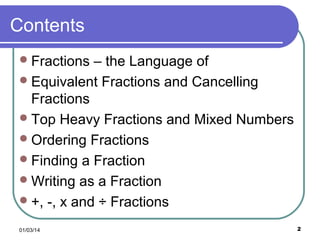
Contents
 Fractions

– the Language of
 Equivalent Fractions and Cancelling
Fractions
 Top Heavy Fractions and Mixed Numbers
 Ordering Fractions
 Finding a Fraction
 Writing as a Fraction
 +, -, x and ÷ Fractions
01/03/14

2
What are Fractions ?
 Parts

1
2

 Eg.

2
3
1
2
01/03/14

of a whole

3
4

2
3

6
7

Numerator
Denominator

1 1 1 1
3 4 5 50

Unit Fractions
3
Fractions
 What

1
2

do they mean …
We have 1 of those parts
The whole is split into 2 parts

3
4

We have 3 of those parts
The whole is split into 4 parts

01/03/14

4
Equivalent Fractions
1
2

=

2
4

3
4

=

12
16

x2

1
2
01/03/14

=
x2

2
4

x4

3
4

12
= 16

x4

5
Equivalent Fractions

5
8

x4

x3

= 32

20

x4

7
12

21

= 36

x3

6
Cancelling Fractions
 Reducing

fractions to their simplest form
 Equivalent fractions using the smallest
numbers
5
 Reduce
10 to simplest form
 Find HCF of 5 and 10
5
 So divide both numerator & denominator by 5

5
10
01/03/14

÷5

=
÷5

1
2
7
Cancelling Fractions
 Cancel

 HCF

=3

 So,

12
15

÷3

=
÷3

01/03/14

16
36

12
15
HCF = 4

4
5

16
36

÷4

=
÷4

4
9
Top Heavy Fractions & Mixed Numbers

2

7
3

1
3

 Convert

12
5

into a mixed number

1

1

+

 12
01/03/14

+

2
5

=

2

2
5

2
÷ 5 = 2 with 5 left over
9
Top Heavy Fractions & Mixed
Numbers
 Convert
 26

26 into a mixed number
3

÷ 3 = 8, with 2 left over, so
3

8

2
3

3

3 into a top heavy fraction
5
18
5
 How many fifths
 Convert

01/03/14

10
Top Heavy Fractions & Mixed
Numbers
 Convert
 So
 Try


01/03/14

3

3

3
5

into a top heavy fraction

3 = ( 3 x 5 )+ 3
5
5

3

1
3

(3x 3 )+ 1 10
=
3
3

18
=
5

5

3
7

(5x7) + 3
38
=
7
7
11
Ordering Fractions
1
5
 But

3
5

4
5

2
5

3
5

Easy !!

what about …..
5
8

11
20

 Convert

to equivalent fractions with
same denominator first
40
 Find LCM of 5, 8 and 20 (denominators)
01/03/14

12
Ordering Fractions
3
5

=

 Now

24
40

11
20

=

22
40

24
40

25
40

then answer the question
11
20

01/03/14

=

25
40

put them in order …
22
40

 So,

5
8

3
5

5
8
13
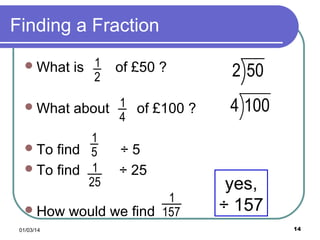
Finding a Fraction
 What

is 1

 What

about 1 of £100 ?

2

1
 To find 5
 To find 1
25

of £50 ?
4

÷5
÷ 25

1
 How would we find 157
01/03/14

2 50
4 100

yes,
÷ 157
14
Finding a Fraction
 What

about 2 of £125 ?
5

1
 Find 5 first –

25
5 125

 Then,

x by 2

 So, 2

25
x2
50

of £125 is £50

5

01/03/14

15
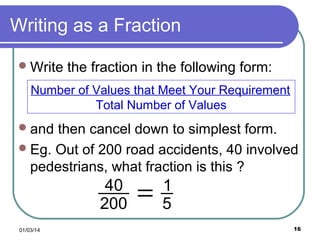
Writing as a Fraction
 Write

the fraction in the following form:

Number of Values that Meet Your Requirement
Total Number of Values
 and

then cancel down to simplest form.
 Eg. Out of 200 road accidents, 40 involved
pedestrians, what fraction is this ?

40
200
01/03/14

=

1
5
16
Adding Fractions
 Denominators
 Eg.

1
5

+

must be the same

3
5

=

4
5

 Convert

to equivalent fractions with
same denominator, if necessary

01/03/14

17
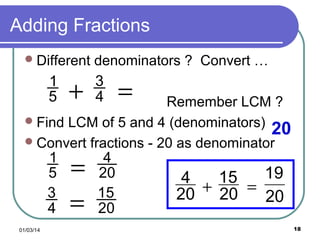
Adding Fractions
 Different

1
5

+

denominators ? Convert …

3
4

=

Remember LCM ?
 Find LCM of 5 and 4 (denominators)
20
 Convert fractions - 20 as denominator
1
4
5
20
19
15
4
+ 20 =
3
15
20
20
4
20

=
=

01/03/14

18
Subtracting Fractions
 Subtraction
 Eg.

3
5

works the same

−

1
5

=

2
5

 Convert

to equivalent fractions with
same denominator, if necessary

01/03/14

19
Subtracting Fractions
 Different

1
2

−

denominators – convert …

2
5

=

LCM of 2 and 5 (denominators) 10
 Convert fractions - 10 as denominator
5
1
2
10
1
5
4
− 10 =
2
4
10
10
5
10
 Find

=
=

01/03/14

20
Adding & Subtracting Fractions
 Use

the following steps, where relevant
 Convert to top heavy fractions
 Convert to equivalent fractions with
same denominator
 Add or subtract the numerators
 Cancel down to simplest terms
 Convert back to mixed number
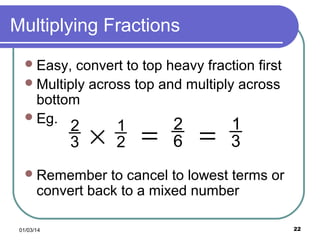
Multiplying Fractions
 Easy,

convert to top heavy fraction first
 Multiply across top and multiply across
bottom
 Eg.
2
1

2
3

×

1
2

=

6

=

3

 Remember

to cancel to lowest terms or
convert back to a mixed number

01/03/14

22
Dividing Fractions
 Just

as easy ! Again, convert to top
heavy fractions first, if necessary.
 Rule:- Turn the 2nd fraction upside down
and then multiply

2
5

÷

3
8

=

2
5

×

8
3

=

16
15

=

1

1
15

 Answers

must be in their simplest form
and as mixed numbers if appropriate

01/03/14

23
+, -, x and ÷ Fractions
 Always

…
 Give your answer in its simplest form
 Use mixed numbers where relevant

01/03/14

24
Session Summary
 Fractions

– the Language of
 Equivalent Fractions and Cancelling
Fractions
 Top Heavy Fractions and Mixed Numbers
 Ordering Fractions
 Finding a Fraction
 Writing as a Fraction
 +, -, x and ÷ Fractions
01/03/14

25

Fractions

  • 1.
  • 2.
    Contents  Fractions – theLanguage of  Equivalent Fractions and Cancelling Fractions  Top Heavy Fractions and Mixed Numbers  Ordering Fractions  Finding a Fraction  Writing as a Fraction  +, -, x and ÷ Fractions 01/03/14 2
  • 3.
    What are Fractions?  Parts 1 2  Eg. 2 3 1 2 01/03/14 of a whole 3 4 2 3 6 7 Numerator Denominator 1 1 1 1 3 4 5 50 Unit Fractions 3
  • 4.
    Fractions  What 1 2 do theymean … We have 1 of those parts The whole is split into 2 parts 3 4 We have 3 of those parts The whole is split into 4 parts 01/03/14 4
  • 5.
  • 6.
  • 7.
    Cancelling Fractions  Reducing fractionsto their simplest form  Equivalent fractions using the smallest numbers 5  Reduce 10 to simplest form  Find HCF of 5 and 10 5  So divide both numerator & denominator by 5 5 10 01/03/14 ÷5 = ÷5 1 2 7
  • 8.
    Cancelling Fractions  Cancel HCF =3  So, 12 15 ÷3 = ÷3 01/03/14 16 36 12 15 HCF = 4 4 5 16 36 ÷4 = ÷4 4 9
  • 9.
    Top Heavy Fractions& Mixed Numbers 2 7 3 1 3  Convert 12 5 into a mixed number 1 1 +  12 01/03/14 + 2 5 = 2 2 5 2 ÷ 5 = 2 with 5 left over 9
  • 10.
    Top Heavy Fractions& Mixed Numbers  Convert  26 26 into a mixed number 3 ÷ 3 = 8, with 2 left over, so 3 8 2 3 3 3 into a top heavy fraction 5 18 5  How many fifths  Convert 01/03/14 10
  • 11.
    Top Heavy Fractions& Mixed Numbers  Convert  So  Try  01/03/14 3 3 3 5 into a top heavy fraction 3 = ( 3 x 5 )+ 3 5 5 3 1 3 (3x 3 )+ 1 10 = 3 3 18 = 5 5 3 7 (5x7) + 3 38 = 7 7 11
  • 12.
    Ordering Fractions 1 5  But 3 5 4 5 2 5 3 5 Easy!! what about ….. 5 8 11 20  Convert to equivalent fractions with same denominator first 40  Find LCM of 5, 8 and 20 (denominators) 01/03/14 12
  • 13.
    Ordering Fractions 3 5 =  Now 24 40 11 20 = 22 40 24 40 25 40 thenanswer the question 11 20 01/03/14 = 25 40 put them in order … 22 40  So, 5 8 3 5 5 8 13
  • 14.
    Finding a Fraction What is 1  What about 1 of £100 ? 2 1  To find 5  To find 1 25 of £50 ? 4 ÷5 ÷ 25 1  How would we find 157 01/03/14 2 50 4 100 yes, ÷ 157 14
  • 15.
    Finding a Fraction What about 2 of £125 ? 5 1  Find 5 first – 25 5 125  Then, x by 2  So, 2 25 x2 50 of £125 is £50 5 01/03/14 15
  • 16.
    Writing as aFraction  Write the fraction in the following form: Number of Values that Meet Your Requirement Total Number of Values  and then cancel down to simplest form.  Eg. Out of 200 road accidents, 40 involved pedestrians, what fraction is this ? 40 200 01/03/14 = 1 5 16
  • 17.
    Adding Fractions  Denominators Eg. 1 5 + must be the same 3 5 = 4 5  Convert to equivalent fractions with same denominator, if necessary 01/03/14 17
  • 18.
    Adding Fractions  Different 1 5 + denominators? Convert … 3 4 = Remember LCM ?  Find LCM of 5 and 4 (denominators) 20  Convert fractions - 20 as denominator 1 4 5 20 19 15 4 + 20 = 3 15 20 20 4 20 = = 01/03/14 18
  • 19.
    Subtracting Fractions  Subtraction Eg. 3 5 works the same − 1 5 = 2 5  Convert to equivalent fractions with same denominator, if necessary 01/03/14 19
  • 20.
    Subtracting Fractions  Different 1 2 − denominators– convert … 2 5 = LCM of 2 and 5 (denominators) 10  Convert fractions - 10 as denominator 5 1 2 10 1 5 4 − 10 = 2 4 10 10 5 10  Find = = 01/03/14 20
  • 21.
    Adding & SubtractingFractions  Use the following steps, where relevant  Convert to top heavy fractions  Convert to equivalent fractions with same denominator  Add or subtract the numerators  Cancel down to simplest terms  Convert back to mixed number
  • 22.
    Multiplying Fractions  Easy, convertto top heavy fraction first  Multiply across top and multiply across bottom  Eg. 2 1 2 3 × 1 2 = 6 = 3  Remember to cancel to lowest terms or convert back to a mixed number 01/03/14 22
  • 23.
    Dividing Fractions  Just aseasy ! Again, convert to top heavy fractions first, if necessary.  Rule:- Turn the 2nd fraction upside down and then multiply 2 5 ÷ 3 8 = 2 5 × 8 3 = 16 15 = 1 1 15  Answers must be in their simplest form and as mixed numbers if appropriate 01/03/14 23
  • 24.
    +, -, xand ÷ Fractions  Always …  Give your answer in its simplest form  Use mixed numbers where relevant 01/03/14 24
  • 25.
    Session Summary  Fractions –the Language of  Equivalent Fractions and Cancelling Fractions  Top Heavy Fractions and Mixed Numbers  Ordering Fractions  Finding a Fraction  Writing as a Fraction  +, -, x and ÷ Fractions 01/03/14 25