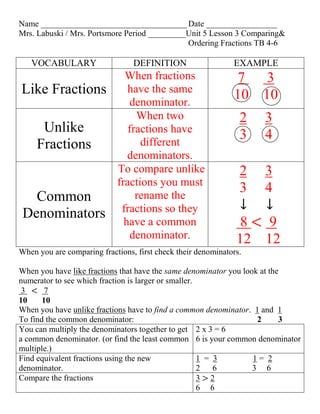
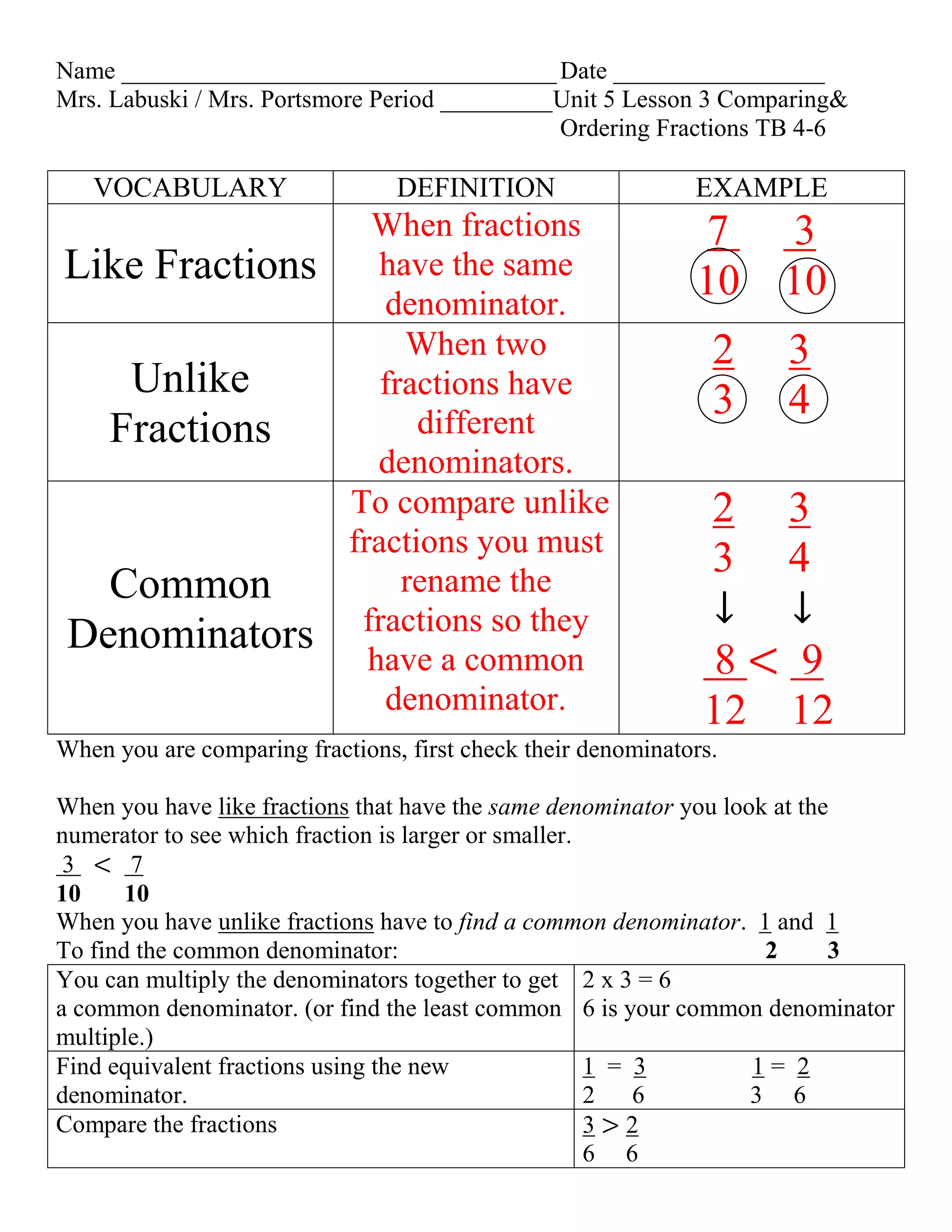
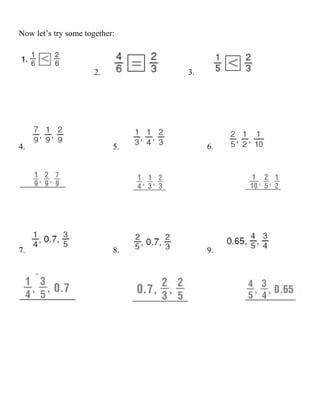
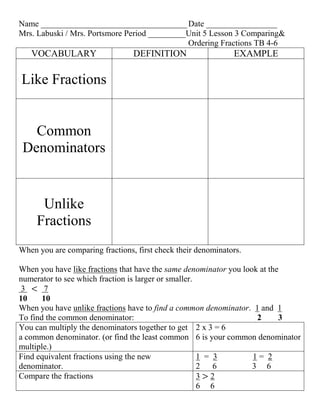
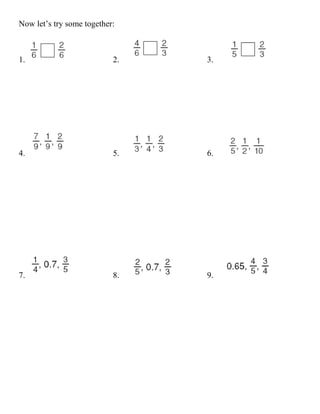
This document provides definitions and examples for comparing and ordering fractions. It explains that when fractions have the same denominator, they are like fractions and can be directly compared by looking at the numerators. For unlike fractions with different denominators, a common denominator must be found, such as the least common multiple of the denominators, so the fractions can be converted to equivalent fractions with the same denominator and then compared. Examples are provided of finding a common denominator and comparing fractions.