F.R.A.C.A.S. Failure Reporting, Analysis and Corrective Action System Presented by: Andy Page
Phone is  Listen Only During the Webinar….email questions to [email_address]
F.R.A.C.A.S. Webinar Objectives What is it? How do you use the results? How do you set it up? Biggest Challenges Summary and Wrap up
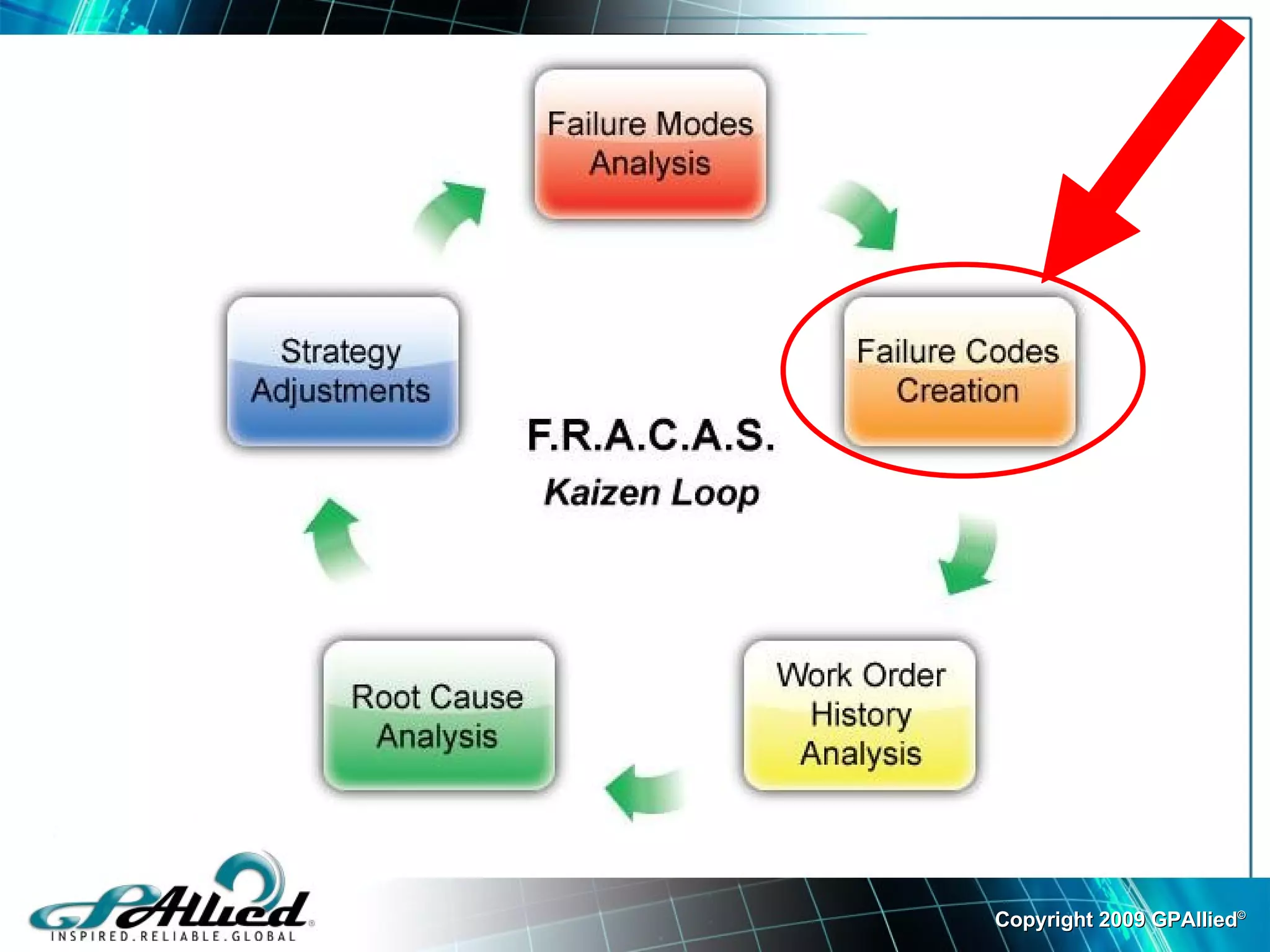
Definition fracas: n. A noisy, disorderly fight or quarrel; a brawl F.R.A.C.A.S. –  A system for recording the nature of equipment failures, analyzing the data for patterns and making business decisions based on the conclusions drawn from the data Predominantly talking about CMMS Failure Codes and how they can be used. Also, talking about the other failure characteristics  Mean Time to Repair Work Request Sources
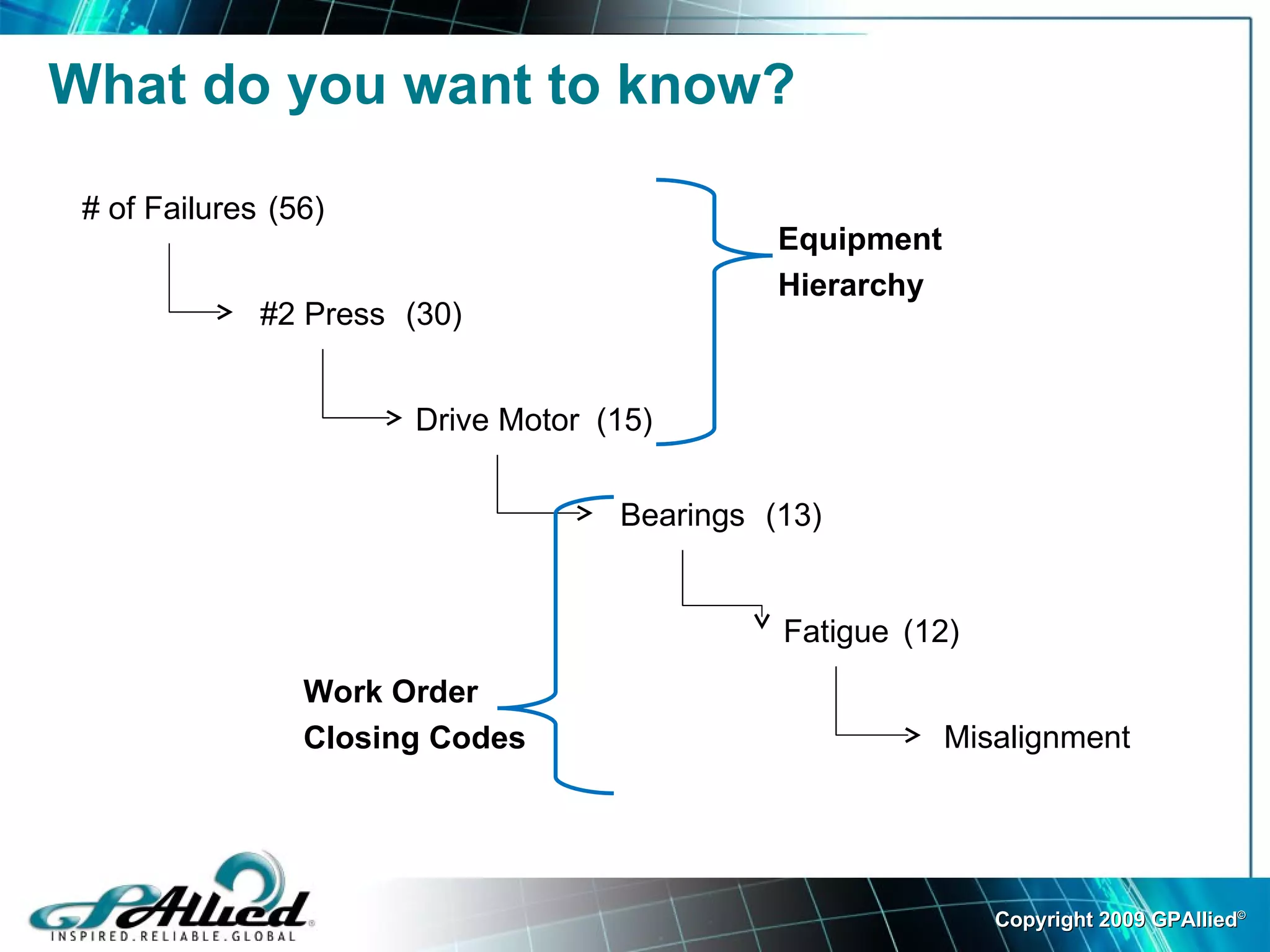
What do you want to know? # of Failures (56) #2 Press (30) Drive Motor (15) Bearings (13) (12) Fatigue Misalignment Equipment Hierarchy Work Order Closing Codes
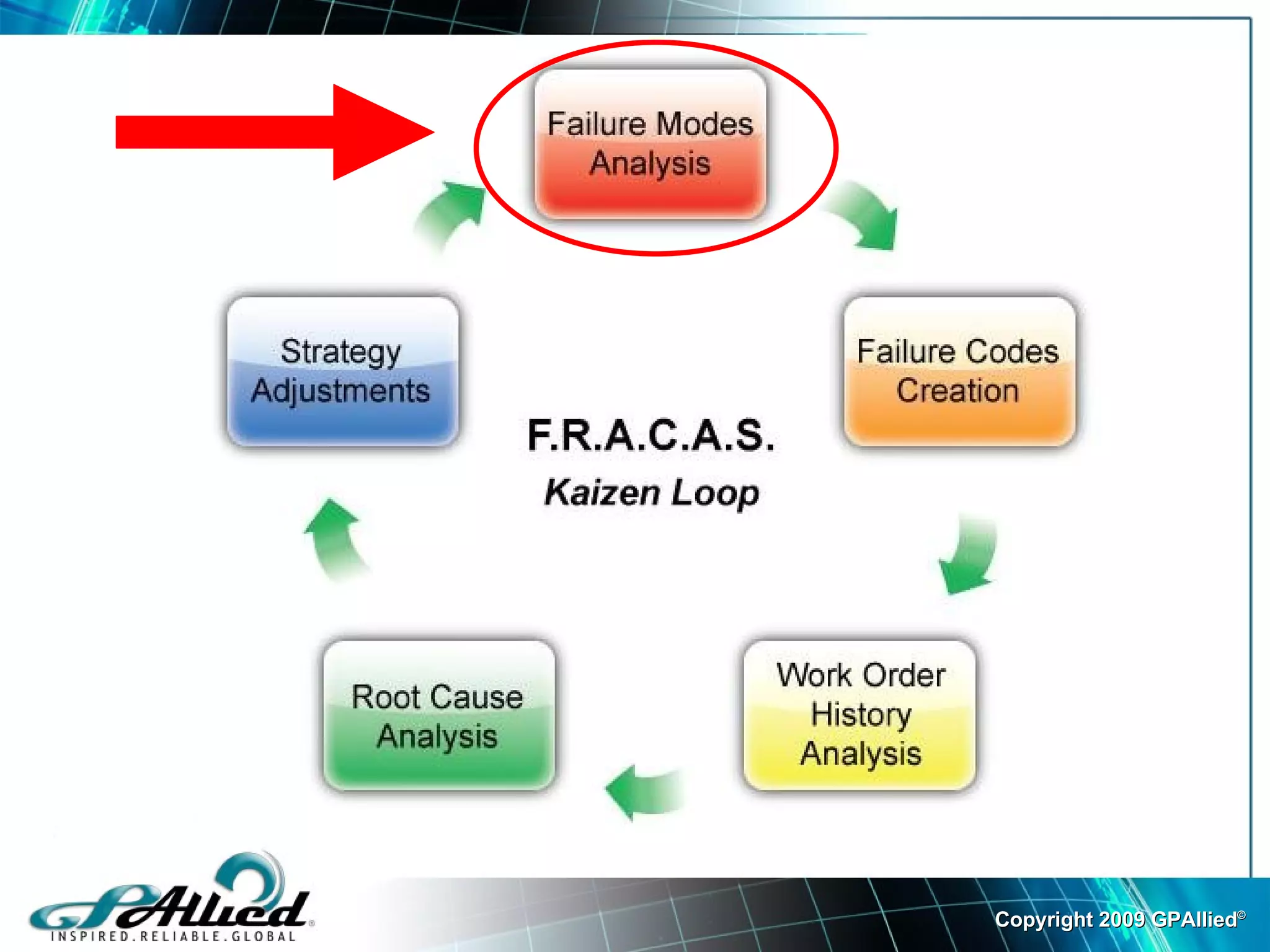
This is not a coincidence! Failure Modes C
 
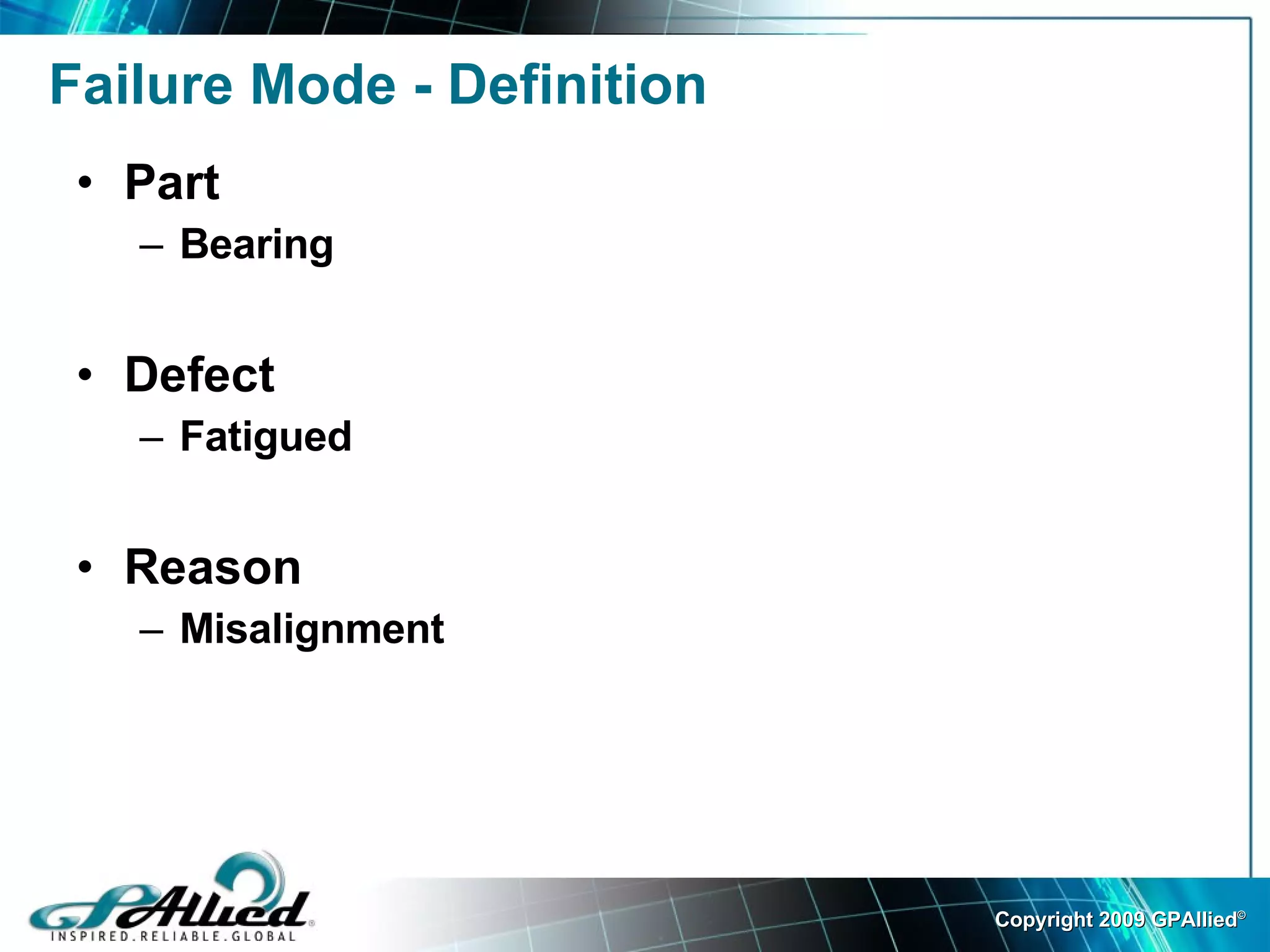
Failure Mode - Definition Part Bearing Defect Fatigued Reason Misalignment
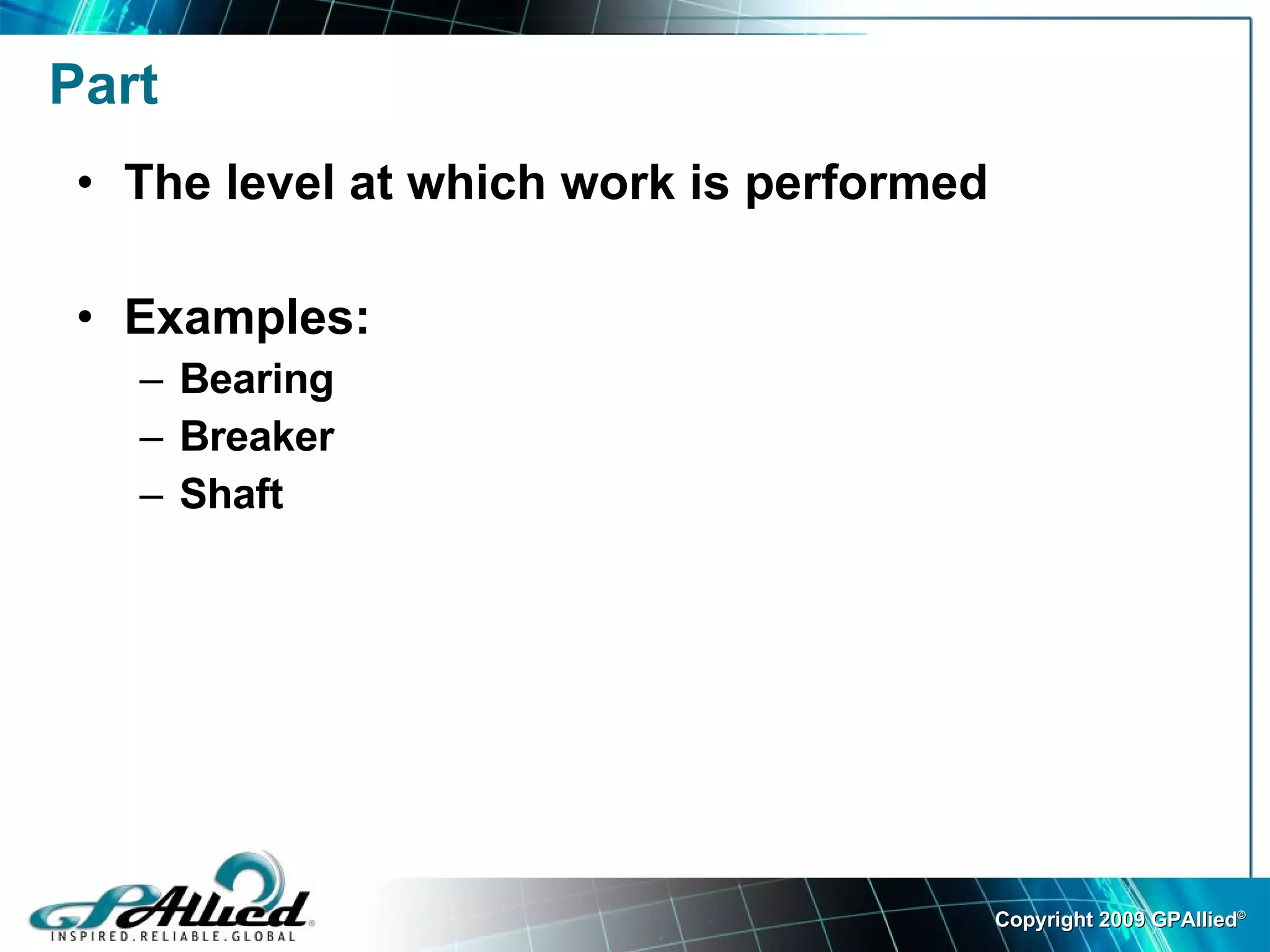
Part The level at which work is performed Examples: Bearing Breaker Shaft
Defect Not just the Mode Worn Not descriptive enough Has to include Failure Mechanism When the mechanism is descriptive Knowing the mechanism might change the countermeasure (task) Example: Adhesive Wear versus Abrasive Wear
Reason Describes the action or condition that was physically responsible for the problem Example: Improper Installation NOT another failure Cannot reference another failure mode as the reason why this failure mode is present These are called “Secondary Effects” Example: Bearing – Abrasive Wear – Seal Failed
For “Reason”…how deep do I go? Bearing Defect Effect Physical Cause Human Cause Systemic Cause Latent Cause Shaft Misalignment
 
“ We only need a few codes…” What we expected (Failure Modes) What we recorded (Failure Codes)
Real World Example Failure Modes Bearing – Fatigued – Age Bearing – Fatigued – Imbalance Bearing – Fatigued – Misalignment Bearing – Abrasive Wear – Contaminants Bearing – Adhesive Wear - Age Failure Codes Pump - Stopped Pump - Making Noise Pump - Not Pumping Shaft – Seized
 
Work Order History Report # of Failures (56) #2 Press (30) Drive Motor (15) Bearings (13) (12) Fatigue Misalignment
This is what you are looking for Contains the Failure Mode Independent of Equipment Type Shows the BIG picture What would be the “Corrective Action”? # of Instances Failure Code 78 Misalignment – Improper Assembly 56 Bearing Fatigue – Misalignment 32 Loose Connections – Improper Assembly 22 Soft Foot – Improper Assembly 8 Abrasive Wear – Improper Lube Procedure 1 Turn-to-Turn Short – Background Vibration
LEAN Terminology Yokoten (“push to the side”) Take what you have learned on this machine and apply it to other like machines FRACAS “ If it has happened to this machine…how many other machines has it happened to as well?” Even more importantly…”How many other machines is it  about  to happen to?”
 
Now…we go deep Bearing Defect Effect Physical Cause Human Cause Systemic Cause Latent Cause Shaft Misalignment No Training Standard No Performance Standard No Repair Standard Organizational Attitude Towards The Value of Precision Maintenance Skills Deficiency Lack of Motivation Lack of Time
2 “Un-pardonables” for Reliability Engineers To fix the same problem twice This really means you never FIXED it the first time. You most likely addressed the  Symptom  and not the  Problem To know a problem is coming and not be prepared to deal with it efficiently  Run-to-Fail is a perfectly valid strategy for some things But to not be ready is unpardonable Job Plans on File Ready access to spare parts
 
Strategy Adjustments Changing the Equipment Maintenance Plan Different PM Task Different Inspection Task Different Frequency Different Operating Philosophy 70% of failures come from improper operation 30% of failures come from improper/inadequate maintenance
Biggest Challenges Crafts personnel or Supervision won’t always know the Part - Defect – Reason in the field If they simply Remove & Replace…FRACAS will  never  happen Someone has to be responsible to perform the failure analysis and get that data into the CMMS For a while, you will constantly find that you need a Failure Code that is not in the system This means that you Failure Modes Library isn’t complete yet
Implementation Plan – Part 1 Start Small & Take It Slow Critical Equipment Only (Top 20%) Let work processes mature around the new requirements Trigger for next level All Work Orders = Closing Codes Take the next 20% Work your way up to 100%
Implementation Plan – Part 2 Define your work control processes Assign Goals, Roles and Responsibilities Individual responsibilities for data entry and analysis can be anyone’s…just make sure it is officially assigned Institute a system for checking compliance A system for addressing non-compliance
Implementation Plan – Part 3 Identify the Top 20% of your equipment Identify Failure Modes Populate CMMS with Failure Codes Close Each Work Order for Critical Equipment On Scheduled Basis…run analysis reports Analyze whole plant or areas Not much deeper Not by equipment types Focus too small…you’ll miss the big patterns
Summary Powerful method for making the organization a “learning organization” Learn from mistakes A different way of thinking about failure analysis No longer is it…which MACHINE is giving us trouble It is now…what are our dominant issues across the plant
Summary - continued Everybody wants the benefits of FRACAS but few people are willing to put forth the effort to “Feed the Beast” Not willing to put the work control processes in place to make it a reality Not willing to hold people accountable for non-compliance

FRACAS, Failure Reporting Analysis, Corrective Action System

  • 1.
  • 2.
    F.R.A.C.A.S. Failure Reporting,Analysis and Corrective Action System Presented by: Andy Page
  • 3.
    Phone is Listen Only During the Webinar….email questions to [email_address]
  • 4.
    F.R.A.C.A.S. Webinar ObjectivesWhat is it? How do you use the results? How do you set it up? Biggest Challenges Summary and Wrap up
  • 5.
    Definition fracas: n.A noisy, disorderly fight or quarrel; a brawl F.R.A.C.A.S. – A system for recording the nature of equipment failures, analyzing the data for patterns and making business decisions based on the conclusions drawn from the data Predominantly talking about CMMS Failure Codes and how they can be used. Also, talking about the other failure characteristics Mean Time to Repair Work Request Sources
  • 6.
    What do youwant to know? # of Failures (56) #2 Press (30) Drive Motor (15) Bearings (13) (12) Fatigue Misalignment Equipment Hierarchy Work Order Closing Codes
  • 7.
    This is nota coincidence! Failure Modes C
  • 8.
  • 9.
    Failure Mode -Definition Part Bearing Defect Fatigued Reason Misalignment
  • 10.
    Part The levelat which work is performed Examples: Bearing Breaker Shaft
  • 11.
    Defect Not justthe Mode Worn Not descriptive enough Has to include Failure Mechanism When the mechanism is descriptive Knowing the mechanism might change the countermeasure (task) Example: Adhesive Wear versus Abrasive Wear
  • 12.
    Reason Describes theaction or condition that was physically responsible for the problem Example: Improper Installation NOT another failure Cannot reference another failure mode as the reason why this failure mode is present These are called “Secondary Effects” Example: Bearing – Abrasive Wear – Seal Failed
  • 13.
    For “Reason”…how deepdo I go? Bearing Defect Effect Physical Cause Human Cause Systemic Cause Latent Cause Shaft Misalignment
  • 14.
  • 15.
    “ We onlyneed a few codes…” What we expected (Failure Modes) What we recorded (Failure Codes)
  • 16.
    Real World ExampleFailure Modes Bearing – Fatigued – Age Bearing – Fatigued – Imbalance Bearing – Fatigued – Misalignment Bearing – Abrasive Wear – Contaminants Bearing – Adhesive Wear - Age Failure Codes Pump - Stopped Pump - Making Noise Pump - Not Pumping Shaft – Seized
  • 17.
  • 18.
    Work Order HistoryReport # of Failures (56) #2 Press (30) Drive Motor (15) Bearings (13) (12) Fatigue Misalignment
  • 19.
    This is whatyou are looking for Contains the Failure Mode Independent of Equipment Type Shows the BIG picture What would be the “Corrective Action”? # of Instances Failure Code 78 Misalignment – Improper Assembly 56 Bearing Fatigue – Misalignment 32 Loose Connections – Improper Assembly 22 Soft Foot – Improper Assembly 8 Abrasive Wear – Improper Lube Procedure 1 Turn-to-Turn Short – Background Vibration
  • 20.
    LEAN Terminology Yokoten(“push to the side”) Take what you have learned on this machine and apply it to other like machines FRACAS “ If it has happened to this machine…how many other machines has it happened to as well?” Even more importantly…”How many other machines is it about to happen to?”
  • 21.
  • 22.
    Now…we go deepBearing Defect Effect Physical Cause Human Cause Systemic Cause Latent Cause Shaft Misalignment No Training Standard No Performance Standard No Repair Standard Organizational Attitude Towards The Value of Precision Maintenance Skills Deficiency Lack of Motivation Lack of Time
  • 23.
    2 “Un-pardonables” forReliability Engineers To fix the same problem twice This really means you never FIXED it the first time. You most likely addressed the Symptom and not the Problem To know a problem is coming and not be prepared to deal with it efficiently Run-to-Fail is a perfectly valid strategy for some things But to not be ready is unpardonable Job Plans on File Ready access to spare parts
  • 24.
  • 25.
    Strategy Adjustments Changingthe Equipment Maintenance Plan Different PM Task Different Inspection Task Different Frequency Different Operating Philosophy 70% of failures come from improper operation 30% of failures come from improper/inadequate maintenance
  • 26.
    Biggest Challenges Craftspersonnel or Supervision won’t always know the Part - Defect – Reason in the field If they simply Remove & Replace…FRACAS will never happen Someone has to be responsible to perform the failure analysis and get that data into the CMMS For a while, you will constantly find that you need a Failure Code that is not in the system This means that you Failure Modes Library isn’t complete yet
  • 27.
    Implementation Plan –Part 1 Start Small & Take It Slow Critical Equipment Only (Top 20%) Let work processes mature around the new requirements Trigger for next level All Work Orders = Closing Codes Take the next 20% Work your way up to 100%
  • 28.
    Implementation Plan –Part 2 Define your work control processes Assign Goals, Roles and Responsibilities Individual responsibilities for data entry and analysis can be anyone’s…just make sure it is officially assigned Institute a system for checking compliance A system for addressing non-compliance
  • 29.
    Implementation Plan –Part 3 Identify the Top 20% of your equipment Identify Failure Modes Populate CMMS with Failure Codes Close Each Work Order for Critical Equipment On Scheduled Basis…run analysis reports Analyze whole plant or areas Not much deeper Not by equipment types Focus too small…you’ll miss the big patterns
  • 30.
    Summary Powerful methodfor making the organization a “learning organization” Learn from mistakes A different way of thinking about failure analysis No longer is it…which MACHINE is giving us trouble It is now…what are our dominant issues across the plant
  • 31.
    Summary - continuedEverybody wants the benefits of FRACAS but few people are willing to put forth the effort to “Feed the Beast” Not willing to put the work control processes in place to make it a reality Not willing to hold people accountable for non-compliance