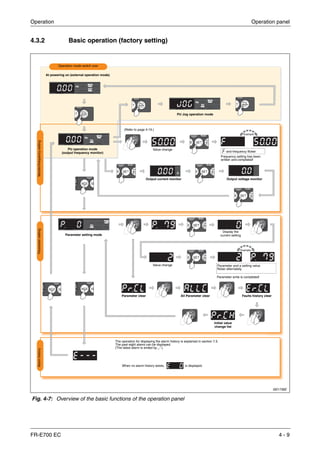
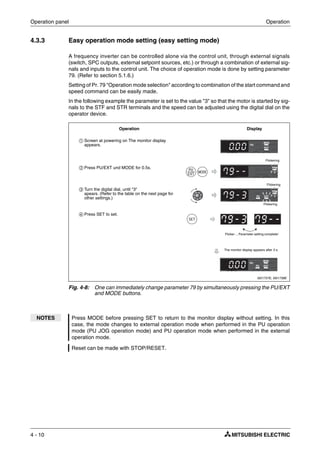
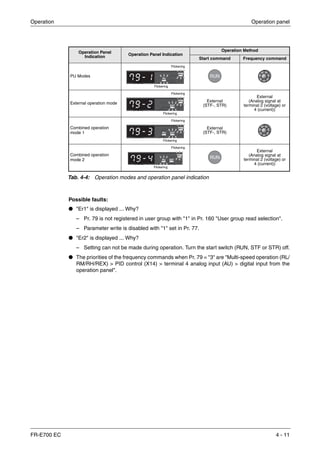
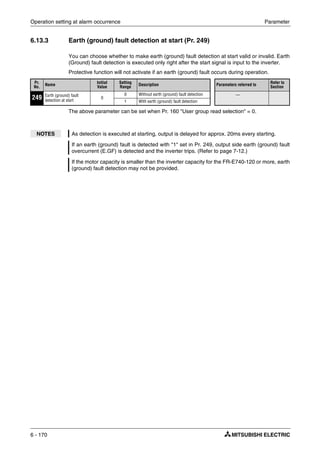
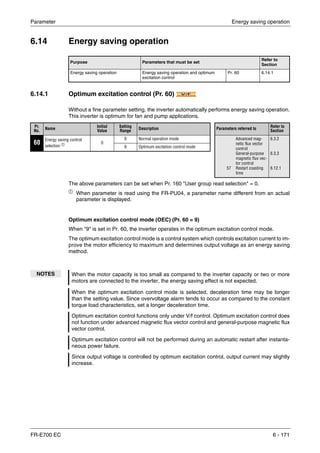
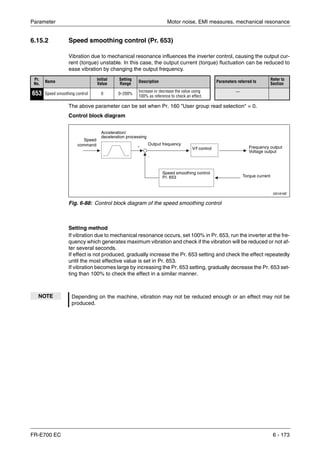
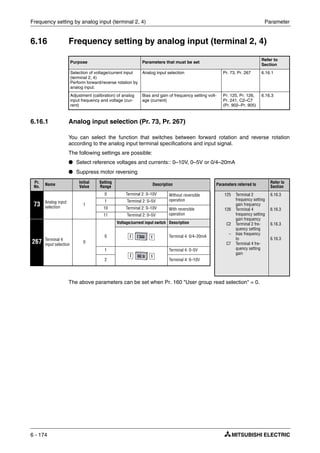
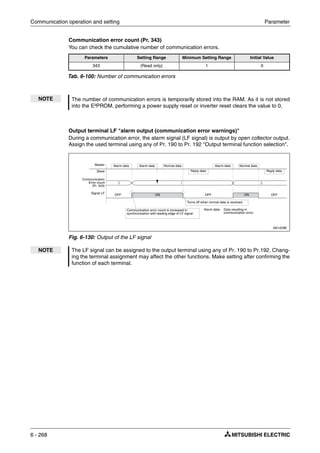
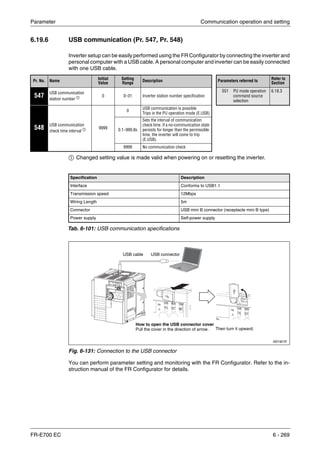
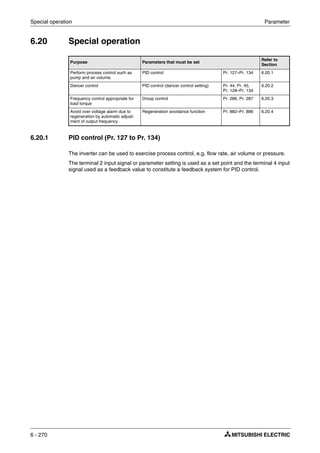
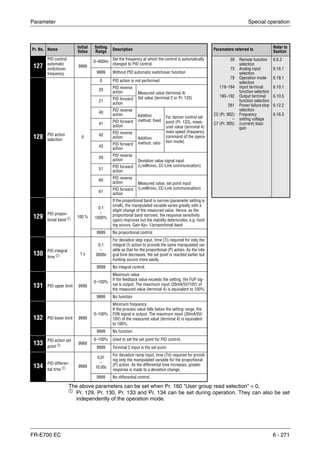
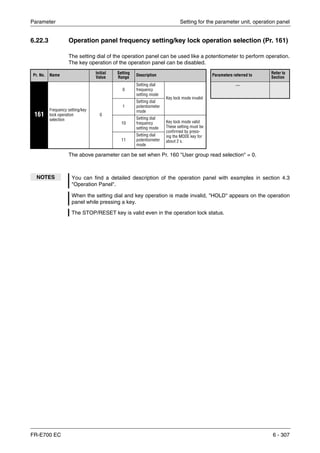
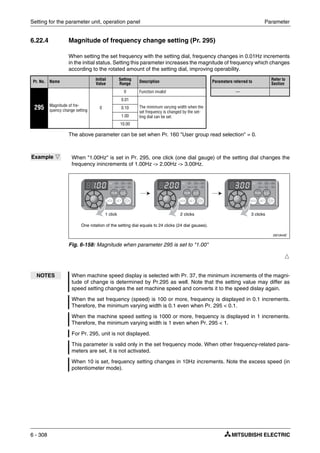
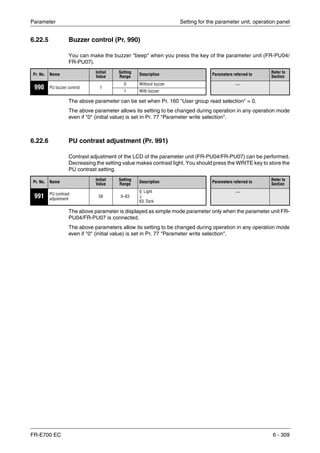
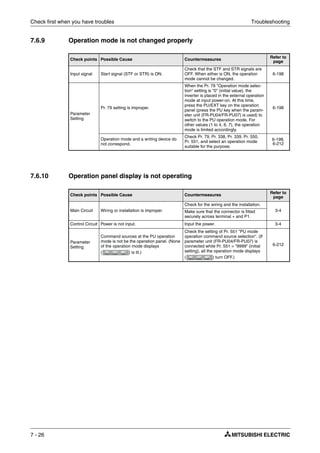
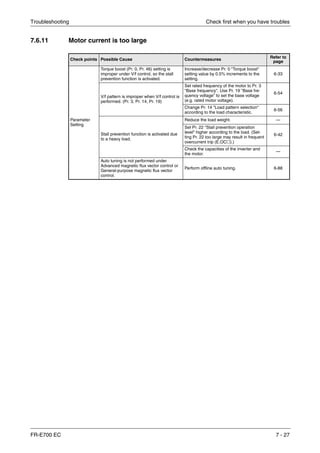
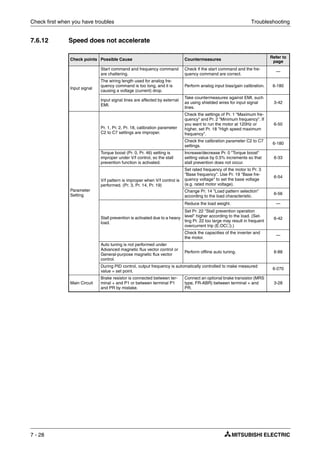
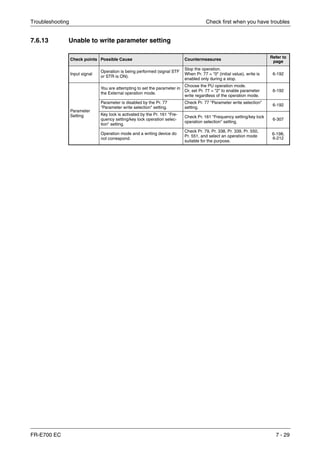
MITSUBISHI ELECTRIC
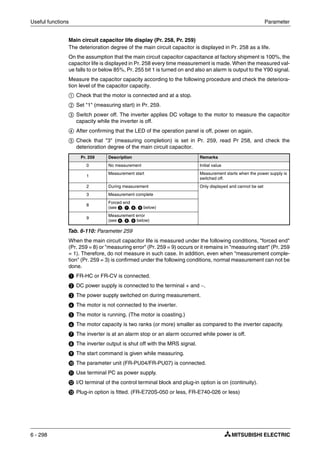
MITSUBISHI ELECTRIC INDUSTRIAL AUTOMATION
FR-E700
Frequency Inverter
Instruction Manual
FR-E720S EC
FR-E740 EC
Art. No: 213994
01 03 2011
Version D
Instruction Manual
Inverter FR-E700 EC
Art. no.: 213994
Version Changes / Additions / Corrections
A 11/2007 pdp —
B 08/2008 pdp General Description of the 3-phase frequency inverter for 400 V
Expansion of performance classes through the frequency inver-
ter FR-E740-230 and 300
Revision and correction of individual sections
C 09/2009 pdp – akl General
Section 7.6
Expansion of the range of models by the inverters FR-E720S for
connection to a single-phase power supply
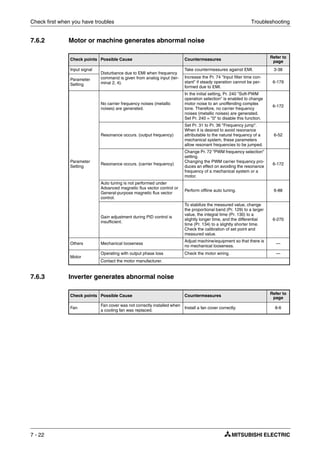
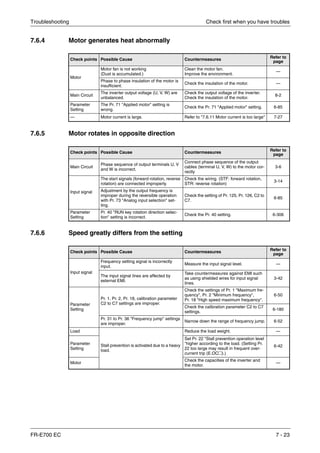
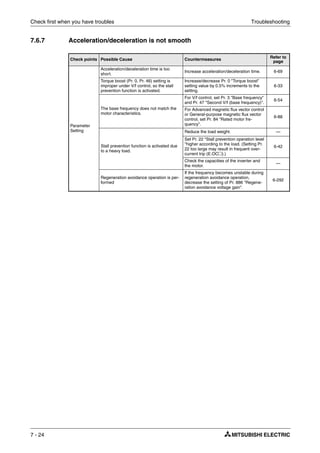
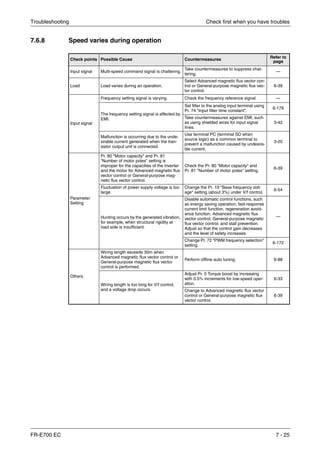
Check first when you have troubles
C1 09/2010 akl Page 3-30
Page 3-32
Thermal relay type name
D 03/2011 akl Chapter 3 Replacement: DC reactor FR-HEL –> FFR-HEL-(H)-E
FR-E700 EC I
Thank you for choosing this Mitsubishi inverter.
This instruction manual provides instructions for advanced use of the FR-E700 series inverters.
Incorrect handling might cause an unexpected fault. Before using the inverter, always read this
instruction manual to use the equipment to its optimum.
Safety instructions
Do not attempt to install, operate, maintain or inspect the inverter until you have read through
this instruction manual carefully and can use the equipment correctly. Do not use the inverter un-
til you have a full knowledge of the equipment, safety information and instructions. In this in-
struction manual, the safety instruction levels are classified into "WARNING" and "CAUTION".
Note that even the CAUTION level may lead to a serious consequence according to conditions.
Please follow strictly the instructions of both levels because they are important to personnel
safety.
P
WARNING:
Assumes that incorrect handling may cause hazardous conditions, resulting in death
or severe injury.
E
CAUTION:
Assumes that incorrect handling may cause hazardous conditions, resulting in medi-
um or slight injury, or may cause physical damage only.
II
Electric Shock Prevention
P
WARNING:
● While power is on or when the inverter is running, do not open the front cover.
Otherwise you may get an electric shock.
● Do not run the inverter with the front cover removed. Otherwise, you may access
the exposed high-voltage terminals or the charging part of the circuitry and get an
electric shock.
● Even if power is off, do not remove the front cover except for wiring or periodic
inspection. You may access the charged inverter circuits and get an electric shock.
● Before starting wiring or inspection, check to make sure that the operation panel
indicator is off, wait for at least 10 minutes after the power supply has been switched
off, and check that there are no residual voltage using a tester or the like. The
capacitor is charged with high voltage for some time after power off and it is
dangerous.
● This inverter must be earthed. Earthing must conform to the requirements of
national and local safety regulations and electrical codes. (JIS, NEC section 250,
IEC 536 class 1 and other applicable standards)
Use a neutral-point earthed (grounded) power supply for 400V class inverter in
compliance with EN standard.
● Any person who is involved in the wiring or inspection of this equipment should
be fully competent to do the work.
● Always install the inverter before wiring. Otherwise, you may get an electric shock
or be injured.
● Perform setting dial and key operations with dry hands to prevent an electric shock.
Otherwise you may get an electric shock.
● Do not subject the cables to scratches, excessive stress, heavy loads or pinching.
Otherwise you may get an electric shock.
● Do not replace the cooling fan while power is on. It is dangerous to replace the
cooling fan while power is on.
● Do not touch the printed circuit board with wet hands. You may get an electric shock.
● When measuring the main circuit capacitor capacity, the DC voltage is applied to
the motor for 1s at powering off. Never touch the motor terminal, etc. right after
powering off to prevent an electric shock.
FR-E700 EC III
Fire Prevention
Injury Prevention
E
CAUTION:
● Mount the inverter to incombustible material. Install the inverter on a nonflammable
wall without holes (so that nobody can touch the inverter heatsink on the rear side,
etc.). Mounting it to or near combustible material can cause a fire.
● If the inverter has become faulty, switch off the inverter power. A continuous flow
of large current could cause a fire.
● When using a brake resistor, make up a sequence that will turn off power when an
alarm signal is output. Otherwise, the brake resistor may excessively overheat due
to damage of the brake transistor and such, causing a fire.
● Do not connect a resistor directly to the DC terminals +, –. This could cause a fire
and destroy the inverter. The surface temperature of braking resistors can far
exceed 100°C for brief periods. Make sure that there is adequate protection against
accidental contact and a safe distance is maintained to other units and system
parts.
E
CAUTION:
● Apply only the voltage specified in the instruction manual to each terminal. Other-
wise, burst, damage, etc. may occur.
● Ensure that the cables are connected to the correct terminals. Otherwise, burst,
damage, etc. may occur.
● Always make sure that polarity is correct to prevent damage, etc. Otherwise, burst,
damage, etc. may occur.
● While power is on or for some time after power-off, do not touch the inverter as it
is hot and you may get burnt.
IV
Additional Instructions
Also note the following points to prevent an accidental failure, injury, electric shock, etc.
Transport und Installation
ቢ
Temperature applicable for a short time, e.g. in transit.
Wiring
E
CAUTION:
● Transport the product using the correct method that corresponds to the weight.
Failure to observe this could lead to injuries.
● Do not stack the inverter boxes higher than the number recommended.
● Ensure that installation position and material can withstand the weight of the
inverter. Install according to the information in the instruction manual.
● Do not install or operate the inverter if it is damaged or has parts missing. This can
result in breakdowns.
● When carrying the inverter, do not hold it by the front cover or setting dial; it may
fall off or fail.
● Do not stand or rest heavy objects on the product.
● Check the inverter mounting orientation is correct.
● Prevent other conductive bodies such as screws and metal fragments or other
flammable substance such as oil from entering the inverter.
● As the inverter is a precision instrument, do not drop or subject it to impact.
● Use the inverter under the following environmental conditions. Otherwise, the
inverter may be damaged.
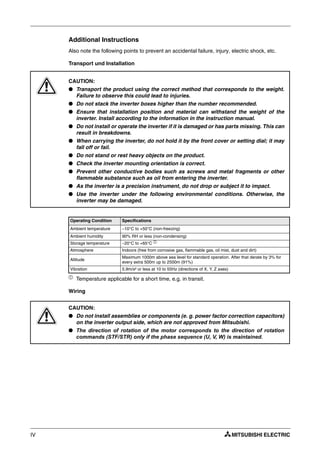
Operating Condition Specifications
Ambient temperature −10°C to +50°C (non-freezing)
Ambient humidity 90% RH or less (non-condensing)
Storage temperature −20°C to +65°C ቢ
Atmosphere Indoors (free from corrosive gas, flammable gas, oil mist, dust and dirt)
Altitude
Maximum 1000m above sea level for standard operation. After that derate by 3% for
every extra 500m up to 2500m (91%)
Vibration 5.9m/s² or less at 10 to 55Hz (directions of X, Y, Z axes)
E
CAUTION:
● Do not install assemblies or components (e. g. power factor correction capacitors)
on the inverter output side, which are not approved from Mitsubishi.
● The direction of rotation of the motor corresponds to the direction of rotation
commands (STF/STR) only if the phase sequence (U, V, W) is maintained.
FR-E700 EC V
Trial run
Operation
E
CAUTION:
● Before starting operation, confirm and adjust the parameters. A failure to do so
may cause some machines to make unexpected motions.
P
WARNING:
● When you have chosen the retry function, stay away from the equipment as it will
restart suddenly after an alarm stop.
● Since pressing the STOP/RESET-key may not stop output depending on the func-
tion setting status, provide a circuit and switch separately to make an emergency
stop (power off, mechanical brake operation for emergency stop, etc).
● Make sure that the start signal is off before resetting the inverter alarm. A failure
to do so may restart the motor suddenly.
● The load used should be a three-phase induction motor only. Connection of any
other electrical equipment to the inverter output may damage the equipment.
● Do not modify the equipment.
● Do not perform parts removal which is not instructed in this manual. Doing so may
lead to fault or damage of the inverter.
E
CAUTION:
● The electronic thermal relay function does not guarantee protection of the motor
from overheating. It is recommended to install both an external thermal and PTC
thermistor for overheat protection.
● Do not use a magnetic contactor on the inverter input for frequent starting/stopping
of the inverter. Otherwise, the life of the inverter decreases.
● Use a noise filter to reduce the effect of electromagnetic interference and follow
the accepted EMC procedures for proper installation of frequency inverters. Oth-
erwise nearby electronic equipment may be affected.
● Take appropriate measures regarding harmonics. Otherwise this can endanger
compensation systems or overload generators.
● Use a motor designed for inverter operation. (The stress for motor windings is
bigger than in line power supply).
● When parameter clear or all clear is performed, set again the required parameters
before starting operations. Each parameter returns to the initial value.
● The inverter can be easily set for high-speed operation. Before changing its setting,
fully examine the performances of the motor and machine.
● The DC braking function of the frequency inverter is not designed to continuously
hold a load. Use an electro-mechanical holding brake on the motor for this purpose.
● Before running an inverter which had been stored for a long period, always perform
inspection and test operation.
● For prevention of damage due to static electricity, touch nearby metal before
touching this product to eliminate static electricity from your body.
VI
Emergency stop
Maintenance, inspection and parts replacement
Disposing the inverter
General instructions
Many of the diagrams and drawings in instruction manuals show the inverter without a cover, or
partially open. Never run the inverter in this status. Always replace the cover and follow this in-
struction manual when operating the inverter.
E
CAUTION:
● Provide a safety backup such as an emergency brake which will prevent the
machine and equipment from hazardous conditions if the inverter fails.
● When the breaker on the inverter primary side trips, check for the wiring fault (short
circuit), damage to internal parts of the inverter, etc. Identify the cause of the trip,
then remove the cause and power on the breaker.
● When the protective function is activated (i. e. the frequency inverter switches off
with an error message), take the corresponding corrective action as described in
the inverter manual, then reset the inverter, and resume operation.
E
CAUTION:
● Do not carry out a megger (insulation resistance) test on the control circuit of the
inverter. It will cause a failure.
E
CAUTION:
● Treat as industrial waste.
Contents
FR-E700 EC VII
Contents
1 Product checking and part identification
1.1 Inverter type . . . . . . . . . . . . . . . . . . . . . . . . . . . . . . . . . . . . . . . . . . . . . . . . . . . .1-1
1.2 Description of the Case . . . . . . . . . . . . . . . . . . . . . . . . . . . . . . . . . . . . . . . . . . .1-2
1.2.1 Accessory . . . . . . . . . . . . . . . . . . . . . . . . . . . . . . . . . . . . . . . . . . . . . . .1-3
2 Installation
2.1 Removal and reinstallation of the front cover . . . . . . . . . . . . . . . . . . . . . . . . . . .2-1
2.1.1 FR-E720S and FR-E740-016 to FR-E740-170 . . . . . . . . . . . . . . . . . . .2-1
2.1.2 FR-E740-230 and FR-E740-300 . . . . . . . . . . . . . . . . . . . . . . . . . . . . . .2-2
2.2 Removal and reinstallation of the wiring cover. . . . . . . . . . . . . . . . . . . . . . . . . .2-4
2.3 Mounting. . . . . . . . . . . . . . . . . . . . . . . . . . . . . . . . . . . . . . . . . . . . . . . . . . . . . . .2-5
2.4 Enclosure design . . . . . . . . . . . . . . . . . . . . . . . . . . . . . . . . . . . . . . . . . . . . . . . .2-7
2.4.1 Inverter installation environment . . . . . . . . . . . . . . . . . . . . . . . . . . . . . .2-7
2.4.2 Inverter placement . . . . . . . . . . . . . . . . . . . . . . . . . . . . . . . . . . . . . . .2-11
3 Wiring
3.1 Inverter and peripheral devices . . . . . . . . . . . . . . . . . . . . . . . . . . . . . . . . . . . . .3-1
3.1.1 Peripheral devices. . . . . . . . . . . . . . . . . . . . . . . . . . . . . . . . . . . . . . . . .3-3
3.2 Terminal connection diagramm . . . . . . . . . . . . . . . . . . . . . . . . . . . . . . . . . . . . .3-4
3.3 Main circuit connection. . . . . . . . . . . . . . . . . . . . . . . . . . . . . . . . . . . . . . . . . . . .3-6
3.3.1 Specification of main circuit terminal. . . . . . . . . . . . . . . . . . . . . . . . . . .3-6
3.3.2 Terminal layout and wiring . . . . . . . . . . . . . . . . . . . . . . . . . . . . . . . . . .3-7
3.4 Control circuit specifications. . . . . . . . . . . . . . . . . . . . . . . . . . . . . . . . . . . . . . .3-14
3.4.1 Control circuit terminals. . . . . . . . . . . . . . . . . . . . . . . . . . . . . . . . . . . .3-17
3.4.2 Wiring instructions. . . . . . . . . . . . . . . . . . . . . . . . . . . . . . . . . . . . . . . .3-19
3.4.3 Changing the control logic. . . . . . . . . . . . . . . . . . . . . . . . . . . . . . . . . .3-20
Contents
VIII
3.5 PU connector . . . . . . . . . . . . . . . . . . . . . . . . . . . . . . . . . . . . . . . . . . . . . . . . . .3-23
3.5.1 Connecting the parameter unit using a connection cable . . . . . . . . . .3-23
3.5.2 RS-485 communication. . . . . . . . . . . . . . . . . . . . . . . . . . . . . . . . . . . .3-24
3.6 USB connector . . . . . . . . . . . . . . . . . . . . . . . . . . . . . . . . . . . . . . . . . . . . . . . . .3-25
3.7 Connection of stand-alone option units . . . . . . . . . . . . . . . . . . . . . . . . . . . . . .3-26
3.7.1 Magnetic contactors (MC) . . . . . . . . . . . . . . . . . . . . . . . . . . . . . . . . . .3-26
3.7.2 Connection of a dedicated external brake
resistor FR-ABR and MRS
(FR-E720S-030 or more, FR-E740-016 or more) . . . . . . . . . . . . . . . .3-28
3.7.3 Connection of a brake unit FR-BU2 . . . . . . . . . . . . . . . . . . . . . . . . . .3-32
3.7.4 Connection of the high power factor converter FR-HC . . . . . . . . . . . .3-35
3.7.5 Connection of the power regeneration common converter FR-CV . . .3-36
3.7.6 Connection of the power improving DC reactor FFR-HEL-(H)-E . . . .3-37
3.7.7 Installation of a reactor . . . . . . . . . . . . . . . . . . . . . . . . . . . . . . . . . . . .3-37
3.8 Electromagnetic compatibility (EMC) . . . . . . . . . . . . . . . . . . . . . . . . . . . . . . . .3-38
3.8.1 Leakage currents and countermeasures. . . . . . . . . . . . . . . . . . . . . . .3-38
3.8.2 Inverter-generated noises and their reduction techniques . . . . . . . . .3-42
3.8.3 Power supply harmonics . . . . . . . . . . . . . . . . . . . . . . . . . . . . . . . . . . .3-45
3.8.4 Inverter-driven 400V class motor . . . . . . . . . . . . . . . . . . . . . . . . . . . .3-46
4 Operation
4.1 Precautions for use of the inverter . . . . . . . . . . . . . . . . . . . . . . . . . . . . . . . . . . .4-1
4.1.1 Failsafe of the system which uses the inverter . . . . . . . . . . . . . . . . . . .4-3
4.2 Drive the motor. . . . . . . . . . . . . . . . . . . . . . . . . . . . . . . . . . . . . . . . . . . . . . . . . .4-6
4.3 Operation panel . . . . . . . . . . . . . . . . . . . . . . . . . . . . . . . . . . . . . . . . . . . . . . . . .4-7
4.3.1 Parts of the operation panel . . . . . . . . . . . . . . . . . . . . . . . . . . . . . . . . .4-7
4.3.2 Basic operation (factory setting) . . . . . . . . . . . . . . . . . . . . . . . . . . . . . .4-9
4.3.3 Easy operation mode setting (easy setting mode) . . . . . . . . . . . . . . .4-10
4.3.4 Operation lock . . . . . . . . . . . . . . . . . . . . . . . . . . . . . . . . . . . . . . . . . . .4-12
4.3.5 Monitoring of output current and output voltage . . . . . . . . . . . . . . . . .4-14
4.3.6 First priority monitor . . . . . . . . . . . . . . . . . . . . . . . . . . . . . . . . . . . . . .4-14
4.3.7 Digital dial push. . . . . . . . . . . . . . . . . . . . . . . . . . . . . . . . . . . . . . . . . .4-14
4.3.8 Change the parameter setting value . . . . . . . . . . . . . . . . . . . . . . . . . .4-15
4.3.9 Parameter clear/All Parameter clear . . . . . . . . . . . . . . . . . . . . . . . . . .4-16
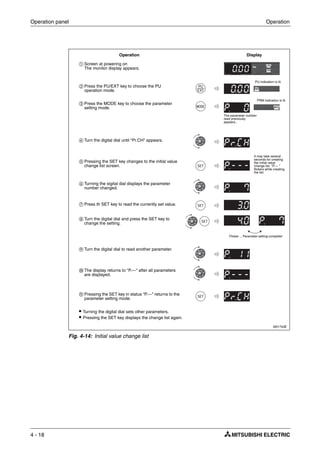
4.3.10 Initial value change list . . . . . . . . . . . . . . . . . . . . . . . . . . . . . . . . . . . .4-17
Contents
FR-E700 EC IX
5 Basic settings
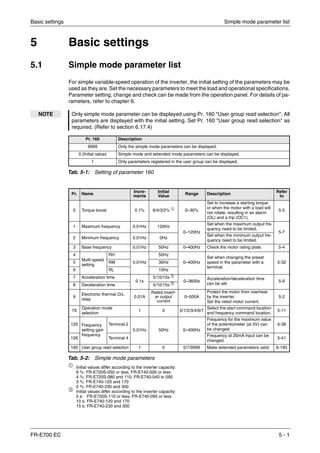
5.1 Simple mode parameter list . . . . . . . . . . . . . . . . . . . . . . . . . . . . . . . . . . . . . . . .5-1
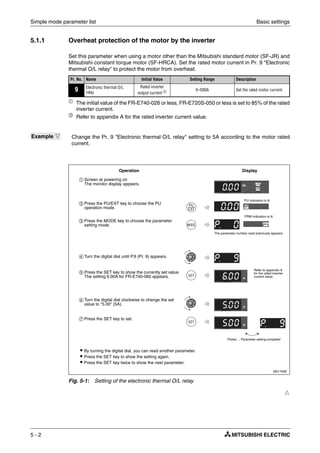
5.1.1 Overheat protection of the motor by the inverter. . . . . . . . . . . . . . . . . .5-2
5.1.2 When the rated motor frequency is 60Hz (Pr. 3) . . . . . . . . . . . . . . . . .5-4
5.1.3 Increase the starting torque (Pr. 0) . . . . . . . . . . . . . . . . . . . . . . . . . . .5-5
5.1.4 Limit the maximum and minimum output frequency (Pr. 1, Pr. 2) . . . . .5-7
5.1.5 Change the acceleration/deceleration time (Pr. 7, Pr. 8) . . . . . . . . . . .5-9
5.1.6 Operation mode (Pr. 79) . . . . . . . . . . . . . . . . . . . . . . . . . . . . . . . . . . .5-11
5.1.7 Large starting torque and low speed torque are necessary
(Advance magnetic flux control, general-purpose
magnetic flux vector control) (Pr. 71, Pr. 80, Pr. 81, Pr. 800) . . . . . .5-12
5.1.8 To exhibit the best performance of the motor performance
(offline auto tuning) (Pr. 9, Pr. 71, Pr. 83, Pr. 84, Pr. 96) . . . . . . . . . .5-15
5.2 PU operation mode. . . . . . . . . . . . . . . . . . . . . . . . . . . . . . . . . . . . . . . . . . . . . .5-20
5.2.1 Set the set frequency to operate . . . . . . . . . . . . . . . . . . . . . . . . . . . . .5-21
5.2.2 Use the digital dial like a potentiometer to perform operation . . . . . . .5-23
5.2.3 Use switches to give the frequency command (multi-speed setting) .5-24
5.2.4 Perform frequency setting by analog voltage input . . . . . . . . . . . . . . .5-26
5.2.5 Perform frequency setting by analog current input . . . . . . . . . . . . . . .5-28
5.3 External operation . . . . . . . . . . . . . . . . . . . . . . . . . . . . . . . . . . . . . . . . . . . . . .5-30
5.3.1 Use the set frequency set by the operation panel (Pr. 79 = 3) . . . . . .5-30
5.3.2 Use switches to give a start command and a frequency command
(multi-speed setting) (Pr. 4 to Pr. 6) . . . . . . . . . . . . . . . . . . . . . . . . . .5-32
5.3.3 Perform frequency setting by analog voltage input . . . . . . . . . . . . . . .5-35
5.3.4 Change the frequency (40Hz) of the maximum value of
potentiometer (at 5V) . . . . . . . . . . . . . . . . . . . . . . . . . . . . . . . . . . . . .5-38
5.3.5 Perform frequency setting by analog current input . . . . . . . . . . . . . . .5-39
5.3.6 Change the frequency (40Hz) of the maximum value of
potentiometer (at 20mA) . . . . . . . . . . . . . . . . . . . . . . . . . . . . . . . . . . .5-41
Contents
X
6 Parameter
6.1 Parameter overview . . . . . . . . . . . . . . . . . . . . . . . . . . . . . . . . . . . . . . . . . . . . . .6-1
6.2 Control mode . . . . . . . . . . . . . . . . . . . . . . . . . . . . . . . . . . . . . . . . . . . . . . . . . .6-30
6.2.1 Change the control method (Pr. 80, Pr. 81, Pr. 800). . . . . . . . . . . . . .6-31
6.3 Adjust the output torque (current) of the motor. . . . . . . . . . . . . . . . . . . . . . . . .6-33
6.3.1 Manual torque boost (Pr. 0, Pr. 46) . . . . . . . . . . . . . . . . . . . . . . . . . .6-33
6.3.2 Advanced magnetic flux vector control
(Pr. 71, Pr. 80, Pr. 81, Pr.89, Pr. 800) . . . . . . . . . . . . . . . . . . . . . . . .6-36
6.3.3 General-purpose magnetic flux vector control
(Pr. 71, Pr. 80, Pr. 81, Pr. 800) . . . . . . . . . . . . . . . . . . . . . . . . . . . . .6-39
6.3.4 Slip compensation (Pr. 245 to Pr. 247) . . . . . . . . . . . . . . . . . . . . . . .6-41
6.3.5 Stall prevention operation
(Pr. 22, Pr. 23, Pr. 48, Pr. 66, Pr. 156, Pr. 157, Pr. 277). . . . . . . . . . .6-42
6.4 Limit the output frequency . . . . . . . . . . . . . . . . . . . . . . . . . . . . . . . . . . . . . . . .6-50
6.4.1 Maximum and minimum frequency (Pr. 1, Pr. 2, Pr. 18) . . . . . . . . . . .6-50
6.4.2 Avoid mechanical resonance points (frequency jumps)
(Pr. 31 to Pr. 36) . . . . . . . . . . . . . . . . . . . . . . . . . . . . . . . . . . . . . . . . .6-52
6.5 Set V/f pattern. . . . . . . . . . . . . . . . . . . . . . . . . . . . . . . . . . . . . . . . . . . . . . . . . .6-54
6.5.1 Base frequency, voltage (Pr. 3, Pr. 19, Pr. 47) . . . . . . . . . . . . . . . . .6-54
6.5.2 Load pattern selection (Pr. 14) . . . . . . . . . . . . . . . . . . . . . . . . . . . . . .6-56
6.6 Frequency setting by external terminals. . . . . . . . . . . . . . . . . . . . . . . . . . . . . .6-58
6.6.1 Multi-speed setting operation
(Pr. 4 to Pr. 6, Pr. 24 to Pr. 27, Pr. 232 to Pr. 239) . . . . . . . . . . . . . . .6-58
6.6.2 Jog operation (Pr. 15, Pr. 16) . . . . . . . . . . . . . . . . . . . . . . . . . . . . . . .6-61
6.6.3 Remote setting function (Pr. 28) . . . . . . . . . . . . . . . . . . . . . . . . . . . . .6-65
6.7 Acceleration and deceleration . . . . . . . . . . . . . . . . . . . . . . . . . . . . . . . . . . . . .6-69
6.7.1 Acceleration and deceleration time
(Pr. 7, Pr. 8, Pr. 20, Pr. 21, Pr. 44, Pr. 45, Pr. 147). . . . . . . . . . . . . . .6-69
6.7.2 Starting frequency and start-time hold function. . . . . . . . . . . . . . . . . .6-73
6.7.3 Acceleration and deceleration pattern (Pr. 29) . . . . . . . . . . . . . . . . . .6-75
6.7.4 Shortest acceleration/deceleration
(automatic acceleration/deceleration)
(Pr. 61 to Pr. 63, Pr. 292, Pr. 293) . . . . . . . . . . . . . . . . . . . . . . . . . . .6-77
6.8 Selection and protection of a motor . . . . . . . . . . . . . . . . . . . . . . . . . . . . . . . . .6-80
6.8.1 Motor overheat protection (Electronic thermal O/L relay)
(Pr. 9, Pr. 51). . . . . . . . . . . . . . . . . . . . . . . . . . . . . . . . . . . . . . . . . . . .6-80
6.8.2 Applied motor (Pr. 71, Pr. 450) . . . . . . . . . . . . . . . . . . . . . . . . . . . . . .6-85
6.8.3 To exhibit the best performance of the motor performance
(offline auto tuning)
(Pr. 71, Pr. 80 to Pr. 84, Pr. 90 to Pr. 94, Pr. 96, Pr. 859). . . . . . . . . .6-88
Contents
FR-E700 EC XI
6.9 Motor brake and stop operation . . . . . . . . . . . . . . . . . . . . . . . . . . . . . . . . . . . .6-98
6.9.1 DC injection brake (Pr. 10 to Pr. 12) . . . . . . . . . . . . . . . . . . . . . . . . . .6-98
6.9.2 Selection of a regenerative brake (Pr. 30, Pr. 70). . . . . . . . . . . . . . .6-101
6.9.3 Stop selection (Pr. 250). . . . . . . . . . . . . . . . . . . . . . . . . . . . . . . . . . .6-103
6.9.4 Stop-on contact control function
(Pr. 6, Pr. 48, Pr. 270, Pr. 275, Pr. 276) . . . . . . . . . . . . . . . . . . . . . .6-105
6.9.5 Brake sequence function (Pr. 278 to Pr. 283, Pr. 292) . . . . . . . . . .6-109
6.10 Function assignment of external terminals. . . . . . . . . . . . . . . . . . . . . . . . . . .6-114
6.10.1 Input terminal function selection (Pr. 178 to Pr. 184) . . . . . . . . . . . .6-114
6.10.2 Inverter output shutoff signal (MRS signal, Pr. 17) . . . . . . . . . . . . . .6-117
6.10.3 Condition selection of function validity by second
function selection signal (RT, Pr. 155) . . . . . . . . . . . . . . . . . . . . . . .6-119
6.10.4 Start signal selection (Terminal STF, STR, STOP, Pr. 250) . . . . . . .6-120
6.10.5 Output terminal function selection (Pr. 190 to Pr. 192) . . . . . . . . . . .6-124
6.10.6 Detection of output frequency (SU, FU, Pr. 41 to Pr. 43) . . . . . . . . .6-129
6.10.7 Output current detection function (Y12, Y13, Pr. 150 to Pr. 153) . . .6-131
6.10.8 Remote output function (REM, Pr. 495 to Pr. 497) . . . . . . . . . . . . . .6-133
6.11 Monitor display and monitor output signals . . . . . . . . . . . . . . . . . . . . . . . . . .6-136
6.11.1 Speed display and speed setting (Pr. 37) . . . . . . . . . . . . . . . . . . . . .6-136
6.11.2 Monitor display selection of DU/PU and terminal AM
(Pr. 52, Pr. 158, Pr. 170, Pr. 171, Pr. 268, Pr. 563, Pr. 564). . . . . . .6-138
6.11.3 Reference of the terminal AM (analog voltage output)
(Pr. 55, Pr. 56). . . . . . . . . . . . . . . . . . . . . . . . . . . . . . . . . . . . . . . . . .6-146
6.11.4 Terminal AM calibration [calibration parameter
Pr. 645, C1 (Pr.901)] . . . . . . . . . . . . . . . . . . . . . . . . . . . . . . . . . . . . .6-148
6.12 Operation selection at power failure. . . . . . . . . . . . . . . . . . . . . . . . . . . . . . . .6-151
6.12.1 Automatic restart
(Pr. 30, Pr. 57, Pr. 58, Pr. 96, Pr. 162, Pr. 165,
Pr. 298, Pr. 299, Pr. 611) . . . . . . . . . . . . . . . . . . . . . . . . . . . . . . . . .6-151
6.12.2 Power failure-time deceleration-to-stop function (Pr. 261) . . . . . . . .6-162
6.13 Operation setting at alarm occurrence . . . . . . . . . . . . . . . . . . . . . . . . . . . . . .6-166
6.13.1 Retry function (Pr. 65, Pr. 67 to Pr. 69). . . . . . . . . . . . . . . . . . . . . . .6-166
6.13.2 Input/output phase failure protection selection (Pr. 251, Pr. 872) . . .6-169
6.13.3 Earth (ground) fault detection at start (Pr. 249). . . . . . . . . . . . . . . . .6-170
6.14 Energy saving operation. . . . . . . . . . . . . . . . . . . . . . . . . . . . . . . . . . . . . . . . .6-171
6.14.1 Optimum excitation control (Pr. 60) . . . . . . . . . . . . . . . . . . . . . . . . .6-171
6.15 Motor noise, EMI measures, mechanical resonance . . . . . . . . . . . . . . . . . . .6-172
6.15.1 PWM carrier frequency and soft-PWM control (Pr. 72, Pr. 240) . . . .6-172
6.15.2 Speed smoothing control (Pr. 653) . . . . . . . . . . . . . . . . . . . . . . . . . .6-173
Contents
XII
6.16 Frequency setting by analog input (terminal 2, 4) . . . . . . . . . . . . . . . . . . . . .6-174
6.16.1 Analog input selection (Pr. 73, Pr. 267) . . . . . . . . . . . . . . . . . . . . . .6-174
6.16.2 Input filter time constant (Pr. 74) . . . . . . . . . . . . . . . . . . . . . . . . . . . .6-179
6.16.3 Bias and gain of frequency setting voltage (current)
[Pr. 125, Pr. 126, Pr. 241, C2 (Pr. 902) to C7 (Pr. 905)] . . . . . . . . . .6-180
6.17 Misoperation prevention and parameter setting restriction. . . . . . . . . . . . . . .6-187
6.17.1 Reset selection/disconnected PU detection/PU stop selection
(Pr. 75) . . . . . . . . . . . . . . . . . . . . . . . . . . . . . . . . . . . . . . . . . . . . . . .6-187
6.17.2 Parameter write selection (Pr. 77). . . . . . . . . . . . . . . . . . . . . . . . . . .6-192
6.17.3 Reverse rotation prevention selection (Pr. 78) . . . . . . . . . . . . . . . . .6-194
6.17.4 User groups (Pr. 160, Pr. 172 to Pr. 174) . . . . . . . . . . . . . . . . . . . . .6-195
6.18 Selection of operation mode and operation location . . . . . . . . . . . . . . . . . . .6-198
6.18.1 Operation mode selection (Pr. 79) . . . . . . . . . . . . . . . . . . . . . . . . . .6-198
6.18.2 Operation mode at power on (Pr. 79, Pr. 340) . . . . . . . . . . . . . . . . .6-210
6.18.3 Start command source and frequency command source during
communication operation
(Pr. 338, Pr. 339, Pr. 550, Pr. 551) . . . . . . . . . . . . . . . . . . . . . . . . . .6-212
6.19 Communication operation and setting . . . . . . . . . . . . . . . . . . . . . . . . . . . . . .6-221
6.19.1 PU connector . . . . . . . . . . . . . . . . . . . . . . . . . . . . . . . . . . . . . . . . . .6-221
6.19.2 Initial settings and specifications of RS-485 communication
(Pr. 117 to Pr. 120, Pr. 123, Pr. 124, Pr. 549). . . . . . . . . . . . . . . . . .6-226
6.19.3 Communication E²PROM write selection (Pr. 342) . . . . . . . . . . . . . .6-232
6.19.4 Mitsubishi inverter protocol (computer link communication) . . . . . . .6-233
6.19.5 Modbus-RTU communication
(Pr. 117, Pr. 118, Pr. 120, Pr. 122, Pr. 343, Pr. 549) . . . . . . . . . . . .6-251
6.19.6 USB communication (Pr. 547, Pr. 548) . . . . . . . . . . . . . . . . . . . . . . .6-269
6.20 Special operation . . . . . . . . . . . . . . . . . . . . . . . . . . . . . . . . . . . . . . . . . . . . . .6-270
6.20.1 PID control (Pr. 127 to Pr. 134). . . . . . . . . . . . . . . . . . . . . . . . . . . . .6-270
6.20.2 Dancer control (Pr. 44, Pr. 45, Pr. 128 to Pr. 134) . . . . . . . . . . . . . .6-282
6.20.3 Droop control (Pr. 286 to Pr. 287) . . . . . . . . . . . . . . . . . . . . . . . . . .6-291
6.20.4 Regeneration avoidance function
(Pr. 665, Pr. 882, Pr. 883, Pr. 885, Pr. 886) . . . . . . . . . . . . . . . . . . .6-292
6.21 Useful functions . . . . . . . . . . . . . . . . . . . . . . . . . . . . . . . . . . . . . . . . . . . . . . .6-295
6.21.1 Cooling fan operation selection (Pr. 244) . . . . . . . . . . . . . . . . . . . . .6-295
6.21.2 Display of the life of the inverter parts (Pr. 255 to Pr. 259) . . . . . . . .6-296
6.21.3 Maintenance timer alarm (Pr. 503, Pr. 504) . . . . . . . . . . . . . . . . . . .6-300
6.21.4 Current average value monitor signal (Pr. 555 to Pr. 557) . . . . . . . .6-301
6.21.5 Free parameters (Pr. 888, Pr. 889) . . . . . . . . . . . . . . . . . . . . . . . . . .6-305
Contents
FR-E700 EC XIII
6.22 Setting for the parameter unit, operation panel . . . . . . . . . . . . . . . . . . . . . . .6-306
6.22.1 RUN key rotation direction selection (Pr. 40) . . . . . . . . . . . . . . . . . .6-306
6.22.2 PU display language selection (Pr. 145) . . . . . . . . . . . . . . . . . . . . . .6-306
6.22.3 Operation panel frequency setting/key lock operation selection
(Pr. 161) . . . . . . . . . . . . . . . . . . . . . . . . . . . . . . . . . . . . . . . . . . . . . .6-307
6.22.4 Magnitude of frequency change setting (Pr. 295) . . . . . . . . . . . . . . .6-308
6.22.5 Buzzer control (Pr. 990) . . . . . . . . . . . . . . . . . . . . . . . . . . . . . . . . . .6-309
6.22.6 PU contrast adjustment (Pr. 991) . . . . . . . . . . . . . . . . . . . . . . . . . . .6-309
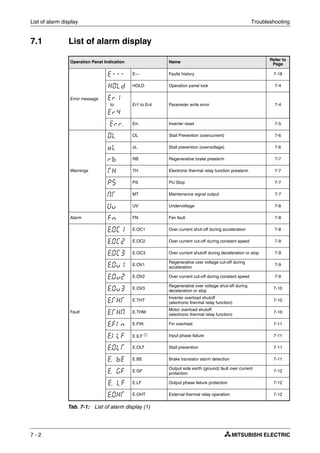
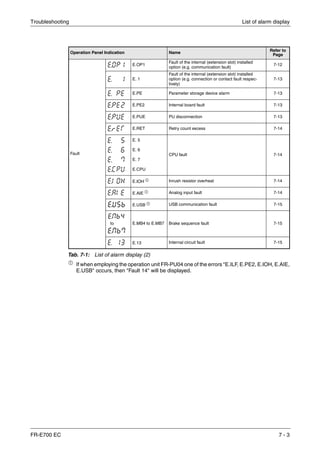
7 Troubleshooting
7.1 List of alarm display . . . . . . . . . . . . . . . . . . . . . . . . . . . . . . . . . . . . . . . . . . . . . .7-2
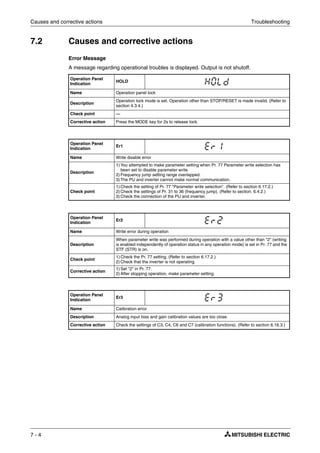
7.2 Causes and corrective actions . . . . . . . . . . . . . . . . . . . . . . . . . . . . . . . . . . . . . .7-4
7.3 Reset method of protective function. . . . . . . . . . . . . . . . . . . . . . . . . . . . . . . . .7-16
7.4 LED display . . . . . . . . . . . . . . . . . . . . . . . . . . . . . . . . . . . . . . . . . . . . . . . . . . .7-17
7.5 Check and clear of the fault history . . . . . . . . . . . . . . . . . . . . . . . . . . . . . . . . .7-18
7.6 Check first when you have troubles . . . . . . . . . . . . . . . . . . . . . . . . . . . . . . . . .7-20
7.6.1 Motor does not start . . . . . . . . . . . . . . . . . . . . . . . . . . . . . . . . . . . . . .7-20
7.6.2 Motor or machine generates abnormal noise . . . . . . . . . . . . . . . . . . .7-22
7.6.3 Inverter generates abnormal noise . . . . . . . . . . . . . . . . . . . . . . . . . . .7-22
7.6.4 Motor generates heat abnormally . . . . . . . . . . . . . . . . . . . . . . . . . . . .7-23
7.6.5 Motor rotates in opposite direction . . . . . . . . . . . . . . . . . . . . . . . . . . .7-23
7.6.6 Speed greatly differs from the setting . . . . . . . . . . . . . . . . . . . . . . . . .7-23
7.6.7 Acceleration/deceleration is not smooth . . . . . . . . . . . . . . . . . . . . . . .7-24
7.6.8 Speed varies during operation . . . . . . . . . . . . . . . . . . . . . . . . . . . . . .7-25
7.6.9 Operation mode is not changed properly . . . . . . . . . . . . . . . . . . . . . .7-26
7.6.10 Operation panel display is not operating. . . . . . . . . . . . . . . . . . . . . . .7-26
7.6.11 Motor current is too large . . . . . . . . . . . . . . . . . . . . . . . . . . . . . . . . . .7-27
7.6.12 Speed does not accelerate . . . . . . . . . . . . . . . . . . . . . . . . . . . . . . . . .7-28
7.6.13 Unable to write parameter setting . . . . . . . . . . . . . . . . . . . . . . . . . . . .7-29
7.7 Meters and measuring methods. . . . . . . . . . . . . . . . . . . . . . . . . . . . . . . . . . . .7-30
7.7.1 Measurement of powers . . . . . . . . . . . . . . . . . . . . . . . . . . . . . . . . . . .7-31
7.7.2 Measurement of voltages and use of PT . . . . . . . . . . . . . . . . . . . . . .7-32
7.7.3 Measurement of currents . . . . . . . . . . . . . . . . . . . . . . . . . . . . . . . . . .7-32
7.7.4 Use of CT and transducer . . . . . . . . . . . . . . . . . . . . . . . . . . . . . . . . . .7-33
7.7.5 Measurement of inverter input power factor . . . . . . . . . . . . . . . . . . . .7-33
7.7.6 Measurement of converter output voltage
(across terminals + and –). . . . . . . . . . . . . . . . . . . . . . . . . . . . . . . . . .7-33
Contents
XIV
8 Maintenance and inspection
8.1 Inspection . . . . . . . . . . . . . . . . . . . . . . . . . . . . . . . . . . . . . . . . . . . . . . . . . . . . . .8-1
8.1.1 Daily inspection . . . . . . . . . . . . . . . . . . . . . . . . . . . . . . . . . . . . . . . . . . .8-1
8.1.2 Periodic inspection . . . . . . . . . . . . . . . . . . . . . . . . . . . . . . . . . . . . . . . .8-1
8.1.3 Daily and periodic inspection . . . . . . . . . . . . . . . . . . . . . . . . . . . . . . . .8-2
8.1.4 Display of the life of the inverter parts. . . . . . . . . . . . . . . . . . . . . . . . . .8-4
8.1.5 Checking the inverter and converter modules. . . . . . . . . . . . . . . . . . . .8-5
8.1.6 Cleaning . . . . . . . . . . . . . . . . . . . . . . . . . . . . . . . . . . . . . . . . . . . . . . . .8-6
8.1.7 Replacement of parts . . . . . . . . . . . . . . . . . . . . . . . . . . . . . . . . . . . . . .8-6
8.1.8 Inverter replacement . . . . . . . . . . . . . . . . . . . . . . . . . . . . . . . . . . . . . .8-10
8.2 Measurements on the main circuit . . . . . . . . . . . . . . . . . . . . . . . . . . . . . . . . . .8-11
8.2.1 Insulation resistance test using megger . . . . . . . . . . . . . . . . . . . . . . .8-11
8.2.2 Pressure test . . . . . . . . . . . . . . . . . . . . . . . . . . . . . . . . . . . . . . . . . . . .8-11
8.2.3 Measurement of voltages and currents. . . . . . . . . . . . . . . . . . . . . . . .8-12
A Appendix
A.1 Specifications . . . . . . . . . . . . . . . . . . . . . . . . . . . . . . . . . . . . . . . . . . . . . . . . . A-1
A.1.1 1-phase, 200V class . . . . . . . . . . . . . . . . . . . . . . . . . . . . . . . . . . . . . . A-1
8.2.4 3-phase, 400V class . . . . . . . . . . . . . . . . . . . . . . . . . . . . . . . . . . . . . . A-2
A.2 Common specifications . . . . . . . . . . . . . . . . . . . . . . . . . . . . . . . . . . . . . . . . . . A-3
A.3 Outline dimension drawings . . . . . . . . . . . . . . . . . . . . . . . . . . . . . . . . . . . . . . A-5
A.3.1 FR-E720S-008 to 030 . . . . . . . . . . . . . . . . . . . . . . . . . . . . . . . . . . . . A-5
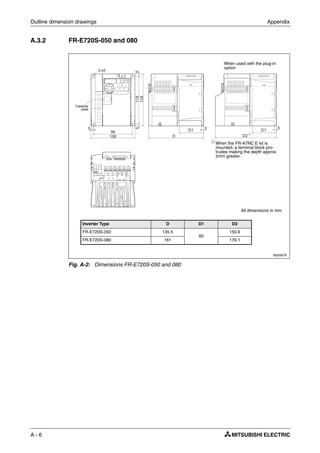
A.3.2 FR-E720S-050 and 080 . . . . . . . . . . . . . . . . . . . . . . . . . . . . . . . . . . . A-6
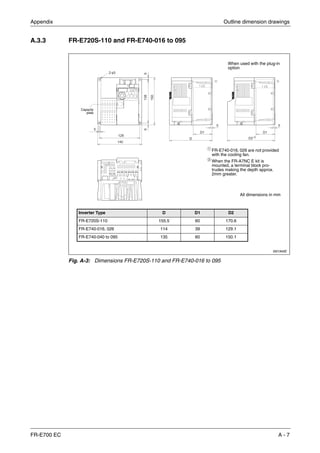
A.3.3 FR-E720S-110 and FR-E740-016 to 095 . . . . . . . . . . . . . . . . . . . . . . A-7
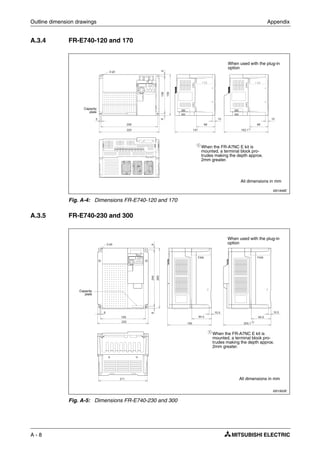
A.3.4 FR-E740-120 and 170 . . . . . . . . . . . . . . . . . . . . . . . . . . . . . . . . . . . . A-8
A.3.5 FR-E740-230 and 300 . . . . . . . . . . . . . . . . . . . . . . . . . . . . . . . . . . . . A-8
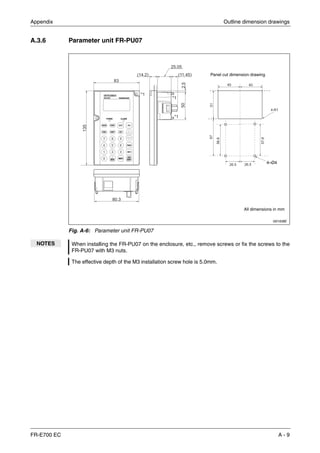
A.3.6 Parameter unit FR-PU07 . . . . . . . . . . . . . . . . . . . . . . . . . . . . . . . . . . A-9
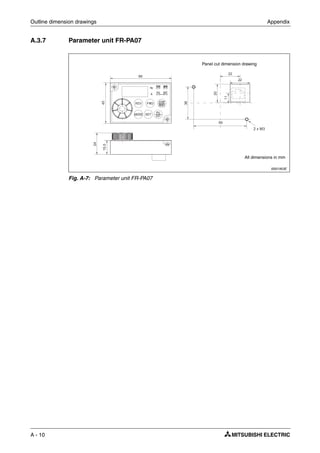
A.3.7 Parameter unit FR-PA07 . . . . . . . . . . . . . . . . . . . . . . . . . . . . . . . . . A-10
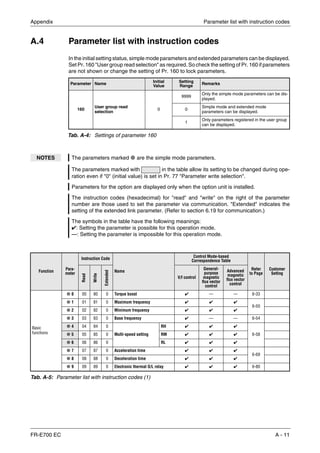
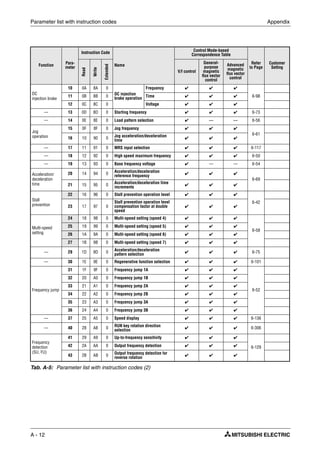
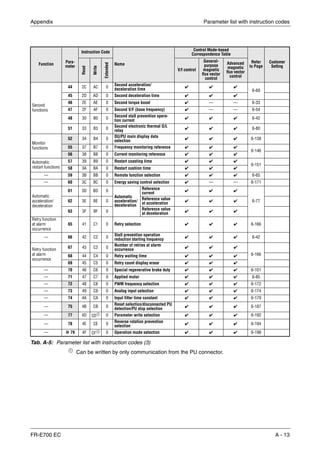
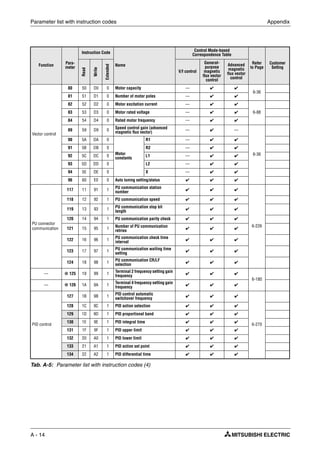
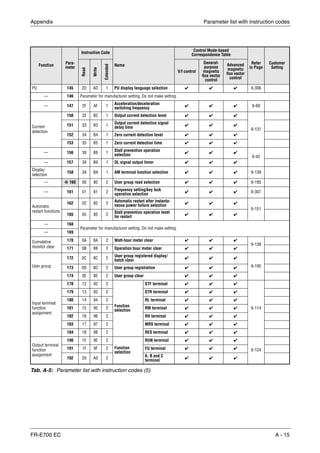
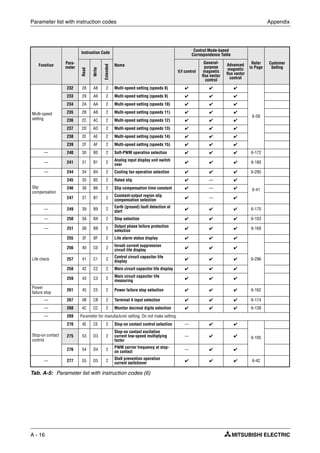
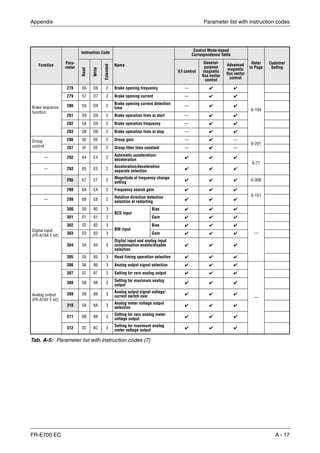
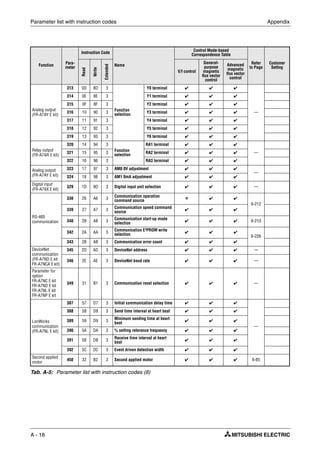
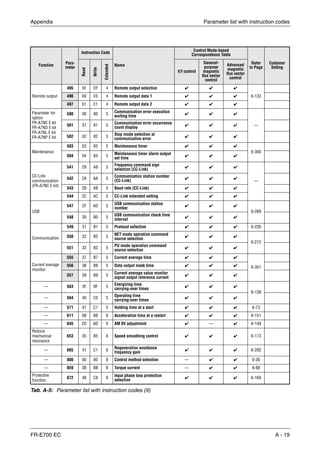
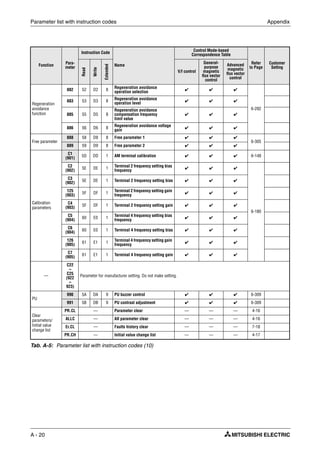
A.4 Parameter list with instruction codes . . . . . . . . . . . . . . . . . . . . . . . . . . . . . . . A-11
Product checking and part identification Inverter type
FR-E700 EC 1 - 1
1 Product checking and part identification
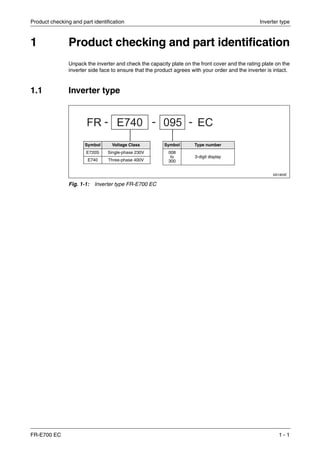
Unpack the inverter and check the capacity plate on the front cover and the rating plate on the
inverter side face to ensure that the product agrees with your order and the inverter is intact.
1.1 Inverter type
I001905E
Fig. 1-1: Inverter type FR-E700 EC
Symbol Voltage Class
E720S Single-phase 230V
E740 Three-phase 400V
Symbol Type number
008
to
300
3-digit display
Description of the Case Product checking and part identification
1 - 2
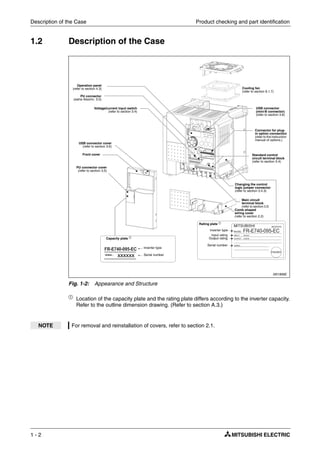
1.2 Description of the Case
ቢ
Location of the capacity plate and the rating plate differs according to the inverter capacity.
Refer to the outline dimension drawing. (Refer to section A.3.)
I001906E
Fig. 1-2: Appearance and Structure
NOTE For removal and reinstallation of covers, refer to section 2.1.
Capacity plate ቢ
Front cover
Inverter type
Inverter type
Serial number
PU connector
(siehe Abschn. 3.5)
Rating plate ቢ
Comb shaped
wiring cover
(refer to section 2.2)
Standard control
circuit terminal block
(refer to section 3.4)
Main circuit
terminal block
(refer to section 3.3)
Voltage/current input switch
(refer to section 3.4)
Cooling fan
(refer to section 8.1.7)
Operation panel
(refer to section 4.3)
USB connector cover
(refer to section 3.6)
PU connector cover
(refer to section 3.5)
USB connector
(mini-B connector)
(refer to section 3.6)
Connector for plug-
in option connection
(refer to the instruction
manual of options.)
Changing the control
logic jumper connector
(refer to section 3.4.3)
Serial number
Input rating
Output rating
Product checking and part identification Description of the Case
FR-E700 EC 1 - 3
1.2.1 Accessory
Fan cover fixing screws
Capacity Screw Size [mm] Number
FR-E720S-050 to 110 M3 × 35 1
FR-E740-040 to 095 M3 × 35 1
FR-E740-120 to 300 M3 × 35 2
Tab. 1-1: Fan cover fixing screws
NOTES The fan cover fixing screws are not delivered with models FR-E720S-008 to 030 and
FR-E740-026 or less.
For removal and reinstallation of the cooling fans, refer to section 8.1.7.
Description of the Case Product checking and part identification
1 - 4
Installation Removal and reinstallation of the front cover
FR-E700 EC 2 - 1
2 Installation
2.1 Removal and reinstallation of the front cover
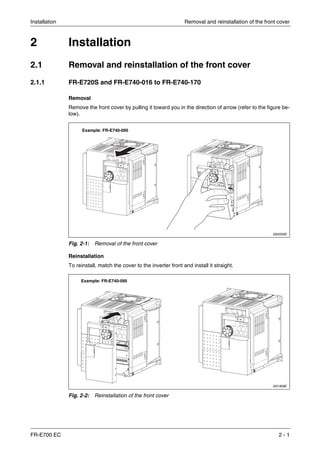
2.1.1 FR-E720S and FR-E740-016 to FR-E740-170
Removal
Remove the front cover by pulling it toward you in the direction of arrow (refer to the figure be-
low).
Reinstallation
To reinstall, match the cover to the inverter front and install it straight.
I002050E
Fig. 2-1: Removal of the front cover
I001908E
Fig. 2-2: Reinstallation of the front cover
Example: FR-E740-095
Removal and reinstallation of the front cover Installation
2 - 2
2.1.2 FR-E740-230 and FR-E740-300
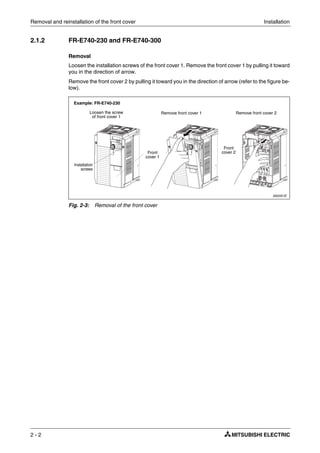
Removal
Loosen the installation screws of the front cover 1. Remove the front cover 1 by pulling it toward
you in the direction of arrow.
Remove the front cover 2 by pulling it toward you in the direction of arrow (refer to the figure be-
low).
I002051E
Fig. 2-3: Removal of the front cover
Loosen the screw
of front cover 1
Front
cover 1
Front
cover 2
Remove front cover 1
Installation
screws
Remove front cover 2
Example: FR-E740-230
Installation Removal and reinstallation of the front cover
FR-E700 EC 2 - 3
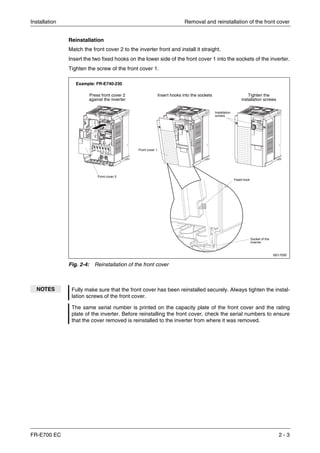
Reinstallation
Match the front cover 2 to the inverter front and install it straight.
Insert the two fixed hooks on the lower side of the front cover 1 into the sockets of the inverter.
Tighten the screw of the front cover 1.
I001705E
Fig. 2-4: Reinstallation of the front cover
NOTES Fully make sure that the front cover has been reinstalled securely. Always tighten the instal-
lation screws of the front cover.
The same serial number is printed on the capacity plate of the front cover and the rating
plate of the inverter. Before reinstalling the front cover, check the serial numbers to ensure
that the cover removed is reinstalled to the inverter from where it was removed.
Insert hooks into the socketsPress front cover 2
against the inverter
Tighten the
installation screws
Installation
screws
Front cover 2
Front cover 1
Fixed hook
Socket of the
inverter
Example: FR-E740-230
Removal and reinstallation of the wiring cover Installation
2 - 4
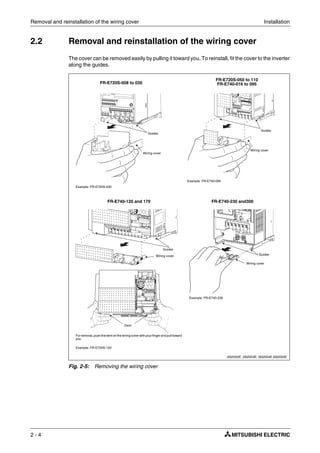
2.2 Removal and reinstallation of the wiring cover
The cover can be removed easily by pulling it toward you. To reinstall, fit the cover to the inverter
along the guides.
I002052E, I002053E, I002054E I002055E
Fig. 2-5: Removing the wiring cover
FR-E720S-008 to 030
Guides
Wiring cover
Guides
Wiring cover
FR-E740-230 and300FR-E740-120 and 170
FR-E720S-050 to 110
FR-E740-016 to 095
Example: FR-E720S-030
Guides
Wiring cover
Example: FR-E740-095
Guides
Wiring cover
Example: FR-E720S-120
Example: FR-E740-230
Dent
For removal, push the dent on the wiring cover with your finger and pull toward
you.
Installation Mounting
FR-E700 EC 2 - 5
2.3 Mounting
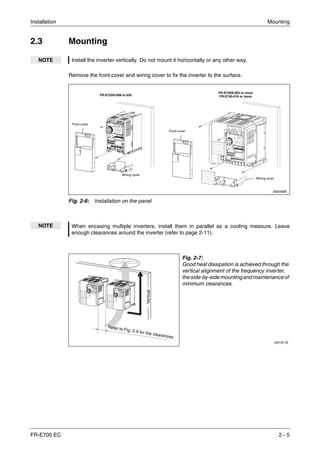
Remove the front cover and wiring cover to fix the inverter to the surface.
NOTE Install the inverter vertically. Do not mount it horizontally or any other way.
I002056E
Fig. 2-6: Installation on the panel
NOTE When encasing multiple inverters, install them in parallel as a cooling measure. Leave
enough clearances around the inverter (refer to page 2-11).
Fig. 2-7:
Good heat dissipation is achieved through the
vertical alignment of the frequency inverter,
theside-by-sidemountingandmaintenance of
minimum clearances.
I001911E
Front cover
Wiring cover
Front cover
Wiring cover
FR-E720S-008 to 030
FR-E720S-050 or more
FR-E740-016 or more
Refer to Fig. 2-9 for the clearances
Vertical
Mounting Installation
2 - 6
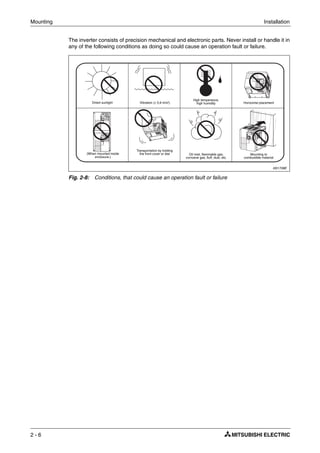
The inverter consists of precision mechanical and electronic parts. Never install or handle it in
any of the following conditions as doing so could cause an operation fault or failure.
I001708E
Fig. 2-8: Conditions, that could cause an operation fault or failure
Direct sunlight Vibration (≥ 5,9 m/s²)
High temperature,
high humidity Horizontal placement
(When mounted inside
enclosure.)
Transportation by holding
the front cover or dial Oil mist, flammable gas,
corrosive gas, fluff, dust, etc.
Mounting to
combustible material
Installation Enclosure design
FR-E700 EC 2 - 7
2.4 Enclosure design
When an inverter enclosure is to be designed and manufactured, heat generated by contained
equipment, etc., the environment of an operating place, and others must be fully considered to
determine the enclosure structure, size and equipment layout. The inverter unit uses many
semiconductor devices. To ensure higher reliability and long period of operation, operate the in-
verter in the ambient environment that completely satisfies the equipment specifications.
2.4.1 Inverter installation environment
As the inverter installation environment should satisfy the standard specifications indicated in
the following table, operation in any place that does not meet these conditions not only deteri-
orates the performance and life of the inverter, but also causes a failure. Refer to the following
points and take adequate measures.
Temperature
The permissible ambient temperature of the inverter FR-E700 is between −10 and +50°C. Al-
ways operate the inverter within this temperature range. Operation outside this range will con-
siderably shorten the service lives of the semiconductors, parts, capacitors and others. Take the
following measures so that the ambient temperature of the inverter falls within the specified
range.
● Measures against high temperature
– Use a forced ventilation system or similar cooling system. (Refer to page 2-10.)
– Install the enclosure in an air-conditioned electrical chamber.
– Block direct sunlight.
– Provide a shield or similar plate to avoid direct exposure to the radiated heat and wind
of a heat source.
– Ventilate the area around the enclosure well.
● Measures against low temperature
– Provide a space heater in the enclosure.
– Do not power off the inverter. (Keep the start signal of the inverter off.)
● Sudden temperature changes
– Select an installation place where temperature does not change suddenly.
– Avoid installing the inverter near the air outlet of an air conditioner.
– If temperature changes are caused by opening/closing of a door, install the inverter away
from the door.
Item Specification
Ambient temperature −10°C to +50°C (non-freezing)
Ambient humidity 90% RH or less (non-condensing)
Atmosphere Free from corrosive and explosive gases, dust and dirt
Maximum altitude 1000m or less
Vibration 5.9m/s² or less (0,6 g) at 10 to 55Hz (directions of X, Y, Z axes)
Tab. 2-1: Environmental standard specifications of inverter
Enclosure design Installation
2 - 8
Humidity
Normally operate the inverter within the 45% to 90% range of the ambient humidity. Too high hu-
midity will pose problems of reduced insulation and metal corrosion. On the other hand, too low
humidity may produce a spatial electrical breakdown. The insulation distance specified in
JEM1103 "Control Equipment Insulator" is defined as humidity 45% to 85%.
● Measures against high humidity
– Make the enclosure enclosed, and provide it with a hygroscopic agent.
– Take dry air into the enclosure from outside.
– Provide a space heater in the enclosure
● Measures against low humidity
What is important in fitting or inspection of the unit in this status is to discharge your body
(static electricity) beforehand and keep your body from contact with the parts and patterns,
besides blowing air of proper humidity into the enclosure from outside.
● Measures against condensation
Condensation may occur if frequent operation stops change the in-enclosure temperature
suddenly or if the outside air temperature changes suddenly. Condensation causes such
faults as reduced insulation and corrosion.
– Take the measures against high humidity.
– Do not power off the inverter. (Keep the start signal of the inverter off.)
Dust, dirt, oil mist
Dust and dirt will cause such faults as poor contact of contact points, reduced insulation or re-
duced cooling effect due to moisture absorption of accumulated dust and dirt, and in-enclosure
temperature rise due to clogged filter.
In the atmosphere where conductive powder floats, dust and dirt will cause such faults as mal-
function, deteriorated insulation and short circuit in a short time.
Since oil mist will cause similar conditions, it is necessary to take adequate measures.
● Measures against dust, dirt, oil mist
– Place in a totally enclosed enclosure.
Take measures if the in-enclosure temperature rises. (Refer to page 2-10.)
– Purge air.
Pump clean air from outside to make the in-enclosure pressure higher than the outside-
air pressure.
Corrosive gas, salt damage
If the inverter is exposed to corrosive gas or to salt near a beach, the printed board patterns and
parts will corrode or the relays and switches will result in poor contact. In such places, take the
measures against dust, dirt, oil mist.
Installation Enclosure design
FR-E700 EC 2 - 9
Explosive, flammable gases
As the inverter is non-explosion proof, it must be contained in an explosion proof enclosure.
In places where explosion may be caused by explosive gas, dust or dirt, an enclosure cannot be
used unless it structurally complies with the guidelines and has passed the specified tests. This
makes the enclosure itself expensive (including the test charges).
The best way is to avoid installation in such places and install the inverter in a non-hazardous
place.
Highland
Use the inverter at the altitude of within 1000m.
If it is used at a higher place, it is likely that thin air will reduce the cooling effect and low air pres-
sure will deteriorate dielectric strength.
Vibration, impact
The vibration resistance of the inverter is up to 5.9m/s² at 10 to 55Hz frequency and 1mm am-
plitude for the directions of X, Y, Z axes.
Vibration or impact, if less than the specified value, applied for a long time may make the mech-
anism loose or cause poor contact to the connectors.
Especially when impact is imposed repeatedly, caution must be taken as the part pins are likely
to break.
● Countermeasures
– Provide the enclosure with rubber vibration isolators.
– Strengthen the structure to prevent the enclosure from resonance.
– Install the enclosure away from sources of vibration.
Enclosure design Installation
2 - 10
Cooling system types for inverter enclosure
From the enclosure that contains the inverter, the heat of the inverter and other equipment
(transformers, lamps, resistors, etc.) and the incoming heat such as direct sunlight must be dis-
sipated to keep the in-enclosure temperature lower than the permissible temperatures of the in-
enclosure equipment including the inverter.
The cooling systems are classified as follows in terms of the cooling calculation method.
● Cooling by natural heat dissipation from the enclosure surface (Totally enclosed type)
● Cooling by heat sink (Aluminium fin, etc.)
● Cooling by ventilation (Forced ventilation type, pipe ventilation type)
● Cooling by heat exchanger or cooler (Heat pipe, cooler, etc.)
Cooling System Enclosure Structure Comment
Natural
cooling
Natural ventilation
(Enclosed, open type)
I001000E
Low in cost and generally used, but the enclosure
size increases as the inverter capacity increases.
For relatively small capacities.
Natural ventilation
(Totally enclosed
type)
I001001E
Being a totally enclosed type, the most appropriate
for hostile environment having dust, dirt, oil mist,
etc. The enclosure size increases depending on the
inverter capacity.
Forced
cooling
Heatsink cooling
I001002E
Having restrictions on the heatsink mounting posi-
tion and area, and designed for relative small
capacities.
Forced ventilation
I001003E
For general indoor installation. Appropriate for
enclosure downsizing and cost reduction, and often
used.
Heat pipe
I001004E
Totally enclosed type for enclosure downsizing.
Tab. 2-2: Cooling system types for inverter enclosure
heatsink
heat pipe
Installation Enclosure design
FR-E700 EC 2 - 11
2.4.2 Inverter placement
Clearances around the inverter
Always observe the specified minimum clearances to ensure good heat dissipation and ade-
quate accessibility of the frequency inverter for servicing.
Inverter mounting orientation
Mount the inverter on a wall as specified. Do not mount it horizontally or any other way.
Above the inverter
Heat is blown up from inside the inverter by the small fan built in the unit. Any equipment placed
above the inverter should be heat resistant.
Fig. 2-9: Clearances
Ambient temperature and humidity Clearances (side) Clearances (front)
Leave enough clearances and take cooling
measures.
Inverter
5cm 5cm
5cm
≥ 10cm
≥ 10cm
≥ 1cm ቢ
≥ 1cm ቢ
x = Measurement
position
Inverter
Temperature: −10°C to +50°C
Humidity: 90% RH maximum
≥ 1cm ቢ
ቢ When using the inverters at the ambient
temperature of 40°C or less, the inverters
can be installed without any clearance
between them (0cm clearance).
When ambient temperature exceeds
40°C, clearances between the inverters
should be 1cm or more (5cm or more for
the FR-E740-120 or more).
ቢ ≥ 5cm for the FR-E740-120 and more
Enclosure design Installation
2 - 12
Arrangement of multiple inverters
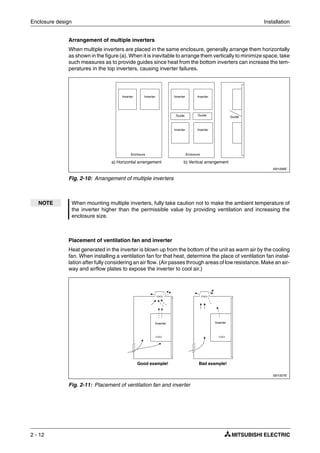
When multiple inverters are placed in the same enclosure, generally arrange them horizontally
as shown in the figure (a). When it is inevitable to arrange them vertically to minimize space, take
such measures as to provide guides since heat from the bottom inverters can increase the tem-
peratures in the top inverters, causing inverter failures.
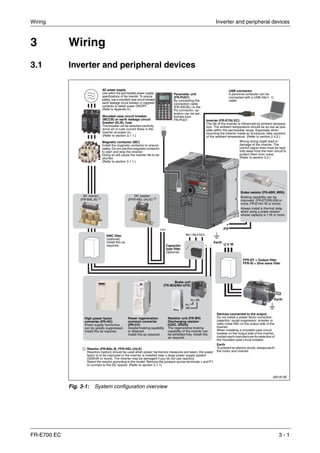
Placement of ventilation fan and inverter
Heat generated in the inverter is blown up from the bottom of the unit as warm air by the cooling
fan. When installing a ventilation fan for that heat, determine the place of ventilation fan instal-
lation after fully considering an air flow. (Air passes through areas of low resistance. Make an air-
way and airflow plates to expose the inverter to cool air.)
I001006E
Fig. 2-10: Arrangement of multiple inverters
NOTE When mounting multiple inverters, fully take caution not to make the ambient temperature of
the inverter higher than the permissible value by providing ventilation and increasing the
enclosure size.
I001007E
Fig. 2-11: Placement of ventilation fan and inverter
a) Horizontal arrangement b) Vertical arrangement
Inverter
InverterInverter
Inverter Inverter Inverter
Guide Guide Guide
Enclosure Enclosure
Good example!
Inverter Inverter
Bad example!
Wiring Inverter and peripheral devices
FR-E700 EC 3 - 1
3 Wiring
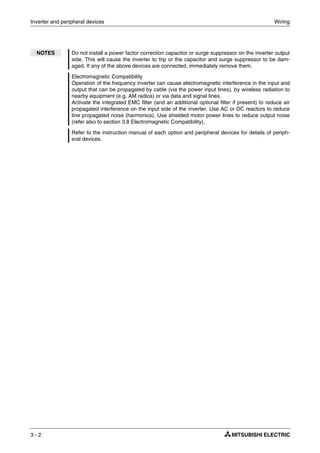
3.1 Inverter and peripheral devices
I001913E
Fig. 3-1: System configuration overview
+ P1
AC power supply
Use within the permissible power supply
specifications of the inverter. To ensure
safety, use a moulded case circuit breaker,
earth leakage circuit breaker or magnetic
contactor to switch power ON/OFF.
(Refer to Appendix A.)
Moulded case circuit breaker
(MCCB) or earth leakage circuit
breaker (ELB), fuse
The breaker ust be selected carefully
since an in-rush current flows in the
inverter at power on.
(Refer to section 3.1.1.)
AC reactor
(FR-BAL-B) ቢ
DC reactor
(FFR-HEL-(H)-E) ቢ
EMC filter
(optional)
Install this as
required.
High power factor
converter (FR-HC)
Power supply harmonics
can be greatly suppressed.
Install this as required.
Power regeneration
common converter
(FR-CV)
Greater braking capability
is obtained.
Install this as required.
Resistor unit (FR-BR)
Discharging resistor
(GZG, GRZG)
The regenerative braking
capability of the inverter can
be exhibited fully. Install this
as required.
Brake unit
(FR-BU2/BU-UFS)
Magnetic contactor (MC)
Install the magnetic contactor to ensure
safety. Do not use this magnetic contactor
to start and stop the inverter.
Doing so will cause the inverter life to be
shorten.
(Refer to section 3.1.1.)
Parameter unit
(FR-PU07)
By connecting the
connection cable
(FR-A5CBL) to the
PU connector, op-
eration can be per-
formed from
FR-PU07. Inverter (FR-E700 EC)
The life of the inverter is influenced by ambient tempera-
ture. The ambient temperature should be as low as pos-
sible within the permissible range. Especially when
mounting the inverter inside an enclosure, take cautions
of the ambient temperature. (Refer to section 2.4.2.)
Wrong wiring might lead to
damage of the inverter. The
control signal lines must be kept
fully away from the main circuit to
protect them from noise.
(Refer to section 3.2.)
FFR-DT = Output filter
FFR-SI = Sine wave filter
Earth
Earth
Devices connected to the output
Do not install a power factor correction
capacitor, surge suppressor, arrester or
radio noise filter on the output side of the
inverter.
When installing a moulded case circuit
breaker on the output side of the inverter,
contact each manufacturer for selection of
the moulded case circuit breaker.
Earth
To prevent an electric shock, always earth
the motor and inverter.
USB connector
A personal computer can be
connected with a USB (Ver1. 1)
cable.
Capacitor
type filter
(optional)
Brake resistor (FR-ABR, MRS)
Braking capability can be
improved. (FR-E720S-030 or
more, FR-E740-16 or more).
Always install a thermal relay
when using a brake resistor
whose capacity is 11K or more.
ቢ Reactor (FR-BAL-B, FFR-HEL-(H)-E)
Reactors (option) should be used when power harmonics measures are taken, the power
factor is to be improved or the inverter is installed near a large power supply system
(500kVA or more). The inverter may be damaged if you do not use reactors.
Select the reactor according to the model. Remove the jumpers across terminals + and P1
to connect to the DC reactor. (Refer to section 3.1.1).
Inverter and peripheral devices Wiring
3 - 2
NOTES Do not install a power factor correction capacitor or surge suppressor on the inverter output
side. This will cause the inverter to trip or the capacitor and surge suppressor to be dam-
aged. If any of the above devices are connected, immediately remove them.
Electromagnetic Compatibility
Operation of the frequency inverter can cause electromagnetic interference in the input and
output that can be propagated by cable (via the power input lines), by wireless radiation to
nearby equipment (e.g. AM radios) or via data and signal lines.
Activate the integrated EMC filter (and an additional optional filter if present) to reduce air
propagated interference on the input side of the inverter. Use AC or DC reactors to reduce
line propagated noise (harmonics). Use shielded motor power lines to reduce output noise
(refer also to section 3.8 Electromagnetic Compatibility).
Refer to the instruction manual of each option and peripheral devices for details of periph-
eral devices.
Wiring Inverter and peripheral devices
FR-E700 EC 3 - 3
3.1.1 Peripheral devices
Check the motor capacity of the inverter you purchased. Appropriate peripheral devices must be
selected according to the capacity. Refer to the following list and prepare appropriate peripheral
devices:
ቢ
Select the MCCB according to the inverter power supply capacity. Install one MCCB per
inverter.
The places with "xx" refer to the breaking capacity in case of short circuit. The correct
selection must be done depending on the design of the power input wiring.
ባ
Magnetic contactor is selected based on the AC-1 class. The electrical durability of magnetic
contactor is 500,000 times. When the magnetic contactor is used for emergency stop during
motor driving, the electrical durability is 25 times.
When using the MC for emergency stop during motor driving or using on the motor side
during commercial-power supply operation, select the MC with class AC-3 rated current for
the motor rated current.
Motor output [kW] Applicable Inverter Type
Breaker Selection ቢ Input Side Magnetic
Contactor ባ
Reactor connection Reactor connection
Without With Without With
200Vclass
0.1 FR-E720S-008
NF32 xx 3P 5 A
S-N10
0.2 FR-E720S-015
0.4 FR-E720S-030 NF32 xx 3P 10 A
0.75 FR-E720S-050 NF32 xx 3P 15 A NF32 xx 3P 10 A
1.5 FR-E720S-080 NF63 xx 3P 20 A
2.2 FR-E720S-110 NF32 xx 3P 40 A NF32 xx 3P 32 A S-N20, S-N21 S-N10
400Vclass
0.4 FR-E740-016
NF32 xx 3P 5 A
S-N10
0.75 FR-E740-026
1.5 FR-E740-040 NF32 xx 3P 10 A
2.2 FR-E740-060 NF32 xx 3P 15 A NF32 xx 3P 10 A
3.7 FR-E740-095 NF63 xx 3P 20 A NF32 xx 3P 15 A
5.5 FR-E740-120 NF63 xx 3P 30 A NF63 xx 3P 20 A S-N20 S-N11
7.5 FR-E740-170 NF63 xx 3P 30 A NF63 xx 3P 30 A
S-N20
11 FR-E740-230 NF63 xx 3P 50 A NF63 xx 3P 40 A
15 FR-E740-300 NF125 xx 3P 100 A NF63 xx 3P 50 A S-N25 S-N20
Tab. 3-1: Breakers and contactors
Fig. 3-2:
Installation of the breakers
I001332E
NOTES When the inverter capacity is larger than the motor capacity, select an MCCB and a mag-
netic contactor according to the inverter type and cable and reactor according to the motor
output.
When the breaker on the inverter primary side trips, check for the wiring fault (short circuit),
damage to internal parts of the inverter, etc. Identify the cause of the trip, then remove the
cause and power on the breaker.
M
3~
M
3~
Inverter
MCCB Inverter
MCCB
Terminal connection diagramm Wiring
3 - 4
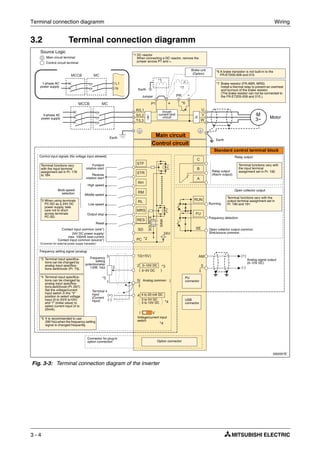
3.2 Terminal connection diagramm
I002057E
Fig. 3-3: Terminal connection diagram of the inverter
MCCB MC
R/L1
P1 +
PR -
S/L2
T/L3
U
V
W
STR
STF
RH
RM
RL
MRS
SD
PC
FU
RUN
SE
A
B
C
AM
52
10(+5V)
2
3
1
4(+)
(-)
5( )
*5
*1
*7
*2
*3
*4
SINK
SOURCE
I V
*4
( )
R
RES
(+)
(-)
MCCB MC
L1
N
*6
24V
Source Logic
Main circuit terminal
Control circuit terminal
Jumper
*1 DC reactor
When connecting a DC reactor, remove the
jumper across P1 and +.
Earth
Motor
3-phase AC
power supply
Main circuit
Control circuit
Terminal functions vary
with the input terminal
assignment set in Pr. 178
to 184.
Control input signals (No voltage input allowed)
Forward
rotation start
Reverse
rotation start
High speed
Middle speed
Low speed
Multi-speed
selection
Output stop
Reset
Contact input common (sink*)
24V DC power supply/
max. 100mA load current
Contact input common (source*)
*(Common for external power supply transistor)
Frequency setting signal (analog)
0–5V DC
4 to 20 mA DC
0 to 5V DC
0 to 10V DC
PU
connector
Connector for plug-in
option connection Option connector
*5 It is recommended to use
2W/1kΩ when the frequency setting
signal is changed frequently.
Relay output
(Alarm output)
Relay output
Running
Terminal functions vary with
the input terminal
assignment set in Pr. 192.
Frequency detection
Open collector output common
Sink/source common
Analog signal output
(0–10V DC)
Frequency
setting
potentiometer
1/2W, 1kΩ
M
3~
Earth
Brake unit
(Option)
*7 Brake resistor (FR-ABR, MRS)
Install a thermal relay to prevent an overheat
and burnout of the brake resistor.
(The brake resistor can not be connected to
the FR-E720S-008 and 015.).
Earth
Standard control terminal block
Terminal functions vary with the
output terminal assignment set in
Pr. 190 and 191.
Open collector output
USB
connector
*2 When using terminals
PC-SD as a 24V DC
power supply, take
care not to short
across terminals
PC-SD.
0–10V DC
Voltage/current input
switch
Terminal 4
input
(Current
input)
*4 Terminal input specifica-
tions can be changed by
analog input specifica-
tions switchover (Pr. 267).
Set the voltage/current
input switch in the "V"
position to select voltage
input (0 to 5V/0 to10V)
and "I" (initial value) to
select current input (4 to
20mA).
*3 Terminal input specifica-
tions can be changed by
analog input specifica-
tions switchover (Pr. 73).
Analog common
*6 A brake transistor is not built-in to the
FR-E720S-008 and 015.
1-phase AC
power supply
Inrush
current limit
circuit
Wiring Terminal connection diagramm
FR-E700 EC 3 - 5
NOTES To prevent a malfunction due to noise, keep the signal cables more than 10cm away from
the power cables. Also separate the main circuit wire of the input side and the output side.
After wiring, wire offcuts must not be left in the inverter.
Wire offcuts can cause an alarm, failure or malfunction. Always keep the inverter clean.
When drilling mounting holes in an enclosure etc., take care not to allow chips and other for-
eign matter to enter the inverter.
The output of the single-phase power input specification is three-phase 230V.
Main circuit connection Wiring
3 - 6
3.3 Main circuit connection
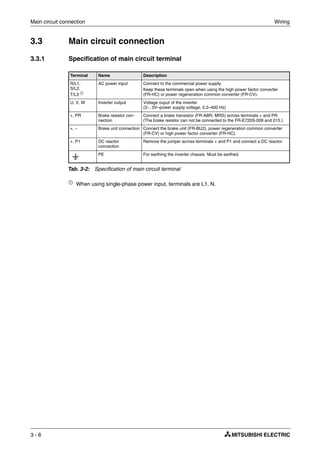
3.3.1 Specification of main circuit terminal
ቢ When using single-phase power input, terminals are L1, N.
Terminal Name Description
R/L1,
S/L2,
T/L3 ቢ
AC power input Connect to the commercial power supply.
Keep these terminals open when using the high power factor converter
(FR-HC) or power regeneration common converter (FR-CV).
U, V, W Inverter output Voltage ouput of the inverter
(3~, 0V–power supply voltage, 0.2–400 Hz)
+, PR Brake resistor con-
nection
Connect a brake transistor (FR-ABR, MRS) across terminals + and PR.
(The brake resistor can not be connected to the FR-E720S-008 and 015.)
+, − Brake unit connection Connect the brake unit (FR-BU2), power regeneration common converter
(FR-CV) or high power factor converter (FR-HC).
+, P1 DC reactor
connection
Remove the jumper across terminals + and P1 and connect a DC reactor.
PE For earthing the inverter chassis. Must be earthed.
Tab. 3-2: Specification of main circuit terminal
Wiring Main circuit connection
FR-E700 EC 3 - 7
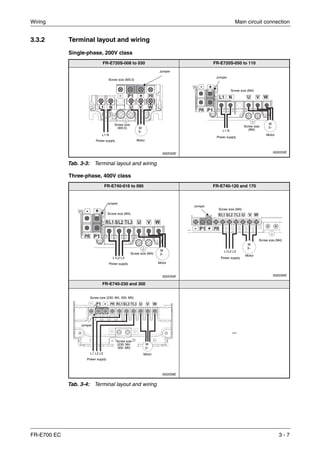
3.3.2 Terminal layout and wiring
Single-phase, 200V class
Three-phase, 400V class
FR-E720S-008 to 030 FR-E720S-050 to 110
I002032E I002033E
Tab. 3-3: Terminal layout and wiring
FR-E740-016 to 095 FR-E740-120 and 170
I002034E I002035E
FR-E740-230 and 300
I002058E
—
Tab. 3-4: Terminal layout and wiring
Jumper
L1 N
M
3~
MotorPower supply
Screw size
(M3,5)
Screw size (M3,5)
Jumper
Screw size (M4)
M
3~
Motor
Power supply
L1 N
Screw size
(M4)
Jumper
L1L2 L3
M
3~
MotorPower supply
Screw size (M4)
Screw size (M4)
Jumper
Screw size (M4)
M
3~
Motor
Power supply
L1L2 L3
Screw size (M4)
Jumper
Screw size
(230: M4,
300: M5)
L1 L2 L3
M
3~
Motor
Power supply
Screw size (230: M4, 300: M5)
Main circuit connection Wiring
3 - 8
E
CAUTION:
● The power supply cables must be connected to R/L1, S/L2, T/L3. Never connect the
power cable to the U, V, W of the inverter. Doing so will damage the inverter. (Phase
sequence needs not to be matched.)
● Connect the motor to U, V, W. At this time, turning on the forward rotation switch
(signal) rotates the motor in the counter clockwise direction when viewed from the
motor shaft.
Wiring Main circuit connection
FR-E700 EC 3 - 9
Cables and wiring length
Select the recommended cable size to ensure that a voltage drop will be 2% max.
If the wiring distance is long between the inverter and motor, a main circuit cable voltage drop
will cause the motor torque to decrease especially at the output of a low frequency.
The following tables indicate a selection example for the wiring length of 20m.
200V class (when input power supply is 230V)
400V class (when input power supply is 440V)
ቢ
The recommended cable size is that of the HIV cable (600 V class 2 vinyl-insulated cable)
with continuous maximum permissible temperature of 75 °C. Assumes that the ambient
temperature is 50 °C or less and the wiring distance is 20 m or less.
ባ
The recommended cable size is that of the THHW cable with continuous maximum
permissible temperature of 75 °C. Assumes that the ambient temperature is 40 °C or less
and the wiring distance is 20 m or less.
(Selection example for use mainly in the United States.)
ቤ The recommended cable size is that of the PVC cable with continuous maximum permissible
temperature of 70°C. Assumes that the ambient temperature is 40°C or less and the wiring
distance is 20m or less.
(Selection example for use mainly in Europe.)
ብ
The terminal screw size indicates the terminal size for R/L1, S/L2, T/L3, U, V, W, and a screw
for earthing. (For single-phase power input, the terminal screw size indicates the size of
terminal screw for L1, N, U, V, W, PR, +, – and P1 and a screw for earthing (grounding).)
The line voltage drop can be calculated by the following expression:
Use a larger diameter cable when the wiring distance is long or when it is desired to decrease
the voltage drop (torque reduction) in the low speed range.
Applicable Inverter
Type
Terminal
Screw
Size ብ
Tightening
Torque
[Nm]
Crimping
Terminal
Cable Size
HIV etc. [mm²] ቢ
AWG ባ
PVC [mm²] ቤ
L1, N,
P1, +
U, V,
W
L1, N,
P1, +
U, V,
W
Earth
cable
gauge
L1, N,
P1, +
U, V,
W
L1, N,
P1, +
U, V,
W
Earth
cable
gauge
FR-E720S-008 to 030 M3.5 1.2 2-3.5 2-3.5 2 2 2 14 14 2.5 2.5 2.5
FR-E720S-050 M4 1.5 2-4 2-4 2 2 2 14 14 2.5 2.5 2.5
FR-E720S-080 M4 1.5 2-4 2-4 2 2 2 14 14 2.5 2.5 2.5
FR-E720S-110 M4 1.5 5.5-4 2-4 3.5 2 3.5 12 14 4 2.5 4
Tab. 3-5: Cable size
Applicable Inverter
Type
Terminal
Screw
Size ብ
Tightening
Torque
[Nm]
Crimping
Terminal
Cable Size
HIV etc. [mm²] ቢ AWG ባ PVC [mm²] ቤ
R/L1,
S/L2
T/L3,
P1, +
U, V,
W
R/L1,
S/L2
T/L3,
P1, +
U, V,
W
Earth
cable
gauge
R/L1,
S/L2
T/L3,
P1, +
U, V,
W
R/L1,
S/L2
T/L3,
P1, +
U, V,
W
Earth
cable
gauge
FR-E740-016 to 095 M4 1.5 2-4 2-4 2 2 2 14 14 2.5 2.5 2.5
FR-E740-120 M4 1.5 5.5-4 2-4 3.5 2 3.5 12 14 4 2.5 4
FR-E740-170 M4 1.5 5.5-4 5.5-4 3.5 3.5 3.5 12 12 4 4 4
FR-E740-230 M4 1.5 5.5-4 5.5-4 5.5 5.5 8 10 10 6 6 10
FR-E740-300 M5 2.5 8-5 8-5 8 8 8 8 8 10 10 10
Tab. 3-6: Cable size
Line voltage drop [V]
3 wire restistance [mΩ/m]× wiring distance [m]× current [A]×
1000
-------------------------------------------------------------------------------------------------------------------------------------------------------------------------=
Main circuit connection Wiring
3 - 10
E
CAUTION:
● Tighten the terminal screw to the specified torque. A screw that has been tightened
too loosely can cause a short circuit or malfunction. A screw that has been
tightened too tightly can cause a short circuit or malfunction due to the unit
breakage.
● Use crimping terminals with insulation sleeve to wire the power supply and motor.
Wiring Main circuit connection
FR-E700 EC 3 - 11
Notes on earthing
Use the dedicated earth terminal to earth the inverter. (Do not use the screw in the casing, chas-
sis, etc.)
Use the thickest possible earth cable. Use the cable whose size is equal to or greater than that
indicated in Tab. 3-6, and minimize the cable length. The earthing point should be as near as
possible to the inverter.
Always earth the motor and inverter
● Purpose of earthing
Generally, an electrical apparatus has an earth terminal, which must be connected to the
ground before use.
An electrical circuit is usually insulated by an insulating material and encased. However, it
is impossible to manufacture an insulating material that can shut off a leakage current
completely, and actually, a slight current flow into the case. The purpose of earthing the case
of an electrical apparatus is to prevent operator from getting an electric shock from this
leakage current when touching it.
To avoid the influence of external noises, this earthing is important to audio equipment,
sensors, computers and other apparatuses that handle low-level signals or operate very fast.
● Earthing methods and earthing work
As described previously, earthing is roughly classified into an electrical shock prevention
type and a noise affected malfunction prevention type. Therefore, these two types should
be discriminated clearly, and the following work must be done to prevent the leakage current
having the inverter's high frequency components from entering the malfunction prevention
type earthing:
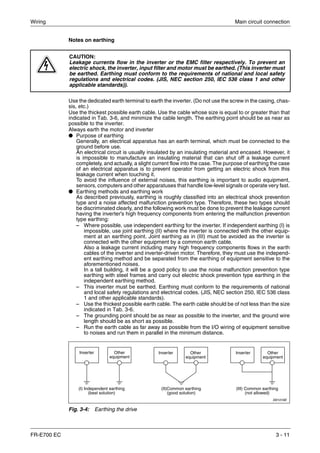
– Where possible, use independent earthing for the inverter. If independent earthing (I) is
impossible, use joint earthing (II) where the inverter is connected with the other equip-
ment at an earthing point. Joint earthing as in (III) must be avoided as the inverter is
connected with the other equipment by a common earth cable.
Also a leakage current including many high frequency components flows in the earth
cables of the inverter and inverter-driven motor. Therefore, they must use the independ-
ent earthing method and be separated from the earthing of equipment sensitive to the
aforementioned noises.
In a tall building, it will be a good policy to use the noise malfunction prevention type
earthing with steel frames and carry out electric shock prevention type earthing in the
independent earthing method.
– This inverter must be earthed. Earthing must conform to the requirements of national
and local safety regulations and electrical codes. (JIS, NEC section 250, IEC 536 class
1 and other applicable standards).
– Use the thickest possible earth cable. The earth cable should be of not less than the size
indicated in Tab. 3-6.
– The grounding point should be as near as possible to the inverter, and the ground wire
length should be as short as possible.
– Run the earth cable as far away as possible from the I/O wiring of equipment sensitive
to noises and run them in parallel in the minimum distance.
P
CAUTION:
Leakage currents flow in the inverter or the EMC filter respectively. To prevent an
electric shock, the inverter, input filter and motor must be earthed. (This inverter must
be earthed. Earthing must conform to the requirements of national and local safety
regulations and electrical codes. (JIS, NEC section 250, IEC 536 class 1 and other
applicable standards)).
I001016E
Fig. 3-4: Earthing the drive
(I) Independent earthing
(best solution)
(II)Common earthing
(good solution)
(III) Common earthing
(not allowed)
Inverter Other
equipment
Inverter Other
equipment
Inverter Other
equipment
Main circuit connection Wiring
3 - 12
Total wiring length
The maximum possible length of the motor cables depends on the capacity of the inverter and
the selected carrier frequency.
The lengths in the following table are for unshielded cables. When shielded cables are use di-
vide the values listed in the table by 2.
200V class
400V class
Pr. 72 "PWM frequency
selection" setting
(carrier frequency)
FR-E720S-
008 015 030 050 080 110
≤ 1 (1kHz) 200m 200m 300m 500m 500m 500m
2 to 15 (2kHz to 14,5kHz) 30m 100m 200m 300m 500m 500m
Tab. 3-7: Total wiring length
Pr. 72 "PWM frequency
selection" setting
(carrier frequency)
FR-E740-
016 026 040 060 ≥ 095
≤ 1 (1kHz) 200m 200m 300m 500m 500m
2 to 15 (2kHz to 14,5kHz) 30m 100m 200m 300m 500m
Tab. 3-8: Total wiring length
Fig. 3-5:
Remember that in the table above the total
wiring length is what is being referred to. In
parallel connections of several motors every
motor wire must be counted. In this example,
for the frequency inverter with an output
capacity of 3.7kW the permissible wiring
length is exceeded by the two parallel motor
lead wires.
I001904E
≤ 500m
300m
300m
300m + 300m = 600m
Wiring Main circuit connection
FR-E700 EC 3 - 13
NOTES Note that the motor windings are subjected to significantly higher loads when the motor is
operated by inverter than with normal mains operation. The motors must be approved for
inverter operation by the manufacturer (refer also to section 3.8.4).
Especially for long-distance wiring, the inverter may be affected by a charging current
caused by the stray capacitances of the wiring, leading to a malfunction of the overcurrent
protective function, fast response current limit function, or stall prevention function or a mal-
function or fault of the equipment connected on the inverter output side.
If fast-response current limit malfunctions, disable this function. When the stall prevention
function misoperates, increase the stall level. (Refer Pr. 22 "Stall prevention operation level"
and Pr. 156 "Stall prevention operation selection".)
Refer to section 6.15.1 for details of Pr. 72 "PWM frequency selection".
When using the automatic restart after instantaneous power failure function with wiring
length exceeding than 100m, select without frequency search (Pr. 162 = "1, 11").
Control circuit specifications Wiring
3 - 14
3.4 Control circuit specifications
The functions of the terminals highlighted in grey can be adjusted with parameters 178 to 184
"Input terminal function assignment" and Pr. 190 to 192 "Output terminal function assignment"
(refer to section 6.10). The listed settings show the default configuration as shipped, which you
can restore by resetting to the factory defaults.
Input signals
Terminal Name Description
Rated
Specifications
Refer to
Page
Contactinput
STF
Forward rotation
start
Turn on the STF signal to
start forward rotation and
turn it off to stop.
When the STF
and STR signals
are turned on
simultaneously,
the stop com-
mand is given.
Input resist-
ance: 4.7kΩ
Voltage at
opening:
21V to 26V DC
Contacts at
short-circuited:
4 to 6mA DC
6-114
STR
Reverse rotation
start
Turn on the STR signal to
start reverse rotation and
turn it off to stop.
RH, RM, RL
Multi-speed
selection
Multi-speed can be selected according to the
combination of RH, RM and RL signals.
MRS Output stop
Turn on the MRS signal (20ms or more) to stop
the inverter output.
Use to shut off the inverter output when stop-
ping the motor by electromagnetic brake.
RES Reset
Used to reset alarm output provided when pro-
tective function is activated.
Turn on the RES signal for more than 0.1s,
then turn it off.
Initial setting is for reset always. By setting
Pr. 75, reset can be set to enabled only at an
inverter alarm occurrence. Recover about 1s
after reset is cancelled.
Referencepoint
SD
Contact input com-
mon (sink)
24V DC power
supply common
A determined control function is activated, if
the corresponding terminal is connected to the
terminal SD (sink logic). The SD terminal is
isolated from the digital circuits via opto cou-
plers.
The terminal is isolated from the reference
potential of the analog circuit (terminal 5).
— —
PC
24V DC
power supply,
contact input
common
(source)
24V DC/0.1A output
With negative logic and control via open col-
lector transistors (e.g. a PLC) the positive pole
of an external power source must be con-
nected to the PC terminal. With positive logic
the PC terminal is used as a common refer-
ence for the control inputs. This means that
when positive logic is selected (default setting
of the EC units) the corresponding control
function is activated by connecting its terminal
to the PC terminal.
Power supply
voltage range:
22 V to
26,5 V DC
Permissible
load current:
100 mA
3-20
Tab. 3-9: Input signals (1)
Wiring Control circuit specifications
FR-E700 EC 3 - 15
Terminal Name Description
Rated
Specifications
Refer to
Page
Frequencysetting
10
(Output volt-
age
5V DC)
Frequency setting
power supply
Used as power supply when connecting poten-
tiometer for frequency setting (speed setting)
from outside of the inverter.
Rated output voltage: 5V DC
Recommended potentiometer: 1kΩ, 2W linear,
multi turn potentiometer
5.2V DC ± 0,2V,
Permissible
load current
10mA
6-174
2
Frequency setting
(voltage)
Inputting 0 to 5V DC (or 0 to 10V) provides the
maximum output frequency at 5V (10V) and
makes input and output proportional. Use Pr.
73 to switch from among input 0 to 5V DC (ini-
tial setting), 0 to 10V DC.
Input resist-
ance:
10kΩ ± 1kΩ
Maximum
permissible
voltage:
20V DC
4
Frequency setting
(current)
Inputting 4 to 20mA DC (or 0 to 5V, 0 to 10V)
provides the maximum output frequency at
20mA and makes input and output propor-
tional. This input signal is valid only when the
AU signal is on (terminal 2 input is invalid).
Use Pr. 267 to switch from among input 4 to
20mA (initial setting), 0 to 5V DC and 0 to
10V DC. Set the voltage/current input switch in
the "V" position to select voltage input (0 to 5V/
0 to 10V).
Current input:
Input resist-
ance:
233Ω ± 5Ω
Maximum
permissible
current: 30mA
Voltage input:
Input resist-
ance:
10kΩ ± 1kΩ
Maximum
permissible
voltage:
20V DC
5
Frequency setting
common
Terminal 5 provides the common reference
potential (0V) for all analog set point values
and for the analog output signals AM (voltage).
The terminal is isolated from the digital circuit’s
reference potential (SD). This terminal should
not be grounded. If local regulations require
grounding of the reference potential note that
this can propagate any noise in the ground
potential to the control electronics, thus
increasing sensitivity to interference.
—
Tab. 3-9: Input signals (2)
NOTE Set Pr. 267 and a voltage/current input switch correctly, then input analog signals in accord-
ance with the settings. Applying a voltage with voltage/current input switch in "I" position
(current input is selected) or a current with switch in"V" position (voltage input is selected)
could cause component damage of the inverter or analog circuit of output devices. Refer to
section 6.16 for details.
Voltage inputCurrent input
(initial status)
Control circuit specifications Wiring
3 - 16
Output signals
Communication
Terminal Name Description
Rated
Specifications
Refer to
Page
Relay
A, B, C
Relay output
(alarm output)
The alarm is output via relay contacts. The
block diagram shows the normal operation and
voltage free status. If the protective function is
activated, the relay picks up.
Contact
capacity:
230V AC/0.3A
(Power
factor: 0.4) or
30V DC/0.3A
6-124
Opencollector
RUN Inverter running
Switched low when the inverter output fre-
quency is equal to or higher than the starting
frequency (initial value 0.5Hz).
Switched high during stop or DC injection
brake operation.
Permissible
load:
24V DC (max.
27V DC), 0.1A
(A voltage drop
is 3.4V maxi-
mum when the
signal is on.)
FU
Frequency
detection
The output is switched low once the output fre-
quency exceeds a value preset in Pr. 42 (or
43). Otherwise the FU output is switched high.
SE
Open collector
output common
Reference potential for the signals RUN and
FU. This terminal is isolated from the reference
potential of the control circuit SD.
— —
Analogoutput
AM
Analog voltage
output
Select one e.g. output fre-
quency from monitor items.
The output signal is propor-
tional to the magnitude of
the corresponding monitor-
ing item.
Not output during inverter
reset.
Output item:
Output
frequency
(initial setting)
Output signal:
0–10V DC
Permissible
load current:
1 mA
(load imped-
ance:
≥ 10kΩ)
Resolution:
8 bit
6-146
Tab. 3-10: Output signals
Name Description Specification
Refer to
Page
RS-485
PU connector
With the PU connector, communication can be
made through RS-485.
Conforming standard:
EIA-485 (RS-485)
Transmission format:
Multidrop
Communication speed:
4800 to 38400bps
Overall length: 500m
3-23,
6-221
USB
USB connector
The FR Configurator can be operated by con-
necting the inverter to the personal computer
through USB.
Interface:
conforms to USB1.1
Transmission speed: 12Mbps
Connector:
USB mini B connector
(receptacle mini B type)
3-25,
6-269
Tab. 3-11: Communication signals
B
C
A
Wiring Control circuit specifications
FR-E700 EC 3 - 17
3.4.1 Control circuit terminals
Wiring method
ቢ Remove about 6mm of the cable insulation. Wire the stripped cable after twisting it to prevent
it from becoming loose. In addition, do not solder it.
ባ Loosen the terminal screw and insert the cable into the terminal.
I001917E
Fig. 3-6: Terminal layout
Fig. 3-7:
Preparation of the cable
I001326E
Item Terminals A, B and C Other terminals
Screw size M3 M2
Tightening torque 0.5Nm–0.6Nm 0.22 Nm–0.25 Nm
Cable size 0.3mm²–0.75mm² 0.3 mm²–0.5 mm²
Screwdriver
Flat blade screw driver
Edge thickness: 0,4mm × 2,5mm
Tab. 3-12: Connection to the terminals
E
CAUTION:
Undertightening can cause cable disconnection or malfunction. Overtightening can
cause a short circuit or malfunction due to damage to the screw or unit.
AM
Terminal screw size
Terminals A, B and C: M3
Other than the above: M2
X = 6mm (Terminal A, B and C)
5mm (Other than the above)
X
Control circuit specifications Wiring
3 - 18
Common terminals of the control circuits PC, 5, SE
Terminals PC, 5, and SE are all common terminals (0V) for I/O signals and are isolated from
each other. Avoid connecting the terminal PC and 5 and the terminal SE and 5. Terminal PC is
a common terminal for the contact input terminals (STF, STR, RH, RM, RL, MRS and RES).
The open collector circuit is isolated from the internal control circuit by photocoupler.
Terminal 5 is a common terminal for frequency setting signal (terminal 2 or 4) and analog output
terminal AM. It should be protected from external noise using a shielded or twisted cable.
Terminal SE is a common terminal for the open collector output terminal RUN and FU.
The contact input circuit is isolated from the internal control circuit by photocoupler.
Signal inputs by contactless switch
The contacted input terminals of the inverter (STF, STR, RH, RM, RL, MRS and RES) can be
controlled using a transistor instead of a contacted switch as shown below. According to the ad-
justed control logic, PNP transistors (positive logic) or NPN transistors (negative logic) must be
used to activate the inputs.
Fig. 3-8:
External signal input in source logic using
transistor (initial setting)
I001020E
PC
STF, etc.
Inverter
Wiring Control circuit specifications
FR-E700 EC 3 - 19
3.4.2 Wiring instructions
● Use shielded or twisted cables for connection to the control circuit terminals and run them
away from the main and power circuits (including the 230V relay sequence circuit).
● Use two or more parallel micro-signal contacts or twin contacts to prevent a contact faults
when using contact inputs since the control circuit input signals are micro-currents.
● Do not apply a voltage to the contact input terminals (e.g. STF) of the control circuit.
● Always apply a voltage to the alarm output terminals (A, B, C) via a relay coil, lamp, etc. In
no way must a voltage be short-circuited by these relay contacts.
● It is recommended to use the cables of 0.75mm² gauge for connection to the control circuit
terminals. If the cable gauge used is 1.25mm² or more, the front cover may be lifted when
there are many cables running or the cables are run improperly, resulting in an operation
panel contact fault.
● The wiring length should be 30m maximum.
● Do not short terminal PC and SD. Inverter may be damaged.
Fig. 3-9:
Contacts
I001021EMicro signal contacts Twin contacts
Control circuit specifications Wiring
3 - 20
3.4.3 Changing the control logic
FR-E700 frequency inverters offer the possibility of choosing between two types of control logic.
Depending on the direction of the flowing current, one distinguishes between:
● In sink logic, a signal switches on when a current flows from the corresponding signal input
terminal. Terminal SD is common to the contact input signals. Terminal SE is common to
the open collector output signals.
● In source logic, a signal switches on when a current flows into the corresponding signal input
terminal. Terminal PC is common to the contact input signals. Terminal SE is common to
the open collector output signals.
The input signals are set to source logic (SOURCE) when shipped from the factory. To change
the control logic, the jumper connector above the control circuit terminal block must be moved
to the other position.
(The output signals may be used in either the sink or source logic independently of the jumper
connector position.)
I001029E
Fig. 3-10: Changing the control logic
Fig. 3-11:
Changing the control logic
I001918E
RUN RUN
Current flow concerning the input/output
signals when sink logic is selected
Current flow concerning the input/output
signals when source logic is selected
Current CurrentSINK
SOURCE
FR-E700 DC input (sink type),
e.g. AX40
DC input (source type),
e.g. AX80
FR-E700
Current Current
Wiring Control circuit specifications
FR-E700 EC 3 - 21
NOTES Turn off the inverter power before switching a jumper connector.
The sink-source logic change-over jumper connector must be fitted in only one of those
positions. If it is fitted in both positions at the same time, the inverter may be damaged.
The capacity plate is placed on the front cover and the rating plate is on the inverter. Since
these plates have the same serial numbers, always reinstall the removed cover onto the ori-
ginal inverter.
Control circuit specifications Wiring
3 - 22
Using an external power supply
● Sink logic type
Use terminal PC as a common terminal to prevent a malfunction caused by undesirable
current. (Do not connect terminal SD of the inverter with terminal 0V of the external power
supply. When using terminals PC-SD as a 24V DC power supply, do not install a power
supply in parallel in the outside of the inverter. Doing so may cause a malfunction due to
undesirable current.)
● Source logic type
When using an external power supply for transistor output, use terminal SD as a common
to prevent misoperation caused by undesirable current.
Fig. 3-12:
Using an external power supply in connection
with the outputs of a PLC
I001030E
Fig. 3-13:
Using an external power supply in connection
with the outputs of a PLC
I001031E
AY40 Inverter
Current
AY80 Inverter
Current
Wiring PU connector
FR-E700 EC 3 - 23
3.5 PU connector
Using the PU connector, you can perform communication operation from the FR-PU07, the
FR-PA07 or a personal computer. Refer to the figure below to open the PU connector cover.
3.5.1 Connecting the parameter unit using a connection cable
Use the optional FR-CB२२ or connector and cable available on the market. Insert the cable
plugs securely into the PU connector of the inverter and the connection connector of the
FR-PU07/FR-PA07 along the guide until the tabs snap into place.
Overall wiring length when the parameter unit is connected: max. 20m.
I001919E
Fig. 3-14: To open the cover of the PU connector
II002059E
Fig. 3-15: Connecting the parameter unit FR-PU07/FR-PA07 using a connection cable
PU connector
To open the cover
Place a flathead screwdriver, etc. in a slot
and push up the cover to open.
FR-PU07
Cable FR-CB२२ (option)
PU connector
FR-PA07
PU connector Wiring
3 - 24
3.5.2 RS-485 communication
When the PU connector is connected with a personal, FA or other computer by a communication
cable, a user program can run and monitor the inverter or read and write to parameters.
The protocol can be selected from Mitsubishi inverter and Modbus RTU. For detailed informa-
tion refer to section 6.19.
Wiring USB connector
FR-E700 EC 3 - 25
3.6 USB connector
Inverter setup can be easily performed using the FR Configurator by connecting the inverter and
personal computer with a USB cable (version 1.1).
Specification Description
Interface USB 1.1
Transmission speed 12MBps
Wiring length 5m
Connector USB mini B connector (receptacle mini B type)
Power supply Self-power supply
Tab. 3-13: USB connector specifications
I001921E
Fig. 3-16: Connection to the USB connector
Pull the cover in the direction
of the arrow.
USB cable USB connector
Then turn it upward.
Connection of stand-alone option units Wiring
3 - 26
3.7 Connection of stand-alone option units
The inverter accepts a variety of stand-alone option units as required.
3.7.1 Magnetic contactors (MC)
Inverter input side magnetic contactor (MC)
On the inverter input side, it is recommended to provide an MC for the following purposes.
● To release the inverter from the power supply when the fault occurs or when the drive is not
functioning (e.g. emergency stop operation).
When cycle operation or heavy-duty operation is performed with an optional brake resistor
connected, overheat and burnout of the discharging resistor can be prevented if a regener-
ative brake transistor is damaged due to insufficient heat capacity of the discharging resistor
and excess regenerative brake duty.
● To prevent any accident due to an automatic restart at restoration of power after an inverter
stop made by a power failure.
● The control power supply for inverter is always running and consumes a little power. When
stopping the inverter for an extended period of time, powering off the inverter will save power
slightly.
● To separate the inverter from the power supply to ensure safe maintenance and inspection
work.
E
CAUTION:
Incorrect connection will cause inverter damage or accident. Connect and operate the
option unit carefully in accordance with the corresponding option unit manual.
NOTE Since repeated inrush currents at power on will shorten the life of the converter circuit
(switching life is about 1,000,000 times.), frequent starts and stops of the MC must be
avoided. Turn on/off the inverter start controlling terminals (STF, STR) to run/stop the
inverter.
Wiring Connection of stand-alone option units
FR-E700 EC 3 - 27
ቢ When the power supply is 400V class, install a step-down transformer.
Ħ
Handling of the inverter output side magnetic contactor
Switch the magnetic contactor between the inverter and motor only when both the inverter and
motor are at a stop. When the magnetic contactor is turned on while the inverter is operating,
overcurrent protection of the inverter and such will activate. When an MC is provided for switch-
ing to the commercial power supply, for example, switch it on/off after the inverter and motor
have stopped.
Example Ĥ As shown below, always use the start signal (ON or OFF across terminals STF or STR-PC)
to make a start or stop. (Refer to section 6.10.4.)
I001922E
Fig. 3-17: Start and stop of the inverter
Power
supply
Inverter
To the
motor
Operation preparation
OFF ON
Stop
Start/Stopp Operation
Start
T ቢ
Connection of stand-alone option units Wiring
3 - 28
3.7.2 Connection of a dedicated external brake resistor FR-ABR and MRS
(FR-E720S-030 or more, FR-E740-016 or more)
Install a dedicated brake resistor (FR-ABR or MRS) outside when the motor is made to run by
the load, quick deceleration is required, etc. Connect a dedicated brake resistor (FR-ABR or
MRS) to terminal + and PR. (For the locations of terminal + and PR, refer to the terminal block
layout (section 3.3.2).)
Set parameters below (refer to section 6.9.2).
FR-E720S-030
Connected brake
resistor
Parameter setting
Pr. 30 „Regenerative
function selection“
Pr. 70 „Special regenerative brake duty“
MRS 0 (initial value) —
FR-ABR
1
FR-E720S-110 or less
FR-E740-170 or less
10 (%)
FR-E740-230 or more 6 (%)
Tab. 3-14: Setting of parameter 30 and 70 when connecting an external brake resistor
E
CAUTION:
● The brake resistor connected should only be the dedicated brake resistor.
● Do not remove a jumper across terminal + and P1 except when connecting a DC
reactor.
● The shape of jumper differs according to capacities.
Fig. 3-18:
Connection of a brake resistor to the terminals
+ and PR for the inverter FR-E720S-030
I002036E
Terminal +
Brake resistor
Terminal PR
Jumper
Wiring Connection of stand-alone option units
FR-E700 EC 3 - 29
FR-E720S-050 to 110 and FR-E740-016 to 095
FR-E740-120 to 300
Fig. 3-19:
Connection of a brake resistor to the terminals
+ and PR for the inverters FR-E720S-050 to
110 and FR-E740-016 to FR-E740-095
I001923E
Fig. 3-20:
Connection of a brake resistor to the terminals
+ and PR for the inverters FR-E740-120 to
FR-E740-300
I001924E
Terminal +
Brake resistor
Terminal PR
Jumper
Terminal +
Brake resistor
Terminal PR
Jumper
Connection of stand-alone option units Wiring
3 - 30
It is recommended to configure a sequence, which shuts off power in the input side of the in-
verter by the external thermal relay as shown below, to prevent overheat and burnout of the high
duty brake resistor (FR-ABR) in case the regenerative brake transistor is damaged. (The brake
resistor can not be connected to the FR-E720S-008 or 015.)
ቢ
Refer to Tab. 3-15 for the type number of each capacity of thermal relay and the diagram for
the connection.
ባ
When the power supply is 400V class, install a step-down transformer.
I002043E
Fig. 3-21: Protection circuits
Power Supply
Voltage Type
High-duty Brake
Resistor
Thermal Relay Type
(Mitsubishi Product)
Contact Rating
230V
MRS
MRS120W200 TH-N20CXHZKP-0.7A
110V AC/5A
220V AC/2A (AC 11 class),
110V DC/0.5A
220V DC/0.25A (DC 11 class)
MRS120W100 TH-N20CXHZKP-1.3A
MRS120W60 TH-N20CXHZKP-2.1A
MRS120W40 TH-N20CXHZKP-3.6A
FR-ABR
FR-ABR-0.4K TH-N20CXHZKP-0.7A
FR-ABR-0.75K TH-N20CXHZKP-1.3A
FR-ABR-2.2K TH-N20CXHZKP-2.1A
400V
FR-ABR-H0.4K TH-N20CXHZKP-0.24A
FR-ABR-H0.75K TH-N20CXHZKP-0.35A
FR-ABR-H1.5K TH-N20CXHZKP-0.9A
FR-ABR-H2.2K TH-N20CXHZKP-1.3A
FR-ABR-H3.7K TH-N20CXHZKP-2.1A
FR-ABR-H5.5K TH-N20CXHZKP-2.5A
FR-ABR-H7.5K TH-N20CXHZKP-3.6A
FR-ABR-H11K on request
FR-ABR-H15K on request
Tab. 3-15: Resistor and thermal relay combination
Fig. 3-22:
Connecting the thermal relay
I001458E
Power
supply
Inverter Thermo relay
(OCR) ቢ
OFFON
Example 1
Brake
restistor
Inverter
OFFON
Example 2
Brake
restistor
OCR
contact
Power
supply
Thermo relay
(OCR) ቢ
OCR
contact
T ባ
T ባ
To the inverter +
terminal
To a resistor
Wiring Connection of stand-alone option units
FR-E700 EC 3 - 31
E
CAUTION:
● Brake resistor can not be used with the brake unit (FR-BU2), high power factor
converter (FR-HC), power supply regeneration converter (FR-CV), etc.
● Do not connect a resistor directly to the DC terminals + and –. This could cause a
fire.
Connection of stand-alone option units Wiring
3 - 32
3.7.3 Connection of a brake unit FR-BU2
When connecting a brake unit to improve the brake capability at deceleration, make connection
as shown below.
Connection example with the GRZG type discharging resistor
ቢ
If the control contacts are only specified for 230V control power you must install a transformer
when using a 400V power supply.
ባ Connect the inverter terminals (+, −) and brake unit terminals so that their terminal signals
match with each other. (Incorrect connection will damage the inverter.)
ቤ
The wiring distance between the inverter, brake unit and resistor unit should be within 5m.
If twisted wires are used, the distance should be within 10m.
ብ
If the transistors in the brake unit should become faulty, the resistor can be unusually hot,
causing a fire. Therefore, install a magnetic contactor on the inverters input side to configure
a circuit so that a current is shut off in case of fault.
ቦ
Refer to FR-BU2 manual for connection method of discharging resistor.
I002044E
Fig. 3-23: Connection with the brake unit FR-BU2
Brake Unit Discharging Resistor
Recommended External Thermal
Relay
FR-BU2-1.5K GZG 300W-50Ω (one) TH-N20CXHZKP-1.3A
FR-BU2-3.7K GRZG 200-10Ω (three in series) TH-N20CXHZKP-3.6A
FR-BU2-7.5K GRZG 300-5Ω (four in series) on request
FR-BU2-15K GRZG 400-2Ω (six in series) on request
FR-BU2-7.5K GRZG 200-10Ω (six in series) TH-N20CXHZKP-3.6A
FR-BU2-15K GRZG 300-5Ω (eight in series) on request
Tab. 3-16: Recommended external relay
ON
3-phase AC
power supply
OFF
Inverter
≤ 5m ቤ
M
3~
Motor
ባ
ብ
T ቢ
ቤ
ቦ
Wiring Connection of stand-alone option units
FR-E700 EC 3 - 33
E
CAUTION:
● If the transistors in the brake unit should become faulty, the resistor can be
unusually hot, causing a fire. Therefore, install a magnetic contactor on the
inverters input side to configure a circuit so that a current is shut off in case of fault.
● Do not remove a jumper across terminal + and P1 except when connecting a DC
reactor.
NOTE Set "1" in Pr. 0 "Brake mode selection" of the FR-BU2 to use GRZG type discharging resis-
tor.
Connection of stand-alone option units Wiring
3 - 34
Connection example with the FR-BR(-H) type resistor
ቢ
If the control contacts are only specified for 230V control power you must install a transformer
when using a 400V power supply.
ባ Normal: across TH1-TH2 ... close, Alarm: across TH1-TH2 ... open
ቤ
Connect the inverter terminals (+, −) and brake unit terminals so that their terminal signals
match with each other. (Incorrect connection will damage the inverter.)
ብ A jumper is connected across BUE and SD in the initial status.
ቦ
The wiring distance between the inverter, brake unit and resistor unit should be within 5m.
If twisted wires are used, the distance should be within 10m.
002045E
Fig. 3-24: Connection with the brake unit FR-BU2
E
CAUTION:
● If the transistors in the brake unit should become faulty, the resistor can be
unusually hot, causing a fire. Therefore, install a magnetic contactor on the
inverters input side to configure a circuit so that a current is shut off in case of fault.
● Do not remove a jumper across terminal + and P1 except when connecting a DC
reactor.
ON
3-phase AC
power supply
OFF
Inverter
≤ 5m ቦ
M
3~
Motor
ቤ
ባ
ቤ
ብ
T ቢ
Wiring Connection of stand-alone option units
FR-E700 EC 3 - 35
3.7.4 Connection of the high power factor converter FR-HC
When connecting the high power factor converter (FR-HC) to suppress power harmonics, per-
form wiring securely as shown below.
ቢ
Keep input terminals (R/L1, S/L2, T/L3) open. Incorrect connection will damage the inverter.
ባ
Do not insert an MCCB between the terminals + and − (between P and +, between N and
−). Opposite polarity of terminals −, + will damage the inverter.
ቤ
Use Pr. 178 to Pr. 184 "Input terminal function selection" to assign the terminals used for
the X10, RES signal. (Refer to section 6.10).
ብ Be sure to connect terminal RDY of the FR-HC to the X10 signal or MRS signal assigned
terminal of the inverter, and connect terminal SE of the FR-HC to terminal SD of the inverter.
Without proper connecting, FR-HC will be damaged.
E
CAUTION:
Perform wiring of the high power factor converter (FR-HC) securely as shown below.
Incorrect connection will damage the high power factor converter and inverter.
I002060E
Fig. 3-25: Connection of the high power factor converter FR-HC
NOTES The voltage phases of terminals R/L1, S/L2, T/L3 and terminals R4, S4, T4 must be
matched.
Use sink logic when the FR-HC is connected. The FR-HC cannot be connected when
source logic (factory setting) is selected.
Do not remove a jumper across terminal + and P1 except when connecting a DC reactor.
3-phase AC
power supply
Inverter
High power factor
converter (FR-HC)
Reactor 1
(FR-HCL01)
External box
(FR-HCB)
Motor
M
3~
Phase
detection
Reactor 2
(FR-HCL02)
ቢ
ባ
ቤ
ቤ
ብ
Connection of stand-alone option units Wiring
3 - 36
3.7.5 Connection of the power regeneration common converter FR-CV
When connecting the power regeneration common converter (FR-CV), make connection so that
the inverter terminals (+, −) and the terminal symbols of the power regeneration common con-
verter (FR-CV) are the same.
ቢ
Always keep the power input terminals R/L1, S/L2, T/L3 open. Incorrect connection will
damage the inverter.
ባ Do not insert an MCCB between the terminals + and − (between P/L+ and +, between N/
L− and −). Opposite polarity of terminals −, + will damage the inverter.
ቤ
Always connect the power supply and terminals R/L11, S/L21, T/MC1. Operating the inverter
without connecting them will damage the power regeneration common converter.
ብ
Use Pr. 178 to Pr. 184 "Input terminal function selection" to assign the terminals used for
the X10, RES signal. (Refer to section 6.10).
ቦ Be sure to connect terminal RDYB of the FR-CV to the X10 signal or MRS signal assigned
terminal of the inverter, and connect terminal SE of the FR-CV to terminal SD of the inverter.
Without proper connecting, FR-CV will be damaged.
I002061
Fig. 3-26: Connection of the power regeneration common converter FR-CV
NOTES The voltage phases of terminals R/L11, S/L21, T/MC1 and terminals R2/L1, S2/L2, T2/L3
must be matched.
Use sink logic when the FR-CV is connected. The FR-CV cannot be connected when source
logic (factory setting) is selected.
Do not remove a jumper across terminal + and P1.
Inverter
Dedicatedstand-alone
reactor FR-CVL
Power regeneration
common converter FR-CV
3-phase AC
power supply
Motor
M
3~
ባ
ቤ
ቢ
ቦ
ብ
ብ
Wiring Connection of stand-alone option units
FR-E700 EC 3 - 37
3.7.6 Connection of the power improving DC reactor FFR-HEL-(H)-E
When using the DC reactor (FFR-HEL-(H)-E), connect it between terminals P1 and +. In this
case, the jumper connected across terminals P1 and + must be removed. Otherwise, the reactor
will not exhibit its performance.
3.7.7 Installation of a reactor
When the inverter is connected near a large-capacity power transformer (500kVA or more) or
when a power capacitor is to be switched over, an excessive peak current may flow in the power
input circuit, damaging the converter circuit. To prevent this, always install the optional DC re-
actor (FFR-HEL-(H)-E) or AC reactor (FR-BAL-B).
ቢ
When connecting the FFR-HEL-(H)-E, remove the jumper across terminals + and P1.
Fig. 3-27:
Connection of a DC reactor
I002048E_N
NOTES The wiring distance should be within 5m.
The size of the cables used should be equal to or larger than that of the power supply cables
(R/L1, S/L2, T/L3).
I002038E
Fig. 3-28: Installation of a reactor
NOTES
The wiring length between the FFR-HEL-(H)-E and inverter should be 5m maximum and
minimized.
Use the same wire size as that of the power supply wire (R/L1, S/L2, T/L3). (Refer to page 3-9.)
FFR-HEL-(H)-E
Remove the
jumper.
Power
supply
AC reactor
(FR-BAL-B)
DC reactor
(FFR-HEL-(H)-E) ቢ
Installation
range of reactor
Wiring length [m]
Powersupply
capacity[kVA]
M
3~
Inverter
DC reactor
(FFR-HEL-(H)-E) ቢ
Single-phase power input
Three-phase power input
Power
supply
AC reactor
(FR-BAL-B)
Inverter
M
3~
Electromagnetic compatibility (EMC) Wiring
3 - 38
3.8 Electromagnetic compatibility (EMC)
3.8.1 Leakage currents and countermeasures
Mains filters, shielded motor cables, the motor, and the inverter itself cause stationary and var-
iable leakage currents to PE. Since its value depends on the capacitances, carrier frequency,
etc., low acoustic noise operation at the increased carrier frequency of the inverter will increase
the leakage current. Therefore, take the following measures. Select the earth leakage breaker
according to its rated sensitivity current, independently of the carrier frequency setting.
To-earth (ground) leakage currents
Leakage currents may flow not only into the inverter's own line but also into the other lines
through the earth (ground) cable, etc. These leakage currents may operate earth (ground) leak-
age circuit breakers and earth leakage relays unnecessarily.
● Countermeasures
– If the carrier frequency setting is high, decrease the Pr. 72 "PWM frequency selection"
setting. Note that motor noise increases. Selecting Pr. 240 "Soft-PWM operation selec-
tion" makes the sound inoffensive.
– By using earth leakage circuit breakers designed for harmonic and surge suppression
in the inverter's own line and other line, operation can be performed with the carrier
frequency kept high (with low noise).
● To-earth leakage currents
– Take caution as long wiring will increase the leakage current. Decreasing the carrier
frequency of the inverter reduces the leakage current.
– Increasing the motor capacity increases the leakage current.
– Shielded motor cables significantly increase the leakage current to PE (approx. double
the value generated with unshielded motor cables of the same length).
– The leakage current of the 400V class is larger than that of the 200V class.
Line-to-line leakage currents
Harmonics of leakage currents flowing in static capacities between the inverter output cables
may operate the external thermal relay unnecessarily. When the wiring length is long (50m or
more) for the 400V class small-capacity model (FR-E700-170 or less), the external thermal relay
is likely to operate unnecessarily because the ratio of the leakage current to the rated motor
current increases.
Wiring Electromagnetic compatibility (EMC)
FR-E700 EC 3 - 39
Ħ
● Countermeasures
– Use Pr. 9 "Electronic thermal O/L relay".
– If the carrier frequency setting is high, decrease the Pr. 72 "PWM frequency selection"
setting. Note that motor noise increases. Selecting Pr. 240 "Soft-PWM operation selec-
tion" makes the sound inoffensive. To ensure that the motor is protected against line-to-
line leakage currents, it is recommended to use a temperature sensor (e.g. PTC element)
to directly detect motor temperature.
● Selecting a power supply circuit breaker:
You can also use a circuit breaker (MCCB) to protect the power supply lines against short
circuits and overloads. However, note that this does not protect the inverter (rectifiers, IGBT).
Select the capacity of the circuit breaker on the basis of the cross-sectional area of the power
supply lines. To calculate the required mains current trip point you need to know the power
required by the inverter (Refer to Rated Input Capacity in Appendix A, Specifications) and
the mains supply voltage. Select a circuit breaker with a trip point that is slightly higher than
calculated, particularly in the case of breakers with electromagnetic tripping, since the trip
characteristics are strongly influenced by the harmonics in the power supply line.
Example Ĥ Line-to-line leakage current data example
Dedicated motor: SF-JR 4P
Carrier frequency: 14.5kHz
Used wire: 2mm², 4 cores, cab tyre cable
Motor Capacity [kW] Rated Motor Current [A]
Leakage Currents [mA]
Wiring length 50m Wiring length 100m
0.4 1.1 620 1000
0.75 1.9 680 1060
1.5 3.5 740 1120
2.2 4.1 800 1180
3.7 6.4 880 1260
5.5 9.7 980 1360
7.5 12.8 1070 1450
Tab. 3-17: Line-to-line leakage current data example
I001043E
Fig. 3-29: Line-to-line leakage currents
NOTE The earth leakage breaker must be either a Mitsubishi earth leakage breaker (ELB, for har-
monics and surges) or an ELB with breaker designed for harmonic and surge suppression
that is approved for use with frequency inverters.
Power
supply
Inverter
Line-to-line
leakage currents
path
Line-to-line static
capacitances
M
3~
Thermal
relay
Motor
Electromagnetic compatibility (EMC) Wiring
3 - 40
Note on selecting a suitable power supply ELCB
If you install a Mitsubishi frequency inverter with a 3-phase power supply in locations where an
earth leakage contact breaker is required by the VDE you must install a universal-current sen-
sitive ELCB conforming to the specifications laid down in VDE 0160 / EN 50178 (ELCB Type B).
This is necessary because pulse-current sensitive ELCBs (Type A) do not pro-vide reliable trip-
ping performance for the frequency inverter in response to DC leakage current.
When selecting a suitable universal-current sensitive ELCB you must also take into account the
influence of the mains filter, the length of the shielded motor power cables and the frequency on
the leakage currents.
Also note that when the mains power is switched on with switches without a snap-action function
the resulting brief asymmetrical load can cause unwanted triggering of the ELCB.
This problem can be avoided by using a Type B ELCB with a delayed response function, or by
using a contactor relay to switch all three phases simultaneously.
Calculate the trip current sensitivity of the ELB as follows:
● Breaker designed for harmonic and surge suppression:
IΔn ≥ 10 × (Ig1 + Ign + Igi + lg2 + lgm)
● Standard breaker:
IΔn ≥ 10 × [Ig1 + Ign + Igi + 3 × (Ig2 + lgm)]
Ig1, Ig2: Leakage currents in wire path during commercial power supply operation
Ign: Leakage current of inverter input side noise filter
Igm: Leakage current of motor during commercial power supply operation
Igi: Leakage current of inverter unit
I002037E
Fig. 3-30: Leakage currents
NOTE For star connection, the amount of leakage current is 1/3.
Example of leakage current per 1km
during the commercial power supply
operation when the CV cable is
routed in metal conduit
200V/60Hz)
Leakage current example of 3-phase
induction motor during the
commercial power supply operation
(200V/60Hz)
Power supply size [mm²] Motor capacity [kW]
Leakagecurrent[mA]
Leakagecurrent[mA]
Example of leakage current per 1km
during the commercial power supply
operation when the CV cable is
routed in metal conduit
(Three-phase three-wire delta
connection 400V/60Hz)
Leakage current example of 3-
phase induction motor during the
commercial power supply
operation
(Totally-enclosed fan-cooled type
motor 400V/60Hz)
Leakagecurrent[mA]
Leakagecurrent[mA]
Power supply size [mm²] Motor capacity [kW]
Wiring Electromagnetic compatibility (EMC)
FR-E700 EC 3 - 41
Ħ
Example Ĥ
Breaker Designed for Harmonic
and Surge Suppression
Standard Breaker
Leakage current Ig1 [mA]
Leakage current Ign [mA] 0 (without noise filter)
Leakage current Igi [mA] 1 (with noise filter)
Leakage current Ig2 [mA]
Motor leakage current Igm [mA] 0.36
Total leakage current [mA] 2.79 6.15
Rated sensivity current [mA] 30 100
Tab. 3-18: Estimation of the permanent flowing leakage current
NOTES The frequency inverter monitors its own output for ground faults up to a frequency of 120Hz.
However, it is important to understand that this feature only protects the inverter itself. It can-
not be used to provide protection against shock hazards for personnel.
In the connection earthed-neutral system, the sensitivity current is purified against an earth
fault in the inverter output side. Earthing must conform to the requirements of national and
local safety regulations and electrical codes. (JIS, NEC section 250, IEC 536 class 1 and
other applicable standards)
When the breaker is installed on the output side of the inverter, it may be unnecessarily
operated by harmonics even if the effective value is less than the rating. In this case, do not
install the breaker since the eddy current and hysteresis loss will increase, leading to tem-
perature rise.
The following models are standard breakers: BV-C1, BC-V, NVB, NV-L, NV-G2N, NV-G3NA
and NV-2F earth leakage relay (except NV-ZHA), NV with AA neutral wire open-phase pro-
tection.
The other models are designed for harmonic and surge suppression: NV-C/NV-S/MN series,
NV30-FA, NV50-FA, BV-C2, earth leakage alarm breaker (NF-Z), NV-ZHA, NV-H
3
Inverter M
3~ 3~, 400V, 2.2kW
ELB
5.5mm² × 5m 5.5mm² × 60m
Ig1 Ign
Igi
Ig2 Igm
Noise filter
(optional)
1
3
--- 66×
5 m
1000 m
--------------------× 0.11=
1
3
--- 66×
60 m
1000 m
--------------------× 1,32=
Electromagnetic compatibility (EMC) Wiring
3 - 42
3.8.2 Inverter-generated noises and their reduction techniques
Some noises enter the inverter to malfunction it and others are radiated by the inverter to mal-
function peripheral devices. Though the inverter is designed to be insusceptible to noises, it han-
dles low-level signals, so it requires the following basic techniques. Also, since the inverter
chops outputs at high carrier frequency, that could generate noises. If these noises cause pe-
ripheral devices to malfunction, measures should be taken to suppress noises.
These techniques differ slightly depending on noise propagation paths.
● Basic techniques
– Do not run the power cables (I/O cables) and signal cables of the inverter in parallel with
each other and do not bundle them.
– Use twisted pair shielded cables for the detector connection and control signal cables.
Earth the shield.
– Earth the inverter, motor, etc. at one point.
● Techniques to reduce noises that enter and malfunction the inverter
When devices that generate many noises (which use magnetic contactors, magnetic brakes,
many relays, for example) are installed near the inverter and the inverter may be malfunc-
tioned by noises, the following measures must be taken:
– Provide surge suppressors for devices that generate many noises to suppress noises.
– Fit data line filters to signal cables.
– Earth the shields of the detector connection and control signal cables with cable clamp
metal.
● Techniques to reduce noises that are radiated by the inverter to malfunction peripheral
devices
Inverter-generated noises are largely classified into:
– those radiated by the cables connected to the inverter and inverter main circuits (I/O),
– those electromagnetically and electrostatically induced to the signal cables of the
peripheral devices close to the main circuit power supply,
– and those transmitted through the power supply cables.
Wiring Electromagnetic compatibility (EMC)
FR-E700 EC 3 - 43
I001048E
Fig. 3-31: Noise propagation
I001049E
Fig. 3-32: Noise paths
Inverter
generated noise Air propagated
noise
Noise directly radiated
from inverter
Noise radiated from
power supply cable
Noise radiated from
motor connection cabl
Electromagnetic
induction noise
Electrostatic
induction noise
Electrical path
propagated noise
Noise propagated
through power supply
cable
Ground wire by
leakage current
... Path ᕡ
... Path ᕢ
... Path ᕣ
... Path ᕧ
... Path ᕨ
... Path ᕤ ᕥ
... Path ᕦ
ᕡ
ᕢ
ᕣ
ᕤ
ᕥ
ᕦ
ᕧ
ᕨ
ᕡ
ᕣ
ᕧ
Instrument Receiver
Inverter
Telephone
Sensor
power
supply
Sensor
M
3~
Motor
Electromagnetic compatibility (EMC) Wiring
3 - 44
Noise
Propagation Path
Measures
ᕡ ᕢ ᕣ When devices that handle low-level signals and are liable to malfunction due to noises, e.g.
instruments, receivers and sensors, are contained in the enclosure that contains the inverter
or when their signal cables are run near the inverter, the devices may be malfunctioned by air-
propagated noises. The following measures must be taken:
ț Install easily affected devices as far away as possible from the inverter.
ț Run easily affected signal cables as far away as possible from the inverter and its I/O
cables.
ț Do not run the signal cables and power cables (inverter I/O cables) in parallel with each
other and do not bundle them.
ț Inserting a filter (dU/dt, sine wave filter) into the output suppresses the radiation noise from
the cables.
ț Use shield cables as signal cables and power cables and run them in individual metal
conduits to produce further effects.
ᕤ ᕥ ᕦ When the signal cables are run in parallel with or bundled with the power cables, magnetic and
static induction noises may be propagated to the signal cables to malfunction the devices and
the following measures must be taken:
ț Install easily affected devices as far away as possible from the inverter.
ț Run easily affected signal cables as far away as possible from the I/O cables of the inverter.
ț Do not run the signal cables and power cables (inverter I/O cables) in parallel with each
other and do not bundle them.
ț Use shield cables as signal cables and power cables and run them in individual metal
conduits to produce further effects.
ᕧ When the power supplies of the peripheral devices are connected to the power supply of the
inverter in the same line, inverter-generated noises may flow back through the power supply
cables to malfunction the devices and the following measures must be taken:
ț Use additional (optional) noise filters as required.
ț Install output filters to the power cables of the inverter after you consulted MITSUBISHI.
ᕨ When a closed loop circuit is formed by connecting the peripheral device wiring to the inverter,
leakage currents may flow through the earth cable of the inverter to malfunction the device. In
such a case, disconnection of the earth cable of the device may cause the device to operate
properly.
Tab. 3-19: Noise and Countermeasures
I001881E
Fig. 3-33: Noise reduction examples
Inverter
Enclosure
Inverter
power
supply
Sensor
M
3~
Motor
Control
power supply
Do not earth
enclosure directly
Do not earth shield
but connect it to signal common cable.
Use a twisted pair shielded cable
Use a shielded motor
power cable.
Install an output filter after you
consulted MITSUBISHI.
Decrease carrier
frequency.
Separate the inverter, power line,
and sensor circuit by more than 30cm.
(at least 10cm)
Power
supply for
sensor
Install an input filter after you
consulted MITSUBISHI.
Wiring Electromagnetic compatibility (EMC)
FR-E700 EC 3 - 45
3.8.3 Power supply harmonics
The inverter may generate power supply harmonics from its converter circuit to affect the power
generator, power capacitor etc. Power supply harmonics are different from noise and leakage
currents in source, frequency band and transmission path. Take the following countermeasure
suppression techniques.
● Measures
The harmonic current generated from the inverter to the input side differs according to
various conditions such as the wiring impedance, whether a reactor is used or not, and
output frequency and output current on the load side.
For the output frequency and output current, we understand that they should be calculated
in the conditions under the rated load at the maximum operating frequency.
Item Harmonics Noise
Frequency Maximum 50 (≤ 3kHz) Several 10kHz to 1GHz
Environment To electric channel, power impedance To-space, distance, wiring path
Quantitative understanding Theoretical calculation possible Random occurrence, quantitative
grasping difficult
Generated amount Nearly proportional to load capacity Depending on the current fluctuation
ratio (larger as switching is faster)
Affected equipment immunity Specified in standard per equipment Different depending on maker's equip-
ment specifications
Suppression example Provide reactor Increase distance
Tab. 3-20: Differences between harmonics and noises
I002049E
Fig. 3-34: Reduction of power supply harmonics
E
CAUTION:
The power factor improving capacitor and surge suppressor on the inverter output
side may be overheated or damaged by the harmonic components of the inverter
output. Also, since an excessive current flows in the inverter to activate over current
protection, do not provide a capacitor and surge suppressor on the inverter output
side when the motor is driven by the inverter. For power factor improvement, install
a reactor on the inverter input side or in the DC circuit.
Power
supply
AC reactor
(FR-BAL-B)
DC reactor
(FFR-HEL-(H)-E)
M
3~
Inverter
Do not insert power
factor improving capacitor
Electromagnetic compatibility (EMC) Wiring
3 - 46
3.8.4 Inverter-driven 400V class motor
In the PWM type inverter, a surge voltage attributable to wiring constants is generated at the mo-
tor terminals. Especially for a 400V class motor, the surge voltage may deteriorate the insula-
tion. When the 400V class motor is driven by the inverter, consider the following measures:
● Rectifying the motor insulation and limiting the PWM carrier frequency according to the
wiring length. For the 400V class motor, use an insulation-enhanced motor.
– Specify the "400V class inverter-driven insulation-enhanced motor".
– For the dedicated motor such as the constant-torque motor and low-vibration motor, use
the "inverter-driven, dedicated motor".
– Set Pr. 72 "PWM frequency selection" as indicated below according to the wiring length.
● Limiting the voltage rise speed of the frequency inverter output voltage (dU/dT):
If the motor requires a rise speed of 500V/µs or less you must install a filter in the output of
the inverter. Please contact your Mitsubishi dealer for more details.
Wiring Length
≤ 50m 50m to 100m ≥ 100m
Parameter 72 ≤ 15 (14.5kHz) ≤ 8 (8kHz) ≤ 2 (2kHz)
Tab. 3-21: Setting of Pr. 72 according to the wiring length
NOTE For details of Pr. 72 "PWM frequency selection", refer to section 6.15.
Operation Precautions for use of the inverter
FR-E700 EC 4 - 1
4 Operation
4.1 Precautions for use of the inverter
The FR-E700 series is a highly reliable product, but incorrect peripheral circuit making or op-
eration/handling method may shorten the product life or damage the product.
Before starting operation, always recheck the following items.
● Use crimping terminals with insulation sleeve to wire the power supply and motor.
● Application of power to the output terminals (U, V, W) of the inverter will damage the inverter.
Never perform such wiring.
● After wiring, wire offcuts must not be left in the inverter.
Wire offcuts can cause an alarm, failure or malfunction. Always keep the inverter clean.
When drilling mounting holes in a control box etc., take care not to allow chips and other
foreign matter to enter the inverter.
● Use cables of the size to make a voltage drop 2% maximum.
If the wiring distance is long between the inverter and motor, a main circuit cable voltage
drop will cause the motor torque to decrease especially at the output of a low frequency.
(Refer to page 3-9 for the recommended cable sizes.)
● The overall wiring length should be 500m maximum.
Especially for long distance wiring, the fast-response current limit function may be reduced
or the equipment connected to the inverter output side may malfunction or become faulty
under the influence of a charging current due to the stray capacity of the wiring. Therefore,
note the overall wiring length. (Refer to page 3-12.)
● Electromagnetic Compatibility
Operation of the frequency inverter can cause electromagnetic interference in the input and
output that can be propagated by cable (via the power input lines), by wireless radiation to
nearby equipment (e.g. AM radios) or via data and signal lines.
Use AC or DC reactors to reduce line propagated noise (harmonics). Use shielded motor
power lines to reduce output noise (refer also to section 3.8 Electromagnetic Compatibility).
● Do not install a power factor correction capacitor, surge suppressor or radio noise filter on
the inverter output side. This will cause the inverter to trip or the capacitor and surge
suppressor to be damaged. If any of the above devices is installed, immediately remove it.
● Before starting wiring or other work after the inverter is operated, wait for at least 10 minutes
after the power supply has been switched off, and check that there are no residual voltage
using a tester or the like. The capacitor is charged with high voltage for some time after
power off and it is dangerous.
● A short circuit or earth fault on the inverter output side may damage the inverter modules.
– Fully check the insulation resistance of the circuit prior to inverter operation since
repeated short circuits caused by peripheral circuit inadequacy or an earth fault caused
by wiring inadequacy or reduced motor insulation resistance may damage the inverter
modules.
– Fully check the to-earth insulation and inter-phase insulation of the inverter output side
before power-on.
Especially for an old motor or use in hostile atmosphere, securely check the motor
insulation resistance etc.
Precautions for use of the inverter Operation
4 - 2
● Do not use the inverter input side magnetic contactor to start/stop the inverter.
Always use the start signal (ON/OFF of STF and STR signals) to start/stop the inverter.
● Across + and PR terminals, connect only an external regenerative brake discharging resistor.
Do not connect a mechanical brake.
The brake resistor can not be connected to the FR-E720S-008 and 015. Leave terminals +
and PR open. Also, never short between + and PR.
● Do not apply a voltage higher than the permissible voltage to the inverter I/O signal circuits.
Contact to the inverter I/O signal circuits or opposite polarity may damage the I/O devices.
Especially check the wiring to prevent the speed setting potentiometer from being connected
incorrectly to short terminals 10-5.
● Provide electrical and mechanical interlocks for MC1 and MC2 which are used for commer-
cial power supply-inverterswitch-over.
When the wiring is incorrect or if there is a commercial power supply-inverter switch-over
circuit as shown below, the inverter will be damaged by leakage current from the power
supply due to arcs generated at the time of switch-over or chattering caused by a sequence
error.
● Instructions for overload operation
When performing operation of frequent start/stop of the inverter, increase/decrease in the
temperature of the transistor element of the inverter may repeat due to a continuous flow of
large current, shortening the life from thermal fatigue. Since thermal fatigue is related to the
amount of current, the life can be increased by reducing bound current, starting current, etc.
Decreasing current may increase the life. However, decreasing current will result in insuffi-
cient torque and the inverter may not start. Therefore, increase the inverter capacity to have
enough allowance for current.
● Make sure that the specifications and rating match the system requirements.
● When the motor speed is unstable, due to change in the frequency setting signal caused by
electromagnetic noises from the inverter, take the following measures when applying the
motor speed by the analog signal.
– Do not run the signal cables and power cables (inverter I/O cables) in parallel with each
other and do not bundle them.
– Run signal cables as far away as possible from power cables (inverter I/O cables).
– Use shield cables as signal cables.
– Install a ferrite core on the signal cable (Example: ZCAT3035-1330 TDK).
Fig. 4-1:
Mechanical interlocks for MC1 and MC2
I001042E
E
CAUTION:
If the machine must not be restarted when power is restored after a power failure,
provide a magnetic contactor in the inverter's input side and also make up a sequence
which will not switch on the start signal.
If the start signal (start switch) remains on after a power failure, the inverter will
automatically restart as soon as the power is restored.
Power
supply
Undesirable current
M
3~
Operation Precautions for use of the inverter
FR-E700 EC 4 - 3
4.1.1 Failsafe of the system which uses the inverter
When a fault occurs, the inverter trips to output a fault signal. However, a fault output signal may
not be output at an inverter fault occurrence when the detection circuit or output circuit fails, etc.
Although Mitsubishi assures best quality products, provide an interlock which uses inverter sta-
tus output signals to prevent accidents such as damage to machine when the inverter fails for
some reason and at the same time consider the system configuration where failsafe from out-
side the inverter, without using the inverter, is enabled even if the inverter fails.
Interlock method which uses the inverter status output signals
By combining the inverter status output signals to provide an interlock as shown below, an in-
verter alarm can be detected.
Check by the output of the inverter fault signal
When the fault occurs and trips the inverter, the fault output signal (ALM signal) is output (ALM
signal is assigned to terminal ABC in the initial setting). Check that the inverter functions prop-
erly. In addition, negative logic can be set (on when the inverter is normal, off when the fault oc-
curs).
Interlock Method Check Method Used Signals Refer to
Page
Inverter protective
function operation
Operation check of an alarm contact
Circuit error detection by negative logic
Fault output signal
(ALM signal)
6-128
Inverter running sta-
tus
Operation ready check signal
Operation ready signal
(RY signal)
6-127
Logic check of the start signal and running
signal
Start signal
(STF signal, STR signal)
Running signal
(RUN signal)
6-103
6-127
Logic check of the start signal and output
current
Start signal
(STF signal, STR signal)
Output current detection signal
(Y12 signal)
6-103
6-131
Tab. 4-1: Different output signals of the frequency inverter can be used for interlocks
I001877E
Fig. 4-2: Kontakt B-C opens when a fault occurs (initial setting)
Inverter fault occurrence
(trip)
Output
frequency
Reset ON
Time
Reset processing
(about 1s)
ON (no Alarm)ABC
(when output
at NC contact)
OFF
ON OFF
RES
Precautions for use of the inverter Operation
4 - 4
Checking the inverter operating status by the inverter operation ready completion signal
Operation ready signal (RY signal) is output when the inverter power is on and the inverter be-
comes operative. Check if the RY signal is output after powering on the inverter.
Checking the inverter operating status by the start signal input to the inverter and
inverter running signal
The inverter running signal (RUN signal) is output when the inverter is running (RUN signal is as-
signed to terminal RUN in the initial setting).
Check if RUN signal is output when inputting the start signal to the inverter (forward signal is STF
signal and reverse signal is STR signal). For logic check, note that RUN signal is output for the
period from the inverter decelerates until output to the motor is stopped, configure a sequence
considering the inverter deceleration time.
Checking the motor operating status by the start signal input to the inverter and inverter
output current detection signal
The output current detection signal (Y12 signal) is output when the inverter operates and cur-
rents flows in the motor. Check if Y12 signal is output when inputting the start signal to the in-
verter (forward signal is STF signal and reverse signal is STR signal).
Note that the current level at which Y12 signal is output is set to 150% of the inverter rated cur-
rent in the initial setting, it is necessary to adjust the level to around 20% using no load current
of the motor as reference with Pr. 150 "Output current detection level".
For logic check, as same as the inverter running signal (RUN signal), the inverter outputs for the
period from the inverter decelerates until output to the motor is stopped, configure a sequence
considering the inverter deceleration time.
I001878E
Fig. 4-3: Ready status and motor running
Power supply
Outputfrequency
Pr. 13 "Starting frequency"
DC injection
brake operation
Time
DC injection brake
operation point
ON
ON
ON
ON
ON
OFF
OFF
OFF
OFF
Reset processing
STF
RH
RY
RUN
Operation Precautions for use of the inverter
FR-E700 EC 4 - 5
Output terminal function assignment
When using various signals, assign functions to Pr. 190 to Pr. 192 (output terminal function
selection) referring to the table below.
Backup method outside the inverter
Even if the interlock is provided by the inverter status signal, enough failsafe is not ensured de-
pending on the failure status of the inverter itself. For example, even if the interlock is provided
using the inverter fault output signal, start signal and RUN signal output, there is a case where
a fault output signal is not output and RUN signal is kept output even if an inverter fault occurs.
Provide a speed detector to detect the motor speed and current detector to detect the motor cur-
rent and consider the backup system such as checking up as below according to the level of im-
portance of the system.
● Start signal and actual operation check
Check the motor running and motor current while the start signal is input to the inverter by
comparing the start signal to the inverter and detected speed of the speed detector or
detected current of the current detector. Note that the motor current runs as the motor is
running for the period until the motor stops since the inverter starts decelerating even if the
start signal turns off. For the logic check, configure a sequence considering the inverter
deceleration time. In addition, it is recommended to check the three-phase current when
using the current detector.
● Command speed and actual operation check
Check if there is no gap between the actual speed and commanded speed by comparing
the inverter speed command and detected speed of the speed detector.
Output Signal
190 to 192 Setting
Positive Logic Negative Logic
ALM 99 199
RY 11 111
RUN 0 100
Y12 12 112
Tab. 4-2: Setting in positive and negative logic
NOTE Changing the terminal assignment using Pr. 190 to Pr. 192 "Output terminal function selec-
tion" may affect the other functions. Make setting after confirming the function of each termi-
nal.
I001879E
Fig. 4-4: Backup method outside the inverter
System failure
Inverter
Controller
Sensor
(speed,
temperature,
air volume, etc.)
To the alarm detection sensor
Drive the motor Operation
4 - 6
4.2 Drive the motor
The inverter needs frequency command and start command. Refer to the flow chart below to
perform setting.
Check the following items before powering on the inverter:
● Check that the inverter is installed correctly in a correct place. (Refer to section 2.3.)
● Check that wiring is correct. (Refer to section 3.2.)
● Check that no load is connected to the motor.
I001732E
Fig. 4-5: Steps of operation
NOTES When protecting the motor from overheat by the inverter, set Pr. 9 "Electronic thermal O/L
relay". (Refer to section 5.1.1.)
When the rated frequency of the motor is 60Hz, set Pr. 3 "Base frequency" (Refer to
section 5.1.2.)
Step of operation
Installation/mounting
Wiring of the power
supply and motor
System examination
How
to give a start
command?
Start command using the PU connector and plug-in
option (communication). (Refer to section 3.5.2.)
Start command with
RUN on the operation
panel (PU).
How to
give a frequency
command?
Connect a switch, relay, etc. to the
control circuit terminal block of the
inverter to give a start command.
(External)
How to
give a frequency
command?
Set from the operation
panel and the PU
(FR-PU04/FR-PU07).
(PU) (PU)/(External) (PU)/(External) (PU)/(External)
Change frequency with
ON/OFF switches
connected to terminals
(multi-speed setting).
Perform frequency setting by
a voltage output device
(connection across terminals
2-5).
Perform frequency setting by
a current output device
(connection across
terminals 4-5).
(Refer to page 5-20) (Refer to page 5-24) (Refer to page 5-26) (Refer to page 5-28)
Set from the operation
panel and the PU
(FR-PU04/FR-PU07).
(PU)/(External) (External) (External) (External)
Change frequency with
ON/OFF switches
connected to terminals
(multi-speed setting).
Perform frequency setting by
a voltage output device
(connectionacrossterminals
2-5).
Perform frequency setting by
a current output device
(connection across
terminals 4-5).
(Refer to page 5-30) (Refer to page 5-32) (Refer to page 5-35) (Refer to page 5-39)
RUN
Frequency [Hz]
Time [s]
ONStart command
Frequency command
Output
frequency
Operation Operation panel
FR-E700 EC 4 - 7
4.3 Operation panel
4.3.1 Parts of the operation panel
ቢ The number of digits displayed on the operation panel is four. Only the upper four digits of
values can be displayed and set. If the values to be displayed have five digits or more
including decimal places, the fifth or later numerals can not be displayed nor set.
When 50Hz is set, 50.00 is displayed. When 120Hz is set, 120.0 is displayed and second
decimal place is not displayed nor set.
I001732E
Fig. 4-6: Operation panel of the FR-E700
LED-Display
4-digit 7-segment display for operational
values, parameter numbers, etc. ቢ
Unit indication
LED to indicate the current unit
ț Hz: Frequency
ț A: Current
ț Off: Voltage
ț Flicker: Set frequency
Rotation direction indication
Lit or flicker during inverter operation
ț RUN is lit: Forward rotation
ț RUN flickering slowly: Reverse
rotation
ț RUN flickering fast: Start command is
given but the frequency command is
missing
Monitor indication
Lit to indicate the monitoring mode.
Parameter setting mode
Lit to indicate the parameter setting
mode.
Operation mode indication
LED to indicate the operation mode
ț PU operation mode (PU)
ț External operation mode (EXT)
(lit at power-ON at initial setting.)
ț Network operation mode (NET)
ț Combined operation mode
(PU and EXT)
These turn OFF when command source
is not on operation panel (refer to
section 6.18.3).
Operation panel Operation
4 - 8
Key Function Description
Digital dial
Used to change the frequency setting and
parameter values.
Press to display the following.
ț Displays the set frequency in the monitor mode
ț Currently set value is displayed during calibration
ț Displays the order in the faults history mode
Rotation direction
RUN command for forward/reverse rotation.
The rotation direction can be selected by setting Pr. 40.
Stop operation/
Fault reset
ț Used to stop RUN command.
ț Fault can be reset when protective function is activated (fault).
Mode switch over
Used to change each setting mode.
ț Pressing PU/EXT simultaneously changes the operation mode
(refer to section 4.3.3).
ț Pressing for a while (2s) can lock operation (refer to section
4.3.4).
Write settings
If pressed during operation, monitor changes as below:
Operation mode
switch over
Used to switch between the PU and external operation mode. When
using the external operation mode (operation using a separately
connected frequency setting potentiometer and start signal), press
this key to light up the EXT indication. (Press MODE simultanesouly
(0.5s) or change Pr. 79 setting to change to combined mode.)
PU: PU operation mode
EXT: External operation mode (Cancels PU stop also.)
Tab. 4-3: Keys of the operation panel
Running
frequency
Output
current
Output
voltage
Operation Operation panel
FR-E700 EC 4 - 9
4.3.2 Basic operation (factory setting)
I001736E
Fig. 4-7: Overview of the basic functions of the operation panel
Operation mode switch over
At powering on (external operation mode)
Monitor/frequencysettingParametersettingAlarmhistory
PU Jog operation mode
(Refer to page 4-15.)
PU operation mode
(output frequency monitor)
Value change
Example
and frequency flicker
Frequency setting has been
written and completed!
Output current monitor Output voltage monitor
Parameter setting mode
Display the
current setting
Example
Parameter and a setting value
flicker alternately.
Parameter clear All Parameter clear Faults history clear
Parameter write is completed!
Initial value
change list
The operation for displaying the alarm history is explained in section 7.5.
The past eight alams can be displayed.
(The latest alarm is ended by „.“.)
When no alarm history exists, is displayed.
Value change
Operation panel Operation
4 - 10
4.3.3 Easy operation mode setting (easy setting mode)
A frequency inverter can be controlled alone via the control unit, through external signals
(switch, SPC outputs, external setpoint sources, etc.) or through a combination of external sig-
nals and inputs to the control unit. The choice of operation mode is done by setting parameter
79. (Refer to section 5.1.6.)
Setting of Pr. 79 "Operation mode selection" according to combination of the start command and
speed command can be easily made.
In the following example the parameter is set to the value "3" so that the motor is started by sig-
nals to the STF and STR terminals and the speed can be adjusted using the digital dial on the
operator device.
I001737E, I001738E
Fig. 4-8: One can immediately change parameter 79 by simultaneously pressing the PU/EXT
and MODE buttons.
NOTES Press MODE before pressing SET to return to the monitor display without setting. In this
case, the mode changes to external operation mode when performed in the PU operation
mode (PU JOG operation mode) and PU operation mode when performed in the external
operation mode.
Reset can be made with STOP/RESET.
ቢ Screen at powering on The monitor display
appears.
ባ Press PU/EXT und MODE for 0.5s.
ቤ Turn the digital dial, until "3"
apears. (Refer to the table on the next page for
other settings.)
ብ Press SET to set.
Operation Display
Flickering
Flickering
Flickering
Flicker ... Parameter setting complete!
The monitor display appears after 3 s.
Operation Operation panel
FR-E700 EC 4 - 11
Possible faults:
● "Er1" is displayed ... Why?
– Pr. 79 is not registered in user group with "1" in Pr. 160 "User group read selection".
– Parameter write is disabled with "1" set in Pr. 77.
● "Er2" is displayed ... Why?
– Setting can not be made during operation. Turn the start switch (RUN, STF or STR) off.
● The priorities of the frequency commands when Pr. 79 = "3" are "Multi-speed operation (RL/
RM/RH/REX) > PID control (X14) > terminal 4 analog input (AU) > digital input from the
operation panel".
Operation Panel
Indication
Operation Panel Indication
Operation Method
Start command Frequency command
PU Modes
External operation mode
External
(STF-, STR)
External
(Analog signal at
terminal 2 (voltage) or
4 (current))
Combined operation
mode 1
External
(STF-, STR)
Combined operation
mode 2
External
(Analog signal at
terminal 2 (voltage) or
4 (current))
Tab. 4-4: Operation modes and operation panel indication
Flickering
Flickering
Flickering
Flickering
Flickering
Flickering
Flickering
Flickering
Operation panel Operation
4 - 12
4.3.4 Operation lock
Operation using the digital dial and key of the operation panel can be made invalid to prevent pa-
rameter change and unexpected start and stop.
Operation lock
● Set "10" or "11" in Pr. 161, then press the MODE key for 2s to make the digital dial key
operation invalid.
● When the digital dial and key operation is made invalid, "HOLD" appears on the operation
panel.
● When the digital dial and key operation is invalid, "HOLD" appears if the digital dial or key
operation is performed. (When the digital dial or key operation is not performed for 2s, the
monitor display appears.)
Operation unlock
To make the digital dial and key operation valid again, press the MODE key for 2s.
NOTES The STOP/RESET key is valid even in the operation lock status.
Set "0" (extended mode parameter valid) in Pr. 160 "User group read selection".
Set "10" or "11" (key lock mode valid) in Pr. 161 "Frequency setting/key lock operation selec-
tion".
Operation Operation panel
FR-E700 EC 4 - 13
I001739E
Fig. 4-9: Operation lock
ቢ Screen at powering on
The monitor display appears.
ባ Press the PU/EXT key to choose the PU
operation mode.
ቤ Press the MODE key to choose the parameter
setting mode.
ብ Turn the digital dial until P.161 (Pr. 161) appears.
ቦ Press the SET key to show the currently set value.
The initial value "0" appears.
ቧ Turn the digital dial clockwise to change it
to the setting value of "10".
ቨ Press the SET key to set.
ቩ Press the MODE key for 2s to show the key lock
mode.
Operation Display
The parameter number read previously
appears.
Flicker ... Parameter setting complete!
PU indication is lit.
PRM indication is lit.
Operation panel Operation
4 - 14
4.3.5 Monitoring of output current and output voltage
Monitor display of output frequency, output current and output voltage can be changed by push-
ing the SET key during monitoring mode.
4.3.6 First priority monitor
Hold down the SET key for 1s to set monitor description to be appeared first in the monitor mode.
(To return to the output frequency monitor, hold down the SET key for 1s after displaying the out-
put frequency monitor.)
4.3.7 Digital dial push
Appears when PU operation mode or external/PU combined operation mode 1 is selected
(Pr. 79 = "3").
Push the digital dial to display the set frequency currently set.
I001740E
Fig. 4-10: Monitoring of output current and output voltage
Fig. 4-11:
Display the set frequency currently set
I001067E
ቢ Press the MODE key during operation to choose
the output frequency monitor.
(Hz indication is lit.)
ባ Independently of whether the inverter is running
in any operation mode or at a stop, the output
current monitor appears by pressing the SET key.
(A indication is lit.)
ቤ Press the SET key to show the output voltage
monitor.
(Hz and A indication are turned off.)
Operation Display
Operation Operation panel
FR-E700 EC 4 - 15
4.3.8 Change the parameter setting value
Possible faults:
● "Er1" to "Er4" is displayed ... Why?
– The error indication means:
Er1: Write disable error
Er2: Write error during operation
Er3: Calibration error
Er4: Mode designation error
For details refer to section 7.1.
Example Ĥ Change the Pr. 1 "Maximum frequency" setting from 120Hz to 50Hz.
I001462E
Fig. 4-12: Setting the maximum output frequency
ቢ Screen at powering on
The monitor display appears.
ባ Press the PU/EXT key to choose the PU
operation mode.
ቤ Press the MODE key to choose the parameter
setting mode.
ብ Turn the digital dial until P.1 (Pr. 1) appears.
ቦ Press the SET key to show the currently set value.
The initial value "120.0" appears.
ቧ Turn the digital dial counter clockwise to change it
to the setting value of "50.00".
ቨ Press the SET key to set.
Operation Display
The parameter number
read previously
appears.
Flicker ... Parameter setting complete!
PU indication is lit.
ț Turn the digital dial to read another parameter.
ț Press the SET key to show the setting again.
ț Press the SET key twice to show the next parameter.
ț Press the MODE key twice to return the monitor to frequency monitor.
PRM indication is lit.
Operation panel Operation
4 - 16
4.3.9 Parameter clear/All Parameter clear
● Set "1" in Pr.CL "Parameter clear" or ALLC "all parameter clear" to initialize all parameters.
(Parameters are not cleared when "1" is set in Pr. 77 "Parameter write selection".)
● Parameter clear returns all parameters except calibration parameters C1 (Pr. 901) to C7
(Pr. 905) and the terminal function selection parameters to the initial values.
● Refer to the extended parameter list Tab. 6-1 for parameters cleared with this operation.
Possible faults:
● "1" and "Er4" are displayed alternately.
– The inverter is not in the PU operation mode. Press the PU/EXT key. The PU indication
is lit and the monitor (4 digit LED) displays "1". (When Pr. 79 = "0" (initial value)).
Carry out operation from step ቧ again.
I001742E
Fig. 4-13: Parameter clear
ቢ Screen at powering on
The monitor display appears.
ባ Press the PU/EXT key to choose the PU
operation mode.
ቤ Press the MODE key to choose the parameter
setting mode.
ብ Turn the digital dial until "PR.CL" or "ALLC" appears
ቦ Press the SET key to show the currently set value.
The initial value "0" appears.
ቧ Turn the digital dial to change it to the setting
value of "1".
ቨ Press the SET key to set.
Operation Display
The parameter number
read previously
appears.
Flicker ... Parameter setting complete!
PU indication is lit.
ț By turning the digital dial, you can read another parameter.
ț Press the SET key to show the setting again.
ț Press the SET key twice to show the next parameter.
PRM indication is lit.
Operation Operation panel
FR-E700 EC 4 - 17
4.3.10 Initial value change list
Displays and sets the parameters changed from the initial value.
NOTES Calibration parameters (C1 (Pr. 901) to C7 (Pr. 905)) are not displayed even they are
changed from the initial settings.
Only simple mode parameter is displayed when simple mode is set (Pr. 160 = 9999).
Only user group is displayed when user group is set (Pr. 160 = "1").
Pr. 160 is displayed independently of whether the setting value is changed or not.
When parameter setting is changed after creating the initial value change list, the setting will
be reflected to the initial value change list next time.
Operation panel Operation
4 - 18
I001743E
Fig. 4-14: Initial value change list
ቢ Screen at powering on
The monitor display appears.
ባ Press the PU/EXT key to choose the PU
operation mode.
ቤ Press the MODE key to choose the parameter
setting mode.
ብ Turn the digital dial until "Pr.CH" appears.
ቦ Pressing the SET key changes to the initial value
change list screen.
ቧ Turning the sigital dial displays the parameter
number changed.
ቨ Press th SET key to read the currently set value.
ቩ Turn the digital dial and press the SET key to
change the setting.
ቪ Turn the digital dial to read another parameter.
ቫ The display returns to "P.---" after all parameters
are displayed.
ቭ Pressing the SET key in status "P.---" returns to the
parameter setting mode.
Operation Display
The parameter number
read previously
appears..
Flicker ... Parameter setting complete!
It may take several
seconds for creating
the initial value
change list. "P.--- "
flickers while creating
the list.
PU indication is lit.
PRM indication is lit.
ț Turning the digital dial sets other parameters.
ț Pressing the SET key displays the change list again.
Basic settings Simple mode parameter list
FR-E700 EC 5 - 1
5 Basic settings
5.1 Simple mode parameter list
For simple variable-speed operation of the inverter, the initial setting of the parameters may be
used as they are. Set the necessary parameters to meet the load and operational specifications.
Parameter setting, change and check can be made from the operation panel. For details of pa-
rameters, refer to chapter 6.
ቢ
Initial values differ according to the inverter capacity:
6 %: FR-E720S-050 or less, FR-E740-026 or less
4 %: FR-E720S-080 and 110, FR-E740-040 to 095
3 %: FR-E740-120 and 170
2 %: FR-E740-230 and 300
ባ
Initial values differ according to the inverter capacity:
5 s: FR-E720S-110 or less, FR-E740-095 or less
10 s: FR-E740-120 and 170
15 s: FR-E740-230 and 300
NOTE Only simple mode parameter can be displayed using Pr. 160 "User group read selection". All
parameters are displayed with the initial setting. Set Pr. 160 "User group read selection" as
required. (Refer to section 6.17.4)
Pr. 160 Description
9999 Only the simple mode parameters can be displayed.
0 (Initial value) Simple mode and extended mode parameters can be displayed.
1 Only parameters registered in the user group can be displayed.
Tab. 5-1: Setting of parameter 160
Pr. Name
Incre-
ments
Initial
Value
Range Description
Refer
to
0 Torque boost 0.1% 6/4/3/2% ቢ 0–30%
Set to increase a starting torque
or when the motor with a load will
not rotate, resulting in an alarm
(OL) and a trip (OC1).
5-5
1 Maximum frequency 0.01Hz 120Hz
0–120Hz
Set when the maximum output fre-
quency need to be limited.
5-7
2 Minimum frequency 0.01Hz 0Hz
Set when the minimum output fre-
quency need to be limited.
3 Base frequency 0.01Hz 50Hz 0–400Hz Check the motor rating plate. 5-4
4
Multi-speed
setting
RH
0.01Hz
50Hz
0–400Hz
Set when changing the preset
speed in the parameter with a
terminal.
5-325 RM 30Hz
6 RL 10Hz
7 Acceleration time
0.1s
5/10/15s ባ
0–3600s
Acceleration/deceleration time
can be set.
5-9
8 Deceleration time 5/10/15s ባ
9
Electronic thermal O/L
relay
0.01A
Rated invert-
er output
current
0–500A
Protect the motor from overheat
by the inverter.
Set the rated motor current.
5-2
79
Operation mode
selection
1 0 0/1/2/3/4/6/7
Select the start command location
and frequency command location.
5-11
125 Frequency
setting gain
frequency
Terminal 2
0.01Hz 50Hz 0–400Hz
Frequency for the maximum value
of the potentiometer (at 5V) can
be changed.
5-38
126 Terminal 4
Frequency at 20mA input can be
changed.
5-41
160 User group read selection 1 0 0/1/9999 Make extended parameters valid 6-195
Tab. 5-2: Simple mode parameters
Simple mode parameter list Basic settings
5 - 2
5.1.1 Overheat protection of the motor by the inverter
Set this parameter when using a motor other than the Mitsubishi standard motor (SF-JR) and
Mitsubishi constant torque motor (SF-HRCA). Set the rated motor current in Pr. 9 "Electronic
thermal O/L relay" to protect the motor from overheat.
ቢ
The initial value of the FR-E740-026 or less, FR-E720S-050 or less is set to 85% of the rated
inverter current.
ባ
Refer to appendix A for the rated inverter current value.
Ħ
Pr. No. Name Initial Value Setting Range Description
9 Electronic thermal O/L
relay
Rated inverter
output current ቢ 0–500A Set the rated motor current.
Example Ĥ Change the Pr. 9 "Electronic thermal O/L relay" setting to 5A according to the motor rated
current.
I001744E
Fig. 5-1: Setting of the electronic thermal O/L relay
ቢ Screen at powering on
The monitor display appears.
ባ Press the PU/EXT key to choose the PU
operation mode.
ቤ Press the MODE key to choose the parameter
setting mode.
ብ Turn the digital dial until P.9 (Pr. 9) appears.
ቦ Press the SET key to show the currently set value.
The setting 6.00A for FR-E740-060 appears.
ቧ Turn the digital dial clockwise to change the set
value to "5.00" (5A).
ቨ Press the SET key to set.
Operation Display
The parameter number read previously appears.
Flicker ... Parameter setting complete!
PU indication is lit.
Refer to appendix A
for the rated inverter
current value.
ț By turning the digital dial, you can read another parameter.
ț Press the SET key to show the setting again.
ț Press the SET key twice to show the next parameter.
PRM indication is lit.
Basic settings Simple mode parameter list
FR-E700 EC 5 - 3
NOTES Protective function by electronic thermal relay function is reset by inverter power reset and
reset signal input. Avoid unnecessary reset and power-off.
When two or more motors are connected to the inverter, they cannot be protected by the
electronic thermal relay function. Install an external thermal relay to each motor.
When the difference between the inverter and motor capacities is large and the setting is
small, the protective characteristics of the electronic over current protection will be deterio-
rated. In this case, use an external thermal relay.
A special motor cannot be protected by the electronic thermal relay function. Use an exter-
nal thermal relay.
Electronic thermal relay does not work when 5% or less of inverter rated current is set to
electronic thermal relay setting.
Simple mode parameter list Basic settings
5 - 4
5.1.2 When the rated motor frequency is 60Hz (Pr. 3)
First, check the motor rating plate. If a frequency given on the rating plate is "60Hz" only, always
set Pr. 3 "Base frequency" to "60Hz". Leaving the base frequency unchanged from "50Hz" may
make the voltage low and the torque insufficient. It may result in an inverter trip due to overload.
Ħ
Pr.
No. Name Initial Value
Setting
Range Description
3 Base frequency 50Hz 0–400Hz Set the rated motor frequency.
Example Ĥ Change Pr. 3 "Base frequency" to 60Hz according to the motor rated frequency.
I001745E
Fig. 5-2: Setting the base frequency
V/FV/FV/F
ቢ Screen at powering on
The monitor display appears.
ባ Press the PU/EXT key to choose the PU
operation mode.
ቤ Press the MODE key to choose the parameter
setting mode.
ብ Turn the digital dial until P.3 (Pr. 3) appears.
ቦ Press the SET key to show the currently set value.
The initial value "50.00" appears.
ቧ Turn the digital dial to change it to the setting
value of "60.00".
ቨ Press the SET key to set.
Operation Display
The parameter number
read previously
appears.
Flicker ... Parameter setting complete!
PU indication is lit.
ț By turning the digital dial, you can read another parameter.
ț Press the SET key to show the setting again.
ț Press the SET key twice to show the next parameter.
PRM indication is lit.
Basic settings Simple mode parameter list
FR-E700 EC 5 - 5
5.1.3 Increase the starting torque (Pr. 0)
Set this parameter when the motor with a load does not rotate, an alarm OL is output, resulting
in an inverter trip due to OC1, etc.
Pr.
No.
Name Initial Value Setting
Range
Description
0 Torque boost
FR-E720S-008 to 050
FR-E740-016 and 026 6%
0–30%
Motor torque in the low-frequency range can be
adjusted to the load to increase the starting motor
torque.
FR-E720S-080 and 110
FR-E740-040 to 095
4%
FR-E740-120 and 170 3%
FR-E740-230 and 300 2%
Example Ĥ When the motor with a load does not rotate, increase the Pr. 0 value 1% by 1% unit by look-
ing at the motor movement. (The guideline is for about 10% change at the greatest.)
Fig. 5-3:
Relation between output frequency and output
voltage
I001098E
V/FV/FV/F
Setting
range
Pr. 0, Pr. 46
Outputvoltage
Base
frequency
Output frequency [Hz]
Simple mode parameter list Basic settings
5 - 6
Ħ
I001746E
Fig. 5-4: Setting the starting torque
NOTES A too large setting will cause the motor to overheat, resulting in an over current trip (OL (over
current alarm) then E.OC1 (over current shutoff during acceleration)), thermal trip (E.THM
(Motor overload shutoff), and E.THT (Inverter overload shutoff)).
When an error (E.OC1) occurs, release the start command, and decrease the value 1% by
1%. (Refer to page 7-8.)
If the inverter still does not operate properly after the above measures, adjust the accelera-
tion/deceleration setting or activate the vector control function by Pr. 80 "Motor capacity".
(Refer to section 6.3.2.)
ቢ Screen at powering on
The monitor display appears.
ባ Press the PU/EXT key to choose the PU
operation mode.
ቤ Press the MODE key to choose the parameter
setting mode.
ብ Turn the digital dial until P.0 (Pr. 0) appears.
ቦ Press the SET key to show the currently set value.
"6.0" (initial value is 6% for the 00026) appears.
ቧ Turn the digital dial to change it
to the setting value of "7.0".
ቨ Press the SET key to set.
Operation Display
The parameter number read previously appears.
Flicker ... Parameter setting complete!
PU indication is lit.
The initial value differs
according to the
capacity.
ț By turning the digital dial, you can read another parameter.
ț Press the SET key to show the setting again.
ț Press the SET key twice to show the next parameter.
PRM indication is lit.
Basic settings Simple mode parameter list
FR-E700 EC 5 - 7
5.1.4 Limit the maximum and minimum output frequency (Pr. 1, Pr. 2)
Pr.
No. Name Initial Value
Setting
Range
Description
1 Maximum frequency 120Hz 0–120Hz Set the upper limit of the output frequency.
2 Minimum frequency 0Hz 0–120Hz Set the lower limit of the output frequency.
Example Ĥ You can limit the motor speed. Limit the frequency set by the potentiometer, etc. to 50Hz
maximum. (Set "50"Hz to Pr. 1 "Maximum frequency".)
Fig. 5-5:
Minimum and maximum output frequency
I001100E
Pr. 1
Pr. 18
Clamped at the
maximum frequency
5, 10V
(20mA)
Output
frequency [Hz]
Pr. 2
Frequency
setting
0
(4mA)Clamped at the
minimum frequency
Simple mode parameter list Basic settings
5 - 8
Ħ
I001747E
Fig. 5-6: Setting the maximum frequency
NOTES The output frequency is clamped by the Pr. 2 setting even the set frequency is lower than
the Pr. 2 setting (The frequency will not decrease to the Pr. 2 setting.) Note that Pr. 15 "Jog
frequency" has higher priority than the minimum frequency.
When the Pr. 1 setting is changed, frequency higher than the Pr. 1 setting can not be set by
the digital dial.
When performing a high speed operation at 120Hz or more, setting of Pr. 18 "High speed
maximum frequency" is necessary. (Refer to section. 6.4.1.)
E
CAUTION:
If the Pr. 2 setting is higher than the Pr. 13 "Starting frequency" value, note that the
motor will run at the set frequency according to the acceleration time setting by merely
switching the start signal on, without entry of the command frequency.
ቢ Screen at powering on
The monitor display appears.
ባ Press the PU/EXT key to choose the PU
operation mode.
ቤ Press the MODE key to choose the parameter
setting mode.
ብ Turn the digital dial until P.1 (Pr. 1) appears.
ቦ Press the SET key to show the currently set value.
The initial value "120.0" appears.
ቧ Turn the digital dial to change it
to the setting value of "50.00".
ቨ Press the SET key to set.
Operation Display
The parameter number read previously appears.
Flicker ... Parameter setting complete!
PRM indication is lit.
ț By turning the digital dial, you can read another parameter.
ț Press the SET key to show the setting again.
ț Press the SET key twice to show the next parameter.
PU indication is lit.
Basic settings Simple mode parameter list
FR-E700 EC 5 - 9
5.1.5 Change the acceleration/deceleration time (Pr. 7, Pr. 8)
Set in Pr. 7 "Acceleration time" a larger value for a slower speed increase and a smaller value
for a faster speed increase.
Set in Pr. 8 "Deceleration time" a larger value for a slower speed decrease and a smaller value
for a faster speed decrease.
ቢ
Depends on the Pr. 21 "Acceleration/deceleration time increments" setting. The initial value
for the setting range is "0 to 3600s" and setting increments is "0.1s".
Pr.
No.
Name Initial Value
Setting
Range
Description
7 Acceleration time
≤ FR-E720S-110
≤ FR-E740-095
5s
0–3600s/
0–360s ቢ Set the motor acceleration time.
FR-E740-120 and 170 10s
FR-E740-230 and 300 15s
8 Deceleration time
≤ FR-E720S-110
≤ FR-E740-095
5s
0–3600s/
0–360s ቢ Set the motor deceleration time.
FR-E740-120 and 170 10s
FR-E740-230 and 300 15s
NOTE Too short acceleration/deceleration times may lead to an inverter shutoff with error message
(E.THT, E.THM, E.OCT, E.OVT ...).
Example Ĥ Change the Pr. 7 "Acceleration time" setting from "5s" to "10s".
Fig. 5-7:
Acceleration/deceleration time
I000006C
Pr.20
Hz
t
0 Pr.7 Pr.8
Outputfrequency
Simple mode parameter list Basic settings
5 - 10
Ħ
I001748E
Fig. 5-8: Setting the acceleration time
ቢ Screen at powering on
The monitor display appears.
ባ Press the PU/EXT key to choose the PU
operation mode.
ቤ Press the MODE key to choose the parameter
setting mode.
ብ Turn the digital dial until P.7 (Pr. 7) appears.
ቦ Press the SET key to show the currently set value.
The initial value "5.0" appears.
ቧ Turn the digital dial to change it to the setting
value of "10.0".
ቨ Press the SET key to set.
Operation Display
The parameter number read previously
appears.
Flicker ... Parameter setting complete!
PU indication is lit.
The initial value differs
according to the
capacity.
ț By turning the digital dial, you can read another parameter.
ț Press the SET key to show the setting again.
ț Press the SET key twice to show the next parameter.
PRM indication is lit.
Basic settings Simple mode parameter list
FR-E700 EC 5 - 11
5.1.6 Operation mode (Pr. 79)
Select the operation command location and frequency command location.
ቢ
For the terminal used for the X12 signal (PU operation interlock signal) input, assign "12" in
Pr. 178 to Pr. 184 "Input terminal function selection" to assign functions. For Pr. 178 to
Pr. 184, refer to section 6.10.1. When the X12 signal is not assigned, function of the MRS
signal switches from MRS (output stop) to PU operation interlock signal.
Pr.
No. Name
Initial
Value
Setting
Range Description
LED Indication
79
Operation
mode
selection
0
0
External/PU switch over mode
Press the PU/EXT key to switch between the PU and
external operation mode. (Refer to section 4.3.3.)
At power on, the inverter is in the external operation
mode.
1 PU operation mode
2
Fixed to external operation mode
Operation can be performed by switching between the
external and Net operation mode.
3
External/PU combined operation mode 1
Running frequency Start signal
Operation panel and PU
(FR-PU04/FR-PU07) set-
ting or external signal
input (multi-speed set-
ting, across terminals 4-5
(valid when AU signal
turns on)).
External signal input
(terminal STF-, STR)
4
External/PU combined operation mode 2
Running frequency Start signal
External signal input (Ter-
minal 2, 4, JOG, multi-
speed selection, etc.)
Input using the RUN-key
of the operation panel or
FWD/REV of the PU (FR-
PU04/FR-PU07)
6
Switch-over mode
Switch among PU operation, external operation, and
NET operation while keeping the same operation sta-
tus.
7
External operation mode (PU operation interlock)
X12 signal ON ቢ
:
Operation mode can be switched to the PU operation
mode.
(output stop during external operation)
X12 signal OFF ቢ
:
Operation mode can not be switched to the PU opera-
tion mode.
NOTE Setting value "1" to "4" can be changed in the easy operation mode. (Refer to section 4.3.3.)
: OFF
: ON
External operation mode
PU operation mode
External operation mode
NET operation mode
External operation mode
NET operation mode
PU operation mode
External operation mode
PU operation mode
Simple mode parameter list Basic settings
5 - 12
5.1.7 Large starting torque and low speed torque are necessary
(Advance magnetic flux control, general-purpose magnetic flux vector
control) (Pr. 71, Pr. 80, Pr. 81, Pr. 800)
Advanced magnetic flux vector control can be selected by setting the capacity, poles and type
of the motor used in Pr. 80 and Pr. 81.
Advanced magnetic flux vector control, general-purpose magnetic flux vector control?
The low speed torque can be improved by providing voltage compensation so that the motor cur-
rent which meets the load torque to flow. Output frequency compensation (slip compensation)
is made so that the motor actual speed approximates a speed command value. Effective when
load fluctuates drastically, etc.
General-purpose magnetic flux vector control is the same function as it is for the FR-E500 se-
ries. Select this control when operation characteristics as similar as possible are required when
replacing from the FR-E500 series. For other cases, select advanced magnetic flux vector con-
trol.
ቢ
Refer to appendix A for the rated inverter output current.
ባ
Set a value other than "9999" in Pr. 80 and Pr. 81.
Pr.
No.
Name Initial
Value
Setting Range Description
9 Electronic thermal
O/L relay
Rated
inverter
output
current ቢ
0–500A Set the rated motor current.
71 Applied motor 0
0/1/3–6/13–16/23/24/40/
43/44/50/53/54
By selecting a standard motor or constant-torque
motor, thermal characteristic and motor constants of
each motor are set.
80 Motor capacity 9999
0.1–55kW Set the applied motor capacity.
9999 V/f Control
81 Number of motor
poles
9999
2/4/6/8/10 Set the number of motor poles.
9999 V/f Control
800 Control method
selection
20
20 Advanced magnetic flux vector control ባ
30 General-purpose magnetic flux vector control ባ
NOTES If the following conditions are not satisfied, select V/F control since malfunction such as
insufficient torque and uneven rotation may occur.
● The motor capacity should be equal to or one rank lower than the inverter capacity. (Note
that the capacity should be 0.1kW or more.)
● Motor to be used is any of Mitsubishi standard motor, high efficiency motor (SF-JR,
SF-HR 0.2kW or more) or Mitsubishi constant-torque motor (SF-JRCA (four-pole),
SF-HRCA 0.4kW to 15kW). When using a motor other than the above (other manufactu-
rer's motor), perform offline auto tuning without fail.
Single-motor operation (one motor run by one inverter) should be performed.
The wiring length from inverter to motor should be within 30m. (Perform offline auto tuning in
the state where wiring work is performed when the wiring length exceeds 30m.)
AD MFVCAD MFVCAD MFVC GP MFVCGP MFVCGP MFVC
Basic settings Simple mode parameter list
FR-E700 EC 5 - 13
Selection method of advanced magnetic flux vector control
Fig. 5-9: Selection method of advanced magnetic flux vector control
NOTES Uneven rotation slightly increases as compared to the V/F control. (It is not suitable for
machines such as grinding machine and wrapping machine which requires less uneven
rotation at low speed.)
Use Pr. 89 to adjust the motor speed fluctuation at load fluctuation. (Refer to page 6-36.)
Perform secure wiring.
(Refer to section 3.2.)
Set the motor. (Pr. 71) (Refer to page 5-12.)
ቢ
For other settings of Pr. 71, refer to section 6.8.2.
ባ Refer to section 5.1.8 for offline auto tuning.
Motor Pr. 71 ቢ
Remarks
Mitsubishi
Standard motor,
high efficiency
motor
SF-JR 0 Initial value
SF-HR 40 —
Others 3 Offline auto tuning is necessary. ባ
Constant-torque
motor
SF-JRCA 4P 1 —
SF-HRCA 4P 50 —
Others (SF-JRC, etc.) 13 Offline auto tuning is necessary. ባ
Other
manufac-
turer's
Standard motor — 3
Offline auto tuning is necessary. ባ
Constant-torque
motor
— 13
Set the motor capacity and the number of motor poles.
(Pr. 80, Pr. 81) (Refer to page 5-12.)
Set the operation command. (Refer to section 5.2.)
Test run
Set motor capacity (kW) in Pr. 80 "Motor capacity" and the number of
motor poles (number of poles) in Pr. 81 "Number of motor poles".(V/f
control is performed when the setting is "9999" (initial value).
Select the start command and speed command.
1) Start command
– Operation panel: Setting by pressing the RUN key of the
operation panel
– External command: Setting by forward rotation or reverse
rotation command (terminal STF or STR)
2) Speed command
– Operation panel: Setting by pressing the digital dial of the
operation panel
– External analog command (terminal 2 or 4):
Give a speed command using the analog signal input to
terminal 2 (or terminal 4).
– Multi-speed command:
The external signals (RH, RM, RL) may also be used to give
speed command.
ț Perform offline auto tuning. (Pr. 96) (Refer to section 5.1.8.)
Select the control method. (Pr. 800)
(Refer to page 5-12.)
Set "20" (initial value) in Pr. 800 to make advanced magnetic flux vector
control valid.
Simple mode parameter list Basic settings
5 - 14
Selection method of general-purpose magnetic flux vector control
Fig. 5-10: Selection method of general-purpose magnetic flux vector control
Perform secure wiring.
(Refer to section 3.2.)
Set the motor. (Pr. 71) (Refer to page 5-12.)
ቢ
For other settings of Pr. 71, refer to section 6.8.2.
ባ Refer to section 5.1.8 for offline auto tuning.
Motor Pr. 71 ቢ
Remarks
Mitsubishi
Standard motor,
high efficiency
motor
SF-JR 0 Initial value
SF-HR 40 —
Others 3 Offline auto tuning is necessary. ባ
Constant-torque
motor
SF-JRCA 4P 1 —
SF-HRCA 4P 50 —
Others (SF-JRC, etc.) 13 Offline auto tuning is necessary. ባ
Other
manufac-
turer's
Standard motor — 3
Offline auto tuning is necessary. ባ
Constant-torque
motor
— 13
Set the motor capacity and the number of motor poles.
(Pr. 80, Pr. 81) (Refer to page 5-12.)
Set the operation command. (Refer to section 5.2.)
Test run
Set motor capacity (kW) in Pr. 80 "Motor capacity" and the number of
motor poles (number of poles) in Pr. 81 "Number of motor poles". (V/f
control is performed when the setting is "9999" (initial value).
Select the start command and speed command.
1) Start command
– Operation panel: Setting by pressing the RUN key of the
operation panel
– External command: Setting by forward rotation or reverse
rotation command (terminal STF or STR)
2) Speed command
– Operation panel: Setting by pressing the digital dial of the
operation panel
– External analog command (terminal 2 or 4):
Give a speed command using the analog signal input to
terminal 2 (or terminal 4).
– Multi-speed command:
The external signals (RH, RM, RL) may also be used to give
speed command.
ț Perform offline auto tuning. (Pr. 96) (Refer to section 5.1.8.)
ț Set slip compensation. (Pr. 245, Pr. 246, Pr. 247, refer to section 6.3.4).
Select the control method. (Pr. 800)
(Refer to page 5-12.)
Set "30" in Pr. 800 to make general-purpose magnetic flux vector control
valid.
Basic settings Simple mode parameter list
FR-E700 EC 5 - 15
5.1.8 To exhibit the best performance of the motor performance
(offline auto tuning) (Pr. 9, Pr. 71, Pr. 83, Pr. 84, Pr. 96)
The motor performance can be maximized with offline auto tuning.
What is offline auto tuning?
When performing advanced magnetic flux vector control or general-purpose magnetic flux vec-
tor control, the motor can be run with the optimum operating characteristics by automatically
measuring the motor constants (offline auto tuning) even when each motor constants differs,
other manufacturer's motor is used, or the wiring length is long.
ቢ Refer to appendix A for the rated inverter output current.
ባ
The initial value differs according to the voltage class: 200V/400V
Pr.
No. Name
Initial
Value Setting Range Description
9 Electronic thermal
O/L relay
Rated
inverter
output
current ቢ
0–500A Set the rated motor current.
71 Applied motor 0 0/1/3–6/ 13–16/ 23/24/
40/43/44/50/53/54
By selecting a standard motor or constant-torque motor,
thermal characteristic and motor constants of each
motor are set.
83 Motor rated voltage
200V/
400V ባ 0–1000V Set the rated motor voltage (V).
84 Rated motor
frequency
50Hz 10–120Hz Set the rated motor frequency (Hz).
96 Auto tuning setting/
status
0
0 Offline auto tuning is not performed
1
Offline auto tuning is performed without motor running
(all motor constants)
11
For general-purpose magnetic flux vector control
Offline auto tuning is performed without motor running
(motor constant (R1) only)
21
Offline auto tuning for V/f control
(automatic restart after instantaneous power failure
(with frequency search)) (refer to section 6.12.1)
NOTES This function is made valid only when a value other than "9999" is set in Pr. 80 and Pr. 81
and advanced magnetic flux vector control or general-purpose magnetic flux vector control is
selected.)
You can copy the offline auto tuning data (motor constants) to another inverter with the PU
(FR-PU07).
Even when motors (other manufacturer's motor, SF-JRC, etc.) other than Mitsubishi stand-
ard motor, high efficiency motor (SF-JR, SF-HR 0.2kW or more), and Mitsubishi constant-
torque motor (SF-JRCA four-pole, SF-HRCA 0.4kW to 15kW) are used or the wiring length
is long, using the offline auto tuning function runs the motor with the optimum operating
characteristics.
Tuning is enabled even when a load is connected to the motor. As the motor may run slightly,
fix the motor securely with a mechanical brake or make sure that there will be no problem in
safety if the motor runs (caution is required especially in elevator). Note that tuning perform-
ance is unaffected even if the motor runs slightly.
Reading/writing/copy of motor constants tuned by offline auto tuning are enabled.
The offline auto tuning status can be monitored with the operation panel and PU (FR-PU04/
FR-PU07).
Simple mode parameter list Basic settings
5 - 16
Before performing offline auto tuning
Check the following before performing offline auto tuning.
● Make sure advanced magnetic flux vector control or general-purpose magnetic flux vector
control (Pr. 80, Pr. 81) is selected (refer to section 5.1.7). (Tuning can be performed even
under V/f control selected by turning on X18.)
● A motor should be connected. Note that the motor should be at a stop at a tuning start.
● The motor capacity should be equal to or one rank lower than the inverter capacity. (Note
that the capacity should be 0.1kW or more.)
● The maximum frequency is 120Hz.
● A high-slip motor, high-speed motor and special motor cannot be tuned.
● As the motor may run slightly, fix the motor securely with a mechanical brake or make sure
that there will be no problem in safety if the motor runs (caution is required especially in
elevator). Note that tuning performance is unaffected even if the motor runs slightly.
Setting
ቢ Select advanced magnetic flux vector control or general-purpose magnetic flux vector
control. (Refer to section 5.1.7.)
ባ Set "1" or "11" in Pr. 96 "Auto tuning setting/status".
– When the setting is "1":
Tune all motor constants without running the motor.
When performing advanced magnetic flux vector control, set "1" to perform tuning.
Depending on the motor type and the inverter capacity it takes approximately 25 to 75s
until tuning is completed.
(Excitation noise is produced during tuning.)
– When the setting is "11":
Tune motor constants (R1) only without running the motor.
When performing general-purpose magnetic flux vector control, set "11" to perform
tuning.
It takes approximately 9s until tuning is completed.
ቤ Set the rated motor current (initial value is rated inverter current) in Pr. 9 "Electronic thermal
O/L relay". (Refer to page 5-2.)
ብ Set the rated voltage of motor (initial value is 200V) in Pr. 83 "Rated motor voltage" and
rated motor frequency (initial value is 60Hz) in Pr. 84 "Rated motor frequency".
ቦ Set Pr. 71 "Applied motor" according to the motor used.
ቢ
For other settings of Pr. 71, refer to the section 6.12.2.
Motor Parameter 71 ቢ
Mitsubishi
Standard motor,
high efficiency motor
SF-JR 3
SF-JR 4P-1.5kW or less 23
SF-HR 43
Others 3
Constant-torque motor
SF-JRCA 4P 13
SF-HRCA 53
Others (SF-JRC, etc.) 13
Other
manufac-
turer's
Standard motor 3
Constant-torque motor 13
Tab. 5-3: Motor selection
Basic settings Simple mode parameter list
FR-E700 EC 5 - 17
Execution of tuning
When performing tuning or PU operation, press the RUN key of the operation panel or the FWD
or REV key of the parameter unit (FR-PU04/FR-DU07).
For external operation, turn on the run command (STF signal or STR signal). Tuning starts.
E
CAUTION:
Before performing tuning, check the monitor display of the operation panel or
parameter unit (FR-PU04/FR-PU07) if the inverter is in the status for tuning. (Refer to
Tab. 5-4.) When the start command is turned on under V/f control, the motor starts.
NOTES To force tuning to end, use the MRS or RES signal or press the STOP key of the operation
panel. (Turning the start signal (STF signal or STR signal) off also ends tuning.)
During offline auto tuning, only the following I/O signals are valid: (initial value)
– Input terminal <valid signal> MRS, RES, STF, STR
– Output terminal RUN, AM, A, B, C
Note that the progress status of offline auto tuning is output from AM when speed and output
frequency are selected.
Since the RUN signal turns on when tuning is started, caution is required especially when a
sequence which releases a mechanical brake by the RUN signal has been designed.
When executing offline auto tuning, input the run command after switching on the main cir-
cuit power (R/L1, S/L2, T/L3) of the inverter.
Do not perform ON/OFF switching of the second function selection signal (RT) during execu-
tion of offline auto tuning. Auto tuning is not excecuted properly.
Simple mode parameter list Basic settings
5 - 18
Monitor display during auto tuning
Monitor is displayed on the operation panel and parameter unit (FR-PU04/FR-PU07) during tun-
ing as below.
Reference: Offline auto tuning time (when the initial value is set)
Return to the normal operation mode
When offline auto tuning ends, press the STOP/RESET key of the operation panel during PU op-
eration.
For external operation, turn off the start signal (STF signal or STR signal) once.
This operation resets the offline auto tuning and the PU's monitor display returns to the normal
indication. (Without this operation, next operation cannot be started.)
Parameter Unit
(FR-PU04/FR-PU07) Display
Operation Panel Indication
Parameter 96 1 11 1 11
Setting
Tuning in
progress
Normal end
Error end
(when inverter
protective func-
tion operation is
activated)
Tab. 5-4: Monitor display
NOTE The set frequency monitor displayed during the offline auto tuning is 0Hz.
Offline Auto Tuning Setting Time
Tune all motor constants (Pr. 96 = 1) Approximately 25 to 75s
(Tuning time differs according to the inverter capacity and
motor type.)
Tune motor constants (R1) only (Pr. 96 = 11) Approximately 9s
Tab. 5-5: Offline auto tuning time (when the initial value is set)
NOTE Do not change the Pr. 96 setting after completion of tuning (3 or 13). If the Pr. 96 setting is
changed, tuning data is made invalid. If the Pr. 96 setting is changed, tuning must be per-
formed again.
STOP PU
1
READ:List
STOP PU
11
READ:List
FWD PU
2
STF
TUNE
FWD PU
12
STF
TUNE
STOP PU
3
STF
TUNE
COMPLETION
STOP PU
13
STF
TUNE
COMPETION
Flickering Flickering
STOP PU
9
STF
TUNE
ERROR
Basic settings Simple mode parameter list
FR-E700 EC 5 - 19
If offline auto tuning ended in error (see the table below), motor constants are not set. Perform
an inverter reset and restart tuning.
When tuning is ended forcibly by pressing the STOP-key or turning off the start signal (STF or
STR) during tuning, offline auto tuning does not end normally. (The motor constants have not
been set.) Perform an inverter reset and restart tuning.
When using the motor corresponding to the following specifications and conditions, reset Pr. 9
Electronic thermal O/L relay as below after tuning is completed.
● When the rated power specifications of the motor is 200/220V(400/440V) 60Hz, set 1.1 times
rated motor current value in Pr. 9.
● When performing motor protection from overheat using a PTC thermistor or motor with
temperature detector such as Klixon, set "0" (motor overheat protection by the inverter is
invalid) in Pr. 9.
Error Display Error cause Remedy
8
Forced end Set "1" or "11" in Pr. 96 and perform tuning
again.
9 Inverter protective function operation Make setting again.
91
Current limit (stall prevention) function was
activated.
Set "1" in Pr. 156.
92
Converter output voltage reached 75% of rated
value.
Check for fluctuation of power supply voltage.
93
– Calculation error
– A motor is not connected.
Check the motor wiring and make setting
again.
Tab. 5-6: Value of Parameter 96
NOTES The motor constants measured once in the offline auto tuning are stored as parameters and
their data are held until the offline auto tuning is performed again.
An instantaneous power failure occurring during tuning will result in a tuning error. After
power is restored, the inverter goes into the normal operation mode. Therefore, when STF
(STR) signal is on, the motor runs in the forward (reverse) rotation.
Any alarm occurring during tuning is handled as in the ordinary mode. Note that if an error
retry has been set, retry is ignored.
E
CAUTION:
As the motor may run slightly during offline auto tuning, fix the motor securely with
a mechanical brake or make sure that there will be no problem in safety if the motor
runs. Note that if the motor runs slightly, tuning performance is unaffected.
PU operation mode Basic settings
5 - 20
5.2 PU operation mode
From where is the frequency command given?
● Operation at the frequency set in the frequency setting mode of the operation panel. (Refer
to section 5.2.1.)
● Operation using the digital dial as the volume. (Refer to section 5.2.2.)
● Change of frequency with ON/OFF switches connected to terminals. (Refer to section 5.2.3.)
● Frequency setting with a voltage output device. (Refer to section 5.2.4.)
● Frequency setting with a current output device. (Refer to section 5.2.5.)
Fig. 5-11:
PU operation mode
I001897E
Motor
Power
supply
Inverter
Basic settings PU operation mode
FR-E700 EC 5 - 21
5.2.1 Set the set frequency to operate
Ħ
Possible faults:
● Operation cannot be performed at the set frequency.
– Did you press the SET key within 5s after turning the digital dial?
● The frequency does not change by turning the digital dial.
– Check to see if the operation mode selected is the external operation mode. (Press the
PU/EXT key to change to the PU operation mode.)
● Operation does not change to the PU operation mode.
– Check that "0" (initial value) is set in Pr. 79 Operation mode selection.
– Check that the start command is not on.
Example Ĥ Performing operation at 30Hz
I001767E
Fig. 5-12: Frequency setting with the digital dial
ቢ Screen at powering on
The monitor display appears.
ባ Press the PU/EXT key to choose the PU
operation mode.
ቤ Turn the digital dial to show the
frequency you want to set.
The frequency flickers for about 5s.
ብ While the value is flickering press the
SET key to set the frequency.
(If you do not press the SET key, the
value flickers for about 5s and the
display returns to 0.00 (display) Hz.
At this time, return to step ቤ and set
the frequency again.)
ቦ After the value flickered for about 3s,
the display returns to 0.00 (monitor
display). Press the RUN key
to start operation.
ቧ To change the set frequency, perform
the operation in above steps ቤ and ብ.
(Starts from the previously set
frequency.)
ቨ Press the STOP/RESET key to stop.
Operation Display
Flickers for about 5s.
Flicker ... Frequency setting complete!
PU indication is lit.
3s later
PU operation mode Basic settings
5 - 22
Change the acceleration time using Pr. 7 (refer to section 5.1.5) and the deceleration time using
Pr. 8 (refer to section 5.1.5).
The maximum output frequency is set in Pr. 1. (Refer to section 5.1.4.)
NOTES Press the digital dial to show the set frequency.
The digital dial can also be used like a potentiometer to perform operation. (Refer to
section 5.2.2).
Use Pr. 295 "Magnitude of frequency change setting" to change the frequency setting incre-
ments of the digital dial.
Basic settings PU operation mode
FR-E700 EC 5 - 23
5.2.2 Use the digital dial like a potentiometer to perform operation
● Set "1" (setting dial potentiometer mode) in Pr. 161 "Frequency setting/key lock operation
selection".
Ħ
Example Ĥ Change the frequency from 0Hz to 50Hz during operation.
I001768E
Fig. 5-13: Use the digital dial like a potentiometer to perform operation
NOTES If flickering "50.00" turns to "0.0", the Pr. 161 "Frequency setting/key lock operation selec-
tion" setting may not be "1".
Independently of whether the inverter is running or at a stop, the frequency can be set by
merely turning the digital dial.
Use Pr. 295 "Magnitude of frequency change setting" to change the frequency setting incre-
ments of the digital dial.
ቢ Screen at powering on
The monitor display appears.
ባ Press the PU/EXT key to choose the PU
operation mode.
ቤ Chage the PR. 161 setting to "1".
(Refer to page 4-15.)
ብ Press the RUN key to start the inverter.
ቦ Turn the digital dial until "50.00" appears.
The flickering frequency is the set frequency.
You don’t need to press the SET key.
Operation Display
PU indication is lit.
The frequency flickers for about 5s
PU operation mode Basic settings
5 - 24
5.2.3 Use switches to give the frequency command (multi-speed setting)
In frequency inverters of the FR-E700 series up to 15 frequency setpoints (and thus rpms and
speeds) can be selected via the RH, RM, RL and REX terminals. Manually activated switches
or relay outputs of a programmble logic controller (PLC), for example, can be used to select a
frequency.
● Pr. 79 "Operation mode selection" must be set to "4" (external/PU combined operation
mode 2).
● Use the RUN key to give a start command.
● The initial values of the terminals RH, RM, RL are 50Hz, 30Hz, and 10Hz. (Refer to
section 5.3.2 to change frequencies using Pr. 4, Pr. 5 and Pr. 6.)
● Three setpoints can be selected by separately switching on the signals to the RH, RM and
RL terminals. The selection of the fourth to the seventh fixed frequency is possible through
the combination of signals of these inputs (see diagram below). The setpoints are determi-
ned by parameters 24 to 27. The REX terminal is used to select the 8th to the 15th rpm/
speed (section 6.6.1).
I001769E
Fig. 5-14: Use switches to give the frequency command
I000004aC
Fig. 5-15: Multi-speed selection by external terminals
Power supply Motor
Inverter
High speed
Middle speed
Low speed
t
RH
RM
RL
Outputfrequency[Hz]
Speed 1 (high speed)
Speed 2
(middle speed)
Speed 3
(low speed)
Speed 4
Speed 5
Speed 6
Speed 7
ON
ON
ON
ON
ON
ON ON ON
ON ON
ON
Basic settings PU operation mode
FR-E700 EC 5 - 25
Possible faults:
● 50Hz for the RH, 30Hz for the RL and 10Hz for the RL are not output when they are turned on.
– Check for the setting of Pr. 4, Pr. 5, and Pr. 6 once again.
– Check for the setting of Pr. 1 "Maximum frequency" and Pr. 2 "Minimum frequency" once
again. (Refer to section 5.1.4.)
– Check that Pr. 180 "RL terminal function selection" = "0", Pr. 181 "RM terminal function
selection" = "1", Pr. 182 "RH terminal function selection" = "2" and Pr. 59 "Remote function
selection" = "0" (all are initial values).
● RUN lamp is not lit.
– Check that wiring is correct. Check the wiring once again.
– Check for the Pr. 79 setting once again. (Pr. 79 must be set to "4".) (Refer to section 5.1.6.)
I001770E
Fig. 5-16: Operate the inverter by using multi-speed setting
NOTE Refer to section 5.3.2 to change the running frequency at each terminal in Pr. 4 "Multi-speed
setting (highspeed)", Pr. 5 "Multi-speed setting (middle speed)", and Pr. 6 "Multi-speed set-
ting (low speed)".
ቢ Screen at powering on
The monitor display appears.
ባ Change the Pr. 79 setting to "4".
(Refer to section 4.3.3 for change of the setting.)
"PU" display and "EXT" display are lit.
ቤ Turn on the start switch RUN.
When the frequency command is not given,
"RUN" flickers fast.
ብ Turn on the low speed signal (RL). The output
frequency increases to 10Hz according to Pr. 7
"Acceleration time".
"RUN" display is lit during forward rotation
operation and flickers slowly during reverse
rotation operation.
ቦ Turn off the low speed switch (RL). The output
frequency decreases to 0Hz according to Pr. 8
"Deceleration time".
"RUN" flickers fast.
ቧ Press the STOP/RESET key.
"RUN" turns off.
Operation Display
Flickering
Flickering
PU operation mode Basic settings
5 - 26
5.2.4 Perform frequency setting by analog voltage input
In this type of setpoint selection a potentiometer is connected to the frequency inverter. The po-
tentiometer is supplied with a voltage of 5V through terminal 10 of the frequency inverter.
● Pr. 79 "Operation mode selection" must be set to "4" (external/PU combined operation
mode 2).
● Use the RUN key to give a start command.
I001772E
Fig. 5-17: Frequency setting by analog voltage input
Power supply Motor
Inverter
Frequency setting
potentiometer
(1kΩ/2W)
Basic settings PU operation mode
FR-E700 EC 5 - 27
I001772E
Fig. 5-18: Operate the inverter by using the analog voltage input
NOTES Change the frequency (50Hz) of the maximum value of potentiometer (at 5V) by adjusting
the frequency in Pr. 125 "Terminal 2 frequency setting gain frequency". (Refer to
section 5.3.4.).
Change the frequency (0Hz) of the minimum value of potentiometer (at 0V) by adjusting the
frequency in calibration parameter C2 "Terminal 2 frequency setting bias frequency". (Refer
to section 6.16.3.)
ቢ Screen at powering on
The monitor display appears.
ባ Change the Pr. 79 setting to "4".
(Refer to section 4.3.3 for change of the setting.)
"PU" display and "EXT" display are lit.
ቤ Turn on the start switch RUN.
When the frequency command is not given,
"RUN" flickers fast.
ብ Acceleration → constant speed
Turn the volume (frequency setting potentiometer)
clockwise slowly to full. The frequency value on the
indication increases according to Pr. 7
"Acceleration time" until 50Hz is displayed.
ቦ Deceleration
Turn the potentiometer counter clockwise to full
slowly. The frequency value on the indication
decreases according to Pr. 8 "Deceleration time"
and displays "0.00" (0.00Hz) when the motor is
stopped.
"RUN" flickers fast.
ቧ Press the STOP/RESET key.
"RUN" turns off.
Operation Display
Flickering
Flickering
Stop
PU operation mode Basic settings
5 - 28
5.2.5 Perform frequency setting by analog current input
An external current source is connection to the frequency inverter for setpoint default setting.
● Pr. 79 "Operation mode selection" must be set to "4" (external/PU combined operation
mode 2).
● Turn the AU signal on.
● Use the RUN key to give a start command.
I001773E
Fig. 5-19: Frequency setting by analog current input
NOTE For the analog current input (0/4 to 20 mA) to become effective for setpoint default setting,
the AU signal on the AU terminal must be activated. This is done, for example, by means of
a bridge as shown in Fig. 5-19.
Power supply Motor
Inverter
Current signal
source
(0/4–20mA DC)
AU signal
Basic settings PU operation mode
FR-E700 EC 5 - 29
I001774E
Fig. 5-20: Operate the inverter by using the analog current input
NOTES One of Pr. 178 to Pr. 184 "AU terminal function selection" must be set to "4" (AU signal) (ini-
tial value). (Refer to section 6.10.1.)
Change the frequency (50Hz) at the maximum value of potentiometer (at 20mA) by adjusting
the frequency in Pr. 126 "Terminal 4 frequency setting gain frequency". (Refer to
section 5.3.6).
Change the frequency (0Hz) at the minimum value of potentiometer (at 4mA) by adjusting
the frequency in calibration parameter C5 "Terminal 4 frequency setting bias frequency".
(Refer to section 6.16.3.)
ቢ Screen at powering on
The monitor display appears.
ባ Change the Pr. 79 setting to "4".
(Refer to section 4.3.3 for change of the setting.)
"PU" display and "EXT" display are lit.
ቤ Check that the terminal 4 input selection signal (AU)
is on.
Turn on the start switch RUN.
When the frequency command is not given,
"RUN" flickers fast.
ብ Acceleration → constant speed
Perform 20mA input. The frequency value on the
indication increases according to Pr. 7
"Acceleration time" until 50Hz is displayed.
ቦ Deceleration
Perform 4mA input. The frequency value on the
indication decreases according to Pr. 8
"Deceleration time" and displays "0.00" (0.00Hz)
when the motor is stopped.
"RUN" flickers fast.
ቧ Press the STOP/RESET key
"RUN" turns off.
Operation Display
Flickering
Flickering
Stop
Current signal
source
(0/4–20mA DC)
Current signal
source
(0/4–20mA DC)
External operation Basic settings
5 - 30
5.3 External operation
From where is the frequency command given?
● Operation at the frequency set in the frequency setting mode of the operation panel. (Refer
to section 5.3.1.)
● Give a frequency command by switch (multi-speed setting). (Refer to section 5.3.2).
● Perform frequency setting by a voltage output device. (Refer to section 5.3.3.)
● Perform frequency setting by a current output device. (Refer to section 5.3.4.)
5.3.1 Use the set frequency set by the operation panel (Pr. 79 = 3)
● Set "3" in Pr. 79 (External/PU combined operation mode 1).
● Switch terminal STF (STR)-PC on to give a start command.
● Refer to section 5.2.1 for the set frequency by the operation panel.
I001775E
Fig. 5-21: External operation
Power supply Motor
Inverter
Forward rotation start
Reverse rotation start
Set frequency
Basic settings External operation
FR-E700 EC 5 - 31
Possible faults:
● Pressing th STOP/RESET key of the operation panel changed the
display .
– Turn the start switch (STF or STR) off.
– The display can be reset by PU/EXT.
I001776E
Fig. 5-22: Operate the inverter by using external signals
NOTES Pr. 178 "STF terminal function selection" must be set to "60" (or Pr. 179 "STR terminal func-
tion selection" must be set to "61"). (All are initial values.)
When Pr. 79 "Operation mode selection" is set to "3", multi-speed operation is also made
valid. (Refer to section 5.3.2.)
ቢ Screen at powering on
The monitor display appears.
ባ Change the Pr. 79 setting to "3".
(Refer to section 4.3.3 for change of the setting.)
"PU" display and "EXT" display are lit.
ቤ Turn the start switch (STF or STR) on.
The motor runs at the frequency set in the set
frequency mode of the operation panel.
ብ Turn the digital dial to change running frequency.
Display the frequency you want to set.
The frequency flickers for about 5s.
ቦWhile the value is flickering, press the SET key
to set the frequency
(If you do not press the SET key, the value flickers
for about 5s and the display then returns
to 0.00 (display) Hz. At this time, return to
"Step ቤ " and set the frequency again)
ቧ Turn the start switch (STF or STR) off.
The motor decelerates according to Pr. 8
"Deceleration time" to stop.
Operation Display
Flicker ... Frequency setting complete!
Flickers for about 5s
Stop
Forward
rotation
Reverse
rotation
ON
Forward
rotation
Reverse
rotation
OFF
External operation Basic settings
5 - 32
5.3.2 Use switches to give a start command and a frequency command (multi-
speed setting) (Pr. 4 to Pr. 6)
● Start command by terminal STF (STR)-PC.
● Frequency command by terminal RH, RM, RL and STR-PC.
● "EXT" must be lit. (When "PU" is lit, switch it to "EXT" with the PU/EXT key.)
● The initial values of the terminals RH, RM, RL are 50Hz, 30Hz, and 10Hz. (Use Pr. 4, Pr. 5
and Pr. 6 to change.)
● Operation at 15-speed can be performed by turning two (or three) terminals simultaneously.
(Refer to section 6.6.1.)
I0001086E
Fig. 5-23: Frequency and start command by switches
I000004aC
Fig. 5-24: Multi-speed selection by external terminals
Power supply Motor
Inverter
Forward rotation start
Reverse rotation start
High speed
Middle speed
Low speed
t
RH
RM
RL
Outputfrequency[Hz]
Speed 1 (high speed)
Speed 2
(middle speed)
Speed 3
(low speed)
Speed 4
Speed 5
Speed 6
Speed 7
ON
ON
ON
ON
ON
ON ON ON
ON ON
ON
Basic settings External operation
FR-E700 EC 5 - 33
Ħ
Example Ĥ Set "40Hz" in Pr. 4 "Multi-speed setting (high speed)" and turn on terminals RH and STF
(STR)-PC to operate.
I001778E
Fig. 5-25: Operate the inverter by using external signals
ቢ Power on → operation mode check
For the initial setting, the inverter operates in the
external operation mode "EXT" when powering
on. Check that the operation command
indication is "EXT". If not displayed, press the
PU/EXT key to change to the external "EXT"
operation mode.
If the operation mode still does not change, set
Pr. 79 to change to the external operation mode.
(Refer to section 5.1.6).
ባ Change the Pr. 4 setting to "40.00" (40.00 Hz).
(Refer to section 4.3.8 for change of the setting.)
ቤ Turn on the high speed switch (RH).
ብ Turn the start switch (STF or STR) on.
40Hz appears (30Hz appears when RM is on
and 10Hz appears when RL is on.)
"RUN" display is lit during forward rotation
operation and flickers during reverse rotation
operation.
ቦ Stop
Turn the start switch (STF or STR) off.
The motor stops according to Pr. 8
"Deceleration time".
Operation Display
Stop
Forward rotation
Reverse rotation
OFF
ON
High speed
Middle speed
Low speed
ON
ON
Forward rotation
Reverse rotation
External operation Basic settings
5 - 34
Possible faults:
● The EXT lamp is not lit even when the PU/EXT key is pressed.
– Switchover of the operation mode with is valid when Pr. 79 = 0 (initial value).
● 50Hz, 30Hz and 10Hz are not output from RH, RM and RL respectively when they are turned on.
– Check for the setting of Pr. 4, Pr. 5, and Pr. 6 once again.
– Check for the setting of Pr. 1 "Maximum frequency" and Pr. 2 "Minimum frequency" once
again. (Refer to section 5.1.4.)
– Check for the Pr. 79 setting once again. (Pr. 79 must be set to "0" or "2".) (Refer to
section 5.1.6.)
– Check that Pr. 180 "RL terminal function selection" = "0", Pr. 181 "RM terminal function
selection" = "1", Pr. 182 "RH terminal function selection" = "2" and Pr. 59 "Remote function
selection" = "0". (All are initial values.)
● The RUN lamp is not lit.
– Check that wiring is correct. Check it again.
– Check that "60" is set in Pr. 178 "STF terminal function selection" (or "61" is set in Pr. 179
"STR terminal function selection"). (All are initial values.)
NOTE External operation is fixed by setting "2" (external operation mode) in Pr. 79 "Operation
mode selection" when you do not want to take time pressing the PU/EXT key or when you
want to use the current start command and frequency command.
Basic settings External operation
FR-E700 EC 5 - 35
5.3.3 Perform frequency setting by analog voltage input
The frequency setting potentiometer is supplied with 5V of power from the inverter (terminal 10).
I001090E
Fig. 5-26: Frequency setting by analog voltage input
Power supply Motor
Inverter
Frequency setting
potentiometer
(1kΩ/2W)
Forward rotation start
Reverse rotation start
External operation Basic settings
5 - 36
I001779E
Fig. 5-27: Operate the inverter by using the analog voltage input
NOTES When you want to operate in the external operation mode always at powering on or when
you want to save the trouble of input, set "2" (external operation mode) in Pr. 79 "Operation
mode selection" to choose external operation mode always.
Pr. 178 "STF terminal function selection" must be set to "60" (or Pr. 179 "STR terminal func-
tion selection" must be set to "61"). (All are initial values.)
Change the frequency (0Hz) of the minimum value of potentiometer (at 0V) by adjusting the
frequency in calibration parameter C2 "Terminal 2 frequency setting bias frequency". (Refer
to section 6.16.3.)
ቢ Power on → operation mode check
For the initial setting, the inverter operates in the
external operation mode "EXT" when powering
on. Check that the operation command indication
is "EXT". If not displayed, press the PU/EXT key
to change to the external "EXT" operation mode.
If the operation mode still does not change, set
Pr. 79 to "0" to change to the external operation
mode. (Refer to section 5.1.6).
ባ Turn the start switch (STF or STR) on.
When the frequency command is not given,
"RUN" flickers fast.
ቤ Acceleration → constant speed
Turn the potentiometer (frequency setting
potentiometer) clockwise slowly to full.
The frequency value on the indication increases
according to Pr. 7 "Acceleration time" until 50Hz
is displayed.
ብ Deceleration
Turn the potentiometer (frequency setting
potentiometer) counterclockwise slowly to full.
The frequency value on the indication decreases
according to Pr.8 "Deceleration time" and
displays "0.00" (0.00Hz) to stop the motor.
"RUN" flickers fast.
ቦ Stop
Turn the start switch (STF or STR) off.
"RUN" turns off.
Operation Display
Stop
Forward rotation
Reverse rotation
ON
ON
OFF
Flickering
Flickering
Forward rotation
Reverse rotation
Basic settings External operation
FR-E700 EC 5 - 37
Possible faults:
● The motor will not rotate.
– Check that the EXT lamp is lit. The external operation mode is valid when Pr. 79 = 0
(initial value). Use the PU/EXT key to change into the external operation mode.
– Check that wiring is correct. Check once again.
External operation Basic settings
5 - 38
5.3.4 Change the frequency (40Hz) of the maximum value of potentiometer (at 5V)
Ħ
Example Ĥ The frequency of the maximum analog voltage of the potentiometer (at 5V) has to be
changed from the initial setting of 50Hz to 40 Hz. Set 40Hz in Pr. 125.
I001780E
Fig. 5-28: Change the frequency of the maximum analog value
NOTES Set the frequency at 0V using calibration parameter C2.
As other adjustment methods of frequency setting voltage gain, there are methods to adjust
with a voltage applied to across terminals 2-5 and adjust at any point without a voltage
applied. (Refer to section 6.16.3 for the setting method of calibration parameter C4.)
ቢ Turn the digital dial until P.125 (Pr. 125) appears.
ባ Press the SET key to show the currently set value.
The initial value "50.00" (50.00Hz) appears.
ቤ Turn the digital dial to change the set value to
"40.00" (40.00Hz).
ብ Press the SET key to set.
ቦ Press the MODE key twice to choose monitor/
frequency monitor.
ቧ Turn the start switch (STF or STR) on and turn the
volume (frequency setting potentiometer)
clockwise to full slowly. (Refer to Fig. 5-27,
step ባ to ቦ).
Operation Display
Flicker ... 40Hz output at 5V
input complete!
Gain
Pr. 125
Initial value
Bias
C2 (Pr. 902)
50Hz
Outputfrequency[Hz]
Frequency setting signal0
0
0
C3 (Pr. 902)
100%
5V
10V
C4 (Pr. 903)
Basic settings External operation
FR-E700 EC 5 - 39
5.3.5 Perform frequency setting by analog current input
An external current source is connection to the frequency inverter for setpoint default setting.
● Switch terminal STF (STR)-PC on to give a start command.
● Turn the AU signal on.
● Pr. 79 "Operation mode selection" must be set to "2" (external operation mode).
I001094E
Fig. 5-29: Frequency setting by analog current input
NOTE For the analog current input (0/4 to 20 mA) to become effective for setpoint default setting,
the AU signal on the AU terminal must be activated. This is done, for example, by means of
a bridge as shown in Fig. 5-29.
Power supply Motor
Inverter
Current signal
source
(0/4–20mA DC)
Forward rotation start
Reverse rotation start
AU signal
External operation Basic settings
5 - 40
Possible faults:
● The motor will not rotate.
– Check that the EXT lamp is lit. The external operation mode is valid when Pr. 79 = 0
(initial value) or 2. Use the PU/EXT key to change into the external operation mode.
– The AU signal must be turned on.
– Check that wiring is correct. Check once again.
I001782E
Fig. 5-30: Operate the inverter by using the analog current input
NOTE One of Pr. 178 to Pr. 184 "AU terminal function selection" must be set to "4" (AU signal) (ini-
tial value). (Refer to section 6.10.1.)
NOTE Change the frequency (0Hz) of the minimum value of potentiometer (at 4mA) by adjusting
the frequency in calibration parameter C5 "Terminal 4 frequency setting bias frequency".
(Refer to section 6.16.3.)
ቢ Power on → operation mode check
For the initial setting, the inverter operates in the
external operation mode "EXT" when powering
on. Check that the operation command indication
is "EXT". If not displayed, press the PU/EXT key
to change to the external "EXT" operation mode.
If the operation mode still does not change, set
Pr. 79 to change to the external operation
mode. (Refer to section 5.1.6).
ባ Start
Turn the start switch (STF or STR) on.
When the frequency command is not given,
"RUN" flickers fast.
ቤ Acceleration → constant speed
Perform 20mA input. The frequency value on the
indication increases according to Pr. 7
"Acceleration time" until 50.00Hz is displayed.
ብ Deceleration
Perform 4mA input. The frequency value on the
indication decreases according to Pr.8
"Deceleration time" and displays "0.00" (0.00Hz)
when the motor is stopped.
"RUN" flickers fast.
ቦ Stop
Turn the start switch STF or STR off.
Operation Display
Stop
Forward rotation
Reverse rotation
ON
ON
OFF
Flickering
Flickering
Current signal
source
(0/4–20mA DC)
Current signal
source
(0/4–20mA DC)
Forward rotation
Reverse rotation
Basic settings External operation
FR-E700 EC 5 - 41
5.3.6 Changethefrequency(40Hz)ofthemaximumvalueofpotentiometer(at20mA)
Ħ
Example Ĥ The frequency of the maximum analog current of the potentiometer (at 20mA) has to be
changed from the initial setting of 50Hz to 40 Hz. Set 40Hz in Pr. 126.
I001783E
Fig. 5-31: Change the frequency of the maximum analog value
NOTES Set the frequency at 4mA using calibration parameter C5.
As other adjustment methods of frequency setting current gain, there are methods to adjust
with a current flowing in the terminals 4-5 and adjust at any point without a current flowing.
(Refer to section 6.16.3 for the setting method of calibration parameter C7.)
When performing a high speed operation at 120Hz or more, setting of Pr. 18 "High speed
maximum frequency" is necessary. (Refer to section 6.4.1.)
ቢ Turn the digital dial until P.126 (Pr. 126) appears.
ባ Press the SET key to show the currently set value.
The initial value "50.00" (50.00Hz) appears.
ቤ Turn the digital dial to change the set value to
"40.00" (40.00Hz).
ብ Press the SET key to set.
ቦ Press the MODE key twice to choose monitor/
frequency monitor.
ቧ Turn the start switch STF or STR on to allow 20mA
current to flow.
(Refer to Fig. 5-30, step ባ to ቦ).
Operation Display
Flicker ... 40Hz output at 20mA
input complete!.
Gain Pr. 126
Initial value
Bias C5 (Pr. 904)
50Hz
Outputfrequency[Hz]
Frequency
setting signal
0
0
C6 (Pr. 904)
100%
20mA
C7 (Pr. 905)
20
4
External operation Basic settings
5 - 42
Parameter Parameter overview
FR-E700 EC 6 - 1
6 Parameter
6.1 Parameter overview
For simple variable-speed operation of the inverter, the initial setting of the parameters may be
used as they are. Set the necessary parameters to meet the load and operational specifications.
Parameter setting, change and check can be made from the operation panel.
indicates simple mode parameters. (initially set to extended mode)
The abbreviations in the explanations below are as follows:
.........V/f control
.........Advanced magnetic flux vector control
.........General-purpose magnetic-flux vector control
Parameters without any indication are valid for all control. The half-tone screened parameters
allow its setting to be changed during operation even if "0" (initial value) is set in Pr. 77 "Pa-
rameter write selection".
Func-
tion
Parameter
Name Incre-
ments
Initial
value
Setting
range
Description
Para-
meter
copy
Para-
meter
clear
All
Para-
meter
clear Refer
to
page
Related
parameters
✔: enabled
—: disabled
Manualtorqueboost
0 Torque boost 0.1% 6/4/3/2 * 0–30%
Set the output voltage at 0Hz as %
* Initial values differ according to
the inverter capacity:
FR-E720S-050 or less,
FR-E740-026 or less/
FR-E720S-080 and 110,
FR-E740-040 to 095/
FR-E740-120 and 170/
FR-E740-230 and 300
✔ ✔ ✔
6-33
46 Second torque boost 0.1% 9999
0–30%
Set the torque boost when the RT
signal is on. ✔ ✔ ✔
9999 Without second torque boost
Minimum/maximumfrequency
1 Maximum frequency 0.01Hz 120Hz 0–120Hz
Set the upper limit of the output
frequency
✔ ✔ ✔
6-50
2 Minimum frequency 0.01Hz 0Hz 0–120Hz
Set the lower limit of the output
frequency
✔ ✔ ✔
18
High speed maximum
frequency
0.01Hz 120Hz 120–400Hz
Set when performing operation at
120Hz or more
✔ ✔ ✔
Tab. 6-1: Parameter overview (1)
V/FV/FV/F
AD MFVCAD MFVCAD MFVC
GP MFVCGP MFVCGP MFVC
V/FV/FV/F
Parameter overview Parameter
6 - 2
Func-
tion
Parameter
Name
Incre-
ments
Initial
value
Setting
range
Description
Para-
meter
copy
Para-
meter
clear
All
Para-
meter
clear Refer
to
page
Related
parameters
✔: enabled
—: disabled
Basefrequency,voltage
3 Base frequency 0.01Hz 50Hz 0–400Hz
Set the frequency when the motor
rated torque is generated. (50Hz/
60Hz)
✔ ✔ ✔
6-54
19 Base frequency voltage 0.1V 8888
0–1000V Maximum inverter output voltage
✔ ✔ ✔8888 95% of power supply voltage
9999 Same as power supply voltage
47
Second V/f (base
frequency)
0.01Hz 9999
0–400Hz
Set the base frequency when the
RT signal is on.
✔ ✔ ✔
9999 Second V/f is invalid.
Multi-speedsettingoperation
4
Multi-speed setting
(high speed)
0.01Hz 50Hz 0–400Hz
Set frequency when the RH signal
is on.
✔ ✔ ✔
6-58
5
Multi-speed setting
(middle speed)
0.01Hz 30Hz 0–400Hz
Set frequency when the RM signal
is on.
✔ ✔ ✔
6
Multi-speed setting
(low speed)
0.01Hz 10Hz 0–400Hz
Set frequency when the RL signal
is on.
✔ ✔ ✔
24
–
27
Multi-speed setting
4 speed to 7 speed
0.01Hz 9999
0–400Hz/
9999
Frequency from 4 speed to 15
speed can be set according to the
combination of the RH, RM, RL
and REX signals.
9999: not selected
✔ ✔ ✔
232
–
239
Multi-speed setting
8 speed to 15 speed
0.01Hz 9999
0–400Hz/
9999
✔ ✔ ✔
Tab. 6-1: Parameter overview (2)
V/FV/FV/F
Parameter Parameter overview
FR-E700 EC 6 - 3
Func-
tion
Parameter
Name
Incre-
ments
Initial
value
Setting
range
Description
Para-
meter
copy
Para-
meter
clear
All
Para-
meter
clear Refer
to
page
Related
parameters
✔: enabled
—: disabled
Acceleration/decelerationtimesetting
7 Acceleration time 0.1/
0.01s
5/10/
15s *
0–3600/
360s
Set the motor acceleration time
* Initial values differ according to
the inverter capacity:
FR-E720S-110 or less,
FR-E740-095 or less/
FR-E740-120 and 170/
FR-E740-230 and 300
✔ ✔ ✔
6-69
8 Deceleration time
0.1/
0.01s
5/10/
15s *
0–3600/
360s
Set the motor deceleration time
* Initial values differ according to
the inverter capacity:
FR-E720S-110 or less,
FR-E740-095 or less/
FR-E740-120 and 170/
FR-E740-230 and 300
✔ ✔ ✔
20
Acceleration/
deceleration reference
frequency
0.01Hz 50Hz 1–400Hz
Set the frequency referenced as
acceleration/deceleration time. As
acceleration/deceleration time, set
the frequency change time from
stop to Pr. 20.
✔ ✔ ✔
21
Acceleration/
deceleration time
increments
1 0
0
Increments:
0.1s
Range:
0–3600s
Increments and
setting range of
acceleration/
deceleration time
setting can be
changed.
✔ ✔ ✔
1
Increments:
0.1s
Range:
0–3600s
44
Second acceleration/
deceleration time
0.1/
0.01s
5/10/
15s *
0–3600/
360s
Set the acceleration/deceleration
time when the RT signal is on.
* Initial values differ according to
the inverter capacity:
FR-E720S-110 or less,
FR-E740-095 or less/
FR-E740-120 and 170/
FR-E740-230 and 300
✔ ✔ ✔
45
Second deceleration
time
0.1/
0.01s 9999
0–3600/
360s
Set the deceleration time when the
RT signal is on.
✔ ✔ ✔
9999
Acceleration time = deceleration
time
147
Acceleration/decelera-
tion time switching
frequency
0.01Hz 9999 0–400Hz/
9999
Frequency when automatically
switching to the acceleration/
deceleration time of Pr. 44 and
Pr. 45.
✔ ✔ ✔
Motorprotectionfromoverheat
(electronicthermalrelayfunction)
9
Electronic thermal O/L
relay
0.01A
Rated
inverter
output
current *
0–500A
Set the rated motor current.
* The initial value of the 026 or
less is set to 85% of the
rated inverter current.
✔ ✔ ✔
6-80
51
Second electronic
thermal O/L relay
0.01A 9999
0–500A
Made valid when the RT signal is
on. Set the rated motor current.
✔ ✔ ✔
9999
Second electronic thermal O/L
relay invalid
Tab. 6-1: Parameter overview (3)
Parameter overview Parameter
6 - 4
Func-
tion
Parameter
Name
Incre-
ments
Initial
value
Setting
range
Description
Para-
meter
copy
Para-
meter
clear
All
Para-
meter
clear Refer
to
page
Related
parameters
✔: enabled
—: disabled
DCinjectionbrake
10
DC injection brake
operation frequency
0.01Hz 3Hz 0–120Hz
Set the operation frequency of the
DC injection brake.
✔ ✔ ✔
6-98
11
DC injection brake
operation time
0.1s 0.5s
0 DC injection brake disabled
✔ ✔ ✔
0.1–10s
Set the operation time of the DC
injection brake.
12
DC injection brake
operation voltage
0.1% 6/4/2 % *
0 DC injection brake disabled
✔ ✔ ✔
0.1–30%
Set the DC injection brake voltage
(torque).
* Initial values differ according to
the inverter capacity:
FR-E720S-008 and 015/
FR-E720S-030 to 110,
FR-E740-016 to 170/
FR-E740-230 and 300
Starting
frequency
13 Starting frequency 0.01Hz 0.5Hz 0–60Hz Starting frequency can be set. ✔ ✔ ✔
6-73
571 Holding time at a start 0.1s 9999
0.0–10.0s
Set the holding time of Pr. 13
"Starting frequency". ✔ ✔ ✔
9999 Holding function at stat is invalid.
V/fpatternmatching
applications
14 Load pattern selection 1 1
0 For constant torque load
✔ ✔ ✔ 6-56
1 For variable-torque load
2
For constant
torque eleva-
tors
at reverse rotation
boost of 0%
3
at forward rota-
tion boost of 0%
Jogoperation
15 Jog frequency 0.01Hz 5Hz 0–400Hz
Set the frequency for jog
operation.
✔ ✔ ✔
6-61
16
Jog acceleration/
deceleration time
0.1/
0.01s 0.5s
0–3600/
360s
Set the acceleration/deceleration
time for jog operation. Set the time
taken to reach the frequency set in
Pr. 20 "Acceleration/deceleration
reference frequency" for accelera-
tion/deceleration time (initial value
is 50Hz).
In addition, acceleration/decelera-
tion time can not be set separately.
✔ ✔ ✔
MRSinput
selection
17 MRS input selection 1 0
0 Open input always
✔ ✔ ✔ 6-117
2
Normally closed input (NC contact
input specifications)
4
External terminal: Normally closed
input (NC contact input specifica-
tions)
Communication: Normally open
input
—
18 Refer to Pr. 1 and Pr. 2
19 Refer to Pr. 3
20
21
Refer to Pr. 7 and Pr. 8
Tab. 6-1: Parameter overview (4)
V/FV/FV/F
Parameter Parameter overview
FR-E700 EC 6 - 5
Func-
tion
Parameter
Name
Incre-
ments
Initial
value
Setting
range
Description
Para-
meter
copy
Para-
meter
clear
All
Para-
meter
clear Refer
to
page
Related
parameters
✔: enabled
—: disabled
Stallpreventionoperation
22
Stall prevention
operation level
0.1% 150%
0
Stall prevention operation
selection becomes invalid.
✔ ✔ ✔
6-42
0.1–200%
The stall prevention operation level
can be set.
23
Stall prevention opera-
tion level compensa-
tion factor at double
speed
0.1% 9999
0–200%
The stall operation level can be
reduced when operating at a high
speed above the rated frequency. ✔ ✔ ✔
9999 Constant according to Pr. 22
48
Second stall prevention
operation current
0.1% 110%
0
Second stall prevention operation
invalid
✔ ✔ ✔
0.1–120%
The stall prevention operation level
can be set.
9999 Same level as Pr. 22.
66
Stall prevention opera-
tion reduction starting
frequency
0.01Hz 50Hz 0–400Hz
Set the frequency at which the stall
operation level is started to
reduce.
✔ ✔ ✔
156
Stall prevention
operation selection
1 0 0–31/100/
101
Pr. 156 allows you to select
whether to use stall prevention or
not according to the acceleration/
deceleration status.
✔ ✔ ✔
157 OL signal output timer 0.1s 0s
0–25s
Set the output start time of the OL
signal output when stall preven-
tion is activated. ✔ ✔ ✔
9999 Without the OL signal output
277
Stall prevention opera-
tion current switchover
1 0
0
When the output current exceeds
the limit level, output frequency is
limited to limit current. The
inverter rated current is the refer-
ence to the limit level.
✔ ✔ ✔
1
When the output torque exceeds
the limit level, output frequency is
limited to limit current. The rated
motor torque is the reference to
the limit level.
—
24
–
27
Refer to Pr. 4 to Pr. 6
Acceleration/
decelerationpattern
29
Acceleration/decelera-
tion pattern selection
1 0
0 Linear acceleration/deceleration
✔ ✔ ✔ 6-75
1
S-pattern acceleration/
deceleration A
2
S-pattern acceleration/
deceleration B
Selectionofregenerationunit
30
Regenerative function
selection
1 0
0
Brake resistor MRS, brake unit
FR-BU2, high power factor con-
verter FR-HC, power regeneration
common converter FR-CV
✔ ✔ ✔
6-101
1 High-duty brake resistor FR-ABR
2
High power factor converter
FR-HC (when an automatic restart
after instantaneous power failure
is selected)
70
Special regenerative
brake duty
0.1% 0% 0–30%
Set this parameter when a high
duty brake resistor or power
regeneration converter is used.
✔ ✔ ✔
Tab. 6-1: Parameter overview (5)
Parameter overview Parameter
6 - 6
Func-
tion
Parameter
Name
Incre-
ments
Initial
value
Setting
range
Description
Para-
meter
copy
Para-
meter
clear
All
Para-
meter
clear Refer
to
page
Related
parameters
✔: enabled
—: disabled
Avoidmechanical
resonancepoints
31 Frequency jump 1A 0.01Hz 9999
0–400Hz/
9999
1A to 1B, 2A to 2B, 3A to 3B are
frequency jumps
9999: Function invalid
✔ ✔ ✔
6-52
32 Frequency jump 1B 0.01Hz 9999
0–400Hz/
9999
✔ ✔ ✔
33 Frequency jump 2A 0.01Hz 9999 0–400Hz/
9999
✔ ✔ ✔
34 Frequency jump 2B 0.01Hz 9999
0–400Hz/
9999 ✔ ✔ ✔
35 Frequency jump 3A 0.01Hz 9999
0–400Hz/
9999
✔ ✔ ✔
36 Frequency jump 3B 0.01Hz 9999 0–400Hz/
9999
✔ ✔ ✔
Speeddisplayand
speedsetting
37 Speed display 0.001 0
0 Frequency display, setting
✔ ✔ ✔ 6-136
0.01–9998 Set the machine speed at 60Hz.
RUNkeyrotation
directionselection
40
RUN key rotation direc-
tion selection
1 0
0 Forward rotation
✔ ✔ ✔ 6-306
1 Reverse rotation
Detectionofoutput
frequency(SU,FU)
41
Up-to-frequency
sensitivity (SU output)
0.1% 10% 0–100%
Set the level where the SU signal
turns on.
✔ ✔ ✔
6-129
42
Output frequency
detection (FU output)
0.01Hz 6Hz 0–400Hz
Set the frequency where the FU
signal turns on.
✔ ✔ ✔
43
Output frequency
detection for reverse
rotation
0.01Hz 9999
0–400Hz
Set the frequency where the FU
signal turns on in reverse rotation. ✔ ✔ ✔
9999 Same as Pr. 42 setting
—
44
45 Refer to Pr. 7 and Pr. 8
46 Refer to Pr. 0
47 Refer to Pr. 3
48 Refer to Pr. 22
— 51 Refer to Pr. 9
Tab. 6-1: Parameter overview (6)
Parameter Parameter overview
FR-E700 EC 6 - 7
Func-
tion
Parameter
Name
Incre-
ments
Initial
value
Setting
range
Description
Para-
meter
copy
Para-
meter
clear
All
Para-
meter
clear Refer
to
page
Related
parameters
✔: enabled
—: disabled
Displayfunctions
52
DU/PU main display
data selection
1 0
0/5/7–12/
14/20/
23–25/
52–57/61/
62/100
Selects monitor to be displayed on
the operation panel and parameter
unit and monitor to be output to
the terminal AM.
0: Output frequency (Pr. 52)
1: Output frequency (Pr. 158)
2: Output current (Pr. 158)
3: Output voltage (Pr. 158)
5: Frequency setting value
7: Motor torque
8: Converter output voltage
9: Regenerative brake duty
10: Electronic thermal relay
function load factor
11: Output current peak value
12: Converter output voltage
peak value
14: Output power
20: Cumulative energization
time (Pr. 52)
21: Reference voltage output
(Pr. 158)
23: Actual operation time (Pr. 52)
24: Motor load factor
25: Cumulative power (Pr. 52)
52: PID set point
53: PID measured value
54: PID deviation (Pr. 52)
55: I/O terminal status (Pr. 52)
56: Option input terminal status
(Pr. 52)
57: Option output terminal status
(Pr. 52)
61: Motor thermal load factor
62: Inverter load factor
100:Set frequency is displayed
during a stop and output
frequency is displayed during
operation (Pr. 52).
✔ ✔ ✔
6-138
158
AM terminal function
selection
1 1
1–3/5/7–12/
14/21/24/
52/53/61/62
✔ ✔ ✔
170 Watt-hour meter clear 1 9999
0
Set "0" to clear the watt-hour meter
monitor.
✔ — ✔
10
Set the maximum value when
monitoring from communication
to 0 to 9999kWh.
9999
Set the maximum value when
monitoring from communication
to 0 to 65535kWh.
171
Operation hour meter
clear
1 9999 0/9999
Set "0" in the parameter to clear
the watt hour monitor.
Setting "9999" has no effect.
✔ ✔ ✔
268
Monitor decimal digits
selection
1 9999
0
Displays the monitor as integral
value.
✔ — ✔
1
Displays the monitor in incre-
ments of 0.1.
9999 No fixed decimal position
563
Energizing time
carrying-over times
1 0 0–65535
The numbers of cumulative ener-
gizing time monitor exceeded
65535h is displayed.
Reading only
— — —
564
Operating time
carrying-over times
1 0 0–65535
The numbers of operation time
monitor exceeded 65535h is dis-
played.
Reading only
— — —
Tab. 6-1: Parameter overview (7)
Parameter overview Parameter
6 - 8
Func-
tion
Parameter
Name
Incre-
ments
Initial
value
Setting
range
Description
Para-
meter
copy
Para-
meter
clear
All
Para-
meter
clear Refer
to
page
Related
parameters
✔: enabled
—: disabled
Changeofthemonitor
outputfromterminalAM
55
Frequency monitoring
reference
0.01Hz 50Hz 0–400Hz
Set the full-scale value to output
the output frequency monitor
value to terminal AM.
✔ ✔ ✔
6-146
56
Current monitoring
reference
0.01
Rated
inverter
output
current
0–500
Set the full-scale value to output
the output current monitor value
to terminal AM.
✔ — ✔
Restartoperationafterinstantaneouspowerfailure
57 Restart coasting time 0.1s 9999
0
The coasting time is as follows:
FR-E720S-080 or less,
FR-E740-040 or less: . . . . . . 1 s,
FR-E720S-110,
FR-E740-060 to 170: . . . . . . 2 s,
FR-E740-230 and 300: . . . . . 3 s ✔ ✔ ✔
6-151
0.1–5s
Set the waiting time for inverter-
triggered restart after an instanta-
neous power failure.
9999 No restart
58 Restart cushion time 0,1 s 1 s 0–60 s
Set a voltage starting time at
restart.
✔ ✔ ✔
162
Automatic restart after
instantaneous power
failure selection
1 1
0
With fre-
quency search
When using the
frequency search,
consider the wir-
ing length limit.
(Refer to page
3-12.)
✔ ✔ ✔
1
Without fre-
quencysearch
(Reduced
voltage sys-
tem)
10
Frequency
search at
every start
11
Reduced
voltage sys-
tem at every
start
165
Stall prevention opera-
tion level for restart
0.1% 150% 0–200%
Consider the rated inverter current
as 100% and set the stall preven-
tion operation level during restart
operation.
✔ ✔ ✔
298 Frequency search gain 1 9999
0–32767
When offline auto tuning is per-
formed under V/f control, fre-
quency search gain necessary for
frequency search for automatic
restart after instantaneous power
failure is set as well as the motor
constants (R1).
✔ — ✔
9999
Uses the Mitsubishi motor (SF-JR,
SF-HRCA) constants
299
Rotation direction
detection selection at
restarting
1 9999
0 Without rotation direction detection
✔ ✔ ✔
1 With rotation direction detection
9999
When Pr. 78 = "0", the rotation
direction is detected.
When Pr. 78 = "1", "2", the rotation
direction is not detected.
611
Acceleration time at a
restart
0.1s 9999
0–3600s
Set the acceleration time to reach
the set frequency at a restart.
✔ ✔ ✔
9999
Acceleration time for restart is the
normal acceleration time (e.g.
Pr. 7).
Tab. 6-1: Parameter overview (8)
Parameter Parameter overview
FR-E700 EC 6 - 9
Func-
tion
Parameter
Name
Incre-
ments
Initial
value
Setting
range
Description
Para-
meter
copy
Para-
meter
clear
All
Para-
meter
clear Refer
to
page
Related
parameters
✔: enabled
—: disabled
Remotesettingfunction
59
Remote function
selection
1 0
RH, RM, RL
signal func-
tion
Frequency setting
storage function
✔ ✔ ✔ 6-65
0
Multi-speed
setting
—
1
Remote
setting
Yes
2
Remote
setting
No
3
Remote
setting
No (Turning STF/
STR off clears
remote setting
frequency.)
Energysavingcontrol
selection
60
Energy saving
control selection
1 0
0 Normal operation mode
✔ ✔ ✔ 6-171
9
Optimum excitation control mode
(OEC)
Automaticacceleration/deceleration
61 Reference current 0.01A 9999
0–500A
Setting value (rated motor current)
is referenced
✔ ✔ ✔
6-77
9999
Rated inverter current is refer-
enced
62
Reference value at
acceleration
1% 9999
0–200% Setting value is a limit value
✔ ✔ ✔
9999 150% is a limit value
63
Reference value at
deceleration
1% 9999
0–200% Setting value is a limit value
✔ ✔ ✔
9999 150% is a limit value
292
Automatic accelera-
tion/deceleration
1 0
0 Normal mode
✔ ✔ ✔
1 Shortest
acceleration/
deceleration
mode
Without brake
11 With brake
7 Brake sequence mode 1
8 Brake sequence mode 2
293
Acceleration/decelera-
tion separate selection
1 0
0
Calculates acceleration/decelera-
tion time of both acceleration and
deceleration for the shortest accel-
eration/deceleration mode.
✔ ✔ ✔
1
Calculates only acceleration time
for the shortest acceleration/decel-
eration mode.
2
Calculates only deceleration time
for the shortest acceleration/decel-
eration mode
Tab. 6-1: Parameter overview (9)
V/FV/FV/F
Parameter overview Parameter
6 - 10
Func-
tion
Parameter
Name
Incre-
ments
Initial
value
Setting
range
Description
Para-
meter
copy
Para-
meter
clear
All
Para-
meter
clear Refer
to
page
Related
parameters
✔: enabled
—: disabled
Retryfunctionatalarmoccurrence
65 Retry selection 1 0 0–5 An alarm for retry can be selected. ✔ ✔ ✔
6-166
67
Number of retries at
alarm occurrence
1 0
0 No retry function
✔ ✔ ✔
1–10
Set the number of retries at alarm
occurrence. An alarm output is not
provided during retry operation.
101–110
Set the number of retries at alarm
occurrence. (The setting value
minus 100 is the number of
retries.) An alarm output is pro-
vided during retry operation.
68 Retry waiting time 0.1s 1s 0.1–360s
Set the waiting time from when an
inverter alarm occurs until a retry
is made.
✔ ✔ ✔
69
Retry count display
erase
1 0 0
Clear the number of restarts
succeeded by retry.
✔ ✔ ✔
—
66 Refer to Pr. 22 and Pr. 23
67
–
69
Refer to Pr. 65
— 70 Refer to Pr. 30
Tab. 6-1: Parameter overview (10)
Parameter Parameter overview
FR-E700 EC 6 - 11
Func-
tion
Parameter
Name
Incre-
ments
Initial
value
Setting
range
Description
Para-
meter
copy
Para-
meter
clear
All
Para-
meter
clear Refer
to
page
Related
parameters
✔: enabled
—: disabled
Appliedmotor
71 Applied motor 1 0
0
Thermal characteristics of a stand-
ard motor
✔ ✔ ✔
6-85
1
Thermal characteristics of the Mit-
subishi constant-torque motor
40
Thermal characteristic of Mitsubi-
shi high efficiency standard motor
(SF-HR)
50
Thermal characteristic of Mitsubi-
shi constant torque motor (SF-
HRCA)
3
Standard
motor
Select "offline
auto tuning set-
ting"
13
Constant-
torque motor
23
Mitsubishi
standard
motor SF-JR
4P (≤ 1,5 kW)
43
Mitsubishi
highefficiency
motor
(SF-HR)
53
Mitsubishi
constant-
torque motor
(SF-HRCA)
4
Standard
motor
Auto tuning data
can be read,
changed, and set.
14
Constant-
torque motor
24
Mitsubishi
standard
motor SF-JR
4P (≤ 1,5 kW)
44
Mitsubishi
highefficiency
motor
(SF-HR)
54
Mitsubishi
constant-
torque motor
(SF-HRCA)
5
Standard
motor
Star connection
Direct input of
motor constants
is enabled15
Constant-
torque motor
6
Standard
motor
Delta connection
Direct input of
motor constants
is enabled16
Constant-
torque motor
450 Second applied motor 1 9999
0
Thermal characteristics of a stand-
ard motor
✔ ✔ ✔
1
Thermal characteristics of the Mit-
subishi constant-torque motor
9999
Second motor is invalid (thermal
characteristic of the first motor
(Pr.71))
Tab. 6-1: Parameter overview (11)
Parameter overview Parameter
6 - 12
Func-
tion
Parameter
Name
Incre-
ments
Initial
value
Setting
range
Description
Para-
meter
copy
Para-
meter
clear
All
Para-
meter
clear Refer
to
page
Related
parameters
✔: enabled
—: disabled
Carrierfrequencyand
Soft-PWMselection
72
PWM frequency
selection
1 1 0–15
PWM carrier frequency can be
changed. The setting displayed is
in [kHz]. Note that 0 indicates
0.7kHz, 15 indicates 14.5kHz.
✔ ✔ ✔
6-172
240
Soft-PWM operation
selection
1 1
0 Soft-PWM invalid
✔ ✔ ✔
1
When Pr. 72 = "0 to 5", Soft-PWM
is valid.
Analoginputselection
73 Analog input selection 1 1
Terminal 2
input
Polarity reversible
✔ — ✔
6-174
0 0–10V
Not used
1 0–5V
10 0–10V
With
11 0–5V
267
Terminal 4 input
selection
1 0
0 Terminal 4 input 4 to 20mA
✔ — ✔1 Terminal 4 input 0 to 5V
2 Terminal 4 input 0 to 10V
Noiseeliminationat
theanaloginput
74
Input filter time
constant
1 1 0–8
The primary delay filter time con-
stant for the analog input can be
set.
A larger setting results in a larger
filter.
✔ ✔ ✔ 6-179
Resetselection/
disconnectedPU/PUstop
75
Reset selection/
disconnected PU/PU
stop
1 14 0–3/14–17
You can select the reset input
acceptance, disconnected PU
(operation panel/FR-PU04/
FR-PU07) connector detection
function and PU stop function. For
the initial value, reset always ena-
bled, without disconnected PU
detection, and with PU stop func-
tion are set.
✔ — — 6-187
Preventionof
parameterrewrite
77
Parameter write
selection
1 0
0 Write is enabled only during a stop
✔ ✔ ✔ 6-192
1 Parameter write is disabled.
2
Parameter write is enabled in any
operation mode regardless of
operation status.
Note:
Parameters that can generally be
written during operation should
not be written as well with this set-
ting.
Preventionofreverse
rotationofthemotor
78
Reverse rotation
prevention selection
1 0
0
Both forward and reverse rota-
tions allowed
✔ ✔ ✔ 6-194
1 Reverse rotation disallowed
2 Forward rotation disallowed
Tab. 6-1: Parameter overview (12)
Parameter Parameter overview
FR-E700 EC 6 - 13
ቢ
These parameters are communication parameters that are not cleared when parameter
clear (all clear) is executed from RS-485 communication. (Refer to section 6.19 for RS-485
communication) Note that when using a three-phase power input specification model,
Pr. 345 and Pr. 346 are set back to initial values.
Func-
tion
Parameter
Name
Incre-
ments
Initial
value
Setting
range
Description
Para-
meter
copy
Para-
meter
clear
All
Para-
meter
clear Refer
to
page
Related
parameters
✔: enabled
—: disabled
Operationmodeselection
79
Operation mode
selection
1 0
0 External/PU switch over mode
✔ ✔ ✔ 6-198
1 Fixed to PU operation mode
2 Fixed to External operation mode
3
External/PU combined operation
mode 1
4
External/PU combined operation
mode 2
6 Switch-over mode
7
External operation mode
(PU operation interlock)
340
Communication start-
up mode selection
1 0
0 As set in Pr. 79.
✔ ✔ ቢ
✔ ቢ
6-210
1
Started in the network operation
mode.
10
Started in the network operation
mode. Operation mode can be
changed between the PU operation
mode and network operation
mode from the operation panel.
Selectionofcontrolmethod
80 Motor capacity 0.01kW 9999
0.1–15kW Set the applied motor capacity.
✔ ✔ ✔
6-36
9999 V/f control is performed
81 Number of motor poles 1 9999
2/4/6/8/10 Set the number of motor poles.
✔ ✔ ✔
12/14/16/
18/20
X18 signal
ON: V/f con-
trol
Set 10 + number
of motor poles
9999 V/f control is performed
89
Speed control gain
(advanced magnetic
flux vector)
0.1% 9999
0–200%
Motor speed fluctuation due to
load fluctuation is adjusted during
advanced magnetic flux vector
control.
100% is a referenced value.
✔ — ✔
9999
Gain matching with the motor set
in Pr. 71.
800
Control method selec-
tion
1 20
20
Advanced
magnetic flux
vector control Set a value other
than "9999" in
Pr. 80 and Pr. 81.
✔ ✔ ✔
30
General-pur-
pose mag-
netic flux
vector control
Tab. 6-1: Parameter overview (13)
ADMFVCADMFVCADMFVCGPMFVCGPMFVCGPMFVC
Parameter overview Parameter
6 - 14
Func-
tion
Parameter
Name
Incre-
ments
Initial
value
Setting
range
Description
Para-
meter
copy
Para-
meter
clear
All
Para-
meter
clear Refer
to
page
Related
parameters
✔: enabled
—: disabled
Offlineautotuning
82
Motor excitation cur-
rent
0.01A * 9999
0–500A *
Tuning data (The value measured
by offline auto tuning is automati-
cally set.)
* The range differs according to
the Pr. 71 setting.
✔ — ✔
6-88
9999
Uses the Mitsubishi motor (SF-JR,
SF-HRCA) constants
83 Motor rated voltage 0.1V 200V/
400V *
0–1000V
Set the rated motor voltage (V).
* The initial value differs accord-
ing to the voltage class:
200V/400V
✔ ✔ ✔
84 Rated motor frequency 0.01Hz 50Hz 10–120Hz
Set the rated motor frequency
(Hz).
✔ ✔ ✔
90 Motor constant (R1) 0.001Ω* 9999
0–50Ω *
Tuning data (The value measured
by offline auto tuning is automati-
cally set.)
* The range differs according to
the Pr. 71 setting. ✔ — ✔
9999
Use constants of the Mitsubishi
motor (SF-JR, SF-HR, SF-JRCA,
SF-HRCA)
91 Motor constant (R2) 0.001Ω* 9999
0–50Ω *
Tuning data (The value measured
by offline auto tuning is automati-
cally set.)
* The range differs according to
the Pr. 71 setting. ✔ — ✔
9999
Use constants of the Mitsubishi
motor (SF-JR, SF-HR, SF-JRCA,
SF-HRCA)
92 Motor constant (L1) 0.1mH * 9999
0–1000mH *
Tuning data (The value measured
by offline auto tuning is automati-
cally set.)
* The range differs according to
the Pr. 71 setting. ✔ — ✔
9999
Use constants of the Mitsubishi
motor (SF-JR, SF-HR, SF-JRCA,
SF-HRCA)
93 Motor constant (L2) 0.1mH * 9999
0–1000mH *
Tuning data (The value measured
by offline auto tuning is automati-
cally set.)
* The range differs according to
the Pr. 71 setting. ✔ — ✔
9999
Use constants of the Mitsubishi
motor (SF-JR, SF-HR, SF-JRCA,
SF-HRCA)
Tab. 6-1: Parameter overview (14)
Parameter Parameter overview
FR-E700 EC 6 - 15
Func-
tion
Parameter
Name
Incre-
ments
Initial
value
Setting
range
Description
Para-
meter
copy
Para-
meter
clear
All
Para-
meter
clear Refer
to
page
Related
parameters
✔: enabled
—: disabled
Offlineautotuning
94 Motor constant (X) 0.1% * 9999
0–100% *
Tuning data (The value measured
by offline auto tuning is automati-
cally set.)
* The range differs according to
the Pr. 71 setting.
✔ — ✔
6-88
9999
Use the Mitsubishi motor (SF-JR,
SF-HRCA) constants
96
Auto tuning setting/
status
1 0
0
Offline auto tuning is not per-
formed
✔ — ✔
1
For advanced magnetic flux vector
control
Offline auto tuning is performed
without motor running (all motor
constants)
11
For general-purpose magnetic flux
vector control
Offline auto tuning is performed
without motor running (motor
constant (R1) only)
21
Offline auto tuning for V/F control
(automatic restart after instantane-
ous power failure (with frequency
search))
859 Torque current 0.01A * 9999
0–500A *
Tuning data (The value measured
by offline auto tuning is automati-
cally set.)
* The range differs according to
the Pr. 71 setting.
✔ — ✔
9999
Use the Mitsubishi motor (SF-JR,
SF-HRCA) constants
—
89 Refer to Pr. 81
90
–
94
Refer to Pr. 82 to 84
96 Refer to Pr. 82 to 84
Tab. 6-1: Parameter overview (15)
Parameter overview Parameter
6 - 16
ቢ
These parameters are communication parameters that are not cleared when parameter
clear (all clear) is executed from RS-485 communication. (Refer to section 6.19 for RS-485
communication) Note that when using a three-phase power input specification model,
Pr. 345 and Pr. 346 are set back to initial values.
Func-
tion
Parameter
Name
Incre-
ments
Initial
value
Setting
range
Description
Para-
meter
copy
Para-
meter
clear
All
Para-
meter
clear Refer
to
page
Related
parameters
✔: enabled
—: disabled
Communicationinitialsetting
117
PU communication
station
1 0 0–31
(0–247)
Set the inverter station numbers
when two or more inverters are
connected to one personal compu-
ter.
When "1" (Modbus-RTU protocol)
is set in Pr. 549, the setting range
within parenthesis is applied.
✔ ✔ ቢ ✔ ቢ
6-226
118
PU communication
speed
1 192 48/96/
192/384
Set the communication speed. The
setting value × 100 equals the
communication speed.
For example, the communication
speed is 19200bps when the set-
ting value is "192".
✔ ✔ ቢ ✔ ቢ
119
PU communication
stop bit length
1 1
0
Stop bit length: 1bit
data length: 8bit
✔ ✔ ቢ ✔ ቢ
1
Stop bit length: 2bit
data length: 8bit
10
Stop bit length: 1bit
data length: 7bit
11
Stop bit length: 2bit
data length: 7bit
120
PU communication
parity check
1 2
0
Without parity check
(for Modbus-RTU: stop bit length:
2bit)
✔ ✔ ቢ ✔ ቢ1
With odd parity check
(for Modbus-RTU: stop bit length:
1bit)
2
With even parity check
(for Modbus-RTU: stop bit length:
1bit)
121
Number of PU commu-
nication retries
1 1
0–10
If the number of consecutive
errors exceeds the permissible
value, E.PUE (computer link)/
E.ESR (Modbus-RTU) will cause
an alarm stop. ✔ ✔ ቢ
✔ ቢ
9999
If a communication error occurs,
the inverter will not come to an
alarm stop.
122
PU communication
check time interval
0.1s 9999
0 No PU connector communication
✔ ✔ ቢ ✔ ቢ0.1–999.8s
Set the communication check time
interval. If a no-communication
state persists for longer than the
permissible time, the inverter will
come to an alarm stop.
9999 No communication check
123
PU communication
waiting time setting
1 9999
0–150ms
Set the waiting time between data
transmission to the inverter and
response. ✔ ✔ ቢ
✔ ቢ
9999 Set with communication data.
Tab. 6-1: Parameter overview (16)
Parameter Parameter overview
FR-E700 EC 6 - 17
ቢ These parameters are communication parameters that are not cleared when parameter
clear (all clear) is executed from RS-485 communication. (Refer to section 6.19 for RS-485
communication) Note that when using a three-phase power input specification model,
Pr. 345 and Pr. 346 are set back to initial values.
Func-
tion
Parameter
Name
Incre-
ments
Initial
value
Setting
range
Description
Para-
meter
copy
Para-
meter
clear
All
Para-
meter
clear Refer
to
page
Related
parameters
✔: enabled
—: disabled
Communicationinitialsetting
124
PU communication
CR/LF presence/
absence selection
1 1
0 Without CR/LF
✔ ✔ ቢ ✔ ቢ
6-226
1 With CR
2 With CR/LF
342
Communication
E²PROM write
selection
1 0
0
Parameter values written by com-
munication are written to the
E²PROM and RAM.
✔ ✔ ✔
1
Parameter values written by com-
munication are written to the
RAM.
343
Communication error
count
1 0 Read only
Display the number of communi-
cation errors during Modbus-RTU
communication. Read only.
Displayed only when Modbus-RTU
protocol is selected.
— — —
502
Stop mode selection at
communication error
1 0
0/3 You can select
the inverter
operation if a
communica-
tion error
occurs.
Coasts to stop
✔ ✔ ✔
1/2
Decelerates to
stop
549 Protocol selection 1 0
0
Mitsubishi
inverter (com-
puter link)
protocol)
After setting
change, reset
(switch power off,
then on) the
inverter. The set-
ting change is
reflected after a
reset.
✔ ✔ ቢ
✔ ቢ
1
Modbus-RTU
protocol
Tab. 6-1: Parameter overview (17)
Parameter overview Parameter
6 - 18
Func-
tion
Parameter
Name
Incre-
ments
Initial
value
Setting
range
Description
Para-
meter
copy
Para-
meter
clear
All
Para-
meter
clear Refer
to
page
Related
parameters
✔: enabled
—: disabled
Changeofanaloginputfrequency,
adjustmentofvoltage,currentinputandfrequency(calibration)
125
Terminal 2 frequency
setting gain frequency
0.01Hz 50Hz 0–400Hz
Set the frequency of terminal 2
input gain (maximum).
✔ — ✔
6-180
126
Terminal 4 frequency
setting gain frequency
0.01Hz 50Hz 0–400Hz
Set the frequency of terminal 4
input gain (maximum).
✔ — ✔
241
Analog input display
unit switch over
1 0
0
Displayed in
% Select the unit for
analog input dis-
play.
✔ ✔ ✔
1
Displayed in
V/mA
C2
(902)
Terminal 2 frequency
setting bias frequency
0.01Hz 0Hz 0–400Hz
Set the frequency on the bias side
of terminal 2 input.
✔ — ✔
C3
(902)
Terminal 2 frequency
setting bias
0.1% 0% 0–300%
Set the converted % of the bias
side voltage (current) of terminal 2
input.
✔ — ✔
C4
(903)
Terminal 2 frequency
setting gain
0.1% 100% 0–300%
Set the converted % of the gain
side voltage of terminal 2 input.
✔ — ✔
C5
(904)
Terminal 4 frequency
setting bias frequency
0.01Hz 0Hz 0–400Hz
Set the frequency on the bias side
of terminal 4 input.
✔ — ✔
C6
(904)
Terminal 4 frequency
setting bias
0.1% 20% 0–300%
Set the converted % of the bias
side current (voltage) of terminal 4
input.
✔ — ✔
C7
(905)
Terminal 4 frequency
setting gain
0.1% 100% 0–300%
Set the converted % of the gain
side current (voltage) of terminal 4
input.
✔ — ✔
Tab. 6-1: Parameter overview (18)
Parameter Parameter overview
FR-E700 EC 6 - 19
Func-
tion
Parameter
Name Incre-
ments
Initial
value
Setting
range
Description
Para-
meter
copy
Para-
meter
clear
All
Para-
meter
clear Refer
to
page
Related
parameters
✔: enabled
—: disabled
PIDcontrol
127
PID control automatic
switchover frequency
0.01Hz 9999
0–400Hz
Set the frequency at which the
control is automatically changed
to PID control. ✔ ✔ ✔
6-270
9999 Without PID automatic switchover
function
128 PID action selection 1 0
0 PID control invalid
✔ ✔ ✔
20 PID reverse
action Measured value
input (terminal 4)
Set value (termi-
nal 2 or Pr. 133)
21
PID forward
action
40–43
Dancer con-
trol
50 PID reverse
action
Deviation value
signal input
(CC-Link commu-
nication)51
PID forward
action
60
PID reverse
action
Measured value
and set point
input
(CC-Link commu-
nication)
61
PID forward
action
129 PID proportional band 0.1% 100%
0.1–1000%
If the proportional band is narrow
(parameter setting is small), the
manipulated variable varies greatly
with a slight change of the meas-
ured value.
Hence, as the proportional band
narrows, the response sensitivity
(gain) improves but the stability
deteriorates, e.g. hunting occurs.
Gain Kp = 1/proportional band
✔ ✔ ✔
9999 No proportional control.
130 PID integral time 0.1 s 1s
0.1–3600s
Time required for only the integral
(I) action to provide the same
manipulated variable as that for
the proportional (P) action. As the
integral time decreases, the set
point is reached earlier but hunting
occurs more easily.
✔ ✔ ✔
9999 No integral control.
131 PID upper limit 0.1% 9999
0–100%
Set the upper limit value.
If the feedback value exceeds the
setting, the FUP signal is output.
The maximum input (20mA/5V/
10V) of the measured value (ter-
minal 4) is equivalent to 100%.
✔ ✔ ✔
9999 No function
132 PID lower limit 0.1% 9999
0–100%
Set the lower limit value.
If the process value falls below the
setting range, the FDN signal is
output. The maximum input
(20mA/5V/10V) of the measured
value (terminal 4) is equivalent to
100%
✔ ✔ ✔
9999 No function
133 PID action set point 0.01% 9999
0–100%
Used to set the set point for PID
control in the PU operation mode. ✔ ✔ ✔
9999 No function
134 PID differential time 0.01s 9999
0.01–10.00s
Time required for only the differ-
ential (D) action to provide the
same manipulated variable as that
for the proportional (P) action. As
the differential time increases,
greater response is made to a
deviation change.
✔ ✔ ✔
9999 No differential control.
Tab. 6-1: Parameter overview (19)
Parameter overview Parameter
6 - 20
Func-
tion
Parameter
Name
Incre-
ments
Initial
value
Setting
range
Description
Para-
meter
copy
Para-
meter
clear
All
Para-
meter
clear Refer
to
page
Related
parameters
✔: enabled
—: disabled
Parameterunit
languageswitchover
145
PU display language
selection
1 1
0 Japanese
✔ — — 6-306
1 English
2 German
3 French
4 Spanish
5 Italian
6 Swedish
7 Finnish
—
146 Parameter for manufacturer setting. Do not set.
147 Refer to Pr. 7 and Pr. 8
Detectionofoutputcurrent(Y12signal)
andDetectionofzerocurrent(Y13signal)
150
Output current detec-
tion level
0.1% 150% 0–200%
Set the output current detection
level. 100% is the rated inverter
current.
✔ ✔ ✔
6-131
151
Output current detec-
tion signal delay time
0.1s 0s 0–10s
Set the output current detection
period. Set the time from when the
output current has risen above the
setting until the output current
detection signal (Y12) is output.
✔ ✔ ✔
152
Zero current detection
level
0.1% 5% 0–200%
Set the zero current detection
level. Suppose that the rated
inverter current at the specified
overload capacity is 100%.
✔ ✔ ✔
153
Zero current detection
time
0.01s 0.5s 0–1s
Set this parameter to define the
period from when the output cur-
rent drops below the Pr. 152 value
until the zero current detection
signal (Y13) is output.
✔ ✔ ✔
—
156
157
Refer to Pr. 22
— 158 Refer to Pr. 52
Usergroupfunction
160
User group read
selection
1 0
0
Simple mode and extended mode
parameters can be displayed.
✔ ✔ ✔
6-195
1
Only parameters registered in the
user group can be displayed.
9999
Only the simple mode parameters
can be displayed
172
User group registered
display/batch clear
1 0
(0–16)
Displays the number of cases reg-
istered as a user group (reading
only). ✔ — —
9999
Batch clear the user group regis-
tration
173 User group registration 1 9999 0–999/9999
Set the parameter numbers to be
registered to the user group.
Read value is always "9999".
— — —
174 User group clear 1 9999 0–999/9999
Set the parameter numbers to be
cleared from the user group.
Read value is always "9999".
— — —
Tab. 6-1: Parameter overview (20)
Parameter Parameter overview
FR-E700 EC 6 - 21
Func-
tion
Parameter
Name
Incre-
ments
Initial
value
Setting
range
Description
Para-
meter
copy
Para-
meter
clear
All
Para-
meter
clear Refer
to
page
Related
parameters
✔: enabled
—: disabled
Operationselection
oftheoperationpanel
161
Frequency setting/key
lock operation selec-
tion
1 0
0
Setting dial
frequency set-
ting mode Key lock mode
invalid
✔ — ✔ 6-307
1
Setting dial
potentiome-
ter mode
10
Setting dial
frequency set-
ting mode Key lock mode
valid
11
Setting dial
potentiome-
ter mode
—
162
165
Refer to Pr. 57
168
169
Parameter for manufacturer setting. Do not set.
170
171 Refer to Pr. 52
172
–
174
Refer to Pr. 160
Functionassignmentofinputterminal
178
STF terminal function
selection
1 60
0–5/7/8/10/
12/14–16/
18/24/25/
60/62/
65–67/9999
0: Low-speed operation
command
1: Middle-speed operation
command
2: High-speed operation
command
3: Second function selection
4: Terminal 4 input selection
5: Jog operation selection
7: External thermal relay input
8: Fifteen speed selection
10: Inverter operation enable signal
(FR-HC/FR-CV connection)
12: PU operation external
interlock
14: PID control valid terminal
15: Brake opening completion
signal
16: PU-external operation
switchover
18: V/f switchover
24: Output stop
25: Start self-holding selection
60: Forward rotation command
(assigned to STF terminal
(Pr. 178) only)
61: Reverse rotation command
(assigned to STR terminal
(Pr. 179) only)
62: Inverter reset
65: NET/PU operation switchover
66: External/NET operation
switchover
67: Command source switchover
9999: No function
✔ — ✔
6-114
179
STR terminal function
selection
1 61
0–5/7/8/10/
12/14–16/
18/24/25/
61/62/
65–67/9999
✔ — ✔
180
RL terminal function
selection
1 0
0–5/7/8/10/
12/14–16/
18/24/25/
62/65–67/
9999
✔ — ✔
181
RM terminal function
selection
1 1 ✔ — ✔
182
RH terminal function
selection
1 2 ✔ — ✔
183
MRS terminal function
selection
1 3 ✔ — ✔
184
RES terminal function
selection
1 4 ✔ — ✔
Tab. 6-1: Parameter overview (21)
Parameter overview Parameter
6 - 22
Func-
tion
Parameter
Name
Incre-
ments
Initial
value
Setting
range
Description
Para-
meter
copy
Para-
meter
clear
All
Para-
meter
clear Refer
to
page
Related
parameters
✔: enabled
—: disabled
Functionassignmentofoutputterminal
190
RUN terminal function
selection
1 0
0/1/3/4/7/8/
11–16/20/
25/26/46/
47/64/90/
91/93/95/
96/98/99/
100/101/
103/104/
107/108/
111–116/
120/125/
126/146/
147/164/
190/191/
193/195/
196/198/
199/9999
0/100: Inverter running
1/101: Up to frequencych
3/103: Overload alarm
4/104: Output frequency
detection
7/107: Regenerative brake
prealarm
8/108: Electronic thermal relay
function prealarm
11/111: Inverter operation ready
12/112: Output current detection
13/113: Zero current detection
14/114: PID lower limit
15/115: PID upper limit
16/116: PID forward/reverse
rotation output
20/120: Brake opening request
25/125: Fan fault output
26/126: Heatsink overheat
prealarm
46/146: During deceleration at
occurrence of power fail-
ure (retained until release)
47/147: PID control activated
64/164: During retry
90/190: Life alarm
91/191: Alarm output 3
(power-off signal)
93/193: Current average monitor
95/195: Maintenance timer alarm
96/196: Remote output
98/198: Minor fault output
99/199: Alarm output
9999: No function
0–99: Source logic
100–199: Sink logic
✔ — ✔
6-124
191
FU terminal function
selection
1 1 ✔ — ✔
192
ABC terminal function
selection
1 2
0/1/3/4/7/8/
11–16/20/
25/26/46/
47/64/90/
91/95/96/
98/99/100/
101/103/
104/107/
108/
111–116/
120/125/
126/146/
147/164/
190/191/
195/196/
198/199/
9999
✔ — ✔
—
232
–
239
Refer to Pr. 4 to Pr. 6
240 Refer to Pr. 72
241 Refer to Pr. 125 and Pr. 126
Tab. 6-1: Parameter overview (22)
Parameter Parameter overview
FR-E700 EC 6 - 23
Func-
tion
Parameter
Name
Incre-
ments
Initial
value
Setting
range
Description
Para-
meter
copy
Para-
meter
clear
All
Para-
meter
clear Refer
to
page
Related
parameters
✔: enabled
—: disabled
Increasecooling
fanlife
244
Cooling fan operation
selection
1 1
0
Operates at power on
Cooling fan on/off control invalid
(The cooling fan is always on at
power on.)
✔ ✔ ✔ 6-295
1 Cooling fan on/off control valid
Slipcompensation
245 Rated slip 0.01% 9999
0–50% Used to set the rated motor slip.
✔ ✔ ✔
6-41
9999 No slip compensation
246
Slip compensation
time constant
0.01s 0.5s 0.01–10s
Used to set the response time of
slip compensation. When the
value is made smaller, response
will be faster. However, as load
inertia is greater, a regenerative
over voltage (E.OV२) error is
more liable to occur.
✔ ✔ ✔
247
Constant-output region
slip compensation
selection
1 9999
0
Slip compensation is not made in
the constant output range (fre-
quency range above the frequency
set in Pr. 3) ✔ ✔ ✔
9999
Slip compensation is made in the
constant output range.
Groundfaultdetection
249
Earth (ground) fault
detection at start
1 0
0 Without ground fault detection
✔ ✔ ✔ 6-170
1 With ground fault detection
Selectionofmotorstoppingmethod
250 Stop selection 0.1s 9999
0–100s
The motor is
coasted to a
stop when the
preset time
elapses after
the start sig-
nal is turned
off.
STF signal:
Forward rotation
start
STR signal:
Reverse rotation
start
✔ ✔ ✔ 6-103
1000–1100s
The motor is
coasted to a
stop (Pr. 250
− 1000)s after
the start sig-
nal is turned
off.
STF signal:
Start signal
STR signal:
Forward/reverse
signal
8888
When the
start signal is
turned off, the
motor decel-
erates to stop.
STF signal:
Start signal
STR signal:
Forward/reverse
signal
9999
STF signal:
Forward rotation
start
STR signal:
Reverse rotation
start
Tab. 6-1: Parameter overview (23)
GPMFVCGPMFVCGPMFVCV/FV/FV/F
Parameter overview Parameter
6 - 24
Func-
tion
Parameter
Name
Incre-
ments
Initial
value
Setting
range
Description
Para-
meter
copy
Para-
meter
clear
All
Para-
meter
clear Refer
to
page
Related
parameters
✔: enabled
—: disabled
Input/outputphasefailure
protectionselection
251
Output phase failure
protection selection
1 1
0
Without output phase failure
protection
✔ ✔ ✔
6-169
1
With output phase failure
protection
872
Input phase failure
protection selection
1 1
0
Without input phase failure
protection
✔ ✔ ✔
1
With input phase failure
protection
Displayofthelifeoftheinverterparts
255
Life alarm status
display
1 0 (0–15)
Display whether the control circuit
capacitor, main circuit capacitor,
cooling fan, and each parts of the
inrush current limit circuit has
reached the life alarm output level
or not. (Reading only)
— — —
6-296
256
Inrush current limit
circuit life display
1% 100% (0–100%)
Display the deterioration degree of
the inrush current limit circuit.
(Reading only)
— — —
257
Control circuit
capacitor life display
1% 100% (0–100%)
Display the deterioration degree of
the control circuit capacitor.
(Reading only)
— — —
258
Main circuit capacitor
life display
1% 100% (0–100%)
Display the deterioration degree of
the main circuit capacitor.
(Reading only)
The value measured by Pr. 259 is
displayed.
— — —
259
Main circuit capacitor
life measuring
1 0 0/1
Setting "1" and switching the
power supply off starts the meas-
urement of the main circuit capaci-
tor life. When the Pr. 259 value is
"3" after powering on again, the
measuring is completed. Displays
the deterioration degree in Pr. 258.
✔ ✔ ✔
Operationatinstantaneouspowerfailure
261
Power failure stop
selection
1 0
0
Coasting to stop
When under voltage or power fail-
ure occurs, the inverter output is
shut off.
✔ ✔ ✔ 6-162
1
When under voltage or a power
failure occurs, the inverter can be
decelerated to a stop.
2
When under voltage or a power
failure occurs, the inverter can be
decelerated to a stop. If power is
restored during a power failure,
the inverter accelerates again.
—
267 Refer to Pr. 73
268 Refer to Pr. 52
269 Parameter for manufacturer setting: Do not set.
Tab. 6-1: Parameter overview (24)
Parameter Parameter overview
FR-E700 EC 6 - 25
Func-
tion
Parameter
Name
Incre-
ments
Initial
value
Setting
range
Description
Para-
meter
copy
Para-
meter
clear
All
Para-
meter
clear Refer
to
page
Related
parameters
✔: enabled
—: disabled
Stop-oncontactcontrol
270
Stop-on contact
control selection
1 0
0 Without stop-on contact control
✔ ✔ ✔
6-105
1 Stop-on contact control
275
Stop-on contact
excitation current
low-speed multiplying
factor
0,1 % 9999
0–300 %
Usually set a value between 130%
and 180%.
Set the force (holding torque) for
stop-on contact control.
✔ ✔ ✔
9999 No compensation.
276
PWM carrier
frequency at stop-on
contact
1 9999
0–9
Set a PWM carrier frequency for
stop-on contact control.
(Valid at the output frequency of
3Hz or less.)
✔ ✔ ✔
9999
As set in Pr. 72 "PWM frequency
selection".
— 277 Refer to Pr. 22
Brakesequencefunction
278
Brake opening
frequency
0.01Hz 3Hz 0–30Hz
Set to the rated slip frequency of
the motor + about 1.0Hz.
This parameter may be set only if
Pr. 278 ≤ Pr. 282.
✔ ✔ ✔
6-109
279 Brake opening current 0.1% 130% 0–200%
Generally, set this parameter to
about 50 to 90%. If the setting is
too low, the load is liable to drop
due to gravity at start.
Suppose that the rated inverter
current is 100%.
✔ ✔ ✔
280
Brake opening current
detection time
0.1s 0.3s 0–2s
Generally, set this parameter to
about 0.1 to 0.3s.
✔ ✔ ✔
281
Brake operation time at
start
0.1s 0.3s 0–5s
Pr. 292 = 7: Set the mechanical
delay time until the brake is loos-
ened.
Pr. 292 = 8: Set the mechanical
delay time until the brake is loos-
ened + about 0.1 to 0.2s.
✔ ✔ ✔
282
Brake operation
frequency
0.01Hz 6Hz 0–30Hz
At this frequency, the brake open-
ing request signal (BOF) is
switched off. Generally, set this
parameter to the Pr. 278 setting +
3 to 4Hz.This parameter may be
set only if Pr. 278 ≤ Pr. 282.
✔ ✔ ✔
283
Brake operation time at
stop
0.1s 0.3s 0–5s
Pr. 292 = 7: Set the mechanical
delay time until the brake is closed
+ 0.1s.
Pr. 292 = 8: Set the mechanical
delay time until the brake is closed
+ about 0.2 to 0.3 seconds.
✔ ✔ ✔
292
Automatic accelera-
tion/deceleration
1 0 0/1/7/8/11 Brake sequence function is made valid when a setting is "7 or 8".
Droopcontrol
286 Droop gain 0.1% 0%
0 Droop control is invalid
✔ ✔ ✔
6-291
0.1–100%
Set the drooping amount at the
rated torque as a percentage with
respect to the rated motor fre-
quency.
287
Droop filter time
constant
0.01s 0.3s 0–1s
Set the time constant of the pri-
mary delay filter applied to the
torque current.
✔ ✔ ✔
Tab. 6-1: Parameter overview (25)
ADMFVCADMFVCADMFVCGPMFVCGPMFVCGPMFVCADMFVCADMFVCADMFVCGPMFVCGPMFVCGPMFVCADMFVCADMFVCADMFVC
Parameter overview Parameter
6 - 26
ቢ
These parameters are communication parameters that are not cleared when parameter
clear (all clear) is executed from RS-485 communication. (Refer to section 6.19 for RS-485
communication) Note that when using a three-phase power input specification model,
Pr. 345 and Pr. 346 are set back to initial values.
Func-
tion
Parameter
Name Incre-
ments
Initial
value
Setting
range
Description
Para-
meter
copy
Para-
meter
clear
All
Para-
meter
clear Refer
to
page
Related
parameters
✔: enabled
—: disabled
— 292
293
Refer to Pr. 61
Settingofthemagnitudeof
frequencychangebythesettingdial
295
Magnitude of fre-
quency change setting
0,01 0
0 Invalid
✔ ✔ ✔ 6-3080/0.01/
0.1/1/10
The setting increments when the
set frequency is changed by the
setting dial can be set.
—
298
299
Refer to Pr. 57
Communication
338
Communication opera-
tion command source
1 0
0
Operation command source
communication
✔ ✔ ቢ
✔ ቢ
6-212
1
Operation command source exter-
nal (start/stop)
339
Communication speed
command source
1 0
0
Speed command source commu-
nication
✔ ✔ ቢ
✔ ቢ
1
Speed command source external
(Frequency setting from commu-
nication is invalid, terminal 2 set-
ting from external is valid)
2
Speed command source external
(Frequency setting from commu-
nication is valid, terminal 2 setting
from external is invalid)
550
NET mode operation
command source
selection
1 9999
0 Communication option valid
✔ ✔ ቢ
✔ ቢ
2 PU connector valid
9999
Automatic recognition of the com-
munication option
Normally, PU connector is
valid.Communication option is
valid when the communication
option is mounted.
551
PU mode operation
command source
selection
1 9999
2
Selects the PU connector as the
PU operation mode control source
✔ ✔ ቢ ✔ ቢ
3
Selects the USB connector as the
PU operation mode control
source.
4
Selects the operation panel as the
PU operation mode control
source.
9999
USB connection, PU07 connection
automatic recognition
Priorities: USB > PU07 > operation
panel
—
340 Refer to Pr. 79
342
343
Refer to Pr. 117 to Pr. 124
450 Refer to Pr. 71
Tab. 6-1: Parameter overview (26)
Parameter Parameter overview
FR-E700 EC 6 - 27
ቢ
These parameters are communication parameters that are not cleared when parameter
clear (all clear) is executed from RS-485 communication. (Refer to section 6.19 for RS-485
communication) Note that when using a three-phase power input specification model,
Pr. 345 and Pr. 346 are set back to initial values.
Func-
tion
Parameter
Name Incre-
ments
Initial
value
Setting
range
Description
Para-
meter
copy
Para-
meter
clear
All
Para-
meter
clear Refer
to
page
Related
parameters
✔: enabled
—: disabled
Remoteoutputfunction
(REMsignal)
495
Remote output
selection
1 0
0
Remote out-
put data clear
at powering
off Remote output
data clear at
inverter reset
✔ ✔ ✔
6-133
1
Remote out-
put data
retention at
powering off
10
Remote out-
put data clear
at powering
off Remote output
data retention at
inverter reset
11
Remote out-
put data
retention at
powering off
496 Remote output data 1 1 0 0–4095 Output terminal can be switched
on and off.
— — —
497 Remote output data 2 1 0 0–4095 — — —
— 502 Refer to Pr. 124
Maintenanceofparts
503 Maintenance timer 1 0 0 (1–9998)
Display the cumulative energizing
time of the inverter in 100h incre-
ments. Reading only
Writing the setting of "0" clears the
cumulative energizing time.
— — —
6-300
504
Maintenance timer
alarm output set time
1 9999
0–9998
Set the time taken until when the
maintenance timer alarm output
signal (Y95) is output. ✔ — ✔
9999 No function
InvertersetupusingUSBcommunication
547
USB communication
station number
1 0 0–31
Specifies the inverter station
number.
✔ ✔ ቢ
✔ ቢ
6-269
548
USB communication
check time interval
0.1 s 9999
0
USB communication is enabled.
However, the inverter will come to
an alarm stop (E.USB) if operation
is changed to PU operation mode. ✔ ✔ ቢ
✔ ቢ
0.1–999.8s
Set the interval of communication
check time.
9999 No communication check
551 Refer to Pr. 338 to Pr. 339
—
549 Refer to Pr. 117 to Pr. 124
550
551 Refer to Pr. 338 and Pr. 339
Tab. 6-1: Parameter overview (27)
Parameter overview Parameter
6 - 28
Func-
tion
Parameter
Name Incre-
ments
Initial
value
Setting
range
Description
Para-
meter
copy
Para-
meter
clear
All
Para-
meter
clear Refer
to
page
Related
parameters
✔: enabled
—: disabled
Currentaverage
monitorsignal
555 Current average time 0.1s 1s 0.1–1.0s
Set the time taken to average the
current during start bit output
(1s).
✔ ✔ ✔
6-301556 Data output mask time 0.1s 0s 0.0–20.0s
Set the time for not obtaining
(mask) transient state data.
✔ ✔ ✔
557
Current average value
monitor signal output
reference current
0.01A
Rated
inverter
current
0–500A
Set the reference (100%) for out-
putting the signal of the current
average value
✔ ✔ ✔
—
563
564
Refer to Pr. 52
571 Refer to Pr. 13
611 Refer to Pr. 57
Reducemechanical
resonance
653
Speed smoothing
control
0.1% 0 0–200%
The torque fluctuation is reduced
to reduce vibration due to
mechanical resonance.
✔ ✔ ✔ 6-173
—
665 Refer to Pr. 882
800 Refer to Pr. 80
859 Refer to Pr. 84
872 Refer to Pr. 251
645 Refer to Pr. C1 (901)
Regenerationavoidancefunction
882
Regeneration
avoidance operation
selection
1 0
0
Regeneration avoidance function
invalid
✔ ✔ ✔
6-292
1
Regeneration avoidance function
is always valid
2
Regeneration avoidance function
is valid only during a constant
speed operation
883
Regeneration
avoidance operation
level
0.1V
400V/
780V * 300–800V
Set the bus voltage level at which
regeneration avoidance operates.
When the bus voltage level is set
to low, overvoltage error will be
less apt to occur. However, the
actual deceleration time increases.
The set value must be higher
than the "power supply
voltage × .
* The initial value differs according
to the voltage class:
200V/400V
✔ ✔ ✔
885
Regeneration avoid-
ance compensation
frequency limit value
0.01Hz 6Hz
0–10Hz
Set the limit value of frequency
which rises at activation of regen-
eration avoidance function. ✔ ✔ ✔
9999 Frequency limit invalid
886
Regeneration avoid-
ance voltage gain
0.1% 100% 0–200%
Adjusts responsiveness at activa-
tion of regeneration avoidance. A
larger setting of Pr. 886 will
improve responsiveness to the
bus voltage change. However, the
output frequency could become
unstable.
When the load inertia of the motor
is large, decrease the Pr. 886 set-
ting.When vibration is not sup-
pressed by decreasing the Pr. 886
setting, set a smaller value in
Pr. 665.
✔ ✔ ✔
665
Regeneration avoid-
ance frequency gain
0.1% 100% 0–200%
Tab. 6-1: Parameter overview (28)
2
Parameter Parameter overview
FR-E700 EC 6 - 29
Func-
tion
Parameter
Name
Incre-
ments
Initial
value
Setting
range
Description
Para-
meter
copy
Para-
meter
clear
All
Para-
meter
clear Refer
to
page
Related
parameters
✔: enabled
—: disabled
Freeparameter
888 Free parameter 1 1 9999 0–9999
Parameters you can use for your
own purposes.
Used for maintenance, manage-
ment, etc. by setting a unique
number to each inverter when
multiple inverters are used.
Data is held even if the inverter
power is turned off.
✔ — —
6-305
889 Free parameter 2 1 9999 0–9999 ✔ — —
Adjustmentofterminal
AMoutput(calibration)
C1
(901) AM terminal calibration — — —
Calibrate the scale of the analog
meter connected to terminal AM.
✔ — ✔
6-148
645 AM 0V adjustment 1 1000 970–1200
Calibrates the scale of the meter
when analog output is 0.
✔ — ✔
—
C2
(902)
–
C7
(905)
Refer to Pr. 125 and Pr. 126
—
C22
(922)
–
C25
(923)
Parameter for manufacturer setting. Do not set.
Buzzercontrolof
theoperationpanel
990 PU buzzer control 1 1
0 Without buzzer
✔ ✔ ✔ 6-309
1 With buzzer
Contrastadjustmentof
theparameterunit
991
PU contrast
adjustment
1 58 0–63
Contrast adjustment of the LCD of
the parameter unit (FR-PU04) can
be performed.
0 (light) → 63 (dark)
✔ ✔ ✔ 6-309
Clearparameters,
Initialvaluechangelist
Pr.CL Parameter clear 1 0 0/1
Setting "1" returns all parameters except calibration param-
eters to the initial values.
4-16
ALLC All parameter clear 1 0 0/1 Setting "1" returns all parameters to the initial values. 4-16
Er.CL Fault history clear 1 0 0/1 Setting "1" will clear eight past alarms. 7-18
Pr.CH Initial value change list 1 0 0 Displays the parameters changed from the initial value. 4-17
Tab. 6-1: Parameter overview (29)
NOTE The parameter number in parentheses is the one for use with the parameter unit (FR-PU04/
FR-PU07).
Control mode Parameter
6 - 30
6.2 Control mode
V/f control (initial setting), advanced magnetic flux vector control and general-purpose magnetic
flux vector control are available with this inverter.
V/f control
It controls frequency and voltage so that the ratio of frequency (f) to voltage (V) is constant when
changing frequency.
Advanced (general-purpose) magnetic flux vector control
● This control divides the inverter output current into an excitation current and a torque current
by vector calculation and makes voltage compensation to flow a motor current which meets
the load torque. Before operation of a motor in advanced magnetic flux vector control, the
self-setting of motor data must occur.
● General-purpose magnetic flux vector control is the same function as the FR-E500 series.
For other cases, select advanced magnetic flux vector control.
If the following conditions are not satisfied, select V/f control since malfunction such as insuf-
ficient torque and uneven rotation may occur.
● The motor capacity should be equal to or one rank lower than the inverter capacity.
● Motor to be used is any of Mitsubishi standard motor, high efficiency motor (SF-JR, SF-HR
0.2kW or more) or Mitsubishi constant torque motor (SF-JRCA four-pole, SF-HRCA 0.4kW
to 15kW). When using a motor other than the above (other manufacturer's motor), perform
offline auto tuning without fail.
● Single-motor operation (one motor run by one inverter) should be performed.
● Wiring length from inverter to motor should be within 30m. (Perform offline auto tuning in
the state where wiring work is performed when the wiring length exceeds 30m.)
Parameter Control mode
FR-E700 EC 6 - 31
6.2.1 Change the control method (Pr. 80, Pr. 81, Pr. 800)
Set when selecting the control method for advanced magnetic flux vector control and general-
purpose magnetic flux vector control. The initial value is V/f control.
● Select a control mode using Pr. 800 "Control method selection".
ቢ Set a value other than "9999" in Pr. 80 and Pr. 81.
Setting of the motor capacity and the number of motor poles (Pr. 80, Pr. 81)
● Motor specifications (motor capacity and number of motor poles) must be set to select
advanced magnetic flux vector control or general-purpose magnetic flux vector control.
● Set the motor capacity (kW) in Pr. 80 "Motor capacity" and set the number of motor poles
in Pr. 81 "Number of motor poles".
Selection of control method
Select the inverter control method for V/f control, advanced magnetic flux vector control, and
general-purpose magnetic flux vector control.
ቢ Control method is V/f control regardless of the setting value of Pr. 800 when "9999" is set
in Pr. 80 "Motor capacity" or Pr. 81 "Number of motor poles".
Pr.
No.
Name
Initial
Value
Setting Range Descripton Parameters referred to
Refer to
Section
80 Motor capacity 9999
0.1–15kW Set the applied motor capacity.
178–184
450
44
45
46
47
48
51
Advanced mag-
netic flux vector
control
General-purpose
magnetic flux
vector control
Input terminal
function selection
Second applied
motor
Second accelera-
tion/deceleration
time
Second decelera-
tion time
Second torque
boost
Second V/f (base
frequency)
Second stall pre-
vention operation
current
Second elec-
tronic thermal O/L
relay
6.3.2
6.3.3
6.10.1
6.8.2
6.7.1
6.7.1
6.3.1
6.5.1
6.3.5
6.8.1
9999 V/f control
81 Number of motor
poles
9999
2/4/6/8/10 Set the number of motor poles.
9999 V/f control
800 Control method selec-
tion
20
20
V/f control
Advanced
magnetic
flux vector
control ቢ
30
General-
purpose mag-
netic flux vec-
tor control ቢ
Pr. 80, Pr. 81 Pr. 800 Control Method
≠ 9999
20
(Pr. 800 initial value)
Advanced magnetic flux vector con-
trol
30
General-purpose magnetic flux vec-
tor control
9999
(Pr. 80, Pr. 81 initial value)
— ቢ
V/f control
Tab. 6-2: Selection of control method
Control mode Parameter
6 - 32
Control method switching by external terminals (X18 signal)
● Use the V/f switchover signal (X18) to change the control method (V/f control-advanced
magnetic flux vector control (general-purpose magnetic flux vector control)) with external
terminal.
● Turn the X18 signal on to change the currently selected control method (advanced magnetic
flux vector control or general-purpose magnetic flux vector control) to V/f control.
For the terminal used for X18 signal input, set "18" in any of Pr. 178 to Pr. 184 "Input terminal
function selection" to assign the function.
NOTES When V/f control is selected by V/f switchover (X18 signal), second function is also selected
at the same time. Control between V/f and advanced (general-purpose) magnetic flux can
not be switched while the inverter is running. In case control is switched between V/f and
advanced (general-purpose) magnetic flux, only second function is selected.
Changing the terminal assignment using Pr. 178 to Pr. 184 "Input terminal function selec-
tion" may affect the other functions. Make setting after confirming the function of each termi-
nal.
Parameter Adjust the output torque (current) of the motor
FR-E700 EC 6 - 33
6.3 Adjust the output torque (current) of the motor
6.3.1 Manual torque boost (Pr. 0, Pr. 46)
You can compensate for a voltage drop in the low-frequency region to improve motor torque re-
duction in the low-speed range.
Motor torque in the low-frequency range can be adjusted to the load to increase the starting mo-
tor torque.
Two kinds of start torque boosts can be changed by switching between terminals.
ቢ
The above parameter can be set when Pr. 160 "User group read selection" = 0.
Purpose Parameter that must be set
Refer to
Section
Set starting torque manually Manual torque boost Pr. 0, Pr. 46, 6.3.1
Automatically control output current
according to load
Advanced magnetic flux vector control,
general-purpose magnetic flux vector con-
trol
Pr. 71, Pr. 80,
Pr. 81, Pr. 90,
Pr. 450, Pr. 800
6.3.2
6.3.3
Compensate for motor slip to secure
low-speed torque
Slip compensation (V/f control and general-
purpose magnetic flux vector control only)
Pr. 245–Pr. 247 6.3.4
Limit output current to prevent
inverter trip
Stall prevention operation Pr. 22, Pr. 23,
Pr. 66, Pr. 156,
Pr. 157
6.3.5
Pr.
No.
Name Initial Value Setting
Range
Description Parameters referred to Refer to
Section
0 Torque boost
FR-E720S-008 to 050,
FR-E740-016 and 026
6%
0–30%
Set the output voltage at
0Hz as %.
3
19
71
178–184
Base frequency
Base frequency
voltage
Applied motor
Input terminal
function selection
6.5.1
6.5.1
6.8.2
6.10.1
FR-E720S-080 and 110,
FR-E740-040 to 095
4%
FR-E740-120 and 170 3%
FR-E740-230 and 300 2%
46
Second torque
boost ቢ 9999
0–30%
Set the torque boost value
when the RT signal is on.
9999
Without second torque
boost
V/FV/FV/F
Adjust the output torque (current) of the motor Parameter
6 - 34
Starting torque adjustment
On the assumption that Pr. 19 "Base frequency voltage" is 100%, set the output voltage at 0Hz
in % to Pr. 0 (Pr. 46).
Set multiple base frequencies (RT signal, Pr. 46)
Use the second torque boost when changing the torque boost according to application or when
using multiple motors by switching between them by one inverter.
Pr. 46 "Second torque boost" is made valid when the RT signal turns on. The RT signal acts as
the second function selection signal and makes the other second functions valid.
Fig. 6-1:
Relationship between output frequency and
output voltage
I000001C
E
CAUTION:
Adjust the parameter little by little (about 0.5%), and check the motor status each time.
If the setting is too large, the motor will overheat. The guideline is about 10% at the
greatest.
The requirements of the motor manufacturer must also be observed.
100
50
30
[%]
fB
Setting range Pr. 0, Pr. 46
Outputvoltage
Parameter Adjust the output torque (current) of the motor
FR-E700 EC 6 - 35
NOTES The RT signal acts as the second function selection signal and makes the other second
functions valid. (Refer to section 6.10.3.)
The amount of current flows in the motor may become large according to the conditions
such as the motor characteristics, load, acceleration/deceleration time, wiring length, etc.,
resulting in an overcurrent trip (OL (overcurrent alarm) then E.OC1 (overcurrent trip during
acceleration), overload trip (E.THM (motor overload trip), or E.THT (inverter overload trip).
(When a fault occurs, release the start command, and decrease the Pr. 0 setting 1% by 1%
to reset.)
The Pr. 0, Pr. 46 settings are valid only when V/f control is selected.
When using the inverter dedicated motor (constant torque motor) with the FR-E740-120 and
170, set torque boost value to 2%. When Pr. 0 = 3% (initial value), if Pr. 71 value is changed
to the setting for use with a constant-torque motor, the Pr. 0 setting changes to 2%.
Changing the terminal assignment using Pr. 178 to Pr. 189 "Input terminal function selec-
tion" may affect the other functions. Please make setting after confirming the function of
each terminal.
Adjust the output torque (current) of the motor Parameter
6 - 36
6.3.2 Advanced magnetic flux vector control
(Pr. 71, Pr. 80, Pr. 81, Pr.89, Pr. 800)
Advanced magnetic flux vector control can be selected by setting the capacity, poles and type
of the motor used in Pr. 80 and Pr. 81.
● Advanced magnetic flux vector control?
The low speed torque can be improved by providing voltage compensation so that the motor
current which meets the load torque to flow. Output frequency compensation (slip compen-
sation) is made so that the motor actual speed approximates a speed command value.
Effective when load fluctuates drastically, etc.
When the FR-E500 series used for general-purpose magnetic flux vector control was
replaced, select general-purpose magnetic flux vector control only when the same operation
characteristic is necessary.
The above parameters can be set when Pr. 160 "User group read selection" = 0.
ቢ
Set a value other than "9999" in Pr. 80 and Pr. 81.
If the following conditions are not satisfied, select V/f control since malfunction such as insuf-
ficient torque and uneven rotation may occur.
● The motor capacity should be equal to or one rank lower than the inverter capacity.
● Motor to be used is any of Mitsubishi standard motor, high efficiency motor (SF-JR, SF-HR
0.2kW or more) or Mitsubishi constant-torque motor (SF-JRCA four-pole, SF-HRCA 0.4kW
to 15kW). When using a motor other than the above (other manufacturer's motor), perform
offline auto tuning without fail.
● Single-motor operation (one motor run by one inverter) should be performed.
● The wiring length from inverter to motor should be within 30m. (Perform offline auto tuning
in the state where wiring work is performed when the wiring length exceeds 30m.)
● Permissible wiring length between inverter and motor differs according to the inverter
capacity and setting value of Pr. 72 "PWM frequency selection" (carrier frequency). (Refer
to page 3-12).
Pr.
No.
Name Initial
Value
Setting Range Description Parameters referred to Referto
Section
71 Applied motor 0
0/1/3–6/13–16/
23/24/40/43/44/
50/53/54
By selecting a standard motor or constant-
torque motor, thermal characteristic and
motor constants of each motor are set.
71
450
800
Applied motor
Second applied
motor
Control method
selection
6.8.2
6.8.2
6.2.1
80 Motor capacity 9999
0.1–15kW Set the applied motor capacity.
9999 V/f control
81 Number of motor
poles
9999
2/4/6/8/10 Set the number of motor poles.
9999 V/f control
89
Speed control
gain (advanced
magnetic flux
vector)
9999
0–200%
Motor speed fluctuation due to load fluctua-
tion is adjusted during advanced magnetic
flux vector control.
100% is a referenced value.
9999 Gain matching with the motor set in Pr. 71.
800 Control method
selection
20
20 Advanced magnetic flux vector control ቢ
30
General-purpose magnetic flux vector
control ቢ
AD MFVCAD MFVCAD MFVC
Parameter Adjust the output torque (current) of the motor
FR-E700 EC 6 - 37
Selection method of advanced magnetic flux vector control
Fig. 6-2: Selection method of advanced magnetic flux vector control
NOTES Uneven rotation slightly increases as compared to the V/f control. It is not suitable for
machines such as grinding machine and wrapping machine which requires less uneven
rotation at low speed.
When a surge voltage suppression filter (FFR-DT) is connected between the inverter and
motor, output torque may decrease.
Perform secure wiring.
(Refer to section 3.2.)
Set the motor. (Pr. 71)
ቢ
Refer to section 6.8.2, for other settings of Pr. 71.
ባ
Refer to section 6.8.3 for offline auto tuning.
Motor Pr. 71 ቢ
Remarks
Mitsubishi standard
motor
Mitsubishi high effi-
ciency motor
SF-JR
0
(initial value)
SF-HR 40
Others 3 Offline auto tuning is necessary ባ
Mitsubishi constant-
torque motor
SF-JRCA 4P 1
SF-HRCA 4P 50
Others (SF-JRC, etc.) 13 Offline auto tuning is necessary ባ
Other manufacturer's
standard motor
— 3 Offline auto tuning is necessary ባ
Other manufacturer's
constant-torque motor
— 13 Offline auto tuning is necessary ባ
Set the motor capacity and the number of motor poles.
(Pr. 80, Pr. 81) (Refer to section 6.2.1.)
Set the operation command.
(Refer to section 6.18.1.)
Test run
Set motor capacity (kW) in Pr. 80 "Motor capacity" and the number of
motor poles (number of poles) in Pr. 81 "Number of motor poles".
(V/f control is performed when the setting is "9999" (initial value).
Select the start command and speed command.
1) Start command
– Operation panel: Setting by pressing the RUN key of the
operation panel
– External command: Setting by forward rotation or reverse
rotation command (terminal STF or STR)
2) Speed command
– Operation panel: Setting by pressing the digital dial of the
operation panel
– External analog command (terminal 2 or 4):
Give a speed command using the analog signal input to
terminal 2 (or terminal 4).
– Multi-speed command:
The external signals (RH, RM, RL) may also be used to give
speed command.
ț Perform offline auto tuning. (Pr. 96) (Refer to section 6.8.3.)
Select the control method. (Pr. 800)
(Refer to section 6.3.2.)
Set "20" (initial value) in Pr. 800 to make advanced magnetic flux vector
control valid.
Adjust the output torque (current) of the motor Parameter
6 - 38
Adjust the motor speed fluctuation at load fluctuation
The motor speed fluctuation at load fluctuation can be adjusted using Pr. 89. (It is useful when
the speed command does not match the motor speed after the FR-E500 series inverter is re-
placed with the FR-E700 series inverter, etc.)
Fig. 6-3:
Adjustment of speed fluctuations
I001544E
Loadtorque
Speed
Parameter Adjust the output torque (current) of the motor
FR-E700 EC 6 - 39
6.3.3 General-purpose magnetic flux vector control
(Pr. 71, Pr. 80, Pr. 81, Pr. 800)
General-purpose magnetic flux vector control is the same function as the FR-E500 series. Se-
lect this control when the same operation characteristic is necessary. For other cases, select ad-
vanced magnetic flux vector control.
The above parameters can be set when Pr. 160 "User group read selection" = 0.
ቢ
Set a value other than "9999" in Pr. 80 and Pr. 81.
If the following conditions are not satisfied, select V/f control since malfunction such as insuf-
ficient torque and uneven rotation may occur.
● The motor capacity should be equal to or one rank lower than the inverter capacity.
● Motor to be used is any of Mitsubishi standard motor, high efficiency motor (SF-JR, SF-HR
0.2kW or more) or Mitsubishi constant-torque motor (SF-JRCA four-pole, SF-HRCA 0.4kW
to 15kW). When using a motor other than the above (other manufacturer's motor), perform
offline auto tuning without fail.
● Single-motor operation (one motor run by one inverter) should be performed.
● The wiring length from inverter to motor should be within 30m. (Perform offline auto tuning
in the state where wiring work is performed when the wiring length exceeds 30m.)
● Permissible wiring length between inverter and motor differs according to the inverter
capacity and setting value of Pr. 72 "PWM frequency selection" (carrier frequency). (Refer
to page 3-12).
Pr.
No.
Name
Initial
Value
Setting Range Description Parameters referred to
Referto
Section
71 Applied motor 0
0/1/3–6/13–16/
23/24/40/43/44/
50/53/54
By selecting a standard motor or constant
torque motor, thermal characteristic and
motor constants of each motor are set.
3
19
71
77
Base frequency
Base frequency
Applied motor
Parameter write
selection
6.5.1
6.5.1
6.8.2
6.17.2
80 Motor capacity 9999
0.1–15kW Applied motor capacity.
9999 V/f control
81 Number of motor
poles
9999
2/4/6/8/10 Number of motor poles.
9999 V/f control
800 Control method
selection
20
20 Advanced magnetic flux vector control ቢ
30
General-purpose magnetic flux vector
control ቢ
GP MFVCGP MFVCGP MFVC
Adjust the output torque (current) of the motor Parameter
6 - 40
Selection method of general-purpose magnetic flux vector control
Fig. 6-4: Selection method of general-purpose magnetic flux vector control
NOTES Uneven rotation slightly increases as compared to the V/f control. It is not suitable for
machines such as grinding machine and wrapping machine which requires less uneven
rotation at low speed.
When a surge voltage suppression filter (FFR-DT) is connected between the inverter and
motor, output torque may decrease.
Perform secure wiring.
(Refer to section 3.2.)
Set the motor. (Pr. 71)
ቢ
Refer to section 6.8.2, for other settings of Pr. 71.
ባ
Refer to section 6.8.3 for offline auto tuning.
Motor Pr. 71 ቢ
Remarks
Mitsubishi standard
motor
Mitsubishi high effi-
ciency motor
SF-JR
0
(initial value)
SF-HR 40
Others 3 Offline auto tuning is necessary ባ
Mitsubishi constant-
torque motor
SF-JRCA 4P 1
SF-HRCA 4P 50
Others (SF-JRC, etc.) 13 Offline auto tuning is necessary ባ
Other manufacturer's
standard motor
— 3 Offline auto tuning is necessary ባ
Other manufacturer's
constant-torque motor
— 13 Offline auto tuning is necessary ባ
Set the motor capacity and the number of motor poles.
(Pr. 80, Pr. 81) (Refer to section 6.2.1.)
Set the operation command.
(Refer to section 6.18.1.)
Test run
Set motor capacity (kW) in Pr. 80 "Motor capacity" and the number of
motor poles (number of poles) in Pr. 81 "Number of motor poles".
(V/f control is performed when the setting is "9999" (initial value).
Select the start command and speed command.
1) Start command
– Operation panel: Setting by pressing the RUN key of the
operation panel
– External command: Setting by forward rotation or reverse
rotation command (terminal STF or STR)
2) Speed command
– Operation panel: Setting by pressing the digital dial of the
operation panel
– External analog command (terminal 2 or 4):
Give a speed command using the analog signal input to
terminal 2 (or terminal 4).
– Multi-speed command:
The external signals (RH, RM, RL) may also be used to give
speed command.
ț Perform offline auto tuning. (Pr. 96) (Refer to section 6.8.3.)
ț Set slip compensation. (Pr. 245, Pr. 246, Pr. 247) (Refer to section 6.3.4.)
Select the control method. (Pr. 800)
(Refer to section 6.3.2.)
Set "30" in Pr. 800 to make general-purpose magnetic flux vectorcontrol
valid.
Parameter Adjust the output torque (current) of the motor
FR-E700 EC 6 - 41
6.3.4 Slip compensation (Pr. 245 to Pr. 247)
When V/f control or general-purpose magnetic flux vector control is performed, the inverter
output current may be used to assume motor slip to keep the motor speed constant.
The above parameters can be set when Pr. 160 "User group read selection" = 0.
Slip compensation is validated when the motor rated slip calculated by the following formula is
set to Pr. 245. Slip compensation is not made when Pr. 245 = 0 or 9999.
Pr.
No.
Name Initial
Value
Setting Range Description Parameters referred to Refer to
Section
245 Rated slip 9999
0.01–50% Rated motor slip. 1
3
Maximum fre-
quency
Base frequency
6.4.1
6.5.10/9999 No slip compensation
246 Slip compensation time
constant
0.5s 0.01–10s
Slip compensation response time.
When the value is made smaller,
response will be faster. However,
as load inertia is greater, a regen-
erative overvoltage fault (E.OV२)
is more liable to occur.
247 Constant-output region slip
compensation selection
9999
0
Slip compensation is not made in
the constant power range (fre-
quency range above the frequency
set in Pr. 3)
9999
Slip compensation is made in the
constant power range.
NOTES When performing slip compensation, the output frequency may become greater than the set
frequency. Set the Pr. 1 "Maximum frequency" value a little higher than the set frequency.
Slip compensation is always valid when advanced magnetic flux vector control is selected,
the Pr. 245 to Pr. 247 settings are invalid.
V/FV/FV/F GP MFVCGP MFVCGP MFVC
Rated slip
Synchronous speed at base frequency Rated speed–
Synchronous speed at base frequency
---------------------------------------------------------------------------------------------------------------------------------------------- 100%×=
Adjust the output torque (current) of the motor Parameter
6 - 42
6.3.5 Stall prevention operation
(Pr. 22, Pr. 23, Pr. 48, Pr. 66, Pr. 156, Pr. 157, Pr. 277)
This function monitors the output current and automatically changes the output frequency to
prevent the inverter from coming to trip due to overcurrent, overvoltage, etc. In addition, simple
torque limit which limits the output torque to the predetermined value can be selected.
It can also limit stall prevention and fast-response current limit operation during acceleration/de-
celeration, driving or regeneration.
● Stall prevention
If the output current exceeds the stall prevention operation level, the output frequency of the
inverter is automatically varied to reduce the output current.
● Fast-response current limit
If the current exceeds the limit value, the output of the inverter is shut off to prevent an
overcurrent.
● Torque limit
The inverter output frequency is controlled so that the output torque (torque current) will not
exceed the stall prevention operation level (motor rated torque is referenced).
The above parameters can be set when Pr. 160 "User group read selection" = 0.
Pr.
No.
Name
Initial
Value
Setting
Range
Description Parameters referred to
Refer to
Section
22 Stall prevention operation
level
150%
0 Stall prevention operation invalid 3
178–184
190–192
Base frequency
Input terminal
function selection
Output terminal
function selection
6.5.1
6.10.1
6.10.5
0.1–120%
Set the current value to start the
stall prevention operation.
23
Stall prevention operation
level compensation factor at
double speed
9999
0–200%
The stall operation level can be
reduced when operating at a high
speed above the rated frequency.
9999 Constant according to Pr. 22.
48 Second stall prevention oper-
ation current
9999
0 Stall prevention operation invalid
0.1–200%
Second stall prevention operation
level
9999 Same level as Pr. 22.
66 Stall prevention operation
reduction starting frequency
50Hz 0–400Hz
Set the frequency at which the
stall operation level is started to
reduce.
156 Stall prevention operation
selection
0
0–31/
100/101
Select whether stall prevention
operation and fast-response cur-
rent limit operation will be per-
formed or not.
157 OL signal output timer 0s
0–25s
Output start time of the OL signal
output when stall prevention is
activated.
9999 Without the OL signal output
277 Stall prevention operation
current switchover
0
0 Output current is the limit level
1
Output torque (torque current) is
the limit level
Parameter Adjust the output torque (current) of the motor
FR-E700 EC 6 - 43
Block diagram
Setting of stall prevention operation level (Pr. 22)
Set in Pr. 22 the percentage of the output current to the rated inverter current at which stall pre-
vention operation will be performed. Normally set this parameter to 150% (initial value).
Stall prevention operation stops acceleration (makes deceleration) during acceleration, makes
deceleration during constant speed, and stops deceleration (makes acceleration) during de-
celeration.
When stall prevention operation is performed, the OL signal is output.
I001883E
Fig. 6-5: Stall prevention block diagram
I001120E
Fig. 6-6: Stall prevention operation example
NOTE If an overload status lasts long, an inverter trip (e.g. electronic thermal relay function
"E.THM") may occur.
Pr. 22
Pr. 48
Stall prevention operation invalid
Stall prevention operation level
Output frequency
Pr. 23, Pr. 66
Pr. 22
Output current
Acceleration
D
eceleration
Constant speed
Output frequency
OL
Time
Adjust the output torque (current) of the motor Parameter
6 - 44
A machine protection and load limit by torque limit (Pr. 277)
When Pr. 277 "Stall prevention current switchover" = 1, torque limit can be set.
When output torque (torque current) exceeds the stall prevention operation level, the output fre-
quency is controlled to limit the output torque. For the stall prevention operation level at this time,
the motor rated torque is defined as reference.
NOTES When driving multiple motors with one inverter, torque limit does not function properly.
Since magnetic flux decreases in the constant output range (Pr. 3 "Base frequency" or
more), the inverter operate with lower torque than the stall prevention operation level.
When torque limit is activated during regeneration, the output frequency is increased up to
the maximum frequency.
Torque limit does not function at 5Hz or less during deceleration.
Note the following when using torque limit under V/f control.
ț Capacity of the inverter and motor should be the same.
ț Stall prevention operation level (torque limit level) is the rated torque reference of the motor
whose capacity is equivalent to the inverter.
ț When Pr. 0 "Torque boost" setting is large, torque limit is likely to occur in the low speed
range.
ț Use the advanced magnetic flux vector control when more appropriate torque limit is
necessary.
Parameter Adjust the output torque (current) of the motor
FR-E700 EC 6 - 45
Stall prevention operation signal output and output timing adjustment (OL signal, Pr. 157)
When the output current exceeds the stall prevention operation level and stall prevention is ac-
tivated, the stall prevention operation signal (OL signal) turns on for longer than 100ms. When
the output current falls to or below the stall prevention operation level, the output signal turns off.
Use Pr. 157 "OL signal output timer" to set whether the OL signal is output immediately or after
a preset period of time.
This operation is also performed when the regeneration avoidance function or oL (overvoltage
stall) is executed.
For the OL signal, set "3 (positive logic) or 103 (negative logic)" in Pr. 190 to Pr. 192 "Output ter-
minal function selection" and assign functions to the output terminal.
Pr. 157 Setting Description
0 Output immediately.
0.1–25s Output after the set time (s) has elapsed.
9999 Not output.
Tab. 6-3: Setting of parameter 157
Fig. 6-7:
Output of the OL signal
I001330E
NOTES If the frequency has fallen to 1Hz by stall prevention operation and remains for 3s, a fault
(E.OLT) appears to trip the inverter output.
Changing the terminal assignment using Pr. 190 to Pr. 192 "Output terminal function selec-
tion" may affect the other functions. Make setting after confirming the function of each termi-
nal.
Overload state
Pr. 157
OL output signal
Adjust the output torque (current) of the motor Parameter
6 - 46
Setting of stall prevention operation in high frequency range (Pr. 22, Pr. 23, Pr. 66)
During high-speed operation above the rated motor frequency, acceleration may not be made
because the motor current does not increase. If operation is performed in a high frequency
range, the current at motor lockup becomes smaller than the rated output current of the inverter,
and the protective function (OL) is not executed if the motor is at a stop.
To improve the operating characteristics of the motor in this case, the stall prevention level can
be reduced in the high frequency region. This function is effective for performing operation up
to the high-speed range on a centrifugal separator etc.
Pr. 23 sets the change in the current limiting in the frequency range starting at the frequency set
by Pr. 66. For example, if Pr. 66 is set to 75Hz the motor stall prevention operation level at an
output frequency of 150Hz will be reduced to 75% when Pr. 23 is set to 100%, and to 66% when
Pr. 23 is set to 50% (see the formula below). Generally Pr. 66 is set to 50Hz and Pr. 23 to 100%.
Formula for stall prevention operation level:
When Pr. 23 "Stall prevention operation level compensation factor at double speed" = 9999 (in-
itial value), the stall prevention operation level is kept constant at the Pr. 22 setting up to 400Hz.
I001900E
Fig. 6-8: Stall prevention operation level
Fig. 6-9:
Stall prevention operation level when
Pr. 22 = 150 %, Pr. 23 = 100 % and
Pr. 66 = 50 Hz
I001545C
Pr. 23 = 9999
Output frequency [Hz]
Current[%]
Current limiting if the current limit was set at higher
frequency (Pr. 23).
Output frequency [Hz]
Current[%]
Setting example Pr. 22 = 150%
Pr. 23 = 100%
Pr. 66 = 50Hz
Stall prevention operation level [%] A B
Pr. 22 A–
Pr. 22 B–
--------------------------
Pr. 23 100–
100
--------------------------------××+=
where A
Pr. 66 [Hz] Pr. 22 [%]×
Output frequency [Hz]
------------------------------------------------------------- B
Pr. 66 [Hz] Pr. 22 [%]×
400Hz
-------------------------------------------------------------=,=
Parameter Adjust the output torque (current) of the motor
FR-E700 EC 6 - 47
Set two types stall prevention operation levels (Pr. 48)
Turning RT signal on makes Pr. 48 "Second stall prevention operation current" valid.
For the terminal used for RT signal input, set "3" in any of Pr. 178 to Pr. 184 "Input terminal func-
tion selection" to assign the function.
NOTES Changing the terminal assignment using Pr. 178 to Pr. 184 "Input terminal function selec-
tion" may affect the other functions. Make setting after confirming the function of each termi-
nal.
The RT signal acts as the second function selection signal and makes the other second
functions valid.
Adjust the output torque (current) of the motor Parameter
6 - 48
Limit the stall prevention operation and fast-response current limit operation according
to the operating status (Pr. 156)
Refer to the following table and select whether fast-response current limit operation will be per-
formed or not and the operation to be performed at OL signal output:
ቢ Since both fast-response current limit and stall prevention are not activated, OL signal and
E.OLT are not output.
ባ
The settings "100" and "101" allow operations to be performed in the driving and regener-
ation modes, respectively. The setting "101" disables the fast-response current limit in the
driving mode.
ቤ
OL signal is not output at fast-response current limit operation.
Pr. 156
Setting
Fast-response
Current
Limit ቤ
Stall Prevention Operation Level OL Signal Output
Acceleration Constant
speed
Deceleration Without alarm Stop with
alarm „E.OLT“
0 ✔ ✔ ✔ ✔ ✔ —
1 — ✔ ✔ ✔ ✔ —
2 ✔ — ✔ ✔ ✔ —
3 — — ✔ ✔ ✔ —
4 ✔ ✔ — ✔ ✔ —
5 — ✔ — ✔ ✔ —
6 ✔ — — ✔ ✔ —
7 — — — ✔ ✔ —
8 ✔ ✔ ✔ — ✔ —
9 — ✔ ✔ — ✔ —
10 ✔ — ✔ — ✔ —
11 — — ✔ — ✔ —
12 ✔ ✔ — — ✔ —
13 — ✔ — — ✔ —
14 ✔ — — — ቢ ቢ
15 — — — — ቢ ቢ
16 ✔ ✔ ✔ ✔ — ✔
17 — ✔ ✔ ✔ — ✔
18 ✔ — ✔ ✔ — ✔
19 — — ✔ ✔ — ✔
20 ✔ ✔ — ✔ — ✔
21 — ✔ — ✔ — ✔
22 ✔ — — ✔ — ✔
23 — — — ✔ — ✔
24 ✔ ✔ ✔ — — ✔
25 — ✔ ✔ — — ✔
26 ✔ — ✔ — — ✔
27 — — ✔ — — ✔
28 ✔ ✔ — — — ✔
29 — ✔ — — — ✔
30 ✔ — — — ቢ ቢ
31 — — — — ቢ ቢ
100 D ባ ✔ ✔ ✔ ✔ ✔ —
100 R ባ — — — — ቢ ቢ
101 D ባ — ✔ ✔ ✔ ✔ —
101 R ባ — — — — ቢ ቢ
Tab. 6-4: Setting of parameter 156 (D = Driving, R = Regeneration)
Parameter Adjust the output torque (current) of the motor
FR-E700 EC 6 - 49
NOTES When the load is heavy or the acceleration/deceleration time is short, stall prevention is
activated and acceleration/deceleration may not be made according to the preset
acceleration/deceleration time. Set Pr. 156 and stall prevention operation level to the
optimum values.
In vertical lift applications, make setting so that the fast-response current limit is not acti-
vated. Torque may not be produced, causing a drop due to gravity.
E
CAUTION:
● Do not set a small value as the stall prevention operation current. Otherwise, torque
generated will reduce.
● Always perform test operation.
Stall prevention operation during acceleration may increase the acceleration time.
Stall prevention operation performed during constant speed may cause sudden
speed changes.
Stall prevention operation during deceleration may increase the deceleration time,
increasing the deceleration distance.
Limit the output frequency Parameter
6 - 50
6.4 Limit the output frequency
6.4.1 Maximum and minimum frequency (Pr. 1, Pr. 2, Pr. 18)
You can limit the motor speed. Clamp the upper and lower limits of the output frequency.
ቢ
The above parameter can be set when Pr. 160 "User group read selection" = 0.
Set the maximum frequency
Set the upper limit of the output frequency in Pr. 1 "Maximum frequency". If the frequency of the
frequency command entered is higher than the setting, the output frequency is clamped at the
maximum frequency.
When you want to perform operation above 120Hz, set the upper limit of the output frequency
to Pr. 18 "High speed maximum frequency". (When Pr. 18 is set, Pr. 1 automatically switches to
the frequency of Pr. 18. When Pr. 18 is set, Pr. 18 automatically switches to the frequency of
Pr. 1.)
Purpose Parameters that must be set
Refer to
Section
Set upper limit and lower limit of output
frequency
Maximum/minimum frequency Pr. 1, Pr. 2,
Pr. 18
6.4.1
Perform operation by avoiding machine
resonance points
Frequency jump Pr. 31–Pr. 36 6.4.2
Pr.
No.
Name Initial Value
Setting
Range
Description Parameters referred to
Refer to
Section
1 Maximum frequency 120Hz 0–120Hz
Set the upper limit of the output
frequency.
13
15
125
126
Starting frequency
Jog frequency
Terminal 2
frequency setting
gain frequency
Terminal 4
frequency setting
gain frequency
6.7.2
6.6.2
6.16.3
6.16.3
2 Minimum frequency 0Hz 0–120Hz
Set the lower limit of the output
frequency.
18
High speed maximum
frequency ቢ 120Hz 120–400Hz
Set when performing the opera-
tion at 120Hz or more
Fig. 6-10:
Maximum and minimum output frequency
I001100E
NOTE When performing operation above 50Hz using the frequency setting analog signal, change
Pr. 125 (Pr. 126) "Frequency setting gain". (Refer to section 6.16.3.) If only Pr. 1 or Pr. 18 is
changed, operation above 50Hz cannot be performed.
Pr. 1
Pr. 18
Clamped at the
maximum frequency
5, 10V
(20mA)
Output
frequency [Hz]
Pr. 2
Frequency
setting
0
(4mA)Clamped at the
minimum frequency
Parameter Limit the output frequency
FR-E700 EC 6 - 51
Set the minimum frequency
Use Pr. 2 "Minimum frequency" to set the lower limit of the output frequency.
NOTES When Pr. 15 "Jog frequency" is equal to or less than Pr. 2, the Pr. 15 setting has precedence
over the Pr. 2 setting.
The output frequency is clamped by the Pr. 2 setting even the set frequency is lower than
the Pr. 2 setting (The frequency will not decrease to the Pr. 2 setting.)
E
CAUTION:
If the Pr. 2 setting is higher than the Pr. 13 "Starting frequency" value, note that the
motor will run at the set frequency according to the acceleration time setting by merely
switching the start signal on, without entry of the command frequency.
Limit the output frequency Parameter
6 - 52
6.4.2 Avoid mechanical resonance points (frequency jumps) (Pr. 31 to Pr. 36)
When it is desired to avoid resonance attributable to the natural frequency of a mechanical sys-
tem, these parameters allow resonant frequencies to be jumped.
The above parameters can be set when Pr. 160 "User group read selection" = 0.
Up to three areas may be set, with the jump frequencies set to either the top or bottom point of
each area.
The settings of frequency jumps 1A, 2A, 3A are jump points, and operation is performed at these
frequencies in the jump areas.
Pr.
No.
Name Initial Value Setting Range Description Parameters referred to Refer to
Section
31 Frequency jump 1A 9999 0–400Hz/9999
1A to 1B, 2A to 2B, 3A to 3B is
frequency jumps
9999: Function invalid
—
32 Frequency jump 1B 9999 0–400Hz/9999
33 Frequency jump 2A 9999 0–400Hz/9999
34 Frequency jump 2B 9999 0–400Hz/9999
35 Frequency jump 3A 9999 0–400Hz/9999
36 Frequency jump 3B 9999 0–400Hz/9999
Fig. 6-11:
Definition of the jump areas
I000019C
Hz
Pr.36(3B)
Pr.35(3A)
Pr.34(2B)
Pr.33(2A)
Pr.32(1B)
Pr.31(1A)
Set frequency
Outputfrequency
Parameter Limit the output frequency
FR-E700 EC 6 - 53
The following diagrams show how the jump point is selected. The diagram on the left shows a
sequence in which the jump takes place at the end of the area to be jumped, for which the lower
frequency must be entered first. In the diagram on the right the jump takes place at the beginning
of the frequency area to be jumped, for which the higher frequency must be entered first.
I00019aC
Fig. 6-12: Selection of the jump point
NOTE During acceleration/deceleration, the running frequency within the set area is valid.
Hz Hz
Pr.32(1B) Pr.31(1A)
Pr.31(1A) Pr.32(1B)32 32
38 38
Set frequency Set frequency
Outputfrequency
Set V/f pattern Parameter
6 - 54
6.5 Set V/f pattern
6.5.1 Base frequency, voltage (Pr. 3, Pr. 19, Pr. 47)
Used to adjust the inverter outputs (voltage, frequency) to the motor rating.
ቢ
The above parameter can be set when Pr. 160 "User group read selection" = 0.
Setting of base frequency (Pr. 3)
When operating a standard motor, generally set the rated frequency of the motor to Pr. 3 "Base
frequency".
When running the motor using commercial power supply-inverter switch-over operation, set
Pr. 3 to the same value as the power supply frequency.
If the frequency given on the motor rating plate is "60Hz" only, always set to "60Hz". It may result
in an inverter trip due to overload. Caution must be taken especially when Pr. 14 "Load pattern
selection" = "1" (variable torque load)
Purpose Parameters that must be set
Refer to
Section
Set motor ratings Base frequency, Base frequency voltage Pr. 3, Pr. 19,
Pr. 47
6.5.1
Select a V/f pattern according to
applications
Load pattern selection Pr. 14 6.5.2
Pr.
No.
Name Initial Value Setting Range Description Parameters referred to Refer to
Section
3 Base frequency 50Hz 0–400Hz
Set the frequency when the motor
rated torque is generated. (50Hz/
60Hz)
14
29
83
84
178–184
Load pattern
selection
Acceleration/decel-
eration pattern
selection
Motor rated
voltage
Rated motor fre-
quency
Input terminal
function selection
General-purpose
magnetic flux vec-
tor control
Advanced mag-
netic flux vector
control
6.5.2
6.7.3
6.8.3
6.8.3
6.10.1
6.3.3
6.3.2
19
Base frequency
voltage ቢ 8888
0–1000V Set the rated motor voltage.
8888 95% of power supply voltage
9999 Same as power supply voltage
47
Second V/f
(base frequency) ቢ 9999
0–400Hz
Set the base frequency when the RT
signal is on.
9999 Second V/f invalid
I000003aC
Fig. 6-13: Output voltage related to the output frequency
V/FV/FV/F
50 60 120
[Hz]
100
[%]
Base frequency setting range
SettingrangePr.19
Outputvoltagerelatedtothe
powersupplyvoltage
Pr. 3 = 50Hz, Pr. 19 = 9999
Pr. 3 = 60Hz, Pr. 19 = 220V
Parameter Set V/f pattern
FR-E700 EC 6 - 55
Set two kinds of base frequencies (Pr. 47)
Use the second base frequency when you want to change the base frequency, e.g. when using
multiple motors by switching between them by one inverter.
Pr. 47 "Second V/f (base frequency)" is valid when the RT signal is on.
Base frequency voltage setting (Pr. 19)
Use Pr. 19 "Base frequency voltage" to set the base voltage (e.g. rated motor voltage). If the set-
ting is less than the power supply voltage, the maximum output voltage of the inverter is as set
in Pr. 19.
Pr. 19 can be utilized in the following cases:
● When regeneration frequency is high (e.g. continuous regeneration)
During regeneration, the output voltage becomes higher than the reference and may cause
an over current trip (E.OC२) due to an increased motor current.
● When power supply voltage variation is large
When the power supply voltage exceeds the rated voltage of the motor, speed variation or
motor overheat may be caused by excessive torque or increased motor current.
NOTES The RT signal acts as the second function selection signal and makes the other second
functions valid.
Set "3" in any of Pr. 178 to Pr. 184 "Input terminal function selection" and assign the RT
signal.
NOTES When advanced magnetic flux vector control or general-purpose magnetic flux vector control
is selected, Pr. 3, Pr. 47 and Pr. 19 are invalid and Pr. 83 and Pr. 84 are valid.
Note that Pr. 3 or Pr. 47 value is made valid as inflection points of S-pattern when Pr. 29
"Acceleration/deceleration pattern selection" = 1 (S-pattern acceleration/deceleration A).
Changing the terminal assignment using Pr. 178 to Pr. 184 "Input terminal function selec-
tion" may affect the other functions. Make setting after confirming the function of each termi-
nal.
Note that the output voltage of the inverter cannot exceed the power supply voltage.
Set V/f pattern Parameter
6 - 56
6.5.2 Load pattern selection (Pr. 14)
You can select the optimum output characteristic (V/f characteristic) for the application and load
characteristics.
The above parameter can be set when Pr. 160 "User group read selection" = 0.
For constant-torque load (Pr. 14 = 0, initial value)
At or less than the base frequency voltage, the output voltage varies linearly with the output fre-
quency. Set this value when driving the load whose load torque is constant if the speed varies,
e.g. conveyor, cart or roll drive.
For variable-torque load (Pr. 14 = 1)
At or less than the base frequency voltage, the output voltage varies with the output frequency
in a square curve. Set this value when driving the load whose load torque varies in proportion
to the square of the speed, e.g. fan or pump.
Pr.
No.
Name Initial
Value
Setting Range Description Parameters referred to Refer to
Section
14 Load pattern selection 0
0 For constant torque load 0
46
3
178–184
Torque boost
Second torque
boost
Base frequency
Input terminal func-
tion selection
General-purpose
magnetic flux vec-
tor control
Advanced magnetic
flux vector control
6.3.1
6.3.1
6.5.1
6.10.1
6.3.3
6.3.2
1 For variable torque load
2
For constant torque elevators
(at reverse rotation boost of
0%)
3
For constant torque elevators
(at forward rotation boost of
0%)
Fig. 6-14:
Constant-torque load
I001322C
Fig. 6-15:
Variable-torque load
I001323C
[%]
100
Hz
Pr. 3 Base frequency
Output frequency
Outputvoltage
[%]
100
Hz
Pr. 3 Base frequency
Output frequency
Outputvoltage
Parameter Set V/f pattern
FR-E700 EC 6 - 57
Constant-torque load application (Pr. 14 = 2 or 3)
Set "2" when a vertical lift load is fixed as power driving load at forward rotation and regenerative
load at reverse rotation.
Pr. 0 "Torque boost" is valid during forward rotation and torque boost is automatically changed
to "0%" during reverse rotation. Pr. 46 "Second torque boost" is made valid when the RT signal
turns on.
Set "3" for an elevated load that is in the driving mode during reverse rotation and in the regen-
erative load mode during forward rotation according to the load weight, e.g. counterweight sys-
tem.
I001547E
Fig. 6-16: Characteristic with manual torque boost
NOTES For the RT signal, set "3" in any of Pr. 178 to Pr.184 "Input terminal function selection" to
assign the function.
When torque is continuously regenerated as vertical lift load, it is effective to set the rated
voltage in Pr. 19 "Base frequency voltage" to prevent trip due to current at regeneration.
In addition, when the RT signal is on, the other second functions are also valid.
Load pattern selection does not function under advanced magnetic flux vector control and
general-purpose magnetic flux vector control.
Changing the terminal assignment using Pr. 178 to Pr. 184 "Input terminal function selec-
tion" may affect the other functions. Make setting after confirming the function of each termi-
nal.
For vertical lift loads
At forward rotation boost......Pr. 0 (Pr. 46) setting,
At reverse rotation boost ......0%
(Lifts, hoists, elevators)
Pr. 14 = 2
Pr. 0
Pr. 46
Outputvoltage
Output frequency
Base frequency Pr. 3
Hz
Forward
rotation
Reverse
rotation
Pr. 14 = 3
Outputvoltage
Output frequency
Base frequency Pr. 3
Hz
Reverse
rotation
Forward
rotationPr. 0
Pr. 46
For vertical lift loads
At forward rotation boost...... 0%,
At reverse rotation boost...... Pr. 0 (Pr. 46) setting
(Lifts, hoists, elevators)
Frequency setting by external terminals Parameter
6 - 58
6.6 Frequency setting by external terminals
6.6.1 Multi-speed setting operation
(Pr. 4 to Pr. 6, Pr. 24 to Pr. 27, Pr. 232 to Pr. 239)
Can be used to change the preset speed in the parameter with the contact signals.
Any speed can be selected by merely turning on-off the contact signals (RH, RM, RL, REX sig-
nals).
The above parameters allow its setting to be changed during operation in any operation mode
even if "0" (initial value) is set in Pr. 77 "Parameter write selection".
ቢ The above parameters can be set when Pr. 160 "User group read selection" = 0.
Purpose Parameters that must be set
Refer to
Section
Make frequency setting by combina-
tion of terminals
Multi-speed operation Pr. 4–Pr. 6,
Pr. 24–Pr. 27
Pr. 232–Pr. 239
6.6.1
Perform jog operation Jog operatio Pr. 15, Pr. 16 6.6.2
Infinitely variable speed setting by
terminals
Remote setting function Pr. 59 6.6.3
Pr.
No. Name
Initial
Value Setting Range Description Parameters referred to
Refer to
Section
4 Multi-speed setting
(high speed)
50Hz 0–400Hz
Set the frequency when RH
turns on.
15
59
79
178–184
JOG frequency
Remote function
selection
Operation mode
selection
Input terminal
function selection
6.6.2
6.6.3
6.18.1
6.10.1
5 Multi-speed setting
(middle speed)
30Hz 0–400Hz
Set the frequency when RM
turns on.
6 Multi-speed setting
(low speed)
10Hz 0–400Hz
Set the frequency when RL turns
on.
24 Multi-speed setting
(speed 4) ቢ 9999 0–400Hz/9999
Frequency from speed 4 to
speed 15 can be set according
to the combination of the RH,
RM, RL and REX signals.
9999: not selected
25 Multi-speed setting
(speed 5) ቢ 9999 0–400Hz/9999
26 Multi-speed setting
(speed 6) ቢ 9999 0–400Hz/9999
27 Multi-speed setting
(speed 7) ቢ 9999 0–400Hz/9999
232 Multi-speed setting
(speed 8) ቢ 9999 0–400Hz/9999
233 Multi-speed setting
(speed 9) ቢ 9999 0–400Hz/9999
234 Multi-speed setting
(speed 10) ቢ 9999 0–400Hz/9999
235 Multi-speed setting
(speed 11) ቢ 9999 0–400Hz/9999
236 Multi-speed setting
(speed 12) ቢ 9999 0–400Hz/9999
237 Multi-speed setting
(speed 13) ቢ 9999 0–400Hz/9999
238 Multi-speed setting
(speed 14) ቢ 9999 0–400Hz/9999
239 Multi-speed setting
(speed 15) ቢ 9999 0–400Hz/9999
Parameter Frequency setting by external terminals
FR-E700 EC 6 - 59
Operation is performed at the frequency set in Pr. 4 when the RH signal turns on, Pr. 5 when the
RM signal turns on, and Pr. 6 when the RL signal turns on.
Frequency from speed 4 to speed 15 can be set according to the combination of the RH, RM,
RL and REX signals. Set the running frequencies in Pr. 24 to Pr. 27, Pr. 232 to Pr. 239. (In the
initial value setting, speed 4 to speed 15 are unavailable.)
ቢ
When "9999" is set in Pr. 232 "Multi-speed setting (speed 8)", operation is performed at
frequency set in Pr. 6 when RH, RM and RL are turned off and REX is turned on.
Fig. 6-17:
Multi-speed selection by external terminals
I002062E
I002063E
Fig. 6-18: Multi-speed selection by external terminals
NOTES In the initial setting, if two or three speeds are simultaneously selected, priority is given to
the set frequency of the lower signal. For example, when the RH and RM signals turn on, the
RM signal (Pr. 5) has a higher priority.
The RH, RM, RL signals are assigned to the terminal RH, RM, RL in the initial setting. By
setting "0 (RL)", "1 (RM)", "2 (RH)" in any of Pr. 178 to Pr. 184 "Input terminal function assig-
nment", you can assign the signals to other terminals.
For the terminal used for REX signal input, set "8" in any of Pr. 178 to Pr. 184 to assign the
function.
Outputfrequency[Hz]
time
ON
ON
ON
Speed 1 (high speed)
Speed 2 (middle speed)
Speed 3 (low speed)
Outputfrequency[Hz]
Speed 8
Speed 11
Speed 9
Speed 10
Speed 12
Speed 13
Speed 14
Speed 15
ON
ON
ON ON
ON ON ON ON
ON
ON
ቢ
ON ON ON
ON
time
ON ON ON
ONONON
ON ON ON ON
ONONONON
Speed 7
Speed 6
Speed 5
Speed 4
Frequency setting by external terminals Parameter
6 - 60
Fig. 6-19:
Connection example
I001127E
NOTES The priorities of the frequency commands by the external signals are "jog operation > multi-
speed operation > terminal 4 analog input > terminal 2 analog input". (Refer to section 6.16
for the frequency command by analog input.)
Valid in external operation mode or PU/external combined operation mode (Pr. 79 = 3 or 4).
Multi-speed parameters can also be set in the PU or external operation mode.
Pr. 24 to Pr. 27 and Pr. 232 to Pr. 239 settings have no priority between them.
When a value other than "0" is set in Pr. 59 "Remote function selection", the RH, RM and RL
signals are used as the remote setting signals and the multi-speed setting becomes invalid.
The RH, RM, RL, REX signals can be assigned to the input terminal using any of Pr. 178 to
Pr. 189 "Input terminal function selection". When terminal assignment is changed, the other
functions may be affected. Please make setting after confirming the function of each termi-
nal.
Forward
rotation
Multi-speed
selection
Frequencysetting
potentiometer
Parameter Frequency setting by external terminals
FR-E700 EC 6 - 61
6.6.2 Jog operation (Pr. 15, Pr. 16)
You can set the frequency and acceleration/deceleration time for jog operation. Jog operation
can be performed from either the outside or PU.
Can be used for conveyor positioning, test operation, etc.
These parameters are displayed as simple mode parameter only when the parameter unit (FR-
PU04/FR-PU07) is connected. When the parameter unit is not connected, the above parame-
ters can be set when Pr. 160 "User group read selection" = 0.
Jog operation from outside
When the jog signal is on, a start and stop can be made by the start signal (STF, STR). For the
terminal used for Jog operation selection, set "5" in any of Pr. 178 to Pr. 184 "Input terminal func-
tion selection" to assign the function.
Pr.
No. Name
Initial
Value Setting Range Description Parameters referred to
Refer to
Section
15 Jog frequency 5Hz 0–400Hz Set the frequency for jog operation. 13
29
20
21
79
178–184
Starting frequency
Acceleration/decel-
eration pattern
selection
Acceleration/decel-
eration reference
frequency
Acceleration/
deceleration time
increments
Operation mode
selection
Input terminal
function selection
6.7.2
6.7.3
6.7.1
6.7.1
6.18.1
6.10.1
16 Jog acceleration/
deceleration time
0.5s 0–3600/360s
Acceleration/deceleration time for jog
operation.
This setting is related to to the reference
frequency set in Pr. 20 and the increments
set in Pr. 21.
Pr. 21 = 0 (Initial setting)
Setting range: 0–3600s
Inrements: 0.1s
Pr. 21 = 1
Setting range: 0–360 s
Inrements: 0.01s
The acceleration and deceleration times
cannot be set separately.
I001788E
Fig. 6-20: Connection diagram for external jog operation
Power
supply
Forward rotation start
Reverse rotation start
Jog operation
Motor
Inverter
ቢ
When assigning the jog signal to
the terminal RH
Frequency setting by external terminals Parameter
6 - 62
Fig. 6-21:
Jog operation signal timing chart
I001324C
I001789E
Fig. 6-22: Jog operation in the external operation mode
Hz
t
t
t
STF
STR
Pr.15
Pr.16
Pr.20
t
JOG
Inputsignals
Jog
frequency
Forward rotation
Outputfrequency
Reverse
rotation
ON
ON
ON
ቢ Screen at powering on
Confirm that the external operation mode is
selected. (EXT indication is lit)
If not displayed, press the PU/EXT key to change
to the external operation mode If the operation
mode still does not change, set Pr. 79 to change
to the external operation mode.
ባ Turn the JOG switch on.
ቤ Turn the start switch STF or STR on.
The motor rotates while the start switch is ON.
It rotates at 5Hz (initial value of Pr. 15).
ብ Turn the start switch STF or STR off.
Forward
rotation
Reverse
rotation
Reverse
rotation
Forward
rotation
ON
ON
OFF
Stop
Rotates while ON.
Operation Display
JOG
Parameter Frequency setting by external terminals
FR-E700 EC 6 - 63
JOG operation from PU
Selects Jog operation mode from the operation panel and PU (FR-PU04/FR-PU07). Operation
is performed only while the start button is pressed.
Fig. 6-23:
Connection example for jog operation
performed from PU
I001790E
I001791E
Fig. 6-24: JOG operation performed from PU
Power
supply
Motor
Inverter
Operation panel
ቢ Confirmation of the RUN indication and operation
mode indication.
The monitor mode must have been selected.
The inverter must be at a stop.
ባ Press the PU/EXT key to choose the
PU JOG operation mode.
ቤ Press the RUN key.
The motor rotates while the key is pressed.
It rotates at 5Hz (initial value of Pr. 15).
ብ Release the RUN key to stop the motor.
When changing the frequency of PU JOG operation:
ቦ Press the MODE key to choose the parameter
setting mode.
ቧ Turn the digital dial until Pr. 15 "JOG frequency"
appears.
ቨ Press the SET key to show the currently set value
(5Hz).
ቩ Turn the digital dial to set the value to "10.00"
(10.00Hz).
ቪ Press the SET key to set.
ቫ Perform the operations in steps ቢ to ብ
The motor rotates at 10Hz.
Hold down
Stop
Operation Display
Release
The parameter number read previously
appears.
Flicker ... Parameter setting complete!
"PRM" indication is lit.
Frequency setting by external terminals Parameter
6 - 64
NOTES When Pr. 29 "Acceleration/deceleration pattern selection" = "1" (S-pattern acceleration/
deceleration A), the acceleration/deceleration time is the period of time required to reach
Pr. 3 "Base frequency".
The Pr. 15 setting should be equal to or higher than the Pr. 13 "Starting frequency setting".
The JOG signal can be assigned to the input terminal using any of Pr. 178 to Pr. 184 "Input
terminal function selection". When terminal assignment is changed, the other functions may
be affected. Please make setting after confirming the function of each terminal.
During jog operation, the second acceleration/deceleration via the RT signal cannot be
selected. (The other second functions are valid (refer to section 6.10.3)).
When Pr. 79 "Operation mode selection" = 4, push the RUN key of the operation panel or
the FWD/REV key of the PU (FR-PU04/FR-PU07) to make a start or push the STOP/RESET
key to make a stop.
This function is invalid when Pr. 79 = 3.
Parameter Frequency setting by external terminals
FR-E700 EC 6 - 65
6.6.3 Remote setting function (Pr. 28)
Even if the operation panel is located away from the enclosure, you can use contact signals to
perform continuous variable-speed operation, without using analog signals.
The above parameter can be set when Pr. 160 "User group read selection" = 0.
Pr. 59 can be used to select a digital motor potentiometer. Setting Pr. 59 to a value of "1" ac-
tivates the frequency setting storage function, so that the stored value is also stored when the
power is switched off. The last frequency value is stored in the E²PROM. The delete instruction
only applies to the data stored in RAM.
When Pr. 59 is set to any of "1 to 3" (remote setting function valid), the functions of the RH, RM
and RL signals are changed: RH ⇒ acceleration, RM ⇒ deceleration and RL ⇒ clear.
* External operation frequency (other than multi-speed) or PU running frequency.
Pr.
No.
Name Initial
Value
Setting
Range
Description
Parameters referred to Refer to
SectionRH, RM and RL
signal function
Frequency setting
storage function
59 Remote function
selection
0
0 Multi-speed setting — 1
18
7
8
44
45
178–184
Maximum
frequency
High speed
maximum
frequency
Acceleration time
Deceleration time
Second accelera-
tion/deceleration
time
Second decelera-
tion time
Input terminal
function selection
6.4.1
6.4.1
6.7.1
6.7.1
6.7.1
6.7.1
6.10.1
1 Remote setting ✔
2 Remote setting —
3 Remote setting
—
(Turning STF/STR off
clears remote setting
frequency.)
Fig. 6-25:
Connection diagram for remote setting
I001132E
I001133E
Fig. 6-26: Example of the remote setting function
Forward rotation
Acceleration
Deceleration
Clear
Inverter
Acceleration RH
Deceleration RM
Clear RL
Forward rotation STF
Power supply
Pr. 59 = 1
Pr. 59 = 2, 3
Pr. 59 = 1, 2
Pr. 59 = 3
Output
frequency[Hz]
Time
ON
ON
ON
ON EIN ON ON
ON
ON
ONON
Frequency setting by external terminals Parameter
6 - 66
Remote setting function
When using the remote setting function, following frequencies can be compensated to the fre-
quency set by RH and RM operation according to the operation mode.
During external operation (including Pr. 79 = 4): external frequency
command other than
multi-speed settings
During external operation and PU combined operation (Pr. 79 = 3): PU frequency command
or terminal 4 input.
During PU operation: PU frequency command
Frequency setting storage
The frequency setting storage function stores the remotely-set frequency (frequency set by RH/
RM operation) into the memory (E²PROM). When power is switched off once, then on, operation
is resumed with that output frequency value. (Pr. 59 = 1)
The frequency is stored at the point when the start signal (STF or STR) turns off or every one
minute after one minute has elapsed since turn off (on) of both the RH (acceleration) and RM
(deceleration) signals. (The frequency is written if the present frequency setting compared with
the past frequency setting every one minute is different. The state of the RL signal does not af-
fect writing.)
Parameter Frequency setting by external terminals
FR-E700 EC 6 - 67
NOTES The range of frequency changeable by RH (acceleration) and RM (deceleration) is 0 to max-
imum frequency (Pr. 1 or Pr. 18 setting). Note that the maximum value of set frequency is
(main speed + maximum frequency).
When the acceleration or deceleration signal switches on, acceleration/deceleration time is
as set in Pr. 44 and Pr. 45. Note that when long time has been set in Pr. 7 or Pr. 8, the accel-
eration/deceleration time is as set in Pr. 7 or Pr. 8 (when RT signal is off).
When the RT signal is on, acceleration/deceleration is made in the time set to Pr. 44 and
Pr. 45, regardless of the Pr. 7 or Pr. 8 setting.
If the start signal (STF or STR) is off, turning on the acceleration (RH) or deceleration (RM)
signal varies the preset frequency.
When switching the start signal from ON to OFF, or changing frequency by the RH or RM
signal frequently, set the frequency setting value storage function (write to E²PROM) invalid
(Pr. 59 = 2 or 3). If set valid (Pr. 59 = 1), frequency is written to E²PROM frequently, this will
shorten the life of the E²PROM.
The RH, RM, RL signals can be assigned to the input terminal using any Pr. 178 to Pr. 184
"Input terminal function selection". When terminal assignment is changed, the other func-
tions may be affected. Please make setting after confirming the function of each terminal.
Also available for the network operation mode.
Acceleration (RH)
Deceleration (RM)
Forward rotation (STF)
ON
ON
ON
Main speed setting
Pr. 1
Output frequency
is clamped at Pr. 1
The set frequency is clamped at
(main speed + Pr. 1)
Set frequency
Output frequency
Time
Frequency setting by external terminals Parameter
6 - 68
During jog operation or PID control operation, the remote setting function is invalid.
Set frequency = 0 Hz
● Even when the remotely-set frequency is cleared by turning on the RL (clear) signal after
turn off (on) of both the RH and RM signals, the inverter operates at the remotely-set
frequency stored in the last operation if power is reapplied before one minute has elapsed
since turn off (on) of both the RH and RM signals.
● When the remotely-set frequency is cleared by turning on the RL (clear) signal after turn off
(on) of both the RH and RM signals, the inverter operates at the frequency in the remotely-
set frequency cleared state if power is reapplied after one minute has elapsed since turn off
(on) of both the RH and RM signals.
I001134C
Fig. 6-27: Outputting the remotely-set frequency stored last time
I001135C
Fig. 6-28: Outputting the current set frequency
E
CAUTION:
When Pr. 59 is set to "1" the motor will restart automatically after a power failure if
there is an active rotation direction signal.
Acceleration RH
Deceleration RM
Clear RL
Forward rotation STF
Power supply
Remotely-set frequency stored last time
< 1 minute
Output
frequency[Hz]
Remotely-set frequency stored last time
ON
ON
ON
ON
ON
ON
OFF
Time
Acceleration RH
Deceleration RM
Clear RL
Forward rotation STF
Power supply
Operation is performed at the set
frequency 0Hz.
> 1 minute
Output
frequency[Hz]
Remotely-set frequency stored last time
ON
ON
ON ON
ON
ON
Time
OFF
Parameter Acceleration and deceleration
FR-E700 EC 6 - 69
6.7 Acceleration and deceleration
6.7.1 Acceleration and deceleration time
(Pr. 7, Pr. 8, Pr. 20, Pr. 21, Pr. 44, Pr. 45, Pr. 147)
Used to set motor acceleration/deceleration time. Set a larger value for a slower speed increase/
decrease or a smaller value for a faster speed increase/decrease.
ቢ
The above parameters can be set when Pr. 160 "User group read selection" = 0.
ባ
Depends on the Pr. 21 "Acceleration/deceleration time increments" setting. The initial value
for the setting range is "0 to 3600s" and the setting increments is "0.1s".
Purpose Parameters that must be set
Refer to
Section
Motor acceleration/deceleration time
setting
Acceleration/deceleration times Pr. 7, Pr. 8,
Pr. 20, Pr. 21,
Pr. 44, Pr. 45,
Pr. 147
6.7.1
Starting frequency Starting frequency and start-time hold Pr. 13, Pr. 571 6.7.2
Set acceleration/deceleration
pattern suitable for application
Acceleration/deceleration pattern Pr. 29 6.7.3
Automatically set optimum
acceleration/deceleration time
Automatic acceleration/deceleration Pr. 61–Pr. 63,
Pr. 292
6.7.4
Pr.
No. Name Initial Value
Setting
Range Description Parameters referred to
Refer to
Section
7 Acceleration
time
FR-E720S-110 or less,
FR-E740-095 or less
5s
0–3600s/
0–360s ባ
Set the motor acceleration
time.
3
29
125
126
178–184
Base frequency
Acceleration/
deceleration pattern
selection
Frequency setting
gain frequency
Frequency setting
gain frequency
Input terminal func-
tion selection
6.5.1
6.7.3
6.16.3
6.16.3
6.10.1
FR-E740-120 and 170 10s
FR-E740-230 and 300 15s
8 Deceleration
time
FR-E720S-110 or less,
FR-E740-095 or less 5s
0–3600s/
0–360s ባ
Set the motor deceleration
time.FR-E740-120 and 170 10s
FR-E740-230 and 300 15s
20
Acceleration/
deceleration
reference
frequency ቢ
50Hz 1–400Hz
Set the frequency that will be
the basis of acceleration/decel-
eration time.
As acceleration/deceleration
time, set the frequency change
time from stop to Pr. 20.
21
Acceleration/
deceleration
time incre-
ments ቢ
0
0
Increments:
0.1s
Range:
0–3600s
Incrementsand
setting range of
acceleration/
deceleration
time setting
can be
changed.
1
Increments:
0,01 s
Range:
0–360 s
44
Second accel-
eration/decel-
eration time ቢ
FR-E720S-110 or less,
FR-E740-095 or less
5s
0–3600s/
0–360s ባ
Set the acceleration/decelera-
tion time when the RT signal is
on.
FR-E740-120 and 170 10s
FR-E740-230 and 300 15s
45
Second decel-
eration time ቢ 9999
0–3600s/
0–360s ባ
Set the deceleration time when
the RT signal is on.
9999
Acceleration time = decelera-
tion time
147
Acceleration/
deceleration
timeswitching
frequency ቢ
9999
0–400Hz
Frequency when automatically
switching to the acceleration/
deceleration time of Pr. 44 and
Pr. 45.
9999 No function
Acceleration and deceleration Parameter
6 - 70
Acceleration time setting (Pr. 7, Pr. 20)
Use Pr. 7 "Acceleration time" to set the acceleration time required to reach Pr. 20 "Acceleration/
deceleration reference frequency" from 0Hz.
Set the acceleration time according to the following formula:
Deceleration time setting (Pr. 8, Pr. 20)
Use Pr. 8 "Deceleration time" to set the deceleration time required to reach 0Hz from Pr. 20
"Acceleration/deceleration reference frequency".
Set the deceleration time according to the following formula:
Fig. 6-29:
Acceleration/deceleration time
I000006C
Example Ĥ When Pr. 20 = 50Hz (initial value), Pr. 13 = 0.5Hz
The acceleration can be made up to the maximum operating frequency of 40Hz in 10s.
Ħ
Example Ĥ When Pr. 20 = 120Hz, Pr. 10 = 3Hz
The deceleration can be made up from the maximum operating frequency of 40Hz to a stop
in 10s.
Ħ
Pr.20
Hz
t
0 Pr.7
Pr.44
Pr.8
Pr.45
Outputfrequency
Acceleration
time setting
Pr. 20
Maximum operating frequency Pr. 13–
------------------------------------------------------------------------------------------------------ Acceleration time from stop to
maximum operating frequency
×=
Pr. 7
50Hz
40Hz 0,5Hz–
----------------------------------- 10s× 12.7s==
Deceleration
time setting
Pr. 20
Maximum operating frequency Pr. 10–
------------------------------------------------------------------------------------------------------ Deceleration time from maximum
operating frequency to stop
×=
Pr. 8
120Hz
40Hz 3Hz–
------------------------------- 10s× 32.4s==
Parameter Acceleration and deceleration
FR-E700 EC 6 - 71
Change the setting range and increments of the acceleration/deceleration time (Pr. 21)
Use Pr. 21 to set the acceleration/deceleration time and minimum setting range.
Setting "0" (initial value)............. 0 to 3600s (minimum setting increments 0.1s)
Setting "1".................................. 0 to 360s (minimum setting increments 0.01s)
Set two kinds of acceleration/deceleration times (RT signal, Pr. 44, Pr. 45, Pr. 147)
Pr. 44 and Pr. 45 are valid when the RT signal is on, or the output frequency reaches or exceeds
the setting of Pr. 147. Switching the parameter sets allows you to operate motors with different
specifications and capabilities with the frequency inverter.
When "9999" is set to Pr. 45, the deceleration time becomes equal to the acceleration time
(Pr. 44).
For the RT signal, set "3" in any of Pr. 178 to Pr. 184 "Input terminal function selection" to assign
the function.
When RT signal is off, automatic switching of the acceleration/deceleration time is available with
Pr. 147.
ቢ When the RT signal turns on, the acceleration/deceleration time switches to the second
acceleration/deceleration time even when the output frequency is not reached to Pr. 147
setting.
E
CAUTION:
Changing the Pr. 21 setting changes the acceleration/deceleration setting (Pr. 7, Pr. 8,
Pr. 16, Pr. 44, Pr. 45).
(The Pr. 611 "Acceleration time at a restart" setting is not affected.)
Example:
When Pr. 21 = 0, setting "5.0" s in Pr. 7 and "1" in Pr. 21 automatically changes the
Pr. 7 setting to "0.5" s.
Pr. 147 Acceleration/Deceleration Time Description
9999 (Initial value) Pr. 7, Pr. 8
No automatic switching of the accel-
eration/deceleration time
0.00Hz Pr. 44, Pr. 45
Second acceleration/deceleration
time from a start
0.00 Hz ≤ Pr. 147 ≤ Set frequency
Output frequency < Pr. 147:
Pr. 7, Pr. 8
Pr. 147 ≤ Output frequency:
Pr. 44, Pr. 45
Acceleration/deceleration time auto-
matic switching ቢ
Set frequency < Pr. 147 Pr. 7, Pr. 8
No automatic switching, since output
frequency will not reach the switch-
ing frequency
Tab. 6-5: Acceleration/deceleration times in dependence on Parameter 147
I001929E
Fig. 6-30: Automatic switching of the acceleration/deceleration time
Set frequency
Acceleration time
t
Output frequency [Hz]
Deceleration time
Acceleration and deceleration Parameter
6 - 72
S-shaped acceleration/deceleration pattern
If a S-shaped acceleration/deceleration pattern A is selected in pr. 29, the set time is the period
required to reach the base frequency set in Pr. 3 "Base frequency".
Acceleration/deceleration time formula when the set frequency is the base frequency or higher.
T: Acceleration/deceleration time setting value (s)
f: Set frequency (Hz)
Guideline for acceleration/deceleration time when Pr. 3 Base frequency = 50Hz (0Hz to set fre-
quency).
NOTE You will find a detailed description of this parameter in section 6.7.3.
Acceleration/deceleration
time [s]
Frequency Setting [Hz]
50 120 200 400
5 5 16 38 145
15 15 47 115 435
Tab. 6-6: Acceleration/deceleration time at a base frequency of 50Hz
NOTES Changing terminal assignment may affect the other functions. Make setting after confirming
the function of each terminal. (Refer to section 6.10.3.)
If the Pr. 20 setting is changed, the Pr. 125 and Pr. 126 (frequency setting signal gain fre-
quency) settings do not change. Set Pr. 125 and Pr. 126 to adjust the gains.
When the Pr. 7, Pr. 8, Pr. 44 and Pr. 45 settings are 0.03s or less, the acceleration/deceler-
ation time is 0.04s. At that time, set Pr. 20 to "120Hz" or less.
If the acceleration/deceleration time is set, the actual motor acceleration/deceleration time
cannot be made shorter than the shortest acceleration/deceleration time determined by the
mechanical system J (inertia moment) and motor torque.
t
4
9
---
T
Pr. 3( )
2
-------------------- f
2
×
5
9
---+× T=
Parameter Acceleration and deceleration
FR-E700 EC 6 - 73
6.7.2 Starting frequency and start-time hold function
You can set the starting frequency and hold the set starting frequency for a certain period of time.
Set these functions when you need the starting torque or want to smooth motor drive at a start.
The above parameters can be set when Pr. 160 "User group read selection" = 0.
Starting frequency setting (Pr. 13)
The motor is started with the specified start frequency as soon as the frequency inverter re-
ceives a start signal and a frequency setting that is greater than or equal to the preset starting
frequency.
Pr.
No.
Name Initial Value Setting Range Description Parameters referred to
Refer to
Section
13 Starting frequency 0.5Hz 0–60Hz
Frequency at start can be set in
the range 0 to 60Hz.
You can set the starting fre-
quency at which the start signal
is turned on.
2 Minimum
frequency
6.4.1
571 Holding time at start 9999
0.0–10.0s
Set the holding time of Pr. 13
"Starting frequency".
9999
Holding function at a start is
invalid
Fig. 6-31:
Starting frequency parameter
I000008C
NOTE The inverter will not start if the frequency setting signal is less than the value set in Pr. 13.
Example Ĥ When 5Hz is set in Pr. 13, the motor will not start running until the frequency setting signal
reaches 5Hz.
Ħ
P
WARNING:
Note that when Pr. 13 is set to any value lower than Pr. 2 "Minimum frequency", simply
turning on the start signal will run the motor at the preset frequency even if the
command frequency is not input.
60
Pr.13
0
Output
frequency [Hz]
Settingrange
ONForward rotation
t
Hz
Acceleration and deceleration Parameter
6 - 74
Start-time hold function (Pr. 571)
This function holds the time set in Pr. 571 and the output frequency set in Pr. 13 "Starting
frequency".
This function performs initial excitation to smooth the motor drive at a start.
I000399C
Fig. 6-32: Holding time at start
NOTES When the start signal was turned off during start-time hold, deceleration is started at that
point.
At switching between forward rotation and reverse rotation, the starting frequency is valid
but the start-time hold function is invalid.
When Pr. 13 = 0Hz, the starting frequency is held at 0.01Hz.
Pr. 571
Pr. 13
Output
frequency [Hz]
ON
t
Forward rotation OFF
Parameter Acceleration and deceleration
FR-E700 EC 6 - 75
6.7.3 Acceleration and deceleration pattern (Pr. 29)
You can set the acceleration/deceleration pattern suitable for application.
The above parameters can be set when Pr. 160 "User group read selection" = 0.
Linear acceleration/deceleration (Pr. 29 = 0, initial value)
For the inverter operation, the output frequency is made to change linearly (linear acceleration/
deceleration) to prevent the motor and inverter from excessive stress to reach the set frequency
during acceleration, deceleration, etc. when frequency changes. Linear acceleration/deceler-
ation has a uniform frequency/time slope (refer to Fig. 6-33).
Pr.
No. Name
Initial
Value
Setting
Range Description Parameters referred to
Refer to
Section
29 Acceleration/deceleration
pattern selection
0
0 Linear acceleration/deceleration 3
7
8
20
Base frequency
Acceleration time
Deceleration time
Acceleration/
deceleration refer-
ence frequency
6.5.1
6.7.1
6.7.1
6.7.1
1 S-pattern acceleration/deceleration A
2 S-pattern acceleration/deceleration B
Fig. 6-33:
Characteristic for parameter 29 = 0
I000015C
Hz
t
fm
Outputfrequency
Time
linear
Acceleration and deceleration Parameter
6 - 76
S-pattern acceleration/deceleration A (Pr. 29 = 1)
For machine tool spindle applications, etc.
Used when acceleration/deceleration must be made in a short time to a high-speed range of not
lower than base frequency. In this acceleration/deceleration pattern, Pr. 3 "Base frequency" (fb)
is the inflection point of the S-pattern (refer to Fig. 6-34) and you can set the acceleration/de-
celeration time appropriate for motor torque reduction in a constant-output operation region of
base frequency or higher.
S-pattern acceleration/deceleration B (Pr. 29 = 2)
When a setting of "2" is entered frequency changes are executed with an S-pattern. For
example, if a drive is accelerated from 0 to 30Hz and then re-accelerated to 50Hz then each
acceleration sequence (i.e. the first sequence from 0 to 30Hz and the second from 30Hz to
50Hz) will be executed with an S-pattern. The time for the S-pattern is not longer than that for
linear acceleration (refer to Fig. 6-35). This prevents jolts in drive operation, for example for
conveyor belt and positioning drive systems.
Fig. 6-34:
Characteristic for parameter 29 = 1
I000016C
Fig. 6-35:
Characteristic for parameter 29 = 2
I000017C
NOTE As the acceleration/deceleration time of S-pattern acceleration/deceleration A, set the time
taken until Pr. 3 "Base frequency" is reached, not Pr. 20 "Acceleration/deceleration refer-
ence frequency".
Hz
t
fm
Outputfrequency
Time
S-pattern acceleration/
deceleration A
t
f2
f1
Outputfrequency
Time
S-pattern acceleration/
deceleration B
Parameter Acceleration and deceleration
FR-E700 EC 6 - 77
6.7.4 Shortest acceleration/deceleration (automatic acceleration/deceleration)
(Pr. 61 to Pr. 63, Pr. 292, Pr. 293)
The inverter operates in the same conditions as when appropriate values are set in each pa-
rameter even if acceleration/deceleration time and V/f pattern are not set. This function is useful
when you just want to operate, etc. without fine parameter setting.
The above parameters can be set when Pr. 160 "User group read selection" = 0.
Pr.
No. Name
Initial
Value Setting Range Description Parameters referred to
Referto
Section
61 Reference cur-
rent
9999
0–500A
Set the reference current during shortest
acceleration/deceleration.
0
7
8
22
Torque boost
Acceleration
time
Deceleration
time
Stall prevention
operation level
6.3.1
6.7.1
6.7.1
6.3.5
9999
Rated inverter output current value is refer-
ence
62 Reference value
at acceleration
9999
0–200%
Set the limit value during shortest accelera-
tion.
9999 150% is a limit value
63 Reference value
at deceleration
9999
0–200%
Set the limit value during shortest decelera-
tion.
9999 150% is a limit value
292
Automatic accel-
eration/decelera-
tion
0
0 Normal mode
1
Shortest acceleration/deceleration (without
brake)
11
Shortest acceleration/deceleration (with
brake)
7/8
Brake sequence mode 1, 2
(Refer to section 6.9.5.)
293
Acceleration/
deceleration sep-
arate selection
0
0
Both acceleration and deceleration are made
in the shortest acceleration/deceleration
mode
1
Only acceleration is made in the shortest
acceleration/deceleration mode
2
Only deceleration is made in the shortest
acceleration/deceleration mode
Acceleration and deceleration Parameter
6 - 78
Shortest acceleration/deceleration mode (Pr. 292 = 1, 11, Pr. 293)
● Set when you want to accelerate/decelerate the motor for the shortest time. It is desired to
make acceleration/decelerationin a shorter time for a machine tool etc. but the design values
of machine constants are unknown.
● Acceleration/deceleration speed is automatically adjusted at a start of acceleration/decel-
eration from the value of the setting value of Pr. 7 "Acceleration time" and Pr. 8 "Deceleration
time" so that acceleration/deceleration is made with the maximum torque the inverter can
output. (The setting values of Pr. 7 and Pr. 8 are not changed.)
● Either acceleration or deceleration can be made in the shortest time using Pr. 293
"Acceleration/deceleration separate selection". When the setting value is "0" (initial value),
both acceleration and deceleration can be made in the shortest time.
● Set "11" when an optional high-duty brake resistor or brake unit is connected. Deceleration
time can be further shortened.
● When the shortest/acceleration mode is selected, the stall prevention operation level during
acceleration/deceleration from the value of becomes 150% (adjustable using Pr. 61 to
Pr. 63). Setting of Pr. 22 "Stall prevention operation level" is used only during a constant
speed operation.
● It is inappropriate to use for the following applications.
– Machine with a large inertia such as a fan (more than 10 times). Since stall prevention
operation will be activated for a long time, this type of machine may be brought to an
alarm stop due to motor overloading, etc.
– It is desired to always perform operation with a constant acceleration/deceleration time.
NOTES Even if automatic acceleration/deceleration mode has been selected, inputting the jog signal
(jog operation) or RT signal (second function selection) during an inverter stop will switch to
the normal operation and give priority to jog operation or second function selection. Note
that JOG and RT signal input is invalid even if JOG signal and RT signal are input during
operation in automatic acceleration/deceleration mode.
Since acceleration/deceleration is made with the stall prevention operation being activated,
the acceleration/deceleration speed always varies according to the load conditions.
Note that when proper values are set in Pr. 7 and Pr. 8, acceleration/deceleration time may
be shorter than selecting shortest acceleration/deceleration mode.
Parameter Acceleration and deceleration
FR-E700 EC 6 - 79
Adjustment of shortest acceleration/deceleration mode (Pr. 61 to Pr. 63)
By setting the adjustment parameters Pr. 61 to Pr. 63, the application range can be made wider.
Pr. No. Name
Setting
Range Description
61 Reference current
0–500A
For example, when the motor and inverter are different in capacity,
set the rated motor current value.
Set reference current (A) of the stall prevention operation level dur-
ing acceleration/deceleration.
9999
(initial
value)
The rated inverter current is defined as reference.
62
63
Reference value at
acceleration
Reference value at
deceleration
0–200%
Set when it is desired to change the reference level of acceleration
and deceleration.
Set the stall prevention operation level (ratio to the current value of
Pr. 61) during acceleration/deceleration.
9999
(initial
value)
The 150% value during shortest acceleration/deceleration is
judged as the stall prevention operation level.
Tab. 6-7: Adjumstment parameter setting
NOTE Since the Pr. 61 to Pr. 63 settings automatically return to the initial value (9999) if the Pr. 292
setting is changed, set Pr. 292 first when you need to set Pr. 61 to Pr. 63.
Selection and protection of a motor Parameter
6 - 80
6.8 Selection and protection of a motor
6.8.1 Motor overheat protection (Electronic thermal O/L relay) (Pr. 9, Pr. 51)
The FR-E700 EC frequency inverters have an internal electronic motor protection function that
monitors the motor frequency and motor current. Overload conditions are identified and the mo-
tor protection function is triggered on the basis of these two factors, in combination with the rated
motor current. The electronic motor protection function is primarily for protection against over-
heating at intermediate speeds and high motor torques. The reduced cooling performance of the
motor fan under these conditions is also taken into account.
ቢ The initial value of the FR-E720S-050 or less and FR-E740-026 or less is set to 85% of the
rated inverter current.
ባ
The above parameters can be set when Pr. 160 "User group read selection" = 0.
ቤ When parameter is read using the FR-PU04, a parameter name different from an actual
parameter is displayed.
Purpose Parameters that must be set
Refer to
Section
Motor protection from overheat Electronic thermal O/L relay Pr. 9, Pr. 51 6.8.1
Use the constant torque motor Applied motor Pr. 71 6.8.2
The motor performance can be
maximized for operation in magnetic
flux vector control method.
Offline auto tuning Pr. 71,
Pr. 80–Pr. 84,
Pr. 90–Pr. 94,
Pr. 96, Pr. 859
6.8.3
Pr.
No.
Name
Initial
Value
Setting Range Description Parameters referred to
Refer to
Section
9 Electronic thermal O/L
relay
Rated
inverter
output
current ቢ
0–500A Set the rated motor current.
71
72
178–184
190–192
Applied motor
PWM frequency
selection
Input terminal
function selection
Output terminal
function selection
6.8.2
6.15.1
6.10.1
6.10.5
51
Second electronic
thermal O/L relay ባ ቤ 9999
0–500A
Made valid when the RT signal is
on.
Set the rated motor current.
9999
Second electronic thermal O/L
relay invalid
Parameter Selection and protection of a motor
FR-E700 EC 6 - 81
Electronic thermal O/L relay (Pr. 9)
Set the rated current [A] of the motor in Pr. 9. (When the power supply specification is 400V/
440V 60Hz, set the 1.1 times the rated motor current.)
Set "0" to Pr. 9 when you do not want to activate the electronic thermal relay function, e.g. when
using an external thermal relay with the motor. (Note that the output transistor protection of the
inverter functions (E.THT).)
When using the Mitsubishi constant-torque motor set "1, 13 to 16, 50, 53 or 54" to Pr. 71. (This
provides a 100% continuous torque characteristic in the low-speed range.) After this set the rat-
ed current of the motor to Pr. 9.
The figure below shows the electronic thermal relay function operation characteristic. The re-
gion on the right of the characteristic curve is the operation region. The region on the left of the
characteristic curve is the non-operation region.
ቢ When a value 50% of the inverter rated output current (current value) is set to Pr. 9.
ባ
The % value denotes the percentage to the inverter rated output current. It is not the
percentage to the motor rated current.
ቤ When you set the electronic thermal relay function dedicated to the Mitsubishi constant-
torque motor, this characteristic curve applies to operation at 6Hz or higher.
I001792E
Fig. 6-36: Electronic thermal relay function operation characteristic
Inverter output power (%)
(% to the rated input current)
(s)unitdisplayin
thisregion
(min)unitdisplay
inthisregion
Pr. 9 = 50 % setting of
the inverter rating % ቢ ባ Pr. 9 = 100 % setting of
the inverter rating ቢ ባ
Range for
transistor
protection
or more ቤ
Characteristic when electronic thermal
relay function for motor protection is
turned off (When Pr. 9 setting is 0(A)).
or more ቤ
Operation range
– Range on the right of characteristic curve
Non operation range
– Range on the left of characteristic curve
Operationtime(min)Operationtime(s)
Selection and protection of a motor Parameter
6 - 82
NOTES Fault by electronic thermal relay function is reset by inverter power reset and reset signal
input. Avoid unnecessary reset and power-off.
When multiple motors are operated by a single inverter, protection cannot be provided by
the electronic thermal relay function. Install an external thermal relay to each motor.
When the difference between the inverter and motor capacities is large and the setting is
small, the protective characteristics of the electronic thermal relay function will be deterio-
rated. In this case, use an external thermal relay.
A special motor cannot be protected by the electronic thermal relay function. Use the exter-
nal thermal relay.
The operation time of the transistor protection thermal relay shortens when the Pr. 72 "PWM
frequency selection" setting increases.
Electronic thermal relay does not work when 5 % or less of inverter rated current is set to
electronic thermal relay setting.
Parameter Selection and protection of a motor
FR-E700 EC 6 - 83
Set two different electronic thermal O/L relays (Pr. 51)
Use this function when running two motors of different rated currents individually by a single in-
verter. (When running two motors together, use external thermal relays.)
Set the rated current of the second motor to Pr. 51. When the RT signal is on, thermal protection
is provided based on the Pr. 51 setting.
For the terminal used for RT signal input, set "3" in any of Pr. 178 to Pr. 184 "Input terminal func-
tion selection" to assign the function.
¼ Output current value is used to perform integration processing.
̅ Output current is assumed as 0A to perform integration processing. (cooling processing)
— Electronic thermal relay function is not activated.
Fig. 6-37:
Running two motors by a single inverter
I001137C
Pr. 450
Second applied
motor
Pr. 9
Electronic thermal
O/L relay
Pr. 51
Second electronic
thermal O/L relay
RT = OFF RT = ON
1. motor 2. motor 1. motor 2. motor
9999 0
9999 — — — —
0 — — — —
0.01–500 — ̅ — ¼
9999 ≠ 0
9999 ¼ — ¼ —
0 ¼ — ̅ —
0.01–500 ¼ ̅ ̅ ¼
≠ 9999 0
9999 — — — —
0 — — — —
0.01–500 — ̅ — ¼
≠ 9999 ≠ 0
9999 ¼ ̅ ̅ ¼
0 ¼ — ̅ —
0.01–500 (0.1–3600) ¼ ̅ ̅ ¼
Tab. 6-8: Switching the electronic thermal O/L relay
NOTE The RT signal acts as the second function selection signal and makes the other second
functions valid. (Refer to section 6.10.3.)
M
3~
M
3~
Selection and protection of a motor Parameter
6 - 84
Electronic thermal relay function prealarm (TH) and alarm signal (THP signal)
The alarm signal (THP) is output and electronic thermal relay function prealarm (TH) is dis-
played when the electronic thermal O/L relay cumulative value reaches 85% of the level set in
Pr. 9 or Pr. 51. If it reaches 100% of the Pr. 9 "Electronic thermal O/L relay setting", a motor over-
load trip (E.THM) occurs.
For the terminal used for the THP signal output, assign the function by setting "8 (positive logic)
or 108 (negative logic)" in any of Pr. 190 to Pr. 192 "Output terminal function selection".
External thermal relay input (OH signal)
To protect the motor against overheat, use the OH signal (refer to Fig. 6-39) when using an ex-
ternal thermal relay or the built-in thermal protector of the motor.
When the thermal relay operates, the inverter trips and outputs the fault signal (E.OHT).
For the terminal used for OH signal input, assign the function by setting "7" to any of Pr. 178 to
Pr. 184 "Input terminal function selection".
NOTE The prealarm signal "THP" is also issued as soon as the thermal load of the IGBT output
stages of the frequency inverter is 85%. If the load rises further up to 100%, then the thermal
overload protection of the frequency inverter responds and the "E.THT" error message is
shown.
I001138E
Fig. 6-38: Prealarm signal output
NOTE Changing the terminal assignment using Pr. 190 to Pr. 192 "Output terminal function
selection" may affect the other functions. Make setting after confirming the function of each
terminal.
Fig. 6-39:
Connection of an external thermal relay
I000553C
NOTE Changing the terminal assignment using Pr. 178 to Pr. 184 "Input terminal function
selection" may affect the other functions. Make setting after confirming the function of each
terminal.
Electronic thermal relay function
operation level
Time
ON ONElectronic thermal O/L relay prealarm THP
U
V
W
M
3 ~
OH
PC
Parameter Selection and protection of a motor
FR-E700 EC 6 - 85
6.8.2 Applied motor (Pr. 71, Pr. 450)
Setting of the used motor selects the thermal characteristic appropriate for the motor.
Setting is required to use a constant-torque motor. Thermal characteristic of the electronic ther-
mal relay function suitable for the motor is set.
When general-purpose magnetic flux vector or advanced magnetic flux vector control is select-
ed, the motor constants (SF-JR, SF-HR, SF-JRCA, SF-HRCA, etc.) necessary for control are
selected as well.
Pr.
No. Name
Initial
Value Setting Range Description Parameters referred to
Refer to
Section
71 Applied motor 0
0/1–3–6/
13–16/23/24/
40/43/44/50/
53/54
Selecting the standard motor or
constant-torque motor sets the
corresponding motor thermal
characteristic.
0
12
80
81
82–84
90–94
96
800
Torque boost
DC injection brake
operation voltage
Motor capacity
Number of motor
poles
Motor constants
Control method
selection
6.3.1
6.9.1
6.8.3
6.8.3
6.8.3
6.2.1
450 Second applied motor 9999
0/1
Set when using the second
motor.
9999
Second motor is invalid
(thermal characteristic of the
first motor (Pr. 71))
Selection and protection of a motor Parameter
6 - 86
Set the motor to be used
Refer to the following list and set this parameter according to the motor used.
ቢ
Motor constants of Mitsubishi high efficiency motor SF-HR.
ባ Motor constants of Mitsubishi constant-torque motor SF-HRCA.
Pr. 71 Pr. 450
Thermal Characteristic of the Electronic Thermal
Relay Function
Motor
Standard
(SF-JR, etc.)
Constant torque
(SF-JRCA, etc.)
0
(initial value)
Thermal characteristics of a standard motor ✔ —
1
Thermal characteristics of the Mitsubishi constant-torque
motor
✔
40 —
Thermal characteristic of Mitsubishi high efficiency motor
(SF-HR)
✔ ቢ
50 —
Thermal characteristic of Mitsubishi constant torque
motor (SF-HRCA)
✔ ባ
3 — Standard motor
Select "Offline auto
tuning setting"
✔
13 — Constant-torque motor ✔
23 —
Mitsubishi standard motor
(SF-JR 4P 1.5kW or less)
✔
43 —
Mitsubishi high efficiency motor
(SF-HR)
✔ ቢ
53 —
Mitsubishi constant-torque
motor (SF-HRCA)
✔ ባ
4 — Standard motor
Auto tuning data can
be read, changed, and
set.
✔
14 — Constant-torque motor ✔
24 —
Mitsubishi standard motor
(SF-JR 4P 1.5kW or less)
✔
44 —
Mitsubishi high efficiency motor
(SF-HR)
✔ ቢ
54 —
Mitsubishi constant-torque
motor (SF-HRCA)
✔ ባ
5 — Standard motor Star con-
nection
Direct
input of
motor
con-
stants is
enabled
✔
15 — Constant-torque motor ✔
6 — Standard motor Delta
connection
✔
16 — Constant-torque motor ✔
—
9999
(initial
value)
Without second applied motor
Tab. 6-9: Setting of parameter Pr. 71 and Pr. 450
NOTE For the FR-E740-120 and 170, the Pr. 0 "Torque boost" and Pr. 12 "DC injection brake oper-
ation voltage" settings are automatically changed according to the Pr. 71 setting as follows.
Pr. 71 0, 3–6, 23, 24, 40, 43, 44 1, 13–16, 50, 53, 54
Pr. 0 3% 2%
Pr. 12 4% 2%
Tab. 6-10: Changes of parameter 0 and 12 related to parameter 71
Parameter Selection and protection of a motor
FR-E700 EC 6 - 87
Use two motors (Pr. 450)
● Set Pr. 450 "Second applied motor" to use two different motors with one inverter.
● When "9999" (initial value) is set, no function is selected.
● When a value other than "9999" is set in Pr. 450, the second motor is valid when the RT
signal turns on.
● For the RT signal, set "3" in any of Pr. 178 to Pr. 184 "Input terminal function selection" to
assign the function.
NOTES The RT signal acts as the second function selection signal and makes the other second
functions valid. (Refer to section 6.10.3.)
Changing the terminal assignment using Pr. 178 to Pr. 184 "Input terminal function
selection" may affect other functions. Make setting after confirming the function of each
terminal.
E
CAUTION:
● Set this parameter correctly according to the motor used. Incorrect setting may
cause the motor to overheat and burn.
● Set the electronic thermal relay function to the thermal characteristic for the
constant-torque motor when using a geared motor (GM-G, GM-D, GM-SY, GM-HY2
series) to perform advanced magnetic flux vector control or general-purpose
magnetic-flux vector control.
Selection and protection of a motor Parameter
6 - 88
6.8.3 To exhibit the best performance of the motor performance
(offline auto tuning) (Pr. 71, Pr. 80 to Pr. 84, Pr. 90 to Pr. 94, Pr. 96, Pr. 859)
The motor performance can be maximized with offline auto tuning.
What is offline auto tuning?
● When performing advanced magnetic flux vector control or general-purpose magnetic flux
vector control, the motor can be run with the optimum operating characteristics by automat-
ically measuring the motor constants (offline autotuning) even when each motor constants
differs, other manufacturer's motor is used, or the wiring length is long.
The above parameters can be set when Pr. 160 "User group read selection" = 0.
Pr.
No.
Name Initial
Value
Setting Range Description Parameters referred to Refer to
Section
71 Applied motor 0
0/1–3–6/13–
16/23/24/40/
43/44/50/53/54
By selecting a standard motor or
constant-torque motor, thermal
characteristic and motor con-
stants of each motor are set.
7
8
9
71
80
81
156
178–184
190–192
800
Acceleration time
Deceleration time
Electronic ther-
mal O/L relay
Applied motor
Motor capacity
Number of motor
poles
Stall prevention
operation selec-
tion
Input terminal
function selection
Output terminal
function selection
Control method
selection
6.7.1
6.7.1
6.8.1
6.8.2
6.2.1
6.2.1
6.3.5
6.10.1
6.10.5
6.2.1
80 Motor capacity 9999
0.1–15kW Applied motor capacity.
9999 V/f control
81 Number of motor
poles
9999
2/4/6/8/10 Number of motor poles.
9999 V/f control
82 Motor excitation cur-
rent
9999
0–500A
Tuning data
(The value measured by offline
auto tuning is automatically set.)
9999
Uses the Mitsubishi motor (SF-
JR, SF-HR, SF-JRCA, SF-HRCA)
constants.
83 Motor rated voltage
200V class 200V
0–1000 V Rated motor voltage (V).
400V class 400V
84 Rated motor fre-
quency
50Hz 10–120Hz Rated motor frequency (Hz).
90 Motor constant (R1) 9999 0–50Ω/9999
Tuning data
(The value measured by offline
auto tuning is automatically set.)
9999: Uses the Mitsubishi motor
(SF-JR, SF-HR, SF-JRCA,
SF-HRCA) constants.
91 Motor constant (R2) 9999 0–50Ω/9999
92 Motor constant (L1) 9999 0–1000mH/9999
93 Motor constant (L2) 9999 0–1000mH/9999
94 Motor constant (X) 9999 0–100%/9999
96 Auto tuning setting/
status
0
0
Offline auto tuning is not per-
formed
1
For advanced magnetic flux vector
control
Offline auto tuning is performed
without motor running (all motor
constants).
11
For general-purpose magnetic flux
vector control
Offline auto tuning is performed
without motor running.
(motor constant (R1) only)
21
Offline auto tuning for V/f control
(automatic restart after instanta-
neous power failure (with fre-
quency search))
859 Torque current 9999
0–500A
Tuning data
(The value measured by offline
auto tuning is automatically set.)
9999
Uses the Mitsubishi motor
(SF-JR, SF-HR, SF-JRCA,
SF-HRCA) constants.
Parameter Selection and protection of a motor
FR-E700 EC 6 - 89
The setting range and increments of Pr. 82, Pr. 90 to Pr. 94 and Pr. 859 changes according to
the setting value of Pr. 71 and Pr. 96.
ቢ
When Pr. 71 = "0, 1, 40 or 50", or setting value of Pr. 96 read after performing offline auto
tuning is not "3, 13, 23".
ባ When Pr. 71 = "5, 6, 15, or 16"
ቤ
When Pr. 71 = "3, 13, 23, 43 or 53" and setting value of Pr. 96 read after performing offline
auto tuning is "3, 13, 23". Or when Pr. 71 = "4, 14, 24, 44 or 54".
● This function is made valid only when a value other than "9999" is set in Pr. 80 and Pr. 81
and advanced magnetic flux vector control or general-purpose magnetic flux vector control
is selected.
● You can copy the offline auto tuning data (motor constants) to another inverter with the PU
(FR-PU07).
● Even when motors (other manufacturer's motor, SF-JRC, etc.) other than Mitsubishi stand-
ard motor, high efficiency motor (SF-JR, SF-HR 0.2kW or more), and Mitsubishi constant-
torque motor (SF-JRCA four-pole, SF-HRCA 0.4kW to 15kW) are used or the wiring length
is long, using the offline auto tuning function runs the motor with the optimum operating
characteristics.
● Tuning is enabled even when a load is connected to the motor.
● Reading/writing/copy of motor constants tuned by offline auto tuning are enabled.
● The offline auto tuning status can be monitored with the operation panel and PU (FR-PU04/
FR-PU07).
● Do not connect a surge voltage suppression filter (FFR-DT) between the inverter and motor.
Applied Motor Internal Stored Value ቢ
Direct Input Value ባ Auto Tuning
Measured Value ቤ
Pr. Function Name Setting
Range
Setting
Incre-
ments
Setting
Range
Setting
Incre-
ments
Setting
Range
Setting
Incre-
ments
82
Motor excitation
current
0–500A, 9999 0.01A 0–500A, 9999 0.01A 0–****, 9999 1
90 Motor constant R1 0–50Ω, 9999 0.001Ω 0–50Ω, 9999 0.001Ω 0–****, 9999 1
91 Motor constant R2 0–50Ω, 9999 0.001Ω 0–50Ω, 9999 0.001Ω 0–****, 9999 1
92 Motor constant L1 0–1000mH,
9999
0.1mH 0–50Ω, 9999 0.001Ω 0–****, 9999 1
93 Motor constant L2 0–1000mH,
9999
0.1mH 0–50Ω, 9999 0.001Ω 0–****, 9999 1
94 Motor constant X 0–100%, 9999 0.1% 0–500Ω, 9999 0.01Ω 0–****, 9999 1
859 Torque current 0–500A, 9999 0.01A 0–500A, 9999 0.01A 0–****, 9999 1
Tab. 6-11: Parameter setting ranges
E
CAUTION:
As the motor may run slightly, fix the motor securely with a mechanical brake or make
sure that there will be no problem in safety if the motor runs (caution is required
especially in elevator). Note that tuning performance is unaffected even if the motor
runs slightly.
Selection and protection of a motor Parameter
6 - 90
Before performing offline auto tuning
Check the following before performing offline auto tuning.
● Make sure advanced magnetic flux vector control or general-purpose magnetic flux vector
control (Pr. 80, Pr. 81) is selected. (Tuning can be performed even under V/f control selected
by turning on X18.)
● A motor should be connected. Note that the motor should be at a stop at a tuning start.
● The motor capacity should be equal to or one rank lower than the inverter capacity.
● The maximum frequency is 120Hz.
● A high-slip motor, high-speed motor and special motor cannot be tuned.
● Offline auto tuning will not be performed properly if it is performed with a surge voltage
suppression filter (FFR-DT) connected between the inverter and motor. Remove it before
starting tuning.
Setting
● Select advanced magnetic flux vector control (refer to section 6.3.2) or general-purpose
magnetic flux vector control (refer to section 6.3.3).
● Set "1" or "11" in Pr. 96 "Auto tuning setting/status".
– When the setting is "1": Tune all motor constants without running the motor.
When performing advanced magnetic flux vector control, set "1" to perform tuning.
It takes approximately 25 to 75s (depending on the inverter inverter capacity and motor
type) until tuning is completed. (Excitation noise is produced during tuning.)
– When the setting is "11": Tune motor constants (R1) only without running the motor.
When performing general-purpose magnetic flux vector control, set "11" to perform
tuning.
It takes approximately 9s until tuning is completed.
● Set the rated motor current (initial value is rated inverter current) in Pr. 9 "Electronic thermal
O/L relay". (Refer to section 6.8.)
● Set the rated voltage of motor (initial value is 400V) in Pr. 83 "Motor rated voltage" and rated
motor frequency (initial value is 50Hz) in Pr. 84 "Rated motor frequency".
● Set Pr. 71 "Applied motor" according to the motor used.
ቢ
Refer to section 6.8.2, for other settings of Pr. 71.
E
CAUTION:
As the motor may run slightly, fix the motor securely with a mechanical brake or make
sure that there will be no problem in safety if the motor runs (caution is required
especially in elevator). Note that tuning performance is unaffected even if the motor
runs slightly.
Motor Pr. 71 ቢ
Mitsubishi standard motorMitsubishi high
efficiency motor
SF-JR 3
SF-JR 4P-1.5 kW or less 23
SF-HR 43
Others 3
Mitsubishi constant-torque motor
SF-JRCA 4P 13
SF-HRCA 53
Others (SF-JRC, etc.) 13
Other manufacturer's standard motor — 3
Other manufacturer's constant-torque motor — 13
Tab. 6-12: Motor selection
Parameter Selection and protection of a motor
FR-E700 EC 6 - 91
Execution of tuning
When performing tuning or PU operation, press the RUN key of the operation panel or the FWD
or REV key of the parameter unit (FR-PU04/FR-PU07).
For external operation, turn on the run command (STF signal or STR signal). Tuning starts.
E
CAUTION:
Before performing tuning, check the monitor display of the operation panel or
parameter unit (FR-PU04/FR-PU07) if the inverter is in the status for tuning (refer to
Tab. 6-13). When the start command is turned on under V/f control, the motor starts.
NOTES To force tuning to end, use the MRS or RES signal or press the STOP/RESET key of the
operation panel. (Turning the start signal (STF signal or STR signal) off also ends tuning.)
During offline auto tuning, only the following I/O signals are valid: (initial value)
– Input terminal:
MRS, RES, STF, STR
– Output terminal:
RUN, AM, A, B, C
Note that the progress status of offline auto tuning is output in eight steps from AM when
speed and output frequency are selected.
Since the RUN signal turns on when tuning is started, caution is required especially when a
sequence which releases a mechanical brake by the RUN signal has been designed.
When executing offline auto tuning, input the run command after switching on the main cir-
cuit power (R/L1, S/L2, T/L3) of the inverter.
Do not perform ON/OFF switching of the second function selection signal (RT) during execu-
tion of offline autotuning. Auto tuning is not excecuted properly.
Do not connect a surge voltage suppression filter (FFR-DT) between the inverter and motor.
Selection and protection of a motor Parameter
6 - 92
Display during tuning
Monitor is displayed on the operation panel and parameter unit (FR-PU04/FR-PU07) during tun-
ing as below.
Return to normal operation
When offline auto tuning ends, press the STOP/RESET key of the operation panel during PU op-
eration. For external operation, turn off the start signal (STF signal or STR signal) once. This op-
eration resets the offline auto tuning and the PU's monitor display returns to the normal indica-
tion. (Without this operation, next operation cannot be started.)
Parameter Unit
(FR-PU04/FR-PU07) Display
Operation Panel Indication
Pr. 96 1 11 1 11
Setting
Tuning in
progress
Normal end
Error end
(when inverter
protective func-
tion operation is
activated)
Tab. 6-13: Display during tuning (monitor display)
Offline Auto Tuning Setting Time
Tune all motor constants (Pr. 96 = 1) Approximately 25 to 75s
(Tuning time differs according to the inverter capacity
and motor type.)
Tune motor constants (R1) only (Pr. 96 = 11) Approximately 9s
Tab. 6-14: Offline auto tuning time (when the initial value is set)
NOTE The set frequency monitor displayed during the offline auto tuning is 0Hz.
NOTE Do not change the Pr. 96 setting after completion of tuning (3 or 13). If the Pr. 96 setting is
changed, tuning data is made invalid. If the Pr. 96 setting is changed, tuning must be per-
formed again.
STOP PU
1
READ:List
STOP PU
11
READ:List
FWD PU
2
STF
TUNE
FWD PU
12
STF
TUNE
STOP PU
3
STF
TUNE
COMPLETION
STOP PU
13
STF
TUNE
COMPETION
Flickering Flickering
STOP PU
9
STF
TUNE
ERROR
Parameter Selection and protection of a motor
FR-E700 EC 6 - 93
If offline auto tuning ended in error (see the table below), motor constants are not set. Perform
an inverter reset and restart tuning.
When tuning is ended forcibly by pressing the STOP/RESET key or turning off the start signal
(STF or STR) during tuning, offline autotuning does not end normally. (The motor constants
have not been set.) Perform an inverter reset and restart tuning.
When using the motor corresponding to the following specifications and conditions, reset Pr. 9
Electronic thermal O/L relay as below after tuning is completed.
● When the rated power specifications of the motor is 200/220V(400/440V) 60Hz, set 1.1 times
rated motor current value in Pr. 9.
● When performing motor protection from overheat using a PTC thermistor or motor with
temperature detector such as Klixon, set "0" (motor overheat protection by the inverter is
invalid) in Pr. 9.
Pr. 96 Setting Error Cause Remedy
8
Forced end Set "1" or "11" in Pr. 96 and perform tuning
again.
9 Inverter protective function operation Make setting again.
91
Current limit (stall prevention) function was
activated.
Set "1" in Pr. 156.
92
Converter output voltage reached 75% of
rated value.
Check for fluctuation of power supply voltage.
93
– Calculation error
– A motor is not connected.
Check the motor wiring and make setting
again.
Set the rated current of the motor in Pr. 9.
Tab. 6-15: Parameter 96 setting
NOTES The motor constants measured once in the offline auto tuning are stored as parameters and
their data are held until the offline auto tuning is performed again.
An instantaneous power failure occurring during tuning will result in a tuning error. After
power is restored, the inverter goes into the normal operation mode. Therefore, when STF
(STR) signal is on, the motor runs in the forward (reverse) rotation.
Any alarm occurring during tuning is handled as in the ordinary mode. Note that if a fault
retry has been set, retry is ignored.
E
CAUTION:
As the motor may run slightly, fix the motor securely with a mechanical brake or make
sure that there will be no problem in safety if the motor runs (caution is required
especially in elevator). Note that tuning performance is unaffected even if the motor
runs slightly.
Selection and protection of a motor Parameter
6 - 94
Utilizing or changing offline auto tuning data for use
The data measured in the offline auto tuning can be read and utilized or changed.
ቢ Set Pr. 71 according to the motor used.:
ቢ
For other settings of Pr. 71, refer to section 6.8.2.
ባ In the parameter setting mode, read the following parameters and set desired values.
Motor Pr. 71 ቢ
Mitsubishi standard motor,
Mitsubishi high efficiency motor
SF-JR 4
SF-JR 4P (1.5kW or less) 24
SF-HR 44
Others 4
Mitsubishi constant-torque motor
SF-JRCA 4P 14
SF-HRCA 4P 54
Others (SF-JRC, etc.) 14
Other manufacturer's standard motor — 4
Other manufacturer's constant-torque motor — 14
Tab. 6-16: Motor selection
Parameter Name Setting Range Setting Increments Initial Value
82 Motor excitation
current
0–**** , 9999 1 9999
90 Motor constant R1 0–**** , 9999 1 9999
91 Motor constant R2 0–**** , 9999 1 9999
92 Motor constant L1 0–**** , 9999 1 9999
93 Motor constant L2 0–**** , 9999 1 9999
94 Motor constant X 0–**** , 9999 1 9999
859 Torque current 0–**** , 9999 1 9999
Tab. 6-17: Parameter setting ranges
NOTES When "9999" is set in Pr. 82, Pr. 90 to Pr. 94, Pr. 859, Mitsubishi motor (SF-JR, SF-HR, SF-
JRCA, SF-HRCA) constants are used.
As the motor constants measured in the offline auto tuning have been converted into internal
data (****), refer to the following setting example when making setting:
Setting example:
To slightly increase Pr. 90 value (5%)
When Pr. 90 is displayed as "2516", set 2642, i.e. 2516 × 1.05 = 2641.8, in Pr. 90.
(The value displayed has been converted into a value for internal use. Hence, simple addi-
tion of a given value to the displayed value has no significance.)
Parameter Selection and protection of a motor
FR-E700 EC 6 - 95
Method to set the motor constants without using the offline auto tuning data
The Pr. 90 to Pr. 94 motor constants may either be entered in [ Ω, mΩ ] or in [mH]. Before starting
operation, confirm which motor constant unit is used.
To enter the Pr. 90 to Pr. 94 motor constants in [Ω]/[mΩ]
ቢ Set Pr. 71 according to the motor used:
ባ In the parameter setting mode, read the following parameters and set desired values.
Iq = torque current, I100 = rated current, I0 = no load current
ቤ Refer to the following table and set Pr. 83 and Pr. 84.
Star Connection Motor Delta Connection Motor
Standard motor 5 6
Constant-torque motor 15 16
Tab. 6-18: Setting of parameter 71
Pr. Name Setting Range Setting Inrements Initial Value
82
Motor excitation current
(no load current) 0–500A, 9999 0.01A 9999
90 Motor constant R1 0–50Ω, 9999 0.001Ω 9999
91 Motor constant R2 0–50Ω, 9999 0.001Ω 9999
92 Motor constant L1 0–50Ω, 9999 0.001Ω 9999
93 Motor constant L2 0–50Ω, 9999 0.001Ω 9999
94 Motor constant X 0–500Ω, 9999 0.01Ω 9999
859 Torque current 0–500A, 9999 0.01A 9999
Tab. 6-19: Setting of parameter 82, 90 to 94 and 859
Pr. Name Setting Range Setting Inrements Initial Value
83 Motor rated voltage 0–1000V 0.1V 400V
84 Rated motor frequency 10–120Hz 0.01Hz 50Hz
Tab. 6-20: Setting of parameter 83 and 84
NOTES When "9999" is set in Pr. 82, Pr. 90 to Pr. 94, Pr. 859, Mitsubishi motor (SF-JR, SF-HR, SF-
JRCA, SF-HRCA) constants are used.
If "star connection" is mistaken for "delta connection" or vice versa during setting of Pr. 71,
advanced magnetic flux vector control and general-purpose magnetic flux vector control
cannot be exercised properly.
Iq I100
2
I0
2
–=
Selection and protection of a motor Parameter
6 - 96
To enter the Pr. 90 and Pr. 94 motor constants in [mH]
ቢ Set Pr. 71 according to the motor used:
ቢ
For other settings of Pr. 71, refer to section 6.8.2.
ባ In the parameter setting mode, read the following parameters and set desired values.
Calculate the Pr. 94 value from the following formula.
R1: Primary resistance
R2: Secondary resistance
l1: Primary leakage inductance
l2: Secondary leakage inductance
M: Excitation inductance
S: Slip
L1 = l1 + M: Primary inductance
L2 = l2 + M: Secondary inductance
Motor Pr. 71 ቢ
Mitsubishi standard motor,
Mitsubishi high efficiency motor
SF-JR 0
SF-HR 40
Mitsubishi constant-torque motor
SF-JRCA 4P 1
SF-HRCA 50
Tab. 6-21: Motor selection
Fig. 6-40:
Motor equivalent circuit diagram
I001556E
Pr. 94 1
M
2
L1 L2×
---------------------–
⎝ ⎠
⎛ ⎞ 100 [%]×=
R1 l1 l2
M R2/S
U
Parameter Selection and protection of a motor
FR-E700 EC 6 - 97
ቤ Refer to the following table and set Pr. 83 and Pr. 84.
Pr. Name Setting Range Setting Inrements Initial Value
82
Motor excitation current
(no load current)
0–500A, 9999 0.01A 9999
90 Motor constant R1 0–50Ω, 9999 0.001Ω 9999
91 Motor constant R2 0–50Ω, 9999 0.001Ω 9999
92 Motor constant L1 0–1000mH, 9999 0.1mH 9999
93 Motor constant L2 0–1000mH, 9999 0.1mH 9999
94 Motor constant X 0–100%, 9999 0.1% 9999
859 Torque current 0–500A, 9999 0.01A 9999
Tab. 6-22: Setting of parameter 82, 90 to 94 and 859
Pr. Name Setting Range Setting Inrements Initial Value
83 Motor rated voltage 0–1000V 0.1V 400V
84 Rated Motor Frequency 10–120Hz 0.01Hz 50Hz
Tab. 6-23: Setting of parameter 83 and 84
NOTE When "9999" is set in Pr. 82, Pr. 90 to Pr. 94, Pr. 859, Mitsubishi motor (SF-JR, SF-HR, SF-
JRCA, SF-HRCA) constants are used.
Motor brake and stop operation Parameter
6 - 98
6.9 Motor brake and stop operation
6.9.1 DC injection brake (Pr. 10 to Pr. 12)
The FR-E700 EC frequency inverter has an adjustable DC brake function.
This function uses the eddy current brake principle, stopping the motor by applying a pulsed DC
voltage to the motor stator.
The pulsed DC voltage applied to the motor stator can achieve stopping torques of around 25
to 30% of the motor’s rated torque.
The above parameters can be set when Pr. 160 "User group read selection" = 0.
Purpose Parameters that must be set
Refer to
Section
Motor braking torque adjustment DC injection brake Pr. 10–Pr. 12 6.9.1
Improve the motor braking torque
with an option
Selection of a regenerative brake Pr. 30, Pr. 70 6.9.2
Coast the motor to a stop Selection of motor stopping method Pr. 250 6.9.3
Used to stop the motor with a
mechanical brake
(vibration restraint at stop-on-contact)
Stop-on-contact control Pr. 6, Pr. 48,
Pr. 270, Pr. 275,
Pr. 276
6.9.4
Used to stop the motor with a
mechanical brake (operation timing of
a mechanical brake)
Brake sequence function Pr. 278–Pr. 283,
Pr. 292
6.9.5
Pr.
No. Name Initial Value
Setting
Range Description Parameters referred to
Refer to
Section
10
DC injection
brake operation
frequency
3Hz 0–120Hz
Set the operation frequency of the
DC injection brake.
13
71
Starting
frequency
Applied motor
6.7.2
6.8.2
11
DC injection
brake operation
time
0.5s
0 DC injection brake disabled
0.1–10s
Set the operation time of the DC
injection brake.
12
DC injection
brake operation
voltage
FR-E720S-008 to 015 6%
0–30%
Set the DC injection brake voltage
(torque). When "0" is set, DC injec-
tion brake is disabled.
FR-E720S-030 to 110,
FR-E740-016 to 170
4%
FR-E740-230 and 300 2%
Parameter Motor brake and stop operation
FR-E700 EC 6 - 99
Operation frequency setting (Pr. 10)
When the frequency at which the DC injection brake operates is set to Pr. 10, the DC injection
brake is operated when this frequency is reached during deceleration.
Operation time setting (Pr. 11)
Use Pr. 11 to set the duration period the DC injection brake is applied.
When the motor does not stop due to large load moment (J), increasing the setting produces an
effect.
When Pr. 11 = 0s, the DC injection brake is not operated. (At a stop, the motor coasts.)
Fig. 6-41:
When Pr. 11 is set to a value between 0.1
and 10s
I000007C
100
t
t
Outputfrequency[Hz]
DCinjectionbrake
voltage
Pr. 10
Pr. 11
Pr. 12
Motor brake and stop operation Parameter
6 - 100
Operation voltage (torque) setting (Pr. 12)
Use Pr. 12 to set the percentage to the power supply voltage.
When Pr. 12 = 0%, the DC injection brake is not operated. (At a stop, the motor coasts.)
When using the constant-torque motor (SF-JRCA) and energy saving motor (SF-HR,
SF-HRCA), change the Pr.12 setting as follows:
Constant-torque motor:
FR-E720S-110 or less, FR-E740-095 or less ........4%
FR-E740-120 or more ............................................2%
Energy saving motor SF-HR, SF-HRCA:
FR-E720S-110 or less, FR-E740-095 or less.........4%
FR-E740-120 and 170............................................3%
FR-E740-230 and 300............................................2%
NOTES For the FR-E740-120 and 170, when the Pr. 12 setting is the following, changing the Pr. 71
"Applied motor" setting automatically changes the Pr. 12 setting. Therefore, it is not
necessary to change the Pr. 12 setting.
Parameter 12 = 4% (initial value)
The Pr. 12 setting is automatically changed to 2% if the Pr. 71 value is changed from the
value selecting the standard motor (0, 3 to 6, 23, 24, 40, 43, 44) to the value selecting the
constant torque motor (1, 13 to 16, 50, 53, 54).
Parameter 12 = 2%
The Pr. 12 setting is automatically changed to 4% (initial value) if the Pr. 71 value is changed
from the value selecting the constant torque motor (1, 13 to 16, 50, 53, 54) to the value
selecting the standard motor (0, 3 to 6, 23, 24, 40, 43, 44).
Even if the Pr. 12 setting is increased, braking torque is limited so that the output current is
within the rated inverter current.
As stop holding torque is not produced, install a mechanical brake.
Parameter Motor brake and stop operation
FR-E700 EC 6 - 101
6.9.2 Selection of a regenerative brake (Pr. 30, Pr. 70)
● When making frequent starts/stops, use the optional high-duty brake resistor (FR-ABR,
MRS) and brake unit (FR-BU2) to increase the regenerative brake duty.
● Use a power regeneration common converter (FR-CV) for continuous operation in regen-
eration status.
Use the high power factor converter (FR-HC) to reduce harmonics, improve the power factor,
or continuously use the regenerative status.
The above parameters can be set when Pr. 160 "User group read selection" = 0.
When using the brake resistor (MRS), the brake unit (FR-BU2), power regeneration
common converter (FR-CV), and high power factor converter (FR-HC).
Set Pr. 30 to "0" (initial value). The Pr. 70 setting is made invalid. At this time, the regenerative
brake duty is as follows.
● FR-E720S-030 or more .............3%
● FR-E740-016 or more................2%
● Assign the inverter operation enable signal (X10) to the contact input terminal.
To make protective coordination with the FR-HC and FR-CV, use the inverter operation
enable signal to shut off the inverter output.
Input the RDY signal of the FR-HC (RDYB signal of the FR-CV).
● For the terminal used for X10 signal input, assign its function by setting "10" (X10) to any
of Pr. 178 to Pr. 184.
When using the high-duty brake resistor (FR-ABR)
(FR-E720S-030 or more, FR-E740-016 or more)
Set "1" in Pr. 30. Set Pr. 70 as follows.
● FR-E720S-100 or less, FR-E740-170 or less............. 10%
● FR-E740-230 and 300.................................................. 6%
Pr.
No.
Name Initial
Value
Setting
Range
Description Parameters referred to Refer to
Section
30 Regenerative function
selection
0
0
Brake resistor MRS,
Brake unit (FR-BU2)
Power regeneration common converter
(FR-CV)
High power factor converter (FR-HC)
57
178–184
190–192
Restart coasting
time
Input terminal
function selection
Output terminal
function selection
6.12.1
6.10.1
6.10.5
1 High-duty brake resistor (FR-ABR)
2
High power factor converter (FR-HC) when
automatic restart after instantaneous
power failure is selected
70 Special regenerative
brake duty
0% 0–30%
Brake duty when using the high-duty
brake resistor (FR-ABR)
Motor brake and stop operation Parameter
6 - 102
When a high power factor converter (FR-HC) is used and automatic restart after instan-
taneous power failure function is made valid.
● When automatic restart after instantaneous power failure function of both the FR-HC and
inverter is made valid (when avalue other than "9999" is set in Pr. 57 "Restart coasting time"),
set "2" in Pr. 30.
● Set Pr. 70 to "0%" (initial value).
● When the FR-HC detects power failure during inverter operation, the RDY signal turns on,
resulting in the motor coasting. Turning the RDY signal off after power restoration, the inverter
detects the motor speed (depends on the Pr. 162 "Automatic restart after instantaneous
power failure selection") and restarts automatically after instantaneous power failure.
Regenerative brake duty alarm output and alarm signal (RBP signal)
● [RB] appears on the operation panel and an alarm signal (RBP) is output when 85% of the
regenerative brake duty set in Pr. 70 is reached. If the regenerative brake duty reaches 100%
of the Pr. 70 setting, a regenerative overvoltage (E.OV1 to E.OV3) occurs. Note that [RB] is
not displayed when Pr. 30 = "0".
● The inverter does not trip even when the alarm (RBP) signal is output.
● For the terminal used for the RBP signal output, assign the function by setting "7 (positive
logic) or 107 (negative logic)" in any of Pr. 190 to Pr. 192 "Output terminal function selection".
I001566E
Fig. 6-42: Regenerative overload
NOTES The MRS signal can also be used instead of the X10 signal.
Refer to section 3.7 for connecting the high-duty brake resistor (MRS, FR-ABR), brake unit
(FR-BU2), high power factor converter (FR-HC), and power regeneration common converter
(FR-CV).
When terminal assignment is changed using Pr. 178 to Pr. 184 "Input terminal function
selection" and Pr. 190 to Pr. 192 "Output terminal function selection", the other functions
may be affected. Make setting after confirming the function of each terminal.
E
CAUTION:
The value set in Pr. 70 must not exceed the setting of the brake resistor used.
Otherwise, the resistor can overheat.
Regenerative brake
pre-alarm (RBP)
Time
Ratio of the brake
duty to the Pr. 70
setting (%)
OFF ON ON
100 %
85 %
100 %: Overvoltage tripping
Parameter Motor brake and stop operation
FR-E700 EC 6 - 103
6.9.3 Stop selection (Pr. 250)
Used to select the stopping method (deceleration to a stop or coasting) when the start signal
turns off. Used to stop the motor with a mechanical brake, etc. together with switching off of the
start signal. You can also select the operations of the start signals (STF/STR). (Refer to
section 6.10.4 for start signal selection.)
The above parameter can be set when Pr. 160 "User group read selection" = 0.
Set Pr. 250 to "9999" (initial value) or "8888". The motor decelerates to a stop when the start sig-
nal (STF/STR) turns off.
Pr.
No.
Name
Initial
Value
Setting
Range
Description
Parameters referred to
Refer to
SectionStart Signal
(STF/STR)
Stop Operation
250 Stop selection 9999
0–100s
STF: Forward
rotation start
STR: Reverse rotation
start
The motor is coasted to
a stop when the preset
time elapses after the
start signal is turned off.
7
8
13
Acceleration time
Deceleration time
Starting frequency
6.7.1
6.7.1
6.7.2
1000s
–
1100s
STF: Start signal
STR: Forward/reverse
signal
The motor is coasted to
a stop (Pr. 250 − 1000)s
after the start signal is
turned off.
9999
STF: Forward
rotation start
STR: Reverse
rotation start
When the start signal is
turned off, the motor
decelerates to stop.
8888
STF: Start signal
STR: Forward/reverse
signal
I001143E
Fig. 6-43: Stop operation when parameter 250 = 9999
Output
frequency [Hz]
Start signal
RUN signal
DC brake
Deceleration starts when start signal turns off
Deceleration time (Time set to Pr. 8, etc.)
Time
ON
ON
OFF
OFF
Motor brake and stop operation Parameter
6 - 104
Use Pr. 250 to set the time from when the start signal turns off until the output is shut off. When
any of "1000" to "1100" is set, the output is shut off after (Pr. 250 − 1000)s.
The output is shut off when the time set in Pr. 250 has elapsed after the start signal had turned
off. The motor coasts to a stop.
I001144E
Fig. 6-44: Stop operation when parameter 250 ≠ 8888 or 9999
NOTES The RUN signal turns off when the output stops.
Stop selection is invalid when the following functions are activated.
ț Power failure stop function (Pr. 261)
ț PU stop (Pr. 75)
ț Deceleration stop because of communication error (Pr. 502)
ț Emergency stop by LonWorks communication
When setting of Pr. 250 is not 9999 nor 8888, acceleration/deceleration is performed
according to the frequency command, until start signal is OFF and output is shutoff.
When the start signal is turned on again during motor coasting, the motor starts at Pr. 13
"Starting frequency".
Output
frequency [Hz]
Start signal
RUN signal
Motor coasts to stop
Output is shut off when set time elapses after start
signal turned off
Pr. 250
Time
ON
ON
OFF
OFF
Parameter Motor brake and stop operation
FR-E700 EC 6 - 105
6.9.4 Stop-on contact control function
(Pr. 6, Pr. 48, Pr. 270, Pr. 275, Pr. 276)
To ensure accurate positioning at the upper limit etc. of a lift, stop-on-contact control causes a
mechanical brake to be closed while the motor is developing a holding torque to keep the load
in contact with a mechanical stopper etc. This function suppresses vibration which is liable to oc-
cur when the load is stopped upon contact in vertical motion applications, ensuring steady pre-
cise positioning.
ቢ The parameter can be set when Pr. 160 "User group read selection" = 0.
I001567E
Fig. 6-45: Suppressing vibration in vertical motion applications
Pr.
No. Name
Initial
Value
Setting
Range Description Parameters referred to
Refer to
Section
6 Multi-speed setting
(low speed)
10Hz 0–400Hz
Sets the output frequency for
stop-on-contact control.
4–6
24–27
15
48
59
72
79
128
178–184
292
Multi-speed setting
Jog frequency
Second stall preven-
tion operation cur-
rent
Remote function
selection
PWM frequency
selection
Operation mode
selection
PID action selection
Input terminal
function selection
Automatic accelera-
tion/deceleration
6.6.1
6.6.2
6.3.5
6.6.3
6.15.1
6.18.1
6.20.1
6.10.1
6.7.4
48
Second stall prevention
operation current ቢ 9999
0–200%
Sets the stall prevention opera-
tion level for stall prevention
operation level.
9999 Pr. 22 setting
270
Stop-on contact control
selection ቢ 0
0 Normal operation
1 Stop-on-contact control
275
Stop-on contact excita-
tion current low-speed
multiplying factor ቢ
9999
0–300%
Set the force (holding torque)
for stop-on-contact control.
Normally set 130% to 180%.
9999 Without compensation
276
PWM carrier frequency at
stop-on contact ቢ 9999
0–9
Sets a PWM carrier frequency
for stop-on-contact control.
9999
As set in Pr. 72 "PWM frequency
selection".
AD MFVCAD MFVCAD MFVC GP MFVCGP MFVCGP MFVC
Without stop-on-contact control With stop-on-contact control
Vibration Complete stop
Lift Lift
Motor brake and stop operation Parameter
6 - 106
ቢ
The input signal terminal used differs according to the Pr. 180 to Pr. 184 settings.
I001568E
Fig. 6-46: Connection example
I001569E
Fig. 6-47: Switchng to the stop-on contact control mode
ቢ
ቢ
ቢ
ቢ
Forward rotation command
High-speed operation command
Middle-speed operation command
Stop-on contact selection 0
Stop-on contact selection 1
MC
Mechanical
brake
Motor
MCCB
Power supply
Pr. 4
Pr. 5
Pr. 6
Normal mode Stop-on-contact control mode
Time
Outputfrequency
ON
ON
ON
ON
OFF
OFF
OFF
* Goes into stop-on-contact control when both RL and RT
switch on. RL and RT may be switched on in any order with
any time difference.
(a): Acceleration time (Pr. 7)
(b): Deceleration time (Pr. 8)
(c): Second deceleration time (Pr. 44/Pr. 45)
Parameter Motor brake and stop operation
FR-E700 EC 6 - 107
Set stop-on-contact control
● Make sure that the inverter is in external operation mode. (Refer to section 6.18.1.)
● Select advanced magnetic flux vector control or general-purpose magnetic flux vector
control.
● Set "1" in Pr. 270 "Stop-on contact control selection".
● Set output frequency during stop-on-contact control in Pr. 6 "Multi-speed setting (low
speed)".
The frequency should be as low as possible (about 2Hz). If it is set to more than 30Hz, the
operating frequency will be 30Hz.
● When both the RT and RL signals are switched on, the inverter enters the stop-on-contact
mode, in which operation is performed at the frequency set in Pr. 6 independently of the
preceding speed.
● For the terminal used for X18 signal input, set "3" in any of Pr. 178 to Pr. 184 "Input terminal
function selection" and "0" in Pr. 178 to Pr. 184 "Input terminal function selection" to assign
the function.
Function switching of stop-on-contact control selection
NOTES By increasing the Pr. 275 setting, the low-speed (stop-on-contact) torque increases, but
overcurrent fault (E.OCT) may occur or the machine may oscillate in a stop-on-contact state.
The stop-on-contact function is diferent from servo-lock function, and if used to stop or hold
a load for an extended period, this function can cause the motor to overheat. After a stop,
immediately change to a mechanical brake to hold the load.
Under the following operating conditions, the stop-on-contact functionis made invalid:
ț PU operation (Pr. 79)
ț Jog operation (JOG signal)
ț PU+external operation (Pr. 79)
ț PID control function operation (Pr.128)
ț remote setting function operation (Pr. 59)
ț automatic acceleration/deceleration operation (Pr. 292)
Main Functions
Normal Operation
(either RL or RT is off
or both are off)
With stop-on-contact Control
(both RL and RT are on)
Output frequency
Multi-speed
0 to 5V/0 to 10V/4 to 20mA etc. Pr. 6
Stall prevention operation level Pr. 22
Pr. 48
(Pr. 22 when Pr. 48 = 9999)
Excitation current low speed scaling
factor
— Only Pr. 275 (0 to 300%) is compen-
sated before both RL and RT turn on.
Carrier frequency Pr. 72
Output frequency is 3Hz or less
When Pr. 276 setting (Pr. 72 when
Pr. 276 = 9999)
Fast-response current limit Valid Invalid
Tab. 6-24: Function switching of stop-on-contact control selection
Motor brake and stop operation Parameter
6 - 108
Set frequency when stop-on-contact control (Pr. 270 = 1) is selected
The following table lists the frequencies set when the input terminals (RH, RM, RL, RT, JOG) are
selected together.
Stop-on-contact control is invalid when remote setting function is selected (Pr. 59 = 1 to 3).
Input Signal Stop-on
Contact
Set Frequency
RH RM RL RT JOG
ON Pr. 4 "Multi-speed setting (high speed)"
ON Pr. 5 "Multi-speed setting (middle speed)"
ON Pr. 6 "Multi-speed setting (low speed)"
ON By 0 to 5V (0 to 10V), 4 to 20mA input
ON Pr. 15 "Jog frequency"
ON ON Pr. 26 "Multi-speed setting (speed 6)"
ON ON Pr. 25 "Multi-speed setting (speed 5)"
ON ON Pr. 4 "Multi-speed setting (high speed)"
ON ON Pr. 15 "Jog frequency"
ON ON Pr. 24 "Multi-speed setting (speed 4)"
ON ON Pr. 5 "Multi-speed setting (middle speed)"
ON ON Pr. 15 "Jog frequency"
ON ON Valid Pr. 6 "Multi-speed setting (low speed)"
ON ON Pr. 15 "Jog frequency"
ON ON ON Pr. 15 "Jog frequency"
ON ON ON Valid Pr. 6 "Multi-speed setting (low speed)"
ON ON ON Pr. 15 "Jog frequency"
ON ON ON Valid Pr. 6 "Multi-speed setting (low speed)"
ON ON ON Pr. 15 "Jog frequency"
ON ON ON Pr. 26 "Multi-speed setting (speed 6)"
ON ON ON Pr. 27 "Multi-speed setting (speed 7)"
ON ON ON ON Pr. 15 "Jog frequency"
ON ON ON ON Valid Pr. 6 "Multi-speed setting (low speed)"
ON ON ON ON ON Pr. 15 "Jog frequency"
By 0 to 5V (0 to 10V), 4 to 20mA input
Tab. 6-25: Frequency and combined input signals
NOTE Changing the terminal function using any of Pr. 178 to Pr. 184 may affect the other func-
tions. Make setting after confirming the function of each terminal.
Parameter Motor brake and stop operation
FR-E700 EC 6 - 109
6.9.5 Brake sequence function (Pr. 278 to Pr. 283, Pr. 292)
This function is used to output from the inverter the mechanical brake operation timing signal in
vertical lift and other applications.This function prevents the load from dropping with gravity at
a start due to the operation timing error of the mechanical brake or an overcurrent alarm from
occurring at a stop, ensuring secure operation.
The above parameters can be set when Pr. 160 "User group read selection" = 0.
Pr.
No.
Name
Initial
Value
Setting
Range
Description Parameters referred to
Refer to
Section
278 Brake opening frequency 3Hz 0–30Hz
Set to the rated slip frequency of the
motor + about 1.0Hz.
This parameter may be set only if
Pr. 278 ≤ Pr. 282.
80
81
180–184
190–192
800
Motor capacity
Number of motor
poles
Input terminal
function selection
Output terminal
function selection
Control method
selection
6.2.1
6.2.1
6.10.1
6.10.5
6.3.2
279 Brake opening current 130% 0–200%
Generally, set this parameter to about
50 to 90%. If the setting is too low, the
load is liable to drop due to gravity at
start.
Suppose that the rated inverter current
is 100%.
280 Brake opening current
detection time
0.3s 0–2s
Generally, set this parameter to about
0.1 to 0.3s.
281 Brake operation time at
start
0.3s 0–5s
When Pr. 292 = 7, set the mechanical
delay time until the brake is loosened.
Set the mechanical delay time until the
brake is loosened + about 0.1 to 0.2s
when Pr. 292 = 8.
282 Brake operation frequency 6Hz 0–30Hz
Set the frequency to activate the
mechanical brake by turning off the
brake opening request signal (BOF).
Generally, set this parameter to the
Pr. 278 setting + 3 to 4Hz.
This parameter may be set only if Pr.
278 ≤ Pr. 282.
283 Brake operation time at
stop
0.3s 0–5s
Set the mechanical delay time until the
brake is closed + 0.1s when Pr. 292 = 7.
Sets the mechanical delay time until the
brake is closed + 0.2 to 0.3s when
Pr. 292 = 8.
292 Automatic acceleration/
deceleration
0
0 Normal operation mode
1/11
Shortest acceleration/deceleration mode
(Refer to page 6-78.)
7 Brake sequence mode 1
8 Brake sequence mode 2
AD MFVCAD MFVCAD MFVC GP MFVCGP MFVCGP MFVC
Motor brake and stop operation Parameter
6 - 110
ቢ
The input signal terminal used differs according to the Pr. 178 to Pr. 184 settings.
ባ
The output signal terminal used differs according to the Pr. 190 to Pr. 192 settings.
ቤ The current should be within the permissible current of transistor in the inverter. (24V/
0.1A DC)
I001793E
Fig. 6-48: Connection example with mechanical brake (Pr. 184 = 15, Pr. 190 = 20)
NOTES When brake sequence mode is selected, automatic restart after instantaneous power failure
is invalid.
When using this function, set the acceleration time to 1s or longer.
Changing the terminal function using any of Pr. 178 to Pr. 184 and Pr. 190 to Pr. 192 may
affect the other functions. Make setting after confirming the function of each terminal.
PC
ቢ
ባ
ቤ
Start signal
Multi-speed signal
BRI signal
Mechanical
brake
Motor
Power
supply
BOF signal: Brake opening request signal
BRI signal: Brake opening completion signal
BOF signal
24V DC
Parameter Motor brake and stop operation
FR-E700 EC 6 - 111
Set the brake sequence mode
● Select advanced magnetic flux vector control or general-purpose magnetic flux vector
control. The brake sequence function is valid only when the external operation mode,
external/PU combined operation mode 1 or network operation mode is selected.
● Set "7 or 8" (brake sequence mode) in Pr. 292. To ensure more complete sequence control,
it is recommended to set "7" (brake opening completion signal input) in Pr. 292.
● Set "15" in any of Pr. 178 to Pr. 184 "Input terminal function selection" and assign the brake
opening completion signal (BRI) to the input terminal.
● Set "20 (positive logic)" or "120 (negative logic)" in any of Pr. 190 to Pr. 192 "Output terminal
function selection" and assign the brake opening request signal (BOF) to the output terminal.
With brake opening completion signal input (Pr. 292 = 7)
● When the start signal is input to the inverter, the inverter starts running. When the internal
speed command reaches the value set in Pr. 278 and the output current is not less than the
value set in Pr. 279, the inverter outputs the brake opening request signal (BOF) after the
time set in Pr. 280 has elapsed.
When the time set in Pr. 281 elapses after the brake opening completion signal (BRI) was
activated, the inverter increases the output frequency to the set speed.
● When the speed has decreased to the frequency set in Pr. 282 during deceleration, the BOF
signal is turned off. When the time set in Pr. 283 elapses after the electromagnetic brake
operation was completed and the BRI signal was turned off, the inverter output is switched
off.
E
CAUTION:
In lift applications where an inadvertent lifting of the holding brake can lead to personal
injury or property damage, the BOF signal may be used for safety reasons only in
positive logic, that is, setting "20".
I001571E
Fig. 6-49: Operation when parameter 292 = 7
Output
frequency
Pr. 282
Pr. 278
Pr. 13
Pr. 280
Pr. 281
Pr. 283
Pr. 279
Time
STF
Output currrent
BOF signal
BRI signal
Electromagnetic brake
operation
ON
ON
ON
Closed Opened Closed
Motor brake and stop operation Parameter
6 - 112
With brake opening completion signal input (Pr. 292 = 8)
● When the start signal is input to the inverter, the inverter starts running. When the internal
speed command reaches the value set in Pr. 278 and the output current is not less than the
value set in Pr. 279, the inverter outputs the brake opening request signal (BOF) after the
time set in Pr. 280 has elapsed.
When the time set in Pr. 281 elapses after the BOF signal is output, the inverter increases
the output frequency to the set speed.
● When the speed has decreased to the frequency set in Pr. 282 during deceleration, the
brake opening request signal (BOF) is turned off. When the time set in Pr. 283 has elapsed
after the BOF signal is turned off, the inverter output is switched off.
I001572E
Fig. 6-50: Operation when parameter 292 = 8
NOTE If brake sequence mode has been selected, inputting the jog signal (jog operation) or RT
signal (second function selection) during an inverter stop will make brake sequence mode
invalid and give priority to jog operation or second function selection. Note that JOG and RT
signal input is invalid even if JOG signal and RT signal are input during operation in brake
sequence mode.
Output
frequency
Pr. 282
Pr. 278
Pr. 13
Pr. 280
Pr. 281
Pr. 283
Pr. 279
Time
STF
Output current
BOF signal
Electromagnetic brake
operation
EIN
EIN
Closed Opened Closed
Parameter Motor brake and stop operation
FR-E700 EC 6 - 113
Protective functions
If any of the following errors occurs in the brake sequence mode, the inverter results in a fault,
trips, and turns off the brake opening request signal (BOF).
Fault
Display
Description
E.MB4
Although more than 2s have elapsed after the start command (forward or reverse rotation) is input,
the brake opening request signal (BOF) does not turn on.
E.MB5
Although more than 2s have elapsed after the brake opening request signal (BOF) turned on, the
brake opening completion signal (BRI) does not turn on.
E.MB6
Though the inverter had turned on the brake opening request signal (BOF), the brake opening com-
pletion signal (BRI) turned off midway.
E.MB7
Although more than 2s have elapsed after the brake opening request signal (BOF) turned off at a
stop, the brake opening completion signal (BRI) does not turn off.
Tab. 6-26: Protective functions
NOTES A too large setting of Pr. 278 "Brake opening frequency" activates stall prevention operation
and may cause E.MB4.
If the sum of the time between Pr. 13 "Starting frequency" and Pr. 278 "Brake opening fre-
quency" + Pr. 280 "Brake opening current detection time" is more than 2s, E.MB4 occurs.
Output frequency [Hz]
Brake opening request
(BOF signal)
Time
ON
Outputfrequency[Hz]
Function assignment of external terminals Parameter
6 - 114
6.10 Function assignment of external terminals
6.10.1 Input terminal function selection (Pr. 178 to Pr. 184)
Use these parameters to select/change the input terminal functions.
The above parameters can be set when Pr. 160 "User group read selection" = 0.
Purpose Parameters that must be set
Refer to
Section
Assign function to input terminal Input terminal function selection Pr. 178–Pr. 184 6.10.1
Set MRS signal (output shutoff) to nor-
mally closed contact specification
MRS input selection Pr. 17 6.10.2
Assign start signal and forward/
reverse command to other signals
Start signal (STF/STF) operation selection Pr. 250 6.10.4
Assign function to output terminal Output terminal function selection Pr. 190–Pr. 192 6.10.5
Detect output frequency Up-to-frequency sensitivity
Output frequency detection
Pr. 41–Pr. 43 6.10.6
Detect output current Output current detection
Zero current detection
Pr. 150–Pr. 153 6.10.7
Remote output function Remote output Pr. 495–Pr. 497 6.10.8
Pr.
No.
Name Initial
Value
Initial Signal Setting Range Parameters referred to Refer to
Section
178 STF terminal
function selection
60
STF (forward rotation
command)
0–5/7/8/10/12/14–16/
18/24/25/60/62/
65–67/9999
—
179 STR terminal
function selection
61
STR (reverse rotation
command)
0–5/7/8/10/12/14–16/
18/24/25/61/62/
65–67/9999
180 RL terminal
function selection
0
RL (low-speed operation
command)
0–5/7/8/10/12/14–16/
18/24/25/62/
65–67/9999
181 RM terminal
function selection
1
RM (middle-speed operation
command)
182 RH terminal
function selection
2
RH (high speed operation
command)
183 MRS terminal
function selection
24 MRS (output stop)
184 RES terminal
function selection
62 RES (inverter reset)
Parameter Function assignment of external terminals
FR-E700 EC 6 - 115
Input terminal function assignment
ቢ When Pr. 59 "Remote function selection" = 1 or 2, the functions of the RL, RM and RH
signals are changed as given in the table.
ባ
When Pr. 270 "Stop-on contact control selection" = 1, functions of RL and RT signals are
changed as in the table.
ቤ
The OH signal turns on when the relay contact "opens".
Setting Terminal Function Related Parameters
Refer to
Page
0 RL
Pr. 59 = 0
(initial value)
Low-speed operation command
Pr. 4–Pr. 6, Pr. 24–Pr. 27,
Pr. 232–Pr. 239
6-58
Pr. 59 = 1, 2 ቢ Remote setting (setting clear) Pr. 59 6-65
Pr. 270 = 1 ባ Stop-on contact selection 0 Pr. 270, Pr. 275, Pr. 276 6-105
1 RM
Pr. 59 = 0
(initial value)
Middle-speed operation command
Pr. 4–Pr. 6, Pr. 24–Pr. 27,
Pr. 232–Pr. 239
6-58
Pr. 59 = 1, 2 ቢ Remote setting (deceleration) Pr. 59 6-65
2 RH
Pr. 59 = 0
(initial value)
High-speed operation command
Pr. 4–Pr. 6, Pr. 24–Pr. 27,
Pr. 232–Pr. 239
6-58
Pr. 59 = 1, 2 ቢ Remote setting (acceleration) Pr. 59 6-65
3 RT
Second function selection Pr. 44–Pr. 51 6-119
Pr. 270 = 1 ባ Stop-on contact selection 1 Pr. 270, Pr. 275, Pr. 276 6-105
4 AU Terminal 4 input selection Pr. 267 6-174
5 JOG Jog operation selection Pr. 15, Pr. 16 6-61
7 OH External thermal relay input ቤ Pr. 9 6-80
8 REX 15 speed selection (combination with three speeds RL, RM, RH)
Pr. 4–Pr. 6, Pr. 24–Pr. 27,
Pr. 232–Pr. 239
6-58
10 X10
Inverter operation enable signal
(FR-HC-, FR-CV connection)
Pr. 30, Pr. 70 6-101
12 X12 PU operation external interlock Pr. 79 6-198
14 X14 PID control valid terminal Pr. 127–Pr. 134 6-270
15 BRI Brake opening completion signal Pr. 278–Pr. 285 6-109
16 X16
PU-external operation switchover
(turning on X16 selects external operation)
Pr. 79, Pr. 340 6-207
18 X18 V/f switchover (V/f control is exercised when X18 is on) Pr. 80, Pr. 81, Pr. 800
6-31, 6-36,
6-39, 6-88
24 MRS Output stop Pr. 17 6-117
25 STOP Start self-holding selection — 6-120
60 STF
Forward rotation command
(assigned to STF terminal (Pr. 178) only)
— 6-120
61 STR
Reverse rotation command
(assigned to STR terminal (Pr. 179) only)
— 6-120
62 RES Inverter reset — —
65 X65
PU/NET operation switchover
(turning on X65 selects PU operation)
Pr. 79, Pr. 340 6-210
66 X66
External/NET operation switchover
(turning on X66 selects NET operation)
Pr. 79, Pr. 340 6-210
67 X67
Command source switchover
(turning on X67 makes Pr. 338 and Pr. 339 commands valid)
Pr. 338, Pr. 339 6-212
9999 — No function — —
Tab. 6-27: Input terminal function assignment
Function assignment of external terminals Parameter
6 - 116
Response time of each signal
The response time of the X10 signal and MRS signal is within 2ms.
The response time of other signals is within 20ms.
NOTES Changing the terminal assignment using Pr. 178 to Pr. 184 "Input terminal function
selection" may affect the other functions. Please make setting after confirming the function of
each terminal.
One function can be assigned to two or more terminals. In this case, the terminal inputs are
ORed.
The priorities of the speed commands are in order of jog, multi-speed setting (RH, RM, RL,
REX) and PID (X14).
When the X10 signal (FR-HC, FR-CV connection - inverter operation enable signal) is not
set, the MRS signal shares this function.
When the PU operation external interlock (X12) signal is not assigned at the Pr. 79 "Opera-
tion mode selection" setting of "7", the MRS signal shares this function.
Use common terminals to assign multi-speeds (7 speeds) and remote setting. They cannot
be set individually. (Common terminals are used since these functions are designed for
speed setting and need not be set at the same time.)
When V/f control is selected by V/f switchover (X18 signal), second function is also selected
at the same time. Control between V/f and advanced (general-purpose) magnetic flux can
not be switched during operation. In case control is switched between V/f and advanced
(general-purpose) magnetic flux, only second function is selected.
Turning the AU signal on makes terminal 2 (voltage input) invalid.
Parameter Function assignment of external terminals
FR-E700 EC 6 - 117
6.10.2 Inverter output shutoff signal (MRS signal, Pr. 17)
The inverter output can be shut off from the MRS signal. The logic of the MRS signal can also
be selected.
The above parameter can be set when Pr. 160 "User group read selection" = 0.
Output shutoff signal
Turning on the output shutoff signal (MRS) during inverter running shuts off the output imme-
diately.
Terminal MRS may be used as described below:
● When mechanical brake (e.g. electromagnetic brake) is used to stop motor.
The inverter output is shut off when the mechanical brake operates.
● To provide interlock to disable operation by the inverter.
With the MRS signal on, the inverter cannot be operated if the start signal is entered into
the inverter.
● Coast the motor to a stop.
When the start signal is turned off, the inverter decelerates the motor to a stop in the preset
deceleration time, but when the MRS signal is turned on, the motor coasts to a stop.
Pr.
No.
Name Initial
Value
Setting
Range
Description Parameters referred to Refer to
Section
17 MRS input selection 0
0 Normally open input 178–184 Input terminal
function selection
6.10.1
2
Normally closed input (NC contact input
specifications)
4
External terminal: Normally closed input
(NC contact input specifications)Com-
munication: Normally open input
Fig. 6-51:
Output shutoff signal
I001325C
Motor coasts to
stop
Time
MRS
STF (STR)
Outputfrequency
ON
ON
Function assignment of external terminals Parameter
6 - 118
MRS signal logic inversion
When Pr. 17 is set to "2", the MRS signal (output stop) can be changed to the normally closed
(NC contact) input specification. When the MRS signal turns on (opens), the inverter shuts off
the output.
Assign a different action for each MRS signal input from communication and external
terminal (Pr. 17 = 4)
When Pr. 17 is set to "4", the MRS signal from external terminal (output stop) can be changed
to the normally closed (NC contact) input, and the MRS signal from communication can be
changed to the normally open (NO contact) input.
This function is useful to perform operation by communication with MRS signal from external ter-
minal remained on.
Fig. 6-52:
Connection of the MRS terminal in source
logic
I000011C
External MRS
Communication
MRS
Pr. 17
0 2 4
OFF OFF Operation enabled Output shutoff Output shutoff
OFF ON Output shutoff Output shutoff Output shutoff
ON OFF Output shutoff Output shutoff Operation enabled
ON ON Output shutoff Operation enabled Output shutoff
Tab. 6-28: Activating the output shutoff by external signal or communication
NOTES The MRS signal is assigned to the terminal MRS in the initial setting. By setting "24" in any
of Pr. 178 to Pr.184 "Input terminal function selection", you can assign the RT signal to the
other terminal.
The MRS signal can shut off the output, independently of the PU, external or network opera-
tion mode.
Changing the terminal assignment using Pr. 178 to Pr. 184 "Input terminal function
selection" may affect the other functions. Make setting after confirming the function of each
terminal.
Pr. 17 = 0
PC
MRS
PC
MRS
Pr. 17 = 2
Parameter Function assignment of external terminals
FR-E700 EC 6 - 119
6.10.3 Condition selection of function validity by second function selection
signal (RT, Pr. 155)
You can select the second function using the RT signal. For the RT signal, set "3" in any of
Pr. 178 to Pr. 184 "Input terminal function selection" to assign the function.
The second function has the following applications:
● Switching between normal use and emergency use.
● Switching between heavy load and light load.
● Changing of acceleration/deceleration time by broken line acceleration/deceleration.
● Switching of characteristic between main motor and sub motor.
Following functions that can be set as second functions:
Fig. 6-53:
Second functions connection diagram
I001145C
Fig. 6-54:
Second acceleration/deceleration time
example
I001794E
Function
Parameter Number as Refer to
Page1. function 2. function
Torque boost Pr. 0 Pr. 46 6-33
Base frequency Pr. 3 Pr. 47 6-54
Acceleration time Pr. 7 Pr. 44 6-69
Deceleration time Pr. 8 Pr. 44, Pr. 45 6-69
Electronic thermal relay function Pr. 9 Pr. 51 6-80
Stall prevention Pr. 22 Pr. 48 6-42
Applied motor Pr. 71 Pr. 450 6-85
Tab. 6-29: Functions that can be set as second functions
NOTES When the RT signal is on, the above second function is selected at the same time.
Changing the terminal assignment using Pr. 178 to Pr. 184 "Input terminal function selection"
may affect the other functions. Make setting after confirming the function of each terminal.
Start
Second functions selection
High speed
Middle speed
Inverter
Outputfrequency
Acceleration time
is reflected
Time
Function assignment of external terminals Parameter
6 - 120
6.10.4 Start signal selection (Terminal STF, STR, STOP, Pr. 250)
You can select the operation of the start signal (STF/STR).
Used to select the stopping method (deceleration to a stop or coasting) when the start signal
turns off. Used to stop the motor with a mechanical brake, etc. together with switching off of the
start signal. (Refer to section 6.9.3 for stop selection.)
The above parameter can be set when Pr. 160 "User group read selection" = 0.
2-wire type (terminals STF and STR)
A two-wire type connection is shown below.
In the initial setting, the forward/reverse rotation signals (STF/STR) are used as start and stop
signals. Turn on either of the forward and reverse rotation signals to start the motor in the cor-
responding direction. If both are turned off (or on) during operation, the inverter decelerates to
a stop.
The speed setting signal may either be given by entering 0 to 10V DC across the speed setting
input terminal 2-5, by setting the required values in Pr. 4 to Pr. 6 "Multi-speed setting" (high, mid-
dle, low speeds), etc. (For multi-speed operation, refer to section 6.6.1).
When Pr. 250 is set to any of "1000 to 1100, 8888", the STF signal becomes a start command
and the STR signal a forward/reverse command.
Pr.
No.
Name Initial
Value
Setting
Range
Description
Parameters referred to Refer to
SectionStart Signal
(STF/STR)
Stop Operation
250 Stop selection 9999
0–100s
STF: Forward
rotation start
STR: Reverse rotation
start
The motor is coasted to
a stop when the preset
time elapses after the
start signal is turned off.
4–6
178–184
Multi-speed set-
ting
Input terminal
function selection
6.6.1
6.10.1
1000s
–
1100s
STF: Start signal
STR: Forward/reverse
signal
The motor is coasted to
a stop (Pr. 250 − 1000)s
after the start signal is
turned off.
9999
STF: Forward
rotation start
STR: Reverse
rotation start
When the start signal is
turned off, the motor
decelerates to stop.
8888
STF: Start signal
STR: Forward/reverse
signal
Fig. 6-55:
2-wire type connection (Pr. 250 = 9999)
I001148E
Forward rotation start
Reverse rotation start
Inverter
Outputfrequency
Forward
rotation
Reverse
rotation
Time
ON
ON
Parameter Function assignment of external terminals
FR-E700 EC 6 - 121
Fig. 6-56:
2-wire type connection (Pr. 250 = 8888)
I001149E
NOTES When Pr. 250 is set to any of "0 to 100, 1000 to 1100", the motor coasts to a stop if the start
command is turned off. (Refer to section 6.9.3.)
The STF and STR signals are assigned to the STF and STR terminals in the initial setting.
The STF signal can be assigned to Pr. 178 "STF terminal function selection" and the STR
signal to Pr. 179 "STR terminal function selection" only.
Start signal
Forward/reverse signal
Inverter
Outputfrequency
Forward
rotation
Reverse
rotation
Time
ON
ON
Function assignment of external terminals Parameter
6 - 122
3-wire type (terminals STF, STR and STOP)
A three-wire type connection is shown below.
The start self-holding selection becomes valid when the STOP signal is turned on. In this case,
the forward/reverse rotation signal functions only as a start signal.
If the start signal (STF or STR) is turned on and then off, the start signal is held and makes a start.
When changing the direction of rotation, turn STR (STF) on once and then off. To stop the in-
verter, turning off the STOP signal once decelerates it to a stop. When using the STOP signal,
set "25" in Pr. 178 to Pr. 184 to assign function.
Fig. 6-57:
3-wire type connection (Pr. 250 = 9999)
I001150E
Fig. 6-58:
3-wire type connection (Pr. 250 = 8888)
I001151E
NOTES When the JOG signal is turned on to enable jog operation, the STOP signal becomes
invalid.
If the MRS signal is turned on to stop the output, the self-holding function is not cancelled.
Forward
rotation start
Inverter
Outputfrequency
Forward
rotation
Reverse
rotation
Time
ON
Reverse
rotation start
Stop
ON
ON ONON
Start
Inverter
Outputfrequency
Time
Forward/
reverse rotation
Forward
rotation
Reverse
rotation
ON ON
ON
ON ON
Stop
Parameter Function assignment of external terminals
FR-E700 EC 6 - 123
Start signal selection
STF STR
Setting Inverter Status
Pr. 250 = 0–100s/9999 Pr. 250 = 1000–1100s/8888
OFF OFF Stop
Stop
OFF ON Reverse rotation
ON OFF Forward rotation Forward rotation
ON ON Stop Reverse rotation
Tab. 6-30: Start signal selection
Function assignment of external terminals Parameter
6 - 124
6.10.5 Output terminal function selection (Pr. 190 to Pr. 192)
You can change the functions of the open collector output terminal and relay output terminal.
The above parameter can be set when Pr. 160 "User group read selection" = 0.
You can set the functions of the output terminals.
Refer to the following table and set the parameters:
0–99: Source logic
100–199: Sink logic
Pr.
No. Name
Initial
Value Initial Signal Setting Range Parameters referred to
Refer to
Section
190 RUN terminal
function selection
Open
collector
output
terminal
0 RUN (inverter running)
0/1/3/4/7/8/11–16/
20/25/26/46/47/64/
90/91/93/95/96/98/
99/100/101/103/
104/107/108/
111–116/120/125/
126/146/147/164/
190/191/193/195/
196/198/199/9999
13 Starting
frequency
6.7.2
191 FU terminal
function selection
4
FU (output frequency
detection)
192 ABC terminal
function selection
Relay
output
terminal
99 ALM (alarm output)
0/1/3/4/7/8/11–16/
20/25/26/46/47/64/
90/91/95/96/98/99/
100/101/103/104/
107/108/111–116/
120/125/126/146/
147/164/190/191/
195/196/198/199/
9999
Setting
Terminal Function Operation
Related Parame-
ters
Refer to
PageSource
Logic
Sink
Logic
0 100 RUN Inverter running
Output during operation when
the inverter output frequency
rises to or above Pr. 13
"Starting frequency".
— 6-127
1 101 SU Up to frequency ቢ
Output when the output fre-
quency is reached to the set
frequency.
Pr. 41 6-129
3 103 OL Overload alarm
Output while stall prevention
function is activated.
Pr. 22, Pr. 23,
Pr. 66
6-42
4 104 FU Output frequency detection
Output when the output
frequency reaches the
frequency setting in Pr. 42
(Pr. 43 for reverse rotation).
Pr. 42, Pr. 43 6-129
7 107 RBP Regenerative brake prealarm
Output when 85% of the
regenerative brake duty set in
Pr. 70 is reached.
Pr. 70 6-101
8 108 THP
Electronic thermal O/L relay
pre-alarm
Output when the electronic
thermal relay function cumu-
lative value reaches 85%.
(Electronic thermal relay
function protection (E.THT/
E.THM) activates, when the
value reached 100%.)
Pr. 9 6-84
Tab. 6-31: Output terminal function assignment (1)
Parameter Function assignment of external terminals
FR-E700 EC 6 - 125
Setting
Terminal Function Operation
Related Parame-
ters
Refer to
PageSource
Logic
Sink
Logic
11 111 RY Inverter operation ready
Output when the inverter can
be started by switching the
start signal on or while it is
running.
— 6-127
12 112 Y12 Output current detection
Output when the output cur-
rent is higher than the Pr. 150
setting for longer than the
time set in Pr. 151.
Pr. 150, Pr. 151 6-131
13 113 Y13 Zero current detection
Output when the output
power is lower than the
Pr. 152 setting for longer than
the time set in Pr. 153.
Pr. 152, Pr. 153 6-131
14 114 FDN PID lower limit
Output when the feedback
value falls below the lower
limit of PID control.
Pr. 127–Pr. 134 6-270
15 115 FUP PID upper limit
Output when the feedback
value rises above the upper
limit of PID control.
16 116 RL
PID forward/reverse rotation
output
Output when forward rotation
is performed in PID control.
20 120 BOF Brake opening request
Output to open the brake
when the brake sequence
function is selected.
Pr. 278–Pr. 283,
Pr. 292
6-109
25 125 FAN Fan fault output
Output at the time of a fan
fault.
Pr. 244 6-295
26 126 FIN Heatsink overheat prealarm
Output when the heatsink
temperature reaches about
85% of the heatsink overheat
protection providing tempera-
ture.
— 7-11
46 146 Y46
During deceleration at occur-
rence of power failure (retained
until release)
Output when the power fail-
ure-time deceleration function
is executed.
Pr. 261 6-162
47 147 PID During PID control activated Output during PID control. Pr. 127–Pr. 134 6-270
64 164 Y64 During retry
Output during retry
processing.
Pr. 65–Pr. 69 6-166
Tab. 6-31: Output terminal function assignment (2)
Function assignment of external terminals Parameter
6 - 126
ቢ
Note that when the frequency setting is varied using an analog signal or the digital dial of
the operation panel, the output of the SU (up to frequency) signal may alternate on and off
depending on that varying speed and the timing of the varying speed due to acceleration/
deceleration time setting. (The output will not alternate on and off when the acceleration/
deceleration time setting is "0s".)
Setting
Terminal Function Operation
Related Parame-
ters
Refer to
PageSource
Logic
Sink
Logic
90 190 Y90 Life alarm
Output when any of the con-
trol circuit capacitor, main cir-
cuit capacitor and inrush
current limit circuit or the
cooling fan approaches the
end of its service life.
Pr. 255–Pr. 259 6-296
91 191 Y91 Alarm output 3 (power-off signal)
Output when an error occurs
due to the circuit failure or
connection alarm of the
inverter.
— 6-128
93 193 Y93
Current average value monitor
signal
Average current value and
maintenance timer value are
output as pulses. The signal
can not be set in Pr. 192
"ABC terminal function selec-
tion".
Pr. 555–Pr. 557 6-301
95 195 Y95 Maintenance timer signal
Output when Pr. 503 rises to
or above the Pr. 504 setting.
Pr. 503, Pr. 504 6-300
96 196 REM Remote Output
Output to the terminal when a
value is set to the parameter.
Pr. 495–Pr. 497 6-133
98 198 LF Minor fault output
Output when a minor fault
(fan failure or communication
error warning) occurs.
Pr. 121, Pr. 244
6-226,
6-295
99 199 ALM Alarm output
Output when the inverter's
protective function is acti-
vated to stop the output
(major fault). The signal out-
put is stopped when a reset
turns on.
— 6-128
9999 — No function — — —
Tab. 6-31: Output terminal function assignment (3)
NOTES The same function may be set to more than one terminal.
When the function is executed, the terminal conducts at the setting of any of "0" to "99", and
does not conduct at the setting of any of "100" to "199".
Changing the terminal assignment using Pr. 190 to Pr. 192 "Output terminal function selec-
tion" may affect the other functions. Make setting after confirming the function of each termi-
nal.
Do not assign signals which repeat frequent ON/OFF to A, B, and C. Otherwise, the life of
the relay contact decreases.
Parameter Function assignment of external terminals
FR-E700 EC 6 - 127
Inverter operation ready signal (RY) and inverter running signal (RUN)
When the inverter is ready to operate, the output of the operation ready signal (RY) is on. It is
also on during inverter running.
When the output frequency of the inverter rises to or above Pr. 13 "Starting frequency", the out-
put of the inverter running signal (RUN) is turned on. During an inverter stop or DC injection
brake operation, the output is off.
When using the RY or RUN signal, set "11 (source logic)" or "111 (sink logic)" (RY) or "0 (source
logic)" or "100 (sink logic)" (RUN) to any of Pr. 190 to Pr. 192 "Output terminal function selection"
to assign the function to the output terminal.
ቢ
This signal turns OFF during power failure or undervoltage.
I001796E
Fig. 6-59: Ready and motor running signals
Output
Signal
Start
Signal
OFF
(during
stop)
Start
Signal
ON
(during
stop)
Start
Signal
ON
(during
opera-
tion)
Under
DC Injec-
tion
Brake
At Alarm Occur-
rence or MRS Signal
ON (output shutoff)
Automatic Restart after Instan-
taneous Power Failure
Coasting
Restart-
ing
Start
Signal
ON
Start
Signal
OFF
RY ON ON ON ON OFF ON ቢ ON
RUN OFF OFF ON OFF OFF OFF ON
Tab. 6-32: Output signal output
NOTE The RUN signal (positive logic) is assigned to the terminal RUN in the initial setting.
Power supply
Outputfrequency
Starting frequency Pr. 13
DC injection brake operation
Time
DC injection brake operation point
ON
ON
ON
ON
ON
OFF
OFF
OFF
OFF
Reset processing
Function assignment of external terminals Parameter
6 - 128
Alarm output signal (ALM)
If the inverter comes to trip, the ALM signal is output. (Refer to section 7.1.)
Fault output 3 (power-off signal) (Y91)
The Y91 signal is output at occurrence of a fault attributable to the failure of the inverter circuit
or a fault caused by a wiring mistake. When using the Y91 signal, set "91 (positive logic)" or "191
(negative logic)" to any of Pr. 190 to Pr. 192 "Output terminal function selection" to assign the
function to the output terminal.
I001797E
Fig. 6-60: Alarm signals
NOTE The ALM signal is assigned to the ABC contact in the default setting. By setting "99 (positive
logic) or 199 (negative logic) in Pr. 190 to Pr. 192 "Output terminal function selection", the
ALM signal can be assigned to the other signal.
Operation Panel Indication Name
E.BE Brake transistor alarm detection
E.GF Output side earth (ground) fault overcurrent
E.LF Output phase loss
E.PE Parameter storage device fault
E.PE2 Internal board fault
E. 6/
E. 7
E.CPU
CPU fault
E.IOH Inrush current limit circuit fault
Tab. 6-33: Faults that lead to Y91 signal output
NOTE At occurrence of output side earth (ground) fault overcurrent (E.GF), overcurrent trip during
acceleration (E.OC1) may be displayed. At this time, the Y91 signal is output.
Inverter alarm occurrence
(output shutoff)
Output
frequency
Reset ON
Time
Reset processing
(about 1s)
ON
ON
Parameter Function assignment of external terminals
FR-E700 EC 6 - 129
6.10.6 Detection of output frequency (SU, FU, Pr. 41 to Pr. 43)
The inverter output frequency is detected and output to the output signal.
The above parameters can be set when Pr. 160 "User group read selection" = 0.
Up-to-frequency sensitivity (SU, Pr. 41)
When the output frequency reaches the set frequency, the up-to-frequency signal (SU) is out-
put. The Pr. 41 value can be adjusted within the range 0% to ±100% on the assumption that the
set frequency is 100%.
This parameter can be used to ensure that the running frequency has been reached to provide
the operation start signal etc. for related equipment.
When using the SU signal, set "1 (positive logic) or 101 (negative logic)" in Pr. 190 to Pr. 192
"Output terminal function selection" to assign function to the output terminal.
Pr.
No. Name
Initial
Value
Setting
Range Description Parameters referred to
Refer to
Section
41 Up-to-frequency
sensitivity
10% 0–100% Set the level where the SU signal turns on. 190–192 Output terminal
function selection
6.10.5
42 Output frequency
detection
6Hz 0–400Hz
Set the frequency where the FU signal
turns on.
43
Output frequency
detection for reverse
rotation
9999
0–400Hz
Set the frequency where the FU signal
turns on in reverse rotation.
9999 Same as Pr. 42 setting
Fig. 6-61:
Output of the SU signal
I000020C
t
Hz
Adjustment
range
Pr. 41
SU
signal
Output
frequency
Set
frequency
Running frequency
Function assignment of external terminals Parameter
6 - 130
Output frequency detection (FU, Pr. 42, Pr. 43)
The output frequency detection signal (FU) is output when the output frequency reaches or ex-
ceeds the Pr. 42 setting. This function can be used for electromagnetic brake operation, open
signal, etc.
When the detection frequency is set to Pr. 43, frequency detection for reverse operation use only
can also be set. This function is effective for switching the timing of electromagnetic brake op-
eration between forward rotation (rise) and reverse rotation (fall) during vertical lift operation,etc.
When Pr. 43 ≠ 9999, the Pr. 42 setting is used for forward rotation and the Pr. 43 setting is used
for reverse rotation.
I001798E
Fig. 6-62: Frequency detection for forward and reverse rotation
NOTES The FU signal is assigned to the terminal FU in the initial setting. The FU signal can also be
assigned to the other terminal by setting "4 (positive logic) or 104 (negative logic)" in any of
Pr. 190 to Pr. 192.
All signals are off during DC injection brake.
The output frequency to be compared with the set frequency is the output frequency before
slip compensation is performed.
Changing the terminal assignment using Pr.190 to Pr.192 "Output terminal function selec-
tion" may affect the other functions. Make setting after confirming the function of each termi-
nal.
FU
Output
frequency
Time
Forward
rotation
Reverse
rotation
ON ON
Parameter Function assignment of external terminals
FR-E700 EC 6 - 131
6.10.7 Output current detection function (Y12, Y13, Pr. 150 to Pr. 153)
The output power during inverter running can be detected and output to the output terminal.
The above parameters can be set when Pr. 160 "User group read selection" = 0.
Output current detection (Y12, Pr. 150, Pr. 151, Pr. 166, Pr. 167)
The output current detection function can be used for excessive torque detection, etc.
If the output current remains higher than the Pr. 150 setting during inverter operation for longer
than the time set in Pr. 151, the output current detection signal (Y12) is output from the inverter's
open collector or relay output terminal. When the Y12 signal turns on, the ON state is held for
approximately 100ms.
For the Y12 signal, set "12 (positive logic) or 112 (negative logic)" in Pr. 190 to Pr. 192 "Output
terminal function selection" and assign functions to the output terminal.
Pr.
No. Name
Initial
Value
Setting
Range Description Parameters referred to
Refer to
Section
150 Output current detection
level
150% 0–120%
Set the output current detection level.
100% is the rated inverter current.
190–192 Output terminal
function selection
6.10.5
151 Output current detection
signal delay time
0s 0–10s
Set the output current detection period.
Set the time from when the output cur-
rent has risen above the setting until the
output current detection signal (Y12) is
output.
152 Zero current detection
level
5% 0–200%
Set the zero current detection level.
The rated inverter current is assumed to
be 100%.
153 Zero current detection
time
0.5s 0–1s
Set this parameter to define the period
from when the output current drops
below the Pr. 152 value until the zero
current detection signal (Y13) is output.
I001155E
Fig. 6-63: Output current detection
Output current
Pr. 150
Output current
detection signal Y12
Pr. 151
100ms
Time
ON
Function assignment of external terminals Parameter
6 - 132
Zero current detection (Y13, Pr. 152, Pr. 153)
If the output current remains lower than the Pr. 152 setting during inverter operation for longer
than the time set in Pr. 153, the zero current detection (Y13) signal is output from the inverter's
open collector or relay output terminal. As soon as the signal is output to terminal Y13, it remains
turned on for 100ms.
When the inverter's output current falls to "0", torque will not be generated. This may cause a
drop due to gravity when the inverter is used in vertical lift application. To prevent this, the output
current zero signal (Y13) can be output from the inverter to close the mechanical brake when the
output current has fallen to "zero".
Set "13" (source logic) or "113" (sink logic) to any of Pr. 190 to Pr. 192 "Output terminal function
selection" to assign the function of the output power detection signal (Y13) to the output terminal.
I001156E
Fig. 6-64: Zero current detection
NOTES This function is also valid during execution of the online auto tuning.
The response time of Y12 and Y13 signals is approximately 0.1s. Note that the response
time changes according to the loadcondition.
When Pr. 152 = "0", detection is disabled.
Changing the terminal assignment using Pr. 190 to Pr. 192 "Output terminal function selec-
tion" may affect the other functions. Make setting after confirming the function of each termi-
nal.
E
CAUTION:
The zero current detection level setting should not be too high, and the zero current
detection time setting not too long. Otherwise, the detection signal may not be output
when torque is not generated at a low output current.
To prevent the machine and equipment from resulting in hazardous conditions by use
of the zero current detection signal, install a safety backup such as an emergency
brake.
Output current
Pr. 152
Zero current detec-
tion signal Y13
Pr. 152
Pr. 153
Time
Start signal
Pr. 153
100ms
ON
ON ON
Parameter Function assignment of external terminals
FR-E700 EC 6 - 133
6.10.8 Remote output function (REM, Pr. 495 to Pr. 497)
You can utilize the on/off of the inverter’s output signals instead of the remote output terminal of
the programmable logic controller.
The above parameters can be set when Pr. 160 "User group read selection" = 0.
ቢ
The above parameters allow its setting to be changed during operation in any operation
mode even if "0" (initial value) is set in Pr. 77 "Parameter write selection".
The output terminal can be turned on/off depending onthe Pr. 496 or Pr. 497 setting. The remote
output selection can be controlled on/off by computer link communication from the PU connector
or by communication from the communication option.
Set "96 (positive logic) or 196 (negative logic)" to any of Pr. 190 to Pr. 192 "Output terminal func-
tion selection", and assign the remote output (REM) signal to the terminal used for remote out-
put.
Pr.
No.
Name
Initial
Value
Setting
Range
Description Parameters referred to
Refer to
Section
495 Remote output
selection
0
0
Remote output data
clear at powering off Remote output data
clear at inverter
reset
190–192 Output terminal
function selection
6.10.5
1
Remote output data
retention at powering
off
10
Remote output data
clear at powering off Remote output data
retention at inverter
reset11
Remote output data
retention at powering
off
496 Remote output
data 1 ቢ 0 0–4095
Refer to Fig. 6-65
497 Remote output
data 2 ቢ 0 0–4095
Function assignment of external terminals Parameter
6 - 134
When you refer to Fig. 6-65 and set "1" to the terminal bit (terminal where the REM signal has
been assigned) of Pr. 496 or Pr. 497, the output terminal turns on (off for sink logic). By setting
"0", the output terminal turns off (on for sink logic).
ቢ
As desired (always "0" when read).
ባ
Y0 to Y6 are available only when the extension output option (FR-A7AY E kit) is fitted.
ቤ
RA1 to RA3 are available only when the relay output option (FR-A7AR E kit) is fitted.
Example Ĥ When "96" (source logic) is set to Pr. 190 "RUN terminal function selection" and "1" (H01) is
set to Pr. 496, the terminal RUN turns on.
Ħ
I001799E
Fig. 6-65: Remote output data
Pr. 496
Pr. 497
Parameter Function assignment of external terminals
FR-E700 EC 6 - 135
When Pr. 495 = 0 or 10, performing a power supply reset (including a power failure) clears the
REM signal output. (The ON/OFF states of the terminals are as set in Pr. 190 to Pr. 192.) The
Pr. 496 and Pr. 497 settings are also "0".
When Pr. 495 = 1 or 11, the remote output data before power supply-off is stored into the
E²PROM, so the signal output at power recovery is the same as before power supply-off. How-
ever, it is not stored when the inverter is reset (terminal reset, reset request through commu-
nication). (See the chart below).
When Pr. 495 = 10 or 11, signal before rest is saved even at inverter reset.
I001158E
Fig. 6-66: ON/OFF example for source logic
NOTES The output terminal where the REM signal is not assigned using any of Pr. 190 to Pr. 192
does not turn on/off if 0/1 is set to the terminal bit of Pr. 496 or Pr. 497. (It turns on/off with
the assigned function.)
When the inverter is reset (terminal reset, reset request through communication), Pr. 496
and Pr. 497 values turn to "0". When Pr.495 = 1 or 11, however, they are the settings at
power off. (The settings are stored at power off.) When Pr. 495 = 10 or 11, they are the
same as before an inverter reset is made.
Power
supply
REM
Inverter reset time
(about 1s)
REM signal clear REM signal held
Pr. 495 = 0, 10 Pr. 495 = 1, 11
Monitor display and monitor output signals Parameter
6 - 136
6.11 Monitor display and monitor output signals
6.11.1 Speed display and speed setting (Pr. 37)
You can output RPM rates, speeds and throughput volumes based on the output frequency to
the displays of the operation panels, FR-PU04 and FR-PU07 parameter units or to the AM out-
put.
The above parameters can be set when Pr. 160 "User group read selection" = 0.
The maximum value of the setting range differs according to the Pr. 1 "Maximum frequency" (Pa-
rameter 18 "High speed maximum frequency") and it can be calculated from the following for-
mula:
Note that the maximum setting value of Pr. 37 is 9998 if the result of the above formula exceeds
9998.
To display the machine speed set Pr. 37 to the reference value for the speed to be shown at
60Hz. For example, if the speed is 55m/min at 60Hz set Pr. 37 to "55". The display will then show
"55" when the motor frequency is 60Hz.
Purpose Parameters that must be set
Refer to
Section
Display motor speed
Set speed
Speed display and speed setting Pr. 37 6.11.1
Change PU monitor display data DU/PU main display data selection
Cumulative monitor clear
Pr. 52, Pr. 54,
Pr. 170, Pr. 171,
Pr. 268, Pr. 563,
Pr. 564
6.11.2
Change of the monitor output from
terminal AM
Terminal AM function selection Pr. 158 6.11.3
Set the reference of the monitor
output from terminal AM
Terminal AM standard setting Pr. 55, Pr. 56 6.11.3
Adjust terminal AM outputs Terminal AM calibration Pr. 645, Pr. 900 6.11.4
Pr.
No. Name
Initial
Setting
Setting
Range Description Parameters referred to
Refer to
Section
37 Speed display 0
0 Frequency display, setting 1
52
800
Maximum
frequency
DU/PU main dis-
play data selection
Control method
selection
6.4.1
6.11.2
6.3.2
0.01–9998 Set the machine speed at 60Hz.
Maximum setting value of Pr. 37
16777.215 60 [Hz]×
Setting value of Pr. 1(Pr. 18) [Hz]
----------------------------------------------------------------------------------------<
Parameter Monitor display and monitor output signals
FR-E700 EC 6 - 137
ቢ Machine speed conversion formula: Pr. 37 × frequency/60Hz
ባ
Hz is displayed in 0.01Hz increments and machine speed is in 0.001.
Pr. 37
Output Frequency
Monitor
Set Frequency
Monitor
Frequency Setting
Parameter Setting
0
(initial
value)
Hz Hz
Hz
0.01–9998 Machine speed ቢ
Machine speed ቢ
Tab. 6-34: Setting range of parameter 37
NOTES Under V/f control, the output frequency of the inverter is displayed in terms of synchronous
speed, and therefore, displayed value = actual speed + motor slip. The display changes to
the actual speed (estimated value calculated based on the motor slip) when advanced mag-
netic flux vector control was selected or slip compensation was made valid.
Refer to Pr. 52 when you want to change the PU main monitor (PU main display).
Since the panel display of the operation panel is 4 digits in length, the monitor value of more
than "9999" is displayed "----".
When the machine speed is displayed on the FR-PU04/FR-PU07, do not change the speed
by using an up/down key in the state where the set speed exceeding 65535 is displayed.
The set speed may become arbitrary value.
While the machine speed is displayed on the monitor, values of other parameters related to
speed (Pr. 1, etc.) are in frequency increments. Set other parameters (Pr. 1, etc) related to
speed in increments of frequency.
Due to the limitations on the resolution of the set frequency, the indication in the second dec-
imal place may differ from the setting.
When frequency or set frequency is monitored from network option card except for
FR-A7NC E kit, frequency is displayed for monitor description regardless of Pr. 37 setting.
E
CAUTION:
Make sure that the running speed setting is correct. Otherwise, the motor might run
at extremely high speed, damaging the machine.
Monitor display and monitor output signals Parameter
6 - 138
6.11.2 Monitor display selection of DU/PU and terminal AM
(Pr. 52, Pr. 158, Pr. 170, Pr. 171, Pr. 268, Pr. 563, Pr. 564)
The monitor to be displayed on the main screen of the control panel and parameter unit
(FR-PU04/FR-PU07) can be selected.
In addition, signal to be output from the terminal AM (analog voltage output) can be selected.
The above parameters can be set when Pr. 160 "User group read selection" = 0.
ቢ The above parameters allow its setting to be changed during operation in any operation
mode even if "0" (initial value) is set in Pr. 77 "Parameter write selection".
Pr.
No.
Name
Initial
Value
Setting
Range
Description Parameters referred to
Refer to
Section
52
DU/PU main display data
selection ቢ
0
(output
frequency)
0/5/7–12/
14/20/
23–25/
52–57/61/
62/100
Select the monitor to be displayed on the
operation panel and parameter unit.
Refer to Tab. 6-35 for monitor descrip-
tion.
30
70
37
55
56
Regenerative
function selection
Special regenera-
tive brake duty
Speed display
Frequency moni-
toring reference
Current monitor-
ing reference
6.9.2
6.9.2
6.11.1
6.11.3
6.11.3158
AM terminal function
selection ቢ
1
(output
frequency)
1–3/5/
7–12/14/
21/24/
52/53/
61/62
Select the monitor output to terminal AM.
170 Watt-hour meter clear 9999
0
Set "0" to clear the watt-hour meter
monitor.
10
Set the maximum value when monitoring
from communication to 0 to 9999kWh.
9999
Set the maximum value when monitoring
from communication to 0 to 65535kWh.
171 Operation hour meter
clear
9999 0/9999
Set "0" in the parameter to clear the watt-
hour monitor.
Setting "9999" has no effect.
268 Monitor decimal digits
selection ቢ 9999
0 Displays as integral value.
1 Displayed in 0.1 increments.
9999 No function
563 Energizing time
carrying-over times
0
0–65535
(reading
only)
The numbers of cumulative energizing
time monitor exceeded 65535h is dis-
played.
Reading only
564 Operating time carrying-
over times
0
0–65535
(reading
only)
The numbers of operation time monitor
exceeded 65535h is displayed.
Reading only
Parameter Monitor display and monitor output signals
FR-E700 EC 6 - 139
Monitor description list (Pr. 52)
● Set the monitor to be displayed on the operation panel and parameter unit (FR-PU04/FR-
PU07) in Pr. 52 "DU/PU main display data selection".
● Set the monitor to be output to the terminal AM (analog output (0 to 10V DC voltage output))
in Pr. 158 "AM terminal function selection".
Types of Monitor Unit
Pr. 52
Pr. 158 (AM)
Setting
Terminal AM
Full Scale Value
Description
Opera-
tion
panel
LED
PU
Main
Monitor
Output frequency 0.01Hz 0/100 1 Pr. 55
Displays the inverter output fre-
quency.
Output current 0.01A/0.1A 0/100 2 Pr. 56
Displays the inverter output current
effective value.
Output voltage 0.1V 0/100 3
200V class 400V
Displays the inverter output voltage.
400V class 800V
Alarm display — 0/100 — — Displays 8 past alarms individually.
Frequency setting 0.01Hz 5 ቢ
5 Pr. 55 Displays the set frequency.
Motor torque 0.1% 7 ቢ
7
Rated torque of the
applied motor × 2
Displays the motor torque in % on
the assumption that the rated motor
torque is 100%.
(Displays 0% during V/f control)
Converter output voltage 0.1V 8 ቢ
8
200V class 400V
Displays the DC bus voltage value.
400V class 800V
Regenerative brake duty 0.1% 9 ቢ
9 Pr. 70 Brake duty set in Pr. 30, Pr. 70
Electronic thermal relay
function load factor
0.1% 10 ቢ
10 100%
Displays the motor thermal cumula-
tive value on the assumption that the
thermal operation level is 100%. ቧ
Output current peak value 0.01A 11 ቢ
11 Pr. 56
Holds and displays the peak value of
the output power monitor.
(Cleared at every start)
Converter output voltage
peak value
0.1V 12 ቢ
12
200V class 400V Holds and displays the peak value of
the DC bus voltage value.
(Cleared at every start)400V class 800V
Output power 0.01kW 14 ቢ
14
Rated inverter
power × 2
Displays the power on the inverter
output side
Input terminal status —
—
ቢ
— —
Displays the input terminal ON/OFF
status on the PU.
(Refer to page 6-143 for DU display.)
Output terminal status — ቢ — —
Displays the output terminal ON/OFF
status on the PU.
(Refer to page 6-143 for DU display.)
Cumulative
energization time ባ 1h 20 — —
Adds up and displays the energiza-
tion time after inverter shipment.
You can check the numbers of the
monitor value exceeded 65535h with
Pr. 563.
Reference voltage output — — 21 — Terminal AM: Output 10V
Tab. 6-35: Monitor description list (1)
Monitor display and monitor output signals Parameter
6 - 140
ቢ Frequency setting to output terminal status on the PU main monitor are selected by "other
monitor selection" of the parameter unit (FR-PU04/FR-PU07).
ባ
The cumulative energization time and actual operation time are accumulated from 0 to 65535
hours, then cleared, and accumulated again from 0.When the operation panel is used, the
time is displayed up to 65.53 (65530h) on the assumption that 1h = 0.001, and thereafter,
it is added up from 0.
ቤ Actual operation time is not accumulated when the cumulative operation time is less than
1h until turning off of the power supply.
ብ
When using the parameter unit (FR-PU04/FR-PU07), "kW" is displayed.
ቦ Since the panel display of the operation panel is 4 digits in length, the monitor value of more
than "9999" is displayed "----".
ቧ
Larger thermal value between the motor thermal and transistor thermal is displayed.
A value other than 0% is displayed if the ambient temperature (heatsink temperature) is high
even when the inverter is at a stop.
Types of Monitor Unit
Pr. 52
Pr. 158 (AM)
Setting
Terminal
AM
Full Scale
Value
Description
Opera-
tion
panel
LED
PU
Main
Monitor
Actual operation
time ባ ቤ 1h 23 — —
Adds up and displays the inverter
operation time.
You can check the numbers of the
monitor value exceeded 65535h with
Pr. 564. Can be cleared by Pr. 171.
(Refer to page 6-144.)
Motor load factor 0.1% 24 24 200%
Displays the output current value on
the assumption that the inverter rated
current value is 100%.
Monitor value = output power monitor
value/rated inverter current × 100 [%]
Cumulative power ቦ
0.01kWh ብ
25 — —
Adds up and displays the power
amount based on the output power
monitor.
Can be cleared by Pr. 170.
(Refer to page 6-144.)
PID set point 0.1% 52 52 100%
Display the set point, measured
value and deviation during PID con-
trol. (Refer to page 6-270 for details.)
PID measured value 0.1% 53 53 100%
PID deviation value 0.1% 54 — —
Inverter I/O terminal
monitor
— 55 — — —
Displays the ON/OFF status of the
inverter input terminal and output ter-
minal on the operation panel
(Refer to page 6-143 for details.)
Option input terminal
status
— 56 — — —
Displays the input terminal ON/OFF
status of the digital input option (FR-
A7AX E kit) on the operation panel.
(Refer to page 6-143 for details.)
Option output terminal
status
— 57 — — —
Displays the output terminal ON/OFF
status of the digital output option
(FR-A7AY E kit) or relay output
option (FR-A7AR E kit) on the opera-
tion panel
(Refer to page 6-143 for details.)
Motor thermal load factor 0.1% 61 61
Thermal re-
lay operation
level (100%)
Motor thermal heat cumulative value
is displayed.
(Motor overload trip (E.THM) at
100%)
Inverter thermal load
factor
0.1% 62 62
Thermal re-
lay operation
level (100%)
Transistor thermal heat cumulative
value is displayed.
(Inverter overload trip (E.THT) at
100%)
Tab. 6-35: Monitor description list (2)
Parameter Monitor display and monitor output signals
FR-E700 EC 6 - 141
Ħ
NOTES By setting "0" in Pr. 52, the monitoring of output speed to alarm display can be selected in
sequence by the SET key.
When the operation panel is used, the displayed units are Hz and A only and the others are
not displayed.
The monitor set in Pr. 52 is displayed in the third monitor position. However, change the out-
put current monitor for the motor load factor.
The monitor displayed at powering on is the first monitor. Display the monitor to be displayed
on the first monitor and press the SET key for 1s. (To return to the output frequency monitor,
hold down the SET key for 1s after displaying the output frequency monitor.)
I001800E
Fig. 6-67: Displaying various types of monitor
Example Ĥ When Pr. 52 is set to "20" (cumulative energizing time), the monitor is displayed on the oper-
ation panel as described below.
I001801C
Fig. 6-68: Selection of the third monitor
Power on monitor (first monitor) Second monitor Third monitor Alarm monitor
Output frequency Output current Output voltage
With
fault
Power on monitor (first monitor) Second Third monitor Alarm monitor
Output frequency Output current Cumulative energizing time
With
fault
Monitor display and monitor output signals Parameter
6 - 142
Display set frequency during stop (Pr. 52)
When "100" is set in Pr. 52, the set frequency and output frequency are displayed during stop
and operation respectively. (LED of Hz flickers during stop and is lit during operation.).
ቢ
The set frequency displayed indicates the frequency to be output when the start command
is on. Different from the frequency setting displayed when Pr. 52 = 5, the value based on
maximum/minimum frequency and frequency jump is displayed.
Parameter 52
0 100
During running/stop During stop During running
Output frequency Output frequency Set frequency ቢ
Output frequency
Output current Output current
Output voltage Output voltage
Alarm display Alarm display
Tab. 6-36: Display during running and stop
NOTES During an error, the output frequency at error occurrence appears.
During MRS, the values displayed are the same as during a stop.
During offline auto tuning, the tuning status monitor has priority.
Parameter Monitor display and monitor output signals
FR-E700 EC 6 - 143
Operation panel (FR-DU07) I/O terminal monitor
When Pr. 52 is set to any of "55 to 57", the I/O terminal states can be monitored on the operation
panel.
The I/O terminal monitor is displayed on the third monitor.
The LED is on when the terminal is on, and the LED is off when the terminal is off. The centre
line of LED is always on.
ቢ You can set "56" or "57" even if the option is not fitted. When the option is not fitted, the
monitor displays are all off.
On the unit I/O terminal monitor (Pr. 52 = 55), the upper LEDs denote the input terminal states
and the lower the output terminal states.
On the option FR-A7AX E kit monitor (Pr. 52 = 56), the decimal point LED of the first digit LED
is on.
On the option FR-A7AY E kit or FR-A7AR E kit monitor (Pr. 52 = 57), the decimal point LED of
the second digit LED is on.
Pr. 52 Monitor Description
55 Displays the I/O and output terminal ON/OFF states of the inverter unit.
56 ቢ Displays the input terminal ON/OFF states of the digital input option (FR-A7AX E kit).
57 ቢ Displays the output terminal ON/OFF states of the digital output option (FR-A7AY E kit)
or relay output option (FR-A7AR E kit).
Tab. 6-37: I/O terminal monitor
I001802E
Fig. 6-69: Displaying the signal states of the I/O terminals
I001803E
Fig. 6-70: Displaying the signal states when the option FR-A7AX E kit is mounted
I001163E
Fig. 6-71: Displaying the signal states when the option FR-A7AY E kit or FR-A7AR E kit is mounted
Output
terminals
Centre line is
always on
Display example:
When signals STF, RH
and RUN are on
Input
terminal
free free free
free free
free
free
free
free
free
free free
free
Decimal point LED of first digit LED is always on
Centre line is always on
free free free
free
free
free
free
Decimal point LED of second digit LED is always on
FR-A7AY E kit
Centre line is always on
FR-A7AR E kit
Monitor display and monitor output signals Parameter
6 - 144
Cumulative energizing power monitor and clear (Pr. 170)
On the cumulative power monitor (Pr. 52 = 25), the output power monitor value is added up and
is updated in 1h increments. The operation panel, parameter unit (FR-PU04/FR-PU07) and
communication (RS-485 communication, communication option) display increments and dis-
play ranges are as indicated below:
ቢ
Power is measured in the range 0 to 9999.99kWh, and displayed in 4 digits.
When the monitor value exceeds "99.99", a carry occurs, e.g. "100.0", so the value is
displayed in 0.1kWh increments.
ባ
Power is measured in the range 0 to 99999.99kWh, and displayed in 5 digits.
When the monitor value exceeds "999.99", a carry occurs, e.g. "1000.0", so the value is
displayed in 0.1kWh increments.
Writing "0" to Pr. 170 clears the cumulative energizing power monitor.
Cumulative energizing time and actual operation time monitor (Pr. 171, Pr. 563, Pr. 564)
Cumulative energization time monitor (Pr. 52 = 20) accumulates energization time from ship-
ment of the inverter every one hour.
On the actual operation time monitor (Pr. 52 = 23), the inverter running time is added up every
hour. (Time is not added up during a stop.)
If the monitored value exceeds 65535, it is added up from 0. You can check the numbers of cu-
mulative energization time monitor exceeded 65535h with Pr. 563 and the numbers of actual op-
eration time monitor exceeded 65535h with Pr. 564.
Writing "0" to Pr. 171 clears the cumulative energization power monitor. (The cumulative time
monitor can not be cleared.)
Operation Panel ቢ FR-PU04/FR-PU07 ባ Communication
Range Unit Range Unit
Range
Unit
Pr. 170 = 10 Pr. 170 = 9999
0–99.99kWh 0.01kWh 0–999.99kWh 0.01kWh
0–9999kWh 0–65535kWh
(initial value)
1kWh100–999.9kWh 0.1kWh 1000–9999.9kWh 0.1kWh
1000–9999kWh 1kWh 10000–99999kWh 1kWh
Tab. 6-38: Units and range of the cumulative energizing monitor
NOTE If "0" is written to Pr. 170 and Pr. 170 is read again, "9999" or "10" is displayed.
NOTES The actual operation time is not added up unless the inverter is operated one or more hours
continuously.
If "0" is written to Pr. 171 and Pr. 171 is read again, "9999" is always displayed. Setting
"9999" does not clear the actual operation time meter.
Parameter Monitor display and monitor output signals
FR-E700 EC 6 - 145
You can select the decimal digits of the monitor (Pr. 268)
As the operation panel display is 4 digits long, the decimal places may vary at analog input, etc.
The decimal places can be hidden by selecting the decimal digits. In such a case, the decimal
digits can be selected by Pr. 268.
Pr. 268 Description
9999 (initial value) No function
0
For the first or second decimal places (0.1 increments or 0.01 increments) of the
monitor, numbers in the first decimal place and smaller are rounded to display
an integral value (1 increments).
The monitor value smaller than 0.99 is displayed as 0.
1
When 2 decimal places (0.01 increments) are monitored, the 0.01 decimal place
is dropped and the monitor displays the first decimal place (0.1 increments).
The monitored digits in 1 increments are displayed as they are.
Tab. 6-39: Selection of decimal digits
NOTE The number of display digits on the cumulative energization time (Pr. 52 = 20) and actual
operation time (Pr. 52 = 23) does not change.
Monitor display and monitor output signals Parameter
6 - 146
6.11.3 Reference of the terminal AM (analog voltage output) (Pr. 55, Pr. 56)
Analog voltage output from the terminal AM is available. Set the reference of the signal output
from terminal AM.
The above parameters can be set when Pr. 160 "User group read selection" = 0.
ቢ
The above parameters allow its setting to be changed during operation in any operation
mode even if "0" (initial value) is set in Pr. 77 "Parameter write selection".
Frequency monitoring reference (Pr. 55)
Set the frequency to be referenced when the frequency monitor (output frequency/set frequen-
cy) is selected for the terminal AM display.
● Set the frequency (output frequency/set frequency) when the voltage output at terminal AM
is 10V DC. The analog voltage output and frequency at terminal AM are proportional. (The
maximum output voltage is 10V DC.).
Pr.
No.
Name
Initial
Value
Setting
Range
Description Parameters referred to
Refer to
Section
55
Frequency
monitoring
reference ቢ
50Hz 0–400Hz
Full-scale value to output the output
frequency monitor value to terminal
AM.
158 AM terminal
function selection
6.11.2
56 Current monitoring
reference ቢ
Rated
inverter
output
current
0–500A
Full-scale value to output the output
current monitor value to terminal
AM.
Fig. 6-72:
Frequency monitoring reference
I001164E
10V DC
Setting range of Pr. 55
Initial value
TerminalAM
outputvoltage
Parameter Monitor display and monitor output signals
FR-E700 EC 6 - 147
Current monitoring reference (Pr. 56)
Set the current to be referenced when the current monitor (inverter output current, etc.) is se-
lected for terminal AM display.
● Set the current value when the voltage output at terminal AM is 10V DC. The analog voltage
output and current value at terminal AM are proportional. (The maximum output voltage is
10V DC.)
Fig. 6-73:
Current monitoring reference
I001165E
10V DC
Setting range of Pr. 56
Rated output current
(initial value)
TerminalAM
outputvoltage
500A
Monitor display and monitor output signals Parameter
6 - 148
6.11.4 Terminal AM calibration [calibration parameter Pr. 645, C1 (Pr.901)]
By using the operation panel or parameter unit, you can calibrate terminal AM to full scale de-
flection.
The above parameters can be set when Pr. 160 "User group read selection" = 0.
The parameter number in parentheses is the one for use with the operation panel (PA02) for the
FR-E500 series or parameter unit (FR-PU04/FR-PU07).
The above parameters allow its setting to be changed during operation in any operation mode
even if "0" (initial value) is set in Pr. 77 "Parameter write selection".
Terminal AM bias calibration
Use Pr. 645 AM "0V adjustment" to calibrate the bias side output signal from terminal AM. If the
meter needle does not point to 0 when the analog output from terminal AM is 0, add or decrease
the Pr. 645 setting to adjust the meter needle points to 0. When changing ±1 in Pr. 645, the an-
alog output changes about ±5mV. (Analog output will not become lower than about −100mV
even when setting the Pr. 645 lower.)
Pr. No. Name
Initial
Value
Setting
Range
Description Parameters referred to
Refer to
Section
645 AM 0V adjustment 1000 970–1200
Calibrates the scale of the meter when
analog output is 0.
55
56
158
Frequency moni-
toring reference
Current monitor-
ing reference
AM terminal func-
tion selection
6.11.3
6.11.3
6.11.3
C1
(901)
AM terminal calibra-
tion
— —
Calibrates the scale of the meter con-
nected to terminal AM.
Fig. 6-74:
Terminal AM bias calibration
I001931E
NOTES Calibration bias and gain changes when changing the control circuit terminal block. Use
Pr. 645 and C1 (Pr. 901) to calibrate again in that case.
If bias calibration (Pr. 645) is performed, make sure to perform gain calibration (C1 (Pr. 901))
too.
Output
signal
Bias calibration of output
signal (Pr. 645)
Terminal AM
output
Parameter Monitor display and monitor output signals
FR-E700 EC 6 - 149
Terminal AM gain calibration [C1 (Pr. 901)]
Terminal AM is factory-set to provide a 10V DC output in the full-scale status of the correspond-
ing monitor item. Calibration parameter C1 (Pr. 901) allows the output voltage ratios (gains) to
be adjusted according to the meter scale. Note that the maximum output voltage is 10V DC, the
maximum output current 1mA.
Calibrate the terminal AM gain in the following procedure:
ቢ Connect an 0–10V DC voltmeter to inverter terminals AM and 5, taking care to correct with
the correct polarity. AM is positive.
ባ Set Pr. 158 to select the monitor signal you want to output to analog output AM (refer to
page 6-146). To display the output frequency or the output current set Pr. 55 or Pr. 56,
respectively, to the maximum frequency or current value for which you want to output 10V
to the terminal.
ቤ Start the frequency inverter in PU mode with the operation panel or the control terminals
(external operation).
ብ Calibrate the full deflection of the meter by setting C1 (Pr. 901) and then operating the digital
dial. Note that the value shown on the operating panel for the monitor signal associated with
C1 does not change when you turn the digital dial, but the analog voltage output to AM will
change as you turn the dial. Confirm the calibration value found by pressing the SET key
(this assigns the maximum voltage output to the displayed value of the monitor signal.)
Fig. 6-75:
Connecting an analog meter to the AM output
I001168C
Fig. 6-76:
Terminal AM gain calibration
I001932E
NOTE If it is not possible output the signal to be measured for calibration at its maximum value you
can set Pr. 158 to "21". This outputs a continuous signal of approx. 10V to terminal AM,
which makes it possible to calibrate the maximum value on the meter. When C1 is used to
calibrate the full meter deflection in this mode a value of "1000" is displayed. Afterwards you
can then reset Pr. 158 to the required monitor signal setting.
10V DC
Output
signal
Gain calibration
of output signal
(Pr. 901)
Terminal AM
output
Monitor display and monitor output signals Parameter
6 - 150
How to calibrate the terminal AM when using the operation panel
The following example shows how to calibrate the maximum value of the AM terminal to the
60Hz output frequency. This operation is performed in PU mode.
I001933E
Fig. 6-77: AM terminal calibration
NOTES Calibration can also be made for external operation. Set the frequency in external operation
mode, and make calibration in the above procedure.
Calibration can be made even during operation.
For the operation procedure using the parameter unit (FR-PU04/FR-PU07), refer to the
parameter unit instruction manual.
ቢ Confirmation of the RUN indication and
operation mode indication
ባ Press the MODE key to choose the parameter
setting mode.
ቤ Turn the digital dial until "C..." appears.
ብ Press the SET key to show the currently set value.
The initial value "C---" appears.
ቦ Turn the digital dial until "C 1" appears.
ቧ Press the SET key to enable setting.
ቨ If the inverter is at a stop, press the RUN key to start
the inverter.
(Motor needs not be connected.)
Wait until the output frequency of 50Hz is reached.
ቩTurn the digital dial to adjust the indicator needle
to the desired position.
(In contrast to the output analog current the value
shown for C1 does not change when turning the
digital dial.)
ቪ Press the SET key to set. Setting is complete.
(When Pr. 54 = 1)
Operation Display
Flicker ... Parameter setting complete!
The monitor set to Pr. 158
"AM terminal function
selection" is displayed.
Analog indicator
ț By turning the digital dial, you can read another parameter.
ț Press the SET key to return to the "C---" indication (step ብ).
ț Press the SET key twice to show the next parameter (Pr.CL).
PRM indication is lit.
C1 to C7 setting is
enabled.
The parameter number read previously
appears.
Parameter Operation selection at power failure
FR-E700 EC 6 - 151
6.12 Operation selection at power failure
6.12.1 Automatic restart
(Pr. 30, Pr. 57, Pr. 58, Pr. 96, Pr. 162, Pr. 165, Pr. 298, Pr. 299, Pr. 611)
You can restart the inverter without stopping the motor in the following cases.
● when power comes back on after an instantaneous power failure
● when motor is coasting at start
Purpose Parameters that must be set
Refer to
Section
At instantaneous power failure
occurrence, restart inverter without
stopping motor.
Automatic restart operation after instanta-
neous power failure/flying start
Pr. 30, Pr. 57,
Pr. 58, Pr. Pr. 96,
Pr. 162, Pr. 165,
Pr. 298, Pr. 299,
Pr. 611
6.12.1
When under voltage or a power fail-
ure occurs, the inverter can be
decelerated to a stop.
Power failure-time deceleration-to-stop
function
Pr. 261 6.12.2
Operation selection at power failure Parameter
6 - 152
The above parameters can be set when Pr. 160 "User group read selection" = 0.
Pr.
No. Name
Initial
Value
Setting
Range Description Parameters referred to
Refer to
Section
30 Regenerative function
selection
0
0/1
The motor starts at the starting fre-
quency when MRS (X10) turns on then
off.
7
21
13
65
67–69
71
78
178–184
Acceleration time
Acceleration/
deceleration time
increments
Starting frequency
Retry selection
Retry function
Applied motor
Reverse rotation
prevention selec-
tion
Input terminal
function selection
6.7.1
6.7.1
6.7.2
6.13.1
6.13.1
6.8.2
6.17.3
6.10.1
2
Restart operation is performed when
MRS (X10) turns on then off
57 Restart coasting time 9999
0
FR-E720S-080 or less,
FR-E740-040 or less .....................1 s
FR-E720S-110,
FR-E740-060 to 170......................2 s
FR-E740-230 and 300...................3 s
0.1–5s
Set the waiting time for inverter-trig-
gered restart after an instantaneous
power failure.
9999 No restart
58 Restart cushion time 1s 0–60s Set a voltage starting time at restart.
96 Auto tuning setting/
status 0
0 Offline auto tuning is not performed
1
Advanced magnetic flux vector control
Offline auto tuning is performed with-
out motor running (all motor con-
stants) (Refer to section 6.3.2.)
11
For general-purpose magnetic flux vec-
tor control
Offline auto tuning is performed with-
out motor running (motor constants
(R1) only) (Refer to section 6.3.3.)
21
Offline auto tuning (tuning performed
without motor running) for V/f control
and automatic restart after instantane-
ous power failure (with frequency
search)
162
Automatic restart after
instantaneous power
failure selection
0
0 With frequency search
1
No frequency search:
The output voltage is increased until
the preset frequency is reached, irre-
spective of the current motor speed.
10 Frequency search at every start
11
On every start the output voltage is
increased until the preset frequency
reached, irrespective of the current
motor speed.
165 Stall prevention opera-
tion level for restart
150% 0–200%
Consider the rated inverter current
according to the overload capacity as
100% and set the stall prevention oper-
ation level during restart operation.
298 Frequency search gain 9999
0–32767
When offline auto tuning is performed
under V/f control, frequency search
gain necessary for frequency search for
automatic restart after instantaneous
power failure is set as well as the motor
constants (R1).
9999
Uses the Mitsubishi motor (SF-JR, SF-
HR, SF-JRCA, SF-HRCA) constants
299
Rotation direction
detection selection at
restarting
9999
0 Without rotation direction detection
1 With rotation direction detection
9999
When Pr. 78 = "0", the rotation direction
is detected.
When Pr. 78 = "1","2", the rotation direc-
tion is not detected.
611 Acceleration time at a
restart
9999
0–3600s
Acceleration time to reach the accelera-
tion time reference frequency at a
restart.
9999
Acceleration time for restart is the nor-
mal acceleration time (e.g. Pr. 7)
Parameter Operation selection at power failure
FR-E700 EC 6 - 153
Automatic restart after instantaneous power failure operation (Pr. 30, Pr. 162, Pr. 299)
● Without frequency search
When Pr. 162 = "1" or "11", automatic restart operation is performed in a reduced voltage
system, where the voltage is gradually risen with the output frequency unchanged from prior
to an instantaneous power failure independently of the coasting speed of the motor.
ቢ The output shut off timing differs according to the load condition.
Fig. 6-78:
Automatic restart without frequency search
(Pr. 162 = 1/11)
I001901E
NOTE This system stores the output frequency and rotation direction prior to an instantaneous
power failure and restart using the stored value. Therefore, if the instantaneous power fai-
lure time exceeds 0.2s and the stored value cannot be retained, the inverter starts at Pr. 13
"Starting frequency" (initial value = 0.5Hz) in the starting direction upon power restoration.
Power
supply
(L1, L2, L3)
Motor
speed
[r/min]
Output
frequency
[Hz]
Output
voltage
[V]
Power failure
Coasting time
Pr. 57 Restart cushion
time Pr. 58
ቢ
Operation selection at power failure Parameter
6 - 154
● With frequency search
When "0 (initial value) or 10" is set in Pr. 162, the inverter smoothly starts after detecting
the motor speed upon power restoration. (The motor capacity should be equal to or one
rank lower than the inverter capacity.)
When using the frequency search, perform offline autotuning. (Refer to page 6-88 for
advanced magnetic flux vector, general-purpose magnetic flux vector control and page
6-157 for V/f control.)
During reverse rotation, the inverter can be restarted smoothly as the direction of rotation
is detected. You can select whether to make rotation direction detection or not with Pr. 299
"Rotation direction detection selection at restarting". When capacities of the motor and
inverter differ, set "0" (without rotation direction detection) in Pr. 299.
ቢ The output shut off timing differs according to the load condition.
Pr. 299 Setting
Pr. 78 Setting
0 1 2
9999
(Initial value)
With rotation
direction detection
Without rotation
direction detection
Without rotation
direction detection
0
Without rotation
direction detection
Without rotation
direction detection
Without rotation
direction detection
1 With rotation
direction detection
With rotation
direction detection
With rotation
direction detection
Tab. 6-40: Rotation direction direction
Fig. 6-79:
Automatic restart with frequency search
(Pr. 162 = 0/10)
I000722C
Power
supply
(L1, L2, L3)
Motor
speed
[r/min]
Output
frequency
[Hz]
Output
voltage
[V]
Power failure
Coasting time +
speed detection time
Pr. 57
Restart cushion
time Pr. 58
Acceleration time Pr. 611
ቢ
Parameter Operation selection at power failure
FR-E700 EC 6 - 155
NOTES Speed detection time (frequency search) changes according to the motor speed (maximum
100ms).
Frequency search errors can occur if the output capacity of the frequency inverter is one or
more classes higher than that of the motor or if the motor is a special model (e.g. with a fre-
quency rating above 60Hz). If this happens it is possible for over current error messages
(OCT) to be generated during motor acceleration. In such configurations flying restarts are
not possible and the frequency search function should not be used.
At motor frequencies of 10Hz or less the inverter accelerates from 0Hz to the set frequency.
If more than one motor is connected to the inverter in parallel the frequency search on auto-
matic restart does not work correctly and over current error messages (OCT) are likely. In
such configurations deactivate frequency search (set Pr. 162 to "1" or "11").
When reverse rotation is detected when Pr. 78 = 1 (reverse rotation disabled), the rotation
direction is changed to forward rotation after decelerates in reverse rotation when the start
command is forward rotation. The inverter will not start when the start command is reverse
rotation.
When automatic restart operation after instantaneous power failure is activated while the
motor is running at a low speed (less than 10Hz), the motor restarts in the direction prior to
instantaneous power failure without detecting the rotation direction (Pr. 299 "Rotation direc-
tion detection selection at restarting" = 1).
If the frequency search result exceeds the set frequency, the output frequency is limited at
the set frequency.
When the wiring length exceeds 100m, select without frequency search (Pr. 162 = 1 or 11).
Operation selection at power failure Parameter
6 - 156
● Restart operation at every start
When Pr. 162 = "10" or "11", automatic restart operation is also performed every start, in
addition to the automatic restart after instantaneous power failure. When Pr. 162 = "0",
automatic restart operation is performed at the first start after power supply-on, but not
performed at the second time or later.
● Automatic restart operation selection of MRS (X10) signal
Restart operation after turning MRS (X10) signal on then off using Pr. 30 can be selected
as in the table below. When automatic restart after instantaneous power failure is selected
when using the high power factor converter (FR-HC), normally set "2" in Pr. 30.
Restart coasting time (Pr. 57)
Coasting time is the time from when the motor speed is detected until automatic restart control
is started.
Set Pr. 57 to "0" to perform automatic restart operation.
The coasting time is automatically set to the value below. Generally this setting will pose no
problems.
FR-E720S-080 or less, FR-E740-040 or less ...............1s/
FR-E720S-100, FR-E740-060 to 170............................2s/
FR-E740-230 and 300...................................................3s
Operation may not be performed well depending on the magnitude of the moment of inertia (J)
of the load or running frequency. Adjust the coasting time between 0.1s and 5s according to the
load specifications.
Restart cushion time (Pr. 58)
Cushion time is the length of time when the voltage appropriate to the voltage at the detected
motor speed (output frequency prior to instantaneous power failure when Pr. 162 = 1 or 11) from
0V.
Normally the initial value need not be changed for operation, but adjust it according to the mag-
nitude of the moment of inertia (J) of the load or torque.
Automatic restart operation adjustment (Pr. 165, Pr. 611)
Using Pr. 165, you can set the stall prevention operation level at a restart.
Using Pr. 611, you can set the acceleration time until the set frequency (Pr. 20) is reached after
automatic restart operation is performed besides the normal acceleration time.
Pr. 30 Operation after MRS and X10 Signal Turns off, on, then off
0/1 Start at the Pr. 13 "Starting frequency".
2 Frequency search is made and starts at the coasting speed.
Fig. 6-80:
Voltage rise at automatic restart
I001170E
NOTE If the setting of Pr. 21 "Acceleration/deceleration time increments" is changed, the setting
increments of Pr. 611 does not change.
Voltage
Time
Parameter Operation selection at power failure
FR-E700 EC 6 - 157
Frequency search gain (Pr. 298), offline auto tuning (Pr. 96)
When automatic restart after instantaneous power failure operation (with frequency search) is
valid at V/f control, perform offline auto tuning. Perform offline auto tuning during V/f control in
the following order to set Pr. 298 "Frequency search gain" automatically. (Refer to page 6-88
during advanced magnetic flux vector control and general-purpose magnetic flux vector con-
trol.)
Before performing offline auto tuning
Check the following before performing offline auto tuning:
● The inverter is under V/f control.
● A motor should be connected. Note that the motor should be at a stop at a tuning start.
● The motor capacity should be equal to or one rank lower than the inverter capacity.
● The maximum frequency is 120Hz.
● A high-slip motor, high-speed motor and special motor cannot be tuned.
● Even if tuning is performed without motor running (Pr. 96 "Auto tuning setting/status" = 21),
the motor may run slightly. Therefore, fix the motor securely with a mechanical brake, or
before tuning, make sure that there will be no problem in safety if the motor runs (caution is
required especially in vertical lift applications). Note that tuning performance is unaffected
even if the motor runs slightly.
● Offline auto tuning will not be performed properly if it is performed with a surge voltage
suppression filter (FFR-DT) connected between the inverter and motor. Remove it before
starting tuning.
Setting
● Set "21" in Pr. 96 "Auto tuning setting/status". Tuning is performed without motor running.
According to the motor type and the inverter capacity, it takes approximately 9s until tuning
is completed. (Excitation noise is produced during tuning.)
● Set the rated motor current (initial value is rated inverter current) in Pr. 9 "Electronic thermal
O/L relay". (Refer to section 6.8).
● Set Pr. 71 "Applied motor" according to the motor used.
ቢ
Refer to section 6.8.2, for other settings of Pr. 71.
Motor Pr. 71 ቢ
Mitsubishi standard motor,
Mitsubishi high efficiency motor
SF-JR 3
SF-JR 4P-1.5kW or less 23
SF-HR 43
Others 3
Mitsubishi constant-torque motor
SF-JRCA 4P 13
SF-HRCA 53
Others (SF-JRC, etc.) 13
Other manufacturer's standard motor — 3
Other manufacturer's constant torque motor — 13
Tab. 6-41: Motor selection
Operation selection at power failure Parameter
6 - 158
Execution of tuning
When performing tuning or PU operation, press the RUN key of the operation panel.
For external operation, turn on the run command (STF signal or STR signal). Tuning starts.
E
CAUTION:
Before performing tuning, check the monitor display of the operation panel or
parameter unit (FR-PU04/FR-PU07) if the inverter is in the status for tuning. (Refer to
Tab. 6-13).
NOTES To force tuning to end, use the MRS or RES signal or press the STOP key of the operation
panel. (Turning the start signal (STF signal or STR signal) off also ends tuning.)
During offline auto tuning, only the following I/O signals are valid: (initial value)
– Input terminal <valid signal> MRS, RES, STF, STR
– Output terminal RUN, AM, A, B, C
Note that the progress status of offline auto tuning is output from AM when speed and output
frequency are selected.
Since the RUN signal turns on when tuning is started, caution is required especially when a
sequence which releases a mechanical brake by the RUN signal has been designed.
When executing offline auto tuning, input the run command after switching on the main cir-
cuit power (R/L1, S/L2, T/L3) of the inverter.
Do not perform ON/OFF switching of the second function selection signal (RT) during execu-
tion of offline auto tuning. Auto tuning is not excecuted properly.
Parameter Operation selection at power failure
FR-E700 EC 6 - 159
Monitor display during auto tuning
Monitor is displayed on the operation panel and parameter unit (FR-PU04/FR-PU07) during tun-
ing as below.
Return to the normal operation mode
When offline auto tuning ends, press the STOP/RESET key of the operation panel during PU op-
eration.
For external operation, turn off the start signal (STF signal or STR signal) once.
This operation resets the offline auto tuning and the PU's monitor display returns to the normal
indication. (Without this operation, next operation cannot be started.)
Parameter Unit
(FR-PU04/FR-PU07) Display
Operation Panel Indication
Parameter 96 21 21
Setting
Tuning in progress
Normal end
Error end (when inverter protective
function operation is activated)
Tab. 6-42: Monitor display
Offline Auto Tuning Setting Time
Tune motor constants (R1) only (Pr. 96 = 21) Approx. 9s
(Tuning time differs according to the inverter capacity
and motor type.)
Tab. 6-43: Offline auto tuning time (when the initial value is set)
NOTE Do not change the Pr. 96 setting after completion of tuning (23). If the Pr. 96 setting is
changed, tuning data is made invalid. If the Pr. 96 setting is changed, tuning must be per-
formed again.
Flickering
STOP PU
9
STF
TUNE
ERROR
Operation selection at power failure Parameter
6 - 160
If offline auto tuning ended in error (see the table below), motor constants are not set. Perform
an inverter reset and restart tuning.
When tuning is ended forcibly by pressing the STOP-key or turning off the start signal (STF or
STR) during tuning, offline auto tuning does not end normally. (The motor constants have not
been set.) Perform an inverter reset and restart tuning.
When using the motor corresponding to the following specifications and conditions, reset Pr.9
Electronic thermal O/L relay as below after tuning is completed.
● When the rated power specifications of the motor is 200/220V(400/440V) 60Hz, set 1.1 times
rated motor current value in Pr. 9.
● When performing motor protection from overheat using a PTC thermistor or motor with
temperature detector such as Klixon, set "0" (motor overheat protection by the inverter is
invalid) in Pr. 9.
Error Display Error cause Remedy
8 Force end Set "21" in Pr. 96 and perform tuning again.
9 Inverter protective function operation Make setting again.
91
Current limit (stall prevention) function was
activated.
Set "1" in Pr. 156.
92
Converter output voltage reached 75% of
rated value.
Check for fluctuation of power supply voltage.
93
– Calculation error
– A motor is not connected.
Check the motor wiring and make setting
again.
Set the rated current of the motor in Pr. 9.
Tab. 6-44: Value of Parameter 96
NOTES The motor constants measured once in the offline auto tuning are stored as parameters and
their data are held until the offline auto tuning is performed again.
An instantaneous power failure occurring during tuning will result in a tuning error. After
power is restored, the inverter goes into the normal operation mode. Therefore, when STF
(STR) signal is on, the motor runs in the forward (reverse) rotation.
Any alarm occurring during tuning is handled as in the ordinary mode. Note that if an error
retry has been set, retry is ignored.
The set frequency monitor displayed during the offline auto tuning is 0Hz.
Changing the terminal assignment using Pr. 178 to Pr. 184 "Input terminal function selec-
tion" may affect the other functions. Make setting after confirming the function of each termi-
nal.
The SU and FU signals are not output during a restart. They are output after the restart
cushion time has elapsed.
Automatic restart operation will also be performed after a reset or when a retry is made by
the retry function.
Parameter Operation selection at power failure
FR-E700 EC 6 - 161
E
CAUTION:
Before activating the automatic restart after power failure function please make sure
that this mode is supported for the drive and permitted for your configuration.
When automatic restart after instantaneous power failure has been selected, the motor
and machine will start suddenly (after the reset time has elapsed) after occurrence of
an instantaneous power failure. Stay away from the motor and machine. When you
have selected automatic restart after instantaneous power failure function, apply
CAUTION stickers in easily visible places.
When the start signal is turned off or is pressed during the restart cushion time after
instantaneous power failure, deceleration starts after Pr. 58 "Restart cushion time"
has elapsed.
Operation selection at power failure Parameter
6 - 162
6.12.2 Power failure-time deceleration-to-stop function (Pr. 261)
When a power failure or under voltage occurs, the inverter can be decelerated to a stop or can
be decelerated and re-accelerated to the set frequency.
The above parameter can be set when Pr. 160 "User group read selection" = 0.
Parameter setting
When Pr. 261 is set to "1" or "2", the inverter decelerates to a stop if an undervoltage or power
failure occurs.
Operation outline of deceleration to stop at power failure
When undervoltage or power failure has occurred, the output frequency is decreased and con-
trolled so that the converter circuit (DC bus) voltage is constant and decreased to 0Hz to stop.
Pr.
No.
Name Initial
Value
Setting
Range
Description Parameters referred to Refer to
Section
261 Power failure stop
selection
0
0
Coasting to stop when under voltage or
power failure occurs, the inverter output
is shut off.
57
190–192
Restart coasting
time
Output terminal
function selection
6.12.1
6.10.5
1
When under voltage or a power failure
occurs, the inverter can be decelerated to
a stop.
2
When under voltage or a power failure
occurs, the inverter can be decelerated to
a stop.
If power is restored during a power fail-
ure, the inverter accelerates again.
I001814E
Fig. 6-81: Parameters for stop selection at power failure
Output fre-
quency
Time
Power ON OFF
Parameter Operation selection at power failure
FR-E700 EC 6 - 163
Power failure stop mode (Pr. 261 = 1)
If power is restored during power failure deceleration, deceleration to a stop is continued and the
inverter remains stopped. To restart, turn off the start signal once, then turn it on again.
I001815E
Fig. 6-82: Power restoration
NOTES When automatic restart after instantaneous power failure is selected (Pr. 57 ≠ 9999), power
failure stop function is made invalid and automatic restart operation after instantaneous
power failure is made valid.
After a power failure stop, the inverter will not start even if the power is restored with the start
signal (STF/STR) input. After switching on the power, turn off the start signal once and then
on again to make a start.
I001175E
Fig. 6-83: Restart at power restoration
Output
frequency
Power
supply
During deceleration at
occurrence of power failure
During stop at
occurrence of
power failure
Time
Turn off STF once to make
acceleration again
Output
frequency
Power
supply
ON
Not started as inverter is
stopped due to power
failure
OFF ON
Operation selection at power failure Parameter
6 - 164
Operation continuation at instantaneous power failure function (Pr. 261 = 2)
When power is restored during deceleration after a power failure, acceleration is made again up
to the set frequency.
When this function is used in combination with the automatic restart after instantaneous power
failure function (Pr. 57 ≠ 9999), deceleration can be made at a power failure and acceleration
can be made again after power restoration.
I001176E
Fig. 6-84: Operation continuation at instantaneous power failure
I001177E
Fig. 6-85: Operation continuation at instantaneous power failure
NOTE When operation continuation at instantaneous power failure function is used, keep the start-
ing signal (STF/STR) on even during instantaneous power failure. If the starting signal turns
off during instantaneous power failure, the inverter decelerates according to the deceleration
time setting, causing the motor to coast if enough regenerative energy is not obtained.
Output
frequency
Power
supply
Pr. 261 = 2 When power is restored during deceleration
Reacceleration ቢ
Time
During deceleration
at occurrence of
power failure
ቢ
Deceleration time depends on Pr. 7
(Pr. 44).
Output
frequency
Power
supply
Pr. 261 = 2, Pr. 57 ≠ 9999
When used with automatic restart after
instantaneous power failure
Automatic restart after
instantaneous power failure
Time
During deceleration
at occurrence of
power failure
Reset time + Pr. 57
During power failure
Parameter Operation selection at power failure
FR-E700 EC 6 - 165
Power failure deceleration signal (Y46 signal)
The Y46 signal is on during deceleration at an instantaneous power failure or during a stop after
deceleration at an instantaneous power failure.
After a power failure stop, the inverter can not start even if power is restored the start command
is given. In this case, check the power failure deceleration signal (Y46 signal) (at occurrence of
input phase loss (E.ILF), etc.).
For the Y46 signal, set "46 (forward operation)" or "146 (reverse operation)" to any of Pr. 190 to
Pr. 192 "Output terminal function selection" to assign the function.
NOTES During a stop or trip, the power failure stop selection is not performed.
Changing the terminal assignment using Pr. 190 to Pr. 192 "Output terminal function selec-
tion" may affect the other functions. Please make setting after confirming the function of
each terminal.
E
CAUTION:
If power-failure deceleration operation is set, some loads may cause the inverter to
trip and the motor to coast. The motor will coast if enough regenerative energy is given
from the motor.
Operation setting at alarm occurrence Parameter
6 - 166
6.13 Operation setting at alarm occurrence
6.13.1 Retry function (Pr. 65, Pr. 67 to Pr. 69)
If a fault occurs, the inverter resets itself automatically to restart. You can also select the fault for
a retry.
When you have selected automatic restart after instantaneous power failure (Pr. 57 "Restart
coasting time" ≠ 9999), restart operation is performed at the retry operation time which is the
same of that of a power failure. (Refer to section 6.12.1 for the restart function.)
The above parameters can be set when Pr. 160 "User group read selection" = 0.
Purpose Parameters that must be set
Refer to
section
Recover by retry operation at alarm
occurrence
Retry operation Pr. 65,
Pr. 67–Pr. 69
6.13.1
Do not input/output phase failure
alarm
Input/output phase failure protection
selection
Pr. 251, Pr. 872 6.13.2
Pr.
No.
Name
Initial
Value
Setting
Range
Description Parameters referred to
Refer to
Section
65 Retry selection 0 0–5 An alarm for retry can be selected.
57 Restart coasting
time
6.12.1
67 Number of retries at
alarm occurrence
0
0 No retry function
1–10
Set the number of retries at alarm occur-
rence. An alarm output is not provided
during retry operation.
101–110
Set the number of retries at alarm occur-
rence.
(The setting value of minus 100 is the
number of retries.)
An alarm output is provided during retry
operation.
68 Retry waiting time 1 s 0.1–360s
Set the waiting time from when an
inverter alarm occurs until a retry is
made.
69 Retry count display erase 0 0
Clear the number of restarts succeeded
by retry.
Parameter Operation setting at alarm occurrence
FR-E700 EC 6 - 167
Retry operation automatically resets a fault and restarts the inverter at the starting frequency
when the time set in Pr. 68 elapses after the inverter is tripped.
Retry operation is performed by setting Pr. 67 to any value other than "0". Set the number of re-
tries at fault occurrence in Pr. 67. When retries fail consecutively more than the number of times
set in Pr. 67, a retry count excess fault (E.RET) occurs, resulting in inverter trip. (Refer to retry
failure example in Fig. 6-87.)
Use Pr. 68 to set the waiting time from when the inverter trips until a retry is made in the range
0 to 360s. (When the setting value is "0s", the actual time is 0.1s.)
Reading the Pr. 69 value provides the cumulative number of successful restart times made by
retry. The cumulative count in Pr. 69 is increased by 1 when a retry is regarded as successful
after normal operation continues without faults occurring for more than four times longer than
the time set in Pr. 68 after a retry start. (When retry is successful, cumulative number of retry fail-
ure is cleared.) Writing "0" to Pr. 69 clears the cumulative count.
During a retry, the Y64 signal is on. For the Y64 signal, assign the function by setting "64 (pos-
itive operation)" or "164 (negative operation)" to any of Pr. 190 to Pr. 192 "Output terminal func-
tion selection".
I001178E
Fig. 6-86: Retry success example
I001179E
Fig. 6-87: Retry failure example
Output frequency Pr. 68 × 5
Retry success
Retry success count
Success count + 1
Alarm occurrence
Retry start
Time
Output frequency
Alarm signal
Retry failure E.RET
Time
First
retry
Second
retry
Third
retry
Alarm
occurrence
Alarm
occurrence
Alarm
occurrence
Operation setting at alarm occurrence Parameter
6 - 168
Using Pr. 65 you can select the alarm that will cause a retry to be executed. No retry will be made
for the alarm not indicated.
Alarm
Display
for Retry
Name
Parameter 65 Setting
0 1 2 3 4 5
E.OC1 Over current shut-off during acceleration ✔ ✔ — ✔ ✔ ✔
E.OC2 Over current shut-off during constant speed ✔ ✔ — ✔ ✔
E.OC3 Over current shut-off during deceleration or stop ✔ ✔ — ✔ ✔ ✔
E.OV1 Regenerative over voltage shut-off during acceleration ✔ — ✔ ✔ ✔ —
E.OV2 Regenerative over voltage shut-off during constant speed ✔ — ✔ ✔ ✔ —
E.OV3 Regenerative over voltage shut-off during deceleration or stop ✔ — ✔ ✔ ✔ —
E.THM Motor overload shut-off (electronic thermal relay function) ✔ — — — — —
E.THT Inverter overload shut-off (electronic thermal relay function) ✔ — — — — —
E.BE Brake transistor alarm detection/Internal circuit error ✔ — — — ✔ —
E.GF Output side earth (ground) fault over current protection ✔ — — — ✔ —
E.USB USB communication fault ✔ — — — ✔ —
E.OHT External thermal relay operation ✔ — — — — —
E.OLT Stall Prevention ✔ — — — ✔ —
E.OP1 Communication option fault ✔ — — — ✔ —
E.PE Parameter storage device alarm ✔ — — — ✔ —
E.MB4 Brake sequence fault ✔ — — — ✔ —
E.MB5 ✔ — — — ✔ —
E.MB6 ✔ — — — ✔ —
E.MB7 ✔ — — — ✔ —
E.ILF Input phase failure ✔ — — — ✔ —
Tab. 6-45: Faults selected for retry
NOTES When terminal assignment is changed using Pr. 190 to Pr. 192, the other functions may be
affected. Make setting after confirming the function of each terminal.
For a retry error, only the description of the first alarm is stored.
When an inverter alarm is reset by the retry function at the retry time, the accumulated data
of the electronic thermal relay function, regeneration converter duty etc. are not cleared.
(Different from the power-on reset.)
Retry is not performed if E.PE (Parameter storage device fault) occurred at power on.
E
CAUTION:
When you have selected the retry function, stay away from the motor and machine
unless required. They will start suddenly (after the reset time has elapsed) after
occurrence of an alarm.
When you have selected the retry function, apply CAUTION seals in easily visible
places.
Parameter Operation setting at alarm occurrence
FR-E700 EC 6 - 169
6.13.2 Input/output phase failure protection selection (Pr. 251, Pr. 872)
You can disable the output phase failure function that stops the inverter output if one of the in-
verter output side (load side) three phases (U, V, W) opens.
Input phase loss protection is a function to stop the inverter output if one of the three phases (R/
L1, S/L2, T/L3) on the inverter's input side is lost.
The above parameters can be set when Pr. 160 "User group read selection" = 0.
ቢ Available only for the three-phase power input specification model.
Output phase failure protection selection (Pr. 251)
If phase loss occurs during inverter running (except for during DC brake operation, or output fre-
quency is 1Hz or less), output phase loss protection (E.LF) activates, and inverter trips.
When Pr. 251 is set to "0", output phase failure protection (E.LF) becomes invalid.
Input phase failure protection selection (Pr. 872)
When Pr. 872 is set to "1", input phase failure protection (E.ILF) is provided if a phase failure of
one phase among the three phases is detected for 1s continuously.
Pr.
No.
Name Initial
Value
Setting
Range
Description Parameters referred to Refer to
Section
251 Output phase failure
protection selection
1
0 Without output phase failure protection —
1 With output phase failure protection
872
Input phase failure
protection selection ቢ 0
0 Without input phase failure protection
1 With input phase failure protection
NOTES If an input phase failure continues for a long time during inverter operation, the converter
section and capacitor lives of the inverter will be shorter.
As phase loss is detected according to the bus voltage change, it can not be detected if the
load is light. Also, if the power supply voltage is imbalanced, phase loss is less likely
detected.
Phase loss can not be detected during regeneration load operation.
If parameter copy is performed from single-phase power input specification model to three-
phase power input specification model, Pr. 872 setting may be changed. Check Pr. 872 set-
ting after parameter copy.
Operation setting at alarm occurrence Parameter
6 - 170
6.13.3 Earth (ground) fault detection at start (Pr. 249)
You can choose whether to make earth (ground) fault detection at start valid or invalid. Earth
(Ground) fault detection is executed only right after the start signal is input to the inverter.
Protective function will not activate if an earth (ground) fault occurs during operation.
The above parameter can be set when Pr. 160 "User group read selection" = 0.
Pr.
No.
Name
Initial
Value
Setting
Range
Description Parameters referred to
Refer to
Section
249 Earth (ground) fault
detection at start
0
0 Without earth (ground) fault detection —
1 With earth (ground) fault detection
NOTES As detection is executed at starting, output is delayed for approx. 20ms every starting.
If an earth (ground) fault is detected with "1" set in Pr. 249, output side earth (ground) fault
overcurrent (E.GF) is detected and the inverter trips. (Refer to page 7-12.)
If the motor capacity is smaller than the inverter capacity for the FR-E740-120 or more, earth
(ground) fault detection may not be provided.
Parameter Energy saving operation
FR-E700 EC 6 - 171
6.14 Energy saving operation
6.14.1 Optimum excitation control (Pr. 60)
Without a fine parameter setting, the inverter automatically performs energy saving operation.
This inverter is optimum for fan and pump applications.
The above parameters can be set when Pr. 160 "User group read selection" = 0.
ቢ
When parameter is read using the FR-PU04, a parameter name different from an actual
parameter is displayed.
Optimum excitation control mode (OEC) (Pr. 60 = 9)
When "9" is set in Pr. 60, the inverter operates in the optimum excitation control mode.
The optimum excitation control mode is a control system which controls excitation current to im-
prove the motor efficiency to maximum and determines output voltage as an energy saving
method.
Purpose Parameters that must be set
Refer to
Section
Energy saving operation Energy saving operation and optimum
excitation control
Pr. 60 6.14.1
Pr.
No. Name
Initial
Value
Setting
Range Description Parameters referred to
Refer to
Section
60
Energy saving control
selection ቢ 0
0 Normal operation mode
57
Advanced mag-
netic flux vector
control
General-purpose
magnetic flux vec-
tor control
Restart coasting
time
6.3.2
6.3.3
6.12.1
9 Optimum excitation control mode
NOTES When the motor capacity is too small as compared to the inverter capacity or two or more
motors are connected to the inverter, the energy saving effect is not expected.
When the optimum excitation control mode is selected, deceleration time may be longer
than the setting value. Since overvoltage alarm tends to occur as compared to the constant
torque load characteristics, set a longer deceleration time.
Optimum excitation control functions only under V/f control. Optimum excitation control does
not function under advanced magnetic flux vector control and general-purpose magnetic flux
vector control.
Optimum excitation control will not be performed during an automatic restart after instanta-
neous power failure.
Since output voltage is controlled by optimum excitation control, output current may slightly
increase.
V/FV/FV/F
Motor noise, EMI measures, mechanical resonance Parameter
6 - 172
6.15 Motor noise, EMI measures, mechanical resonance
6.15.1 PWM carrier frequency and soft-PWM control (Pr. 72, Pr. 240)
You can change the motor sound.
The above parameters can be set when Pr. 160 "User group read selection" = 0.
ቢ
The above parameters allow its setting to be changed during operation in any operation
mode even if "0" (initial value) is set in Pr. 77 "Parameter write selection".
PWM carrier frequency changing (Pr. 72)
You can change the PWM carrier frequency of the inverter.
Changing the PWM carrier frequency produces an effect on avoiding the resonance frequency
of a mechanical system or motor or on reducing noise or leakage current generated from the
inverter.
Soft-PWM control (Pr. 240)
Soft-PWM control is a control system that changes the motor noise from a metallic tone into
an unoffending complex tone.
Purpose Parameters that must be set
Refer to
Section
Reduction of the motor noise
Measures against EMI and leakage
currents
Carrier frequency and Soft-PWM selection Pr. 72, Pr. 240 6.15.1
Reduce mechanical resonance Speed smoothing control Pr. 653 6.15.2
Pr.
No. Name
Initial
Value Setting Range Description Parameters referred to
Refer to
Section
72
PWM frequency
selection ቢ 1 0–15
(integral value)
PWM carrier frequency can be
changed. The setting displayed is in
[kHz]. The settings indicate the fol-
lowing frequencies:
0 .............. 0.7kHz
Settings between 1–14 correspond
directly to the frequency values.
15 .......... 14.5kHz
156 Stall prevention
operation selec-
tion
6.3.5
240
Soft-PWM operation
selection ቢ 1
0 Soft-PWM is invalid
1
When Pr. 72 = 0 to 5, Soft-PWM is
valid.
NOTES Decreasing the PWM carrier frequency reduces inverter-generated noise and leakage cur-
rent, but increases motor noise.
When PWM carrier frequency is set to 1kHz or less (Pr. 72 ≤ 1), fast response current limit
may function prior to stall prevention operation due to increase in ripple currents, resulting in
insufficient torque. In such case, set fast-response current limit operation invalid using
Pr. 156 "Stall prevention operation selection".
When setting 2kHz or more in Pr. 72 to perform operation in the place where the ambient
temperature exceeding 40°C, caution should be taken as the rated inverter current should
be reduced. (Refer to appendix A-1.)
Parameter Motor noise, EMI measures, mechanical resonance
FR-E700 EC 6 - 173
6.15.2 Speed smoothing control (Pr. 653)
Vibration due to mechanical resonance influences the inverter control, causing the output cur-
rent (torque) unstable. In this case, the output current (torque) fluctuation can be reduced to
ease vibration by changing the output frequency.
The above parameter can be set when Pr. 160 "User group read selection" = 0.
Control block diagram
Setting method
If vibration due to mechanical resonance occurs, set 100% in Pr. 653, run the inverter at the fre-
quency which generates maximum vibration and check if the vibration will be reduced or not af-
ter several seconds.
If effect is not produced, gradually increase the Pr. 653 setting and check the effect repeatedly
until the most effective value is set in Pr. 653.
If vibration becomes large by increasing the Pr. 653 setting, gradually decrease the Pr. 653 set-
ting than 100% to check the effect in a similar manner.
Pr.
No. Name
Initial
Value
Setting
Range Description Parameters referred to
Refer to
Section
653 Speed smoothing control 0 0–200%
Increase or decrease the value using
100% as reference to check an effect.
—
I001816E
Fig. 6-88: Control block diagram of the speed smoothing control
NOTE Depending on the machine, vibration may not be reduced enough or an effect may not be
produced.
Output frequency
Speed
command
Torque current
Frequency output
Voltage output
V/f control
Speed smoothing control
Pr. 653
Acceleration/
deceleration processing
Frequency setting by analog input (terminal 2, 4) Parameter
6 - 174
6.16 Frequency setting by analog input (terminal 2, 4)
6.16.1 Analog input selection (Pr. 73, Pr. 267)
You can select the function that switches between forward rotation and reverse rotation
according to the analog input terminal specifications and input signal.
The following settings are possible:
● Select reference voltages and currents:: 0–10V, 0–5V or 0/4–20mA
● Suppress motor reversing
The above parameters can be set when Pr. 160 "User group read selection" = 0.
Purpose Parameters that must be set
Refer to
Section
Selection of voltage/current input
(terminal 2, 4)
Perform forward/reverse rotation by
analog input.
Analog input selection Pr. 73, Pr. 267 6.16.1
Adjustment (calibration) of analog
input frequency and voltage (cur-
rent)
Bias and gain of frequency setting volt-
age (current)
Pr. 125, Pr. 126,
Pr. 241, C2–C7
(Pr. 902–Pr. 905)
6.16.3
Pr.
No.
Name
Initial
Value
Setting
Range
Description Parameters referred to
Refer to
Section
73 Analog input
selection
1
0 Terminal 2: 0–10V Without reversible
operation
125
126
C2
–
C7
Terminal 2
frequency setting
gain frequency
Terminal 4
frequency setting
gain frequency
Terminal 2 fre-
quency setting
bias frequency
to
Terminal 4 fre-
quency setting
gain
6.16.3
6.16.3
6.16.3
6.16.3
1 Terminal 2: 0–5V
10 Terminal 2: 0–10V With reversible
operation11 Terminal 2: 0–5V
267 Terminal 4
input selection
0
Voltage/current input switch Description
0 Terminal 4: 0/4–20mA
1 Terminal 4: 0–5V
2 Terminal 4: 0–10V
Parameter Frequency setting by analog input (terminal 2, 4)
FR-E700 EC 6 - 175
Selection of analog input specifications
For the terminal 2 for analog voltage input, 0 to 5V (initial value) or 0 to 10V can be selected. Ei-
ther voltage input (0 to 5V, 0 to 10V) or current input (4 to 20mA initial value) can be selected for
terminal 4 used for analog input. Change the input specifications by setting Pr. 73 and Pr. 267
and voltage/current input switch.
Rated specifications of terminal 4 change according to thevoltage/current input switch setting:
Voltage input: Input resistance 10kΩ ± 1kΩ, maximum permissible input voltage 20V DC
Current input: Input resistance 233Ω ± 5Ω, maximum permissible current 30mA
Fig. 6-89:
Voltage/current input switch
I001934E
E
CAUTION:
Set Pr. 267 and a voltage/current input switch correctly, then input an analog signal
in accordance with the setting. Incorrect setting as in the table below could cause
component damage. Incorrect settings other than below can cause abnormal opera-
tion.
Current input
(initial setting)
Voltage input
Setting Causing Component Damage
Operation
Switch setting Terminal input
I (current input) Voltage input This could cause component damage to the analog
signal output circuit of signal output devices.
(electrical load in the analog signal output circuit of
signal output devices increases)
V (voltage input) Current input This could cause component damage of the inverter
signal input circuit.
(output power in the analog signal output circuit of sig-
nal output devices increases)
Frequency setting by analog input (terminal 2, 4) Parameter
6 - 176
Refer to the following table and set Pr. 73 and Pr. 267. The half-tone screened areas indicate
the main speed setting.
The terminal used for the AU signal input, set "4" in Pr. 178 to Pr. 184 "Input terminal function
selection" to assign functions.
Pr. 73 Terminal 2
Terminal 4
Polarity Reversible
AU signal
0 0–10V
OFF —
No1
(initial
value)
0–5V
10 0–10V
Yes
11 0–5V
0
—
ON
According to Pr. 267:
0: 4–20mA (initial value)
1: 0–5V
2: 0–10V
No1
(initial
value)
10
— Yes
11
Tab. 6-46: Setting of parameter 73 and 267
NOTES Turn the AU signal on to make terminal 4 valid.
Make sure that the parameter and switch settings are the same. Different setting may cause
a fault, failure or malfunction.
Use Pr. 125 (Pr. 126) "Frequency setting gain" to change the maximum output frequency at
input of the maximum output frequency command voltage (current). At this time, the com-
mand voltage (current) need not be input. Also, the acceleration/deceleration time, which is a
slope up/down to the acceleration/deceleration reference frequency, is not affected by the
change in Pr. 73 setting.
Changing the terminal assignment using Pr. 178 to Pr. 184 "Input terminal function selec-
tion" may affect the other functions. Make setting after confirming the function of each termi-
nal.
Parameter Frequency setting by analog input (terminal 2, 4)
FR-E700 EC 6 - 177
Perform operation by analog input voltage
The frequency setting signal inputs 0 to 5V DC (or 0 to 10V DC) to across the terminals 2-5.
The 5V (10V) input is the maximum output frequency.
The power supply 5V can be input by either using the internal power supply or preparing an
external power supply. Prepare an external power supply to input the power supply 10V. For
the built-in power supply, terminals 10-5 provide 5V DC output.
When inputting 10V DC to the terminal 2, set "0" or "10" in Pr. 73. (The initial value is 0 to 5V.)
Setting "1 (0 to 5V DC)" or "2 (0 to 10V DC)" in Pr. 267 and a voltage/current input switch in the
OFF position changes the terminal 4 to the voltage input specification. When the AU signal
turns on, the terminal 4 input becomes valid.
Fig. 6-90:
Frequency setting by voltage 0–5V DC
I001182E
Fig. 6-91:
Frequency setting by voltage 0–10V DC
I001884E
Terminal
Inverter Built-in Power Supply
Voltage
Frequency Setting
Resolution Pr. 73 (terminal 2 input voltage)
10 5V DC 0.1Hz/50Hz 0–5V DC
Tab. 6-47: Built-in power supply voltage
NOTE The wiring length of the terminal 10, 2, 5 should be 30m maximum.
Forward rotation
Frequency
setting
0–5V DC
Connection diagram
using terminal 2 (0–5V DC)
PC
Forward rotation
Frequency
setting
0–10V DC
Connection diagram
using terminal 2 (0–10V DC)
Voltage input
equipment
Frequency setting by analog input (terminal 2, 4) Parameter
6 - 178
Perform operation by analog input current
When the pressure or temperature is controlled constant by a fan, pump, etc., automatic
operation can be performed by inputting the output signal 0/4 to 20mA of the adjuster to across
the terminals 4-5.
Perform forward/reverse rotation by analog input (polarity reversible operation)
Setting "10" or "11" in Pr. 73 and adjusting Pr. 125 (Pr. 126) "Terminal 2 frequency setting gain
frequency" (Terminal 4 frequency setting gain frequency) and C2 (Pr. 902) "Terminal 2
frequency setting bias frequency" to C7 (Pr.905) "Terminal 4 frequency setting gain" makes
reverse operation by terminal 2 (terminal 4) valid.
NOTE The AU signal must be turned on to use the terminal 4. For the terminal used for AU signal
input, set "4" in any of Pr. 178 to Pr. 184 to assign the function.
Fig. 6-92:
Frequency setting by the function "Current
input 0/4–20mA" assigned to terminal 4
I001184E
Example Ĥ When performing reversible operation by terminal 2 (0 to 5V) input.
ቢ Set "11" in Pr. 73 to make reversible operation valid.
Set frequency at maximum analog input in Pr. 125 (Pr. 903).
ባ Set 1/2 of the value set in C4 (Pr. 903) in C3 (Pr. 902).
ቤ Reversible operation is performed when 0 to 2.5V DC is input and forward rotation when
2.5 to 5V DC.
Ħ
P
CAUTION:
When reversible operation is set, be aware of reverse rotation operation when analog
input stops (only the start signal is input).
NOTE When reversible operation is valid, reversible operation (0 to 4mA: reverse operation, 4mA
to 20mA: forward operation) is performed by terminal 4 in the initial setting.
Forward rotation
Frequency
setting
0/4–20mA DC
Connection diagram
using terminal 4 (0/4–20mA DC)
Current
input
equipment
Forward
rotation
Not reversible
Reverse
rotation
Reversible
Terminal 2 input [V]
Set frequency [Hz]
Parameter Frequency setting by analog input (terminal 2, 4)
FR-E700 EC 6 - 179
6.16.2 Input filter time constant (Pr. 74)
If the set point signal (terminal 2 or 4) is an unstable signal or contains noise you can filter out
the instability or noise by increasing the setting value of Pr. 74.
The above parameters can be set when Pr. 160 "User group read selection" = 0.
Increase the filter time constant if steady operation cannot be performed due to noise. A larger
setting results in slower response. (The time constant can be set between approximately 1ms
to 1s with the setting of 0 to 8.)
Pr.
No.
Name
Initial
Value
Setting
Value
Description Parameters referred to
Refer to
Section
74 Input filter time constant 1 0–8
Set the primary delay filter time constant
for the analog input.
A larger setting results in a larger filter.
—
Frequency setting by analog input (terminal 2, 4) Parameter
6 - 180
6.16.3 Bias and gain of frequency setting voltage (current) [Pr. 125, Pr. 126,
Pr. 241, C2 (Pr. 902) to C7 (Pr. 905)]
You can set the magnitude (slope) of the output frequency as desired in relation to the frequency
setting signal (0 to 5V, 0 to 10V or 0/4 to 20mA DC).
These parameters can be used to configure the inverter precisely for set point signals that either
exceed or do not quite reach 5V or 10V or 20mA. These settings can also be used to configure
inverse control (i.e. high output frequency at minimum set point signal, minimum output
frequency at maximum set point signal).
ቢ The above parameters can be set when Pr. 160 "User group read selection" = 0.
ባ
The parameter number in parentheses is the one for use with the operation panel (PA02)
for the FR-E500 series or parameter unit (FR-PU04/FR-PU07).
ቤ The above parameter allow its setting to be changed during operation in any operation mode
even if "0" (initial value) is set in Pr. 77 "Parameter write selection".
Pr. No. Name
Initial
Value
Setting
Range
Description Parameters referred to
Refer to
Section
125 Terminal 2 frequency setting
gain frequency
50Hz 0–400Hz
Set the frequency of terminal 2
input gain (maximum).
20
73
267
79
Acceleration/
deceleration
reference
frequency
Analog input
selection
Terminal 4 input
selection
Operation mode
selection
6.7.1
6.16.1
6.16.1
6.18.1
126 Terminal 4 frequency setting
gain frequency
50Hz 0–400Hz
Set the frequency of terminal 4
input gain (maximum).
241 Analog input display unit
switchover ቢ ቤ 0
0 Displayed in %
Select the unit of
analog input
display.1
Displayed in
V/mA
C2
(902)
Terminal 2 frequency setting
bias frequency ቢ ባ 0Hz 0–400Hz
Set the frequency on the bias side
of terminal 2 input.
C3
(902)
Terminal 2 frequency setting
bias ቢ ባ 0% 0–300%
Set the converted % of the bias
side voltage (current) of terminal
2 input.
C4
(903)
Terminal 2 frequency setting
gain ቢ ባ 100% 0–300%
Set the converted % of the gain
side voltage of terminal 2 input.)
C5
(904)
Terminal 4 frequency setting
bias frequency ቢ ባ 0Hz 0–400Hz
Set the frequency on the bias side
of terminal 4 input.
C6
(904)
Terminal 4 frequency setting
bias ቢ ባ 20% 0–300%
Set the converted % of the bias
side current (voltage) of terminal
4 input.
C7
(905)
Terminal 4 frequency setting
gain ቢ ባ 100% 0–300%
Set the converted % of the gain
side current (voltage) of terminal
4 input.
Parameter Frequency setting by analog input (terminal 2, 4)
FR-E700 EC 6 - 181
Change the frequency at maximum analog input (Pr. 125, Pr. 126)
Set a value to Pr. 125 (Pr. 126) when changing only the frequency setting (gain) of the maximum
analog input power (current). (C2 (Pr. 902) to C7 (Pr. 905) setting need not be changed.)
Analog input bias/gain calibration [C2 (Pr. 902) to C7 (Pr. 905)]
The parameters for input bias and gain can be used to configure the inverter for set point signals
that do not exactly match 5V or 10V or 20mA. You can enter the exact output frequencies to
be associated with the minimum and maximum signal values separately for terminals 2 and 4.
This feature can also be used to configure an inverse control characteristic (i.e. high output
frequency at minimum set point signal, minimum output frequency at maximum set point signal).
Set the bias frequency of the terminal 2 input using C2 (Pr. 902). (Factory-set to the frequency
at 0V.)
Parameter C3 (Pr. 902) is the frequency setting bias for the input signal at terminal 2, i.e. the
minimum value of the analog signal. When signals are smaller than this value the frequency
set point signal will be limited to the value set with C2.
Parameter 125 sets the gain for the terminal 2 output frequency. This is the frequency set point
value that corresponds to the maximum analog signal defined with Pr. 73. (Pr. 125 is set to a
default value of 50Hz at the factory.)
Parameter C4 (Pr. 903) sets the gain for the input signal on terminal 2, i.e. the maximum value
of the analog signal connected to terminal 2. When signals exceed this value the frequency set
point value is limited to the value stored in Pr. 125.
Parameter C5 (Pr. 904) sets the frequency set point bias frequency for terminal 4. This is the
frequency corresponding to the minimum analog signal. (This parameter is set to a default value
of 0Hz at the factory.)
Parameter C6 (Pr. 904) sets the bias of the input signal on terminal 4, i.e. the minimum value
of the analog signal connected to terminal 4. When the signal on this terminal is lower than this
value the frequency set point value is limited to the value set with C5. (This parameter is set to
a default value of 20% at the factory, which corresponds to approx. 4mA.)
Parameter 126 sets the gain for the terminal 4 output frequency. This is the frequency set point
value that corresponds to the maximum analog signal defined with Pr. 73. (Pr. 126 is set to a
default value of 50Hz at the factory.)
Parameter C7 (Pr. 905) sets the gain of the input signal on terminal 4, i.e. the maximum value
of the analog signal connected to terminal 4. When the signal on this terminal is higher than
this value the frequency set point value is limited to the value set with Pr. 126.
Frequency setting by analog input (terminal 2, 4) Parameter
6 - 182
There are three methods to adjust the frequency setting voltage (current) bias/gain:
● Method to adjust any point by application of voltage (current) to across the terminals 2-5
(4-5). (Refer to page 6-184.)
● Method to adjust any point without application of a voltage (current) to across terminals 2-5
(4-5). (Refer to page 6-185.)
● Adjusting only the frequency without adjusting the voltage (current).
(Refer to page 6-186.)
I001191E
Fig. 6-93: Signal adjustment of terminal 2
I001191E
Fig. 6-94: Signal adjustment of terminal 4
NOTE When voltage/current input signal for terminal 4 was switched using Pr. 267 and voltage/cur-
rent input switch, perform calibration without fail.
Frequency setting signal
Outputfrequency[Hz]
0
0
0
C3 (Pr. 902)
100%
5V
10V
C4 (Pr. 903)
Gain Pr. 125
Initial value
Bias
50Hz
C2
(Pr. 902)
Frequency setting signal
Outputfrequency[Hz]
0
0
C6 (Pr. 904)
100%
20mA
C7 (Pr. 905)
Gain Pr. 126
Initial value
Bias
50Hz
C5
(Pr. 904)
Parameter Frequency setting by analog input (terminal 2, 4)
FR-E700 EC 6 - 183
Analog input display unit changing (Pr. 241)
The level display for the analog signal connected to terminal 2 or terminal 4 can be switched
between a % display and a display in V or mA.
Depending on the terminal input specification set to Pr. 73 and Pr. 267, the display units of C3
(Pr. 902), C4 (Pr. 903), C6 (Pr. 904) and C7 (Pr. 905) change as shown below.
Note that the LED A also light up as an additional indicator when Pr. 241 is set to "1" and the dis-
play is set to the settings for C3/C4 or C6/C7.
Analog Command (terminal 2, 4)
(depending on Pr. 73, Pr. 267, and
voltage/current input switch)
Pr. 241 = 0 (initial value) Pr. 241 = 1
0–5V 0 to 5V → 0 to 100% is displayed. 0 to 5V→ 0 to 5V is displayed.
0–10V 0 to 10V → 0 to 100% is displayed. 0 to 10V → 0 to 10V is displayed.
0/4–20mA 0 to 20mA → 0 to 100% is displayed. 0 to 20mA → 0 to 20mA is displayed.
Tab. 6-48: Units when displaying the set value
Frequency setting by analog input (terminal 2, 4) Parameter
6 - 184
Frequency setting signal (current) bias/gain adjustment method
1. Method to adjust any point by application of voltage (current) to across the terminals 2-5 (4-5).
The following example illustrating the procedure assumes that Pr. 241 is set to "0":
I001886E
Fig. 6-95: Bias and gain adjustment by application of an reference signal
NOTES If the frequency meter (display meter) connected across the terminals AM-5 does not indi-
cate just 50Hz, set the calibration parameter C1 "AM terminal calibration". (Refer to
section 6.11.4).
Error code Er3 may be displayed when you save if the frequency values for gain and bias
are less than approx. 5% apart. If this happens correct the frequency settings and save
again.
ቢ Confirmation of the RUN indication and
operation mode indication.
The inverter must be at a stop.
The inverter must be in the PU operation
mode (using the PU/EXT key).
ባ Press the MODE key to choose the
parameter setting mode.
ቤ Turn the digital dial until "C..." appears.
ብ Press the SET key until "C---" appears.
ቦ Turn the digital dial until "C 4 (C 7)"
appears. Set to C4 "Terminal 2 frequency
setting gain".
ቧ Press the SET key to display the analog
voltage (current) value (%).
ቨ Apply the maximum set value. (Turn the
external potentiometer to its maximum)
CAUTION:
After performing the operation in
step ቧ do not touch the digital dial
until completion of calibration.
ቩ Press the SET key to set.
Operation Display
C1 to C7 setting is
enabled.
Analog voltage (current) value (%)
across terminals 2-5 (across
terminals 4-5)
The value is nearly 100 (%) in
the maximum position of the
potentiometer.
Flicker ... Parameter setting complete!
(Adjustment completed)
ț By turning the digital dial, you can read another parameter.
ț Press the SET key to return to the "C---" indication (step ብ).
ț Press the SET key twice to show the next parameter (Pr.CL).
Voltage input Current input
The value is nearly 100 (%)
in the maximum position of
the potentiometer.
PRM indication is lit.
The parameter number read
previously appears.
Voltage
input
Current
input
Parameter Frequency setting by analog input (terminal 2, 4)
FR-E700 EC 6 - 185
2. Method to adjust any point without application of a voltage (current) to across terminals 2-5
(4-5).
(This example shows how to change from 4V to 5V, assuming that Pr. 241 is set to "1".)
I001887E
Fig. 6-96: Bias and gain adjustment without application of an reference signal
NOTE By pressing the digital dial after step ቧ, you can confirm the current frequency setting bias/
gain setting. It cannot be confirmed after execution of step ቨ.
Operation Display
Analog voltage (current) value (%)
across terminals 2-5 (across
terminals 4-5) and the „A“ indication
or no indication is lit.
The gain frequency is reached when
a voltage of 5.0V is displayed.
Flicker ... Parameter setting complete!
(Adjustment completed)
ț By turning the digital dial, you can read another parameter.
ț Press the SET key to return to the "C---" indication (step ብ).
ț Press the SET key twice to show the next parameter (Pr.CL).
ቢ Confirmation of the RUN indication and
operation mode indication.
The inverter must be at a stop.
The inverter must be in the PU operation
mode (using the PU/EXT key).
ባ Press the MODE key to choose the
parameter setting mode.
ቤ Turn the digital dial until "C..." appears.
ብ Press the SET key until "C---" appears.
ቦ Turn the digital dial until "C 4 (C 7)"
appears. Set to C4 "Terminal 2 frequency
setting gain".
ቧ Press the SET key to display the analog
voltage (current) value (%).
ቨ Turn the digital dial to set the gain of the
voltage signal value. If Pr. 241 is set to "1"
the value will be displayed directly.
CAUTION:
When you start turning the digital dial
the value that is currently stored
(in this example 4V) will be displayed.
ቩ Press the SET key to set.
PRM indication is lit.
The parameter number read
previously appears.
C1 to C7 setting is
enabled.
Voltage input Current input
Voltage
input
Current
input
Frequency setting by analog input (terminal 2, 4) Parameter
6 - 186
3. Method to adjust only the frequency without adjustment of a gain voltage (current).
(The gain frequency is changed from 50 Hz to 40 Hz.)
I001820E
Fig. 6-97: Adjusting only the frequency without adjustment of a voltage (current)
NOTES Changing C4 (Pr. 903) or C7 (Pr. 905) (gain adjustment) value will not change the Pr. 20
value.
For the operation procedure using the parameter unit (FR-PU04/FR-PU07), refer to the
FR-PU04/FR-PU07 instruction manual.
When setting the value to 120Hz or more, it is necessary to set Pr. 18 "High speed maximum
frequency" to 120Hz or more. (Refer to page 6-50.)
Make the bias frequency setting using calibration parameter C2 (Pr. 902) or C5 (Pr. 904).
(Refer to page 6-181.)
E
CAUTION:
Take care when setting any value other than "0" as the bias speed at 0V (0/4mA). Even
if a frequency command is not given, merely turning on the start signal will start the
motor at the preset frequency.
ቢ Turn the digital dial until P.125 (Pr. 125) or
P.126 (Pr. 126) appears
ባ Press the SET key to show the currently
set value (50.00Hz).
ቤ Turn the digital dial to change it
to the setting value of "40.00" (40.00Hz).
ብ Press the SET key to set.
ቦ Press the MODE key twice to choose
monitor/frequency monitor.
ቧ Apply the maximum signal value to the
terminals 2-5 (4-5) and turn the start
signal (STF or STR) on. The inverter will
accelerate the motor to 40 Hz.
Operation Display
Flicker ... Parameter setting complete!
Voltage input Current input
or
Voltage input Current input
Parameter Misoperation prevention and parameter setting restriction
FR-E700 EC 6 - 187
6.17 Misoperation prevention and parameter setting restriction
6.17.1 Reset selection/disconnected PU detection/PU stop selection (Pr. 75)
You can select the reset input acceptance, disconnected PU (FR-PU04/FR-PU07) connector
detection function and PU stop function.
The above parameter can be set when Pr. 160 "User group read selection" = 0.
The Pr. 75 value can be set any time. Also, if parameter (all) clear is executed, this setting will
not return to the initial value.
Purpose Parameters that must be set
Refer to
Section
Limit reset function
Make alarm stop when PU is
disconnected
Stop from PU
Reset selection/
disconnected PU detection/
PU stop selection
Pr. 75 6.17.1
Prevention of parameter rewrite Parameter write selection Pr. 77 6.17.2
Prevention of reverse rotation of the
motor
Reverse rotation prevention selection Pr. 78 6.17.3
Displays necessary parameters Display of applied parameters and user
group function
Pr. 160,
Pr. 172–Pr. 174
6.17.4
Control of parameter write by
communication
E²PROM write selection Pr. 342 6.19.3
Pr.
No.
Name Initial
Value
Setting
Range
Description Parameters referred to Refer to
Section
75
Reset selection/
disconnected PU
detection/
PU stop selection
14 0–3/
14–17
For the initial value, reset always
enabled, without disconnected PU
detection, and with PU stop func-
tion are set.
250
551
Stop selection
PU mode opera-
tion command
source selection
6.9.3
6.18.3
Pr. 75 Reset Selection Disconnected PU Detection PU Stop Selection
0 Reset input always enabled.
If the PU is disconnected,
operation will be continued.
Pressing the STOP
key decelerates the
motor to a stop only in
the PU operation
mode.
1
Enabled only when the protective function
is activated
2 Reset input always enabled. When the PU is discon-
nected, the inverter output is
shut off.3
Enabled only when the protective function
is activated
14
(initial
value)
Reset input always enabled.
If the PU is disconnected,
operation will be continued.
Pressing the STOP
key decelerates the
motor to a stop in any
of the PU, external and
communication opera-
tion modes.
15
Enabled only when the protective function
is activated
16 Reset input always enabled. When the PU is discon-
nected, the inverter output is
shut off.17
Enabled only when the protective function
is activated
Tab. 6-49: Setting of parameter 75
Misoperation prevention and parameter setting restriction Parameter
6 - 188
Reset selection
You can select the enable condition of reset function (RES signal, reset command through com-
munication) input.
When Pr. 75 is set to any of "1, 3, 15, 17", a reset can be input only when the inverter is tripped.
Disconnected PU detection
This function detects that the PU (FR-PU04/FR-PU07) has been disconnected from the inverter
for longer than 1s and causes the inverter to provide an alarm output (E.PUE) and come to an
alarm stop.
When Pr. 75 is set to any of "0, 1, 14, 15", operation is continued if the PU is disconnected.
NOTES When the reset signal (RES) is input during operation, the motor coasts since the inverter
being reset shuts off the output. Also, the cumulative value of the electronic thermal relay
function and the regenerative brake duty are cleared.
The reset key of the PU is valid only when the protective function is activated, independently
of the Pr. 75 setting.
NOTES When the PU has been disconnected since before power-on, it is not judged as an alarm.
To make a restart, confirm that the PU is connected and then reset the inverter.
The motor decelerates to a stop when the PU is disconnected during PU jog operation with
Pr. 75 set to any of "0, 1, 14, 15" (operation is continued if the PU is disconnected).
When RS-485 communication operation is performed through the PU connector, the reset
selection/PU stop selection function is valid but the disconnected PU detection function is
invalid.
Parameter Misoperation prevention and parameter setting restriction
FR-E700 EC 6 - 189
PU stop selection
In any of the PU operation, external operation and network operation modes, the motor can be
stopped by pressing the STOP key of the PU.
When the inverter is stopped by the PU stop function (refer to section 4.3 "Operation panel") in
the external operation mode, "PS" is displayed but an alarm is not output. An alarm output is not
provided.
After the motor is stopped from the PU, it is necessary to perform PU stop (PS) reset to restart.
PS reset can be made from the unit from which PU stop is made (operation panel, parameter unit
(FR-PU04/PU07, operation panel for FR-E500 (PA02)).
The motor can be restarted by making PS cancel using a power supply reset or RES signal.
When Pr. 75 is set to any of "0 to 3", PU stop (PS display) is invalid, deceleration to a stop by the
STOP key is valid only in the PU operation mode.
NOTE During operation in the PU operation mode through USB communication or RS-485 commu-
nication from the PU connector, the motor decelerates to stop (PU stop) when STOP is
entered from the operation panel.
Misoperation prevention and parameter setting restriction Parameter
6 - 190
Restarting method when stop was made by pressing the STOP key from the PU during
external operation ("PS" is displayed)
Operation panel
ቢ After the motor has decelerated to a stop, turn off the STF or STR signal.
ባ Press the PU/EXT key to change to the PU operation mode. The PU indication is lit. The
message "PS" is canceled.
ቤ Press the PU/EXT key to change to the external operation mode. The EXT indication is lit.
ብ Turn on the STF or STR signal.
Parameter unit (FR-PU04/FR-PU07)
ቢ After completion of deceleration to a stop, switch off the STF or STR signal.
ባ Press the EXT key. The message "PS" is canceled.
ቤ Switch on the STF or STR signal.
The motor can be restarted by making a reset using a power supply reset or RES signal.
I000027C
Fig. 6-98: Stop during external operation
NOTE If Pr. 250 "Stop selection" is set to other than "9999" to select coasting to a stop, the motor
will not be coasted to a stop but decelerated to a stop by the PU stop function during exter-
nal operation.
Time
PU key
STOP key
Operation panel
Speed
STF (EIN)
STR (AUS)
Parameter Misoperation prevention and parameter setting restriction
FR-E700 EC 6 - 191
Restart (PS reset) method when PU stop (PS display) is made during PU operation
PU stop (PS display) is made when the motor is stopped from the unit where control command
source is not selected (operation panel, parameter unit (FR-PU04/FR-PU07, operation panel for
FR-E500 (PA02)) in the PU operation mode.
For example, when Pr. 551 "PU mode operation command source selection" = 9999 (initial val-
ue), the motor is stopped from the PU (PS display) if entered from the operation panel in PU op-
eration mode with the parameter unit mounted.
When the motor is stopped from the PU when the parameter unit (FR-PU04/FR-PU07) is
selected as control command source
ቢ After the motor has decelerated to a stop, press the STOP key of the parameter unit
(FR-PU04/FR-PU07).
ባ Press the PU/EXT key to change to the external operation mode. The EXT indication is lit.
The message "PS" is canceled.
ቤ Press the PU key of the parameter unit (FR-PU04/FR-PU07) to select the PU operation
mode.
ብ Press the FWD or the REV key of the parameter unit (FR-PU04/FR-PU07).
NOTE When Pr. 551 = "9999", the priorities of the PU control source is USB connector > parameter
unit (FR-PU04/FR-PU07) > operation panel.
P
CAUTION:
Do not reset the inverter while the start signal is being input. Otherwise, the motor will
start instantly after resetting, leading to potentially hazardous conditions.
Misoperation prevention and parameter setting restriction Parameter
6 - 192
6.17.2 Parameter write selection (Pr. 77)
You can select whether write to various parameters can be performed or not. Use this function
to prevent parameter values from being rewritten by misoperation.
The above parameter can be set when Pr. 160 "User group read selection" = 0.
Pr. 77 can be always set independently of the operation mode and operation status.
Write parameters only at a stop (Pr. 77 = 0)
Parameters can be written only during a stop in the PU operation mode.
The half-tone screened parameters in the parameter list (Tab. 6-1) can always be written, re-
gardless of the operation mode and operation status. However, Pr. 72 "PWM frequency selec-
tion" and Pr. 240 "Soft-PWM operation selection" can be written during operation in the PU op-
eration mode, but cannot be written in external operation mode.
Disable parameter write (Pr. 77 = 1)
Parameter write is not enabled. (Reading is enabled.)
Parameter clear and all parameter clear cannot be performed, either.
The parameters given below can be written if Pr. 77 = 1.
Pr.
No.
Name
Initial
Value
Setting
Range
Description Parameters referred to
Refer to
Section
77 Parameter write selection 0
0 Write is enabled only during a stop. 79 Operation mode
selection
6.18.1
1 Parameter write is not enabled.
2
Parameter write is enabled in any opera-
tion mode regardless of operation status.
Parameter Name
22 Stall prevention operation level
75 Reset selection/disconnected PU detection/PU stop selection
77 Parameter write selection
79 Operation mode selection
160 User group read selection
Tab. 6-50: Parameters that can be written even if Pr. 77 = 1
Parameter Misoperation prevention and parameter setting restriction
FR-E700 EC 6 - 193
Write parameters during operation (Pr. 77 = 2)
Parameters can always be written. The following parameters cannot be written during operation
if Pr. 77 = 2. Stop operation when changing their parameter settings.
Parameter Bezeichnung
19 Base frequency voltage
23 Stall prevention operation level compensation factor at double speed
40 RUN key rotation direction selection
48 Second stall prevention operation current
60 Energy saving control selection
61 Reference current
66 Stall prevention operation reduction starting frequenc
71 Applied motor
79 Operation mode selection
80 Motor capacity (simple magnetic flux vector control)
81 Number of motor poles
82 Motor excitation current
83 Motor rated voltage
84 Rated motor frequency
90–94 Motor constants
96 Auto tuning setting/status
178–184 Input terminal function selection
190–192 Output terminal function selection
255 Life alarm status display
256 Inrush current limit circuit life display
257 Control circuit capacitor life display
258 Main circuit capacitor life display
277 Stall prevention operation current switchover
292 Automatic acceleration/deceleration
293 Acceleration/deceleration separate selection
298 Frequency search gain
329
Digital input unit selection
(Parameter for the plug-in option FR-A7AX E kit)
343 Communication error count
450 Second applied motor
541
Frequency command sign selection (CC-Link)
(Parameter for the plug-in option FR-A7NC E kit)
563 Energization time carrying-over times
564 Operating time carrying-over times
800 Control method selection
859 Torque current
Tab. 6-51: Parameters that cannot be written during operation
Misoperation prevention and parameter setting restriction Parameter
6 - 194
6.17.3 Reverse rotation prevention selection (Pr. 78)
In some applications (fans, pumps) it is necessary to ensure that the motor cannot be reversed.
This can be achieved with Pr. 78.
The above parameter can be set when Pr. 160 "User group read selection" = 0.
Set this parameter when you want to limit the motor rotation to only one direction.
This parameter is valid for all of the reverse rotation and forward rotation keys of the operation
panel and parameter unit (FR-PU04/FR-PU07), the start signals (STF, STR signals) via external
terminals, and the forward and reverse rotation commands through communication.
Pr.
No.
Name
Initial
Value
Setting
Range
Description Parameters referred to
Refer to
Section
78 Reverse rotation
prevention selection
0
0
Both forward and reverse rotations
allowed
—
1 Reverse rotation disabled
2 Forward rotation disallowed
Parameter Misoperation prevention and parameter setting restriction
FR-E700 EC 6 - 195
6.17.4 User groups (Pr. 160, Pr. 172 to Pr. 174)
Parameter which can be read from the operation panel and parameter unit can be restricted.
In the initial setting, only the simple mode parameters are displayed.
ቢ The above parameter can be set when Pr. 160 "User group read selection" = 0.
ባ
The values read from Pr. 173 and Pr. 174 are always "9999".
Display of simple mode parameters and extended parameters (Pr. 160)
When Pr. 160 = "9999", only the simple mode parameters can be displayed on the operation
panel and parameter unit (FR-PU04/FR-PU07). (Refer to the parameter list Tab. 6-1 for the
simple mode parameters.)
Setting "0" to Pr. 160 enables the display of the simple mode parameters and extended para-
meters.
Pr.
No.
Name Initial
Setting
Setting
Range
Description Parameters referred to Refer to
Section
160 User group read selection 0
9999
Only the simple mode parameters can be
displayed.
550
551
NET mode opera-
tion command
source selection
PU mode operation
command source
selection
6.18.3
6.18.30
The simple mode and extended parame-
ters can be displayed.
1
Only parameters registered in the user
group can be displayed.
172
User group registered
display/batch clear ቢ 0
(0–16)
Displays the number of cases registered
as a user group (Read only)
9999 Batch clear the user group registration
173
User group
registration ቢ ባ 9999
0–999/
9999
Set the parameter numbers to be
registered to the user group.
174 User group clear ቢ ባ 9999
0–999/
9999
Set the parameter numbers to be cleared
from the user group.
NOTES When a plug-in option is fitted to the inverter, the option parameters can also be read.
When reading the parameters using the communication option, all parameters (simple mode,
extended mode, parameters for options) can be read regardless of the Pr. 160 setting.
When RS-485 communication is used to read the parameters, all parameters can be read,
regardless of the Pr. 550 "NET mode operation command source selection", Pr. 551 "PU
mode operation command source selection", regardless of Pr. 160 setting.
Pr. 15 "Jog frequency", Pr. 16 "Jog acceleration/deceleration time", and Pr. 991 "PU contrast
adjustment" are displayed as simple mode parameter when the parameter unit (FR-PU04/
FR-PU07) is fitted.
Pr. 551 Pr. 550 Pr. 160 Valid/Invalid
2 (PU) — Valid
3 (USB)
9999
(auto-detect)
(initial value)
0 (communication option) Valid
2 (PU) Invalid (all readable)
9999
(auto-detect)
(initial value)
With communication option: valid
Without communication option: invalid
(all readable)
Misoperation prevention and parameter setting restriction Parameter
6 - 196
User group function (Pr. 160, Pr. 172 to Pr. 174)
The user group function is designed to display only the parameters necessary for setting.
From among all parameters, a maximum of 16 parameters can be registered to a user group.
When Pr. 160 is set to "1", only the parameters registered to the user group can be accessed.
(Reading of parameters other than the user group registration is disabled.)
To register a parameter to the user group, set its parameter number to Pr. 173. To delete a pa-
rameter from the user group, set its parameter number to Pr. 174. To batch-delete the registered
parameters, set Pr. 172 to "9999".
Registration of parameter to user group (Pr. 173)
I001821E
Fig. 6-99: When registering Pr. 3 to user group
ቢ Confirmation of the RUN indication and
operation mode indication.
The inverter must be at a stop.
The inverter must be in the PU operation mode
(using the PU/EXT key).
ባ Press the MODE key to choose the parameter
setting mode.
ቤ Turn the digital dial until P.173 (Pr. 173) appears.
ብ Press the SET key to display "9999".
ቦ Turn the digital dial until "3" appears.
ቧ Press the SET key to set.
"P.173" and "3" are displayed alternately.
To continue parameter registration, repeat
steps ቤ to ቧ.
Operation Display
Flicker ... Registration of Pr. 3
to user group completed!
Parameter setting mode
Pr. 173 "User group
registration" is displayed.
When Pr. 173 is read,
"9999" is displayed.
Select the parameter number
to be registered.
Parameter Misoperation prevention and parameter setting restriction
FR-E700 EC 6 - 197
Deletion of parameter from user group (Pr. 174)
I001822E
Fig. 6-100: When deleting Pr. 3 from user group
NOTES Pr. 77, Pr. 160 and Pr. 991 can always be read, independently of the user group setting.
Pr. 77, Pr. 160 and Pr. 172 to Pr. 174 cannot be registered to the user group.
When Pr. 174 is read, "9999" is always displayed. Although "9999" can be written, no func-
tion is available.
When any value other than "9999" is set to Pr. 172, no function is available.
ቢ Confirmation of the RUN indication and
operation mode indication.
The inverter must be at a stop.
The inverter must be in the PU operation mode
(using the PU/EXT key).
ባ Press the MODE key to choose the parameter
setting mode.
ቤ Turn the digital dial until P.174 (Pr. 174) appears.
ብ Press the SET key to display "9999".
ቦ Turn the digital dial until "3" appears.
ቧ Press the SET key to set.
"P.174" and "3" are displayed alternately.
To continue parameter deletion, repeat
steps ቤ to ቧ.
Operation Display
Flicker ... Deletion of Pr. 3
from user group completed!
Parameter setting mode
Pr. 174 "User group clear" is
displayed.
When Pr. 174 is read,
"9999" is displayed.
Select the parameter number
to be deleted.
Selection of operation mode and operation location Parameter
6 - 198
6.18 Selection of operation mode and operation location
6.18.1 Operation mode selection (Pr. 79)
Used to select the operation mode of the inverter.
Mode can be changed as desired between operation using external command signals (external
operation), operation from the operation panel and PU (FR-PU07/FR-PU04) (PU operation),
combined operation of PU operation and external operation (external/PU combined operation),
and network operation (when RS-485 communication or acommunication option is used).
The above parameter can be changed during a stop in any operation mode.
Purpose Parameters that must be set
Refer to
Section
Operation mode selection Operation mode selection Pr. 79 6.18.1
Started in network operation mode Operation mode at power on Pr. 79, Pr. 340 6.18.2
Selection of control source Selection of control source, speed com-
mand source and control location during
communication operation
Pr. 338, Pr. 339,
Pr. 550, Pr. 551
6.18.3
Pr.
No.
Name Initial
Value
Setting
Range
Description Parameters referred to Refer to
Section
79 Operation mode
selection
0
0
External/PU switchover mode
External operation mode at power on
15
4–6
24–27
232–239
75
161
178–184
190–192
340
550
Jog frequency
Multi-speed
operation
Reset selection/
disconnected PU
detection/
PU stop selection
Frequency setting/
key lock operation
selection
Input terminal func-
tion selection
Output terminal
function selection
Communication
start-up mode
selection
NET mode opera-
tion command
source selection
6.6.2
6.6.1
6.17.1
6.22.3
6.10.1
6.10.5
6.18.2
6.18.3
1 Fixed to PU operation mode
2
Fixed to external operation mode
Operation can be performed by switching
between external and NET operation
mode
3
Combined operation mode 1
Running frequency:
Operation panel, and PU (FR-PU04/
FR-PU07) setting or external signal input
[multi-speed setting, across terminals
4-5 (valid when AU signal turns on)]
Start signal:
External signal input (terminal STF, STR)
4
External/PU combined operation mode 2
Running frequency:
External signal input (terminal 2, 4, JOG,
multi-speed setting, etc.)
Start signal:
Enter from the RUN key of the operation
panel and the FWD/REV keys of the PU
(FR-PU04/FR-PU07)
6
Switchover mode
Switchover between PU operation, exter-
nal operation, and NET operation is avail-
able while keeping the same operation
status.
7
External operation mode (PU operation
interlock)
X12 signal ON:
Operation mode can be shifted to PU
operation mode (output stop during
external operation)
X12 signal OFF:
Operation mode can not be switched to
PU operation mode.
Parameter Selection of operation mode and operation location
FR-E700 EC 6 - 199
Operation mode basics
The operation mode is to specify the source of inputting the start command and set frequency
of the inverter.
● Select the "external operation mode" when performing operation by basically using the
control circuit terminals and providing potentiometers, switches, etc. externally.
● Select the "PU operation mode" when inputting the start command and frequency setting
through communication from the operation panel, parameter unit (FR-PU04/FR-PU07) or
PU connector.
● Select the "network operation mode (NET operation mode)" when the commands are
applied from the RS-485 communication with the PU connector or the network to the
communication option card.
The operation mode can be selected from the operation panel or with the communication
instruction code.
I001823E
Fig. 6-101: Operation modes of the inverter
NOTES Either "3" or "4" may be set to select the PU/external combined mode.
The stop function (PU stop selection) activated by pressing the STOP/RESET key of the
operation panel and parameter unit (FR-PU04/FR-PU07) is valid even in other than the PU
operation mode in the initial setting. (Refer to Pr. 75 "Reset selection/disconnected PU
detection/PU stop selection" (section 6.17.1).)
Inverter
Communication
option
External terminals
Network
operation mode
External
operation mode
Potentiometer
Switch
PLC
Personal computer
PU operation mode
Operation
panel
PU operation
mode
PU operation mode
GOT
FR-PU07
USB connector
Selection of operation mode and operation location Parameter
6 - 200
Switching the operation mode
I001824_gbC
Fig. 6-102: Switching the operation mode when Pr. 340 = 0 or 1
I001893_gbC
Fig. 6-103: Switching the operation mode when Pr. 340 = 10
NOTE For switching of operation by external terminals, refer to the following:
ț PU operation external interlock signal (X12 signal) (refer to page 6-206)
ț PU-external operation switch-over signal (X16) (refer to page 6-207)
ț PU-NET operation switchover signal (X65) (refer to page 6-208)
ț External-NET operation switchover signal (X66) (refer to page 6-208)
ț Pr. 340 "Communication start-up mode selection" (refer to page 6-210)
External operation
Switching from the network Switching from the PU
Network operation PU operation
Switch to the external
operation mode from the
network.
Switch to the network operation
mode from the network.
Press of
the PU to light
Press of
the PU to light
PU operationNetwork operation
Press of the PU to light
Parameter Selection of operation mode and operation location
FR-E700 EC 6 - 201
Operation mode selection flow
In the following flowchart, select the basic parameter setting and terminal connection related to
the operation mode:
START Connection Parameter setting Operation
Where is the start command source?
From external (STF/STR terminal)
Where is the
frequency set?
From external (Terminal 2, 4,
JOG, multi-speed, etc.)
STF (forward rotation)/
STR (reverse rotation)
(Refer to page 6-114)
Terminal 2, 4-5 (analog), RL, RM,
RH, JOG, etc.
Frequency setting signal ON
STF(STR) ON
From PU STF (forward rotation)/
STR (reverse rotation)
(Refer to page 6-114)
Pr. 79 = 3
(External/PU combined
operation 1)
Digital dial
From communication (PU connector/communication option)
PU connector or
communication option?
PU connector
(RS-485 communication)
STF (forward rotation)/
STR(reverse rotation)
(Refer to page 6-114)
Pr. 338 = 1
Pr. 340 = 1
Communication frequency setting
command sending
STF(STR) ON
Communication option Connection of communication option
(Refer to the corresponding commu-
nication option instruction manual)
Pr. 338 = 1
Pr. 340 = 1
Communication frequency setting
command sending
STF(STR) ONFrom PU
Where is the
frequency set?
From external (Terminal 2, 4,
JOG, multi-speed, etc.) Terminal 2, 4-5 (analog), RL, RM,
RH, JOG, etc.
Pr. 79 = 4
(External/PU combined
operation 2)
Frequency setting terminal ON
RUN/FWD/REV key ON
From PU Pr. 79 = 1
(Fixed to PU operation) Digital dial
From communication
(PU connector/communication
option)
From communication (PU connector/communication option)
PU connector or
communication option?
PU connector
(RS-485 communication)
Where is the
frequency set?
From external (Terminal 2, 4, JOG, multi-speed, etc.)
Terminal 2, 4-5 (analog), RL, RM,
RH, JOG, etc.
Pr. 339 = 1
Pr. 340 = 1
Frequency setting terminal ON
Communication start command
sending
From the operation panel
From communication (PU connector)
Pr. 340 = 1
Communication frequency setting
command sending
Communication start command
sendingCommunication option
Where is the
frequency set?
From external (Terminal 2, 4, JOG, multi-speed, etc.)
Connection of communication option
(Refer to the corresponding commu-
nication option instruction manual)
Terminal2,4-5(analog),RL,RM,RH,
JOG-PC, etc.
Pr. 339 = 1
Pr. 340 = 1
Frequency setting terminal ON
Communication start command
sending
From the operation panel
From communication (communication option)
Connection of communication option
(Refer to the corresponding commu-
nication option instruction manual)
Pr. 340 = 1
Communication frequency setting
command sending
Communication start command
sending
Disabled
Disabled
Disabled
Selection of operation mode and operation location Parameter
6 - 202
External operation mode (Pr. 79 = 0, 2)
Select the external operation mode when performing operation by providing a frequency setting
potentiometer, start switch, etc. externally and connecting them to the control circuit terminals
of the inverter.
Basically, parameter changing is disabled in external operation mode. (Some parameters can
be changed. Refer to Tab. 6-1 for the parameter list.)
When "0" or "2" is selected for Pr. 79, the inverter enters the external operation mode at power
on. (When using the network operation mode, refer to section 6.18.2).
If you don’t need to change the parameter settings frequently you can set the unit to external
mode permanently by setting Pr. 79 to "2". (If you need to change parameter settings frequently
external mode should be activated by setting Pr. 79 to "0". Then the frequency inverter will switch
to external mode automatically when the power is switched on but it can be switched to PU mode
by pressing the PU/EXT key. You can then make the parameter changes in PU mode and switch
back to external mode again afterwards by pressing PU/EXT again.)
The STF and STR signal are used as a start command, and the terminal 2, 4, multi-speed set-
ting, JOG signal, etc. are used as frequency setting.
Fig. 6-104:
External operation mode
I001205E
Motor
Power supply
Forward rotation
start
Reverse rotation
start
Frequency setting
potentiometer
Inverter
Parameter Selection of operation mode and operation location
FR-E700 EC 6 - 203
PU operation mode (Pr. 79 = 1)
Select the PU operation mode when applying start and speed command by only the key oper-
ation of the operation panel (FR-PU04/FR-PU07). Also select the PU operation mode when
making communication using the PU connector.
When "1" is selected for Pr. 79, the inverter enters the PU operation mode at power on. You can-
not change to the other operation mode.
The setting dial of the operation panel can be used for setting like a volume. (Pr. 161 "Frequency
setting/key lock operation selection", refer to section 6.22.3).
Fig. 6-105:
PU operation mode
I001825E
Motor
Power
supply
Inverter
Operation
panel
Selection of operation mode and operation location Parameter
6 - 204
PU/external combined operation mode 1 (Pr. 79 = 3)
Select the PU/external combined operation mode 1 when applying frequency command from
the operation panel or parameter unit (FR-PU04/FR-PU07) and inputting the start command
with the external start switch.
Select "3" for Pr. 79. You cannot change to the other operation mode by using the PU/EXT-key.
When a frequency is input from the external signal by multi-speed setting, it has a higher priority
than the frequency setting of the PU. When AU is on, the terminal 4 is used.
PU/external combined operation mode 2 (Pr. 79 = 4)
Select the PU/external combined operation mode 2 when applying frequency command from
the external potentiometer, multi-speed or JOG signal and inputting the start command by key
operation of the operation panel (FR-PU04/FR-PU07).
Select "4" for Pr. 79. You cannot change to the other operation mode by using the PU/EXT-key.
Fig. 6-106:
Combined operation mode 1
I001826E
Fig. 6-107:
Combined operation mode 2
I001827E
Motor
Power supply
Inverter
Forward
rotation start
Reverse
rotation start
Set frequency
Motor
Power
supply
Inverter
Frequency setting
potentiomer Operation
panel
Parameter Selection of operation mode and operation location
FR-E700 EC 6 - 205
Switch-over mode (Pr. 79 = 6)
While continuing operation, you can switch between the PU operation, external operation and
network operation (when RS-485 communication with the PU connector or communication op-
tion is used).
Operation Mode Switching Switching Operation/Operating Status
External operation ⇒ PU operation Select the PU operation mode with the operation panel or parameter
unit.
Rotation direction is the same as that of external operation.
The frequency set with the potentiometer (frequency command) or like
is used unchanged. (Note that the setting will disappear when power is
switched off or the inverter is reset.)
External operation ⇒ NET operation Send the mode change command to the network operation mode
through communication.
Rotation direction is the same as that of external operation.
The value set with the setting potentiometer (frequency command) or
like is used unchanged. (Note that the setting will disappear when
power is switched off or the inverter is reset.)
PU operation ⇒ external operation Press the external operation key of the parameter unit.
The rotation direction is determined by the input signal of the external
operation.
The set frequency is determined by the external frequency command
signal.
PU operation ⇒ NET operation Send the mode change command to the network operation mode
through communication.
Rotation direction and set frequency are the same as those of PU oper-
ation.
NET operation ⇒ external operation Command to change to external mode is transmitted by communica-
tion.
Rotation direction is determined by the external operation input signal.
The set frequency is determined by the external frequency command
signal.
NET operation ⇒ PU operation Select the PU operation mode with the operation panel or parameter
unit.
The rotation direction and frequency command in the network opera-
tion mode are used unchanged.
Tab. 6-52: Operation states in the switch-over mode
P
WARNING:
When using switch-over mode please note that in some switch-over operations the
rotation direction command and the frequency setting value are "transferred" to the
"new" operating mode (refer to Tab. 6-52 for details). When this happens the drive will
run in the new operating mode even though it has not (yet) received any control
commands.
It is extremely important to take this into account and take the necessary steps to
ensure that performing these switch-over operations cannot cause hazardous condi-
tions.
Selection of operation mode and operation location Parameter
6 - 206
PU operation interlock (Pr. 79 = 7)
The PU operation interlock function is designed to forcibly change the operation mode to ex-
ternal operation mode when the PU operation interlock signal (X12) input turns off.
This function prevents the inverter from being inoperative by the external command if the mode
is accidentally left unswitched from the PU operation mode.
Set "7" (PU operation interlock) in Pr. 79. For the terminal used for X12 signal (PU operation in-
terlock signal) input, set "12" to any of Pr. 178 to Pr. 184 "Input terminal function selection" to as-
sign the function. (Refer to section 6.10.1 for Pr. 178 to Pr. 184.) When the X12 signal has not
been assigned, the function of the MRS signal switches from MRS (output stop) to the PU op-
eration interlock signal.
Function/operation changed by switching on-off the X12 (MRS) signal
ቢ The operation mode switches to external operation mode independently of whether the start
signal (STF, STR) is on or off. Therefore, the motor is run in external operation mode when
the X12 (MRS) signal is turned off with either of STF and STR on.
ባ At alarm occurrence, pressing the STOP/RESET key of the operation panel resets the
inverter.
X12 (MRS) Signal
Function/Operation
Operation mode Parameter write
ON
Operation mode (external, PU, NET)
switching enabled
Output stop during external operation
Parameter write enabled (depending on Pr. 77
"Parameter write selection" and each parame-
ter write condition
(Refer to Tab. 6-1 for the parameter list.)
OFF
Forcibly switched to external operation mode
External operation allowed.
Switching to PU or NET operation mode disa-
bled
Parameter write disabled with exception of
Pr. 79
Tab. 6-53: Function of the X12 signal
Operation Condition
X12 (MRS)
Signal
Operation
Mode
Operating Status
Switching to PU,
NET Operation
Mode
Operation
mode
Status
PU/NET
During stop ON → OFF ቢ
External ባ
If external operation frequency set-
ting and start signal are entered,
operation is performed in that status.
Disallowed
Running ON → OFF ቢ
Disallowed
External
During stop
OFF → ON
External ባ
Stop Enabled
ON → OFF Disallowed
Running
OFF → ON During operation → output stop Disallowed
ON → OFF Output stop → During operation Disallowed
Tab. 6-54: Switching the X12 (MRS) signal
NOTES If the X12 (MRS) signal is on, the operation mode cannot be switched to PU operation mode
when the start signal (STF, STR) is on.
When the MRS signal is used as the PU interlock signal, the MRS signal serves as the nor-
mal MRS function (output stop) by turning on the MRS signal and then changing the Pr. 79
value to other than "7" in the PU operation mode. Also as soon as "7" is set in Pr. 79, the sig-
nal acts as the PU interlock signal.
When the MRS signal is used as the PU operation interlock signal, the logic of the signal is
as set in Pr. 17. When Pr. 17 = 2, read ON as OFF and OFF as ON in the above explana-
tion.
Changing the terminal assignment using Pr. 178 to Pr. 184 "Input terminal function selec-
tion" may affect the other functions. Please make setting after confirming the function of
each terminal.
Parameter Selection of operation mode and operation location
FR-E700 EC 6 - 207
Switching of operation mode by external terminal (X16)
When external operation and operation from the operation panel are used together, use of the
PU-external operation switching signal (X16) allows switching betwen the PU operation mode
and external operation mode during a stop (during a motor stop, start command off).
When Pr. 79 = any of "0, 6, 7", the operation mode can be switched between the PU operation
mode and external operation mode. (Pr. 79 = 6 switch-over mode can be changed during op-
eration)
For the terminal used for X16 signal input, set "16" to any of Pr. 178 to Pr. 184 "Input terminal
function selection" to assign the function.
Pr. 79
X16 Signal State Operation Mode
Remarks
ON (external) OFF (PU)
0 (initial value) External operation
mode
PU operation mode
Can be switched to external, PU or NET
operation mode
1 PU operation mode Fixed to PU operation mode
2 External operation mode
Fixed to external operation mode (Can be
switched to NET operation mode.)
3 / 4 External/PU combined operation mode External/PU combined mode fixed
6
External operation
mode PU operation mode
Can be switched to external, PU or NET
operation mode with operation continued
7
X12 (MRS) ON External operation
mode
PU operation mode
Can be switched to external, PU or NET
operation mode. (Output stop in external
operation mode.)
X12 (MRS) OFF External operation mode
Fixed to external operation mode (Forcibly
switched to external operation mode.)
Tab. 6-55: Operation mode switching by signal X16
NOTES The operation mode status changes depending on the setting of Pr. 340 "Communication
start-up mode selection" and the ON/OFF states of the X65 and X66 signals. (For details,
refer to page 6-208).
The priorities of Pr. 79, Pr. 340 and signals are:
Pr. 79 > X12 > X66 > X65 > X16 > Pr. 340
Changing the terminal assignment using Pr. 178 to Pr. 184 "Input terminal function selec-
tion" may affect the other functions. Please make setting after confirming the function of
each terminal.
Selection of operation mode and operation location Parameter
6 - 208
Switching of operation mode by external terminal (X65, X66)
When Pr. 79 = any of "0, 2, 6", the operation mode switching signals (X65, X66) can be used to
change the PU or external operation mode to network operation mode during a stop (during a
motor stop or start command off). (Pr. 79 = 6 switch-over mode can be changed during oper-
ation)
When switching between the network operation mode and PU operation mode:
ቢ Set Pr. 79 to "0" (initial value) or "6".
ባ Set "10" in Pr. 340 "Communication start-up mode selection".
ቤ Set "65" to any of Pr. 178 to Pr. 184 to assign the PU-NET operation switching signal (X65)
to the external terminal.
ብ The operation mode changes to PU operation mode when the X65 signal turns on, or to
network operation mode when the X65 signal turns off.
ቢ
NET operation mode when the X66 signal is on.
ባ
PU operation mode is selected when the X16 signal is off. PU operation mode also when
Pr. 550 "NET mode operation command source selection" = 0 (communication option control
source) and the communication option is not fitted.
ቤ
External operation mode when the X16 signal is on.
Pr. 340 Pr. 79
X65 Signal State
Remarks
ON (PU) OFF (NET)
10
0
(initial setting)
PU
operation mode ቢ
NET operation
mode ባ
Cannot be switched to external
operation mode
1 PU operation mode Fixed to PU operation mode
2 NET operation mode Fixed to NET operation mode
3 / 4 External/PU combined operation mode External/PU combined mode fixed
6 PU
operation mode ቢ
NET operation
mode ባ
Operation mode can be switched with
operation continued
Cannot be switched to external
operation mode
7
X12 (MRS) ON
Switching among the External and PU
operation mode is enabled ቤ Output stop in external operation mode
X12 (MRS)
OFF
External operation mode
Forcibly switched to external operation
mode
Tab. 6-56: Operation mode switching by signal X65
Parameter Selection of operation mode and operation location
FR-E700 EC 6 - 209
When switching between the network operation mode and external operation mode:
ቢ Set Pr. 79 to "0" (initial value), "2", "6" or "7". (At the Pr. 79 setting of "7", the operation mode
can be switched when the X12 (MRS) signal turns on.)
ባ Set "0 (initial value) or 1" in Pr. 340 "Communication startup mode selection".
ቤ Set "66" to any of Pr. 178 to Pr. 184 to assign the external-NET operation switching signal
(X66) to the external terminal.
ብ The operation mode changes to network operation mode when the X66 signal turns on, or
to external operation mode when the X66 signal turns off.
ቢ PU operation mode also when Pr. 550 "NET mode operation command source selection" =
1 (communication option control source) and the communication option is not fitted.
ባ
PU operation mode when the X16 signal is off. When the X65 signal has been assigned,
the operation mode changes with the ON/OFF state of the X65 signal.
Pr. 340 Pr. 79
X66-Signal
Remarks
ON (PU) OFF (NET)
0
(initial
value)/
1
0 (initial
value)
NET
operation mode ቢ
External
operation mode ባ
1 PU operation mode Fixed to PU operation mode
2
NET
operation mode ቢ
External
operation mode
Cannot be switched to PU operation
mode
3 / 4 External/PU combined operation mode External/PU combined mode fixed
6 NET
operation mode ቢ
External
operation mode ባ
Operation mode can be switched with
operation continued
7
X12 (MRS) ON
NET
operation mode ቢ
External
operation mode ባ
Output stop in external operation mode
X12 (MRS)
OFF
External
operation mode
Forcibly switched to external operation
mode
Tab. 6-57: Operation mode switching by signal X66
NOTES The priorities of Pr. 79, Pr. 340 and signals are:
Pr. 79 > X12 > X66 > X65 > X16 > Pr. 340
Changing the terminal assignment using Pr. 178 to Pr. 184 "Input terminal function selec-
tion" may affect the other functions. Please make setting after confirming the function of
each terminal.
Selection of operation mode and operation location Parameter
6 - 210
6.18.2 Operation mode at power on (Pr. 79, Pr. 340)
When power is switched on or when power comes back on after instantaneous power failure, the
inverter can be started up in network operation mode.
After the inverter has started up in the network operation mode, parameter write and operation
can be performed from a program.
Set this mode for communication operation using the inverter RS-485 terminals or communi-
cation option.
The above parameters can be changed during a stop in any operation mode.
ቢ The above parameter can be set when Pr. 160 "User group read selection" = 0. However,
the parameters can be set whenever the communication option is connected. (Refer to
section 6.17.4.)
Pr.
No.
Name Initial
Value
Setting
Range
Description Parameters referred to Refer to
Section
79 Operation mode
selection
0 0–4/6/7
Select the operation mode.
(Refer to page 6-201)
79 Operation mode
selection
6.18.1
340
Communication
start-up mode
selection ቢ
0
0 As set in Pr. 79.
1 Started in network operation mode.
10
Started in network operation mode.
Operation mode can be changed between
the PU operation mode and network
operation mode from the operation
panel.
Parameter Selection of operation mode and operation location
FR-E700 EC 6 - 211
Specify operation mode at power on (Pr. 340)
Depending on the Pr. 79 and Pr. 340 settings, the operation mode at power on (reset) changes
as described below:
ቢ The operation mode cannot be switched directly between the PU operation mode and
network operation mode.
ባ
Operation mode can be changed between the PU operation mode and network operation
mode with th PU/EXT key of the operation panel and X65 signal.
Pr. 340 Pr. 79
Operation Mode at Power on, Power
Restoration, Reset
Operation Mode Switching
0
(initial
value)
0
(initial
value)
External operation mode
Can be switched to external, PU or NET
operation mode ቢ
1 PU operation mode Fixed to PU operation mode
2 External operation moderieb
Can be switched to external or NET opera-
tion mode
Switching to PU operation mode disabled
3 / 4 External/PU combined operation mode Operation mode switching disabled
6 External operation mode
Can be switched to external, PU or NET
operation mode with operation continued
7
X12 (MRS) signal ON: External operation
mode
Can be switched to external, PU or NET
operation mode ቢ
X12 (MRS) signal OFF: External operation
mode
Fixed to external operation mode (Forcibly
switched to external operation mode.)
1
0 NET operation mode
Same as when Pr. 340 = 0
1 PU operation mode
2 NET operation mode
3 / 4 External/PU combined operation mode
6 NET operation mode
7
X12 (MRS) signal ON: NET operation mode
X12 (MRS) signal OFF: External operation
mode
10
0 NET operation mode
Can be switched to PU or NET operation
mode ባ
1 PU operation mode Same as when Pr. 340 = 0
2 NET operation mode Fixed to NET operation mode
3 / 4 External/PU combined operation mode Same as when Pr. 340 = 0
6 NET operation mode
Can be switched to PU or NET operation
mode with operation continued ባ
7 External operation mode Same as when Pr. 340 = 0
Tab. 6-58: Operation mode of the inverter at power on
Selection of operation mode and operation location Parameter
6 - 212
6.18.3 Start command source and frequency command source during
communication operation (Pr. 338, Pr. 339, Pr. 550, Pr. 551)
When the RS-485 communication with the PU connector or communication option is used, the
external start command and frequency command can be made valid. Command source in the
PU operation mode can be selected.
From the communication device, parameter unit, etc. which have command source, parameter
write or start command can be executed. Parameter read or monitoring can be executed in any
operation mode.
The above parameters can be set when Pr. 160 "User group read selection" = 0. However, the
parameters can be set whenever the communication option is connected. (Refer to section
6.17.4.)
ቢ Pr. 550 and Pr. 551 are always write-enabled.
Pr.
No.
Name
Initial
Value
Setting
Range
Description Parameters referred to
Refer to
Section
338
Communication
operation command
source
0
0 Start command source communication 59
79
270
Remote function
selection
Operation mode
selection
Stop-on contact
control selection
6.6.3
6.18.1
6.9.4
1 Start command source external
339 Communication speed
command source
0
0
Frequency command source communi-
cation
1
Frequency command source external
(Frequency command from communica-
tion is invalid, frequency command from
terminal 2 is valid)
2
Frequency command source external
(Frequency command from communica-
tion is valid, frequency command from
terminal 2 is invalid)
550
NET mode operation
command source
selection ቢ
9999
0
The communication option is the com-
mand source when NET operation mode.
2
PU connector is the command source
when NET operation mode.
9999
Automatic communication option recog-
nition
Normally, PU connector is the command
source. When a communication option is
mounted, the communication option is
the command source.
551
PU mode operation
command source
selection ቢ
2
2
PU connector is the command source
when PU operation mode.
3
USB connector is the command source
when PU operation mode.
4
Operation panel is the command source
when PU operation mode.
9999
USB automatic recognition
Normally, operation panel is the com-
mand source. When the parameter unit is
connected to the PU connector, PU is the
command source. When USB is con-
nected, USB connector is the command
source.
Parameter Selection of operation mode and operation location
FR-E700 EC 6 - 213
Select the command source of the network operation mode (Pr. 550)
Either the RS-485 communication with the PU connector or communication option can be spec-
ified as the command source in the network operation mode.
For example, set Pr. 550 to "2" when executing parameter write, start command or frequency
command from the unit RS-485 terminals in the network operation mode independently of
whether the communication option is connected or not.
NOTE Since Pr. 550 = 9999 (automatic communication option recognition) in the initial setting,
parameter write, start command and frequency command cannot be executed by communi-
cation using the unit RS-485 terminals when the communication option is fitted.
Selection of operation mode and operation location Parameter
6 - 214
Selects the command source of the PU operation mode (Pr. 551)
Any of the operation panel, PU connector, or USB connector can be specified as the command
source in the PU operation mode.
In the PU operation mode, set Pr. 551 to "2" when executing parameter write, start command or
frequency command during the RS-485 communication with PU communication.
ቢ The Modbus-RTU protocol cannot be used in the PU operation mode. When using the
Modbus-RTU protocol, set Pr. 550 to "2".
ባ
When the communication option is not fitted, the operation mode cannot be switched to the
network operation mode.
ቤ When Pr. 551 = 9999, the priorities of the PU control source is USB connector > parameter
unit (FR-PU04/FR-PU07) > operation panel.
NOTES When performing the RS-485 communication with the PU connector when Pr. 551 = 9999,
PU mode command source does not automatically change to the PU connector. Change to
the network operation mode to change the command source.
When "2" (NET mode PU connector) is set in Pr. 550 and "2" (PU mode PU connector) is set
in Pr. 551, PU operation mode has priority. When the communication option is not fitted,
therefore, the operation mode cannot be switched to the network operation mode.
Changed setting value is made valid when powering on or resetting the inverter.
The Modbus-RTU protocol cannot be used in the PU operation mode. Select network opera-
tion mode (NET mode command source).
All of the operation mode indicator ( ) of the operation panel turns OFF when
command source is not operation panel.
Pr.
550
Pr. 551
Command Source
RemarksOperation
panel
USB
connector
PU connector
Communica-
tion optionParameter
unit
RS-485
communication
0
2 — — PU PU ቢ
NET ባ
3 — PU — — NET ባ
4 PU — — — NET ባ
9999
(initial
value)
PU ቤ
PU ቤ
PU ቤ
— NET ባ
2
2 — — PU PU ቢ
—
Switching to NET oper-
ation mode disabled
3 — PU — NET —
4 PU — — NET —
9999
(initial
value)
PU ቤ
PU ቤ
PU ቤ
NET —
9999
(initial
value)
2 — — PU PU ቢ
NET ባ
3 — PU
— — NET ባ Communication option
fitted
— NET —
Communication option
not fitted
4 PU —
— — NET ባ Communication option
fitted
— NET —
Communication option
not fitted
9999
(initial
value)
PU ቤ
PU ቤ
PU ቤ
— NET ባ Communication option
fitted
— NET —
Communication option
not fitted
Tab. 6-59: Parameter 550 and 551 settings
Parameter Selection of operation mode and operation location
FR-E700 EC 6 - 215
Controllability through communication
Oper-
ation
Loca-
tion
Condition
(Pr. 551) Command
Operation Mode
PU operation
External
operation
External/PU
combined
operation
mode 1
(Pr. 79 = 3)
External/PU
combined
operation
mode 2
(Pr. 79 = 4)
NET operation
(when
using PU
connector) ቧ
NET operation
(when
communica-
tion option is
used) ቨ
ControlbyRS-485communicationfromPUconnector
2
(PU
connector)
Run command
(start)
✔ — — ✔ —
Run command
(stop)
✔ ȣ ቤ
ȣ ቤ ✔ ȣ ቤ
Running frequency
setting
✔ — ✔ — —
Parameter write ✔ ብ
— ቦ
✔ ብ
✔ ብ
— ቦ
Inverter reset ✔ ✔ ✔ ✔ ✔
Other than the
above
Run command
(start)
— — — — ✔ ቢ —
Run command
(stop)
— — — — ✔ ቢ —
Running frequency
setting
— — — — ✔ ቢ —
Parameter write — ቦ
— ቦ
— ቦ
— ቦ
✔ ብ
— ቦ
Inverter reset — — — — ✔ ባ —
OperationfromtheUSBconnector
3
(USB
connector)
9999
(automatic
recognition)
Run command
(start, stop)
✔ — — ✔ —
Running frequency
setting
✔ — ✔ — —
Parameter write ✔ ብ — ቦ — ቦ — ቦ — ቦ
Inverter reset ✔ ✔ ✔ ✔ ✔
Other than the
above
Run command
(start, stop)
— — — — —
Running frequency
setting
— — — — —
Parameter write — ቦ — ቦ — ቦ — ቦ — ቦ
Inverter reset ✔ ✔ ✔ ✔ ✔ ባ —
Tab. 6-60: Functions in the single operation modes (1)
Selection of operation mode and operation location Parameter
6 - 216
✔: enabled
—: not enabled
ȣ: some are enabled
ቢ
As set in Pr. 338 "Communication operation command source" and Pr. 339 "Communication
speed command source".
ባ At occurrence of RS-485 communication error, the inverter cannot be reset from the
computer.
ቤ
Enabled only when stopped by the PU. At a PU stop, "PS" is displayed on the operation
panel. As set in Pr. 75 "Reset selection/disconnected PU detection/PU stop selection".
(Refer to section 6.17.1.)
ብ
Some parameters may be write-disabled according to the Pr. 77 "Parameter write selection"
setting and operating status. (Refer to section 6.17.2).
ቦ
Some parameters are write-enabled independently of the operation mode and command
source presence/absence. When Pr. 77 = 2, write is enabled. (Refer to Tab. 6-1 for the
parameter list.) Parameter clear is disabled.
ቧ When Pr. 550 "NET mode operation command source selection" = 2 (PU connector valid)
or Pr. 550 "NET mode operation command source selection" = 9999 and the communication
option is not fitted.
ቨ When Pr. 550 "NET mode operation command source selection" = 0 (communication option
valid) or Pr. 550 "NET mode operation command source selection" = 9999 and the
communication option is fitted.
Oper-
ation
Loca-
tion
Condition
(Pr. 551) Command
Operation Mode
PU operation
External
operation
External/PU
combined
operation
mode 1
(Pr. 79 = 3)
External/PU
combined
operation
mode 2
(Pr. 79 = 4)
NET operation
(when
using PU
connector) ቧ
NET operation
(when
communica-
tion option is
used) ቨ
Controlbycommunication
fromcommunicationoption
—
Run command
(start, stop)
— — — — — ✔ ቢ
Running frequency
setting
— — — — — ✔ ቢ
Parameter write — ቦ
— ቦ
— ቦ
— ቦ
— ቦ
✔ ብ
Inverter reset — — — — — ✔ ባ
Controlcircuit
externalterminals
—
Inverter reset ✔ ✔ ✔ ✔ ✔
Run command
(start, stop)
— ✔ ✔ — — ቢ
Running frequency
setting
— ✔ — ✔ — ቢ
Tab. 6-60: Functions in the single operation modes (2)
Parameter Selection of operation mode and operation location
FR-E700 EC 6 - 217
Operation at alarm occurrence
ቢ
Can be selected using Pr. 75 "Reset selection/disconnected PU detection/PU stop selection"
ባ
Can be selected using Pr. 122 "PU communication check time interval" and Pr. 548 "USB
communication check time interval".
ቤ As controlled by the communication option.
ብ
In the PU JOG operation mode, operation is always stopped when the PU is disconnected.
Whether fault (E.PUE) occurrence is allowed or not is as set in Pr. 75 "Reset selection/
disconnected PU detection/PU stop selection".
ቦ
When Pr. 550 "NET mode operation command source selection" = 2 (PU connector valid)
or Pr. 550 "NET mode operation command source selection" = 9999 and the communication
option is not fitted.
ቧ
When Pr. 550 "NET mode operation command source selection" = 0 (communication option
valid) or Pr. 550 "NET mode operation command source selection" = 9999 and the
communication option is fitted.
Alarm Definition
Condition
(Pr. 551)
Operation Mode
PU operation
External
operation
External/PU
combined
operation
mode 1
(Pr. 79 = 3)
External/PU
combined
operation
mode 2
(Pr. 79 = 4)
NET operation
(when
using PU
connector) ቦ
NET operation
(when
communica-
tion option is
used) ቧ
Inverter fault — Stop
PU disconnection of the PU
connector
2
(PU connector)
9999
(automatic reco-
gnition)
Stop/continued ቢ ብ
Other than the
above Stop/continued ቢ
RS-485 communication
error of the PU connector
2
(PU connector)
Stop/
continued ባ Continued
Stop/
continued ባ — Continued
Other than the
above
Continued
Stop/
continued ቤ Continued
Communication error of
USB connector
3
(USB connector)
9999
(automatic reco-
gnition)
Stop/
continued ባ Continued
Stop/
continued ባ Continued
Other than the
above
Continued
Communication alarm of
communication option
— Continued
Stop/
continued ቤ Continued
Tab. 6-61: Operation at alarm occurrence
Selection of operation mode and operation location Parameter
6 - 218
Selection of control source in network operation mode (Pr. 338, Pr. 339)
As control sources, there are the operation command source that controls the signals related to
the inverter start command and function selection and the speed command source that controls
the signals related to frequency setting.
In network operation mode, the commands from the external terminals and communication (PU
connector or communication option) are as listed below.
Operation
Location
Selection
Communication operation com-
mand source (Pr. 338)
0: NET 1: External
Remarks
Communication speed command
source (Pr.339)
0: NET
1:
Exter-
nal
2:
Exter-
nal
0: NET
1:
Exter-
nal
2:
Exter-
nal
Fixed func-
tion
(Terminal-
equivalent
function)
Running frequency from
communication
NET — NET NET — NET
Terminal 2 — External — — External —
Terminal 4 — External — External
Selectivefunction
Pr.178toPr.184setting
0 RL
Low speed operation com-
mand/remote setting clear/
stop-on contact selection 0
NET External NET External
Pr. 59 = 0
(multi-speeds)
Pr. 59 = 1, 2
(remote)
Pr. 270 = 1
(stop-on-contact 0)
1 RM
Middle-speed operation
command/remote setting
deceleration
NET External NET External
2 RH
High speed operation
command/remote setting
acceleration
NET External NET External
3 RT
Second function selection/
stop-on contact selection 1
NET External
Pr. 270 = 1
(stop-on-contact 1)
4 AU Terminal 4 input selection — Combined — Combined
5 JOG Jog operation selection — External
7 OH External thermal relay input External
8 REX Fifteen speed selection NET External NET External
Pr. 59 = 0
(multi-speeds)
10 X10
Inverter operation enable sig-
nal
External
12 X12
PU operation external
interlock
External
14 X14 PID control valid terminal NET External NET External
15 BRI
Brake opening completion sig-
nal
NET NET
16 X16
PU-external operation switch-
over
External
18 X18 V/f switching NET External
Tab. 6-62: Writing operation and speed commands (1)
Parameter Selection of operation mode and operation location
FR-E700 EC 6 - 219
Explanation of table:
External: Operation is valid only from external terminal signal.
NET: Control only from communication is valid.
Combined: Operation is valid from either of external terminal and communication.
—: Operation is invalid from either of external terminal and communication.
Operation
Location
Selection
Communication operation com-
mand source (Pr. 338)
0: NET 1: External
Remarks
Communication speed command
source (Pr.339)
0: NET
1:
Exter-
nal
2:
Exter-
nal
0: NET
1:
Exter-
nal
2:
Exter-
nal
Selectivefunction
Pr.178toPr.184setting
24 MRS
Output stop Combined External Pr. 79 ≠ 7
PU operation interlock
External
Pr. 79 = 7
(When X12 signal
is not assigned)
25 STOP Start self-holding selection — External
60 STF Forward rotation command NET External
61 STR Reverse rotation command NET External
62 RES Reset External
65 X65 PU-NET operation switchover External
66 X66
External-NET operation
switchover
External
67 X67 Command source switchover External
Tab. 6-62: Writing operation and speed commands (2)
NOTES The control source of communication is as set in Pr. 550 and Pr. 551.
The Pr. 338 and Pr. 339 settings can be changed while the inverter is running when Pr. 77 =
2. Note that the setting change is reflected after the inverter has stopped. Until the inverter
has stopped, communication operation command source and communication speed com-
mand source before the setting change are valid.
Selection of operation mode and operation location Parameter
6 - 220
Switching of command source by external terminal (X67)
In the network operation mode, the command source switching signal (X67) can be used to
switch the start command source and speed command source.
Set "67" to any of Pr. 178 to Pr. 184 "Input terminal function selection" to assign the X67 signal
to the control terminal.
When the X67 signal is off, the start command source and speed command source are control
terminal.
X67 Signal State Operation Command Source Speed Command Source
No signal assignment
According to Pr. 338 According to Pr. 339
ON
OFF Operation is valid only from external terminal signal.
Tab. 6-63: Switching of command source by the signal X67
NOTES The ON/OFF state of the X67 signal is reflected only during a stop. It is reflected after a stop
when the terminal is switched during operation.
When the X67 signal is off, a reset via communication is disabled.
Changing the terminal assignment using Pr. 178 to Pr. 184 "Input terminal function selec-
tion" may affect the other functions. Please make setting after confirming the function of
each terminal.
Parameter Communication operation and setting
FR-E700 EC 6 - 221
6.19 Communication operation and setting
6.19.1 PU connector
Using the PU connector, you can perform communication operation from a personal computer
etc. When the PU connector is connected with a personal, FA or other computer by a commu-
nication cable, a user program can run and monitor the inverter or read and write to parameters.
Purpose Parameters that must be set
Refer to
Section
Communication operation from
PU connector
Initial setting of computer link
communication (PU connector)
Pr. 117–Pr. 124 6.19.2
Modbus-RTU communication
specification
Pr. 117, Pr. 118,
Pr. 120, Pr. 122,
Pr. 343, Pr. 502
Pr. 549
6.19.5
Restrictions on parameter write
through communication
Communication E²PROM write selection Pr. 342 6.19.3
Communication using USB
(FR Configurator)
USB communication Pr. 547, Pr. 548 6.19.6
Fig. 6-108:
PU connector pin-outs
I001935E
Pin Number Name Description
1) SG Earth (Ground) (connected to terminal 5)
2) — Operation panel power supply
3) RDA Inverter receive+
4) SDB Inverter send−
5) SDA Inverter send+
6) RDB Inverter receive−
7) SG Earth (Ground) (connected to terminal 5
8) — Operation panel power supply
Tab. 6-64: PU connector (terminal description)
NOTES Pins No. 2) and 8) provide power to the operation panel or parameter unit. Do not use these
pins for RS-485 communication.
Do not connect the PU connector to the computer's LAN board, FAX modem socket or tele-
phone modular connector. The product could be damaged due to differences in electrical
specifications.
1) to 8)
Communication operation and setting Parameter
6 - 222
PU connector communication system configuration and wiring
● Connecting the PU to the inverter
● Connecting a computer to a single inverter
ቢ
Pins No. 2) and 8) provide power to the operation panel or parameter unit. Do not use these
pins for RS-485 communication.
Fig. 6-109:
Connecting the PU to the PU connector
I001829E
Fig. 6-110:
Connecting the RS-485 interface of a PC to
the PU connector
I001211E
Fig. 6-111:
Connecting the RS-232C interface of a PC to
the PU connector
I001212E
FR-PU07
Inverter
PU
connector
FR-A5CBL
RJ-45-connector
Inverter
PU
connector
Cable as shown
in Fig. 6-113
RS-485
interface
RJ-45-
connector ቢ
Station 0
PC
Inverter
PU
connector
SC-FR PC
RS-232C
cable
RJ-45
connector
Station 0
RS-232C
connector
max. 15m
RS-232C/RS-485
converter
PC
Parameter Communication operation and setting
FR-E700 EC 6 - 223
● Combination of computer and multiple inverters
ቢ
The inverters may be affected by reflection depending on the transmission speed or
transmission distance. If this reflection hinders communication, provide a terminating
resistor. If the PU connector is used to make a connection, use a distributor since a
terminating resistor cannot be fitted. Connect the terminating resistor to only the inverter
remotest from the computer. (Terminating resistor: 100Ω)
I001902E
Fig. 6-112: Connection of a computer to several inverters
RS-485
interface
PC Station 0
FR-A5CBL
PU
connector
PU
connector
PU
connector
Station 1 Station n
Inverter
7
RJ-45
PC
Inverter 1
PU
connector
FR-A5CBL1
+5V DC
RS-232C/RS-485
converter
RS-232C
connector
FR-A5CBL
+5V DC
converter
power supply
SC-FRPC
Terminating
resistor ቢ
FR-RJ45TR
Distributor Distributor Distributor
Inverter
5
RJ-45
Inverter
3
RJ-45
Inverter
1
RJ-45
Bus In
RJ45
Inverter
8
RJ-45
Inverter
6
RJ-45
Inverter
4
RJ-45
Inverter
2
RJ-45
Bus Out
RJ45
BUS System Distributor FR-RJ45-HUB10
Communication operation and setting Parameter
6 - 224
Connection with RS-485 computer
● Wiring of one RS-485 computer and one inverter
● Wiring of one RS-485 computer and "n" inverters (several inverters)
ቢ Make connection in accordance with the instruction manual of the computer to be used with.
Fully check the terminal numbers of the computer since they vary with the model.
ባ
The inverters may be affected by reflection depending on the transmission speed or
transmission distance. If this reflection hinders communication, provide a terminating
resistor. If the PU connector is used to make a connection, use a distributor since a
terminating resistor cannot be fitted. Connect the terminating resistor to only the inverter
remotest from the computer. (Terminating resistor: 100Ω)
I001938E
Fig. 6-113: Connection to an inverter
I001939E
Fig. 6-114: Connection to several inverter
NOTE Do not use pins No. 2, 8 of the FR-A5CBL cable. (Refer to page 6-221.)
Computer side terminals ቢ PU connector
Cable connection and signal direction
Receive data
Receive data
Send data
Send data
Signal ground
0,2 mm² or more
Inverter
PC ቢ
Station 0 Station 1 Station n
Terminating
resistor ባ
Receive
Send
Parameter Communication operation and setting
FR-E700 EC 6 - 225
Two-wire type connection
If the computer is 2-wire type, a connection from the inverter can be changed to 2-wire type by
passing wires across reception terminals and transmission terminals of the PU connector pin.
Fig. 6-115:
Two-wire type connection
I001833E
NOTES A program should be created so that transmission is disabled (receiving state) when the
computer is not sending and reception is disabled (sending state) during sending to prevent
the computer from receiving its own data.
The passed wiring length should be as short as possible.
Transmission
enable
Reception
enable
Pass a
wire
PC Inverter
Communication operation and setting Parameter
6 - 226
6.19.2 Initial settings and specifications of RS-485 communication (Pr. 117 to
Pr. 120, Pr. 123, Pr. 124, Pr. 549)
Used to perform required settings for RS-485 communication between the inverter and personal
computer. Use PU connector of the inverter for communication.
● You can perform parameter setting, monitoring, etc. using Mitsubishi inverter protocol or
Modbus-RTU protocol.
● To make communication between the personal computer and inverter, initialization of the
communication specifications must be made to the inverter. Data communication cannot be
made if the initial settings are not made or there is any setting error.
PU connector communication related parameter
The above parameters can be set when Pr. 160 "User group read selection" = 0.
ቢ
When "1" (Modbus-RTU protocol) is set in Pr. 549, the setting range within parenthesis is
applied.
Pr. No. Name
Initial
Value
Setting
Range Description Parameters referred to
Refer to
Section
117 PU communication
station number
0
0–31
(0–247) ቢ
Specify the inverter station number.
Set the inverter station numbers
when two or more inverters are
connected to one personal compu-
ter.
—
118 PU communication
speed
192
48/96/
192/384
Set the communication speed.
The setting value × 100 equals the
communication speed.
For example, the communication
speed is 19200bps when the set-
ting value is "192".
119 PU communication stop
bit length
1
Stop bit length Data length
0 1bit
8bit
1 2bit
10 1bit
7bit
11 2bit
120 PU communication
parity check
2
0 Without parity check
1 With odd parity check
2 With even parity check
123 PU communication
waiting time setting 9999
0–150 ms
Set the waiting time between data
transmission to the inverter and
response.
9999 Set with communication data.
124
PU communication
CR/LF presence/absence
selection
1
0 Without CR/LF
1 With CR
2 With CR/LF
549 Protocol selection 0
0
Mitsubishi inverter (computer link
operation) protocol
1 Modbus-RTU protocol
NOTE Always reset the inverter after making the initial settings of the parameters. After you have
changed the communication-related parameters, communication cannot be made until the
inverter is reset.
Parameter Communication operation and setting
FR-E700 EC 6 - 227
Operation selection at communication error occurrence (Pr. 121, Pr. 122, Pr. 502)
The above parameters can be set when Pr. 160 "User group read selection" = 0. However, it can
be set any time when the communication option is connected. (Refer to section 6.17.4.)
Pr.
No.
Name Initial
Value
Setting
Range
Description Parameters referred to Refer to
Section
121
Number of PU
communica-
tion retries
1
0–10
Number of retries at data receive error occurrence
If the number of consecutive errors exceeds the permissi-
ble value, the inverter will come to trip (depends on
Pr. 502).
Valid only Mitsubishi inverter (computer link operation)
protocol
7
8
190–192
Acceleration time
Deceleration time
Output terminal
function selection
6.7.1
6.7.1
6.10.5
9999
If a communication error occurs, the inverter will not
come to trip.
122
PU communi-
cation check
time interval
0
0
RS-485 communication can be made. Note that a com-
munication fault (E.PUE) occurs as soon as the inverter is
switched to the operation mode with command source.
0.1
–
999.8 s
Communication check (signal loss detection) time inter-
valIf a no-communication state persists for longer than
the permissible time, the inverter will come to trip
(depends on Pr. 502).
9999 No communication check (signal loss detection)
502
Stop mode
selection at
communica-
tion error
0
At fault
occurrence
Indication Fault output
At fault
removal
0/3 Coasts to stop E.PUE Output
Stop
(E.PUE)
1
Decelerates to
stop
After stop
E.PUE
Output after
stop
Stop
(E.PUE)
2
Decelerates to
stop
After stop
E.PUE
Without
output
Automatic
restart
functions
Communication operation and setting Parameter
6 - 228
Retry count setting (Pr.121)
Set the permissible number of retries at data receive error occurrence. (Refer to page 6-239 for
data receive error for retry.)
When data receive errors occur consecutively and exceed the permissible number of retries set,
an inverter trips (E.PUE) and a motor stops (as set in Pr. 502).
When "9999" is set, an inverter fault is not provided even if data receive error occurs but an alarm
signal (LF) is output.
For the terminal used for the LF signal output, assign the function by setting "98 (positive logic)
or 198 (negative logic)" in any of Pr. 190 to Pr. 192 "Output terminal function selection".
Ħ
Example Ĥ PU connector communication at different settings of parameter 121
I001354E
Fig. 6-116: Data transmission error
NOTE Pr. 121 is valid only when Mitsubishi inverter (computer link operation) protocol is selected.
Pr. 121 is not valid when Modbus-RTU communication protocol is selected.
Computer
⇓ Data flow
Inverter
Inverter
⇓ Data flow
Computer
Wrong
PU
Reception error
Fault E.PUE
Reception error
Wrong
PU connector communication, Pr. 121 = 1 (initial value)
PU connector communication, Pr. 121 = 9999
Reception error Reception error
Computer
⇓ Data flow
Inverter
Inverter
⇓ Data flow
Computer
OFF OFFON
Wrong Wrong Normal
Parameter Communication operation and setting
FR-E700 EC 6 - 229
Signal loss detection (Pr. 122)
If a signal loss (communication stop) is detected between the inverter and master as a result of
a signal loss detection, a communication fault (E.PUE) occurs and the inverter trips (as set in
Pr. 502).
When the setting is "9999", communication check (signal loss detection) is not made.
When the setting value is "0" (initial value), RS-485 communication can be made. However, a
communication fault (E.PUE) occurrs as soon as the inverter is switched to the operation mode
(network operation mode in the initial setting) with the control.
A signal loss detection is made when the setting is any of "0.1s to 999.8s". To make a signal loss
detection, it is necessary to send data (refer to Mitsubishi inverter protcol control code (page
6-237), Modbus-RTU comunciation protocol (page 6-253)) from the computer within the com-
munication check time interval. (The inverter makes communication check (clearing of com-
munication check counter) regardless of the station number setting of the data sent from the
master).
Communication check is made from the first communication in the operation mode with control
source valid (network operation mode in the initial setting).
Ħ
Example Ĥ PU connector communication, Pr. 122 = 0.1–999.8s
I001220E
Fig. 6-117: Signal loss detection
NOTES Always set the communication check time interval before starting operation to prevent haz-
ardous conditions.
Data communication is not started automatically but is made only once when the computer
provides a communication request. If communication is disabled during operation due to sig-
nal cable breakage etc., the inverter cannot be stopped. When the communication check
time interval has elapsed, the inverter will come to an alarm stop (E.PUE). The inverter can
be coasted to a stop by switching on its RES signal or by switching power off.
If communication is broken due to signal cable breakage, computer fault etc., the inverter
does not detect such a fault. This should be fully noted.
Computer
⇓ Data flow
Inverter
Inverter
⇓ Data flow
Computer
Operation mode External PU
Check start
Alarm E.PUE
Time
Pr. 122
Communication
check counter
Communication operation and setting Parameter
6 - 230
Stop operation selection at occurrence of communication fault (Pr. 502)
Stop operation when retry count excess (Mitsubishi inverter protocol only) or signal loss detec-
tion error occurs can be selected.
Pr. 502 Operation Indication Fault output
0 (initial value) Coasts to stop. E. PUE lit Provided
1 Decelerates to stop E. PUE lit after stop Provided after stop
2 Not provided
3 Same as the setting "0"
Tab. 6-65: Operation at fault occurrence
Pr. 502 Operation Indication Fault output
0 (initial value) Kept stopped E.PUE Kept provided
1
2 Automatic restart functions Normal display Not provided
3 Same as the setting "0"
Tab. 6-66: Operation at fault removal
Fig. 6-118:
Operation when Pr. 502 setting is "0 (initial
value) or 3"
I001834E
Fig. 6-119:
Operation when Pr. 502 setting is "1"
I001835E
Communication
fault
Display
OFF
Fault
occurrence
Outputfrequency
Fault display
(E.PUE)
Fault output
(ALM)
ON
Fault
removal
Motor
coasting
OFF ON
OFF
Time
Communication
fault
Display
OFF
Fault
occurrence
Outputfrequency
Fault display
(E.PUE)
Fault output
(ALM)
ON
Fault
removal
Decelerates
to stop
OFF ON
OFF
Time
Parameter Communication operation and setting
FR-E700 EC 6 - 231
Fig. 6-120:
Operation when Pr. 502 setting is "2"
I001836E
NOTES The fault output indicates fault output signal (ALM signal) or alarm bit output.
When the setting was made to provide a fault output, the fault description is stored into the
faults history. (The fault description is written to the faults history when a fault output is pro-
vided.) When no fault output is provided, the fault definition overwrites the fault indication of
the faults history temporarily, but is not stored. After the fault is removed, the fault indication
returns to the ordinary monitor, and the faults history returns to the preceding fault indica-
tion.
When the Pr. 502 setting is "1 or 2", the deceleration time is the ordinary deceleration time
setting (e.g. Pr. 8, Pr. 44, Pr. 45). In addition, acceleration time for restart is the normal
acceleration time (e.g. Pr. 7, Pr. 44).
When "2" is set in Pr. 502, run command/speed command at restarting follows the command
before an fault occurrence.
When "2" is set in Pr. 502 at occurrence of a communication error and the error is removed
during deceleration, the inverter accelerates again at that point.
Communication
fault
Display
OFF
Fault
occurrence
Outputfrequency
Fault display
(E.PUE)
Fault output
(ALM)
ON
Fault
removal
Decelerates
to stop
OFF
OFF
Time
Communication operation and setting Parameter
6 - 232
6.19.3 Communication E²PROM write selection (Pr. 342)
When parameter write is performed from the inverter PU connector, USB communication, and
communication option, parameters storage device can be changed from E²PROM + RAM to
RAM only. Set when a frequent parameter change is necessary.
When changing the parameter values frequently, set "1" in Pr. 342 to write them to the RAM only.
The life of the E²PROM will be shorter if parameter write is performed frequently with the setting
unchanged from "0 (initial value)" (E²PROM write).
The above parameter can be set when Pr. 160 "User group read selection" = 0. However, the
parameter can be set whenever the communication option is connected. (Refer to
section 6.17.4).
Pr.
No.
Name
Initial
Value
Setting
Range
Description Parameters referred to
Refer to
Section
342 Communication
E²PROM write selection
0
0
Parameter values written by communica-
tion are written to the E²PROM and RAM.
—
1
Parameter values written by communica-
tion are written to the RAM.
NOTE When "1" (write to RAM only) is set in Pr. 342, powering off the inverter will erase the
changed parameter values. Therefore, the parameter values available when power is
switched on again are the values stored in E²PROM previously.
Parameter Communication operation and setting
FR-E700 EC 6 - 233
6.19.4 Mitsubishi inverter protocol (computer link communication)
You can perform parameter setting, monitor, etc. from the PU connector of the inverter using the
Mitsubishi inverter protocol (computer link communication).
Communication specifications
Item Description
Related
Parameters
Communication protocol Mitsubishi protocol (computer link) Pr. 549
Conforming standard EIA-485 (RS-485) —
Number of inverters connected 1 : N (maximum 32 units), setting is 0 to 31 stations Pr. 117
Communication
speed
PU connector Selected from among 4800/9600/19200 and 38400bps Pr. 118
Control protocol Asynchronous system —
Communication method Half-duplex system —
Communication
specifications
Character
system
ASCII (7 bits or 8 bits can be selected) Pr. 119
Start bit 1 bit —
Stop bit length 1 bit or 2 bits can be selected Pr. 119
Parity check Check (even, odd) or no check can be selected Pr. 120
Error check Sum code check —
Terminator CR/LF (presence or absence can be selected) Pr. 124
Waiting time setting Selectable between presence and absence Pr. 123
Tab. 6-67: Communication specifications
Communication operation and setting Parameter
6 - 234
Communication procedure
Data communication between the computer and inverter is made in the following procedure:
ቢ
If a data error is detected and a retry must be made, execute retry operation with the user
program. The inverter comes to an alarm stop if the number of consecutive retries exceeds
the parameter setting.
ባ
On receipt of a data error occurrence, the inverter returns "reply data ᕣ" to the computer
again. The inverter comes to an alarm stop if the number of consecutive data errors reaches
or exceeds the parameter setting.
Communication operation presence/absence and data format types
Data communication between the computer and inverter is made in ASCII code (hexadecimal
code). Data is automatically converted to ASCII format when it is exchanged between an ex-
ternal computer and the frequency inverter. In the following table the different data formats are
referred to with the letters A–F. The corresponding formats are explained in the next section.
ቢ
In the communication request data from the computer to the inverter, 10ms or more is also
required after "no data error (ACK)". (Refer to page 6-239.)
ባ The inverter response to the inverter reset request can be selected. (Refer to page 6-243,
Tab. 6-73.)
ቤ
When any of "0.01 to 9998" is set in Pr. 37 and "01" in instruction code HFF sets data format
to "A2" or "E2". In addition, data format is always A2 and E2 for read or write of Pr. 37.
I000030C
Fig. 6-121: Schematic diagram of data exchange
No. Operation
Run
Command
Running
Frequency
Parameter
Write
Inverter
Reset Monitor
Parameter
Read
ᕡ
Communication request is sent to the
inverter in accordance with the user
program in the computer.
A1
A
A2 ቤ
A
A2 ቤ A B B
ᕢ The inverter will not send data unless
requested.
Present Present Present Absent Present Present
ᕣ
Reply data
from the
inverter (Data
ᕡ) is checked
for error)
No error ቢ
(Request accepted) C C C C ባ
E
E1
E2 ቤ
E
E2 ቤ
With error
(Request rejected)
D D D D ባ
D D
ᕤ Computer processing delay time 10ms or more
ᕥ
Answer from
computer in
response to
reply data ᕣ
(Data ᕣ) is
checked for
error)
No error ቢ
(No inverter
processing)
Absent Absent Absent Absent
Absent
(C)
Absent
(C)
With error
(Inverter
reoutputs ᕣ)
Absent Absent Absent Absent F F
Tab. 6-68: Communication and data format
Computer
⇓ Data flow
Inverter
Inverter
⇓ Data flow
Computer
When data is written
ᕡ
ቢ
ᕣ
ᕤ ᕥ
ᕢ
ባ
When data is read
Parameter Communication operation and setting
FR-E700 EC 6 - 235
● Data writing format
Communication request data from the computer to the inverter
Reply data from the inverter to the computer (no data error detected)
Reply data from the inverter to the computer (data error detected)
ቢ
Indicate a control code (Refer to Tab. 6-69.)
ባ
Specify the inverter station numbers between H00 and H1F (stations 0 to 31) in hexadecimal.
ቤ
When Pr. 123, Pr. 337 "Waiting time setting" ≠ 9999, create the communication request data
without "waiting time" in the data format. (The number of characters decreases by 1.)
ብ CR, LF code
When data is transmitted from the computer to the inverter, codes CR (carriage return) and
LF (line feed) are automatically set at the end of a data group on some computers. In this
case, setting must also be made on the inverter according to the computer. Whether the CR
and LF codes will be present or absent can be selected using Pr. 124 "CR, LF selection".
Format
Number of Characters
1 2 3 4 5 6 7 8 9 10 11 12 13 14 15
A ENQ
ቢ
Inverter
station
number ባ
Instruction
code
Waiting
time ቤ Data Sum check ብ
A1
ENQ
ቢ
Inverter
station
number ባ
Instruction
code
Waiting
time ቤ Data Sum check ብ
A2
ENQ
ቢ
Inverter
station
number ባ
Instruction
code
Waiting
time ቤ Data Sum check ብ
Format
Number of Characters
1 2 3 4
C ACK ቢ
Inverter
station
number ባ
ብ
Format
Number of Characters
1 2 3 4 5
D NAK ቢ
Inverter
station
number ባ
Error
code
ብ
Communication operation and setting Parameter
6 - 236
● Data reading format
Communication request data from the computer to the inverter
Reply data from the inverter to the computer (no data error detected)
Reply data from the inverter to the computer (data error detected)
Send data from the computer to the inverter during data read
ቢ
Indicate a control code (Refer to Tab. 6-69.)
ባ
Specify the inverter station numbers between H00 and H1F (stations 0 to 31) in hexadecimal.
ቤ
When Pr. 123, Pr. 337 "Waiting time setting" ≠ 9999, create the communication request data
without "waiting time" in the data format. (The number of characters decreases by 1.)
ብ
CR, LF code
When data is transmitted from the computer to the inverter, codes CR (carriage return) and
LF (line feed) are automatically set at the end of a data group on some computers. In this
case, setting must also be made on the inverter according to the computer. Whether the CR
and LF codes will be present or absent can be selected using Pr. 124 "CR, LF selection".
Format
Number of Characters
1 2 3 4 5 6 7 8 9
B
ENQ
ቢ
Inverter
station
number ባ
Instruction
code
Wait-
ing
time
ቤ
Sum check ብ
Format
Number of Characters
1 2 3 4 5 6 7 8 9 10 11 12 13
E STX ቢ
Inverter
station
number ባ
Read data ETX ቢ
Sum check ብ
E1 STX ቢ
Inverter
station
number ባ
Read data ETX ቢ Sum check ብ
E2 STX ቢ
Inverter
station
number ባ
Read data ETX ቢ
Sum check
ብ
Format
Number of Characters
1 2 3 4 5
D NAK ቢ
Inverter
station
number ባ
Error
code
ብ
Format
Number of Characters
1 2 3 4
C
(No data error
detected)
ACK ቢ
Inverter
station
number ባ
ብ
F
(Data error
detected)
NAK ቢ
Inverter
station
number ባ
ብ
Parameter Communication operation and setting
FR-E700 EC 6 - 237
Data definitions
● Control codes
● Inverter station number
Specify the station number of the inverter which communicates with the computer.
The inverter station numbers are specified between H00 and H1F (stations 0 to 31) in
hexadecimal.
● Instruction code
Specify the processing request, e.g. operation or monitoring, given by the computer to the
inverter. Hence, the inverter can be run and monitored in various ways by specifying the
instruction code as appropriate. (Refer to the appendix.)
● Data
Indicates the data such as frequency and parameters transferred to and from the inverter.
The definitions and ranges of set data are determined in accordance with the instruction
codes. (Refer to the appendix.)
● Waiting time
Specify the waiting time between the receipt of data at the inverter from the computer and
the transmission of reply data. Set the waiting time in accordance with the response time of
the computer between 0 and 150ms in 10ms increments (e.g. 1 = 10ms, 2 = 20ms).
Signal Name ASCII Code Description
STX H02 Start Of Text (start of data)
ETX H03 End Of Text (end of data)
ENQ H05 Enquiry (communication request)
ACK H06 Acknowledge (no data error detected)
LF H0A Line Feed
CR H0D Carriage Return
NAK H15 Negative Acknowledge (data error detected)
Tab. 6-69: Control codes
I000038C
Fig. 6-122: Specifying the waiting time
NOTES When Pr. 123 "Waiting time setting" ≠ 9999, create the communication request data without
"waiting time" in the data format. (The number of characters decreases by 1.)
The data check time changes depending on the instruction code. (Refer to page 6-240).
Computer
⇓ Data flow
Inverter
Inverter
⇓ Data flow
Computer
Inverter data processing time
= Waiting time + Data check time
(setting × 10ms) (About 10 to 30ms which
depends on the instruction
codes)
Communication operation and setting Parameter
6 - 238
● Sum check code
The sum check code is 2-digit ASCII (hexadecimal) representing the lower 1 byte (8 bits) of
the sum (binary) derived from the checked ASCII data.
ቢ
When Pr. 123 "Waiting time setting" ≠ 9999, create the communication request data without
"waiting time" in the data format. (The number of characters decreases by 1.)
I000039C
Fig. 6-123: Sum check code (examples)
H05
H02
H30
H30
H30
H31
H41
H37
H45 H46
H33
H31
H31
H37
H37
H44
H30
H31 H34
H30
H31
H03
0
0
E F
3
1
1
1 4
0
1 0
1
7
7
A
7
D
0
H H H H H H H H H
30 + 31 + 45 + 31 + 31 + 30 + 37 + 41 + 44
H
= F 4
H H H H H H
30 + 31 + 31 + 37 + 37 + 30
H
= 30
Example 1
Computer
→ Inverter
Example 2
Inverter
→ Computer
Binary
code
Binary
code
ASCII Code
ASCII-Code
ENQ Station
number
Instruction
code
Waiting
timeቢ
Data
Sum
check
code
STX Station
number
Data read
Sum
check
code
ETX
Parameter Communication operation and setting
FR-E700 EC 6 - 239
● Error code
If any error is found in the data received by the inverter, its definition is sent back to the
computer together with the NAK code.
Error
Code
Error Item Error Definition
Inverter
Operation
H0 Computer NAK error
The number of errors consecutively detected in commu-
nication request data from the computer is greater than
allowed number of retries.
Brought to an
alarm stop if error
occurs continu-
ously more than
the allowable
number of retries.
(E.PUE)
H1 Parity error
The parity check result does not match the specified
parity.
H2 Sum check error
The sum check code in the computer does not match
that of the data received by the inverter.
H3 Protocol error
The data received by the inverter has a grammatical
mistake. Alternatively, data receive is not completed
within the predetermined time. CR or LF is not as set in
the parameter.
H4 Framing error The stop bit length differs from the initial setting.
H5 Overrun error
New data has been sent by the computer before the
inverter completes receiving the preceding data.
H6 — — —
H7 Character error
The character received is invalid
(other than 0 to 9, A to F, control code).
Does not accept
received data but
is not brought to
alarm stop.
H8 — — —
H9 — — —
HA Mode error
Parameter write was attempted in other than the compu-
ter link operation mode, when operation command
source is not selected or during inverter operation.
Does not accept
received data but
is not brought to
alarm stop.
HB Instruction code error The specified command does not exist.
HC Data range error
Invalid data has been specified for parameter write, fre-
quency setting, etc.
HD — — —
HE — — —
HF — — —
Tab. 6-70: Error codes
Communication operation and setting Parameter
6 - 240
● Response time
Formula for data sending time:
ቢ
The communication specifications are listed in the table below:
The data check time related to different functions is shown in the table below:
I001327E
Fig. 6-124: Response time
Data
sending time [s] =
1
×
Number of data
characters
(refer to page 6-234)
×
Communications specifications
(total number of bits) ቢ
Communication speed
(Baudrate)
Name Number of Bits
Stop bit length 1 bit
2 bits
Data length 7 bit
8 bits
Parity check Yes 1 bit
No 0 bits
Tab. 6-71: Communication specifications
NOTES In addition to the above, 1 start bit is necessary.
Minimum number of total bits: 9 bits. Maximum number of total bits: 12 bits.
Function Data Check Time
Various monitors, run command, frequency setting
(RAM)
< 12ms
Parameter read/write, frequency setting (E²PROM) < 30ms
Parameter clear/all clear < 5s
Reset command — (no answer)
Tab. 6-72: Data check time
Computer
⇓ Data flow
Inverter
Inverter
⇓ Data flow
Computer
Data sending time (Refer to the following formula)
Inverter data processing time = Waiting time + Data check time
(setting × 10ms) (Depends on the
instruction code
(see Tab. 6-72))
Time
Data sending time (Refer to the following formula)
10ms or more necessary
Parameter Communication operation and setting
FR-E700 EC 6 - 241
Instructions for the program
When data from the computer has any error, the inverter does not accept that data. Hence, in
the user program, always insert a retry program for data error.
All data communication, e.g. run command or monitoring, are started when the computer gives
a communication request. The inverter does not return any data without the computer's request.
Hence, design the program so that the computer gives a data read request for monitoring, etc.
as required.
Program example
To change the operation mode to computer link operation
Programming example of Microsoft®
Visual C++®
(Ver.6.0)
Fig. 6-125:Programming example
#include <stdio.h>
#include <windows.h>
void main(void){
HANDLE hCom; //Communication handle
DCB hDcb; //Structure for communication setting
COMMTIMEOUTS hTim; //Structure for time out setting
char szTx[0x10]; //Send buffer
char szRx[0x10]; //Receive buffer
char szCommand[0x10]; //Command
int nTx,nRx; //For buffer size storing
int nSum; //For sum code calculation
BOOL bRet;
int nRet;
int i;
//**** Opens COM1 Port****
hCom = CreateFile ("COM1", (GENERIC_READ | GENERIC_WRITE), 0, NULL, OPEN_EXISTING, FILE_ATTRIBUTE_NORMAL, NULL);
if (hCom != NULL) {
//**** Makes a communication setting of COM1 port****
GetCommState(hCom,&hDcb); //Retrieves current communication information
hDcb.DCBlength = sizeof(DCB); //Structure size setting
hDcb.BaudRate = 19200; //Communication speed=19200bps
hDcb.ByteSize = 8; //Data length=8bit
hDcb.Parity = 2; //Even parity
hDcb.StopBits = 2; //Stop bit=2bit
bRet = SetCommState(hCom,&hDcb); //Sets the changed communication data
if (bRet == TRUE) {
//**** Makes a time out setting of COM1 port****
Get CommTimeouts(hCom,&hTim); /Obtains the current time out value
hTim.WriteTotalTimeoutConstant = 1000; //Write time out 1s
hTim.ReadTotalTimeoutConstant = 1000; //Read time out 1s
SetCommTimeouts(hCom,&hTim); //Changed time out value setting
//**** Sets the command to switch the operation mode of the station 1 inverter to the network operation mode ****
sprintf(szCommand,"01FB10000"); //Send data (NET operation write)
nTx = strlen(szCommand); //Send data size
//**** Generates sum code****
nSum = 0; //Initialization of sum data
for (i = 0;i < nTx;i++) {
nSum += szCommand[i]; //Calculates sum code
nSum &= (0xff); //Masks data
}
//**** Generates send data****
memset(szTx,0,sizeof(szTx)); //Initialization of send buffer
memset(szRx,0,sizeof(szRx)); //Initialization of receive buffer
sprintf(szTx,"5%s%02X",szCommand,nSum); //ENQ code+send data+sum code
nTx = 1 + nTx + 2; //Number of ENQ code+number of send data+number of sum code
nRet = WriteFile(hCom,szTx,nTx,&nTx,NULL);
//**** Sending ****
if(nRet != 0) {
nRet = ReadFile(hCom,szRx,sizeof(szRx),&nRx,NULL);
//**** Receiving ****
if(nRet != 0) {
//**** Displays the receive data ****
for(i = 0;i < nRx;i++) {
printf("%02X ",(BYTE)szRx[i]); //Consol output of receive data
//Displays ASCII coder in hexadecimal. Displays 30 when "0"
}
printf("nr");
}
}
}
CloseHandle(hCom); //Close communication port
}
}
Communication operation and setting Parameter
6 - 242
Fig. 6-126: General flowchart
NOTES Always set the communication check time interval before starting operation to prevent haz-
ardous conditions.
Data communication is not started automatically but is made only once when the computer
provides a communication request. If communication is disabled during operation due to sig-
nal cable breakage etc., the inverter cannot be stopped. When the communication check
time interval has elapsed, the inverter will come to an alarm stop (E.PUE). The inverter can
be coasted to a stop by switching on its RES signal or by switching power off.
If communication is broken due to signal cable breakage, computer fault etc., the inverter
does not detect such a fault. This should be fully noted.
Send data processing
ț Data setting
ț Sum code calculation
ț Data transmission
Receive data
processing
ț Data retrieval
ț Screen display
Port open
Communication setting
Time out setting
Receive data waiting
Parameter Communication operation and setting
FR-E700 EC 6 - 243
Setting items and set data
After completion of parameter setting, set the instruction codes and data then start communi-
cation from the computer to allow various types of operation control and monitoring.
No. Item
Read/
write
Instruction
Code Data Description
Number
of Data
Digits
(Format)
1 Operation Mode
Read H7B H000: Network operation
H0001:External operation
H0002:PU operation
4
(B, E/D)
Write HFB
4
(A, C/D)
2
Monitor
Output frequency/
speed
Read H6F
H0000 to HFFFF:
Output frequency in 0.01Hz increments
Speed increments 1/0.001 (when Pr. 37 =
0.01 to 9998)
When "0.01 to 9998" is set in Pr. 37 and
"01" in instruction code HFF, the incre-
ments change to 0.001 and the data format
is E2.
When "100" is set in Pr. 52, the monitor
value is different depending on whether the
inverter is at a stop or running. (Refer to
section 6.11.2.)
4
6
(B, E,
E2/D)
Output current Read H70
H0000 to HFFFF:
Output current (hexadecimal) in 0.01A
increments
4
(B, E/D)
Output voltage Read H71
H0000 to HFFFF:
Output voltage (hexadecimal) in 0.1V
increments
4
(B, E/D)
Special monitor Read H72
H0000 to HFFFF:
Monitor data selected in instruction code
HF3
4
(B, E/D)
6
(B, E2/D)
Special monitor
selection No.
Read H73
H01 to H3E:
Monitor selection data
(Refer to Tab. 6-76 on page 6-247.)
2
(B, E1/D)
Write HF3 2
(A1, C/D)
Fault definition Read H74 to H77
H0000 to HFFFF:
(Refer to Tab. 6-77 on page 6-248.)
4
(B, E/D)
3
Run command
(extended)
Write HF9 You can set the control input commands
such as the forward rotation signal (STF)
and reverse rotation signal (STR).
(Refer to page 6-249 for details.)
4
(A, C/D)
Run command Write HFA
2
(A1, C/D)
4
Inverter status monitor
(extended)
Read H79
You can monitor the states of the output
signals such as forward rotation, reverse
rotation and inverter running (RUN).
(Refer to page 6-249 for details.)
4
(B, E/D)
Inverter status monitor Read H7A 2
(B, E1/D)
Tab. 6-73: Setting of the instruction codes and data (1)
Latest alarmSecond fault in past
Fourth fault in past
Sixth fault in past
Eighth fault in past
Third fault in past
Fifth fault in past
Seventh fault in past
Communication operation and setting Parameter
6 - 244
No. Item
Read/
write
Instruction
Code
Data Description
Number
of Data
Digits
(Format)
5
Set frequency (RAM)
Read
H6D Read set frequency/speed from RAM or
E²PROM.
H0000 to HFFFF: Set frequency in 0.01Hz
increments
Speed increments 1/0.001 (when Pr. 37 =
0.01 to 9998)
When "0.01 to 9998" is set in Pr. 37 and
"01" in instruction code HFF, the incre-
ments change to 0.001 and the data format
is E2.
4
(B, E/D)
6
(B, E2/D)
Set frequency (E²PROM) H6E
Set frequency (RAM)
Write
HED Write set frequency/speed to RAM or
E²PROM.
H0000 to H9C40 (0 to 400.00Hz):
Frequency increments 0.01Hz
Speed increments 1/0.001 (when Pr. 37 =
0.01 to 9998)
When "0.01 to 9998" is set in Pr. 37 and
"01" in instruction code HFF, the incre-
ments change to 0.001 and the data format
is A2.
To change the set frequency consecutively,
write data to the inverter RAM. (instruction
code: HED)
4
(A, C/D)
6
(A2, C/D)
Set frequency
(RAM, E²PROM)
HEE
6 Inverter reset Write HFD
H9696: Resets the inverter.
As the inverter is reset at start of communi-
cation by the computer, the inverter cannot
send reply data back to the computer.
4
(A, C/D)
H9966: Resets the inverter.
When data is sent normally, ACK is
returned to the computer and then the
inverter is reset.
4
(A, D)
7 Alarm definition all clear Write HF4 H9696: Alarm history batch clear 4
(A, C/D)
8 All parameter clear Write HFC
All parameters return to the initial values.
Whether to clear communication parame-
ters or not can be selected according to
data. (✔: Clear, —: Not clear)
Refer to Tab. 6-1 for parameter clear, all
clear, and communication parameters.
ቢNote that when using a three-phase
power input specification model, Pr. 345
and Pr. 346 are set back to initial values.
When all parameter clear is executed for
H9696 or H9966, communication-related
parameter settings also return to the initial
values. When resuming operation, set
these parameters again.
Executing clear will clear the instruction
code HEC, HF3, and HFF settings.
4
(A, C/D)
Tab. 6-73: Setting of the instruction codes and data (2)
Clear Type Data
Communication-
parameter
Parameter
clear
H9696 ✔
H5A5A — ቢ
All parameter
clear
H9966 ✔
H55AA — ቢ
Parameter Communication operation and setting
FR-E700 EC 6 - 245
No. Item
Read/
write
Instruction
Code
Data Description
Number
of Data
Digits
(Format)
9
Parameters
Read H00 to H63
Refer to the instruction code of the parame-
ter list (appendix) and write and/or read
parameter values as required.
When setting Pr. 100 and later, link param-
eter extended setting must be set.
Data format of Pr. 37 read and write is E2
and A2.
4
(B, E/D)
6
(B, E2/D)
10 Write H80 to HE3
4
(A, C/D)
6
(A2, C/D)
11
Link parameter extended
setting
Read H7F
Parameter description is changed accord-
ing to the H00 to H09 setting.
For details of the settings, refer to the
instruction code of the parameter list
(appendix).
2
(B, E1/D)
Write HFF
2
(A1, C/D)
12
Second parameter
changing
(instruction code
HFF = 1, 9)
Read H6C Setting calibration parameter ቢ
H00: Frequency ባ
H01: Parameter-set analog value
H02: Analog value input from terminal
ቢ
Refer to the list of calibration parameters
on page 6-246.
ባ
The gain frequency can also be written
using Pr. 125 (instruction code: H99) or
Pr. 126 (instruction code: H9A).
2
(B, E1/D)
Write HEC 2
(A1, C/D)
Tab. 6-73: Setting of the instruction codes and data (3)
NOTES Refer to page 6-234 for data formats A, A1, A2, B, C, D, E, E1 and E2.
Set 65520 (HFFF0) as a parameter value "8888" and 65535 (HFFFF) as "9999".
For the instruction codes HFF, HEC and HF3, their values are held once written but cleared
to zero when an inverter reset or all clear is performed.
Communication operation and setting Parameter
6 - 246
To read/write C3 (Pr. 902) and C6 (Pr. 904) after inverter reset or parameter clear, execute from
step ቢ again.
Ħ
● List of calibration parameters
Example Ĥ When reading the C3 (Pr. 902) and C6 (Pr. 904) settings from the inverter of station No. 0.
Computer Send Data Inverter Send Data Description
ቢ ENQ 00 FF 0 01 82 ACK 00 Set "H01" to the extended link parameter.
ባ ENQ 00 EC 0 01 7E ACK 00 Set "H01" to second parameter changing.
ቤ ENQ 00 5E 0 0F STX 00 0000 ETX 25 C3 (Pr. 902) is read. 0% is read.
ብ ENQ 00 60 0 FB STX 00 0000 ETX 25 C6 (Pr. 904) is read. 0% is read.
Tab. 6-74: Example for data transmission
Pr. Name
Instruction
Code
Pr. Name
Instruction
Code
Read
Write
Extended
Read
Write
Extended
C2
(902)
Terminal 2 frequency setting
bias frequency
5E DE 1 C5
(905)
Terminal 4 frequency setting
bias frequency
60 E0 1
C3
(902)
Terminal 2 frequency setting
bias
5E DE 1
C6
(904)
Terminal 4 frequency setting
bias
60 E0 1
125
(903)
Terminal 2 frequency setting
gain frequency
5F DF 1
126
(905)
Terminal 4 frequency setting
gain frequency
61 E1 1
C4
(903)
Terminal 2 frequency setting
gain
5F DF 1 C7
(905)
Terminal 4 frequency setting
gain
61 E1 1
Tab. 6-75: Calibration parameters
Parameter Communication operation and setting
FR-E700 EC 6 - 247
● Special monitor selection numbers.
Refer to section 6.11.2 for details of the monitor description.
ቢ
When "0.01 to 9998" is set in Pr. 37 and "01" in instruction code HFF, the data format is 6
digits (E2).
ባ
Input terminal monitor details
ቤ Output terminal monitor details
ብ
Details of option input terminal monitor 1 (input terminal status of FR-A7AX E kit)
(All terminals are off when an option is not fitted.)
ቦ Details of option input terminal monitor 2 (input terminal status of FR-A7AX E kit)
(All terminals are off when an option is not fitted.)
ቧ
Details of option output terminal monitor (output terminal status of FR-A7AX E kit/A7AR E kit)
(All terminals are off when an option is not fitted.)
Data Description Unit Data Description Unit
H01 Output frequency/speed ቢ 0.01Hz
0.001
H14 Cumulative energization time 1h
H02 Output current 0.01A H17 Actual operation time 1h
H03 Output voltage 0.1V H18 Motor load factor 0.1%
H05 Frequency setting/speed setting ቢ 0.01Hz
0.001
H19 Cumulative power 1kWh
H07 Motor torque 0.1% H34 PID set point 0.1%
H08 Converter output voltage 0.1V H35 PID measured value 0.1%
H09 Regenerative brake duty 0.1% H36 PID deviation 0.1%
H0A
Electronic thermal relay function
load factor
0.1% H3A Option input terminal status 1 ብ
—
H0B Output current peak value 0.01A H3B Option input terminal status 2 ቦ —
H0C Converter output voltage peak value 0.1V H3C Option output terminal status ቧ
—
H0E Output power 0.01kW H3D Motor thermal load factor 0.1%
H0F Input terminal status ባ — H3E Inverter thermal load factor 0.1%
H10 Output terminal status ቤ — — — —
Tab. 6-76: Special monitor selection numbers
b15 b0
— — — — — RES — MRS — RH RM RL — — STR STF
b15 b0
— — — — — — — — — — ABC FU — — — RUN
b15 b0
X15 X14 X13 X12 X11 X10 X9 X8 X7 X6 X5 X4 X3 X2 X1 X0
b15 b0
— — — — — — — — — — — — — — — DY
b15 b0
— — — — — — RA3 RA2 RA1 Y6 Y5 Y4 Y3 Y2 Y1 Y0
Communication operation and setting Parameter
6 - 248
● Fault data
Refer to section 7.1 for details of alarm description.
Ħ
Data Description Data Description Data Description
H00 No fault present H70 E.BE HC8 E.USB
H10 E.OC1 H80 E.GF HD8 E.MB4
H11 E.OC2 H81 E.LF HD9 E.MB5
H12 E.OC3 H90 E.OHT HDA E.MB6
H20 E.OV1 HA1 E.OP1 HDB E.MB7
H21 E.OV2 HB0 E.PE HF1 E.1
H22 E.OV3 HB1 E.PUE HF5 E.5
H30 E.THT HB2 E.RET HF6 E.6
H31 E.THM HB3 E.PE2 HF7 E.7
H40 E.FIN HC0 E.CPU HFD E.13
H52 E.ILF HC5 E.IOH
H60 E.OLT HC7 E.AIE
Tab. 6-77: Fault data
Example Ĥ Fault description display example (instruction code: H74)
I002068E
Fig. 6-127: Fault example
Previous fault
(H30)
Latest fault
(HA1)
For read data = H30A1
previous fault ............ THT
latest fault ................. OP1
Parameter Communication operation and setting
FR-E700 EC 6 - 249
● Run command
ቢ
The signal within parentheses is the initial setting. The description changes depending on
the setting of Pr. 180 to Pr. 184 "Input terminal function selection". (Refer to section 6.10.1.)
ባ
The signal within parentheses is the default setting. Reset cannot be controlled by the
network, bit 11 is invalid in the initial status. When using bit 11, change the signal with Pr. 184
"RES terminal function selection" (section 6.10.1) (Reset can be executed with the instruc-
tion code HFD.)
ቤ
When Pr. 551 = 2 (PU Mode control source is PU connector), only forward rotation and
reverse rotation can be used.
Item
Instruction
Code Bits Description Example
Run
command
HFA 8
b0: AU (current input
selection) ቤ
b1: Forward rotation start
b2: Reverse rotation start
b3: RL (low speed) ቢ ቤ
b4: RM (middle speed) ቢ ቤ
b5: RH (high speed) ቢ ቤ
b6: RT (second function
selection) ቤ
b7: MRS (output stop) ቢ ቤ
Run
command
(extended)
HF9 16
b0: AU (current input
selection) ቤ
b1: Forward rotation start
b2: Reverse rotation start
b3: RL (low speed) ቢ ቤ
b4: RM (middle speed) ቢ ቤ
b5: RH (high speed) ቢ ቤ
b6: RT (second function
selection) ቤ
b7: MRS (output stop) ቢ ቤ
b8: —
b9: —
b10: —
b11: RES (reset) ባ ቤ
b12: —
b13: —
b14: —
b15: —
Tab. 6-78: Run commands
Example 1: H02 (Forward rotation)
Example 2: H00 (Stop)
Example 1: H0002 (Forward rotation)
Example 2: H0800 low speed operation
(When Pr. 184 "RES terminal function selection" is set
to "0")
Communication operation and setting Parameter
6 - 250
● Inverter status monitor
ቢ The signal within parentheses is the initial setting. The description changes depending on
the setting of Pr. 190 to Pr. 192 "Output terminal function selection". (Refer to section 6.10.5.)
Item
Instruction
Code Bits Description Example
Inverter
status
monitor
H7A 8
b0: RUN (inverter running) ቢ
b1: Forward rotation
b2: Reverse rotation
b3: SU (up to frequency)
b4: OL (overload)
b5: —
b6: FU (frequency
detection) ቢ
b7: ABC (alarm) ቢ
Inverter
status
monitor
(extended)
H79 16
b0: RUN (inverter running) ቢ
b1: Forward rotation
b2: Reverse rotation
b3: SU (up to frequency)
b4: OL (overload)
b5: —
b6: FU (frequency
detection) ቢ
b7: ABC (alarm) ቢ
b8: —
b9: —
b10: —
b11: —
b12: —
b13: —
b14: —
b15: Alarm occurrence
Tab. 6-79: Monitoring the inverter status
Example 1: H02 (During forward rotation)
Example 2: H80 (Stop at alarm occurrence)
Example 1: H0002 (During forward rotation)
Example 2: H8080 ( Stop at alarm occurrence)
Parameter Communication operation and setting
FR-E700 EC 6 - 251
6.19.5 Modbus-RTU communication
(Pr. 117, Pr. 118, Pr. 120, Pr. 122, Pr. 343, Pr. 549)
Using the Modbus RTU communication protocol, communication operation or parameter setting
can be performed from the PU connector of the inverter.
The above parameter can be set when Pr. 160 "User group read selection" = 0.
ቢ
When Modbus-RTU communication is performed from the master with address 0 (station
number 0) set, broadcast communication is selected and the inverter does not send a
response message. When response from the inverter is necessary, set a value other than
"0" (initial value is 0) in Pr. 117 "PU communication station number". Some functions are
invalid for broadcast communication. (Refer to page 6-254.)
Pr. No. Name Initial
Value
Setting
Range
Description Parameters referred to Refer to
Section
117
PU communica-
tion station
number
0
0 No reply to the master ቢ —
1–247
Inverter station number specification
Set the inverter station numbers when two or more invert-
ers are connected to one personal computer.
118 PU communica-
tion speed
96
48/96/
192/384
Communication speed
The setting value × 100 equals the communication speed.
(Example: 9600bps if 96)
120 PU communica-
tion parity check
2
0
Without parity check
Stop bit length 2bit
1
With odd parity check
Stop bit length 1bit
2
With even parity check
Stop bit length 1bit
122
PU communica-
tion check time
interval
0
0
RS-485 communication can be made. Note that a commu-
nication fault (E.PUE) occurs as soon as the inverter is
switched to the operation mode with command source.
0,1
–
999.8s
Communication check (signal loss detection) time interval
If a no-communication state persists for longer than the
permissible time, the inverter will come to trip (depends
on Pr. 502).
9999 No communication check (signal loss detection)
343 Communication
error count
0 —
Displays the number of communication errors during
Modbus-RTU communication (reading only)
502
Stop mode selec-
tion at communi-
cation error
0
At fault
occurrence
Indication Fault output
At fault
removal
0/3
Coasts to
stop
E.PUE Output
Stop
(E.PUE)
1
Deceleratesto
stop
After stop
E.PUE
Output after
stop
Stop
(E.PUE)
2
Deceleratesto
stop
After stop
E.PUE
Without out-
put
Automatic
restart
functions
549 Protocol selection 0
0 Mitsubishi inverter (computer link) protocol
1 Modbus-RTU protocol
NOTES When "1" (Modbus-RTU protocol) is set in Pr. 549 and "384" (38400bps) in Pr. 118, parameter
unit (FR-PU04/FR-PU07) is disabled. When using the parameter unit (FR-PU04/FR-PU07),
change parameter using the operation panel.
When using the Modbus-RTU protocol, set Pr. 549 "Protocol selection" to "1".
When PU connector is selected as NET mode operation source (when Pr. 550 "NET mode
operation command source selection" = 2 or 9999 (initial value) without communication
option), Modbus RTU communication operation can be performed. (Refer to section 6.19.2).
Communication operation and setting Parameter
6 - 252
Communication specifications
Item Description
Related
Parameters
Communication protocol Modbus-RTU protocol Pr. 549
Conforming standard EIA-485 (RS-485) —
Number of inverters connected 1 : N (maximum 32 units), setting is 0 to 247 stations Pr. 117
Communication speed Can be selected from 4800/9600/19200 and 38400bps Pr. 118
Control protocol Asynchronous system —
Communication method Half-duplex system —
Communication
specifications
Character system Binary (fixed to 8 bits) —
Start bit 1bit —
Stop bit length Select from the following three types
ț No parity, stop bit length: 2 bits
ț Odd parity, stop bit length: 1 bit
ț Even parity, stop bit length: 1 bit
Pr. 120
Parity check
Error check CRC code check —
Terminator — —
Waiting time setting — —
Tab. 6-80: Communication specifications
Parameter Communication operation and setting
FR-E700 EC 6 - 253
Outline
The Modbus protocol is the communication protocol developed by Modicon for PLC.
The Modbus protocol performs serial communication between the master and slave using the
dedicated message frame. The dedicated message frame has the functions that can perform
data read and write. Using the functions, you can read and write the parameter values from the
inverter, write the input command of the inverter, and check the operating status. In this product,
the inverter data are classified in the holding register area (register addresses 40001 to 49999).
By accessing the assigned holding register address, the master can communicate with the in-
verter which is a slave.
The data check time related to different functions is shown in the table below:
● Query
The master sends a message to the slave (= inverter) at the specified address.
● Normal
Response after receiving the query from the master, the slave executes the requested
function and returns the corresponding normal response to the master.
● Error Response
If an invalid function code, address or data is received, the slave returns it to the master.
When a response description is returned, the error code indicating that the request from the
master cannot be executed is added.
No response is returned for the hardware-detected error, frame error and CRC check error.
● Broadcast
By specifying address 0, the master can send a message to all slaves. All slaves that received
the message from the master execute the requested function. In this communication, the
slaves do not return a response to the master.
NOTE There are two different serial transmission modes: ASCII (American Standard Code for
Information Interchange) mode and RTU (Remote Terminal Unit) mode. This product sup-
ports only the RTU mode in which two hexadecimal coded characters are transmitted in one
byte (8 bit) data. Only the communication protocol is defined by the Modbus protocol, and
the physical layer is not stipulated.
I001227E
Fig. 6-128: Message format
Item Check Time
Various monitors, operation command, frequency setting (RAM) < 20ms
Parameter read/write, frequency setting (E²PROM) < 50ms
Parameter clear/all clear < 5s
Reset command —
Tab. 6-81: Data check time
NOTE The inverter executes the function independently of the inverter station number setting
(Pr. 117) during broadcast communication.
Query communication
Query Message
Response Message
PLC (Master)
Inverter
(slave)
Data absence time
(3.5 bytes or more)
Inverter response time
(Refer to the following table for the data
check time)
Broadcast communication
Query Message
No Response
PLC (Master)
Inverter
(slave)
Communication operation and setting Parameter
6 - 254
Message frame (protocol)
Communication method
Basically, the master sends a query message (question) and the slave returns a response mes-
sage (response). When communication is normal, Device Address and Function Code are cop-
ied as they are, and when communication is abnormal (function code or data code is illegal), bit
7 (= 80h) of Function Code is turned on and the error code is set to Data Bytes.
The message frame consists of the four message fields as shown above. By adding the no-data
time (T1: Start, End) of 3.5 characters to the beginning and end of the message data, the slave
recognizes it as one message.
Protocol details
I001228E
Fig. 6-129: Data transmission
Start ᕡ Address ᕢ Function ᕣ Data ᕤ CRC Check End
T1 8 bits 8 bits n × 8 bits L
8 bits
H
8 bits
T1
Message Field Description
ᕡ Address field
The address code is 1 byte long (8 bits) and any of 0 to 247 can be set. Set "0" to send a
broadcast message (all-address instruction) or any of 1 to 247 to send a message to each
slave. When the slave responds, it returns the address set from the master. The value set to
Pr. 117 "PU communication station number" is the slave address.
ᕢ Function field
The function code is 1 byte long (8 bits) and can be set to any of 1 to 255. The master sets the
function that it wants to request from the slave, and the slave performs the requested opera-
tion. The following table gives the supported function codes. An error response is returned if
the set function code is other than those in the following table. When the slave returns a nor-
mal response, it returns the function code set by the master. When the slave returns an error
response, it returns H80 + function code.
ᕣ Data field
The format changes depending on the function code (refer to page 6-255). Data includes the
byte count, number of bytes, description of access to the holding register, etc.
ᕤ CRC check
field
The received message frame is checked for error. CRC check is performed, and 2 byte long
data is added to the end of the message. When CRC is added to the message, the low-order
byte is added first and is followed by the high-order byte. The CRC value is calculated by the
sending side that adds CRC to the message. The receiving side recalculates CRC during mes-
sage receiving, and compares the result of that calculation and the actual value received in the
CRC check field. If these two values do not match, the result is defined as error.
Tab. 6-82: Protocol details
Query message from Master
Device Address Device Address
Function Code Function Code
Eight-Bit
Data Bytes
Eight-Bit
Data Bytes
Error Check Error Check
Response message from slave
Code Function Name Outline
Broadcast
Communica-
tion
H03 Read Holding Register Reads the holding register data. Disallowed
H06 Preset Single Register Writes data to the holding register. Allowed
H08 Diagnostics
Function diagnosis.
(communication check only)
Disallowed
H10 Preset Multiple Registers
Writes data to multiple
consecutive holding registers.
Allowed
H46
Read Holding Register
Access Log
Reads the number of registers that
succeeded in communication last
time.
Disallowed
Parameter Communication operation and setting
FR-E700 EC 6 - 255
Message format types
The message formats corresponding to the function codes in Tab. 6-82 will be explained.
● Read holding register data (H03 or 03)
Can read the description of system environment variables, real-time monitor, alarm history,
and inverter parameters assigned to the holding register area. (Refer to the register list on
page 6-263.)
Query Message
Response message
ᕡ Slave
Address
ᕢ Function ᕣ Starting Address ᕤ No. of Points CRC Check
(8 bits) H03
(8 bits)
H
(8 bits)
L
(8 bits)
H
(8 bits)
L
(8 bits)
L
(8 bits)
H
(8 bits)
ᕡ Slave
Address
ᕢ Function
ᕥ Byte
Count
ᕦ Data CRC Check
(8 bits)
H03
(8 bits)
(8 bits)
H
(8 bits)
L
(8 bits)
...
n × 16 bits
L
(8 bits)
H
(8 bits)
Message Description
ᕡ Slave Address
Set the address to which the message will be sent. Broadcast communica-
tion cannot be made (0 is invalid)
ᕢ Function Set H03.
ᕣ Starting Address
Set the address at which holding register data read will be started.
Starting address = starting register address (decimal) + 40001
For example, setting of the starting address 0001 reads the data of the
holding register 40002.
ᕤ No. of Points
Set the number of holding registers from which data will be read. The
number of registers from which data can be read is a maximum of 125.
Tab. 6-83: Description of the query message
Message Description
ᕥ Byte Count
The setting range is H02 to H14 (2 to 20).
Twice greater than the No. of Points specified at ᕤ is set.
ᕦ Data
The number of data specified at ᕤ is set. Data are read in order of Hi byte
and Lo byte, and set in order of starting address data, starting address + 1
data, starting address + 2 data, ...
Tab. 6-84: Description of normal response
Communication operation and setting Parameter
6 - 256
Query message
Normal response (Response message)
Read value:
Register 41004 (Pr. 4): H1770 (60.00Hz)
Register 41005 (Pr. 5): H0BB8 (30.00Hz)
Register 41006 (Pr. 6): H03E8 (10.00Hz)
Ħ
Example Ĥ To read the register values of 41004 (Pr. 4) to 41006 (Pr. 6) from the slave address 17
(H11).
Slave Ad-
dress
Function Starting Address No. of Points CRC Check
H11
(8 bits)
H03
(8 bits)
H03
(8 bits)
HEB
(8 bits)
H00
(8 bits)
H03
(8 bits)
H77
(8 bits)
H2B
(8 bits)
Slave Ad-
dress
Function Byte
Count
Data CRC Check
H11
(8 Bits)
H03
(8 Bits)
H06
(8 Bits)
H17
(8 Bits)
H70
(8 Bits)
H0B
(8 Bits)
HB8
(8 Bits)
H03
(8 Bits)
HE8
(8 Bits)
H2C
(8 Bits)
HE6
(8 Bits)
Parameter Communication operation and setting
FR-E700 EC 6 - 257
● Write multiple holding register data (H06 or 06)
You can write the description of system environment variables and inverter parameters
assigned to the holding register area. (Refer to the register list on page 6-263).
Query message
Normal response (Response message)
The normal response data ᕡ to ᕤ (including CRC check) of the normal response are the same
as those of the query message. No response is made for broadcast communication.
Query message
Normal Response (Response message):
Same data as the query message.
Ħ
ᕡ Slave
Address
ᕢ Function ᕣ Register Address ᕤ Preset Data CRC Check
(8 bits)
H06
(8 bits)
H
(8 bits)
L
(8 bits)
H
(8 bits)
L
(8 bits)
L
(8 bits)
H
(8 bits)
ᕡ Slave
Address ᕢ Function ᕣ Register Address ᕤ Preset Data CRC Check
(8 bits)
H06
(8 bits)
H
(8 bits)
L
(8 bits)
H
(8 bits)
L
(8 bits)
L
(8 bits)
H
(8 bits)
Message Description
ᕡ Slave Address
Set the address to which the message will be sent. Setting of address 0
enables broadcast communication.
ᕢ Function Set H06.
ᕣ Register Address
Set the address of the holding register to which data will be written.
Register address = holding register address (decimal) + 40001
For example, setting of register address 0001 writes data to the holding
register address 40002.
ᕤ Preset Data
Set the data that will be written to the holding register. The written data is
fixed to 2 bytes.
Tab. 6-85: Description of the query message
Example Ĥ To write 60Hz (H1770) to 40014 (running frequency RAM) at slave address 5 (H05).
Slave
Address
Function Register Address Preset Data CRC Check
H05
(8 bits)
H06
(8 bits)
H00
(8 bits)
H0D
(8 bits)
H17
(8 bits)
H70
(8 bits)
H17
(8 bits)
H99
(8 bits)
NOTE For broadcast communication, no response is returned in reply to a query. Therefore, the
next query must be made when the inverter processing time has elapsed after the previous
query.
Communication operation and setting Parameter
6 - 258
● Function diagnosis (H08 or 08)
A communication check can be made since the query message sent is returned unchanged
as a response message (function of subfunction code H00). Subfunction code H00 (Return
Query Data).
Query message
Normal response (Response message)
The normal response data ᕡ to ᕤ (including CRC check) of the normal response are the same
as those of the query message.
ᕡ Slave
Address
ᕢ Function ᕣ Subfunction ᕤ Data CRC Check
(8 bits)
H08
(8 bits)
H00
(8 bits)
H00
(8 bits)
H
(8 bits)
L
(8 bits)
L
(8 bits)
H
(8 bits)
ᕡ Slave
Address ᕢ Function ᕣ Subfunction ᕤ Data CRC Check
(8 bits)
H08
(8 bits)
H00
(8 bits)
H00
(8 bits)
H
(8 bits)
L
(8 bits)
L
(8 bits)
H
(8 bits)
Message Description
ᕡ Slave Address
Set the address to which the message will be sent. Broadcast communica-
tion cannot be made (0 is invalid)
ᕢ Function Set H08.
ᕣ Subfunction Set H0000.
ᕤ Data
Any data can be set if it is 2 bytes long.
The setting range is H0000 to HFFFF.
Tab. 6-86: Description of the query message
Parameter Communication operation and setting
FR-E700 EC 6 - 259
● Write multiple holding register data (H10 or 16)
You can write data to multiple holding registers.
Query message
Normal response (Response message)
The normal response data ᕡ to ᕤ (including CRC check) of the normal response are the same
as those of the query message.
Query message
Normal response (Response message)
Ħ
ᕡ Slave
Address
ᕢ Func-
tion
ᕣ Starting
Address
ᕤ No. of
Registers
ᕥ Byte
Count
ᕦ Data CRC Check
(8 Bits)
H10
(8 Bits)
H
(8 Bits)
L
(8 Bits)
H
(8 Bits)
L
(8 Bits)
L
(8 Bits)
H
(8 Bits)
L
(8 Bits)
...
n × 2 × 8 Bits
L
(8 Bits)
H
(8 Bits)
ᕡ Slave
Address ᕢ Function ᕣ Starting Address ᕤ No. of Registers CRC Check
(8 bits)
H10
(8 bits)
H
(8 bits)
L
(8 bits)
H
(8 bits)
L
(8 bits)
L
(8 bits)
H
(8 bits)
Message Description
ᕡ Slave Address
Set the address to which the message will be sent. Setting of address 0
enables broadcast communication.
ᕢ Function Set H10.
ᕣ Starting Address
Set the address where holding register data write will be started.
Starting address = starting register address (decimal) + 40001
For example, setting of the starting address 0001 reads the data of the
holding register 40002.
ᕤ No. of Points
Set the number of holding registers where data will be written. The number
of registers where data can be written is a maximum of 125.
ᕥ Byte Count
The setting range is H02 to HFA (0 to 250).
Set twice greater than the value specified at ᕤ.
ᕦ Data
Set the data specified by the number specified at ᕤ. The written data are
set in order of Hi byte and Lo byte, and arranged in order of the starting
address data, starting address + 1 data, starting address + 2 data ...
Tab. 6-87: Description of the query message
Example Ĥ To write 0.5s (H05) to 41007 (Pr. 7) at the slave address 25 (H19) and 1s (H0A) to 41008
(Pr. 8).
Slave
Address
Function Starting
Address
No. of
Registers
Byte
Count
Data CRC Check
H19
(8 bits)
H10
(8 bits)
H03
(8 bits)
HEE
(8 bits)
H00
(8 bits)
H02
(8 bits)
H04
(8 bits)
H00
(8 bits)
H05
(8 bits)
H00
(8 bits)
H0A
(8 bits)
H86
(8 bits)
H3D
(8 bits)
Slave
Address
Function Starting
Address
No. of
Registers
Byte
Count
CRC Check
H19
(8 bits)
H10
(8 bits)
H03
(8 bits)
HEE
(8 bits)
H00
(8 bits)
H02
(8 bits)
H04
(8 bits)
H22
(8 bits)
H61
(8 bits)
Communication operation and setting Parameter
6 - 260
● Read holding register access log (H46 or 70)
A response can be made to a query made by the function code H03 or H10.
The starting address of the holding registers that succeeded in access during previous
communication and the number of successful registers are returned.
In response to the query for other than the above function code, 0 is returned for the address
and number of registers.
Query message
Normal response (Response message)
Query message
Normal response (Response message)
Success of two registers at starting address 41007 (Pr. 7) is returned.
Ħ
ᕡ Slave
Address
ᕢ Function CRC Check
(8 bits)
H46
(8 bits)
L
(8 bits)
H
(8 bits)
ᕡ Slave
Address ᕢ Function ᕣ Starting Address ᕤ No. of Points CRC Check
(8 bits)
H46
(8 bits)
H
(8 bits)
L
(8 bits)
H
(8 bits)
L
(8 bits)
L
(8 bits)
H
(8 bits)
Message Description
ᕡ Slave Address
Set the address to which the message will be sent. Broadcast communica-
tion cannot be made (0 is invalid)
ᕢ Function Set H46.
Tab. 6-88: Description of the query message
Message Description
ᕣ Starting Address
The starting address of the holding registers that succeeded in access is
returned.
Starting address = starting register address (decimal) + 40001
For example, when the starting address 0001 is returned, the address of
the holding register that succeeded in access is 40002.
ᕤ No. of Points The number of holding registers that succeeded in access is returned.
Tab. 6-89: Description of normal response
Example Ĥ To read the successful register starting address and successful count from the slave
address 25 (H19).
Slave
Address
Function CRC Check
H19
(8 bits)
H46
(8 bits)
H8B
(8 bits)
HD2
(8 bits)
Slave
Address
Function Starting Address No. of Points CRC Check
H19
(8 bits)
H10
(8 bits)
H03
(8 bits)
HEE
(8 bits)
H00
(8 bits)
H02
(8 bits)
H22
(8 bits)
H61
(8 bits)
Parameter Communication operation and setting
FR-E700 EC 6 - 261
● Error response
An error response is returned if the query message received from the master has an illegal
function, address or data. No response is returned for a parity, CRC, overrun, framing or
busy error.
Error response (Response message)
ቢ
An error will not occur in the following cases:
– Function code H03 (Read Holding Register Data )
When the No. of Points is 1 or more and there is one or more holding registers from which
data can be read.
– Function code H10 (Write Multiple Holding Register Data)
When the No. of Points is 1 or more and there is 1 or more holding registers to which
data can be written.
Namely, when the function code H03 or H10 is used to access multiple holding registers,
an error will not occur if a non-existing holding register or read disabled or write disabled
holding register is accessed.
NOTE No response message is sent in the case of broadcast communication also.
ᕡ Slave Address ᕢ Function ᕣ Exception Code CRC Check
(8 bits) H80 + Function
(8 bits)
(8 bits) L
(8 bits)
H
(8 bits)
Message Description
ᕡ Slave address Set the address received from the master.
ᕢ Function The master-requested function code + H80 is set.
ᕣ Exception code The code in the following table is set.
Tab. 6-90: Description of response data
Code Error Item Description
01
ILLEGAL FUNCTION
(Function code illegal)
The set function code in the query message from the master cannot be
handled by the slave.
02
ILLEGAL DATA
ADDRESS ቢ
(Address illegal)
The set register address in the query message from the master cannot be
handled by the inverter.
(No parameter, parameter read disabled, parameter write disabled)
03
ILLEGAL DATA VALUE
(Data illegal)
The set data in the query message from the master cannot be handled by
the inverter.
(Out of parameter write range, mode specified, other error)
Tab. 6-91: Error code list
NOTES An error will occur if all accessed holding registers do not exist.
Data read from a non-existing holding register is 0, and data written there is invalid.
Communication operation and setting Parameter
6 - 262
To detect the mistakes of message data from the master, they are checked for the following er-
rors. If an error is detected, an alarm stop will not occur.
Error Item Error Definition Inverter Side Operation
Parity error
The data received by the inverter differs from
the specified parity (Pr. 334 setting).
Pr. 343 is increased by 1 at error
occurrence.
The terminal LF is output at error
occurrence.
Framing error
The data received by the inverter differs from
the specified stop bit length (Pr. 333).
Overrun error
The following data was sent from the master
before the inverter completes data receiving.
Message frame error
The message frame data length is checked,
and the received data length of less than 4
bytes is regarded as an error.
CRC check error
A mismatch found by CRC check between
the message frame data and calculation
result is regarded as an error.
Tab. 6-92: Error check item
Parameter Communication operation and setting
FR-E700 EC 6 - 263
Modbus registers
● System environment variable
ቢ
The communication parameter values are not cleared.
ባ For write, set the data as a control input instruction. For read, data is read as an inverter
operating status.
ቤ
For write, set data as the operation mode setting. For read, data is read as the operation
mode status.
Register Definition Read/write Remarks
40002 Inverter reset Write Any value can be written
40003 Parameter clear Write Set H965A as a written value.
40004 All parameter clear Write Set H99AA as a written value.
40006 Parameter clear ቢ Write Set H5A96 as a written value.
40007 All parameter clear ቢ Write Set HAA99 as a written value.
40009 Inverter status/control input instruction ባ Read/write Refer to Tab. 6-94
40010 Operation mode/inverter setting ቤ Read/write Refer to Tab. 6-95
40014 Running frequency (RAM value) Read/write According to the Pr. 37 setting,
the frequency and selectable
speed are in 1r/min increments.40015 Running frequency (E²PROM value) Write
Tab. 6-93: System environment variable
Communication operation and setting Parameter
6 - 264
ቢ
The signal within parentheses is the default setting. The description changes depending on
the setting of Pr. 180 to Pr. 184 "Input terminal function selection". (Refer to section 6.10.1.)
Each assigned signal is valid or invalid depending on NET. (Refer to section 6.18.3.)
ባ
The signal within parentheses is the default setting. Definitions change according to the
Pr. 190 to Pr. 192 "Output terminal function selection". (Refer to section 6.10.5.)
The restrictions depending on the operation mode changes according to the computer link spec-
ifications.
Bit
Definition
Control input instruction Inverter status
0 Stop command RUN (inverter running) ባ
1 Forward rotation command Forward rotation
2 Reverse rotation command Reverse rotation
3 RH (high speed operation command) ቢ SU (up to frequency)
4 RM (middle speed operation command) ቢ OL (overload)
5 RL (low speed operation command) ቢ 0
6 0 FU (frequency detection) ባ
7 RT (second function selection) ABC (Alarm) ባ
8 AU (current input selection) 0
9 0 0
10 MRS (output stop) ቢ 0
11 0 0
12 RES (reset) ቢ 0
13 0 0
14 0 0
15 0 Alarm
Tab. 6-94: Inverter status/control input instruction
Operation Mode Read Value Written Value
EXT H0000 H0010
PU H0001 —
EXT JOG H0002 —
PU JOG H0003 —
NET H0004 H0014
PU + EXT H0005 —
Tab. 6-95: Operation mode/inverter setting
Parameter Communication operation and setting
FR-E700 EC 6 - 265
● Real-time monitor
Refer to section 6.11.2 for details of the monitor description.
ቢ
When Pr. 37 = "0.01 to 9998", displayed in integral number.
ባ
Input terminal monitor details
ቤ Output terminal monitor details
ብ
Details of option input terminal monitor 1 (input terminal status of FR-A7AX E kit)
(All terminals are off when an option is not fitted.)
ቦ Details of option input terminal monitor 2 (input terminal status of FR-A7AX E kit)
(All terminals are off when an option is not fitted.)
ቧ
Details of option output terminal monitor (output terminal status of FR-A7AY E kit/A7AR E
kit)(All terminals are off when an option is not fitted.)
Register Description Unit Register Description Unit
40201
Output frequency/
Speed ቢ 0.01Hz/1 40220
Cumulative
energizing time
1h
40202 Output current 0.01A 40223 Actual operation time 1h
40203 Output voltage 0.1V 40224 Motor load factor 0.1%
40205
Frequency setting/
speed setting ቢ 0.01Hz/1 40225 Cumulative power 1kWh
40207 Motor torque 0.1% 40252 PID set point 0.1%
40208
Converter output
voltage
0.1V 40253 PID measurement value 0.1%
40209
Regenerative brake
duty
0.1% 40254 PID deviation value 0.1%
40210
Electronic thermal relay
function load factor
0.1% 40258
Option input terminal
status 1 ብ —
40211
Output current peak
value
0.01A 40259
Option input terminal
status 2 ቦ —
40212
Converter output
voltage peak value
0.1V 40260
Option output terminal
status ቧ —
40214 Output power 0.01kW 40261
Motor thermal load fac-
tor
0.1%
40215 Input terminal status ባ — 40262
Inverter thermal load
factor
0.1%
40216
Output terminal
status ቤ — — — —
Tab. 6-96: Real-time monitor
b15 b0
— — — — — RES — MRS — RH RM RL — — STR STF
b15 b0
— — — — — — — — — — ABC FU — — — RUN
b15 b0
X15 X14 X13 X12 X11 X10 X9 X8 X7 X6 X5 X4 X3 X2 X1 X0
b15 b0
— — — — — — — — — — — — — — — DY
b15 b0
— — — — — — RA3 RA2 RA1 Y6 Y5 Y4 Y3 Y2 Y1 Y0
Communication operation and setting Parameter
6 - 266
● Parameter
Parameters Register Parameter Name Read/write Remarks
0–999 41000–
41999
Refer to the parameter list
(Tab. 6-1) for the parameter
names.
Read/write
The parameter number +
41000 is the register number.
C2 (902) 41902
Terminal 2 frequency setting bias
(frequency)
Read/write
C3 (902)
42092
Terminal 2 frequency setting bias
(analog value)
Read/write
The analog value (%) set to
C3 (902) is read.
43902
Terminal 2 frequency setting bias
(terminal analog value)
Read
The analog value (%) of the
voltage (current) applied to the
terminal 2 is read.
125 (903) 41903
Terminal 2 frequency setting gain
(frequency)
Read/write
C4 (903)
42093
Terminal 2 frequency setting gain
(analog value)
Read/write
The analog value (%) set to
C4 (903) is read.
43903
Terminal 2 frequency setting gain
(terminal analog value)
Read
The analog value (%) of the
voltage (current) applied to the
terminal 2 is read.
C5 (904) 41904
Terminal 4 frequency setting bias
(frequency)
Read/write
C6 (904)
42094
Terminal 4 frequency setting bias
(analog value)
Read/write
The analog value (%) set to
C6 (904) is read.
43904
Terminal 4 frequency setting bias
(terminal analog value)
Read
The analog value (%) of the
current (voltage) applied to the
terminal 4 is read.
126 (905) 41905
Terminal 4 frequency setting gain
(frequency)
Read/write
C7 (905)
42095
Terminal 4 frequency setting gain
(analog value)
Read/write
The analog value (%) set to
C7 (905) is read.
43905
Terminal 4 frequency setting gain
(terminal analog value)
Read
The analog value (%) of the
current (voltage) applied to the
terminal 4 is read.
Tab. 6-97: Parameter
Parameter Communication operation and setting
FR-E700 EC 6 - 267
● Fault history
Register Definition Read/write Remarks
40501 Fault history 1 Read/write
Being 2 bytes in length, the data is stored as
"H00२२". The error code can be referred to in the
low-order 1 byte.
Performing write using the register 40501 batch-
clears the alarm history. Set any value as data.
40502 Fault history 2 Read
40503 Fault history 3 Read
40504 Fault history 4 Read
40505 Fault history 5 Read
40506 Fault history 6 Read
40507 Fault history 7 Read
40508 Fault history 8 Read
Tab. 6-98: Fault history
Data Description Data Description Data Description
H00 No fault present H70 E.BE HC8 E.USB
H10 E.OC1 H80 E.GF HD8 E.MB4
H11 E.OC2 H81 E.LF HD9 E.MB5
H12 E.OC3 H90 E.OHT HDA E.MB6
H20 E.OV1 HA1 E.OP1 HDB E.MB7
H21 E.OV2 HB0 E.PE HF1 E.1
H22 E.OV3 HB1 E.PUE HF5 E.5
H30 E.THT HB2 E.RET HF6 E.6
H31 E.THM HB3 E.PE2 HF7 E.7
H40 E.FIN HC0 E.CPU HFD E.13
H52 E.ILF HC5 E.IOH
H60 E.OLT HC7 E.AIE
Tab. 6-99: Fault code list
NOTE Refer to section 7.1 for details of fault definition.
Communication operation and setting Parameter
6 - 268
Communication error count (Pr. 343)
You can check the cumulative number of communication errors.
Output terminal LF "alarm output (communication error warnings)"
During a communication error, the alarm signal (LF signal) is output by open collector output.
Assign the used terminal using any of Pr. 190 to Pr. 192 "Output terminal function selection".
Parameters Setting Range Minimum Setting Range Initial Value
343 (Read only) 1 0
Tab. 6-100: Number of communication errors
NOTE The number of communication errors is temporarily stored into the RAM. As it is not stored
into the E²PROM, performing a power supply reset or inverter reset clears the value to 0.
I001229E
Fig. 6-130: Output of the LF signal
NOTE The LF signal can be assigned to the output terminal using any of Pr. 190 to Pr.192. Chang-
ing the terminal assignment may affect the other functions. Make setting after confirming the
function of each terminal.
Master
Slave
Communication
Error count
(Pr. 343)
Signal LF
Alarm data Alarm data Normal data
Reply data
Normal dataAlarm data
Reply data
OFF OFF OFFON ON
Communication error count is increased in
synchronization with leading edge of LF signal
Turns off when normal data is received
Alarm data: Data resulting in
communication error.
Parameter Communication operation and setting
FR-E700 EC 6 - 269
6.19.6 USB communication (Pr. 547, Pr. 548)
Inverter setup can be easily performed using the FR Configurator by connecting the inverter and
personal computer with a USB cable. A personal computer and inverter can be easily connected
with one USB cable.
ቢ Changed setting value is made valid when powering on or resetting the inverter.
You can perform parameter setting and monitoring with the FR Configurator. Refer to the in-
struction manual of the FR Configurator for details.
Pr. No. Name Initial
Value
Setting
Range
Description Parameters referred to Refer to
Section
547
USB communication
station number ቢ 0 0–31 Inverter station number specification
551 PU mode operation
command source
selection
6.18.3
548
USB communication
check time interval ቢ 9999
0
USB communication is possible
Trips in the PU operation mode (E.USB)
0.1–999.8s
Sets the interval of communication
check time. If a no-communication state
persists for longer than the permissible
time, the inverter will come to trip
(E.USB).
9999 No communication check
Specification Description
Interface Conforms to USB1.1
Transmission speed 12Mbps
Wiring Length 5m
Connector USB mini B connector (receptacle mini B type)
Power supply Self-power supply
Tab. 6-101: USB communication specifications
I001921E
Fig. 6-131: Connection to the USB connector
USB cable USB connector
How to open the USB connector cover
Pull the cover in the direction of arrow. Then turn it upward.
Special operation Parameter
6 - 270
6.20 Special operation
6.20.1 PID control (Pr. 127 to Pr. 134)
The inverter can be used to exercise process control, e.g. flow rate, air volume or pressure.
The terminal 2 input signal or parameter setting is used as a set point and the terminal 4 input
signal used as a feedback value to constitute a feedback system for PID control.
Purpose Parameters that must be set
Refer to
Section
Perform process control such as
pump and air volume.
PID control Pr. 127–Pr. 134 6.20.1
Dancer control PID control (dancer control setting) Pr. 44, Pr. 45,
Pr. 128–Pr. 134
6.20.2
Frequency control appropriate for
load torque
Droop control Pr. 286, Pr. 287 6.20.3
Avoid over voltage alarm due to
regeneration by automatic adjust-
ment of output frequency
Regeneration avoidance function Pr. 882–Pr. 886 6.20.4
Parameter Special operation
FR-E700 EC 6 - 271
The above parameters can be set when Pr. 160 "User group read selection" = 0.
ቢ
Pr. 129, Pr. 130, Pr. 133 and Pr. 134 can be set during operation. They can also be set
independently of the operation mode.
Pr. No. Name
Initial
Value
Setting
Range Description Parameters referred to
Refer to
Section
127
PID control
automatic
switchover
frequency
9999
0–400Hz
Set the frequency at which the control is automatically
changed to PID control.
59
73
79
178–184
190–192
261
C2 (Pr. 902)
–
C7 (Pr. 905)
Remote function
selection
Analog input
selection
Operation mode
selection
Input terminal
function selection
Output terminal
function selection
Power failure stop
selection
Frequency
setting voltage
(current) bias/
gain
6.6.3
6.16.1
6.18.1
6.10.1
6.10.5
6.12.2
6.16.3
9999 Without PID automatic switchover function
128 PID action
selection
0
0 PID action is not performed
20
PID reverse
action Measured value (terminal 4)
Set value (terminal 2 or Pr. 133)
21
PID forward
action
40
PID reverse
action Addition
method: fixed
For dancer control set
point (Pr. 133), meas-
ured value (terminal 4)
main speed (frequency
command of the opera-
tion mode)
41
PID forward
action
42 PID reverse
action Addition
method: ratio
43 PID forward
action
50 PID reverse
action Deviation value signal input
(LONWORKS, CC-Link communication)
51 PID forward
action
60 PID reverse
action Measured value, set point input
(LONWORKS, CC-Link communication)
61 PID forward
action
129
PID propor-
tional band ቢ 100 %
0.1
–
1000%
If the proportional band is narrow (parameter setting is
small), the manipulated variable varies greatly with a
slight change of the measured value. Hence, as the
proportional band narrows, the response sensitivity
(gain) improves but the stability deteriorates, e.g. hunt-
ing occurs. Gain Kp= 1/proportional band
9999 No proportional control
130
PID integral
time ቢ 1 s
0,1
–
3600s
For deviation step input, time (Ti) required for only the
integral (I) action to provide the same manipulated var-
iable as that for the proportional (P) action. As the inte-
gral time decreases, the set point is reached earlier but
hunting occurs more easily.
9999 No integral control.
131 PID upper limit 9999
0–100%
Maximum value
If the feedback value exceeds the setting, the FUP sig-
nal is output. The maximum input (20mA/5V/10V) of
the measured value (terminal 4) is equivalent to 100%.
9999 No function
132 PID lower limit 9999
0–100%
Minimum frequency
If the process value falls below the setting range, the
FDN signal is output. The maximum input (20mA/5V/
10V) of the measured value (terminal 4) is equivalent
to 100%.
9999 No function
133
PID action set
point ቢ 9999
0–100% Used to set the set point for PID control.
9999 Terminal 2 input is the set point.
134
PID differen-
tial time ቢ 9999
0,01
–
10.00s
For deviation ramp input, time (Td) required for provid-
ing only the manipulated variable for the proportional
(P) action. As the differential time increases, greater
response is made to a deviation change.
9999 No differential control.
Special operation Parameter
6 - 272
PID control basic configuration
PI action
A combination of P action (P) and I action (I) for providing a manipulated variable in response
to deviation and changes with time.
I001231E
Fig. 6-132: System configuration when Pr. 128 = 20 or 21 (set/feedback value at the inverter)
Fig. 6-133:
Operation example for stepped changes of
measured value
I000045C
[ [Kp 1+ +Td S1
Ti S•
•
Pr. 133 or
terminal 2
Kp: Proportionality constant; Ti: Integral time; S: Operator; Td: Differential time
Motor
Manipulated
variable
0–5V DC
(0–10V DC)
Feedback signal (measured value),
4–20mA DC (0–5V DC, 0–10V DC)
PID operation
Inverter
Set point
Terminal 4
t
t
t
Deviation Set point
Measured
value
P action
I action
PI action
Parameter Special operation
FR-E700 EC 6 - 273
PD action
A combination of P action (P) and differential control action (D) for providing a manipulated var-
iable in response to deviation speed to improve the transient characteristic.
PID action
The PI action and PD action are combined to utilize the advantages of both actions for control.
Fig. 6-134:
Operation example for proportional changes
of measured value
I000046C
Fig. 6-135:
Operation example for proportional changes
of measured value
I001233E
Deviation
Set point
Measured
valueP action
D action
PD action
Deviation
Set point
Measured
valueP action
I action
PID action
D action
Special operation Parameter
6 - 274
Reverse action
Increases the manipulated variable fi (output frequency) if deviation X = (set point − measured
value) is positive, and decreases the manipulated variable if deviation is negative.
Forward action
Increases the manipulated variable (output frequency) if deviation X = (set point − measured val-
ue) is negative, and decreases the manipulated variable if deviation is positive.
Relationships between deviation and manipulated variable (output frequency).
I000047C
Fig. 6-136: Heater
I000048C
Fig. 6-137: Cooling
Deviation
Positive Negative
Reverse action
Forward action
Tab. 6-102: Relationships between deviation and manipulated variable
X<0
+
–
X>0
t
Set point
Deviation
Feedback signal
(measured value)
Set point
Measured value
Cold → fi increased
Hot → fi decreased
X<0
+
–
X>0
t
Set point
Deviation
Feedback signal
(measured value)
Set point
Measured value
Too Cold → fi decrease
Hot → fi increase
Parameter Special operation
FR-E700 EC 6 - 275
Connection diagram
The following graphic shows a typical application:
ቢ The power supply must be selected in accordance with the power specifications of the
detector used.
ባ
The used input signal terminal changes depending on the Pr. 178 to Pr. 184 "Input terminal
selection" setting.
ቤ
The used output signal terminal changes depending on the Pr. 190 to Pr. 192 "Output
terminal selection" setting.
ብ The AU signal need not be input.
I001838C
Fig. 6-138: Connection diagram in source logic
M
0 24V
STR
STF
(FDN) FU
SE
MRS (X14)
PC
L1 U
L2 V
L3 W
- +
4
5
10
2
P
(FUP) RUN
Power
supply
Forward rotation
Reverse rotation
PID control
selection
Setting
Potentiometer
1kΩ, 1–2W
(Set point
setting)
Measured value 4–20mA
Pump
2 wire type
Detector
Upper limit
Lower limit
Power supply for OC
outputs
ቢ
ባ
ባ
ባ
ቤ
ቤ
Pr. 128 = 20
Pr. 183 = 14
Pr. 190 = 15
Pr. 191 = 14
Pr. 192 = 16
1 phase,
e.g. 230V, 50Hz
ብ
Special operation Parameter
6 - 276
I/O signals and parameter setting
ቢ Set "20, 21, 50, 51, 60 or 61" in Pr. 128 to perform PID operation.
ባ Set "14" in any of Pr. 178 to Pr. 184 "Input terminal function selection" to assign PID control
selection signal (X14) to turn the X14 signal on.
When the X14 signal is not assigned, only the Pr. 128 setting makes PID control valid.
ቤ Enter the set point using the inverter terminal 2 or Pr. 133 and enter the measured value to
terminal 4.
NOTES When Pr. 128 = "0" or X14 signal is off, normal inverter operation is performed without PID
action.
Turning ON/OFF of bit of the terminal, to which X14 signal is assigned through network as
RS-485 communication, enables PID control.
Signal
Terminal
used Function Description Parameter Setting
Input
X14
Depending
on
Pr. 178–184
PID control
selection
Turn on X14 to perform PID
control. ቢ
Set "14" to any of
Pr. 178 to Pr. 184.
2 2
Set point input Enter the set point for PID control. Pr. 128 = 20, 21; Pr. 133 = 9999
0–5V..........0–100% Pr. 73 = 1 ባ
, 11
0–10V........0–100% Pr. 73 = 0, 10
PU —
Set point input Set the set value (Pr. 133) from
the operation panel.
Pr. 128 = 20, 21;
Pr. 133 = 0–100% ቦ
4 4
Measured
value input
Input the signal from the detector
(measured value signal).
Pr. 128 = 20, 21
4–20mA.....0–100% Pr. 267 = 0 ባ
0–5V..........0–100% Pr. 267 = 1
0–10V........0–100% Pr. 267 = 2
Commu-
nication ቤ —
Deviation
value input
Input the deviation value from
LONWORKS , CC-Link communi-
cation.
Pr. 128 = 50, 51
Set value,
measured
value input
Input the set value and measured
value from LONWORKS , CC-Link
communication
Pr. 128 = 60, 61
Tab. 6-103: I/O signals and parameter settings (1)
Parameter Special operation
FR-E700 EC 6 - 277
ቢ When the X14 signal is not assigned, only the Pr. 128 setting makes PID control valid.
ባ
The half-tone screened areas indicate the parameter initial values.
ቤ
Refer to the CC-Link communication option (FR-A7NC E kit) instruction manual for the
setting method from CC-Link communication.
Refer to the LONWORKS communication option (FR-A7NL E kit) instruction manual for the
setting method from LONWORKS communication.
ብ When "100" or larger value is set to any of Pr. 190 to Pr. 192 "Output terminal function
selection", the terminal output has negative logic. (Refer to section 6.10.5 for details.)
ቦ
If Pr. 133 is used for the set point signal (setting ≠ 9999) any additional set point signal
applied to terminals 2-5 will be ignored.
Signal
Terminal
used Function Description Parameter Setting
Output FUP
Depending
on
Pr. 190–192
Upper limit
output
Output to indicate that the meas-
ured value signal exceeded the
upper limit value (Pr. 131).
Pr. 128 = 20, 21, 60, 61
Pr. 131 ≠ 9999
Set "15" or "115" to any of
Pr. 190–Pr. 192. ብ
FDN
Lower limit
output
Output when the measured value
signal falls below the lower limit
(Pr.132).
Pr. 128 = 20, 21, 60, 61
Pr. 132 ≠ 9999
Set "14" or "114" to any of
Pr. 190–Pr. 192. ብ
RL
Forward
(reverse) rota-
tion direction
output
"Hi" is output to indicate that the
output indication of the parameter
unit is forward rotation (FWD) or
"Low" to indicate that it is reverse
rotation (REV) or stop (STOP).
Set "16" or "116" to any of
Pr. 190–Pr. 192. ብ
PID
During PID
control
activated
Turns on during PID control. Set "47" or "147" to any of
Pr. 190–Pr. 192. ብ
SE SE
Output
terminal
common
Common terminal for open collec-
tor output terminal.
Tab. 6-103: I/O signals and parameter settings (2)
NOTES Changing the terminal function using any of Pr. 178 to Pr. 184 and Pr. 190 to Pr. 192 may
affect the other functions. Make setting after confirming the function of each terminal.
When the Pr. 267 setting was changed, check the voltage/current input switch setting. Differ-
ent setting may cause a fault, failure or malfunction. (Refer to page 6-175 for setting.)
Special operation Parameter
6 - 278
PID control automatic switchover control (Pr. 127)
For a fast system start-up at an operation start, the system can be started up in normal operation
mode only at a start.
When the frequency is set to Pr. 127 "PID control automatic switchover frequency" within the
range 0 to 400Hz, the system starts up in normal operation mode from a start until Pr. 127 is
reached, and then it shifts to PID control operation mode. Once the system has entered PID con-
trol operation, it continues PID control if the output frequency falls to or below Pr. 127.
PID monitor function
The PID control set point, measured value and deviation value can be displayed on the oper-
ation panel and output from terminal AM.
The deviation monitor displays a negative value on the assumption that 1000 is 0%. (The de-
viation monitor cannot beoutput from the terminal AM.)
For each monitor, set the following value in Pr. 52 "DU/PU main display data selection" and
Pr. 158 "AM terminal function selection".
Adjustment procedure
I001234E
Fig. 6-139: Automatic switchover to PID control
Setting Monitor Description
Minimum
Increment
TerminalAM
Full Scale Remarks
52 PID set point 0.1% 100% —
53
PID measurement
value
0.1% 100%
54 PID deviation value 0.1% —
Value cannot be output from the terminal AM.
The PID deviation value of 0% is displayed as
1000.
Tab. 6-104: PID monitor function
Fig. 6-140:
Adjustment procedure
Output frequency
Normal
operation
PID control
Time
Parameter setting
Adjust the PID control
parameters Pr. 127 to
Pr. 134.
Set the I/O terminals for PID
control. (Pr. 178 to Pr. 184
and Pr. 190 to Pr. 192.)
Terminal setting
Turn on the
X14 signal
Operation
When X14 signal is not
assigned, setting a value
other than "0" in Pr. 128
activates PID operation.
Parameter Special operation
FR-E700 EC 6 - 279
Calibration example
Example Ĥ A detector of 4mA at 0°C and 20mA at 50°C is used to adjust the room temperature to 25°C
under PID control. The set point is given to across inverter terminals 2-5 (0 to 5V).
I001237E
Fig. 6-141: Calibration example
Set the room temperature to 25°C
Set Pr. 128 to "20" or "21" to enable PID control.
Start
Determination of set point
Conversion of set point into %
Determine the set point of what is
desired to be adjusted.
Calculate the ratio of the set point to
the detector output.
Detector specifications
When 0°C → 4mA and 50°C → 20mA are used, the set point
25°C is 50% on the assumption that 4mA is 0% and 20mA
is 100%.
Make calibration. Make the calibration as described in the following section
when the target setting input (0 to 5V) and detector output (4
to 20mA) must be calibrated.
Setting of set point
Input a voltage across terminals 2-5
according to the set value %.
When the set point is 50%
As the terminal 2 specifications are 0% → 0V and 100% → 5V,
input 2.5V to the terminal 2 for the set point of 50%.
Operation
To stabilize the measured value,
change the proportional band
(Pr. 129) to a larger value, the
integral time (Pr. 130) to a slightly
longer time.
When performing operation, first set the proportional band
(Pr. 129) to a slightly larger value, the integral time (Pr. 130)
to a slightly longer time, and the differential time (Pr. 134) to
"9999" (no function), and while looking at the system opera-
tion, decrease the proportional band (Pr. 129) and increase
the integral time (Pr. 130).
Is the set point stable?
Yes
No
Parameter adjustment Parameter optimization
While the measured value is stable
throughout the operation status, the
proportional band (Pr. 129) an the inte-
gral time (Pr. 130) may be decreased.
Adjustment end
Set the proportional band (Pr. 129)
to a slightly larger value, the integral
time (Pr. 130) to a slightly longer
time, and the differential time
(Pr. 134) to "9999" (no function),
and turn on the start signal.
Special operation Parameter
6 - 280
Set point input calibration
ቢ Apply the input voltage of 0% set point setting (e.g. 0V) across terminals 2-5.
ባ Enter in C2 (Pr. 902) the frequency which should be output by the inverter at the deviation
of 0% (e.g. 0Hz).
ቤ In C3 (Pr. 902), set the voltage value at 0%.
ብ Apply the voltage of 100% set point (e.g. 5V) to across terminals 2-5.
ቦ Enter in Pr. 125 the frequency which should be output by the inverter at the deviation of
100% (e.g. 50Hz).
ቧ In C4 (Pr. 903), set the voltage value at 100%.
Process value input calibration
ቢ Apply the input current of 0% detector setting (e.g. 4mA) across terminals 4-5.
ባ Make calibration of the process value bias (%) using C6 (Pr. 904).
ቤ Apply the input current of 100% detector setting (e.g. 20mA) across terminals 4-5.
ብ Make calibration of the process value gain (%) using C7 (Pr. 905).
NOTE The frequency set in C5 (Pr. 904) and Pr. 126 should be the same as set in C2 (Pr. 902) and
Pr. 125.
I000050C
Fig. 6-142: Input calibration
%
100
0
0 5 (V)
%
100
0
0 4 20 (mA)
50
0
0 100 (%)
Set point setting Process value Manipulated variable
Deviation
Manipulated variable (Hz)
Parameter Special operation
FR-E700 EC 6 - 281
NOTES If the multi-speed (RH, RM, RL signal) or jog operation (jog signal) is entered with the X14
signal on, PID control is stopped and multi-speed or jog operation is started.
If the setting is as follows, PID control becomes invalid. Pr. 79 "Operation mode selection" =
6 (switchover mode). When the inverter is at a stop with Pr. 261 "Power failure stop selec-
tion" selected.
Changing the terminal function using any of Pr. 178 to Pr. 184, Pr. 190 to Pr. 192 may affect
the other functions. Make setting after confirming the function of each terminal.
When PID control is selected, the minimum frequency is the frequency set in Pr. 902 and the
maximum frequency is the frequency set in Pr. 903. (Pr. 1" Maximum frequency" and Pr. 2
"Minimum frequency" settings are also valid.)
The remote operation function is invalid during PID operation.
When the control is switched to PID control during normal operation, the frequency com-
mand value calculated by PID operation using 0Hz as standard is used without the fre-
quency during the operation.
Frequency
command
PID set point
Frequency command
during normal operation
PID action ON
Normal
operation
Normal
operation
PID
operation
Operation when control is switched to
PID control during normal operation
Special operation Parameter
6 - 282
6.20.2 Dancer control (Pr. 44, Pr. 45, Pr. 128 to Pr. 134)
Performs PID control by feedbacking the position detection of the dancer roller, controlling the
dancer roller is in thespecified position.
The above parameters can be set when Pr.160 "User group read selection" = 0.
ቢ
Pr.129, Pr.130, Pr.133 and Pr.134 can be set during operation. They can also be set
independently of the operation mode.
Pr. No. Name
Initial
Value
Setting
Range Description Parameters referred to
Refer to
Section
44
Second
acceleration/
deceleration
time
FR-E720S-
110 or less
FR-E740-095
or less
5s
0–3600/
360s
This parameter is the acceleration time of the main
speed during dancer control. It will not function as
second acceleration/deceleration time.
59
73
79
178–184
190–192
C2 (Pr. 902)
–
C7 (Pr. 905)
Remote func-
tion selection
Analog input
selection
Operation
mode selection
Input terminal
function selec-
tion
Outputterminal
function selec-
tion)
Frequency set-
ting voltage
(current) bias/
gain
6.6.3
6.16.1
6.18.1
6.10.1
6.10.5
6.16.3
FR-E740-120
and 170
10s
FR-E740-230
and 300
15s
45
Second
deceleration
time
9999
0–3600/
360s
This parameter is the deceleration time of the main
speed during dancer control. It will not function as
second deceleration time.9999
128 PID action
selection 0
0 PID action is not performed
20 PID reverse action Measured value (terminal 4)
Set value (terminal 2 or
Pr. 133)21
PID forward
action
40 PID reverse action Addition
method:
fixed
For dancer control
set point (Pr. 133),
measured value
(terminal 4)
main speed (speed
command of the
operation mode)
41
PID forward
action
42 PID reverse action Addition
method:
ratio43
PID forward
action
50 PID reverse action Deviation value signal input
(LONWORKS, CC-Link com-
munication)51
PID forward
action
60 PID reverse action Set point and measured value
input (LONWORKS, CC-Link
communication)61
PID forward
action
129
PID propor-
tional
band ቢ
100%
0.1
–
1000%
If the proportional band is narrow (parameter set-
ting is small), the manipulated variable varies
greatly with a slight change of the measured value.
Hence, as the proportional band narrows, the
response sensitivity (gain) improves but the stabil-
ity deteriorates, e.g. hunting occurs.
Gain Kp = 1/proportional band
9999 No proportional control
130 PID integral
time ቢ 1s
0.1
–
3600s
For deviation step input, time (Ti) required for only
the integral (I) action to provide the same manipu-
lated variable as that for the proportional (P)
action. As the integral time decreases, the set point
is reached earlier but hunting occurs more easily.
9999 No integral control.
131 PID upper
limit
9999
0–100%
Maximum value
If the feedback value exceeds the setting, the FUP
signal is output. The maximum input (20mA/5V/
10V) of the measured value (terminal 4) is equiva-
lent to 100%.
9999 No function
132 PID lower
limit
9999
0–100%
Minimum value
If the process value falls below the setting range,
the FDN signal is output. The maximum input
(20mA/5V/10V) of the measured value (terminal 4)
is equivalent to 100%.
9999 No function
133 PID action
set point ቢ 9999
0–100% Used to set the set point for PID control.
9999 Always 50%
134 PID differen-
tial time ቢ 9999
0.01
–
10.00s
For deviation ramp input, time (Td) required for
providing only the manipulated variable for the pro-
portional (P) action. As the differential time
increases, greater response is made to a deviation
change.
9999 No differential control.
Parameter Special operation
FR-E700 EC 6 - 283
Dancer control block diagram
ቢ The main speed can be selected from all operation mode such as external (analog voltage
input, multi-speed), PU (digital frequency setting), communication (RS-485, CC-Link).
Set point and measured value of PID control
I001840E
Fig. 6-143: Dancer control block diagram
Input Input Signal Pr. 267
Current/Voltage Input
Switch
Set point Pr. 133 0–100% — —
Measured
value
When measured value is
input as current (4 to
20mA).
4mA ... 0%, 20mA ... 100%
0
When measured value is
input as voltage (0 to ±5V
or 0 to ±10V).
0V ... 0%, 5V ... 100% 1
0V ... 0%, 10V ... 100%
2
Tab. 6-105: Set point and measured value of PID control
NOTES Changing the terminal function using any of Pr.178 to Pr.184 may affect the other functions.
Make setting after confirming the function of each terminal.
When the Pr. 267 setting was changed, check the voltage/current input switch setting. Differ-
ent setting may cause a fault, failure or malfunction. (Refer to page 6-175 for setting.)
Main speed
command ቢ
M
3~
Target frequency
Acceleration/deceleration
of main speed
PID
deviation Acceleration/
deceleration
PID control
PID feedback
Convert to
0 to 100%
Terminal 4
Potentiometer
Dancer roll position detection
Limit
PID set point
Dancer roll
setting point
Pr. 133
Special operation Parameter
6 - 284
Dancer control overview
Performs dancer control by setting 40 to 43 in Pr. 128 "PID action selection". The main speed
command is the speed command of each operation mode (external, PU, Network). Performs
PID control by the position detection signal of the dancer roller, then the result is added to the
main speed command. For acceleration/deceleration of the main speed, set the acceleration
time in Pr. 44 "Second acceleration/deceleration time" and the deceleration time in Pr. 45 "Sec-
ond deceleration time".
Set 0s normally to Pr.7 "Acceleration time" and Pr.8 "Deceleration time". When the Pr. 7 and
Pr. 8 setting is large, response of dancer control during acceleration/deceleration is slow.
Connection diagram
The following figure shows a typical application example:
ቢ The main speed command differs according to each operation mode (external, PU, com-
munication).
ባ The used output signal terminal changes depending on the Pr. 190 to Pr. 192 "Output
terminal selection" setting.
ቤ The used input signal terminal changes depending on the Pr. 178 to Pr. 184 "Input terminal
selection" setting.
ብ
The AU signal need not be input.
I001841E
Fig. 6-144: Signal overlay during dancer control
I001842C
Fig. 6-145: Example in source logic
ON
Outputfrequency
Main
speed
Output frequency
Tme
PID adding value
M
STR
STF
(FDN) FU
SE
MRS (X14)
PC
L1 U
L2 V
L3 W
4
5
10
2
(FUP) RUN
Power
supply
Forward rotation
Reverse rotation
PID control selection
Potentiometer
1kΩ, 1–2W
(Main speed
command) ቢ
Upper limit (FUP)
Lower limit (FDN)
Output signal common
ባ
ቤ
ቤ
Pr. 128 = 41
Pr. 183 = 14
Pr. 190 = 15
Pr. 191 = 14
Pr. 192 = 16
Feedback value of
dancer roll position ብ
Parameter Special operation
FR-E700 EC 6 - 285
I/O signals and parameter setting
ቢ Set "40 to 43" in Pr. 128 to perform dancer control.
ባ Set "14" in any of Pr. 178 to Pr. 184 "Input terminal function selection" to assign PID control
selection signal (X14) to turn the X14 signal on.
When the X14 signal is not assigned, only the Pr. 128 setting makes dancer control valid.
ቤ Input the set point using Pr. 133, then input the measured value signal (dancer roller position
detection signal) across terminal 4 and 5 of the inverter.
ቢ
When the X14 signal is not assigned, only the Pr. 128 setting makes dancer control valid.
ባ
The half-tone screened areas indicate the parameter initial values.
ቤ When 100 or larger value is set in any of Pr. 190 to Pr. 192 "Output terminal function
selection", the terminal output has negative logic. (For details, refer to section 6.10.5.)
NOTES When Pr. 128 = "0" or X14 signal is off, normal inverter operation is performed without
dancer control.
Turning ON/OFF of bit of the terminal, to which X14 signal is assigned through network as
RS-485 communication, enables dancer control.
Signal
Terminal
used Function Description Parameter Setting
Input
X14
Depending
on
Pr. 178–184
PID control
selection
Turn on X14 signal to perform
dancer control. ቢ
Set "14" in any of Pr. 178 to
Pr. 184.
4 4
Measured
value input
Input the signal from the dancer
roller detector (measured value
signal).
Pr. 128 = 40, 41, 42, 43
4–20mA .... 0–100% Pr. 267 = 0 ባ
0–5V ......... 0–100% Pr. 267 = 1
0–10V ....... 0–100% Pr. 267 = 2
Output
FUP
Depending
on
Pr. 190–192
Upper limit out-
put
Output to indicate that the meas-
ured value signal exceeded the
maximum value (Pr. 131).
Pr. 128 = 40, 41, 42, 43
Pr. 131 ≠ 9999
Set "15" or "115" in any of
Pr. 190 to Pr.192. ቤ
FDN
Lower limit out-
put
Output when the measured value
signal falls below the minimum
value (Pr. 132).
Pr. 128 = 40, 41, 42, 43
Pr. 132 ≠ 9999
Set "14" or "114" in any of
Pr. 190 to Pr.192. ቤ
RL
Forward
(reverse) rota-
tion direction
output
Output is "ON" when the output
indication of the parameter unit is
forward rotation (FWD) and
"OFF" when reverse rotation
(REV) or stop (STOP).
Set "16" or "116" in any of
Pr. 190 to Pr. 192. ቤ
PID
During PID con-
trol activated
Turns on during PID control. Set "47" or "147" in any of
Pr. 190 to Pr. 192. ቤ
SE SE
Output terminal
common
Common terminal for open col-
lector output terminal.
Tab. 6-106: I/O signals and parameter setting
Special operation Parameter
6 - 286
NOTES Changing the terminal function using any of Pr. 178 to Pr. 184 and Pr. 190 to Pr. 192 may
affect the other functions. Make setting after confirming the function of each terminal.
When the Pr. 267 setting was changed, check the voltage/current input switch setting. Differ-
ent setting may cause a fault, failure or malfunction. (Refer to page 6-175 for setting.)
Parameter Special operation
FR-E700 EC 6 - 287
Parameter details
When ratio (Pr. 128 = 42, 43) is selected for addition method, PID control × (ratio of main speed)
is added to the main speed. The ratio is determined by the Pr. 125 "Terminal 2 frequency setting
gain frequency" and C2 (Pr. 902) "Terminal 2 frequency setting bias frequency". The frequency
setting signal is set to 0 to 50Hz in the range between 0 to 100% in the initial setting. The ratio
is (× 100%) when the main speed is 50Hz and (× 50%) when 25Hz.
Turning X14 signal on/off during operation by assigning X14 signal results in the following op-
eration.
When X14 signal is on: Uses output frequency unchanged as the main speed command and
continues operation by dancer control.
When X14 signal is off: Ends dancer control and continues operation at the set frequency
made valid.
Action of Pr. 129 "PID proportional band", Pr. 130 "PID integral time", Pr. 131 "PID upper limit",
Pr. 132 "PID lower limit", Pr. 134 "PID differential time is the same as PID control. For the re-
lationship of controlled variable (%) of PID control and frequency, 0% is equivalent to the set fre-
quency of Pr. 902 and 100% to Pr. 903.
For the Pr. 133 "PID action set point" setting, set frequency of Pr. 902 is equivalent to 0% and
Pr. 903 to 100%. When 9999 is set in Pr. 133, 50% is the set point.
I001894E
Fig. 6-146: Signal calibration at terminal 2
NOTES Even when C4 (Pr. 903) is set to other than 100%, the frequency setting signal is considered
as 100%.
Even when C3 (Pr. 903) is set to other than 0%, the frequency setting signal is considered
as 0%.
When C2 (Pr .902) is set to other than 0Hz, the frequency setting signal is 0% when C2
(Pr. 902) is less than the set frequency.
Pr. 128 PID Action
Addition
Method
Set Point Measured Value Main Speed Command
40 Reverse action
Fixed
Pr. 133 Terminal 4
Speed command for each
operation mode
41 Forward action
42 Reverse action
Ratio
43 Forward action
Tab. 6-107: PID control in dependence of parameter 128
NOTE Pr. 127 "PID control automatic switchover frequency" is invalid.
Frequency setting signals
Outputfrequency[Hz]
0 100%
Initial value
Bias
50Hz
C2
(Pr. 902)
Gain Pr. 125
Special operation Parameter
6 - 288
Output signal
Output terminal assignment during dancer control (PID control) operation
PID signal turns on during dancer control (PID control) or at a stop by PID control (in the status
PID operation being performed inside) (The signal is off during normal operation.)
For the terminal used for PID signal output, assign the function by setting "47 (positive logic) or
147 (negative logic)" in any of Pr. 190 to Pr. 192 "Output terminal function selection".
PID monitor function
The PID control set point and measured value can be output to the operation panel monitor dis-
play and terminal AM.
For each monitor, set the following value in Pr. 52 "DU/PU main display data selection" and
Pr. 158 "AM terminal function selection".
Priorities of main speed command
The priorities of the main speed speed command source when the speed command source is
external are as follows.
JOG signal > multi-speed setting signal (RL/RM/RH/REX) > 16 bit digital input (option) > ter-
minal 2
The priorities of the main speed speed command source when "3" is set in Pr. 79.
Multi-speed setting signal (RL/RM/RH/REX) > set frequency (digital setting by PU, operation
panel)
Terminal 4 can not be selected as the main speed speed command even when AU terminal is
turned on.
Even when a remote operation function is selected by setting a value other than "0" in Pr. 59,
compensation of the remote setting frequency to the main speed is ignored (changes to 0).
NOTE Changing the terminal function using any of Pr. 178 to Pr. 184, Pr. 190 to Pr. 192 may affect
the other functions. Make setting after confirming the function of each terminal.
Setting
Monitor Descrip-
tion
Minimum
Increments
Terminal AM
Full Scale
Remarks
52 PID set point 0.1% 100% —
53
PID measured
value
0.1% 100%
54
PID deviation
value
0.1% —
Value cannot be output from the terminal AM.
The PID deviation value of 0% is displayed as
1000.
Tab. 6-108: PID monitor function
Parameter Special operation
FR-E700 EC 6 - 289
Dancer roller position detection signal adjustment
When terminal 4 input is voltage input, 0V is minimum position and 5V (10V) is maximum
position. When current is input, 4mA is minimum position and 20mA is maximum position (initial
value). When 0 to 7V is output from the potentiometer, it is necessary to calibrate C7 (Pr. 905)
at 7V.
ቢ After changing the current/voltage input switch to "V", set "2" in Pr. 267 to change terminal
4 input to voltage input.
ባ Input 0V to across terminal 4 and 5 to calibrate C6 (Pr. 904). (% display displayed at analog
calibration is irrelevant to % of the feed back value.)
ቤ By inputting 7V to across terminal 4 to 5, calibrate C7 (Pr. 905). (% display displayed at
analog calibration is irrelevant to % of the feed back value.)
ብ Set 50% in Pr.133.
Ħ
I001843E
Fig. 6-147: Dancer roller position detection signal adjustment
Example Ĥ Control at a dancer center position using a 0 to 7V potentiometer
NOTE When the Pr. 267 setting was changed, check the voltage/current input switch setting. Differ-
ent setting may cause a fault, failure or malfunction. (Refer to page 6-175 for setting.)
Feedback value
Potentiometer, etc.Lower limit
position
Upper limit
position
Special operation Parameter
6 - 290
NOTES In normal PID control, PID control is stopped when multi-speed operation signal (RH, RM,
RL, REX signal) or JOG signal is input. In dancer control, however, PID control continues
handling the signals as the main speed.
During dancer control, Second acceleration/deceleration time of Pr. 44 and Pr. 45 are the
parameters for acceleration/deceleration time setting to the main speed command source.
They do not function as the second function.
When switchover mode is set with "6" in Pr. 79 , dancer control (PID control) is invalid.
Speed command of terminal 4 input from terminal AU is invalid when dancer control is
selected.
Acceleration/deceleration of the main speed command is the same operation as when fre-
quency command is increased/decreased by analog input.
ț Therefore, SU signal remains on even if the starting signal is turned on/off (always in the
constant speed state).
ț The DC brake operation starting frequency when turning off the starting signal is not Pr. 10
but a smaller value of either Pr. 13 or 0.5Hz.
ț The set frequency monitor is always variable as "main speed command+PID control".
The main speed setting frequency accelerates for the acceleration/deceleration time set in
Pr. 44 and Pr. 45 and the output frequency accelerates/decelerates for the acceleration/
deceleration time set in Pr. 7 and Pr. 8. Therefore, when the set time of Pr. 7 and Pr. 8 is
longer than Pr. 44 and Pr. 45, the output frequency accelerates/decelerates for the acceler-
ation/deceleration time set in Pr. 7 and Pr. 8.
For the integral term limit, a smaller value of either the PID manipulated variable (%) value
converted from the linear, interpolated Pr. 1 "Maximum frequency" with Pr. 902 and Pr. 903,
or 100% is used for limit. Although the output frequency is limited by the minimum fre-
quency, operation limit of the integral term is not performed.
Parameter Special operation
FR-E700 EC 6 - 291
6.20.3 Droop control (Pr. 286 to Pr. 287)
This function is designed to balance the load in proportion to the load torque to provide the speed
drooping characteristic under advanced magnetic flux vector control. This function is effective
for balancing the load when using multiple inverters.
The output frequency is changed according to the magnitude of torque current under advanced
magnetic flux vector control. The drooping amount at the rated torque is set by the droop gain
as a percentage using the rated frequency as a reference.
The maximum droop compensation frequencyis 120Hz.
Pr. No. Name
Initial
Value
Setting
Range
Description Parameters referred to
Refer to
Section
286 Droop gain 0%
0
Droop control is invalid
(Normal operation)
1 Maximum frequency
PID control
6.4.1
6.20.1
0.1–100%
Droop control is valid
Drooping amount at the rated
torque as a percentage with
respect to the rated motor fre-
quency.
287 Droop filter time constant 0.3s 0–1s
Time constant of the filter
applied on the torque current.
I001627E
Fig. 6-148: Droop control
NOTES Set the droop gain to about the rated slip of the motor.
Droop control is invalid during PID control operation.
The maximum value of frequency after droop compensation is either 120Hz or Pr. 1 "Maxi-
mum frequency", whichever is smaller.
AD MFVCAD MFVCAD MFVC
Ratedfrequency
0 100%−100%
Frequency
command
Droop compensation
frequency
Droop
gain
Torque
Droop compensation frequency
Torque current after filtering
Rated value of base frequency
--------------------------------------------------------------------------------- Rated motor frequency Droop gain×
100
------------------------------------------------------------------------------------------------×=
Rated slip
Synchronous speed at base frequency Rated speed–
Synchronous speed at base frequency
---------------------------------------------------------------------------------------------------------------------------------------------- 100 [%]×=
Special operation Parameter
6 - 292
6.20.4 Regeneration avoidance function (Pr. 665, Pr. 882, Pr. 883, Pr. 885, Pr. 886)
This function detects a regeneration status and increases the frequency to avoid the regener-
ation status.
Possible to avoid regeneration by automatically increasing the frequency and continue opera-
tion if the fan happens to rotate faster than the set speed due to the effect of another fan in the
same duct.
The above parameters can be set when Pr. 160 "User group read selection" = 0.
Pr. No. Name
Initial
Value
Setting
Range Description Parameters referred to
Refer to
Section
882
Regeneration
avoidance opera-
tion selection
0
0
Regeneration avoidance function
invalid
1
8
22
Maximum
frequency
Deceleration time
Stall prevention
operation level
6.4.1
6.7.1
6.3.51
Regeneration avoidance function is
always valid
2
Regeneration avoidance function is
valid only during a constant speed
operation
883
Regeneration
avoidance opera-
tion level
200V
class 400V
300–800V
Set the bus voltage level at which
regeneration avoidance operates.
When the bus voltage level is set to
low, over voltage error will be less apt
to occur. However, the actual decelera-
tion time increases. The set value
must be higher than the
.
400V
class 780V
885
Regeneration
avoidance
compensation
frequency limit
value
6 Hz
0–10Hz
Set the limit value of frequency which
rises at activation of regeneration
avoidance function.
9999 Frequency limit invalid
886
Regeneration
avoidance voltage
gain
100% 0–200%
Responsiveness at activation of regen-
eration avoidance. A larger setting will
improve responsiveness to the bus
voltage change. However, the output
frequency could become unstable.
When vibration is not suppressed by
decreasing the Pr. 886 setting, set a
smaller value in Pr. 665.
665 Regeneration avoid-
ance frequency gain
100% 0–200%
power supply voltage 2×
Parameter Special operation
FR-E700 EC 6 - 293
What is regeneration avoidance function? (Pr. 882, Pr. 883)
When the regeneration status is serious, the DC bus voltage rises and an over voltage alarm
(E.OV२) may occur. When this bus voltage rise is detected and the bus voltage level reaches
or exceeds Pr. 883, increasing the frequency avoids the regeneration status.
The regeneration avoidance function is always on when "1" is set in Pr. 882 and activated only
during a constant speed when "2" is set in Pr. 882.
I001257E
Fig. 6-149: Regeneration avoidance function
NOTES The inclination of the frequency increased or decreased by the regeneration avoidance func-
tion changes depending on the regeneration status.
The DC bus voltage of the inverter is normally about √2 times greater than the input voltage
(when the input voltage is 220 V, the bus voltage is about 311 V DC and when the input volt-
age is 440V AC, the bus voltage is about 622V DC). However, it varies with the input power
supply waveform.
The Pr. 883 setting should be kept higher than the DC bus voltage level. Otherwise, the
regeneration avoidance function is always on.
While over voltage stall (oL) stops the output frequency during deceleration, the regenera-
tion avoidance function is always on and increases the frequency according to the regenera-
tion amount.
Busvoltage
[VDC]
Output
frequency[Hz]
Regeneration avoidance operation
example for acceleration
Regeneration avoidance operation
example for constant speed
Regeneration avoidance operation
example for deceleration
Pr. 883Pr. 883 Pr. 883
During regeneration avoidance
function operation
During regeneration avoidance
function operation During regeneration avoidance
function operation
Time
Time
Time
Busvoltage
[VDC]
Output
frequency[Hz]
Busvoltage
[VDC]
Output
frequency[Hz]
Special operation Parameter
6 - 294
Limit regeneration avoidance operation frequency (Pr. 885)
You can limit the output frequency compensated for (increased) by the regeneration avoidance
function.
The frequency is limited to the output frequency (frequency prior to regeneration avoidance op-
eration) + Pr. 885 "Regeneration avoidance compensation frequency limit value" during accel-
eration or constant speed. If the regeneration avoidance frequency exceeds the limit value dur-
ing deceleration, the limit value is held until the output frequency falls to 1/2 of Pr. 885.
When the regeneration avoidance frequency has reached Pr. 1 "Maximum frequency", it is lim-
ited to the maximum frequency.
When Pr. 885 is set to "9999", the frequency setting is invalid.
Regeneration avoidance function adjustment (Pr. 665, Pr. 886)
If the frequency becomes instable during regeneration avoidance operation, decrease the set-
ting of Pr. 886 "Regeneration avoidance voltage gain". Reversely, if sudden regeneration caus-
es an overvoltage alarm, increase the setting.
When vibration is not suppressed by decreasing the Pr. 886 setting, set a smaller value in
Pr. 665 "Regeneration avoidance frequency gain".
Fig. 6-150:
Limit the output frequency
I001260E
NOTES When regeneration avoidance operation is performed, "oL" (over voltage stall) is displayed
and the OL signal is output.
When regeneration avoidance operation is performed, stall prevention is also activated at
the same time.
The regeneration avoidance function cannot shorten the actual deceleration time taken to
stop the motor. The actual deceleration time depends on the regeneration energy consump-
tion capability. When shortening the deceleration time, consider using the regeneration unit
(FR-BU2, FR-CV, FR-HC) and brake resistor (MRS, FR-ABR etc.) to consume regeneration
energy at constant speed.
When using the regeneration unit (FR-BU2, FR-CV, FR-HC) and brake resistor (FR-ABR
etc.), set Pr. 882 to "0 (initial value)" (regeneration avoidance function invalid). When using
the regeneration unit, etc. to consume regeneration energy at deceleration, set Pr. 882 to "2"
(regeneration avoidance function valid only at a constant speed).
When regeneration avoidance operation is performed, the OL signal output item of Pr. 156
also becomes the target of oL (over voltage stall). Pr. 157 "OL signal output timer" also
becomes the target of (over voltage stall).
Output
frequency[Hz]
Output frequency
Time
Pr. 885/2
Restriction level
Pr. 885
Parameter Useful functions
FR-E700 EC 6 - 295
6.21 Useful functions
6.21.1 Cooling fan operation selection (Pr. 244)
You can control the operation of the cooling fan (FR-E740-040 or more, FR-E720S-050 or more)
built in the inverter.
The above parameter can be set when Pr. 160 "User group read selection" = 0.
In either of the following cases, fan operation is regarded as faulty, "FN" is shown on the oper-
ation panel, and the fan fault "FAN" and alarm "LF" signals are output.
Pr. 244 = 0
When the fan comes to a stop with power on.
Pr. 244 = 1
When the fan stops during the fan ON command while the inverter is running.
For the terminal used for FAN signal output, set "25" (source logic) or "125" (sink logic) to any
of Pr. 190 to Pr.192 "Output terminal function selection", and for the LF signal, set "98" (source
logic) or "198" (sink logic).
Increase cooling fan life Parameters that must be set
Refer to
Section
To determine the maintenance time
of parts.
Cooling fan operation selection Pr. 244 6.21.1
Inverter part life display Pr. 255–Pr. 259 6.21.2
Maintenance output function Pr. 503–Pr. 504 6.21.3
Freely available parameter Current average value monitor signal Pr. 555–Pr. 557 6.21.4
Increase cooling fan life Free parameter Pr. 888–Pr. 889 6.21.5
Pr. No. Name
Initial
Value
Setting
Range
Description Parameters referred to
Refer to
Section
244 Cooling fan operation
selection
1
0
Operates at power on
Cooling fan on/off control invalid (The
cooling fan is always on at power on)
190–192 Output terminal
function selection
6.10.5
1
Cooling fan on/off control valid
The fan is always on while the inverter
is running. During a stop, the inverter
status is monitored and the fan
switches on-off according to the tem-
perature of the heatsink.
NOTE When terminal assignment is changed using Pr. 190 to Pr. 192 "Output terminal function
selection", the other functions may be affected. Please make setting after confirming the
function of each terminal.
Useful functions Parameter
6 - 296
6.21.2 Display of the life of the inverter parts (Pr. 255 to Pr. 259)
Degrees of deterioration of main circuit capacitor, control circuit capacitor, cooling fan and in-
rush current limit circuit and can be diagnosed by monitor.
When any part has approached the end of its life, an alarm can be output by self diagnosis to pre-
vent a fault. (Use the life check of this function as a guideline since the life except the main circuit
capacitor is calculated theoretically.) For the life check of the main circuit capacitor, the alarm
signal (Y90) will not be output if a measuring method shown on page 6-298 is not performed.
The above parameters can be set when Pr. 160 "User group read selection" = 0.
Life alarm display and signal output (Y90 signal, Pr. 255)
Whether any of the control circuit capacitor, main circuit capacitor, cooling fan and inrush current
limit circuit has reached the life alarm output level or not can be checked by Pr. 255 "Life alarm
status display" and life alarm signal (Y90).
ቢ Read the setting of parameter 255.
ባ When the life alarm output level is reached, the bits are set as follows.
Pr. No. Name
Initial
Value
Setting
Range Description Parameters referred to
Refer to
Section
255 Life alarm status
display
0 (0–15)
Display whether the control circuit
capacitor, main circuit capacitor, cool-
ing fan, and each parts of the inrush
current limit circuit has reached the
life alarm output level or not.
Reading only
190–192 Output terminal
function selection
6.10.5
256 Inrush current
limit circuit life display
100% (0–100%)
Display the deterioration degree of the
inrush current limit circuit. Reading
only
257 Control circuit
capacitor life display
100% (0–100%)
Display the deterioration degree of the
control circuit capacitor. Reading only
258 Main circuit capacitor
life display
100% (0–100%)
Display the deterioration degree of the
main circuit capacitor. Reading only
The value measured by Pr. 259 is dis-
played.
259 Main circuit capacitor
life measuring
0
0/1
(2/3/8/9)
Setting "1" and switching the power
supply off starts the measurement of
the main circuit capacitor life (refer to
the following pages).
When the Pr. 259 value is "3" after
powering on again, the measuring is
completed. Read the deterioration
degree in Pr. 258.
I001262E
Fig. 6-151: Read parameter 255
I001261E
Fig. 6-152: Bits of parameter 255
Call up Pr. 255 Read the setting of Pr. 255
The bit image is displayed
in decimal.
Control circuit capacitor life
Main circuit capacitor life
Cooling fan life
Inrush current limit circuit life
Parameter Useful functions
FR-E700 EC 6 - 297
✔: End of the service life is reached
—: End of the service life is not reached
The life alarm signal (Y90) turns on when any of the control circuit capacitor, main circuit ca-
pacitor, cooling fan and inrush current limit circuit reaches the life alarm output level.
For the terminal used for the Y90 signal, set "90" (source logic) or "190" (sink logic) to any of
Pr. 190 to Pr.192 "Output terminal function selection".
Life display of the inrush current limit circuit (Pr. 256)
The life of the inrush current limit circuit (relay, contactor and inrush resistor) is displayed in
Pr. 259.
The number of contact (relay, contactor, thyristor) ON times is counted, and it is counted down
from 100% (0 times) every 1%/10,000 times. As soon as 10% (900,000 times) is reached,
Pr. 255 bit 3 is turned on and also an alarm is output to the Y90 signal.
Control circuit capacitor life display (Pr. 257)
The deterioration degree of the control circuit capacitor is displayed in Pr. 257 as a life.
In the operating status, the control circuit capacitor life is calculated from the energizing time and
temperature of the inverter’s heatsink, and is counted down from 100%. As soon as the control
circuit capacitor life falls below 10%, Pr. 255 bit 0 is turned on and also an alarm is output to the
Y90 signal.
Pr. 255
(decimal)
Bits
(binary)
Inrush Current
Limit Circuit Life Cooling Fan Life
Main Circuit
Capacitor Life
Control Circuit
Capacitor Life
15 1111 ✔ ✔ ✔ ✔
14 1110 ✔ ✔ ✔ —
13 1101 ✔ ✔ — ✔
12 1100 ✔ ✔ — —
11 1011 ✔ — ✔ ✔
10 1010 ✔ — ✔ —
9 1001 ✔ — — ✔
8 1000 ✔ — — —
7 0111 — ✔ ✔ ✔
6 0110 — ✔ ✔ —
5 0101 — ✔ — ✔
4 0100 — ✔ — —
3 0011 — — ✔ ✔
2 0010 — — ✔ —
1 0001 — — — ✔
0 0000 — — — —
Tab. 6-109: Displaying the end of service life by bits
NOTE When terminal assignment is changed using Pr. 190 to Pr. 192 "Output terminal function
selection", the other functions may be affected. Please make setting after confirming the
function of each terminal.
Useful functions Parameter
6 - 298
Main circuit capacitor life display (Pr. 258, Pr. 259)
The deterioration degree of the main circuit capacitor is displayed in Pr. 258 as a life.
On the assumption that the main circuit capacitor capacitance at factory shipment is 100%, the
capacitor life is displayed in Pr. 258 every time measurement is made. When the measured val-
ue falls to or below 85%, Pr. 255 bit 1 is turned on and also an alarm is output to the Y90 signal.
Measure the capacitor capacity according to the following procedure and check the deteriora-
tion level of the capacitor capacity.
ቢ Check that the motor is connected and at a stop.
ባ Set "1" (measuring start) in Pr. 259.
ቤ Switch power off. The inverter applies DC voltage to the motor to measure the capacitor
capacity while the inverter is off.
ብ After confirming that the LED of the operation panel is off, power on again.
ቦ Check that "3" (measuring completion) is set in Pr. 259, read Pr 258, and check the
deterioration degree of the main circuit capacitor.
When the main circuit capacitor life is measured under the following conditions, "forced end"
(Pr. 259 = 8) or "measuring error" (Pr. 259 = 9) occurs or it remains in "measuring start" (Pr. 259
= 1). Therefore, do not measure in such case. In addition, even when "measurement comple-
tion" (Pr. 259 = 3) is confirmed under the following conditions, normal measurement can not be
done.
³ FR-HC or FR-CV is connected.
· DC power supply is connected to the terminal + and −.
» The power supply switched on during measurement.
¿ The motor is not connected to the inverter.
´ The motor is running. (The motor is coasting.)
² The motor capacity is two ranks (or more) smaller as compared to the inverter capacity.
¶ The inverter is at an alarm stop or an alarm occurred while power is off.
º The inverter output is shut off with the MRS signal.
¾ The start command is given while measuring.
µ The parameter unit (FR-PU04/FR-PU07) is connected.
¸ Use terminal PC as power supply.
¹ I/O terminal of the control terminal block and plug-in option is on (continuity).
Ƹ Plug-in option is fitted. (FR-E720S-050 or less, FR-E740-026 or less)
Pr. 259 Description Remarks
0 No measurement Initial value
1
Measurement start Measurement starts when the power supply is
switched off.
2 During measurement Only displayed and cannot be set
3 Measurement complete
8
Forced end
(see ᕣ, ᕧ, ᕨ, ᕩ below)
9
Measurement error
(see ᕤ, ᕥ, ᕦ below)
Tab. 6-110: Parameter 259
Parameter Useful functions
FR-E700 EC 6 - 299
Turning the power on during measuring before LED of the operation panel turns off, it may re-
main in "measuring" (Pr. 259 = 2) status. In such case, carry out operation from step ባ.
Cooling fan life display
The cooling fan speed of 40% or less is detected and "FN" is displayed on the operation panel
and parameter unit (FR-PU04/FR-PU07). As an alarm display, Pr. 255 bit 2 is turned on and also
an alarm is output to the Y90 signal.
NOTE For the accurate life measuring of the main circuit capacitor, perform after more than 3 hrs
passed since the turn off of the power as it is affected by the capacitor temperature.
P
WARNING:
When measuring the main circuit capacitor capacity (Pr. 259 "Main circuit capacitor
life measuring" = 1), the DC voltage is applied to the motor for 1s at powering off. Never
touch the motor terminal, etc. right after powering off to prevent an electric shock.
NOTE When the inverter is mounted with two or more cooling fans, "FN" is displayed with one or
more fans with speed of 50% or less.
Useful functions Parameter
6 - 300
6.21.3 Maintenance timer alarm (Pr. 503, Pr. 504)
When the cumulative energizing time of the inverter reaches the parameter set time, the main-
tenance timer output signal (Y95) is output. "MT" is displayed on the operation panel. This can
be used as a guideline for the maintenance time of peripheral devices.
The above parameters can be set when Pr. 160 "User group read selection" = 0.
The cumulative energizing time of the inverter is stored into the E²PROM every hour and indi-
cated in Pr. 503 "Maintenance timer" in 100h increments. Pr. 503 is clamped at 9998 (999800h).
When the Pr. 503 value reaches the time set to Pr. 504 "Maintenance timer alarm output set
time" (100h increments), the maintenance timer alarm output signal (Y95) is output.
For the terminal used for the Y95 signal output, assign the function by setting "95" (source logic)
or "195" (sink logic) to any of Pr. 190 to Pr. 192 "Output terminal function selection".
Pr. No. Name
Initial
Value
Setting
Range Description Parameters referred to
Refer to
Section
503 Maintenance timer 0 0 (1–9998)
Display the cumulative energizing time
of the inverter in 100h increments.
Reading only
Writing the setting of "0" clears the
cumulative energizing time.
190–192 Output terminal
function selection
6.10.5
504 Maintenance timer
alarm output set time
9999
0–9998
Set the time taken until when the
maintenance timer alarm output signal
(Y95) is output.
9999 No function
I001263E
Fig. 6-153: Maintenance timer
NOTES The cumulative energizing time is counted every hour. The energizing time of less than 1h is
not counted.
When terminal assignment is changed using Pr. 190 to Pr. 192 "Output terminal function
selection", the other functions may be affected. Please make setting after confirming the
function of each terminal.
First power
99998
(999800h)
Maintenance timer
(Pr. 503)
Pr. 504
Y95 signal
("MT" display)
Set "0" in Pr. 503
OFF ON ON
ON
Time
OFF
Parameter Useful functions
FR-E700 EC 6 - 301
6.21.4 Current average value monitor signal (Pr. 555 to Pr. 557)
The average value of the output current during constant speed operation and the maintenance
timer value are output as a pulse to the current average value monitor signal (Y93). The pulse
width output to the I/O module of the PLC or the like can be used as a guideline due to abrasion
of machines and elongation of belt and for aged deterioration of devices to know the mainte-
nance time.
The current average value monitor signal (Y93) is output as pulse for 20s as 1 cycle and re-
peatedly output during constant speed operation.
The above parameters can be set when Pr. 160 "User group read selection" = 0.
The above parameters allow its setting to be changed during operation in any operation mode
even if "0" (initial value) is set in Pr. 77 "Parameter write selection".
I001940E
Fig. 6-154: Monitoring the maintenance timer and current average value
Pr. No. Name
Initial
Value
Setting
Range
Description Parameters referred to
Refer to
Section
555 Current average time 1s 0.1–1.0s
Set the time taken to average the cur-
rent during start bit output (1s).
57
190–192
503
Restart coasting
time
Output terminal
function selection
Maintenance timer
6.12.1
6.10.5
6.21.3
556 Data output mask time 0s 0.0–20.0s
Set the time for not obtaining (mask)
transient state data.
557
Current average value
monitor signal output
reference current
Rated
inverter
current
0–500A
Set the reference (100%) for output-
ting the signal of the current average
value.
Maintenance
time
Parts have
reached their life!
Input unitOutput unit Inverter
PLC
Useful functions Parameter
6 - 302
The pulse output of the current average value monitor signal (Y93) is shown below.
For the terminal used for the Y93 signal output, assign the function by setting "93" (positive logic)
or "193" (negative logic) to Pr. 190 "RUN terminal function selection". The function can not be
assigned to Pr. 192 "ABC terminal function selection".
Setting of Pr. 556 "Data output mask time"
The output current is unstable (transient state) right after the operation is changed from the ac-
celeration/deceleration state to the constant speed operation. Set the time for not obtaining
(mask) transient state data in Pr. 556.
I001265E
Fig. 6-155: Output of the pulse signal Y93
From acceleration to constant speed operationOutput frequency
Y93
Data output mask time
When the speed has changed to constant from
acceleration/deceleration, Y93 signal is not output
for Pr. 556 time.
Start pulse
Output as Hi pulse shape for 1s (fixed)
Time and output current set in Pr. 555 are averaged
Output current average value pulse
The averaged current value is output as low pulse shape for 0.5
to 9s (10 to 180%) during start bit output
. Signal output time
Output current average value [A]
Pr. 557 [A]
-------------------------------------------------------------------------------------- 5s×=
Maintenance timer pulse
The maintenance timer value (Pr.503) is output as Hi
output pulse shape for 2 to 9s (16000h to 72000h).
Signal output time
Pr. 503 1000h×
40000h
------------------------------------------ 5s×=
End pulse
output as low pulse shape
for 1 to 16.5s
1 cycle (20s) Next cycle
Time
Parameter Useful functions
FR-E700 EC 6 - 303
Setting of the Pr. 555 "Current average time"
The average output current is calculated during Hi output of start bit (1s). Set the time taken to
average the current during start bit output in Pr. 555.
Setting of Pr. 557 "Current average value monitor signal output reference current"
Set the reference (100%) for outputting the signal of the current average value. Obtain the time
of the low pulse after a fixed start pulse of 1s from the following calculation.
Note that the output time range is 0.5 to 9s, and it is 0.5s when the output current average value
is less than 10% of the setting value of Pr. 557 and 9s when it exceeds 180%.
Output of Pr. 503 "Maintenance timer"
After the output current average value is output as low pulse shape, the maintenance timer value
is output as high pulse shape. The output time of the maintenance timer value is obtained from
the following calculation.
Note that the output time range is 2 to 9s, and it is 2s when Pr. 503 is less than16000h and 9s
when it exceeds 72000h.
Fig. 6-156:
Signal output time for the current average
value
I001266E
Example Ĥ When Pr. 557 = 10A and the average value of output current is 15A, the current average
value monitor signal is output as low pulse shape for 7.5s.
Ħ
Fig. 6-157:
Signal output time for the maintenance output
value
I001267E
Output current average value
Pr. 557
----------------------------------------------------------------------------- 5s (output current average value 100%/5s)×
Signaloutput
time
(s)
Output current average value
Signal output time
15A
10A
---------- 5s× 7.5s==
Pr. 503 100×
40000h
------------------------------------ 5s (Maintenance timer value 100%/5s)×
Signaloutput
time
(s)
Maintenance timer value
(h)
Useful functions Parameter
6 - 304
NOTES Mask of data output and sampling of output current are not performed during acceleration/
deceleration.
When the speed is changed to acceleration/deceleration from constant speed during start bit
output, the data is judged as invalid, the start bit is output as high pulse shape for 3.5s, and
the end signal is output as low pulse shape for 16.5s. The signal is output for at least 1 cycle
even when acceleration/deceleration state continues after the start bit output is completed.
When the output current value (inverter output current monitor) is 0A on completion of the 1
cycle signal output, the signal is not output until the speed becomes constant next time.
The current average value monitor signal (Y93) is output as low pulse shape for 20s (without
data output) under the following condition:
ț When the motor is in the acceleration/deceleration state on completion of the 1 cycle
signal output.
ț When 1-cycle signal output was ended during restart operation with the setting of
automatic restart after instantaneous power failure (Pr. 57 ≠ 9999).
ț When automatic restart operation was being performed with automatic restart after
instantaneous power failure selected (Pr. 57 ≠ 9999) on completion of the data output
mask.
When terminal assignment is changed using Pr. 190 to Pr. 192 "Output terminal function
selection", the other functions may be affected. Please make setting after confirming the
function of each terminal.
The speed is changed to deceleration from the
constant speed during start bit output
Output frequency
Y93
Start bit
Output as high pulse
shape for 3.5s
End signal
Output as low pulse shape
for 16.5s
Next cycleInvalid cycle (20s)Previous cycle
Time
Parameter Useful functions
FR-E700 EC 6 - 305
6.21.5 Free parameters (Pr. 888, Pr. 889)
Parameters you can use for your own purposes.
You can input any number within the setting range "0" to "9999".
For example, the number can be used:
● As a unit number when multiple units are used.
● As a pattern number for each operation application when multiple units are used.
● As the year and month of introduction or inspection.
The above parameters can be set when Pr. 160 "User group read selection" = 0.
The above parameters allow its setting to be changed during operation in any operation mode
even if "0" (initial value) is set in Pr. 77 "Parameter write selection".
Pr. No. Name Initial
Value
Setting
Range
Description Parameters referred to Refer to
Section
888 Free parameter 1 9999 0–9999
Any values can be set. Data is held
evenif the inverter power is turned off.
—
889 Free parameter 2 9999 0–9999
NOTE Pr. 888 and Pr. 889 do not influence the inverter operation.
Setting for the parameter unit, operation panel Parameter
6 - 306
6.22 Setting for the parameter unit, operation panel
6.22.1 RUN key rotation direction selection (Pr. 40)
Used to choose the direction of rotation by operating the RUN key of the operation panel.
The above parameter can be set when Pr. 160 "User group read selection" = 0.
6.22.2 PU display language selection (Pr. 145)
By using parameter 145 you can select the display language for the parameter unit FR-PU04/
FR-PU07.
The above parameter can be set when Pr. 160 "User group read selection" = 0.
Purpose Parameters that must be set
Refer to
Section
Selection of rotation direction by the
RUN key of the operation panel
RUN key rotation direction selection Pr. 40
6.22.1
Switch the display language of the
parameter unit
PU display language selection Pr. 145 6.22.2
Use the setting dial of the operation
panel like a volume for frequency
setting.
Key lock of operation panel
Operation panel operation selection Pr. 161 6.22.3
Change the magnitude of change of
frequency setting by the setting dial
of the operation panel
Magnitude of frequency change setting Pr. 295 6.22.4
Control of the parameter unit buzzer PU buzzer control Pr. 990 6.22.5
Adjust LCD contrast of the parame-
ter unit
PU contrast adjustment Pr. 991 6.22.6
Pr. No. Name
Initial
Value
Setting
Range
Description Parameters referred to
Refer to
Section
40 RUN key rotation
direction selection
0
0 Forward rotation —
1 Reverse rotation
Pr. No. Name
Initial
Value
Setting
Value
Description Parameters referred to
Refer to
Section
145 PU display language
selection
1
0 Japanese —
1 English
2 German
3 French
4 Spanish
5 Italian
6 Swedish
7 Finnish
Parameter Setting for the parameter unit, operation panel
FR-E700 EC 6 - 307
6.22.3 Operation panel frequency setting/key lock operation selection (Pr. 161)
The setting dial of the operation panel can be used like a potentiometer to perform operation.
The key operation of the operation panel can be disabled.
The above parameter can be set when Pr. 160 "User group read selection" = 0.
Pr. No. Name Initial
Value
Setting
Range
Description Parameters referred to Refer to
Section
161
Frequency setting/key
lock operation
selection
0
0
Setting dial
frequency
setting mode
Key lock mode invalid
—
1
Setting dial
potentiometer
mode
10
Setting dial
frequency
setting mode
Key lock mode valid
These setting must be
confirmed by press-
ing the MODE key for
about 2 s.11
Setting dial
potentiometer
mode
NOTES You can find a detailed description of the operation panel with examples in section 4.3
"Operation Panel".
When the setting dial and key operation is made invalid, "HOLD" appears on the operation
panel while pressing a key.
The STOP/RESET key is valid even in the operation lock status.
Setting for the parameter unit, operation panel Parameter
6 - 308
6.22.4 Magnitude of frequency change setting (Pr. 295)
When setting the set frequency with the setting dial, frequency changes in 0.01Hz increments
in the initial status. Setting this parameter increases the magnitude of frequency which changes
according to the rotated amount of the setting dial, improving operability.
The above parameter can be set when Pr. 160 "User group read selection" = 0.
Ħ
Pr. No. Name
Initial
Value
Setting
Range Description Parameters referred to
Refer to
Section
295 Magnitude of fre-
quency change setting
0
0 Function invalid —
0.01
The minimum varying width when the
set frequency is changed by the set-
ting dial can be set.
0.10
1.00
10.00
Example Ĥ When "1.00Hz" is set in Pr. 295, one click (one dial gauge) of the setting dial changes the
frequency inincrements of 1.00Hz -> 2.00Hz -> 3.00Hz.
I001844E
Fig. 6-158: Magnitude when parameter 295 is set to "1.00"
NOTES When machine speed display is selected with Pr. 37, the minimum increments of the magni-
tude of change is determined by Pr.295 as well. Note that the setting value may differ as
speed setting changes the set machine speed and converts it to the speed dislay again.
When the set frequency (speed) is 100 or more, frequency is displayed in 0.1 increments.
Therefore, the minimum varying width is 0.1 even when Pr. 295 < 0.1.
When the machine speed setting is 1000 or more, frequency is displayed in 1 increments.
Therefore, the minimum varying width is 1 even when Pr. 295 < 1.
For Pr. 295, unit is not displayed.
This parameter is valid only in the set frequency mode. When other frequency-related para-
meters are set, it is not activated.
When 10 is set, frequency setting changes in 10Hz increments. Note the excess speed (in
potentiometer mode).
1 click 2 clicks 3 clicks
One rotation of the setting dial equals to 24 clicks (24 dial gauses).
Parameter Setting for the parameter unit, operation panel
FR-E700 EC 6 - 309
6.22.5 Buzzer control (Pr. 990)
You can make the buzzer "beep" when you press the key of the parameter unit (FR-PU04/
FR-PU07).
The above parameter can be set when Pr. 160 "User group read selection" = 0.
The above parameter allows its setting to be changed during operation in any operation mode
even if "0" (initial value) is set in Pr. 77 "Parameter write selection".
6.22.6 PU contrast adjustment (Pr. 991)
Contrast adjustment of the LCD of the parameter unit (FR-PU04/FR-PU07) can be performed.
Decreasing the setting value makes contrast light. You should press the WRITE key to store the
PU contrast setting.
The above parameter is displayed as simple mode parameter only when the parameter unit FR-
PU04/FR-PU07 is connected.
The above parameters allow its setting to be changed during operation in any operation mode
even if "0" (initial value) is set in Pr. 77 "Parameter write selection".
Pr. No. Name
Initial
Value
Setting
Range
Description Parameters referred to
Refer to
Section
990 PU buzzer control 1
0 Without buzzer —
1 With buzzer
Pr. No. Name
Initial
Value
Setting
Range Description Parameters referred to
Refer to
Section
991 PU contrast
adjustment
58 0–63
0: Light
↓
63: Dark
—
Setting for the parameter unit, operation panel Parameter
6 - 310
Troubleshooting
FR-E700 EC 7 - 1
7 Troubleshooting
When an alarm occurs in the inverter, the protective function is activated bringing the inverter to
an alarm stop and the PU display automatically changes to any of the following error (alarm) in-
dications. If your fault does not correspond to any of the following errors or if you have any other
problem, please contact your sales representative.
● Retention of fault output signal. . . . . . . . . . . When the magnetic contactor (MC) provided
on the input side of the inverter is opened at
the activation of the protective function, the
inverter’s control power will be lost and the
alarm output will not be held.
● Fault or alarm display . . . . . . . . . . . . . . . . . . When the protective function is activated, the
operation panel display automatically switch-
es to the above indication.
● Resetting method . . . . . . . . . . . . . . . . . . . . . When a protective function of the inverter is
activated, the power output of the inverter is
blocked (motor is coasting). The inverter can-
not start up again unless an automatic restart
has been configured or the inverter is reset.
Please observe carefully the warnings con-
tained below in the configuration of an auto-
matic restart or the execution of a reset.
● If protective functions were activated (i. e. the inverter switched off with an error message)
follow the instructions for error correction provided in the manual for the inverter. Especially
in the case of short circuits or earth contacts in the inverter output and mains over voltages
the cause of the fault must be determined prior to switching on again as a recurrence of
such faults at short intervals can lead to premature aging of components or even the
complete breakdown of the device. After the cause of the fault has been found and corrected
the inverter can be reset and operations continue.
List of alarm display Troubleshooting
7 - 2
7.1 List of alarm display
Operation Panel Indication Name
Refer to
Page
Error message
E--- Faults history 7-18
HOLD Operation panel lock 7-4
to Er1 to Er4 Parameter write error 7-4
Err. Inverter reset 7-5
Warnings
OL Stall Prevention (overcurrent) 7-6
oL Stall prevention (overvoltage) 7-6
RB Regenerative brake prealarm 7-7
TH Electronic thermal relay function prealarm 7-7
PS PU Stop 7-7
MT Maintenance signal output 7-7
UV Undervoltage 7-8
Alarm FN Fan fault 7-8
Fault
E.OC1 Over current shut-off during acceleration 7-8
E.OC2 Over current cut-off during constant speed 7-9
E.OC3 Over current shutoff during deceleration or stop 7-9
E.OV1
Regenerative over voltage cut-off during
acceleration
7-9
E.OV2 Over current cut-off during constant speed 7-9
E.OV3
Regenerative over voltage shut-off during
deceleration or stop
7-10
E.THT
Inverter overload shutoff
(electronic thermal relay function)
7-10
E.THM
Motor overload shutoff
(electronic thermal relay function)
7-10
E.FIN Fin overheat 7-11
E.ILF ቢ Input phase failure 7-11
E.OLT Stall prevention 7-11
E.BE Brake transistor alarm detection 7-11
E.GF
Output side earth (ground) fault over current
protection
7-12
E.LF Output phase failure protection 7-12
E.OHT External thermal relay operation 7-12
Tab. 7-1: List of alarm display (1)
Troubleshooting List of alarm display
FR-E700 EC 7 - 3
ቢ
If when employing the operation unit FR-PU04 one of the errors "E.ILF, E.PE2, E.IOH, E.AIE,
E.USB" occurs, then "Fault 14" will be displayed.
Operation Panel Indication Name
Refer to
Page
Fault
E.OP1
Fault of the internal (extension slot) installed
option (e.g. communication fault)
7-12
E. 1
Fault of the internal (extension slot) installed
option (e.g. connection or contact fault respec-
tively)
7-13
E.PE Parameter storage device alarm 7-13
E.PE2 Internal board fault 7-13
E.PUE PU disconnection 7-13
E.RET Retry count excess 7-14
E. 5
E. 6
E. 7
E.CPU
CPU fault 7-14
E.IOH ቢ Inrush resistor overheat 7-14
E.AIE ቢ Analog input fault 7-14
E.USB ቢ USB communication fault 7-15
to E.MB4 to E.MB7 Brake sequence fault 7-15
E.13 Internal circuit fault 7-15
Tab. 7-1: List of alarm display (2)
Causes and corrective actions Troubleshooting
7 - 4
7.2 Causes and corrective actions
Error Message
A message regarding operational troubles is displayed. Output is not shutoff.
Operation Panel
Indication
HOLD
Name Operation panel lock
Description
Operation lock mode is set. Operation other than STOP/RESET is made invalid. (Refer to
section 4.3.4.)
Check point —
Corrective action Press the MODE key for 2s to release lock.
Operation Panel
Indication
Er1
Name Write disable error
Description
1) You attempted to make parameter setting when Pr. 77 Parameter write selection has
been set to disable parameter write.
2) Frequency jump setting range overlapped.
3) The PU and inverter cannot make normal communication.
Check point
1) Check the setting of Pr. 77 "Parameter write selection". (Refer to section 6.17.2.)
2) Check the settings of Pr. 31 to 36 (frequency jump). (Refer to section. 6.4.2.)
3) Check the connection of the PU and inverter.
Operation Panel
Indication
Er2
Name Write error during operation
Description
When parameter write was performed during operation with a value other than "2" (writing
is enabled independently of operation status in any operation mode) is set in Pr. 77 and the
STF (STR) is on.
Check point
1) Check the Pr. 77 setting. (Refer to section 6.17.2.)
2) Check that the inverter is not operating.
Corrective action
1) Set "2" in Pr. 77.
2) After stopping operation, make parameter setting.
Operation Panel
Indication
Er3
Name Calibration error
Description Analog input bias and gain calibration values are too close.
Corrective action Check the settings of C3, C4, C6 and C7 (calibration functions). (Refer to section 6.16.3.)
Troubleshooting Causes and corrective actions
FR-E700 EC 7 - 5
Operation Panel
Indication
Er4
Name Mode designation error
Description
You attempted to make parameter setting in the NET operation mode when Pr. 77 is not
"2".
Check point
1) Check that operation mode is "PU operation mode".
2) Check the Pr. 77 setting. (Refer to section 6.17.2.)
Corrective action
1) After setting the operation mode to the "PU operation mode", make parameter setting.
(Refer to section 6.17.2.)
2) After setting "2" in Pr. 72, make parameter setting.
Operation Panel
Indication
Err.
Name Inverter reset
Description
1) Executing reset using RES signal, or reset command from communication or PU.
2) Displays at powering off.
Corrective action 1) Turn off the RES signal.
Causes and corrective actions Troubleshooting
7 - 6
Warnings
When the protective function is activated, the output is not shut off.
Operation Panel
Indication
OL
FR-PU04
FR-PU07
OL
Name Stall prevention (overcurrent)
Description
During
acceleration
When the output current (output torque when Pr. 277 "Stall prevention
current switchover" = 1) of the inverter exceeds the stall prevention opera-
tion level (Pr. 22 "Stall prevention operation level", etc.), this function
stops the increase in frequency until the overload current decreases to
prevent the inverter from resulting in overcurrent trip. When the overload
current has reduced below stall prevention operation level, this function
increases the frequency again.
During
constant-
speed
operation
When the output current (output torque when Pr. 277 "Stall prevention
current switchover" = 1) of the inverter exceeds the stall prevention opera-
tion level (Pr. 22 "Stall prevention operation level", etc.), this function
reduces frequency until the overload current decreases to prevent the
inverter from resulting in overcurrent trip. When the overload current has
reduced below stall prevention operation level, this function increases the
frequency up to the set value.
During
deceleration
When the output current (output torque when Pr. 277 "Stall prevention
current switchover" = 1) of the inverter exceeds the stall prevention opera-
tion level (Pr. 22 "Stall prevention operation level", etc.), this function
stops the decrease in frequency until the overload current decreases to
prevent the inverter from resulting in overcurrent trip. When the overload
current has decreased below stall prevention operation level, this function
decreases the frequency again.
Check point
1) Check that the Pr. 0 "Torque boost" setting is not too large.
2) Check that the Pr. 7 "Acceleration time" and Pr. 8 "Deceleration time" settings are not too
small.
3) Check that the load is not too heavy.
4) Are there any failure in peripheral devices?
5) Check that the Pr. 13 "Starting frequency" is not too large.
6) Check that the Pr. 22 "Stall prevention operation level" is appropriate.
Corrective action
1) Increase or decrease the Pr. 0 "Torque boost setting" 1% by 1% and check the motor
status. (Refer to section 6.3.1.)
2) Set a larger value in Pr. 7 "Acceleration time" and Pr. 8 "Deceleration time". (Refer to
section 6.7.1.)
3) Reduce the load weight.
4) Try advanced magnetic flux vector control and general-purpose magnetic flux vector con-
trol.
5) Change the Pr. 14 "Load pattern selection" setting.
6) Set stall prevention operation current in Pr. 22 "Stall prevention operation level". (The ini-
tial value is 150%.) The acceleration/deceleration time may change. Increase the stall
prevention operation level with Pr. 22 "Stall prevention operation level", or disable stall
prevention with Pr. 156 "Stall prevention operation selection". (Operation at OL occur-
rence can be selected using Pr. 156.)
Operation Panel
Indication
oL
FR-PU04
FR-PU07
oL
Name Stall prevention (overcurrent)
Description
During
deceleration
ț If the regenerative energy of the motor becomes excessive and
exceeds the regenerative energy consumption capability, this function
stops the decrease in frequency to prevent over voltage shut-off. As
soon as the regenerative energy has decreased, deceleration resumes.
ț If the regenerative energy of the motor becomes excessive when
regeneration avoidance function is selected (Pr. 882 = 1), this function
increases the speed to prevent over voltage shut-off. (Refer to
section 6.20.4).
Check point
ț Check for sudden speed reduction.
ț Check that regeneration avoidance function (Pr. 882, Pr. 883, Pr. 885, Pr. 886) is used.
(Refer to section 6.20.4.)
Corrective action
The deceleration time may change. Increase the deceleration time using Pr. 8 "Decelera-
tion time".
Troubleshooting Causes and corrective actions
FR-E700 EC 7 - 7
Operation Panel
Indication
PS
FR-PU04
FR-PU07
PS
Name PU Stop
Description
Stop with the STOP/RESET key of the PU is set in Pr. 75 "Reset selection/disconnected
PU detection/PU stop selection". (For Pr. 75, refer to section 6.17.1.)
Check point Check for a stop made by pressing the STOP/RESET key of the operation panel.
Corrective action Turn the start signal off and release with PU/EXT key.
Operation Panel
Indication
RB
FR-PU04
FR-PU07
RB
Name Regenerative brake prealarm
Description
Appears if the regenerative brake duty reaches or exceeds 85% of the Pr. 70 "Special
regenerative brake duty" value. When the setting of Pr. 70 "Special regenerative brake
duty" is the initial value (Pr. 70 = 0), this warning does not occur.
If the regenerative brake duty reaches 100%, a regenerative overvoltage (E. OV२) occurs.
The RBP signal can be simultaneously output with the [RB] display. For the terminal used
for the RBP signal output, assign the function by setting "7 (positive logic) or 107 (negative
logic)" in any of Pr. 190 to Pr. 192 "Output terminal function selection". (Refer to
section 6.10.5.)
Check point
ț Check that the brake resistor duty is not high.
ț Check that the Pr. 30 "Regenerative function selection" and Pr. 70 "Special regenerative
brake duty" values are correct.
Corrective action
ț Increase the deceleration time (Pr. 8).
ț Check the Pr. 30 "Regenerative function selection" and Pr. 70 "Special regenerative
brake duty" values.
Operation Panel
Indication
TH
FR-PU04
FR-PU07
TH
Name Electronic thermal relay function prealarm
Description
Appears if the cumulative value of the Pr. 9 "Electronic thermal O/L relay" reaches or
exceeds 85% of the preset level. If it reaches 100% of the Pr. 9 "Electronic thermal O/L
relay" setting, a motor overload trip (E. THM) occurs. The THP signal can be simultane-
ously output with the [TH] display. For the terminal used for THP signal output, assign the
function by setting "8 (positive logic) or 108 (negative logic)" in any of Pr. 190 to Pr. 192
"Output terminal function selection"). (Refer to section 6.10.5.)
Check point
1)Check for large load or sudden acceleration.
2) Is the Pr. 9 "Electronic thermal O/L relay" setting is appropriate? (Refer to section 6.8.1.)
Corrective action
1) Reduce the load weight or the number of operation times.
2) Set an appropriate value in Pr. 9 "Electronic thermal O/L relay". (Refer to section 6.8.1.)
Operation Panel
Indication
MT
FR-PU04
FR-PU07
—
Name Maintenance signal output
Description
Indicates that the cumulative energization time of the inverter has reached a given time.
When the setting of Pr. 504 "Maintenance timer alarm output" set time is the initial value
(Pr. 504 = 9999), this warning does not occur.
Check point
The Pr. 503 "Maintenance timer" setting is larger than the Pr. 504 "Maintenance timer
alarm output set time" setting. (Refer to section 6.21.3.)
Corrective action Setting "0" in Pr. 503 "Maintenance timer" erases the signal.
Causes and corrective actions Troubleshooting
7 - 8
Alarm
When an alarm occurs, the output is not shut off. You can also output an alarm signal by making
parameter setting. (Set "98" in any of Pr. 190 to Pr. 192 "Output terminal function selection". Re-
fer to section 6.10.5).
Fault
When a fault occurs, the inverter trips and a fault signal is output.
Operation Panel
Indication
UV
FR-PU04
FR-PU07
—
Name Undervoltage
Description
If the power supply voltage of the inverter decreases, the control circuit will not perform nor-
mal functions. In addition, the motor torque will be insufficient and/or heat generation will
increase. To prevent this, if the power supply voltage decreases below about 230VAC, this
function stops the inverter output and displays. An alarm is reset when the voltage returns
to normal.
Check point Check that the power supply voltage is normal.
Corrective action Check that the power supply voltage is normal.
Operation Panel
Indication
FN
FR-PU04
FR-PU07
FN
Name Fan fault
Description
For the inverter that contains a cooling fan, "FN" appears on the operation panel when the
cooling fan stops due to an alarm or different operation from the setting of Pr. 244 "Cooling
fan operation selection".
Check point Check the cooling fan for an alarm.
Corrective action Replace the cooling fan.
Operation Panel
Indication
E.OC1
FR-PU04
FR-PU07
OC During Acc
Name Over current shut-off during acceleration
Description
When the inverter output current reaches or exceeds approximately 230% of the rated cur-
rent during acceleration, the protective circuit is activated and the inverter trips.
Check point
1) Check for sudden acceleration.
2) Check that the downward acceleration time is not long in vertical lift application.
3) Check for output short circuit/ground fault.
4) Check that stall prevention operation is correct.
5) Check that regeneration is not performed frequently. (Check that the output voltage
becomes larger than the V/f reference value at regeneration and overcurrent occurs due
to the high voltage.)
Corrective action
1) Increase the acceleration time. (Shorten the downward acceleration time in vertical lift
application.)
2) When "E.OC1" is always lit at starting, disconnect the motor once and start the inverter.
If "E.OC1" is still lit, contact your sales representative.
3) Check the wiring to make sure that output short circuit/ground fault does not occur.
4) Perform a correct stall prevention operation. (Refer to section 6.3.5).
5) Set base voltage (rated voltage of the motor, etc.) in Pr. 19 "Base frequency voltage".
(Refer to section 6.5.1.)
Troubleshooting Causes and corrective actions
FR-E700 EC 7 - 9
Operation Panel
Indication
E.OC2
FR-PU04
FR-PU07
OC During Dec
Name Over current shut-off during constant speed
Description
When the inverter output current reaches or exceeds approximately 230% of the rated cur-
rent during constant speed operation, the protective circuit is activated and the inverter
trips.
Check point
1) Check for sudden load change.
2) Check for output short circuit/ground fault.
3) Check that stall prevention operation is correct.
Corrective action
1) Keep load stable.
2) Check the wiring to make sure that output short circuit/ground fault does not occur.
3) Perform a correct stall prevention operation. (Refer to section 6.3.5).
Operation Panel
Indication
E.OC3
FR-PU04
FR-PU07
OC During Dec
Name Over current shut-off during deceleration or stop
Description
When the inverter output current reaches or exceeds approximately 230% of the rated
inverter current during deceleration (other than acceleration or constant speed), the protec-
tive circuit is activated and the inverter trips.
Check point
1) Check for sudden speed reduction.
2) Check for output short circuit/ground fault.
3) Check for too fast operation of the motor’s mechanical brake.
4) Check that stall prevention operation setting is correct.
Corrective action
1) Increase the deceleration time.
2) Check the wiring to make sure that output short circuit/ground fault does not occur.
3) Check the mechanical brake operation.
4) Check that stall prevention operation setting is correct. (Refer to section 6.3.5.)
Operation Panel
Indication
E.OV1
FR-PU04
FR-PU07
OV During Acc
Name Regenerative over voltage shutoff during acceleration
Description
If regenerative energy causes the inverter's internal main circuit DC voltage to reach or
exceed the specified value, the protective circuit is activated and the inverter trips. The cir-
cuit may also be activated by a surge voltage produced in the power supply system.
Check point
1) Check for too slow acceleration (e.g. during downward acceleration in vertical lift load).
2) Check that the Pr. 22 "Stall prevention operation level" is not too low.
Corrective action
1) ¼ Decrease the acceleration time.
¼ Check that regeneration avoidance function (Pr. 882, Pr. 883, Pr. 885, Pr. 886) is used.
(Refer to section 6.20.4)
2) Set a correct value in Pr. 22 "Stall prevention operation level".
Operation Panel
Indication
E.OV2
FR-PU04
FR-PU07
U>>N = konst
Name Regenerative over voltage shut-off during constant speed
Description
If regenerative energy causes the inverter's internal main circuit DC voltage to reach or
exceed the specified value, the protective circuit is activated to stop the inverter output. The
circuit may also be activated by a surge voltage produced in the power supply system.
Check point
1) Check for sudden load change.
2) Check that the Pr. 22 "Stall prevention operation level" is not too low.
Corrective action
1) ¼ Keep load stable.
¼ Check that regeneration avoidance function (Pr. 882, Pr. 883, Pr. 885, Pr. 886) is used.
(Refer to section 6.20.4)
¼ Use the brake resistor, brake unit or power regeneration common converter (FR-CV)
as required.
2) Set a correct value in Pr. 22 "Stall prevention operation level".
Causes and corrective actions Troubleshooting
7 - 10
ቢ
Resetting the inverter initializes the internal thermal integrated data of the electronic thermal
relay function.
ቢ Resetting the inverter initializes the internal thermal integrated data of the electronic thermal
relay function.
Operation Panel
Indication
E.OV3
FR-PU04
FR-PU07
OV During Dec
Name Regenerative over voltage shut-off during deceleration or stop
Description
If regenerative energy causes the inverter's internal main circuit DC voltage to reach or
exceed the specified value, the protective circuit is activated to stop the inverter output. The
circuit may also be activated by a surge voltage produced in the power supply system.
Check point Check for sudden speed reduction.
Corrective action
ț Increase the deceleration time. (Set the deceleration time which matches the inertia
moment of the load)
ț Use regeneration avoidance function (Pr. 882, Pr. 883, Pr. 885, Pr. 886). (Refer to
section 6.20.4.)
ț Use the brake unit or power regeneration common converter (FR-CV) as required.
Operation Panel
Indication
E.THT
FR-PU04
FR-PU07
Inv. Overload
Name Inverter overload shut-off (electronic thermal relay function) ቢ
Description
If the temperature of the output transistor element exceeds the protection level under the
condition that a current not less than the rated inverter current flows and overcurrent trip
does not occur (230% or less), the electronic thermal relay activates to stop the inverter
output. (Overload capacity 150% for 60s, 200% for 3s)
Check point
ț Check that acceleration/deceleration time is not too short.
ț Check that torque boost setting is not too large (small).
ț Check that load pattern selection setting is appropriate for the load pattern of the using
machine.
ț Check the motor for use under overload.
ț Check for too high ambient temperature.
Corrective action
ț Increase acceleration/deceleration time.
ț Adjust the torque boost setting.
ț Set the load pattern selection setting according to the load pattern of the using machine.
ț Reduce the load weight.
ț Set the ambient temperature to within the specifications.
Operation Panel
Indication
E.THM
FR-PU04
FR-PU07
Motor Overload
Name Motor overload shut-off (electronic thermal relay function) ቢ
Description
The electronic thermal relay function in the inverter detects motor overheat due to overload
or reduced cooling capability during constant-speed operation and pre-alarm (TH display)
is output when the I²t value reaches 85% of the Pr. 9 "Electronic thermal O/L relay" setting
and the protection circuit is activated to stop the inverter output when the I²t value reaches
the specified value. When running a special motor such as a multi-pole motor or multiple
motors, provide a thermal relay on the inverter output side since such motor(s) cannot be
protected by the electronic thermal relay function.
Check point
1) Check the motor for use under overload.
2) Check that the setting of Pr. 71 "Applied motor" for motor selection is correct.
(Refer to section 6.8.2.)
3) Check that the setting of Pr. 71 "Applied motor" for motor selection is correct.
(Refer to section 6.3.5.)
Corrective action
1) Reduce the load weight.
2) For a constant-torque motor, set the constant-torque motor in Pr. 71 "Applied motor".
3) Check that stall prevention operation setting is correct. (Refer to section 6.3.5.)
Troubleshooting Causes and corrective actions
FR-E700 EC 7 - 11
ቢ Available only for three-phase power input specification model.
Operation Panel
Indication
E.FIN
FR-PU04
FR-PU07
H/Sink O/Temp
Name Fin overheat
Description
If the heatsink overheats, the temperature sensor is actuated to stop the inverter output.
The FIN signal can be output when the temperature becomes approximately 85% of the
heatsink overheat protection operation temperature. For the terminal used for the FIN sig-
nal output, assign the function by setting "26" (source logic) or "126" (sink logic) in any of
Pr. 190 to Pr. 192 "Output terminal function selection". (Refer to section 6.10.5).
Check point
1) Check for too high ambient temperature.
2) Check for heatsink clogging.
3) Check that the cooling fan is stopped. (Check that "FN" is not displayed on the operation
panel.)
Corrective action
1) Set the ambient temperature to within the specifications.
2) Clean the heatsink.
3) Replace the cooling fan.
Operation Panel
Indication
E.ILF
FR-PU04 Fault 14
FR-PU07 Input phase loss
Name Input phase failure ቢ
Description
Inverter trips when function valid setting (=1) is selected in Pr. 872 Input phase loss protec-
tion selection and one phase of the three phase power input is lost. (Refer to section
6.13.2).
It may function if phase-to-phase voltage of the three-phase power input becomes largely
unbalanced.
Check point
ț Check for a brake in the cable for the three-phase power supply input.
ț Check that phase-to-phase voltage of the three-phase power input is not largely
unbalanced.
Corrective action
ț Wire the cables properly.
ț Repair a brake portion in the cable.
ț Check the Pr. 872 "Input phase failure protection selection" setting.
ț Set Pr. 872 = "0" (without input phase loss protection) when three-phase input voltage is
largely unbalanced.
Operation Panel
Indication
E.OLT
FR-PU04
FR-PU07
StallPrevSTP (OLshown during
stall prevention operation)
Name Stall prevention
Description
If the output frequency has fallen to 1Hz by stall prevention operation and remains for 3s, a
fault (E.OLT) appears and trips the inverter. "OL" appears while stall prevention is being
activated.
E.OLT may not occur if stall prevention (OL) is activated during output phase loss.
Check point Check the motor for use under overload. (Refer to section 6.3.5).
Corrective action
ț Reduce the load weight.
ț Check the Pr. 22 "Stall prevention operation level" setting.
Operation Panel
Indication
E.BE
FR-PU04
FR-PU07
Br. Cct. Fault
Name Brake transistor alarm detection/internal circuit error
Description
When a brake transistor alarm has occurred due to the large regenerative energy from the
motor etc., the brake transistor alarm is detected and the inverter trips.
In this case, the inverter must be powered off immediately.
Check point
ț Reduce the load inertia.
ț heck that the frequency of using the brake is proper.
Corrective action Replace the inverter.
Causes and corrective actions Troubleshooting
7 - 12
ቢ
Functions only when any of Pr. 178 to Pr. 184 "Input terminal function selection" is set to OH.
Operation Panel
Indication
E.GF
FR-PU04
FR-PU07
Ground Fault
Name Output phase failure protection
Description
The inverter trips if an earth (ground) fault overcurrent flows at start due to an earth
(ground) fault that occurred on the inverter's output side (load side). Whether this protective
function is used or not is set with Pr. 249 "Earth (ground) fault detection at start".
Check point Check for an earth fault in the motor and connection cable.
Corrective action Remedy the earth fault portion.
Operation Panel
Indication
E.LF
FR-PU04
FR-PU07
E.LF
Name Output phase loss
Description
If one of the three phases (U, V, W) on the inverter's output side (load side) is lost during
inverter operation (except during DC injection brake operation and when output frequency
is under 1Hz), inverter stops the output.
Whether the protective function is used or not is set with Pr. 251 "Output phase loss protec-
tion selection".
Check point
ț Check the wiring (Check that the motor is normal.)
ț Check that the capacity of the motor used is not smaller than that of the inverter.
Corrective action
ț Wire the cables properly.
ț Check the Pr. 251 "Output phase failure protection selection" setting.
Operation Panel
Indication
E.OHT
FR-PU04
FR-PU07
OH Fault
Name External thermal relay operation ቢ
Description
If the external thermal relay provided for motor overheat protection or the internally
mounted temperature relay in the motor, etc. switches on (contacts open), the inverter out-
put is stopped.
Functions when "7" (OH signal) is set to any of Pr. 178 to Pr. 184 "Input terminal function
selection".
This protective function does not function in the initial status (OH signal is not assigned).
Check point
ț Check for motor overheating.
ț Check that the value of "7" (OH signal) is set correctly in any of Pr. 178 to Pr. 184 "Input
terminal function selection".
Corrective action
ț Reduce the load and frequency of operation.
ț Even if the relay contacts are reset automatically, the inverter will not restart unless it is
reset.
Operation Panel
Indication
E.OP1
FR-PU04
FR-PU07
Option slot alarm 1
Name Communication option fault
Description
Stops the inverter output when a communication line fault occurs in the communication
option.
Check point
ț Check for a wrong option function setting and operation.
ț Check that the plug-in option unit is plugged into the connector securely.
ț Check for a break in the communication cable.
ț Check that the terminating resistor is fitted properly.
Corrective action
ț Check the option function setting, etc.
ț Connect the plug-in option securely.
ț Check the connection of communication cable.
ț Connect the terminating resistor correctly.
Troubleshooting Causes and corrective actions
FR-E700 EC 7 - 13
Operation Panel
Indication
E.1
FR-PU04
FR-PU07
Name Option fault
Description
ț Stops the inverter output if a contact fault or the like of the connector between the
inverter and communication option occurs.
ț Appears when the switch for the manufacturer setting of the plug-in option is changed.
Check point
ț Check that the plug-in option is plugged into the connector securely.
ț Check for excess electrical noises around the inverter.
ț Check the switch position for the manufacturer setting of the plug-in option.
Corrective action
ț Connect the plug-in option securely.
ț Take measures against noises if there are devices producing excess electrical noises
around the inverter.
If the problem still persists after taking the above measure, please contact your sales
representative or distributor.
ț Return the switch position for the manufacturer setting of the plug-in option to the initial
status. (Refer to the instruction manual of each option)
Operation Panel
Indication
E.PE
FR-PU04
FR-PU07
Corrupt Memry
Name Parameter storage device alarm (control circuit board)
Description Stops the inverter output if fault occurred in the parameter stored. (E²PROM fault)
Check point Check for too many number of parameter write times.
Corrective action
Please contact your sales representative.
When performing parameter write frequently for communication purposes, set "1" in Pr. 342
to enable RAM write. Note that powering off returns the inverter to the status before RAM
write.
Operation Panel
Indication
E.PE2
FR-PU04 Fault 14
FR-PU07 PR storage alarm
Name Internal board fault
Description
When a combination of control board and main circuit board is wrong, the inverter is
tripped.
Check point —
Corrective action Please contact your sales representative.
Operation Panel
Indication
E.PUE
FR-PU04
FR-PU07
PU Leave Out
Name PU disconnection
Description
This function stops the inverter output if communication between the inverter and PU is
suspended, e.g. the parameter unit is disconnected, when "2", "3", "16" or "17" was set in
Pr. 75 "Reset selection/disconnected PU detection/PU stop selection". This function stops
the inverter output when communication errors occurred consecutively for more than per-
missible number of retries when a value other than "9999" is set in Pr. 121 "Number of PU
communication retries" during the RS-485 communication with the PU connector (use Pr.
502 "Stop mode selection at communication error" to change). This function also stops the
inverter output if communication is broken within the period of time set in Pr. 122 "PU com-
munication check time interval" during the RS-485 communication with the PU connector.
Check point
ț Check that the parameter unit (FR-PU04/FR-PU07) is fitted tightly.
ț Check the Pr. 75 setting.
Corrective action Connect the parameter unit (FR-PU04/FR-PU07) securely.
Causes and corrective actions Troubleshooting
7 - 14
Operation Panel
Indication
E.RET
FR-PU04
FR-PU07
Retry No Over
Name Retry count excess
Description
If operation cannot be resumed properly within the number of retries set, this function trips
the inverter. Functions only when Pr. 67 "Number of retries at fault occurrence" is set.
When the initial value (Pr. 67 = 0) is set, this protective function does not function.
Check point Find the cause of fault occurrence.
Corrective action Eliminate the cause of the error preceding this error indication.
Operation Panel
Indication
E. 5
FR-PU04
FR-PU07
Fault 5
E. 6 Fault 6
E. 7 Fault 7
E.CPU CPU Fault
Name CPU fault
Description Stops the inverter output if the communication fault of the built-in CPU occurs.
Check point Check for devices producing excess electrical noises around the inverter.
Corrective action
ț Take measures against noises if there are devices producing excess electrical noises
around the inverter.
ț Please contact your sales representative.
Operation Panel
Indication
E.IOH
FR-PU04
FR-PU07
Fault 14
Inrush overheat
Name Inrush current limit circuit fault
Description
Stops the inverter output when the resistor of inrush current limit circuit overheated. The
inrush current limit circuit fault.
Check point Check that frequent power ON/OFF is not repeated.
Corrective action
Configure a circuit where frequent power ON/OFF is not repeated. If the problem still per-
sists after taking the above measure, please contact your sales representative.
Operation Panel
Indication
E.AIE
FR-PU04
FR-PU07
Fault 14
Analog in error
Name Analog input fault
Description
Appears if voltage(current) is input to terminal 4 when the setting in Pr. 267 "Terminal 4
input selection" and the setting of voltage/current input switch are different.
Check point Check the setting of Pr. 267 "Terminal 4 input selection" and voltage/current input switch.
Corrective action
Either give a frequency command by current input or set Pr. 267 Terminal 4 input selection,
and voltage/current input switch to voltage input. (Refer to section 6.16.1.)
Troubleshooting Causes and corrective actions
FR-E700 EC 7 - 15
Operation Panel
Indication
E.USB
FR-PU04 Fault 14
FR-PU07 USB comm error
Name USB communication fault
Description
When communication has broken during the time set in Pr. 548 "USB communication
check time interval", this function stops the inverter output.
Check point
ț Check the USB communication cable.
ț Check the Pr. 548 "USB communication check time interval setting".
Corrective action
ț Check the USB communication cable.
ț Increase the Pr. 548 "USB communication check time interval setting". Or, change the
setting to 9999. (Refer to section 6.19.6.)
Operation Panel
Indication
E.MB4 to
E.MB7
to
FR-PU04
E.MB4 Fault to E.MB7 Fault
FR-PU07
Name Brake sequence fault
Description
The inverter output is stopped when a sequence error occurs during use of the brake
sequence function (Pr. 278 to Pr. 283). This protective function does not function in the ini-
tial status. (Refer to section 6.9.5.)
Check point Find the cause of alarm occurrence.
Corrective action Check the set parameters and perform wiring properly.
Operation Panel
Indication
E.13
FR-PU04
FR-PU07
Fault 13
Name Internal circuit fault
Description Stop the inverter output when an internal circuit fault occurred.
Corrective action Please contact your sales representative.
NOTES If protective functions of E.ILF, E.PE2, E.IOH, E.AIE or E.USB are activated when using the
FR-PU04, "Fault 14" is displayed.
Also when the faults history is checked on the FR-PU04, the display is "E.14".
If faults other than the above appear, contact your sales representative.
Reset method of protective function Troubleshooting
7 - 16
7.3 Reset method of protective function
Eliminate the cause of the error before you reset the inverter. Note that the internal thermal in-
tegrated value of the electronic thermal relay function and the number of retries are cleared
(erased) by resetting the inverter. It takes about 1s for reset.
The inverter can be reset by performing any of the following operations:
● Using the operation panel, press the STOP/RESET key to reset the inverter.
(Enabled only when the inverter protective function is activated (major fault). (Refer to
page 7-8 for major fault.))
● Switch OFF the power once, then switch it ON again after the indicator of the operation panel
turns OFF.
● Turn on the reset signal RES for more than 0.1s. (Connect the terminals RES and SD when
using sink logic or terminals RES and PC as shown Fig. 7-3 when using source logic).
(If the RES signal is kept on, "Err." appears (flickers) to indicate that the inverter is in the
reset status.)
Fig. 7-1:
Resetting the inverter by using the operation
panel
I001859E
Fig. 7-2:
Resetting the inverter by switching the power
supply off an on
I001297E
Fig. 7-3:
Resetting the inverter by turning on the RES
signal
I000249C
RESET
RES
PC
Inverter
Troubleshooting LED display
FR-E700 EC 7 - 17
7.4 LED display
There are the following correspondences between the actual alphanumeric characters and the
digital characters displayed on the operation panel.
I000299C
Fig. 7-4: Correspondences between digital and actual characters (operation panel)
Check and clear of the fault history Troubleshooting
7 - 18
7.5 Check and clear of the fault history
Check for the fault history
ቢ
The cumulative energization time and actual operation time are accumulated from 0 to 65535
hours, then cleared, and accumulated again from 0. When the operation panel is used, the
time is displayed up to 65.53 (65530h) in the indication of 1h = 0.001, and thereafter, it is
added up from 0.
I001857E
Fig. 7-5: Displaying the fault list and the status values for the time of the fault
Monitor/frequency setting
Operation panel is used for
operation
Parameter setting
Parameter setting change
Faults history Procedure for displaying the faults history and the status values for the time of the fault
Eight past faults can be displayed with the digital dial.
(The last fault in the list is identified by a dot after the E: "E.")
When no alarm exists is displayed.
Output frequency
Flickering
Output current
Flickering
Flickering
Energizing time ቢ
Flickering
Output voltage
Flickering
Flickering
Flickering
Fault history number
(The number of past faults is displayed.)
Press
the digital dial.
Press
the digital dial.
Press
the digital dial.
Troubleshooting Check and clear of the fault history
FR-E700 EC 7 - 19
Clearing procedure
The fault history can be cleared by setting "1" in Er.CL "Faults history clear". (The fault history
is not cleared when "1" is set in Pr. 77 "Parameter write selection".)
I001858E
Fig. 7-6: Clearing the fault history
ቢ Screen at powering on
The monitor display appears.
ባ Press the MODE key to choose the parameter
setting mode.
ቤ Turn the digital dial until Er.CL appears.
ብ Press the SET key to show the currently set value.
The initial value "0" appears.
ቦ Turn the digital dial to change it to the set value "1".
ቧ Press the SET key to set.
Operation Display
The parameter number
read previously
appears.
Flicker ... Fault history clear complete!
ț By turning the digital dial, you can read another parameter.
ț Press the SET key to show the setting again.
ț Press the SET key twice to show the next parameter.
Check first when you have troubles Troubleshooting
7 - 20
7.6 Check first when you have troubles
7.6.1 Motor does not start
Check points Possible Cause Countermeasures
Refer to
page
Main Circuit
Appropriate power supply voltage is not
applied. (Operation panel display is not
provided.)
Power ON a moulded case circuit breaker
(MCCB), an earth leakage circuit breaker
(ELB), or a magnetic contactor (MC). —
Check for the decreased input voltage,
input phase loss, and wiring.
Motor is not connected properly.
Check the wiring between the inverter and
the motor.
3-6
The jumper across + and P1 is discon-
nected.
Securely fit a jumper across + and P1.
When using a DC reactor (FFR-HEL-(H)-E),
remove the jumper across + and P1, and
then connect the DC reactor.
3-37
Input Signal
Start signal is not input.
Check the start command source, and
input a start signal.
PU operation mode: RUN key
External operation mode : STF/STR signal
6-201
Both the forward and reverse rotation start
signals (STF, STR) are input simultane-
ously.
Turn ON only one of the forward and
reverse rotation start signals (STF or
STR).
When the STF and STR signals are turned
ON simultaneously, a stop command is
given.
3-14
Frequency command is zero.
Check the frequency command source
and enter a frequency command.
(When the frequency command is 0Hz
and the run command is entered, RUN
LED of the operation panel flickers.)
6-201
AU signal is not ON when terminal 4 is
used for frequency setting.
Turn ON the AU signal.
Turning ON the AU signal activates termi-
nal 4 input.
3-14
Output stop signal (MRS) or reset signal
(RES) is ON.
Turn MRS or RES signal OFF.
Inverter starts the operation with a given
start command and a frequency command
after turning OFF MRS or RES signal.
Before turning OFF, ensure the safety.
6-117,
7-16
Jumper connector of sink - source is
wrongly selected.
Check that the control logic switchover
jumper connector is correctly installed.
If it is not installed correctly, input signal is
not recognized.
3-20
Voltage/current input switch is not cor-
rectly set for analog input signal (0 to 5V/0
to 10V, 4 to 20mA).
Set Pr. 73, Pr. 267, and a voltage/current
input switch correctly, then input an analog
signal in accordance with the setting.
3-14
The STOP/RESET key was pressed
(Operation panel indication is "PS".)
During the External operation mode,
check the method of restarting from a
STOP/RESET key input stop from PU.
7-7
Two-wire or three-wire type connection is
wrong.
Check the connection.
Connect STOP signal when three-wire
type is used.
6-120
Troubleshooting Check first when you have troubles
FR-E700 EC 7 - 21
Parameter
Setting
Pr. 0 "Torque boost" setting is improper
when V/F control is used.
Increase Pr. 0 setting by 0.5% increments
while observing the rotation of a motor.
If that makes no difference, decrease the
setting.
6-33
Pr. 78 "Reverse rotation prevention selec-
tion" is set.
Check the Pr. 78 setting.
Set Pr. 78 when you want to limit the motor
rotation to only one direction.
6-194
Pr. 79 "Operation mode selection" setting
is wrong.
Select the operation mode which corre-
sponds with input methods of start com-
mand and frequency command.
6-201
Bias and gain (calibration parameter C2 to
C7) settings are improper.
Check the bias and gain (calibration
parameter C2 to C7) settings.
6-180
Pr. 13 "Starting frequency" setting is
greater than the running frequency.
Set running frequency higher than Pr. 13.
The inverter does not start if the frequency
setting signal is less than the value set in
Pr. 13.
6-73
Frequency settings of various running fre-
quency (such as multi-speed operation)
are zero. Especially, Pr. 1 "Maximum fre-
quency" is zero.
Set the frequency command according to
the application. Set Pr. 1 higher than the
actual frequency used.
6-50
Pr. 15 "Jog frequency" setting is lower
than Pr. 13 "Starting frequency".
Set Pr. 15 "Jog frequency" higher than
Pr. 13 "Starting frequency".
6-61
Operation mode and a writing device do
not match.
Check Pr. 79, Pr. 338, Pr. 339, Pr. 550,
Pr. 551, and select an operation mode
suitable for the purpose.
6-198,
6-212
Start signal operation selection is set by
the Pr. 250 "Stop selection".
Check Pr. 250 setting and connection of
STF and STR signals.
6-120
Inverter decelerated to a stop when power
failure deceleration stop function is
selected.
When power is restored, ensure the safety,
and turn OFF the start signal once, then
turn ON again to restart. Inverter restarts
when Pr. 261="2".
6-162
Performing auto tuning.
When offline auto tuning ends, press the
STOP/RESET key of the operation panel
for the PU operation.
For the External operation, turn OFF the
start signal (STF or STR).
This operation resets the offline auto tun-
ing, and the PU's monitor display returns
to the normal indication.
(Without this operation, next operation
cannot be started.)
6-88
Automatic restart after instantaneous
power failure function or power failure stop
function is activated. (Performing overload
operation with single-phase power input
specification model may cause voltage
insufficiency, and results in a detection of
power failure.)
ț Disable the automatic restart after
instantaneous power failure function
and power failure stop function.
ț Reduce the load.
ț Increase the acceleration time if the
automatic restart after instantaneous
power failure function or power failure
stop function occurred during
acceleration.
6-151,
6-162
Load
Load is too heavy. Reduce the load. —
Shaft is locked. Inspect the machine (motor). —
Others
Operation panel display shows an error
(e.g. E.OC1).
When any fault occurs, take an appropri-
ate corrective action, then reset the
inverter, and resume the operation.
7-2
Check points Possible Cause Countermeasures
Refer to
page
Check first when you have troubles Troubleshooting
7 - 22
7.6.2 Motor or machine generates abnormal noise
7.6.3 Inverter generates abnormal noise
Check points Possible Cause Countermeasures
Refer to
page
Input signal
Disturbance due to EMI when frequency
command is given from analog input (ter-
minal 2, 4).
Take countermeasures against EMI. 3-38
Parameter
Setting
Increase the Pr. 74 "Input filter time con-
stant" if steady operation cannot be per-
formed due to EMI.
6-179
Parameter
Setting
No carrier frequency noises (metallic
noises) are generated.
In the initial setting, Pr. 240 "Soft-PWM
operation selection" is enabled to change
motor noise to an unoffending complex
tone. Therefore, no carrier frequency
noises (metallic noises) are generated.
Set Pr. 240 = "0" to disable this function.
6-172
Resonance occurs. (output frequency)
Set Pr. 31 to Pr. 36 "Frequency jump".
When it is desired to avoid resonance
attributable to the natural frequency of a
mechanical system, these parameters
allow resonant frequencies to be jumped.
6-52
Resonance occurs. (carrier frequency)
Change Pr. 72 "PWM frequency selection"
setting.
Changing the PWM carrier frequency pro-
duces an effect on avoiding the resonance
frequency of a mechanical system or a
motor.
6-172
Auto tuning is not performed under
Advanced magnetic flux vector control or
General-purpose magnetic flux vector
control.
Perform offline auto tuning. 6-88
Gain adjustment during PID control is
insufficient.
To stabilize the measured value, change
the proportional band (Pr. 129) to a larger
value, the integral time (Pr. 130) to a
slightly longer time, and the differential
time (Pr. 134) to a slightly shorter time.
Check the calibration of set point and
measured value.
6-270
Others Mechanical looseness
Adjust machine/equipment so that there is
no mechanical looseness.
—
Motor
Operating with output phase loss Check the motor wiring. —
Contact the motor manufacturer.
Check points Possible Cause Countermeasures Refer to
page
Fan
Fan cover was not correctly installed when
a cooling fan was replaced.
Install a fan cover correctly. 8-6
Troubleshooting Check first when you have troubles
FR-E700 EC 7 - 23
7.6.4 Motor generates heat abnormally
7.6.5 Motor rotates in opposite direction
7.6.6 Speed greatly differs from the setting
Check points Possible Cause Countermeasures
Refer to
page
Motor
Motor fan is not working
(Dust is accumulated.)
Clean the motor fan.
Improve the environment.
—
Phase to phase insulation of the motor is
insufficient.
Check the insulation of the motor. —
Main Circuit
The inverter output voltage (U, V, W) are
unbalanced.
Check the output voltage of the inverter.
Check the insulation of the motor.
8-2
Parameter
Setting
The Pr. 71 "Applied motor" setting is
wrong.
Check the Pr. 71 "Applied motor" setting. 6-85
— Motor current is large. Refer to "7.6.11 Motor current is too large" 7-27
Check points Possible Cause Countermeasures
Refer to
page
Main Circuit
Phase sequence of output terminals U, V
and W is incorrect.
Connect phase sequence of the output
cables (terminal U, V, W) to the motor cor-
rectly
3-6
Input signal
The start signals (forward rotation, reverse
rotation) are connected improperly.
Check the wiring. (STF: forward rotation,
STR: reverse rotation)
3-14
Adjustment by the output frequency is
improper during the reversible operation
with Pr. 73 "Analog input selection" set-
ting.
Check the setting of Pr. 125, Pr. 126, C2 to
C7.
6-85
Parameter
Setting
Pr. 40 "RUN key rotation direction selec-
tion" setting is incorrect.
Check the Pr. 40 setting. 6-306
Check points Possible Cause Countermeasures
Refer to
page
Input signal
Frequency setting signal is incorrectly
input.
Measure the input signal level. —
The input signal lines are affected by
external EMI.
Take countermeasures against EMI such
as using shielded wires for input signal
lines.
3-42
Parameter
Setting
Pr. 1, Pr. 2, Pr. 18, calibration parameter
C2 to C7 settings are improper.
Check the settings of Pr. 1 "Maximum fre-
quency", Pr. 2 "Minimum frequency",
Pr. 18 "High speed maximum frequency".
6-50
Check the calibration parameter C2 to C7
settings.
6-180
Pr. 31 to Pr. 36 "Frequency jump" settings
are improper.
Narrow down the range of frequency jump. 6-52
Load
Stall prevention is activated due to a heavy
load.
Reduce the load weight. —
Parameter
Setting
Set Pr. 22 "Stall prevention operation level
"higher according to the load. (Setting Pr.
22 too large may result in frequent over-
current trip (E.OC२).)
6-42
Motor
Check the capacities of the inverter and
the motor.
—
Check first when you have troubles Troubleshooting
7 - 24
7.6.7 Acceleration/deceleration is not smooth
Check points Possible Cause Countermeasures
Refer to
page
Parameter
Setting
Acceleration/deceleration time is too
short.
Increase acceleration/deceleration time. 6-69
Torque boost (Pr. 0, Pr. 46) setting is
improper under V/f control, so the stall
prevention function is activated.
Increase/decrease Pr. 0 "Torque boost"
setting value by 0.5% increments to the
setting.
6-33
The base frequency does not match the
motor characteristics.
For V/f control, set Pr. 3 "Base frequency"
and Pr. 47 "Second V/f (base frequency)".
6-54
For Advanced magnetic flux vector control
or General-purpose magnetic flux vector
control, set Pr. 84 "Rated motor fre-
quency".
6-88
Stall prevention function is activated due
to a heavy load.
Reduce the load weight. —
Set Pr. 22 "Stall prevention operation level
"higher according to the load. (Setting Pr.
22 too large may result in frequent over-
current trip (E.OC२).)
6-42
Check the capacities of the inverter and
the motor.
—
Regeneration avoidance operation is per-
formed
If the frequency becomes unstable during
regeneration avoidance operation,
decrease the setting of Pr. 886 "Regene-
ration avoidance voltage gain".
6-292
Troubleshooting Check first when you have troubles
FR-E700 EC 7 - 25
7.6.8 Speed varies during operation
Check points Possible Cause Countermeasures
Refer to
page
Input signal Multi-speed command signal is chattering.
Take countermeasures to suppress chat-
tering.
—
Load Load varies during an operation.
Select Advanced magnetic flux vector con-
trol or General-purpose magnetic flux vec-
tor control.
6-39
Input signal
Frequency setting signal is varying. Check the frequency reference signal. —
The frequency setting signal is affected by
EMI.
Set filter to the analog input terminal using
Pr. 74 "Input filter time constant".
6-179
Take countermeasures against EMI, such
as using shielded wires for input signal
lines.
3-42
Malfunction is occurring due to the unde-
sirable current generated when the tran-
sistor output unit is connected.
Use terminal PC (terminal SD when
source logic) as a common terminal to
prevent a malfunction caused by undesira-
ble current.
3-20
Parameter
Setting
Pr. 80 "Motor capacity" and Pr. 81
"Number of motor poles" setting is
improper for the capacities of the inverter
and the motor for Advanced magnetic flux
vector control or General-purpose mag-
netic flux vector control.
Check the Pr. 80 "Motor capacity" and
Pr. 81 "Number of motor poles" setting.
6-39
Fluctuation of power supply voltage is too
large.
Change the Pr. 19 "Base frequency volt-
age" setting (about 3%) under V/f control.
6-54
Hunting occurs by the generated vibration,
for example, when structural rigidity at
load side is insufficient.
Disable automatic control functions, such
as energy saving operation, fast-response
current limit function, regeneration avoid-
ance function, Advanced magnetic flux
vector control, General-purpose magnetic
flux vector control, and stall prevention.
Adjust so that the control gain decreases
and the level of safety increases.
—
Change Pr. 72 "PWM frequency selection"
setting.
6-172
Others
Wiring length exceeds 30m when
Advanced magnetic flux vector control or
General-purpose magnetic flux vector
control is performed.
Perform offline auto tuning. 6-88
Wiring length is too long for V/f control,
and a voltage drop occurs.
Adjust Pr. 0 Torque boost by increasing
with 0.5% increments for low-speed oper-
ation.
6-33
Change to Advanced magnetic flux vector
control or General-purpose magnetic flux
vector control.
6-39
Check first when you have troubles Troubleshooting
7 - 26
7.6.9 Operation mode is not changed properly
7.6.10 Operation panel display is not operating
Check points Possible Cause Countermeasures
Refer to
page
Input signal Start signal (STF or STR) is ON.
Check that the STF and STR signals are
OFF. When either is ON, the operation
mode cannot be changed.
6-198
Parameter
Setting
Pr. 79 setting is improper.
When the Pr. 79 "Operation mode selec-
tion" setting is "0" (initial value), the
inverter is placed in the external operation
mode at input power-on. At this time,
press the PU/EXT key on the operation
panel (press the PU key when the param-
eter unit (FR-PU04/FR-PU07) is used) to
switch to the PU operation mode. For
other values (1 to 4, 6, 7), the operation
mode is limited accordingly.
6-198
Operation mode and a writing device do
not correspond.
Check Pr. 79, Pr. 338, Pr. 339, Pr. 550,
Pr. 551, and select an operation mode
suitable for the purpose.
6-198,
6-212
Check points Possible Cause Countermeasures
Refer to
page
Main Circuit Wiring or installation is improper.
Check for the wiring and the installation.
3-4Make sure that the connector is fitted
securely across terminal + and P1.
Control Circuit Power is not input. Input the power. 3-4
Parameter
Setting
Command sources at the PU operation
mode is not be the operation panel. (None
of the operation mode displays
( ) is lit.)
Check the setting of Pr. 551 "PU mode
operation command source selection". (If
parameter unit (FR-PU04/FR-PU07) is
connected while Pr. 551 = "9999" (initial
setting), all the operation mode displays
( ) turn OFF.)
6-212
Troubleshooting Check first when you have troubles
FR-E700 EC 7 - 27
7.6.11 Motor current is too large
Check points Possible Cause Countermeasures
Refer to
page
Parameter
Setting
Torque boost (Pr. 0, Pr. 46) setting is
improper under V/f control, so the stall
prevention function is activated.
Increase/decrease Pr. 0 "Torque boost"
setting value by 0.5% increments to the
setting.
6-33
V/f pattern is improper when V/f control is
performed. (Pr. 3, Pr. 14, Pr. 19)
Set rated frequency of the motor to Pr. 3
"Base frequency". Use Pr. 19 "Base fre-
quency voltage" to set the base voltage
(e.g. rated motor voltage).
6-54
Change Pr. 14 "Load pattern selection"
according to the load characteristic.
6-56
Stall prevention function is activated due
to a heavy load.
Reduce the load weight. —
Set Pr. 22 "Stall prevention operation
level" higher according to the load. (Set-
ting Pr. 22 too large may result in frequent
overcurrent trip (E.OC२).)
6-42
Check the capacities of the inverter and
the motor.
—
Auto tuning is not performed under
Advanced magnetic flux vector control or
General-purpose magnetic flux vector
control.
Perform offline auto tuning. 6-88
Check first when you have troubles Troubleshooting
7 - 28
7.6.12 Speed does not accelerate
Check points Possible Cause Countermeasures
Refer to
page
Input signal
Start command and frequency command
are chattering.
Check if the start command and the fre-
quency command are correct.
—
The wiring length used for analog fre-
quency command is too long, and it is
causing a voltage (current) drop.
Perform analog input bias/gain calibration. 6-180
Input signal lines are affected by external
EMI.
Take countermeasures against EMI, such
as using shielded wires for input signal
lines.
3-42
Parameter
Setting
Pr. 1, Pr. 2, Pr. 18, calibration parameter
C2 to C7 settings are improper.
Check the settings of Pr. 1 "Maximum fre-
quency" and Pr. 2 "Minimum frequency". If
you want to run the motor at 120Hz or
higher, set Pr. 18 "High speed maximum
frequency".
6-50
Check the calibration parameter C2 to C7
settings.
6-180
Torque boost (Pr. 0, Pr. 46) setting is
improper under V/f control, so the stall
prevention function is activated.
Increase/decrease Pr. 0 "Torque boost"
setting value by 0.5% increments so that
stall prevention does not occur.
6-33
V/f pattern is improper when V/f control is
performed. (Pr. 3, Pr. 14, Pr. 19)
Set rated frequency of the motor to Pr. 3
"Base frequency". Use Pr. 19 "Base fre-
quency voltage" to set the base voltage
(e.g. rated motor voltage).
6-54
Change Pr. 14 "Load pattern selection"
according to the load characteristic.
6-56
Stall prevention is activated due to a heavy
load.
Reduce the load weight. —
Set Pr. 22 "Stall prevention operation
level" higher according to the load. (Set-
ting Pr. 22 too large may result in frequent
overcurrent trip (E.OC२).)
6-42
Check the capacities of the inverter and
the motor.
—
Auto tuning is not performed under
Advanced magnetic flux vector control or
General-purpose magnetic flux vector
control.
Perform offline auto tuning. 6-88
During PID control, output frequency is automatically controlled to make measured
value = set point.
6-270
Main Circuit
Brake resistor is connected between ter-
minal + and P1 or between terminal P1
and PR by mistake.
Connect an optional brake transistor (MRS
type, FR-ABR) between terminal + and
PR.
3-28
Troubleshooting Check first when you have troubles
FR-E700 EC 7 - 29
7.6.13 Unable to write parameter setting
Check points Possible Cause Countermeasures
Refer to
page
Input signal
Operation is being performed (signal STF
or STR is ON).
Stop the operation.
When Pr. 77 = "0" (initial value), write is
enabled only during a stop.
6-192
Parameter
Setting
You are attempting to set the parameter in
the External operation mode.
Choose the PU operation mode.
Or, set Pr. 77 = "2" to enable parameter
write regardless of the operation mode.
6-192
Parameter is disabled by the Pr. 77
"Parameter write selection" setting.
Check Pr. 77 "Parameter write selection"
setting.
6-192
Key lock is activated by the Pr. 161 "Fre-
quency setting/key lock operation selec-
tion" setting.
Check Pr. 161 "Frequency setting/key lock
operation selection" setting.
6-307
Operation mode and a writing device do
not correspond.
Check Pr. 79, Pr. 338, Pr. 339, Pr. 550,
Pr. 551, and select an operation mode
suitable for the purpose.
6-198,
6-212
Meters and measuring methods Troubleshooting
7 - 30
7.7 Meters and measuring methods
Since voltages and currents in the primary and secondary side of the inverter include harmonics,
different meters indicate different measured values. When making measurement with the me-
ters designed for commercial frequency, use the following measuring instruments and circuits:
When installing meters etc. on the inverter output side
When the inverter-to-motor wiring length is large, especially in the 400V class, large-capacity
models, the meters and CTs may generate heat due to line-to-line leakage current. Therefore,
choose the equipment which has enough allowance for the current rating. When measuring and
indicating the output voltage and output current of the inverter, it is recommended to utilize the
AM-5 terminal output function of the inverter.
When using measuring instruments for the normal frequency range, carry out the measure-
ments as described below.
NOTE For further information about measurements at the inverter refer to section 8.2.
I001313E
Fig. 7-7: Measurements at the main circuit
Input voltage
Input current
Output voltage
Output current
3-phase
power supply
Inverter
Instrument types
To the motor
Moving-iron type
Electrodynamometer type
Moving-coil type
Rectifier type
Troubleshooting Meters and measuring methods
FR-E700 EC 7 - 31
7.7.1 Measurement of powers
Using an electro-dynamometer type meter, measure the power in both the input and output
sides of the inverter using the two- or three-wattmeter method. As the current is liable to be im-
balanced especially in the input side, it is recommended to use the three-wattmeter method.
Examples of measured value differences produced by different measuring meters are shown
below.
An error will be produced by difference between measuring instruments, e.g. power calculation
type and two- or three-wattmeter type three-phase wattmeter. When a CT is used in the current
measuring side or when the meter contains a PT on the voltage measurement side, an error will
also be produced due to the frequency characteristics of the CT and PT.
I001301E, I001302E,
Fig. 7-8: Differences when measuring power with different instruments
3-wattmeter method (Electro-dynamometer type)
2-wattmeter method (Electro-dynamometer type)
Clip AC power meter
(For balanced 3-phase load)
Clamp-on wattmeter
(Hall device power arithmetic type)
3-wattmeter method (Electro-dynamometer type)
2-wattmeter method (Electro-dynamometer type)
Clip AC power meter
(For balanced 3-phase load)
Clamp-on wattmeter
(Hall device power arithmetic type)
Measurement conditions:
Constant-torque (100%) load,
constant-output at 60Hz or more. 3.7kW, 4-pole motor,
value indicated in 3-wattmeter method is 100%
Measurement conditions:
Constant-torque (100%) load,
constant-output at 60Hz or more. 3.7kW, 4-pole motor,
value indicated in 3-wattmeter method is 100%
Example of measuring inverter input power Example of measuring inverter input power
Meters and measuring methods Troubleshooting
7 - 32
7.7.2 Measurement of voltages and use of PT
Inverter input side
As the input side voltage has a sine wave and it is extremely small in distortion, accurate meas-
urement can be made with an ordinary AC meter.
Inverter output side
Since the output side voltage has a PWM-controlled rectangular wave, always use a rectifier
type voltmeter. A needle type tester can not be used to measure the output side voltage as it in-
dicates a value much greater than the actual value. A moving-iron type meter indicates an ef-
fective value which includes harmonics and therefore the value is larger than that of the fun-
damental wave. The value monitored on the operation panel is the inverter-controlled voltage
itself. Hence, that value is accurate and it is recommended to monitor values (provide analog
output) using the operation panel.
PT
No PT can be used in the output side of the inverter. Use a direct-reading meter. (A PT can be
used in the input side of the inverter.)
7.7.3 Measurement of currents
Use a moving-iron type meter on both the input and output sides of the inverter. However, if the
carrier frequency exceeds 5kHz, do not use that meter since an overcurrent losses produced in
the internal metal parts of the meter will increase and themeter may burn out. In this case, use
an approximate-effective value type.
Since current on the inverter input side tends to be unbalanced, measurement of three phases
is recommended. Correct value can not be obtained by measuring only one or two phases. On
the other hand, the unbalanced ratio of each phase of the output side current should be within
10%.
When a clamp ammeter is used, always use an effective value detection type. A mean value de-
tection type produces a large error and may indicate an extremely smaller value than the actual
value. The value monitored on the operation panel is accurateif the output frequency varies, and
it is recommended to monitor values (provide analog output) using the operation panel.
Examples of process value differences produced by different measuring meters are shown be-
low.
I001303E, I001304E,
Fig. 7-9: Differences when measuring currents with different instruments
Moving-iron
type
Clip AC power
meter
Measurement conditions:
Value indicated by moving-iron type ammeter is 100%.
Example of measuring Inverter Input Current Example of measuring Inverter Output Current
Clamp-on wattmeter
current measurementClamp meter
Measurement conditions:
Value indicated by moving-iron type ammeter is 100%.
Moving-iron
type
Clip AC power
meter
Clamp-on wattmeter
current measurement
Clamp meter
Troubleshooting Meters and measuring methods
FR-E700 EC 7 - 33
7.7.4 Use of CT and transducer
A CT may be used in both the input and output sides of the inverter, but the one used should
have the largest possible VA ability because an error will increase if the frequency gets lower.
When using a transducer, use the effective value calculation type which is immune to harmon-
ics.
7.7.5 Measurement of inverter input power factor
Use the effective power and apparent power to calculate the inverter input power factor. A
power-factor meter cannot indicate an exact value.
7.7.6 Measurement of converter output voltage (across terminals + and –)
The output voltage of the converter is developed across terminals + and – and can be measured
with a moving-coil type meter (tester). Although the voltage varies according to the power supply
voltage, approximately 270V DC to 300V DC (540V DC to 600V DC for the 400V class) is output
when no load is connected and voltage decreases during driving load operation.
When energy is regenerated from the motor during deceleration, for example, the converter out-
put voltage rises to nearly 400V DC to 450V DC (800V DC to 900V DC for the 400V class) max-
imum. When this value is reached the alarm message E.OV२ is displayed and the inverter out-
put is shut off.
Total power factor of the inverter
Effective power
Apparent power
------------------------------------------
3-phase input power found by 3-wattmeter method
3 V (power supply voltage)× I (input current effective value)×
-----------------------------------------------------------------------------------------------------------------------------------------------------------------------
=
=
Meters and measuring methods Troubleshooting
7 - 34
Maintenance and inspection Inspection
FR-E700 EC 8 - 1
8 Maintenance and inspection
The inverter is a static unit mainly consisting of semiconductor devices. Daily inspection must
be performed to prevent any fault from occurring due to the adverse effects of the operating en-
vironment, such as temperature, humidity, dust, dirt and vibration, changes in the parts with ti-
me, service life, and other factors.
8.1 Inspection
8.1.1 Daily inspection
Basically, check for the following faults during operation:
● Motor operation fault
● Improper installation environment
● Cooling system fault
● Unusual vibration and noise
● Unusual overheat and discoloration
During operation, check the inverter input voltages using a tester.
8.1.2 Periodic inspection
Check the areas inaccessible during operation and requiring periodic inspection. Consult us for
periodic inspection.
● Check for cooling system fault . . . . . . . . .Clean the air filter, etc.
● Tightening check and retightening . . . . . .The screws and bolts may become loose due to
vibration, temperature changes, etc.
Tighten them according to the specified tighten-
ing torque. (Refer to page 3-9.)
● Check the conductors and insulating materials for corrosion and damage.
● Measure insulation resistance.
● Check and change the cooling fan and relay.
P
WARNING:
Wait for a period of well over 10 minutes after disconnecting from the power supply
before performing any service work on the frequency inverter. This is necessary so
that the capacitors can discharge down to a safe level (< 25V) after disconnection of
the mains power. Check the voltage across the main circuit terminals + and – of the inverter
using a tester.
Inspection Maintenance and inspection
8 - 2
8.1.3 Daily and periodic inspection
AreaofInspection
Inspection
Item
Description
Interval
Corrective Action at Alarm
Occurrence
Customer’s
check
Daily
Periodicባ
General
Surrounding
environment
Check the ambient temperature, humidity, dirt,
corrosive gas, oil mist , etc.
✔ Improve environment
Overall unit Check for unusual vibration and noise. ✔ Check alarm location and retighten
Power supply
voltage Check that the main circuit voltages are normal. ቢ ✔ Inspect the power supply
Maincircuit
General
1) Check with megger (across main circuit
terminals and earth (ground) terminal).
✔ Contact the manufacturer
2) Check for loose screws and bolts. ✔ Retighten
3) Check for overheat traces on the parts. ✔ Contact the manufacturer
4) Check for stain ✔ Clean
Conductors,
cables
1) Check conductors for distortion. ✔ Contact the manufacturer
2) Check cable sheaths for breakage ✔ Contact the manufacturer
Transformer/
reactor
Check for unusual odor and abnormal increase in
whining sound.
✔
Stop the device and contact the
manufacturer.
Terminal block Check for damage. ✔
Stop the device and contact the
manufacturer.
Smoothing
aluminum
electrolytic
capacitor
1) Check for liquid leakage. ✔ Contact the manufacturer
2) Check for safety valve projection and bulge. ✔ Contact the manufacturer
3)Visual check and judge by the life check of the
main circuit capacitor (Refer to section 8.1.4.)
✔
Relay/
contactor
Check that the operation is normal and no chatter is
heard.
✔ Contact the manufacturer
Controlcircuit/Protectivecircuit
Operation
check
1) Check that the output voltages across phases
with the inverter operated alone is balanced.
✔ Contact the manufacturer
2) Check that no fault is found in protective and dis-
play circuits in a sequence protective operation
test.
✔ Contact the manufacturer
Partscheck
Overall
1) Check for unusual odor and discoloration. ✔
Stop the device and contact the
manufacturer
2) Check for serious rust development. ✔ Contact the manufacturer
Alumi-
num elec-
trolytic
capacitor
1)Check for liquid leakage in a capacitor and defor-
mation trance
✔ Contact the manufacturer
2) Visual check and judge by the life check of the
control circuit capacitor. (Refer to section 8.1.4.)
✔
Coolingsystem
Cooling fan
1) Check for unusual vibration and noise. ✔ Replace the fan
2) Check for loose screws and bolts. ✔ Retighten
3) Check for stain. ✔ Clean
Heatsink
1) Check for clogging. ✔ Clean
2) Check for stain. ✔ Clean
Tab. 8-1: Daily and periodic inspection (1)
Maintenance and inspection Inspection
FR-E700 EC 8 - 3
ቢ It is recommended to install a device to monitor voltage for checking the power supply voltage
to the inverter.
ባ
One to two years of periodic inspection cycle is recommended. However, it differs according
to the installation environment. Consult us for periodic inspection.
AreaofInspection
Inspection
Item
Description
Interval
Corrective Action at Alarm
Occurrence
Customer’s
check
Daily
Periodicባ
Display
Indication
1) Check that display is normal. ✔ Contact the manufacturer
2) Check for stain. ✔ Clean
Meter Check that reading is normal. ✔
Stop the device and contact the
manufacturer.
Loadmotor
Operqation
check
Check for vibration and abnormal increase in oper-
ation noise.
✔
Stop the device and contact the
manufacturer.
Tab. 8-1: Daily and periodic inspection (2)
Inspection Maintenance and inspection
8 - 4
8.1.4 Display of the life of the inverter parts
The self-diagnostic alarm is output when the life span of the control circuit capacitor, cooling fan
and each parts of the inrush current limit circuit is near to give an indication of replacement time.
For the life check of the main circuit capacitor, the alarm signal (Y90) will not be output if a meas-
uring method using Parameter 259 is not performed. (Refer to the description below.)
The life alarm output can be used as a guideline for life judgement:
Parts Judgement Level
Main circuit capacitor 85% of the initial capacity
Control circuit capacitor Estimated 10% life remaining
Inrush current limit circuit Estimated 10% life remaining (Power on: 100,000 times left)
Cooling fan Less than 50% of the predetermined speed
Tab. 8-2: Guideline for the alarm signal output
NOTE Refer to section 6.21.2 to perform the life check of the inverter parts.
Maintenance and inspection Inspection
FR-E700 EC 8 - 5
8.1.5 Checking the inverter and converter modules
Disconnect the external power supply cables (R/L1, S/L2, T/L3) and motor cables (U, V, W).
Prepare a tester. (Use 100Ω range.)
Change the polarity of the tester alternately at the inverter terminals R/L1, S/L2, T/L3, U, V, W,
+ and −, and check for continuity.
At the time of discontinuity, the measured value is almost ȍ. When there is an instantaneous
continuity, due to the smoothing capacitor, the tester may not indicate ȍ. At the time of conti-
nuity, the measured value is several to several ten’s-of ohms depending on the module type, cir-
cuit tester type, etc. If all measured values are almost thesame, the modules are without fault.
ቢ
T/L3, D3 and D6 are only for the three-phase power input specification models.
E
CAUTION:
Before measurement, check that the smoothing capacitor is discharged.
Fig. 8-1:
Module device numbers and terminals to be
checked
I002039E
Tester Polarity
Measured Value
Tester Polarity
Measured Value
Converter
module
D1
R/L1 + Discontinuity
D4
R/L1 − Continuity
+ R/L1 Continuity − R/L1 Discontinuity
D2
S/L2 + Discontinuity
D5
S/L2 − Continuity
+ S/L2 Continuity − S/L2 Discontinuity
D3 ቢ
T/L3 ቢ
+ Discontinuity
D6 ቢ
T/L3 ቢ
− Continuity
+ T/L3 ቢ
Continuity − T/L3 ቢ
Discontinuity
Inverter
module
TR1
U + Discontinuity
TR4
U − Continuity
+ U Continuity − U Discontinuity
TR3
V + Discontinuity
TR6
V − Continuity
+ V Continuity − V Discontinuity
TR5
W + Discontinuity
TR2
W − Continuity
+ W Continuity − W Discontinuity
Tab. 8-3: Continuity check of the modules
Converter module Inverter module
−
+
Inspection Maintenance and inspection
8 - 6
8.1.6 Cleaning
Always run the inverter in a clean status. When cleaning the inverter, gently wipe dirty areas with
a soft cloth immersed in neutral detergent or ethanol.
8.1.7 Replacement of parts
The inverter consists of many electronic parts such as semiconductor devices.
The following parts may deteriorate with age because of their structures or physical character-
istics, leading to reduced performance or fault of the inverter. For preventive maintenance, the
parts must be replaced periodically.
Use the life check function as a guidance of parts replacement.
ቢ
Replacement years for when the yearly average ambient temperature is 40°C
(without corrosive gas, flammable gas, oil mist, dust and dirt etc.)
ባ
Output current: 80% of the inverter rated current
Cooling fan
The replacement interval of the cooling fan used for cooling the parts generating heat such as
the main circuit semiconductor is greatly affected by the ambient temperature. When unusual
noise and/or vibration is noticed during inspection, the cooling fan must be replaced immedi-
ately.
E
CAUTION:
Do not use solvent, such as acetone, benzene, toluene and alcohol, as they will cause
the inverter surface paint to peel off.
The display, etc. of the operation panel and parameter unit (FR-PU04/FR-PU07) are
vulnerable to detergent and alcohol. Therefore, avoid using them for cleaning.
Part Name Standard Replacement Interval ቢ
Description
Cooling fan 10 years Replace (as required)
Main circuit smoothing capacitor 10 years ባ Replace (as required)
On-board smoothing capacitor 10 years Replace the board (as required)
Relays — As required
Tab. 8-4: Wearing parts
NOTE For parts replacement, consult the nearest Mitsubishi FA Centre.
Inverter Type Fan Type Units
FR-E720S- 50 to 110 MMF-06F24ES-RP1 BKO-CA1638H01 1
FR-E740-
040 to 095 MMF-06F24ES-RP1 BKO-CA1638H01 1
120 and 170 MMF-06F24ES-RP1 BKO-CA1638H01 2
230 and 300 MMF-08F24ES-RP1 BKO-CA1639H01 2
Tab. 8-5: Correspondence between inverters and cooling fans
NOTE The FR-E720S-030 or less and the FR-E740-026 or less are not provided with a cooling fan.
Maintenance and inspection Inspection
FR-E700 EC 8 - 7
● Removal of the fan
ቢ Push the hooks of the fan cover from above. Remove the fan cover.
ባ Disconnect the fan connector.
ቤ Remove the fan.
P
WARNING:
Switch the power off before replacing fans. Since the inverter circuits are charged with
voltage even after power off, replace fans only when the inverter cover is on the
inverter to prevent an electric shock accident.
I001860E, I001861E
Fig. 8-2: Removal of the fan cover
I001941E
Fig. 8-3: Removal of the fan
FR-E740-120 or moreFR-E720S-050 to 110,
FR-E740-095 or less
FR-E720S-050 to 110,
FR-E740-095 or less
FR-E740-120 or more
Fan cover
Fan connector
Fan connector
Fan
Fan
Fan cover
Inspection Maintenance and inspection
8 - 8
● Reinstallation of the fan
ቢ After confirming the orientation of the fan, reinstall the fan so that the arrow on the left of
"AIR FLOW" faces up.
ባ Reconnect the fan connectors. When wiring, use care to avoid the cables being caught by
the fan.
ቤ Reinstall the fan cover. Insert hooks into the holes ᕡ. Insert hooks ᕢ until you hear a click
sound.
Fig. 8-4:
Orientation of the fan
I001864E
NOTE Installing the fan in the opposite air flow direction can cause the inverter life to be shorter.
I001865E, I001866E
Fig. 8-5: Connection of the fan
I001942E
Fig. 8-6: Reinstall the fan cover
Fan side face
AIR FLOW
FR-E720S-050 to 110,
FR-E740-095 or less
FR-E740-120 or more
ᕡ
FR-E720S-050 to 110,
FR-E740-095 or less
ᕢ
ᕢ
ᕡ
FR-E740-120 or more
Maintenance and inspection Inspection
FR-E700 EC 8 - 9
Smoothing capacitors
A large-capacity aluminum electrolytic capacitor is used for smoothing in the main circuit DC
section, and an aluminum electrolytic capacitor is used for stabilizing the control power in the
control circuit. Their characteristics are deteriorated by the adverse effects of ripple currents,
etc.
The replacement intervals greatly vary with the ambient temperature and operating conditions.
When the inverter is operated in air-conditioned, normal environment conditions, replace the ca-
pacitors about every 10 years
Judge that the capacitor has reached its life when the measured capacitance of the capacitor re-
duced below 80% of the rating.
When a certain period of time has elapsed, the capacitors will deteriorate more rapidly. Check
the capacitors at least every year (less than six months if the life will be expired soon).
The appearance criteria for inspection are as follows:
● Case: Check the side and bottom faces for expansion
● Sealing plate: Check for remarkable warp and extreme crack.
● Check for external crack, discoloration, fluid leakage, etc.
Relays
To prevent a contact fault, etc., relays must be replaced according to the cumulative number of
switching times (switching life).
Inspection Maintenance and inspection
8 - 10
8.1.8 Inverter replacement
The inverter can be replaced with the control circuit wiring kept connected. Before replacement,
remove the wiring cover of the inverter.
ቢ Remove the installation screw of the control circuit terminal block.
Pull the control circuit terminal downward.
ባ Using care not to bend the pins of the inverter’s control circuit connector, reinstall the control
circuit terminal block and fix it with the installation screw.
P
WARNING:
Before starting inverter replacement, switch power off, wait for at least 10 minutes,
and then check the voltage with a tester and such to ensure safety.
I001943E
Fig. 8-7: Removal of the terminal block
I001944E
Fig. 8-8: Reinstallation of the terminal block
NOTE Calibration bias and gain changes when changing the control circuit terminal block. Use
Pr. 645 and C1 (Pr. 901) to calibrate again in that case.
Installation screw
Installation
screw
Maintenance and inspection Measurements on the main circuit
FR-E700 EC 8 - 11
8.2 Measurements on the main circuit
This section describes the measurement of the main circuit voltages, currents, powers and in-
sulation resistance.
Please follow as well the instructions for measuring instruments and measuring methods in
section 7.7.
8.2.1 Insulation resistance test using megger
For the inverter, conduct the insulation resistance test on the main circuit only as shown below
and do not perform the test on the control circuit. (Use a 500V DC megger.)
8.2.2 Pressure test
Do not conduct a pressure test. Deterioration may occur.
I001872E
Fig. 8-9: Insulation resistance test
E
CAUTION:
Before performing the insulation resistance test on the external circuit, disconnect
the cables from all terminals of the inverter so that the test voltage is not applied to
the inverter.
NOTE For the continuity test of the control circuit, use a tester (high resistance range) and do not
use the megger or buzzer.
Power supply
500V DC megger
Earth
Measurements on the main circuit Maintenance and inspection
8 - 12
8.2.3 Measurement of voltages and currents
Since voltages and currents in the primary and secondary side of the inverter include harmonics,
different meters indicate different measured values. When making measurement with the me-
ters designed for commercial frequency, use the following measuring instruments and circuits:
When installing meters etc. on the inverter output side
When the inverter-to-motor wiring length is large, especially in the 400V class, large-capacity
models, the meters and CTs may generate heat due to line-to-line leakage current. Therefore,
choose the equipment which has enough allowance for the current rating. When measuring and
indicating the output voltage and output current of the inverter, it is recommended to utilize the
AM-5 terminal output function of the inverter.
When using measuring instruments for the normal frequency range, carry out the measure-
ments as described below.
I002040E
Fig. 8-10: Examples of measuring points and instruments
Input
voltage
Input
current
Output
voltage
Output
current
Power supply
Inverter
Instrument types
To the motor
Moving-iron type
Electrodynamometer type
Moving-coil type
Rectifier type
1-phase, 230V
3-phase, 400V
* At, As, Vt, Vs, W12, W13 are only for the three-phase power input
specification models.
Maintenance and inspection Measurements on the main circuit
FR-E700 EC 8 - 13
Measuring Points and Instruments
ቢ
Use an FFT to measure the output voltage accurately. An FA tester or general measuring
instrument cannot measure accurately.
ባ
When the carrier frequency exceeds 5kHz, do not use this instrument since using it may
increase eddy-current losses produced in metal parts inside the instrument, leading to
burnout. In this case, use an approximate-effective value type.
ቤ
T/L3 is only for the three-phase power input specification models.
Item Measuring Point
Measuring
Instrument
Remarks (Reference Measurement Value)
Power supply
voltage V1
Across
R/L1-S/L2,
S/L2-T/L3,
T/L3-R/L1 ቤ
Moving-iron type
AC voltmeter
Commercial power supply
Within permissible AC voltage fluctuation
(Refer to appendix A)
Power supply
side current I1
R/L1, S/L2, and T/L3
line currents ቤ
Moving-iron type
AC ammeter —
Power supply
side power P1
R/L1, S/L2, T/L3
and R/L1-S/L2,
S/L2-T/L3,
T/L3-R/L1 ቤ
Electrodynamic
type single-phase
wattmeter
P1 = W11 + W12 + W13 (3-wattmeter method)
Power supply
side power
factor Pf1
Calculate after measuring power supply voltage, power supply side current and power supply side
power.
Single-phase power supply Three-phase power supply
Output side
voltage V2
Across U-V, V-W and
W-U
Rectifier type AC
voltage meter ቢ
(Moving-iron type
cannot measure)
Difference between the phases is within ±1% of the
maximum output voltage
Output side
current I2
U, V and W line
currents
Moving-iron type
AC ammeter ባ
Difference between the phases is 10% or lower of
the rated inverter current.
Output side
power P2
U, V, W and U-V,
V-W
Electrodynamic
type single-phase
wattmeter
P2 = W21 + W22
2-wattmeter method (or 3-wattmeter method)
Output side
power factor
Pf2
Calculate in similar manner to power supply side power factor.
Converter
output
Across + and − Moving-coil type
(such as tester)
Inverter LED display is lit. 1.35 × V1
Tab. 8-6: Measuring Points and Instruments of the main circuit
Pf1
P1
V1 I1×
------------------ 100 %×= Pf1
P1
3 V1 I1××
-------------------------------- 100 %×=
Pf2
P2
3 V2 I2××
-------------------------------- 100%×=
Measurements on the main circuit Maintenance and inspection
8 - 14
ቢ When the setting of Pr. 192 "ABC terminal function selection" is positive logic.
Item Measuring Point
Measuring
Instrument
Remarks (Reference Measurement Value)
Frequency
setting signal
Across 2 (positive)
and 5
Moving-coil type
(Tester and such
may be used)
(Internal resist-
ance: 50kΩ or
larger)
0 to 10V DC, 4 to 20mA "5" is
common
Across 4 (positive)
and 5
Frequency set-
ting power
supply
Across 10 (positive)
and 5
5.2V DC
Frequency
meter signal
Across AM (positive)
and 5
Approximately 10V DC at maximum
frequency (without frequency meter)
Start signal
Select signal
Across STF, STR,
RH, RM, RL and PC
(positive)
When open: 20 to 30V DC
ON voltage: 1V or less
"PC" is
common
Reset Across RES and PC
(positive)
Output stop Across MRS and PC
(positive)
Fault signal Across A-C
and B-C
Moving-coil type
(such as tester)
Continuity check ቢ
Normal Abnormal
Across A-C Discontinuity Continuity
Across B-C Continuity Discontinuity
Tab. 8-6: Measuring Points and Instruments of the control circuit
Appendix Specifications
FR-E700 EC A - 1
A Appendix
A.1 Specifications
A.1.1 1-phase, 200V class
ቢ
The applied motor capacity indicated is the maximum capacity applicable for use of the
Mitsubishi 4-pole standard motor.
ባ The rated output capacity indicated assumes that the output voltage is 230V.
ቤ
Setting 2kHz or more in Pr. 72 "PWM frequency selection" to perform low acoustic noise
operation with the ambient temperature exceeding 40°C, the rated output current is the value
in parentheses.
ብ
The % value of the overload current rating indicated is the ratio of the overload current to
the inverter’s rated output current. For repeated duty, allow time for the inverter and motor
to return to or below the temperatures under 100% load. If the automatic restart after
instantaneous power failure function (Pr. 57) or power failure stop function (Pr. 261) is set
and power supply voltage is low while load becomes bigger, the bus voltage decreases to
power failure detection level and load of 100% or more may not be available.
ቦ
The maximum output voltage does not exceed the power supply voltage. The maximum
output voltage can be changed within the setting range. However, the pulse voltage value
of the inverter output side voltage remains unchanged at about that of the power supply.
ቧ The power supply capacity varies with the value of the power supply side inverter impedance
(including those of the input reactor and cables).
Model FR-E720S-२२२-EC 008 015 030 050 080 110
Rated motor capacity [kW] ቢ 0.1 0.2 0.4 0.75 1.5 2.2
Output
Output capacity [kVA] ባ 0.3 0.6 1.2 2.0 3.2 4.4
Rated current [A] ቤ 0.8
(0.8)
1.5
(1.4)
3.0
(2.5)
5.0
(4.1)
8.0
(7.0)
11.0
(10.0)
Overload current rating ብ 200% of rated motor capacity for 3s; 150% for 60s
Voltage ቦ 3-phase AC, 0V to power supply voltage
Powersupply
Power supply voltage 1-phase, 200–240V AC, -15%/+10%
Voltage range 170–264V AC at 50/60 Hz
Power supply frequency 50/60Hz ± 5%
Rated input capacity [kVA] ቧ 0.5 0.9 1.5 2.5 4.0 5.2
Protective structure IP20
Cooling system Self cooling Forced air cooling
Weight [kg] 0.6 0.6 0.9 1.4 1.5 2.0
Tab. A-1: Specifications
2
Specifications Appendix
A - 2
A.1.2 3-phase, 400V class
ቢ
The applied motor capacity indicated is the maximum capacity applicable for use of the
Mitsubishi 4-pole standard motor.
ባ
The rated output capacity indicated assumes that the output voltage is 440V.
ቤ
Setting 2kHz or more in Pr. 72 "PWM frequency selection" to perform low acoustic noise
operation with the ambient temperature exceeding 40°C, the rated output current is the value
in parentheses.
ብ
The % value of the overload current rating indicated is the ratio of the overload current to
the inverter’s rated output current. For repeated duty, allow time for the inverter and motor
to return to or below the temperatures under 100% load.
ቦ
The maximum output voltage does not exceed the power supply voltage. The maximum
output voltage can be changed within the setting range. However, the pulse voltage value
of the inverter output side voltage remains unchanged at about that of the power supply.
ቧ
The power supply capacity varies with the value of the power supply side inverter impedance
(including those of the input reactor and cables).
Model FR-E740-२२२-EC 016 026 040 060 095 120 170 230 300
Rated motor capacity [kW] ቢ 0.4 0.75 1.5 2.2 3.7 5.5 7.5 11 15
Output
Output capacity [kVA] ባ 1.2 2.0 3.0 4.6 7.2 9.1 13.0 17.5 23.0
Rated current [A] ቤ 1.6
(1.4)
2.6
(2.2)
4.0
(3.8)
6.0
(5.4)
9.5
(8.7)
12 17 23 30
Overload current rating ብ 200% of rated motor capacity for 3 s; 150% for 60 s
Voltage ቦ 3-phase AC, 0V to power supply voltage
Powersupply
Power supply voltage 3-phase, 380–480V AC, −15%/+10%
Voltage range 325–528V AC at 50/60Hz
Power supply frequency 50/60 Hz ± 5%
Rated input capacity [kVA] ቧ 1.5 2.5 4.5 5.5 9.5 12 17 20 28
Protective structure IP20
Cooling system Self cooling Forced air cooling
Weight [kg] 1.4 1.4 1.9 1.9 1.9 3.2 3.2 5.9 5.9
Tab. A-2: Specifications
2
Appendix Common specifications
FR-E700 EC A - 3
A.2 Common specifications
FR-E700 Specification
Controlspecification
Control system
V/f control, optimum excitation control, general-purpose magnetic flux vector control or advanced
magnetic flux vector control can be selected
Modulation control Sine evaluated PWM, Soft PWM
Output frequency range 0.2–400Hz
Frequency setting
resolution
Analog input
0.06Hz/0–50Hz (terminal 2, 4: 0–10V/10bit)
0.12Hz/0–50Hz (terminal 2, 4: 0–5V/9bit)
0.06Hz/0–50Hz (terminal 4: 0/4–20mA/10bit)
Digital input 0.01Hz
Frequency accuracy
Analog input ±0.5% of the maximum output frequency (temperature range 25°C ±10°C)
Digital input ±0.01% of the set output frequency
Voltage/frequency characteristics
Base frequency can be set from 0 to 400Hz
Constant torque/variable torque pattern can be selected
Starting torque 200% or more (at 0.5Hz) ... when advanced magnetic flux vector control is set (3.7K or less)
Torque boost Manual torque boost
Acceleration/deceleration time 0.01 to 360s; 0.1 to 3600s (can be set individually)
Acceleration/deceleration characteristics Linear or S-form course, user selectable
Braking torque
Regenerative ቢ
FR-E720S-008 and 015 ... 150 %,
FR-E720S-030 and 050, FR-E740-016 and 026 ... 100 %,
FR-E720S-080, FR-E740-040 ... 50%,
FR-E720S-0110, FR-E740-060 or more... 20%
DC injection brake
Operation frequency (0 to 120Hz), operation time (0 to 10s)
and operation voltage (0 to 30%) can be set individually.
Stall prevention Responses threshold 0–200%, user adjustable
Controlsignalsforoperation
Frequency setting
values
Analog input
Terminal 2: 0–5V DC, 0–10V DC
Terminal 4: 0–5V DC, 0–10V DC, 0/4–20mA
Digital input Entered from operation panel and parameter unit
Start signal Forward and reverse rotation or start signal automatic
self-holding input (3-wire input) can be selected.
Input signals
Any of 7 signals can be selected using parameters 178 to 184 "Input terminal function selection":
multi-speed selection, remote setting, stop-on contact selection, second function selection, termi-
nal 4 input selection, JOG operation selection, PID control valid terminal, brake opening comple-
tion signal, external thermal input, PU-external operation switchover, V/f switchover, output stop,
start self-holding selection, forward rotation, reverse rotation command, inverter reset, PU-NET
operation switchover, external-NET operation switchover, command source switchover, inverter
operation enable signal, and PU operation external interlock
Operational functions
Maximum/minimum frequency setting, frequency jump operation, external thermal relay input
selection, automatic restart after instantaneous power failure operation, forward/reverse rotation
prevention, remote setting, brake sequence, second function, multi-speed operation, stop-on
contact control, droop control, regeneration avoidance, slip compensation, operation mode selec-
tion, offline auto tuning function, PID control, computer link operation (RS-485)
Output signals
Open collector out-
puts
2 points
Relay outputs 1 point
Operating status
Selection can be made from inverter operation, up-to-frequency, overload alarm, output fre-
quency detection, regenerative brake prealarm, electronic thermal relay function prealarm, inver-
ter operation ready, output current detection, zero current detection, PID lower limit, PID upper
limit, PID forward/reverse rotation output, brake opening request, fan alarm (FR-E720S-050 or
more, FR-E740-040 or more), heatsink overheat pre-alarm, deceleration at an instantaneous
power failure, PID control activated, during retry, life alarm, current average value monitor,
remote output, alarm output, fault output, fault output 3, and maintenance timer alarm using
Pr. 190 to Pr. 192 "Output terminal function selection".
Analog output 0–10V DC: 1 point
For meter
Selection can be made from output frequency, motor current (steady), output voltage, frequency
setting, motor torque, converter output voltage, regenerative brake duty, electronic thermal relay
function load factor, output current peak value, converter output voltage peak value, reference
voltage output, motor load factor, PID set point, PID measured value, output power 0 to 10V DC
using Pr. 158 "AM terminal function selection".
Tab. A-3: Common specifications (1)
Common specifications Appendix
A - 4
ቢ
The braking torque indicated is a short-duration average torque (which varies with motor
loss) when the motor alone is decelerated from 60Hz in the shortest time and is not a
continuous regenerative torque. When the motor is decelerated from the frequency higher
than the base frequency, the average deceleration torque will reduce. Since the inverter
does not contain a brake resistor, use the optional brake resistor when regenerative energy
is large. A brake unit (FR-BU2) may also be used.
ባ This protective function is available with the three-phase power input specification model
only.
ቤ
This protective function does not function in the initial status.
ብ When using the inverters at the ambient temperature of 40°C or less, the inverters can be
installed closely attached (0cm clearance).
ቦ
The product may only be exposed to the full extremes of this temperature range for short
periods (e.g. during transportation).
FR-E700 Specification
Display
Operation panel or
parameter unit
(FR-PU07)
Operating status
You can select from among output frequency, motor current (steady), output voltage, frequency
setting, cumulative energization time, actual operation time, motor torque, converter output volt-
age, regenerative brake duty, electronic thermal relay function load factor, output current peak
value, converter output voltage peak value, motor load factor, PID set point, PID measured value,
PID deviation, inverter I/O terminal monitor, I/O terminal option monitor, output power, cumula-
tive power, motor thermal load factor, and inverter thermal load factor.
Fault definition
Fault definition is displayed when the protective function is activated,
the output voltage/current/frequency/cumulative energizing time right before the protection func-
tion was activated and the past 8 alarm definitions are stored.
Additional display by
the parameter unit
(FR-PU04/FRPU07)
only
Operating status Not used
Fault definition Output voltage/current/frequency/cumulative energization time immediately before the fault
occurs
Interactive guidance Operation guide/trouble shooting with a help function
Protection
Protective functions
Overcurrent during acceleration, overcurrent during constant speed, overcurrent during
deceleration, overvoltage during acceleration, overvoltage during constant speed,
overvoltage during deceleration, inverter protection thermal operation, motor protection thermal
operation, heatsink overheat, input phase failure ባ
, output side earth (ground) fault overcurrent
at start, output phase failure, external thermal relay operation ቤ
, option fault, parameter error,
internal board fault, PU disconnection, retry count excess ቤ
, CPU fault, brake transistor alarm,
inrush resistance overheat, communication error, analog input error, USB communication error,
brake sequence error 4 to 7 ቤ
Warning functions
Fan alarm (FR-E720S-050 or more, FR-E740-040 or more), overcurrent stall prevention, overvolt-
age stall prevention, PU stop, parameter write error, regenerative brake prealarm ቤ,
electronic thermal relay function prealarm, maintenance output ቤ
, undervoltage
Environment
Ambient temperature −10°C to +50°C (non-freezing) ብ
Storage temperature ቦ −20°C to +65°C
Ambient humidity Max. 90% (non-condensing)
Ambience conditions For indoor use only, avoid environments containing corrosive gases, install in a dust-free location.
Altitude Max. 1000m above sea level
Vibration resistance Max. 5.9m/s² (JIS 60068-2-6) or less at 10 to 55Hz (directions of X , Y and Z axes)
Tab. A-3: Common specifications (2)
Appendix Outline dimension drawings
FR-E700 EC A - 5
A.3 Outline dimension drawings
A.3.1 FR-E720S-008 to 030
I002066E
Fig. A-1: Dimensions FR-E720S-008 to 030
Inverter Type D D1 D2
FR-E720S-008, 015 80.5 10 95.6
FR-E720S-030 142.5 42 157.6
All dimensions in mm
When used with the plug-in
option
ᕃ
When the FR-A7NC E kit is
mounted, a terminal block pro-
trudes making the depth approx.
2mm greater.
Capacity
plate
Outline dimension drawings Appendix
A - 6
A.3.2 FR-E720S-050 and 080
I002067E
Fig. A-2: Dimensions FR-E720S-050 and 080
Inverter Type D D1 D2
FR-E720S-050 135.5
60
150.6
FR-E720S-080 161 176.1
All dimensions in mm
When used with the plug-in
option
ᕃ When the FR-A7NC E kit is
mounted, a terminal block pro-
trudes making the depth approx.
2mm greater.
Capacity
plate
Appendix Outline dimension drawings
FR-E700 EC A - 7
A.3.3 FR-E720S-110 and FR-E740-016 to 095
I001945E
Fig. A-3: Dimensions FR-E720S-110 and FR-E740-016 to 095
Inverter Type D D1 D2
FR-E720S-110 155.5 60 170.6
FR-E740-016, 026 114 39 129.1
FR-E740-040 to 095 135 60 150.1
All dimensions in mm
When used with the plug-in
option
ᕃ FR-E740-016, 026 are not provided
with the cooling fan.
ᕄ
When the FR-A7NC E kit is
mounted, a terminal block pro-
trudes making the depth approx.
2mm greater.
Capacity
plate
Outline dimension drawings Appendix
A - 8
A.3.4 FR-E740-120 and 170
A.3.5 FR-E740-230 and 300
I001946E
Fig. A-4: Dimensions FR-E740-120 and 170
I001952E
Fig. A-5: Dimensions FR-E740-230 and 300
All dimensions in mm
When used with the plug-in
option
ᕃ
When the FR-A7NC E kit is
mounted, a terminal block pro-
trudes making the depth approx.
2mm greater.
Capacity
plate
All dimensions in mm
When used with the plug-in
option
ᕃ
When the FR-A7NC E kit is
mounted, a terminal block pro-
trudes making the depth approx.
2mm greater.
Capacity
plate
Appendix Outline dimension drawings
FR-E700 EC A - 9
A.3.6 Parameter unit FR-PU07
I001638E
Fig. A-6: Parameter unit FR-PU07
NOTES When installing the FR-PU07 on the enclosure, etc., remove screws or fix the screws to the
FR-PU07 with M3 nuts.
The effective depth of the M3 installation screw hole is 5.0mm.
All dimensions in mm
4–Ø4
Panel cut dimension drawing
Outline dimension drawings Appendix
A - 10
A.3.7 Parameter unit FR-PA07
I0001953E
Fig. A-7: Parameter unit FR-PA07
All dimensions in mm
Panel cut dimension drawing
Appendix Parameter list with instruction codes
FR-E700 EC A - 11
A.4 Parameter list with instruction codes
In the initial setting status, simple mode parameters and extended parameters can be displayed.
Set Pr. 160 "User group read selection" as required. So check the setting of Pr. 160 if parameters
are not shown or change the setting of Pr. 160 to lock parameters.
Parameter Name Initial
Value
Setting
Range
Remarks
160
User group read
selection
0
9999
Only the simple mode parameters can be dis-
played.
0
Simple mode and extended mode
parameters can be displayed.
1
Only parameters registered in the user group
can be displayed.
Tab. A-4: Settings of parameter 160
NOTES The parameters marked are the simple mode parameters.
The parameters marked with in the table allow its setting to be changed during ope-
ration even if "0" (initial value) is set in Pr. 77 "Parameter write selection".
Parameters for the option are displayed only when the option unit is installed.
The instruction codes (hexadecimal) for "read" and "write" on the right of the parameter
number are those used to set the parameter via communication. "Extended" indicates the
setting of the extended link parameter. (Refer to section 6.19 for communication.)
The symbols in the table have the following meanings:
✔: Setting the parameter is possible for this operation mode.
—: Setting the parameter is impossible for this operation mode.
Function
Para-
meter
Instruction Code
Name
Control Mode-based
Correspondence Table
Refer
to Page
Customer
Setting
Read
Write
Extended
V/f control
General-
purpose
magnetic
flux vector
control
Advanced
magnetic
flux vector
control
Basic
functions
0 00 80 0 Torque boost ✔ — — 6-33
1 01 81 0 Maximum frequency ✔ ✔ ✔
6-50
2 02 82 0 Minimum frequency ✔ ✔ ✔
3 03 83 0 Base frequency ✔ — — 6-54
4 04 84 0
Multi-speed setting
RH ✔ ✔ ✔
6-585 05 85 0 RM ✔ ✔ ✔
6 06 86 0 RL ✔ ✔ ✔
7 07 87 0 Acceleration time ✔ ✔ ✔
6-69
8 08 88 0 Deceleration time ✔ ✔ ✔
9 09 89 0 Electronic thermal O/L relay ✔ ✔ ✔ 6-80
Tab. A-5: Parameter list with instruction codes (1)
Parameter list with instruction codes Appendix
A - 12
Function Para-
meter
Instruction Code
Name
Control Mode-based
Correspondence Table
Refer
to Page
Customer
Setting
Read
Write
Extended
V/f control
General-
purpose
magnetic
flux vector
control
Advanced
magnetic
flux vector
control
DC
injection brake
10 0A 8A 0
DC injection
brake operation
Frequency ✔ ✔ ✔
6-9811 0B 8B 0 Time ✔ ✔ ✔
12 0C 8C 0 Voltage ✔ ✔ ✔
— 13 0D 8D 0 Starting frequency ✔ ✔ ✔ 6-73
— 14 0E 8E 0 Load pattern selection ✔ — — 6-56
Jog
operation
15 0F 8F 0 Jog frequency ✔ ✔ ✔
6-61
16 10 90 0
Jog acceleration/deceleration
time
✔ ✔ ✔
— 17 11 91 0 MRS input selection ✔ ✔ ✔ 6-117
— 18 12 92 0 High speed maximum frequency ✔ ✔ ✔ 6-50
— 19 13 93 0 Base frequency voltage ✔ — — 6-54
Acceleration/
deceleration
time
20 14 94 0
Acceleration/deceleration
reference frequency
✔ ✔ ✔
6-69
21 15 95 0
Acceleration/deceleration time
increments
✔ ✔ ✔
Stall
prevention
22 16 96 0 Stall prevention operation level ✔ ✔ ✔
6-42
23 17 97 0
Stall prevention operation level
compensation factor at double
speed
✔ ✔ ✔
Multi-speed
setting
24 18 98 0 Multi-speed setting (speed 4) ✔ ✔ ✔
6-58
25 19 99 0 Multi-speed setting (speed 5) ✔ ✔ ✔
26 1A 9A 0 Multi-speed setting (speed 6) ✔ ✔ ✔
27 1B 9B 0 Multi-speed setting (speed 7) ✔ ✔ ✔
— 29 1D 9D 0 Acceleration/deceleration
pattern selection
✔ ✔ ✔ 6-75
— 30 1E 9E 0 Regenerative function selection ✔ ✔ ✔ 6-101
Frequency jump
31 1F 9F 0 Frequency jump 1A ✔ ✔ ✔
6-52
32 20 A0 0 Frequency jump 1B ✔ ✔ ✔
33 21 A1 0 Frequency jump 2A ✔ ✔ ✔
34 22 A2 0 Frequency jump 2B ✔ ✔ ✔
35 23 A3 0 Frequency jump 3A ✔ ✔ ✔
36 24 A4 0 Frequency jump 3B ✔ ✔ ✔
— 37 25 A5 0 Speed display ✔ ✔ ✔ 6-136
— 40 28 A8 0 RUN key rotation direction
selection
✔ ✔ ✔ 6-306
Frequency
detection
(SU, FU)
41 29 A9 0 Up-to-frequency sensitivity ✔ ✔ ✔
6-12942 2A AA 0 Output frequency detection ✔ ✔ ✔
43 2B AB 0 Output frequency detection for
reverse rotation
✔ ✔ ✔
Tab. A-5: Parameter list with instruction codes (2)
Appendix Parameter list with instruction codes
FR-E700 EC A - 13
ቢ Can be written by only communication from the PU connector.
Function
Para-
meter
Instruction Code
Name
Control Mode-based
Correspondence Table
Refer
to Page
Customer
Setting
Read
Write
Extended
V/f control
General-
purpose
magnetic
flux vector
control
Advanced
magnetic
flux vector
control
Second
functions
44 2C AC 0 Second acceleration/
deceleration time
✔ ✔ ✔
6-69
45 2D AD 0 Second deceleration time ✔ ✔ ✔
46 2E AE 0 Second torque boost ✔ — — 6-33
47 2F AF 0 Second V/F (base frequency) ✔ — — 6-54
48 30 B0 0
Second stall prevention opera-
tion current
✔ ✔ ✔ 6-42
51 33 B3 0
Second electronic thermal O/L
relay ✔ ✔ ✔ 6-80
Monitor
functions
52 34 B4 0
DU/PU main display data
selection ✔ ✔ ✔ 6-138
55 37 B7 0 Frequency monitoring reference ✔ ✔ ✔
6-146
56 38 B8 0 Current monitoring reference ✔ ✔ ✔
Automatic
restart functions
57 39 B9 0 Restart coasting time ✔ ✔ ✔
6-151
58 3A BA 0 Restart cushion time ✔ ✔ ✔
— 59 3B BB 0 Remote function selection ✔ ✔ ✔ 6-65
— 60 3C BC 0 Energy saving control selection ✔ — — 6-171
Automatic
acceleration/
deceleration
61 3D BD 0
Automatic
acceleration/
deceleration
Reference
current
✔ ✔ ✔
6-7762 3E BE 0
Reference value
at acceleration
✔ ✔ ✔
63 3F BF 0
Reference value
at deceleration ✔ ✔ ✔
Retry function
at alarm
occurrence
65 41 C1 0 Retry selection ✔ ✔ ✔ 6-166
— 66 42 C2 0
Stall prevention operation
reduction starting frequency
✔ ✔ ✔ 6-42
Retry function
at alarm
occurrence
67 43 C3 0
Number of retries at alarm
occurrence ✔ ✔ ✔
6-16668 44 C4 0 Retry waiting time ✔ ✔ ✔
69 45 C5 0 Retry count display erase ✔ ✔ ✔
— 70 46 C6 0 Special regenerative brake duty ✔ ✔ ✔ 6-101
— 71 47 C7 0 Applied motor ✔ ✔ ✔ 6-85
— 72 48 C8 0 PWM frequency selection ✔ ✔ ✔ 6-172
— 73 49 C9 0 Analog input selection ✔ ✔ ✔ 6-174
— 74 4A CA 0 Input filter time constant ✔ ✔ ✔ 6-179
— 75 4B CB 0
Reset selection/disconnected PU
detection/PU stop selection
✔ ✔ ✔ 6-187
— 77 4D CDቢ 0 Parameter write selection ✔ ✔ ✔ 6-192
— 78 4E CE 0
Reverse rotation prevention
selection ✔ ✔ ✔ 6-194
— 79 4F CFቢ 0 Operation mode selection ✔ ✔ ✔ 6-198
Tab. A-5: Parameter list with instruction codes (3)
Parameter list with instruction codes Appendix
A - 14
Function Para-
meter
Instruction Code
Name
Control Mode-based
Correspondence Table
Refer
to Page
Customer
Setting
Read
Write
Extended
V/f control
General-
purpose
magnetic
flux vector
control
Advanced
magnetic
flux vector
control
Vector control
80 50 D0 0 Motor capacity — ✔ ✔
6-36
81 51 D1 0 Number of motor poles — ✔ ✔
82 52 D2 0 Motor excitation current — ✔ ✔
6-8883 53 D3 0 Motor rated voltage — ✔ ✔
84 54 D4 0 Rated motor frequency — ✔ ✔
89 59 D9 0
Speed control gain (advanced
magnetic flux vector) — ✔ —
6-36
90 5A DA 0
Motor
constants
R1 — ✔ ✔
91 5B DB 0 R2 — ✔ ✔
92 5C DC 0 L1 — ✔ ✔
93 5D DD 0 L2 — ✔ ✔
94 5E DE 0 X — ✔ ✔
96 60 E0 0 Auto tuning setting/status ✔ ✔ ✔
PU connector
communication
117 11 91 1
PU communication station
number
✔ ✔ ✔
6-226
118 12 92 1 PU communication speed ✔ ✔ ✔
119 13 93 1
PU communication stop bit
length
✔ ✔ ✔
120 14 94 1 PU communication parity check ✔ ✔ ✔
121 15 95 1
Number of PU communication
retries
✔ ✔ ✔
122 16 96 1
PU communication check time
interval
✔ ✔ ✔
123 17 97 1
PU communication waiting time
setting
✔ ✔ ✔
124 18 98 1
PU communication CR/LF
selection
✔ ✔ ✔
— 125 19 99 1
Terminal 2 frequency setting gain
frequency
✔ ✔ ✔
6-180
— 126 1A 9A 1
Terminal 4 frequency setting gain
frequency
✔ ✔ ✔
PID control
127 1B 9B 1
PID control automatic
switchover frequency
✔ ✔ ✔
6-270
128 1C 9C 1 PID action selection ✔ ✔ ✔
129 1D 9D 1 PID proportional band ✔ ✔ ✔
130 1E 9E 1 PID integral time ✔ ✔ ✔
131 1F 9F 1 PID upper limit ✔ ✔ ✔
132 20 A0 1 PID lower limit ✔ ✔ ✔
133 21 A1 1 PID action set point ✔ ✔ ✔
134 22 A2 1 PID differential time ✔ ✔ ✔
Tab. A-5: Parameter list with instruction codes (4)
Appendix Parameter list with instruction codes
FR-E700 EC A - 15
Function Para-
meter
Instruction Code
Name
Control Mode-based
Correspondence Table
Refer
to Page
Customer
Setting
Read
Write
Extended
V/f control
General-
purpose
magnetic
flux vector
control
Advanced
magnetic
flux vector
control
PU 145 2D AD 1 PU display language selection ✔ ✔ ✔ 6-306
— 146 Parameter for manufacturer setting. Do not make setting.
— 147 2F AF 1
Acceleration/deceleration
switching frequency ✔ ✔ ✔ 6-69
Current
detection
150 32 B2 1 Output current detection level ✔ ✔ ✔
6-131
151 33 B3 1
Output current detection signal
delay time ✔ ✔ ✔
152 34 B4 1 Zero current detection level ✔ ✔ ✔
153 35 B5 1 Zero current detection time ✔ ✔ ✔
— 156 38 B8 1
Stall prevention operation
selection
✔ ✔ ✔
6-42
— 157 39 B9 1 OL signal output timer ✔ ✔ ✔
Display
selection
158 3A BA 1 AM terminal function selection ✔ ✔ ✔ 6-138
— 160 00 80 2 User group read selection ✔ ✔ ✔ 6-195
— 161 01 81 2
Frequency setting/key lock
operation selection ✔ ✔ ✔ 6-307
Automatic
restart functions
162 02 82 2
Automatic restart after instanta-
neous power failure selection ✔ ✔ ✔
6-151
165 05 85 2
Stall prevention operation level
for restart ✔ ✔ ✔
— 168
Parameter for manufacturer setting. Do not make setting.
— 169
Cumulative
monitor clear
170 0A 8A 2 Watt-hour meter clear ✔ ✔ ✔
6-138
171 0B 8B 2 Operation hour meter clear ✔ ✔ ✔
User group
172 0C 8C 2
User group registered display/
batch clear ✔ ✔ ✔
6-195173 0D 8D 2 User group registration ✔ ✔ ✔
174 0E 8E 2 User group clear ✔ ✔ ✔
Input terminal
function
assignment
178 12 92 2
Function
selection
STF terminal ✔ ✔ ✔
6-114
179 13 93 2 STR terminal ✔ ✔ ✔
180 14 94 2 RL terminal ✔ ✔ ✔
181 15 95 2 RM terminal ✔ ✔ ✔
182 16 96 2 RH terminal ✔ ✔ ✔
183 17 97 2 MRS terminal ✔ ✔ ✔
184 18 98 2 RES terminal ✔ ✔ ✔
Output terminal
function
assignment
190 1E 9E 2
Function
selection
RUN terminal ✔ ✔ ✔
6-124191 1F 9F 2 FU terminal ✔ ✔ ✔
192 20 A0 2
A, B and C
terminal
✔ ✔ ✔
Tab. A-5: Parameter list with instruction codes (5)
Parameter list with instruction codes Appendix
A - 16
Function Para-
meter
Instruction Code
Name
Control Mode-based
Correspondence Table
Refer
to Page
Customer
Setting
Read
Write
Extended
V/f control
General-
purpose
magnetic
flux vector
control
Advanced
magnetic
flux vector
control
Multi-speed
setting
232 28 A8 2 Multi-speed setting (speeds 8) ✔ ✔ ✔
6-58
233 29 A9 2 Multi-speed setting (speeds 9) ✔ ✔ ✔
234 2A AA 2 Multi-speed setting (speeds 10) ✔ ✔ ✔
235 2B AB 2 Multi-speed setting (speeds 11) ✔ ✔ ✔
236 2C AC 2 Multi-speed setting (speeds 12) ✔ ✔ ✔
237 2D AD 2 Multi-speed setting (speeds 13) ✔ ✔ ✔
238 2E AE 2 Multi-speed setting (speeds 14) ✔ ✔ ✔
239 2F AF 2 Multi-speed setting (speeds 15) ✔ ✔ ✔
— 240 30 B0 2 Soft-PWM operation selection ✔ ✔ ✔ 6-172
— 241 31 B1 2
Analog input display unit switch
over
✔ ✔ ✔ 6-180
— 244 34 B4 2 Cooling fan operation selection ✔ ✔ ✔ 6-295
Slip
compensation
245 35 B5 2 Rated slip ✔ — ✔
6-41246 36 B6 2 Slip compensation time constant ✔ — ✔
247 37 B7 2
Constant-output region slip
compensation selection
✔ — ✔
— 249 39 B9 2
Earth (ground) fault detection at
start
✔ ✔ ✔ 6-170
— 250 3A BA 2 Stop selection ✔ ✔ ✔ 6-103
— 251 3B BB 2
Output phase failure protection
selection
✔ ✔ ✔ 6-169
Life check
255 3F BF 2 Life alarm status display ✔ ✔ ✔
6-296
256 40 C0 2
Inrush current suppression
circuit life display
✔ ✔ ✔
257 41 C1 2
Control circuit capacitor life
display
✔ ✔ ✔
258 42 C2 2 Main circuit capacitor life display ✔ ✔ ✔
259 43 C3 2
Main circuit capacitor life
measuring
✔ ✔ ✔
Power
failure stop
261 45 C5 2 Power failure stop selection ✔ ✔ ✔ 6-162
— 267 4B CB 2 Terminal 4 input selection ✔ ✔ ✔ 6-174
— 268 4C CC 2 Monitor decimal digits selection ✔ ✔ ✔ 6-138
— 269 Parameter for manufacturer setting. Do not make setting.
Stop-on contact
control
270 4E CE 2 Stop-on contact control selection — ✔ ✔
6-105275 53 D3 2
Stop-on contact excitation
current low-speed multiplying
factor
— ✔ ✔
276 54 D4 2 PWM carrier frequency at stop-
on contact
— ✔ ✔
— 277 55 D5 2 Stall prevention operation
current switchover
✔ ✔ ✔ 6-42
Tab. A-5: Parameter list with instruction codes (6)
Appendix Parameter list with instruction codes
FR-E700 EC A - 17
Function Para-
meter
Instruction Code
Name
Control Mode-based
Correspondence Table
Refer
to Page
Customer
Setting
Read
Write
Extended
V/f control
General-
purpose
magnetic
flux vector
control
Advanced
magnetic
flux vector
control
Brake sequence
function
278 56 D6 2 Brake opening frequency — ✔ ✔
6-109
279 57 D7 2 Brake opening current — ✔ ✔
280 58 D8 2
Brake opening current detection
time — ✔ ✔
281 59 D9 2 Brake operation time at start — ✔ ✔
282 5A DA 2 Brake operation frequency — ✔ ✔
283 5B DB 2 Brake operation time at stop — ✔ ✔
Droop
control
286 5E DE 2 Droop gain — ✔ —
6-291
287 5F DE 2 Droop filter time constant — ✔ —
— 292 64 E4 2
Automatic acceleration/
deceleration
✔ ✔ ✔
6-77
— 293 65 E5 2
Acceleration/deceleration
separate selection
✔ ✔ ✔
295 67 E7 2
Magnitude of frequency change
setting
✔ ✔ ✔ 6-308
298 6A EA 2 Frequency search gain ✔ ✔ ✔
6-151
— 299 6B EB 2
Rotation direction detection
selection at restarting
✔ ✔ ✔
Digital input
(FR-A7AX E kit)
300 00 80 3
BCD input
Bias ✔ ✔ ✔
—
301 01 81 3 Gain ✔ ✔ ✔
302 02 82 3
BIN input
Bias ✔ ✔ ✔
303 03 83 3 Gain ✔ ✔ ✔
304 04 84 3
Digital input and analog input
compensation enable/disable
selection
✔ ✔ ✔
305 05 85 3 Read timing operation selection ✔ ✔ ✔
Analog output
(FR-A7AY E kit)
306 06 86 3 Analog output signal selection ✔ ✔ ✔
—
307 07 87 3 Setting for zero analog output ✔ ✔ ✔
308 08 88 3 Setting for maximum analog
output
✔ ✔ ✔
309 09 89 3 Analog output signal voltage/
current switch over
✔ ✔ ✔
310 0A 8A 3 Analog meter voltage output
selection
✔ ✔ ✔
311 0B 8B 3 Setting for zero analog meter
voltage output
✔ ✔ ✔
312 0C 8C 3 Setting for maximum analog
meter voltage output
✔ ✔ ✔
Tab. A-5: Parameter list with instruction codes (7)
Parameter list with instruction codes Appendix
A - 18
Function Para-
meter
Instruction Code
Name
Control Mode-based
Correspondence Table
Refer
to Page
Customer
Setting
Read
Write
Extended
V/f control
General-
purpose
magnetic
flux vector
control
Advanced
magnetic
flux vector
control
Analog output
(FR-A7AY E kit)
313 0D 8D 3
Function
selection
Y0 terminal ✔ ✔ ✔
—
314 0E 8E 3 Y1 terminal ✔ ✔ ✔
315 0F 8F 3 Y2 terminal ✔ ✔ ✔
316 10 90 3 Y3 terminal ✔ ✔ ✔
317 11 91 3 Y4 terminal ✔ ✔ ✔
318 12 92 3 Y5 terminal ✔ ✔ ✔
319 13 93 3 Y6 terminal ✔ ✔ ✔
Relay output
(FR-A7AR E kit)
320 14 94 3
Function
selection
RA1 terminal ✔ ✔ ✔
—321 15 95 3 RA2 terminal ✔ ✔ ✔
322 16 96 3 RA3 terminal ✔ ✔ ✔
Analog output
(FR-A7AY E kit)
323 17 97 3 AM0 0V adjustment ✔ ✔ ✔
—
324 18 98 3 AM1 0mA adjustment ✔ ✔ ✔
Digital input
(FR-A7AX E kit)
329 1D 9D 3 Digital input unit selection ✔ ✔ ✔ —
RS-485
communication
338 26 A6 3
Communication operation
command source ❃ ✔ ✔
6-212
339 27 A7 3
Communication speed command
source ✔ ✔ ✔
340 28 A8 3
Communication start-up mode
selection ✔ ✔ ✔ 6-210
342 2A AA 3
Communication E²PROM write
selection ✔ ✔ ✔
6-226
343 2B AB 3 Communication error count ✔ ✔ ✔
DeviceNet
communication
(FR-A7ND E kit
FR-A7NCA E kit)
345 2D AD 3 DeviceNet address ✔ ✔ ✔ —
346 2E AE 3 DeviceNet baud rate ✔ ✔ ✔ —
Parameter for
option
FR-A7NC E kit
FR-A7ND E kit
FR-A7NL E kit
FR-A7NP E kit
349 31 B1 3 Communication reset selection ✔ ✔ ✔ —
LonWorks
communication
(FR-A7NL E kit)
387 57 D7 3 Initial communication delay time ✔ ✔ ✔
—
388 58 D8 3 Send time interval at heart beat ✔ ✔ ✔
389 59 D9 3
Minimum sending time at heart
beat ✔ ✔ ✔
390 5A DA 3 % setting reference frequency ✔ ✔ ✔
391 5B DB 3
Receive time interval at heart
beat ✔ ✔ ✔
392 5C DC 3 Event driven detection width ✔ ✔ ✔
Second applied
motor
450 32 B2 3 Second applied motor ✔ ✔ ✔ 6-85
Tab. A-5: Parameter list with instruction codes (8)
Appendix Parameter list with instruction codes
FR-E700 EC A - 19
Function Para-
meter
Instruction Code
Name
Control Mode-based
Correspondence Table
Refer
to Page
Customer
Setting
Read
Write
Extended
V/f control
General-
purpose
magnetic
flux vector
control
Advanced
magnetic
flux vector
control
Remote output
495 5F DF 4 Remote output selection ✔ ✔ ✔
6-133496 60 E0 4 Remote output data 1 ✔ ✔ ✔
497 61 E1 4 Remote output data 2 ✔ ✔ ✔
Parameter for
option
FR-A7NC E kit
FR-A7ND E kit
FR-A7NL E kit
FR-A7NP E kit
500 00 80 5
Communication error execution
waiting time ✔ ✔ ✔
—501 01 81 5
Communication error occurrence
count display ✔ ✔ ✔
502 02 82 5
Stop mode selection at
communication error
✔ ✔ ✔
Maintenance
503 03 83 5 Maintenance timer ✔ ✔ ✔
6-300
504 04 84 5
Maintenance timer alarm output
set time
✔ ✔ ✔
CC-Link
communication
(FR-A7NC E kit)
541 29 A9 5
Frequency command sign
selection (CC-Link)
✔ ✔ ✔
—
542 2A AA 5
Communication station number
(CC-Link)
✔ ✔ ✔
543 2B AB 5 Baud rate (CC-Link) ✔ ✔ ✔
544 2C AC 5 CC-Link extended setting ✔ ✔ ✔
USB
547 2F AD 5
USB communication station
number
✔ ✔ ✔
6-269
548 30 B0 5
USB communication check time
interval
✔ ✔ ✔
Communication
549 31 B1 5 Protocol selection ✔ ✔ ✔ 6-226
550 32 B2 5
NET mode operation command
source selection
✔ ✔ ✔
6-212
551 33 B3 5
PU mode operation command
source selection
✔ ✔ ✔
Current average
monitor
555 37 B7 5 Current average time ✔ ✔ ✔
6-301556 38 B8 5 Data output mask time ✔ ✔ ✔
557 39 B9 5
Current average value monitor
signal output reference current
✔ ✔ ✔
— 563 3F BF 5
Energizing time
carrying-over times
✔ ✔ ✔
6-138
— 564 40 C0 5
Operating time
carrying-over times
✔ ✔ ✔
— 571 47 C7 5 Holding time at a start ✔ ✔ ✔ 6-73
— 611 0B 8B 6 Acceleration time at a restart ✔ ✔ ✔ 6-151
— 645 2D AD 6 AM 0V adjustment ✔ — ✔ 6-148
Reduce
mechanical
resonance
653 35 B5 6 Speed smoothing control ✔ ✔ ✔ 6-173
— 665 41 C1 6
Regeneration avoidance
frequency gain
✔ ✔ ✔ 6-292
— 800 00 80 8 Control method selection — ✔ ✔ 6-36
— 859 3B BB 8 Torque current — ✔ ✔ 6-88
Protective
function
872 48 C8 8
Input phase loss protection
selection
✔ ✔ ✔ 6-169
Tab. A-5: Parameter list with instruction codes (9)
Parameter list with instruction codes Appendix
A - 20
Function Para-
meter
Instruction Code
Name
Control Mode-based
Correspondence Table
Refer
to Page
Customer
Setting
Read
Write
Extended
V/f control
General-
purpose
magnetic
flux vector
control
Advanced
magnetic
flux vector
control
Regeneration
avoidance
function
882 52 D2 8
Regeneration avoidance
operation selection ✔ ✔ ✔
6-292
883 53 D3 8
Regeneration avoidance
operation level ✔ ✔ ✔
885 55 D5 8
Regeneration avoidance
compensation frequency
limit value
✔ ✔ ✔
886 56 D6 8
Regeneration avoidance voltage
gain
✔ ✔ ✔
Free parameter
888 58 D8 8 Free parameter 1 ✔ ✔ ✔
6-305
889 59 D9 8 Free parameter 2 ✔ ✔ ✔
Calibration
parameters
C1
(901)
5D DD 1 AM terminal calibration ✔ ✔ ✔ 6-148
C2
(902)
5E DE 1 Terminal 2 frequency setting bias
frequency
✔ ✔ ✔
6-180
C3
(902) 5E DE 1 Terminal 2 frequency setting bias ✔ ✔ ✔
125
(903)
5F DF 1
Terminal 2 frequency setting gain
frequency
✔ ✔ ✔
C4
(903)
5F DF 1 Terminal 2 frequency setting gain ✔ ✔ ✔
C5
(904) 60 E0 1
Terminal 4 frequency setting bias
frequency ✔ ✔ ✔
C6
(904)
60 E0 1 Terminal 4 frequency setting bias ✔ ✔ ✔
126
(905)
61 E1 1 Terminal 4 frequency setting gain
frequency
✔ ✔ ✔
C7
(905) 61 E1 1 Terminal 4 frequency setting gain ✔ ✔ ✔
—
C22
–
C25
(922
–
923)
Parameter for manufacturer setting. Do not make setting.
PU
990 5A DA 9 PU buzzer control ✔ ✔ ✔ 6-309
991 5B DB 9 PU contrast adjustment ✔ ✔ ✔ 6-309
Clear
parameters/
Initial value
change list
PR.CL — Parameter clear — — — 4-16
ALLC — All parameter clear — — — 4-16
Er.CL — Faults history clear — — — 7-18
PR.CH — Initial value change list — — — 4-17
Tab. A-5: Parameter list with instruction codes (10)
Appendix Index
FR-E700 EC A - 21
Index
A
AC reactor . . . . . . . . . . . . . . . . . . . . . . . . . . . . 3-37
Acceleration
Characteristic . . . . . . . . . . . . . . . . . . . . . . . 6-75
Acceleration and deceleration time
Parameter . . . . . . . . . . . . . . . . . . . . . . . . . 6-69
Accessory . . . . . . . . . . . . . . . . . . . . . . . . . . . . . 1-3
Advanced magnetic flux vector control . . . . . . 6-30
Parameter . . . . . . . . . . . . . . . . . . . . . . . . . 6-36
Alarm output
Terminals . . . . . . . . . . . . . . . . . . . . . . . . . . 3-16
Auto tuning . . . . . . . . . . . . . . . . . . . . . . . . . . . . 6-88
Automatic restart . . . . . . . . . . . . . . . . . . . . . . 6-151
B
Base frequency . . . . . . . . . . . . . . . . . . . . . . . . 6-54
Basic settings . . . . . . . . . . . . . . . . . . . . . . . . . . . 5-1
Bias
adjust . . . . . . . . . . . . . . . . . . . . . . . . . . . . 6-180
Buzzer
control . . . . . . . . . . . . . . . . . . . . . . . . . . . 6-309
C
Cables
Size . . . . . . . . . . . . . . . . . . . . . . . . . . . . . . . 3-9
Calibration
Terminal AM . . . . . . . . . . . . . . . . . . . . . . 6-148
Case . . . . . . . . . . . . . . . . . . . . . . . . . . . . . . . . . . 1-2
Characteristic
Acceleration/deceleration . . . . . . . . . . . . . 6-75
Load torque . . . . . . . . . . . . . . . . . . . . . . . . 6-56
Cleaning . . . . . . . . . . . . . . . . . . . . . . . . . . . . . . . 8-6
Combined operation mode . . . . . . . . . . . . . . . 6-204
Communication
Basic settings . . . . . . . . . . . . . . . . . . . . . 6-226
Mitsubishi inverter protocol . . . . . . . . . . . 6-233
Modbus-RTU . . . . . . . . . . . . . . . . . . . . . . 6-251
PU connector . . . . . . . . . . . . . . . . . . . . . . 6-221
USB . . . . . . . . . . . . . . . . . . . . . . . . . . . . . 6-269
Contactors and breakers . . . . . . . . . . . . . . . . . . 3-3
Contrast
Parameter . . . . . . . . . . . . . . . . . . . . . . . . 6-309
Control codes . . . . . . . . . . . . . . . . . . . . . . . . . 6-237
Control modes . . . . . . . . . . . . . . . . . . . . . . . . . 6-30
Cooling . . . . . . . . . . . . . . . . . . . . . . . . . . . . . . . 2-10
Cooling fan
Operation . . . . . . . . . . . . . . . . . . . . . . . . .6-295
Reinstallation . . . . . . . . . . . . . . . . . . . . . . . .8-8
Removal . . . . . . . . . . . . . . . . . . . . . . . . . . . .8-7
Cooling system . . . . . . . . . . . . . . . . . . . . . . . . .2-10
Cumulative power meter
clear . . . . . . . . . . . . . . . . . . . . . . . . . . . . .6-138
D
Dancer control
Parameter . . . . . . . . . . . . . . . . . . . . . . . .6-282
DC injection brake
Parameter . . . . . . . . . . . . . . . . . . . . . . . . .6-98
DC reactor . . . . . . . . . . . . . . . . . . . . . . . . . . . .3-37
Digital dial
Description . . . . . . . . . . . . . . . . . . . . . . . . . .4-8
Magnitude . . . . . . . . . . . . . . . . . . . . . . . .6-308
Dimensions
Inverter . . . . . . . . . . . . . . . . . . . . . . . . . . . . A-5
Parameter unit FR-PA07 . . . . . . . . . . . . . A-10
Parameter unit FR-PU07 . . . . . . . . . . . . . . A-9
Display
I/0 terminals . . . . . . . . . . . . . . . . . . . . . . .6-143
Selection . . . . . . . . . . . . . . . . . . . . . . . . .6-138
Speed . . . . . . . . . . . . . . . . . . . . . . . . . . . .6-136
Droop control . . . . . . . . . . . . . . . . . . . . . . . . .6-291
E
Earthing
Leakage currents . . . . . . . . . . . . . . . . . . . .3-11
Electromagnetic compatibility . . . . . . . . . . . . . .3-38
Enclosure
Cooling system . . . . . . . . . . . . . . . . . . . . . .2-10
Design . . . . . . . . . . . . . . . . . . . . . . . . . . . . .2-7
Energy saving operation . . . . . . . . . . . . . . . . .6-171
Environment specifications . . . . . . . . . . . . . . . . .2-7
Error
corrective action . . . . . . . . . . . . . . . . . . . . . .7-4
Diagnosis . . . . . . . . . . . . . . . . . . . . . . . . . . .7-1
Display . . . . . . . . . . . . . . . . . . . . . . . . . . . . .7-4
LED/LCD display . . . . . . . . . . . . . . . . . . . . .7-2
List . . . . . . . . . . . . . . . . . . . . . . . . . . . . . . . .7-2
Message . . . . . . . . . . . . . . . . . . . . . . . . . . . .7-2
Troubleshooting . . . . . . . . . . . . . . . . . . . . .7-20
A - 22
Index Appendix
F
Fault history
clear . . . . . . . . . . . . . . . . . . . . . . . . . . . . . . 7-18
read . . . . . . . . . . . . . . . . . . . . . . . . . . . . . . 7-18
Frequency jump
Parameter . . . . . . . . . . . . . . . . . . . . . . . . . 6-52
Frequency monitor
Reference . . . . . . . . . . . . . . . . . . . . . . . . 6-146
Frequency setting
Digital dial . . . . . . . . . . . . . . . . . . . . . . . . . 5-23
Front cover
Reinstallation . . . . . . . . . . . . . . . . . . . . . . . . 2-1
Removal . . . . . . . . . . . . . . . . . . . . . . . . . . . . 2-1
G
Gain
adjust . . . . . . . . . . . . . . . . . . . . . . . . . . . . 6-180
I
Input terminals
Function selection . . . . . . . . . . . . . . . . . . 6-114
Inspection . . . . . . . . . . . . . . . . . . . . . . . . . . . . . . 8-1
Installation
Enclosure . . . . . . . . . . . . . . . . . . . . . . . . . . . 2-6
Instruction codes . . . . . . . . . . . . . . . . . . . . . . .A-11
Insulation resistance test . . . . . . . . . . . . . . . . . 8-11
J
Jog operation
Parameter . . . . . . . . . . . . . . . . . . . . . . . . . 6-61
L
Language
Selection . . . . . . . . . . . . . . . . . . . . . . . . . 6-306
Language selection
Parameter . . . . . . . . . . . . . . . . . . . . . . . . 6-306
Leakage currents . . . . . . . . . . . . . . . . . . . . . . . 3-38
Life
Monitor . . . . . . . . . . . . . . . . . . . . . . . . . . . 6-296
Load pattern
Selection . . . . . . . . . . . . . . . . . . . . . . . . . . 6-56
Logic
Sink logic . . . . . . . . . . . . . . . . . . . . . . . . . . 3-20
Source logic . . . . . . . . . . . . . . . . . . . . . . . . 3-20
M
Maintenance . . . . . . . . . . . . . . . . . . . . . . . . . . . 8-1
Maintenance timer
Parameter . . . . . . . . . . . . . . . . . . . . . . . . 6-300
Mechanical brake
Control . . . . . . . . . . . . . . . . . . . . . . . . . . 6-109
Mitsubishi inverter protocol . . . . . . . . . . . . . . 6-233
Mode
external Operation . . . . . . . . . . . . . . . . . . 5-30
PU operation . . . . . . . . . . . . . . . . . . . . . . . 5-20
Motor
Selection . . . . . . . . . . . . . . . . . . . . . . . . . . 6-85
Motor protection
Parameter . . . . . . . . . . . . . . . . . . . . . . . . . 6-80
Multi-speed setting
Parameter . . . . . . . . . . . . . . . . . . . . . . . . . 6-58
O
Operation hour meter
clear . . . . . . . . . . . . . . . . . . . . . . . . . . . . 6-138
Operation mode
at power on . . . . . . . . . . . . . . . . . . . . . . . 6-210
combined . . . . . . . . . . . . . . . . . . . . . . . . 6-204
Communication . . . . . . . . . . . . . . . . . . . . 6-215
external operation . . . . . . . . . . . . . . . . . . 6-202
PU operation mode . . . . . . . . . . . . . . . . . 6-203
Operation mode selection
Flow chart . . . . . . . . . . . . . . . . . . . . . . . . 6-201
Parameter . . . . . . . . . . . . . . . . . . . . . . . . 6-198
Operation panel
Basic functions . . . . . . . . . . . . . . . . . . . . . . 4-9
Functions . . . . . . . . . . . . . . . . . . . . . . . . . . 4-7
Output
analog . . . . . . . . . . . . . . . . . . . . . . . . . . . 6-146
Output current
Detection . . . . . . . . . . . . . . . . . . . . . . . . 6-131
Output frequency
Detection . . . . . . . . . . . . . . . . . . . . . . . . 6-129
Frequency jumps . . . . . . . . . . . . . . . . . . . 6-52
Jog frequency . . . . . . . . . . . . . . . . . . . . . . 6-61
maximum . . . . . . . . . . . . . . . . . . . . . . . . . 6-50
minimum . . . . . . . . . . . . . . . . . . . . . . . . . . 6-50
Multi-speed setting . . . . . . . . . . . . . . . . . . 6-58
Starting frequency . . . . . . . . . . . . . . . . . . 6-73
Output terminals
Function selection . . . . . . . . . . . . . . . . . . 6-124
Appendix Index
FR-E700 EC A - 23
P
Parameter
clear . . . . . . . . . . . . . . . . . . . . . . . . . . . . . . 4-16
free . . . . . . . . . . . . . . . . . . . . . . . . . . . . . 6-305
Instruction codes . . . . . . . . . . . . . . . . . . . .A-11
Overview . . . . . . . . . . . . . . . . . . . . . . . . . . . 6-1
set . . . . . . . . . . . . . . . . . . . . . . . . . . . . . . . 4-15
Simple mode parameters . . . . . . . . . . . . . . 5-1
Parameter unit
Wiring . . . . . . . . . . . . . . . . . . . . . . . . . . . . 3-23
Parameter write disable . . . . . . . . . . . . . . . . . 6-192
PID control
Parameter . . . . . . . . . . . . . . . . . . . . . . . . 6-270
PLC
Connection . . . . . . . . . . . . . . . . . . . . . . . . 3-22
Power failure
Automatic restart . . . . . . . . . . . . . . . . . . . 6-151
Protective earth
Wiring . . . . . . . . . . . . . . . . . . . . . . . . . . . . . 3-6
Protective functions
Overview . . . . . . . . . . . . . . . . . . . . . . . . . . .A-4
reset . . . . . . . . . . . . . . . . . . . . . . . . . . . . . . 7-16
R
Reactor . . . . . . . . . . . . . . . . . . . . . . . . . . . . . . 3-37
Regeneration avoidance
Parameter . . . . . . . . . . . . . . . . . . . . . . . . 6-292
Remote outputs
Parameter . . . . . . . . . . . . . . . . . . . . . . . . 6-133
Remote setting function
Parameter . . . . . . . . . . . . . . . . . . . . . . . . . 6-65
Reset . . . . . . . . . . . . . . . . . . . . . . . . . . . . . . . . 7-16
Resonance points
Avoidance . . . . . . . . . . . . . . . . . . . . . . . . . 6-52
Restart
at alarm occurence . . . . . . . . . . . . . . . . . 6-166
at power failure . . . . . . . . . . . . . . . . . . . . 6-153
Reverse rotation prevention
Parameter . . . . . . . . . . . . . . . . . . . . . . . . 6-194
S
Second functions
Setting . . . . . . . . . . . . . . . . . . . . . . . . . . .6-119
Set value
adjust . . . . . . . . . . . . . . . . . . . . . . . . . . . .6-180
analog . . . . . . . . . . . . . . . . . . . . . . . . . . .6-174
Bias . . . . . . . . . . . . . . . . . . . . . . . . . . . . .6-184
Filter . . . . . . . . . . . . . . . . . . . . . . . . . . . . .6-179
Gain . . . . . . . . . . . . . . . . . . . . . . . . . . . . .6-184
Shortest acceleration/deceleration . . . . . . . . . .6-77
Specifications . . . . . . . . . . . . . . . . . . . . . . . . . . A-1
Speed display
Parameter . . . . . . . . . . . . . . . . . . . . . . . .6-136
Stall prevention
Parameter . . . . . . . . . . . . . . . . . . . . . . . . .6-42
Stall prevention operation . . . . . . . . . . . . . . . . .6-42
Start signal
Assignment . . . . . . . . . . . . . . . . . . . . . . .6-120
Starting frequency
DC injection brake . . . . . . . . . . . . . . . . . . .6-98
Parameter . . . . . . . . . . . . . . . . . . . . . . . . .6-73
Starting the inverter . . . . . . . . . . . . . . . . . . . . . .4-6
Station number . . . . . . . . . . . . . . . . . . . . . . . .6-226
Stop-on contact . . . . . . . . . . . . . . . . . . . . . . . .6-105
Switch
Voltage/current . . . . . . . . . . . . . . . . . . . . .6-175
T
Terminal
Control circuit . . . . . . . . . . . . . . . . . . . . . . .3-14
Terminals
Communication . . . . . . . . . . . . . . . . . . . . .3-16
Function assignment . . . . . . . . . . . . . . . .6-114
Torque
Boost . . . . . . . . . . . . . . . . . . . . . . . . . . . . .6-33
Parameter . . . . . . . . . . . . . . . . . . . . . . . . .6-33
U
Up-to-frequency sensivity
Parameter . . . . . . . . . . . . . . . . . . . . . . . .6-129
USB connector . . . . . . . . . . . . . . . . . . . . . . . .6-269
User group
Parameter deletion . . . . . . . . . . . . . . . . . .6-197
User groups
Parameter . . . . . . . . . . . . . . . . . . . . . . . .6-195
A - 24
Index Appendix
V
V/f control . . . . . . . . . . . . . . . . . . . . . . . . . . . . . 6-30
V/f pattern
Parameter . . . . . . . . . . . . . . . . . . . . . . . . . 6-54
Vector control
Parameter . . . . . . . . . . . . . . . . . . . . . . . . . 6-39
W
Wiring
Control circuit . . . . . . . . . . . . . . . . . . . . . . . 3-14
DC reactor . . . . . . . . . . . . . . . . . . . . . . . . . 3-37
external brake unit . . . . . . . . . . . . . . . . . . . 3-32
High power factor converter . . . . . . . . . . . . 3-35
Magnetic contactor . . . . . . . . . . . . . . . . . . 3-26
Main circuit . . . . . . . . . . . . . . . . . . . . . . . . . . 3-6
Parameter unit . . . . . . . . . . . . . . . . . . . . . . 3-23
Power regeneration common converter . . . 3-36
Reactor . . . . . . . . . . . . . . . . . . . . . . . . . . . 3-37
stand-alone option units . . . . . . . . . . . . . . . 3-26
System configuration . . . . . . . . . . . . . . . . . . 3-1
Terminal connection diagram . . . . . . . . . . . 3-4
Z
Zero current
Detection . . . . . . . . . . . . . . . . . . . . . . . . . 6-132
HEADQUARTERS
EUROPEMITSUBISHI ELECTRIC EUROPE B.V.
German Branch
GothaerStraße 8
D-40880 Ratingen
Phone: +49 (0)2102 / 486-0
Fax: +49 (0)2102 / 486-1120
CZECH REP.MITSUBISHIELECTRICEUROPEB.V.-org.sl.
Czech Branch
Avenir Business Park, Radlická 714/113a
CZ-158 00 Praha 5
Phone: +420 - 251 551 470
Fax: +420 - 251-551-471
FRANCEMITSUBISHI ELECTRIC EUROPE B.V.
French Branch
25, Boulevard des Bouvets
F-92741 NanterreCedex
Phone: +33 (0)1 / 55 68 55 68
Fax: +33 (0)1 / 55 68 57 57
IRELANDMITSUBISHI ELECTRIC EUROPE B.V.
Irish Branch
Westgate Business Park, Ballymount
IRL-Dublin 24
Phone: +353 (0)1 4198800
Fax: +353 (0)1 4198890
ITALYMITSUBISHI ELECTRIC EUROPE B.V.
Italian Branch
Viale Colleoni 7
I-20041Agrate Brianza (MB)
Phone: +39 039 / 60 53 1
Fax: +39 039 / 60 53 312
POLANDMITSUBISHI ELECTRIC EUROPE B.V.
Poland Branch
Krakowska 50
PL-32-083 Balice
Phone: +48 (0)12 / 630 47 00
Fax: +48 (0)12 / 630 47 01
RUSSIAMITSUBISHI ELECTRIC EUROPE B.V.
52, bld. 3 Kosmodamianskaya nab 8 floor
RU-115054 Мoscow
Phone: +7 495 721-2070
Fax: +7 495 721-2071
SPAINMITSUBISHI ELECTRIC EUROPE B.V.
Spanish Branch
Carretera de Rubí 76-80
E-08190 Sant Cugat del Vallés (Barcelona)
Phone: 902 131121 // +34 935653131
Fax: +34 935891579
UKMITSUBISHI ELECTRIC EUROPE B.V.
UK Branch
Travellers Lane
UK-Hatfield, Herts. AL10 8XB
Phone: +44 (0)1707 / 27 61 00
Fax: +44 (0)1707 / 27 86 95
JAPANMITSUBISHI ELECTRIC CORPORATION
Office Tower “Z” 14 F
8-12,1 chome, Harumi Chuo-Ku
Tokyo 104-6212
Phone: +81 3 622 160 60
Fax: +81 3 622 160 75
USAMITSUBISHI ELECTRIC AUTOMATION, Inc.
500 Corporate Woods Parkway
Vernon Hills, IL 60061
Phone: +1 847 478 21 00
Fax: +1 847 478 22 53
EUROPEAN REPRESENTATIVES
AUSTRIAGEVA
Wiener Straße 89
AT-2500 Baden
Phone: +43 (0)2252 / 85 55 20
Fax: +43 (0)2252 / 488 60
BELARUSTEHNIKON
Oktyabrskaya 16/5, Off. 703-711
BY-220030 Minsk
Phone: +375 (0)17 / 210 46 26
Fax: +375 (0)17 / 210 46 26
BELGIUMESCO DRIVES & AUTOMATION
Culliganlaan 3
BE-1831 Diegem
Phone: +32 (0)2 / 717 64 30
Fax: +32 (0)2 / 717 64 31
BELGIUMKoning & Hartman b.v.
Woluwelaan 31
BE-1800 Vilvoorde
Phone: +32 (0)2 / 257 02 40
Fax: +32 (0)2 / 257 02 49
BOSNIA AND HERZEGOVINAINEA BH d.o.o.
Aleja Lipa 56
BA-71000 Sarajevo
Phone: +387 (0)33 / 921 164
Fax: +387 (0)33 / 524 539
BULGARIAAKHNATON
4 Andrej Ljapchev Blvd. Pb 21
BG-1756 Sofia
Phone: +359 (0)2 / 817 6044
Fax: +359 (0)2 / 97 44 06 1
CROATIAINEA CR d.o.o.
Losinjska 4 a
HR-10000 Zagreb
Phone: +385 (0)1 / 36 940 - 01/ -02/ -03
Fax: +385 (0)1 / 36 940 - 03
CZECH REPUBLICAutoCont C.S. s.r.o.
Technologická 374/6
CZ-708 00 Ostrava-Pustkovec
Phone: +420 595 691 150
Fax: +420 595 691 199
DENMARKBeijer Electronics A/S
Lykkegårdsvej 17
DK-4000 Roskilde
Phone: +45 (0)46/ 75 76 66
Fax: +45 (0)46 / 75 56 26
ESTONIABeijer Electronics Eesti OÜ
Pärnu mnt.160i
EE-11317 Tallinn
Phone: +372 (0)6 / 51 81 40
Fax: +372 (0)6 / 51 81 49
FINLANDBeijer Electronics OY
Peltoie 37
FIN-28400 Ulvila
Phone: +358 (0)207 / 463 540
Fax: +358 (0)207 / 463 541
GREECEUTECO
5, Mavrogenous Str.
GR-18542 Piraeus
Phone: +30 211 / 1206 900
Fax: +30 211 / 1206 999
HUNGARYMELTRADE Kft.
Fertő utca 14.
HU-1107 Budapest
Phone: +36 (0)1 / 431-9726
Fax: +36 (0)1 / 431-9727
LATVIABeijer Electronics SIA
Ritausmas iela 23
LV-1058 Riga
Phone: +371 (0)784 / 2280
Fax: +371 (0)784 / 2281
LITHUANIABeijer Electronics UAB
Savanoriu Pr. 187
LT-02300 Vilnius
Phone: +370 (0)5 / 232 3101
Fax: +370 (0)5 / 232 2980
EUROPEAN REPRESENTATIVES
MALTAALFATRADE Ltd.
99, Paola Hill
Malta- Paola PLA 1702
Phone: +356 (0)21 / 697 816
Fax: +356 (0)21 / 697 817
MOLDOVAINTEHSIS srl
bld. Traian 23/1
MD-2060 Kishinev
Phone: +373 (0)22 / 66 4242
Fax: +373 (0)22 / 66 4280
NETHERLANDSHIFLEX AUTOM.TECHNIEK B.V.
Wolweverstraat 22
NL-2984 CD Ridderkerk
Phone: +31 (0)180 – 46 60 04
Fax: +31 (0)180 – 44 23 55
NETHERLANDSKoning & Hartman b.v.
Haarlerbergweg 21-23
NL-1101 CH Amsterdam
Phone: +31 (0)20 / 587 76 00
Fax: +31 (0)20 / 587 76 05
NORWAYBeijer Electronics AS
Postboks 487
NO-3002 Drammen
Phone: +47 (0)32 / 24 30 00
Fax: +47 (0)32 / 84 85 77
PORTUGALFonseca S.A.
R. João Francisco do Casal 87/89
PT - 3801-997 Aveiro, Esgueira
Phone: +351 (0)234 / 303 900
Fax: +351 (0)234 / 303 910
ROMANIASirius Trading & Services srl
Aleea Lacul Morii Nr. 3
RO-060841 Bucuresti, Sector 6
Phone: +40 (0)21 / 430 40 06
Fax: +40 (0)21 / 430 40 02
SERBIACraft Con. & Engineering d.o.o.
Bulevar Svetog Cara Konstantina 80-86
SER-18106 Nis
Phone: +381 (0)18 / 292-24-4/5
Fax: +381 (0)18 / 292-24-4/5
SERBIAINEA SR d.o.o.
Izletnicka 10
SER-113000 Smederevo
Phone: +381 (0)26 / 617 163
Fax: +381 (0)26 / 617 163
SLOVAKIASIMAP s.r.o.
Jána Derku 1671
SK-911 01 Trencín
Phone: +421 (0)32 743 04 72
Fax: +421 (0)32 743 75 20
SLOVAKIAPROCONT, spol. s r.o. Prešov
Kúpelná 1/A
SK-080 01 Prešov
Phone: +421 (0)51 7580 611
Fax: +421 (0)51 7580 650
SLOVENIAINEA d.o.o.
Stegne 11
SI-1000 Ljubljana
Phone: +386 (0)1 / 513 8100
Fax: +386 (0)1 / 513 8170
SWEDENBeijer Electronics AB
Box 426
SE-20124 Malmö
Phone: +46 (0)40 / 35 86 00
Fax: +46 (0)40 / 93 23 01
SWITZERLANDOmni Ray AG
Im Schörli 5
CH-8600 Dübendorf
Phone: +41 (0)44 / 802 28 80
Fax: +41 (0)44 / 802 28 28
TURKEYGTS
Bayraktar Bulvari Nutuk Sok. No:5
TR-34775 Yukarı Dudullu-Ümraniye-İSTANBUL
Phone: +90 (0)216 526 39 90
Fax: +90 (0)216 526 3995
UKRAINECSC Automation Ltd.
4-B, M. Raskovoyi St.
UA-02660 Kiev
Phone: +380 (0)44 / 494 33 55
Fax: +380 (0)44 / 494-33-66
EURASIAN REPRESENTATIVES
KAZAKHSTANKazpromautomatics Ltd.
Mustafina Str. 7/2
KAZ-470046 Karaganda
Phone: +7 7212 / 50 11 50
Fax: +7 7212 / 50 11 50
MIDDLE EAST REPRESENTATIVE
ISRAELSHERF Motion Techn. Ltd.
Rehov Hamerkava 19
IL-58851 Holon
Phone: +972 (0)3 / 559 54 62
Fax: +972 (0)3 / 556 01 82
LEBANONCEG INTERNATIONAL
Cebaco Center/Block A Autostrade DORA
Lebanon - Beirut
Phone: +961 (0)1 / 240 430
Fax: +961 (0)1 / 240 438
AFRICAN REPRESENTATIVE
SOUTH AFRICACBI Ltd.
Private Bag 2016
ZA-1600 Isando
Phone: + 27 (0)11 / 977 0770
Fax: + 27 (0)11 / 977 0761
Mitsubishi Electric Europe B.V. /// FA - European Business Group /// Gothaer Straße 8 /// D-40880 Ratingen /// Germany
Tel.: +49(0)2102-4860/// Fax: +49(0)2102-4861120/// info@mitsubishi-automation.com /// www.mitsubishi-automation.com
MITSUBISHI ELECTRIC

Fr e700

  • 1.
    MITSUBISHI ELECTRIC MITSUBISHI ELECTRICINDUSTRIAL AUTOMATION FR-E700 Frequency Inverter Instruction Manual FR-E720S EC FR-E740 EC Art. No: 213994 01 03 2011 Version D
  • 3.
    Instruction Manual Inverter FR-E700EC Art. no.: 213994 Version Changes / Additions / Corrections A 11/2007 pdp — B 08/2008 pdp General Description of the 3-phase frequency inverter for 400 V Expansion of performance classes through the frequency inver- ter FR-E740-230 and 300 Revision and correction of individual sections C 09/2009 pdp – akl General Section 7.6 Expansion of the range of models by the inverters FR-E720S for connection to a single-phase power supply Check first when you have troubles C1 09/2010 akl Page 3-30 Page 3-32 Thermal relay type name D 03/2011 akl Chapter 3 Replacement: DC reactor FR-HEL –> FFR-HEL-(H)-E
  • 5.
    FR-E700 EC I Thankyou for choosing this Mitsubishi inverter. This instruction manual provides instructions for advanced use of the FR-E700 series inverters. Incorrect handling might cause an unexpected fault. Before using the inverter, always read this instruction manual to use the equipment to its optimum. Safety instructions Do not attempt to install, operate, maintain or inspect the inverter until you have read through this instruction manual carefully and can use the equipment correctly. Do not use the inverter un- til you have a full knowledge of the equipment, safety information and instructions. In this in- struction manual, the safety instruction levels are classified into "WARNING" and "CAUTION". Note that even the CAUTION level may lead to a serious consequence according to conditions. Please follow strictly the instructions of both levels because they are important to personnel safety. P WARNING: Assumes that incorrect handling may cause hazardous conditions, resulting in death or severe injury. E CAUTION: Assumes that incorrect handling may cause hazardous conditions, resulting in medi- um or slight injury, or may cause physical damage only.
  • 6.
    II Electric Shock Prevention P WARNING: ●While power is on or when the inverter is running, do not open the front cover. Otherwise you may get an electric shock. ● Do not run the inverter with the front cover removed. Otherwise, you may access the exposed high-voltage terminals or the charging part of the circuitry and get an electric shock. ● Even if power is off, do not remove the front cover except for wiring or periodic inspection. You may access the charged inverter circuits and get an electric shock. ● Before starting wiring or inspection, check to make sure that the operation panel indicator is off, wait for at least 10 minutes after the power supply has been switched off, and check that there are no residual voltage using a tester or the like. The capacitor is charged with high voltage for some time after power off and it is dangerous. ● This inverter must be earthed. Earthing must conform to the requirements of national and local safety regulations and electrical codes. (JIS, NEC section 250, IEC 536 class 1 and other applicable standards) Use a neutral-point earthed (grounded) power supply for 400V class inverter in compliance with EN standard. ● Any person who is involved in the wiring or inspection of this equipment should be fully competent to do the work. ● Always install the inverter before wiring. Otherwise, you may get an electric shock or be injured. ● Perform setting dial and key operations with dry hands to prevent an electric shock. Otherwise you may get an electric shock. ● Do not subject the cables to scratches, excessive stress, heavy loads or pinching. Otherwise you may get an electric shock. ● Do not replace the cooling fan while power is on. It is dangerous to replace the cooling fan while power is on. ● Do not touch the printed circuit board with wet hands. You may get an electric shock. ● When measuring the main circuit capacitor capacity, the DC voltage is applied to the motor for 1s at powering off. Never touch the motor terminal, etc. right after powering off to prevent an electric shock.
  • 7.
    FR-E700 EC III FirePrevention Injury Prevention E CAUTION: ● Mount the inverter to incombustible material. Install the inverter on a nonflammable wall without holes (so that nobody can touch the inverter heatsink on the rear side, etc.). Mounting it to or near combustible material can cause a fire. ● If the inverter has become faulty, switch off the inverter power. A continuous flow of large current could cause a fire. ● When using a brake resistor, make up a sequence that will turn off power when an alarm signal is output. Otherwise, the brake resistor may excessively overheat due to damage of the brake transistor and such, causing a fire. ● Do not connect a resistor directly to the DC terminals +, –. This could cause a fire and destroy the inverter. The surface temperature of braking resistors can far exceed 100°C for brief periods. Make sure that there is adequate protection against accidental contact and a safe distance is maintained to other units and system parts. E CAUTION: ● Apply only the voltage specified in the instruction manual to each terminal. Other- wise, burst, damage, etc. may occur. ● Ensure that the cables are connected to the correct terminals. Otherwise, burst, damage, etc. may occur. ● Always make sure that polarity is correct to prevent damage, etc. Otherwise, burst, damage, etc. may occur. ● While power is on or for some time after power-off, do not touch the inverter as it is hot and you may get burnt.
  • 8.
    IV Additional Instructions Also notethe following points to prevent an accidental failure, injury, electric shock, etc. Transport und Installation ቢ Temperature applicable for a short time, e.g. in transit. Wiring E CAUTION: ● Transport the product using the correct method that corresponds to the weight. Failure to observe this could lead to injuries. ● Do not stack the inverter boxes higher than the number recommended. ● Ensure that installation position and material can withstand the weight of the inverter. Install according to the information in the instruction manual. ● Do not install or operate the inverter if it is damaged or has parts missing. This can result in breakdowns. ● When carrying the inverter, do not hold it by the front cover or setting dial; it may fall off or fail. ● Do not stand or rest heavy objects on the product. ● Check the inverter mounting orientation is correct. ● Prevent other conductive bodies such as screws and metal fragments or other flammable substance such as oil from entering the inverter. ● As the inverter is a precision instrument, do not drop or subject it to impact. ● Use the inverter under the following environmental conditions. Otherwise, the inverter may be damaged. Operating Condition Specifications Ambient temperature −10°C to +50°C (non-freezing) Ambient humidity 90% RH or less (non-condensing) Storage temperature −20°C to +65°C ቢ Atmosphere Indoors (free from corrosive gas, flammable gas, oil mist, dust and dirt) Altitude Maximum 1000m above sea level for standard operation. After that derate by 3% for every extra 500m up to 2500m (91%) Vibration 5.9m/s² or less at 10 to 55Hz (directions of X, Y, Z axes) E CAUTION: ● Do not install assemblies or components (e. g. power factor correction capacitors) on the inverter output side, which are not approved from Mitsubishi. ● The direction of rotation of the motor corresponds to the direction of rotation commands (STF/STR) only if the phase sequence (U, V, W) is maintained.
  • 9.
    FR-E700 EC V Trialrun Operation E CAUTION: ● Before starting operation, confirm and adjust the parameters. A failure to do so may cause some machines to make unexpected motions. P WARNING: ● When you have chosen the retry function, stay away from the equipment as it will restart suddenly after an alarm stop. ● Since pressing the STOP/RESET-key may not stop output depending on the func- tion setting status, provide a circuit and switch separately to make an emergency stop (power off, mechanical brake operation for emergency stop, etc). ● Make sure that the start signal is off before resetting the inverter alarm. A failure to do so may restart the motor suddenly. ● The load used should be a three-phase induction motor only. Connection of any other electrical equipment to the inverter output may damage the equipment. ● Do not modify the equipment. ● Do not perform parts removal which is not instructed in this manual. Doing so may lead to fault or damage of the inverter. E CAUTION: ● The electronic thermal relay function does not guarantee protection of the motor from overheating. It is recommended to install both an external thermal and PTC thermistor for overheat protection. ● Do not use a magnetic contactor on the inverter input for frequent starting/stopping of the inverter. Otherwise, the life of the inverter decreases. ● Use a noise filter to reduce the effect of electromagnetic interference and follow the accepted EMC procedures for proper installation of frequency inverters. Oth- erwise nearby electronic equipment may be affected. ● Take appropriate measures regarding harmonics. Otherwise this can endanger compensation systems or overload generators. ● Use a motor designed for inverter operation. (The stress for motor windings is bigger than in line power supply). ● When parameter clear or all clear is performed, set again the required parameters before starting operations. Each parameter returns to the initial value. ● The inverter can be easily set for high-speed operation. Before changing its setting, fully examine the performances of the motor and machine. ● The DC braking function of the frequency inverter is not designed to continuously hold a load. Use an electro-mechanical holding brake on the motor for this purpose. ● Before running an inverter which had been stored for a long period, always perform inspection and test operation. ● For prevention of damage due to static electricity, touch nearby metal before touching this product to eliminate static electricity from your body.
  • 10.
    VI Emergency stop Maintenance, inspectionand parts replacement Disposing the inverter General instructions Many of the diagrams and drawings in instruction manuals show the inverter without a cover, or partially open. Never run the inverter in this status. Always replace the cover and follow this in- struction manual when operating the inverter. E CAUTION: ● Provide a safety backup such as an emergency brake which will prevent the machine and equipment from hazardous conditions if the inverter fails. ● When the breaker on the inverter primary side trips, check for the wiring fault (short circuit), damage to internal parts of the inverter, etc. Identify the cause of the trip, then remove the cause and power on the breaker. ● When the protective function is activated (i. e. the frequency inverter switches off with an error message), take the corresponding corrective action as described in the inverter manual, then reset the inverter, and resume operation. E CAUTION: ● Do not carry out a megger (insulation resistance) test on the control circuit of the inverter. It will cause a failure. E CAUTION: ● Treat as industrial waste.
  • 11.
    Contents FR-E700 EC VII Contents 1Product checking and part identification 1.1 Inverter type . . . . . . . . . . . . . . . . . . . . . . . . . . . . . . . . . . . . . . . . . . . . . . . . . . . .1-1 1.2 Description of the Case . . . . . . . . . . . . . . . . . . . . . . . . . . . . . . . . . . . . . . . . . . .1-2 1.2.1 Accessory . . . . . . . . . . . . . . . . . . . . . . . . . . . . . . . . . . . . . . . . . . . . . . .1-3 2 Installation 2.1 Removal and reinstallation of the front cover . . . . . . . . . . . . . . . . . . . . . . . . . . .2-1 2.1.1 FR-E720S and FR-E740-016 to FR-E740-170 . . . . . . . . . . . . . . . . . . .2-1 2.1.2 FR-E740-230 and FR-E740-300 . . . . . . . . . . . . . . . . . . . . . . . . . . . . . .2-2 2.2 Removal and reinstallation of the wiring cover. . . . . . . . . . . . . . . . . . . . . . . . . .2-4 2.3 Mounting. . . . . . . . . . . . . . . . . . . . . . . . . . . . . . . . . . . . . . . . . . . . . . . . . . . . . . .2-5 2.4 Enclosure design . . . . . . . . . . . . . . . . . . . . . . . . . . . . . . . . . . . . . . . . . . . . . . . .2-7 2.4.1 Inverter installation environment . . . . . . . . . . . . . . . . . . . . . . . . . . . . . .2-7 2.4.2 Inverter placement . . . . . . . . . . . . . . . . . . . . . . . . . . . . . . . . . . . . . . .2-11 3 Wiring 3.1 Inverter and peripheral devices . . . . . . . . . . . . . . . . . . . . . . . . . . . . . . . . . . . . .3-1 3.1.1 Peripheral devices. . . . . . . . . . . . . . . . . . . . . . . . . . . . . . . . . . . . . . . . .3-3 3.2 Terminal connection diagramm . . . . . . . . . . . . . . . . . . . . . . . . . . . . . . . . . . . . .3-4 3.3 Main circuit connection. . . . . . . . . . . . . . . . . . . . . . . . . . . . . . . . . . . . . . . . . . . .3-6 3.3.1 Specification of main circuit terminal. . . . . . . . . . . . . . . . . . . . . . . . . . .3-6 3.3.2 Terminal layout and wiring . . . . . . . . . . . . . . . . . . . . . . . . . . . . . . . . . .3-7 3.4 Control circuit specifications. . . . . . . . . . . . . . . . . . . . . . . . . . . . . . . . . . . . . . .3-14 3.4.1 Control circuit terminals. . . . . . . . . . . . . . . . . . . . . . . . . . . . . . . . . . . .3-17 3.4.2 Wiring instructions. . . . . . . . . . . . . . . . . . . . . . . . . . . . . . . . . . . . . . . .3-19 3.4.3 Changing the control logic. . . . . . . . . . . . . . . . . . . . . . . . . . . . . . . . . .3-20
  • 12.
    Contents VIII 3.5 PU connector. . . . . . . . . . . . . . . . . . . . . . . . . . . . . . . . . . . . . . . . . . . . . . . . . .3-23 3.5.1 Connecting the parameter unit using a connection cable . . . . . . . . . .3-23 3.5.2 RS-485 communication. . . . . . . . . . . . . . . . . . . . . . . . . . . . . . . . . . . .3-24 3.6 USB connector . . . . . . . . . . . . . . . . . . . . . . . . . . . . . . . . . . . . . . . . . . . . . . . . .3-25 3.7 Connection of stand-alone option units . . . . . . . . . . . . . . . . . . . . . . . . . . . . . .3-26 3.7.1 Magnetic contactors (MC) . . . . . . . . . . . . . . . . . . . . . . . . . . . . . . . . . .3-26 3.7.2 Connection of a dedicated external brake resistor FR-ABR and MRS (FR-E720S-030 or more, FR-E740-016 or more) . . . . . . . . . . . . . . . .3-28 3.7.3 Connection of a brake unit FR-BU2 . . . . . . . . . . . . . . . . . . . . . . . . . .3-32 3.7.4 Connection of the high power factor converter FR-HC . . . . . . . . . . . .3-35 3.7.5 Connection of the power regeneration common converter FR-CV . . .3-36 3.7.6 Connection of the power improving DC reactor FFR-HEL-(H)-E . . . .3-37 3.7.7 Installation of a reactor . . . . . . . . . . . . . . . . . . . . . . . . . . . . . . . . . . . .3-37 3.8 Electromagnetic compatibility (EMC) . . . . . . . . . . . . . . . . . . . . . . . . . . . . . . . .3-38 3.8.1 Leakage currents and countermeasures. . . . . . . . . . . . . . . . . . . . . . .3-38 3.8.2 Inverter-generated noises and their reduction techniques . . . . . . . . .3-42 3.8.3 Power supply harmonics . . . . . . . . . . . . . . . . . . . . . . . . . . . . . . . . . . .3-45 3.8.4 Inverter-driven 400V class motor . . . . . . . . . . . . . . . . . . . . . . . . . . . .3-46 4 Operation 4.1 Precautions for use of the inverter . . . . . . . . . . . . . . . . . . . . . . . . . . . . . . . . . . .4-1 4.1.1 Failsafe of the system which uses the inverter . . . . . . . . . . . . . . . . . . .4-3 4.2 Drive the motor. . . . . . . . . . . . . . . . . . . . . . . . . . . . . . . . . . . . . . . . . . . . . . . . . .4-6 4.3 Operation panel . . . . . . . . . . . . . . . . . . . . . . . . . . . . . . . . . . . . . . . . . . . . . . . . .4-7 4.3.1 Parts of the operation panel . . . . . . . . . . . . . . . . . . . . . . . . . . . . . . . . .4-7 4.3.2 Basic operation (factory setting) . . . . . . . . . . . . . . . . . . . . . . . . . . . . . .4-9 4.3.3 Easy operation mode setting (easy setting mode) . . . . . . . . . . . . . . .4-10 4.3.4 Operation lock . . . . . . . . . . . . . . . . . . . . . . . . . . . . . . . . . . . . . . . . . . .4-12 4.3.5 Monitoring of output current and output voltage . . . . . . . . . . . . . . . . .4-14 4.3.6 First priority monitor . . . . . . . . . . . . . . . . . . . . . . . . . . . . . . . . . . . . . .4-14 4.3.7 Digital dial push. . . . . . . . . . . . . . . . . . . . . . . . . . . . . . . . . . . . . . . . . .4-14 4.3.8 Change the parameter setting value . . . . . . . . . . . . . . . . . . . . . . . . . .4-15 4.3.9 Parameter clear/All Parameter clear . . . . . . . . . . . . . . . . . . . . . . . . . .4-16 4.3.10 Initial value change list . . . . . . . . . . . . . . . . . . . . . . . . . . . . . . . . . . . .4-17
  • 13.
    Contents FR-E700 EC IX 5Basic settings 5.1 Simple mode parameter list . . . . . . . . . . . . . . . . . . . . . . . . . . . . . . . . . . . . . . . .5-1 5.1.1 Overheat protection of the motor by the inverter. . . . . . . . . . . . . . . . . .5-2 5.1.2 When the rated motor frequency is 60Hz (Pr. 3) . . . . . . . . . . . . . . . . .5-4 5.1.3 Increase the starting torque (Pr. 0) . . . . . . . . . . . . . . . . . . . . . . . . . . .5-5 5.1.4 Limit the maximum and minimum output frequency (Pr. 1, Pr. 2) . . . . .5-7 5.1.5 Change the acceleration/deceleration time (Pr. 7, Pr. 8) . . . . . . . . . . .5-9 5.1.6 Operation mode (Pr. 79) . . . . . . . . . . . . . . . . . . . . . . . . . . . . . . . . . . .5-11 5.1.7 Large starting torque and low speed torque are necessary (Advance magnetic flux control, general-purpose magnetic flux vector control) (Pr. 71, Pr. 80, Pr. 81, Pr. 800) . . . . . .5-12 5.1.8 To exhibit the best performance of the motor performance (offline auto tuning) (Pr. 9, Pr. 71, Pr. 83, Pr. 84, Pr. 96) . . . . . . . . . .5-15 5.2 PU operation mode. . . . . . . . . . . . . . . . . . . . . . . . . . . . . . . . . . . . . . . . . . . . . .5-20 5.2.1 Set the set frequency to operate . . . . . . . . . . . . . . . . . . . . . . . . . . . . .5-21 5.2.2 Use the digital dial like a potentiometer to perform operation . . . . . . .5-23 5.2.3 Use switches to give the frequency command (multi-speed setting) .5-24 5.2.4 Perform frequency setting by analog voltage input . . . . . . . . . . . . . . .5-26 5.2.5 Perform frequency setting by analog current input . . . . . . . . . . . . . . .5-28 5.3 External operation . . . . . . . . . . . . . . . . . . . . . . . . . . . . . . . . . . . . . . . . . . . . . .5-30 5.3.1 Use the set frequency set by the operation panel (Pr. 79 = 3) . . . . . .5-30 5.3.2 Use switches to give a start command and a frequency command (multi-speed setting) (Pr. 4 to Pr. 6) . . . . . . . . . . . . . . . . . . . . . . . . . .5-32 5.3.3 Perform frequency setting by analog voltage input . . . . . . . . . . . . . . .5-35 5.3.4 Change the frequency (40Hz) of the maximum value of potentiometer (at 5V) . . . . . . . . . . . . . . . . . . . . . . . . . . . . . . . . . . . . .5-38 5.3.5 Perform frequency setting by analog current input . . . . . . . . . . . . . . .5-39 5.3.6 Change the frequency (40Hz) of the maximum value of potentiometer (at 20mA) . . . . . . . . . . . . . . . . . . . . . . . . . . . . . . . . . . .5-41
  • 14.
    Contents X 6 Parameter 6.1 Parameteroverview . . . . . . . . . . . . . . . . . . . . . . . . . . . . . . . . . . . . . . . . . . . . . .6-1 6.2 Control mode . . . . . . . . . . . . . . . . . . . . . . . . . . . . . . . . . . . . . . . . . . . . . . . . . .6-30 6.2.1 Change the control method (Pr. 80, Pr. 81, Pr. 800). . . . . . . . . . . . . .6-31 6.3 Adjust the output torque (current) of the motor. . . . . . . . . . . . . . . . . . . . . . . . .6-33 6.3.1 Manual torque boost (Pr. 0, Pr. 46) . . . . . . . . . . . . . . . . . . . . . . . . . .6-33 6.3.2 Advanced magnetic flux vector control (Pr. 71, Pr. 80, Pr. 81, Pr.89, Pr. 800) . . . . . . . . . . . . . . . . . . . . . . . .6-36 6.3.3 General-purpose magnetic flux vector control (Pr. 71, Pr. 80, Pr. 81, Pr. 800) . . . . . . . . . . . . . . . . . . . . . . . . . . . . .6-39 6.3.4 Slip compensation (Pr. 245 to Pr. 247) . . . . . . . . . . . . . . . . . . . . . . .6-41 6.3.5 Stall prevention operation (Pr. 22, Pr. 23, Pr. 48, Pr. 66, Pr. 156, Pr. 157, Pr. 277). . . . . . . . . . .6-42 6.4 Limit the output frequency . . . . . . . . . . . . . . . . . . . . . . . . . . . . . . . . . . . . . . . .6-50 6.4.1 Maximum and minimum frequency (Pr. 1, Pr. 2, Pr. 18) . . . . . . . . . . .6-50 6.4.2 Avoid mechanical resonance points (frequency jumps) (Pr. 31 to Pr. 36) . . . . . . . . . . . . . . . . . . . . . . . . . . . . . . . . . . . . . . . . .6-52 6.5 Set V/f pattern. . . . . . . . . . . . . . . . . . . . . . . . . . . . . . . . . . . . . . . . . . . . . . . . . .6-54 6.5.1 Base frequency, voltage (Pr. 3, Pr. 19, Pr. 47) . . . . . . . . . . . . . . . . .6-54 6.5.2 Load pattern selection (Pr. 14) . . . . . . . . . . . . . . . . . . . . . . . . . . . . . .6-56 6.6 Frequency setting by external terminals. . . . . . . . . . . . . . . . . . . . . . . . . . . . . .6-58 6.6.1 Multi-speed setting operation (Pr. 4 to Pr. 6, Pr. 24 to Pr. 27, Pr. 232 to Pr. 239) . . . . . . . . . . . . . . .6-58 6.6.2 Jog operation (Pr. 15, Pr. 16) . . . . . . . . . . . . . . . . . . . . . . . . . . . . . . .6-61 6.6.3 Remote setting function (Pr. 28) . . . . . . . . . . . . . . . . . . . . . . . . . . . . .6-65 6.7 Acceleration and deceleration . . . . . . . . . . . . . . . . . . . . . . . . . . . . . . . . . . . . .6-69 6.7.1 Acceleration and deceleration time (Pr. 7, Pr. 8, Pr. 20, Pr. 21, Pr. 44, Pr. 45, Pr. 147). . . . . . . . . . . . . . .6-69 6.7.2 Starting frequency and start-time hold function. . . . . . . . . . . . . . . . . .6-73 6.7.3 Acceleration and deceleration pattern (Pr. 29) . . . . . . . . . . . . . . . . . .6-75 6.7.4 Shortest acceleration/deceleration (automatic acceleration/deceleration) (Pr. 61 to Pr. 63, Pr. 292, Pr. 293) . . . . . . . . . . . . . . . . . . . . . . . . . . .6-77 6.8 Selection and protection of a motor . . . . . . . . . . . . . . . . . . . . . . . . . . . . . . . . .6-80 6.8.1 Motor overheat protection (Electronic thermal O/L relay) (Pr. 9, Pr. 51). . . . . . . . . . . . . . . . . . . . . . . . . . . . . . . . . . . . . . . . . . . .6-80 6.8.2 Applied motor (Pr. 71, Pr. 450) . . . . . . . . . . . . . . . . . . . . . . . . . . . . . .6-85 6.8.3 To exhibit the best performance of the motor performance (offline auto tuning) (Pr. 71, Pr. 80 to Pr. 84, Pr. 90 to Pr. 94, Pr. 96, Pr. 859). . . . . . . . . .6-88
  • 15.
    Contents FR-E700 EC XI 6.9Motor brake and stop operation . . . . . . . . . . . . . . . . . . . . . . . . . . . . . . . . . . . .6-98 6.9.1 DC injection brake (Pr. 10 to Pr. 12) . . . . . . . . . . . . . . . . . . . . . . . . . .6-98 6.9.2 Selection of a regenerative brake (Pr. 30, Pr. 70). . . . . . . . . . . . . . .6-101 6.9.3 Stop selection (Pr. 250). . . . . . . . . . . . . . . . . . . . . . . . . . . . . . . . . . .6-103 6.9.4 Stop-on contact control function (Pr. 6, Pr. 48, Pr. 270, Pr. 275, Pr. 276) . . . . . . . . . . . . . . . . . . . . . .6-105 6.9.5 Brake sequence function (Pr. 278 to Pr. 283, Pr. 292) . . . . . . . . . .6-109 6.10 Function assignment of external terminals. . . . . . . . . . . . . . . . . . . . . . . . . . .6-114 6.10.1 Input terminal function selection (Pr. 178 to Pr. 184) . . . . . . . . . . . .6-114 6.10.2 Inverter output shutoff signal (MRS signal, Pr. 17) . . . . . . . . . . . . . .6-117 6.10.3 Condition selection of function validity by second function selection signal (RT, Pr. 155) . . . . . . . . . . . . . . . . . . . . . . .6-119 6.10.4 Start signal selection (Terminal STF, STR, STOP, Pr. 250) . . . . . . .6-120 6.10.5 Output terminal function selection (Pr. 190 to Pr. 192) . . . . . . . . . . .6-124 6.10.6 Detection of output frequency (SU, FU, Pr. 41 to Pr. 43) . . . . . . . . .6-129 6.10.7 Output current detection function (Y12, Y13, Pr. 150 to Pr. 153) . . .6-131 6.10.8 Remote output function (REM, Pr. 495 to Pr. 497) . . . . . . . . . . . . . .6-133 6.11 Monitor display and monitor output signals . . . . . . . . . . . . . . . . . . . . . . . . . .6-136 6.11.1 Speed display and speed setting (Pr. 37) . . . . . . . . . . . . . . . . . . . . .6-136 6.11.2 Monitor display selection of DU/PU and terminal AM (Pr. 52, Pr. 158, Pr. 170, Pr. 171, Pr. 268, Pr. 563, Pr. 564). . . . . . .6-138 6.11.3 Reference of the terminal AM (analog voltage output) (Pr. 55, Pr. 56). . . . . . . . . . . . . . . . . . . . . . . . . . . . . . . . . . . . . . . . . .6-146 6.11.4 Terminal AM calibration [calibration parameter Pr. 645, C1 (Pr.901)] . . . . . . . . . . . . . . . . . . . . . . . . . . . . . . . . . . . . .6-148 6.12 Operation selection at power failure. . . . . . . . . . . . . . . . . . . . . . . . . . . . . . . .6-151 6.12.1 Automatic restart (Pr. 30, Pr. 57, Pr. 58, Pr. 96, Pr. 162, Pr. 165, Pr. 298, Pr. 299, Pr. 611) . . . . . . . . . . . . . . . . . . . . . . . . . . . . . . . . .6-151 6.12.2 Power failure-time deceleration-to-stop function (Pr. 261) . . . . . . . .6-162 6.13 Operation setting at alarm occurrence . . . . . . . . . . . . . . . . . . . . . . . . . . . . . .6-166 6.13.1 Retry function (Pr. 65, Pr. 67 to Pr. 69). . . . . . . . . . . . . . . . . . . . . . .6-166 6.13.2 Input/output phase failure protection selection (Pr. 251, Pr. 872) . . .6-169 6.13.3 Earth (ground) fault detection at start (Pr. 249). . . . . . . . . . . . . . . . .6-170 6.14 Energy saving operation. . . . . . . . . . . . . . . . . . . . . . . . . . . . . . . . . . . . . . . . .6-171 6.14.1 Optimum excitation control (Pr. 60) . . . . . . . . . . . . . . . . . . . . . . . . .6-171 6.15 Motor noise, EMI measures, mechanical resonance . . . . . . . . . . . . . . . . . . .6-172 6.15.1 PWM carrier frequency and soft-PWM control (Pr. 72, Pr. 240) . . . .6-172 6.15.2 Speed smoothing control (Pr. 653) . . . . . . . . . . . . . . . . . . . . . . . . . .6-173
  • 16.
    Contents XII 6.16 Frequency settingby analog input (terminal 2, 4) . . . . . . . . . . . . . . . . . . . . .6-174 6.16.1 Analog input selection (Pr. 73, Pr. 267) . . . . . . . . . . . . . . . . . . . . . .6-174 6.16.2 Input filter time constant (Pr. 74) . . . . . . . . . . . . . . . . . . . . . . . . . . . .6-179 6.16.3 Bias and gain of frequency setting voltage (current) [Pr. 125, Pr. 126, Pr. 241, C2 (Pr. 902) to C7 (Pr. 905)] . . . . . . . . . .6-180 6.17 Misoperation prevention and parameter setting restriction. . . . . . . . . . . . . . .6-187 6.17.1 Reset selection/disconnected PU detection/PU stop selection (Pr. 75) . . . . . . . . . . . . . . . . . . . . . . . . . . . . . . . . . . . . . . . . . . . . . . .6-187 6.17.2 Parameter write selection (Pr. 77). . . . . . . . . . . . . . . . . . . . . . . . . . .6-192 6.17.3 Reverse rotation prevention selection (Pr. 78) . . . . . . . . . . . . . . . . .6-194 6.17.4 User groups (Pr. 160, Pr. 172 to Pr. 174) . . . . . . . . . . . . . . . . . . . . .6-195 6.18 Selection of operation mode and operation location . . . . . . . . . . . . . . . . . . .6-198 6.18.1 Operation mode selection (Pr. 79) . . . . . . . . . . . . . . . . . . . . . . . . . .6-198 6.18.2 Operation mode at power on (Pr. 79, Pr. 340) . . . . . . . . . . . . . . . . .6-210 6.18.3 Start command source and frequency command source during communication operation (Pr. 338, Pr. 339, Pr. 550, Pr. 551) . . . . . . . . . . . . . . . . . . . . . . . . . .6-212 6.19 Communication operation and setting . . . . . . . . . . . . . . . . . . . . . . . . . . . . . .6-221 6.19.1 PU connector . . . . . . . . . . . . . . . . . . . . . . . . . . . . . . . . . . . . . . . . . .6-221 6.19.2 Initial settings and specifications of RS-485 communication (Pr. 117 to Pr. 120, Pr. 123, Pr. 124, Pr. 549). . . . . . . . . . . . . . . . . .6-226 6.19.3 Communication E²PROM write selection (Pr. 342) . . . . . . . . . . . . . .6-232 6.19.4 Mitsubishi inverter protocol (computer link communication) . . . . . . .6-233 6.19.5 Modbus-RTU communication (Pr. 117, Pr. 118, Pr. 120, Pr. 122, Pr. 343, Pr. 549) . . . . . . . . . . . .6-251 6.19.6 USB communication (Pr. 547, Pr. 548) . . . . . . . . . . . . . . . . . . . . . . .6-269 6.20 Special operation . . . . . . . . . . . . . . . . . . . . . . . . . . . . . . . . . . . . . . . . . . . . . .6-270 6.20.1 PID control (Pr. 127 to Pr. 134). . . . . . . . . . . . . . . . . . . . . . . . . . . . .6-270 6.20.2 Dancer control (Pr. 44, Pr. 45, Pr. 128 to Pr. 134) . . . . . . . . . . . . . .6-282 6.20.3 Droop control (Pr. 286 to Pr. 287) . . . . . . . . . . . . . . . . . . . . . . . . . .6-291 6.20.4 Regeneration avoidance function (Pr. 665, Pr. 882, Pr. 883, Pr. 885, Pr. 886) . . . . . . . . . . . . . . . . . . .6-292 6.21 Useful functions . . . . . . . . . . . . . . . . . . . . . . . . . . . . . . . . . . . . . . . . . . . . . . .6-295 6.21.1 Cooling fan operation selection (Pr. 244) . . . . . . . . . . . . . . . . . . . . .6-295 6.21.2 Display of the life of the inverter parts (Pr. 255 to Pr. 259) . . . . . . . .6-296 6.21.3 Maintenance timer alarm (Pr. 503, Pr. 504) . . . . . . . . . . . . . . . . . . .6-300 6.21.4 Current average value monitor signal (Pr. 555 to Pr. 557) . . . . . . . .6-301 6.21.5 Free parameters (Pr. 888, Pr. 889) . . . . . . . . . . . . . . . . . . . . . . . . . .6-305
  • 17.
    Contents FR-E700 EC XIII 6.22Setting for the parameter unit, operation panel . . . . . . . . . . . . . . . . . . . . . . .6-306 6.22.1 RUN key rotation direction selection (Pr. 40) . . . . . . . . . . . . . . . . . .6-306 6.22.2 PU display language selection (Pr. 145) . . . . . . . . . . . . . . . . . . . . . .6-306 6.22.3 Operation panel frequency setting/key lock operation selection (Pr. 161) . . . . . . . . . . . . . . . . . . . . . . . . . . . . . . . . . . . . . . . . . . . . . .6-307 6.22.4 Magnitude of frequency change setting (Pr. 295) . . . . . . . . . . . . . . .6-308 6.22.5 Buzzer control (Pr. 990) . . . . . . . . . . . . . . . . . . . . . . . . . . . . . . . . . .6-309 6.22.6 PU contrast adjustment (Pr. 991) . . . . . . . . . . . . . . . . . . . . . . . . . . .6-309 7 Troubleshooting 7.1 List of alarm display . . . . . . . . . . . . . . . . . . . . . . . . . . . . . . . . . . . . . . . . . . . . . .7-2 7.2 Causes and corrective actions . . . . . . . . . . . . . . . . . . . . . . . . . . . . . . . . . . . . . .7-4 7.3 Reset method of protective function. . . . . . . . . . . . . . . . . . . . . . . . . . . . . . . . .7-16 7.4 LED display . . . . . . . . . . . . . . . . . . . . . . . . . . . . . . . . . . . . . . . . . . . . . . . . . . .7-17 7.5 Check and clear of the fault history . . . . . . . . . . . . . . . . . . . . . . . . . . . . . . . . .7-18 7.6 Check first when you have troubles . . . . . . . . . . . . . . . . . . . . . . . . . . . . . . . . .7-20 7.6.1 Motor does not start . . . . . . . . . . . . . . . . . . . . . . . . . . . . . . . . . . . . . .7-20 7.6.2 Motor or machine generates abnormal noise . . . . . . . . . . . . . . . . . . .7-22 7.6.3 Inverter generates abnormal noise . . . . . . . . . . . . . . . . . . . . . . . . . . .7-22 7.6.4 Motor generates heat abnormally . . . . . . . . . . . . . . . . . . . . . . . . . . . .7-23 7.6.5 Motor rotates in opposite direction . . . . . . . . . . . . . . . . . . . . . . . . . . .7-23 7.6.6 Speed greatly differs from the setting . . . . . . . . . . . . . . . . . . . . . . . . .7-23 7.6.7 Acceleration/deceleration is not smooth . . . . . . . . . . . . . . . . . . . . . . .7-24 7.6.8 Speed varies during operation . . . . . . . . . . . . . . . . . . . . . . . . . . . . . .7-25 7.6.9 Operation mode is not changed properly . . . . . . . . . . . . . . . . . . . . . .7-26 7.6.10 Operation panel display is not operating. . . . . . . . . . . . . . . . . . . . . . .7-26 7.6.11 Motor current is too large . . . . . . . . . . . . . . . . . . . . . . . . . . . . . . . . . .7-27 7.6.12 Speed does not accelerate . . . . . . . . . . . . . . . . . . . . . . . . . . . . . . . . .7-28 7.6.13 Unable to write parameter setting . . . . . . . . . . . . . . . . . . . . . . . . . . . .7-29 7.7 Meters and measuring methods. . . . . . . . . . . . . . . . . . . . . . . . . . . . . . . . . . . .7-30 7.7.1 Measurement of powers . . . . . . . . . . . . . . . . . . . . . . . . . . . . . . . . . . .7-31 7.7.2 Measurement of voltages and use of PT . . . . . . . . . . . . . . . . . . . . . .7-32 7.7.3 Measurement of currents . . . . . . . . . . . . . . . . . . . . . . . . . . . . . . . . . .7-32 7.7.4 Use of CT and transducer . . . . . . . . . . . . . . . . . . . . . . . . . . . . . . . . . .7-33 7.7.5 Measurement of inverter input power factor . . . . . . . . . . . . . . . . . . . .7-33 7.7.6 Measurement of converter output voltage (across terminals + and –). . . . . . . . . . . . . . . . . . . . . . . . . . . . . . . . . .7-33
  • 18.
    Contents XIV 8 Maintenance andinspection 8.1 Inspection . . . . . . . . . . . . . . . . . . . . . . . . . . . . . . . . . . . . . . . . . . . . . . . . . . . . . .8-1 8.1.1 Daily inspection . . . . . . . . . . . . . . . . . . . . . . . . . . . . . . . . . . . . . . . . . . .8-1 8.1.2 Periodic inspection . . . . . . . . . . . . . . . . . . . . . . . . . . . . . . . . . . . . . . . .8-1 8.1.3 Daily and periodic inspection . . . . . . . . . . . . . . . . . . . . . . . . . . . . . . . .8-2 8.1.4 Display of the life of the inverter parts. . . . . . . . . . . . . . . . . . . . . . . . . .8-4 8.1.5 Checking the inverter and converter modules. . . . . . . . . . . . . . . . . . . .8-5 8.1.6 Cleaning . . . . . . . . . . . . . . . . . . . . . . . . . . . . . . . . . . . . . . . . . . . . . . . .8-6 8.1.7 Replacement of parts . . . . . . . . . . . . . . . . . . . . . . . . . . . . . . . . . . . . . .8-6 8.1.8 Inverter replacement . . . . . . . . . . . . . . . . . . . . . . . . . . . . . . . . . . . . . .8-10 8.2 Measurements on the main circuit . . . . . . . . . . . . . . . . . . . . . . . . . . . . . . . . . .8-11 8.2.1 Insulation resistance test using megger . . . . . . . . . . . . . . . . . . . . . . .8-11 8.2.2 Pressure test . . . . . . . . . . . . . . . . . . . . . . . . . . . . . . . . . . . . . . . . . . . .8-11 8.2.3 Measurement of voltages and currents. . . . . . . . . . . . . . . . . . . . . . . .8-12 A Appendix A.1 Specifications . . . . . . . . . . . . . . . . . . . . . . . . . . . . . . . . . . . . . . . . . . . . . . . . . A-1 A.1.1 1-phase, 200V class . . . . . . . . . . . . . . . . . . . . . . . . . . . . . . . . . . . . . . A-1 8.2.4 3-phase, 400V class . . . . . . . . . . . . . . . . . . . . . . . . . . . . . . . . . . . . . . A-2 A.2 Common specifications . . . . . . . . . . . . . . . . . . . . . . . . . . . . . . . . . . . . . . . . . . A-3 A.3 Outline dimension drawings . . . . . . . . . . . . . . . . . . . . . . . . . . . . . . . . . . . . . . A-5 A.3.1 FR-E720S-008 to 030 . . . . . . . . . . . . . . . . . . . . . . . . . . . . . . . . . . . . A-5 A.3.2 FR-E720S-050 and 080 . . . . . . . . . . . . . . . . . . . . . . . . . . . . . . . . . . . A-6 A.3.3 FR-E720S-110 and FR-E740-016 to 095 . . . . . . . . . . . . . . . . . . . . . . A-7 A.3.4 FR-E740-120 and 170 . . . . . . . . . . . . . . . . . . . . . . . . . . . . . . . . . . . . A-8 A.3.5 FR-E740-230 and 300 . . . . . . . . . . . . . . . . . . . . . . . . . . . . . . . . . . . . A-8 A.3.6 Parameter unit FR-PU07 . . . . . . . . . . . . . . . . . . . . . . . . . . . . . . . . . . A-9 A.3.7 Parameter unit FR-PA07 . . . . . . . . . . . . . . . . . . . . . . . . . . . . . . . . . A-10 A.4 Parameter list with instruction codes . . . . . . . . . . . . . . . . . . . . . . . . . . . . . . . A-11
  • 19.
    Product checking andpart identification Inverter type FR-E700 EC 1 - 1 1 Product checking and part identification Unpack the inverter and check the capacity plate on the front cover and the rating plate on the inverter side face to ensure that the product agrees with your order and the inverter is intact. 1.1 Inverter type I001905E Fig. 1-1: Inverter type FR-E700 EC Symbol Voltage Class E720S Single-phase 230V E740 Three-phase 400V Symbol Type number 008 to 300 3-digit display
  • 20.
    Description of theCase Product checking and part identification 1 - 2 1.2 Description of the Case ቢ Location of the capacity plate and the rating plate differs according to the inverter capacity. Refer to the outline dimension drawing. (Refer to section A.3.) I001906E Fig. 1-2: Appearance and Structure NOTE For removal and reinstallation of covers, refer to section 2.1. Capacity plate ቢ Front cover Inverter type Inverter type Serial number PU connector (siehe Abschn. 3.5) Rating plate ቢ Comb shaped wiring cover (refer to section 2.2) Standard control circuit terminal block (refer to section 3.4) Main circuit terminal block (refer to section 3.3) Voltage/current input switch (refer to section 3.4) Cooling fan (refer to section 8.1.7) Operation panel (refer to section 4.3) USB connector cover (refer to section 3.6) PU connector cover (refer to section 3.5) USB connector (mini-B connector) (refer to section 3.6) Connector for plug- in option connection (refer to the instruction manual of options.) Changing the control logic jumper connector (refer to section 3.4.3) Serial number Input rating Output rating
  • 21.
    Product checking andpart identification Description of the Case FR-E700 EC 1 - 3 1.2.1 Accessory Fan cover fixing screws Capacity Screw Size [mm] Number FR-E720S-050 to 110 M3 × 35 1 FR-E740-040 to 095 M3 × 35 1 FR-E740-120 to 300 M3 × 35 2 Tab. 1-1: Fan cover fixing screws NOTES The fan cover fixing screws are not delivered with models FR-E720S-008 to 030 and FR-E740-026 or less. For removal and reinstallation of the cooling fans, refer to section 8.1.7.
  • 22.
    Description of theCase Product checking and part identification 1 - 4
  • 23.
    Installation Removal andreinstallation of the front cover FR-E700 EC 2 - 1 2 Installation 2.1 Removal and reinstallation of the front cover 2.1.1 FR-E720S and FR-E740-016 to FR-E740-170 Removal Remove the front cover by pulling it toward you in the direction of arrow (refer to the figure be- low). Reinstallation To reinstall, match the cover to the inverter front and install it straight. I002050E Fig. 2-1: Removal of the front cover I001908E Fig. 2-2: Reinstallation of the front cover Example: FR-E740-095 Example: FR-E740-095
  • 24.
    Removal and reinstallationof the front cover Installation 2 - 2 2.1.2 FR-E740-230 and FR-E740-300 Removal Loosen the installation screws of the front cover 1. Remove the front cover 1 by pulling it toward you in the direction of arrow. Remove the front cover 2 by pulling it toward you in the direction of arrow (refer to the figure be- low). I002051E Fig. 2-3: Removal of the front cover Loosen the screw of front cover 1 Front cover 1 Front cover 2 Remove front cover 1 Installation screws Remove front cover 2 Example: FR-E740-230
  • 25.
    Installation Removal andreinstallation of the front cover FR-E700 EC 2 - 3 Reinstallation Match the front cover 2 to the inverter front and install it straight. Insert the two fixed hooks on the lower side of the front cover 1 into the sockets of the inverter. Tighten the screw of the front cover 1. I001705E Fig. 2-4: Reinstallation of the front cover NOTES Fully make sure that the front cover has been reinstalled securely. Always tighten the instal- lation screws of the front cover. The same serial number is printed on the capacity plate of the front cover and the rating plate of the inverter. Before reinstalling the front cover, check the serial numbers to ensure that the cover removed is reinstalled to the inverter from where it was removed. Insert hooks into the socketsPress front cover 2 against the inverter Tighten the installation screws Installation screws Front cover 2 Front cover 1 Fixed hook Socket of the inverter Example: FR-E740-230
  • 26.
    Removal and reinstallationof the wiring cover Installation 2 - 4 2.2 Removal and reinstallation of the wiring cover The cover can be removed easily by pulling it toward you. To reinstall, fit the cover to the inverter along the guides. I002052E, I002053E, I002054E I002055E Fig. 2-5: Removing the wiring cover FR-E720S-008 to 030 Guides Wiring cover Guides Wiring cover FR-E740-230 and300FR-E740-120 and 170 FR-E720S-050 to 110 FR-E740-016 to 095 Example: FR-E720S-030 Guides Wiring cover Example: FR-E740-095 Guides Wiring cover Example: FR-E720S-120 Example: FR-E740-230 Dent For removal, push the dent on the wiring cover with your finger and pull toward you.
  • 27.
    Installation Mounting FR-E700 EC2 - 5 2.3 Mounting Remove the front cover and wiring cover to fix the inverter to the surface. NOTE Install the inverter vertically. Do not mount it horizontally or any other way. I002056E Fig. 2-6: Installation on the panel NOTE When encasing multiple inverters, install them in parallel as a cooling measure. Leave enough clearances around the inverter (refer to page 2-11). Fig. 2-7: Good heat dissipation is achieved through the vertical alignment of the frequency inverter, theside-by-sidemountingandmaintenance of minimum clearances. I001911E Front cover Wiring cover Front cover Wiring cover FR-E720S-008 to 030 FR-E720S-050 or more FR-E740-016 or more Refer to Fig. 2-9 for the clearances Vertical
  • 28.
    Mounting Installation 2 -6 The inverter consists of precision mechanical and electronic parts. Never install or handle it in any of the following conditions as doing so could cause an operation fault or failure. I001708E Fig. 2-8: Conditions, that could cause an operation fault or failure Direct sunlight Vibration (≥ 5,9 m/s²) High temperature, high humidity Horizontal placement (When mounted inside enclosure.) Transportation by holding the front cover or dial Oil mist, flammable gas, corrosive gas, fluff, dust, etc. Mounting to combustible material
  • 29.
    Installation Enclosure design FR-E700EC 2 - 7 2.4 Enclosure design When an inverter enclosure is to be designed and manufactured, heat generated by contained equipment, etc., the environment of an operating place, and others must be fully considered to determine the enclosure structure, size and equipment layout. The inverter unit uses many semiconductor devices. To ensure higher reliability and long period of operation, operate the in- verter in the ambient environment that completely satisfies the equipment specifications. 2.4.1 Inverter installation environment As the inverter installation environment should satisfy the standard specifications indicated in the following table, operation in any place that does not meet these conditions not only deteri- orates the performance and life of the inverter, but also causes a failure. Refer to the following points and take adequate measures. Temperature The permissible ambient temperature of the inverter FR-E700 is between −10 and +50°C. Al- ways operate the inverter within this temperature range. Operation outside this range will con- siderably shorten the service lives of the semiconductors, parts, capacitors and others. Take the following measures so that the ambient temperature of the inverter falls within the specified range. ● Measures against high temperature – Use a forced ventilation system or similar cooling system. (Refer to page 2-10.) – Install the enclosure in an air-conditioned electrical chamber. – Block direct sunlight. – Provide a shield or similar plate to avoid direct exposure to the radiated heat and wind of a heat source. – Ventilate the area around the enclosure well. ● Measures against low temperature – Provide a space heater in the enclosure. – Do not power off the inverter. (Keep the start signal of the inverter off.) ● Sudden temperature changes – Select an installation place where temperature does not change suddenly. – Avoid installing the inverter near the air outlet of an air conditioner. – If temperature changes are caused by opening/closing of a door, install the inverter away from the door. Item Specification Ambient temperature −10°C to +50°C (non-freezing) Ambient humidity 90% RH or less (non-condensing) Atmosphere Free from corrosive and explosive gases, dust and dirt Maximum altitude 1000m or less Vibration 5.9m/s² or less (0,6 g) at 10 to 55Hz (directions of X, Y, Z axes) Tab. 2-1: Environmental standard specifications of inverter
  • 30.
    Enclosure design Installation 2- 8 Humidity Normally operate the inverter within the 45% to 90% range of the ambient humidity. Too high hu- midity will pose problems of reduced insulation and metal corrosion. On the other hand, too low humidity may produce a spatial electrical breakdown. The insulation distance specified in JEM1103 "Control Equipment Insulator" is defined as humidity 45% to 85%. ● Measures against high humidity – Make the enclosure enclosed, and provide it with a hygroscopic agent. – Take dry air into the enclosure from outside. – Provide a space heater in the enclosure ● Measures against low humidity What is important in fitting or inspection of the unit in this status is to discharge your body (static electricity) beforehand and keep your body from contact with the parts and patterns, besides blowing air of proper humidity into the enclosure from outside. ● Measures against condensation Condensation may occur if frequent operation stops change the in-enclosure temperature suddenly or if the outside air temperature changes suddenly. Condensation causes such faults as reduced insulation and corrosion. – Take the measures against high humidity. – Do not power off the inverter. (Keep the start signal of the inverter off.) Dust, dirt, oil mist Dust and dirt will cause such faults as poor contact of contact points, reduced insulation or re- duced cooling effect due to moisture absorption of accumulated dust and dirt, and in-enclosure temperature rise due to clogged filter. In the atmosphere where conductive powder floats, dust and dirt will cause such faults as mal- function, deteriorated insulation and short circuit in a short time. Since oil mist will cause similar conditions, it is necessary to take adequate measures. ● Measures against dust, dirt, oil mist – Place in a totally enclosed enclosure. Take measures if the in-enclosure temperature rises. (Refer to page 2-10.) – Purge air. Pump clean air from outside to make the in-enclosure pressure higher than the outside- air pressure. Corrosive gas, salt damage If the inverter is exposed to corrosive gas or to salt near a beach, the printed board patterns and parts will corrode or the relays and switches will result in poor contact. In such places, take the measures against dust, dirt, oil mist.
  • 31.
    Installation Enclosure design FR-E700EC 2 - 9 Explosive, flammable gases As the inverter is non-explosion proof, it must be contained in an explosion proof enclosure. In places where explosion may be caused by explosive gas, dust or dirt, an enclosure cannot be used unless it structurally complies with the guidelines and has passed the specified tests. This makes the enclosure itself expensive (including the test charges). The best way is to avoid installation in such places and install the inverter in a non-hazardous place. Highland Use the inverter at the altitude of within 1000m. If it is used at a higher place, it is likely that thin air will reduce the cooling effect and low air pres- sure will deteriorate dielectric strength. Vibration, impact The vibration resistance of the inverter is up to 5.9m/s² at 10 to 55Hz frequency and 1mm am- plitude for the directions of X, Y, Z axes. Vibration or impact, if less than the specified value, applied for a long time may make the mech- anism loose or cause poor contact to the connectors. Especially when impact is imposed repeatedly, caution must be taken as the part pins are likely to break. ● Countermeasures – Provide the enclosure with rubber vibration isolators. – Strengthen the structure to prevent the enclosure from resonance. – Install the enclosure away from sources of vibration.
  • 32.
    Enclosure design Installation 2- 10 Cooling system types for inverter enclosure From the enclosure that contains the inverter, the heat of the inverter and other equipment (transformers, lamps, resistors, etc.) and the incoming heat such as direct sunlight must be dis- sipated to keep the in-enclosure temperature lower than the permissible temperatures of the in- enclosure equipment including the inverter. The cooling systems are classified as follows in terms of the cooling calculation method. ● Cooling by natural heat dissipation from the enclosure surface (Totally enclosed type) ● Cooling by heat sink (Aluminium fin, etc.) ● Cooling by ventilation (Forced ventilation type, pipe ventilation type) ● Cooling by heat exchanger or cooler (Heat pipe, cooler, etc.) Cooling System Enclosure Structure Comment Natural cooling Natural ventilation (Enclosed, open type) I001000E Low in cost and generally used, but the enclosure size increases as the inverter capacity increases. For relatively small capacities. Natural ventilation (Totally enclosed type) I001001E Being a totally enclosed type, the most appropriate for hostile environment having dust, dirt, oil mist, etc. The enclosure size increases depending on the inverter capacity. Forced cooling Heatsink cooling I001002E Having restrictions on the heatsink mounting posi- tion and area, and designed for relative small capacities. Forced ventilation I001003E For general indoor installation. Appropriate for enclosure downsizing and cost reduction, and often used. Heat pipe I001004E Totally enclosed type for enclosure downsizing. Tab. 2-2: Cooling system types for inverter enclosure heatsink heat pipe
  • 33.
    Installation Enclosure design FR-E700EC 2 - 11 2.4.2 Inverter placement Clearances around the inverter Always observe the specified minimum clearances to ensure good heat dissipation and ade- quate accessibility of the frequency inverter for servicing. Inverter mounting orientation Mount the inverter on a wall as specified. Do not mount it horizontally or any other way. Above the inverter Heat is blown up from inside the inverter by the small fan built in the unit. Any equipment placed above the inverter should be heat resistant. Fig. 2-9: Clearances Ambient temperature and humidity Clearances (side) Clearances (front) Leave enough clearances and take cooling measures. Inverter 5cm 5cm 5cm ≥ 10cm ≥ 10cm ≥ 1cm ቢ ≥ 1cm ቢ x = Measurement position Inverter Temperature: −10°C to +50°C Humidity: 90% RH maximum ≥ 1cm ቢ ቢ When using the inverters at the ambient temperature of 40°C or less, the inverters can be installed without any clearance between them (0cm clearance). When ambient temperature exceeds 40°C, clearances between the inverters should be 1cm or more (5cm or more for the FR-E740-120 or more). ቢ ≥ 5cm for the FR-E740-120 and more
  • 34.
    Enclosure design Installation 2- 12 Arrangement of multiple inverters When multiple inverters are placed in the same enclosure, generally arrange them horizontally as shown in the figure (a). When it is inevitable to arrange them vertically to minimize space, take such measures as to provide guides since heat from the bottom inverters can increase the tem- peratures in the top inverters, causing inverter failures. Placement of ventilation fan and inverter Heat generated in the inverter is blown up from the bottom of the unit as warm air by the cooling fan. When installing a ventilation fan for that heat, determine the place of ventilation fan instal- lation after fully considering an air flow. (Air passes through areas of low resistance. Make an air- way and airflow plates to expose the inverter to cool air.) I001006E Fig. 2-10: Arrangement of multiple inverters NOTE When mounting multiple inverters, fully take caution not to make the ambient temperature of the inverter higher than the permissible value by providing ventilation and increasing the enclosure size. I001007E Fig. 2-11: Placement of ventilation fan and inverter a) Horizontal arrangement b) Vertical arrangement Inverter InverterInverter Inverter Inverter Inverter Guide Guide Guide Enclosure Enclosure Good example! Inverter Inverter Bad example!
  • 35.
    Wiring Inverter andperipheral devices FR-E700 EC 3 - 1 3 Wiring 3.1 Inverter and peripheral devices I001913E Fig. 3-1: System configuration overview + P1 AC power supply Use within the permissible power supply specifications of the inverter. To ensure safety, use a moulded case circuit breaker, earth leakage circuit breaker or magnetic contactor to switch power ON/OFF. (Refer to Appendix A.) Moulded case circuit breaker (MCCB) or earth leakage circuit breaker (ELB), fuse The breaker ust be selected carefully since an in-rush current flows in the inverter at power on. (Refer to section 3.1.1.) AC reactor (FR-BAL-B) ቢ DC reactor (FFR-HEL-(H)-E) ቢ EMC filter (optional) Install this as required. High power factor converter (FR-HC) Power supply harmonics can be greatly suppressed. Install this as required. Power regeneration common converter (FR-CV) Greater braking capability is obtained. Install this as required. Resistor unit (FR-BR) Discharging resistor (GZG, GRZG) The regenerative braking capability of the inverter can be exhibited fully. Install this as required. Brake unit (FR-BU2/BU-UFS) Magnetic contactor (MC) Install the magnetic contactor to ensure safety. Do not use this magnetic contactor to start and stop the inverter. Doing so will cause the inverter life to be shorten. (Refer to section 3.1.1.) Parameter unit (FR-PU07) By connecting the connection cable (FR-A5CBL) to the PU connector, op- eration can be per- formed from FR-PU07. Inverter (FR-E700 EC) The life of the inverter is influenced by ambient tempera- ture. The ambient temperature should be as low as pos- sible within the permissible range. Especially when mounting the inverter inside an enclosure, take cautions of the ambient temperature. (Refer to section 2.4.2.) Wrong wiring might lead to damage of the inverter. The control signal lines must be kept fully away from the main circuit to protect them from noise. (Refer to section 3.2.) FFR-DT = Output filter FFR-SI = Sine wave filter Earth Earth Devices connected to the output Do not install a power factor correction capacitor, surge suppressor, arrester or radio noise filter on the output side of the inverter. When installing a moulded case circuit breaker on the output side of the inverter, contact each manufacturer for selection of the moulded case circuit breaker. Earth To prevent an electric shock, always earth the motor and inverter. USB connector A personal computer can be connected with a USB (Ver1. 1) cable. Capacitor type filter (optional) Brake resistor (FR-ABR, MRS) Braking capability can be improved. (FR-E720S-030 or more, FR-E740-16 or more). Always install a thermal relay when using a brake resistor whose capacity is 11K or more. ቢ Reactor (FR-BAL-B, FFR-HEL-(H)-E) Reactors (option) should be used when power harmonics measures are taken, the power factor is to be improved or the inverter is installed near a large power supply system (500kVA or more). The inverter may be damaged if you do not use reactors. Select the reactor according to the model. Remove the jumpers across terminals + and P1 to connect to the DC reactor. (Refer to section 3.1.1).
  • 36.
    Inverter and peripheraldevices Wiring 3 - 2 NOTES Do not install a power factor correction capacitor or surge suppressor on the inverter output side. This will cause the inverter to trip or the capacitor and surge suppressor to be dam- aged. If any of the above devices are connected, immediately remove them. Electromagnetic Compatibility Operation of the frequency inverter can cause electromagnetic interference in the input and output that can be propagated by cable (via the power input lines), by wireless radiation to nearby equipment (e.g. AM radios) or via data and signal lines. Activate the integrated EMC filter (and an additional optional filter if present) to reduce air propagated interference on the input side of the inverter. Use AC or DC reactors to reduce line propagated noise (harmonics). Use shielded motor power lines to reduce output noise (refer also to section 3.8 Electromagnetic Compatibility). Refer to the instruction manual of each option and peripheral devices for details of periph- eral devices.
  • 37.
    Wiring Inverter andperipheral devices FR-E700 EC 3 - 3 3.1.1 Peripheral devices Check the motor capacity of the inverter you purchased. Appropriate peripheral devices must be selected according to the capacity. Refer to the following list and prepare appropriate peripheral devices: ቢ Select the MCCB according to the inverter power supply capacity. Install one MCCB per inverter. The places with "xx" refer to the breaking capacity in case of short circuit. The correct selection must be done depending on the design of the power input wiring. ባ Magnetic contactor is selected based on the AC-1 class. The electrical durability of magnetic contactor is 500,000 times. When the magnetic contactor is used for emergency stop during motor driving, the electrical durability is 25 times. When using the MC for emergency stop during motor driving or using on the motor side during commercial-power supply operation, select the MC with class AC-3 rated current for the motor rated current. Motor output [kW] Applicable Inverter Type Breaker Selection ቢ Input Side Magnetic Contactor ባ Reactor connection Reactor connection Without With Without With 200Vclass 0.1 FR-E720S-008 NF32 xx 3P 5 A S-N10 0.2 FR-E720S-015 0.4 FR-E720S-030 NF32 xx 3P 10 A 0.75 FR-E720S-050 NF32 xx 3P 15 A NF32 xx 3P 10 A 1.5 FR-E720S-080 NF63 xx 3P 20 A 2.2 FR-E720S-110 NF32 xx 3P 40 A NF32 xx 3P 32 A S-N20, S-N21 S-N10 400Vclass 0.4 FR-E740-016 NF32 xx 3P 5 A S-N10 0.75 FR-E740-026 1.5 FR-E740-040 NF32 xx 3P 10 A 2.2 FR-E740-060 NF32 xx 3P 15 A NF32 xx 3P 10 A 3.7 FR-E740-095 NF63 xx 3P 20 A NF32 xx 3P 15 A 5.5 FR-E740-120 NF63 xx 3P 30 A NF63 xx 3P 20 A S-N20 S-N11 7.5 FR-E740-170 NF63 xx 3P 30 A NF63 xx 3P 30 A S-N20 11 FR-E740-230 NF63 xx 3P 50 A NF63 xx 3P 40 A 15 FR-E740-300 NF125 xx 3P 100 A NF63 xx 3P 50 A S-N25 S-N20 Tab. 3-1: Breakers and contactors Fig. 3-2: Installation of the breakers I001332E NOTES When the inverter capacity is larger than the motor capacity, select an MCCB and a mag- netic contactor according to the inverter type and cable and reactor according to the motor output. When the breaker on the inverter primary side trips, check for the wiring fault (short circuit), damage to internal parts of the inverter, etc. Identify the cause of the trip, then remove the cause and power on the breaker. M 3~ M 3~ Inverter MCCB Inverter MCCB
  • 38.
    Terminal connection diagrammWiring 3 - 4 3.2 Terminal connection diagramm I002057E Fig. 3-3: Terminal connection diagram of the inverter MCCB MC R/L1 P1 + PR - S/L2 T/L3 U V W STR STF RH RM RL MRS SD PC FU RUN SE A B C AM 52 10(+5V) 2 3 1 4(+) (-) 5( ) *5 *1 *7 *2 *3 *4 SINK SOURCE I V *4 ( ) R RES (+) (-) MCCB MC L1 N *6 24V Source Logic Main circuit terminal Control circuit terminal Jumper *1 DC reactor When connecting a DC reactor, remove the jumper across P1 and +. Earth Motor 3-phase AC power supply Main circuit Control circuit Terminal functions vary with the input terminal assignment set in Pr. 178 to 184. Control input signals (No voltage input allowed) Forward rotation start Reverse rotation start High speed Middle speed Low speed Multi-speed selection Output stop Reset Contact input common (sink*) 24V DC power supply/ max. 100mA load current Contact input common (source*) *(Common for external power supply transistor) Frequency setting signal (analog) 0–5V DC 4 to 20 mA DC 0 to 5V DC 0 to 10V DC PU connector Connector for plug-in option connection Option connector *5 It is recommended to use 2W/1kΩ when the frequency setting signal is changed frequently. Relay output (Alarm output) Relay output Running Terminal functions vary with the input terminal assignment set in Pr. 192. Frequency detection Open collector output common Sink/source common Analog signal output (0–10V DC) Frequency setting potentiometer 1/2W, 1kΩ M 3~ Earth Brake unit (Option) *7 Brake resistor (FR-ABR, MRS) Install a thermal relay to prevent an overheat and burnout of the brake resistor. (The brake resistor can not be connected to the FR-E720S-008 and 015.). Earth Standard control terminal block Terminal functions vary with the output terminal assignment set in Pr. 190 and 191. Open collector output USB connector *2 When using terminals PC-SD as a 24V DC power supply, take care not to short across terminals PC-SD. 0–10V DC Voltage/current input switch Terminal 4 input (Current input) *4 Terminal input specifica- tions can be changed by analog input specifica- tions switchover (Pr. 267). Set the voltage/current input switch in the "V" position to select voltage input (0 to 5V/0 to10V) and "I" (initial value) to select current input (4 to 20mA). *3 Terminal input specifica- tions can be changed by analog input specifica- tions switchover (Pr. 73). Analog common *6 A brake transistor is not built-in to the FR-E720S-008 and 015. 1-phase AC power supply Inrush current limit circuit
  • 39.
    Wiring Terminal connectiondiagramm FR-E700 EC 3 - 5 NOTES To prevent a malfunction due to noise, keep the signal cables more than 10cm away from the power cables. Also separate the main circuit wire of the input side and the output side. After wiring, wire offcuts must not be left in the inverter. Wire offcuts can cause an alarm, failure or malfunction. Always keep the inverter clean. When drilling mounting holes in an enclosure etc., take care not to allow chips and other for- eign matter to enter the inverter. The output of the single-phase power input specification is three-phase 230V.
  • 40.
    Main circuit connectionWiring 3 - 6 3.3 Main circuit connection 3.3.1 Specification of main circuit terminal ቢ When using single-phase power input, terminals are L1, N. Terminal Name Description R/L1, S/L2, T/L3 ቢ AC power input Connect to the commercial power supply. Keep these terminals open when using the high power factor converter (FR-HC) or power regeneration common converter (FR-CV). U, V, W Inverter output Voltage ouput of the inverter (3~, 0V–power supply voltage, 0.2–400 Hz) +, PR Brake resistor con- nection Connect a brake transistor (FR-ABR, MRS) across terminals + and PR. (The brake resistor can not be connected to the FR-E720S-008 and 015.) +, − Brake unit connection Connect the brake unit (FR-BU2), power regeneration common converter (FR-CV) or high power factor converter (FR-HC). +, P1 DC reactor connection Remove the jumper across terminals + and P1 and connect a DC reactor. PE For earthing the inverter chassis. Must be earthed. Tab. 3-2: Specification of main circuit terminal
  • 41.
    Wiring Main circuitconnection FR-E700 EC 3 - 7 3.3.2 Terminal layout and wiring Single-phase, 200V class Three-phase, 400V class FR-E720S-008 to 030 FR-E720S-050 to 110 I002032E I002033E Tab. 3-3: Terminal layout and wiring FR-E740-016 to 095 FR-E740-120 and 170 I002034E I002035E FR-E740-230 and 300 I002058E — Tab. 3-4: Terminal layout and wiring Jumper L1 N M 3~ MotorPower supply Screw size (M3,5) Screw size (M3,5) Jumper Screw size (M4) M 3~ Motor Power supply L1 N Screw size (M4) Jumper L1L2 L3 M 3~ MotorPower supply Screw size (M4) Screw size (M4) Jumper Screw size (M4) M 3~ Motor Power supply L1L2 L3 Screw size (M4) Jumper Screw size (230: M4, 300: M5) L1 L2 L3 M 3~ Motor Power supply Screw size (230: M4, 300: M5)
  • 42.
    Main circuit connectionWiring 3 - 8 E CAUTION: ● The power supply cables must be connected to R/L1, S/L2, T/L3. Never connect the power cable to the U, V, W of the inverter. Doing so will damage the inverter. (Phase sequence needs not to be matched.) ● Connect the motor to U, V, W. At this time, turning on the forward rotation switch (signal) rotates the motor in the counter clockwise direction when viewed from the motor shaft.
  • 43.
    Wiring Main circuitconnection FR-E700 EC 3 - 9 Cables and wiring length Select the recommended cable size to ensure that a voltage drop will be 2% max. If the wiring distance is long between the inverter and motor, a main circuit cable voltage drop will cause the motor torque to decrease especially at the output of a low frequency. The following tables indicate a selection example for the wiring length of 20m. 200V class (when input power supply is 230V) 400V class (when input power supply is 440V) ቢ The recommended cable size is that of the HIV cable (600 V class 2 vinyl-insulated cable) with continuous maximum permissible temperature of 75 °C. Assumes that the ambient temperature is 50 °C or less and the wiring distance is 20 m or less. ባ The recommended cable size is that of the THHW cable with continuous maximum permissible temperature of 75 °C. Assumes that the ambient temperature is 40 °C or less and the wiring distance is 20 m or less. (Selection example for use mainly in the United States.) ቤ The recommended cable size is that of the PVC cable with continuous maximum permissible temperature of 70°C. Assumes that the ambient temperature is 40°C or less and the wiring distance is 20m or less. (Selection example for use mainly in Europe.) ብ The terminal screw size indicates the terminal size for R/L1, S/L2, T/L3, U, V, W, and a screw for earthing. (For single-phase power input, the terminal screw size indicates the size of terminal screw for L1, N, U, V, W, PR, +, – and P1 and a screw for earthing (grounding).) The line voltage drop can be calculated by the following expression: Use a larger diameter cable when the wiring distance is long or when it is desired to decrease the voltage drop (torque reduction) in the low speed range. Applicable Inverter Type Terminal Screw Size ብ Tightening Torque [Nm] Crimping Terminal Cable Size HIV etc. [mm²] ቢ AWG ባ PVC [mm²] ቤ L1, N, P1, + U, V, W L1, N, P1, + U, V, W Earth cable gauge L1, N, P1, + U, V, W L1, N, P1, + U, V, W Earth cable gauge FR-E720S-008 to 030 M3.5 1.2 2-3.5 2-3.5 2 2 2 14 14 2.5 2.5 2.5 FR-E720S-050 M4 1.5 2-4 2-4 2 2 2 14 14 2.5 2.5 2.5 FR-E720S-080 M4 1.5 2-4 2-4 2 2 2 14 14 2.5 2.5 2.5 FR-E720S-110 M4 1.5 5.5-4 2-4 3.5 2 3.5 12 14 4 2.5 4 Tab. 3-5: Cable size Applicable Inverter Type Terminal Screw Size ብ Tightening Torque [Nm] Crimping Terminal Cable Size HIV etc. [mm²] ቢ AWG ባ PVC [mm²] ቤ R/L1, S/L2 T/L3, P1, + U, V, W R/L1, S/L2 T/L3, P1, + U, V, W Earth cable gauge R/L1, S/L2 T/L3, P1, + U, V, W R/L1, S/L2 T/L3, P1, + U, V, W Earth cable gauge FR-E740-016 to 095 M4 1.5 2-4 2-4 2 2 2 14 14 2.5 2.5 2.5 FR-E740-120 M4 1.5 5.5-4 2-4 3.5 2 3.5 12 14 4 2.5 4 FR-E740-170 M4 1.5 5.5-4 5.5-4 3.5 3.5 3.5 12 12 4 4 4 FR-E740-230 M4 1.5 5.5-4 5.5-4 5.5 5.5 8 10 10 6 6 10 FR-E740-300 M5 2.5 8-5 8-5 8 8 8 8 8 10 10 10 Tab. 3-6: Cable size Line voltage drop [V] 3 wire restistance [mΩ/m]× wiring distance [m]× current [A]× 1000 -------------------------------------------------------------------------------------------------------------------------------------------------------------------------=
  • 44.
    Main circuit connectionWiring 3 - 10 E CAUTION: ● Tighten the terminal screw to the specified torque. A screw that has been tightened too loosely can cause a short circuit or malfunction. A screw that has been tightened too tightly can cause a short circuit or malfunction due to the unit breakage. ● Use crimping terminals with insulation sleeve to wire the power supply and motor.
  • 45.
    Wiring Main circuitconnection FR-E700 EC 3 - 11 Notes on earthing Use the dedicated earth terminal to earth the inverter. (Do not use the screw in the casing, chas- sis, etc.) Use the thickest possible earth cable. Use the cable whose size is equal to or greater than that indicated in Tab. 3-6, and minimize the cable length. The earthing point should be as near as possible to the inverter. Always earth the motor and inverter ● Purpose of earthing Generally, an electrical apparatus has an earth terminal, which must be connected to the ground before use. An electrical circuit is usually insulated by an insulating material and encased. However, it is impossible to manufacture an insulating material that can shut off a leakage current completely, and actually, a slight current flow into the case. The purpose of earthing the case of an electrical apparatus is to prevent operator from getting an electric shock from this leakage current when touching it. To avoid the influence of external noises, this earthing is important to audio equipment, sensors, computers and other apparatuses that handle low-level signals or operate very fast. ● Earthing methods and earthing work As described previously, earthing is roughly classified into an electrical shock prevention type and a noise affected malfunction prevention type. Therefore, these two types should be discriminated clearly, and the following work must be done to prevent the leakage current having the inverter's high frequency components from entering the malfunction prevention type earthing: – Where possible, use independent earthing for the inverter. If independent earthing (I) is impossible, use joint earthing (II) where the inverter is connected with the other equip- ment at an earthing point. Joint earthing as in (III) must be avoided as the inverter is connected with the other equipment by a common earth cable. Also a leakage current including many high frequency components flows in the earth cables of the inverter and inverter-driven motor. Therefore, they must use the independ- ent earthing method and be separated from the earthing of equipment sensitive to the aforementioned noises. In a tall building, it will be a good policy to use the noise malfunction prevention type earthing with steel frames and carry out electric shock prevention type earthing in the independent earthing method. – This inverter must be earthed. Earthing must conform to the requirements of national and local safety regulations and electrical codes. (JIS, NEC section 250, IEC 536 class 1 and other applicable standards). – Use the thickest possible earth cable. The earth cable should be of not less than the size indicated in Tab. 3-6. – The grounding point should be as near as possible to the inverter, and the ground wire length should be as short as possible. – Run the earth cable as far away as possible from the I/O wiring of equipment sensitive to noises and run them in parallel in the minimum distance. P CAUTION: Leakage currents flow in the inverter or the EMC filter respectively. To prevent an electric shock, the inverter, input filter and motor must be earthed. (This inverter must be earthed. Earthing must conform to the requirements of national and local safety regulations and electrical codes. (JIS, NEC section 250, IEC 536 class 1 and other applicable standards)). I001016E Fig. 3-4: Earthing the drive (I) Independent earthing (best solution) (II)Common earthing (good solution) (III) Common earthing (not allowed) Inverter Other equipment Inverter Other equipment Inverter Other equipment
  • 46.
    Main circuit connectionWiring 3 - 12 Total wiring length The maximum possible length of the motor cables depends on the capacity of the inverter and the selected carrier frequency. The lengths in the following table are for unshielded cables. When shielded cables are use di- vide the values listed in the table by 2. 200V class 400V class Pr. 72 "PWM frequency selection" setting (carrier frequency) FR-E720S- 008 015 030 050 080 110 ≤ 1 (1kHz) 200m 200m 300m 500m 500m 500m 2 to 15 (2kHz to 14,5kHz) 30m 100m 200m 300m 500m 500m Tab. 3-7: Total wiring length Pr. 72 "PWM frequency selection" setting (carrier frequency) FR-E740- 016 026 040 060 ≥ 095 ≤ 1 (1kHz) 200m 200m 300m 500m 500m 2 to 15 (2kHz to 14,5kHz) 30m 100m 200m 300m 500m Tab. 3-8: Total wiring length Fig. 3-5: Remember that in the table above the total wiring length is what is being referred to. In parallel connections of several motors every motor wire must be counted. In this example, for the frequency inverter with an output capacity of 3.7kW the permissible wiring length is exceeded by the two parallel motor lead wires. I001904E ≤ 500m 300m 300m 300m + 300m = 600m
  • 47.
    Wiring Main circuitconnection FR-E700 EC 3 - 13 NOTES Note that the motor windings are subjected to significantly higher loads when the motor is operated by inverter than with normal mains operation. The motors must be approved for inverter operation by the manufacturer (refer also to section 3.8.4). Especially for long-distance wiring, the inverter may be affected by a charging current caused by the stray capacitances of the wiring, leading to a malfunction of the overcurrent protective function, fast response current limit function, or stall prevention function or a mal- function or fault of the equipment connected on the inverter output side. If fast-response current limit malfunctions, disable this function. When the stall prevention function misoperates, increase the stall level. (Refer Pr. 22 "Stall prevention operation level" and Pr. 156 "Stall prevention operation selection".) Refer to section 6.15.1 for details of Pr. 72 "PWM frequency selection". When using the automatic restart after instantaneous power failure function with wiring length exceeding than 100m, select without frequency search (Pr. 162 = "1, 11").
  • 48.
    Control circuit specificationsWiring 3 - 14 3.4 Control circuit specifications The functions of the terminals highlighted in grey can be adjusted with parameters 178 to 184 "Input terminal function assignment" and Pr. 190 to 192 "Output terminal function assignment" (refer to section 6.10). The listed settings show the default configuration as shipped, which you can restore by resetting to the factory defaults. Input signals Terminal Name Description Rated Specifications Refer to Page Contactinput STF Forward rotation start Turn on the STF signal to start forward rotation and turn it off to stop. When the STF and STR signals are turned on simultaneously, the stop com- mand is given. Input resist- ance: 4.7kΩ Voltage at opening: 21V to 26V DC Contacts at short-circuited: 4 to 6mA DC 6-114 STR Reverse rotation start Turn on the STR signal to start reverse rotation and turn it off to stop. RH, RM, RL Multi-speed selection Multi-speed can be selected according to the combination of RH, RM and RL signals. MRS Output stop Turn on the MRS signal (20ms or more) to stop the inverter output. Use to shut off the inverter output when stop- ping the motor by electromagnetic brake. RES Reset Used to reset alarm output provided when pro- tective function is activated. Turn on the RES signal for more than 0.1s, then turn it off. Initial setting is for reset always. By setting Pr. 75, reset can be set to enabled only at an inverter alarm occurrence. Recover about 1s after reset is cancelled. Referencepoint SD Contact input com- mon (sink) 24V DC power supply common A determined control function is activated, if the corresponding terminal is connected to the terminal SD (sink logic). The SD terminal is isolated from the digital circuits via opto cou- plers. The terminal is isolated from the reference potential of the analog circuit (terminal 5). — — PC 24V DC power supply, contact input common (source) 24V DC/0.1A output With negative logic and control via open col- lector transistors (e.g. a PLC) the positive pole of an external power source must be con- nected to the PC terminal. With positive logic the PC terminal is used as a common refer- ence for the control inputs. This means that when positive logic is selected (default setting of the EC units) the corresponding control function is activated by connecting its terminal to the PC terminal. Power supply voltage range: 22 V to 26,5 V DC Permissible load current: 100 mA 3-20 Tab. 3-9: Input signals (1)
  • 49.
    Wiring Control circuitspecifications FR-E700 EC 3 - 15 Terminal Name Description Rated Specifications Refer to Page Frequencysetting 10 (Output volt- age 5V DC) Frequency setting power supply Used as power supply when connecting poten- tiometer for frequency setting (speed setting) from outside of the inverter. Rated output voltage: 5V DC Recommended potentiometer: 1kΩ, 2W linear, multi turn potentiometer 5.2V DC ± 0,2V, Permissible load current 10mA 6-174 2 Frequency setting (voltage) Inputting 0 to 5V DC (or 0 to 10V) provides the maximum output frequency at 5V (10V) and makes input and output proportional. Use Pr. 73 to switch from among input 0 to 5V DC (ini- tial setting), 0 to 10V DC. Input resist- ance: 10kΩ ± 1kΩ Maximum permissible voltage: 20V DC 4 Frequency setting (current) Inputting 4 to 20mA DC (or 0 to 5V, 0 to 10V) provides the maximum output frequency at 20mA and makes input and output propor- tional. This input signal is valid only when the AU signal is on (terminal 2 input is invalid). Use Pr. 267 to switch from among input 4 to 20mA (initial setting), 0 to 5V DC and 0 to 10V DC. Set the voltage/current input switch in the "V" position to select voltage input (0 to 5V/ 0 to 10V). Current input: Input resist- ance: 233Ω ± 5Ω Maximum permissible current: 30mA Voltage input: Input resist- ance: 10kΩ ± 1kΩ Maximum permissible voltage: 20V DC 5 Frequency setting common Terminal 5 provides the common reference potential (0V) for all analog set point values and for the analog output signals AM (voltage). The terminal is isolated from the digital circuit’s reference potential (SD). This terminal should not be grounded. If local regulations require grounding of the reference potential note that this can propagate any noise in the ground potential to the control electronics, thus increasing sensitivity to interference. — Tab. 3-9: Input signals (2) NOTE Set Pr. 267 and a voltage/current input switch correctly, then input analog signals in accord- ance with the settings. Applying a voltage with voltage/current input switch in "I" position (current input is selected) or a current with switch in"V" position (voltage input is selected) could cause component damage of the inverter or analog circuit of output devices. Refer to section 6.16 for details. Voltage inputCurrent input (initial status)
  • 50.
    Control circuit specificationsWiring 3 - 16 Output signals Communication Terminal Name Description Rated Specifications Refer to Page Relay A, B, C Relay output (alarm output) The alarm is output via relay contacts. The block diagram shows the normal operation and voltage free status. If the protective function is activated, the relay picks up. Contact capacity: 230V AC/0.3A (Power factor: 0.4) or 30V DC/0.3A 6-124 Opencollector RUN Inverter running Switched low when the inverter output fre- quency is equal to or higher than the starting frequency (initial value 0.5Hz). Switched high during stop or DC injection brake operation. Permissible load: 24V DC (max. 27V DC), 0.1A (A voltage drop is 3.4V maxi- mum when the signal is on.) FU Frequency detection The output is switched low once the output fre- quency exceeds a value preset in Pr. 42 (or 43). Otherwise the FU output is switched high. SE Open collector output common Reference potential for the signals RUN and FU. This terminal is isolated from the reference potential of the control circuit SD. — — Analogoutput AM Analog voltage output Select one e.g. output fre- quency from monitor items. The output signal is propor- tional to the magnitude of the corresponding monitor- ing item. Not output during inverter reset. Output item: Output frequency (initial setting) Output signal: 0–10V DC Permissible load current: 1 mA (load imped- ance: ≥ 10kΩ) Resolution: 8 bit 6-146 Tab. 3-10: Output signals Name Description Specification Refer to Page RS-485 PU connector With the PU connector, communication can be made through RS-485. Conforming standard: EIA-485 (RS-485) Transmission format: Multidrop Communication speed: 4800 to 38400bps Overall length: 500m 3-23, 6-221 USB USB connector The FR Configurator can be operated by con- necting the inverter to the personal computer through USB. Interface: conforms to USB1.1 Transmission speed: 12Mbps Connector: USB mini B connector (receptacle mini B type) 3-25, 6-269 Tab. 3-11: Communication signals B C A
  • 51.
    Wiring Control circuitspecifications FR-E700 EC 3 - 17 3.4.1 Control circuit terminals Wiring method ቢ Remove about 6mm of the cable insulation. Wire the stripped cable after twisting it to prevent it from becoming loose. In addition, do not solder it. ባ Loosen the terminal screw and insert the cable into the terminal. I001917E Fig. 3-6: Terminal layout Fig. 3-7: Preparation of the cable I001326E Item Terminals A, B and C Other terminals Screw size M3 M2 Tightening torque 0.5Nm–0.6Nm 0.22 Nm–0.25 Nm Cable size 0.3mm²–0.75mm² 0.3 mm²–0.5 mm² Screwdriver Flat blade screw driver Edge thickness: 0,4mm × 2,5mm Tab. 3-12: Connection to the terminals E CAUTION: Undertightening can cause cable disconnection or malfunction. Overtightening can cause a short circuit or malfunction due to damage to the screw or unit. AM Terminal screw size Terminals A, B and C: M3 Other than the above: M2 X = 6mm (Terminal A, B and C) 5mm (Other than the above) X
  • 52.
    Control circuit specificationsWiring 3 - 18 Common terminals of the control circuits PC, 5, SE Terminals PC, 5, and SE are all common terminals (0V) for I/O signals and are isolated from each other. Avoid connecting the terminal PC and 5 and the terminal SE and 5. Terminal PC is a common terminal for the contact input terminals (STF, STR, RH, RM, RL, MRS and RES). The open collector circuit is isolated from the internal control circuit by photocoupler. Terminal 5 is a common terminal for frequency setting signal (terminal 2 or 4) and analog output terminal AM. It should be protected from external noise using a shielded or twisted cable. Terminal SE is a common terminal for the open collector output terminal RUN and FU. The contact input circuit is isolated from the internal control circuit by photocoupler. Signal inputs by contactless switch The contacted input terminals of the inverter (STF, STR, RH, RM, RL, MRS and RES) can be controlled using a transistor instead of a contacted switch as shown below. According to the ad- justed control logic, PNP transistors (positive logic) or NPN transistors (negative logic) must be used to activate the inputs. Fig. 3-8: External signal input in source logic using transistor (initial setting) I001020E PC STF, etc. Inverter
  • 53.
    Wiring Control circuitspecifications FR-E700 EC 3 - 19 3.4.2 Wiring instructions ● Use shielded or twisted cables for connection to the control circuit terminals and run them away from the main and power circuits (including the 230V relay sequence circuit). ● Use two or more parallel micro-signal contacts or twin contacts to prevent a contact faults when using contact inputs since the control circuit input signals are micro-currents. ● Do not apply a voltage to the contact input terminals (e.g. STF) of the control circuit. ● Always apply a voltage to the alarm output terminals (A, B, C) via a relay coil, lamp, etc. In no way must a voltage be short-circuited by these relay contacts. ● It is recommended to use the cables of 0.75mm² gauge for connection to the control circuit terminals. If the cable gauge used is 1.25mm² or more, the front cover may be lifted when there are many cables running or the cables are run improperly, resulting in an operation panel contact fault. ● The wiring length should be 30m maximum. ● Do not short terminal PC and SD. Inverter may be damaged. Fig. 3-9: Contacts I001021EMicro signal contacts Twin contacts
  • 54.
    Control circuit specificationsWiring 3 - 20 3.4.3 Changing the control logic FR-E700 frequency inverters offer the possibility of choosing between two types of control logic. Depending on the direction of the flowing current, one distinguishes between: ● In sink logic, a signal switches on when a current flows from the corresponding signal input terminal. Terminal SD is common to the contact input signals. Terminal SE is common to the open collector output signals. ● In source logic, a signal switches on when a current flows into the corresponding signal input terminal. Terminal PC is common to the contact input signals. Terminal SE is common to the open collector output signals. The input signals are set to source logic (SOURCE) when shipped from the factory. To change the control logic, the jumper connector above the control circuit terminal block must be moved to the other position. (The output signals may be used in either the sink or source logic independently of the jumper connector position.) I001029E Fig. 3-10: Changing the control logic Fig. 3-11: Changing the control logic I001918E RUN RUN Current flow concerning the input/output signals when sink logic is selected Current flow concerning the input/output signals when source logic is selected Current CurrentSINK SOURCE FR-E700 DC input (sink type), e.g. AX40 DC input (source type), e.g. AX80 FR-E700 Current Current
  • 55.
    Wiring Control circuitspecifications FR-E700 EC 3 - 21 NOTES Turn off the inverter power before switching a jumper connector. The sink-source logic change-over jumper connector must be fitted in only one of those positions. If it is fitted in both positions at the same time, the inverter may be damaged. The capacity plate is placed on the front cover and the rating plate is on the inverter. Since these plates have the same serial numbers, always reinstall the removed cover onto the ori- ginal inverter.
  • 56.
    Control circuit specificationsWiring 3 - 22 Using an external power supply ● Sink logic type Use terminal PC as a common terminal to prevent a malfunction caused by undesirable current. (Do not connect terminal SD of the inverter with terminal 0V of the external power supply. When using terminals PC-SD as a 24V DC power supply, do not install a power supply in parallel in the outside of the inverter. Doing so may cause a malfunction due to undesirable current.) ● Source logic type When using an external power supply for transistor output, use terminal SD as a common to prevent misoperation caused by undesirable current. Fig. 3-12: Using an external power supply in connection with the outputs of a PLC I001030E Fig. 3-13: Using an external power supply in connection with the outputs of a PLC I001031E AY40 Inverter Current AY80 Inverter Current
  • 57.
    Wiring PU connector FR-E700EC 3 - 23 3.5 PU connector Using the PU connector, you can perform communication operation from the FR-PU07, the FR-PA07 or a personal computer. Refer to the figure below to open the PU connector cover. 3.5.1 Connecting the parameter unit using a connection cable Use the optional FR-CB२२ or connector and cable available on the market. Insert the cable plugs securely into the PU connector of the inverter and the connection connector of the FR-PU07/FR-PA07 along the guide until the tabs snap into place. Overall wiring length when the parameter unit is connected: max. 20m. I001919E Fig. 3-14: To open the cover of the PU connector II002059E Fig. 3-15: Connecting the parameter unit FR-PU07/FR-PA07 using a connection cable PU connector To open the cover Place a flathead screwdriver, etc. in a slot and push up the cover to open. FR-PU07 Cable FR-CB२२ (option) PU connector FR-PA07
  • 58.
    PU connector Wiring 3- 24 3.5.2 RS-485 communication When the PU connector is connected with a personal, FA or other computer by a communication cable, a user program can run and monitor the inverter or read and write to parameters. The protocol can be selected from Mitsubishi inverter and Modbus RTU. For detailed informa- tion refer to section 6.19.
  • 59.
    Wiring USB connector FR-E700EC 3 - 25 3.6 USB connector Inverter setup can be easily performed using the FR Configurator by connecting the inverter and personal computer with a USB cable (version 1.1). Specification Description Interface USB 1.1 Transmission speed 12MBps Wiring length 5m Connector USB mini B connector (receptacle mini B type) Power supply Self-power supply Tab. 3-13: USB connector specifications I001921E Fig. 3-16: Connection to the USB connector Pull the cover in the direction of the arrow. USB cable USB connector Then turn it upward.
  • 60.
    Connection of stand-aloneoption units Wiring 3 - 26 3.7 Connection of stand-alone option units The inverter accepts a variety of stand-alone option units as required. 3.7.1 Magnetic contactors (MC) Inverter input side magnetic contactor (MC) On the inverter input side, it is recommended to provide an MC for the following purposes. ● To release the inverter from the power supply when the fault occurs or when the drive is not functioning (e.g. emergency stop operation). When cycle operation or heavy-duty operation is performed with an optional brake resistor connected, overheat and burnout of the discharging resistor can be prevented if a regener- ative brake transistor is damaged due to insufficient heat capacity of the discharging resistor and excess regenerative brake duty. ● To prevent any accident due to an automatic restart at restoration of power after an inverter stop made by a power failure. ● The control power supply for inverter is always running and consumes a little power. When stopping the inverter for an extended period of time, powering off the inverter will save power slightly. ● To separate the inverter from the power supply to ensure safe maintenance and inspection work. E CAUTION: Incorrect connection will cause inverter damage or accident. Connect and operate the option unit carefully in accordance with the corresponding option unit manual. NOTE Since repeated inrush currents at power on will shorten the life of the converter circuit (switching life is about 1,000,000 times.), frequent starts and stops of the MC must be avoided. Turn on/off the inverter start controlling terminals (STF, STR) to run/stop the inverter.
  • 61.
    Wiring Connection ofstand-alone option units FR-E700 EC 3 - 27 ቢ When the power supply is 400V class, install a step-down transformer. Ħ Handling of the inverter output side magnetic contactor Switch the magnetic contactor between the inverter and motor only when both the inverter and motor are at a stop. When the magnetic contactor is turned on while the inverter is operating, overcurrent protection of the inverter and such will activate. When an MC is provided for switch- ing to the commercial power supply, for example, switch it on/off after the inverter and motor have stopped. Example Ĥ As shown below, always use the start signal (ON or OFF across terminals STF or STR-PC) to make a start or stop. (Refer to section 6.10.4.) I001922E Fig. 3-17: Start and stop of the inverter Power supply Inverter To the motor Operation preparation OFF ON Stop Start/Stopp Operation Start T ቢ
  • 62.
    Connection of stand-aloneoption units Wiring 3 - 28 3.7.2 Connection of a dedicated external brake resistor FR-ABR and MRS (FR-E720S-030 or more, FR-E740-016 or more) Install a dedicated brake resistor (FR-ABR or MRS) outside when the motor is made to run by the load, quick deceleration is required, etc. Connect a dedicated brake resistor (FR-ABR or MRS) to terminal + and PR. (For the locations of terminal + and PR, refer to the terminal block layout (section 3.3.2).) Set parameters below (refer to section 6.9.2). FR-E720S-030 Connected brake resistor Parameter setting Pr. 30 „Regenerative function selection“ Pr. 70 „Special regenerative brake duty“ MRS 0 (initial value) — FR-ABR 1 FR-E720S-110 or less FR-E740-170 or less 10 (%) FR-E740-230 or more 6 (%) Tab. 3-14: Setting of parameter 30 and 70 when connecting an external brake resistor E CAUTION: ● The brake resistor connected should only be the dedicated brake resistor. ● Do not remove a jumper across terminal + and P1 except when connecting a DC reactor. ● The shape of jumper differs according to capacities. Fig. 3-18: Connection of a brake resistor to the terminals + and PR for the inverter FR-E720S-030 I002036E Terminal + Brake resistor Terminal PR Jumper
  • 63.
    Wiring Connection ofstand-alone option units FR-E700 EC 3 - 29 FR-E720S-050 to 110 and FR-E740-016 to 095 FR-E740-120 to 300 Fig. 3-19: Connection of a brake resistor to the terminals + and PR for the inverters FR-E720S-050 to 110 and FR-E740-016 to FR-E740-095 I001923E Fig. 3-20: Connection of a brake resistor to the terminals + and PR for the inverters FR-E740-120 to FR-E740-300 I001924E Terminal + Brake resistor Terminal PR Jumper Terminal + Brake resistor Terminal PR Jumper
  • 64.
    Connection of stand-aloneoption units Wiring 3 - 30 It is recommended to configure a sequence, which shuts off power in the input side of the in- verter by the external thermal relay as shown below, to prevent overheat and burnout of the high duty brake resistor (FR-ABR) in case the regenerative brake transistor is damaged. (The brake resistor can not be connected to the FR-E720S-008 or 015.) ቢ Refer to Tab. 3-15 for the type number of each capacity of thermal relay and the diagram for the connection. ባ When the power supply is 400V class, install a step-down transformer. I002043E Fig. 3-21: Protection circuits Power Supply Voltage Type High-duty Brake Resistor Thermal Relay Type (Mitsubishi Product) Contact Rating 230V MRS MRS120W200 TH-N20CXHZKP-0.7A 110V AC/5A 220V AC/2A (AC 11 class), 110V DC/0.5A 220V DC/0.25A (DC 11 class) MRS120W100 TH-N20CXHZKP-1.3A MRS120W60 TH-N20CXHZKP-2.1A MRS120W40 TH-N20CXHZKP-3.6A FR-ABR FR-ABR-0.4K TH-N20CXHZKP-0.7A FR-ABR-0.75K TH-N20CXHZKP-1.3A FR-ABR-2.2K TH-N20CXHZKP-2.1A 400V FR-ABR-H0.4K TH-N20CXHZKP-0.24A FR-ABR-H0.75K TH-N20CXHZKP-0.35A FR-ABR-H1.5K TH-N20CXHZKP-0.9A FR-ABR-H2.2K TH-N20CXHZKP-1.3A FR-ABR-H3.7K TH-N20CXHZKP-2.1A FR-ABR-H5.5K TH-N20CXHZKP-2.5A FR-ABR-H7.5K TH-N20CXHZKP-3.6A FR-ABR-H11K on request FR-ABR-H15K on request Tab. 3-15: Resistor and thermal relay combination Fig. 3-22: Connecting the thermal relay I001458E Power supply Inverter Thermo relay (OCR) ቢ OFFON Example 1 Brake restistor Inverter OFFON Example 2 Brake restistor OCR contact Power supply Thermo relay (OCR) ቢ OCR contact T ባ T ባ To the inverter + terminal To a resistor
  • 65.
    Wiring Connection ofstand-alone option units FR-E700 EC 3 - 31 E CAUTION: ● Brake resistor can not be used with the brake unit (FR-BU2), high power factor converter (FR-HC), power supply regeneration converter (FR-CV), etc. ● Do not connect a resistor directly to the DC terminals + and –. This could cause a fire.
  • 66.
    Connection of stand-aloneoption units Wiring 3 - 32 3.7.3 Connection of a brake unit FR-BU2 When connecting a brake unit to improve the brake capability at deceleration, make connection as shown below. Connection example with the GRZG type discharging resistor ቢ If the control contacts are only specified for 230V control power you must install a transformer when using a 400V power supply. ባ Connect the inverter terminals (+, −) and brake unit terminals so that their terminal signals match with each other. (Incorrect connection will damage the inverter.) ቤ The wiring distance between the inverter, brake unit and resistor unit should be within 5m. If twisted wires are used, the distance should be within 10m. ብ If the transistors in the brake unit should become faulty, the resistor can be unusually hot, causing a fire. Therefore, install a magnetic contactor on the inverters input side to configure a circuit so that a current is shut off in case of fault. ቦ Refer to FR-BU2 manual for connection method of discharging resistor. I002044E Fig. 3-23: Connection with the brake unit FR-BU2 Brake Unit Discharging Resistor Recommended External Thermal Relay FR-BU2-1.5K GZG 300W-50Ω (one) TH-N20CXHZKP-1.3A FR-BU2-3.7K GRZG 200-10Ω (three in series) TH-N20CXHZKP-3.6A FR-BU2-7.5K GRZG 300-5Ω (four in series) on request FR-BU2-15K GRZG 400-2Ω (six in series) on request FR-BU2-7.5K GRZG 200-10Ω (six in series) TH-N20CXHZKP-3.6A FR-BU2-15K GRZG 300-5Ω (eight in series) on request Tab. 3-16: Recommended external relay ON 3-phase AC power supply OFF Inverter ≤ 5m ቤ M 3~ Motor ባ ብ T ቢ ቤ ቦ
  • 67.
    Wiring Connection ofstand-alone option units FR-E700 EC 3 - 33 E CAUTION: ● If the transistors in the brake unit should become faulty, the resistor can be unusually hot, causing a fire. Therefore, install a magnetic contactor on the inverters input side to configure a circuit so that a current is shut off in case of fault. ● Do not remove a jumper across terminal + and P1 except when connecting a DC reactor. NOTE Set "1" in Pr. 0 "Brake mode selection" of the FR-BU2 to use GRZG type discharging resis- tor.
  • 68.
    Connection of stand-aloneoption units Wiring 3 - 34 Connection example with the FR-BR(-H) type resistor ቢ If the control contacts are only specified for 230V control power you must install a transformer when using a 400V power supply. ባ Normal: across TH1-TH2 ... close, Alarm: across TH1-TH2 ... open ቤ Connect the inverter terminals (+, −) and brake unit terminals so that their terminal signals match with each other. (Incorrect connection will damage the inverter.) ብ A jumper is connected across BUE and SD in the initial status. ቦ The wiring distance between the inverter, brake unit and resistor unit should be within 5m. If twisted wires are used, the distance should be within 10m. 002045E Fig. 3-24: Connection with the brake unit FR-BU2 E CAUTION: ● If the transistors in the brake unit should become faulty, the resistor can be unusually hot, causing a fire. Therefore, install a magnetic contactor on the inverters input side to configure a circuit so that a current is shut off in case of fault. ● Do not remove a jumper across terminal + and P1 except when connecting a DC reactor. ON 3-phase AC power supply OFF Inverter ≤ 5m ቦ M 3~ Motor ቤ ባ ቤ ብ T ቢ
  • 69.
    Wiring Connection ofstand-alone option units FR-E700 EC 3 - 35 3.7.4 Connection of the high power factor converter FR-HC When connecting the high power factor converter (FR-HC) to suppress power harmonics, per- form wiring securely as shown below. ቢ Keep input terminals (R/L1, S/L2, T/L3) open. Incorrect connection will damage the inverter. ባ Do not insert an MCCB between the terminals + and − (between P and +, between N and −). Opposite polarity of terminals −, + will damage the inverter. ቤ Use Pr. 178 to Pr. 184 "Input terminal function selection" to assign the terminals used for the X10, RES signal. (Refer to section 6.10). ብ Be sure to connect terminal RDY of the FR-HC to the X10 signal or MRS signal assigned terminal of the inverter, and connect terminal SE of the FR-HC to terminal SD of the inverter. Without proper connecting, FR-HC will be damaged. E CAUTION: Perform wiring of the high power factor converter (FR-HC) securely as shown below. Incorrect connection will damage the high power factor converter and inverter. I002060E Fig. 3-25: Connection of the high power factor converter FR-HC NOTES The voltage phases of terminals R/L1, S/L2, T/L3 and terminals R4, S4, T4 must be matched. Use sink logic when the FR-HC is connected. The FR-HC cannot be connected when source logic (factory setting) is selected. Do not remove a jumper across terminal + and P1 except when connecting a DC reactor. 3-phase AC power supply Inverter High power factor converter (FR-HC) Reactor 1 (FR-HCL01) External box (FR-HCB) Motor M 3~ Phase detection Reactor 2 (FR-HCL02) ቢ ባ ቤ ቤ ብ
  • 70.
    Connection of stand-aloneoption units Wiring 3 - 36 3.7.5 Connection of the power regeneration common converter FR-CV When connecting the power regeneration common converter (FR-CV), make connection so that the inverter terminals (+, −) and the terminal symbols of the power regeneration common con- verter (FR-CV) are the same. ቢ Always keep the power input terminals R/L1, S/L2, T/L3 open. Incorrect connection will damage the inverter. ባ Do not insert an MCCB between the terminals + and − (between P/L+ and +, between N/ L− and −). Opposite polarity of terminals −, + will damage the inverter. ቤ Always connect the power supply and terminals R/L11, S/L21, T/MC1. Operating the inverter without connecting them will damage the power regeneration common converter. ብ Use Pr. 178 to Pr. 184 "Input terminal function selection" to assign the terminals used for the X10, RES signal. (Refer to section 6.10). ቦ Be sure to connect terminal RDYB of the FR-CV to the X10 signal or MRS signal assigned terminal of the inverter, and connect terminal SE of the FR-CV to terminal SD of the inverter. Without proper connecting, FR-CV will be damaged. I002061 Fig. 3-26: Connection of the power regeneration common converter FR-CV NOTES The voltage phases of terminals R/L11, S/L21, T/MC1 and terminals R2/L1, S2/L2, T2/L3 must be matched. Use sink logic when the FR-CV is connected. The FR-CV cannot be connected when source logic (factory setting) is selected. Do not remove a jumper across terminal + and P1. Inverter Dedicatedstand-alone reactor FR-CVL Power regeneration common converter FR-CV 3-phase AC power supply Motor M 3~ ባ ቤ ቢ ቦ ብ ብ
  • 71.
    Wiring Connection ofstand-alone option units FR-E700 EC 3 - 37 3.7.6 Connection of the power improving DC reactor FFR-HEL-(H)-E When using the DC reactor (FFR-HEL-(H)-E), connect it between terminals P1 and +. In this case, the jumper connected across terminals P1 and + must be removed. Otherwise, the reactor will not exhibit its performance. 3.7.7 Installation of a reactor When the inverter is connected near a large-capacity power transformer (500kVA or more) or when a power capacitor is to be switched over, an excessive peak current may flow in the power input circuit, damaging the converter circuit. To prevent this, always install the optional DC re- actor (FFR-HEL-(H)-E) or AC reactor (FR-BAL-B). ቢ When connecting the FFR-HEL-(H)-E, remove the jumper across terminals + and P1. Fig. 3-27: Connection of a DC reactor I002048E_N NOTES The wiring distance should be within 5m. The size of the cables used should be equal to or larger than that of the power supply cables (R/L1, S/L2, T/L3). I002038E Fig. 3-28: Installation of a reactor NOTES The wiring length between the FFR-HEL-(H)-E and inverter should be 5m maximum and minimized. Use the same wire size as that of the power supply wire (R/L1, S/L2, T/L3). (Refer to page 3-9.) FFR-HEL-(H)-E Remove the jumper. Power supply AC reactor (FR-BAL-B) DC reactor (FFR-HEL-(H)-E) ቢ Installation range of reactor Wiring length [m] Powersupply capacity[kVA] M 3~ Inverter DC reactor (FFR-HEL-(H)-E) ቢ Single-phase power input Three-phase power input Power supply AC reactor (FR-BAL-B) Inverter M 3~
  • 72.
    Electromagnetic compatibility (EMC)Wiring 3 - 38 3.8 Electromagnetic compatibility (EMC) 3.8.1 Leakage currents and countermeasures Mains filters, shielded motor cables, the motor, and the inverter itself cause stationary and var- iable leakage currents to PE. Since its value depends on the capacitances, carrier frequency, etc., low acoustic noise operation at the increased carrier frequency of the inverter will increase the leakage current. Therefore, take the following measures. Select the earth leakage breaker according to its rated sensitivity current, independently of the carrier frequency setting. To-earth (ground) leakage currents Leakage currents may flow not only into the inverter's own line but also into the other lines through the earth (ground) cable, etc. These leakage currents may operate earth (ground) leak- age circuit breakers and earth leakage relays unnecessarily. ● Countermeasures – If the carrier frequency setting is high, decrease the Pr. 72 "PWM frequency selection" setting. Note that motor noise increases. Selecting Pr. 240 "Soft-PWM operation selec- tion" makes the sound inoffensive. – By using earth leakage circuit breakers designed for harmonic and surge suppression in the inverter's own line and other line, operation can be performed with the carrier frequency kept high (with low noise). ● To-earth leakage currents – Take caution as long wiring will increase the leakage current. Decreasing the carrier frequency of the inverter reduces the leakage current. – Increasing the motor capacity increases the leakage current. – Shielded motor cables significantly increase the leakage current to PE (approx. double the value generated with unshielded motor cables of the same length). – The leakage current of the 400V class is larger than that of the 200V class. Line-to-line leakage currents Harmonics of leakage currents flowing in static capacities between the inverter output cables may operate the external thermal relay unnecessarily. When the wiring length is long (50m or more) for the 400V class small-capacity model (FR-E700-170 or less), the external thermal relay is likely to operate unnecessarily because the ratio of the leakage current to the rated motor current increases.
  • 73.
    Wiring Electromagnetic compatibility(EMC) FR-E700 EC 3 - 39 Ħ ● Countermeasures – Use Pr. 9 "Electronic thermal O/L relay". – If the carrier frequency setting is high, decrease the Pr. 72 "PWM frequency selection" setting. Note that motor noise increases. Selecting Pr. 240 "Soft-PWM operation selec- tion" makes the sound inoffensive. To ensure that the motor is protected against line-to- line leakage currents, it is recommended to use a temperature sensor (e.g. PTC element) to directly detect motor temperature. ● Selecting a power supply circuit breaker: You can also use a circuit breaker (MCCB) to protect the power supply lines against short circuits and overloads. However, note that this does not protect the inverter (rectifiers, IGBT). Select the capacity of the circuit breaker on the basis of the cross-sectional area of the power supply lines. To calculate the required mains current trip point you need to know the power required by the inverter (Refer to Rated Input Capacity in Appendix A, Specifications) and the mains supply voltage. Select a circuit breaker with a trip point that is slightly higher than calculated, particularly in the case of breakers with electromagnetic tripping, since the trip characteristics are strongly influenced by the harmonics in the power supply line. Example Ĥ Line-to-line leakage current data example Dedicated motor: SF-JR 4P Carrier frequency: 14.5kHz Used wire: 2mm², 4 cores, cab tyre cable Motor Capacity [kW] Rated Motor Current [A] Leakage Currents [mA] Wiring length 50m Wiring length 100m 0.4 1.1 620 1000 0.75 1.9 680 1060 1.5 3.5 740 1120 2.2 4.1 800 1180 3.7 6.4 880 1260 5.5 9.7 980 1360 7.5 12.8 1070 1450 Tab. 3-17: Line-to-line leakage current data example I001043E Fig. 3-29: Line-to-line leakage currents NOTE The earth leakage breaker must be either a Mitsubishi earth leakage breaker (ELB, for har- monics and surges) or an ELB with breaker designed for harmonic and surge suppression that is approved for use with frequency inverters. Power supply Inverter Line-to-line leakage currents path Line-to-line static capacitances M 3~ Thermal relay Motor
  • 74.
    Electromagnetic compatibility (EMC)Wiring 3 - 40 Note on selecting a suitable power supply ELCB If you install a Mitsubishi frequency inverter with a 3-phase power supply in locations where an earth leakage contact breaker is required by the VDE you must install a universal-current sen- sitive ELCB conforming to the specifications laid down in VDE 0160 / EN 50178 (ELCB Type B). This is necessary because pulse-current sensitive ELCBs (Type A) do not pro-vide reliable trip- ping performance for the frequency inverter in response to DC leakage current. When selecting a suitable universal-current sensitive ELCB you must also take into account the influence of the mains filter, the length of the shielded motor power cables and the frequency on the leakage currents. Also note that when the mains power is switched on with switches without a snap-action function the resulting brief asymmetrical load can cause unwanted triggering of the ELCB. This problem can be avoided by using a Type B ELCB with a delayed response function, or by using a contactor relay to switch all three phases simultaneously. Calculate the trip current sensitivity of the ELB as follows: ● Breaker designed for harmonic and surge suppression: IΔn ≥ 10 × (Ig1 + Ign + Igi + lg2 + lgm) ● Standard breaker: IΔn ≥ 10 × [Ig1 + Ign + Igi + 3 × (Ig2 + lgm)] Ig1, Ig2: Leakage currents in wire path during commercial power supply operation Ign: Leakage current of inverter input side noise filter Igm: Leakage current of motor during commercial power supply operation Igi: Leakage current of inverter unit I002037E Fig. 3-30: Leakage currents NOTE For star connection, the amount of leakage current is 1/3. Example of leakage current per 1km during the commercial power supply operation when the CV cable is routed in metal conduit 200V/60Hz) Leakage current example of 3-phase induction motor during the commercial power supply operation (200V/60Hz) Power supply size [mm²] Motor capacity [kW] Leakagecurrent[mA] Leakagecurrent[mA] Example of leakage current per 1km during the commercial power supply operation when the CV cable is routed in metal conduit (Three-phase three-wire delta connection 400V/60Hz) Leakage current example of 3- phase induction motor during the commercial power supply operation (Totally-enclosed fan-cooled type motor 400V/60Hz) Leakagecurrent[mA] Leakagecurrent[mA] Power supply size [mm²] Motor capacity [kW]
  • 75.
    Wiring Electromagnetic compatibility(EMC) FR-E700 EC 3 - 41 Ħ Example Ĥ Breaker Designed for Harmonic and Surge Suppression Standard Breaker Leakage current Ig1 [mA] Leakage current Ign [mA] 0 (without noise filter) Leakage current Igi [mA] 1 (with noise filter) Leakage current Ig2 [mA] Motor leakage current Igm [mA] 0.36 Total leakage current [mA] 2.79 6.15 Rated sensivity current [mA] 30 100 Tab. 3-18: Estimation of the permanent flowing leakage current NOTES The frequency inverter monitors its own output for ground faults up to a frequency of 120Hz. However, it is important to understand that this feature only protects the inverter itself. It can- not be used to provide protection against shock hazards for personnel. In the connection earthed-neutral system, the sensitivity current is purified against an earth fault in the inverter output side. Earthing must conform to the requirements of national and local safety regulations and electrical codes. (JIS, NEC section 250, IEC 536 class 1 and other applicable standards) When the breaker is installed on the output side of the inverter, it may be unnecessarily operated by harmonics even if the effective value is less than the rating. In this case, do not install the breaker since the eddy current and hysteresis loss will increase, leading to tem- perature rise. The following models are standard breakers: BV-C1, BC-V, NVB, NV-L, NV-G2N, NV-G3NA and NV-2F earth leakage relay (except NV-ZHA), NV with AA neutral wire open-phase pro- tection. The other models are designed for harmonic and surge suppression: NV-C/NV-S/MN series, NV30-FA, NV50-FA, BV-C2, earth leakage alarm breaker (NF-Z), NV-ZHA, NV-H 3 Inverter M 3~ 3~, 400V, 2.2kW ELB 5.5mm² × 5m 5.5mm² × 60m Ig1 Ign Igi Ig2 Igm Noise filter (optional) 1 3 --- 66× 5 m 1000 m --------------------× 0.11= 1 3 --- 66× 60 m 1000 m --------------------× 1,32=
  • 76.
    Electromagnetic compatibility (EMC)Wiring 3 - 42 3.8.2 Inverter-generated noises and their reduction techniques Some noises enter the inverter to malfunction it and others are radiated by the inverter to mal- function peripheral devices. Though the inverter is designed to be insusceptible to noises, it han- dles low-level signals, so it requires the following basic techniques. Also, since the inverter chops outputs at high carrier frequency, that could generate noises. If these noises cause pe- ripheral devices to malfunction, measures should be taken to suppress noises. These techniques differ slightly depending on noise propagation paths. ● Basic techniques – Do not run the power cables (I/O cables) and signal cables of the inverter in parallel with each other and do not bundle them. – Use twisted pair shielded cables for the detector connection and control signal cables. Earth the shield. – Earth the inverter, motor, etc. at one point. ● Techniques to reduce noises that enter and malfunction the inverter When devices that generate many noises (which use magnetic contactors, magnetic brakes, many relays, for example) are installed near the inverter and the inverter may be malfunc- tioned by noises, the following measures must be taken: – Provide surge suppressors for devices that generate many noises to suppress noises. – Fit data line filters to signal cables. – Earth the shields of the detector connection and control signal cables with cable clamp metal. ● Techniques to reduce noises that are radiated by the inverter to malfunction peripheral devices Inverter-generated noises are largely classified into: – those radiated by the cables connected to the inverter and inverter main circuits (I/O), – those electromagnetically and electrostatically induced to the signal cables of the peripheral devices close to the main circuit power supply, – and those transmitted through the power supply cables.
  • 77.
    Wiring Electromagnetic compatibility(EMC) FR-E700 EC 3 - 43 I001048E Fig. 3-31: Noise propagation I001049E Fig. 3-32: Noise paths Inverter generated noise Air propagated noise Noise directly radiated from inverter Noise radiated from power supply cable Noise radiated from motor connection cabl Electromagnetic induction noise Electrostatic induction noise Electrical path propagated noise Noise propagated through power supply cable Ground wire by leakage current ... Path ᕡ ... Path ᕢ ... Path ᕣ ... Path ᕧ ... Path ᕨ ... Path ᕤ ᕥ ... Path ᕦ ᕡ ᕢ ᕣ ᕤ ᕥ ᕦ ᕧ ᕨ ᕡ ᕣ ᕧ Instrument Receiver Inverter Telephone Sensor power supply Sensor M 3~ Motor
  • 78.
    Electromagnetic compatibility (EMC)Wiring 3 - 44 Noise Propagation Path Measures ᕡ ᕢ ᕣ When devices that handle low-level signals and are liable to malfunction due to noises, e.g. instruments, receivers and sensors, are contained in the enclosure that contains the inverter or when their signal cables are run near the inverter, the devices may be malfunctioned by air- propagated noises. The following measures must be taken: ț Install easily affected devices as far away as possible from the inverter. ț Run easily affected signal cables as far away as possible from the inverter and its I/O cables. ț Do not run the signal cables and power cables (inverter I/O cables) in parallel with each other and do not bundle them. ț Inserting a filter (dU/dt, sine wave filter) into the output suppresses the radiation noise from the cables. ț Use shield cables as signal cables and power cables and run them in individual metal conduits to produce further effects. ᕤ ᕥ ᕦ When the signal cables are run in parallel with or bundled with the power cables, magnetic and static induction noises may be propagated to the signal cables to malfunction the devices and the following measures must be taken: ț Install easily affected devices as far away as possible from the inverter. ț Run easily affected signal cables as far away as possible from the I/O cables of the inverter. ț Do not run the signal cables and power cables (inverter I/O cables) in parallel with each other and do not bundle them. ț Use shield cables as signal cables and power cables and run them in individual metal conduits to produce further effects. ᕧ When the power supplies of the peripheral devices are connected to the power supply of the inverter in the same line, inverter-generated noises may flow back through the power supply cables to malfunction the devices and the following measures must be taken: ț Use additional (optional) noise filters as required. ț Install output filters to the power cables of the inverter after you consulted MITSUBISHI. ᕨ When a closed loop circuit is formed by connecting the peripheral device wiring to the inverter, leakage currents may flow through the earth cable of the inverter to malfunction the device. In such a case, disconnection of the earth cable of the device may cause the device to operate properly. Tab. 3-19: Noise and Countermeasures I001881E Fig. 3-33: Noise reduction examples Inverter Enclosure Inverter power supply Sensor M 3~ Motor Control power supply Do not earth enclosure directly Do not earth shield but connect it to signal common cable. Use a twisted pair shielded cable Use a shielded motor power cable. Install an output filter after you consulted MITSUBISHI. Decrease carrier frequency. Separate the inverter, power line, and sensor circuit by more than 30cm. (at least 10cm) Power supply for sensor Install an input filter after you consulted MITSUBISHI.
  • 79.
    Wiring Electromagnetic compatibility(EMC) FR-E700 EC 3 - 45 3.8.3 Power supply harmonics The inverter may generate power supply harmonics from its converter circuit to affect the power generator, power capacitor etc. Power supply harmonics are different from noise and leakage currents in source, frequency band and transmission path. Take the following countermeasure suppression techniques. ● Measures The harmonic current generated from the inverter to the input side differs according to various conditions such as the wiring impedance, whether a reactor is used or not, and output frequency and output current on the load side. For the output frequency and output current, we understand that they should be calculated in the conditions under the rated load at the maximum operating frequency. Item Harmonics Noise Frequency Maximum 50 (≤ 3kHz) Several 10kHz to 1GHz Environment To electric channel, power impedance To-space, distance, wiring path Quantitative understanding Theoretical calculation possible Random occurrence, quantitative grasping difficult Generated amount Nearly proportional to load capacity Depending on the current fluctuation ratio (larger as switching is faster) Affected equipment immunity Specified in standard per equipment Different depending on maker's equip- ment specifications Suppression example Provide reactor Increase distance Tab. 3-20: Differences between harmonics and noises I002049E Fig. 3-34: Reduction of power supply harmonics E CAUTION: The power factor improving capacitor and surge suppressor on the inverter output side may be overheated or damaged by the harmonic components of the inverter output. Also, since an excessive current flows in the inverter to activate over current protection, do not provide a capacitor and surge suppressor on the inverter output side when the motor is driven by the inverter. For power factor improvement, install a reactor on the inverter input side or in the DC circuit. Power supply AC reactor (FR-BAL-B) DC reactor (FFR-HEL-(H)-E) M 3~ Inverter Do not insert power factor improving capacitor
  • 80.
    Electromagnetic compatibility (EMC)Wiring 3 - 46 3.8.4 Inverter-driven 400V class motor In the PWM type inverter, a surge voltage attributable to wiring constants is generated at the mo- tor terminals. Especially for a 400V class motor, the surge voltage may deteriorate the insula- tion. When the 400V class motor is driven by the inverter, consider the following measures: ● Rectifying the motor insulation and limiting the PWM carrier frequency according to the wiring length. For the 400V class motor, use an insulation-enhanced motor. – Specify the "400V class inverter-driven insulation-enhanced motor". – For the dedicated motor such as the constant-torque motor and low-vibration motor, use the "inverter-driven, dedicated motor". – Set Pr. 72 "PWM frequency selection" as indicated below according to the wiring length. ● Limiting the voltage rise speed of the frequency inverter output voltage (dU/dT): If the motor requires a rise speed of 500V/µs or less you must install a filter in the output of the inverter. Please contact your Mitsubishi dealer for more details. Wiring Length ≤ 50m 50m to 100m ≥ 100m Parameter 72 ≤ 15 (14.5kHz) ≤ 8 (8kHz) ≤ 2 (2kHz) Tab. 3-21: Setting of Pr. 72 according to the wiring length NOTE For details of Pr. 72 "PWM frequency selection", refer to section 6.15.
  • 81.
    Operation Precautions foruse of the inverter FR-E700 EC 4 - 1 4 Operation 4.1 Precautions for use of the inverter The FR-E700 series is a highly reliable product, but incorrect peripheral circuit making or op- eration/handling method may shorten the product life or damage the product. Before starting operation, always recheck the following items. ● Use crimping terminals with insulation sleeve to wire the power supply and motor. ● Application of power to the output terminals (U, V, W) of the inverter will damage the inverter. Never perform such wiring. ● After wiring, wire offcuts must not be left in the inverter. Wire offcuts can cause an alarm, failure or malfunction. Always keep the inverter clean. When drilling mounting holes in a control box etc., take care not to allow chips and other foreign matter to enter the inverter. ● Use cables of the size to make a voltage drop 2% maximum. If the wiring distance is long between the inverter and motor, a main circuit cable voltage drop will cause the motor torque to decrease especially at the output of a low frequency. (Refer to page 3-9 for the recommended cable sizes.) ● The overall wiring length should be 500m maximum. Especially for long distance wiring, the fast-response current limit function may be reduced or the equipment connected to the inverter output side may malfunction or become faulty under the influence of a charging current due to the stray capacity of the wiring. Therefore, note the overall wiring length. (Refer to page 3-12.) ● Electromagnetic Compatibility Operation of the frequency inverter can cause electromagnetic interference in the input and output that can be propagated by cable (via the power input lines), by wireless radiation to nearby equipment (e.g. AM radios) or via data and signal lines. Use AC or DC reactors to reduce line propagated noise (harmonics). Use shielded motor power lines to reduce output noise (refer also to section 3.8 Electromagnetic Compatibility). ● Do not install a power factor correction capacitor, surge suppressor or radio noise filter on the inverter output side. This will cause the inverter to trip or the capacitor and surge suppressor to be damaged. If any of the above devices is installed, immediately remove it. ● Before starting wiring or other work after the inverter is operated, wait for at least 10 minutes after the power supply has been switched off, and check that there are no residual voltage using a tester or the like. The capacitor is charged with high voltage for some time after power off and it is dangerous. ● A short circuit or earth fault on the inverter output side may damage the inverter modules. – Fully check the insulation resistance of the circuit prior to inverter operation since repeated short circuits caused by peripheral circuit inadequacy or an earth fault caused by wiring inadequacy or reduced motor insulation resistance may damage the inverter modules. – Fully check the to-earth insulation and inter-phase insulation of the inverter output side before power-on. Especially for an old motor or use in hostile atmosphere, securely check the motor insulation resistance etc.
  • 82.
    Precautions for useof the inverter Operation 4 - 2 ● Do not use the inverter input side magnetic contactor to start/stop the inverter. Always use the start signal (ON/OFF of STF and STR signals) to start/stop the inverter. ● Across + and PR terminals, connect only an external regenerative brake discharging resistor. Do not connect a mechanical brake. The brake resistor can not be connected to the FR-E720S-008 and 015. Leave terminals + and PR open. Also, never short between + and PR. ● Do not apply a voltage higher than the permissible voltage to the inverter I/O signal circuits. Contact to the inverter I/O signal circuits or opposite polarity may damage the I/O devices. Especially check the wiring to prevent the speed setting potentiometer from being connected incorrectly to short terminals 10-5. ● Provide electrical and mechanical interlocks for MC1 and MC2 which are used for commer- cial power supply-inverterswitch-over. When the wiring is incorrect or if there is a commercial power supply-inverter switch-over circuit as shown below, the inverter will be damaged by leakage current from the power supply due to arcs generated at the time of switch-over or chattering caused by a sequence error. ● Instructions for overload operation When performing operation of frequent start/stop of the inverter, increase/decrease in the temperature of the transistor element of the inverter may repeat due to a continuous flow of large current, shortening the life from thermal fatigue. Since thermal fatigue is related to the amount of current, the life can be increased by reducing bound current, starting current, etc. Decreasing current may increase the life. However, decreasing current will result in insuffi- cient torque and the inverter may not start. Therefore, increase the inverter capacity to have enough allowance for current. ● Make sure that the specifications and rating match the system requirements. ● When the motor speed is unstable, due to change in the frequency setting signal caused by electromagnetic noises from the inverter, take the following measures when applying the motor speed by the analog signal. – Do not run the signal cables and power cables (inverter I/O cables) in parallel with each other and do not bundle them. – Run signal cables as far away as possible from power cables (inverter I/O cables). – Use shield cables as signal cables. – Install a ferrite core on the signal cable (Example: ZCAT3035-1330 TDK). Fig. 4-1: Mechanical interlocks for MC1 and MC2 I001042E E CAUTION: If the machine must not be restarted when power is restored after a power failure, provide a magnetic contactor in the inverter's input side and also make up a sequence which will not switch on the start signal. If the start signal (start switch) remains on after a power failure, the inverter will automatically restart as soon as the power is restored. Power supply Undesirable current M 3~
  • 83.
    Operation Precautions foruse of the inverter FR-E700 EC 4 - 3 4.1.1 Failsafe of the system which uses the inverter When a fault occurs, the inverter trips to output a fault signal. However, a fault output signal may not be output at an inverter fault occurrence when the detection circuit or output circuit fails, etc. Although Mitsubishi assures best quality products, provide an interlock which uses inverter sta- tus output signals to prevent accidents such as damage to machine when the inverter fails for some reason and at the same time consider the system configuration where failsafe from out- side the inverter, without using the inverter, is enabled even if the inverter fails. Interlock method which uses the inverter status output signals By combining the inverter status output signals to provide an interlock as shown below, an in- verter alarm can be detected. Check by the output of the inverter fault signal When the fault occurs and trips the inverter, the fault output signal (ALM signal) is output (ALM signal is assigned to terminal ABC in the initial setting). Check that the inverter functions prop- erly. In addition, negative logic can be set (on when the inverter is normal, off when the fault oc- curs). Interlock Method Check Method Used Signals Refer to Page Inverter protective function operation Operation check of an alarm contact Circuit error detection by negative logic Fault output signal (ALM signal) 6-128 Inverter running sta- tus Operation ready check signal Operation ready signal (RY signal) 6-127 Logic check of the start signal and running signal Start signal (STF signal, STR signal) Running signal (RUN signal) 6-103 6-127 Logic check of the start signal and output current Start signal (STF signal, STR signal) Output current detection signal (Y12 signal) 6-103 6-131 Tab. 4-1: Different output signals of the frequency inverter can be used for interlocks I001877E Fig. 4-2: Kontakt B-C opens when a fault occurs (initial setting) Inverter fault occurrence (trip) Output frequency Reset ON Time Reset processing (about 1s) ON (no Alarm)ABC (when output at NC contact) OFF ON OFF RES
  • 84.
    Precautions for useof the inverter Operation 4 - 4 Checking the inverter operating status by the inverter operation ready completion signal Operation ready signal (RY signal) is output when the inverter power is on and the inverter be- comes operative. Check if the RY signal is output after powering on the inverter. Checking the inverter operating status by the start signal input to the inverter and inverter running signal The inverter running signal (RUN signal) is output when the inverter is running (RUN signal is as- signed to terminal RUN in the initial setting). Check if RUN signal is output when inputting the start signal to the inverter (forward signal is STF signal and reverse signal is STR signal). For logic check, note that RUN signal is output for the period from the inverter decelerates until output to the motor is stopped, configure a sequence considering the inverter deceleration time. Checking the motor operating status by the start signal input to the inverter and inverter output current detection signal The output current detection signal (Y12 signal) is output when the inverter operates and cur- rents flows in the motor. Check if Y12 signal is output when inputting the start signal to the in- verter (forward signal is STF signal and reverse signal is STR signal). Note that the current level at which Y12 signal is output is set to 150% of the inverter rated cur- rent in the initial setting, it is necessary to adjust the level to around 20% using no load current of the motor as reference with Pr. 150 "Output current detection level". For logic check, as same as the inverter running signal (RUN signal), the inverter outputs for the period from the inverter decelerates until output to the motor is stopped, configure a sequence considering the inverter deceleration time. I001878E Fig. 4-3: Ready status and motor running Power supply Outputfrequency Pr. 13 "Starting frequency" DC injection brake operation Time DC injection brake operation point ON ON ON ON ON OFF OFF OFF OFF Reset processing STF RH RY RUN
  • 85.
    Operation Precautions foruse of the inverter FR-E700 EC 4 - 5 Output terminal function assignment When using various signals, assign functions to Pr. 190 to Pr. 192 (output terminal function selection) referring to the table below. Backup method outside the inverter Even if the interlock is provided by the inverter status signal, enough failsafe is not ensured de- pending on the failure status of the inverter itself. For example, even if the interlock is provided using the inverter fault output signal, start signal and RUN signal output, there is a case where a fault output signal is not output and RUN signal is kept output even if an inverter fault occurs. Provide a speed detector to detect the motor speed and current detector to detect the motor cur- rent and consider the backup system such as checking up as below according to the level of im- portance of the system. ● Start signal and actual operation check Check the motor running and motor current while the start signal is input to the inverter by comparing the start signal to the inverter and detected speed of the speed detector or detected current of the current detector. Note that the motor current runs as the motor is running for the period until the motor stops since the inverter starts decelerating even if the start signal turns off. For the logic check, configure a sequence considering the inverter deceleration time. In addition, it is recommended to check the three-phase current when using the current detector. ● Command speed and actual operation check Check if there is no gap between the actual speed and commanded speed by comparing the inverter speed command and detected speed of the speed detector. Output Signal 190 to 192 Setting Positive Logic Negative Logic ALM 99 199 RY 11 111 RUN 0 100 Y12 12 112 Tab. 4-2: Setting in positive and negative logic NOTE Changing the terminal assignment using Pr. 190 to Pr. 192 "Output terminal function selec- tion" may affect the other functions. Make setting after confirming the function of each termi- nal. I001879E Fig. 4-4: Backup method outside the inverter System failure Inverter Controller Sensor (speed, temperature, air volume, etc.) To the alarm detection sensor
  • 86.
    Drive the motorOperation 4 - 6 4.2 Drive the motor The inverter needs frequency command and start command. Refer to the flow chart below to perform setting. Check the following items before powering on the inverter: ● Check that the inverter is installed correctly in a correct place. (Refer to section 2.3.) ● Check that wiring is correct. (Refer to section 3.2.) ● Check that no load is connected to the motor. I001732E Fig. 4-5: Steps of operation NOTES When protecting the motor from overheat by the inverter, set Pr. 9 "Electronic thermal O/L relay". (Refer to section 5.1.1.) When the rated frequency of the motor is 60Hz, set Pr. 3 "Base frequency" (Refer to section 5.1.2.) Step of operation Installation/mounting Wiring of the power supply and motor System examination How to give a start command? Start command using the PU connector and plug-in option (communication). (Refer to section 3.5.2.) Start command with RUN on the operation panel (PU). How to give a frequency command? Connect a switch, relay, etc. to the control circuit terminal block of the inverter to give a start command. (External) How to give a frequency command? Set from the operation panel and the PU (FR-PU04/FR-PU07). (PU) (PU)/(External) (PU)/(External) (PU)/(External) Change frequency with ON/OFF switches connected to terminals (multi-speed setting). Perform frequency setting by a voltage output device (connection across terminals 2-5). Perform frequency setting by a current output device (connection across terminals 4-5). (Refer to page 5-20) (Refer to page 5-24) (Refer to page 5-26) (Refer to page 5-28) Set from the operation panel and the PU (FR-PU04/FR-PU07). (PU)/(External) (External) (External) (External) Change frequency with ON/OFF switches connected to terminals (multi-speed setting). Perform frequency setting by a voltage output device (connectionacrossterminals 2-5). Perform frequency setting by a current output device (connection across terminals 4-5). (Refer to page 5-30) (Refer to page 5-32) (Refer to page 5-35) (Refer to page 5-39) RUN Frequency [Hz] Time [s] ONStart command Frequency command Output frequency
  • 87.
    Operation Operation panel FR-E700EC 4 - 7 4.3 Operation panel 4.3.1 Parts of the operation panel ቢ The number of digits displayed on the operation panel is four. Only the upper four digits of values can be displayed and set. If the values to be displayed have five digits or more including decimal places, the fifth or later numerals can not be displayed nor set. When 50Hz is set, 50.00 is displayed. When 120Hz is set, 120.0 is displayed and second decimal place is not displayed nor set. I001732E Fig. 4-6: Operation panel of the FR-E700 LED-Display 4-digit 7-segment display for operational values, parameter numbers, etc. ቢ Unit indication LED to indicate the current unit ț Hz: Frequency ț A: Current ț Off: Voltage ț Flicker: Set frequency Rotation direction indication Lit or flicker during inverter operation ț RUN is lit: Forward rotation ț RUN flickering slowly: Reverse rotation ț RUN flickering fast: Start command is given but the frequency command is missing Monitor indication Lit to indicate the monitoring mode. Parameter setting mode Lit to indicate the parameter setting mode. Operation mode indication LED to indicate the operation mode ț PU operation mode (PU) ț External operation mode (EXT) (lit at power-ON at initial setting.) ț Network operation mode (NET) ț Combined operation mode (PU and EXT) These turn OFF when command source is not on operation panel (refer to section 6.18.3).
  • 88.
    Operation panel Operation 4- 8 Key Function Description Digital dial Used to change the frequency setting and parameter values. Press to display the following. ț Displays the set frequency in the monitor mode ț Currently set value is displayed during calibration ț Displays the order in the faults history mode Rotation direction RUN command for forward/reverse rotation. The rotation direction can be selected by setting Pr. 40. Stop operation/ Fault reset ț Used to stop RUN command. ț Fault can be reset when protective function is activated (fault). Mode switch over Used to change each setting mode. ț Pressing PU/EXT simultaneously changes the operation mode (refer to section 4.3.3). ț Pressing for a while (2s) can lock operation (refer to section 4.3.4). Write settings If pressed during operation, monitor changes as below: Operation mode switch over Used to switch between the PU and external operation mode. When using the external operation mode (operation using a separately connected frequency setting potentiometer and start signal), press this key to light up the EXT indication. (Press MODE simultanesouly (0.5s) or change Pr. 79 setting to change to combined mode.) PU: PU operation mode EXT: External operation mode (Cancels PU stop also.) Tab. 4-3: Keys of the operation panel Running frequency Output current Output voltage
  • 89.
    Operation Operation panel FR-E700EC 4 - 9 4.3.2 Basic operation (factory setting) I001736E Fig. 4-7: Overview of the basic functions of the operation panel Operation mode switch over At powering on (external operation mode) Monitor/frequencysettingParametersettingAlarmhistory PU Jog operation mode (Refer to page 4-15.) PU operation mode (output frequency monitor) Value change Example and frequency flicker Frequency setting has been written and completed! Output current monitor Output voltage monitor Parameter setting mode Display the current setting Example Parameter and a setting value flicker alternately. Parameter clear All Parameter clear Faults history clear Parameter write is completed! Initial value change list The operation for displaying the alarm history is explained in section 7.5. The past eight alams can be displayed. (The latest alarm is ended by „.“.) When no alarm history exists, is displayed. Value change
  • 90.
    Operation panel Operation 4- 10 4.3.3 Easy operation mode setting (easy setting mode) A frequency inverter can be controlled alone via the control unit, through external signals (switch, SPC outputs, external setpoint sources, etc.) or through a combination of external sig- nals and inputs to the control unit. The choice of operation mode is done by setting parameter 79. (Refer to section 5.1.6.) Setting of Pr. 79 "Operation mode selection" according to combination of the start command and speed command can be easily made. In the following example the parameter is set to the value "3" so that the motor is started by sig- nals to the STF and STR terminals and the speed can be adjusted using the digital dial on the operator device. I001737E, I001738E Fig. 4-8: One can immediately change parameter 79 by simultaneously pressing the PU/EXT and MODE buttons. NOTES Press MODE before pressing SET to return to the monitor display without setting. In this case, the mode changes to external operation mode when performed in the PU operation mode (PU JOG operation mode) and PU operation mode when performed in the external operation mode. Reset can be made with STOP/RESET. ቢ Screen at powering on The monitor display appears. ባ Press PU/EXT und MODE for 0.5s. ቤ Turn the digital dial, until "3" apears. (Refer to the table on the next page for other settings.) ብ Press SET to set. Operation Display Flickering Flickering Flickering Flicker ... Parameter setting complete! The monitor display appears after 3 s.
  • 91.
    Operation Operation panel FR-E700EC 4 - 11 Possible faults: ● "Er1" is displayed ... Why? – Pr. 79 is not registered in user group with "1" in Pr. 160 "User group read selection". – Parameter write is disabled with "1" set in Pr. 77. ● "Er2" is displayed ... Why? – Setting can not be made during operation. Turn the start switch (RUN, STF or STR) off. ● The priorities of the frequency commands when Pr. 79 = "3" are "Multi-speed operation (RL/ RM/RH/REX) > PID control (X14) > terminal 4 analog input (AU) > digital input from the operation panel". Operation Panel Indication Operation Panel Indication Operation Method Start command Frequency command PU Modes External operation mode External (STF-, STR) External (Analog signal at terminal 2 (voltage) or 4 (current)) Combined operation mode 1 External (STF-, STR) Combined operation mode 2 External (Analog signal at terminal 2 (voltage) or 4 (current)) Tab. 4-4: Operation modes and operation panel indication Flickering Flickering Flickering Flickering Flickering Flickering Flickering Flickering
  • 92.
    Operation panel Operation 4- 12 4.3.4 Operation lock Operation using the digital dial and key of the operation panel can be made invalid to prevent pa- rameter change and unexpected start and stop. Operation lock ● Set "10" or "11" in Pr. 161, then press the MODE key for 2s to make the digital dial key operation invalid. ● When the digital dial and key operation is made invalid, "HOLD" appears on the operation panel. ● When the digital dial and key operation is invalid, "HOLD" appears if the digital dial or key operation is performed. (When the digital dial or key operation is not performed for 2s, the monitor display appears.) Operation unlock To make the digital dial and key operation valid again, press the MODE key for 2s. NOTES The STOP/RESET key is valid even in the operation lock status. Set "0" (extended mode parameter valid) in Pr. 160 "User group read selection". Set "10" or "11" (key lock mode valid) in Pr. 161 "Frequency setting/key lock operation selec- tion".
  • 93.
    Operation Operation panel FR-E700EC 4 - 13 I001739E Fig. 4-9: Operation lock ቢ Screen at powering on The monitor display appears. ባ Press the PU/EXT key to choose the PU operation mode. ቤ Press the MODE key to choose the parameter setting mode. ብ Turn the digital dial until P.161 (Pr. 161) appears. ቦ Press the SET key to show the currently set value. The initial value "0" appears. ቧ Turn the digital dial clockwise to change it to the setting value of "10". ቨ Press the SET key to set. ቩ Press the MODE key for 2s to show the key lock mode. Operation Display The parameter number read previously appears. Flicker ... Parameter setting complete! PU indication is lit. PRM indication is lit.
  • 94.
    Operation panel Operation 4- 14 4.3.5 Monitoring of output current and output voltage Monitor display of output frequency, output current and output voltage can be changed by push- ing the SET key during monitoring mode. 4.3.6 First priority monitor Hold down the SET key for 1s to set monitor description to be appeared first in the monitor mode. (To return to the output frequency monitor, hold down the SET key for 1s after displaying the out- put frequency monitor.) 4.3.7 Digital dial push Appears when PU operation mode or external/PU combined operation mode 1 is selected (Pr. 79 = "3"). Push the digital dial to display the set frequency currently set. I001740E Fig. 4-10: Monitoring of output current and output voltage Fig. 4-11: Display the set frequency currently set I001067E ቢ Press the MODE key during operation to choose the output frequency monitor. (Hz indication is lit.) ባ Independently of whether the inverter is running in any operation mode or at a stop, the output current monitor appears by pressing the SET key. (A indication is lit.) ቤ Press the SET key to show the output voltage monitor. (Hz and A indication are turned off.) Operation Display
  • 95.
    Operation Operation panel FR-E700EC 4 - 15 4.3.8 Change the parameter setting value Possible faults: ● "Er1" to "Er4" is displayed ... Why? – The error indication means: Er1: Write disable error Er2: Write error during operation Er3: Calibration error Er4: Mode designation error For details refer to section 7.1. Example Ĥ Change the Pr. 1 "Maximum frequency" setting from 120Hz to 50Hz. I001462E Fig. 4-12: Setting the maximum output frequency ቢ Screen at powering on The monitor display appears. ባ Press the PU/EXT key to choose the PU operation mode. ቤ Press the MODE key to choose the parameter setting mode. ብ Turn the digital dial until P.1 (Pr. 1) appears. ቦ Press the SET key to show the currently set value. The initial value "120.0" appears. ቧ Turn the digital dial counter clockwise to change it to the setting value of "50.00". ቨ Press the SET key to set. Operation Display The parameter number read previously appears. Flicker ... Parameter setting complete! PU indication is lit. ț Turn the digital dial to read another parameter. ț Press the SET key to show the setting again. ț Press the SET key twice to show the next parameter. ț Press the MODE key twice to return the monitor to frequency monitor. PRM indication is lit.
  • 96.
    Operation panel Operation 4- 16 4.3.9 Parameter clear/All Parameter clear ● Set "1" in Pr.CL "Parameter clear" or ALLC "all parameter clear" to initialize all parameters. (Parameters are not cleared when "1" is set in Pr. 77 "Parameter write selection".) ● Parameter clear returns all parameters except calibration parameters C1 (Pr. 901) to C7 (Pr. 905) and the terminal function selection parameters to the initial values. ● Refer to the extended parameter list Tab. 6-1 for parameters cleared with this operation. Possible faults: ● "1" and "Er4" are displayed alternately. – The inverter is not in the PU operation mode. Press the PU/EXT key. The PU indication is lit and the monitor (4 digit LED) displays "1". (When Pr. 79 = "0" (initial value)). Carry out operation from step ቧ again. I001742E Fig. 4-13: Parameter clear ቢ Screen at powering on The monitor display appears. ባ Press the PU/EXT key to choose the PU operation mode. ቤ Press the MODE key to choose the parameter setting mode. ብ Turn the digital dial until "PR.CL" or "ALLC" appears ቦ Press the SET key to show the currently set value. The initial value "0" appears. ቧ Turn the digital dial to change it to the setting value of "1". ቨ Press the SET key to set. Operation Display The parameter number read previously appears. Flicker ... Parameter setting complete! PU indication is lit. ț By turning the digital dial, you can read another parameter. ț Press the SET key to show the setting again. ț Press the SET key twice to show the next parameter. PRM indication is lit.
  • 97.
    Operation Operation panel FR-E700EC 4 - 17 4.3.10 Initial value change list Displays and sets the parameters changed from the initial value. NOTES Calibration parameters (C1 (Pr. 901) to C7 (Pr. 905)) are not displayed even they are changed from the initial settings. Only simple mode parameter is displayed when simple mode is set (Pr. 160 = 9999). Only user group is displayed when user group is set (Pr. 160 = "1"). Pr. 160 is displayed independently of whether the setting value is changed or not. When parameter setting is changed after creating the initial value change list, the setting will be reflected to the initial value change list next time.
  • 98.
    Operation panel Operation 4- 18 I001743E Fig. 4-14: Initial value change list ቢ Screen at powering on The monitor display appears. ባ Press the PU/EXT key to choose the PU operation mode. ቤ Press the MODE key to choose the parameter setting mode. ብ Turn the digital dial until "Pr.CH" appears. ቦ Pressing the SET key changes to the initial value change list screen. ቧ Turning the sigital dial displays the parameter number changed. ቨ Press th SET key to read the currently set value. ቩ Turn the digital dial and press the SET key to change the setting. ቪ Turn the digital dial to read another parameter. ቫ The display returns to "P.---" after all parameters are displayed. ቭ Pressing the SET key in status "P.---" returns to the parameter setting mode. Operation Display The parameter number read previously appears.. Flicker ... Parameter setting complete! It may take several seconds for creating the initial value change list. "P.--- " flickers while creating the list. PU indication is lit. PRM indication is lit. ț Turning the digital dial sets other parameters. ț Pressing the SET key displays the change list again.
  • 99.
    Basic settings Simplemode parameter list FR-E700 EC 5 - 1 5 Basic settings 5.1 Simple mode parameter list For simple variable-speed operation of the inverter, the initial setting of the parameters may be used as they are. Set the necessary parameters to meet the load and operational specifications. Parameter setting, change and check can be made from the operation panel. For details of pa- rameters, refer to chapter 6. ቢ Initial values differ according to the inverter capacity: 6 %: FR-E720S-050 or less, FR-E740-026 or less 4 %: FR-E720S-080 and 110, FR-E740-040 to 095 3 %: FR-E740-120 and 170 2 %: FR-E740-230 and 300 ባ Initial values differ according to the inverter capacity: 5 s: FR-E720S-110 or less, FR-E740-095 or less 10 s: FR-E740-120 and 170 15 s: FR-E740-230 and 300 NOTE Only simple mode parameter can be displayed using Pr. 160 "User group read selection". All parameters are displayed with the initial setting. Set Pr. 160 "User group read selection" as required. (Refer to section 6.17.4) Pr. 160 Description 9999 Only the simple mode parameters can be displayed. 0 (Initial value) Simple mode and extended mode parameters can be displayed. 1 Only parameters registered in the user group can be displayed. Tab. 5-1: Setting of parameter 160 Pr. Name Incre- ments Initial Value Range Description Refer to 0 Torque boost 0.1% 6/4/3/2% ቢ 0–30% Set to increase a starting torque or when the motor with a load will not rotate, resulting in an alarm (OL) and a trip (OC1). 5-5 1 Maximum frequency 0.01Hz 120Hz 0–120Hz Set when the maximum output fre- quency need to be limited. 5-7 2 Minimum frequency 0.01Hz 0Hz Set when the minimum output fre- quency need to be limited. 3 Base frequency 0.01Hz 50Hz 0–400Hz Check the motor rating plate. 5-4 4 Multi-speed setting RH 0.01Hz 50Hz 0–400Hz Set when changing the preset speed in the parameter with a terminal. 5-325 RM 30Hz 6 RL 10Hz 7 Acceleration time 0.1s 5/10/15s ባ 0–3600s Acceleration/deceleration time can be set. 5-9 8 Deceleration time 5/10/15s ባ 9 Electronic thermal O/L relay 0.01A Rated invert- er output current 0–500A Protect the motor from overheat by the inverter. Set the rated motor current. 5-2 79 Operation mode selection 1 0 0/1/2/3/4/6/7 Select the start command location and frequency command location. 5-11 125 Frequency setting gain frequency Terminal 2 0.01Hz 50Hz 0–400Hz Frequency for the maximum value of the potentiometer (at 5V) can be changed. 5-38 126 Terminal 4 Frequency at 20mA input can be changed. 5-41 160 User group read selection 1 0 0/1/9999 Make extended parameters valid 6-195 Tab. 5-2: Simple mode parameters
  • 100.
    Simple mode parameterlist Basic settings 5 - 2 5.1.1 Overheat protection of the motor by the inverter Set this parameter when using a motor other than the Mitsubishi standard motor (SF-JR) and Mitsubishi constant torque motor (SF-HRCA). Set the rated motor current in Pr. 9 "Electronic thermal O/L relay" to protect the motor from overheat. ቢ The initial value of the FR-E740-026 or less, FR-E720S-050 or less is set to 85% of the rated inverter current. ባ Refer to appendix A for the rated inverter current value. Ħ Pr. No. Name Initial Value Setting Range Description 9 Electronic thermal O/L relay Rated inverter output current ቢ 0–500A Set the rated motor current. Example Ĥ Change the Pr. 9 "Electronic thermal O/L relay" setting to 5A according to the motor rated current. I001744E Fig. 5-1: Setting of the electronic thermal O/L relay ቢ Screen at powering on The monitor display appears. ባ Press the PU/EXT key to choose the PU operation mode. ቤ Press the MODE key to choose the parameter setting mode. ብ Turn the digital dial until P.9 (Pr. 9) appears. ቦ Press the SET key to show the currently set value. The setting 6.00A for FR-E740-060 appears. ቧ Turn the digital dial clockwise to change the set value to "5.00" (5A). ቨ Press the SET key to set. Operation Display The parameter number read previously appears. Flicker ... Parameter setting complete! PU indication is lit. Refer to appendix A for the rated inverter current value. ț By turning the digital dial, you can read another parameter. ț Press the SET key to show the setting again. ț Press the SET key twice to show the next parameter. PRM indication is lit.
  • 101.
    Basic settings Simplemode parameter list FR-E700 EC 5 - 3 NOTES Protective function by electronic thermal relay function is reset by inverter power reset and reset signal input. Avoid unnecessary reset and power-off. When two or more motors are connected to the inverter, they cannot be protected by the electronic thermal relay function. Install an external thermal relay to each motor. When the difference between the inverter and motor capacities is large and the setting is small, the protective characteristics of the electronic over current protection will be deterio- rated. In this case, use an external thermal relay. A special motor cannot be protected by the electronic thermal relay function. Use an exter- nal thermal relay. Electronic thermal relay does not work when 5% or less of inverter rated current is set to electronic thermal relay setting.
  • 102.
    Simple mode parameterlist Basic settings 5 - 4 5.1.2 When the rated motor frequency is 60Hz (Pr. 3) First, check the motor rating plate. If a frequency given on the rating plate is "60Hz" only, always set Pr. 3 "Base frequency" to "60Hz". Leaving the base frequency unchanged from "50Hz" may make the voltage low and the torque insufficient. It may result in an inverter trip due to overload. Ħ Pr. No. Name Initial Value Setting Range Description 3 Base frequency 50Hz 0–400Hz Set the rated motor frequency. Example Ĥ Change Pr. 3 "Base frequency" to 60Hz according to the motor rated frequency. I001745E Fig. 5-2: Setting the base frequency V/FV/FV/F ቢ Screen at powering on The monitor display appears. ባ Press the PU/EXT key to choose the PU operation mode. ቤ Press the MODE key to choose the parameter setting mode. ብ Turn the digital dial until P.3 (Pr. 3) appears. ቦ Press the SET key to show the currently set value. The initial value "50.00" appears. ቧ Turn the digital dial to change it to the setting value of "60.00". ቨ Press the SET key to set. Operation Display The parameter number read previously appears. Flicker ... Parameter setting complete! PU indication is lit. ț By turning the digital dial, you can read another parameter. ț Press the SET key to show the setting again. ț Press the SET key twice to show the next parameter. PRM indication is lit.
  • 103.
    Basic settings Simplemode parameter list FR-E700 EC 5 - 5 5.1.3 Increase the starting torque (Pr. 0) Set this parameter when the motor with a load does not rotate, an alarm OL is output, resulting in an inverter trip due to OC1, etc. Pr. No. Name Initial Value Setting Range Description 0 Torque boost FR-E720S-008 to 050 FR-E740-016 and 026 6% 0–30% Motor torque in the low-frequency range can be adjusted to the load to increase the starting motor torque. FR-E720S-080 and 110 FR-E740-040 to 095 4% FR-E740-120 and 170 3% FR-E740-230 and 300 2% Example Ĥ When the motor with a load does not rotate, increase the Pr. 0 value 1% by 1% unit by look- ing at the motor movement. (The guideline is for about 10% change at the greatest.) Fig. 5-3: Relation between output frequency and output voltage I001098E V/FV/FV/F Setting range Pr. 0, Pr. 46 Outputvoltage Base frequency Output frequency [Hz]
  • 104.
    Simple mode parameterlist Basic settings 5 - 6 Ħ I001746E Fig. 5-4: Setting the starting torque NOTES A too large setting will cause the motor to overheat, resulting in an over current trip (OL (over current alarm) then E.OC1 (over current shutoff during acceleration)), thermal trip (E.THM (Motor overload shutoff), and E.THT (Inverter overload shutoff)). When an error (E.OC1) occurs, release the start command, and decrease the value 1% by 1%. (Refer to page 7-8.) If the inverter still does not operate properly after the above measures, adjust the accelera- tion/deceleration setting or activate the vector control function by Pr. 80 "Motor capacity". (Refer to section 6.3.2.) ቢ Screen at powering on The monitor display appears. ባ Press the PU/EXT key to choose the PU operation mode. ቤ Press the MODE key to choose the parameter setting mode. ብ Turn the digital dial until P.0 (Pr. 0) appears. ቦ Press the SET key to show the currently set value. "6.0" (initial value is 6% for the 00026) appears. ቧ Turn the digital dial to change it to the setting value of "7.0". ቨ Press the SET key to set. Operation Display The parameter number read previously appears. Flicker ... Parameter setting complete! PU indication is lit. The initial value differs according to the capacity. ț By turning the digital dial, you can read another parameter. ț Press the SET key to show the setting again. ț Press the SET key twice to show the next parameter. PRM indication is lit.
  • 105.
    Basic settings Simplemode parameter list FR-E700 EC 5 - 7 5.1.4 Limit the maximum and minimum output frequency (Pr. 1, Pr. 2) Pr. No. Name Initial Value Setting Range Description 1 Maximum frequency 120Hz 0–120Hz Set the upper limit of the output frequency. 2 Minimum frequency 0Hz 0–120Hz Set the lower limit of the output frequency. Example Ĥ You can limit the motor speed. Limit the frequency set by the potentiometer, etc. to 50Hz maximum. (Set "50"Hz to Pr. 1 "Maximum frequency".) Fig. 5-5: Minimum and maximum output frequency I001100E Pr. 1 Pr. 18 Clamped at the maximum frequency 5, 10V (20mA) Output frequency [Hz] Pr. 2 Frequency setting 0 (4mA)Clamped at the minimum frequency
  • 106.
    Simple mode parameterlist Basic settings 5 - 8 Ħ I001747E Fig. 5-6: Setting the maximum frequency NOTES The output frequency is clamped by the Pr. 2 setting even the set frequency is lower than the Pr. 2 setting (The frequency will not decrease to the Pr. 2 setting.) Note that Pr. 15 "Jog frequency" has higher priority than the minimum frequency. When the Pr. 1 setting is changed, frequency higher than the Pr. 1 setting can not be set by the digital dial. When performing a high speed operation at 120Hz or more, setting of Pr. 18 "High speed maximum frequency" is necessary. (Refer to section. 6.4.1.) E CAUTION: If the Pr. 2 setting is higher than the Pr. 13 "Starting frequency" value, note that the motor will run at the set frequency according to the acceleration time setting by merely switching the start signal on, without entry of the command frequency. ቢ Screen at powering on The monitor display appears. ባ Press the PU/EXT key to choose the PU operation mode. ቤ Press the MODE key to choose the parameter setting mode. ብ Turn the digital dial until P.1 (Pr. 1) appears. ቦ Press the SET key to show the currently set value. The initial value "120.0" appears. ቧ Turn the digital dial to change it to the setting value of "50.00". ቨ Press the SET key to set. Operation Display The parameter number read previously appears. Flicker ... Parameter setting complete! PRM indication is lit. ț By turning the digital dial, you can read another parameter. ț Press the SET key to show the setting again. ț Press the SET key twice to show the next parameter. PU indication is lit.
  • 107.
    Basic settings Simplemode parameter list FR-E700 EC 5 - 9 5.1.5 Change the acceleration/deceleration time (Pr. 7, Pr. 8) Set in Pr. 7 "Acceleration time" a larger value for a slower speed increase and a smaller value for a faster speed increase. Set in Pr. 8 "Deceleration time" a larger value for a slower speed decrease and a smaller value for a faster speed decrease. ቢ Depends on the Pr. 21 "Acceleration/deceleration time increments" setting. The initial value for the setting range is "0 to 3600s" and setting increments is "0.1s". Pr. No. Name Initial Value Setting Range Description 7 Acceleration time ≤ FR-E720S-110 ≤ FR-E740-095 5s 0–3600s/ 0–360s ቢ Set the motor acceleration time. FR-E740-120 and 170 10s FR-E740-230 and 300 15s 8 Deceleration time ≤ FR-E720S-110 ≤ FR-E740-095 5s 0–3600s/ 0–360s ቢ Set the motor deceleration time. FR-E740-120 and 170 10s FR-E740-230 and 300 15s NOTE Too short acceleration/deceleration times may lead to an inverter shutoff with error message (E.THT, E.THM, E.OCT, E.OVT ...). Example Ĥ Change the Pr. 7 "Acceleration time" setting from "5s" to "10s". Fig. 5-7: Acceleration/deceleration time I000006C Pr.20 Hz t 0 Pr.7 Pr.8 Outputfrequency
  • 108.
    Simple mode parameterlist Basic settings 5 - 10 Ħ I001748E Fig. 5-8: Setting the acceleration time ቢ Screen at powering on The monitor display appears. ባ Press the PU/EXT key to choose the PU operation mode. ቤ Press the MODE key to choose the parameter setting mode. ብ Turn the digital dial until P.7 (Pr. 7) appears. ቦ Press the SET key to show the currently set value. The initial value "5.0" appears. ቧ Turn the digital dial to change it to the setting value of "10.0". ቨ Press the SET key to set. Operation Display The parameter number read previously appears. Flicker ... Parameter setting complete! PU indication is lit. The initial value differs according to the capacity. ț By turning the digital dial, you can read another parameter. ț Press the SET key to show the setting again. ț Press the SET key twice to show the next parameter. PRM indication is lit.
  • 109.
    Basic settings Simplemode parameter list FR-E700 EC 5 - 11 5.1.6 Operation mode (Pr. 79) Select the operation command location and frequency command location. ቢ For the terminal used for the X12 signal (PU operation interlock signal) input, assign "12" in Pr. 178 to Pr. 184 "Input terminal function selection" to assign functions. For Pr. 178 to Pr. 184, refer to section 6.10.1. When the X12 signal is not assigned, function of the MRS signal switches from MRS (output stop) to PU operation interlock signal. Pr. No. Name Initial Value Setting Range Description LED Indication 79 Operation mode selection 0 0 External/PU switch over mode Press the PU/EXT key to switch between the PU and external operation mode. (Refer to section 4.3.3.) At power on, the inverter is in the external operation mode. 1 PU operation mode 2 Fixed to external operation mode Operation can be performed by switching between the external and Net operation mode. 3 External/PU combined operation mode 1 Running frequency Start signal Operation panel and PU (FR-PU04/FR-PU07) set- ting or external signal input (multi-speed set- ting, across terminals 4-5 (valid when AU signal turns on)). External signal input (terminal STF-, STR) 4 External/PU combined operation mode 2 Running frequency Start signal External signal input (Ter- minal 2, 4, JOG, multi- speed selection, etc.) Input using the RUN-key of the operation panel or FWD/REV of the PU (FR- PU04/FR-PU07) 6 Switch-over mode Switch among PU operation, external operation, and NET operation while keeping the same operation sta- tus. 7 External operation mode (PU operation interlock) X12 signal ON ቢ : Operation mode can be switched to the PU operation mode. (output stop during external operation) X12 signal OFF ቢ : Operation mode can not be switched to the PU opera- tion mode. NOTE Setting value "1" to "4" can be changed in the easy operation mode. (Refer to section 4.3.3.) : OFF : ON External operation mode PU operation mode External operation mode NET operation mode External operation mode NET operation mode PU operation mode External operation mode PU operation mode
  • 110.
    Simple mode parameterlist Basic settings 5 - 12 5.1.7 Large starting torque and low speed torque are necessary (Advance magnetic flux control, general-purpose magnetic flux vector control) (Pr. 71, Pr. 80, Pr. 81, Pr. 800) Advanced magnetic flux vector control can be selected by setting the capacity, poles and type of the motor used in Pr. 80 and Pr. 81. Advanced magnetic flux vector control, general-purpose magnetic flux vector control? The low speed torque can be improved by providing voltage compensation so that the motor cur- rent which meets the load torque to flow. Output frequency compensation (slip compensation) is made so that the motor actual speed approximates a speed command value. Effective when load fluctuates drastically, etc. General-purpose magnetic flux vector control is the same function as it is for the FR-E500 se- ries. Select this control when operation characteristics as similar as possible are required when replacing from the FR-E500 series. For other cases, select advanced magnetic flux vector con- trol. ቢ Refer to appendix A for the rated inverter output current. ባ Set a value other than "9999" in Pr. 80 and Pr. 81. Pr. No. Name Initial Value Setting Range Description 9 Electronic thermal O/L relay Rated inverter output current ቢ 0–500A Set the rated motor current. 71 Applied motor 0 0/1/3–6/13–16/23/24/40/ 43/44/50/53/54 By selecting a standard motor or constant-torque motor, thermal characteristic and motor constants of each motor are set. 80 Motor capacity 9999 0.1–55kW Set the applied motor capacity. 9999 V/f Control 81 Number of motor poles 9999 2/4/6/8/10 Set the number of motor poles. 9999 V/f Control 800 Control method selection 20 20 Advanced magnetic flux vector control ባ 30 General-purpose magnetic flux vector control ባ NOTES If the following conditions are not satisfied, select V/F control since malfunction such as insufficient torque and uneven rotation may occur. ● The motor capacity should be equal to or one rank lower than the inverter capacity. (Note that the capacity should be 0.1kW or more.) ● Motor to be used is any of Mitsubishi standard motor, high efficiency motor (SF-JR, SF-HR 0.2kW or more) or Mitsubishi constant-torque motor (SF-JRCA (four-pole), SF-HRCA 0.4kW to 15kW). When using a motor other than the above (other manufactu- rer's motor), perform offline auto tuning without fail. Single-motor operation (one motor run by one inverter) should be performed. The wiring length from inverter to motor should be within 30m. (Perform offline auto tuning in the state where wiring work is performed when the wiring length exceeds 30m.) AD MFVCAD MFVCAD MFVC GP MFVCGP MFVCGP MFVC
  • 111.
    Basic settings Simplemode parameter list FR-E700 EC 5 - 13 Selection method of advanced magnetic flux vector control Fig. 5-9: Selection method of advanced magnetic flux vector control NOTES Uneven rotation slightly increases as compared to the V/F control. (It is not suitable for machines such as grinding machine and wrapping machine which requires less uneven rotation at low speed.) Use Pr. 89 to adjust the motor speed fluctuation at load fluctuation. (Refer to page 6-36.) Perform secure wiring. (Refer to section 3.2.) Set the motor. (Pr. 71) (Refer to page 5-12.) ቢ For other settings of Pr. 71, refer to section 6.8.2. ባ Refer to section 5.1.8 for offline auto tuning. Motor Pr. 71 ቢ Remarks Mitsubishi Standard motor, high efficiency motor SF-JR 0 Initial value SF-HR 40 — Others 3 Offline auto tuning is necessary. ባ Constant-torque motor SF-JRCA 4P 1 — SF-HRCA 4P 50 — Others (SF-JRC, etc.) 13 Offline auto tuning is necessary. ባ Other manufac- turer's Standard motor — 3 Offline auto tuning is necessary. ባ Constant-torque motor — 13 Set the motor capacity and the number of motor poles. (Pr. 80, Pr. 81) (Refer to page 5-12.) Set the operation command. (Refer to section 5.2.) Test run Set motor capacity (kW) in Pr. 80 "Motor capacity" and the number of motor poles (number of poles) in Pr. 81 "Number of motor poles".(V/f control is performed when the setting is "9999" (initial value). Select the start command and speed command. 1) Start command – Operation panel: Setting by pressing the RUN key of the operation panel – External command: Setting by forward rotation or reverse rotation command (terminal STF or STR) 2) Speed command – Operation panel: Setting by pressing the digital dial of the operation panel – External analog command (terminal 2 or 4): Give a speed command using the analog signal input to terminal 2 (or terminal 4). – Multi-speed command: The external signals (RH, RM, RL) may also be used to give speed command. ț Perform offline auto tuning. (Pr. 96) (Refer to section 5.1.8.) Select the control method. (Pr. 800) (Refer to page 5-12.) Set "20" (initial value) in Pr. 800 to make advanced magnetic flux vector control valid.
  • 112.
    Simple mode parameterlist Basic settings 5 - 14 Selection method of general-purpose magnetic flux vector control Fig. 5-10: Selection method of general-purpose magnetic flux vector control Perform secure wiring. (Refer to section 3.2.) Set the motor. (Pr. 71) (Refer to page 5-12.) ቢ For other settings of Pr. 71, refer to section 6.8.2. ባ Refer to section 5.1.8 for offline auto tuning. Motor Pr. 71 ቢ Remarks Mitsubishi Standard motor, high efficiency motor SF-JR 0 Initial value SF-HR 40 — Others 3 Offline auto tuning is necessary. ባ Constant-torque motor SF-JRCA 4P 1 — SF-HRCA 4P 50 — Others (SF-JRC, etc.) 13 Offline auto tuning is necessary. ባ Other manufac- turer's Standard motor — 3 Offline auto tuning is necessary. ባ Constant-torque motor — 13 Set the motor capacity and the number of motor poles. (Pr. 80, Pr. 81) (Refer to page 5-12.) Set the operation command. (Refer to section 5.2.) Test run Set motor capacity (kW) in Pr. 80 "Motor capacity" and the number of motor poles (number of poles) in Pr. 81 "Number of motor poles". (V/f control is performed when the setting is "9999" (initial value). Select the start command and speed command. 1) Start command – Operation panel: Setting by pressing the RUN key of the operation panel – External command: Setting by forward rotation or reverse rotation command (terminal STF or STR) 2) Speed command – Operation panel: Setting by pressing the digital dial of the operation panel – External analog command (terminal 2 or 4): Give a speed command using the analog signal input to terminal 2 (or terminal 4). – Multi-speed command: The external signals (RH, RM, RL) may also be used to give speed command. ț Perform offline auto tuning. (Pr. 96) (Refer to section 5.1.8.) ț Set slip compensation. (Pr. 245, Pr. 246, Pr. 247, refer to section 6.3.4). Select the control method. (Pr. 800) (Refer to page 5-12.) Set "30" in Pr. 800 to make general-purpose magnetic flux vector control valid.
  • 113.
    Basic settings Simplemode parameter list FR-E700 EC 5 - 15 5.1.8 To exhibit the best performance of the motor performance (offline auto tuning) (Pr. 9, Pr. 71, Pr. 83, Pr. 84, Pr. 96) The motor performance can be maximized with offline auto tuning. What is offline auto tuning? When performing advanced magnetic flux vector control or general-purpose magnetic flux vec- tor control, the motor can be run with the optimum operating characteristics by automatically measuring the motor constants (offline auto tuning) even when each motor constants differs, other manufacturer's motor is used, or the wiring length is long. ቢ Refer to appendix A for the rated inverter output current. ባ The initial value differs according to the voltage class: 200V/400V Pr. No. Name Initial Value Setting Range Description 9 Electronic thermal O/L relay Rated inverter output current ቢ 0–500A Set the rated motor current. 71 Applied motor 0 0/1/3–6/ 13–16/ 23/24/ 40/43/44/50/53/54 By selecting a standard motor or constant-torque motor, thermal characteristic and motor constants of each motor are set. 83 Motor rated voltage 200V/ 400V ባ 0–1000V Set the rated motor voltage (V). 84 Rated motor frequency 50Hz 10–120Hz Set the rated motor frequency (Hz). 96 Auto tuning setting/ status 0 0 Offline auto tuning is not performed 1 Offline auto tuning is performed without motor running (all motor constants) 11 For general-purpose magnetic flux vector control Offline auto tuning is performed without motor running (motor constant (R1) only) 21 Offline auto tuning for V/f control (automatic restart after instantaneous power failure (with frequency search)) (refer to section 6.12.1) NOTES This function is made valid only when a value other than "9999" is set in Pr. 80 and Pr. 81 and advanced magnetic flux vector control or general-purpose magnetic flux vector control is selected.) You can copy the offline auto tuning data (motor constants) to another inverter with the PU (FR-PU07). Even when motors (other manufacturer's motor, SF-JRC, etc.) other than Mitsubishi stand- ard motor, high efficiency motor (SF-JR, SF-HR 0.2kW or more), and Mitsubishi constant- torque motor (SF-JRCA four-pole, SF-HRCA 0.4kW to 15kW) are used or the wiring length is long, using the offline auto tuning function runs the motor with the optimum operating characteristics. Tuning is enabled even when a load is connected to the motor. As the motor may run slightly, fix the motor securely with a mechanical brake or make sure that there will be no problem in safety if the motor runs (caution is required especially in elevator). Note that tuning perform- ance is unaffected even if the motor runs slightly. Reading/writing/copy of motor constants tuned by offline auto tuning are enabled. The offline auto tuning status can be monitored with the operation panel and PU (FR-PU04/ FR-PU07).
  • 114.
    Simple mode parameterlist Basic settings 5 - 16 Before performing offline auto tuning Check the following before performing offline auto tuning. ● Make sure advanced magnetic flux vector control or general-purpose magnetic flux vector control (Pr. 80, Pr. 81) is selected (refer to section 5.1.7). (Tuning can be performed even under V/f control selected by turning on X18.) ● A motor should be connected. Note that the motor should be at a stop at a tuning start. ● The motor capacity should be equal to or one rank lower than the inverter capacity. (Note that the capacity should be 0.1kW or more.) ● The maximum frequency is 120Hz. ● A high-slip motor, high-speed motor and special motor cannot be tuned. ● As the motor may run slightly, fix the motor securely with a mechanical brake or make sure that there will be no problem in safety if the motor runs (caution is required especially in elevator). Note that tuning performance is unaffected even if the motor runs slightly. Setting ቢ Select advanced magnetic flux vector control or general-purpose magnetic flux vector control. (Refer to section 5.1.7.) ባ Set "1" or "11" in Pr. 96 "Auto tuning setting/status". – When the setting is "1": Tune all motor constants without running the motor. When performing advanced magnetic flux vector control, set "1" to perform tuning. Depending on the motor type and the inverter capacity it takes approximately 25 to 75s until tuning is completed. (Excitation noise is produced during tuning.) – When the setting is "11": Tune motor constants (R1) only without running the motor. When performing general-purpose magnetic flux vector control, set "11" to perform tuning. It takes approximately 9s until tuning is completed. ቤ Set the rated motor current (initial value is rated inverter current) in Pr. 9 "Electronic thermal O/L relay". (Refer to page 5-2.) ብ Set the rated voltage of motor (initial value is 200V) in Pr. 83 "Rated motor voltage" and rated motor frequency (initial value is 60Hz) in Pr. 84 "Rated motor frequency". ቦ Set Pr. 71 "Applied motor" according to the motor used. ቢ For other settings of Pr. 71, refer to the section 6.12.2. Motor Parameter 71 ቢ Mitsubishi Standard motor, high efficiency motor SF-JR 3 SF-JR 4P-1.5kW or less 23 SF-HR 43 Others 3 Constant-torque motor SF-JRCA 4P 13 SF-HRCA 53 Others (SF-JRC, etc.) 13 Other manufac- turer's Standard motor 3 Constant-torque motor 13 Tab. 5-3: Motor selection
  • 115.
    Basic settings Simplemode parameter list FR-E700 EC 5 - 17 Execution of tuning When performing tuning or PU operation, press the RUN key of the operation panel or the FWD or REV key of the parameter unit (FR-PU04/FR-DU07). For external operation, turn on the run command (STF signal or STR signal). Tuning starts. E CAUTION: Before performing tuning, check the monitor display of the operation panel or parameter unit (FR-PU04/FR-PU07) if the inverter is in the status for tuning. (Refer to Tab. 5-4.) When the start command is turned on under V/f control, the motor starts. NOTES To force tuning to end, use the MRS or RES signal or press the STOP key of the operation panel. (Turning the start signal (STF signal or STR signal) off also ends tuning.) During offline auto tuning, only the following I/O signals are valid: (initial value) – Input terminal <valid signal> MRS, RES, STF, STR – Output terminal RUN, AM, A, B, C Note that the progress status of offline auto tuning is output from AM when speed and output frequency are selected. Since the RUN signal turns on when tuning is started, caution is required especially when a sequence which releases a mechanical brake by the RUN signal has been designed. When executing offline auto tuning, input the run command after switching on the main cir- cuit power (R/L1, S/L2, T/L3) of the inverter. Do not perform ON/OFF switching of the second function selection signal (RT) during execu- tion of offline auto tuning. Auto tuning is not excecuted properly.
  • 116.
    Simple mode parameterlist Basic settings 5 - 18 Monitor display during auto tuning Monitor is displayed on the operation panel and parameter unit (FR-PU04/FR-PU07) during tun- ing as below. Reference: Offline auto tuning time (when the initial value is set) Return to the normal operation mode When offline auto tuning ends, press the STOP/RESET key of the operation panel during PU op- eration. For external operation, turn off the start signal (STF signal or STR signal) once. This operation resets the offline auto tuning and the PU's monitor display returns to the normal indication. (Without this operation, next operation cannot be started.) Parameter Unit (FR-PU04/FR-PU07) Display Operation Panel Indication Parameter 96 1 11 1 11 Setting Tuning in progress Normal end Error end (when inverter protective func- tion operation is activated) Tab. 5-4: Monitor display NOTE The set frequency monitor displayed during the offline auto tuning is 0Hz. Offline Auto Tuning Setting Time Tune all motor constants (Pr. 96 = 1) Approximately 25 to 75s (Tuning time differs according to the inverter capacity and motor type.) Tune motor constants (R1) only (Pr. 96 = 11) Approximately 9s Tab. 5-5: Offline auto tuning time (when the initial value is set) NOTE Do not change the Pr. 96 setting after completion of tuning (3 or 13). If the Pr. 96 setting is changed, tuning data is made invalid. If the Pr. 96 setting is changed, tuning must be per- formed again. STOP PU 1 READ:List STOP PU 11 READ:List FWD PU 2 STF TUNE FWD PU 12 STF TUNE STOP PU 3 STF TUNE COMPLETION STOP PU 13 STF TUNE COMPETION Flickering Flickering STOP PU 9 STF TUNE ERROR
  • 117.
    Basic settings Simplemode parameter list FR-E700 EC 5 - 19 If offline auto tuning ended in error (see the table below), motor constants are not set. Perform an inverter reset and restart tuning. When tuning is ended forcibly by pressing the STOP-key or turning off the start signal (STF or STR) during tuning, offline auto tuning does not end normally. (The motor constants have not been set.) Perform an inverter reset and restart tuning. When using the motor corresponding to the following specifications and conditions, reset Pr. 9 Electronic thermal O/L relay as below after tuning is completed. ● When the rated power specifications of the motor is 200/220V(400/440V) 60Hz, set 1.1 times rated motor current value in Pr. 9. ● When performing motor protection from overheat using a PTC thermistor or motor with temperature detector such as Klixon, set "0" (motor overheat protection by the inverter is invalid) in Pr. 9. Error Display Error cause Remedy 8 Forced end Set "1" or "11" in Pr. 96 and perform tuning again. 9 Inverter protective function operation Make setting again. 91 Current limit (stall prevention) function was activated. Set "1" in Pr. 156. 92 Converter output voltage reached 75% of rated value. Check for fluctuation of power supply voltage. 93 – Calculation error – A motor is not connected. Check the motor wiring and make setting again. Tab. 5-6: Value of Parameter 96 NOTES The motor constants measured once in the offline auto tuning are stored as parameters and their data are held until the offline auto tuning is performed again. An instantaneous power failure occurring during tuning will result in a tuning error. After power is restored, the inverter goes into the normal operation mode. Therefore, when STF (STR) signal is on, the motor runs in the forward (reverse) rotation. Any alarm occurring during tuning is handled as in the ordinary mode. Note that if an error retry has been set, retry is ignored. E CAUTION: As the motor may run slightly during offline auto tuning, fix the motor securely with a mechanical brake or make sure that there will be no problem in safety if the motor runs. Note that if the motor runs slightly, tuning performance is unaffected.
  • 118.
    PU operation modeBasic settings 5 - 20 5.2 PU operation mode From where is the frequency command given? ● Operation at the frequency set in the frequency setting mode of the operation panel. (Refer to section 5.2.1.) ● Operation using the digital dial as the volume. (Refer to section 5.2.2.) ● Change of frequency with ON/OFF switches connected to terminals. (Refer to section 5.2.3.) ● Frequency setting with a voltage output device. (Refer to section 5.2.4.) ● Frequency setting with a current output device. (Refer to section 5.2.5.) Fig. 5-11: PU operation mode I001897E Motor Power supply Inverter
  • 119.
    Basic settings PUoperation mode FR-E700 EC 5 - 21 5.2.1 Set the set frequency to operate Ħ Possible faults: ● Operation cannot be performed at the set frequency. – Did you press the SET key within 5s after turning the digital dial? ● The frequency does not change by turning the digital dial. – Check to see if the operation mode selected is the external operation mode. (Press the PU/EXT key to change to the PU operation mode.) ● Operation does not change to the PU operation mode. – Check that "0" (initial value) is set in Pr. 79 Operation mode selection. – Check that the start command is not on. Example Ĥ Performing operation at 30Hz I001767E Fig. 5-12: Frequency setting with the digital dial ቢ Screen at powering on The monitor display appears. ባ Press the PU/EXT key to choose the PU operation mode. ቤ Turn the digital dial to show the frequency you want to set. The frequency flickers for about 5s. ብ While the value is flickering press the SET key to set the frequency. (If you do not press the SET key, the value flickers for about 5s and the display returns to 0.00 (display) Hz. At this time, return to step ቤ and set the frequency again.) ቦ After the value flickered for about 3s, the display returns to 0.00 (monitor display). Press the RUN key to start operation. ቧ To change the set frequency, perform the operation in above steps ቤ and ብ. (Starts from the previously set frequency.) ቨ Press the STOP/RESET key to stop. Operation Display Flickers for about 5s. Flicker ... Frequency setting complete! PU indication is lit. 3s later
  • 120.
    PU operation modeBasic settings 5 - 22 Change the acceleration time using Pr. 7 (refer to section 5.1.5) and the deceleration time using Pr. 8 (refer to section 5.1.5). The maximum output frequency is set in Pr. 1. (Refer to section 5.1.4.) NOTES Press the digital dial to show the set frequency. The digital dial can also be used like a potentiometer to perform operation. (Refer to section 5.2.2). Use Pr. 295 "Magnitude of frequency change setting" to change the frequency setting incre- ments of the digital dial.
  • 121.
    Basic settings PUoperation mode FR-E700 EC 5 - 23 5.2.2 Use the digital dial like a potentiometer to perform operation ● Set "1" (setting dial potentiometer mode) in Pr. 161 "Frequency setting/key lock operation selection". Ħ Example Ĥ Change the frequency from 0Hz to 50Hz during operation. I001768E Fig. 5-13: Use the digital dial like a potentiometer to perform operation NOTES If flickering "50.00" turns to "0.0", the Pr. 161 "Frequency setting/key lock operation selec- tion" setting may not be "1". Independently of whether the inverter is running or at a stop, the frequency can be set by merely turning the digital dial. Use Pr. 295 "Magnitude of frequency change setting" to change the frequency setting incre- ments of the digital dial. ቢ Screen at powering on The monitor display appears. ባ Press the PU/EXT key to choose the PU operation mode. ቤ Chage the PR. 161 setting to "1". (Refer to page 4-15.) ብ Press the RUN key to start the inverter. ቦ Turn the digital dial until "50.00" appears. The flickering frequency is the set frequency. You don’t need to press the SET key. Operation Display PU indication is lit. The frequency flickers for about 5s
  • 122.
    PU operation modeBasic settings 5 - 24 5.2.3 Use switches to give the frequency command (multi-speed setting) In frequency inverters of the FR-E700 series up to 15 frequency setpoints (and thus rpms and speeds) can be selected via the RH, RM, RL and REX terminals. Manually activated switches or relay outputs of a programmble logic controller (PLC), for example, can be used to select a frequency. ● Pr. 79 "Operation mode selection" must be set to "4" (external/PU combined operation mode 2). ● Use the RUN key to give a start command. ● The initial values of the terminals RH, RM, RL are 50Hz, 30Hz, and 10Hz. (Refer to section 5.3.2 to change frequencies using Pr. 4, Pr. 5 and Pr. 6.) ● Three setpoints can be selected by separately switching on the signals to the RH, RM and RL terminals. The selection of the fourth to the seventh fixed frequency is possible through the combination of signals of these inputs (see diagram below). The setpoints are determi- ned by parameters 24 to 27. The REX terminal is used to select the 8th to the 15th rpm/ speed (section 6.6.1). I001769E Fig. 5-14: Use switches to give the frequency command I000004aC Fig. 5-15: Multi-speed selection by external terminals Power supply Motor Inverter High speed Middle speed Low speed t RH RM RL Outputfrequency[Hz] Speed 1 (high speed) Speed 2 (middle speed) Speed 3 (low speed) Speed 4 Speed 5 Speed 6 Speed 7 ON ON ON ON ON ON ON ON ON ON ON
  • 123.
    Basic settings PUoperation mode FR-E700 EC 5 - 25 Possible faults: ● 50Hz for the RH, 30Hz for the RL and 10Hz for the RL are not output when they are turned on. – Check for the setting of Pr. 4, Pr. 5, and Pr. 6 once again. – Check for the setting of Pr. 1 "Maximum frequency" and Pr. 2 "Minimum frequency" once again. (Refer to section 5.1.4.) – Check that Pr. 180 "RL terminal function selection" = "0", Pr. 181 "RM terminal function selection" = "1", Pr. 182 "RH terminal function selection" = "2" and Pr. 59 "Remote function selection" = "0" (all are initial values). ● RUN lamp is not lit. – Check that wiring is correct. Check the wiring once again. – Check for the Pr. 79 setting once again. (Pr. 79 must be set to "4".) (Refer to section 5.1.6.) I001770E Fig. 5-16: Operate the inverter by using multi-speed setting NOTE Refer to section 5.3.2 to change the running frequency at each terminal in Pr. 4 "Multi-speed setting (highspeed)", Pr. 5 "Multi-speed setting (middle speed)", and Pr. 6 "Multi-speed set- ting (low speed)". ቢ Screen at powering on The monitor display appears. ባ Change the Pr. 79 setting to "4". (Refer to section 4.3.3 for change of the setting.) "PU" display and "EXT" display are lit. ቤ Turn on the start switch RUN. When the frequency command is not given, "RUN" flickers fast. ብ Turn on the low speed signal (RL). The output frequency increases to 10Hz according to Pr. 7 "Acceleration time". "RUN" display is lit during forward rotation operation and flickers slowly during reverse rotation operation. ቦ Turn off the low speed switch (RL). The output frequency decreases to 0Hz according to Pr. 8 "Deceleration time". "RUN" flickers fast. ቧ Press the STOP/RESET key. "RUN" turns off. Operation Display Flickering Flickering
  • 124.
    PU operation modeBasic settings 5 - 26 5.2.4 Perform frequency setting by analog voltage input In this type of setpoint selection a potentiometer is connected to the frequency inverter. The po- tentiometer is supplied with a voltage of 5V through terminal 10 of the frequency inverter. ● Pr. 79 "Operation mode selection" must be set to "4" (external/PU combined operation mode 2). ● Use the RUN key to give a start command. I001772E Fig. 5-17: Frequency setting by analog voltage input Power supply Motor Inverter Frequency setting potentiometer (1kΩ/2W)
  • 125.
    Basic settings PUoperation mode FR-E700 EC 5 - 27 I001772E Fig. 5-18: Operate the inverter by using the analog voltage input NOTES Change the frequency (50Hz) of the maximum value of potentiometer (at 5V) by adjusting the frequency in Pr. 125 "Terminal 2 frequency setting gain frequency". (Refer to section 5.3.4.). Change the frequency (0Hz) of the minimum value of potentiometer (at 0V) by adjusting the frequency in calibration parameter C2 "Terminal 2 frequency setting bias frequency". (Refer to section 6.16.3.) ቢ Screen at powering on The monitor display appears. ባ Change the Pr. 79 setting to "4". (Refer to section 4.3.3 for change of the setting.) "PU" display and "EXT" display are lit. ቤ Turn on the start switch RUN. When the frequency command is not given, "RUN" flickers fast. ብ Acceleration → constant speed Turn the volume (frequency setting potentiometer) clockwise slowly to full. The frequency value on the indication increases according to Pr. 7 "Acceleration time" until 50Hz is displayed. ቦ Deceleration Turn the potentiometer counter clockwise to full slowly. The frequency value on the indication decreases according to Pr. 8 "Deceleration time" and displays "0.00" (0.00Hz) when the motor is stopped. "RUN" flickers fast. ቧ Press the STOP/RESET key. "RUN" turns off. Operation Display Flickering Flickering Stop
  • 126.
    PU operation modeBasic settings 5 - 28 5.2.5 Perform frequency setting by analog current input An external current source is connection to the frequency inverter for setpoint default setting. ● Pr. 79 "Operation mode selection" must be set to "4" (external/PU combined operation mode 2). ● Turn the AU signal on. ● Use the RUN key to give a start command. I001773E Fig. 5-19: Frequency setting by analog current input NOTE For the analog current input (0/4 to 20 mA) to become effective for setpoint default setting, the AU signal on the AU terminal must be activated. This is done, for example, by means of a bridge as shown in Fig. 5-19. Power supply Motor Inverter Current signal source (0/4–20mA DC) AU signal
  • 127.
    Basic settings PUoperation mode FR-E700 EC 5 - 29 I001774E Fig. 5-20: Operate the inverter by using the analog current input NOTES One of Pr. 178 to Pr. 184 "AU terminal function selection" must be set to "4" (AU signal) (ini- tial value). (Refer to section 6.10.1.) Change the frequency (50Hz) at the maximum value of potentiometer (at 20mA) by adjusting the frequency in Pr. 126 "Terminal 4 frequency setting gain frequency". (Refer to section 5.3.6). Change the frequency (0Hz) at the minimum value of potentiometer (at 4mA) by adjusting the frequency in calibration parameter C5 "Terminal 4 frequency setting bias frequency". (Refer to section 6.16.3.) ቢ Screen at powering on The monitor display appears. ባ Change the Pr. 79 setting to "4". (Refer to section 4.3.3 for change of the setting.) "PU" display and "EXT" display are lit. ቤ Check that the terminal 4 input selection signal (AU) is on. Turn on the start switch RUN. When the frequency command is not given, "RUN" flickers fast. ብ Acceleration → constant speed Perform 20mA input. The frequency value on the indication increases according to Pr. 7 "Acceleration time" until 50Hz is displayed. ቦ Deceleration Perform 4mA input. The frequency value on the indication decreases according to Pr. 8 "Deceleration time" and displays "0.00" (0.00Hz) when the motor is stopped. "RUN" flickers fast. ቧ Press the STOP/RESET key "RUN" turns off. Operation Display Flickering Flickering Stop Current signal source (0/4–20mA DC) Current signal source (0/4–20mA DC)
  • 128.
    External operation Basicsettings 5 - 30 5.3 External operation From where is the frequency command given? ● Operation at the frequency set in the frequency setting mode of the operation panel. (Refer to section 5.3.1.) ● Give a frequency command by switch (multi-speed setting). (Refer to section 5.3.2). ● Perform frequency setting by a voltage output device. (Refer to section 5.3.3.) ● Perform frequency setting by a current output device. (Refer to section 5.3.4.) 5.3.1 Use the set frequency set by the operation panel (Pr. 79 = 3) ● Set "3" in Pr. 79 (External/PU combined operation mode 1). ● Switch terminal STF (STR)-PC on to give a start command. ● Refer to section 5.2.1 for the set frequency by the operation panel. I001775E Fig. 5-21: External operation Power supply Motor Inverter Forward rotation start Reverse rotation start Set frequency
  • 129.
    Basic settings Externaloperation FR-E700 EC 5 - 31 Possible faults: ● Pressing th STOP/RESET key of the operation panel changed the display . – Turn the start switch (STF or STR) off. – The display can be reset by PU/EXT. I001776E Fig. 5-22: Operate the inverter by using external signals NOTES Pr. 178 "STF terminal function selection" must be set to "60" (or Pr. 179 "STR terminal func- tion selection" must be set to "61"). (All are initial values.) When Pr. 79 "Operation mode selection" is set to "3", multi-speed operation is also made valid. (Refer to section 5.3.2.) ቢ Screen at powering on The monitor display appears. ባ Change the Pr. 79 setting to "3". (Refer to section 4.3.3 for change of the setting.) "PU" display and "EXT" display are lit. ቤ Turn the start switch (STF or STR) on. The motor runs at the frequency set in the set frequency mode of the operation panel. ብ Turn the digital dial to change running frequency. Display the frequency you want to set. The frequency flickers for about 5s. ቦWhile the value is flickering, press the SET key to set the frequency (If you do not press the SET key, the value flickers for about 5s and the display then returns to 0.00 (display) Hz. At this time, return to "Step ቤ " and set the frequency again) ቧ Turn the start switch (STF or STR) off. The motor decelerates according to Pr. 8 "Deceleration time" to stop. Operation Display Flicker ... Frequency setting complete! Flickers for about 5s Stop Forward rotation Reverse rotation ON Forward rotation Reverse rotation OFF
  • 130.
    External operation Basicsettings 5 - 32 5.3.2 Use switches to give a start command and a frequency command (multi- speed setting) (Pr. 4 to Pr. 6) ● Start command by terminal STF (STR)-PC. ● Frequency command by terminal RH, RM, RL and STR-PC. ● "EXT" must be lit. (When "PU" is lit, switch it to "EXT" with the PU/EXT key.) ● The initial values of the terminals RH, RM, RL are 50Hz, 30Hz, and 10Hz. (Use Pr. 4, Pr. 5 and Pr. 6 to change.) ● Operation at 15-speed can be performed by turning two (or three) terminals simultaneously. (Refer to section 6.6.1.) I0001086E Fig. 5-23: Frequency and start command by switches I000004aC Fig. 5-24: Multi-speed selection by external terminals Power supply Motor Inverter Forward rotation start Reverse rotation start High speed Middle speed Low speed t RH RM RL Outputfrequency[Hz] Speed 1 (high speed) Speed 2 (middle speed) Speed 3 (low speed) Speed 4 Speed 5 Speed 6 Speed 7 ON ON ON ON ON ON ON ON ON ON ON
  • 131.
    Basic settings Externaloperation FR-E700 EC 5 - 33 Ħ Example Ĥ Set "40Hz" in Pr. 4 "Multi-speed setting (high speed)" and turn on terminals RH and STF (STR)-PC to operate. I001778E Fig. 5-25: Operate the inverter by using external signals ቢ Power on → operation mode check For the initial setting, the inverter operates in the external operation mode "EXT" when powering on. Check that the operation command indication is "EXT". If not displayed, press the PU/EXT key to change to the external "EXT" operation mode. If the operation mode still does not change, set Pr. 79 to change to the external operation mode. (Refer to section 5.1.6). ባ Change the Pr. 4 setting to "40.00" (40.00 Hz). (Refer to section 4.3.8 for change of the setting.) ቤ Turn on the high speed switch (RH). ብ Turn the start switch (STF or STR) on. 40Hz appears (30Hz appears when RM is on and 10Hz appears when RL is on.) "RUN" display is lit during forward rotation operation and flickers during reverse rotation operation. ቦ Stop Turn the start switch (STF or STR) off. The motor stops according to Pr. 8 "Deceleration time". Operation Display Stop Forward rotation Reverse rotation OFF ON High speed Middle speed Low speed ON ON Forward rotation Reverse rotation
  • 132.
    External operation Basicsettings 5 - 34 Possible faults: ● The EXT lamp is not lit even when the PU/EXT key is pressed. – Switchover of the operation mode with is valid when Pr. 79 = 0 (initial value). ● 50Hz, 30Hz and 10Hz are not output from RH, RM and RL respectively when they are turned on. – Check for the setting of Pr. 4, Pr. 5, and Pr. 6 once again. – Check for the setting of Pr. 1 "Maximum frequency" and Pr. 2 "Minimum frequency" once again. (Refer to section 5.1.4.) – Check for the Pr. 79 setting once again. (Pr. 79 must be set to "0" or "2".) (Refer to section 5.1.6.) – Check that Pr. 180 "RL terminal function selection" = "0", Pr. 181 "RM terminal function selection" = "1", Pr. 182 "RH terminal function selection" = "2" and Pr. 59 "Remote function selection" = "0". (All are initial values.) ● The RUN lamp is not lit. – Check that wiring is correct. Check it again. – Check that "60" is set in Pr. 178 "STF terminal function selection" (or "61" is set in Pr. 179 "STR terminal function selection"). (All are initial values.) NOTE External operation is fixed by setting "2" (external operation mode) in Pr. 79 "Operation mode selection" when you do not want to take time pressing the PU/EXT key or when you want to use the current start command and frequency command.
  • 133.
    Basic settings Externaloperation FR-E700 EC 5 - 35 5.3.3 Perform frequency setting by analog voltage input The frequency setting potentiometer is supplied with 5V of power from the inverter (terminal 10). I001090E Fig. 5-26: Frequency setting by analog voltage input Power supply Motor Inverter Frequency setting potentiometer (1kΩ/2W) Forward rotation start Reverse rotation start
  • 134.
    External operation Basicsettings 5 - 36 I001779E Fig. 5-27: Operate the inverter by using the analog voltage input NOTES When you want to operate in the external operation mode always at powering on or when you want to save the trouble of input, set "2" (external operation mode) in Pr. 79 "Operation mode selection" to choose external operation mode always. Pr. 178 "STF terminal function selection" must be set to "60" (or Pr. 179 "STR terminal func- tion selection" must be set to "61"). (All are initial values.) Change the frequency (0Hz) of the minimum value of potentiometer (at 0V) by adjusting the frequency in calibration parameter C2 "Terminal 2 frequency setting bias frequency". (Refer to section 6.16.3.) ቢ Power on → operation mode check For the initial setting, the inverter operates in the external operation mode "EXT" when powering on. Check that the operation command indication is "EXT". If not displayed, press the PU/EXT key to change to the external "EXT" operation mode. If the operation mode still does not change, set Pr. 79 to "0" to change to the external operation mode. (Refer to section 5.1.6). ባ Turn the start switch (STF or STR) on. When the frequency command is not given, "RUN" flickers fast. ቤ Acceleration → constant speed Turn the potentiometer (frequency setting potentiometer) clockwise slowly to full. The frequency value on the indication increases according to Pr. 7 "Acceleration time" until 50Hz is displayed. ብ Deceleration Turn the potentiometer (frequency setting potentiometer) counterclockwise slowly to full. The frequency value on the indication decreases according to Pr.8 "Deceleration time" and displays "0.00" (0.00Hz) to stop the motor. "RUN" flickers fast. ቦ Stop Turn the start switch (STF or STR) off. "RUN" turns off. Operation Display Stop Forward rotation Reverse rotation ON ON OFF Flickering Flickering Forward rotation Reverse rotation
  • 135.
    Basic settings Externaloperation FR-E700 EC 5 - 37 Possible faults: ● The motor will not rotate. – Check that the EXT lamp is lit. The external operation mode is valid when Pr. 79 = 0 (initial value). Use the PU/EXT key to change into the external operation mode. – Check that wiring is correct. Check once again.
  • 136.
    External operation Basicsettings 5 - 38 5.3.4 Change the frequency (40Hz) of the maximum value of potentiometer (at 5V) Ħ Example Ĥ The frequency of the maximum analog voltage of the potentiometer (at 5V) has to be changed from the initial setting of 50Hz to 40 Hz. Set 40Hz in Pr. 125. I001780E Fig. 5-28: Change the frequency of the maximum analog value NOTES Set the frequency at 0V using calibration parameter C2. As other adjustment methods of frequency setting voltage gain, there are methods to adjust with a voltage applied to across terminals 2-5 and adjust at any point without a voltage applied. (Refer to section 6.16.3 for the setting method of calibration parameter C4.) ቢ Turn the digital dial until P.125 (Pr. 125) appears. ባ Press the SET key to show the currently set value. The initial value "50.00" (50.00Hz) appears. ቤ Turn the digital dial to change the set value to "40.00" (40.00Hz). ብ Press the SET key to set. ቦ Press the MODE key twice to choose monitor/ frequency monitor. ቧ Turn the start switch (STF or STR) on and turn the volume (frequency setting potentiometer) clockwise to full slowly. (Refer to Fig. 5-27, step ባ to ቦ). Operation Display Flicker ... 40Hz output at 5V input complete! Gain Pr. 125 Initial value Bias C2 (Pr. 902) 50Hz Outputfrequency[Hz] Frequency setting signal0 0 0 C3 (Pr. 902) 100% 5V 10V C4 (Pr. 903)
  • 137.
    Basic settings Externaloperation FR-E700 EC 5 - 39 5.3.5 Perform frequency setting by analog current input An external current source is connection to the frequency inverter for setpoint default setting. ● Switch terminal STF (STR)-PC on to give a start command. ● Turn the AU signal on. ● Pr. 79 "Operation mode selection" must be set to "2" (external operation mode). I001094E Fig. 5-29: Frequency setting by analog current input NOTE For the analog current input (0/4 to 20 mA) to become effective for setpoint default setting, the AU signal on the AU terminal must be activated. This is done, for example, by means of a bridge as shown in Fig. 5-29. Power supply Motor Inverter Current signal source (0/4–20mA DC) Forward rotation start Reverse rotation start AU signal
  • 138.
    External operation Basicsettings 5 - 40 Possible faults: ● The motor will not rotate. – Check that the EXT lamp is lit. The external operation mode is valid when Pr. 79 = 0 (initial value) or 2. Use the PU/EXT key to change into the external operation mode. – The AU signal must be turned on. – Check that wiring is correct. Check once again. I001782E Fig. 5-30: Operate the inverter by using the analog current input NOTE One of Pr. 178 to Pr. 184 "AU terminal function selection" must be set to "4" (AU signal) (ini- tial value). (Refer to section 6.10.1.) NOTE Change the frequency (0Hz) of the minimum value of potentiometer (at 4mA) by adjusting the frequency in calibration parameter C5 "Terminal 4 frequency setting bias frequency". (Refer to section 6.16.3.) ቢ Power on → operation mode check For the initial setting, the inverter operates in the external operation mode "EXT" when powering on. Check that the operation command indication is "EXT". If not displayed, press the PU/EXT key to change to the external "EXT" operation mode. If the operation mode still does not change, set Pr. 79 to change to the external operation mode. (Refer to section 5.1.6). ባ Start Turn the start switch (STF or STR) on. When the frequency command is not given, "RUN" flickers fast. ቤ Acceleration → constant speed Perform 20mA input. The frequency value on the indication increases according to Pr. 7 "Acceleration time" until 50.00Hz is displayed. ብ Deceleration Perform 4mA input. The frequency value on the indication decreases according to Pr.8 "Deceleration time" and displays "0.00" (0.00Hz) when the motor is stopped. "RUN" flickers fast. ቦ Stop Turn the start switch STF or STR off. Operation Display Stop Forward rotation Reverse rotation ON ON OFF Flickering Flickering Current signal source (0/4–20mA DC) Current signal source (0/4–20mA DC) Forward rotation Reverse rotation
  • 139.
    Basic settings Externaloperation FR-E700 EC 5 - 41 5.3.6 Changethefrequency(40Hz)ofthemaximumvalueofpotentiometer(at20mA) Ħ Example Ĥ The frequency of the maximum analog current of the potentiometer (at 20mA) has to be changed from the initial setting of 50Hz to 40 Hz. Set 40Hz in Pr. 126. I001783E Fig. 5-31: Change the frequency of the maximum analog value NOTES Set the frequency at 4mA using calibration parameter C5. As other adjustment methods of frequency setting current gain, there are methods to adjust with a current flowing in the terminals 4-5 and adjust at any point without a current flowing. (Refer to section 6.16.3 for the setting method of calibration parameter C7.) When performing a high speed operation at 120Hz or more, setting of Pr. 18 "High speed maximum frequency" is necessary. (Refer to section 6.4.1.) ቢ Turn the digital dial until P.126 (Pr. 126) appears. ባ Press the SET key to show the currently set value. The initial value "50.00" (50.00Hz) appears. ቤ Turn the digital dial to change the set value to "40.00" (40.00Hz). ብ Press the SET key to set. ቦ Press the MODE key twice to choose monitor/ frequency monitor. ቧ Turn the start switch STF or STR on to allow 20mA current to flow. (Refer to Fig. 5-30, step ባ to ቦ). Operation Display Flicker ... 40Hz output at 20mA input complete!. Gain Pr. 126 Initial value Bias C5 (Pr. 904) 50Hz Outputfrequency[Hz] Frequency setting signal 0 0 C6 (Pr. 904) 100% 20mA C7 (Pr. 905) 20 4
  • 140.
    External operation Basicsettings 5 - 42
  • 141.
    Parameter Parameter overview FR-E700EC 6 - 1 6 Parameter 6.1 Parameter overview For simple variable-speed operation of the inverter, the initial setting of the parameters may be used as they are. Set the necessary parameters to meet the load and operational specifications. Parameter setting, change and check can be made from the operation panel. indicates simple mode parameters. (initially set to extended mode) The abbreviations in the explanations below are as follows: .........V/f control .........Advanced magnetic flux vector control .........General-purpose magnetic-flux vector control Parameters without any indication are valid for all control. The half-tone screened parameters allow its setting to be changed during operation even if "0" (initial value) is set in Pr. 77 "Pa- rameter write selection". Func- tion Parameter Name Incre- ments Initial value Setting range Description Para- meter copy Para- meter clear All Para- meter clear Refer to page Related parameters ✔: enabled —: disabled Manualtorqueboost 0 Torque boost 0.1% 6/4/3/2 * 0–30% Set the output voltage at 0Hz as % * Initial values differ according to the inverter capacity: FR-E720S-050 or less, FR-E740-026 or less/ FR-E720S-080 and 110, FR-E740-040 to 095/ FR-E740-120 and 170/ FR-E740-230 and 300 ✔ ✔ ✔ 6-33 46 Second torque boost 0.1% 9999 0–30% Set the torque boost when the RT signal is on. ✔ ✔ ✔ 9999 Without second torque boost Minimum/maximumfrequency 1 Maximum frequency 0.01Hz 120Hz 0–120Hz Set the upper limit of the output frequency ✔ ✔ ✔ 6-50 2 Minimum frequency 0.01Hz 0Hz 0–120Hz Set the lower limit of the output frequency ✔ ✔ ✔ 18 High speed maximum frequency 0.01Hz 120Hz 120–400Hz Set when performing operation at 120Hz or more ✔ ✔ ✔ Tab. 6-1: Parameter overview (1) V/FV/FV/F AD MFVCAD MFVCAD MFVC GP MFVCGP MFVCGP MFVC V/FV/FV/F
  • 142.
    Parameter overview Parameter 6- 2 Func- tion Parameter Name Incre- ments Initial value Setting range Description Para- meter copy Para- meter clear All Para- meter clear Refer to page Related parameters ✔: enabled —: disabled Basefrequency,voltage 3 Base frequency 0.01Hz 50Hz 0–400Hz Set the frequency when the motor rated torque is generated. (50Hz/ 60Hz) ✔ ✔ ✔ 6-54 19 Base frequency voltage 0.1V 8888 0–1000V Maximum inverter output voltage ✔ ✔ ✔8888 95% of power supply voltage 9999 Same as power supply voltage 47 Second V/f (base frequency) 0.01Hz 9999 0–400Hz Set the base frequency when the RT signal is on. ✔ ✔ ✔ 9999 Second V/f is invalid. Multi-speedsettingoperation 4 Multi-speed setting (high speed) 0.01Hz 50Hz 0–400Hz Set frequency when the RH signal is on. ✔ ✔ ✔ 6-58 5 Multi-speed setting (middle speed) 0.01Hz 30Hz 0–400Hz Set frequency when the RM signal is on. ✔ ✔ ✔ 6 Multi-speed setting (low speed) 0.01Hz 10Hz 0–400Hz Set frequency when the RL signal is on. ✔ ✔ ✔ 24 – 27 Multi-speed setting 4 speed to 7 speed 0.01Hz 9999 0–400Hz/ 9999 Frequency from 4 speed to 15 speed can be set according to the combination of the RH, RM, RL and REX signals. 9999: not selected ✔ ✔ ✔ 232 – 239 Multi-speed setting 8 speed to 15 speed 0.01Hz 9999 0–400Hz/ 9999 ✔ ✔ ✔ Tab. 6-1: Parameter overview (2) V/FV/FV/F
  • 143.
    Parameter Parameter overview FR-E700EC 6 - 3 Func- tion Parameter Name Incre- ments Initial value Setting range Description Para- meter copy Para- meter clear All Para- meter clear Refer to page Related parameters ✔: enabled —: disabled Acceleration/decelerationtimesetting 7 Acceleration time 0.1/ 0.01s 5/10/ 15s * 0–3600/ 360s Set the motor acceleration time * Initial values differ according to the inverter capacity: FR-E720S-110 or less, FR-E740-095 or less/ FR-E740-120 and 170/ FR-E740-230 and 300 ✔ ✔ ✔ 6-69 8 Deceleration time 0.1/ 0.01s 5/10/ 15s * 0–3600/ 360s Set the motor deceleration time * Initial values differ according to the inverter capacity: FR-E720S-110 or less, FR-E740-095 or less/ FR-E740-120 and 170/ FR-E740-230 and 300 ✔ ✔ ✔ 20 Acceleration/ deceleration reference frequency 0.01Hz 50Hz 1–400Hz Set the frequency referenced as acceleration/deceleration time. As acceleration/deceleration time, set the frequency change time from stop to Pr. 20. ✔ ✔ ✔ 21 Acceleration/ deceleration time increments 1 0 0 Increments: 0.1s Range: 0–3600s Increments and setting range of acceleration/ deceleration time setting can be changed. ✔ ✔ ✔ 1 Increments: 0.1s Range: 0–3600s 44 Second acceleration/ deceleration time 0.1/ 0.01s 5/10/ 15s * 0–3600/ 360s Set the acceleration/deceleration time when the RT signal is on. * Initial values differ according to the inverter capacity: FR-E720S-110 or less, FR-E740-095 or less/ FR-E740-120 and 170/ FR-E740-230 and 300 ✔ ✔ ✔ 45 Second deceleration time 0.1/ 0.01s 9999 0–3600/ 360s Set the deceleration time when the RT signal is on. ✔ ✔ ✔ 9999 Acceleration time = deceleration time 147 Acceleration/decelera- tion time switching frequency 0.01Hz 9999 0–400Hz/ 9999 Frequency when automatically switching to the acceleration/ deceleration time of Pr. 44 and Pr. 45. ✔ ✔ ✔ Motorprotectionfromoverheat (electronicthermalrelayfunction) 9 Electronic thermal O/L relay 0.01A Rated inverter output current * 0–500A Set the rated motor current. * The initial value of the 026 or less is set to 85% of the rated inverter current. ✔ ✔ ✔ 6-80 51 Second electronic thermal O/L relay 0.01A 9999 0–500A Made valid when the RT signal is on. Set the rated motor current. ✔ ✔ ✔ 9999 Second electronic thermal O/L relay invalid Tab. 6-1: Parameter overview (3)
  • 144.
    Parameter overview Parameter 6- 4 Func- tion Parameter Name Incre- ments Initial value Setting range Description Para- meter copy Para- meter clear All Para- meter clear Refer to page Related parameters ✔: enabled —: disabled DCinjectionbrake 10 DC injection brake operation frequency 0.01Hz 3Hz 0–120Hz Set the operation frequency of the DC injection brake. ✔ ✔ ✔ 6-98 11 DC injection brake operation time 0.1s 0.5s 0 DC injection brake disabled ✔ ✔ ✔ 0.1–10s Set the operation time of the DC injection brake. 12 DC injection brake operation voltage 0.1% 6/4/2 % * 0 DC injection brake disabled ✔ ✔ ✔ 0.1–30% Set the DC injection brake voltage (torque). * Initial values differ according to the inverter capacity: FR-E720S-008 and 015/ FR-E720S-030 to 110, FR-E740-016 to 170/ FR-E740-230 and 300 Starting frequency 13 Starting frequency 0.01Hz 0.5Hz 0–60Hz Starting frequency can be set. ✔ ✔ ✔ 6-73 571 Holding time at a start 0.1s 9999 0.0–10.0s Set the holding time of Pr. 13 "Starting frequency". ✔ ✔ ✔ 9999 Holding function at stat is invalid. V/fpatternmatching applications 14 Load pattern selection 1 1 0 For constant torque load ✔ ✔ ✔ 6-56 1 For variable-torque load 2 For constant torque eleva- tors at reverse rotation boost of 0% 3 at forward rota- tion boost of 0% Jogoperation 15 Jog frequency 0.01Hz 5Hz 0–400Hz Set the frequency for jog operation. ✔ ✔ ✔ 6-61 16 Jog acceleration/ deceleration time 0.1/ 0.01s 0.5s 0–3600/ 360s Set the acceleration/deceleration time for jog operation. Set the time taken to reach the frequency set in Pr. 20 "Acceleration/deceleration reference frequency" for accelera- tion/deceleration time (initial value is 50Hz). In addition, acceleration/decelera- tion time can not be set separately. ✔ ✔ ✔ MRSinput selection 17 MRS input selection 1 0 0 Open input always ✔ ✔ ✔ 6-117 2 Normally closed input (NC contact input specifications) 4 External terminal: Normally closed input (NC contact input specifica- tions) Communication: Normally open input — 18 Refer to Pr. 1 and Pr. 2 19 Refer to Pr. 3 20 21 Refer to Pr. 7 and Pr. 8 Tab. 6-1: Parameter overview (4) V/FV/FV/F
  • 145.
    Parameter Parameter overview FR-E700EC 6 - 5 Func- tion Parameter Name Incre- ments Initial value Setting range Description Para- meter copy Para- meter clear All Para- meter clear Refer to page Related parameters ✔: enabled —: disabled Stallpreventionoperation 22 Stall prevention operation level 0.1% 150% 0 Stall prevention operation selection becomes invalid. ✔ ✔ ✔ 6-42 0.1–200% The stall prevention operation level can be set. 23 Stall prevention opera- tion level compensa- tion factor at double speed 0.1% 9999 0–200% The stall operation level can be reduced when operating at a high speed above the rated frequency. ✔ ✔ ✔ 9999 Constant according to Pr. 22 48 Second stall prevention operation current 0.1% 110% 0 Second stall prevention operation invalid ✔ ✔ ✔ 0.1–120% The stall prevention operation level can be set. 9999 Same level as Pr. 22. 66 Stall prevention opera- tion reduction starting frequency 0.01Hz 50Hz 0–400Hz Set the frequency at which the stall operation level is started to reduce. ✔ ✔ ✔ 156 Stall prevention operation selection 1 0 0–31/100/ 101 Pr. 156 allows you to select whether to use stall prevention or not according to the acceleration/ deceleration status. ✔ ✔ ✔ 157 OL signal output timer 0.1s 0s 0–25s Set the output start time of the OL signal output when stall preven- tion is activated. ✔ ✔ ✔ 9999 Without the OL signal output 277 Stall prevention opera- tion current switchover 1 0 0 When the output current exceeds the limit level, output frequency is limited to limit current. The inverter rated current is the refer- ence to the limit level. ✔ ✔ ✔ 1 When the output torque exceeds the limit level, output frequency is limited to limit current. The rated motor torque is the reference to the limit level. — 24 – 27 Refer to Pr. 4 to Pr. 6 Acceleration/ decelerationpattern 29 Acceleration/decelera- tion pattern selection 1 0 0 Linear acceleration/deceleration ✔ ✔ ✔ 6-75 1 S-pattern acceleration/ deceleration A 2 S-pattern acceleration/ deceleration B Selectionofregenerationunit 30 Regenerative function selection 1 0 0 Brake resistor MRS, brake unit FR-BU2, high power factor con- verter FR-HC, power regeneration common converter FR-CV ✔ ✔ ✔ 6-101 1 High-duty brake resistor FR-ABR 2 High power factor converter FR-HC (when an automatic restart after instantaneous power failure is selected) 70 Special regenerative brake duty 0.1% 0% 0–30% Set this parameter when a high duty brake resistor or power regeneration converter is used. ✔ ✔ ✔ Tab. 6-1: Parameter overview (5)
  • 146.
    Parameter overview Parameter 6- 6 Func- tion Parameter Name Incre- ments Initial value Setting range Description Para- meter copy Para- meter clear All Para- meter clear Refer to page Related parameters ✔: enabled —: disabled Avoidmechanical resonancepoints 31 Frequency jump 1A 0.01Hz 9999 0–400Hz/ 9999 1A to 1B, 2A to 2B, 3A to 3B are frequency jumps 9999: Function invalid ✔ ✔ ✔ 6-52 32 Frequency jump 1B 0.01Hz 9999 0–400Hz/ 9999 ✔ ✔ ✔ 33 Frequency jump 2A 0.01Hz 9999 0–400Hz/ 9999 ✔ ✔ ✔ 34 Frequency jump 2B 0.01Hz 9999 0–400Hz/ 9999 ✔ ✔ ✔ 35 Frequency jump 3A 0.01Hz 9999 0–400Hz/ 9999 ✔ ✔ ✔ 36 Frequency jump 3B 0.01Hz 9999 0–400Hz/ 9999 ✔ ✔ ✔ Speeddisplayand speedsetting 37 Speed display 0.001 0 0 Frequency display, setting ✔ ✔ ✔ 6-136 0.01–9998 Set the machine speed at 60Hz. RUNkeyrotation directionselection 40 RUN key rotation direc- tion selection 1 0 0 Forward rotation ✔ ✔ ✔ 6-306 1 Reverse rotation Detectionofoutput frequency(SU,FU) 41 Up-to-frequency sensitivity (SU output) 0.1% 10% 0–100% Set the level where the SU signal turns on. ✔ ✔ ✔ 6-129 42 Output frequency detection (FU output) 0.01Hz 6Hz 0–400Hz Set the frequency where the FU signal turns on. ✔ ✔ ✔ 43 Output frequency detection for reverse rotation 0.01Hz 9999 0–400Hz Set the frequency where the FU signal turns on in reverse rotation. ✔ ✔ ✔ 9999 Same as Pr. 42 setting — 44 45 Refer to Pr. 7 and Pr. 8 46 Refer to Pr. 0 47 Refer to Pr. 3 48 Refer to Pr. 22 — 51 Refer to Pr. 9 Tab. 6-1: Parameter overview (6)
  • 147.
    Parameter Parameter overview FR-E700EC 6 - 7 Func- tion Parameter Name Incre- ments Initial value Setting range Description Para- meter copy Para- meter clear All Para- meter clear Refer to page Related parameters ✔: enabled —: disabled Displayfunctions 52 DU/PU main display data selection 1 0 0/5/7–12/ 14/20/ 23–25/ 52–57/61/ 62/100 Selects monitor to be displayed on the operation panel and parameter unit and monitor to be output to the terminal AM. 0: Output frequency (Pr. 52) 1: Output frequency (Pr. 158) 2: Output current (Pr. 158) 3: Output voltage (Pr. 158) 5: Frequency setting value 7: Motor torque 8: Converter output voltage 9: Regenerative brake duty 10: Electronic thermal relay function load factor 11: Output current peak value 12: Converter output voltage peak value 14: Output power 20: Cumulative energization time (Pr. 52) 21: Reference voltage output (Pr. 158) 23: Actual operation time (Pr. 52) 24: Motor load factor 25: Cumulative power (Pr. 52) 52: PID set point 53: PID measured value 54: PID deviation (Pr. 52) 55: I/O terminal status (Pr. 52) 56: Option input terminal status (Pr. 52) 57: Option output terminal status (Pr. 52) 61: Motor thermal load factor 62: Inverter load factor 100:Set frequency is displayed during a stop and output frequency is displayed during operation (Pr. 52). ✔ ✔ ✔ 6-138 158 AM terminal function selection 1 1 1–3/5/7–12/ 14/21/24/ 52/53/61/62 ✔ ✔ ✔ 170 Watt-hour meter clear 1 9999 0 Set "0" to clear the watt-hour meter monitor. ✔ — ✔ 10 Set the maximum value when monitoring from communication to 0 to 9999kWh. 9999 Set the maximum value when monitoring from communication to 0 to 65535kWh. 171 Operation hour meter clear 1 9999 0/9999 Set "0" in the parameter to clear the watt hour monitor. Setting "9999" has no effect. ✔ ✔ ✔ 268 Monitor decimal digits selection 1 9999 0 Displays the monitor as integral value. ✔ — ✔ 1 Displays the monitor in incre- ments of 0.1. 9999 No fixed decimal position 563 Energizing time carrying-over times 1 0 0–65535 The numbers of cumulative ener- gizing time monitor exceeded 65535h is displayed. Reading only — — — 564 Operating time carrying-over times 1 0 0–65535 The numbers of operation time monitor exceeded 65535h is dis- played. Reading only — — — Tab. 6-1: Parameter overview (7)
  • 148.
    Parameter overview Parameter 6- 8 Func- tion Parameter Name Incre- ments Initial value Setting range Description Para- meter copy Para- meter clear All Para- meter clear Refer to page Related parameters ✔: enabled —: disabled Changeofthemonitor outputfromterminalAM 55 Frequency monitoring reference 0.01Hz 50Hz 0–400Hz Set the full-scale value to output the output frequency monitor value to terminal AM. ✔ ✔ ✔ 6-146 56 Current monitoring reference 0.01 Rated inverter output current 0–500 Set the full-scale value to output the output current monitor value to terminal AM. ✔ — ✔ Restartoperationafterinstantaneouspowerfailure 57 Restart coasting time 0.1s 9999 0 The coasting time is as follows: FR-E720S-080 or less, FR-E740-040 or less: . . . . . . 1 s, FR-E720S-110, FR-E740-060 to 170: . . . . . . 2 s, FR-E740-230 and 300: . . . . . 3 s ✔ ✔ ✔ 6-151 0.1–5s Set the waiting time for inverter- triggered restart after an instanta- neous power failure. 9999 No restart 58 Restart cushion time 0,1 s 1 s 0–60 s Set a voltage starting time at restart. ✔ ✔ ✔ 162 Automatic restart after instantaneous power failure selection 1 1 0 With fre- quency search When using the frequency search, consider the wir- ing length limit. (Refer to page 3-12.) ✔ ✔ ✔ 1 Without fre- quencysearch (Reduced voltage sys- tem) 10 Frequency search at every start 11 Reduced voltage sys- tem at every start 165 Stall prevention opera- tion level for restart 0.1% 150% 0–200% Consider the rated inverter current as 100% and set the stall preven- tion operation level during restart operation. ✔ ✔ ✔ 298 Frequency search gain 1 9999 0–32767 When offline auto tuning is per- formed under V/f control, fre- quency search gain necessary for frequency search for automatic restart after instantaneous power failure is set as well as the motor constants (R1). ✔ — ✔ 9999 Uses the Mitsubishi motor (SF-JR, SF-HRCA) constants 299 Rotation direction detection selection at restarting 1 9999 0 Without rotation direction detection ✔ ✔ ✔ 1 With rotation direction detection 9999 When Pr. 78 = "0", the rotation direction is detected. When Pr. 78 = "1", "2", the rotation direction is not detected. 611 Acceleration time at a restart 0.1s 9999 0–3600s Set the acceleration time to reach the set frequency at a restart. ✔ ✔ ✔ 9999 Acceleration time for restart is the normal acceleration time (e.g. Pr. 7). Tab. 6-1: Parameter overview (8)
  • 149.
    Parameter Parameter overview FR-E700EC 6 - 9 Func- tion Parameter Name Incre- ments Initial value Setting range Description Para- meter copy Para- meter clear All Para- meter clear Refer to page Related parameters ✔: enabled —: disabled Remotesettingfunction 59 Remote function selection 1 0 RH, RM, RL signal func- tion Frequency setting storage function ✔ ✔ ✔ 6-65 0 Multi-speed setting — 1 Remote setting Yes 2 Remote setting No 3 Remote setting No (Turning STF/ STR off clears remote setting frequency.) Energysavingcontrol selection 60 Energy saving control selection 1 0 0 Normal operation mode ✔ ✔ ✔ 6-171 9 Optimum excitation control mode (OEC) Automaticacceleration/deceleration 61 Reference current 0.01A 9999 0–500A Setting value (rated motor current) is referenced ✔ ✔ ✔ 6-77 9999 Rated inverter current is refer- enced 62 Reference value at acceleration 1% 9999 0–200% Setting value is a limit value ✔ ✔ ✔ 9999 150% is a limit value 63 Reference value at deceleration 1% 9999 0–200% Setting value is a limit value ✔ ✔ ✔ 9999 150% is a limit value 292 Automatic accelera- tion/deceleration 1 0 0 Normal mode ✔ ✔ ✔ 1 Shortest acceleration/ deceleration mode Without brake 11 With brake 7 Brake sequence mode 1 8 Brake sequence mode 2 293 Acceleration/decelera- tion separate selection 1 0 0 Calculates acceleration/decelera- tion time of both acceleration and deceleration for the shortest accel- eration/deceleration mode. ✔ ✔ ✔ 1 Calculates only acceleration time for the shortest acceleration/decel- eration mode. 2 Calculates only deceleration time for the shortest acceleration/decel- eration mode Tab. 6-1: Parameter overview (9) V/FV/FV/F
  • 150.
    Parameter overview Parameter 6- 10 Func- tion Parameter Name Incre- ments Initial value Setting range Description Para- meter copy Para- meter clear All Para- meter clear Refer to page Related parameters ✔: enabled —: disabled Retryfunctionatalarmoccurrence 65 Retry selection 1 0 0–5 An alarm for retry can be selected. ✔ ✔ ✔ 6-166 67 Number of retries at alarm occurrence 1 0 0 No retry function ✔ ✔ ✔ 1–10 Set the number of retries at alarm occurrence. An alarm output is not provided during retry operation. 101–110 Set the number of retries at alarm occurrence. (The setting value minus 100 is the number of retries.) An alarm output is pro- vided during retry operation. 68 Retry waiting time 0.1s 1s 0.1–360s Set the waiting time from when an inverter alarm occurs until a retry is made. ✔ ✔ ✔ 69 Retry count display erase 1 0 0 Clear the number of restarts succeeded by retry. ✔ ✔ ✔ — 66 Refer to Pr. 22 and Pr. 23 67 – 69 Refer to Pr. 65 — 70 Refer to Pr. 30 Tab. 6-1: Parameter overview (10)
  • 151.
    Parameter Parameter overview FR-E700EC 6 - 11 Func- tion Parameter Name Incre- ments Initial value Setting range Description Para- meter copy Para- meter clear All Para- meter clear Refer to page Related parameters ✔: enabled —: disabled Appliedmotor 71 Applied motor 1 0 0 Thermal characteristics of a stand- ard motor ✔ ✔ ✔ 6-85 1 Thermal characteristics of the Mit- subishi constant-torque motor 40 Thermal characteristic of Mitsubi- shi high efficiency standard motor (SF-HR) 50 Thermal characteristic of Mitsubi- shi constant torque motor (SF- HRCA) 3 Standard motor Select "offline auto tuning set- ting" 13 Constant- torque motor 23 Mitsubishi standard motor SF-JR 4P (≤ 1,5 kW) 43 Mitsubishi highefficiency motor (SF-HR) 53 Mitsubishi constant- torque motor (SF-HRCA) 4 Standard motor Auto tuning data can be read, changed, and set. 14 Constant- torque motor 24 Mitsubishi standard motor SF-JR 4P (≤ 1,5 kW) 44 Mitsubishi highefficiency motor (SF-HR) 54 Mitsubishi constant- torque motor (SF-HRCA) 5 Standard motor Star connection Direct input of motor constants is enabled15 Constant- torque motor 6 Standard motor Delta connection Direct input of motor constants is enabled16 Constant- torque motor 450 Second applied motor 1 9999 0 Thermal characteristics of a stand- ard motor ✔ ✔ ✔ 1 Thermal characteristics of the Mit- subishi constant-torque motor 9999 Second motor is invalid (thermal characteristic of the first motor (Pr.71)) Tab. 6-1: Parameter overview (11)
  • 152.
    Parameter overview Parameter 6- 12 Func- tion Parameter Name Incre- ments Initial value Setting range Description Para- meter copy Para- meter clear All Para- meter clear Refer to page Related parameters ✔: enabled —: disabled Carrierfrequencyand Soft-PWMselection 72 PWM frequency selection 1 1 0–15 PWM carrier frequency can be changed. The setting displayed is in [kHz]. Note that 0 indicates 0.7kHz, 15 indicates 14.5kHz. ✔ ✔ ✔ 6-172 240 Soft-PWM operation selection 1 1 0 Soft-PWM invalid ✔ ✔ ✔ 1 When Pr. 72 = "0 to 5", Soft-PWM is valid. Analoginputselection 73 Analog input selection 1 1 Terminal 2 input Polarity reversible ✔ — ✔ 6-174 0 0–10V Not used 1 0–5V 10 0–10V With 11 0–5V 267 Terminal 4 input selection 1 0 0 Terminal 4 input 4 to 20mA ✔ — ✔1 Terminal 4 input 0 to 5V 2 Terminal 4 input 0 to 10V Noiseeliminationat theanaloginput 74 Input filter time constant 1 1 0–8 The primary delay filter time con- stant for the analog input can be set. A larger setting results in a larger filter. ✔ ✔ ✔ 6-179 Resetselection/ disconnectedPU/PUstop 75 Reset selection/ disconnected PU/PU stop 1 14 0–3/14–17 You can select the reset input acceptance, disconnected PU (operation panel/FR-PU04/ FR-PU07) connector detection function and PU stop function. For the initial value, reset always ena- bled, without disconnected PU detection, and with PU stop func- tion are set. ✔ — — 6-187 Preventionof parameterrewrite 77 Parameter write selection 1 0 0 Write is enabled only during a stop ✔ ✔ ✔ 6-192 1 Parameter write is disabled. 2 Parameter write is enabled in any operation mode regardless of operation status. Note: Parameters that can generally be written during operation should not be written as well with this set- ting. Preventionofreverse rotationofthemotor 78 Reverse rotation prevention selection 1 0 0 Both forward and reverse rota- tions allowed ✔ ✔ ✔ 6-194 1 Reverse rotation disallowed 2 Forward rotation disallowed Tab. 6-1: Parameter overview (12)
  • 153.
    Parameter Parameter overview FR-E700EC 6 - 13 ቢ These parameters are communication parameters that are not cleared when parameter clear (all clear) is executed from RS-485 communication. (Refer to section 6.19 for RS-485 communication) Note that when using a three-phase power input specification model, Pr. 345 and Pr. 346 are set back to initial values. Func- tion Parameter Name Incre- ments Initial value Setting range Description Para- meter copy Para- meter clear All Para- meter clear Refer to page Related parameters ✔: enabled —: disabled Operationmodeselection 79 Operation mode selection 1 0 0 External/PU switch over mode ✔ ✔ ✔ 6-198 1 Fixed to PU operation mode 2 Fixed to External operation mode 3 External/PU combined operation mode 1 4 External/PU combined operation mode 2 6 Switch-over mode 7 External operation mode (PU operation interlock) 340 Communication start- up mode selection 1 0 0 As set in Pr. 79. ✔ ✔ ቢ ✔ ቢ 6-210 1 Started in the network operation mode. 10 Started in the network operation mode. Operation mode can be changed between the PU operation mode and network operation mode from the operation panel. Selectionofcontrolmethod 80 Motor capacity 0.01kW 9999 0.1–15kW Set the applied motor capacity. ✔ ✔ ✔ 6-36 9999 V/f control is performed 81 Number of motor poles 1 9999 2/4/6/8/10 Set the number of motor poles. ✔ ✔ ✔ 12/14/16/ 18/20 X18 signal ON: V/f con- trol Set 10 + number of motor poles 9999 V/f control is performed 89 Speed control gain (advanced magnetic flux vector) 0.1% 9999 0–200% Motor speed fluctuation due to load fluctuation is adjusted during advanced magnetic flux vector control. 100% is a referenced value. ✔ — ✔ 9999 Gain matching with the motor set in Pr. 71. 800 Control method selec- tion 1 20 20 Advanced magnetic flux vector control Set a value other than "9999" in Pr. 80 and Pr. 81. ✔ ✔ ✔ 30 General-pur- pose mag- netic flux vector control Tab. 6-1: Parameter overview (13) ADMFVCADMFVCADMFVCGPMFVCGPMFVCGPMFVC
  • 154.
    Parameter overview Parameter 6- 14 Func- tion Parameter Name Incre- ments Initial value Setting range Description Para- meter copy Para- meter clear All Para- meter clear Refer to page Related parameters ✔: enabled —: disabled Offlineautotuning 82 Motor excitation cur- rent 0.01A * 9999 0–500A * Tuning data (The value measured by offline auto tuning is automati- cally set.) * The range differs according to the Pr. 71 setting. ✔ — ✔ 6-88 9999 Uses the Mitsubishi motor (SF-JR, SF-HRCA) constants 83 Motor rated voltage 0.1V 200V/ 400V * 0–1000V Set the rated motor voltage (V). * The initial value differs accord- ing to the voltage class: 200V/400V ✔ ✔ ✔ 84 Rated motor frequency 0.01Hz 50Hz 10–120Hz Set the rated motor frequency (Hz). ✔ ✔ ✔ 90 Motor constant (R1) 0.001Ω* 9999 0–50Ω * Tuning data (The value measured by offline auto tuning is automati- cally set.) * The range differs according to the Pr. 71 setting. ✔ — ✔ 9999 Use constants of the Mitsubishi motor (SF-JR, SF-HR, SF-JRCA, SF-HRCA) 91 Motor constant (R2) 0.001Ω* 9999 0–50Ω * Tuning data (The value measured by offline auto tuning is automati- cally set.) * The range differs according to the Pr. 71 setting. ✔ — ✔ 9999 Use constants of the Mitsubishi motor (SF-JR, SF-HR, SF-JRCA, SF-HRCA) 92 Motor constant (L1) 0.1mH * 9999 0–1000mH * Tuning data (The value measured by offline auto tuning is automati- cally set.) * The range differs according to the Pr. 71 setting. ✔ — ✔ 9999 Use constants of the Mitsubishi motor (SF-JR, SF-HR, SF-JRCA, SF-HRCA) 93 Motor constant (L2) 0.1mH * 9999 0–1000mH * Tuning data (The value measured by offline auto tuning is automati- cally set.) * The range differs according to the Pr. 71 setting. ✔ — ✔ 9999 Use constants of the Mitsubishi motor (SF-JR, SF-HR, SF-JRCA, SF-HRCA) Tab. 6-1: Parameter overview (14)
  • 155.
    Parameter Parameter overview FR-E700EC 6 - 15 Func- tion Parameter Name Incre- ments Initial value Setting range Description Para- meter copy Para- meter clear All Para- meter clear Refer to page Related parameters ✔: enabled —: disabled Offlineautotuning 94 Motor constant (X) 0.1% * 9999 0–100% * Tuning data (The value measured by offline auto tuning is automati- cally set.) * The range differs according to the Pr. 71 setting. ✔ — ✔ 6-88 9999 Use the Mitsubishi motor (SF-JR, SF-HRCA) constants 96 Auto tuning setting/ status 1 0 0 Offline auto tuning is not per- formed ✔ — ✔ 1 For advanced magnetic flux vector control Offline auto tuning is performed without motor running (all motor constants) 11 For general-purpose magnetic flux vector control Offline auto tuning is performed without motor running (motor constant (R1) only) 21 Offline auto tuning for V/F control (automatic restart after instantane- ous power failure (with frequency search)) 859 Torque current 0.01A * 9999 0–500A * Tuning data (The value measured by offline auto tuning is automati- cally set.) * The range differs according to the Pr. 71 setting. ✔ — ✔ 9999 Use the Mitsubishi motor (SF-JR, SF-HRCA) constants — 89 Refer to Pr. 81 90 – 94 Refer to Pr. 82 to 84 96 Refer to Pr. 82 to 84 Tab. 6-1: Parameter overview (15)
  • 156.
    Parameter overview Parameter 6- 16 ቢ These parameters are communication parameters that are not cleared when parameter clear (all clear) is executed from RS-485 communication. (Refer to section 6.19 for RS-485 communication) Note that when using a three-phase power input specification model, Pr. 345 and Pr. 346 are set back to initial values. Func- tion Parameter Name Incre- ments Initial value Setting range Description Para- meter copy Para- meter clear All Para- meter clear Refer to page Related parameters ✔: enabled —: disabled Communicationinitialsetting 117 PU communication station 1 0 0–31 (0–247) Set the inverter station numbers when two or more inverters are connected to one personal compu- ter. When "1" (Modbus-RTU protocol) is set in Pr. 549, the setting range within parenthesis is applied. ✔ ✔ ቢ ✔ ቢ 6-226 118 PU communication speed 1 192 48/96/ 192/384 Set the communication speed. The setting value × 100 equals the communication speed. For example, the communication speed is 19200bps when the set- ting value is "192". ✔ ✔ ቢ ✔ ቢ 119 PU communication stop bit length 1 1 0 Stop bit length: 1bit data length: 8bit ✔ ✔ ቢ ✔ ቢ 1 Stop bit length: 2bit data length: 8bit 10 Stop bit length: 1bit data length: 7bit 11 Stop bit length: 2bit data length: 7bit 120 PU communication parity check 1 2 0 Without parity check (for Modbus-RTU: stop bit length: 2bit) ✔ ✔ ቢ ✔ ቢ1 With odd parity check (for Modbus-RTU: stop bit length: 1bit) 2 With even parity check (for Modbus-RTU: stop bit length: 1bit) 121 Number of PU commu- nication retries 1 1 0–10 If the number of consecutive errors exceeds the permissible value, E.PUE (computer link)/ E.ESR (Modbus-RTU) will cause an alarm stop. ✔ ✔ ቢ ✔ ቢ 9999 If a communication error occurs, the inverter will not come to an alarm stop. 122 PU communication check time interval 0.1s 9999 0 No PU connector communication ✔ ✔ ቢ ✔ ቢ0.1–999.8s Set the communication check time interval. If a no-communication state persists for longer than the permissible time, the inverter will come to an alarm stop. 9999 No communication check 123 PU communication waiting time setting 1 9999 0–150ms Set the waiting time between data transmission to the inverter and response. ✔ ✔ ቢ ✔ ቢ 9999 Set with communication data. Tab. 6-1: Parameter overview (16)
  • 157.
    Parameter Parameter overview FR-E700EC 6 - 17 ቢ These parameters are communication parameters that are not cleared when parameter clear (all clear) is executed from RS-485 communication. (Refer to section 6.19 for RS-485 communication) Note that when using a three-phase power input specification model, Pr. 345 and Pr. 346 are set back to initial values. Func- tion Parameter Name Incre- ments Initial value Setting range Description Para- meter copy Para- meter clear All Para- meter clear Refer to page Related parameters ✔: enabled —: disabled Communicationinitialsetting 124 PU communication CR/LF presence/ absence selection 1 1 0 Without CR/LF ✔ ✔ ቢ ✔ ቢ 6-226 1 With CR 2 With CR/LF 342 Communication E²PROM write selection 1 0 0 Parameter values written by com- munication are written to the E²PROM and RAM. ✔ ✔ ✔ 1 Parameter values written by com- munication are written to the RAM. 343 Communication error count 1 0 Read only Display the number of communi- cation errors during Modbus-RTU communication. Read only. Displayed only when Modbus-RTU protocol is selected. — — — 502 Stop mode selection at communication error 1 0 0/3 You can select the inverter operation if a communica- tion error occurs. Coasts to stop ✔ ✔ ✔ 1/2 Decelerates to stop 549 Protocol selection 1 0 0 Mitsubishi inverter (com- puter link) protocol) After setting change, reset (switch power off, then on) the inverter. The set- ting change is reflected after a reset. ✔ ✔ ቢ ✔ ቢ 1 Modbus-RTU protocol Tab. 6-1: Parameter overview (17)
  • 158.
    Parameter overview Parameter 6- 18 Func- tion Parameter Name Incre- ments Initial value Setting range Description Para- meter copy Para- meter clear All Para- meter clear Refer to page Related parameters ✔: enabled —: disabled Changeofanaloginputfrequency, adjustmentofvoltage,currentinputandfrequency(calibration) 125 Terminal 2 frequency setting gain frequency 0.01Hz 50Hz 0–400Hz Set the frequency of terminal 2 input gain (maximum). ✔ — ✔ 6-180 126 Terminal 4 frequency setting gain frequency 0.01Hz 50Hz 0–400Hz Set the frequency of terminal 4 input gain (maximum). ✔ — ✔ 241 Analog input display unit switch over 1 0 0 Displayed in % Select the unit for analog input dis- play. ✔ ✔ ✔ 1 Displayed in V/mA C2 (902) Terminal 2 frequency setting bias frequency 0.01Hz 0Hz 0–400Hz Set the frequency on the bias side of terminal 2 input. ✔ — ✔ C3 (902) Terminal 2 frequency setting bias 0.1% 0% 0–300% Set the converted % of the bias side voltage (current) of terminal 2 input. ✔ — ✔ C4 (903) Terminal 2 frequency setting gain 0.1% 100% 0–300% Set the converted % of the gain side voltage of terminal 2 input. ✔ — ✔ C5 (904) Terminal 4 frequency setting bias frequency 0.01Hz 0Hz 0–400Hz Set the frequency on the bias side of terminal 4 input. ✔ — ✔ C6 (904) Terminal 4 frequency setting bias 0.1% 20% 0–300% Set the converted % of the bias side current (voltage) of terminal 4 input. ✔ — ✔ C7 (905) Terminal 4 frequency setting gain 0.1% 100% 0–300% Set the converted % of the gain side current (voltage) of terminal 4 input. ✔ — ✔ Tab. 6-1: Parameter overview (18)
  • 159.
    Parameter Parameter overview FR-E700EC 6 - 19 Func- tion Parameter Name Incre- ments Initial value Setting range Description Para- meter copy Para- meter clear All Para- meter clear Refer to page Related parameters ✔: enabled —: disabled PIDcontrol 127 PID control automatic switchover frequency 0.01Hz 9999 0–400Hz Set the frequency at which the control is automatically changed to PID control. ✔ ✔ ✔ 6-270 9999 Without PID automatic switchover function 128 PID action selection 1 0 0 PID control invalid ✔ ✔ ✔ 20 PID reverse action Measured value input (terminal 4) Set value (termi- nal 2 or Pr. 133) 21 PID forward action 40–43 Dancer con- trol 50 PID reverse action Deviation value signal input (CC-Link commu- nication)51 PID forward action 60 PID reverse action Measured value and set point input (CC-Link commu- nication) 61 PID forward action 129 PID proportional band 0.1% 100% 0.1–1000% If the proportional band is narrow (parameter setting is small), the manipulated variable varies greatly with a slight change of the meas- ured value. Hence, as the proportional band narrows, the response sensitivity (gain) improves but the stability deteriorates, e.g. hunting occurs. Gain Kp = 1/proportional band ✔ ✔ ✔ 9999 No proportional control. 130 PID integral time 0.1 s 1s 0.1–3600s Time required for only the integral (I) action to provide the same manipulated variable as that for the proportional (P) action. As the integral time decreases, the set point is reached earlier but hunting occurs more easily. ✔ ✔ ✔ 9999 No integral control. 131 PID upper limit 0.1% 9999 0–100% Set the upper limit value. If the feedback value exceeds the setting, the FUP signal is output. The maximum input (20mA/5V/ 10V) of the measured value (ter- minal 4) is equivalent to 100%. ✔ ✔ ✔ 9999 No function 132 PID lower limit 0.1% 9999 0–100% Set the lower limit value. If the process value falls below the setting range, the FDN signal is output. The maximum input (20mA/5V/10V) of the measured value (terminal 4) is equivalent to 100% ✔ ✔ ✔ 9999 No function 133 PID action set point 0.01% 9999 0–100% Used to set the set point for PID control in the PU operation mode. ✔ ✔ ✔ 9999 No function 134 PID differential time 0.01s 9999 0.01–10.00s Time required for only the differ- ential (D) action to provide the same manipulated variable as that for the proportional (P) action. As the differential time increases, greater response is made to a deviation change. ✔ ✔ ✔ 9999 No differential control. Tab. 6-1: Parameter overview (19)
  • 160.
    Parameter overview Parameter 6- 20 Func- tion Parameter Name Incre- ments Initial value Setting range Description Para- meter copy Para- meter clear All Para- meter clear Refer to page Related parameters ✔: enabled —: disabled Parameterunit languageswitchover 145 PU display language selection 1 1 0 Japanese ✔ — — 6-306 1 English 2 German 3 French 4 Spanish 5 Italian 6 Swedish 7 Finnish — 146 Parameter for manufacturer setting. Do not set. 147 Refer to Pr. 7 and Pr. 8 Detectionofoutputcurrent(Y12signal) andDetectionofzerocurrent(Y13signal) 150 Output current detec- tion level 0.1% 150% 0–200% Set the output current detection level. 100% is the rated inverter current. ✔ ✔ ✔ 6-131 151 Output current detec- tion signal delay time 0.1s 0s 0–10s Set the output current detection period. Set the time from when the output current has risen above the setting until the output current detection signal (Y12) is output. ✔ ✔ ✔ 152 Zero current detection level 0.1% 5% 0–200% Set the zero current detection level. Suppose that the rated inverter current at the specified overload capacity is 100%. ✔ ✔ ✔ 153 Zero current detection time 0.01s 0.5s 0–1s Set this parameter to define the period from when the output cur- rent drops below the Pr. 152 value until the zero current detection signal (Y13) is output. ✔ ✔ ✔ — 156 157 Refer to Pr. 22 — 158 Refer to Pr. 52 Usergroupfunction 160 User group read selection 1 0 0 Simple mode and extended mode parameters can be displayed. ✔ ✔ ✔ 6-195 1 Only parameters registered in the user group can be displayed. 9999 Only the simple mode parameters can be displayed 172 User group registered display/batch clear 1 0 (0–16) Displays the number of cases reg- istered as a user group (reading only). ✔ — — 9999 Batch clear the user group regis- tration 173 User group registration 1 9999 0–999/9999 Set the parameter numbers to be registered to the user group. Read value is always "9999". — — — 174 User group clear 1 9999 0–999/9999 Set the parameter numbers to be cleared from the user group. Read value is always "9999". — — — Tab. 6-1: Parameter overview (20)
  • 161.
    Parameter Parameter overview FR-E700EC 6 - 21 Func- tion Parameter Name Incre- ments Initial value Setting range Description Para- meter copy Para- meter clear All Para- meter clear Refer to page Related parameters ✔: enabled —: disabled Operationselection oftheoperationpanel 161 Frequency setting/key lock operation selec- tion 1 0 0 Setting dial frequency set- ting mode Key lock mode invalid ✔ — ✔ 6-307 1 Setting dial potentiome- ter mode 10 Setting dial frequency set- ting mode Key lock mode valid 11 Setting dial potentiome- ter mode — 162 165 Refer to Pr. 57 168 169 Parameter for manufacturer setting. Do not set. 170 171 Refer to Pr. 52 172 – 174 Refer to Pr. 160 Functionassignmentofinputterminal 178 STF terminal function selection 1 60 0–5/7/8/10/ 12/14–16/ 18/24/25/ 60/62/ 65–67/9999 0: Low-speed operation command 1: Middle-speed operation command 2: High-speed operation command 3: Second function selection 4: Terminal 4 input selection 5: Jog operation selection 7: External thermal relay input 8: Fifteen speed selection 10: Inverter operation enable signal (FR-HC/FR-CV connection) 12: PU operation external interlock 14: PID control valid terminal 15: Brake opening completion signal 16: PU-external operation switchover 18: V/f switchover 24: Output stop 25: Start self-holding selection 60: Forward rotation command (assigned to STF terminal (Pr. 178) only) 61: Reverse rotation command (assigned to STR terminal (Pr. 179) only) 62: Inverter reset 65: NET/PU operation switchover 66: External/NET operation switchover 67: Command source switchover 9999: No function ✔ — ✔ 6-114 179 STR terminal function selection 1 61 0–5/7/8/10/ 12/14–16/ 18/24/25/ 61/62/ 65–67/9999 ✔ — ✔ 180 RL terminal function selection 1 0 0–5/7/8/10/ 12/14–16/ 18/24/25/ 62/65–67/ 9999 ✔ — ✔ 181 RM terminal function selection 1 1 ✔ — ✔ 182 RH terminal function selection 1 2 ✔ — ✔ 183 MRS terminal function selection 1 3 ✔ — ✔ 184 RES terminal function selection 1 4 ✔ — ✔ Tab. 6-1: Parameter overview (21)
  • 162.
    Parameter overview Parameter 6- 22 Func- tion Parameter Name Incre- ments Initial value Setting range Description Para- meter copy Para- meter clear All Para- meter clear Refer to page Related parameters ✔: enabled —: disabled Functionassignmentofoutputterminal 190 RUN terminal function selection 1 0 0/1/3/4/7/8/ 11–16/20/ 25/26/46/ 47/64/90/ 91/93/95/ 96/98/99/ 100/101/ 103/104/ 107/108/ 111–116/ 120/125/ 126/146/ 147/164/ 190/191/ 193/195/ 196/198/ 199/9999 0/100: Inverter running 1/101: Up to frequencych 3/103: Overload alarm 4/104: Output frequency detection 7/107: Regenerative brake prealarm 8/108: Electronic thermal relay function prealarm 11/111: Inverter operation ready 12/112: Output current detection 13/113: Zero current detection 14/114: PID lower limit 15/115: PID upper limit 16/116: PID forward/reverse rotation output 20/120: Brake opening request 25/125: Fan fault output 26/126: Heatsink overheat prealarm 46/146: During deceleration at occurrence of power fail- ure (retained until release) 47/147: PID control activated 64/164: During retry 90/190: Life alarm 91/191: Alarm output 3 (power-off signal) 93/193: Current average monitor 95/195: Maintenance timer alarm 96/196: Remote output 98/198: Minor fault output 99/199: Alarm output 9999: No function 0–99: Source logic 100–199: Sink logic ✔ — ✔ 6-124 191 FU terminal function selection 1 1 ✔ — ✔ 192 ABC terminal function selection 1 2 0/1/3/4/7/8/ 11–16/20/ 25/26/46/ 47/64/90/ 91/95/96/ 98/99/100/ 101/103/ 104/107/ 108/ 111–116/ 120/125/ 126/146/ 147/164/ 190/191/ 195/196/ 198/199/ 9999 ✔ — ✔ — 232 – 239 Refer to Pr. 4 to Pr. 6 240 Refer to Pr. 72 241 Refer to Pr. 125 and Pr. 126 Tab. 6-1: Parameter overview (22)
  • 163.
    Parameter Parameter overview FR-E700EC 6 - 23 Func- tion Parameter Name Incre- ments Initial value Setting range Description Para- meter copy Para- meter clear All Para- meter clear Refer to page Related parameters ✔: enabled —: disabled Increasecooling fanlife 244 Cooling fan operation selection 1 1 0 Operates at power on Cooling fan on/off control invalid (The cooling fan is always on at power on.) ✔ ✔ ✔ 6-295 1 Cooling fan on/off control valid Slipcompensation 245 Rated slip 0.01% 9999 0–50% Used to set the rated motor slip. ✔ ✔ ✔ 6-41 9999 No slip compensation 246 Slip compensation time constant 0.01s 0.5s 0.01–10s Used to set the response time of slip compensation. When the value is made smaller, response will be faster. However, as load inertia is greater, a regenerative over voltage (E.OV२) error is more liable to occur. ✔ ✔ ✔ 247 Constant-output region slip compensation selection 1 9999 0 Slip compensation is not made in the constant output range (fre- quency range above the frequency set in Pr. 3) ✔ ✔ ✔ 9999 Slip compensation is made in the constant output range. Groundfaultdetection 249 Earth (ground) fault detection at start 1 0 0 Without ground fault detection ✔ ✔ ✔ 6-170 1 With ground fault detection Selectionofmotorstoppingmethod 250 Stop selection 0.1s 9999 0–100s The motor is coasted to a stop when the preset time elapses after the start sig- nal is turned off. STF signal: Forward rotation start STR signal: Reverse rotation start ✔ ✔ ✔ 6-103 1000–1100s The motor is coasted to a stop (Pr. 250 − 1000)s after the start sig- nal is turned off. STF signal: Start signal STR signal: Forward/reverse signal 8888 When the start signal is turned off, the motor decel- erates to stop. STF signal: Start signal STR signal: Forward/reverse signal 9999 STF signal: Forward rotation start STR signal: Reverse rotation start Tab. 6-1: Parameter overview (23) GPMFVCGPMFVCGPMFVCV/FV/FV/F
  • 164.
    Parameter overview Parameter 6- 24 Func- tion Parameter Name Incre- ments Initial value Setting range Description Para- meter copy Para- meter clear All Para- meter clear Refer to page Related parameters ✔: enabled —: disabled Input/outputphasefailure protectionselection 251 Output phase failure protection selection 1 1 0 Without output phase failure protection ✔ ✔ ✔ 6-169 1 With output phase failure protection 872 Input phase failure protection selection 1 1 0 Without input phase failure protection ✔ ✔ ✔ 1 With input phase failure protection Displayofthelifeoftheinverterparts 255 Life alarm status display 1 0 (0–15) Display whether the control circuit capacitor, main circuit capacitor, cooling fan, and each parts of the inrush current limit circuit has reached the life alarm output level or not. (Reading only) — — — 6-296 256 Inrush current limit circuit life display 1% 100% (0–100%) Display the deterioration degree of the inrush current limit circuit. (Reading only) — — — 257 Control circuit capacitor life display 1% 100% (0–100%) Display the deterioration degree of the control circuit capacitor. (Reading only) — — — 258 Main circuit capacitor life display 1% 100% (0–100%) Display the deterioration degree of the main circuit capacitor. (Reading only) The value measured by Pr. 259 is displayed. — — — 259 Main circuit capacitor life measuring 1 0 0/1 Setting "1" and switching the power supply off starts the meas- urement of the main circuit capaci- tor life. When the Pr. 259 value is "3" after powering on again, the measuring is completed. Displays the deterioration degree in Pr. 258. ✔ ✔ ✔ Operationatinstantaneouspowerfailure 261 Power failure stop selection 1 0 0 Coasting to stop When under voltage or power fail- ure occurs, the inverter output is shut off. ✔ ✔ ✔ 6-162 1 When under voltage or a power failure occurs, the inverter can be decelerated to a stop. 2 When under voltage or a power failure occurs, the inverter can be decelerated to a stop. If power is restored during a power failure, the inverter accelerates again. — 267 Refer to Pr. 73 268 Refer to Pr. 52 269 Parameter for manufacturer setting: Do not set. Tab. 6-1: Parameter overview (24)
  • 165.
    Parameter Parameter overview FR-E700EC 6 - 25 Func- tion Parameter Name Incre- ments Initial value Setting range Description Para- meter copy Para- meter clear All Para- meter clear Refer to page Related parameters ✔: enabled —: disabled Stop-oncontactcontrol 270 Stop-on contact control selection 1 0 0 Without stop-on contact control ✔ ✔ ✔ 6-105 1 Stop-on contact control 275 Stop-on contact excitation current low-speed multiplying factor 0,1 % 9999 0–300 % Usually set a value between 130% and 180%. Set the force (holding torque) for stop-on contact control. ✔ ✔ ✔ 9999 No compensation. 276 PWM carrier frequency at stop-on contact 1 9999 0–9 Set a PWM carrier frequency for stop-on contact control. (Valid at the output frequency of 3Hz or less.) ✔ ✔ ✔ 9999 As set in Pr. 72 "PWM frequency selection". — 277 Refer to Pr. 22 Brakesequencefunction 278 Brake opening frequency 0.01Hz 3Hz 0–30Hz Set to the rated slip frequency of the motor + about 1.0Hz. This parameter may be set only if Pr. 278 ≤ Pr. 282. ✔ ✔ ✔ 6-109 279 Brake opening current 0.1% 130% 0–200% Generally, set this parameter to about 50 to 90%. If the setting is too low, the load is liable to drop due to gravity at start. Suppose that the rated inverter current is 100%. ✔ ✔ ✔ 280 Brake opening current detection time 0.1s 0.3s 0–2s Generally, set this parameter to about 0.1 to 0.3s. ✔ ✔ ✔ 281 Brake operation time at start 0.1s 0.3s 0–5s Pr. 292 = 7: Set the mechanical delay time until the brake is loos- ened. Pr. 292 = 8: Set the mechanical delay time until the brake is loos- ened + about 0.1 to 0.2s. ✔ ✔ ✔ 282 Brake operation frequency 0.01Hz 6Hz 0–30Hz At this frequency, the brake open- ing request signal (BOF) is switched off. Generally, set this parameter to the Pr. 278 setting + 3 to 4Hz.This parameter may be set only if Pr. 278 ≤ Pr. 282. ✔ ✔ ✔ 283 Brake operation time at stop 0.1s 0.3s 0–5s Pr. 292 = 7: Set the mechanical delay time until the brake is closed + 0.1s. Pr. 292 = 8: Set the mechanical delay time until the brake is closed + about 0.2 to 0.3 seconds. ✔ ✔ ✔ 292 Automatic accelera- tion/deceleration 1 0 0/1/7/8/11 Brake sequence function is made valid when a setting is "7 or 8". Droopcontrol 286 Droop gain 0.1% 0% 0 Droop control is invalid ✔ ✔ ✔ 6-291 0.1–100% Set the drooping amount at the rated torque as a percentage with respect to the rated motor fre- quency. 287 Droop filter time constant 0.01s 0.3s 0–1s Set the time constant of the pri- mary delay filter applied to the torque current. ✔ ✔ ✔ Tab. 6-1: Parameter overview (25) ADMFVCADMFVCADMFVCGPMFVCGPMFVCGPMFVCADMFVCADMFVCADMFVCGPMFVCGPMFVCGPMFVCADMFVCADMFVCADMFVC
  • 166.
    Parameter overview Parameter 6- 26 ቢ These parameters are communication parameters that are not cleared when parameter clear (all clear) is executed from RS-485 communication. (Refer to section 6.19 for RS-485 communication) Note that when using a three-phase power input specification model, Pr. 345 and Pr. 346 are set back to initial values. Func- tion Parameter Name Incre- ments Initial value Setting range Description Para- meter copy Para- meter clear All Para- meter clear Refer to page Related parameters ✔: enabled —: disabled — 292 293 Refer to Pr. 61 Settingofthemagnitudeof frequencychangebythesettingdial 295 Magnitude of fre- quency change setting 0,01 0 0 Invalid ✔ ✔ ✔ 6-3080/0.01/ 0.1/1/10 The setting increments when the set frequency is changed by the setting dial can be set. — 298 299 Refer to Pr. 57 Communication 338 Communication opera- tion command source 1 0 0 Operation command source communication ✔ ✔ ቢ ✔ ቢ 6-212 1 Operation command source exter- nal (start/stop) 339 Communication speed command source 1 0 0 Speed command source commu- nication ✔ ✔ ቢ ✔ ቢ 1 Speed command source external (Frequency setting from commu- nication is invalid, terminal 2 set- ting from external is valid) 2 Speed command source external (Frequency setting from commu- nication is valid, terminal 2 setting from external is invalid) 550 NET mode operation command source selection 1 9999 0 Communication option valid ✔ ✔ ቢ ✔ ቢ 2 PU connector valid 9999 Automatic recognition of the com- munication option Normally, PU connector is valid.Communication option is valid when the communication option is mounted. 551 PU mode operation command source selection 1 9999 2 Selects the PU connector as the PU operation mode control source ✔ ✔ ቢ ✔ ቢ 3 Selects the USB connector as the PU operation mode control source. 4 Selects the operation panel as the PU operation mode control source. 9999 USB connection, PU07 connection automatic recognition Priorities: USB > PU07 > operation panel — 340 Refer to Pr. 79 342 343 Refer to Pr. 117 to Pr. 124 450 Refer to Pr. 71 Tab. 6-1: Parameter overview (26)
  • 167.
    Parameter Parameter overview FR-E700EC 6 - 27 ቢ These parameters are communication parameters that are not cleared when parameter clear (all clear) is executed from RS-485 communication. (Refer to section 6.19 for RS-485 communication) Note that when using a three-phase power input specification model, Pr. 345 and Pr. 346 are set back to initial values. Func- tion Parameter Name Incre- ments Initial value Setting range Description Para- meter copy Para- meter clear All Para- meter clear Refer to page Related parameters ✔: enabled —: disabled Remoteoutputfunction (REMsignal) 495 Remote output selection 1 0 0 Remote out- put data clear at powering off Remote output data clear at inverter reset ✔ ✔ ✔ 6-133 1 Remote out- put data retention at powering off 10 Remote out- put data clear at powering off Remote output data retention at inverter reset 11 Remote out- put data retention at powering off 496 Remote output data 1 1 0 0–4095 Output terminal can be switched on and off. — — — 497 Remote output data 2 1 0 0–4095 — — — — 502 Refer to Pr. 124 Maintenanceofparts 503 Maintenance timer 1 0 0 (1–9998) Display the cumulative energizing time of the inverter in 100h incre- ments. Reading only Writing the setting of "0" clears the cumulative energizing time. — — — 6-300 504 Maintenance timer alarm output set time 1 9999 0–9998 Set the time taken until when the maintenance timer alarm output signal (Y95) is output. ✔ — ✔ 9999 No function InvertersetupusingUSBcommunication 547 USB communication station number 1 0 0–31 Specifies the inverter station number. ✔ ✔ ቢ ✔ ቢ 6-269 548 USB communication check time interval 0.1 s 9999 0 USB communication is enabled. However, the inverter will come to an alarm stop (E.USB) if operation is changed to PU operation mode. ✔ ✔ ቢ ✔ ቢ 0.1–999.8s Set the interval of communication check time. 9999 No communication check 551 Refer to Pr. 338 to Pr. 339 — 549 Refer to Pr. 117 to Pr. 124 550 551 Refer to Pr. 338 and Pr. 339 Tab. 6-1: Parameter overview (27)
  • 168.
    Parameter overview Parameter 6- 28 Func- tion Parameter Name Incre- ments Initial value Setting range Description Para- meter copy Para- meter clear All Para- meter clear Refer to page Related parameters ✔: enabled —: disabled Currentaverage monitorsignal 555 Current average time 0.1s 1s 0.1–1.0s Set the time taken to average the current during start bit output (1s). ✔ ✔ ✔ 6-301556 Data output mask time 0.1s 0s 0.0–20.0s Set the time for not obtaining (mask) transient state data. ✔ ✔ ✔ 557 Current average value monitor signal output reference current 0.01A Rated inverter current 0–500A Set the reference (100%) for out- putting the signal of the current average value ✔ ✔ ✔ — 563 564 Refer to Pr. 52 571 Refer to Pr. 13 611 Refer to Pr. 57 Reducemechanical resonance 653 Speed smoothing control 0.1% 0 0–200% The torque fluctuation is reduced to reduce vibration due to mechanical resonance. ✔ ✔ ✔ 6-173 — 665 Refer to Pr. 882 800 Refer to Pr. 80 859 Refer to Pr. 84 872 Refer to Pr. 251 645 Refer to Pr. C1 (901) Regenerationavoidancefunction 882 Regeneration avoidance operation selection 1 0 0 Regeneration avoidance function invalid ✔ ✔ ✔ 6-292 1 Regeneration avoidance function is always valid 2 Regeneration avoidance function is valid only during a constant speed operation 883 Regeneration avoidance operation level 0.1V 400V/ 780V * 300–800V Set the bus voltage level at which regeneration avoidance operates. When the bus voltage level is set to low, overvoltage error will be less apt to occur. However, the actual deceleration time increases. The set value must be higher than the "power supply voltage × . * The initial value differs according to the voltage class: 200V/400V ✔ ✔ ✔ 885 Regeneration avoid- ance compensation frequency limit value 0.01Hz 6Hz 0–10Hz Set the limit value of frequency which rises at activation of regen- eration avoidance function. ✔ ✔ ✔ 9999 Frequency limit invalid 886 Regeneration avoid- ance voltage gain 0.1% 100% 0–200% Adjusts responsiveness at activa- tion of regeneration avoidance. A larger setting of Pr. 886 will improve responsiveness to the bus voltage change. However, the output frequency could become unstable. When the load inertia of the motor is large, decrease the Pr. 886 set- ting.When vibration is not sup- pressed by decreasing the Pr. 886 setting, set a smaller value in Pr. 665. ✔ ✔ ✔ 665 Regeneration avoid- ance frequency gain 0.1% 100% 0–200% Tab. 6-1: Parameter overview (28) 2
  • 169.
    Parameter Parameter overview FR-E700EC 6 - 29 Func- tion Parameter Name Incre- ments Initial value Setting range Description Para- meter copy Para- meter clear All Para- meter clear Refer to page Related parameters ✔: enabled —: disabled Freeparameter 888 Free parameter 1 1 9999 0–9999 Parameters you can use for your own purposes. Used for maintenance, manage- ment, etc. by setting a unique number to each inverter when multiple inverters are used. Data is held even if the inverter power is turned off. ✔ — — 6-305 889 Free parameter 2 1 9999 0–9999 ✔ — — Adjustmentofterminal AMoutput(calibration) C1 (901) AM terminal calibration — — — Calibrate the scale of the analog meter connected to terminal AM. ✔ — ✔ 6-148 645 AM 0V adjustment 1 1000 970–1200 Calibrates the scale of the meter when analog output is 0. ✔ — ✔ — C2 (902) – C7 (905) Refer to Pr. 125 and Pr. 126 — C22 (922) – C25 (923) Parameter for manufacturer setting. Do not set. Buzzercontrolof theoperationpanel 990 PU buzzer control 1 1 0 Without buzzer ✔ ✔ ✔ 6-309 1 With buzzer Contrastadjustmentof theparameterunit 991 PU contrast adjustment 1 58 0–63 Contrast adjustment of the LCD of the parameter unit (FR-PU04) can be performed. 0 (light) → 63 (dark) ✔ ✔ ✔ 6-309 Clearparameters, Initialvaluechangelist Pr.CL Parameter clear 1 0 0/1 Setting "1" returns all parameters except calibration param- eters to the initial values. 4-16 ALLC All parameter clear 1 0 0/1 Setting "1" returns all parameters to the initial values. 4-16 Er.CL Fault history clear 1 0 0/1 Setting "1" will clear eight past alarms. 7-18 Pr.CH Initial value change list 1 0 0 Displays the parameters changed from the initial value. 4-17 Tab. 6-1: Parameter overview (29) NOTE The parameter number in parentheses is the one for use with the parameter unit (FR-PU04/ FR-PU07).
  • 170.
    Control mode Parameter 6- 30 6.2 Control mode V/f control (initial setting), advanced magnetic flux vector control and general-purpose magnetic flux vector control are available with this inverter. V/f control It controls frequency and voltage so that the ratio of frequency (f) to voltage (V) is constant when changing frequency. Advanced (general-purpose) magnetic flux vector control ● This control divides the inverter output current into an excitation current and a torque current by vector calculation and makes voltage compensation to flow a motor current which meets the load torque. Before operation of a motor in advanced magnetic flux vector control, the self-setting of motor data must occur. ● General-purpose magnetic flux vector control is the same function as the FR-E500 series. For other cases, select advanced magnetic flux vector control. If the following conditions are not satisfied, select V/f control since malfunction such as insuf- ficient torque and uneven rotation may occur. ● The motor capacity should be equal to or one rank lower than the inverter capacity. ● Motor to be used is any of Mitsubishi standard motor, high efficiency motor (SF-JR, SF-HR 0.2kW or more) or Mitsubishi constant torque motor (SF-JRCA four-pole, SF-HRCA 0.4kW to 15kW). When using a motor other than the above (other manufacturer's motor), perform offline auto tuning without fail. ● Single-motor operation (one motor run by one inverter) should be performed. ● Wiring length from inverter to motor should be within 30m. (Perform offline auto tuning in the state where wiring work is performed when the wiring length exceeds 30m.)
  • 171.
    Parameter Control mode FR-E700EC 6 - 31 6.2.1 Change the control method (Pr. 80, Pr. 81, Pr. 800) Set when selecting the control method for advanced magnetic flux vector control and general- purpose magnetic flux vector control. The initial value is V/f control. ● Select a control mode using Pr. 800 "Control method selection". ቢ Set a value other than "9999" in Pr. 80 and Pr. 81. Setting of the motor capacity and the number of motor poles (Pr. 80, Pr. 81) ● Motor specifications (motor capacity and number of motor poles) must be set to select advanced magnetic flux vector control or general-purpose magnetic flux vector control. ● Set the motor capacity (kW) in Pr. 80 "Motor capacity" and set the number of motor poles in Pr. 81 "Number of motor poles". Selection of control method Select the inverter control method for V/f control, advanced magnetic flux vector control, and general-purpose magnetic flux vector control. ቢ Control method is V/f control regardless of the setting value of Pr. 800 when "9999" is set in Pr. 80 "Motor capacity" or Pr. 81 "Number of motor poles". Pr. No. Name Initial Value Setting Range Descripton Parameters referred to Refer to Section 80 Motor capacity 9999 0.1–15kW Set the applied motor capacity. 178–184 450 44 45 46 47 48 51 Advanced mag- netic flux vector control General-purpose magnetic flux vector control Input terminal function selection Second applied motor Second accelera- tion/deceleration time Second decelera- tion time Second torque boost Second V/f (base frequency) Second stall pre- vention operation current Second elec- tronic thermal O/L relay 6.3.2 6.3.3 6.10.1 6.8.2 6.7.1 6.7.1 6.3.1 6.5.1 6.3.5 6.8.1 9999 V/f control 81 Number of motor poles 9999 2/4/6/8/10 Set the number of motor poles. 9999 V/f control 800 Control method selec- tion 20 20 V/f control Advanced magnetic flux vector control ቢ 30 General- purpose mag- netic flux vec- tor control ቢ Pr. 80, Pr. 81 Pr. 800 Control Method ≠ 9999 20 (Pr. 800 initial value) Advanced magnetic flux vector con- trol 30 General-purpose magnetic flux vec- tor control 9999 (Pr. 80, Pr. 81 initial value) — ቢ V/f control Tab. 6-2: Selection of control method
  • 172.
    Control mode Parameter 6- 32 Control method switching by external terminals (X18 signal) ● Use the V/f switchover signal (X18) to change the control method (V/f control-advanced magnetic flux vector control (general-purpose magnetic flux vector control)) with external terminal. ● Turn the X18 signal on to change the currently selected control method (advanced magnetic flux vector control or general-purpose magnetic flux vector control) to V/f control. For the terminal used for X18 signal input, set "18" in any of Pr. 178 to Pr. 184 "Input terminal function selection" to assign the function. NOTES When V/f control is selected by V/f switchover (X18 signal), second function is also selected at the same time. Control between V/f and advanced (general-purpose) magnetic flux can not be switched while the inverter is running. In case control is switched between V/f and advanced (general-purpose) magnetic flux, only second function is selected. Changing the terminal assignment using Pr. 178 to Pr. 184 "Input terminal function selec- tion" may affect the other functions. Make setting after confirming the function of each termi- nal.
  • 173.
    Parameter Adjust theoutput torque (current) of the motor FR-E700 EC 6 - 33 6.3 Adjust the output torque (current) of the motor 6.3.1 Manual torque boost (Pr. 0, Pr. 46) You can compensate for a voltage drop in the low-frequency region to improve motor torque re- duction in the low-speed range. Motor torque in the low-frequency range can be adjusted to the load to increase the starting mo- tor torque. Two kinds of start torque boosts can be changed by switching between terminals. ቢ The above parameter can be set when Pr. 160 "User group read selection" = 0. Purpose Parameter that must be set Refer to Section Set starting torque manually Manual torque boost Pr. 0, Pr. 46, 6.3.1 Automatically control output current according to load Advanced magnetic flux vector control, general-purpose magnetic flux vector con- trol Pr. 71, Pr. 80, Pr. 81, Pr. 90, Pr. 450, Pr. 800 6.3.2 6.3.3 Compensate for motor slip to secure low-speed torque Slip compensation (V/f control and general- purpose magnetic flux vector control only) Pr. 245–Pr. 247 6.3.4 Limit output current to prevent inverter trip Stall prevention operation Pr. 22, Pr. 23, Pr. 66, Pr. 156, Pr. 157 6.3.5 Pr. No. Name Initial Value Setting Range Description Parameters referred to Refer to Section 0 Torque boost FR-E720S-008 to 050, FR-E740-016 and 026 6% 0–30% Set the output voltage at 0Hz as %. 3 19 71 178–184 Base frequency Base frequency voltage Applied motor Input terminal function selection 6.5.1 6.5.1 6.8.2 6.10.1 FR-E720S-080 and 110, FR-E740-040 to 095 4% FR-E740-120 and 170 3% FR-E740-230 and 300 2% 46 Second torque boost ቢ 9999 0–30% Set the torque boost value when the RT signal is on. 9999 Without second torque boost V/FV/FV/F
  • 174.
    Adjust the outputtorque (current) of the motor Parameter 6 - 34 Starting torque adjustment On the assumption that Pr. 19 "Base frequency voltage" is 100%, set the output voltage at 0Hz in % to Pr. 0 (Pr. 46). Set multiple base frequencies (RT signal, Pr. 46) Use the second torque boost when changing the torque boost according to application or when using multiple motors by switching between them by one inverter. Pr. 46 "Second torque boost" is made valid when the RT signal turns on. The RT signal acts as the second function selection signal and makes the other second functions valid. Fig. 6-1: Relationship between output frequency and output voltage I000001C E CAUTION: Adjust the parameter little by little (about 0.5%), and check the motor status each time. If the setting is too large, the motor will overheat. The guideline is about 10% at the greatest. The requirements of the motor manufacturer must also be observed. 100 50 30 [%] fB Setting range Pr. 0, Pr. 46 Outputvoltage
  • 175.
    Parameter Adjust theoutput torque (current) of the motor FR-E700 EC 6 - 35 NOTES The RT signal acts as the second function selection signal and makes the other second functions valid. (Refer to section 6.10.3.) The amount of current flows in the motor may become large according to the conditions such as the motor characteristics, load, acceleration/deceleration time, wiring length, etc., resulting in an overcurrent trip (OL (overcurrent alarm) then E.OC1 (overcurrent trip during acceleration), overload trip (E.THM (motor overload trip), or E.THT (inverter overload trip). (When a fault occurs, release the start command, and decrease the Pr. 0 setting 1% by 1% to reset.) The Pr. 0, Pr. 46 settings are valid only when V/f control is selected. When using the inverter dedicated motor (constant torque motor) with the FR-E740-120 and 170, set torque boost value to 2%. When Pr. 0 = 3% (initial value), if Pr. 71 value is changed to the setting for use with a constant-torque motor, the Pr. 0 setting changes to 2%. Changing the terminal assignment using Pr. 178 to Pr. 189 "Input terminal function selec- tion" may affect the other functions. Please make setting after confirming the function of each terminal.
  • 176.
    Adjust the outputtorque (current) of the motor Parameter 6 - 36 6.3.2 Advanced magnetic flux vector control (Pr. 71, Pr. 80, Pr. 81, Pr.89, Pr. 800) Advanced magnetic flux vector control can be selected by setting the capacity, poles and type of the motor used in Pr. 80 and Pr. 81. ● Advanced magnetic flux vector control? The low speed torque can be improved by providing voltage compensation so that the motor current which meets the load torque to flow. Output frequency compensation (slip compen- sation) is made so that the motor actual speed approximates a speed command value. Effective when load fluctuates drastically, etc. When the FR-E500 series used for general-purpose magnetic flux vector control was replaced, select general-purpose magnetic flux vector control only when the same operation characteristic is necessary. The above parameters can be set when Pr. 160 "User group read selection" = 0. ቢ Set a value other than "9999" in Pr. 80 and Pr. 81. If the following conditions are not satisfied, select V/f control since malfunction such as insuf- ficient torque and uneven rotation may occur. ● The motor capacity should be equal to or one rank lower than the inverter capacity. ● Motor to be used is any of Mitsubishi standard motor, high efficiency motor (SF-JR, SF-HR 0.2kW or more) or Mitsubishi constant-torque motor (SF-JRCA four-pole, SF-HRCA 0.4kW to 15kW). When using a motor other than the above (other manufacturer's motor), perform offline auto tuning without fail. ● Single-motor operation (one motor run by one inverter) should be performed. ● The wiring length from inverter to motor should be within 30m. (Perform offline auto tuning in the state where wiring work is performed when the wiring length exceeds 30m.) ● Permissible wiring length between inverter and motor differs according to the inverter capacity and setting value of Pr. 72 "PWM frequency selection" (carrier frequency). (Refer to page 3-12). Pr. No. Name Initial Value Setting Range Description Parameters referred to Referto Section 71 Applied motor 0 0/1/3–6/13–16/ 23/24/40/43/44/ 50/53/54 By selecting a standard motor or constant- torque motor, thermal characteristic and motor constants of each motor are set. 71 450 800 Applied motor Second applied motor Control method selection 6.8.2 6.8.2 6.2.1 80 Motor capacity 9999 0.1–15kW Set the applied motor capacity. 9999 V/f control 81 Number of motor poles 9999 2/4/6/8/10 Set the number of motor poles. 9999 V/f control 89 Speed control gain (advanced magnetic flux vector) 9999 0–200% Motor speed fluctuation due to load fluctua- tion is adjusted during advanced magnetic flux vector control. 100% is a referenced value. 9999 Gain matching with the motor set in Pr. 71. 800 Control method selection 20 20 Advanced magnetic flux vector control ቢ 30 General-purpose magnetic flux vector control ቢ AD MFVCAD MFVCAD MFVC
  • 177.
    Parameter Adjust theoutput torque (current) of the motor FR-E700 EC 6 - 37 Selection method of advanced magnetic flux vector control Fig. 6-2: Selection method of advanced magnetic flux vector control NOTES Uneven rotation slightly increases as compared to the V/f control. It is not suitable for machines such as grinding machine and wrapping machine which requires less uneven rotation at low speed. When a surge voltage suppression filter (FFR-DT) is connected between the inverter and motor, output torque may decrease. Perform secure wiring. (Refer to section 3.2.) Set the motor. (Pr. 71) ቢ Refer to section 6.8.2, for other settings of Pr. 71. ባ Refer to section 6.8.3 for offline auto tuning. Motor Pr. 71 ቢ Remarks Mitsubishi standard motor Mitsubishi high effi- ciency motor SF-JR 0 (initial value) SF-HR 40 Others 3 Offline auto tuning is necessary ባ Mitsubishi constant- torque motor SF-JRCA 4P 1 SF-HRCA 4P 50 Others (SF-JRC, etc.) 13 Offline auto tuning is necessary ባ Other manufacturer's standard motor — 3 Offline auto tuning is necessary ባ Other manufacturer's constant-torque motor — 13 Offline auto tuning is necessary ባ Set the motor capacity and the number of motor poles. (Pr. 80, Pr. 81) (Refer to section 6.2.1.) Set the operation command. (Refer to section 6.18.1.) Test run Set motor capacity (kW) in Pr. 80 "Motor capacity" and the number of motor poles (number of poles) in Pr. 81 "Number of motor poles". (V/f control is performed when the setting is "9999" (initial value). Select the start command and speed command. 1) Start command – Operation panel: Setting by pressing the RUN key of the operation panel – External command: Setting by forward rotation or reverse rotation command (terminal STF or STR) 2) Speed command – Operation panel: Setting by pressing the digital dial of the operation panel – External analog command (terminal 2 or 4): Give a speed command using the analog signal input to terminal 2 (or terminal 4). – Multi-speed command: The external signals (RH, RM, RL) may also be used to give speed command. ț Perform offline auto tuning. (Pr. 96) (Refer to section 6.8.3.) Select the control method. (Pr. 800) (Refer to section 6.3.2.) Set "20" (initial value) in Pr. 800 to make advanced magnetic flux vector control valid.
  • 178.
    Adjust the outputtorque (current) of the motor Parameter 6 - 38 Adjust the motor speed fluctuation at load fluctuation The motor speed fluctuation at load fluctuation can be adjusted using Pr. 89. (It is useful when the speed command does not match the motor speed after the FR-E500 series inverter is re- placed with the FR-E700 series inverter, etc.) Fig. 6-3: Adjustment of speed fluctuations I001544E Loadtorque Speed
  • 179.
    Parameter Adjust theoutput torque (current) of the motor FR-E700 EC 6 - 39 6.3.3 General-purpose magnetic flux vector control (Pr. 71, Pr. 80, Pr. 81, Pr. 800) General-purpose magnetic flux vector control is the same function as the FR-E500 series. Se- lect this control when the same operation characteristic is necessary. For other cases, select ad- vanced magnetic flux vector control. The above parameters can be set when Pr. 160 "User group read selection" = 0. ቢ Set a value other than "9999" in Pr. 80 and Pr. 81. If the following conditions are not satisfied, select V/f control since malfunction such as insuf- ficient torque and uneven rotation may occur. ● The motor capacity should be equal to or one rank lower than the inverter capacity. ● Motor to be used is any of Mitsubishi standard motor, high efficiency motor (SF-JR, SF-HR 0.2kW or more) or Mitsubishi constant-torque motor (SF-JRCA four-pole, SF-HRCA 0.4kW to 15kW). When using a motor other than the above (other manufacturer's motor), perform offline auto tuning without fail. ● Single-motor operation (one motor run by one inverter) should be performed. ● The wiring length from inverter to motor should be within 30m. (Perform offline auto tuning in the state where wiring work is performed when the wiring length exceeds 30m.) ● Permissible wiring length between inverter and motor differs according to the inverter capacity and setting value of Pr. 72 "PWM frequency selection" (carrier frequency). (Refer to page 3-12). Pr. No. Name Initial Value Setting Range Description Parameters referred to Referto Section 71 Applied motor 0 0/1/3–6/13–16/ 23/24/40/43/44/ 50/53/54 By selecting a standard motor or constant torque motor, thermal characteristic and motor constants of each motor are set. 3 19 71 77 Base frequency Base frequency Applied motor Parameter write selection 6.5.1 6.5.1 6.8.2 6.17.2 80 Motor capacity 9999 0.1–15kW Applied motor capacity. 9999 V/f control 81 Number of motor poles 9999 2/4/6/8/10 Number of motor poles. 9999 V/f control 800 Control method selection 20 20 Advanced magnetic flux vector control ቢ 30 General-purpose magnetic flux vector control ቢ GP MFVCGP MFVCGP MFVC
  • 180.
    Adjust the outputtorque (current) of the motor Parameter 6 - 40 Selection method of general-purpose magnetic flux vector control Fig. 6-4: Selection method of general-purpose magnetic flux vector control NOTES Uneven rotation slightly increases as compared to the V/f control. It is not suitable for machines such as grinding machine and wrapping machine which requires less uneven rotation at low speed. When a surge voltage suppression filter (FFR-DT) is connected between the inverter and motor, output torque may decrease. Perform secure wiring. (Refer to section 3.2.) Set the motor. (Pr. 71) ቢ Refer to section 6.8.2, for other settings of Pr. 71. ባ Refer to section 6.8.3 for offline auto tuning. Motor Pr. 71 ቢ Remarks Mitsubishi standard motor Mitsubishi high effi- ciency motor SF-JR 0 (initial value) SF-HR 40 Others 3 Offline auto tuning is necessary ባ Mitsubishi constant- torque motor SF-JRCA 4P 1 SF-HRCA 4P 50 Others (SF-JRC, etc.) 13 Offline auto tuning is necessary ባ Other manufacturer's standard motor — 3 Offline auto tuning is necessary ባ Other manufacturer's constant-torque motor — 13 Offline auto tuning is necessary ባ Set the motor capacity and the number of motor poles. (Pr. 80, Pr. 81) (Refer to section 6.2.1.) Set the operation command. (Refer to section 6.18.1.) Test run Set motor capacity (kW) in Pr. 80 "Motor capacity" and the number of motor poles (number of poles) in Pr. 81 "Number of motor poles". (V/f control is performed when the setting is "9999" (initial value). Select the start command and speed command. 1) Start command – Operation panel: Setting by pressing the RUN key of the operation panel – External command: Setting by forward rotation or reverse rotation command (terminal STF or STR) 2) Speed command – Operation panel: Setting by pressing the digital dial of the operation panel – External analog command (terminal 2 or 4): Give a speed command using the analog signal input to terminal 2 (or terminal 4). – Multi-speed command: The external signals (RH, RM, RL) may also be used to give speed command. ț Perform offline auto tuning. (Pr. 96) (Refer to section 6.8.3.) ț Set slip compensation. (Pr. 245, Pr. 246, Pr. 247) (Refer to section 6.3.4.) Select the control method. (Pr. 800) (Refer to section 6.3.2.) Set "30" in Pr. 800 to make general-purpose magnetic flux vectorcontrol valid.
  • 181.
    Parameter Adjust theoutput torque (current) of the motor FR-E700 EC 6 - 41 6.3.4 Slip compensation (Pr. 245 to Pr. 247) When V/f control or general-purpose magnetic flux vector control is performed, the inverter output current may be used to assume motor slip to keep the motor speed constant. The above parameters can be set when Pr. 160 "User group read selection" = 0. Slip compensation is validated when the motor rated slip calculated by the following formula is set to Pr. 245. Slip compensation is not made when Pr. 245 = 0 or 9999. Pr. No. Name Initial Value Setting Range Description Parameters referred to Refer to Section 245 Rated slip 9999 0.01–50% Rated motor slip. 1 3 Maximum fre- quency Base frequency 6.4.1 6.5.10/9999 No slip compensation 246 Slip compensation time constant 0.5s 0.01–10s Slip compensation response time. When the value is made smaller, response will be faster. However, as load inertia is greater, a regen- erative overvoltage fault (E.OV२) is more liable to occur. 247 Constant-output region slip compensation selection 9999 0 Slip compensation is not made in the constant power range (fre- quency range above the frequency set in Pr. 3) 9999 Slip compensation is made in the constant power range. NOTES When performing slip compensation, the output frequency may become greater than the set frequency. Set the Pr. 1 "Maximum frequency" value a little higher than the set frequency. Slip compensation is always valid when advanced magnetic flux vector control is selected, the Pr. 245 to Pr. 247 settings are invalid. V/FV/FV/F GP MFVCGP MFVCGP MFVC Rated slip Synchronous speed at base frequency Rated speed– Synchronous speed at base frequency ---------------------------------------------------------------------------------------------------------------------------------------------- 100%×=
  • 182.
    Adjust the outputtorque (current) of the motor Parameter 6 - 42 6.3.5 Stall prevention operation (Pr. 22, Pr. 23, Pr. 48, Pr. 66, Pr. 156, Pr. 157, Pr. 277) This function monitors the output current and automatically changes the output frequency to prevent the inverter from coming to trip due to overcurrent, overvoltage, etc. In addition, simple torque limit which limits the output torque to the predetermined value can be selected. It can also limit stall prevention and fast-response current limit operation during acceleration/de- celeration, driving or regeneration. ● Stall prevention If the output current exceeds the stall prevention operation level, the output frequency of the inverter is automatically varied to reduce the output current. ● Fast-response current limit If the current exceeds the limit value, the output of the inverter is shut off to prevent an overcurrent. ● Torque limit The inverter output frequency is controlled so that the output torque (torque current) will not exceed the stall prevention operation level (motor rated torque is referenced). The above parameters can be set when Pr. 160 "User group read selection" = 0. Pr. No. Name Initial Value Setting Range Description Parameters referred to Refer to Section 22 Stall prevention operation level 150% 0 Stall prevention operation invalid 3 178–184 190–192 Base frequency Input terminal function selection Output terminal function selection 6.5.1 6.10.1 6.10.5 0.1–120% Set the current value to start the stall prevention operation. 23 Stall prevention operation level compensation factor at double speed 9999 0–200% The stall operation level can be reduced when operating at a high speed above the rated frequency. 9999 Constant according to Pr. 22. 48 Second stall prevention oper- ation current 9999 0 Stall prevention operation invalid 0.1–200% Second stall prevention operation level 9999 Same level as Pr. 22. 66 Stall prevention operation reduction starting frequency 50Hz 0–400Hz Set the frequency at which the stall operation level is started to reduce. 156 Stall prevention operation selection 0 0–31/ 100/101 Select whether stall prevention operation and fast-response cur- rent limit operation will be per- formed or not. 157 OL signal output timer 0s 0–25s Output start time of the OL signal output when stall prevention is activated. 9999 Without the OL signal output 277 Stall prevention operation current switchover 0 0 Output current is the limit level 1 Output torque (torque current) is the limit level
  • 183.
    Parameter Adjust theoutput torque (current) of the motor FR-E700 EC 6 - 43 Block diagram Setting of stall prevention operation level (Pr. 22) Set in Pr. 22 the percentage of the output current to the rated inverter current at which stall pre- vention operation will be performed. Normally set this parameter to 150% (initial value). Stall prevention operation stops acceleration (makes deceleration) during acceleration, makes deceleration during constant speed, and stops deceleration (makes acceleration) during de- celeration. When stall prevention operation is performed, the OL signal is output. I001883E Fig. 6-5: Stall prevention block diagram I001120E Fig. 6-6: Stall prevention operation example NOTE If an overload status lasts long, an inverter trip (e.g. electronic thermal relay function "E.THM") may occur. Pr. 22 Pr. 48 Stall prevention operation invalid Stall prevention operation level Output frequency Pr. 23, Pr. 66 Pr. 22 Output current Acceleration D eceleration Constant speed Output frequency OL Time
  • 184.
    Adjust the outputtorque (current) of the motor Parameter 6 - 44 A machine protection and load limit by torque limit (Pr. 277) When Pr. 277 "Stall prevention current switchover" = 1, torque limit can be set. When output torque (torque current) exceeds the stall prevention operation level, the output fre- quency is controlled to limit the output torque. For the stall prevention operation level at this time, the motor rated torque is defined as reference. NOTES When driving multiple motors with one inverter, torque limit does not function properly. Since magnetic flux decreases in the constant output range (Pr. 3 "Base frequency" or more), the inverter operate with lower torque than the stall prevention operation level. When torque limit is activated during regeneration, the output frequency is increased up to the maximum frequency. Torque limit does not function at 5Hz or less during deceleration. Note the following when using torque limit under V/f control. ț Capacity of the inverter and motor should be the same. ț Stall prevention operation level (torque limit level) is the rated torque reference of the motor whose capacity is equivalent to the inverter. ț When Pr. 0 "Torque boost" setting is large, torque limit is likely to occur in the low speed range. ț Use the advanced magnetic flux vector control when more appropriate torque limit is necessary.
  • 185.
    Parameter Adjust theoutput torque (current) of the motor FR-E700 EC 6 - 45 Stall prevention operation signal output and output timing adjustment (OL signal, Pr. 157) When the output current exceeds the stall prevention operation level and stall prevention is ac- tivated, the stall prevention operation signal (OL signal) turns on for longer than 100ms. When the output current falls to or below the stall prevention operation level, the output signal turns off. Use Pr. 157 "OL signal output timer" to set whether the OL signal is output immediately or after a preset period of time. This operation is also performed when the regeneration avoidance function or oL (overvoltage stall) is executed. For the OL signal, set "3 (positive logic) or 103 (negative logic)" in Pr. 190 to Pr. 192 "Output ter- minal function selection" and assign functions to the output terminal. Pr. 157 Setting Description 0 Output immediately. 0.1–25s Output after the set time (s) has elapsed. 9999 Not output. Tab. 6-3: Setting of parameter 157 Fig. 6-7: Output of the OL signal I001330E NOTES If the frequency has fallen to 1Hz by stall prevention operation and remains for 3s, a fault (E.OLT) appears to trip the inverter output. Changing the terminal assignment using Pr. 190 to Pr. 192 "Output terminal function selec- tion" may affect the other functions. Make setting after confirming the function of each termi- nal. Overload state Pr. 157 OL output signal
  • 186.
    Adjust the outputtorque (current) of the motor Parameter 6 - 46 Setting of stall prevention operation in high frequency range (Pr. 22, Pr. 23, Pr. 66) During high-speed operation above the rated motor frequency, acceleration may not be made because the motor current does not increase. If operation is performed in a high frequency range, the current at motor lockup becomes smaller than the rated output current of the inverter, and the protective function (OL) is not executed if the motor is at a stop. To improve the operating characteristics of the motor in this case, the stall prevention level can be reduced in the high frequency region. This function is effective for performing operation up to the high-speed range on a centrifugal separator etc. Pr. 23 sets the change in the current limiting in the frequency range starting at the frequency set by Pr. 66. For example, if Pr. 66 is set to 75Hz the motor stall prevention operation level at an output frequency of 150Hz will be reduced to 75% when Pr. 23 is set to 100%, and to 66% when Pr. 23 is set to 50% (see the formula below). Generally Pr. 66 is set to 50Hz and Pr. 23 to 100%. Formula for stall prevention operation level: When Pr. 23 "Stall prevention operation level compensation factor at double speed" = 9999 (in- itial value), the stall prevention operation level is kept constant at the Pr. 22 setting up to 400Hz. I001900E Fig. 6-8: Stall prevention operation level Fig. 6-9: Stall prevention operation level when Pr. 22 = 150 %, Pr. 23 = 100 % and Pr. 66 = 50 Hz I001545C Pr. 23 = 9999 Output frequency [Hz] Current[%] Current limiting if the current limit was set at higher frequency (Pr. 23). Output frequency [Hz] Current[%] Setting example Pr. 22 = 150% Pr. 23 = 100% Pr. 66 = 50Hz Stall prevention operation level [%] A B Pr. 22 A– Pr. 22 B– -------------------------- Pr. 23 100– 100 --------------------------------××+= where A Pr. 66 [Hz] Pr. 22 [%]× Output frequency [Hz] ------------------------------------------------------------- B Pr. 66 [Hz] Pr. 22 [%]× 400Hz -------------------------------------------------------------=,=
  • 187.
    Parameter Adjust theoutput torque (current) of the motor FR-E700 EC 6 - 47 Set two types stall prevention operation levels (Pr. 48) Turning RT signal on makes Pr. 48 "Second stall prevention operation current" valid. For the terminal used for RT signal input, set "3" in any of Pr. 178 to Pr. 184 "Input terminal func- tion selection" to assign the function. NOTES Changing the terminal assignment using Pr. 178 to Pr. 184 "Input terminal function selec- tion" may affect the other functions. Make setting after confirming the function of each termi- nal. The RT signal acts as the second function selection signal and makes the other second functions valid.
  • 188.
    Adjust the outputtorque (current) of the motor Parameter 6 - 48 Limit the stall prevention operation and fast-response current limit operation according to the operating status (Pr. 156) Refer to the following table and select whether fast-response current limit operation will be per- formed or not and the operation to be performed at OL signal output: ቢ Since both fast-response current limit and stall prevention are not activated, OL signal and E.OLT are not output. ባ The settings "100" and "101" allow operations to be performed in the driving and regener- ation modes, respectively. The setting "101" disables the fast-response current limit in the driving mode. ቤ OL signal is not output at fast-response current limit operation. Pr. 156 Setting Fast-response Current Limit ቤ Stall Prevention Operation Level OL Signal Output Acceleration Constant speed Deceleration Without alarm Stop with alarm „E.OLT“ 0 ✔ ✔ ✔ ✔ ✔ — 1 — ✔ ✔ ✔ ✔ — 2 ✔ — ✔ ✔ ✔ — 3 — — ✔ ✔ ✔ — 4 ✔ ✔ — ✔ ✔ — 5 — ✔ — ✔ ✔ — 6 ✔ — — ✔ ✔ — 7 — — — ✔ ✔ — 8 ✔ ✔ ✔ — ✔ — 9 — ✔ ✔ — ✔ — 10 ✔ — ✔ — ✔ — 11 — — ✔ — ✔ — 12 ✔ ✔ — — ✔ — 13 — ✔ — — ✔ — 14 ✔ — — — ቢ ቢ 15 — — — — ቢ ቢ 16 ✔ ✔ ✔ ✔ — ✔ 17 — ✔ ✔ ✔ — ✔ 18 ✔ — ✔ ✔ — ✔ 19 — — ✔ ✔ — ✔ 20 ✔ ✔ — ✔ — ✔ 21 — ✔ — ✔ — ✔ 22 ✔ — — ✔ — ✔ 23 — — — ✔ — ✔ 24 ✔ ✔ ✔ — — ✔ 25 — ✔ ✔ — — ✔ 26 ✔ — ✔ — — ✔ 27 — — ✔ — — ✔ 28 ✔ ✔ — — — ✔ 29 — ✔ — — — ✔ 30 ✔ — — — ቢ ቢ 31 — — — — ቢ ቢ 100 D ባ ✔ ✔ ✔ ✔ ✔ — 100 R ባ — — — — ቢ ቢ 101 D ባ — ✔ ✔ ✔ ✔ — 101 R ባ — — — — ቢ ቢ Tab. 6-4: Setting of parameter 156 (D = Driving, R = Regeneration)
  • 189.
    Parameter Adjust theoutput torque (current) of the motor FR-E700 EC 6 - 49 NOTES When the load is heavy or the acceleration/deceleration time is short, stall prevention is activated and acceleration/deceleration may not be made according to the preset acceleration/deceleration time. Set Pr. 156 and stall prevention operation level to the optimum values. In vertical lift applications, make setting so that the fast-response current limit is not acti- vated. Torque may not be produced, causing a drop due to gravity. E CAUTION: ● Do not set a small value as the stall prevention operation current. Otherwise, torque generated will reduce. ● Always perform test operation. Stall prevention operation during acceleration may increase the acceleration time. Stall prevention operation performed during constant speed may cause sudden speed changes. Stall prevention operation during deceleration may increase the deceleration time, increasing the deceleration distance.
  • 190.
    Limit the outputfrequency Parameter 6 - 50 6.4 Limit the output frequency 6.4.1 Maximum and minimum frequency (Pr. 1, Pr. 2, Pr. 18) You can limit the motor speed. Clamp the upper and lower limits of the output frequency. ቢ The above parameter can be set when Pr. 160 "User group read selection" = 0. Set the maximum frequency Set the upper limit of the output frequency in Pr. 1 "Maximum frequency". If the frequency of the frequency command entered is higher than the setting, the output frequency is clamped at the maximum frequency. When you want to perform operation above 120Hz, set the upper limit of the output frequency to Pr. 18 "High speed maximum frequency". (When Pr. 18 is set, Pr. 1 automatically switches to the frequency of Pr. 18. When Pr. 18 is set, Pr. 18 automatically switches to the frequency of Pr. 1.) Purpose Parameters that must be set Refer to Section Set upper limit and lower limit of output frequency Maximum/minimum frequency Pr. 1, Pr. 2, Pr. 18 6.4.1 Perform operation by avoiding machine resonance points Frequency jump Pr. 31–Pr. 36 6.4.2 Pr. No. Name Initial Value Setting Range Description Parameters referred to Refer to Section 1 Maximum frequency 120Hz 0–120Hz Set the upper limit of the output frequency. 13 15 125 126 Starting frequency Jog frequency Terminal 2 frequency setting gain frequency Terminal 4 frequency setting gain frequency 6.7.2 6.6.2 6.16.3 6.16.3 2 Minimum frequency 0Hz 0–120Hz Set the lower limit of the output frequency. 18 High speed maximum frequency ቢ 120Hz 120–400Hz Set when performing the opera- tion at 120Hz or more Fig. 6-10: Maximum and minimum output frequency I001100E NOTE When performing operation above 50Hz using the frequency setting analog signal, change Pr. 125 (Pr. 126) "Frequency setting gain". (Refer to section 6.16.3.) If only Pr. 1 or Pr. 18 is changed, operation above 50Hz cannot be performed. Pr. 1 Pr. 18 Clamped at the maximum frequency 5, 10V (20mA) Output frequency [Hz] Pr. 2 Frequency setting 0 (4mA)Clamped at the minimum frequency
  • 191.
    Parameter Limit theoutput frequency FR-E700 EC 6 - 51 Set the minimum frequency Use Pr. 2 "Minimum frequency" to set the lower limit of the output frequency. NOTES When Pr. 15 "Jog frequency" is equal to or less than Pr. 2, the Pr. 15 setting has precedence over the Pr. 2 setting. The output frequency is clamped by the Pr. 2 setting even the set frequency is lower than the Pr. 2 setting (The frequency will not decrease to the Pr. 2 setting.) E CAUTION: If the Pr. 2 setting is higher than the Pr. 13 "Starting frequency" value, note that the motor will run at the set frequency according to the acceleration time setting by merely switching the start signal on, without entry of the command frequency.
  • 192.
    Limit the outputfrequency Parameter 6 - 52 6.4.2 Avoid mechanical resonance points (frequency jumps) (Pr. 31 to Pr. 36) When it is desired to avoid resonance attributable to the natural frequency of a mechanical sys- tem, these parameters allow resonant frequencies to be jumped. The above parameters can be set when Pr. 160 "User group read selection" = 0. Up to three areas may be set, with the jump frequencies set to either the top or bottom point of each area. The settings of frequency jumps 1A, 2A, 3A are jump points, and operation is performed at these frequencies in the jump areas. Pr. No. Name Initial Value Setting Range Description Parameters referred to Refer to Section 31 Frequency jump 1A 9999 0–400Hz/9999 1A to 1B, 2A to 2B, 3A to 3B is frequency jumps 9999: Function invalid — 32 Frequency jump 1B 9999 0–400Hz/9999 33 Frequency jump 2A 9999 0–400Hz/9999 34 Frequency jump 2B 9999 0–400Hz/9999 35 Frequency jump 3A 9999 0–400Hz/9999 36 Frequency jump 3B 9999 0–400Hz/9999 Fig. 6-11: Definition of the jump areas I000019C Hz Pr.36(3B) Pr.35(3A) Pr.34(2B) Pr.33(2A) Pr.32(1B) Pr.31(1A) Set frequency Outputfrequency
  • 193.
    Parameter Limit theoutput frequency FR-E700 EC 6 - 53 The following diagrams show how the jump point is selected. The diagram on the left shows a sequence in which the jump takes place at the end of the area to be jumped, for which the lower frequency must be entered first. In the diagram on the right the jump takes place at the beginning of the frequency area to be jumped, for which the higher frequency must be entered first. I00019aC Fig. 6-12: Selection of the jump point NOTE During acceleration/deceleration, the running frequency within the set area is valid. Hz Hz Pr.32(1B) Pr.31(1A) Pr.31(1A) Pr.32(1B)32 32 38 38 Set frequency Set frequency Outputfrequency
  • 194.
    Set V/f patternParameter 6 - 54 6.5 Set V/f pattern 6.5.1 Base frequency, voltage (Pr. 3, Pr. 19, Pr. 47) Used to adjust the inverter outputs (voltage, frequency) to the motor rating. ቢ The above parameter can be set when Pr. 160 "User group read selection" = 0. Setting of base frequency (Pr. 3) When operating a standard motor, generally set the rated frequency of the motor to Pr. 3 "Base frequency". When running the motor using commercial power supply-inverter switch-over operation, set Pr. 3 to the same value as the power supply frequency. If the frequency given on the motor rating plate is "60Hz" only, always set to "60Hz". It may result in an inverter trip due to overload. Caution must be taken especially when Pr. 14 "Load pattern selection" = "1" (variable torque load) Purpose Parameters that must be set Refer to Section Set motor ratings Base frequency, Base frequency voltage Pr. 3, Pr. 19, Pr. 47 6.5.1 Select a V/f pattern according to applications Load pattern selection Pr. 14 6.5.2 Pr. No. Name Initial Value Setting Range Description Parameters referred to Refer to Section 3 Base frequency 50Hz 0–400Hz Set the frequency when the motor rated torque is generated. (50Hz/ 60Hz) 14 29 83 84 178–184 Load pattern selection Acceleration/decel- eration pattern selection Motor rated voltage Rated motor fre- quency Input terminal function selection General-purpose magnetic flux vec- tor control Advanced mag- netic flux vector control 6.5.2 6.7.3 6.8.3 6.8.3 6.10.1 6.3.3 6.3.2 19 Base frequency voltage ቢ 8888 0–1000V Set the rated motor voltage. 8888 95% of power supply voltage 9999 Same as power supply voltage 47 Second V/f (base frequency) ቢ 9999 0–400Hz Set the base frequency when the RT signal is on. 9999 Second V/f invalid I000003aC Fig. 6-13: Output voltage related to the output frequency V/FV/FV/F 50 60 120 [Hz] 100 [%] Base frequency setting range SettingrangePr.19 Outputvoltagerelatedtothe powersupplyvoltage Pr. 3 = 50Hz, Pr. 19 = 9999 Pr. 3 = 60Hz, Pr. 19 = 220V
  • 195.
    Parameter Set V/fpattern FR-E700 EC 6 - 55 Set two kinds of base frequencies (Pr. 47) Use the second base frequency when you want to change the base frequency, e.g. when using multiple motors by switching between them by one inverter. Pr. 47 "Second V/f (base frequency)" is valid when the RT signal is on. Base frequency voltage setting (Pr. 19) Use Pr. 19 "Base frequency voltage" to set the base voltage (e.g. rated motor voltage). If the set- ting is less than the power supply voltage, the maximum output voltage of the inverter is as set in Pr. 19. Pr. 19 can be utilized in the following cases: ● When regeneration frequency is high (e.g. continuous regeneration) During regeneration, the output voltage becomes higher than the reference and may cause an over current trip (E.OC२) due to an increased motor current. ● When power supply voltage variation is large When the power supply voltage exceeds the rated voltage of the motor, speed variation or motor overheat may be caused by excessive torque or increased motor current. NOTES The RT signal acts as the second function selection signal and makes the other second functions valid. Set "3" in any of Pr. 178 to Pr. 184 "Input terminal function selection" and assign the RT signal. NOTES When advanced magnetic flux vector control or general-purpose magnetic flux vector control is selected, Pr. 3, Pr. 47 and Pr. 19 are invalid and Pr. 83 and Pr. 84 are valid. Note that Pr. 3 or Pr. 47 value is made valid as inflection points of S-pattern when Pr. 29 "Acceleration/deceleration pattern selection" = 1 (S-pattern acceleration/deceleration A). Changing the terminal assignment using Pr. 178 to Pr. 184 "Input terminal function selec- tion" may affect the other functions. Make setting after confirming the function of each termi- nal. Note that the output voltage of the inverter cannot exceed the power supply voltage.
  • 196.
    Set V/f patternParameter 6 - 56 6.5.2 Load pattern selection (Pr. 14) You can select the optimum output characteristic (V/f characteristic) for the application and load characteristics. The above parameter can be set when Pr. 160 "User group read selection" = 0. For constant-torque load (Pr. 14 = 0, initial value) At or less than the base frequency voltage, the output voltage varies linearly with the output fre- quency. Set this value when driving the load whose load torque is constant if the speed varies, e.g. conveyor, cart or roll drive. For variable-torque load (Pr. 14 = 1) At or less than the base frequency voltage, the output voltage varies with the output frequency in a square curve. Set this value when driving the load whose load torque varies in proportion to the square of the speed, e.g. fan or pump. Pr. No. Name Initial Value Setting Range Description Parameters referred to Refer to Section 14 Load pattern selection 0 0 For constant torque load 0 46 3 178–184 Torque boost Second torque boost Base frequency Input terminal func- tion selection General-purpose magnetic flux vec- tor control Advanced magnetic flux vector control 6.3.1 6.3.1 6.5.1 6.10.1 6.3.3 6.3.2 1 For variable torque load 2 For constant torque elevators (at reverse rotation boost of 0%) 3 For constant torque elevators (at forward rotation boost of 0%) Fig. 6-14: Constant-torque load I001322C Fig. 6-15: Variable-torque load I001323C [%] 100 Hz Pr. 3 Base frequency Output frequency Outputvoltage [%] 100 Hz Pr. 3 Base frequency Output frequency Outputvoltage
  • 197.
    Parameter Set V/fpattern FR-E700 EC 6 - 57 Constant-torque load application (Pr. 14 = 2 or 3) Set "2" when a vertical lift load is fixed as power driving load at forward rotation and regenerative load at reverse rotation. Pr. 0 "Torque boost" is valid during forward rotation and torque boost is automatically changed to "0%" during reverse rotation. Pr. 46 "Second torque boost" is made valid when the RT signal turns on. Set "3" for an elevated load that is in the driving mode during reverse rotation and in the regen- erative load mode during forward rotation according to the load weight, e.g. counterweight sys- tem. I001547E Fig. 6-16: Characteristic with manual torque boost NOTES For the RT signal, set "3" in any of Pr. 178 to Pr.184 "Input terminal function selection" to assign the function. When torque is continuously regenerated as vertical lift load, it is effective to set the rated voltage in Pr. 19 "Base frequency voltage" to prevent trip due to current at regeneration. In addition, when the RT signal is on, the other second functions are also valid. Load pattern selection does not function under advanced magnetic flux vector control and general-purpose magnetic flux vector control. Changing the terminal assignment using Pr. 178 to Pr. 184 "Input terminal function selec- tion" may affect the other functions. Make setting after confirming the function of each termi- nal. For vertical lift loads At forward rotation boost......Pr. 0 (Pr. 46) setting, At reverse rotation boost ......0% (Lifts, hoists, elevators) Pr. 14 = 2 Pr. 0 Pr. 46 Outputvoltage Output frequency Base frequency Pr. 3 Hz Forward rotation Reverse rotation Pr. 14 = 3 Outputvoltage Output frequency Base frequency Pr. 3 Hz Reverse rotation Forward rotationPr. 0 Pr. 46 For vertical lift loads At forward rotation boost...... 0%, At reverse rotation boost...... Pr. 0 (Pr. 46) setting (Lifts, hoists, elevators)
  • 198.
    Frequency setting byexternal terminals Parameter 6 - 58 6.6 Frequency setting by external terminals 6.6.1 Multi-speed setting operation (Pr. 4 to Pr. 6, Pr. 24 to Pr. 27, Pr. 232 to Pr. 239) Can be used to change the preset speed in the parameter with the contact signals. Any speed can be selected by merely turning on-off the contact signals (RH, RM, RL, REX sig- nals). The above parameters allow its setting to be changed during operation in any operation mode even if "0" (initial value) is set in Pr. 77 "Parameter write selection". ቢ The above parameters can be set when Pr. 160 "User group read selection" = 0. Purpose Parameters that must be set Refer to Section Make frequency setting by combina- tion of terminals Multi-speed operation Pr. 4–Pr. 6, Pr. 24–Pr. 27 Pr. 232–Pr. 239 6.6.1 Perform jog operation Jog operatio Pr. 15, Pr. 16 6.6.2 Infinitely variable speed setting by terminals Remote setting function Pr. 59 6.6.3 Pr. No. Name Initial Value Setting Range Description Parameters referred to Refer to Section 4 Multi-speed setting (high speed) 50Hz 0–400Hz Set the frequency when RH turns on. 15 59 79 178–184 JOG frequency Remote function selection Operation mode selection Input terminal function selection 6.6.2 6.6.3 6.18.1 6.10.1 5 Multi-speed setting (middle speed) 30Hz 0–400Hz Set the frequency when RM turns on. 6 Multi-speed setting (low speed) 10Hz 0–400Hz Set the frequency when RL turns on. 24 Multi-speed setting (speed 4) ቢ 9999 0–400Hz/9999 Frequency from speed 4 to speed 15 can be set according to the combination of the RH, RM, RL and REX signals. 9999: not selected 25 Multi-speed setting (speed 5) ቢ 9999 0–400Hz/9999 26 Multi-speed setting (speed 6) ቢ 9999 0–400Hz/9999 27 Multi-speed setting (speed 7) ቢ 9999 0–400Hz/9999 232 Multi-speed setting (speed 8) ቢ 9999 0–400Hz/9999 233 Multi-speed setting (speed 9) ቢ 9999 0–400Hz/9999 234 Multi-speed setting (speed 10) ቢ 9999 0–400Hz/9999 235 Multi-speed setting (speed 11) ቢ 9999 0–400Hz/9999 236 Multi-speed setting (speed 12) ቢ 9999 0–400Hz/9999 237 Multi-speed setting (speed 13) ቢ 9999 0–400Hz/9999 238 Multi-speed setting (speed 14) ቢ 9999 0–400Hz/9999 239 Multi-speed setting (speed 15) ቢ 9999 0–400Hz/9999
  • 199.
    Parameter Frequency settingby external terminals FR-E700 EC 6 - 59 Operation is performed at the frequency set in Pr. 4 when the RH signal turns on, Pr. 5 when the RM signal turns on, and Pr. 6 when the RL signal turns on. Frequency from speed 4 to speed 15 can be set according to the combination of the RH, RM, RL and REX signals. Set the running frequencies in Pr. 24 to Pr. 27, Pr. 232 to Pr. 239. (In the initial value setting, speed 4 to speed 15 are unavailable.) ቢ When "9999" is set in Pr. 232 "Multi-speed setting (speed 8)", operation is performed at frequency set in Pr. 6 when RH, RM and RL are turned off and REX is turned on. Fig. 6-17: Multi-speed selection by external terminals I002062E I002063E Fig. 6-18: Multi-speed selection by external terminals NOTES In the initial setting, if two or three speeds are simultaneously selected, priority is given to the set frequency of the lower signal. For example, when the RH and RM signals turn on, the RM signal (Pr. 5) has a higher priority. The RH, RM, RL signals are assigned to the terminal RH, RM, RL in the initial setting. By setting "0 (RL)", "1 (RM)", "2 (RH)" in any of Pr. 178 to Pr. 184 "Input terminal function assig- nment", you can assign the signals to other terminals. For the terminal used for REX signal input, set "8" in any of Pr. 178 to Pr. 184 to assign the function. Outputfrequency[Hz] time ON ON ON Speed 1 (high speed) Speed 2 (middle speed) Speed 3 (low speed) Outputfrequency[Hz] Speed 8 Speed 11 Speed 9 Speed 10 Speed 12 Speed 13 Speed 14 Speed 15 ON ON ON ON ON ON ON ON ON ON ቢ ON ON ON ON time ON ON ON ONONON ON ON ON ON ONONONON Speed 7 Speed 6 Speed 5 Speed 4
  • 200.
    Frequency setting byexternal terminals Parameter 6 - 60 Fig. 6-19: Connection example I001127E NOTES The priorities of the frequency commands by the external signals are "jog operation > multi- speed operation > terminal 4 analog input > terminal 2 analog input". (Refer to section 6.16 for the frequency command by analog input.) Valid in external operation mode or PU/external combined operation mode (Pr. 79 = 3 or 4). Multi-speed parameters can also be set in the PU or external operation mode. Pr. 24 to Pr. 27 and Pr. 232 to Pr. 239 settings have no priority between them. When a value other than "0" is set in Pr. 59 "Remote function selection", the RH, RM and RL signals are used as the remote setting signals and the multi-speed setting becomes invalid. The RH, RM, RL, REX signals can be assigned to the input terminal using any of Pr. 178 to Pr. 189 "Input terminal function selection". When terminal assignment is changed, the other functions may be affected. Please make setting after confirming the function of each termi- nal. Forward rotation Multi-speed selection Frequencysetting potentiometer
  • 201.
    Parameter Frequency settingby external terminals FR-E700 EC 6 - 61 6.6.2 Jog operation (Pr. 15, Pr. 16) You can set the frequency and acceleration/deceleration time for jog operation. Jog operation can be performed from either the outside or PU. Can be used for conveyor positioning, test operation, etc. These parameters are displayed as simple mode parameter only when the parameter unit (FR- PU04/FR-PU07) is connected. When the parameter unit is not connected, the above parame- ters can be set when Pr. 160 "User group read selection" = 0. Jog operation from outside When the jog signal is on, a start and stop can be made by the start signal (STF, STR). For the terminal used for Jog operation selection, set "5" in any of Pr. 178 to Pr. 184 "Input terminal func- tion selection" to assign the function. Pr. No. Name Initial Value Setting Range Description Parameters referred to Refer to Section 15 Jog frequency 5Hz 0–400Hz Set the frequency for jog operation. 13 29 20 21 79 178–184 Starting frequency Acceleration/decel- eration pattern selection Acceleration/decel- eration reference frequency Acceleration/ deceleration time increments Operation mode selection Input terminal function selection 6.7.2 6.7.3 6.7.1 6.7.1 6.18.1 6.10.1 16 Jog acceleration/ deceleration time 0.5s 0–3600/360s Acceleration/deceleration time for jog operation. This setting is related to to the reference frequency set in Pr. 20 and the increments set in Pr. 21. Pr. 21 = 0 (Initial setting) Setting range: 0–3600s Inrements: 0.1s Pr. 21 = 1 Setting range: 0–360 s Inrements: 0.01s The acceleration and deceleration times cannot be set separately. I001788E Fig. 6-20: Connection diagram for external jog operation Power supply Forward rotation start Reverse rotation start Jog operation Motor Inverter ቢ When assigning the jog signal to the terminal RH
  • 202.
    Frequency setting byexternal terminals Parameter 6 - 62 Fig. 6-21: Jog operation signal timing chart I001324C I001789E Fig. 6-22: Jog operation in the external operation mode Hz t t t STF STR Pr.15 Pr.16 Pr.20 t JOG Inputsignals Jog frequency Forward rotation Outputfrequency Reverse rotation ON ON ON ቢ Screen at powering on Confirm that the external operation mode is selected. (EXT indication is lit) If not displayed, press the PU/EXT key to change to the external operation mode If the operation mode still does not change, set Pr. 79 to change to the external operation mode. ባ Turn the JOG switch on. ቤ Turn the start switch STF or STR on. The motor rotates while the start switch is ON. It rotates at 5Hz (initial value of Pr. 15). ብ Turn the start switch STF or STR off. Forward rotation Reverse rotation Reverse rotation Forward rotation ON ON OFF Stop Rotates while ON. Operation Display JOG
  • 203.
    Parameter Frequency settingby external terminals FR-E700 EC 6 - 63 JOG operation from PU Selects Jog operation mode from the operation panel and PU (FR-PU04/FR-PU07). Operation is performed only while the start button is pressed. Fig. 6-23: Connection example for jog operation performed from PU I001790E I001791E Fig. 6-24: JOG operation performed from PU Power supply Motor Inverter Operation panel ቢ Confirmation of the RUN indication and operation mode indication. The monitor mode must have been selected. The inverter must be at a stop. ባ Press the PU/EXT key to choose the PU JOG operation mode. ቤ Press the RUN key. The motor rotates while the key is pressed. It rotates at 5Hz (initial value of Pr. 15). ብ Release the RUN key to stop the motor. When changing the frequency of PU JOG operation: ቦ Press the MODE key to choose the parameter setting mode. ቧ Turn the digital dial until Pr. 15 "JOG frequency" appears. ቨ Press the SET key to show the currently set value (5Hz). ቩ Turn the digital dial to set the value to "10.00" (10.00Hz). ቪ Press the SET key to set. ቫ Perform the operations in steps ቢ to ብ The motor rotates at 10Hz. Hold down Stop Operation Display Release The parameter number read previously appears. Flicker ... Parameter setting complete! "PRM" indication is lit.
  • 204.
    Frequency setting byexternal terminals Parameter 6 - 64 NOTES When Pr. 29 "Acceleration/deceleration pattern selection" = "1" (S-pattern acceleration/ deceleration A), the acceleration/deceleration time is the period of time required to reach Pr. 3 "Base frequency". The Pr. 15 setting should be equal to or higher than the Pr. 13 "Starting frequency setting". The JOG signal can be assigned to the input terminal using any of Pr. 178 to Pr. 184 "Input terminal function selection". When terminal assignment is changed, the other functions may be affected. Please make setting after confirming the function of each terminal. During jog operation, the second acceleration/deceleration via the RT signal cannot be selected. (The other second functions are valid (refer to section 6.10.3)). When Pr. 79 "Operation mode selection" = 4, push the RUN key of the operation panel or the FWD/REV key of the PU (FR-PU04/FR-PU07) to make a start or push the STOP/RESET key to make a stop. This function is invalid when Pr. 79 = 3.
  • 205.
    Parameter Frequency settingby external terminals FR-E700 EC 6 - 65 6.6.3 Remote setting function (Pr. 28) Even if the operation panel is located away from the enclosure, you can use contact signals to perform continuous variable-speed operation, without using analog signals. The above parameter can be set when Pr. 160 "User group read selection" = 0. Pr. 59 can be used to select a digital motor potentiometer. Setting Pr. 59 to a value of "1" ac- tivates the frequency setting storage function, so that the stored value is also stored when the power is switched off. The last frequency value is stored in the E²PROM. The delete instruction only applies to the data stored in RAM. When Pr. 59 is set to any of "1 to 3" (remote setting function valid), the functions of the RH, RM and RL signals are changed: RH ⇒ acceleration, RM ⇒ deceleration and RL ⇒ clear. * External operation frequency (other than multi-speed) or PU running frequency. Pr. No. Name Initial Value Setting Range Description Parameters referred to Refer to SectionRH, RM and RL signal function Frequency setting storage function 59 Remote function selection 0 0 Multi-speed setting — 1 18 7 8 44 45 178–184 Maximum frequency High speed maximum frequency Acceleration time Deceleration time Second accelera- tion/deceleration time Second decelera- tion time Input terminal function selection 6.4.1 6.4.1 6.7.1 6.7.1 6.7.1 6.7.1 6.10.1 1 Remote setting ✔ 2 Remote setting — 3 Remote setting — (Turning STF/STR off clears remote setting frequency.) Fig. 6-25: Connection diagram for remote setting I001132E I001133E Fig. 6-26: Example of the remote setting function Forward rotation Acceleration Deceleration Clear Inverter Acceleration RH Deceleration RM Clear RL Forward rotation STF Power supply Pr. 59 = 1 Pr. 59 = 2, 3 Pr. 59 = 1, 2 Pr. 59 = 3 Output frequency[Hz] Time ON ON ON ON EIN ON ON ON ON ONON
  • 206.
    Frequency setting byexternal terminals Parameter 6 - 66 Remote setting function When using the remote setting function, following frequencies can be compensated to the fre- quency set by RH and RM operation according to the operation mode. During external operation (including Pr. 79 = 4): external frequency command other than multi-speed settings During external operation and PU combined operation (Pr. 79 = 3): PU frequency command or terminal 4 input. During PU operation: PU frequency command Frequency setting storage The frequency setting storage function stores the remotely-set frequency (frequency set by RH/ RM operation) into the memory (E²PROM). When power is switched off once, then on, operation is resumed with that output frequency value. (Pr. 59 = 1) The frequency is stored at the point when the start signal (STF or STR) turns off or every one minute after one minute has elapsed since turn off (on) of both the RH (acceleration) and RM (deceleration) signals. (The frequency is written if the present frequency setting compared with the past frequency setting every one minute is different. The state of the RL signal does not af- fect writing.)
  • 207.
    Parameter Frequency settingby external terminals FR-E700 EC 6 - 67 NOTES The range of frequency changeable by RH (acceleration) and RM (deceleration) is 0 to max- imum frequency (Pr. 1 or Pr. 18 setting). Note that the maximum value of set frequency is (main speed + maximum frequency). When the acceleration or deceleration signal switches on, acceleration/deceleration time is as set in Pr. 44 and Pr. 45. Note that when long time has been set in Pr. 7 or Pr. 8, the accel- eration/deceleration time is as set in Pr. 7 or Pr. 8 (when RT signal is off). When the RT signal is on, acceleration/deceleration is made in the time set to Pr. 44 and Pr. 45, regardless of the Pr. 7 or Pr. 8 setting. If the start signal (STF or STR) is off, turning on the acceleration (RH) or deceleration (RM) signal varies the preset frequency. When switching the start signal from ON to OFF, or changing frequency by the RH or RM signal frequently, set the frequency setting value storage function (write to E²PROM) invalid (Pr. 59 = 2 or 3). If set valid (Pr. 59 = 1), frequency is written to E²PROM frequently, this will shorten the life of the E²PROM. The RH, RM, RL signals can be assigned to the input terminal using any Pr. 178 to Pr. 184 "Input terminal function selection". When terminal assignment is changed, the other func- tions may be affected. Please make setting after confirming the function of each terminal. Also available for the network operation mode. Acceleration (RH) Deceleration (RM) Forward rotation (STF) ON ON ON Main speed setting Pr. 1 Output frequency is clamped at Pr. 1 The set frequency is clamped at (main speed + Pr. 1) Set frequency Output frequency Time
  • 208.
    Frequency setting byexternal terminals Parameter 6 - 68 During jog operation or PID control operation, the remote setting function is invalid. Set frequency = 0 Hz ● Even when the remotely-set frequency is cleared by turning on the RL (clear) signal after turn off (on) of both the RH and RM signals, the inverter operates at the remotely-set frequency stored in the last operation if power is reapplied before one minute has elapsed since turn off (on) of both the RH and RM signals. ● When the remotely-set frequency is cleared by turning on the RL (clear) signal after turn off (on) of both the RH and RM signals, the inverter operates at the frequency in the remotely- set frequency cleared state if power is reapplied after one minute has elapsed since turn off (on) of both the RH and RM signals. I001134C Fig. 6-27: Outputting the remotely-set frequency stored last time I001135C Fig. 6-28: Outputting the current set frequency E CAUTION: When Pr. 59 is set to "1" the motor will restart automatically after a power failure if there is an active rotation direction signal. Acceleration RH Deceleration RM Clear RL Forward rotation STF Power supply Remotely-set frequency stored last time < 1 minute Output frequency[Hz] Remotely-set frequency stored last time ON ON ON ON ON ON OFF Time Acceleration RH Deceleration RM Clear RL Forward rotation STF Power supply Operation is performed at the set frequency 0Hz. > 1 minute Output frequency[Hz] Remotely-set frequency stored last time ON ON ON ON ON ON Time OFF
  • 209.
    Parameter Acceleration anddeceleration FR-E700 EC 6 - 69 6.7 Acceleration and deceleration 6.7.1 Acceleration and deceleration time (Pr. 7, Pr. 8, Pr. 20, Pr. 21, Pr. 44, Pr. 45, Pr. 147) Used to set motor acceleration/deceleration time. Set a larger value for a slower speed increase/ decrease or a smaller value for a faster speed increase/decrease. ቢ The above parameters can be set when Pr. 160 "User group read selection" = 0. ባ Depends on the Pr. 21 "Acceleration/deceleration time increments" setting. The initial value for the setting range is "0 to 3600s" and the setting increments is "0.1s". Purpose Parameters that must be set Refer to Section Motor acceleration/deceleration time setting Acceleration/deceleration times Pr. 7, Pr. 8, Pr. 20, Pr. 21, Pr. 44, Pr. 45, Pr. 147 6.7.1 Starting frequency Starting frequency and start-time hold Pr. 13, Pr. 571 6.7.2 Set acceleration/deceleration pattern suitable for application Acceleration/deceleration pattern Pr. 29 6.7.3 Automatically set optimum acceleration/deceleration time Automatic acceleration/deceleration Pr. 61–Pr. 63, Pr. 292 6.7.4 Pr. No. Name Initial Value Setting Range Description Parameters referred to Refer to Section 7 Acceleration time FR-E720S-110 or less, FR-E740-095 or less 5s 0–3600s/ 0–360s ባ Set the motor acceleration time. 3 29 125 126 178–184 Base frequency Acceleration/ deceleration pattern selection Frequency setting gain frequency Frequency setting gain frequency Input terminal func- tion selection 6.5.1 6.7.3 6.16.3 6.16.3 6.10.1 FR-E740-120 and 170 10s FR-E740-230 and 300 15s 8 Deceleration time FR-E720S-110 or less, FR-E740-095 or less 5s 0–3600s/ 0–360s ባ Set the motor deceleration time.FR-E740-120 and 170 10s FR-E740-230 and 300 15s 20 Acceleration/ deceleration reference frequency ቢ 50Hz 1–400Hz Set the frequency that will be the basis of acceleration/decel- eration time. As acceleration/deceleration time, set the frequency change time from stop to Pr. 20. 21 Acceleration/ deceleration time incre- ments ቢ 0 0 Increments: 0.1s Range: 0–3600s Incrementsand setting range of acceleration/ deceleration time setting can be changed. 1 Increments: 0,01 s Range: 0–360 s 44 Second accel- eration/decel- eration time ቢ FR-E720S-110 or less, FR-E740-095 or less 5s 0–3600s/ 0–360s ባ Set the acceleration/decelera- tion time when the RT signal is on. FR-E740-120 and 170 10s FR-E740-230 and 300 15s 45 Second decel- eration time ቢ 9999 0–3600s/ 0–360s ባ Set the deceleration time when the RT signal is on. 9999 Acceleration time = decelera- tion time 147 Acceleration/ deceleration timeswitching frequency ቢ 9999 0–400Hz Frequency when automatically switching to the acceleration/ deceleration time of Pr. 44 and Pr. 45. 9999 No function
  • 210.
    Acceleration and decelerationParameter 6 - 70 Acceleration time setting (Pr. 7, Pr. 20) Use Pr. 7 "Acceleration time" to set the acceleration time required to reach Pr. 20 "Acceleration/ deceleration reference frequency" from 0Hz. Set the acceleration time according to the following formula: Deceleration time setting (Pr. 8, Pr. 20) Use Pr. 8 "Deceleration time" to set the deceleration time required to reach 0Hz from Pr. 20 "Acceleration/deceleration reference frequency". Set the deceleration time according to the following formula: Fig. 6-29: Acceleration/deceleration time I000006C Example Ĥ When Pr. 20 = 50Hz (initial value), Pr. 13 = 0.5Hz The acceleration can be made up to the maximum operating frequency of 40Hz in 10s. Ħ Example Ĥ When Pr. 20 = 120Hz, Pr. 10 = 3Hz The deceleration can be made up from the maximum operating frequency of 40Hz to a stop in 10s. Ħ Pr.20 Hz t 0 Pr.7 Pr.44 Pr.8 Pr.45 Outputfrequency Acceleration time setting Pr. 20 Maximum operating frequency Pr. 13– ------------------------------------------------------------------------------------------------------ Acceleration time from stop to maximum operating frequency ×= Pr. 7 50Hz 40Hz 0,5Hz– ----------------------------------- 10s× 12.7s== Deceleration time setting Pr. 20 Maximum operating frequency Pr. 10– ------------------------------------------------------------------------------------------------------ Deceleration time from maximum operating frequency to stop ×= Pr. 8 120Hz 40Hz 3Hz– ------------------------------- 10s× 32.4s==
  • 211.
    Parameter Acceleration anddeceleration FR-E700 EC 6 - 71 Change the setting range and increments of the acceleration/deceleration time (Pr. 21) Use Pr. 21 to set the acceleration/deceleration time and minimum setting range. Setting "0" (initial value)............. 0 to 3600s (minimum setting increments 0.1s) Setting "1".................................. 0 to 360s (minimum setting increments 0.01s) Set two kinds of acceleration/deceleration times (RT signal, Pr. 44, Pr. 45, Pr. 147) Pr. 44 and Pr. 45 are valid when the RT signal is on, or the output frequency reaches or exceeds the setting of Pr. 147. Switching the parameter sets allows you to operate motors with different specifications and capabilities with the frequency inverter. When "9999" is set to Pr. 45, the deceleration time becomes equal to the acceleration time (Pr. 44). For the RT signal, set "3" in any of Pr. 178 to Pr. 184 "Input terminal function selection" to assign the function. When RT signal is off, automatic switching of the acceleration/deceleration time is available with Pr. 147. ቢ When the RT signal turns on, the acceleration/deceleration time switches to the second acceleration/deceleration time even when the output frequency is not reached to Pr. 147 setting. E CAUTION: Changing the Pr. 21 setting changes the acceleration/deceleration setting (Pr. 7, Pr. 8, Pr. 16, Pr. 44, Pr. 45). (The Pr. 611 "Acceleration time at a restart" setting is not affected.) Example: When Pr. 21 = 0, setting "5.0" s in Pr. 7 and "1" in Pr. 21 automatically changes the Pr. 7 setting to "0.5" s. Pr. 147 Acceleration/Deceleration Time Description 9999 (Initial value) Pr. 7, Pr. 8 No automatic switching of the accel- eration/deceleration time 0.00Hz Pr. 44, Pr. 45 Second acceleration/deceleration time from a start 0.00 Hz ≤ Pr. 147 ≤ Set frequency Output frequency < Pr. 147: Pr. 7, Pr. 8 Pr. 147 ≤ Output frequency: Pr. 44, Pr. 45 Acceleration/deceleration time auto- matic switching ቢ Set frequency < Pr. 147 Pr. 7, Pr. 8 No automatic switching, since output frequency will not reach the switch- ing frequency Tab. 6-5: Acceleration/deceleration times in dependence on Parameter 147 I001929E Fig. 6-30: Automatic switching of the acceleration/deceleration time Set frequency Acceleration time t Output frequency [Hz] Deceleration time
  • 212.
    Acceleration and decelerationParameter 6 - 72 S-shaped acceleration/deceleration pattern If a S-shaped acceleration/deceleration pattern A is selected in pr. 29, the set time is the period required to reach the base frequency set in Pr. 3 "Base frequency". Acceleration/deceleration time formula when the set frequency is the base frequency or higher. T: Acceleration/deceleration time setting value (s) f: Set frequency (Hz) Guideline for acceleration/deceleration time when Pr. 3 Base frequency = 50Hz (0Hz to set fre- quency). NOTE You will find a detailed description of this parameter in section 6.7.3. Acceleration/deceleration time [s] Frequency Setting [Hz] 50 120 200 400 5 5 16 38 145 15 15 47 115 435 Tab. 6-6: Acceleration/deceleration time at a base frequency of 50Hz NOTES Changing terminal assignment may affect the other functions. Make setting after confirming the function of each terminal. (Refer to section 6.10.3.) If the Pr. 20 setting is changed, the Pr. 125 and Pr. 126 (frequency setting signal gain fre- quency) settings do not change. Set Pr. 125 and Pr. 126 to adjust the gains. When the Pr. 7, Pr. 8, Pr. 44 and Pr. 45 settings are 0.03s or less, the acceleration/deceler- ation time is 0.04s. At that time, set Pr. 20 to "120Hz" or less. If the acceleration/deceleration time is set, the actual motor acceleration/deceleration time cannot be made shorter than the shortest acceleration/deceleration time determined by the mechanical system J (inertia moment) and motor torque. t 4 9 --- T Pr. 3( ) 2 -------------------- f 2 × 5 9 ---+× T=
  • 213.
    Parameter Acceleration anddeceleration FR-E700 EC 6 - 73 6.7.2 Starting frequency and start-time hold function You can set the starting frequency and hold the set starting frequency for a certain period of time. Set these functions when you need the starting torque or want to smooth motor drive at a start. The above parameters can be set when Pr. 160 "User group read selection" = 0. Starting frequency setting (Pr. 13) The motor is started with the specified start frequency as soon as the frequency inverter re- ceives a start signal and a frequency setting that is greater than or equal to the preset starting frequency. Pr. No. Name Initial Value Setting Range Description Parameters referred to Refer to Section 13 Starting frequency 0.5Hz 0–60Hz Frequency at start can be set in the range 0 to 60Hz. You can set the starting fre- quency at which the start signal is turned on. 2 Minimum frequency 6.4.1 571 Holding time at start 9999 0.0–10.0s Set the holding time of Pr. 13 "Starting frequency". 9999 Holding function at a start is invalid Fig. 6-31: Starting frequency parameter I000008C NOTE The inverter will not start if the frequency setting signal is less than the value set in Pr. 13. Example Ĥ When 5Hz is set in Pr. 13, the motor will not start running until the frequency setting signal reaches 5Hz. Ħ P WARNING: Note that when Pr. 13 is set to any value lower than Pr. 2 "Minimum frequency", simply turning on the start signal will run the motor at the preset frequency even if the command frequency is not input. 60 Pr.13 0 Output frequency [Hz] Settingrange ONForward rotation t Hz
  • 214.
    Acceleration and decelerationParameter 6 - 74 Start-time hold function (Pr. 571) This function holds the time set in Pr. 571 and the output frequency set in Pr. 13 "Starting frequency". This function performs initial excitation to smooth the motor drive at a start. I000399C Fig. 6-32: Holding time at start NOTES When the start signal was turned off during start-time hold, deceleration is started at that point. At switching between forward rotation and reverse rotation, the starting frequency is valid but the start-time hold function is invalid. When Pr. 13 = 0Hz, the starting frequency is held at 0.01Hz. Pr. 571 Pr. 13 Output frequency [Hz] ON t Forward rotation OFF
  • 215.
    Parameter Acceleration anddeceleration FR-E700 EC 6 - 75 6.7.3 Acceleration and deceleration pattern (Pr. 29) You can set the acceleration/deceleration pattern suitable for application. The above parameters can be set when Pr. 160 "User group read selection" = 0. Linear acceleration/deceleration (Pr. 29 = 0, initial value) For the inverter operation, the output frequency is made to change linearly (linear acceleration/ deceleration) to prevent the motor and inverter from excessive stress to reach the set frequency during acceleration, deceleration, etc. when frequency changes. Linear acceleration/deceler- ation has a uniform frequency/time slope (refer to Fig. 6-33). Pr. No. Name Initial Value Setting Range Description Parameters referred to Refer to Section 29 Acceleration/deceleration pattern selection 0 0 Linear acceleration/deceleration 3 7 8 20 Base frequency Acceleration time Deceleration time Acceleration/ deceleration refer- ence frequency 6.5.1 6.7.1 6.7.1 6.7.1 1 S-pattern acceleration/deceleration A 2 S-pattern acceleration/deceleration B Fig. 6-33: Characteristic for parameter 29 = 0 I000015C Hz t fm Outputfrequency Time linear
  • 216.
    Acceleration and decelerationParameter 6 - 76 S-pattern acceleration/deceleration A (Pr. 29 = 1) For machine tool spindle applications, etc. Used when acceleration/deceleration must be made in a short time to a high-speed range of not lower than base frequency. In this acceleration/deceleration pattern, Pr. 3 "Base frequency" (fb) is the inflection point of the S-pattern (refer to Fig. 6-34) and you can set the acceleration/de- celeration time appropriate for motor torque reduction in a constant-output operation region of base frequency or higher. S-pattern acceleration/deceleration B (Pr. 29 = 2) When a setting of "2" is entered frequency changes are executed with an S-pattern. For example, if a drive is accelerated from 0 to 30Hz and then re-accelerated to 50Hz then each acceleration sequence (i.e. the first sequence from 0 to 30Hz and the second from 30Hz to 50Hz) will be executed with an S-pattern. The time for the S-pattern is not longer than that for linear acceleration (refer to Fig. 6-35). This prevents jolts in drive operation, for example for conveyor belt and positioning drive systems. Fig. 6-34: Characteristic for parameter 29 = 1 I000016C Fig. 6-35: Characteristic for parameter 29 = 2 I000017C NOTE As the acceleration/deceleration time of S-pattern acceleration/deceleration A, set the time taken until Pr. 3 "Base frequency" is reached, not Pr. 20 "Acceleration/deceleration refer- ence frequency". Hz t fm Outputfrequency Time S-pattern acceleration/ deceleration A t f2 f1 Outputfrequency Time S-pattern acceleration/ deceleration B
  • 217.
    Parameter Acceleration anddeceleration FR-E700 EC 6 - 77 6.7.4 Shortest acceleration/deceleration (automatic acceleration/deceleration) (Pr. 61 to Pr. 63, Pr. 292, Pr. 293) The inverter operates in the same conditions as when appropriate values are set in each pa- rameter even if acceleration/deceleration time and V/f pattern are not set. This function is useful when you just want to operate, etc. without fine parameter setting. The above parameters can be set when Pr. 160 "User group read selection" = 0. Pr. No. Name Initial Value Setting Range Description Parameters referred to Referto Section 61 Reference cur- rent 9999 0–500A Set the reference current during shortest acceleration/deceleration. 0 7 8 22 Torque boost Acceleration time Deceleration time Stall prevention operation level 6.3.1 6.7.1 6.7.1 6.3.5 9999 Rated inverter output current value is refer- ence 62 Reference value at acceleration 9999 0–200% Set the limit value during shortest accelera- tion. 9999 150% is a limit value 63 Reference value at deceleration 9999 0–200% Set the limit value during shortest decelera- tion. 9999 150% is a limit value 292 Automatic accel- eration/decelera- tion 0 0 Normal mode 1 Shortest acceleration/deceleration (without brake) 11 Shortest acceleration/deceleration (with brake) 7/8 Brake sequence mode 1, 2 (Refer to section 6.9.5.) 293 Acceleration/ deceleration sep- arate selection 0 0 Both acceleration and deceleration are made in the shortest acceleration/deceleration mode 1 Only acceleration is made in the shortest acceleration/deceleration mode 2 Only deceleration is made in the shortest acceleration/deceleration mode
  • 218.
    Acceleration and decelerationParameter 6 - 78 Shortest acceleration/deceleration mode (Pr. 292 = 1, 11, Pr. 293) ● Set when you want to accelerate/decelerate the motor for the shortest time. It is desired to make acceleration/decelerationin a shorter time for a machine tool etc. but the design values of machine constants are unknown. ● Acceleration/deceleration speed is automatically adjusted at a start of acceleration/decel- eration from the value of the setting value of Pr. 7 "Acceleration time" and Pr. 8 "Deceleration time" so that acceleration/deceleration is made with the maximum torque the inverter can output. (The setting values of Pr. 7 and Pr. 8 are not changed.) ● Either acceleration or deceleration can be made in the shortest time using Pr. 293 "Acceleration/deceleration separate selection". When the setting value is "0" (initial value), both acceleration and deceleration can be made in the shortest time. ● Set "11" when an optional high-duty brake resistor or brake unit is connected. Deceleration time can be further shortened. ● When the shortest/acceleration mode is selected, the stall prevention operation level during acceleration/deceleration from the value of becomes 150% (adjustable using Pr. 61 to Pr. 63). Setting of Pr. 22 "Stall prevention operation level" is used only during a constant speed operation. ● It is inappropriate to use for the following applications. – Machine with a large inertia such as a fan (more than 10 times). Since stall prevention operation will be activated for a long time, this type of machine may be brought to an alarm stop due to motor overloading, etc. – It is desired to always perform operation with a constant acceleration/deceleration time. NOTES Even if automatic acceleration/deceleration mode has been selected, inputting the jog signal (jog operation) or RT signal (second function selection) during an inverter stop will switch to the normal operation and give priority to jog operation or second function selection. Note that JOG and RT signal input is invalid even if JOG signal and RT signal are input during operation in automatic acceleration/deceleration mode. Since acceleration/deceleration is made with the stall prevention operation being activated, the acceleration/deceleration speed always varies according to the load conditions. Note that when proper values are set in Pr. 7 and Pr. 8, acceleration/deceleration time may be shorter than selecting shortest acceleration/deceleration mode.
  • 219.
    Parameter Acceleration anddeceleration FR-E700 EC 6 - 79 Adjustment of shortest acceleration/deceleration mode (Pr. 61 to Pr. 63) By setting the adjustment parameters Pr. 61 to Pr. 63, the application range can be made wider. Pr. No. Name Setting Range Description 61 Reference current 0–500A For example, when the motor and inverter are different in capacity, set the rated motor current value. Set reference current (A) of the stall prevention operation level dur- ing acceleration/deceleration. 9999 (initial value) The rated inverter current is defined as reference. 62 63 Reference value at acceleration Reference value at deceleration 0–200% Set when it is desired to change the reference level of acceleration and deceleration. Set the stall prevention operation level (ratio to the current value of Pr. 61) during acceleration/deceleration. 9999 (initial value) The 150% value during shortest acceleration/deceleration is judged as the stall prevention operation level. Tab. 6-7: Adjumstment parameter setting NOTE Since the Pr. 61 to Pr. 63 settings automatically return to the initial value (9999) if the Pr. 292 setting is changed, set Pr. 292 first when you need to set Pr. 61 to Pr. 63.
  • 220.
    Selection and protectionof a motor Parameter 6 - 80 6.8 Selection and protection of a motor 6.8.1 Motor overheat protection (Electronic thermal O/L relay) (Pr. 9, Pr. 51) The FR-E700 EC frequency inverters have an internal electronic motor protection function that monitors the motor frequency and motor current. Overload conditions are identified and the mo- tor protection function is triggered on the basis of these two factors, in combination with the rated motor current. The electronic motor protection function is primarily for protection against over- heating at intermediate speeds and high motor torques. The reduced cooling performance of the motor fan under these conditions is also taken into account. ቢ The initial value of the FR-E720S-050 or less and FR-E740-026 or less is set to 85% of the rated inverter current. ባ The above parameters can be set when Pr. 160 "User group read selection" = 0. ቤ When parameter is read using the FR-PU04, a parameter name different from an actual parameter is displayed. Purpose Parameters that must be set Refer to Section Motor protection from overheat Electronic thermal O/L relay Pr. 9, Pr. 51 6.8.1 Use the constant torque motor Applied motor Pr. 71 6.8.2 The motor performance can be maximized for operation in magnetic flux vector control method. Offline auto tuning Pr. 71, Pr. 80–Pr. 84, Pr. 90–Pr. 94, Pr. 96, Pr. 859 6.8.3 Pr. No. Name Initial Value Setting Range Description Parameters referred to Refer to Section 9 Electronic thermal O/L relay Rated inverter output current ቢ 0–500A Set the rated motor current. 71 72 178–184 190–192 Applied motor PWM frequency selection Input terminal function selection Output terminal function selection 6.8.2 6.15.1 6.10.1 6.10.5 51 Second electronic thermal O/L relay ባ ቤ 9999 0–500A Made valid when the RT signal is on. Set the rated motor current. 9999 Second electronic thermal O/L relay invalid
  • 221.
    Parameter Selection andprotection of a motor FR-E700 EC 6 - 81 Electronic thermal O/L relay (Pr. 9) Set the rated current [A] of the motor in Pr. 9. (When the power supply specification is 400V/ 440V 60Hz, set the 1.1 times the rated motor current.) Set "0" to Pr. 9 when you do not want to activate the electronic thermal relay function, e.g. when using an external thermal relay with the motor. (Note that the output transistor protection of the inverter functions (E.THT).) When using the Mitsubishi constant-torque motor set "1, 13 to 16, 50, 53 or 54" to Pr. 71. (This provides a 100% continuous torque characteristic in the low-speed range.) After this set the rat- ed current of the motor to Pr. 9. The figure below shows the electronic thermal relay function operation characteristic. The re- gion on the right of the characteristic curve is the operation region. The region on the left of the characteristic curve is the non-operation region. ቢ When a value 50% of the inverter rated output current (current value) is set to Pr. 9. ባ The % value denotes the percentage to the inverter rated output current. It is not the percentage to the motor rated current. ቤ When you set the electronic thermal relay function dedicated to the Mitsubishi constant- torque motor, this characteristic curve applies to operation at 6Hz or higher. I001792E Fig. 6-36: Electronic thermal relay function operation characteristic Inverter output power (%) (% to the rated input current) (s)unitdisplayin thisregion (min)unitdisplay inthisregion Pr. 9 = 50 % setting of the inverter rating % ቢ ባ Pr. 9 = 100 % setting of the inverter rating ቢ ባ Range for transistor protection or more ቤ Characteristic when electronic thermal relay function for motor protection is turned off (When Pr. 9 setting is 0(A)). or more ቤ Operation range – Range on the right of characteristic curve Non operation range – Range on the left of characteristic curve Operationtime(min)Operationtime(s)
  • 222.
    Selection and protectionof a motor Parameter 6 - 82 NOTES Fault by electronic thermal relay function is reset by inverter power reset and reset signal input. Avoid unnecessary reset and power-off. When multiple motors are operated by a single inverter, protection cannot be provided by the electronic thermal relay function. Install an external thermal relay to each motor. When the difference between the inverter and motor capacities is large and the setting is small, the protective characteristics of the electronic thermal relay function will be deterio- rated. In this case, use an external thermal relay. A special motor cannot be protected by the electronic thermal relay function. Use the exter- nal thermal relay. The operation time of the transistor protection thermal relay shortens when the Pr. 72 "PWM frequency selection" setting increases. Electronic thermal relay does not work when 5 % or less of inverter rated current is set to electronic thermal relay setting.
  • 223.
    Parameter Selection andprotection of a motor FR-E700 EC 6 - 83 Set two different electronic thermal O/L relays (Pr. 51) Use this function when running two motors of different rated currents individually by a single in- verter. (When running two motors together, use external thermal relays.) Set the rated current of the second motor to Pr. 51. When the RT signal is on, thermal protection is provided based on the Pr. 51 setting. For the terminal used for RT signal input, set "3" in any of Pr. 178 to Pr. 184 "Input terminal func- tion selection" to assign the function. ¼ Output current value is used to perform integration processing. ̅ Output current is assumed as 0A to perform integration processing. (cooling processing) — Electronic thermal relay function is not activated. Fig. 6-37: Running two motors by a single inverter I001137C Pr. 450 Second applied motor Pr. 9 Electronic thermal O/L relay Pr. 51 Second electronic thermal O/L relay RT = OFF RT = ON 1. motor 2. motor 1. motor 2. motor 9999 0 9999 — — — — 0 — — — — 0.01–500 — ̅ — ¼ 9999 ≠ 0 9999 ¼ — ¼ — 0 ¼ — ̅ — 0.01–500 ¼ ̅ ̅ ¼ ≠ 9999 0 9999 — — — — 0 — — — — 0.01–500 — ̅ — ¼ ≠ 9999 ≠ 0 9999 ¼ ̅ ̅ ¼ 0 ¼ — ̅ — 0.01–500 (0.1–3600) ¼ ̅ ̅ ¼ Tab. 6-8: Switching the electronic thermal O/L relay NOTE The RT signal acts as the second function selection signal and makes the other second functions valid. (Refer to section 6.10.3.) M 3~ M 3~
  • 224.
    Selection and protectionof a motor Parameter 6 - 84 Electronic thermal relay function prealarm (TH) and alarm signal (THP signal) The alarm signal (THP) is output and electronic thermal relay function prealarm (TH) is dis- played when the electronic thermal O/L relay cumulative value reaches 85% of the level set in Pr. 9 or Pr. 51. If it reaches 100% of the Pr. 9 "Electronic thermal O/L relay setting", a motor over- load trip (E.THM) occurs. For the terminal used for the THP signal output, assign the function by setting "8 (positive logic) or 108 (negative logic)" in any of Pr. 190 to Pr. 192 "Output terminal function selection". External thermal relay input (OH signal) To protect the motor against overheat, use the OH signal (refer to Fig. 6-39) when using an ex- ternal thermal relay or the built-in thermal protector of the motor. When the thermal relay operates, the inverter trips and outputs the fault signal (E.OHT). For the terminal used for OH signal input, assign the function by setting "7" to any of Pr. 178 to Pr. 184 "Input terminal function selection". NOTE The prealarm signal "THP" is also issued as soon as the thermal load of the IGBT output stages of the frequency inverter is 85%. If the load rises further up to 100%, then the thermal overload protection of the frequency inverter responds and the "E.THT" error message is shown. I001138E Fig. 6-38: Prealarm signal output NOTE Changing the terminal assignment using Pr. 190 to Pr. 192 "Output terminal function selection" may affect the other functions. Make setting after confirming the function of each terminal. Fig. 6-39: Connection of an external thermal relay I000553C NOTE Changing the terminal assignment using Pr. 178 to Pr. 184 "Input terminal function selection" may affect the other functions. Make setting after confirming the function of each terminal. Electronic thermal relay function operation level Time ON ONElectronic thermal O/L relay prealarm THP U V W M 3 ~ OH PC
  • 225.
    Parameter Selection andprotection of a motor FR-E700 EC 6 - 85 6.8.2 Applied motor (Pr. 71, Pr. 450) Setting of the used motor selects the thermal characteristic appropriate for the motor. Setting is required to use a constant-torque motor. Thermal characteristic of the electronic ther- mal relay function suitable for the motor is set. When general-purpose magnetic flux vector or advanced magnetic flux vector control is select- ed, the motor constants (SF-JR, SF-HR, SF-JRCA, SF-HRCA, etc.) necessary for control are selected as well. Pr. No. Name Initial Value Setting Range Description Parameters referred to Refer to Section 71 Applied motor 0 0/1–3–6/ 13–16/23/24/ 40/43/44/50/ 53/54 Selecting the standard motor or constant-torque motor sets the corresponding motor thermal characteristic. 0 12 80 81 82–84 90–94 96 800 Torque boost DC injection brake operation voltage Motor capacity Number of motor poles Motor constants Control method selection 6.3.1 6.9.1 6.8.3 6.8.3 6.8.3 6.2.1 450 Second applied motor 9999 0/1 Set when using the second motor. 9999 Second motor is invalid (thermal characteristic of the first motor (Pr. 71))
  • 226.
    Selection and protectionof a motor Parameter 6 - 86 Set the motor to be used Refer to the following list and set this parameter according to the motor used. ቢ Motor constants of Mitsubishi high efficiency motor SF-HR. ባ Motor constants of Mitsubishi constant-torque motor SF-HRCA. Pr. 71 Pr. 450 Thermal Characteristic of the Electronic Thermal Relay Function Motor Standard (SF-JR, etc.) Constant torque (SF-JRCA, etc.) 0 (initial value) Thermal characteristics of a standard motor ✔ — 1 Thermal characteristics of the Mitsubishi constant-torque motor ✔ 40 — Thermal characteristic of Mitsubishi high efficiency motor (SF-HR) ✔ ቢ 50 — Thermal characteristic of Mitsubishi constant torque motor (SF-HRCA) ✔ ባ 3 — Standard motor Select "Offline auto tuning setting" ✔ 13 — Constant-torque motor ✔ 23 — Mitsubishi standard motor (SF-JR 4P 1.5kW or less) ✔ 43 — Mitsubishi high efficiency motor (SF-HR) ✔ ቢ 53 — Mitsubishi constant-torque motor (SF-HRCA) ✔ ባ 4 — Standard motor Auto tuning data can be read, changed, and set. ✔ 14 — Constant-torque motor ✔ 24 — Mitsubishi standard motor (SF-JR 4P 1.5kW or less) ✔ 44 — Mitsubishi high efficiency motor (SF-HR) ✔ ቢ 54 — Mitsubishi constant-torque motor (SF-HRCA) ✔ ባ 5 — Standard motor Star con- nection Direct input of motor con- stants is enabled ✔ 15 — Constant-torque motor ✔ 6 — Standard motor Delta connection ✔ 16 — Constant-torque motor ✔ — 9999 (initial value) Without second applied motor Tab. 6-9: Setting of parameter Pr. 71 and Pr. 450 NOTE For the FR-E740-120 and 170, the Pr. 0 "Torque boost" and Pr. 12 "DC injection brake oper- ation voltage" settings are automatically changed according to the Pr. 71 setting as follows. Pr. 71 0, 3–6, 23, 24, 40, 43, 44 1, 13–16, 50, 53, 54 Pr. 0 3% 2% Pr. 12 4% 2% Tab. 6-10: Changes of parameter 0 and 12 related to parameter 71
  • 227.
    Parameter Selection andprotection of a motor FR-E700 EC 6 - 87 Use two motors (Pr. 450) ● Set Pr. 450 "Second applied motor" to use two different motors with one inverter. ● When "9999" (initial value) is set, no function is selected. ● When a value other than "9999" is set in Pr. 450, the second motor is valid when the RT signal turns on. ● For the RT signal, set "3" in any of Pr. 178 to Pr. 184 "Input terminal function selection" to assign the function. NOTES The RT signal acts as the second function selection signal and makes the other second functions valid. (Refer to section 6.10.3.) Changing the terminal assignment using Pr. 178 to Pr. 184 "Input terminal function selection" may affect other functions. Make setting after confirming the function of each terminal. E CAUTION: ● Set this parameter correctly according to the motor used. Incorrect setting may cause the motor to overheat and burn. ● Set the electronic thermal relay function to the thermal characteristic for the constant-torque motor when using a geared motor (GM-G, GM-D, GM-SY, GM-HY2 series) to perform advanced magnetic flux vector control or general-purpose magnetic-flux vector control.
  • 228.
    Selection and protectionof a motor Parameter 6 - 88 6.8.3 To exhibit the best performance of the motor performance (offline auto tuning) (Pr. 71, Pr. 80 to Pr. 84, Pr. 90 to Pr. 94, Pr. 96, Pr. 859) The motor performance can be maximized with offline auto tuning. What is offline auto tuning? ● When performing advanced magnetic flux vector control or general-purpose magnetic flux vector control, the motor can be run with the optimum operating characteristics by automat- ically measuring the motor constants (offline autotuning) even when each motor constants differs, other manufacturer's motor is used, or the wiring length is long. The above parameters can be set when Pr. 160 "User group read selection" = 0. Pr. No. Name Initial Value Setting Range Description Parameters referred to Refer to Section 71 Applied motor 0 0/1–3–6/13– 16/23/24/40/ 43/44/50/53/54 By selecting a standard motor or constant-torque motor, thermal characteristic and motor con- stants of each motor are set. 7 8 9 71 80 81 156 178–184 190–192 800 Acceleration time Deceleration time Electronic ther- mal O/L relay Applied motor Motor capacity Number of motor poles Stall prevention operation selec- tion Input terminal function selection Output terminal function selection Control method selection 6.7.1 6.7.1 6.8.1 6.8.2 6.2.1 6.2.1 6.3.5 6.10.1 6.10.5 6.2.1 80 Motor capacity 9999 0.1–15kW Applied motor capacity. 9999 V/f control 81 Number of motor poles 9999 2/4/6/8/10 Number of motor poles. 9999 V/f control 82 Motor excitation cur- rent 9999 0–500A Tuning data (The value measured by offline auto tuning is automatically set.) 9999 Uses the Mitsubishi motor (SF- JR, SF-HR, SF-JRCA, SF-HRCA) constants. 83 Motor rated voltage 200V class 200V 0–1000 V Rated motor voltage (V). 400V class 400V 84 Rated motor fre- quency 50Hz 10–120Hz Rated motor frequency (Hz). 90 Motor constant (R1) 9999 0–50Ω/9999 Tuning data (The value measured by offline auto tuning is automatically set.) 9999: Uses the Mitsubishi motor (SF-JR, SF-HR, SF-JRCA, SF-HRCA) constants. 91 Motor constant (R2) 9999 0–50Ω/9999 92 Motor constant (L1) 9999 0–1000mH/9999 93 Motor constant (L2) 9999 0–1000mH/9999 94 Motor constant (X) 9999 0–100%/9999 96 Auto tuning setting/ status 0 0 Offline auto tuning is not per- formed 1 For advanced magnetic flux vector control Offline auto tuning is performed without motor running (all motor constants). 11 For general-purpose magnetic flux vector control Offline auto tuning is performed without motor running. (motor constant (R1) only) 21 Offline auto tuning for V/f control (automatic restart after instanta- neous power failure (with fre- quency search)) 859 Torque current 9999 0–500A Tuning data (The value measured by offline auto tuning is automatically set.) 9999 Uses the Mitsubishi motor (SF-JR, SF-HR, SF-JRCA, SF-HRCA) constants.
  • 229.
    Parameter Selection andprotection of a motor FR-E700 EC 6 - 89 The setting range and increments of Pr. 82, Pr. 90 to Pr. 94 and Pr. 859 changes according to the setting value of Pr. 71 and Pr. 96. ቢ When Pr. 71 = "0, 1, 40 or 50", or setting value of Pr. 96 read after performing offline auto tuning is not "3, 13, 23". ባ When Pr. 71 = "5, 6, 15, or 16" ቤ When Pr. 71 = "3, 13, 23, 43 or 53" and setting value of Pr. 96 read after performing offline auto tuning is "3, 13, 23". Or when Pr. 71 = "4, 14, 24, 44 or 54". ● This function is made valid only when a value other than "9999" is set in Pr. 80 and Pr. 81 and advanced magnetic flux vector control or general-purpose magnetic flux vector control is selected. ● You can copy the offline auto tuning data (motor constants) to another inverter with the PU (FR-PU07). ● Even when motors (other manufacturer's motor, SF-JRC, etc.) other than Mitsubishi stand- ard motor, high efficiency motor (SF-JR, SF-HR 0.2kW or more), and Mitsubishi constant- torque motor (SF-JRCA four-pole, SF-HRCA 0.4kW to 15kW) are used or the wiring length is long, using the offline auto tuning function runs the motor with the optimum operating characteristics. ● Tuning is enabled even when a load is connected to the motor. ● Reading/writing/copy of motor constants tuned by offline auto tuning are enabled. ● The offline auto tuning status can be monitored with the operation panel and PU (FR-PU04/ FR-PU07). ● Do not connect a surge voltage suppression filter (FFR-DT) between the inverter and motor. Applied Motor Internal Stored Value ቢ Direct Input Value ባ Auto Tuning Measured Value ቤ Pr. Function Name Setting Range Setting Incre- ments Setting Range Setting Incre- ments Setting Range Setting Incre- ments 82 Motor excitation current 0–500A, 9999 0.01A 0–500A, 9999 0.01A 0–****, 9999 1 90 Motor constant R1 0–50Ω, 9999 0.001Ω 0–50Ω, 9999 0.001Ω 0–****, 9999 1 91 Motor constant R2 0–50Ω, 9999 0.001Ω 0–50Ω, 9999 0.001Ω 0–****, 9999 1 92 Motor constant L1 0–1000mH, 9999 0.1mH 0–50Ω, 9999 0.001Ω 0–****, 9999 1 93 Motor constant L2 0–1000mH, 9999 0.1mH 0–50Ω, 9999 0.001Ω 0–****, 9999 1 94 Motor constant X 0–100%, 9999 0.1% 0–500Ω, 9999 0.01Ω 0–****, 9999 1 859 Torque current 0–500A, 9999 0.01A 0–500A, 9999 0.01A 0–****, 9999 1 Tab. 6-11: Parameter setting ranges E CAUTION: As the motor may run slightly, fix the motor securely with a mechanical brake or make sure that there will be no problem in safety if the motor runs (caution is required especially in elevator). Note that tuning performance is unaffected even if the motor runs slightly.
  • 230.
    Selection and protectionof a motor Parameter 6 - 90 Before performing offline auto tuning Check the following before performing offline auto tuning. ● Make sure advanced magnetic flux vector control or general-purpose magnetic flux vector control (Pr. 80, Pr. 81) is selected. (Tuning can be performed even under V/f control selected by turning on X18.) ● A motor should be connected. Note that the motor should be at a stop at a tuning start. ● The motor capacity should be equal to or one rank lower than the inverter capacity. ● The maximum frequency is 120Hz. ● A high-slip motor, high-speed motor and special motor cannot be tuned. ● Offline auto tuning will not be performed properly if it is performed with a surge voltage suppression filter (FFR-DT) connected between the inverter and motor. Remove it before starting tuning. Setting ● Select advanced magnetic flux vector control (refer to section 6.3.2) or general-purpose magnetic flux vector control (refer to section 6.3.3). ● Set "1" or "11" in Pr. 96 "Auto tuning setting/status". – When the setting is "1": Tune all motor constants without running the motor. When performing advanced magnetic flux vector control, set "1" to perform tuning. It takes approximately 25 to 75s (depending on the inverter inverter capacity and motor type) until tuning is completed. (Excitation noise is produced during tuning.) – When the setting is "11": Tune motor constants (R1) only without running the motor. When performing general-purpose magnetic flux vector control, set "11" to perform tuning. It takes approximately 9s until tuning is completed. ● Set the rated motor current (initial value is rated inverter current) in Pr. 9 "Electronic thermal O/L relay". (Refer to section 6.8.) ● Set the rated voltage of motor (initial value is 400V) in Pr. 83 "Motor rated voltage" and rated motor frequency (initial value is 50Hz) in Pr. 84 "Rated motor frequency". ● Set Pr. 71 "Applied motor" according to the motor used. ቢ Refer to section 6.8.2, for other settings of Pr. 71. E CAUTION: As the motor may run slightly, fix the motor securely with a mechanical brake or make sure that there will be no problem in safety if the motor runs (caution is required especially in elevator). Note that tuning performance is unaffected even if the motor runs slightly. Motor Pr. 71 ቢ Mitsubishi standard motorMitsubishi high efficiency motor SF-JR 3 SF-JR 4P-1.5 kW or less 23 SF-HR 43 Others 3 Mitsubishi constant-torque motor SF-JRCA 4P 13 SF-HRCA 53 Others (SF-JRC, etc.) 13 Other manufacturer's standard motor — 3 Other manufacturer's constant-torque motor — 13 Tab. 6-12: Motor selection
  • 231.
    Parameter Selection andprotection of a motor FR-E700 EC 6 - 91 Execution of tuning When performing tuning or PU operation, press the RUN key of the operation panel or the FWD or REV key of the parameter unit (FR-PU04/FR-PU07). For external operation, turn on the run command (STF signal or STR signal). Tuning starts. E CAUTION: Before performing tuning, check the monitor display of the operation panel or parameter unit (FR-PU04/FR-PU07) if the inverter is in the status for tuning (refer to Tab. 6-13). When the start command is turned on under V/f control, the motor starts. NOTES To force tuning to end, use the MRS or RES signal or press the STOP/RESET key of the operation panel. (Turning the start signal (STF signal or STR signal) off also ends tuning.) During offline auto tuning, only the following I/O signals are valid: (initial value) – Input terminal: MRS, RES, STF, STR – Output terminal: RUN, AM, A, B, C Note that the progress status of offline auto tuning is output in eight steps from AM when speed and output frequency are selected. Since the RUN signal turns on when tuning is started, caution is required especially when a sequence which releases a mechanical brake by the RUN signal has been designed. When executing offline auto tuning, input the run command after switching on the main cir- cuit power (R/L1, S/L2, T/L3) of the inverter. Do not perform ON/OFF switching of the second function selection signal (RT) during execu- tion of offline autotuning. Auto tuning is not excecuted properly. Do not connect a surge voltage suppression filter (FFR-DT) between the inverter and motor.
  • 232.
    Selection and protectionof a motor Parameter 6 - 92 Display during tuning Monitor is displayed on the operation panel and parameter unit (FR-PU04/FR-PU07) during tun- ing as below. Return to normal operation When offline auto tuning ends, press the STOP/RESET key of the operation panel during PU op- eration. For external operation, turn off the start signal (STF signal or STR signal) once. This op- eration resets the offline auto tuning and the PU's monitor display returns to the normal indica- tion. (Without this operation, next operation cannot be started.) Parameter Unit (FR-PU04/FR-PU07) Display Operation Panel Indication Pr. 96 1 11 1 11 Setting Tuning in progress Normal end Error end (when inverter protective func- tion operation is activated) Tab. 6-13: Display during tuning (monitor display) Offline Auto Tuning Setting Time Tune all motor constants (Pr. 96 = 1) Approximately 25 to 75s (Tuning time differs according to the inverter capacity and motor type.) Tune motor constants (R1) only (Pr. 96 = 11) Approximately 9s Tab. 6-14: Offline auto tuning time (when the initial value is set) NOTE The set frequency monitor displayed during the offline auto tuning is 0Hz. NOTE Do not change the Pr. 96 setting after completion of tuning (3 or 13). If the Pr. 96 setting is changed, tuning data is made invalid. If the Pr. 96 setting is changed, tuning must be per- formed again. STOP PU 1 READ:List STOP PU 11 READ:List FWD PU 2 STF TUNE FWD PU 12 STF TUNE STOP PU 3 STF TUNE COMPLETION STOP PU 13 STF TUNE COMPETION Flickering Flickering STOP PU 9 STF TUNE ERROR
  • 233.
    Parameter Selection andprotection of a motor FR-E700 EC 6 - 93 If offline auto tuning ended in error (see the table below), motor constants are not set. Perform an inverter reset and restart tuning. When tuning is ended forcibly by pressing the STOP/RESET key or turning off the start signal (STF or STR) during tuning, offline autotuning does not end normally. (The motor constants have not been set.) Perform an inverter reset and restart tuning. When using the motor corresponding to the following specifications and conditions, reset Pr. 9 Electronic thermal O/L relay as below after tuning is completed. ● When the rated power specifications of the motor is 200/220V(400/440V) 60Hz, set 1.1 times rated motor current value in Pr. 9. ● When performing motor protection from overheat using a PTC thermistor or motor with temperature detector such as Klixon, set "0" (motor overheat protection by the inverter is invalid) in Pr. 9. Pr. 96 Setting Error Cause Remedy 8 Forced end Set "1" or "11" in Pr. 96 and perform tuning again. 9 Inverter protective function operation Make setting again. 91 Current limit (stall prevention) function was activated. Set "1" in Pr. 156. 92 Converter output voltage reached 75% of rated value. Check for fluctuation of power supply voltage. 93 – Calculation error – A motor is not connected. Check the motor wiring and make setting again. Set the rated current of the motor in Pr. 9. Tab. 6-15: Parameter 96 setting NOTES The motor constants measured once in the offline auto tuning are stored as parameters and their data are held until the offline auto tuning is performed again. An instantaneous power failure occurring during tuning will result in a tuning error. After power is restored, the inverter goes into the normal operation mode. Therefore, when STF (STR) signal is on, the motor runs in the forward (reverse) rotation. Any alarm occurring during tuning is handled as in the ordinary mode. Note that if a fault retry has been set, retry is ignored. E CAUTION: As the motor may run slightly, fix the motor securely with a mechanical brake or make sure that there will be no problem in safety if the motor runs (caution is required especially in elevator). Note that tuning performance is unaffected even if the motor runs slightly.
  • 234.
    Selection and protectionof a motor Parameter 6 - 94 Utilizing or changing offline auto tuning data for use The data measured in the offline auto tuning can be read and utilized or changed. ቢ Set Pr. 71 according to the motor used.: ቢ For other settings of Pr. 71, refer to section 6.8.2. ባ In the parameter setting mode, read the following parameters and set desired values. Motor Pr. 71 ቢ Mitsubishi standard motor, Mitsubishi high efficiency motor SF-JR 4 SF-JR 4P (1.5kW or less) 24 SF-HR 44 Others 4 Mitsubishi constant-torque motor SF-JRCA 4P 14 SF-HRCA 4P 54 Others (SF-JRC, etc.) 14 Other manufacturer's standard motor — 4 Other manufacturer's constant-torque motor — 14 Tab. 6-16: Motor selection Parameter Name Setting Range Setting Increments Initial Value 82 Motor excitation current 0–**** , 9999 1 9999 90 Motor constant R1 0–**** , 9999 1 9999 91 Motor constant R2 0–**** , 9999 1 9999 92 Motor constant L1 0–**** , 9999 1 9999 93 Motor constant L2 0–**** , 9999 1 9999 94 Motor constant X 0–**** , 9999 1 9999 859 Torque current 0–**** , 9999 1 9999 Tab. 6-17: Parameter setting ranges NOTES When "9999" is set in Pr. 82, Pr. 90 to Pr. 94, Pr. 859, Mitsubishi motor (SF-JR, SF-HR, SF- JRCA, SF-HRCA) constants are used. As the motor constants measured in the offline auto tuning have been converted into internal data (****), refer to the following setting example when making setting: Setting example: To slightly increase Pr. 90 value (5%) When Pr. 90 is displayed as "2516", set 2642, i.e. 2516 × 1.05 = 2641.8, in Pr. 90. (The value displayed has been converted into a value for internal use. Hence, simple addi- tion of a given value to the displayed value has no significance.)
  • 235.
    Parameter Selection andprotection of a motor FR-E700 EC 6 - 95 Method to set the motor constants without using the offline auto tuning data The Pr. 90 to Pr. 94 motor constants may either be entered in [ Ω, mΩ ] or in [mH]. Before starting operation, confirm which motor constant unit is used. To enter the Pr. 90 to Pr. 94 motor constants in [Ω]/[mΩ] ቢ Set Pr. 71 according to the motor used: ባ In the parameter setting mode, read the following parameters and set desired values. Iq = torque current, I100 = rated current, I0 = no load current ቤ Refer to the following table and set Pr. 83 and Pr. 84. Star Connection Motor Delta Connection Motor Standard motor 5 6 Constant-torque motor 15 16 Tab. 6-18: Setting of parameter 71 Pr. Name Setting Range Setting Inrements Initial Value 82 Motor excitation current (no load current) 0–500A, 9999 0.01A 9999 90 Motor constant R1 0–50Ω, 9999 0.001Ω 9999 91 Motor constant R2 0–50Ω, 9999 0.001Ω 9999 92 Motor constant L1 0–50Ω, 9999 0.001Ω 9999 93 Motor constant L2 0–50Ω, 9999 0.001Ω 9999 94 Motor constant X 0–500Ω, 9999 0.01Ω 9999 859 Torque current 0–500A, 9999 0.01A 9999 Tab. 6-19: Setting of parameter 82, 90 to 94 and 859 Pr. Name Setting Range Setting Inrements Initial Value 83 Motor rated voltage 0–1000V 0.1V 400V 84 Rated motor frequency 10–120Hz 0.01Hz 50Hz Tab. 6-20: Setting of parameter 83 and 84 NOTES When "9999" is set in Pr. 82, Pr. 90 to Pr. 94, Pr. 859, Mitsubishi motor (SF-JR, SF-HR, SF- JRCA, SF-HRCA) constants are used. If "star connection" is mistaken for "delta connection" or vice versa during setting of Pr. 71, advanced magnetic flux vector control and general-purpose magnetic flux vector control cannot be exercised properly. Iq I100 2 I0 2 –=
  • 236.
    Selection and protectionof a motor Parameter 6 - 96 To enter the Pr. 90 and Pr. 94 motor constants in [mH] ቢ Set Pr. 71 according to the motor used: ቢ For other settings of Pr. 71, refer to section 6.8.2. ባ In the parameter setting mode, read the following parameters and set desired values. Calculate the Pr. 94 value from the following formula. R1: Primary resistance R2: Secondary resistance l1: Primary leakage inductance l2: Secondary leakage inductance M: Excitation inductance S: Slip L1 = l1 + M: Primary inductance L2 = l2 + M: Secondary inductance Motor Pr. 71 ቢ Mitsubishi standard motor, Mitsubishi high efficiency motor SF-JR 0 SF-HR 40 Mitsubishi constant-torque motor SF-JRCA 4P 1 SF-HRCA 50 Tab. 6-21: Motor selection Fig. 6-40: Motor equivalent circuit diagram I001556E Pr. 94 1 M 2 L1 L2× ---------------------– ⎝ ⎠ ⎛ ⎞ 100 [%]×= R1 l1 l2 M R2/S U
  • 237.
    Parameter Selection andprotection of a motor FR-E700 EC 6 - 97 ቤ Refer to the following table and set Pr. 83 and Pr. 84. Pr. Name Setting Range Setting Inrements Initial Value 82 Motor excitation current (no load current) 0–500A, 9999 0.01A 9999 90 Motor constant R1 0–50Ω, 9999 0.001Ω 9999 91 Motor constant R2 0–50Ω, 9999 0.001Ω 9999 92 Motor constant L1 0–1000mH, 9999 0.1mH 9999 93 Motor constant L2 0–1000mH, 9999 0.1mH 9999 94 Motor constant X 0–100%, 9999 0.1% 9999 859 Torque current 0–500A, 9999 0.01A 9999 Tab. 6-22: Setting of parameter 82, 90 to 94 and 859 Pr. Name Setting Range Setting Inrements Initial Value 83 Motor rated voltage 0–1000V 0.1V 400V 84 Rated Motor Frequency 10–120Hz 0.01Hz 50Hz Tab. 6-23: Setting of parameter 83 and 84 NOTE When "9999" is set in Pr. 82, Pr. 90 to Pr. 94, Pr. 859, Mitsubishi motor (SF-JR, SF-HR, SF- JRCA, SF-HRCA) constants are used.
  • 238.
    Motor brake andstop operation Parameter 6 - 98 6.9 Motor brake and stop operation 6.9.1 DC injection brake (Pr. 10 to Pr. 12) The FR-E700 EC frequency inverter has an adjustable DC brake function. This function uses the eddy current brake principle, stopping the motor by applying a pulsed DC voltage to the motor stator. The pulsed DC voltage applied to the motor stator can achieve stopping torques of around 25 to 30% of the motor’s rated torque. The above parameters can be set when Pr. 160 "User group read selection" = 0. Purpose Parameters that must be set Refer to Section Motor braking torque adjustment DC injection brake Pr. 10–Pr. 12 6.9.1 Improve the motor braking torque with an option Selection of a regenerative brake Pr. 30, Pr. 70 6.9.2 Coast the motor to a stop Selection of motor stopping method Pr. 250 6.9.3 Used to stop the motor with a mechanical brake (vibration restraint at stop-on-contact) Stop-on-contact control Pr. 6, Pr. 48, Pr. 270, Pr. 275, Pr. 276 6.9.4 Used to stop the motor with a mechanical brake (operation timing of a mechanical brake) Brake sequence function Pr. 278–Pr. 283, Pr. 292 6.9.5 Pr. No. Name Initial Value Setting Range Description Parameters referred to Refer to Section 10 DC injection brake operation frequency 3Hz 0–120Hz Set the operation frequency of the DC injection brake. 13 71 Starting frequency Applied motor 6.7.2 6.8.2 11 DC injection brake operation time 0.5s 0 DC injection brake disabled 0.1–10s Set the operation time of the DC injection brake. 12 DC injection brake operation voltage FR-E720S-008 to 015 6% 0–30% Set the DC injection brake voltage (torque). When "0" is set, DC injec- tion brake is disabled. FR-E720S-030 to 110, FR-E740-016 to 170 4% FR-E740-230 and 300 2%
  • 239.
    Parameter Motor brakeand stop operation FR-E700 EC 6 - 99 Operation frequency setting (Pr. 10) When the frequency at which the DC injection brake operates is set to Pr. 10, the DC injection brake is operated when this frequency is reached during deceleration. Operation time setting (Pr. 11) Use Pr. 11 to set the duration period the DC injection brake is applied. When the motor does not stop due to large load moment (J), increasing the setting produces an effect. When Pr. 11 = 0s, the DC injection brake is not operated. (At a stop, the motor coasts.) Fig. 6-41: When Pr. 11 is set to a value between 0.1 and 10s I000007C 100 t t Outputfrequency[Hz] DCinjectionbrake voltage Pr. 10 Pr. 11 Pr. 12
  • 240.
    Motor brake andstop operation Parameter 6 - 100 Operation voltage (torque) setting (Pr. 12) Use Pr. 12 to set the percentage to the power supply voltage. When Pr. 12 = 0%, the DC injection brake is not operated. (At a stop, the motor coasts.) When using the constant-torque motor (SF-JRCA) and energy saving motor (SF-HR, SF-HRCA), change the Pr.12 setting as follows: Constant-torque motor: FR-E720S-110 or less, FR-E740-095 or less ........4% FR-E740-120 or more ............................................2% Energy saving motor SF-HR, SF-HRCA: FR-E720S-110 or less, FR-E740-095 or less.........4% FR-E740-120 and 170............................................3% FR-E740-230 and 300............................................2% NOTES For the FR-E740-120 and 170, when the Pr. 12 setting is the following, changing the Pr. 71 "Applied motor" setting automatically changes the Pr. 12 setting. Therefore, it is not necessary to change the Pr. 12 setting. Parameter 12 = 4% (initial value) The Pr. 12 setting is automatically changed to 2% if the Pr. 71 value is changed from the value selecting the standard motor (0, 3 to 6, 23, 24, 40, 43, 44) to the value selecting the constant torque motor (1, 13 to 16, 50, 53, 54). Parameter 12 = 2% The Pr. 12 setting is automatically changed to 4% (initial value) if the Pr. 71 value is changed from the value selecting the constant torque motor (1, 13 to 16, 50, 53, 54) to the value selecting the standard motor (0, 3 to 6, 23, 24, 40, 43, 44). Even if the Pr. 12 setting is increased, braking torque is limited so that the output current is within the rated inverter current. As stop holding torque is not produced, install a mechanical brake.
  • 241.
    Parameter Motor brakeand stop operation FR-E700 EC 6 - 101 6.9.2 Selection of a regenerative brake (Pr. 30, Pr. 70) ● When making frequent starts/stops, use the optional high-duty brake resistor (FR-ABR, MRS) and brake unit (FR-BU2) to increase the regenerative brake duty. ● Use a power regeneration common converter (FR-CV) for continuous operation in regen- eration status. Use the high power factor converter (FR-HC) to reduce harmonics, improve the power factor, or continuously use the regenerative status. The above parameters can be set when Pr. 160 "User group read selection" = 0. When using the brake resistor (MRS), the brake unit (FR-BU2), power regeneration common converter (FR-CV), and high power factor converter (FR-HC). Set Pr. 30 to "0" (initial value). The Pr. 70 setting is made invalid. At this time, the regenerative brake duty is as follows. ● FR-E720S-030 or more .............3% ● FR-E740-016 or more................2% ● Assign the inverter operation enable signal (X10) to the contact input terminal. To make protective coordination with the FR-HC and FR-CV, use the inverter operation enable signal to shut off the inverter output. Input the RDY signal of the FR-HC (RDYB signal of the FR-CV). ● For the terminal used for X10 signal input, assign its function by setting "10" (X10) to any of Pr. 178 to Pr. 184. When using the high-duty brake resistor (FR-ABR) (FR-E720S-030 or more, FR-E740-016 or more) Set "1" in Pr. 30. Set Pr. 70 as follows. ● FR-E720S-100 or less, FR-E740-170 or less............. 10% ● FR-E740-230 and 300.................................................. 6% Pr. No. Name Initial Value Setting Range Description Parameters referred to Refer to Section 30 Regenerative function selection 0 0 Brake resistor MRS, Brake unit (FR-BU2) Power regeneration common converter (FR-CV) High power factor converter (FR-HC) 57 178–184 190–192 Restart coasting time Input terminal function selection Output terminal function selection 6.12.1 6.10.1 6.10.5 1 High-duty brake resistor (FR-ABR) 2 High power factor converter (FR-HC) when automatic restart after instantaneous power failure is selected 70 Special regenerative brake duty 0% 0–30% Brake duty when using the high-duty brake resistor (FR-ABR)
  • 242.
    Motor brake andstop operation Parameter 6 - 102 When a high power factor converter (FR-HC) is used and automatic restart after instan- taneous power failure function is made valid. ● When automatic restart after instantaneous power failure function of both the FR-HC and inverter is made valid (when avalue other than "9999" is set in Pr. 57 "Restart coasting time"), set "2" in Pr. 30. ● Set Pr. 70 to "0%" (initial value). ● When the FR-HC detects power failure during inverter operation, the RDY signal turns on, resulting in the motor coasting. Turning the RDY signal off after power restoration, the inverter detects the motor speed (depends on the Pr. 162 "Automatic restart after instantaneous power failure selection") and restarts automatically after instantaneous power failure. Regenerative brake duty alarm output and alarm signal (RBP signal) ● [RB] appears on the operation panel and an alarm signal (RBP) is output when 85% of the regenerative brake duty set in Pr. 70 is reached. If the regenerative brake duty reaches 100% of the Pr. 70 setting, a regenerative overvoltage (E.OV1 to E.OV3) occurs. Note that [RB] is not displayed when Pr. 30 = "0". ● The inverter does not trip even when the alarm (RBP) signal is output. ● For the terminal used for the RBP signal output, assign the function by setting "7 (positive logic) or 107 (negative logic)" in any of Pr. 190 to Pr. 192 "Output terminal function selection". I001566E Fig. 6-42: Regenerative overload NOTES The MRS signal can also be used instead of the X10 signal. Refer to section 3.7 for connecting the high-duty brake resistor (MRS, FR-ABR), brake unit (FR-BU2), high power factor converter (FR-HC), and power regeneration common converter (FR-CV). When terminal assignment is changed using Pr. 178 to Pr. 184 "Input terminal function selection" and Pr. 190 to Pr. 192 "Output terminal function selection", the other functions may be affected. Make setting after confirming the function of each terminal. E CAUTION: The value set in Pr. 70 must not exceed the setting of the brake resistor used. Otherwise, the resistor can overheat. Regenerative brake pre-alarm (RBP) Time Ratio of the brake duty to the Pr. 70 setting (%) OFF ON ON 100 % 85 % 100 %: Overvoltage tripping
  • 243.
    Parameter Motor brakeand stop operation FR-E700 EC 6 - 103 6.9.3 Stop selection (Pr. 250) Used to select the stopping method (deceleration to a stop or coasting) when the start signal turns off. Used to stop the motor with a mechanical brake, etc. together with switching off of the start signal. You can also select the operations of the start signals (STF/STR). (Refer to section 6.10.4 for start signal selection.) The above parameter can be set when Pr. 160 "User group read selection" = 0. Set Pr. 250 to "9999" (initial value) or "8888". The motor decelerates to a stop when the start sig- nal (STF/STR) turns off. Pr. No. Name Initial Value Setting Range Description Parameters referred to Refer to SectionStart Signal (STF/STR) Stop Operation 250 Stop selection 9999 0–100s STF: Forward rotation start STR: Reverse rotation start The motor is coasted to a stop when the preset time elapses after the start signal is turned off. 7 8 13 Acceleration time Deceleration time Starting frequency 6.7.1 6.7.1 6.7.2 1000s – 1100s STF: Start signal STR: Forward/reverse signal The motor is coasted to a stop (Pr. 250 − 1000)s after the start signal is turned off. 9999 STF: Forward rotation start STR: Reverse rotation start When the start signal is turned off, the motor decelerates to stop. 8888 STF: Start signal STR: Forward/reverse signal I001143E Fig. 6-43: Stop operation when parameter 250 = 9999 Output frequency [Hz] Start signal RUN signal DC brake Deceleration starts when start signal turns off Deceleration time (Time set to Pr. 8, etc.) Time ON ON OFF OFF
  • 244.
    Motor brake andstop operation Parameter 6 - 104 Use Pr. 250 to set the time from when the start signal turns off until the output is shut off. When any of "1000" to "1100" is set, the output is shut off after (Pr. 250 − 1000)s. The output is shut off when the time set in Pr. 250 has elapsed after the start signal had turned off. The motor coasts to a stop. I001144E Fig. 6-44: Stop operation when parameter 250 ≠ 8888 or 9999 NOTES The RUN signal turns off when the output stops. Stop selection is invalid when the following functions are activated. ț Power failure stop function (Pr. 261) ț PU stop (Pr. 75) ț Deceleration stop because of communication error (Pr. 502) ț Emergency stop by LonWorks communication When setting of Pr. 250 is not 9999 nor 8888, acceleration/deceleration is performed according to the frequency command, until start signal is OFF and output is shutoff. When the start signal is turned on again during motor coasting, the motor starts at Pr. 13 "Starting frequency". Output frequency [Hz] Start signal RUN signal Motor coasts to stop Output is shut off when set time elapses after start signal turned off Pr. 250 Time ON ON OFF OFF
  • 245.
    Parameter Motor brakeand stop operation FR-E700 EC 6 - 105 6.9.4 Stop-on contact control function (Pr. 6, Pr. 48, Pr. 270, Pr. 275, Pr. 276) To ensure accurate positioning at the upper limit etc. of a lift, stop-on-contact control causes a mechanical brake to be closed while the motor is developing a holding torque to keep the load in contact with a mechanical stopper etc. This function suppresses vibration which is liable to oc- cur when the load is stopped upon contact in vertical motion applications, ensuring steady pre- cise positioning. ቢ The parameter can be set when Pr. 160 "User group read selection" = 0. I001567E Fig. 6-45: Suppressing vibration in vertical motion applications Pr. No. Name Initial Value Setting Range Description Parameters referred to Refer to Section 6 Multi-speed setting (low speed) 10Hz 0–400Hz Sets the output frequency for stop-on-contact control. 4–6 24–27 15 48 59 72 79 128 178–184 292 Multi-speed setting Jog frequency Second stall preven- tion operation cur- rent Remote function selection PWM frequency selection Operation mode selection PID action selection Input terminal function selection Automatic accelera- tion/deceleration 6.6.1 6.6.2 6.3.5 6.6.3 6.15.1 6.18.1 6.20.1 6.10.1 6.7.4 48 Second stall prevention operation current ቢ 9999 0–200% Sets the stall prevention opera- tion level for stall prevention operation level. 9999 Pr. 22 setting 270 Stop-on contact control selection ቢ 0 0 Normal operation 1 Stop-on-contact control 275 Stop-on contact excita- tion current low-speed multiplying factor ቢ 9999 0–300% Set the force (holding torque) for stop-on-contact control. Normally set 130% to 180%. 9999 Without compensation 276 PWM carrier frequency at stop-on contact ቢ 9999 0–9 Sets a PWM carrier frequency for stop-on-contact control. 9999 As set in Pr. 72 "PWM frequency selection". AD MFVCAD MFVCAD MFVC GP MFVCGP MFVCGP MFVC Without stop-on-contact control With stop-on-contact control Vibration Complete stop Lift Lift
  • 246.
    Motor brake andstop operation Parameter 6 - 106 ቢ The input signal terminal used differs according to the Pr. 180 to Pr. 184 settings. I001568E Fig. 6-46: Connection example I001569E Fig. 6-47: Switchng to the stop-on contact control mode ቢ ቢ ቢ ቢ Forward rotation command High-speed operation command Middle-speed operation command Stop-on contact selection 0 Stop-on contact selection 1 MC Mechanical brake Motor MCCB Power supply Pr. 4 Pr. 5 Pr. 6 Normal mode Stop-on-contact control mode Time Outputfrequency ON ON ON ON OFF OFF OFF * Goes into stop-on-contact control when both RL and RT switch on. RL and RT may be switched on in any order with any time difference. (a): Acceleration time (Pr. 7) (b): Deceleration time (Pr. 8) (c): Second deceleration time (Pr. 44/Pr. 45)
  • 247.
    Parameter Motor brakeand stop operation FR-E700 EC 6 - 107 Set stop-on-contact control ● Make sure that the inverter is in external operation mode. (Refer to section 6.18.1.) ● Select advanced magnetic flux vector control or general-purpose magnetic flux vector control. ● Set "1" in Pr. 270 "Stop-on contact control selection". ● Set output frequency during stop-on-contact control in Pr. 6 "Multi-speed setting (low speed)". The frequency should be as low as possible (about 2Hz). If it is set to more than 30Hz, the operating frequency will be 30Hz. ● When both the RT and RL signals are switched on, the inverter enters the stop-on-contact mode, in which operation is performed at the frequency set in Pr. 6 independently of the preceding speed. ● For the terminal used for X18 signal input, set "3" in any of Pr. 178 to Pr. 184 "Input terminal function selection" and "0" in Pr. 178 to Pr. 184 "Input terminal function selection" to assign the function. Function switching of stop-on-contact control selection NOTES By increasing the Pr. 275 setting, the low-speed (stop-on-contact) torque increases, but overcurrent fault (E.OCT) may occur or the machine may oscillate in a stop-on-contact state. The stop-on-contact function is diferent from servo-lock function, and if used to stop or hold a load for an extended period, this function can cause the motor to overheat. After a stop, immediately change to a mechanical brake to hold the load. Under the following operating conditions, the stop-on-contact functionis made invalid: ț PU operation (Pr. 79) ț Jog operation (JOG signal) ț PU+external operation (Pr. 79) ț PID control function operation (Pr.128) ț remote setting function operation (Pr. 59) ț automatic acceleration/deceleration operation (Pr. 292) Main Functions Normal Operation (either RL or RT is off or both are off) With stop-on-contact Control (both RL and RT are on) Output frequency Multi-speed 0 to 5V/0 to 10V/4 to 20mA etc. Pr. 6 Stall prevention operation level Pr. 22 Pr. 48 (Pr. 22 when Pr. 48 = 9999) Excitation current low speed scaling factor — Only Pr. 275 (0 to 300%) is compen- sated before both RL and RT turn on. Carrier frequency Pr. 72 Output frequency is 3Hz or less When Pr. 276 setting (Pr. 72 when Pr. 276 = 9999) Fast-response current limit Valid Invalid Tab. 6-24: Function switching of stop-on-contact control selection
  • 248.
    Motor brake andstop operation Parameter 6 - 108 Set frequency when stop-on-contact control (Pr. 270 = 1) is selected The following table lists the frequencies set when the input terminals (RH, RM, RL, RT, JOG) are selected together. Stop-on-contact control is invalid when remote setting function is selected (Pr. 59 = 1 to 3). Input Signal Stop-on Contact Set Frequency RH RM RL RT JOG ON Pr. 4 "Multi-speed setting (high speed)" ON Pr. 5 "Multi-speed setting (middle speed)" ON Pr. 6 "Multi-speed setting (low speed)" ON By 0 to 5V (0 to 10V), 4 to 20mA input ON Pr. 15 "Jog frequency" ON ON Pr. 26 "Multi-speed setting (speed 6)" ON ON Pr. 25 "Multi-speed setting (speed 5)" ON ON Pr. 4 "Multi-speed setting (high speed)" ON ON Pr. 15 "Jog frequency" ON ON Pr. 24 "Multi-speed setting (speed 4)" ON ON Pr. 5 "Multi-speed setting (middle speed)" ON ON Pr. 15 "Jog frequency" ON ON Valid Pr. 6 "Multi-speed setting (low speed)" ON ON Pr. 15 "Jog frequency" ON ON Pr. 15 "Jog frequency" ON ON ON Pr. 15 "Jog frequency" ON ON ON Pr. 15 "Jog frequency" ON ON ON Pr. 15 "Jog frequency" ON ON ON Valid Pr. 6 "Multi-speed setting (low speed)" ON ON ON Pr. 15 "Jog frequency" ON ON ON Pr. 15 "Jog frequency" ON ON ON Valid Pr. 6 "Multi-speed setting (low speed)" ON ON ON Pr. 15 "Jog frequency" ON ON ON Pr. 26 "Multi-speed setting (speed 6)" ON ON ON Pr. 27 "Multi-speed setting (speed 7)" ON ON ON ON Pr. 15 "Jog frequency" ON ON ON ON Pr. 15 "Jog frequency" ON ON ON ON Pr. 15 "Jog frequency" ON ON ON ON Pr. 15 "Jog frequency" ON ON ON ON Valid Pr. 6 "Multi-speed setting (low speed)" ON ON ON ON ON Pr. 15 "Jog frequency" By 0 to 5V (0 to 10V), 4 to 20mA input Tab. 6-25: Frequency and combined input signals NOTE Changing the terminal function using any of Pr. 178 to Pr. 184 may affect the other func- tions. Make setting after confirming the function of each terminal.
  • 249.
    Parameter Motor brakeand stop operation FR-E700 EC 6 - 109 6.9.5 Brake sequence function (Pr. 278 to Pr. 283, Pr. 292) This function is used to output from the inverter the mechanical brake operation timing signal in vertical lift and other applications.This function prevents the load from dropping with gravity at a start due to the operation timing error of the mechanical brake or an overcurrent alarm from occurring at a stop, ensuring secure operation. The above parameters can be set when Pr. 160 "User group read selection" = 0. Pr. No. Name Initial Value Setting Range Description Parameters referred to Refer to Section 278 Brake opening frequency 3Hz 0–30Hz Set to the rated slip frequency of the motor + about 1.0Hz. This parameter may be set only if Pr. 278 ≤ Pr. 282. 80 81 180–184 190–192 800 Motor capacity Number of motor poles Input terminal function selection Output terminal function selection Control method selection 6.2.1 6.2.1 6.10.1 6.10.5 6.3.2 279 Brake opening current 130% 0–200% Generally, set this parameter to about 50 to 90%. If the setting is too low, the load is liable to drop due to gravity at start. Suppose that the rated inverter current is 100%. 280 Brake opening current detection time 0.3s 0–2s Generally, set this parameter to about 0.1 to 0.3s. 281 Brake operation time at start 0.3s 0–5s When Pr. 292 = 7, set the mechanical delay time until the brake is loosened. Set the mechanical delay time until the brake is loosened + about 0.1 to 0.2s when Pr. 292 = 8. 282 Brake operation frequency 6Hz 0–30Hz Set the frequency to activate the mechanical brake by turning off the brake opening request signal (BOF). Generally, set this parameter to the Pr. 278 setting + 3 to 4Hz. This parameter may be set only if Pr. 278 ≤ Pr. 282. 283 Brake operation time at stop 0.3s 0–5s Set the mechanical delay time until the brake is closed + 0.1s when Pr. 292 = 7. Sets the mechanical delay time until the brake is closed + 0.2 to 0.3s when Pr. 292 = 8. 292 Automatic acceleration/ deceleration 0 0 Normal operation mode 1/11 Shortest acceleration/deceleration mode (Refer to page 6-78.) 7 Brake sequence mode 1 8 Brake sequence mode 2 AD MFVCAD MFVCAD MFVC GP MFVCGP MFVCGP MFVC
  • 250.
    Motor brake andstop operation Parameter 6 - 110 ቢ The input signal terminal used differs according to the Pr. 178 to Pr. 184 settings. ባ The output signal terminal used differs according to the Pr. 190 to Pr. 192 settings. ቤ The current should be within the permissible current of transistor in the inverter. (24V/ 0.1A DC) I001793E Fig. 6-48: Connection example with mechanical brake (Pr. 184 = 15, Pr. 190 = 20) NOTES When brake sequence mode is selected, automatic restart after instantaneous power failure is invalid. When using this function, set the acceleration time to 1s or longer. Changing the terminal function using any of Pr. 178 to Pr. 184 and Pr. 190 to Pr. 192 may affect the other functions. Make setting after confirming the function of each terminal. PC ቢ ባ ቤ Start signal Multi-speed signal BRI signal Mechanical brake Motor Power supply BOF signal: Brake opening request signal BRI signal: Brake opening completion signal BOF signal 24V DC
  • 251.
    Parameter Motor brakeand stop operation FR-E700 EC 6 - 111 Set the brake sequence mode ● Select advanced magnetic flux vector control or general-purpose magnetic flux vector control. The brake sequence function is valid only when the external operation mode, external/PU combined operation mode 1 or network operation mode is selected. ● Set "7 or 8" (brake sequence mode) in Pr. 292. To ensure more complete sequence control, it is recommended to set "7" (brake opening completion signal input) in Pr. 292. ● Set "15" in any of Pr. 178 to Pr. 184 "Input terminal function selection" and assign the brake opening completion signal (BRI) to the input terminal. ● Set "20 (positive logic)" or "120 (negative logic)" in any of Pr. 190 to Pr. 192 "Output terminal function selection" and assign the brake opening request signal (BOF) to the output terminal. With brake opening completion signal input (Pr. 292 = 7) ● When the start signal is input to the inverter, the inverter starts running. When the internal speed command reaches the value set in Pr. 278 and the output current is not less than the value set in Pr. 279, the inverter outputs the brake opening request signal (BOF) after the time set in Pr. 280 has elapsed. When the time set in Pr. 281 elapses after the brake opening completion signal (BRI) was activated, the inverter increases the output frequency to the set speed. ● When the speed has decreased to the frequency set in Pr. 282 during deceleration, the BOF signal is turned off. When the time set in Pr. 283 elapses after the electromagnetic brake operation was completed and the BRI signal was turned off, the inverter output is switched off. E CAUTION: In lift applications where an inadvertent lifting of the holding brake can lead to personal injury or property damage, the BOF signal may be used for safety reasons only in positive logic, that is, setting "20". I001571E Fig. 6-49: Operation when parameter 292 = 7 Output frequency Pr. 282 Pr. 278 Pr. 13 Pr. 280 Pr. 281 Pr. 283 Pr. 279 Time STF Output currrent BOF signal BRI signal Electromagnetic brake operation ON ON ON Closed Opened Closed
  • 252.
    Motor brake andstop operation Parameter 6 - 112 With brake opening completion signal input (Pr. 292 = 8) ● When the start signal is input to the inverter, the inverter starts running. When the internal speed command reaches the value set in Pr. 278 and the output current is not less than the value set in Pr. 279, the inverter outputs the brake opening request signal (BOF) after the time set in Pr. 280 has elapsed. When the time set in Pr. 281 elapses after the BOF signal is output, the inverter increases the output frequency to the set speed. ● When the speed has decreased to the frequency set in Pr. 282 during deceleration, the brake opening request signal (BOF) is turned off. When the time set in Pr. 283 has elapsed after the BOF signal is turned off, the inverter output is switched off. I001572E Fig. 6-50: Operation when parameter 292 = 8 NOTE If brake sequence mode has been selected, inputting the jog signal (jog operation) or RT signal (second function selection) during an inverter stop will make brake sequence mode invalid and give priority to jog operation or second function selection. Note that JOG and RT signal input is invalid even if JOG signal and RT signal are input during operation in brake sequence mode. Output frequency Pr. 282 Pr. 278 Pr. 13 Pr. 280 Pr. 281 Pr. 283 Pr. 279 Time STF Output current BOF signal Electromagnetic brake operation EIN EIN Closed Opened Closed
  • 253.
    Parameter Motor brakeand stop operation FR-E700 EC 6 - 113 Protective functions If any of the following errors occurs in the brake sequence mode, the inverter results in a fault, trips, and turns off the brake opening request signal (BOF). Fault Display Description E.MB4 Although more than 2s have elapsed after the start command (forward or reverse rotation) is input, the brake opening request signal (BOF) does not turn on. E.MB5 Although more than 2s have elapsed after the brake opening request signal (BOF) turned on, the brake opening completion signal (BRI) does not turn on. E.MB6 Though the inverter had turned on the brake opening request signal (BOF), the brake opening com- pletion signal (BRI) turned off midway. E.MB7 Although more than 2s have elapsed after the brake opening request signal (BOF) turned off at a stop, the brake opening completion signal (BRI) does not turn off. Tab. 6-26: Protective functions NOTES A too large setting of Pr. 278 "Brake opening frequency" activates stall prevention operation and may cause E.MB4. If the sum of the time between Pr. 13 "Starting frequency" and Pr. 278 "Brake opening fre- quency" + Pr. 280 "Brake opening current detection time" is more than 2s, E.MB4 occurs. Output frequency [Hz] Brake opening request (BOF signal) Time ON Outputfrequency[Hz]
  • 254.
    Function assignment ofexternal terminals Parameter 6 - 114 6.10 Function assignment of external terminals 6.10.1 Input terminal function selection (Pr. 178 to Pr. 184) Use these parameters to select/change the input terminal functions. The above parameters can be set when Pr. 160 "User group read selection" = 0. Purpose Parameters that must be set Refer to Section Assign function to input terminal Input terminal function selection Pr. 178–Pr. 184 6.10.1 Set MRS signal (output shutoff) to nor- mally closed contact specification MRS input selection Pr. 17 6.10.2 Assign start signal and forward/ reverse command to other signals Start signal (STF/STF) operation selection Pr. 250 6.10.4 Assign function to output terminal Output terminal function selection Pr. 190–Pr. 192 6.10.5 Detect output frequency Up-to-frequency sensitivity Output frequency detection Pr. 41–Pr. 43 6.10.6 Detect output current Output current detection Zero current detection Pr. 150–Pr. 153 6.10.7 Remote output function Remote output Pr. 495–Pr. 497 6.10.8 Pr. No. Name Initial Value Initial Signal Setting Range Parameters referred to Refer to Section 178 STF terminal function selection 60 STF (forward rotation command) 0–5/7/8/10/12/14–16/ 18/24/25/60/62/ 65–67/9999 — 179 STR terminal function selection 61 STR (reverse rotation command) 0–5/7/8/10/12/14–16/ 18/24/25/61/62/ 65–67/9999 180 RL terminal function selection 0 RL (low-speed operation command) 0–5/7/8/10/12/14–16/ 18/24/25/62/ 65–67/9999 181 RM terminal function selection 1 RM (middle-speed operation command) 182 RH terminal function selection 2 RH (high speed operation command) 183 MRS terminal function selection 24 MRS (output stop) 184 RES terminal function selection 62 RES (inverter reset)
  • 255.
    Parameter Function assignmentof external terminals FR-E700 EC 6 - 115 Input terminal function assignment ቢ When Pr. 59 "Remote function selection" = 1 or 2, the functions of the RL, RM and RH signals are changed as given in the table. ባ When Pr. 270 "Stop-on contact control selection" = 1, functions of RL and RT signals are changed as in the table. ቤ The OH signal turns on when the relay contact "opens". Setting Terminal Function Related Parameters Refer to Page 0 RL Pr. 59 = 0 (initial value) Low-speed operation command Pr. 4–Pr. 6, Pr. 24–Pr. 27, Pr. 232–Pr. 239 6-58 Pr. 59 = 1, 2 ቢ Remote setting (setting clear) Pr. 59 6-65 Pr. 270 = 1 ባ Stop-on contact selection 0 Pr. 270, Pr. 275, Pr. 276 6-105 1 RM Pr. 59 = 0 (initial value) Middle-speed operation command Pr. 4–Pr. 6, Pr. 24–Pr. 27, Pr. 232–Pr. 239 6-58 Pr. 59 = 1, 2 ቢ Remote setting (deceleration) Pr. 59 6-65 2 RH Pr. 59 = 0 (initial value) High-speed operation command Pr. 4–Pr. 6, Pr. 24–Pr. 27, Pr. 232–Pr. 239 6-58 Pr. 59 = 1, 2 ቢ Remote setting (acceleration) Pr. 59 6-65 3 RT Second function selection Pr. 44–Pr. 51 6-119 Pr. 270 = 1 ባ Stop-on contact selection 1 Pr. 270, Pr. 275, Pr. 276 6-105 4 AU Terminal 4 input selection Pr. 267 6-174 5 JOG Jog operation selection Pr. 15, Pr. 16 6-61 7 OH External thermal relay input ቤ Pr. 9 6-80 8 REX 15 speed selection (combination with three speeds RL, RM, RH) Pr. 4–Pr. 6, Pr. 24–Pr. 27, Pr. 232–Pr. 239 6-58 10 X10 Inverter operation enable signal (FR-HC-, FR-CV connection) Pr. 30, Pr. 70 6-101 12 X12 PU operation external interlock Pr. 79 6-198 14 X14 PID control valid terminal Pr. 127–Pr. 134 6-270 15 BRI Brake opening completion signal Pr. 278–Pr. 285 6-109 16 X16 PU-external operation switchover (turning on X16 selects external operation) Pr. 79, Pr. 340 6-207 18 X18 V/f switchover (V/f control is exercised when X18 is on) Pr. 80, Pr. 81, Pr. 800 6-31, 6-36, 6-39, 6-88 24 MRS Output stop Pr. 17 6-117 25 STOP Start self-holding selection — 6-120 60 STF Forward rotation command (assigned to STF terminal (Pr. 178) only) — 6-120 61 STR Reverse rotation command (assigned to STR terminal (Pr. 179) only) — 6-120 62 RES Inverter reset — — 65 X65 PU/NET operation switchover (turning on X65 selects PU operation) Pr. 79, Pr. 340 6-210 66 X66 External/NET operation switchover (turning on X66 selects NET operation) Pr. 79, Pr. 340 6-210 67 X67 Command source switchover (turning on X67 makes Pr. 338 and Pr. 339 commands valid) Pr. 338, Pr. 339 6-212 9999 — No function — — Tab. 6-27: Input terminal function assignment
  • 256.
    Function assignment ofexternal terminals Parameter 6 - 116 Response time of each signal The response time of the X10 signal and MRS signal is within 2ms. The response time of other signals is within 20ms. NOTES Changing the terminal assignment using Pr. 178 to Pr. 184 "Input terminal function selection" may affect the other functions. Please make setting after confirming the function of each terminal. One function can be assigned to two or more terminals. In this case, the terminal inputs are ORed. The priorities of the speed commands are in order of jog, multi-speed setting (RH, RM, RL, REX) and PID (X14). When the X10 signal (FR-HC, FR-CV connection - inverter operation enable signal) is not set, the MRS signal shares this function. When the PU operation external interlock (X12) signal is not assigned at the Pr. 79 "Opera- tion mode selection" setting of "7", the MRS signal shares this function. Use common terminals to assign multi-speeds (7 speeds) and remote setting. They cannot be set individually. (Common terminals are used since these functions are designed for speed setting and need not be set at the same time.) When V/f control is selected by V/f switchover (X18 signal), second function is also selected at the same time. Control between V/f and advanced (general-purpose) magnetic flux can not be switched during operation. In case control is switched between V/f and advanced (general-purpose) magnetic flux, only second function is selected. Turning the AU signal on makes terminal 2 (voltage input) invalid.
  • 257.
    Parameter Function assignmentof external terminals FR-E700 EC 6 - 117 6.10.2 Inverter output shutoff signal (MRS signal, Pr. 17) The inverter output can be shut off from the MRS signal. The logic of the MRS signal can also be selected. The above parameter can be set when Pr. 160 "User group read selection" = 0. Output shutoff signal Turning on the output shutoff signal (MRS) during inverter running shuts off the output imme- diately. Terminal MRS may be used as described below: ● When mechanical brake (e.g. electromagnetic brake) is used to stop motor. The inverter output is shut off when the mechanical brake operates. ● To provide interlock to disable operation by the inverter. With the MRS signal on, the inverter cannot be operated if the start signal is entered into the inverter. ● Coast the motor to a stop. When the start signal is turned off, the inverter decelerates the motor to a stop in the preset deceleration time, but when the MRS signal is turned on, the motor coasts to a stop. Pr. No. Name Initial Value Setting Range Description Parameters referred to Refer to Section 17 MRS input selection 0 0 Normally open input 178–184 Input terminal function selection 6.10.1 2 Normally closed input (NC contact input specifications) 4 External terminal: Normally closed input (NC contact input specifications)Com- munication: Normally open input Fig. 6-51: Output shutoff signal I001325C Motor coasts to stop Time MRS STF (STR) Outputfrequency ON ON
  • 258.
    Function assignment ofexternal terminals Parameter 6 - 118 MRS signal logic inversion When Pr. 17 is set to "2", the MRS signal (output stop) can be changed to the normally closed (NC contact) input specification. When the MRS signal turns on (opens), the inverter shuts off the output. Assign a different action for each MRS signal input from communication and external terminal (Pr. 17 = 4) When Pr. 17 is set to "4", the MRS signal from external terminal (output stop) can be changed to the normally closed (NC contact) input, and the MRS signal from communication can be changed to the normally open (NO contact) input. This function is useful to perform operation by communication with MRS signal from external ter- minal remained on. Fig. 6-52: Connection of the MRS terminal in source logic I000011C External MRS Communication MRS Pr. 17 0 2 4 OFF OFF Operation enabled Output shutoff Output shutoff OFF ON Output shutoff Output shutoff Output shutoff ON OFF Output shutoff Output shutoff Operation enabled ON ON Output shutoff Operation enabled Output shutoff Tab. 6-28: Activating the output shutoff by external signal or communication NOTES The MRS signal is assigned to the terminal MRS in the initial setting. By setting "24" in any of Pr. 178 to Pr.184 "Input terminal function selection", you can assign the RT signal to the other terminal. The MRS signal can shut off the output, independently of the PU, external or network opera- tion mode. Changing the terminal assignment using Pr. 178 to Pr. 184 "Input terminal function selection" may affect the other functions. Make setting after confirming the function of each terminal. Pr. 17 = 0 PC MRS PC MRS Pr. 17 = 2
  • 259.
    Parameter Function assignmentof external terminals FR-E700 EC 6 - 119 6.10.3 Condition selection of function validity by second function selection signal (RT, Pr. 155) You can select the second function using the RT signal. For the RT signal, set "3" in any of Pr. 178 to Pr. 184 "Input terminal function selection" to assign the function. The second function has the following applications: ● Switching between normal use and emergency use. ● Switching between heavy load and light load. ● Changing of acceleration/deceleration time by broken line acceleration/deceleration. ● Switching of characteristic between main motor and sub motor. Following functions that can be set as second functions: Fig. 6-53: Second functions connection diagram I001145C Fig. 6-54: Second acceleration/deceleration time example I001794E Function Parameter Number as Refer to Page1. function 2. function Torque boost Pr. 0 Pr. 46 6-33 Base frequency Pr. 3 Pr. 47 6-54 Acceleration time Pr. 7 Pr. 44 6-69 Deceleration time Pr. 8 Pr. 44, Pr. 45 6-69 Electronic thermal relay function Pr. 9 Pr. 51 6-80 Stall prevention Pr. 22 Pr. 48 6-42 Applied motor Pr. 71 Pr. 450 6-85 Tab. 6-29: Functions that can be set as second functions NOTES When the RT signal is on, the above second function is selected at the same time. Changing the terminal assignment using Pr. 178 to Pr. 184 "Input terminal function selection" may affect the other functions. Make setting after confirming the function of each terminal. Start Second functions selection High speed Middle speed Inverter Outputfrequency Acceleration time is reflected Time
  • 260.
    Function assignment ofexternal terminals Parameter 6 - 120 6.10.4 Start signal selection (Terminal STF, STR, STOP, Pr. 250) You can select the operation of the start signal (STF/STR). Used to select the stopping method (deceleration to a stop or coasting) when the start signal turns off. Used to stop the motor with a mechanical brake, etc. together with switching off of the start signal. (Refer to section 6.9.3 for stop selection.) The above parameter can be set when Pr. 160 "User group read selection" = 0. 2-wire type (terminals STF and STR) A two-wire type connection is shown below. In the initial setting, the forward/reverse rotation signals (STF/STR) are used as start and stop signals. Turn on either of the forward and reverse rotation signals to start the motor in the cor- responding direction. If both are turned off (or on) during operation, the inverter decelerates to a stop. The speed setting signal may either be given by entering 0 to 10V DC across the speed setting input terminal 2-5, by setting the required values in Pr. 4 to Pr. 6 "Multi-speed setting" (high, mid- dle, low speeds), etc. (For multi-speed operation, refer to section 6.6.1). When Pr. 250 is set to any of "1000 to 1100, 8888", the STF signal becomes a start command and the STR signal a forward/reverse command. Pr. No. Name Initial Value Setting Range Description Parameters referred to Refer to SectionStart Signal (STF/STR) Stop Operation 250 Stop selection 9999 0–100s STF: Forward rotation start STR: Reverse rotation start The motor is coasted to a stop when the preset time elapses after the start signal is turned off. 4–6 178–184 Multi-speed set- ting Input terminal function selection 6.6.1 6.10.1 1000s – 1100s STF: Start signal STR: Forward/reverse signal The motor is coasted to a stop (Pr. 250 − 1000)s after the start signal is turned off. 9999 STF: Forward rotation start STR: Reverse rotation start When the start signal is turned off, the motor decelerates to stop. 8888 STF: Start signal STR: Forward/reverse signal Fig. 6-55: 2-wire type connection (Pr. 250 = 9999) I001148E Forward rotation start Reverse rotation start Inverter Outputfrequency Forward rotation Reverse rotation Time ON ON
  • 261.
    Parameter Function assignmentof external terminals FR-E700 EC 6 - 121 Fig. 6-56: 2-wire type connection (Pr. 250 = 8888) I001149E NOTES When Pr. 250 is set to any of "0 to 100, 1000 to 1100", the motor coasts to a stop if the start command is turned off. (Refer to section 6.9.3.) The STF and STR signals are assigned to the STF and STR terminals in the initial setting. The STF signal can be assigned to Pr. 178 "STF terminal function selection" and the STR signal to Pr. 179 "STR terminal function selection" only. Start signal Forward/reverse signal Inverter Outputfrequency Forward rotation Reverse rotation Time ON ON
  • 262.
    Function assignment ofexternal terminals Parameter 6 - 122 3-wire type (terminals STF, STR and STOP) A three-wire type connection is shown below. The start self-holding selection becomes valid when the STOP signal is turned on. In this case, the forward/reverse rotation signal functions only as a start signal. If the start signal (STF or STR) is turned on and then off, the start signal is held and makes a start. When changing the direction of rotation, turn STR (STF) on once and then off. To stop the in- verter, turning off the STOP signal once decelerates it to a stop. When using the STOP signal, set "25" in Pr. 178 to Pr. 184 to assign function. Fig. 6-57: 3-wire type connection (Pr. 250 = 9999) I001150E Fig. 6-58: 3-wire type connection (Pr. 250 = 8888) I001151E NOTES When the JOG signal is turned on to enable jog operation, the STOP signal becomes invalid. If the MRS signal is turned on to stop the output, the self-holding function is not cancelled. Forward rotation start Inverter Outputfrequency Forward rotation Reverse rotation Time ON Reverse rotation start Stop ON ON ONON Start Inverter Outputfrequency Time Forward/ reverse rotation Forward rotation Reverse rotation ON ON ON ON ON Stop
  • 263.
    Parameter Function assignmentof external terminals FR-E700 EC 6 - 123 Start signal selection STF STR Setting Inverter Status Pr. 250 = 0–100s/9999 Pr. 250 = 1000–1100s/8888 OFF OFF Stop Stop OFF ON Reverse rotation ON OFF Forward rotation Forward rotation ON ON Stop Reverse rotation Tab. 6-30: Start signal selection
  • 264.
    Function assignment ofexternal terminals Parameter 6 - 124 6.10.5 Output terminal function selection (Pr. 190 to Pr. 192) You can change the functions of the open collector output terminal and relay output terminal. The above parameter can be set when Pr. 160 "User group read selection" = 0. You can set the functions of the output terminals. Refer to the following table and set the parameters: 0–99: Source logic 100–199: Sink logic Pr. No. Name Initial Value Initial Signal Setting Range Parameters referred to Refer to Section 190 RUN terminal function selection Open collector output terminal 0 RUN (inverter running) 0/1/3/4/7/8/11–16/ 20/25/26/46/47/64/ 90/91/93/95/96/98/ 99/100/101/103/ 104/107/108/ 111–116/120/125/ 126/146/147/164/ 190/191/193/195/ 196/198/199/9999 13 Starting frequency 6.7.2 191 FU terminal function selection 4 FU (output frequency detection) 192 ABC terminal function selection Relay output terminal 99 ALM (alarm output) 0/1/3/4/7/8/11–16/ 20/25/26/46/47/64/ 90/91/95/96/98/99/ 100/101/103/104/ 107/108/111–116/ 120/125/126/146/ 147/164/190/191/ 195/196/198/199/ 9999 Setting Terminal Function Operation Related Parame- ters Refer to PageSource Logic Sink Logic 0 100 RUN Inverter running Output during operation when the inverter output frequency rises to or above Pr. 13 "Starting frequency". — 6-127 1 101 SU Up to frequency ቢ Output when the output fre- quency is reached to the set frequency. Pr. 41 6-129 3 103 OL Overload alarm Output while stall prevention function is activated. Pr. 22, Pr. 23, Pr. 66 6-42 4 104 FU Output frequency detection Output when the output frequency reaches the frequency setting in Pr. 42 (Pr. 43 for reverse rotation). Pr. 42, Pr. 43 6-129 7 107 RBP Regenerative brake prealarm Output when 85% of the regenerative brake duty set in Pr. 70 is reached. Pr. 70 6-101 8 108 THP Electronic thermal O/L relay pre-alarm Output when the electronic thermal relay function cumu- lative value reaches 85%. (Electronic thermal relay function protection (E.THT/ E.THM) activates, when the value reached 100%.) Pr. 9 6-84 Tab. 6-31: Output terminal function assignment (1)
  • 265.
    Parameter Function assignmentof external terminals FR-E700 EC 6 - 125 Setting Terminal Function Operation Related Parame- ters Refer to PageSource Logic Sink Logic 11 111 RY Inverter operation ready Output when the inverter can be started by switching the start signal on or while it is running. — 6-127 12 112 Y12 Output current detection Output when the output cur- rent is higher than the Pr. 150 setting for longer than the time set in Pr. 151. Pr. 150, Pr. 151 6-131 13 113 Y13 Zero current detection Output when the output power is lower than the Pr. 152 setting for longer than the time set in Pr. 153. Pr. 152, Pr. 153 6-131 14 114 FDN PID lower limit Output when the feedback value falls below the lower limit of PID control. Pr. 127–Pr. 134 6-270 15 115 FUP PID upper limit Output when the feedback value rises above the upper limit of PID control. 16 116 RL PID forward/reverse rotation output Output when forward rotation is performed in PID control. 20 120 BOF Brake opening request Output to open the brake when the brake sequence function is selected. Pr. 278–Pr. 283, Pr. 292 6-109 25 125 FAN Fan fault output Output at the time of a fan fault. Pr. 244 6-295 26 126 FIN Heatsink overheat prealarm Output when the heatsink temperature reaches about 85% of the heatsink overheat protection providing tempera- ture. — 7-11 46 146 Y46 During deceleration at occur- rence of power failure (retained until release) Output when the power fail- ure-time deceleration function is executed. Pr. 261 6-162 47 147 PID During PID control activated Output during PID control. Pr. 127–Pr. 134 6-270 64 164 Y64 During retry Output during retry processing. Pr. 65–Pr. 69 6-166 Tab. 6-31: Output terminal function assignment (2)
  • 266.
    Function assignment ofexternal terminals Parameter 6 - 126 ቢ Note that when the frequency setting is varied using an analog signal or the digital dial of the operation panel, the output of the SU (up to frequency) signal may alternate on and off depending on that varying speed and the timing of the varying speed due to acceleration/ deceleration time setting. (The output will not alternate on and off when the acceleration/ deceleration time setting is "0s".) Setting Terminal Function Operation Related Parame- ters Refer to PageSource Logic Sink Logic 90 190 Y90 Life alarm Output when any of the con- trol circuit capacitor, main cir- cuit capacitor and inrush current limit circuit or the cooling fan approaches the end of its service life. Pr. 255–Pr. 259 6-296 91 191 Y91 Alarm output 3 (power-off signal) Output when an error occurs due to the circuit failure or connection alarm of the inverter. — 6-128 93 193 Y93 Current average value monitor signal Average current value and maintenance timer value are output as pulses. The signal can not be set in Pr. 192 "ABC terminal function selec- tion". Pr. 555–Pr. 557 6-301 95 195 Y95 Maintenance timer signal Output when Pr. 503 rises to or above the Pr. 504 setting. Pr. 503, Pr. 504 6-300 96 196 REM Remote Output Output to the terminal when a value is set to the parameter. Pr. 495–Pr. 497 6-133 98 198 LF Minor fault output Output when a minor fault (fan failure or communication error warning) occurs. Pr. 121, Pr. 244 6-226, 6-295 99 199 ALM Alarm output Output when the inverter's protective function is acti- vated to stop the output (major fault). The signal out- put is stopped when a reset turns on. — 6-128 9999 — No function — — — Tab. 6-31: Output terminal function assignment (3) NOTES The same function may be set to more than one terminal. When the function is executed, the terminal conducts at the setting of any of "0" to "99", and does not conduct at the setting of any of "100" to "199". Changing the terminal assignment using Pr. 190 to Pr. 192 "Output terminal function selec- tion" may affect the other functions. Make setting after confirming the function of each termi- nal. Do not assign signals which repeat frequent ON/OFF to A, B, and C. Otherwise, the life of the relay contact decreases.
  • 267.
    Parameter Function assignmentof external terminals FR-E700 EC 6 - 127 Inverter operation ready signal (RY) and inverter running signal (RUN) When the inverter is ready to operate, the output of the operation ready signal (RY) is on. It is also on during inverter running. When the output frequency of the inverter rises to or above Pr. 13 "Starting frequency", the out- put of the inverter running signal (RUN) is turned on. During an inverter stop or DC injection brake operation, the output is off. When using the RY or RUN signal, set "11 (source logic)" or "111 (sink logic)" (RY) or "0 (source logic)" or "100 (sink logic)" (RUN) to any of Pr. 190 to Pr. 192 "Output terminal function selection" to assign the function to the output terminal. ቢ This signal turns OFF during power failure or undervoltage. I001796E Fig. 6-59: Ready and motor running signals Output Signal Start Signal OFF (during stop) Start Signal ON (during stop) Start Signal ON (during opera- tion) Under DC Injec- tion Brake At Alarm Occur- rence or MRS Signal ON (output shutoff) Automatic Restart after Instan- taneous Power Failure Coasting Restart- ing Start Signal ON Start Signal OFF RY ON ON ON ON OFF ON ቢ ON RUN OFF OFF ON OFF OFF OFF ON Tab. 6-32: Output signal output NOTE The RUN signal (positive logic) is assigned to the terminal RUN in the initial setting. Power supply Outputfrequency Starting frequency Pr. 13 DC injection brake operation Time DC injection brake operation point ON ON ON ON ON OFF OFF OFF OFF Reset processing
  • 268.
    Function assignment ofexternal terminals Parameter 6 - 128 Alarm output signal (ALM) If the inverter comes to trip, the ALM signal is output. (Refer to section 7.1.) Fault output 3 (power-off signal) (Y91) The Y91 signal is output at occurrence of a fault attributable to the failure of the inverter circuit or a fault caused by a wiring mistake. When using the Y91 signal, set "91 (positive logic)" or "191 (negative logic)" to any of Pr. 190 to Pr. 192 "Output terminal function selection" to assign the function to the output terminal. I001797E Fig. 6-60: Alarm signals NOTE The ALM signal is assigned to the ABC contact in the default setting. By setting "99 (positive logic) or 199 (negative logic) in Pr. 190 to Pr. 192 "Output terminal function selection", the ALM signal can be assigned to the other signal. Operation Panel Indication Name E.BE Brake transistor alarm detection E.GF Output side earth (ground) fault overcurrent E.LF Output phase loss E.PE Parameter storage device fault E.PE2 Internal board fault E. 6/ E. 7 E.CPU CPU fault E.IOH Inrush current limit circuit fault Tab. 6-33: Faults that lead to Y91 signal output NOTE At occurrence of output side earth (ground) fault overcurrent (E.GF), overcurrent trip during acceleration (E.OC1) may be displayed. At this time, the Y91 signal is output. Inverter alarm occurrence (output shutoff) Output frequency Reset ON Time Reset processing (about 1s) ON ON
  • 269.
    Parameter Function assignmentof external terminals FR-E700 EC 6 - 129 6.10.6 Detection of output frequency (SU, FU, Pr. 41 to Pr. 43) The inverter output frequency is detected and output to the output signal. The above parameters can be set when Pr. 160 "User group read selection" = 0. Up-to-frequency sensitivity (SU, Pr. 41) When the output frequency reaches the set frequency, the up-to-frequency signal (SU) is out- put. The Pr. 41 value can be adjusted within the range 0% to ±100% on the assumption that the set frequency is 100%. This parameter can be used to ensure that the running frequency has been reached to provide the operation start signal etc. for related equipment. When using the SU signal, set "1 (positive logic) or 101 (negative logic)" in Pr. 190 to Pr. 192 "Output terminal function selection" to assign function to the output terminal. Pr. No. Name Initial Value Setting Range Description Parameters referred to Refer to Section 41 Up-to-frequency sensitivity 10% 0–100% Set the level where the SU signal turns on. 190–192 Output terminal function selection 6.10.5 42 Output frequency detection 6Hz 0–400Hz Set the frequency where the FU signal turns on. 43 Output frequency detection for reverse rotation 9999 0–400Hz Set the frequency where the FU signal turns on in reverse rotation. 9999 Same as Pr. 42 setting Fig. 6-61: Output of the SU signal I000020C t Hz Adjustment range Pr. 41 SU signal Output frequency Set frequency Running frequency
  • 270.
    Function assignment ofexternal terminals Parameter 6 - 130 Output frequency detection (FU, Pr. 42, Pr. 43) The output frequency detection signal (FU) is output when the output frequency reaches or ex- ceeds the Pr. 42 setting. This function can be used for electromagnetic brake operation, open signal, etc. When the detection frequency is set to Pr. 43, frequency detection for reverse operation use only can also be set. This function is effective for switching the timing of electromagnetic brake op- eration between forward rotation (rise) and reverse rotation (fall) during vertical lift operation,etc. When Pr. 43 ≠ 9999, the Pr. 42 setting is used for forward rotation and the Pr. 43 setting is used for reverse rotation. I001798E Fig. 6-62: Frequency detection for forward and reverse rotation NOTES The FU signal is assigned to the terminal FU in the initial setting. The FU signal can also be assigned to the other terminal by setting "4 (positive logic) or 104 (negative logic)" in any of Pr. 190 to Pr. 192. All signals are off during DC injection brake. The output frequency to be compared with the set frequency is the output frequency before slip compensation is performed. Changing the terminal assignment using Pr.190 to Pr.192 "Output terminal function selec- tion" may affect the other functions. Make setting after confirming the function of each termi- nal. FU Output frequency Time Forward rotation Reverse rotation ON ON
  • 271.
    Parameter Function assignmentof external terminals FR-E700 EC 6 - 131 6.10.7 Output current detection function (Y12, Y13, Pr. 150 to Pr. 153) The output power during inverter running can be detected and output to the output terminal. The above parameters can be set when Pr. 160 "User group read selection" = 0. Output current detection (Y12, Pr. 150, Pr. 151, Pr. 166, Pr. 167) The output current detection function can be used for excessive torque detection, etc. If the output current remains higher than the Pr. 150 setting during inverter operation for longer than the time set in Pr. 151, the output current detection signal (Y12) is output from the inverter's open collector or relay output terminal. When the Y12 signal turns on, the ON state is held for approximately 100ms. For the Y12 signal, set "12 (positive logic) or 112 (negative logic)" in Pr. 190 to Pr. 192 "Output terminal function selection" and assign functions to the output terminal. Pr. No. Name Initial Value Setting Range Description Parameters referred to Refer to Section 150 Output current detection level 150% 0–120% Set the output current detection level. 100% is the rated inverter current. 190–192 Output terminal function selection 6.10.5 151 Output current detection signal delay time 0s 0–10s Set the output current detection period. Set the time from when the output cur- rent has risen above the setting until the output current detection signal (Y12) is output. 152 Zero current detection level 5% 0–200% Set the zero current detection level. The rated inverter current is assumed to be 100%. 153 Zero current detection time 0.5s 0–1s Set this parameter to define the period from when the output current drops below the Pr. 152 value until the zero current detection signal (Y13) is output. I001155E Fig. 6-63: Output current detection Output current Pr. 150 Output current detection signal Y12 Pr. 151 100ms Time ON
  • 272.
    Function assignment ofexternal terminals Parameter 6 - 132 Zero current detection (Y13, Pr. 152, Pr. 153) If the output current remains lower than the Pr. 152 setting during inverter operation for longer than the time set in Pr. 153, the zero current detection (Y13) signal is output from the inverter's open collector or relay output terminal. As soon as the signal is output to terminal Y13, it remains turned on for 100ms. When the inverter's output current falls to "0", torque will not be generated. This may cause a drop due to gravity when the inverter is used in vertical lift application. To prevent this, the output current zero signal (Y13) can be output from the inverter to close the mechanical brake when the output current has fallen to "zero". Set "13" (source logic) or "113" (sink logic) to any of Pr. 190 to Pr. 192 "Output terminal function selection" to assign the function of the output power detection signal (Y13) to the output terminal. I001156E Fig. 6-64: Zero current detection NOTES This function is also valid during execution of the online auto tuning. The response time of Y12 and Y13 signals is approximately 0.1s. Note that the response time changes according to the loadcondition. When Pr. 152 = "0", detection is disabled. Changing the terminal assignment using Pr. 190 to Pr. 192 "Output terminal function selec- tion" may affect the other functions. Make setting after confirming the function of each termi- nal. E CAUTION: The zero current detection level setting should not be too high, and the zero current detection time setting not too long. Otherwise, the detection signal may not be output when torque is not generated at a low output current. To prevent the machine and equipment from resulting in hazardous conditions by use of the zero current detection signal, install a safety backup such as an emergency brake. Output current Pr. 152 Zero current detec- tion signal Y13 Pr. 152 Pr. 153 Time Start signal Pr. 153 100ms ON ON ON
  • 273.
    Parameter Function assignmentof external terminals FR-E700 EC 6 - 133 6.10.8 Remote output function (REM, Pr. 495 to Pr. 497) You can utilize the on/off of the inverter’s output signals instead of the remote output terminal of the programmable logic controller. The above parameters can be set when Pr. 160 "User group read selection" = 0. ቢ The above parameters allow its setting to be changed during operation in any operation mode even if "0" (initial value) is set in Pr. 77 "Parameter write selection". The output terminal can be turned on/off depending onthe Pr. 496 or Pr. 497 setting. The remote output selection can be controlled on/off by computer link communication from the PU connector or by communication from the communication option. Set "96 (positive logic) or 196 (negative logic)" to any of Pr. 190 to Pr. 192 "Output terminal func- tion selection", and assign the remote output (REM) signal to the terminal used for remote out- put. Pr. No. Name Initial Value Setting Range Description Parameters referred to Refer to Section 495 Remote output selection 0 0 Remote output data clear at powering off Remote output data clear at inverter reset 190–192 Output terminal function selection 6.10.5 1 Remote output data retention at powering off 10 Remote output data clear at powering off Remote output data retention at inverter reset11 Remote output data retention at powering off 496 Remote output data 1 ቢ 0 0–4095 Refer to Fig. 6-65 497 Remote output data 2 ቢ 0 0–4095
  • 274.
    Function assignment ofexternal terminals Parameter 6 - 134 When you refer to Fig. 6-65 and set "1" to the terminal bit (terminal where the REM signal has been assigned) of Pr. 496 or Pr. 497, the output terminal turns on (off for sink logic). By setting "0", the output terminal turns off (on for sink logic). ቢ As desired (always "0" when read). ባ Y0 to Y6 are available only when the extension output option (FR-A7AY E kit) is fitted. ቤ RA1 to RA3 are available only when the relay output option (FR-A7AR E kit) is fitted. Example Ĥ When "96" (source logic) is set to Pr. 190 "RUN terminal function selection" and "1" (H01) is set to Pr. 496, the terminal RUN turns on. Ħ I001799E Fig. 6-65: Remote output data Pr. 496 Pr. 497
  • 275.
    Parameter Function assignmentof external terminals FR-E700 EC 6 - 135 When Pr. 495 = 0 or 10, performing a power supply reset (including a power failure) clears the REM signal output. (The ON/OFF states of the terminals are as set in Pr. 190 to Pr. 192.) The Pr. 496 and Pr. 497 settings are also "0". When Pr. 495 = 1 or 11, the remote output data before power supply-off is stored into the E²PROM, so the signal output at power recovery is the same as before power supply-off. How- ever, it is not stored when the inverter is reset (terminal reset, reset request through commu- nication). (See the chart below). When Pr. 495 = 10 or 11, signal before rest is saved even at inverter reset. I001158E Fig. 6-66: ON/OFF example for source logic NOTES The output terminal where the REM signal is not assigned using any of Pr. 190 to Pr. 192 does not turn on/off if 0/1 is set to the terminal bit of Pr. 496 or Pr. 497. (It turns on/off with the assigned function.) When the inverter is reset (terminal reset, reset request through communication), Pr. 496 and Pr. 497 values turn to "0". When Pr.495 = 1 or 11, however, they are the settings at power off. (The settings are stored at power off.) When Pr. 495 = 10 or 11, they are the same as before an inverter reset is made. Power supply REM Inverter reset time (about 1s) REM signal clear REM signal held Pr. 495 = 0, 10 Pr. 495 = 1, 11
  • 276.
    Monitor display andmonitor output signals Parameter 6 - 136 6.11 Monitor display and monitor output signals 6.11.1 Speed display and speed setting (Pr. 37) You can output RPM rates, speeds and throughput volumes based on the output frequency to the displays of the operation panels, FR-PU04 and FR-PU07 parameter units or to the AM out- put. The above parameters can be set when Pr. 160 "User group read selection" = 0. The maximum value of the setting range differs according to the Pr. 1 "Maximum frequency" (Pa- rameter 18 "High speed maximum frequency") and it can be calculated from the following for- mula: Note that the maximum setting value of Pr. 37 is 9998 if the result of the above formula exceeds 9998. To display the machine speed set Pr. 37 to the reference value for the speed to be shown at 60Hz. For example, if the speed is 55m/min at 60Hz set Pr. 37 to "55". The display will then show "55" when the motor frequency is 60Hz. Purpose Parameters that must be set Refer to Section Display motor speed Set speed Speed display and speed setting Pr. 37 6.11.1 Change PU monitor display data DU/PU main display data selection Cumulative monitor clear Pr. 52, Pr. 54, Pr. 170, Pr. 171, Pr. 268, Pr. 563, Pr. 564 6.11.2 Change of the monitor output from terminal AM Terminal AM function selection Pr. 158 6.11.3 Set the reference of the monitor output from terminal AM Terminal AM standard setting Pr. 55, Pr. 56 6.11.3 Adjust terminal AM outputs Terminal AM calibration Pr. 645, Pr. 900 6.11.4 Pr. No. Name Initial Setting Setting Range Description Parameters referred to Refer to Section 37 Speed display 0 0 Frequency display, setting 1 52 800 Maximum frequency DU/PU main dis- play data selection Control method selection 6.4.1 6.11.2 6.3.2 0.01–9998 Set the machine speed at 60Hz. Maximum setting value of Pr. 37 16777.215 60 [Hz]× Setting value of Pr. 1(Pr. 18) [Hz] ----------------------------------------------------------------------------------------<
  • 277.
    Parameter Monitor displayand monitor output signals FR-E700 EC 6 - 137 ቢ Machine speed conversion formula: Pr. 37 × frequency/60Hz ባ Hz is displayed in 0.01Hz increments and machine speed is in 0.001. Pr. 37 Output Frequency Monitor Set Frequency Monitor Frequency Setting Parameter Setting 0 (initial value) Hz Hz Hz 0.01–9998 Machine speed ቢ Machine speed ቢ Tab. 6-34: Setting range of parameter 37 NOTES Under V/f control, the output frequency of the inverter is displayed in terms of synchronous speed, and therefore, displayed value = actual speed + motor slip. The display changes to the actual speed (estimated value calculated based on the motor slip) when advanced mag- netic flux vector control was selected or slip compensation was made valid. Refer to Pr. 52 when you want to change the PU main monitor (PU main display). Since the panel display of the operation panel is 4 digits in length, the monitor value of more than "9999" is displayed "----". When the machine speed is displayed on the FR-PU04/FR-PU07, do not change the speed by using an up/down key in the state where the set speed exceeding 65535 is displayed. The set speed may become arbitrary value. While the machine speed is displayed on the monitor, values of other parameters related to speed (Pr. 1, etc.) are in frequency increments. Set other parameters (Pr. 1, etc) related to speed in increments of frequency. Due to the limitations on the resolution of the set frequency, the indication in the second dec- imal place may differ from the setting. When frequency or set frequency is monitored from network option card except for FR-A7NC E kit, frequency is displayed for monitor description regardless of Pr. 37 setting. E CAUTION: Make sure that the running speed setting is correct. Otherwise, the motor might run at extremely high speed, damaging the machine.
  • 278.
    Monitor display andmonitor output signals Parameter 6 - 138 6.11.2 Monitor display selection of DU/PU and terminal AM (Pr. 52, Pr. 158, Pr. 170, Pr. 171, Pr. 268, Pr. 563, Pr. 564) The monitor to be displayed on the main screen of the control panel and parameter unit (FR-PU04/FR-PU07) can be selected. In addition, signal to be output from the terminal AM (analog voltage output) can be selected. The above parameters can be set when Pr. 160 "User group read selection" = 0. ቢ The above parameters allow its setting to be changed during operation in any operation mode even if "0" (initial value) is set in Pr. 77 "Parameter write selection". Pr. No. Name Initial Value Setting Range Description Parameters referred to Refer to Section 52 DU/PU main display data selection ቢ 0 (output frequency) 0/5/7–12/ 14/20/ 23–25/ 52–57/61/ 62/100 Select the monitor to be displayed on the operation panel and parameter unit. Refer to Tab. 6-35 for monitor descrip- tion. 30 70 37 55 56 Regenerative function selection Special regenera- tive brake duty Speed display Frequency moni- toring reference Current monitor- ing reference 6.9.2 6.9.2 6.11.1 6.11.3 6.11.3158 AM terminal function selection ቢ 1 (output frequency) 1–3/5/ 7–12/14/ 21/24/ 52/53/ 61/62 Select the monitor output to terminal AM. 170 Watt-hour meter clear 9999 0 Set "0" to clear the watt-hour meter monitor. 10 Set the maximum value when monitoring from communication to 0 to 9999kWh. 9999 Set the maximum value when monitoring from communication to 0 to 65535kWh. 171 Operation hour meter clear 9999 0/9999 Set "0" in the parameter to clear the watt- hour monitor. Setting "9999" has no effect. 268 Monitor decimal digits selection ቢ 9999 0 Displays as integral value. 1 Displayed in 0.1 increments. 9999 No function 563 Energizing time carrying-over times 0 0–65535 (reading only) The numbers of cumulative energizing time monitor exceeded 65535h is dis- played. Reading only 564 Operating time carrying- over times 0 0–65535 (reading only) The numbers of operation time monitor exceeded 65535h is displayed. Reading only
  • 279.
    Parameter Monitor displayand monitor output signals FR-E700 EC 6 - 139 Monitor description list (Pr. 52) ● Set the monitor to be displayed on the operation panel and parameter unit (FR-PU04/FR- PU07) in Pr. 52 "DU/PU main display data selection". ● Set the monitor to be output to the terminal AM (analog output (0 to 10V DC voltage output)) in Pr. 158 "AM terminal function selection". Types of Monitor Unit Pr. 52 Pr. 158 (AM) Setting Terminal AM Full Scale Value Description Opera- tion panel LED PU Main Monitor Output frequency 0.01Hz 0/100 1 Pr. 55 Displays the inverter output fre- quency. Output current 0.01A/0.1A 0/100 2 Pr. 56 Displays the inverter output current effective value. Output voltage 0.1V 0/100 3 200V class 400V Displays the inverter output voltage. 400V class 800V Alarm display — 0/100 — — Displays 8 past alarms individually. Frequency setting 0.01Hz 5 ቢ 5 Pr. 55 Displays the set frequency. Motor torque 0.1% 7 ቢ 7 Rated torque of the applied motor × 2 Displays the motor torque in % on the assumption that the rated motor torque is 100%. (Displays 0% during V/f control) Converter output voltage 0.1V 8 ቢ 8 200V class 400V Displays the DC bus voltage value. 400V class 800V Regenerative brake duty 0.1% 9 ቢ 9 Pr. 70 Brake duty set in Pr. 30, Pr. 70 Electronic thermal relay function load factor 0.1% 10 ቢ 10 100% Displays the motor thermal cumula- tive value on the assumption that the thermal operation level is 100%. ቧ Output current peak value 0.01A 11 ቢ 11 Pr. 56 Holds and displays the peak value of the output power monitor. (Cleared at every start) Converter output voltage peak value 0.1V 12 ቢ 12 200V class 400V Holds and displays the peak value of the DC bus voltage value. (Cleared at every start)400V class 800V Output power 0.01kW 14 ቢ 14 Rated inverter power × 2 Displays the power on the inverter output side Input terminal status — — ቢ — — Displays the input terminal ON/OFF status on the PU. (Refer to page 6-143 for DU display.) Output terminal status — ቢ — — Displays the output terminal ON/OFF status on the PU. (Refer to page 6-143 for DU display.) Cumulative energization time ባ 1h 20 — — Adds up and displays the energiza- tion time after inverter shipment. You can check the numbers of the monitor value exceeded 65535h with Pr. 563. Reference voltage output — — 21 — Terminal AM: Output 10V Tab. 6-35: Monitor description list (1)
  • 280.
    Monitor display andmonitor output signals Parameter 6 - 140 ቢ Frequency setting to output terminal status on the PU main monitor are selected by "other monitor selection" of the parameter unit (FR-PU04/FR-PU07). ባ The cumulative energization time and actual operation time are accumulated from 0 to 65535 hours, then cleared, and accumulated again from 0.When the operation panel is used, the time is displayed up to 65.53 (65530h) on the assumption that 1h = 0.001, and thereafter, it is added up from 0. ቤ Actual operation time is not accumulated when the cumulative operation time is less than 1h until turning off of the power supply. ብ When using the parameter unit (FR-PU04/FR-PU07), "kW" is displayed. ቦ Since the panel display of the operation panel is 4 digits in length, the monitor value of more than "9999" is displayed "----". ቧ Larger thermal value between the motor thermal and transistor thermal is displayed. A value other than 0% is displayed if the ambient temperature (heatsink temperature) is high even when the inverter is at a stop. Types of Monitor Unit Pr. 52 Pr. 158 (AM) Setting Terminal AM Full Scale Value Description Opera- tion panel LED PU Main Monitor Actual operation time ባ ቤ 1h 23 — — Adds up and displays the inverter operation time. You can check the numbers of the monitor value exceeded 65535h with Pr. 564. Can be cleared by Pr. 171. (Refer to page 6-144.) Motor load factor 0.1% 24 24 200% Displays the output current value on the assumption that the inverter rated current value is 100%. Monitor value = output power monitor value/rated inverter current × 100 [%] Cumulative power ቦ 0.01kWh ብ 25 — — Adds up and displays the power amount based on the output power monitor. Can be cleared by Pr. 170. (Refer to page 6-144.) PID set point 0.1% 52 52 100% Display the set point, measured value and deviation during PID con- trol. (Refer to page 6-270 for details.) PID measured value 0.1% 53 53 100% PID deviation value 0.1% 54 — — Inverter I/O terminal monitor — 55 — — — Displays the ON/OFF status of the inverter input terminal and output ter- minal on the operation panel (Refer to page 6-143 for details.) Option input terminal status — 56 — — — Displays the input terminal ON/OFF status of the digital input option (FR- A7AX E kit) on the operation panel. (Refer to page 6-143 for details.) Option output terminal status — 57 — — — Displays the output terminal ON/OFF status of the digital output option (FR-A7AY E kit) or relay output option (FR-A7AR E kit) on the opera- tion panel (Refer to page 6-143 for details.) Motor thermal load factor 0.1% 61 61 Thermal re- lay operation level (100%) Motor thermal heat cumulative value is displayed. (Motor overload trip (E.THM) at 100%) Inverter thermal load factor 0.1% 62 62 Thermal re- lay operation level (100%) Transistor thermal heat cumulative value is displayed. (Inverter overload trip (E.THT) at 100%) Tab. 6-35: Monitor description list (2)
  • 281.
    Parameter Monitor displayand monitor output signals FR-E700 EC 6 - 141 Ħ NOTES By setting "0" in Pr. 52, the monitoring of output speed to alarm display can be selected in sequence by the SET key. When the operation panel is used, the displayed units are Hz and A only and the others are not displayed. The monitor set in Pr. 52 is displayed in the third monitor position. However, change the out- put current monitor for the motor load factor. The monitor displayed at powering on is the first monitor. Display the monitor to be displayed on the first monitor and press the SET key for 1s. (To return to the output frequency monitor, hold down the SET key for 1s after displaying the output frequency monitor.) I001800E Fig. 6-67: Displaying various types of monitor Example Ĥ When Pr. 52 is set to "20" (cumulative energizing time), the monitor is displayed on the oper- ation panel as described below. I001801C Fig. 6-68: Selection of the third monitor Power on monitor (first monitor) Second monitor Third monitor Alarm monitor Output frequency Output current Output voltage With fault Power on monitor (first monitor) Second Third monitor Alarm monitor Output frequency Output current Cumulative energizing time With fault
  • 282.
    Monitor display andmonitor output signals Parameter 6 - 142 Display set frequency during stop (Pr. 52) When "100" is set in Pr. 52, the set frequency and output frequency are displayed during stop and operation respectively. (LED of Hz flickers during stop and is lit during operation.). ቢ The set frequency displayed indicates the frequency to be output when the start command is on. Different from the frequency setting displayed when Pr. 52 = 5, the value based on maximum/minimum frequency and frequency jump is displayed. Parameter 52 0 100 During running/stop During stop During running Output frequency Output frequency Set frequency ቢ Output frequency Output current Output current Output voltage Output voltage Alarm display Alarm display Tab. 6-36: Display during running and stop NOTES During an error, the output frequency at error occurrence appears. During MRS, the values displayed are the same as during a stop. During offline auto tuning, the tuning status monitor has priority.
  • 283.
    Parameter Monitor displayand monitor output signals FR-E700 EC 6 - 143 Operation panel (FR-DU07) I/O terminal monitor When Pr. 52 is set to any of "55 to 57", the I/O terminal states can be monitored on the operation panel. The I/O terminal monitor is displayed on the third monitor. The LED is on when the terminal is on, and the LED is off when the terminal is off. The centre line of LED is always on. ቢ You can set "56" or "57" even if the option is not fitted. When the option is not fitted, the monitor displays are all off. On the unit I/O terminal monitor (Pr. 52 = 55), the upper LEDs denote the input terminal states and the lower the output terminal states. On the option FR-A7AX E kit monitor (Pr. 52 = 56), the decimal point LED of the first digit LED is on. On the option FR-A7AY E kit or FR-A7AR E kit monitor (Pr. 52 = 57), the decimal point LED of the second digit LED is on. Pr. 52 Monitor Description 55 Displays the I/O and output terminal ON/OFF states of the inverter unit. 56 ቢ Displays the input terminal ON/OFF states of the digital input option (FR-A7AX E kit). 57 ቢ Displays the output terminal ON/OFF states of the digital output option (FR-A7AY E kit) or relay output option (FR-A7AR E kit). Tab. 6-37: I/O terminal monitor I001802E Fig. 6-69: Displaying the signal states of the I/O terminals I001803E Fig. 6-70: Displaying the signal states when the option FR-A7AX E kit is mounted I001163E Fig. 6-71: Displaying the signal states when the option FR-A7AY E kit or FR-A7AR E kit is mounted Output terminals Centre line is always on Display example: When signals STF, RH and RUN are on Input terminal free free free free free free free free free free free free free Decimal point LED of first digit LED is always on Centre line is always on free free free free free free free Decimal point LED of second digit LED is always on FR-A7AY E kit Centre line is always on FR-A7AR E kit
  • 284.
    Monitor display andmonitor output signals Parameter 6 - 144 Cumulative energizing power monitor and clear (Pr. 170) On the cumulative power monitor (Pr. 52 = 25), the output power monitor value is added up and is updated in 1h increments. The operation panel, parameter unit (FR-PU04/FR-PU07) and communication (RS-485 communication, communication option) display increments and dis- play ranges are as indicated below: ቢ Power is measured in the range 0 to 9999.99kWh, and displayed in 4 digits. When the monitor value exceeds "99.99", a carry occurs, e.g. "100.0", so the value is displayed in 0.1kWh increments. ባ Power is measured in the range 0 to 99999.99kWh, and displayed in 5 digits. When the monitor value exceeds "999.99", a carry occurs, e.g. "1000.0", so the value is displayed in 0.1kWh increments. Writing "0" to Pr. 170 clears the cumulative energizing power monitor. Cumulative energizing time and actual operation time monitor (Pr. 171, Pr. 563, Pr. 564) Cumulative energization time monitor (Pr. 52 = 20) accumulates energization time from ship- ment of the inverter every one hour. On the actual operation time monitor (Pr. 52 = 23), the inverter running time is added up every hour. (Time is not added up during a stop.) If the monitored value exceeds 65535, it is added up from 0. You can check the numbers of cu- mulative energization time monitor exceeded 65535h with Pr. 563 and the numbers of actual op- eration time monitor exceeded 65535h with Pr. 564. Writing "0" to Pr. 171 clears the cumulative energization power monitor. (The cumulative time monitor can not be cleared.) Operation Panel ቢ FR-PU04/FR-PU07 ባ Communication Range Unit Range Unit Range Unit Pr. 170 = 10 Pr. 170 = 9999 0–99.99kWh 0.01kWh 0–999.99kWh 0.01kWh 0–9999kWh 0–65535kWh (initial value) 1kWh100–999.9kWh 0.1kWh 1000–9999.9kWh 0.1kWh 1000–9999kWh 1kWh 10000–99999kWh 1kWh Tab. 6-38: Units and range of the cumulative energizing monitor NOTE If "0" is written to Pr. 170 and Pr. 170 is read again, "9999" or "10" is displayed. NOTES The actual operation time is not added up unless the inverter is operated one or more hours continuously. If "0" is written to Pr. 171 and Pr. 171 is read again, "9999" is always displayed. Setting "9999" does not clear the actual operation time meter.
  • 285.
    Parameter Monitor displayand monitor output signals FR-E700 EC 6 - 145 You can select the decimal digits of the monitor (Pr. 268) As the operation panel display is 4 digits long, the decimal places may vary at analog input, etc. The decimal places can be hidden by selecting the decimal digits. In such a case, the decimal digits can be selected by Pr. 268. Pr. 268 Description 9999 (initial value) No function 0 For the first or second decimal places (0.1 increments or 0.01 increments) of the monitor, numbers in the first decimal place and smaller are rounded to display an integral value (1 increments). The monitor value smaller than 0.99 is displayed as 0. 1 When 2 decimal places (0.01 increments) are monitored, the 0.01 decimal place is dropped and the monitor displays the first decimal place (0.1 increments). The monitored digits in 1 increments are displayed as they are. Tab. 6-39: Selection of decimal digits NOTE The number of display digits on the cumulative energization time (Pr. 52 = 20) and actual operation time (Pr. 52 = 23) does not change.
  • 286.
    Monitor display andmonitor output signals Parameter 6 - 146 6.11.3 Reference of the terminal AM (analog voltage output) (Pr. 55, Pr. 56) Analog voltage output from the terminal AM is available. Set the reference of the signal output from terminal AM. The above parameters can be set when Pr. 160 "User group read selection" = 0. ቢ The above parameters allow its setting to be changed during operation in any operation mode even if "0" (initial value) is set in Pr. 77 "Parameter write selection". Frequency monitoring reference (Pr. 55) Set the frequency to be referenced when the frequency monitor (output frequency/set frequen- cy) is selected for the terminal AM display. ● Set the frequency (output frequency/set frequency) when the voltage output at terminal AM is 10V DC. The analog voltage output and frequency at terminal AM are proportional. (The maximum output voltage is 10V DC.). Pr. No. Name Initial Value Setting Range Description Parameters referred to Refer to Section 55 Frequency monitoring reference ቢ 50Hz 0–400Hz Full-scale value to output the output frequency monitor value to terminal AM. 158 AM terminal function selection 6.11.2 56 Current monitoring reference ቢ Rated inverter output current 0–500A Full-scale value to output the output current monitor value to terminal AM. Fig. 6-72: Frequency monitoring reference I001164E 10V DC Setting range of Pr. 55 Initial value TerminalAM outputvoltage
  • 287.
    Parameter Monitor displayand monitor output signals FR-E700 EC 6 - 147 Current monitoring reference (Pr. 56) Set the current to be referenced when the current monitor (inverter output current, etc.) is se- lected for terminal AM display. ● Set the current value when the voltage output at terminal AM is 10V DC. The analog voltage output and current value at terminal AM are proportional. (The maximum output voltage is 10V DC.) Fig. 6-73: Current monitoring reference I001165E 10V DC Setting range of Pr. 56 Rated output current (initial value) TerminalAM outputvoltage 500A
  • 288.
    Monitor display andmonitor output signals Parameter 6 - 148 6.11.4 Terminal AM calibration [calibration parameter Pr. 645, C1 (Pr.901)] By using the operation panel or parameter unit, you can calibrate terminal AM to full scale de- flection. The above parameters can be set when Pr. 160 "User group read selection" = 0. The parameter number in parentheses is the one for use with the operation panel (PA02) for the FR-E500 series or parameter unit (FR-PU04/FR-PU07). The above parameters allow its setting to be changed during operation in any operation mode even if "0" (initial value) is set in Pr. 77 "Parameter write selection". Terminal AM bias calibration Use Pr. 645 AM "0V adjustment" to calibrate the bias side output signal from terminal AM. If the meter needle does not point to 0 when the analog output from terminal AM is 0, add or decrease the Pr. 645 setting to adjust the meter needle points to 0. When changing ±1 in Pr. 645, the an- alog output changes about ±5mV. (Analog output will not become lower than about −100mV even when setting the Pr. 645 lower.) Pr. No. Name Initial Value Setting Range Description Parameters referred to Refer to Section 645 AM 0V adjustment 1000 970–1200 Calibrates the scale of the meter when analog output is 0. 55 56 158 Frequency moni- toring reference Current monitor- ing reference AM terminal func- tion selection 6.11.3 6.11.3 6.11.3 C1 (901) AM terminal calibra- tion — — Calibrates the scale of the meter con- nected to terminal AM. Fig. 6-74: Terminal AM bias calibration I001931E NOTES Calibration bias and gain changes when changing the control circuit terminal block. Use Pr. 645 and C1 (Pr. 901) to calibrate again in that case. If bias calibration (Pr. 645) is performed, make sure to perform gain calibration (C1 (Pr. 901)) too. Output signal Bias calibration of output signal (Pr. 645) Terminal AM output
  • 289.
    Parameter Monitor displayand monitor output signals FR-E700 EC 6 - 149 Terminal AM gain calibration [C1 (Pr. 901)] Terminal AM is factory-set to provide a 10V DC output in the full-scale status of the correspond- ing monitor item. Calibration parameter C1 (Pr. 901) allows the output voltage ratios (gains) to be adjusted according to the meter scale. Note that the maximum output voltage is 10V DC, the maximum output current 1mA. Calibrate the terminal AM gain in the following procedure: ቢ Connect an 0–10V DC voltmeter to inverter terminals AM and 5, taking care to correct with the correct polarity. AM is positive. ባ Set Pr. 158 to select the monitor signal you want to output to analog output AM (refer to page 6-146). To display the output frequency or the output current set Pr. 55 or Pr. 56, respectively, to the maximum frequency or current value for which you want to output 10V to the terminal. ቤ Start the frequency inverter in PU mode with the operation panel or the control terminals (external operation). ብ Calibrate the full deflection of the meter by setting C1 (Pr. 901) and then operating the digital dial. Note that the value shown on the operating panel for the monitor signal associated with C1 does not change when you turn the digital dial, but the analog voltage output to AM will change as you turn the dial. Confirm the calibration value found by pressing the SET key (this assigns the maximum voltage output to the displayed value of the monitor signal.) Fig. 6-75: Connecting an analog meter to the AM output I001168C Fig. 6-76: Terminal AM gain calibration I001932E NOTE If it is not possible output the signal to be measured for calibration at its maximum value you can set Pr. 158 to "21". This outputs a continuous signal of approx. 10V to terminal AM, which makes it possible to calibrate the maximum value on the meter. When C1 is used to calibrate the full meter deflection in this mode a value of "1000" is displayed. Afterwards you can then reset Pr. 158 to the required monitor signal setting. 10V DC Output signal Gain calibration of output signal (Pr. 901) Terminal AM output
  • 290.
    Monitor display andmonitor output signals Parameter 6 - 150 How to calibrate the terminal AM when using the operation panel The following example shows how to calibrate the maximum value of the AM terminal to the 60Hz output frequency. This operation is performed in PU mode. I001933E Fig. 6-77: AM terminal calibration NOTES Calibration can also be made for external operation. Set the frequency in external operation mode, and make calibration in the above procedure. Calibration can be made even during operation. For the operation procedure using the parameter unit (FR-PU04/FR-PU07), refer to the parameter unit instruction manual. ቢ Confirmation of the RUN indication and operation mode indication ባ Press the MODE key to choose the parameter setting mode. ቤ Turn the digital dial until "C..." appears. ብ Press the SET key to show the currently set value. The initial value "C---" appears. ቦ Turn the digital dial until "C 1" appears. ቧ Press the SET key to enable setting. ቨ If the inverter is at a stop, press the RUN key to start the inverter. (Motor needs not be connected.) Wait until the output frequency of 50Hz is reached. ቩTurn the digital dial to adjust the indicator needle to the desired position. (In contrast to the output analog current the value shown for C1 does not change when turning the digital dial.) ቪ Press the SET key to set. Setting is complete. (When Pr. 54 = 1) Operation Display Flicker ... Parameter setting complete! The monitor set to Pr. 158 "AM terminal function selection" is displayed. Analog indicator ț By turning the digital dial, you can read another parameter. ț Press the SET key to return to the "C---" indication (step ብ). ț Press the SET key twice to show the next parameter (Pr.CL). PRM indication is lit. C1 to C7 setting is enabled. The parameter number read previously appears.
  • 291.
    Parameter Operation selectionat power failure FR-E700 EC 6 - 151 6.12 Operation selection at power failure 6.12.1 Automatic restart (Pr. 30, Pr. 57, Pr. 58, Pr. 96, Pr. 162, Pr. 165, Pr. 298, Pr. 299, Pr. 611) You can restart the inverter without stopping the motor in the following cases. ● when power comes back on after an instantaneous power failure ● when motor is coasting at start Purpose Parameters that must be set Refer to Section At instantaneous power failure occurrence, restart inverter without stopping motor. Automatic restart operation after instanta- neous power failure/flying start Pr. 30, Pr. 57, Pr. 58, Pr. Pr. 96, Pr. 162, Pr. 165, Pr. 298, Pr. 299, Pr. 611 6.12.1 When under voltage or a power fail- ure occurs, the inverter can be decelerated to a stop. Power failure-time deceleration-to-stop function Pr. 261 6.12.2
  • 292.
    Operation selection atpower failure Parameter 6 - 152 The above parameters can be set when Pr. 160 "User group read selection" = 0. Pr. No. Name Initial Value Setting Range Description Parameters referred to Refer to Section 30 Regenerative function selection 0 0/1 The motor starts at the starting fre- quency when MRS (X10) turns on then off. 7 21 13 65 67–69 71 78 178–184 Acceleration time Acceleration/ deceleration time increments Starting frequency Retry selection Retry function Applied motor Reverse rotation prevention selec- tion Input terminal function selection 6.7.1 6.7.1 6.7.2 6.13.1 6.13.1 6.8.2 6.17.3 6.10.1 2 Restart operation is performed when MRS (X10) turns on then off 57 Restart coasting time 9999 0 FR-E720S-080 or less, FR-E740-040 or less .....................1 s FR-E720S-110, FR-E740-060 to 170......................2 s FR-E740-230 and 300...................3 s 0.1–5s Set the waiting time for inverter-trig- gered restart after an instantaneous power failure. 9999 No restart 58 Restart cushion time 1s 0–60s Set a voltage starting time at restart. 96 Auto tuning setting/ status 0 0 Offline auto tuning is not performed 1 Advanced magnetic flux vector control Offline auto tuning is performed with- out motor running (all motor con- stants) (Refer to section 6.3.2.) 11 For general-purpose magnetic flux vec- tor control Offline auto tuning is performed with- out motor running (motor constants (R1) only) (Refer to section 6.3.3.) 21 Offline auto tuning (tuning performed without motor running) for V/f control and automatic restart after instantane- ous power failure (with frequency search) 162 Automatic restart after instantaneous power failure selection 0 0 With frequency search 1 No frequency search: The output voltage is increased until the preset frequency is reached, irre- spective of the current motor speed. 10 Frequency search at every start 11 On every start the output voltage is increased until the preset frequency reached, irrespective of the current motor speed. 165 Stall prevention opera- tion level for restart 150% 0–200% Consider the rated inverter current according to the overload capacity as 100% and set the stall prevention oper- ation level during restart operation. 298 Frequency search gain 9999 0–32767 When offline auto tuning is performed under V/f control, frequency search gain necessary for frequency search for automatic restart after instantaneous power failure is set as well as the motor constants (R1). 9999 Uses the Mitsubishi motor (SF-JR, SF- HR, SF-JRCA, SF-HRCA) constants 299 Rotation direction detection selection at restarting 9999 0 Without rotation direction detection 1 With rotation direction detection 9999 When Pr. 78 = "0", the rotation direction is detected. When Pr. 78 = "1","2", the rotation direc- tion is not detected. 611 Acceleration time at a restart 9999 0–3600s Acceleration time to reach the accelera- tion time reference frequency at a restart. 9999 Acceleration time for restart is the nor- mal acceleration time (e.g. Pr. 7)
  • 293.
    Parameter Operation selectionat power failure FR-E700 EC 6 - 153 Automatic restart after instantaneous power failure operation (Pr. 30, Pr. 162, Pr. 299) ● Without frequency search When Pr. 162 = "1" or "11", automatic restart operation is performed in a reduced voltage system, where the voltage is gradually risen with the output frequency unchanged from prior to an instantaneous power failure independently of the coasting speed of the motor. ቢ The output shut off timing differs according to the load condition. Fig. 6-78: Automatic restart without frequency search (Pr. 162 = 1/11) I001901E NOTE This system stores the output frequency and rotation direction prior to an instantaneous power failure and restart using the stored value. Therefore, if the instantaneous power fai- lure time exceeds 0.2s and the stored value cannot be retained, the inverter starts at Pr. 13 "Starting frequency" (initial value = 0.5Hz) in the starting direction upon power restoration. Power supply (L1, L2, L3) Motor speed [r/min] Output frequency [Hz] Output voltage [V] Power failure Coasting time Pr. 57 Restart cushion time Pr. 58 ቢ
  • 294.
    Operation selection atpower failure Parameter 6 - 154 ● With frequency search When "0 (initial value) or 10" is set in Pr. 162, the inverter smoothly starts after detecting the motor speed upon power restoration. (The motor capacity should be equal to or one rank lower than the inverter capacity.) When using the frequency search, perform offline autotuning. (Refer to page 6-88 for advanced magnetic flux vector, general-purpose magnetic flux vector control and page 6-157 for V/f control.) During reverse rotation, the inverter can be restarted smoothly as the direction of rotation is detected. You can select whether to make rotation direction detection or not with Pr. 299 "Rotation direction detection selection at restarting". When capacities of the motor and inverter differ, set "0" (without rotation direction detection) in Pr. 299. ቢ The output shut off timing differs according to the load condition. Pr. 299 Setting Pr. 78 Setting 0 1 2 9999 (Initial value) With rotation direction detection Without rotation direction detection Without rotation direction detection 0 Without rotation direction detection Without rotation direction detection Without rotation direction detection 1 With rotation direction detection With rotation direction detection With rotation direction detection Tab. 6-40: Rotation direction direction Fig. 6-79: Automatic restart with frequency search (Pr. 162 = 0/10) I000722C Power supply (L1, L2, L3) Motor speed [r/min] Output frequency [Hz] Output voltage [V] Power failure Coasting time + speed detection time Pr. 57 Restart cushion time Pr. 58 Acceleration time Pr. 611 ቢ
  • 295.
    Parameter Operation selectionat power failure FR-E700 EC 6 - 155 NOTES Speed detection time (frequency search) changes according to the motor speed (maximum 100ms). Frequency search errors can occur if the output capacity of the frequency inverter is one or more classes higher than that of the motor or if the motor is a special model (e.g. with a fre- quency rating above 60Hz). If this happens it is possible for over current error messages (OCT) to be generated during motor acceleration. In such configurations flying restarts are not possible and the frequency search function should not be used. At motor frequencies of 10Hz or less the inverter accelerates from 0Hz to the set frequency. If more than one motor is connected to the inverter in parallel the frequency search on auto- matic restart does not work correctly and over current error messages (OCT) are likely. In such configurations deactivate frequency search (set Pr. 162 to "1" or "11"). When reverse rotation is detected when Pr. 78 = 1 (reverse rotation disabled), the rotation direction is changed to forward rotation after decelerates in reverse rotation when the start command is forward rotation. The inverter will not start when the start command is reverse rotation. When automatic restart operation after instantaneous power failure is activated while the motor is running at a low speed (less than 10Hz), the motor restarts in the direction prior to instantaneous power failure without detecting the rotation direction (Pr. 299 "Rotation direc- tion detection selection at restarting" = 1). If the frequency search result exceeds the set frequency, the output frequency is limited at the set frequency. When the wiring length exceeds 100m, select without frequency search (Pr. 162 = 1 or 11).
  • 296.
    Operation selection atpower failure Parameter 6 - 156 ● Restart operation at every start When Pr. 162 = "10" or "11", automatic restart operation is also performed every start, in addition to the automatic restart after instantaneous power failure. When Pr. 162 = "0", automatic restart operation is performed at the first start after power supply-on, but not performed at the second time or later. ● Automatic restart operation selection of MRS (X10) signal Restart operation after turning MRS (X10) signal on then off using Pr. 30 can be selected as in the table below. When automatic restart after instantaneous power failure is selected when using the high power factor converter (FR-HC), normally set "2" in Pr. 30. Restart coasting time (Pr. 57) Coasting time is the time from when the motor speed is detected until automatic restart control is started. Set Pr. 57 to "0" to perform automatic restart operation. The coasting time is automatically set to the value below. Generally this setting will pose no problems. FR-E720S-080 or less, FR-E740-040 or less ...............1s/ FR-E720S-100, FR-E740-060 to 170............................2s/ FR-E740-230 and 300...................................................3s Operation may not be performed well depending on the magnitude of the moment of inertia (J) of the load or running frequency. Adjust the coasting time between 0.1s and 5s according to the load specifications. Restart cushion time (Pr. 58) Cushion time is the length of time when the voltage appropriate to the voltage at the detected motor speed (output frequency prior to instantaneous power failure when Pr. 162 = 1 or 11) from 0V. Normally the initial value need not be changed for operation, but adjust it according to the mag- nitude of the moment of inertia (J) of the load or torque. Automatic restart operation adjustment (Pr. 165, Pr. 611) Using Pr. 165, you can set the stall prevention operation level at a restart. Using Pr. 611, you can set the acceleration time until the set frequency (Pr. 20) is reached after automatic restart operation is performed besides the normal acceleration time. Pr. 30 Operation after MRS and X10 Signal Turns off, on, then off 0/1 Start at the Pr. 13 "Starting frequency". 2 Frequency search is made and starts at the coasting speed. Fig. 6-80: Voltage rise at automatic restart I001170E NOTE If the setting of Pr. 21 "Acceleration/deceleration time increments" is changed, the setting increments of Pr. 611 does not change. Voltage Time
  • 297.
    Parameter Operation selectionat power failure FR-E700 EC 6 - 157 Frequency search gain (Pr. 298), offline auto tuning (Pr. 96) When automatic restart after instantaneous power failure operation (with frequency search) is valid at V/f control, perform offline auto tuning. Perform offline auto tuning during V/f control in the following order to set Pr. 298 "Frequency search gain" automatically. (Refer to page 6-88 during advanced magnetic flux vector control and general-purpose magnetic flux vector con- trol.) Before performing offline auto tuning Check the following before performing offline auto tuning: ● The inverter is under V/f control. ● A motor should be connected. Note that the motor should be at a stop at a tuning start. ● The motor capacity should be equal to or one rank lower than the inverter capacity. ● The maximum frequency is 120Hz. ● A high-slip motor, high-speed motor and special motor cannot be tuned. ● Even if tuning is performed without motor running (Pr. 96 "Auto tuning setting/status" = 21), the motor may run slightly. Therefore, fix the motor securely with a mechanical brake, or before tuning, make sure that there will be no problem in safety if the motor runs (caution is required especially in vertical lift applications). Note that tuning performance is unaffected even if the motor runs slightly. ● Offline auto tuning will not be performed properly if it is performed with a surge voltage suppression filter (FFR-DT) connected between the inverter and motor. Remove it before starting tuning. Setting ● Set "21" in Pr. 96 "Auto tuning setting/status". Tuning is performed without motor running. According to the motor type and the inverter capacity, it takes approximately 9s until tuning is completed. (Excitation noise is produced during tuning.) ● Set the rated motor current (initial value is rated inverter current) in Pr. 9 "Electronic thermal O/L relay". (Refer to section 6.8). ● Set Pr. 71 "Applied motor" according to the motor used. ቢ Refer to section 6.8.2, for other settings of Pr. 71. Motor Pr. 71 ቢ Mitsubishi standard motor, Mitsubishi high efficiency motor SF-JR 3 SF-JR 4P-1.5kW or less 23 SF-HR 43 Others 3 Mitsubishi constant-torque motor SF-JRCA 4P 13 SF-HRCA 53 Others (SF-JRC, etc.) 13 Other manufacturer's standard motor — 3 Other manufacturer's constant torque motor — 13 Tab. 6-41: Motor selection
  • 298.
    Operation selection atpower failure Parameter 6 - 158 Execution of tuning When performing tuning or PU operation, press the RUN key of the operation panel. For external operation, turn on the run command (STF signal or STR signal). Tuning starts. E CAUTION: Before performing tuning, check the monitor display of the operation panel or parameter unit (FR-PU04/FR-PU07) if the inverter is in the status for tuning. (Refer to Tab. 6-13). NOTES To force tuning to end, use the MRS or RES signal or press the STOP key of the operation panel. (Turning the start signal (STF signal or STR signal) off also ends tuning.) During offline auto tuning, only the following I/O signals are valid: (initial value) – Input terminal <valid signal> MRS, RES, STF, STR – Output terminal RUN, AM, A, B, C Note that the progress status of offline auto tuning is output from AM when speed and output frequency are selected. Since the RUN signal turns on when tuning is started, caution is required especially when a sequence which releases a mechanical brake by the RUN signal has been designed. When executing offline auto tuning, input the run command after switching on the main cir- cuit power (R/L1, S/L2, T/L3) of the inverter. Do not perform ON/OFF switching of the second function selection signal (RT) during execu- tion of offline auto tuning. Auto tuning is not excecuted properly.
  • 299.
    Parameter Operation selectionat power failure FR-E700 EC 6 - 159 Monitor display during auto tuning Monitor is displayed on the operation panel and parameter unit (FR-PU04/FR-PU07) during tun- ing as below. Return to the normal operation mode When offline auto tuning ends, press the STOP/RESET key of the operation panel during PU op- eration. For external operation, turn off the start signal (STF signal or STR signal) once. This operation resets the offline auto tuning and the PU's monitor display returns to the normal indication. (Without this operation, next operation cannot be started.) Parameter Unit (FR-PU04/FR-PU07) Display Operation Panel Indication Parameter 96 21 21 Setting Tuning in progress Normal end Error end (when inverter protective function operation is activated) Tab. 6-42: Monitor display Offline Auto Tuning Setting Time Tune motor constants (R1) only (Pr. 96 = 21) Approx. 9s (Tuning time differs according to the inverter capacity and motor type.) Tab. 6-43: Offline auto tuning time (when the initial value is set) NOTE Do not change the Pr. 96 setting after completion of tuning (23). If the Pr. 96 setting is changed, tuning data is made invalid. If the Pr. 96 setting is changed, tuning must be per- formed again. Flickering STOP PU 9 STF TUNE ERROR
  • 300.
    Operation selection atpower failure Parameter 6 - 160 If offline auto tuning ended in error (see the table below), motor constants are not set. Perform an inverter reset and restart tuning. When tuning is ended forcibly by pressing the STOP-key or turning off the start signal (STF or STR) during tuning, offline auto tuning does not end normally. (The motor constants have not been set.) Perform an inverter reset and restart tuning. When using the motor corresponding to the following specifications and conditions, reset Pr.9 Electronic thermal O/L relay as below after tuning is completed. ● When the rated power specifications of the motor is 200/220V(400/440V) 60Hz, set 1.1 times rated motor current value in Pr. 9. ● When performing motor protection from overheat using a PTC thermistor or motor with temperature detector such as Klixon, set "0" (motor overheat protection by the inverter is invalid) in Pr. 9. Error Display Error cause Remedy 8 Force end Set "21" in Pr. 96 and perform tuning again. 9 Inverter protective function operation Make setting again. 91 Current limit (stall prevention) function was activated. Set "1" in Pr. 156. 92 Converter output voltage reached 75% of rated value. Check for fluctuation of power supply voltage. 93 – Calculation error – A motor is not connected. Check the motor wiring and make setting again. Set the rated current of the motor in Pr. 9. Tab. 6-44: Value of Parameter 96 NOTES The motor constants measured once in the offline auto tuning are stored as parameters and their data are held until the offline auto tuning is performed again. An instantaneous power failure occurring during tuning will result in a tuning error. After power is restored, the inverter goes into the normal operation mode. Therefore, when STF (STR) signal is on, the motor runs in the forward (reverse) rotation. Any alarm occurring during tuning is handled as in the ordinary mode. Note that if an error retry has been set, retry is ignored. The set frequency monitor displayed during the offline auto tuning is 0Hz. Changing the terminal assignment using Pr. 178 to Pr. 184 "Input terminal function selec- tion" may affect the other functions. Make setting after confirming the function of each termi- nal. The SU and FU signals are not output during a restart. They are output after the restart cushion time has elapsed. Automatic restart operation will also be performed after a reset or when a retry is made by the retry function.
  • 301.
    Parameter Operation selectionat power failure FR-E700 EC 6 - 161 E CAUTION: Before activating the automatic restart after power failure function please make sure that this mode is supported for the drive and permitted for your configuration. When automatic restart after instantaneous power failure has been selected, the motor and machine will start suddenly (after the reset time has elapsed) after occurrence of an instantaneous power failure. Stay away from the motor and machine. When you have selected automatic restart after instantaneous power failure function, apply CAUTION stickers in easily visible places. When the start signal is turned off or is pressed during the restart cushion time after instantaneous power failure, deceleration starts after Pr. 58 "Restart cushion time" has elapsed.
  • 302.
    Operation selection atpower failure Parameter 6 - 162 6.12.2 Power failure-time deceleration-to-stop function (Pr. 261) When a power failure or under voltage occurs, the inverter can be decelerated to a stop or can be decelerated and re-accelerated to the set frequency. The above parameter can be set when Pr. 160 "User group read selection" = 0. Parameter setting When Pr. 261 is set to "1" or "2", the inverter decelerates to a stop if an undervoltage or power failure occurs. Operation outline of deceleration to stop at power failure When undervoltage or power failure has occurred, the output frequency is decreased and con- trolled so that the converter circuit (DC bus) voltage is constant and decreased to 0Hz to stop. Pr. No. Name Initial Value Setting Range Description Parameters referred to Refer to Section 261 Power failure stop selection 0 0 Coasting to stop when under voltage or power failure occurs, the inverter output is shut off. 57 190–192 Restart coasting time Output terminal function selection 6.12.1 6.10.5 1 When under voltage or a power failure occurs, the inverter can be decelerated to a stop. 2 When under voltage or a power failure occurs, the inverter can be decelerated to a stop. If power is restored during a power fail- ure, the inverter accelerates again. I001814E Fig. 6-81: Parameters for stop selection at power failure Output fre- quency Time Power ON OFF
  • 303.
    Parameter Operation selectionat power failure FR-E700 EC 6 - 163 Power failure stop mode (Pr. 261 = 1) If power is restored during power failure deceleration, deceleration to a stop is continued and the inverter remains stopped. To restart, turn off the start signal once, then turn it on again. I001815E Fig. 6-82: Power restoration NOTES When automatic restart after instantaneous power failure is selected (Pr. 57 ≠ 9999), power failure stop function is made invalid and automatic restart operation after instantaneous power failure is made valid. After a power failure stop, the inverter will not start even if the power is restored with the start signal (STF/STR) input. After switching on the power, turn off the start signal once and then on again to make a start. I001175E Fig. 6-83: Restart at power restoration Output frequency Power supply During deceleration at occurrence of power failure During stop at occurrence of power failure Time Turn off STF once to make acceleration again Output frequency Power supply ON Not started as inverter is stopped due to power failure OFF ON
  • 304.
    Operation selection atpower failure Parameter 6 - 164 Operation continuation at instantaneous power failure function (Pr. 261 = 2) When power is restored during deceleration after a power failure, acceleration is made again up to the set frequency. When this function is used in combination with the automatic restart after instantaneous power failure function (Pr. 57 ≠ 9999), deceleration can be made at a power failure and acceleration can be made again after power restoration. I001176E Fig. 6-84: Operation continuation at instantaneous power failure I001177E Fig. 6-85: Operation continuation at instantaneous power failure NOTE When operation continuation at instantaneous power failure function is used, keep the start- ing signal (STF/STR) on even during instantaneous power failure. If the starting signal turns off during instantaneous power failure, the inverter decelerates according to the deceleration time setting, causing the motor to coast if enough regenerative energy is not obtained. Output frequency Power supply Pr. 261 = 2 When power is restored during deceleration Reacceleration ቢ Time During deceleration at occurrence of power failure ቢ Deceleration time depends on Pr. 7 (Pr. 44). Output frequency Power supply Pr. 261 = 2, Pr. 57 ≠ 9999 When used with automatic restart after instantaneous power failure Automatic restart after instantaneous power failure Time During deceleration at occurrence of power failure Reset time + Pr. 57 During power failure
  • 305.
    Parameter Operation selectionat power failure FR-E700 EC 6 - 165 Power failure deceleration signal (Y46 signal) The Y46 signal is on during deceleration at an instantaneous power failure or during a stop after deceleration at an instantaneous power failure. After a power failure stop, the inverter can not start even if power is restored the start command is given. In this case, check the power failure deceleration signal (Y46 signal) (at occurrence of input phase loss (E.ILF), etc.). For the Y46 signal, set "46 (forward operation)" or "146 (reverse operation)" to any of Pr. 190 to Pr. 192 "Output terminal function selection" to assign the function. NOTES During a stop or trip, the power failure stop selection is not performed. Changing the terminal assignment using Pr. 190 to Pr. 192 "Output terminal function selec- tion" may affect the other functions. Please make setting after confirming the function of each terminal. E CAUTION: If power-failure deceleration operation is set, some loads may cause the inverter to trip and the motor to coast. The motor will coast if enough regenerative energy is given from the motor.
  • 306.
    Operation setting atalarm occurrence Parameter 6 - 166 6.13 Operation setting at alarm occurrence 6.13.1 Retry function (Pr. 65, Pr. 67 to Pr. 69) If a fault occurs, the inverter resets itself automatically to restart. You can also select the fault for a retry. When you have selected automatic restart after instantaneous power failure (Pr. 57 "Restart coasting time" ≠ 9999), restart operation is performed at the retry operation time which is the same of that of a power failure. (Refer to section 6.12.1 for the restart function.) The above parameters can be set when Pr. 160 "User group read selection" = 0. Purpose Parameters that must be set Refer to section Recover by retry operation at alarm occurrence Retry operation Pr. 65, Pr. 67–Pr. 69 6.13.1 Do not input/output phase failure alarm Input/output phase failure protection selection Pr. 251, Pr. 872 6.13.2 Pr. No. Name Initial Value Setting Range Description Parameters referred to Refer to Section 65 Retry selection 0 0–5 An alarm for retry can be selected. 57 Restart coasting time 6.12.1 67 Number of retries at alarm occurrence 0 0 No retry function 1–10 Set the number of retries at alarm occur- rence. An alarm output is not provided during retry operation. 101–110 Set the number of retries at alarm occur- rence. (The setting value of minus 100 is the number of retries.) An alarm output is provided during retry operation. 68 Retry waiting time 1 s 0.1–360s Set the waiting time from when an inverter alarm occurs until a retry is made. 69 Retry count display erase 0 0 Clear the number of restarts succeeded by retry.
  • 307.
    Parameter Operation settingat alarm occurrence FR-E700 EC 6 - 167 Retry operation automatically resets a fault and restarts the inverter at the starting frequency when the time set in Pr. 68 elapses after the inverter is tripped. Retry operation is performed by setting Pr. 67 to any value other than "0". Set the number of re- tries at fault occurrence in Pr. 67. When retries fail consecutively more than the number of times set in Pr. 67, a retry count excess fault (E.RET) occurs, resulting in inverter trip. (Refer to retry failure example in Fig. 6-87.) Use Pr. 68 to set the waiting time from when the inverter trips until a retry is made in the range 0 to 360s. (When the setting value is "0s", the actual time is 0.1s.) Reading the Pr. 69 value provides the cumulative number of successful restart times made by retry. The cumulative count in Pr. 69 is increased by 1 when a retry is regarded as successful after normal operation continues without faults occurring for more than four times longer than the time set in Pr. 68 after a retry start. (When retry is successful, cumulative number of retry fail- ure is cleared.) Writing "0" to Pr. 69 clears the cumulative count. During a retry, the Y64 signal is on. For the Y64 signal, assign the function by setting "64 (pos- itive operation)" or "164 (negative operation)" to any of Pr. 190 to Pr. 192 "Output terminal func- tion selection". I001178E Fig. 6-86: Retry success example I001179E Fig. 6-87: Retry failure example Output frequency Pr. 68 × 5 Retry success Retry success count Success count + 1 Alarm occurrence Retry start Time Output frequency Alarm signal Retry failure E.RET Time First retry Second retry Third retry Alarm occurrence Alarm occurrence Alarm occurrence
  • 308.
    Operation setting atalarm occurrence Parameter 6 - 168 Using Pr. 65 you can select the alarm that will cause a retry to be executed. No retry will be made for the alarm not indicated. Alarm Display for Retry Name Parameter 65 Setting 0 1 2 3 4 5 E.OC1 Over current shut-off during acceleration ✔ ✔ — ✔ ✔ ✔ E.OC2 Over current shut-off during constant speed ✔ ✔ — ✔ ✔ E.OC3 Over current shut-off during deceleration or stop ✔ ✔ — ✔ ✔ ✔ E.OV1 Regenerative over voltage shut-off during acceleration ✔ — ✔ ✔ ✔ — E.OV2 Regenerative over voltage shut-off during constant speed ✔ — ✔ ✔ ✔ — E.OV3 Regenerative over voltage shut-off during deceleration or stop ✔ — ✔ ✔ ✔ — E.THM Motor overload shut-off (electronic thermal relay function) ✔ — — — — — E.THT Inverter overload shut-off (electronic thermal relay function) ✔ — — — — — E.BE Brake transistor alarm detection/Internal circuit error ✔ — — — ✔ — E.GF Output side earth (ground) fault over current protection ✔ — — — ✔ — E.USB USB communication fault ✔ — — — ✔ — E.OHT External thermal relay operation ✔ — — — — — E.OLT Stall Prevention ✔ — — — ✔ — E.OP1 Communication option fault ✔ — — — ✔ — E.PE Parameter storage device alarm ✔ — — — ✔ — E.MB4 Brake sequence fault ✔ — — — ✔ — E.MB5 ✔ — — — ✔ — E.MB6 ✔ — — — ✔ — E.MB7 ✔ — — — ✔ — E.ILF Input phase failure ✔ — — — ✔ — Tab. 6-45: Faults selected for retry NOTES When terminal assignment is changed using Pr. 190 to Pr. 192, the other functions may be affected. Make setting after confirming the function of each terminal. For a retry error, only the description of the first alarm is stored. When an inverter alarm is reset by the retry function at the retry time, the accumulated data of the electronic thermal relay function, regeneration converter duty etc. are not cleared. (Different from the power-on reset.) Retry is not performed if E.PE (Parameter storage device fault) occurred at power on. E CAUTION: When you have selected the retry function, stay away from the motor and machine unless required. They will start suddenly (after the reset time has elapsed) after occurrence of an alarm. When you have selected the retry function, apply CAUTION seals in easily visible places.
  • 309.
    Parameter Operation settingat alarm occurrence FR-E700 EC 6 - 169 6.13.2 Input/output phase failure protection selection (Pr. 251, Pr. 872) You can disable the output phase failure function that stops the inverter output if one of the in- verter output side (load side) three phases (U, V, W) opens. Input phase loss protection is a function to stop the inverter output if one of the three phases (R/ L1, S/L2, T/L3) on the inverter's input side is lost. The above parameters can be set when Pr. 160 "User group read selection" = 0. ቢ Available only for the three-phase power input specification model. Output phase failure protection selection (Pr. 251) If phase loss occurs during inverter running (except for during DC brake operation, or output fre- quency is 1Hz or less), output phase loss protection (E.LF) activates, and inverter trips. When Pr. 251 is set to "0", output phase failure protection (E.LF) becomes invalid. Input phase failure protection selection (Pr. 872) When Pr. 872 is set to "1", input phase failure protection (E.ILF) is provided if a phase failure of one phase among the three phases is detected for 1s continuously. Pr. No. Name Initial Value Setting Range Description Parameters referred to Refer to Section 251 Output phase failure protection selection 1 0 Without output phase failure protection — 1 With output phase failure protection 872 Input phase failure protection selection ቢ 0 0 Without input phase failure protection 1 With input phase failure protection NOTES If an input phase failure continues for a long time during inverter operation, the converter section and capacitor lives of the inverter will be shorter. As phase loss is detected according to the bus voltage change, it can not be detected if the load is light. Also, if the power supply voltage is imbalanced, phase loss is less likely detected. Phase loss can not be detected during regeneration load operation. If parameter copy is performed from single-phase power input specification model to three- phase power input specification model, Pr. 872 setting may be changed. Check Pr. 872 set- ting after parameter copy.
  • 310.
    Operation setting atalarm occurrence Parameter 6 - 170 6.13.3 Earth (ground) fault detection at start (Pr. 249) You can choose whether to make earth (ground) fault detection at start valid or invalid. Earth (Ground) fault detection is executed only right after the start signal is input to the inverter. Protective function will not activate if an earth (ground) fault occurs during operation. The above parameter can be set when Pr. 160 "User group read selection" = 0. Pr. No. Name Initial Value Setting Range Description Parameters referred to Refer to Section 249 Earth (ground) fault detection at start 0 0 Without earth (ground) fault detection — 1 With earth (ground) fault detection NOTES As detection is executed at starting, output is delayed for approx. 20ms every starting. If an earth (ground) fault is detected with "1" set in Pr. 249, output side earth (ground) fault overcurrent (E.GF) is detected and the inverter trips. (Refer to page 7-12.) If the motor capacity is smaller than the inverter capacity for the FR-E740-120 or more, earth (ground) fault detection may not be provided.
  • 311.
    Parameter Energy savingoperation FR-E700 EC 6 - 171 6.14 Energy saving operation 6.14.1 Optimum excitation control (Pr. 60) Without a fine parameter setting, the inverter automatically performs energy saving operation. This inverter is optimum for fan and pump applications. The above parameters can be set when Pr. 160 "User group read selection" = 0. ቢ When parameter is read using the FR-PU04, a parameter name different from an actual parameter is displayed. Optimum excitation control mode (OEC) (Pr. 60 = 9) When "9" is set in Pr. 60, the inverter operates in the optimum excitation control mode. The optimum excitation control mode is a control system which controls excitation current to im- prove the motor efficiency to maximum and determines output voltage as an energy saving method. Purpose Parameters that must be set Refer to Section Energy saving operation Energy saving operation and optimum excitation control Pr. 60 6.14.1 Pr. No. Name Initial Value Setting Range Description Parameters referred to Refer to Section 60 Energy saving control selection ቢ 0 0 Normal operation mode 57 Advanced mag- netic flux vector control General-purpose magnetic flux vec- tor control Restart coasting time 6.3.2 6.3.3 6.12.1 9 Optimum excitation control mode NOTES When the motor capacity is too small as compared to the inverter capacity or two or more motors are connected to the inverter, the energy saving effect is not expected. When the optimum excitation control mode is selected, deceleration time may be longer than the setting value. Since overvoltage alarm tends to occur as compared to the constant torque load characteristics, set a longer deceleration time. Optimum excitation control functions only under V/f control. Optimum excitation control does not function under advanced magnetic flux vector control and general-purpose magnetic flux vector control. Optimum excitation control will not be performed during an automatic restart after instanta- neous power failure. Since output voltage is controlled by optimum excitation control, output current may slightly increase. V/FV/FV/F
  • 312.
    Motor noise, EMImeasures, mechanical resonance Parameter 6 - 172 6.15 Motor noise, EMI measures, mechanical resonance 6.15.1 PWM carrier frequency and soft-PWM control (Pr. 72, Pr. 240) You can change the motor sound. The above parameters can be set when Pr. 160 "User group read selection" = 0. ቢ The above parameters allow its setting to be changed during operation in any operation mode even if "0" (initial value) is set in Pr. 77 "Parameter write selection". PWM carrier frequency changing (Pr. 72) You can change the PWM carrier frequency of the inverter. Changing the PWM carrier frequency produces an effect on avoiding the resonance frequency of a mechanical system or motor or on reducing noise or leakage current generated from the inverter. Soft-PWM control (Pr. 240) Soft-PWM control is a control system that changes the motor noise from a metallic tone into an unoffending complex tone. Purpose Parameters that must be set Refer to Section Reduction of the motor noise Measures against EMI and leakage currents Carrier frequency and Soft-PWM selection Pr. 72, Pr. 240 6.15.1 Reduce mechanical resonance Speed smoothing control Pr. 653 6.15.2 Pr. No. Name Initial Value Setting Range Description Parameters referred to Refer to Section 72 PWM frequency selection ቢ 1 0–15 (integral value) PWM carrier frequency can be changed. The setting displayed is in [kHz]. The settings indicate the fol- lowing frequencies: 0 .............. 0.7kHz Settings between 1–14 correspond directly to the frequency values. 15 .......... 14.5kHz 156 Stall prevention operation selec- tion 6.3.5 240 Soft-PWM operation selection ቢ 1 0 Soft-PWM is invalid 1 When Pr. 72 = 0 to 5, Soft-PWM is valid. NOTES Decreasing the PWM carrier frequency reduces inverter-generated noise and leakage cur- rent, but increases motor noise. When PWM carrier frequency is set to 1kHz or less (Pr. 72 ≤ 1), fast response current limit may function prior to stall prevention operation due to increase in ripple currents, resulting in insufficient torque. In such case, set fast-response current limit operation invalid using Pr. 156 "Stall prevention operation selection". When setting 2kHz or more in Pr. 72 to perform operation in the place where the ambient temperature exceeding 40°C, caution should be taken as the rated inverter current should be reduced. (Refer to appendix A-1.)
  • 313.
    Parameter Motor noise,EMI measures, mechanical resonance FR-E700 EC 6 - 173 6.15.2 Speed smoothing control (Pr. 653) Vibration due to mechanical resonance influences the inverter control, causing the output cur- rent (torque) unstable. In this case, the output current (torque) fluctuation can be reduced to ease vibration by changing the output frequency. The above parameter can be set when Pr. 160 "User group read selection" = 0. Control block diagram Setting method If vibration due to mechanical resonance occurs, set 100% in Pr. 653, run the inverter at the fre- quency which generates maximum vibration and check if the vibration will be reduced or not af- ter several seconds. If effect is not produced, gradually increase the Pr. 653 setting and check the effect repeatedly until the most effective value is set in Pr. 653. If vibration becomes large by increasing the Pr. 653 setting, gradually decrease the Pr. 653 set- ting than 100% to check the effect in a similar manner. Pr. No. Name Initial Value Setting Range Description Parameters referred to Refer to Section 653 Speed smoothing control 0 0–200% Increase or decrease the value using 100% as reference to check an effect. — I001816E Fig. 6-88: Control block diagram of the speed smoothing control NOTE Depending on the machine, vibration may not be reduced enough or an effect may not be produced. Output frequency Speed command Torque current Frequency output Voltage output V/f control Speed smoothing control Pr. 653 Acceleration/ deceleration processing
  • 314.
    Frequency setting byanalog input (terminal 2, 4) Parameter 6 - 174 6.16 Frequency setting by analog input (terminal 2, 4) 6.16.1 Analog input selection (Pr. 73, Pr. 267) You can select the function that switches between forward rotation and reverse rotation according to the analog input terminal specifications and input signal. The following settings are possible: ● Select reference voltages and currents:: 0–10V, 0–5V or 0/4–20mA ● Suppress motor reversing The above parameters can be set when Pr. 160 "User group read selection" = 0. Purpose Parameters that must be set Refer to Section Selection of voltage/current input (terminal 2, 4) Perform forward/reverse rotation by analog input. Analog input selection Pr. 73, Pr. 267 6.16.1 Adjustment (calibration) of analog input frequency and voltage (cur- rent) Bias and gain of frequency setting volt- age (current) Pr. 125, Pr. 126, Pr. 241, C2–C7 (Pr. 902–Pr. 905) 6.16.3 Pr. No. Name Initial Value Setting Range Description Parameters referred to Refer to Section 73 Analog input selection 1 0 Terminal 2: 0–10V Without reversible operation 125 126 C2 – C7 Terminal 2 frequency setting gain frequency Terminal 4 frequency setting gain frequency Terminal 2 fre- quency setting bias frequency to Terminal 4 fre- quency setting gain 6.16.3 6.16.3 6.16.3 6.16.3 1 Terminal 2: 0–5V 10 Terminal 2: 0–10V With reversible operation11 Terminal 2: 0–5V 267 Terminal 4 input selection 0 Voltage/current input switch Description 0 Terminal 4: 0/4–20mA 1 Terminal 4: 0–5V 2 Terminal 4: 0–10V
  • 315.
    Parameter Frequency settingby analog input (terminal 2, 4) FR-E700 EC 6 - 175 Selection of analog input specifications For the terminal 2 for analog voltage input, 0 to 5V (initial value) or 0 to 10V can be selected. Ei- ther voltage input (0 to 5V, 0 to 10V) or current input (4 to 20mA initial value) can be selected for terminal 4 used for analog input. Change the input specifications by setting Pr. 73 and Pr. 267 and voltage/current input switch. Rated specifications of terminal 4 change according to thevoltage/current input switch setting: Voltage input: Input resistance 10kΩ ± 1kΩ, maximum permissible input voltage 20V DC Current input: Input resistance 233Ω ± 5Ω, maximum permissible current 30mA Fig. 6-89: Voltage/current input switch I001934E E CAUTION: Set Pr. 267 and a voltage/current input switch correctly, then input an analog signal in accordance with the setting. Incorrect setting as in the table below could cause component damage. Incorrect settings other than below can cause abnormal opera- tion. Current input (initial setting) Voltage input Setting Causing Component Damage Operation Switch setting Terminal input I (current input) Voltage input This could cause component damage to the analog signal output circuit of signal output devices. (electrical load in the analog signal output circuit of signal output devices increases) V (voltage input) Current input This could cause component damage of the inverter signal input circuit. (output power in the analog signal output circuit of sig- nal output devices increases)
  • 316.
    Frequency setting byanalog input (terminal 2, 4) Parameter 6 - 176 Refer to the following table and set Pr. 73 and Pr. 267. The half-tone screened areas indicate the main speed setting. The terminal used for the AU signal input, set "4" in Pr. 178 to Pr. 184 "Input terminal function selection" to assign functions. Pr. 73 Terminal 2 Terminal 4 Polarity Reversible AU signal 0 0–10V OFF — No1 (initial value) 0–5V 10 0–10V Yes 11 0–5V 0 — ON According to Pr. 267: 0: 4–20mA (initial value) 1: 0–5V 2: 0–10V No1 (initial value) 10 — Yes 11 Tab. 6-46: Setting of parameter 73 and 267 NOTES Turn the AU signal on to make terminal 4 valid. Make sure that the parameter and switch settings are the same. Different setting may cause a fault, failure or malfunction. Use Pr. 125 (Pr. 126) "Frequency setting gain" to change the maximum output frequency at input of the maximum output frequency command voltage (current). At this time, the com- mand voltage (current) need not be input. Also, the acceleration/deceleration time, which is a slope up/down to the acceleration/deceleration reference frequency, is not affected by the change in Pr. 73 setting. Changing the terminal assignment using Pr. 178 to Pr. 184 "Input terminal function selec- tion" may affect the other functions. Make setting after confirming the function of each termi- nal.
  • 317.
    Parameter Frequency settingby analog input (terminal 2, 4) FR-E700 EC 6 - 177 Perform operation by analog input voltage The frequency setting signal inputs 0 to 5V DC (or 0 to 10V DC) to across the terminals 2-5. The 5V (10V) input is the maximum output frequency. The power supply 5V can be input by either using the internal power supply or preparing an external power supply. Prepare an external power supply to input the power supply 10V. For the built-in power supply, terminals 10-5 provide 5V DC output. When inputting 10V DC to the terminal 2, set "0" or "10" in Pr. 73. (The initial value is 0 to 5V.) Setting "1 (0 to 5V DC)" or "2 (0 to 10V DC)" in Pr. 267 and a voltage/current input switch in the OFF position changes the terminal 4 to the voltage input specification. When the AU signal turns on, the terminal 4 input becomes valid. Fig. 6-90: Frequency setting by voltage 0–5V DC I001182E Fig. 6-91: Frequency setting by voltage 0–10V DC I001884E Terminal Inverter Built-in Power Supply Voltage Frequency Setting Resolution Pr. 73 (terminal 2 input voltage) 10 5V DC 0.1Hz/50Hz 0–5V DC Tab. 6-47: Built-in power supply voltage NOTE The wiring length of the terminal 10, 2, 5 should be 30m maximum. Forward rotation Frequency setting 0–5V DC Connection diagram using terminal 2 (0–5V DC) PC Forward rotation Frequency setting 0–10V DC Connection diagram using terminal 2 (0–10V DC) Voltage input equipment
  • 318.
    Frequency setting byanalog input (terminal 2, 4) Parameter 6 - 178 Perform operation by analog input current When the pressure or temperature is controlled constant by a fan, pump, etc., automatic operation can be performed by inputting the output signal 0/4 to 20mA of the adjuster to across the terminals 4-5. Perform forward/reverse rotation by analog input (polarity reversible operation) Setting "10" or "11" in Pr. 73 and adjusting Pr. 125 (Pr. 126) "Terminal 2 frequency setting gain frequency" (Terminal 4 frequency setting gain frequency) and C2 (Pr. 902) "Terminal 2 frequency setting bias frequency" to C7 (Pr.905) "Terminal 4 frequency setting gain" makes reverse operation by terminal 2 (terminal 4) valid. NOTE The AU signal must be turned on to use the terminal 4. For the terminal used for AU signal input, set "4" in any of Pr. 178 to Pr. 184 to assign the function. Fig. 6-92: Frequency setting by the function "Current input 0/4–20mA" assigned to terminal 4 I001184E Example Ĥ When performing reversible operation by terminal 2 (0 to 5V) input. ቢ Set "11" in Pr. 73 to make reversible operation valid. Set frequency at maximum analog input in Pr. 125 (Pr. 903). ባ Set 1/2 of the value set in C4 (Pr. 903) in C3 (Pr. 902). ቤ Reversible operation is performed when 0 to 2.5V DC is input and forward rotation when 2.5 to 5V DC. Ħ P CAUTION: When reversible operation is set, be aware of reverse rotation operation when analog input stops (only the start signal is input). NOTE When reversible operation is valid, reversible operation (0 to 4mA: reverse operation, 4mA to 20mA: forward operation) is performed by terminal 4 in the initial setting. Forward rotation Frequency setting 0/4–20mA DC Connection diagram using terminal 4 (0/4–20mA DC) Current input equipment Forward rotation Not reversible Reverse rotation Reversible Terminal 2 input [V] Set frequency [Hz]
  • 319.
    Parameter Frequency settingby analog input (terminal 2, 4) FR-E700 EC 6 - 179 6.16.2 Input filter time constant (Pr. 74) If the set point signal (terminal 2 or 4) is an unstable signal or contains noise you can filter out the instability or noise by increasing the setting value of Pr. 74. The above parameters can be set when Pr. 160 "User group read selection" = 0. Increase the filter time constant if steady operation cannot be performed due to noise. A larger setting results in slower response. (The time constant can be set between approximately 1ms to 1s with the setting of 0 to 8.) Pr. No. Name Initial Value Setting Value Description Parameters referred to Refer to Section 74 Input filter time constant 1 0–8 Set the primary delay filter time constant for the analog input. A larger setting results in a larger filter. —
  • 320.
    Frequency setting byanalog input (terminal 2, 4) Parameter 6 - 180 6.16.3 Bias and gain of frequency setting voltage (current) [Pr. 125, Pr. 126, Pr. 241, C2 (Pr. 902) to C7 (Pr. 905)] You can set the magnitude (slope) of the output frequency as desired in relation to the frequency setting signal (0 to 5V, 0 to 10V or 0/4 to 20mA DC). These parameters can be used to configure the inverter precisely for set point signals that either exceed or do not quite reach 5V or 10V or 20mA. These settings can also be used to configure inverse control (i.e. high output frequency at minimum set point signal, minimum output frequency at maximum set point signal). ቢ The above parameters can be set when Pr. 160 "User group read selection" = 0. ባ The parameter number in parentheses is the one for use with the operation panel (PA02) for the FR-E500 series or parameter unit (FR-PU04/FR-PU07). ቤ The above parameter allow its setting to be changed during operation in any operation mode even if "0" (initial value) is set in Pr. 77 "Parameter write selection". Pr. No. Name Initial Value Setting Range Description Parameters referred to Refer to Section 125 Terminal 2 frequency setting gain frequency 50Hz 0–400Hz Set the frequency of terminal 2 input gain (maximum). 20 73 267 79 Acceleration/ deceleration reference frequency Analog input selection Terminal 4 input selection Operation mode selection 6.7.1 6.16.1 6.16.1 6.18.1 126 Terminal 4 frequency setting gain frequency 50Hz 0–400Hz Set the frequency of terminal 4 input gain (maximum). 241 Analog input display unit switchover ቢ ቤ 0 0 Displayed in % Select the unit of analog input display.1 Displayed in V/mA C2 (902) Terminal 2 frequency setting bias frequency ቢ ባ 0Hz 0–400Hz Set the frequency on the bias side of terminal 2 input. C3 (902) Terminal 2 frequency setting bias ቢ ባ 0% 0–300% Set the converted % of the bias side voltage (current) of terminal 2 input. C4 (903) Terminal 2 frequency setting gain ቢ ባ 100% 0–300% Set the converted % of the gain side voltage of terminal 2 input.) C5 (904) Terminal 4 frequency setting bias frequency ቢ ባ 0Hz 0–400Hz Set the frequency on the bias side of terminal 4 input. C6 (904) Terminal 4 frequency setting bias ቢ ባ 20% 0–300% Set the converted % of the bias side current (voltage) of terminal 4 input. C7 (905) Terminal 4 frequency setting gain ቢ ባ 100% 0–300% Set the converted % of the gain side current (voltage) of terminal 4 input.
  • 321.
    Parameter Frequency settingby analog input (terminal 2, 4) FR-E700 EC 6 - 181 Change the frequency at maximum analog input (Pr. 125, Pr. 126) Set a value to Pr. 125 (Pr. 126) when changing only the frequency setting (gain) of the maximum analog input power (current). (C2 (Pr. 902) to C7 (Pr. 905) setting need not be changed.) Analog input bias/gain calibration [C2 (Pr. 902) to C7 (Pr. 905)] The parameters for input bias and gain can be used to configure the inverter for set point signals that do not exactly match 5V or 10V or 20mA. You can enter the exact output frequencies to be associated with the minimum and maximum signal values separately for terminals 2 and 4. This feature can also be used to configure an inverse control characteristic (i.e. high output frequency at minimum set point signal, minimum output frequency at maximum set point signal). Set the bias frequency of the terminal 2 input using C2 (Pr. 902). (Factory-set to the frequency at 0V.) Parameter C3 (Pr. 902) is the frequency setting bias for the input signal at terminal 2, i.e. the minimum value of the analog signal. When signals are smaller than this value the frequency set point signal will be limited to the value set with C2. Parameter 125 sets the gain for the terminal 2 output frequency. This is the frequency set point value that corresponds to the maximum analog signal defined with Pr. 73. (Pr. 125 is set to a default value of 50Hz at the factory.) Parameter C4 (Pr. 903) sets the gain for the input signal on terminal 2, i.e. the maximum value of the analog signal connected to terminal 2. When signals exceed this value the frequency set point value is limited to the value stored in Pr. 125. Parameter C5 (Pr. 904) sets the frequency set point bias frequency for terminal 4. This is the frequency corresponding to the minimum analog signal. (This parameter is set to a default value of 0Hz at the factory.) Parameter C6 (Pr. 904) sets the bias of the input signal on terminal 4, i.e. the minimum value of the analog signal connected to terminal 4. When the signal on this terminal is lower than this value the frequency set point value is limited to the value set with C5. (This parameter is set to a default value of 20% at the factory, which corresponds to approx. 4mA.) Parameter 126 sets the gain for the terminal 4 output frequency. This is the frequency set point value that corresponds to the maximum analog signal defined with Pr. 73. (Pr. 126 is set to a default value of 50Hz at the factory.) Parameter C7 (Pr. 905) sets the gain of the input signal on terminal 4, i.e. the maximum value of the analog signal connected to terminal 4. When the signal on this terminal is higher than this value the frequency set point value is limited to the value set with Pr. 126.
  • 322.
    Frequency setting byanalog input (terminal 2, 4) Parameter 6 - 182 There are three methods to adjust the frequency setting voltage (current) bias/gain: ● Method to adjust any point by application of voltage (current) to across the terminals 2-5 (4-5). (Refer to page 6-184.) ● Method to adjust any point without application of a voltage (current) to across terminals 2-5 (4-5). (Refer to page 6-185.) ● Adjusting only the frequency without adjusting the voltage (current). (Refer to page 6-186.) I001191E Fig. 6-93: Signal adjustment of terminal 2 I001191E Fig. 6-94: Signal adjustment of terminal 4 NOTE When voltage/current input signal for terminal 4 was switched using Pr. 267 and voltage/cur- rent input switch, perform calibration without fail. Frequency setting signal Outputfrequency[Hz] 0 0 0 C3 (Pr. 902) 100% 5V 10V C4 (Pr. 903) Gain Pr. 125 Initial value Bias 50Hz C2 (Pr. 902) Frequency setting signal Outputfrequency[Hz] 0 0 C6 (Pr. 904) 100% 20mA C7 (Pr. 905) Gain Pr. 126 Initial value Bias 50Hz C5 (Pr. 904)
  • 323.
    Parameter Frequency settingby analog input (terminal 2, 4) FR-E700 EC 6 - 183 Analog input display unit changing (Pr. 241) The level display for the analog signal connected to terminal 2 or terminal 4 can be switched between a % display and a display in V or mA. Depending on the terminal input specification set to Pr. 73 and Pr. 267, the display units of C3 (Pr. 902), C4 (Pr. 903), C6 (Pr. 904) and C7 (Pr. 905) change as shown below. Note that the LED A also light up as an additional indicator when Pr. 241 is set to "1" and the dis- play is set to the settings for C3/C4 or C6/C7. Analog Command (terminal 2, 4) (depending on Pr. 73, Pr. 267, and voltage/current input switch) Pr. 241 = 0 (initial value) Pr. 241 = 1 0–5V 0 to 5V → 0 to 100% is displayed. 0 to 5V→ 0 to 5V is displayed. 0–10V 0 to 10V → 0 to 100% is displayed. 0 to 10V → 0 to 10V is displayed. 0/4–20mA 0 to 20mA → 0 to 100% is displayed. 0 to 20mA → 0 to 20mA is displayed. Tab. 6-48: Units when displaying the set value
  • 324.
    Frequency setting byanalog input (terminal 2, 4) Parameter 6 - 184 Frequency setting signal (current) bias/gain adjustment method 1. Method to adjust any point by application of voltage (current) to across the terminals 2-5 (4-5). The following example illustrating the procedure assumes that Pr. 241 is set to "0": I001886E Fig. 6-95: Bias and gain adjustment by application of an reference signal NOTES If the frequency meter (display meter) connected across the terminals AM-5 does not indi- cate just 50Hz, set the calibration parameter C1 "AM terminal calibration". (Refer to section 6.11.4). Error code Er3 may be displayed when you save if the frequency values for gain and bias are less than approx. 5% apart. If this happens correct the frequency settings and save again. ቢ Confirmation of the RUN indication and operation mode indication. The inverter must be at a stop. The inverter must be in the PU operation mode (using the PU/EXT key). ባ Press the MODE key to choose the parameter setting mode. ቤ Turn the digital dial until "C..." appears. ብ Press the SET key until "C---" appears. ቦ Turn the digital dial until "C 4 (C 7)" appears. Set to C4 "Terminal 2 frequency setting gain". ቧ Press the SET key to display the analog voltage (current) value (%). ቨ Apply the maximum set value. (Turn the external potentiometer to its maximum) CAUTION: After performing the operation in step ቧ do not touch the digital dial until completion of calibration. ቩ Press the SET key to set. Operation Display C1 to C7 setting is enabled. Analog voltage (current) value (%) across terminals 2-5 (across terminals 4-5) The value is nearly 100 (%) in the maximum position of the potentiometer. Flicker ... Parameter setting complete! (Adjustment completed) ț By turning the digital dial, you can read another parameter. ț Press the SET key to return to the "C---" indication (step ብ). ț Press the SET key twice to show the next parameter (Pr.CL). Voltage input Current input The value is nearly 100 (%) in the maximum position of the potentiometer. PRM indication is lit. The parameter number read previously appears. Voltage input Current input
  • 325.
    Parameter Frequency settingby analog input (terminal 2, 4) FR-E700 EC 6 - 185 2. Method to adjust any point without application of a voltage (current) to across terminals 2-5 (4-5). (This example shows how to change from 4V to 5V, assuming that Pr. 241 is set to "1".) I001887E Fig. 6-96: Bias and gain adjustment without application of an reference signal NOTE By pressing the digital dial after step ቧ, you can confirm the current frequency setting bias/ gain setting. It cannot be confirmed after execution of step ቨ. Operation Display Analog voltage (current) value (%) across terminals 2-5 (across terminals 4-5) and the „A“ indication or no indication is lit. The gain frequency is reached when a voltage of 5.0V is displayed. Flicker ... Parameter setting complete! (Adjustment completed) ț By turning the digital dial, you can read another parameter. ț Press the SET key to return to the "C---" indication (step ብ). ț Press the SET key twice to show the next parameter (Pr.CL). ቢ Confirmation of the RUN indication and operation mode indication. The inverter must be at a stop. The inverter must be in the PU operation mode (using the PU/EXT key). ባ Press the MODE key to choose the parameter setting mode. ቤ Turn the digital dial until "C..." appears. ብ Press the SET key until "C---" appears. ቦ Turn the digital dial until "C 4 (C 7)" appears. Set to C4 "Terminal 2 frequency setting gain". ቧ Press the SET key to display the analog voltage (current) value (%). ቨ Turn the digital dial to set the gain of the voltage signal value. If Pr. 241 is set to "1" the value will be displayed directly. CAUTION: When you start turning the digital dial the value that is currently stored (in this example 4V) will be displayed. ቩ Press the SET key to set. PRM indication is lit. The parameter number read previously appears. C1 to C7 setting is enabled. Voltage input Current input Voltage input Current input
  • 326.
    Frequency setting byanalog input (terminal 2, 4) Parameter 6 - 186 3. Method to adjust only the frequency without adjustment of a gain voltage (current). (The gain frequency is changed from 50 Hz to 40 Hz.) I001820E Fig. 6-97: Adjusting only the frequency without adjustment of a voltage (current) NOTES Changing C4 (Pr. 903) or C7 (Pr. 905) (gain adjustment) value will not change the Pr. 20 value. For the operation procedure using the parameter unit (FR-PU04/FR-PU07), refer to the FR-PU04/FR-PU07 instruction manual. When setting the value to 120Hz or more, it is necessary to set Pr. 18 "High speed maximum frequency" to 120Hz or more. (Refer to page 6-50.) Make the bias frequency setting using calibration parameter C2 (Pr. 902) or C5 (Pr. 904). (Refer to page 6-181.) E CAUTION: Take care when setting any value other than "0" as the bias speed at 0V (0/4mA). Even if a frequency command is not given, merely turning on the start signal will start the motor at the preset frequency. ቢ Turn the digital dial until P.125 (Pr. 125) or P.126 (Pr. 126) appears ባ Press the SET key to show the currently set value (50.00Hz). ቤ Turn the digital dial to change it to the setting value of "40.00" (40.00Hz). ብ Press the SET key to set. ቦ Press the MODE key twice to choose monitor/frequency monitor. ቧ Apply the maximum signal value to the terminals 2-5 (4-5) and turn the start signal (STF or STR) on. The inverter will accelerate the motor to 40 Hz. Operation Display Flicker ... Parameter setting complete! Voltage input Current input or Voltage input Current input
  • 327.
    Parameter Misoperation preventionand parameter setting restriction FR-E700 EC 6 - 187 6.17 Misoperation prevention and parameter setting restriction 6.17.1 Reset selection/disconnected PU detection/PU stop selection (Pr. 75) You can select the reset input acceptance, disconnected PU (FR-PU04/FR-PU07) connector detection function and PU stop function. The above parameter can be set when Pr. 160 "User group read selection" = 0. The Pr. 75 value can be set any time. Also, if parameter (all) clear is executed, this setting will not return to the initial value. Purpose Parameters that must be set Refer to Section Limit reset function Make alarm stop when PU is disconnected Stop from PU Reset selection/ disconnected PU detection/ PU stop selection Pr. 75 6.17.1 Prevention of parameter rewrite Parameter write selection Pr. 77 6.17.2 Prevention of reverse rotation of the motor Reverse rotation prevention selection Pr. 78 6.17.3 Displays necessary parameters Display of applied parameters and user group function Pr. 160, Pr. 172–Pr. 174 6.17.4 Control of parameter write by communication E²PROM write selection Pr. 342 6.19.3 Pr. No. Name Initial Value Setting Range Description Parameters referred to Refer to Section 75 Reset selection/ disconnected PU detection/ PU stop selection 14 0–3/ 14–17 For the initial value, reset always enabled, without disconnected PU detection, and with PU stop func- tion are set. 250 551 Stop selection PU mode opera- tion command source selection 6.9.3 6.18.3 Pr. 75 Reset Selection Disconnected PU Detection PU Stop Selection 0 Reset input always enabled. If the PU is disconnected, operation will be continued. Pressing the STOP key decelerates the motor to a stop only in the PU operation mode. 1 Enabled only when the protective function is activated 2 Reset input always enabled. When the PU is discon- nected, the inverter output is shut off.3 Enabled only when the protective function is activated 14 (initial value) Reset input always enabled. If the PU is disconnected, operation will be continued. Pressing the STOP key decelerates the motor to a stop in any of the PU, external and communication opera- tion modes. 15 Enabled only when the protective function is activated 16 Reset input always enabled. When the PU is discon- nected, the inverter output is shut off.17 Enabled only when the protective function is activated Tab. 6-49: Setting of parameter 75
  • 328.
    Misoperation prevention andparameter setting restriction Parameter 6 - 188 Reset selection You can select the enable condition of reset function (RES signal, reset command through com- munication) input. When Pr. 75 is set to any of "1, 3, 15, 17", a reset can be input only when the inverter is tripped. Disconnected PU detection This function detects that the PU (FR-PU04/FR-PU07) has been disconnected from the inverter for longer than 1s and causes the inverter to provide an alarm output (E.PUE) and come to an alarm stop. When Pr. 75 is set to any of "0, 1, 14, 15", operation is continued if the PU is disconnected. NOTES When the reset signal (RES) is input during operation, the motor coasts since the inverter being reset shuts off the output. Also, the cumulative value of the electronic thermal relay function and the regenerative brake duty are cleared. The reset key of the PU is valid only when the protective function is activated, independently of the Pr. 75 setting. NOTES When the PU has been disconnected since before power-on, it is not judged as an alarm. To make a restart, confirm that the PU is connected and then reset the inverter. The motor decelerates to a stop when the PU is disconnected during PU jog operation with Pr. 75 set to any of "0, 1, 14, 15" (operation is continued if the PU is disconnected). When RS-485 communication operation is performed through the PU connector, the reset selection/PU stop selection function is valid but the disconnected PU detection function is invalid.
  • 329.
    Parameter Misoperation preventionand parameter setting restriction FR-E700 EC 6 - 189 PU stop selection In any of the PU operation, external operation and network operation modes, the motor can be stopped by pressing the STOP key of the PU. When the inverter is stopped by the PU stop function (refer to section 4.3 "Operation panel") in the external operation mode, "PS" is displayed but an alarm is not output. An alarm output is not provided. After the motor is stopped from the PU, it is necessary to perform PU stop (PS) reset to restart. PS reset can be made from the unit from which PU stop is made (operation panel, parameter unit (FR-PU04/PU07, operation panel for FR-E500 (PA02)). The motor can be restarted by making PS cancel using a power supply reset or RES signal. When Pr. 75 is set to any of "0 to 3", PU stop (PS display) is invalid, deceleration to a stop by the STOP key is valid only in the PU operation mode. NOTE During operation in the PU operation mode through USB communication or RS-485 commu- nication from the PU connector, the motor decelerates to stop (PU stop) when STOP is entered from the operation panel.
  • 330.
    Misoperation prevention andparameter setting restriction Parameter 6 - 190 Restarting method when stop was made by pressing the STOP key from the PU during external operation ("PS" is displayed) Operation panel ቢ After the motor has decelerated to a stop, turn off the STF or STR signal. ባ Press the PU/EXT key to change to the PU operation mode. The PU indication is lit. The message "PS" is canceled. ቤ Press the PU/EXT key to change to the external operation mode. The EXT indication is lit. ብ Turn on the STF or STR signal. Parameter unit (FR-PU04/FR-PU07) ቢ After completion of deceleration to a stop, switch off the STF or STR signal. ባ Press the EXT key. The message "PS" is canceled. ቤ Switch on the STF or STR signal. The motor can be restarted by making a reset using a power supply reset or RES signal. I000027C Fig. 6-98: Stop during external operation NOTE If Pr. 250 "Stop selection" is set to other than "9999" to select coasting to a stop, the motor will not be coasted to a stop but decelerated to a stop by the PU stop function during exter- nal operation. Time PU key STOP key Operation panel Speed STF (EIN) STR (AUS)
  • 331.
    Parameter Misoperation preventionand parameter setting restriction FR-E700 EC 6 - 191 Restart (PS reset) method when PU stop (PS display) is made during PU operation PU stop (PS display) is made when the motor is stopped from the unit where control command source is not selected (operation panel, parameter unit (FR-PU04/FR-PU07, operation panel for FR-E500 (PA02)) in the PU operation mode. For example, when Pr. 551 "PU mode operation command source selection" = 9999 (initial val- ue), the motor is stopped from the PU (PS display) if entered from the operation panel in PU op- eration mode with the parameter unit mounted. When the motor is stopped from the PU when the parameter unit (FR-PU04/FR-PU07) is selected as control command source ቢ After the motor has decelerated to a stop, press the STOP key of the parameter unit (FR-PU04/FR-PU07). ባ Press the PU/EXT key to change to the external operation mode. The EXT indication is lit. The message "PS" is canceled. ቤ Press the PU key of the parameter unit (FR-PU04/FR-PU07) to select the PU operation mode. ብ Press the FWD or the REV key of the parameter unit (FR-PU04/FR-PU07). NOTE When Pr. 551 = "9999", the priorities of the PU control source is USB connector > parameter unit (FR-PU04/FR-PU07) > operation panel. P CAUTION: Do not reset the inverter while the start signal is being input. Otherwise, the motor will start instantly after resetting, leading to potentially hazardous conditions.
  • 332.
    Misoperation prevention andparameter setting restriction Parameter 6 - 192 6.17.2 Parameter write selection (Pr. 77) You can select whether write to various parameters can be performed or not. Use this function to prevent parameter values from being rewritten by misoperation. The above parameter can be set when Pr. 160 "User group read selection" = 0. Pr. 77 can be always set independently of the operation mode and operation status. Write parameters only at a stop (Pr. 77 = 0) Parameters can be written only during a stop in the PU operation mode. The half-tone screened parameters in the parameter list (Tab. 6-1) can always be written, re- gardless of the operation mode and operation status. However, Pr. 72 "PWM frequency selec- tion" and Pr. 240 "Soft-PWM operation selection" can be written during operation in the PU op- eration mode, but cannot be written in external operation mode. Disable parameter write (Pr. 77 = 1) Parameter write is not enabled. (Reading is enabled.) Parameter clear and all parameter clear cannot be performed, either. The parameters given below can be written if Pr. 77 = 1. Pr. No. Name Initial Value Setting Range Description Parameters referred to Refer to Section 77 Parameter write selection 0 0 Write is enabled only during a stop. 79 Operation mode selection 6.18.1 1 Parameter write is not enabled. 2 Parameter write is enabled in any opera- tion mode regardless of operation status. Parameter Name 22 Stall prevention operation level 75 Reset selection/disconnected PU detection/PU stop selection 77 Parameter write selection 79 Operation mode selection 160 User group read selection Tab. 6-50: Parameters that can be written even if Pr. 77 = 1
  • 333.
    Parameter Misoperation preventionand parameter setting restriction FR-E700 EC 6 - 193 Write parameters during operation (Pr. 77 = 2) Parameters can always be written. The following parameters cannot be written during operation if Pr. 77 = 2. Stop operation when changing their parameter settings. Parameter Bezeichnung 19 Base frequency voltage 23 Stall prevention operation level compensation factor at double speed 40 RUN key rotation direction selection 48 Second stall prevention operation current 60 Energy saving control selection 61 Reference current 66 Stall prevention operation reduction starting frequenc 71 Applied motor 79 Operation mode selection 80 Motor capacity (simple magnetic flux vector control) 81 Number of motor poles 82 Motor excitation current 83 Motor rated voltage 84 Rated motor frequency 90–94 Motor constants 96 Auto tuning setting/status 178–184 Input terminal function selection 190–192 Output terminal function selection 255 Life alarm status display 256 Inrush current limit circuit life display 257 Control circuit capacitor life display 258 Main circuit capacitor life display 277 Stall prevention operation current switchover 292 Automatic acceleration/deceleration 293 Acceleration/deceleration separate selection 298 Frequency search gain 329 Digital input unit selection (Parameter for the plug-in option FR-A7AX E kit) 343 Communication error count 450 Second applied motor 541 Frequency command sign selection (CC-Link) (Parameter for the plug-in option FR-A7NC E kit) 563 Energization time carrying-over times 564 Operating time carrying-over times 800 Control method selection 859 Torque current Tab. 6-51: Parameters that cannot be written during operation
  • 334.
    Misoperation prevention andparameter setting restriction Parameter 6 - 194 6.17.3 Reverse rotation prevention selection (Pr. 78) In some applications (fans, pumps) it is necessary to ensure that the motor cannot be reversed. This can be achieved with Pr. 78. The above parameter can be set when Pr. 160 "User group read selection" = 0. Set this parameter when you want to limit the motor rotation to only one direction. This parameter is valid for all of the reverse rotation and forward rotation keys of the operation panel and parameter unit (FR-PU04/FR-PU07), the start signals (STF, STR signals) via external terminals, and the forward and reverse rotation commands through communication. Pr. No. Name Initial Value Setting Range Description Parameters referred to Refer to Section 78 Reverse rotation prevention selection 0 0 Both forward and reverse rotations allowed — 1 Reverse rotation disabled 2 Forward rotation disallowed
  • 335.
    Parameter Misoperation preventionand parameter setting restriction FR-E700 EC 6 - 195 6.17.4 User groups (Pr. 160, Pr. 172 to Pr. 174) Parameter which can be read from the operation panel and parameter unit can be restricted. In the initial setting, only the simple mode parameters are displayed. ቢ The above parameter can be set when Pr. 160 "User group read selection" = 0. ባ The values read from Pr. 173 and Pr. 174 are always "9999". Display of simple mode parameters and extended parameters (Pr. 160) When Pr. 160 = "9999", only the simple mode parameters can be displayed on the operation panel and parameter unit (FR-PU04/FR-PU07). (Refer to the parameter list Tab. 6-1 for the simple mode parameters.) Setting "0" to Pr. 160 enables the display of the simple mode parameters and extended para- meters. Pr. No. Name Initial Setting Setting Range Description Parameters referred to Refer to Section 160 User group read selection 0 9999 Only the simple mode parameters can be displayed. 550 551 NET mode opera- tion command source selection PU mode operation command source selection 6.18.3 6.18.30 The simple mode and extended parame- ters can be displayed. 1 Only parameters registered in the user group can be displayed. 172 User group registered display/batch clear ቢ 0 (0–16) Displays the number of cases registered as a user group (Read only) 9999 Batch clear the user group registration 173 User group registration ቢ ባ 9999 0–999/ 9999 Set the parameter numbers to be registered to the user group. 174 User group clear ቢ ባ 9999 0–999/ 9999 Set the parameter numbers to be cleared from the user group. NOTES When a plug-in option is fitted to the inverter, the option parameters can also be read. When reading the parameters using the communication option, all parameters (simple mode, extended mode, parameters for options) can be read regardless of the Pr. 160 setting. When RS-485 communication is used to read the parameters, all parameters can be read, regardless of the Pr. 550 "NET mode operation command source selection", Pr. 551 "PU mode operation command source selection", regardless of Pr. 160 setting. Pr. 15 "Jog frequency", Pr. 16 "Jog acceleration/deceleration time", and Pr. 991 "PU contrast adjustment" are displayed as simple mode parameter when the parameter unit (FR-PU04/ FR-PU07) is fitted. Pr. 551 Pr. 550 Pr. 160 Valid/Invalid 2 (PU) — Valid 3 (USB) 9999 (auto-detect) (initial value) 0 (communication option) Valid 2 (PU) Invalid (all readable) 9999 (auto-detect) (initial value) With communication option: valid Without communication option: invalid (all readable)
  • 336.
    Misoperation prevention andparameter setting restriction Parameter 6 - 196 User group function (Pr. 160, Pr. 172 to Pr. 174) The user group function is designed to display only the parameters necessary for setting. From among all parameters, a maximum of 16 parameters can be registered to a user group. When Pr. 160 is set to "1", only the parameters registered to the user group can be accessed. (Reading of parameters other than the user group registration is disabled.) To register a parameter to the user group, set its parameter number to Pr. 173. To delete a pa- rameter from the user group, set its parameter number to Pr. 174. To batch-delete the registered parameters, set Pr. 172 to "9999". Registration of parameter to user group (Pr. 173) I001821E Fig. 6-99: When registering Pr. 3 to user group ቢ Confirmation of the RUN indication and operation mode indication. The inverter must be at a stop. The inverter must be in the PU operation mode (using the PU/EXT key). ባ Press the MODE key to choose the parameter setting mode. ቤ Turn the digital dial until P.173 (Pr. 173) appears. ብ Press the SET key to display "9999". ቦ Turn the digital dial until "3" appears. ቧ Press the SET key to set. "P.173" and "3" are displayed alternately. To continue parameter registration, repeat steps ቤ to ቧ. Operation Display Flicker ... Registration of Pr. 3 to user group completed! Parameter setting mode Pr. 173 "User group registration" is displayed. When Pr. 173 is read, "9999" is displayed. Select the parameter number to be registered.
  • 337.
    Parameter Misoperation preventionand parameter setting restriction FR-E700 EC 6 - 197 Deletion of parameter from user group (Pr. 174) I001822E Fig. 6-100: When deleting Pr. 3 from user group NOTES Pr. 77, Pr. 160 and Pr. 991 can always be read, independently of the user group setting. Pr. 77, Pr. 160 and Pr. 172 to Pr. 174 cannot be registered to the user group. When Pr. 174 is read, "9999" is always displayed. Although "9999" can be written, no func- tion is available. When any value other than "9999" is set to Pr. 172, no function is available. ቢ Confirmation of the RUN indication and operation mode indication. The inverter must be at a stop. The inverter must be in the PU operation mode (using the PU/EXT key). ባ Press the MODE key to choose the parameter setting mode. ቤ Turn the digital dial until P.174 (Pr. 174) appears. ብ Press the SET key to display "9999". ቦ Turn the digital dial until "3" appears. ቧ Press the SET key to set. "P.174" and "3" are displayed alternately. To continue parameter deletion, repeat steps ቤ to ቧ. Operation Display Flicker ... Deletion of Pr. 3 from user group completed! Parameter setting mode Pr. 174 "User group clear" is displayed. When Pr. 174 is read, "9999" is displayed. Select the parameter number to be deleted.
  • 338.
    Selection of operationmode and operation location Parameter 6 - 198 6.18 Selection of operation mode and operation location 6.18.1 Operation mode selection (Pr. 79) Used to select the operation mode of the inverter. Mode can be changed as desired between operation using external command signals (external operation), operation from the operation panel and PU (FR-PU07/FR-PU04) (PU operation), combined operation of PU operation and external operation (external/PU combined operation), and network operation (when RS-485 communication or acommunication option is used). The above parameter can be changed during a stop in any operation mode. Purpose Parameters that must be set Refer to Section Operation mode selection Operation mode selection Pr. 79 6.18.1 Started in network operation mode Operation mode at power on Pr. 79, Pr. 340 6.18.2 Selection of control source Selection of control source, speed com- mand source and control location during communication operation Pr. 338, Pr. 339, Pr. 550, Pr. 551 6.18.3 Pr. No. Name Initial Value Setting Range Description Parameters referred to Refer to Section 79 Operation mode selection 0 0 External/PU switchover mode External operation mode at power on 15 4–6 24–27 232–239 75 161 178–184 190–192 340 550 Jog frequency Multi-speed operation Reset selection/ disconnected PU detection/ PU stop selection Frequency setting/ key lock operation selection Input terminal func- tion selection Output terminal function selection Communication start-up mode selection NET mode opera- tion command source selection 6.6.2 6.6.1 6.17.1 6.22.3 6.10.1 6.10.5 6.18.2 6.18.3 1 Fixed to PU operation mode 2 Fixed to external operation mode Operation can be performed by switching between external and NET operation mode 3 Combined operation mode 1 Running frequency: Operation panel, and PU (FR-PU04/ FR-PU07) setting or external signal input [multi-speed setting, across terminals 4-5 (valid when AU signal turns on)] Start signal: External signal input (terminal STF, STR) 4 External/PU combined operation mode 2 Running frequency: External signal input (terminal 2, 4, JOG, multi-speed setting, etc.) Start signal: Enter from the RUN key of the operation panel and the FWD/REV keys of the PU (FR-PU04/FR-PU07) 6 Switchover mode Switchover between PU operation, exter- nal operation, and NET operation is avail- able while keeping the same operation status. 7 External operation mode (PU operation interlock) X12 signal ON: Operation mode can be shifted to PU operation mode (output stop during external operation) X12 signal OFF: Operation mode can not be switched to PU operation mode.
  • 339.
    Parameter Selection ofoperation mode and operation location FR-E700 EC 6 - 199 Operation mode basics The operation mode is to specify the source of inputting the start command and set frequency of the inverter. ● Select the "external operation mode" when performing operation by basically using the control circuit terminals and providing potentiometers, switches, etc. externally. ● Select the "PU operation mode" when inputting the start command and frequency setting through communication from the operation panel, parameter unit (FR-PU04/FR-PU07) or PU connector. ● Select the "network operation mode (NET operation mode)" when the commands are applied from the RS-485 communication with the PU connector or the network to the communication option card. The operation mode can be selected from the operation panel or with the communication instruction code. I001823E Fig. 6-101: Operation modes of the inverter NOTES Either "3" or "4" may be set to select the PU/external combined mode. The stop function (PU stop selection) activated by pressing the STOP/RESET key of the operation panel and parameter unit (FR-PU04/FR-PU07) is valid even in other than the PU operation mode in the initial setting. (Refer to Pr. 75 "Reset selection/disconnected PU detection/PU stop selection" (section 6.17.1).) Inverter Communication option External terminals Network operation mode External operation mode Potentiometer Switch PLC Personal computer PU operation mode Operation panel PU operation mode PU operation mode GOT FR-PU07 USB connector
  • 340.
    Selection of operationmode and operation location Parameter 6 - 200 Switching the operation mode I001824_gbC Fig. 6-102: Switching the operation mode when Pr. 340 = 0 or 1 I001893_gbC Fig. 6-103: Switching the operation mode when Pr. 340 = 10 NOTE For switching of operation by external terminals, refer to the following: ț PU operation external interlock signal (X12 signal) (refer to page 6-206) ț PU-external operation switch-over signal (X16) (refer to page 6-207) ț PU-NET operation switchover signal (X65) (refer to page 6-208) ț External-NET operation switchover signal (X66) (refer to page 6-208) ț Pr. 340 "Communication start-up mode selection" (refer to page 6-210) External operation Switching from the network Switching from the PU Network operation PU operation Switch to the external operation mode from the network. Switch to the network operation mode from the network. Press of the PU to light Press of the PU to light PU operationNetwork operation Press of the PU to light Press of the PU to light
  • 341.
    Parameter Selection ofoperation mode and operation location FR-E700 EC 6 - 201 Operation mode selection flow In the following flowchart, select the basic parameter setting and terminal connection related to the operation mode: START Connection Parameter setting Operation Where is the start command source? From external (STF/STR terminal) Where is the frequency set? From external (Terminal 2, 4, JOG, multi-speed, etc.) STF (forward rotation)/ STR (reverse rotation) (Refer to page 6-114) Terminal 2, 4-5 (analog), RL, RM, RH, JOG, etc. Frequency setting signal ON STF(STR) ON From PU STF (forward rotation)/ STR (reverse rotation) (Refer to page 6-114) Pr. 79 = 3 (External/PU combined operation 1) Digital dial From communication (PU connector/communication option) PU connector or communication option? PU connector (RS-485 communication) STF (forward rotation)/ STR(reverse rotation) (Refer to page 6-114) Pr. 338 = 1 Pr. 340 = 1 Communication frequency setting command sending STF(STR) ON Communication option Connection of communication option (Refer to the corresponding commu- nication option instruction manual) Pr. 338 = 1 Pr. 340 = 1 Communication frequency setting command sending STF(STR) ONFrom PU Where is the frequency set? From external (Terminal 2, 4, JOG, multi-speed, etc.) Terminal 2, 4-5 (analog), RL, RM, RH, JOG, etc. Pr. 79 = 4 (External/PU combined operation 2) Frequency setting terminal ON RUN/FWD/REV key ON From PU Pr. 79 = 1 (Fixed to PU operation) Digital dial From communication (PU connector/communication option) From communication (PU connector/communication option) PU connector or communication option? PU connector (RS-485 communication) Where is the frequency set? From external (Terminal 2, 4, JOG, multi-speed, etc.) Terminal 2, 4-5 (analog), RL, RM, RH, JOG, etc. Pr. 339 = 1 Pr. 340 = 1 Frequency setting terminal ON Communication start command sending From the operation panel From communication (PU connector) Pr. 340 = 1 Communication frequency setting command sending Communication start command sendingCommunication option Where is the frequency set? From external (Terminal 2, 4, JOG, multi-speed, etc.) Connection of communication option (Refer to the corresponding commu- nication option instruction manual) Terminal2,4-5(analog),RL,RM,RH, JOG-PC, etc. Pr. 339 = 1 Pr. 340 = 1 Frequency setting terminal ON Communication start command sending From the operation panel From communication (communication option) Connection of communication option (Refer to the corresponding commu- nication option instruction manual) Pr. 340 = 1 Communication frequency setting command sending Communication start command sending Disabled Disabled Disabled
  • 342.
    Selection of operationmode and operation location Parameter 6 - 202 External operation mode (Pr. 79 = 0, 2) Select the external operation mode when performing operation by providing a frequency setting potentiometer, start switch, etc. externally and connecting them to the control circuit terminals of the inverter. Basically, parameter changing is disabled in external operation mode. (Some parameters can be changed. Refer to Tab. 6-1 for the parameter list.) When "0" or "2" is selected for Pr. 79, the inverter enters the external operation mode at power on. (When using the network operation mode, refer to section 6.18.2). If you don’t need to change the parameter settings frequently you can set the unit to external mode permanently by setting Pr. 79 to "2". (If you need to change parameter settings frequently external mode should be activated by setting Pr. 79 to "0". Then the frequency inverter will switch to external mode automatically when the power is switched on but it can be switched to PU mode by pressing the PU/EXT key. You can then make the parameter changes in PU mode and switch back to external mode again afterwards by pressing PU/EXT again.) The STF and STR signal are used as a start command, and the terminal 2, 4, multi-speed set- ting, JOG signal, etc. are used as frequency setting. Fig. 6-104: External operation mode I001205E Motor Power supply Forward rotation start Reverse rotation start Frequency setting potentiometer Inverter
  • 343.
    Parameter Selection ofoperation mode and operation location FR-E700 EC 6 - 203 PU operation mode (Pr. 79 = 1) Select the PU operation mode when applying start and speed command by only the key oper- ation of the operation panel (FR-PU04/FR-PU07). Also select the PU operation mode when making communication using the PU connector. When "1" is selected for Pr. 79, the inverter enters the PU operation mode at power on. You can- not change to the other operation mode. The setting dial of the operation panel can be used for setting like a volume. (Pr. 161 "Frequency setting/key lock operation selection", refer to section 6.22.3). Fig. 6-105: PU operation mode I001825E Motor Power supply Inverter Operation panel
  • 344.
    Selection of operationmode and operation location Parameter 6 - 204 PU/external combined operation mode 1 (Pr. 79 = 3) Select the PU/external combined operation mode 1 when applying frequency command from the operation panel or parameter unit (FR-PU04/FR-PU07) and inputting the start command with the external start switch. Select "3" for Pr. 79. You cannot change to the other operation mode by using the PU/EXT-key. When a frequency is input from the external signal by multi-speed setting, it has a higher priority than the frequency setting of the PU. When AU is on, the terminal 4 is used. PU/external combined operation mode 2 (Pr. 79 = 4) Select the PU/external combined operation mode 2 when applying frequency command from the external potentiometer, multi-speed or JOG signal and inputting the start command by key operation of the operation panel (FR-PU04/FR-PU07). Select "4" for Pr. 79. You cannot change to the other operation mode by using the PU/EXT-key. Fig. 6-106: Combined operation mode 1 I001826E Fig. 6-107: Combined operation mode 2 I001827E Motor Power supply Inverter Forward rotation start Reverse rotation start Set frequency Motor Power supply Inverter Frequency setting potentiomer Operation panel
  • 345.
    Parameter Selection ofoperation mode and operation location FR-E700 EC 6 - 205 Switch-over mode (Pr. 79 = 6) While continuing operation, you can switch between the PU operation, external operation and network operation (when RS-485 communication with the PU connector or communication op- tion is used). Operation Mode Switching Switching Operation/Operating Status External operation ⇒ PU operation Select the PU operation mode with the operation panel or parameter unit. Rotation direction is the same as that of external operation. The frequency set with the potentiometer (frequency command) or like is used unchanged. (Note that the setting will disappear when power is switched off or the inverter is reset.) External operation ⇒ NET operation Send the mode change command to the network operation mode through communication. Rotation direction is the same as that of external operation. The value set with the setting potentiometer (frequency command) or like is used unchanged. (Note that the setting will disappear when power is switched off or the inverter is reset.) PU operation ⇒ external operation Press the external operation key of the parameter unit. The rotation direction is determined by the input signal of the external operation. The set frequency is determined by the external frequency command signal. PU operation ⇒ NET operation Send the mode change command to the network operation mode through communication. Rotation direction and set frequency are the same as those of PU oper- ation. NET operation ⇒ external operation Command to change to external mode is transmitted by communica- tion. Rotation direction is determined by the external operation input signal. The set frequency is determined by the external frequency command signal. NET operation ⇒ PU operation Select the PU operation mode with the operation panel or parameter unit. The rotation direction and frequency command in the network opera- tion mode are used unchanged. Tab. 6-52: Operation states in the switch-over mode P WARNING: When using switch-over mode please note that in some switch-over operations the rotation direction command and the frequency setting value are "transferred" to the "new" operating mode (refer to Tab. 6-52 for details). When this happens the drive will run in the new operating mode even though it has not (yet) received any control commands. It is extremely important to take this into account and take the necessary steps to ensure that performing these switch-over operations cannot cause hazardous condi- tions.
  • 346.
    Selection of operationmode and operation location Parameter 6 - 206 PU operation interlock (Pr. 79 = 7) The PU operation interlock function is designed to forcibly change the operation mode to ex- ternal operation mode when the PU operation interlock signal (X12) input turns off. This function prevents the inverter from being inoperative by the external command if the mode is accidentally left unswitched from the PU operation mode. Set "7" (PU operation interlock) in Pr. 79. For the terminal used for X12 signal (PU operation in- terlock signal) input, set "12" to any of Pr. 178 to Pr. 184 "Input terminal function selection" to as- sign the function. (Refer to section 6.10.1 for Pr. 178 to Pr. 184.) When the X12 signal has not been assigned, the function of the MRS signal switches from MRS (output stop) to the PU op- eration interlock signal. Function/operation changed by switching on-off the X12 (MRS) signal ቢ The operation mode switches to external operation mode independently of whether the start signal (STF, STR) is on or off. Therefore, the motor is run in external operation mode when the X12 (MRS) signal is turned off with either of STF and STR on. ባ At alarm occurrence, pressing the STOP/RESET key of the operation panel resets the inverter. X12 (MRS) Signal Function/Operation Operation mode Parameter write ON Operation mode (external, PU, NET) switching enabled Output stop during external operation Parameter write enabled (depending on Pr. 77 "Parameter write selection" and each parame- ter write condition (Refer to Tab. 6-1 for the parameter list.) OFF Forcibly switched to external operation mode External operation allowed. Switching to PU or NET operation mode disa- bled Parameter write disabled with exception of Pr. 79 Tab. 6-53: Function of the X12 signal Operation Condition X12 (MRS) Signal Operation Mode Operating Status Switching to PU, NET Operation Mode Operation mode Status PU/NET During stop ON → OFF ቢ External ባ If external operation frequency set- ting and start signal are entered, operation is performed in that status. Disallowed Running ON → OFF ቢ Disallowed External During stop OFF → ON External ባ Stop Enabled ON → OFF Disallowed Running OFF → ON During operation → output stop Disallowed ON → OFF Output stop → During operation Disallowed Tab. 6-54: Switching the X12 (MRS) signal NOTES If the X12 (MRS) signal is on, the operation mode cannot be switched to PU operation mode when the start signal (STF, STR) is on. When the MRS signal is used as the PU interlock signal, the MRS signal serves as the nor- mal MRS function (output stop) by turning on the MRS signal and then changing the Pr. 79 value to other than "7" in the PU operation mode. Also as soon as "7" is set in Pr. 79, the sig- nal acts as the PU interlock signal. When the MRS signal is used as the PU operation interlock signal, the logic of the signal is as set in Pr. 17. When Pr. 17 = 2, read ON as OFF and OFF as ON in the above explana- tion. Changing the terminal assignment using Pr. 178 to Pr. 184 "Input terminal function selec- tion" may affect the other functions. Please make setting after confirming the function of each terminal.
  • 347.
    Parameter Selection ofoperation mode and operation location FR-E700 EC 6 - 207 Switching of operation mode by external terminal (X16) When external operation and operation from the operation panel are used together, use of the PU-external operation switching signal (X16) allows switching betwen the PU operation mode and external operation mode during a stop (during a motor stop, start command off). When Pr. 79 = any of "0, 6, 7", the operation mode can be switched between the PU operation mode and external operation mode. (Pr. 79 = 6 switch-over mode can be changed during op- eration) For the terminal used for X16 signal input, set "16" to any of Pr. 178 to Pr. 184 "Input terminal function selection" to assign the function. Pr. 79 X16 Signal State Operation Mode Remarks ON (external) OFF (PU) 0 (initial value) External operation mode PU operation mode Can be switched to external, PU or NET operation mode 1 PU operation mode Fixed to PU operation mode 2 External operation mode Fixed to external operation mode (Can be switched to NET operation mode.) 3 / 4 External/PU combined operation mode External/PU combined mode fixed 6 External operation mode PU operation mode Can be switched to external, PU or NET operation mode with operation continued 7 X12 (MRS) ON External operation mode PU operation mode Can be switched to external, PU or NET operation mode. (Output stop in external operation mode.) X12 (MRS) OFF External operation mode Fixed to external operation mode (Forcibly switched to external operation mode.) Tab. 6-55: Operation mode switching by signal X16 NOTES The operation mode status changes depending on the setting of Pr. 340 "Communication start-up mode selection" and the ON/OFF states of the X65 and X66 signals. (For details, refer to page 6-208). The priorities of Pr. 79, Pr. 340 and signals are: Pr. 79 > X12 > X66 > X65 > X16 > Pr. 340 Changing the terminal assignment using Pr. 178 to Pr. 184 "Input terminal function selec- tion" may affect the other functions. Please make setting after confirming the function of each terminal.
  • 348.
    Selection of operationmode and operation location Parameter 6 - 208 Switching of operation mode by external terminal (X65, X66) When Pr. 79 = any of "0, 2, 6", the operation mode switching signals (X65, X66) can be used to change the PU or external operation mode to network operation mode during a stop (during a motor stop or start command off). (Pr. 79 = 6 switch-over mode can be changed during oper- ation) When switching between the network operation mode and PU operation mode: ቢ Set Pr. 79 to "0" (initial value) or "6". ባ Set "10" in Pr. 340 "Communication start-up mode selection". ቤ Set "65" to any of Pr. 178 to Pr. 184 to assign the PU-NET operation switching signal (X65) to the external terminal. ብ The operation mode changes to PU operation mode when the X65 signal turns on, or to network operation mode when the X65 signal turns off. ቢ NET operation mode when the X66 signal is on. ባ PU operation mode is selected when the X16 signal is off. PU operation mode also when Pr. 550 "NET mode operation command source selection" = 0 (communication option control source) and the communication option is not fitted. ቤ External operation mode when the X16 signal is on. Pr. 340 Pr. 79 X65 Signal State Remarks ON (PU) OFF (NET) 10 0 (initial setting) PU operation mode ቢ NET operation mode ባ Cannot be switched to external operation mode 1 PU operation mode Fixed to PU operation mode 2 NET operation mode Fixed to NET operation mode 3 / 4 External/PU combined operation mode External/PU combined mode fixed 6 PU operation mode ቢ NET operation mode ባ Operation mode can be switched with operation continued Cannot be switched to external operation mode 7 X12 (MRS) ON Switching among the External and PU operation mode is enabled ቤ Output stop in external operation mode X12 (MRS) OFF External operation mode Forcibly switched to external operation mode Tab. 6-56: Operation mode switching by signal X65
  • 349.
    Parameter Selection ofoperation mode and operation location FR-E700 EC 6 - 209 When switching between the network operation mode and external operation mode: ቢ Set Pr. 79 to "0" (initial value), "2", "6" or "7". (At the Pr. 79 setting of "7", the operation mode can be switched when the X12 (MRS) signal turns on.) ባ Set "0 (initial value) or 1" in Pr. 340 "Communication startup mode selection". ቤ Set "66" to any of Pr. 178 to Pr. 184 to assign the external-NET operation switching signal (X66) to the external terminal. ብ The operation mode changes to network operation mode when the X66 signal turns on, or to external operation mode when the X66 signal turns off. ቢ PU operation mode also when Pr. 550 "NET mode operation command source selection" = 1 (communication option control source) and the communication option is not fitted. ባ PU operation mode when the X16 signal is off. When the X65 signal has been assigned, the operation mode changes with the ON/OFF state of the X65 signal. Pr. 340 Pr. 79 X66-Signal Remarks ON (PU) OFF (NET) 0 (initial value)/ 1 0 (initial value) NET operation mode ቢ External operation mode ባ 1 PU operation mode Fixed to PU operation mode 2 NET operation mode ቢ External operation mode Cannot be switched to PU operation mode 3 / 4 External/PU combined operation mode External/PU combined mode fixed 6 NET operation mode ቢ External operation mode ባ Operation mode can be switched with operation continued 7 X12 (MRS) ON NET operation mode ቢ External operation mode ባ Output stop in external operation mode X12 (MRS) OFF External operation mode Forcibly switched to external operation mode Tab. 6-57: Operation mode switching by signal X66 NOTES The priorities of Pr. 79, Pr. 340 and signals are: Pr. 79 > X12 > X66 > X65 > X16 > Pr. 340 Changing the terminal assignment using Pr. 178 to Pr. 184 "Input terminal function selec- tion" may affect the other functions. Please make setting after confirming the function of each terminal.
  • 350.
    Selection of operationmode and operation location Parameter 6 - 210 6.18.2 Operation mode at power on (Pr. 79, Pr. 340) When power is switched on or when power comes back on after instantaneous power failure, the inverter can be started up in network operation mode. After the inverter has started up in the network operation mode, parameter write and operation can be performed from a program. Set this mode for communication operation using the inverter RS-485 terminals or communi- cation option. The above parameters can be changed during a stop in any operation mode. ቢ The above parameter can be set when Pr. 160 "User group read selection" = 0. However, the parameters can be set whenever the communication option is connected. (Refer to section 6.17.4.) Pr. No. Name Initial Value Setting Range Description Parameters referred to Refer to Section 79 Operation mode selection 0 0–4/6/7 Select the operation mode. (Refer to page 6-201) 79 Operation mode selection 6.18.1 340 Communication start-up mode selection ቢ 0 0 As set in Pr. 79. 1 Started in network operation mode. 10 Started in network operation mode. Operation mode can be changed between the PU operation mode and network operation mode from the operation panel.
  • 351.
    Parameter Selection ofoperation mode and operation location FR-E700 EC 6 - 211 Specify operation mode at power on (Pr. 340) Depending on the Pr. 79 and Pr. 340 settings, the operation mode at power on (reset) changes as described below: ቢ The operation mode cannot be switched directly between the PU operation mode and network operation mode. ባ Operation mode can be changed between the PU operation mode and network operation mode with th PU/EXT key of the operation panel and X65 signal. Pr. 340 Pr. 79 Operation Mode at Power on, Power Restoration, Reset Operation Mode Switching 0 (initial value) 0 (initial value) External operation mode Can be switched to external, PU or NET operation mode ቢ 1 PU operation mode Fixed to PU operation mode 2 External operation moderieb Can be switched to external or NET opera- tion mode Switching to PU operation mode disabled 3 / 4 External/PU combined operation mode Operation mode switching disabled 6 External operation mode Can be switched to external, PU or NET operation mode with operation continued 7 X12 (MRS) signal ON: External operation mode Can be switched to external, PU or NET operation mode ቢ X12 (MRS) signal OFF: External operation mode Fixed to external operation mode (Forcibly switched to external operation mode.) 1 0 NET operation mode Same as when Pr. 340 = 0 1 PU operation mode 2 NET operation mode 3 / 4 External/PU combined operation mode 6 NET operation mode 7 X12 (MRS) signal ON: NET operation mode X12 (MRS) signal OFF: External operation mode 10 0 NET operation mode Can be switched to PU or NET operation mode ባ 1 PU operation mode Same as when Pr. 340 = 0 2 NET operation mode Fixed to NET operation mode 3 / 4 External/PU combined operation mode Same as when Pr. 340 = 0 6 NET operation mode Can be switched to PU or NET operation mode with operation continued ባ 7 External operation mode Same as when Pr. 340 = 0 Tab. 6-58: Operation mode of the inverter at power on
  • 352.
    Selection of operationmode and operation location Parameter 6 - 212 6.18.3 Start command source and frequency command source during communication operation (Pr. 338, Pr. 339, Pr. 550, Pr. 551) When the RS-485 communication with the PU connector or communication option is used, the external start command and frequency command can be made valid. Command source in the PU operation mode can be selected. From the communication device, parameter unit, etc. which have command source, parameter write or start command can be executed. Parameter read or monitoring can be executed in any operation mode. The above parameters can be set when Pr. 160 "User group read selection" = 0. However, the parameters can be set whenever the communication option is connected. (Refer to section 6.17.4.) ቢ Pr. 550 and Pr. 551 are always write-enabled. Pr. No. Name Initial Value Setting Range Description Parameters referred to Refer to Section 338 Communication operation command source 0 0 Start command source communication 59 79 270 Remote function selection Operation mode selection Stop-on contact control selection 6.6.3 6.18.1 6.9.4 1 Start command source external 339 Communication speed command source 0 0 Frequency command source communi- cation 1 Frequency command source external (Frequency command from communica- tion is invalid, frequency command from terminal 2 is valid) 2 Frequency command source external (Frequency command from communica- tion is valid, frequency command from terminal 2 is invalid) 550 NET mode operation command source selection ቢ 9999 0 The communication option is the com- mand source when NET operation mode. 2 PU connector is the command source when NET operation mode. 9999 Automatic communication option recog- nition Normally, PU connector is the command source. When a communication option is mounted, the communication option is the command source. 551 PU mode operation command source selection ቢ 2 2 PU connector is the command source when PU operation mode. 3 USB connector is the command source when PU operation mode. 4 Operation panel is the command source when PU operation mode. 9999 USB automatic recognition Normally, operation panel is the com- mand source. When the parameter unit is connected to the PU connector, PU is the command source. When USB is con- nected, USB connector is the command source.
  • 353.
    Parameter Selection ofoperation mode and operation location FR-E700 EC 6 - 213 Select the command source of the network operation mode (Pr. 550) Either the RS-485 communication with the PU connector or communication option can be spec- ified as the command source in the network operation mode. For example, set Pr. 550 to "2" when executing parameter write, start command or frequency command from the unit RS-485 terminals in the network operation mode independently of whether the communication option is connected or not. NOTE Since Pr. 550 = 9999 (automatic communication option recognition) in the initial setting, parameter write, start command and frequency command cannot be executed by communi- cation using the unit RS-485 terminals when the communication option is fitted.
  • 354.
    Selection of operationmode and operation location Parameter 6 - 214 Selects the command source of the PU operation mode (Pr. 551) Any of the operation panel, PU connector, or USB connector can be specified as the command source in the PU operation mode. In the PU operation mode, set Pr. 551 to "2" when executing parameter write, start command or frequency command during the RS-485 communication with PU communication. ቢ The Modbus-RTU protocol cannot be used in the PU operation mode. When using the Modbus-RTU protocol, set Pr. 550 to "2". ባ When the communication option is not fitted, the operation mode cannot be switched to the network operation mode. ቤ When Pr. 551 = 9999, the priorities of the PU control source is USB connector > parameter unit (FR-PU04/FR-PU07) > operation panel. NOTES When performing the RS-485 communication with the PU connector when Pr. 551 = 9999, PU mode command source does not automatically change to the PU connector. Change to the network operation mode to change the command source. When "2" (NET mode PU connector) is set in Pr. 550 and "2" (PU mode PU connector) is set in Pr. 551, PU operation mode has priority. When the communication option is not fitted, therefore, the operation mode cannot be switched to the network operation mode. Changed setting value is made valid when powering on or resetting the inverter. The Modbus-RTU protocol cannot be used in the PU operation mode. Select network opera- tion mode (NET mode command source). All of the operation mode indicator ( ) of the operation panel turns OFF when command source is not operation panel. Pr. 550 Pr. 551 Command Source RemarksOperation panel USB connector PU connector Communica- tion optionParameter unit RS-485 communication 0 2 — — PU PU ቢ NET ባ 3 — PU — — NET ባ 4 PU — — — NET ባ 9999 (initial value) PU ቤ PU ቤ PU ቤ — NET ባ 2 2 — — PU PU ቢ — Switching to NET oper- ation mode disabled 3 — PU — NET — 4 PU — — NET — 9999 (initial value) PU ቤ PU ቤ PU ቤ NET — 9999 (initial value) 2 — — PU PU ቢ NET ባ 3 — PU — — NET ባ Communication option fitted — NET — Communication option not fitted 4 PU — — — NET ባ Communication option fitted — NET — Communication option not fitted 9999 (initial value) PU ቤ PU ቤ PU ቤ — NET ባ Communication option fitted — NET — Communication option not fitted Tab. 6-59: Parameter 550 and 551 settings
  • 355.
    Parameter Selection ofoperation mode and operation location FR-E700 EC 6 - 215 Controllability through communication Oper- ation Loca- tion Condition (Pr. 551) Command Operation Mode PU operation External operation External/PU combined operation mode 1 (Pr. 79 = 3) External/PU combined operation mode 2 (Pr. 79 = 4) NET operation (when using PU connector) ቧ NET operation (when communica- tion option is used) ቨ ControlbyRS-485communicationfromPUconnector 2 (PU connector) Run command (start) ✔ — — ✔ — Run command (stop) ✔ ȣ ቤ ȣ ቤ ✔ ȣ ቤ Running frequency setting ✔ — ✔ — — Parameter write ✔ ብ — ቦ ✔ ብ ✔ ብ — ቦ Inverter reset ✔ ✔ ✔ ✔ ✔ Other than the above Run command (start) — — — — ✔ ቢ — Run command (stop) — — — — ✔ ቢ — Running frequency setting — — — — ✔ ቢ — Parameter write — ቦ — ቦ — ቦ — ቦ ✔ ብ — ቦ Inverter reset — — — — ✔ ባ — OperationfromtheUSBconnector 3 (USB connector) 9999 (automatic recognition) Run command (start, stop) ✔ — — ✔ — Running frequency setting ✔ — ✔ — — Parameter write ✔ ብ — ቦ — ቦ — ቦ — ቦ Inverter reset ✔ ✔ ✔ ✔ ✔ Other than the above Run command (start, stop) — — — — — Running frequency setting — — — — — Parameter write — ቦ — ቦ — ቦ — ቦ — ቦ Inverter reset ✔ ✔ ✔ ✔ ✔ ባ — Tab. 6-60: Functions in the single operation modes (1)
  • 356.
    Selection of operationmode and operation location Parameter 6 - 216 ✔: enabled —: not enabled ȣ: some are enabled ቢ As set in Pr. 338 "Communication operation command source" and Pr. 339 "Communication speed command source". ባ At occurrence of RS-485 communication error, the inverter cannot be reset from the computer. ቤ Enabled only when stopped by the PU. At a PU stop, "PS" is displayed on the operation panel. As set in Pr. 75 "Reset selection/disconnected PU detection/PU stop selection". (Refer to section 6.17.1.) ብ Some parameters may be write-disabled according to the Pr. 77 "Parameter write selection" setting and operating status. (Refer to section 6.17.2). ቦ Some parameters are write-enabled independently of the operation mode and command source presence/absence. When Pr. 77 = 2, write is enabled. (Refer to Tab. 6-1 for the parameter list.) Parameter clear is disabled. ቧ When Pr. 550 "NET mode operation command source selection" = 2 (PU connector valid) or Pr. 550 "NET mode operation command source selection" = 9999 and the communication option is not fitted. ቨ When Pr. 550 "NET mode operation command source selection" = 0 (communication option valid) or Pr. 550 "NET mode operation command source selection" = 9999 and the communication option is fitted. Oper- ation Loca- tion Condition (Pr. 551) Command Operation Mode PU operation External operation External/PU combined operation mode 1 (Pr. 79 = 3) External/PU combined operation mode 2 (Pr. 79 = 4) NET operation (when using PU connector) ቧ NET operation (when communica- tion option is used) ቨ Controlbycommunication fromcommunicationoption — Run command (start, stop) — — — — — ✔ ቢ Running frequency setting — — — — — ✔ ቢ Parameter write — ቦ — ቦ — ቦ — ቦ — ቦ ✔ ብ Inverter reset — — — — — ✔ ባ Controlcircuit externalterminals — Inverter reset ✔ ✔ ✔ ✔ ✔ Run command (start, stop) — ✔ ✔ — — ቢ Running frequency setting — ✔ — ✔ — ቢ Tab. 6-60: Functions in the single operation modes (2)
  • 357.
    Parameter Selection ofoperation mode and operation location FR-E700 EC 6 - 217 Operation at alarm occurrence ቢ Can be selected using Pr. 75 "Reset selection/disconnected PU detection/PU stop selection" ባ Can be selected using Pr. 122 "PU communication check time interval" and Pr. 548 "USB communication check time interval". ቤ As controlled by the communication option. ብ In the PU JOG operation mode, operation is always stopped when the PU is disconnected. Whether fault (E.PUE) occurrence is allowed or not is as set in Pr. 75 "Reset selection/ disconnected PU detection/PU stop selection". ቦ When Pr. 550 "NET mode operation command source selection" = 2 (PU connector valid) or Pr. 550 "NET mode operation command source selection" = 9999 and the communication option is not fitted. ቧ When Pr. 550 "NET mode operation command source selection" = 0 (communication option valid) or Pr. 550 "NET mode operation command source selection" = 9999 and the communication option is fitted. Alarm Definition Condition (Pr. 551) Operation Mode PU operation External operation External/PU combined operation mode 1 (Pr. 79 = 3) External/PU combined operation mode 2 (Pr. 79 = 4) NET operation (when using PU connector) ቦ NET operation (when communica- tion option is used) ቧ Inverter fault — Stop PU disconnection of the PU connector 2 (PU connector) 9999 (automatic reco- gnition) Stop/continued ቢ ብ Other than the above Stop/continued ቢ RS-485 communication error of the PU connector 2 (PU connector) Stop/ continued ባ Continued Stop/ continued ባ — Continued Other than the above Continued Stop/ continued ቤ Continued Communication error of USB connector 3 (USB connector) 9999 (automatic reco- gnition) Stop/ continued ባ Continued Stop/ continued ባ Continued Other than the above Continued Communication alarm of communication option — Continued Stop/ continued ቤ Continued Tab. 6-61: Operation at alarm occurrence
  • 358.
    Selection of operationmode and operation location Parameter 6 - 218 Selection of control source in network operation mode (Pr. 338, Pr. 339) As control sources, there are the operation command source that controls the signals related to the inverter start command and function selection and the speed command source that controls the signals related to frequency setting. In network operation mode, the commands from the external terminals and communication (PU connector or communication option) are as listed below. Operation Location Selection Communication operation com- mand source (Pr. 338) 0: NET 1: External Remarks Communication speed command source (Pr.339) 0: NET 1: Exter- nal 2: Exter- nal 0: NET 1: Exter- nal 2: Exter- nal Fixed func- tion (Terminal- equivalent function) Running frequency from communication NET — NET NET — NET Terminal 2 — External — — External — Terminal 4 — External — External Selectivefunction Pr.178toPr.184setting 0 RL Low speed operation com- mand/remote setting clear/ stop-on contact selection 0 NET External NET External Pr. 59 = 0 (multi-speeds) Pr. 59 = 1, 2 (remote) Pr. 270 = 1 (stop-on-contact 0) 1 RM Middle-speed operation command/remote setting deceleration NET External NET External 2 RH High speed operation command/remote setting acceleration NET External NET External 3 RT Second function selection/ stop-on contact selection 1 NET External Pr. 270 = 1 (stop-on-contact 1) 4 AU Terminal 4 input selection — Combined — Combined 5 JOG Jog operation selection — External 7 OH External thermal relay input External 8 REX Fifteen speed selection NET External NET External Pr. 59 = 0 (multi-speeds) 10 X10 Inverter operation enable sig- nal External 12 X12 PU operation external interlock External 14 X14 PID control valid terminal NET External NET External 15 BRI Brake opening completion sig- nal NET NET 16 X16 PU-external operation switch- over External 18 X18 V/f switching NET External Tab. 6-62: Writing operation and speed commands (1)
  • 359.
    Parameter Selection ofoperation mode and operation location FR-E700 EC 6 - 219 Explanation of table: External: Operation is valid only from external terminal signal. NET: Control only from communication is valid. Combined: Operation is valid from either of external terminal and communication. —: Operation is invalid from either of external terminal and communication. Operation Location Selection Communication operation com- mand source (Pr. 338) 0: NET 1: External Remarks Communication speed command source (Pr.339) 0: NET 1: Exter- nal 2: Exter- nal 0: NET 1: Exter- nal 2: Exter- nal Selectivefunction Pr.178toPr.184setting 24 MRS Output stop Combined External Pr. 79 ≠ 7 PU operation interlock External Pr. 79 = 7 (When X12 signal is not assigned) 25 STOP Start self-holding selection — External 60 STF Forward rotation command NET External 61 STR Reverse rotation command NET External 62 RES Reset External 65 X65 PU-NET operation switchover External 66 X66 External-NET operation switchover External 67 X67 Command source switchover External Tab. 6-62: Writing operation and speed commands (2) NOTES The control source of communication is as set in Pr. 550 and Pr. 551. The Pr. 338 and Pr. 339 settings can be changed while the inverter is running when Pr. 77 = 2. Note that the setting change is reflected after the inverter has stopped. Until the inverter has stopped, communication operation command source and communication speed com- mand source before the setting change are valid.
  • 360.
    Selection of operationmode and operation location Parameter 6 - 220 Switching of command source by external terminal (X67) In the network operation mode, the command source switching signal (X67) can be used to switch the start command source and speed command source. Set "67" to any of Pr. 178 to Pr. 184 "Input terminal function selection" to assign the X67 signal to the control terminal. When the X67 signal is off, the start command source and speed command source are control terminal. X67 Signal State Operation Command Source Speed Command Source No signal assignment According to Pr. 338 According to Pr. 339 ON OFF Operation is valid only from external terminal signal. Tab. 6-63: Switching of command source by the signal X67 NOTES The ON/OFF state of the X67 signal is reflected only during a stop. It is reflected after a stop when the terminal is switched during operation. When the X67 signal is off, a reset via communication is disabled. Changing the terminal assignment using Pr. 178 to Pr. 184 "Input terminal function selec- tion" may affect the other functions. Please make setting after confirming the function of each terminal.
  • 361.
    Parameter Communication operationand setting FR-E700 EC 6 - 221 6.19 Communication operation and setting 6.19.1 PU connector Using the PU connector, you can perform communication operation from a personal computer etc. When the PU connector is connected with a personal, FA or other computer by a commu- nication cable, a user program can run and monitor the inverter or read and write to parameters. Purpose Parameters that must be set Refer to Section Communication operation from PU connector Initial setting of computer link communication (PU connector) Pr. 117–Pr. 124 6.19.2 Modbus-RTU communication specification Pr. 117, Pr. 118, Pr. 120, Pr. 122, Pr. 343, Pr. 502 Pr. 549 6.19.5 Restrictions on parameter write through communication Communication E²PROM write selection Pr. 342 6.19.3 Communication using USB (FR Configurator) USB communication Pr. 547, Pr. 548 6.19.6 Fig. 6-108: PU connector pin-outs I001935E Pin Number Name Description 1) SG Earth (Ground) (connected to terminal 5) 2) — Operation panel power supply 3) RDA Inverter receive+ 4) SDB Inverter send− 5) SDA Inverter send+ 6) RDB Inverter receive− 7) SG Earth (Ground) (connected to terminal 5 8) — Operation panel power supply Tab. 6-64: PU connector (terminal description) NOTES Pins No. 2) and 8) provide power to the operation panel or parameter unit. Do not use these pins for RS-485 communication. Do not connect the PU connector to the computer's LAN board, FAX modem socket or tele- phone modular connector. The product could be damaged due to differences in electrical specifications. 1) to 8)
  • 362.
    Communication operation andsetting Parameter 6 - 222 PU connector communication system configuration and wiring ● Connecting the PU to the inverter ● Connecting a computer to a single inverter ቢ Pins No. 2) and 8) provide power to the operation panel or parameter unit. Do not use these pins for RS-485 communication. Fig. 6-109: Connecting the PU to the PU connector I001829E Fig. 6-110: Connecting the RS-485 interface of a PC to the PU connector I001211E Fig. 6-111: Connecting the RS-232C interface of a PC to the PU connector I001212E FR-PU07 Inverter PU connector FR-A5CBL RJ-45-connector Inverter PU connector Cable as shown in Fig. 6-113 RS-485 interface RJ-45- connector ቢ Station 0 PC Inverter PU connector SC-FR PC RS-232C cable RJ-45 connector Station 0 RS-232C connector max. 15m RS-232C/RS-485 converter PC
  • 363.
    Parameter Communication operationand setting FR-E700 EC 6 - 223 ● Combination of computer and multiple inverters ቢ The inverters may be affected by reflection depending on the transmission speed or transmission distance. If this reflection hinders communication, provide a terminating resistor. If the PU connector is used to make a connection, use a distributor since a terminating resistor cannot be fitted. Connect the terminating resistor to only the inverter remotest from the computer. (Terminating resistor: 100Ω) I001902E Fig. 6-112: Connection of a computer to several inverters RS-485 interface PC Station 0 FR-A5CBL PU connector PU connector PU connector Station 1 Station n Inverter 7 RJ-45 PC Inverter 1 PU connector FR-A5CBL1 +5V DC RS-232C/RS-485 converter RS-232C connector FR-A5CBL +5V DC converter power supply SC-FRPC Terminating resistor ቢ FR-RJ45TR Distributor Distributor Distributor Inverter 5 RJ-45 Inverter 3 RJ-45 Inverter 1 RJ-45 Bus In RJ45 Inverter 8 RJ-45 Inverter 6 RJ-45 Inverter 4 RJ-45 Inverter 2 RJ-45 Bus Out RJ45 BUS System Distributor FR-RJ45-HUB10
  • 364.
    Communication operation andsetting Parameter 6 - 224 Connection with RS-485 computer ● Wiring of one RS-485 computer and one inverter ● Wiring of one RS-485 computer and "n" inverters (several inverters) ቢ Make connection in accordance with the instruction manual of the computer to be used with. Fully check the terminal numbers of the computer since they vary with the model. ባ The inverters may be affected by reflection depending on the transmission speed or transmission distance. If this reflection hinders communication, provide a terminating resistor. If the PU connector is used to make a connection, use a distributor since a terminating resistor cannot be fitted. Connect the terminating resistor to only the inverter remotest from the computer. (Terminating resistor: 100Ω) I001938E Fig. 6-113: Connection to an inverter I001939E Fig. 6-114: Connection to several inverter NOTE Do not use pins No. 2, 8 of the FR-A5CBL cable. (Refer to page 6-221.) Computer side terminals ቢ PU connector Cable connection and signal direction Receive data Receive data Send data Send data Signal ground 0,2 mm² or more Inverter PC ቢ Station 0 Station 1 Station n Terminating resistor ባ Receive Send
  • 365.
    Parameter Communication operationand setting FR-E700 EC 6 - 225 Two-wire type connection If the computer is 2-wire type, a connection from the inverter can be changed to 2-wire type by passing wires across reception terminals and transmission terminals of the PU connector pin. Fig. 6-115: Two-wire type connection I001833E NOTES A program should be created so that transmission is disabled (receiving state) when the computer is not sending and reception is disabled (sending state) during sending to prevent the computer from receiving its own data. The passed wiring length should be as short as possible. Transmission enable Reception enable Pass a wire PC Inverter
  • 366.
    Communication operation andsetting Parameter 6 - 226 6.19.2 Initial settings and specifications of RS-485 communication (Pr. 117 to Pr. 120, Pr. 123, Pr. 124, Pr. 549) Used to perform required settings for RS-485 communication between the inverter and personal computer. Use PU connector of the inverter for communication. ● You can perform parameter setting, monitoring, etc. using Mitsubishi inverter protocol or Modbus-RTU protocol. ● To make communication between the personal computer and inverter, initialization of the communication specifications must be made to the inverter. Data communication cannot be made if the initial settings are not made or there is any setting error. PU connector communication related parameter The above parameters can be set when Pr. 160 "User group read selection" = 0. ቢ When "1" (Modbus-RTU protocol) is set in Pr. 549, the setting range within parenthesis is applied. Pr. No. Name Initial Value Setting Range Description Parameters referred to Refer to Section 117 PU communication station number 0 0–31 (0–247) ቢ Specify the inverter station number. Set the inverter station numbers when two or more inverters are connected to one personal compu- ter. — 118 PU communication speed 192 48/96/ 192/384 Set the communication speed. The setting value × 100 equals the communication speed. For example, the communication speed is 19200bps when the set- ting value is "192". 119 PU communication stop bit length 1 Stop bit length Data length 0 1bit 8bit 1 2bit 10 1bit 7bit 11 2bit 120 PU communication parity check 2 0 Without parity check 1 With odd parity check 2 With even parity check 123 PU communication waiting time setting 9999 0–150 ms Set the waiting time between data transmission to the inverter and response. 9999 Set with communication data. 124 PU communication CR/LF presence/absence selection 1 0 Without CR/LF 1 With CR 2 With CR/LF 549 Protocol selection 0 0 Mitsubishi inverter (computer link operation) protocol 1 Modbus-RTU protocol NOTE Always reset the inverter after making the initial settings of the parameters. After you have changed the communication-related parameters, communication cannot be made until the inverter is reset.
  • 367.
    Parameter Communication operationand setting FR-E700 EC 6 - 227 Operation selection at communication error occurrence (Pr. 121, Pr. 122, Pr. 502) The above parameters can be set when Pr. 160 "User group read selection" = 0. However, it can be set any time when the communication option is connected. (Refer to section 6.17.4.) Pr. No. Name Initial Value Setting Range Description Parameters referred to Refer to Section 121 Number of PU communica- tion retries 1 0–10 Number of retries at data receive error occurrence If the number of consecutive errors exceeds the permissi- ble value, the inverter will come to trip (depends on Pr. 502). Valid only Mitsubishi inverter (computer link operation) protocol 7 8 190–192 Acceleration time Deceleration time Output terminal function selection 6.7.1 6.7.1 6.10.5 9999 If a communication error occurs, the inverter will not come to trip. 122 PU communi- cation check time interval 0 0 RS-485 communication can be made. Note that a com- munication fault (E.PUE) occurs as soon as the inverter is switched to the operation mode with command source. 0.1 – 999.8 s Communication check (signal loss detection) time inter- valIf a no-communication state persists for longer than the permissible time, the inverter will come to trip (depends on Pr. 502). 9999 No communication check (signal loss detection) 502 Stop mode selection at communica- tion error 0 At fault occurrence Indication Fault output At fault removal 0/3 Coasts to stop E.PUE Output Stop (E.PUE) 1 Decelerates to stop After stop E.PUE Output after stop Stop (E.PUE) 2 Decelerates to stop After stop E.PUE Without output Automatic restart functions
  • 368.
    Communication operation andsetting Parameter 6 - 228 Retry count setting (Pr.121) Set the permissible number of retries at data receive error occurrence. (Refer to page 6-239 for data receive error for retry.) When data receive errors occur consecutively and exceed the permissible number of retries set, an inverter trips (E.PUE) and a motor stops (as set in Pr. 502). When "9999" is set, an inverter fault is not provided even if data receive error occurs but an alarm signal (LF) is output. For the terminal used for the LF signal output, assign the function by setting "98 (positive logic) or 198 (negative logic)" in any of Pr. 190 to Pr. 192 "Output terminal function selection". Ħ Example Ĥ PU connector communication at different settings of parameter 121 I001354E Fig. 6-116: Data transmission error NOTE Pr. 121 is valid only when Mitsubishi inverter (computer link operation) protocol is selected. Pr. 121 is not valid when Modbus-RTU communication protocol is selected. Computer ⇓ Data flow Inverter Inverter ⇓ Data flow Computer Wrong PU Reception error Fault E.PUE Reception error Wrong PU connector communication, Pr. 121 = 1 (initial value) PU connector communication, Pr. 121 = 9999 Reception error Reception error Computer ⇓ Data flow Inverter Inverter ⇓ Data flow Computer OFF OFFON Wrong Wrong Normal
  • 369.
    Parameter Communication operationand setting FR-E700 EC 6 - 229 Signal loss detection (Pr. 122) If a signal loss (communication stop) is detected between the inverter and master as a result of a signal loss detection, a communication fault (E.PUE) occurs and the inverter trips (as set in Pr. 502). When the setting is "9999", communication check (signal loss detection) is not made. When the setting value is "0" (initial value), RS-485 communication can be made. However, a communication fault (E.PUE) occurrs as soon as the inverter is switched to the operation mode (network operation mode in the initial setting) with the control. A signal loss detection is made when the setting is any of "0.1s to 999.8s". To make a signal loss detection, it is necessary to send data (refer to Mitsubishi inverter protcol control code (page 6-237), Modbus-RTU comunciation protocol (page 6-253)) from the computer within the com- munication check time interval. (The inverter makes communication check (clearing of com- munication check counter) regardless of the station number setting of the data sent from the master). Communication check is made from the first communication in the operation mode with control source valid (network operation mode in the initial setting). Ħ Example Ĥ PU connector communication, Pr. 122 = 0.1–999.8s I001220E Fig. 6-117: Signal loss detection NOTES Always set the communication check time interval before starting operation to prevent haz- ardous conditions. Data communication is not started automatically but is made only once when the computer provides a communication request. If communication is disabled during operation due to sig- nal cable breakage etc., the inverter cannot be stopped. When the communication check time interval has elapsed, the inverter will come to an alarm stop (E.PUE). The inverter can be coasted to a stop by switching on its RES signal or by switching power off. If communication is broken due to signal cable breakage, computer fault etc., the inverter does not detect such a fault. This should be fully noted. Computer ⇓ Data flow Inverter Inverter ⇓ Data flow Computer Operation mode External PU Check start Alarm E.PUE Time Pr. 122 Communication check counter
  • 370.
    Communication operation andsetting Parameter 6 - 230 Stop operation selection at occurrence of communication fault (Pr. 502) Stop operation when retry count excess (Mitsubishi inverter protocol only) or signal loss detec- tion error occurs can be selected. Pr. 502 Operation Indication Fault output 0 (initial value) Coasts to stop. E. PUE lit Provided 1 Decelerates to stop E. PUE lit after stop Provided after stop 2 Not provided 3 Same as the setting "0" Tab. 6-65: Operation at fault occurrence Pr. 502 Operation Indication Fault output 0 (initial value) Kept stopped E.PUE Kept provided 1 2 Automatic restart functions Normal display Not provided 3 Same as the setting "0" Tab. 6-66: Operation at fault removal Fig. 6-118: Operation when Pr. 502 setting is "0 (initial value) or 3" I001834E Fig. 6-119: Operation when Pr. 502 setting is "1" I001835E Communication fault Display OFF Fault occurrence Outputfrequency Fault display (E.PUE) Fault output (ALM) ON Fault removal Motor coasting OFF ON OFF Time Communication fault Display OFF Fault occurrence Outputfrequency Fault display (E.PUE) Fault output (ALM) ON Fault removal Decelerates to stop OFF ON OFF Time
  • 371.
    Parameter Communication operationand setting FR-E700 EC 6 - 231 Fig. 6-120: Operation when Pr. 502 setting is "2" I001836E NOTES The fault output indicates fault output signal (ALM signal) or alarm bit output. When the setting was made to provide a fault output, the fault description is stored into the faults history. (The fault description is written to the faults history when a fault output is pro- vided.) When no fault output is provided, the fault definition overwrites the fault indication of the faults history temporarily, but is not stored. After the fault is removed, the fault indication returns to the ordinary monitor, and the faults history returns to the preceding fault indica- tion. When the Pr. 502 setting is "1 or 2", the deceleration time is the ordinary deceleration time setting (e.g. Pr. 8, Pr. 44, Pr. 45). In addition, acceleration time for restart is the normal acceleration time (e.g. Pr. 7, Pr. 44). When "2" is set in Pr. 502, run command/speed command at restarting follows the command before an fault occurrence. When "2" is set in Pr. 502 at occurrence of a communication error and the error is removed during deceleration, the inverter accelerates again at that point. Communication fault Display OFF Fault occurrence Outputfrequency Fault display (E.PUE) Fault output (ALM) ON Fault removal Decelerates to stop OFF OFF Time
  • 372.
    Communication operation andsetting Parameter 6 - 232 6.19.3 Communication E²PROM write selection (Pr. 342) When parameter write is performed from the inverter PU connector, USB communication, and communication option, parameters storage device can be changed from E²PROM + RAM to RAM only. Set when a frequent parameter change is necessary. When changing the parameter values frequently, set "1" in Pr. 342 to write them to the RAM only. The life of the E²PROM will be shorter if parameter write is performed frequently with the setting unchanged from "0 (initial value)" (E²PROM write). The above parameter can be set when Pr. 160 "User group read selection" = 0. However, the parameter can be set whenever the communication option is connected. (Refer to section 6.17.4). Pr. No. Name Initial Value Setting Range Description Parameters referred to Refer to Section 342 Communication E²PROM write selection 0 0 Parameter values written by communica- tion are written to the E²PROM and RAM. — 1 Parameter values written by communica- tion are written to the RAM. NOTE When "1" (write to RAM only) is set in Pr. 342, powering off the inverter will erase the changed parameter values. Therefore, the parameter values available when power is switched on again are the values stored in E²PROM previously.
  • 373.
    Parameter Communication operationand setting FR-E700 EC 6 - 233 6.19.4 Mitsubishi inverter protocol (computer link communication) You can perform parameter setting, monitor, etc. from the PU connector of the inverter using the Mitsubishi inverter protocol (computer link communication). Communication specifications Item Description Related Parameters Communication protocol Mitsubishi protocol (computer link) Pr. 549 Conforming standard EIA-485 (RS-485) — Number of inverters connected 1 : N (maximum 32 units), setting is 0 to 31 stations Pr. 117 Communication speed PU connector Selected from among 4800/9600/19200 and 38400bps Pr. 118 Control protocol Asynchronous system — Communication method Half-duplex system — Communication specifications Character system ASCII (7 bits or 8 bits can be selected) Pr. 119 Start bit 1 bit — Stop bit length 1 bit or 2 bits can be selected Pr. 119 Parity check Check (even, odd) or no check can be selected Pr. 120 Error check Sum code check — Terminator CR/LF (presence or absence can be selected) Pr. 124 Waiting time setting Selectable between presence and absence Pr. 123 Tab. 6-67: Communication specifications
  • 374.
    Communication operation andsetting Parameter 6 - 234 Communication procedure Data communication between the computer and inverter is made in the following procedure: ቢ If a data error is detected and a retry must be made, execute retry operation with the user program. The inverter comes to an alarm stop if the number of consecutive retries exceeds the parameter setting. ባ On receipt of a data error occurrence, the inverter returns "reply data ᕣ" to the computer again. The inverter comes to an alarm stop if the number of consecutive data errors reaches or exceeds the parameter setting. Communication operation presence/absence and data format types Data communication between the computer and inverter is made in ASCII code (hexadecimal code). Data is automatically converted to ASCII format when it is exchanged between an ex- ternal computer and the frequency inverter. In the following table the different data formats are referred to with the letters A–F. The corresponding formats are explained in the next section. ቢ In the communication request data from the computer to the inverter, 10ms or more is also required after "no data error (ACK)". (Refer to page 6-239.) ባ The inverter response to the inverter reset request can be selected. (Refer to page 6-243, Tab. 6-73.) ቤ When any of "0.01 to 9998" is set in Pr. 37 and "01" in instruction code HFF sets data format to "A2" or "E2". In addition, data format is always A2 and E2 for read or write of Pr. 37. I000030C Fig. 6-121: Schematic diagram of data exchange No. Operation Run Command Running Frequency Parameter Write Inverter Reset Monitor Parameter Read ᕡ Communication request is sent to the inverter in accordance with the user program in the computer. A1 A A2 ቤ A A2 ቤ A B B ᕢ The inverter will not send data unless requested. Present Present Present Absent Present Present ᕣ Reply data from the inverter (Data ᕡ) is checked for error) No error ቢ (Request accepted) C C C C ባ E E1 E2 ቤ E E2 ቤ With error (Request rejected) D D D D ባ D D ᕤ Computer processing delay time 10ms or more ᕥ Answer from computer in response to reply data ᕣ (Data ᕣ) is checked for error) No error ቢ (No inverter processing) Absent Absent Absent Absent Absent (C) Absent (C) With error (Inverter reoutputs ᕣ) Absent Absent Absent Absent F F Tab. 6-68: Communication and data format Computer ⇓ Data flow Inverter Inverter ⇓ Data flow Computer When data is written ᕡ ቢ ᕣ ᕤ ᕥ ᕢ ባ When data is read
  • 375.
    Parameter Communication operationand setting FR-E700 EC 6 - 235 ● Data writing format Communication request data from the computer to the inverter Reply data from the inverter to the computer (no data error detected) Reply data from the inverter to the computer (data error detected) ቢ Indicate a control code (Refer to Tab. 6-69.) ባ Specify the inverter station numbers between H00 and H1F (stations 0 to 31) in hexadecimal. ቤ When Pr. 123, Pr. 337 "Waiting time setting" ≠ 9999, create the communication request data without "waiting time" in the data format. (The number of characters decreases by 1.) ብ CR, LF code When data is transmitted from the computer to the inverter, codes CR (carriage return) and LF (line feed) are automatically set at the end of a data group on some computers. In this case, setting must also be made on the inverter according to the computer. Whether the CR and LF codes will be present or absent can be selected using Pr. 124 "CR, LF selection". Format Number of Characters 1 2 3 4 5 6 7 8 9 10 11 12 13 14 15 A ENQ ቢ Inverter station number ባ Instruction code Waiting time ቤ Data Sum check ብ A1 ENQ ቢ Inverter station number ባ Instruction code Waiting time ቤ Data Sum check ብ A2 ENQ ቢ Inverter station number ባ Instruction code Waiting time ቤ Data Sum check ብ Format Number of Characters 1 2 3 4 C ACK ቢ Inverter station number ባ ብ Format Number of Characters 1 2 3 4 5 D NAK ቢ Inverter station number ባ Error code ብ
  • 376.
    Communication operation andsetting Parameter 6 - 236 ● Data reading format Communication request data from the computer to the inverter Reply data from the inverter to the computer (no data error detected) Reply data from the inverter to the computer (data error detected) Send data from the computer to the inverter during data read ቢ Indicate a control code (Refer to Tab. 6-69.) ባ Specify the inverter station numbers between H00 and H1F (stations 0 to 31) in hexadecimal. ቤ When Pr. 123, Pr. 337 "Waiting time setting" ≠ 9999, create the communication request data without "waiting time" in the data format. (The number of characters decreases by 1.) ብ CR, LF code When data is transmitted from the computer to the inverter, codes CR (carriage return) and LF (line feed) are automatically set at the end of a data group on some computers. In this case, setting must also be made on the inverter according to the computer. Whether the CR and LF codes will be present or absent can be selected using Pr. 124 "CR, LF selection". Format Number of Characters 1 2 3 4 5 6 7 8 9 B ENQ ቢ Inverter station number ባ Instruction code Wait- ing time ቤ Sum check ብ Format Number of Characters 1 2 3 4 5 6 7 8 9 10 11 12 13 E STX ቢ Inverter station number ባ Read data ETX ቢ Sum check ብ E1 STX ቢ Inverter station number ባ Read data ETX ቢ Sum check ብ E2 STX ቢ Inverter station number ባ Read data ETX ቢ Sum check ብ Format Number of Characters 1 2 3 4 5 D NAK ቢ Inverter station number ባ Error code ብ Format Number of Characters 1 2 3 4 C (No data error detected) ACK ቢ Inverter station number ባ ብ F (Data error detected) NAK ቢ Inverter station number ባ ብ
  • 377.
    Parameter Communication operationand setting FR-E700 EC 6 - 237 Data definitions ● Control codes ● Inverter station number Specify the station number of the inverter which communicates with the computer. The inverter station numbers are specified between H00 and H1F (stations 0 to 31) in hexadecimal. ● Instruction code Specify the processing request, e.g. operation or monitoring, given by the computer to the inverter. Hence, the inverter can be run and monitored in various ways by specifying the instruction code as appropriate. (Refer to the appendix.) ● Data Indicates the data such as frequency and parameters transferred to and from the inverter. The definitions and ranges of set data are determined in accordance with the instruction codes. (Refer to the appendix.) ● Waiting time Specify the waiting time between the receipt of data at the inverter from the computer and the transmission of reply data. Set the waiting time in accordance with the response time of the computer between 0 and 150ms in 10ms increments (e.g. 1 = 10ms, 2 = 20ms). Signal Name ASCII Code Description STX H02 Start Of Text (start of data) ETX H03 End Of Text (end of data) ENQ H05 Enquiry (communication request) ACK H06 Acknowledge (no data error detected) LF H0A Line Feed CR H0D Carriage Return NAK H15 Negative Acknowledge (data error detected) Tab. 6-69: Control codes I000038C Fig. 6-122: Specifying the waiting time NOTES When Pr. 123 "Waiting time setting" ≠ 9999, create the communication request data without "waiting time" in the data format. (The number of characters decreases by 1.) The data check time changes depending on the instruction code. (Refer to page 6-240). Computer ⇓ Data flow Inverter Inverter ⇓ Data flow Computer Inverter data processing time = Waiting time + Data check time (setting × 10ms) (About 10 to 30ms which depends on the instruction codes)
  • 378.
    Communication operation andsetting Parameter 6 - 238 ● Sum check code The sum check code is 2-digit ASCII (hexadecimal) representing the lower 1 byte (8 bits) of the sum (binary) derived from the checked ASCII data. ቢ When Pr. 123 "Waiting time setting" ≠ 9999, create the communication request data without "waiting time" in the data format. (The number of characters decreases by 1.) I000039C Fig. 6-123: Sum check code (examples) H05 H02 H30 H30 H30 H31 H41 H37 H45 H46 H33 H31 H31 H37 H37 H44 H30 H31 H34 H30 H31 H03 0 0 E F 3 1 1 1 4 0 1 0 1 7 7 A 7 D 0 H H H H H H H H H 30 + 31 + 45 + 31 + 31 + 30 + 37 + 41 + 44 H = F 4 H H H H H H 30 + 31 + 31 + 37 + 37 + 30 H = 30 Example 1 Computer → Inverter Example 2 Inverter → Computer Binary code Binary code ASCII Code ASCII-Code ENQ Station number Instruction code Waiting timeቢ Data Sum check code STX Station number Data read Sum check code ETX
  • 379.
    Parameter Communication operationand setting FR-E700 EC 6 - 239 ● Error code If any error is found in the data received by the inverter, its definition is sent back to the computer together with the NAK code. Error Code Error Item Error Definition Inverter Operation H0 Computer NAK error The number of errors consecutively detected in commu- nication request data from the computer is greater than allowed number of retries. Brought to an alarm stop if error occurs continu- ously more than the allowable number of retries. (E.PUE) H1 Parity error The parity check result does not match the specified parity. H2 Sum check error The sum check code in the computer does not match that of the data received by the inverter. H3 Protocol error The data received by the inverter has a grammatical mistake. Alternatively, data receive is not completed within the predetermined time. CR or LF is not as set in the parameter. H4 Framing error The stop bit length differs from the initial setting. H5 Overrun error New data has been sent by the computer before the inverter completes receiving the preceding data. H6 — — — H7 Character error The character received is invalid (other than 0 to 9, A to F, control code). Does not accept received data but is not brought to alarm stop. H8 — — — H9 — — — HA Mode error Parameter write was attempted in other than the compu- ter link operation mode, when operation command source is not selected or during inverter operation. Does not accept received data but is not brought to alarm stop. HB Instruction code error The specified command does not exist. HC Data range error Invalid data has been specified for parameter write, fre- quency setting, etc. HD — — — HE — — — HF — — — Tab. 6-70: Error codes
  • 380.
    Communication operation andsetting Parameter 6 - 240 ● Response time Formula for data sending time: ቢ The communication specifications are listed in the table below: The data check time related to different functions is shown in the table below: I001327E Fig. 6-124: Response time Data sending time [s] = 1 × Number of data characters (refer to page 6-234) × Communications specifications (total number of bits) ቢ Communication speed (Baudrate) Name Number of Bits Stop bit length 1 bit 2 bits Data length 7 bit 8 bits Parity check Yes 1 bit No 0 bits Tab. 6-71: Communication specifications NOTES In addition to the above, 1 start bit is necessary. Minimum number of total bits: 9 bits. Maximum number of total bits: 12 bits. Function Data Check Time Various monitors, run command, frequency setting (RAM) < 12ms Parameter read/write, frequency setting (E²PROM) < 30ms Parameter clear/all clear < 5s Reset command — (no answer) Tab. 6-72: Data check time Computer ⇓ Data flow Inverter Inverter ⇓ Data flow Computer Data sending time (Refer to the following formula) Inverter data processing time = Waiting time + Data check time (setting × 10ms) (Depends on the instruction code (see Tab. 6-72)) Time Data sending time (Refer to the following formula) 10ms or more necessary
  • 381.
    Parameter Communication operationand setting FR-E700 EC 6 - 241 Instructions for the program When data from the computer has any error, the inverter does not accept that data. Hence, in the user program, always insert a retry program for data error. All data communication, e.g. run command or monitoring, are started when the computer gives a communication request. The inverter does not return any data without the computer's request. Hence, design the program so that the computer gives a data read request for monitoring, etc. as required. Program example To change the operation mode to computer link operation Programming example of Microsoft® Visual C++® (Ver.6.0) Fig. 6-125:Programming example #include <stdio.h> #include <windows.h> void main(void){ HANDLE hCom; //Communication handle DCB hDcb; //Structure for communication setting COMMTIMEOUTS hTim; //Structure for time out setting char szTx[0x10]; //Send buffer char szRx[0x10]; //Receive buffer char szCommand[0x10]; //Command int nTx,nRx; //For buffer size storing int nSum; //For sum code calculation BOOL bRet; int nRet; int i; //**** Opens COM1 Port**** hCom = CreateFile ("COM1", (GENERIC_READ | GENERIC_WRITE), 0, NULL, OPEN_EXISTING, FILE_ATTRIBUTE_NORMAL, NULL); if (hCom != NULL) { //**** Makes a communication setting of COM1 port**** GetCommState(hCom,&hDcb); //Retrieves current communication information hDcb.DCBlength = sizeof(DCB); //Structure size setting hDcb.BaudRate = 19200; //Communication speed=19200bps hDcb.ByteSize = 8; //Data length=8bit hDcb.Parity = 2; //Even parity hDcb.StopBits = 2; //Stop bit=2bit bRet = SetCommState(hCom,&hDcb); //Sets the changed communication data if (bRet == TRUE) { //**** Makes a time out setting of COM1 port**** Get CommTimeouts(hCom,&hTim); /Obtains the current time out value hTim.WriteTotalTimeoutConstant = 1000; //Write time out 1s hTim.ReadTotalTimeoutConstant = 1000; //Read time out 1s SetCommTimeouts(hCom,&hTim); //Changed time out value setting //**** Sets the command to switch the operation mode of the station 1 inverter to the network operation mode **** sprintf(szCommand,"01FB10000"); //Send data (NET operation write) nTx = strlen(szCommand); //Send data size //**** Generates sum code**** nSum = 0; //Initialization of sum data for (i = 0;i < nTx;i++) { nSum += szCommand[i]; //Calculates sum code nSum &= (0xff); //Masks data } //**** Generates send data**** memset(szTx,0,sizeof(szTx)); //Initialization of send buffer memset(szRx,0,sizeof(szRx)); //Initialization of receive buffer sprintf(szTx,"5%s%02X",szCommand,nSum); //ENQ code+send data+sum code nTx = 1 + nTx + 2; //Number of ENQ code+number of send data+number of sum code nRet = WriteFile(hCom,szTx,nTx,&nTx,NULL); //**** Sending **** if(nRet != 0) { nRet = ReadFile(hCom,szRx,sizeof(szRx),&nRx,NULL); //**** Receiving **** if(nRet != 0) { //**** Displays the receive data **** for(i = 0;i < nRx;i++) { printf("%02X ",(BYTE)szRx[i]); //Consol output of receive data //Displays ASCII coder in hexadecimal. Displays 30 when "0" } printf("nr"); } } } CloseHandle(hCom); //Close communication port } }
  • 382.
    Communication operation andsetting Parameter 6 - 242 Fig. 6-126: General flowchart NOTES Always set the communication check time interval before starting operation to prevent haz- ardous conditions. Data communication is not started automatically but is made only once when the computer provides a communication request. If communication is disabled during operation due to sig- nal cable breakage etc., the inverter cannot be stopped. When the communication check time interval has elapsed, the inverter will come to an alarm stop (E.PUE). The inverter can be coasted to a stop by switching on its RES signal or by switching power off. If communication is broken due to signal cable breakage, computer fault etc., the inverter does not detect such a fault. This should be fully noted. Send data processing ț Data setting ț Sum code calculation ț Data transmission Receive data processing ț Data retrieval ț Screen display Port open Communication setting Time out setting Receive data waiting
  • 383.
    Parameter Communication operationand setting FR-E700 EC 6 - 243 Setting items and set data After completion of parameter setting, set the instruction codes and data then start communi- cation from the computer to allow various types of operation control and monitoring. No. Item Read/ write Instruction Code Data Description Number of Data Digits (Format) 1 Operation Mode Read H7B H000: Network operation H0001:External operation H0002:PU operation 4 (B, E/D) Write HFB 4 (A, C/D) 2 Monitor Output frequency/ speed Read H6F H0000 to HFFFF: Output frequency in 0.01Hz increments Speed increments 1/0.001 (when Pr. 37 = 0.01 to 9998) When "0.01 to 9998" is set in Pr. 37 and "01" in instruction code HFF, the incre- ments change to 0.001 and the data format is E2. When "100" is set in Pr. 52, the monitor value is different depending on whether the inverter is at a stop or running. (Refer to section 6.11.2.) 4 6 (B, E, E2/D) Output current Read H70 H0000 to HFFFF: Output current (hexadecimal) in 0.01A increments 4 (B, E/D) Output voltage Read H71 H0000 to HFFFF: Output voltage (hexadecimal) in 0.1V increments 4 (B, E/D) Special monitor Read H72 H0000 to HFFFF: Monitor data selected in instruction code HF3 4 (B, E/D) 6 (B, E2/D) Special monitor selection No. Read H73 H01 to H3E: Monitor selection data (Refer to Tab. 6-76 on page 6-247.) 2 (B, E1/D) Write HF3 2 (A1, C/D) Fault definition Read H74 to H77 H0000 to HFFFF: (Refer to Tab. 6-77 on page 6-248.) 4 (B, E/D) 3 Run command (extended) Write HF9 You can set the control input commands such as the forward rotation signal (STF) and reverse rotation signal (STR). (Refer to page 6-249 for details.) 4 (A, C/D) Run command Write HFA 2 (A1, C/D) 4 Inverter status monitor (extended) Read H79 You can monitor the states of the output signals such as forward rotation, reverse rotation and inverter running (RUN). (Refer to page 6-249 for details.) 4 (B, E/D) Inverter status monitor Read H7A 2 (B, E1/D) Tab. 6-73: Setting of the instruction codes and data (1) Latest alarmSecond fault in past Fourth fault in past Sixth fault in past Eighth fault in past Third fault in past Fifth fault in past Seventh fault in past
  • 384.
    Communication operation andsetting Parameter 6 - 244 No. Item Read/ write Instruction Code Data Description Number of Data Digits (Format) 5 Set frequency (RAM) Read H6D Read set frequency/speed from RAM or E²PROM. H0000 to HFFFF: Set frequency in 0.01Hz increments Speed increments 1/0.001 (when Pr. 37 = 0.01 to 9998) When "0.01 to 9998" is set in Pr. 37 and "01" in instruction code HFF, the incre- ments change to 0.001 and the data format is E2. 4 (B, E/D) 6 (B, E2/D) Set frequency (E²PROM) H6E Set frequency (RAM) Write HED Write set frequency/speed to RAM or E²PROM. H0000 to H9C40 (0 to 400.00Hz): Frequency increments 0.01Hz Speed increments 1/0.001 (when Pr. 37 = 0.01 to 9998) When "0.01 to 9998" is set in Pr. 37 and "01" in instruction code HFF, the incre- ments change to 0.001 and the data format is A2. To change the set frequency consecutively, write data to the inverter RAM. (instruction code: HED) 4 (A, C/D) 6 (A2, C/D) Set frequency (RAM, E²PROM) HEE 6 Inverter reset Write HFD H9696: Resets the inverter. As the inverter is reset at start of communi- cation by the computer, the inverter cannot send reply data back to the computer. 4 (A, C/D) H9966: Resets the inverter. When data is sent normally, ACK is returned to the computer and then the inverter is reset. 4 (A, D) 7 Alarm definition all clear Write HF4 H9696: Alarm history batch clear 4 (A, C/D) 8 All parameter clear Write HFC All parameters return to the initial values. Whether to clear communication parame- ters or not can be selected according to data. (✔: Clear, —: Not clear) Refer to Tab. 6-1 for parameter clear, all clear, and communication parameters. ቢNote that when using a three-phase power input specification model, Pr. 345 and Pr. 346 are set back to initial values. When all parameter clear is executed for H9696 or H9966, communication-related parameter settings also return to the initial values. When resuming operation, set these parameters again. Executing clear will clear the instruction code HEC, HF3, and HFF settings. 4 (A, C/D) Tab. 6-73: Setting of the instruction codes and data (2) Clear Type Data Communication- parameter Parameter clear H9696 ✔ H5A5A — ቢ All parameter clear H9966 ✔ H55AA — ቢ
  • 385.
    Parameter Communication operationand setting FR-E700 EC 6 - 245 No. Item Read/ write Instruction Code Data Description Number of Data Digits (Format) 9 Parameters Read H00 to H63 Refer to the instruction code of the parame- ter list (appendix) and write and/or read parameter values as required. When setting Pr. 100 and later, link param- eter extended setting must be set. Data format of Pr. 37 read and write is E2 and A2. 4 (B, E/D) 6 (B, E2/D) 10 Write H80 to HE3 4 (A, C/D) 6 (A2, C/D) 11 Link parameter extended setting Read H7F Parameter description is changed accord- ing to the H00 to H09 setting. For details of the settings, refer to the instruction code of the parameter list (appendix). 2 (B, E1/D) Write HFF 2 (A1, C/D) 12 Second parameter changing (instruction code HFF = 1, 9) Read H6C Setting calibration parameter ቢ H00: Frequency ባ H01: Parameter-set analog value H02: Analog value input from terminal ቢ Refer to the list of calibration parameters on page 6-246. ባ The gain frequency can also be written using Pr. 125 (instruction code: H99) or Pr. 126 (instruction code: H9A). 2 (B, E1/D) Write HEC 2 (A1, C/D) Tab. 6-73: Setting of the instruction codes and data (3) NOTES Refer to page 6-234 for data formats A, A1, A2, B, C, D, E, E1 and E2. Set 65520 (HFFF0) as a parameter value "8888" and 65535 (HFFFF) as "9999". For the instruction codes HFF, HEC and HF3, their values are held once written but cleared to zero when an inverter reset or all clear is performed.
  • 386.
    Communication operation andsetting Parameter 6 - 246 To read/write C3 (Pr. 902) and C6 (Pr. 904) after inverter reset or parameter clear, execute from step ቢ again. Ħ ● List of calibration parameters Example Ĥ When reading the C3 (Pr. 902) and C6 (Pr. 904) settings from the inverter of station No. 0. Computer Send Data Inverter Send Data Description ቢ ENQ 00 FF 0 01 82 ACK 00 Set "H01" to the extended link parameter. ባ ENQ 00 EC 0 01 7E ACK 00 Set "H01" to second parameter changing. ቤ ENQ 00 5E 0 0F STX 00 0000 ETX 25 C3 (Pr. 902) is read. 0% is read. ብ ENQ 00 60 0 FB STX 00 0000 ETX 25 C6 (Pr. 904) is read. 0% is read. Tab. 6-74: Example for data transmission Pr. Name Instruction Code Pr. Name Instruction Code Read Write Extended Read Write Extended C2 (902) Terminal 2 frequency setting bias frequency 5E DE 1 C5 (905) Terminal 4 frequency setting bias frequency 60 E0 1 C3 (902) Terminal 2 frequency setting bias 5E DE 1 C6 (904) Terminal 4 frequency setting bias 60 E0 1 125 (903) Terminal 2 frequency setting gain frequency 5F DF 1 126 (905) Terminal 4 frequency setting gain frequency 61 E1 1 C4 (903) Terminal 2 frequency setting gain 5F DF 1 C7 (905) Terminal 4 frequency setting gain 61 E1 1 Tab. 6-75: Calibration parameters
  • 387.
    Parameter Communication operationand setting FR-E700 EC 6 - 247 ● Special monitor selection numbers. Refer to section 6.11.2 for details of the monitor description. ቢ When "0.01 to 9998" is set in Pr. 37 and "01" in instruction code HFF, the data format is 6 digits (E2). ባ Input terminal monitor details ቤ Output terminal monitor details ብ Details of option input terminal monitor 1 (input terminal status of FR-A7AX E kit) (All terminals are off when an option is not fitted.) ቦ Details of option input terminal monitor 2 (input terminal status of FR-A7AX E kit) (All terminals are off when an option is not fitted.) ቧ Details of option output terminal monitor (output terminal status of FR-A7AX E kit/A7AR E kit) (All terminals are off when an option is not fitted.) Data Description Unit Data Description Unit H01 Output frequency/speed ቢ 0.01Hz 0.001 H14 Cumulative energization time 1h H02 Output current 0.01A H17 Actual operation time 1h H03 Output voltage 0.1V H18 Motor load factor 0.1% H05 Frequency setting/speed setting ቢ 0.01Hz 0.001 H19 Cumulative power 1kWh H07 Motor torque 0.1% H34 PID set point 0.1% H08 Converter output voltage 0.1V H35 PID measured value 0.1% H09 Regenerative brake duty 0.1% H36 PID deviation 0.1% H0A Electronic thermal relay function load factor 0.1% H3A Option input terminal status 1 ብ — H0B Output current peak value 0.01A H3B Option input terminal status 2 ቦ — H0C Converter output voltage peak value 0.1V H3C Option output terminal status ቧ — H0E Output power 0.01kW H3D Motor thermal load factor 0.1% H0F Input terminal status ባ — H3E Inverter thermal load factor 0.1% H10 Output terminal status ቤ — — — — Tab. 6-76: Special monitor selection numbers b15 b0 — — — — — RES — MRS — RH RM RL — — STR STF b15 b0 — — — — — — — — — — ABC FU — — — RUN b15 b0 X15 X14 X13 X12 X11 X10 X9 X8 X7 X6 X5 X4 X3 X2 X1 X0 b15 b0 — — — — — — — — — — — — — — — DY b15 b0 — — — — — — RA3 RA2 RA1 Y6 Y5 Y4 Y3 Y2 Y1 Y0
  • 388.
    Communication operation andsetting Parameter 6 - 248 ● Fault data Refer to section 7.1 for details of alarm description. Ħ Data Description Data Description Data Description H00 No fault present H70 E.BE HC8 E.USB H10 E.OC1 H80 E.GF HD8 E.MB4 H11 E.OC2 H81 E.LF HD9 E.MB5 H12 E.OC3 H90 E.OHT HDA E.MB6 H20 E.OV1 HA1 E.OP1 HDB E.MB7 H21 E.OV2 HB0 E.PE HF1 E.1 H22 E.OV3 HB1 E.PUE HF5 E.5 H30 E.THT HB2 E.RET HF6 E.6 H31 E.THM HB3 E.PE2 HF7 E.7 H40 E.FIN HC0 E.CPU HFD E.13 H52 E.ILF HC5 E.IOH H60 E.OLT HC7 E.AIE Tab. 6-77: Fault data Example Ĥ Fault description display example (instruction code: H74) I002068E Fig. 6-127: Fault example Previous fault (H30) Latest fault (HA1) For read data = H30A1 previous fault ............ THT latest fault ................. OP1
  • 389.
    Parameter Communication operationand setting FR-E700 EC 6 - 249 ● Run command ቢ The signal within parentheses is the initial setting. The description changes depending on the setting of Pr. 180 to Pr. 184 "Input terminal function selection". (Refer to section 6.10.1.) ባ The signal within parentheses is the default setting. Reset cannot be controlled by the network, bit 11 is invalid in the initial status. When using bit 11, change the signal with Pr. 184 "RES terminal function selection" (section 6.10.1) (Reset can be executed with the instruc- tion code HFD.) ቤ When Pr. 551 = 2 (PU Mode control source is PU connector), only forward rotation and reverse rotation can be used. Item Instruction Code Bits Description Example Run command HFA 8 b0: AU (current input selection) ቤ b1: Forward rotation start b2: Reverse rotation start b3: RL (low speed) ቢ ቤ b4: RM (middle speed) ቢ ቤ b5: RH (high speed) ቢ ቤ b6: RT (second function selection) ቤ b7: MRS (output stop) ቢ ቤ Run command (extended) HF9 16 b0: AU (current input selection) ቤ b1: Forward rotation start b2: Reverse rotation start b3: RL (low speed) ቢ ቤ b4: RM (middle speed) ቢ ቤ b5: RH (high speed) ቢ ቤ b6: RT (second function selection) ቤ b7: MRS (output stop) ቢ ቤ b8: — b9: — b10: — b11: RES (reset) ባ ቤ b12: — b13: — b14: — b15: — Tab. 6-78: Run commands Example 1: H02 (Forward rotation) Example 2: H00 (Stop) Example 1: H0002 (Forward rotation) Example 2: H0800 low speed operation (When Pr. 184 "RES terminal function selection" is set to "0")
  • 390.
    Communication operation andsetting Parameter 6 - 250 ● Inverter status monitor ቢ The signal within parentheses is the initial setting. The description changes depending on the setting of Pr. 190 to Pr. 192 "Output terminal function selection". (Refer to section 6.10.5.) Item Instruction Code Bits Description Example Inverter status monitor H7A 8 b0: RUN (inverter running) ቢ b1: Forward rotation b2: Reverse rotation b3: SU (up to frequency) b4: OL (overload) b5: — b6: FU (frequency detection) ቢ b7: ABC (alarm) ቢ Inverter status monitor (extended) H79 16 b0: RUN (inverter running) ቢ b1: Forward rotation b2: Reverse rotation b3: SU (up to frequency) b4: OL (overload) b5: — b6: FU (frequency detection) ቢ b7: ABC (alarm) ቢ b8: — b9: — b10: — b11: — b12: — b13: — b14: — b15: Alarm occurrence Tab. 6-79: Monitoring the inverter status Example 1: H02 (During forward rotation) Example 2: H80 (Stop at alarm occurrence) Example 1: H0002 (During forward rotation) Example 2: H8080 ( Stop at alarm occurrence)
  • 391.
    Parameter Communication operationand setting FR-E700 EC 6 - 251 6.19.5 Modbus-RTU communication (Pr. 117, Pr. 118, Pr. 120, Pr. 122, Pr. 343, Pr. 549) Using the Modbus RTU communication protocol, communication operation or parameter setting can be performed from the PU connector of the inverter. The above parameter can be set when Pr. 160 "User group read selection" = 0. ቢ When Modbus-RTU communication is performed from the master with address 0 (station number 0) set, broadcast communication is selected and the inverter does not send a response message. When response from the inverter is necessary, set a value other than "0" (initial value is 0) in Pr. 117 "PU communication station number". Some functions are invalid for broadcast communication. (Refer to page 6-254.) Pr. No. Name Initial Value Setting Range Description Parameters referred to Refer to Section 117 PU communica- tion station number 0 0 No reply to the master ቢ — 1–247 Inverter station number specification Set the inverter station numbers when two or more invert- ers are connected to one personal computer. 118 PU communica- tion speed 96 48/96/ 192/384 Communication speed The setting value × 100 equals the communication speed. (Example: 9600bps if 96) 120 PU communica- tion parity check 2 0 Without parity check Stop bit length 2bit 1 With odd parity check Stop bit length 1bit 2 With even parity check Stop bit length 1bit 122 PU communica- tion check time interval 0 0 RS-485 communication can be made. Note that a commu- nication fault (E.PUE) occurs as soon as the inverter is switched to the operation mode with command source. 0,1 – 999.8s Communication check (signal loss detection) time interval If a no-communication state persists for longer than the permissible time, the inverter will come to trip (depends on Pr. 502). 9999 No communication check (signal loss detection) 343 Communication error count 0 — Displays the number of communication errors during Modbus-RTU communication (reading only) 502 Stop mode selec- tion at communi- cation error 0 At fault occurrence Indication Fault output At fault removal 0/3 Coasts to stop E.PUE Output Stop (E.PUE) 1 Deceleratesto stop After stop E.PUE Output after stop Stop (E.PUE) 2 Deceleratesto stop After stop E.PUE Without out- put Automatic restart functions 549 Protocol selection 0 0 Mitsubishi inverter (computer link) protocol 1 Modbus-RTU protocol NOTES When "1" (Modbus-RTU protocol) is set in Pr. 549 and "384" (38400bps) in Pr. 118, parameter unit (FR-PU04/FR-PU07) is disabled. When using the parameter unit (FR-PU04/FR-PU07), change parameter using the operation panel. When using the Modbus-RTU protocol, set Pr. 549 "Protocol selection" to "1". When PU connector is selected as NET mode operation source (when Pr. 550 "NET mode operation command source selection" = 2 or 9999 (initial value) without communication option), Modbus RTU communication operation can be performed. (Refer to section 6.19.2).
  • 392.
    Communication operation andsetting Parameter 6 - 252 Communication specifications Item Description Related Parameters Communication protocol Modbus-RTU protocol Pr. 549 Conforming standard EIA-485 (RS-485) — Number of inverters connected 1 : N (maximum 32 units), setting is 0 to 247 stations Pr. 117 Communication speed Can be selected from 4800/9600/19200 and 38400bps Pr. 118 Control protocol Asynchronous system — Communication method Half-duplex system — Communication specifications Character system Binary (fixed to 8 bits) — Start bit 1bit — Stop bit length Select from the following three types ț No parity, stop bit length: 2 bits ț Odd parity, stop bit length: 1 bit ț Even parity, stop bit length: 1 bit Pr. 120 Parity check Error check CRC code check — Terminator — — Waiting time setting — — Tab. 6-80: Communication specifications
  • 393.
    Parameter Communication operationand setting FR-E700 EC 6 - 253 Outline The Modbus protocol is the communication protocol developed by Modicon for PLC. The Modbus protocol performs serial communication between the master and slave using the dedicated message frame. The dedicated message frame has the functions that can perform data read and write. Using the functions, you can read and write the parameter values from the inverter, write the input command of the inverter, and check the operating status. In this product, the inverter data are classified in the holding register area (register addresses 40001 to 49999). By accessing the assigned holding register address, the master can communicate with the in- verter which is a slave. The data check time related to different functions is shown in the table below: ● Query The master sends a message to the slave (= inverter) at the specified address. ● Normal Response after receiving the query from the master, the slave executes the requested function and returns the corresponding normal response to the master. ● Error Response If an invalid function code, address or data is received, the slave returns it to the master. When a response description is returned, the error code indicating that the request from the master cannot be executed is added. No response is returned for the hardware-detected error, frame error and CRC check error. ● Broadcast By specifying address 0, the master can send a message to all slaves. All slaves that received the message from the master execute the requested function. In this communication, the slaves do not return a response to the master. NOTE There are two different serial transmission modes: ASCII (American Standard Code for Information Interchange) mode and RTU (Remote Terminal Unit) mode. This product sup- ports only the RTU mode in which two hexadecimal coded characters are transmitted in one byte (8 bit) data. Only the communication protocol is defined by the Modbus protocol, and the physical layer is not stipulated. I001227E Fig. 6-128: Message format Item Check Time Various monitors, operation command, frequency setting (RAM) < 20ms Parameter read/write, frequency setting (E²PROM) < 50ms Parameter clear/all clear < 5s Reset command — Tab. 6-81: Data check time NOTE The inverter executes the function independently of the inverter station number setting (Pr. 117) during broadcast communication. Query communication Query Message Response Message PLC (Master) Inverter (slave) Data absence time (3.5 bytes or more) Inverter response time (Refer to the following table for the data check time) Broadcast communication Query Message No Response PLC (Master) Inverter (slave)
  • 394.
    Communication operation andsetting Parameter 6 - 254 Message frame (protocol) Communication method Basically, the master sends a query message (question) and the slave returns a response mes- sage (response). When communication is normal, Device Address and Function Code are cop- ied as they are, and when communication is abnormal (function code or data code is illegal), bit 7 (= 80h) of Function Code is turned on and the error code is set to Data Bytes. The message frame consists of the four message fields as shown above. By adding the no-data time (T1: Start, End) of 3.5 characters to the beginning and end of the message data, the slave recognizes it as one message. Protocol details I001228E Fig. 6-129: Data transmission Start ᕡ Address ᕢ Function ᕣ Data ᕤ CRC Check End T1 8 bits 8 bits n × 8 bits L 8 bits H 8 bits T1 Message Field Description ᕡ Address field The address code is 1 byte long (8 bits) and any of 0 to 247 can be set. Set "0" to send a broadcast message (all-address instruction) or any of 1 to 247 to send a message to each slave. When the slave responds, it returns the address set from the master. The value set to Pr. 117 "PU communication station number" is the slave address. ᕢ Function field The function code is 1 byte long (8 bits) and can be set to any of 1 to 255. The master sets the function that it wants to request from the slave, and the slave performs the requested opera- tion. The following table gives the supported function codes. An error response is returned if the set function code is other than those in the following table. When the slave returns a nor- mal response, it returns the function code set by the master. When the slave returns an error response, it returns H80 + function code. ᕣ Data field The format changes depending on the function code (refer to page 6-255). Data includes the byte count, number of bytes, description of access to the holding register, etc. ᕤ CRC check field The received message frame is checked for error. CRC check is performed, and 2 byte long data is added to the end of the message. When CRC is added to the message, the low-order byte is added first and is followed by the high-order byte. The CRC value is calculated by the sending side that adds CRC to the message. The receiving side recalculates CRC during mes- sage receiving, and compares the result of that calculation and the actual value received in the CRC check field. If these two values do not match, the result is defined as error. Tab. 6-82: Protocol details Query message from Master Device Address Device Address Function Code Function Code Eight-Bit Data Bytes Eight-Bit Data Bytes Error Check Error Check Response message from slave Code Function Name Outline Broadcast Communica- tion H03 Read Holding Register Reads the holding register data. Disallowed H06 Preset Single Register Writes data to the holding register. Allowed H08 Diagnostics Function diagnosis. (communication check only) Disallowed H10 Preset Multiple Registers Writes data to multiple consecutive holding registers. Allowed H46 Read Holding Register Access Log Reads the number of registers that succeeded in communication last time. Disallowed
  • 395.
    Parameter Communication operationand setting FR-E700 EC 6 - 255 Message format types The message formats corresponding to the function codes in Tab. 6-82 will be explained. ● Read holding register data (H03 or 03) Can read the description of system environment variables, real-time monitor, alarm history, and inverter parameters assigned to the holding register area. (Refer to the register list on page 6-263.) Query Message Response message ᕡ Slave Address ᕢ Function ᕣ Starting Address ᕤ No. of Points CRC Check (8 bits) H03 (8 bits) H (8 bits) L (8 bits) H (8 bits) L (8 bits) L (8 bits) H (8 bits) ᕡ Slave Address ᕢ Function ᕥ Byte Count ᕦ Data CRC Check (8 bits) H03 (8 bits) (8 bits) H (8 bits) L (8 bits) ... n × 16 bits L (8 bits) H (8 bits) Message Description ᕡ Slave Address Set the address to which the message will be sent. Broadcast communica- tion cannot be made (0 is invalid) ᕢ Function Set H03. ᕣ Starting Address Set the address at which holding register data read will be started. Starting address = starting register address (decimal) + 40001 For example, setting of the starting address 0001 reads the data of the holding register 40002. ᕤ No. of Points Set the number of holding registers from which data will be read. The number of registers from which data can be read is a maximum of 125. Tab. 6-83: Description of the query message Message Description ᕥ Byte Count The setting range is H02 to H14 (2 to 20). Twice greater than the No. of Points specified at ᕤ is set. ᕦ Data The number of data specified at ᕤ is set. Data are read in order of Hi byte and Lo byte, and set in order of starting address data, starting address + 1 data, starting address + 2 data, ... Tab. 6-84: Description of normal response
  • 396.
    Communication operation andsetting Parameter 6 - 256 Query message Normal response (Response message) Read value: Register 41004 (Pr. 4): H1770 (60.00Hz) Register 41005 (Pr. 5): H0BB8 (30.00Hz) Register 41006 (Pr. 6): H03E8 (10.00Hz) Ħ Example Ĥ To read the register values of 41004 (Pr. 4) to 41006 (Pr. 6) from the slave address 17 (H11). Slave Ad- dress Function Starting Address No. of Points CRC Check H11 (8 bits) H03 (8 bits) H03 (8 bits) HEB (8 bits) H00 (8 bits) H03 (8 bits) H77 (8 bits) H2B (8 bits) Slave Ad- dress Function Byte Count Data CRC Check H11 (8 Bits) H03 (8 Bits) H06 (8 Bits) H17 (8 Bits) H70 (8 Bits) H0B (8 Bits) HB8 (8 Bits) H03 (8 Bits) HE8 (8 Bits) H2C (8 Bits) HE6 (8 Bits)
  • 397.
    Parameter Communication operationand setting FR-E700 EC 6 - 257 ● Write multiple holding register data (H06 or 06) You can write the description of system environment variables and inverter parameters assigned to the holding register area. (Refer to the register list on page 6-263). Query message Normal response (Response message) The normal response data ᕡ to ᕤ (including CRC check) of the normal response are the same as those of the query message. No response is made for broadcast communication. Query message Normal Response (Response message): Same data as the query message. Ħ ᕡ Slave Address ᕢ Function ᕣ Register Address ᕤ Preset Data CRC Check (8 bits) H06 (8 bits) H (8 bits) L (8 bits) H (8 bits) L (8 bits) L (8 bits) H (8 bits) ᕡ Slave Address ᕢ Function ᕣ Register Address ᕤ Preset Data CRC Check (8 bits) H06 (8 bits) H (8 bits) L (8 bits) H (8 bits) L (8 bits) L (8 bits) H (8 bits) Message Description ᕡ Slave Address Set the address to which the message will be sent. Setting of address 0 enables broadcast communication. ᕢ Function Set H06. ᕣ Register Address Set the address of the holding register to which data will be written. Register address = holding register address (decimal) + 40001 For example, setting of register address 0001 writes data to the holding register address 40002. ᕤ Preset Data Set the data that will be written to the holding register. The written data is fixed to 2 bytes. Tab. 6-85: Description of the query message Example Ĥ To write 60Hz (H1770) to 40014 (running frequency RAM) at slave address 5 (H05). Slave Address Function Register Address Preset Data CRC Check H05 (8 bits) H06 (8 bits) H00 (8 bits) H0D (8 bits) H17 (8 bits) H70 (8 bits) H17 (8 bits) H99 (8 bits) NOTE For broadcast communication, no response is returned in reply to a query. Therefore, the next query must be made when the inverter processing time has elapsed after the previous query.
  • 398.
    Communication operation andsetting Parameter 6 - 258 ● Function diagnosis (H08 or 08) A communication check can be made since the query message sent is returned unchanged as a response message (function of subfunction code H00). Subfunction code H00 (Return Query Data). Query message Normal response (Response message) The normal response data ᕡ to ᕤ (including CRC check) of the normal response are the same as those of the query message. ᕡ Slave Address ᕢ Function ᕣ Subfunction ᕤ Data CRC Check (8 bits) H08 (8 bits) H00 (8 bits) H00 (8 bits) H (8 bits) L (8 bits) L (8 bits) H (8 bits) ᕡ Slave Address ᕢ Function ᕣ Subfunction ᕤ Data CRC Check (8 bits) H08 (8 bits) H00 (8 bits) H00 (8 bits) H (8 bits) L (8 bits) L (8 bits) H (8 bits) Message Description ᕡ Slave Address Set the address to which the message will be sent. Broadcast communica- tion cannot be made (0 is invalid) ᕢ Function Set H08. ᕣ Subfunction Set H0000. ᕤ Data Any data can be set if it is 2 bytes long. The setting range is H0000 to HFFFF. Tab. 6-86: Description of the query message
  • 399.
    Parameter Communication operationand setting FR-E700 EC 6 - 259 ● Write multiple holding register data (H10 or 16) You can write data to multiple holding registers. Query message Normal response (Response message) The normal response data ᕡ to ᕤ (including CRC check) of the normal response are the same as those of the query message. Query message Normal response (Response message) Ħ ᕡ Slave Address ᕢ Func- tion ᕣ Starting Address ᕤ No. of Registers ᕥ Byte Count ᕦ Data CRC Check (8 Bits) H10 (8 Bits) H (8 Bits) L (8 Bits) H (8 Bits) L (8 Bits) L (8 Bits) H (8 Bits) L (8 Bits) ... n × 2 × 8 Bits L (8 Bits) H (8 Bits) ᕡ Slave Address ᕢ Function ᕣ Starting Address ᕤ No. of Registers CRC Check (8 bits) H10 (8 bits) H (8 bits) L (8 bits) H (8 bits) L (8 bits) L (8 bits) H (8 bits) Message Description ᕡ Slave Address Set the address to which the message will be sent. Setting of address 0 enables broadcast communication. ᕢ Function Set H10. ᕣ Starting Address Set the address where holding register data write will be started. Starting address = starting register address (decimal) + 40001 For example, setting of the starting address 0001 reads the data of the holding register 40002. ᕤ No. of Points Set the number of holding registers where data will be written. The number of registers where data can be written is a maximum of 125. ᕥ Byte Count The setting range is H02 to HFA (0 to 250). Set twice greater than the value specified at ᕤ. ᕦ Data Set the data specified by the number specified at ᕤ. The written data are set in order of Hi byte and Lo byte, and arranged in order of the starting address data, starting address + 1 data, starting address + 2 data ... Tab. 6-87: Description of the query message Example Ĥ To write 0.5s (H05) to 41007 (Pr. 7) at the slave address 25 (H19) and 1s (H0A) to 41008 (Pr. 8). Slave Address Function Starting Address No. of Registers Byte Count Data CRC Check H19 (8 bits) H10 (8 bits) H03 (8 bits) HEE (8 bits) H00 (8 bits) H02 (8 bits) H04 (8 bits) H00 (8 bits) H05 (8 bits) H00 (8 bits) H0A (8 bits) H86 (8 bits) H3D (8 bits) Slave Address Function Starting Address No. of Registers Byte Count CRC Check H19 (8 bits) H10 (8 bits) H03 (8 bits) HEE (8 bits) H00 (8 bits) H02 (8 bits) H04 (8 bits) H22 (8 bits) H61 (8 bits)
  • 400.
    Communication operation andsetting Parameter 6 - 260 ● Read holding register access log (H46 or 70) A response can be made to a query made by the function code H03 or H10. The starting address of the holding registers that succeeded in access during previous communication and the number of successful registers are returned. In response to the query for other than the above function code, 0 is returned for the address and number of registers. Query message Normal response (Response message) Query message Normal response (Response message) Success of two registers at starting address 41007 (Pr. 7) is returned. Ħ ᕡ Slave Address ᕢ Function CRC Check (8 bits) H46 (8 bits) L (8 bits) H (8 bits) ᕡ Slave Address ᕢ Function ᕣ Starting Address ᕤ No. of Points CRC Check (8 bits) H46 (8 bits) H (8 bits) L (8 bits) H (8 bits) L (8 bits) L (8 bits) H (8 bits) Message Description ᕡ Slave Address Set the address to which the message will be sent. Broadcast communica- tion cannot be made (0 is invalid) ᕢ Function Set H46. Tab. 6-88: Description of the query message Message Description ᕣ Starting Address The starting address of the holding registers that succeeded in access is returned. Starting address = starting register address (decimal) + 40001 For example, when the starting address 0001 is returned, the address of the holding register that succeeded in access is 40002. ᕤ No. of Points The number of holding registers that succeeded in access is returned. Tab. 6-89: Description of normal response Example Ĥ To read the successful register starting address and successful count from the slave address 25 (H19). Slave Address Function CRC Check H19 (8 bits) H46 (8 bits) H8B (8 bits) HD2 (8 bits) Slave Address Function Starting Address No. of Points CRC Check H19 (8 bits) H10 (8 bits) H03 (8 bits) HEE (8 bits) H00 (8 bits) H02 (8 bits) H22 (8 bits) H61 (8 bits)
  • 401.
    Parameter Communication operationand setting FR-E700 EC 6 - 261 ● Error response An error response is returned if the query message received from the master has an illegal function, address or data. No response is returned for a parity, CRC, overrun, framing or busy error. Error response (Response message) ቢ An error will not occur in the following cases: – Function code H03 (Read Holding Register Data ) When the No. of Points is 1 or more and there is one or more holding registers from which data can be read. – Function code H10 (Write Multiple Holding Register Data) When the No. of Points is 1 or more and there is 1 or more holding registers to which data can be written. Namely, when the function code H03 or H10 is used to access multiple holding registers, an error will not occur if a non-existing holding register or read disabled or write disabled holding register is accessed. NOTE No response message is sent in the case of broadcast communication also. ᕡ Slave Address ᕢ Function ᕣ Exception Code CRC Check (8 bits) H80 + Function (8 bits) (8 bits) L (8 bits) H (8 bits) Message Description ᕡ Slave address Set the address received from the master. ᕢ Function The master-requested function code + H80 is set. ᕣ Exception code The code in the following table is set. Tab. 6-90: Description of response data Code Error Item Description 01 ILLEGAL FUNCTION (Function code illegal) The set function code in the query message from the master cannot be handled by the slave. 02 ILLEGAL DATA ADDRESS ቢ (Address illegal) The set register address in the query message from the master cannot be handled by the inverter. (No parameter, parameter read disabled, parameter write disabled) 03 ILLEGAL DATA VALUE (Data illegal) The set data in the query message from the master cannot be handled by the inverter. (Out of parameter write range, mode specified, other error) Tab. 6-91: Error code list NOTES An error will occur if all accessed holding registers do not exist. Data read from a non-existing holding register is 0, and data written there is invalid.
  • 402.
    Communication operation andsetting Parameter 6 - 262 To detect the mistakes of message data from the master, they are checked for the following er- rors. If an error is detected, an alarm stop will not occur. Error Item Error Definition Inverter Side Operation Parity error The data received by the inverter differs from the specified parity (Pr. 334 setting). Pr. 343 is increased by 1 at error occurrence. The terminal LF is output at error occurrence. Framing error The data received by the inverter differs from the specified stop bit length (Pr. 333). Overrun error The following data was sent from the master before the inverter completes data receiving. Message frame error The message frame data length is checked, and the received data length of less than 4 bytes is regarded as an error. CRC check error A mismatch found by CRC check between the message frame data and calculation result is regarded as an error. Tab. 6-92: Error check item
  • 403.
    Parameter Communication operationand setting FR-E700 EC 6 - 263 Modbus registers ● System environment variable ቢ The communication parameter values are not cleared. ባ For write, set the data as a control input instruction. For read, data is read as an inverter operating status. ቤ For write, set data as the operation mode setting. For read, data is read as the operation mode status. Register Definition Read/write Remarks 40002 Inverter reset Write Any value can be written 40003 Parameter clear Write Set H965A as a written value. 40004 All parameter clear Write Set H99AA as a written value. 40006 Parameter clear ቢ Write Set H5A96 as a written value. 40007 All parameter clear ቢ Write Set HAA99 as a written value. 40009 Inverter status/control input instruction ባ Read/write Refer to Tab. 6-94 40010 Operation mode/inverter setting ቤ Read/write Refer to Tab. 6-95 40014 Running frequency (RAM value) Read/write According to the Pr. 37 setting, the frequency and selectable speed are in 1r/min increments.40015 Running frequency (E²PROM value) Write Tab. 6-93: System environment variable
  • 404.
    Communication operation andsetting Parameter 6 - 264 ቢ The signal within parentheses is the default setting. The description changes depending on the setting of Pr. 180 to Pr. 184 "Input terminal function selection". (Refer to section 6.10.1.) Each assigned signal is valid or invalid depending on NET. (Refer to section 6.18.3.) ባ The signal within parentheses is the default setting. Definitions change according to the Pr. 190 to Pr. 192 "Output terminal function selection". (Refer to section 6.10.5.) The restrictions depending on the operation mode changes according to the computer link spec- ifications. Bit Definition Control input instruction Inverter status 0 Stop command RUN (inverter running) ባ 1 Forward rotation command Forward rotation 2 Reverse rotation command Reverse rotation 3 RH (high speed operation command) ቢ SU (up to frequency) 4 RM (middle speed operation command) ቢ OL (overload) 5 RL (low speed operation command) ቢ 0 6 0 FU (frequency detection) ባ 7 RT (second function selection) ABC (Alarm) ባ 8 AU (current input selection) 0 9 0 0 10 MRS (output stop) ቢ 0 11 0 0 12 RES (reset) ቢ 0 13 0 0 14 0 0 15 0 Alarm Tab. 6-94: Inverter status/control input instruction Operation Mode Read Value Written Value EXT H0000 H0010 PU H0001 — EXT JOG H0002 — PU JOG H0003 — NET H0004 H0014 PU + EXT H0005 — Tab. 6-95: Operation mode/inverter setting
  • 405.
    Parameter Communication operationand setting FR-E700 EC 6 - 265 ● Real-time monitor Refer to section 6.11.2 for details of the monitor description. ቢ When Pr. 37 = "0.01 to 9998", displayed in integral number. ባ Input terminal monitor details ቤ Output terminal monitor details ብ Details of option input terminal monitor 1 (input terminal status of FR-A7AX E kit) (All terminals are off when an option is not fitted.) ቦ Details of option input terminal monitor 2 (input terminal status of FR-A7AX E kit) (All terminals are off when an option is not fitted.) ቧ Details of option output terminal monitor (output terminal status of FR-A7AY E kit/A7AR E kit)(All terminals are off when an option is not fitted.) Register Description Unit Register Description Unit 40201 Output frequency/ Speed ቢ 0.01Hz/1 40220 Cumulative energizing time 1h 40202 Output current 0.01A 40223 Actual operation time 1h 40203 Output voltage 0.1V 40224 Motor load factor 0.1% 40205 Frequency setting/ speed setting ቢ 0.01Hz/1 40225 Cumulative power 1kWh 40207 Motor torque 0.1% 40252 PID set point 0.1% 40208 Converter output voltage 0.1V 40253 PID measurement value 0.1% 40209 Regenerative brake duty 0.1% 40254 PID deviation value 0.1% 40210 Electronic thermal relay function load factor 0.1% 40258 Option input terminal status 1 ብ — 40211 Output current peak value 0.01A 40259 Option input terminal status 2 ቦ — 40212 Converter output voltage peak value 0.1V 40260 Option output terminal status ቧ — 40214 Output power 0.01kW 40261 Motor thermal load fac- tor 0.1% 40215 Input terminal status ባ — 40262 Inverter thermal load factor 0.1% 40216 Output terminal status ቤ — — — — Tab. 6-96: Real-time monitor b15 b0 — — — — — RES — MRS — RH RM RL — — STR STF b15 b0 — — — — — — — — — — ABC FU — — — RUN b15 b0 X15 X14 X13 X12 X11 X10 X9 X8 X7 X6 X5 X4 X3 X2 X1 X0 b15 b0 — — — — — — — — — — — — — — — DY b15 b0 — — — — — — RA3 RA2 RA1 Y6 Y5 Y4 Y3 Y2 Y1 Y0
  • 406.
    Communication operation andsetting Parameter 6 - 266 ● Parameter Parameters Register Parameter Name Read/write Remarks 0–999 41000– 41999 Refer to the parameter list (Tab. 6-1) for the parameter names. Read/write The parameter number + 41000 is the register number. C2 (902) 41902 Terminal 2 frequency setting bias (frequency) Read/write C3 (902) 42092 Terminal 2 frequency setting bias (analog value) Read/write The analog value (%) set to C3 (902) is read. 43902 Terminal 2 frequency setting bias (terminal analog value) Read The analog value (%) of the voltage (current) applied to the terminal 2 is read. 125 (903) 41903 Terminal 2 frequency setting gain (frequency) Read/write C4 (903) 42093 Terminal 2 frequency setting gain (analog value) Read/write The analog value (%) set to C4 (903) is read. 43903 Terminal 2 frequency setting gain (terminal analog value) Read The analog value (%) of the voltage (current) applied to the terminal 2 is read. C5 (904) 41904 Terminal 4 frequency setting bias (frequency) Read/write C6 (904) 42094 Terminal 4 frequency setting bias (analog value) Read/write The analog value (%) set to C6 (904) is read. 43904 Terminal 4 frequency setting bias (terminal analog value) Read The analog value (%) of the current (voltage) applied to the terminal 4 is read. 126 (905) 41905 Terminal 4 frequency setting gain (frequency) Read/write C7 (905) 42095 Terminal 4 frequency setting gain (analog value) Read/write The analog value (%) set to C7 (905) is read. 43905 Terminal 4 frequency setting gain (terminal analog value) Read The analog value (%) of the current (voltage) applied to the terminal 4 is read. Tab. 6-97: Parameter
  • 407.
    Parameter Communication operationand setting FR-E700 EC 6 - 267 ● Fault history Register Definition Read/write Remarks 40501 Fault history 1 Read/write Being 2 bytes in length, the data is stored as "H00२२". The error code can be referred to in the low-order 1 byte. Performing write using the register 40501 batch- clears the alarm history. Set any value as data. 40502 Fault history 2 Read 40503 Fault history 3 Read 40504 Fault history 4 Read 40505 Fault history 5 Read 40506 Fault history 6 Read 40507 Fault history 7 Read 40508 Fault history 8 Read Tab. 6-98: Fault history Data Description Data Description Data Description H00 No fault present H70 E.BE HC8 E.USB H10 E.OC1 H80 E.GF HD8 E.MB4 H11 E.OC2 H81 E.LF HD9 E.MB5 H12 E.OC3 H90 E.OHT HDA E.MB6 H20 E.OV1 HA1 E.OP1 HDB E.MB7 H21 E.OV2 HB0 E.PE HF1 E.1 H22 E.OV3 HB1 E.PUE HF5 E.5 H30 E.THT HB2 E.RET HF6 E.6 H31 E.THM HB3 E.PE2 HF7 E.7 H40 E.FIN HC0 E.CPU HFD E.13 H52 E.ILF HC5 E.IOH H60 E.OLT HC7 E.AIE Tab. 6-99: Fault code list NOTE Refer to section 7.1 for details of fault definition.
  • 408.
    Communication operation andsetting Parameter 6 - 268 Communication error count (Pr. 343) You can check the cumulative number of communication errors. Output terminal LF "alarm output (communication error warnings)" During a communication error, the alarm signal (LF signal) is output by open collector output. Assign the used terminal using any of Pr. 190 to Pr. 192 "Output terminal function selection". Parameters Setting Range Minimum Setting Range Initial Value 343 (Read only) 1 0 Tab. 6-100: Number of communication errors NOTE The number of communication errors is temporarily stored into the RAM. As it is not stored into the E²PROM, performing a power supply reset or inverter reset clears the value to 0. I001229E Fig. 6-130: Output of the LF signal NOTE The LF signal can be assigned to the output terminal using any of Pr. 190 to Pr.192. Chang- ing the terminal assignment may affect the other functions. Make setting after confirming the function of each terminal. Master Slave Communication Error count (Pr. 343) Signal LF Alarm data Alarm data Normal data Reply data Normal dataAlarm data Reply data OFF OFF OFFON ON Communication error count is increased in synchronization with leading edge of LF signal Turns off when normal data is received Alarm data: Data resulting in communication error.
  • 409.
    Parameter Communication operationand setting FR-E700 EC 6 - 269 6.19.6 USB communication (Pr. 547, Pr. 548) Inverter setup can be easily performed using the FR Configurator by connecting the inverter and personal computer with a USB cable. A personal computer and inverter can be easily connected with one USB cable. ቢ Changed setting value is made valid when powering on or resetting the inverter. You can perform parameter setting and monitoring with the FR Configurator. Refer to the in- struction manual of the FR Configurator for details. Pr. No. Name Initial Value Setting Range Description Parameters referred to Refer to Section 547 USB communication station number ቢ 0 0–31 Inverter station number specification 551 PU mode operation command source selection 6.18.3 548 USB communication check time interval ቢ 9999 0 USB communication is possible Trips in the PU operation mode (E.USB) 0.1–999.8s Sets the interval of communication check time. If a no-communication state persists for longer than the permissible time, the inverter will come to trip (E.USB). 9999 No communication check Specification Description Interface Conforms to USB1.1 Transmission speed 12Mbps Wiring Length 5m Connector USB mini B connector (receptacle mini B type) Power supply Self-power supply Tab. 6-101: USB communication specifications I001921E Fig. 6-131: Connection to the USB connector USB cable USB connector How to open the USB connector cover Pull the cover in the direction of arrow. Then turn it upward.
  • 410.
    Special operation Parameter 6- 270 6.20 Special operation 6.20.1 PID control (Pr. 127 to Pr. 134) The inverter can be used to exercise process control, e.g. flow rate, air volume or pressure. The terminal 2 input signal or parameter setting is used as a set point and the terminal 4 input signal used as a feedback value to constitute a feedback system for PID control. Purpose Parameters that must be set Refer to Section Perform process control such as pump and air volume. PID control Pr. 127–Pr. 134 6.20.1 Dancer control PID control (dancer control setting) Pr. 44, Pr. 45, Pr. 128–Pr. 134 6.20.2 Frequency control appropriate for load torque Droop control Pr. 286, Pr. 287 6.20.3 Avoid over voltage alarm due to regeneration by automatic adjust- ment of output frequency Regeneration avoidance function Pr. 882–Pr. 886 6.20.4
  • 411.
    Parameter Special operation FR-E700EC 6 - 271 The above parameters can be set when Pr. 160 "User group read selection" = 0. ቢ Pr. 129, Pr. 130, Pr. 133 and Pr. 134 can be set during operation. They can also be set independently of the operation mode. Pr. No. Name Initial Value Setting Range Description Parameters referred to Refer to Section 127 PID control automatic switchover frequency 9999 0–400Hz Set the frequency at which the control is automatically changed to PID control. 59 73 79 178–184 190–192 261 C2 (Pr. 902) – C7 (Pr. 905) Remote function selection Analog input selection Operation mode selection Input terminal function selection Output terminal function selection Power failure stop selection Frequency setting voltage (current) bias/ gain 6.6.3 6.16.1 6.18.1 6.10.1 6.10.5 6.12.2 6.16.3 9999 Without PID automatic switchover function 128 PID action selection 0 0 PID action is not performed 20 PID reverse action Measured value (terminal 4) Set value (terminal 2 or Pr. 133) 21 PID forward action 40 PID reverse action Addition method: fixed For dancer control set point (Pr. 133), meas- ured value (terminal 4) main speed (frequency command of the opera- tion mode) 41 PID forward action 42 PID reverse action Addition method: ratio 43 PID forward action 50 PID reverse action Deviation value signal input (LONWORKS, CC-Link communication) 51 PID forward action 60 PID reverse action Measured value, set point input (LONWORKS, CC-Link communication) 61 PID forward action 129 PID propor- tional band ቢ 100 % 0.1 – 1000% If the proportional band is narrow (parameter setting is small), the manipulated variable varies greatly with a slight change of the measured value. Hence, as the proportional band narrows, the response sensitivity (gain) improves but the stability deteriorates, e.g. hunt- ing occurs. Gain Kp= 1/proportional band 9999 No proportional control 130 PID integral time ቢ 1 s 0,1 – 3600s For deviation step input, time (Ti) required for only the integral (I) action to provide the same manipulated var- iable as that for the proportional (P) action. As the inte- gral time decreases, the set point is reached earlier but hunting occurs more easily. 9999 No integral control. 131 PID upper limit 9999 0–100% Maximum value If the feedback value exceeds the setting, the FUP sig- nal is output. The maximum input (20mA/5V/10V) of the measured value (terminal 4) is equivalent to 100%. 9999 No function 132 PID lower limit 9999 0–100% Minimum frequency If the process value falls below the setting range, the FDN signal is output. The maximum input (20mA/5V/ 10V) of the measured value (terminal 4) is equivalent to 100%. 9999 No function 133 PID action set point ቢ 9999 0–100% Used to set the set point for PID control. 9999 Terminal 2 input is the set point. 134 PID differen- tial time ቢ 9999 0,01 – 10.00s For deviation ramp input, time (Td) required for provid- ing only the manipulated variable for the proportional (P) action. As the differential time increases, greater response is made to a deviation change. 9999 No differential control.
  • 412.
    Special operation Parameter 6- 272 PID control basic configuration PI action A combination of P action (P) and I action (I) for providing a manipulated variable in response to deviation and changes with time. I001231E Fig. 6-132: System configuration when Pr. 128 = 20 or 21 (set/feedback value at the inverter) Fig. 6-133: Operation example for stepped changes of measured value I000045C [ [Kp 1+ +Td S1 Ti S• • Pr. 133 or terminal 2 Kp: Proportionality constant; Ti: Integral time; S: Operator; Td: Differential time Motor Manipulated variable 0–5V DC (0–10V DC) Feedback signal (measured value), 4–20mA DC (0–5V DC, 0–10V DC) PID operation Inverter Set point Terminal 4 t t t Deviation Set point Measured value P action I action PI action
  • 413.
    Parameter Special operation FR-E700EC 6 - 273 PD action A combination of P action (P) and differential control action (D) for providing a manipulated var- iable in response to deviation speed to improve the transient characteristic. PID action The PI action and PD action are combined to utilize the advantages of both actions for control. Fig. 6-134: Operation example for proportional changes of measured value I000046C Fig. 6-135: Operation example for proportional changes of measured value I001233E Deviation Set point Measured valueP action D action PD action Deviation Set point Measured valueP action I action PID action D action
  • 414.
    Special operation Parameter 6- 274 Reverse action Increases the manipulated variable fi (output frequency) if deviation X = (set point − measured value) is positive, and decreases the manipulated variable if deviation is negative. Forward action Increases the manipulated variable (output frequency) if deviation X = (set point − measured val- ue) is negative, and decreases the manipulated variable if deviation is positive. Relationships between deviation and manipulated variable (output frequency). I000047C Fig. 6-136: Heater I000048C Fig. 6-137: Cooling Deviation Positive Negative Reverse action Forward action Tab. 6-102: Relationships between deviation and manipulated variable X<0 + – X>0 t Set point Deviation Feedback signal (measured value) Set point Measured value Cold → fi increased Hot → fi decreased X<0 + – X>0 t Set point Deviation Feedback signal (measured value) Set point Measured value Too Cold → fi decrease Hot → fi increase
  • 415.
    Parameter Special operation FR-E700EC 6 - 275 Connection diagram The following graphic shows a typical application: ቢ The power supply must be selected in accordance with the power specifications of the detector used. ባ The used input signal terminal changes depending on the Pr. 178 to Pr. 184 "Input terminal selection" setting. ቤ The used output signal terminal changes depending on the Pr. 190 to Pr. 192 "Output terminal selection" setting. ብ The AU signal need not be input. I001838C Fig. 6-138: Connection diagram in source logic M 0 24V STR STF (FDN) FU SE MRS (X14) PC L1 U L2 V L3 W - + 4 5 10 2 P (FUP) RUN Power supply Forward rotation Reverse rotation PID control selection Setting Potentiometer 1kΩ, 1–2W (Set point setting) Measured value 4–20mA Pump 2 wire type Detector Upper limit Lower limit Power supply for OC outputs ቢ ባ ባ ባ ቤ ቤ Pr. 128 = 20 Pr. 183 = 14 Pr. 190 = 15 Pr. 191 = 14 Pr. 192 = 16 1 phase, e.g. 230V, 50Hz ብ
  • 416.
    Special operation Parameter 6- 276 I/O signals and parameter setting ቢ Set "20, 21, 50, 51, 60 or 61" in Pr. 128 to perform PID operation. ባ Set "14" in any of Pr. 178 to Pr. 184 "Input terminal function selection" to assign PID control selection signal (X14) to turn the X14 signal on. When the X14 signal is not assigned, only the Pr. 128 setting makes PID control valid. ቤ Enter the set point using the inverter terminal 2 or Pr. 133 and enter the measured value to terminal 4. NOTES When Pr. 128 = "0" or X14 signal is off, normal inverter operation is performed without PID action. Turning ON/OFF of bit of the terminal, to which X14 signal is assigned through network as RS-485 communication, enables PID control. Signal Terminal used Function Description Parameter Setting Input X14 Depending on Pr. 178–184 PID control selection Turn on X14 to perform PID control. ቢ Set "14" to any of Pr. 178 to Pr. 184. 2 2 Set point input Enter the set point for PID control. Pr. 128 = 20, 21; Pr. 133 = 9999 0–5V..........0–100% Pr. 73 = 1 ባ , 11 0–10V........0–100% Pr. 73 = 0, 10 PU — Set point input Set the set value (Pr. 133) from the operation panel. Pr. 128 = 20, 21; Pr. 133 = 0–100% ቦ 4 4 Measured value input Input the signal from the detector (measured value signal). Pr. 128 = 20, 21 4–20mA.....0–100% Pr. 267 = 0 ባ 0–5V..........0–100% Pr. 267 = 1 0–10V........0–100% Pr. 267 = 2 Commu- nication ቤ — Deviation value input Input the deviation value from LONWORKS , CC-Link communi- cation. Pr. 128 = 50, 51 Set value, measured value input Input the set value and measured value from LONWORKS , CC-Link communication Pr. 128 = 60, 61 Tab. 6-103: I/O signals and parameter settings (1)
  • 417.
    Parameter Special operation FR-E700EC 6 - 277 ቢ When the X14 signal is not assigned, only the Pr. 128 setting makes PID control valid. ባ The half-tone screened areas indicate the parameter initial values. ቤ Refer to the CC-Link communication option (FR-A7NC E kit) instruction manual for the setting method from CC-Link communication. Refer to the LONWORKS communication option (FR-A7NL E kit) instruction manual for the setting method from LONWORKS communication. ብ When "100" or larger value is set to any of Pr. 190 to Pr. 192 "Output terminal function selection", the terminal output has negative logic. (Refer to section 6.10.5 for details.) ቦ If Pr. 133 is used for the set point signal (setting ≠ 9999) any additional set point signal applied to terminals 2-5 will be ignored. Signal Terminal used Function Description Parameter Setting Output FUP Depending on Pr. 190–192 Upper limit output Output to indicate that the meas- ured value signal exceeded the upper limit value (Pr. 131). Pr. 128 = 20, 21, 60, 61 Pr. 131 ≠ 9999 Set "15" or "115" to any of Pr. 190–Pr. 192. ብ FDN Lower limit output Output when the measured value signal falls below the lower limit (Pr.132). Pr. 128 = 20, 21, 60, 61 Pr. 132 ≠ 9999 Set "14" or "114" to any of Pr. 190–Pr. 192. ብ RL Forward (reverse) rota- tion direction output "Hi" is output to indicate that the output indication of the parameter unit is forward rotation (FWD) or "Low" to indicate that it is reverse rotation (REV) or stop (STOP). Set "16" or "116" to any of Pr. 190–Pr. 192. ብ PID During PID control activated Turns on during PID control. Set "47" or "147" to any of Pr. 190–Pr. 192. ብ SE SE Output terminal common Common terminal for open collec- tor output terminal. Tab. 6-103: I/O signals and parameter settings (2) NOTES Changing the terminal function using any of Pr. 178 to Pr. 184 and Pr. 190 to Pr. 192 may affect the other functions. Make setting after confirming the function of each terminal. When the Pr. 267 setting was changed, check the voltage/current input switch setting. Differ- ent setting may cause a fault, failure or malfunction. (Refer to page 6-175 for setting.)
  • 418.
    Special operation Parameter 6- 278 PID control automatic switchover control (Pr. 127) For a fast system start-up at an operation start, the system can be started up in normal operation mode only at a start. When the frequency is set to Pr. 127 "PID control automatic switchover frequency" within the range 0 to 400Hz, the system starts up in normal operation mode from a start until Pr. 127 is reached, and then it shifts to PID control operation mode. Once the system has entered PID con- trol operation, it continues PID control if the output frequency falls to or below Pr. 127. PID monitor function The PID control set point, measured value and deviation value can be displayed on the oper- ation panel and output from terminal AM. The deviation monitor displays a negative value on the assumption that 1000 is 0%. (The de- viation monitor cannot beoutput from the terminal AM.) For each monitor, set the following value in Pr. 52 "DU/PU main display data selection" and Pr. 158 "AM terminal function selection". Adjustment procedure I001234E Fig. 6-139: Automatic switchover to PID control Setting Monitor Description Minimum Increment TerminalAM Full Scale Remarks 52 PID set point 0.1% 100% — 53 PID measurement value 0.1% 100% 54 PID deviation value 0.1% — Value cannot be output from the terminal AM. The PID deviation value of 0% is displayed as 1000. Tab. 6-104: PID monitor function Fig. 6-140: Adjustment procedure Output frequency Normal operation PID control Time Parameter setting Adjust the PID control parameters Pr. 127 to Pr. 134. Set the I/O terminals for PID control. (Pr. 178 to Pr. 184 and Pr. 190 to Pr. 192.) Terminal setting Turn on the X14 signal Operation When X14 signal is not assigned, setting a value other than "0" in Pr. 128 activates PID operation.
  • 419.
    Parameter Special operation FR-E700EC 6 - 279 Calibration example Example Ĥ A detector of 4mA at 0°C and 20mA at 50°C is used to adjust the room temperature to 25°C under PID control. The set point is given to across inverter terminals 2-5 (0 to 5V). I001237E Fig. 6-141: Calibration example Set the room temperature to 25°C Set Pr. 128 to "20" or "21" to enable PID control. Start Determination of set point Conversion of set point into % Determine the set point of what is desired to be adjusted. Calculate the ratio of the set point to the detector output. Detector specifications When 0°C → 4mA and 50°C → 20mA are used, the set point 25°C is 50% on the assumption that 4mA is 0% and 20mA is 100%. Make calibration. Make the calibration as described in the following section when the target setting input (0 to 5V) and detector output (4 to 20mA) must be calibrated. Setting of set point Input a voltage across terminals 2-5 according to the set value %. When the set point is 50% As the terminal 2 specifications are 0% → 0V and 100% → 5V, input 2.5V to the terminal 2 for the set point of 50%. Operation To stabilize the measured value, change the proportional band (Pr. 129) to a larger value, the integral time (Pr. 130) to a slightly longer time. When performing operation, first set the proportional band (Pr. 129) to a slightly larger value, the integral time (Pr. 130) to a slightly longer time, and the differential time (Pr. 134) to "9999" (no function), and while looking at the system opera- tion, decrease the proportional band (Pr. 129) and increase the integral time (Pr. 130). Is the set point stable? Yes No Parameter adjustment Parameter optimization While the measured value is stable throughout the operation status, the proportional band (Pr. 129) an the inte- gral time (Pr. 130) may be decreased. Adjustment end Set the proportional band (Pr. 129) to a slightly larger value, the integral time (Pr. 130) to a slightly longer time, and the differential time (Pr. 134) to "9999" (no function), and turn on the start signal.
  • 420.
    Special operation Parameter 6- 280 Set point input calibration ቢ Apply the input voltage of 0% set point setting (e.g. 0V) across terminals 2-5. ባ Enter in C2 (Pr. 902) the frequency which should be output by the inverter at the deviation of 0% (e.g. 0Hz). ቤ In C3 (Pr. 902), set the voltage value at 0%. ብ Apply the voltage of 100% set point (e.g. 5V) to across terminals 2-5. ቦ Enter in Pr. 125 the frequency which should be output by the inverter at the deviation of 100% (e.g. 50Hz). ቧ In C4 (Pr. 903), set the voltage value at 100%. Process value input calibration ቢ Apply the input current of 0% detector setting (e.g. 4mA) across terminals 4-5. ባ Make calibration of the process value bias (%) using C6 (Pr. 904). ቤ Apply the input current of 100% detector setting (e.g. 20mA) across terminals 4-5. ብ Make calibration of the process value gain (%) using C7 (Pr. 905). NOTE The frequency set in C5 (Pr. 904) and Pr. 126 should be the same as set in C2 (Pr. 902) and Pr. 125. I000050C Fig. 6-142: Input calibration % 100 0 0 5 (V) % 100 0 0 4 20 (mA) 50 0 0 100 (%) Set point setting Process value Manipulated variable Deviation Manipulated variable (Hz)
  • 421.
    Parameter Special operation FR-E700EC 6 - 281 NOTES If the multi-speed (RH, RM, RL signal) or jog operation (jog signal) is entered with the X14 signal on, PID control is stopped and multi-speed or jog operation is started. If the setting is as follows, PID control becomes invalid. Pr. 79 "Operation mode selection" = 6 (switchover mode). When the inverter is at a stop with Pr. 261 "Power failure stop selec- tion" selected. Changing the terminal function using any of Pr. 178 to Pr. 184, Pr. 190 to Pr. 192 may affect the other functions. Make setting after confirming the function of each terminal. When PID control is selected, the minimum frequency is the frequency set in Pr. 902 and the maximum frequency is the frequency set in Pr. 903. (Pr. 1" Maximum frequency" and Pr. 2 "Minimum frequency" settings are also valid.) The remote operation function is invalid during PID operation. When the control is switched to PID control during normal operation, the frequency com- mand value calculated by PID operation using 0Hz as standard is used without the fre- quency during the operation. Frequency command PID set point Frequency command during normal operation PID action ON Normal operation Normal operation PID operation Operation when control is switched to PID control during normal operation
  • 422.
    Special operation Parameter 6- 282 6.20.2 Dancer control (Pr. 44, Pr. 45, Pr. 128 to Pr. 134) Performs PID control by feedbacking the position detection of the dancer roller, controlling the dancer roller is in thespecified position. The above parameters can be set when Pr.160 "User group read selection" = 0. ቢ Pr.129, Pr.130, Pr.133 and Pr.134 can be set during operation. They can also be set independently of the operation mode. Pr. No. Name Initial Value Setting Range Description Parameters referred to Refer to Section 44 Second acceleration/ deceleration time FR-E720S- 110 or less FR-E740-095 or less 5s 0–3600/ 360s This parameter is the acceleration time of the main speed during dancer control. It will not function as second acceleration/deceleration time. 59 73 79 178–184 190–192 C2 (Pr. 902) – C7 (Pr. 905) Remote func- tion selection Analog input selection Operation mode selection Input terminal function selec- tion Outputterminal function selec- tion) Frequency set- ting voltage (current) bias/ gain 6.6.3 6.16.1 6.18.1 6.10.1 6.10.5 6.16.3 FR-E740-120 and 170 10s FR-E740-230 and 300 15s 45 Second deceleration time 9999 0–3600/ 360s This parameter is the deceleration time of the main speed during dancer control. It will not function as second deceleration time.9999 128 PID action selection 0 0 PID action is not performed 20 PID reverse action Measured value (terminal 4) Set value (terminal 2 or Pr. 133)21 PID forward action 40 PID reverse action Addition method: fixed For dancer control set point (Pr. 133), measured value (terminal 4) main speed (speed command of the operation mode) 41 PID forward action 42 PID reverse action Addition method: ratio43 PID forward action 50 PID reverse action Deviation value signal input (LONWORKS, CC-Link com- munication)51 PID forward action 60 PID reverse action Set point and measured value input (LONWORKS, CC-Link communication)61 PID forward action 129 PID propor- tional band ቢ 100% 0.1 – 1000% If the proportional band is narrow (parameter set- ting is small), the manipulated variable varies greatly with a slight change of the measured value. Hence, as the proportional band narrows, the response sensitivity (gain) improves but the stabil- ity deteriorates, e.g. hunting occurs. Gain Kp = 1/proportional band 9999 No proportional control 130 PID integral time ቢ 1s 0.1 – 3600s For deviation step input, time (Ti) required for only the integral (I) action to provide the same manipu- lated variable as that for the proportional (P) action. As the integral time decreases, the set point is reached earlier but hunting occurs more easily. 9999 No integral control. 131 PID upper limit 9999 0–100% Maximum value If the feedback value exceeds the setting, the FUP signal is output. The maximum input (20mA/5V/ 10V) of the measured value (terminal 4) is equiva- lent to 100%. 9999 No function 132 PID lower limit 9999 0–100% Minimum value If the process value falls below the setting range, the FDN signal is output. The maximum input (20mA/5V/10V) of the measured value (terminal 4) is equivalent to 100%. 9999 No function 133 PID action set point ቢ 9999 0–100% Used to set the set point for PID control. 9999 Always 50% 134 PID differen- tial time ቢ 9999 0.01 – 10.00s For deviation ramp input, time (Td) required for providing only the manipulated variable for the pro- portional (P) action. As the differential time increases, greater response is made to a deviation change. 9999 No differential control.
  • 423.
    Parameter Special operation FR-E700EC 6 - 283 Dancer control block diagram ቢ The main speed can be selected from all operation mode such as external (analog voltage input, multi-speed), PU (digital frequency setting), communication (RS-485, CC-Link). Set point and measured value of PID control I001840E Fig. 6-143: Dancer control block diagram Input Input Signal Pr. 267 Current/Voltage Input Switch Set point Pr. 133 0–100% — — Measured value When measured value is input as current (4 to 20mA). 4mA ... 0%, 20mA ... 100% 0 When measured value is input as voltage (0 to ±5V or 0 to ±10V). 0V ... 0%, 5V ... 100% 1 0V ... 0%, 10V ... 100% 2 Tab. 6-105: Set point and measured value of PID control NOTES Changing the terminal function using any of Pr.178 to Pr.184 may affect the other functions. Make setting after confirming the function of each terminal. When the Pr. 267 setting was changed, check the voltage/current input switch setting. Differ- ent setting may cause a fault, failure or malfunction. (Refer to page 6-175 for setting.) Main speed command ቢ M 3~ Target frequency Acceleration/deceleration of main speed PID deviation Acceleration/ deceleration PID control PID feedback Convert to 0 to 100% Terminal 4 Potentiometer Dancer roll position detection Limit PID set point Dancer roll setting point Pr. 133
  • 424.
    Special operation Parameter 6- 284 Dancer control overview Performs dancer control by setting 40 to 43 in Pr. 128 "PID action selection". The main speed command is the speed command of each operation mode (external, PU, Network). Performs PID control by the position detection signal of the dancer roller, then the result is added to the main speed command. For acceleration/deceleration of the main speed, set the acceleration time in Pr. 44 "Second acceleration/deceleration time" and the deceleration time in Pr. 45 "Sec- ond deceleration time". Set 0s normally to Pr.7 "Acceleration time" and Pr.8 "Deceleration time". When the Pr. 7 and Pr. 8 setting is large, response of dancer control during acceleration/deceleration is slow. Connection diagram The following figure shows a typical application example: ቢ The main speed command differs according to each operation mode (external, PU, com- munication). ባ The used output signal terminal changes depending on the Pr. 190 to Pr. 192 "Output terminal selection" setting. ቤ The used input signal terminal changes depending on the Pr. 178 to Pr. 184 "Input terminal selection" setting. ብ The AU signal need not be input. I001841E Fig. 6-144: Signal overlay during dancer control I001842C Fig. 6-145: Example in source logic ON Outputfrequency Main speed Output frequency Tme PID adding value M STR STF (FDN) FU SE MRS (X14) PC L1 U L2 V L3 W 4 5 10 2 (FUP) RUN Power supply Forward rotation Reverse rotation PID control selection Potentiometer 1kΩ, 1–2W (Main speed command) ቢ Upper limit (FUP) Lower limit (FDN) Output signal common ባ ቤ ቤ Pr. 128 = 41 Pr. 183 = 14 Pr. 190 = 15 Pr. 191 = 14 Pr. 192 = 16 Feedback value of dancer roll position ብ
  • 425.
    Parameter Special operation FR-E700EC 6 - 285 I/O signals and parameter setting ቢ Set "40 to 43" in Pr. 128 to perform dancer control. ባ Set "14" in any of Pr. 178 to Pr. 184 "Input terminal function selection" to assign PID control selection signal (X14) to turn the X14 signal on. When the X14 signal is not assigned, only the Pr. 128 setting makes dancer control valid. ቤ Input the set point using Pr. 133, then input the measured value signal (dancer roller position detection signal) across terminal 4 and 5 of the inverter. ቢ When the X14 signal is not assigned, only the Pr. 128 setting makes dancer control valid. ባ The half-tone screened areas indicate the parameter initial values. ቤ When 100 or larger value is set in any of Pr. 190 to Pr. 192 "Output terminal function selection", the terminal output has negative logic. (For details, refer to section 6.10.5.) NOTES When Pr. 128 = "0" or X14 signal is off, normal inverter operation is performed without dancer control. Turning ON/OFF of bit of the terminal, to which X14 signal is assigned through network as RS-485 communication, enables dancer control. Signal Terminal used Function Description Parameter Setting Input X14 Depending on Pr. 178–184 PID control selection Turn on X14 signal to perform dancer control. ቢ Set "14" in any of Pr. 178 to Pr. 184. 4 4 Measured value input Input the signal from the dancer roller detector (measured value signal). Pr. 128 = 40, 41, 42, 43 4–20mA .... 0–100% Pr. 267 = 0 ባ 0–5V ......... 0–100% Pr. 267 = 1 0–10V ....... 0–100% Pr. 267 = 2 Output FUP Depending on Pr. 190–192 Upper limit out- put Output to indicate that the meas- ured value signal exceeded the maximum value (Pr. 131). Pr. 128 = 40, 41, 42, 43 Pr. 131 ≠ 9999 Set "15" or "115" in any of Pr. 190 to Pr.192. ቤ FDN Lower limit out- put Output when the measured value signal falls below the minimum value (Pr. 132). Pr. 128 = 40, 41, 42, 43 Pr. 132 ≠ 9999 Set "14" or "114" in any of Pr. 190 to Pr.192. ቤ RL Forward (reverse) rota- tion direction output Output is "ON" when the output indication of the parameter unit is forward rotation (FWD) and "OFF" when reverse rotation (REV) or stop (STOP). Set "16" or "116" in any of Pr. 190 to Pr. 192. ቤ PID During PID con- trol activated Turns on during PID control. Set "47" or "147" in any of Pr. 190 to Pr. 192. ቤ SE SE Output terminal common Common terminal for open col- lector output terminal. Tab. 6-106: I/O signals and parameter setting
  • 426.
    Special operation Parameter 6- 286 NOTES Changing the terminal function using any of Pr. 178 to Pr. 184 and Pr. 190 to Pr. 192 may affect the other functions. Make setting after confirming the function of each terminal. When the Pr. 267 setting was changed, check the voltage/current input switch setting. Differ- ent setting may cause a fault, failure or malfunction. (Refer to page 6-175 for setting.)
  • 427.
    Parameter Special operation FR-E700EC 6 - 287 Parameter details When ratio (Pr. 128 = 42, 43) is selected for addition method, PID control × (ratio of main speed) is added to the main speed. The ratio is determined by the Pr. 125 "Terminal 2 frequency setting gain frequency" and C2 (Pr. 902) "Terminal 2 frequency setting bias frequency". The frequency setting signal is set to 0 to 50Hz in the range between 0 to 100% in the initial setting. The ratio is (× 100%) when the main speed is 50Hz and (× 50%) when 25Hz. Turning X14 signal on/off during operation by assigning X14 signal results in the following op- eration. When X14 signal is on: Uses output frequency unchanged as the main speed command and continues operation by dancer control. When X14 signal is off: Ends dancer control and continues operation at the set frequency made valid. Action of Pr. 129 "PID proportional band", Pr. 130 "PID integral time", Pr. 131 "PID upper limit", Pr. 132 "PID lower limit", Pr. 134 "PID differential time is the same as PID control. For the re- lationship of controlled variable (%) of PID control and frequency, 0% is equivalent to the set fre- quency of Pr. 902 and 100% to Pr. 903. For the Pr. 133 "PID action set point" setting, set frequency of Pr. 902 is equivalent to 0% and Pr. 903 to 100%. When 9999 is set in Pr. 133, 50% is the set point. I001894E Fig. 6-146: Signal calibration at terminal 2 NOTES Even when C4 (Pr. 903) is set to other than 100%, the frequency setting signal is considered as 100%. Even when C3 (Pr. 903) is set to other than 0%, the frequency setting signal is considered as 0%. When C2 (Pr .902) is set to other than 0Hz, the frequency setting signal is 0% when C2 (Pr. 902) is less than the set frequency. Pr. 128 PID Action Addition Method Set Point Measured Value Main Speed Command 40 Reverse action Fixed Pr. 133 Terminal 4 Speed command for each operation mode 41 Forward action 42 Reverse action Ratio 43 Forward action Tab. 6-107: PID control in dependence of parameter 128 NOTE Pr. 127 "PID control automatic switchover frequency" is invalid. Frequency setting signals Outputfrequency[Hz] 0 100% Initial value Bias 50Hz C2 (Pr. 902) Gain Pr. 125
  • 428.
    Special operation Parameter 6- 288 Output signal Output terminal assignment during dancer control (PID control) operation PID signal turns on during dancer control (PID control) or at a stop by PID control (in the status PID operation being performed inside) (The signal is off during normal operation.) For the terminal used for PID signal output, assign the function by setting "47 (positive logic) or 147 (negative logic)" in any of Pr. 190 to Pr. 192 "Output terminal function selection". PID monitor function The PID control set point and measured value can be output to the operation panel monitor dis- play and terminal AM. For each monitor, set the following value in Pr. 52 "DU/PU main display data selection" and Pr. 158 "AM terminal function selection". Priorities of main speed command The priorities of the main speed speed command source when the speed command source is external are as follows. JOG signal > multi-speed setting signal (RL/RM/RH/REX) > 16 bit digital input (option) > ter- minal 2 The priorities of the main speed speed command source when "3" is set in Pr. 79. Multi-speed setting signal (RL/RM/RH/REX) > set frequency (digital setting by PU, operation panel) Terminal 4 can not be selected as the main speed speed command even when AU terminal is turned on. Even when a remote operation function is selected by setting a value other than "0" in Pr. 59, compensation of the remote setting frequency to the main speed is ignored (changes to 0). NOTE Changing the terminal function using any of Pr. 178 to Pr. 184, Pr. 190 to Pr. 192 may affect the other functions. Make setting after confirming the function of each terminal. Setting Monitor Descrip- tion Minimum Increments Terminal AM Full Scale Remarks 52 PID set point 0.1% 100% — 53 PID measured value 0.1% 100% 54 PID deviation value 0.1% — Value cannot be output from the terminal AM. The PID deviation value of 0% is displayed as 1000. Tab. 6-108: PID monitor function
  • 429.
    Parameter Special operation FR-E700EC 6 - 289 Dancer roller position detection signal adjustment When terminal 4 input is voltage input, 0V is minimum position and 5V (10V) is maximum position. When current is input, 4mA is minimum position and 20mA is maximum position (initial value). When 0 to 7V is output from the potentiometer, it is necessary to calibrate C7 (Pr. 905) at 7V. ቢ After changing the current/voltage input switch to "V", set "2" in Pr. 267 to change terminal 4 input to voltage input. ባ Input 0V to across terminal 4 and 5 to calibrate C6 (Pr. 904). (% display displayed at analog calibration is irrelevant to % of the feed back value.) ቤ By inputting 7V to across terminal 4 to 5, calibrate C7 (Pr. 905). (% display displayed at analog calibration is irrelevant to % of the feed back value.) ብ Set 50% in Pr.133. Ħ I001843E Fig. 6-147: Dancer roller position detection signal adjustment Example Ĥ Control at a dancer center position using a 0 to 7V potentiometer NOTE When the Pr. 267 setting was changed, check the voltage/current input switch setting. Differ- ent setting may cause a fault, failure or malfunction. (Refer to page 6-175 for setting.) Feedback value Potentiometer, etc.Lower limit position Upper limit position
  • 430.
    Special operation Parameter 6- 290 NOTES In normal PID control, PID control is stopped when multi-speed operation signal (RH, RM, RL, REX signal) or JOG signal is input. In dancer control, however, PID control continues handling the signals as the main speed. During dancer control, Second acceleration/deceleration time of Pr. 44 and Pr. 45 are the parameters for acceleration/deceleration time setting to the main speed command source. They do not function as the second function. When switchover mode is set with "6" in Pr. 79 , dancer control (PID control) is invalid. Speed command of terminal 4 input from terminal AU is invalid when dancer control is selected. Acceleration/deceleration of the main speed command is the same operation as when fre- quency command is increased/decreased by analog input. ț Therefore, SU signal remains on even if the starting signal is turned on/off (always in the constant speed state). ț The DC brake operation starting frequency when turning off the starting signal is not Pr. 10 but a smaller value of either Pr. 13 or 0.5Hz. ț The set frequency monitor is always variable as "main speed command+PID control". The main speed setting frequency accelerates for the acceleration/deceleration time set in Pr. 44 and Pr. 45 and the output frequency accelerates/decelerates for the acceleration/ deceleration time set in Pr. 7 and Pr. 8. Therefore, when the set time of Pr. 7 and Pr. 8 is longer than Pr. 44 and Pr. 45, the output frequency accelerates/decelerates for the acceler- ation/deceleration time set in Pr. 7 and Pr. 8. For the integral term limit, a smaller value of either the PID manipulated variable (%) value converted from the linear, interpolated Pr. 1 "Maximum frequency" with Pr. 902 and Pr. 903, or 100% is used for limit. Although the output frequency is limited by the minimum fre- quency, operation limit of the integral term is not performed.
  • 431.
    Parameter Special operation FR-E700EC 6 - 291 6.20.3 Droop control (Pr. 286 to Pr. 287) This function is designed to balance the load in proportion to the load torque to provide the speed drooping characteristic under advanced magnetic flux vector control. This function is effective for balancing the load when using multiple inverters. The output frequency is changed according to the magnitude of torque current under advanced magnetic flux vector control. The drooping amount at the rated torque is set by the droop gain as a percentage using the rated frequency as a reference. The maximum droop compensation frequencyis 120Hz. Pr. No. Name Initial Value Setting Range Description Parameters referred to Refer to Section 286 Droop gain 0% 0 Droop control is invalid (Normal operation) 1 Maximum frequency PID control 6.4.1 6.20.1 0.1–100% Droop control is valid Drooping amount at the rated torque as a percentage with respect to the rated motor fre- quency. 287 Droop filter time constant 0.3s 0–1s Time constant of the filter applied on the torque current. I001627E Fig. 6-148: Droop control NOTES Set the droop gain to about the rated slip of the motor. Droop control is invalid during PID control operation. The maximum value of frequency after droop compensation is either 120Hz or Pr. 1 "Maxi- mum frequency", whichever is smaller. AD MFVCAD MFVCAD MFVC Ratedfrequency 0 100%−100% Frequency command Droop compensation frequency Droop gain Torque Droop compensation frequency Torque current after filtering Rated value of base frequency --------------------------------------------------------------------------------- Rated motor frequency Droop gain× 100 ------------------------------------------------------------------------------------------------×= Rated slip Synchronous speed at base frequency Rated speed– Synchronous speed at base frequency ---------------------------------------------------------------------------------------------------------------------------------------------- 100 [%]×=
  • 432.
    Special operation Parameter 6- 292 6.20.4 Regeneration avoidance function (Pr. 665, Pr. 882, Pr. 883, Pr. 885, Pr. 886) This function detects a regeneration status and increases the frequency to avoid the regener- ation status. Possible to avoid regeneration by automatically increasing the frequency and continue opera- tion if the fan happens to rotate faster than the set speed due to the effect of another fan in the same duct. The above parameters can be set when Pr. 160 "User group read selection" = 0. Pr. No. Name Initial Value Setting Range Description Parameters referred to Refer to Section 882 Regeneration avoidance opera- tion selection 0 0 Regeneration avoidance function invalid 1 8 22 Maximum frequency Deceleration time Stall prevention operation level 6.4.1 6.7.1 6.3.51 Regeneration avoidance function is always valid 2 Regeneration avoidance function is valid only during a constant speed operation 883 Regeneration avoidance opera- tion level 200V class 400V 300–800V Set the bus voltage level at which regeneration avoidance operates. When the bus voltage level is set to low, over voltage error will be less apt to occur. However, the actual decelera- tion time increases. The set value must be higher than the . 400V class 780V 885 Regeneration avoidance compensation frequency limit value 6 Hz 0–10Hz Set the limit value of frequency which rises at activation of regeneration avoidance function. 9999 Frequency limit invalid 886 Regeneration avoidance voltage gain 100% 0–200% Responsiveness at activation of regen- eration avoidance. A larger setting will improve responsiveness to the bus voltage change. However, the output frequency could become unstable. When vibration is not suppressed by decreasing the Pr. 886 setting, set a smaller value in Pr. 665. 665 Regeneration avoid- ance frequency gain 100% 0–200% power supply voltage 2×
  • 433.
    Parameter Special operation FR-E700EC 6 - 293 What is regeneration avoidance function? (Pr. 882, Pr. 883) When the regeneration status is serious, the DC bus voltage rises and an over voltage alarm (E.OV२) may occur. When this bus voltage rise is detected and the bus voltage level reaches or exceeds Pr. 883, increasing the frequency avoids the regeneration status. The regeneration avoidance function is always on when "1" is set in Pr. 882 and activated only during a constant speed when "2" is set in Pr. 882. I001257E Fig. 6-149: Regeneration avoidance function NOTES The inclination of the frequency increased or decreased by the regeneration avoidance func- tion changes depending on the regeneration status. The DC bus voltage of the inverter is normally about √2 times greater than the input voltage (when the input voltage is 220 V, the bus voltage is about 311 V DC and when the input volt- age is 440V AC, the bus voltage is about 622V DC). However, it varies with the input power supply waveform. The Pr. 883 setting should be kept higher than the DC bus voltage level. Otherwise, the regeneration avoidance function is always on. While over voltage stall (oL) stops the output frequency during deceleration, the regenera- tion avoidance function is always on and increases the frequency according to the regenera- tion amount. Busvoltage [VDC] Output frequency[Hz] Regeneration avoidance operation example for acceleration Regeneration avoidance operation example for constant speed Regeneration avoidance operation example for deceleration Pr. 883Pr. 883 Pr. 883 During regeneration avoidance function operation During regeneration avoidance function operation During regeneration avoidance function operation Time Time Time Busvoltage [VDC] Output frequency[Hz] Busvoltage [VDC] Output frequency[Hz]
  • 434.
    Special operation Parameter 6- 294 Limit regeneration avoidance operation frequency (Pr. 885) You can limit the output frequency compensated for (increased) by the regeneration avoidance function. The frequency is limited to the output frequency (frequency prior to regeneration avoidance op- eration) + Pr. 885 "Regeneration avoidance compensation frequency limit value" during accel- eration or constant speed. If the regeneration avoidance frequency exceeds the limit value dur- ing deceleration, the limit value is held until the output frequency falls to 1/2 of Pr. 885. When the regeneration avoidance frequency has reached Pr. 1 "Maximum frequency", it is lim- ited to the maximum frequency. When Pr. 885 is set to "9999", the frequency setting is invalid. Regeneration avoidance function adjustment (Pr. 665, Pr. 886) If the frequency becomes instable during regeneration avoidance operation, decrease the set- ting of Pr. 886 "Regeneration avoidance voltage gain". Reversely, if sudden regeneration caus- es an overvoltage alarm, increase the setting. When vibration is not suppressed by decreasing the Pr. 886 setting, set a smaller value in Pr. 665 "Regeneration avoidance frequency gain". Fig. 6-150: Limit the output frequency I001260E NOTES When regeneration avoidance operation is performed, "oL" (over voltage stall) is displayed and the OL signal is output. When regeneration avoidance operation is performed, stall prevention is also activated at the same time. The regeneration avoidance function cannot shorten the actual deceleration time taken to stop the motor. The actual deceleration time depends on the regeneration energy consump- tion capability. When shortening the deceleration time, consider using the regeneration unit (FR-BU2, FR-CV, FR-HC) and brake resistor (MRS, FR-ABR etc.) to consume regeneration energy at constant speed. When using the regeneration unit (FR-BU2, FR-CV, FR-HC) and brake resistor (FR-ABR etc.), set Pr. 882 to "0 (initial value)" (regeneration avoidance function invalid). When using the regeneration unit, etc. to consume regeneration energy at deceleration, set Pr. 882 to "2" (regeneration avoidance function valid only at a constant speed). When regeneration avoidance operation is performed, the OL signal output item of Pr. 156 also becomes the target of oL (over voltage stall). Pr. 157 "OL signal output timer" also becomes the target of (over voltage stall). Output frequency[Hz] Output frequency Time Pr. 885/2 Restriction level Pr. 885
  • 435.
    Parameter Useful functions FR-E700EC 6 - 295 6.21 Useful functions 6.21.1 Cooling fan operation selection (Pr. 244) You can control the operation of the cooling fan (FR-E740-040 or more, FR-E720S-050 or more) built in the inverter. The above parameter can be set when Pr. 160 "User group read selection" = 0. In either of the following cases, fan operation is regarded as faulty, "FN" is shown on the oper- ation panel, and the fan fault "FAN" and alarm "LF" signals are output. Pr. 244 = 0 When the fan comes to a stop with power on. Pr. 244 = 1 When the fan stops during the fan ON command while the inverter is running. For the terminal used for FAN signal output, set "25" (source logic) or "125" (sink logic) to any of Pr. 190 to Pr.192 "Output terminal function selection", and for the LF signal, set "98" (source logic) or "198" (sink logic). Increase cooling fan life Parameters that must be set Refer to Section To determine the maintenance time of parts. Cooling fan operation selection Pr. 244 6.21.1 Inverter part life display Pr. 255–Pr. 259 6.21.2 Maintenance output function Pr. 503–Pr. 504 6.21.3 Freely available parameter Current average value monitor signal Pr. 555–Pr. 557 6.21.4 Increase cooling fan life Free parameter Pr. 888–Pr. 889 6.21.5 Pr. No. Name Initial Value Setting Range Description Parameters referred to Refer to Section 244 Cooling fan operation selection 1 0 Operates at power on Cooling fan on/off control invalid (The cooling fan is always on at power on) 190–192 Output terminal function selection 6.10.5 1 Cooling fan on/off control valid The fan is always on while the inverter is running. During a stop, the inverter status is monitored and the fan switches on-off according to the tem- perature of the heatsink. NOTE When terminal assignment is changed using Pr. 190 to Pr. 192 "Output terminal function selection", the other functions may be affected. Please make setting after confirming the function of each terminal.
  • 436.
    Useful functions Parameter 6- 296 6.21.2 Display of the life of the inverter parts (Pr. 255 to Pr. 259) Degrees of deterioration of main circuit capacitor, control circuit capacitor, cooling fan and in- rush current limit circuit and can be diagnosed by monitor. When any part has approached the end of its life, an alarm can be output by self diagnosis to pre- vent a fault. (Use the life check of this function as a guideline since the life except the main circuit capacitor is calculated theoretically.) For the life check of the main circuit capacitor, the alarm signal (Y90) will not be output if a measuring method shown on page 6-298 is not performed. The above parameters can be set when Pr. 160 "User group read selection" = 0. Life alarm display and signal output (Y90 signal, Pr. 255) Whether any of the control circuit capacitor, main circuit capacitor, cooling fan and inrush current limit circuit has reached the life alarm output level or not can be checked by Pr. 255 "Life alarm status display" and life alarm signal (Y90). ቢ Read the setting of parameter 255. ባ When the life alarm output level is reached, the bits are set as follows. Pr. No. Name Initial Value Setting Range Description Parameters referred to Refer to Section 255 Life alarm status display 0 (0–15) Display whether the control circuit capacitor, main circuit capacitor, cool- ing fan, and each parts of the inrush current limit circuit has reached the life alarm output level or not. Reading only 190–192 Output terminal function selection 6.10.5 256 Inrush current limit circuit life display 100% (0–100%) Display the deterioration degree of the inrush current limit circuit. Reading only 257 Control circuit capacitor life display 100% (0–100%) Display the deterioration degree of the control circuit capacitor. Reading only 258 Main circuit capacitor life display 100% (0–100%) Display the deterioration degree of the main circuit capacitor. Reading only The value measured by Pr. 259 is dis- played. 259 Main circuit capacitor life measuring 0 0/1 (2/3/8/9) Setting "1" and switching the power supply off starts the measurement of the main circuit capacitor life (refer to the following pages). When the Pr. 259 value is "3" after powering on again, the measuring is completed. Read the deterioration degree in Pr. 258. I001262E Fig. 6-151: Read parameter 255 I001261E Fig. 6-152: Bits of parameter 255 Call up Pr. 255 Read the setting of Pr. 255 The bit image is displayed in decimal. Control circuit capacitor life Main circuit capacitor life Cooling fan life Inrush current limit circuit life
  • 437.
    Parameter Useful functions FR-E700EC 6 - 297 ✔: End of the service life is reached —: End of the service life is not reached The life alarm signal (Y90) turns on when any of the control circuit capacitor, main circuit ca- pacitor, cooling fan and inrush current limit circuit reaches the life alarm output level. For the terminal used for the Y90 signal, set "90" (source logic) or "190" (sink logic) to any of Pr. 190 to Pr.192 "Output terminal function selection". Life display of the inrush current limit circuit (Pr. 256) The life of the inrush current limit circuit (relay, contactor and inrush resistor) is displayed in Pr. 259. The number of contact (relay, contactor, thyristor) ON times is counted, and it is counted down from 100% (0 times) every 1%/10,000 times. As soon as 10% (900,000 times) is reached, Pr. 255 bit 3 is turned on and also an alarm is output to the Y90 signal. Control circuit capacitor life display (Pr. 257) The deterioration degree of the control circuit capacitor is displayed in Pr. 257 as a life. In the operating status, the control circuit capacitor life is calculated from the energizing time and temperature of the inverter’s heatsink, and is counted down from 100%. As soon as the control circuit capacitor life falls below 10%, Pr. 255 bit 0 is turned on and also an alarm is output to the Y90 signal. Pr. 255 (decimal) Bits (binary) Inrush Current Limit Circuit Life Cooling Fan Life Main Circuit Capacitor Life Control Circuit Capacitor Life 15 1111 ✔ ✔ ✔ ✔ 14 1110 ✔ ✔ ✔ — 13 1101 ✔ ✔ — ✔ 12 1100 ✔ ✔ — — 11 1011 ✔ — ✔ ✔ 10 1010 ✔ — ✔ — 9 1001 ✔ — — ✔ 8 1000 ✔ — — — 7 0111 — ✔ ✔ ✔ 6 0110 — ✔ ✔ — 5 0101 — ✔ — ✔ 4 0100 — ✔ — — 3 0011 — — ✔ ✔ 2 0010 — — ✔ — 1 0001 — — — ✔ 0 0000 — — — — Tab. 6-109: Displaying the end of service life by bits NOTE When terminal assignment is changed using Pr. 190 to Pr. 192 "Output terminal function selection", the other functions may be affected. Please make setting after confirming the function of each terminal.
  • 438.
    Useful functions Parameter 6- 298 Main circuit capacitor life display (Pr. 258, Pr. 259) The deterioration degree of the main circuit capacitor is displayed in Pr. 258 as a life. On the assumption that the main circuit capacitor capacitance at factory shipment is 100%, the capacitor life is displayed in Pr. 258 every time measurement is made. When the measured val- ue falls to or below 85%, Pr. 255 bit 1 is turned on and also an alarm is output to the Y90 signal. Measure the capacitor capacity according to the following procedure and check the deteriora- tion level of the capacitor capacity. ቢ Check that the motor is connected and at a stop. ባ Set "1" (measuring start) in Pr. 259. ቤ Switch power off. The inverter applies DC voltage to the motor to measure the capacitor capacity while the inverter is off. ብ After confirming that the LED of the operation panel is off, power on again. ቦ Check that "3" (measuring completion) is set in Pr. 259, read Pr 258, and check the deterioration degree of the main circuit capacitor. When the main circuit capacitor life is measured under the following conditions, "forced end" (Pr. 259 = 8) or "measuring error" (Pr. 259 = 9) occurs or it remains in "measuring start" (Pr. 259 = 1). Therefore, do not measure in such case. In addition, even when "measurement comple- tion" (Pr. 259 = 3) is confirmed under the following conditions, normal measurement can not be done. ³ FR-HC or FR-CV is connected. · DC power supply is connected to the terminal + and −. » The power supply switched on during measurement. ¿ The motor is not connected to the inverter. ´ The motor is running. (The motor is coasting.) ² The motor capacity is two ranks (or more) smaller as compared to the inverter capacity. ¶ The inverter is at an alarm stop or an alarm occurred while power is off. º The inverter output is shut off with the MRS signal. ¾ The start command is given while measuring. µ The parameter unit (FR-PU04/FR-PU07) is connected. ¸ Use terminal PC as power supply. ¹ I/O terminal of the control terminal block and plug-in option is on (continuity). Ƹ Plug-in option is fitted. (FR-E720S-050 or less, FR-E740-026 or less) Pr. 259 Description Remarks 0 No measurement Initial value 1 Measurement start Measurement starts when the power supply is switched off. 2 During measurement Only displayed and cannot be set 3 Measurement complete 8 Forced end (see ᕣ, ᕧ, ᕨ, ᕩ below) 9 Measurement error (see ᕤ, ᕥ, ᕦ below) Tab. 6-110: Parameter 259
  • 439.
    Parameter Useful functions FR-E700EC 6 - 299 Turning the power on during measuring before LED of the operation panel turns off, it may re- main in "measuring" (Pr. 259 = 2) status. In such case, carry out operation from step ባ. Cooling fan life display The cooling fan speed of 40% or less is detected and "FN" is displayed on the operation panel and parameter unit (FR-PU04/FR-PU07). As an alarm display, Pr. 255 bit 2 is turned on and also an alarm is output to the Y90 signal. NOTE For the accurate life measuring of the main circuit capacitor, perform after more than 3 hrs passed since the turn off of the power as it is affected by the capacitor temperature. P WARNING: When measuring the main circuit capacitor capacity (Pr. 259 "Main circuit capacitor life measuring" = 1), the DC voltage is applied to the motor for 1s at powering off. Never touch the motor terminal, etc. right after powering off to prevent an electric shock. NOTE When the inverter is mounted with two or more cooling fans, "FN" is displayed with one or more fans with speed of 50% or less.
  • 440.
    Useful functions Parameter 6- 300 6.21.3 Maintenance timer alarm (Pr. 503, Pr. 504) When the cumulative energizing time of the inverter reaches the parameter set time, the main- tenance timer output signal (Y95) is output. "MT" is displayed on the operation panel. This can be used as a guideline for the maintenance time of peripheral devices. The above parameters can be set when Pr. 160 "User group read selection" = 0. The cumulative energizing time of the inverter is stored into the E²PROM every hour and indi- cated in Pr. 503 "Maintenance timer" in 100h increments. Pr. 503 is clamped at 9998 (999800h). When the Pr. 503 value reaches the time set to Pr. 504 "Maintenance timer alarm output set time" (100h increments), the maintenance timer alarm output signal (Y95) is output. For the terminal used for the Y95 signal output, assign the function by setting "95" (source logic) or "195" (sink logic) to any of Pr. 190 to Pr. 192 "Output terminal function selection". Pr. No. Name Initial Value Setting Range Description Parameters referred to Refer to Section 503 Maintenance timer 0 0 (1–9998) Display the cumulative energizing time of the inverter in 100h increments. Reading only Writing the setting of "0" clears the cumulative energizing time. 190–192 Output terminal function selection 6.10.5 504 Maintenance timer alarm output set time 9999 0–9998 Set the time taken until when the maintenance timer alarm output signal (Y95) is output. 9999 No function I001263E Fig. 6-153: Maintenance timer NOTES The cumulative energizing time is counted every hour. The energizing time of less than 1h is not counted. When terminal assignment is changed using Pr. 190 to Pr. 192 "Output terminal function selection", the other functions may be affected. Please make setting after confirming the function of each terminal. First power 99998 (999800h) Maintenance timer (Pr. 503) Pr. 504 Y95 signal ("MT" display) Set "0" in Pr. 503 OFF ON ON ON Time OFF
  • 441.
    Parameter Useful functions FR-E700EC 6 - 301 6.21.4 Current average value monitor signal (Pr. 555 to Pr. 557) The average value of the output current during constant speed operation and the maintenance timer value are output as a pulse to the current average value monitor signal (Y93). The pulse width output to the I/O module of the PLC or the like can be used as a guideline due to abrasion of machines and elongation of belt and for aged deterioration of devices to know the mainte- nance time. The current average value monitor signal (Y93) is output as pulse for 20s as 1 cycle and re- peatedly output during constant speed operation. The above parameters can be set when Pr. 160 "User group read selection" = 0. The above parameters allow its setting to be changed during operation in any operation mode even if "0" (initial value) is set in Pr. 77 "Parameter write selection". I001940E Fig. 6-154: Monitoring the maintenance timer and current average value Pr. No. Name Initial Value Setting Range Description Parameters referred to Refer to Section 555 Current average time 1s 0.1–1.0s Set the time taken to average the cur- rent during start bit output (1s). 57 190–192 503 Restart coasting time Output terminal function selection Maintenance timer 6.12.1 6.10.5 6.21.3 556 Data output mask time 0s 0.0–20.0s Set the time for not obtaining (mask) transient state data. 557 Current average value monitor signal output reference current Rated inverter current 0–500A Set the reference (100%) for output- ting the signal of the current average value. Maintenance time Parts have reached their life! Input unitOutput unit Inverter PLC
  • 442.
    Useful functions Parameter 6- 302 The pulse output of the current average value monitor signal (Y93) is shown below. For the terminal used for the Y93 signal output, assign the function by setting "93" (positive logic) or "193" (negative logic) to Pr. 190 "RUN terminal function selection". The function can not be assigned to Pr. 192 "ABC terminal function selection". Setting of Pr. 556 "Data output mask time" The output current is unstable (transient state) right after the operation is changed from the ac- celeration/deceleration state to the constant speed operation. Set the time for not obtaining (mask) transient state data in Pr. 556. I001265E Fig. 6-155: Output of the pulse signal Y93 From acceleration to constant speed operationOutput frequency Y93 Data output mask time When the speed has changed to constant from acceleration/deceleration, Y93 signal is not output for Pr. 556 time. Start pulse Output as Hi pulse shape for 1s (fixed) Time and output current set in Pr. 555 are averaged Output current average value pulse The averaged current value is output as low pulse shape for 0.5 to 9s (10 to 180%) during start bit output . Signal output time Output current average value [A] Pr. 557 [A] -------------------------------------------------------------------------------------- 5s×= Maintenance timer pulse The maintenance timer value (Pr.503) is output as Hi output pulse shape for 2 to 9s (16000h to 72000h). Signal output time Pr. 503 1000h× 40000h ------------------------------------------ 5s×= End pulse output as low pulse shape for 1 to 16.5s 1 cycle (20s) Next cycle Time
  • 443.
    Parameter Useful functions FR-E700EC 6 - 303 Setting of the Pr. 555 "Current average time" The average output current is calculated during Hi output of start bit (1s). Set the time taken to average the current during start bit output in Pr. 555. Setting of Pr. 557 "Current average value monitor signal output reference current" Set the reference (100%) for outputting the signal of the current average value. Obtain the time of the low pulse after a fixed start pulse of 1s from the following calculation. Note that the output time range is 0.5 to 9s, and it is 0.5s when the output current average value is less than 10% of the setting value of Pr. 557 and 9s when it exceeds 180%. Output of Pr. 503 "Maintenance timer" After the output current average value is output as low pulse shape, the maintenance timer value is output as high pulse shape. The output time of the maintenance timer value is obtained from the following calculation. Note that the output time range is 2 to 9s, and it is 2s when Pr. 503 is less than16000h and 9s when it exceeds 72000h. Fig. 6-156: Signal output time for the current average value I001266E Example Ĥ When Pr. 557 = 10A and the average value of output current is 15A, the current average value monitor signal is output as low pulse shape for 7.5s. Ħ Fig. 6-157: Signal output time for the maintenance output value I001267E Output current average value Pr. 557 ----------------------------------------------------------------------------- 5s (output current average value 100%/5s)× Signaloutput time (s) Output current average value Signal output time 15A 10A ---------- 5s× 7.5s== Pr. 503 100× 40000h ------------------------------------ 5s (Maintenance timer value 100%/5s)× Signaloutput time (s) Maintenance timer value (h)
  • 444.
    Useful functions Parameter 6- 304 NOTES Mask of data output and sampling of output current are not performed during acceleration/ deceleration. When the speed is changed to acceleration/deceleration from constant speed during start bit output, the data is judged as invalid, the start bit is output as high pulse shape for 3.5s, and the end signal is output as low pulse shape for 16.5s. The signal is output for at least 1 cycle even when acceleration/deceleration state continues after the start bit output is completed. When the output current value (inverter output current monitor) is 0A on completion of the 1 cycle signal output, the signal is not output until the speed becomes constant next time. The current average value monitor signal (Y93) is output as low pulse shape for 20s (without data output) under the following condition: ț When the motor is in the acceleration/deceleration state on completion of the 1 cycle signal output. ț When 1-cycle signal output was ended during restart operation with the setting of automatic restart after instantaneous power failure (Pr. 57 ≠ 9999). ț When automatic restart operation was being performed with automatic restart after instantaneous power failure selected (Pr. 57 ≠ 9999) on completion of the data output mask. When terminal assignment is changed using Pr. 190 to Pr. 192 "Output terminal function selection", the other functions may be affected. Please make setting after confirming the function of each terminal. The speed is changed to deceleration from the constant speed during start bit output Output frequency Y93 Start bit Output as high pulse shape for 3.5s End signal Output as low pulse shape for 16.5s Next cycleInvalid cycle (20s)Previous cycle Time
  • 445.
    Parameter Useful functions FR-E700EC 6 - 305 6.21.5 Free parameters (Pr. 888, Pr. 889) Parameters you can use for your own purposes. You can input any number within the setting range "0" to "9999". For example, the number can be used: ● As a unit number when multiple units are used. ● As a pattern number for each operation application when multiple units are used. ● As the year and month of introduction or inspection. The above parameters can be set when Pr. 160 "User group read selection" = 0. The above parameters allow its setting to be changed during operation in any operation mode even if "0" (initial value) is set in Pr. 77 "Parameter write selection". Pr. No. Name Initial Value Setting Range Description Parameters referred to Refer to Section 888 Free parameter 1 9999 0–9999 Any values can be set. Data is held evenif the inverter power is turned off. — 889 Free parameter 2 9999 0–9999 NOTE Pr. 888 and Pr. 889 do not influence the inverter operation.
  • 446.
    Setting for theparameter unit, operation panel Parameter 6 - 306 6.22 Setting for the parameter unit, operation panel 6.22.1 RUN key rotation direction selection (Pr. 40) Used to choose the direction of rotation by operating the RUN key of the operation panel. The above parameter can be set when Pr. 160 "User group read selection" = 0. 6.22.2 PU display language selection (Pr. 145) By using parameter 145 you can select the display language for the parameter unit FR-PU04/ FR-PU07. The above parameter can be set when Pr. 160 "User group read selection" = 0. Purpose Parameters that must be set Refer to Section Selection of rotation direction by the RUN key of the operation panel RUN key rotation direction selection Pr. 40 6.22.1 Switch the display language of the parameter unit PU display language selection Pr. 145 6.22.2 Use the setting dial of the operation panel like a volume for frequency setting. Key lock of operation panel Operation panel operation selection Pr. 161 6.22.3 Change the magnitude of change of frequency setting by the setting dial of the operation panel Magnitude of frequency change setting Pr. 295 6.22.4 Control of the parameter unit buzzer PU buzzer control Pr. 990 6.22.5 Adjust LCD contrast of the parame- ter unit PU contrast adjustment Pr. 991 6.22.6 Pr. No. Name Initial Value Setting Range Description Parameters referred to Refer to Section 40 RUN key rotation direction selection 0 0 Forward rotation — 1 Reverse rotation Pr. No. Name Initial Value Setting Value Description Parameters referred to Refer to Section 145 PU display language selection 1 0 Japanese — 1 English 2 German 3 French 4 Spanish 5 Italian 6 Swedish 7 Finnish
  • 447.
    Parameter Setting forthe parameter unit, operation panel FR-E700 EC 6 - 307 6.22.3 Operation panel frequency setting/key lock operation selection (Pr. 161) The setting dial of the operation panel can be used like a potentiometer to perform operation. The key operation of the operation panel can be disabled. The above parameter can be set when Pr. 160 "User group read selection" = 0. Pr. No. Name Initial Value Setting Range Description Parameters referred to Refer to Section 161 Frequency setting/key lock operation selection 0 0 Setting dial frequency setting mode Key lock mode invalid — 1 Setting dial potentiometer mode 10 Setting dial frequency setting mode Key lock mode valid These setting must be confirmed by press- ing the MODE key for about 2 s.11 Setting dial potentiometer mode NOTES You can find a detailed description of the operation panel with examples in section 4.3 "Operation Panel". When the setting dial and key operation is made invalid, "HOLD" appears on the operation panel while pressing a key. The STOP/RESET key is valid even in the operation lock status.
  • 448.
    Setting for theparameter unit, operation panel Parameter 6 - 308 6.22.4 Magnitude of frequency change setting (Pr. 295) When setting the set frequency with the setting dial, frequency changes in 0.01Hz increments in the initial status. Setting this parameter increases the magnitude of frequency which changes according to the rotated amount of the setting dial, improving operability. The above parameter can be set when Pr. 160 "User group read selection" = 0. Ħ Pr. No. Name Initial Value Setting Range Description Parameters referred to Refer to Section 295 Magnitude of fre- quency change setting 0 0 Function invalid — 0.01 The minimum varying width when the set frequency is changed by the set- ting dial can be set. 0.10 1.00 10.00 Example Ĥ When "1.00Hz" is set in Pr. 295, one click (one dial gauge) of the setting dial changes the frequency inincrements of 1.00Hz -> 2.00Hz -> 3.00Hz. I001844E Fig. 6-158: Magnitude when parameter 295 is set to "1.00" NOTES When machine speed display is selected with Pr. 37, the minimum increments of the magni- tude of change is determined by Pr.295 as well. Note that the setting value may differ as speed setting changes the set machine speed and converts it to the speed dislay again. When the set frequency (speed) is 100 or more, frequency is displayed in 0.1 increments. Therefore, the minimum varying width is 0.1 even when Pr. 295 < 0.1. When the machine speed setting is 1000 or more, frequency is displayed in 1 increments. Therefore, the minimum varying width is 1 even when Pr. 295 < 1. For Pr. 295, unit is not displayed. This parameter is valid only in the set frequency mode. When other frequency-related para- meters are set, it is not activated. When 10 is set, frequency setting changes in 10Hz increments. Note the excess speed (in potentiometer mode). 1 click 2 clicks 3 clicks One rotation of the setting dial equals to 24 clicks (24 dial gauses).
  • 449.
    Parameter Setting forthe parameter unit, operation panel FR-E700 EC 6 - 309 6.22.5 Buzzer control (Pr. 990) You can make the buzzer "beep" when you press the key of the parameter unit (FR-PU04/ FR-PU07). The above parameter can be set when Pr. 160 "User group read selection" = 0. The above parameter allows its setting to be changed during operation in any operation mode even if "0" (initial value) is set in Pr. 77 "Parameter write selection". 6.22.6 PU contrast adjustment (Pr. 991) Contrast adjustment of the LCD of the parameter unit (FR-PU04/FR-PU07) can be performed. Decreasing the setting value makes contrast light. You should press the WRITE key to store the PU contrast setting. The above parameter is displayed as simple mode parameter only when the parameter unit FR- PU04/FR-PU07 is connected. The above parameters allow its setting to be changed during operation in any operation mode even if "0" (initial value) is set in Pr. 77 "Parameter write selection". Pr. No. Name Initial Value Setting Range Description Parameters referred to Refer to Section 990 PU buzzer control 1 0 Without buzzer — 1 With buzzer Pr. No. Name Initial Value Setting Range Description Parameters referred to Refer to Section 991 PU contrast adjustment 58 0–63 0: Light ↓ 63: Dark —
  • 450.
    Setting for theparameter unit, operation panel Parameter 6 - 310
  • 451.
    Troubleshooting FR-E700 EC 7- 1 7 Troubleshooting When an alarm occurs in the inverter, the protective function is activated bringing the inverter to an alarm stop and the PU display automatically changes to any of the following error (alarm) in- dications. If your fault does not correspond to any of the following errors or if you have any other problem, please contact your sales representative. ● Retention of fault output signal. . . . . . . . . . . When the magnetic contactor (MC) provided on the input side of the inverter is opened at the activation of the protective function, the inverter’s control power will be lost and the alarm output will not be held. ● Fault or alarm display . . . . . . . . . . . . . . . . . . When the protective function is activated, the operation panel display automatically switch- es to the above indication. ● Resetting method . . . . . . . . . . . . . . . . . . . . . When a protective function of the inverter is activated, the power output of the inverter is blocked (motor is coasting). The inverter can- not start up again unless an automatic restart has been configured or the inverter is reset. Please observe carefully the warnings con- tained below in the configuration of an auto- matic restart or the execution of a reset. ● If protective functions were activated (i. e. the inverter switched off with an error message) follow the instructions for error correction provided in the manual for the inverter. Especially in the case of short circuits or earth contacts in the inverter output and mains over voltages the cause of the fault must be determined prior to switching on again as a recurrence of such faults at short intervals can lead to premature aging of components or even the complete breakdown of the device. After the cause of the fault has been found and corrected the inverter can be reset and operations continue.
  • 452.
    List of alarmdisplay Troubleshooting 7 - 2 7.1 List of alarm display Operation Panel Indication Name Refer to Page Error message E--- Faults history 7-18 HOLD Operation panel lock 7-4 to Er1 to Er4 Parameter write error 7-4 Err. Inverter reset 7-5 Warnings OL Stall Prevention (overcurrent) 7-6 oL Stall prevention (overvoltage) 7-6 RB Regenerative brake prealarm 7-7 TH Electronic thermal relay function prealarm 7-7 PS PU Stop 7-7 MT Maintenance signal output 7-7 UV Undervoltage 7-8 Alarm FN Fan fault 7-8 Fault E.OC1 Over current shut-off during acceleration 7-8 E.OC2 Over current cut-off during constant speed 7-9 E.OC3 Over current shutoff during deceleration or stop 7-9 E.OV1 Regenerative over voltage cut-off during acceleration 7-9 E.OV2 Over current cut-off during constant speed 7-9 E.OV3 Regenerative over voltage shut-off during deceleration or stop 7-10 E.THT Inverter overload shutoff (electronic thermal relay function) 7-10 E.THM Motor overload shutoff (electronic thermal relay function) 7-10 E.FIN Fin overheat 7-11 E.ILF ቢ Input phase failure 7-11 E.OLT Stall prevention 7-11 E.BE Brake transistor alarm detection 7-11 E.GF Output side earth (ground) fault over current protection 7-12 E.LF Output phase failure protection 7-12 E.OHT External thermal relay operation 7-12 Tab. 7-1: List of alarm display (1)
  • 453.
    Troubleshooting List ofalarm display FR-E700 EC 7 - 3 ቢ If when employing the operation unit FR-PU04 one of the errors "E.ILF, E.PE2, E.IOH, E.AIE, E.USB" occurs, then "Fault 14" will be displayed. Operation Panel Indication Name Refer to Page Fault E.OP1 Fault of the internal (extension slot) installed option (e.g. communication fault) 7-12 E. 1 Fault of the internal (extension slot) installed option (e.g. connection or contact fault respec- tively) 7-13 E.PE Parameter storage device alarm 7-13 E.PE2 Internal board fault 7-13 E.PUE PU disconnection 7-13 E.RET Retry count excess 7-14 E. 5 E. 6 E. 7 E.CPU CPU fault 7-14 E.IOH ቢ Inrush resistor overheat 7-14 E.AIE ቢ Analog input fault 7-14 E.USB ቢ USB communication fault 7-15 to E.MB4 to E.MB7 Brake sequence fault 7-15 E.13 Internal circuit fault 7-15 Tab. 7-1: List of alarm display (2)
  • 454.
    Causes and correctiveactions Troubleshooting 7 - 4 7.2 Causes and corrective actions Error Message A message regarding operational troubles is displayed. Output is not shutoff. Operation Panel Indication HOLD Name Operation panel lock Description Operation lock mode is set. Operation other than STOP/RESET is made invalid. (Refer to section 4.3.4.) Check point — Corrective action Press the MODE key for 2s to release lock. Operation Panel Indication Er1 Name Write disable error Description 1) You attempted to make parameter setting when Pr. 77 Parameter write selection has been set to disable parameter write. 2) Frequency jump setting range overlapped. 3) The PU and inverter cannot make normal communication. Check point 1) Check the setting of Pr. 77 "Parameter write selection". (Refer to section 6.17.2.) 2) Check the settings of Pr. 31 to 36 (frequency jump). (Refer to section. 6.4.2.) 3) Check the connection of the PU and inverter. Operation Panel Indication Er2 Name Write error during operation Description When parameter write was performed during operation with a value other than "2" (writing is enabled independently of operation status in any operation mode) is set in Pr. 77 and the STF (STR) is on. Check point 1) Check the Pr. 77 setting. (Refer to section 6.17.2.) 2) Check that the inverter is not operating. Corrective action 1) Set "2" in Pr. 77. 2) After stopping operation, make parameter setting. Operation Panel Indication Er3 Name Calibration error Description Analog input bias and gain calibration values are too close. Corrective action Check the settings of C3, C4, C6 and C7 (calibration functions). (Refer to section 6.16.3.)
  • 455.
    Troubleshooting Causes andcorrective actions FR-E700 EC 7 - 5 Operation Panel Indication Er4 Name Mode designation error Description You attempted to make parameter setting in the NET operation mode when Pr. 77 is not "2". Check point 1) Check that operation mode is "PU operation mode". 2) Check the Pr. 77 setting. (Refer to section 6.17.2.) Corrective action 1) After setting the operation mode to the "PU operation mode", make parameter setting. (Refer to section 6.17.2.) 2) After setting "2" in Pr. 72, make parameter setting. Operation Panel Indication Err. Name Inverter reset Description 1) Executing reset using RES signal, or reset command from communication or PU. 2) Displays at powering off. Corrective action 1) Turn off the RES signal.
  • 456.
    Causes and correctiveactions Troubleshooting 7 - 6 Warnings When the protective function is activated, the output is not shut off. Operation Panel Indication OL FR-PU04 FR-PU07 OL Name Stall prevention (overcurrent) Description During acceleration When the output current (output torque when Pr. 277 "Stall prevention current switchover" = 1) of the inverter exceeds the stall prevention opera- tion level (Pr. 22 "Stall prevention operation level", etc.), this function stops the increase in frequency until the overload current decreases to prevent the inverter from resulting in overcurrent trip. When the overload current has reduced below stall prevention operation level, this function increases the frequency again. During constant- speed operation When the output current (output torque when Pr. 277 "Stall prevention current switchover" = 1) of the inverter exceeds the stall prevention opera- tion level (Pr. 22 "Stall prevention operation level", etc.), this function reduces frequency until the overload current decreases to prevent the inverter from resulting in overcurrent trip. When the overload current has reduced below stall prevention operation level, this function increases the frequency up to the set value. During deceleration When the output current (output torque when Pr. 277 "Stall prevention current switchover" = 1) of the inverter exceeds the stall prevention opera- tion level (Pr. 22 "Stall prevention operation level", etc.), this function stops the decrease in frequency until the overload current decreases to prevent the inverter from resulting in overcurrent trip. When the overload current has decreased below stall prevention operation level, this function decreases the frequency again. Check point 1) Check that the Pr. 0 "Torque boost" setting is not too large. 2) Check that the Pr. 7 "Acceleration time" and Pr. 8 "Deceleration time" settings are not too small. 3) Check that the load is not too heavy. 4) Are there any failure in peripheral devices? 5) Check that the Pr. 13 "Starting frequency" is not too large. 6) Check that the Pr. 22 "Stall prevention operation level" is appropriate. Corrective action 1) Increase or decrease the Pr. 0 "Torque boost setting" 1% by 1% and check the motor status. (Refer to section 6.3.1.) 2) Set a larger value in Pr. 7 "Acceleration time" and Pr. 8 "Deceleration time". (Refer to section 6.7.1.) 3) Reduce the load weight. 4) Try advanced magnetic flux vector control and general-purpose magnetic flux vector con- trol. 5) Change the Pr. 14 "Load pattern selection" setting. 6) Set stall prevention operation current in Pr. 22 "Stall prevention operation level". (The ini- tial value is 150%.) The acceleration/deceleration time may change. Increase the stall prevention operation level with Pr. 22 "Stall prevention operation level", or disable stall prevention with Pr. 156 "Stall prevention operation selection". (Operation at OL occur- rence can be selected using Pr. 156.) Operation Panel Indication oL FR-PU04 FR-PU07 oL Name Stall prevention (overcurrent) Description During deceleration ț If the regenerative energy of the motor becomes excessive and exceeds the regenerative energy consumption capability, this function stops the decrease in frequency to prevent over voltage shut-off. As soon as the regenerative energy has decreased, deceleration resumes. ț If the regenerative energy of the motor becomes excessive when regeneration avoidance function is selected (Pr. 882 = 1), this function increases the speed to prevent over voltage shut-off. (Refer to section 6.20.4). Check point ț Check for sudden speed reduction. ț Check that regeneration avoidance function (Pr. 882, Pr. 883, Pr. 885, Pr. 886) is used. (Refer to section 6.20.4.) Corrective action The deceleration time may change. Increase the deceleration time using Pr. 8 "Decelera- tion time".
  • 457.
    Troubleshooting Causes andcorrective actions FR-E700 EC 7 - 7 Operation Panel Indication PS FR-PU04 FR-PU07 PS Name PU Stop Description Stop with the STOP/RESET key of the PU is set in Pr. 75 "Reset selection/disconnected PU detection/PU stop selection". (For Pr. 75, refer to section 6.17.1.) Check point Check for a stop made by pressing the STOP/RESET key of the operation panel. Corrective action Turn the start signal off and release with PU/EXT key. Operation Panel Indication RB FR-PU04 FR-PU07 RB Name Regenerative brake prealarm Description Appears if the regenerative brake duty reaches or exceeds 85% of the Pr. 70 "Special regenerative brake duty" value. When the setting of Pr. 70 "Special regenerative brake duty" is the initial value (Pr. 70 = 0), this warning does not occur. If the regenerative brake duty reaches 100%, a regenerative overvoltage (E. OV२) occurs. The RBP signal can be simultaneously output with the [RB] display. For the terminal used for the RBP signal output, assign the function by setting "7 (positive logic) or 107 (negative logic)" in any of Pr. 190 to Pr. 192 "Output terminal function selection". (Refer to section 6.10.5.) Check point ț Check that the brake resistor duty is not high. ț Check that the Pr. 30 "Regenerative function selection" and Pr. 70 "Special regenerative brake duty" values are correct. Corrective action ț Increase the deceleration time (Pr. 8). ț Check the Pr. 30 "Regenerative function selection" and Pr. 70 "Special regenerative brake duty" values. Operation Panel Indication TH FR-PU04 FR-PU07 TH Name Electronic thermal relay function prealarm Description Appears if the cumulative value of the Pr. 9 "Electronic thermal O/L relay" reaches or exceeds 85% of the preset level. If it reaches 100% of the Pr. 9 "Electronic thermal O/L relay" setting, a motor overload trip (E. THM) occurs. The THP signal can be simultane- ously output with the [TH] display. For the terminal used for THP signal output, assign the function by setting "8 (positive logic) or 108 (negative logic)" in any of Pr. 190 to Pr. 192 "Output terminal function selection"). (Refer to section 6.10.5.) Check point 1)Check for large load or sudden acceleration. 2) Is the Pr. 9 "Electronic thermal O/L relay" setting is appropriate? (Refer to section 6.8.1.) Corrective action 1) Reduce the load weight or the number of operation times. 2) Set an appropriate value in Pr. 9 "Electronic thermal O/L relay". (Refer to section 6.8.1.) Operation Panel Indication MT FR-PU04 FR-PU07 — Name Maintenance signal output Description Indicates that the cumulative energization time of the inverter has reached a given time. When the setting of Pr. 504 "Maintenance timer alarm output" set time is the initial value (Pr. 504 = 9999), this warning does not occur. Check point The Pr. 503 "Maintenance timer" setting is larger than the Pr. 504 "Maintenance timer alarm output set time" setting. (Refer to section 6.21.3.) Corrective action Setting "0" in Pr. 503 "Maintenance timer" erases the signal.
  • 458.
    Causes and correctiveactions Troubleshooting 7 - 8 Alarm When an alarm occurs, the output is not shut off. You can also output an alarm signal by making parameter setting. (Set "98" in any of Pr. 190 to Pr. 192 "Output terminal function selection". Re- fer to section 6.10.5). Fault When a fault occurs, the inverter trips and a fault signal is output. Operation Panel Indication UV FR-PU04 FR-PU07 — Name Undervoltage Description If the power supply voltage of the inverter decreases, the control circuit will not perform nor- mal functions. In addition, the motor torque will be insufficient and/or heat generation will increase. To prevent this, if the power supply voltage decreases below about 230VAC, this function stops the inverter output and displays. An alarm is reset when the voltage returns to normal. Check point Check that the power supply voltage is normal. Corrective action Check that the power supply voltage is normal. Operation Panel Indication FN FR-PU04 FR-PU07 FN Name Fan fault Description For the inverter that contains a cooling fan, "FN" appears on the operation panel when the cooling fan stops due to an alarm or different operation from the setting of Pr. 244 "Cooling fan operation selection". Check point Check the cooling fan for an alarm. Corrective action Replace the cooling fan. Operation Panel Indication E.OC1 FR-PU04 FR-PU07 OC During Acc Name Over current shut-off during acceleration Description When the inverter output current reaches or exceeds approximately 230% of the rated cur- rent during acceleration, the protective circuit is activated and the inverter trips. Check point 1) Check for sudden acceleration. 2) Check that the downward acceleration time is not long in vertical lift application. 3) Check for output short circuit/ground fault. 4) Check that stall prevention operation is correct. 5) Check that regeneration is not performed frequently. (Check that the output voltage becomes larger than the V/f reference value at regeneration and overcurrent occurs due to the high voltage.) Corrective action 1) Increase the acceleration time. (Shorten the downward acceleration time in vertical lift application.) 2) When "E.OC1" is always lit at starting, disconnect the motor once and start the inverter. If "E.OC1" is still lit, contact your sales representative. 3) Check the wiring to make sure that output short circuit/ground fault does not occur. 4) Perform a correct stall prevention operation. (Refer to section 6.3.5). 5) Set base voltage (rated voltage of the motor, etc.) in Pr. 19 "Base frequency voltage". (Refer to section 6.5.1.)
  • 459.
    Troubleshooting Causes andcorrective actions FR-E700 EC 7 - 9 Operation Panel Indication E.OC2 FR-PU04 FR-PU07 OC During Dec Name Over current shut-off during constant speed Description When the inverter output current reaches or exceeds approximately 230% of the rated cur- rent during constant speed operation, the protective circuit is activated and the inverter trips. Check point 1) Check for sudden load change. 2) Check for output short circuit/ground fault. 3) Check that stall prevention operation is correct. Corrective action 1) Keep load stable. 2) Check the wiring to make sure that output short circuit/ground fault does not occur. 3) Perform a correct stall prevention operation. (Refer to section 6.3.5). Operation Panel Indication E.OC3 FR-PU04 FR-PU07 OC During Dec Name Over current shut-off during deceleration or stop Description When the inverter output current reaches or exceeds approximately 230% of the rated inverter current during deceleration (other than acceleration or constant speed), the protec- tive circuit is activated and the inverter trips. Check point 1) Check for sudden speed reduction. 2) Check for output short circuit/ground fault. 3) Check for too fast operation of the motor’s mechanical brake. 4) Check that stall prevention operation setting is correct. Corrective action 1) Increase the deceleration time. 2) Check the wiring to make sure that output short circuit/ground fault does not occur. 3) Check the mechanical brake operation. 4) Check that stall prevention operation setting is correct. (Refer to section 6.3.5.) Operation Panel Indication E.OV1 FR-PU04 FR-PU07 OV During Acc Name Regenerative over voltage shutoff during acceleration Description If regenerative energy causes the inverter's internal main circuit DC voltage to reach or exceed the specified value, the protective circuit is activated and the inverter trips. The cir- cuit may also be activated by a surge voltage produced in the power supply system. Check point 1) Check for too slow acceleration (e.g. during downward acceleration in vertical lift load). 2) Check that the Pr. 22 "Stall prevention operation level" is not too low. Corrective action 1) ¼ Decrease the acceleration time. ¼ Check that regeneration avoidance function (Pr. 882, Pr. 883, Pr. 885, Pr. 886) is used. (Refer to section 6.20.4) 2) Set a correct value in Pr. 22 "Stall prevention operation level". Operation Panel Indication E.OV2 FR-PU04 FR-PU07 U>>N = konst Name Regenerative over voltage shut-off during constant speed Description If regenerative energy causes the inverter's internal main circuit DC voltage to reach or exceed the specified value, the protective circuit is activated to stop the inverter output. The circuit may also be activated by a surge voltage produced in the power supply system. Check point 1) Check for sudden load change. 2) Check that the Pr. 22 "Stall prevention operation level" is not too low. Corrective action 1) ¼ Keep load stable. ¼ Check that regeneration avoidance function (Pr. 882, Pr. 883, Pr. 885, Pr. 886) is used. (Refer to section 6.20.4) ¼ Use the brake resistor, brake unit or power regeneration common converter (FR-CV) as required. 2) Set a correct value in Pr. 22 "Stall prevention operation level".
  • 460.
    Causes and correctiveactions Troubleshooting 7 - 10 ቢ Resetting the inverter initializes the internal thermal integrated data of the electronic thermal relay function. ቢ Resetting the inverter initializes the internal thermal integrated data of the electronic thermal relay function. Operation Panel Indication E.OV3 FR-PU04 FR-PU07 OV During Dec Name Regenerative over voltage shut-off during deceleration or stop Description If regenerative energy causes the inverter's internal main circuit DC voltage to reach or exceed the specified value, the protective circuit is activated to stop the inverter output. The circuit may also be activated by a surge voltage produced in the power supply system. Check point Check for sudden speed reduction. Corrective action ț Increase the deceleration time. (Set the deceleration time which matches the inertia moment of the load) ț Use regeneration avoidance function (Pr. 882, Pr. 883, Pr. 885, Pr. 886). (Refer to section 6.20.4.) ț Use the brake unit or power regeneration common converter (FR-CV) as required. Operation Panel Indication E.THT FR-PU04 FR-PU07 Inv. Overload Name Inverter overload shut-off (electronic thermal relay function) ቢ Description If the temperature of the output transistor element exceeds the protection level under the condition that a current not less than the rated inverter current flows and overcurrent trip does not occur (230% or less), the electronic thermal relay activates to stop the inverter output. (Overload capacity 150% for 60s, 200% for 3s) Check point ț Check that acceleration/deceleration time is not too short. ț Check that torque boost setting is not too large (small). ț Check that load pattern selection setting is appropriate for the load pattern of the using machine. ț Check the motor for use under overload. ț Check for too high ambient temperature. Corrective action ț Increase acceleration/deceleration time. ț Adjust the torque boost setting. ț Set the load pattern selection setting according to the load pattern of the using machine. ț Reduce the load weight. ț Set the ambient temperature to within the specifications. Operation Panel Indication E.THM FR-PU04 FR-PU07 Motor Overload Name Motor overload shut-off (electronic thermal relay function) ቢ Description The electronic thermal relay function in the inverter detects motor overheat due to overload or reduced cooling capability during constant-speed operation and pre-alarm (TH display) is output when the I²t value reaches 85% of the Pr. 9 "Electronic thermal O/L relay" setting and the protection circuit is activated to stop the inverter output when the I²t value reaches the specified value. When running a special motor such as a multi-pole motor or multiple motors, provide a thermal relay on the inverter output side since such motor(s) cannot be protected by the electronic thermal relay function. Check point 1) Check the motor for use under overload. 2) Check that the setting of Pr. 71 "Applied motor" for motor selection is correct. (Refer to section 6.8.2.) 3) Check that the setting of Pr. 71 "Applied motor" for motor selection is correct. (Refer to section 6.3.5.) Corrective action 1) Reduce the load weight. 2) For a constant-torque motor, set the constant-torque motor in Pr. 71 "Applied motor". 3) Check that stall prevention operation setting is correct. (Refer to section 6.3.5.)
  • 461.
    Troubleshooting Causes andcorrective actions FR-E700 EC 7 - 11 ቢ Available only for three-phase power input specification model. Operation Panel Indication E.FIN FR-PU04 FR-PU07 H/Sink O/Temp Name Fin overheat Description If the heatsink overheats, the temperature sensor is actuated to stop the inverter output. The FIN signal can be output when the temperature becomes approximately 85% of the heatsink overheat protection operation temperature. For the terminal used for the FIN sig- nal output, assign the function by setting "26" (source logic) or "126" (sink logic) in any of Pr. 190 to Pr. 192 "Output terminal function selection". (Refer to section 6.10.5). Check point 1) Check for too high ambient temperature. 2) Check for heatsink clogging. 3) Check that the cooling fan is stopped. (Check that "FN" is not displayed on the operation panel.) Corrective action 1) Set the ambient temperature to within the specifications. 2) Clean the heatsink. 3) Replace the cooling fan. Operation Panel Indication E.ILF FR-PU04 Fault 14 FR-PU07 Input phase loss Name Input phase failure ቢ Description Inverter trips when function valid setting (=1) is selected in Pr. 872 Input phase loss protec- tion selection and one phase of the three phase power input is lost. (Refer to section 6.13.2). It may function if phase-to-phase voltage of the three-phase power input becomes largely unbalanced. Check point ț Check for a brake in the cable for the three-phase power supply input. ț Check that phase-to-phase voltage of the three-phase power input is not largely unbalanced. Corrective action ț Wire the cables properly. ț Repair a brake portion in the cable. ț Check the Pr. 872 "Input phase failure protection selection" setting. ț Set Pr. 872 = "0" (without input phase loss protection) when three-phase input voltage is largely unbalanced. Operation Panel Indication E.OLT FR-PU04 FR-PU07 StallPrevSTP (OLshown during stall prevention operation) Name Stall prevention Description If the output frequency has fallen to 1Hz by stall prevention operation and remains for 3s, a fault (E.OLT) appears and trips the inverter. "OL" appears while stall prevention is being activated. E.OLT may not occur if stall prevention (OL) is activated during output phase loss. Check point Check the motor for use under overload. (Refer to section 6.3.5). Corrective action ț Reduce the load weight. ț Check the Pr. 22 "Stall prevention operation level" setting. Operation Panel Indication E.BE FR-PU04 FR-PU07 Br. Cct. Fault Name Brake transistor alarm detection/internal circuit error Description When a brake transistor alarm has occurred due to the large regenerative energy from the motor etc., the brake transistor alarm is detected and the inverter trips. In this case, the inverter must be powered off immediately. Check point ț Reduce the load inertia. ț heck that the frequency of using the brake is proper. Corrective action Replace the inverter.
  • 462.
    Causes and correctiveactions Troubleshooting 7 - 12 ቢ Functions only when any of Pr. 178 to Pr. 184 "Input terminal function selection" is set to OH. Operation Panel Indication E.GF FR-PU04 FR-PU07 Ground Fault Name Output phase failure protection Description The inverter trips if an earth (ground) fault overcurrent flows at start due to an earth (ground) fault that occurred on the inverter's output side (load side). Whether this protective function is used or not is set with Pr. 249 "Earth (ground) fault detection at start". Check point Check for an earth fault in the motor and connection cable. Corrective action Remedy the earth fault portion. Operation Panel Indication E.LF FR-PU04 FR-PU07 E.LF Name Output phase loss Description If one of the three phases (U, V, W) on the inverter's output side (load side) is lost during inverter operation (except during DC injection brake operation and when output frequency is under 1Hz), inverter stops the output. Whether the protective function is used or not is set with Pr. 251 "Output phase loss protec- tion selection". Check point ț Check the wiring (Check that the motor is normal.) ț Check that the capacity of the motor used is not smaller than that of the inverter. Corrective action ț Wire the cables properly. ț Check the Pr. 251 "Output phase failure protection selection" setting. Operation Panel Indication E.OHT FR-PU04 FR-PU07 OH Fault Name External thermal relay operation ቢ Description If the external thermal relay provided for motor overheat protection or the internally mounted temperature relay in the motor, etc. switches on (contacts open), the inverter out- put is stopped. Functions when "7" (OH signal) is set to any of Pr. 178 to Pr. 184 "Input terminal function selection". This protective function does not function in the initial status (OH signal is not assigned). Check point ț Check for motor overheating. ț Check that the value of "7" (OH signal) is set correctly in any of Pr. 178 to Pr. 184 "Input terminal function selection". Corrective action ț Reduce the load and frequency of operation. ț Even if the relay contacts are reset automatically, the inverter will not restart unless it is reset. Operation Panel Indication E.OP1 FR-PU04 FR-PU07 Option slot alarm 1 Name Communication option fault Description Stops the inverter output when a communication line fault occurs in the communication option. Check point ț Check for a wrong option function setting and operation. ț Check that the plug-in option unit is plugged into the connector securely. ț Check for a break in the communication cable. ț Check that the terminating resistor is fitted properly. Corrective action ț Check the option function setting, etc. ț Connect the plug-in option securely. ț Check the connection of communication cable. ț Connect the terminating resistor correctly.
  • 463.
    Troubleshooting Causes andcorrective actions FR-E700 EC 7 - 13 Operation Panel Indication E.1 FR-PU04 FR-PU07 Name Option fault Description ț Stops the inverter output if a contact fault or the like of the connector between the inverter and communication option occurs. ț Appears when the switch for the manufacturer setting of the plug-in option is changed. Check point ț Check that the plug-in option is plugged into the connector securely. ț Check for excess electrical noises around the inverter. ț Check the switch position for the manufacturer setting of the plug-in option. Corrective action ț Connect the plug-in option securely. ț Take measures against noises if there are devices producing excess electrical noises around the inverter. If the problem still persists after taking the above measure, please contact your sales representative or distributor. ț Return the switch position for the manufacturer setting of the plug-in option to the initial status. (Refer to the instruction manual of each option) Operation Panel Indication E.PE FR-PU04 FR-PU07 Corrupt Memry Name Parameter storage device alarm (control circuit board) Description Stops the inverter output if fault occurred in the parameter stored. (E²PROM fault) Check point Check for too many number of parameter write times. Corrective action Please contact your sales representative. When performing parameter write frequently for communication purposes, set "1" in Pr. 342 to enable RAM write. Note that powering off returns the inverter to the status before RAM write. Operation Panel Indication E.PE2 FR-PU04 Fault 14 FR-PU07 PR storage alarm Name Internal board fault Description When a combination of control board and main circuit board is wrong, the inverter is tripped. Check point — Corrective action Please contact your sales representative. Operation Panel Indication E.PUE FR-PU04 FR-PU07 PU Leave Out Name PU disconnection Description This function stops the inverter output if communication between the inverter and PU is suspended, e.g. the parameter unit is disconnected, when "2", "3", "16" or "17" was set in Pr. 75 "Reset selection/disconnected PU detection/PU stop selection". This function stops the inverter output when communication errors occurred consecutively for more than per- missible number of retries when a value other than "9999" is set in Pr. 121 "Number of PU communication retries" during the RS-485 communication with the PU connector (use Pr. 502 "Stop mode selection at communication error" to change). This function also stops the inverter output if communication is broken within the period of time set in Pr. 122 "PU com- munication check time interval" during the RS-485 communication with the PU connector. Check point ț Check that the parameter unit (FR-PU04/FR-PU07) is fitted tightly. ț Check the Pr. 75 setting. Corrective action Connect the parameter unit (FR-PU04/FR-PU07) securely.
  • 464.
    Causes and correctiveactions Troubleshooting 7 - 14 Operation Panel Indication E.RET FR-PU04 FR-PU07 Retry No Over Name Retry count excess Description If operation cannot be resumed properly within the number of retries set, this function trips the inverter. Functions only when Pr. 67 "Number of retries at fault occurrence" is set. When the initial value (Pr. 67 = 0) is set, this protective function does not function. Check point Find the cause of fault occurrence. Corrective action Eliminate the cause of the error preceding this error indication. Operation Panel Indication E. 5 FR-PU04 FR-PU07 Fault 5 E. 6 Fault 6 E. 7 Fault 7 E.CPU CPU Fault Name CPU fault Description Stops the inverter output if the communication fault of the built-in CPU occurs. Check point Check for devices producing excess electrical noises around the inverter. Corrective action ț Take measures against noises if there are devices producing excess electrical noises around the inverter. ț Please contact your sales representative. Operation Panel Indication E.IOH FR-PU04 FR-PU07 Fault 14 Inrush overheat Name Inrush current limit circuit fault Description Stops the inverter output when the resistor of inrush current limit circuit overheated. The inrush current limit circuit fault. Check point Check that frequent power ON/OFF is not repeated. Corrective action Configure a circuit where frequent power ON/OFF is not repeated. If the problem still per- sists after taking the above measure, please contact your sales representative. Operation Panel Indication E.AIE FR-PU04 FR-PU07 Fault 14 Analog in error Name Analog input fault Description Appears if voltage(current) is input to terminal 4 when the setting in Pr. 267 "Terminal 4 input selection" and the setting of voltage/current input switch are different. Check point Check the setting of Pr. 267 "Terminal 4 input selection" and voltage/current input switch. Corrective action Either give a frequency command by current input or set Pr. 267 Terminal 4 input selection, and voltage/current input switch to voltage input. (Refer to section 6.16.1.)
  • 465.
    Troubleshooting Causes andcorrective actions FR-E700 EC 7 - 15 Operation Panel Indication E.USB FR-PU04 Fault 14 FR-PU07 USB comm error Name USB communication fault Description When communication has broken during the time set in Pr. 548 "USB communication check time interval", this function stops the inverter output. Check point ț Check the USB communication cable. ț Check the Pr. 548 "USB communication check time interval setting". Corrective action ț Check the USB communication cable. ț Increase the Pr. 548 "USB communication check time interval setting". Or, change the setting to 9999. (Refer to section 6.19.6.) Operation Panel Indication E.MB4 to E.MB7 to FR-PU04 E.MB4 Fault to E.MB7 Fault FR-PU07 Name Brake sequence fault Description The inverter output is stopped when a sequence error occurs during use of the brake sequence function (Pr. 278 to Pr. 283). This protective function does not function in the ini- tial status. (Refer to section 6.9.5.) Check point Find the cause of alarm occurrence. Corrective action Check the set parameters and perform wiring properly. Operation Panel Indication E.13 FR-PU04 FR-PU07 Fault 13 Name Internal circuit fault Description Stop the inverter output when an internal circuit fault occurred. Corrective action Please contact your sales representative. NOTES If protective functions of E.ILF, E.PE2, E.IOH, E.AIE or E.USB are activated when using the FR-PU04, "Fault 14" is displayed. Also when the faults history is checked on the FR-PU04, the display is "E.14". If faults other than the above appear, contact your sales representative.
  • 466.
    Reset method ofprotective function Troubleshooting 7 - 16 7.3 Reset method of protective function Eliminate the cause of the error before you reset the inverter. Note that the internal thermal in- tegrated value of the electronic thermal relay function and the number of retries are cleared (erased) by resetting the inverter. It takes about 1s for reset. The inverter can be reset by performing any of the following operations: ● Using the operation panel, press the STOP/RESET key to reset the inverter. (Enabled only when the inverter protective function is activated (major fault). (Refer to page 7-8 for major fault.)) ● Switch OFF the power once, then switch it ON again after the indicator of the operation panel turns OFF. ● Turn on the reset signal RES for more than 0.1s. (Connect the terminals RES and SD when using sink logic or terminals RES and PC as shown Fig. 7-3 when using source logic). (If the RES signal is kept on, "Err." appears (flickers) to indicate that the inverter is in the reset status.) Fig. 7-1: Resetting the inverter by using the operation panel I001859E Fig. 7-2: Resetting the inverter by switching the power supply off an on I001297E Fig. 7-3: Resetting the inverter by turning on the RES signal I000249C RESET RES PC Inverter
  • 467.
    Troubleshooting LED display FR-E700EC 7 - 17 7.4 LED display There are the following correspondences between the actual alphanumeric characters and the digital characters displayed on the operation panel. I000299C Fig. 7-4: Correspondences between digital and actual characters (operation panel)
  • 468.
    Check and clearof the fault history Troubleshooting 7 - 18 7.5 Check and clear of the fault history Check for the fault history ቢ The cumulative energization time and actual operation time are accumulated from 0 to 65535 hours, then cleared, and accumulated again from 0. When the operation panel is used, the time is displayed up to 65.53 (65530h) in the indication of 1h = 0.001, and thereafter, it is added up from 0. I001857E Fig. 7-5: Displaying the fault list and the status values for the time of the fault Monitor/frequency setting Operation panel is used for operation Parameter setting Parameter setting change Faults history Procedure for displaying the faults history and the status values for the time of the fault Eight past faults can be displayed with the digital dial. (The last fault in the list is identified by a dot after the E: "E.") When no alarm exists is displayed. Output frequency Flickering Output current Flickering Flickering Energizing time ቢ Flickering Output voltage Flickering Flickering Flickering Fault history number (The number of past faults is displayed.) Press the digital dial. Press the digital dial. Press the digital dial.
  • 469.
    Troubleshooting Check andclear of the fault history FR-E700 EC 7 - 19 Clearing procedure The fault history can be cleared by setting "1" in Er.CL "Faults history clear". (The fault history is not cleared when "1" is set in Pr. 77 "Parameter write selection".) I001858E Fig. 7-6: Clearing the fault history ቢ Screen at powering on The monitor display appears. ባ Press the MODE key to choose the parameter setting mode. ቤ Turn the digital dial until Er.CL appears. ብ Press the SET key to show the currently set value. The initial value "0" appears. ቦ Turn the digital dial to change it to the set value "1". ቧ Press the SET key to set. Operation Display The parameter number read previously appears. Flicker ... Fault history clear complete! ț By turning the digital dial, you can read another parameter. ț Press the SET key to show the setting again. ț Press the SET key twice to show the next parameter.
  • 470.
    Check first whenyou have troubles Troubleshooting 7 - 20 7.6 Check first when you have troubles 7.6.1 Motor does not start Check points Possible Cause Countermeasures Refer to page Main Circuit Appropriate power supply voltage is not applied. (Operation panel display is not provided.) Power ON a moulded case circuit breaker (MCCB), an earth leakage circuit breaker (ELB), or a magnetic contactor (MC). — Check for the decreased input voltage, input phase loss, and wiring. Motor is not connected properly. Check the wiring between the inverter and the motor. 3-6 The jumper across + and P1 is discon- nected. Securely fit a jumper across + and P1. When using a DC reactor (FFR-HEL-(H)-E), remove the jumper across + and P1, and then connect the DC reactor. 3-37 Input Signal Start signal is not input. Check the start command source, and input a start signal. PU operation mode: RUN key External operation mode : STF/STR signal 6-201 Both the forward and reverse rotation start signals (STF, STR) are input simultane- ously. Turn ON only one of the forward and reverse rotation start signals (STF or STR). When the STF and STR signals are turned ON simultaneously, a stop command is given. 3-14 Frequency command is zero. Check the frequency command source and enter a frequency command. (When the frequency command is 0Hz and the run command is entered, RUN LED of the operation panel flickers.) 6-201 AU signal is not ON when terminal 4 is used for frequency setting. Turn ON the AU signal. Turning ON the AU signal activates termi- nal 4 input. 3-14 Output stop signal (MRS) or reset signal (RES) is ON. Turn MRS or RES signal OFF. Inverter starts the operation with a given start command and a frequency command after turning OFF MRS or RES signal. Before turning OFF, ensure the safety. 6-117, 7-16 Jumper connector of sink - source is wrongly selected. Check that the control logic switchover jumper connector is correctly installed. If it is not installed correctly, input signal is not recognized. 3-20 Voltage/current input switch is not cor- rectly set for analog input signal (0 to 5V/0 to 10V, 4 to 20mA). Set Pr. 73, Pr. 267, and a voltage/current input switch correctly, then input an analog signal in accordance with the setting. 3-14 The STOP/RESET key was pressed (Operation panel indication is "PS".) During the External operation mode, check the method of restarting from a STOP/RESET key input stop from PU. 7-7 Two-wire or three-wire type connection is wrong. Check the connection. Connect STOP signal when three-wire type is used. 6-120
  • 471.
    Troubleshooting Check firstwhen you have troubles FR-E700 EC 7 - 21 Parameter Setting Pr. 0 "Torque boost" setting is improper when V/F control is used. Increase Pr. 0 setting by 0.5% increments while observing the rotation of a motor. If that makes no difference, decrease the setting. 6-33 Pr. 78 "Reverse rotation prevention selec- tion" is set. Check the Pr. 78 setting. Set Pr. 78 when you want to limit the motor rotation to only one direction. 6-194 Pr. 79 "Operation mode selection" setting is wrong. Select the operation mode which corre- sponds with input methods of start com- mand and frequency command. 6-201 Bias and gain (calibration parameter C2 to C7) settings are improper. Check the bias and gain (calibration parameter C2 to C7) settings. 6-180 Pr. 13 "Starting frequency" setting is greater than the running frequency. Set running frequency higher than Pr. 13. The inverter does not start if the frequency setting signal is less than the value set in Pr. 13. 6-73 Frequency settings of various running fre- quency (such as multi-speed operation) are zero. Especially, Pr. 1 "Maximum fre- quency" is zero. Set the frequency command according to the application. Set Pr. 1 higher than the actual frequency used. 6-50 Pr. 15 "Jog frequency" setting is lower than Pr. 13 "Starting frequency". Set Pr. 15 "Jog frequency" higher than Pr. 13 "Starting frequency". 6-61 Operation mode and a writing device do not match. Check Pr. 79, Pr. 338, Pr. 339, Pr. 550, Pr. 551, and select an operation mode suitable for the purpose. 6-198, 6-212 Start signal operation selection is set by the Pr. 250 "Stop selection". Check Pr. 250 setting and connection of STF and STR signals. 6-120 Inverter decelerated to a stop when power failure deceleration stop function is selected. When power is restored, ensure the safety, and turn OFF the start signal once, then turn ON again to restart. Inverter restarts when Pr. 261="2". 6-162 Performing auto tuning. When offline auto tuning ends, press the STOP/RESET key of the operation panel for the PU operation. For the External operation, turn OFF the start signal (STF or STR). This operation resets the offline auto tun- ing, and the PU's monitor display returns to the normal indication. (Without this operation, next operation cannot be started.) 6-88 Automatic restart after instantaneous power failure function or power failure stop function is activated. (Performing overload operation with single-phase power input specification model may cause voltage insufficiency, and results in a detection of power failure.) ț Disable the automatic restart after instantaneous power failure function and power failure stop function. ț Reduce the load. ț Increase the acceleration time if the automatic restart after instantaneous power failure function or power failure stop function occurred during acceleration. 6-151, 6-162 Load Load is too heavy. Reduce the load. — Shaft is locked. Inspect the machine (motor). — Others Operation panel display shows an error (e.g. E.OC1). When any fault occurs, take an appropri- ate corrective action, then reset the inverter, and resume the operation. 7-2 Check points Possible Cause Countermeasures Refer to page
  • 472.
    Check first whenyou have troubles Troubleshooting 7 - 22 7.6.2 Motor or machine generates abnormal noise 7.6.3 Inverter generates abnormal noise Check points Possible Cause Countermeasures Refer to page Input signal Disturbance due to EMI when frequency command is given from analog input (ter- minal 2, 4). Take countermeasures against EMI. 3-38 Parameter Setting Increase the Pr. 74 "Input filter time con- stant" if steady operation cannot be per- formed due to EMI. 6-179 Parameter Setting No carrier frequency noises (metallic noises) are generated. In the initial setting, Pr. 240 "Soft-PWM operation selection" is enabled to change motor noise to an unoffending complex tone. Therefore, no carrier frequency noises (metallic noises) are generated. Set Pr. 240 = "0" to disable this function. 6-172 Resonance occurs. (output frequency) Set Pr. 31 to Pr. 36 "Frequency jump". When it is desired to avoid resonance attributable to the natural frequency of a mechanical system, these parameters allow resonant frequencies to be jumped. 6-52 Resonance occurs. (carrier frequency) Change Pr. 72 "PWM frequency selection" setting. Changing the PWM carrier frequency pro- duces an effect on avoiding the resonance frequency of a mechanical system or a motor. 6-172 Auto tuning is not performed under Advanced magnetic flux vector control or General-purpose magnetic flux vector control. Perform offline auto tuning. 6-88 Gain adjustment during PID control is insufficient. To stabilize the measured value, change the proportional band (Pr. 129) to a larger value, the integral time (Pr. 130) to a slightly longer time, and the differential time (Pr. 134) to a slightly shorter time. Check the calibration of set point and measured value. 6-270 Others Mechanical looseness Adjust machine/equipment so that there is no mechanical looseness. — Motor Operating with output phase loss Check the motor wiring. — Contact the motor manufacturer. Check points Possible Cause Countermeasures Refer to page Fan Fan cover was not correctly installed when a cooling fan was replaced. Install a fan cover correctly. 8-6
  • 473.
    Troubleshooting Check firstwhen you have troubles FR-E700 EC 7 - 23 7.6.4 Motor generates heat abnormally 7.6.5 Motor rotates in opposite direction 7.6.6 Speed greatly differs from the setting Check points Possible Cause Countermeasures Refer to page Motor Motor fan is not working (Dust is accumulated.) Clean the motor fan. Improve the environment. — Phase to phase insulation of the motor is insufficient. Check the insulation of the motor. — Main Circuit The inverter output voltage (U, V, W) are unbalanced. Check the output voltage of the inverter. Check the insulation of the motor. 8-2 Parameter Setting The Pr. 71 "Applied motor" setting is wrong. Check the Pr. 71 "Applied motor" setting. 6-85 — Motor current is large. Refer to "7.6.11 Motor current is too large" 7-27 Check points Possible Cause Countermeasures Refer to page Main Circuit Phase sequence of output terminals U, V and W is incorrect. Connect phase sequence of the output cables (terminal U, V, W) to the motor cor- rectly 3-6 Input signal The start signals (forward rotation, reverse rotation) are connected improperly. Check the wiring. (STF: forward rotation, STR: reverse rotation) 3-14 Adjustment by the output frequency is improper during the reversible operation with Pr. 73 "Analog input selection" set- ting. Check the setting of Pr. 125, Pr. 126, C2 to C7. 6-85 Parameter Setting Pr. 40 "RUN key rotation direction selec- tion" setting is incorrect. Check the Pr. 40 setting. 6-306 Check points Possible Cause Countermeasures Refer to page Input signal Frequency setting signal is incorrectly input. Measure the input signal level. — The input signal lines are affected by external EMI. Take countermeasures against EMI such as using shielded wires for input signal lines. 3-42 Parameter Setting Pr. 1, Pr. 2, Pr. 18, calibration parameter C2 to C7 settings are improper. Check the settings of Pr. 1 "Maximum fre- quency", Pr. 2 "Minimum frequency", Pr. 18 "High speed maximum frequency". 6-50 Check the calibration parameter C2 to C7 settings. 6-180 Pr. 31 to Pr. 36 "Frequency jump" settings are improper. Narrow down the range of frequency jump. 6-52 Load Stall prevention is activated due to a heavy load. Reduce the load weight. — Parameter Setting Set Pr. 22 "Stall prevention operation level "higher according to the load. (Setting Pr. 22 too large may result in frequent over- current trip (E.OC२).) 6-42 Motor Check the capacities of the inverter and the motor. —
  • 474.
    Check first whenyou have troubles Troubleshooting 7 - 24 7.6.7 Acceleration/deceleration is not smooth Check points Possible Cause Countermeasures Refer to page Parameter Setting Acceleration/deceleration time is too short. Increase acceleration/deceleration time. 6-69 Torque boost (Pr. 0, Pr. 46) setting is improper under V/f control, so the stall prevention function is activated. Increase/decrease Pr. 0 "Torque boost" setting value by 0.5% increments to the setting. 6-33 The base frequency does not match the motor characteristics. For V/f control, set Pr. 3 "Base frequency" and Pr. 47 "Second V/f (base frequency)". 6-54 For Advanced magnetic flux vector control or General-purpose magnetic flux vector control, set Pr. 84 "Rated motor fre- quency". 6-88 Stall prevention function is activated due to a heavy load. Reduce the load weight. — Set Pr. 22 "Stall prevention operation level "higher according to the load. (Setting Pr. 22 too large may result in frequent over- current trip (E.OC२).) 6-42 Check the capacities of the inverter and the motor. — Regeneration avoidance operation is per- formed If the frequency becomes unstable during regeneration avoidance operation, decrease the setting of Pr. 886 "Regene- ration avoidance voltage gain". 6-292
  • 475.
    Troubleshooting Check firstwhen you have troubles FR-E700 EC 7 - 25 7.6.8 Speed varies during operation Check points Possible Cause Countermeasures Refer to page Input signal Multi-speed command signal is chattering. Take countermeasures to suppress chat- tering. — Load Load varies during an operation. Select Advanced magnetic flux vector con- trol or General-purpose magnetic flux vec- tor control. 6-39 Input signal Frequency setting signal is varying. Check the frequency reference signal. — The frequency setting signal is affected by EMI. Set filter to the analog input terminal using Pr. 74 "Input filter time constant". 6-179 Take countermeasures against EMI, such as using shielded wires for input signal lines. 3-42 Malfunction is occurring due to the unde- sirable current generated when the tran- sistor output unit is connected. Use terminal PC (terminal SD when source logic) as a common terminal to prevent a malfunction caused by undesira- ble current. 3-20 Parameter Setting Pr. 80 "Motor capacity" and Pr. 81 "Number of motor poles" setting is improper for the capacities of the inverter and the motor for Advanced magnetic flux vector control or General-purpose mag- netic flux vector control. Check the Pr. 80 "Motor capacity" and Pr. 81 "Number of motor poles" setting. 6-39 Fluctuation of power supply voltage is too large. Change the Pr. 19 "Base frequency volt- age" setting (about 3%) under V/f control. 6-54 Hunting occurs by the generated vibration, for example, when structural rigidity at load side is insufficient. Disable automatic control functions, such as energy saving operation, fast-response current limit function, regeneration avoid- ance function, Advanced magnetic flux vector control, General-purpose magnetic flux vector control, and stall prevention. Adjust so that the control gain decreases and the level of safety increases. — Change Pr. 72 "PWM frequency selection" setting. 6-172 Others Wiring length exceeds 30m when Advanced magnetic flux vector control or General-purpose magnetic flux vector control is performed. Perform offline auto tuning. 6-88 Wiring length is too long for V/f control, and a voltage drop occurs. Adjust Pr. 0 Torque boost by increasing with 0.5% increments for low-speed oper- ation. 6-33 Change to Advanced magnetic flux vector control or General-purpose magnetic flux vector control. 6-39
  • 476.
    Check first whenyou have troubles Troubleshooting 7 - 26 7.6.9 Operation mode is not changed properly 7.6.10 Operation panel display is not operating Check points Possible Cause Countermeasures Refer to page Input signal Start signal (STF or STR) is ON. Check that the STF and STR signals are OFF. When either is ON, the operation mode cannot be changed. 6-198 Parameter Setting Pr. 79 setting is improper. When the Pr. 79 "Operation mode selec- tion" setting is "0" (initial value), the inverter is placed in the external operation mode at input power-on. At this time, press the PU/EXT key on the operation panel (press the PU key when the param- eter unit (FR-PU04/FR-PU07) is used) to switch to the PU operation mode. For other values (1 to 4, 6, 7), the operation mode is limited accordingly. 6-198 Operation mode and a writing device do not correspond. Check Pr. 79, Pr. 338, Pr. 339, Pr. 550, Pr. 551, and select an operation mode suitable for the purpose. 6-198, 6-212 Check points Possible Cause Countermeasures Refer to page Main Circuit Wiring or installation is improper. Check for the wiring and the installation. 3-4Make sure that the connector is fitted securely across terminal + and P1. Control Circuit Power is not input. Input the power. 3-4 Parameter Setting Command sources at the PU operation mode is not be the operation panel. (None of the operation mode displays ( ) is lit.) Check the setting of Pr. 551 "PU mode operation command source selection". (If parameter unit (FR-PU04/FR-PU07) is connected while Pr. 551 = "9999" (initial setting), all the operation mode displays ( ) turn OFF.) 6-212
  • 477.
    Troubleshooting Check firstwhen you have troubles FR-E700 EC 7 - 27 7.6.11 Motor current is too large Check points Possible Cause Countermeasures Refer to page Parameter Setting Torque boost (Pr. 0, Pr. 46) setting is improper under V/f control, so the stall prevention function is activated. Increase/decrease Pr. 0 "Torque boost" setting value by 0.5% increments to the setting. 6-33 V/f pattern is improper when V/f control is performed. (Pr. 3, Pr. 14, Pr. 19) Set rated frequency of the motor to Pr. 3 "Base frequency". Use Pr. 19 "Base fre- quency voltage" to set the base voltage (e.g. rated motor voltage). 6-54 Change Pr. 14 "Load pattern selection" according to the load characteristic. 6-56 Stall prevention function is activated due to a heavy load. Reduce the load weight. — Set Pr. 22 "Stall prevention operation level" higher according to the load. (Set- ting Pr. 22 too large may result in frequent overcurrent trip (E.OC२).) 6-42 Check the capacities of the inverter and the motor. — Auto tuning is not performed under Advanced magnetic flux vector control or General-purpose magnetic flux vector control. Perform offline auto tuning. 6-88
  • 478.
    Check first whenyou have troubles Troubleshooting 7 - 28 7.6.12 Speed does not accelerate Check points Possible Cause Countermeasures Refer to page Input signal Start command and frequency command are chattering. Check if the start command and the fre- quency command are correct. — The wiring length used for analog fre- quency command is too long, and it is causing a voltage (current) drop. Perform analog input bias/gain calibration. 6-180 Input signal lines are affected by external EMI. Take countermeasures against EMI, such as using shielded wires for input signal lines. 3-42 Parameter Setting Pr. 1, Pr. 2, Pr. 18, calibration parameter C2 to C7 settings are improper. Check the settings of Pr. 1 "Maximum fre- quency" and Pr. 2 "Minimum frequency". If you want to run the motor at 120Hz or higher, set Pr. 18 "High speed maximum frequency". 6-50 Check the calibration parameter C2 to C7 settings. 6-180 Torque boost (Pr. 0, Pr. 46) setting is improper under V/f control, so the stall prevention function is activated. Increase/decrease Pr. 0 "Torque boost" setting value by 0.5% increments so that stall prevention does not occur. 6-33 V/f pattern is improper when V/f control is performed. (Pr. 3, Pr. 14, Pr. 19) Set rated frequency of the motor to Pr. 3 "Base frequency". Use Pr. 19 "Base fre- quency voltage" to set the base voltage (e.g. rated motor voltage). 6-54 Change Pr. 14 "Load pattern selection" according to the load characteristic. 6-56 Stall prevention is activated due to a heavy load. Reduce the load weight. — Set Pr. 22 "Stall prevention operation level" higher according to the load. (Set- ting Pr. 22 too large may result in frequent overcurrent trip (E.OC२).) 6-42 Check the capacities of the inverter and the motor. — Auto tuning is not performed under Advanced magnetic flux vector control or General-purpose magnetic flux vector control. Perform offline auto tuning. 6-88 During PID control, output frequency is automatically controlled to make measured value = set point. 6-270 Main Circuit Brake resistor is connected between ter- minal + and P1 or between terminal P1 and PR by mistake. Connect an optional brake transistor (MRS type, FR-ABR) between terminal + and PR. 3-28
  • 479.
    Troubleshooting Check firstwhen you have troubles FR-E700 EC 7 - 29 7.6.13 Unable to write parameter setting Check points Possible Cause Countermeasures Refer to page Input signal Operation is being performed (signal STF or STR is ON). Stop the operation. When Pr. 77 = "0" (initial value), write is enabled only during a stop. 6-192 Parameter Setting You are attempting to set the parameter in the External operation mode. Choose the PU operation mode. Or, set Pr. 77 = "2" to enable parameter write regardless of the operation mode. 6-192 Parameter is disabled by the Pr. 77 "Parameter write selection" setting. Check Pr. 77 "Parameter write selection" setting. 6-192 Key lock is activated by the Pr. 161 "Fre- quency setting/key lock operation selec- tion" setting. Check Pr. 161 "Frequency setting/key lock operation selection" setting. 6-307 Operation mode and a writing device do not correspond. Check Pr. 79, Pr. 338, Pr. 339, Pr. 550, Pr. 551, and select an operation mode suitable for the purpose. 6-198, 6-212
  • 480.
    Meters and measuringmethods Troubleshooting 7 - 30 7.7 Meters and measuring methods Since voltages and currents in the primary and secondary side of the inverter include harmonics, different meters indicate different measured values. When making measurement with the me- ters designed for commercial frequency, use the following measuring instruments and circuits: When installing meters etc. on the inverter output side When the inverter-to-motor wiring length is large, especially in the 400V class, large-capacity models, the meters and CTs may generate heat due to line-to-line leakage current. Therefore, choose the equipment which has enough allowance for the current rating. When measuring and indicating the output voltage and output current of the inverter, it is recommended to utilize the AM-5 terminal output function of the inverter. When using measuring instruments for the normal frequency range, carry out the measure- ments as described below. NOTE For further information about measurements at the inverter refer to section 8.2. I001313E Fig. 7-7: Measurements at the main circuit Input voltage Input current Output voltage Output current 3-phase power supply Inverter Instrument types To the motor Moving-iron type Electrodynamometer type Moving-coil type Rectifier type
  • 481.
    Troubleshooting Meters andmeasuring methods FR-E700 EC 7 - 31 7.7.1 Measurement of powers Using an electro-dynamometer type meter, measure the power in both the input and output sides of the inverter using the two- or three-wattmeter method. As the current is liable to be im- balanced especially in the input side, it is recommended to use the three-wattmeter method. Examples of measured value differences produced by different measuring meters are shown below. An error will be produced by difference between measuring instruments, e.g. power calculation type and two- or three-wattmeter type three-phase wattmeter. When a CT is used in the current measuring side or when the meter contains a PT on the voltage measurement side, an error will also be produced due to the frequency characteristics of the CT and PT. I001301E, I001302E, Fig. 7-8: Differences when measuring power with different instruments 3-wattmeter method (Electro-dynamometer type) 2-wattmeter method (Electro-dynamometer type) Clip AC power meter (For balanced 3-phase load) Clamp-on wattmeter (Hall device power arithmetic type) 3-wattmeter method (Electro-dynamometer type) 2-wattmeter method (Electro-dynamometer type) Clip AC power meter (For balanced 3-phase load) Clamp-on wattmeter (Hall device power arithmetic type) Measurement conditions: Constant-torque (100%) load, constant-output at 60Hz or more. 3.7kW, 4-pole motor, value indicated in 3-wattmeter method is 100% Measurement conditions: Constant-torque (100%) load, constant-output at 60Hz or more. 3.7kW, 4-pole motor, value indicated in 3-wattmeter method is 100% Example of measuring inverter input power Example of measuring inverter input power
  • 482.
    Meters and measuringmethods Troubleshooting 7 - 32 7.7.2 Measurement of voltages and use of PT Inverter input side As the input side voltage has a sine wave and it is extremely small in distortion, accurate meas- urement can be made with an ordinary AC meter. Inverter output side Since the output side voltage has a PWM-controlled rectangular wave, always use a rectifier type voltmeter. A needle type tester can not be used to measure the output side voltage as it in- dicates a value much greater than the actual value. A moving-iron type meter indicates an ef- fective value which includes harmonics and therefore the value is larger than that of the fun- damental wave. The value monitored on the operation panel is the inverter-controlled voltage itself. Hence, that value is accurate and it is recommended to monitor values (provide analog output) using the operation panel. PT No PT can be used in the output side of the inverter. Use a direct-reading meter. (A PT can be used in the input side of the inverter.) 7.7.3 Measurement of currents Use a moving-iron type meter on both the input and output sides of the inverter. However, if the carrier frequency exceeds 5kHz, do not use that meter since an overcurrent losses produced in the internal metal parts of the meter will increase and themeter may burn out. In this case, use an approximate-effective value type. Since current on the inverter input side tends to be unbalanced, measurement of three phases is recommended. Correct value can not be obtained by measuring only one or two phases. On the other hand, the unbalanced ratio of each phase of the output side current should be within 10%. When a clamp ammeter is used, always use an effective value detection type. A mean value de- tection type produces a large error and may indicate an extremely smaller value than the actual value. The value monitored on the operation panel is accurateif the output frequency varies, and it is recommended to monitor values (provide analog output) using the operation panel. Examples of process value differences produced by different measuring meters are shown be- low. I001303E, I001304E, Fig. 7-9: Differences when measuring currents with different instruments Moving-iron type Clip AC power meter Measurement conditions: Value indicated by moving-iron type ammeter is 100%. Example of measuring Inverter Input Current Example of measuring Inverter Output Current Clamp-on wattmeter current measurementClamp meter Measurement conditions: Value indicated by moving-iron type ammeter is 100%. Moving-iron type Clip AC power meter Clamp-on wattmeter current measurement Clamp meter
  • 483.
    Troubleshooting Meters andmeasuring methods FR-E700 EC 7 - 33 7.7.4 Use of CT and transducer A CT may be used in both the input and output sides of the inverter, but the one used should have the largest possible VA ability because an error will increase if the frequency gets lower. When using a transducer, use the effective value calculation type which is immune to harmon- ics. 7.7.5 Measurement of inverter input power factor Use the effective power and apparent power to calculate the inverter input power factor. A power-factor meter cannot indicate an exact value. 7.7.6 Measurement of converter output voltage (across terminals + and –) The output voltage of the converter is developed across terminals + and – and can be measured with a moving-coil type meter (tester). Although the voltage varies according to the power supply voltage, approximately 270V DC to 300V DC (540V DC to 600V DC for the 400V class) is output when no load is connected and voltage decreases during driving load operation. When energy is regenerated from the motor during deceleration, for example, the converter out- put voltage rises to nearly 400V DC to 450V DC (800V DC to 900V DC for the 400V class) max- imum. When this value is reached the alarm message E.OV२ is displayed and the inverter out- put is shut off. Total power factor of the inverter Effective power Apparent power ------------------------------------------ 3-phase input power found by 3-wattmeter method 3 V (power supply voltage)× I (input current effective value)× ----------------------------------------------------------------------------------------------------------------------------------------------------------------------- = =
  • 484.
    Meters and measuringmethods Troubleshooting 7 - 34
  • 485.
    Maintenance and inspectionInspection FR-E700 EC 8 - 1 8 Maintenance and inspection The inverter is a static unit mainly consisting of semiconductor devices. Daily inspection must be performed to prevent any fault from occurring due to the adverse effects of the operating en- vironment, such as temperature, humidity, dust, dirt and vibration, changes in the parts with ti- me, service life, and other factors. 8.1 Inspection 8.1.1 Daily inspection Basically, check for the following faults during operation: ● Motor operation fault ● Improper installation environment ● Cooling system fault ● Unusual vibration and noise ● Unusual overheat and discoloration During operation, check the inverter input voltages using a tester. 8.1.2 Periodic inspection Check the areas inaccessible during operation and requiring periodic inspection. Consult us for periodic inspection. ● Check for cooling system fault . . . . . . . . .Clean the air filter, etc. ● Tightening check and retightening . . . . . .The screws and bolts may become loose due to vibration, temperature changes, etc. Tighten them according to the specified tighten- ing torque. (Refer to page 3-9.) ● Check the conductors and insulating materials for corrosion and damage. ● Measure insulation resistance. ● Check and change the cooling fan and relay. P WARNING: Wait for a period of well over 10 minutes after disconnecting from the power supply before performing any service work on the frequency inverter. This is necessary so that the capacitors can discharge down to a safe level (< 25V) after disconnection of the mains power. Check the voltage across the main circuit terminals + and – of the inverter using a tester.
  • 486.
    Inspection Maintenance andinspection 8 - 2 8.1.3 Daily and periodic inspection AreaofInspection Inspection Item Description Interval Corrective Action at Alarm Occurrence Customer’s check Daily Periodicባ General Surrounding environment Check the ambient temperature, humidity, dirt, corrosive gas, oil mist , etc. ✔ Improve environment Overall unit Check for unusual vibration and noise. ✔ Check alarm location and retighten Power supply voltage Check that the main circuit voltages are normal. ቢ ✔ Inspect the power supply Maincircuit General 1) Check with megger (across main circuit terminals and earth (ground) terminal). ✔ Contact the manufacturer 2) Check for loose screws and bolts. ✔ Retighten 3) Check for overheat traces on the parts. ✔ Contact the manufacturer 4) Check for stain ✔ Clean Conductors, cables 1) Check conductors for distortion. ✔ Contact the manufacturer 2) Check cable sheaths for breakage ✔ Contact the manufacturer Transformer/ reactor Check for unusual odor and abnormal increase in whining sound. ✔ Stop the device and contact the manufacturer. Terminal block Check for damage. ✔ Stop the device and contact the manufacturer. Smoothing aluminum electrolytic capacitor 1) Check for liquid leakage. ✔ Contact the manufacturer 2) Check for safety valve projection and bulge. ✔ Contact the manufacturer 3)Visual check and judge by the life check of the main circuit capacitor (Refer to section 8.1.4.) ✔ Relay/ contactor Check that the operation is normal and no chatter is heard. ✔ Contact the manufacturer Controlcircuit/Protectivecircuit Operation check 1) Check that the output voltages across phases with the inverter operated alone is balanced. ✔ Contact the manufacturer 2) Check that no fault is found in protective and dis- play circuits in a sequence protective operation test. ✔ Contact the manufacturer Partscheck Overall 1) Check for unusual odor and discoloration. ✔ Stop the device and contact the manufacturer 2) Check for serious rust development. ✔ Contact the manufacturer Alumi- num elec- trolytic capacitor 1)Check for liquid leakage in a capacitor and defor- mation trance ✔ Contact the manufacturer 2) Visual check and judge by the life check of the control circuit capacitor. (Refer to section 8.1.4.) ✔ Coolingsystem Cooling fan 1) Check for unusual vibration and noise. ✔ Replace the fan 2) Check for loose screws and bolts. ✔ Retighten 3) Check for stain. ✔ Clean Heatsink 1) Check for clogging. ✔ Clean 2) Check for stain. ✔ Clean Tab. 8-1: Daily and periodic inspection (1)
  • 487.
    Maintenance and inspectionInspection FR-E700 EC 8 - 3 ቢ It is recommended to install a device to monitor voltage for checking the power supply voltage to the inverter. ባ One to two years of periodic inspection cycle is recommended. However, it differs according to the installation environment. Consult us for periodic inspection. AreaofInspection Inspection Item Description Interval Corrective Action at Alarm Occurrence Customer’s check Daily Periodicባ Display Indication 1) Check that display is normal. ✔ Contact the manufacturer 2) Check for stain. ✔ Clean Meter Check that reading is normal. ✔ Stop the device and contact the manufacturer. Loadmotor Operqation check Check for vibration and abnormal increase in oper- ation noise. ✔ Stop the device and contact the manufacturer. Tab. 8-1: Daily and periodic inspection (2)
  • 488.
    Inspection Maintenance andinspection 8 - 4 8.1.4 Display of the life of the inverter parts The self-diagnostic alarm is output when the life span of the control circuit capacitor, cooling fan and each parts of the inrush current limit circuit is near to give an indication of replacement time. For the life check of the main circuit capacitor, the alarm signal (Y90) will not be output if a meas- uring method using Parameter 259 is not performed. (Refer to the description below.) The life alarm output can be used as a guideline for life judgement: Parts Judgement Level Main circuit capacitor 85% of the initial capacity Control circuit capacitor Estimated 10% life remaining Inrush current limit circuit Estimated 10% life remaining (Power on: 100,000 times left) Cooling fan Less than 50% of the predetermined speed Tab. 8-2: Guideline for the alarm signal output NOTE Refer to section 6.21.2 to perform the life check of the inverter parts.
  • 489.
    Maintenance and inspectionInspection FR-E700 EC 8 - 5 8.1.5 Checking the inverter and converter modules Disconnect the external power supply cables (R/L1, S/L2, T/L3) and motor cables (U, V, W). Prepare a tester. (Use 100Ω range.) Change the polarity of the tester alternately at the inverter terminals R/L1, S/L2, T/L3, U, V, W, + and −, and check for continuity. At the time of discontinuity, the measured value is almost ȍ. When there is an instantaneous continuity, due to the smoothing capacitor, the tester may not indicate ȍ. At the time of conti- nuity, the measured value is several to several ten’s-of ohms depending on the module type, cir- cuit tester type, etc. If all measured values are almost thesame, the modules are without fault. ቢ T/L3, D3 and D6 are only for the three-phase power input specification models. E CAUTION: Before measurement, check that the smoothing capacitor is discharged. Fig. 8-1: Module device numbers and terminals to be checked I002039E Tester Polarity Measured Value Tester Polarity Measured Value Converter module D1 R/L1 + Discontinuity D4 R/L1 − Continuity + R/L1 Continuity − R/L1 Discontinuity D2 S/L2 + Discontinuity D5 S/L2 − Continuity + S/L2 Continuity − S/L2 Discontinuity D3 ቢ T/L3 ቢ + Discontinuity D6 ቢ T/L3 ቢ − Continuity + T/L3 ቢ Continuity − T/L3 ቢ Discontinuity Inverter module TR1 U + Discontinuity TR4 U − Continuity + U Continuity − U Discontinuity TR3 V + Discontinuity TR6 V − Continuity + V Continuity − V Discontinuity TR5 W + Discontinuity TR2 W − Continuity + W Continuity − W Discontinuity Tab. 8-3: Continuity check of the modules Converter module Inverter module − +
  • 490.
    Inspection Maintenance andinspection 8 - 6 8.1.6 Cleaning Always run the inverter in a clean status. When cleaning the inverter, gently wipe dirty areas with a soft cloth immersed in neutral detergent or ethanol. 8.1.7 Replacement of parts The inverter consists of many electronic parts such as semiconductor devices. The following parts may deteriorate with age because of their structures or physical character- istics, leading to reduced performance or fault of the inverter. For preventive maintenance, the parts must be replaced periodically. Use the life check function as a guidance of parts replacement. ቢ Replacement years for when the yearly average ambient temperature is 40°C (without corrosive gas, flammable gas, oil mist, dust and dirt etc.) ባ Output current: 80% of the inverter rated current Cooling fan The replacement interval of the cooling fan used for cooling the parts generating heat such as the main circuit semiconductor is greatly affected by the ambient temperature. When unusual noise and/or vibration is noticed during inspection, the cooling fan must be replaced immedi- ately. E CAUTION: Do not use solvent, such as acetone, benzene, toluene and alcohol, as they will cause the inverter surface paint to peel off. The display, etc. of the operation panel and parameter unit (FR-PU04/FR-PU07) are vulnerable to detergent and alcohol. Therefore, avoid using them for cleaning. Part Name Standard Replacement Interval ቢ Description Cooling fan 10 years Replace (as required) Main circuit smoothing capacitor 10 years ባ Replace (as required) On-board smoothing capacitor 10 years Replace the board (as required) Relays — As required Tab. 8-4: Wearing parts NOTE For parts replacement, consult the nearest Mitsubishi FA Centre. Inverter Type Fan Type Units FR-E720S- 50 to 110 MMF-06F24ES-RP1 BKO-CA1638H01 1 FR-E740- 040 to 095 MMF-06F24ES-RP1 BKO-CA1638H01 1 120 and 170 MMF-06F24ES-RP1 BKO-CA1638H01 2 230 and 300 MMF-08F24ES-RP1 BKO-CA1639H01 2 Tab. 8-5: Correspondence between inverters and cooling fans NOTE The FR-E720S-030 or less and the FR-E740-026 or less are not provided with a cooling fan.
  • 491.
    Maintenance and inspectionInspection FR-E700 EC 8 - 7 ● Removal of the fan ቢ Push the hooks of the fan cover from above. Remove the fan cover. ባ Disconnect the fan connector. ቤ Remove the fan. P WARNING: Switch the power off before replacing fans. Since the inverter circuits are charged with voltage even after power off, replace fans only when the inverter cover is on the inverter to prevent an electric shock accident. I001860E, I001861E Fig. 8-2: Removal of the fan cover I001941E Fig. 8-3: Removal of the fan FR-E740-120 or moreFR-E720S-050 to 110, FR-E740-095 or less FR-E720S-050 to 110, FR-E740-095 or less FR-E740-120 or more Fan cover Fan connector Fan connector Fan Fan Fan cover
  • 492.
    Inspection Maintenance andinspection 8 - 8 ● Reinstallation of the fan ቢ After confirming the orientation of the fan, reinstall the fan so that the arrow on the left of "AIR FLOW" faces up. ባ Reconnect the fan connectors. When wiring, use care to avoid the cables being caught by the fan. ቤ Reinstall the fan cover. Insert hooks into the holes ᕡ. Insert hooks ᕢ until you hear a click sound. Fig. 8-4: Orientation of the fan I001864E NOTE Installing the fan in the opposite air flow direction can cause the inverter life to be shorter. I001865E, I001866E Fig. 8-5: Connection of the fan I001942E Fig. 8-6: Reinstall the fan cover Fan side face AIR FLOW FR-E720S-050 to 110, FR-E740-095 or less FR-E740-120 or more ᕡ FR-E720S-050 to 110, FR-E740-095 or less ᕢ ᕢ ᕡ FR-E740-120 or more
  • 493.
    Maintenance and inspectionInspection FR-E700 EC 8 - 9 Smoothing capacitors A large-capacity aluminum electrolytic capacitor is used for smoothing in the main circuit DC section, and an aluminum electrolytic capacitor is used for stabilizing the control power in the control circuit. Their characteristics are deteriorated by the adverse effects of ripple currents, etc. The replacement intervals greatly vary with the ambient temperature and operating conditions. When the inverter is operated in air-conditioned, normal environment conditions, replace the ca- pacitors about every 10 years Judge that the capacitor has reached its life when the measured capacitance of the capacitor re- duced below 80% of the rating. When a certain period of time has elapsed, the capacitors will deteriorate more rapidly. Check the capacitors at least every year (less than six months if the life will be expired soon). The appearance criteria for inspection are as follows: ● Case: Check the side and bottom faces for expansion ● Sealing plate: Check for remarkable warp and extreme crack. ● Check for external crack, discoloration, fluid leakage, etc. Relays To prevent a contact fault, etc., relays must be replaced according to the cumulative number of switching times (switching life).
  • 494.
    Inspection Maintenance andinspection 8 - 10 8.1.8 Inverter replacement The inverter can be replaced with the control circuit wiring kept connected. Before replacement, remove the wiring cover of the inverter. ቢ Remove the installation screw of the control circuit terminal block. Pull the control circuit terminal downward. ባ Using care not to bend the pins of the inverter’s control circuit connector, reinstall the control circuit terminal block and fix it with the installation screw. P WARNING: Before starting inverter replacement, switch power off, wait for at least 10 minutes, and then check the voltage with a tester and such to ensure safety. I001943E Fig. 8-7: Removal of the terminal block I001944E Fig. 8-8: Reinstallation of the terminal block NOTE Calibration bias and gain changes when changing the control circuit terminal block. Use Pr. 645 and C1 (Pr. 901) to calibrate again in that case. Installation screw Installation screw
  • 495.
    Maintenance and inspectionMeasurements on the main circuit FR-E700 EC 8 - 11 8.2 Measurements on the main circuit This section describes the measurement of the main circuit voltages, currents, powers and in- sulation resistance. Please follow as well the instructions for measuring instruments and measuring methods in section 7.7. 8.2.1 Insulation resistance test using megger For the inverter, conduct the insulation resistance test on the main circuit only as shown below and do not perform the test on the control circuit. (Use a 500V DC megger.) 8.2.2 Pressure test Do not conduct a pressure test. Deterioration may occur. I001872E Fig. 8-9: Insulation resistance test E CAUTION: Before performing the insulation resistance test on the external circuit, disconnect the cables from all terminals of the inverter so that the test voltage is not applied to the inverter. NOTE For the continuity test of the control circuit, use a tester (high resistance range) and do not use the megger or buzzer. Power supply 500V DC megger Earth
  • 496.
    Measurements on themain circuit Maintenance and inspection 8 - 12 8.2.3 Measurement of voltages and currents Since voltages and currents in the primary and secondary side of the inverter include harmonics, different meters indicate different measured values. When making measurement with the me- ters designed for commercial frequency, use the following measuring instruments and circuits: When installing meters etc. on the inverter output side When the inverter-to-motor wiring length is large, especially in the 400V class, large-capacity models, the meters and CTs may generate heat due to line-to-line leakage current. Therefore, choose the equipment which has enough allowance for the current rating. When measuring and indicating the output voltage and output current of the inverter, it is recommended to utilize the AM-5 terminal output function of the inverter. When using measuring instruments for the normal frequency range, carry out the measure- ments as described below. I002040E Fig. 8-10: Examples of measuring points and instruments Input voltage Input current Output voltage Output current Power supply Inverter Instrument types To the motor Moving-iron type Electrodynamometer type Moving-coil type Rectifier type 1-phase, 230V 3-phase, 400V * At, As, Vt, Vs, W12, W13 are only for the three-phase power input specification models.
  • 497.
    Maintenance and inspectionMeasurements on the main circuit FR-E700 EC 8 - 13 Measuring Points and Instruments ቢ Use an FFT to measure the output voltage accurately. An FA tester or general measuring instrument cannot measure accurately. ባ When the carrier frequency exceeds 5kHz, do not use this instrument since using it may increase eddy-current losses produced in metal parts inside the instrument, leading to burnout. In this case, use an approximate-effective value type. ቤ T/L3 is only for the three-phase power input specification models. Item Measuring Point Measuring Instrument Remarks (Reference Measurement Value) Power supply voltage V1 Across R/L1-S/L2, S/L2-T/L3, T/L3-R/L1 ቤ Moving-iron type AC voltmeter Commercial power supply Within permissible AC voltage fluctuation (Refer to appendix A) Power supply side current I1 R/L1, S/L2, and T/L3 line currents ቤ Moving-iron type AC ammeter — Power supply side power P1 R/L1, S/L2, T/L3 and R/L1-S/L2, S/L2-T/L3, T/L3-R/L1 ቤ Electrodynamic type single-phase wattmeter P1 = W11 + W12 + W13 (3-wattmeter method) Power supply side power factor Pf1 Calculate after measuring power supply voltage, power supply side current and power supply side power. Single-phase power supply Three-phase power supply Output side voltage V2 Across U-V, V-W and W-U Rectifier type AC voltage meter ቢ (Moving-iron type cannot measure) Difference between the phases is within ±1% of the maximum output voltage Output side current I2 U, V and W line currents Moving-iron type AC ammeter ባ Difference between the phases is 10% or lower of the rated inverter current. Output side power P2 U, V, W and U-V, V-W Electrodynamic type single-phase wattmeter P2 = W21 + W22 2-wattmeter method (or 3-wattmeter method) Output side power factor Pf2 Calculate in similar manner to power supply side power factor. Converter output Across + and − Moving-coil type (such as tester) Inverter LED display is lit. 1.35 × V1 Tab. 8-6: Measuring Points and Instruments of the main circuit Pf1 P1 V1 I1× ------------------ 100 %×= Pf1 P1 3 V1 I1×× -------------------------------- 100 %×= Pf2 P2 3 V2 I2×× -------------------------------- 100%×=
  • 498.
    Measurements on themain circuit Maintenance and inspection 8 - 14 ቢ When the setting of Pr. 192 "ABC terminal function selection" is positive logic. Item Measuring Point Measuring Instrument Remarks (Reference Measurement Value) Frequency setting signal Across 2 (positive) and 5 Moving-coil type (Tester and such may be used) (Internal resist- ance: 50kΩ or larger) 0 to 10V DC, 4 to 20mA "5" is common Across 4 (positive) and 5 Frequency set- ting power supply Across 10 (positive) and 5 5.2V DC Frequency meter signal Across AM (positive) and 5 Approximately 10V DC at maximum frequency (without frequency meter) Start signal Select signal Across STF, STR, RH, RM, RL and PC (positive) When open: 20 to 30V DC ON voltage: 1V or less "PC" is common Reset Across RES and PC (positive) Output stop Across MRS and PC (positive) Fault signal Across A-C and B-C Moving-coil type (such as tester) Continuity check ቢ Normal Abnormal Across A-C Discontinuity Continuity Across B-C Continuity Discontinuity Tab. 8-6: Measuring Points and Instruments of the control circuit
  • 499.
    Appendix Specifications FR-E700 ECA - 1 A Appendix A.1 Specifications A.1.1 1-phase, 200V class ቢ The applied motor capacity indicated is the maximum capacity applicable for use of the Mitsubishi 4-pole standard motor. ባ The rated output capacity indicated assumes that the output voltage is 230V. ቤ Setting 2kHz or more in Pr. 72 "PWM frequency selection" to perform low acoustic noise operation with the ambient temperature exceeding 40°C, the rated output current is the value in parentheses. ብ The % value of the overload current rating indicated is the ratio of the overload current to the inverter’s rated output current. For repeated duty, allow time for the inverter and motor to return to or below the temperatures under 100% load. If the automatic restart after instantaneous power failure function (Pr. 57) or power failure stop function (Pr. 261) is set and power supply voltage is low while load becomes bigger, the bus voltage decreases to power failure detection level and load of 100% or more may not be available. ቦ The maximum output voltage does not exceed the power supply voltage. The maximum output voltage can be changed within the setting range. However, the pulse voltage value of the inverter output side voltage remains unchanged at about that of the power supply. ቧ The power supply capacity varies with the value of the power supply side inverter impedance (including those of the input reactor and cables). Model FR-E720S-२२२-EC 008 015 030 050 080 110 Rated motor capacity [kW] ቢ 0.1 0.2 0.4 0.75 1.5 2.2 Output Output capacity [kVA] ባ 0.3 0.6 1.2 2.0 3.2 4.4 Rated current [A] ቤ 0.8 (0.8) 1.5 (1.4) 3.0 (2.5) 5.0 (4.1) 8.0 (7.0) 11.0 (10.0) Overload current rating ብ 200% of rated motor capacity for 3s; 150% for 60s Voltage ቦ 3-phase AC, 0V to power supply voltage Powersupply Power supply voltage 1-phase, 200–240V AC, -15%/+10% Voltage range 170–264V AC at 50/60 Hz Power supply frequency 50/60Hz ± 5% Rated input capacity [kVA] ቧ 0.5 0.9 1.5 2.5 4.0 5.2 Protective structure IP20 Cooling system Self cooling Forced air cooling Weight [kg] 0.6 0.6 0.9 1.4 1.5 2.0 Tab. A-1: Specifications 2
  • 500.
    Specifications Appendix A -2 A.1.2 3-phase, 400V class ቢ The applied motor capacity indicated is the maximum capacity applicable for use of the Mitsubishi 4-pole standard motor. ባ The rated output capacity indicated assumes that the output voltage is 440V. ቤ Setting 2kHz or more in Pr. 72 "PWM frequency selection" to perform low acoustic noise operation with the ambient temperature exceeding 40°C, the rated output current is the value in parentheses. ብ The % value of the overload current rating indicated is the ratio of the overload current to the inverter’s rated output current. For repeated duty, allow time for the inverter and motor to return to or below the temperatures under 100% load. ቦ The maximum output voltage does not exceed the power supply voltage. The maximum output voltage can be changed within the setting range. However, the pulse voltage value of the inverter output side voltage remains unchanged at about that of the power supply. ቧ The power supply capacity varies with the value of the power supply side inverter impedance (including those of the input reactor and cables). Model FR-E740-२२२-EC 016 026 040 060 095 120 170 230 300 Rated motor capacity [kW] ቢ 0.4 0.75 1.5 2.2 3.7 5.5 7.5 11 15 Output Output capacity [kVA] ባ 1.2 2.0 3.0 4.6 7.2 9.1 13.0 17.5 23.0 Rated current [A] ቤ 1.6 (1.4) 2.6 (2.2) 4.0 (3.8) 6.0 (5.4) 9.5 (8.7) 12 17 23 30 Overload current rating ብ 200% of rated motor capacity for 3 s; 150% for 60 s Voltage ቦ 3-phase AC, 0V to power supply voltage Powersupply Power supply voltage 3-phase, 380–480V AC, −15%/+10% Voltage range 325–528V AC at 50/60Hz Power supply frequency 50/60 Hz ± 5% Rated input capacity [kVA] ቧ 1.5 2.5 4.5 5.5 9.5 12 17 20 28 Protective structure IP20 Cooling system Self cooling Forced air cooling Weight [kg] 1.4 1.4 1.9 1.9 1.9 3.2 3.2 5.9 5.9 Tab. A-2: Specifications 2
  • 501.
    Appendix Common specifications FR-E700EC A - 3 A.2 Common specifications FR-E700 Specification Controlspecification Control system V/f control, optimum excitation control, general-purpose magnetic flux vector control or advanced magnetic flux vector control can be selected Modulation control Sine evaluated PWM, Soft PWM Output frequency range 0.2–400Hz Frequency setting resolution Analog input 0.06Hz/0–50Hz (terminal 2, 4: 0–10V/10bit) 0.12Hz/0–50Hz (terminal 2, 4: 0–5V/9bit) 0.06Hz/0–50Hz (terminal 4: 0/4–20mA/10bit) Digital input 0.01Hz Frequency accuracy Analog input ±0.5% of the maximum output frequency (temperature range 25°C ±10°C) Digital input ±0.01% of the set output frequency Voltage/frequency characteristics Base frequency can be set from 0 to 400Hz Constant torque/variable torque pattern can be selected Starting torque 200% or more (at 0.5Hz) ... when advanced magnetic flux vector control is set (3.7K or less) Torque boost Manual torque boost Acceleration/deceleration time 0.01 to 360s; 0.1 to 3600s (can be set individually) Acceleration/deceleration characteristics Linear or S-form course, user selectable Braking torque Regenerative ቢ FR-E720S-008 and 015 ... 150 %, FR-E720S-030 and 050, FR-E740-016 and 026 ... 100 %, FR-E720S-080, FR-E740-040 ... 50%, FR-E720S-0110, FR-E740-060 or more... 20% DC injection brake Operation frequency (0 to 120Hz), operation time (0 to 10s) and operation voltage (0 to 30%) can be set individually. Stall prevention Responses threshold 0–200%, user adjustable Controlsignalsforoperation Frequency setting values Analog input Terminal 2: 0–5V DC, 0–10V DC Terminal 4: 0–5V DC, 0–10V DC, 0/4–20mA Digital input Entered from operation panel and parameter unit Start signal Forward and reverse rotation or start signal automatic self-holding input (3-wire input) can be selected. Input signals Any of 7 signals can be selected using parameters 178 to 184 "Input terminal function selection": multi-speed selection, remote setting, stop-on contact selection, second function selection, termi- nal 4 input selection, JOG operation selection, PID control valid terminal, brake opening comple- tion signal, external thermal input, PU-external operation switchover, V/f switchover, output stop, start self-holding selection, forward rotation, reverse rotation command, inverter reset, PU-NET operation switchover, external-NET operation switchover, command source switchover, inverter operation enable signal, and PU operation external interlock Operational functions Maximum/minimum frequency setting, frequency jump operation, external thermal relay input selection, automatic restart after instantaneous power failure operation, forward/reverse rotation prevention, remote setting, brake sequence, second function, multi-speed operation, stop-on contact control, droop control, regeneration avoidance, slip compensation, operation mode selec- tion, offline auto tuning function, PID control, computer link operation (RS-485) Output signals Open collector out- puts 2 points Relay outputs 1 point Operating status Selection can be made from inverter operation, up-to-frequency, overload alarm, output fre- quency detection, regenerative brake prealarm, electronic thermal relay function prealarm, inver- ter operation ready, output current detection, zero current detection, PID lower limit, PID upper limit, PID forward/reverse rotation output, brake opening request, fan alarm (FR-E720S-050 or more, FR-E740-040 or more), heatsink overheat pre-alarm, deceleration at an instantaneous power failure, PID control activated, during retry, life alarm, current average value monitor, remote output, alarm output, fault output, fault output 3, and maintenance timer alarm using Pr. 190 to Pr. 192 "Output terminal function selection". Analog output 0–10V DC: 1 point For meter Selection can be made from output frequency, motor current (steady), output voltage, frequency setting, motor torque, converter output voltage, regenerative brake duty, electronic thermal relay function load factor, output current peak value, converter output voltage peak value, reference voltage output, motor load factor, PID set point, PID measured value, output power 0 to 10V DC using Pr. 158 "AM terminal function selection". Tab. A-3: Common specifications (1)
  • 502.
    Common specifications Appendix A- 4 ቢ The braking torque indicated is a short-duration average torque (which varies with motor loss) when the motor alone is decelerated from 60Hz in the shortest time and is not a continuous regenerative torque. When the motor is decelerated from the frequency higher than the base frequency, the average deceleration torque will reduce. Since the inverter does not contain a brake resistor, use the optional brake resistor when regenerative energy is large. A brake unit (FR-BU2) may also be used. ባ This protective function is available with the three-phase power input specification model only. ቤ This protective function does not function in the initial status. ብ When using the inverters at the ambient temperature of 40°C or less, the inverters can be installed closely attached (0cm clearance). ቦ The product may only be exposed to the full extremes of this temperature range for short periods (e.g. during transportation). FR-E700 Specification Display Operation panel or parameter unit (FR-PU07) Operating status You can select from among output frequency, motor current (steady), output voltage, frequency setting, cumulative energization time, actual operation time, motor torque, converter output volt- age, regenerative brake duty, electronic thermal relay function load factor, output current peak value, converter output voltage peak value, motor load factor, PID set point, PID measured value, PID deviation, inverter I/O terminal monitor, I/O terminal option monitor, output power, cumula- tive power, motor thermal load factor, and inverter thermal load factor. Fault definition Fault definition is displayed when the protective function is activated, the output voltage/current/frequency/cumulative energizing time right before the protection func- tion was activated and the past 8 alarm definitions are stored. Additional display by the parameter unit (FR-PU04/FRPU07) only Operating status Not used Fault definition Output voltage/current/frequency/cumulative energization time immediately before the fault occurs Interactive guidance Operation guide/trouble shooting with a help function Protection Protective functions Overcurrent during acceleration, overcurrent during constant speed, overcurrent during deceleration, overvoltage during acceleration, overvoltage during constant speed, overvoltage during deceleration, inverter protection thermal operation, motor protection thermal operation, heatsink overheat, input phase failure ባ , output side earth (ground) fault overcurrent at start, output phase failure, external thermal relay operation ቤ , option fault, parameter error, internal board fault, PU disconnection, retry count excess ቤ , CPU fault, brake transistor alarm, inrush resistance overheat, communication error, analog input error, USB communication error, brake sequence error 4 to 7 ቤ Warning functions Fan alarm (FR-E720S-050 or more, FR-E740-040 or more), overcurrent stall prevention, overvolt- age stall prevention, PU stop, parameter write error, regenerative brake prealarm ቤ, electronic thermal relay function prealarm, maintenance output ቤ , undervoltage Environment Ambient temperature −10°C to +50°C (non-freezing) ብ Storage temperature ቦ −20°C to +65°C Ambient humidity Max. 90% (non-condensing) Ambience conditions For indoor use only, avoid environments containing corrosive gases, install in a dust-free location. Altitude Max. 1000m above sea level Vibration resistance Max. 5.9m/s² (JIS 60068-2-6) or less at 10 to 55Hz (directions of X , Y and Z axes) Tab. A-3: Common specifications (2)
  • 503.
    Appendix Outline dimensiondrawings FR-E700 EC A - 5 A.3 Outline dimension drawings A.3.1 FR-E720S-008 to 030 I002066E Fig. A-1: Dimensions FR-E720S-008 to 030 Inverter Type D D1 D2 FR-E720S-008, 015 80.5 10 95.6 FR-E720S-030 142.5 42 157.6 All dimensions in mm When used with the plug-in option ᕃ When the FR-A7NC E kit is mounted, a terminal block pro- trudes making the depth approx. 2mm greater. Capacity plate
  • 504.
    Outline dimension drawingsAppendix A - 6 A.3.2 FR-E720S-050 and 080 I002067E Fig. A-2: Dimensions FR-E720S-050 and 080 Inverter Type D D1 D2 FR-E720S-050 135.5 60 150.6 FR-E720S-080 161 176.1 All dimensions in mm When used with the plug-in option ᕃ When the FR-A7NC E kit is mounted, a terminal block pro- trudes making the depth approx. 2mm greater. Capacity plate
  • 505.
    Appendix Outline dimensiondrawings FR-E700 EC A - 7 A.3.3 FR-E720S-110 and FR-E740-016 to 095 I001945E Fig. A-3: Dimensions FR-E720S-110 and FR-E740-016 to 095 Inverter Type D D1 D2 FR-E720S-110 155.5 60 170.6 FR-E740-016, 026 114 39 129.1 FR-E740-040 to 095 135 60 150.1 All dimensions in mm When used with the plug-in option ᕃ FR-E740-016, 026 are not provided with the cooling fan. ᕄ When the FR-A7NC E kit is mounted, a terminal block pro- trudes making the depth approx. 2mm greater. Capacity plate
  • 506.
    Outline dimension drawingsAppendix A - 8 A.3.4 FR-E740-120 and 170 A.3.5 FR-E740-230 and 300 I001946E Fig. A-4: Dimensions FR-E740-120 and 170 I001952E Fig. A-5: Dimensions FR-E740-230 and 300 All dimensions in mm When used with the plug-in option ᕃ When the FR-A7NC E kit is mounted, a terminal block pro- trudes making the depth approx. 2mm greater. Capacity plate All dimensions in mm When used with the plug-in option ᕃ When the FR-A7NC E kit is mounted, a terminal block pro- trudes making the depth approx. 2mm greater. Capacity plate
  • 507.
    Appendix Outline dimensiondrawings FR-E700 EC A - 9 A.3.6 Parameter unit FR-PU07 I001638E Fig. A-6: Parameter unit FR-PU07 NOTES When installing the FR-PU07 on the enclosure, etc., remove screws or fix the screws to the FR-PU07 with M3 nuts. The effective depth of the M3 installation screw hole is 5.0mm. All dimensions in mm 4–Ø4 Panel cut dimension drawing
  • 508.
    Outline dimension drawingsAppendix A - 10 A.3.7 Parameter unit FR-PA07 I0001953E Fig. A-7: Parameter unit FR-PA07 All dimensions in mm Panel cut dimension drawing
  • 509.
    Appendix Parameter listwith instruction codes FR-E700 EC A - 11 A.4 Parameter list with instruction codes In the initial setting status, simple mode parameters and extended parameters can be displayed. Set Pr. 160 "User group read selection" as required. So check the setting of Pr. 160 if parameters are not shown or change the setting of Pr. 160 to lock parameters. Parameter Name Initial Value Setting Range Remarks 160 User group read selection 0 9999 Only the simple mode parameters can be dis- played. 0 Simple mode and extended mode parameters can be displayed. 1 Only parameters registered in the user group can be displayed. Tab. A-4: Settings of parameter 160 NOTES The parameters marked are the simple mode parameters. The parameters marked with in the table allow its setting to be changed during ope- ration even if "0" (initial value) is set in Pr. 77 "Parameter write selection". Parameters for the option are displayed only when the option unit is installed. The instruction codes (hexadecimal) for "read" and "write" on the right of the parameter number are those used to set the parameter via communication. "Extended" indicates the setting of the extended link parameter. (Refer to section 6.19 for communication.) The symbols in the table have the following meanings: ✔: Setting the parameter is possible for this operation mode. —: Setting the parameter is impossible for this operation mode. Function Para- meter Instruction Code Name Control Mode-based Correspondence Table Refer to Page Customer Setting Read Write Extended V/f control General- purpose magnetic flux vector control Advanced magnetic flux vector control Basic functions 0 00 80 0 Torque boost ✔ — — 6-33 1 01 81 0 Maximum frequency ✔ ✔ ✔ 6-50 2 02 82 0 Minimum frequency ✔ ✔ ✔ 3 03 83 0 Base frequency ✔ — — 6-54 4 04 84 0 Multi-speed setting RH ✔ ✔ ✔ 6-585 05 85 0 RM ✔ ✔ ✔ 6 06 86 0 RL ✔ ✔ ✔ 7 07 87 0 Acceleration time ✔ ✔ ✔ 6-69 8 08 88 0 Deceleration time ✔ ✔ ✔ 9 09 89 0 Electronic thermal O/L relay ✔ ✔ ✔ 6-80 Tab. A-5: Parameter list with instruction codes (1)
  • 510.
    Parameter list withinstruction codes Appendix A - 12 Function Para- meter Instruction Code Name Control Mode-based Correspondence Table Refer to Page Customer Setting Read Write Extended V/f control General- purpose magnetic flux vector control Advanced magnetic flux vector control DC injection brake 10 0A 8A 0 DC injection brake operation Frequency ✔ ✔ ✔ 6-9811 0B 8B 0 Time ✔ ✔ ✔ 12 0C 8C 0 Voltage ✔ ✔ ✔ — 13 0D 8D 0 Starting frequency ✔ ✔ ✔ 6-73 — 14 0E 8E 0 Load pattern selection ✔ — — 6-56 Jog operation 15 0F 8F 0 Jog frequency ✔ ✔ ✔ 6-61 16 10 90 0 Jog acceleration/deceleration time ✔ ✔ ✔ — 17 11 91 0 MRS input selection ✔ ✔ ✔ 6-117 — 18 12 92 0 High speed maximum frequency ✔ ✔ ✔ 6-50 — 19 13 93 0 Base frequency voltage ✔ — — 6-54 Acceleration/ deceleration time 20 14 94 0 Acceleration/deceleration reference frequency ✔ ✔ ✔ 6-69 21 15 95 0 Acceleration/deceleration time increments ✔ ✔ ✔ Stall prevention 22 16 96 0 Stall prevention operation level ✔ ✔ ✔ 6-42 23 17 97 0 Stall prevention operation level compensation factor at double speed ✔ ✔ ✔ Multi-speed setting 24 18 98 0 Multi-speed setting (speed 4) ✔ ✔ ✔ 6-58 25 19 99 0 Multi-speed setting (speed 5) ✔ ✔ ✔ 26 1A 9A 0 Multi-speed setting (speed 6) ✔ ✔ ✔ 27 1B 9B 0 Multi-speed setting (speed 7) ✔ ✔ ✔ — 29 1D 9D 0 Acceleration/deceleration pattern selection ✔ ✔ ✔ 6-75 — 30 1E 9E 0 Regenerative function selection ✔ ✔ ✔ 6-101 Frequency jump 31 1F 9F 0 Frequency jump 1A ✔ ✔ ✔ 6-52 32 20 A0 0 Frequency jump 1B ✔ ✔ ✔ 33 21 A1 0 Frequency jump 2A ✔ ✔ ✔ 34 22 A2 0 Frequency jump 2B ✔ ✔ ✔ 35 23 A3 0 Frequency jump 3A ✔ ✔ ✔ 36 24 A4 0 Frequency jump 3B ✔ ✔ ✔ — 37 25 A5 0 Speed display ✔ ✔ ✔ 6-136 — 40 28 A8 0 RUN key rotation direction selection ✔ ✔ ✔ 6-306 Frequency detection (SU, FU) 41 29 A9 0 Up-to-frequency sensitivity ✔ ✔ ✔ 6-12942 2A AA 0 Output frequency detection ✔ ✔ ✔ 43 2B AB 0 Output frequency detection for reverse rotation ✔ ✔ ✔ Tab. A-5: Parameter list with instruction codes (2)
  • 511.
    Appendix Parameter listwith instruction codes FR-E700 EC A - 13 ቢ Can be written by only communication from the PU connector. Function Para- meter Instruction Code Name Control Mode-based Correspondence Table Refer to Page Customer Setting Read Write Extended V/f control General- purpose magnetic flux vector control Advanced magnetic flux vector control Second functions 44 2C AC 0 Second acceleration/ deceleration time ✔ ✔ ✔ 6-69 45 2D AD 0 Second deceleration time ✔ ✔ ✔ 46 2E AE 0 Second torque boost ✔ — — 6-33 47 2F AF 0 Second V/F (base frequency) ✔ — — 6-54 48 30 B0 0 Second stall prevention opera- tion current ✔ ✔ ✔ 6-42 51 33 B3 0 Second electronic thermal O/L relay ✔ ✔ ✔ 6-80 Monitor functions 52 34 B4 0 DU/PU main display data selection ✔ ✔ ✔ 6-138 55 37 B7 0 Frequency monitoring reference ✔ ✔ ✔ 6-146 56 38 B8 0 Current monitoring reference ✔ ✔ ✔ Automatic restart functions 57 39 B9 0 Restart coasting time ✔ ✔ ✔ 6-151 58 3A BA 0 Restart cushion time ✔ ✔ ✔ — 59 3B BB 0 Remote function selection ✔ ✔ ✔ 6-65 — 60 3C BC 0 Energy saving control selection ✔ — — 6-171 Automatic acceleration/ deceleration 61 3D BD 0 Automatic acceleration/ deceleration Reference current ✔ ✔ ✔ 6-7762 3E BE 0 Reference value at acceleration ✔ ✔ ✔ 63 3F BF 0 Reference value at deceleration ✔ ✔ ✔ Retry function at alarm occurrence 65 41 C1 0 Retry selection ✔ ✔ ✔ 6-166 — 66 42 C2 0 Stall prevention operation reduction starting frequency ✔ ✔ ✔ 6-42 Retry function at alarm occurrence 67 43 C3 0 Number of retries at alarm occurrence ✔ ✔ ✔ 6-16668 44 C4 0 Retry waiting time ✔ ✔ ✔ 69 45 C5 0 Retry count display erase ✔ ✔ ✔ — 70 46 C6 0 Special regenerative brake duty ✔ ✔ ✔ 6-101 — 71 47 C7 0 Applied motor ✔ ✔ ✔ 6-85 — 72 48 C8 0 PWM frequency selection ✔ ✔ ✔ 6-172 — 73 49 C9 0 Analog input selection ✔ ✔ ✔ 6-174 — 74 4A CA 0 Input filter time constant ✔ ✔ ✔ 6-179 — 75 4B CB 0 Reset selection/disconnected PU detection/PU stop selection ✔ ✔ ✔ 6-187 — 77 4D CDቢ 0 Parameter write selection ✔ ✔ ✔ 6-192 — 78 4E CE 0 Reverse rotation prevention selection ✔ ✔ ✔ 6-194 — 79 4F CFቢ 0 Operation mode selection ✔ ✔ ✔ 6-198 Tab. A-5: Parameter list with instruction codes (3)
  • 512.
    Parameter list withinstruction codes Appendix A - 14 Function Para- meter Instruction Code Name Control Mode-based Correspondence Table Refer to Page Customer Setting Read Write Extended V/f control General- purpose magnetic flux vector control Advanced magnetic flux vector control Vector control 80 50 D0 0 Motor capacity — ✔ ✔ 6-36 81 51 D1 0 Number of motor poles — ✔ ✔ 82 52 D2 0 Motor excitation current — ✔ ✔ 6-8883 53 D3 0 Motor rated voltage — ✔ ✔ 84 54 D4 0 Rated motor frequency — ✔ ✔ 89 59 D9 0 Speed control gain (advanced magnetic flux vector) — ✔ — 6-36 90 5A DA 0 Motor constants R1 — ✔ ✔ 91 5B DB 0 R2 — ✔ ✔ 92 5C DC 0 L1 — ✔ ✔ 93 5D DD 0 L2 — ✔ ✔ 94 5E DE 0 X — ✔ ✔ 96 60 E0 0 Auto tuning setting/status ✔ ✔ ✔ PU connector communication 117 11 91 1 PU communication station number ✔ ✔ ✔ 6-226 118 12 92 1 PU communication speed ✔ ✔ ✔ 119 13 93 1 PU communication stop bit length ✔ ✔ ✔ 120 14 94 1 PU communication parity check ✔ ✔ ✔ 121 15 95 1 Number of PU communication retries ✔ ✔ ✔ 122 16 96 1 PU communication check time interval ✔ ✔ ✔ 123 17 97 1 PU communication waiting time setting ✔ ✔ ✔ 124 18 98 1 PU communication CR/LF selection ✔ ✔ ✔ — 125 19 99 1 Terminal 2 frequency setting gain frequency ✔ ✔ ✔ 6-180 — 126 1A 9A 1 Terminal 4 frequency setting gain frequency ✔ ✔ ✔ PID control 127 1B 9B 1 PID control automatic switchover frequency ✔ ✔ ✔ 6-270 128 1C 9C 1 PID action selection ✔ ✔ ✔ 129 1D 9D 1 PID proportional band ✔ ✔ ✔ 130 1E 9E 1 PID integral time ✔ ✔ ✔ 131 1F 9F 1 PID upper limit ✔ ✔ ✔ 132 20 A0 1 PID lower limit ✔ ✔ ✔ 133 21 A1 1 PID action set point ✔ ✔ ✔ 134 22 A2 1 PID differential time ✔ ✔ ✔ Tab. A-5: Parameter list with instruction codes (4)
  • 513.
    Appendix Parameter listwith instruction codes FR-E700 EC A - 15 Function Para- meter Instruction Code Name Control Mode-based Correspondence Table Refer to Page Customer Setting Read Write Extended V/f control General- purpose magnetic flux vector control Advanced magnetic flux vector control PU 145 2D AD 1 PU display language selection ✔ ✔ ✔ 6-306 — 146 Parameter for manufacturer setting. Do not make setting. — 147 2F AF 1 Acceleration/deceleration switching frequency ✔ ✔ ✔ 6-69 Current detection 150 32 B2 1 Output current detection level ✔ ✔ ✔ 6-131 151 33 B3 1 Output current detection signal delay time ✔ ✔ ✔ 152 34 B4 1 Zero current detection level ✔ ✔ ✔ 153 35 B5 1 Zero current detection time ✔ ✔ ✔ — 156 38 B8 1 Stall prevention operation selection ✔ ✔ ✔ 6-42 — 157 39 B9 1 OL signal output timer ✔ ✔ ✔ Display selection 158 3A BA 1 AM terminal function selection ✔ ✔ ✔ 6-138 — 160 00 80 2 User group read selection ✔ ✔ ✔ 6-195 — 161 01 81 2 Frequency setting/key lock operation selection ✔ ✔ ✔ 6-307 Automatic restart functions 162 02 82 2 Automatic restart after instanta- neous power failure selection ✔ ✔ ✔ 6-151 165 05 85 2 Stall prevention operation level for restart ✔ ✔ ✔ — 168 Parameter for manufacturer setting. Do not make setting. — 169 Cumulative monitor clear 170 0A 8A 2 Watt-hour meter clear ✔ ✔ ✔ 6-138 171 0B 8B 2 Operation hour meter clear ✔ ✔ ✔ User group 172 0C 8C 2 User group registered display/ batch clear ✔ ✔ ✔ 6-195173 0D 8D 2 User group registration ✔ ✔ ✔ 174 0E 8E 2 User group clear ✔ ✔ ✔ Input terminal function assignment 178 12 92 2 Function selection STF terminal ✔ ✔ ✔ 6-114 179 13 93 2 STR terminal ✔ ✔ ✔ 180 14 94 2 RL terminal ✔ ✔ ✔ 181 15 95 2 RM terminal ✔ ✔ ✔ 182 16 96 2 RH terminal ✔ ✔ ✔ 183 17 97 2 MRS terminal ✔ ✔ ✔ 184 18 98 2 RES terminal ✔ ✔ ✔ Output terminal function assignment 190 1E 9E 2 Function selection RUN terminal ✔ ✔ ✔ 6-124191 1F 9F 2 FU terminal ✔ ✔ ✔ 192 20 A0 2 A, B and C terminal ✔ ✔ ✔ Tab. A-5: Parameter list with instruction codes (5)
  • 514.
    Parameter list withinstruction codes Appendix A - 16 Function Para- meter Instruction Code Name Control Mode-based Correspondence Table Refer to Page Customer Setting Read Write Extended V/f control General- purpose magnetic flux vector control Advanced magnetic flux vector control Multi-speed setting 232 28 A8 2 Multi-speed setting (speeds 8) ✔ ✔ ✔ 6-58 233 29 A9 2 Multi-speed setting (speeds 9) ✔ ✔ ✔ 234 2A AA 2 Multi-speed setting (speeds 10) ✔ ✔ ✔ 235 2B AB 2 Multi-speed setting (speeds 11) ✔ ✔ ✔ 236 2C AC 2 Multi-speed setting (speeds 12) ✔ ✔ ✔ 237 2D AD 2 Multi-speed setting (speeds 13) ✔ ✔ ✔ 238 2E AE 2 Multi-speed setting (speeds 14) ✔ ✔ ✔ 239 2F AF 2 Multi-speed setting (speeds 15) ✔ ✔ ✔ — 240 30 B0 2 Soft-PWM operation selection ✔ ✔ ✔ 6-172 — 241 31 B1 2 Analog input display unit switch over ✔ ✔ ✔ 6-180 — 244 34 B4 2 Cooling fan operation selection ✔ ✔ ✔ 6-295 Slip compensation 245 35 B5 2 Rated slip ✔ — ✔ 6-41246 36 B6 2 Slip compensation time constant ✔ — ✔ 247 37 B7 2 Constant-output region slip compensation selection ✔ — ✔ — 249 39 B9 2 Earth (ground) fault detection at start ✔ ✔ ✔ 6-170 — 250 3A BA 2 Stop selection ✔ ✔ ✔ 6-103 — 251 3B BB 2 Output phase failure protection selection ✔ ✔ ✔ 6-169 Life check 255 3F BF 2 Life alarm status display ✔ ✔ ✔ 6-296 256 40 C0 2 Inrush current suppression circuit life display ✔ ✔ ✔ 257 41 C1 2 Control circuit capacitor life display ✔ ✔ ✔ 258 42 C2 2 Main circuit capacitor life display ✔ ✔ ✔ 259 43 C3 2 Main circuit capacitor life measuring ✔ ✔ ✔ Power failure stop 261 45 C5 2 Power failure stop selection ✔ ✔ ✔ 6-162 — 267 4B CB 2 Terminal 4 input selection ✔ ✔ ✔ 6-174 — 268 4C CC 2 Monitor decimal digits selection ✔ ✔ ✔ 6-138 — 269 Parameter for manufacturer setting. Do not make setting. Stop-on contact control 270 4E CE 2 Stop-on contact control selection — ✔ ✔ 6-105275 53 D3 2 Stop-on contact excitation current low-speed multiplying factor — ✔ ✔ 276 54 D4 2 PWM carrier frequency at stop- on contact — ✔ ✔ — 277 55 D5 2 Stall prevention operation current switchover ✔ ✔ ✔ 6-42 Tab. A-5: Parameter list with instruction codes (6)
  • 515.
    Appendix Parameter listwith instruction codes FR-E700 EC A - 17 Function Para- meter Instruction Code Name Control Mode-based Correspondence Table Refer to Page Customer Setting Read Write Extended V/f control General- purpose magnetic flux vector control Advanced magnetic flux vector control Brake sequence function 278 56 D6 2 Brake opening frequency — ✔ ✔ 6-109 279 57 D7 2 Brake opening current — ✔ ✔ 280 58 D8 2 Brake opening current detection time — ✔ ✔ 281 59 D9 2 Brake operation time at start — ✔ ✔ 282 5A DA 2 Brake operation frequency — ✔ ✔ 283 5B DB 2 Brake operation time at stop — ✔ ✔ Droop control 286 5E DE 2 Droop gain — ✔ — 6-291 287 5F DE 2 Droop filter time constant — ✔ — — 292 64 E4 2 Automatic acceleration/ deceleration ✔ ✔ ✔ 6-77 — 293 65 E5 2 Acceleration/deceleration separate selection ✔ ✔ ✔ 295 67 E7 2 Magnitude of frequency change setting ✔ ✔ ✔ 6-308 298 6A EA 2 Frequency search gain ✔ ✔ ✔ 6-151 — 299 6B EB 2 Rotation direction detection selection at restarting ✔ ✔ ✔ Digital input (FR-A7AX E kit) 300 00 80 3 BCD input Bias ✔ ✔ ✔ — 301 01 81 3 Gain ✔ ✔ ✔ 302 02 82 3 BIN input Bias ✔ ✔ ✔ 303 03 83 3 Gain ✔ ✔ ✔ 304 04 84 3 Digital input and analog input compensation enable/disable selection ✔ ✔ ✔ 305 05 85 3 Read timing operation selection ✔ ✔ ✔ Analog output (FR-A7AY E kit) 306 06 86 3 Analog output signal selection ✔ ✔ ✔ — 307 07 87 3 Setting for zero analog output ✔ ✔ ✔ 308 08 88 3 Setting for maximum analog output ✔ ✔ ✔ 309 09 89 3 Analog output signal voltage/ current switch over ✔ ✔ ✔ 310 0A 8A 3 Analog meter voltage output selection ✔ ✔ ✔ 311 0B 8B 3 Setting for zero analog meter voltage output ✔ ✔ ✔ 312 0C 8C 3 Setting for maximum analog meter voltage output ✔ ✔ ✔ Tab. A-5: Parameter list with instruction codes (7)
  • 516.
    Parameter list withinstruction codes Appendix A - 18 Function Para- meter Instruction Code Name Control Mode-based Correspondence Table Refer to Page Customer Setting Read Write Extended V/f control General- purpose magnetic flux vector control Advanced magnetic flux vector control Analog output (FR-A7AY E kit) 313 0D 8D 3 Function selection Y0 terminal ✔ ✔ ✔ — 314 0E 8E 3 Y1 terminal ✔ ✔ ✔ 315 0F 8F 3 Y2 terminal ✔ ✔ ✔ 316 10 90 3 Y3 terminal ✔ ✔ ✔ 317 11 91 3 Y4 terminal ✔ ✔ ✔ 318 12 92 3 Y5 terminal ✔ ✔ ✔ 319 13 93 3 Y6 terminal ✔ ✔ ✔ Relay output (FR-A7AR E kit) 320 14 94 3 Function selection RA1 terminal ✔ ✔ ✔ —321 15 95 3 RA2 terminal ✔ ✔ ✔ 322 16 96 3 RA3 terminal ✔ ✔ ✔ Analog output (FR-A7AY E kit) 323 17 97 3 AM0 0V adjustment ✔ ✔ ✔ — 324 18 98 3 AM1 0mA adjustment ✔ ✔ ✔ Digital input (FR-A7AX E kit) 329 1D 9D 3 Digital input unit selection ✔ ✔ ✔ — RS-485 communication 338 26 A6 3 Communication operation command source ❃ ✔ ✔ 6-212 339 27 A7 3 Communication speed command source ✔ ✔ ✔ 340 28 A8 3 Communication start-up mode selection ✔ ✔ ✔ 6-210 342 2A AA 3 Communication E²PROM write selection ✔ ✔ ✔ 6-226 343 2B AB 3 Communication error count ✔ ✔ ✔ DeviceNet communication (FR-A7ND E kit FR-A7NCA E kit) 345 2D AD 3 DeviceNet address ✔ ✔ ✔ — 346 2E AE 3 DeviceNet baud rate ✔ ✔ ✔ — Parameter for option FR-A7NC E kit FR-A7ND E kit FR-A7NL E kit FR-A7NP E kit 349 31 B1 3 Communication reset selection ✔ ✔ ✔ — LonWorks communication (FR-A7NL E kit) 387 57 D7 3 Initial communication delay time ✔ ✔ ✔ — 388 58 D8 3 Send time interval at heart beat ✔ ✔ ✔ 389 59 D9 3 Minimum sending time at heart beat ✔ ✔ ✔ 390 5A DA 3 % setting reference frequency ✔ ✔ ✔ 391 5B DB 3 Receive time interval at heart beat ✔ ✔ ✔ 392 5C DC 3 Event driven detection width ✔ ✔ ✔ Second applied motor 450 32 B2 3 Second applied motor ✔ ✔ ✔ 6-85 Tab. A-5: Parameter list with instruction codes (8)
  • 517.
    Appendix Parameter listwith instruction codes FR-E700 EC A - 19 Function Para- meter Instruction Code Name Control Mode-based Correspondence Table Refer to Page Customer Setting Read Write Extended V/f control General- purpose magnetic flux vector control Advanced magnetic flux vector control Remote output 495 5F DF 4 Remote output selection ✔ ✔ ✔ 6-133496 60 E0 4 Remote output data 1 ✔ ✔ ✔ 497 61 E1 4 Remote output data 2 ✔ ✔ ✔ Parameter for option FR-A7NC E kit FR-A7ND E kit FR-A7NL E kit FR-A7NP E kit 500 00 80 5 Communication error execution waiting time ✔ ✔ ✔ —501 01 81 5 Communication error occurrence count display ✔ ✔ ✔ 502 02 82 5 Stop mode selection at communication error ✔ ✔ ✔ Maintenance 503 03 83 5 Maintenance timer ✔ ✔ ✔ 6-300 504 04 84 5 Maintenance timer alarm output set time ✔ ✔ ✔ CC-Link communication (FR-A7NC E kit) 541 29 A9 5 Frequency command sign selection (CC-Link) ✔ ✔ ✔ — 542 2A AA 5 Communication station number (CC-Link) ✔ ✔ ✔ 543 2B AB 5 Baud rate (CC-Link) ✔ ✔ ✔ 544 2C AC 5 CC-Link extended setting ✔ ✔ ✔ USB 547 2F AD 5 USB communication station number ✔ ✔ ✔ 6-269 548 30 B0 5 USB communication check time interval ✔ ✔ ✔ Communication 549 31 B1 5 Protocol selection ✔ ✔ ✔ 6-226 550 32 B2 5 NET mode operation command source selection ✔ ✔ ✔ 6-212 551 33 B3 5 PU mode operation command source selection ✔ ✔ ✔ Current average monitor 555 37 B7 5 Current average time ✔ ✔ ✔ 6-301556 38 B8 5 Data output mask time ✔ ✔ ✔ 557 39 B9 5 Current average value monitor signal output reference current ✔ ✔ ✔ — 563 3F BF 5 Energizing time carrying-over times ✔ ✔ ✔ 6-138 — 564 40 C0 5 Operating time carrying-over times ✔ ✔ ✔ — 571 47 C7 5 Holding time at a start ✔ ✔ ✔ 6-73 — 611 0B 8B 6 Acceleration time at a restart ✔ ✔ ✔ 6-151 — 645 2D AD 6 AM 0V adjustment ✔ — ✔ 6-148 Reduce mechanical resonance 653 35 B5 6 Speed smoothing control ✔ ✔ ✔ 6-173 — 665 41 C1 6 Regeneration avoidance frequency gain ✔ ✔ ✔ 6-292 — 800 00 80 8 Control method selection — ✔ ✔ 6-36 — 859 3B BB 8 Torque current — ✔ ✔ 6-88 Protective function 872 48 C8 8 Input phase loss protection selection ✔ ✔ ✔ 6-169 Tab. A-5: Parameter list with instruction codes (9)
  • 518.
    Parameter list withinstruction codes Appendix A - 20 Function Para- meter Instruction Code Name Control Mode-based Correspondence Table Refer to Page Customer Setting Read Write Extended V/f control General- purpose magnetic flux vector control Advanced magnetic flux vector control Regeneration avoidance function 882 52 D2 8 Regeneration avoidance operation selection ✔ ✔ ✔ 6-292 883 53 D3 8 Regeneration avoidance operation level ✔ ✔ ✔ 885 55 D5 8 Regeneration avoidance compensation frequency limit value ✔ ✔ ✔ 886 56 D6 8 Regeneration avoidance voltage gain ✔ ✔ ✔ Free parameter 888 58 D8 8 Free parameter 1 ✔ ✔ ✔ 6-305 889 59 D9 8 Free parameter 2 ✔ ✔ ✔ Calibration parameters C1 (901) 5D DD 1 AM terminal calibration ✔ ✔ ✔ 6-148 C2 (902) 5E DE 1 Terminal 2 frequency setting bias frequency ✔ ✔ ✔ 6-180 C3 (902) 5E DE 1 Terminal 2 frequency setting bias ✔ ✔ ✔ 125 (903) 5F DF 1 Terminal 2 frequency setting gain frequency ✔ ✔ ✔ C4 (903) 5F DF 1 Terminal 2 frequency setting gain ✔ ✔ ✔ C5 (904) 60 E0 1 Terminal 4 frequency setting bias frequency ✔ ✔ ✔ C6 (904) 60 E0 1 Terminal 4 frequency setting bias ✔ ✔ ✔ 126 (905) 61 E1 1 Terminal 4 frequency setting gain frequency ✔ ✔ ✔ C7 (905) 61 E1 1 Terminal 4 frequency setting gain ✔ ✔ ✔ — C22 – C25 (922 – 923) Parameter for manufacturer setting. Do not make setting. PU 990 5A DA 9 PU buzzer control ✔ ✔ ✔ 6-309 991 5B DB 9 PU contrast adjustment ✔ ✔ ✔ 6-309 Clear parameters/ Initial value change list PR.CL — Parameter clear — — — 4-16 ALLC — All parameter clear — — — 4-16 Er.CL — Faults history clear — — — 7-18 PR.CH — Initial value change list — — — 4-17 Tab. A-5: Parameter list with instruction codes (10)
  • 519.
    Appendix Index FR-E700 ECA - 21 Index A AC reactor . . . . . . . . . . . . . . . . . . . . . . . . . . . . 3-37 Acceleration Characteristic . . . . . . . . . . . . . . . . . . . . . . . 6-75 Acceleration and deceleration time Parameter . . . . . . . . . . . . . . . . . . . . . . . . . 6-69 Accessory . . . . . . . . . . . . . . . . . . . . . . . . . . . . . 1-3 Advanced magnetic flux vector control . . . . . . 6-30 Parameter . . . . . . . . . . . . . . . . . . . . . . . . . 6-36 Alarm output Terminals . . . . . . . . . . . . . . . . . . . . . . . . . . 3-16 Auto tuning . . . . . . . . . . . . . . . . . . . . . . . . . . . . 6-88 Automatic restart . . . . . . . . . . . . . . . . . . . . . . 6-151 B Base frequency . . . . . . . . . . . . . . . . . . . . . . . . 6-54 Basic settings . . . . . . . . . . . . . . . . . . . . . . . . . . . 5-1 Bias adjust . . . . . . . . . . . . . . . . . . . . . . . . . . . . 6-180 Buzzer control . . . . . . . . . . . . . . . . . . . . . . . . . . . 6-309 C Cables Size . . . . . . . . . . . . . . . . . . . . . . . . . . . . . . . 3-9 Calibration Terminal AM . . . . . . . . . . . . . . . . . . . . . . 6-148 Case . . . . . . . . . . . . . . . . . . . . . . . . . . . . . . . . . . 1-2 Characteristic Acceleration/deceleration . . . . . . . . . . . . . 6-75 Load torque . . . . . . . . . . . . . . . . . . . . . . . . 6-56 Cleaning . . . . . . . . . . . . . . . . . . . . . . . . . . . . . . . 8-6 Combined operation mode . . . . . . . . . . . . . . . 6-204 Communication Basic settings . . . . . . . . . . . . . . . . . . . . . 6-226 Mitsubishi inverter protocol . . . . . . . . . . . 6-233 Modbus-RTU . . . . . . . . . . . . . . . . . . . . . . 6-251 PU connector . . . . . . . . . . . . . . . . . . . . . . 6-221 USB . . . . . . . . . . . . . . . . . . . . . . . . . . . . . 6-269 Contactors and breakers . . . . . . . . . . . . . . . . . . 3-3 Contrast Parameter . . . . . . . . . . . . . . . . . . . . . . . . 6-309 Control codes . . . . . . . . . . . . . . . . . . . . . . . . . 6-237 Control modes . . . . . . . . . . . . . . . . . . . . . . . . . 6-30 Cooling . . . . . . . . . . . . . . . . . . . . . . . . . . . . . . . 2-10 Cooling fan Operation . . . . . . . . . . . . . . . . . . . . . . . . .6-295 Reinstallation . . . . . . . . . . . . . . . . . . . . . . . .8-8 Removal . . . . . . . . . . . . . . . . . . . . . . . . . . . .8-7 Cooling system . . . . . . . . . . . . . . . . . . . . . . . . .2-10 Cumulative power meter clear . . . . . . . . . . . . . . . . . . . . . . . . . . . . .6-138 D Dancer control Parameter . . . . . . . . . . . . . . . . . . . . . . . .6-282 DC injection brake Parameter . . . . . . . . . . . . . . . . . . . . . . . . .6-98 DC reactor . . . . . . . . . . . . . . . . . . . . . . . . . . . .3-37 Digital dial Description . . . . . . . . . . . . . . . . . . . . . . . . . .4-8 Magnitude . . . . . . . . . . . . . . . . . . . . . . . .6-308 Dimensions Inverter . . . . . . . . . . . . . . . . . . . . . . . . . . . . A-5 Parameter unit FR-PA07 . . . . . . . . . . . . . A-10 Parameter unit FR-PU07 . . . . . . . . . . . . . . A-9 Display I/0 terminals . . . . . . . . . . . . . . . . . . . . . . .6-143 Selection . . . . . . . . . . . . . . . . . . . . . . . . .6-138 Speed . . . . . . . . . . . . . . . . . . . . . . . . . . . .6-136 Droop control . . . . . . . . . . . . . . . . . . . . . . . . .6-291 E Earthing Leakage currents . . . . . . . . . . . . . . . . . . . .3-11 Electromagnetic compatibility . . . . . . . . . . . . . .3-38 Enclosure Cooling system . . . . . . . . . . . . . . . . . . . . . .2-10 Design . . . . . . . . . . . . . . . . . . . . . . . . . . . . .2-7 Energy saving operation . . . . . . . . . . . . . . . . .6-171 Environment specifications . . . . . . . . . . . . . . . . .2-7 Error corrective action . . . . . . . . . . . . . . . . . . . . . .7-4 Diagnosis . . . . . . . . . . . . . . . . . . . . . . . . . . .7-1 Display . . . . . . . . . . . . . . . . . . . . . . . . . . . . .7-4 LED/LCD display . . . . . . . . . . . . . . . . . . . . .7-2 List . . . . . . . . . . . . . . . . . . . . . . . . . . . . . . . .7-2 Message . . . . . . . . . . . . . . . . . . . . . . . . . . . .7-2 Troubleshooting . . . . . . . . . . . . . . . . . . . . .7-20
  • 520.
    A - 22 IndexAppendix F Fault history clear . . . . . . . . . . . . . . . . . . . . . . . . . . . . . . 7-18 read . . . . . . . . . . . . . . . . . . . . . . . . . . . . . . 7-18 Frequency jump Parameter . . . . . . . . . . . . . . . . . . . . . . . . . 6-52 Frequency monitor Reference . . . . . . . . . . . . . . . . . . . . . . . . 6-146 Frequency setting Digital dial . . . . . . . . . . . . . . . . . . . . . . . . . 5-23 Front cover Reinstallation . . . . . . . . . . . . . . . . . . . . . . . . 2-1 Removal . . . . . . . . . . . . . . . . . . . . . . . . . . . . 2-1 G Gain adjust . . . . . . . . . . . . . . . . . . . . . . . . . . . . 6-180 I Input terminals Function selection . . . . . . . . . . . . . . . . . . 6-114 Inspection . . . . . . . . . . . . . . . . . . . . . . . . . . . . . . 8-1 Installation Enclosure . . . . . . . . . . . . . . . . . . . . . . . . . . . 2-6 Instruction codes . . . . . . . . . . . . . . . . . . . . . . .A-11 Insulation resistance test . . . . . . . . . . . . . . . . . 8-11 J Jog operation Parameter . . . . . . . . . . . . . . . . . . . . . . . . . 6-61 L Language Selection . . . . . . . . . . . . . . . . . . . . . . . . . 6-306 Language selection Parameter . . . . . . . . . . . . . . . . . . . . . . . . 6-306 Leakage currents . . . . . . . . . . . . . . . . . . . . . . . 3-38 Life Monitor . . . . . . . . . . . . . . . . . . . . . . . . . . . 6-296 Load pattern Selection . . . . . . . . . . . . . . . . . . . . . . . . . . 6-56 Logic Sink logic . . . . . . . . . . . . . . . . . . . . . . . . . . 3-20 Source logic . . . . . . . . . . . . . . . . . . . . . . . . 3-20 M Maintenance . . . . . . . . . . . . . . . . . . . . . . . . . . . 8-1 Maintenance timer Parameter . . . . . . . . . . . . . . . . . . . . . . . . 6-300 Mechanical brake Control . . . . . . . . . . . . . . . . . . . . . . . . . . 6-109 Mitsubishi inverter protocol . . . . . . . . . . . . . . 6-233 Mode external Operation . . . . . . . . . . . . . . . . . . 5-30 PU operation . . . . . . . . . . . . . . . . . . . . . . . 5-20 Motor Selection . . . . . . . . . . . . . . . . . . . . . . . . . . 6-85 Motor protection Parameter . . . . . . . . . . . . . . . . . . . . . . . . . 6-80 Multi-speed setting Parameter . . . . . . . . . . . . . . . . . . . . . . . . . 6-58 O Operation hour meter clear . . . . . . . . . . . . . . . . . . . . . . . . . . . . 6-138 Operation mode at power on . . . . . . . . . . . . . . . . . . . . . . . 6-210 combined . . . . . . . . . . . . . . . . . . . . . . . . 6-204 Communication . . . . . . . . . . . . . . . . . . . . 6-215 external operation . . . . . . . . . . . . . . . . . . 6-202 PU operation mode . . . . . . . . . . . . . . . . . 6-203 Operation mode selection Flow chart . . . . . . . . . . . . . . . . . . . . . . . . 6-201 Parameter . . . . . . . . . . . . . . . . . . . . . . . . 6-198 Operation panel Basic functions . . . . . . . . . . . . . . . . . . . . . . 4-9 Functions . . . . . . . . . . . . . . . . . . . . . . . . . . 4-7 Output analog . . . . . . . . . . . . . . . . . . . . . . . . . . . 6-146 Output current Detection . . . . . . . . . . . . . . . . . . . . . . . . 6-131 Output frequency Detection . . . . . . . . . . . . . . . . . . . . . . . . 6-129 Frequency jumps . . . . . . . . . . . . . . . . . . . 6-52 Jog frequency . . . . . . . . . . . . . . . . . . . . . . 6-61 maximum . . . . . . . . . . . . . . . . . . . . . . . . . 6-50 minimum . . . . . . . . . . . . . . . . . . . . . . . . . . 6-50 Multi-speed setting . . . . . . . . . . . . . . . . . . 6-58 Starting frequency . . . . . . . . . . . . . . . . . . 6-73 Output terminals Function selection . . . . . . . . . . . . . . . . . . 6-124
  • 521.
    Appendix Index FR-E700 ECA - 23 P Parameter clear . . . . . . . . . . . . . . . . . . . . . . . . . . . . . . 4-16 free . . . . . . . . . . . . . . . . . . . . . . . . . . . . . 6-305 Instruction codes . . . . . . . . . . . . . . . . . . . .A-11 Overview . . . . . . . . . . . . . . . . . . . . . . . . . . . 6-1 set . . . . . . . . . . . . . . . . . . . . . . . . . . . . . . . 4-15 Simple mode parameters . . . . . . . . . . . . . . 5-1 Parameter unit Wiring . . . . . . . . . . . . . . . . . . . . . . . . . . . . 3-23 Parameter write disable . . . . . . . . . . . . . . . . . 6-192 PID control Parameter . . . . . . . . . . . . . . . . . . . . . . . . 6-270 PLC Connection . . . . . . . . . . . . . . . . . . . . . . . . 3-22 Power failure Automatic restart . . . . . . . . . . . . . . . . . . . 6-151 Protective earth Wiring . . . . . . . . . . . . . . . . . . . . . . . . . . . . . 3-6 Protective functions Overview . . . . . . . . . . . . . . . . . . . . . . . . . . .A-4 reset . . . . . . . . . . . . . . . . . . . . . . . . . . . . . . 7-16 R Reactor . . . . . . . . . . . . . . . . . . . . . . . . . . . . . . 3-37 Regeneration avoidance Parameter . . . . . . . . . . . . . . . . . . . . . . . . 6-292 Remote outputs Parameter . . . . . . . . . . . . . . . . . . . . . . . . 6-133 Remote setting function Parameter . . . . . . . . . . . . . . . . . . . . . . . . . 6-65 Reset . . . . . . . . . . . . . . . . . . . . . . . . . . . . . . . . 7-16 Resonance points Avoidance . . . . . . . . . . . . . . . . . . . . . . . . . 6-52 Restart at alarm occurence . . . . . . . . . . . . . . . . . 6-166 at power failure . . . . . . . . . . . . . . . . . . . . 6-153 Reverse rotation prevention Parameter . . . . . . . . . . . . . . . . . . . . . . . . 6-194 S Second functions Setting . . . . . . . . . . . . . . . . . . . . . . . . . . .6-119 Set value adjust . . . . . . . . . . . . . . . . . . . . . . . . . . . .6-180 analog . . . . . . . . . . . . . . . . . . . . . . . . . . .6-174 Bias . . . . . . . . . . . . . . . . . . . . . . . . . . . . .6-184 Filter . . . . . . . . . . . . . . . . . . . . . . . . . . . . .6-179 Gain . . . . . . . . . . . . . . . . . . . . . . . . . . . . .6-184 Shortest acceleration/deceleration . . . . . . . . . .6-77 Specifications . . . . . . . . . . . . . . . . . . . . . . . . . . A-1 Speed display Parameter . . . . . . . . . . . . . . . . . . . . . . . .6-136 Stall prevention Parameter . . . . . . . . . . . . . . . . . . . . . . . . .6-42 Stall prevention operation . . . . . . . . . . . . . . . . .6-42 Start signal Assignment . . . . . . . . . . . . . . . . . . . . . . .6-120 Starting frequency DC injection brake . . . . . . . . . . . . . . . . . . .6-98 Parameter . . . . . . . . . . . . . . . . . . . . . . . . .6-73 Starting the inverter . . . . . . . . . . . . . . . . . . . . . .4-6 Station number . . . . . . . . . . . . . . . . . . . . . . . .6-226 Stop-on contact . . . . . . . . . . . . . . . . . . . . . . . .6-105 Switch Voltage/current . . . . . . . . . . . . . . . . . . . . .6-175 T Terminal Control circuit . . . . . . . . . . . . . . . . . . . . . . .3-14 Terminals Communication . . . . . . . . . . . . . . . . . . . . .3-16 Function assignment . . . . . . . . . . . . . . . .6-114 Torque Boost . . . . . . . . . . . . . . . . . . . . . . . . . . . . .6-33 Parameter . . . . . . . . . . . . . . . . . . . . . . . . .6-33 U Up-to-frequency sensivity Parameter . . . . . . . . . . . . . . . . . . . . . . . .6-129 USB connector . . . . . . . . . . . . . . . . . . . . . . . .6-269 User group Parameter deletion . . . . . . . . . . . . . . . . . .6-197 User groups Parameter . . . . . . . . . . . . . . . . . . . . . . . .6-195
  • 522.
    A - 24 IndexAppendix V V/f control . . . . . . . . . . . . . . . . . . . . . . . . . . . . . 6-30 V/f pattern Parameter . . . . . . . . . . . . . . . . . . . . . . . . . 6-54 Vector control Parameter . . . . . . . . . . . . . . . . . . . . . . . . . 6-39 W Wiring Control circuit . . . . . . . . . . . . . . . . . . . . . . . 3-14 DC reactor . . . . . . . . . . . . . . . . . . . . . . . . . 3-37 external brake unit . . . . . . . . . . . . . . . . . . . 3-32 High power factor converter . . . . . . . . . . . . 3-35 Magnetic contactor . . . . . . . . . . . . . . . . . . 3-26 Main circuit . . . . . . . . . . . . . . . . . . . . . . . . . . 3-6 Parameter unit . . . . . . . . . . . . . . . . . . . . . . 3-23 Power regeneration common converter . . . 3-36 Reactor . . . . . . . . . . . . . . . . . . . . . . . . . . . 3-37 stand-alone option units . . . . . . . . . . . . . . . 3-26 System configuration . . . . . . . . . . . . . . . . . . 3-1 Terminal connection diagram . . . . . . . . . . . 3-4 Z Zero current Detection . . . . . . . . . . . . . . . . . . . . . . . . . 6-132
  • 524.
    HEADQUARTERS EUROPEMITSUBISHI ELECTRIC EUROPEB.V. German Branch GothaerStraße 8 D-40880 Ratingen Phone: +49 (0)2102 / 486-0 Fax: +49 (0)2102 / 486-1120 CZECH REP.MITSUBISHIELECTRICEUROPEB.V.-org.sl. Czech Branch Avenir Business Park, Radlická 714/113a CZ-158 00 Praha 5 Phone: +420 - 251 551 470 Fax: +420 - 251-551-471 FRANCEMITSUBISHI ELECTRIC EUROPE B.V. French Branch 25, Boulevard des Bouvets F-92741 NanterreCedex Phone: +33 (0)1 / 55 68 55 68 Fax: +33 (0)1 / 55 68 57 57 IRELANDMITSUBISHI ELECTRIC EUROPE B.V. Irish Branch Westgate Business Park, Ballymount IRL-Dublin 24 Phone: +353 (0)1 4198800 Fax: +353 (0)1 4198890 ITALYMITSUBISHI ELECTRIC EUROPE B.V. Italian Branch Viale Colleoni 7 I-20041Agrate Brianza (MB) Phone: +39 039 / 60 53 1 Fax: +39 039 / 60 53 312 POLANDMITSUBISHI ELECTRIC EUROPE B.V. Poland Branch Krakowska 50 PL-32-083 Balice Phone: +48 (0)12 / 630 47 00 Fax: +48 (0)12 / 630 47 01 RUSSIAMITSUBISHI ELECTRIC EUROPE B.V. 52, bld. 3 Kosmodamianskaya nab 8 floor RU-115054 Мoscow Phone: +7 495 721-2070 Fax: +7 495 721-2071 SPAINMITSUBISHI ELECTRIC EUROPE B.V. Spanish Branch Carretera de Rubí 76-80 E-08190 Sant Cugat del Vallés (Barcelona) Phone: 902 131121 // +34 935653131 Fax: +34 935891579 UKMITSUBISHI ELECTRIC EUROPE B.V. UK Branch Travellers Lane UK-Hatfield, Herts. AL10 8XB Phone: +44 (0)1707 / 27 61 00 Fax: +44 (0)1707 / 27 86 95 JAPANMITSUBISHI ELECTRIC CORPORATION Office Tower “Z” 14 F 8-12,1 chome, Harumi Chuo-Ku Tokyo 104-6212 Phone: +81 3 622 160 60 Fax: +81 3 622 160 75 USAMITSUBISHI ELECTRIC AUTOMATION, Inc. 500 Corporate Woods Parkway Vernon Hills, IL 60061 Phone: +1 847 478 21 00 Fax: +1 847 478 22 53 EUROPEAN REPRESENTATIVES AUSTRIAGEVA Wiener Straße 89 AT-2500 Baden Phone: +43 (0)2252 / 85 55 20 Fax: +43 (0)2252 / 488 60 BELARUSTEHNIKON Oktyabrskaya 16/5, Off. 703-711 BY-220030 Minsk Phone: +375 (0)17 / 210 46 26 Fax: +375 (0)17 / 210 46 26 BELGIUMESCO DRIVES & AUTOMATION Culliganlaan 3 BE-1831 Diegem Phone: +32 (0)2 / 717 64 30 Fax: +32 (0)2 / 717 64 31 BELGIUMKoning & Hartman b.v. Woluwelaan 31 BE-1800 Vilvoorde Phone: +32 (0)2 / 257 02 40 Fax: +32 (0)2 / 257 02 49 BOSNIA AND HERZEGOVINAINEA BH d.o.o. Aleja Lipa 56 BA-71000 Sarajevo Phone: +387 (0)33 / 921 164 Fax: +387 (0)33 / 524 539 BULGARIAAKHNATON 4 Andrej Ljapchev Blvd. Pb 21 BG-1756 Sofia Phone: +359 (0)2 / 817 6044 Fax: +359 (0)2 / 97 44 06 1 CROATIAINEA CR d.o.o. Losinjska 4 a HR-10000 Zagreb Phone: +385 (0)1 / 36 940 - 01/ -02/ -03 Fax: +385 (0)1 / 36 940 - 03 CZECH REPUBLICAutoCont C.S. s.r.o. Technologická 374/6 CZ-708 00 Ostrava-Pustkovec Phone: +420 595 691 150 Fax: +420 595 691 199 DENMARKBeijer Electronics A/S Lykkegårdsvej 17 DK-4000 Roskilde Phone: +45 (0)46/ 75 76 66 Fax: +45 (0)46 / 75 56 26 ESTONIABeijer Electronics Eesti OÜ Pärnu mnt.160i EE-11317 Tallinn Phone: +372 (0)6 / 51 81 40 Fax: +372 (0)6 / 51 81 49 FINLANDBeijer Electronics OY Peltoie 37 FIN-28400 Ulvila Phone: +358 (0)207 / 463 540 Fax: +358 (0)207 / 463 541 GREECEUTECO 5, Mavrogenous Str. GR-18542 Piraeus Phone: +30 211 / 1206 900 Fax: +30 211 / 1206 999 HUNGARYMELTRADE Kft. Fertő utca 14. HU-1107 Budapest Phone: +36 (0)1 / 431-9726 Fax: +36 (0)1 / 431-9727 LATVIABeijer Electronics SIA Ritausmas iela 23 LV-1058 Riga Phone: +371 (0)784 / 2280 Fax: +371 (0)784 / 2281 LITHUANIABeijer Electronics UAB Savanoriu Pr. 187 LT-02300 Vilnius Phone: +370 (0)5 / 232 3101 Fax: +370 (0)5 / 232 2980 EUROPEAN REPRESENTATIVES MALTAALFATRADE Ltd. 99, Paola Hill Malta- Paola PLA 1702 Phone: +356 (0)21 / 697 816 Fax: +356 (0)21 / 697 817 MOLDOVAINTEHSIS srl bld. Traian 23/1 MD-2060 Kishinev Phone: +373 (0)22 / 66 4242 Fax: +373 (0)22 / 66 4280 NETHERLANDSHIFLEX AUTOM.TECHNIEK B.V. Wolweverstraat 22 NL-2984 CD Ridderkerk Phone: +31 (0)180 – 46 60 04 Fax: +31 (0)180 – 44 23 55 NETHERLANDSKoning & Hartman b.v. Haarlerbergweg 21-23 NL-1101 CH Amsterdam Phone: +31 (0)20 / 587 76 00 Fax: +31 (0)20 / 587 76 05 NORWAYBeijer Electronics AS Postboks 487 NO-3002 Drammen Phone: +47 (0)32 / 24 30 00 Fax: +47 (0)32 / 84 85 77 PORTUGALFonseca S.A. R. João Francisco do Casal 87/89 PT - 3801-997 Aveiro, Esgueira Phone: +351 (0)234 / 303 900 Fax: +351 (0)234 / 303 910 ROMANIASirius Trading & Services srl Aleea Lacul Morii Nr. 3 RO-060841 Bucuresti, Sector 6 Phone: +40 (0)21 / 430 40 06 Fax: +40 (0)21 / 430 40 02 SERBIACraft Con. & Engineering d.o.o. Bulevar Svetog Cara Konstantina 80-86 SER-18106 Nis Phone: +381 (0)18 / 292-24-4/5 Fax: +381 (0)18 / 292-24-4/5 SERBIAINEA SR d.o.o. Izletnicka 10 SER-113000 Smederevo Phone: +381 (0)26 / 617 163 Fax: +381 (0)26 / 617 163 SLOVAKIASIMAP s.r.o. Jána Derku 1671 SK-911 01 Trencín Phone: +421 (0)32 743 04 72 Fax: +421 (0)32 743 75 20 SLOVAKIAPROCONT, spol. s r.o. Prešov Kúpelná 1/A SK-080 01 Prešov Phone: +421 (0)51 7580 611 Fax: +421 (0)51 7580 650 SLOVENIAINEA d.o.o. Stegne 11 SI-1000 Ljubljana Phone: +386 (0)1 / 513 8100 Fax: +386 (0)1 / 513 8170 SWEDENBeijer Electronics AB Box 426 SE-20124 Malmö Phone: +46 (0)40 / 35 86 00 Fax: +46 (0)40 / 93 23 01 SWITZERLANDOmni Ray AG Im Schörli 5 CH-8600 Dübendorf Phone: +41 (0)44 / 802 28 80 Fax: +41 (0)44 / 802 28 28 TURKEYGTS Bayraktar Bulvari Nutuk Sok. No:5 TR-34775 Yukarı Dudullu-Ümraniye-İSTANBUL Phone: +90 (0)216 526 39 90 Fax: +90 (0)216 526 3995 UKRAINECSC Automation Ltd. 4-B, M. Raskovoyi St. UA-02660 Kiev Phone: +380 (0)44 / 494 33 55 Fax: +380 (0)44 / 494-33-66 EURASIAN REPRESENTATIVES KAZAKHSTANKazpromautomatics Ltd. Mustafina Str. 7/2 KAZ-470046 Karaganda Phone: +7 7212 / 50 11 50 Fax: +7 7212 / 50 11 50 MIDDLE EAST REPRESENTATIVE ISRAELSHERF Motion Techn. Ltd. Rehov Hamerkava 19 IL-58851 Holon Phone: +972 (0)3 / 559 54 62 Fax: +972 (0)3 / 556 01 82 LEBANONCEG INTERNATIONAL Cebaco Center/Block A Autostrade DORA Lebanon - Beirut Phone: +961 (0)1 / 240 430 Fax: +961 (0)1 / 240 438 AFRICAN REPRESENTATIVE SOUTH AFRICACBI Ltd. Private Bag 2016 ZA-1600 Isando Phone: + 27 (0)11 / 977 0770 Fax: + 27 (0)11 / 977 0761 Mitsubishi Electric Europe B.V. /// FA - European Business Group /// Gothaer Straße 8 /// D-40880 Ratingen /// Germany Tel.: +49(0)2102-4860/// Fax: +49(0)2102-4861120/// info@mitsubishi-automation.com /// www.mitsubishi-automation.com MITSUBISHI ELECTRIC