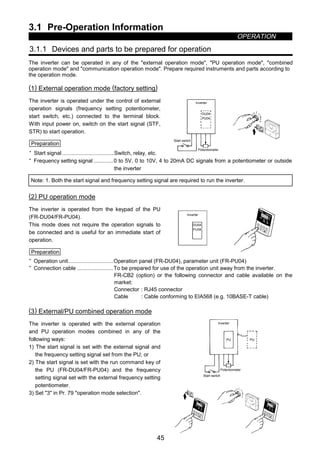
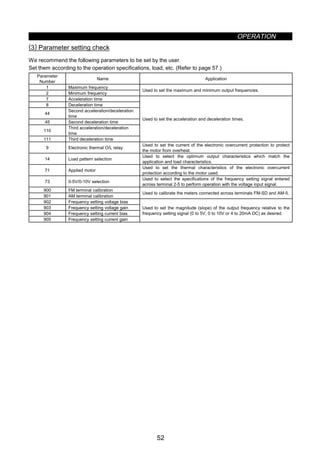
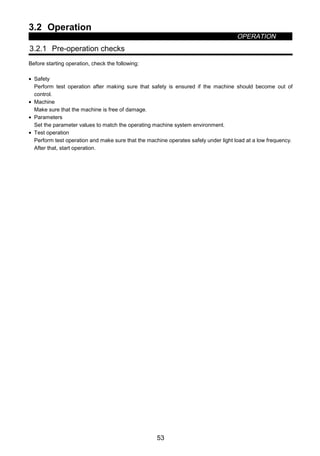
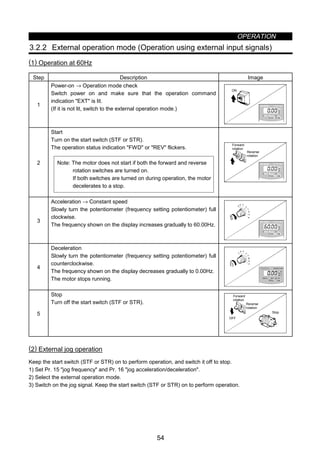
HIGH FUNCTION
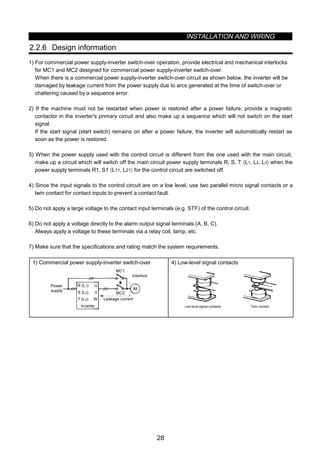
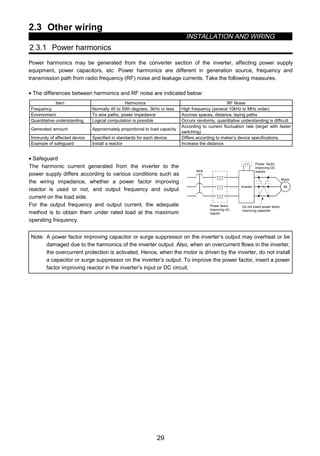
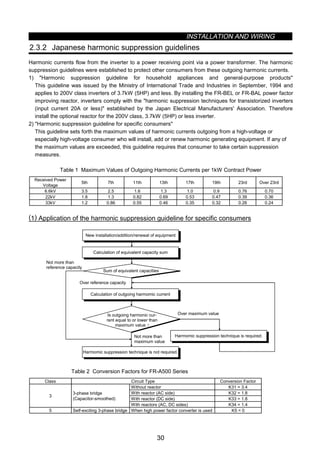
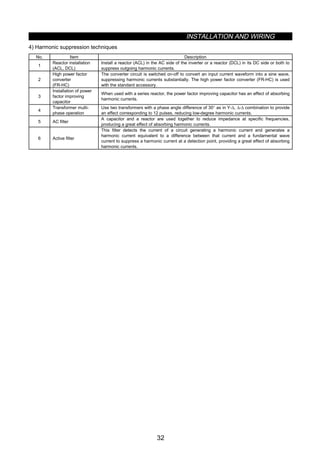
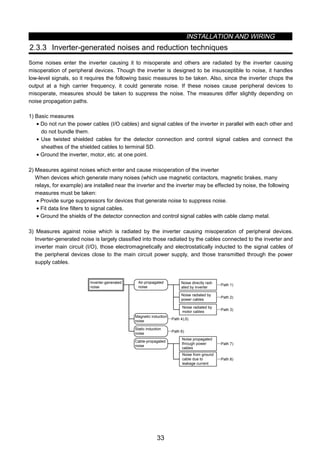
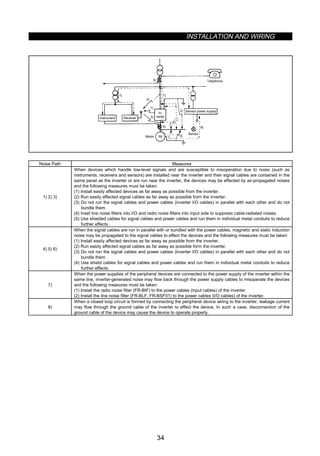
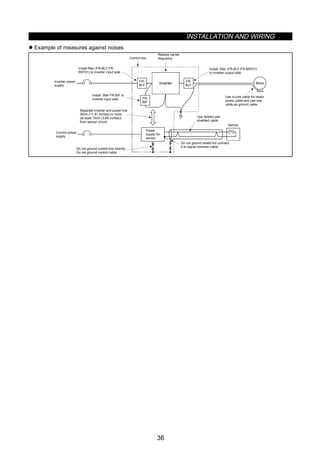
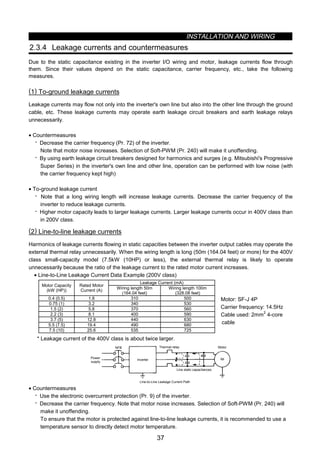
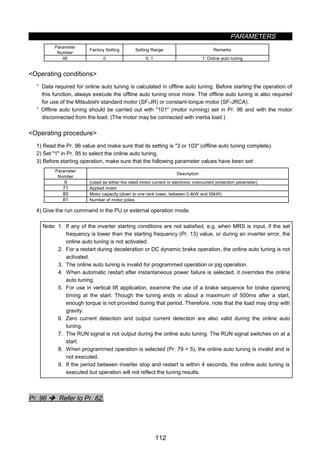
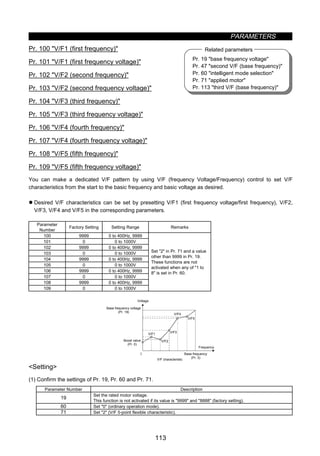
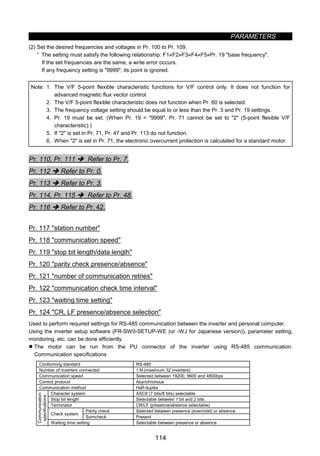
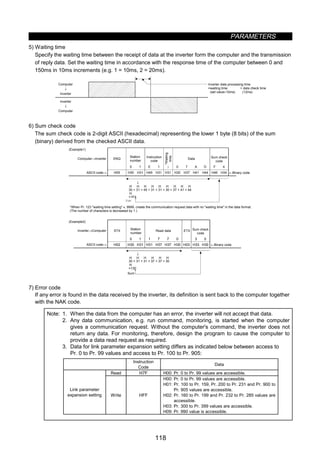
&
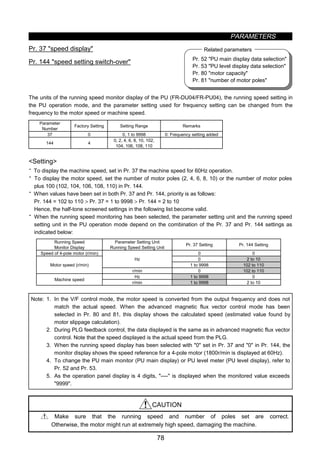
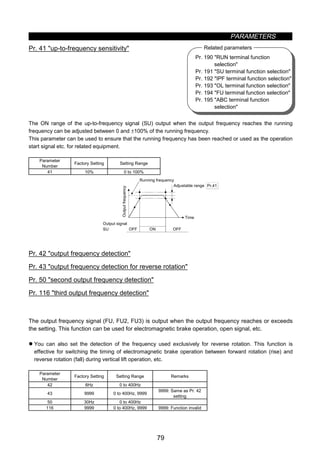
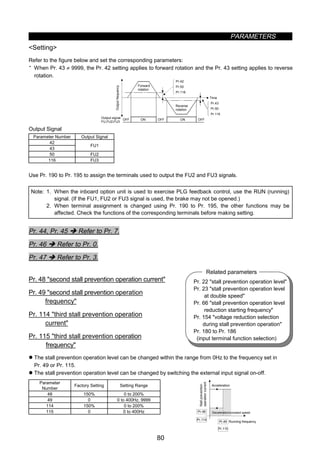
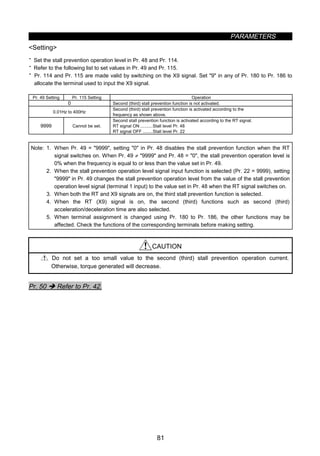
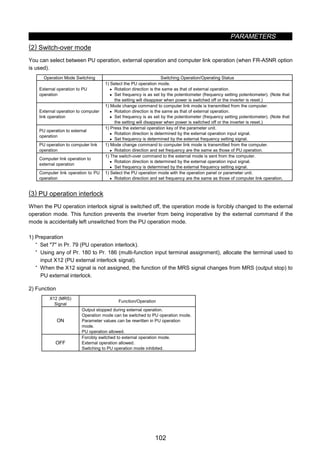
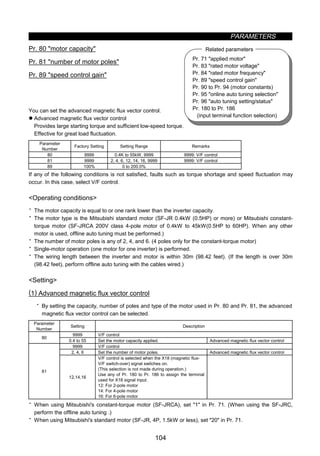
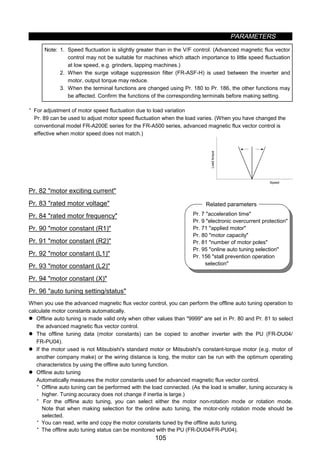
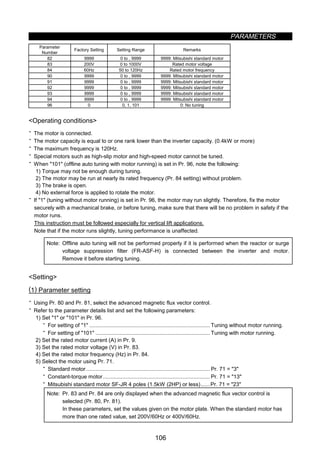
LOW ACOUSTIC NOISE
FR-A500
TRANSISTORIZED INVERTER
– INSTRUCTION MANUAL –
FR-A520-0.4Kto55K(-NA)
FR-A540-0.4Kto55K(-NA)(-EC)
A - 1
Thank you for choosing this Mitsubishi transistorized Inverter.
This instruction manual gives handling information and precautions for use of this
equipment.
Incorrect handling might cause an unexpected fault. Before using the inverter, please read
this manual carefully to use the equipment to its optimum.
Please forward this manual to the end user.
This section is specifically about safety matters
Do not attempt to install, operate, maintain or inspect the inverter until you have read through this
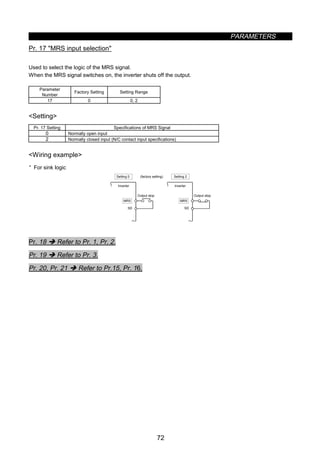
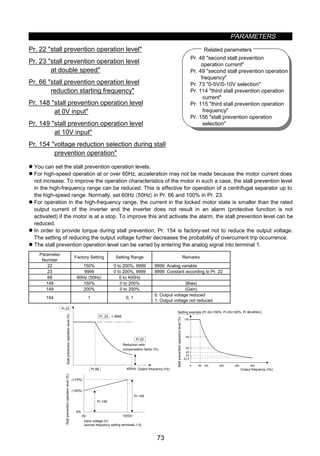
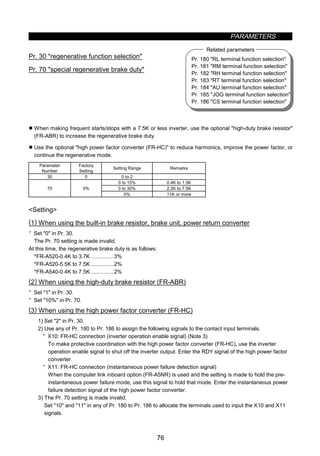
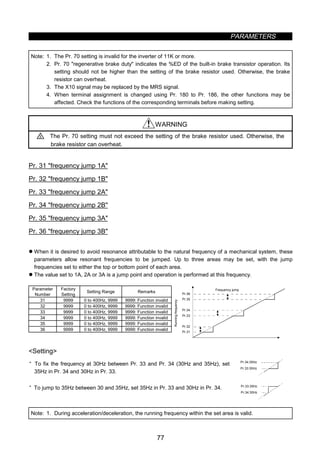
instruction manual and appended documents carefully and can use the equipment correctly.
Do not use the inverter until you have a full knowledge of the equipment, safety information and
instructions.
In this instruction manual, the safety instruction levels are classified into “WARNING” and “CAUTION”.
Assumes that incorrect handling may cause hazardous conditions, resulting in
death or severe injury.
Assumes that incorrect handling may cause hazardous conditions, resulting in
medium or slight injury, or may cause physical damage only.
Note that the CAUTION level may lead to a serious consequence according to conditions. Please follow
the instructions of both levels because they are important to personnel safety.
CAUTION
WARNING
A - 2
SAFETY INSTRUCTIONS
1. Electric Shock Prevention
WARNING
z While power is on or when the inverter is running, do not open the front cover. You may get an electric
shock.
z Do not run the inverter with the front cover removed. Otherwise, you may access the exposed high-
voltage terminals or the charging part of the circuitry and get an electric shock.
z If power is off, do not remove the front cover except for wiring or periodic inspection. You may access
the charged inverter circuits and get an electric shock.
z Before starting wiring or inspection, switch power off, wait for more at least 10 minutes and check for
the presence of any residual voltage with a meter (check chapter 2 for further details.) etc.
z Use class 3 (200V) or special class 3 (400V) or higher earthing method to earth the inverter.
z Any person who is involved in the wiring or inspection of this equipment should be fully competent to do
the work.
z Always install the inverter before wiring. Otherwise, you may get an electric shock or be injured.
z Operate the switches with dry hands to prevent an electric shock.
z Do not subject the cables to scratches, excessive stress, heavy loads or pinching. Otherwise, you may
get an electric shock.
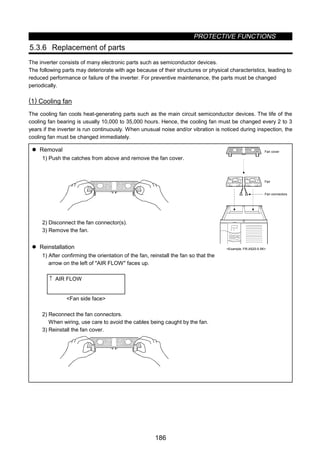
z Do not change the cooling fan while power is on. To do so will invite a hazardous condition.
2. Fire Prevention
CAUTION
z Mount the inverter on an incombustible surface. Installing the inverter directly on or near a combustible
surface could lead to a fire.
z If the inverter has become faulty, switch off the inverter power. A continuous flow of large current could
cause a fire.
z Do not connect a resistor directly to the DC terminals P, N. This could cause a fire.
3. Injury Prevention
CAUTION
z Apply only the voltage specified in the instruction manual to each terminal to prevent damage etc.
z Ensure that the cables are connected to the correct terminals. Otherwise, damage etc. may occur.
z Always make sure that polarity is correct to prevent damage etc.
z After the inverter has been operating for a relativly long period of time, do not touch the inverter as it
may be hot and you may get burnt.
A - 3
4. Additional instructions
Also note the following points to prevent an accidental failure, injury, electric shock, etc.:
(1) Transportation and installation
CAUTION
z When carrying products, use correct lifting gear to prevent injury.
z Do not stack the inverter boxes higher than the number recommended.
z Ensure that installation position and material can withstand the weight of the inverter. Install
according to the information in the Instruction Manual.
z Do not operate if the inverter is damaged or has parts missing.
z Do not hold the inverter by the front cover; it may fall off.
z Do not stand or rest heavy objects on the inverter.
z Check the inverter mounting orientation is correct.
z Prevent screws, wire fragments, conductive bodies, oil or other flammable substances from entering
the inverter.
z Do not drop the inverter, or subject it to impact.
z Use the inverter under the following environmental conditions:
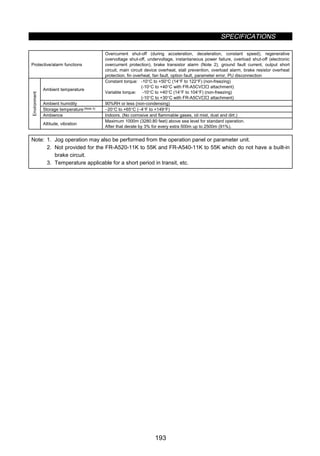
Ambient temperature
Constant torque: -10°C to +50°C (14°F to 122°F) (non-freezing)
(-10°C to +40°C with FR-A5CVUU attachment)
Variable torque: -10°C to +40°C (14°F to 104°F) (non-freezing)
(-10°C to +30°C with FR-A5CVUU attachment)
Ambient humidity 90%RH or less (non-condensing)
Storage temperature -20°C to +65°C* (-4°F to 149°F)
Ambience Indoors (free from corrosive gas, flammable gas, oil mist, dust and dirt)
Environment
Altitude, vibration
Maximum 1000m (3280.80 feet.) above sea level for standard operation.
After that derate by 3% for every extra 500m up to 2500m (91%).
••*Temperatures applicable for a short time, e.g. in transit.
(2) Wiring
CAUTION
z Do not fit capacitive equipment such as a power factor correction capacitor, noise filter or surge
suppressor to the output of the inverter.
z The connection orientation of the output cables U, V, W to the motor will affect the direction of
rotation of the motor.
(3) Trial run
CAUTION
z Check all parameters, and ensure that the machine will not be damaged by a sudden start-up.
(4) Operation
CAUTION
z When you have chosen the retry function, stay away from the equipment as it will restart suddenly
after an alarm stop.
z The [STOP] key is valid only when the appropriate function setting has been made. Prepare an
emergency stop switch separately.
z Make sure that the start signal is off before resetting the inverter alarm. A failure to do so may restart
the motor suddenly.
A - 4
CAUTION
z The load used should be a three-phase induction motor only. Connection of any other electrical
equipment to the inverter output may damage the equipment.
z The electronic overcurrent protection does not guarantee protection of the motor from overheating.
z Do not use a magnetic contactor on the inverter input for frequent starting/stopping of the inverter.
z Use a noise filter to reduce the effect of electromagnetic interference. Otherwise nearby electronic
equipment may be affected.
z Take measures to suppress harmonics. Otherwise power harmonics from the inverter may
heat/damage the power capacitor and generator.
z When a 400V class motor is inverter-driven, it should be insulation-enhanced or surge voltages
suppressed. Surge voltages attributable to the wiring constants may occur at the motor terminals,
deteriorating the insulation of the motor.
z When parameter clear or all clear is performed, each parameter returns to the factory setting. Re-set
the required parameters before starting operation.
z The inverter can be easily set for high-speed operation. Before changing its setting, examine the
performance of the motor and machine.
z In addition to the inverter's holding function, install a holding device to ensure safety.
z Before running an inverter which had been stored for a long period, always perform inspection and
test operation.
(5) Emergency stop
CAUTION
z Provide a safety backup such as an emergency brake which will prevent the machine and equipment
from hazardous conditions if the inverter fails.
(6) Maintenance, inspection and parts replacement
CAUTION
z Do not carry out a megger (insulation resistance) test on the control circuit of the inverter.
(7) Disposing of the inverter
CAUTION
z Treat as industrial waste.
(8) General instructions
Many of the diagrams and drawings in this instruction manual show the inverter without a cover, or partially
open. Never run the inverter like this. Always replace the cover and follow this instruction manual when
operating the inverter.
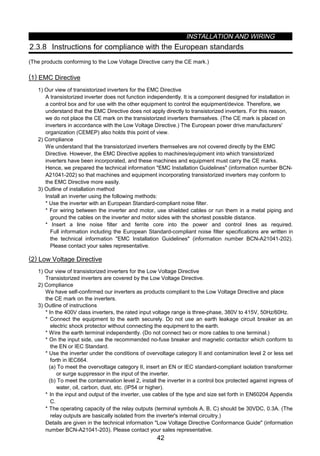
CONTENTS
I
 287/,1( 
1.1 Pre-Operation Information .........................................................................................................................................1
1.1.1 Precautions for operation....................................................................................................................................1
1.2 Basic Configuration....................................................................................................................................................2
1.2.1 Basic configuration .............................................................................................................................................2
1.3 Structure ....................................................................................................................................................................3
1.3.1 Appearance and structure ..................................................................................................................................3
1.3.2 Removal and reinstallation of the front cover .....................................................................................................4
1.3.3 Removal and reinstallation of the operation panel..............................................................................................6
 ,167$//$7,21 $1' :,5,1* 
2.1 Installation..................................................................................................................................................................7
2.1.1 Instructions for installation ..................................................................................................................................7
2.2 Wiring ........................................................................................................................................................................9
2.2.1 Terminal connection diagram .............................................................................................................................9
2.2.2 Wiring of the main circuit ..................................................................................................................................12
2.2.3 Wiring of the control circuit ...............................................................................................................................18
2.2.4 Connection to the PU connector.......................................................................................................................22
2.2.5 Connection of stand-alone option units ............................................................................................................24
2.2.6 Design information............................................................................................................................................28
2.3 Other wiring .............................................................................................................................................................29
2.3.1 Power harmonics ..............................................................................................................................................29
2.3.2 Japanese harmonic suppression guidelines.....................................................................................................30
2.3.3 Inverter-generated noises and reduction techniques........................................................................................33
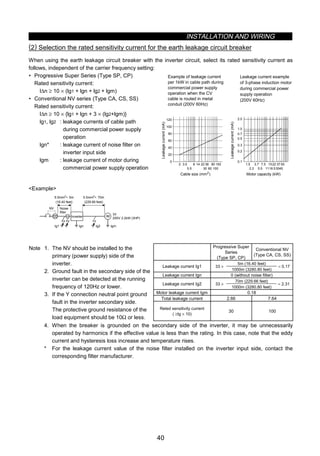
2.3.4 Leakage currents and countermeasures ..........................................................................................................37
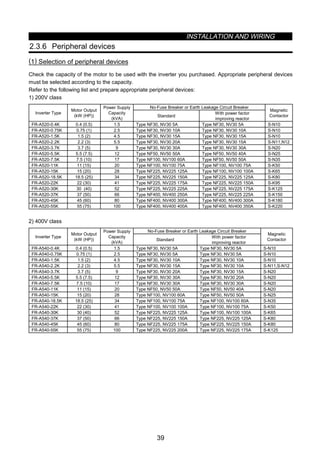
2.3.5 Inverter-driven 400V class motor......................................................................................................................38
2.3.6 Peripheral devices ............................................................................................................................................39
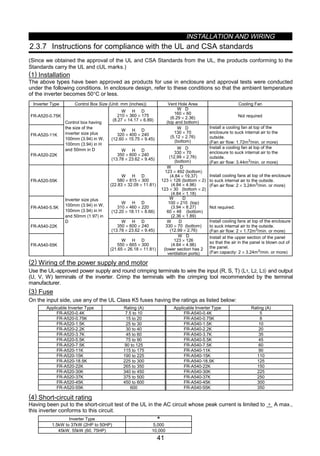
2.3.7 Instructions for compliance with the UL and CSA standards............................................................................41
2.3.8 Instructions for compliance with the European standards ................................................................................42
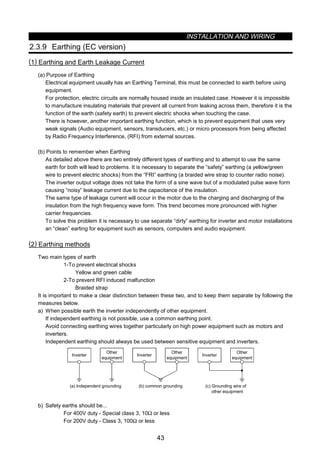
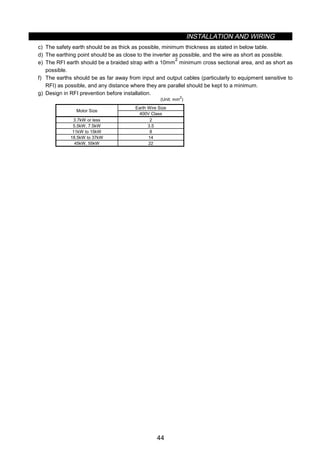
2.3.9 Earthing (EC version)........................................................................................................................................43
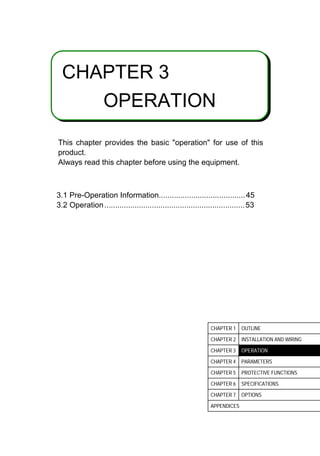
 23(5$7,21 
3.1 Pre-Operation Information .......................................................................................................................................45
3.1.1 Devices and parts to be prepared for operation ...............................................................................................45
3.1.2 Power on...........................................................................................................................................................47
3.1.3 Parameter check...............................................................................................................................................47
3.2 Operation.................................................................................................................................................................53
3.2.1 Pre-operation checks........................................................................................................................................53
3.2.2 External operation mode (Operation using external input signals) ...................................................................54
3.2.3 PU operation mode (Operation using the operation panel (FR-DU04))...........................................................55
3.2.4 Combined operation mode (Operation using the external input signals and PU)............................................56
 3$5$0(7(5 
4.1 Parameter List .........................................................................................................................................................57
4.2 Parameter Function Details .....................................................................................................................................63
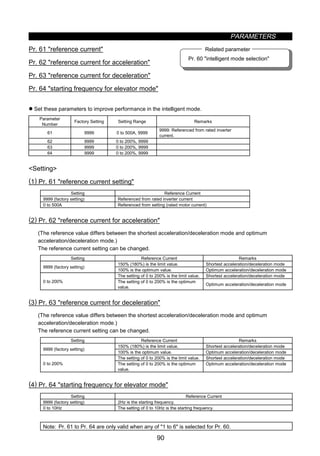
z Torque boost (Pr. 0, Pr. 46, Pr. 112).......................................................................................................................63
z Output frequency range (Pr. 1, Pr. 2, Pr. 18) ..........................................................................................................64
II
z Base frequency, base frequency voltage (Pr. 3, Pr. 19, Pr. 47, Pr. 113).................................................................65
z Multi-speed operation (Pr. 4 to Pr. 6, Pr. 24 to Pr. 27, Pr. 232 to Pr. 239)..............................................................66
z Acceleration/deceleration time (Pr. 7, Pr. 8, Pr. 20, Pr. 21, Pr. 44, Pr. 45, Pr. 110, Pr. 111) ..................................67
z Electronic overcurrent protection (Pr. 9)..................................................................................................................68
z DC dynamic brake (Pr. 10, Pr. 11, Pr. 12)...............................................................................................................69
z Starting frequency (Pr. 13) ......................................................................................................................................70
z Load pattern selection (Pr. 14)................................................................................................................................70
z Jog operation (Pr. 15, Pr. 16)..................................................................................................................................71
z MRS input selection (Pr. 17) ...................................................................................................................................72
z Stall prevention (Pr. 22, Pr. 23, Pr. 66, Pr. 148, Pr. 149, Pr. 154)...........................................................................73
z Multi-speed input compensation (Pr. 28).................................................................................................................74
z Acceleration/deceleration pattern (Pr. 29, Pr. 140 to Pr. 143).................................................................................75
z Regenerative brake duty (Pr. 30, Pr. 70).................................................................................................................76
z Frequency jump (Pr. 31 to Pr. 36)...........................................................................................................................77
z Speed display (Pr. 37, Pr. 144) ...............................................................................................................................78
z Up-to-frequency sensitivity (Pr. 41).........................................................................................................................79
z Output frequency detection (Pr. 42, Pr. 43, Pr. 50, Pr. 116) ...................................................................................79
z Second/third stall prevention (Pr. 48, Pr. 49, Pr. 114, Pr. 115) ...............................................................................80
z Monitor display/FM, AM terminal function selection (Pr. 52 to Pr. 54, Pr. 158).......................................................82
z Monitoring reference (Pr. 55, Pr. 56).......................................................................................................................84
z Automatic restart after instantaneous power failure (Pr. 57, Pr. 58, Pr. 162 to Pr. 165) .........................................85
z Remote setting function selection (Pr. 59) ..............................................................................................................87
z Intelligent mode selection (Pr. 60)...........................................................................................................................88
z Acceleration/deceleration reference current/lift mode starting frequency (Pr. 61 to Pr. 64)....................................90
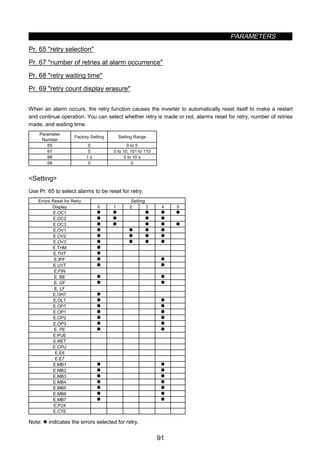
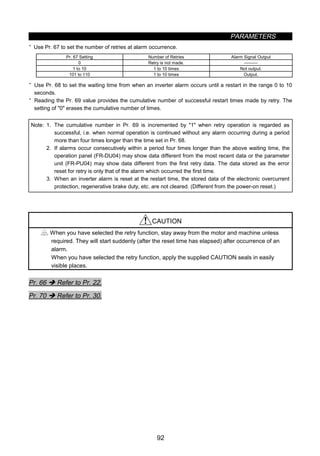
z Retry function (Pr. 65, Pr. 67 to Pr. 69)...................................................................................................................91
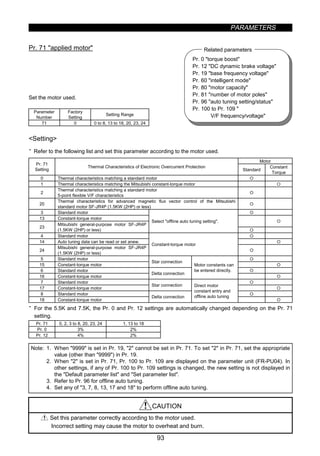
z Applied motor (Pr. 71) .............................................................................................................................................93
z PWM carrier frequency (Pr. 72, Pr. 240).................................................................................................................94
z Voltage input (Pr. 73) ..............................................................................................................................................95
z Input filter time constant (Pr. 74) .............................................................................................................................96
z Reset selection/PU disconnection detection/PU stop selection (Pr. 75) .................................................................96
z Alarm code output selection (Pr. 76).......................................................................................................................98
z Parameter write inhibit selection (Pr. 77) ................................................................................................................99
z Reverse rotation prevention selection (Pr. 78)......................................................................................................100
z Operation mode selection (Pr. 79) ........................................................................................................................101
z Motor capacity/number of motor poles/speed control gain (Pr. 80, Pr. 81, Pr. 89) ...............................................104
z Offline auto tuning function (Pr. 82 to Pr. 84, Pr. 90 to Pr. 94, Pr. 96) ..................................................................105
z Online auto tuning selection (Pr. 95).....................................................................................................................111
z V/F control frequency (voltage) (Pr. 100 to Pr. 109)..............................................................................................113
z Computer link operation (Pr. 117 to Pr. 124).........................................................................................................114
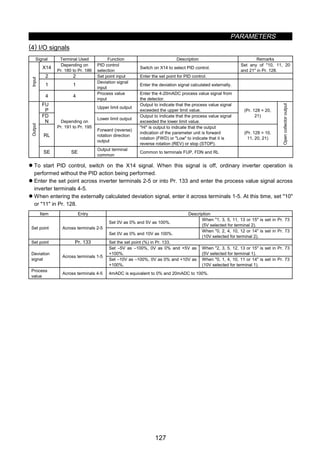
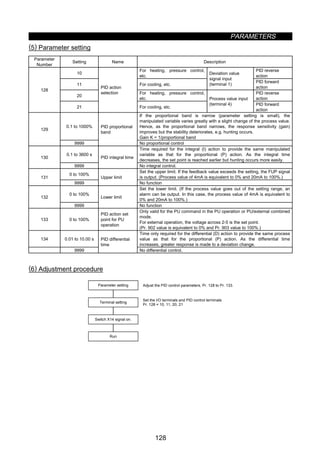
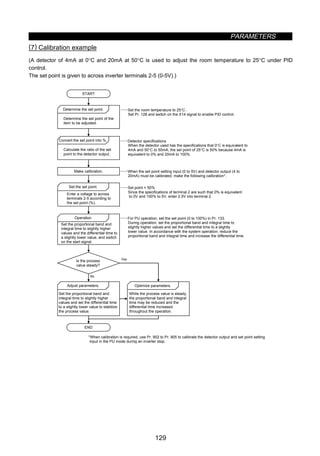
z PID control (Pr. 128 to Pr. 134).............................................................................................................................124
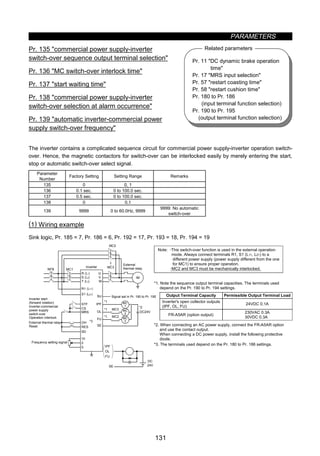
z Commercial power supply-inverter switch-over function (Pr. 135 to Pr. 139)........................................................131
z Output current detection function (Pr. 150, Pr. 151)..............................................................................................135
z Zero current detection (Pr. 152, Pr. 153)...............................................................................................................136
z RT signal activated condition selection (Pr. 155) ..................................................................................................137
z Stall prevention function and current limit function (Pr. 156).................................................................................137
z OL signal output timer (Pr. 157) ............................................................................................................................139
z User group selection (Pr. 160, Pr. 173 to Pr. 176) ................................................................................................140
z Watt-hour meter clear/actual operation hour meter clear (Pr. 170, Pr. 171).........................................................141
z Input terminal function selection (Pr. 180 to Pr. 186) ............................................................................................141
z Output terminal function selection (Pr. 190 to Pr. 195) .........................................................................................144
III
z User initial value setting (Pr. 199) .........................................................................................................................146
z Programmed operation function (Pr. 200 to Pr. 231) ............................................................................................147
z Cooling fan operation selection (Pr. 244)..............................................................................................................151
z Stop selection (Pr. 250).........................................................................................................................................152
z Power failure-time deceleration-to-stop function (Pr. 261 to Pr. 266) ...................................................................154
z Stop-on-contact, load torque high-speed frequency selection (Pr. 270) ...............................................................156
z High-speed frequency control (Pr. 271 to Pr. 274)................................................................................................157
z Stop on contact (Pr. 275, Pr. 276).........................................................................................................................161
z Brake sequence function (Pr. 278 to Pr. 285) .......................................................................................................164
z Droop control (Pr. 286, Pr. 287) ............................................................................................................................168
z Meter (frequency meter) calibration (Pr. 900, Pr. 901)..........................................................................................169
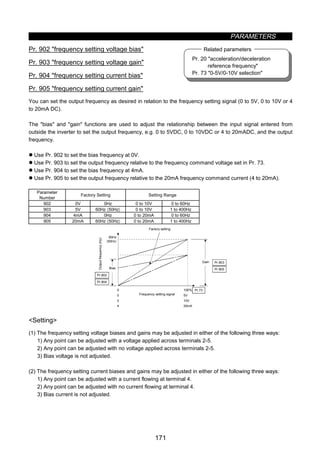
z Frequency setting voltage (current) bias and gain (Pr. 902 to Pr. 905).................................................................171
z Buzzer control (Pr. 990) ........................................................................................................................................173
 3527(7,9( )817,216 
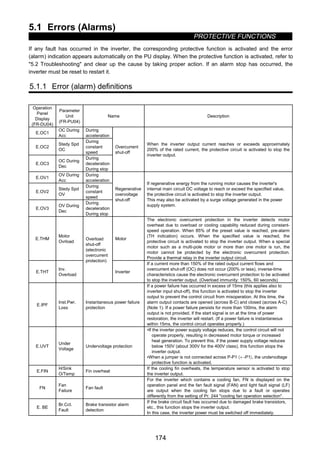
5.1 Errors (alarms).......................................................................................................................................................174
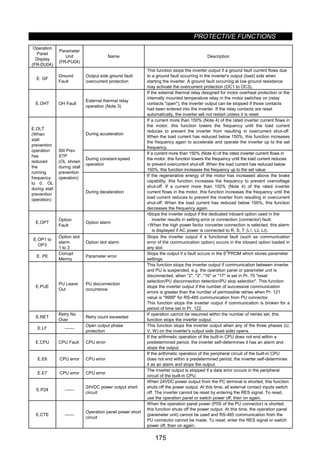
5.1.1 Error (alarm) definitions ..................................................................................................................................174
5.1.2 Correspondences between digital and actual characters...............................................................................177
5.1.3 Alarm code output...........................................................................................................................................178
5.1.4 Resetting the inverter......................................................................................................................................178
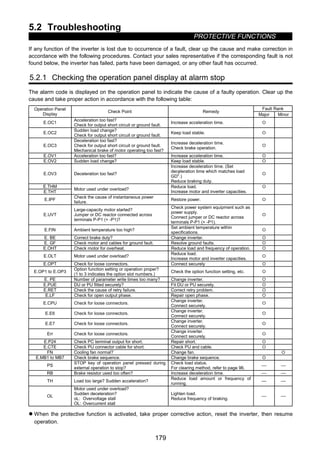
5.2 Troubleshooting.....................................................................................................................................................179
5.2.1 Checking the operation panel display at alarm stop.......................................................................................179
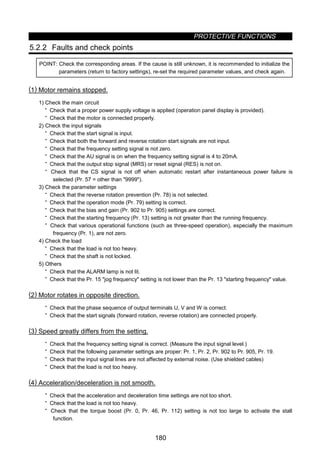
5.2.2 Faults and check points..................................................................................................................................180
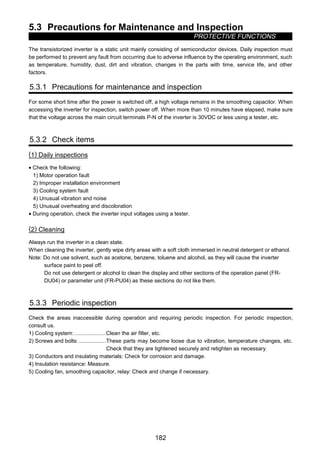
5.3 Precautions for Maintenance and Inspection.........................................................................................................182
5.3.1 Precautions for maintenance and inspection..................................................................................................182
5.3.2 Check items....................................................................................................................................................182
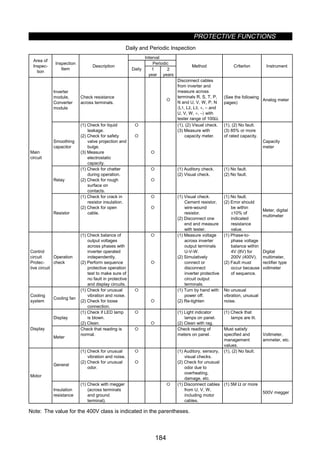
5.3.3 Periodic inspection..........................................................................................................................................182
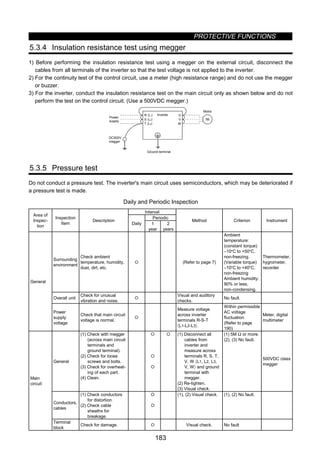
5.3.4 Insulation resistance test using megger .........................................................................................................183
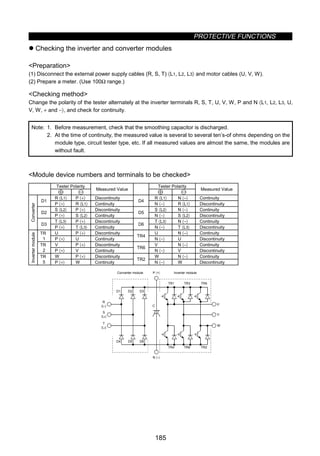
5.3.5 Pressure test...................................................................................................................................................183
5.3.6 Replacement of parts......................................................................................................................................186
5.3.7 Inverter replacement.......................................................................................................................................187
5.3.8 Measurement of main circuit voltages, currents and power............................................................................188
 63(,),$7,216 
6.1 Standard Specifications.........................................................................................................................................190
6.1.1 Model specifications .......................................................................................................................................190
6.1.2 Common specifications...................................................................................................................................192
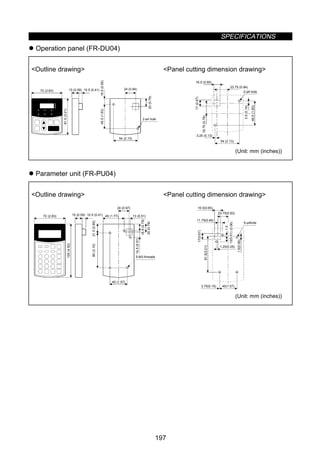
6.1.3 Outline drawings .............................................................................................................................................194
 237,216 
7.1 Option List..............................................................................................................................................................198
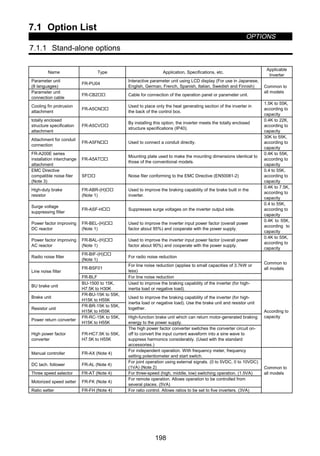
7.1.1 Stand-alone options........................................................................................................................................198
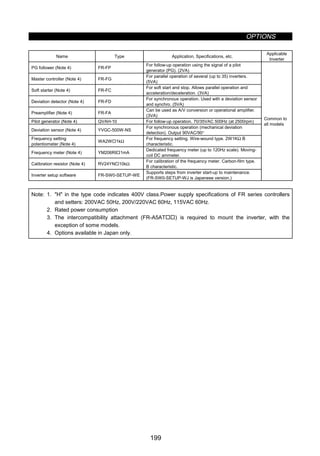
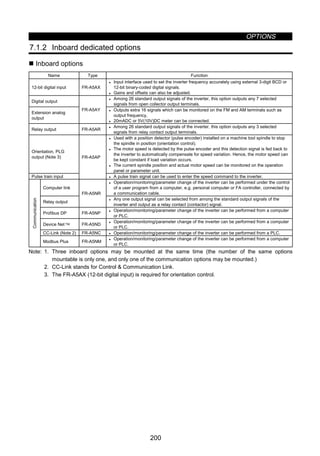
7.1.2 Inboard dedicated options ..............................................................................................................................200
$33(1',(6 
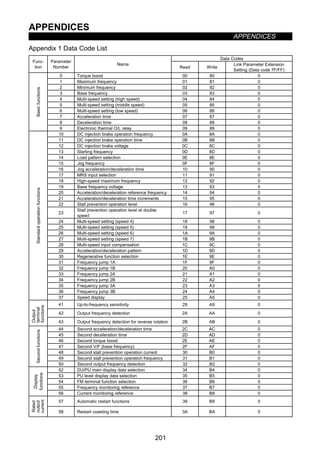
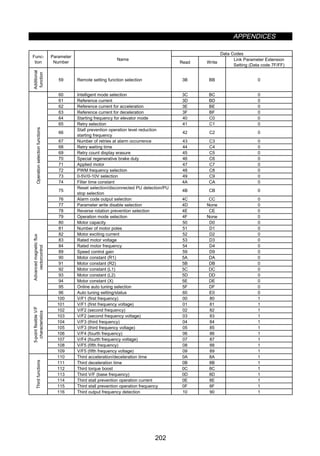
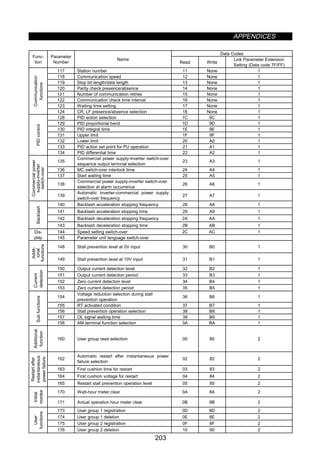
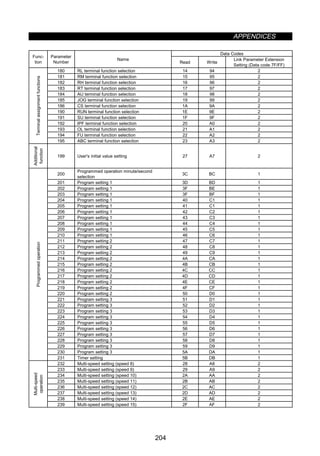
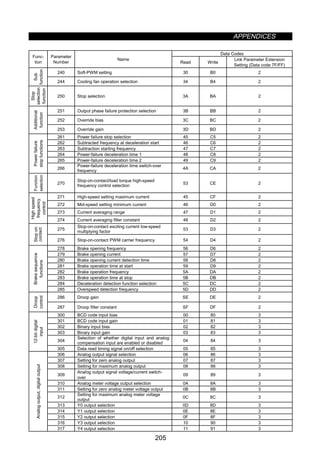
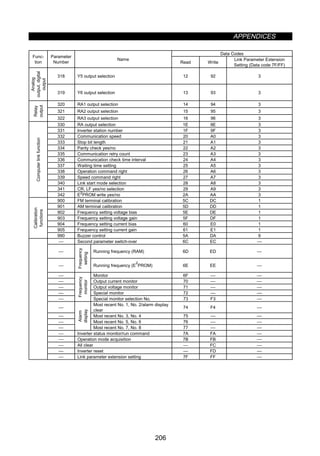
Appendix 1 Data Code List ..........................................................................................................................................201
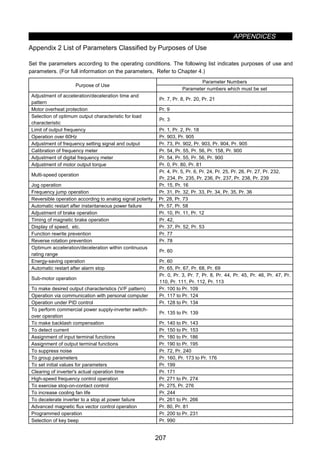
Appendix 2 List of Parameters Classified by Purposes of Use....................................................................................207
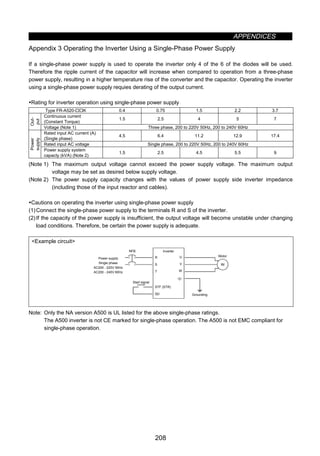
Appendix 3 Operating the Inverter Using a Single-Phase Power Supply ....................................................................208
1
CHAPTER 1
OUTLINE
This chapter gives information on the basic outline of this
product.
Always read the instructions in this chapter before using the
equipment.
1.1 Pre-Operation Information........................................1
1.2 Basic Configuration..................................................2
1.3 Structure ..................................................................3
Abbreviations
O DU
Operation panel (FR-DU04)
O PU
Operation panel (FR-DU04) and parameter unit (FR-PU04)
O Inverter
Mitsubishi transistorized inverter FR-A500 series
O Pr.
Parameter number
O PU operation
Operation using the PU (FR-DU04/FR-PU04)
O External operation
Operation using the control circuit signals
O Combined operation
Operation using both the PU (FR-DU04/FR-PU04) and
external operation
O FR-A200E
Mitsubishi transistorized inverter FR-A200 series
EXCELLENT series
CHAPTER 1 OUTLINE
CHAPTER 2 INSTALLATION AND WIRING
CHAPTER 3 OPERATION
CHAPTER 4 PARAMETERS
CHAPTER 5 PROTECTIVE FUNCTIONS
CHAPTER 6 SPECIFICATIONS
CHAPTER 7 OPTIONS
APPENDICES
1.1 Pre-Operation Information
OUTLINE
1
1 OUTLINE
1.1 Pre-Operation Information
1.1.1 Precautions for operation
Incorrect handling might cause the inverter to operate improperly, its life to be reduced considerably, or at the
worst, the inverter to be damaged. Handle the inverter properly in accordance with the information in each
section as well as the precautions and instructions of this manual to use it correctly.
This manual is written for the FR-A500 series transistorized inverters.
For handling information on the parameter unit (FR-PU04), inboard options, stand-alone options, etc., refer to
the corresponding manuals.
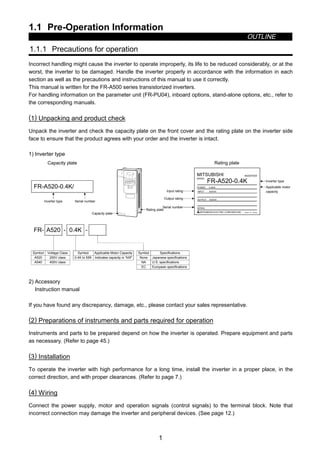
(1) Unpacking and product check
Unpack the inverter and check the capacity plate on the front cover and the rating plate on the inverter side
face to ensure that the product agrees with your order and the inverter is intact.
1) Inverter type
FR-A520-0.4K/
MITSUBISHI
MODEL
FR-A520-0.4K
INVERTER
POWER
INPUT
OUTPUT
SERIAL
MITSUBISHI ELECTRIC CORPORATION
0.4kW
XXXXX
MADE IN JAPAN
XXXXX
Capacity plate
Inverter type Serial number
Capacity plate
Rating plate
Rating plate
Input rating
Output rating
Serial number
Inverter type
FR- A520 - 0.4K -
Symbol Voltage Class
A520
A540
200V class
400V class
Symbol Applicable Motor Capacity
0.4K to 55K Indicates capacity in kW.
Symbol Specifications
None
NA
Japanese specifications
U.S. specifications
EC European specifications
Applicable motor
capacity
2) Accessory
Instruction manual
If you have found any discrepancy, damage, etc., please contact your sales representative.
(2) Preparations of instruments and parts required for operation
Instruments and parts to be prepared depend on how the inverter is operated. Prepare equipment and parts
as necessary. (Refer to page 45.)
(3) Installation
To operate the inverter with high performance for a long time, install the inverter in a proper place, in the
correct direction, and with proper clearances. (Refer to page 7.)
(4) Wiring
Connect the power supply, motor and operation signals (control signals) to the terminal block. Note that
incorrect connection may damage the inverter and peripheral devices. (See page 12.)
1.2 Basic Configuration
OUTLINE
2
1.2 Basic Configuration
1.2.1 Basic configuration
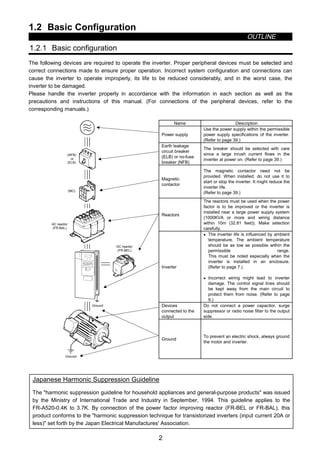
The following devices are required to operate the inverter. Proper peripheral devices must be selected and
correct connections made to ensure proper operation. Incorrect system configuration and connections can
cause the inverter to operate improperly, its life to be reduced considerably, and in the worst case, the
inverter to be damaged.
Please handle the inverter properly in accordance with the information in each section as well as the
precautions and instructions of this manual. (For connections of the peripheral devices, refer to the
corresponding manuals.)
Name Description
Power supply
Use the power supply within the permissible
power supply specifications of the inverter.
(Refer to page 39.)
Earth leakage
circuit breaker
(ELB) or no-fuse
breaker (NFB)
The breaker should be selected with care
since a large inrush current flows in the
inverter at power on. (Refer to page 39.)
Magnetic
contactor
The magnetic contactor need not be
provided. When installed, do not use it to
start or stop the inverter. It might reduce the
inverter life.
(Refer to page 39.)
Reactors
The reactors must be used when the power
factor is to be improved or the inverter is
installed near a large power supply system
(1000KVA or more and wiring distance
within 10m (32.81 feet)). Make selection
carefully.
Inverter
z The inverter life is influenced by ambient
temperature. The ambient temperature
should be as low as possible within the
permissible range.
This must be noted especially when the
inverter is installed in an enclosure.
(Refer to page 7.)
z Incorrect wiring might lead to inverter
damage. The control signal lines should
be kept away from the main circuit to
protect them from noise. (Refer to page
9.)
Devices
connected to the
output
Do not connect a power capacitor, surge
suppressor or radio noise filter to the output
side.
(MC)
Ground
DC reactor
(FR-BEL)
Ground
(NFB)
or
(ELB)
AC reactor
(FR-BAL)
Ground
To prevent an electric shock, always ground
the motor and inverter.
Japanese Harmonic Suppression Guideline
The harmonic suppression guideline for household appliances and general-purpose products was issued
by the Ministry of International Trade and Industry in September, 1994. This guideline applies to the
FR-A520-0.4K to 3.7K. By connection of the power factor improving reactor (FR-BEL or FR-BAL), this
product conforms to the harmonic suppression technique for transistorized inverters (input current 20A or
less) set forth by the Japan Electrical Manufactures' Association.
1.3 Structure
OUTLINE
3
1.3 Structure
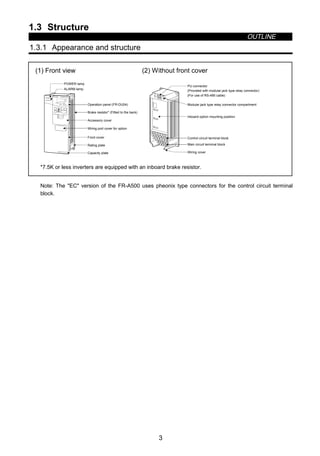
1.3.1 Appearance and structure
(1) Front view (2) Without front cover
POWER lamp
ALARM lamp
Operation panel (FR-DU04)
Brake resistor* (Fitted to the back)
Accessory cover
Wiring port cover for option
Front cover
Rating plate
Capacity plate Wiring cover
PU connector
(Provided with modular jack type relay connector)
(For use of RS-485 cable)
Modular jack type relay connector compartment
Inboard option mounting position
Control circuit terminal block
Main circuit terminal block
*7.5K or less inverters are equipped with an inboard brake resistor.
Note: The EC version of the FR-A500 uses pheonix type connectors for the control circuit terminal
block.
OUTLINE
4
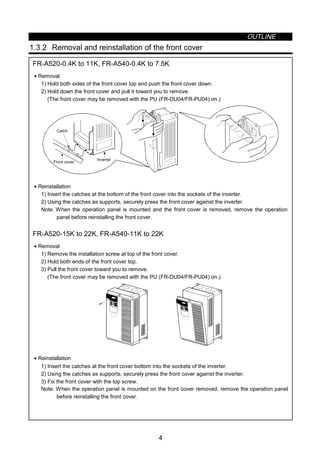
1.3.2 Removal and reinstallation of the front cover
FR-A520-0.4K to 11K, FR-A540-0.4K to 7.5K
• Removal
1) Hold both sides of the front cover top and push the front cover down.
2) Hold down the front cover and pull it toward you to remove.
(The front cover may be removed with the PU (FR-DU04/FR-PU04) on.)
Front cover
Inverter
Catch
• Reinstallation
1) Insert the catches at the bottom of the front cover into the sockets of the inverter.
2) Using the catches as supports, securely press the front cover against the inverter.
Note: When the operation panel is mounted and the front cover is removed, remove the operation
panel before reinstalling the front cover.
FR-A520-15K to 22K, FR-A540-11K to 22K
• Removal
1) Remove the installation screw at top of the front cover.
2) Hold both ends of the front cover top.
3) Pull the front cover toward you to remove.
(The front cover may be removed with the PU (FR-DU04/FR-PU04) on.)
• Reinstallation
1) Insert the catches at the front cover bottom into the sockets of the inverter.
2) Using the catches as supports, securely press the front cover against the inverter.
3) Fix the front cover with the top screw.
Note: When the operation panel is mounted on the front cover removed, remove the operation panel
before reinstalling the front cover.
OUTLINE
5
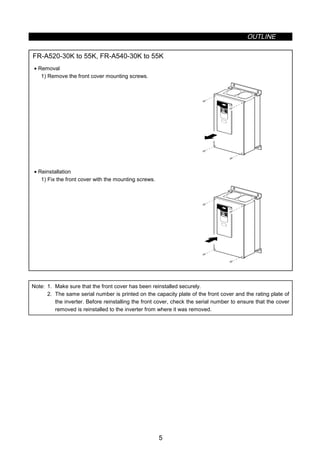
FR-A520-30K to 55K, FR-A540-30K to 55K
• Removal
1) Remove the front cover mounting screws.
• Reinstallation
1) Fix the front cover with the mounting screws.
Note: 1. Make sure that the front cover has been reinstalled securely.
2. The same serial number is printed on the capacity plate of the front cover and the rating plate of
the inverter. Before reinstalling the front cover, check the serial number to ensure that the cover
removed is reinstalled to the inverter from where it was removed.
OUTLINE
6
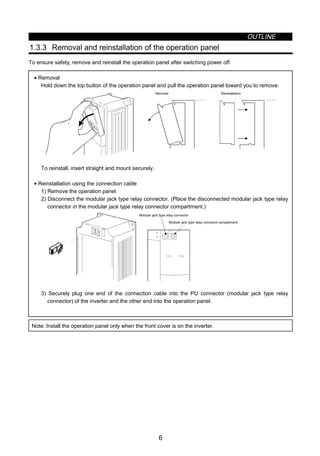
1.3.3 Removal and reinstallation of the operation panel
To ensure safety, remove and reinstall the operation panel after switching power off.
• Removal
Hold down the top button of the operation panel and pull the operation panel toward you to remove.
‚ Removal Reinstallation
To reinstall, insert straight and mount securely.
• Reinstallation using the connection cable
1) Remove the operation panel.
2) Disconnect the modular jack type relay connector. (Place the disconnected modular jack type relay
connector in the modular jack type relay connector compartment.)
Modular jack type relay connector compartment
Modular jack type relay connector
3) Securely plug one end of the connection cable into the PU connector (modular jack type relay
connector) of the inverter and the other end into the operation panel.
Note: Install the operation panel only when the front cover is on the inverter.
2
CHAPTER 2
INSTALLATION AND WIRING
This chapter gives information on the basic installation and
wiring of this product.
Always read the instructions in this chapter before using the
equipment.
2.1 Installation................................................................ 7
2.2 Wiring ...................................................................... 9
2.3 Other wiring .............................................................29
CHAPTER 1 OUTLINE
CHAPTER 2 INSTALLATION AND WIRING
CHAPTER 3 OPERATION
CHAPTER 4 PARAMETERS
CHAPTER 5 PROTECTIVE FUNCTIONS
CHAPTER 6 SPECIFICATIONS
CHAPTER 7 OPTIONS
APPENDICES
2.1 Installation
INSTALLATION AND WIRING
7
2 INSTALLATION AND WIRING
2.1 Installation
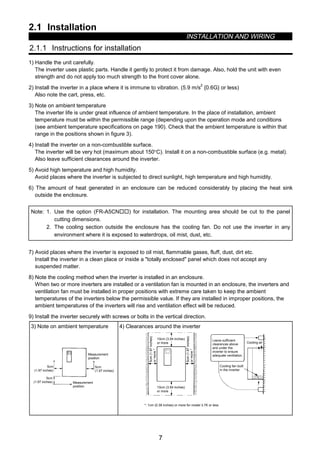
2.1.1 Instructions for installation
1) Handle the unit carefully.
The inverter uses plastic parts. Handle it gently to protect it from damage. Also, hold the unit with even
strength and do not apply too much strength to the front cover alone.
2) Install the inverter in a place where it is immune to vibration. (5.9 m/s
2
{0.6G} or less)
Also note the cart, press, etc.
3) Note on ambient temperature
The inverter life is under great influence of ambient temperature. In the place of installation, ambient
temperature must be within the permissible range (depending upon the operation mode and conditions
(see ambient temperature specifications on page 190). Check that the ambient temperature is within that
range in the positions shown in figure 3).
4) Install the inverter on a non-combustible surface.
The inverter will be very hot (maximum about 150°C). Install it on a non-combustible surface (e.g. metal).
Also leave sufficient clearances around the inverter.
5) Avoid high temperature and high humidity.
Avoid places where the inverter is subjected to direct sunlight, high temperature and high humidity.
6) The amount of heat generated in an enclosure can be reduced considerably by placing the heat sink
outside the enclosure.
Note: 1. Use the option (FR-A5CN……) for installation. The mounting area should be cut to the panel
cutting dimensions.
2. The cooling section outside the enclosure has the cooling fan. Do not use the inverter in any
environment where it is exposed to waterdrops, oil mist, dust, etc.
7) Avoid places where the inverter is exposed to oil mist, flammable gases, fluff, dust, dirt etc.
Install the inverter in a clean place or inside a totally enclosed panel which does not accept any
suspended matter.
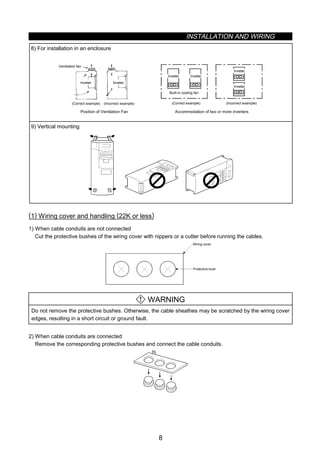
8) Note the cooling method when the inverter is installed in an enclosure.
When two or more inverters are installed or a ventilation fan is mounted in an enclosure, the inverters and
ventilation fan must be installed in proper positions with extreme care taken to keep the ambient
temperatures of the inverters below the permissible value. If they are installed in improper positions, the
ambient temperatures of the inverters will rise and ventilation effect will be reduced.
9) Install the inverter securely with screws or bolts in the vertical direction.
3) Note on ambient temperature
Measurement
position
Measurement
position
5cm
(1.97 inches)
5cm
(1.97 inches)
5cm
(1.97 inches)
4) Clearances around the inverter
10cm (3.94 inches)
5cm(1.97inches)
ormore*
*: 1cm (0.39 inches) or more for model 3.7K or less
Leave sufficient
clearances above
and under the
inverter to ensure
adequate ventilation.
Cooling fan built
in the inverter
Cooling air
5cm(1.97inches)
ormore*
or more
10cm (3.94 inches)
or more
INSTALLATION AND WIRING
8
8) For installation in an enclosure
Ventilation fan
(Correct example)
Position of Ventilation Fan
Inveter Inveter
Inveter
(Correct example) (Incorrect example)
Built-in cooling fan
Inveter
Inveter
Inveter
Accommodation of two or more inverters
(Incorrect example)
9) Vertical mounting
(1) Wiring cover and handling (22K or less)
1) When cable conduits are not connected
Cut the protective bushes of the wiring cover with nippers or a cutter before running the cables.
Wiring cover
Protective bush
WARNING
Do not remove the protective bushes. Otherwise, the cable sheathes may be scratched by the wiring cover
edges, resulting in a short circuit or ground fault.
2) When cable conduits are connected
Remove the corresponding protective bushes and connect the cable conduits.
2.2 Wiring
INSTALLATION AND WIRING
9
2.2 Wiring
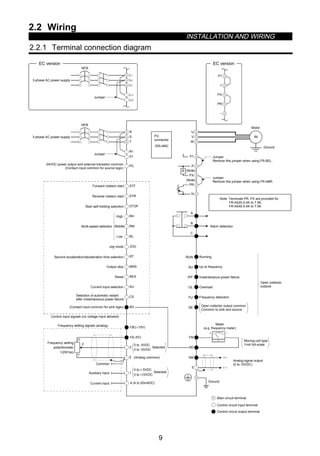
2.2.1 Terminal connection diagram
NFB
R
S
T
R1
S1
PC
STF
STR
STOP
RH
RM
RL
JOG
RT
MRS
RES
AU
CS
SD
10E(+10V)
10(+5V)
2
5
2
3
1
1
4 (4 to 20mADC)
Frequency setting
potentiometer
1/2W1kΩ
RUN
SU
IPF
OL
FU
SE
FM
SD
IM
A
B
C
U
V
W
P1
P
PX
PR
N
+ −
(−)
(+)AM
5
R
Ground
Main circuit terminal
Control circuit input terminal
Control circuit output terminal
3-phase AC power supply
Jumper
24VDC power output and external transistor common
(Contact input common for source logic)
Forward rotation start
Reverse rotation start
Start self-holding selection
High
Middle
Low
Jog mode
Second acceleration/deceleration time selection
Output stop
Reset
Current input selection
Selection of automatic restart
after instantaneous power failure
(Contact input common for sink logic)
Control input signals (no voltage input allowed)
Frequency setting signals (analog)
Common
Auxiliary input
Current input
0 to 5VDC
0 to 10VDC
Selected
(Analog common)
0 to ± 5VDC
0 to ±10VDC
Selected
PU
connector
(Note)
(Note)
Motor
Ground
Jumper
Remove this jumper when using FR-BEL.
Jumper
Remove this jumper when using FR-ABR.
Note: Terminals PR, PX are provided for
FR-A520-0.4K to 7.5K.
FR-A540-0.4K to 7.5K
Alarm detection
Running
Up to frequency
Instantaneous power failure
Overload
Frequency detection
Open collector output common
Common to sink and source
Open collector
outputs
Meter
(e.g. frequency meter)
Moving-coil type
1mA full-scale
Analog signal output
(0 to 10VDC)
Multi-speed selection
(RS-485)
NFB
L1
L2
L3
L11
L21
3-phase AC power supply
Jumper
EC version
P1
+
PX
PR
–
EC version
INSTALLATION AND WIRING
10
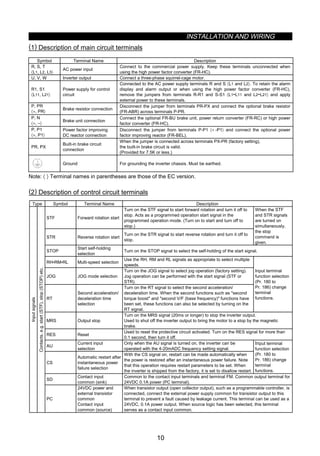
(1) Description of main circuit terminals
Symbol Terminal Name Description
R, S, T
〈L1, L2, L3〉
AC power input
Connect to the commercial power supply. Keep these terminals unconnected when
using the high power factor converter (FR-HC).
U, V, W Inverter output Connect a three-phase squirrel-cage motor.
R1, S1
〈L11, L21〉
Power supply for control
circuit
Connected to the AC power supply terminals R and S 〈L1 and L2〉. To retain the alarm
display and alarm output or when using the high power factor converter (FR-HC),
remove the jumpers from terminals R-R1 and S-S1 〈L1-L11 and L2-L21〉 and apply
external power to these terminals.
P, PR
〈+, PR〉
Brake resistor connection
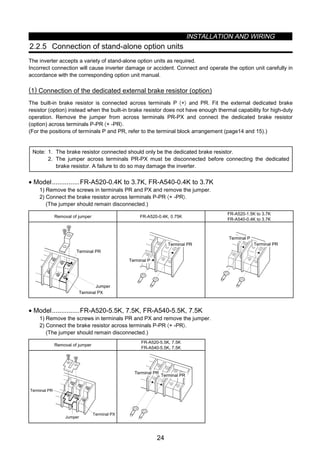
Disconnect the jumper from terminals PR-PX and connect the optional brake resistor
(FR-ABR) across terminals P-PR.
P, N
〈+, −〉
Brake unit connection
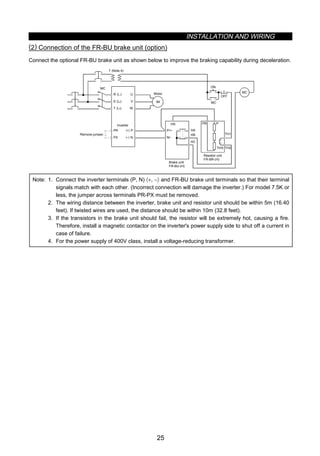
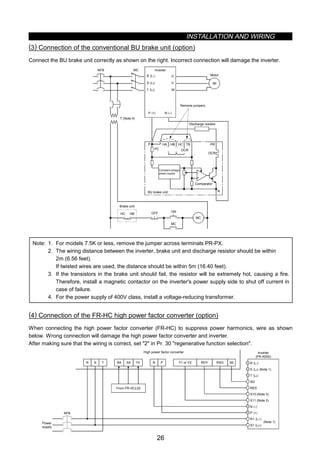
Connect the optional FR-BU brake unit, power return converter (FR-RC) or high power
factor converter (FR-HC).
P, P1
〈+, P1〉
Power factor improving
DC reactor connection
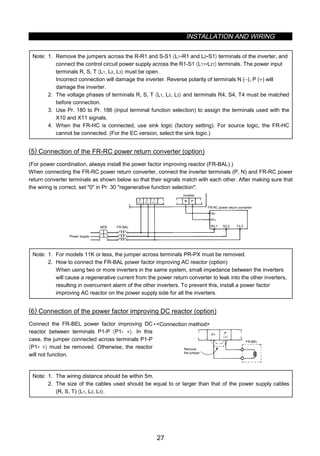
Disconnect the jumper from terminals P-P1 〈+ -P1〉 and connect the optional power
factor improving reactor (FR-BEL).
PR, PX
Built-in brake circuit
connection
When the jumper is connected across terminals PX-PR (factory setting),
the built-in brake circuit is valid.
(Provided for 7.5K or less.)
Ground For grounding the inverter chassis. Must be earthed.
Note: 〈 〉 Terminal names in parentheses are those of the EC version.
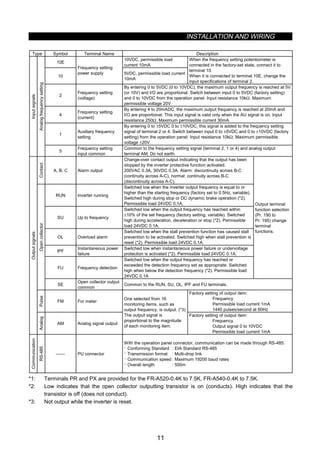
(2) Description of control circuit terminals
Type Symbol Terminal Name Description
STF Forward rotation start
Turn on the STF signal to start forward rotation and turn it off to
stop. Acts as a programmed operation start signal in the
programmed operation mode. (Turn on to start and turn off to
stop.)
STR Reverse rotation start
Turn on the STR signal to start reverse rotation and turn it off to
stop.
When the STF
and STR signals
are turned on
simultaneously,
the stop
command is
given.
STOP
Start self-holding
selection
Turn on the STOP signal to select the self-holding of the start signal.
RH•RM•RL Multi-speed selection
Use the RH, RM and RL signals as appropriate to select multiple
speeds.
JOG JOG mode selection
Turn on the JOG signal to select jog operation (factory setting).
Jog operation can be performed with the start signal (STF or
STR).
RT
Second acceleration/
deceleration time
selection
Turn on the RT signal to select the second acceleration/
deceleration time. When the second functions such as second
torque boost and second V/F (base frequency) functions have
been set, these functions can also be selected by turning on the
RT signal.
Input terminal
function selection
(Pr. 180 to
Pr. 186) change
terminal
functions.
MRS Output stop
Turn on the MRS signal (20ms or longer) to stop the inverter output.
Used to shut off the inverter output to bring the motor to a stop by the magnetic
brake.
RES Reset
Used to reset the protective circuit activated. Turn on the RES signal for more than
0.1 second, then turn it off.
AU
Current input
selection
Only when the AU signal is turned on, the inverter can be
operated with the 4-20mADC frequency setting signal.
CS
Automatic restart after
instantaneous power
failure selection
With the CS signal on, restart can be made automatically when
the power is restored after an instantaneous power failure. Note
that this operation requires restart parameters to be set. When
the inverter is shipped from the factory, it is set to disallow restart.
Input terminal
function selection
(Pr. 180 to
Pr. 186) change
terminal
functions.
SD
Contact input
common (sink)
Common to the contact input terminals and terminal FM. Common output terminal for
24VDC 0.1A power (PC terminal).
Inputsignals
Contacts,e.g.start(STF),stop(STOP)etc.
PC
24VDC power and
external transistor
common
Contact input
common (source)
When transistor output (open collector output), such as a programmable controller, is
connected, connect the external power supply common for transistor output to this
terminal to prevent a fault caused by leakage current. This terminal can be used as a
24VDC, 0.1A power output. When source logic has been selected, this terminal
serves as a contact input common.
INSTALLATION AND WIRING
11
Type Symbol Terminal Name Description
10E
10VDC, permissible load
current 10mA
10
Frequency setting
power supply 5VDC, permissible load current
10mA
When the frequency setting potentiometer is
connected in the factory-set state, connect it to
terminal 10.
When it is connected to terminal 10E, change the
input specifications of terminal 2.
2
Frequency setting
(voltage)
By entering 0 to 5VDC (0 to 10VDC), the maximum output frequency is reached at 5V
(or 10V) and I/O are proportional. Switch between input 0 to 5VDC (factory setting)
and 0 to 10VDC from the operation panel. Input resistance 10kΩ. Maximum
permissible voltage 20V.
4
Frequency setting
(current)
By entering 4 to 20mADC, the maximum output frequency is reached at 20mA and
I/O are proportional. This input signal is valid only when the AU signal is on. Input
resistance 250Ω. Maximum permissible current 30mA.
1
Auxiliary frequency
setting
By entering 0 to ±5VDC 0 to ±10VDC, this signal is added to the frequency setting
signal of terminal 2 or 4. Switch between input 0 to ±5VDC and 0 to ±10VDC (factory
setting) from the operation panel. Input resistance 10kΩ. Maximum permissible
voltage ±20V.
Inputsignals
Analogfrequencysetting
5
Frequency setting
input common
Common to the frequency setting signal (terminal 2, 1 or 4) and analog output
terminal AM. Do not earth.
Contact
A, B, C Alarm output
Change-over contact output indicating that the output has been
stopped by the inverter protective function activated.
200VAC 0.3A, 30VDC 0.3A. Alarm: discontinuity across B-C
(continuity across A-C), normal: continuity across B-C
(discontinuity across A-C).
RUN Inverter running
Switched low when the inverter output frequency is equal to or
higher than the starting frequency (factory set to 0.5Hz, variable).
Switched high during stop or DC dynamic brake operation (*2).
Permissible load 24VDC 0.1A.
SU Up to frequency
Switched low when the output frequency has reached within
±10% of the set frequency (factory setting, variable). Switched
high during acceleration, deceleration or stop (*2). Permissible
load 24VDC 0.1A.
OL Overload alarm
Switched low when the stall prevention function has caused stall
prevention to be activated. Switched high when stall prevention is
reset (*2). Permissible load 24VDC 0.1A.
IPF
Instantaneous power
failure
Switched low when instantaneous power failure or undervoltage
protection is activated (*2). Permissible load 24VDC 0.1A.
FU Frequency detection
Switched low when the output frequency has reached or
exceeded the detection frequency set as appropriate. Switched
high when below the detection frequency (*2). Permissible load
24VDC 0.1A
Output terminal
function selection
(Pr. 190 to
Pr. 195) change
terminal
functions.
Opencollector
SE
Open collector output
common
Common to the RUN, SU, OL, IPF and FU terminals.
Pulse
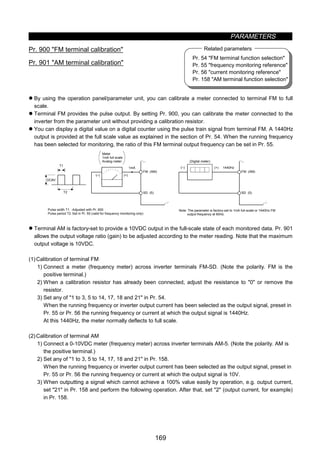
FM For meter
Factory setting of output item:
Frequency
Permissible load current 1mA
1440 pulses/second at 60Hz
Outputsignals
Analog
AM Analog signal output
One selected from 16
monitoring items, such as
output frequency, is output. (*3)
The output signal is
proportional to the magnitude
of each monitoring item.
Factory setting of output item:
Frequency
Output signal 0 to 10VDC
Permissible load current 1mA
Communication
RS-485
 PU connector
With the operation panel connector, communication can be made through RS-485.
· Conforming Standard : EIA Standard RS-485
· Transmission format : Multi-drop link
· Communication speed : Maximum 19200 baud rates
· Overall length : 500m
*1: Terminals PR and PX are provided for the FR-A520-0.4K to 7.5K, FR-A540-0.4K to 7.5K.
*2: Low indicates that the open collector outputting transistor is on (conducts). High indicates that the
transistor is off (does not conduct).
*3: Not output while the inverter is reset.
INSTALLATION AND WIRING
12
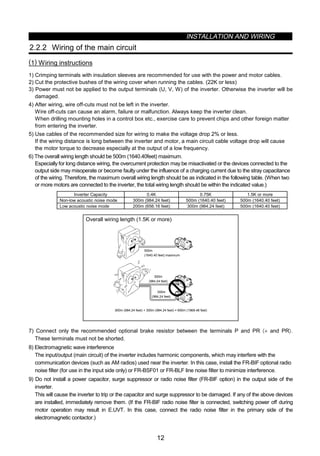
2.2.2 Wiring of the main circuit
(1) Wiring instructions
1) Crimping terminals with insulation sleeves are recommended for use with the power and motor cables.
2) Cut the protective bushes of the wiring cover when running the cables. (22K or less)
3) Power must not be applied to the output terminals (U, V, W) of the inverter. Otherwise the inverter will be
damaged.
4) After wiring, wire off-cuts must not be left in the inverter.
Wire off-cuts can cause an alarm, failure or malfunction. Always keep the inverter clean.
When drilling mounting holes in a control box etc., exercise care to prevent chips and other foreign matter
from entering the inverter.
5) Use cables of the recommended size for wiring to make the voltage drop 2% or less.
If the wiring distance is long between the inverter and motor, a main circuit cable voltage drop will cause
the motor torque to decrease especially at the output of a low frequency.
6) The overall wiring length should be 500m (1640.40feet) maximum.
Especially for long distance wiring, the overcurrent protection may be misactivated or the devices connected to the
output side may misoperate or become faulty under the influence of a charging current due to the stray capacitance
of the wiring. Therefore, the maximum overall wiring length should be as indicated in the following table. (When two
or more motors are connected to the inverter, the total wiring length should be within the indicated value.)
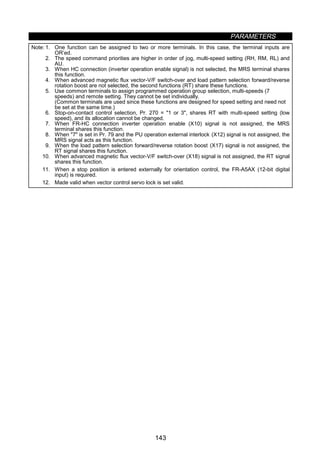
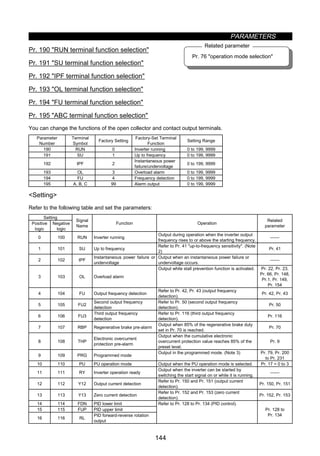
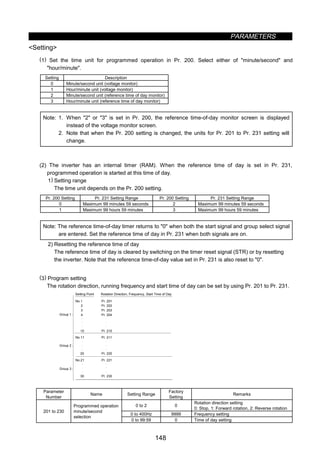
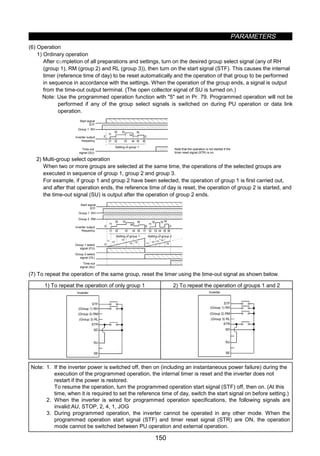
Inverter Capacity 0.4K 0.75K 1.5K or more
Non-low acoustic noise mode 300m (984.24 feet) 500m (1640.40 feet) 500m (1640.40 feet)
Low acoustic noise mode 200m (656.16 feet) 300m (984.24 feet) 500m (1640.40 feet)
Overall wiring length (1.5K or more)
300m (984.24 feet) + 300m (984.24 feet) = 600m (1968.48 feet)
500m
(1640.40 feet) maximum
300m
(984.24 feet)
300m
(984.24 feet)
7) Connect only the recommended optional brake resistor between the terminals P and PR 〈+ and PR〉.
These terminals must not be shorted.
8) Electromagnetic wave interference
The input/output (main circuit) of the inverter includes harmonic components, which may interfere with the
communication devices (such as AM radios) used near the inverter. In this case, install the FR-BIF optional radio
noise filter (for use in the input side only) or FR-BSF01 or FR-BLF line noise filter to minimize interference.
9) Do not install a power capacitor, surge suppressor or radio noise filter (FR-BIF option) in the output side of the
inverter.
This will cause the inverter to trip or the capacitor and surge suppressor to be damaged. If any of the above devices
are installed, immediately remove them. (If the FR-BIF radio noise filter is connected, switching power off during
motor operation may result in E.UVT. In this case, connect the radio noise filter in the primary side of the
electromagnetic contactor.)
INSTALLATION AND WIRING
13
10) When rewiring after operation, make sure that the POWER lamp has gone off, and when more than 10
minutes have elapsed after power-off, check with a tester that the voltage is zero. After that, start rewiring
work. For some time after power-off, there is a dangerous voltage in the capacitor.
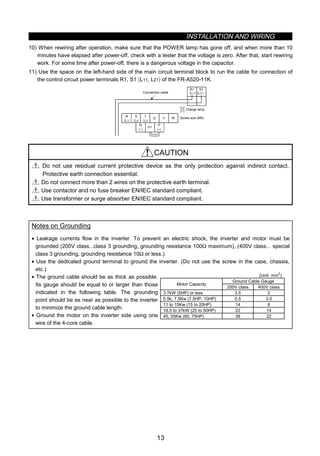
11) Use the space on the left-hand side of the main circuit terminal block to run the cable for connection of
the control circuit power terminals R1, S1 〈L11, L21〉 of the FR-A520-11K.
N
U V W
P1
R1 S1
P
Screw size (M5)
Connection cable
Charge lamp
T
〈L3〉
R
〈L1〉
S
〈L2〉
〈−〉 〈+〉
〈L11〉 〈L21〉
CAUTION
Do not use residual current protective device as the only protection against indirect contact.
Protective earth connection essential.
Do not connect more than 2 wires on the protective earth terminal.
Use contactor and no fuse breaker EN/IEC standard compliant.
Use transformer or surge absorber EN/IEC standard compliant.
Notes on Grounding
• Leakage currents flow in the inverter. To prevent an electric shock, the inverter and motor must be
grounded (200V class...class 3 grounding, grounding resistance 100Ω maximum), (400V class... special
class 3 grounding, grounding resistance 10Ω or less.).
• Use the dedicated ground terminal to ground the inverter. (Do not use the screw in the case, chassis,
etc.)
(Unit: mm
2
)
Ground Cable Gauge
Motor Capacity
200V class 400V class
3.7kW (5HP) or less 3.5 2
5.5k, 7.5Kw (7.5HP, 10HP) 5.5 3.5
11 to 15Kw (15 to 20HP) 14 8
18.5 to 37kW (25 to 50HP) 22 14
45, 55Kw (60, 75HP) 38 22
• The ground cable should be as thick as possible.
Its gauge should be equal to or larger than those
indicated in the following table. The grounding
point should be as near as possible to the inverter
to minimize the ground cable length.
• Ground the motor on the inverter side using one
wire of the 4-core cable.
INSTALLATION AND WIRING
14
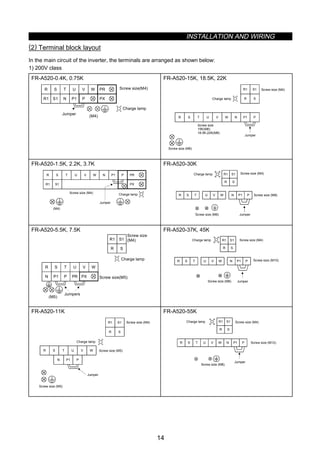
(2) Terminal block layout
In the main circuit of the inverter, the terminals are arranged as shown below:
1) 200V class
FR-A520-0.4K, 0.75K
R
R1
S T U V W PR
S1 N P1 P
(M4)
PX
Jumper
Screw size(M4)
Charge lamp
FR-A520-15K, 18.5K, 22K
R S T U V W N P1 P
R S
R1 S1
Screw size
15K(M6)
18.5K,22K(M8)
Jumper
Charge lamp
Screw size (M4)
Screw size (M6)
FR-A520-1.5K, 2.2K, 3.7K
R
R1
S T U V W PR
S1
N P1 P
PX
(M4)
Jumper
Screw size (M4) Charge lamp
FR-A520-30K
R S T U V W
R1 S1
N P1 P
R S
Charge lamp Screw size (M4)
Screw size (M8)
Screw size (M6) Jumper
FR-A520-5.5K, 7.5K
R
N
S T U V W
P1 P PR PX
R1
R
S1
S
(M5)
Jumpers
Charge lamp
Screw size
(M4)
Screw size(M5)
FR-A520-37K, 45K
R S T U V W
R1 S1
N P1 P
R S
Charge lamp Screw size (M4)
Screw size (M10)
Screw size (M8) Jumper
FR-A520-11K
R
N
S T U V W
P1 P
R1
R
S1
S
Jumper
Screw size (M4)
Charge lamp
Screw size (M5)
Screw size (M5)
FR-A520-55K
R S T U V W
R1 S1
N P1 P
R S
Charge lamp Screw size (M4)
Screw size (M12)
Screw size (M8)
Jumper
INSTALLATION AND WIRING
15
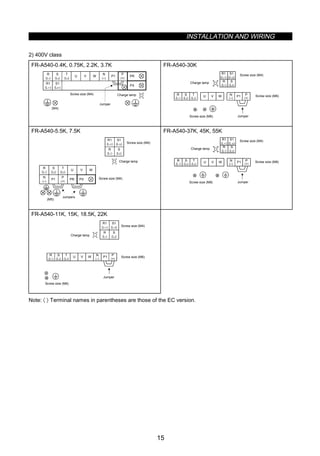
2) 400V class
FR-A540-0.4K, 0.75K, 2.2K, 3.7K
U V W PRP1
PX
(M4)
Screw size (M4)
Jumper
Charge lamp
R
〈L1〉
S
〈L2〉
T
〈L3〉
N
〈–〉
P
〈+〉
R1
〈L11〉
S1
〈L21〉
FR-A540-30K
U V W P1
Jumper
Screw size (M4)
Screw size (M6)
Screw size (M6)
Charge lamp
S
〈L2〉
R
〈L1〉
T
〈L3〉
R
〈L1〉
S
〈L2〉
R1
〈L11〉
S1
〈L12〉
N
〈–〉
P
〈+〉
FR-A540-5.5K, 7.5K
U V W
P1 PR PX
(M5)
Screw size (M4)
Charge lamp
Screw size (M4)
Jumpers
R
〈L1〉
S
〈L2〉
T
〈L3〉
N
〈–〉
P
〈+〉
R
〈L1〉
S
〈L2〉
R1
〈L11〉
S1
〈L12〉
FR-A540-37K, 45K, 55K
S
〈L2〉
R
〈L1〉
U V W P1
Jumper
Screw size (M4)
Screw size (M8)
Screw size (M8)
Charge lamp
T
〈L3〉
R
〈L1〉
S
〈L2〉
R1
〈L11〉
S1
〈L12〉
N
〈–〉
P
〈+〉
FR-A540-11K, 15K, 18.5K, 22K
S
〈L2〉
U V W P1
Jumper
Screw size (M4)
Charge lamp
Screw size (M6)
Screw size (M6)
R
〈L1〉
T
〈L3〉
R
〈L1〉
S
〈L2〉
R1
〈L11〉
S1
〈L12〉
N
〈–〉
P
〈+〉
Note: 〈 〉 Terminal names in parentheses are those of the EC version.
INSTALLATION AND WIRING
16
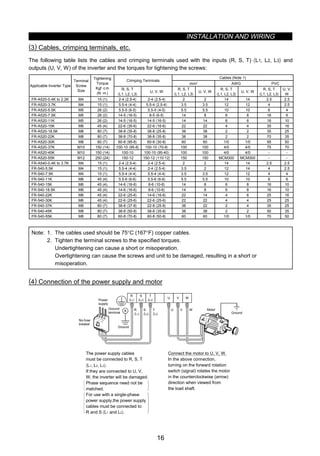
(3) Cables, crimping terminals, etc.
The following table lists the cables and crimping terminals used with the inputs (R, S, T) 〈L1, L2, L3〉 and
outputs (U, V, W) of the inverter and the torques for tightening the screws:
Cables (Note 1)
Crimping Terminals
mm2 AWG PVC
Applicable Inverter Type
Terminal
Screw
Size
Tightening
Torque
Kgf⋅cm
(N⋅m)
R, S, T
〈L1, L2, L3〉
U, V, W
R, S, T
〈L1, L2, L3〉
U, V, W
R, S, T
〈L1, L2, L3〉
U, V, W
R, S, T
〈L1, L2, L3〉
U, V,
W
FR-A520-0.4K to 2.2K M4 15 (1) 2-4 〈2.5-4〉 2-4 〈2.5-4〉 2 2 14 14 2.5 2.5
FR-A520-3.7K M4 15 (1) 5.5-4 〈4-4〉 5.5-4 〈2.5-4〉 3.5 3.5 12 12 4 2.5
FR-A520-5.5K M5 26 (2) 5.5-5 〈6-5〉 5.5-5 〈4-5〉 5.5 5.5 10 10 6 4
FR-A520-7.5K M5 26 (2) 14-5 〈16-5〉 8-5 〈6-5〉 14 8 6 8 16 6
FR-A520-11K M5 26 (2) 14-5 〈16-5〉 14-5 〈16-5〉 14 14 6 6 16 10
FR-A520-15K M6 45 (4) 22-6 〈35-6〉 22-6 〈16-6〉 22 22 4 4 35 16
FR-A520-18.5K M8 80 (7) 38-8 〈35-8〉 38-8 〈25-8〉 38 38 2 2 35 25
FR-A520-22K M8 80 (7) 38-8 〈70-8〉 38-8 〈35-8〉 38 38 2 2 70 35
FR-A520-30K M8 80 (7) 60-8 〈95-8〉 60-8 〈30-8〉 60 60 1/0 1/0 95 50
FR-A520-37K M10 150 (14) 100-10 〈95-8〉 100-10 〈70-8〉 100 100 4/0 4/0 75 70
FR-A520-45K M10 150 (14) 100-10 100-10 〈95-40〉 100 100 4/0 4/0 − −
FR-A520-55K M12 250 (24) 150-12 150-12 〈110-12〉 150 150 MCM300 MCM300 − −
FR-A540-0.4K to 3.7K M4 15 (1) 2-4 〈2.5-4〉 2-4 〈2.5-4〉 2 2 14 14 2.5 2.5
FR-540-5.5K M4 15 (1) 5.5-4 〈4-4〉 2-4 〈2.5-4〉 3.5 2 12 14 4 2.5
FR-540-7.5K M4 15 (1) 5.5-4 〈4-4〉 5.5-4 〈4-4〉 3.5 3.5 12 12 4 4
FR-540-11K M6 45 (4) 5.5-6 〈6-6〉 5.5-6 〈6-6〉 5.5 5.5 10 10 6 6
FR-540-15K M6 45 (4) 14-6 〈16-6〉 8-6 〈10-6〉 14 8 6 8 16 10
FR-540-18.5K M6 45 (4) 14-6 〈16-6〉 8-6 〈10-6〉 14 8 6 8 16 10
FR-540-22K M6 45 (4) 22-6 〈25-6〉 14-6 〈16-6〉 22 14 4 6 25 16
FR-540-30K M6 45 (4) 22-6 〈25-6〉 22-6 〈25-6〉 22 22 4 4 25 25
FR-540-37K M8 80 (7) 38-8 〈37-8〉 22-8 〈25-8〉 38 22 2 4 35 25
FR-540-45K M8 80 (7) 38-8 〈50-8〉 38-8 〈35-8〉 38 38 2 2 50 35
FR-540-55K M8 80 (7) 60-8 〈70-8〉 60-8 〈50-8〉 60 60 1/0 1/0 70 50
Note: 1. The cables used should be 75°C (167°F) copper cables.
2. Tighten the terminal screws to the specified torques.
Undertightening can cause a short or misoperation.
Overtightening can cause the screws and unit to be damaged, resulting in a short or
misoperation.
(4) Connection of the power supply and motor
Ground
Ground
Ground
terminal
Power
supply
U V W
U V W Motor
No-fuse
breaker
The power supply cables
must be connected to R, S, T
〈L1, L2, L3〉.
If they are connected to U, V,
W, the inverter will be damaged.
Phase sequence need not be
matched.
For use with a single-phase
power supply,the power supply
cables must be connected to
R and S 〈L1 and L2〉.
Connect the motor to U, V, W.
In the above connection,
turning on the forward rotation
switch (signal) rotates the motor
in the counterclockwise (arrow)
direction when viewed from
the load shaft.
R
〈L1〉
S
〈L2〉
T
〈L3〉
R
〈L1〉
S
〈L2〉
T
〈L3〉
INSTALLATION AND WIRING
17
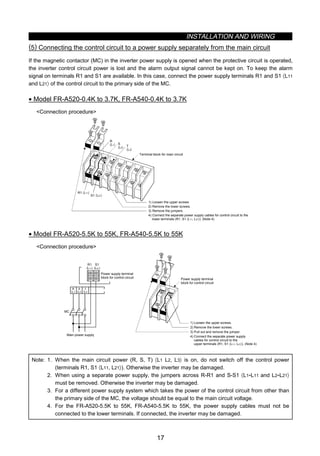
(5) Connecting the control circuit to a power supply separately from the main circuit
If the magnetic contactor (MC) in the inverter power supply is opened when the protective circuit is operated,
the inverter control circuit power is lost and the alarm output signal cannot be kept on. To keep the alarm
signal on terminals R1 and S1 are available. In this case, connect the power supply terminals R1 and S1 〈L11
and L21〉 of the control circuit to the primary side of the MC.
• Model FR-A520-0.4K to 3.7K, FR-A540-0.4K to 3.7K
Connection procedure
R
〈L1〉 S
〈L2〉 T
〈L3〉
R1 〈L11〉
S1 〈L21〉
4) Connect the separate power supply cables for control circuit to the
lower terminals (R1, S1 〈L11, L21〉). (Note 4)
Terminal block for main circuit
1) Loosen the upper screws
2) Remove the lower screws.
3) Remove the jumpers.
• Model FR-A520-5.5K to 55K, FR-A540-5.5K to 55K
Connection procedure
MC
1) Loosen the upper screws.
2) Remove the lower screws.
3) Pull out and remove the jumper.
4) Connect the separate power supply
cables for control circuit to the
upper terminals (R1, S1 〈L11, L21〉). (Note 4)
Power supply terminal
block for control circuit
Main power supply
Power supply terminal
block for control circuit
R
〈L1〉
S
〈L2〉
T
〈L3〉
R1
〈L11〉
S1
〈L21〉
Note: 1. When the main circuit power (R, S, T) 〈L1 L2, L3〉 is on, do not switch off the control power
(terminals R1, S1 〈L11, L21〉). Otherwise the inverter may be damaged.
2. When using a separate power supply, the jumpers across R-R1 and S-S1 〈L1-L11 and L2-L21〉
must be removed. Otherwise the inverter may be damaged.
3. For a different power supply system which takes the power of the control circuit from other than
the primary side of the MC, the voltage should be equal to the main circuit voltage.
4. For the FR-A520-5.5K to 55K, FR-A540-5.5K to 55K, the power supply cables must not be
connected to the lower terminals. If connected, the inverter may be damaged.
INSTALLATION AND WIRING
18
2.2.3 Wiring of the control circuit
(1) Wiring instructions
1) Terminals SD, SE and 5 are common to the I/O signals and isolated from each other. These common
terminals must not be connected to each other or earthed.
2) Use shielded or twisted cables for connection to the control circuit terminals and run them away from the
main and power circuits (including the 200V relay sequence circuit).
3) The frequency input signals to the control circuit are micro currents. When contacts are required, use two
or more parallel micro signal contacts or a twin contact to prevent a contact fault.
4) It is recommended to use the cables of 0.75mm
2
gauge for connection to the control circuit terminals.
If the cable gauge used is 1.25mm
2
or more, the front cover may be lifted when there are many cables
running or the cables are run improperly, resulting in an operation panel or parameter unit contact fault.
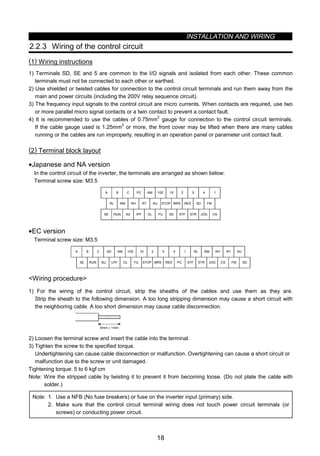
(2) Terminal block layout
•Japanese and NA version
In the control circuit of the inverter, the terminals are arranged as shown below:
Terminal screw size: M3.5
A
RL
SE RUN SU IPF OL FU SD STF STR JOG CS
RM RH RT AU STOP MRS RES SD FM
B C PC AM 10E 10 2 5 4 1
•EC version
Terminal screw size: M3.5
A
SE RUN SU LPF OL STOP MRS RES PC STF
B C SD AM 10E 10 2 5 4 1 RL RM RH RT AU
STR JOG CS FM SDFU
Wiring procedure
1) For the wiring of the control circuit, strip the sheaths of the cables and use them as they are.
Strip the sheath to the following dimension. A too long stripping dimension may cause a short circuit with
the neighboring cable. A too short dimension may cause cable disconnection.
6mm ± 1mm
2) Loosen the terminal screw and insert the cable into the terminal.
3) Tighten the screw to the specified torque.
Undertightening can cause cable disconnection or malfunction. Overtightening can cause a short circuit or
malfunction due to the screw or unit damaged.
Tightening torque: 5 to 6 kgf⋅cm
Note: Wire the stripped cable by twisting it to prevent it from becoming loose. (Do not plate the cable with
solder.)
Note: 1. Use a NFB (No fuse breakers) or fuse on the inverter input (primary) side.
2. Make sure that the control circuit terminal wiring does not touch power circuit terminals (or
screws) or conducting power circuit.
INSTALLATION AND WIRING
19
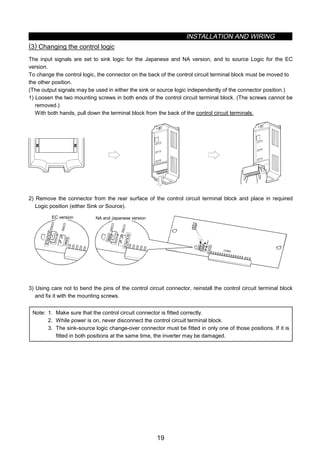
(3) Changing the control logic
The input signals are set to sink logic for the Japanese and NA version, and to source Logic for the EC
version.
To change the control logic, the connector on the back of the control circuit terminal block must be moved to
the other position.
(The output signals may be used in either the sink or source logic independently of the connector position.)
1) Loosen the two mounting screws in both ends of the control circuit terminal block. (The screws cannot be
removed.)
With both hands, pull down the terminal block from the back of the control circuit terminals.
2) Remove the connector from the rear surface of the control circuit terminal block and place in required
Logic position (either Sink or Source).
SOURCE
CON3
CON2
SINK
CON1
SINK
CON3
CON2
SOURCE
SINK
CON3
CON2
SOURCE
EC version NA and Japanese version
3) Using care not to bend the pins of the control circuit connector, reinstall the control circuit terminal block
and fix it with the mounting screws.
Note: 1. Make sure that the control circuit connector is fitted correctly.
2. While power is on, never disconnect the control circuit terminal block.
3. The sink-source logic change-over connector must be fitted in only one of those positions. If it is
fitted in both positions at the same time, the inverter may be damaged.
INSTALLATION AND WIRING
20
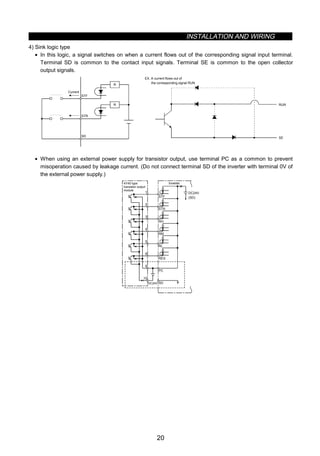
4) Sink logic type
• In this logic, a signal switches on when a current flows out of the corresponding signal input terminal.
Terminal SD is common to the contact input signals. Terminal SE is common to the open collector
output signals.
R
R
STF
STR
SD
Current
RUN
SE
EX. A current flows out of
the corresponding signal RUN
• When using an external power supply for transistor output, use terminal PC as a common to prevent
misoperation caused by leakage current. (Do not connect terminal SD of the inverter with terminal 0V of
the external power supply.)
1
2
3
4
5
6
9
10
DC24V SD
PC
RES
RL
RM
RH
STR
STF
DC24V
(SD)
AY40 type
transistor output
module
Inverter
INSTALLATION AND WIRING
21
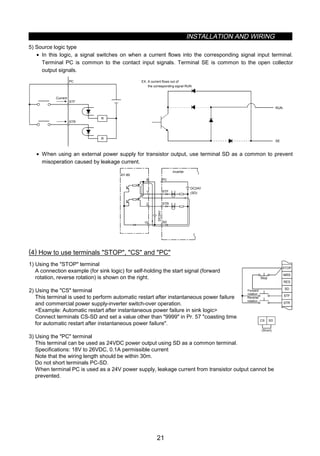
5) Source logic type
• In this logic, a signal switches on when a current flows into the corresponding signal input terminal.
Terminal PC is common to the contact input signals. Terminal SE is common to the open collector
output signals.
PC
STF
STR
R
R
Current
RUN
SE
EX. A current flows out of
the corresponding signal RUN
• When using an external power supply for transistor output, use terminal SD as a common to prevent
misoperation caused by leakage current.
AY-80
9
1
2
10
PC
STF
STR
SD
DC24V
(SD)
DC24V
Inverter
(4) How to use terminals STOP, CS and PC
1) Using the STOP terminal
A connection example (for sink logic) for self-holding the start signal (forward
rotation, reverse rotation) is shown on the right.
2) Using the CS terminal
This terminal is used to perform automatic restart after instantaneous power failure
and commercial power supply-inverter switch-over operation.
Example: Automatic restart after instantaneous power failure in sink logic
Connect terminals CS-SD and set a value other than 9999 in Pr. 57 coasting time
for automatic restart after instantaneous power failure.
MRS
RES
SD
STF
STR
STOP
Reverse
rotation
Stop
Forward
rotation
CS SD
(Short)
3) Using the PC terminal
This terminal can be used as 24VDC power output using SD as a common terminal.
Specifications: 18V to 26VDC, 0.1A permissible current
Note that the wiring length should be within 30m.
Do not short terminals PC-SD.
When terminal PC is used as a 24V power supply, leakage current from transistor output cannot be
prevented.
INSTALLATION AND WIRING
22
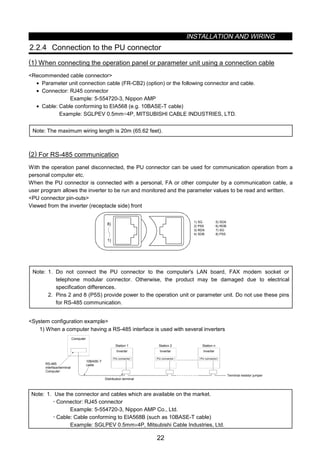
2.2.4 Connection to the PU connector
(1) When connecting the operation panel or parameter unit using a connection cable
Recommended cable connector
• Parameter unit connection cable (FR-CB2) (option) or the following connector and cable.
• Connector: RJ45 connector
Example: 5-554720-3, Nippon AMP
• Cable: Cable conforming to EIA568 (e.g. 10BASE-T cable)
Example: SGLPEV 0.5mm×4P, MITSUBISHI CABLE INDUSTRIES, LTD.
Note: The maximum wiring length is 20m (65.62 feet).
(2) For RS-485 communication
With the operation panel disconnected, the PU connector can be used for communication operation from a
personal computer etc.
When the PU connector is connected with a personal, FA or other computer by a communication cable, a
user program allows the inverter to be run and monitored and the parameter values to be read and written.
PU connector pin-outs
Viewed from the inverter (receptacle side) front
1) SG
2) P5S
3) RDA
4) SDB
5) SDA
6) RDB
7) SG
8) P5S
1)
8)
Note: 1. Do not connect the PU connector to the computer's LAN board, FAX modem socket or
telephone modular connector. Otherwise, the product may be damaged due to electrical
specification differences.
2. Pins 2 and 8 (P5S) provide power to the operation unit or parameter unit. Do not use these pins
for RS-485 communication.
System configuration example
1) When a computer having a RS-485 interface is used with several inverters
PU connectorPU connector
Computer
Inverter
Station 1
PU connector
Inverter
Station 2
Inverter
Station n
RS-485
interface/terminal
Computer
10BASE-T
cable
Terminal resistor jumper
Distribution terminal
Note: 1. Use the connector and cables which are available on the market.
x Connector: RJ45 connector
Example: 5-554720-3, Nippon AMP Co., Ltd.
x Cable: Cable conforming to EIA568B (such as 10BASE-T cable)
Example: SGLPEV 0.5mm×4P, Mitsubishi Cable Industries, Ltd.
INSTALLATION AND WIRING
23
2) When a computer having a RS-232C interface is used with inverters
Computer
Inverter
Station 1
PU connector
Inverter
Station 2
PU connector
Inverter
Station n
PU connector
Terminal resistor jumper
Max. 15mRS-232C connector
RS-232C cable
RS-485 terminal
*Converter
*Converter available on the market is required.
10BASE-T cable
Distribution terminal
Note: 1. Use the connector, cables and converter which are available on the market.
x Connector: RJ45 connector
Example: Nippon AMP Co., Ltd.
x Cable: Cable conforming to EIA568B (such as 10BASE-T cable)
Example: SGLPEV 0.5mm×4P, Mitsubishi Cable Industries, Ltd.
x RS-485/RS-232C converter
Example: FA-T-RS40, Industrial System Div., Mitsubishi Electric Engineering Co., Ltd.
or
: Cable with built-in interface DAFXI-CAB series, Connector conversion cable
DINV-485CAB, Dia Trend Co., Ltd.
Wiring method
1) Wiring of one computer and one inverter
Computer Side Terminals
Signal name Description
RDA
RDB
SDA
SDB
RSA
RSB
CSA
CSB
SG
FG
Receive data
Receive data
Send data
Send data
Request to send
Request to send
Clear to send
Clear to send
Signal ground
Frame ground
PU connector
SDA
SDB
RDA
RDB
RDR
SG
*2
∗1 Terminal resistor
jumper
0.3mm or more2
Cable connection and signal direction
10BASE-T Cable
Inverter
2) Wiring of one computer and n inverters (several inverters)
*2
Computer
RDA
RDB
SDA
SDB
RSA
RSB
CSA
CSB
SG
FG Station 1
SG
RDB
RDA
SDB
SDA
Station 2
SG
RDB
RDA
SDB
SDA
Station 3
SG
RDR
RDB
RDA
SDB
SDA
Terminal
resistor
jumper (*1)
Inverter Inverter Inverter
Note: 1. Connect the terminal resistor jumper only to the inverter remotest from the computer.
(Terminal resistor: 100 Ω)
2. Make connections in accordance with the instruction manual of the computer used.
Fully check the terminal numbers of the computer as they differ between models.
INSTALLATION AND WIRING
24
2.2.5 Connection of stand-alone option units
The inverter accepts a variety of stand-alone option units as required.
Incorrect connection will cause inverter damage or accident. Connect and operate the option unit carefully in
accordance with the corresponding option unit manual.
(1) Connection of the dedicated external brake resistor (option)
The built-in brake resistor is connected across terminals P 〈+〉 and PR. Fit the external dedicated brake
resistor (option) instead when the built-in brake resistor does not have enough thermal capability for high-duty
operation. Remove the jumper from across terminals PR-PX and connect the dedicated brake resistor
(option) across terminals P-PR 〈+ -PR〉.
(For the positions of terminals P and PR, refer to the terminal block arrangement (page14 and 15).)
Note: 1. The brake resistor connected should only be the dedicated brake resistor.
2. The jumper across terminals PR-PX must be disconnected before connecting the dedicated
brake resistor. A failure to do so may damage the inverter.
• Model...............FR-A520-0.4K to 3.7K, FR-A540-0.4K to 3.7K
1) Remove the screws in terminals PR and PX and remove the jumper.
2) Connect the brake resistor across terminals P-PR 〈+ -PR〉.
(The jumper should remain disconnected.)
Removal of jumper FR-A520-0.4K, 0.75K
FR-A520-1.5K to 3.7K
FR-A540-0.4K to 3.7K
Terminal PX
Terminal PR
Jumper
Terminal PR
Terminal P
Terminal PR
Terminal P
• Model...............FR-A520-5.5K, 7.5K, FR-A540-5.5K, 7.5K
1) Remove the screws in terminals PR and PX and remove the jumper.
2) Connect the brake resistor across terminals P-PR 〈+ -PR〉.
(The jumper should remain disconnected.)
Removal of jumper
FR-A520-5.5K, 7.5K
FR-A540-5.5K, 7.5K
Jumper
Terminal PR
Terminal PX
Terminal PR
Terminal PR
INSTALLATION AND WIRING
25
(2) Connection of the FR-BU brake unit (option)
Connect the optional FR-BU brake unit as shown below to improve the braking capability during deceleration.
MC
R 〈L1〉
S 〈L2〉
T 〈L3〉
U
V
W
〈+〉 P
〈–〉 N
PR
PX
IM
PR
P/+
N/-
HA
HB
HC
Brake unit
FR-BU-(H)
Resistor unit
FR-BR-(H)
THS TH2
TH1
PPR
ON
MC
OFF
MC
Remove jumper.
Inverter
Motor
T (Note 4)
Note: 1. Connect the inverter terminals (P, N) 〈+, −〉 and FR-BU brake unit terminals so that their terminal
signals match with each other. (Incorrect connection will damage the inverter.) For model 7.5K or
less, the jumper across terminals PR-PX must be removed.
2. The wiring distance between the inverter, brake unit and resistor unit should be within 5m (16.40
feet). If twisted wires are used, the distance should be within 10m (32.8 feet).
3. If the transistors in the brake unit should fail, the resistor will be extremely hot, causing a fire.
Therefore, install a magnetic contactor on the inverter's power supply side to shut off a current in
case of failure.
4. For the power supply of 400V class, install a voltage-reducing transformer.
INSTALLATION AND WIRING
26
(3) Connection of the conventional BU brake unit (option)
Connect the BU brake unit correctly as shown on the right. Incorrect connection will damage the inverter.
MC
R 〈L1〉
S 〈L2〉
T 〈L3〉
U
V
W
IM
Inverter
HCHBHA TB
HC HB
ON
MC
MC
OFF
P 〈+〉 N 〈–〉
P
OCR
PR
OCR
N
NFB
PC
Brake unit
Remove jumpers.
Discharge resistor
Constant-voltage
power supply
BU brake unit
Comparator
Motor
T (Note 4)
+
-
Note: 1. For models 7.5K or less, remove the jumper across terminals PR-PX.
2. The wiring distance between the inverter, brake unit and discharge resistor should be within
2m (6.56 feet).
If twisted wires are used, the distance should be within 5m (16.40 feet).
3. If the transistors in the brake unit should fail, the resistor will be extremely hot, causing a fire.
Therefore, install a magnetic contactor on the inverter's power supply side to shut off current in
case of failure.
4. For the power supply of 400V class, install a voltage-reducing transformer.
(4) Connection of the FR-HC high power factor converter (option)
When connecting the high power factor converter (FR-HC) to suppress power harmonics, wire as shown
below. Wrong connection will damage the high power factor converter and inverter.
After making sure that the wiring is correct, set 2 in Pr. 30 regenerative function selection.
X10 (Note 3)
X11 (Note 3)
N 〈–〉
P 〈+〉
R1 〈L11〉
S1 〈L21〉
RES
SD
T 〈L3〉
S 〈L2〉 (Note 1)
R 〈L1〉
NFB
R S T R4 S4 T4 N P Y1 or Y2 RDY RSO SE
Inverter
(FR-A500)
(Note 1)
High power factor converter
From FR-HCL02
Power
supply
INSTALLATION AND WIRING
27
Note: 1. Remove the jumpers across the R-R1 and S-S1 〈L1-R1 and L2-S1〉 terminals of the inverter, and
connect the control circuit power supply across the R1-S1 〈L11-L21〉 terminals. The power input
terminals R, S, T 〈L1, L2, L3〉 must be open.
Incorrect connection will damage the inverter. Reverse polarity of terminals N (−), P (+) will
damage the inverter.
2. The voltage phases of terminals R, S, T 〈L1, L2, L3〉 and terminals R4, S4, T4 must be matched
before connection.
3. Use Pr. 180 to Pr. 186 (input terminal function selection) to assign the terminals used with the
X10 and X11 signals.
4. When the FR-HC is connected, use sink logic (factory setting). For source logic, the FR-HC
cannot be connected. (For the EC version, select the sink logic.)
(5) Connection of the FR-RC power return converter (option)
(For power coordination, always install the power factor improving reactor (FR-BAL).)
When connecting the FR-RC power return converter, connect the inverter terminals (P, N) and FR-RC power
return converter terminals as shown below so that their signals match with each other. After making sure that
the wiring is correct, set 0 in Pr. 30 regenerative function selection.
N P
NFB FR-BAL R/L1 S/L2 T/L3
P/+
N/−
FR-RC power return converter
Power supply
Inverter
R
〈L1〉
S
〈L2〉
T
〈L3〉
Note: 1. For models 11K or less, the jumper across terminals PR-PX must be removed.
2. How to connect the FR-BAL power factor improving AC reactor (option)
When using two or more inverters in the same system, small impedance between the inverters
will cause a regenerative current from the power return converter to leak into the other inverters,
resulting in overcurrent alarm of the other inverters. To prevent this, install a power factor
improving AC reactor on the power supply side for all the inverters.
(6) Connection of the power factor improving DC reactor (option)
Connect the FR-BEL power factor improving DC
reactor between terminals P1-P 〈P1- +〉. In this
case, the jumper connected across terminals P1-P
〈P1- +〉 must be removed. Otherwise, the reactor
will not function.
•Connection method
P1 P
FR-BEL
Remove
the jumper.
〈+〉
Note: 1. The wiring distance should be within 5m.
2. The size of the cables used should be equal to or larger than that of the power supply cables
(R, S, T) 〈L1, L2, L3〉.
INSTALLATION AND WIRING
28
2.2.6 Design information
1) For commercial power supply-inverter switch-over operation, provide electrical and mechanical interlocks
for MC1 and MC2 designed for commercial power supply-inverter switch-over.
When there is a commercial power supply-inverter switch-over circuit as shown below, the inverter will be
damaged by leakage current from the power supply due to arcs generated at the time of switch-over or
chattering caused by a sequence error.
2) If the machine must not be restarted when power is restored after a power failure, provide a magnetic
contactor in the inverter's primary circuit and also make up a sequence which will not switch on the start
signal.
If the start signal (start switch) remains on after a power failure, the inverter will automatically restart as
soon as the power is restored.
3) When the power supply used with the control circuit is different from the one used with the main circuit,
make up a circuit which will switch off the main circuit power supply terminals R, S, T 〈L1, L2, L3〉 when the
power supply terminals R1, S1 〈L11, L21〉 for the control circuit are switched off.
4) Since the input signals to the control circuit are on a low level, use two parallel micro signal contacts or a
twin contact for contact inputs to prevent a contact fault.
5) Do not apply a large voltage to the contact input terminals (e.g. STF) of the control circuit.
6) Do not apply a voltage directly to the alarm output signal terminals (A, B, C).
Always apply a voltage to these terminals via a relay coil, lamp, etc.
7) Make sure that the specifications and rating match the system requirements.
1) Commercial power supply-inverter switch-over
U
V
W
R (L1)
S (L2)
T (L3)
IM
MC2
MC1
Interlock
Leakage current
Inverter
Power
supply
4) Low-level signal contacts
Twin contactLow-level signal contacts
2.3 Other wiring
INSTALLATION AND WIRING
29
2.3 Other wiring
2.3.1 Power harmonics
Power harmonics may be generated from the converter section of the inverter, affecting power supply
equipment, power capacitors, etc. Power harmonics are different in generation source, frequency and
transmission path from radio frequency (RF) noise and leakage currents. Take the following measures.
• The differences between harmonics and RF noise are indicated below:
Item Harmonics RF Noise
Frequency Normally 40 to 50th degrees, 3kHz or less High frequency (several 10kHz to MHz order)
Environment To wire paths, power impedance Accross spaces, distance, laying paths
Quantitative understanding Logical computation is possible Occurs randomly, quantitative understanding is difficult.
Generated amount Approximately proportional to load capacity
According to current fluctuation rate (larger with faster
switching)
Immunity of affected device Specified in standards for each device. Differs according to maker’s device specifications.
Example of safeguard Install a reactor Increase the distance.
• Safeguard
The harmonic current generated from the inverter to the
power supply differs according to various conditions such as
the wiring impedance, whether a power factor improving
reactor is used or not, and output frequency and output
current on the load side.
For the output frequency and output current, the adequate
method is to obtain them under rated load at the maximum
operating frequency.
NFB
IMInverter
Power factor
improving DC
reactor
Motor
Do not insert power factor
improving capacitor
Power factor
improving AC
reactor
Note: A power factor improving capacitor or surge suppressor on the inverter’s output may overheat or be
damaged due to the harmonics of the inverter output. Also, when an overcurrent flows in the inverter,
the overcurrent protection is activated, Hence, when the motor is driven by the inverter, do not install
a capacitor or surge suppressor on the inverter’s output. To improve the power factor, insert a power
factor improving reactor in the inverter’s input or DC circuit.
INSTALLATION AND WIRING
30
2.3.2 Japanese harmonic suppression guidelines
Harmonic currents flow from the inverter to a power receiving point via a power transformer. The harmonic
suppression guidelines were established to protect other consumers from these outgoing harmonic currents.
1) Harmonic suppression guideline for household appliances and general-purpose products
This guideline was issued by the Ministry of International Trade and Industries in September, 1994 and
applies to 200V class inverters of 3.7kW (5HP) and less. By installing the FR-BEL or FR-BAL power factor
improving reactor, inverters comply with the harmonic suppression techniques for transistorized inverters
(input current 20A or less) established by the Japan Electrical Manufacturers' Association. Therefore
install the optional reactor for the 200V class, 3.7kW (5HP) or less inverter.
2) Harmonic suppression guideline for specific consumers
This guideline sets forth the maximum values of harmonic currents outgoing from a high-voltage or
especially high-voltage consumer who will install, add or renew harmonic generating equipment. If any of
the maximum values are exceeded, this guideline requires that consumer to take certain suppression
measures.
Table 1 Maximum Values of Outgoing Harmonic Currents per 1kW Contract Power
Received Power
Voltage
5th 7th 11th 13th 17th 19th 23rd Over 23rd
6.6kV 3.5 2.5 1.6 1.3 1.0 0.9 0.76 0.70
22kV 1.8 1.3 0.82 0.69 0.53 0.47 0.39 0.36
33kV 1.2 0.86 0.55 0.46 0.35 0.32 0.26 0.24
(1) Application of the harmonic suppression guideline for specific consumers
New installation/addition/renewal of equipment
Sum of equivalent capacities
Over reference capacity
Is outgoing harmonic cur-
rent equal to or lower than
maximum value ?
Over maximum value
Not more than
maximum value
Not more than
reference capacity
Calculation of equivalent capacity sum
Calculation of outgoing harmomic current
Harmomic suppression technique is required.
Harmomic suppression technique is not required.
Table 2 Conversion Factors for FR-A500 Series
Class Circuit Type Conversion Factor
Without reactor K31 = 3.4
With reactor (AC side) K32 = 1.8
With reactor (DC side) K33 = 1.8
3
3-phase bridge
(Capacitor-smoothed)
With reactors (AC, DC sides) K34 = 1.4
5 Self-exciting 3-phase bridge When high power factor converter is used K5 = 0
INSTALLATION AND WIRING
31
Table 3 Equivalent Capacity Limits
Received Power Voltage Reference Capacity
6.6kV 50kVA
22/33kV 300kVA
66kV or more 2000kVA
Table 4 Harmonic Content (Values at the fundamental current of 100%)
Reactor 5th 7th 11th 13th 17th 19th 23rd 25th
Not used 65 41 8.5 7.7 4.3 3.1 2.6 1.8
Used (AC side) 38 14.5 7.4 3.4 3.2 1.9 1.7 1.3
Used (DC side) 30 13 8.4 5.0 4.7 3.2 3.0 2.2
Used (AC, DC sides) 28 9.1 7.2 4.1 3.2 2.4 1.6 1.4
1) Calculation of equivalent capacity (P0) of harmonic generating equipment
The “equivalent capacity” is the capacity of a 6-pulse converter converted from the capacity of consumer’s
harmonic generating equipment and is calculated with the following equation. If the sum of equivalent
capacities is higher than the limit in Table 3, harmonics must be calculated with the following procedure:
P0 = Σ (Ki × Pi) [kVA]
Ki: Conversion factor (refer to Table 2)
Pi: Rated capacity of harmonic generating equipment* [kVA]
I : Number indicating the conversion circuit type
*: Rated capacity: Determined by the capacity
of the applied motor and found in Table 5. It
should be noted that the rated capacity
used here is used to calculate generated
harmonic amount and is different from the
power supply capacity required for actual
inverter drive.
2) Calculation of outgoing harmonic current
Outgoing harmonic current = fundamental wave current (value converted from received power voltage) ×
operation ratio × harmonic content
• Operation ratio: Operation ratio = actual load factor × operation time ratio during 30 minutes
• Harmonic content: Found in Table 4.
Table 5 Rated Capacities and Outgoing Harmonic Currents for Inverter Drive
Rated Current [A]
Fundamental
Wave Current
Converted from
6.6kV
Rated
Capacity
Fundamental Wave Current Converted from 6.6kV
(No reactor, 100% operation ratio)
Applied
Motor
(kW (HP))
200V 400V (mA) (kVA) 5th 7th 11th 13th 17th 19th 23rd 25th
0.4 (0.5) 0.81 49 0.57 31.85 20.09 4.165 3.773 2.107 1.519 1.274 0.882
0.75 (1) 1.37 83 0.97 53.95 34.03 7.055 6.391 3.569 2.573 2.158 1.494
1.5 (2) 2.75 167 1.95 108.6 68.47 14.20 12.86 7.181 5.177 4.342 3.006
2.2 (3) 3.96 240 2.81 156.0 98.40 20.40 18.48 10.32 7.440 6.240 4.320
3.7 (5)
Not
applied
6.50 394 4.61 257.1 161.5 33.49 30.34 16.94 12.21 10.24 7.092
5.5 (7.5) 19.1 9.55 579 6.77 376.1 237.4 49.22 44.58 24.90 17.95 15.05 10.42
7.5 (10) 25.6 12.8 776 9.07 504.4 318.2 65.96 59.75 33.37 24.06 20.18 13.97
11 (15) 36.9 18.5 1121 13.1 728.7 459.6 95.29 86.32 48.20 34.75 29.15 20.18
15 (20) 49.8 24.9 1509 17.6 980.9 618.7 128.3 116.2 64.89 46.78 39.24 27.16
18.5 (25) 61.4 30.7 1860 21.8 1209 762.6 158.1 143.2 79.98 57.66 48.36 33.48
22 (30) 73.1 36.6 2220 25.9 1443 910.2 188.7 170.9 95.46 68.82 57.72 39.96
30 (40) 98.0 49.0 2970 34.7 1931 1218 252.5 228.7 127.7 92.07 77.22 53.46
37 (50) 121 60.4 3660 42.8 2379 1501 311.1 281.8 157.4 113.5 95.16 65.88
45 (60) 147 73.5 4450 52.1 2893 1825 378.3 342.7 191.4 138.0 115.7 80.10
55 (75) 180 89.9 5450 63.7 3543 2235 463.3 419.7 234.4 169.0 141.7 98.10
3) Harmonic suppression technique requirement
If the outgoing harmonic current is higher than; maximum value per 1kW (contract power) × contract
power, a harmonic suppression technique is required.
INSTALLATION AND WIRING
32
4) Harmonic suppression techniques
No. Item Description
1
Reactor installation
(ACL, DCL)
Install a reactor (ACL) in the AC side of the inverter or a reactor (DCL) in its DC side or both to
suppress outgoing harmonic currents.
2
High power factor
converter
(FR-HC)
The converter circuit is switched on-off to convert an input current waveform into a sine wave,
suppressing harmonic currents substantially. The high power factor converter (FR-HC) is used
with the standard accessory.
3
Installation of power
factor improving
capacitor
When used with a series reactor, the power factor improving capacitor has an effect of absorbing
harmonic currents.
4
Transformer multi-
phase operation
Use two transformers with a phase angle difference of 30° as in Y-∆, ∆-∆ combination to provide
an effect corresponding to 12 pulses, reducing low-degree harmonic currents.
5 AC filter
A capacitor and a reactor are used together to reduce impedance at specific frequencies,
producing a great effect of absorbing harmonic currents.
6 Active filter
This filter detects the current of a circuit generating a harmonic current and generates a
harmonic current equivalent to a difference between that current and a fundamental wave
current to suppress a harmonic current at a detection point, providing a great effect of absorbing
harmonic currents.
INSTALLATION AND WIRING
33
2.3.3 Inverter-generated noises and reduction techniques
Some noises enter the inverter causing it to misoperate and others are radiated by the inverter causing
misoperation of peripheral devices. Though the inverter is designed to be insusceptible to noise, it handles
low-level signals, so it requires the following basic measures to be taken. Also, since the inverter chops the
output at a high carrier frequency, it could generate noise. If these noises cause peripheral devices to
misoperate, measures should be taken to suppress the noise. The measures differ slightly depending on
noise propagation paths.
1) Basic measures
• Do not run the power cables (I/O cables) and signal cables of the inverter in parallel with each other and
do not bundle them.
• Use twisted shielded cables for the detector connection and control signal cables and connect the
sheathes of the shielded cables to terminal SD.
• Ground the inverter, motor, etc. at one point.
2) Measures against noises which enter and cause misoperation of the inverter
When devices which generate many noises (which use magnetic contactors, magnetic brakes, many
relays, for example) are installed near the inverter and the inverter may be effected by noise, the following
measures must be taken:
• Provide surge suppressors for devices that generate noise to suppress noise.
• Fit data line filters to signal cables.
• Ground the shields of the detector connection and control signal cables with cable clamp metal.
3) Measures against noise which is radiated by the inverter causing misoperation of peripheral devices.
Inverter-generated noise is largely classified into those radiated by the cables connected to the inverter and
inverter main circuit (I/O), those electromagnetically and electrostatically inducted to the signal cables of
the peripheral devices close to the main circuit power supply, and those transmitted through the power
supply cables.
Air-propagated
noise
Magnetic induction
noise
Static induction
noise
Cable-propagated
noise
Noise directly radi-
ated by inverter
Noise radiated by
power cables
Noise radiated by
motor cables
Noise propagated
through power
cables
Noise from ground
cable due to
leakage current
‚‚‚Path 4),5)
‚‚‚Path 6)
‚‚‚Path 1)
‚‚‚Path 2)
‚‚‚Path 3)
‚‚‚Path 7)
‚‚‚Path 8)
Inverter-generated
noise
INSTALLATION AND WIRING
34
IM
In-
verter
Sensor power supply
ReceiverInstrument
Telephone
Motor
Sensor
5)
7)
2)
1)
7)
3)
2)
8)
3)
4)
6)
Noise Path Measures
1) 2) 3)
When devices which handle low-level signals and are susceptible to misoperation due to noise (such as
instruments, receivers and sensors) are installed near the inverter and their signal cables are contained in the
same panel as the inverter or are run near the inverter, the devices may be effected by air-propagated noises
and the following measures must be taken:
(1) Install easily affected devices as far away as possible from the inverter.
(2) Run easily affected signal cables as far away as possible from the inverter.
(3) Do not run the signal cables and power cables (inverter I/O cables) in parallel with each other and do not
bundle them.
(4) Inset line noise filters into I/O and radio noise filters into input side to suppress cable-radiated noises.
(5) Use shielded cables for signal cables and power cables and run them in individual metal conduits to reduce
further effects.
4) 5) 6)
When the signal cables are run in parallel with or bundled with the power cables, magnetic and static induction
noise may be propagated to the signal cables to effect the devices and the following measures must be taken:
(1) Install easily affected devices as far away as possible from the inverter.
(2) Run easily affected signal cables as far away as possible form the inverter.
(3) Do not run the signal cables and power cables (inverter I/O cables) in parallel with each other and do not
bundle them.
(4) Use shield cables for signal cables and power cables and run them in individual metal conduits to reduce
further effects.
7)
When the power supplies of the peripheral devices are connected to the power supply of the inverter within the
same line, inverter-generated noise may flow back through the power supply cables to misoperate the devices
and the following measures must be taken:
(1) Install the radio noise filter (FR-BIF) to the power cables (input cables) of the inverter.
(2) Install the line noise filter (FR-BLF, FR-BSF01) to the power cables (I/O cables) of the inverter.
8)
When a closed loop circuit is formed by connecting the peripheral device wiring to the inverter, leakage current
may flow through the ground cable of the inverter to effect the device. In such a case, disconnection of the
ground cable of the device may cause the device to operate properly.
INSTALLATION AND WIRING
35
• Data line filter
Noise entry can be prevented by providing a data line filter for the detector cable etc.
Example Data line filter: ZCAT3035-1330 (TDK make)
ESD-SR-25 (Tokin make)
Impedance specifications (ZCAT3035-1330)
Impedance (Ω)
10 to 100MHz 100 to 500MHz
80 150
The above impedance values are reference values
and not guaranteed values.
34±1
TDK
39±1
Product name Lot number
φ30±1
Cable fixing band
mounting section
φ13±1
Outline Dimension Drawing (ZCAT3035-1330)
[Unit : mm]
• Data examples
By decreasing the carrier frequency, the noise terminal voltage*
can be reduced. Use Pr. 72 to set the carrier frequency to a low
value (1kHz).
Though motor noise increases at a low carrier frequency,
selection of Soft-PWM in Pr. 240 will make it unoffending.
Differences between Noise Terminal Voltages
at Different Carrier Frequencies
0.1 0.3 0.5 1 3 5 10 30
20
60
80
100
120
0
FR-A520-3.7K
fc=0.7kHz
fc=14.5kHz
fc=2.0kHz Soft-PWM(Factory setting)
FR-A220E-3.7k fc=(14.5kHz)
Conditions
‚ Motor: 3.7kW (5HP)
‚ Average terminal voltage 0dB=1µV
120dB=1V
Noiseterminalvoltage(dB)
Noise frequency (MHz)
By decreasing the carrier frequency, noise will be about as low
as that of our conventional FR-Z200 series.
By using shielded cables as signal cables, induction noise can
be reduced greatly (to 1/10 - 1/100). Induction noise can also be
reduced by moving the signal cables away from the inverter
output cables. (Separation of 30cm (11.81 inches) reduces noise
to 1/2-1/3.)
By fitting the FR-BSF01 or BLF on the inverter output side,
induction noise to the signal cables can be reduced.
Noise Terminal Voltage of Inverter and Example
of Its Reduction by Noise ilters
0.1 0.3 0.5 1 3 5 10 30
20
60
80
100
120
0
FR-A520-3.7k(fc=0.7kHz)
FR-Z220-3.7K
Noise frequency (MHz)
Noiseterminalvoltage(dB)
Conditions
‚ Motor:3.7kW (5HP)
‚ Average terminal voltage 0dB=1µV
120dB=1V
Noise Induced to Signal Cables by Inverter Output Cables
20
40
60
80
100
100 20 30 40 50
5cm
d(cm)
FR-BLF
FR-BSF01
(4T)
Line-to-line distance, d (cm)
Inductionvoltage(dB)
Parallel cable
Twisted pair cable
Coaxial cable
Conditions
‚ Inverter: FR-A520-3.7K
‚ Motor: FR-JR 4P 3.7kW (5HP)
‚ Output frequency: 30Hz
‚ Noise form: Normal mode
Inverter Motor
Terminal
Measuring instrument
*Noise terminal voltage: Represents the magnitude of noise propagated from the inverter to the power supply.
INSTALLATION AND WIRING
36
z Example of measures against noises
FR-
BLF
FR-
BIF
FR-
BLF
Install filter (FR-BLF,FR-
BSF01) to inverter input side.
Control box
Reduce carrier
frequency.
Install filter (FR-BLF,FR-BSF01)
to inverter output side.
Use 4-core cable for motor
power cable and use one
cable as ground cable.
Use twisted pair
shielded cable.
Sensor
Do not ground shield but connect
it to signal common cable.
Do not ground control box directly.
Do not ground control cable.
Control power
supply
Separate inverter and power line
30cm (11.81 inches) or more
(at least 10cm (3.94 inches))
from sensor circuit.
Install filter FR-BIF to
inverter input side.
Inverter power
supply
Power
supply for
sensor
Inverter Motor
INSTALLATION AND WIRING
37
2.3.4 Leakage currents and countermeasures
Due to the static capacitance existing in the inverter I/O wiring and motor, leakage currents flow through
them. Since their values depend on the static capacitance, carrier frequency, etc., take the following
measures.
(1) To-ground leakage currents
Leakage currents may flow not only into the inverter's own line but also into the other line through the ground
cable, etc. These leakage currents may operate earth leakage circuit breakers and earth leakage relays
unnecessarily.
• Countermeasures
⋅ Decrease the carrier frequency (Pr. 72) of the inverter.
Note that motor noise increases. Selection of Soft-PWM (Pr. 240) will make it unoffending.
⋅ By using earth leakage circuit breakers designed for harmonics and surges (e.g. Mitsubishi's Progressive
Super Series) in the inverter's own line and other line, operation can be performed with low noise (with
the carrier frequency kept high)
• To-ground leakage current
⋅ Note that a long wiring length will increase leakage currents. Decrease the carrier frequency of the
inverter to reduce leakage currents.
⋅ Higher motor capacity leads to larger leakage currents. Larger leakage currents occur in 400V class than
in 200V class.
(2) Line-to-line leakage currents
Harmonics of leakage currents flowing in static capacities between the inverter output cables may operate the
external thermal relay unnecessarily. When the wiring length is long (50m (164.04 feet) or more) for the 400V
class small-capacity model (7.5kW (10HP) or less), the external thermal relay is likely to operate
unnecessarily because the ratio of the leakage current to the rated motor current increases.
• Line-to-Line Leakage Current Data Example (200V class)
Leakage Current (mA)
Motor Capacity
(kW (HP))
Rated Motor
Current (A)
Wiring length 50m
(164.04 feet)
Wiring length 100m
(328.08 feet)
0.4 (0.5) 1.8 310 500
0.75 (1) 3.2 340 530
1.5 (2) 5.8 370 560
2.2 (3) 8.1 400 590
3.7 (5) 12.8 440 630
5.5 (7.5) 19.4 490 680
7.5 (10) 25.6 535 725
Motor: SF-J 4P
Carrier frequency: 14.5Hz
Cable used: 2mm
2
4-core
cable
* Leakage current of the 400V class is about twice larger.
IM
NFB
Line-to-Line Leakage Current Path
Power
supply
Inverter
Thermal relay
Line static capacitances
Motor
• Countermeasures
⋅ Use the electronic overcurrent protection (Pr. 9) of the inverter.
⋅ Decrease the carrier frequency. Note that motor noise increases. Selection of Soft-PWM (Pr. 240) will
make it unoffending.
To ensure that the motor is protected against line-to-line leakage currents, it is recommended to use a
temperature sensor to directly detect motor temperature.
INSTALLATION AND WIRING
38
2.3.5 Inverter-driven 400V class motor
In the PWM type inverter, a surge voltage attributable to wiring constants is generated at the motor terminals.
Especially for a 400V class motor, the surge voltage may deteriorate the insulation. When the 400V class
motor is driven by the inverter, consider the following measures:
• Measures
It is recommended to take either of the following measures:
(1) Rectifying the motor insulation
For the 400V class motor, use an insulation-rectified motor. Specifically,
1) Specify the “400V class inverter-driven, insulation-rectified motor”.
2) For the dedicated motor such as the constant-torque motor and low-vibration motor, use the
“inverter-driven, dedicated motor”.
(2) Suppressing the surge voltage on the inverter side
On the secondary side of the inverter, connect the optional surge voltage suppression filter (FR-ASF-H).
INSTALLATION AND WIRING
39
2.3.6 Peripheral devices
(1) Selection of peripheral devices
Check the capacity of the motor to be used with the inverter you purchased. Appropriate peripheral devices
must be selected according to the capacity.
Refer to the following list and prepare appropriate peripheral devices:
1) 200V class
No-Fuse Breaker or Earth Leakage Circuit Breaker
Inverter Type
Motor Output
(kW (HP))
Power Supply
Capacity
(kVA)
Standard
With power factor
improving reactor
Magnetic
Contactor
FR-A520-0.4K 0.4 (0.5) 1.5 Type NF30, NV30 5A Type NF30, NV30 5A S-N10
FR-A520-0.75K 0.75 (1) 2.5 Type NF30, NV30 10A Type NF30, NV30 10A S-N10
FR-A520-1.5K 1.5 (2) 4.5 Type NF30, NV30 15A Type NF30, NV30 15A S-N10
FR-A520-2.2K 2.2 (3) 5.5 Type NF30, NV30 20A Type NF30, NV30 15A S-N11,N12
FR-A520-3.7K 3.7 (5) 9 Type NF30, NV30 30A Type NF30, NV30 30A S-N20
FR-A520-5.5K 5.5 (7.5) 12 Type NF50, NV50 50A Type NF50, NV50 40A S-N25
FR-A520-7.5K 7.5 (10) 17 Type NF100, NV100 60A Type NF50, NV50 50A S-N35
FR-A520-11K 11 (15) 20 Type NF100, NV100 75A Type NF100, NV100 75A S-K50
FR-A520-15K 15 (20) 28 Type NF225, NV225 125A Type NF100, NV100 100A S-K65
FR-A520-18.5K 18.5 (25) 34 Type NF225, NV225 150A Type NF225, NV225 125A S-K80
FR-A520-22K 22 (30) 41 Type NF225, NV225 175A Type NF225, NV225 150A S-K95
FR-A520-30K 30 (40) 52 Type NF225, NV225 225A Type NF225, NV225 175A S-K125
FR-A520-37K 37 (50) 66 Type NF400, NV400 250A Type NF225, NV225 225A S-K150
FR-A520-45K 45 (60) 80 Type NF400, NV400 300A Type NF400, NV400 300A S-K180
FR-A520-55K 55 (75) 100 Type NF400, NV400 400A Type NF400, NV400 350A S-K220
2) 400V class
No-Fuse Breaker or Earth Leakage Circuit Breaker
Inverter Type
Motor Output
(kW (HP))
Power Supply
Capacity
(kVA)
Standard
With power factor
improving reactor
Magnetic
Contactor
FR-A540-0.4K 0.4 (0.5) 1.5 Type NF30, NV30 5A Type NF30, NV30 5A S-N10
FR-A540-0.75K 0.75 (1) 2.5 Type NF30, NV30 5A Type NF30, NV30 5A S-N10
FR-A540-1.5K 1.5 (2) 4.5 Type NF30, NV30 10A Type NF30, NV30 10A S-N10
FR-A540-2.2K 2.2 (3) 5.5 Type NF30, NV30 15A Type NF30, NV30 10A S-N11,S-N12
FR-A540-3.7K 3.7 (5) 9 Type NF30, NV30 20A Type NF30, NV30 15A S-N20
FR-A540-5.5K 5.5 (7.5) 12 Type NF30, NV30 30A Type NF30, NV30 20A S-N20
FR-A540-7.5K 7.5 (10) 17 Type NF30, NV30 30A Type NF30, NV30 30A S-N20
FR-A540-11K 11 (15) 20 Type NF50, NV50 50A Type NF50, NV50 40A S-N20
FR-A540-15K 15 (20) 28 Type NF100, NV100 60A Type NF50, NV50 50A S-N25
FR-A540-18.5K 18.5 (25) 34 Type NF100, NV100 75A Type NF100, NV100 60A S-N35
FR-A540-22K 22 (30) 41 Type NF100, NV100 100A Type NF100, NV100 75A S-K50
FR-A540-30K 30 (40) 52 Type NF225, NV225 125A Type NF100, NV100 100A S-K65
FR-A540-37K 37 (50) 66 Type NF225, NV225 150A Type NF225, NV225 125A S-K80
FR-A540-45K 45 (60) 80 Type NF225, NV225 175A Type NF225, NV225 150A S-K80
FR-A540-55K 55 (75) 100 Type NF225, NV225 200A Type NF225, NV225 175A S-K125
INSTALLATION AND WIRING
40
(2) Selection the rated sensitivity current for the earth leakage circuit breaker
When using the earth leakage circuit breaker with the inverter circuit, select its rated sensitivity current as
follows, independent of the carrier frequency setting:
• Progressive Super Series (Type SP, CP)
Rated sensitivity current:
l∆n ≥ 10 × (lg1 + lgn + lg2 + lgm)
• Conventional NV series (Type CA, CS, SS)
Rated sensitivity current:
l∆n ≥ 10 × {lg1 + lgn + 3 × (lg2+lgm)}
lg1, lg2 : leakage currents of cable path
during commercial power supply
operation
lgn* : leakage current of noise filter on
inverter input side
lgm : leakage current of motor during
commercial power supply operation
0
20
40
60
80
100
120
2 3.5
5.5
8 14 22
30
38
60
80
100
150
0.1
1.5 3.7
2.2
7.5 1522
11
37
30
55
45
0.2
0.3
0.5
0.7
1.0
2.0
5.5 18.5
Leakage current example
of 3-phase induction motor
during commercial power
supply operation
(200V 60Hz)
Leakagecurrent(mA)
Leakagecurrent(mA)
Cable size (mm )2 Motor capacity (kW)
Example of leakage current
per 1kW in cable path during
commercial power supply
operation when the CV
cable is routed in metal
conduit (200V 60Hz)
Example
NV
Ig1 Ign Ig2 Igm
5.5mm2•~ 5m
(16.40 feet)
5.5mm2•~ 70m
(229.66 feet)
IM
3ƒÓ
200V 2.2kW (3HP)Inverter
Noise
filter
Progressive Super
Series
(Type SP, CP)
Conventional NV
(Type CA, CS, SS)
5m (16.40 feet)
Leakage current Ig1 33 ×
1000m (3280.80 feet)
= 0.17
Leakage current Ign 0 (without noise filter)
70m (229.66 feet)
Leakage current Ig2 33 ×
1000m (3280.80 feet)
= 2.31
Motor leakage current Igm 0.18
Total leakage current 2.66 7.64
Note 1. The NV should be installed to the
primary (power supply) side of the
inverter.
2. Ground fault in the secondary side of the
inverter can be detected at the running
frequency of 120Hz or lower.
3. If the Y connection neutral point ground
fault in the inverter secondary side.
The protective ground resistance of the
load equipment should be 10Ω or less.
Reted sensitivity current
( ≥Ig × 10)
30 100
4. When the breaker is grounded on the secondary side of the inverter, it may be unnecessarily
operated by harmonics if the effective value is less than the rating. In this case, note that the eddy
current and hysteresis loss increase and temperature rises.
* For the leakage current value of the noise filter installed on the inverter input side, contact the
corresponding filter manufacturer.
INSTALLATION AND WIRING
41
2.3.7 Instructions for compliance with the UL and CSA standards
(Since we obtained the approval of the UL and CSA Standards from the UL, the products conforming to the
Standards carry the UL and cUL marks.)
(1) Installation
The above types have been approved as products for use in enclosure and approval tests were conducted
under the following conditions. In enclosure design, refer to these conditions so that the ambient temperature
of the inverter becomes 50°C or less.
Inverter Type Control Box Size (Unit: mm (inches)) Vent Hole Area Cooling Fan
FR-A520-0.75K
W H D
210 × 360 × 175
(8.27 × 14.17 × 6.89)
W D
160 × 60
(6.29 × 2.36)
(top and bottom)
Not required
FR-A520-11K
W H D
320 × 400 × 240
(12.60 × 15.75 × 9.45)
W D
130 × 70
(5.12 × 2.76)
(bottom)
Install a cooling fan at top of the
enclosure to suck internal air to the
outside.
(Fan air flow: 1.72m3/min. or more)
FR-A520-22K
Control box having
the size of the
inverter size plus
100mm (3.94) in W,
100mm (3.94) in H
and 50mm in D W H D
350 × 600 × 240
(13.78 × 23.62 × 9.45)
W D
330 × 70
(12.99 × 2.76)
(bottom)
Install a cooling fan at top of the
enclosure to suck internal air to the
outside.
(Fan air flow: 3.44m3/min. or more)
FR-A520-55K
W H D
580 × 815 × 300
(22.83 × 32.09 × 11.81)
W D
123 × 492 (bottom)
(4.84 × 19.37)
123 × 126 (bottom × 2)
(4.84 × 4.96)
123 × 300 (bottom × 2)
(4.84 × 1.18)
Install cooling fans at top of the enclosure
to suck internal air to the outside.
(Fan air flow: 2 × 3.24m3/min. or more)
FR-A540-5.5K
W H D
310 × 460 × 220
(12.20 × 18.11 × 8.66)
W D
100 × 210 (top)
(3.94 × 8.27)
160 × 480 (bottom)
(2.36 × 1.89)
Not required.
FR-A540-22K
W H D
350 × 600 × 240
(13.78 × 23.62 × 9.45)
W D
330 × 70 (bottom)
(12.99 × 2.76)
Install cooling fans at top of the enclosure
to suck internal air to the outside.
(Fan air flow: 2 × 1.72m3/min. or more)
FR-A540-55K
Inverter size plus
100mm (3.94) in W,
100mm (3.94) in H
and 50mm (1.97) in
D
W H D
550 × 665 × 300
(21.65 × 26.18 × 11.81)
W D
123 × 126
(4.84 × 4.96)
(lower section has 2
ventilation ports)
Install at the upper section of the panel
so that the air in the panel is blown out of
the panel.
(Fan capacity: 2 × 3.24m3/min. or more)
(2) Wiring of the power supply and motor
Use the UL-approved power supply and round crimping terminals to wire the input (R, S, T) 〈L1, L2, L3〉 and output
(U, V, W) terminals of the inverter. Crimp the terminals with the crimping tool recommended by the terminal
manufacturer.
(3) Fuse
On the input side, use any of the UL Class K5 fuses having the ratings as listed below:
Applicable Inverter Type Rating (A) Applicable Inverter Type Rating (A)
FR-A520-0.4K 7.5 to 10 FR-A540-0.4K 5
FR-A520-0.75K 15 to 20 FR-A540-0.75K 8
FR-A520-1.5K 25 to 30 FR-A540-1.5K 10
FR-A520-2.2K 30 to 40 FR-A540-2.2K 20
FR-A520-3.7K 45 to 60 FR-A540-3.7K 35
FR-A520-5.5K 75 to 90 FR-A540-5.5K 45
FR-A520-7.5K 90 to 125 FR-A540-7.5K 60
FR-A520-11K 115 to 175 FR-A540-11K 90
FR-A520-15K 190 to 225 FR-A540-15K 110
FR-A520-18.5K 225 to 300 FR-A540-18.5K 125
FR-A520-22K 265 to 350 FR-A540-22K 150
FR-A520-30K 340 to 450 FR-A540-30K 225
FR-A520-37K 375 to 500 FR-A540-37K 250
FR-A520-45K 450 to 600 FR-A540-45K 300
FR-A520-55K 600 FR-A540-55K 350
(4) Short-circuit rating
Having been put to the short-circuit test of the UL in the AC circuit whose peak current is limited to ∗ A max.,
this inverter conforms to this circuit.
Inverter Type *
1.5kW to 37kW (2HP to 50HP) 5,000
45kW, 55kW (60, 75HP) 10,000
INSTALLATION AND WIRING
42
2.3.8 Instructions for compliance with the European standards
(The products conforming to the Low Voltage Directive carry the CE mark.)
(1) EMC Directive
1) Our view of transistorized inverters for the EMC Directive
A transistorized inverter does not function independently. It is a component designed for installation in
a control box and for use with the other equipment to control the equipment/device. Therefore, we
understand that the EMC Directive does not apply directly to transistorized inverters. For this reason,
we do not place the CE mark on the transistorized inverters themselves. (The CE mark is placed on
inverters in accordance with the Low Voltage Directive.) The European power drive manufacturers'
organization (CEMEP) also holds this point of view.
2) Compliance
We understand that the transistorized inverters themselves are not covered directly by the EMC
Directive. However, the EMC Directive applies to machines/equipment into which transistorized
inverters have been incorporated, and these machines and equipment must carry the CE marks.
Hence, we prepared the technical information EMC Installation Guidelines (information number BCN-
A21041-202) so that machines and equipment incorporating transistorized inverters may conform to
the EMC Directive more easily.
3) Outline of installation method
Install an inverter using the following methods:
* Use the inverter with an European Standard-compliant noise filter.
* For wiring between the inverter and motor, use shielded cables or run them in a metal piping and
ground the cables on the inverter and motor sides with the shortest possible distance.
* Insert a line noise filter and ferrite core into the power and control lines as required.
Full information including the European Standard-compliant noise filter specifications are written in
the technical information EMC Installation Guidelines (information number BCN-A21041-202).
Please contact your sales representative.
(2) Low Voltage Directive
1) Our view of transistorized inverters for the Low Voltage Directive
Transistorized inverters are covered by the Low Voltage Directive.
2) Compliance
We have self-confirmed our inverters as products compliant to the Low Voltage Directive and place
the CE mark on the inverters.
3) Outline of instructions
* In the 400V class inverters, the rated input voltage range is three-phase, 380V to 415V, 50Hz/60Hz.
* Connect the equipment to the earth securely. Do not use an earth leakage circuit breaker as an
electric shock protector without connecting the equipment to the earth.
* Wire the earth terminal independently. (Do not connect two or more cables to one terminal.)
* On the input side, use the recommended no-fuse breaker and magnetic contactor which conform to
the EN or IEC Standard.
* Use the inverter under the conditions of overvoltage category II and contamination level 2 or less set
forth in IEC664.
(a) To meet the overvoltage category II, insert an EN or IEC standard-compliant isolation transformer
or surge suppressor in the input of the inverter.
(b) To meet the contamination level 2, install the inverter in a control box protected against ingress of
water, oil, carbon, dust, etc. (IP54 or higher).
* In the input and output of the inverter, use cables of the type and size set forth in EN60204 Appendix
C.
* The operating capacity of the relay outputs (terminal symbols A, B, C) should be 30VDC, 0.3A. (The
relay outputs are basically isolated from the inverter's internal circuitry.)
Details are given in the technical information Low Voltage Directive Conformance Guide (information
number BCN-A21041-203). Please contact your sales representative.
INSTALLATION AND WIRING
43
2.3.9 Earthing (EC version)
(1) Earthing and Earth Leakage Current
(a) Purpose of Earthing
Electrical equipment usually has an Earthing Terminal, this must be connected to earth before using
equipment.
For protection, electric circuits are normally housed inside an insulated case. However it is impossible
to manufacture insulating materials that prevent all current from leaking across them, therefore it is the
function of the earth (safety earth) to prevent electric shocks when touching the case.
There is however, another important earthing function, which is to prevent equipment that uses very
weak signals (Audio equipment, sensors, transducers, etc.) or micro processors from being affected
by Radio Frequency Interference, (RFI) from external sources.
(b) Points to remember when Earthing
As detailed above there are two entirely different types of earthing and to attempt to use the same
earth for both will lead to problems. It is necessary to separate the “safety” earthing (a yellow/green
wire to prevent electric shocks) from the “FRI” earthing (a braided wire strap to counter radio noise).
The inverter output voltage does not take the form of a sine wave but of a modulated pulse wave form
causing “noisy” leakage current due to the capacitance of the insulation.
The same type of leakage current will occur in the motor due to the charging and discharging of the
insulation from the high frequency wave form. This trend becomes more pronounced with higher
carrier frequencies.
To solve this problem it is necessary to use separate “dirty” earthing for inverter and motor installations
an “clean” earting for equipment such as sensors, computers and audio equipment.
(2) Earthing methods
Two main types of earth
1-To prevent electrical shocks
Yellow and green cable
2-To prevent RFI induced malfunction
Braided strap
It is important to make a clear distinction between these two, and to keep them separate by following the
measures below.
a) When possible earth the inverter independently of other equipment.
If independent earthing is not possible, use a common earthing point.
Avoid connecting earthing wires together particularly on high power equipment such as motors and
inverters.
Independent earthing should always be used between sensitive equipment and inverters.
Other
equipment
Inverter
(a) Independent grounding
Other
equipment
Inverter
(b) common grounding (c) Grounding wire of
other equipment
Other
equipment
Inverter
b) Safety earths should be...
For 400V duty - Special class 3, 10Ω or less
For 200V duty - Class 3, 100Ω or less
INSTALLATION AND WIRING
44
c) The safety earth should be as thick as possible, minimum thickness as stated in below table.
d) The earthing point should be as close to the inverter as possible, and the wire as short as possible.
e) The RFI earth should be a braided strap with a 10mm
2
minimum cross sectional area, and as short as
possible.
f) The earths should be as far away from input and output cables (particularly to equipment sensitive to
RFI) as possible, and any distance where they are parallel should be kept to a minimum.
g) Design in RFI prevention before installation.
(Unit: mm
2
)
Earth Wire Size
Motor Size
400V Class
3.7kW or less 2
5.5kW, 7.5kW 3.5
11kW to 15kW 8
18.5kW to 37kW 14
45kW, 55kW 22
3
CHAPTER 3
OPERATION
This chapter provides the basic operation for use of this
product.
Always read this chapter before using the equipment.
3.1 Pre-Operation Information........................................45
3.2 Operation.................................................................53
CHAPTER 1 OUTLINE
CHAPTER 2 INSTALLATION AND WIRING
CHAPTER 3 OPERATION
CHAPTER 4 PARAMETERS
CHAPTER 5 PROTECTIVE FUNCTIONS
CHAPTER 6 SPECIFICATIONS
CHAPTER 7 OPTIONS
APPENDICES
3.1 Pre-Operation Information
OPERATION
45
3 OPERATION
3.1 Pre-Operation Information
3.1.1 Devices and parts to be prepared for operation
The inverter can be operated in any of the external operation mode, PU operation mode, combined
operation mode and communication operation mode. Prepare required instruments and parts according to
the operation mode.
(1) External operation mode (factory setting)
The inverter is operated under the control of external
operation signals (frequency setting potentiometer,
start switch, etc.) connected to the terminal block.
With input power on, switch on the start signal (STF,
STR) to start operation.
Preparation
· Start signal ..................................Switch, relay, etc.
DU04
PU04
Potentiometer
Inverter
Start switch
· Frequency setting signal .............0 to 5V, 0 to 10V, 4 to 20mA DC signals from a potentiometer or outside
the inverter
Note: 1. Both the start signal and frequency setting signal are required to run the inverter.
(2) PU operation mode
The inverter is operated from the keypad of the PU
(FR-DU04/FR-PU04).
This mode does not require the operation signals to
be connected and is useful for an immediate start of
operation.
Preparation
DU04
PU04
Inverter
· Operation unit..............................Operation panel (FR-DU04), parameter unit (FR-PU04)
· Connection cable ........................To be prepared for use of the operation unit away from the inverter.
FR-CB2 (option) or the following connector and cable available on the
market:
Connector : RJ45 connector
Cable : Cable conforming to EIA568 (e.g. 10BASE-T cable)
(3) External/PU combined operation mode
The inverter is operated with the external operation
and PU operation modes combined in any of the
following ways:
1) The start signal is set with the external signal and
the frequency setting signal set from the PU; or
2) The start signal is set with the run command key of
the PU (FR-DU04/FR-PU04) and the frequency
setting signal set with the external frequency setting
potentiometer.
3) Set 3 in Pr. 79 operation mode selection.
PU PU
Potentiometer
Inverter
Start switch
OPERATION
46
Preparation
· Start signal ..................................Switch, relay, etc. (for 1)
· Frequency setting signal .............0 to 5V, 0 to 10V, 4 to 20mA DC signals from a potentiometer or outside
the inverter (for 2)
· Operation unit..............................Operation panel (FR-DU04), parameter unit (FR-PU04)
· Connection cable ........................To be prepared for use of the operation unit away from the inverter
FR-CB2 (option) or the following connector and cable available on the
market:
Connector : RJ45 connector
Cable : Cable conforming to EIA568 (e.g. 10BASE-T cable)
3) Combined operation mode
Change the setting of Pr. 79 operation mode selection as follows:
Description
Setting
Running frequency setting Start signal
3
PU (FR-DU04/FR-PU04)
· Direct setting and [UP/DOWN] key setting
Terminal signal
· STF
· STR
4
Terminal signal
·0 to 5VDC across 2-5
·0 to 10VDC across 2-5
·4 to 20mADC across 4-5
·Multi-speed selection (Pr. 4 to Pr. 6, Pr. 24
to Pr. 27, Pr. 232 to Pr. 239)
·Jog frequency (Pr. 15)
Parameter unit
· [FWD] key
· [REV] key
(4) Communication operation mode
Communication operation can be performed by connecting a personal computer and the PU connector with
the RS-485 communication cable.
The inverter setup software is available as an FR-A500 inverter start-up support software package.
Preparation
· Connection cable ........................Connector : RJ45 connector
Cable : Cable conforming to EIA568
(e.g. 10BASE-T cable)
· Personal computer
Inverter setup software operating environment
OS ................................................Windows 3.1, Windows 95
RAM..............................................1MB or more
Floppy disk drive...........................One or more 3.5 inch floppy
disk drives
Mouse...........................................Mouse connectable to the
personal computer
OPERATION
47
3.1.2 Power on
Before switching power on, check the following:
• Installation check
Make sure that the inverter is installed correctly in a correct place. (Refer to page 7.)
· Wiring check
Make sure that the main and control circuits are wired correctly.
Make sure that the options and peripheral devices are selected and connected correctly.
(Refer to page 9.)
• Switch power on.
Power-on is complete when the POWER lamp is lit correctly and the operation panel (FR-DU04) displays
correct data.
3.1.3 Parameter check
The inverter is designed to perform simple variable-speed operation with the factory settings of the
parameters. Set the necessary parameters according to the load and operation specifications. Use the
operation panel (FR-DU04) to set, change and confirm the parameter values. For full information on the
parameters, refer to CHAPTER 4 PARAMETERS (page 57).
(1) Operation panel (FR-DU04)
With the operation panel (FR-DU04), you can set the running frequency, monitor the operation command
display, set parameters, display an error, and copy parameters.
1) Names and functions of the operation panel (FR-DU04)
Display
LED ×4 digits
[MODE] key
[SET] key
Unit indication
‚ Hz (frequency)
‚ A (current)
‚ V (voltage)
Operation status indication
[Operation command] keys
‚ [REV] (reverse rotation) key
‚ [FWD] (forward rotation) key
[STOP/RESET] key
FR-DU04
Hz
A
V
MON EXT PU
CONTROL PANEL
FWD
MODE
SET
REV FWD
STOP
RESET
REV
Key Description
[MODE] key You can select the operation mode or setting mode.
[SET] key You can determine the frequency and parameter setting.
[UP/DOWN] key
( key)
· Used to increase or decrease the running frequency consecutively. Hold down this key to change the
frequency.
· Press this key in the setting mode to change the parameter setting consecutively.
[REV] key Used to give a reverse rotation command.
[FWD] key Used to give a forward rotation command.
[STOP/RESET] key
· Used to stop operation.
· Used to reset the inverter when its output is stopped by the protective function activated (major fault).
OPERATION
48
2) Monitor display changed by pressing the [MODE] key
MODE MODE MODE MODE
MODE
zHelp modezMonitoring mode zParameter setting mode zOperation mode
FR-DU04 CONTROL PANEL
Hz
MON EXT PU
A
V
REV FWD
zFrequency setting mode (Note)
FR-DU04 CONTROL PANEL
Hz
MON EXT PU
A
V
REV FWD
FR-DU04 CONTROL PANEL
Hz
MON EXT PU
A
V
REV FWD
FR-DU04 CONTROL PANEL
Hz
MON EXT PU
A
V
REV FWD
FR-DU04 CONTROL PANEL
Hz
MON EXT PU
A
V
REV FWD
Note: The frequency setting mode is displayed only in the PU operation mode.
(2) Key operation
1) Monitoring mode
· Operation command indications in the monitoring mode
EXT is lit to indicate external operation.
PU is lit to indicate PU operation.
Both EXT and PU are lit to indicate PU/external combined operation mode.
· The monitor display can also be changed during operation.
MODE
SET SET SET
SET
SETSET
*1
SET
*1
SET
*1
*2
To 2) Frequency setting mode (Note 3)
zFrequency monitor zCurrent monitor zVoltage monitor zAlarm monitor
Alarm present
Alarm absent
FR-DU04 CONTROL PANEL
Hz
MON EXT PU
A
V
REV FWD
FR-DU04 CONTROL PANEL
Hz
MON EXT PU
A
V
REV FWD
FR-DU04 CONTROL PANEL
Hz
MON EXT PU
A
V
REV FWD
FR-DU04 CONTROL PANEL
Hz
MON EXT PU
A
V
REV FWD
Note: 1. Hold down the [SET] key marked *1 for more than 1.5 seconds to change the current monitor to
the power-on monitor.
2. Hold down the [SET] key marked *2 for more than 1.5 seconds to display four errors including the
most recent one.
3. Shifts to the parameter setting mode when in the external operation mode.
2) Frequency setting mode
· Used to set the running frequency in the PU operation mode.
MODE
SET
MODE
To 3) Parameter setting mode
zSet frequency writezSet frequency change
Press to change the set frequency.
To frequency monitor
FR-DU04 CONTROL PANEL
Hz
MON EXT PU
A
V
REV FWD
FR-DU04 CONTROL PANEL
Hz
MON EXT PU
A
V
REV FWD
FR-DU04 CONTROL PANEL
Hz
MON EXT PU
A
V
REV FWD
OPERATION
49
3) Parameter setting mode
· A parameter value may either be set by updating its parameter number or setting the value digit-by-digit
using the [UP/DOWN] key.
· To write the setting, change it and press the [SET] key 1.5 seconds.
Set 0 or 4 (factory setting) in Pr. 79 operation mode selection or select the PU operation mode.
MODE SET
SET SET
SET SET
MODE
SET
0 ∼ 9 0 ∼ 9 0 ∼ 9
SET
To 4) Operation mode
zParameter number change zSetting change
Press for
1.5 sec.
zSetting write
Flicker
Press
to change the setting.
Simultaneous input
Most significant digit flickers Middle digit flickers Least significant digit flickers
zhanging the parameter number
to change the parameter number.
Press
FR-DU04 CONTROL PANEL
Hz
MON EXT PU
A
V
REV FWD
FR-DU04 CONTROL PANEL
Hz
MON EXT PU
A
V
REV FWD
FR-DU04 CONTROL PANEL
Hz
MON EXT PU
A
V
REV FWD
FR-DU04 CONTROL PANEL
Hz
MON EXT PU
A
V
REV FWD
FR-DU04 CONTROL PANEL
Hz
MON EXT PU
A
V
REV FWD
FR-DU04 CONTROL PANEL
Hz
MON EXT PU
A
V
REV FWD
FR-DU04 CONTROL PANEL
Hz
MON EXT PU
A
V
REV FWD
FR-DU04 CONTROL PANEL
Hz
MON EXT PU
A
V
REV FWD
FR-DU04 CONTROL PANEL
Hz
MON EXT PU
A
V
REV FWD
FR-DU04 CONTROL PANEL
Hz
MON EXT PU
A
V
REV FWD
FR-DU04 CONTROL PANEL
Hz
MON EXT PU
A
V
REV FWD
4) Operation mode
MODE MODEMODE
To 5) Help mode
zExternal operation zPU operation zPU jog operation
FR-DU04 CONTROL PANEL
Hz
MON EXT PU
A
V
REV FWD
FR-DU04 CONTROL PANEL
Hz
MON EXT PU
A
V
REV FWD
FR-DU04 CONTROL PANEL
Hz
MON EXT PU
A
V
REV FWD
5) Help mode
MODE
To 1) Monitoring mode
zAlarm history zAlarm history
clear
zParameter clear zAll clear zUser clear zSoftware version
readFR-DU04 CONTROL PANEL
Hz
MON EXT PU
A
V
REV FWD
OPERATION
50
· Alarm history
Four past alarms can be displayed with the [UP/DOWN] key.
(. is appended to the most recent alarm.)
E.HIS
SET
Shows an alarm. (When no alarm exists, E._ _0 is displayed.)
Alarm display
SET
Frequency at alarm occurrence is displayed.
· Alarm history clear
Clears all alarm history.
SET SET
SET
Flicker
Cancel
FR-DU04 CONTROL PANEL
Hz
MON EXT PU
A
V
REV FWD
FR-DU04 CONTROL PANEL
Hz
MON EXT PU
A
V
REV FWD
FR-DU04 CONTROL PANEL
Hz
MON EXT PU
A
V
REV FWD
FR-DU04 CONTROL PANEL
Hz
MON EXT PU
A
V
REV FWD
· Parameter clear
Initialises the parameter values to the factory settings. The calibration values are not initialized.
(Parameter values are not cleared by setting 1 in Pr. 77 parameter write disable selection).)
SET SET
SET
Flicker
Cancel
FR-DU04 CONTROL PANEL
Hz
MON EXT PU
A
V
REV FWD
FR-DU04 CONTROL PANEL
Hz
MON EXT PU
A
V
REV FWD
FR-DU04 CONTROL PANEL
Hz
MON EXT PU
A
V
REV FWD
FR-DU04 CONTROL PANEL
Hz
MON EXT PU
A
V
REV FWD
· All clear
Initialises the parameter values and calibration values to the factory settings.
SET SET
SET
Flicker
Cancel
FR-DU04 CONTROL PANEL
Hz
MON EXT PU
A
V
REV FWD
FR-DU04 CONTROL PANEL
Hz
MON EXT PU
A
V
REV FWD
FR-DU04 CONTROL PANEL
Hz
MON EXT PU
A
V
REV FWD
FR-DU04 CONTROL PANEL
Hz
MON EXT PU
A
V
REV FWD
· User clear
Initialises the user-set parameters.
The other parameters are initialized to the factory settings.
SET SET
SET
Flicker
Cancel
FR-DU04 CONTROL PANEL
Hz
MON EXT PU
A
V
REV FWD
FR-DU04 CONTROL PANEL
Hz
MON EXT PU
A
V
REV FWD
FR-DU04 CONTROL PANEL
Hz
MON EXT PU
A
V
REV FWD
FR-DU04 CONTROL PANEL
Hz
MON EXT PU
A
V
REV FWD
OPERATION
51
6) Copy mode
By using the operation panel (FR-DU04), the parameter values can be copied to another inverter (only the
FR-A500 series).
1) Operation procedure
After reading the parameter values from the copy source inverter, connect the operation panel to the
copy destination inverter, and write the parameter values.
After writing the parameters to the inverter of copy destination, always reset the inverter, e.g. switch
power off once, before starting operation.
SET SET SET
SET
Connect to copy destination inverter.
zParameter setting mode
(Note 1) (Note 1) (Note 1)
zParameter read zParameter write zParameter verify
Press for
1.5 sec.
Press for
1.5 sec.
Press for
1.5 sec.
FR-DU04 CONTROL PANEL
Hz
MON EXT PU
A
V
REV FWD
FR-DU04 CONTROL PANEL
Hz
MON EXT PU
A
V
REV FWD
FR-DU04 CONTROL PANEL
Hz
MON EXT PU
A
V
REV FWD
FR-DU04 CONTROL PANEL
Hz
MON EXT PU
A
V
REV FWD
FR-DU04 CONTROL PANEL
Hz
MON EXT PU
A
V
REV FWD
FR-DU04 CONTROL PANEL
Hz
MON EXT PU
A
V
REV FWD
FR-DU04 CONTROL PANEL
Hz
MON EXT PU
A
V
REV FWD
FR-DU04 CONTROL PANEL
Hz
MON EXT PU
A
V
REV FWD
FR-DU04 CONTROL PANEL
Hz
MON EXT PU
A
V
REV FWD
After writing the parameters,
always reset the inverter before
operation.
Note: 1. While the copy function is being activated, the monitor display flickers. The display returns to the
lit-up state on completion of the copy function.
2. If a read error occurs during parameter read, read error (E.rE1) is displayed.
3. If a write error occurs during parameter write, write error (E.rE2) is displayed.
4. If a data discrepancy occurs during parameter verify, the corresponding parameter number and
verify error (E.rE3) are displayed alternately. If the direct frequency setting or jog frequency
setting is discrepant, verify error (E.rE3) flickers. To ignore this display and continue verify,
press the [SET] key.
5. When the copy destination inverter is not the FR-A500 series, model error (E.rE4) is displayed.
Reference: It is recommended to read the parameter values after completion of parameter setting.
By writing the parameter values from the operation panel fitted to a new inverter after inverter
replacement, parameter setup can be completed.
OPERATION
52
(3) Parameter setting check
We recommend the following parameters to be set by the user.
Set them according to the operation specifications, load, etc. (Refer to page 57.)
Parameter
Number
Name Application
1 Maximum frequency
2 Minimum frequency
Used to set the maximum and minimum output frequencies.
7 Acceleration time
8 Deceleration time
44
Second acceleration/deceleration
time
45 Second deceleration time
110
Third acceleration/deceleration
time
111 Third deceleration time
Used to set the acceleration and deceleration times.
9 Electronic thermal O/L relay
Used to set the current of the electronic overcurrent protection to protect
the motor from overheat.
14 Load pattern selection
Used to select the optimum output characteristics which match the
application and load characteristics.
71 Applied motor
Used to set the thermal characteristics of the electronic overcurrent
protection according to the motor used.
73 0-5V/0-10V selection
Used to select the specifications of the frequency setting signal entered
across terminal 2-5 to perform operation with the voltage input signal.
900 FM terminal calibration
901 AM terminal calibration
Used to calibrate the meters connected across terminals FM-SD and AM-5.
902 Frequency setting voltage bias
903 Frequency setting voltage gain
904 Frequency setting current bias
905 Frequency setting current gain
Used to set the magnitude (slope) of the output frequency relative to the
frequency setting signal (0 to 5V, 0 to 10V or 4 to 20mA DC) as desired.
3.2 Operation
OPERATION
53
3.2 Operation
3.2.1 Pre-operation checks
Before starting operation, check the following:
• Safety
Perform test operation after making sure that safety is ensured if the machine should become out of
control.
• Machine
Make sure that the machine is free of damage.
• Parameters
Set the parameter values to match the operating machine system environment.
• Test operation
Perform test operation and make sure that the machine operates safely under light load at a low frequency.
After that, start operation.
OPERATION
54
3.2.2 External operation mode (Operation using external input signals)
(1) Operation at 60Hz
Step Description Image
1
Power-on → Operation mode check
Switch power on and make sure that the operation command
indication EXT is lit.
(If it is not lit, switch to the external operation mode.)
ON
FR-DU04 CONTROL PANEL
Hz
MON EXT PU
A
V
REV FWD
2
Start
Turn on the start switch (STF or STR).
The operation status indication FWD or REV flickers.
Note: The motor does not start if both the forward and reverse
rotation switches are turned on.
If both switches are turned on during operation, the motor
decelerates to a stop.
Reverse
rotation
Forward
rotation
FR-DU04 CONTROL PANEL
Hz
MON EXT PU
A
V
REV FWD
3
Acceleration → Constant speed
Slowly turn the potentiometer (frequency setting potentiometer) full
clockwise.
The frequency shown on the display increases gradually to 60.00Hz.
FR-DU04 CONTROL PANEL
Hz
MON EXT PU
A
V
REV FWD
4
Deceleration
Slowly turn the potentiometer (frequency setting potentiometer) full
counterclockwise.
The frequency shown on the display decreases gradually to 0.00Hz.
The motor stops running. REV FWD
5
Stop
Turn off the start switch (STF or STR).
OFF
Stop
Forward
rotation
Reverse
rotation
(2) External jog operation
Keep the start switch (STF or STR) on to perform operation, and switch it off to stop.
1) Set Pr. 15 jog frequency and Pr. 16 jog acceleration/deceleration.
2) Select the external operation mode.
3) Switch on the jog signal. Keep the start switch (STF or STR) on to perform operation.
OPERATION
55
3.2.3 PU operation mode
(Operation using the operation panel (FR-DU04))
(1) Operation at 60Hz
While the motor is running, repeat the following steps 2 and 3 to vary the speed:
Step Description Image
1
Power-on → Operation mode check
Switch power on and make sure that the operation command
indication PU is lit.
(If it is not lit, switch to the PU operation mode.)
ON
REV FWD
2
Running frequency setting
Set the running frequency to 60Hz.
First, press the [MODE] key to select the frequency setting mode.
Then, press the [UP/DOWN] key to change the setting, and press
the [SET] key to write the frequency.
(or)
FR-DU04 CONTROL PANEL
Hz
MON EXT PU
A
V
REV FWD
3
Start
Press the [FWD] or [REV] key.
The motor starts running. The monitoring mode is automatically
selected and the output frequency is displayed.
REVFWD (or)
REV FWD
4
Stop
Press the [STOP] key.
The motor is decelerated to a stop.
FR-DU04 CONTROL PANEL
Hz
MON EXT PU
A
V
REV FWD
(2) PU jog operation
Hold down the [FWD] or [REV] key to perform operation, and release it to stop.
1) Set Pr. 15 jog frequency and Pr. 16 jog acceleration/deceleration.
2) Select the PU jog operation mode.
3) Hold down the [FWD] or [REV] key to perform operation.
(If the motor remains stopped, check Pr. 13 starting frequency. The motor will not start if its setting is
lower than the starting frequency.)
OPERATION
56
3.2.4 Combined operation mode
(Operation using the external input signals and PU)
When entering the start signal from outside the inverter and setting the running frequency from the PU
(Pr. 79 = 3)
The external frequency setting signals and the PU's FWD, REV and STOP keys are not accepted.
Step Description Image
1
Power-on
Switch power on.
ON
2
Operation mode selection
Set 3 in Pr. 79 operation mode selection.
The combined operation mode is selected and the operation status
indication EXT and PU are lit.
FR-DU04 CONTROL PANEL
Hz
MON EXT PU
A
V
REV FWD
3
Start
Turn on the start switch (STF or STR).
Note: The motor does not start if both the forward and reverse
rotation switches are turned on. If both switches are
turned on during operation, the motor decelerates (when
Pr. 250 = 9999) to a stop.
ON
Reverse
rotation
Forward
rotation
FR-DU04 CONTROL PANEL
Hz
MON EXT PU
A
V
REV FWD
4
Running frequency setting
Using the parameter unit, set the running frequency to 60Hz.
The operation command indication REV or FWD is lit.
· Select the frequency setting mode and make step setting.
Note: Step setting is the way of changing the frequency
consecutively by pressing the [UP/DOWN] key.
Hold down the [UP/DOWN] key to change the frequency.
Step setting
5
Stop
Turn off the start switch (STF or STR).
The motor stops running.
FR-DU04 CONTROL PANEL
Hz
MON EXT PU
A
V
REV FWD
4
CHAPTER 4
PARAMETERS
This chapter explains the parameters of this product.
Always read the instructions before using the equipment.
4.1 Parameter List .........................................................57
4.2 Parameter Function Details......................................63
Note: By making parameter settings, you can change the functions of contact input
terminals RL, RM, RH, RT, AU, JOG, CS and open collector output terminals
RUN, SU, IPF, OL, FU. Therefore, signal names corresponding to the functions
are used in the description of this chapter (except in the wiring examples). Note
that they are not terminal names.
Note: The settings in brackets refer to the “EC” version default settings.
CHAPTER 1 OUTLINE
CHAPTER 2 INSTALLATION AND WIRING
CHAPTER 3 OPERATION
CHAPTER 4 PARAMETERS
CHAPTER 5 PROTECTIVE FUNCTIONS
CHAPTER 6 SPECIFICATIONS
CHAPTER 7 OPTIONS
APPENDICES
4.1 Parameter List
PARAMETERS
57
4 PARAMETER
4.1 Parameter List
Func-
tion
Parameter
Number
Name Setting Range
Minimum
Setting
Increments
Factory Setting
〈EC Version〉
Refer
To
Page:
0 Torque boost (Note 1) 0 to 30% 0.1%
6%/4%/3%/2%
(Note 9)
63
1 Maximum frequency 0 to 120Hz 0.01Hz 120Hz 64
2 Minimum frequency 0 to 120Hz 0.01Hz 0Hz 64
3 Base frequency 0 to 400Hz 0.01Hz 60Hz 〈50Hz〉 65
4 Multi-speed setting (high speed) 0 to 400Hz 0.01Hz 60Hz 66
5 Multi-speed setting (middle speed) 0 to 400Hz 0.01Hz 30Hz 66
6 Multi-speed setting (low speed) 0 to 400Hz 0.01Hz 10Hz 66
7 Acceleration time
0 to 3600 s/
0 to 360 s
0.1 s/
0.01 s
5 s/15 s
(Note 6)
67
8 Deceleration time
0 to 3600 s/
0 to 360 s
0.1 s/
0.01 s
5 s/15 s
(Note 6)
67
Basicfunctions
9 Electronic thermal O/L relay 0 to 500A 0.01A
Rated output
current
68
10 DC injection brake operation frequency 0 to 120Hz, 9999 0.01Hz 3Hz 69
11 DC injection brake operation time 0 to 10 s, 8888 0.1 s 0.5 s 69
12 DC injection brake voltage 0 to 30% 0.1% 4%/2% (Note 6) 69
13 Starting frequency 0 to 60Hz 0.01Hz 0.5Hz 70
14 Load pattern selection (Note 1) 0 to 5 1 0 70
15 Jog frequency 0 to 400Hz 0.01Hz 5Hz 71
16 Jog acceleration/deceleration time
0 to 3600 s/
0 to 360 s
0.1 s/
0.01 s
0.5 s 71
17 MRS input selection 0,2 1 0 72
18 High-speed maximum frequency 120 to 400Hz 0.01Hz 120Hz 72
19 Base frequency voltage (Note 1) 0 to 1000V, 8888, 9999 0.1V 9999 〈8888〉 72
20
Acceleration/deceleration reference
frequency
1 to 400Hz 0.01Hz 60Hz 〈50Hz〉 72
21
Acceleration/deceleration time
increments
0,1 1 0 72
22 Stall prevention operation level 0 to 200%, 9999 0.1% 150% 73
23
Stall prevention operation level at double
speed
0 to 200%, 9999 0.1% 9999 73
24 Multi-speed setting (speed 4) 0 to 400Hz, 9999 0.01Hz 9999 74
25 Multi-speed setting (speed 5) 0 to 400Hz, 9999 0.01Hz 9999 74
26 Multi-speed setting (speed 6) 0 to 400Hz, 9999 0.01Hz 9999 74
27 Multi-speed setting (speed 7) 0 to 400Hz, 9999 0.01Hz 9999 74
28 Multi-speed input compensation 0, 1 1 0 74
29 Acceleration/deceleration pattern 0, 1, 2, 3 1 0 75
30 Regenerative function selection 0, 1, 2 1 0 76
31 Frequency jump 1A 0 to 400Hz, 9999 0.01Hz 9999 77
32 Frequency jump 1B 0 to 400Hz, 9999 0.01Hz 9999 77
33 Frequency jump 2A 0 to 400Hz, 9999 0.01Hz 9999 77
34 Frequency jump 2B 0 to 400Hz, 9999 0.01Hz 9999 77
35 Frequency jump 3A 0 to 400Hz, 9999 0.01Hz 9999 77
36 Frequency jump 3B 0 to 400Hz, 9999 0.01Hz 9999 77
Standardoperationfunctions
37 Speed display 0,1 to 9998 1 0 78
41 Up-to-frequency sensitivity 0 to 100% 0.1% 10% 79
42 Output frequency detection 0 to 400Hz 0.01Hz 6Hz 79
Output
terminal
functions
43
Output frequency detection for reverse
rotation
0 to 400Hz, 9999 0.01Hz 9999 79
44 Second acceleration/deceleration time
0 to 3600 s/
0 to 360 s
0.1 s/0.01 s 5 s 80
45 Second deceleration time
0 to 3600 s/0 to 360 s,
9999
0.1 s/0.01 s 9999 80
46 Second torque boost (Note 1) 0 to 30%, 9999 0.1% 9999 80
47 Second V/F (base frequency) (Note 1) 0 to 400Hz, 9999 0.01Hz 9999 80
48 Second stall prevention operation current 0 to 200% 0.1% 150% 80
49
Second stall prevention operation
frequency
0 to 400Hz, 9999 0.01 0 80
Secondfunctions
50 Second output frequency detection 0 to 400Hz 0.01Hz 30Hz 81
ParameterList
PARAMETERS
58
Func-
tion
Parameter
Number
Name Setting Range
Minimum
Setting
Increments
Factory Setting
〈EC Version〉
Refer
To
Page:
52 DU/PU main display data selection
0 to 20, 22, 23, 24, 25,
100
1 0 82
53 PU level display data selection 0 to 3, 5 to 14, 17, 18 1 1 82
54 FM terminal function selection
1 to 3, 5 to 14,
17, 18, 21
1 1 82
55 Frequency monitoring reference 0 to 400Hz 0.01Hz 60Hz 〈50Hz〉 84
Displayfunctions
56 Current monitoring reference 0 to 500A 0.01A Rated output current 84
57 Restart coasting time 0, 0.1 to 5 s, 9999 0.1 s 9999 85
Automatic
restart
functions
58 Restart cushion time 0 to 60 s 0.1 s 1.0 s 85
Additional
function
59 Remote setting function selection 0, 1, 2 1 0 87
60 Intelligent mode selection 0 to 8 1 0 88
61 Reference I for intelligent mode 0 to 500A, 9999 0.01A 9999 90
62 Ref. I for intelligent mode accel. 0 to 200%, 9999 0.1% 9999 90
63 Ref. I for intelligent mode decel. 0 to 200%, 9999 0.1% 9999 90
64 Starting frequency for elevator mode 0 to 10Hz, 9999 0.01Hz 9999 90
65 Retry selection 0 to 5 1 0 91
66
Stall prevention operation level reduction
starting frequency
0 to 400Hz 0.01Hz 60Hz 〈50Hz〉 92
67 Number of retries at alarm occurrence 0 to 10,101 to 110 1 0 91
68 Retry waiting time 0 to 10 s 0.1 s 1 s 91
69 Retry count display erasure 0  0 91
70 Special regenerative brake duty
0 to 15%/0 to 30%/0%
(Note 10)
0.1% 0% 92
71 Applied motor
0 to 8, 13 to 18, 20, 23,
24
1 0 93
72 PWM frequency selection 0 to 15 1 2 94
73 0-5V/0-10V selection 0 to 5, 10 to 15 1 1 95
74 Filter time constant 0 to 8 1 1 96
75
Reset selection/disconnected PU
detection/PU stop selection
0 to 3, 14 to 17 1 14 96
76 Alarm code output selection 0, 1, 2, 3 1 0 98
77 Parameter write disable selection 0, 1, 2 1 0 99
78 Reverse rotation prevention selection 0, 1, 1 0 100
Operationselectionfunctions
79 Operation mode selection 0 to 8 1 0 101
80 Motor capacity 0.4 to 55kW, 9999 0.01kW 9999 104
81 Number of motor poles 2, 4, 6, 12, 14, 16, 9999 1 9999 104
82 Motor exciting current (Note 4) 0 to , 9999 1 9999 105
83 Rated motor voltage 0 to 1000V 0.1V 200/400V (Note 2) 105
84 Rated motor frequency 50 to 120Hz 0.01Hz 60Hz 〈50Hz〉 105
89 Speed control gain 0 to 200.0% 0.1% 100% 111
90 Motor constant (R1) (Note 4) 0 to, 9999 9999 105
91 Motor constant (R2) (Note 4) 0 to, 9999 9999 105
92 Motor constant (L1) (Note 4) 0 to, 9999 9999 105
93 Motor constant (L2) (Note 4) 0 to, 9999 9999 105
94 Motor constant (X) 0 to, 9999 9999 105
95 Online auto tuning selection 0, 1 1 0 111
Advancedmagneticfluxvectorcontrol
96 Auto tuning setting/status 0, 1, 101 1 0 112
100 V/F1 (first frequency) (Note 1) 0 to 400Hz, 9999 0.01Hz 9999 113
101 V/F1 (first frequency voltage) (Note 1) 0 to 1000V 0.1V 0 113
102 V/F2 (second frequency) (Note 1) 0 to 400Hz, 9999 0.01Hz 9999 113
103 V/F2 (second frequency voltage) (Note 1) 0 to 1000V 0.1V 0 113
104 V/F3 (third frequency) (Note 1) 0 to 400Hz, 9999 0.01Hz 9999 113
105 V/F3 (third frequency voltage) (Note 1) 0 to 1000V 0.1V 0 113
5-pointflexibleV/F
characteristics
106 V/F4 (fourth frequency) (Note 1) 0 to 400Hz, 9999 0.01Hz 9999 113
ParameterList
PARAMETERS
59
Func-
tion
Parameter
Number
Name Setting Range
Minimum
Setting
Increments
Factory Setting
〈EC Version〉
Refer
To
Page:
107
V/F4 (fourth frequency voltage)
(Note 1)
0 to 1000V 0.1V 0 113
108 V/F5 (fifth frequency) (Note 1) 0 to 400Hz, 9999 0.01Hz 9999 113
5-pointflexibleV/F
characteristics
109
V/F5 (fifth frequency voltage)
(Note 1)
0 to 1000V 0.1V 0 113
110 Third acceleration/deceleration time
0 to 3600 s/0 to 360 s,
9999
0.1 s/0.01 s 9999 114
111 Third deceleration time
0 to 3600 s/0 to 360 s,
9999
0.1 s/0.01 s 9999 114
112 Third torque boost (Note 1) 0 to 30.0%, 9999 0.1% 9999 114
113 Third V/F (base frequency) (Note 1) 0 to 400Hz, 9999 0.01Hz 9999 114
114 Third stall prevention operation current 0 to 200% 0.1% 150% 114
115
Third stall prevention operation
frequency
0 to 400Hz 0.01Hz 0 114
Thirdfunctions
116 Third output frequency detection 0 to 400Hz, 9999 0.01Hz 9999 114
117 Station number 0 to 31 1 0 114
118 Communication speed 48, 96, 192 1 192 114
119 Stop bit length/data length
0, 1 (data length 8)
10, 11 (data length 7)
1 1 114
120 Parity check presence/absence 0, 1, 2 1 2 114
121 Number of communication retries 0 to 10, 9999 1 1 114
122 Communication check time interval 0, 0.1 to 999.8 s, 9999 0.1 s 0 〈9999〉 114
123 Waiting time setting 0 to 150ms, 9999 1ms 9999 114
Communicationfunctions
124 CR, LF presence/absence selection 0,1,2 1 1 114
128 PID action selection 10, 11, 20, 21  10 124
129 PID proportional band 0.1 to 1000%, 9999 0.1% 100% 124
130 PID integral time 0.1 to 3600 s, 9999 0.1 s 1 s 124
131 Upper limit 0 to 100%, 9999 0.1% 9999 124
132 Lower limit 0 to 100%, 9999 0.1% 9999 124
133 PID action set point for PU operation 0 to 100% 0.01% 0% 124
PIDcontrol
134 PID differential time 0.01 to 10.00 s, 9999 0.01 s 9999 124
135
Commercial power supply-inverter
switch-over sequence output terminal
selection
0, 1 1 0 131
136 MC switch-over interlock time 0 to 100.0 s 0.1 s 1.0 s 131
137 Start waiting time 0 to 100.0 s 0.1 s 0.5 s 131
138
Commercial power supply-inverter
switch-over selection at alarm
occurrence
0, 1 1 0 131
Commercialpowersupply-
inverterswitch-over
139
Automatic inverter-commercial power
supply switch-over frequency
0 to 60.00Hz, 9999 0.01Hz 9999 131
140
Backlash acceleration stopping
frequency (Note 7)
0 to 400Hz 0.01Hz 1.00Hz 134
141
Backlash acceleration stopping time
(Note 7)
0 to 360 s 0.1 s 0.5 s 134
142
Backlash deceleration stopping
frequency (Note 7)
0 to 400Hz 0.01Hz 1.00Hz 134
Backlash
143
Backlash deceleration stopping time
(Note 7)
0 to 360 s 0.1 s 0.5 s 134
Display
144 Speed setting switch-over
0, 2, 4, 6, 8, 10, 102,
104, 106, 108, 110
1 4 134
148 Stall prevention level at 0V input 0 to 200% 0.1% 150% 134
Additional
functions
149 Stall prevention level at 10V input 0 to 200% 0.1% 200% 134
ParameterList
PARAMETERS
60
Func-
tion
Parameter
Number
Name Setting Range
Minimum
Setting
Increments
Factory Setting
〈EC Version〉
Refer
To
Page:
150 Output current detection level 0 to 200% 0.1% 150% 135
151 Output current detection period 0 to 10 s 0.1 s 0 135
152 Zero current detection level 0 to 200.0% 0.1% 5.0% 136
Current
detection
153 Zero current detection period 0 to 1 s 0.01 s 0.5 s 136
154
Voltage reduction selection during stall
prevention operation
0, 1 1 1 136
155 RT activated condition 0, 10 1 0 137
156 Stall prevention operation selection 0 to 31, 100 1 0 137
157 OL signal waiting time 0 to 25 s, 9999 0.1 s 0 139
Subfunctions
158 AM terminal function selection
1 to 3, 5 to 14,
17, 18, 21
1 1 139
Additional
function
160 User group read selection 0, 1, 10, 11 1 0 140
162
Automatic restart after instantaneous
power failure selection
0, 1 1 0 140
163 First cushion time for restart 0 to 20 s 0.1 s 0 s 140
164 First cushion voltage for restart 0 to 100% 0.1% 0% 140
Automaticrestart
afterinstantaneous
powerfailure
165 Restart stall prevention operation level 0 to 200% 0.1% 150% 140
170 Watt-hour meter clear 0  0 141
Initial
monitor
171 Actual operation hour meter clear 0  0 141
173 User group 1 registration 0 to 999 1 0 141
174 User group 1 deletion 0 to 999, 9999 1 0 141
175 User group 2 registration 0 to 999 1 0 141
Userfunctions
176 User group 2 deletion 0 to 999, 9999 1 0 141
180 RL terminal function selection 0 to 99, 9999 1 0 141
181 RM terminal function selection 0 to 99, 9999 1 1 141
182 RH terminal function selection 0 to 99, 9999 1 2 141
183 RT terminal function selection 0 to 99, 9999 1 3 141
184 AU terminal function selection 0 to 99, 9999 1 4 141
185 JOG terminal function selection 0 to 99, 9999 1 5 141
186 CS terminal function selection 0 to 99, 9999 1 6 141
190 RUN terminal function selection 0 to 199, 9999 1 0 144
191 SU terminal function selection 0 to 199, 9999 1 1 144
192 IPF terminal function selection 0 to 199, 9999 1 2 144
193 OL terminal function selection 0 to 199, 9999 1 3 144
194 FU terminal function selection 0 to 199, 9999 1 4 144
Terminalassignmentfunctions
195 ABC terminal function selection 0 to 199, 9999 1 99 144
Additi-
onal
function
199 User's initial value setting 0 to 999, 9999 1 0 146
ParameterList
PARAMETERS
61
Func-
tion
Parameter
Number
Name Setting Range
Minimum
Setting
Increments
Factory Setting
〈EC Version〉
Refer
To
Page:
200
Programmed operation minute/second
selection
0, 2: Minute, second
1, 3: Hour, minute
1 0 147
201
Program set 1
1 to 10
0-2: Rotation direction
0-400, 9999: Frequency
0-99.59: Time
1
0.1Hz
Minute or
second
0
9999
0
147
211
Program set 2
11 to 20
0-2: Rotation direction
0-400, 9999: Frequency
0-99.59: Time
1
0.1Hz
Minute or
second
0
9999
0
147
221
Program set 3
21 to 30
0-2: Rotation direction
0-400, 9999: Frequency
0-99.59: Time
1
0.1Hz
Minute or
second
0
9999
0
147
Programmedoperation
231 Timer setting 0 to 99.59  0 147
232 Multi-speed setting (speed 8) 0 to 400Hz, 9999 0.01Hz 9999 151
233 Multi-speed setting (speed 9) 0 to 400Hz, 9999 0.01Hz 9999 151
234 Multi-speed setting (speed 10) 0 to 400Hz, 9999 0.01Hz 9999 151
235 Multi-speed setting (speed 11) 0 to 400Hz, 9999 0.01Hz 9999 151
236 Multi-speed setting (speed 12) 0 to 400Hz, 9999 0.01Hz 9999 151
237 Multi-speed setting (speed 13) 0 to 400Hz, 9999 0.01Hz 9999 151
238 Multi-speed setting (speed 14) 0 to 400Hz, 9999 0.01Hz 9999 151
Multi-speedoperation
239 Multi-speed setting (speed 15) 0 to 400Hz, 9999 0.01Hz 9999 151
240 Soft-PWM setting 0, 1 1 1 151
Subfunctions
244 Cooling fan operation selection 0, 1 1 0 151
Stopselection
function
250 Stop selection 0 to 100 s, 9999 0.1 s 9999 152
251 Output phase failure protection selection 0,1 1 1 153
252 Override bias 0 to 200% 0.1% 50% 153
Additional
function
253 Override gain 0 to 200% 0.1% 150% 153
261 Power failure stop selection 0, 1 1 0 154
262
Subtracted frequency at deceleration
start
0 to 20Hz 0.01Hz 3Hz 154
263 Subtraction starting frequency 0 to 120Hz, 9999 0.01Hz 60Hz 〈50Hz〉 154
264 Power-failure deceleration time 1 0 to 3600/0 to 360 s 0.1 s/0.01 s 5 s 154
265 Power-failure deceleration time 2
0 to 3600/0 to 360 s,
9999
0.1 s/0.01 s 9999 154
Powerfailurestopfunction
266
Power-failure deceleration time switch-
over frequency
0 to 400Hz 0.01Hz 60Hz 〈50Hz〉 154
Selection
function
270
Stop-on-contact/load torque high-speed
frequency control selection
0, 1, 2, 3 1 0 156
271 High-speed setting maximum current 0 to 200% 0.1% 50% 157
272 Mid-speed setting minimum current 0 to 200% 0.1% 100% 157
273 Current averaging range 0 to 400Hz, 9999 0.01Hz 9999 157
High-speed
frequency
control
274 Current averaging filter constant 1 to 4000 1 16 157
275
Stop-on-contact exciting current low-
speed multiplying factor
0 to 1000%, 9999 1% 9999 (Note 5) 161
Stopon
contact
276 Stop-on-contact PWM carrier frequency 0 to 15, 9999 1 9999 (Note 5) 161
ParameterList
PARAMETERS
62
Func-
tion
Parameter
Number
Name Setting Range
Minimum
Setting
Increments
Factory Setting
〈EC Version〉
Refer
To
Page:
278 Brake opening frequency (Note 3) 0 to 30Hz 0.01Hz 3Hz 164
279 Brake opening current (Note 3) 0 to 200% 0.1% 130% 164
280
Brake opening current detection time
(Note 3)
0 to 2 s 0.1 s 0.3 s 164
281 Brake operation time at start (Note 3) 0 to 5 s 0.1 s 0.3 s 164
282 Brake operation frequency (Note 3) 0 to 30Hz 0.01Hz 6Hz 164
283 Brake operation time at stop (Note 3) 0 to 5 s 0.1 s 0.3 s 164
284
Deceleration detection function selection
(Note 3)
0, 1 1 0 164
285 Overspeed detection frequency 0 to 30Hz, 9999 0.01Hz 9999 164
286 Droop gain 0 to 100% 0.1% 0% 168
Brakesequencefunctions
287 Droop filler constant 0.00 to 1.00 s 0.01s 0.3s 168
900 FM terminal calibration    169
901 AM terminal calibration    169
902 Frequency setting voltage bias 0 to 10V 0 to 60Hz 0.01Hz 0V 0Hz 171
903 Frequency setting voltage gain 0 to 10V
1 to
400Hz
0.01Hz 5V
60Hz
〈50Hz〉
171
904 Frequency setting current bias 0 to 20mA 0 to 60Hz 0.01Hz 4mA 0Hz 171
Calibrationfunctions
905 Frequency setting current gain 0 to 20mA
1 to
400Hz
0.01Hz 20mA
60Hz
〈50Hz〉
171
Additional
function
990 Buzzer control 0, 1 1 1 173
Note: 1. Indicates the parameter settings which are ignored when the advanced magnetic flux vector
control mode is selected.
2. The factory setting of the FR-A540 (400V class) is 400V.
3. Can be set when Pr. 80, Pr. 81 ≠ 9999, Pr. 60 = 7 or 8.
4. Can be accessed when Pr. 80, Pr. 81 ≠ 9999, Pr. 77 = 801.
5. Can be accessed when Pr. 270 = 1 or 3, Pr. 80, Pr. 81 ≠ 9999.
6. The setting depends on the inverter capacity.
7. Can be accessed when Pr. 29 = 3.
8. The half-tone screened parameters allow their settings to be changed during operation if 0
(factory setting) has been set in Pr. 77. (Note that the Pr. 72 and Pr. 240 settings cannot be
changed during external operation.)
9. The setting depends on the inverter capacity: (0.4K)/(1.5K to 3.7K)/(5.5K, 7.5K)/(11K).
10. The setting depends on the inverter capacity: (0.4K to 1.5K)/(2.2K to 7.5K)/(11K or more).
ParameterList
4.2 Parameter Function Details
PARAMETERS
63
Pr. 3 base frequency
Pr. 19 base frequency voltage
Pr. 71 applied motor
Pr. 80 motor capacity
Pr. 81 number of motor poles
Pr. 180 to Pr. 186
(input terminal function selection)
Related parameters
4.2 Parameter Function Detailsz Torque boost (Pr. 0, Pr. 46, Pr. 112)
Pr. 0 torque boost
Pr. 46 second torque boost
Pr. 112 third torque boost
You can compensate for a voltage drop in the low frequency
range to improve motor torque reduction in the low speed range.
z Motor torque in the low-frequency range can be adjusted to the load to increase the starting motor torque.
z You can select any of the three different starting torque boosts by terminal switching.
Parameter
Number
Factory
Setting
Setting Range Remarks
0.4K, 0.75K 6%
1.5K to 3.7K 4%
5.5K, 7.5K 3%
0
11K or more 2%
0 to 30% 
46 9999 0 to 30%, 9999 9999: Function invalid
112 9999 0 to 30%, 9999 9999: Function invalid
Pr.0
Pr.46
Pr.112
0
100%
Base frequency
Outputvoltage
Setting range
Output frequency (Hz)
Setting
x Assuming that the base frequency voltage is 100%, set the 0Hz voltage in %.
x A large setting will cause the motor to overheat. The guideline for maximum value is about 10%.
x Pr. 46 is valid when the RT signal is on. Pr. 112 is valid when the X9 signal is on. Use any of Pr. 180 to
Pr. 186 to assign the terminal used to input the X9 signal.
Note: 1. When using a constant-torque motor, change the setting of this parameter as follows:
0.4K, 0.75K...6%, 1.5K to 3.7k, 4%, 5.5K or more...2%
2. This parameter setting is ignored when Pr. 80 and Pr. 81 have been set to select the advanced
magnetic flux vector control mode.
3. When the Pr. 0 setting is either of the following values for 5.5K and 7.5K, it is automatically
changed when the Pr.71 setting is changed:
(1) When Pr. 0 setting is 3% (factory setting)
The Pr. 0 setting is changed to 2% automatically when the Pr. 71 setting is changed from
[general-purpose motor selection value (0, 2 to 8, 20, 23, 24)] to [constant-torque motor
selection value (1, 13 to 18)].
(2) When Pr. 0 setting is 2%
The Pr. 0 setting is changed to 3% (factory setting) automatically when the Pr. 71 setting is
changed from [constant-torque motor selection value (1, 13 to 18)] to [general-purpose motor
selection value (0, 2 to 8, 20, 23, 24)].
4. Increase the setting when the inverter-to-motor distance is long or motor torque in the low-speed
range is insufficient, for example. A too large setting may result in an overcurrent trip.
5. When the RT (X9) signal is on, the other second (third) functions such as second (third)
acceleration/deceleration time are also selected.
6. When terminal assignment is changed using Pr. 180 to Pr. 186 during use of the second or third
functions, the other functions may be affected. Check the functions of the corresponding
terminals before making setting.
PARAMETERS
64
Pr. 903 frequency setting voltage gain
Pr. 905 frequency setting current gain
Related parameters
z Output frequency range (Pr. 1, Pr. 2, Pr. 18)
Pr. 1 maximum frequency
Pr. 2 minimum frequency
Pr. 18 high-speed maximum frequency
Used to clamp the upper and lower limits of the output frequency. Used for high-speed operation at or over
120Hz.
z Can be used to set the upper and lower limits of motor speed.
Parameter
Number
Factory Setting Setting Range
1 120Hz 0 to 120Hz
2 0Hz 0 to 120Hz
18 120Hz 120 to 400Hz
Pr.1
Pr.18
Pr.2
5,10V0
Frequency setting
Output frequency
20mA, etc.
Setting
· Use Pr. 1 to set the upper limit of the output frequency. If the frequency of the frequency command entered
is higher than the setting, the output frequency is clamped at the maximum frequency.
To perform operation over 120Hz, set the upper limit of the output frequency in Pr. 18.
(When the Pr. 18 value is set, Pr. 1 automatically changes to the frequency in Pr. 18.)
· Use Pr. 2 to set the lower limit of the output frequency.
Note: When the frequency setting analog signal is used to run the motor beyond 60Hz, change the Pr. 903
and Pr. 905 values. If Pr. 1 or Pr. 18 is only changed, the motor cannot run beyond 60Hz.
CAUTION
When the Pr. 2 setting is higher than the Pr. 13 value, note that the motor will run at the set
frequency by merely switching the start signal on, without entering the command frequency.
PARAMETERS
65
Pr. 71 applied motor
Pr. 80 motor capacity
Pr. 81 number of motor poles
Pr. 83 rated motor voltage
Pr. 84 rated motor frequency
Pr. 180 to Pr. 186 (input terminal
function selection)
Related parameters
z Base frequency, base frequency voltage (Pr. 3, Pr. 19, Pr. 47, Pr. 113)
Pr. 3 base frequency
Pr. 19 base frequency voltage
Pr. 47 second V/F (base frequency)
Pr. 113 third V/F (base frequency)
Used to adjust the inverter outputs (voltage, frequency) to the motor rating.
z When running a standard motor, generally set the frequency rating to 60Hz. When running the motor using
the commercial power supply-inverter switch-over, set the base frequency to the same value as the power
supply frequency.
Parameter
Number
Factory Setting Setting Range Remarks
3 60Hz 〈50Hz〉 0 to 400Hz
19 9999 〈8888〉
0 to 1000V,
8888•9999
8888: 95% of power
supply voltage
9999: Same as power
supply voltage
47 9999 0 to 400Hz, 9999 9999: Function invalid
113 9999 0 to 400Hz, 9999 9999: Function invalid
Pr.19
Pr.3
Pr.47
Pr.113
Output frequency
Outputvoltage
Setting
· Use Pr. 3, Pr. 47 and Pr. 113 to set the base frequency (rated motor frequency). Three different base
frequencies can be set and the required frequency can be selected from among them.
· Pr. 47 is valid when the RT signal is on, and Pr. 113 is valid when the X9 signal is on. Use any of Pr. 180 to
Pr. 186 to assign the terminal used to input the X9 signal.
· Use Pr. 19 to set the base voltage (e.g. rated motor voltage).
Note: 1. Set the base frequency to 60Hz when using a constant-torque motor.
2. When the advanced magnetic flux vector control mode has been selected using Pr. 80 and
Pr. 81, Pr. 3, Pr. 47, Pr. 113 and Pr. 19 are made invalid and Pr. 84 and Pr. 83 are made valid.
3. When 2 (5-point flexible V/F characteristics) is set in Pr. 71, the Pr. 47 and Pr. 113 settings are
made invalid.
4. When the RT (X9) signal is on, the other second (third) functions such as second (third)
acceleration/deceleration time are also selected.
5. When terminal assignment is changed using Pr. 180 to Pr. 186 during use of the second or third
functions, the other functions may be affected. Check the functions of the corresponding
terminals before making setting.
PARAMETERS
66
Pr. 1 maximum frequency
Pr. 2 minimum frequency
Pr. 15 jog frequency
Pr. 28 multi-speed input compensation
Pr. 29 acceleration/deceleration
pattern
Pr. 79 operation mode selection
Pr. 180 to Pr. 186 (input terminal
function selection)
Related parameters
z Multi-speed operation (Pr. 4 to Pr. 6, Pr. 24 to Pr. 27, Pr. 232 to Pr. 239)
Pr. 4 3-speed setting (high speed)
Pr. 5 3-speed setting (middle speed)
Pr. 6 3-speed setting (low speed)
Pr. 24 to Pr. 27 multi-speed setting
(speeds 4 to 7)
Pr. 232 to Pr. 239 multi-speed setting
(speeds 8 to 15)
Used to preset the running speeds in parameters and switch between them using terminals.
z Any speed can be selected by switching on-off the contact signal (RH, RM, RL or REX signal).
z By using these functions with jog frequency (Pr. 15), maximum frequency (Pr. 1) and minimum frequency
(Pr. 2), up to 18 speeds can be set.
z Valid in the external operation mode or PU/external combined operation mode (Pr. 79 = 3 or 4).
Parameter
Number
Factory Setting Setting Range Remarks
4 60Hz 0 to 400Hz
5 30Hz 0 to 400Hz
6 10Hz 0 to 400Hz
24 to 27 9999 0 to 400Hz, 9999 9999: Not selected
232 to 239 9999 0 to 400Hz, 9999 9999: Not selected
ON
ON ON ON ON
ON ON
ONONON
ON
RH
RM
RL
REX
Speed 7
Outputfrequency
Speed 1
(high speed)
Speed 2
(middle speed)
Speed 3
(low speed)
Speed 4
Time
Speed 5
Speed 6
ONON ON ON ON ON ON ON
ON ON ON ON
ON ON ON ON
ON ON ON ON
RH
RM
RL
REX
Speed 15
Outputfrequency
Time
Speed 9
Speed 8
Speed 10
Speed 11
Speed 12
Speed 13
Speed 14
Setting
· Set the running frequencies in the corresponding parameters.
· Each speed (frequency) can be set as desired between 0 and 400Hz during inverter operation.
After the required multi-speed setting parameter has been read, the setting can be changed by pressing
the [UP/DOWN] key. (In this case, when you release the [UP/DOWN] key, press the [SET] key to store the
set frequency. When using the FR-PU04 (option), press the [WRITE] key.)
· Use any of Pr. 180 to Pr. 186 to assign the terminal used to input the REX signal.
Note: 1. The multi-speed settings override the main speeds (across terminals 2-5, 4-5).
2. The multi-speeds can also be set in the PU or external operation mode.
3. For 3-speed setting, if two or three speeds are simultaneously selected, priority is given to the
frequency setting of the lower signal.
4. Pr. 24 to Pr. 27 and Pr. 232 to Pr. 239 settings have no priority between them.
5. The parameter values can be changed during operation.
6. When terminal assignment is changed using Pr. 180 to Pr. 186, the other functions may be
affected. Check the functions of the corresponding terminals before making setting.
PARAMETERS
67
Pr. 3 base frequency
Pr. 29 acceleration/deceleration
pattern
Pr. 180 to Pr. 186 (input terminal
function selection)
Related parameters
z Acceleration/deceleration time (Pr. 7, Pr. 8, Pr. 20, Pr. 21, Pr. 44, Pr. 45, Pr. 110, Pr. 111)
Pr. 7 acceleration time
Pr. 8 deceleration time
Pr. 20 acceleration/deceleration reference
frequency
Pr. 21 acceleration/deceleration time increments
Pr. 44 second acceleration/deceleration time
Pr. 45 second deceleration time
Pr. 110 third acceleration/deceleration time
Pr. 111 third deceleration time
Used to set motor acceleration/deceleration time.
Set a larger value for a slower speed increase/decrease or a smaller value for a faster speed
increase/decrease.
Parameter Number
Factory
Setting
Setting Range Remarks
7.5K or less 5 s
7
11K or more 15 s
0 to 3600 s/0 to 360 s
7.5K or less 5 s
8
11K or more 15 s
0 to 3600 s/0 to 360 s
20 60Hz 〈50Hz〉 1 to 400Hz
21 0 0, 1 0: 0 to 3600 s, 1: 0 to 360 s
7.5K or less
44
11K or more
5 s 0 to 3600 s/0 to 360 s
7.5K or less
45
11K or more
9999 0 to 3600 s/0 to 360 s, 9999
9999: Acceleration time =
deceleration time
7.5K or less
110
11K or more
9999 0 to 3600 s/0 to 360 s, 9999 9999: Function invalid
7.5K or less
111
11K or more
9999 0 to 3600 s/0 to 360 s, 9999
9999: Acceleration time =
deceleration time
Pr.20
Pr.7
Pr.44
Pr.110
Pr.8
Pr.45
Pr.111
Deceleration
time
Outputfrequency
Running frequency
Time
Acceleration
time
Setting
· Use Pr. 21 to set the acceleration/deceleration time and minimum setting increments:
Set value 0 (factory setting)........ 0 to 3600 seconds (minimum setting increments: 0.1 second)
Set value 1.................................. 0 to 360 seconds (minimum setting increments: 0.01 second)
· Use Pr. 7, Pr. 44 and Pr. 110 to set the acceleration time required to reach the frequency set in Pr. 20 from
0Hz.
· Use Pr. 8, Pr. 45 and Pr. 111 to set the deceleration time required to reach 0Hz from the frequency set in
Pr. 20.
· Pr. 44 and Pr. 45 are valid when the RT signal is on, and Pr. 110 and Pr. 111 are valid when the X9 signal
is on. When both RT and X9 are on, Pr. 110 and Pr. 111 are valid.
· Use any of Pr. 180 to Pr. 186 to assign the terminal used to input the X9 signal.
· Set 9999 in Pr. 45 and Pr. 111 to make the deceleration time equal to the acceleration time (Pr. 44, Pr. 110).
· When 9999 is set in Pr. 110, the function is made invalid.
PARAMETERS
68
Pr. 71 applied motor
Related parameter
Note: 1. In S-shaped acceleration/deceleration pattern A (refer to page 75), the set time is a period
required to reach the base frequency set in Pr. 3.
· Acceleration/deceleration time calculation expression when the set frequency is the base
frequency or higher
t =
4
9
×
T
(Pr.3)2 × f
2
+
5
9 T
T: Acceleration/deceleration time setting (seconds)
f: Set frequency (Hz)
· Guideline for acceleration/deceleration time at the base frequency of 60Hz (0Hz to set
frequency)
Frequency setting (Hz)
Acceleration/
decelerationtime (seconds)
60 120 200 400
5 5 12 27 102
15 15 35 82 305
2. If the Pr. 20 setting is changed, the settings of calibration functions Pr. 903 and Pr. 905
(frequency setting signal gains) remain unchanged. To adjust the gains, adjust calibration
functions Pr. 903 and Pr. 905.
3. When the setting of Pr. 7, Pr. 8, Pr. 44, Pr. 45, Pr. 110 or Pr. 111 is 0, the
acceleration/deceleration time is 0.04 seconds. At this time, set 120Hz or less in Pr. 20.
4. When the RT (X9) signal is on, the other second (third) functions such as second (third) torque
boost are also selected.
5. If the shortest acceleration/deceleration time is set, the actual motor acceleration/deceleration
time cannot be made shorter than the shortest acceleration/deceleration time determined by the
mechanical system's GD
2
and motor torque.
z Electronic overcurrent protection (Pr. 9)
Pr. 9 electronic overcurrent protection
Set the current of the electronic overcurrent protection to protect the motor from overheat. This feature
provides the optimum protective characteristics, including reduced motor cooling capability, at low speed.
Parameter
Number
Factory Setting Setting Range
9 Rated output current* 0 to 500A
*0.4K and 0.75K are set to 85% of the rated inverter current.
Setting
· Set the rated current [A] of the motor.
(Normally set the rated current value at 50Hz.)
· Setting of 0 makes the electronic overcurrent protection (motor protective function) invalid. (The inverter's
output transistor protective function is valid.)
· When Mitsubishi's constant-torque motor is used, set 1 or any of 13 to 18 in Pr. 71 to select the 100%
continuous torque characteristic in the low speed range. Then, set the rated motor current in Pr. 9.
Note: 1. When two or more motors are connected to the inverter, they cannot be protected by the
electronic overcurrent protection. Install an external thermal relay to each motor.
2. When a difference between the inverter and motor capacities is large and the setting is small, the
protective characteristics of the electronic overcurrent protection will be deteriorated. In this case,
use an external thermal relay.
3. A special motor cannot be protected by the electronic overcurrent protection. Use an external
thermal relay.
PARAMETERS
69
Pr. 13 starting frequency
Pr. 71 applied motor
Related parameters
z DC dynamic brake (Pr. 10, Pr. 11, Pr. 12)
Pr. 10 DC dynamic brake operation frequency
Pr. 11 DC dynamic brake operation time
Pr. 12 DC dynamic brake voltage
By setting the stopping DC dynamic brake voltage (torque), operation time and operation starting frequency,
the stopping accuracy of positioning operation, etc. or the timing of operating the DC dynamic brake to stop
the motor is adjusted according to the load.
Parameter
Number
Factory
Setting
Setting Range Remarks
10 3Hz 0 to 120Hz, 9999
9999: Operated at
or below Pr. 13
value.
11 0.5 s 0 to 10 s, 8888
8888: Operated
when X13 signal
switches on.
7.5K or less 4%
12
11K or more 2%
0 to 30%
Pr.10
Pr.12
Pr.11 Operation time
Outputfrequency
Operation frequency
Time
DC dynamic
brake voltage
Operation voltage
Time
Setting
· Use Pr. 10 to set the frequency at which the DC dynamic brake application is started.
By setting 9999 in Pr. 10, the motor is decelerated to the frequency set in Pr. 13 and braked.
· Use Pr. 11 to set the period during when the brake is operated. By setting “8888” in Pr. 11, the DC dynamic
brake is operated while the X13 signal is on.
· Use any of Pr. 180 to Pr. 186 to assign the terminal used to input the X13 signal.
· Use Pr. 12 to set the percentage of the power supply voltage.
· When using the inverter dedicated motor (constant-torque motor), change the Pr. 12 setting as follows:
3.7K or less...4%, 5.5K or more...2%
Note: 1. When the Pr. 12 setting is either of the following values for 5.5K and 7.5K, it is automatically
changed when the Pr. 71 setting is changed:
(1) When Pr. 12 setting is 4% (factory setting)
The Pr. 12 setting is changed to 2% automatically when the Pr. 71 setting is changed from
[general-purpose motor selection value (0, 2 to 8, 20, 23, 24)] to [constant-torque motor
selection value (1, 13 to 18)].
(2) When Pr. 12 setting is 2%
The Pr. 12 setting is changed to 4% (factory setting) automatically when the Pr. 71 setting is
changed from [constant-torque motor selection value (1, 13 to 18)] to [general-purpose motor
selection value (0, 2 to 8, 20, 23, 24)].
2. When Pr. 11 = 0 or 8888 or Pr. 12 = 0, DC dynamic brake operation cannot be performed.
CAUTION
In the orientation (using option) mode, do not set 8888 in Pr. 11.
The motor may not be stopped in the correct position.
Install a mechanical brake. No holding torque is provided.
PARAMETERS
70
Pr. 0 torque boost
Pr. 80 motor capacity
Pr. 81 number of motor poles
Pr. 180 to Pr. 186
(input terminal function selection)
Related parameters
z Starting frequency (Pr. 13)
Pr. 13 starting frequency
You can set the starting frequency between 0 and 60Hz.
z Set the starting frequency at which the start signal is switched on.
Parameter
Number
Factory Setting Setting Range
13 0.5Hz 0.01 to 60Hz
Setting
60
Pr.13
ON
0
Forward
rotation
Output frequency
(Hz)
Settingrange
Frequency setting signal (V) Time
Note: The inverter will not start if the frequency setting signal is less than the value set in Pr. 13 starting
frequency.
For example, when 5Hz is set in Pr. 13, the motor will start running when the frequency setting signal
reaches 5Hz.
z Load pattern selection (Pr. 14)
Pr. 14 load pattern selection
You can select the optimum output characteristic (V/F characteristic) for the application and load
characteristics.
Parameter
Number
Factory Setting Setting Range
14 0 0 to 5
100%
Pr.14=0
Output frequency (Hz)
For constant-torque loads
(e.g. conveyor, cart)
Outputvoltage
Base frequency
Output frequency (Hz)
For variable-torque loads
(Fan, pump)
100%
Outputvoltage
Base frequency
Pr.14=1
Output frequency (Hz)
For lift
Boost for forward rotation...Pr. 0 setting
Boost for reverse rotation...0%
100%
Pr.0
Outputvoltage
Forward
rotation
Reverse
rotation
Base frequency
Pr.14=2
100%
Pr.0
Pr.14=3
Output frequency (Hz)
For lift
Boost for forward rotation...0%
Boost for reverse rotation...Pr. 0 setting
Outputvoltage
Reverse
rotation
Forward
rotation
Base frequency
PARAMETERS
71
Pr. 20 acceleration/deceleration
reference frequency
Pr. 21 acceleration/deceleration time
increments
Pr. 79 operation mode selection
Pr. 180 to Pr. 186
(input terminal function selection)
Related parameters
Setting Output Characteristics Application
0 For constant-torque load Conveyor, cart, etc.
1 For variable-torque load Fan, pump
2 Boost for reverse rotation 0% Boost for forward rotation...Pr. 0 setting
3
For constant-
torque lift Boost for forward rotation 0% Boost for reverse rotation...Pr. 0 setting
For lift load
ON...For constant-torque load (same as in setting = 0)
4 RT signal OFF...For constant-torque lift, boost for reverse rotation 0% (same as in
setting = 2)
ON...For constant-torque load (same as in setting = 0)
5 RT signal OFF...For constant-torque lift, boost for forward rotation 0% (same as in
setting = 3)
Load pattern selection
switching function using
RT signal
Note: 1. This parameter setting is ignored when Pr. 80 and Pr. 81 have been set to select the advanced
magnetic flux vector control mode.
2. When the RT signal is on, the other second functions such as second acceleration/deceleration
time and second torque boost are also selected.
3. When the setting is 4 or 5, X17 signal may be used instead of the RT signal. Use any of Pr. 180
to Pr. 186 to assign the terminal used to input the X17 signal.
z Jog operation (Pr. 15, Pr. 16)
Pr. 15 jog frequency
Pr. 16 jog acceleration/deceleration time
In the external operation mode, jog operation can be started and stopped with the start signal (STF, STR)
after selection of the jog mode (JOG signal ON). In the PU operation mode, jog operation can also be
performed using the PU (FR-DU04/FR-PU04).
z Set the frequency and acceleration/deceleration time for jog operation
Parameter
Number
Factory Setting Setting Range Remarks
15 5Hz 0 to 400Hz
0 to 3600 s When Pr. 21 = 0
16 0.5 s
0 to 360 s When Pr. 21 = 1
Pr.20
Pr.15
Pr.16
ON
ON
ON
JOG
Reverse rotation STR
Output frequency (Hz)
Jog frequency
setting range
Reverse
rotation
Time
Forward
rotation
Forward rotation STF
Note: 1. In S-shaped acceleration/deceleration pattern A, the set time is a period of time required to reach
Pr. 3 base frequency.
2. The acceleration time and deceleration time cannot be set separately for jog operation.
PARAMETERS
72
z MRS input selection (Pr. 17)
Pr. 17 MRS input selection
Used to select the logic of the MRS signal.
When the MRS signal switches on, the inverter shuts off the output.
Parameter
Number
Factory Setting Setting Range
17 0 0, 2
Setting
Pr. 17 Setting Specifications of MRS Signal
0 Normally open input
2 Normally closed input (N/C contact input specifications)
Wiring example
· For sink logic
MRS
SD
MRS
SD
Setting 0 (factory setting) Setting 2
Output stop Output stop
Inverter Inverter
Pr. 18 Î Refer to Pr. 1, Pr. 2.
Pr. 19 Î Refer to Pr. 3.
Pr. 20, Pr. 21 Î Refer to Pr.15, Pr. 16.
PARAMETERS
73
Pr. 48 second stall prevention
operation current
Pr. 49 second stall prevention operation
frequency
Pr. 73 0-5V/0-10V selection
Pr. 114 third stall prevention operation
current
Pr. 115 third stall prevention operation
frequency
Pr. 156 stall prevention operation
selection
Related parameters
z Stall prevention (Pr. 22, Pr. 23, Pr. 66, Pr. 148, Pr. 149, Pr. 154)
Pr. 22 stall prevention operation level
Pr. 23 stall prevention operation level
at double speed
Pr. 66 stall prevention operation level
reduction starting frequency
Pr. 148 stall prevention operation level
at 0V input
Pr. 149 stall prevention operation level
at 10V input
Pr. 154 voltage reduction selection during stall
prevention operation
z You can set the stall prevention operation levels.
z For high-speed operation at or over 60Hz, acceleration may not be made because the motor current does
not increase. To improve the operation characteristics of the motor in such a case, the stall prevention level
in the high-frequency range can be reduced. This is effective for operation of a centrifugal separator up to
the high-speed range. Normally, set 60Hz 〈50Hz〉 in Pr. 66 and 100% in Pr. 23.
z For operation in the high-frequency range, the current in the locked motor state is smaller than the rated
output current of the inverter and the inverter does not result in an alarm (protective function is not
activated) if the motor is at a stop. To improve this and activate the alarm, the stall prevention level can be
reduced.
z In order to provide torque during stall prevention, Pr. 154 is factory-set not to reduce the output voltage.
The setting of reducing the output voltage further decreases the probability of overcurrent trip occurrence.
z The stall prevention operation level can be varied by entering the analog signal into terminal 1.
Parameter
Number
Factory Setting Setting Range Remarks
22 150% 0 to 200%, 9999 9999: Analog variable
23 9999 0 to 200%, 9999 9999: Constant according to Pr. 22
66 60Hz 〈50Hz〉 0 to 400Hz
148 150% 0 to 200% (Bias)
149 200% 0 to 200% (Gain)
154 1 0, 1
0: Output voltage reduced
1: Output voltage not reduced
Pr.22
Pr.23
Pr.66 400Hz Output frequency (Hz)
Stallpreventionoperationlevel(%)
Pr. 23 = 9999
Reduction ratio
compensation factor (%)
150
90
60
45
30
22.5
600 100 200 300 400
Output frequency (Hz)
Setting example (Pr.22=150%, Pr.23=100%, Pr.66=60Hz)
Stallpreventionoperationlevel(%)
(170%)
(130%)
0%
0V
Pr.148
Pr.149
10(5)V
Input voltage (V)
(across frequency setting terminals 1-5)
Stallpreventionoperationlevel(%)
PARAMETERS
74
Pr. 59 remote setting function
Pr. 73 0-5V/0-10V selection
Related parameters
Setting
· In Pr. 22, set the stall prevention operation level. Normally set it to 150% (factory setting). Set 0 in Pr. 22
to disable the stall prevention operation.
· To reduce the stall prevention operation level in the high-frequency range, set the reduction starting
frequency in Pr. 66 and the reduction ratio compensation factor in Pr. 23.
Calculation expression for stall prevention operation level
Stall prevention operation level (%) = A + B × [
Pr.22-A
Pr.22-B ] × [
Pr.23-100
100 ]
where, A =
Pr.66 (Hz) × Pr.22 (%)
output frequency (Hz) , B =
Pr.66 (Hz) × Pr.22(%)
400Hz
· By setting 9999 (factory setting) in Pr. 23, the stall prevention operation level is constant at the Pr. 22
setting up to 400Hz.
· Set 9999 in Pr. 22 to vary the stall prevention operation level using the analog signal (0-5V/0-10V) entered
to the frequency setting auxiliary input terminal [1]. (Use Pr. 73 to select between 10V and 5V.)
· Use Pr. 148 and Pr. 149 to adjust the gain and bias of the analog signal.
· Set 0 in Pr. 154 to reduce the output voltage during stall prevention operation.
Note: 1. When Pr. 22 = 9999, terminal 1 is exclusively used for setting the stall prevention operation
level. The auxiliary input and override functions are not activated.
CAUTION
Do not set a too small value as the stall prevention operation current. Otherwise, torque
generated will reduce.
Test operation must be performed. Stall prevention operation during acceleration may
increase the acceleration time.
Stall prevention operation during constant speed may change the speed suddenly.
Stall prevention operation during deceleration may increase the deceleration time, increasing
the deceleration distance.
Pr. 24 to Pr. 27 Î Refer to Pr. 4 to Pr. 6.
z Multi-speed input compensation (Pr. 28)
Pr. 28 multi-speed input compensation
By entering a compensation signal into the frequency setting auxiliary input terminal 1 (Note 2), the speeds
(frequencies) of multi-speed settings or the speed setting made by remote setting function can be
compensated for.
Parameter
Number
Factory Setting Setting Range Remarks
28 0 0, 1
0: Not compensated,
1: Compensated
Note: 1. Use Pr. 73 to select the compensation input voltage between 0 to ±5V and 0 to ±10V.
2. When any of 4, 5, 14 and 15 is set in Pr. 73, the compensation signal is entered into terminal 2.
(Override functions)
PARAMETERS
75
Pr. 3 base frequency
Pr. 7 acceleration time
Pr. 8 deceleration time
Pr. 20 acceleration/deceleration
reference frequency
Pr. 44 second acceleration/
deceleration time
Pr. 45 second deceleration time
Pr. 110 third acceleration/
deceleration time
Pr. 111 third deceleration time
Related parameters
z Acceleration/deceleration pattern (Pr. 29, Pr. 140 to Pr. 143)
Pr. 29 acceleration/deceleration pattern
Pr. 140 backlash acceleration stopping frequency
Pr. 141 backlash acceleration stopping time
Pr. 142 backlash deceleration stopping frequency
Pr. 143 backlash deceleration stopping time
Set the acceleration/deceleration pattern.
Also, you can suspend acceleration/deceleration at set frequencies and for the time period set in the
parameters.
Parameter
Number
Factory Setting Setting Range Remarks
29 0 0, 1, 2, 3 3: Backlash compensation
140 1.00Hz 0 to 400Hz Valid when Pr. 29 = 3.
141 0.5 s 0 to 360 s Valid when Pr. 29 = 3.
142 1.00Hz 0 to 400Hz Valid when Pr. 29 = 3.
143 0 s 0 to 360 s Valid when Pr. 29 = 3.
t
Time
[Linear acceleration/deceleration]
Outputfrequency(Hz)
Set value 0
fb
t
[S-shaped acceleration/deceleration A]
Time
Outputfrequency(Hz)
Set value 1
f1
t
f2
[S-shaped acceleration/deceleration B]
Outputfrequency(Hz)
Time
Set value 2
t
∆f2 Pr.142
∆t2 Pr.143∆t1 Pr.141
∆f1 Pr.140
Outputfrequency(Hz)
Set value 3
[Backlash compensation function]
Time
Setting
Pr. 29
Setting
Function Description
0
Linear
acceleration/
deceleration
Linear acceleration/deceleration is made up/down to the preset frequency (factory setting).
1
S-shaped
acceleration/
deceleration A
(Note 1)
For machine tool spindles
This setting is used when it is necessary to make acceleration/deceleration in a short time up to the
60Hz or higher speed range. In this acceleration/deceleration pattern, fb (base frequency) is always the
inflection point of an S shape, and you can set the acceleration/deceleration time according to the
reduction in motor torque in the 60Hz or higher constant-output operation range.
2
S-shaped
acceleration/
deceleration B
Prevention of cargo collapse on conveyor, etc.
This setting provides S-shaped acceleration/deceleration from f2 (current frequency) to f1 (target
frequency), easing an acceleration/deceleration shock. This pattern has an effect on the prevention of
cargo collapse, etc.
3
Backlash
compensation
(Note 2, 3)
Backlash compensation for reduction gear, etc.
This function stops the speed change temporarily during acceleration/deceleration, reducing a shock
generated when a reduction gear backlash is eliminated suddenly. Use Pr. 140 to Pr. 143 to set the
stopping times and stopping frequencies in accordance with the above diagrams.
Note: 1. For the acceleration/deceleration time, set the time required to reach the base frequency in
Pr. 3, not the acceleration/deceleration reference frequency in Pr. 20. For details, refer to Pr. 7 and
Pr. 8.
2. Pr. 140 to Pr. 143 is accessible when 3 is set in Pr. 29.
3. The acceleration/deceleration time is increased by the stopping time.
PARAMETERS
76
Pr. 180 RL terminal function selection
Pr. 181 RM terminal function selection
Pr. 182 RH terminal function selection
Pr. 183 RT terminal function selection
Pr. 184 AU terminal function selection
Pr. 185 JOG terminal function selection
Pr. 186 CS terminal function selection
Related parametersz Regenerative brake duty (Pr. 30, Pr. 70)
Pr. 30 regenerative function selection
Pr. 70 special regenerative brake duty
z When making frequent starts/stops with a 7.5K or less inverter, use the optional high-duty brake resistor
(FR-ABR) to increase the regenerative brake duty.
z Use the optional high power factor converter (FR-HC) to reduce harmonics, improve the power factor, or
continue the regenerative mode.
Parameter
Number
Factory
Setting
Setting Range Remarks
30 0 0 to 2
0 to 15% 0.4K to 1.5K
0 to 30% 2.2K to 7.5K70 0%
0% 11K or more
Setting
(1) When using the built-in brake resistor, brake unit, power return converter
· Set 0 in Pr. 30.
The Pr. 70 setting is made invalid.
At this time, the regenerative brake duty is as follows:
*FR-A520-0.4K to 3.7K ...............3%
*FR-A520-5.5K to 7.5K ...............2%
*FR-A540-0.4K to 7.5K ...............2%
(2) When using the high-duty brake resistor (FR-ABR)
· Set 1 in Pr. 30.
· Set 10% in Pr. 70.
(3) When using the high power factor converter (FR-HC)
1) Set 2 in Pr. 30.
2) Use any of Pr. 180 to Pr. 186 to assign the following signals to the contact input terminals.
· X10: FR-HC connection (inverter operation enable signal) (Note 3)
To make protective coordination with the high power factor converter (FR-HC), use the inverter
operation enable signal to shut off the inverter output. Enter the RDY signal of the high power factor
converter.
· X11: FR-HC connection (instantaneous power failure detection signal)
When the computer link inboard option (FR-A5NR) is used and the setting is made to hold the pre-
instantaneous power failure mode, use this signal to hold that mode. Enter the instantaneous power
failure detection signal of the high power factor converter.
3) The Pr. 70 setting is made invalid.
Set 10 and 11 in any of Pr. 180 to Pr. 186 to allocate the terminals used to input the X10 and X11
signals.
PARAMETERS
77
Note: 1. The Pr. 70 setting is invalid for the inverter of 11K or more.
2. Pr. 70 regenerative brake duty indicates the %ED of the built-in brake transistor operation. Its
setting should not be higher than the setting of the brake resistor used. Otherwise, the brake
resistor can overheat.
3. The X10 signal may be replaced by the MRS signal.
4. When terminal assignment is changed using Pr. 180 to Pr. 186, the other functions may be
affected. Check the functions of the corresponding terminals before making setting.
WARNING
The Pr. 70 setting must not exceed the setting of the brake resistor used. Otherwise, the
brake resistor can overheat.
z Frequency jump (Pr. 31 to Pr. 36)
Pr. 31 frequency jump 1A
Pr. 32 frequency jump 1B
Pr. 33 frequency jump 2A
Pr. 34 frequency jump 2B
Pr. 35 frequency jump 3A
Pr. 36 frequency jump 3B
z When it is desired to avoid resonance attributable to the natural frequency of a mechanical system, these
parameters allow resonant frequencies to be jumped. Up to three areas may be set, with the jump
frequencies set to either the top or bottom point of each area.
z The value set to 1A, 2A or 3A is a jump point and operation is performed at this frequency.
Parameter
Number
Factory
Setting
Setting Range Remarks
31 9999 0 to 400Hz, 9999 9999: Function invalid
32 9999 0 to 400Hz, 9999 9999: Function invalid
33 9999 0 to 400Hz, 9999 9999: Function invalid
34 9999 0 to 400Hz, 9999 9999: Function invalid
35 9999 0 to 400Hz, 9999 9999: Function invalid
36 9999 0 to 400Hz, 9999 9999: Function invalid Pr.31
Pr.32
Pr.33
Pr.34
Pr.35
Pr.36
Frequency jump
Runningfrequency
Setting
· To fix the frequency at 30Hz between Pr. 33 and Pr. 34 (30Hz and 35Hz), set
35Hz in Pr. 34 and 30Hz in Pr. 33.
Pr.34:35Hz
Pr.33:30Hz
· To jump to 35Hz between 30 and 35Hz, set 35Hz in Pr. 33 and 30Hz in Pr. 34. Pr.33:35Hz
Pr.34:30Hz
Note: 1. During acceleration/deceleration, the running frequency within the set area is valid.
PARAMETERS
78
Pr. 52 PU main display data selection
Pr. 53 PU level display data selection
Pr. 80 motor capacity
Pr. 81 number of motor poles
Related parameters
z Speed display (Pr. 37, Pr. 144)
Pr. 37 speed display
Pr. 144 speed setting switch-over
The units of the running speed monitor display of the PU (FR-DU04/FR-PU04), the running speed setting in
the PU operation mode, and the parameter setting used for frequency setting can be changed from the
frequency to the motor speed or machine speed.
Parameter
Number
Factory Setting Setting Range Remarks
37 0 0, 1 to 9998 0: Frequency setting added
144 4
0, 2, 4, 6, 8, 10, 102,
104, 106, 108, 110
Setting
· To display the machine speed, set in Pr. 37 the machine speed for 60Hz operation.
· To display the motor speed, set the number of motor poles (2, 4, 6, 8, 10) or the number of motor poles
plus 100 (102, 104, 106, 108, 110) in Pr. 144.
· When values have been set in both Pr. 37 and Pr. 144, priority is as follows:
Pr. 144 = 102 to 110  Pr. 37 = 1 to 9998  Pr. 144 = 2 to 10
Hence, the half-tone screened settings in the following list become valid.
· When the running speed monitoring has been selected, the parameter setting unit and the running speed
setting unit in the PU operation mode depend on the combination of the Pr. 37 and Pr. 144 settings as
indicated below:
Running Speed
Monitor Display
Parameter Setting Unit
Running Speed Setting Unit
Pr. 37 Setting Pr. 144 Setting
Speed of 4-pole motor (r/min) 0 0
0 2 to 10Hz
1 to 9998 102 to 110Motor speed (r/min)
r/min 0 102 to 110
Hz 1 to 9998 0
Machine speed
r/min 1 to 9998 2 to 10
Note: 1. In the V/F control mode, the motor speed is converted from the output frequency and does not
match the actual speed. When the advanced magnetic flux vector control mode has been
selected in Pr. 80 and 81, this display shows the calculated speed (estimated value found by
motor slippage calculation).
2. During PLG feedback control, the data displayed is the same as in advanced magnetic flux vector
control. Note that the speed displayed is the actual speed from the PLG.
3. When the running speed display has been selected with 0 set in Pr. 37 and 0 in Pr. 144, the
monitor display shows the speed reference for a 4-pole motor (1800r/min is displayed at 60Hz).
4. To change the PU main monitor (PU main display) or PU level meter (PU level display), refer to
Pr. 52 and Pr. 53.
5. As the operation panel display is 4 digits, ---- is displayed when the monitored value exceeds
9999.
CAUTION
Make sure that the running speed and number of poles set are correct.
Otherwise, the motor might run at extremely high speed, damaging the machine.
PARAMETERS
79
Pr. 190 RUN terminal function
selection
Pr. 191 SU terminal function selection
Pr. 192 IPF terminal function selection
Pr. 193 OL terminal function selection
Pr. 194 FU terminal function selection
Pr. 195 ABC terminal function
selection
Related parameters
z Up-to-frequency sensitivity (Pr. 41)
Pr. 41 up-to-frequency sensitivity
The ON range of the up-to-frequency signal (SU) output when the output frequency reaches the running
frequency can be adjusted between 0 and ±100% of the running frequency.
This parameter can be used to ensure that the running frequency has been reached or used as the operation
start signal etc. for related equipment.
Parameter
Number
Factory Setting Setting Range
41 10% 0 to 100%
Outputfrequency
ON
Running frequency
Adjustable range Pr.41
Output signal
SU
Time
OFFOFF
z Output frequency detection (Pr. 42, Pr. 43, Pr. 50, Pr. 116)
Pr. 42 output frequency detection
Pr. 43 output frequency detection for reverse rotation
Pr. 50 second output frequency detection
Pr. 116 third output frequency detection
The output frequency signal (FU, FU2, FU3) is output when the output frequency reaches or exceeds
the setting. This function can be used for electromagnetic brake operation, open signal, etc.
z You can also set the detection of the frequency used exclusively for reverse rotation. This function is
effective for switching the timing of electromagnetic brake operation between forward rotation (rise) and
reverse rotation (fall) during vertical lift operation, etc.
Parameter
Number
Factory Setting Setting Range Remarks
42 6Hz 0 to 400Hz
43 9999 0 to 400Hz, 9999
9999: Same as Pr. 42
setting
50 30Hz 0 to 400Hz
116 9999 0 to 400Hz, 9999 9999: Function invalid
PARAMETERS
80
Pr. 22 stall prevention operation level
Pr. 23 stall prevention operation level
at double speed
Pr. 66 stall prevention operation level
reduction starting frequency
Pr. 154 voltage reduction selection
during stall prevention operation
Pr. 180 to Pr. 186
(input terminal function selection)
Related parameters
Setting
Refer to the figure below and set the corresponding parameters:
· When Pr. 43 ≠ 9999, the Pr. 42 setting applies to forward rotation and the Pr. 43 setting applies to reverse
rotation.
Pr.50
Pr.42
Pr.116
Pr.50
Pr.43
Pr.116
Output signal
FU,FU2,FU3
Outputfrequency
Forward
rotation
Reverse
rotation
Time
OFF OFF OFFON ON
Output Signal
Parameter Number Output Signal
42
43
FU1
50 FU2
116 FU3
Use Pr. 190 to Pr. 195 to assign the terminals used to output the FU2 and FU3 signals.
Note: 1. When the inboard option unit is used to exercise PLG feedback control, use the RUN (running)
signal. (If the FU1, FU2 or FU3 signal is used, the brake may not be opened.)
2. When terminal assignment is changed using Pr. 190 to Pr. 195, the other functions may be
affected. Check the functions of the corresponding terminals before making setting.
Pr. 44, Pr. 45 Î Refer to Pr. 7.
Pr. 46 Î Refer to Pr. 0.
Pr. 47 Î Refer to Pr. 3.
z Second/third stall prevention (Pr. 48, Pr. 49, Pr. 114, Pr. 115)
Pr. 48 second stall prevention operation current
Pr. 49 second stall prevention operation
frequency
Pr. 114 third stall prevention operation
current
Pr. 115 third stall prevention operation
frequency
z The stall prevention operation level can be changed within the range from 0Hz to the frequency set in
Pr. 49 or Pr. 115.
z The stall prevention operation level can be changed by switching the external input signal on-off.
Parameter
Number
Factory Setting Setting Range
48 150% 0 to 200%
49 0 0 to 400Hz, 9999
114 150% 0 to 200%
115 0 0 to 400Hz
Running frequency
Stallprevention
operationcurrent
Acceleration
Deceleration/constant speed
Pr.49
Pr.115
Pr.114
Pr.48
PARAMETERS
81
Setting
· Set the stall prevention operation level in Pr. 48 and Pr. 114.
· Refer to the following list to set values in Pr. 49 and Pr. 115.
· Pr. 114 and Pr. 115 are made valid by switching on the X9 signal. Set 9 in any of Pr. 180 to Pr. 186 to
allocate the terminal used to input the X9 signal.
Pr. 49 Setting Pr. 115 Setting Operation
0 Second (third) stall prevention function is not activated.
0.01Hz to 400Hz
Second (third) stall prevention function is activated according to the
frequency as shown above.
9999 Cannot be set.
Second stall prevention function is activated according to the RT signal.
RT signal ON ..........Stall level Pr. 48
RT signal OFF ........Stall level Pr. 22
Note: 1. When Pr. 49 = 9999, setting 0 in Pr. 48 disables the stall prevention function when the RT
signal switches on. When Pr. 49 ≠ 9999 and Pr. 48 = 0, the stall prevention operation level is
0% when the frequency is equal to or less than the value set in Pr. 49.
2. When the stall prevention operation level signal input function is selected (Pr. 22 = 9999), setting
9999 in Pr. 49 changes the stall prevention operation level from the value of the stall prevention
operation level signal (terminal 1 input) to the value set in Pr. 48 when the RT signal switches on.
3. When both the RT and X9 signals are on, the third stall prevention function is selected.
4. When the RT (X9) signal is on, the second (third) functions such as second (third)
acceleration/deceleration time are also selected.
5. When terminal assignment is changed using Pr. 180 to Pr. 186, the other functions may be
affected. Check the functions of the corresponding terminals before making setting.
CAUTION
Do not set a too small value to the second (third) stall prevention operation current.
Otherwise, torque generated will decrease.
Pr. 50 Î Refer to Pr. 42.
PARAMETERS
82
Pr. 37 speed display
Pr. 55 frequency monitoring reference
Pr. 56 current monitoring reference
Pr. 170 watt-hour meter clear
Pr. 171 actual operation hour meter
clear
Pr. 900 FM terminal calibration
Pr. 901 AM terminal calibration
Related parameters
z Monitor display/FM, AM terminal function selection (Pr. 52 to Pr. 54, Pr. 158)
Pr. 52 DU/PU main display screen data selection
Pr. 53 PU level display data selection
Pr. 54 FM terminal function selection
Pr. 158 AM terminal function selection
z You can select the signals shown on the operation panel (FR-DU04)/parameter unit (FR-PU04) main
display screen and on the parameter unit (FR-PU04) level meter and signals output to the FM and AM
terminals.
z There are two different signal outputs: FM pulse train output terminal and AM analog output terminal.
Select the signals using Pr. 54 and Pr. 158.
Parameter
Number
Factory Setting Setting Range
52 0 0 to 20, 22 to 25, 100
53 1 0 to 3, 5 to 14, 17, 18
54 1 1 to 3, 5 to 14, 17, 18, 21
158 1 1 to 3, 5 to 14, 17, 18, 21
Setting
Set Pr. 52 to Pr. 54 and Pr. 158 in accordance with the following table:
Parameter Setting
Pr.52 Pr.53 Pr.54 Pr.158
Signal Type
Display
Unit DU
LED
PU
main
monitor
PU level
meter
FM
terminal
AM
terminal
Full-Scale Value of
FM, AM, Level Meter
No display  × × 0 × × 
Output frequency Hz 0/100 0/100 1 1 1 Pr. 55
Output current A 0/100 0/100 2 2 2 Pr. 56
Output voltage V 0/100 0/100 3 3 3 400V or 800V
Alarm display  0/100 0/100 × × × 
Frequency setting Hz 5 * 5 5 5 Pr. 55
Running speed r/min 6 * 6 6 6
Pr. 55 value converted into Pr. 37
value
Motor torque % 7 * 7 7 7 Rated torque of applied motor × 2
Converter output voltage V 8 * 8 8 8 400V or 800V
Regenerative brake duty % 9 * 9 9 9 Pr. 70
Electronic overcurrent
protection load factor
% 10 * 10 10 10 Protection operation level
Output current peak
value
A 11 * 11 11 11 Pr. 56
Converter output voltage
peak value
V 12 * 12 12 12 400V or 800V
Input power kW 13 * 13 13 13 Rated power of inverter rating × 2
Output power kW 14 * 14 14 14 Rated power of inverter rating × 2
Input terminal status  × * × × × 
Output terminal status  × * × × × 
Load meter ** % 17 17 17 17 17 Pr. 56
Motor exciting current A 18 18 18 18 18 Pr. 56
Position pulse  19 19 × × × 
Cumulative operation
time
hr 20 20 × × × 
Reference voltage
output
 × × × 21 21
1440Hz is output to FM terminal.
Full-scale voltage is output to AM
terminal.
Orientation status  22 22 × × × 
Actual operation time hr 23 23 × × × 
Motor load factor % 24 24 × × × Rated inverter current × 2
Cumulative power kW 25 25 × × × 
PARAMETERS
83
When 100 is set in Pr. 52, the monitored values during stop and during operation differ as indicated below:
(The LED on the left of Hz flickers during a stop and is lit during running.)
Pr. 52
0 100
During operation/during
stop
During stop During operation
Output frequency Output frequency Set frequency Output frequency
Output current Output current
Output voltage Output voltage
Alarm display Alarm display
Note: 1. During an error, the output frequency at error occurrence is displayed.
2. During MRS, the values are the same as during a stop. During offline auto tuning, the tuning status
monitor has priority.
Note: 1. The monitoring of items marked × cannot be selected.
2. By setting 0 in Pr. 52, the monitoring of output frequency to alarm display can be selected in
sequence by the SHIFT key.
3. *Frequency setting to output terminal status on the PU main monitor are selected by other
monitor selection of the parameter unit (FR-PU04).
4. **The load meter is displayed in %, with the current set in Pr. 56 regarded as 100%.
5. The motor torque display is valid only in the advanced magnetic flux vector control mode.
6. The actual operation time displayed by setting 23 in Pr. 52 is calculated using the inverter
operation time. (Inverter stop time is not included.) Set 0 in Pr. 171 to clear it.
7. When Pr. 53 = 0, the level meter display of the parameter unit can be erased.
8. By setting 1, 2, 5, 6, 11, 17 or 18 in Pr. 53, the full-scale value can be set in Pr. 55 or Pr. 56.
9. The cumulative operation time and actual operation time are calculated from 0 to 65535 hours,
then cleared, and recalculated from 0.
When the operation panel (FR-DU04) is used, the display shows ---- after 9999 or more hours
have elapsed.
Whether 9999 or more hours have elapsed or not can be confirmed on the parameter unit
(FR-PU04).
10. The actual operation time is not calculated unless the inverter has operated for longer than one
hour continuously.
11. When the operation panel (FR-DU04) is used, the display unit is Hz, V or A only.
12. The orientation status functions when the FR-A5AP option is used. If the option is not used, 22
may be set in Pr. 52 and the value displayed remains 0 and the function is invalid.
PARAMETERS
84
Pr. 37 speed display
Pr. 53 PU level display data selection
Pr. 54 FM terminal function selection
Pr. 158 AM terminal function selection
Pr. 900 FM terminal calibration
Pr. 901 AM terminal calibration
Related parameters
z Monitoring reference (Pr. 55, Pr. 56)
Pr. 55 frequency monitoring reference
Pr. 56 current monitoring reference
Set the frequency or current which is referenced for display when the frequency or current is selected for the
FM and AM terminals and PU level meter display.
Parameter
Number
Factory Setting Setting Range
55 60Hz 〈50Hz〉 0 to 400Hz
56
Rated output
current
0 to 500A
Pr.56Pr.55
1440 pulses/second. (terminal FM)
10VDC (terminal AM)
Full scale (PU level monitor)
Outputordisplay
Outputordisplay
Output frequency
Frequency setting
Running speed
Output current
Output current peak value
Load meter
1440 pulses/second. (terminal FM)
10VDC (terminal AM)
Full scale (PU level monitor)
Setting
Referring to the above figures and following table, set Pr. 55 and Pr. 56:
Monitoring Reference
Setting Parameter
Monitored Data Selection
PU Level Display
Selection
Pr. 53 Setting
FM Terminal Function
Selection
Pr. 54 Setting
AM Terminal Function
Selection
Pr. 158 Setting
Output frequency (Hz)) 1 1 1
Frequency setting (Hz) 5 5 5
Frequency monitoring
reference Pr. 55
Running speed (Pr. 37) 6 6 6
Output current (A) 2 2 2
Output current peak value
(A)
11 11 11
Load meter (%) 17 17 17
Current monitoring
reference Pr. 56
Motor exciting current (A) 18 18 18
Setting using Pr. 55, Pr. 56
Set to make the PU
level meter indication
to be in full-scale.
Set to make the
terminal FM pulse train
output to be 1440
pulses/second.
Set to make the
terminal AM output
voltage to be 10V.
Note: 1. The maximum pulse train output of terminal FM is 2400 pulses/second. If Pr. 55 is not adjusted,
the output of terminal FM will be filled to capacity. Therefore, adjust Pr. 55.
2. The maximum output voltage of terminal AM is 10VDC.
PARAMETERS
85
z Automatic restart after instantaneous power failure (Pr. 57, Pr. 58, Pr. 162 to Pr. 165)
Pr. 57 coasting time for automatic restart after instantaneous power
failure/commercial power supply-inverter switch-over
Pr. 58 cushion time for automatic restart after instantaneous power
failure/commercial power supply-inverter switch-over
Pr.162 Automatic restart after instantaneous power failure selection
Pr.163 First cushion time for restart
Pr.164 First cushion voltage for restart
Pr.165 Restart stall prevention operation level
z You can restart the inverter without stopping the motor (with the motor coasting) when the commercial
power supply is switched to the inverter operation or when the power is restored after an instantaneous
power failure. (When automatic restart operation is set to be enabled, UVT and IPF among the alarm
output signals will not be output at occurrence of an instantaneous power failure.)
Parameter
Number
Factory Setting Setting Range Remarks
57 9999 0, 0.1 to 5 s, 9999 9999: No restart
58 1.0 s 0 to 60 s
162 0 0, 1
0: Frequency search, 1: No frequency
search
163 0 s 0 to 20 s
164 0% 0 to 100%
165 150% 0 to 200%
(Pr.163) Pr.58
Pr.164
STF
IM
NFB
CS
SD
CS
SD
S1 〈L21〉
R1 〈L11〉
T 〈L3〉
S 〈L2〉
R 〈L1〉
MC1
MC2
×
MC3
W
V
U
Connect CS-SD for use of only
automatic restart after instantaneous
power failure.
Voltage
Time
Voltage rise time
MC switching sequence
PARAMETERS
86
Setting
Refer to the above figures and following table, and set the parameters:
Parameter
Number
Setting Description
0
Frequency search made
Frequency search is made after detection of an instantaneous power failure.
162
1
No frequency search
Independently of the motor coasting speed, the output voltage is gradually increased
with the frequency kept as preset.
0.4K to 1.5K 0.5 s coasting time
2.2K to 7.5K 1.0 s coasting time0
11K or more 3.0 s coasting time
Generally use this setting.
0.1 to 5 s
Waiting time for inverter-triggered restart after power is restored from an instantaneous
power failure. (Set this time between 0.1 s and 5 s according to the inertia moment
(GD
2
) and torque of the load.)
57
9999 No restart
58 0 to 60 s
163 0 to 20 s
164 0 to 100%
165 0 to 200%
Normally the motor may be run with the factory settings. These values are adjustable
to the load (inertia moment, torque).
Note: 1. When restart operation is selected, UVT and IPF among the alarm output signals are not output
at occurrence of an instantaneous power failure.
2. If the inverter capacity is more than one rank higher than the motor capacity, an overcurrent
(OCT) alarm may take place, disabling the motor from starting.
3. When Pr. 57 ≠ 9999, the inverter will not run if the CS signal remain off.
4. When Pr. 162 = 0, connection of two or more motors to one inverter will make the inverter
function improperly. (The inverter will not start properly.)
5. When Pr. 162 = 0, the DC dynamic brake is operated instantly on detection of restarting speed.
Therefore, if the inertia moment (GD
2
) of the load is small, the speed may reduce.
6. When Pr. 162 = 1, the output frequency before an instantaneous power failure is stored and
output at the time of restart. If the power of the inverter control circuit is lost, the frequency before
an instantaneous power failure cannot be stored and the inverter will start at 0Hz.
7. The SU and FU signals are not output during restart but are output after the restart cushion time
has elapsed.
CAUTION
Provide mechanical interlocks for MC1 and MC2.
The inverter will be damaged if power is entered into the inverter output section.
When automatic restart after instantaneous power failure has been selected, the motor and
machine will start suddenly (after the reset time has elapsed) after occurrence of an
instantaneous power failure. Stay away from the motor and machine.
When you have selected automatic restart after instantaneous power failure, apply the
supplied CAUTION seals in easily visible places.
PARAMETERS
87
•••••••
Pr. 1 maximum frequency
Pr. 7 acceleration time
Pr. 8 deceleration time
Pr. 18 high-speed maximum frequency
Pr. 28 multi-speed input compensation
Pr. 44 second acceleration/deceleration
time
Pr. 45 second deceleration time
Related parameters
z Remote setting function selection (Pr. 59)
Pr. 59 remote setting function selection
If the operator panel is located away from the control box, you can use contact signals to perform continuous
variable-speed operation, without using analog signals.
z By merely setting this parameter, you can use the acceleration, deceleration and setting clear functions of
the motorized speed setter (FR-FK).
z When the remote function is used, the output frequency of the inverter can be compensated for as follows:
External operation mode Frequency set by RH/RM operation plus external running frequency other
than multi-speeds
(Set 1 in Pr. 28 to select the compensation input (terminal 1).)
PU operation mode Frequency set by RH/RM operation plus PU running frequency
Parameter
Number
Factory Setting Setting Range
59 0 0, 1, 2
Outputfrequency
Acceleration (RH)
Deceleration (RM)
Clear (RL)
Forward rotation (STF)
Time
ON ON
Setting
Refer to the following table and set the parameter:
Operation
Pr. 59 Setting
Remote setting function
Frequency setting storage
function
0 No 
1 Yes Yes
2 Yes No
· Use Pr. 59 to select whether the remote setting function is used or not and whether the frequency setting
storage function in the remote setting mode is used or not. When remote setting function - yes is
selected, the functions of terminals RH, RM and RL are changed to acceleration (RH), deceleration (RM)
and clear (RL).
Note: 1. The frequency can be varied by RH (acceleration) and RM (deceleration) between 0 and the
maximum frequency (Pr. 1 or Pr. 18 setting).
2. When the acceleration or deceleration signal switches on, the set frequency varies according to
the slope set in Pr. 44 or Pr. 45. The output frequency acceleration/deceleration times are as set
in Pr. 7 and Pr. 8, respectively. Therefore, the longer preset times are used to vary the actual
output frequency.
3. The frequency setting storage function stores in memory the remotely-set frequency (frequency
set by RH/RM operation) when the acceleration and deceleration signals remain off for more than
1 minute or as soon as the start signal (STF or STR) switches off. When power is switched off,
then on, operation is resumed with that value.
PARAMETERS
88
Pr. 0 torque boost
Pr. 7 acceleration time
Pr. 8 deceleration time
Pr. 13 starting frequency
Pr. 19 base frequency voltage
Pr. 80, Pr. 81
(advanced magnetic flux vector control)
Pr. 278 to Pr. 285
(brake sequence functions)
Related parameters
CAUTION
When selecting this function, re-set the maximum frequency according to the machine.
z Intelligent mode selection (Pr. 60)
Pr. 60 intelligent mode selection
The inverter automatically sets appropriate parameters for operation.
z If you do not set the acceleration and deceleration times and V/F pattern, you can run the inverter as if
appropriate values had been set in the corresponding parameters. This operation mode is useful to start
operation immediately without making fine parameter settings.
Parameter
Number
Factory Setting Setting Range
60 0 0 to 8
Setting
Pr. 60
Setting
Operation Mode Description
Automatically Set
Parameters
0
Ordinary operation
mode
 
1, 2
Shortest
acceleration/
deceleration mode
Set to accelerate/decelerate the motor in the shortest time. The
inverter makes acceleration/deceleration in the shortest time using its full
capabilities. During deceleration, an insufficient brake capability may cause
the regenerative overvoltage alarm (E.OV3).
1: Stall prevention operation level 150%
2: Stall prevention operation level 180%
Pr. 7, Pr. 8
3
Optimum
acceleration/
deceleration mode
(Note 2, 4)
Optimum operation can be carried out by fully utilizing the inverter
capabilities in the continuous rating range.
Self-learning automatically sets the corresponding parameters so that the
average current during acceleration/deceleration is equal to the rated current.
Appropriate for applications where the load will not vary by a large ammount.
Pr. 0, Pr. 7, Pr. 8
4
Energy-saving
mode (Note 3, 5)
Tunes the inverter output voltage online to minimize the inverter
output voltage during constant-speed operation.
Appropriate for energy-saving applications such as fan and pump.
Output voltage
5, 6
Elevator mode
(Note 3)
Automatically controls the inverter output voltage to deliver the
maximum torque in both the driving and regenerative modes. Appropriate
for a counterbalanced elevator.
5: Stall prevention operation level 150%
6: Stall prevention operation level 180%
Pr. 0, Pr. 13, Pr. 19
7
Mechanical
brake opening
completion signal
input
8
Brake sequence
mode Mechanical
brake opening
completion
signal not input
This function causes the inverter to output the
mechanical brake operation timing signal for elevating
application.
For function details and related parameter setting, refer
to Pr. 278 to Pr. 285 (brake sequence functions).

PARAMETERS
89
Note: 1. When more accurate control is required for your application, set the other parameters as
appropriate.
2. Because of the learning system, this control is not valid at the first time in the optimum
acceleration/deceleration mode. Also, this mode is only valid for frequency setting of 30.01Hz or
more.
3. When the advanced magnetic flux vector control has been selected using Pr. 80 and Pr. 81, the
settings of the energy-saving mode and elevator mode are ignored. (Advanced magnetic flux
vector control has higher priority.)
4. If an overvoltage (OV3) trip has occurred during operation in the optimum
acceleration/deceleration mode (setting 3), re-set Pr. 8 deceleration time to a larger value and
restart operation in this mode.
5. When the energy-saving mode (setting 4) is used to decelerate the motor to a stop, the
deceleration time may be longer than the preset value. Also, overvoltage is likely to occur in this
mode as compared to the constant-torque load characteristics, set the deceleration time to a
longer value.
PARAMETERS
90
Pr. 60 intelligent mode selection
Related parameter
z Acceleration/deceleration reference current/lift mode starting frequency (Pr. 61 to Pr. 64)
Pr. 61 reference current
Pr. 62 reference current for acceleration
Pr. 63 reference current for deceleration
Pr. 64 starting frequency for elevator mode
z Set these parameters to improve performance in the intelligent mode.
Parameter
Number
Factory Setting Setting Range Remarks
61 9999 0 to 500A, 9999
9999: Referenced from rated inverter
current.
62 9999 0 to 200%, 9999
63 9999 0 to 200%, 9999
64 9999 0 to 200%, 9999
Setting
(1) Pr. 61 reference current setting
Setting Reference Current
9999 (factory setting) Referenced from rated inverter current
0 to 500A Referenced from setting (rated motor current)
(2) Pr. 62 reference current for acceleration
(The reference value differs between the shortest acceleration/deceleration mode and optimum
acceleration/deceleration mode.)
The reference current setting can be changed.
Setting Reference Current Remarks
150% (180%) is the limit value. Shortest acceleration/deceleration mode
9999 (factory setting)
100% is the optimum value. Optimum acceleration/deceleration mode
The setting of 0 to 200% is the limit value. Shortest acceleration/deceleration mode
0 to 200% The setting of 0 to 200% is the optimum
value.
Optimum acceleration/deceleration mode
(3) Pr. 63 reference current for deceleration
(The reference value differs between the shortest acceleration/deceleration mode and optimum
acceleration/deceleration mode.)
The reference current setting can be changed.
Setting Reference Current Remarks
150% (180%) is the limit value. Shortest acceleration/deceleration mode
9999 (factory setting)
100% is the optimum value. Optimum acceleration/deceleration mode
The setting of 0 to 200% is the limit value. Shortest acceleration/deceleration mode
0 to 200% The setting of 0 to 200% is the optimum
value.
Optimum acceleration/deceleration mode
(4) Pr. 64 starting frequency for elevator mode
Setting Reference Current
9999 (factory setting) 2Hz is the starting frequency.
0 to 10Hz The setting of 0 to 10Hz is the starting frequency.
Note: Pr. 61 to Pr. 64 are only valid when any of 1 to 6 is selected for Pr. 60.
PARAMETERS
91
z Retry function (Pr. 65, Pr. 67 to Pr. 69)
Pr. 65 retry selection
Pr. 67 number of retries at alarm occurrence
Pr. 68 retry waiting time
Pr. 69 retry count display erasure
When an alarm occurs, the retry function causes the inverter to automatically reset itself to make a restart
and continue operation. You can select whether retry is made or not, alarms reset for retry, number of retries
made, and waiting time.
Parameter
Number
Factory Setting Setting Range
65 0 0 to 5
67 0 0 to 10, 101 to 110
68 1 s 0 to 10 s
69 0 0
Setting
Use Pr. 65 to select alarms to be reset for retry.
Errors Reset for Retry Setting
Display 0 1 2 3 4 5
E.OC1 z z z z z
E.OC2 z z z z
E.OC3 z z z z z
E.OV1 z z z z
E.OV2 z z z z
E.OV3 z z z z
E.THM z
E.THT z
E.IPF z z
E.UVT z z
E.FIN
E. BE z z
E. GF z z
E. LF
E.OHT z
E.OLT z z
E.OPT z z
E.OP1 z z
E.OP2 z z
E.OP3 z z
E. PE z z
E.PUE
E.RET
E.CPU
E.E6
E.E7
E.MB1 z z
E.MB2 z z
E.MB3 z z
E.MB4 z z
E.MB5 z z
E.MB6 z z
E.MB7 z z
E.P24
E.CTE
Note: z indicates the errors selected for retry.
PARAMETERS
92
· Use Pr. 67 to set the number of retries at alarm occurrence.
Pr. 67 Setting Number of Retries Alarm Signal Output
0 Retry is not made. 
1 to 10 1 to 10 times Not output.
101 to 110 1 to 10 times Output.
· Use Pr. 68 to set the waiting time from when an inverter alarm occurs until a restart in the range 0 to 10
seconds.
· Reading the Pr. 69 value provides the cumulative number of successful restart times made by retry. The
setting of 0 erases the cumulative number of times.
Note: 1. The cumulative number in Pr. 69 is incremented by 1 when retry operation is regarded as
successful, i.e. when normal operation is continued without any alarm occurring during a period
more than four times longer than the time set in Pr. 68.
2. If alarms occur consecutively within a period four times longer than the above waiting time, the
operation panel (FR-DU04) may show data different from the most recent data or the parameter
unit (FR-PU04) may show data different from the first retry data. The data stored as the error
reset for retry is only that of the alarm which occurred the first time.
3. When an inverter alarm is reset at the restart time, the stored data of the electronic overcurrent
protection, regenerative brake duty, etc. are not cleared. (Different from the power-on reset.)
CAUTION
When you have selected the retry function, stay away from the motor and machine unless
required. They will start suddenly (after the reset time has elapsed) after occurrence of an
alarm.
When you have selected the retry function, apply the supplied CAUTION seals in easily
visible places.
Pr. 66 Î Refer to Pr. 22.
Pr. 70 Î Refer to Pr. 30.
PARAMETERS
93
Pr. 0 torque boost
Pr. 12 DC dynamic brake voltage
Pr. 19 base frequency voltage
Pr. 60 intelligent mode
Pr. 80 motor capacity
Pr. 81 number of motor poles
Pr. 96 auto tuning setting/status
Pr. 100 to Pr. 109 
V/F frequency/voltage
Related parameters
z Applied motor (Pr. 71)
Pr. 71 applied motor
Set the motor used.
Parameter
Number
Factory
Setting
Setting Range
71 0 0 to 8, 13 to 18, 20, 23, 24
Setting
· Refer to the following list and set this parameter according to the motor used.
Motor
Pr. 71
Setting
Thermal Characteristics of Electronic Overcurrent Protection
Standard
Constant
Torque
0 Thermal characteristics matching a standard motor {
1 Thermal characteristics matching the Mitsubishi constant-torque motor {
2
Thermal characteristics matching a standard motor
5-point flexible V/F characteristics
{
20
Thermal characteristics for advanced magnetic flux vector control of the Mitsubishi
standard motor SF-JR4P (1.5KW (2HP) or less)
{
3 Standard motor {
13 Constant-torque motor
{
23
Mitsubishi general-purpose motor SF-JR4P
(1.5KW (2HP) or less)
Select offline auto tuning setting.
{
4 Standard motor {
14 Auto tuning data can be read or set anew. {
24
Mitsubishi general-purpose motor SF-JR4P
(1.5KW (2HP) or less)
Constant-torque motor
{
5 Standard motor {
15 Constant-torque motor
Star connection
{
6 Standard motor {
16 Constant-torque motor
Delta connection
Motor constants can
be entered directly.
{
7 Standard motor {
17 Constant-torque motor
Star connection
{
8 Standard motor {
18 Constant-torque motor
Delta connection
Direct motor
constant entry and
offline auto tuning
{
· For the 5.5K and 7.5K, the Pr. 0 and Pr. 12 settings are automatically changed depending on the Pr. 71
setting.
Pr. 71 0, 2, 3 to 8, 20, 23, 24 1, 13 to 18
Pr. 0 3% 2%
Pr. 12 4% 2%
Note: 1. When 9999 is set in Pr. 19, 2 cannot be set in Pr. 71. To set 2 in Pr. 71, set the appropriate
value (other than 9999) in Pr. 19.
2. When 2 is set in Pr. 71, Pr. 100 to Pr. 109 are displayed on the parameter unit (FR-PU04). In
other settings, if any of Pr. 100 to Pr. 109 settings is changed, the new setting is not displayed in
the Default parameter list and Set parameter list.
3. Refer to Pr. 96 for offline auto tuning.
4. Set any of 3, 7, 8, 13, 17 and 18 to perform offline auto tuning.
CAUTION
Set this parameter correctly according to the motor used.
Incorrect setting may cause the motor to overheat and burn.
PARAMETERS
94
z PWM carrier frequency (Pr. 72, Pr. 240)
Pr. 72 PWM frequency selection
Pr. 240 Soft-PWM setting
You can change the motor tone.
z By parameter setting, you can select Soft-PWM control which changes the motor tone.
z Soft-PWM control changes motor noise from a metallic tone into an unoffending complex tone.
Parameter
Number
Factory Setting Setting Range Remarks
72 2 0 to 15 0: 0.7kHz, 15: 14.5kHz
240 1 0, 1 1: Soft-PWM valid
Setting
· Refer to the following list and set the parameters:
Parameter
Number
Factory Setting Description
72 0 to 15
PWM carrier frequency can be changed.
The setting displayed is in [kHz]. Note that 0 indicates 0.7kHz and 15 indicates 14.5kHz.
0 Soft-PWM invalid
240
1 When any of 0 to 5 is set in Pr. 72, Soft-PWM is made valid.
Note: 1. A reduced PWM carrier frequency will decrease inverter-generated noise and leakage current but
increase motor noise.
PARAMETERS
95
Pr. 22 stall prevention operation level
Pr. 903 frequency setting voltage bias
Pr. 905 frequency setting current gain
Related parameters
z Voltage input (Pr. 73)
Pr. 73 0-5V/0-10V selection
You can select the analog input terminal specifications, the override function and the function to switch
between forward and reverse rotation depending on the input signal polarity.
Parameter
Number
Factory Setting Setting Range
73 1 0 to 5, 10 to 15
Setting
Pr. 73
Setting
Terminal AU
Signal
Terminal 2
Input Voltage
Terminal 1
Input Voltage
Terminal 4 Input, 4
to 20mA
Override Function
Polarity
Reversible
0 ∗0 to 10V 0 to ±10V
1 ∗0 to 5V 0 to ±10V
2 ∗0 to 10V 0 to ±5V
3 ∗0 to 5V 0 to ±5V
×
4 0 to 10V ∗0 to ±10V
5 0 to 5V ∗0 to ±5V
{
No
(Note 3)
10 ∗0 to 10V 0 to ±10V
11 ∗0 to 5V 0 to ±10V
12 ∗0 to 10V 0 to ±5V
13 ∗0 to 5V 0 to ±5V
×
14 0 to 10V ∗0 to ±10V
15
OFF
(No)
0 to 5V ∗0 to ±5V
Invalid
{
Valid
0 0 to ±10V
1 0 to ±10V
2 0 to ±5V
3
Invalid
0 to ±5V
×
4 0 to 10V
5 0 to 5V
Invalid {
No
(Note 3)
10 0 to ±10V
11 0 to ±10V
12 0 to ±5V
13
Invalid
0 to ±5V
×
14 0 to 10V
15
ON
(Yes)
0 to 5V
Invalid
Yes
∗
{
Valid
Note: 1. The value of terminal 1 (frequency setting auxiliary input) is added to the main speed setting
signal of terminal 2 or 4.
2. When override has been selected, terminal 1 or 4 is for the main speed setting and terminal 2 is
for the override signal (50 to 150% at 0-5V or 0-10V).
3. Indicates that a negative-polarity frequency command signal is not accepted.
4. To change the maximum output frequency at the input of the maximum frequency command
voltage (current), use the frequency setting voltage (current) gain, Pr. 903 (Pr. 905). At this time,
the command voltage (current) need not be input. Also, the acceleration/deceleration time, which
is a slope up/down to the acceleration/deceleration reference frequency, is not affected by the
change in Pr. 73 setting.
5. When the Pr. 22 setting is 9999, the value of terminal 1 is for the stall prevention operation level
setting.
6. ∗ indicates the main speed setting.
PARAMETERS
96
z Input filter time constant (Pr. 74)
Pr. 74 filter time constant
You can set the input section's internal filter constant of an external voltage or current frequency setting
signal.
z Effective for eliminating noise in the frequency setting circuit.
z Increase the filter time constant if steady operation cannot be performed due to noise. A larger setting
results in lower response. (The time constant can be set between approximately 1ms to 1s. with the setting
of 0 to 8. A larger setting results in a larger filter time constant.)
Parameter
Number
Factory Setting Setting Range
74 1 0 to 8
z Reset selection/PU disconnection detection/PU stop selection (Pr. 75)
Pr. 75 reset selection/PU disconnection detection/PU stop selection
You can select the reset input acceptance, PU (FR-DU04/FR-PU04) connector disconnection detection
function and PU stop function.
• Reset selection : You can select the reset function input timing.
• PU disconnection detection : When it is detected that the PU (FR-DU04/FR-PU04) connector is
disconnected from the inverter for more than 1 second, the inverter outputs
an alarm code (E.PUE) and comes to an alarm stop.
• PU stop selection : When an alarm occurs in any operation mode, you can stop the motor from
the PU by pressing the [STOP] key.
Parameter
Number
Factory Setting Setting Range
75 14 0 to 3, 14 to 17
STF ON
(STR) OFF
Stop example for external operation
Speed
Operation panel
[SET] key
[STOP] key
Time
Setting
Pr. 75
Setting
Reset Selection PU Disconnection Detection PU Stop Selection
0 Reset input normally enabled.
1
Reset input enabled only when the
protective function is activated.
If the PU is disconnected, operation
will be continued.
2 Reset input normally enabled.
3
Reset input enabled only when the
protective function is activated.
When the PU is disconnected, the
inverter output is shut off.
Pressing the [STOP] key decelerates
the motor to a stop only in the PU
operation mode.
14 Reset input normally enabled.
15
Reset input enabled only when the
protective function is activated.
If the PU is disconnected, operation
will be continued.
16 Reset input normally enabled.
17
Reset input enabled only when the
protective function is activated.
When the PU is disconnected, the
inverter output is shut off.
Pressing the [STOP] key decelerates
the motor to a stop in any of the PU,
external and communication operation
modes.
PARAMETERS
97
How to make a restart after a stop made by the [STOP] key from the PU during external
operation
(1) Operation panel (FR-DU04)
1) After completion of deceleration to a stop, switch off the STF or STR signal.
2) Press the [MODE] key three times* to call the indication. (Note 8)
(*: For monitor screen)
3) Press the [SET] key.
4) Turn on the STF or STR signal.
(2) Parameter unit (FR-PU04)
1) After completion of deceleration to a stop, switch off the STF or STR signal.
2) Press the [EXT] key.
3) Switch on the STF or STR signal.
Note: 1. By entering the reset signal (RES) during operation, the inverter shuts off output while it is reset,
the data of the electronic overcurrent protection and regenerative brake duty are reset, and the
motor coasts.
2. The PU disconnection detection function judges that the PU connector is disconnected when it is
removed from the inverter for more than 1 second. If the PU had been disconnected before
power-on, it is not judged as an alarm.
3. To resume operation, reset the inverter after confirming that the PU is connected securely.
4. When PU disconnection detection is set and the PU is then disconnected during PU jog
operation, the motor decelerates to a stop. The motor will not stop if a PU disconnection alarm
occurs.
5. The Pr. 75 value can be set any time. Also, if parameter (all) clear is executed, this setting will not
return to the initial value.
6. When the motor is stopped by the PU stop function, PS is displayed but an alarm is not output.
When the PU connector is used for RS-485 communication operation, the reset selection and PU
stop selection functions are valid but the PU disconnection detection function is invalid.
7. The reset key of the PU is only valid when the protective function is activated, independent of the
Pr. 75 setting.
8. When Pr. 79 = 3, press the [MODE] key three times, then press the [UP/DOWN] key to display
.
CAUTION
Do not reset the inverter with the start signal on.
Otherwise, the motor will start instantly after resetting, which may lead to hazardous conditions.
PARAMETERS
98
z Alarm code output selection (Pr. 76)
Pr. 76 alarm code output selection
When an alarm occurs, its code can be output as a 4-bit digital signal from the open collector output
terminals. When programmed operation has been selected, this parameter also serves to output a group
operation signal.
The alarm code can read by a programmable controller etc to show its remedy on a display. Also you can
look at the progress of programmed operation.
Parameter
Number
Factory Setting Setting Range
76 0 0 to 3
Setting
· Alarm code output
Output Terminals
Pr. 76 Setting
SU IPF OL FU
0 Alarm code is not output. (Depends on Pr. 190 to Pr. 195).
1 Alarm code bit 3 Alarm code bit 2 Alarm code bit 1 Alarm code bit 0
2
When an alarm occurs, an alarm code signal is output. (Output signal is the same as in 1.)
When operation is normal, an operation status signal is output. (Output signal is the same as in 0.)
3
(during programmed
operation)
Output at time-out During group 3 operation During group 2 operation During group 1 operation
Note: 1. For alarm code definitions, refer to page 178.
2. The Pr. 76 setting overrides the Pr. 190 to Pr. 195 settings. Therefore, if you assign other signals
to output terminals SU, IPF, OL and FU using Pr. 190 to Pr. 195, these terminals provide the
output signals as listed above when any of 1 to 3 is set in Pr. 76. This should be noted when
using the functions which use the output signals to exercise control.
Example: When using the brake sequence functions (Pr. 278 to Pr. 285), assign the brake
opening request signal (BOF) to the RUN terminal by setting 20 in Pr. 190.
Pr. 79 operation mode selection
Pr. 190 to Pr. 195
(multi-function outputs)
Pr. 200 to Pr. 231
programmed operation
Related parameters
PARAMETERS
99
z Parameter write inhibit selection (Pr. 77)
Pr. 77 parameter write disable selection
You can select between write-enable and disable for parameters. This function is used to prevent parameter
values from being rewritten by accident.
Parameter
Number
Factory Setting Setting Range
77 0 0, 1, 2
Setting
Pr. 77 Setting Function
0
Write enabled during a stop only.
Parameter values may only be written during a stop in the PU operation mode.
1
Write disabled.
Values of Pr.75, Pr. 77 and Pr. 79 operation mode selection may be written.
2 Write enabled even during operation.
Note: 1. The values of the parameters half-tone screened in the parameter list can be set at any time.
(Pr. 72 and Pr. 240 values cannot be set during external operation.)
2. If Pr. 77 = 2, the values of the following parameters cannot be written during operation. Stop
operation when changing their parameter settings.
Parameter
Number
Name
Parameter
Number
Name
23
Stall prevention operation level at
double speed
100 V/F1 (first frequency)
48
Second stall prevention operation
current
101 V/F1 (first frequency voltage)
49
Second stall prevention operation
frequency
102 V/F2 (second frequency)
60 Intelligent mode selection 103 V/F2 (second frequency voltage)
61 Reference current 104 V/F3 (third frequency)
66
Stall prevention operation reduction
starting frequency
105 V/F3 (third frequency voltage)
71 Applied motor 106 V/F4 (fourth frequency)
79 Operation mode selection 107 V/F4 (fourth frequency voltage)
80 Motor capacity 108 V/F5 (fifth frequency)
81 Number of motor poles 109 V/F5 (fifth frequency voltage)
83 Rated motor voltage 135
Commercial power supply-inverter
switch-over sequence output
terminal selection
84 Rated motor frequency 136 MC switch-over interlock time
95 Advanced mode selection 137 Start waiting time
96 Auto tuning setting/status 138
Commercial power supply-inverter
switch-over selection at alarm
occurrence
139
Automatic inverter-commercial
power supply switch-over frequency
3. By setting 1 in Pr. 77, the following clear operations can be inhibited:
· Parameter clear
· All clear
· User clear
PARAMETERS
100
z Reverse rotation prevention selection (Pr. 78)
Pr. 78 reverse rotation prevention selection
This function can prevent any reverse rotation fault resulting from the misoperation of the start signal.
z Used for a machine which runs only in one direction, e.g. fan, pump.
(The setting of this function is valid for the PU, external and communication operations.)
Parameter
Number
Factory Setting Setting Range
78 0 0, 1, 2
Setting
Pr. 78 Setting Function
0 Both forward and reverse rotations allowed
1 Reverse rotation disallowed
2 Forward rotation disallowed
PARAMETERS
101
Pr. 15 jog frequency
Pr. 4 to Pr. 6, Pr. 24 to 27, Pr.232 to
Pr.239
multi-speed operation
Pr. 76 alarm code output selection
Pr. 180 to Pr. 186
(input terminal function selection)
Pr. 200 to Pr. 231
programmed operation
Pr. 15 jog frequency
Pr. 4 to Pr. 6, Pr. 24 to 27, Pr.232 to
Pr.239
multi-speed operation
Pr. 76 alarm code output selection
Pr. 180 to Pr. 186
(input terminal function selection)
Pr. 200 to Pr. 231
programmed operation
Related parameters
z Operation mode selection (Pr. 79)
Pr. 79 operation mode selection
Used to select the operation mode of the inverter.
You can choose any of the operation modes: operation using external signals (external operation), operation
from the PU (FR-DU04/FR-PU04) (PU operation), combination of PU operation and external operation
(external/PU combined operation), and computer link operation (when the FR-A5NR option is used).
Parameter
Number
Factory Setting Setting Range
79 0 0 to 8
Setting
Pr. 79 Setting Function
0 PU or external operation can be selected.
1 PU operation mode
2 External operation mode
3
External/PU combined operation mode 1
Running frequency ..........Set from the PU (FR-DU04/FR-PU04) (direct setting, [UP/DOWN] key) or external
signal input (multi-speed setting only)
Start signal......................External signal input (terminal STF, STR)
4
External/PU combined operation mode 2
Running frequency ..........External signal input (terminal 2, 4, 1, jog, multi-speed selection)
Start signal......................Input from the PU (FR-DU04/FR-PU04) ([FWD] key, [REV] key)
5
Programmed operation mode
You can set 10 different operation starting times, rotation directions and running frequencies for each of three
groups.
Operation start. ............STF, timer reset...........STR
Group selection............RH, RM, RL
6
Switch-over mode
Switch-over between PU operation, external operation and computer link operation (when the communication
option such as the FR-A5NR is used) modes can be done while running.
7
External operation mode (PU operation interlock)
X12 signal ON.................May be switched to PU operation mode (output stop during external operation)
X12 signal OFF ...............Switching to PU operation mode inhibited
8
Switching to other than external operation mode (disallowed during operation)
X16 signal ON ................Switched to external operation mode
X16 signal OFF ...............Switched to PU operation mode
Note: 1. Either 3 or 4 may be set to select the PU/external combined operation. These settings differ in
starting method.
(1) Programmed operation
With this function, you can set 10 different operation starting times, rotation directions and running
frequencies individually for each of selected three groups to perform automatic operation under the
control of the internal elapsed time counting timer. For full information of this function, refer to the
explanations of Pr. 200 to Pr. 231.
PARAMETERS
102
(2) Switch-over mode
You can select between PU operation, external operation and computer link operation (when FR-A5NR option
is used).
Operation Mode Switching Switching Operation/Operating Status
External operation to PU
operation
1) Select the PU operation mode.
z Rotation direction is the same as that of external operation.
z Set frequency is as set by the potentiometer (frequency setting potentiometer). (Note that
the setting will disappear when power is switched off or the inverter is reset.)
External operation to computer
link operation
1) Mode change command to computer link mode is transmitted from the computer.
z Rotation direction is the same as that of external operation.
z Set frequency is as set by the potentiometer (frequency setting potentiometer). (Note that
the setting will disappear when power is switched off or the inverter is reset.)
PU operation to external
operation
1) Press the external operation key of the parameter unit.
z Rotation direction is determined by the external operation input signal.
z Set frequency is determined by the external frequency setting signal.
PU operation to computer link
operation
1) Mode change command to computer link mode is transmitted from the computer.
z Rotation direction and set frequency are the same as those of PU operation.
Computer link operation to
external operation
1) The switch-over command to the external mode is sent from the computer.
z Rotation direction is determined by the external operation input signal.
z Set frequency is determined by the external frequency setting signal.
Computer link operation to PU
operation
1) Select the PU operation mode with the operation panel or parameter unit.
z Rotation direction and set frequency are the same as those of computer link operation.
(3) PU operation interlock
When the PU operation interlock signal is switched off, the operation mode is forcibly changed to the external
operation mode. This function prevents the inverter from being inoperative by the external command if the
mode is accidentally left unswitched from the PU operation mode.
1) Preparation
· Set 7 in Pr. 79 (PU operation interlock).
· Using any of Pr. 180 to Pr. 186 (multi-function input terminal assignment), allocate the terminal used to
input X12 (PU external interlock signal).
· When the X12 signal is not assigned, the function of the MRS signal changes from MRS (output stop) to
PU external interlock.
2) Function
X12 (MRS)
Signal
Function/Operation
ON
Output stopped during external operation.
Operation mode can be switched to PU operation mode.
Parameter values can be rewritten in PU operation
mode.
PU operation allowed.
OFF
Forcibly switched to external operation mode.
External operation allowed.
Switching to PU operation mode inhibited.
PARAMETERS
103
Function/operation changed by switching on-off the X12 (MRS) signal
Operating Condition
Operation
mode
Status
X12 (MRS)
Signal
Operation
Mode
(Note 4)
Operating Status Parameter Write
Switching
to PU
Operation
Mode
During stop
ON → OFF
(Note 3)
During stop Allowed → disallowed Disallowed
PU
During
operation
ON → OFF
(Note 3)
External
If external operation
frequency setting and start
signal are entered,
operation is performed in
that status.
Allowed → disallowed Disallowed
OFF → ON Disallowed → disallowed Allowed
During stop
ON → OFF
During stop
Disallowed → disallowed Disallowed
OFF → ON Disallowed → disallowed Disallowed → disallowed DisallowedExternal
During
operation ON → OFF
External
During operation →
output stop
Disallowed → disallowed Disallowed
Note: 1. When the Pr. 79 setting is 7 and the PU operation interlock signal is OFF, network operation such
as computer link cannot be used.
2. If the X12 (MRS) signal is on, the operation mode cannot be switched to the PU operation mode
when the start signal (STF, STR) is on.
3. The operation mode switches to the external operation mode independently of whether the start
signal (STF, STR) is on or off. Therefore, the motor is run in the external operation mode when
the X12 (MRS) signal is switched off with either of STF and STR on.
4. When an alarm occurs, the inverter can be reset by pressing the [RESET] key of the operation
panel.
5. When the MRS signal is used as the PU interlock signal, switching the MRS signal on and
rewriting the Pr. 79 value to other than 7 in the PU operation mode causes the MRS signal to
provide the ordinary MRS function (output stop). Also, as soon as 7 is set in Pr. 79, the MRS
signal acts as a PU interlock signal.
6. When the MRS signal is used as the PU external interlock signal, the signal logic conforms to the
Pr. 17 setting. When Pr. 17 = 2, read ON for OFF and OFF for ON in the above explanation.
(4) Operation mode external signal switching function
1) Preparation
Set 8 (switching to other than external operation mode) in Pr. 79. Using any of Pr. 180 to Pr. 186 (input
terminal function selection), allocate the terminal used to input the X16 (PU-external operation switching)
signal.
2) Function
When the X16 signal is switched on in the PU operation mode, the operation mode is forcibly changed to
the external operation mode. When the X16 signal is switched off in the external operation mode, the
operation mode is changed to the PU operation mode. When the X16 signal is switched off during network
operation such as computer link, the operation mode is changed to the PU operation mode as soon as the
switch-over command to the external operation mode is sent from the computer. Note that this switch-over
may only be made while the inverter is at a stop and cannot be made during operation.
X16 Signal Operation Mode
ON External operation mode (cannot be changed to the PU operation mode)
OFF PU operation mode (cannot be changed to the external operation mode)
Note: When terminal assignment is changed using Pr. 180 to Pr. 186, the other functions may be affected.
Check the functions of the corresponding terminals before making setting.
PARAMETERS
104
Pr. 71 applied motor
Pr. 83 rated motor voltage
Pr. 84 rated motor frequency
Pr. 89 speed control gain
Pr. 90 to Pr. 94 (motor constants)
Pr. 95 online auto tuning selection
Pr. 96 auto tuning setting/status
Pr. 180 to Pr. 186
(input terminal function selection)
Related parameters
z Motor capacity/number of motor poles/speed control gain (Pr. 80, Pr. 81, Pr. 89)
Pr. 80 motor capacity
Pr. 81 number of motor poles
Pr. 89 speed control gain
You can set the advanced magnetic flux vector control.
z Advanced magnetic flux vector control
Provides large starting torque and sufficient low-speed torque.
Effective for great load fluctuation.
Parameter
Number
Factory Setting Setting Range Remarks
80 9999 0.4K to 55kW, 9999 9999: V/F control
81 9999 2, 4, 6, 12, 14, 16, 9999 9999: V/F control
89 100% 0 to 200.0%
If any of the following conditions is not satisfied, faults such as torque shortage and speed fluctuation may
occur. In this case, select V/F control.
Operating conditions
· The motor capacity is equal to or one rank lower than the inverter capacity.
· The motor type is the Mitsubishi standard motor (SF-JR 0.4kW (0.5HP) or more) or Mitsubishi constant-
torque motor (SF-JRCA 200V class 4-pole motor of 0.4kW to 45kW(0.5HP to 60HP). When any other
motor is used, offline auto tuning must be performed.)
· The number of motor poles is any of 2, 4, and 6. (4 poles only for the constant-torque motor)
· Single-motor operation (one motor for one inverter) is performed.
· The wiring length between the inverter and motor is within 30m (98.42 feet). (If the length is over 30m
(98.42 feet), perform offline auto tuning with the cables wired.)
Setting
(1) Advanced magnetic flux vector control
· By setting the capacity, number of poles and type of the motor used in Pr. 80 and Pr. 81, the advanced
magnetic flux vector control can be selected.
Parameter
Number
Setting Description
9999 V/F control
80
0.4 to 55 Set the motor capacity applied. Advanced magnetic flux vector control
9999 V/F control
2, 4, 6 Set the number of motor poles. Advanced magnetic flux vector control
81
12,14,16
V/F control is selected when the X18 (magnetic flux-
V/F switch-over) signal switches on.
(This selection is not made during operation.)
Use any of Pr. 180 to Pr. 186 to assign the terminal
used for X18 signal input.
12: For 2-pole motor
14: For 4-pole motor
16: For 6-pole motor
· When using Mitsubishi's constant-torque motor (SF-JRCA), set 1 in Pr. 71. (When using the SF-JRC,
perform the offline auto tuning .)
· When using Mitsubishi's standard motor (SF-JR, 4P, 1.5kW or less), set 20 in Pr. 71.
PARAMETERS
105
Pr. 7 acceleration time
Pr. 9 electronic overcurrent protection
Pr. 71 applied motor
Pr. 80 motor capacity
Pr. 81 number of motor poles
Pr. 95 online auto tuning selection
Pr. 156 stall prevention operation
selection
Related parameters
Note: 1. Speed fluctuation is slightly greater than in the V/F control. (Advanced magnetic flux vector
control may not be suitable for machines which attach importance to little speed fluctuation
at low speed, e.g. grinders, lapping machines.)
2. When the surge voltage suppression filter (FR-ASF-H) is used between the inverter and
motor, output torque may reduce.
3. When the terminal functions are changed using Pr. 180 to Pr. 186, the other functions may
be affected. Confirm the functions of the corresponding terminals before making setting.
· For adjustment of motor speed fluctuation due to load variation
Pr. 89 can be used to adjust motor speed fluctuation when the load varies. (When you have changed the
conventional model FR-A200E series for the FR-A500 series, advanced magnetic flux vector control is
effective when motor speed does not match.)
Speed
Loadtorque
z Offline auto tuning function (Pr. 82 to Pr. 84, Pr. 90 to Pr. 94, Pr. 96)
Pr. 82 motor exciting current
Pr. 83 rated motor voltage
Pr. 84 rated motor frequency
Pr. 90 motor constant (R1)
Pr. 91 motor constant (R2)
Pr. 92 motor constant (L1)
Pr. 93 motor constant (L2)
Pr. 94 motor constant (X)
Pr. 96 auto tuning setting/status
When you use the advanced magnetic flux vector control, you can perform the offline auto tuning operation to
calculate motor constants automatically.
z Offline auto tuning is made valid only when other values than 9999 are set in Pr. 80 and Pr. 81 to select
the advanced magnetic flux vector control.
z The offline tuning data (motor constants) can be copied to another inverter with the PU (FR-DU04/
FR-PU04).
z If the motor used is not Mitsubishi's standard motor or Mitsubishi's constant-torque motor (e.g. motor of
another company make) or the wiring distance is long, the motor can be run with the optimum operating
characteristics by using the offline auto tuning function.
z Offline auto tuning
Automatically measures the motor constants used for advanced magnetic flux vector control.
· Offline auto tuning can be performed with the load connected. (As the load is smaller, tuning accuracy is
higher. Tuning accuracy does not change if inertia is large.)
· For the offline auto tuning, you can select either the motor non-rotation mode or rotation mode.
Note that when making selection for the online auto tuning, the motor-only rotation mode should be
selected.
· You can read, write and copy the motor constants tuned by the offline auto tuning.
· The offline auto tuning status can be monitored with the PU (FR-DU04/FR-PU04).
PARAMETERS
106
Parameter
Number
Factory Setting Setting Range Remarks
82 9999 0 to , 9999 9999: Mitsubishi standard motor
83 200V 0 to 1000V Rated motor voltage
84 60Hz 50 to 120Hz Rated motor frequency
90 9999 0 to , 9999 9999: Mitsubishi standard motor
91 9999 0 to , 9999 9999: Mitsubishi standard motor
92 9999 0 to , 9999 9999: Mitsubishi standard motor
93 9999 0 to , 9999 9999: Mitsubishi standard motor
94 9999 0 to , 9999 9999: Mitsubishi standard motor
96 0 0, 1, 101 0: No tuning
Operating conditions
· The motor is connected.
· The motor capacity is equal to or one rank lower than the inverter capacity. (0.4kW or more)
· The maximum frequency is 120Hz.
· Special motors such as high-slip motor and high-speed motor cannot be tuned.
· When 101 (offline auto tuning with motor running) is set in Pr. 96, note the following:
1) Torque may not be enough during tuning.
2) The motor may be run at nearly its rated frequency (Pr. 84 setting) without problem.
3) The brake is open.
4) No external force is applied to rotate the motor.
· If 1 (tuning without motor running) is set in Pr. 96, the motor may run slightly. Therefore, fix the motor
securely with a mechanical brake, or before tuning, make sure that there will be no problem in safety if the
motor runs.
This instruction must be followed especially for vertical lift applications.
Note that if the motor runs slightly, tuning performance is unaffected.
Note: Offline auto tuning will not be performed properly if it is performed when the reactor or surge
voltage suppression filter (FR-ASF-H) is connected between the inverter and motor.
Remove it before starting tuning.
Setting
(1) Parameter setting
· Using Pr. 80 and Pr. 81, select the advanced magnetic flux vector control.
· Refer to the parameter details list and set the following parameters:
1) Set 1 or 101 in Pr. 96.
· For setting of 1 ................................................................................Tuning without motor running.
· For setting of 101 ............................................................................Tuning with motor running.
2) Set the rated motor current (A) in Pr. 9.
3) Set the rated motor voltage (V) in Pr. 83.
4) Set the rated motor frequency (Hz) in Pr. 84.
5) Select the motor using Pr. 71.
· Standard motor ..................................................................................Pr. 71 = 3
· Constant-torque motor.......................................................................Pr. 71 = 13
· Mitsubishi standard motor SF-JR 4 poles (1.5kW (2HP) or less)......Pr. 71 = 23
Note: Pr. 83 and Pr. 84 are only displayed when the advanced magnetic flux vector control is
selected (Pr. 80, Pr. 81).
In these parameters, set the values given on the motor plate. When the standard motor has
more than one rated value, set 200V/60Hz or 400V/60Hz.
PARAMETERS
107
„ Parameter details
Parameter
Number
Setting Description
9 0 to 500A Set the rated motor current (A).
0
Electronic overcurrent protection thermal characteristics suitable for general-purpose
motor
1
Electronic overcurrent protection thermal characteristics suitable for Mitsubishi's
constant-torque motor
2
Electronic overcurrent protection thermal characteristics suitable for general-purpose
motor
5-point flexible V/F characteristics
20
Mitsubishi's SF-JR4P general-purpose motor (1.5kW (2HP) or less), Electronic
overcurrent protection thermal characteristics for advanced magnetic flux vector
control
3 Standard motor
13 Constant-torque motor
23
Mitsubishi's SF-JR4P standard motor
(1.5kW (2HP) or less)
Select offline auto tuning setting
4 Standard motor
14 Constant-torque motor
24
Mitsubishi's SF-JR4P standard motor
(1.5kW (2HP) or less)
Auto tuning read or change setting
enabled
5 Standard motor
15 Constant-torque motor
Star connection
6 Standard motor
16 Constant-torque motor
Delta connection
Direct input of
motor constants
enabled
7 Standard motor
17 Constant-torque motor
Star connection
8 Standard motor
71 (Note 1)
18 Constant-torque motor
Delta connection
Direct input of
motor constants
and offline auto
tuning
83 0 to 1000V Set the rated motor voltage (V).
84 50 to 120Hz Set the rated motor frequency (Hz).
90 0 to , 9999
91 0 to , 9999
92 0 to , 9999
93 0 to , 9999
9999
94
0 to 100%
Tuning data
(Values measured by offline auto tuning are set automatically.)
0 Offline auto tuning is not performed.
1 Offline auto tuning is performed without motor running.96 (Note 2)
101 Offline auto tuning is performed with motor running.
Note: 1. The electronic overcurrent protection characteristics are also selected simultaneously.
2. Select 101 to increase tuning accuracy.
(2) Tuning execution
· For PU operation, press the [FWD] or [REV] key.
· For external operation, switch on the run command.
Note: 1. When 101 is set in Pr. 96, guard against hazards because the motor rotates.
2. To force tuning to end
· Switch on the MRS or RES signal or press the [STOP] key to end.
· Switch off the tuning start command or make a forced stop.
3. During offline auto tuning, the following I/O signals are only valid:
· Input signals
STOP, OH, MRS, RT, CS, RES, STF, STR
· Output signals
RUN, OL, IPF, FM, AM, A, B, C
4. Special caution should be exercised when a sequence has been designed to open the
mechanical brake with the RUN signal.
PARAMETERS
108
(3) Monitoring the offline tuning status
When the parameter unit (FR-PU04) is used, the Pr. 96 value is displayed during tuning on the main
monitor as shown below. When the operation panel (FR-DU04) is used, only the same numerical value as
on the PU is displayed:
· Parameter unit (FR-PU04) main monitor
(For inverter trip)
1. Setting
2. Tuning in
progress
3. Completion 4. Error-activated end
STOP PU
1
FWD PU
2
STF
TUNE
STOP PU
3
STF
TUNE
COMPLETION
Display
STOP PU
101
FWD PU
102
STF
TUNE
STOP PU
103
STF
TUNE
COMPLETION
STOP PU
9
STF
TUNE
ERROR
· Operation panel (FR-DU04) display
(For inverter trip)
1. Setting
2. Tuning in
progress
3. Completion 4. Error-activated end
1 2 3Displayed
value
101 102 103
9
· Reference: Offline auto tuning time (factory setting)
Offline Auto Tuning Setting Time
1: No-rotation mode Approximately 25 seconds
2: Rotation mode
Approximately 40 seconds
(Offline auto tuning time varies with acceleration and deceleration time settings as
indicated below:
Offline auto tuning time = acceleration time + deceleration time + approximately 30
seconds)
(4) Ending the offline auto tuning
1) Confirm the Pr. 96 value.
· Normal end: 3 or 103 is displayed.
· Error-activated end: 9, 91, 92 or 93 is displayed.
· Forced end ... 8 is displayed.
2) When tuning ended normally.
For PU operation, press the [STOP] key. For external operation, switch off the start signal (STF or STR).
This operation resets the offline auto tuning and the PU's monitor display returns to the ordinary indication.
(Without this operation, next operation cannot be done.)
3) When tuning was ended due to an error.
Offline auto tuning did not end normally. (Motor constants have not been set.) Reset the inverter and start
tuning all over again.
4) Error display definitions.
Error Display Error Cause Remedy
9 Inverter trip Re-set.
91
Current limit (stall prevention) function was
activated.
Increase acceleration/deceleration time.
Set 1 in Pr. 156.
92
Inverter output voltage reached 75% of rated
value.
Check for fluctuation of power supply voltage.
93 Calculation error Check the motor wiring and re-set.
No connection with motor will result in 93 error.
PARAMETERS
109
5) When tuning was forced to end
A forced end occurs when tuning is forced to end by pressing the [STOP] key or turning off the start signal
(STF or STR) during tuning.
In this case, offline auto tuning was not brought to a normal end. (The motor constants are not yet set.)
Reset the inverter and restart tuning.
Note: 1. The motor constants measured once in the offline auto tuning are stored as parameters and their
data is held until the offline auto tuning is performed again.
2. An instantaneous power failure occurring during tuning will result in a tuning error. After power is
restored, the inverter goes into the ordinary operation mode. Therefore, when STF (STR) is on,
the motor runs in forward (reverse) rotation.
3. When 8888 is set in Pr. 11, the tuning is forced to end and the DC dynamic brake is started
upon input of the MRS signal.
4. Any alarm occurring during tuning is handled as in the ordinary mode.
Note that if an error retry has been set, retry is ignored.
5. The set frequency monitor displayed during the offline auto tuning is 0Hz.
CAUTION
Note that the motor may start running suddenly.
When the offline auto tuning is used in vertical lift application, e.g. a lifter, it may drop due to
insufficient torque.
Setting the motor constants as desired
The motor constants (Pr. 90 to Pr. 94) may be set as desired in either of two ways; the data measured
in the offline auto tuning is read and utilized or changed, or the motor constants are set without the
offline
auto tuning data being used.
„ To utilize or change the offline auto tuning data
Operating procedure
1. Set 801 in Pr. 77. Only when the Pr. 80 and Pr. 81 settings are other than 9999, the parameter
values of the motor constants (Pr. 90 to Pr. 94) can be displayed. Though the parameter values of
other than the motor constants (Pr. 90 to Pr. 94) can also be displayed, they are parameters for
manufacturer setting and should be handled carefully without misuse.
2. Set any of the following values in Pr. 71:
· Standard motor...................................................................................... Pr. 71 = 4
· Constant-torque motor........................................................................... Pr. 71 = 14
· Mitsubishi standard motor SF-JR 4 poles (1.5kW (2HP) or less).......... Pr. 71 = 24
3. In the parameter setting mode, read the following parameters and set desired values. (Note 1)
Parameter
Number
Name Setting Range
Setting
Increments
Factory
Setting
82 Motor exciting current 0 to ****, 9999 1 9999
90 Motor constant R1 0 to ****, 9999 1 9999
91 Motor constant R2 0 to ****, 9999 1 9999
92 Motor constant L1 0 to ****, 9999 1 9999
93 Motor constant L2 0 to ****, 9999 1 9999
94 Motor constant X 0 to ****, 9999 1 9999
4. Return the Pr. 77 setting to the original value.
PARAMETERS
110
Note: 1. Pr. 90 to Pr. 94 values may only be read when the Pr. 80 and Pr. 81 settings are other than
9999 (advanced magnetic flux vector control selected).
2. Set 9999 in Pr. 90 to Pr. 94 to use the standard motor constants (including those for the
constant-torque motor).
3. Set 3 (standard motor), 13 (constant-torque motor) or 23 (Mitsubishi standard motor SF-JR
4P (1.5kW (2HP) or less)) in Pr. 71 to use the constants measured in the offline auto tuning. Set
4, 14 or 24 in Pr. 71 and change the motor constants to change the values measured in the
offline auto tuning.
4. As the motor constants measured in the offline auto tuning have been converted into internal data
(****), refer to the following setting example when making setting:
Setting example: To slightly increase Pr. 90 value
When Pr. 90 is displayed 2516, set 2642, i.e. 2516×1.05=2641.8, in Pr. 90.
(The value displayed has been converted into a value for internal use. Hence, simple addition of a
given value to the displayed value has no significance.)
„ To set the motor constants without using the offline auto tuning data
The Pr. 92 and Pr. 93 motor constants may either be entered in [Ω] or in [mH]. Before starting
operation, confirm which motor constant unit is used.
z To enter the Pr. 92 and Pr. 93 motor constants in [Ω]
Operating procedure
1. Set 801 in Pr. 77. Only when the Pr. 80 and Pr. 81 settings are other than 9999, the parameter
values of the motor constants (Pr. 90 to Pr. 94) can be displayed. Though the parameter values
of other than the motor constants (Pr. 90 to Pr. 94) can also be displayed, they are parameters
for manufacturer setting and should be handled carefully without misuse.
2. Set any of the following values in Pr. 71:
Star Connection Motor Delta Connection Motor
Standard motor 5 6
Setting
Constant-torque motor 15 16
3. In the parameter setting mode, read the following parameters and set desired values:
Parameter
Number
Name Setting Range
Setting
Increments
Factory
Setting
90 Motor constant R1 0 to 10Ω, 9999 0.001Ω 9999
91 Motor constant R2 0 to 10Ω, 9999 0.001Ω 9999
92 Motor constant X1 0 to 10Ω, 9999 0.001Ω 9999
93 Motor constant X2 0 to 10Ω, 9999 0.001Ω 9999
94 Motor constant X 0 to 500Ω, 9999 0.01Ω 9999
4. Refer to the following table and set Pr. 84:
Parameter
Number
Name Setting Range
Setting
Increments
Factory
Setting
84 Rated motor frequency 50 to 120Hz 0.01Hz 60Hz 〈50Hz〉
5. Return the Pr. 77 setting to the original value.
Note: 1. Pr. 90 to Pr. 94 values may only be read when the Pr. 80 and Pr. 81 settings are other
than 9999 (advanced magnetic flux vector control selected).
2. Set 9999 in Pr. 90 to Pr. 94 to use the standard motor constants (including those for the
constant-torque motor).
3. If star connection is mistaken for delta connection or vice versa during setting of Pr.
71, advanced magnetic flux vector control cannot be exercised normally.
PARAMETERS
111
Pr. 71 applied motor
Pr. 80 motor capacity
Pr. 81 number of motor poles
Pr. 83 rated motor voltage
Pr. 84 rated motor frequency
Pr. 89 speed control gain
Pr. 90 to Pr. 94 (motor constants)
Pr. 96 auto tuning setting/status
Related parameters
z To enter the Pr. 92 and Pr. 93 motor constants in [mH]
Operating procedure
1. Set 801 in Pr. 77. Only when the Pr. 80 and Pr. 81 settings are other than 9999, the parameter
values of the motor constants (Pr. 90 to Pr. 94) can be displayed. Though the parameter (Pr. 82 to
Pr. 99) values of other than the motor constants (Pr. 90 to Pr. 94) can also be displayed, they are
parameters for manufacturer setting and should be handled carefully without misuse.
2. Set any of the following values in Pr. 71:
· Standard motor...................................................................................... Pr. 71 = 0
· Constant-torque motor........................................................................... Pr. 71 = 1
· Mitsubishi standard motor SF-JR 4 poles (1.5kW (2HP) or less).......... Pr. 71 = 20
3. In the parameter setting mode, read the following parameters and set desired values:
Parameter
Number
Name Setting Range
Setting
Increments
Factory
Setting
90 Motor constant R1 0 to 50Ω, 9999 0.001Ω 9999
91 Motor constant R2 0 to 50Ω, 9999 0.001Ω 9999
92 Motor constant L1 0 to 1000mH, 9999 0.1mH 9999
93 Motor constant L2 0 to 1000mH, 9999 0.1mH 9999
94 Motor constant X 0 to 100%, 9999 0.1% 9999
4. Refer to the following table and set Pr. 84:
Parameter
Number
Name Setting Range
Setting
Increments
Factory
Setting
84 Rated motor frequency 50 to 120Hz 0.01Hz 60Hz 〈50Hz〉
5. Return the Pr. 77 setting to the original value.
Note: 1. Pr.90 to Pr. 94 values may only be read when the Pr. 80 and Pr. 81 settings are other than
9999 (advanced magnetic flux vector control selected).
2. Set 9999 in Pr. 90 to Pr. 94 to use the standard motor constants (including those for the
constant-torque motor).
Pr. 89 Î Refer to Pr. 80.
z Online auto tuning selection (Pr. 95)
Pr. 95 online auto tuning selection
By online auto tuning, the motor conditions are tuned rapidly at the start. This enables precise operation
unaffected by motor temperatures and steady high-torque operation down to super-low speed. After setting
the Pr. 80 and Pr. 81 values, select online auto tuning with Pr. 95.
z Online auto tuning
Use this function when steady high-torque operation is required for low-speed operation under advanced
magnetic flux vector control.
· Before starting the online auto tuning, perform the offline auto tuning. Data must be calculated.
PARAMETERS
112
Parameter
Number
Factory Setting Setting Range Remarks
95 0 0, 1 1: Online auto tuning
Operating conditions
· Data required for online auto tuning is calculated in offline auto tuning. Before starting the operation of
this function, always execute the offline auto tuning once more. The offline auto tuning is also required
for use of the Mitsubishi standard motor (SF-JR) or constant-torque motor (SF-JRCA).
· Offline auto tuning should be carried out with 101 (motor running) set in Pr. 96 and with the motor
disconnected from the load. (The motor may be connected with inertia load.)
Operating procedure
1) Read the Pr. 96 value and make sure that its setting is 3 or 103 (offline auto tuning complete).
2) Set 1 in Pr. 95 to select the online auto tuning.
3) Before starting operation, make sure that the following parameter values have been set:
Parameter
Number
Description
9 (Used as either the rated motor current or electronic overcurrent protection parameter)
71 Applied motor
80 Motor capacity (down to one rank lower, between 0.4kW and 55kW)
81 Number of motor poles
4) Give the run command in the PU or external operation mode.
Note: 1. If any of the inverter starting conditions are not satisfied, e.g. when MRS is input, if the set
frequency is lower than the starting frequency (Pr. 13) value, or during an inverter error, the
online auto tuning is not activated.
2. For a restart during deceleration or DC dynamic brake operation, the online auto tuning is not
activated.
3. The online auto tuning is invalid for programmed operation or jog operation.
4. When automatic restart after instantaneous power failure is selected, it overrides the online
auto tuning.
5. For use in vertical lift application, examine the use of a brake sequence for brake opening
timing at the start. Though the tuning ends in about a maximum of 500ms after a start,
enough torque is not provided during that period. Therefore, note that the load may drop with
gravity.
6. Zero current detection and output current detection are also valid during the online auto
tuning.
7. The RUN signal is not output during the online auto tuning. The RUN signal switches on at a
start.
8. When programmed operation is selected (Pr. 79 = 5), the online auto tuning is invalid and is
not executed.
9. If the period between inverter stop and restart is within 4 seconds, the online auto tuning is
executed but operation will not reflect the tuning results.
Pr. 96 Î Refer to Pr. 82.
PARAMETERS
113
Pr. 19 base frequency voltage
Pr. 47 second V/F (base frequency)
Pr. 60 intelligent mode selection
Pr. 71 applied motor
Pr. 113 third V/F (base frequency)
Related parameters
z V/F control frequency (voltage) (Pr. 100 to Pr. 109)
Pr. 100 V/F1 (first frequency)
Pr. 101 V/F1 (first frequency voltage)
Pr. 102 V/F2 (second frequency)
Pr. 103 V/F2 (second frequency voltage)
Pr. 104 V/F3 (third frequency)
Pr. 105 V/F3 (third frequency voltage)
Pr. 106 V/F4 (fourth frequency)
Pr. 107 V/F4 (fourth frequency voltage)
Pr. 108 V/F5 (fifth frequency)
Pr. 109 V/F5 (fifth frequency voltage)
You can make a dedicated V/F pattern by using V/F (frequency Voltage/Frequency) control to set V/F
characteristics from the start to the basic frequency and basic voltage as desired.
z Desired V/F characteristics can be set by presetting V/F1 (first frequency voltage/first frequency), V/F2,
V/F3, V/F4 and V/F5 in the corresponding parameters.
Parameter
Number
Factory Setting Setting Range Remarks
100 9999 0 to 400Hz, 9999
101 0 0 to 1000V
102 9999 0 to 400Hz, 9999
103 0 0 to 1000V
104 9999 0 to 400Hz, 9999
105 0 0 to 1000V
106 9999 0 to 400Hz, 9999
107 0 0 to 1000V
108 9999 0 to 400Hz, 9999
109 0 0 to 1000V
Set 2 in Pr. 71 and a value
other than 9999 in Pr. 19.
These functions are not
activated when any of 1 to
8 is set in Pr. 60.
0
V/F5
V/F4
V/F3
V/F2
V/F1
Voltage
Base frequency voltage
(Pr. 19)
Boost value
(Pr. 0)
V/F characteristic
Base frequency
(Pr. 3)
Frequency
Setting
(1) Confirm the settings of Pr. 19, Pr. 60 and Pr. 71.
Parameter Number Description
19
Set the rated motor voltage.
This function is not activated if its value is 9999 and 8888 (factory setting).
60 Set 0 (ordinary operation mode).
71 Set 2 (V/F 5-point flexible characteristic).
PARAMETERS
114
(2) Set the desired frequencies and voltages in Pr. 100 to Pr. 109.
· The setting must satisfy the following relationship: F1≠F2≠F3≠F4≠F5≠Pr. 19 base frequency.
If the set frequencies are the same, a write error occurs.
If any frequency setting is 9999, its point is ignored.
Note: 1. The V/F 5-point flexible characteristic functions for V/F control only. It does not function for
advanced magnetic flux vector control.
2. The V/F 5-point flexible characteristic does not function when Pr. 60 is selected.
3. The frequency voltage setting should be equal to or less than the Pr. 3 and Pr. 19 settings.
4. Pr. 19 must be set. (When Pr. 19 = 9999, Pr. 71 cannot be set to 2 (5-point flexible V/F
characteristic).)
5. If 2 is set in Pr. 71, Pr. 47 and Pr. 113 do not function.
6. When 2 is set in Pr. 71, the electronic overcurrent protection is calculated for a standard motor.
Pr. 110, Pr. 111 Î Refer to Pr. 7.
Pr. 112 Î Refer to Pr. 0.
Pr. 113 Î Refer to Pr. 3.
Pr. 114, Pr. 115 Î Refer to Pr. 48.
Pr. 116 Î Refer to Pr. 42.
z Computer link operation (Pr. 117 to Pr. 124)
Pr. 117 station number
Pr. 118 communication speed
Pr. 119 stop bit length/data length
Pr. 120 parity check presence/absence
Pr. 121 number of communication retries
Pr. 122 communication check time interval
Pr. 123 waiting time setting
Pr. 124 CR, LF presence/absence selection
Used to perform required settings for RS-485 communication between the inverter and personal computer.
Using the inverter setup software (FR-SW0-SETUP-WE (or -WJ for Japanese version)), parameter setting,
monitoring, etc. can be done efficiently.
z The motor can be run from the PU connector of the inverter using RS-485 communication.
Communication specifications
Conforming standard RS-485
Number of inverters connected 1:N (maximum 32 inverters)
Communication speed Selected between 19200, 9600 and 4800bps
Control protocol Asynchronous
Communication method Half-duplex
Character system ASCII (7 bits/8 bits) selectable
Stop bit length Selectable between 1 bit and 2 bits.
Terminator CR/LF (presence/absence selectable)
Parity check Selected between presence (even/odd) or absence
Check system
Sumcheck Present
Communication
specifications
Waiting time setting Selectable between presence or absence
PARAMETERS
115
z For the data codes of the parameters, refer to the data code list in the appendices.
Parameter
Number
Factory
Setting
Setting Range
117 0 0 to 31
118 192 48, 96, 192
Data length 8 0, 1
119 1
Data length 7 10, 11
120 2 0, 1, 2
121 1 0 to 10, 9999
122 0 9999 0 to 999.8 sec, 999
123 9999 0 to 150ms, 9999
124 1 0, 1, 2
Setting
To make communication between the personal computer and inverter, the communication specifications
must be set to the inverter initially. If initial setting is not made or there is a setting fault, data transfer cannot
be made.
Note: After making the initial setting of the parameters, always reset the inverter. After you have changed the
communication-related parameters, communication cannot be made if the inverter is not reset.
Parameter
Number
Name Setting Description
117
Station
number
0 to 31
Station number specified for communication from the PU connector.
Set the inverter station numbers when two or more inverters are connected to one
personal computer.
48 4800 baud
96 9600 baud118
Communi-
cation
speed 192 19200 baud
0 Stop bit length 1 bit
8 bits
1 Stop bit length 2 bits
10 Stop bit length 1 bit
119
Stop bit
length/data
length 7 bits
11 Stop bit length 2 bits
0 Absent
1 Odd parity present120
Parity check
presence/
absence 2 Even parity present
0 to 10
Set the permissible number of retries at occurrence of data receive error. If the
number of consecutive errors exceeds the permissible value, the inverter will come
to an alarm stop.
121
Number of
communica-
tion retries 9999
(65535)
If a communication error occurs, the inverter will not come to an alarm stop. At this
time, the inverter can be coasted to a stop by MRS or RESET input.
During an error, the light fault signal (LF) is given to the open collector output.
Allocate the used terminal with any of Pr. 190 to Pr. 195 (output terminal function
selection).
0 No communication
0.1 to 999.8 Set the communication check time [sec] interval.
122
Communi-
cation
check time
interval
9999
If a no-communication state persists for longer than the permissible time, the
inverter will come to an alarm stop.
0 to 150ms Set the waiting time between data transmission to the inverter and response.
123
Waiting
time setting 9999 Set with communication data.
0 Without CR/LF
1 With CR
124
CR, LF
presence/
absence
selection
2 With CR/LF
PARAMETERS
116
Computer programming
(1) Communication protocol
Data communication between the computer and inverter is performed using the following procedure:
*1
*2
Computer
Inverter
↓ (Data flow)
Computer
↓ (Data flow)
Inverter
Data read
Data write
Time
1)
2) 3)
4)
5)
*1. If a data error is detected and a retry must be made, execute retry operation from the user program.
The inverter comes to an alarm stop if the number of consecutive retries exceeds the parameter
setting.
*2. On receipt of a data error occurrence, the inverter returns “reply data 3” to the computer again. The
inverter comes to an alarm stop if the number of consecutive data errors reaches or exceeds the
parameter setting.
(2) Communication operation presence/absence and data format types
Communication operation presence/absence and data format types are as follows:
No. Operation
Run
Command
Running
Frequency
Parameter
Write
Inverter Reset Monitoring
Parameter
Read
1)
Communication request is sent to the
inverter in accordance with the user
program.
A’ A A A B B
2) Inverter data processing time Present Present Present Absent Present Present
No error
Request accepted
C C C Absent
E
E’
E
3)
Reply data from the
inverter
(Data 1 is checked for
error)
With error
request rejected
D D D Absent F F
4) Computer processing delay time Absent Absent Absent Absent G G
No error
No processing
Absent Absent Absent Absent G G
5)
Answer from
computer in response
to reply data 3
(Data 3 is checked for
error)
With error data
3 is output
Absent Absent Absent Absent H H
(3) Data format
Hexadecimal data is used. Data is automatically transferred in ASCII between the computer and inverter.
1) Data format types
(1) Communication request data from computer to inverter
*3
ENQ
*4
1 2 3 4 5 6 7 8 9 10 11 12 13
*3
ENQ
*4
1 2 3 4 5 6 7 8 9 10 11
*3
ENQ
*4
1 2 3 4 5 6 7 8 9
[Data format]
Format A
[Data read]
Format A'
Format B
Inverter
station
number
Instruction
code
*5
Waiting
time
Data
Sum
sheck
Inverter
station
number
Inverter
station
number
Instruction
code
Instruction
code
*5
Waiting
time
*5
Waiting
time
Data
Sum
sheck
Sum
sheck
←Number of characters
PARAMETERS
117
Note: 1. The inverter station numbers may be set between H00 and H1F (stations 0 and 31) in
hexadecimal.
2. *3 indicates the control code.
3. *4 indicates the CR or LF code.
When data is transmitted from the computer to the inverter, codes CR (carriage return)
and LF (line feed) are automatically set at the end of a data group on some computers. In
this case, setting must also be made from the inverter according to the computer.
Also, the presence and absence of the CR and LF codes can be selected using Pr. 124.
4. *5: When Pr. 123 waiting time setting ≠ 9999, create the communication request data
with no waiting time in the data format. (The number of characters decreases by 1.)
2) Send data from computer to inverter during data write
*3
ACK
*4
1 2 3 4
*3
NAK
1 2 3 4
*4
5
[No data error detected] [Data error detected]
Format C Format D
Inverter
station
number
Inverter
station
number
Error
code
←Number of characters←Number of characters
3) Reply data from inverter to computer during data read
1 2 3 4 5
1 2 3 4 5 6 7 8 9 10 11
[No data error detected]
1 2 3 4 5 6 7 8 9
*3
STX
Format E
Inverter
station
number
Read
data
Sum
check
←Number of characters
Format E'
*3
ETX
*4Read data
Inverter
station
number
Sum
check
*4
*3
ETX
*3
STX
[Data error detected]
Format F
*3
NAK
Error
code
*4
Inverter
station
number
4) Reply data from computer to inverter during data read
1 2 3 4 1 2 3 4
[No data error detected]
*3
ACK
Format G
Inverter
station
number
←Number of characters
Format H*4
*3
NAK
[Data error detected]
*4
Inverter
station
number
←Number of characters
(4) Data definitions
1) Control codes
Signal ASCII Code Description
STX H02 Start of Text (Start of data)
ETX H03 End of Text (End of data)
ENQ H05 Enquiry (Communication request)
ACK H06 Acknowledge (No data error detected)
LF H0A Line Feed
CR H0D Carriage Return
NAK H15 Negative Acknowledge (Data error detected)
2) Inverter station number
Specify the station number of the inverter which communicates with the computer.
3) Instruction code
Specify the processing request (e.g. operation, monitoring) given by the computer to the inverter. Hence,
the inverter can be run and monitored in various ways by specifying the instruction code as appropriate.
4) Data
Indicates the data such as frequency and parameters transferred to and from the inverter. The definitions
and ranges of set data are determined in accordance with the instruction codes. (Refer to Appendix 1.)
PARAMETERS
118
5) Waiting time
Specify the waiting time between the receipt of data at the inverter form the computer and the transmission
of reply data. Set the waiting time in accordance with the response time of the computer between 0 and
150ms in 10ms increments (e.g. 1 = 10ms, 2 = 20ms).
Computer
↓
Inverter
Inverter
↓
Computer
Inverter data processing time
=waiting time + data check time
(set value×10ms) (12ms)
6) Sum check code
The sum check code is 2-digit ASCII (hexadecimal) representing the lower 1 byte (8 bits) of the sum
(binary) derived from the checked ASCII data.
10 1 E 1 0 7 A D F 4
H05 H30 H31 H31H45 H31 H30 H37 H41 H44 H46 H34
(Example1)
Computer→Inverter
ASCII code→
Station
number
Instruction
code *Waiting
time
Data Sum check
code
←Binary code
Sum
↓
30 + 31 + 45 + 31 + 31 + 30 + 37 + 41 + 44
=1F4
HH H H H H H H H
H
0 1 1 7 0 3 0
H02 H30 H31 H37H31 H37 H30 H03 H33 H30
7
(Example2)
Inverter→Computer
ASCII code→ ←Binary code
Sum check
code
STX
Station
number
Read data ETX
Sum
↓
30 + 31 + 31 + 37 + 37 + 30
=130
HH H H H H
H
ENQ
*When Pr. 123 waiting time setting ≠‚ 9999, create the communication request data with no waiting time in the data format.
(The number of characters is decreased by 1.)
7) Error code
If any error is found in the data received by the inverter, its definition is sent back to the computer together
with the NAK code.
Note: 1. When the data from the computer has an error, the inverter will not accept that data.
2. Any data communication, e.g. run command, monitoring, is started when the computer
gives a communication request. Without the computer's command, the inverter does not
return any data. For monitoring, therefore, design the program to cause the computer to
provide a data read request as required.
3. Data for link parameter expansion setting differs as indicated below between access to
Pr. 0 to Pr. 99 values and access to Pr. 100 to Pr. 905:
Instruction
Code
Data
Read H7F H00: Pr. 0 to Pr. 99 values are accessible.
Link parameter
expansion setting Write HFF
H00: Pr. 0 to Pr. 99 values are accessible.
H01: Pr. 100 to Pr. 159, Pr. 200 to Pr. 231 and Pr. 900 to
Pr. 905 values are accessible.
H02: Pr. 160 to Pr. 199 and Pr. 232 to Pr. 285 values are
accessible.
H03: Pr. 300 to Pr. 399 values are accessible.
H09: Pr. 990 value is accessible.
PARAMETERS
119
Instructions for the program
(1) When the operation mode is switched to communication operation.
(2) Since any data communication, such as operation command or monitoring, is always requested by the
computer, the inverter will not return data without the computer's request. Hence, design the program so
that the computer gives a data read request for monitoring, etc. as required.
(3) Program example
When the operation mode is switched to communication operation
10 OPEN COM1: 9600, E, 8, 2, HD AS#1
20 COMST1, 1, 1: COMST1, 2, 1
30 ON COM (1) GOSUB*REC
40 COM (1) ON
50 D$= 01FB10002
60 S=0
70 FOR I=1 TO LEN (D$)
80 A$=MID$ (D$, I, 1)
90 A=ASC (A$)
100 S=S+A
110 NEXTI
120 D$=CHR$ (H5) +D$+RIGHT$ (HEX$ (S) , 2)
130 PRINT#1, D$
140 GOTO 50
1000 *REC
1010 IF LOC (1)=0 THEN RETURN
1020 PRINT RECEIVE DATA
1030 PRINT INPUT$ (LOC (1) , #1)
1040 RETURN
Initial setting of I/O file
: Communication file
opening
: Circuit control signal
(RS, ER) ON/OFF setting
: Interrupt definition at
data receive
: Interrupt enable
Transmission data setting
Sum code calculation
: Addition of control and
sum codes
Data transmission
Interrupt data receive
: Interrupt occurrence at
data receive
Receive data processing
{Data import
{Screen display
General flowchart
Line number
10
40
50
140
Input file
initial setting
Transmission data
processing
{Data setting
{Sum code calculation
{Data transmission
Interrupt
1000
1040
CAUTION
When the inverter's communication check time interval is not set, interlocks are provided to
disable operation to prevent hazard. Always set the communication check time interval
before starting operation.
Data communication is not started automatically but is made only when the computer
provides a communication request. If communication is disabled during operation due to
signal cable breakage etc, the inverter cannot be stopped. When the communication check
time interval has elapsed, the inverter will come to an alarm stop (E.PUE).
The inverter can be coasted to a stop by switching on its RES signal or by switching power
off.
If communication is halted due to signal cable breakage, computer fault etc., the inverter
does not detect such a fault. This should be fully noted.
PARAMETERS
120
Setting items and set data
After completion of parameter setting, set the instruction codes and data and start communication from
the computer to allow various types of operation control and monitoring.
No. Item
Instruction
Code
Description
Number of
Data Digits
Read H7B
H0000: Communication option operation
H0001: External operation
H0002: Communication operation (PU connector)
1
Operation
mode
Write HFB
H0000: Communication option operation
H0001: External operation
H0002: Communication operation (PU connector)
4 digits
Output frequency
[speed]
H6F
H0000 to HFFFF: Output frequency (hexadecimal) in 0.01Hz
increments
[Speed (hexadecimal) in 1r/min increments if Pr. 37 = 1 to
9998 or Pr. 144 = 2 to 10, 102 to 110.]
4 digits
Output current H70
H0000 to HFFFF: Output current (hexadecimal) in 0.1A
increments
4 digits
Output voltage H71
H0000 to HFFFF: Output voltage (hexadecimal) in 0.1V
increments
4 digits
Special monitor H72
H0000 to HFFFF: Monitored data selected by instruction code
HF3
4 digits
H01 to H0E Monitor selection data
Data Description
Incre-
ments
Data Description
Incre-
ments
H01
Output
frequency
0.01Hz H09
Regenerative
brake
0.1%Read H73
H02 Output current 0.01A H0A
Electronic
overcurrent
protection load
factor
0.1%
H03 Output voltage 0.1V H0B
Output current
peak value
0.01A
H05
Frequency
setting
0.01Hz H0C
Converter output
voltage peak value
0.1V
H06 Running speed r/min H0D Input power 0.01kW
H07 Motor torque 0.1% H0E Output power 0.01kW
Special monitor
selection No.
Write HF3
2 digits
H0000 to HFFFF: Two most recent alarm definitions
Read data: [Example] H30A0
Most recent alarm
(HA0)
b15 b8b7 b0
0 0 1 1 0 0 0 0 0 0 0 0 00 1 1
(Previous alarm ........ THT)
(Most recent alarm ..... OPT)
Previous alarm
(H30)
Alarm data
Data Description Data Description Data Description
H00 No alarm H51 UVT HB1 PUE
H10 0C1 H60 OLT HB2 RET
H11 0C2 H70 BE HC1 CTE
H12 0C3 H80 GF HC2 P24
H20 0V1 H81 LF HD5 MB1
H21 0V2 H90 OHT HD6 MB2
H22 0V3 HA0 OPT HD7 MB3
H30 THT HA1 OP1 HD8 MB4
H31 THM HA2 OP2 HD9 MB5
H40 FIN HA3 OP3 HDA MB6
H50 IPF HB0 PE HDB MB7
2
Monitoring
Alarm definition H74 to H77 2 digits
PARAMETERS
121
No. Item
Instruction
Code
Description
Number
of Data
Digits
3 Run command HFA
b0:
b1: Forward rotation (STF)
b2: Reverse rotation (STR)
b3:
b4:
b5:
b6:
b7:
H00 to HFF: Run command
0 0 0 0 0 0 01
b7 b0
[Example 1] H02
... Forward rotation
[Example 2] H00
... Stop
(For example 1)
2 digits
4
Inverter status
monitor
H7A
b0: Inverter running (RUN) *
b1: Forward rotation (STF)
b2: Reverse rotation (STR)
b3: Up to frequency (SU) *
b4: Overload (OL) *
b5: Instantaneous power
failure (IPF) *
b6: Frequency detection (FU) *
b7: Alarm occurrence *
H00 to HFF: Inverter status monitor
0 0 0 0 0 0 01
b7
[Example 1] H02
... During forward rotation
[Example 2] H80
... Stop due to alarm
(For example 1)
*The output data depends on the Pr. 190 to Pr. 195 settings.
2 digits
5
Running frequency
write
(E
2
PROM)
HEE
H0000 to H9C40: 0.01Hz increments (hexadecimal)
(0 ≠ 400.00 Hz)
To change the running frequency consecutively, write data to the
inverter RAM. (Instruction code: HED)
4 digits
6 Inverter reset HFD
H9696: Resets the inverter.
As the inverter is reset on start of communication by the computer, the
inverter cannot send reply data back to the computer.
4 digits
All parameters return to the factory settings.
Any of four different clear operations is performed according to the data.
Pr.
Data
Communi-
cation Pr.
Calibration Other Pr.
HEC
HF3
HFF
H9696 { × { {
H9966 { { { {
H5A5A × × { {
H55AA × { { {
7 All clear HFC
When all parameter clear is executed for H9696 or H9966,
communication-related parameter settings also return to the factory
settings. When resuming operation, set the parameters again.
4 digits
H9669: User clear is made.
Communi-
cation Pr.
Calibration Other Pr.
HEC
HFC
HFF
{ × { {
8 User clear HFC 4 digits
9 Parameter write H80 to HE3
10 Parameter read H00 to H63
Refer to the data list (Appendix 1) and write and/or read parameter
values as required.
Note that some parameters may not be accessible.
4 digits
Read H7F
11
Link
parameter
expansion
setting Write HFF
H00 to H6C and H80 to HEC parameter values are changed.
H00: Pr. 0 to Pr. 99 values are accessible.
H01: Pr. 100 to Pr. 159 , Pr. 200 to Pr. 231 and Pr. 900 to Pr. 905
values are accessible.
H02: Pr. 160 to Pr. 199 and Pr. 232 to Pr. 285 values are accessible.
H03: Pr. 300 to Pr. 399 values are accessible.
H09: Pr. 990 value is accessible.
2 digits
Read H6C
When setting the programmed operation
(data code H3D to H5A, H8D to HAD)
parameter
H00: Time
H01: Time
H02: Rotation direction
6 3 3 B
Time (Min.) Min. (Sec.)
12
Second
parameter
changing
(Code
FF = 1)
Write HEC
When setting the bias/gain (data code H5E to H6A, HDE to HED)
parameter
H00: Offset/gain
H01: Analog
H02: Analog value of terminal
2 digits
PARAMETERS
122
Error code List
The corresponding error code in the following list is displayed if an error is detected in any communication
request data form the computer.
Error
Code
Item Definition Inverter Operation
H0 Computer NAK error
The number of errors consecutively detected in communication
request data from the computer is greater than allowed number
of retry times.
H1 Parity error The parity check result does not match the specified parity.
H2 Sum check error
The sum check code in the computer does not match that of the
data received by the inverter.
H3 Protocol error
Data received by the inverter is in the wrong protocol, data
receive is not completed within the given time, or CR and LF are
not as set in the parameter.
H4 Framing error The stop bit length is not as specified.
H5 Overrun error
New data has been sent by the computer before the inverter
completes receiving the preceding data.
Brought to an alarm stop
(E.OPT) if error occurs
continuously more than
the allowable number of
retry times.
H6   
H7 Character error
The character received is invalid (other than 0 to 9, A to F,
control code).
Does not accept receive
data but is not brought to
alarm stop.
H8   
H9   
HA Mode error
Parameter write was attempted in other than the computer link
operation mode or during inverter operation.
HB
Instruction code
error
The specified command does not exist.
HC Data range error
Invalid data has been specified for parameter write, frequency
setting, etc.
Does not accept or
receive data but is not
brought to alarm stop.
HD   
HE   
HF   
PARAMETERS
123
(5) Communication specifications for RS-485 communication
Operation Mode
Operation Location Item
Communication
Operation from PU
Connector
External
Operation
Computer Link Operation
(inboard option used)
Run command (start) Enable Disable Disable
Running frequency setting Enable
Enable
(Combined
mode)
Disable
Monitoring Enable Enable Enable
Parameter write Enable (*4) Disable (*4) Disable (*4)
Parameter read Enable Enable Enable
Inverter reset Enable Enable Enable
Computer user program via
PU connector
Stop command (*3) Enable Enable Enable
Run command Disable Disable Enable (*1)
Running frequency setting Disable Disable Enable (*1)
Monitoring Enable Enable Enable
Parameter write Disable (*4) Disable (*4) Enable (*4)
Parameter read Enable Enable Enable
Inverter reset Disable Disable Enable
Computer user program via
inboard option
Stop command (*3) Enable Enable Enable
Inverter reset Enable Enable Enable
Run command Disable Enable Enable (*1)Control circuit terminal
Running frequency setting Disable Enable Enable (*1)
(*1) As set in the operation and speed command write parameters.
(*2) At occurrence of RS-485 communication fault, the inverter cannot be reset from the computer.
(*3) As set in Pr. 75.
(*4) As set in Pr. 77.
(6) Operation at alarm occurrence
Operation Mode
Fault Location Description
Communication
Operation
(PU connector)
External Operation
Computer link Operation
(inboard option used)
Inverter operation Stop Stop Stop
PU connector Continued Continued ContinuedInverter fault
Communication
Inboard option Continued Continued Continued
Inverter operation Stop/continued (*5) Continued Continued
PU connector Stop Stop Stop
Communication
error
(Communication
from PU connector)
Communication
Inboard option Continued Continued Continued
Inverter operation Continued Continued Stop/continued (*6)
PU connector Continued Continued Continued
Communication
error
(Inboard option)
Communication
Inboard option Stop Stop Stop
(*5) Can be selected using the corresponding parameter (factory-set to continue)
(*6) Can be selected using the corresponding parameter (factory-set to stop)
(7) Communication error
Fault Location Error Message
Communication error
(Communication from PU connector)
E.PUE
Communication error
(Inboard option)
E.OP1 to E.OP3
PARAMETERS
124
Pr. 73 0-5V/0-10V selection
Pr. 79 operation mode selection
Pr. 180 to Pr. 186
(input terminal assignment)
Pr. 191 to Pr. 194
(output terminal assignment)
Pr. 902 to Pr. 905
(frequency setting voltage
(current) biases and gains)
Related parameters
z PID control (Pr. 128 to Pr. 134)
Pr. 128 PID action selection
Pr. 129 PID proportional band
Pr. 130 PID integral time
Pr. 131 upper limit
Pr. 132 lower limit
Pr. 133 PID action set point for PU operation
Pr. 134 PID differential time
The inverter can be used to exercise process control, e.g. flow rate, air volume or pressure.
z The voltage input signal (0 to ±5V or 0 to ±10V) or Pr. 133 setting is used as a set point and the 4 to
20mADC current input signal used as a feedback value to constitute a feedback system for PID control.
Parameter
Number
Factory Setting Setting Range Remarks
128 10 10, 11, 20, 21
129 100% 0.1 to 1000%, 9999 9999: No proportional control
130 1 s 0.1 to 3600 s, 9999 9999: No integral control
131 9999 0 to 100%, 9999 9999: Function invalid
132 9999 0 to 100%, 9999 9999: Function invalid
133 0% 0 to 100%
134 9999 0.01 to 10.00 s, 9999 9999: No differential control
Setting
(1) Basic PID control configuration
+
-
x
y
fi
IM
y
U
Ti ‚ S
1
1+ +Td ‚ S
Kp: Proportional constant Ti: Integral time S: Operator Td: Differential time
Set point
Deviation
Kp
PID
operation
Manipulated
variable
Inverter
drive circuit
Motor
Process value
(2) PID action overview
1) PI action
A combination of proportional control action (P) and integral control action (I) for providing a manipulated
variable in response to deviation and changes with time.
[Operation example for stepped changes of process value]
Note: PI action is the sum of P and I actions.
Time
Time
Time
Process value
P action
I action
PI action
Deviation Set point
PARAMETERS
125
2) PD action
A combination of proportional control action (P) and differential control action (D) for providing a
manipulated variable in response to deviation speed to improve the transient characteristic.
[Operation example for proportional changes of process value]
Note: PD action is the sum of P and D actions.
Time
Time
Time
Deviation
P action
D action
PD action
Set point
Process
value
3) PID action
The PI action and PD action are combined to utilize the advantages of both actions for control.
Note: The PID action is the sum of P and I and D actions.
4) Reverse action
Increases the manipulated variable (output frequency) if deviation X (set point - process value) is positive,
and decreases the manipulated variable if deviation is negative.
X0
X0
+
-
Process value
Set point
[Heating]
Process value
Cold → fi up
Hot → fi down
Deviation Set point
5) Forward action
Increases the manipulated variable (output frequency) if deviation X (set point - process value) is negative,
and decreases the manipulated variable if deviation is positive.
X0
X0
+
-
Set point
Too cold → fi down
Hot → fi up
Set point
[Cooling]
Process value
Process value
Deviation
Relationships between deviation and manipulated variable (output frequency)
Deviation
Positive Negative
Reverse action Ò Ô
Forward action Ô Ò
PARAMETERS
126
(3) Wiring example
z Sink logic
z Pr. 183 = 14
z Pr. 192 = 16
z Pr. 193 = 14
z Pr. 194 = 15
NFB
0 24V
AC1φ
200/220V 50/60Hz
R 〈L1〉
S 〈L2〉
T 〈L3〉
STF
STR
RT(Note 3)
SD
10
2
5
1
4
U
V
W
(Note 2)
FU
OL
SE
(Process value•j 4 ∼ 20mADC
IM P
-+ + +-
(OUT) (24V)
IPF
(Note 1)
Power supply
Forward rotation
Reverse rotation
PID control selection
Setting potentiometer
(Set point setting)
Deviation signal
Inverter
Motor Pump
Upper limit
Lower limit
Forward
rotation output
Reverse
rotation output
Output signal common
For 2-wire
type Detector
For 3-wire
type
DC power
supply
(COM)
Note: 1. The power supply must be selected in accordance with the power specifications of the detector
used.
2. The output signal terminals used depends on the Pr. 191 to Pr. 194 settings.
3. The input signal terminals used depends on the Pr. 180 to Pr. 186 settings.
PARAMETERS
127
(4) I/O signals
Signal Terminal Used Function Description Remarks
X14
Depending on
Pr. 180 to Pr. 186
PID control
selection
Switch on X14 to select PID control.
Set any of 10, 11, 20
and 21 in Pr. 128.
2 2 Set point input Enter the set point for PID control.
1 1
Deviation signal
input
Enter the deviation signal calculated externally.
Input
4 4
Process value
input
Enter the 4-20mADC process value signal from
the detector.
FU
P
Upper limit output
Output to indicate that the process value signal
exceeded the upper limit value.
FD
N
Lower limit output
Output to indicate that the process value signal
exceeded the lower limit value.
(Pr. 128 = 20,
21)
RL
Depending on
Pr. 191 to Pr. 195
Forward (reverse)
rotation direction
output
Hi is output to indicate that the output
indication of the parameter unit is forward
rotation (FWD) or Low to indicate that it is
reverse rotation (REV) or stop (STOP).
(Pr. 128 = 10,
11, 20, 21)
Opencollectoroutput
Output
SE SE
Output terminal
common
Common to terminals FUP, FDN and RL
z To start PID control, switch on the X14 signal. When this signal is off, ordinary inverter operation is
performed without the PID action being performed.
z Enter the set point across inverter terminals 2-5 or into Pr. 133 and enter the process value signal across
inverter terminals 4-5.
z When entering the externally calculated deviation signal, enter it across terminals 1-5. At this time, set 10
or 11 in Pr. 128.
Item Entry Description
Set 0V as 0% and 5V as 100%.
When 1, 3, 5, 11, 13 or 15 is set in Pr. 73
(5V selected for terminal 2).
Set point Across terminals 2-5
Set 0V as 0% and 10V as 100%.
When 0, 2, 4, 10, 12 or 14 is set in Pr. 73
(10V selected for terminal 2).
Set point Pr. 133 Set the set point (%) in Pr. 133.
Set −5V as −100%, 0V as 0% and +5V as
+100%.
When 2, 3, 5, 12, 13 or 15 is set in Pr. 73
(5V selected for terminal 1).Deviation
signal
Across terminals 1-5
Set −10V as −100%, 0V as 0% and +10V as
+100%.
When 0, 1, 4, 10, 11 or 14 is set in Pr. 73
(10V selected for terminal 1).
Process
value
Across terminals 4-5 4mADC is equivalent to 0% and 20mADC to 100%.
PARAMETERS
128
(5) Parameter setting
Parameter
Number
Setting Name Description
10
For heating, pressure control,
etc.
PID reverse
action
11 For cooling, etc.
Deviation value
signal input
(terminal 1)
PID forward
action
20
For heating, pressure control,
etc.
PID reverse
action
128
21
PID action
selection
For cooling, etc.
Process value input
(terminal 4) PID forward
action
0.1 to 1000%
If the proportional band is narrow (parameter setting is small), the
manipulated variable varies greatly with a slight change of the process value.
Hence, as the proportional band narrows, the response sensitivity (gain)
improves but the stability deteriorates, e.g. hunting occurs.
Gain K = 1/proportional band
129
9999
PID proportional
band
No proportional control
0.1 to 3600 s
Time required for the integral (I) action to provide the same manipulated
variable as that for the proportional (P) action. As the integral time
decreases, the set point is reached earlier but hunting occurs more easily.
130
9999
PID integral time
No integral control.
0 to 100%
Set the upper limit. If the feedback value exceeds the setting, the FUP signal
is output. (Process value of 4mA is equivalent to 0% and 20mA to 100%.)131
9999
Upper limit
No function
0 to 100%
Set the lower limit. (If the process value goes out of the setting range, an
alarm can be output. In this case, the process value of 4mA is equivalent to
0% and 20mA to 100%.)
132
9999
Lower limit
No function
133 0 to 100%
PID action set
point for PU
operation
Only valid for the PU command in the PU operation or PU/external combined
mode.
For external operation, the voltage across 2-5 is the set point.
(Pr. 902 value is equivalent to 0% and Pr. 903 value to 100%.)
134 0.01 to 10.00 s
Time only required for the differential (D) action to provide the same process
value as that for the proportional (P) action. As the differential time
increases, greater response is made to a deviation change.
9999
PID differential
time
No differential control.
(6) Adjustment procedure
Set the I/O terminals and PID control terminals.
Pr. 128 = 10, 11, 20, 21
Parameter setting
Terminal setting
Switch X14 signal on.
Run
Adjust the PID control parameters, Pr. 128 to Pr. 133.
PARAMETERS
129
(7) Calibration example
(A detector of 4mA at 0°C and 20mA at 50°C is used to adjust the room temperature to 25°C under PID
control.
The set point is given to across inverter terminals 2-5 (0-5V).)
Yes
No
*When calibration is required, use Pr. 902 to Pr. 905 to calibrate the detector output and set point setting
input in the PU mode during an inverter stop.
START
Determine the set point.
Determine the set point of the
item to be adjusted.
Convert the set point into %.
Calculate the ratio of the set
point to the detector output.
Make calibration.
Set the set point.
Enter a voltage to across
terminals 2-5 according to
the set point (%).
Operation
Set the proportional band and
integral time to slightly higher
values and the differential time to
a slightly lower value, and switch
on the start signal.
Is the process
value steady?
Adjust parameters.
Set the proportional band and
integral time to slightly higher
values and set the differential time
to a slightly lower value to stabilize
the process value.
END
Optimize parameters.
While the process value is steady,
the proportional band and integral
time may be reduced and the
differential time increased
throughout the operation.
xxxxxxSet the room temperature to 25°C.
Set Pr. 128 and switch on the X14 signal to enable PID control.
xxxxxxDetector specifications
When the detector used has the specifications that 0°C is equivalent to
4mA and 50°C to 50mA, the set point of 25°C is 50% because 4mA is
equivalent to 0% and 20mA to 100%.
xxxxxxWhen the set point setting input (0 to 5V) and detector output (4 to
20mA) must be calibrated, make the following calibration*.
xxxxxxSet point = 50%
Since the specifications of terminal 2 are such that 0% is equivalent
to 0V and 100% to 5V, enter 2.5V into terminal 2.
xxxxxxFor PU operation, set the set point (0 to 100%) in Pr. 133.
During operation, set the proportional band and integral time to
slightly higher values and set the differential time to a slightly
lower value. In accordance with the system operation, reduce the
proportional band and integral time and increase the differential time.
PARAMETERS
130
Set point input calibration
1. Apply the input voltage of 0% set point setting (e.g. 0V) to across terminals 2-5.
2. Make calibration using Pr. 902. At this time, enter the frequency which should be output by the inverter at
the deviation of 0% (e.g. 0Hz).
3. Apply the voltage of 100% set point setting (e.g. 5V) to across terminals 2-5.
4. Make calibration using Pr. 903. At this time, enter the frequency which should be output by the inverter at
the deviation of 100% (e.g. 60Hz).
Detector output calibration
1. Apply the output current of 0% detector setting (e.g. 4mA) to across terminals 4-5.
2. Make calibration using Pr. 904.
3. Apply the output current of 100% detector setting (e.g. 20mA) to across terminals 4-5.
4. Make calibration using Pr. 905.
Note: The frequencies set in Pr. 904 and Pr. 905 should be the same as set in Pr. 902 and Pr. 903. The
results of the above calibration are as shown below:
100
0
0 5 (V)
%
[Set point setting]
100
0
0 20 (mA)
%
4
[Detection value]
60
0
0 100 Deviation (%)
[Manipulated variable]
Manipulated
variable (Hz)
Note: 1. If the multi-speed (RH, RM, RL) signal or jog operation (jog) signal is entered with the X14 signal
on, PID control is stopped and multi-speed or jog operation is started.
2. When 20 or 21 is set in Pr. 128, note that the input across inverter terminals 1-5 is added to
the set point across terminals 2-5.
3. When 5 (programmed operation mode) is selected for Pr. 79, PID control operation cannot be
performed. In this setting, programmed operation is performed.
4. When 6 (switch-over mode) is selected for Pr. 79, PID is made invalid.
5. When 9999 is set in Pr. 22, the stall prevention level is the value entered from terminal 1. When
using terminal 1 as the edit input terminal for PID, therefore, set a value other than 9999 in
Pr. 22.
6. When 1 (online auto tuning) is selected for Pr. 95, PID control is made invalid.
7. When the terminal functions are changed using Pr. 180 to Pr. 186 and/or Pr. 190 to Pr. 195, the
other functions may be affected. Confirm the functions of the corresponding terminals before
making settings.
PARAMETERS
131
Pr. 11 DC dynamic brake operation
time
Pr. 17 MRS input selection
Pr. 57 restart coasting time
Pr. 58 restart cushion time
Pr. 180 to Pr. 186
(input terminal function selection)
Pr. 190 to Pr. 195
(output terminal function selection)
Related parameters
z Commercial power supply-inverter switch-over function (Pr. 135 to Pr. 139)
Pr. 135 commercial power supply-inverter
switch-over sequence output terminal selection
Pr. 136 MC switch-over interlock time
Pr. 137 start waiting time
Pr. 138 commercial power supply-inverter
switch-over selection at alarm occurrence
Pr. 139 automatic inverter-commercial power
supply switch-over frequency
The inverter contains a complicated sequence circuit for commercial power supply-inverter operation switch-
over. Hence, the magnetic contactors for switch-over can be interlocked easily by merely entering the start,
stop or automatic switch-over select signal.
Parameter
Number
Factory Setting Setting Range Remarks
135 0 0, 1
136 0.1 sec. 0 to 100.0 sec.
137 0.5 sec. 0 to 100.0 sec.
138 0 0,1
139 9999 0 to 60.0Hz, 9999
9999: No automatic
switch-over
(1) Wiring example
Sink logic, Pr. 185 = 7, Pr. 186 = 6, Pr. 192 = 17, Pr. 193 = 18, Pr. 194 = 19
MC1
R 〈L1〉
S 〈L2〉
T 〈L3〉
STF
R1 〈L11〉
S1 〈L21〉
CS
MRS
RES
SD
10
2
5
U
V
W
MC2
×
MC3
IM
IPF
OL
SE
*1
*1
*1
*2
MC3
MC2
DC24V
MC
1
FU
NFB
MC
2
MC
3*3OH
SU
IPF
OL
FU
SE
DC
24V
External thermal relay
Reset
Frequency setting signal
External
thermal relay
Signal set in Pr. 190 to Pr. 195
*3. The terminals used depend on the Pr. 180 to Pr. 186 settings.
Note: RThis switch-over function is used in the external operation
mode. Always connect terminals R1, S1 (L11, L21) to a
different power supply (power supply different from the one
for MC1) to ensure proper operation.
RMC2 and MC3 must be mechanically interlocked.
*1. Note the sequence output terminal capacities. The terminals used
depend on the Pr. 190 to Pr. 194 settings.
Output Terminal Capacity Permissible Output Terminal Load
Inverter's open collector outputs
(IPF, OL, FU)
24VDC 0.1A
FR-A5AR (option output)
230VAC 0.3A
30VDC 0.3A
*2. When connecting an AC power supply, connect the FR-A5AR option
and use the contact output.
When connecting a DC power supply, install the following protective
diode.
Inverter
Operation interlock
Inverter start
(forward rotation)
Inverter-commercial
power supply
switch-over
PARAMETERS
132
· Roles of the magnetic contactors (MC1, MC2, MC3)
Magnetic
Contactor
Place of Installation Role
MC1
Between power supply and
inverter
Normally shorted with the following exception:
Opened only when an inverter fault occurs (shorted again by resetting)
MC2 Between power supply and motor
Shorted for commercial power supply operation, opened for inverter
operation
Shorted when an inverter fault occurs (selected with parameter, except
for external thermal relay operation)
MC3 Between inverter output and motor
Shorted for inverter operation, opened for commercial power supply
operation
Opened when an inverter fault occurs
I/O signals
1) When this function is used (Pr. 135 = 1), the input signals are switched on-off as indicated below:
MC Operation ({: ON, ×: OFF)
Signal Terminal Used Function On-Off
MC1 MC2 MC3
MRS MRS
Operation
enable/disable selection
Commercial power supply-
inverter operation enable
............................ON
Commercial power supply-
inverter operation disable
............................OFF
{
{

×

Unchanged
CS
Depending on
Pr. 180 to Pr.186
Inverter-commercial
power supply switch-
over
Inverter operation.ON
Commercial power supply
operation..............OFF
{
{
×
{
{
×
STF
(STR)
STF
(STR)
Inverter operation
command (invalid for
commercial power
supply) (Note)
Forward (reverse) rotation
............................ON
Stop .....................OFF
{
{
×
×
{
{
OH
Depending on
Pr. 180 to Pr.186
External thermal relay
input
Motor normal........ON
Motor fault............OFF
{
×

×

×
RES RES
Operating condition
initialization
Initialization..........ON
Normal operation .OFF
Unchanged
{
×

Unchanged

Note: · In the above MC Operation field, [-] indicates that MC1 is on, MC2 is off and MC3 is on in inverter
operation and MC1 is on, MC2 is off and MC3 is off in commercial power supply operation.
[Unchanged] indicates that the status before signal-on or -off is held.
· The CS signal only functions when the MRS signal is on. STF (STR) only functions when MRS and
CS are on.
· MC1 switches off when an inverter fault occurs.
· If the MRS signal is not switched on, neither commercial power supply nor inverter operation can be
performed.
2) The output signals are output as follows:
Signal Terminal Used Description
MC1 MC1's operation signal is output
MC2 MC2's operation signal is output
MC3
Depending on Pr. 190
to Pr. 195
MC3's operation signal is output
PARAMETERS
133
(2) Parameter setting
Parameter
Number
Name Setting Description
0
Sequence output is not provided. (Pr. 136, Pr. 137, Pr. 138 and Pr. 139
settings are ignored.)
135
Commercial power
supply-inverter
switch-over
sequence output
terminal selection
1
Sequence output is provided.
When MC1 to MC3 are assigned with Pr. 190 to Pr. 195 (output terminal
function selection), open collector outputs are provided. When they are not
assigned, relay outputs are provided from the FR-A5AR (option).
136
MC switch-over
interlock time
0 to 100.0 s
Sets the MC2 and MC3 operation interlock time.
137 Start waiting time 0 to 100.0 s
Set a slightly longer (about 0.3 to 0.5 s) value than the time from when the
ON signal enters inverter operation MC3 to when it actually switches on.
0
Stops inverter operation and coasts the motor.
The inverter stops when an inverter fault occurs (both MC2 and MC3 switch
off).
138
Commercial power
supply-inverter
switch-over selection
at alarm occurrence 1
Stops inverter operation and automatically switches inverter operation to
commercial power supply operation.
When an inverter fault occurs, inverter operation is automatically switched to
commercial power supply operation (MC2: ON, MC3: OFF).
0 to 60.0Hz
The motor is started and run by the inverter up to the set frequency, and
when the output frequency reaches or exceeds the set frequency, inverter
operation is automatically switched to commercial power supply operation.
Start and stop are controlled by the inverter operation command (STF or
STR).
139
Automatic inverter-
commercial power
supply switch-over
frequency
9999 Automatic switch-over is not done.
Note: 1. Pr. 139 functions when Pr. 135 setting is other than 0.
2. When the motor started by the inverter reaches the automatic switch-over frequency, inverter
operation is switched to commercial power supply operation. If the inverter's run command value is
then lowered to or below the switch-over frequency, commercial power supply operation is not
automatically switched to inverter operation.
Switch off the inverter operation command signal (STF or STR) to switch commercial power supply
operation to inverter operation and decelerate the motor to a stop.
Operation sequence
ON
OFF
ON
OFF
ON
OFF
ON
OFF
(MRS)
(STF)
(CS)
ON
OFF(MC1)
ON
OFF(MC3)
ON
OFF(MC2)
A A,B AC,
D
A C,DB Each timer
A: Pr. 136 (MC switch-over interlock time)
B: Pr. 137 (MC start waiting time)
C: Pr. 57 (reset time)
D: Pr. 58 (switch-over cushion time)
Power
Operation interlock
Inverter operation command
Inverter-commercial power supply switch-over
Commercial power supply-inverter switch-over
Each timer
Operating status
(Motor speed)
Off for inverter fault only
Operation command
Actual operation (Note)
Coast to stop
Commercial power
supply stop
Inverter
operation
Coasting
Commercial power
supply operation
Coasting Inverter
operation
Stop Inverter
operation
ON: Operation enable
OFF: Operation disable
ON: Forward rotation
ON: Inverter operation
OFF: Stop
OFF: Commercial power supply operation
Note: Indicates a delay until MC switches on.
PARAMETERS
134
(3) Operation procedure
1) Operation procedure for running
Operation pattern
‚ Pr. 135 = 1 (inverter's open collector output terminals)
‚ Pr. 136 = 2.0 s
‚ Pr. 137 = 1.0 s (Set the value equal to or longer than the time
from when MC3 switches on actually until the inverter and
motor are connected. If it is shorter, restart may not function properly.
‚ Pr. 57 = 0.5 s
‚ Pr. 58 = 0.5 s (Always set this parameter when commercial power
supply operation is switched to inverter operation.)
Constant-speed operation,
commercial power supply operation
Switch power on.
Set parameters.
Start, inverter operation
Deceleration (stop), inverter operation
2) Signal on-off after parameter setting
MRS CS STF MC1 MC2 MC3 Remarks
Power on
OFF
(OFF)
OFF
(OFF)
OFF
(OFF)
OFF ON
(OFF ON)
OFF
(OFF)
OFF ON
(OFF ON)
External operation mode
(PU operation mode)
At start
(Inverter)
OFF ON OFF ON OFF ON ON OFF ON
Constant speed
(Commercial
power supply)
ON ON OFF ON ON OFF ON ON OFF
After MC3 switches off,
MC2 switches on.
(Motor coasts during this
period.)
Waiting time 2 seconds.
Switched to
inverter
operation for
deceleration
(Inverter)
ON OFF ON ON ON ON OFF OFF ON
After MC2 switches off,
MC3 switches on.
(Motor coasts during this
period.)
Waiting time 4 seconds.
Stop ON ON ON OFF ON OFF ON
Note: 1. This function is only activated when R1 and S1 are connected to a different power supply (power
supply which is not connected to MC1).
2. This function is only valid in the external operation or PU (speed command) and external (run
command) operation mode when the Pr. 135 value is other than 0. When the Pr. 135 value is
other than 0 in the operation mode other than the above, MC1 and MC3 switch on.
3. MC3 is on when the MRS and CS signals are on and STR is off, but when the motor run by the
commercial power supply was coasted to a stop at the last time, it restarts after the time set in
Pr. 137 has elapsed.
4. Inverter operation is enabled when the MRS, STF and CS signals switch on. In other cases (MRS
is on), commercial power supply operation is performed.
5. When the CS signal is switched off, the motor is switched over to commercial power supply
operation. Note that when the STF (STR) signal is switched off, the motor is decelerated to a stop
by the inverter.
6. When both MC2 and MC3 are off and MC2 or MC3 is then switched on, the motor restarts after
the waiting time set in Pr. 136 has elapsed.
7. If the Pr. 135 setting is other than 0, the Pr. 136 and Pr. 137 settings are ignored in the PU
operation mode.
Also, the inverter's input terminals (STF, CS, MRS, OH) return to their ordinary functions.
8. When the commercial power supply-inverter switch-over sequence is selected, the PU operation
interlock function (Pr. 79 = 7) is not activated if it has been set.
9. When the terminal functions are changed using Pr. 180 to Pr. 186 and/or Pr. 190 to Pr. 195, the
other functions may be affected. Confirm the functions of the corresponding terminals before
making settings.
Pr. 140 to Pr. 143 Î Refer to Pr. 29.
Pr. 144 Î Refer to Pr. 37.
Pr. 148, Pr. 149 Î Refer to Pr. 22.
PARAMETERS
135
Pr. 190 to Pr. 195
(output terminal function selection)
Related parameters
z Output current detection function (Pr. 150, Pr. 151)
Pr. 150 output current detection level
Pr. 151 output current detection time
z If the output current remains higher than the Pr. 150 setting during inverter operation for longer than the
time set in Pr. 151, the output current detection signal (Y12) is output from the inverter's open collector
output terminal.
(Use any of Pr. 190 to Pr. 195 to assign the terminal used for Y12 signal output.)
Parameter
Number
Factory Setting Setting Range
150 150% 0 to 200.0%
151 0 0 to 10 s
Pr.151
Pr.150
OFF ON OFF
Minimum 100ms
Time (t)
Output current
detection signal
Output (I)
Setting
Refer to the following list and set the parameters:
Parameter Number Description
150
Set the output current detection level.
100% is the rated inverter current.
151
Set the output current detection time. Set a period of time from when the output current rises to or above the
Pr. 150 setting to when the output current detection signal (Y12) is output.
Note: 1. Once switched on, the output current detection signal is held on for at least 100ms.
2. This function is also valid during execution of the online or offline auto tuning.
3. When the terminal functions are changed using Pr. 190 to Pr. 195, the other functions may be
affected. Confirm the functions of the corresponding terminals before making settings.
PARAMETERS
136
Pr. 190 to Pr. 195
(output terminal function selection)
Related parameters
z Zero current detection (Pr. 152, Pr. 153)
Pr. 152 zero current detection level
Pr. 153 zero current detection time
When the inverter's output current falls to 0, torque will not be generated. This may cause a gravity drop
when the inverter is used in vertical lift application.
To prevent this, the output current zero signal can be output from the inverter to close the mechanical brake
when the output current has fallen to zero.
z If the output current remains lower than the Pr. 152 setting during inverter operation for longer than the time
set in Pr. 153, the zero current detection (Y13) signal is output from the inverter's open collector output
terminal.
(Use any of Pr. 190 to Pr. 195 to assign the terminal used for Y13 signal output.)
Parameter
Number
Factory Setting Setting Range
152 5.0% 0 to 200.0%
153 0.5 s 0 to 1 s
Output current 0 [A]
OFF ON
OFF ON
Pr.152
OFF ON
100 ms (Note)
Start signal
Pr. 152 zero current
detection level
Zero current detection
signal output
Pr. 153 detection time Pr. 153 detection time
Setting
Refer to the following list and set the parameters:
Parameter
Number
Description
152
Set the zero current detection level.
Set this parameter to define the percentage of the rated current at which the zero current will be detected.
153
Set the zero current detection time.
Set a period of time from when the output current drops to or below the Pr. 152 setting to when the zero current
detection signal (Y13) is output.
Note: 1. If the current falls below the preset detection level but the timing condition is not satisfied, the zero
current detection signal is held on for about 100ms.
2. This function is also valid during execution of the online or offline auto tuning.
3. When the terminal functions are changed using Pr. 190 to Pr. 195, the other functions may be
affected. Confirm the functions of the corresponding terminals before making settings.
CAUTION
The zero current detection level setting should not be too high, and the zero current detection
time setting not be too long. Otherwise, the detection signal may not be output when torque
is not generated at a low output current.
To prevent the machine and equipment from resulting in hazardous conditions by use of the
zero current detection signal, install a safety backup such as an emergency brake.
PARAMETERS
137
Pr. 14 load pattern selection
Pr. 44 to Pr. 49
(second function selection)
Pr. 81 number of motor poles
Pr. 180 to Pr. 186
(input terminal function selection)
Related parameters
Pr. 22 stall prevention operation level
Pr. 23 stall prevention operation level at
double speed
Pr. 47 second stall prevention operation
current
Pr. 48 second stall prevention operation
frequency
Pr. 114 third stall prevention operation
current
Pr. 115 third stall prevention operation
frequency
Pr. 154 voltage reduction selection
during stall prevention operation
Pr. 157 OL signal output waiting time
Related parameters
Pr. 154 Î Refer to Pr. 22.
z RT signal activated condition selection (Pr. 155)
Pr. 155 RT signal activated condition selection
z Set the condition of activating the RT terminal to select the second control functions by switching on-off the
RT signal.
Parameter
Number
Factory Setting Setting Range
155 0 0, 10
Setting
Refer to the following table and set the parameter:
Pr. 155 Setting Description
0
Made valid immediately by switching the RT signal
on-off.
10
Made valid only when the RT signal is on at constant
speed.
(Invalid during acceleration/deceleration)
z Stall prevention function and current limit function (Pr. 156)
Pr. 156 stall prevention operation selection
Stall prevention and fast-response current limit can be disabled and the OL signal output delayed.
Parameter
Number
Factory Setting Setting Range
156 0 0 to 31, 100, 101
PARAMETERS
138
Setting
Refer to the following table and set the parameter as required:
Stall Prevention
{...Activated
z...Not activated
Pr. 156 Setting
Fast-Response
Current Limit
{...Activated
z...Not activated Acceleration Constant speed Deceleration
OL Signal Output
{...Operation continued
z...Operation not
continued (Note 1)
0 { { { { {
1 z { { { {
2 { z { { {
3 z z { { {
4 { { z { {
5 z { z { {
6 { z z { {
7 z z z { {
8 { { { z {
9 z { { z {
10 { z { z {
11 z z { z {
12 { { z z {
13 z { z z {
14 { z z z {
15 z z z z {
16 { { { { z
17 z { { { z
18 { z { { z
19 z z { { z
20 { { z { z
21 z { z { z
22 { z z { z
23 z z z { z
24 { { { z z
25 z { { z z
26 { z { z z
27 z z { z z
28 { { z z z
29 z { z z z
30 { z z z z
31 z z z z z
Driving { { { { {100
Regenerative z z z z {
Driving z { { { {101
Regenerative z z z z {
Note 1: When Operation not continued for OL signal output is selected, the E.OLT alarm code
(stopped by stall prevention) is displayed and operation stopped.
(Alarm stop display E.OLT)
Note 2: If the load is heavy, the lift is predetermined, or the acceleration/deceleration time is short, the
stall prevention may be activated and the motor not stopped in the preset
acceleration/deceleration time. Therefore, set optimum values to the Pr. 156 stall prevention
operation level.
(When the output voltage reduces during stall prevention operation, an overcurrent trip will be less
liable to occur but the torque decreases. Set 0 in Pr. 154 when the torque may be reduced.)
CAUTION
Always perform test operation.
Stall prevention operation performed during acceleration may increase the acceleration time.
Stall prevention operation performed during constant speed may cause sudden speed
changes.
Stall prevention operation performed during deceleration may increase the deceleration time,
increasing the deceleration distance.
PARAMETERS
139
Pr. 190 RUN terminal function
selection
Pr. 191 SU terminal function selection
Pr. 192 IPF terminal function selection
Pr. 193 OL terminal function selection
Pr. 194 FU terminal function selection
Pr. 195 ABC terminal function
selection
Related parameters
z OL signal output timer (Pr. 157)
Pr. 157 OL signal output waiting time
Use this parameter to set whether the overload alarm signal (OL signal) is output immediately or a preset
period of time after occurrence of an overload status.
Parameter
Number
Factory Setting Setting Range Remarks
157 0 0 to 25 s, 9999 9999: No signal output
Set time t (seconds)
Overload status (OL output)
OL output signal
Setting
Refer to the following table and set the parameter:
Pr. 157 Setting Description
0 Output immediately.
0.1 to 25 Output after the set time t (seconds) have elapsed.
9999 Overload alarm signal is not output.
Pr. 158 Î Refer to Pr. 54.
PARAMETERS
140
z User group selection (Pr. 160, Pr. 173 to Pr. 176)
Pr. 160 user group read selection
Pr. 173 user group 1 registration
Pr. 174 user group 1 deletion
Pr. 175 user group 2 registration
Pr. 176 user group 2 deletion
From among all parameters, a total of 32 parameters can be registered to two different user groups.
The registered parameters may only be accessed for reading and writing.
Other parameters than those registered to the user groups cannot be read.
Parameter
Number
Factory Setting Setting Range Remarks
160 0 0, 1, 10, 11
173 0 0 to 999
174 0 0 to 999, 9999 9999: Batch deletion
175 0 0 to 999
176 0 0 to 999, 9999 9999: Batch deletion
Examples of use
(1) Parameter registration to user group (when registering Pr. 3 to user group 1)
FR-DU04 CONTROL PANEL
Hz
MON EXT PU
A
V
REV FWD
FR-DU04 CONTROL PANEL
Hz
MON EXT PU
A
V
REV FWD
FR-DU04 CONTROL PANEL
Hz
MON EXT PU
A
V
REV FWD
FR-DU04 CONTROL PANEL
Hz
MON EXT PU
A
V
REV FWD
FR-DU04 CONTROL PANEL
Hz
MON EXT PU
A
V
REV FWD
Pr. 173 reading
1) 2) 3) 4) 5)
SET SET
1.5 seconds
The number of parameters
registered for user setting
appears.
Using the [UP/DOWN] key,
choose the parameter number
to be registered.
Pr. 3 is registered to user
group 1.
Using the [UP/DOWN] key,
move to the next parameter
to be registered.
Using the [SET] key, make
registration.
.....
Flickering
.....
.....
.....
(2) Parameter deletion from user group (when deleting Pr. 5 from user group 1)
FR-DU04 CONTROL PANEL
Hz
MON EXT PU
A
V
REV FWD
FR-DU04 CONTROL PANEL
Hz
MON EXT PU
A
V
REV FWD
FR-DU04 CONTROL PANEL
Hz
MON EXT PU
A
V
REV FWD
FR-DU04 CONTROL PANEL
Hz
MON EXT PU
A
V
REV FWD
FR-DU04 CONTROL PANEL
Hz
MON EXT PU
A
V
REV FWD
Pr. 174 reading
1) 2) 3) 4) 5)
SET SET
1.5 seconds
The number of parameters
registered for user setting
appears.
Using the [UP/DOWN] key,
choose the parameter number
to be deleted.
Pr. 5 is deleted from user
group 1.
Using the [UP/DOWN] key,
choose the parameter to be
deleted.
Using the [SET] key, make
deletion.
.....
Flickering
.....
.....
.....
(3) By setting the required value in Pr. 160, make the user groups valid or invalid.
Pr. 160 Setting Description
0 All parameters can be accessed for reading and writing (Factory setting)
1 Parameters registered to user group 1 may only be accessed for reading and writing.
10 Parameters registered to user group 2 may only be accessed for reading and writing.
11 Parameters registered to user groups 1 and 2 may only be accessed for reading and writing.
Note: 1. Pr. 77, Pr. 160 and Pr. 991 values can always be read independently of the user group setting.
2. When Pr. 173 or Pr. 174 is read, the number of parameters registered to user group 1 appears.
When Pr. 175 or Pr. 176 is read, the number of parameters registered to user group 2 appears.
3. 0 set in the second digit of the 2-digit Pr. 160 setting is not displayed. However, it is displayed
when 0 is set in the first digit only.
4. When 9999 is set in Pr. 174 or Pr. 176, the parameters registered to the corresponding user
group is batch-deleted.
Pr. 162 to Pr. 165 Î Refer to Pr. 57.
PARAMETERS
141
Pr. 52 DU/PU main display data
selection
Related parameter
z Watt-hour meter clear/actual operation hour meter clear (Pr. 170, Pr. 171)
Pr. 170 watt-hour meter clear
Pr. 171 actual operation hour meter clear
You can clear the watt-hour value and actual operation hour monitoring function.
Parameter
Number
Factory Setting Setting Range
170 0 0
171 0 0
Setting
Write 0 in the parameters to clear the watt-hour value and actual operation hour.
Pr. 173 to Pr. 176 Î Refer to Pr. 160.
z Input terminal function selection (Pr. 180 to Pr. 186)
Pr. 180 RL terminal function selection
Pr. 181 RM terminal function selection
Pr. 182 RH terminal function selection
Pr. 183 RT terminal function selection
Pr. 184 AU terminal function selection
Pr. 185 JOG terminal function selection
Pr. 186 CS terminal function selection
Use these parameters to select/change the input terminal functions.
Parameter
Number
Terminal
Symbol
Factory Setting Factory-Set Terminal Function Setting Range
180 RL 0 Low-speed operation command (RL) 0 to 99, 9999
181 RM 1 Middle-speed operation command (RM) 0 to 99, 9999
182 RH 2 High-speed operation command (RH) 0 to 99, 9999
183 RT 3 Second function selection (RT) 0 to 99, 9999
184 AU 4 Current input selection (AU) 0 to 99, 9999
185 JOG 5 Jog operation selection (JOG) 0 to 99, 9999
186 CS 6
Automatic restart after instantaneous
power failure selection (CS)
0 to 99, 9999
PARAMETERS
142
Setting
Refer to the following list and set the parameters:
Setting
Signal
Name
Functions Relevant Parameters
Pr. 59 = 0
Low-speed operation command Pr. 4 to Pr. 6
Pr. 24 to Pr. 27
Pr. 232 to Pr. 239
Pr. 59 = 1, 2 * Remote setting (acceleration) Pr. 59
Pr. 79 = 5 *
Programmed operation group
selection
Pr. 79, Pr. 200, Pr. 201 to Pr. 210, Pr.
211 to Pr. 220, Pr. 221 to Pr. 230, Pr.
231
0 RL
Pr. 270 = 1, 3 * Stop-on-contact selection 0 Pr. 270, Pr. 275, Pr. 276
Pr. 59 = 0 Middle-speed operation command Pr. 4 to Pr. 6, Pr. 24 to Pr. 27, Pr. 232 to
Pr. 239
Pr. 59 = 1, 2 * Remote setting (deceleration) Pr. 59
1 RM
Pr. 79 = 5 *
Programmed operation group
selection
Pr. 79, Pr. 200, Pr. 201 to Pr. 210, Pr.
211 to Pr. 220, Pr. 221 to Pr. 230, Pr.
231
Pr. 59 = 0 High-speed operation command Pr. 4 to Pr. 6, Pr. 24 to Pr. 27,
Pr. 232 to Pr. 239
Pr. 59 = 1, 2 * Remote setting (setting clear) Pr. 59
2 RH
Pr. 79 = 5 *
Programmed operation group
selection
Pr. 79, Pr. 200, Pr. 201 to Pr. 210, Pr.
211 to Pr. 220, Pr. 221 to Pr. 230, Pr.
231
Second function selection Pr. 44 to Pr. 50
3 RT
Pr.270 = 1, 3 * Stop-on-contact selection 1 Pr. 270, Pr. 275, Pr. 276
4 AU Current input selection Refer to page 10
5 JOG Jog operation selection Pr. 15, Pr. 16
6 CS Automatic restart after instantaneous power failure selection Pr. 57, Pr. 58, Pr. 162 to Pr. 165
7 OH
External thermal relay input**
The externally provided overheat protection thermal relay,
motor-embedded temperature relay or the like is operated to
stop the inverter.
Refer to page 174
8 REX 15-speed selection (combination with RL, RM, RH)
Pr. 4 to Pr. 6, Pr. 24 to Pr. 27,
Pr. 232 to Pr. 239
9 X9 Third function Pr. 110 to Pr. 116
10 X10 FR-HC connection (inverter operation enable) Pr. 30, Pr. 70
11 X11 FR-HC connection (instantaneous power failure detection) Pr. 30, Pr. 70
12 X12 PU operation external interlock Pr. 79
13 X13 External DC dynamic braking start Pr. 10 to Pr. 12
14 X14 PID control valid terminal Pr. 128 to Pr. 134
15 BRI Brake opening completion signal Pr. 278 to Pr. 285
16 X16 PU-external operation switch-over Pr. 79
17 X17 Load pattern selection forward/reverse rotation boost Pr. 14
18 X18 Advanced magnetic flux vector-V/F switch-over Pr. 80, Pr. 81, Pr. 89
19 X19 Load torque high-speed frequency Pr. 271 to Pr. 274
20 X20 S-pattern acceleration/deceleration C switch-over terminal
(only when FR-A5AP option is fitted)
Pr. 380 to Pr. 383
22 X22 Orientation command (Note 11) (only when FR-A5AP option
is fitted)
Pr. 350 to Pr. 369
23 LX Pre-excitation (Note 2) (only when FR-A5AP option is fitted) Pr. 80, Pr.81, Pr. 359, Pr. 369, Pr. 370
9999 No function
*: When Pr. 59 = 1 or 2, Pr. 79 = 5, and Pr. 270 = 1 or 3, the functions of the RL, RM, RH and RT signals change as listed above.
**: Operated when the relay contact opens.
PARAMETERS
143
Note: 1. One function can be assigned to two or more terminals. In this case, the terminal inputs are
OR’ed.
2. The speed command priorities are higher in order of jog, multi-speed setting (RH, RM, RL) and
AU.
3. When HC connection (inverter operation enable signal) is not selected, the MRS terminal shares
this function.
4. When advanced magnetic flux vector-V/F switch-over and load pattern selection forward/reverse
rotation boost are not selected, the second functions (RT) share these functions.
5. Use common terminals to assign programmed operation group selection, multi-speeds (7
speeds) and remote setting. They cannot be set individually.
(Common terminals are used since these functions are designed for speed setting and need not
be set at the same time.)
6. Stop-on-contact control selection, Pr. 270 = 1 or 3, shares RT with multi-speed setting (low
speed), and its allocation cannot be changed.
7. When FR-HC connection inverter operation enable (X10) signal is not assigned, the MRS
terminal shares this function.
8. When 7 is set in Pr. 79 and the PU operation external interlock (X12) signal is not assigned, the
MRS signal acts as this function.
9. When the load pattern selection forward/reverse rotation boost (X17) signal is not assigned, the
RT signal shares this function.
10. When advanced magnetic flux vector-V/F switch-over (X18) signal is not assigned, the RT signal
shares this function.
11. When a stop position is entered externally for orientation control, the FR-A5AX (12-bit digital
input) is required.
12. Made valid when vector control servo lock is set valid.
PARAMETERS
144
Pr. 76 operation mode selection
Related parameterz Output terminal function selection (Pr. 190 to Pr. 195)
Pr. 190 RUN terminal function selection
Pr. 191 SU terminal function selection
Pr. 192 IPF terminal function selection
Pr. 193 OL terminal function selection
Pr. 194 FU terminal function selection
Pr. 195 ABC terminal function selection
You can change the functions of the open collector and contact output terminals.
Parameter
Number
Terminal
Symbol
Factory Setting
Factory-Set Terminal
Function
Setting Range
190 RUN 0 Inverter running 0 to 199, 9999
191 SU 1 Up to frequency 0 to 199, 9999
192 IPF 2
Instantaneous power
failure/undervoltage
0 to 199, 9999
193 OL 3 Overload alarm 0 to 199, 9999
194 FU 4 Frequency detection 0 to 199, 9999
195 A, B, C 99 Alarm output 0 to 199, 9999
Setting
Refer to the following table and set the parameters:
Setting
Positive
logic
Negative
logic
Signal
Name
Function Operation
Related
parameter
0 100 RUN Inverter running
Output during operation when the inverter output
frequency rises to or above the starting frequency.

1 101 SU Up to frequency
Refer to Pr. 41 up-to-frequency sensitivity. (Note
2)
Pr. 41
2 102 IPF
Instantaneous power failure or
undervoltage
Output when an instantaneous power failure or
undervoltage occurs.

3 103 OL Overload alarm
Output while stall prevention function is activated. Pr. 22, Pr. 23,
Pr. 66, Pr. 148,
Pr.1, Pr. 149,
Pr. 154
4 104 FU Output frequency detection
Refer to Pr. 42, Pr. 43 (output frequency
detection).
Pr. 42, Pr. 43
5 105 FU2
Second output frequency
detection
Refer to Pr. 50 (second output frequency
detection).
Pr. 50
6 106 FU3
Third output frequency
detection
Refer to Pr. 116 (third output frequency
detection).
Pr. 116
7 107 RBP Regenerative brake pre-alarm
Output when 85% of the regenerative brake duty
set in Pr. 70 is reached.
Pr. 70
8 108 THP
Electronic overcurrent
protection pre-alarm
Output when the cumulative electronic
overcurrent protection value reaches 85% of the
preset level.
Pr. 9
9 109 PRG Programmed mode
Output in the programmed mode. (Note 3) Pr. 79, Pr. 200
to Pr. 231
10 110 PU PU operation mode Output when the PU operation mode is selected. Pr. 17 = 0 to 3
11 111 RY Inverter operation ready
Output when the inverter can be started by
switching the start signal on or while it is running.

12 112 Y12 Output current detection
Refer to Pr. 150 and Pr. 151 (output current
detection).
Pr. 150, Pr. 151
13 113 Y13 Zero current detection
Refer to Pr. 152 and Pr. 153 (zero current
detection).
Pr. 152, Pr. 153
14 114 FDN PID lower limit
15 115 FUP PID upper limit
16 116 RL
PID forward-reverse rotation
output
Refer to Pr. 128 to Pr. 134 (PID control).
Pr. 128 to
Pr. 134
PARAMETERS
145
Setting
Positive
logic
Negative
logic
Signal
Name
Function Operation
Related
parameter
17  MC1
Commercial power supply-
inverter switch-over MC1
18  MC2
Commercial power supply-
inverter switch-over MC2
19  MC3
Commercial power supply-
inverter switch-over MC3
Refer to Pr. 135 to Pr.139 (commercial power
supply-inverter switch-over).
Pr. 135 to
Pr. 139
20 120 BOF Brake opening request
Refer to Pr. 278 to Pr. 285 (brake sequence
functions).
Pr. 278 to
Pr. 285
25 125 FAN Fan fault output Output when a fan fault occurs. 
26 126 FIN Fin overheat pre-alarm
Output when the heat sink temperature reaches
about 85% of the fin overheat protection
temperature.

127 ORA In-position
28 128 ORM Orientation error
When orientation is valid (only when FR-A5AP
option is loaded)
29 129 Y29 Overspeed detection
30 130 Y30 Forward running output
31 131 Y31 Reverse running output
For PLG feedback control, vector control
(only when the FR-A5AP option is loaded)
32 132 Y32 Regeneration status output
33 133 RY2 Operation ready 2
For vector control
(only when the FR-A5AP option is loaded)

98 198 LF Minor fault output
Output when a minor fault occurs. (Refer to page
179.)

99 199 ABC Alarm output
Output when the inverter's protective function is
activated to stop the output (major fault).

9999  No function  
0 to 99: Positive logic
100 to 199: Negative logic
Note: 1. Under PLG feedback control (when the FR-A5AP option is loaded), the operations of the up-to-
frequency SU and frequency detection FU, FU2, FU3 are as follows:
SU, FU: The actual speed (frequency) provided by the PLG feedback signal is output at or above
the frequency specified for detection.
FU, FU3: The inverter output frequency is output at or above the frequency specified for
detection.
2. When the frequency setting is varied with the analog signal or the [UP/DOWN] key of the
operation panel, note that the output of the SU (up-to-frequency) signal may alternate between
ON and OFF due to that varying speed and the timing of the varying speed dependent on the
acceleration/deceleration time setting.
3. This signal is output when 5 is set in Pr. 79 operation mode selection and the external
operation mode is selected (the inverter goes into the programmed mode).
4. The same function may be set to more than one terminal.
5. When the function is activated, the terminal conducts with the settings of 0 to 99 and does not
conduct with the settings of 100 to 199.
6. Pr. 190 to Pr. 195 do not function if the values set are other than the above.
7. When Pr. 76 = 1 or 3, the output signals of the SU, IPF, OL and FU output terminals conform to
Pr. 76. When an inverter alarm occurs, the signal outputs are switched over to alarm code
outputs.
8. The output assignment of the RUN terminal and alarm output relay conforms to the above setting
independently of Pr. 76.
PARAMETERS
146
Pr. 77 parameter write disable
selection
Related parameter
z User initial value setting (Pr. 199)
Pr. 199 user's initial value setting
Among the parameters, you can set user-only parameter initial values. These values may be set to 16
parameters.
By performing user clear operation from the operation panel or parameter unit, you can initialize the
parameters to the user-set initial values. Note that the parameters of which initial values have not been set
are initialized to the factory settings by user clear operation.
z You can read the user's initial value list in the help mode of the parameter unit (FR-PU04).
Parameter
Number
Factory Setting Setting Range
199 0 0 to 999, 9999
The read Pr. 199 value is displayed as the number of parameters registered.
Setting example
(1) To set 1 in Pr. 7 and 2 in Pr. 8 as user's initial values. (Operation from the FR-DU04)
6) Through the above steps, the initial values of Pr. 7 and
Pr. 8 are registered.
1) Set 1 (target initial value) in Pr. 7.
2) Set 2 (target initial value) in Pr. 8.
3) Press the [SET] key to read Pr. 199. The number of
parameters having user's initial values are then displayed.
4) Further press the [SET] key for 1.5 seconds.
The parameter setting screen is then displayed.
5) Select Pr. 7 and Pr. 8 with the [UP/DOWN] key and
press the [SET] key for 1.5 seconds to enter.
The settings of the parameters whose numbers are set in Pr. 199 (i.e. Pr. 7 = 1, Pr. 8 = 2 in the above
example) are user's initial values.
(2) Deletion of user's initial values
By writing 9999 to Pr. 199 (and pressing the [SET] key for 1.5 seconds), the user's initial values
registered are batch-deleted.
Note: 1. When user's initial values for Pr. 902 to Pr. 905 are set, one parameter uses the area of two
parameters for registration.
2. As this setting is concerned with user-cleared initial values, the parameter numbers which cannot
be cleared cannot be set.
3. The operation panel (FR-DU04) cannot be used to refer to user's initial values.
4. Values cannot be registered to Pr. 201 to Pr. 231.
PARAMETERS
147
Pr. 76 alarm code output selection
Pr. 79 operation mode selection
Related parameters
z Programmed operation function (Pr. 200 to Pr. 231)
Pr. 200 program minute/second selection
Pr. 201 to Pr. 210 program setting 1 to 10
Pr. 211 to Pr. 220 program setting 11 to 20
Pr. 221 to Pr. 230 program setting 21 to 30
Pr. 231 time-of-day setting
z In programmed operation, automatic operation is performed under the control of the internal timer in
accordance with the preset time of day, running frequency and rotation direction.
z This function is made valid when the following parameter is set to the following value:
· Pr. 79 = 5 (programmed operation)
z You can select the time unit for programmed operation between minute/second and hour/minute.
z The start time of day, rotation direction and running frequency are defined as one point and every 10 points
are grouped into three:
· Group 1: Pr. 201 to Pr. 210
· Group 2: Pr. 211 to Pr. 220
· Group 3: Pr. 221 to Pr. 230
z Use Pr. 231 to set the time of day when programmed operation is started.
Parameter
Number
Factory
Setting
Setting Range Remarks
200 0 0 to 3
0, 2 [minute/second]
1, 3 [hour/minute]
201 to 210 0,9999,0
0 to 2
0 to 400, 9999
0 to 99.59
0 to 2: Rotation direction
0 to 400, 9999: Frequency
0 to 99.59: Time
211 to 220 0,9999,0
0 to 2
0 to 400, 9999
0 to 99.59
0 to 2: Rotation direction
0 to 400, 9999: Frequency
0 to 99.59: Time
221 to 230 0,9999,0
0 to 2: Rotation direction
0 to 400, 9999: Frequency
0 to 99.59: Time
0 to 2: Rotation direction
0 to 400, 9999: Frequency
0 to 99.59: Time
231 0 0 to 99.59
Wiring example
· For sink logic
STF
RH
RM
RL
STR
SD
FU
OL
PF
SU
SE
I
1
2
3
U,V,W
Output signal common
Programmed
operation start
Group selection
Timer reset
Input signal common
Inverter
Motor
Terminal function Pr. 79 = 5
Terminal function Pr. 76 = 3
Group run signals
(Open collector)
Time-out signal
R,S,T
〈L1,L2,L3〉
PARAMETERS
148
Setting
(1) Set the time unit for programmed operation in Pr. 200. Select either of minute/second and
hour/minute.
Setting Description
0 Minute/second unit (voltage monitor)
1 Hour/minute unit (voltage monitor)
2 Minute/second unit (reference time of day monitor)
3 Hour/minute unit (reference time of day monitor)
Note: 1. When 2 or 3 is set in Pr. 200, the reference time-of-day monitor screen is displayed
instead of the voltage monitor screen.
2. Note that when the Pr. 200 setting is changed, the units for Pr. 201 to Pr. 231 setting will
change.
(2) The inverter has an internal timer (RAM). When the reference time of day is set in Pr. 231,
programmed operation is started at this time of day.
1) Setting range
The time unit depends on the Pr. 200 setting.
Pr. 200 Setting Pr. 231 Setting Range Pr. 200 Setting Pr. 231 Setting Range
0 Maximum 99 minutes 59 seconds 2 Maximum 99 minutes 59 seconds
1 Maximum 99 hours 59 minutes 3 Maximum 99 hours 59 minutes
Note: The reference time-of-day timer returns to 0 when both the start signal and group select signal
are entered. Set the reference time of day in Pr. 231 when both signals are on.
2) Resetting the reference time of day
The reference time of day is cleared by switching on the timer reset signal (STR) or by resetting
the inverter. Note that the reference time-of-day value set in Pr. 231 is also reset to 0.
(3) Program setting
The rotation direction, running frequency and start time of day can be set by using Pr. 201 to Pr. 231.
No.1 Pr. 201
2 Pr. 202
3 Pr. 203
4 Pr. 204
10 Pr. 210
No.11 Pr. 211
20 Pr. 220
No.21 Pr. 221
30 Pr. 230
Group 3
Setting Point Rotation Direction, Frequency, Start Time of Day
Group 1
Group 2
Parameter
Number
Name Setting Range
Factory
Setting
Remarks
0 to 2 0
Rotation direction setting
0: Stop, 1: Forward rotation, 2: Reverse rotation
0 to 400Hz 9999 Frequency setting
201 to 230
Programmed operation
minute/second
selection
0 to 99:59 0 Time of day setting
PARAMETERS
149
Setting procedure
(Example: Set point No. 1, forward rotation, 30Hz, 4 hours 30 minutes)
1) Read Pr. 201 value.
2) Enter 1 (forward rotation) in Pr. 201 and press the [SET] key ([WRITE] key when using the FR-PU04
parameter unit).
3) Enter 30 (30Hz) and press the [SET] key ([WRITE] key when using the FR-PU04 parameter unit). (Note 1)
4) Enter 4.30 and press the [SET] key ([WRITE] key when using the FR-PU04 parameter unit). (Note 2)
5) Press the [UP] key to move to the next parameter (Pr. 202), and press the [SET] key ([READ] key when
using the FR-PU04 parameter unit) to display the current setting. Hereafter, press the [UP] key to advance
the parameter one by one.
Note 1: To make a stop, write 0 in the rotation direction and frequency. Set 9999 for no
setting.
Note 2: An error will result if 4.80 is entered (59 minutes or 59 seconds is exceeded).
· Assuming that operation has been programmed as indicated in the following table, the operation
pattern is as shown in the figure below:
No. Operation Parameter Setting
1
Forward rotation, 20Hz, 1 hour 0
minutes
Pr. 201 = 1, 20, 1:00
2 Stop, 3 hours 0 minutes Pr. 202 = 0, 0, 3:00
3
Reverse rotation, 30Hz, 4 hours 0
minutes
Pr. 203 = 2, 30, 4:00
4
Forward rotation, 10Hz, 6 hours 0
minutes
Pr. 204 = 1, 10, 6:00
5
Forward rotation, 35Hz, 7 hours 30
minutes
Pr. 205 = 1, 35, 7:30
6 Stop, 9 hours 0 minutes Pr. 206 = 0, 0, 9:00
Operation pattern
20Hz
0 1 3
4
6 9
10Hz
32 4 5 6
7:30
35Hz
Time of day
Set point 1
Forward
rotation
(4) Input signals
Name Description Signal Level Remarks
Group signal
RH (group 1)
RM (group 2)
RL (group 3)
Used to select the group for
programmed operation.
Timer reset signal (STR) Input to zero the reference time of day.
Programmed operation start
signal (STF)
Input to start programmed operation.
Photocoupler
isolated
May also be driven by
transistor. When ic = 10mA,
Vec0.5V should be satisfied.
(5) Output signals
Name Description Signal Level Remarks
Time-out signal (SU)
Output on completion of the operation of
the selected group and cleared on timer
reset.
Group select signals
(FU, OL, IPF)
Output during running of corresponding
group's program and cleared on timer
reset.
Open collector
output (isolated)
Permissible load
24VDC, 0.1A
Only when Pr. 76 = 3
PARAMETERS
150
(6) Operation
1) Ordinary operation
After completion of all preparations and settings, turn on the desired group select signal (any of RH
(group 1), RM (group 2) and RL (group 3)), then turn on the start signal (STF). This causes the internal
timer (reference time of day) to be reset automatically and the operation of that group to be performed
in sequence in accordance with the settings. When the operation of the group ends, a signal is output
from the time-out output terminal. (The open collector signal of SU is turned on.)
Note: Use the programmed operation function with 5 set in Pr. 79. Programmed operation will not be
performed if any of the group select signals is switched on during PU operation or data link
operation.
t1 t2 t3 t4 t5 t6
f1
f2 f3
f4
f5
0 0
Note that the operation is not started if the
timer reset signal (STR) is on.
Start signal
STF
Group 1 RH
Inverter output
frequency
Time-out
signal (SU)
Setting of group 1
2) Multi-group select operation
When two or more groups are selected at the same time, the operations of the selected groups are
executed in sequence of group 1, group 2 and group 3.
For example, if group 1 and group 2 have been selected, the operation of group 1 is first carried out,
and after that operation ends, the reference time of day is reset, the operation of group 2 is started, and
the time-out signal (SU) is output after the operation of group 2 ends.
t1 t2 t3 t4 t5 t1 t2 t3 t4 t5 t6
f1
f2 f3
f4
f5
f1
f2 f3 f4
0 0 0
0
t'1 t'2
t'3
t'4 t'5 t'1
t'2 t'3 t'4
t'5
Time-out
signal (SU)
Start signal
STF
Group 1 RH
Group 2 RM
Inverter output
frequency
Group 1 select
signal (FU)
Group 2 select
signal (OL)
Setting of group 1 Setting of group 2
(7) To repeat the operation of the same group, reset the timer using the time-out signal as shown below.
1) To repeat the operation of only group 1 2) To repeat the operation of groups 1 and 2
STF
STR
SU
SD
SE
(Group 3) RL
Inverter
(Group 1) RH
(Group 2) RM
STF
STR
SU
SD
SE
(Group 3) RL
Inverter
(Group 1) RH
(Group 2) RM
Note: 1. If the inverter power is switched off, then on (including an instantaneous power failure) during the
execution of the programmed operation, the internal timer is reset and the inverter does not
restart if the power is restored.
To resume the operation, turn the programmed operation start signal (STF) off, then on. (At this
time, when it is required to set the reference time of day, switch the start signal on before setting.)
2. When the inverter is wired for programmed operation specifications, the following signals are
invalid:AU, STOP, 2, 4, 1, JOG
3. During programmed operation, the inverter cannot be operated in any other mode. When the
programmed operation start signal (STF) and timer reset signal (STR) are ON, the operation
mode cannot be switched between PU operation and external operation.
PARAMETERS
151
Pr. 232 to Pr. 239 Î Refer to Pr. 4.
Pr. 240 Î Refer to Pr. 72.
z Cooling fan operation selection (Pr. 244)
Pr. 244 cooling fan operation selection
You can control the operation of the cooling fan built in the inverter (200V class, 1.5K or more).
Parameter
Number
Factory Setting Setting Range
244 0 0, 1
Setting
Setting Description
0 Operated at power on (independently of whether the inverter is running or at a stop).
1
Cooling fan on-off control valid
(The cooling fan is always on while the inverter is running. During a stop, the inverter status
is monitored and the fan switches on-off according to temperature.)
Reference
In either of the following cases, fan operation is regarded as faulty, [FN] is shown on the operation panel, and
the fan fault (FAN) and light fault (LF) signals are output. Use Pr. 190 to Pr. 195 (multi-function outputs) to
allocate the terminals used to output the FAN and LF signals.
1) Pr. 244 = 0
When the fan comes to a stop with power on.
2) Pr. 244 = 1
When the fan stops during the fan ON command while the inverter is running, or when the fan starts
during the fan OFF command.
Note: When the terminal functions are changed using Pr. 190 to Pr. 195, the other functions may be
affected. Confirm the functions of the corresponding terminals before making setting.
PARAMETERS
152
Pr. 7 acceleration time
Pr. 8 deceleration time
Pr. 44 second acceleration/deceleration
time
Pr. 45 second deceleration time
Pr. 110 third acceleration/deceleration
time
Pr. 111 third deceleration time
Related parameters
z Stop selection (Pr. 250)
Pr. 250 stop selection
Used to select the stopping method (deceleration to a stop or coasting) when the start signal (STF/STR)
switches off.
Parameter
Number
Factory Setting Setting Range
250 9999 0 to 100 s, 9999
(1) Pr. 250 = 9999
When the start signal switches off, the motor is decelerated to a stop.
Time
ON OFF
DC brake
Start signal
Output
frequency Decelerated when start signal switches off.
Deceleration time (time set in Pr. 8, etc.)
(2) Pr. 250 = other than 9999
The output is shut off when the time set in Pr. 250 has elapsed after the start signal had switched off. The
motor coasts to a stop.
OFF
OFF
Start signal
Output
frequency
RUN signal
Time
Output is shut off when time set in Pr. 250 has
elapsed after start signal had switched off.
Motor coasts to a stop.
Note: 1. The RUN signal switches off when the output stops.
2. When the start signal is switched on again during motor coasting, the motor starts at 0Hz.
PARAMETERS
153
Pr. 73 0 to 5V, 0 to 10V selection
Related parameters
Pr. 251 Output phase failure protection selection
You can make invalid the output phase failure protection (E.LF) function which stops the inverter output if one
of the three phases (U, V, W) on the inverter's output side (load side) becomes open.
Parameter
Number
Setting Range
Minimum
Setting
Increments
Factory Setting Description
251 0, 1 1 1
0: Without output phase failure protection
1: With output phase failure protection
Pr. 252 override bias
Pr. 253 override gain
You can extend the 50% to 150% override range (to 0% to 200%), which is covered when Pr. 73 0 to 5V, 0
to 10V selection is used to select the override, and set the override value as desired.
Parameter Number Setting Range
Minimum Setting
Increments
Factory Setting
252 0 to 200% 0.1% 50%
253 0 to 200% 0.1% 150%
Overridevalue(%)
Pr. 252
0V 2.5V
(5V)
5V
(10V)
0
50
100
150
200
Factory setting
(50% to 150%)
Voltage across 2-5
Pr. 253
PARAMETERS
154
Pr. 12 DC dynamic brake voltage
Pr. 20 acceleration/deceleration
reference frequency
Related parameters
z Power failure-time deceleration-to-stop function (Pr. 261 to Pr. 266)
Pr. 261 power failure stop selection
Pr. 262 subtracted frequency at deceleration
start
Pr. 263 subtraction starting frequency
Pr. 264 power-failure deceleration time 1
Pr. 265 power-failure deceleration time 2
Pr. 266 power-failure deceleration time switch-over frequency
When an instantaneous power failure or undervoltage occurs, the inverter can be decelerated to a stop.
z Remove the jumpers from across terminals R-R1 L1-L11 and terminals S-S1 L2-L21 and connect
terminal R1 L11 to terminal P + and terminal S1 L21 to terminal N -.
Parameter
Number
Factory Setting Setting Range
261 0 0, 1
262 3Hz 0 to 20Hz
263 60Hz 〈50Hz〉 0 to 120Hz, 9999
264 5 s 0 to 3600/0 to 360 s
265 9999 0 to 3600/0 to 360 s, 9999
266 60Hz 〈50Hz〉 0 to 400Hz
Pr.262
Pr.264
Pr.265
Pr.266
Time
Power supply
Outputfrequency
Switch-over frequency
Subtracted frequency
Power-failure deceleration time 1
Power-failure deceleration time 2
Setting
Parameter
Number
Setting Description
0
Coasting to stop
When undervoltage or power failure occurs, the inverter output is shut off.261
1 When undervoltage or power failure occurs, the inverter is decelerated to a stop.
262 0 to 20Hz
Normally, operation can be performed with the factory setting unchanged. The frequency can
be adjusted within the range 0 to 20Hz according to the load specifications (inertia moment,
torque).
0 to 120Hz
If the output frequency at occurrence of undervoltage or power failure is equal to or greater
than the frequency set in Pr. 263, deceleration starts at the value found by subtracting the
frequency set in Pr. 262 from the output frequency at that time. If the output frequency at
occurrence of undervoltage or power failure is less than the frequency set in Pr. 263, the
inverter is decelerated to a stop, starting at the output frequency at that time.
263
9999
The inverter is decelerated to a stop, starting at the value found by subtracting the frequency
set in Pr. 262 from the output frequency at occurrence of undervoltage or power failure.
Pr. 21 = 0 0 to 3600 s
264
Pr. 21 = 1 0 to 360 s
Set a deceleration slope down to the frequency set in Pr. 266. Set the slope in terms of time
required for deceleration from the frequency set in Pr. 20 to 0Hz.
Pr. 21 = 0 0 to 3600 s
Pr. 21 = 1 0 to 360 s
Set a deceleration slope below the frequency set in Pr. 266. Set the slope in terms of time
required for deceleration from the frequency set in Pr. 20 to 0Hz.265
9999 Same slope as in Pr. 264
266 0 to 400Hz
Set the frequency at which the deceleration slope is is switched from the Pr. 264 setting to
the Pr. 265 setting.
PARAMETERS
155
Note: 1. This function is invalid when the automatic restart after instantaneous power failure function is
activated.
2. If (output frequency at occurrence of undervoltage or power failure) minus (frequency set in
Pr. 263) is negative, the calculation result is regarded as 0Hz.
3. The power failure stop function is not activated during a stop or error.
4. If power is restored during deceleration, the inverter is kept decelerating to a stop.
To restart, switch off the start signal once, then switch it on again.
5. When the high power factor converter is used (Pr. 30 = 2), this function is made invalid.
CAUTION
If power-failure deceleration operation is set, some loads may cause the inverter to trip and
the motor to coast.
If enough regenerative energy is not given by the motor, the motor will coast.
PARAMETERS
156
Pr. 271 high-speed setting maximum
current
Pr. 272 mid-speed setting minimum
current
Pr. 273 current averaging range
Pr. 274 current averaging filter
constant
Pr. 275 stop-on-contact exciting current
low-speed multiplying factor
Pr. 276 stop-on-contact PWM carrier
frequency
Related parameters
z Stop-on-contact, load torque high-speed frequency selection (Pr. 270)
Pr. 270 stop-on-contact, load torque
high-speed frequency selection
To ensure accurate positioning at the upper limit etc of a lift, stop-on-contact control causes a mechanical
brake to be closed while the motor is developing a holding torque to keep the load in contact with a
mechanical stopper etc.
This function suppresses vibration which is liable to occur when the load is stopped upon contact in vertical
motion applications, ensuring steady precise positioning.
Load torque high-speed frequency control automatically sets the maximum operating frequency according to
the load.
Specifically, the weight of the load is determined after a start by the average current at a given time; when the
load is light, the preset frequency can be increased for operation.
When the load is light, speed can be automatically increased in a sky parking lot, for example, to reduce
incoming and outgoing times.
z Using Pr. 270, select stop-on-contact control and/or high-speed frequency control (control which
automatically switches between high- and middle-speed operations according to load torque).
· When stop-on-contact control is selected, select advanced magnetic flux vector control. For function
details, refer to Pr. 275 and Pr. 276.
· For function details of load torque high-speed frequency control, refer to Pr. 271 to Pr. 274.
Parameter
Number
Factory
Setting
Setting Range Description
0 Without stop-on-contact control and load torque high-speed frequency control
1 Stop-on-contact control
2 Load torque high-speed frequency control
270 0
3 Stop-on-contact control and load torque high-speed frequency control
PARAMETERS
157
Pr. 4 multi-seed setting (high speed)
Pr. 5 multi-seed setting (middle
speed)
Pr. 6 multi-seed setting (low speed)
Pr. 59 remote setting function
selection
Pr. 180 to Pr. 186
(input terminal function selection)
Related parameters
z High-speed frequency control (Pr. 271 to Pr. 274)
Pr. 271 high-speed setting maximum current
Pr. 272 mid-speed setting minimum current
Pr. 273 current averaging range
Pr. 274 current averaging filter constant
z Used to set the current, averaging range, etc. required when 2 or 3 is set in Pr. 270 to select load torque
high-speed frequency control.
Parameter
Number
Factory Setting Setting Range
271 50% 0 to 200%
272 100% 0 to 200%
273 9999 0 to 400Hz, 9999
274 16 1 to 4000
The lift with a light load or without
a load is moved faster than the
lift with a load.
(The output frequency is increased.)
With high-speed frequency controlWithout high-speed frequency control
Whether there is a load or
not, the lift is moved vertically
at the same speed.
Light
Faster
Wiring example
· Sink logic
· Pr. 186 = 19
R 〈L1〉 U
S 〈L2〉 V
T 〈L3〉 W
MC
STF
SD
NFB
Motor
Power supply
200 to 230VAC or 380 to 480VAC
Start signal
Load torque high-speed
frequency function selection
CS (Note)
Mechanical
brake
Note: The input signal terminal used depends on the Pr. 180 to Pr. 186 settings.
PARAMETERS
158
Operation example
CS
STF (STR)
OFF
ON
Pr.5
Pr.4
Pr.5
A
× Pr.5
1
2 × Pr.5
1
2
B
Terminal
Less than 1/2 rated
current and driven load
Not less than rated current
or regenerative load
· When operation is performed with X19 (load detection high-speed frequency function selection) signal on,
the inverter automatically varies the maximum frequency between Pr. 4 “multi-speed setting (high speed)”
and Pr. 5 multi-speed setting (middle speed) settings as shown below according to the average current
flowing during acceleration from the frequency half of the Pr. 5 setting to the frequency set in Pr. 5.
Example: 1. If the average current is not more than half of the rated inverter current, the maximum
frequency is the value set in Pr. 4 as shown in operation example A.
2. If the average current is not less than the rated inverter current, the maximum frequency is the
value set in Pr. 5 as shown in operation example B.
Pr.4
(120Hz)
Pr.5
(60Hz)
Pr.271
(50%)
Pr.272
(100%)
Average current
Frequency
In this example, the frequency varies according to the current; 60Hz for 100% current
and 120Hz for 50% current.
Setting
1) Set 2 or 3 in Pr. 270.
2) Assign X19 (load detection high-speed frequency function selection) to the input terminal using any of
Pr. 180 to Pr. 186.
3) Refer to the following table and set the parameters:
Parameter
Number
Name Setting Description
4 Multi-speed setting (high speed) 0 to 400Hz Set the higher-speed frequency.
5 Multi-speed setting (middle speed) 0 to 400Hz Set the lower-speed frequency.
271 High-speed setting maximum current 0 to 200%
272 Mid-speed setting minimum current 0 to 200%
Set the upper and lower limits of the current at high and middle
speeds.
0 to 400Hz
(Average current during acceleration from (Pr. 273 × 1/2) Hz to
(Pr. 273) Hz can be achieved.
273 Current averaging range
9999
Average current during acceleration from (Pr. 5 × 1/2) Hz to
(Pr. 5) Hz is achieved.
274 Current averaging filter constant 1 to 4000
Set the time constant of the primary delay filter relative to the
output current.
(The time constant [ms] is 0.75 × Pr. 274 and the factory
setting is 12ms.) A larger setting provides higher stability but
poorer response.
PARAMETERS
159
Note: 1. This function is only valid in the external operation mode. This function is not activated when 1
or 2 (remote setting function) is selected for Pr. 59.
2. If the current averaging zone includes the low output region, the output current may increase in
the constant-output region. When the current is low, the running frequency increases, increasing
the deceleration time.
3. The maximum output frequency is 120Hz. If its setting exceeds 120Hz, the output frequency is
120Hz.
4. The fast-response current limit function is invalid.
5. Can be activated at every start.
6. When the terminal functions are changed using Pr. 180 to Pr. 186, the other functions may be
affected. Confirm the functions of the corresponding terminals before making settings.
CAUTION
When the load is light, the motor may accelerate suddenly up to 120Hz, causing hazardous
conditions. Provide sufficient interlocks on the machine side before starting operation.
z Set frequency reference table for load torque high-speed frequency control
The following table lists the frequencies set when the load torque high-speed frequency control signal (X19)
and multi-speed terminals (RH, RM, RL) are selected together:
Input Signals
X19 RH RM RL
Set Frequency
{ Conforms to load torque high-speed frequency control.
{ Speed 1 (high speed) Pr. 4
{ Speed 2 (middle speed) Pr. 5
{ Speed 3 (low speed) Pr. 6
{ { Speed 1 (high speed) Pr. 4
{ { Speed 2 (middle speed) Pr. 5
{ { Speed 3 (low speed) Pr. 6
{ { Speed 6 Pr. 26
{ { Speed 5 Pr. 25
{ { Speed 4 Pr. 24
{ { { Speed 6 Pr. 26
{ { { Speed 4 Pr. 24
{ { { Speed 7 Pr. 27
{ { { Speed 5 Pr. 25
{ { { { Speed 7 Pr. 27
Setting using terminal 2, 1, 4, JOG
{ indicates that the signal is on.
Note: 1. Assumes that the external operation command mode is selected and the remote setting function
is not selected.
2. Multi-speeds override the main speeds (across terminals 2-5, 4-5, 1-5).
3. When the 12-bit digital speed input (option FR-A5AX) is selected, the above list is invalid.
(The 12-bit digital speed input has the highest priority.)
4. Jog operation overrides the above list.
PARAMETERS
160
z Function list (The following specifications apply to the external operation mode.)
Pr. 270 Setting
Load Torque High-Speed
Frequency Control
Stop-On-Contact Control Multi-Speeds (7 speeds)
0 × × {
1 × { {
2 { × {
3 { { {
{: Indicates that the function is valid.
z Restrictions when 1 to 3 are selected for Pr. 270
Under the following conditions, the functions of Pr. 270 settings 1 to 3 are made invalid:
· PU operation
· Programmed operation
· PU + external combined
· PID control
· Remote setting function mode
· Orientation control (option FR-A5AP)
· Jog operation (common to PU and external operations)
PARAMETERS
161
Pr. 4 multi-seed setting (high speed)
Pr. 5 multi-seed setting (middle speed)
Pr. 6 multi-seed setting (low speed)
Pr. 48 second stall prevention
operation current
Pr. 72 PWM carrier frequency
Pr. 180 to Pr. 186 (input terminal
function selection)
Pr. 270 stop-on-contact, load torque
high-speed frequency selection
Related parameters
z Stop on contact (Pr. 275, Pr. 276)
Pr. 275 stop-on-contact exciting current
low-speed multiplying factor
Pr. 276 stop-on-contact PWM carrier
frequency
z Set 1 or 3 (stop-on-contact control) in Pr. 270. Also advanced magnetic flux vector control must be
selected.
Parameter
Number
Factory Setting Setting Range
270 0 0, 1, 2, 3,
275 9999 0 to 1000%, 9999
276 9999 0 to 15, 9999
Lift
Without stop-on-contact control With stop-on-contact control
Vibration Complete stop
Lift
Wiring and operation examples
· Sink logic
NFB
R 〈L1〉
S 〈L2〉
T 〈L3〉
STF
RH
RM
RL
RT
SD
U
V
W
MC
Motor
Power supply
200-230VAC
or 380-480VAC
Stop-on-contact selection 2
Start signal
Multi-speed selection 1
Multi-speed selection 2
Stop-on-contact selection 1
Mechanical
brake
(a) (b) (c)
Time
Pr.4
RH
ON
OFF
RM
ON
OFF
RL
ON
OFF
RT
ON
OFF
Pr.5
Pr.6
Output
frequency
0
Ordinary mode Stop-on-contact control
Goes into stop-on-contact control mode when both
RL and RT switch on.
Note: (RL and RT may be switched on in any order with
any time difference.)
(a) Acceleration time (Pr. 7)
(b) Deceleration time (Pr. 8)
(c) Second deceleration time (Pr. 44)
Note: The input signal terminals used depend on the Pr. 180 to Pr. 186 settings.
When both the RT and RL terminals are switched on, the inverter enters the stop-on-contact mode, in which
operation is performed at the frequency set in Pr. 6 multi-speed setting (low speed) independently of the
preceding speed.
PARAMETERS
162
Note: 1. By increasing the Pr. 275 setting, the low-speed (stop-on-contact) torque increases, but the
overcurrent alarm (E.OCT) may occur or the machine may oscillate in a stop-on-contact state.
2. The stop-on-contact function is different from the servo lock function, and if used to stop or hold a
load for an extended period, the function can cause the motor to overheat. After a stop,
immediately reset this function and use a mechanical brake to hold the load.
3. Under the following operating conditions, the stop-on-contact function is made invalid:
· PU operation
· Programmed operation
· PU + external operation
· PID control function operation
· Remote setting function operation
· Orientation control function operation
· Jog operation
Setting
1) Select advanced magnetic flux vector control and set 1 or 3 in Pr. 270.
2) Refer to the following list and set the parameters:
Parameter
Number
Name Setting Description
6
Multi-speed setting (low
speed)
0 to 400Hz
Set the output frequency for stop-on-contact control.
The frequency should be as low as possible (about 2Hz). If it is set
to more than 30Hz, the operating frequency will be 30Hz.
When stop-on-contact control is to be exercised during PLG
feedback control, PLG feedback control is made invalid when the
inverter enters the stop-on-contact control mode.
48
Second stall prevention
operation current
0 to 200% Set the stall prevention operation for stop-on-contact control.
0 to 1000%
Usually set a value between 130% and 180%.
Set the force (holding torque) for stop-on-contact control.275
Stop-on-contact exciting
current low-speed
multiplying factor 9999 No compensation
0 to 15
Set a PWM carrier frequency for stop-on-contact control.
(Valid at the frequency of 3Hz or less)276
Stop-on-contact PWM
carrier frequency
9999 Conforms to the Pr. 72 PWM carrier frequency selection.
· Function switch-over when stop-on-contact control is selected
Operation Mode (External) Ordinary Operation Stop-on-Contact Control
RL RT RL RTRL, RT terminals
Main function Either is OFF ON ON
Remarks
Output frequency for a
stop on contact
Multi-speeds
0 to 5V, 0 to 10V
4 to 20mA
Pr. 6 low-speed frequency
Stall prevention operation
level
Pr. 22 (stall prevention
operation level)
Pr. 48 (second stall prevention operation
current)
When RL and RT are on,
Pr. 49 (second stall prevention
operation frequency) is invalid.
Exciting current low-speed
multiplying factor
The current is compensated for by the
multiplying factor (0 to 1000%) set in
Pr. 275 before RL and RT are switched
on.
Carrier frequency
Pr. 72 PWM frequency
selection
(0 to 15)
Pr. 276 (stop-on-contact PWM carrier
frequency)
(0 to 15, 9999)
Fast-response current limit Yes No
PARAMETERS
163
Frequencies set in stop-on-contact control (Pr. 270 = 1 or 3) (In external operation mode)
The following table lists the frequencies set when the input terminals (RH, RM, RL, RT, JOG) are selected
together.
Input Signals
RH RM RL RT JOG
Set Frequency
Stop-on-
Contact
Control
Function
Remarks
{ Speed 1 (high speed) Pr. 4
{ Speed 2 (middle speed) Pr. 5
{ Speed 3 (low speed) Pr. 6
{ According to 0-5V, 0-10V, 4-20mA
{ Jog frequency Pr. 15
{ { Speed 6 Pr. 26
Middle speed when
Pr. 26 = 9999
{ { Speed 5 Pr. 25 Low speed when Pr. 25 = 9999
{ { Speed 1 (high speed) Pr. 4
{ { Jog frequency Pr. 15
{ { Speed 4 Pr. 24 Low speed when Pr. 24 = 9999
{ { Speed 2 (middle speed) Pr. 5
{ { Jog frequency Pr. 15
{ { Speed 3 (low speed, stop-on-contact
frequency) Pr. 6
~
{ { Jog frequency Pr. 15
{ { { Jog frequency Pr. 15
{ { { Speed 3 (low speed, stop-on-contact
frequency) Pr. 6
~
{ { { Jog frequency Pr. 15
{ { { Speed 3 (low speed, stop-on-contact
frequency) Pr. 6
~
{ { { Jog frequency Pr. 15
{ { { Speed 6 Pr. 26
Middle speed when
Pr. 26 = 9999
{ { { Speed 7 Pr. 27 Low speed when Pr. 27 = 9999
{ { { { Jog frequency Pr. 15
{ { { { Jog frequency Pr. 6
{ { { { Speed 3 (low speed, stop-on-contact
frequency) Pr. 6
~
{ { { { { Jog frequency Pr. 15
According to 0-5V, 0-10V, 4-20mA
*~ indicates that the function is selected.
Note: 1. { indicates that the signal is on.
2. Indicates that the remote setting function is not selected. (The remote setting function disables
stop-on-contact control.)
3. The selection of the 12-bit digital speed input FR-A5AX (option) makes the above list invalid.
Note that when both RL and RT are on, the frequency is as set in Pr. 6 and stop-on-contact
control is exercised.
4. The jog frequency has the highest priority.
5. When the terminal functions are changed using Pr. 180 to Pr. 186, the other functions may be
affected. Confirm the functions of the corresponding terminals before making settings.
PARAMETERS
164
Pr. 60 intelligent mode selection
Pr. 80 motor capacity
Pr. 81 number of motor poles
Pr. 180 to Pr. 186 (input terminal
function selection)
Pr. 190 to Pr. 195
(output terminal function selection)
Related parameters
z Brake sequence function (Pr. 278 to Pr. 285)
Pr. 278 brake opening frequency
Pr. 279 brake opening current
Pr. 280 brake opening current detection time
Pr. 281 brake operation time at start
Pr. 282 brake operation frequency
Pr. 283 brake operation time at stop
Pr. 284 deceleration detection function selection
Pr. 285 overspeed detection frequency
This function is used to output from the inverter the mechanical brake opening completion signal timing signal
in vertical lift and other applications.
This function prevents the load from dropping with gravity at starting due to the operation timing fault of the
mechanical brake or an overcurrent alarm from occurring at a stop, ensuring secure operation.
z The mechanical brake opening completion signal may either be entered or not entered into the inverter.
z This function is only valid when 7 or 8 is set in Pr. 60 to select brake sequence mode. (With the
exception of Pr. 285)
Parameter
Number
Factory Setting Setting Range
278 3Hz 0 to 30Hz
279 130% 0 to 200%
280 0.3 sec 0 to 2 sec
281 0.3 sec 0 to 5 sec
282 6Hz 0 to 30Hz
283 0.3 sec 0 to 5 sec
284 0 0, 1
285 9999 0 to 30Hz, 9999
Wiring example
· Sink logic
· Pr. 184 = 15
· Pr. 190 = 20
R 〈L1〉 U
S 〈L2〉 V
T 〈L3〉 W
MC
STF
RH
SD SE
MC MC
DC24V
*
NFB
Brake opening request signal (BOF signal)
*Note the permissible current of the
inverter's internal transistor.
(24VDC 0.1A)
Start signal
Multi-speed signal
Brake opening completion signal
(Note 2) RUN
AU (Note 1)
Mechanical
brake
Motor
(BRI signal)
Note: 1. The input signal terminal used depends on the Pr. 180 to Pr. 186 settings.
2. The output signal terminal used depends on the Pr. 190 to Pr. 195 settings.
PARAMETERS
165
Operation example
z At start: When the start signal is input to the inverter, the inverter starts running. When the output frequency
reaches the value set in Pr. 278 and the output current is not less than the value set in Pr. 279, the inverter
outputs the brake opening request signal (BOF) after the time set in Pr. 280 has elapsed.
When the time set in Pr. 281 elapses after the brake opening completion signal (BRI) was activated, the
inverter increases the output frequency to the set speed.
z At stop: When the speed has decreased to the frequency set in Pr. 282, the brake opening request signal
(BOF) is switched off. When the time set in Pr. 283 elapses after the brake operation confirmation
signal (BRI) was activated, the inverter output is switched off.
* If Pr. 60 = 8 (mechanical brake opening completion signal not input), this time is the time after the
brake opening request signal is output.
1) Pr. 60 = 7 (brake opening completion signal input)
STF
ON
ON
Pr.280Pr.278
Pr.13 Pr.283
Pr.278Pr.282
Pr.283
ON
Pr.279
Time
Target
frequency
Output frequency
Output current
Brake opening request
(BOF signal)
Brake opening completion
(BRI signal)
Electromagnetic brake operation
Closed Opened Closed
2) Pr. 60 = 8 (mechanical brake opening completion signal not input)
STF
ON
ON
Pr.280Pr.278
Pr.13 Pr.281
Pr.278Pr.282
Pr.283
Pr.279
Time
Target
frequency
Output frequency
Output current
Brake opening request
(BOF signal)
Electromagnetic brake operation
Closed Opened Closed
PARAMETERS
166
Setting
(1) Parameter setting
1) Select advanced magnetic flux vector control. (Pr. 80, Pr. 81 •9999)
2) Set 7 or 8 (brake sequence mode) in Pr. 60.
To ensure more complete sequence control, it is recommended to set 7 (brake opening completion signal
input) in Pr. 60. Note that the automatic restart after instantaneous power failure function is not activated
when the brake sequence mode is selected.
3) Refer to the following table and set the parameters:
Parameter
Number
Name Setting Description
278
Brake opening
frequency
0 to 30Hz
Set to the rated slip frequency of the motor + about 1.0Hz.
This parameter may only be set if Pr. 278 ≤ Pr. 282.
279 Brake opening current 0 to 200%
Generally, set this parameter to about 50 to 90%. If the setting is too
low, the load is liable to drop with gravity at start.
Suppose that the rated inverter current is 100%.
280
Brake opening current
detection time
0 to 2 sec Generally, set this parameter to about 0.1 to 0.3 seconds.
281
Brake operation time
at start
0 to 5 sec
Pr. 60 = 7: Set the mechanical delay time until the brake is loosened.
Pr. 60 = 8: Set the mechanical delay time until the brake is loosened +
about 0.1-0.2 seconds.
282
Brake closing
frequency
0 to 30Hz
At this frequency, the brake opening request signal (BOF) is switched
off. Generally, set this parameter to the Pr. 278 setting + 3-4Hz.
This parameter may only be set if Pr. 282 ≥ Pr. 278.
283
Brake operation time
at stop
0 to 5 sec
Pr. 60 = 7: Set the mechanical delay time until the brake is closed + 0.1
seconds.
Pr. 60 = 8: Set the mechanical delay time until the brake is closed +
about 0.2 to 0.3 seconds.
0 Deceleration is not detected.
284
Deceleration
detection function
selection
1
If deceleration is not normal during deceleration operation, the
inverter alarm (E.MB2) is provided to shut off the output and switch off
the brake opening request signal (BOF).
0 to 30Hz
If (detected frequency) - (output frequency)  Pr. 285 in the PLG
feedback control mode, the inverter alarm (E.MB1) is provided to shut off
the output and switch off the brake opening request signal (BOF).
285
Overspeed detection
frequency
9999 Overspeed is not detected.
Note: When using this function, set the acceleration time to 1 second or longer.
(2) Explanations of terminals used
The terminals must be allocated using Pr. 180 to Pr. 186 and Pr. 190 to Pr. 195.
Brake Sequence Mode
Signal Terminals Used Pr. 60 = 7 (with mechanical brake
opening completion signal)
Pr. 60 = 8 (without mechanical
brake opening completion signal)
BOF According to Pr. 180 to Pr. 186 Brake opening request Brake opening request
BRI According to Pr. 190 to Pr. 195 Brake opening completion signal 
Note: 1. The brake opening completion signal (BRI) is a parameter valid when Pr. 60 = 7.
2. When the terminal functions are changed using Pr. 180 to 186 and Pr. 190 to Pr. 195, the other
functions may be affected. Confirm the functions of the corresponding terminals before making
settings.
PARAMETERS
167
(3) Protective functions
If any of the following errors occur in the brake sequence mode, the inverter results in an alarm, shuts off the
output and switches off the brake opening request signal (BOF terminal).
On the operation panel (FR-DU04) LED and parameter unit (FR-PU04) screen, the following errors are
displayed:
Error
Display
Error Display
E.MB1 (Detected frequency) - (output frequency)  Pr. 286 in the PLG feedback control mode. (Overspeed detection function)
E.MB2
Deceleration is not normal during deceleration operation (Use Pr. 284 to select this function.) (Except stall prevention
operation)
E.MB3 Brake opening request signal (BOF) switched on though the motor is at a stop. (Gravity drop prevention function)
E.MB4
More than 2 seconds after the run command (forward or reverse rotation) is input, the brake opening request signal
(BOF) does not switch on.
E.MB5
More than 2 seconds after the brake opening request signal switched on, the brake opening completion signal (BRI)
does not switch on.
E.MB6
Though the inverter had switched on the brake opening request signal (BOF), the brake opening completion signal (BRI)
switched off during that period.
E.MB7
More than 2 seconds after the brake opening request signal (BOF) switched off at a stop, the brake opening completion
signal (BRI) does not switch off.
Note: During PLG feedback control (when the FR-A5AP option is loaded), overspeed detection (Pr. 285) is
valid if the Pr. 60 setting is other than 7 or 8.
PARAMETERS
168
z Droop control (Pr. 286, Pr. 287)
Pr. 286 Droop gain
Pr. 287 Droop filter time constant
This function balances the load in proportion to the load torque with or without PLG, and provides speed
drooping characteristics.
This is effective in balancing the load when using multiple inverters.
z The output frequency is varied according to the amount of torque current during unbalanced flux vector
control and vector control.
The drooping amount at the rated torque is set by the droop gain as a percentage using the rated
frequency as a reference.
Droop compensation frequency =
Amount of torque current after filtering
Rated current
×
Rated frequency × droop gain
100
z Confirm the following items when using the droop control.
1. This function is valid when Pr. 286 ≠ 0 during unbalanced flux vector and vector control.
2. This function is valid when the operation state is constant speed operation.
3. The upper limit of the droop compensation frequency is 120Hz.
4. The rated current follows the value set in Pr. 9 Motor rated current.
Parameter No. Name Setting range Min. setting unit Factory setting
286 Droop gain 0 to 100% 0.01% 0%
287 Droop filter time constant 0.00 to 1.00s 0.01s 0.3s
Droop gain
Torque
100%
Droop compensation frequency
Frequency
Setting
Refer to the following table and set each parameter.
Parameter No. Details
286
Set the drooping amount at the rated torque as a percentage with respect to the rated
frequency.
When the setting value is 0, the function will be invalid (no droop control).
287 Set the time constant of the filter applied on the torque amount current.
PARAMETERS
169
Pr. 54 FM terminal function selection
Pr. 55 frequency monitoring reference
Pr. 56 current monitoring reference
Pr. 158 AM terminal function selection
Related parameters
z Meter (frequency meter) calibration (Pr. 900, Pr. 901)
Pr. 900 FM terminal calibration
Pr. 901 AM terminal calibration
z By using the operation panel/parameter unit, you can calibrate a meter connected to terminal FM to full
scale.
z Terminal FM provides the pulse output. By setting Pr. 900, you can calibrate the meter connected to the
inverter from the parameter unit without providing a calibration resistor.
z You can display a digital value on a digital counter using the pulse train signal from terminal FM. A 1440Hz
output is provided at the full scale value as explained in the section of Pr. 54. When the running frequency
has been selected for monitoring, the ratio of this FM terminal output frequency can be set in Pr. 55.
(–) (+)
1mA
DC8V
T2
T1
FM (AM)
SD (5)
(–) (+) 1440Hz
FM (AM)
SD (5)
Note: The parameter is factory-set to 1mA full-scale or 1440Hz FM
output frequency at 60Hz.
Meter
1mA full scale
Analog meter
Pulse width T1
Pulse period T2
(Digital meter)
:Adjusted with Pr. 900
:Set in Pr. 55 (valid for frequency monitoring only)
z Terminal AM is factory-set to provide a 10VDC output in the full-scale state of each monitored data. Pr. 901
allows the output voltage ratio (gain) to be adjusted according to the meter reading. Note that the maximum
output voltage is 10VDC.
(1)Calibration of terminal FM
1) Connect a meter (frequency meter) across inverter terminals FM-SD. (Note the polarity. FM is the
positive terminal.)
2) When a calibration resistor has already been connected, adjust the resistance to 0 or remove the
resistor.
3) Set any of 1 to 3, 5 to 14, 17, 18 and 21 in Pr. 54.
When the running frequency or inverter output current has been selected as the output signal, preset in
Pr. 55 or Pr. 56 the running frequency or current at which the output signal is 1440Hz.
At this 1440Hz, the meter normally deflects to full scale.
(2)Calibration of terminal AM
1) Connect a 0-10VDC meter (frequency meter) across inverter terminals AM-5. (Note the polarity. AM is
the positive terminal.)
2) Set any of 1 to 3, 5 to 14, 17, 18 and 21 in Pr. 158.
When the running frequency or inverter output current has been selected as the output signal, preset in
Pr. 55 or Pr. 56 the running frequency or current at which the output signal is 10V.
3) When outputting a signal which cannot achieve a 100% value easily by operation, e.g. output current,
set 21 in Pr. 158 and perform the following operation. After that, set 2 (output current, for example)
in Pr. 158.
PARAMETERS
170
Operation procedure
· When operation panel (FR-DU04) is used
8) Press the [STOP/RESET] key to stop the inverter.
1) Select the PU operation mode.
2) Set the running frequency.
3) Press the [SET] key.
4) Read Pr. 900 FM terminal calibration or Pr. 901 AM terminal calibration.
5) Press the [FWD] key to run the inverter. (Motor need not be connected.)
7) Press the [SET] key for about 1.5 seconds.
6) Hold down the [UP/DOWN] key to adjust the meter pointer to the required position.
(Depending on the setting, the pointer may take some time to move.)
Note: 1. Pr. 900 is factory-set to 1mA full-scale or 1440Hz FM output frequency at 60Hz. The maximum
pulse train output of terminal FM is 2400Hz.
2. When a frequency meter is connected across terminals FM-SD to monitor the running frequency,
the FM terminal output is filled to capacity at the factory setting if the maximum output frequency
reaches or exceeds 100Hz. In this case, the Pr. 55 setting must be changed to the maximum
frequency.
3. For the operation procedure using the parameter unit (FR-PU04), refer to the FR-PU04
instruction manual.
PARAMETERS
171
Pr. 20 acceleration/deceleration
reference frequency
Pr. 73 0-5V/0-10V selection
Related parameters
z Frequency setting voltage (current) bias and gain (Pr. 902 to Pr. 905)
Pr. 902 frequency setting voltage bias
Pr. 903 frequency setting voltage gain
Pr. 904 frequency setting current bias
Pr. 905 frequency setting current gain
You can set the output frequency as desired in relation to the frequency setting signal (0 to 5V, 0 to 10V or 4
to 20mA DC).
The bias and gain functions are used to adjust the relationship between the input signal entered from
outside the inverter to set the output frequency, e.g. 0 to 5VDC, 0 to 10VDC or 4 to 20mADC, and the output
frequency.
z Use Pr. 902 to set the bias frequency at 0V.
z Use Pr. 903 to set the output frequency relative to the frequency command voltage set in Pr. 73.
z Use Pr. 904 to set the bias frequency at 4mA.
z Use Pr. 905 to set the output frequency relative to the 20mA frequency command current (4 to 20mA).
Parameter
Number
Factory Setting Setting Range
902 0V 0Hz 0 to 10V 0 to 60Hz
903 5V 60Hz 〈50Hz〉 0 to 10V 1 to 400Hz
904 4mA 0Hz 0 to 20mA 0 to 60Hz
905 20mA 60Hz 〈50Hz〉 0 to 20mA 1 to 400Hz
60Hz
〈50Hz〉
Pr.902
Pr.904
Pr.903
Pr.73
Pr.905
Gain
Outputfrequency(Hz)
Bias
Factory setting
Frequency setting signal0
0
4
0
5V
10V
20mA
100%
Setting
(1) The frequency setting voltage biases and gains may be adjusted in either of the following three ways:
1) Any point can be adjusted with a voltage applied across terminals 2-5.
2) Any point can be adjusted with no voltage applied across terminals 2-5.
3) Bias voltage is not adjusted.
(2) The frequency setting current biases and gains may be adjusted in either of the following three ways:
1) Any point can be adjusted with a current flowing at terminal 4.
2) Any point can be adjusted with no current flowing at terminal 4.
3) Bias current is not adjusted.
PARAMETERS
172
Adjustment procedure Pr. 902 (Pr. 904) frequency setting voltage (current) bias
• When operation panel (FR-DU04) is used
Select the PU operation mode.
Read Pr. 902 (Pr. 904) value.
Press the [SET] key.
Using the [UP/DOWN] key, set the bias
frequency.
Press the [SET] key for about 1.5 seconds
The bias voltage (current) setting flickers.
Press the [SET] key.
The cursor moves to the next parameter.
Bias setting complete.
(1) Any point is adjusted with
a voltage (current) applied
(2) Any point is adjusted with
no voltage (current) applied
(3) Bias voltage (current)
is not adjusted.
Apply the bias voltage (current).
Press the [SET] key for about 1.5 seconds.
The analog voltage (current) monitor value
across terminals 2(4)-5 is displayed.
Using the [UP/DOWN] key, set
the bias voltage (current) in %.
[0% for 0V (0mA), 100% for 5V
(10V, 20mA)]
When the [UP] or [DOWN] key
is pressed, the present setting is
displayed.
*Pr. 903 to Pr. 905 can also be adjusted similarly using the above procedure.
Note: 1. If the Pr. 903 or Pr. 905 (gain adjustment) value is changed, the Pr. 20 value does not change.
The input signal to terminal 1 (frequency setting auxiliary input) is added to the frequency setting
signal.
2. For the operation procedure using the parameter unit (FR-PU04), refer to the FR-PU04 instruction
manual.
PARAMETERS
173
CAUTION
Be careful when setting any value other than 0. Even without the speed command, the
motor will start running at the set frequency by merely switching on the start signal.
z Buzzer control (Pr. 990)
Pr. 990 buzzer control
You can make the buzzer beep when you press any key of the operation panel or parameter unit.
Parameter
Number
Factory Setting Setting Range Remarks
990 1 0, 1 0: Without beep, 1: With beep
5
CHAPTER 5
PROTECTIVE FUNCTIONS
This chapter explains the protective functions of this
product.
Always read the instructions before using the equipment.
5.1 Errors (Alarms) ........................................................174
5.2 Troubleshooting .......................................................179
5.3 Precautions for Maintenance and Inspection ...........182
CHAPTER 1 OUTLINE
CHAPTER 2 INSTALLATION AND WIRING
CHAPTER 3 OPERATION
CHAPTER 4 PARAMETERS
CHAPTER 5 PROTECTIVE FUNCTIONS
CHAPTER 6 SPECIFICATIONS
CHAPTER 7 OPTIONS
APPENDICES
5.1 Errors (Alarms)
PROTECTIVE FUNCTIONS
174
5 PROTECTIVE FUNCTIONS
5.1 Errors (alarms)
If any fault has occurred in the inverter, the corresponding protective function is activated and the error
(alarm) indication appears automatically on the PU display. When the protective function is activated, refer to
5.2 Troubleshooting and clear up the cause by taking proper action. If an alarm stop has occurred, the
inverter must be reset to restart it.
5.1.1 Error (alarm) definitions
Operation
Panel
Display
(FR-DU04)
Parameter
Unit
(FR-PU04)
Name Description
E.OC1
OC During
Acc
During
acceleration
E.OC2
Stedy Spd
OC
During
constant
speed
E.OC3
OC During
Dec
During
deceleration
During stop
Overcurrent
shut-off
When the inverter output current reaches or exceeds approximately
200% of the rated current, the protective circuit is activated to stop the
inverter output.
E.OV1
OV During
Acc
During
acceleration
E.OV2
Stedy Spd
OV
During
constant
speed
E.OV3
OV During
Dec
During
deceleration
During stop
Regenerative
overvoltage
shut-off
If regenerative energy from the running motor causes the inverter's
internal main circuit DC voltage to reach or exceed the specified value,
the protective circuit is activated to stop the inverter output.
This may also be activated by a surge voltage generated in the power
supply system.
E.THM
Motor
Ovrload
Motor
The electronic overcurrent protection in the inverter detects motor
overheat due to overload or cooling capability reduced during constant-
speed operation. When 85% of the preset value is reached, pre-alarm
(TH indication) occurs. When the specified value is reached, the
protective circuit is activated to stop the inverter output. When a special
motor such as a multi-pole motor or more than one motor is run, the
motor cannot be protected by the electronic overcurrent protection.
Provide a thermal relay in the inverter output circuit.
E.THT
Inv.
Overload
Overload
shut-off
(electronic
overcurrent
protection)
Inverter
If a current more than 150% of the rated output current flows and
overcurrent shut-off (OC) does not occur (200% or less), inverse-time
characteristics cause the electronic overcurrent protection to be activated
to stop the inverter output. (Overload immunity: 150%, 60 seconds)
E.IPF
Inst.Pwr.
Loss
Instantaneous power failure
protection
If a power failure has occurred in excess of 15ms (this applies also to
inverter input shut-off), this function is activated to stop the inverter
output to prevent the control circuit from misoperation. At this time, the
alarm output contacts are opened (across B-C) and closed (across A-C)
(Note 1). If a power failure persists for more than 100ms, the alarm
output is not provided, if the start signal is on at the time of power
restoration, the inverter will restart. (If a power failure is instantaneous
within 15ms, the control circuit operates properly.)
E.UVT
Under
Voltage
Undervoltage protection
•If the inverter power supply voltage reduces, the control circuit will not
operate properly, resulting in decreased motor torque or increased
heat generation. To prevent this, if the power supply voltage reduces
below 150V (about 300V for the 400V class), this function stops the
inverter output.
•When a jumper is not connected across P-P1 〈+ -P1〉, the undervoltage
protective function is activated.
E.FIN
H/Sink
O/Temp
Fin overheat
If the cooling fin overheats, the temperature sensor is activated to stop
the inverter output.
FN
Fan
Failure
Fan fault
For the inverter which contains a cooling fan, FN is displayed on the
operation panel and the fan fault signal (FAN) and light fault signal (LF)
are output when the cooling fan stops due to a fault or operates
differently from the setting of Pr. 244 cooling fan operation selection.
E. BE
Br.Cct.
Fault
Brake transistor alarm
detection
If the brake circuit fault has occurred due to damaged brake transistors,
etc., this function stops the inverter output.
In this case, the inverter power must be switched off immediately.
PROTECTIVE FUNCTIONS
175
Operation
Panel
Display
(FR-DU04)
Parameter
Unit
(FR-PU04)
Name Description
E. GF
Ground
Fault
Output side ground fault
overcurrent protection
This function stops the inverter output if a ground fault current flows due
to a ground fault occurring in the inverter's output (load) side when
starting the inverter. A ground fault occurring at low ground resistance
may activate the overcurrent protection (OC1 to OC3).
E.OHT OH Fault
External thermal relay
operation (Note 3)
If the external thermal relay designed for motor overheat protection or the
internally mounted temperature relay in the motor switches on (relay
contacts open), the inverter output can be stopped if those contacts
had been entered into the inverter. If the relay contacts are reset
automatically, the inverter will not restart unless it is reset.
During acceleration
If a current more than 150% (Note 4) of the rated inverter current flows in
the motor, this function lowers the frequency until the load current
reduces to prevent the inverter from resulting in overcurrent shut-off.
When the load current has reduced below 150%, this function increases
the frequency again to accelerate and operate the inverter up to the set
frequency.
During constant-speed
operation
If a current more than 150% (Note 4) of the rated inverter current flows in
the motor, this function lowers the frequency until the load current reduces
to prevent overcurrent shut-off. When the load current has reduced below
150%, this function increases the frequency up to the set value.
E.OLT
(When
stall
prevention
operation
has
reduced
the
running
frequency
to 0. OL
during stall
prevention
operation)
Stll Prev
STP
(OL shown
during stall
prevention
operation)
During deceleration
If the regenerative energy of the motor has increased above the brake
capability, this function increases the frequency to prevent overvoltage
shut-off. If a current more than 150% (Note 4) of the rated inverter
current flows in the motor, this function increases the frequency until the
load current reduces to prevent the inverter from resulting in overcurrent
shut-off. When the load current has reduced below 150%, this function
decreases the frequency again.
E.OPT
Option
Fault
Option alarm
•Stops the inverter output if the dedicated inboard option used in the
inverter results in setting error or connection (connector) fault.
•When the high power factor converter connection is selected, this alarm
is displayed if AC power is connected to R, S, T 〈L1, L2, L3〉.
E.OP1 to
OP3
Option slot
alarm
1 to 3
Option slot alarm
Stops the inverter output if a functional fault (such as communication
error of the communication option) occurs in the inboard option loaded in
any slot.
E. PE
Corrupt
Memry
Parameter error
Stops the output if a fault occurs in the E
2
PROM which stores parameter
settings.
E.PUE
PU Leave
Out
PU disconnection
occurrence
This function stops the inverter output if communication between inverter
and PU is suspended, e.g. the operation panel or parameter unit is
disconnected, when 2, 3, 16 or 17 is set in Pr. 75 reset
selection/PU disconnection detection/PU stop selection. This function
stops the inverter output if the number of successive communication
errors is greater than the number of permissible retries when Pr. 121
value is 9999 for RS-485 communication from PU connector.
This function stops the inverter output if communication is broken for a
period of time set in Pr. 122.
E.RET
Retry No
Over
Retry count exceeded
If operation cannot be resumed within the number of retries set, this
function stops the inverter output.
E.LF 
Open output phase
protection
This function stops the inverter output when any of the three phases (U,
V, W) on the inverter's output side (load side) opens.
E.CPU CPU Fault CPU error
If the arithmetic operation of the built-in CPU does not end within a
predetermined period, the inverter self-determines it has an alarm and
stops the output.
E.E6 CPU error CPU error
If the arithmetic operation of the peripheral circuit of the built-in CPU
does not end within a predetermined period, the inverter self-determines
it as an alarm and stops the output.
E.E7 CPU error CPU error
The inverter output is stopped if a data error occurs in the peripheral
circuit of the built-in CPU.
E.P24 
24VDC power output short
circuit
When 24VDC power output from the PC terminal is shorted, this function
shuts off the power output. At this time, all external contact inputs switch
off. The inverter cannot be reset by entering the RES signal. To reset,
use the operation panel or switch power off, then on again.
E.CTE 
Operation panel power short
circuit
When the operation panel power (P5S of the PU connector) is shorted,
this function shuts off the power output. At this time, the operation panel
(parameter unit) cannot be used and RS-485 communication from the
PU connector cannot be made. To reset, enter the RES signal or switch
power off, then on again.
PROTECTIVE FUNCTIONS
176
Operation
Panel
Display
(FR-DU04)
Parameter
Unit
(FR-PU04)
Name Description
 
Brake resistor overheat
protection
Inverters of 7.5K or less contain a brake resistor. When the regenerative
brake duty from the motor has reached 85% of the specified value,
pre-alarm (RB indication) occurs. If the specified value is exceeded, the
brake circuit operation is stopped temporarily to protect the brake resistor
from overheating. (If the brake is operated in this state, regenerative
overvoltage shut-off will occur.) When the brake resistor has cooled, the
brake operation is resumed.
E.MB1 to
MB7
 Brake sequence error
This function stops the inverter output if a sequence error occurs during
the use of the brake sequence function (Pr. 278 to Pr. 285).
Err  Error The inverter output is stopped if a malfunction occurs in the built-in CPU.
Note: 1. If Pr. 195 (A, B, C terminal function selection) is as set in the factory.
2. The terminals used must be allocated using Pr. 190 to Pr. 195.
3. External thermal relay operation is only activated when OH is set in any of Pr. 180 to Pr. 186
(input terminal function selection).
4. Indicates that the stall prevention operation level has been set to 150% (factory setting). If this
value is changed, stall prevention is operated at the new value.
5. Resetting method
When the protective function is activated and the inverter stops its output (the motor is coasted to
a stop), the inverter is kept stopped. Unless reset, the inverter cannot restart. To reset the
inverter, use any of the following methods: switch power off once, then on again; short reset
terminal RES-SD for more than 0.1 second, then open; press the [RESET] key of the parameter
unit (use the help function of the parameter unit). If RES-SD is kept shorted, the operation panel
will show Err. or the parameter unit will show that the inverter is being reset.
PROTECTIVE FUNCTIONS
177
z To know the operating status at the occurrence of an alarm
When any alarm has occurred, the display automatically switches to the indication of the corresponding
protective function (error). By pressing the [MODE] key at this point without resetting the inverter, the display
shows the output frequency. In this way, it is possible to know the running frequency at the occurrence of the
alarm. It is also possible to know the current in the same manner. However, these values are not stored in
memory and are erased when the inverter is reset.
5.1.2 Correspondences between digital and actual characters
There are the following correspondences between the actual alphanumeric characters and the digital
characters displayed on the operation panel:
Actual Digital Actual Digital Actual Digital
0
1
2
3
4
5
6
7
8
9
A
B
C
E
F
G
H
I
J
L
M
N
O
P
T
U
V
r
-
o
S
PROTECTIVE FUNCTIONS
178
5.1.3 Alarm code output
By setting Pr. 76 alarm code output selection, an alarm definition can be output as a 4-bit digital signal. This
signal is output from the open collector output terminals equipped as standard on the inverter.
Correlations between alarm definitions and alarm codes are as follows.
Output Terminal Signal On-OffOperation Panel
Display
(FR-DU04)
SU IPF OL FU
Alarm Code Alarm Output (across B-C)
E.OC1 0 0 0 1 1
E.OC2 0 0 1 0 2
E.OC3 0 0 1 1 3
Provided (Open)
E.OV1
E.OV2
E.OV3
0 1 0 0 4 Provided (Open)
E.THM 0 1 0 1 5
E.THT 0 1 1 0 6
Provided (Open)
E.IPF 0 1 1 1 7 Provided (Open)
E.UVT 1 0 0 0 8 Provided (Open)
E.FIN 1 0 0 1 9 Provided (Open)
E. BE 1 0 1 0 A Provided (Open)
E. GF 1 0 1 1 B Provided (Open)
E.OHT 1 1 0 0 C Provided (Open)
E.OLT 1 1 0 1 D
Not provided (Provided when OLT
is displayed) (Open)
E.OPT 1 1 1 0 E Provided (Open)
E.OP1 to E.OP3 1 1 1 0 E Provided (Open)
E. PE Provided (Open)
E.PUE Provided (Open)
E.RET Provided (Open)
E.LF Provided (Open)
E.CPU Provided (Open)
E.E6 Provided (Open)
E.E7
1 1 1 1 F
Provided (Open)
(Note) 0: Output transistor OFF, 1: Output transistor ON (common terminal SE)
The alarm output assumes that Pr. 195 setting is 99 (factory setting).
5.1.4 Resetting the inverter
The inverter can be reset by performing any of the following operations. Note that the electronic overcurrent
protection's internal heat calculation value and the number of retries are cleared (erased) by resetting the
inverter.
Operation 1: Using the operation panel (FR-DU04), press the [RESET] key to reset the inverter.
Operation 2: Switch power off once, then switch it on again.
Operation 3: Switch on the reset signal (RES).
5.2 Troubleshooting
PROTECTIVE FUNCTIONS
179
5.2 Troubleshooting
If any function of the inverter is lost due to occurrence of a fault, clear up the cause and make correction in
accordance with the following procedures. Contact your sales representative if the corresponding fault is not
found below, the inverter has failed, parts have been damaged, or any other fault has occurred.
5.2.1 Checking the operation panel display at alarm stop
The alarm code is displayed on the operation panel to indicate the cause of a faulty operation. Clear up the
cause and take proper action in accordance with the following table:
Fault RankOperation Panel
Display
Check Point Remedy
Major Minor
E.OC1
Acceleration too fast?
Check for output short circuit or ground fault.
Increase acceleration time. {
E.OC2
Sudden load change?
Check for output short circuit or ground fault.
Keep load stable. {
E.OC3
Deceleration too fast?
Check for output short circuit or ground fault.
Mechanical brake of motor operating too fast?
Increase deceleration time.
Check brake operation.
{
E.OV1 Acceleration too fast? Increase acceleration time. {
E.OV2 Sudden load change? Keep load stable. {
E.OV3 Deceleration too fast?
Increase deceleration time. (Set
deceleration time which matches load
GD
2
.)
Reduce braking duty.
{
E.THM
E.THT
Motor used under overload?
Reduce load.
Increase motor and inverter capacities.
{
E.IPF
Check the cause of instantaneous power
failure.
Restore power. {
E.UVT
Large-capacity motor started?
Jumper or DC reactor connected across
terminals P-P1 (+ -P1)?
Check power system equipment such as
power supply.
Connect jumper or DC reactor across
terminals P-P1 (+ -P1).
{
E.FIN Ambient temperature too high?
Set ambient temperature within
specifications.
{
E. BE Correct brake duty? Change inverter. {
E. GF Check motor and cables for ground fault. Resolve ground faults. {
E.OHT Check motor for overheat. Reduce load and frequency of operation. {
E.OLT Motor used under overload?
Reduce load.
Increase motor and inverter capacities.
{
E.OPT Check for loose connectors. Connect securely {
E.OP1 to E.OP3
Option function setting or operation proper?
(1 to 3 indicates the option slot numbers.)
Check the option function setting, etc. {
E. PE Number of parameter write times too many? Change inverter. {
E.PUE DU or PU fitted securely? Fit DU or PU securely. {
E.RET Check the cause of retry failure. Correct retry problem. {
E.LF Check for open output phase. Repair open phase. {
E.CPU Check for loose connectors.
Change inverter.
Connect securely.
{
E.E6 Check for loose connectors.
Change inverter.
Connect securely.
{
E.E7 Check for loose connectors.
Change inverter.
Connect securely.
{
Err Check for loose connectors.
Change inverter.
Connect securely.
{
E.P24 Check PC terminal output for short. Repair short. {
E.CTE Check PU connector cable for short. Check PU and cable. {
FN Cooling fan normal? Change fan. {
E.MB1 to MB7 Check brake sequence. Change brake sequence. {
PS
STOP key of operation panel pressed during
external operation to stop?
Check load status.
For clearing method, refer to page 96.
 
RB Brake resistor used too often? Increase deceleration time.  
TH Load too large? Sudden acceleration?
Reduce load amount or frequency of
running.
 
OL
Motor used under overload?
Sudden deceleration?
oL: Overvoltage stall
OL: Overcurrent stall
Lighten load.
Reduce frequency of braking.
 
z When the protective function is activated, take proper corrective action, reset the inverter, then resume
operation.
PROTECTIVE FUNCTIONS
180
5.2.2 Faults and check points
POINT: Check the corresponding areas. If the cause is still unknown, it is recommended to initialize the
parameters (return to factory settings), re-set the required parameter values, and check again.
(1) Motor remains stopped.
1) Check the main circuit
· Check that a proper power supply voltage is applied (operation panel display is provided).
· Check that the motor is connected properly.
2) Check the input signals
· Check that the start signal is input.
· Check that both the forward and reverse rotation start signals are not input.
· Check that the frequency setting signal is not zero.
· Check that the AU signal is on when the frequency setting signal is 4 to 20mA.
· Check that the output stop signal (MRS) or reset signal (RES) is not on.
· Check that the CS signal is not off when automatic restart after instantaneous power failure is
selected (Pr. 57 = other than 9999).
3) Check the parameter settings
· Check that the reverse rotation prevention (Pr. 78) is not selected.
· Check that the operation mode (Pr. 79) setting is correct.
· Check that the bias and gain (Pr. 902 to Pr. 905) settings are correct.
· Check that the starting frequency (Pr. 13) setting is not greater than the running frequency.
· Check that various operational functions (such as three-speed operation), especially the maximum
frequency (Pr. 1), are not zero.
4) Check the load
· Check that the load is not too heavy.
· Check that the shaft is not locked.
5) Others
· Check that the ALARM lamp is not lit.
· Check that the Pr. 15 jog frequency setting is not lower than the Pr. 13 starting frequency value.
(2) Motor rotates in opposite direction.
· Check that the phase sequence of output terminals U, V and W is correct.
· Check that the start signals (forward rotation, reverse rotation) are connected properly.
(3) Speed greatly differs from the setting.
· Check that the frequency setting signal is correct. (Measure the input signal level.)
· Check that the following parameter settings are proper: Pr. 1, Pr. 2, Pr. 902 to Pr. 905, Pr. 19.
· Check that the input signal lines are not affected by external noise. (Use shielded cables)
· Check that the load is not too heavy.
(4) Acceleration/deceleration is not smooth.
· Check that the acceleration and deceleration time settings are not too short.
· Check that the load is not too heavy.
· Check that the torque boost (Pr. 0, Pr. 46, Pr. 112) setting is not too large to activate the stall
function.
PROTECTIVE FUNCTIONS
181
(5) Motor current is large.
· Check that the load is not too heavy.
· Check that the torque boost (Pr. 0, Pr. 46, Pr. 112) setting is not too large.
(6) Speed does not increase.
· Check that the maximum frequency (Pr. 1) setting is correct.
· Check that the load is not too heavy. (In agitators, etc., load may become heavy in winter.)
· Check that the torque boost (Pr. 0, Pr. 46, Pr. 112) setting is not too large to activate the stall
prevention function.
(7) Speed varies during operation.
During operation under advanced magnetic flux vector control, the output frequency varies with load
fluctuation between 0 and 2Hz. This is a normal operation and is not a fault.
1) Inspection of load
· Check that the load is not varying.
2) Inspection of input signal
· Check that the frequency setting signal is not varying.
· Check that the frequency setting signal is not affected by induced noise.
3) Others
· Check that the settings of the applied motor capacity (Pr. 80) and the number of applied motor poles
(Pr. 81) are correct for the inverter and motor capacities in advanced magnetic flux vector control.
· Check that the wiring length is within 30m (98.42 feet) in advanced magnetic flux vector control.
· Check that the wiring length is correct in V/F control.
(8) Operation mode is not changed properly.
If the operation mode is not changed properly, check the following:
1. External input signal .............Check that the STF or STR signal is off.
When it is on, the operation mode cannot be changed.
2. Parameter setting .................Check the Pr. 79 setting.
When the setting of Pr. 79 operation mode selection is 0 (factory
setting), switching input power on places the inverter in the external
operation mode. Press the operation panel's [MODE] key three times
and press the [UP] key (press the [PU] key for the parameter unit
(FR-PU04)). This changes the external operation mode into the PU
operation mode. For any other setting (1 to 8), the operation mode is
limited according to the setting.
(9) Operation panel (FR-DU04) display is not provided.
· Make sure that the operation panel is connected securely with the inverter.
(10) POWER lamp is not lit.
· Make sure that the wiring and installation are correct.
5.3 Precautions for Maintenance and Inspection
PROTECTIVE FUNCTIONS
182
5.3 Precautions for Maintenance and Inspection
The transistorized inverter is a static unit mainly consisting of semiconductor devices. Daily inspection must
be performed to prevent any fault from occurring due to adverse influence by the operating environment, such
as temperature, humidity, dust, dirt and vibration, changes in the parts with time, service life, and other
factors.
5.3.1 Precautions for maintenance and inspection
For some short time after the power is switched off, a high voltage remains in the smoothing capacitor. When
accessing the inverter for inspection, switch power off. When more than 10 minutes have elapsed, make sure
that the voltage across the main circuit terminals P-N of the inverter is 30VDC or less using a tester, etc.
5.3.2 Check items
(1) Daily inspections
• Check the following:
1) Motor operation fault
2) Improper installation environment
3) Cooling system fault
4) Unusual vibration and noise
5) Unusual overheating and discoloration
• During operation, check the inverter input voltages using a tester.
(2) Cleaning
Always run the inverter in a clean state.
When cleaning the inverter, gently wipe dirty areas with a soft cloth immersed in neutral detergent or ethanol.
Note: Do not use solvent, such as acetone, benzene, toluene and alcohol, as they will cause the inverter
surface paint to peel off.
Do not use detergent or alcohol to clean the display and other sections of the operation panel (FR-
DU04) or parameter unit (FR-PU04) as these sections do not like them.
5.3.3 Periodic inspection
Check the areas inaccessible during operation and requiring periodic inspection. For periodic inspection,
consult us.
1) Cooling system:.....................Clean the air filter, etc.
2) Screws and bolts:..................These parts may become loose due to vibration, temperature changes, etc.
Check that they are tightened securely and retighten as necessary.
3) Conductors and insulating materials: Check for corrosion and damage.
4) Insulation resistance: Measure.
5) Cooling fan, smoothing capacitor, relay: Check and change if necessary.
PROTECTIVE FUNCTIONS
183
5.3.4 Insulation resistance test using megger
1) Before performing the insulation resistance test using a megger on the external circuit, disconnect the
cables from all terminals of the inverter so that the test voltage is not applied to the inverter.
2) For the continuity test of the control circuit, use a meter (high resistance range) and do not use the megger
or buzzer.
3) For the inverter, conduct the insulation resistance test on the main circuit only as shown below and do not
perform the test on the control circuit. (Use a 500VDC megger.)
R 〈L1〉
S 〈L2〉
T 〈L3〉
U
V
M
IM
Inverter
Motor
Power
supply
DC500V
megger
Ground terminal
5.3.5 Pressure test
Do not conduct a pressure test. The inverter's main circuit uses semiconductors, which may be deteriorated if
a pressure test is made.
Daily and Periodic Inspection
Interval
Periodic
Area of
Inspec-
tion
Inspection
Item
Description
Daily 1
year
2
years
Method Criterion Instrument
Surrounding
environment
Check ambient
temperature, humidity,
dust, dirt, etc.
{ (Refer to page 7)
Ambient
temperature:
(constant torque)
−10ºC to +50ºC,
non-freezing.
(Variable torque)
−10ºC to +40ºC,
non-freezing
Ambient humidity:
90% or less,
non-condensing.
Thermometer,
hygrometer,
recorder
Overall unit
Check for unusual
vibration and noise.
{ Visual and auditory
checks.
No fault.
General
Power
supply
voltage
Check that main circuit
voltage is normal.
{
Measure voltage
across inverter
terminals R-S-T
〈L1-L2-L3〉.
Within permissible
AC voltage
fluctuation
(Refer to page
190)
Meter, digital
multimeter
General
(1) Check with megger
(across main circuit
terminals and
ground terminal).
(2) Check for loose
screws and bolts.
(3) Check for overheat-
ing of each part.
(4) Clean.
{
{
{
{ (1) Disconnect all
cables from
inverter and
measure across
terminals R, S, T,
V, W 〈L1, L2, L3,
V, W〉 and ground
terminal with
megger.
(2) Re-tighten.
(3) Visual check.
(1) 5M Ω or more.
(2), (3) No fault.
500VDC class
megger
Conductors,
cables
(1) Check conductors
for distortion.
(2) Check cable
sheaths for
breakage.
{
{
(1), (2) Visual check. (1), (2) No fault.
Main
circuit
Terminal
block
Check for damage. { Visual check. No fault
PROTECTIVE FUNCTIONS
184
Daily and Periodic Inspection
Interval
Periodic
Area of
Inspec-
tion
Inspection
Item
Description
Daily 1
year
2
years
Method Crlterlon Instrument
Inverter
module,
Converter
module
Check resistance
across terminals.
{
Disconnect cables
from inverter and
measure across
terminals R, S, T, P,
N and U, V, W, P, N
〈L1, L2, L3, +, − and
U, V, W, +, −〉 with
tester range of 100Ω.
(See the following
pages)
Analog meter
Smoothing
capacitor
(1) Check for liquid
leakage.
(2) Check for safety
valve projection and
bulge.
(3) Measure
electrostatic
capacity.
{
{
{
(1), (2) Visual check.
(3) Measure with
capacity meter.
(1), (2) No fault.
(3) 85% or more
of rated capacity.
Capacity
meter
Relay
(1) Check for chatter
during operation.
(2) Check for rough
surface on
contacts.
{
{
(1) Auditory check.
(2) Visual check.
(1) No fault.
(2) No fault.
Main
circuit
Resistor
(1) Check for crack in
resistor insulation.
(2) Check for open
cable.
{
{
(1) Visual check.
Cement resistor,
wire-wound
resistor.
(2) Disconnect one
end and measure
with tester.
(1) No fault.
(2) Error should
be within
±10% of
indicated
resistance
value.
Meter, digital
multimeter
Control
circuit
Protec-
tive circuit
Operation
check
(1) Check balance of
output voltages
across phases with
inverter operated
independently.
(2) Perform sequence
protective operation
test to make sure of
no fault in protective
and display circuits.
{
{
(1) Measure voltage
across inverter
output terminals
U-V-W.
(2) Simulatively
connect or
disconnect
inverter protective
circuit output
terminals.
(1) Phase-to-
phase voltage
balance within
4V (8V) for
200V (400V).
(2) Fault must
occur because
of sequence.
Digital
multimeter,
rectifier type
voltmeter
Cooling
system
Cooling fan
(1) Check for unusual
vibration and noise.
(2) Check for loose
connection.
{
{
(1) Turn by hand with
power off.
(2) Re-tighten
No unusual
vibration, unusual
noise.
Display
(1) Check if LED lamp
is blown.
(2) Clean.
{
{
(1) Light indicator
lamps on panel.
(2) Clean with rag.
(1) Check that
lamps are lit.
Display
Meter
Check that reading is
normal.
{ Check reading of
meters on panel.
Must satisfy
specified and
management
values.
Voltmeter,
ammeter, etc.
General
(1) Check for unusual
vibration and noise.
(2) Check for unusual
odor.
{
{
(1) Auditory, sensory,
visual checks.
(2) Check for unusual
odor due to
overheating,
damage, etc.
(1), (2) No fault.
Motor
Insulation
resistance
(1) Check with megger
(across terminals
and ground
terminal).
{ (1) Disconnect cables
from U, V, W,
including motor
cables.
(1) 5M Ω or more
500V megger
Note: The value for the 400V class is indicated in the parentheses.
PROTECTIVE FUNCTIONS
185
z Checking the inverter and converter modules
Preparation
(1) Disconnect the external power supply cables (R, S, T) 〈L1, L2, L3〉 and motor cables (U, V, W).
(2) Prepare a meter. (Use 100Ω range.)
Checking method
Change the polarity of the tester alternately at the inverter terminals R, S, T, U, V, W, P and N 〈L1, L2, L3, U,
V, W, + and −〉, and check for continuity.
Note: 1. Before measurement, check that the smoothing capacitor is discharged.
2. At the time of continuity, the measured value is several to several ten’s-of ohms depending on the
module type, circuit tester type, etc. If all measured values are almost the same, the modules are
without fault.
Module device numbers and terminals to be checked
Tester Polarity Tester Polarity
Measured Value Measured Value
R 〈L1〉 P 〈+〉 Discontinuity R 〈L1〉 N 〈−〉 Continuity
D1
P 〈+〉 R 〈L1〉 Continuity
D4
N 〈−〉 R 〈L1〉 Discontinuity
S 〈L2〉 P 〈+〉 Discontinuity S 〈L2〉 N 〈−〉 Continuity
D2
P 〈+〉 S 〈L2〉 Continuity
D5
N 〈−〉 S 〈L2〉 Discontinuity
T 〈L3〉 P 〈+〉 Discontinuity T 〈L3〉 N 〈−〉 Continuity
Converter
dl
D3
P 〈+〉 T 〈L3〉 Continuity
D6
N 〈−〉 T 〈L3〉 Discontinuity
U P 〈+〉 Discontinuity U N 〈−〉 ContinuityTR
1 P 〈+〉 U Continuity
TR4
N 〈−〉 U Discontinuity
V P 〈+〉 Discontinuity V N 〈−〉 ContinuityTR
2 P 〈+〉 V Continuity
TR6
N 〈−〉 V Discontinuity
W P 〈+〉 Discontinuity W N 〈−〉 Continuity
Invertermodule
TR
5 P 〈+〉 W Continuity
TR2
N 〈−〉 W Discontinuity
D1 D2 D3
D4 D5 D6
TR1 TR3 TR5
TR4 TR6 TR2
U
V
W
R
〈L1〉
S
〈L2〉
T
〈L3〉
C
P 〈+〉
N 〈–〉
Inverter moduleConverter module
PROTECTIVE FUNCTIONS
186
5.3.6 Replacement of parts
The inverter consists of many electronic parts such as semiconductor devices.
The following parts may deteriorate with age because of their structures or physical characteristics, leading to
reduced performance or failure of the inverter. For preventive maintenance, the parts must be changed
periodically.
(1) Cooling fan
The cooling fan cools heat-generating parts such as the main circuit semiconductor devices. The life of the
cooling fan bearing is usually 10,000 to 35,000 hours. Hence, the cooling fan must be changed every 2 to 3
years if the inverter is run continuously. When unusual noise and/or vibration is noticed during inspection, the
cooling fan must be changed immediately.
z Removal
1) Push the catches from above and remove the fan cover.
2) Disconnect the fan connector(s).
3) Remove the fan.
z Reinstallation
1) After confirming the orientation of the fan, reinstall the fan so that the
arrow on the left of AIR FLOW faces up.
↑ AIR FLOW
Fan side face
2) Reconnect the fan connectors.
When wiring, use care to avoid the cables being caught by the fan.
3) Reinstall the fan cover.
Fan cover
Fan
Fan connectors
Example: FR-A520-5.5K
PROTECTIVE FUNCTIONS
187
(2) Smoothing capacitors
A large-capacity aluminum electrolytic capacitor is used for smoothing the DC in the main circuit, and an
aluminum electrolytic capacitor is also used for stabilizing the control power in the control circuit. Their
characteristics are adversely affected by ripple current, etc. When the inverter is operated in an ordinary, air-
conditioned environment, change the capacitors about every 5 years. When 5 years have elapsed, the
capacitors will deteriorate more rapidly.
Check the capacitors at least every year (less than six months if their life will be expired soon).
Check the following:
1) Case (side faces and bottom face for expansion)
2) Sealing plate (for remarkable warping and extreme cracks)
3) Explosion-proof valve (for excessive valve expansion and operation)
4) Appearance, external cracks, discoloration, leakage. When the measured capacitance of the capacitor has
reduced below 85% of the rating, change the capacitor.
(3) Relays
To prevent a contact fault, etc., relays must be changed according to the number of accumulative switching
times (switching life).
See the following table for the inverter parts replacement guide. Lamps and other short-life parts must also be
changed during periodic inspection.
Replacement Parts of the Inverter
Part Name Standard Replacement Interval Description
Cooling fan 2 to 3 years Change (as required)
Smoothing capacitor in main circuit 5 years Change (as required)
Smoothing capacitor on control board 5 years Change the board (as required)
Relays  Change as required
5.3.7 Inverter replacement
The inverter can be changed with the control circuit wiring kept connected. Before replacement, remove the
screws in the wiring cover of the inverter.
1) Remove the mounting screws in both ends of the control circuit terminal block.
2) With both hands, pull down the terminal block from the back of the control circuit terminals.
3) When installing the terminal block to a new inverter, exercise care not to bend the pins of the control circuit
terminal block connector.
PROTECTIVE FUNCTIONS
188
5.3.8 Measurement of main circuit voltages, currents and power
z Measurement of voltages and currents
Since the voltages and currents on the inverter power supply and output sides include harmonics,
accurate measurement depends on the instruments used and circuits measured.
When instruments for commercial frequency are used for measurement, measure the following circuits
using the instruments given on the next page.
+ -
Ar
As
At
Vr
Vs
Vt
W11
W12
W13
Au
Av
Aw
Vu
Vv
Vw
W12
W22
V
R 〈L1〉
S 〈L2〉
T 〈L3〉
U
V
W
Inverter
P 〈+〉
2
〈–〉 N
3-phase
power
supply
Instrument
types
Input voltage
Input current
Output voltage
Output current
To motor
5
Typical Measuring Points and Instruments
Note: Use an FFT to measure the output voltage accurately. Accurate measurement cannot be made if you
use a tester or general measuring instrument.
PROTECTIVE FUNCTIONS
189
Measuring Points and Instruments
Item Measuring Point Measuring Instrument
Remarks
(Reference Measured Value) *
Power supply voltage V1
Across R-S, S-T and T-R
〈Across L1-L2, L2-L3 and L3-L1〉
Moving-iron type AC voltmeter
Commercial power supply
Within permissible AC voltage
fluctuation
Power supply side
current I1
R, S and T line currents
〈L1, L2 and L1 line currents〉
Moving-iron type AC ammeter
Power supply side power
P1
At R, S and T, and across R-S,
S-T and T-R
〈At L1, L2 and L3, and across
L1-L2, L2-L3 and L3-L1〉
Electrodynamic type single-
phase wattmeter
P1 = W11 + W12 + W13
(3-wattmeter method)
Power supply side power
factor Pf1
Calculate after measuring power supply voltage, power supply side current and power supply side
power.
× 100%
3 V1 × I1
P1
Pf1 =
Output side voltage V2 Across U-V, V-Wand W-U
Rectifier type AC voltmeter
(Note 1) (Not moving-iron type)
Difference between phases is
within ±1% of maximum output
voltage.
Output side current I2 U, V and W line currents
Moving-iron type AC ammeter
(Note 3)
Current should be equal to or less
than rated inverter current.
Difference between phases is 10%
or lower.
Output side power P2
At U, V and W, and across U-V
and V-W
Electrodynamic type single-
phase wattmeter
P2 = W21 + W22
2-wattmeter method
(or 3-wattmeter method)
Output side power factor
Pf2
Calculate in similar manner to power supply side power factor.
× 100%
3 V2 × I2
P2
Pf2 =
Converter output Across P-N 〈Across + and −〉
Moving-coil type (such as
tester)
POWER lamp lit
1.35 × V1
Maximum 380V (760V) during
regenerative operation
Across 2 (+) −5 0 to 5V/0 to 10VDC
Across 1 (+) −5 0 to ±5V/0 to ±10VDCFrequency setting signal
Across 4 (+) −5 4 to 20mADC
Across 10 (+) −5 5VDCFrequency setting power
supply Across 10E (+) −5 10VDC
“5”is
common.
Across FM (+) −SD
Approximately 5VDC at
maximum frequency
(without frequency meter)
DC8V
T1
T2
Pulse width T1:
Adjusted by Pr.900
Pulse cycle T2: Set by Pr.55
(Valid for frequency
monitoring only)
Frequency meter signal
Across AM (+) −5
Approximately 10DVC at
maximum frequency
(without frequency meter)
Start signal
Select signal
Across STF, STR, RH, RM, RL,
JOG, RT, AU, STOP, CS (+) −SD
Reset Across RES (+) −SD
Output stop Across MRS (+) −SD
Moving-coil type (Tester, etc.
may be used) (Internal
resistance: 50kΩ or larger)
20 to 30VDC when open.
ON voltage: 1V or less
SDiscommon.
Alarm signal
Across A-C
Across B-C
Moving-coil type
(such as tester)
Continuity check (Note 2)
At OFF At ON
Across A-C: Discontinuity Continuity
Across B-C: Continuity Discontinuity
Note 1. Accurate data will not be obtained by a tester.
2. When Pr. 195 A, B, C terminal function selection setting is positive logic.
3. When the carrier frequency exceeds 5kHz, do not use the instrument because overcurrent losses occurring in the metallic
parts inside the instrument will increase and may lead to burnout.
In this case, use an approximate effective value type instrument.
* Values in parentheses indicate those for 400V class.
6
CHAPTER 6
SPECIFICATIONS
This chapter provides the specifications of this product.
Always read the instructions before using the equipment.
6.1 Standard Specifications ...........................................190
CHAPTER 1 OUTLINE
CHAPTER 2 INSTALLATION AND WIRING
CHAPTER 3 OPERATION
CHAPTER 4 PARAMETERS
CHAPTER 5 PROTECTIVE FUNCTIONS
CHAPTER 6 SPECIFICATIONS
CHAPTER 7 OPTIONS
APPENDICES
6.1 Standard Specifications
SPECIFICATIONS
190
6 SPECIFICATIONS
6.1 Standard Specifications
6.1.1 Model specifications
z 200V class (Japanese version, NA version)
Type FR-A520-……K 0.4 0.75 1.5 2.2 3.7 5.5 7.5 11 15 18.5 22 30 37 45 55
kW 0.4 0.75 1.5 2.2 3.7 5.5 7.5 11 15 18.5 22 30 37 45 55
CT 0.5 1 2 3 5 7.5 10 15 20 25 30 40 50 60 75
Applicable
motor capacity
(Note 1) HP
VT 1 1.5 3 3 5 10 10 20 25 30 40 50 60 75 100
CT 1.1 1.9 3.1 4.2 6.7 9.2 12.6 17.6 23.3 29 34 44 55 67 82
Rated capacity
(kVA) (Note 2)
VT 1.3 1.9 3.7 4.6 7.1 10.7 14.1 20.7 25.9 30.5 39.2 49.7 58.4 70.8 94.6
CT 3 5 8 11 17 24 33 46 61 76 90 115 145 175 215Continuous
current (A) VT 3.6 5 9.6 12 18 28 37 54 68 80 104 130 154 185 248
CV 150% 60 seconds, 200% 0.5 seconds (inverse-time characteristics)Overload
capacity
(Note 3) VT 120% 60 seconds, 150% 0.5 seconds (inverse-time characteristics)
Voltage (Note 4) Three phase, 200V to 220V 50Hz, 200 to 240V 60Hz
Three phase, 200V to
220V 50Hz,
200 to 230V 60Hz
Maximum
value/time
150% 5 seconds 100% 5 seconds 20% (Note 5)
Output
Regen-
erative
braking
torque
Permissi-
ble duty
3%ED 2%ED Continuous (Note 5)
Rated input AC
voltage, frequency
Three phase, 200V to 220V 50Hz, 200 to 240V 60Hz
Three phase, 200V to
220V 50Hz,
200 to 230V 60Hz
Permissible AC
voltage fluctuation
170 to 242V 50Hz, 170 to 264V 60Hz
170 to 242V 50Hz, 170 to
253V 60Hz
Permissible
frequency fluctuation
±5%
Powersupply
Power supply system
capacity (kVA) (Note
6)
1.5 2.5 4.5 5.5 9 12 17 20 28 34 41 52 66 80 100
Protective structure (JEM
1030)
Enclosed type (IP20 NEMA1) (Note 7) Open type (IP00)
Cooling system Self-cooling Forced air cooling
Approx. weight (kg (lbs)),
with DU
2.0
(4.4)
2.5
(5.51)
3.5
(7.72)
3.5
(7.72)
3.5
(7.72)
6.0
(13.23)
6.0
(13.23)
8.0
(17.64)
13.0
(28.66)
13.0
(28.66)
13.0
(28.66)
30.0
(66.14)
40.0
(88.18)
40.0
(88.18)
55.0
(121.25)
Note: 1. The applicable motor capacity indicated is the maximum capacity applicable when Mitsubishi
4-pole standard motor is used.
2. The rated output capacity indicated assumes that the output voltage is 220V for 200V class and
440V for 400V class.
3. The overload capacity indicated in % is the ratio of the overload current to the inverter's rated
current. For repeated duty, allow time for the inverter and motor to return to or below the
temperatures under 100% load.
4. The maximum output voltage cannot exceed the power supply voltage. The maximum output
voltage may be set as desired below the power supply voltage.
5. The torque indicated is the average value for deceleration from 60Hz to a stop and varies with
motor loss.
6. The power supply capacity changes with the values of the power supply side inverter impedances
(including those of the input reactor and cables).
7. The open type (IP00) is used when the inboard option is fitted after removal of the option wiring
port cover.
SPECIFICATIONS
191
z 400V class (Japanese version, NA version, EC version)
Type FR-A540-……K 0.4 0.75 1.5 2.2 3.7 5.5 7.5 11 15 18.5 22 30 37 45 55
kW 0.4 0.75 1.5 2.2 3.7 5.5 7.5 11 15 18.5 22 30 37 45 55
CT 0.5 1 2 3 5 7.5 10 15 20 25 30 40 50 60 75
Applicable
motor capacity
(Note 1) HP
VT 1 1.5 3 3 5 10 15 20 25 30 40 50 60 75 100
CT 1.1 1.9 3 4.2 6.9 9.1 13 17.5 23.6 29 32.8 43.4 54 65 84Rated capacity
(kVA) (Note 2)
VT 1.3 2.3 3.6 4.7 6.9 10.6 16.0 20.5 25.9 30.5 39.7 49.5 58.6 72.6 94.7
CT 1.5 2.5 4 6 9 12 17 23 31 38 43 57 71 86 110Continuous
current (A) VT 1.8 3 4.8 6.7 9 14 21 27 34 40 52 65 77 96 124
CT 150% 60 seconds, 200% 0.5 seconds (inverse-time characteristics)Overload
capacity
(Note. 3) VT 120% 60 seconds, 150% 0.5 seconds (inverse-time characteristics)
Voltage (Note 4) Three phase, 380V to 480V 50Hz/60Hz
Maximum
value/time
100% 5 seconds 20% (Note 5)
Output
Regen-
erative
braking
torque
Permissi-ble
duty
2%ED Continuous (Note 5)
Rated input AC
voltage, frequency
Three phase, 380V to 480V 50Hz/60Hz
Permissible AC
voltage fluctuation
323 to 528V 50Hz/60Hz
Permissible frequency
fluctuation
±5%
Powersupply
Power supply system
capacity (kVA) (Note
6)
1.5 2.5 4.5 5.5 9 12 17 20 28 34 41 52 66 80 100
Protective structure (JEM
1030)
Enclosed type (IP20 NEMA1) (Note 7) Open type (IP00)
Cooling system Self-cooling Forced air cooling
Approx. weight (kg (lbs)),
with DU
3.5
(7.72)
3.5
(7.72)
3.5
(7.72)
3.5
(7.72)
3.5
(7.72)
6.0
(13.23)
6.0
(13.23)
13.0
(28.66)
13.0
(28.66)
13.0
(28.66)
13.0
(28.66)
24.0
(52.91)
35.0
(77.16)
35.0
(77.16)
36.0
(79.37)
Note: 1. The applicable motor capacity indicated is the maximum capacity applicable when Mitsubishi
4-pole standard motor is used.
2. The rated output capacity indicated assumes that the output voltage is 220V for 200V class and
440V for 400V class.
3. The overload capacity indicated in % is the ratio of the overload current to the inverter's rated
current. For repeated duty, allow time for the inverter and motor to return to or below the
temperatures under 100% load.
4. The maximum output voltage cannot exceed the power supply voltage. The maximum output
voltage may be set as desired below the power supply voltage.
5. The torque indicated is the average value for deceleration from 60Hz to a stop and varies with
motor loss.
6. The power supply capacity changes with the values of the power supply side inverter impedances
(including those of the input reactor and cables).
7. The open type (IP00) is used when the inboard option is fitted after removal of the option wiring
port cover.
SPECIFICATIONS
192
6.1.2 Common specifications
Control system
Soft-PWM control/high carrier frequency PWM control (V/F control or
advanced magnetic flux vector control can be selected)
Output frequency range 0.2 to 400Hz
Analog input
0.015Hz/60Hz (terminal 2 input: 12 bits/0 to 10V, 11 bits/0 to 5V, terminal 1 input: 12 bits/−10
to +10V, 11 bits/−5 to +5V)
Frequency
setting
resolution Digital input 0.01Hz
Frequency accuracy
Within ±0.2% of maximum output frequency (25°C ±10°C (77°F ±18°F) for analog input, within
0.01% of set output frequency for digital input
Voltage/frequency
characteristic
Base frequency set as required between 0 and 400Hz. Constant torque or variable torque
pattern can be selected.
Starting torque 150%: At 0.5Hz (for advanced magnetic flux vector control)
Torque boost Manual torque boost
Acceleration/deceleration
time setting
0 to 3600 s (acceleration and deceleration can be set individually), linear or S-pattern
acceleration/deceleration mode can be selected.
DC dynamic brake Operation frequency (0 to 120Hz), operation time (0 to 10 s), voltage (0 to 30%) variable
Controlspecifications
Stall prevention operation
level
Operation current level can be set (0 to 200% variable), presence or absence can be selected.
Analog input 0 to 5VDC, 0 to 10VDC, 0 to ±10VDC, 4 to 20mADC
Frequency
setting
signal
Digital input
3-digit BCD or 12-bit binary using operation panel or parameter unit
(when the FR-A5AX option is used)
Start signal
Forward and reverse rotation, start signal automatic self-holding input (3-wire input) can be
selected.
Multi-speed selection
Up to 15 speeds can be selected. (Each speed can be set between 0 and 400Hz, running
speed can be changed during operation from the PU (FR-DU04/FR-PU04).)
Second, third
acceleration/
deceleration time
selection
0 to 3600 seconds (up to three different accelerations and decelerations
can be set individually.)
Jog operation
selection
Provided with jog operation mode select terminal (Note 1)
Current input selection Input of frequency setting signal 4 to 20mADC (terminal 4) is selected.
Output stop Instantaneous shut-off of inverter output (frequency, voltage)
Inputsignals
Alarm reset Alarm retained at the activation of protective function is reset.
Operation functions
Maximum/minimum frequency setting, frequency jump operation, external thermal relay input
selection, polarity reversible operation, automatic restart operation after instantaneous power
failure, commercial power supply-inverter switch-over operation, forward/reverse rotation
prevention, slip compensation, operation mode selection, offline auto tuning function, online
auto tuning function, PID control, programmed operation, computer link operation (RS-485)
Operating status
5 different signals can be selected from inverter running, up to frequency, instantaneous power
failure (undervoltage), frequency detection, second frequency detection, third frequency
detection, during program mode operation, during PU operation, overload alarm, regenerative
brake pre-alarm, electronic overcurrent protection pre-alarm, zero current detection, output
current detection, PID lower limit, PID upper limit, PID forward/reverse rotation, commercial
power supply-inverter switch-over MC1, 2, 3, operation ready, brake release request, fan fault
and fin overheat pre-alarm minor fault. Open collector output.
Alarm (inverter trip)
Contact output...change-over contact (230VAC 0.3A, 30VDC 0.3A)
Open collector...alarm code (4 bit) output
Operationalspecifications
Outputsignals
For meter
1 signal can be selected from output frequency, motor current (steady or peak value), output
voltage, frequency setting, running speed, motor torque, converter output voltage (steady or
peak value), regenerative brake duty, electronic overcurrent protection load factor, input power,
output power, load meter, and motor exciting current. Pulse train output (1440 pulses/sec./full
scale) and analog output (0 to 10VDC).
Operating
status
Selection can be made from output frequency, motor current (steady or peak value), output
voltage, frequency setting, running speed, motor torque, overload, converter output voltage
(steady or peak value), electronic overcurrent protection load factor, input power, output power,
load meter, motor exciting current, cumulative energization time, actual operation time,
watt-hour meter, regenerative brake duty and motor load factor.
PU (FR-DU04
/FR-PU04)
Alarm
definition
Alarm definition is displayed when protective function is activated. 8 alarm definitions are stored.
(Four alarm definitions are only displayed on the operation panel.)
Operating
status
Input terminal signal states, output terminal signal states, option fitting status, terminal
assignment status
Alarm
definition
Output voltage/current/frequency/cumulative energization time
immediately before protective function is activated
Display
Additional
display on
parameter unit
(FR-PU04)
only Interactive
guidance
Operation guide and troubleshooting by help function
SPECIFICATIONS
193
Protective/alarm functions
Overcurrent shut-off (during acceleration, deceleration, constant speed), regenerative
overvoltage shut-off, undervoltage, instantaneous power failure, overload shut-off (electronic
overcurrent protection), brake transistor alarm (Note 2), ground fault current, output short
circuit, main circuit device overheat, stall prevention, overload alarm, brake resistor overheat
protection, fin overheat, fan fault, option fault, parameter error, PU disconnection
Ambient temperature
Constant torque: -10°C to +50°C (14°F to 122°F) (non-freezing)
(-10°C to +40°C with FR-A5CV…… attachment)
Variable torque: -10°C to +40°C (14°F to 104°F) (non-freezing)
(-10°C to +30°C with FR-A5CV…… attachment)
Ambient humidity 90%RH or less (non-condensing)
Storage temperature (Note 3) −20°C to +65°C (−4°F to +149°F)
Ambience Indoors. (No corrosive and flammable gases, oil mist, dust and dirt.)
Environment
Altitude, vibration
Maximum 1000m (3280.80 feet) above sea level for standard operation.
After that derate by 3% for every extra 500m up to 2500m (91%).
Note: 1. Jog operation may also be performed from the operation panel or parameter unit.
2. Not provided for the FR-A520-11K to 55K and FR-A540-11K to 55K which do not have a built-in
brake circuit.
3. Temperature applicable for a short period in transit, etc.
SPECIFICATIONS
194
6.1.3 Outline drawings
z FR-A520-0.4K, 0.75K
z 200V class
Inverter Type D D1
FR-A520-0.4K 110 (4.33) 21 (0.83)
FR-A520-0.75K 125 (4.92) 36 (1.42)
110 (4.33)
260(10.24)
D
95 (3.74)
6 (0.24)
D1
5 (0.20)
245(9.65)
2-φ6 hole
(Unit: mm (inches))
z FR-A520-1.5K, 2.2K, 3.7K
z FR-A540-0.4K, 0.75K, 1.5K, 2.2K, 3.7K
150 (5.91)
260(10.24)
140 (5.51)
143 (5.63)
49.5(1.95)
125 (4.92)
6 (0.24)
5 (0.20)
245(9.65)
2-φ6 hole
Note: FR-A540-0.4K to 1.5K are not provided
with the cooling fan.
(Unit: mm (inches))
SPECIFICATIONS
195
z FR-A520-5.5K, 7.5K, 11K
z FR-A540-5.5K, 7.5K
z 200V class
Inverter Type H H1 D D1
FR-A520-5.5K
260
(10.24)
245
(9.65)
170
(6.69)
86.5
(3.41)
FR-A520-7.5K
260
(10.24)
245
(9.65)
170
(6.69)
86.5
(3.41)
FR-A520-11K
300
(11.81)
285
(11.22)
190
(7.48)
101.5
(4.00)
z 400V class
Inverter Type H H1 D D1
FR-A540-5.5K
260
(10.24)
245
(9.65)
170
(6.69)
86.5
(3.41)
FR-A540-7.5K
260
(10.24)
245
(9.65)
170
(6.69)
86.5
(3.41)
220 (8.66)
H
D
211 (8.31)
195 (7.68)
6 (0.24) H1
10.5 (0.41)
D1
2-φ6 hole
(Unit: mm (inches))
z FR-A520-15K, 18.5K, 22K
z FR-A540-11K, 15K, 18.5K, 22K
250 (9.84)
400(15.75)
190 (7.48)
242 (9.53)
230 (9.06)
380(14.96)
101.5(4.00)
10.5 (0.4)
10 (0.39)
2-φ10 hole
(Unit: mm (inches))
SPECIFICATIONS
196
z FR-A520-30K, 37K, 45K, 55K
z FR-A540-30K, 37K, 45K, 55K
D1
W2
C
W1
H
W D
3.2 (0.13)
H1
2-φC hole
z 200V class
Inverter Type W W1 W2 H H1 D D1 C
FR-A520-30K
340
(13.39)
270
(10.63)
320
(12.60)
550
(21.65)
530
(20.87)
195
(7.68)
71.5
(2.81)
10
(0.39)
FR-A520-37K
450
(17.72)
380
(14.96)
430
(16.93)
550
(21.65)
525
(20.67)
250
(9.84)
154
(6.06)
12
(0.47)
FR-A520-45K
450
(17.72)
380
(14.96)
430
(16.93)
550
(21.65)
525
(20.67)
250
(9.84)
154
(6.06)
12
(0.47)
FR-A520-55K
480
(18.90)
410
(16.14)
460
(18.11)
700
(27.56)
675
(26.57)
250
(9.84)
154
(6.06)
12
(0.47)
z 400V class
Inverter Type W W1 W2 H H1 D D1 C
FR-A540-30K
340
(13.39)
270
(10.63)
320
(12.60)
550
(21.65)
530
(20.87)
195
(7.68)
71.5
(2.81)
10
(0.39)
FR-A540-37K
450
(17.72)
380
(14.96)
430
(16.93)
550
(21.65)
525
(20.67)
250
(9.84)
154
(6.06)
12
(0.47)
FR-A540-45K
450
(17.72)
380
(14.96)
430
(16.93)
550
(21.65)
525
(20.67)
250
(9.84)
154
(6.06)
12
(0.47)
FR-A540-55K
450
(17.72)
380
(14.96)
430
(16.93)
550
(21.65)
525
(20.67)
250
9.84)
154
(6.06)
12
(0.47)
(Unit: mm (inches))
SPECIFICATIONS
197
z Operation panel (FR-DU04)
Outline drawing
81.5(3.21)
72 (2.83) 15 (0.59) 10.5 (0.41)
20(0.79)
54 (2.13)
16.5(0.65)46.5(1.83)
24 (0.94)
2-φ4 hole
Panel cutting dimension drawing
19.75(0.78)
3.25 (0.13)
16.5 (0.65)
23.75 (0.94)
46.5(1.83)
17(0.67)
54 (2.13)
2-φ4 hole
3.5(0.14)
(Unit: mm (inches))
z Parameter unit (FR-PU04)
Outline drawing
125(4.92)
72 (2.83) 15 (0.59) 10.5 (0.41)
40 (1.57)
80(3.15)
45 (1.77)
24 (0.97)
13 (0.51)
20(0.79)
14.5(0.51)
21.5(0.85)
5-M3 threads
18.5(0.79)
Panel cutting dimension drawing
40(1.57)
5-φ4hole
11.75(0.46)
81.5(3.21)
1.25(0.05)
17(0.67)
16.5(0.65)
1.5(0.06)
23.75(0.93)
1.5
(0.06)13(0.51)
3.75(0.15)
(Unit: mm (inches))
7
CHAPTER 7
OPTIONS
This chapter describes the options of this product.
Always read the instructions before using the equipment.
7.1 Option List................................................................198
CHAPTER 1 OUTLINE
CHAPTER 2 INSTALLATION AND WIRING
CHAPTER 3 OPERATION
CHAPTER 4 PARAMETERS
CHAPTER 5 PROTECTIVE FUNCTIONS
CHAPTER 6 SPECIFICATIONS
CHAPTER 7 OPTIONS
APPENDICES
7.1 Option List
OPTIONS
198
7 OPTIONS
7.1 Option List
7.1.1 Stand-alone options
Name Type Application, Specifications, etc.
Applicable
Inverter
Parameter unit
(8 languages)
FR-PU04
Interactive parameter unit using LCD display (For use in Japanese,
English, German, French, Spanish, Italian, Swedish and Finnish)
Parameter unit
connection cable
FR-CB2…… Cable for connection of the operation panel or parameter unit.
Common to
all models
Cooling fin protrusion
attachment
FR-A5CN…… Used to place only the heat generating section of the inverter in
the back of the control box.
1.5K to 55K,
according to
capacity
totally enclosed
structure specification
attachment
FR-A5CV…… By installing this option, the inverter meets the totally enclosed
structure specifications (IP40).
0.4K to 22K,
according to
capacity
Attachment for conduit
connection
FR-A5FN…… Used to connect a conduit directly.
30K to 55K,
according to
capacity
FR-A200E series
installation interchange
attachment
FR-A5AT…… Mounting plate used to make the mounting dimensions identical to
those of the conventional models.
0.4K to 55K,
according to
capacity
EMC Directive
compatible noise filer
(Note 3)
SF…… Noise filer conforming to the EMC Directive (EN50081-2)
0.4 to 55K,
according to
capacity
High-duty brake
resistor
FR-ABR-(H)……
(Note 1)
Used to improve the braking capability of the brake built in the
inverter.
0.4K to 7.5K,
according to
capacity
Surge voltage
suppressing filter
FR-ASF-H…… Suppresses surge voltages on the inverter output side.
0.4 to 55K,
according to
capacity
Power factor improving
DC reactor
FR-BEL-(H)……
(Note 1)
Used to improve the inverter input power factor (overall power
factor about 95%) and cooperate with the power supply.
0.4K to 55K,
according to
capacity
Power factor improving
AC reactor
FR-BAL-(H)……
(Note 1)
Used to improve the inverter input power factor (overall power
factor about 90%) and cooperate with the power supply.
0.4K to 55K,
according to
capacity
Radio noise filter
FR-BIF-(H)……
(Note 1)
For radio noise reduction
FR-BSF01
For line noise reduction (applies to small capacities of 3.7kW or
less)Line noise filter
FR-BLF For line noise reduction
Common to
all models
BU brake unit
BU-1500 to 15K,
H7.5K to H30K
Used to improve the braking capability of the inverter (for high-
inertia load or negative load).
Brake unit
FR-BU-15K to 55K,
H15K to H55K
Resistor unit
FR-BR-15K to 55K,
H15K to H55K
Used to improve the braking capability of the inverter (for high-
inertia load or negative load). Use the brake unit and resistor unit
together.
Power return converter
FR-RC-15K to 55K,
H15K to H55K
High-function brake unit which can return motor-generated braking
energy to the power supply.
High power factor
converter
FR-HC7.5K to 55K,
H7.5K to H55K
The high power factor converter switches the converter circuit on-
off to convert the input current waveform into a sine wave to
suppress harmonics considerably. (Used with the standard
accessories.)
According to
capacity
Manual controller FR-AX (Note 4)
For independent operation. With frequency meter, frequency
setting potentiometer and start switch.
DC tach. follower FR-AL (Note 4)
For joint operation using external signals. (0 to 5VDC, 0 to 10VDC)
(1VA) (Note 2)
Three speed selector FR-AT (Note 4) For three-speed (high, middle, low) switching operation. (1.5VA)
Motorized speed setter FR-FK (Note 4)
For remote operation. Allows operation to be controlled from
several places. (5VA)
Ratio setter FR-FH (Note 4) For ratio control. Allows ratios to be set to five inverters. (3VA)
Common to
all models
OPTIONS
199
Name Type Application, Specifications, etc.
Applicable
Inverter
PG follower (Note 4) FR-FP
For follow-up operation using the signal of a pilot
generator (PG). (2VA)
Master controller (Note 4) FR-FG
For parallel operation of several (up to 35) inverters.
(5VA)
Soft starter (Note 4) FR-FC
For soft start and stop. Allows parallel operation and
acceleration/deceleration. (3VA)
Deviation detector (Note 4) FR-FD
For synchronous operation. Used with a deviation sensor
and synchro. (5VA)
Preamplifier (Note 4) FR-FA
Can be used as A/V conversion or operational amplifier.
(3VA)
Pilot generator (Note 4) QVAH-10 For follow-up operation. 70/35VAC 500Hz (at 2500rpm)
Deviation sensor (Note 4) YVGC-500W-NS
For synchronous operation (mechanical deviation
detection). Output 90VAC/90°
Frequency setting
potentiometer (Note 4)
WA2W…1kΩ
For frequency setting. Wire-wound type. 2W1KΩ B
characteristic.
Frequency meter (Note 4) YM206RI…1mA
Dedicated frequency meter (up to 120Hz scale). Moving-
coil DC ammeter.
Calibration resistor (Note 4) RV24YN…10kΩ
For calibration of the frequency meter. Carbon-film type.
B characteristic.
Inverter setup software FR-SW0-SETUP-WE
Supports steps from inverter start-up to maintenance.
(FR-SW0-SETUP-WJ is Japanese version.)
Common to
all models
Note: 1. H in the type code indicates 400V class.Power supply specifications of FR series controllers
and setters: 200VAC 50Hz, 200V/220VAC 60Hz, 115VAC 60Hz.
2. Rated power consumption
3. The intercompatibility attachment (FR-A5AT……) is required to mount the inverter, with the
exception of some models.
4. Options available in Japan only.
OPTIONS
200
7.1.2 Inboard dedicated options
„ Inboard options
Name Type Function
12-bit digital input FR-A5AX
z Input interface used to set the inverter frequency accurately using external 3-digit BCD or
12-bit binary-coded digital signals.
z Gains and offsets can also be adjusted.
Digital output
z Among 26 standard output signals of the inverter, this option outputs any 7 selected
signals from open collector output terminals.
Extension analog
output
FR-A5AY z Outputs extra 16 signals which can be monitored on the FM and AM terminals such as
output frequency,
z 20mADC or 5V(10V)DC meter can be connected.
Relay output FR-A5AR
z Among 26 standard output signals of the inverter, this option outputs any 3 selected
signals from relay contact output terminals.
Orientation, PLG
output (Note 3)
z Used with a position detector (pulse encoder) installed on a machine tool spindle to stop
the spindle in position (orientation control).
z The motor speed is detected by the pulse encoder and this detection signal is fed back to
the inverter to automatically compensate for speed variation. Hence, the motor speed can
be kept constant if load variation occurs.
z The current spindle position and actual motor speed can be monitored on the operation
panel or parameter unit.
Pulse train input
FR-A5AP
z A pulse train signal can be used to enter the speed command to the inverter.
Computer link
z Operation/monitoring/parameter change of the inverter can be performed under the control
of a user program from a computer, e.g. personal computer or FA controller, connected by
a communication cable.
Relay output
FR-A5NR
z Any one output signal can be selected from among the standard output signals of the
inverter and output as a relay contact (contactor) signal.
Profibus DP FR-A5NP
z Operation/monitoring/parameter change of the inverter can be performed from a computer
or PLC.
Device Net TM FR-A5ND
z Operation/monitoring/parameter change of the inverter can be performed from a computer
or PLC.
CC-Link (Note 2) FR-A5NC z Operation/monitoring/parameter change of the inverter can be performed from a PLC.
Communication
Modbus Plus FR-A5NM
z Operation/monitoring/parameter change of the inverter can be performed from a computer
or PLC.
Note: 1. Three inboard options may be mounted at the same time (the number of the same options
mountable is only one, and only one of the communication options may be mounted.)
2. CC-Link stands for Control  Communication Link.
3. The FR-A5AX (12-bit digital input) is required for orientation control.
8
APPENDICES
This chapter provides the appendices for use of this
product.
Always read the instructions before using the equipment.
Appendix 1 Data Code List..................................................201
Appendix 2 List of Parameters Classified
by Purpose of Use..................................207
Appendix 3 Operating the Inverter Using
Single-Phase Power Supply ...................208
CHAPTER 1 OUTLINE
CHAPTER 2 INSTALLATION AND WIRING
CHAPTER 3 OPERATION
CHAPTER 4 PARAMETERS
CHAPTER 5 PROTECTIVE FUNCTIONS
CHAPTER 6 SPECIFICATIONS
CHAPTER 7 OPTIONS
APPENDICES
APPENDICES
APPENDICES
201
APPENDICES
Appendix 1 Data Code List
Data Codes
Func-
tion
Parameter
Number
Name
Read Write
Link Parameter Extension
Setting (Data code 7F/FF)
0 Torque boost 00 80 0
1 Maximum frequency 01 81 0
2 Minimum frequency 02 82 0
3 Base frequency 03 83 0
4 Multi-speed setting (high speed) 04 84 0
5 Multi-speed setting (middle speed) 05 85 0
6 Multi-speed setting (low speed) 06 86 0
7 Acceleration time 07 87 0
8 Deceleration time 08 88 0
Basicfunctions
9 Electronic thermal O/L relay 09 89 0
10 DC injection brake operation frequency 0A 8A 0
11 DC injection brake operation time 0B 8B 0
12 DC injection brake voltage 0C 8C 0
13 Starting frequency 0D 8D 0
14 Load pattern selection 0E 8E 0
15 Jog frequency 0F 8F 0
16 Jog acceleration/deceleration time 10 90 0
17 MRS input selection 11 91 0
18 High-speed maximum frequency 12 92 0
19 Base frequency voltage 13 93 0
20 Acceleration/deceleration reference frequency 14 94 0
21 Acceleration/deceleration time increments 15 95 0
22 Stall prevention operation level 16 96 0
23
Stall prevention operation level at double
speed
17 97 0
24 Multi-speed setting (speed 4) 18 98 0
25 Multi-speed setting (speed 5) 19 99 0
26 Multi-speed setting (speed 6) 1A 9A 0
27 Multi-speed setting (speed 7) 1B 9B 0
28 Multi-speed input compensation 1C 9C 0
29 Acceleration/deceleration pattern 1D 9D 0
30 Regenerative function selection 1E 9E 0
31 Frequency jump 1A 1F 9F 0
32 Frequency jump 1B 20 A0 0
33 Frequency jump 2A 21 A1 0
34 Frequency jump 2B 22 A2 0
35 Frequency jump 3A 23 A3 0
36 Frequency jump 3B 24 A4 0
Standardoperationfunctions
37 Speed display 25 A5 0
41 Up-to-frequency sensitivity 29 A9 0
42 Output frequency detection 2A AA 0
Output
terminal
functions
43 Output frequency detection for reverse rotation 2B AB 0
44 Second acceleration/deceleration time 2C AC 0
45 Second deceleration time 2D AD 0
46 Second torque boost 2E AE 0
47 Second V/F (base frequency) 2F AF 0
48 Second stall prevention operation current 30 B0 0
49 Second stall prevention operation frequency 31 B1 0
Secondfunctions
50 Second output frequency detection 32 B2 0
52 DU/PU main display data selection 34 B4 0
53 PU level display data selection 35 B5 0
54 FM terminal function selection 36 B6 0
55 Frequency monitoring reference 37 B7 0
Display
functions
56 Current monitoring reference 38 B8 0
57 Automatic restart functions 39 B9 0
Rated
output
current
58 Restart coasting time 3A BA 0
APPENDICES
202
Data Codes
Func-
tion
Parameter
Number
Name
Read Write
Link Parameter Extension
Setting (Data code 7F/FF)
Additional
function
59 Remote setting function selection 3B BB 0
60 Intelligent mode selection 3C BC 0
61 Reference current 3D BD 0
62 Reference current for acceleration 3E BE 0
63 Reference current for deceleration 3F BF 0
64 Starting frequency for elevator mode 40 C0 0
65 Retry selection 41 C1 0
66
Stall prevention operation level reduction
starting frequency
42 C2 0
67 Number of retries at alarm occurrence 43 C3 0
68 Retry waiting time 44 C4 0
69 Retry count display erasure 45 C5 0
70 Special regenerative brake duty 46 C6 0
71 Applied motor 47 C7 0
72 PWM frequency selection 48 C8 0
73 0-5V/0-10V selection 49 C9 0
74 Filter time constant 4A CA 0
75
Reset selection/disconnected PU detection/PU
stop selection
4B CB 0
76 Alarm code output selection 4C CC 0
77 Parameter write disable selection 4D None 0
78 Reverse rotation prevention selection 4E CE 0
Operationselectionfunctions
79 Operation mode selection 4F None 0
80 Motor capacity 50 D0 0
81 Number of motor poles 51 D1 0
82 Motor exciting current 52 D2 0
83 Rated motor voltage 53 D3 0
84 Rated motor frequency 54 D4 0
89 Speed control gain 59 D9 0
90 Motor constant (R1) 5A DA 0
91 Motor constant (R2) 5B DB 0
92 Motor constant (L1) 5C DC 0
93 Motor constant (L2) 5D DD 0
94 Motor constant (X) 5E DE 0
95 Online auto tuning selection 5F DF 0
Advancedmagneticflux
vectorcontrol
96 Auto tuning setting/status 60 E0 0
100 V/F1 (first frequency) 00 80 1
101 V/F1 (first frequency voltage) 01 81 1
102 V/F2 (second frequency) 02 82 1
103 V/F2 (second frequency voltage) 03 83 1
104 V/F3 (third frequency) 04 84 1
105 V/F3 (third frequency voltage) 05 85 1
106 V/F4 (fourth frequency) 06 86 1
107 V/F4 (fourth frequency voltage) 07 87 1
108 V/F5 (fifth frequency) 08 88 1
5-pointflexibleV/F
characteristics
109 V/F5 (fifth frequency voltage) 09 89 1
110 Third acceleration/deceleration time 0A 8A 1
111 Third deceleration time 0B 8B 1
112 Third torque boost 0C 8C 1
113 Third V/F (base frequency) 0D 8D 1
114 Third stall prevention operation current 0E 8E 1
115 Third stall prevention operation frequency 0F 8F 1
Thirdfunctions
116 Third output frequency detection 10 90 1
APPENDICES
203
Data Codes
Func-
tion
Parameter
Number
Name
Read Write
Link Parameter Extension
Setting (Data code 7F/FF)
117 Station number 11 None 1
118 Communication speed 12 None 1
119 Stop bit length/data length 13 None 1
120 Parity check presence/absence 14 None 1
121 Number of communication retries 15 None 1
122 Communication check time interval 16 None 1
123 Waiting time setting 17 None 1
Communication
functions
124 CR, LF presence/absence selection 18 None 1
128 PID action selection 1C 9C 1
129 PID proportional band 1D 9D 1
130 PID integral time 1E 9E 1
131 Upper limit 1F 9F 1
132 Lower limit 20 A0 1
133 PID action set point for PU operation 21 A1 1
PIDcontrol
134 PID differential time 22 A2 1
135
Commercial power supply-inverter switch-over
sequence output terminal selection
23 A3 1
136 MC switch-over interlock time 24 A4 1
137 Start waiting time 25 A5 1
138
Commercial power supply-inverter switch-over
selection at alarm occurrence
26 A6 1
Commercialpower
supply-inverter
switch-over
139
Automatic inverter-commercial power supply
switch-over frequency
27 A7 1
140 Backlash acceleration stopping frequency 28 A8 1
141 Backlash acceleration stopping time 29 A9 1
142 Backlash deceleration stopping frequency 2A AA 1
Backlash
143 Backlash deceleration stopping time 2B AB 1
144 Speed setting switch-over 2C AC 1Dis-
play 145 Parameter unit language switch-over
148 Stall prevention level at 0V input 30 B0 1
Addit-
ional
functions
149 Stall prevention level at 10V input 31 B1 1
150 Output current detection level 32 B2 1
151 Output current detection period 33 B3 1
152 Zero current detection level 34 B4 1
Current
detection
153 Zero current detection period 35 B5 1
154
Voltage reduction selection during stall
prevention operation
36 B6 1
155 RT activated condition 37 B7 1
156 Stall prevention operation selection 38 B8 1
157 OL signal waiting time 39 B9 1
Subfunctions
158 AM terminal function selection 3A BA 1
Additional
function
160 User group read selection 00 80 2
162
Automatic restart after instantaneous power
failure selection
02 82 2
163 First cushion time for restart 03 83 2
164 First cushion voltage for restart 04 84 2
Restartafter
instantaneous
powerfailure
165 Restart stall prevention operation level 05 85 2
170 Watt-hour meter clear 0A 8A 2
Initial
monitor
171 Actual operation hour meter clear 0B 8B 2
173 User group 1 registration 0D 8D 2
174 User group 1 deletion 0E 8E 2
175 User group 2 registration 0F 8F 2
User
functions
176 User group 2 deletion 10 90 2
APPENDICES
204
Data Codes
Func-
tion
Parameter
Number
Name
Read Write
Link Parameter Extension
Setting (Data code 7F/FF)
180 RL terminal function selection 14 94 2
181 RM terminal function selection 15 95 2
182 RH terminal function selection 16 96 2
183 RT terminal function selection 17 97 2
184 AU terminal function selection 18 98 2
185 JOG terminal function selection 19 99 2
186 CS terminal function selection 1A 9A 2
190 RUN terminal function selection 1E 9E 2
191 SU terminal function selection 1F 9F 2
192 IPF terminal function selection 20 A0 2
193 OL terminal function selection 21 A1 2
194 FU terminal function selection 22 A2 2
Terminalassignmentfunctions
195 ABC terminal function selection 23 A3 2
Additional
function
199 User's initial value setting 27 A7 2
200
Programmed operation minute/second
selection
3C BC 1
201 Program setting 1 3D BD 1
202 Program setting 1 3F BE 1
203 Program setting 1 3F BF 1
204 Program setting 1 40 C1 1
205 Program setting 1 41 C1 1
206 Program setting 1 42 C2 1
207 Program setting 1 43 C3 1
208 Program setting 1 44 C4 1
209 Program setting 1 45 C5 1
210 Program setting 1 46 C6 1
211 Program setting 2 47 C7 1
212 Program setting 2 48 C8 1
213 Program setting 2 49 C9 1
214 Program setting 2 4A CA 1
215 Program setting 2 4B CB 1
216 Program setting 2 4C CC 1
217 Program setting 2 4D CD 1
218 Program setting 2 4E CE 1
219 Program setting 2 4F CF 1
220 Program setting 2 50 D0 1
221 Program setting 3 51 D1 1
222 Program setting 3 52 D2 1
223 Program setting 3 53 D3 1
224 Program setting 3 54 D4 1
225 Program setting 3 55 D5 1
226 Program setting 3 56 D6 1
227 Program setting 3 57 D7 1
228 Program setting 3 58 D8 1
229 Program setting 3 59 D9 1
230 Program setting 3 5A DA 1
Programmedoperation
231 Timer setting 5B DB 1
232 Multi-speed setting (speed 8) 28 A8 2
233 Multi-speed setting (speed 9) 29 A9 2
234 Multi-speed setting (speed 10) 2A AA 2
235 Multi-speed setting (speed 11) 2B AB 2
236 Multi-speed setting (speed 12) 2C AC 2
237 Multi-speed setting (speed 13) 2D AD 2
238 Multi-speed setting (speed 14) 2E AE 2
Multi-speed
operation
239 Multi-speed setting (speed 15) 2F AF 2
APPENDICES
205
Data Codes
Func-
tion
Parameter
Number
Name
Read Write
Link Parameter Extension
Setting (Data code 7F/FF)
240 Soft-PWM setting 30 B0 2
Sub
function
244 Cooling fan operation selection 34 B4 2
Stop
selection
function
250 Stop selection 3A BA 2
251 Output phase failure protection selection 3B BB 2
252 Override bias 3C BC 2
Additional
function
253 Override gain 3D BD 2
261 Power failure stop selection 45 C5 2
262 Subtracted frequency at deceleration start 46 C6 2
263 Subtraction starting frequency 47 C7 2
264 Power-failure deceleration time 1 48 C8 2
265 Power-failure deceleration time 2 49 C9 2
Powerfailure
stopfunctions
266
Power-failure deceleration time switch-over
frequency
4A CA 2
Function
selection
270
Stop-on-contact/load torque high-speed
frequency control selection
53 CE 2
271 High-speed setting maximum current 45 CF 2
272 Mid-speed setting minimum current 46 D0 2
273 Current averaging range 47 D1 2
Highspeed
frequency
control
274 Current averaging filter constant 48 D2 2
275
Stop-on-contact exciting current low-speed
multiplying factor
53 D3 2
Stopon
contact
276 Stop-on-contact PWM carrier frequency 54 D4 2
278 Brake opening frequency 56 D6 2
279 Brake opening current 57 D7 2
280 Brake opening current detection time 58 D8 2
281 Brake operation time at start 59 D9 2
282 Brake operation frequency 5A DA 2
283 Brake operation time at stop 5B DB 2
284 Deceleration detection function selection 5C DC 2
Brakesequence
functions
285 Overspeed detection frequency 5D DD 2
286 Droop gain SE DE 2
Droop
control
287 Droop filter constant SF DF 2
300 BCD code input bias 00 80 3
301 BCD code input gain 01 81 3
302 Binary input bias 02 82 3
303 Binary input gain 03 83 3
304
Selection of whether digital input and analog
compensation input are enabled or disabled
04 84 3
12-bitdigital
input
305 Data read timing signal on/off selection 05 85 3
306 Analog output signal selection 06 86 3
307 Setting for zero analog output 07 87 3
308 Setting for maximum analog output 08 88 3
309
Analog output signal voltage/current switch-
over
09 89 3
310 Analog meter voltage output selection 0A 8A 3
311 Setting for zero analog meter voltage output 0B 8B 3
312
Setting for maximum analog meter voltage
output
0C 8C 3
313 Y0 output selection 0D 8D 3
314 Y1 output selection 0E 8E 3
315 Y2 output selection 0F 8F 3
316 Y3 output selection 10 90 3
Analogoutput,digitaloutput
317 Y4 output selection 11 91 3
APPENDICES
206
Data Codes
Func-
tion
Parameter
Number
Name
Read Write
Link Parameter Extension
Setting (Data code 7F/FF)
318 Y5 output selection 12 92 3
Analog
output,digital
output
319 Y6 output selection 13 93 3
320 RA1 output selection 14 94 3
321 RA2 output selection 15 95 3
Relay
output
322 RA3 output selection 16 96 3
330 RA output selection 1E 9E 3
331 Inverter station number 1F 9F 3
332 Communication speed 20 A0 3
333 Stop bit length 21 A1 3
334 Parity check yes/no 22 A2 3
335 Communication retry count 23 A3 3
336 Communication check time interval 24 A4 3
337 Waiting time setting 25 A5 3
338 Operation command right 26 A6 3
339 Speed command right 27 A7 3
340 Link start mode selection 28 A8 3
341 CR, LF yes/no selection 29 A9 3
Computerlinkfunction
342 E2
PROM write yes/no 2A AA 3
900 FM terminal calibration 5C DC 1
901 AM terminal calibration 5D DD 1
902 Frequency setting voltage bias 5E DE 1
903 Frequency setting voltage gain 5F DF 1
904 Frequency setting current bias 60 E0 1
905 Frequency setting current gain 61 E1 1
Calibration
functions
990 Buzzer control 5A DA 9
 Second parameter switch-over 6C EC 
 Running frequency (RAM) 6D ED 

Frequency
setting
Running frequency (E
2
PROM) 6E EE 
 Monitor 6F  
 Output current monitor 70  
 Output voltage monitor 71  
 Special monitor 72  

Frequency
monitor
Special monitor selection No. 73 F3 

Most recent No. 1, No. 2/alarm display
clear
74 F4 
 Most recent No. 3, No. 4 75  
 Most recent No. 5, No. 6 76  

Alarm
display
Most recent No. 7, No. 8 77  
 Inverter status monitor/run command 7A FA 
 Operation mode acquisition 7B FB 
 All clear  FC 
 Inverter reset  FD 
 Link parameter extension setting 7F FF 
APPENDICES
207
Appendix 2 List of Parameters Classified by Purposes of Use
Set the parameters according to the operating conditions. The following list indicates purposes of use and
parameters. (For full information on the parameters, Refer to Chapter 4.)
Parameter Numbers
Purpose of Use
Parameter numbers which must be set
Adjustment of acceleration/deceleration time and
pattern
Pr. 7, Pr. 8, Pr. 20, Pr. 21
Motor overheat protection Pr. 9
Selection of optimum output characteristic for load
characteristic
Pr. 3
Limit of output frequency Pr. 1, Pr. 2, Pr. 18
Operation over 60Hz Pr. 903, Pr. 905
Adjustment of frequency setting signal and output Pr. 73, Pr. 902, Pr. 903, Pr. 904, Pr. 905
Calibration of frequency meter Pr. 54, Pr. 55, Pr. 56, Pr. 158, Pr. 900
Adjustment of digital frequency meter Pr. 54, Pr. 55, Pr. 56, Pr. 900
Adjustment of motor output torque Pr. 0, Pr. 80, Pr. 81
Multi-speed operation
Pr. 4, Pr. 5, Pr. 6, Pr. 24, Pr. 25, Pr. 26, Pr. 27, Pr. 232,
Pr. 234, Pr. 235, Pr. 236, Pr. 237, Pr. 238, Pr. 239
Jog operation Pr. 15, Pr. 16
Frequency jump operation Pr. 31, Pr. 32, Pr. 33, Pr. 34, Pr. 35, Pr. 36
Reversible operation according to analog signal polarity Pr. 28, Pr. 73
Automatic restart after instantaneous power failure Pr. 57, Pr. 58
Adjustment of brake operation Pr. 10, Pr. 11, Pr. 12
Timing of magnetic brake operation Pr. 42,
Display of speed, etc. Pr. 37, Pr. 52, Pr. 53
Function rewrite prevention Pr. 77
Reverse rotation prevention Pr. 78
Optimum acceleration/deceleration within continuous
rating range
Pr. 60
Energy-saving operation Pr. 60
Automatic restart after alarm stop Pr. 65, Pr. 67, Pr. 68, Pr. 69
Sub-motor operation
Pr. 0, Pr. 3, Pr. 7, Pr. 8, Pr. 44, Pr. 45, Pr. 46, Pr. 47, Pr.
110, Pr. 111, Pr. 112, Pr. 113
To make desired output characteristics (V/F pattern) Pr. 100 to Pr. 109
Operation via communication with personal computer Pr. 117 to Pr. 124
Operation under PID control Pr. 128 to Pr. 134
To perform commercial power supply-inverter switch-
over operation
Pr. 135 to Pr. 139
To make backlash compensation Pr. 140 to Pr. 143
To detect current Pr. 150 to Pr. 153
Assignment of input terminal functions Pr. 180 to Pr. 186
Assignment of output terminal functions Pr. 190 to Pr. 195
To suppress noise Pr. 72, Pr. 240
To group parameters Pr. 160, Pr. 173 to Pr. 176
To set initial values for parameters Pr. 199
Clearing of inverter's actual operation time Pr. 171
High-speed frequency control operation Pr. 271 to Pr. 274
To exercise stop-on-contact control Pr. 275, Pr. 276
To increase cooling fan life Pr. 244
To decelerate inverter to a stop at power failure Pr. 261 to Pr. 266
Advanced magnetic flux vector control operation Pr. 80, Pr. 81
Programmed operation Pr. 200 to Pr. 231
Selection of key beep Pr. 990
APPENDICES
208
Appendix 3 Operating the Inverter Using a Single-Phase Power Supply
If a single-phase power supply is used to operate the inverter only 4 of the 6 of the diodes will be used.
Therefore the ripple current of the capacitor will increase when compared to operation from a three-phase
power supply, resulting in a higher temperature rise of the converter and the capacitor. Operating the inverter
using a single-phase power supply requies derating of the output current.
yRating for inverter operation using single-phase power supply
Type FR-A520-……K 0.4 0.75 1.5 2.2 3.7
Continuous current
(Constant Torque)
1.5 2.5 4 5 7
Out-
put
Voltage (Note 1) Three phase, 200 to 220V 50Hz, 200 to 240V 60Hz
Rated input AC current (A)
(Single phase)
4.5 6.4 11.2 12.9 17.4
Rated input AC voltage Single phase, 200 to 220V 50Hz, 200 to 240V 60Hz
Power
supply
Power supply system
capacty (kVA) (Note 2)
1.5 2.5 4.5 5.5 9
(Note 1) The maximum output voltage cannot exceed the power supply voltage. The maximum output
voltage may be set as desired below supply voltage.
(Note 2) The power supply capacity changes with the values of power supply side inverter impedance
(including those of the input reactor and cables).
yCautions on operating the inverter using single-phase power supply
(1)Connect the single-phase power supply to the terminals R and S of the inverter.
(2)If the capacity of the power supply is insufficient, the output voltage will become unstable under changing
load conditions. Therefore, be certain the power supply is adequate.
Example circuit
R
S
T
U
V
W
IM
InverterNFB
Motor
STF (STR)
SD Grounding
Power supply
Single phase
AC200 - 220V 50Hz
AC200 - 240V 60Hz
Start signal
Note: Only the NA version A500 is UL listed for the above single-phase ratings.
The A500 inverter is not CE marked for single-phase operation. The A500 is not EMC compliant for
single-phase operation.
REVISIONS
* The manual number is given on the bottom left of the back cover.
Print Data *Manual Number Revision
Sep., 1997 IB(NA)-66790-A First edition
Oct., 1997 IB(NA)-66790-B Partly modified
Front cover
Nov., 1997 IB(NA)-66790-C Additions
z Instructions for Standard-compliant products (pages 38, 39)
z FR-A540-30K to 55K
Modifications
z Pr. 902 to Pr. 905 adjustment procedure
z External options
z Dedicated inboard options
Mar., 1998 IB(NA)-66790-D Additions
z In accordance with NA and EC
Modifications
z In accordance with Standard-compliant models
z User group setting
z Input terminal function selection
Oct., 1998 IB(NA)-66790-E Additions
z Description of the data line filter
Partial additions
z Alarm displays (E.E6, E.E7)
Modifications
z Change in ground terminal position of FR-A520-0.4K, 0.75K
z Change in ground terminal screw size of FR-A520-5.5K, 7.5K
z About RS-485/RS-232C converter
Fr a500

Fr a500

  • 1.
    HIGH FUNCTION & LOW ACOUSTICNOISE FR-A500 TRANSISTORIZED INVERTER – INSTRUCTION MANUAL – FR-A520-0.4Kto55K(-NA) FR-A540-0.4Kto55K(-NA)(-EC)
  • 2.
    A - 1 Thankyou for choosing this Mitsubishi transistorized Inverter. This instruction manual gives handling information and precautions for use of this equipment. Incorrect handling might cause an unexpected fault. Before using the inverter, please read this manual carefully to use the equipment to its optimum. Please forward this manual to the end user. This section is specifically about safety matters Do not attempt to install, operate, maintain or inspect the inverter until you have read through this instruction manual and appended documents carefully and can use the equipment correctly. Do not use the inverter until you have a full knowledge of the equipment, safety information and instructions. In this instruction manual, the safety instruction levels are classified into “WARNING” and “CAUTION”. Assumes that incorrect handling may cause hazardous conditions, resulting in death or severe injury. Assumes that incorrect handling may cause hazardous conditions, resulting in medium or slight injury, or may cause physical damage only. Note that the CAUTION level may lead to a serious consequence according to conditions. Please follow the instructions of both levels because they are important to personnel safety. CAUTION WARNING
  • 3.
    A - 2 SAFETYINSTRUCTIONS 1. Electric Shock Prevention WARNING z While power is on or when the inverter is running, do not open the front cover. You may get an electric shock. z Do not run the inverter with the front cover removed. Otherwise, you may access the exposed high- voltage terminals or the charging part of the circuitry and get an electric shock. z If power is off, do not remove the front cover except for wiring or periodic inspection. You may access the charged inverter circuits and get an electric shock. z Before starting wiring or inspection, switch power off, wait for more at least 10 minutes and check for the presence of any residual voltage with a meter (check chapter 2 for further details.) etc. z Use class 3 (200V) or special class 3 (400V) or higher earthing method to earth the inverter. z Any person who is involved in the wiring or inspection of this equipment should be fully competent to do the work. z Always install the inverter before wiring. Otherwise, you may get an electric shock or be injured. z Operate the switches with dry hands to prevent an electric shock. z Do not subject the cables to scratches, excessive stress, heavy loads or pinching. Otherwise, you may get an electric shock. z Do not change the cooling fan while power is on. To do so will invite a hazardous condition. 2. Fire Prevention CAUTION z Mount the inverter on an incombustible surface. Installing the inverter directly on or near a combustible surface could lead to a fire. z If the inverter has become faulty, switch off the inverter power. A continuous flow of large current could cause a fire. z Do not connect a resistor directly to the DC terminals P, N. This could cause a fire. 3. Injury Prevention CAUTION z Apply only the voltage specified in the instruction manual to each terminal to prevent damage etc. z Ensure that the cables are connected to the correct terminals. Otherwise, damage etc. may occur. z Always make sure that polarity is correct to prevent damage etc. z After the inverter has been operating for a relativly long period of time, do not touch the inverter as it may be hot and you may get burnt.
  • 4.
    A - 3 4.Additional instructions Also note the following points to prevent an accidental failure, injury, electric shock, etc.: (1) Transportation and installation CAUTION z When carrying products, use correct lifting gear to prevent injury. z Do not stack the inverter boxes higher than the number recommended. z Ensure that installation position and material can withstand the weight of the inverter. Install according to the information in the Instruction Manual. z Do not operate if the inverter is damaged or has parts missing. z Do not hold the inverter by the front cover; it may fall off. z Do not stand or rest heavy objects on the inverter. z Check the inverter mounting orientation is correct. z Prevent screws, wire fragments, conductive bodies, oil or other flammable substances from entering the inverter. z Do not drop the inverter, or subject it to impact. z Use the inverter under the following environmental conditions: Ambient temperature Constant torque: -10°C to +50°C (14°F to 122°F) (non-freezing) (-10°C to +40°C with FR-A5CVUU attachment) Variable torque: -10°C to +40°C (14°F to 104°F) (non-freezing) (-10°C to +30°C with FR-A5CVUU attachment) Ambient humidity 90%RH or less (non-condensing) Storage temperature -20°C to +65°C* (-4°F to 149°F) Ambience Indoors (free from corrosive gas, flammable gas, oil mist, dust and dirt) Environment Altitude, vibration Maximum 1000m (3280.80 feet.) above sea level for standard operation. After that derate by 3% for every extra 500m up to 2500m (91%). ••*Temperatures applicable for a short time, e.g. in transit. (2) Wiring CAUTION z Do not fit capacitive equipment such as a power factor correction capacitor, noise filter or surge suppressor to the output of the inverter. z The connection orientation of the output cables U, V, W to the motor will affect the direction of rotation of the motor. (3) Trial run CAUTION z Check all parameters, and ensure that the machine will not be damaged by a sudden start-up. (4) Operation CAUTION z When you have chosen the retry function, stay away from the equipment as it will restart suddenly after an alarm stop. z The [STOP] key is valid only when the appropriate function setting has been made. Prepare an emergency stop switch separately. z Make sure that the start signal is off before resetting the inverter alarm. A failure to do so may restart the motor suddenly.
  • 5.
    A - 4 CAUTION zThe load used should be a three-phase induction motor only. Connection of any other electrical equipment to the inverter output may damage the equipment. z The electronic overcurrent protection does not guarantee protection of the motor from overheating. z Do not use a magnetic contactor on the inverter input for frequent starting/stopping of the inverter. z Use a noise filter to reduce the effect of electromagnetic interference. Otherwise nearby electronic equipment may be affected. z Take measures to suppress harmonics. Otherwise power harmonics from the inverter may heat/damage the power capacitor and generator. z When a 400V class motor is inverter-driven, it should be insulation-enhanced or surge voltages suppressed. Surge voltages attributable to the wiring constants may occur at the motor terminals, deteriorating the insulation of the motor. z When parameter clear or all clear is performed, each parameter returns to the factory setting. Re-set the required parameters before starting operation. z The inverter can be easily set for high-speed operation. Before changing its setting, examine the performance of the motor and machine. z In addition to the inverter's holding function, install a holding device to ensure safety. z Before running an inverter which had been stored for a long period, always perform inspection and test operation. (5) Emergency stop CAUTION z Provide a safety backup such as an emergency brake which will prevent the machine and equipment from hazardous conditions if the inverter fails. (6) Maintenance, inspection and parts replacement CAUTION z Do not carry out a megger (insulation resistance) test on the control circuit of the inverter. (7) Disposing of the inverter CAUTION z Treat as industrial waste. (8) General instructions Many of the diagrams and drawings in this instruction manual show the inverter without a cover, or partially open. Never run the inverter like this. Always replace the cover and follow this instruction manual when operating the inverter.
  • 6.
    CONTENTS I 287/,1( 1.1Pre-Operation Information .........................................................................................................................................1 1.1.1 Precautions for operation....................................................................................................................................1 1.2 Basic Configuration....................................................................................................................................................2 1.2.1 Basic configuration .............................................................................................................................................2 1.3 Structure ....................................................................................................................................................................3 1.3.1 Appearance and structure ..................................................................................................................................3 1.3.2 Removal and reinstallation of the front cover .....................................................................................................4 1.3.3 Removal and reinstallation of the operation panel..............................................................................................6 ,167$//$7,21 $1' :,5,1* 2.1 Installation..................................................................................................................................................................7 2.1.1 Instructions for installation ..................................................................................................................................7 2.2 Wiring ........................................................................................................................................................................9 2.2.1 Terminal connection diagram .............................................................................................................................9 2.2.2 Wiring of the main circuit ..................................................................................................................................12 2.2.3 Wiring of the control circuit ...............................................................................................................................18 2.2.4 Connection to the PU connector.......................................................................................................................22 2.2.5 Connection of stand-alone option units ............................................................................................................24 2.2.6 Design information............................................................................................................................................28 2.3 Other wiring .............................................................................................................................................................29 2.3.1 Power harmonics ..............................................................................................................................................29 2.3.2 Japanese harmonic suppression guidelines.....................................................................................................30 2.3.3 Inverter-generated noises and reduction techniques........................................................................................33 2.3.4 Leakage currents and countermeasures ..........................................................................................................37 2.3.5 Inverter-driven 400V class motor......................................................................................................................38 2.3.6 Peripheral devices ............................................................................................................................................39 2.3.7 Instructions for compliance with the UL and CSA standards............................................................................41 2.3.8 Instructions for compliance with the European standards ................................................................................42 2.3.9 Earthing (EC version)........................................................................................................................................43 23(5$7,21 3.1 Pre-Operation Information .......................................................................................................................................45 3.1.1 Devices and parts to be prepared for operation ...............................................................................................45 3.1.2 Power on...........................................................................................................................................................47 3.1.3 Parameter check...............................................................................................................................................47 3.2 Operation.................................................................................................................................................................53 3.2.1 Pre-operation checks........................................................................................................................................53 3.2.2 External operation mode (Operation using external input signals) ...................................................................54 3.2.3 PU operation mode (Operation using the operation panel (FR-DU04))...........................................................55 3.2.4 Combined operation mode (Operation using the external input signals and PU)............................................56 3$5$0(7(5 4.1 Parameter List .........................................................................................................................................................57 4.2 Parameter Function Details .....................................................................................................................................63 z Torque boost (Pr. 0, Pr. 46, Pr. 112).......................................................................................................................63 z Output frequency range (Pr. 1, Pr. 2, Pr. 18) ..........................................................................................................64
  • 7.
    II z Base frequency,base frequency voltage (Pr. 3, Pr. 19, Pr. 47, Pr. 113).................................................................65 z Multi-speed operation (Pr. 4 to Pr. 6, Pr. 24 to Pr. 27, Pr. 232 to Pr. 239)..............................................................66 z Acceleration/deceleration time (Pr. 7, Pr. 8, Pr. 20, Pr. 21, Pr. 44, Pr. 45, Pr. 110, Pr. 111) ..................................67 z Electronic overcurrent protection (Pr. 9)..................................................................................................................68 z DC dynamic brake (Pr. 10, Pr. 11, Pr. 12)...............................................................................................................69 z Starting frequency (Pr. 13) ......................................................................................................................................70 z Load pattern selection (Pr. 14)................................................................................................................................70 z Jog operation (Pr. 15, Pr. 16)..................................................................................................................................71 z MRS input selection (Pr. 17) ...................................................................................................................................72 z Stall prevention (Pr. 22, Pr. 23, Pr. 66, Pr. 148, Pr. 149, Pr. 154)...........................................................................73 z Multi-speed input compensation (Pr. 28).................................................................................................................74 z Acceleration/deceleration pattern (Pr. 29, Pr. 140 to Pr. 143).................................................................................75 z Regenerative brake duty (Pr. 30, Pr. 70).................................................................................................................76 z Frequency jump (Pr. 31 to Pr. 36)...........................................................................................................................77 z Speed display (Pr. 37, Pr. 144) ...............................................................................................................................78 z Up-to-frequency sensitivity (Pr. 41).........................................................................................................................79 z Output frequency detection (Pr. 42, Pr. 43, Pr. 50, Pr. 116) ...................................................................................79 z Second/third stall prevention (Pr. 48, Pr. 49, Pr. 114, Pr. 115) ...............................................................................80 z Monitor display/FM, AM terminal function selection (Pr. 52 to Pr. 54, Pr. 158).......................................................82 z Monitoring reference (Pr. 55, Pr. 56).......................................................................................................................84 z Automatic restart after instantaneous power failure (Pr. 57, Pr. 58, Pr. 162 to Pr. 165) .........................................85 z Remote setting function selection (Pr. 59) ..............................................................................................................87 z Intelligent mode selection (Pr. 60)...........................................................................................................................88 z Acceleration/deceleration reference current/lift mode starting frequency (Pr. 61 to Pr. 64)....................................90 z Retry function (Pr. 65, Pr. 67 to Pr. 69)...................................................................................................................91 z Applied motor (Pr. 71) .............................................................................................................................................93 z PWM carrier frequency (Pr. 72, Pr. 240).................................................................................................................94 z Voltage input (Pr. 73) ..............................................................................................................................................95 z Input filter time constant (Pr. 74) .............................................................................................................................96 z Reset selection/PU disconnection detection/PU stop selection (Pr. 75) .................................................................96 z Alarm code output selection (Pr. 76).......................................................................................................................98 z Parameter write inhibit selection (Pr. 77) ................................................................................................................99 z Reverse rotation prevention selection (Pr. 78)......................................................................................................100 z Operation mode selection (Pr. 79) ........................................................................................................................101 z Motor capacity/number of motor poles/speed control gain (Pr. 80, Pr. 81, Pr. 89) ...............................................104 z Offline auto tuning function (Pr. 82 to Pr. 84, Pr. 90 to Pr. 94, Pr. 96) ..................................................................105 z Online auto tuning selection (Pr. 95).....................................................................................................................111 z V/F control frequency (voltage) (Pr. 100 to Pr. 109)..............................................................................................113 z Computer link operation (Pr. 117 to Pr. 124).........................................................................................................114 z PID control (Pr. 128 to Pr. 134).............................................................................................................................124 z Commercial power supply-inverter switch-over function (Pr. 135 to Pr. 139)........................................................131 z Output current detection function (Pr. 150, Pr. 151)..............................................................................................135 z Zero current detection (Pr. 152, Pr. 153)...............................................................................................................136 z RT signal activated condition selection (Pr. 155) ..................................................................................................137 z Stall prevention function and current limit function (Pr. 156).................................................................................137 z OL signal output timer (Pr. 157) ............................................................................................................................139 z User group selection (Pr. 160, Pr. 173 to Pr. 176) ................................................................................................140 z Watt-hour meter clear/actual operation hour meter clear (Pr. 170, Pr. 171).........................................................141 z Input terminal function selection (Pr. 180 to Pr. 186) ............................................................................................141 z Output terminal function selection (Pr. 190 to Pr. 195) .........................................................................................144
  • 8.
    III z User initialvalue setting (Pr. 199) .........................................................................................................................146 z Programmed operation function (Pr. 200 to Pr. 231) ............................................................................................147 z Cooling fan operation selection (Pr. 244)..............................................................................................................151 z Stop selection (Pr. 250).........................................................................................................................................152 z Power failure-time deceleration-to-stop function (Pr. 261 to Pr. 266) ...................................................................154 z Stop-on-contact, load torque high-speed frequency selection (Pr. 270) ...............................................................156 z High-speed frequency control (Pr. 271 to Pr. 274)................................................................................................157 z Stop on contact (Pr. 275, Pr. 276).........................................................................................................................161 z Brake sequence function (Pr. 278 to Pr. 285) .......................................................................................................164 z Droop control (Pr. 286, Pr. 287) ............................................................................................................................168 z Meter (frequency meter) calibration (Pr. 900, Pr. 901)..........................................................................................169 z Frequency setting voltage (current) bias and gain (Pr. 902 to Pr. 905).................................................................171 z Buzzer control (Pr. 990) ........................................................................................................................................173 3527(7,9( )817,216 5.1 Errors (alarms).......................................................................................................................................................174 5.1.1 Error (alarm) definitions ..................................................................................................................................174 5.1.2 Correspondences between digital and actual characters...............................................................................177 5.1.3 Alarm code output...........................................................................................................................................178 5.1.4 Resetting the inverter......................................................................................................................................178 5.2 Troubleshooting.....................................................................................................................................................179 5.2.1 Checking the operation panel display at alarm stop.......................................................................................179 5.2.2 Faults and check points..................................................................................................................................180 5.3 Precautions for Maintenance and Inspection.........................................................................................................182 5.3.1 Precautions for maintenance and inspection..................................................................................................182 5.3.2 Check items....................................................................................................................................................182 5.3.3 Periodic inspection..........................................................................................................................................182 5.3.4 Insulation resistance test using megger .........................................................................................................183 5.3.5 Pressure test...................................................................................................................................................183 5.3.6 Replacement of parts......................................................................................................................................186 5.3.7 Inverter replacement.......................................................................................................................................187 5.3.8 Measurement of main circuit voltages, currents and power............................................................................188 63(,),$7,216 6.1 Standard Specifications.........................................................................................................................................190 6.1.1 Model specifications .......................................................................................................................................190 6.1.2 Common specifications...................................................................................................................................192 6.1.3 Outline drawings .............................................................................................................................................194 237,216 7.1 Option List..............................................................................................................................................................198 7.1.1 Stand-alone options........................................................................................................................................198 7.1.2 Inboard dedicated options ..............................................................................................................................200 $33(1',(6 Appendix 1 Data Code List ..........................................................................................................................................201 Appendix 2 List of Parameters Classified by Purposes of Use....................................................................................207 Appendix 3 Operating the Inverter Using a Single-Phase Power Supply ....................................................................208
  • 9.
    1 CHAPTER 1 OUTLINE This chaptergives information on the basic outline of this product. Always read the instructions in this chapter before using the equipment. 1.1 Pre-Operation Information........................................1 1.2 Basic Configuration..................................................2 1.3 Structure ..................................................................3 Abbreviations O DU Operation panel (FR-DU04) O PU Operation panel (FR-DU04) and parameter unit (FR-PU04) O Inverter Mitsubishi transistorized inverter FR-A500 series O Pr. Parameter number O PU operation Operation using the PU (FR-DU04/FR-PU04) O External operation Operation using the control circuit signals O Combined operation Operation using both the PU (FR-DU04/FR-PU04) and external operation O FR-A200E Mitsubishi transistorized inverter FR-A200 series EXCELLENT series CHAPTER 1 OUTLINE CHAPTER 2 INSTALLATION AND WIRING CHAPTER 3 OPERATION CHAPTER 4 PARAMETERS CHAPTER 5 PROTECTIVE FUNCTIONS CHAPTER 6 SPECIFICATIONS CHAPTER 7 OPTIONS APPENDICES
  • 10.
    1.1 Pre-Operation Information OUTLINE 1 1OUTLINE 1.1 Pre-Operation Information 1.1.1 Precautions for operation Incorrect handling might cause the inverter to operate improperly, its life to be reduced considerably, or at the worst, the inverter to be damaged. Handle the inverter properly in accordance with the information in each section as well as the precautions and instructions of this manual to use it correctly. This manual is written for the FR-A500 series transistorized inverters. For handling information on the parameter unit (FR-PU04), inboard options, stand-alone options, etc., refer to the corresponding manuals. (1) Unpacking and product check Unpack the inverter and check the capacity plate on the front cover and the rating plate on the inverter side face to ensure that the product agrees with your order and the inverter is intact. 1) Inverter type FR-A520-0.4K/ MITSUBISHI MODEL FR-A520-0.4K INVERTER POWER INPUT OUTPUT SERIAL MITSUBISHI ELECTRIC CORPORATION 0.4kW XXXXX MADE IN JAPAN XXXXX Capacity plate Inverter type Serial number Capacity plate Rating plate Rating plate Input rating Output rating Serial number Inverter type FR- A520 - 0.4K - Symbol Voltage Class A520 A540 200V class 400V class Symbol Applicable Motor Capacity 0.4K to 55K Indicates capacity in kW. Symbol Specifications None NA Japanese specifications U.S. specifications EC European specifications Applicable motor capacity 2) Accessory Instruction manual If you have found any discrepancy, damage, etc., please contact your sales representative. (2) Preparations of instruments and parts required for operation Instruments and parts to be prepared depend on how the inverter is operated. Prepare equipment and parts as necessary. (Refer to page 45.) (3) Installation To operate the inverter with high performance for a long time, install the inverter in a proper place, in the correct direction, and with proper clearances. (Refer to page 7.) (4) Wiring Connect the power supply, motor and operation signals (control signals) to the terminal block. Note that incorrect connection may damage the inverter and peripheral devices. (See page 12.)
  • 11.
    1.2 Basic Configuration OUTLINE 2 1.2Basic Configuration 1.2.1 Basic configuration The following devices are required to operate the inverter. Proper peripheral devices must be selected and correct connections made to ensure proper operation. Incorrect system configuration and connections can cause the inverter to operate improperly, its life to be reduced considerably, and in the worst case, the inverter to be damaged. Please handle the inverter properly in accordance with the information in each section as well as the precautions and instructions of this manual. (For connections of the peripheral devices, refer to the corresponding manuals.) Name Description Power supply Use the power supply within the permissible power supply specifications of the inverter. (Refer to page 39.) Earth leakage circuit breaker (ELB) or no-fuse breaker (NFB) The breaker should be selected with care since a large inrush current flows in the inverter at power on. (Refer to page 39.) Magnetic contactor The magnetic contactor need not be provided. When installed, do not use it to start or stop the inverter. It might reduce the inverter life. (Refer to page 39.) Reactors The reactors must be used when the power factor is to be improved or the inverter is installed near a large power supply system (1000KVA or more and wiring distance within 10m (32.81 feet)). Make selection carefully. Inverter z The inverter life is influenced by ambient temperature. The ambient temperature should be as low as possible within the permissible range. This must be noted especially when the inverter is installed in an enclosure. (Refer to page 7.) z Incorrect wiring might lead to inverter damage. The control signal lines should be kept away from the main circuit to protect them from noise. (Refer to page 9.) Devices connected to the output Do not connect a power capacitor, surge suppressor or radio noise filter to the output side. (MC) Ground DC reactor (FR-BEL) Ground (NFB) or (ELB) AC reactor (FR-BAL) Ground To prevent an electric shock, always ground the motor and inverter. Japanese Harmonic Suppression Guideline The harmonic suppression guideline for household appliances and general-purpose products was issued by the Ministry of International Trade and Industry in September, 1994. This guideline applies to the FR-A520-0.4K to 3.7K. By connection of the power factor improving reactor (FR-BEL or FR-BAL), this product conforms to the harmonic suppression technique for transistorized inverters (input current 20A or less) set forth by the Japan Electrical Manufactures' Association.
  • 12.
    1.3 Structure OUTLINE 3 1.3 Structure 1.3.1Appearance and structure (1) Front view (2) Without front cover POWER lamp ALARM lamp Operation panel (FR-DU04) Brake resistor* (Fitted to the back) Accessory cover Wiring port cover for option Front cover Rating plate Capacity plate Wiring cover PU connector (Provided with modular jack type relay connector) (For use of RS-485 cable) Modular jack type relay connector compartment Inboard option mounting position Control circuit terminal block Main circuit terminal block *7.5K or less inverters are equipped with an inboard brake resistor. Note: The EC version of the FR-A500 uses pheonix type connectors for the control circuit terminal block.
  • 13.
    OUTLINE 4 1.3.2 Removal andreinstallation of the front cover FR-A520-0.4K to 11K, FR-A540-0.4K to 7.5K • Removal 1) Hold both sides of the front cover top and push the front cover down. 2) Hold down the front cover and pull it toward you to remove. (The front cover may be removed with the PU (FR-DU04/FR-PU04) on.) Front cover Inverter Catch • Reinstallation 1) Insert the catches at the bottom of the front cover into the sockets of the inverter. 2) Using the catches as supports, securely press the front cover against the inverter. Note: When the operation panel is mounted and the front cover is removed, remove the operation panel before reinstalling the front cover. FR-A520-15K to 22K, FR-A540-11K to 22K • Removal 1) Remove the installation screw at top of the front cover. 2) Hold both ends of the front cover top. 3) Pull the front cover toward you to remove. (The front cover may be removed with the PU (FR-DU04/FR-PU04) on.) • Reinstallation 1) Insert the catches at the front cover bottom into the sockets of the inverter. 2) Using the catches as supports, securely press the front cover against the inverter. 3) Fix the front cover with the top screw. Note: When the operation panel is mounted on the front cover removed, remove the operation panel before reinstalling the front cover.
  • 14.
    OUTLINE 5 FR-A520-30K to 55K,FR-A540-30K to 55K • Removal 1) Remove the front cover mounting screws. • Reinstallation 1) Fix the front cover with the mounting screws. Note: 1. Make sure that the front cover has been reinstalled securely. 2. The same serial number is printed on the capacity plate of the front cover and the rating plate of the inverter. Before reinstalling the front cover, check the serial number to ensure that the cover removed is reinstalled to the inverter from where it was removed.
  • 15.
    OUTLINE 6 1.3.3 Removal andreinstallation of the operation panel To ensure safety, remove and reinstall the operation panel after switching power off. • Removal Hold down the top button of the operation panel and pull the operation panel toward you to remove. ‚ Removal Reinstallation To reinstall, insert straight and mount securely. • Reinstallation using the connection cable 1) Remove the operation panel. 2) Disconnect the modular jack type relay connector. (Place the disconnected modular jack type relay connector in the modular jack type relay connector compartment.) Modular jack type relay connector compartment Modular jack type relay connector 3) Securely plug one end of the connection cable into the PU connector (modular jack type relay connector) of the inverter and the other end into the operation panel. Note: Install the operation panel only when the front cover is on the inverter.
  • 16.
    2 CHAPTER 2 INSTALLATION ANDWIRING This chapter gives information on the basic installation and wiring of this product. Always read the instructions in this chapter before using the equipment. 2.1 Installation................................................................ 7 2.2 Wiring ...................................................................... 9 2.3 Other wiring .............................................................29 CHAPTER 1 OUTLINE CHAPTER 2 INSTALLATION AND WIRING CHAPTER 3 OPERATION CHAPTER 4 PARAMETERS CHAPTER 5 PROTECTIVE FUNCTIONS CHAPTER 6 SPECIFICATIONS CHAPTER 7 OPTIONS APPENDICES
  • 17.
    2.1 Installation INSTALLATION ANDWIRING 7 2 INSTALLATION AND WIRING 2.1 Installation 2.1.1 Instructions for installation 1) Handle the unit carefully. The inverter uses plastic parts. Handle it gently to protect it from damage. Also, hold the unit with even strength and do not apply too much strength to the front cover alone. 2) Install the inverter in a place where it is immune to vibration. (5.9 m/s 2 {0.6G} or less) Also note the cart, press, etc. 3) Note on ambient temperature The inverter life is under great influence of ambient temperature. In the place of installation, ambient temperature must be within the permissible range (depending upon the operation mode and conditions (see ambient temperature specifications on page 190). Check that the ambient temperature is within that range in the positions shown in figure 3). 4) Install the inverter on a non-combustible surface. The inverter will be very hot (maximum about 150°C). Install it on a non-combustible surface (e.g. metal). Also leave sufficient clearances around the inverter. 5) Avoid high temperature and high humidity. Avoid places where the inverter is subjected to direct sunlight, high temperature and high humidity. 6) The amount of heat generated in an enclosure can be reduced considerably by placing the heat sink outside the enclosure. Note: 1. Use the option (FR-A5CN……) for installation. The mounting area should be cut to the panel cutting dimensions. 2. The cooling section outside the enclosure has the cooling fan. Do not use the inverter in any environment where it is exposed to waterdrops, oil mist, dust, etc. 7) Avoid places where the inverter is exposed to oil mist, flammable gases, fluff, dust, dirt etc. Install the inverter in a clean place or inside a totally enclosed panel which does not accept any suspended matter. 8) Note the cooling method when the inverter is installed in an enclosure. When two or more inverters are installed or a ventilation fan is mounted in an enclosure, the inverters and ventilation fan must be installed in proper positions with extreme care taken to keep the ambient temperatures of the inverters below the permissible value. If they are installed in improper positions, the ambient temperatures of the inverters will rise and ventilation effect will be reduced. 9) Install the inverter securely with screws or bolts in the vertical direction. 3) Note on ambient temperature Measurement position Measurement position 5cm (1.97 inches) 5cm (1.97 inches) 5cm (1.97 inches) 4) Clearances around the inverter 10cm (3.94 inches) 5cm(1.97inches) ormore* *: 1cm (0.39 inches) or more for model 3.7K or less Leave sufficient clearances above and under the inverter to ensure adequate ventilation. Cooling fan built in the inverter Cooling air 5cm(1.97inches) ormore* or more 10cm (3.94 inches) or more
  • 18.
    INSTALLATION AND WIRING 8 8)For installation in an enclosure Ventilation fan (Correct example) Position of Ventilation Fan Inveter Inveter Inveter (Correct example) (Incorrect example) Built-in cooling fan Inveter Inveter Inveter Accommodation of two or more inverters (Incorrect example) 9) Vertical mounting (1) Wiring cover and handling (22K or less) 1) When cable conduits are not connected Cut the protective bushes of the wiring cover with nippers or a cutter before running the cables. Wiring cover Protective bush WARNING Do not remove the protective bushes. Otherwise, the cable sheathes may be scratched by the wiring cover edges, resulting in a short circuit or ground fault. 2) When cable conduits are connected Remove the corresponding protective bushes and connect the cable conduits.
  • 19.
    2.2 Wiring INSTALLATION ANDWIRING 9 2.2 Wiring 2.2.1 Terminal connection diagram NFB R S T R1 S1 PC STF STR STOP RH RM RL JOG RT MRS RES AU CS SD 10E(+10V) 10(+5V) 2 5 2 3 1 1 4 (4 to 20mADC) Frequency setting potentiometer 1/2W1kΩ RUN SU IPF OL FU SE FM SD IM A B C U V W P1 P PX PR N + − (−) (+)AM 5 R Ground Main circuit terminal Control circuit input terminal Control circuit output terminal 3-phase AC power supply Jumper 24VDC power output and external transistor common (Contact input common for source logic) Forward rotation start Reverse rotation start Start self-holding selection High Middle Low Jog mode Second acceleration/deceleration time selection Output stop Reset Current input selection Selection of automatic restart after instantaneous power failure (Contact input common for sink logic) Control input signals (no voltage input allowed) Frequency setting signals (analog) Common Auxiliary input Current input 0 to 5VDC 0 to 10VDC Selected (Analog common) 0 to ± 5VDC 0 to ±10VDC Selected PU connector (Note) (Note) Motor Ground Jumper Remove this jumper when using FR-BEL. Jumper Remove this jumper when using FR-ABR. Note: Terminals PR, PX are provided for FR-A520-0.4K to 7.5K. FR-A540-0.4K to 7.5K Alarm detection Running Up to frequency Instantaneous power failure Overload Frequency detection Open collector output common Common to sink and source Open collector outputs Meter (e.g. frequency meter) Moving-coil type 1mA full-scale Analog signal output (0 to 10VDC) Multi-speed selection (RS-485) NFB L1 L2 L3 L11 L21 3-phase AC power supply Jumper EC version P1 + PX PR – EC version
  • 20.
    INSTALLATION AND WIRING 10 (1)Description of main circuit terminals Symbol Terminal Name Description R, S, T 〈L1, L2, L3〉 AC power input Connect to the commercial power supply. Keep these terminals unconnected when using the high power factor converter (FR-HC). U, V, W Inverter output Connect a three-phase squirrel-cage motor. R1, S1 〈L11, L21〉 Power supply for control circuit Connected to the AC power supply terminals R and S 〈L1 and L2〉. To retain the alarm display and alarm output or when using the high power factor converter (FR-HC), remove the jumpers from terminals R-R1 and S-S1 〈L1-L11 and L2-L21〉 and apply external power to these terminals. P, PR 〈+, PR〉 Brake resistor connection Disconnect the jumper from terminals PR-PX and connect the optional brake resistor (FR-ABR) across terminals P-PR. P, N 〈+, −〉 Brake unit connection Connect the optional FR-BU brake unit, power return converter (FR-RC) or high power factor converter (FR-HC). P, P1 〈+, P1〉 Power factor improving DC reactor connection Disconnect the jumper from terminals P-P1 〈+ -P1〉 and connect the optional power factor improving reactor (FR-BEL). PR, PX Built-in brake circuit connection When the jumper is connected across terminals PX-PR (factory setting), the built-in brake circuit is valid. (Provided for 7.5K or less.) Ground For grounding the inverter chassis. Must be earthed. Note: 〈 〉 Terminal names in parentheses are those of the EC version. (2) Description of control circuit terminals Type Symbol Terminal Name Description STF Forward rotation start Turn on the STF signal to start forward rotation and turn it off to stop. Acts as a programmed operation start signal in the programmed operation mode. (Turn on to start and turn off to stop.) STR Reverse rotation start Turn on the STR signal to start reverse rotation and turn it off to stop. When the STF and STR signals are turned on simultaneously, the stop command is given. STOP Start self-holding selection Turn on the STOP signal to select the self-holding of the start signal. RH•RM•RL Multi-speed selection Use the RH, RM and RL signals as appropriate to select multiple speeds. JOG JOG mode selection Turn on the JOG signal to select jog operation (factory setting). Jog operation can be performed with the start signal (STF or STR). RT Second acceleration/ deceleration time selection Turn on the RT signal to select the second acceleration/ deceleration time. When the second functions such as second torque boost and second V/F (base frequency) functions have been set, these functions can also be selected by turning on the RT signal. Input terminal function selection (Pr. 180 to Pr. 186) change terminal functions. MRS Output stop Turn on the MRS signal (20ms or longer) to stop the inverter output. Used to shut off the inverter output to bring the motor to a stop by the magnetic brake. RES Reset Used to reset the protective circuit activated. Turn on the RES signal for more than 0.1 second, then turn it off. AU Current input selection Only when the AU signal is turned on, the inverter can be operated with the 4-20mADC frequency setting signal. CS Automatic restart after instantaneous power failure selection With the CS signal on, restart can be made automatically when the power is restored after an instantaneous power failure. Note that this operation requires restart parameters to be set. When the inverter is shipped from the factory, it is set to disallow restart. Input terminal function selection (Pr. 180 to Pr. 186) change terminal functions. SD Contact input common (sink) Common to the contact input terminals and terminal FM. Common output terminal for 24VDC 0.1A power (PC terminal). Inputsignals Contacts,e.g.start(STF),stop(STOP)etc. PC 24VDC power and external transistor common Contact input common (source) When transistor output (open collector output), such as a programmable controller, is connected, connect the external power supply common for transistor output to this terminal to prevent a fault caused by leakage current. This terminal can be used as a 24VDC, 0.1A power output. When source logic has been selected, this terminal serves as a contact input common.
  • 21.
    INSTALLATION AND WIRING 11 TypeSymbol Terminal Name Description 10E 10VDC, permissible load current 10mA 10 Frequency setting power supply 5VDC, permissible load current 10mA When the frequency setting potentiometer is connected in the factory-set state, connect it to terminal 10. When it is connected to terminal 10E, change the input specifications of terminal 2. 2 Frequency setting (voltage) By entering 0 to 5VDC (0 to 10VDC), the maximum output frequency is reached at 5V (or 10V) and I/O are proportional. Switch between input 0 to 5VDC (factory setting) and 0 to 10VDC from the operation panel. Input resistance 10kΩ. Maximum permissible voltage 20V. 4 Frequency setting (current) By entering 4 to 20mADC, the maximum output frequency is reached at 20mA and I/O are proportional. This input signal is valid only when the AU signal is on. Input resistance 250Ω. Maximum permissible current 30mA. 1 Auxiliary frequency setting By entering 0 to ±5VDC 0 to ±10VDC, this signal is added to the frequency setting signal of terminal 2 or 4. Switch between input 0 to ±5VDC and 0 to ±10VDC (factory setting) from the operation panel. Input resistance 10kΩ. Maximum permissible voltage ±20V. Inputsignals Analogfrequencysetting 5 Frequency setting input common Common to the frequency setting signal (terminal 2, 1 or 4) and analog output terminal AM. Do not earth. Contact A, B, C Alarm output Change-over contact output indicating that the output has been stopped by the inverter protective function activated. 200VAC 0.3A, 30VDC 0.3A. Alarm: discontinuity across B-C (continuity across A-C), normal: continuity across B-C (discontinuity across A-C). RUN Inverter running Switched low when the inverter output frequency is equal to or higher than the starting frequency (factory set to 0.5Hz, variable). Switched high during stop or DC dynamic brake operation (*2). Permissible load 24VDC 0.1A. SU Up to frequency Switched low when the output frequency has reached within ±10% of the set frequency (factory setting, variable). Switched high during acceleration, deceleration or stop (*2). Permissible load 24VDC 0.1A. OL Overload alarm Switched low when the stall prevention function has caused stall prevention to be activated. Switched high when stall prevention is reset (*2). Permissible load 24VDC 0.1A. IPF Instantaneous power failure Switched low when instantaneous power failure or undervoltage protection is activated (*2). Permissible load 24VDC 0.1A. FU Frequency detection Switched low when the output frequency has reached or exceeded the detection frequency set as appropriate. Switched high when below the detection frequency (*2). Permissible load 24VDC 0.1A Output terminal function selection (Pr. 190 to Pr. 195) change terminal functions. Opencollector SE Open collector output common Common to the RUN, SU, OL, IPF and FU terminals. Pulse FM For meter Factory setting of output item: Frequency Permissible load current 1mA 1440 pulses/second at 60Hz Outputsignals Analog AM Analog signal output One selected from 16 monitoring items, such as output frequency, is output. (*3) The output signal is proportional to the magnitude of each monitoring item. Factory setting of output item: Frequency Output signal 0 to 10VDC Permissible load current 1mA Communication RS-485  PU connector With the operation panel connector, communication can be made through RS-485. · Conforming Standard : EIA Standard RS-485 · Transmission format : Multi-drop link · Communication speed : Maximum 19200 baud rates · Overall length : 500m *1: Terminals PR and PX are provided for the FR-A520-0.4K to 7.5K, FR-A540-0.4K to 7.5K. *2: Low indicates that the open collector outputting transistor is on (conducts). High indicates that the transistor is off (does not conduct). *3: Not output while the inverter is reset.
  • 22.
    INSTALLATION AND WIRING 12 2.2.2Wiring of the main circuit (1) Wiring instructions 1) Crimping terminals with insulation sleeves are recommended for use with the power and motor cables. 2) Cut the protective bushes of the wiring cover when running the cables. (22K or less) 3) Power must not be applied to the output terminals (U, V, W) of the inverter. Otherwise the inverter will be damaged. 4) After wiring, wire off-cuts must not be left in the inverter. Wire off-cuts can cause an alarm, failure or malfunction. Always keep the inverter clean. When drilling mounting holes in a control box etc., exercise care to prevent chips and other foreign matter from entering the inverter. 5) Use cables of the recommended size for wiring to make the voltage drop 2% or less. If the wiring distance is long between the inverter and motor, a main circuit cable voltage drop will cause the motor torque to decrease especially at the output of a low frequency. 6) The overall wiring length should be 500m (1640.40feet) maximum. Especially for long distance wiring, the overcurrent protection may be misactivated or the devices connected to the output side may misoperate or become faulty under the influence of a charging current due to the stray capacitance of the wiring. Therefore, the maximum overall wiring length should be as indicated in the following table. (When two or more motors are connected to the inverter, the total wiring length should be within the indicated value.) Inverter Capacity 0.4K 0.75K 1.5K or more Non-low acoustic noise mode 300m (984.24 feet) 500m (1640.40 feet) 500m (1640.40 feet) Low acoustic noise mode 200m (656.16 feet) 300m (984.24 feet) 500m (1640.40 feet) Overall wiring length (1.5K or more) 300m (984.24 feet) + 300m (984.24 feet) = 600m (1968.48 feet) 500m (1640.40 feet) maximum 300m (984.24 feet) 300m (984.24 feet) 7) Connect only the recommended optional brake resistor between the terminals P and PR 〈+ and PR〉. These terminals must not be shorted. 8) Electromagnetic wave interference The input/output (main circuit) of the inverter includes harmonic components, which may interfere with the communication devices (such as AM radios) used near the inverter. In this case, install the FR-BIF optional radio noise filter (for use in the input side only) or FR-BSF01 or FR-BLF line noise filter to minimize interference. 9) Do not install a power capacitor, surge suppressor or radio noise filter (FR-BIF option) in the output side of the inverter. This will cause the inverter to trip or the capacitor and surge suppressor to be damaged. If any of the above devices are installed, immediately remove them. (If the FR-BIF radio noise filter is connected, switching power off during motor operation may result in E.UVT. In this case, connect the radio noise filter in the primary side of the electromagnetic contactor.)
  • 23.
    INSTALLATION AND WIRING 13 10)When rewiring after operation, make sure that the POWER lamp has gone off, and when more than 10 minutes have elapsed after power-off, check with a tester that the voltage is zero. After that, start rewiring work. For some time after power-off, there is a dangerous voltage in the capacitor. 11) Use the space on the left-hand side of the main circuit terminal block to run the cable for connection of the control circuit power terminals R1, S1 〈L11, L21〉 of the FR-A520-11K. N U V W P1 R1 S1 P Screw size (M5) Connection cable Charge lamp T 〈L3〉 R 〈L1〉 S 〈L2〉 〈−〉 〈+〉 〈L11〉 〈L21〉 CAUTION Do not use residual current protective device as the only protection against indirect contact. Protective earth connection essential. Do not connect more than 2 wires on the protective earth terminal. Use contactor and no fuse breaker EN/IEC standard compliant. Use transformer or surge absorber EN/IEC standard compliant. Notes on Grounding • Leakage currents flow in the inverter. To prevent an electric shock, the inverter and motor must be grounded (200V class...class 3 grounding, grounding resistance 100Ω maximum), (400V class... special class 3 grounding, grounding resistance 10Ω or less.). • Use the dedicated ground terminal to ground the inverter. (Do not use the screw in the case, chassis, etc.) (Unit: mm 2 ) Ground Cable Gauge Motor Capacity 200V class 400V class 3.7kW (5HP) or less 3.5 2 5.5k, 7.5Kw (7.5HP, 10HP) 5.5 3.5 11 to 15Kw (15 to 20HP) 14 8 18.5 to 37kW (25 to 50HP) 22 14 45, 55Kw (60, 75HP) 38 22 • The ground cable should be as thick as possible. Its gauge should be equal to or larger than those indicated in the following table. The grounding point should be as near as possible to the inverter to minimize the ground cable length. • Ground the motor on the inverter side using one wire of the 4-core cable.
  • 24.
    INSTALLATION AND WIRING 14 (2)Terminal block layout In the main circuit of the inverter, the terminals are arranged as shown below: 1) 200V class FR-A520-0.4K, 0.75K R R1 S T U V W PR S1 N P1 P (M4) PX Jumper Screw size(M4) Charge lamp FR-A520-15K, 18.5K, 22K R S T U V W N P1 P R S R1 S1 Screw size 15K(M6) 18.5K,22K(M8) Jumper Charge lamp Screw size (M4) Screw size (M6) FR-A520-1.5K, 2.2K, 3.7K R R1 S T U V W PR S1 N P1 P PX (M4) Jumper Screw size (M4) Charge lamp FR-A520-30K R S T U V W R1 S1 N P1 P R S Charge lamp Screw size (M4) Screw size (M8) Screw size (M6) Jumper FR-A520-5.5K, 7.5K R N S T U V W P1 P PR PX R1 R S1 S (M5) Jumpers Charge lamp Screw size (M4) Screw size(M5) FR-A520-37K, 45K R S T U V W R1 S1 N P1 P R S Charge lamp Screw size (M4) Screw size (M10) Screw size (M8) Jumper FR-A520-11K R N S T U V W P1 P R1 R S1 S Jumper Screw size (M4) Charge lamp Screw size (M5) Screw size (M5) FR-A520-55K R S T U V W R1 S1 N P1 P R S Charge lamp Screw size (M4) Screw size (M12) Screw size (M8) Jumper
  • 25.
    INSTALLATION AND WIRING 15 2)400V class FR-A540-0.4K, 0.75K, 2.2K, 3.7K U V W PRP1 PX (M4) Screw size (M4) Jumper Charge lamp R 〈L1〉 S 〈L2〉 T 〈L3〉 N 〈–〉 P 〈+〉 R1 〈L11〉 S1 〈L21〉 FR-A540-30K U V W P1 Jumper Screw size (M4) Screw size (M6) Screw size (M6) Charge lamp S 〈L2〉 R 〈L1〉 T 〈L3〉 R 〈L1〉 S 〈L2〉 R1 〈L11〉 S1 〈L12〉 N 〈–〉 P 〈+〉 FR-A540-5.5K, 7.5K U V W P1 PR PX (M5) Screw size (M4) Charge lamp Screw size (M4) Jumpers R 〈L1〉 S 〈L2〉 T 〈L3〉 N 〈–〉 P 〈+〉 R 〈L1〉 S 〈L2〉 R1 〈L11〉 S1 〈L12〉 FR-A540-37K, 45K, 55K S 〈L2〉 R 〈L1〉 U V W P1 Jumper Screw size (M4) Screw size (M8) Screw size (M8) Charge lamp T 〈L3〉 R 〈L1〉 S 〈L2〉 R1 〈L11〉 S1 〈L12〉 N 〈–〉 P 〈+〉 FR-A540-11K, 15K, 18.5K, 22K S 〈L2〉 U V W P1 Jumper Screw size (M4) Charge lamp Screw size (M6) Screw size (M6) R 〈L1〉 T 〈L3〉 R 〈L1〉 S 〈L2〉 R1 〈L11〉 S1 〈L12〉 N 〈–〉 P 〈+〉 Note: 〈 〉 Terminal names in parentheses are those of the EC version.
  • 26.
    INSTALLATION AND WIRING 16 (3)Cables, crimping terminals, etc. The following table lists the cables and crimping terminals used with the inputs (R, S, T) 〈L1, L2, L3〉 and outputs (U, V, W) of the inverter and the torques for tightening the screws: Cables (Note 1) Crimping Terminals mm2 AWG PVC Applicable Inverter Type Terminal Screw Size Tightening Torque Kgf⋅cm (N⋅m) R, S, T 〈L1, L2, L3〉 U, V, W R, S, T 〈L1, L2, L3〉 U, V, W R, S, T 〈L1, L2, L3〉 U, V, W R, S, T 〈L1, L2, L3〉 U, V, W FR-A520-0.4K to 2.2K M4 15 (1) 2-4 〈2.5-4〉 2-4 〈2.5-4〉 2 2 14 14 2.5 2.5 FR-A520-3.7K M4 15 (1) 5.5-4 〈4-4〉 5.5-4 〈2.5-4〉 3.5 3.5 12 12 4 2.5 FR-A520-5.5K M5 26 (2) 5.5-5 〈6-5〉 5.5-5 〈4-5〉 5.5 5.5 10 10 6 4 FR-A520-7.5K M5 26 (2) 14-5 〈16-5〉 8-5 〈6-5〉 14 8 6 8 16 6 FR-A520-11K M5 26 (2) 14-5 〈16-5〉 14-5 〈16-5〉 14 14 6 6 16 10 FR-A520-15K M6 45 (4) 22-6 〈35-6〉 22-6 〈16-6〉 22 22 4 4 35 16 FR-A520-18.5K M8 80 (7) 38-8 〈35-8〉 38-8 〈25-8〉 38 38 2 2 35 25 FR-A520-22K M8 80 (7) 38-8 〈70-8〉 38-8 〈35-8〉 38 38 2 2 70 35 FR-A520-30K M8 80 (7) 60-8 〈95-8〉 60-8 〈30-8〉 60 60 1/0 1/0 95 50 FR-A520-37K M10 150 (14) 100-10 〈95-8〉 100-10 〈70-8〉 100 100 4/0 4/0 75 70 FR-A520-45K M10 150 (14) 100-10 100-10 〈95-40〉 100 100 4/0 4/0 − − FR-A520-55K M12 250 (24) 150-12 150-12 〈110-12〉 150 150 MCM300 MCM300 − − FR-A540-0.4K to 3.7K M4 15 (1) 2-4 〈2.5-4〉 2-4 〈2.5-4〉 2 2 14 14 2.5 2.5 FR-540-5.5K M4 15 (1) 5.5-4 〈4-4〉 2-4 〈2.5-4〉 3.5 2 12 14 4 2.5 FR-540-7.5K M4 15 (1) 5.5-4 〈4-4〉 5.5-4 〈4-4〉 3.5 3.5 12 12 4 4 FR-540-11K M6 45 (4) 5.5-6 〈6-6〉 5.5-6 〈6-6〉 5.5 5.5 10 10 6 6 FR-540-15K M6 45 (4) 14-6 〈16-6〉 8-6 〈10-6〉 14 8 6 8 16 10 FR-540-18.5K M6 45 (4) 14-6 〈16-6〉 8-6 〈10-6〉 14 8 6 8 16 10 FR-540-22K M6 45 (4) 22-6 〈25-6〉 14-6 〈16-6〉 22 14 4 6 25 16 FR-540-30K M6 45 (4) 22-6 〈25-6〉 22-6 〈25-6〉 22 22 4 4 25 25 FR-540-37K M8 80 (7) 38-8 〈37-8〉 22-8 〈25-8〉 38 22 2 4 35 25 FR-540-45K M8 80 (7) 38-8 〈50-8〉 38-8 〈35-8〉 38 38 2 2 50 35 FR-540-55K M8 80 (7) 60-8 〈70-8〉 60-8 〈50-8〉 60 60 1/0 1/0 70 50 Note: 1. The cables used should be 75°C (167°F) copper cables. 2. Tighten the terminal screws to the specified torques. Undertightening can cause a short or misoperation. Overtightening can cause the screws and unit to be damaged, resulting in a short or misoperation. (4) Connection of the power supply and motor Ground Ground Ground terminal Power supply U V W U V W Motor No-fuse breaker The power supply cables must be connected to R, S, T 〈L1, L2, L3〉. If they are connected to U, V, W, the inverter will be damaged. Phase sequence need not be matched. For use with a single-phase power supply,the power supply cables must be connected to R and S 〈L1 and L2〉. Connect the motor to U, V, W. In the above connection, turning on the forward rotation switch (signal) rotates the motor in the counterclockwise (arrow) direction when viewed from the load shaft. R 〈L1〉 S 〈L2〉 T 〈L3〉 R 〈L1〉 S 〈L2〉 T 〈L3〉
  • 27.
    INSTALLATION AND WIRING 17 (5)Connecting the control circuit to a power supply separately from the main circuit If the magnetic contactor (MC) in the inverter power supply is opened when the protective circuit is operated, the inverter control circuit power is lost and the alarm output signal cannot be kept on. To keep the alarm signal on terminals R1 and S1 are available. In this case, connect the power supply terminals R1 and S1 〈L11 and L21〉 of the control circuit to the primary side of the MC. • Model FR-A520-0.4K to 3.7K, FR-A540-0.4K to 3.7K Connection procedure R 〈L1〉 S 〈L2〉 T 〈L3〉 R1 〈L11〉 S1 〈L21〉 4) Connect the separate power supply cables for control circuit to the lower terminals (R1, S1 〈L11, L21〉). (Note 4) Terminal block for main circuit 1) Loosen the upper screws 2) Remove the lower screws. 3) Remove the jumpers. • Model FR-A520-5.5K to 55K, FR-A540-5.5K to 55K Connection procedure MC 1) Loosen the upper screws. 2) Remove the lower screws. 3) Pull out and remove the jumper. 4) Connect the separate power supply cables for control circuit to the upper terminals (R1, S1 〈L11, L21〉). (Note 4) Power supply terminal block for control circuit Main power supply Power supply terminal block for control circuit R 〈L1〉 S 〈L2〉 T 〈L3〉 R1 〈L11〉 S1 〈L21〉 Note: 1. When the main circuit power (R, S, T) 〈L1 L2, L3〉 is on, do not switch off the control power (terminals R1, S1 〈L11, L21〉). Otherwise the inverter may be damaged. 2. When using a separate power supply, the jumpers across R-R1 and S-S1 〈L1-L11 and L2-L21〉 must be removed. Otherwise the inverter may be damaged. 3. For a different power supply system which takes the power of the control circuit from other than the primary side of the MC, the voltage should be equal to the main circuit voltage. 4. For the FR-A520-5.5K to 55K, FR-A540-5.5K to 55K, the power supply cables must not be connected to the lower terminals. If connected, the inverter may be damaged.
  • 28.
    INSTALLATION AND WIRING 18 2.2.3Wiring of the control circuit (1) Wiring instructions 1) Terminals SD, SE and 5 are common to the I/O signals and isolated from each other. These common terminals must not be connected to each other or earthed. 2) Use shielded or twisted cables for connection to the control circuit terminals and run them away from the main and power circuits (including the 200V relay sequence circuit). 3) The frequency input signals to the control circuit are micro currents. When contacts are required, use two or more parallel micro signal contacts or a twin contact to prevent a contact fault. 4) It is recommended to use the cables of 0.75mm 2 gauge for connection to the control circuit terminals. If the cable gauge used is 1.25mm 2 or more, the front cover may be lifted when there are many cables running or the cables are run improperly, resulting in an operation panel or parameter unit contact fault. (2) Terminal block layout •Japanese and NA version In the control circuit of the inverter, the terminals are arranged as shown below: Terminal screw size: M3.5 A RL SE RUN SU IPF OL FU SD STF STR JOG CS RM RH RT AU STOP MRS RES SD FM B C PC AM 10E 10 2 5 4 1 •EC version Terminal screw size: M3.5 A SE RUN SU LPF OL STOP MRS RES PC STF B C SD AM 10E 10 2 5 4 1 RL RM RH RT AU STR JOG CS FM SDFU Wiring procedure 1) For the wiring of the control circuit, strip the sheaths of the cables and use them as they are. Strip the sheath to the following dimension. A too long stripping dimension may cause a short circuit with the neighboring cable. A too short dimension may cause cable disconnection. 6mm ± 1mm 2) Loosen the terminal screw and insert the cable into the terminal. 3) Tighten the screw to the specified torque. Undertightening can cause cable disconnection or malfunction. Overtightening can cause a short circuit or malfunction due to the screw or unit damaged. Tightening torque: 5 to 6 kgf⋅cm Note: Wire the stripped cable by twisting it to prevent it from becoming loose. (Do not plate the cable with solder.) Note: 1. Use a NFB (No fuse breakers) or fuse on the inverter input (primary) side. 2. Make sure that the control circuit terminal wiring does not touch power circuit terminals (or screws) or conducting power circuit.
  • 29.
    INSTALLATION AND WIRING 19 (3)Changing the control logic The input signals are set to sink logic for the Japanese and NA version, and to source Logic for the EC version. To change the control logic, the connector on the back of the control circuit terminal block must be moved to the other position. (The output signals may be used in either the sink or source logic independently of the connector position.) 1) Loosen the two mounting screws in both ends of the control circuit terminal block. (The screws cannot be removed.) With both hands, pull down the terminal block from the back of the control circuit terminals. 2) Remove the connector from the rear surface of the control circuit terminal block and place in required Logic position (either Sink or Source). SOURCE CON3 CON2 SINK CON1 SINK CON3 CON2 SOURCE SINK CON3 CON2 SOURCE EC version NA and Japanese version 3) Using care not to bend the pins of the control circuit connector, reinstall the control circuit terminal block and fix it with the mounting screws. Note: 1. Make sure that the control circuit connector is fitted correctly. 2. While power is on, never disconnect the control circuit terminal block. 3. The sink-source logic change-over connector must be fitted in only one of those positions. If it is fitted in both positions at the same time, the inverter may be damaged.
  • 30.
    INSTALLATION AND WIRING 20 4)Sink logic type • In this logic, a signal switches on when a current flows out of the corresponding signal input terminal. Terminal SD is common to the contact input signals. Terminal SE is common to the open collector output signals. R R STF STR SD Current RUN SE EX. A current flows out of the corresponding signal RUN • When using an external power supply for transistor output, use terminal PC as a common to prevent misoperation caused by leakage current. (Do not connect terminal SD of the inverter with terminal 0V of the external power supply.) 1 2 3 4 5 6 9 10 DC24V SD PC RES RL RM RH STR STF DC24V (SD) AY40 type transistor output module Inverter
  • 31.
    INSTALLATION AND WIRING 21 5)Source logic type • In this logic, a signal switches on when a current flows into the corresponding signal input terminal. Terminal PC is common to the contact input signals. Terminal SE is common to the open collector output signals. PC STF STR R R Current RUN SE EX. A current flows out of the corresponding signal RUN • When using an external power supply for transistor output, use terminal SD as a common to prevent misoperation caused by leakage current. AY-80 9 1 2 10 PC STF STR SD DC24V (SD) DC24V Inverter (4) How to use terminals STOP, CS and PC 1) Using the STOP terminal A connection example (for sink logic) for self-holding the start signal (forward rotation, reverse rotation) is shown on the right. 2) Using the CS terminal This terminal is used to perform automatic restart after instantaneous power failure and commercial power supply-inverter switch-over operation. Example: Automatic restart after instantaneous power failure in sink logic Connect terminals CS-SD and set a value other than 9999 in Pr. 57 coasting time for automatic restart after instantaneous power failure. MRS RES SD STF STR STOP Reverse rotation Stop Forward rotation CS SD (Short) 3) Using the PC terminal This terminal can be used as 24VDC power output using SD as a common terminal. Specifications: 18V to 26VDC, 0.1A permissible current Note that the wiring length should be within 30m. Do not short terminals PC-SD. When terminal PC is used as a 24V power supply, leakage current from transistor output cannot be prevented.
  • 32.
    INSTALLATION AND WIRING 22 2.2.4Connection to the PU connector (1) When connecting the operation panel or parameter unit using a connection cable Recommended cable connector • Parameter unit connection cable (FR-CB2) (option) or the following connector and cable. • Connector: RJ45 connector Example: 5-554720-3, Nippon AMP • Cable: Cable conforming to EIA568 (e.g. 10BASE-T cable) Example: SGLPEV 0.5mm×4P, MITSUBISHI CABLE INDUSTRIES, LTD. Note: The maximum wiring length is 20m (65.62 feet). (2) For RS-485 communication With the operation panel disconnected, the PU connector can be used for communication operation from a personal computer etc. When the PU connector is connected with a personal, FA or other computer by a communication cable, a user program allows the inverter to be run and monitored and the parameter values to be read and written. PU connector pin-outs Viewed from the inverter (receptacle side) front 1) SG 2) P5S 3) RDA 4) SDB 5) SDA 6) RDB 7) SG 8) P5S 1) 8) Note: 1. Do not connect the PU connector to the computer's LAN board, FAX modem socket or telephone modular connector. Otherwise, the product may be damaged due to electrical specification differences. 2. Pins 2 and 8 (P5S) provide power to the operation unit or parameter unit. Do not use these pins for RS-485 communication. System configuration example 1) When a computer having a RS-485 interface is used with several inverters PU connectorPU connector Computer Inverter Station 1 PU connector Inverter Station 2 Inverter Station n RS-485 interface/terminal Computer 10BASE-T cable Terminal resistor jumper Distribution terminal Note: 1. Use the connector and cables which are available on the market. x Connector: RJ45 connector Example: 5-554720-3, Nippon AMP Co., Ltd. x Cable: Cable conforming to EIA568B (such as 10BASE-T cable) Example: SGLPEV 0.5mm×4P, Mitsubishi Cable Industries, Ltd.
  • 33.
    INSTALLATION AND WIRING 23 2)When a computer having a RS-232C interface is used with inverters Computer Inverter Station 1 PU connector Inverter Station 2 PU connector Inverter Station n PU connector Terminal resistor jumper Max. 15mRS-232C connector RS-232C cable RS-485 terminal *Converter *Converter available on the market is required. 10BASE-T cable Distribution terminal Note: 1. Use the connector, cables and converter which are available on the market. x Connector: RJ45 connector Example: Nippon AMP Co., Ltd. x Cable: Cable conforming to EIA568B (such as 10BASE-T cable) Example: SGLPEV 0.5mm×4P, Mitsubishi Cable Industries, Ltd. x RS-485/RS-232C converter Example: FA-T-RS40, Industrial System Div., Mitsubishi Electric Engineering Co., Ltd. or : Cable with built-in interface DAFXI-CAB series, Connector conversion cable DINV-485CAB, Dia Trend Co., Ltd. Wiring method 1) Wiring of one computer and one inverter Computer Side Terminals Signal name Description RDA RDB SDA SDB RSA RSB CSA CSB SG FG Receive data Receive data Send data Send data Request to send Request to send Clear to send Clear to send Signal ground Frame ground PU connector SDA SDB RDA RDB RDR SG *2 ∗1 Terminal resistor jumper 0.3mm or more2 Cable connection and signal direction 10BASE-T Cable Inverter 2) Wiring of one computer and n inverters (several inverters) *2 Computer RDA RDB SDA SDB RSA RSB CSA CSB SG FG Station 1 SG RDB RDA SDB SDA Station 2 SG RDB RDA SDB SDA Station 3 SG RDR RDB RDA SDB SDA Terminal resistor jumper (*1) Inverter Inverter Inverter Note: 1. Connect the terminal resistor jumper only to the inverter remotest from the computer. (Terminal resistor: 100 Ω) 2. Make connections in accordance with the instruction manual of the computer used. Fully check the terminal numbers of the computer as they differ between models.
  • 34.
    INSTALLATION AND WIRING 24 2.2.5Connection of stand-alone option units The inverter accepts a variety of stand-alone option units as required. Incorrect connection will cause inverter damage or accident. Connect and operate the option unit carefully in accordance with the corresponding option unit manual. (1) Connection of the dedicated external brake resistor (option) The built-in brake resistor is connected across terminals P 〈+〉 and PR. Fit the external dedicated brake resistor (option) instead when the built-in brake resistor does not have enough thermal capability for high-duty operation. Remove the jumper from across terminals PR-PX and connect the dedicated brake resistor (option) across terminals P-PR 〈+ -PR〉. (For the positions of terminals P and PR, refer to the terminal block arrangement (page14 and 15).) Note: 1. The brake resistor connected should only be the dedicated brake resistor. 2. The jumper across terminals PR-PX must be disconnected before connecting the dedicated brake resistor. A failure to do so may damage the inverter. • Model...............FR-A520-0.4K to 3.7K, FR-A540-0.4K to 3.7K 1) Remove the screws in terminals PR and PX and remove the jumper. 2) Connect the brake resistor across terminals P-PR 〈+ -PR〉. (The jumper should remain disconnected.) Removal of jumper FR-A520-0.4K, 0.75K FR-A520-1.5K to 3.7K FR-A540-0.4K to 3.7K Terminal PX Terminal PR Jumper Terminal PR Terminal P Terminal PR Terminal P • Model...............FR-A520-5.5K, 7.5K, FR-A540-5.5K, 7.5K 1) Remove the screws in terminals PR and PX and remove the jumper. 2) Connect the brake resistor across terminals P-PR 〈+ -PR〉. (The jumper should remain disconnected.) Removal of jumper FR-A520-5.5K, 7.5K FR-A540-5.5K, 7.5K Jumper Terminal PR Terminal PX Terminal PR Terminal PR
  • 35.
    INSTALLATION AND WIRING 25 (2)Connection of the FR-BU brake unit (option) Connect the optional FR-BU brake unit as shown below to improve the braking capability during deceleration. MC R 〈L1〉 S 〈L2〉 T 〈L3〉 U V W 〈+〉 P 〈–〉 N PR PX IM PR P/+ N/- HA HB HC Brake unit FR-BU-(H) Resistor unit FR-BR-(H) THS TH2 TH1 PPR ON MC OFF MC Remove jumper. Inverter Motor T (Note 4) Note: 1. Connect the inverter terminals (P, N) 〈+, −〉 and FR-BU brake unit terminals so that their terminal signals match with each other. (Incorrect connection will damage the inverter.) For model 7.5K or less, the jumper across terminals PR-PX must be removed. 2. The wiring distance between the inverter, brake unit and resistor unit should be within 5m (16.40 feet). If twisted wires are used, the distance should be within 10m (32.8 feet). 3. If the transistors in the brake unit should fail, the resistor will be extremely hot, causing a fire. Therefore, install a magnetic contactor on the inverter's power supply side to shut off a current in case of failure. 4. For the power supply of 400V class, install a voltage-reducing transformer.
  • 36.
    INSTALLATION AND WIRING 26 (3)Connection of the conventional BU brake unit (option) Connect the BU brake unit correctly as shown on the right. Incorrect connection will damage the inverter. MC R 〈L1〉 S 〈L2〉 T 〈L3〉 U V W IM Inverter HCHBHA TB HC HB ON MC MC OFF P 〈+〉 N 〈–〉 P OCR PR OCR N NFB PC Brake unit Remove jumpers. Discharge resistor Constant-voltage power supply BU brake unit Comparator Motor T (Note 4) + - Note: 1. For models 7.5K or less, remove the jumper across terminals PR-PX. 2. The wiring distance between the inverter, brake unit and discharge resistor should be within 2m (6.56 feet). If twisted wires are used, the distance should be within 5m (16.40 feet). 3. If the transistors in the brake unit should fail, the resistor will be extremely hot, causing a fire. Therefore, install a magnetic contactor on the inverter's power supply side to shut off current in case of failure. 4. For the power supply of 400V class, install a voltage-reducing transformer. (4) Connection of the FR-HC high power factor converter (option) When connecting the high power factor converter (FR-HC) to suppress power harmonics, wire as shown below. Wrong connection will damage the high power factor converter and inverter. After making sure that the wiring is correct, set 2 in Pr. 30 regenerative function selection. X10 (Note 3) X11 (Note 3) N 〈–〉 P 〈+〉 R1 〈L11〉 S1 〈L21〉 RES SD T 〈L3〉 S 〈L2〉 (Note 1) R 〈L1〉 NFB R S T R4 S4 T4 N P Y1 or Y2 RDY RSO SE Inverter (FR-A500) (Note 1) High power factor converter From FR-HCL02 Power supply
  • 37.
    INSTALLATION AND WIRING 27 Note:1. Remove the jumpers across the R-R1 and S-S1 〈L1-R1 and L2-S1〉 terminals of the inverter, and connect the control circuit power supply across the R1-S1 〈L11-L21〉 terminals. The power input terminals R, S, T 〈L1, L2, L3〉 must be open. Incorrect connection will damage the inverter. Reverse polarity of terminals N (−), P (+) will damage the inverter. 2. The voltage phases of terminals R, S, T 〈L1, L2, L3〉 and terminals R4, S4, T4 must be matched before connection. 3. Use Pr. 180 to Pr. 186 (input terminal function selection) to assign the terminals used with the X10 and X11 signals. 4. When the FR-HC is connected, use sink logic (factory setting). For source logic, the FR-HC cannot be connected. (For the EC version, select the sink logic.) (5) Connection of the FR-RC power return converter (option) (For power coordination, always install the power factor improving reactor (FR-BAL).) When connecting the FR-RC power return converter, connect the inverter terminals (P, N) and FR-RC power return converter terminals as shown below so that their signals match with each other. After making sure that the wiring is correct, set 0 in Pr. 30 regenerative function selection. N P NFB FR-BAL R/L1 S/L2 T/L3 P/+ N/− FR-RC power return converter Power supply Inverter R 〈L1〉 S 〈L2〉 T 〈L3〉 Note: 1. For models 11K or less, the jumper across terminals PR-PX must be removed. 2. How to connect the FR-BAL power factor improving AC reactor (option) When using two or more inverters in the same system, small impedance between the inverters will cause a regenerative current from the power return converter to leak into the other inverters, resulting in overcurrent alarm of the other inverters. To prevent this, install a power factor improving AC reactor on the power supply side for all the inverters. (6) Connection of the power factor improving DC reactor (option) Connect the FR-BEL power factor improving DC reactor between terminals P1-P 〈P1- +〉. In this case, the jumper connected across terminals P1-P 〈P1- +〉 must be removed. Otherwise, the reactor will not function. •Connection method P1 P FR-BEL Remove the jumper. 〈+〉 Note: 1. The wiring distance should be within 5m. 2. The size of the cables used should be equal to or larger than that of the power supply cables (R, S, T) 〈L1, L2, L3〉.
  • 38.
    INSTALLATION AND WIRING 28 2.2.6Design information 1) For commercial power supply-inverter switch-over operation, provide electrical and mechanical interlocks for MC1 and MC2 designed for commercial power supply-inverter switch-over. When there is a commercial power supply-inverter switch-over circuit as shown below, the inverter will be damaged by leakage current from the power supply due to arcs generated at the time of switch-over or chattering caused by a sequence error. 2) If the machine must not be restarted when power is restored after a power failure, provide a magnetic contactor in the inverter's primary circuit and also make up a sequence which will not switch on the start signal. If the start signal (start switch) remains on after a power failure, the inverter will automatically restart as soon as the power is restored. 3) When the power supply used with the control circuit is different from the one used with the main circuit, make up a circuit which will switch off the main circuit power supply terminals R, S, T 〈L1, L2, L3〉 when the power supply terminals R1, S1 〈L11, L21〉 for the control circuit are switched off. 4) Since the input signals to the control circuit are on a low level, use two parallel micro signal contacts or a twin contact for contact inputs to prevent a contact fault. 5) Do not apply a large voltage to the contact input terminals (e.g. STF) of the control circuit. 6) Do not apply a voltage directly to the alarm output signal terminals (A, B, C). Always apply a voltage to these terminals via a relay coil, lamp, etc. 7) Make sure that the specifications and rating match the system requirements. 1) Commercial power supply-inverter switch-over U V W R (L1) S (L2) T (L3) IM MC2 MC1 Interlock Leakage current Inverter Power supply 4) Low-level signal contacts Twin contactLow-level signal contacts
  • 39.
    2.3 Other wiring INSTALLATIONAND WIRING 29 2.3 Other wiring 2.3.1 Power harmonics Power harmonics may be generated from the converter section of the inverter, affecting power supply equipment, power capacitors, etc. Power harmonics are different in generation source, frequency and transmission path from radio frequency (RF) noise and leakage currents. Take the following measures. • The differences between harmonics and RF noise are indicated below: Item Harmonics RF Noise Frequency Normally 40 to 50th degrees, 3kHz or less High frequency (several 10kHz to MHz order) Environment To wire paths, power impedance Accross spaces, distance, laying paths Quantitative understanding Logical computation is possible Occurs randomly, quantitative understanding is difficult. Generated amount Approximately proportional to load capacity According to current fluctuation rate (larger with faster switching) Immunity of affected device Specified in standards for each device. Differs according to maker’s device specifications. Example of safeguard Install a reactor Increase the distance. • Safeguard The harmonic current generated from the inverter to the power supply differs according to various conditions such as the wiring impedance, whether a power factor improving reactor is used or not, and output frequency and output current on the load side. For the output frequency and output current, the adequate method is to obtain them under rated load at the maximum operating frequency. NFB IMInverter Power factor improving DC reactor Motor Do not insert power factor improving capacitor Power factor improving AC reactor Note: A power factor improving capacitor or surge suppressor on the inverter’s output may overheat or be damaged due to the harmonics of the inverter output. Also, when an overcurrent flows in the inverter, the overcurrent protection is activated, Hence, when the motor is driven by the inverter, do not install a capacitor or surge suppressor on the inverter’s output. To improve the power factor, insert a power factor improving reactor in the inverter’s input or DC circuit.
  • 40.
    INSTALLATION AND WIRING 30 2.3.2Japanese harmonic suppression guidelines Harmonic currents flow from the inverter to a power receiving point via a power transformer. The harmonic suppression guidelines were established to protect other consumers from these outgoing harmonic currents. 1) Harmonic suppression guideline for household appliances and general-purpose products This guideline was issued by the Ministry of International Trade and Industries in September, 1994 and applies to 200V class inverters of 3.7kW (5HP) and less. By installing the FR-BEL or FR-BAL power factor improving reactor, inverters comply with the harmonic suppression techniques for transistorized inverters (input current 20A or less) established by the Japan Electrical Manufacturers' Association. Therefore install the optional reactor for the 200V class, 3.7kW (5HP) or less inverter. 2) Harmonic suppression guideline for specific consumers This guideline sets forth the maximum values of harmonic currents outgoing from a high-voltage or especially high-voltage consumer who will install, add or renew harmonic generating equipment. If any of the maximum values are exceeded, this guideline requires that consumer to take certain suppression measures. Table 1 Maximum Values of Outgoing Harmonic Currents per 1kW Contract Power Received Power Voltage 5th 7th 11th 13th 17th 19th 23rd Over 23rd 6.6kV 3.5 2.5 1.6 1.3 1.0 0.9 0.76 0.70 22kV 1.8 1.3 0.82 0.69 0.53 0.47 0.39 0.36 33kV 1.2 0.86 0.55 0.46 0.35 0.32 0.26 0.24 (1) Application of the harmonic suppression guideline for specific consumers New installation/addition/renewal of equipment Sum of equivalent capacities Over reference capacity Is outgoing harmonic cur- rent equal to or lower than maximum value ? Over maximum value Not more than maximum value Not more than reference capacity Calculation of equivalent capacity sum Calculation of outgoing harmomic current Harmomic suppression technique is required. Harmomic suppression technique is not required. Table 2 Conversion Factors for FR-A500 Series Class Circuit Type Conversion Factor Without reactor K31 = 3.4 With reactor (AC side) K32 = 1.8 With reactor (DC side) K33 = 1.8 3 3-phase bridge (Capacitor-smoothed) With reactors (AC, DC sides) K34 = 1.4 5 Self-exciting 3-phase bridge When high power factor converter is used K5 = 0
  • 41.
    INSTALLATION AND WIRING 31 Table3 Equivalent Capacity Limits Received Power Voltage Reference Capacity 6.6kV 50kVA 22/33kV 300kVA 66kV or more 2000kVA Table 4 Harmonic Content (Values at the fundamental current of 100%) Reactor 5th 7th 11th 13th 17th 19th 23rd 25th Not used 65 41 8.5 7.7 4.3 3.1 2.6 1.8 Used (AC side) 38 14.5 7.4 3.4 3.2 1.9 1.7 1.3 Used (DC side) 30 13 8.4 5.0 4.7 3.2 3.0 2.2 Used (AC, DC sides) 28 9.1 7.2 4.1 3.2 2.4 1.6 1.4 1) Calculation of equivalent capacity (P0) of harmonic generating equipment The “equivalent capacity” is the capacity of a 6-pulse converter converted from the capacity of consumer’s harmonic generating equipment and is calculated with the following equation. If the sum of equivalent capacities is higher than the limit in Table 3, harmonics must be calculated with the following procedure: P0 = Σ (Ki × Pi) [kVA] Ki: Conversion factor (refer to Table 2) Pi: Rated capacity of harmonic generating equipment* [kVA] I : Number indicating the conversion circuit type *: Rated capacity: Determined by the capacity of the applied motor and found in Table 5. It should be noted that the rated capacity used here is used to calculate generated harmonic amount and is different from the power supply capacity required for actual inverter drive. 2) Calculation of outgoing harmonic current Outgoing harmonic current = fundamental wave current (value converted from received power voltage) × operation ratio × harmonic content • Operation ratio: Operation ratio = actual load factor × operation time ratio during 30 minutes • Harmonic content: Found in Table 4. Table 5 Rated Capacities and Outgoing Harmonic Currents for Inverter Drive Rated Current [A] Fundamental Wave Current Converted from 6.6kV Rated Capacity Fundamental Wave Current Converted from 6.6kV (No reactor, 100% operation ratio) Applied Motor (kW (HP)) 200V 400V (mA) (kVA) 5th 7th 11th 13th 17th 19th 23rd 25th 0.4 (0.5) 0.81 49 0.57 31.85 20.09 4.165 3.773 2.107 1.519 1.274 0.882 0.75 (1) 1.37 83 0.97 53.95 34.03 7.055 6.391 3.569 2.573 2.158 1.494 1.5 (2) 2.75 167 1.95 108.6 68.47 14.20 12.86 7.181 5.177 4.342 3.006 2.2 (3) 3.96 240 2.81 156.0 98.40 20.40 18.48 10.32 7.440 6.240 4.320 3.7 (5) Not applied 6.50 394 4.61 257.1 161.5 33.49 30.34 16.94 12.21 10.24 7.092 5.5 (7.5) 19.1 9.55 579 6.77 376.1 237.4 49.22 44.58 24.90 17.95 15.05 10.42 7.5 (10) 25.6 12.8 776 9.07 504.4 318.2 65.96 59.75 33.37 24.06 20.18 13.97 11 (15) 36.9 18.5 1121 13.1 728.7 459.6 95.29 86.32 48.20 34.75 29.15 20.18 15 (20) 49.8 24.9 1509 17.6 980.9 618.7 128.3 116.2 64.89 46.78 39.24 27.16 18.5 (25) 61.4 30.7 1860 21.8 1209 762.6 158.1 143.2 79.98 57.66 48.36 33.48 22 (30) 73.1 36.6 2220 25.9 1443 910.2 188.7 170.9 95.46 68.82 57.72 39.96 30 (40) 98.0 49.0 2970 34.7 1931 1218 252.5 228.7 127.7 92.07 77.22 53.46 37 (50) 121 60.4 3660 42.8 2379 1501 311.1 281.8 157.4 113.5 95.16 65.88 45 (60) 147 73.5 4450 52.1 2893 1825 378.3 342.7 191.4 138.0 115.7 80.10 55 (75) 180 89.9 5450 63.7 3543 2235 463.3 419.7 234.4 169.0 141.7 98.10 3) Harmonic suppression technique requirement If the outgoing harmonic current is higher than; maximum value per 1kW (contract power) × contract power, a harmonic suppression technique is required.
  • 42.
    INSTALLATION AND WIRING 32 4)Harmonic suppression techniques No. Item Description 1 Reactor installation (ACL, DCL) Install a reactor (ACL) in the AC side of the inverter or a reactor (DCL) in its DC side or both to suppress outgoing harmonic currents. 2 High power factor converter (FR-HC) The converter circuit is switched on-off to convert an input current waveform into a sine wave, suppressing harmonic currents substantially. The high power factor converter (FR-HC) is used with the standard accessory. 3 Installation of power factor improving capacitor When used with a series reactor, the power factor improving capacitor has an effect of absorbing harmonic currents. 4 Transformer multi- phase operation Use two transformers with a phase angle difference of 30° as in Y-∆, ∆-∆ combination to provide an effect corresponding to 12 pulses, reducing low-degree harmonic currents. 5 AC filter A capacitor and a reactor are used together to reduce impedance at specific frequencies, producing a great effect of absorbing harmonic currents. 6 Active filter This filter detects the current of a circuit generating a harmonic current and generates a harmonic current equivalent to a difference between that current and a fundamental wave current to suppress a harmonic current at a detection point, providing a great effect of absorbing harmonic currents.
  • 43.
    INSTALLATION AND WIRING 33 2.3.3Inverter-generated noises and reduction techniques Some noises enter the inverter causing it to misoperate and others are radiated by the inverter causing misoperation of peripheral devices. Though the inverter is designed to be insusceptible to noise, it handles low-level signals, so it requires the following basic measures to be taken. Also, since the inverter chops the output at a high carrier frequency, it could generate noise. If these noises cause peripheral devices to misoperate, measures should be taken to suppress the noise. The measures differ slightly depending on noise propagation paths. 1) Basic measures • Do not run the power cables (I/O cables) and signal cables of the inverter in parallel with each other and do not bundle them. • Use twisted shielded cables for the detector connection and control signal cables and connect the sheathes of the shielded cables to terminal SD. • Ground the inverter, motor, etc. at one point. 2) Measures against noises which enter and cause misoperation of the inverter When devices which generate many noises (which use magnetic contactors, magnetic brakes, many relays, for example) are installed near the inverter and the inverter may be effected by noise, the following measures must be taken: • Provide surge suppressors for devices that generate noise to suppress noise. • Fit data line filters to signal cables. • Ground the shields of the detector connection and control signal cables with cable clamp metal. 3) Measures against noise which is radiated by the inverter causing misoperation of peripheral devices. Inverter-generated noise is largely classified into those radiated by the cables connected to the inverter and inverter main circuit (I/O), those electromagnetically and electrostatically inducted to the signal cables of the peripheral devices close to the main circuit power supply, and those transmitted through the power supply cables. Air-propagated noise Magnetic induction noise Static induction noise Cable-propagated noise Noise directly radi- ated by inverter Noise radiated by power cables Noise radiated by motor cables Noise propagated through power cables Noise from ground cable due to leakage current ‚‚‚Path 4),5) ‚‚‚Path 6) ‚‚‚Path 1) ‚‚‚Path 2) ‚‚‚Path 3) ‚‚‚Path 7) ‚‚‚Path 8) Inverter-generated noise
  • 44.
    INSTALLATION AND WIRING 34 IM In- verter Sensorpower supply ReceiverInstrument Telephone Motor Sensor 5) 7) 2) 1) 7) 3) 2) 8) 3) 4) 6) Noise Path Measures 1) 2) 3) When devices which handle low-level signals and are susceptible to misoperation due to noise (such as instruments, receivers and sensors) are installed near the inverter and their signal cables are contained in the same panel as the inverter or are run near the inverter, the devices may be effected by air-propagated noises and the following measures must be taken: (1) Install easily affected devices as far away as possible from the inverter. (2) Run easily affected signal cables as far away as possible from the inverter. (3) Do not run the signal cables and power cables (inverter I/O cables) in parallel with each other and do not bundle them. (4) Inset line noise filters into I/O and radio noise filters into input side to suppress cable-radiated noises. (5) Use shielded cables for signal cables and power cables and run them in individual metal conduits to reduce further effects. 4) 5) 6) When the signal cables are run in parallel with or bundled with the power cables, magnetic and static induction noise may be propagated to the signal cables to effect the devices and the following measures must be taken: (1) Install easily affected devices as far away as possible from the inverter. (2) Run easily affected signal cables as far away as possible form the inverter. (3) Do not run the signal cables and power cables (inverter I/O cables) in parallel with each other and do not bundle them. (4) Use shield cables for signal cables and power cables and run them in individual metal conduits to reduce further effects. 7) When the power supplies of the peripheral devices are connected to the power supply of the inverter within the same line, inverter-generated noise may flow back through the power supply cables to misoperate the devices and the following measures must be taken: (1) Install the radio noise filter (FR-BIF) to the power cables (input cables) of the inverter. (2) Install the line noise filter (FR-BLF, FR-BSF01) to the power cables (I/O cables) of the inverter. 8) When a closed loop circuit is formed by connecting the peripheral device wiring to the inverter, leakage current may flow through the ground cable of the inverter to effect the device. In such a case, disconnection of the ground cable of the device may cause the device to operate properly.
  • 45.
    INSTALLATION AND WIRING 35 •Data line filter Noise entry can be prevented by providing a data line filter for the detector cable etc. Example Data line filter: ZCAT3035-1330 (TDK make) ESD-SR-25 (Tokin make) Impedance specifications (ZCAT3035-1330) Impedance (Ω) 10 to 100MHz 100 to 500MHz 80 150 The above impedance values are reference values and not guaranteed values. 34±1 TDK 39±1 Product name Lot number φ30±1 Cable fixing band mounting section φ13±1 Outline Dimension Drawing (ZCAT3035-1330) [Unit : mm] • Data examples By decreasing the carrier frequency, the noise terminal voltage* can be reduced. Use Pr. 72 to set the carrier frequency to a low value (1kHz). Though motor noise increases at a low carrier frequency, selection of Soft-PWM in Pr. 240 will make it unoffending. Differences between Noise Terminal Voltages at Different Carrier Frequencies 0.1 0.3 0.5 1 3 5 10 30 20 60 80 100 120 0 FR-A520-3.7K fc=0.7kHz fc=14.5kHz fc=2.0kHz Soft-PWM(Factory setting) FR-A220E-3.7k fc=(14.5kHz) Conditions ‚ Motor: 3.7kW (5HP) ‚ Average terminal voltage 0dB=1µV 120dB=1V Noiseterminalvoltage(dB) Noise frequency (MHz) By decreasing the carrier frequency, noise will be about as low as that of our conventional FR-Z200 series. By using shielded cables as signal cables, induction noise can be reduced greatly (to 1/10 - 1/100). Induction noise can also be reduced by moving the signal cables away from the inverter output cables. (Separation of 30cm (11.81 inches) reduces noise to 1/2-1/3.) By fitting the FR-BSF01 or BLF on the inverter output side, induction noise to the signal cables can be reduced. Noise Terminal Voltage of Inverter and Example of Its Reduction by Noise ilters 0.1 0.3 0.5 1 3 5 10 30 20 60 80 100 120 0 FR-A520-3.7k(fc=0.7kHz) FR-Z220-3.7K Noise frequency (MHz) Noiseterminalvoltage(dB) Conditions ‚ Motor:3.7kW (5HP) ‚ Average terminal voltage 0dB=1µV 120dB=1V Noise Induced to Signal Cables by Inverter Output Cables 20 40 60 80 100 100 20 30 40 50 5cm d(cm) FR-BLF FR-BSF01 (4T) Line-to-line distance, d (cm) Inductionvoltage(dB) Parallel cable Twisted pair cable Coaxial cable Conditions ‚ Inverter: FR-A520-3.7K ‚ Motor: FR-JR 4P 3.7kW (5HP) ‚ Output frequency: 30Hz ‚ Noise form: Normal mode Inverter Motor Terminal Measuring instrument *Noise terminal voltage: Represents the magnitude of noise propagated from the inverter to the power supply.
  • 46.
    INSTALLATION AND WIRING 36 zExample of measures against noises FR- BLF FR- BIF FR- BLF Install filter (FR-BLF,FR- BSF01) to inverter input side. Control box Reduce carrier frequency. Install filter (FR-BLF,FR-BSF01) to inverter output side. Use 4-core cable for motor power cable and use one cable as ground cable. Use twisted pair shielded cable. Sensor Do not ground shield but connect it to signal common cable. Do not ground control box directly. Do not ground control cable. Control power supply Separate inverter and power line 30cm (11.81 inches) or more (at least 10cm (3.94 inches)) from sensor circuit. Install filter FR-BIF to inverter input side. Inverter power supply Power supply for sensor Inverter Motor
  • 47.
    INSTALLATION AND WIRING 37 2.3.4Leakage currents and countermeasures Due to the static capacitance existing in the inverter I/O wiring and motor, leakage currents flow through them. Since their values depend on the static capacitance, carrier frequency, etc., take the following measures. (1) To-ground leakage currents Leakage currents may flow not only into the inverter's own line but also into the other line through the ground cable, etc. These leakage currents may operate earth leakage circuit breakers and earth leakage relays unnecessarily. • Countermeasures ⋅ Decrease the carrier frequency (Pr. 72) of the inverter. Note that motor noise increases. Selection of Soft-PWM (Pr. 240) will make it unoffending. ⋅ By using earth leakage circuit breakers designed for harmonics and surges (e.g. Mitsubishi's Progressive Super Series) in the inverter's own line and other line, operation can be performed with low noise (with the carrier frequency kept high) • To-ground leakage current ⋅ Note that a long wiring length will increase leakage currents. Decrease the carrier frequency of the inverter to reduce leakage currents. ⋅ Higher motor capacity leads to larger leakage currents. Larger leakage currents occur in 400V class than in 200V class. (2) Line-to-line leakage currents Harmonics of leakage currents flowing in static capacities between the inverter output cables may operate the external thermal relay unnecessarily. When the wiring length is long (50m (164.04 feet) or more) for the 400V class small-capacity model (7.5kW (10HP) or less), the external thermal relay is likely to operate unnecessarily because the ratio of the leakage current to the rated motor current increases. • Line-to-Line Leakage Current Data Example (200V class) Leakage Current (mA) Motor Capacity (kW (HP)) Rated Motor Current (A) Wiring length 50m (164.04 feet) Wiring length 100m (328.08 feet) 0.4 (0.5) 1.8 310 500 0.75 (1) 3.2 340 530 1.5 (2) 5.8 370 560 2.2 (3) 8.1 400 590 3.7 (5) 12.8 440 630 5.5 (7.5) 19.4 490 680 7.5 (10) 25.6 535 725 Motor: SF-J 4P Carrier frequency: 14.5Hz Cable used: 2mm 2 4-core cable * Leakage current of the 400V class is about twice larger. IM NFB Line-to-Line Leakage Current Path Power supply Inverter Thermal relay Line static capacitances Motor • Countermeasures ⋅ Use the electronic overcurrent protection (Pr. 9) of the inverter. ⋅ Decrease the carrier frequency. Note that motor noise increases. Selection of Soft-PWM (Pr. 240) will make it unoffending. To ensure that the motor is protected against line-to-line leakage currents, it is recommended to use a temperature sensor to directly detect motor temperature.
  • 48.
    INSTALLATION AND WIRING 38 2.3.5Inverter-driven 400V class motor In the PWM type inverter, a surge voltage attributable to wiring constants is generated at the motor terminals. Especially for a 400V class motor, the surge voltage may deteriorate the insulation. When the 400V class motor is driven by the inverter, consider the following measures: • Measures It is recommended to take either of the following measures: (1) Rectifying the motor insulation For the 400V class motor, use an insulation-rectified motor. Specifically, 1) Specify the “400V class inverter-driven, insulation-rectified motor”. 2) For the dedicated motor such as the constant-torque motor and low-vibration motor, use the “inverter-driven, dedicated motor”. (2) Suppressing the surge voltage on the inverter side On the secondary side of the inverter, connect the optional surge voltage suppression filter (FR-ASF-H).
  • 49.
    INSTALLATION AND WIRING 39 2.3.6Peripheral devices (1) Selection of peripheral devices Check the capacity of the motor to be used with the inverter you purchased. Appropriate peripheral devices must be selected according to the capacity. Refer to the following list and prepare appropriate peripheral devices: 1) 200V class No-Fuse Breaker or Earth Leakage Circuit Breaker Inverter Type Motor Output (kW (HP)) Power Supply Capacity (kVA) Standard With power factor improving reactor Magnetic Contactor FR-A520-0.4K 0.4 (0.5) 1.5 Type NF30, NV30 5A Type NF30, NV30 5A S-N10 FR-A520-0.75K 0.75 (1) 2.5 Type NF30, NV30 10A Type NF30, NV30 10A S-N10 FR-A520-1.5K 1.5 (2) 4.5 Type NF30, NV30 15A Type NF30, NV30 15A S-N10 FR-A520-2.2K 2.2 (3) 5.5 Type NF30, NV30 20A Type NF30, NV30 15A S-N11,N12 FR-A520-3.7K 3.7 (5) 9 Type NF30, NV30 30A Type NF30, NV30 30A S-N20 FR-A520-5.5K 5.5 (7.5) 12 Type NF50, NV50 50A Type NF50, NV50 40A S-N25 FR-A520-7.5K 7.5 (10) 17 Type NF100, NV100 60A Type NF50, NV50 50A S-N35 FR-A520-11K 11 (15) 20 Type NF100, NV100 75A Type NF100, NV100 75A S-K50 FR-A520-15K 15 (20) 28 Type NF225, NV225 125A Type NF100, NV100 100A S-K65 FR-A520-18.5K 18.5 (25) 34 Type NF225, NV225 150A Type NF225, NV225 125A S-K80 FR-A520-22K 22 (30) 41 Type NF225, NV225 175A Type NF225, NV225 150A S-K95 FR-A520-30K 30 (40) 52 Type NF225, NV225 225A Type NF225, NV225 175A S-K125 FR-A520-37K 37 (50) 66 Type NF400, NV400 250A Type NF225, NV225 225A S-K150 FR-A520-45K 45 (60) 80 Type NF400, NV400 300A Type NF400, NV400 300A S-K180 FR-A520-55K 55 (75) 100 Type NF400, NV400 400A Type NF400, NV400 350A S-K220 2) 400V class No-Fuse Breaker or Earth Leakage Circuit Breaker Inverter Type Motor Output (kW (HP)) Power Supply Capacity (kVA) Standard With power factor improving reactor Magnetic Contactor FR-A540-0.4K 0.4 (0.5) 1.5 Type NF30, NV30 5A Type NF30, NV30 5A S-N10 FR-A540-0.75K 0.75 (1) 2.5 Type NF30, NV30 5A Type NF30, NV30 5A S-N10 FR-A540-1.5K 1.5 (2) 4.5 Type NF30, NV30 10A Type NF30, NV30 10A S-N10 FR-A540-2.2K 2.2 (3) 5.5 Type NF30, NV30 15A Type NF30, NV30 10A S-N11,S-N12 FR-A540-3.7K 3.7 (5) 9 Type NF30, NV30 20A Type NF30, NV30 15A S-N20 FR-A540-5.5K 5.5 (7.5) 12 Type NF30, NV30 30A Type NF30, NV30 20A S-N20 FR-A540-7.5K 7.5 (10) 17 Type NF30, NV30 30A Type NF30, NV30 30A S-N20 FR-A540-11K 11 (15) 20 Type NF50, NV50 50A Type NF50, NV50 40A S-N20 FR-A540-15K 15 (20) 28 Type NF100, NV100 60A Type NF50, NV50 50A S-N25 FR-A540-18.5K 18.5 (25) 34 Type NF100, NV100 75A Type NF100, NV100 60A S-N35 FR-A540-22K 22 (30) 41 Type NF100, NV100 100A Type NF100, NV100 75A S-K50 FR-A540-30K 30 (40) 52 Type NF225, NV225 125A Type NF100, NV100 100A S-K65 FR-A540-37K 37 (50) 66 Type NF225, NV225 150A Type NF225, NV225 125A S-K80 FR-A540-45K 45 (60) 80 Type NF225, NV225 175A Type NF225, NV225 150A S-K80 FR-A540-55K 55 (75) 100 Type NF225, NV225 200A Type NF225, NV225 175A S-K125
  • 50.
    INSTALLATION AND WIRING 40 (2)Selection the rated sensitivity current for the earth leakage circuit breaker When using the earth leakage circuit breaker with the inverter circuit, select its rated sensitivity current as follows, independent of the carrier frequency setting: • Progressive Super Series (Type SP, CP) Rated sensitivity current: l∆n ≥ 10 × (lg1 + lgn + lg2 + lgm) • Conventional NV series (Type CA, CS, SS) Rated sensitivity current: l∆n ≥ 10 × {lg1 + lgn + 3 × (lg2+lgm)} lg1, lg2 : leakage currents of cable path during commercial power supply operation lgn* : leakage current of noise filter on inverter input side lgm : leakage current of motor during commercial power supply operation 0 20 40 60 80 100 120 2 3.5 5.5 8 14 22 30 38 60 80 100 150 0.1 1.5 3.7 2.2 7.5 1522 11 37 30 55 45 0.2 0.3 0.5 0.7 1.0 2.0 5.5 18.5 Leakage current example of 3-phase induction motor during commercial power supply operation (200V 60Hz) Leakagecurrent(mA) Leakagecurrent(mA) Cable size (mm )2 Motor capacity (kW) Example of leakage current per 1kW in cable path during commercial power supply operation when the CV cable is routed in metal conduit (200V 60Hz) Example NV Ig1 Ign Ig2 Igm 5.5mm2•~ 5m (16.40 feet) 5.5mm2•~ 70m (229.66 feet) IM 3ƒÓ 200V 2.2kW (3HP)Inverter Noise filter Progressive Super Series (Type SP, CP) Conventional NV (Type CA, CS, SS) 5m (16.40 feet) Leakage current Ig1 33 × 1000m (3280.80 feet) = 0.17 Leakage current Ign 0 (without noise filter) 70m (229.66 feet) Leakage current Ig2 33 × 1000m (3280.80 feet) = 2.31 Motor leakage current Igm 0.18 Total leakage current 2.66 7.64 Note 1. The NV should be installed to the primary (power supply) side of the inverter. 2. Ground fault in the secondary side of the inverter can be detected at the running frequency of 120Hz or lower. 3. If the Y connection neutral point ground fault in the inverter secondary side. The protective ground resistance of the load equipment should be 10Ω or less. Reted sensitivity current ( ≥Ig × 10) 30 100 4. When the breaker is grounded on the secondary side of the inverter, it may be unnecessarily operated by harmonics if the effective value is less than the rating. In this case, note that the eddy current and hysteresis loss increase and temperature rises. * For the leakage current value of the noise filter installed on the inverter input side, contact the corresponding filter manufacturer.
  • 51.
    INSTALLATION AND WIRING 41 2.3.7Instructions for compliance with the UL and CSA standards (Since we obtained the approval of the UL and CSA Standards from the UL, the products conforming to the Standards carry the UL and cUL marks.) (1) Installation The above types have been approved as products for use in enclosure and approval tests were conducted under the following conditions. In enclosure design, refer to these conditions so that the ambient temperature of the inverter becomes 50°C or less. Inverter Type Control Box Size (Unit: mm (inches)) Vent Hole Area Cooling Fan FR-A520-0.75K W H D 210 × 360 × 175 (8.27 × 14.17 × 6.89) W D 160 × 60 (6.29 × 2.36) (top and bottom) Not required FR-A520-11K W H D 320 × 400 × 240 (12.60 × 15.75 × 9.45) W D 130 × 70 (5.12 × 2.76) (bottom) Install a cooling fan at top of the enclosure to suck internal air to the outside. (Fan air flow: 1.72m3/min. or more) FR-A520-22K Control box having the size of the inverter size plus 100mm (3.94) in W, 100mm (3.94) in H and 50mm in D W H D 350 × 600 × 240 (13.78 × 23.62 × 9.45) W D 330 × 70 (12.99 × 2.76) (bottom) Install a cooling fan at top of the enclosure to suck internal air to the outside. (Fan air flow: 3.44m3/min. or more) FR-A520-55K W H D 580 × 815 × 300 (22.83 × 32.09 × 11.81) W D 123 × 492 (bottom) (4.84 × 19.37) 123 × 126 (bottom × 2) (4.84 × 4.96) 123 × 300 (bottom × 2) (4.84 × 1.18) Install cooling fans at top of the enclosure to suck internal air to the outside. (Fan air flow: 2 × 3.24m3/min. or more) FR-A540-5.5K W H D 310 × 460 × 220 (12.20 × 18.11 × 8.66) W D 100 × 210 (top) (3.94 × 8.27) 160 × 480 (bottom) (2.36 × 1.89) Not required. FR-A540-22K W H D 350 × 600 × 240 (13.78 × 23.62 × 9.45) W D 330 × 70 (bottom) (12.99 × 2.76) Install cooling fans at top of the enclosure to suck internal air to the outside. (Fan air flow: 2 × 1.72m3/min. or more) FR-A540-55K Inverter size plus 100mm (3.94) in W, 100mm (3.94) in H and 50mm (1.97) in D W H D 550 × 665 × 300 (21.65 × 26.18 × 11.81) W D 123 × 126 (4.84 × 4.96) (lower section has 2 ventilation ports) Install at the upper section of the panel so that the air in the panel is blown out of the panel. (Fan capacity: 2 × 3.24m3/min. or more) (2) Wiring of the power supply and motor Use the UL-approved power supply and round crimping terminals to wire the input (R, S, T) 〈L1, L2, L3〉 and output (U, V, W) terminals of the inverter. Crimp the terminals with the crimping tool recommended by the terminal manufacturer. (3) Fuse On the input side, use any of the UL Class K5 fuses having the ratings as listed below: Applicable Inverter Type Rating (A) Applicable Inverter Type Rating (A) FR-A520-0.4K 7.5 to 10 FR-A540-0.4K 5 FR-A520-0.75K 15 to 20 FR-A540-0.75K 8 FR-A520-1.5K 25 to 30 FR-A540-1.5K 10 FR-A520-2.2K 30 to 40 FR-A540-2.2K 20 FR-A520-3.7K 45 to 60 FR-A540-3.7K 35 FR-A520-5.5K 75 to 90 FR-A540-5.5K 45 FR-A520-7.5K 90 to 125 FR-A540-7.5K 60 FR-A520-11K 115 to 175 FR-A540-11K 90 FR-A520-15K 190 to 225 FR-A540-15K 110 FR-A520-18.5K 225 to 300 FR-A540-18.5K 125 FR-A520-22K 265 to 350 FR-A540-22K 150 FR-A520-30K 340 to 450 FR-A540-30K 225 FR-A520-37K 375 to 500 FR-A540-37K 250 FR-A520-45K 450 to 600 FR-A540-45K 300 FR-A520-55K 600 FR-A540-55K 350 (4) Short-circuit rating Having been put to the short-circuit test of the UL in the AC circuit whose peak current is limited to ∗ A max., this inverter conforms to this circuit. Inverter Type * 1.5kW to 37kW (2HP to 50HP) 5,000 45kW, 55kW (60, 75HP) 10,000
  • 52.
    INSTALLATION AND WIRING 42 2.3.8Instructions for compliance with the European standards (The products conforming to the Low Voltage Directive carry the CE mark.) (1) EMC Directive 1) Our view of transistorized inverters for the EMC Directive A transistorized inverter does not function independently. It is a component designed for installation in a control box and for use with the other equipment to control the equipment/device. Therefore, we understand that the EMC Directive does not apply directly to transistorized inverters. For this reason, we do not place the CE mark on the transistorized inverters themselves. (The CE mark is placed on inverters in accordance with the Low Voltage Directive.) The European power drive manufacturers' organization (CEMEP) also holds this point of view. 2) Compliance We understand that the transistorized inverters themselves are not covered directly by the EMC Directive. However, the EMC Directive applies to machines/equipment into which transistorized inverters have been incorporated, and these machines and equipment must carry the CE marks. Hence, we prepared the technical information EMC Installation Guidelines (information number BCN- A21041-202) so that machines and equipment incorporating transistorized inverters may conform to the EMC Directive more easily. 3) Outline of installation method Install an inverter using the following methods: * Use the inverter with an European Standard-compliant noise filter. * For wiring between the inverter and motor, use shielded cables or run them in a metal piping and ground the cables on the inverter and motor sides with the shortest possible distance. * Insert a line noise filter and ferrite core into the power and control lines as required. Full information including the European Standard-compliant noise filter specifications are written in the technical information EMC Installation Guidelines (information number BCN-A21041-202). Please contact your sales representative. (2) Low Voltage Directive 1) Our view of transistorized inverters for the Low Voltage Directive Transistorized inverters are covered by the Low Voltage Directive. 2) Compliance We have self-confirmed our inverters as products compliant to the Low Voltage Directive and place the CE mark on the inverters. 3) Outline of instructions * In the 400V class inverters, the rated input voltage range is three-phase, 380V to 415V, 50Hz/60Hz. * Connect the equipment to the earth securely. Do not use an earth leakage circuit breaker as an electric shock protector without connecting the equipment to the earth. * Wire the earth terminal independently. (Do not connect two or more cables to one terminal.) * On the input side, use the recommended no-fuse breaker and magnetic contactor which conform to the EN or IEC Standard. * Use the inverter under the conditions of overvoltage category II and contamination level 2 or less set forth in IEC664. (a) To meet the overvoltage category II, insert an EN or IEC standard-compliant isolation transformer or surge suppressor in the input of the inverter. (b) To meet the contamination level 2, install the inverter in a control box protected against ingress of water, oil, carbon, dust, etc. (IP54 or higher). * In the input and output of the inverter, use cables of the type and size set forth in EN60204 Appendix C. * The operating capacity of the relay outputs (terminal symbols A, B, C) should be 30VDC, 0.3A. (The relay outputs are basically isolated from the inverter's internal circuitry.) Details are given in the technical information Low Voltage Directive Conformance Guide (information number BCN-A21041-203). Please contact your sales representative.
  • 53.
    INSTALLATION AND WIRING 43 2.3.9Earthing (EC version) (1) Earthing and Earth Leakage Current (a) Purpose of Earthing Electrical equipment usually has an Earthing Terminal, this must be connected to earth before using equipment. For protection, electric circuits are normally housed inside an insulated case. However it is impossible to manufacture insulating materials that prevent all current from leaking across them, therefore it is the function of the earth (safety earth) to prevent electric shocks when touching the case. There is however, another important earthing function, which is to prevent equipment that uses very weak signals (Audio equipment, sensors, transducers, etc.) or micro processors from being affected by Radio Frequency Interference, (RFI) from external sources. (b) Points to remember when Earthing As detailed above there are two entirely different types of earthing and to attempt to use the same earth for both will lead to problems. It is necessary to separate the “safety” earthing (a yellow/green wire to prevent electric shocks) from the “FRI” earthing (a braided wire strap to counter radio noise). The inverter output voltage does not take the form of a sine wave but of a modulated pulse wave form causing “noisy” leakage current due to the capacitance of the insulation. The same type of leakage current will occur in the motor due to the charging and discharging of the insulation from the high frequency wave form. This trend becomes more pronounced with higher carrier frequencies. To solve this problem it is necessary to use separate “dirty” earthing for inverter and motor installations an “clean” earting for equipment such as sensors, computers and audio equipment. (2) Earthing methods Two main types of earth 1-To prevent electrical shocks Yellow and green cable 2-To prevent RFI induced malfunction Braided strap It is important to make a clear distinction between these two, and to keep them separate by following the measures below. a) When possible earth the inverter independently of other equipment. If independent earthing is not possible, use a common earthing point. Avoid connecting earthing wires together particularly on high power equipment such as motors and inverters. Independent earthing should always be used between sensitive equipment and inverters. Other equipment Inverter (a) Independent grounding Other equipment Inverter (b) common grounding (c) Grounding wire of other equipment Other equipment Inverter b) Safety earths should be... For 400V duty - Special class 3, 10Ω or less For 200V duty - Class 3, 100Ω or less
  • 54.
    INSTALLATION AND WIRING 44 c)The safety earth should be as thick as possible, minimum thickness as stated in below table. d) The earthing point should be as close to the inverter as possible, and the wire as short as possible. e) The RFI earth should be a braided strap with a 10mm 2 minimum cross sectional area, and as short as possible. f) The earths should be as far away from input and output cables (particularly to equipment sensitive to RFI) as possible, and any distance where they are parallel should be kept to a minimum. g) Design in RFI prevention before installation. (Unit: mm 2 ) Earth Wire Size Motor Size 400V Class 3.7kW or less 2 5.5kW, 7.5kW 3.5 11kW to 15kW 8 18.5kW to 37kW 14 45kW, 55kW 22
  • 55.
    3 CHAPTER 3 OPERATION This chapterprovides the basic operation for use of this product. Always read this chapter before using the equipment. 3.1 Pre-Operation Information........................................45 3.2 Operation.................................................................53 CHAPTER 1 OUTLINE CHAPTER 2 INSTALLATION AND WIRING CHAPTER 3 OPERATION CHAPTER 4 PARAMETERS CHAPTER 5 PROTECTIVE FUNCTIONS CHAPTER 6 SPECIFICATIONS CHAPTER 7 OPTIONS APPENDICES
  • 56.
    3.1 Pre-Operation Information OPERATION 45 3OPERATION 3.1 Pre-Operation Information 3.1.1 Devices and parts to be prepared for operation The inverter can be operated in any of the external operation mode, PU operation mode, combined operation mode and communication operation mode. Prepare required instruments and parts according to the operation mode. (1) External operation mode (factory setting) The inverter is operated under the control of external operation signals (frequency setting potentiometer, start switch, etc.) connected to the terminal block. With input power on, switch on the start signal (STF, STR) to start operation. Preparation · Start signal ..................................Switch, relay, etc. DU04 PU04 Potentiometer Inverter Start switch · Frequency setting signal .............0 to 5V, 0 to 10V, 4 to 20mA DC signals from a potentiometer or outside the inverter Note: 1. Both the start signal and frequency setting signal are required to run the inverter. (2) PU operation mode The inverter is operated from the keypad of the PU (FR-DU04/FR-PU04). This mode does not require the operation signals to be connected and is useful for an immediate start of operation. Preparation DU04 PU04 Inverter · Operation unit..............................Operation panel (FR-DU04), parameter unit (FR-PU04) · Connection cable ........................To be prepared for use of the operation unit away from the inverter. FR-CB2 (option) or the following connector and cable available on the market: Connector : RJ45 connector Cable : Cable conforming to EIA568 (e.g. 10BASE-T cable) (3) External/PU combined operation mode The inverter is operated with the external operation and PU operation modes combined in any of the following ways: 1) The start signal is set with the external signal and the frequency setting signal set from the PU; or 2) The start signal is set with the run command key of the PU (FR-DU04/FR-PU04) and the frequency setting signal set with the external frequency setting potentiometer. 3) Set 3 in Pr. 79 operation mode selection. PU PU Potentiometer Inverter Start switch
  • 57.
    OPERATION 46 Preparation · Start signal..................................Switch, relay, etc. (for 1) · Frequency setting signal .............0 to 5V, 0 to 10V, 4 to 20mA DC signals from a potentiometer or outside the inverter (for 2) · Operation unit..............................Operation panel (FR-DU04), parameter unit (FR-PU04) · Connection cable ........................To be prepared for use of the operation unit away from the inverter FR-CB2 (option) or the following connector and cable available on the market: Connector : RJ45 connector Cable : Cable conforming to EIA568 (e.g. 10BASE-T cable) 3) Combined operation mode Change the setting of Pr. 79 operation mode selection as follows: Description Setting Running frequency setting Start signal 3 PU (FR-DU04/FR-PU04) · Direct setting and [UP/DOWN] key setting Terminal signal · STF · STR 4 Terminal signal ·0 to 5VDC across 2-5 ·0 to 10VDC across 2-5 ·4 to 20mADC across 4-5 ·Multi-speed selection (Pr. 4 to Pr. 6, Pr. 24 to Pr. 27, Pr. 232 to Pr. 239) ·Jog frequency (Pr. 15) Parameter unit · [FWD] key · [REV] key (4) Communication operation mode Communication operation can be performed by connecting a personal computer and the PU connector with the RS-485 communication cable. The inverter setup software is available as an FR-A500 inverter start-up support software package. Preparation · Connection cable ........................Connector : RJ45 connector Cable : Cable conforming to EIA568 (e.g. 10BASE-T cable) · Personal computer Inverter setup software operating environment OS ................................................Windows 3.1, Windows 95 RAM..............................................1MB or more Floppy disk drive...........................One or more 3.5 inch floppy disk drives Mouse...........................................Mouse connectable to the personal computer
  • 58.
    OPERATION 47 3.1.2 Power on Beforeswitching power on, check the following: • Installation check Make sure that the inverter is installed correctly in a correct place. (Refer to page 7.) · Wiring check Make sure that the main and control circuits are wired correctly. Make sure that the options and peripheral devices are selected and connected correctly. (Refer to page 9.) • Switch power on. Power-on is complete when the POWER lamp is lit correctly and the operation panel (FR-DU04) displays correct data. 3.1.3 Parameter check The inverter is designed to perform simple variable-speed operation with the factory settings of the parameters. Set the necessary parameters according to the load and operation specifications. Use the operation panel (FR-DU04) to set, change and confirm the parameter values. For full information on the parameters, refer to CHAPTER 4 PARAMETERS (page 57). (1) Operation panel (FR-DU04) With the operation panel (FR-DU04), you can set the running frequency, monitor the operation command display, set parameters, display an error, and copy parameters. 1) Names and functions of the operation panel (FR-DU04) Display LED ×4 digits [MODE] key [SET] key Unit indication ‚ Hz (frequency) ‚ A (current) ‚ V (voltage) Operation status indication [Operation command] keys ‚ [REV] (reverse rotation) key ‚ [FWD] (forward rotation) key [STOP/RESET] key FR-DU04 Hz A V MON EXT PU CONTROL PANEL FWD MODE SET REV FWD STOP RESET REV Key Description [MODE] key You can select the operation mode or setting mode. [SET] key You can determine the frequency and parameter setting. [UP/DOWN] key ( key) · Used to increase or decrease the running frequency consecutively. Hold down this key to change the frequency. · Press this key in the setting mode to change the parameter setting consecutively. [REV] key Used to give a reverse rotation command. [FWD] key Used to give a forward rotation command. [STOP/RESET] key · Used to stop operation. · Used to reset the inverter when its output is stopped by the protective function activated (major fault).
  • 59.
    OPERATION 48 2) Monitor displaychanged by pressing the [MODE] key MODE MODE MODE MODE MODE zHelp modezMonitoring mode zParameter setting mode zOperation mode FR-DU04 CONTROL PANEL Hz MON EXT PU A V REV FWD zFrequency setting mode (Note) FR-DU04 CONTROL PANEL Hz MON EXT PU A V REV FWD FR-DU04 CONTROL PANEL Hz MON EXT PU A V REV FWD FR-DU04 CONTROL PANEL Hz MON EXT PU A V REV FWD FR-DU04 CONTROL PANEL Hz MON EXT PU A V REV FWD Note: The frequency setting mode is displayed only in the PU operation mode. (2) Key operation 1) Monitoring mode · Operation command indications in the monitoring mode EXT is lit to indicate external operation. PU is lit to indicate PU operation. Both EXT and PU are lit to indicate PU/external combined operation mode. · The monitor display can also be changed during operation. MODE SET SET SET SET SETSET *1 SET *1 SET *1 *2 To 2) Frequency setting mode (Note 3) zFrequency monitor zCurrent monitor zVoltage monitor zAlarm monitor Alarm present Alarm absent FR-DU04 CONTROL PANEL Hz MON EXT PU A V REV FWD FR-DU04 CONTROL PANEL Hz MON EXT PU A V REV FWD FR-DU04 CONTROL PANEL Hz MON EXT PU A V REV FWD FR-DU04 CONTROL PANEL Hz MON EXT PU A V REV FWD Note: 1. Hold down the [SET] key marked *1 for more than 1.5 seconds to change the current monitor to the power-on monitor. 2. Hold down the [SET] key marked *2 for more than 1.5 seconds to display four errors including the most recent one. 3. Shifts to the parameter setting mode when in the external operation mode. 2) Frequency setting mode · Used to set the running frequency in the PU operation mode. MODE SET MODE To 3) Parameter setting mode zSet frequency writezSet frequency change Press to change the set frequency. To frequency monitor FR-DU04 CONTROL PANEL Hz MON EXT PU A V REV FWD FR-DU04 CONTROL PANEL Hz MON EXT PU A V REV FWD FR-DU04 CONTROL PANEL Hz MON EXT PU A V REV FWD
  • 60.
    OPERATION 49 3) Parameter settingmode · A parameter value may either be set by updating its parameter number or setting the value digit-by-digit using the [UP/DOWN] key. · To write the setting, change it and press the [SET] key 1.5 seconds. Set 0 or 4 (factory setting) in Pr. 79 operation mode selection or select the PU operation mode. MODE SET SET SET SET SET MODE SET 0 ∼ 9 0 ∼ 9 0 ∼ 9 SET To 4) Operation mode zParameter number change zSetting change Press for 1.5 sec. zSetting write Flicker Press to change the setting. Simultaneous input Most significant digit flickers Middle digit flickers Least significant digit flickers zhanging the parameter number to change the parameter number. Press FR-DU04 CONTROL PANEL Hz MON EXT PU A V REV FWD FR-DU04 CONTROL PANEL Hz MON EXT PU A V REV FWD FR-DU04 CONTROL PANEL Hz MON EXT PU A V REV FWD FR-DU04 CONTROL PANEL Hz MON EXT PU A V REV FWD FR-DU04 CONTROL PANEL Hz MON EXT PU A V REV FWD FR-DU04 CONTROL PANEL Hz MON EXT PU A V REV FWD FR-DU04 CONTROL PANEL Hz MON EXT PU A V REV FWD FR-DU04 CONTROL PANEL Hz MON EXT PU A V REV FWD FR-DU04 CONTROL PANEL Hz MON EXT PU A V REV FWD FR-DU04 CONTROL PANEL Hz MON EXT PU A V REV FWD FR-DU04 CONTROL PANEL Hz MON EXT PU A V REV FWD 4) Operation mode MODE MODEMODE To 5) Help mode zExternal operation zPU operation zPU jog operation FR-DU04 CONTROL PANEL Hz MON EXT PU A V REV FWD FR-DU04 CONTROL PANEL Hz MON EXT PU A V REV FWD FR-DU04 CONTROL PANEL Hz MON EXT PU A V REV FWD 5) Help mode MODE To 1) Monitoring mode zAlarm history zAlarm history clear zParameter clear zAll clear zUser clear zSoftware version readFR-DU04 CONTROL PANEL Hz MON EXT PU A V REV FWD
  • 61.
    OPERATION 50 · Alarm history Fourpast alarms can be displayed with the [UP/DOWN] key. (. is appended to the most recent alarm.) E.HIS SET Shows an alarm. (When no alarm exists, E._ _0 is displayed.) Alarm display SET Frequency at alarm occurrence is displayed. · Alarm history clear Clears all alarm history. SET SET SET Flicker Cancel FR-DU04 CONTROL PANEL Hz MON EXT PU A V REV FWD FR-DU04 CONTROL PANEL Hz MON EXT PU A V REV FWD FR-DU04 CONTROL PANEL Hz MON EXT PU A V REV FWD FR-DU04 CONTROL PANEL Hz MON EXT PU A V REV FWD · Parameter clear Initialises the parameter values to the factory settings. The calibration values are not initialized. (Parameter values are not cleared by setting 1 in Pr. 77 parameter write disable selection).) SET SET SET Flicker Cancel FR-DU04 CONTROL PANEL Hz MON EXT PU A V REV FWD FR-DU04 CONTROL PANEL Hz MON EXT PU A V REV FWD FR-DU04 CONTROL PANEL Hz MON EXT PU A V REV FWD FR-DU04 CONTROL PANEL Hz MON EXT PU A V REV FWD · All clear Initialises the parameter values and calibration values to the factory settings. SET SET SET Flicker Cancel FR-DU04 CONTROL PANEL Hz MON EXT PU A V REV FWD FR-DU04 CONTROL PANEL Hz MON EXT PU A V REV FWD FR-DU04 CONTROL PANEL Hz MON EXT PU A V REV FWD FR-DU04 CONTROL PANEL Hz MON EXT PU A V REV FWD · User clear Initialises the user-set parameters. The other parameters are initialized to the factory settings. SET SET SET Flicker Cancel FR-DU04 CONTROL PANEL Hz MON EXT PU A V REV FWD FR-DU04 CONTROL PANEL Hz MON EXT PU A V REV FWD FR-DU04 CONTROL PANEL Hz MON EXT PU A V REV FWD FR-DU04 CONTROL PANEL Hz MON EXT PU A V REV FWD
  • 62.
    OPERATION 51 6) Copy mode Byusing the operation panel (FR-DU04), the parameter values can be copied to another inverter (only the FR-A500 series). 1) Operation procedure After reading the parameter values from the copy source inverter, connect the operation panel to the copy destination inverter, and write the parameter values. After writing the parameters to the inverter of copy destination, always reset the inverter, e.g. switch power off once, before starting operation. SET SET SET SET Connect to copy destination inverter. zParameter setting mode (Note 1) (Note 1) (Note 1) zParameter read zParameter write zParameter verify Press for 1.5 sec. Press for 1.5 sec. Press for 1.5 sec. FR-DU04 CONTROL PANEL Hz MON EXT PU A V REV FWD FR-DU04 CONTROL PANEL Hz MON EXT PU A V REV FWD FR-DU04 CONTROL PANEL Hz MON EXT PU A V REV FWD FR-DU04 CONTROL PANEL Hz MON EXT PU A V REV FWD FR-DU04 CONTROL PANEL Hz MON EXT PU A V REV FWD FR-DU04 CONTROL PANEL Hz MON EXT PU A V REV FWD FR-DU04 CONTROL PANEL Hz MON EXT PU A V REV FWD FR-DU04 CONTROL PANEL Hz MON EXT PU A V REV FWD FR-DU04 CONTROL PANEL Hz MON EXT PU A V REV FWD After writing the parameters, always reset the inverter before operation. Note: 1. While the copy function is being activated, the monitor display flickers. The display returns to the lit-up state on completion of the copy function. 2. If a read error occurs during parameter read, read error (E.rE1) is displayed. 3. If a write error occurs during parameter write, write error (E.rE2) is displayed. 4. If a data discrepancy occurs during parameter verify, the corresponding parameter number and verify error (E.rE3) are displayed alternately. If the direct frequency setting or jog frequency setting is discrepant, verify error (E.rE3) flickers. To ignore this display and continue verify, press the [SET] key. 5. When the copy destination inverter is not the FR-A500 series, model error (E.rE4) is displayed. Reference: It is recommended to read the parameter values after completion of parameter setting. By writing the parameter values from the operation panel fitted to a new inverter after inverter replacement, parameter setup can be completed.
  • 63.
    OPERATION 52 (3) Parameter settingcheck We recommend the following parameters to be set by the user. Set them according to the operation specifications, load, etc. (Refer to page 57.) Parameter Number Name Application 1 Maximum frequency 2 Minimum frequency Used to set the maximum and minimum output frequencies. 7 Acceleration time 8 Deceleration time 44 Second acceleration/deceleration time 45 Second deceleration time 110 Third acceleration/deceleration time 111 Third deceleration time Used to set the acceleration and deceleration times. 9 Electronic thermal O/L relay Used to set the current of the electronic overcurrent protection to protect the motor from overheat. 14 Load pattern selection Used to select the optimum output characteristics which match the application and load characteristics. 71 Applied motor Used to set the thermal characteristics of the electronic overcurrent protection according to the motor used. 73 0-5V/0-10V selection Used to select the specifications of the frequency setting signal entered across terminal 2-5 to perform operation with the voltage input signal. 900 FM terminal calibration 901 AM terminal calibration Used to calibrate the meters connected across terminals FM-SD and AM-5. 902 Frequency setting voltage bias 903 Frequency setting voltage gain 904 Frequency setting current bias 905 Frequency setting current gain Used to set the magnitude (slope) of the output frequency relative to the frequency setting signal (0 to 5V, 0 to 10V or 4 to 20mA DC) as desired.
  • 64.
    3.2 Operation OPERATION 53 3.2 Operation 3.2.1Pre-operation checks Before starting operation, check the following: • Safety Perform test operation after making sure that safety is ensured if the machine should become out of control. • Machine Make sure that the machine is free of damage. • Parameters Set the parameter values to match the operating machine system environment. • Test operation Perform test operation and make sure that the machine operates safely under light load at a low frequency. After that, start operation.
  • 65.
    OPERATION 54 3.2.2 External operationmode (Operation using external input signals) (1) Operation at 60Hz Step Description Image 1 Power-on → Operation mode check Switch power on and make sure that the operation command indication EXT is lit. (If it is not lit, switch to the external operation mode.) ON FR-DU04 CONTROL PANEL Hz MON EXT PU A V REV FWD 2 Start Turn on the start switch (STF or STR). The operation status indication FWD or REV flickers. Note: The motor does not start if both the forward and reverse rotation switches are turned on. If both switches are turned on during operation, the motor decelerates to a stop. Reverse rotation Forward rotation FR-DU04 CONTROL PANEL Hz MON EXT PU A V REV FWD 3 Acceleration → Constant speed Slowly turn the potentiometer (frequency setting potentiometer) full clockwise. The frequency shown on the display increases gradually to 60.00Hz. FR-DU04 CONTROL PANEL Hz MON EXT PU A V REV FWD 4 Deceleration Slowly turn the potentiometer (frequency setting potentiometer) full counterclockwise. The frequency shown on the display decreases gradually to 0.00Hz. The motor stops running. REV FWD 5 Stop Turn off the start switch (STF or STR). OFF Stop Forward rotation Reverse rotation (2) External jog operation Keep the start switch (STF or STR) on to perform operation, and switch it off to stop. 1) Set Pr. 15 jog frequency and Pr. 16 jog acceleration/deceleration. 2) Select the external operation mode. 3) Switch on the jog signal. Keep the start switch (STF or STR) on to perform operation.
  • 66.
    OPERATION 55 3.2.3 PU operationmode (Operation using the operation panel (FR-DU04)) (1) Operation at 60Hz While the motor is running, repeat the following steps 2 and 3 to vary the speed: Step Description Image 1 Power-on → Operation mode check Switch power on and make sure that the operation command indication PU is lit. (If it is not lit, switch to the PU operation mode.) ON REV FWD 2 Running frequency setting Set the running frequency to 60Hz. First, press the [MODE] key to select the frequency setting mode. Then, press the [UP/DOWN] key to change the setting, and press the [SET] key to write the frequency. (or) FR-DU04 CONTROL PANEL Hz MON EXT PU A V REV FWD 3 Start Press the [FWD] or [REV] key. The motor starts running. The monitoring mode is automatically selected and the output frequency is displayed. REVFWD (or) REV FWD 4 Stop Press the [STOP] key. The motor is decelerated to a stop. FR-DU04 CONTROL PANEL Hz MON EXT PU A V REV FWD (2) PU jog operation Hold down the [FWD] or [REV] key to perform operation, and release it to stop. 1) Set Pr. 15 jog frequency and Pr. 16 jog acceleration/deceleration. 2) Select the PU jog operation mode. 3) Hold down the [FWD] or [REV] key to perform operation. (If the motor remains stopped, check Pr. 13 starting frequency. The motor will not start if its setting is lower than the starting frequency.)
  • 67.
    OPERATION 56 3.2.4 Combined operationmode (Operation using the external input signals and PU) When entering the start signal from outside the inverter and setting the running frequency from the PU (Pr. 79 = 3) The external frequency setting signals and the PU's FWD, REV and STOP keys are not accepted. Step Description Image 1 Power-on Switch power on. ON 2 Operation mode selection Set 3 in Pr. 79 operation mode selection. The combined operation mode is selected and the operation status indication EXT and PU are lit. FR-DU04 CONTROL PANEL Hz MON EXT PU A V REV FWD 3 Start Turn on the start switch (STF or STR). Note: The motor does not start if both the forward and reverse rotation switches are turned on. If both switches are turned on during operation, the motor decelerates (when Pr. 250 = 9999) to a stop. ON Reverse rotation Forward rotation FR-DU04 CONTROL PANEL Hz MON EXT PU A V REV FWD 4 Running frequency setting Using the parameter unit, set the running frequency to 60Hz. The operation command indication REV or FWD is lit. · Select the frequency setting mode and make step setting. Note: Step setting is the way of changing the frequency consecutively by pressing the [UP/DOWN] key. Hold down the [UP/DOWN] key to change the frequency. Step setting 5 Stop Turn off the start switch (STF or STR). The motor stops running. FR-DU04 CONTROL PANEL Hz MON EXT PU A V REV FWD
  • 68.
    4 CHAPTER 4 PARAMETERS This chapterexplains the parameters of this product. Always read the instructions before using the equipment. 4.1 Parameter List .........................................................57 4.2 Parameter Function Details......................................63 Note: By making parameter settings, you can change the functions of contact input terminals RL, RM, RH, RT, AU, JOG, CS and open collector output terminals RUN, SU, IPF, OL, FU. Therefore, signal names corresponding to the functions are used in the description of this chapter (except in the wiring examples). Note that they are not terminal names. Note: The settings in brackets refer to the “EC” version default settings. CHAPTER 1 OUTLINE CHAPTER 2 INSTALLATION AND WIRING CHAPTER 3 OPERATION CHAPTER 4 PARAMETERS CHAPTER 5 PROTECTIVE FUNCTIONS CHAPTER 6 SPECIFICATIONS CHAPTER 7 OPTIONS APPENDICES
  • 69.
    4.1 Parameter List PARAMETERS 57 4PARAMETER 4.1 Parameter List Func- tion Parameter Number Name Setting Range Minimum Setting Increments Factory Setting 〈EC Version〉 Refer To Page: 0 Torque boost (Note 1) 0 to 30% 0.1% 6%/4%/3%/2% (Note 9) 63 1 Maximum frequency 0 to 120Hz 0.01Hz 120Hz 64 2 Minimum frequency 0 to 120Hz 0.01Hz 0Hz 64 3 Base frequency 0 to 400Hz 0.01Hz 60Hz 〈50Hz〉 65 4 Multi-speed setting (high speed) 0 to 400Hz 0.01Hz 60Hz 66 5 Multi-speed setting (middle speed) 0 to 400Hz 0.01Hz 30Hz 66 6 Multi-speed setting (low speed) 0 to 400Hz 0.01Hz 10Hz 66 7 Acceleration time 0 to 3600 s/ 0 to 360 s 0.1 s/ 0.01 s 5 s/15 s (Note 6) 67 8 Deceleration time 0 to 3600 s/ 0 to 360 s 0.1 s/ 0.01 s 5 s/15 s (Note 6) 67 Basicfunctions 9 Electronic thermal O/L relay 0 to 500A 0.01A Rated output current 68 10 DC injection brake operation frequency 0 to 120Hz, 9999 0.01Hz 3Hz 69 11 DC injection brake operation time 0 to 10 s, 8888 0.1 s 0.5 s 69 12 DC injection brake voltage 0 to 30% 0.1% 4%/2% (Note 6) 69 13 Starting frequency 0 to 60Hz 0.01Hz 0.5Hz 70 14 Load pattern selection (Note 1) 0 to 5 1 0 70 15 Jog frequency 0 to 400Hz 0.01Hz 5Hz 71 16 Jog acceleration/deceleration time 0 to 3600 s/ 0 to 360 s 0.1 s/ 0.01 s 0.5 s 71 17 MRS input selection 0,2 1 0 72 18 High-speed maximum frequency 120 to 400Hz 0.01Hz 120Hz 72 19 Base frequency voltage (Note 1) 0 to 1000V, 8888, 9999 0.1V 9999 〈8888〉 72 20 Acceleration/deceleration reference frequency 1 to 400Hz 0.01Hz 60Hz 〈50Hz〉 72 21 Acceleration/deceleration time increments 0,1 1 0 72 22 Stall prevention operation level 0 to 200%, 9999 0.1% 150% 73 23 Stall prevention operation level at double speed 0 to 200%, 9999 0.1% 9999 73 24 Multi-speed setting (speed 4) 0 to 400Hz, 9999 0.01Hz 9999 74 25 Multi-speed setting (speed 5) 0 to 400Hz, 9999 0.01Hz 9999 74 26 Multi-speed setting (speed 6) 0 to 400Hz, 9999 0.01Hz 9999 74 27 Multi-speed setting (speed 7) 0 to 400Hz, 9999 0.01Hz 9999 74 28 Multi-speed input compensation 0, 1 1 0 74 29 Acceleration/deceleration pattern 0, 1, 2, 3 1 0 75 30 Regenerative function selection 0, 1, 2 1 0 76 31 Frequency jump 1A 0 to 400Hz, 9999 0.01Hz 9999 77 32 Frequency jump 1B 0 to 400Hz, 9999 0.01Hz 9999 77 33 Frequency jump 2A 0 to 400Hz, 9999 0.01Hz 9999 77 34 Frequency jump 2B 0 to 400Hz, 9999 0.01Hz 9999 77 35 Frequency jump 3A 0 to 400Hz, 9999 0.01Hz 9999 77 36 Frequency jump 3B 0 to 400Hz, 9999 0.01Hz 9999 77 Standardoperationfunctions 37 Speed display 0,1 to 9998 1 0 78 41 Up-to-frequency sensitivity 0 to 100% 0.1% 10% 79 42 Output frequency detection 0 to 400Hz 0.01Hz 6Hz 79 Output terminal functions 43 Output frequency detection for reverse rotation 0 to 400Hz, 9999 0.01Hz 9999 79 44 Second acceleration/deceleration time 0 to 3600 s/ 0 to 360 s 0.1 s/0.01 s 5 s 80 45 Second deceleration time 0 to 3600 s/0 to 360 s, 9999 0.1 s/0.01 s 9999 80 46 Second torque boost (Note 1) 0 to 30%, 9999 0.1% 9999 80 47 Second V/F (base frequency) (Note 1) 0 to 400Hz, 9999 0.01Hz 9999 80 48 Second stall prevention operation current 0 to 200% 0.1% 150% 80 49 Second stall prevention operation frequency 0 to 400Hz, 9999 0.01 0 80 Secondfunctions 50 Second output frequency detection 0 to 400Hz 0.01Hz 30Hz 81 ParameterList
  • 70.
    PARAMETERS 58 Func- tion Parameter Number Name Setting Range Minimum Setting Increments FactorySetting 〈EC Version〉 Refer To Page: 52 DU/PU main display data selection 0 to 20, 22, 23, 24, 25, 100 1 0 82 53 PU level display data selection 0 to 3, 5 to 14, 17, 18 1 1 82 54 FM terminal function selection 1 to 3, 5 to 14, 17, 18, 21 1 1 82 55 Frequency monitoring reference 0 to 400Hz 0.01Hz 60Hz 〈50Hz〉 84 Displayfunctions 56 Current monitoring reference 0 to 500A 0.01A Rated output current 84 57 Restart coasting time 0, 0.1 to 5 s, 9999 0.1 s 9999 85 Automatic restart functions 58 Restart cushion time 0 to 60 s 0.1 s 1.0 s 85 Additional function 59 Remote setting function selection 0, 1, 2 1 0 87 60 Intelligent mode selection 0 to 8 1 0 88 61 Reference I for intelligent mode 0 to 500A, 9999 0.01A 9999 90 62 Ref. I for intelligent mode accel. 0 to 200%, 9999 0.1% 9999 90 63 Ref. I for intelligent mode decel. 0 to 200%, 9999 0.1% 9999 90 64 Starting frequency for elevator mode 0 to 10Hz, 9999 0.01Hz 9999 90 65 Retry selection 0 to 5 1 0 91 66 Stall prevention operation level reduction starting frequency 0 to 400Hz 0.01Hz 60Hz 〈50Hz〉 92 67 Number of retries at alarm occurrence 0 to 10,101 to 110 1 0 91 68 Retry waiting time 0 to 10 s 0.1 s 1 s 91 69 Retry count display erasure 0  0 91 70 Special regenerative brake duty 0 to 15%/0 to 30%/0% (Note 10) 0.1% 0% 92 71 Applied motor 0 to 8, 13 to 18, 20, 23, 24 1 0 93 72 PWM frequency selection 0 to 15 1 2 94 73 0-5V/0-10V selection 0 to 5, 10 to 15 1 1 95 74 Filter time constant 0 to 8 1 1 96 75 Reset selection/disconnected PU detection/PU stop selection 0 to 3, 14 to 17 1 14 96 76 Alarm code output selection 0, 1, 2, 3 1 0 98 77 Parameter write disable selection 0, 1, 2 1 0 99 78 Reverse rotation prevention selection 0, 1, 1 0 100 Operationselectionfunctions 79 Operation mode selection 0 to 8 1 0 101 80 Motor capacity 0.4 to 55kW, 9999 0.01kW 9999 104 81 Number of motor poles 2, 4, 6, 12, 14, 16, 9999 1 9999 104 82 Motor exciting current (Note 4) 0 to , 9999 1 9999 105 83 Rated motor voltage 0 to 1000V 0.1V 200/400V (Note 2) 105 84 Rated motor frequency 50 to 120Hz 0.01Hz 60Hz 〈50Hz〉 105 89 Speed control gain 0 to 200.0% 0.1% 100% 111 90 Motor constant (R1) (Note 4) 0 to, 9999 9999 105 91 Motor constant (R2) (Note 4) 0 to, 9999 9999 105 92 Motor constant (L1) (Note 4) 0 to, 9999 9999 105 93 Motor constant (L2) (Note 4) 0 to, 9999 9999 105 94 Motor constant (X) 0 to, 9999 9999 105 95 Online auto tuning selection 0, 1 1 0 111 Advancedmagneticfluxvectorcontrol 96 Auto tuning setting/status 0, 1, 101 1 0 112 100 V/F1 (first frequency) (Note 1) 0 to 400Hz, 9999 0.01Hz 9999 113 101 V/F1 (first frequency voltage) (Note 1) 0 to 1000V 0.1V 0 113 102 V/F2 (second frequency) (Note 1) 0 to 400Hz, 9999 0.01Hz 9999 113 103 V/F2 (second frequency voltage) (Note 1) 0 to 1000V 0.1V 0 113 104 V/F3 (third frequency) (Note 1) 0 to 400Hz, 9999 0.01Hz 9999 113 105 V/F3 (third frequency voltage) (Note 1) 0 to 1000V 0.1V 0 113 5-pointflexibleV/F characteristics 106 V/F4 (fourth frequency) (Note 1) 0 to 400Hz, 9999 0.01Hz 9999 113 ParameterList
  • 71.
    PARAMETERS 59 Func- tion Parameter Number Name Setting Range Minimum Setting Increments FactorySetting 〈EC Version〉 Refer To Page: 107 V/F4 (fourth frequency voltage) (Note 1) 0 to 1000V 0.1V 0 113 108 V/F5 (fifth frequency) (Note 1) 0 to 400Hz, 9999 0.01Hz 9999 113 5-pointflexibleV/F characteristics 109 V/F5 (fifth frequency voltage) (Note 1) 0 to 1000V 0.1V 0 113 110 Third acceleration/deceleration time 0 to 3600 s/0 to 360 s, 9999 0.1 s/0.01 s 9999 114 111 Third deceleration time 0 to 3600 s/0 to 360 s, 9999 0.1 s/0.01 s 9999 114 112 Third torque boost (Note 1) 0 to 30.0%, 9999 0.1% 9999 114 113 Third V/F (base frequency) (Note 1) 0 to 400Hz, 9999 0.01Hz 9999 114 114 Third stall prevention operation current 0 to 200% 0.1% 150% 114 115 Third stall prevention operation frequency 0 to 400Hz 0.01Hz 0 114 Thirdfunctions 116 Third output frequency detection 0 to 400Hz, 9999 0.01Hz 9999 114 117 Station number 0 to 31 1 0 114 118 Communication speed 48, 96, 192 1 192 114 119 Stop bit length/data length 0, 1 (data length 8) 10, 11 (data length 7) 1 1 114 120 Parity check presence/absence 0, 1, 2 1 2 114 121 Number of communication retries 0 to 10, 9999 1 1 114 122 Communication check time interval 0, 0.1 to 999.8 s, 9999 0.1 s 0 〈9999〉 114 123 Waiting time setting 0 to 150ms, 9999 1ms 9999 114 Communicationfunctions 124 CR, LF presence/absence selection 0,1,2 1 1 114 128 PID action selection 10, 11, 20, 21  10 124 129 PID proportional band 0.1 to 1000%, 9999 0.1% 100% 124 130 PID integral time 0.1 to 3600 s, 9999 0.1 s 1 s 124 131 Upper limit 0 to 100%, 9999 0.1% 9999 124 132 Lower limit 0 to 100%, 9999 0.1% 9999 124 133 PID action set point for PU operation 0 to 100% 0.01% 0% 124 PIDcontrol 134 PID differential time 0.01 to 10.00 s, 9999 0.01 s 9999 124 135 Commercial power supply-inverter switch-over sequence output terminal selection 0, 1 1 0 131 136 MC switch-over interlock time 0 to 100.0 s 0.1 s 1.0 s 131 137 Start waiting time 0 to 100.0 s 0.1 s 0.5 s 131 138 Commercial power supply-inverter switch-over selection at alarm occurrence 0, 1 1 0 131 Commercialpowersupply- inverterswitch-over 139 Automatic inverter-commercial power supply switch-over frequency 0 to 60.00Hz, 9999 0.01Hz 9999 131 140 Backlash acceleration stopping frequency (Note 7) 0 to 400Hz 0.01Hz 1.00Hz 134 141 Backlash acceleration stopping time (Note 7) 0 to 360 s 0.1 s 0.5 s 134 142 Backlash deceleration stopping frequency (Note 7) 0 to 400Hz 0.01Hz 1.00Hz 134 Backlash 143 Backlash deceleration stopping time (Note 7) 0 to 360 s 0.1 s 0.5 s 134 Display 144 Speed setting switch-over 0, 2, 4, 6, 8, 10, 102, 104, 106, 108, 110 1 4 134 148 Stall prevention level at 0V input 0 to 200% 0.1% 150% 134 Additional functions 149 Stall prevention level at 10V input 0 to 200% 0.1% 200% 134 ParameterList
  • 72.
    PARAMETERS 60 Func- tion Parameter Number Name Setting Range Minimum Setting Increments FactorySetting 〈EC Version〉 Refer To Page: 150 Output current detection level 0 to 200% 0.1% 150% 135 151 Output current detection period 0 to 10 s 0.1 s 0 135 152 Zero current detection level 0 to 200.0% 0.1% 5.0% 136 Current detection 153 Zero current detection period 0 to 1 s 0.01 s 0.5 s 136 154 Voltage reduction selection during stall prevention operation 0, 1 1 1 136 155 RT activated condition 0, 10 1 0 137 156 Stall prevention operation selection 0 to 31, 100 1 0 137 157 OL signal waiting time 0 to 25 s, 9999 0.1 s 0 139 Subfunctions 158 AM terminal function selection 1 to 3, 5 to 14, 17, 18, 21 1 1 139 Additional function 160 User group read selection 0, 1, 10, 11 1 0 140 162 Automatic restart after instantaneous power failure selection 0, 1 1 0 140 163 First cushion time for restart 0 to 20 s 0.1 s 0 s 140 164 First cushion voltage for restart 0 to 100% 0.1% 0% 140 Automaticrestart afterinstantaneous powerfailure 165 Restart stall prevention operation level 0 to 200% 0.1% 150% 140 170 Watt-hour meter clear 0  0 141 Initial monitor 171 Actual operation hour meter clear 0  0 141 173 User group 1 registration 0 to 999 1 0 141 174 User group 1 deletion 0 to 999, 9999 1 0 141 175 User group 2 registration 0 to 999 1 0 141 Userfunctions 176 User group 2 deletion 0 to 999, 9999 1 0 141 180 RL terminal function selection 0 to 99, 9999 1 0 141 181 RM terminal function selection 0 to 99, 9999 1 1 141 182 RH terminal function selection 0 to 99, 9999 1 2 141 183 RT terminal function selection 0 to 99, 9999 1 3 141 184 AU terminal function selection 0 to 99, 9999 1 4 141 185 JOG terminal function selection 0 to 99, 9999 1 5 141 186 CS terminal function selection 0 to 99, 9999 1 6 141 190 RUN terminal function selection 0 to 199, 9999 1 0 144 191 SU terminal function selection 0 to 199, 9999 1 1 144 192 IPF terminal function selection 0 to 199, 9999 1 2 144 193 OL terminal function selection 0 to 199, 9999 1 3 144 194 FU terminal function selection 0 to 199, 9999 1 4 144 Terminalassignmentfunctions 195 ABC terminal function selection 0 to 199, 9999 1 99 144 Additi- onal function 199 User's initial value setting 0 to 999, 9999 1 0 146 ParameterList
  • 73.
    PARAMETERS 61 Func- tion Parameter Number Name Setting Range Minimum Setting Increments FactorySetting 〈EC Version〉 Refer To Page: 200 Programmed operation minute/second selection 0, 2: Minute, second 1, 3: Hour, minute 1 0 147 201 Program set 1 1 to 10 0-2: Rotation direction 0-400, 9999: Frequency 0-99.59: Time 1 0.1Hz Minute or second 0 9999 0 147 211 Program set 2 11 to 20 0-2: Rotation direction 0-400, 9999: Frequency 0-99.59: Time 1 0.1Hz Minute or second 0 9999 0 147 221 Program set 3 21 to 30 0-2: Rotation direction 0-400, 9999: Frequency 0-99.59: Time 1 0.1Hz Minute or second 0 9999 0 147 Programmedoperation 231 Timer setting 0 to 99.59  0 147 232 Multi-speed setting (speed 8) 0 to 400Hz, 9999 0.01Hz 9999 151 233 Multi-speed setting (speed 9) 0 to 400Hz, 9999 0.01Hz 9999 151 234 Multi-speed setting (speed 10) 0 to 400Hz, 9999 0.01Hz 9999 151 235 Multi-speed setting (speed 11) 0 to 400Hz, 9999 0.01Hz 9999 151 236 Multi-speed setting (speed 12) 0 to 400Hz, 9999 0.01Hz 9999 151 237 Multi-speed setting (speed 13) 0 to 400Hz, 9999 0.01Hz 9999 151 238 Multi-speed setting (speed 14) 0 to 400Hz, 9999 0.01Hz 9999 151 Multi-speedoperation 239 Multi-speed setting (speed 15) 0 to 400Hz, 9999 0.01Hz 9999 151 240 Soft-PWM setting 0, 1 1 1 151 Subfunctions 244 Cooling fan operation selection 0, 1 1 0 151 Stopselection function 250 Stop selection 0 to 100 s, 9999 0.1 s 9999 152 251 Output phase failure protection selection 0,1 1 1 153 252 Override bias 0 to 200% 0.1% 50% 153 Additional function 253 Override gain 0 to 200% 0.1% 150% 153 261 Power failure stop selection 0, 1 1 0 154 262 Subtracted frequency at deceleration start 0 to 20Hz 0.01Hz 3Hz 154 263 Subtraction starting frequency 0 to 120Hz, 9999 0.01Hz 60Hz 〈50Hz〉 154 264 Power-failure deceleration time 1 0 to 3600/0 to 360 s 0.1 s/0.01 s 5 s 154 265 Power-failure deceleration time 2 0 to 3600/0 to 360 s, 9999 0.1 s/0.01 s 9999 154 Powerfailurestopfunction 266 Power-failure deceleration time switch- over frequency 0 to 400Hz 0.01Hz 60Hz 〈50Hz〉 154 Selection function 270 Stop-on-contact/load torque high-speed frequency control selection 0, 1, 2, 3 1 0 156 271 High-speed setting maximum current 0 to 200% 0.1% 50% 157 272 Mid-speed setting minimum current 0 to 200% 0.1% 100% 157 273 Current averaging range 0 to 400Hz, 9999 0.01Hz 9999 157 High-speed frequency control 274 Current averaging filter constant 1 to 4000 1 16 157 275 Stop-on-contact exciting current low- speed multiplying factor 0 to 1000%, 9999 1% 9999 (Note 5) 161 Stopon contact 276 Stop-on-contact PWM carrier frequency 0 to 15, 9999 1 9999 (Note 5) 161 ParameterList
  • 74.
    PARAMETERS 62 Func- tion Parameter Number Name Setting Range Minimum Setting Increments FactorySetting 〈EC Version〉 Refer To Page: 278 Brake opening frequency (Note 3) 0 to 30Hz 0.01Hz 3Hz 164 279 Brake opening current (Note 3) 0 to 200% 0.1% 130% 164 280 Brake opening current detection time (Note 3) 0 to 2 s 0.1 s 0.3 s 164 281 Brake operation time at start (Note 3) 0 to 5 s 0.1 s 0.3 s 164 282 Brake operation frequency (Note 3) 0 to 30Hz 0.01Hz 6Hz 164 283 Brake operation time at stop (Note 3) 0 to 5 s 0.1 s 0.3 s 164 284 Deceleration detection function selection (Note 3) 0, 1 1 0 164 285 Overspeed detection frequency 0 to 30Hz, 9999 0.01Hz 9999 164 286 Droop gain 0 to 100% 0.1% 0% 168 Brakesequencefunctions 287 Droop filler constant 0.00 to 1.00 s 0.01s 0.3s 168 900 FM terminal calibration    169 901 AM terminal calibration    169 902 Frequency setting voltage bias 0 to 10V 0 to 60Hz 0.01Hz 0V 0Hz 171 903 Frequency setting voltage gain 0 to 10V 1 to 400Hz 0.01Hz 5V 60Hz 〈50Hz〉 171 904 Frequency setting current bias 0 to 20mA 0 to 60Hz 0.01Hz 4mA 0Hz 171 Calibrationfunctions 905 Frequency setting current gain 0 to 20mA 1 to 400Hz 0.01Hz 20mA 60Hz 〈50Hz〉 171 Additional function 990 Buzzer control 0, 1 1 1 173 Note: 1. Indicates the parameter settings which are ignored when the advanced magnetic flux vector control mode is selected. 2. The factory setting of the FR-A540 (400V class) is 400V. 3. Can be set when Pr. 80, Pr. 81 ≠ 9999, Pr. 60 = 7 or 8. 4. Can be accessed when Pr. 80, Pr. 81 ≠ 9999, Pr. 77 = 801. 5. Can be accessed when Pr. 270 = 1 or 3, Pr. 80, Pr. 81 ≠ 9999. 6. The setting depends on the inverter capacity. 7. Can be accessed when Pr. 29 = 3. 8. The half-tone screened parameters allow their settings to be changed during operation if 0 (factory setting) has been set in Pr. 77. (Note that the Pr. 72 and Pr. 240 settings cannot be changed during external operation.) 9. The setting depends on the inverter capacity: (0.4K)/(1.5K to 3.7K)/(5.5K, 7.5K)/(11K). 10. The setting depends on the inverter capacity: (0.4K to 1.5K)/(2.2K to 7.5K)/(11K or more). ParameterList
  • 75.
    4.2 Parameter FunctionDetails PARAMETERS 63 Pr. 3 base frequency Pr. 19 base frequency voltage Pr. 71 applied motor Pr. 80 motor capacity Pr. 81 number of motor poles Pr. 180 to Pr. 186 (input terminal function selection) Related parameters 4.2 Parameter Function Detailsz Torque boost (Pr. 0, Pr. 46, Pr. 112) Pr. 0 torque boost Pr. 46 second torque boost Pr. 112 third torque boost You can compensate for a voltage drop in the low frequency range to improve motor torque reduction in the low speed range. z Motor torque in the low-frequency range can be adjusted to the load to increase the starting motor torque. z You can select any of the three different starting torque boosts by terminal switching. Parameter Number Factory Setting Setting Range Remarks 0.4K, 0.75K 6% 1.5K to 3.7K 4% 5.5K, 7.5K 3% 0 11K or more 2% 0 to 30%  46 9999 0 to 30%, 9999 9999: Function invalid 112 9999 0 to 30%, 9999 9999: Function invalid Pr.0 Pr.46 Pr.112 0 100% Base frequency Outputvoltage Setting range Output frequency (Hz) Setting x Assuming that the base frequency voltage is 100%, set the 0Hz voltage in %. x A large setting will cause the motor to overheat. The guideline for maximum value is about 10%. x Pr. 46 is valid when the RT signal is on. Pr. 112 is valid when the X9 signal is on. Use any of Pr. 180 to Pr. 186 to assign the terminal used to input the X9 signal. Note: 1. When using a constant-torque motor, change the setting of this parameter as follows: 0.4K, 0.75K...6%, 1.5K to 3.7k, 4%, 5.5K or more...2% 2. This parameter setting is ignored when Pr. 80 and Pr. 81 have been set to select the advanced magnetic flux vector control mode. 3. When the Pr. 0 setting is either of the following values for 5.5K and 7.5K, it is automatically changed when the Pr.71 setting is changed: (1) When Pr. 0 setting is 3% (factory setting) The Pr. 0 setting is changed to 2% automatically when the Pr. 71 setting is changed from [general-purpose motor selection value (0, 2 to 8, 20, 23, 24)] to [constant-torque motor selection value (1, 13 to 18)]. (2) When Pr. 0 setting is 2% The Pr. 0 setting is changed to 3% (factory setting) automatically when the Pr. 71 setting is changed from [constant-torque motor selection value (1, 13 to 18)] to [general-purpose motor selection value (0, 2 to 8, 20, 23, 24)]. 4. Increase the setting when the inverter-to-motor distance is long or motor torque in the low-speed range is insufficient, for example. A too large setting may result in an overcurrent trip. 5. When the RT (X9) signal is on, the other second (third) functions such as second (third) acceleration/deceleration time are also selected. 6. When terminal assignment is changed using Pr. 180 to Pr. 186 during use of the second or third functions, the other functions may be affected. Check the functions of the corresponding terminals before making setting.
  • 76.
    PARAMETERS 64 Pr. 903 frequencysetting voltage gain Pr. 905 frequency setting current gain Related parameters z Output frequency range (Pr. 1, Pr. 2, Pr. 18) Pr. 1 maximum frequency Pr. 2 minimum frequency Pr. 18 high-speed maximum frequency Used to clamp the upper and lower limits of the output frequency. Used for high-speed operation at or over 120Hz. z Can be used to set the upper and lower limits of motor speed. Parameter Number Factory Setting Setting Range 1 120Hz 0 to 120Hz 2 0Hz 0 to 120Hz 18 120Hz 120 to 400Hz Pr.1 Pr.18 Pr.2 5,10V0 Frequency setting Output frequency 20mA, etc. Setting · Use Pr. 1 to set the upper limit of the output frequency. If the frequency of the frequency command entered is higher than the setting, the output frequency is clamped at the maximum frequency. To perform operation over 120Hz, set the upper limit of the output frequency in Pr. 18. (When the Pr. 18 value is set, Pr. 1 automatically changes to the frequency in Pr. 18.) · Use Pr. 2 to set the lower limit of the output frequency. Note: When the frequency setting analog signal is used to run the motor beyond 60Hz, change the Pr. 903 and Pr. 905 values. If Pr. 1 or Pr. 18 is only changed, the motor cannot run beyond 60Hz. CAUTION When the Pr. 2 setting is higher than the Pr. 13 value, note that the motor will run at the set frequency by merely switching the start signal on, without entering the command frequency.
  • 77.
    PARAMETERS 65 Pr. 71 appliedmotor Pr. 80 motor capacity Pr. 81 number of motor poles Pr. 83 rated motor voltage Pr. 84 rated motor frequency Pr. 180 to Pr. 186 (input terminal function selection) Related parameters z Base frequency, base frequency voltage (Pr. 3, Pr. 19, Pr. 47, Pr. 113) Pr. 3 base frequency Pr. 19 base frequency voltage Pr. 47 second V/F (base frequency) Pr. 113 third V/F (base frequency) Used to adjust the inverter outputs (voltage, frequency) to the motor rating. z When running a standard motor, generally set the frequency rating to 60Hz. When running the motor using the commercial power supply-inverter switch-over, set the base frequency to the same value as the power supply frequency. Parameter Number Factory Setting Setting Range Remarks 3 60Hz 〈50Hz〉 0 to 400Hz 19 9999 〈8888〉 0 to 1000V, 8888•9999 8888: 95% of power supply voltage 9999: Same as power supply voltage 47 9999 0 to 400Hz, 9999 9999: Function invalid 113 9999 0 to 400Hz, 9999 9999: Function invalid Pr.19 Pr.3 Pr.47 Pr.113 Output frequency Outputvoltage Setting · Use Pr. 3, Pr. 47 and Pr. 113 to set the base frequency (rated motor frequency). Three different base frequencies can be set and the required frequency can be selected from among them. · Pr. 47 is valid when the RT signal is on, and Pr. 113 is valid when the X9 signal is on. Use any of Pr. 180 to Pr. 186 to assign the terminal used to input the X9 signal. · Use Pr. 19 to set the base voltage (e.g. rated motor voltage). Note: 1. Set the base frequency to 60Hz when using a constant-torque motor. 2. When the advanced magnetic flux vector control mode has been selected using Pr. 80 and Pr. 81, Pr. 3, Pr. 47, Pr. 113 and Pr. 19 are made invalid and Pr. 84 and Pr. 83 are made valid. 3. When 2 (5-point flexible V/F characteristics) is set in Pr. 71, the Pr. 47 and Pr. 113 settings are made invalid. 4. When the RT (X9) signal is on, the other second (third) functions such as second (third) acceleration/deceleration time are also selected. 5. When terminal assignment is changed using Pr. 180 to Pr. 186 during use of the second or third functions, the other functions may be affected. Check the functions of the corresponding terminals before making setting.
  • 78.
    PARAMETERS 66 Pr. 1 maximumfrequency Pr. 2 minimum frequency Pr. 15 jog frequency Pr. 28 multi-speed input compensation Pr. 29 acceleration/deceleration pattern Pr. 79 operation mode selection Pr. 180 to Pr. 186 (input terminal function selection) Related parameters z Multi-speed operation (Pr. 4 to Pr. 6, Pr. 24 to Pr. 27, Pr. 232 to Pr. 239) Pr. 4 3-speed setting (high speed) Pr. 5 3-speed setting (middle speed) Pr. 6 3-speed setting (low speed) Pr. 24 to Pr. 27 multi-speed setting (speeds 4 to 7) Pr. 232 to Pr. 239 multi-speed setting (speeds 8 to 15) Used to preset the running speeds in parameters and switch between them using terminals. z Any speed can be selected by switching on-off the contact signal (RH, RM, RL or REX signal). z By using these functions with jog frequency (Pr. 15), maximum frequency (Pr. 1) and minimum frequency (Pr. 2), up to 18 speeds can be set. z Valid in the external operation mode or PU/external combined operation mode (Pr. 79 = 3 or 4). Parameter Number Factory Setting Setting Range Remarks 4 60Hz 0 to 400Hz 5 30Hz 0 to 400Hz 6 10Hz 0 to 400Hz 24 to 27 9999 0 to 400Hz, 9999 9999: Not selected 232 to 239 9999 0 to 400Hz, 9999 9999: Not selected ON ON ON ON ON ON ON ONONON ON RH RM RL REX Speed 7 Outputfrequency Speed 1 (high speed) Speed 2 (middle speed) Speed 3 (low speed) Speed 4 Time Speed 5 Speed 6 ONON ON ON ON ON ON ON ON ON ON ON ON ON ON ON ON ON ON ON RH RM RL REX Speed 15 Outputfrequency Time Speed 9 Speed 8 Speed 10 Speed 11 Speed 12 Speed 13 Speed 14 Setting · Set the running frequencies in the corresponding parameters. · Each speed (frequency) can be set as desired between 0 and 400Hz during inverter operation. After the required multi-speed setting parameter has been read, the setting can be changed by pressing the [UP/DOWN] key. (In this case, when you release the [UP/DOWN] key, press the [SET] key to store the set frequency. When using the FR-PU04 (option), press the [WRITE] key.) · Use any of Pr. 180 to Pr. 186 to assign the terminal used to input the REX signal. Note: 1. The multi-speed settings override the main speeds (across terminals 2-5, 4-5). 2. The multi-speeds can also be set in the PU or external operation mode. 3. For 3-speed setting, if two or three speeds are simultaneously selected, priority is given to the frequency setting of the lower signal. 4. Pr. 24 to Pr. 27 and Pr. 232 to Pr. 239 settings have no priority between them. 5. The parameter values can be changed during operation. 6. When terminal assignment is changed using Pr. 180 to Pr. 186, the other functions may be affected. Check the functions of the corresponding terminals before making setting.
  • 79.
    PARAMETERS 67 Pr. 3 basefrequency Pr. 29 acceleration/deceleration pattern Pr. 180 to Pr. 186 (input terminal function selection) Related parameters z Acceleration/deceleration time (Pr. 7, Pr. 8, Pr. 20, Pr. 21, Pr. 44, Pr. 45, Pr. 110, Pr. 111) Pr. 7 acceleration time Pr. 8 deceleration time Pr. 20 acceleration/deceleration reference frequency Pr. 21 acceleration/deceleration time increments Pr. 44 second acceleration/deceleration time Pr. 45 second deceleration time Pr. 110 third acceleration/deceleration time Pr. 111 third deceleration time Used to set motor acceleration/deceleration time. Set a larger value for a slower speed increase/decrease or a smaller value for a faster speed increase/decrease. Parameter Number Factory Setting Setting Range Remarks 7.5K or less 5 s 7 11K or more 15 s 0 to 3600 s/0 to 360 s 7.5K or less 5 s 8 11K or more 15 s 0 to 3600 s/0 to 360 s 20 60Hz 〈50Hz〉 1 to 400Hz 21 0 0, 1 0: 0 to 3600 s, 1: 0 to 360 s 7.5K or less 44 11K or more 5 s 0 to 3600 s/0 to 360 s 7.5K or less 45 11K or more 9999 0 to 3600 s/0 to 360 s, 9999 9999: Acceleration time = deceleration time 7.5K or less 110 11K or more 9999 0 to 3600 s/0 to 360 s, 9999 9999: Function invalid 7.5K or less 111 11K or more 9999 0 to 3600 s/0 to 360 s, 9999 9999: Acceleration time = deceleration time Pr.20 Pr.7 Pr.44 Pr.110 Pr.8 Pr.45 Pr.111 Deceleration time Outputfrequency Running frequency Time Acceleration time Setting · Use Pr. 21 to set the acceleration/deceleration time and minimum setting increments: Set value 0 (factory setting)........ 0 to 3600 seconds (minimum setting increments: 0.1 second) Set value 1.................................. 0 to 360 seconds (minimum setting increments: 0.01 second) · Use Pr. 7, Pr. 44 and Pr. 110 to set the acceleration time required to reach the frequency set in Pr. 20 from 0Hz. · Use Pr. 8, Pr. 45 and Pr. 111 to set the deceleration time required to reach 0Hz from the frequency set in Pr. 20. · Pr. 44 and Pr. 45 are valid when the RT signal is on, and Pr. 110 and Pr. 111 are valid when the X9 signal is on. When both RT and X9 are on, Pr. 110 and Pr. 111 are valid. · Use any of Pr. 180 to Pr. 186 to assign the terminal used to input the X9 signal. · Set 9999 in Pr. 45 and Pr. 111 to make the deceleration time equal to the acceleration time (Pr. 44, Pr. 110). · When 9999 is set in Pr. 110, the function is made invalid.
  • 80.
    PARAMETERS 68 Pr. 71 appliedmotor Related parameter Note: 1. In S-shaped acceleration/deceleration pattern A (refer to page 75), the set time is a period required to reach the base frequency set in Pr. 3. · Acceleration/deceleration time calculation expression when the set frequency is the base frequency or higher t = 4 9 × T (Pr.3)2 × f 2 + 5 9 T T: Acceleration/deceleration time setting (seconds) f: Set frequency (Hz) · Guideline for acceleration/deceleration time at the base frequency of 60Hz (0Hz to set frequency) Frequency setting (Hz) Acceleration/ decelerationtime (seconds) 60 120 200 400 5 5 12 27 102 15 15 35 82 305 2. If the Pr. 20 setting is changed, the settings of calibration functions Pr. 903 and Pr. 905 (frequency setting signal gains) remain unchanged. To adjust the gains, adjust calibration functions Pr. 903 and Pr. 905. 3. When the setting of Pr. 7, Pr. 8, Pr. 44, Pr. 45, Pr. 110 or Pr. 111 is 0, the acceleration/deceleration time is 0.04 seconds. At this time, set 120Hz or less in Pr. 20. 4. When the RT (X9) signal is on, the other second (third) functions such as second (third) torque boost are also selected. 5. If the shortest acceleration/deceleration time is set, the actual motor acceleration/deceleration time cannot be made shorter than the shortest acceleration/deceleration time determined by the mechanical system's GD 2 and motor torque. z Electronic overcurrent protection (Pr. 9) Pr. 9 electronic overcurrent protection Set the current of the electronic overcurrent protection to protect the motor from overheat. This feature provides the optimum protective characteristics, including reduced motor cooling capability, at low speed. Parameter Number Factory Setting Setting Range 9 Rated output current* 0 to 500A *0.4K and 0.75K are set to 85% of the rated inverter current. Setting · Set the rated current [A] of the motor. (Normally set the rated current value at 50Hz.) · Setting of 0 makes the electronic overcurrent protection (motor protective function) invalid. (The inverter's output transistor protective function is valid.) · When Mitsubishi's constant-torque motor is used, set 1 or any of 13 to 18 in Pr. 71 to select the 100% continuous torque characteristic in the low speed range. Then, set the rated motor current in Pr. 9. Note: 1. When two or more motors are connected to the inverter, they cannot be protected by the electronic overcurrent protection. Install an external thermal relay to each motor. 2. When a difference between the inverter and motor capacities is large and the setting is small, the protective characteristics of the electronic overcurrent protection will be deteriorated. In this case, use an external thermal relay. 3. A special motor cannot be protected by the electronic overcurrent protection. Use an external thermal relay.
  • 81.
    PARAMETERS 69 Pr. 13 startingfrequency Pr. 71 applied motor Related parameters z DC dynamic brake (Pr. 10, Pr. 11, Pr. 12) Pr. 10 DC dynamic brake operation frequency Pr. 11 DC dynamic brake operation time Pr. 12 DC dynamic brake voltage By setting the stopping DC dynamic brake voltage (torque), operation time and operation starting frequency, the stopping accuracy of positioning operation, etc. or the timing of operating the DC dynamic brake to stop the motor is adjusted according to the load. Parameter Number Factory Setting Setting Range Remarks 10 3Hz 0 to 120Hz, 9999 9999: Operated at or below Pr. 13 value. 11 0.5 s 0 to 10 s, 8888 8888: Operated when X13 signal switches on. 7.5K or less 4% 12 11K or more 2% 0 to 30% Pr.10 Pr.12 Pr.11 Operation time Outputfrequency Operation frequency Time DC dynamic brake voltage Operation voltage Time Setting · Use Pr. 10 to set the frequency at which the DC dynamic brake application is started. By setting 9999 in Pr. 10, the motor is decelerated to the frequency set in Pr. 13 and braked. · Use Pr. 11 to set the period during when the brake is operated. By setting “8888” in Pr. 11, the DC dynamic brake is operated while the X13 signal is on. · Use any of Pr. 180 to Pr. 186 to assign the terminal used to input the X13 signal. · Use Pr. 12 to set the percentage of the power supply voltage. · When using the inverter dedicated motor (constant-torque motor), change the Pr. 12 setting as follows: 3.7K or less...4%, 5.5K or more...2% Note: 1. When the Pr. 12 setting is either of the following values for 5.5K and 7.5K, it is automatically changed when the Pr. 71 setting is changed: (1) When Pr. 12 setting is 4% (factory setting) The Pr. 12 setting is changed to 2% automatically when the Pr. 71 setting is changed from [general-purpose motor selection value (0, 2 to 8, 20, 23, 24)] to [constant-torque motor selection value (1, 13 to 18)]. (2) When Pr. 12 setting is 2% The Pr. 12 setting is changed to 4% (factory setting) automatically when the Pr. 71 setting is changed from [constant-torque motor selection value (1, 13 to 18)] to [general-purpose motor selection value (0, 2 to 8, 20, 23, 24)]. 2. When Pr. 11 = 0 or 8888 or Pr. 12 = 0, DC dynamic brake operation cannot be performed. CAUTION In the orientation (using option) mode, do not set 8888 in Pr. 11. The motor may not be stopped in the correct position. Install a mechanical brake. No holding torque is provided.
  • 82.
    PARAMETERS 70 Pr. 0 torqueboost Pr. 80 motor capacity Pr. 81 number of motor poles Pr. 180 to Pr. 186 (input terminal function selection) Related parameters z Starting frequency (Pr. 13) Pr. 13 starting frequency You can set the starting frequency between 0 and 60Hz. z Set the starting frequency at which the start signal is switched on. Parameter Number Factory Setting Setting Range 13 0.5Hz 0.01 to 60Hz Setting 60 Pr.13 ON 0 Forward rotation Output frequency (Hz) Settingrange Frequency setting signal (V) Time Note: The inverter will not start if the frequency setting signal is less than the value set in Pr. 13 starting frequency. For example, when 5Hz is set in Pr. 13, the motor will start running when the frequency setting signal reaches 5Hz. z Load pattern selection (Pr. 14) Pr. 14 load pattern selection You can select the optimum output characteristic (V/F characteristic) for the application and load characteristics. Parameter Number Factory Setting Setting Range 14 0 0 to 5 100% Pr.14=0 Output frequency (Hz) For constant-torque loads (e.g. conveyor, cart) Outputvoltage Base frequency Output frequency (Hz) For variable-torque loads (Fan, pump) 100% Outputvoltage Base frequency Pr.14=1 Output frequency (Hz) For lift Boost for forward rotation...Pr. 0 setting Boost for reverse rotation...0% 100% Pr.0 Outputvoltage Forward rotation Reverse rotation Base frequency Pr.14=2 100% Pr.0 Pr.14=3 Output frequency (Hz) For lift Boost for forward rotation...0% Boost for reverse rotation...Pr. 0 setting Outputvoltage Reverse rotation Forward rotation Base frequency
  • 83.
    PARAMETERS 71 Pr. 20 acceleration/deceleration referencefrequency Pr. 21 acceleration/deceleration time increments Pr. 79 operation mode selection Pr. 180 to Pr. 186 (input terminal function selection) Related parameters Setting Output Characteristics Application 0 For constant-torque load Conveyor, cart, etc. 1 For variable-torque load Fan, pump 2 Boost for reverse rotation 0% Boost for forward rotation...Pr. 0 setting 3 For constant- torque lift Boost for forward rotation 0% Boost for reverse rotation...Pr. 0 setting For lift load ON...For constant-torque load (same as in setting = 0) 4 RT signal OFF...For constant-torque lift, boost for reverse rotation 0% (same as in setting = 2) ON...For constant-torque load (same as in setting = 0) 5 RT signal OFF...For constant-torque lift, boost for forward rotation 0% (same as in setting = 3) Load pattern selection switching function using RT signal Note: 1. This parameter setting is ignored when Pr. 80 and Pr. 81 have been set to select the advanced magnetic flux vector control mode. 2. When the RT signal is on, the other second functions such as second acceleration/deceleration time and second torque boost are also selected. 3. When the setting is 4 or 5, X17 signal may be used instead of the RT signal. Use any of Pr. 180 to Pr. 186 to assign the terminal used to input the X17 signal. z Jog operation (Pr. 15, Pr. 16) Pr. 15 jog frequency Pr. 16 jog acceleration/deceleration time In the external operation mode, jog operation can be started and stopped with the start signal (STF, STR) after selection of the jog mode (JOG signal ON). In the PU operation mode, jog operation can also be performed using the PU (FR-DU04/FR-PU04). z Set the frequency and acceleration/deceleration time for jog operation Parameter Number Factory Setting Setting Range Remarks 15 5Hz 0 to 400Hz 0 to 3600 s When Pr. 21 = 0 16 0.5 s 0 to 360 s When Pr. 21 = 1 Pr.20 Pr.15 Pr.16 ON ON ON JOG Reverse rotation STR Output frequency (Hz) Jog frequency setting range Reverse rotation Time Forward rotation Forward rotation STF Note: 1. In S-shaped acceleration/deceleration pattern A, the set time is a period of time required to reach Pr. 3 base frequency. 2. The acceleration time and deceleration time cannot be set separately for jog operation.
  • 84.
    PARAMETERS 72 z MRS inputselection (Pr. 17) Pr. 17 MRS input selection Used to select the logic of the MRS signal. When the MRS signal switches on, the inverter shuts off the output. Parameter Number Factory Setting Setting Range 17 0 0, 2 Setting Pr. 17 Setting Specifications of MRS Signal 0 Normally open input 2 Normally closed input (N/C contact input specifications) Wiring example · For sink logic MRS SD MRS SD Setting 0 (factory setting) Setting 2 Output stop Output stop Inverter Inverter Pr. 18 Î Refer to Pr. 1, Pr. 2. Pr. 19 Î Refer to Pr. 3. Pr. 20, Pr. 21 Î Refer to Pr.15, Pr. 16.
  • 85.
    PARAMETERS 73 Pr. 48 secondstall prevention operation current Pr. 49 second stall prevention operation frequency Pr. 73 0-5V/0-10V selection Pr. 114 third stall prevention operation current Pr. 115 third stall prevention operation frequency Pr. 156 stall prevention operation selection Related parameters z Stall prevention (Pr. 22, Pr. 23, Pr. 66, Pr. 148, Pr. 149, Pr. 154) Pr. 22 stall prevention operation level Pr. 23 stall prevention operation level at double speed Pr. 66 stall prevention operation level reduction starting frequency Pr. 148 stall prevention operation level at 0V input Pr. 149 stall prevention operation level at 10V input Pr. 154 voltage reduction selection during stall prevention operation z You can set the stall prevention operation levels. z For high-speed operation at or over 60Hz, acceleration may not be made because the motor current does not increase. To improve the operation characteristics of the motor in such a case, the stall prevention level in the high-frequency range can be reduced. This is effective for operation of a centrifugal separator up to the high-speed range. Normally, set 60Hz 〈50Hz〉 in Pr. 66 and 100% in Pr. 23. z For operation in the high-frequency range, the current in the locked motor state is smaller than the rated output current of the inverter and the inverter does not result in an alarm (protective function is not activated) if the motor is at a stop. To improve this and activate the alarm, the stall prevention level can be reduced. z In order to provide torque during stall prevention, Pr. 154 is factory-set not to reduce the output voltage. The setting of reducing the output voltage further decreases the probability of overcurrent trip occurrence. z The stall prevention operation level can be varied by entering the analog signal into terminal 1. Parameter Number Factory Setting Setting Range Remarks 22 150% 0 to 200%, 9999 9999: Analog variable 23 9999 0 to 200%, 9999 9999: Constant according to Pr. 22 66 60Hz 〈50Hz〉 0 to 400Hz 148 150% 0 to 200% (Bias) 149 200% 0 to 200% (Gain) 154 1 0, 1 0: Output voltage reduced 1: Output voltage not reduced Pr.22 Pr.23 Pr.66 400Hz Output frequency (Hz) Stallpreventionoperationlevel(%) Pr. 23 = 9999 Reduction ratio compensation factor (%) 150 90 60 45 30 22.5 600 100 200 300 400 Output frequency (Hz) Setting example (Pr.22=150%, Pr.23=100%, Pr.66=60Hz) Stallpreventionoperationlevel(%) (170%) (130%) 0% 0V Pr.148 Pr.149 10(5)V Input voltage (V) (across frequency setting terminals 1-5) Stallpreventionoperationlevel(%)
  • 86.
    PARAMETERS 74 Pr. 59 remotesetting function Pr. 73 0-5V/0-10V selection Related parameters Setting · In Pr. 22, set the stall prevention operation level. Normally set it to 150% (factory setting). Set 0 in Pr. 22 to disable the stall prevention operation. · To reduce the stall prevention operation level in the high-frequency range, set the reduction starting frequency in Pr. 66 and the reduction ratio compensation factor in Pr. 23. Calculation expression for stall prevention operation level Stall prevention operation level (%) = A + B × [ Pr.22-A Pr.22-B ] × [ Pr.23-100 100 ] where, A = Pr.66 (Hz) × Pr.22 (%) output frequency (Hz) , B = Pr.66 (Hz) × Pr.22(%) 400Hz · By setting 9999 (factory setting) in Pr. 23, the stall prevention operation level is constant at the Pr. 22 setting up to 400Hz. · Set 9999 in Pr. 22 to vary the stall prevention operation level using the analog signal (0-5V/0-10V) entered to the frequency setting auxiliary input terminal [1]. (Use Pr. 73 to select between 10V and 5V.) · Use Pr. 148 and Pr. 149 to adjust the gain and bias of the analog signal. · Set 0 in Pr. 154 to reduce the output voltage during stall prevention operation. Note: 1. When Pr. 22 = 9999, terminal 1 is exclusively used for setting the stall prevention operation level. The auxiliary input and override functions are not activated. CAUTION Do not set a too small value as the stall prevention operation current. Otherwise, torque generated will reduce. Test operation must be performed. Stall prevention operation during acceleration may increase the acceleration time. Stall prevention operation during constant speed may change the speed suddenly. Stall prevention operation during deceleration may increase the deceleration time, increasing the deceleration distance. Pr. 24 to Pr. 27 Î Refer to Pr. 4 to Pr. 6. z Multi-speed input compensation (Pr. 28) Pr. 28 multi-speed input compensation By entering a compensation signal into the frequency setting auxiliary input terminal 1 (Note 2), the speeds (frequencies) of multi-speed settings or the speed setting made by remote setting function can be compensated for. Parameter Number Factory Setting Setting Range Remarks 28 0 0, 1 0: Not compensated, 1: Compensated Note: 1. Use Pr. 73 to select the compensation input voltage between 0 to ±5V and 0 to ±10V. 2. When any of 4, 5, 14 and 15 is set in Pr. 73, the compensation signal is entered into terminal 2. (Override functions)
  • 87.
    PARAMETERS 75 Pr. 3 basefrequency Pr. 7 acceleration time Pr. 8 deceleration time Pr. 20 acceleration/deceleration reference frequency Pr. 44 second acceleration/ deceleration time Pr. 45 second deceleration time Pr. 110 third acceleration/ deceleration time Pr. 111 third deceleration time Related parameters z Acceleration/deceleration pattern (Pr. 29, Pr. 140 to Pr. 143) Pr. 29 acceleration/deceleration pattern Pr. 140 backlash acceleration stopping frequency Pr. 141 backlash acceleration stopping time Pr. 142 backlash deceleration stopping frequency Pr. 143 backlash deceleration stopping time Set the acceleration/deceleration pattern. Also, you can suspend acceleration/deceleration at set frequencies and for the time period set in the parameters. Parameter Number Factory Setting Setting Range Remarks 29 0 0, 1, 2, 3 3: Backlash compensation 140 1.00Hz 0 to 400Hz Valid when Pr. 29 = 3. 141 0.5 s 0 to 360 s Valid when Pr. 29 = 3. 142 1.00Hz 0 to 400Hz Valid when Pr. 29 = 3. 143 0 s 0 to 360 s Valid when Pr. 29 = 3. t Time [Linear acceleration/deceleration] Outputfrequency(Hz) Set value 0 fb t [S-shaped acceleration/deceleration A] Time Outputfrequency(Hz) Set value 1 f1 t f2 [S-shaped acceleration/deceleration B] Outputfrequency(Hz) Time Set value 2 t ∆f2 Pr.142 ∆t2 Pr.143∆t1 Pr.141 ∆f1 Pr.140 Outputfrequency(Hz) Set value 3 [Backlash compensation function] Time Setting Pr. 29 Setting Function Description 0 Linear acceleration/ deceleration Linear acceleration/deceleration is made up/down to the preset frequency (factory setting). 1 S-shaped acceleration/ deceleration A (Note 1) For machine tool spindles This setting is used when it is necessary to make acceleration/deceleration in a short time up to the 60Hz or higher speed range. In this acceleration/deceleration pattern, fb (base frequency) is always the inflection point of an S shape, and you can set the acceleration/deceleration time according to the reduction in motor torque in the 60Hz or higher constant-output operation range. 2 S-shaped acceleration/ deceleration B Prevention of cargo collapse on conveyor, etc. This setting provides S-shaped acceleration/deceleration from f2 (current frequency) to f1 (target frequency), easing an acceleration/deceleration shock. This pattern has an effect on the prevention of cargo collapse, etc. 3 Backlash compensation (Note 2, 3) Backlash compensation for reduction gear, etc. This function stops the speed change temporarily during acceleration/deceleration, reducing a shock generated when a reduction gear backlash is eliminated suddenly. Use Pr. 140 to Pr. 143 to set the stopping times and stopping frequencies in accordance with the above diagrams. Note: 1. For the acceleration/deceleration time, set the time required to reach the base frequency in Pr. 3, not the acceleration/deceleration reference frequency in Pr. 20. For details, refer to Pr. 7 and Pr. 8. 2. Pr. 140 to Pr. 143 is accessible when 3 is set in Pr. 29. 3. The acceleration/deceleration time is increased by the stopping time.
  • 88.
    PARAMETERS 76 Pr. 180 RLterminal function selection Pr. 181 RM terminal function selection Pr. 182 RH terminal function selection Pr. 183 RT terminal function selection Pr. 184 AU terminal function selection Pr. 185 JOG terminal function selection Pr. 186 CS terminal function selection Related parametersz Regenerative brake duty (Pr. 30, Pr. 70) Pr. 30 regenerative function selection Pr. 70 special regenerative brake duty z When making frequent starts/stops with a 7.5K or less inverter, use the optional high-duty brake resistor (FR-ABR) to increase the regenerative brake duty. z Use the optional high power factor converter (FR-HC) to reduce harmonics, improve the power factor, or continue the regenerative mode. Parameter Number Factory Setting Setting Range Remarks 30 0 0 to 2 0 to 15% 0.4K to 1.5K 0 to 30% 2.2K to 7.5K70 0% 0% 11K or more Setting (1) When using the built-in brake resistor, brake unit, power return converter · Set 0 in Pr. 30. The Pr. 70 setting is made invalid. At this time, the regenerative brake duty is as follows: *FR-A520-0.4K to 3.7K ...............3% *FR-A520-5.5K to 7.5K ...............2% *FR-A540-0.4K to 7.5K ...............2% (2) When using the high-duty brake resistor (FR-ABR) · Set 1 in Pr. 30. · Set 10% in Pr. 70. (3) When using the high power factor converter (FR-HC) 1) Set 2 in Pr. 30. 2) Use any of Pr. 180 to Pr. 186 to assign the following signals to the contact input terminals. · X10: FR-HC connection (inverter operation enable signal) (Note 3) To make protective coordination with the high power factor converter (FR-HC), use the inverter operation enable signal to shut off the inverter output. Enter the RDY signal of the high power factor converter. · X11: FR-HC connection (instantaneous power failure detection signal) When the computer link inboard option (FR-A5NR) is used and the setting is made to hold the pre- instantaneous power failure mode, use this signal to hold that mode. Enter the instantaneous power failure detection signal of the high power factor converter. 3) The Pr. 70 setting is made invalid. Set 10 and 11 in any of Pr. 180 to Pr. 186 to allocate the terminals used to input the X10 and X11 signals.
  • 89.
    PARAMETERS 77 Note: 1. ThePr. 70 setting is invalid for the inverter of 11K or more. 2. Pr. 70 regenerative brake duty indicates the %ED of the built-in brake transistor operation. Its setting should not be higher than the setting of the brake resistor used. Otherwise, the brake resistor can overheat. 3. The X10 signal may be replaced by the MRS signal. 4. When terminal assignment is changed using Pr. 180 to Pr. 186, the other functions may be affected. Check the functions of the corresponding terminals before making setting. WARNING The Pr. 70 setting must not exceed the setting of the brake resistor used. Otherwise, the brake resistor can overheat. z Frequency jump (Pr. 31 to Pr. 36) Pr. 31 frequency jump 1A Pr. 32 frequency jump 1B Pr. 33 frequency jump 2A Pr. 34 frequency jump 2B Pr. 35 frequency jump 3A Pr. 36 frequency jump 3B z When it is desired to avoid resonance attributable to the natural frequency of a mechanical system, these parameters allow resonant frequencies to be jumped. Up to three areas may be set, with the jump frequencies set to either the top or bottom point of each area. z The value set to 1A, 2A or 3A is a jump point and operation is performed at this frequency. Parameter Number Factory Setting Setting Range Remarks 31 9999 0 to 400Hz, 9999 9999: Function invalid 32 9999 0 to 400Hz, 9999 9999: Function invalid 33 9999 0 to 400Hz, 9999 9999: Function invalid 34 9999 0 to 400Hz, 9999 9999: Function invalid 35 9999 0 to 400Hz, 9999 9999: Function invalid 36 9999 0 to 400Hz, 9999 9999: Function invalid Pr.31 Pr.32 Pr.33 Pr.34 Pr.35 Pr.36 Frequency jump Runningfrequency Setting · To fix the frequency at 30Hz between Pr. 33 and Pr. 34 (30Hz and 35Hz), set 35Hz in Pr. 34 and 30Hz in Pr. 33. Pr.34:35Hz Pr.33:30Hz · To jump to 35Hz between 30 and 35Hz, set 35Hz in Pr. 33 and 30Hz in Pr. 34. Pr.33:35Hz Pr.34:30Hz Note: 1. During acceleration/deceleration, the running frequency within the set area is valid.
  • 90.
    PARAMETERS 78 Pr. 52 PUmain display data selection Pr. 53 PU level display data selection Pr. 80 motor capacity Pr. 81 number of motor poles Related parameters z Speed display (Pr. 37, Pr. 144) Pr. 37 speed display Pr. 144 speed setting switch-over The units of the running speed monitor display of the PU (FR-DU04/FR-PU04), the running speed setting in the PU operation mode, and the parameter setting used for frequency setting can be changed from the frequency to the motor speed or machine speed. Parameter Number Factory Setting Setting Range Remarks 37 0 0, 1 to 9998 0: Frequency setting added 144 4 0, 2, 4, 6, 8, 10, 102, 104, 106, 108, 110 Setting · To display the machine speed, set in Pr. 37 the machine speed for 60Hz operation. · To display the motor speed, set the number of motor poles (2, 4, 6, 8, 10) or the number of motor poles plus 100 (102, 104, 106, 108, 110) in Pr. 144. · When values have been set in both Pr. 37 and Pr. 144, priority is as follows: Pr. 144 = 102 to 110 Pr. 37 = 1 to 9998 Pr. 144 = 2 to 10 Hence, the half-tone screened settings in the following list become valid. · When the running speed monitoring has been selected, the parameter setting unit and the running speed setting unit in the PU operation mode depend on the combination of the Pr. 37 and Pr. 144 settings as indicated below: Running Speed Monitor Display Parameter Setting Unit Running Speed Setting Unit Pr. 37 Setting Pr. 144 Setting Speed of 4-pole motor (r/min) 0 0 0 2 to 10Hz 1 to 9998 102 to 110Motor speed (r/min) r/min 0 102 to 110 Hz 1 to 9998 0 Machine speed r/min 1 to 9998 2 to 10 Note: 1. In the V/F control mode, the motor speed is converted from the output frequency and does not match the actual speed. When the advanced magnetic flux vector control mode has been selected in Pr. 80 and 81, this display shows the calculated speed (estimated value found by motor slippage calculation). 2. During PLG feedback control, the data displayed is the same as in advanced magnetic flux vector control. Note that the speed displayed is the actual speed from the PLG. 3. When the running speed display has been selected with 0 set in Pr. 37 and 0 in Pr. 144, the monitor display shows the speed reference for a 4-pole motor (1800r/min is displayed at 60Hz). 4. To change the PU main monitor (PU main display) or PU level meter (PU level display), refer to Pr. 52 and Pr. 53. 5. As the operation panel display is 4 digits, ---- is displayed when the monitored value exceeds 9999. CAUTION Make sure that the running speed and number of poles set are correct. Otherwise, the motor might run at extremely high speed, damaging the machine.
  • 91.
    PARAMETERS 79 Pr. 190 RUNterminal function selection Pr. 191 SU terminal function selection Pr. 192 IPF terminal function selection Pr. 193 OL terminal function selection Pr. 194 FU terminal function selection Pr. 195 ABC terminal function selection Related parameters z Up-to-frequency sensitivity (Pr. 41) Pr. 41 up-to-frequency sensitivity The ON range of the up-to-frequency signal (SU) output when the output frequency reaches the running frequency can be adjusted between 0 and ±100% of the running frequency. This parameter can be used to ensure that the running frequency has been reached or used as the operation start signal etc. for related equipment. Parameter Number Factory Setting Setting Range 41 10% 0 to 100% Outputfrequency ON Running frequency Adjustable range Pr.41 Output signal SU Time OFFOFF z Output frequency detection (Pr. 42, Pr. 43, Pr. 50, Pr. 116) Pr. 42 output frequency detection Pr. 43 output frequency detection for reverse rotation Pr. 50 second output frequency detection Pr. 116 third output frequency detection The output frequency signal (FU, FU2, FU3) is output when the output frequency reaches or exceeds the setting. This function can be used for electromagnetic brake operation, open signal, etc. z You can also set the detection of the frequency used exclusively for reverse rotation. This function is effective for switching the timing of electromagnetic brake operation between forward rotation (rise) and reverse rotation (fall) during vertical lift operation, etc. Parameter Number Factory Setting Setting Range Remarks 42 6Hz 0 to 400Hz 43 9999 0 to 400Hz, 9999 9999: Same as Pr. 42 setting 50 30Hz 0 to 400Hz 116 9999 0 to 400Hz, 9999 9999: Function invalid
  • 92.
    PARAMETERS 80 Pr. 22 stallprevention operation level Pr. 23 stall prevention operation level at double speed Pr. 66 stall prevention operation level reduction starting frequency Pr. 154 voltage reduction selection during stall prevention operation Pr. 180 to Pr. 186 (input terminal function selection) Related parameters Setting Refer to the figure below and set the corresponding parameters: · When Pr. 43 ≠ 9999, the Pr. 42 setting applies to forward rotation and the Pr. 43 setting applies to reverse rotation. Pr.50 Pr.42 Pr.116 Pr.50 Pr.43 Pr.116 Output signal FU,FU2,FU3 Outputfrequency Forward rotation Reverse rotation Time OFF OFF OFFON ON Output Signal Parameter Number Output Signal 42 43 FU1 50 FU2 116 FU3 Use Pr. 190 to Pr. 195 to assign the terminals used to output the FU2 and FU3 signals. Note: 1. When the inboard option unit is used to exercise PLG feedback control, use the RUN (running) signal. (If the FU1, FU2 or FU3 signal is used, the brake may not be opened.) 2. When terminal assignment is changed using Pr. 190 to Pr. 195, the other functions may be affected. Check the functions of the corresponding terminals before making setting. Pr. 44, Pr. 45 Î Refer to Pr. 7. Pr. 46 Î Refer to Pr. 0. Pr. 47 Î Refer to Pr. 3. z Second/third stall prevention (Pr. 48, Pr. 49, Pr. 114, Pr. 115) Pr. 48 second stall prevention operation current Pr. 49 second stall prevention operation frequency Pr. 114 third stall prevention operation current Pr. 115 third stall prevention operation frequency z The stall prevention operation level can be changed within the range from 0Hz to the frequency set in Pr. 49 or Pr. 115. z The stall prevention operation level can be changed by switching the external input signal on-off. Parameter Number Factory Setting Setting Range 48 150% 0 to 200% 49 0 0 to 400Hz, 9999 114 150% 0 to 200% 115 0 0 to 400Hz Running frequency Stallprevention operationcurrent Acceleration Deceleration/constant speed Pr.49 Pr.115 Pr.114 Pr.48
  • 93.
    PARAMETERS 81 Setting · Set thestall prevention operation level in Pr. 48 and Pr. 114. · Refer to the following list to set values in Pr. 49 and Pr. 115. · Pr. 114 and Pr. 115 are made valid by switching on the X9 signal. Set 9 in any of Pr. 180 to Pr. 186 to allocate the terminal used to input the X9 signal. Pr. 49 Setting Pr. 115 Setting Operation 0 Second (third) stall prevention function is not activated. 0.01Hz to 400Hz Second (third) stall prevention function is activated according to the frequency as shown above. 9999 Cannot be set. Second stall prevention function is activated according to the RT signal. RT signal ON ..........Stall level Pr. 48 RT signal OFF ........Stall level Pr. 22 Note: 1. When Pr. 49 = 9999, setting 0 in Pr. 48 disables the stall prevention function when the RT signal switches on. When Pr. 49 ≠ 9999 and Pr. 48 = 0, the stall prevention operation level is 0% when the frequency is equal to or less than the value set in Pr. 49. 2. When the stall prevention operation level signal input function is selected (Pr. 22 = 9999), setting 9999 in Pr. 49 changes the stall prevention operation level from the value of the stall prevention operation level signal (terminal 1 input) to the value set in Pr. 48 when the RT signal switches on. 3. When both the RT and X9 signals are on, the third stall prevention function is selected. 4. When the RT (X9) signal is on, the second (third) functions such as second (third) acceleration/deceleration time are also selected. 5. When terminal assignment is changed using Pr. 180 to Pr. 186, the other functions may be affected. Check the functions of the corresponding terminals before making setting. CAUTION Do not set a too small value to the second (third) stall prevention operation current. Otherwise, torque generated will decrease. Pr. 50 Î Refer to Pr. 42.
  • 94.
    PARAMETERS 82 Pr. 37 speeddisplay Pr. 55 frequency monitoring reference Pr. 56 current monitoring reference Pr. 170 watt-hour meter clear Pr. 171 actual operation hour meter clear Pr. 900 FM terminal calibration Pr. 901 AM terminal calibration Related parameters z Monitor display/FM, AM terminal function selection (Pr. 52 to Pr. 54, Pr. 158) Pr. 52 DU/PU main display screen data selection Pr. 53 PU level display data selection Pr. 54 FM terminal function selection Pr. 158 AM terminal function selection z You can select the signals shown on the operation panel (FR-DU04)/parameter unit (FR-PU04) main display screen and on the parameter unit (FR-PU04) level meter and signals output to the FM and AM terminals. z There are two different signal outputs: FM pulse train output terminal and AM analog output terminal. Select the signals using Pr. 54 and Pr. 158. Parameter Number Factory Setting Setting Range 52 0 0 to 20, 22 to 25, 100 53 1 0 to 3, 5 to 14, 17, 18 54 1 1 to 3, 5 to 14, 17, 18, 21 158 1 1 to 3, 5 to 14, 17, 18, 21 Setting Set Pr. 52 to Pr. 54 and Pr. 158 in accordance with the following table: Parameter Setting Pr.52 Pr.53 Pr.54 Pr.158 Signal Type Display Unit DU LED PU main monitor PU level meter FM terminal AM terminal Full-Scale Value of FM, AM, Level Meter No display  × × 0 × ×  Output frequency Hz 0/100 0/100 1 1 1 Pr. 55 Output current A 0/100 0/100 2 2 2 Pr. 56 Output voltage V 0/100 0/100 3 3 3 400V or 800V Alarm display  0/100 0/100 × × ×  Frequency setting Hz 5 * 5 5 5 Pr. 55 Running speed r/min 6 * 6 6 6 Pr. 55 value converted into Pr. 37 value Motor torque % 7 * 7 7 7 Rated torque of applied motor × 2 Converter output voltage V 8 * 8 8 8 400V or 800V Regenerative brake duty % 9 * 9 9 9 Pr. 70 Electronic overcurrent protection load factor % 10 * 10 10 10 Protection operation level Output current peak value A 11 * 11 11 11 Pr. 56 Converter output voltage peak value V 12 * 12 12 12 400V or 800V Input power kW 13 * 13 13 13 Rated power of inverter rating × 2 Output power kW 14 * 14 14 14 Rated power of inverter rating × 2 Input terminal status  × * × × ×  Output terminal status  × * × × ×  Load meter ** % 17 17 17 17 17 Pr. 56 Motor exciting current A 18 18 18 18 18 Pr. 56 Position pulse  19 19 × × ×  Cumulative operation time hr 20 20 × × ×  Reference voltage output  × × × 21 21 1440Hz is output to FM terminal. Full-scale voltage is output to AM terminal. Orientation status  22 22 × × ×  Actual operation time hr 23 23 × × ×  Motor load factor % 24 24 × × × Rated inverter current × 2 Cumulative power kW 25 25 × × × 
  • 95.
    PARAMETERS 83 When 100 isset in Pr. 52, the monitored values during stop and during operation differ as indicated below: (The LED on the left of Hz flickers during a stop and is lit during running.) Pr. 52 0 100 During operation/during stop During stop During operation Output frequency Output frequency Set frequency Output frequency Output current Output current Output voltage Output voltage Alarm display Alarm display Note: 1. During an error, the output frequency at error occurrence is displayed. 2. During MRS, the values are the same as during a stop. During offline auto tuning, the tuning status monitor has priority. Note: 1. The monitoring of items marked × cannot be selected. 2. By setting 0 in Pr. 52, the monitoring of output frequency to alarm display can be selected in sequence by the SHIFT key. 3. *Frequency setting to output terminal status on the PU main monitor are selected by other monitor selection of the parameter unit (FR-PU04). 4. **The load meter is displayed in %, with the current set in Pr. 56 regarded as 100%. 5. The motor torque display is valid only in the advanced magnetic flux vector control mode. 6. The actual operation time displayed by setting 23 in Pr. 52 is calculated using the inverter operation time. (Inverter stop time is not included.) Set 0 in Pr. 171 to clear it. 7. When Pr. 53 = 0, the level meter display of the parameter unit can be erased. 8. By setting 1, 2, 5, 6, 11, 17 or 18 in Pr. 53, the full-scale value can be set in Pr. 55 or Pr. 56. 9. The cumulative operation time and actual operation time are calculated from 0 to 65535 hours, then cleared, and recalculated from 0. When the operation panel (FR-DU04) is used, the display shows ---- after 9999 or more hours have elapsed. Whether 9999 or more hours have elapsed or not can be confirmed on the parameter unit (FR-PU04). 10. The actual operation time is not calculated unless the inverter has operated for longer than one hour continuously. 11. When the operation panel (FR-DU04) is used, the display unit is Hz, V or A only. 12. The orientation status functions when the FR-A5AP option is used. If the option is not used, 22 may be set in Pr. 52 and the value displayed remains 0 and the function is invalid.
  • 96.
    PARAMETERS 84 Pr. 37 speeddisplay Pr. 53 PU level display data selection Pr. 54 FM terminal function selection Pr. 158 AM terminal function selection Pr. 900 FM terminal calibration Pr. 901 AM terminal calibration Related parameters z Monitoring reference (Pr. 55, Pr. 56) Pr. 55 frequency monitoring reference Pr. 56 current monitoring reference Set the frequency or current which is referenced for display when the frequency or current is selected for the FM and AM terminals and PU level meter display. Parameter Number Factory Setting Setting Range 55 60Hz 〈50Hz〉 0 to 400Hz 56 Rated output current 0 to 500A Pr.56Pr.55 1440 pulses/second. (terminal FM) 10VDC (terminal AM) Full scale (PU level monitor) Outputordisplay Outputordisplay Output frequency Frequency setting Running speed Output current Output current peak value Load meter 1440 pulses/second. (terminal FM) 10VDC (terminal AM) Full scale (PU level monitor) Setting Referring to the above figures and following table, set Pr. 55 and Pr. 56: Monitoring Reference Setting Parameter Monitored Data Selection PU Level Display Selection Pr. 53 Setting FM Terminal Function Selection Pr. 54 Setting AM Terminal Function Selection Pr. 158 Setting Output frequency (Hz)) 1 1 1 Frequency setting (Hz) 5 5 5 Frequency monitoring reference Pr. 55 Running speed (Pr. 37) 6 6 6 Output current (A) 2 2 2 Output current peak value (A) 11 11 11 Load meter (%) 17 17 17 Current monitoring reference Pr. 56 Motor exciting current (A) 18 18 18 Setting using Pr. 55, Pr. 56 Set to make the PU level meter indication to be in full-scale. Set to make the terminal FM pulse train output to be 1440 pulses/second. Set to make the terminal AM output voltage to be 10V. Note: 1. The maximum pulse train output of terminal FM is 2400 pulses/second. If Pr. 55 is not adjusted, the output of terminal FM will be filled to capacity. Therefore, adjust Pr. 55. 2. The maximum output voltage of terminal AM is 10VDC.
  • 97.
    PARAMETERS 85 z Automatic restartafter instantaneous power failure (Pr. 57, Pr. 58, Pr. 162 to Pr. 165) Pr. 57 coasting time for automatic restart after instantaneous power failure/commercial power supply-inverter switch-over Pr. 58 cushion time for automatic restart after instantaneous power failure/commercial power supply-inverter switch-over Pr.162 Automatic restart after instantaneous power failure selection Pr.163 First cushion time for restart Pr.164 First cushion voltage for restart Pr.165 Restart stall prevention operation level z You can restart the inverter without stopping the motor (with the motor coasting) when the commercial power supply is switched to the inverter operation or when the power is restored after an instantaneous power failure. (When automatic restart operation is set to be enabled, UVT and IPF among the alarm output signals will not be output at occurrence of an instantaneous power failure.) Parameter Number Factory Setting Setting Range Remarks 57 9999 0, 0.1 to 5 s, 9999 9999: No restart 58 1.0 s 0 to 60 s 162 0 0, 1 0: Frequency search, 1: No frequency search 163 0 s 0 to 20 s 164 0% 0 to 100% 165 150% 0 to 200% (Pr.163) Pr.58 Pr.164 STF IM NFB CS SD CS SD S1 〈L21〉 R1 〈L11〉 T 〈L3〉 S 〈L2〉 R 〈L1〉 MC1 MC2 × MC3 W V U Connect CS-SD for use of only automatic restart after instantaneous power failure. Voltage Time Voltage rise time MC switching sequence
  • 98.
    PARAMETERS 86 Setting Refer to theabove figures and following table, and set the parameters: Parameter Number Setting Description 0 Frequency search made Frequency search is made after detection of an instantaneous power failure. 162 1 No frequency search Independently of the motor coasting speed, the output voltage is gradually increased with the frequency kept as preset. 0.4K to 1.5K 0.5 s coasting time 2.2K to 7.5K 1.0 s coasting time0 11K or more 3.0 s coasting time Generally use this setting. 0.1 to 5 s Waiting time for inverter-triggered restart after power is restored from an instantaneous power failure. (Set this time between 0.1 s and 5 s according to the inertia moment (GD 2 ) and torque of the load.) 57 9999 No restart 58 0 to 60 s 163 0 to 20 s 164 0 to 100% 165 0 to 200% Normally the motor may be run with the factory settings. These values are adjustable to the load (inertia moment, torque). Note: 1. When restart operation is selected, UVT and IPF among the alarm output signals are not output at occurrence of an instantaneous power failure. 2. If the inverter capacity is more than one rank higher than the motor capacity, an overcurrent (OCT) alarm may take place, disabling the motor from starting. 3. When Pr. 57 ≠ 9999, the inverter will not run if the CS signal remain off. 4. When Pr. 162 = 0, connection of two or more motors to one inverter will make the inverter function improperly. (The inverter will not start properly.) 5. When Pr. 162 = 0, the DC dynamic brake is operated instantly on detection of restarting speed. Therefore, if the inertia moment (GD 2 ) of the load is small, the speed may reduce. 6. When Pr. 162 = 1, the output frequency before an instantaneous power failure is stored and output at the time of restart. If the power of the inverter control circuit is lost, the frequency before an instantaneous power failure cannot be stored and the inverter will start at 0Hz. 7. The SU and FU signals are not output during restart but are output after the restart cushion time has elapsed. CAUTION Provide mechanical interlocks for MC1 and MC2. The inverter will be damaged if power is entered into the inverter output section. When automatic restart after instantaneous power failure has been selected, the motor and machine will start suddenly (after the reset time has elapsed) after occurrence of an instantaneous power failure. Stay away from the motor and machine. When you have selected automatic restart after instantaneous power failure, apply the supplied CAUTION seals in easily visible places.
  • 99.
    PARAMETERS 87 ••••••• Pr. 1 maximumfrequency Pr. 7 acceleration time Pr. 8 deceleration time Pr. 18 high-speed maximum frequency Pr. 28 multi-speed input compensation Pr. 44 second acceleration/deceleration time Pr. 45 second deceleration time Related parameters z Remote setting function selection (Pr. 59) Pr. 59 remote setting function selection If the operator panel is located away from the control box, you can use contact signals to perform continuous variable-speed operation, without using analog signals. z By merely setting this parameter, you can use the acceleration, deceleration and setting clear functions of the motorized speed setter (FR-FK). z When the remote function is used, the output frequency of the inverter can be compensated for as follows: External operation mode Frequency set by RH/RM operation plus external running frequency other than multi-speeds (Set 1 in Pr. 28 to select the compensation input (terminal 1).) PU operation mode Frequency set by RH/RM operation plus PU running frequency Parameter Number Factory Setting Setting Range 59 0 0, 1, 2 Outputfrequency Acceleration (RH) Deceleration (RM) Clear (RL) Forward rotation (STF) Time ON ON Setting Refer to the following table and set the parameter: Operation Pr. 59 Setting Remote setting function Frequency setting storage function 0 No  1 Yes Yes 2 Yes No · Use Pr. 59 to select whether the remote setting function is used or not and whether the frequency setting storage function in the remote setting mode is used or not. When remote setting function - yes is selected, the functions of terminals RH, RM and RL are changed to acceleration (RH), deceleration (RM) and clear (RL). Note: 1. The frequency can be varied by RH (acceleration) and RM (deceleration) between 0 and the maximum frequency (Pr. 1 or Pr. 18 setting). 2. When the acceleration or deceleration signal switches on, the set frequency varies according to the slope set in Pr. 44 or Pr. 45. The output frequency acceleration/deceleration times are as set in Pr. 7 and Pr. 8, respectively. Therefore, the longer preset times are used to vary the actual output frequency. 3. The frequency setting storage function stores in memory the remotely-set frequency (frequency set by RH/RM operation) when the acceleration and deceleration signals remain off for more than 1 minute or as soon as the start signal (STF or STR) switches off. When power is switched off, then on, operation is resumed with that value.
  • 100.
    PARAMETERS 88 Pr. 0 torqueboost Pr. 7 acceleration time Pr. 8 deceleration time Pr. 13 starting frequency Pr. 19 base frequency voltage Pr. 80, Pr. 81 (advanced magnetic flux vector control) Pr. 278 to Pr. 285 (brake sequence functions) Related parameters CAUTION When selecting this function, re-set the maximum frequency according to the machine. z Intelligent mode selection (Pr. 60) Pr. 60 intelligent mode selection The inverter automatically sets appropriate parameters for operation. z If you do not set the acceleration and deceleration times and V/F pattern, you can run the inverter as if appropriate values had been set in the corresponding parameters. This operation mode is useful to start operation immediately without making fine parameter settings. Parameter Number Factory Setting Setting Range 60 0 0 to 8 Setting Pr. 60 Setting Operation Mode Description Automatically Set Parameters 0 Ordinary operation mode   1, 2 Shortest acceleration/ deceleration mode Set to accelerate/decelerate the motor in the shortest time. The inverter makes acceleration/deceleration in the shortest time using its full capabilities. During deceleration, an insufficient brake capability may cause the regenerative overvoltage alarm (E.OV3). 1: Stall prevention operation level 150% 2: Stall prevention operation level 180% Pr. 7, Pr. 8 3 Optimum acceleration/ deceleration mode (Note 2, 4) Optimum operation can be carried out by fully utilizing the inverter capabilities in the continuous rating range. Self-learning automatically sets the corresponding parameters so that the average current during acceleration/deceleration is equal to the rated current. Appropriate for applications where the load will not vary by a large ammount. Pr. 0, Pr. 7, Pr. 8 4 Energy-saving mode (Note 3, 5) Tunes the inverter output voltage online to minimize the inverter output voltage during constant-speed operation. Appropriate for energy-saving applications such as fan and pump. Output voltage 5, 6 Elevator mode (Note 3) Automatically controls the inverter output voltage to deliver the maximum torque in both the driving and regenerative modes. Appropriate for a counterbalanced elevator. 5: Stall prevention operation level 150% 6: Stall prevention operation level 180% Pr. 0, Pr. 13, Pr. 19 7 Mechanical brake opening completion signal input 8 Brake sequence mode Mechanical brake opening completion signal not input This function causes the inverter to output the mechanical brake operation timing signal for elevating application. For function details and related parameter setting, refer to Pr. 278 to Pr. 285 (brake sequence functions). 
  • 101.
    PARAMETERS 89 Note: 1. Whenmore accurate control is required for your application, set the other parameters as appropriate. 2. Because of the learning system, this control is not valid at the first time in the optimum acceleration/deceleration mode. Also, this mode is only valid for frequency setting of 30.01Hz or more. 3. When the advanced magnetic flux vector control has been selected using Pr. 80 and Pr. 81, the settings of the energy-saving mode and elevator mode are ignored. (Advanced magnetic flux vector control has higher priority.) 4. If an overvoltage (OV3) trip has occurred during operation in the optimum acceleration/deceleration mode (setting 3), re-set Pr. 8 deceleration time to a larger value and restart operation in this mode. 5. When the energy-saving mode (setting 4) is used to decelerate the motor to a stop, the deceleration time may be longer than the preset value. Also, overvoltage is likely to occur in this mode as compared to the constant-torque load characteristics, set the deceleration time to a longer value.
  • 102.
    PARAMETERS 90 Pr. 60 intelligentmode selection Related parameter z Acceleration/deceleration reference current/lift mode starting frequency (Pr. 61 to Pr. 64) Pr. 61 reference current Pr. 62 reference current for acceleration Pr. 63 reference current for deceleration Pr. 64 starting frequency for elevator mode z Set these parameters to improve performance in the intelligent mode. Parameter Number Factory Setting Setting Range Remarks 61 9999 0 to 500A, 9999 9999: Referenced from rated inverter current. 62 9999 0 to 200%, 9999 63 9999 0 to 200%, 9999 64 9999 0 to 200%, 9999 Setting (1) Pr. 61 reference current setting Setting Reference Current 9999 (factory setting) Referenced from rated inverter current 0 to 500A Referenced from setting (rated motor current) (2) Pr. 62 reference current for acceleration (The reference value differs between the shortest acceleration/deceleration mode and optimum acceleration/deceleration mode.) The reference current setting can be changed. Setting Reference Current Remarks 150% (180%) is the limit value. Shortest acceleration/deceleration mode 9999 (factory setting) 100% is the optimum value. Optimum acceleration/deceleration mode The setting of 0 to 200% is the limit value. Shortest acceleration/deceleration mode 0 to 200% The setting of 0 to 200% is the optimum value. Optimum acceleration/deceleration mode (3) Pr. 63 reference current for deceleration (The reference value differs between the shortest acceleration/deceleration mode and optimum acceleration/deceleration mode.) The reference current setting can be changed. Setting Reference Current Remarks 150% (180%) is the limit value. Shortest acceleration/deceleration mode 9999 (factory setting) 100% is the optimum value. Optimum acceleration/deceleration mode The setting of 0 to 200% is the limit value. Shortest acceleration/deceleration mode 0 to 200% The setting of 0 to 200% is the optimum value. Optimum acceleration/deceleration mode (4) Pr. 64 starting frequency for elevator mode Setting Reference Current 9999 (factory setting) 2Hz is the starting frequency. 0 to 10Hz The setting of 0 to 10Hz is the starting frequency. Note: Pr. 61 to Pr. 64 are only valid when any of 1 to 6 is selected for Pr. 60.
  • 103.
    PARAMETERS 91 z Retry function(Pr. 65, Pr. 67 to Pr. 69) Pr. 65 retry selection Pr. 67 number of retries at alarm occurrence Pr. 68 retry waiting time Pr. 69 retry count display erasure When an alarm occurs, the retry function causes the inverter to automatically reset itself to make a restart and continue operation. You can select whether retry is made or not, alarms reset for retry, number of retries made, and waiting time. Parameter Number Factory Setting Setting Range 65 0 0 to 5 67 0 0 to 10, 101 to 110 68 1 s 0 to 10 s 69 0 0 Setting Use Pr. 65 to select alarms to be reset for retry. Errors Reset for Retry Setting Display 0 1 2 3 4 5 E.OC1 z z z z z E.OC2 z z z z E.OC3 z z z z z E.OV1 z z z z E.OV2 z z z z E.OV3 z z z z E.THM z E.THT z E.IPF z z E.UVT z z E.FIN E. BE z z E. GF z z E. LF E.OHT z E.OLT z z E.OPT z z E.OP1 z z E.OP2 z z E.OP3 z z E. PE z z E.PUE E.RET E.CPU E.E6 E.E7 E.MB1 z z E.MB2 z z E.MB3 z z E.MB4 z z E.MB5 z z E.MB6 z z E.MB7 z z E.P24 E.CTE Note: z indicates the errors selected for retry.
  • 104.
    PARAMETERS 92 · Use Pr.67 to set the number of retries at alarm occurrence. Pr. 67 Setting Number of Retries Alarm Signal Output 0 Retry is not made.  1 to 10 1 to 10 times Not output. 101 to 110 1 to 10 times Output. · Use Pr. 68 to set the waiting time from when an inverter alarm occurs until a restart in the range 0 to 10 seconds. · Reading the Pr. 69 value provides the cumulative number of successful restart times made by retry. The setting of 0 erases the cumulative number of times. Note: 1. The cumulative number in Pr. 69 is incremented by 1 when retry operation is regarded as successful, i.e. when normal operation is continued without any alarm occurring during a period more than four times longer than the time set in Pr. 68. 2. If alarms occur consecutively within a period four times longer than the above waiting time, the operation panel (FR-DU04) may show data different from the most recent data or the parameter unit (FR-PU04) may show data different from the first retry data. The data stored as the error reset for retry is only that of the alarm which occurred the first time. 3. When an inverter alarm is reset at the restart time, the stored data of the electronic overcurrent protection, regenerative brake duty, etc. are not cleared. (Different from the power-on reset.) CAUTION When you have selected the retry function, stay away from the motor and machine unless required. They will start suddenly (after the reset time has elapsed) after occurrence of an alarm. When you have selected the retry function, apply the supplied CAUTION seals in easily visible places. Pr. 66 Î Refer to Pr. 22. Pr. 70 Î Refer to Pr. 30.
  • 105.
    PARAMETERS 93 Pr. 0 torqueboost Pr. 12 DC dynamic brake voltage Pr. 19 base frequency voltage Pr. 60 intelligent mode Pr. 80 motor capacity Pr. 81 number of motor poles Pr. 96 auto tuning setting/status Pr. 100 to Pr. 109 V/F frequency/voltage Related parameters z Applied motor (Pr. 71) Pr. 71 applied motor Set the motor used. Parameter Number Factory Setting Setting Range 71 0 0 to 8, 13 to 18, 20, 23, 24 Setting · Refer to the following list and set this parameter according to the motor used. Motor Pr. 71 Setting Thermal Characteristics of Electronic Overcurrent Protection Standard Constant Torque 0 Thermal characteristics matching a standard motor { 1 Thermal characteristics matching the Mitsubishi constant-torque motor { 2 Thermal characteristics matching a standard motor 5-point flexible V/F characteristics { 20 Thermal characteristics for advanced magnetic flux vector control of the Mitsubishi standard motor SF-JR4P (1.5KW (2HP) or less) { 3 Standard motor { 13 Constant-torque motor { 23 Mitsubishi general-purpose motor SF-JR4P (1.5KW (2HP) or less) Select offline auto tuning setting. { 4 Standard motor { 14 Auto tuning data can be read or set anew. { 24 Mitsubishi general-purpose motor SF-JR4P (1.5KW (2HP) or less) Constant-torque motor { 5 Standard motor { 15 Constant-torque motor Star connection { 6 Standard motor { 16 Constant-torque motor Delta connection Motor constants can be entered directly. { 7 Standard motor { 17 Constant-torque motor Star connection { 8 Standard motor { 18 Constant-torque motor Delta connection Direct motor constant entry and offline auto tuning { · For the 5.5K and 7.5K, the Pr. 0 and Pr. 12 settings are automatically changed depending on the Pr. 71 setting. Pr. 71 0, 2, 3 to 8, 20, 23, 24 1, 13 to 18 Pr. 0 3% 2% Pr. 12 4% 2% Note: 1. When 9999 is set in Pr. 19, 2 cannot be set in Pr. 71. To set 2 in Pr. 71, set the appropriate value (other than 9999) in Pr. 19. 2. When 2 is set in Pr. 71, Pr. 100 to Pr. 109 are displayed on the parameter unit (FR-PU04). In other settings, if any of Pr. 100 to Pr. 109 settings is changed, the new setting is not displayed in the Default parameter list and Set parameter list. 3. Refer to Pr. 96 for offline auto tuning. 4. Set any of 3, 7, 8, 13, 17 and 18 to perform offline auto tuning. CAUTION Set this parameter correctly according to the motor used. Incorrect setting may cause the motor to overheat and burn.
  • 106.
    PARAMETERS 94 z PWM carrierfrequency (Pr. 72, Pr. 240) Pr. 72 PWM frequency selection Pr. 240 Soft-PWM setting You can change the motor tone. z By parameter setting, you can select Soft-PWM control which changes the motor tone. z Soft-PWM control changes motor noise from a metallic tone into an unoffending complex tone. Parameter Number Factory Setting Setting Range Remarks 72 2 0 to 15 0: 0.7kHz, 15: 14.5kHz 240 1 0, 1 1: Soft-PWM valid Setting · Refer to the following list and set the parameters: Parameter Number Factory Setting Description 72 0 to 15 PWM carrier frequency can be changed. The setting displayed is in [kHz]. Note that 0 indicates 0.7kHz and 15 indicates 14.5kHz. 0 Soft-PWM invalid 240 1 When any of 0 to 5 is set in Pr. 72, Soft-PWM is made valid. Note: 1. A reduced PWM carrier frequency will decrease inverter-generated noise and leakage current but increase motor noise.
  • 107.
    PARAMETERS 95 Pr. 22 stallprevention operation level Pr. 903 frequency setting voltage bias Pr. 905 frequency setting current gain Related parameters z Voltage input (Pr. 73) Pr. 73 0-5V/0-10V selection You can select the analog input terminal specifications, the override function and the function to switch between forward and reverse rotation depending on the input signal polarity. Parameter Number Factory Setting Setting Range 73 1 0 to 5, 10 to 15 Setting Pr. 73 Setting Terminal AU Signal Terminal 2 Input Voltage Terminal 1 Input Voltage Terminal 4 Input, 4 to 20mA Override Function Polarity Reversible 0 ∗0 to 10V 0 to ±10V 1 ∗0 to 5V 0 to ±10V 2 ∗0 to 10V 0 to ±5V 3 ∗0 to 5V 0 to ±5V × 4 0 to 10V ∗0 to ±10V 5 0 to 5V ∗0 to ±5V { No (Note 3) 10 ∗0 to 10V 0 to ±10V 11 ∗0 to 5V 0 to ±10V 12 ∗0 to 10V 0 to ±5V 13 ∗0 to 5V 0 to ±5V × 14 0 to 10V ∗0 to ±10V 15 OFF (No) 0 to 5V ∗0 to ±5V Invalid { Valid 0 0 to ±10V 1 0 to ±10V 2 0 to ±5V 3 Invalid 0 to ±5V × 4 0 to 10V 5 0 to 5V Invalid { No (Note 3) 10 0 to ±10V 11 0 to ±10V 12 0 to ±5V 13 Invalid 0 to ±5V × 14 0 to 10V 15 ON (Yes) 0 to 5V Invalid Yes ∗ { Valid Note: 1. The value of terminal 1 (frequency setting auxiliary input) is added to the main speed setting signal of terminal 2 or 4. 2. When override has been selected, terminal 1 or 4 is for the main speed setting and terminal 2 is for the override signal (50 to 150% at 0-5V or 0-10V). 3. Indicates that a negative-polarity frequency command signal is not accepted. 4. To change the maximum output frequency at the input of the maximum frequency command voltage (current), use the frequency setting voltage (current) gain, Pr. 903 (Pr. 905). At this time, the command voltage (current) need not be input. Also, the acceleration/deceleration time, which is a slope up/down to the acceleration/deceleration reference frequency, is not affected by the change in Pr. 73 setting. 5. When the Pr. 22 setting is 9999, the value of terminal 1 is for the stall prevention operation level setting. 6. ∗ indicates the main speed setting.
  • 108.
    PARAMETERS 96 z Input filtertime constant (Pr. 74) Pr. 74 filter time constant You can set the input section's internal filter constant of an external voltage or current frequency setting signal. z Effective for eliminating noise in the frequency setting circuit. z Increase the filter time constant if steady operation cannot be performed due to noise. A larger setting results in lower response. (The time constant can be set between approximately 1ms to 1s. with the setting of 0 to 8. A larger setting results in a larger filter time constant.) Parameter Number Factory Setting Setting Range 74 1 0 to 8 z Reset selection/PU disconnection detection/PU stop selection (Pr. 75) Pr. 75 reset selection/PU disconnection detection/PU stop selection You can select the reset input acceptance, PU (FR-DU04/FR-PU04) connector disconnection detection function and PU stop function. • Reset selection : You can select the reset function input timing. • PU disconnection detection : When it is detected that the PU (FR-DU04/FR-PU04) connector is disconnected from the inverter for more than 1 second, the inverter outputs an alarm code (E.PUE) and comes to an alarm stop. • PU stop selection : When an alarm occurs in any operation mode, you can stop the motor from the PU by pressing the [STOP] key. Parameter Number Factory Setting Setting Range 75 14 0 to 3, 14 to 17 STF ON (STR) OFF Stop example for external operation Speed Operation panel [SET] key [STOP] key Time Setting Pr. 75 Setting Reset Selection PU Disconnection Detection PU Stop Selection 0 Reset input normally enabled. 1 Reset input enabled only when the protective function is activated. If the PU is disconnected, operation will be continued. 2 Reset input normally enabled. 3 Reset input enabled only when the protective function is activated. When the PU is disconnected, the inverter output is shut off. Pressing the [STOP] key decelerates the motor to a stop only in the PU operation mode. 14 Reset input normally enabled. 15 Reset input enabled only when the protective function is activated. If the PU is disconnected, operation will be continued. 16 Reset input normally enabled. 17 Reset input enabled only when the protective function is activated. When the PU is disconnected, the inverter output is shut off. Pressing the [STOP] key decelerates the motor to a stop in any of the PU, external and communication operation modes.
  • 109.
    PARAMETERS 97 How to makea restart after a stop made by the [STOP] key from the PU during external operation (1) Operation panel (FR-DU04) 1) After completion of deceleration to a stop, switch off the STF or STR signal. 2) Press the [MODE] key three times* to call the indication. (Note 8) (*: For monitor screen) 3) Press the [SET] key. 4) Turn on the STF or STR signal. (2) Parameter unit (FR-PU04) 1) After completion of deceleration to a stop, switch off the STF or STR signal. 2) Press the [EXT] key. 3) Switch on the STF or STR signal. Note: 1. By entering the reset signal (RES) during operation, the inverter shuts off output while it is reset, the data of the electronic overcurrent protection and regenerative brake duty are reset, and the motor coasts. 2. The PU disconnection detection function judges that the PU connector is disconnected when it is removed from the inverter for more than 1 second. If the PU had been disconnected before power-on, it is not judged as an alarm. 3. To resume operation, reset the inverter after confirming that the PU is connected securely. 4. When PU disconnection detection is set and the PU is then disconnected during PU jog operation, the motor decelerates to a stop. The motor will not stop if a PU disconnection alarm occurs. 5. The Pr. 75 value can be set any time. Also, if parameter (all) clear is executed, this setting will not return to the initial value. 6. When the motor is stopped by the PU stop function, PS is displayed but an alarm is not output. When the PU connector is used for RS-485 communication operation, the reset selection and PU stop selection functions are valid but the PU disconnection detection function is invalid. 7. The reset key of the PU is only valid when the protective function is activated, independent of the Pr. 75 setting. 8. When Pr. 79 = 3, press the [MODE] key three times, then press the [UP/DOWN] key to display . CAUTION Do not reset the inverter with the start signal on. Otherwise, the motor will start instantly after resetting, which may lead to hazardous conditions.
  • 110.
    PARAMETERS 98 z Alarm codeoutput selection (Pr. 76) Pr. 76 alarm code output selection When an alarm occurs, its code can be output as a 4-bit digital signal from the open collector output terminals. When programmed operation has been selected, this parameter also serves to output a group operation signal. The alarm code can read by a programmable controller etc to show its remedy on a display. Also you can look at the progress of programmed operation. Parameter Number Factory Setting Setting Range 76 0 0 to 3 Setting · Alarm code output Output Terminals Pr. 76 Setting SU IPF OL FU 0 Alarm code is not output. (Depends on Pr. 190 to Pr. 195). 1 Alarm code bit 3 Alarm code bit 2 Alarm code bit 1 Alarm code bit 0 2 When an alarm occurs, an alarm code signal is output. (Output signal is the same as in 1.) When operation is normal, an operation status signal is output. (Output signal is the same as in 0.) 3 (during programmed operation) Output at time-out During group 3 operation During group 2 operation During group 1 operation Note: 1. For alarm code definitions, refer to page 178. 2. The Pr. 76 setting overrides the Pr. 190 to Pr. 195 settings. Therefore, if you assign other signals to output terminals SU, IPF, OL and FU using Pr. 190 to Pr. 195, these terminals provide the output signals as listed above when any of 1 to 3 is set in Pr. 76. This should be noted when using the functions which use the output signals to exercise control. Example: When using the brake sequence functions (Pr. 278 to Pr. 285), assign the brake opening request signal (BOF) to the RUN terminal by setting 20 in Pr. 190. Pr. 79 operation mode selection Pr. 190 to Pr. 195 (multi-function outputs) Pr. 200 to Pr. 231 programmed operation Related parameters
  • 111.
    PARAMETERS 99 z Parameter writeinhibit selection (Pr. 77) Pr. 77 parameter write disable selection You can select between write-enable and disable for parameters. This function is used to prevent parameter values from being rewritten by accident. Parameter Number Factory Setting Setting Range 77 0 0, 1, 2 Setting Pr. 77 Setting Function 0 Write enabled during a stop only. Parameter values may only be written during a stop in the PU operation mode. 1 Write disabled. Values of Pr.75, Pr. 77 and Pr. 79 operation mode selection may be written. 2 Write enabled even during operation. Note: 1. The values of the parameters half-tone screened in the parameter list can be set at any time. (Pr. 72 and Pr. 240 values cannot be set during external operation.) 2. If Pr. 77 = 2, the values of the following parameters cannot be written during operation. Stop operation when changing their parameter settings. Parameter Number Name Parameter Number Name 23 Stall prevention operation level at double speed 100 V/F1 (first frequency) 48 Second stall prevention operation current 101 V/F1 (first frequency voltage) 49 Second stall prevention operation frequency 102 V/F2 (second frequency) 60 Intelligent mode selection 103 V/F2 (second frequency voltage) 61 Reference current 104 V/F3 (third frequency) 66 Stall prevention operation reduction starting frequency 105 V/F3 (third frequency voltage) 71 Applied motor 106 V/F4 (fourth frequency) 79 Operation mode selection 107 V/F4 (fourth frequency voltage) 80 Motor capacity 108 V/F5 (fifth frequency) 81 Number of motor poles 109 V/F5 (fifth frequency voltage) 83 Rated motor voltage 135 Commercial power supply-inverter switch-over sequence output terminal selection 84 Rated motor frequency 136 MC switch-over interlock time 95 Advanced mode selection 137 Start waiting time 96 Auto tuning setting/status 138 Commercial power supply-inverter switch-over selection at alarm occurrence 139 Automatic inverter-commercial power supply switch-over frequency 3. By setting 1 in Pr. 77, the following clear operations can be inhibited: · Parameter clear · All clear · User clear
  • 112.
    PARAMETERS 100 z Reverse rotationprevention selection (Pr. 78) Pr. 78 reverse rotation prevention selection This function can prevent any reverse rotation fault resulting from the misoperation of the start signal. z Used for a machine which runs only in one direction, e.g. fan, pump. (The setting of this function is valid for the PU, external and communication operations.) Parameter Number Factory Setting Setting Range 78 0 0, 1, 2 Setting Pr. 78 Setting Function 0 Both forward and reverse rotations allowed 1 Reverse rotation disallowed 2 Forward rotation disallowed
  • 113.
    PARAMETERS 101 Pr. 15 jogfrequency Pr. 4 to Pr. 6, Pr. 24 to 27, Pr.232 to Pr.239 multi-speed operation Pr. 76 alarm code output selection Pr. 180 to Pr. 186 (input terminal function selection) Pr. 200 to Pr. 231 programmed operation Pr. 15 jog frequency Pr. 4 to Pr. 6, Pr. 24 to 27, Pr.232 to Pr.239 multi-speed operation Pr. 76 alarm code output selection Pr. 180 to Pr. 186 (input terminal function selection) Pr. 200 to Pr. 231 programmed operation Related parameters z Operation mode selection (Pr. 79) Pr. 79 operation mode selection Used to select the operation mode of the inverter. You can choose any of the operation modes: operation using external signals (external operation), operation from the PU (FR-DU04/FR-PU04) (PU operation), combination of PU operation and external operation (external/PU combined operation), and computer link operation (when the FR-A5NR option is used). Parameter Number Factory Setting Setting Range 79 0 0 to 8 Setting Pr. 79 Setting Function 0 PU or external operation can be selected. 1 PU operation mode 2 External operation mode 3 External/PU combined operation mode 1 Running frequency ..........Set from the PU (FR-DU04/FR-PU04) (direct setting, [UP/DOWN] key) or external signal input (multi-speed setting only) Start signal......................External signal input (terminal STF, STR) 4 External/PU combined operation mode 2 Running frequency ..........External signal input (terminal 2, 4, 1, jog, multi-speed selection) Start signal......................Input from the PU (FR-DU04/FR-PU04) ([FWD] key, [REV] key) 5 Programmed operation mode You can set 10 different operation starting times, rotation directions and running frequencies for each of three groups. Operation start. ............STF, timer reset...........STR Group selection............RH, RM, RL 6 Switch-over mode Switch-over between PU operation, external operation and computer link operation (when the communication option such as the FR-A5NR is used) modes can be done while running. 7 External operation mode (PU operation interlock) X12 signal ON.................May be switched to PU operation mode (output stop during external operation) X12 signal OFF ...............Switching to PU operation mode inhibited 8 Switching to other than external operation mode (disallowed during operation) X16 signal ON ................Switched to external operation mode X16 signal OFF ...............Switched to PU operation mode Note: 1. Either 3 or 4 may be set to select the PU/external combined operation. These settings differ in starting method. (1) Programmed operation With this function, you can set 10 different operation starting times, rotation directions and running frequencies individually for each of selected three groups to perform automatic operation under the control of the internal elapsed time counting timer. For full information of this function, refer to the explanations of Pr. 200 to Pr. 231.
  • 114.
    PARAMETERS 102 (2) Switch-over mode Youcan select between PU operation, external operation and computer link operation (when FR-A5NR option is used). Operation Mode Switching Switching Operation/Operating Status External operation to PU operation 1) Select the PU operation mode. z Rotation direction is the same as that of external operation. z Set frequency is as set by the potentiometer (frequency setting potentiometer). (Note that the setting will disappear when power is switched off or the inverter is reset.) External operation to computer link operation 1) Mode change command to computer link mode is transmitted from the computer. z Rotation direction is the same as that of external operation. z Set frequency is as set by the potentiometer (frequency setting potentiometer). (Note that the setting will disappear when power is switched off or the inverter is reset.) PU operation to external operation 1) Press the external operation key of the parameter unit. z Rotation direction is determined by the external operation input signal. z Set frequency is determined by the external frequency setting signal. PU operation to computer link operation 1) Mode change command to computer link mode is transmitted from the computer. z Rotation direction and set frequency are the same as those of PU operation. Computer link operation to external operation 1) The switch-over command to the external mode is sent from the computer. z Rotation direction is determined by the external operation input signal. z Set frequency is determined by the external frequency setting signal. Computer link operation to PU operation 1) Select the PU operation mode with the operation panel or parameter unit. z Rotation direction and set frequency are the same as those of computer link operation. (3) PU operation interlock When the PU operation interlock signal is switched off, the operation mode is forcibly changed to the external operation mode. This function prevents the inverter from being inoperative by the external command if the mode is accidentally left unswitched from the PU operation mode. 1) Preparation · Set 7 in Pr. 79 (PU operation interlock). · Using any of Pr. 180 to Pr. 186 (multi-function input terminal assignment), allocate the terminal used to input X12 (PU external interlock signal). · When the X12 signal is not assigned, the function of the MRS signal changes from MRS (output stop) to PU external interlock. 2) Function X12 (MRS) Signal Function/Operation ON Output stopped during external operation. Operation mode can be switched to PU operation mode. Parameter values can be rewritten in PU operation mode. PU operation allowed. OFF Forcibly switched to external operation mode. External operation allowed. Switching to PU operation mode inhibited.
  • 115.
    PARAMETERS 103 Function/operation changed byswitching on-off the X12 (MRS) signal Operating Condition Operation mode Status X12 (MRS) Signal Operation Mode (Note 4) Operating Status Parameter Write Switching to PU Operation Mode During stop ON → OFF (Note 3) During stop Allowed → disallowed Disallowed PU During operation ON → OFF (Note 3) External If external operation frequency setting and start signal are entered, operation is performed in that status. Allowed → disallowed Disallowed OFF → ON Disallowed → disallowed Allowed During stop ON → OFF During stop Disallowed → disallowed Disallowed OFF → ON Disallowed → disallowed Disallowed → disallowed DisallowedExternal During operation ON → OFF External During operation → output stop Disallowed → disallowed Disallowed Note: 1. When the Pr. 79 setting is 7 and the PU operation interlock signal is OFF, network operation such as computer link cannot be used. 2. If the X12 (MRS) signal is on, the operation mode cannot be switched to the PU operation mode when the start signal (STF, STR) is on. 3. The operation mode switches to the external operation mode independently of whether the start signal (STF, STR) is on or off. Therefore, the motor is run in the external operation mode when the X12 (MRS) signal is switched off with either of STF and STR on. 4. When an alarm occurs, the inverter can be reset by pressing the [RESET] key of the operation panel. 5. When the MRS signal is used as the PU interlock signal, switching the MRS signal on and rewriting the Pr. 79 value to other than 7 in the PU operation mode causes the MRS signal to provide the ordinary MRS function (output stop). Also, as soon as 7 is set in Pr. 79, the MRS signal acts as a PU interlock signal. 6. When the MRS signal is used as the PU external interlock signal, the signal logic conforms to the Pr. 17 setting. When Pr. 17 = 2, read ON for OFF and OFF for ON in the above explanation. (4) Operation mode external signal switching function 1) Preparation Set 8 (switching to other than external operation mode) in Pr. 79. Using any of Pr. 180 to Pr. 186 (input terminal function selection), allocate the terminal used to input the X16 (PU-external operation switching) signal. 2) Function When the X16 signal is switched on in the PU operation mode, the operation mode is forcibly changed to the external operation mode. When the X16 signal is switched off in the external operation mode, the operation mode is changed to the PU operation mode. When the X16 signal is switched off during network operation such as computer link, the operation mode is changed to the PU operation mode as soon as the switch-over command to the external operation mode is sent from the computer. Note that this switch-over may only be made while the inverter is at a stop and cannot be made during operation. X16 Signal Operation Mode ON External operation mode (cannot be changed to the PU operation mode) OFF PU operation mode (cannot be changed to the external operation mode) Note: When terminal assignment is changed using Pr. 180 to Pr. 186, the other functions may be affected. Check the functions of the corresponding terminals before making setting.
  • 116.
    PARAMETERS 104 Pr. 71 appliedmotor Pr. 83 rated motor voltage Pr. 84 rated motor frequency Pr. 89 speed control gain Pr. 90 to Pr. 94 (motor constants) Pr. 95 online auto tuning selection Pr. 96 auto tuning setting/status Pr. 180 to Pr. 186 (input terminal function selection) Related parameters z Motor capacity/number of motor poles/speed control gain (Pr. 80, Pr. 81, Pr. 89) Pr. 80 motor capacity Pr. 81 number of motor poles Pr. 89 speed control gain You can set the advanced magnetic flux vector control. z Advanced magnetic flux vector control Provides large starting torque and sufficient low-speed torque. Effective for great load fluctuation. Parameter Number Factory Setting Setting Range Remarks 80 9999 0.4K to 55kW, 9999 9999: V/F control 81 9999 2, 4, 6, 12, 14, 16, 9999 9999: V/F control 89 100% 0 to 200.0% If any of the following conditions is not satisfied, faults such as torque shortage and speed fluctuation may occur. In this case, select V/F control. Operating conditions · The motor capacity is equal to or one rank lower than the inverter capacity. · The motor type is the Mitsubishi standard motor (SF-JR 0.4kW (0.5HP) or more) or Mitsubishi constant- torque motor (SF-JRCA 200V class 4-pole motor of 0.4kW to 45kW(0.5HP to 60HP). When any other motor is used, offline auto tuning must be performed.) · The number of motor poles is any of 2, 4, and 6. (4 poles only for the constant-torque motor) · Single-motor operation (one motor for one inverter) is performed. · The wiring length between the inverter and motor is within 30m (98.42 feet). (If the length is over 30m (98.42 feet), perform offline auto tuning with the cables wired.) Setting (1) Advanced magnetic flux vector control · By setting the capacity, number of poles and type of the motor used in Pr. 80 and Pr. 81, the advanced magnetic flux vector control can be selected. Parameter Number Setting Description 9999 V/F control 80 0.4 to 55 Set the motor capacity applied. Advanced magnetic flux vector control 9999 V/F control 2, 4, 6 Set the number of motor poles. Advanced magnetic flux vector control 81 12,14,16 V/F control is selected when the X18 (magnetic flux- V/F switch-over) signal switches on. (This selection is not made during operation.) Use any of Pr. 180 to Pr. 186 to assign the terminal used for X18 signal input. 12: For 2-pole motor 14: For 4-pole motor 16: For 6-pole motor · When using Mitsubishi's constant-torque motor (SF-JRCA), set 1 in Pr. 71. (When using the SF-JRC, perform the offline auto tuning .) · When using Mitsubishi's standard motor (SF-JR, 4P, 1.5kW or less), set 20 in Pr. 71.
  • 117.
    PARAMETERS 105 Pr. 7 accelerationtime Pr. 9 electronic overcurrent protection Pr. 71 applied motor Pr. 80 motor capacity Pr. 81 number of motor poles Pr. 95 online auto tuning selection Pr. 156 stall prevention operation selection Related parameters Note: 1. Speed fluctuation is slightly greater than in the V/F control. (Advanced magnetic flux vector control may not be suitable for machines which attach importance to little speed fluctuation at low speed, e.g. grinders, lapping machines.) 2. When the surge voltage suppression filter (FR-ASF-H) is used between the inverter and motor, output torque may reduce. 3. When the terminal functions are changed using Pr. 180 to Pr. 186, the other functions may be affected. Confirm the functions of the corresponding terminals before making setting. · For adjustment of motor speed fluctuation due to load variation Pr. 89 can be used to adjust motor speed fluctuation when the load varies. (When you have changed the conventional model FR-A200E series for the FR-A500 series, advanced magnetic flux vector control is effective when motor speed does not match.) Speed Loadtorque z Offline auto tuning function (Pr. 82 to Pr. 84, Pr. 90 to Pr. 94, Pr. 96) Pr. 82 motor exciting current Pr. 83 rated motor voltage Pr. 84 rated motor frequency Pr. 90 motor constant (R1) Pr. 91 motor constant (R2) Pr. 92 motor constant (L1) Pr. 93 motor constant (L2) Pr. 94 motor constant (X) Pr. 96 auto tuning setting/status When you use the advanced magnetic flux vector control, you can perform the offline auto tuning operation to calculate motor constants automatically. z Offline auto tuning is made valid only when other values than 9999 are set in Pr. 80 and Pr. 81 to select the advanced magnetic flux vector control. z The offline tuning data (motor constants) can be copied to another inverter with the PU (FR-DU04/ FR-PU04). z If the motor used is not Mitsubishi's standard motor or Mitsubishi's constant-torque motor (e.g. motor of another company make) or the wiring distance is long, the motor can be run with the optimum operating characteristics by using the offline auto tuning function. z Offline auto tuning Automatically measures the motor constants used for advanced magnetic flux vector control. · Offline auto tuning can be performed with the load connected. (As the load is smaller, tuning accuracy is higher. Tuning accuracy does not change if inertia is large.) · For the offline auto tuning, you can select either the motor non-rotation mode or rotation mode. Note that when making selection for the online auto tuning, the motor-only rotation mode should be selected. · You can read, write and copy the motor constants tuned by the offline auto tuning. · The offline auto tuning status can be monitored with the PU (FR-DU04/FR-PU04).
  • 118.
    PARAMETERS 106 Parameter Number Factory Setting SettingRange Remarks 82 9999 0 to , 9999 9999: Mitsubishi standard motor 83 200V 0 to 1000V Rated motor voltage 84 60Hz 50 to 120Hz Rated motor frequency 90 9999 0 to , 9999 9999: Mitsubishi standard motor 91 9999 0 to , 9999 9999: Mitsubishi standard motor 92 9999 0 to , 9999 9999: Mitsubishi standard motor 93 9999 0 to , 9999 9999: Mitsubishi standard motor 94 9999 0 to , 9999 9999: Mitsubishi standard motor 96 0 0, 1, 101 0: No tuning Operating conditions · The motor is connected. · The motor capacity is equal to or one rank lower than the inverter capacity. (0.4kW or more) · The maximum frequency is 120Hz. · Special motors such as high-slip motor and high-speed motor cannot be tuned. · When 101 (offline auto tuning with motor running) is set in Pr. 96, note the following: 1) Torque may not be enough during tuning. 2) The motor may be run at nearly its rated frequency (Pr. 84 setting) without problem. 3) The brake is open. 4) No external force is applied to rotate the motor. · If 1 (tuning without motor running) is set in Pr. 96, the motor may run slightly. Therefore, fix the motor securely with a mechanical brake, or before tuning, make sure that there will be no problem in safety if the motor runs. This instruction must be followed especially for vertical lift applications. Note that if the motor runs slightly, tuning performance is unaffected. Note: Offline auto tuning will not be performed properly if it is performed when the reactor or surge voltage suppression filter (FR-ASF-H) is connected between the inverter and motor. Remove it before starting tuning. Setting (1) Parameter setting · Using Pr. 80 and Pr. 81, select the advanced magnetic flux vector control. · Refer to the parameter details list and set the following parameters: 1) Set 1 or 101 in Pr. 96. · For setting of 1 ................................................................................Tuning without motor running. · For setting of 101 ............................................................................Tuning with motor running. 2) Set the rated motor current (A) in Pr. 9. 3) Set the rated motor voltage (V) in Pr. 83. 4) Set the rated motor frequency (Hz) in Pr. 84. 5) Select the motor using Pr. 71. · Standard motor ..................................................................................Pr. 71 = 3 · Constant-torque motor.......................................................................Pr. 71 = 13 · Mitsubishi standard motor SF-JR 4 poles (1.5kW (2HP) or less)......Pr. 71 = 23 Note: Pr. 83 and Pr. 84 are only displayed when the advanced magnetic flux vector control is selected (Pr. 80, Pr. 81). In these parameters, set the values given on the motor plate. When the standard motor has more than one rated value, set 200V/60Hz or 400V/60Hz.
  • 119.
    PARAMETERS 107 „ Parameter details Parameter Number SettingDescription 9 0 to 500A Set the rated motor current (A). 0 Electronic overcurrent protection thermal characteristics suitable for general-purpose motor 1 Electronic overcurrent protection thermal characteristics suitable for Mitsubishi's constant-torque motor 2 Electronic overcurrent protection thermal characteristics suitable for general-purpose motor 5-point flexible V/F characteristics 20 Mitsubishi's SF-JR4P general-purpose motor (1.5kW (2HP) or less), Electronic overcurrent protection thermal characteristics for advanced magnetic flux vector control 3 Standard motor 13 Constant-torque motor 23 Mitsubishi's SF-JR4P standard motor (1.5kW (2HP) or less) Select offline auto tuning setting 4 Standard motor 14 Constant-torque motor 24 Mitsubishi's SF-JR4P standard motor (1.5kW (2HP) or less) Auto tuning read or change setting enabled 5 Standard motor 15 Constant-torque motor Star connection 6 Standard motor 16 Constant-torque motor Delta connection Direct input of motor constants enabled 7 Standard motor 17 Constant-torque motor Star connection 8 Standard motor 71 (Note 1) 18 Constant-torque motor Delta connection Direct input of motor constants and offline auto tuning 83 0 to 1000V Set the rated motor voltage (V). 84 50 to 120Hz Set the rated motor frequency (Hz). 90 0 to , 9999 91 0 to , 9999 92 0 to , 9999 93 0 to , 9999 9999 94 0 to 100% Tuning data (Values measured by offline auto tuning are set automatically.) 0 Offline auto tuning is not performed. 1 Offline auto tuning is performed without motor running.96 (Note 2) 101 Offline auto tuning is performed with motor running. Note: 1. The electronic overcurrent protection characteristics are also selected simultaneously. 2. Select 101 to increase tuning accuracy. (2) Tuning execution · For PU operation, press the [FWD] or [REV] key. · For external operation, switch on the run command. Note: 1. When 101 is set in Pr. 96, guard against hazards because the motor rotates. 2. To force tuning to end · Switch on the MRS or RES signal or press the [STOP] key to end. · Switch off the tuning start command or make a forced stop. 3. During offline auto tuning, the following I/O signals are only valid: · Input signals STOP, OH, MRS, RT, CS, RES, STF, STR · Output signals RUN, OL, IPF, FM, AM, A, B, C 4. Special caution should be exercised when a sequence has been designed to open the mechanical brake with the RUN signal.
  • 120.
    PARAMETERS 108 (3) Monitoring theoffline tuning status When the parameter unit (FR-PU04) is used, the Pr. 96 value is displayed during tuning on the main monitor as shown below. When the operation panel (FR-DU04) is used, only the same numerical value as on the PU is displayed: · Parameter unit (FR-PU04) main monitor (For inverter trip) 1. Setting 2. Tuning in progress 3. Completion 4. Error-activated end STOP PU 1 FWD PU 2 STF TUNE STOP PU 3 STF TUNE COMPLETION Display STOP PU 101 FWD PU 102 STF TUNE STOP PU 103 STF TUNE COMPLETION STOP PU 9 STF TUNE ERROR · Operation panel (FR-DU04) display (For inverter trip) 1. Setting 2. Tuning in progress 3. Completion 4. Error-activated end 1 2 3Displayed value 101 102 103 9 · Reference: Offline auto tuning time (factory setting) Offline Auto Tuning Setting Time 1: No-rotation mode Approximately 25 seconds 2: Rotation mode Approximately 40 seconds (Offline auto tuning time varies with acceleration and deceleration time settings as indicated below: Offline auto tuning time = acceleration time + deceleration time + approximately 30 seconds) (4) Ending the offline auto tuning 1) Confirm the Pr. 96 value. · Normal end: 3 or 103 is displayed. · Error-activated end: 9, 91, 92 or 93 is displayed. · Forced end ... 8 is displayed. 2) When tuning ended normally. For PU operation, press the [STOP] key. For external operation, switch off the start signal (STF or STR). This operation resets the offline auto tuning and the PU's monitor display returns to the ordinary indication. (Without this operation, next operation cannot be done.) 3) When tuning was ended due to an error. Offline auto tuning did not end normally. (Motor constants have not been set.) Reset the inverter and start tuning all over again. 4) Error display definitions. Error Display Error Cause Remedy 9 Inverter trip Re-set. 91 Current limit (stall prevention) function was activated. Increase acceleration/deceleration time. Set 1 in Pr. 156. 92 Inverter output voltage reached 75% of rated value. Check for fluctuation of power supply voltage. 93 Calculation error Check the motor wiring and re-set. No connection with motor will result in 93 error.
  • 121.
    PARAMETERS 109 5) When tuningwas forced to end A forced end occurs when tuning is forced to end by pressing the [STOP] key or turning off the start signal (STF or STR) during tuning. In this case, offline auto tuning was not brought to a normal end. (The motor constants are not yet set.) Reset the inverter and restart tuning. Note: 1. The motor constants measured once in the offline auto tuning are stored as parameters and their data is held until the offline auto tuning is performed again. 2. An instantaneous power failure occurring during tuning will result in a tuning error. After power is restored, the inverter goes into the ordinary operation mode. Therefore, when STF (STR) is on, the motor runs in forward (reverse) rotation. 3. When 8888 is set in Pr. 11, the tuning is forced to end and the DC dynamic brake is started upon input of the MRS signal. 4. Any alarm occurring during tuning is handled as in the ordinary mode. Note that if an error retry has been set, retry is ignored. 5. The set frequency monitor displayed during the offline auto tuning is 0Hz. CAUTION Note that the motor may start running suddenly. When the offline auto tuning is used in vertical lift application, e.g. a lifter, it may drop due to insufficient torque. Setting the motor constants as desired The motor constants (Pr. 90 to Pr. 94) may be set as desired in either of two ways; the data measured in the offline auto tuning is read and utilized or changed, or the motor constants are set without the offline auto tuning data being used. „ To utilize or change the offline auto tuning data Operating procedure 1. Set 801 in Pr. 77. Only when the Pr. 80 and Pr. 81 settings are other than 9999, the parameter values of the motor constants (Pr. 90 to Pr. 94) can be displayed. Though the parameter values of other than the motor constants (Pr. 90 to Pr. 94) can also be displayed, they are parameters for manufacturer setting and should be handled carefully without misuse. 2. Set any of the following values in Pr. 71: · Standard motor...................................................................................... Pr. 71 = 4 · Constant-torque motor........................................................................... Pr. 71 = 14 · Mitsubishi standard motor SF-JR 4 poles (1.5kW (2HP) or less).......... Pr. 71 = 24 3. In the parameter setting mode, read the following parameters and set desired values. (Note 1) Parameter Number Name Setting Range Setting Increments Factory Setting 82 Motor exciting current 0 to ****, 9999 1 9999 90 Motor constant R1 0 to ****, 9999 1 9999 91 Motor constant R2 0 to ****, 9999 1 9999 92 Motor constant L1 0 to ****, 9999 1 9999 93 Motor constant L2 0 to ****, 9999 1 9999 94 Motor constant X 0 to ****, 9999 1 9999 4. Return the Pr. 77 setting to the original value.
  • 122.
    PARAMETERS 110 Note: 1. Pr.90 to Pr. 94 values may only be read when the Pr. 80 and Pr. 81 settings are other than 9999 (advanced magnetic flux vector control selected). 2. Set 9999 in Pr. 90 to Pr. 94 to use the standard motor constants (including those for the constant-torque motor). 3. Set 3 (standard motor), 13 (constant-torque motor) or 23 (Mitsubishi standard motor SF-JR 4P (1.5kW (2HP) or less)) in Pr. 71 to use the constants measured in the offline auto tuning. Set 4, 14 or 24 in Pr. 71 and change the motor constants to change the values measured in the offline auto tuning. 4. As the motor constants measured in the offline auto tuning have been converted into internal data (****), refer to the following setting example when making setting: Setting example: To slightly increase Pr. 90 value When Pr. 90 is displayed 2516, set 2642, i.e. 2516×1.05=2641.8, in Pr. 90. (The value displayed has been converted into a value for internal use. Hence, simple addition of a given value to the displayed value has no significance.) „ To set the motor constants without using the offline auto tuning data The Pr. 92 and Pr. 93 motor constants may either be entered in [Ω] or in [mH]. Before starting operation, confirm which motor constant unit is used. z To enter the Pr. 92 and Pr. 93 motor constants in [Ω] Operating procedure 1. Set 801 in Pr. 77. Only when the Pr. 80 and Pr. 81 settings are other than 9999, the parameter values of the motor constants (Pr. 90 to Pr. 94) can be displayed. Though the parameter values of other than the motor constants (Pr. 90 to Pr. 94) can also be displayed, they are parameters for manufacturer setting and should be handled carefully without misuse. 2. Set any of the following values in Pr. 71: Star Connection Motor Delta Connection Motor Standard motor 5 6 Setting Constant-torque motor 15 16 3. In the parameter setting mode, read the following parameters and set desired values: Parameter Number Name Setting Range Setting Increments Factory Setting 90 Motor constant R1 0 to 10Ω, 9999 0.001Ω 9999 91 Motor constant R2 0 to 10Ω, 9999 0.001Ω 9999 92 Motor constant X1 0 to 10Ω, 9999 0.001Ω 9999 93 Motor constant X2 0 to 10Ω, 9999 0.001Ω 9999 94 Motor constant X 0 to 500Ω, 9999 0.01Ω 9999 4. Refer to the following table and set Pr. 84: Parameter Number Name Setting Range Setting Increments Factory Setting 84 Rated motor frequency 50 to 120Hz 0.01Hz 60Hz 〈50Hz〉 5. Return the Pr. 77 setting to the original value. Note: 1. Pr. 90 to Pr. 94 values may only be read when the Pr. 80 and Pr. 81 settings are other than 9999 (advanced magnetic flux vector control selected). 2. Set 9999 in Pr. 90 to Pr. 94 to use the standard motor constants (including those for the constant-torque motor). 3. If star connection is mistaken for delta connection or vice versa during setting of Pr. 71, advanced magnetic flux vector control cannot be exercised normally.
  • 123.
    PARAMETERS 111 Pr. 71 appliedmotor Pr. 80 motor capacity Pr. 81 number of motor poles Pr. 83 rated motor voltage Pr. 84 rated motor frequency Pr. 89 speed control gain Pr. 90 to Pr. 94 (motor constants) Pr. 96 auto tuning setting/status Related parameters z To enter the Pr. 92 and Pr. 93 motor constants in [mH] Operating procedure 1. Set 801 in Pr. 77. Only when the Pr. 80 and Pr. 81 settings are other than 9999, the parameter values of the motor constants (Pr. 90 to Pr. 94) can be displayed. Though the parameter (Pr. 82 to Pr. 99) values of other than the motor constants (Pr. 90 to Pr. 94) can also be displayed, they are parameters for manufacturer setting and should be handled carefully without misuse. 2. Set any of the following values in Pr. 71: · Standard motor...................................................................................... Pr. 71 = 0 · Constant-torque motor........................................................................... Pr. 71 = 1 · Mitsubishi standard motor SF-JR 4 poles (1.5kW (2HP) or less).......... Pr. 71 = 20 3. In the parameter setting mode, read the following parameters and set desired values: Parameter Number Name Setting Range Setting Increments Factory Setting 90 Motor constant R1 0 to 50Ω, 9999 0.001Ω 9999 91 Motor constant R2 0 to 50Ω, 9999 0.001Ω 9999 92 Motor constant L1 0 to 1000mH, 9999 0.1mH 9999 93 Motor constant L2 0 to 1000mH, 9999 0.1mH 9999 94 Motor constant X 0 to 100%, 9999 0.1% 9999 4. Refer to the following table and set Pr. 84: Parameter Number Name Setting Range Setting Increments Factory Setting 84 Rated motor frequency 50 to 120Hz 0.01Hz 60Hz 〈50Hz〉 5. Return the Pr. 77 setting to the original value. Note: 1. Pr.90 to Pr. 94 values may only be read when the Pr. 80 and Pr. 81 settings are other than 9999 (advanced magnetic flux vector control selected). 2. Set 9999 in Pr. 90 to Pr. 94 to use the standard motor constants (including those for the constant-torque motor). Pr. 89 Î Refer to Pr. 80. z Online auto tuning selection (Pr. 95) Pr. 95 online auto tuning selection By online auto tuning, the motor conditions are tuned rapidly at the start. This enables precise operation unaffected by motor temperatures and steady high-torque operation down to super-low speed. After setting the Pr. 80 and Pr. 81 values, select online auto tuning with Pr. 95. z Online auto tuning Use this function when steady high-torque operation is required for low-speed operation under advanced magnetic flux vector control. · Before starting the online auto tuning, perform the offline auto tuning. Data must be calculated.
  • 124.
    PARAMETERS 112 Parameter Number Factory Setting SettingRange Remarks 95 0 0, 1 1: Online auto tuning Operating conditions · Data required for online auto tuning is calculated in offline auto tuning. Before starting the operation of this function, always execute the offline auto tuning once more. The offline auto tuning is also required for use of the Mitsubishi standard motor (SF-JR) or constant-torque motor (SF-JRCA). · Offline auto tuning should be carried out with 101 (motor running) set in Pr. 96 and with the motor disconnected from the load. (The motor may be connected with inertia load.) Operating procedure 1) Read the Pr. 96 value and make sure that its setting is 3 or 103 (offline auto tuning complete). 2) Set 1 in Pr. 95 to select the online auto tuning. 3) Before starting operation, make sure that the following parameter values have been set: Parameter Number Description 9 (Used as either the rated motor current or electronic overcurrent protection parameter) 71 Applied motor 80 Motor capacity (down to one rank lower, between 0.4kW and 55kW) 81 Number of motor poles 4) Give the run command in the PU or external operation mode. Note: 1. If any of the inverter starting conditions are not satisfied, e.g. when MRS is input, if the set frequency is lower than the starting frequency (Pr. 13) value, or during an inverter error, the online auto tuning is not activated. 2. For a restart during deceleration or DC dynamic brake operation, the online auto tuning is not activated. 3. The online auto tuning is invalid for programmed operation or jog operation. 4. When automatic restart after instantaneous power failure is selected, it overrides the online auto tuning. 5. For use in vertical lift application, examine the use of a brake sequence for brake opening timing at the start. Though the tuning ends in about a maximum of 500ms after a start, enough torque is not provided during that period. Therefore, note that the load may drop with gravity. 6. Zero current detection and output current detection are also valid during the online auto tuning. 7. The RUN signal is not output during the online auto tuning. The RUN signal switches on at a start. 8. When programmed operation is selected (Pr. 79 = 5), the online auto tuning is invalid and is not executed. 9. If the period between inverter stop and restart is within 4 seconds, the online auto tuning is executed but operation will not reflect the tuning results. Pr. 96 Î Refer to Pr. 82.
  • 125.
    PARAMETERS 113 Pr. 19 basefrequency voltage Pr. 47 second V/F (base frequency) Pr. 60 intelligent mode selection Pr. 71 applied motor Pr. 113 third V/F (base frequency) Related parameters z V/F control frequency (voltage) (Pr. 100 to Pr. 109) Pr. 100 V/F1 (first frequency) Pr. 101 V/F1 (first frequency voltage) Pr. 102 V/F2 (second frequency) Pr. 103 V/F2 (second frequency voltage) Pr. 104 V/F3 (third frequency) Pr. 105 V/F3 (third frequency voltage) Pr. 106 V/F4 (fourth frequency) Pr. 107 V/F4 (fourth frequency voltage) Pr. 108 V/F5 (fifth frequency) Pr. 109 V/F5 (fifth frequency voltage) You can make a dedicated V/F pattern by using V/F (frequency Voltage/Frequency) control to set V/F characteristics from the start to the basic frequency and basic voltage as desired. z Desired V/F characteristics can be set by presetting V/F1 (first frequency voltage/first frequency), V/F2, V/F3, V/F4 and V/F5 in the corresponding parameters. Parameter Number Factory Setting Setting Range Remarks 100 9999 0 to 400Hz, 9999 101 0 0 to 1000V 102 9999 0 to 400Hz, 9999 103 0 0 to 1000V 104 9999 0 to 400Hz, 9999 105 0 0 to 1000V 106 9999 0 to 400Hz, 9999 107 0 0 to 1000V 108 9999 0 to 400Hz, 9999 109 0 0 to 1000V Set 2 in Pr. 71 and a value other than 9999 in Pr. 19. These functions are not activated when any of 1 to 8 is set in Pr. 60. 0 V/F5 V/F4 V/F3 V/F2 V/F1 Voltage Base frequency voltage (Pr. 19) Boost value (Pr. 0) V/F characteristic Base frequency (Pr. 3) Frequency Setting (1) Confirm the settings of Pr. 19, Pr. 60 and Pr. 71. Parameter Number Description 19 Set the rated motor voltage. This function is not activated if its value is 9999 and 8888 (factory setting). 60 Set 0 (ordinary operation mode). 71 Set 2 (V/F 5-point flexible characteristic).
  • 126.
    PARAMETERS 114 (2) Set thedesired frequencies and voltages in Pr. 100 to Pr. 109. · The setting must satisfy the following relationship: F1≠F2≠F3≠F4≠F5≠Pr. 19 base frequency. If the set frequencies are the same, a write error occurs. If any frequency setting is 9999, its point is ignored. Note: 1. The V/F 5-point flexible characteristic functions for V/F control only. It does not function for advanced magnetic flux vector control. 2. The V/F 5-point flexible characteristic does not function when Pr. 60 is selected. 3. The frequency voltage setting should be equal to or less than the Pr. 3 and Pr. 19 settings. 4. Pr. 19 must be set. (When Pr. 19 = 9999, Pr. 71 cannot be set to 2 (5-point flexible V/F characteristic).) 5. If 2 is set in Pr. 71, Pr. 47 and Pr. 113 do not function. 6. When 2 is set in Pr. 71, the electronic overcurrent protection is calculated for a standard motor. Pr. 110, Pr. 111 Î Refer to Pr. 7. Pr. 112 Î Refer to Pr. 0. Pr. 113 Î Refer to Pr. 3. Pr. 114, Pr. 115 Î Refer to Pr. 48. Pr. 116 Î Refer to Pr. 42. z Computer link operation (Pr. 117 to Pr. 124) Pr. 117 station number Pr. 118 communication speed Pr. 119 stop bit length/data length Pr. 120 parity check presence/absence Pr. 121 number of communication retries Pr. 122 communication check time interval Pr. 123 waiting time setting Pr. 124 CR, LF presence/absence selection Used to perform required settings for RS-485 communication between the inverter and personal computer. Using the inverter setup software (FR-SW0-SETUP-WE (or -WJ for Japanese version)), parameter setting, monitoring, etc. can be done efficiently. z The motor can be run from the PU connector of the inverter using RS-485 communication. Communication specifications Conforming standard RS-485 Number of inverters connected 1:N (maximum 32 inverters) Communication speed Selected between 19200, 9600 and 4800bps Control protocol Asynchronous Communication method Half-duplex Character system ASCII (7 bits/8 bits) selectable Stop bit length Selectable between 1 bit and 2 bits. Terminator CR/LF (presence/absence selectable) Parity check Selected between presence (even/odd) or absence Check system Sumcheck Present Communication specifications Waiting time setting Selectable between presence or absence
  • 127.
    PARAMETERS 115 z For thedata codes of the parameters, refer to the data code list in the appendices. Parameter Number Factory Setting Setting Range 117 0 0 to 31 118 192 48, 96, 192 Data length 8 0, 1 119 1 Data length 7 10, 11 120 2 0, 1, 2 121 1 0 to 10, 9999 122 0 9999 0 to 999.8 sec, 999 123 9999 0 to 150ms, 9999 124 1 0, 1, 2 Setting To make communication between the personal computer and inverter, the communication specifications must be set to the inverter initially. If initial setting is not made or there is a setting fault, data transfer cannot be made. Note: After making the initial setting of the parameters, always reset the inverter. After you have changed the communication-related parameters, communication cannot be made if the inverter is not reset. Parameter Number Name Setting Description 117 Station number 0 to 31 Station number specified for communication from the PU connector. Set the inverter station numbers when two or more inverters are connected to one personal computer. 48 4800 baud 96 9600 baud118 Communi- cation speed 192 19200 baud 0 Stop bit length 1 bit 8 bits 1 Stop bit length 2 bits 10 Stop bit length 1 bit 119 Stop bit length/data length 7 bits 11 Stop bit length 2 bits 0 Absent 1 Odd parity present120 Parity check presence/ absence 2 Even parity present 0 to 10 Set the permissible number of retries at occurrence of data receive error. If the number of consecutive errors exceeds the permissible value, the inverter will come to an alarm stop. 121 Number of communica- tion retries 9999 (65535) If a communication error occurs, the inverter will not come to an alarm stop. At this time, the inverter can be coasted to a stop by MRS or RESET input. During an error, the light fault signal (LF) is given to the open collector output. Allocate the used terminal with any of Pr. 190 to Pr. 195 (output terminal function selection). 0 No communication 0.1 to 999.8 Set the communication check time [sec] interval. 122 Communi- cation check time interval 9999 If a no-communication state persists for longer than the permissible time, the inverter will come to an alarm stop. 0 to 150ms Set the waiting time between data transmission to the inverter and response. 123 Waiting time setting 9999 Set with communication data. 0 Without CR/LF 1 With CR 124 CR, LF presence/ absence selection 2 With CR/LF
  • 128.
    PARAMETERS 116 Computer programming (1) Communicationprotocol Data communication between the computer and inverter is performed using the following procedure: *1 *2 Computer Inverter ↓ (Data flow) Computer ↓ (Data flow) Inverter Data read Data write Time 1) 2) 3) 4) 5) *1. If a data error is detected and a retry must be made, execute retry operation from the user program. The inverter comes to an alarm stop if the number of consecutive retries exceeds the parameter setting. *2. On receipt of a data error occurrence, the inverter returns “reply data 3” to the computer again. The inverter comes to an alarm stop if the number of consecutive data errors reaches or exceeds the parameter setting. (2) Communication operation presence/absence and data format types Communication operation presence/absence and data format types are as follows: No. Operation Run Command Running Frequency Parameter Write Inverter Reset Monitoring Parameter Read 1) Communication request is sent to the inverter in accordance with the user program. A’ A A A B B 2) Inverter data processing time Present Present Present Absent Present Present No error Request accepted C C C Absent E E’ E 3) Reply data from the inverter (Data 1 is checked for error) With error request rejected D D D Absent F F 4) Computer processing delay time Absent Absent Absent Absent G G No error No processing Absent Absent Absent Absent G G 5) Answer from computer in response to reply data 3 (Data 3 is checked for error) With error data 3 is output Absent Absent Absent Absent H H (3) Data format Hexadecimal data is used. Data is automatically transferred in ASCII between the computer and inverter. 1) Data format types (1) Communication request data from computer to inverter *3 ENQ *4 1 2 3 4 5 6 7 8 9 10 11 12 13 *3 ENQ *4 1 2 3 4 5 6 7 8 9 10 11 *3 ENQ *4 1 2 3 4 5 6 7 8 9 [Data format] Format A [Data read] Format A' Format B Inverter station number Instruction code *5 Waiting time Data Sum sheck Inverter station number Inverter station number Instruction code Instruction code *5 Waiting time *5 Waiting time Data Sum sheck Sum sheck ←Number of characters ←Number of characters ←Number of characters
  • 129.
    PARAMETERS 117 Note: 1. Theinverter station numbers may be set between H00 and H1F (stations 0 and 31) in hexadecimal. 2. *3 indicates the control code. 3. *4 indicates the CR or LF code. When data is transmitted from the computer to the inverter, codes CR (carriage return) and LF (line feed) are automatically set at the end of a data group on some computers. In this case, setting must also be made from the inverter according to the computer. Also, the presence and absence of the CR and LF codes can be selected using Pr. 124. 4. *5: When Pr. 123 waiting time setting ≠ 9999, create the communication request data with no waiting time in the data format. (The number of characters decreases by 1.) 2) Send data from computer to inverter during data write *3 ACK *4 1 2 3 4 *3 NAK 1 2 3 4 *4 5 [No data error detected] [Data error detected] Format C Format D Inverter station number Inverter station number Error code ←Number of characters←Number of characters 3) Reply data from inverter to computer during data read 1 2 3 4 5 1 2 3 4 5 6 7 8 9 10 11 [No data error detected] 1 2 3 4 5 6 7 8 9 *3 STX Format E Inverter station number Read data Sum check ←Number of characters Format E' *3 ETX *4Read data Inverter station number Sum check *4 *3 ETX *3 STX [Data error detected] Format F *3 NAK Error code *4 Inverter station number 4) Reply data from computer to inverter during data read 1 2 3 4 1 2 3 4 [No data error detected] *3 ACK Format G Inverter station number ←Number of characters Format H*4 *3 NAK [Data error detected] *4 Inverter station number ←Number of characters (4) Data definitions 1) Control codes Signal ASCII Code Description STX H02 Start of Text (Start of data) ETX H03 End of Text (End of data) ENQ H05 Enquiry (Communication request) ACK H06 Acknowledge (No data error detected) LF H0A Line Feed CR H0D Carriage Return NAK H15 Negative Acknowledge (Data error detected) 2) Inverter station number Specify the station number of the inverter which communicates with the computer. 3) Instruction code Specify the processing request (e.g. operation, monitoring) given by the computer to the inverter. Hence, the inverter can be run and monitored in various ways by specifying the instruction code as appropriate. 4) Data Indicates the data such as frequency and parameters transferred to and from the inverter. The definitions and ranges of set data are determined in accordance with the instruction codes. (Refer to Appendix 1.)
  • 130.
    PARAMETERS 118 5) Waiting time Specifythe waiting time between the receipt of data at the inverter form the computer and the transmission of reply data. Set the waiting time in accordance with the response time of the computer between 0 and 150ms in 10ms increments (e.g. 1 = 10ms, 2 = 20ms). Computer ↓ Inverter Inverter ↓ Computer Inverter data processing time =waiting time + data check time (set value×10ms) (12ms) 6) Sum check code The sum check code is 2-digit ASCII (hexadecimal) representing the lower 1 byte (8 bits) of the sum (binary) derived from the checked ASCII data. 10 1 E 1 0 7 A D F 4 H05 H30 H31 H31H45 H31 H30 H37 H41 H44 H46 H34 (Example1) Computer→Inverter ASCII code→ Station number Instruction code *Waiting time Data Sum check code ←Binary code Sum ↓ 30 + 31 + 45 + 31 + 31 + 30 + 37 + 41 + 44 =1F4 HH H H H H H H H H 0 1 1 7 0 3 0 H02 H30 H31 H37H31 H37 H30 H03 H33 H30 7 (Example2) Inverter→Computer ASCII code→ ←Binary code Sum check code STX Station number Read data ETX Sum ↓ 30 + 31 + 31 + 37 + 37 + 30 =130 HH H H H H H ENQ *When Pr. 123 waiting time setting ≠‚ 9999, create the communication request data with no waiting time in the data format. (The number of characters is decreased by 1.) 7) Error code If any error is found in the data received by the inverter, its definition is sent back to the computer together with the NAK code. Note: 1. When the data from the computer has an error, the inverter will not accept that data. 2. Any data communication, e.g. run command, monitoring, is started when the computer gives a communication request. Without the computer's command, the inverter does not return any data. For monitoring, therefore, design the program to cause the computer to provide a data read request as required. 3. Data for link parameter expansion setting differs as indicated below between access to Pr. 0 to Pr. 99 values and access to Pr. 100 to Pr. 905: Instruction Code Data Read H7F H00: Pr. 0 to Pr. 99 values are accessible. Link parameter expansion setting Write HFF H00: Pr. 0 to Pr. 99 values are accessible. H01: Pr. 100 to Pr. 159, Pr. 200 to Pr. 231 and Pr. 900 to Pr. 905 values are accessible. H02: Pr. 160 to Pr. 199 and Pr. 232 to Pr. 285 values are accessible. H03: Pr. 300 to Pr. 399 values are accessible. H09: Pr. 990 value is accessible.
  • 131.
    PARAMETERS 119 Instructions for theprogram (1) When the operation mode is switched to communication operation. (2) Since any data communication, such as operation command or monitoring, is always requested by the computer, the inverter will not return data without the computer's request. Hence, design the program so that the computer gives a data read request for monitoring, etc. as required. (3) Program example When the operation mode is switched to communication operation 10 OPEN COM1: 9600, E, 8, 2, HD AS#1 20 COMST1, 1, 1: COMST1, 2, 1 30 ON COM (1) GOSUB*REC 40 COM (1) ON 50 D$= 01FB10002 60 S=0 70 FOR I=1 TO LEN (D$) 80 A$=MID$ (D$, I, 1) 90 A=ASC (A$) 100 S=S+A 110 NEXTI 120 D$=CHR$ (H5) +D$+RIGHT$ (HEX$ (S) , 2) 130 PRINT#1, D$ 140 GOTO 50 1000 *REC 1010 IF LOC (1)=0 THEN RETURN 1020 PRINT RECEIVE DATA 1030 PRINT INPUT$ (LOC (1) , #1) 1040 RETURN Initial setting of I/O file : Communication file opening : Circuit control signal (RS, ER) ON/OFF setting : Interrupt definition at data receive : Interrupt enable Transmission data setting Sum code calculation : Addition of control and sum codes Data transmission Interrupt data receive : Interrupt occurrence at data receive Receive data processing {Data import {Screen display General flowchart Line number 10 40 50 140 Input file initial setting Transmission data processing {Data setting {Sum code calculation {Data transmission Interrupt 1000 1040 CAUTION When the inverter's communication check time interval is not set, interlocks are provided to disable operation to prevent hazard. Always set the communication check time interval before starting operation. Data communication is not started automatically but is made only when the computer provides a communication request. If communication is disabled during operation due to signal cable breakage etc, the inverter cannot be stopped. When the communication check time interval has elapsed, the inverter will come to an alarm stop (E.PUE). The inverter can be coasted to a stop by switching on its RES signal or by switching power off. If communication is halted due to signal cable breakage, computer fault etc., the inverter does not detect such a fault. This should be fully noted.
  • 132.
    PARAMETERS 120 Setting items andset data After completion of parameter setting, set the instruction codes and data and start communication from the computer to allow various types of operation control and monitoring. No. Item Instruction Code Description Number of Data Digits Read H7B H0000: Communication option operation H0001: External operation H0002: Communication operation (PU connector) 1 Operation mode Write HFB H0000: Communication option operation H0001: External operation H0002: Communication operation (PU connector) 4 digits Output frequency [speed] H6F H0000 to HFFFF: Output frequency (hexadecimal) in 0.01Hz increments [Speed (hexadecimal) in 1r/min increments if Pr. 37 = 1 to 9998 or Pr. 144 = 2 to 10, 102 to 110.] 4 digits Output current H70 H0000 to HFFFF: Output current (hexadecimal) in 0.1A increments 4 digits Output voltage H71 H0000 to HFFFF: Output voltage (hexadecimal) in 0.1V increments 4 digits Special monitor H72 H0000 to HFFFF: Monitored data selected by instruction code HF3 4 digits H01 to H0E Monitor selection data Data Description Incre- ments Data Description Incre- ments H01 Output frequency 0.01Hz H09 Regenerative brake 0.1%Read H73 H02 Output current 0.01A H0A Electronic overcurrent protection load factor 0.1% H03 Output voltage 0.1V H0B Output current peak value 0.01A H05 Frequency setting 0.01Hz H0C Converter output voltage peak value 0.1V H06 Running speed r/min H0D Input power 0.01kW H07 Motor torque 0.1% H0E Output power 0.01kW Special monitor selection No. Write HF3 2 digits H0000 to HFFFF: Two most recent alarm definitions Read data: [Example] H30A0 Most recent alarm (HA0) b15 b8b7 b0 0 0 1 1 0 0 0 0 0 0 0 0 00 1 1 (Previous alarm ........ THT) (Most recent alarm ..... OPT) Previous alarm (H30) Alarm data Data Description Data Description Data Description H00 No alarm H51 UVT HB1 PUE H10 0C1 H60 OLT HB2 RET H11 0C2 H70 BE HC1 CTE H12 0C3 H80 GF HC2 P24 H20 0V1 H81 LF HD5 MB1 H21 0V2 H90 OHT HD6 MB2 H22 0V3 HA0 OPT HD7 MB3 H30 THT HA1 OP1 HD8 MB4 H31 THM HA2 OP2 HD9 MB5 H40 FIN HA3 OP3 HDA MB6 H50 IPF HB0 PE HDB MB7 2 Monitoring Alarm definition H74 to H77 2 digits
  • 133.
    PARAMETERS 121 No. Item Instruction Code Description Number of Data Digits 3Run command HFA b0: b1: Forward rotation (STF) b2: Reverse rotation (STR) b3: b4: b5: b6: b7: H00 to HFF: Run command 0 0 0 0 0 0 01 b7 b0 [Example 1] H02 ... Forward rotation [Example 2] H00 ... Stop (For example 1) 2 digits 4 Inverter status monitor H7A b0: Inverter running (RUN) * b1: Forward rotation (STF) b2: Reverse rotation (STR) b3: Up to frequency (SU) * b4: Overload (OL) * b5: Instantaneous power failure (IPF) * b6: Frequency detection (FU) * b7: Alarm occurrence * H00 to HFF: Inverter status monitor 0 0 0 0 0 0 01 b7 [Example 1] H02 ... During forward rotation [Example 2] H80 ... Stop due to alarm (For example 1) *The output data depends on the Pr. 190 to Pr. 195 settings. 2 digits 5 Running frequency write (E 2 PROM) HEE H0000 to H9C40: 0.01Hz increments (hexadecimal) (0 ≠ 400.00 Hz) To change the running frequency consecutively, write data to the inverter RAM. (Instruction code: HED) 4 digits 6 Inverter reset HFD H9696: Resets the inverter. As the inverter is reset on start of communication by the computer, the inverter cannot send reply data back to the computer. 4 digits All parameters return to the factory settings. Any of four different clear operations is performed according to the data. Pr. Data Communi- cation Pr. Calibration Other Pr. HEC HF3 HFF H9696 { × { { H9966 { { { { H5A5A × × { { H55AA × { { { 7 All clear HFC When all parameter clear is executed for H9696 or H9966, communication-related parameter settings also return to the factory settings. When resuming operation, set the parameters again. 4 digits H9669: User clear is made. Communi- cation Pr. Calibration Other Pr. HEC HFC HFF { × { { 8 User clear HFC 4 digits 9 Parameter write H80 to HE3 10 Parameter read H00 to H63 Refer to the data list (Appendix 1) and write and/or read parameter values as required. Note that some parameters may not be accessible. 4 digits Read H7F 11 Link parameter expansion setting Write HFF H00 to H6C and H80 to HEC parameter values are changed. H00: Pr. 0 to Pr. 99 values are accessible. H01: Pr. 100 to Pr. 159 , Pr. 200 to Pr. 231 and Pr. 900 to Pr. 905 values are accessible. H02: Pr. 160 to Pr. 199 and Pr. 232 to Pr. 285 values are accessible. H03: Pr. 300 to Pr. 399 values are accessible. H09: Pr. 990 value is accessible. 2 digits Read H6C When setting the programmed operation (data code H3D to H5A, H8D to HAD) parameter H00: Time H01: Time H02: Rotation direction 6 3 3 B Time (Min.) Min. (Sec.) 12 Second parameter changing (Code FF = 1) Write HEC When setting the bias/gain (data code H5E to H6A, HDE to HED) parameter H00: Offset/gain H01: Analog H02: Analog value of terminal 2 digits
  • 134.
    PARAMETERS 122 Error code List Thecorresponding error code in the following list is displayed if an error is detected in any communication request data form the computer. Error Code Item Definition Inverter Operation H0 Computer NAK error The number of errors consecutively detected in communication request data from the computer is greater than allowed number of retry times. H1 Parity error The parity check result does not match the specified parity. H2 Sum check error The sum check code in the computer does not match that of the data received by the inverter. H3 Protocol error Data received by the inverter is in the wrong protocol, data receive is not completed within the given time, or CR and LF are not as set in the parameter. H4 Framing error The stop bit length is not as specified. H5 Overrun error New data has been sent by the computer before the inverter completes receiving the preceding data. Brought to an alarm stop (E.OPT) if error occurs continuously more than the allowable number of retry times. H6    H7 Character error The character received is invalid (other than 0 to 9, A to F, control code). Does not accept receive data but is not brought to alarm stop. H8    H9    HA Mode error Parameter write was attempted in other than the computer link operation mode or during inverter operation. HB Instruction code error The specified command does not exist. HC Data range error Invalid data has been specified for parameter write, frequency setting, etc. Does not accept or receive data but is not brought to alarm stop. HD    HE    HF   
  • 135.
    PARAMETERS 123 (5) Communication specificationsfor RS-485 communication Operation Mode Operation Location Item Communication Operation from PU Connector External Operation Computer Link Operation (inboard option used) Run command (start) Enable Disable Disable Running frequency setting Enable Enable (Combined mode) Disable Monitoring Enable Enable Enable Parameter write Enable (*4) Disable (*4) Disable (*4) Parameter read Enable Enable Enable Inverter reset Enable Enable Enable Computer user program via PU connector Stop command (*3) Enable Enable Enable Run command Disable Disable Enable (*1) Running frequency setting Disable Disable Enable (*1) Monitoring Enable Enable Enable Parameter write Disable (*4) Disable (*4) Enable (*4) Parameter read Enable Enable Enable Inverter reset Disable Disable Enable Computer user program via inboard option Stop command (*3) Enable Enable Enable Inverter reset Enable Enable Enable Run command Disable Enable Enable (*1)Control circuit terminal Running frequency setting Disable Enable Enable (*1) (*1) As set in the operation and speed command write parameters. (*2) At occurrence of RS-485 communication fault, the inverter cannot be reset from the computer. (*3) As set in Pr. 75. (*4) As set in Pr. 77. (6) Operation at alarm occurrence Operation Mode Fault Location Description Communication Operation (PU connector) External Operation Computer link Operation (inboard option used) Inverter operation Stop Stop Stop PU connector Continued Continued ContinuedInverter fault Communication Inboard option Continued Continued Continued Inverter operation Stop/continued (*5) Continued Continued PU connector Stop Stop Stop Communication error (Communication from PU connector) Communication Inboard option Continued Continued Continued Inverter operation Continued Continued Stop/continued (*6) PU connector Continued Continued Continued Communication error (Inboard option) Communication Inboard option Stop Stop Stop (*5) Can be selected using the corresponding parameter (factory-set to continue) (*6) Can be selected using the corresponding parameter (factory-set to stop) (7) Communication error Fault Location Error Message Communication error (Communication from PU connector) E.PUE Communication error (Inboard option) E.OP1 to E.OP3
  • 136.
    PARAMETERS 124 Pr. 73 0-5V/0-10Vselection Pr. 79 operation mode selection Pr. 180 to Pr. 186 (input terminal assignment) Pr. 191 to Pr. 194 (output terminal assignment) Pr. 902 to Pr. 905 (frequency setting voltage (current) biases and gains) Related parameters z PID control (Pr. 128 to Pr. 134) Pr. 128 PID action selection Pr. 129 PID proportional band Pr. 130 PID integral time Pr. 131 upper limit Pr. 132 lower limit Pr. 133 PID action set point for PU operation Pr. 134 PID differential time The inverter can be used to exercise process control, e.g. flow rate, air volume or pressure. z The voltage input signal (0 to ±5V or 0 to ±10V) or Pr. 133 setting is used as a set point and the 4 to 20mADC current input signal used as a feedback value to constitute a feedback system for PID control. Parameter Number Factory Setting Setting Range Remarks 128 10 10, 11, 20, 21 129 100% 0.1 to 1000%, 9999 9999: No proportional control 130 1 s 0.1 to 3600 s, 9999 9999: No integral control 131 9999 0 to 100%, 9999 9999: Function invalid 132 9999 0 to 100%, 9999 9999: Function invalid 133 0% 0 to 100% 134 9999 0.01 to 10.00 s, 9999 9999: No differential control Setting (1) Basic PID control configuration + - x y fi IM y U Ti ‚ S 1 1+ +Td ‚ S Kp: Proportional constant Ti: Integral time S: Operator Td: Differential time Set point Deviation Kp PID operation Manipulated variable Inverter drive circuit Motor Process value (2) PID action overview 1) PI action A combination of proportional control action (P) and integral control action (I) for providing a manipulated variable in response to deviation and changes with time. [Operation example for stepped changes of process value] Note: PI action is the sum of P and I actions. Time Time Time Process value P action I action PI action Deviation Set point
  • 137.
    PARAMETERS 125 2) PD action Acombination of proportional control action (P) and differential control action (D) for providing a manipulated variable in response to deviation speed to improve the transient characteristic. [Operation example for proportional changes of process value] Note: PD action is the sum of P and D actions. Time Time Time Deviation P action D action PD action Set point Process value 3) PID action The PI action and PD action are combined to utilize the advantages of both actions for control. Note: The PID action is the sum of P and I and D actions. 4) Reverse action Increases the manipulated variable (output frequency) if deviation X (set point - process value) is positive, and decreases the manipulated variable if deviation is negative. X0 X0 + - Process value Set point [Heating] Process value Cold → fi up Hot → fi down Deviation Set point 5) Forward action Increases the manipulated variable (output frequency) if deviation X (set point - process value) is negative, and decreases the manipulated variable if deviation is positive. X0 X0 + - Set point Too cold → fi down Hot → fi up Set point [Cooling] Process value Process value Deviation Relationships between deviation and manipulated variable (output frequency) Deviation Positive Negative Reverse action Ò Ô Forward action Ô Ò
  • 138.
    PARAMETERS 126 (3) Wiring example zSink logic z Pr. 183 = 14 z Pr. 192 = 16 z Pr. 193 = 14 z Pr. 194 = 15 NFB 0 24V AC1φ 200/220V 50/60Hz R 〈L1〉 S 〈L2〉 T 〈L3〉 STF STR RT(Note 3) SD 10 2 5 1 4 U V W (Note 2) FU OL SE (Process value•j 4 ∼ 20mADC IM P -+ + +- (OUT) (24V) IPF (Note 1) Power supply Forward rotation Reverse rotation PID control selection Setting potentiometer (Set point setting) Deviation signal Inverter Motor Pump Upper limit Lower limit Forward rotation output Reverse rotation output Output signal common For 2-wire type Detector For 3-wire type DC power supply (COM) Note: 1. The power supply must be selected in accordance with the power specifications of the detector used. 2. The output signal terminals used depends on the Pr. 191 to Pr. 194 settings. 3. The input signal terminals used depends on the Pr. 180 to Pr. 186 settings.
  • 139.
    PARAMETERS 127 (4) I/O signals SignalTerminal Used Function Description Remarks X14 Depending on Pr. 180 to Pr. 186 PID control selection Switch on X14 to select PID control. Set any of 10, 11, 20 and 21 in Pr. 128. 2 2 Set point input Enter the set point for PID control. 1 1 Deviation signal input Enter the deviation signal calculated externally. Input 4 4 Process value input Enter the 4-20mADC process value signal from the detector. FU P Upper limit output Output to indicate that the process value signal exceeded the upper limit value. FD N Lower limit output Output to indicate that the process value signal exceeded the lower limit value. (Pr. 128 = 20, 21) RL Depending on Pr. 191 to Pr. 195 Forward (reverse) rotation direction output Hi is output to indicate that the output indication of the parameter unit is forward rotation (FWD) or Low to indicate that it is reverse rotation (REV) or stop (STOP). (Pr. 128 = 10, 11, 20, 21) Opencollectoroutput Output SE SE Output terminal common Common to terminals FUP, FDN and RL z To start PID control, switch on the X14 signal. When this signal is off, ordinary inverter operation is performed without the PID action being performed. z Enter the set point across inverter terminals 2-5 or into Pr. 133 and enter the process value signal across inverter terminals 4-5. z When entering the externally calculated deviation signal, enter it across terminals 1-5. At this time, set 10 or 11 in Pr. 128. Item Entry Description Set 0V as 0% and 5V as 100%. When 1, 3, 5, 11, 13 or 15 is set in Pr. 73 (5V selected for terminal 2). Set point Across terminals 2-5 Set 0V as 0% and 10V as 100%. When 0, 2, 4, 10, 12 or 14 is set in Pr. 73 (10V selected for terminal 2). Set point Pr. 133 Set the set point (%) in Pr. 133. Set −5V as −100%, 0V as 0% and +5V as +100%. When 2, 3, 5, 12, 13 or 15 is set in Pr. 73 (5V selected for terminal 1).Deviation signal Across terminals 1-5 Set −10V as −100%, 0V as 0% and +10V as +100%. When 0, 1, 4, 10, 11 or 14 is set in Pr. 73 (10V selected for terminal 1). Process value Across terminals 4-5 4mADC is equivalent to 0% and 20mADC to 100%.
  • 140.
    PARAMETERS 128 (5) Parameter setting Parameter Number SettingName Description 10 For heating, pressure control, etc. PID reverse action 11 For cooling, etc. Deviation value signal input (terminal 1) PID forward action 20 For heating, pressure control, etc. PID reverse action 128 21 PID action selection For cooling, etc. Process value input (terminal 4) PID forward action 0.1 to 1000% If the proportional band is narrow (parameter setting is small), the manipulated variable varies greatly with a slight change of the process value. Hence, as the proportional band narrows, the response sensitivity (gain) improves but the stability deteriorates, e.g. hunting occurs. Gain K = 1/proportional band 129 9999 PID proportional band No proportional control 0.1 to 3600 s Time required for the integral (I) action to provide the same manipulated variable as that for the proportional (P) action. As the integral time decreases, the set point is reached earlier but hunting occurs more easily. 130 9999 PID integral time No integral control. 0 to 100% Set the upper limit. If the feedback value exceeds the setting, the FUP signal is output. (Process value of 4mA is equivalent to 0% and 20mA to 100%.)131 9999 Upper limit No function 0 to 100% Set the lower limit. (If the process value goes out of the setting range, an alarm can be output. In this case, the process value of 4mA is equivalent to 0% and 20mA to 100%.) 132 9999 Lower limit No function 133 0 to 100% PID action set point for PU operation Only valid for the PU command in the PU operation or PU/external combined mode. For external operation, the voltage across 2-5 is the set point. (Pr. 902 value is equivalent to 0% and Pr. 903 value to 100%.) 134 0.01 to 10.00 s Time only required for the differential (D) action to provide the same process value as that for the proportional (P) action. As the differential time increases, greater response is made to a deviation change. 9999 PID differential time No differential control. (6) Adjustment procedure Set the I/O terminals and PID control terminals. Pr. 128 = 10, 11, 20, 21 Parameter setting Terminal setting Switch X14 signal on. Run Adjust the PID control parameters, Pr. 128 to Pr. 133.
  • 141.
    PARAMETERS 129 (7) Calibration example (Adetector of 4mA at 0°C and 20mA at 50°C is used to adjust the room temperature to 25°C under PID control. The set point is given to across inverter terminals 2-5 (0-5V).) Yes No *When calibration is required, use Pr. 902 to Pr. 905 to calibrate the detector output and set point setting input in the PU mode during an inverter stop. START Determine the set point. Determine the set point of the item to be adjusted. Convert the set point into %. Calculate the ratio of the set point to the detector output. Make calibration. Set the set point. Enter a voltage to across terminals 2-5 according to the set point (%). Operation Set the proportional band and integral time to slightly higher values and the differential time to a slightly lower value, and switch on the start signal. Is the process value steady? Adjust parameters. Set the proportional band and integral time to slightly higher values and set the differential time to a slightly lower value to stabilize the process value. END Optimize parameters. While the process value is steady, the proportional band and integral time may be reduced and the differential time increased throughout the operation. xxxxxxSet the room temperature to 25°C. Set Pr. 128 and switch on the X14 signal to enable PID control. xxxxxxDetector specifications When the detector used has the specifications that 0°C is equivalent to 4mA and 50°C to 50mA, the set point of 25°C is 50% because 4mA is equivalent to 0% and 20mA to 100%. xxxxxxWhen the set point setting input (0 to 5V) and detector output (4 to 20mA) must be calibrated, make the following calibration*. xxxxxxSet point = 50% Since the specifications of terminal 2 are such that 0% is equivalent to 0V and 100% to 5V, enter 2.5V into terminal 2. xxxxxxFor PU operation, set the set point (0 to 100%) in Pr. 133. During operation, set the proportional band and integral time to slightly higher values and set the differential time to a slightly lower value. In accordance with the system operation, reduce the proportional band and integral time and increase the differential time.
  • 142.
    PARAMETERS 130 Set point inputcalibration 1. Apply the input voltage of 0% set point setting (e.g. 0V) to across terminals 2-5. 2. Make calibration using Pr. 902. At this time, enter the frequency which should be output by the inverter at the deviation of 0% (e.g. 0Hz). 3. Apply the voltage of 100% set point setting (e.g. 5V) to across terminals 2-5. 4. Make calibration using Pr. 903. At this time, enter the frequency which should be output by the inverter at the deviation of 100% (e.g. 60Hz). Detector output calibration 1. Apply the output current of 0% detector setting (e.g. 4mA) to across terminals 4-5. 2. Make calibration using Pr. 904. 3. Apply the output current of 100% detector setting (e.g. 20mA) to across terminals 4-5. 4. Make calibration using Pr. 905. Note: The frequencies set in Pr. 904 and Pr. 905 should be the same as set in Pr. 902 and Pr. 903. The results of the above calibration are as shown below: 100 0 0 5 (V) % [Set point setting] 100 0 0 20 (mA) % 4 [Detection value] 60 0 0 100 Deviation (%) [Manipulated variable] Manipulated variable (Hz) Note: 1. If the multi-speed (RH, RM, RL) signal or jog operation (jog) signal is entered with the X14 signal on, PID control is stopped and multi-speed or jog operation is started. 2. When 20 or 21 is set in Pr. 128, note that the input across inverter terminals 1-5 is added to the set point across terminals 2-5. 3. When 5 (programmed operation mode) is selected for Pr. 79, PID control operation cannot be performed. In this setting, programmed operation is performed. 4. When 6 (switch-over mode) is selected for Pr. 79, PID is made invalid. 5. When 9999 is set in Pr. 22, the stall prevention level is the value entered from terminal 1. When using terminal 1 as the edit input terminal for PID, therefore, set a value other than 9999 in Pr. 22. 6. When 1 (online auto tuning) is selected for Pr. 95, PID control is made invalid. 7. When the terminal functions are changed using Pr. 180 to Pr. 186 and/or Pr. 190 to Pr. 195, the other functions may be affected. Confirm the functions of the corresponding terminals before making settings.
  • 143.
    PARAMETERS 131 Pr. 11 DCdynamic brake operation time Pr. 17 MRS input selection Pr. 57 restart coasting time Pr. 58 restart cushion time Pr. 180 to Pr. 186 (input terminal function selection) Pr. 190 to Pr. 195 (output terminal function selection) Related parameters z Commercial power supply-inverter switch-over function (Pr. 135 to Pr. 139) Pr. 135 commercial power supply-inverter switch-over sequence output terminal selection Pr. 136 MC switch-over interlock time Pr. 137 start waiting time Pr. 138 commercial power supply-inverter switch-over selection at alarm occurrence Pr. 139 automatic inverter-commercial power supply switch-over frequency The inverter contains a complicated sequence circuit for commercial power supply-inverter operation switch- over. Hence, the magnetic contactors for switch-over can be interlocked easily by merely entering the start, stop or automatic switch-over select signal. Parameter Number Factory Setting Setting Range Remarks 135 0 0, 1 136 0.1 sec. 0 to 100.0 sec. 137 0.5 sec. 0 to 100.0 sec. 138 0 0,1 139 9999 0 to 60.0Hz, 9999 9999: No automatic switch-over (1) Wiring example Sink logic, Pr. 185 = 7, Pr. 186 = 6, Pr. 192 = 17, Pr. 193 = 18, Pr. 194 = 19 MC1 R 〈L1〉 S 〈L2〉 T 〈L3〉 STF R1 〈L11〉 S1 〈L21〉 CS MRS RES SD 10 2 5 U V W MC2 × MC3 IM IPF OL SE *1 *1 *1 *2 MC3 MC2 DC24V MC 1 FU NFB MC 2 MC 3*3OH SU IPF OL FU SE DC 24V External thermal relay Reset Frequency setting signal External thermal relay Signal set in Pr. 190 to Pr. 195 *3. The terminals used depend on the Pr. 180 to Pr. 186 settings. Note: RThis switch-over function is used in the external operation mode. Always connect terminals R1, S1 (L11, L21) to a different power supply (power supply different from the one for MC1) to ensure proper operation. RMC2 and MC3 must be mechanically interlocked. *1. Note the sequence output terminal capacities. The terminals used depend on the Pr. 190 to Pr. 194 settings. Output Terminal Capacity Permissible Output Terminal Load Inverter's open collector outputs (IPF, OL, FU) 24VDC 0.1A FR-A5AR (option output) 230VAC 0.3A 30VDC 0.3A *2. When connecting an AC power supply, connect the FR-A5AR option and use the contact output. When connecting a DC power supply, install the following protective diode. Inverter Operation interlock Inverter start (forward rotation) Inverter-commercial power supply switch-over
  • 144.
    PARAMETERS 132 · Roles ofthe magnetic contactors (MC1, MC2, MC3) Magnetic Contactor Place of Installation Role MC1 Between power supply and inverter Normally shorted with the following exception: Opened only when an inverter fault occurs (shorted again by resetting) MC2 Between power supply and motor Shorted for commercial power supply operation, opened for inverter operation Shorted when an inverter fault occurs (selected with parameter, except for external thermal relay operation) MC3 Between inverter output and motor Shorted for inverter operation, opened for commercial power supply operation Opened when an inverter fault occurs I/O signals 1) When this function is used (Pr. 135 = 1), the input signals are switched on-off as indicated below: MC Operation ({: ON, ×: OFF) Signal Terminal Used Function On-Off MC1 MC2 MC3 MRS MRS Operation enable/disable selection Commercial power supply- inverter operation enable ............................ON Commercial power supply- inverter operation disable ............................OFF { {  ×  Unchanged CS Depending on Pr. 180 to Pr.186 Inverter-commercial power supply switch- over Inverter operation.ON Commercial power supply operation..............OFF { { × { { × STF (STR) STF (STR) Inverter operation command (invalid for commercial power supply) (Note) Forward (reverse) rotation ............................ON Stop .....................OFF { { × × { { OH Depending on Pr. 180 to Pr.186 External thermal relay input Motor normal........ON Motor fault............OFF { ×  ×  × RES RES Operating condition initialization Initialization..........ON Normal operation .OFF Unchanged { ×  Unchanged  Note: · In the above MC Operation field, [-] indicates that MC1 is on, MC2 is off and MC3 is on in inverter operation and MC1 is on, MC2 is off and MC3 is off in commercial power supply operation. [Unchanged] indicates that the status before signal-on or -off is held. · The CS signal only functions when the MRS signal is on. STF (STR) only functions when MRS and CS are on. · MC1 switches off when an inverter fault occurs. · If the MRS signal is not switched on, neither commercial power supply nor inverter operation can be performed. 2) The output signals are output as follows: Signal Terminal Used Description MC1 MC1's operation signal is output MC2 MC2's operation signal is output MC3 Depending on Pr. 190 to Pr. 195 MC3's operation signal is output
  • 145.
    PARAMETERS 133 (2) Parameter setting Parameter Number NameSetting Description 0 Sequence output is not provided. (Pr. 136, Pr. 137, Pr. 138 and Pr. 139 settings are ignored.) 135 Commercial power supply-inverter switch-over sequence output terminal selection 1 Sequence output is provided. When MC1 to MC3 are assigned with Pr. 190 to Pr. 195 (output terminal function selection), open collector outputs are provided. When they are not assigned, relay outputs are provided from the FR-A5AR (option). 136 MC switch-over interlock time 0 to 100.0 s Sets the MC2 and MC3 operation interlock time. 137 Start waiting time 0 to 100.0 s Set a slightly longer (about 0.3 to 0.5 s) value than the time from when the ON signal enters inverter operation MC3 to when it actually switches on. 0 Stops inverter operation and coasts the motor. The inverter stops when an inverter fault occurs (both MC2 and MC3 switch off). 138 Commercial power supply-inverter switch-over selection at alarm occurrence 1 Stops inverter operation and automatically switches inverter operation to commercial power supply operation. When an inverter fault occurs, inverter operation is automatically switched to commercial power supply operation (MC2: ON, MC3: OFF). 0 to 60.0Hz The motor is started and run by the inverter up to the set frequency, and when the output frequency reaches or exceeds the set frequency, inverter operation is automatically switched to commercial power supply operation. Start and stop are controlled by the inverter operation command (STF or STR). 139 Automatic inverter- commercial power supply switch-over frequency 9999 Automatic switch-over is not done. Note: 1. Pr. 139 functions when Pr. 135 setting is other than 0. 2. When the motor started by the inverter reaches the automatic switch-over frequency, inverter operation is switched to commercial power supply operation. If the inverter's run command value is then lowered to or below the switch-over frequency, commercial power supply operation is not automatically switched to inverter operation. Switch off the inverter operation command signal (STF or STR) to switch commercial power supply operation to inverter operation and decelerate the motor to a stop. Operation sequence ON OFF ON OFF ON OFF ON OFF (MRS) (STF) (CS) ON OFF(MC1) ON OFF(MC3) ON OFF(MC2) A A,B AC, D A C,DB Each timer A: Pr. 136 (MC switch-over interlock time) B: Pr. 137 (MC start waiting time) C: Pr. 57 (reset time) D: Pr. 58 (switch-over cushion time) Power Operation interlock Inverter operation command Inverter-commercial power supply switch-over Commercial power supply-inverter switch-over Commercial power supply-inverter switch-over Commercial power supply-inverter switch-over Each timer Operating status (Motor speed) Off for inverter fault only Operation command Actual operation (Note) Coast to stop Commercial power supply stop Inverter operation Coasting Commercial power supply operation Coasting Inverter operation Stop Inverter operation ON: Operation enable OFF: Operation disable ON: Forward rotation ON: Inverter operation OFF: Stop OFF: Commercial power supply operation Note: Indicates a delay until MC switches on.
  • 146.
    PARAMETERS 134 (3) Operation procedure 1)Operation procedure for running Operation pattern ‚ Pr. 135 = 1 (inverter's open collector output terminals) ‚ Pr. 136 = 2.0 s ‚ Pr. 137 = 1.0 s (Set the value equal to or longer than the time from when MC3 switches on actually until the inverter and motor are connected. If it is shorter, restart may not function properly. ‚ Pr. 57 = 0.5 s ‚ Pr. 58 = 0.5 s (Always set this parameter when commercial power supply operation is switched to inverter operation.) Constant-speed operation, commercial power supply operation Switch power on. Set parameters. Start, inverter operation Deceleration (stop), inverter operation 2) Signal on-off after parameter setting MRS CS STF MC1 MC2 MC3 Remarks Power on OFF (OFF) OFF (OFF) OFF (OFF) OFF ON (OFF ON) OFF (OFF) OFF ON (OFF ON) External operation mode (PU operation mode) At start (Inverter) OFF ON OFF ON OFF ON ON OFF ON Constant speed (Commercial power supply) ON ON OFF ON ON OFF ON ON OFF After MC3 switches off, MC2 switches on. (Motor coasts during this period.) Waiting time 2 seconds. Switched to inverter operation for deceleration (Inverter) ON OFF ON ON ON ON OFF OFF ON After MC2 switches off, MC3 switches on. (Motor coasts during this period.) Waiting time 4 seconds. Stop ON ON ON OFF ON OFF ON Note: 1. This function is only activated when R1 and S1 are connected to a different power supply (power supply which is not connected to MC1). 2. This function is only valid in the external operation or PU (speed command) and external (run command) operation mode when the Pr. 135 value is other than 0. When the Pr. 135 value is other than 0 in the operation mode other than the above, MC1 and MC3 switch on. 3. MC3 is on when the MRS and CS signals are on and STR is off, but when the motor run by the commercial power supply was coasted to a stop at the last time, it restarts after the time set in Pr. 137 has elapsed. 4. Inverter operation is enabled when the MRS, STF and CS signals switch on. In other cases (MRS is on), commercial power supply operation is performed. 5. When the CS signal is switched off, the motor is switched over to commercial power supply operation. Note that when the STF (STR) signal is switched off, the motor is decelerated to a stop by the inverter. 6. When both MC2 and MC3 are off and MC2 or MC3 is then switched on, the motor restarts after the waiting time set in Pr. 136 has elapsed. 7. If the Pr. 135 setting is other than 0, the Pr. 136 and Pr. 137 settings are ignored in the PU operation mode. Also, the inverter's input terminals (STF, CS, MRS, OH) return to their ordinary functions. 8. When the commercial power supply-inverter switch-over sequence is selected, the PU operation interlock function (Pr. 79 = 7) is not activated if it has been set. 9. When the terminal functions are changed using Pr. 180 to Pr. 186 and/or Pr. 190 to Pr. 195, the other functions may be affected. Confirm the functions of the corresponding terminals before making settings. Pr. 140 to Pr. 143 Î Refer to Pr. 29. Pr. 144 Î Refer to Pr. 37. Pr. 148, Pr. 149 Î Refer to Pr. 22.
  • 147.
    PARAMETERS 135 Pr. 190 toPr. 195 (output terminal function selection) Related parameters z Output current detection function (Pr. 150, Pr. 151) Pr. 150 output current detection level Pr. 151 output current detection time z If the output current remains higher than the Pr. 150 setting during inverter operation for longer than the time set in Pr. 151, the output current detection signal (Y12) is output from the inverter's open collector output terminal. (Use any of Pr. 190 to Pr. 195 to assign the terminal used for Y12 signal output.) Parameter Number Factory Setting Setting Range 150 150% 0 to 200.0% 151 0 0 to 10 s Pr.151 Pr.150 OFF ON OFF Minimum 100ms Time (t) Output current detection signal Output (I) Setting Refer to the following list and set the parameters: Parameter Number Description 150 Set the output current detection level. 100% is the rated inverter current. 151 Set the output current detection time. Set a period of time from when the output current rises to or above the Pr. 150 setting to when the output current detection signal (Y12) is output. Note: 1. Once switched on, the output current detection signal is held on for at least 100ms. 2. This function is also valid during execution of the online or offline auto tuning. 3. When the terminal functions are changed using Pr. 190 to Pr. 195, the other functions may be affected. Confirm the functions of the corresponding terminals before making settings.
  • 148.
    PARAMETERS 136 Pr. 190 toPr. 195 (output terminal function selection) Related parameters z Zero current detection (Pr. 152, Pr. 153) Pr. 152 zero current detection level Pr. 153 zero current detection time When the inverter's output current falls to 0, torque will not be generated. This may cause a gravity drop when the inverter is used in vertical lift application. To prevent this, the output current zero signal can be output from the inverter to close the mechanical brake when the output current has fallen to zero. z If the output current remains lower than the Pr. 152 setting during inverter operation for longer than the time set in Pr. 153, the zero current detection (Y13) signal is output from the inverter's open collector output terminal. (Use any of Pr. 190 to Pr. 195 to assign the terminal used for Y13 signal output.) Parameter Number Factory Setting Setting Range 152 5.0% 0 to 200.0% 153 0.5 s 0 to 1 s Output current 0 [A] OFF ON OFF ON Pr.152 OFF ON 100 ms (Note) Start signal Pr. 152 zero current detection level Zero current detection signal output Pr. 153 detection time Pr. 153 detection time Setting Refer to the following list and set the parameters: Parameter Number Description 152 Set the zero current detection level. Set this parameter to define the percentage of the rated current at which the zero current will be detected. 153 Set the zero current detection time. Set a period of time from when the output current drops to or below the Pr. 152 setting to when the zero current detection signal (Y13) is output. Note: 1. If the current falls below the preset detection level but the timing condition is not satisfied, the zero current detection signal is held on for about 100ms. 2. This function is also valid during execution of the online or offline auto tuning. 3. When the terminal functions are changed using Pr. 190 to Pr. 195, the other functions may be affected. Confirm the functions of the corresponding terminals before making settings. CAUTION The zero current detection level setting should not be too high, and the zero current detection time setting not be too long. Otherwise, the detection signal may not be output when torque is not generated at a low output current. To prevent the machine and equipment from resulting in hazardous conditions by use of the zero current detection signal, install a safety backup such as an emergency brake.
  • 149.
    PARAMETERS 137 Pr. 14 loadpattern selection Pr. 44 to Pr. 49 (second function selection) Pr. 81 number of motor poles Pr. 180 to Pr. 186 (input terminal function selection) Related parameters Pr. 22 stall prevention operation level Pr. 23 stall prevention operation level at double speed Pr. 47 second stall prevention operation current Pr. 48 second stall prevention operation frequency Pr. 114 third stall prevention operation current Pr. 115 third stall prevention operation frequency Pr. 154 voltage reduction selection during stall prevention operation Pr. 157 OL signal output waiting time Related parameters Pr. 154 Î Refer to Pr. 22. z RT signal activated condition selection (Pr. 155) Pr. 155 RT signal activated condition selection z Set the condition of activating the RT terminal to select the second control functions by switching on-off the RT signal. Parameter Number Factory Setting Setting Range 155 0 0, 10 Setting Refer to the following table and set the parameter: Pr. 155 Setting Description 0 Made valid immediately by switching the RT signal on-off. 10 Made valid only when the RT signal is on at constant speed. (Invalid during acceleration/deceleration) z Stall prevention function and current limit function (Pr. 156) Pr. 156 stall prevention operation selection Stall prevention and fast-response current limit can be disabled and the OL signal output delayed. Parameter Number Factory Setting Setting Range 156 0 0 to 31, 100, 101
  • 150.
    PARAMETERS 138 Setting Refer to thefollowing table and set the parameter as required: Stall Prevention {...Activated z...Not activated Pr. 156 Setting Fast-Response Current Limit {...Activated z...Not activated Acceleration Constant speed Deceleration OL Signal Output {...Operation continued z...Operation not continued (Note 1) 0 { { { { { 1 z { { { { 2 { z { { { 3 z z { { { 4 { { z { { 5 z { z { { 6 { z z { { 7 z z z { { 8 { { { z { 9 z { { z { 10 { z { z { 11 z z { z { 12 { { z z { 13 z { z z { 14 { z z z { 15 z z z z { 16 { { { { z 17 z { { { z 18 { z { { z 19 z z { { z 20 { { z { z 21 z { z { z 22 { z z { z 23 z z z { z 24 { { { z z 25 z { { z z 26 { z { z z 27 z z { z z 28 { { z z z 29 z { z z z 30 { z z z z 31 z z z z z Driving { { { { {100 Regenerative z z z z { Driving z { { { {101 Regenerative z z z z { Note 1: When Operation not continued for OL signal output is selected, the E.OLT alarm code (stopped by stall prevention) is displayed and operation stopped. (Alarm stop display E.OLT) Note 2: If the load is heavy, the lift is predetermined, or the acceleration/deceleration time is short, the stall prevention may be activated and the motor not stopped in the preset acceleration/deceleration time. Therefore, set optimum values to the Pr. 156 stall prevention operation level. (When the output voltage reduces during stall prevention operation, an overcurrent trip will be less liable to occur but the torque decreases. Set 0 in Pr. 154 when the torque may be reduced.) CAUTION Always perform test operation. Stall prevention operation performed during acceleration may increase the acceleration time. Stall prevention operation performed during constant speed may cause sudden speed changes. Stall prevention operation performed during deceleration may increase the deceleration time, increasing the deceleration distance.
  • 151.
    PARAMETERS 139 Pr. 190 RUNterminal function selection Pr. 191 SU terminal function selection Pr. 192 IPF terminal function selection Pr. 193 OL terminal function selection Pr. 194 FU terminal function selection Pr. 195 ABC terminal function selection Related parameters z OL signal output timer (Pr. 157) Pr. 157 OL signal output waiting time Use this parameter to set whether the overload alarm signal (OL signal) is output immediately or a preset period of time after occurrence of an overload status. Parameter Number Factory Setting Setting Range Remarks 157 0 0 to 25 s, 9999 9999: No signal output Set time t (seconds) Overload status (OL output) OL output signal Setting Refer to the following table and set the parameter: Pr. 157 Setting Description 0 Output immediately. 0.1 to 25 Output after the set time t (seconds) have elapsed. 9999 Overload alarm signal is not output. Pr. 158 Î Refer to Pr. 54.
  • 152.
    PARAMETERS 140 z User groupselection (Pr. 160, Pr. 173 to Pr. 176) Pr. 160 user group read selection Pr. 173 user group 1 registration Pr. 174 user group 1 deletion Pr. 175 user group 2 registration Pr. 176 user group 2 deletion From among all parameters, a total of 32 parameters can be registered to two different user groups. The registered parameters may only be accessed for reading and writing. Other parameters than those registered to the user groups cannot be read. Parameter Number Factory Setting Setting Range Remarks 160 0 0, 1, 10, 11 173 0 0 to 999 174 0 0 to 999, 9999 9999: Batch deletion 175 0 0 to 999 176 0 0 to 999, 9999 9999: Batch deletion Examples of use (1) Parameter registration to user group (when registering Pr. 3 to user group 1) FR-DU04 CONTROL PANEL Hz MON EXT PU A V REV FWD FR-DU04 CONTROL PANEL Hz MON EXT PU A V REV FWD FR-DU04 CONTROL PANEL Hz MON EXT PU A V REV FWD FR-DU04 CONTROL PANEL Hz MON EXT PU A V REV FWD FR-DU04 CONTROL PANEL Hz MON EXT PU A V REV FWD Pr. 173 reading 1) 2) 3) 4) 5) SET SET 1.5 seconds The number of parameters registered for user setting appears. Using the [UP/DOWN] key, choose the parameter number to be registered. Pr. 3 is registered to user group 1. Using the [UP/DOWN] key, move to the next parameter to be registered. Using the [SET] key, make registration. ..... Flickering ..... ..... ..... (2) Parameter deletion from user group (when deleting Pr. 5 from user group 1) FR-DU04 CONTROL PANEL Hz MON EXT PU A V REV FWD FR-DU04 CONTROL PANEL Hz MON EXT PU A V REV FWD FR-DU04 CONTROL PANEL Hz MON EXT PU A V REV FWD FR-DU04 CONTROL PANEL Hz MON EXT PU A V REV FWD FR-DU04 CONTROL PANEL Hz MON EXT PU A V REV FWD Pr. 174 reading 1) 2) 3) 4) 5) SET SET 1.5 seconds The number of parameters registered for user setting appears. Using the [UP/DOWN] key, choose the parameter number to be deleted. Pr. 5 is deleted from user group 1. Using the [UP/DOWN] key, choose the parameter to be deleted. Using the [SET] key, make deletion. ..... Flickering ..... ..... ..... (3) By setting the required value in Pr. 160, make the user groups valid or invalid. Pr. 160 Setting Description 0 All parameters can be accessed for reading and writing (Factory setting) 1 Parameters registered to user group 1 may only be accessed for reading and writing. 10 Parameters registered to user group 2 may only be accessed for reading and writing. 11 Parameters registered to user groups 1 and 2 may only be accessed for reading and writing. Note: 1. Pr. 77, Pr. 160 and Pr. 991 values can always be read independently of the user group setting. 2. When Pr. 173 or Pr. 174 is read, the number of parameters registered to user group 1 appears. When Pr. 175 or Pr. 176 is read, the number of parameters registered to user group 2 appears. 3. 0 set in the second digit of the 2-digit Pr. 160 setting is not displayed. However, it is displayed when 0 is set in the first digit only. 4. When 9999 is set in Pr. 174 or Pr. 176, the parameters registered to the corresponding user group is batch-deleted. Pr. 162 to Pr. 165 Î Refer to Pr. 57.
  • 153.
    PARAMETERS 141 Pr. 52 DU/PUmain display data selection Related parameter z Watt-hour meter clear/actual operation hour meter clear (Pr. 170, Pr. 171) Pr. 170 watt-hour meter clear Pr. 171 actual operation hour meter clear You can clear the watt-hour value and actual operation hour monitoring function. Parameter Number Factory Setting Setting Range 170 0 0 171 0 0 Setting Write 0 in the parameters to clear the watt-hour value and actual operation hour. Pr. 173 to Pr. 176 Î Refer to Pr. 160. z Input terminal function selection (Pr. 180 to Pr. 186) Pr. 180 RL terminal function selection Pr. 181 RM terminal function selection Pr. 182 RH terminal function selection Pr. 183 RT terminal function selection Pr. 184 AU terminal function selection Pr. 185 JOG terminal function selection Pr. 186 CS terminal function selection Use these parameters to select/change the input terminal functions. Parameter Number Terminal Symbol Factory Setting Factory-Set Terminal Function Setting Range 180 RL 0 Low-speed operation command (RL) 0 to 99, 9999 181 RM 1 Middle-speed operation command (RM) 0 to 99, 9999 182 RH 2 High-speed operation command (RH) 0 to 99, 9999 183 RT 3 Second function selection (RT) 0 to 99, 9999 184 AU 4 Current input selection (AU) 0 to 99, 9999 185 JOG 5 Jog operation selection (JOG) 0 to 99, 9999 186 CS 6 Automatic restart after instantaneous power failure selection (CS) 0 to 99, 9999
  • 154.
    PARAMETERS 142 Setting Refer to thefollowing list and set the parameters: Setting Signal Name Functions Relevant Parameters Pr. 59 = 0 Low-speed operation command Pr. 4 to Pr. 6 Pr. 24 to Pr. 27 Pr. 232 to Pr. 239 Pr. 59 = 1, 2 * Remote setting (acceleration) Pr. 59 Pr. 79 = 5 * Programmed operation group selection Pr. 79, Pr. 200, Pr. 201 to Pr. 210, Pr. 211 to Pr. 220, Pr. 221 to Pr. 230, Pr. 231 0 RL Pr. 270 = 1, 3 * Stop-on-contact selection 0 Pr. 270, Pr. 275, Pr. 276 Pr. 59 = 0 Middle-speed operation command Pr. 4 to Pr. 6, Pr. 24 to Pr. 27, Pr. 232 to Pr. 239 Pr. 59 = 1, 2 * Remote setting (deceleration) Pr. 59 1 RM Pr. 79 = 5 * Programmed operation group selection Pr. 79, Pr. 200, Pr. 201 to Pr. 210, Pr. 211 to Pr. 220, Pr. 221 to Pr. 230, Pr. 231 Pr. 59 = 0 High-speed operation command Pr. 4 to Pr. 6, Pr. 24 to Pr. 27, Pr. 232 to Pr. 239 Pr. 59 = 1, 2 * Remote setting (setting clear) Pr. 59 2 RH Pr. 79 = 5 * Programmed operation group selection Pr. 79, Pr. 200, Pr. 201 to Pr. 210, Pr. 211 to Pr. 220, Pr. 221 to Pr. 230, Pr. 231 Second function selection Pr. 44 to Pr. 50 3 RT Pr.270 = 1, 3 * Stop-on-contact selection 1 Pr. 270, Pr. 275, Pr. 276 4 AU Current input selection Refer to page 10 5 JOG Jog operation selection Pr. 15, Pr. 16 6 CS Automatic restart after instantaneous power failure selection Pr. 57, Pr. 58, Pr. 162 to Pr. 165 7 OH External thermal relay input** The externally provided overheat protection thermal relay, motor-embedded temperature relay or the like is operated to stop the inverter. Refer to page 174 8 REX 15-speed selection (combination with RL, RM, RH) Pr. 4 to Pr. 6, Pr. 24 to Pr. 27, Pr. 232 to Pr. 239 9 X9 Third function Pr. 110 to Pr. 116 10 X10 FR-HC connection (inverter operation enable) Pr. 30, Pr. 70 11 X11 FR-HC connection (instantaneous power failure detection) Pr. 30, Pr. 70 12 X12 PU operation external interlock Pr. 79 13 X13 External DC dynamic braking start Pr. 10 to Pr. 12 14 X14 PID control valid terminal Pr. 128 to Pr. 134 15 BRI Brake opening completion signal Pr. 278 to Pr. 285 16 X16 PU-external operation switch-over Pr. 79 17 X17 Load pattern selection forward/reverse rotation boost Pr. 14 18 X18 Advanced magnetic flux vector-V/F switch-over Pr. 80, Pr. 81, Pr. 89 19 X19 Load torque high-speed frequency Pr. 271 to Pr. 274 20 X20 S-pattern acceleration/deceleration C switch-over terminal (only when FR-A5AP option is fitted) Pr. 380 to Pr. 383 22 X22 Orientation command (Note 11) (only when FR-A5AP option is fitted) Pr. 350 to Pr. 369 23 LX Pre-excitation (Note 2) (only when FR-A5AP option is fitted) Pr. 80, Pr.81, Pr. 359, Pr. 369, Pr. 370 9999 No function *: When Pr. 59 = 1 or 2, Pr. 79 = 5, and Pr. 270 = 1 or 3, the functions of the RL, RM, RH and RT signals change as listed above. **: Operated when the relay contact opens.
  • 155.
    PARAMETERS 143 Note: 1. Onefunction can be assigned to two or more terminals. In this case, the terminal inputs are OR’ed. 2. The speed command priorities are higher in order of jog, multi-speed setting (RH, RM, RL) and AU. 3. When HC connection (inverter operation enable signal) is not selected, the MRS terminal shares this function. 4. When advanced magnetic flux vector-V/F switch-over and load pattern selection forward/reverse rotation boost are not selected, the second functions (RT) share these functions. 5. Use common terminals to assign programmed operation group selection, multi-speeds (7 speeds) and remote setting. They cannot be set individually. (Common terminals are used since these functions are designed for speed setting and need not be set at the same time.) 6. Stop-on-contact control selection, Pr. 270 = 1 or 3, shares RT with multi-speed setting (low speed), and its allocation cannot be changed. 7. When FR-HC connection inverter operation enable (X10) signal is not assigned, the MRS terminal shares this function. 8. When 7 is set in Pr. 79 and the PU operation external interlock (X12) signal is not assigned, the MRS signal acts as this function. 9. When the load pattern selection forward/reverse rotation boost (X17) signal is not assigned, the RT signal shares this function. 10. When advanced magnetic flux vector-V/F switch-over (X18) signal is not assigned, the RT signal shares this function. 11. When a stop position is entered externally for orientation control, the FR-A5AX (12-bit digital input) is required. 12. Made valid when vector control servo lock is set valid.
  • 156.
    PARAMETERS 144 Pr. 76 operationmode selection Related parameterz Output terminal function selection (Pr. 190 to Pr. 195) Pr. 190 RUN terminal function selection Pr. 191 SU terminal function selection Pr. 192 IPF terminal function selection Pr. 193 OL terminal function selection Pr. 194 FU terminal function selection Pr. 195 ABC terminal function selection You can change the functions of the open collector and contact output terminals. Parameter Number Terminal Symbol Factory Setting Factory-Set Terminal Function Setting Range 190 RUN 0 Inverter running 0 to 199, 9999 191 SU 1 Up to frequency 0 to 199, 9999 192 IPF 2 Instantaneous power failure/undervoltage 0 to 199, 9999 193 OL 3 Overload alarm 0 to 199, 9999 194 FU 4 Frequency detection 0 to 199, 9999 195 A, B, C 99 Alarm output 0 to 199, 9999 Setting Refer to the following table and set the parameters: Setting Positive logic Negative logic Signal Name Function Operation Related parameter 0 100 RUN Inverter running Output during operation when the inverter output frequency rises to or above the starting frequency.  1 101 SU Up to frequency Refer to Pr. 41 up-to-frequency sensitivity. (Note 2) Pr. 41 2 102 IPF Instantaneous power failure or undervoltage Output when an instantaneous power failure or undervoltage occurs.  3 103 OL Overload alarm Output while stall prevention function is activated. Pr. 22, Pr. 23, Pr. 66, Pr. 148, Pr.1, Pr. 149, Pr. 154 4 104 FU Output frequency detection Refer to Pr. 42, Pr. 43 (output frequency detection). Pr. 42, Pr. 43 5 105 FU2 Second output frequency detection Refer to Pr. 50 (second output frequency detection). Pr. 50 6 106 FU3 Third output frequency detection Refer to Pr. 116 (third output frequency detection). Pr. 116 7 107 RBP Regenerative brake pre-alarm Output when 85% of the regenerative brake duty set in Pr. 70 is reached. Pr. 70 8 108 THP Electronic overcurrent protection pre-alarm Output when the cumulative electronic overcurrent protection value reaches 85% of the preset level. Pr. 9 9 109 PRG Programmed mode Output in the programmed mode. (Note 3) Pr. 79, Pr. 200 to Pr. 231 10 110 PU PU operation mode Output when the PU operation mode is selected. Pr. 17 = 0 to 3 11 111 RY Inverter operation ready Output when the inverter can be started by switching the start signal on or while it is running.  12 112 Y12 Output current detection Refer to Pr. 150 and Pr. 151 (output current detection). Pr. 150, Pr. 151 13 113 Y13 Zero current detection Refer to Pr. 152 and Pr. 153 (zero current detection). Pr. 152, Pr. 153 14 114 FDN PID lower limit 15 115 FUP PID upper limit 16 116 RL PID forward-reverse rotation output Refer to Pr. 128 to Pr. 134 (PID control). Pr. 128 to Pr. 134
  • 157.
    PARAMETERS 145 Setting Positive logic Negative logic Signal Name Function Operation Related parameter 17 MC1 Commercial power supply- inverter switch-over MC1 18  MC2 Commercial power supply- inverter switch-over MC2 19  MC3 Commercial power supply- inverter switch-over MC3 Refer to Pr. 135 to Pr.139 (commercial power supply-inverter switch-over). Pr. 135 to Pr. 139 20 120 BOF Brake opening request Refer to Pr. 278 to Pr. 285 (brake sequence functions). Pr. 278 to Pr. 285 25 125 FAN Fan fault output Output when a fan fault occurs.  26 126 FIN Fin overheat pre-alarm Output when the heat sink temperature reaches about 85% of the fin overheat protection temperature.  127 ORA In-position 28 128 ORM Orientation error When orientation is valid (only when FR-A5AP option is loaded) 29 129 Y29 Overspeed detection 30 130 Y30 Forward running output 31 131 Y31 Reverse running output For PLG feedback control, vector control (only when the FR-A5AP option is loaded) 32 132 Y32 Regeneration status output 33 133 RY2 Operation ready 2 For vector control (only when the FR-A5AP option is loaded)  98 198 LF Minor fault output Output when a minor fault occurs. (Refer to page 179.)  99 199 ABC Alarm output Output when the inverter's protective function is activated to stop the output (major fault).  9999  No function   0 to 99: Positive logic 100 to 199: Negative logic Note: 1. Under PLG feedback control (when the FR-A5AP option is loaded), the operations of the up-to- frequency SU and frequency detection FU, FU2, FU3 are as follows: SU, FU: The actual speed (frequency) provided by the PLG feedback signal is output at or above the frequency specified for detection. FU, FU3: The inverter output frequency is output at or above the frequency specified for detection. 2. When the frequency setting is varied with the analog signal or the [UP/DOWN] key of the operation panel, note that the output of the SU (up-to-frequency) signal may alternate between ON and OFF due to that varying speed and the timing of the varying speed dependent on the acceleration/deceleration time setting. 3. This signal is output when 5 is set in Pr. 79 operation mode selection and the external operation mode is selected (the inverter goes into the programmed mode). 4. The same function may be set to more than one terminal. 5. When the function is activated, the terminal conducts with the settings of 0 to 99 and does not conduct with the settings of 100 to 199. 6. Pr. 190 to Pr. 195 do not function if the values set are other than the above. 7. When Pr. 76 = 1 or 3, the output signals of the SU, IPF, OL and FU output terminals conform to Pr. 76. When an inverter alarm occurs, the signal outputs are switched over to alarm code outputs. 8. The output assignment of the RUN terminal and alarm output relay conforms to the above setting independently of Pr. 76.
  • 158.
    PARAMETERS 146 Pr. 77 parameterwrite disable selection Related parameter z User initial value setting (Pr. 199) Pr. 199 user's initial value setting Among the parameters, you can set user-only parameter initial values. These values may be set to 16 parameters. By performing user clear operation from the operation panel or parameter unit, you can initialize the parameters to the user-set initial values. Note that the parameters of which initial values have not been set are initialized to the factory settings by user clear operation. z You can read the user's initial value list in the help mode of the parameter unit (FR-PU04). Parameter Number Factory Setting Setting Range 199 0 0 to 999, 9999 The read Pr. 199 value is displayed as the number of parameters registered. Setting example (1) To set 1 in Pr. 7 and 2 in Pr. 8 as user's initial values. (Operation from the FR-DU04) 6) Through the above steps, the initial values of Pr. 7 and Pr. 8 are registered. 1) Set 1 (target initial value) in Pr. 7. 2) Set 2 (target initial value) in Pr. 8. 3) Press the [SET] key to read Pr. 199. The number of parameters having user's initial values are then displayed. 4) Further press the [SET] key for 1.5 seconds. The parameter setting screen is then displayed. 5) Select Pr. 7 and Pr. 8 with the [UP/DOWN] key and press the [SET] key for 1.5 seconds to enter. The settings of the parameters whose numbers are set in Pr. 199 (i.e. Pr. 7 = 1, Pr. 8 = 2 in the above example) are user's initial values. (2) Deletion of user's initial values By writing 9999 to Pr. 199 (and pressing the [SET] key for 1.5 seconds), the user's initial values registered are batch-deleted. Note: 1. When user's initial values for Pr. 902 to Pr. 905 are set, one parameter uses the area of two parameters for registration. 2. As this setting is concerned with user-cleared initial values, the parameter numbers which cannot be cleared cannot be set. 3. The operation panel (FR-DU04) cannot be used to refer to user's initial values. 4. Values cannot be registered to Pr. 201 to Pr. 231.
  • 159.
    PARAMETERS 147 Pr. 76 alarmcode output selection Pr. 79 operation mode selection Related parameters z Programmed operation function (Pr. 200 to Pr. 231) Pr. 200 program minute/second selection Pr. 201 to Pr. 210 program setting 1 to 10 Pr. 211 to Pr. 220 program setting 11 to 20 Pr. 221 to Pr. 230 program setting 21 to 30 Pr. 231 time-of-day setting z In programmed operation, automatic operation is performed under the control of the internal timer in accordance with the preset time of day, running frequency and rotation direction. z This function is made valid when the following parameter is set to the following value: · Pr. 79 = 5 (programmed operation) z You can select the time unit for programmed operation between minute/second and hour/minute. z The start time of day, rotation direction and running frequency are defined as one point and every 10 points are grouped into three: · Group 1: Pr. 201 to Pr. 210 · Group 2: Pr. 211 to Pr. 220 · Group 3: Pr. 221 to Pr. 230 z Use Pr. 231 to set the time of day when programmed operation is started. Parameter Number Factory Setting Setting Range Remarks 200 0 0 to 3 0, 2 [minute/second] 1, 3 [hour/minute] 201 to 210 0,9999,0 0 to 2 0 to 400, 9999 0 to 99.59 0 to 2: Rotation direction 0 to 400, 9999: Frequency 0 to 99.59: Time 211 to 220 0,9999,0 0 to 2 0 to 400, 9999 0 to 99.59 0 to 2: Rotation direction 0 to 400, 9999: Frequency 0 to 99.59: Time 221 to 230 0,9999,0 0 to 2: Rotation direction 0 to 400, 9999: Frequency 0 to 99.59: Time 0 to 2: Rotation direction 0 to 400, 9999: Frequency 0 to 99.59: Time 231 0 0 to 99.59 Wiring example · For sink logic STF RH RM RL STR SD FU OL PF SU SE I 1 2 3 U,V,W Output signal common Programmed operation start Group selection Timer reset Input signal common Inverter Motor Terminal function Pr. 79 = 5 Terminal function Pr. 76 = 3 Group run signals (Open collector) Time-out signal R,S,T 〈L1,L2,L3〉
  • 160.
    PARAMETERS 148 Setting (1) Set thetime unit for programmed operation in Pr. 200. Select either of minute/second and hour/minute. Setting Description 0 Minute/second unit (voltage monitor) 1 Hour/minute unit (voltage monitor) 2 Minute/second unit (reference time of day monitor) 3 Hour/minute unit (reference time of day monitor) Note: 1. When 2 or 3 is set in Pr. 200, the reference time-of-day monitor screen is displayed instead of the voltage monitor screen. 2. Note that when the Pr. 200 setting is changed, the units for Pr. 201 to Pr. 231 setting will change. (2) The inverter has an internal timer (RAM). When the reference time of day is set in Pr. 231, programmed operation is started at this time of day. 1) Setting range The time unit depends on the Pr. 200 setting. Pr. 200 Setting Pr. 231 Setting Range Pr. 200 Setting Pr. 231 Setting Range 0 Maximum 99 minutes 59 seconds 2 Maximum 99 minutes 59 seconds 1 Maximum 99 hours 59 minutes 3 Maximum 99 hours 59 minutes Note: The reference time-of-day timer returns to 0 when both the start signal and group select signal are entered. Set the reference time of day in Pr. 231 when both signals are on. 2) Resetting the reference time of day The reference time of day is cleared by switching on the timer reset signal (STR) or by resetting the inverter. Note that the reference time-of-day value set in Pr. 231 is also reset to 0. (3) Program setting The rotation direction, running frequency and start time of day can be set by using Pr. 201 to Pr. 231. No.1 Pr. 201 2 Pr. 202 3 Pr. 203 4 Pr. 204 10 Pr. 210 No.11 Pr. 211 20 Pr. 220 No.21 Pr. 221 30 Pr. 230 Group 3 Setting Point Rotation Direction, Frequency, Start Time of Day Group 1 Group 2 Parameter Number Name Setting Range Factory Setting Remarks 0 to 2 0 Rotation direction setting 0: Stop, 1: Forward rotation, 2: Reverse rotation 0 to 400Hz 9999 Frequency setting 201 to 230 Programmed operation minute/second selection 0 to 99:59 0 Time of day setting
  • 161.
    PARAMETERS 149 Setting procedure (Example: Setpoint No. 1, forward rotation, 30Hz, 4 hours 30 minutes) 1) Read Pr. 201 value. 2) Enter 1 (forward rotation) in Pr. 201 and press the [SET] key ([WRITE] key when using the FR-PU04 parameter unit). 3) Enter 30 (30Hz) and press the [SET] key ([WRITE] key when using the FR-PU04 parameter unit). (Note 1) 4) Enter 4.30 and press the [SET] key ([WRITE] key when using the FR-PU04 parameter unit). (Note 2) 5) Press the [UP] key to move to the next parameter (Pr. 202), and press the [SET] key ([READ] key when using the FR-PU04 parameter unit) to display the current setting. Hereafter, press the [UP] key to advance the parameter one by one. Note 1: To make a stop, write 0 in the rotation direction and frequency. Set 9999 for no setting. Note 2: An error will result if 4.80 is entered (59 minutes or 59 seconds is exceeded). · Assuming that operation has been programmed as indicated in the following table, the operation pattern is as shown in the figure below: No. Operation Parameter Setting 1 Forward rotation, 20Hz, 1 hour 0 minutes Pr. 201 = 1, 20, 1:00 2 Stop, 3 hours 0 minutes Pr. 202 = 0, 0, 3:00 3 Reverse rotation, 30Hz, 4 hours 0 minutes Pr. 203 = 2, 30, 4:00 4 Forward rotation, 10Hz, 6 hours 0 minutes Pr. 204 = 1, 10, 6:00 5 Forward rotation, 35Hz, 7 hours 30 minutes Pr. 205 = 1, 35, 7:30 6 Stop, 9 hours 0 minutes Pr. 206 = 0, 0, 9:00 Operation pattern 20Hz 0 1 3 4 6 9 10Hz 32 4 5 6 7:30 35Hz Time of day Set point 1 Forward rotation (4) Input signals Name Description Signal Level Remarks Group signal RH (group 1) RM (group 2) RL (group 3) Used to select the group for programmed operation. Timer reset signal (STR) Input to zero the reference time of day. Programmed operation start signal (STF) Input to start programmed operation. Photocoupler isolated May also be driven by transistor. When ic = 10mA, Vec0.5V should be satisfied. (5) Output signals Name Description Signal Level Remarks Time-out signal (SU) Output on completion of the operation of the selected group and cleared on timer reset. Group select signals (FU, OL, IPF) Output during running of corresponding group's program and cleared on timer reset. Open collector output (isolated) Permissible load 24VDC, 0.1A Only when Pr. 76 = 3
  • 162.
    PARAMETERS 150 (6) Operation 1) Ordinaryoperation After completion of all preparations and settings, turn on the desired group select signal (any of RH (group 1), RM (group 2) and RL (group 3)), then turn on the start signal (STF). This causes the internal timer (reference time of day) to be reset automatically and the operation of that group to be performed in sequence in accordance with the settings. When the operation of the group ends, a signal is output from the time-out output terminal. (The open collector signal of SU is turned on.) Note: Use the programmed operation function with 5 set in Pr. 79. Programmed operation will not be performed if any of the group select signals is switched on during PU operation or data link operation. t1 t2 t3 t4 t5 t6 f1 f2 f3 f4 f5 0 0 Note that the operation is not started if the timer reset signal (STR) is on. Start signal STF Group 1 RH Inverter output frequency Time-out signal (SU) Setting of group 1 2) Multi-group select operation When two or more groups are selected at the same time, the operations of the selected groups are executed in sequence of group 1, group 2 and group 3. For example, if group 1 and group 2 have been selected, the operation of group 1 is first carried out, and after that operation ends, the reference time of day is reset, the operation of group 2 is started, and the time-out signal (SU) is output after the operation of group 2 ends. t1 t2 t3 t4 t5 t1 t2 t3 t4 t5 t6 f1 f2 f3 f4 f5 f1 f2 f3 f4 0 0 0 0 t'1 t'2 t'3 t'4 t'5 t'1 t'2 t'3 t'4 t'5 Time-out signal (SU) Start signal STF Group 1 RH Group 2 RM Inverter output frequency Group 1 select signal (FU) Group 2 select signal (OL) Setting of group 1 Setting of group 2 (7) To repeat the operation of the same group, reset the timer using the time-out signal as shown below. 1) To repeat the operation of only group 1 2) To repeat the operation of groups 1 and 2 STF STR SU SD SE (Group 3) RL Inverter (Group 1) RH (Group 2) RM STF STR SU SD SE (Group 3) RL Inverter (Group 1) RH (Group 2) RM Note: 1. If the inverter power is switched off, then on (including an instantaneous power failure) during the execution of the programmed operation, the internal timer is reset and the inverter does not restart if the power is restored. To resume the operation, turn the programmed operation start signal (STF) off, then on. (At this time, when it is required to set the reference time of day, switch the start signal on before setting.) 2. When the inverter is wired for programmed operation specifications, the following signals are invalid:AU, STOP, 2, 4, 1, JOG 3. During programmed operation, the inverter cannot be operated in any other mode. When the programmed operation start signal (STF) and timer reset signal (STR) are ON, the operation mode cannot be switched between PU operation and external operation.
  • 163.
    PARAMETERS 151 Pr. 232 toPr. 239 Î Refer to Pr. 4. Pr. 240 Î Refer to Pr. 72. z Cooling fan operation selection (Pr. 244) Pr. 244 cooling fan operation selection You can control the operation of the cooling fan built in the inverter (200V class, 1.5K or more). Parameter Number Factory Setting Setting Range 244 0 0, 1 Setting Setting Description 0 Operated at power on (independently of whether the inverter is running or at a stop). 1 Cooling fan on-off control valid (The cooling fan is always on while the inverter is running. During a stop, the inverter status is monitored and the fan switches on-off according to temperature.) Reference In either of the following cases, fan operation is regarded as faulty, [FN] is shown on the operation panel, and the fan fault (FAN) and light fault (LF) signals are output. Use Pr. 190 to Pr. 195 (multi-function outputs) to allocate the terminals used to output the FAN and LF signals. 1) Pr. 244 = 0 When the fan comes to a stop with power on. 2) Pr. 244 = 1 When the fan stops during the fan ON command while the inverter is running, or when the fan starts during the fan OFF command. Note: When the terminal functions are changed using Pr. 190 to Pr. 195, the other functions may be affected. Confirm the functions of the corresponding terminals before making setting.
  • 164.
    PARAMETERS 152 Pr. 7 accelerationtime Pr. 8 deceleration time Pr. 44 second acceleration/deceleration time Pr. 45 second deceleration time Pr. 110 third acceleration/deceleration time Pr. 111 third deceleration time Related parameters z Stop selection (Pr. 250) Pr. 250 stop selection Used to select the stopping method (deceleration to a stop or coasting) when the start signal (STF/STR) switches off. Parameter Number Factory Setting Setting Range 250 9999 0 to 100 s, 9999 (1) Pr. 250 = 9999 When the start signal switches off, the motor is decelerated to a stop. Time ON OFF DC brake Start signal Output frequency Decelerated when start signal switches off. Deceleration time (time set in Pr. 8, etc.) (2) Pr. 250 = other than 9999 The output is shut off when the time set in Pr. 250 has elapsed after the start signal had switched off. The motor coasts to a stop. OFF OFF Start signal Output frequency RUN signal Time Output is shut off when time set in Pr. 250 has elapsed after start signal had switched off. Motor coasts to a stop. Note: 1. The RUN signal switches off when the output stops. 2. When the start signal is switched on again during motor coasting, the motor starts at 0Hz.
  • 165.
    PARAMETERS 153 Pr. 73 0to 5V, 0 to 10V selection Related parameters Pr. 251 Output phase failure protection selection You can make invalid the output phase failure protection (E.LF) function which stops the inverter output if one of the three phases (U, V, W) on the inverter's output side (load side) becomes open. Parameter Number Setting Range Minimum Setting Increments Factory Setting Description 251 0, 1 1 1 0: Without output phase failure protection 1: With output phase failure protection Pr. 252 override bias Pr. 253 override gain You can extend the 50% to 150% override range (to 0% to 200%), which is covered when Pr. 73 0 to 5V, 0 to 10V selection is used to select the override, and set the override value as desired. Parameter Number Setting Range Minimum Setting Increments Factory Setting 252 0 to 200% 0.1% 50% 253 0 to 200% 0.1% 150% Overridevalue(%) Pr. 252 0V 2.5V (5V) 5V (10V) 0 50 100 150 200 Factory setting (50% to 150%) Voltage across 2-5 Pr. 253
  • 166.
    PARAMETERS 154 Pr. 12 DCdynamic brake voltage Pr. 20 acceleration/deceleration reference frequency Related parameters z Power failure-time deceleration-to-stop function (Pr. 261 to Pr. 266) Pr. 261 power failure stop selection Pr. 262 subtracted frequency at deceleration start Pr. 263 subtraction starting frequency Pr. 264 power-failure deceleration time 1 Pr. 265 power-failure deceleration time 2 Pr. 266 power-failure deceleration time switch-over frequency When an instantaneous power failure or undervoltage occurs, the inverter can be decelerated to a stop. z Remove the jumpers from across terminals R-R1 L1-L11 and terminals S-S1 L2-L21 and connect terminal R1 L11 to terminal P + and terminal S1 L21 to terminal N -. Parameter Number Factory Setting Setting Range 261 0 0, 1 262 3Hz 0 to 20Hz 263 60Hz 〈50Hz〉 0 to 120Hz, 9999 264 5 s 0 to 3600/0 to 360 s 265 9999 0 to 3600/0 to 360 s, 9999 266 60Hz 〈50Hz〉 0 to 400Hz Pr.262 Pr.264 Pr.265 Pr.266 Time Power supply Outputfrequency Switch-over frequency Subtracted frequency Power-failure deceleration time 1 Power-failure deceleration time 2 Setting Parameter Number Setting Description 0 Coasting to stop When undervoltage or power failure occurs, the inverter output is shut off.261 1 When undervoltage or power failure occurs, the inverter is decelerated to a stop. 262 0 to 20Hz Normally, operation can be performed with the factory setting unchanged. The frequency can be adjusted within the range 0 to 20Hz according to the load specifications (inertia moment, torque). 0 to 120Hz If the output frequency at occurrence of undervoltage or power failure is equal to or greater than the frequency set in Pr. 263, deceleration starts at the value found by subtracting the frequency set in Pr. 262 from the output frequency at that time. If the output frequency at occurrence of undervoltage or power failure is less than the frequency set in Pr. 263, the inverter is decelerated to a stop, starting at the output frequency at that time. 263 9999 The inverter is decelerated to a stop, starting at the value found by subtracting the frequency set in Pr. 262 from the output frequency at occurrence of undervoltage or power failure. Pr. 21 = 0 0 to 3600 s 264 Pr. 21 = 1 0 to 360 s Set a deceleration slope down to the frequency set in Pr. 266. Set the slope in terms of time required for deceleration from the frequency set in Pr. 20 to 0Hz. Pr. 21 = 0 0 to 3600 s Pr. 21 = 1 0 to 360 s Set a deceleration slope below the frequency set in Pr. 266. Set the slope in terms of time required for deceleration from the frequency set in Pr. 20 to 0Hz.265 9999 Same slope as in Pr. 264 266 0 to 400Hz Set the frequency at which the deceleration slope is is switched from the Pr. 264 setting to the Pr. 265 setting.
  • 167.
    PARAMETERS 155 Note: 1. Thisfunction is invalid when the automatic restart after instantaneous power failure function is activated. 2. If (output frequency at occurrence of undervoltage or power failure) minus (frequency set in Pr. 263) is negative, the calculation result is regarded as 0Hz. 3. The power failure stop function is not activated during a stop or error. 4. If power is restored during deceleration, the inverter is kept decelerating to a stop. To restart, switch off the start signal once, then switch it on again. 5. When the high power factor converter is used (Pr. 30 = 2), this function is made invalid. CAUTION If power-failure deceleration operation is set, some loads may cause the inverter to trip and the motor to coast. If enough regenerative energy is not given by the motor, the motor will coast.
  • 168.
    PARAMETERS 156 Pr. 271 high-speedsetting maximum current Pr. 272 mid-speed setting minimum current Pr. 273 current averaging range Pr. 274 current averaging filter constant Pr. 275 stop-on-contact exciting current low-speed multiplying factor Pr. 276 stop-on-contact PWM carrier frequency Related parameters z Stop-on-contact, load torque high-speed frequency selection (Pr. 270) Pr. 270 stop-on-contact, load torque high-speed frequency selection To ensure accurate positioning at the upper limit etc of a lift, stop-on-contact control causes a mechanical brake to be closed while the motor is developing a holding torque to keep the load in contact with a mechanical stopper etc. This function suppresses vibration which is liable to occur when the load is stopped upon contact in vertical motion applications, ensuring steady precise positioning. Load torque high-speed frequency control automatically sets the maximum operating frequency according to the load. Specifically, the weight of the load is determined after a start by the average current at a given time; when the load is light, the preset frequency can be increased for operation. When the load is light, speed can be automatically increased in a sky parking lot, for example, to reduce incoming and outgoing times. z Using Pr. 270, select stop-on-contact control and/or high-speed frequency control (control which automatically switches between high- and middle-speed operations according to load torque). · When stop-on-contact control is selected, select advanced magnetic flux vector control. For function details, refer to Pr. 275 and Pr. 276. · For function details of load torque high-speed frequency control, refer to Pr. 271 to Pr. 274. Parameter Number Factory Setting Setting Range Description 0 Without stop-on-contact control and load torque high-speed frequency control 1 Stop-on-contact control 2 Load torque high-speed frequency control 270 0 3 Stop-on-contact control and load torque high-speed frequency control
  • 169.
    PARAMETERS 157 Pr. 4 multi-seedsetting (high speed) Pr. 5 multi-seed setting (middle speed) Pr. 6 multi-seed setting (low speed) Pr. 59 remote setting function selection Pr. 180 to Pr. 186 (input terminal function selection) Related parameters z High-speed frequency control (Pr. 271 to Pr. 274) Pr. 271 high-speed setting maximum current Pr. 272 mid-speed setting minimum current Pr. 273 current averaging range Pr. 274 current averaging filter constant z Used to set the current, averaging range, etc. required when 2 or 3 is set in Pr. 270 to select load torque high-speed frequency control. Parameter Number Factory Setting Setting Range 271 50% 0 to 200% 272 100% 0 to 200% 273 9999 0 to 400Hz, 9999 274 16 1 to 4000 The lift with a light load or without a load is moved faster than the lift with a load. (The output frequency is increased.) With high-speed frequency controlWithout high-speed frequency control Whether there is a load or not, the lift is moved vertically at the same speed. Light Faster Wiring example · Sink logic · Pr. 186 = 19 R 〈L1〉 U S 〈L2〉 V T 〈L3〉 W MC STF SD NFB Motor Power supply 200 to 230VAC or 380 to 480VAC Start signal Load torque high-speed frequency function selection CS (Note) Mechanical brake Note: The input signal terminal used depends on the Pr. 180 to Pr. 186 settings.
  • 170.
    PARAMETERS 158 Operation example CS STF (STR) OFF ON Pr.5 Pr.4 Pr.5 A ×Pr.5 1 2 × Pr.5 1 2 B Terminal Less than 1/2 rated current and driven load Not less than rated current or regenerative load · When operation is performed with X19 (load detection high-speed frequency function selection) signal on, the inverter automatically varies the maximum frequency between Pr. 4 “multi-speed setting (high speed)” and Pr. 5 multi-speed setting (middle speed) settings as shown below according to the average current flowing during acceleration from the frequency half of the Pr. 5 setting to the frequency set in Pr. 5. Example: 1. If the average current is not more than half of the rated inverter current, the maximum frequency is the value set in Pr. 4 as shown in operation example A. 2. If the average current is not less than the rated inverter current, the maximum frequency is the value set in Pr. 5 as shown in operation example B. Pr.4 (120Hz) Pr.5 (60Hz) Pr.271 (50%) Pr.272 (100%) Average current Frequency In this example, the frequency varies according to the current; 60Hz for 100% current and 120Hz for 50% current. Setting 1) Set 2 or 3 in Pr. 270. 2) Assign X19 (load detection high-speed frequency function selection) to the input terminal using any of Pr. 180 to Pr. 186. 3) Refer to the following table and set the parameters: Parameter Number Name Setting Description 4 Multi-speed setting (high speed) 0 to 400Hz Set the higher-speed frequency. 5 Multi-speed setting (middle speed) 0 to 400Hz Set the lower-speed frequency. 271 High-speed setting maximum current 0 to 200% 272 Mid-speed setting minimum current 0 to 200% Set the upper and lower limits of the current at high and middle speeds. 0 to 400Hz (Average current during acceleration from (Pr. 273 × 1/2) Hz to (Pr. 273) Hz can be achieved. 273 Current averaging range 9999 Average current during acceleration from (Pr. 5 × 1/2) Hz to (Pr. 5) Hz is achieved. 274 Current averaging filter constant 1 to 4000 Set the time constant of the primary delay filter relative to the output current. (The time constant [ms] is 0.75 × Pr. 274 and the factory setting is 12ms.) A larger setting provides higher stability but poorer response.
  • 171.
    PARAMETERS 159 Note: 1. Thisfunction is only valid in the external operation mode. This function is not activated when 1 or 2 (remote setting function) is selected for Pr. 59. 2. If the current averaging zone includes the low output region, the output current may increase in the constant-output region. When the current is low, the running frequency increases, increasing the deceleration time. 3. The maximum output frequency is 120Hz. If its setting exceeds 120Hz, the output frequency is 120Hz. 4. The fast-response current limit function is invalid. 5. Can be activated at every start. 6. When the terminal functions are changed using Pr. 180 to Pr. 186, the other functions may be affected. Confirm the functions of the corresponding terminals before making settings. CAUTION When the load is light, the motor may accelerate suddenly up to 120Hz, causing hazardous conditions. Provide sufficient interlocks on the machine side before starting operation. z Set frequency reference table for load torque high-speed frequency control The following table lists the frequencies set when the load torque high-speed frequency control signal (X19) and multi-speed terminals (RH, RM, RL) are selected together: Input Signals X19 RH RM RL Set Frequency { Conforms to load torque high-speed frequency control. { Speed 1 (high speed) Pr. 4 { Speed 2 (middle speed) Pr. 5 { Speed 3 (low speed) Pr. 6 { { Speed 1 (high speed) Pr. 4 { { Speed 2 (middle speed) Pr. 5 { { Speed 3 (low speed) Pr. 6 { { Speed 6 Pr. 26 { { Speed 5 Pr. 25 { { Speed 4 Pr. 24 { { { Speed 6 Pr. 26 { { { Speed 4 Pr. 24 { { { Speed 7 Pr. 27 { { { Speed 5 Pr. 25 { { { { Speed 7 Pr. 27 Setting using terminal 2, 1, 4, JOG { indicates that the signal is on. Note: 1. Assumes that the external operation command mode is selected and the remote setting function is not selected. 2. Multi-speeds override the main speeds (across terminals 2-5, 4-5, 1-5). 3. When the 12-bit digital speed input (option FR-A5AX) is selected, the above list is invalid. (The 12-bit digital speed input has the highest priority.) 4. Jog operation overrides the above list.
  • 172.
    PARAMETERS 160 z Function list(The following specifications apply to the external operation mode.) Pr. 270 Setting Load Torque High-Speed Frequency Control Stop-On-Contact Control Multi-Speeds (7 speeds) 0 × × { 1 × { { 2 { × { 3 { { { {: Indicates that the function is valid. z Restrictions when 1 to 3 are selected for Pr. 270 Under the following conditions, the functions of Pr. 270 settings 1 to 3 are made invalid: · PU operation · Programmed operation · PU + external combined · PID control · Remote setting function mode · Orientation control (option FR-A5AP) · Jog operation (common to PU and external operations)
  • 173.
    PARAMETERS 161 Pr. 4 multi-seedsetting (high speed) Pr. 5 multi-seed setting (middle speed) Pr. 6 multi-seed setting (low speed) Pr. 48 second stall prevention operation current Pr. 72 PWM carrier frequency Pr. 180 to Pr. 186 (input terminal function selection) Pr. 270 stop-on-contact, load torque high-speed frequency selection Related parameters z Stop on contact (Pr. 275, Pr. 276) Pr. 275 stop-on-contact exciting current low-speed multiplying factor Pr. 276 stop-on-contact PWM carrier frequency z Set 1 or 3 (stop-on-contact control) in Pr. 270. Also advanced magnetic flux vector control must be selected. Parameter Number Factory Setting Setting Range 270 0 0, 1, 2, 3, 275 9999 0 to 1000%, 9999 276 9999 0 to 15, 9999 Lift Without stop-on-contact control With stop-on-contact control Vibration Complete stop Lift Wiring and operation examples · Sink logic NFB R 〈L1〉 S 〈L2〉 T 〈L3〉 STF RH RM RL RT SD U V W MC Motor Power supply 200-230VAC or 380-480VAC Stop-on-contact selection 2 Start signal Multi-speed selection 1 Multi-speed selection 2 Stop-on-contact selection 1 Mechanical brake (a) (b) (c) Time Pr.4 RH ON OFF RM ON OFF RL ON OFF RT ON OFF Pr.5 Pr.6 Output frequency 0 Ordinary mode Stop-on-contact control Goes into stop-on-contact control mode when both RL and RT switch on. Note: (RL and RT may be switched on in any order with any time difference.) (a) Acceleration time (Pr. 7) (b) Deceleration time (Pr. 8) (c) Second deceleration time (Pr. 44) Note: The input signal terminals used depend on the Pr. 180 to Pr. 186 settings. When both the RT and RL terminals are switched on, the inverter enters the stop-on-contact mode, in which operation is performed at the frequency set in Pr. 6 multi-speed setting (low speed) independently of the preceding speed.
  • 174.
    PARAMETERS 162 Note: 1. Byincreasing the Pr. 275 setting, the low-speed (stop-on-contact) torque increases, but the overcurrent alarm (E.OCT) may occur or the machine may oscillate in a stop-on-contact state. 2. The stop-on-contact function is different from the servo lock function, and if used to stop or hold a load for an extended period, the function can cause the motor to overheat. After a stop, immediately reset this function and use a mechanical brake to hold the load. 3. Under the following operating conditions, the stop-on-contact function is made invalid: · PU operation · Programmed operation · PU + external operation · PID control function operation · Remote setting function operation · Orientation control function operation · Jog operation Setting 1) Select advanced magnetic flux vector control and set 1 or 3 in Pr. 270. 2) Refer to the following list and set the parameters: Parameter Number Name Setting Description 6 Multi-speed setting (low speed) 0 to 400Hz Set the output frequency for stop-on-contact control. The frequency should be as low as possible (about 2Hz). If it is set to more than 30Hz, the operating frequency will be 30Hz. When stop-on-contact control is to be exercised during PLG feedback control, PLG feedback control is made invalid when the inverter enters the stop-on-contact control mode. 48 Second stall prevention operation current 0 to 200% Set the stall prevention operation for stop-on-contact control. 0 to 1000% Usually set a value between 130% and 180%. Set the force (holding torque) for stop-on-contact control.275 Stop-on-contact exciting current low-speed multiplying factor 9999 No compensation 0 to 15 Set a PWM carrier frequency for stop-on-contact control. (Valid at the frequency of 3Hz or less)276 Stop-on-contact PWM carrier frequency 9999 Conforms to the Pr. 72 PWM carrier frequency selection. · Function switch-over when stop-on-contact control is selected Operation Mode (External) Ordinary Operation Stop-on-Contact Control RL RT RL RTRL, RT terminals Main function Either is OFF ON ON Remarks Output frequency for a stop on contact Multi-speeds 0 to 5V, 0 to 10V 4 to 20mA Pr. 6 low-speed frequency Stall prevention operation level Pr. 22 (stall prevention operation level) Pr. 48 (second stall prevention operation current) When RL and RT are on, Pr. 49 (second stall prevention operation frequency) is invalid. Exciting current low-speed multiplying factor The current is compensated for by the multiplying factor (0 to 1000%) set in Pr. 275 before RL and RT are switched on. Carrier frequency Pr. 72 PWM frequency selection (0 to 15) Pr. 276 (stop-on-contact PWM carrier frequency) (0 to 15, 9999) Fast-response current limit Yes No
  • 175.
    PARAMETERS 163 Frequencies set instop-on-contact control (Pr. 270 = 1 or 3) (In external operation mode) The following table lists the frequencies set when the input terminals (RH, RM, RL, RT, JOG) are selected together. Input Signals RH RM RL RT JOG Set Frequency Stop-on- Contact Control Function Remarks { Speed 1 (high speed) Pr. 4 { Speed 2 (middle speed) Pr. 5 { Speed 3 (low speed) Pr. 6 { According to 0-5V, 0-10V, 4-20mA { Jog frequency Pr. 15 { { Speed 6 Pr. 26 Middle speed when Pr. 26 = 9999 { { Speed 5 Pr. 25 Low speed when Pr. 25 = 9999 { { Speed 1 (high speed) Pr. 4 { { Jog frequency Pr. 15 { { Speed 4 Pr. 24 Low speed when Pr. 24 = 9999 { { Speed 2 (middle speed) Pr. 5 { { Jog frequency Pr. 15 { { Speed 3 (low speed, stop-on-contact frequency) Pr. 6 ~ { { Jog frequency Pr. 15 { { Jog frequency Pr. 15 { { { Jog frequency Pr. 15 { { { Jog frequency Pr. 15 { { { Jog frequency Pr. 15 { { { Speed 3 (low speed, stop-on-contact frequency) Pr. 6 ~ { { { Jog frequency Pr. 15 { { { Jog frequency Pr. 15 { { { Speed 3 (low speed, stop-on-contact frequency) Pr. 6 ~ { { { Jog frequency Pr. 15 { { { Speed 6 Pr. 26 Middle speed when Pr. 26 = 9999 { { { Speed 7 Pr. 27 Low speed when Pr. 27 = 9999 { { { { Jog frequency Pr. 15 { { { { Jog frequency Pr. 15 { { { { Jog frequency Pr. 15 { { { { Jog frequency Pr. 6 { { { { Speed 3 (low speed, stop-on-contact frequency) Pr. 6 ~ { { { { { Jog frequency Pr. 15 According to 0-5V, 0-10V, 4-20mA *~ indicates that the function is selected. Note: 1. { indicates that the signal is on. 2. Indicates that the remote setting function is not selected. (The remote setting function disables stop-on-contact control.) 3. The selection of the 12-bit digital speed input FR-A5AX (option) makes the above list invalid. Note that when both RL and RT are on, the frequency is as set in Pr. 6 and stop-on-contact control is exercised. 4. The jog frequency has the highest priority. 5. When the terminal functions are changed using Pr. 180 to Pr. 186, the other functions may be affected. Confirm the functions of the corresponding terminals before making settings.
  • 176.
    PARAMETERS 164 Pr. 60 intelligentmode selection Pr. 80 motor capacity Pr. 81 number of motor poles Pr. 180 to Pr. 186 (input terminal function selection) Pr. 190 to Pr. 195 (output terminal function selection) Related parameters z Brake sequence function (Pr. 278 to Pr. 285) Pr. 278 brake opening frequency Pr. 279 brake opening current Pr. 280 brake opening current detection time Pr. 281 brake operation time at start Pr. 282 brake operation frequency Pr. 283 brake operation time at stop Pr. 284 deceleration detection function selection Pr. 285 overspeed detection frequency This function is used to output from the inverter the mechanical brake opening completion signal timing signal in vertical lift and other applications. This function prevents the load from dropping with gravity at starting due to the operation timing fault of the mechanical brake or an overcurrent alarm from occurring at a stop, ensuring secure operation. z The mechanical brake opening completion signal may either be entered or not entered into the inverter. z This function is only valid when 7 or 8 is set in Pr. 60 to select brake sequence mode. (With the exception of Pr. 285) Parameter Number Factory Setting Setting Range 278 3Hz 0 to 30Hz 279 130% 0 to 200% 280 0.3 sec 0 to 2 sec 281 0.3 sec 0 to 5 sec 282 6Hz 0 to 30Hz 283 0.3 sec 0 to 5 sec 284 0 0, 1 285 9999 0 to 30Hz, 9999 Wiring example · Sink logic · Pr. 184 = 15 · Pr. 190 = 20 R 〈L1〉 U S 〈L2〉 V T 〈L3〉 W MC STF RH SD SE MC MC DC24V * NFB Brake opening request signal (BOF signal) *Note the permissible current of the inverter's internal transistor. (24VDC 0.1A) Start signal Multi-speed signal Brake opening completion signal (Note 2) RUN AU (Note 1) Mechanical brake Motor (BRI signal) Note: 1. The input signal terminal used depends on the Pr. 180 to Pr. 186 settings. 2. The output signal terminal used depends on the Pr. 190 to Pr. 195 settings.
  • 177.
    PARAMETERS 165 Operation example z Atstart: When the start signal is input to the inverter, the inverter starts running. When the output frequency reaches the value set in Pr. 278 and the output current is not less than the value set in Pr. 279, the inverter outputs the brake opening request signal (BOF) after the time set in Pr. 280 has elapsed. When the time set in Pr. 281 elapses after the brake opening completion signal (BRI) was activated, the inverter increases the output frequency to the set speed. z At stop: When the speed has decreased to the frequency set in Pr. 282, the brake opening request signal (BOF) is switched off. When the time set in Pr. 283 elapses after the brake operation confirmation signal (BRI) was activated, the inverter output is switched off. * If Pr. 60 = 8 (mechanical brake opening completion signal not input), this time is the time after the brake opening request signal is output. 1) Pr. 60 = 7 (brake opening completion signal input) STF ON ON Pr.280Pr.278 Pr.13 Pr.283 Pr.278Pr.282 Pr.283 ON Pr.279 Time Target frequency Output frequency Output current Brake opening request (BOF signal) Brake opening completion (BRI signal) Electromagnetic brake operation Closed Opened Closed 2) Pr. 60 = 8 (mechanical brake opening completion signal not input) STF ON ON Pr.280Pr.278 Pr.13 Pr.281 Pr.278Pr.282 Pr.283 Pr.279 Time Target frequency Output frequency Output current Brake opening request (BOF signal) Electromagnetic brake operation Closed Opened Closed
  • 178.
    PARAMETERS 166 Setting (1) Parameter setting 1)Select advanced magnetic flux vector control. (Pr. 80, Pr. 81 •9999) 2) Set 7 or 8 (brake sequence mode) in Pr. 60. To ensure more complete sequence control, it is recommended to set 7 (brake opening completion signal input) in Pr. 60. Note that the automatic restart after instantaneous power failure function is not activated when the brake sequence mode is selected. 3) Refer to the following table and set the parameters: Parameter Number Name Setting Description 278 Brake opening frequency 0 to 30Hz Set to the rated slip frequency of the motor + about 1.0Hz. This parameter may only be set if Pr. 278 ≤ Pr. 282. 279 Brake opening current 0 to 200% Generally, set this parameter to about 50 to 90%. If the setting is too low, the load is liable to drop with gravity at start. Suppose that the rated inverter current is 100%. 280 Brake opening current detection time 0 to 2 sec Generally, set this parameter to about 0.1 to 0.3 seconds. 281 Brake operation time at start 0 to 5 sec Pr. 60 = 7: Set the mechanical delay time until the brake is loosened. Pr. 60 = 8: Set the mechanical delay time until the brake is loosened + about 0.1-0.2 seconds. 282 Brake closing frequency 0 to 30Hz At this frequency, the brake opening request signal (BOF) is switched off. Generally, set this parameter to the Pr. 278 setting + 3-4Hz. This parameter may only be set if Pr. 282 ≥ Pr. 278. 283 Brake operation time at stop 0 to 5 sec Pr. 60 = 7: Set the mechanical delay time until the brake is closed + 0.1 seconds. Pr. 60 = 8: Set the mechanical delay time until the brake is closed + about 0.2 to 0.3 seconds. 0 Deceleration is not detected. 284 Deceleration detection function selection 1 If deceleration is not normal during deceleration operation, the inverter alarm (E.MB2) is provided to shut off the output and switch off the brake opening request signal (BOF). 0 to 30Hz If (detected frequency) - (output frequency) Pr. 285 in the PLG feedback control mode, the inverter alarm (E.MB1) is provided to shut off the output and switch off the brake opening request signal (BOF). 285 Overspeed detection frequency 9999 Overspeed is not detected. Note: When using this function, set the acceleration time to 1 second or longer. (2) Explanations of terminals used The terminals must be allocated using Pr. 180 to Pr. 186 and Pr. 190 to Pr. 195. Brake Sequence Mode Signal Terminals Used Pr. 60 = 7 (with mechanical brake opening completion signal) Pr. 60 = 8 (without mechanical brake opening completion signal) BOF According to Pr. 180 to Pr. 186 Brake opening request Brake opening request BRI According to Pr. 190 to Pr. 195 Brake opening completion signal  Note: 1. The brake opening completion signal (BRI) is a parameter valid when Pr. 60 = 7. 2. When the terminal functions are changed using Pr. 180 to 186 and Pr. 190 to Pr. 195, the other functions may be affected. Confirm the functions of the corresponding terminals before making settings.
  • 179.
    PARAMETERS 167 (3) Protective functions Ifany of the following errors occur in the brake sequence mode, the inverter results in an alarm, shuts off the output and switches off the brake opening request signal (BOF terminal). On the operation panel (FR-DU04) LED and parameter unit (FR-PU04) screen, the following errors are displayed: Error Display Error Display E.MB1 (Detected frequency) - (output frequency) Pr. 286 in the PLG feedback control mode. (Overspeed detection function) E.MB2 Deceleration is not normal during deceleration operation (Use Pr. 284 to select this function.) (Except stall prevention operation) E.MB3 Brake opening request signal (BOF) switched on though the motor is at a stop. (Gravity drop prevention function) E.MB4 More than 2 seconds after the run command (forward or reverse rotation) is input, the brake opening request signal (BOF) does not switch on. E.MB5 More than 2 seconds after the brake opening request signal switched on, the brake opening completion signal (BRI) does not switch on. E.MB6 Though the inverter had switched on the brake opening request signal (BOF), the brake opening completion signal (BRI) switched off during that period. E.MB7 More than 2 seconds after the brake opening request signal (BOF) switched off at a stop, the brake opening completion signal (BRI) does not switch off. Note: During PLG feedback control (when the FR-A5AP option is loaded), overspeed detection (Pr. 285) is valid if the Pr. 60 setting is other than 7 or 8.
  • 180.
    PARAMETERS 168 z Droop control(Pr. 286, Pr. 287) Pr. 286 Droop gain Pr. 287 Droop filter time constant This function balances the load in proportion to the load torque with or without PLG, and provides speed drooping characteristics. This is effective in balancing the load when using multiple inverters. z The output frequency is varied according to the amount of torque current during unbalanced flux vector control and vector control. The drooping amount at the rated torque is set by the droop gain as a percentage using the rated frequency as a reference. Droop compensation frequency = Amount of torque current after filtering Rated current × Rated frequency × droop gain 100 z Confirm the following items when using the droop control. 1. This function is valid when Pr. 286 ≠ 0 during unbalanced flux vector and vector control. 2. This function is valid when the operation state is constant speed operation. 3. The upper limit of the droop compensation frequency is 120Hz. 4. The rated current follows the value set in Pr. 9 Motor rated current. Parameter No. Name Setting range Min. setting unit Factory setting 286 Droop gain 0 to 100% 0.01% 0% 287 Droop filter time constant 0.00 to 1.00s 0.01s 0.3s Droop gain Torque 100% Droop compensation frequency Frequency Setting Refer to the following table and set each parameter. Parameter No. Details 286 Set the drooping amount at the rated torque as a percentage with respect to the rated frequency. When the setting value is 0, the function will be invalid (no droop control). 287 Set the time constant of the filter applied on the torque amount current.
  • 181.
    PARAMETERS 169 Pr. 54 FMterminal function selection Pr. 55 frequency monitoring reference Pr. 56 current monitoring reference Pr. 158 AM terminal function selection Related parameters z Meter (frequency meter) calibration (Pr. 900, Pr. 901) Pr. 900 FM terminal calibration Pr. 901 AM terminal calibration z By using the operation panel/parameter unit, you can calibrate a meter connected to terminal FM to full scale. z Terminal FM provides the pulse output. By setting Pr. 900, you can calibrate the meter connected to the inverter from the parameter unit without providing a calibration resistor. z You can display a digital value on a digital counter using the pulse train signal from terminal FM. A 1440Hz output is provided at the full scale value as explained in the section of Pr. 54. When the running frequency has been selected for monitoring, the ratio of this FM terminal output frequency can be set in Pr. 55. (–) (+) 1mA DC8V T2 T1 FM (AM) SD (5) (–) (+) 1440Hz FM (AM) SD (5) Note: The parameter is factory-set to 1mA full-scale or 1440Hz FM output frequency at 60Hz. Meter 1mA full scale Analog meter Pulse width T1 Pulse period T2 (Digital meter) :Adjusted with Pr. 900 :Set in Pr. 55 (valid for frequency monitoring only) z Terminal AM is factory-set to provide a 10VDC output in the full-scale state of each monitored data. Pr. 901 allows the output voltage ratio (gain) to be adjusted according to the meter reading. Note that the maximum output voltage is 10VDC. (1)Calibration of terminal FM 1) Connect a meter (frequency meter) across inverter terminals FM-SD. (Note the polarity. FM is the positive terminal.) 2) When a calibration resistor has already been connected, adjust the resistance to 0 or remove the resistor. 3) Set any of 1 to 3, 5 to 14, 17, 18 and 21 in Pr. 54. When the running frequency or inverter output current has been selected as the output signal, preset in Pr. 55 or Pr. 56 the running frequency or current at which the output signal is 1440Hz. At this 1440Hz, the meter normally deflects to full scale. (2)Calibration of terminal AM 1) Connect a 0-10VDC meter (frequency meter) across inverter terminals AM-5. (Note the polarity. AM is the positive terminal.) 2) Set any of 1 to 3, 5 to 14, 17, 18 and 21 in Pr. 158. When the running frequency or inverter output current has been selected as the output signal, preset in Pr. 55 or Pr. 56 the running frequency or current at which the output signal is 10V. 3) When outputting a signal which cannot achieve a 100% value easily by operation, e.g. output current, set 21 in Pr. 158 and perform the following operation. After that, set 2 (output current, for example) in Pr. 158.
  • 182.
    PARAMETERS 170 Operation procedure · Whenoperation panel (FR-DU04) is used 8) Press the [STOP/RESET] key to stop the inverter. 1) Select the PU operation mode. 2) Set the running frequency. 3) Press the [SET] key. 4) Read Pr. 900 FM terminal calibration or Pr. 901 AM terminal calibration. 5) Press the [FWD] key to run the inverter. (Motor need not be connected.) 7) Press the [SET] key for about 1.5 seconds. 6) Hold down the [UP/DOWN] key to adjust the meter pointer to the required position. (Depending on the setting, the pointer may take some time to move.) Note: 1. Pr. 900 is factory-set to 1mA full-scale or 1440Hz FM output frequency at 60Hz. The maximum pulse train output of terminal FM is 2400Hz. 2. When a frequency meter is connected across terminals FM-SD to monitor the running frequency, the FM terminal output is filled to capacity at the factory setting if the maximum output frequency reaches or exceeds 100Hz. In this case, the Pr. 55 setting must be changed to the maximum frequency. 3. For the operation procedure using the parameter unit (FR-PU04), refer to the FR-PU04 instruction manual.
  • 183.
    PARAMETERS 171 Pr. 20 acceleration/deceleration referencefrequency Pr. 73 0-5V/0-10V selection Related parameters z Frequency setting voltage (current) bias and gain (Pr. 902 to Pr. 905) Pr. 902 frequency setting voltage bias Pr. 903 frequency setting voltage gain Pr. 904 frequency setting current bias Pr. 905 frequency setting current gain You can set the output frequency as desired in relation to the frequency setting signal (0 to 5V, 0 to 10V or 4 to 20mA DC). The bias and gain functions are used to adjust the relationship between the input signal entered from outside the inverter to set the output frequency, e.g. 0 to 5VDC, 0 to 10VDC or 4 to 20mADC, and the output frequency. z Use Pr. 902 to set the bias frequency at 0V. z Use Pr. 903 to set the output frequency relative to the frequency command voltage set in Pr. 73. z Use Pr. 904 to set the bias frequency at 4mA. z Use Pr. 905 to set the output frequency relative to the 20mA frequency command current (4 to 20mA). Parameter Number Factory Setting Setting Range 902 0V 0Hz 0 to 10V 0 to 60Hz 903 5V 60Hz 〈50Hz〉 0 to 10V 1 to 400Hz 904 4mA 0Hz 0 to 20mA 0 to 60Hz 905 20mA 60Hz 〈50Hz〉 0 to 20mA 1 to 400Hz 60Hz 〈50Hz〉 Pr.902 Pr.904 Pr.903 Pr.73 Pr.905 Gain Outputfrequency(Hz) Bias Factory setting Frequency setting signal0 0 4 0 5V 10V 20mA 100% Setting (1) The frequency setting voltage biases and gains may be adjusted in either of the following three ways: 1) Any point can be adjusted with a voltage applied across terminals 2-5. 2) Any point can be adjusted with no voltage applied across terminals 2-5. 3) Bias voltage is not adjusted. (2) The frequency setting current biases and gains may be adjusted in either of the following three ways: 1) Any point can be adjusted with a current flowing at terminal 4. 2) Any point can be adjusted with no current flowing at terminal 4. 3) Bias current is not adjusted.
  • 184.
    PARAMETERS 172 Adjustment procedure Pr.902 (Pr. 904) frequency setting voltage (current) bias • When operation panel (FR-DU04) is used Select the PU operation mode. Read Pr. 902 (Pr. 904) value. Press the [SET] key. Using the [UP/DOWN] key, set the bias frequency. Press the [SET] key for about 1.5 seconds The bias voltage (current) setting flickers. Press the [SET] key. The cursor moves to the next parameter. Bias setting complete. (1) Any point is adjusted with a voltage (current) applied (2) Any point is adjusted with no voltage (current) applied (3) Bias voltage (current) is not adjusted. Apply the bias voltage (current). Press the [SET] key for about 1.5 seconds. The analog voltage (current) monitor value across terminals 2(4)-5 is displayed. Using the [UP/DOWN] key, set the bias voltage (current) in %. [0% for 0V (0mA), 100% for 5V (10V, 20mA)] When the [UP] or [DOWN] key is pressed, the present setting is displayed. *Pr. 903 to Pr. 905 can also be adjusted similarly using the above procedure. Note: 1. If the Pr. 903 or Pr. 905 (gain adjustment) value is changed, the Pr. 20 value does not change. The input signal to terminal 1 (frequency setting auxiliary input) is added to the frequency setting signal. 2. For the operation procedure using the parameter unit (FR-PU04), refer to the FR-PU04 instruction manual.
  • 185.
    PARAMETERS 173 CAUTION Be careful whensetting any value other than 0. Even without the speed command, the motor will start running at the set frequency by merely switching on the start signal. z Buzzer control (Pr. 990) Pr. 990 buzzer control You can make the buzzer beep when you press any key of the operation panel or parameter unit. Parameter Number Factory Setting Setting Range Remarks 990 1 0, 1 0: Without beep, 1: With beep
  • 186.
    5 CHAPTER 5 PROTECTIVE FUNCTIONS Thischapter explains the protective functions of this product. Always read the instructions before using the equipment. 5.1 Errors (Alarms) ........................................................174 5.2 Troubleshooting .......................................................179 5.3 Precautions for Maintenance and Inspection ...........182 CHAPTER 1 OUTLINE CHAPTER 2 INSTALLATION AND WIRING CHAPTER 3 OPERATION CHAPTER 4 PARAMETERS CHAPTER 5 PROTECTIVE FUNCTIONS CHAPTER 6 SPECIFICATIONS CHAPTER 7 OPTIONS APPENDICES
  • 187.
    5.1 Errors (Alarms) PROTECTIVEFUNCTIONS 174 5 PROTECTIVE FUNCTIONS 5.1 Errors (alarms) If any fault has occurred in the inverter, the corresponding protective function is activated and the error (alarm) indication appears automatically on the PU display. When the protective function is activated, refer to 5.2 Troubleshooting and clear up the cause by taking proper action. If an alarm stop has occurred, the inverter must be reset to restart it. 5.1.1 Error (alarm) definitions Operation Panel Display (FR-DU04) Parameter Unit (FR-PU04) Name Description E.OC1 OC During Acc During acceleration E.OC2 Stedy Spd OC During constant speed E.OC3 OC During Dec During deceleration During stop Overcurrent shut-off When the inverter output current reaches or exceeds approximately 200% of the rated current, the protective circuit is activated to stop the inverter output. E.OV1 OV During Acc During acceleration E.OV2 Stedy Spd OV During constant speed E.OV3 OV During Dec During deceleration During stop Regenerative overvoltage shut-off If regenerative energy from the running motor causes the inverter's internal main circuit DC voltage to reach or exceed the specified value, the protective circuit is activated to stop the inverter output. This may also be activated by a surge voltage generated in the power supply system. E.THM Motor Ovrload Motor The electronic overcurrent protection in the inverter detects motor overheat due to overload or cooling capability reduced during constant- speed operation. When 85% of the preset value is reached, pre-alarm (TH indication) occurs. When the specified value is reached, the protective circuit is activated to stop the inverter output. When a special motor such as a multi-pole motor or more than one motor is run, the motor cannot be protected by the electronic overcurrent protection. Provide a thermal relay in the inverter output circuit. E.THT Inv. Overload Overload shut-off (electronic overcurrent protection) Inverter If a current more than 150% of the rated output current flows and overcurrent shut-off (OC) does not occur (200% or less), inverse-time characteristics cause the electronic overcurrent protection to be activated to stop the inverter output. (Overload immunity: 150%, 60 seconds) E.IPF Inst.Pwr. Loss Instantaneous power failure protection If a power failure has occurred in excess of 15ms (this applies also to inverter input shut-off), this function is activated to stop the inverter output to prevent the control circuit from misoperation. At this time, the alarm output contacts are opened (across B-C) and closed (across A-C) (Note 1). If a power failure persists for more than 100ms, the alarm output is not provided, if the start signal is on at the time of power restoration, the inverter will restart. (If a power failure is instantaneous within 15ms, the control circuit operates properly.) E.UVT Under Voltage Undervoltage protection •If the inverter power supply voltage reduces, the control circuit will not operate properly, resulting in decreased motor torque or increased heat generation. To prevent this, if the power supply voltage reduces below 150V (about 300V for the 400V class), this function stops the inverter output. •When a jumper is not connected across P-P1 〈+ -P1〉, the undervoltage protective function is activated. E.FIN H/Sink O/Temp Fin overheat If the cooling fin overheats, the temperature sensor is activated to stop the inverter output. FN Fan Failure Fan fault For the inverter which contains a cooling fan, FN is displayed on the operation panel and the fan fault signal (FAN) and light fault signal (LF) are output when the cooling fan stops due to a fault or operates differently from the setting of Pr. 244 cooling fan operation selection. E. BE Br.Cct. Fault Brake transistor alarm detection If the brake circuit fault has occurred due to damaged brake transistors, etc., this function stops the inverter output. In this case, the inverter power must be switched off immediately.
  • 188.
    PROTECTIVE FUNCTIONS 175 Operation Panel Display (FR-DU04) Parameter Unit (FR-PU04) Name Description E.GF Ground Fault Output side ground fault overcurrent protection This function stops the inverter output if a ground fault current flows due to a ground fault occurring in the inverter's output (load) side when starting the inverter. A ground fault occurring at low ground resistance may activate the overcurrent protection (OC1 to OC3). E.OHT OH Fault External thermal relay operation (Note 3) If the external thermal relay designed for motor overheat protection or the internally mounted temperature relay in the motor switches on (relay contacts open), the inverter output can be stopped if those contacts had been entered into the inverter. If the relay contacts are reset automatically, the inverter will not restart unless it is reset. During acceleration If a current more than 150% (Note 4) of the rated inverter current flows in the motor, this function lowers the frequency until the load current reduces to prevent the inverter from resulting in overcurrent shut-off. When the load current has reduced below 150%, this function increases the frequency again to accelerate and operate the inverter up to the set frequency. During constant-speed operation If a current more than 150% (Note 4) of the rated inverter current flows in the motor, this function lowers the frequency until the load current reduces to prevent overcurrent shut-off. When the load current has reduced below 150%, this function increases the frequency up to the set value. E.OLT (When stall prevention operation has reduced the running frequency to 0. OL during stall prevention operation) Stll Prev STP (OL shown during stall prevention operation) During deceleration If the regenerative energy of the motor has increased above the brake capability, this function increases the frequency to prevent overvoltage shut-off. If a current more than 150% (Note 4) of the rated inverter current flows in the motor, this function increases the frequency until the load current reduces to prevent the inverter from resulting in overcurrent shut-off. When the load current has reduced below 150%, this function decreases the frequency again. E.OPT Option Fault Option alarm •Stops the inverter output if the dedicated inboard option used in the inverter results in setting error or connection (connector) fault. •When the high power factor converter connection is selected, this alarm is displayed if AC power is connected to R, S, T 〈L1, L2, L3〉. E.OP1 to OP3 Option slot alarm 1 to 3 Option slot alarm Stops the inverter output if a functional fault (such as communication error of the communication option) occurs in the inboard option loaded in any slot. E. PE Corrupt Memry Parameter error Stops the output if a fault occurs in the E 2 PROM which stores parameter settings. E.PUE PU Leave Out PU disconnection occurrence This function stops the inverter output if communication between inverter and PU is suspended, e.g. the operation panel or parameter unit is disconnected, when 2, 3, 16 or 17 is set in Pr. 75 reset selection/PU disconnection detection/PU stop selection. This function stops the inverter output if the number of successive communication errors is greater than the number of permissible retries when Pr. 121 value is 9999 for RS-485 communication from PU connector. This function stops the inverter output if communication is broken for a period of time set in Pr. 122. E.RET Retry No Over Retry count exceeded If operation cannot be resumed within the number of retries set, this function stops the inverter output. E.LF  Open output phase protection This function stops the inverter output when any of the three phases (U, V, W) on the inverter's output side (load side) opens. E.CPU CPU Fault CPU error If the arithmetic operation of the built-in CPU does not end within a predetermined period, the inverter self-determines it has an alarm and stops the output. E.E6 CPU error CPU error If the arithmetic operation of the peripheral circuit of the built-in CPU does not end within a predetermined period, the inverter self-determines it as an alarm and stops the output. E.E7 CPU error CPU error The inverter output is stopped if a data error occurs in the peripheral circuit of the built-in CPU. E.P24  24VDC power output short circuit When 24VDC power output from the PC terminal is shorted, this function shuts off the power output. At this time, all external contact inputs switch off. The inverter cannot be reset by entering the RES signal. To reset, use the operation panel or switch power off, then on again. E.CTE  Operation panel power short circuit When the operation panel power (P5S of the PU connector) is shorted, this function shuts off the power output. At this time, the operation panel (parameter unit) cannot be used and RS-485 communication from the PU connector cannot be made. To reset, enter the RES signal or switch power off, then on again.
  • 189.
    PROTECTIVE FUNCTIONS 176 Operation Panel Display (FR-DU04) Parameter Unit (FR-PU04) Name Description  Brake resistor overheat protection Inverters of 7.5K or less contain a brake resistor. When the regenerative brake duty from the motor has reached 85% of the specified value, pre-alarm (RB indication) occurs. If the specified value is exceeded, the brake circuit operation is stopped temporarily to protect the brake resistor from overheating. (If the brake is operated in this state, regenerative overvoltage shut-off will occur.) When the brake resistor has cooled, the brake operation is resumed. E.MB1 to MB7  Brake sequence error This function stops the inverter output if a sequence error occurs during the use of the brake sequence function (Pr. 278 to Pr. 285). Err  Error The inverter output is stopped if a malfunction occurs in the built-in CPU. Note: 1. If Pr. 195 (A, B, C terminal function selection) is as set in the factory. 2. The terminals used must be allocated using Pr. 190 to Pr. 195. 3. External thermal relay operation is only activated when OH is set in any of Pr. 180 to Pr. 186 (input terminal function selection). 4. Indicates that the stall prevention operation level has been set to 150% (factory setting). If this value is changed, stall prevention is operated at the new value. 5. Resetting method When the protective function is activated and the inverter stops its output (the motor is coasted to a stop), the inverter is kept stopped. Unless reset, the inverter cannot restart. To reset the inverter, use any of the following methods: switch power off once, then on again; short reset terminal RES-SD for more than 0.1 second, then open; press the [RESET] key of the parameter unit (use the help function of the parameter unit). If RES-SD is kept shorted, the operation panel will show Err. or the parameter unit will show that the inverter is being reset.
  • 190.
    PROTECTIVE FUNCTIONS 177 z Toknow the operating status at the occurrence of an alarm When any alarm has occurred, the display automatically switches to the indication of the corresponding protective function (error). By pressing the [MODE] key at this point without resetting the inverter, the display shows the output frequency. In this way, it is possible to know the running frequency at the occurrence of the alarm. It is also possible to know the current in the same manner. However, these values are not stored in memory and are erased when the inverter is reset. 5.1.2 Correspondences between digital and actual characters There are the following correspondences between the actual alphanumeric characters and the digital characters displayed on the operation panel: Actual Digital Actual Digital Actual Digital 0 1 2 3 4 5 6 7 8 9 A B C E F G H I J L M N O P T U V r - o S
  • 191.
    PROTECTIVE FUNCTIONS 178 5.1.3 Alarmcode output By setting Pr. 76 alarm code output selection, an alarm definition can be output as a 4-bit digital signal. This signal is output from the open collector output terminals equipped as standard on the inverter. Correlations between alarm definitions and alarm codes are as follows. Output Terminal Signal On-OffOperation Panel Display (FR-DU04) SU IPF OL FU Alarm Code Alarm Output (across B-C) E.OC1 0 0 0 1 1 E.OC2 0 0 1 0 2 E.OC3 0 0 1 1 3 Provided (Open) E.OV1 E.OV2 E.OV3 0 1 0 0 4 Provided (Open) E.THM 0 1 0 1 5 E.THT 0 1 1 0 6 Provided (Open) E.IPF 0 1 1 1 7 Provided (Open) E.UVT 1 0 0 0 8 Provided (Open) E.FIN 1 0 0 1 9 Provided (Open) E. BE 1 0 1 0 A Provided (Open) E. GF 1 0 1 1 B Provided (Open) E.OHT 1 1 0 0 C Provided (Open) E.OLT 1 1 0 1 D Not provided (Provided when OLT is displayed) (Open) E.OPT 1 1 1 0 E Provided (Open) E.OP1 to E.OP3 1 1 1 0 E Provided (Open) E. PE Provided (Open) E.PUE Provided (Open) E.RET Provided (Open) E.LF Provided (Open) E.CPU Provided (Open) E.E6 Provided (Open) E.E7 1 1 1 1 F Provided (Open) (Note) 0: Output transistor OFF, 1: Output transistor ON (common terminal SE) The alarm output assumes that Pr. 195 setting is 99 (factory setting). 5.1.4 Resetting the inverter The inverter can be reset by performing any of the following operations. Note that the electronic overcurrent protection's internal heat calculation value and the number of retries are cleared (erased) by resetting the inverter. Operation 1: Using the operation panel (FR-DU04), press the [RESET] key to reset the inverter. Operation 2: Switch power off once, then switch it on again. Operation 3: Switch on the reset signal (RES).
  • 192.
    5.2 Troubleshooting PROTECTIVE FUNCTIONS 179 5.2Troubleshooting If any function of the inverter is lost due to occurrence of a fault, clear up the cause and make correction in accordance with the following procedures. Contact your sales representative if the corresponding fault is not found below, the inverter has failed, parts have been damaged, or any other fault has occurred. 5.2.1 Checking the operation panel display at alarm stop The alarm code is displayed on the operation panel to indicate the cause of a faulty operation. Clear up the cause and take proper action in accordance with the following table: Fault RankOperation Panel Display Check Point Remedy Major Minor E.OC1 Acceleration too fast? Check for output short circuit or ground fault. Increase acceleration time. { E.OC2 Sudden load change? Check for output short circuit or ground fault. Keep load stable. { E.OC3 Deceleration too fast? Check for output short circuit or ground fault. Mechanical brake of motor operating too fast? Increase deceleration time. Check brake operation. { E.OV1 Acceleration too fast? Increase acceleration time. { E.OV2 Sudden load change? Keep load stable. { E.OV3 Deceleration too fast? Increase deceleration time. (Set deceleration time which matches load GD 2 .) Reduce braking duty. { E.THM E.THT Motor used under overload? Reduce load. Increase motor and inverter capacities. { E.IPF Check the cause of instantaneous power failure. Restore power. { E.UVT Large-capacity motor started? Jumper or DC reactor connected across terminals P-P1 (+ -P1)? Check power system equipment such as power supply. Connect jumper or DC reactor across terminals P-P1 (+ -P1). { E.FIN Ambient temperature too high? Set ambient temperature within specifications. { E. BE Correct brake duty? Change inverter. { E. GF Check motor and cables for ground fault. Resolve ground faults. { E.OHT Check motor for overheat. Reduce load and frequency of operation. { E.OLT Motor used under overload? Reduce load. Increase motor and inverter capacities. { E.OPT Check for loose connectors. Connect securely { E.OP1 to E.OP3 Option function setting or operation proper? (1 to 3 indicates the option slot numbers.) Check the option function setting, etc. { E. PE Number of parameter write times too many? Change inverter. { E.PUE DU or PU fitted securely? Fit DU or PU securely. { E.RET Check the cause of retry failure. Correct retry problem. { E.LF Check for open output phase. Repair open phase. { E.CPU Check for loose connectors. Change inverter. Connect securely. { E.E6 Check for loose connectors. Change inverter. Connect securely. { E.E7 Check for loose connectors. Change inverter. Connect securely. { Err Check for loose connectors. Change inverter. Connect securely. { E.P24 Check PC terminal output for short. Repair short. { E.CTE Check PU connector cable for short. Check PU and cable. { FN Cooling fan normal? Change fan. { E.MB1 to MB7 Check brake sequence. Change brake sequence. { PS STOP key of operation panel pressed during external operation to stop? Check load status. For clearing method, refer to page 96.   RB Brake resistor used too often? Increase deceleration time.   TH Load too large? Sudden acceleration? Reduce load amount or frequency of running.   OL Motor used under overload? Sudden deceleration? oL: Overvoltage stall OL: Overcurrent stall Lighten load. Reduce frequency of braking.   z When the protective function is activated, take proper corrective action, reset the inverter, then resume operation.
  • 193.
    PROTECTIVE FUNCTIONS 180 5.2.2 Faultsand check points POINT: Check the corresponding areas. If the cause is still unknown, it is recommended to initialize the parameters (return to factory settings), re-set the required parameter values, and check again. (1) Motor remains stopped. 1) Check the main circuit · Check that a proper power supply voltage is applied (operation panel display is provided). · Check that the motor is connected properly. 2) Check the input signals · Check that the start signal is input. · Check that both the forward and reverse rotation start signals are not input. · Check that the frequency setting signal is not zero. · Check that the AU signal is on when the frequency setting signal is 4 to 20mA. · Check that the output stop signal (MRS) or reset signal (RES) is not on. · Check that the CS signal is not off when automatic restart after instantaneous power failure is selected (Pr. 57 = other than 9999). 3) Check the parameter settings · Check that the reverse rotation prevention (Pr. 78) is not selected. · Check that the operation mode (Pr. 79) setting is correct. · Check that the bias and gain (Pr. 902 to Pr. 905) settings are correct. · Check that the starting frequency (Pr. 13) setting is not greater than the running frequency. · Check that various operational functions (such as three-speed operation), especially the maximum frequency (Pr. 1), are not zero. 4) Check the load · Check that the load is not too heavy. · Check that the shaft is not locked. 5) Others · Check that the ALARM lamp is not lit. · Check that the Pr. 15 jog frequency setting is not lower than the Pr. 13 starting frequency value. (2) Motor rotates in opposite direction. · Check that the phase sequence of output terminals U, V and W is correct. · Check that the start signals (forward rotation, reverse rotation) are connected properly. (3) Speed greatly differs from the setting. · Check that the frequency setting signal is correct. (Measure the input signal level.) · Check that the following parameter settings are proper: Pr. 1, Pr. 2, Pr. 902 to Pr. 905, Pr. 19. · Check that the input signal lines are not affected by external noise. (Use shielded cables) · Check that the load is not too heavy. (4) Acceleration/deceleration is not smooth. · Check that the acceleration and deceleration time settings are not too short. · Check that the load is not too heavy. · Check that the torque boost (Pr. 0, Pr. 46, Pr. 112) setting is not too large to activate the stall function.
  • 194.
    PROTECTIVE FUNCTIONS 181 (5) Motorcurrent is large. · Check that the load is not too heavy. · Check that the torque boost (Pr. 0, Pr. 46, Pr. 112) setting is not too large. (6) Speed does not increase. · Check that the maximum frequency (Pr. 1) setting is correct. · Check that the load is not too heavy. (In agitators, etc., load may become heavy in winter.) · Check that the torque boost (Pr. 0, Pr. 46, Pr. 112) setting is not too large to activate the stall prevention function. (7) Speed varies during operation. During operation under advanced magnetic flux vector control, the output frequency varies with load fluctuation between 0 and 2Hz. This is a normal operation and is not a fault. 1) Inspection of load · Check that the load is not varying. 2) Inspection of input signal · Check that the frequency setting signal is not varying. · Check that the frequency setting signal is not affected by induced noise. 3) Others · Check that the settings of the applied motor capacity (Pr. 80) and the number of applied motor poles (Pr. 81) are correct for the inverter and motor capacities in advanced magnetic flux vector control. · Check that the wiring length is within 30m (98.42 feet) in advanced magnetic flux vector control. · Check that the wiring length is correct in V/F control. (8) Operation mode is not changed properly. If the operation mode is not changed properly, check the following: 1. External input signal .............Check that the STF or STR signal is off. When it is on, the operation mode cannot be changed. 2. Parameter setting .................Check the Pr. 79 setting. When the setting of Pr. 79 operation mode selection is 0 (factory setting), switching input power on places the inverter in the external operation mode. Press the operation panel's [MODE] key three times and press the [UP] key (press the [PU] key for the parameter unit (FR-PU04)). This changes the external operation mode into the PU operation mode. For any other setting (1 to 8), the operation mode is limited according to the setting. (9) Operation panel (FR-DU04) display is not provided. · Make sure that the operation panel is connected securely with the inverter. (10) POWER lamp is not lit. · Make sure that the wiring and installation are correct.
  • 195.
    5.3 Precautions forMaintenance and Inspection PROTECTIVE FUNCTIONS 182 5.3 Precautions for Maintenance and Inspection The transistorized inverter is a static unit mainly consisting of semiconductor devices. Daily inspection must be performed to prevent any fault from occurring due to adverse influence by the operating environment, such as temperature, humidity, dust, dirt and vibration, changes in the parts with time, service life, and other factors. 5.3.1 Precautions for maintenance and inspection For some short time after the power is switched off, a high voltage remains in the smoothing capacitor. When accessing the inverter for inspection, switch power off. When more than 10 minutes have elapsed, make sure that the voltage across the main circuit terminals P-N of the inverter is 30VDC or less using a tester, etc. 5.3.2 Check items (1) Daily inspections • Check the following: 1) Motor operation fault 2) Improper installation environment 3) Cooling system fault 4) Unusual vibration and noise 5) Unusual overheating and discoloration • During operation, check the inverter input voltages using a tester. (2) Cleaning Always run the inverter in a clean state. When cleaning the inverter, gently wipe dirty areas with a soft cloth immersed in neutral detergent or ethanol. Note: Do not use solvent, such as acetone, benzene, toluene and alcohol, as they will cause the inverter surface paint to peel off. Do not use detergent or alcohol to clean the display and other sections of the operation panel (FR- DU04) or parameter unit (FR-PU04) as these sections do not like them. 5.3.3 Periodic inspection Check the areas inaccessible during operation and requiring periodic inspection. For periodic inspection, consult us. 1) Cooling system:.....................Clean the air filter, etc. 2) Screws and bolts:..................These parts may become loose due to vibration, temperature changes, etc. Check that they are tightened securely and retighten as necessary. 3) Conductors and insulating materials: Check for corrosion and damage. 4) Insulation resistance: Measure. 5) Cooling fan, smoothing capacitor, relay: Check and change if necessary.
  • 196.
    PROTECTIVE FUNCTIONS 183 5.3.4 Insulationresistance test using megger 1) Before performing the insulation resistance test using a megger on the external circuit, disconnect the cables from all terminals of the inverter so that the test voltage is not applied to the inverter. 2) For the continuity test of the control circuit, use a meter (high resistance range) and do not use the megger or buzzer. 3) For the inverter, conduct the insulation resistance test on the main circuit only as shown below and do not perform the test on the control circuit. (Use a 500VDC megger.) R 〈L1〉 S 〈L2〉 T 〈L3〉 U V M IM Inverter Motor Power supply DC500V megger Ground terminal 5.3.5 Pressure test Do not conduct a pressure test. The inverter's main circuit uses semiconductors, which may be deteriorated if a pressure test is made. Daily and Periodic Inspection Interval Periodic Area of Inspec- tion Inspection Item Description Daily 1 year 2 years Method Criterion Instrument Surrounding environment Check ambient temperature, humidity, dust, dirt, etc. { (Refer to page 7) Ambient temperature: (constant torque) −10ºC to +50ºC, non-freezing. (Variable torque) −10ºC to +40ºC, non-freezing Ambient humidity: 90% or less, non-condensing. Thermometer, hygrometer, recorder Overall unit Check for unusual vibration and noise. { Visual and auditory checks. No fault. General Power supply voltage Check that main circuit voltage is normal. { Measure voltage across inverter terminals R-S-T 〈L1-L2-L3〉. Within permissible AC voltage fluctuation (Refer to page 190) Meter, digital multimeter General (1) Check with megger (across main circuit terminals and ground terminal). (2) Check for loose screws and bolts. (3) Check for overheat- ing of each part. (4) Clean. { { { { (1) Disconnect all cables from inverter and measure across terminals R, S, T, V, W 〈L1, L2, L3, V, W〉 and ground terminal with megger. (2) Re-tighten. (3) Visual check. (1) 5M Ω or more. (2), (3) No fault. 500VDC class megger Conductors, cables (1) Check conductors for distortion. (2) Check cable sheaths for breakage. { { (1), (2) Visual check. (1), (2) No fault. Main circuit Terminal block Check for damage. { Visual check. No fault
  • 197.
    PROTECTIVE FUNCTIONS 184 Daily andPeriodic Inspection Interval Periodic Area of Inspec- tion Inspection Item Description Daily 1 year 2 years Method Crlterlon Instrument Inverter module, Converter module Check resistance across terminals. { Disconnect cables from inverter and measure across terminals R, S, T, P, N and U, V, W, P, N 〈L1, L2, L3, +, − and U, V, W, +, −〉 with tester range of 100Ω. (See the following pages) Analog meter Smoothing capacitor (1) Check for liquid leakage. (2) Check for safety valve projection and bulge. (3) Measure electrostatic capacity. { { { (1), (2) Visual check. (3) Measure with capacity meter. (1), (2) No fault. (3) 85% or more of rated capacity. Capacity meter Relay (1) Check for chatter during operation. (2) Check for rough surface on contacts. { { (1) Auditory check. (2) Visual check. (1) No fault. (2) No fault. Main circuit Resistor (1) Check for crack in resistor insulation. (2) Check for open cable. { { (1) Visual check. Cement resistor, wire-wound resistor. (2) Disconnect one end and measure with tester. (1) No fault. (2) Error should be within ±10% of indicated resistance value. Meter, digital multimeter Control circuit Protec- tive circuit Operation check (1) Check balance of output voltages across phases with inverter operated independently. (2) Perform sequence protective operation test to make sure of no fault in protective and display circuits. { { (1) Measure voltage across inverter output terminals U-V-W. (2) Simulatively connect or disconnect inverter protective circuit output terminals. (1) Phase-to- phase voltage balance within 4V (8V) for 200V (400V). (2) Fault must occur because of sequence. Digital multimeter, rectifier type voltmeter Cooling system Cooling fan (1) Check for unusual vibration and noise. (2) Check for loose connection. { { (1) Turn by hand with power off. (2) Re-tighten No unusual vibration, unusual noise. Display (1) Check if LED lamp is blown. (2) Clean. { { (1) Light indicator lamps on panel. (2) Clean with rag. (1) Check that lamps are lit. Display Meter Check that reading is normal. { Check reading of meters on panel. Must satisfy specified and management values. Voltmeter, ammeter, etc. General (1) Check for unusual vibration and noise. (2) Check for unusual odor. { { (1) Auditory, sensory, visual checks. (2) Check for unusual odor due to overheating, damage, etc. (1), (2) No fault. Motor Insulation resistance (1) Check with megger (across terminals and ground terminal). { (1) Disconnect cables from U, V, W, including motor cables. (1) 5M Ω or more 500V megger Note: The value for the 400V class is indicated in the parentheses.
  • 198.
    PROTECTIVE FUNCTIONS 185 z Checkingthe inverter and converter modules Preparation (1) Disconnect the external power supply cables (R, S, T) 〈L1, L2, L3〉 and motor cables (U, V, W). (2) Prepare a meter. (Use 100Ω range.) Checking method Change the polarity of the tester alternately at the inverter terminals R, S, T, U, V, W, P and N 〈L1, L2, L3, U, V, W, + and −〉, and check for continuity. Note: 1. Before measurement, check that the smoothing capacitor is discharged. 2. At the time of continuity, the measured value is several to several ten’s-of ohms depending on the module type, circuit tester type, etc. If all measured values are almost the same, the modules are without fault. Module device numbers and terminals to be checked Tester Polarity Tester Polarity Measured Value Measured Value R 〈L1〉 P 〈+〉 Discontinuity R 〈L1〉 N 〈−〉 Continuity D1 P 〈+〉 R 〈L1〉 Continuity D4 N 〈−〉 R 〈L1〉 Discontinuity S 〈L2〉 P 〈+〉 Discontinuity S 〈L2〉 N 〈−〉 Continuity D2 P 〈+〉 S 〈L2〉 Continuity D5 N 〈−〉 S 〈L2〉 Discontinuity T 〈L3〉 P 〈+〉 Discontinuity T 〈L3〉 N 〈−〉 Continuity Converter dl D3 P 〈+〉 T 〈L3〉 Continuity D6 N 〈−〉 T 〈L3〉 Discontinuity U P 〈+〉 Discontinuity U N 〈−〉 ContinuityTR 1 P 〈+〉 U Continuity TR4 N 〈−〉 U Discontinuity V P 〈+〉 Discontinuity V N 〈−〉 ContinuityTR 2 P 〈+〉 V Continuity TR6 N 〈−〉 V Discontinuity W P 〈+〉 Discontinuity W N 〈−〉 Continuity Invertermodule TR 5 P 〈+〉 W Continuity TR2 N 〈−〉 W Discontinuity D1 D2 D3 D4 D5 D6 TR1 TR3 TR5 TR4 TR6 TR2 U V W R 〈L1〉 S 〈L2〉 T 〈L3〉 C P 〈+〉 N 〈–〉 Inverter moduleConverter module
  • 199.
    PROTECTIVE FUNCTIONS 186 5.3.6 Replacementof parts The inverter consists of many electronic parts such as semiconductor devices. The following parts may deteriorate with age because of their structures or physical characteristics, leading to reduced performance or failure of the inverter. For preventive maintenance, the parts must be changed periodically. (1) Cooling fan The cooling fan cools heat-generating parts such as the main circuit semiconductor devices. The life of the cooling fan bearing is usually 10,000 to 35,000 hours. Hence, the cooling fan must be changed every 2 to 3 years if the inverter is run continuously. When unusual noise and/or vibration is noticed during inspection, the cooling fan must be changed immediately. z Removal 1) Push the catches from above and remove the fan cover. 2) Disconnect the fan connector(s). 3) Remove the fan. z Reinstallation 1) After confirming the orientation of the fan, reinstall the fan so that the arrow on the left of AIR FLOW faces up. ↑ AIR FLOW Fan side face 2) Reconnect the fan connectors. When wiring, use care to avoid the cables being caught by the fan. 3) Reinstall the fan cover. Fan cover Fan Fan connectors Example: FR-A520-5.5K
  • 200.
    PROTECTIVE FUNCTIONS 187 (2) Smoothingcapacitors A large-capacity aluminum electrolytic capacitor is used for smoothing the DC in the main circuit, and an aluminum electrolytic capacitor is also used for stabilizing the control power in the control circuit. Their characteristics are adversely affected by ripple current, etc. When the inverter is operated in an ordinary, air- conditioned environment, change the capacitors about every 5 years. When 5 years have elapsed, the capacitors will deteriorate more rapidly. Check the capacitors at least every year (less than six months if their life will be expired soon). Check the following: 1) Case (side faces and bottom face for expansion) 2) Sealing plate (for remarkable warping and extreme cracks) 3) Explosion-proof valve (for excessive valve expansion and operation) 4) Appearance, external cracks, discoloration, leakage. When the measured capacitance of the capacitor has reduced below 85% of the rating, change the capacitor. (3) Relays To prevent a contact fault, etc., relays must be changed according to the number of accumulative switching times (switching life). See the following table for the inverter parts replacement guide. Lamps and other short-life parts must also be changed during periodic inspection. Replacement Parts of the Inverter Part Name Standard Replacement Interval Description Cooling fan 2 to 3 years Change (as required) Smoothing capacitor in main circuit 5 years Change (as required) Smoothing capacitor on control board 5 years Change the board (as required) Relays  Change as required 5.3.7 Inverter replacement The inverter can be changed with the control circuit wiring kept connected. Before replacement, remove the screws in the wiring cover of the inverter. 1) Remove the mounting screws in both ends of the control circuit terminal block. 2) With both hands, pull down the terminal block from the back of the control circuit terminals. 3) When installing the terminal block to a new inverter, exercise care not to bend the pins of the control circuit terminal block connector.
  • 201.
    PROTECTIVE FUNCTIONS 188 5.3.8 Measurementof main circuit voltages, currents and power z Measurement of voltages and currents Since the voltages and currents on the inverter power supply and output sides include harmonics, accurate measurement depends on the instruments used and circuits measured. When instruments for commercial frequency are used for measurement, measure the following circuits using the instruments given on the next page. + - Ar As At Vr Vs Vt W11 W12 W13 Au Av Aw Vu Vv Vw W12 W22 V R 〈L1〉 S 〈L2〉 T 〈L3〉 U V W Inverter P 〈+〉 2 〈–〉 N 3-phase power supply Instrument types Input voltage Input current Output voltage Output current To motor 5 Typical Measuring Points and Instruments Note: Use an FFT to measure the output voltage accurately. Accurate measurement cannot be made if you use a tester or general measuring instrument.
  • 202.
    PROTECTIVE FUNCTIONS 189 Measuring Pointsand Instruments Item Measuring Point Measuring Instrument Remarks (Reference Measured Value) * Power supply voltage V1 Across R-S, S-T and T-R 〈Across L1-L2, L2-L3 and L3-L1〉 Moving-iron type AC voltmeter Commercial power supply Within permissible AC voltage fluctuation Power supply side current I1 R, S and T line currents 〈L1, L2 and L1 line currents〉 Moving-iron type AC ammeter Power supply side power P1 At R, S and T, and across R-S, S-T and T-R 〈At L1, L2 and L3, and across L1-L2, L2-L3 and L3-L1〉 Electrodynamic type single- phase wattmeter P1 = W11 + W12 + W13 (3-wattmeter method) Power supply side power factor Pf1 Calculate after measuring power supply voltage, power supply side current and power supply side power. × 100% 3 V1 × I1 P1 Pf1 = Output side voltage V2 Across U-V, V-Wand W-U Rectifier type AC voltmeter (Note 1) (Not moving-iron type) Difference between phases is within ±1% of maximum output voltage. Output side current I2 U, V and W line currents Moving-iron type AC ammeter (Note 3) Current should be equal to or less than rated inverter current. Difference between phases is 10% or lower. Output side power P2 At U, V and W, and across U-V and V-W Electrodynamic type single- phase wattmeter P2 = W21 + W22 2-wattmeter method (or 3-wattmeter method) Output side power factor Pf2 Calculate in similar manner to power supply side power factor. × 100% 3 V2 × I2 P2 Pf2 = Converter output Across P-N 〈Across + and −〉 Moving-coil type (such as tester) POWER lamp lit 1.35 × V1 Maximum 380V (760V) during regenerative operation Across 2 (+) −5 0 to 5V/0 to 10VDC Across 1 (+) −5 0 to ±5V/0 to ±10VDCFrequency setting signal Across 4 (+) −5 4 to 20mADC Across 10 (+) −5 5VDCFrequency setting power supply Across 10E (+) −5 10VDC “5”is common. Across FM (+) −SD Approximately 5VDC at maximum frequency (without frequency meter) DC8V T1 T2 Pulse width T1: Adjusted by Pr.900 Pulse cycle T2: Set by Pr.55 (Valid for frequency monitoring only) Frequency meter signal Across AM (+) −5 Approximately 10DVC at maximum frequency (without frequency meter) Start signal Select signal Across STF, STR, RH, RM, RL, JOG, RT, AU, STOP, CS (+) −SD Reset Across RES (+) −SD Output stop Across MRS (+) −SD Moving-coil type (Tester, etc. may be used) (Internal resistance: 50kΩ or larger) 20 to 30VDC when open. ON voltage: 1V or less SDiscommon. Alarm signal Across A-C Across B-C Moving-coil type (such as tester) Continuity check (Note 2) At OFF At ON Across A-C: Discontinuity Continuity Across B-C: Continuity Discontinuity Note 1. Accurate data will not be obtained by a tester. 2. When Pr. 195 A, B, C terminal function selection setting is positive logic. 3. When the carrier frequency exceeds 5kHz, do not use the instrument because overcurrent losses occurring in the metallic parts inside the instrument will increase and may lead to burnout. In this case, use an approximate effective value type instrument. * Values in parentheses indicate those for 400V class.
  • 203.
    6 CHAPTER 6 SPECIFICATIONS This chapterprovides the specifications of this product. Always read the instructions before using the equipment. 6.1 Standard Specifications ...........................................190 CHAPTER 1 OUTLINE CHAPTER 2 INSTALLATION AND WIRING CHAPTER 3 OPERATION CHAPTER 4 PARAMETERS CHAPTER 5 PROTECTIVE FUNCTIONS CHAPTER 6 SPECIFICATIONS CHAPTER 7 OPTIONS APPENDICES
  • 204.
    6.1 Standard Specifications SPECIFICATIONS 190 6SPECIFICATIONS 6.1 Standard Specifications 6.1.1 Model specifications z 200V class (Japanese version, NA version) Type FR-A520-……K 0.4 0.75 1.5 2.2 3.7 5.5 7.5 11 15 18.5 22 30 37 45 55 kW 0.4 0.75 1.5 2.2 3.7 5.5 7.5 11 15 18.5 22 30 37 45 55 CT 0.5 1 2 3 5 7.5 10 15 20 25 30 40 50 60 75 Applicable motor capacity (Note 1) HP VT 1 1.5 3 3 5 10 10 20 25 30 40 50 60 75 100 CT 1.1 1.9 3.1 4.2 6.7 9.2 12.6 17.6 23.3 29 34 44 55 67 82 Rated capacity (kVA) (Note 2) VT 1.3 1.9 3.7 4.6 7.1 10.7 14.1 20.7 25.9 30.5 39.2 49.7 58.4 70.8 94.6 CT 3 5 8 11 17 24 33 46 61 76 90 115 145 175 215Continuous current (A) VT 3.6 5 9.6 12 18 28 37 54 68 80 104 130 154 185 248 CV 150% 60 seconds, 200% 0.5 seconds (inverse-time characteristics)Overload capacity (Note 3) VT 120% 60 seconds, 150% 0.5 seconds (inverse-time characteristics) Voltage (Note 4) Three phase, 200V to 220V 50Hz, 200 to 240V 60Hz Three phase, 200V to 220V 50Hz, 200 to 230V 60Hz Maximum value/time 150% 5 seconds 100% 5 seconds 20% (Note 5) Output Regen- erative braking torque Permissi- ble duty 3%ED 2%ED Continuous (Note 5) Rated input AC voltage, frequency Three phase, 200V to 220V 50Hz, 200 to 240V 60Hz Three phase, 200V to 220V 50Hz, 200 to 230V 60Hz Permissible AC voltage fluctuation 170 to 242V 50Hz, 170 to 264V 60Hz 170 to 242V 50Hz, 170 to 253V 60Hz Permissible frequency fluctuation ±5% Powersupply Power supply system capacity (kVA) (Note 6) 1.5 2.5 4.5 5.5 9 12 17 20 28 34 41 52 66 80 100 Protective structure (JEM 1030) Enclosed type (IP20 NEMA1) (Note 7) Open type (IP00) Cooling system Self-cooling Forced air cooling Approx. weight (kg (lbs)), with DU 2.0 (4.4) 2.5 (5.51) 3.5 (7.72) 3.5 (7.72) 3.5 (7.72) 6.0 (13.23) 6.0 (13.23) 8.0 (17.64) 13.0 (28.66) 13.0 (28.66) 13.0 (28.66) 30.0 (66.14) 40.0 (88.18) 40.0 (88.18) 55.0 (121.25) Note: 1. The applicable motor capacity indicated is the maximum capacity applicable when Mitsubishi 4-pole standard motor is used. 2. The rated output capacity indicated assumes that the output voltage is 220V for 200V class and 440V for 400V class. 3. The overload capacity indicated in % is the ratio of the overload current to the inverter's rated current. For repeated duty, allow time for the inverter and motor to return to or below the temperatures under 100% load. 4. The maximum output voltage cannot exceed the power supply voltage. The maximum output voltage may be set as desired below the power supply voltage. 5. The torque indicated is the average value for deceleration from 60Hz to a stop and varies with motor loss. 6. The power supply capacity changes with the values of the power supply side inverter impedances (including those of the input reactor and cables). 7. The open type (IP00) is used when the inboard option is fitted after removal of the option wiring port cover.
  • 205.
    SPECIFICATIONS 191 z 400V class(Japanese version, NA version, EC version) Type FR-A540-……K 0.4 0.75 1.5 2.2 3.7 5.5 7.5 11 15 18.5 22 30 37 45 55 kW 0.4 0.75 1.5 2.2 3.7 5.5 7.5 11 15 18.5 22 30 37 45 55 CT 0.5 1 2 3 5 7.5 10 15 20 25 30 40 50 60 75 Applicable motor capacity (Note 1) HP VT 1 1.5 3 3 5 10 15 20 25 30 40 50 60 75 100 CT 1.1 1.9 3 4.2 6.9 9.1 13 17.5 23.6 29 32.8 43.4 54 65 84Rated capacity (kVA) (Note 2) VT 1.3 2.3 3.6 4.7 6.9 10.6 16.0 20.5 25.9 30.5 39.7 49.5 58.6 72.6 94.7 CT 1.5 2.5 4 6 9 12 17 23 31 38 43 57 71 86 110Continuous current (A) VT 1.8 3 4.8 6.7 9 14 21 27 34 40 52 65 77 96 124 CT 150% 60 seconds, 200% 0.5 seconds (inverse-time characteristics)Overload capacity (Note. 3) VT 120% 60 seconds, 150% 0.5 seconds (inverse-time characteristics) Voltage (Note 4) Three phase, 380V to 480V 50Hz/60Hz Maximum value/time 100% 5 seconds 20% (Note 5) Output Regen- erative braking torque Permissi-ble duty 2%ED Continuous (Note 5) Rated input AC voltage, frequency Three phase, 380V to 480V 50Hz/60Hz Permissible AC voltage fluctuation 323 to 528V 50Hz/60Hz Permissible frequency fluctuation ±5% Powersupply Power supply system capacity (kVA) (Note 6) 1.5 2.5 4.5 5.5 9 12 17 20 28 34 41 52 66 80 100 Protective structure (JEM 1030) Enclosed type (IP20 NEMA1) (Note 7) Open type (IP00) Cooling system Self-cooling Forced air cooling Approx. weight (kg (lbs)), with DU 3.5 (7.72) 3.5 (7.72) 3.5 (7.72) 3.5 (7.72) 3.5 (7.72) 6.0 (13.23) 6.0 (13.23) 13.0 (28.66) 13.0 (28.66) 13.0 (28.66) 13.0 (28.66) 24.0 (52.91) 35.0 (77.16) 35.0 (77.16) 36.0 (79.37) Note: 1. The applicable motor capacity indicated is the maximum capacity applicable when Mitsubishi 4-pole standard motor is used. 2. The rated output capacity indicated assumes that the output voltage is 220V for 200V class and 440V for 400V class. 3. The overload capacity indicated in % is the ratio of the overload current to the inverter's rated current. For repeated duty, allow time for the inverter and motor to return to or below the temperatures under 100% load. 4. The maximum output voltage cannot exceed the power supply voltage. The maximum output voltage may be set as desired below the power supply voltage. 5. The torque indicated is the average value for deceleration from 60Hz to a stop and varies with motor loss. 6. The power supply capacity changes with the values of the power supply side inverter impedances (including those of the input reactor and cables). 7. The open type (IP00) is used when the inboard option is fitted after removal of the option wiring port cover.
  • 206.
    SPECIFICATIONS 192 6.1.2 Common specifications Controlsystem Soft-PWM control/high carrier frequency PWM control (V/F control or advanced magnetic flux vector control can be selected) Output frequency range 0.2 to 400Hz Analog input 0.015Hz/60Hz (terminal 2 input: 12 bits/0 to 10V, 11 bits/0 to 5V, terminal 1 input: 12 bits/−10 to +10V, 11 bits/−5 to +5V) Frequency setting resolution Digital input 0.01Hz Frequency accuracy Within ±0.2% of maximum output frequency (25°C ±10°C (77°F ±18°F) for analog input, within 0.01% of set output frequency for digital input Voltage/frequency characteristic Base frequency set as required between 0 and 400Hz. Constant torque or variable torque pattern can be selected. Starting torque 150%: At 0.5Hz (for advanced magnetic flux vector control) Torque boost Manual torque boost Acceleration/deceleration time setting 0 to 3600 s (acceleration and deceleration can be set individually), linear or S-pattern acceleration/deceleration mode can be selected. DC dynamic brake Operation frequency (0 to 120Hz), operation time (0 to 10 s), voltage (0 to 30%) variable Controlspecifications Stall prevention operation level Operation current level can be set (0 to 200% variable), presence or absence can be selected. Analog input 0 to 5VDC, 0 to 10VDC, 0 to ±10VDC, 4 to 20mADC Frequency setting signal Digital input 3-digit BCD or 12-bit binary using operation panel or parameter unit (when the FR-A5AX option is used) Start signal Forward and reverse rotation, start signal automatic self-holding input (3-wire input) can be selected. Multi-speed selection Up to 15 speeds can be selected. (Each speed can be set between 0 and 400Hz, running speed can be changed during operation from the PU (FR-DU04/FR-PU04).) Second, third acceleration/ deceleration time selection 0 to 3600 seconds (up to three different accelerations and decelerations can be set individually.) Jog operation selection Provided with jog operation mode select terminal (Note 1) Current input selection Input of frequency setting signal 4 to 20mADC (terminal 4) is selected. Output stop Instantaneous shut-off of inverter output (frequency, voltage) Inputsignals Alarm reset Alarm retained at the activation of protective function is reset. Operation functions Maximum/minimum frequency setting, frequency jump operation, external thermal relay input selection, polarity reversible operation, automatic restart operation after instantaneous power failure, commercial power supply-inverter switch-over operation, forward/reverse rotation prevention, slip compensation, operation mode selection, offline auto tuning function, online auto tuning function, PID control, programmed operation, computer link operation (RS-485) Operating status 5 different signals can be selected from inverter running, up to frequency, instantaneous power failure (undervoltage), frequency detection, second frequency detection, third frequency detection, during program mode operation, during PU operation, overload alarm, regenerative brake pre-alarm, electronic overcurrent protection pre-alarm, zero current detection, output current detection, PID lower limit, PID upper limit, PID forward/reverse rotation, commercial power supply-inverter switch-over MC1, 2, 3, operation ready, brake release request, fan fault and fin overheat pre-alarm minor fault. Open collector output. Alarm (inverter trip) Contact output...change-over contact (230VAC 0.3A, 30VDC 0.3A) Open collector...alarm code (4 bit) output Operationalspecifications Outputsignals For meter 1 signal can be selected from output frequency, motor current (steady or peak value), output voltage, frequency setting, running speed, motor torque, converter output voltage (steady or peak value), regenerative brake duty, electronic overcurrent protection load factor, input power, output power, load meter, and motor exciting current. Pulse train output (1440 pulses/sec./full scale) and analog output (0 to 10VDC). Operating status Selection can be made from output frequency, motor current (steady or peak value), output voltage, frequency setting, running speed, motor torque, overload, converter output voltage (steady or peak value), electronic overcurrent protection load factor, input power, output power, load meter, motor exciting current, cumulative energization time, actual operation time, watt-hour meter, regenerative brake duty and motor load factor. PU (FR-DU04 /FR-PU04) Alarm definition Alarm definition is displayed when protective function is activated. 8 alarm definitions are stored. (Four alarm definitions are only displayed on the operation panel.) Operating status Input terminal signal states, output terminal signal states, option fitting status, terminal assignment status Alarm definition Output voltage/current/frequency/cumulative energization time immediately before protective function is activated Display Additional display on parameter unit (FR-PU04) only Interactive guidance Operation guide and troubleshooting by help function
  • 207.
    SPECIFICATIONS 193 Protective/alarm functions Overcurrent shut-off(during acceleration, deceleration, constant speed), regenerative overvoltage shut-off, undervoltage, instantaneous power failure, overload shut-off (electronic overcurrent protection), brake transistor alarm (Note 2), ground fault current, output short circuit, main circuit device overheat, stall prevention, overload alarm, brake resistor overheat protection, fin overheat, fan fault, option fault, parameter error, PU disconnection Ambient temperature Constant torque: -10°C to +50°C (14°F to 122°F) (non-freezing) (-10°C to +40°C with FR-A5CV…… attachment) Variable torque: -10°C to +40°C (14°F to 104°F) (non-freezing) (-10°C to +30°C with FR-A5CV…… attachment) Ambient humidity 90%RH or less (non-condensing) Storage temperature (Note 3) −20°C to +65°C (−4°F to +149°F) Ambience Indoors. (No corrosive and flammable gases, oil mist, dust and dirt.) Environment Altitude, vibration Maximum 1000m (3280.80 feet) above sea level for standard operation. After that derate by 3% for every extra 500m up to 2500m (91%). Note: 1. Jog operation may also be performed from the operation panel or parameter unit. 2. Not provided for the FR-A520-11K to 55K and FR-A540-11K to 55K which do not have a built-in brake circuit. 3. Temperature applicable for a short period in transit, etc.
  • 208.
    SPECIFICATIONS 194 6.1.3 Outline drawings zFR-A520-0.4K, 0.75K z 200V class Inverter Type D D1 FR-A520-0.4K 110 (4.33) 21 (0.83) FR-A520-0.75K 125 (4.92) 36 (1.42) 110 (4.33) 260(10.24) D 95 (3.74) 6 (0.24) D1 5 (0.20) 245(9.65) 2-φ6 hole (Unit: mm (inches)) z FR-A520-1.5K, 2.2K, 3.7K z FR-A540-0.4K, 0.75K, 1.5K, 2.2K, 3.7K 150 (5.91) 260(10.24) 140 (5.51) 143 (5.63) 49.5(1.95) 125 (4.92) 6 (0.24) 5 (0.20) 245(9.65) 2-φ6 hole Note: FR-A540-0.4K to 1.5K are not provided with the cooling fan. (Unit: mm (inches))
  • 209.
    SPECIFICATIONS 195 z FR-A520-5.5K, 7.5K,11K z FR-A540-5.5K, 7.5K z 200V class Inverter Type H H1 D D1 FR-A520-5.5K 260 (10.24) 245 (9.65) 170 (6.69) 86.5 (3.41) FR-A520-7.5K 260 (10.24) 245 (9.65) 170 (6.69) 86.5 (3.41) FR-A520-11K 300 (11.81) 285 (11.22) 190 (7.48) 101.5 (4.00) z 400V class Inverter Type H H1 D D1 FR-A540-5.5K 260 (10.24) 245 (9.65) 170 (6.69) 86.5 (3.41) FR-A540-7.5K 260 (10.24) 245 (9.65) 170 (6.69) 86.5 (3.41) 220 (8.66) H D 211 (8.31) 195 (7.68) 6 (0.24) H1 10.5 (0.41) D1 2-φ6 hole (Unit: mm (inches)) z FR-A520-15K, 18.5K, 22K z FR-A540-11K, 15K, 18.5K, 22K 250 (9.84) 400(15.75) 190 (7.48) 242 (9.53) 230 (9.06) 380(14.96) 101.5(4.00) 10.5 (0.4) 10 (0.39) 2-φ10 hole (Unit: mm (inches))
  • 210.
    SPECIFICATIONS 196 z FR-A520-30K, 37K,45K, 55K z FR-A540-30K, 37K, 45K, 55K D1 W2 C W1 H W D 3.2 (0.13) H1 2-φC hole z 200V class Inverter Type W W1 W2 H H1 D D1 C FR-A520-30K 340 (13.39) 270 (10.63) 320 (12.60) 550 (21.65) 530 (20.87) 195 (7.68) 71.5 (2.81) 10 (0.39) FR-A520-37K 450 (17.72) 380 (14.96) 430 (16.93) 550 (21.65) 525 (20.67) 250 (9.84) 154 (6.06) 12 (0.47) FR-A520-45K 450 (17.72) 380 (14.96) 430 (16.93) 550 (21.65) 525 (20.67) 250 (9.84) 154 (6.06) 12 (0.47) FR-A520-55K 480 (18.90) 410 (16.14) 460 (18.11) 700 (27.56) 675 (26.57) 250 (9.84) 154 (6.06) 12 (0.47) z 400V class Inverter Type W W1 W2 H H1 D D1 C FR-A540-30K 340 (13.39) 270 (10.63) 320 (12.60) 550 (21.65) 530 (20.87) 195 (7.68) 71.5 (2.81) 10 (0.39) FR-A540-37K 450 (17.72) 380 (14.96) 430 (16.93) 550 (21.65) 525 (20.67) 250 (9.84) 154 (6.06) 12 (0.47) FR-A540-45K 450 (17.72) 380 (14.96) 430 (16.93) 550 (21.65) 525 (20.67) 250 (9.84) 154 (6.06) 12 (0.47) FR-A540-55K 450 (17.72) 380 (14.96) 430 (16.93) 550 (21.65) 525 (20.67) 250 9.84) 154 (6.06) 12 (0.47) (Unit: mm (inches))
  • 211.
    SPECIFICATIONS 197 z Operation panel(FR-DU04) Outline drawing 81.5(3.21) 72 (2.83) 15 (0.59) 10.5 (0.41) 20(0.79) 54 (2.13) 16.5(0.65)46.5(1.83) 24 (0.94) 2-φ4 hole Panel cutting dimension drawing 19.75(0.78) 3.25 (0.13) 16.5 (0.65) 23.75 (0.94) 46.5(1.83) 17(0.67) 54 (2.13) 2-φ4 hole 3.5(0.14) (Unit: mm (inches)) z Parameter unit (FR-PU04) Outline drawing 125(4.92) 72 (2.83) 15 (0.59) 10.5 (0.41) 40 (1.57) 80(3.15) 45 (1.77) 24 (0.97) 13 (0.51) 20(0.79) 14.5(0.51) 21.5(0.85) 5-M3 threads 18.5(0.79) Panel cutting dimension drawing 40(1.57) 5-φ4hole 11.75(0.46) 81.5(3.21) 1.25(0.05) 17(0.67) 16.5(0.65) 1.5(0.06) 23.75(0.93) 1.5 (0.06)13(0.51) 3.75(0.15) (Unit: mm (inches))
  • 212.
    7 CHAPTER 7 OPTIONS This chapterdescribes the options of this product. Always read the instructions before using the equipment. 7.1 Option List................................................................198 CHAPTER 1 OUTLINE CHAPTER 2 INSTALLATION AND WIRING CHAPTER 3 OPERATION CHAPTER 4 PARAMETERS CHAPTER 5 PROTECTIVE FUNCTIONS CHAPTER 6 SPECIFICATIONS CHAPTER 7 OPTIONS APPENDICES
  • 213.
    7.1 Option List OPTIONS 198 7OPTIONS 7.1 Option List 7.1.1 Stand-alone options Name Type Application, Specifications, etc. Applicable Inverter Parameter unit (8 languages) FR-PU04 Interactive parameter unit using LCD display (For use in Japanese, English, German, French, Spanish, Italian, Swedish and Finnish) Parameter unit connection cable FR-CB2…… Cable for connection of the operation panel or parameter unit. Common to all models Cooling fin protrusion attachment FR-A5CN…… Used to place only the heat generating section of the inverter in the back of the control box. 1.5K to 55K, according to capacity totally enclosed structure specification attachment FR-A5CV…… By installing this option, the inverter meets the totally enclosed structure specifications (IP40). 0.4K to 22K, according to capacity Attachment for conduit connection FR-A5FN…… Used to connect a conduit directly. 30K to 55K, according to capacity FR-A200E series installation interchange attachment FR-A5AT…… Mounting plate used to make the mounting dimensions identical to those of the conventional models. 0.4K to 55K, according to capacity EMC Directive compatible noise filer (Note 3) SF…… Noise filer conforming to the EMC Directive (EN50081-2) 0.4 to 55K, according to capacity High-duty brake resistor FR-ABR-(H)…… (Note 1) Used to improve the braking capability of the brake built in the inverter. 0.4K to 7.5K, according to capacity Surge voltage suppressing filter FR-ASF-H…… Suppresses surge voltages on the inverter output side. 0.4 to 55K, according to capacity Power factor improving DC reactor FR-BEL-(H)…… (Note 1) Used to improve the inverter input power factor (overall power factor about 95%) and cooperate with the power supply. 0.4K to 55K, according to capacity Power factor improving AC reactor FR-BAL-(H)…… (Note 1) Used to improve the inverter input power factor (overall power factor about 90%) and cooperate with the power supply. 0.4K to 55K, according to capacity Radio noise filter FR-BIF-(H)…… (Note 1) For radio noise reduction FR-BSF01 For line noise reduction (applies to small capacities of 3.7kW or less)Line noise filter FR-BLF For line noise reduction Common to all models BU brake unit BU-1500 to 15K, H7.5K to H30K Used to improve the braking capability of the inverter (for high- inertia load or negative load). Brake unit FR-BU-15K to 55K, H15K to H55K Resistor unit FR-BR-15K to 55K, H15K to H55K Used to improve the braking capability of the inverter (for high- inertia load or negative load). Use the brake unit and resistor unit together. Power return converter FR-RC-15K to 55K, H15K to H55K High-function brake unit which can return motor-generated braking energy to the power supply. High power factor converter FR-HC7.5K to 55K, H7.5K to H55K The high power factor converter switches the converter circuit on- off to convert the input current waveform into a sine wave to suppress harmonics considerably. (Used with the standard accessories.) According to capacity Manual controller FR-AX (Note 4) For independent operation. With frequency meter, frequency setting potentiometer and start switch. DC tach. follower FR-AL (Note 4) For joint operation using external signals. (0 to 5VDC, 0 to 10VDC) (1VA) (Note 2) Three speed selector FR-AT (Note 4) For three-speed (high, middle, low) switching operation. (1.5VA) Motorized speed setter FR-FK (Note 4) For remote operation. Allows operation to be controlled from several places. (5VA) Ratio setter FR-FH (Note 4) For ratio control. Allows ratios to be set to five inverters. (3VA) Common to all models
  • 214.
    OPTIONS 199 Name Type Application,Specifications, etc. Applicable Inverter PG follower (Note 4) FR-FP For follow-up operation using the signal of a pilot generator (PG). (2VA) Master controller (Note 4) FR-FG For parallel operation of several (up to 35) inverters. (5VA) Soft starter (Note 4) FR-FC For soft start and stop. Allows parallel operation and acceleration/deceleration. (3VA) Deviation detector (Note 4) FR-FD For synchronous operation. Used with a deviation sensor and synchro. (5VA) Preamplifier (Note 4) FR-FA Can be used as A/V conversion or operational amplifier. (3VA) Pilot generator (Note 4) QVAH-10 For follow-up operation. 70/35VAC 500Hz (at 2500rpm) Deviation sensor (Note 4) YVGC-500W-NS For synchronous operation (mechanical deviation detection). Output 90VAC/90° Frequency setting potentiometer (Note 4) WA2W…1kΩ For frequency setting. Wire-wound type. 2W1KΩ B characteristic. Frequency meter (Note 4) YM206RI…1mA Dedicated frequency meter (up to 120Hz scale). Moving- coil DC ammeter. Calibration resistor (Note 4) RV24YN…10kΩ For calibration of the frequency meter. Carbon-film type. B characteristic. Inverter setup software FR-SW0-SETUP-WE Supports steps from inverter start-up to maintenance. (FR-SW0-SETUP-WJ is Japanese version.) Common to all models Note: 1. H in the type code indicates 400V class.Power supply specifications of FR series controllers and setters: 200VAC 50Hz, 200V/220VAC 60Hz, 115VAC 60Hz. 2. Rated power consumption 3. The intercompatibility attachment (FR-A5AT……) is required to mount the inverter, with the exception of some models. 4. Options available in Japan only.
  • 215.
    OPTIONS 200 7.1.2 Inboard dedicatedoptions „ Inboard options Name Type Function 12-bit digital input FR-A5AX z Input interface used to set the inverter frequency accurately using external 3-digit BCD or 12-bit binary-coded digital signals. z Gains and offsets can also be adjusted. Digital output z Among 26 standard output signals of the inverter, this option outputs any 7 selected signals from open collector output terminals. Extension analog output FR-A5AY z Outputs extra 16 signals which can be monitored on the FM and AM terminals such as output frequency, z 20mADC or 5V(10V)DC meter can be connected. Relay output FR-A5AR z Among 26 standard output signals of the inverter, this option outputs any 3 selected signals from relay contact output terminals. Orientation, PLG output (Note 3) z Used with a position detector (pulse encoder) installed on a machine tool spindle to stop the spindle in position (orientation control). z The motor speed is detected by the pulse encoder and this detection signal is fed back to the inverter to automatically compensate for speed variation. Hence, the motor speed can be kept constant if load variation occurs. z The current spindle position and actual motor speed can be monitored on the operation panel or parameter unit. Pulse train input FR-A5AP z A pulse train signal can be used to enter the speed command to the inverter. Computer link z Operation/monitoring/parameter change of the inverter can be performed under the control of a user program from a computer, e.g. personal computer or FA controller, connected by a communication cable. Relay output FR-A5NR z Any one output signal can be selected from among the standard output signals of the inverter and output as a relay contact (contactor) signal. Profibus DP FR-A5NP z Operation/monitoring/parameter change of the inverter can be performed from a computer or PLC. Device Net TM FR-A5ND z Operation/monitoring/parameter change of the inverter can be performed from a computer or PLC. CC-Link (Note 2) FR-A5NC z Operation/monitoring/parameter change of the inverter can be performed from a PLC. Communication Modbus Plus FR-A5NM z Operation/monitoring/parameter change of the inverter can be performed from a computer or PLC. Note: 1. Three inboard options may be mounted at the same time (the number of the same options mountable is only one, and only one of the communication options may be mounted.) 2. CC-Link stands for Control Communication Link. 3. The FR-A5AX (12-bit digital input) is required for orientation control.
  • 216.
    8 APPENDICES This chapter providesthe appendices for use of this product. Always read the instructions before using the equipment. Appendix 1 Data Code List..................................................201 Appendix 2 List of Parameters Classified by Purpose of Use..................................207 Appendix 3 Operating the Inverter Using Single-Phase Power Supply ...................208 CHAPTER 1 OUTLINE CHAPTER 2 INSTALLATION AND WIRING CHAPTER 3 OPERATION CHAPTER 4 PARAMETERS CHAPTER 5 PROTECTIVE FUNCTIONS CHAPTER 6 SPECIFICATIONS CHAPTER 7 OPTIONS APPENDICES
  • 217.
    APPENDICES APPENDICES 201 APPENDICES Appendix 1 DataCode List Appendix 1 Data Code List Data Codes Func- tion Parameter Number Name Read Write Link Parameter Extension Setting (Data code 7F/FF) 0 Torque boost 00 80 0 1 Maximum frequency 01 81 0 2 Minimum frequency 02 82 0 3 Base frequency 03 83 0 4 Multi-speed setting (high speed) 04 84 0 5 Multi-speed setting (middle speed) 05 85 0 6 Multi-speed setting (low speed) 06 86 0 7 Acceleration time 07 87 0 8 Deceleration time 08 88 0 Basicfunctions 9 Electronic thermal O/L relay 09 89 0 10 DC injection brake operation frequency 0A 8A 0 11 DC injection brake operation time 0B 8B 0 12 DC injection brake voltage 0C 8C 0 13 Starting frequency 0D 8D 0 14 Load pattern selection 0E 8E 0 15 Jog frequency 0F 8F 0 16 Jog acceleration/deceleration time 10 90 0 17 MRS input selection 11 91 0 18 High-speed maximum frequency 12 92 0 19 Base frequency voltage 13 93 0 20 Acceleration/deceleration reference frequency 14 94 0 21 Acceleration/deceleration time increments 15 95 0 22 Stall prevention operation level 16 96 0 23 Stall prevention operation level at double speed 17 97 0 24 Multi-speed setting (speed 4) 18 98 0 25 Multi-speed setting (speed 5) 19 99 0 26 Multi-speed setting (speed 6) 1A 9A 0 27 Multi-speed setting (speed 7) 1B 9B 0 28 Multi-speed input compensation 1C 9C 0 29 Acceleration/deceleration pattern 1D 9D 0 30 Regenerative function selection 1E 9E 0 31 Frequency jump 1A 1F 9F 0 32 Frequency jump 1B 20 A0 0 33 Frequency jump 2A 21 A1 0 34 Frequency jump 2B 22 A2 0 35 Frequency jump 3A 23 A3 0 36 Frequency jump 3B 24 A4 0 Standardoperationfunctions 37 Speed display 25 A5 0 41 Up-to-frequency sensitivity 29 A9 0 42 Output frequency detection 2A AA 0 Output terminal functions 43 Output frequency detection for reverse rotation 2B AB 0 44 Second acceleration/deceleration time 2C AC 0 45 Second deceleration time 2D AD 0 46 Second torque boost 2E AE 0 47 Second V/F (base frequency) 2F AF 0 48 Second stall prevention operation current 30 B0 0 49 Second stall prevention operation frequency 31 B1 0 Secondfunctions 50 Second output frequency detection 32 B2 0 52 DU/PU main display data selection 34 B4 0 53 PU level display data selection 35 B5 0 54 FM terminal function selection 36 B6 0 55 Frequency monitoring reference 37 B7 0 Display functions 56 Current monitoring reference 38 B8 0 57 Automatic restart functions 39 B9 0 Rated output current 58 Restart coasting time 3A BA 0
  • 218.
    APPENDICES 202 Data Codes Func- tion Parameter Number Name Read Write LinkParameter Extension Setting (Data code 7F/FF) Additional function 59 Remote setting function selection 3B BB 0 60 Intelligent mode selection 3C BC 0 61 Reference current 3D BD 0 62 Reference current for acceleration 3E BE 0 63 Reference current for deceleration 3F BF 0 64 Starting frequency for elevator mode 40 C0 0 65 Retry selection 41 C1 0 66 Stall prevention operation level reduction starting frequency 42 C2 0 67 Number of retries at alarm occurrence 43 C3 0 68 Retry waiting time 44 C4 0 69 Retry count display erasure 45 C5 0 70 Special regenerative brake duty 46 C6 0 71 Applied motor 47 C7 0 72 PWM frequency selection 48 C8 0 73 0-5V/0-10V selection 49 C9 0 74 Filter time constant 4A CA 0 75 Reset selection/disconnected PU detection/PU stop selection 4B CB 0 76 Alarm code output selection 4C CC 0 77 Parameter write disable selection 4D None 0 78 Reverse rotation prevention selection 4E CE 0 Operationselectionfunctions 79 Operation mode selection 4F None 0 80 Motor capacity 50 D0 0 81 Number of motor poles 51 D1 0 82 Motor exciting current 52 D2 0 83 Rated motor voltage 53 D3 0 84 Rated motor frequency 54 D4 0 89 Speed control gain 59 D9 0 90 Motor constant (R1) 5A DA 0 91 Motor constant (R2) 5B DB 0 92 Motor constant (L1) 5C DC 0 93 Motor constant (L2) 5D DD 0 94 Motor constant (X) 5E DE 0 95 Online auto tuning selection 5F DF 0 Advancedmagneticflux vectorcontrol 96 Auto tuning setting/status 60 E0 0 100 V/F1 (first frequency) 00 80 1 101 V/F1 (first frequency voltage) 01 81 1 102 V/F2 (second frequency) 02 82 1 103 V/F2 (second frequency voltage) 03 83 1 104 V/F3 (third frequency) 04 84 1 105 V/F3 (third frequency voltage) 05 85 1 106 V/F4 (fourth frequency) 06 86 1 107 V/F4 (fourth frequency voltage) 07 87 1 108 V/F5 (fifth frequency) 08 88 1 5-pointflexibleV/F characteristics 109 V/F5 (fifth frequency voltage) 09 89 1 110 Third acceleration/deceleration time 0A 8A 1 111 Third deceleration time 0B 8B 1 112 Third torque boost 0C 8C 1 113 Third V/F (base frequency) 0D 8D 1 114 Third stall prevention operation current 0E 8E 1 115 Third stall prevention operation frequency 0F 8F 1 Thirdfunctions 116 Third output frequency detection 10 90 1
  • 219.
    APPENDICES 203 Data Codes Func- tion Parameter Number Name Read Write LinkParameter Extension Setting (Data code 7F/FF) 117 Station number 11 None 1 118 Communication speed 12 None 1 119 Stop bit length/data length 13 None 1 120 Parity check presence/absence 14 None 1 121 Number of communication retries 15 None 1 122 Communication check time interval 16 None 1 123 Waiting time setting 17 None 1 Communication functions 124 CR, LF presence/absence selection 18 None 1 128 PID action selection 1C 9C 1 129 PID proportional band 1D 9D 1 130 PID integral time 1E 9E 1 131 Upper limit 1F 9F 1 132 Lower limit 20 A0 1 133 PID action set point for PU operation 21 A1 1 PIDcontrol 134 PID differential time 22 A2 1 135 Commercial power supply-inverter switch-over sequence output terminal selection 23 A3 1 136 MC switch-over interlock time 24 A4 1 137 Start waiting time 25 A5 1 138 Commercial power supply-inverter switch-over selection at alarm occurrence 26 A6 1 Commercialpower supply-inverter switch-over 139 Automatic inverter-commercial power supply switch-over frequency 27 A7 1 140 Backlash acceleration stopping frequency 28 A8 1 141 Backlash acceleration stopping time 29 A9 1 142 Backlash deceleration stopping frequency 2A AA 1 Backlash 143 Backlash deceleration stopping time 2B AB 1 144 Speed setting switch-over 2C AC 1Dis- play 145 Parameter unit language switch-over 148 Stall prevention level at 0V input 30 B0 1 Addit- ional functions 149 Stall prevention level at 10V input 31 B1 1 150 Output current detection level 32 B2 1 151 Output current detection period 33 B3 1 152 Zero current detection level 34 B4 1 Current detection 153 Zero current detection period 35 B5 1 154 Voltage reduction selection during stall prevention operation 36 B6 1 155 RT activated condition 37 B7 1 156 Stall prevention operation selection 38 B8 1 157 OL signal waiting time 39 B9 1 Subfunctions 158 AM terminal function selection 3A BA 1 Additional function 160 User group read selection 00 80 2 162 Automatic restart after instantaneous power failure selection 02 82 2 163 First cushion time for restart 03 83 2 164 First cushion voltage for restart 04 84 2 Restartafter instantaneous powerfailure 165 Restart stall prevention operation level 05 85 2 170 Watt-hour meter clear 0A 8A 2 Initial monitor 171 Actual operation hour meter clear 0B 8B 2 173 User group 1 registration 0D 8D 2 174 User group 1 deletion 0E 8E 2 175 User group 2 registration 0F 8F 2 User functions 176 User group 2 deletion 10 90 2
  • 220.
    APPENDICES 204 Data Codes Func- tion Parameter Number Name Read Write LinkParameter Extension Setting (Data code 7F/FF) 180 RL terminal function selection 14 94 2 181 RM terminal function selection 15 95 2 182 RH terminal function selection 16 96 2 183 RT terminal function selection 17 97 2 184 AU terminal function selection 18 98 2 185 JOG terminal function selection 19 99 2 186 CS terminal function selection 1A 9A 2 190 RUN terminal function selection 1E 9E 2 191 SU terminal function selection 1F 9F 2 192 IPF terminal function selection 20 A0 2 193 OL terminal function selection 21 A1 2 194 FU terminal function selection 22 A2 2 Terminalassignmentfunctions 195 ABC terminal function selection 23 A3 2 Additional function 199 User's initial value setting 27 A7 2 200 Programmed operation minute/second selection 3C BC 1 201 Program setting 1 3D BD 1 202 Program setting 1 3F BE 1 203 Program setting 1 3F BF 1 204 Program setting 1 40 C1 1 205 Program setting 1 41 C1 1 206 Program setting 1 42 C2 1 207 Program setting 1 43 C3 1 208 Program setting 1 44 C4 1 209 Program setting 1 45 C5 1 210 Program setting 1 46 C6 1 211 Program setting 2 47 C7 1 212 Program setting 2 48 C8 1 213 Program setting 2 49 C9 1 214 Program setting 2 4A CA 1 215 Program setting 2 4B CB 1 216 Program setting 2 4C CC 1 217 Program setting 2 4D CD 1 218 Program setting 2 4E CE 1 219 Program setting 2 4F CF 1 220 Program setting 2 50 D0 1 221 Program setting 3 51 D1 1 222 Program setting 3 52 D2 1 223 Program setting 3 53 D3 1 224 Program setting 3 54 D4 1 225 Program setting 3 55 D5 1 226 Program setting 3 56 D6 1 227 Program setting 3 57 D7 1 228 Program setting 3 58 D8 1 229 Program setting 3 59 D9 1 230 Program setting 3 5A DA 1 Programmedoperation 231 Timer setting 5B DB 1 232 Multi-speed setting (speed 8) 28 A8 2 233 Multi-speed setting (speed 9) 29 A9 2 234 Multi-speed setting (speed 10) 2A AA 2 235 Multi-speed setting (speed 11) 2B AB 2 236 Multi-speed setting (speed 12) 2C AC 2 237 Multi-speed setting (speed 13) 2D AD 2 238 Multi-speed setting (speed 14) 2E AE 2 Multi-speed operation 239 Multi-speed setting (speed 15) 2F AF 2
  • 221.
    APPENDICES 205 Data Codes Func- tion Parameter Number Name Read Write LinkParameter Extension Setting (Data code 7F/FF) 240 Soft-PWM setting 30 B0 2 Sub function 244 Cooling fan operation selection 34 B4 2 Stop selection function 250 Stop selection 3A BA 2 251 Output phase failure protection selection 3B BB 2 252 Override bias 3C BC 2 Additional function 253 Override gain 3D BD 2 261 Power failure stop selection 45 C5 2 262 Subtracted frequency at deceleration start 46 C6 2 263 Subtraction starting frequency 47 C7 2 264 Power-failure deceleration time 1 48 C8 2 265 Power-failure deceleration time 2 49 C9 2 Powerfailure stopfunctions 266 Power-failure deceleration time switch-over frequency 4A CA 2 Function selection 270 Stop-on-contact/load torque high-speed frequency control selection 53 CE 2 271 High-speed setting maximum current 45 CF 2 272 Mid-speed setting minimum current 46 D0 2 273 Current averaging range 47 D1 2 Highspeed frequency control 274 Current averaging filter constant 48 D2 2 275 Stop-on-contact exciting current low-speed multiplying factor 53 D3 2 Stopon contact 276 Stop-on-contact PWM carrier frequency 54 D4 2 278 Brake opening frequency 56 D6 2 279 Brake opening current 57 D7 2 280 Brake opening current detection time 58 D8 2 281 Brake operation time at start 59 D9 2 282 Brake operation frequency 5A DA 2 283 Brake operation time at stop 5B DB 2 284 Deceleration detection function selection 5C DC 2 Brakesequence functions 285 Overspeed detection frequency 5D DD 2 286 Droop gain SE DE 2 Droop control 287 Droop filter constant SF DF 2 300 BCD code input bias 00 80 3 301 BCD code input gain 01 81 3 302 Binary input bias 02 82 3 303 Binary input gain 03 83 3 304 Selection of whether digital input and analog compensation input are enabled or disabled 04 84 3 12-bitdigital input 305 Data read timing signal on/off selection 05 85 3 306 Analog output signal selection 06 86 3 307 Setting for zero analog output 07 87 3 308 Setting for maximum analog output 08 88 3 309 Analog output signal voltage/current switch- over 09 89 3 310 Analog meter voltage output selection 0A 8A 3 311 Setting for zero analog meter voltage output 0B 8B 3 312 Setting for maximum analog meter voltage output 0C 8C 3 313 Y0 output selection 0D 8D 3 314 Y1 output selection 0E 8E 3 315 Y2 output selection 0F 8F 3 316 Y3 output selection 10 90 3 Analogoutput,digitaloutput 317 Y4 output selection 11 91 3
  • 222.
    APPENDICES 206 Data Codes Func- tion Parameter Number Name Read Write LinkParameter Extension Setting (Data code 7F/FF) 318 Y5 output selection 12 92 3 Analog output,digital output 319 Y6 output selection 13 93 3 320 RA1 output selection 14 94 3 321 RA2 output selection 15 95 3 Relay output 322 RA3 output selection 16 96 3 330 RA output selection 1E 9E 3 331 Inverter station number 1F 9F 3 332 Communication speed 20 A0 3 333 Stop bit length 21 A1 3 334 Parity check yes/no 22 A2 3 335 Communication retry count 23 A3 3 336 Communication check time interval 24 A4 3 337 Waiting time setting 25 A5 3 338 Operation command right 26 A6 3 339 Speed command right 27 A7 3 340 Link start mode selection 28 A8 3 341 CR, LF yes/no selection 29 A9 3 Computerlinkfunction 342 E2 PROM write yes/no 2A AA 3 900 FM terminal calibration 5C DC 1 901 AM terminal calibration 5D DD 1 902 Frequency setting voltage bias 5E DE 1 903 Frequency setting voltage gain 5F DF 1 904 Frequency setting current bias 60 E0 1 905 Frequency setting current gain 61 E1 1 Calibration functions 990 Buzzer control 5A DA 9  Second parameter switch-over 6C EC   Running frequency (RAM) 6D ED   Frequency setting Running frequency (E 2 PROM) 6E EE   Monitor 6F    Output current monitor 70    Output voltage monitor 71    Special monitor 72    Frequency monitor Special monitor selection No. 73 F3   Most recent No. 1, No. 2/alarm display clear 74 F4   Most recent No. 3, No. 4 75    Most recent No. 5, No. 6 76    Alarm display Most recent No. 7, No. 8 77    Inverter status monitor/run command 7A FA   Operation mode acquisition 7B FB   All clear  FC   Inverter reset  FD   Link parameter extension setting 7F FF 
  • 223.
    APPENDICES 207 Appendix 2 Listof Parameters Classified by Purposes of Use Appendix 2 List of Parameters Classified by Purposes of Use Set the parameters according to the operating conditions. The following list indicates purposes of use and parameters. (For full information on the parameters, Refer to Chapter 4.) Parameter Numbers Purpose of Use Parameter numbers which must be set Adjustment of acceleration/deceleration time and pattern Pr. 7, Pr. 8, Pr. 20, Pr. 21 Motor overheat protection Pr. 9 Selection of optimum output characteristic for load characteristic Pr. 3 Limit of output frequency Pr. 1, Pr. 2, Pr. 18 Operation over 60Hz Pr. 903, Pr. 905 Adjustment of frequency setting signal and output Pr. 73, Pr. 902, Pr. 903, Pr. 904, Pr. 905 Calibration of frequency meter Pr. 54, Pr. 55, Pr. 56, Pr. 158, Pr. 900 Adjustment of digital frequency meter Pr. 54, Pr. 55, Pr. 56, Pr. 900 Adjustment of motor output torque Pr. 0, Pr. 80, Pr. 81 Multi-speed operation Pr. 4, Pr. 5, Pr. 6, Pr. 24, Pr. 25, Pr. 26, Pr. 27, Pr. 232, Pr. 234, Pr. 235, Pr. 236, Pr. 237, Pr. 238, Pr. 239 Jog operation Pr. 15, Pr. 16 Frequency jump operation Pr. 31, Pr. 32, Pr. 33, Pr. 34, Pr. 35, Pr. 36 Reversible operation according to analog signal polarity Pr. 28, Pr. 73 Automatic restart after instantaneous power failure Pr. 57, Pr. 58 Adjustment of brake operation Pr. 10, Pr. 11, Pr. 12 Timing of magnetic brake operation Pr. 42, Display of speed, etc. Pr. 37, Pr. 52, Pr. 53 Function rewrite prevention Pr. 77 Reverse rotation prevention Pr. 78 Optimum acceleration/deceleration within continuous rating range Pr. 60 Energy-saving operation Pr. 60 Automatic restart after alarm stop Pr. 65, Pr. 67, Pr. 68, Pr. 69 Sub-motor operation Pr. 0, Pr. 3, Pr. 7, Pr. 8, Pr. 44, Pr. 45, Pr. 46, Pr. 47, Pr. 110, Pr. 111, Pr. 112, Pr. 113 To make desired output characteristics (V/F pattern) Pr. 100 to Pr. 109 Operation via communication with personal computer Pr. 117 to Pr. 124 Operation under PID control Pr. 128 to Pr. 134 To perform commercial power supply-inverter switch- over operation Pr. 135 to Pr. 139 To make backlash compensation Pr. 140 to Pr. 143 To detect current Pr. 150 to Pr. 153 Assignment of input terminal functions Pr. 180 to Pr. 186 Assignment of output terminal functions Pr. 190 to Pr. 195 To suppress noise Pr. 72, Pr. 240 To group parameters Pr. 160, Pr. 173 to Pr. 176 To set initial values for parameters Pr. 199 Clearing of inverter's actual operation time Pr. 171 High-speed frequency control operation Pr. 271 to Pr. 274 To exercise stop-on-contact control Pr. 275, Pr. 276 To increase cooling fan life Pr. 244 To decelerate inverter to a stop at power failure Pr. 261 to Pr. 266 Advanced magnetic flux vector control operation Pr. 80, Pr. 81 Programmed operation Pr. 200 to Pr. 231 Selection of key beep Pr. 990
  • 224.
    APPENDICES 208 Appendix 3 Operatingthe Inverter Using a Single-Phase Power Supply Appendix 3 Operating the Inverter Using a Single-Phase Power Supply If a single-phase power supply is used to operate the inverter only 4 of the 6 of the diodes will be used. Therefore the ripple current of the capacitor will increase when compared to operation from a three-phase power supply, resulting in a higher temperature rise of the converter and the capacitor. Operating the inverter using a single-phase power supply requies derating of the output current. yRating for inverter operation using single-phase power supply Type FR-A520-……K 0.4 0.75 1.5 2.2 3.7 Continuous current (Constant Torque) 1.5 2.5 4 5 7 Out- put Voltage (Note 1) Three phase, 200 to 220V 50Hz, 200 to 240V 60Hz Rated input AC current (A) (Single phase) 4.5 6.4 11.2 12.9 17.4 Rated input AC voltage Single phase, 200 to 220V 50Hz, 200 to 240V 60Hz Power supply Power supply system capacty (kVA) (Note 2) 1.5 2.5 4.5 5.5 9 (Note 1) The maximum output voltage cannot exceed the power supply voltage. The maximum output voltage may be set as desired below supply voltage. (Note 2) The power supply capacity changes with the values of power supply side inverter impedance (including those of the input reactor and cables). yCautions on operating the inverter using single-phase power supply (1)Connect the single-phase power supply to the terminals R and S of the inverter. (2)If the capacity of the power supply is insufficient, the output voltage will become unstable under changing load conditions. Therefore, be certain the power supply is adequate. Example circuit R S T U V W IM InverterNFB Motor STF (STR) SD Grounding Power supply Single phase AC200 - 220V 50Hz AC200 - 240V 60Hz Start signal Note: Only the NA version A500 is UL listed for the above single-phase ratings. The A500 inverter is not CE marked for single-phase operation. The A500 is not EMC compliant for single-phase operation.
  • 225.
    REVISIONS * The manualnumber is given on the bottom left of the back cover. Print Data *Manual Number Revision Sep., 1997 IB(NA)-66790-A First edition Oct., 1997 IB(NA)-66790-B Partly modified Front cover Nov., 1997 IB(NA)-66790-C Additions z Instructions for Standard-compliant products (pages 38, 39) z FR-A540-30K to 55K Modifications z Pr. 902 to Pr. 905 adjustment procedure z External options z Dedicated inboard options Mar., 1998 IB(NA)-66790-D Additions z In accordance with NA and EC Modifications z In accordance with Standard-compliant models z User group setting z Input terminal function selection Oct., 1998 IB(NA)-66790-E Additions z Description of the data line filter Partial additions z Alarm displays (E.E6, E.E7) Modifications z Change in ground terminal position of FR-A520-0.4K, 0.75K z Change in ground terminal screw size of FR-A520-5.5K, 7.5K z About RS-485/RS-232C converter