Family Planning Strategies and Tools
            for Success
Douglas Huber MD, MSc, Co-Chair FP/RH Working
                   Group
  Christian Connections for International Health
                 (www.ccih.org)
 Pre-Conference Workshop: Addressing Family Planning
                from Christian Viewpoints
         Marymount University, Arlington, VA
                     9 June 2012

                                                       1
Objectives
• Identify new family planning strategies and
  tools for to achieve success in Christian
  Health programs

• Enable Christian facilities, providers,
  communities and congregations to use state-
  of-the-art FP materials to maximize health
  impact
New vision for family planning


• Family planning is to women’s health what
  immunizations are to children’s health
     Dr. Khama Rogo, World Bank, November 2009
     • (to 1300 participants at the Uganda family planning
       conference)


                                                             3
Family Planning and the Millennium
               Development Goals
Family planning (FP) essential to all the MDGs
1. Poverty and hunger
2. Universal primary education
3. Gender equality
4. Child mortality
5. Maternal health, including increased FP
6. HIV/AIDS & other diseases
7. Environmental sustainability
8. Global partnerships


                                                 4
“The fastest, easiest, cheapest way to prevent
   maternal deaths is with family planning”
• Modern contraceptives (pill, injection,
  IUD) over 100 times safer than
  pregnancy in Kenya & Sub-Saharan Africa


• Access to FP reduces maternal
  mortality—global estimates of 30+%
  reduction in MM if address unmet need
  for FP
                                              5
6
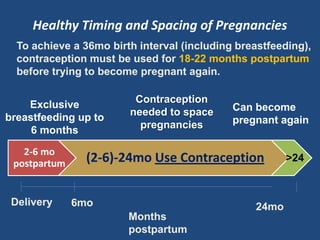
Healthy Timing and Spacing of Pregnancies
  To achieve a 36mo birth interval (including breastfeeding),
  contraception must be used for 18-22 months postpartum
  before trying to become pregnant again.

                         Contraception
    Exclusive                                Can become
                        needed to space
breastfeeding up to                          pregnant again
                          pregnancies
     6 months

   2-6 mo
 postpartum     (2-6)-24mo Use Contraception            >24


 Delivery     6mo                                24mo
                        Months
                        postpartum
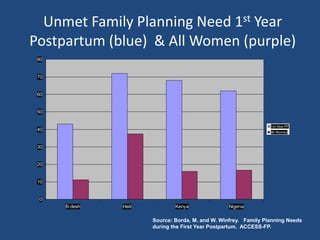
Unmet Family Planning Need 1st Year
Postpartum (blue) & All Women (purple)
 80


 70


 60


 50

                                                                  1st Year PP
 40                                                               All Women


 30


 20


 10


 0
      B-desh   Haiti           Kenya               Nigeria

                       Source: Borda, M. and W. Winfrey. Family Planning Needs
                       during the First Year Postpartum. ACCESS-FP.
Post Partum Family Planning:
              Key Message
• After a live birth, couples should use an
  effective family planning method of their
  choice, continuously for at least 2 years before
  trying to become pregnant again.


                                                 9
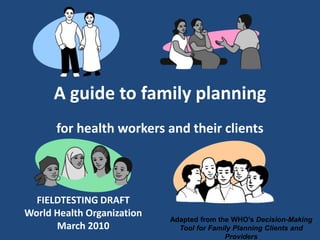
A guide to family planning
      for health workers and their clients


  FIELDTESTING DRAFT
World Health Organization
                            Adapted from the WHO's Decision-Making
      March 2010              Tool for Family Planning Clients and
                                           Providers
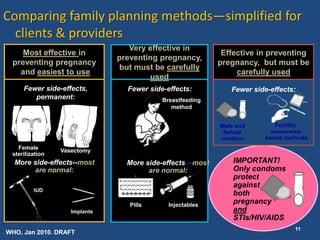
Comparing family planning methods—simplified for
  clients & providers
                                  Very effective in
    Most effective in                                       Effective in preventing
                               preventing pregnancy,
 preventing pregnancy                                      pregnancy, but must be
                               but must be carefully
   and easiest to use                                           carefully used
                                       used
     Fewer side-effects,         Fewer side-effects:          Fewer side-effects:
        permanent:                         Breastfeeding
                                              method


                                                           Male and       Fertility
                                                            female       awareness-
                                                           condom      based methods
   Female        Vasectomy
 sterilization
  More side-effects--most        More side-effects—most        IMPORTANT!
       are normal:                     are normal:             Only condoms
                                                               protect
                                                               against
         IUD
                                                               both
                                  Pills      Injectables
                                                               pregnancy
                    Implants                                   and
                                                               STIs/HIV/AIDS
                                                                                11
WHO, Jan 2010. DRAFT
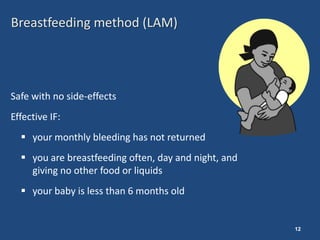
Breastfeeding method (LAM)


Safe with no side-effects
Effective IF:
   your monthly bleeding has not returned
   you are breastfeeding often, day and night, and
    giving no other food or liquids
   your baby is less than 6 months old


                                                      12
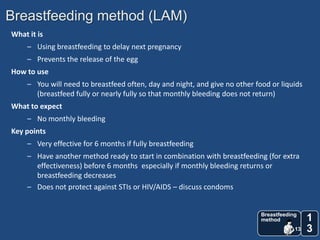
Breastfeeding method (LAM)
What it is
     – Using breastfeeding to delay next pregnancy
     – Prevents the release of the egg
How to use
     – You will need to breastfeed often, day and night, and give no other food or liquids
       (breastfeed fully or nearly fully so that monthly bleeding does not return)
What to expect
     – No monthly bleeding
Key points
     – Very effective for 6 months if fully breastfeeding
     – Have another method ready to start in combination with breastfeeding (for extra
       effectiveness) before 6 months, especially if monthly bleeding returns or
       breastfeeding decreases
     – Does not protect against STIs or HIV/AIDS – discuss condoms


                                                                             Breastfeeding
                                                                             method           1
                                                                                         13   3
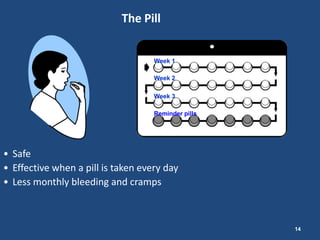
The Pill


                                    Week 1

                                    Week 2

                                    Week 3

                                    Reminder pills


• Safe
• Effective when a pill is taken every day
• Less monthly bleeding and cramps


                                                     14
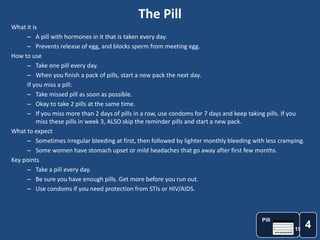
The Pill
What it is
     – A pill with hormones in it that is taken every day.
     – Prevents release of egg, and blocks sperm from meeting egg.
How to use
     – Take one pill every day.
     – When you finish a pack of pills, start a new pack the next day.
     If you miss a pill:
     – Take missed pill as soon as possible.
     – Okay to take 2 pills at the same time.
     – If you miss more than 2 days of pills in a row, use condoms for 7 days and keep taking pills. If you
          miss these pills in week 3, ALSO skip the reminder pills and start a new pack.
What to expect
     – Sometimes irregular bleeding at first, then followed by lighter monthly bleeding with less cramping.
     – Some women have stomach upset or mild headaches that go away after first few months.
Key points
     – Take a pill every day.
     – Be sure you have enough pills. Get more before you run out.
     – Use condoms if you need protection from STIs or HIV/AIDS.


                                                                                           Pill
                                                                                                       15
                                                                                                              4
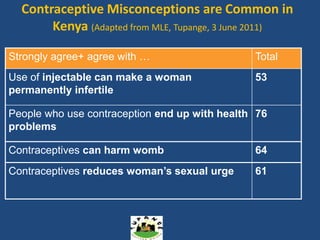
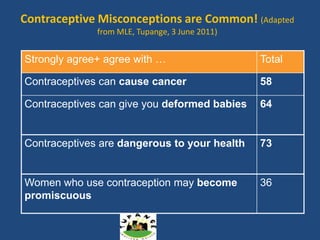
Contraceptive Misconceptions are Common in
       Kenya (Adapted from MLE, Tupange, 3 June 2011)

Strongly agree+ agree with …                   Total
Use of injectable can make a woman             53
permanently infertile

People who use contraception end up with health 76
problems

Contraceptives can harm womb                   64
Contraceptives reduces woman’s sexual urge     61
Contraceptive Misconceptions are Common! (Adapted
              from MLE, Tupange, 3 June 2011)


Strongly agree+ agree with …                    Total

Contraceptives can cause cancer                 58

Contraceptives can give you deformed babies     64


Contraceptives are dangerous to your health     73


Women who use contraception may become          36
promiscuous
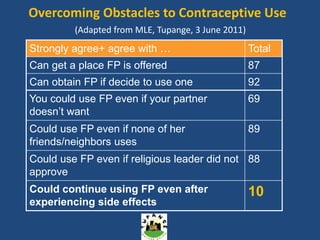
Overcoming Obstacles to Contraceptive Use
         (Adapted from MLE, Tupange, 3 June 2011)
Strongly agree+ agree with …                        Total
Can get a place FP is offered                       87
Can obtain FP if decide to use one                  92
You could use FP even if your partner               69
doesn’t want
Could use FP even if none of her                    89
friends/neighbors uses
Could use FP even if religious leader did not 88
approve
Could continue using FP even after                  10
experiencing side effects
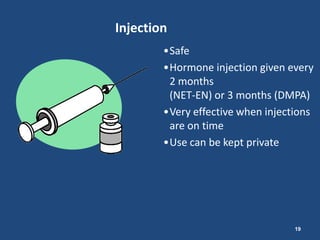
Injection
        •Safe
        •Hormone injection given every
         2 months
         (NET-EN) or 3 months (DMPA)
        •Very effective when injections
         are on time
        •Use can be kept private


                                   19
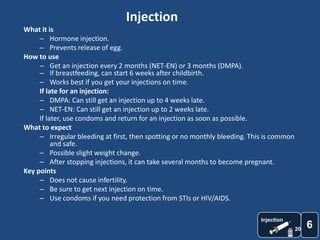
Injection
What it is
     – Hormone injection.
     – Prevents release of egg.
How to use
     – Get an injection every 2 months (NET-EN) or 3 months (DMPA).
     – If breastfeeding, can start 6 weeks after childbirth.
     – Works best if you get your injections on time.
     If late for an injection:
     – DMPA: Can still get an injection up to 4 weeks late.
     – NET-EN: Can still get an injection up to 2 weeks late.
     If later, use condoms and return for an injection as soon as possible.
What to expect
     – Irregular bleeding at first, then spotting or no monthly bleeding. This is common
          and safe.
     – Possible slight weight change.
     – After stopping injections, it can take several months to become pregnant.
Key points
     – Does not cause infertility.
     – Be sure to get next injection on time.
     – Use condoms if you need protection from STIs or HIV/AIDS.

                                                                             Injection
                                                                                           20
                                                                                                6
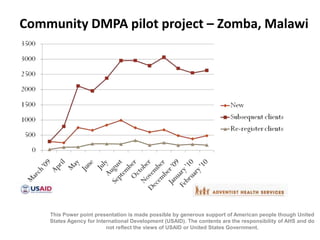
Community DMPA pilot project – Zomba, Malawi


    This Power point presentation is made possible by generous support of American people though United
    States Agency for International Development (USAID). The contents are the responsibility of AHS and do
                          not reflect the views of USAID or United States Government.
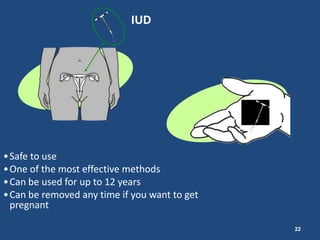
IUD


•Safe to use
•One of the most effective methods
•Can be used for up to 12 years
•Can be removed any time if you want to get
 pregnant

                                              22
IUD
What it is
     – Small, flexible, plastic "T" wrapped in copper wire that is placed in the womb.
     – Prevents sperm from meeting the egg.
How to use
   – Specially trained provider inserts and removes IUD.
     – Can be put in right after you have a baby as well as at other times.
     – Nothing to remember to do after insertion.
What to expect
     – Some cramping and heavier bleeding during monthly bleeding in the first few
       months of use.
Key points
     – Use another method if waiting for appointment.
   – Use condoms if you need protection from STIs or HIV/AIDS.
Where to go: ________________


                                                                              IUD             1
                                                                                         23   0
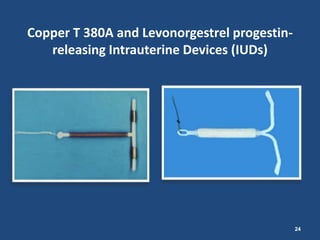
Copper T 380A and Levonorgestrel progestin-
   releasing Intrauterine Devices (IUDs)


                                              24
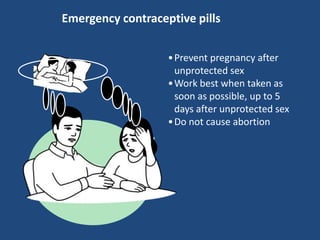
Emergency contraceptive pills


                   •Prevent pregnancy after
                    unprotected sex
                   •Work best when taken as
                    soon as possible, up to 5
                    days after unprotected sex
                   •Do not cause abortion
Emergency contraceptive pills
What it is
    – Pills taken after unprotected sex to prevent pregnancy.
    – Prevents or delays release of egg.
    – Does not cause abortion.
How to use __________________________
    – Can take up to 5 days after unprotected sex.
    – Works best when taken as soon as possible after unprotected sex.
What to expect
    – Sometimes cause nausea, vomiting, vaginal spotting or bleeding for a few
       days.
Key points
    – Does not prevent pregnancy the next time you have sex. do not protect
       against future acts of sexual intercourse.
    – Regular methods are more effective, consider if there is a method you
       would like to use.
    – Seek treatment if you may have been exposed to STIs or HIV/AIDS.
Where to get emergency contraceptive pills: _____________________
                                                                    Emergency
                                                                    Contraception   1
                                                                                    6
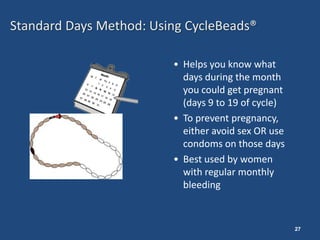
Standard Days Method: Using CycleBeads®

                         • Helps you know what
                           days during the month
                           you could get pregnant
                           (days 9 to 19 of cycle)
                         • To prevent pregnancy,
                           either avoid sex OR use
                           condoms on those days
                         • Best used by women
                           with regular monthly
                           bleeding


                                                     27
Standard Days Method with CycleBeads
What it is
     – A natural (or fertility awareness-based) method that helps women track their cycle to know when
         they are most fertile
     – Prevents sperm from meeting egg by avoiding unprotected sex on fertile days.
How to use
     – Using CycleBeads, move a ring daily to know if on fertile or infertile day
     – Use condoms or not have sex on 12 fertile days marked by white beads
     – Monitor period comes monthly between darker brown bead and last brown bead
     Check cycles are always within 26 to 32-day range required for this method
     – If period starts before placing ring on darker brown bead, it came too soon
     – If period does not start the day after placing ring on last brown bead, it is too late
     – If a short or long cycle more than once in a year, use another method. Contact provider
What to expect
     – No side effects
     – Woman and partner must agree on how to prevent pregnancy on 12 fertile days
Key points
     – Move the ring daily even on days you are having your monthly bleeding
     – If you forget whether you moved the ring, check your calendar for date your period started , count
         how many days have passed and place ring on the bead for today.
     – Agree with partner in advance about using condoms or abstinence on fertile days.
     – Use condoms if you need protection from STIs or HIV/AIDS.
Ideas for Progress
• Postpartum and post-abortion family planning
  becomes the standard of women’s care

• Abundant commodities for all providers—
  especially CHWs—no stock-outs

• CHWs manage vast majority of client concerns in
  the community for common non-harmful
  expected changes—especially for injectables,
  pills, implants and IUDs, based on WHO guide
Ideas for progress
• Overcome misconceptions: give good
  contraceptive method information to all—
  using written and verbal—e.g., WHO FP guide
  for specific method accepted or currently
  using (1/2 or 1/4 page from flip chart--cost-
  effective)

• Give women their method of choice--
  injectables popular in Africa
Best practice: Health providers ensure universal
access to acceptable, effective family planning
REMEMBER:
• The most common harm for women using
  contraception is an unintended pregnancy

• Healthy timing and spacing of pregnancy (HTSP)
  means waiting 2+ years before trying to become
  pregnant again

• Family planning is to women’s health what
  immunizations are to children’s health
                                                   31

CCIH 2012 Conference, Family Planning Pre-Conference, Douglas Huber, Addressing Family Planning from Christian Viewpoints

  • 1.
    Family Planning Strategiesand Tools for Success Douglas Huber MD, MSc, Co-Chair FP/RH Working Group Christian Connections for International Health (www.ccih.org) Pre-Conference Workshop: Addressing Family Planning from Christian Viewpoints Marymount University, Arlington, VA 9 June 2012 1
  • 2.
    Objectives • Identify newfamily planning strategies and tools for to achieve success in Christian Health programs • Enable Christian facilities, providers, communities and congregations to use state- of-the-art FP materials to maximize health impact
  • 3.
    New vision forfamily planning • Family planning is to women’s health what immunizations are to children’s health Dr. Khama Rogo, World Bank, November 2009 • (to 1300 participants at the Uganda family planning conference) 3
  • 4.
    Family Planning andthe Millennium Development Goals Family planning (FP) essential to all the MDGs 1. Poverty and hunger 2. Universal primary education 3. Gender equality 4. Child mortality 5. Maternal health, including increased FP 6. HIV/AIDS & other diseases 7. Environmental sustainability 8. Global partnerships 4
  • 5.
    “The fastest, easiest,cheapest way to prevent maternal deaths is with family planning” • Modern contraceptives (pill, injection, IUD) over 100 times safer than pregnancy in Kenya & Sub-Saharan Africa • Access to FP reduces maternal mortality—global estimates of 30+% reduction in MM if address unmet need for FP 5
  • 6.
  • 7.
    Healthy Timing andSpacing of Pregnancies To achieve a 36mo birth interval (including breastfeeding), contraception must be used for 18-22 months postpartum before trying to become pregnant again. Contraception Exclusive Can become needed to space breastfeeding up to pregnant again pregnancies 6 months 2-6 mo postpartum (2-6)-24mo Use Contraception >24 Delivery 6mo 24mo Months postpartum
  • 8.
    Unmet Family PlanningNeed 1st Year Postpartum (blue) & All Women (purple) 80 70 60 50 1st Year PP 40 All Women 30 20 10 0 B-desh Haiti Kenya Nigeria Source: Borda, M. and W. Winfrey. Family Planning Needs during the First Year Postpartum. ACCESS-FP.
  • 9.
    Post Partum FamilyPlanning: Key Message • After a live birth, couples should use an effective family planning method of their choice, continuously for at least 2 years before trying to become pregnant again. 9
  • 10.
    A guide tofamily planning for health workers and their clients FIELDTESTING DRAFT World Health Organization Adapted from the WHO's Decision-Making March 2010 Tool for Family Planning Clients and Providers
  • 11.
    Comparing family planningmethods—simplified for clients & providers Very effective in Most effective in Effective in preventing preventing pregnancy, preventing pregnancy pregnancy, but must be but must be carefully and easiest to use carefully used used Fewer side-effects, Fewer side-effects: Fewer side-effects: permanent: Breastfeeding method Male and Fertility female awareness- condom based methods Female Vasectomy sterilization More side-effects--most More side-effects—most IMPORTANT! are normal: are normal: Only condoms protect against IUD both Pills Injectables pregnancy Implants and STIs/HIV/AIDS 11 WHO, Jan 2010. DRAFT
  • 12.
    Breastfeeding method (LAM) Safewith no side-effects Effective IF:  your monthly bleeding has not returned  you are breastfeeding often, day and night, and giving no other food or liquids  your baby is less than 6 months old 12
  • 13.
    Breastfeeding method (LAM) Whatit is – Using breastfeeding to delay next pregnancy – Prevents the release of the egg How to use – You will need to breastfeed often, day and night, and give no other food or liquids (breastfeed fully or nearly fully so that monthly bleeding does not return) What to expect – No monthly bleeding Key points – Very effective for 6 months if fully breastfeeding – Have another method ready to start in combination with breastfeeding (for extra effectiveness) before 6 months, especially if monthly bleeding returns or breastfeeding decreases – Does not protect against STIs or HIV/AIDS – discuss condoms Breastfeeding method 1 13 3
  • 14.
    The Pill Week 1 Week 2 Week 3 Reminder pills • Safe • Effective when a pill is taken every day • Less monthly bleeding and cramps 14
  • 15.
    The Pill What itis – A pill with hormones in it that is taken every day. – Prevents release of egg, and blocks sperm from meeting egg. How to use – Take one pill every day. – When you finish a pack of pills, start a new pack the next day. If you miss a pill: – Take missed pill as soon as possible. – Okay to take 2 pills at the same time. – If you miss more than 2 days of pills in a row, use condoms for 7 days and keep taking pills. If you miss these pills in week 3, ALSO skip the reminder pills and start a new pack. What to expect – Sometimes irregular bleeding at first, then followed by lighter monthly bleeding with less cramping. – Some women have stomach upset or mild headaches that go away after first few months. Key points – Take a pill every day. – Be sure you have enough pills. Get more before you run out. – Use condoms if you need protection from STIs or HIV/AIDS. Pill 15 4
  • 16.
    Contraceptive Misconceptions areCommon in Kenya (Adapted from MLE, Tupange, 3 June 2011) Strongly agree+ agree with … Total Use of injectable can make a woman 53 permanently infertile People who use contraception end up with health 76 problems Contraceptives can harm womb 64 Contraceptives reduces woman’s sexual urge 61
  • 17.
    Contraceptive Misconceptions areCommon! (Adapted from MLE, Tupange, 3 June 2011) Strongly agree+ agree with … Total Contraceptives can cause cancer 58 Contraceptives can give you deformed babies 64 Contraceptives are dangerous to your health 73 Women who use contraception may become 36 promiscuous
  • 18.
    Overcoming Obstacles toContraceptive Use (Adapted from MLE, Tupange, 3 June 2011) Strongly agree+ agree with … Total Can get a place FP is offered 87 Can obtain FP if decide to use one 92 You could use FP even if your partner 69 doesn’t want Could use FP even if none of her 89 friends/neighbors uses Could use FP even if religious leader did not 88 approve Could continue using FP even after 10 experiencing side effects
  • 19.
    Injection •Safe •Hormone injection given every 2 months (NET-EN) or 3 months (DMPA) •Very effective when injections are on time •Use can be kept private 19
  • 20.
    Injection What it is – Hormone injection. – Prevents release of egg. How to use – Get an injection every 2 months (NET-EN) or 3 months (DMPA). – If breastfeeding, can start 6 weeks after childbirth. – Works best if you get your injections on time. If late for an injection: – DMPA: Can still get an injection up to 4 weeks late. – NET-EN: Can still get an injection up to 2 weeks late. If later, use condoms and return for an injection as soon as possible. What to expect – Irregular bleeding at first, then spotting or no monthly bleeding. This is common and safe. – Possible slight weight change. – After stopping injections, it can take several months to become pregnant. Key points – Does not cause infertility. – Be sure to get next injection on time. – Use condoms if you need protection from STIs or HIV/AIDS. Injection 20 6
  • 21.
    Community DMPA pilotproject – Zomba, Malawi This Power point presentation is made possible by generous support of American people though United States Agency for International Development (USAID). The contents are the responsibility of AHS and do not reflect the views of USAID or United States Government.
  • 22.
    IUD •Safe to use •Oneof the most effective methods •Can be used for up to 12 years •Can be removed any time if you want to get pregnant 22
  • 23.
    IUD What it is – Small, flexible, plastic "T" wrapped in copper wire that is placed in the womb. – Prevents sperm from meeting the egg. How to use – Specially trained provider inserts and removes IUD. – Can be put in right after you have a baby as well as at other times. – Nothing to remember to do after insertion. What to expect – Some cramping and heavier bleeding during monthly bleeding in the first few months of use. Key points – Use another method if waiting for appointment. – Use condoms if you need protection from STIs or HIV/AIDS. Where to go: ________________ IUD 1 23 0
  • 24.
    Copper T 380Aand Levonorgestrel progestin- releasing Intrauterine Devices (IUDs) 24
  • 25.
    Emergency contraceptive pills •Prevent pregnancy after unprotected sex •Work best when taken as soon as possible, up to 5 days after unprotected sex •Do not cause abortion
  • 26.
    Emergency contraceptive pills Whatit is – Pills taken after unprotected sex to prevent pregnancy. – Prevents or delays release of egg. – Does not cause abortion. How to use __________________________ – Can take up to 5 days after unprotected sex. – Works best when taken as soon as possible after unprotected sex. What to expect – Sometimes cause nausea, vomiting, vaginal spotting or bleeding for a few days. Key points – Does not prevent pregnancy the next time you have sex. do not protect against future acts of sexual intercourse. – Regular methods are more effective, consider if there is a method you would like to use. – Seek treatment if you may have been exposed to STIs or HIV/AIDS. Where to get emergency contraceptive pills: _____________________ Emergency Contraception 1 6
  • 27.
    Standard Days Method:Using CycleBeads® • Helps you know what days during the month you could get pregnant (days 9 to 19 of cycle) • To prevent pregnancy, either avoid sex OR use condoms on those days • Best used by women with regular monthly bleeding 27
  • 28.
    Standard Days Methodwith CycleBeads What it is – A natural (or fertility awareness-based) method that helps women track their cycle to know when they are most fertile – Prevents sperm from meeting egg by avoiding unprotected sex on fertile days. How to use – Using CycleBeads, move a ring daily to know if on fertile or infertile day – Use condoms or not have sex on 12 fertile days marked by white beads – Monitor period comes monthly between darker brown bead and last brown bead Check cycles are always within 26 to 32-day range required for this method – If period starts before placing ring on darker brown bead, it came too soon – If period does not start the day after placing ring on last brown bead, it is too late – If a short or long cycle more than once in a year, use another method. Contact provider What to expect – No side effects – Woman and partner must agree on how to prevent pregnancy on 12 fertile days Key points – Move the ring daily even on days you are having your monthly bleeding – If you forget whether you moved the ring, check your calendar for date your period started , count how many days have passed and place ring on the bead for today. – Agree with partner in advance about using condoms or abstinence on fertile days. – Use condoms if you need protection from STIs or HIV/AIDS.
  • 29.
    Ideas for Progress •Postpartum and post-abortion family planning becomes the standard of women’s care • Abundant commodities for all providers— especially CHWs—no stock-outs • CHWs manage vast majority of client concerns in the community for common non-harmful expected changes—especially for injectables, pills, implants and IUDs, based on WHO guide
  • 30.
    Ideas for progress •Overcome misconceptions: give good contraceptive method information to all— using written and verbal—e.g., WHO FP guide for specific method accepted or currently using (1/2 or 1/4 page from flip chart--cost- effective) • Give women their method of choice-- injectables popular in Africa
  • 31.
    Best practice: Healthproviders ensure universal access to acceptable, effective family planning REMEMBER: • The most common harm for women using contraception is an unintended pregnancy • Healthy timing and spacing of pregnancy (HTSP) means waiting 2+ years before trying to become pregnant again • Family planning is to women’s health what immunizations are to children’s health 31