ENBE | Final Project | Part A – Report | The Future City Representation
Better Cities of the Future
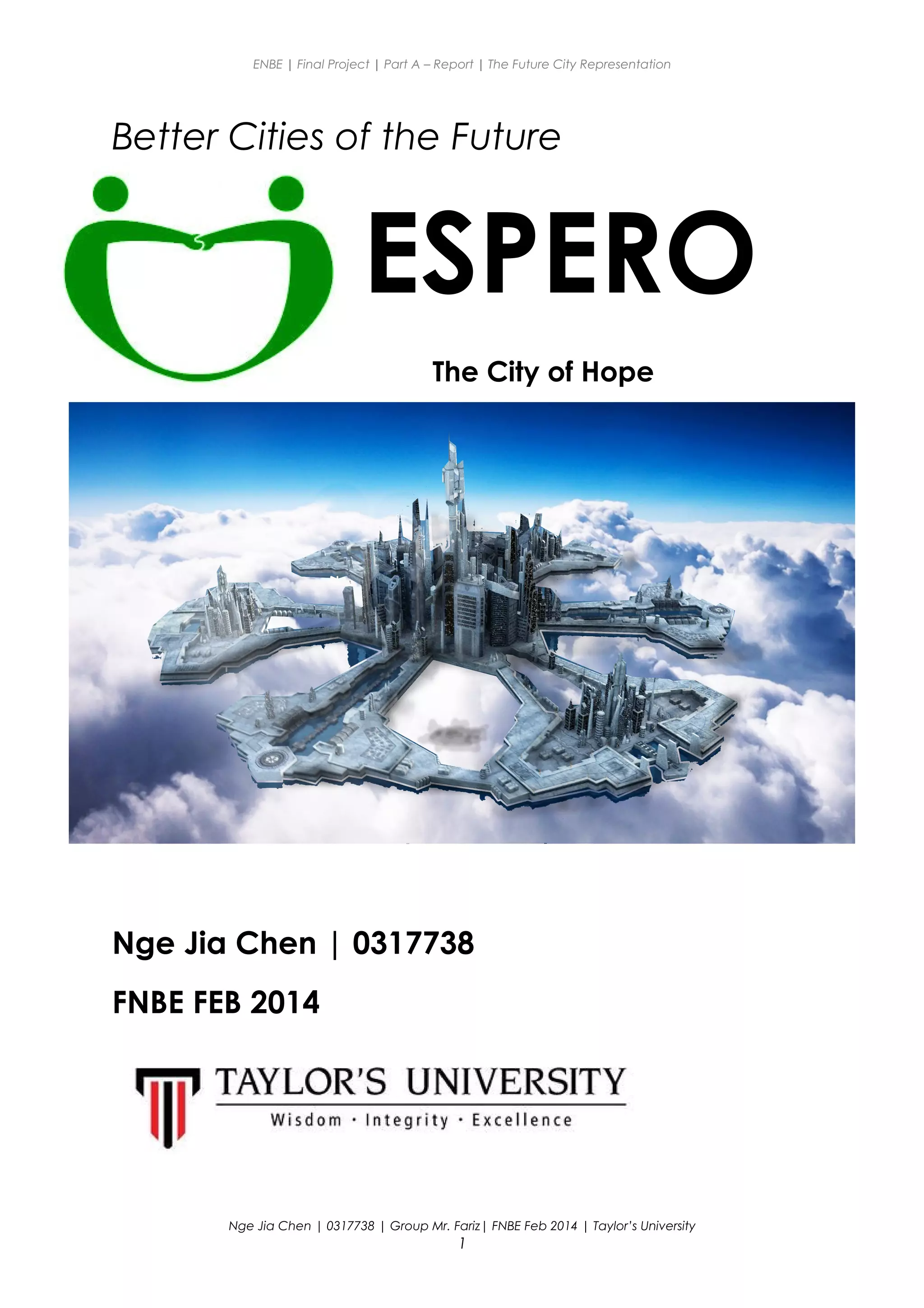
ESPERO
The City of Hope
Nge Jia Chen | 0317738
FNBE FEB 2014
Nge Jia Chen | 0317738 | Group Mr. Fariz| FNBE Feb 2014 | Taylor’s University
1
ENBE | Final Project | Part A – Report | The Future City Representation
Content:
1. Introduction (describe the project brief, the things that you have to do etc)
2. A City (describe the definition, your findings and information on what is a
city-characteristic etc) Investigation on Better City Guidelines and Issues
(Information that may help you with your city proposal)
3. Investigation & Data Collection: Ancient and old cities (describe the city..
give a conclusion. 1-2 cities preferably almost similar to your selected future
city )
4. Investigation & Data Collection: The present city/cities (describe the city..
give a conclusion. 1-2 cities preferably almost similar to your selected future
city )
5. Investigation & Data Collection: The future city/cities (maybe find information
through movies and competition. Describe the city.. give a conclusion. 1-2
cities preferably almost similar to your selected future city )
6. Case study on the selected type of the future city (describe and describe
the characteristic)
7. The New “X” City / Or the new name (describe the new facilities, characters
etc of the new city)
Nge Jia Chen | 0317738 | Group Mr. Fariz| FNBE Feb 2014 | Taylor’s University
2
ENBE | Final Project | Part A – Report | The Future City Representation
8. The Conclusion (describe what was important and others should follow or
perhaps should know and what did you learned)
9. References list
1.Introduction
In this project, I am required to pretend that I am the mayor of the “X”
city and to propose a better future city for the people because the city is no
longer livable. In order to create a better city, I will have to find out what a
city is, its development and history, components, elements and what makes a
better city.
This project is aimed to expose us on how to design a sustainable and
livable city for the people. People ignore design that ignores people. Hence,
we have to design a place that suits the people needs. In order to do so, I
have to do researches on city planning.
After doing the comprehensive researches on what makes a better
city, I am required to produce a report to demonstrate my understandings
and the collection of data on what a city is.
Nge Jia Chen | 0317738 | Group Mr. Fariz| FNBE Feb 2014 | Taylor’s University
3
ENBE | Final Project | Part A – Report | The Future City Representation
2.The City
2.1 The city definition
A city is a relatively permanent and highly organized center of
population, of greater size or importance than a town or village. Think of the
complexity of road systems, transportation, building laws, markets, food
distribution, educational systems, etc., and you get an idea of what is meant
by that statement. But that complexity didn't spring up overnight. It is the
result of long years of human development.
Nge Jia Chen | 0317738 | Group Mr. Fariz| FNBE Feb 2014 | Taylor’s University
4
ENBE | Final Project | Part A – Report | The Future City Representation
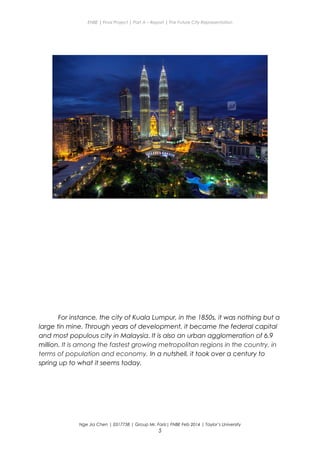
For instance, the city of Kuala Lumpur, in the 1850s, it was nothing but a
large tin mine. Through years of development, it became the federal capital
and most populous city in Malaysia. It is also an urban agglomeration of 6.9
million. It is among the fastest growing metropolitan regions in the country, in
terms of population and economy. In a nutshell, it took over a century to
spring up to what it seems today.
Nge Jia Chen | 0317738 | Group Mr. Fariz| FNBE Feb 2014 | Taylor’s University
5
ENBE | Final Project | Part A – Report | The Future City Representation
2.2 Brief history of city
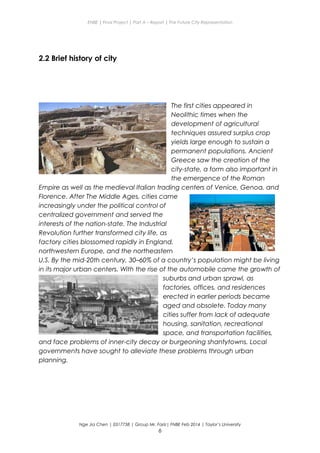
The first cities appeared in
Neolithic times when the
development of agricultural
techniques assured surplus crop
yields large enough to sustain a
permanent populations. Ancient
Greece saw the creation of the
city-state, a form also important in
the emergence of the Roman
Empire as well as the medieval Italian trading centers of Venice, Genoa, and
Florence. After The Middle Ages, cities came
increasingly under the political control of
centralized government and served the
interests of the nation-state. The Industrial
Revolution further transformed city life, as
factory cities blossomed rapidly in England,
northwestern Europe, and the northeastern
U.S. By the mid-20th century, 30–60% of a country’s population might be living
in its major urban centers. With the rise of the automobile came the growth of
suburbs and urban sprawl, as
factories, offices, and residences
erected in earlier periods became
aged and obsolete. Today many
cities suffer from lack of adequate
housing, sanitation, recreational
space, and transportation facilities,
and face problems of inner-city decay or burgeoning shantytowns. Local
governments have sought to alleviate these problems through urban
planning.
Nge Jia Chen | 0317738 | Group Mr. Fariz| FNBE Feb 2014 | Taylor’s University
6
ENBE | Final Project | Part A – Report | The Future City Representation
2.3 What makes a city?
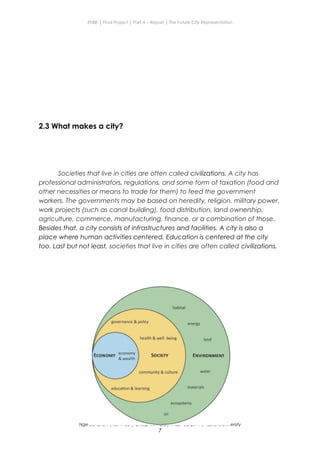
Societies that live in cities are often called civilizations. A city has
professional administrators, regulations, and some form of taxation (food and
other necessities or means to trade for them) to feed the government
workers. The governments may be based on heredity, religion, military power,
work projects (such as canal building), food distribution, land ownership,
agriculture, commerce, manufacturing, finance, or a combination of those.
Besides that, a city consists of infrastructures and facilities. A city is also a
place where human activities centered. Education is centered at the city
too. Last but not least, societies that live in cities are often called civilizations.
Nge Jia Chen | 0317738 | Group Mr. Fariz| FNBE Feb 2014 | Taylor’s University
7
ENBE | Final Project | Part A – Report | The Future City Representation
2.4 What makes a good city?
Now we know what a city is, but what is a good city? A good city uses
technology and communication to create more efficient agglomerations in
terms of competitiveness, innovation, environment, energy, utilities,
governance, and delivery of services to the citizen.
The city achieves smart growth. Smart growth identifies and nurtures the very
best opportunities for growth, plans ways to cope with its demands,
integrates environmental thinking, and ensures that all citizens enjoy a city’s
Nge Jia Chen | 0317738 | Group Mr. Fariz| FNBE Feb 2014 | Taylor’s University
8
ENBE | Final Project | Part A – Report | The Future City Representation
prosperity. Good city leaders also think about regional growth because as a
metropolis expands, they will need the cooperation of surrounding
municipalities and regional service providers. Integrating the environment
into economic decision making is vital to smart growth: cities must invest in
infrastructure that reduces emissions, waste production, and water use, as
well as in building high-density communities.
They do more with less. Great cities secure all revenues due, explore
investment partnerships, embrace technology, make organizational changes
that eliminate overlapping roles, and manage expenses. Successful city
leaders have also learned that, if designed and executed well, private–public
partnerships can be an essential element of smart growth, delivering lower-
cost, higher-quality infrastructure and services.
They win support for change. Change is not easy, and its momentum can
even attract opposition. Successful city leaders build a high-performing team
of civil servants, create a working environment where all employees are
accountable for their actions, and take every opportunity to forge a
stakeholder consensus with the local population and business community.
They take steps to recruit and retain top talent, emphasize collaboration, and
train civil servants in the use of technology.
Nge Jia Chen | 0317738 | Group Mr. Fariz| FNBE Feb 2014 | Taylor’s University
9
ENBE | Final Project | Part A – Report | The Future City Representation
3.Investigation & Data Collection:
Ancient Cities
(Describe and layout your findings and the conclusion 1-2 cities preferably almost
similar to your selected future city )
Nge Jia Chen | 0317738 | Group Mr. Fariz| FNBE Feb 2014 | Taylor’s University
10
ENBE | Final Project | Part A – Report | The Future City Representation
3.1 When did it start? History and all
3.2 What ancient city are you concentrating on?
3.3 What makes is a significant city and what are the details?
3.4 Conclusion about the cities
3.5 What information or element that you can use to your new future city
3.6 Etc
Nge Jia Chen | 0317738 | Group Mr. Fariz| FNBE Feb 2014 | Taylor’s University
11
ENBE | Final Project | Part A – Report | The Future City Representation
4.Investigation & Data Collection:
Present Cities
(Describe and layout your findings and the conclusion 1-2 cities preferably almost
similar to your selected future city)
4.1 When did it start? History and all
4.2 What city are you concentrating on?
4.3 What makes is a significant city and what are the details?
4.4 Conclusion about the cities
4.5 What information or element that you can use to your new future city
4.6 Etc
Nge Jia Chen | 0317738 | Group Mr. Fariz| FNBE Feb 2014 | Taylor’s University
12
ENBE | Final Project | Part A – Report | The Future City Representation
5.Investigation & Data Collection:
Nge Jia Chen | 0317738 | Group Mr. Fariz| FNBE Feb 2014 | Taylor’s University
13
ENBE | Final Project | Part A – Report | The Future City Representation
Future Cities
(Describe and layout your findings and the conclusion 1-2 cities preferably almost
similar to your selected future city)
5.1 When did it start? History and all
5.2 What city are you concentrating on?
5.3 What makes is a significant city and what are the details?
5.4 Conclusion about the cities
5.5 What information or element that you can use to your new future city
5.6 Etc
Nge Jia Chen | 0317738 | Group Mr. Fariz| FNBE Feb 2014 | Taylor’s University
14
ENBE | Final Project | Part A – Report | The Future City Representation
6. Case study on the selected type of
the future city
(describe and explain about your case study)
6.1 Where did you get your information?
6.2 What is the interesting part and important consideration
Etc
Nge Jia Chen | 0317738 | Group Mr. Fariz| FNBE Feb 2014 | Taylor’s University
15
ENBE | Final Project | Part A – Report | The Future City Representation
Nge Jia Chen | 0317738 | Group Mr. Fariz| FNBE Feb 2014 | Taylor’s University
16
ENBE | Final Project | Part A – Report | The Future City Representation
7.The New “X” City / The New NAME?
(describe the new facilities, characters etc of the new city…. Insert information
related to the brief )
7.1 How did you came up with the solution to create this new city
7.2 Why is it on air etc
7.3 What is the important characteristic and elements
7.4 Etc…
7.5 Conclusion about the new X city
7.6 Etc
Nge Jia Chen | 0317738 | Group Mr. Fariz| FNBE Feb 2014 | Taylor’s University
17
ENBE | Final Project | Part A – Report | The Future City Representation
8.Conclusion
(describe what was important and others should follow or perhaps should know and
what did you learned)
Max 3 paragraph.. not more that 150 words
Nge Jia Chen | 0317738 | Group Mr. Fariz| FNBE Feb 2014 | Taylor’s University
18
ENBE | Final Project | Part A – Report | The Future City Representation
Nge Jia Chen | 0317738 | Group Mr. Fariz| FNBE Feb 2014 | Taylor’s University
19
ENBE | Final Project | Part A – Report | The Future City Representation
9.Reference Links
Nge Jia Chen | 0317738 | Group Mr. Fariz| FNBE Feb 2014 | Taylor’s University
20
ENBE | Final Project | Part A – Report | The Future City Representation
Nge Jia Chen | 0317738 | Group Mr. Fariz| FNBE Feb 2014 | Taylor’s University
21

Fp part a - report template

  • 1.
    ENBE | FinalProject | Part A – Report | The Future City Representation Better Cities of the Future ESPERO The City of Hope Nge Jia Chen | 0317738 FNBE FEB 2014 Nge Jia Chen | 0317738 | Group Mr. Fariz| FNBE Feb 2014 | Taylor’s University 1
  • 2.
    ENBE | FinalProject | Part A – Report | The Future City Representation Content: 1. Introduction (describe the project brief, the things that you have to do etc) 2. A City (describe the definition, your findings and information on what is a city-characteristic etc) Investigation on Better City Guidelines and Issues (Information that may help you with your city proposal) 3. Investigation & Data Collection: Ancient and old cities (describe the city.. give a conclusion. 1-2 cities preferably almost similar to your selected future city ) 4. Investigation & Data Collection: The present city/cities (describe the city.. give a conclusion. 1-2 cities preferably almost similar to your selected future city ) 5. Investigation & Data Collection: The future city/cities (maybe find information through movies and competition. Describe the city.. give a conclusion. 1-2 cities preferably almost similar to your selected future city ) 6. Case study on the selected type of the future city (describe and describe the characteristic) 7. The New “X” City / Or the new name (describe the new facilities, characters etc of the new city) Nge Jia Chen | 0317738 | Group Mr. Fariz| FNBE Feb 2014 | Taylor’s University 2
  • 3.
    ENBE | FinalProject | Part A – Report | The Future City Representation 8. The Conclusion (describe what was important and others should follow or perhaps should know and what did you learned) 9. References list 1.Introduction In this project, I am required to pretend that I am the mayor of the “X” city and to propose a better future city for the people because the city is no longer livable. In order to create a better city, I will have to find out what a city is, its development and history, components, elements and what makes a better city. This project is aimed to expose us on how to design a sustainable and livable city for the people. People ignore design that ignores people. Hence, we have to design a place that suits the people needs. In order to do so, I have to do researches on city planning. After doing the comprehensive researches on what makes a better city, I am required to produce a report to demonstrate my understandings and the collection of data on what a city is. Nge Jia Chen | 0317738 | Group Mr. Fariz| FNBE Feb 2014 | Taylor’s University 3
  • 4.
    ENBE | FinalProject | Part A – Report | The Future City Representation 2.The City 2.1 The city definition A city is a relatively permanent and highly organized center of population, of greater size or importance than a town or village. Think of the complexity of road systems, transportation, building laws, markets, food distribution, educational systems, etc., and you get an idea of what is meant by that statement. But that complexity didn't spring up overnight. It is the result of long years of human development. Nge Jia Chen | 0317738 | Group Mr. Fariz| FNBE Feb 2014 | Taylor’s University 4
  • 5.
    ENBE | FinalProject | Part A – Report | The Future City Representation For instance, the city of Kuala Lumpur, in the 1850s, it was nothing but a large tin mine. Through years of development, it became the federal capital and most populous city in Malaysia. It is also an urban agglomeration of 6.9 million. It is among the fastest growing metropolitan regions in the country, in terms of population and economy. In a nutshell, it took over a century to spring up to what it seems today. Nge Jia Chen | 0317738 | Group Mr. Fariz| FNBE Feb 2014 | Taylor’s University 5
  • 6.
    ENBE | FinalProject | Part A – Report | The Future City Representation 2.2 Brief history of city The first cities appeared in Neolithic times when the development of agricultural techniques assured surplus crop yields large enough to sustain a permanent populations. Ancient Greece saw the creation of the city-state, a form also important in the emergence of the Roman Empire as well as the medieval Italian trading centers of Venice, Genoa, and Florence. After The Middle Ages, cities came increasingly under the political control of centralized government and served the interests of the nation-state. The Industrial Revolution further transformed city life, as factory cities blossomed rapidly in England, northwestern Europe, and the northeastern U.S. By the mid-20th century, 30–60% of a country’s population might be living in its major urban centers. With the rise of the automobile came the growth of suburbs and urban sprawl, as factories, offices, and residences erected in earlier periods became aged and obsolete. Today many cities suffer from lack of adequate housing, sanitation, recreational space, and transportation facilities, and face problems of inner-city decay or burgeoning shantytowns. Local governments have sought to alleviate these problems through urban planning. Nge Jia Chen | 0317738 | Group Mr. Fariz| FNBE Feb 2014 | Taylor’s University 6
  • 7.
    ENBE | FinalProject | Part A – Report | The Future City Representation 2.3 What makes a city? Societies that live in cities are often called civilizations. A city has professional administrators, regulations, and some form of taxation (food and other necessities or means to trade for them) to feed the government workers. The governments may be based on heredity, religion, military power, work projects (such as canal building), food distribution, land ownership, agriculture, commerce, manufacturing, finance, or a combination of those. Besides that, a city consists of infrastructures and facilities. A city is also a place where human activities centered. Education is centered at the city too. Last but not least, societies that live in cities are often called civilizations. Nge Jia Chen | 0317738 | Group Mr. Fariz| FNBE Feb 2014 | Taylor’s University 7
  • 8.
    ENBE | FinalProject | Part A – Report | The Future City Representation 2.4 What makes a good city? Now we know what a city is, but what is a good city? A good city uses technology and communication to create more efficient agglomerations in terms of competitiveness, innovation, environment, energy, utilities, governance, and delivery of services to the citizen. The city achieves smart growth. Smart growth identifies and nurtures the very best opportunities for growth, plans ways to cope with its demands, integrates environmental thinking, and ensures that all citizens enjoy a city’s Nge Jia Chen | 0317738 | Group Mr. Fariz| FNBE Feb 2014 | Taylor’s University 8
  • 9.
    ENBE | FinalProject | Part A – Report | The Future City Representation prosperity. Good city leaders also think about regional growth because as a metropolis expands, they will need the cooperation of surrounding municipalities and regional service providers. Integrating the environment into economic decision making is vital to smart growth: cities must invest in infrastructure that reduces emissions, waste production, and water use, as well as in building high-density communities. They do more with less. Great cities secure all revenues due, explore investment partnerships, embrace technology, make organizational changes that eliminate overlapping roles, and manage expenses. Successful city leaders have also learned that, if designed and executed well, private–public partnerships can be an essential element of smart growth, delivering lower- cost, higher-quality infrastructure and services. They win support for change. Change is not easy, and its momentum can even attract opposition. Successful city leaders build a high-performing team of civil servants, create a working environment where all employees are accountable for their actions, and take every opportunity to forge a stakeholder consensus with the local population and business community. They take steps to recruit and retain top talent, emphasize collaboration, and train civil servants in the use of technology. Nge Jia Chen | 0317738 | Group Mr. Fariz| FNBE Feb 2014 | Taylor’s University 9
  • 10.
    ENBE | FinalProject | Part A – Report | The Future City Representation 3.Investigation & Data Collection: Ancient Cities (Describe and layout your findings and the conclusion 1-2 cities preferably almost similar to your selected future city ) Nge Jia Chen | 0317738 | Group Mr. Fariz| FNBE Feb 2014 | Taylor’s University 10
  • 11.
    ENBE | FinalProject | Part A – Report | The Future City Representation 3.1 When did it start? History and all 3.2 What ancient city are you concentrating on? 3.3 What makes is a significant city and what are the details? 3.4 Conclusion about the cities 3.5 What information or element that you can use to your new future city 3.6 Etc Nge Jia Chen | 0317738 | Group Mr. Fariz| FNBE Feb 2014 | Taylor’s University 11
  • 12.
    ENBE | FinalProject | Part A – Report | The Future City Representation 4.Investigation & Data Collection: Present Cities (Describe and layout your findings and the conclusion 1-2 cities preferably almost similar to your selected future city) 4.1 When did it start? History and all 4.2 What city are you concentrating on? 4.3 What makes is a significant city and what are the details? 4.4 Conclusion about the cities 4.5 What information or element that you can use to your new future city 4.6 Etc Nge Jia Chen | 0317738 | Group Mr. Fariz| FNBE Feb 2014 | Taylor’s University 12
  • 13.
    ENBE | FinalProject | Part A – Report | The Future City Representation 5.Investigation & Data Collection: Nge Jia Chen | 0317738 | Group Mr. Fariz| FNBE Feb 2014 | Taylor’s University 13
  • 14.
    ENBE | FinalProject | Part A – Report | The Future City Representation Future Cities (Describe and layout your findings and the conclusion 1-2 cities preferably almost similar to your selected future city) 5.1 When did it start? History and all 5.2 What city are you concentrating on? 5.3 What makes is a significant city and what are the details? 5.4 Conclusion about the cities 5.5 What information or element that you can use to your new future city 5.6 Etc Nge Jia Chen | 0317738 | Group Mr. Fariz| FNBE Feb 2014 | Taylor’s University 14
  • 15.
    ENBE | FinalProject | Part A – Report | The Future City Representation 6. Case study on the selected type of the future city (describe and explain about your case study) 6.1 Where did you get your information? 6.2 What is the interesting part and important consideration Etc Nge Jia Chen | 0317738 | Group Mr. Fariz| FNBE Feb 2014 | Taylor’s University 15
  • 16.
    ENBE | FinalProject | Part A – Report | The Future City Representation Nge Jia Chen | 0317738 | Group Mr. Fariz| FNBE Feb 2014 | Taylor’s University 16
  • 17.
    ENBE | FinalProject | Part A – Report | The Future City Representation 7.The New “X” City / The New NAME? (describe the new facilities, characters etc of the new city…. Insert information related to the brief ) 7.1 How did you came up with the solution to create this new city 7.2 Why is it on air etc 7.3 What is the important characteristic and elements 7.4 Etc… 7.5 Conclusion about the new X city 7.6 Etc Nge Jia Chen | 0317738 | Group Mr. Fariz| FNBE Feb 2014 | Taylor’s University 17
  • 18.
    ENBE | FinalProject | Part A – Report | The Future City Representation 8.Conclusion (describe what was important and others should follow or perhaps should know and what did you learned) Max 3 paragraph.. not more that 150 words Nge Jia Chen | 0317738 | Group Mr. Fariz| FNBE Feb 2014 | Taylor’s University 18
  • 19.
    ENBE | FinalProject | Part A – Report | The Future City Representation Nge Jia Chen | 0317738 | Group Mr. Fariz| FNBE Feb 2014 | Taylor’s University 19
  • 20.
    ENBE | FinalProject | Part A – Report | The Future City Representation 9.Reference Links Nge Jia Chen | 0317738 | Group Mr. Fariz| FNBE Feb 2014 | Taylor’s University 20
  • 21.
    ENBE | FinalProject | Part A – Report | The Future City Representation Nge Jia Chen | 0317738 | Group Mr. Fariz| FNBE Feb 2014 | Taylor’s University 21