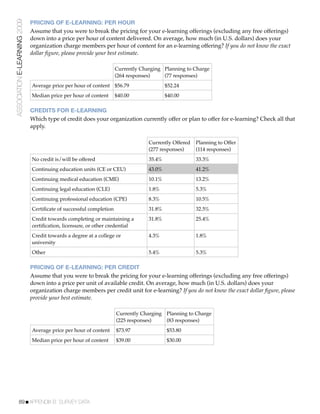
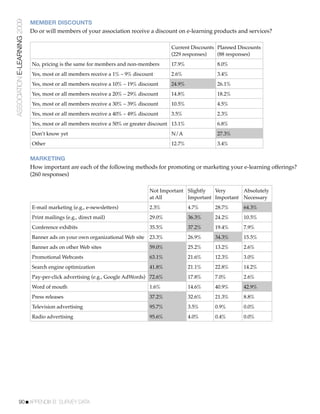
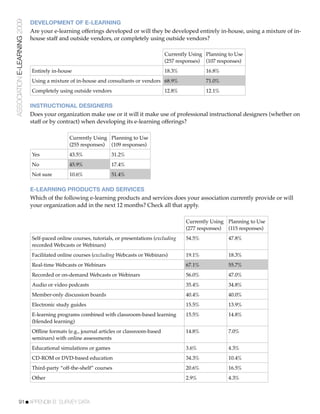
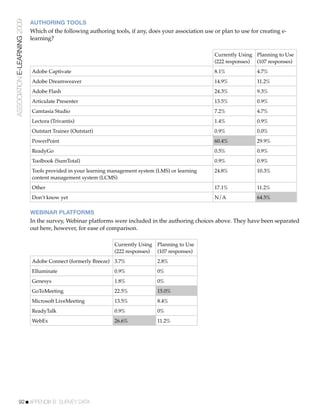
ASSOCIATION E-LEARNING
March 2009


                The State of the Sector
                written by Jeff Cobb and Celisa Steele


                                                         published by Tagoras
                                                           www.tagoras.com
                                                            info@tagoras.com
                                                                 800.867.2046
ASSOCIATION E-LEARNING 2009
                              Copyright and Disclaimer
                              The Fine Print
                              © 2009 Tagoras, Inc. All rights reserved, including the right of reproduction in whole or in part in any
                              form.

                                                                                      *****

                              Purchase of Association E-learning 2009: State of the Sector entitles the purchaser to use of a single copy of
                              this document. If the purchaser is an organization, Tagoras authorizes the reproduction of no more than
                              five copies of this document, including electronically transmitting such copies, for use solely by
                              employees of the purchaser.

                              Quoting from this report on a limited basis for the purposes of creating articles, blog posts, and other
                              publications is considered within the realm of “fair use.”

                              Other than as provided for above, no portion of the material copyrighted herein may be reprinted or
                              published in any form without the prior written consent of Tagoras, Inc. To purchase additional copies of
                              this document, please visit http://www.tagoras.com/catalog/association-e-learning-2009.html.

                                                                                      *****

                              The contents of this document are based on data gathered from a variety of sources. While we deem these sources,
                              including subjective estimates and opinions of the report authors, to be reliable, Tagoras does not guarantee the
                              accuracy of the document’s contents and expressly disclaims any liability by reason of inaccurate source materials.


           2!COPYRIGHT AND DISCLAIMER
ASSOCIATION E-LEARNING 2009
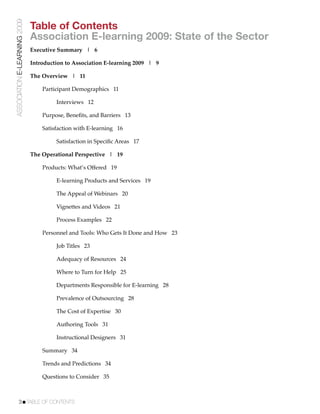
                              Table of Contents
                              Association E-learning 2009: State of the Sector
                              Executive Summary | 6

                              Introduction to Association E-learning 2009 | 9

                              The Overview | 11

                              !   Participant Demographics 11

                              !   !    Interviews 12

                              !   Purpose, Benefits, and Barriers 13

                              !   Satisfaction with E-learning 16

                              !   !    Satisfaction in Specific Areas 17

                              The Operational Perspective | 19

                              !   Products: What’s Offered 19

                              !   !    E-learning Products and Services 19

                              !   !    The Appeal of Webinars 20

                              !   !    Vignettes and Videos 21

                              !   !    Process Examples 22

                              !   Personnel and Tools: Who Gets It Done and How 23

                              !   !    Job Titles 23

                              !   !    Adequacy of Resources 24

                              !   !    Where to Turn for Help 25

                              !   !    Departments Responsible for E-learning 28

                              !   !    Prevalence of Outsourcing 28

                              !   !    The Cost of Expertise 30

                              !   !    Authoring Tools 31

                              !   !    Instructional Designers 31

                              !   Summary 34

                              !   Trends and Predictions 34

                              !   Questions to Consider 35


           3!TABLE OF CONTENTS
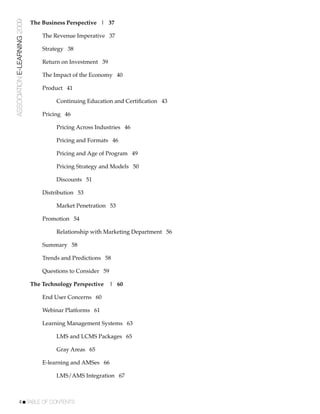
ASSOCIATION E-LEARNING 2009   The Business Perspective | 37

                              !   The Revenue Imperative 37

                              !   Strategy 38

                              !   Return on Investment 39

                              !   The Impact of the Economy 40

                              !   Product 41

                              !   !    Continuing Education and Certification 43

                              !   Pricing 46

                              !   !    Pricing Across Industries 46

                              !   !    Pricing and Formats 46

                              !   !    Pricing and Age of Program 49

                              !   !    Pricing Strategy and Models 50

                              !   !    Discounts 51

                              !   Distribution 53

                              !   !    Market Penetration 53

                              !   Promotion 54

                              !   !    Relationship with Marketing Department 56

                              !   Summary 58

                              !   Trends and Predictions 58

                              !   Questions to Consider 59

                              The Technology Perspective     | 60

                              !   End User Concerns 60

                              !   Webinar Platforms 61

                              !   Learning Management Systems 63

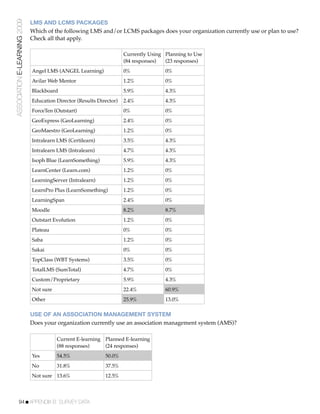
                              !   !    LMS and LCMS Packages 65

                              !   !    Gray Areas 65

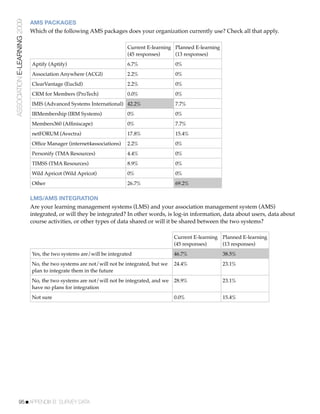
                              !   E-learning and AMSes 66

                              !   !    LMS/AMS Integration 67


           4!TABLE OF CONTENTS
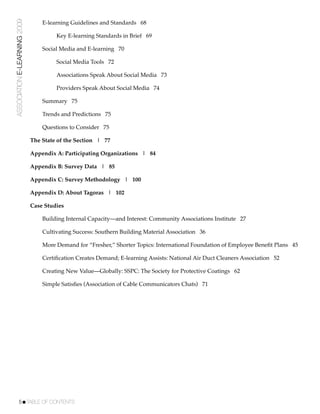
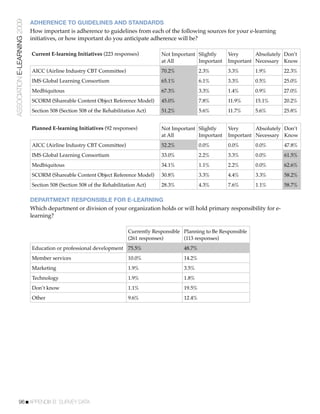
ASSOCIATION E-LEARNING 2009   !   E-learning Guidelines and Standards 68

                              !   !    Key E-learning Standards in Brief 69

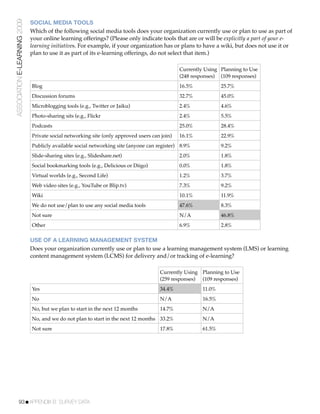
                              !   Social Media and E-learning 70

                              !   !    Social Media Tools 72

                              !   !    Associations Speak About Social Media 73

                              !   !    Providers Speak About Social Media 74

                              !   Summary 75

                              !   Trends and Predictions 75

                              !   Questions to Consider 75

                              The State of the Section | 77

                              Appendix A: Participating Organizations | 84

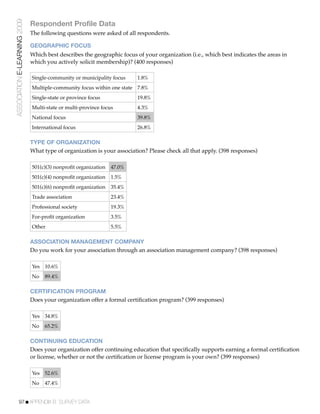
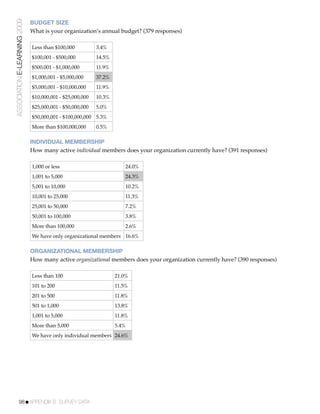
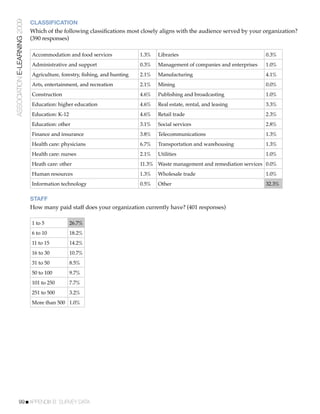
                              Appendix B: Survey Data | 85

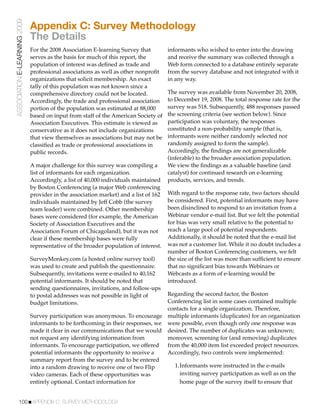
                              Appendix C: Survey Methodology | 100

                              Appendix D: About Tagoras | 102

                              Case Studies

                              !   Building Internal Capacity—and Interest: Community Associations Institute 27

                              !   Cultivating Success: Southern Building Material Association 36

                              !   More Demand for “Fresher,” Shorter Topics: International Foundation of Employee Benefit Plans 45

                              !   Certification Creates Demand; E-learning Assists: National Air Duct Cleaners Association 52

                              !   Creating New Value—Globally: SSPC: The Society for Protective Coatings 62

                              !   Simple Satisfies (Association of Cable Communicators Chats) 71


           5!TABLE OF CONTENTS
ASSOCIATION E-LEARNING 2009
                              Executive Summary
                              Association E-learning 2009: State of the Sector
                              Association E-learning 2009: State of the Sector        respondents who indicated that
                              represents a major effort to assess the state of e-     their organizations will begin
                              learning in the association market and provide          using e-learning in the coming
                              insight into how the role of e-learning in the sector   six months, 75.5 percent are
                              may evolve in the coming months and years.              from organizations with annual
                                                                                      budgets under $5 million, and
                              At the core of the report is a survey of associations   32.7 percent are from
                              conducted at the end of 2008. Nearly 500                organizations with budgets of
                              organizations responded to the survey, providing        less than $500,000. The largest
                              extensive data about how they are using e-learning,     cluster of these respondents (36
                              what tools and technologies they employ to create       percent) also come from
                              and deliver e-learning, and the business practices      organizations with fewer than
                              that support their e-learning initiatives. To           5 staff.                              This report
                              supplement this data, the report authors conducted                                            represents a
                              in-depth interviews with 20 associations and 12 e-      The Operational                       major effort
                              learning technology and service providers to the        Perspective                           to assess
                              sector.                                                                                       the state of
                                                                                      Most of the associations              e-learning in
                                                                                      surveyed or interviewed for           the
                              The Overview                                            this report use a combination         association
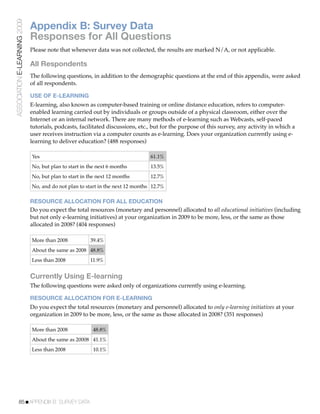
                              Out of 488 responses to the survey, 61.1 percent        of in-house and contract              market.
                              were from individuals who indicated their               resources to produce their e-
                              organizations are currently using e-learning. An        learning offerings, and the
                              additional 26.2 percent indicated they plan to start    majority of those offerings take the form of live
                              using e-learning within the coming 6 to 12 months,      Webinars. Nearly 70 percent of survey respondents
                              and 12.7 percent indicated that they have no plans      who currently use e-learning reported live Webinars
                              to start using e-learning in the coming 12 months.      as one of their delivery formats. Recorded Webinars
                                                                                      (56 percent) and self-paced online courses (54.5
                              Not surprisingly, associations use e-learning mainly    percent) followed in relatively distant second and
                              to deliver professional development to members,         third places. No other formats were nearly as
                              and cost-effectiveness, convenience, and the ability    popular, but a significant number of associations—
                              to reach more learners were among the biggest           40.4 percent of survey respondents—do make use of
                              benefits identified by survey respondents. Overall,       member-only discussion boards.
                              organizations report that they are more satisfied
                              (78.8 percent) than not (21.6 percent) with their e-    With respect to developing e-learning, organizations
                              learning initiatives. The only specific area in which    that currently have programs are about evenly split
                              these organizations report being somewhat more          on whether they do (43.5 percent) or do not (45.9
                              dissatisfied (35.5 percent) than satisfied (33.5          percent) make use of professional instructional
                              percent) is in revenue generation from their            designers. Among the tools that organizations use
                              offerings.                                              to develop e-learning, Microsoft PowerPoint tops
                                                                                      the list—not surprising since it is often the basis for
                              While the survey data indicate that there is a          Webinar presentations as well as on-demand
                              somewhat greater tendency for larger associations       courses.
                              already to have embraced e-learning, there is clearly
                              significant e-learning activity among smaller            In most cases, association e-learning initiatives are
                              organizations. Additionally, it appears that smaller    managed by an education department (which, at
                              organizations may lead the growth in new                small organizations, may mean a single person who
                              programs in the sector for the coming year. Among       wears many hats). Interviews conducted for this


           6!EXECUTIVE SUMMARY
ASSOCIATION E-LEARNING 2009   report suggest, however, that the individuals who      Web, social networks (25 percent, combining public
                              wind up with responsibility for e-learning programs    and private sites) came out on top, followed by
                              often do not come from an education background.        blogs (16.5 percent) and wikis (10.1 percent). All
                              Moreover, there was a general sense among              three tools—but particularly social networks (32.1
                              interviewees that opportunities for networking and     percent) and blogs (25.7 percent)—show stronger
                              knowledge-sharing among peers in the sector is         interest among respondents planning to implement
                              lacking.                                               e-learning.

                              The Technology Perspective                             The Business Perspective
                              Among the Webinar platforms used by                    Most of the organizations interviewed for this
                              organizations, WebEx (27 percent) and                  report along with the vast majority of survey
                              GoToMeeting (23 percent) lead the pack with            respondents currently using e-learning (86 percent)
                              Microsoft Live Meeting (14 percent) a distant third.   or planning to use e-learning (77.4 percent) charge
                                                                                     or plan to charge for some or all of their offerings.
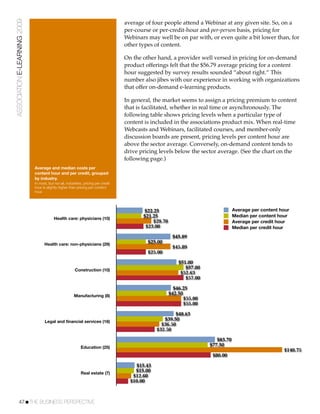
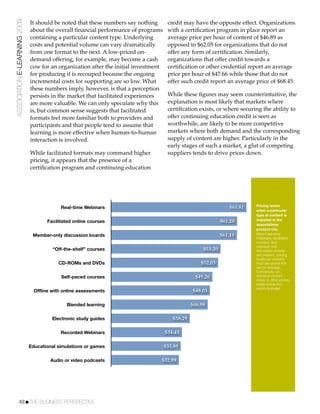
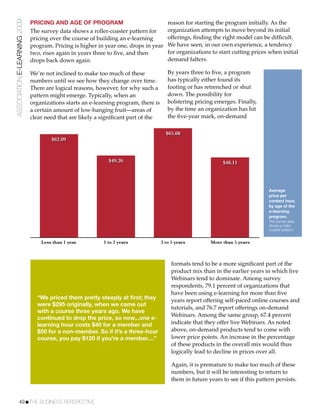
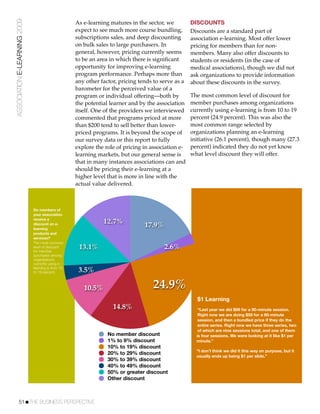
                              Just under half (49.1 percent) of the respondents      The average price per content hour for
                              that currently offer e-learning report using a         organizations currently offering e-learning is US
                              learning management system (LMS) or are planning $56.79 while the most common level of discount for
                              to within the next 12 months. Among those              member course purchases was from 10 to 19
                              organizations, the majority (71.1 percent) report that percent.
                              they either have integrated or plan to integrate the
                              LMS with their association management system           Interviews conducted for this report as well as a
                              (AMS).                                                 brief follow-on survey among the original survey
                                                                                     participants suggest that most organizations do not
                                                      Knowledge of and adherence have a formal e-learning strategy in place or a
                                On average,           to common e-learning           formal approach to pricing their offerings. Only 30.9
                                organizations         guidelines and standards       percent of respondents to the follow-on survey
                                using e-              appears to be quite low in the reported having a formal, documented e-learning
                                learning reach        sector. Adherence to the
                                18 percent of                                        strategy, and only 20 percent indicated that their
                                                      Shareable Content Object       organizations have a formal, documented process
                                their
                                                      Reference Model (SCORM),       for setting prices.
                                membership
                                base with             the most common set of e-
                                their offerings.      learning standards, was        On average, organizations using e-learning reach
                                                      considered very important or approximately 18 percent of their membership base
                                                      absolutely necessary by only with their offerings. Most organizations provide
                                                      27 percent of survey           some form of credit—for example, continuing
                                                      respondents currently using    education units or a certificate—to their learners.
                                                      e-learning.
                                                                                     With respect to marketing methods, e-mail
                                                      Social media is attracting     marketing and word of mouth lead the pack by a
                                                      some interest in the           significant margin. Among organizations currently
                                                      association e-learning         offering e-learning, 93 percent report e-mail as
                                                      community but leaves much either very important or absolutely necessary, and
                                                      room for growth. The           83.8 percent report word of mouth as very
                                                      dominant social tool in both   important or absolutely necessary. The next closest
                                                      current (32.7 percent) and     contender is banner ads on the organizations’ own
                                                      planned (45 percent) e-        Web sites, which 49.8 percent report as very
                                                      learning initiatives is        important or absolutely necessary. Notably, pay-per-
                                                      discussion forums. Among       click advertising, search engine optimization (SEO),
                                                      the tools that many associate and promotional Webcasts—all mainstays of current
                                                      most closely with the social   Internet marketing practices—do not appear to have


           7!EXECUTIVE SUMMARY
ASSOCIATION E-LEARNING 2009   much of a place in current association marketing
                              strategies for e-learning.

                              The State of the Sector
                              E-learning has arrived in the association sector but
                              remains immature. A range of factors—from the
                              current state of the economy to technology
                              advances to the rise of new generations—point to
                              growth and to a clear opportunity for e-learning to
                              transition into a more significant, more strategic
                              part of the mix of services associations provide to
                              members. As this transition occurs, it is likely to be
                              accompanied by the following:

                                 • Growth in implementation of learning
                                   management systems and integration of these
                                   with association management systems
                                 • An increase in the amount of on-demand
                                   educational content offered by organizations
                                 • An increased focus on instructional design
                                   along with development of in-house
                                   instructional design capabilities or use of
                                   contractors
                                 • Relatively slow adoption of social media for e-
                                   learning purposes until organizations develop
                                   strategies and business models for products
                                   that integrate social media with more
                                   traditional content
                                 • An increase in competition that will, in turn, be
                                   a significant factor in the adoption of more
                                   sophisticated marketing practices

                              New, relevant resources and a more cohesive
                              professional network for e-learning in the sector
                              may be the most valuable byproducts of these
                              changes in association e-learning.


           8!EXECUTIVE SUMMARY
ASSOCIATION E-LEARNING 2009
                              Introduction to Association E-learning 2009
                              About This Report
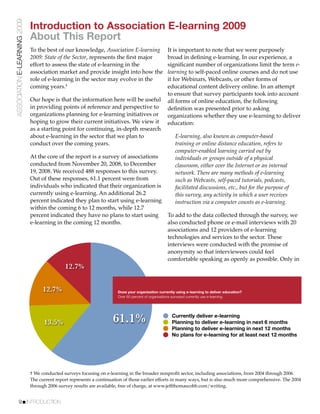
                              To the best of our knowledge, Association E-learning                 It is important to note that we were purposely
                              2009: State of the Sector, represents the first major                 broad in defining e-learning. In our experience, a
                              effort to assess the state of e-learning in the                      significant number of organizations limit the term e-
                              association market and provide insight into how the                  learning to self-paced online courses and do not use
                              role of e-learning in the sector may evolve in the                   it for Webinars, Webcasts, or other forms of
                              coming years.†                                                       educational content delivery online. In an attempt
                                                                                                   to ensure that survey participants took into account
                              Our hope is that the information here will be useful                 all forms of online education, the following
                              in providing points of reference and perspective to                  definition was presented prior to asking
                              organizations planning for e-learning initiatives or                 organizations whether they use e-learning to deliver
                              hoping to grow their current initiatives. We view it                 education:
                              as a starting point for continuing, in-depth research
                              about e-learning in the sector that we plan to                           E-learning, also known as computer-based
                              conduct over the coming years.                                           training or online distance education, refers to
                                                                                                       computer-enabled learning carried out by
                              At the core of the report is a survey of associations                    individuals or groups outside of a physical
                              conducted from November 20, 2008, to December                            classroom, either over the Internet or an internal
                              19, 2008. We received 488 responses to this survey.                      network. There are many methods of e-learning
                              Out of these responses, 61.1 percent were from                           such as Webcasts, self-paced tutorials, podcasts,
                              individuals who indicated that their organization is                     facilitated discussions, etc., but for the purpose of
                              currently using e-learning. An additional 26.2                           this survey, any activity in which a user receives
                              percent indicated they plan to start using e-learning                    instruction via a computer counts as e-learning.
                              within the coming 6 to 12 months, while 12.7
                              percent indicated they have no plans to start using                  To add to the data collected through the survey, we
                              e-learning in the coming 12 months.                                  also conducted phone or e-mail interviews with 20
                                                                                                   associations and 12 providers of e-learning
                                                                                                   technologies and services to the sector. These
                                                                                                   interviews were conducted with the promise of
                                                                                                   anonymity so that interviewees could feel
                                                                                                   comfortable speaking as openly as possible. Only in
                                              12.7%


                                    12.7%                              Does your organization currently using e-learning to deliver education?
                                                                       Over 60 percent of organizations surveyed currently use e-learning.


                                    13.5%                            61.1%                           Currently deliver e-learning
                                                                                                     Planning to deliver e-learning in next 6 months
                                                                                                     Planning to deliver e-learning in next 12 months
                                                                                                     No plans for e-learning for at least next 12 months


                              † We conducted surveys focusing on e-learning in the broader nonprofit sector, including associations, from 2004 through 2006.
                              The current report represents a continuation of those earlier efforts in many ways, but is also much more comprehensive. The 2004
                              through 2006 survey results are available, free of charge, at www.jeffthomascobb.com/writing.


           9!INTRODUCTION
ASSOCIATION E-LEARNING 2009   few limited instances, and with the permission of the interviewee, are the
                              sources of quotations or other information revealed in the report. Our             Partial data from the
                              frequent use of quotations from the interviews is purposeful—we heard              online survey is
                              from many interviewees that they do not have sense of what their peers             included throughout
                              are doing or where to go to find out what other organizations are doing.            this report. See
                              Our hope is that the extensive use of quotations will help a voice for e-          Appendix B for the
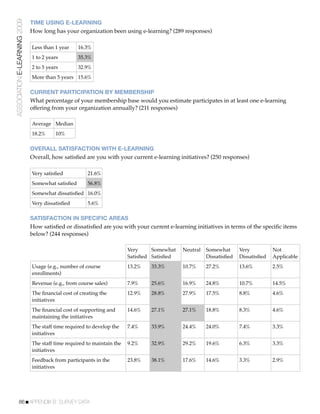
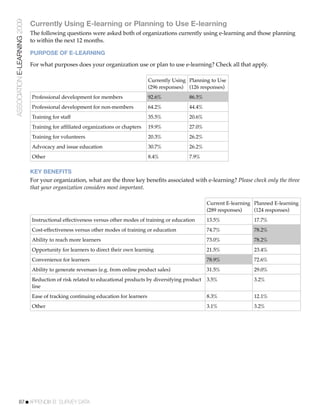
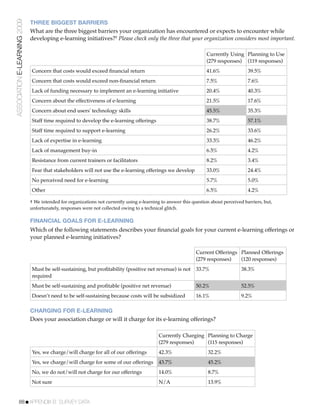
                                                                                                                 raw survey results.
                              learning in the sector emerge.

                              In addition to quoting frequently from the interviews, we have also                The chapters on the
                              crafted brief case studies to highlight the efforts of some of the                 operational, business,
                              organizations we interviewed. These were done with the organizations’              and technology
                              permission, and we tried to be as diverse as possible in selecting the             perspectives end with
                              organizations. The case studies span a range of industries and feature             a summary of trends
                              associations of varying size and geographic focus. Our intention is to             and a list of questions
                              continue to mine case studies from the more than 300 pages of interview            for organizations to
                                                                                                                 ask themselves.
                              transcripts we have collected as well as from our ongoing conversation
                              with organizations and to share these, as they become available, with
                              purchasers of the report.

                              Finally, the two authors of this report have each worked in e-learning for
                              more than a decade and have worked specifically with associations for the
                              better part of that time. Throughout the report we provide our own
                              analysis of the information collected through the survey and the
                              interviews, and we draw on our own experience to offer perspectives that may not be readily apparent
                              from the data. Our approach to doing this is relatively conservative, based on the limitations naturally
                              imposed by a non-probability survey (see the chapter “Methodology”), but even more importantly, on our
                              sense that we are still in the early stages of e-learning in the association sector—a sector that is, by its
                              nature, quite diverse and fragmented—and that broad conclusions must be put forward cautiously.

                              The report is structured into 10 sections:

                                 1.The executive summary
                                 2.This introduction
                                 3.An overview that discusses demographic data, the purposes of association e-learning, the barriers to
                                   and benefits of e-learning, and satisfaction with e-learning
                                 4.A chapter on operations and e-learning that looks at what’s produced, who produces it, using what
                                   process, and with what tools
                                 5.A chapter that takes the business perspective, looking at the strategy that drives e-learning initiatives,
                                   expenses and income, marketing, and competition
                                 6.A chapter on e-learning technology, including the end user point of view and the organizational
                                   standpoint
                                 7.The state of e-learning in the association sector based on our analysis of the survey data and
                                   interviews
                                 8.A discussion of the methodology used for collecting the data that is the basis of this report
                                 9.A series of appendices that provide a list of participating organizations, the raw online survey data
                                   (parts of which are cited throughout the report), the survey methodology, and information about
                                   Tagoras (publisher of this report) and Jeff Cobb and Celisa Steele (authors of this report)

                              Our sincere hope is this report proves useful to associations as they assess their e-learning initiatives or
                              contemplate throwing their hats in the e-learning ring.

           10!INTRODUCTION
ASSOCIATION E-LEARNING 2009
                              The Overview
                              Demographics, Purpose, Benefits, Barriers, and
                              Satisfaction
                              This section provides demographic                                                         0.5%
                              data, discusses the purposes for                                                       5.3% 3.4%
                              which associations undertake e-                                                 5.0%
                              learning, looks at the perceived                                                                         14.5%
                              benefits of and barriers to e-
                              learning, and analyzes associations’
                                                                                                      10.3%
                              satisfaction with e-learning
                              initiatives.
                                                                                                                                                 11.9%
                              Participant Demographics
                                                                                                    11.9%
                              As the demographic data provided
                              at the end of this document
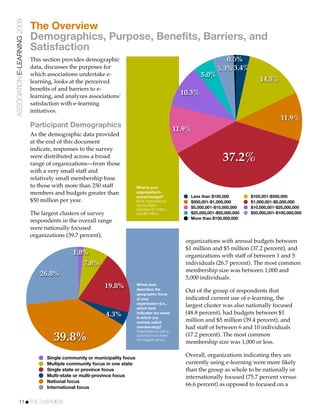
                              indicate, responses to the survey
                              were distributed across a broad
                              range of organizations—from those
                                                                                                                        37.2%
                              with a very small staff and
                              relatively small membership base
                              to those with more than 250 staff              What is your
                              members and budgets greater than               organization’s
                                                                             annual budget?              Less than $100,000        $100,001-$500,000
                              $50 million per year.                          Most organizations          $500,001-$1,000,000       $1,000,001-$5,000,000
                                                                             had budgets
                                                                             between $1 million
                                                                                                         $5,000,001-$10,000,000    $10,000,001-$25,000,000
                              The largest clusters of survey                 and $5 million.             $25,000,001-$50,000,000   $50,000,001-$100,000,000
                                                                                                         More than $100,000,000
                              respondents in the overall range
                              were nationally focused
                              organizations (39.7 percent),
                                                                                                       organizations with annual budgets between
                                                                                                       $1 million and $5 million (37.2 percent), and
                                               1.8%                                                    organizations with staff of between 1 and 5
                                                  7.8%                                                 individuals (26.7 percent). The most common
                                                                                                       membership size was between 1,000 and
                                 26.8%
                                                                                                       5,000 individuals.
                                                            19.8%            Which best
                                                                             describes the             Out of the group of respondents that
                                                                             geographic focus
                                                                             of your                   indicated current use of e-learning, the
                                                                             organization (i.e.,
                                                                             which best
                                                                                                       largest cluster was also nationally focused
                                                             4.3%            indicates the areas       (48.8 percent), had budgets between $1
                                                                             in which you
                                                                             actively solicit
                                                                                                       million and $5 million (39.4 percent), and
                                                                             membership)?              had staff of between 6 and 10 individuals
                                                                             Organizations with a

                                       39.8%                                 national focus were
                                                                             the biggest group.
                                                                                                       (17.2 percent). The most common
                                                                                                       membership size was 1,000 or less.

                                    Single community or municipality focus
                                                                                                       Overall, organizations indicating they are
                                    Multiple community focus in one state                              currently using e-learning were more likely
                                    Single state or province focus                                     than the group as whole to be nationally or
                                    Multi-state or multi-province focus                                internationally focused (75.7 percent versus
                                    National focus
                                    International focus
                                                                                                       66.6 percent) as opposed to focused on a


           11!THE OVERVIEW
ASSOCIATION E-LEARNING 2009                                            region, state, or locality.                 begin using e-learning within either 6 or 12 months.
                                The largest                            They were also more                         These groups tend to manage smaller associations,
                                groups of survey                       likely to have annual                       and thus their movement into e-learning tends to
                                respondents were                       budgets greater than $5                     support the idea we will see significant growth in
                                from nationally                        million (42.5 percent                       new initiatives by small organizations.
                                focused                                versus 33 percent); have
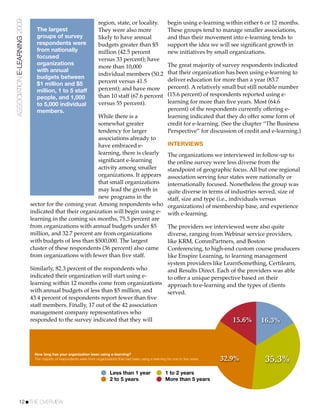
                                organizations                                                                      The great majority of survey respondents indicated
                                                                       more than 10,000
                                with annual                                                                        that their organization has been using e-learning to
                                                                       individual members (50.2
                                budgets between                                                                    deliver education for more than a year (83.7
                                $1 million and $5                      percent versus 41.5
                                                                       percent); and have more                     percent). A relatively small but still notable number
                                million, 1 to 5 staff
                                                                       than 10 staff (67.6 percent                 (15.6 percent) of respondents reported using e-
                                people, and 1,000
                                to 5,000 individual                    versus 55 percent).                         learning for more than five years. Most (64.6
                                members.                                                                           percent) of the respondents currently offering e-
                                                          While there is a                                         learning indicated that they do offer some form of
                                                          somewhat greater                                         credit for e-learning. (See the chapter “The Business
                                                          tendency for larger                                      Perspective” for discussion of credit and e-learning.)
                                                          associations already to
                                                          have embraced e-                                         INTERVIEWS
                                                          learning, there is clearly                               The organizations we interviewed in follow-up to
                                                          significant e-learning                                    the online survey were less diverse from the
                                                          activity among smaller                                   standpoint of geographic focus. All but one regional
                                                          organizations. It appears                                association serving four states were nationally or
                                                          that small organizations                                 internationally focused. Nonetheless the group was
                                                          may lead the growth in                                   quite diverse in terms of industries served, size of
                                                          new programs in the                                      staff, size and type (i.e., individuals versus
                              sector for the coming year. Among respondents who                                    organizations) of membership base, and experience
                              indicated that their organization will begin using e-                                with e-learning.
                              learning in the coming six months, 75.5 percent are
                              from organizations with annual budgets under $5      The providers we interviewed were also quite
                              million, and 32.7 percent are from organizations     diverse, ranging from Webinar service providers,
                              with budgets of less than $500,000. The largest      like KRM, CommPartners, and Boston
                              cluster of these respondents (36 percent) also came  Conferencing, to high-end custom course producers
                              from organizations with fewer than five staff.        like Enspire Learning, to learning management
                                                                                   system providers like LearnSomething, Certilearn,
                              Similarly, 82.3 percent of the respondents who       and Results Direct. Each of the providers was able
                              indicated their organization will start using e-     to offer a unique perspective based on their
                              learning within 12 months come from organizations approach to e-learning and the types of clients
                              with annual budgets of less than $5 million, and     served.
                              43.4 percent of respondents report fewer than five
                              staff members. Finally, 17 out of the 42 association
                              management company representatives who
                              responded to the survey indicated that they will                                15.6% 16.3%


                               How long has your organization been using e-learning?
                               The majority of respondents were from organizations that had been using e-learning for one to five years.   32.9%           35.3%
                                                                              Less than 1 year                   1 to 2 years
                                                                              2 to 5 years                       More than 5 years


           12!THE OVERVIEW
ASSOCIATION E-LEARNING 2009
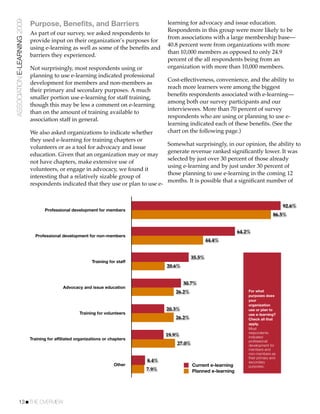
                              Purpose, Benefits, and Barriers                            learning for advocacy and issue education.
                                                                                         Respondents in this group were more likely to be
                              As part of our survey, we asked respondents to
                                                                                         from associations with a large membership base—
                              provide input on their organization’s purposes for
                                                                                         40.8 percent were from organizations with more
                              using e-learning as well as some of the benefits and
                                                                                         than 10,000 members as opposed to only 24.9
                              barriers they experienced.
                                                                                         percent of the all respondents being from an
                              Not surprisingly, most respondents using or                organization with more than 10,000 members.
                              planning to use e-learning indicated professional
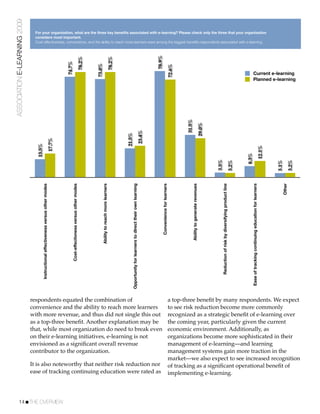
                                                                                         Cost-effectiveness, convenience, and the ability to
                              development for members and non-members as
                                                                                         reach more learners were among the biggest
                              their primary and secondary purposes. A much
                                                                                         benefits respondents associated with e-learning—
                              smaller portion use e-learning for staff training,
                                                                                         among both our survey participants and our
                              though this may be less a comment on e-learning
                                                                                         interviewees. More than 70 percent of survey
                              than on the amount of training available to
                                                                                         respondents who are using or planning to use e-
                              association staff in general.
                                                                                         learning indicated each of these benefits. (See the
                              We also asked organizations to indicate whether            chart on the following page.)
                              they used e-learning for training chapters or
                                                                                         Somewhat surprisingly, in our opinion, the ability to
                              volunteers or as a tool for advocacy and issue
                                                                                         generate revenue ranked significantly lower. It was
                              education. Given that an organization may or may
                                                                                         selected by just over 30 percent of those already
                              not have chapters, make extensive use of
                                                                                         using e-learning and by just under 30 percent of
                              volunteers, or engage in advocacy, we found it
                                                                                         those planning to use e-learning in the coming 12
                              interesting that a relatively sizable group of
                                                                                         months. It is possible that a significant number of
                              respondents indicated that they use or plan to use e-


                                                                                                                                                  92.6%
                                     Professional development for members
                                                                                                                                             86.5%


                                                                                                                          64.2%
                                Professional development for non-members
                                                                                                            44.4%


                                                                                                    35.5%
                                                             Training for staff
                                                                                         20.6%


                                                                                                 30.7%
                                               Advocacy and issue education
                                                                                            26.2%                             For what
                                                                                                                              purposes does
                                                                                                                              your
                                                                                                                              organization
                                                                                         20.3%                                use or plan to
                                                       Training for volunteers                                                use e-learning?
                                                                                            26.2%                             Check all that
                                                                                                                              apply.
                                                                                                                              Most
                                                                                                                              respondents
                                                                                         19.9%                                indicated
                              Training for affiliated organizations or chapters                                               professional
                                                                                             27.0%                            development for
                                                                                                                              members and
                                                                                                                              non-members as
                                                                                                                              their primary and
                                                                                  8.4%                                        secondary
                                                                         Other                       Current e-learning       purposes.
                                                                                  7.9%               Planned e-learning


           13!THE OVERVIEW
ASSOCIATION E-LEARNING 2009
                                For your organization, what are the three key benefits associated with e-learning? Please check only the three that your organization
                                considers most important.
                                Cost-effectiveness, convenience, and the ability to reach more learners were among the biggest benefits respondents associated with e-learning.


                                                                                                                                                                                                                                                  78.9%
                                                                                                                                                                          78.2%
                                                                                                                                 78.2%
                                                                                          74.7%


                                                                                                                                         73.0%


                                                                                                                                                                                                                                                                             72.6%
                                                                                                                                                                                                                                                                                                                                                                                                 Current e-learning
                                                                                                                                                                                                                                                                                                                                                                                                 Planned e-learning


                                                                                                                                                                                                                                                                                        31.5%
                                                                                                                                                                                                                                                                                                                       29.0%
                                                                                                                                                                                                                                          23.4%
                                                                                                                                                                                  21.5%
                                                                                  17.7%
                                 13.5%


                                                                                                                                                                                                                                                                                                                                                                                                                                          12.1%
                                                                                                                                                                                                                                                                                                                                                                                      8.3%
                                                                                                                                                                                                                                                                                                                               3.5%


                                                                                                                                                                                                                                                                                                                                                                                                                                                             3.2%
                                                                                                                                                                                                                                                                                                                                                                               3.2%


                                                                                                                                                                                                                                                                                                                                                                                                                                                  3.1%
                                                                                                                                                                                                                                                                                                                                                                                                                                                     Other
                                                                                                                                                                                                                                                                                                                                  Reduction of risk by diversifying product line


                                                                                                                                                                                                                                                                                                                                                                                         Ease of tracking continuing education for learners
                                                                                                                                                                                                                                                                                            Ability to generate revenues
                                                                                                                                             Ability to reach more learners


                                                                                                                                                                                      Opportunity for learners to direct their own learning


                                                                                                                                                                                                                                                      Convenience for learners
                                                                                              Cost-effectivness versus other modes
                                     Instructional effectiveness versus other modes


                              respondents equated the combination of                                                                                                                                                                                                             a top-three benefit by many respondents. We expect
                              convenience and the ability to reach more learners                                                                                                                                                                                                 to see risk reduction become more commonly
                              with more revenue, and thus did not single this out                                                                                                                                                                                                recognized as a strategic benefit of e-learning over
                              as a top-three benefit. Another explanation may be                                                                                                                                                                                                  the coming year, particularly given the current
                              that, while most organization do need to break even                                                                                                                                                                                                economic environment. Additionally, as
                              on their e-learning initiatives, e-learning is not                                                                                                                                                                                                 organizations become more sophisticated in their
                              envisioned as a significant overall revenue                                                                                                                                                                                                         management of e-learning—and learning
                              contributor to the organization.                                                                                                                                                                                                                   management systems gain more traction in the
                                                                                                                                                                                                                                                                                 market—we also expect to see increased recognition
                              It is also noteworthy that neither risk reduction nor                                                                                                                                                                                              of tracking as a significant operational benefit of
                              ease of tracking continuing education were rated as                                                                                                                                                                                                implementing e-learning.


           14!THE OVERVIEW
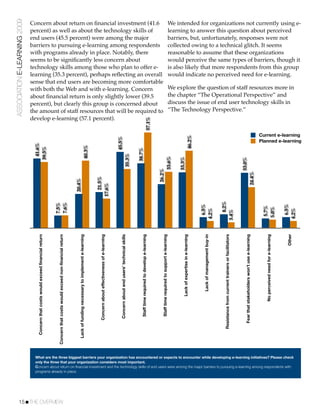
ASSOCIATION E-LEARNING 2009   Concern about return on financial investment (41.6                                                                                                                                                                                                                                                                                                           We intended for organizations not currently using e-
                              percent) as well as about the technology skills of                                                                                                                                                                                                                                                                                                          learning to answer this question about perceived
                              end users (45.5 percent) were among the major                                                                                                                                                                                                                                                                                                               barriers, but, unfortunately, responses were not
                              barriers to pursuing e-learning among respondents                                                                                                                                                                                                                                                                                                           collected owing to a technical glitch. It seems
                              with programs already in place. Notably, there                                                                                                                                                                                                                                                                                                              reasonable to assume that these organizations
                              seems to be significantly less concern about                                                                                                                                                                                                                                                                                                                 would perceive the same types of barriers, though it
                              technology skills among those who plan to offer e-                                                                                                                                                                                                                                                                                                          is also likely that more respondents from this group
                              learning (35.3 percent), perhaps reflecting an overall                                                                                                                                                                                                                                                                                                       would indicate no perceived need for e-learning.
                              sense that end users are becoming more comfortable
                              with both the Web and with e-learning. Concern                                                                                                                                                                                                                                                                                                              We explore the question of staff resources more in
                              about financial return is only slightly lower (39.5                                                                                                                                                                                                                                                                                                          the chapter “The Operational Perspective” and
                              percent), but clearly this group is concerned about                                                                                                                                                                                                                                                                                                         discuss the issue of end user technology skills in
                              the amount of staff resources that will be required to                                                                                                                                                                                                                                                                                                      “The Technology Perspective.”
                              develop e-learning (57.1 percent).


                                                                                                                                                                                                                                                                                                                            57.1%
                                                                                                                                                                                                                                                                                                                                                                                                                                                                                                                                                                   Current e-learning


                                                                                                                                                                                                                                                                                                                                                                                                                     46.2%
                                                                                                                                                                                                                                                45.5%


                                                                                                                                                                                                                                                                                                                                                                                                                                                                                                                                                                   Planned e-learning
                                41.6%


                                                                                                                                                                               40.3%
                               39.5%


                                                                                                                                                                                                                                                                                              38.7%
                                                                                                                                                                                                                                                                              35.3%


                                                                                                                                                                                                                                                                                                                                                 33.6%

                                                                                                                                                                                                                                                                                                                                                                                              33.3%


                                                                                                                                                                                                                                                                                                                                                                                                                                                                                                                   33.0%
                                                                                                                                                                                                                                                                                                                                            26.2%


                                                                                                                                                                                                                                                                                                                                                                                                                                                                                                                                                  24.4%
                                                                                                                                                                                                     21.5%
                                                                                                                                            20.4%


                                                                                                                                                                                                  17.6%


                                                                                                                                                                                                                                                                                                                                                                                                                                                                  8.2%
                                                                                    7.6%
                                                                                    7.5%


                                                                                                                                                                                                                                                                                                                                                                                                                                                                                                                                                                                                           6.5%
                                                                                                                                                                                                                                                                                                                                                                                                                                    6.5%


                                                                                                                                                                                                                                                                                                                                                                                                                                                                                                                                                                    5.7%
                                                                                                                                                                                                                                                                                                                                                                                                                                                                                                                                                                    5.0%


                                                                                                                                                                                                                                                                                                                                                                                                                                                                                                                                                                                                         4.2%
                                                                                                                                                                                                                                                                                                                                                                                                                                  4.2%


                                                                                                                                                                                                                                                                                                                                                                                                                                                               3.4%
                                                                                                                                                                                                                                                                                                                                                                                                                                                                Resistance from current trainers or facilitators


                                                                                                                                                                                                                                                                                                                                                                                                                                                                                                                                                                      No perceived need for e-learning
                                                                                                                                                                                                                                                                                                                                              Staff time required to support e-learning


                                                                                                                                                                                                                                                                                                                                                                                                                                                                                                                     Fear that stakeholders won’t use e-learning


                                                                                                                                                                                                                                                                                                                                                                                                                                                                                                                                                                                                          Other
                                                                                                                                                                                                                                                                                                Staff time required to develop e-learning


                                                                                                                                                                                                                                                                                                                                                                                                                                   Lack of management buy-in
                                                                                                                                                                                                                                                                                                                                                                                                Lack of expertise in e-learning
                                                                                                                                                                                                    Concern about effectiveness of e-learning


                                                                                                                                                                                                                                                  Concern about end users’ technical skills
                                                                                     Concern that costs would exceed non-financial return
                                 Concern that costs would exceed financial return


                                                                                                                                              Lack of funding necessary to implement e-learning


                                What are the three biggest barriers your organization has encountered or expects to encounter while developing e-learning initiatives? Please check
                                only the three that your organization considers most important.
                                Concern about return on financial investment and the technology skills of end users were among the major barriers to pursuing e-learning among respondents with
                                programs already in place.


           15!THE OVERVIEW
ASSOCIATION E-LEARNING 2009
                              Satisfaction with E-learning                                                                                          5.6%
                                                                                                                                                                    21.6%
                                                                                                                                         16.0%

                               Overall, how satisfied are you with your current e-learning initiatives?
                               Most associations reported they are either somewhat satisfied or very satisfied.


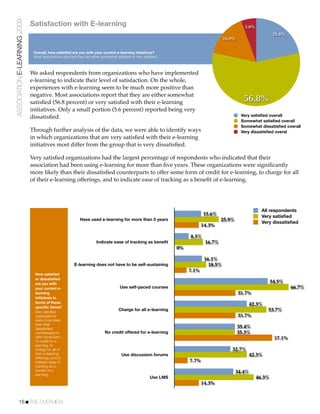
                              We asked respondents from organizations who have implemented
                              e-learning to indicate their level of satisfaction. On the whole,
                              experiences with e-learning seem to be much more positive than
                              negative. Most associations report that they are either somewhat
                              satisfied (56.8 percent) or very satisfied with their e-learning                                                        56.8%
                              initiatives. Only a small portion (5.6 percent) reported being very
                              dissatisfied.                                                                                                         Very satisfied overall
                                                                                                                                                   Somewhat satisfied overall
                                                                                                                                                   Somewhat dissatisfied overall
                              Through further analysis of the data, we were able to identify ways                                                  Very dissatisfied overal
                              in which organizations that are very satisfied with their e-learning
                              initiatives most differ from the group that is very dissatisfied.

                              Very satisfied organizations had the largest percentage of respondents who indicated that their
                              association had been using e-learning for more than five years. These organizations were significantly
                              more likely than their dissatisfied counterparts to offer some form of credit for e-learning, to charge for all
                              of their e-learning offerings, and to indicate ease of tracking as a benefit of e-learning.


                                                                                                                                                             All respondents
                                                                                                                              15.6%                          Very satisfied
                                                            Have used e-learning for more than 5 years                                 25.9%                 Very dissatisfied
                                                                                                                              14.3%

                                                                                                                       8.3%
                                                                      Indicate ease of tracking as benefit                     16.7%
                                                                                                                  0%

                                                                                                                               16.1%
                                                        E-learning does not have to be self-sustaining                           18.5%
                                                                                                                       7.1%
                                How satisfied
                                or dissatisfied
                                are you with                                                                                                                       54.5%
                                your current e-                                      Use self-paced courses                                                                 66.7%
                                learning                                                                                                         35.7%
                                initiatives in
                                terms of these
                                                                                                                                                      42.3%
                                specific items?
                                Very satisfied
                                                                                    Charge for all e-learning                                                  53.7%
                                organizations                                                                                                    35.7%
                                were more likely
                                than their
                                dissatisfied                                                                                                      35.4%
                                counterparts to                            No credit offered for e-learning                                      35.3%
                                offer some form                                                                                                                     57.1%
                                of credit for e-
                                learning, to
                                charge for all of                                                                                           32.7%
                                their e-learning                                      Use discussion forums                                           42.3%
                                offerings, and to
                                indicate ease of                                                                       7.7%
                                tracking as a
                                benefit of e-                                                                                                     34.4%
                                learning.
                                                                                                        Use LMS                                            46.3%
                                                                                                                              14.3%


           16!THE OVERVIEW
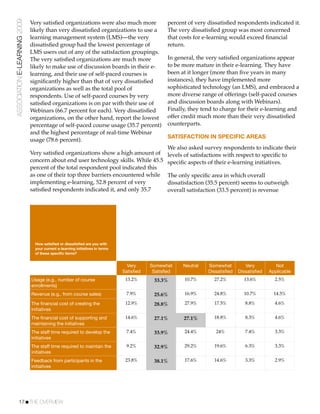
ASSOCIATION E-LEARNING 2009   Very satisfied organizations were also much more                    percent of very dissatisfied respondents indicated it.
                              likely than very dissatisfied organizations to use a                The very dissatisfied group was most concerned
                              learning management system (LMS)—the very                          that costs for e-learning would exceed financial
                              dissatisfied group had the lowest percentage of                     return.
                              LMS users out of any of the satisfaction groupings.
                              The very satisfied organizations are much more                      In general, the very satisfied organizations appear
                              likely to make use of discussion boards in their e-                to be more mature in their e-learning. They have
                              learning, and their use of self-paced courses is                   been at it longer (more than five years in many
                              significantly higher than that of very dissatisfied                  instances), they have implemented more
                              organizations as well as the total pool of                         sophisticated technology (an LMS), and embraced a
                              respondents. Use of self-paced courses by very                     more diverse range of offerings (self-paced courses
                              satisfied organizations is on par with their use of                 and discussion boards along with Webinars).
                              Webinars (66.7 percent for each). Very dissatisfied                 Finally, they tend to charge for their e-learning and
                              organizations, on the other hand, report the lowest                offer credit much more than their very dissatisfied
                              percentage of self-paced course usage (35.7 percent)               counterparts.
                              and the highest percentage of real-time Webinar
                                                                                                 SATISFACTION IN SPECIFIC AREAS
                              usage (78.6 percent).
                                                                                                 We also asked survey respondents to indicate their
                              Very satisfied organizations show a high amount of                  levels of satisfactions with respect to specific to
                              concern about end user technology skills. While 45.5               specific aspects of their e-learning initiatives.
                              percent of the total respondent pool indicated this
                              as one of their top three barriers encountered while               The only specific area in which overall
                              implementing e-learning, 52.8 percent of very                      dissatisfaction (35.5 percent) seems to outweigh
                              satisfied respondents indicated it, and only 35.7                   overall satisfaction (33.5 percent) is revenue


                                How satisfied or dissatisfied are you with
                                your current e-learning initiatives in terms
                                of these specific items?


                                                                                 Very     Somewhat     Neutral   Somewhat         Very          Not
                                                                               Satisfied    Satisfied              Dissatisfied   Dissatisfied   Applicable
                              Usage (e.g., number of course                     13.2%      33.3%       10.7%       27.2%         13.6%         2.5%
                              enrollments)
                              Revenue (e.g., from course sales)                 7.9%       25.6%       16.9%       24.8%         10.7%         14.5%

                              The financial cost of creating the                 12.9%      28.8%       27.9%       17.5%          8.8%         4.6%
                              initiatives
                              The financial cost of supporting and               14.6%      27.1%       27.1%       18.8%          8.3%         4.6%
                              maintaining the initiatives
                              The staff time required to develop the            7.4%       33.9%       24.4%        24%           7.4%         3.3%
                              initiatives
                              The staff time required to maintain the           9.2%       32.9%       29.2%       19.6%          6.3%         3.3%
                              initiatives
                              Feedback from participants in the                 23.8%      38.1%       17.6%       14.6%          3.3%         2.9%
                              initiatives


           17!THE OVERVIEW
ASSOCIATION E-LEARNING 2009   generation. Very satisfied organizations indicate
                              higher than average levels of satisfaction with
                              revenue—64.1 percent report being either somewhat
                              or very satisfied in comparison to 33.5 percent for
                              the total pool of respondents. None of the very
                              dissatisfied respondents reported being either
                              somewhat or very satisfied with revenue, but 71.4
                              percent reported being either somewhat or very
                              dissatisfied. This group also indicated high levels of
                              dissatisfaction with the level of staff time and the
                              financial costs associated with maintaining e-
                              learning initiatives.

                              It is also worth noting that organizations that report
                              being very satisfied with their e-learning initiatives
                              indicate usage (49.1 percent) and feedback from
                              participants (51.9 percent) as their two highest areas
                              of satisfaction. These organizations are reaching
                              their users and hearing positive things from them
                              about e-learning.

                              Having looked at the demographics of the survey
                              respondents and the purposes and benefits of,
                              barriers to, and satisfaction with e-learning, we’ll
                              now delve into deeper discussion of the operational,
                              business, and technology aspects of association e-
                              learning.


           18!THE OVERVIEW
ASSOCIATION E-LEARNING 2009
                              The Operational Perspective
                              Products, Personnel, Process, and Tools
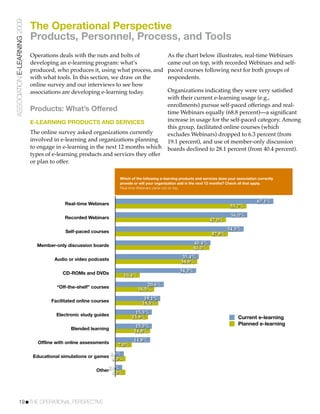
                              Operations deals with the nuts and bolts of                     As the chart below illustrates, real-time Webinars
                              developing an e-learning program: what’s                        came out on top, with recorded Webinars and self-
                              produced, who produces it, using what process, and              paced courses following next for both groups of
                              with what tools. In this section, we draw on the                respondents.
                              online survey and our interviews to see how
                              associations are developing e-learning today.                   Organizations indicating they were very satisfied
                                                                                              with their current e-learning usage (e.g.,
                                                                                              enrollments) pursue self-paced offerings and real-
                              Products: What’s Offered                                        time Webinars equally (68.8 percent)—a significant
                              E-LEARNING PRODUCTS AND SERVICES                                increase in usage for the self-paced category. Among
                                                                                              this group, facilitated online courses (which
                              The online survey asked organizations currently                 excludes Webinars) dropped to 6.3 percent (from
                              involved in e-learning and organizations planning               19.1 percent), and use of member-only discussion
                              to engage in e-learning in the next 12 months which             boards declined to 28.1 percent (from 40.4 percent).
                              types of e-learning products and services they offer
                              or plan to offer.

                                                                   Which of the following e-learning products and services does your association currently
                                                                   provide or will your organization add in the next 12 months? Check all that apply.
                                                                   Real-time Webinars came out on top.


                                            Real-time Webinars                                                                                  67.1%
                                                                                                                                 55.7%

                                            Recorded Webinars                                                                    56.0%
                                                                                                                     47.0%

                                            Self-paced courses                                                                 54.5%
                                                                                                                       47.8%

                                Member-only discussion boards                                               40.4%
                                                                                                            40.0%

                                        Audio or video podcasts                                       35.4%
                                                                                                     34.8%

                                           CD-ROMs and DVDs                                         34.3%
                                                                        10.4%

                                         “Off-the-shelf” courses                    20.6%
                                                                                16.5%

                                      Facilitated online courses                  19.1%
                                                                                 18.3%

                                         Electronic study guides           15.5%
                                                                          13.9%                                                       Current e-learning
                                                                            15.5%                                                     Planned e-learning
                                               Blended learning            14.8%

                                 Offline with online assessments           14.8%
                                                                   7.0%

                               Educational simulations or games 3.6%
                                                                 4.3%

                                                          Other2.9%
                                                                 4.3%


           19!THE OPERATIONAL PERSPECTIVE
ASSOCIATION E-LEARNING 2009   For organizations indicating they were very                          All of these Webinars that have been done to date
                              satisfied with their current e-learning revenue,                      are volunteer members who speak for us for free
                              facilitated online courses went down to 10.5 percent                 and have a presentation that they’ve either
                              (from 19.1 percent), and recorded Webinars dipped                    developed for some other audience or something
                              to 42.1 percent (from 56 percent). In line with the                  like that, so we’re not putting an awful lot of
                              overall data, this very-satisfied-with-revenue group                  overhead on them either. It was a quick way to
                              reported real-time Webinars as the most popular                      ramp up and start the service.... It’s the crawl-
                              offering (63.2 percent).                                             before-you-walk thing. Eventually we intend to be
                                                                                                   doing everything, but right now we are an
                              Compared to the very satisfied, organizations                         association...so there is not a hell of a lot of
                              reporting to be very dissatisfied overall with their e-               budget, and this [set of Webinars] is something
                              learning are:                                                        that is tangible that we can start with. But, for
                                                                                                   sure, everything else is on the big master plan.
                                • Less likely to offer self-paced courses (35.7                    This is a five-year strategy, and the Webinars are
                                  percent versus 66.7 percent)
                                                                                                   just the beginning of it.
                                • Less likely to offer electronic study guides and
                                  blended learning (0 percent versus 18.5 percent               Another advantage is that it’s possible to do a lot
                                  for both)                                                     with a little in the Webinar world. At one of the
                                • Less likely to use third-party, “off the shelf”               organizations where we conducted interviews, a
                                  online courses (7.1 percent versus 18.5 percent)              single staffer did 22 Webinars in a three-month
                                • More likely to offer recorded Webinars (71.4                  period!
                                  percent versus 50 percent)
                                                                                                Just because Webinars are seen as an entry point to
                              One interviewee attested to the popularity of live                e-learning doesn’t mean all organizations start
                              Webinars over recorded ones: “We do see that our                  there: “We started online [with 20-25 asynchronous
                              events are so much more successful as live events                 courses] before we did Webinars,” one interviewee
                              rather than after-the-fact, and I’ve been surprised by            commented, “which is really weird.” For others,
                              that. Our numbers for the live event are great; our               there is a perceived first-mover advantage to taking
                              numbers for the recordings are pathetic.”                         a different tack:

                              THE APPEAL OF WEBINARS                                               [O]ne of the first things they asked me to do was
                              Most organizations surveyed offer real-time                          to actually create a strategy for online learning,
                              Webinars. Why? Webinars are seen as a safe starting                  which is an indulgence for many people, but it
                              place—not too expensive or too time-consuming:                       was a necessary step for us, and I’m really glad we
                                                                                                   took it. And I was quite surprised because actually
                                                                                                   the first recommendation I had was to head into
                                                                                                   Webinars, and they opted for the other option
                                Try a panel format for your Webinars, your                         instead [developing an asynchronous, stand-
                                online chats, or even your teleconferences.                        alone, non-instructor-led course], which I thought
                                                                                                   was a very high-level risk, and they knew it and
                                “[We] pride ourselves on balanced and sound science, so
                                we’ve been using the Webcasts to try and really embody             were willing to take it anyway.... They kind of
                                that principle. We’ve had sometimes opposing views where           wanted to be the first in their association circle, if
                                the science is evolving, so you’ll have those two people, and
                                it has been heated at times. We’ll usually have a more             you will, to head into that territory, and they
                                experienced moderator from the organizational perspective,         were.
                                so a member who knows that subject matter and who can
                                moderate a balanced conversation and then a third person
                                will vary, but sometimes it’s a consumer researcher or a
                                                                                                One interviewee cautioned against succumbing to
                                marketer, someone to bring in an additional outside             pressure to go big initially:
                                perspective that relates to the topic at hand....”
                                                                                                   I think associations feel like to do e-learning that
                                                                                                   they have to make a big investment, that you have
                                                                                                   to have a full catalog right off the bat, and we’ve


           20!THE OPERATIONAL PERSPECTIVE
ASSOCIATION E-LEARNING 2009      found a lot of success with just sort of putting our   mentoring program:
                                 toe in the water and working with a company to         “We post a new              “The one thing that
                                 create one course to see how that one course will      video, about five            we’re doing that I
                                 do. That allowed us to get a feel for what e-          minutes tops, every         think is a little bit
                                 learning would be like for our organization and        two to three                unique is that we are
                                                                                                                    doing free resources,
                                 for our membership without having to outlay a lot      weeks.” The videos
                                                                                                                    little short vignettes
                                 of money.... I think everybody thinks that their e-    are primarily one-
                                                                                                                    on hot topical areas
                                 learning program has to be [like those of the top      on-one interviews           or things more about
                                 associations], and I think e-learning can be           with senior to              public awareness or
                                 customized for your audience based off your            midlevel industry           public safety, or, in
                                 budget and resources. I think if more associations     professionals.              some cases, aditorials
                                 knew that, then they would be willing to take a                                    where we get
                                 chance....                                             Another                     sponsors. And we’ve
                                                                                        organization has            had some success in
                              A vendor agreed that associations often feel              been using video            people finding us
                              overwhelmed and get stymied:                              for consumer                through those—going
                                                                                        education—and has           to the Web site
                                 We’ve had several clients that have decided to         more planned for            because they want to
                                 work with us, we’ve gotten started, and we’ve          the future.                 look at the free
                                 worked closely with them to help guide them                                        resources, and they
                                 through the process and who have just basically           I could spend 15 to      get there and see our
                                 stopped dead in their tracks because they are just        30 minutes with a        courses listed there
                                 so overwhelmed with the whole prospect of doing           consumer who             and decide to try one
                                 it. I think they are scared because they don’t            calls up and has a       out.”
                                 understand it. In a lot of cases the education folks      question.... I love
                                 are just so stretched that they feel that they don’t      that they want to
                                 have time to devote to getting things going.... I         get informed before
                                 think they kind of fear the unknown, the                  they decide to do this, so they know what they are
                                 overwhelming feeling of what it’s going to take to        buying, and, if they decide not to buy it, that’s
                                 implement something new.                                  okay, at least they’ll know. I’m all for educated
                                                                                           consumers—I’m a consumer myself...so I can
                              Given budget and time constraints and the                    totally relate to them. We’ve put together
                              nebulous fear of the unknown, Webinars seem                  brochures, there’s stuff on our Web site now, we
                              familiar and small enough to feel like a safe start.         did a video that ran on public service, but I want
                                                                                           to try and upgrade that. We are doing a series of
                              VIGNETTES AND VIDEOS
                                                                                           videos this year that are going to be three to five
                              Two offerings not specifically included in the list of        minutes, geared toward consumers....
                              online products for our online survey came to our
                              attention during the interviews: videos and               Another organization whose members may not
                              vignettes. (We note, though, that Web video was           have e-mail addresses but do have cell phones
                              included in a question about social media and that        (“...and they’re not carrying six-year-old Nokias—
                              vignettes may be considered a particular type of          they have razzle-dazzle cell phones”) is
                              self-paced tutorial.)                                     contemplating branching into mobile learning,
                                                                                        delivering video to phones.
                              One organization we interviewed began posting
                              short educational videos to its Web site in 2004.         Along with videos, vignettes popped up in our
                              These were primarily educational and aimed at the         interviews as a product offering we hadn’t asked
                              membership—with the occasional promotional                about specifically. In entertainment, vignettes are
                              video added to the mix. More recently, the                brief scenes—think of a Burt and Ernie sketch on
                              organization has rethought its videos as a product        Sesame Street. E-learning borrows the term for short
                              line, as an online professional development and           educational pieces.


           21!THE OPERATIONAL PERSPECTIVE
ASSOCIATION E-LEARNING 2009   One association we spoke with is using free                          input. These might be the same people tapped
                              vignettes as a vehicle for driving public awareness                  to present at the organization’s in-person
                              and getting visitors to their site.                                  conferences or courses.
                                                                                                 • The SMEs provide content. Depending on the
                              The American Society of Association Executives has                   e-learning format and the association’s
                              developed a product line of for-fee vignettes (the                   resources and culture, review of the provided
                              introductory price is $79.95 per). These 90-minute                   content runs the gamut from rigorous to
                              self-study tutorials address association management                  nonexistent. The content may be thoroughly
                              topics.                                                              reworked and edited for on-screen, instructor-
                                                                                                   less presentation. Or a SME’s PowerPoint for a
                              Of note is how well both formats—videos and
                                                                                                   Webinar might only be reviewed cursorily—
                              vignettes—lend themselves to consumer education,
                                                                                                   just as a presentation at an annual conference is
                              or external education, as well as the more
                                                                                                   not put under the microscope by staff, the SME
                              traditional, membership-focused training.
                                                                                                   may be relied on to present the content as she
                              PROCESS EXAMPLES                                                     sees fit.
                              We included a question about the product
                              development process in our brief
                              follow-up survey on e-learning
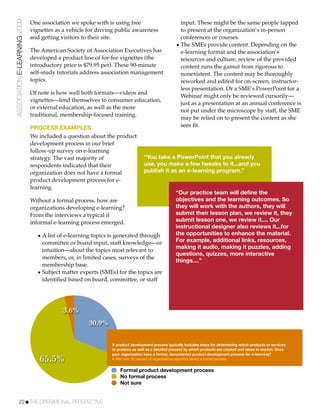
                              strategy. The vast majority of                   “You take a PowerPoint that you already
                              respondents indicated that their                 use, you make a few tweaks to it...and you
                              organization does not have a formal              publish it as an e-learning program.”
                              product development process for e-
                              learning.
                                                                                                 “Our practice team will define the
                              Without a formal process, how are                                  objectives and the learning outcomes. So
                              organizations developing e-learning?                               they will work with the authors, they will
                              From the interviews a typical if                                   submit their lesson plan, we review it, they
                              informal e-learning process emerged.                               submit lesson one, we review it.... Our
                                                                                                 instructional designer also reviews it...for
                                • A list of e-learning topics is generated through               the opportunities to enhance the material.
                                  committee or board input, staff knowledge—or                   For example, additional links, resources,
                                                                                                 making it audio, making it puzzles, adding
                                  intuition—about the topics most relevant to
                                                                                                 questions, quizzes, more interactive
                                  members, or, in limited cases, surveys of the
                                                                                                 things....”
                                  membership base.
                                • Subject matter experts (SMEs) for the topics are
                                  identified based on board, committee, or staff


                                           3.6%
                                                     30.9%

                                                              A product development process typically includes steps for determining which products or services
                                                              to produce as well as a detailed process by which products are created and taken to market. Does
                                                              your organization have a formal, documented product development process for e-learning?
                                 65.5%                        A little over 30 percent of organizations reported having a formal process.


                                                                  Formal product development process
                                                                  No formal process
                                                                  Not sure


           22!THE OPERATIONAL PERSPECTIVE
ASSOCIATION E-LEARNING 2009     • For e-learning where instructors or presenters     initiatives?” Director of education—or what we
                                  interact with learners, staff (or their proxy      consider the equivalent (e.g., director of
                                  vendors or contractors) train them on how to       professional development)—was the most common,
                                  use the relevant software (e.g., a Web             with 62 responses.
                                  conferencing system or a learning management
                                  system).                                           C-level job titles or the equivalent (vice president,
                                • As is common with place-based training, e-         chief learning officer, etc.) were reported 41 times,
                                  learners are often asked to evaluate their         and 36 respondents indicated the head of the
                                  learning experience after completing it—or, in     organization (executive director, CEO, etc.) has
                                  the case of longer offerings, evaluations may be   responsibility for the e-learning initiatives.
                                  requested periodically throughout and at the       Collectively these two groups of responses show
                                  end of the training. In an ideal world, this       that a big chunk put e-learning responsibility right
                                  feedback is mined for ways to improve future       at the top of the organization. Of those reporting the
                                  offerings.                                         CEO or executive director is responsible, the vast
                                                                                     majority (but not all) have annual budgets of less
                              Personnel and Tools: Who Gets It                       than $5 million and staffs smaller than 30. As would
                              Done and How                                           be expected, the larger, more flush associations, tend
                                                                                     to delegate responsibility for e-learning, but many
                              JOB TITLES                                             larger associations still keep the responsibility very
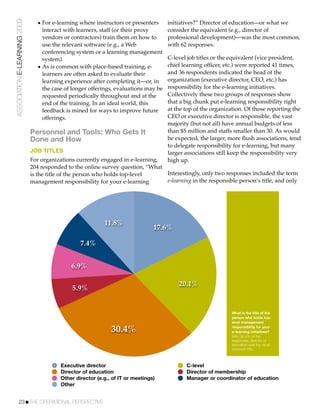
                              For organizations currently engaged in e-learning,     high up.
                              204 responded to the online survey question, “What
                              is the title of the person who holds top-level     Interestingly, only two responses included the term
                              management responsibility for your e-learning      e-learning in the responsible person’s title, and only


                                                            11.8%
                                                                                 17.6%

                                                  7.4%


                                              6.9%

                                                                                         20.1%
                                              5.9%


                                                                                                               What is the title of the
                                                                                                               person who holds top-
                                                                                                               level management

                                                               30.4%                                           responsibility for your
                                                                                                               e-learning initiatives?
                                                                                                               With 30.4% of the
                                                                                                               responses, director of
                                                                                                               education was the most
                                                                                                               common title.


                                          Executive director                                C-level
                                          Director of education                             Director of membership
                                          Other director (e.g., of IT or meetings)          Manager or coordinator of education
                                          Other


           23!THE OPERATIONAL PERSPECTIVE
ASSOCIATION E-LEARNING 2009    two included the broader (and older) term          can work in education—if you can give
                               distance education.                                a presentation, you’re an educator.

                               From the interviews, we learned that,            ADEQUACY OF RESOURCES
                               despite the prevalence of the director of        From the interviews we learned, not
                               education job title, many of those in charge     surprisingly, that most organizations—
                               of e-learning at their organizations do not      whether large or small—felt they had more
                               have a formal background in education.           to do than they had time or resources:
                               We talked with many people who came to
                               e-learning from communications,                    • “I did capacity planning...and I
                               marketing, public relations, and business.           discovered I was one staff person
                               One interviewee noted this phenomena:                short. I did make a request, but, of
                                                                                    course, I was turned down. But
                                  My sense is that the vast majority of             somehow the work gets done.... I
                                  staff working in education departments            don’t believe in throwing more things
                                  have come from somewhere else. It may             at people, you just dilute the quality or
                                  have been in the membership                       you exhaust people—it gets
                                  department or even from outside the               frustrating.”
                                  sector, which is fine—there is nothing           • “We don’t have enough staff
                                  wrong with that—but, if you go into an            resources. All our courses should be
                                  accounting department in an                       updated, but that’s a full-time job for
                                  association, you have a CPA.... I think           someone. Plus we’re launching new
                                  our area is more fuzzy.... The education          courses, so staff time is a major
                                  staff are doing a great job, doing the best       problem. Resources internally become
                                  they can, but they’re not aware of                very difficult to get, like the marketing
                                  resources and tools that are available to         thing, the IT thing—they all have
                                  them. It’s almost like they are managing          other jobs, and e-learning is just one
                                  a product that could be any product.... I         more added to their pile.”
                                  don’t think they’re as perceived as             • “I think everybody would always like
                                  specialty experts as some of the other            resources. I work for a really small
                                  professions are. It’s almost like anyone          organization [fewer than five staff], so


                                 “It’s almost like anyone can work in
                                 education—if you can give a
                                 presentation, you’re an educator.”


           24!THE OPERATIONAL PERSPECTIVE
ASSOCIATION E-LEARNING 2009       you have to really carry your load twice. So,         handholding behind the scenes, which I’ve heard
                                  yes, it does take a lot of time, and it takes a lot   from a lot of other people that that is real common,
                                  of finessing and political skills and talking to       and that’s what you need to do to make this stuff
                                  people forever. Yesterday I had an hour and a         succeed”—to technical troubleshooting.
                                  half meeting with two presenters [for an
                                  upcoming Webinar]. I think that could have               Our end users aren’t very technologically
                                  been more efficient; it could have been 10                advanced. It doesn’t seem to be age-based. We had
                                  minutes, but that happens. It does help to have          thousands of students go through one of those
                                  a vendor, but we do do a lot of it. We do all the        programs, and I got the sense that we needed some
                                  promotion, e-mail promotions, we promote on              customer support, and I’m happy that it went to
                                  our Web site, we promote it in our                       an outside vendor this summer who supports us
                                  newsletter....”                                          with call centers. We had roughly 40 percent of
                                                                                           the people putting in calls, several thousand were
                              Even with the bulk of the must-do work getting               calling. And they may have been calling about
                              done, the lack of resources limits organizations’            minor things, but the range was unbelievable.
                              ability to update their offerings or dabble in new
                              realms like social media and cuts into the time for       Before outsourcing to the call center, this
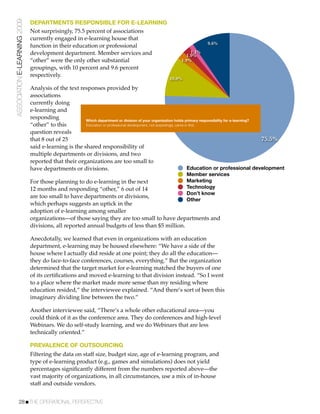
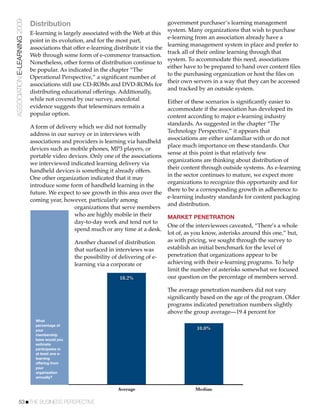
                              essential strategic thinking.                             organization of eight full-time staff swelled its
                                                                                        ranks, for a time, to include eight part-timers just to
                                • “I’m a bit overloaded with everything that            deal with customer service on its e-learning
                                  everyone wants to be done and all the research        products.
                                  that has to be done. So if we started to run a
                                  full-time blog or anything like that, it’s            On the flip side, at least one interviewee was able to
                                  definitely going to require, I think, another          point out a reduction in staff time as a result of
                                  person’s workload.”                                   moving to online system for claiming continuing
                                • “It’s definitely time-consuming by the time you        education as part of her organization’s e-learning
                                  figure out what you are going to do, and you           initiative: “In terms of staff hours spent processing
                                  find your speakers, and you put together your          this stuff [credit claims], we’ve gone from about 45
                                  PowerPoint, and you promote it. It does take a        to 50 hours a week of people processing paper to
                                  lot of manpower.... We definitely don’t have the       probably about 7 hours max, maybe 5.”
                                  resources to do some kind of strategic planning
                                                                                        WHERE TO TURN FOR HELP
                                  and thinking about our whole education
                                  offering.”                                            Since the staff responsible for association e-learning
                                                                                        are likely to not come from an e-learning or even
                              Given the near universal sense that there aren’t          education background and since they are strapped
                              enough resources, what are some of the big time           for resources, we asked our interviewees where they
                              sinks? For some, it is the sheer newness of e-            turn for information and guidance on e-learning. A
                              learning complicated by simultaneous projects:            few sources cropped up regularly:

                                 It was certainly more than I had expected, but I          • American Society of Association Executives
                                 also take into consideration that we implemented            (ASAE): http://www.asaecenter.org
                                 an LMS at the same time, so there were many               • American Society of Training & Development
                                 different projects going on... [F]or me it was the          (ASTD): http://www.astd.org
                                 first time building a full online course—and not           • eLearning Guild: http://
                                 even having to necessarily focus on the content so          www.elearningguild.com
                                 much, given that it was already created—it was            • Internet in general (e.g., Google searches on
                                 certainly a learning process.                               relevant keywords)

                              For others, customer service and support have             Coupled with that handful of concrete sources for
                              demanded a great deal of attention. This can range        help, though, was a recurring sense that
                              from handholding—“There is a lot more                     organizations would like to be connecting with


           25!THE OPERATIONAL PERSPECTIVE
ASSOCIATION E-LEARNING 2009   other associations doing similar things: “Really for
                              myself, I need to do a better job of getting in touch     “I don’t find that there are a lot of other
                              with other folks at my level at other associations.”      people like me in the association world,
                              But that desire is tempered by a sense that there         doing the kind of e-learning that I’m doing.
                              either aren’t great e-learning success stories in the     They are either doing really grand stuff that
                              association world—“I have not encountered                 I’m never going to do, or they’re not doing
                                                                                        anything at all, and they think it’s
                              anybody that is soaring in distance education”—or
                                                                                        completely impossible, so they are not
                              that the lessons that other associations have
                                                                                        interested in it.”
                              learned may not be relevant—“I don’t find that
                              there are a lot of other people like me in the
                              association world, doing the kind of e-learning that
                              I’m doing. They are either doing really grand stuff
                              that I’m never going to do, or they’re not doing
                              anything at all, and they think it’s completely
                              impossible, so they are not interested in it.”

                              Another interviewee lamented:

                                 We would love to be able to have a network of
                                 associations that are not afraid to talk to each
                                 other, that would share information, and we could
                                 all learn from each other. But some of us are
                                 competitors, and that’s understandable. The for-
                                 profit world is a totally different world, and there
                                 are for-profit entities out there selling e-learning.
                                 That’s not us; we have our own set of issues and
                                 things that we have to deal with. And there’s no
                                 place really to go and have that discussion.

                              Interviewees mentioned other sources for advice
                              on e-learning but with much less frequency than
                              those noted above. These included:

                                 • Coworkers
                                 • Consultants
                                 • Vendors
                                 • Members
                                 • Board members and committees

                              In this list of sources, the value of the input varied
                              greatly. For example, while some associations find
                              their committees and boards wonderful sources,
                              one interviewee said, “Our leadership, our board,
                              it’s helpful only in a small way to be honest, so we
                              don’t really look to our board for guidance [on e-
                              learning].” Another said, “We have a corporate
                              board, and they’re supposed to come up with
                              ideas of things that we could turn into e-learning
                              or Webcasts. Nine times out of ten, they’re way off
                              base, unfortunately.”


           26!THE OPERATIONAL PERSPECTIVE
ASSOCIATION E-LEARNING 2009
                                                 Building Internal Capacity—and Interest
                                                 Community Associations Institute
                                                   Dave Jennings at the Community Associations Institute (CAI) is consciously thinking
                                                   of how to engage the staff—and not just the education staff—in the organization’s e-
                                                   learning.

                                                   “Let’s say, if we have 55 staff here, we’d be getting a team of 7 or 8 staff people who
                                                   are interested in this, who want to be involved,” Jennings explained. “They may
                                                   work in any department in the building, whether it’s customer service or accounting,
                                                   but they might think that this is interesting and fun, they want to learn about it, they
                                                   want to help.”

                                                   The idea is to harness the staff’s enthusiasm and interest to build up internal
                                                   knowledge and experience. An interested staff member can develop her own idea for
                                                   a Webinar—or be assigned one—and then she runs with it: contacting the speaker,
                                                   dealing with contracts, getting the event produced. For Jennings, the advantage is
                                                   clear: “If we say a year from now, or even 6 months from now, that we are going to
                                                   do podcasts, the gap between where the staff thinks they are and what they think it
                                                   will take to produce a podcast right now might be a 100-point gap, but after 6 to 12
                                                   months of doing Webinars, that gap could shrink to 20 points. So we get a staff that
                                                   thinks they could do that—if they want to do it, then they can do it.”

                                                   Although CAI is happy to have good vendor relationships that work well now,
                                                   Jennings likes having the option in the future to do more internally, save time, and be
                                                   more efficient. Involving all interested staff in the production of CAI Webinars is part
                                                   of his plan for getting there.


                              “[A]fter we’ve done 20 or 30 of these, a
                              major benefit to us will be having a staff
                              that is very comfortable producing
                              Webinars, and I think that will help us
                              create other products more easily.”
                              Dave Jennings, vice president, education


           27!CASE STUDY
ASSOCIATION E-LEARNING 2009   DEPARTMENTS RESPONSIBLE FOR E-LEARNING
                              Not surprisingly, 75.5 percent of associations
                              currently engaged in e-learning house that
                                                                                                                     9.6%
                              function in their education or professional
                              development department. Member services and                                   1.1%
                                                                                                          1.9%
                              “other” were the only other substantial                                   1.9%
                              groupings, with 10 percent and 9.6 percent
                              respectively.
                                                                                                  10.0%

                              Analysis of the text responses provided by
                              associations
                              currently doing
                              e-learning and
                              responding              Which department or division of your organization holds primary responsibility for e-learning?
                              “other” to this         Education or professional development, not surprisingly, came in first.
                              question reveals
                              that 8 out of 25                                                                                                       75.5%
                              said e-learning is the shared responsibility of
                              multiple departments or divisions, and two
                              reported that their organizations are too small to
                              have departments or divisions.                                                          Education or professional development
                                                                                                          Member services
                              For those planning to do e-learning in the next                 Marketing
                              12 months and responding “other,” 6 out of 14                   Technology
                                                                                              Don’t know
                              are too small to have departments or divisions,
                                                                                              Other
                              which perhaps suggests an uptick in the
                              adoption of e-learning among smaller
                              organizations—of those saying they are too small to have departments and
                              divisions, all reported annual budgets of less than $5 million.

                              Anecdotally, we learned that even in organizations with an education
                              department, e-learning may be housed elsewhere: “We have a side of the
                              house where I actually did reside at one point; they do all the education—
                              they do face-to-face conferences, courses, everything.” But the organization
                              determined that the target market for e-learning matched the buyers of one
                              of its certifications and moved e-learning to that division instead. “So I went
                              to a place where the market made more sense than my residing where
                              education resided,” the interviewee explained. “And there’s sort of been this
                              imaginary dividing line between the two.”

                              Another interviewee said, “There’s a whole other educational area—you
                              could think of it as the conference area. They do conferences and high-level
                              Webinars. We do self-study learning, and we do Webinars that are less
                              technically oriented.”

                              PREVALENCE OF OUTSOURCING
                              Filtering the data on staff size, budget size, age of e-learning program, and
                              type of e-learning product (e.g., games and simulations) does not yield
                              percentages significantly different from the numbers reported above—the
                              vast majority of organizations, in all circumstances, use a mix of in-house
                              staff and outside vendors.


           28!THE OPERATIONAL PERSPECTIVE
ASSOCIATION E-LEARNING 2009   That said, organizations that charge for none of                         company again and pay the same amount again.
                              their e-learning offerings are more likely to develop                    He told me, whatever I recommend, whatever I am
                              those offerings completely in-house (29.4 percent                        comfortable with, and I said that I was always up
                              versus 17.6 percent of those organizations who                           for a professional development challenge myself,
                              charge for all their e-learning offerings), and                          let’s license it, I’ll learn to do it, and I’ll do the
                              organizations with staffs larger than 30 are more                        moderation, which is what we’ve done. And I
                              likely to develop entirely in house (19.4 percent                        think that’s a key in being able to generate revenue
                              versus 7.5 percent doing it all out of house).                           versus struggling to generate revenue from
                                                                                                       Webinars.... However I think that there are some
                              The interviews support the commonsense thinking                          organizations...who couldn’t believe that we do it
                              that the main attraction of using outside vendors is                     ourselves, but clearly they were so nervous about
                              that they make the work easier for the association,                      it that for them hiring an organization to do it for
                              and the main downside is that they can be pricey:                        them was probably their best investment. So for
                              “We use a third party [for our Webinars]. They                           some people and some organizations that really is
                              make it an easy process for us, but it’s an expense                      a good fit; for us, it’s been much better to license
                              that we are not really recouping, so we are                              the system, leverage it across the whole year, and
                              definitely looking at other options.” For some                            the first Webinar paid for it and the rest of the
                              organizations, the staff are excited by the                              Webinars help us to hit various revenue marks
                              opportunity to learn new things and ready to take                        that we want to hit.
                              on more while saving the organization money—but
                              that decision is not for everyone.                                   For organizations that do decide to use outside
                                                                                                   vendors, many asserted that the choice should take
                                 I said to the executive director, we’ve got two key               into account the technology and the association’s
                                 choices here—we can license the system [Web                       reality and relationship with the provider.
                                 conferencing software for Webinars] for a year,
                                 and we can get unlimited use for it, so we can use                    When I examined all the different vendors who
                                 it for meetings, we can use it for Web conferences,                   provide Webinars and teleconferencing, I looked at
                                 we can do all kinds of stuff with it, or we can hire                  the big players and the small players and those in
                                 a company to do it once at the same price, and                        the middle, and we selected Provider X because
                                 when we do the second one, we’ll have to hire that                    they were well priced, and they didn’t have too
                                                                                                       many bells and whistles. Our members are on the
                                                                                                       unsophisticated side, technology-wise, so too
                                                                                                       many bells and whistles would have thrown them
                                                                                                       as well as our staff. I didn’t feel 100 percent
                                              12.8%              18.3%
                                                                                                       comfortable, and the Provider X system was easy
                                                                                                       for me to understand how to operate, and we have
                                                                                                       had very few problems with our attendees not
                                                                                                       being able to figure it out.


                                                                 Are your e-learning offerings developed entirely in-house, using a mixture of in-house
                                                                 staff and outside vendors, or completely using outside vendors?
                                                                 The vast majority of associations use a combination of internal and external resources.


                                                 68.9%                                                   Entirely in-house
                                                                                                         Mix of in-house and consultants or vendors
                                                                                                         Completely outside vendors


           29!THE OPERATIONAL PERSPECTIVE
ASSOCIATION E-LEARNING 2009   THE COST OF EXPERTISE
                              We asked the organizations we interviewed if they typically pay the subject matter experts (SMEs) who
                              develop the content for their e-learning offerings. Most don’t, some do, and some use a mixed model that
                              involves paying some SMEs and not others.

                              For many organizations who don’t pay, it boils down to precedent—they don’t pay presenters for the
                              annual meeting—or the bottom line—they can’t afford to pay. “Free” expertise is a huge boon and not
                              only for e-learning: “[W]e have about 80 instructors, and we don’t pay them a dime to teach two-day
                              classes; we just pay for their trip. They get no honorarium and hardly any recognition. We try but right
                              now the organization doesn’t have a really good structure for recognizing and thanking them like you
                              would think it would, but that saves the organization $200,000 or $300,000 a year, that they’re not paying
                              any honorariums. That’s amazing to me.”

                                                                    But associations in this free-SME camp realize the drawbacks of a
                                                                    volunteer-only approach: “[This use of members as SMEs] limits us a
                                                                    bit because there are some things that our profession wants to learn
                                                                    about that the professionals within the profession don’t have the
                                                                    subject matter expertise in, so we have not gone down that road yet
                                                                    of finding those outside people and paying them for their subject
                                                                    matter expertise, and that limits the kind of courses that we make
                                                                    available.”

                                                                    Organizations who do pay SMEs tend to do so because a little
                                                                    payment can go a long way toward improving the experts’
                                                                    likelihood of hitting deadlines and incorporating feedback or
                                                                    because they’re asking the SMEs for something original rather than
                                                                    recycled content: “I find we have to pay [our SMEs]. If I want to get
                                                                    a finished product out, then the best way to do it is with payment. I
                                                                    think that the industry has changed over the years with that. I see a
                              “[W]e have about 80 instructors,      definite shift towards that. I will get a volunteer to review materials
                              and we don’t pay them a dime          if that review is not too extensive or not too deep and they only have
                              to teach two-day classes; we          to read a sentence here or there. But if I’m going to do development
                              just pay for their trip.... [T]hat    from scratch then we have to pay.”
                              saves the organization $200,000
                              or $300,000 a year.... That’s         Even when financial compensation is given to SMEs, it may be more
                              amazing to me.”                       of a token gesture than a true-market-value estimation of their time
                                                                    and expertise. The figures we heard for a 60- to 90-minute Webinar
                                                                    ranged from $200 to $300. One organization shared that it pays SMEs
                                                                    $2,500 for a one- to two-hour self-paced course and $5,000 for a
                                                                    three- to four-hour course—”so they have some skin in the game
                                                                    too.” It should be noted that this association does have its SMEs sign
                                                                    over intellectual property rights to the self-paced course as part of
                                                                    the agreement.

                                                                    In summary, you may not have to pay for your subject matter
                                                                    expertise if service and volunteerism are well established in your
                                                                    organization. On the other hand, you may need to pay to get
                                                                    responsiveness and original, more thoughtful content.


           30!THE OPERATIONAL PERSPECTIVE
ASSOCIATION E-LEARNING 2009   AUTHORING TOOLS
                              Microsoft PowerPoint is king and queen of e-learning development tools, the only one with greater than 50
                              percent usage in our online survey of associations currently engaged in e-learning. And PowerPoint
                              remains on top no matter staff size, budget size, or age of e-learning program.

                                                                 PowerPoint                                                                          60.4%
                                                        LMS or LCMS tools                                     24.8%
                                                                Adobe Flash                                  24.3%
                                                      Adobe Dreamweaver                           14.9%
                                                        Articulate Presenter                     13.5%
                                                           Adobe Captivate                8.1%
                                                           Camtasia Studio               7.2%
                                                            Adobe Connect            3.7%
                                                          Lectora (Trivantis)     1.4%
                                    Which of
                                    the                     Outstart Trainer     0.9%
                                    following         Toolbook (SumTotal)        0.9%
                                    authoring                      ReadyGo       0.5%
                                    tools, if any,
                                    does your
                                                                      WebEx                                     26.6%
                                    association               GoToMeeting                                   22.5%
                                    use for          Microsoft Live Meeting                      13.5%
                                    creating e-
                                    learning?
                                                                    Genesys           1.8%
                                    Microsoft                     ReadyTalk          0.9%
                                    PowerPoint                   Elluminate          0.9%
                                    was the
                                    indisputable                       Other                        17.1%
                                    front-runner.
                                                                                0%                  20%                  40%                     60%

                              If we look just at organizations that have a learning management system (LMS) or learning content
                              management system (LCMS), then the category for tools provided in the LMS or LCMS goes way up to
                              58.2 percent from 24.8 percent, finally—but just barely—beating PowerPoint out as the most popular tool
                              (PowerPoint comes in at 57 percent for this group). Despite the increase, it is interesting that use of LMS
                              and LCMS tools is not even higher among these organizations. This could be because the LMS does not
                              offer built-in course development tools or because the organization began its e-learning without an LMS
                              and stuck with the same course development tools even after an LMS was added. It could also be that the
                              LMS or LCMS tools are not as user- or process-friendly as other options: “The authoring part [of our LMS]
                              is not that clear, so we have the authors prepare the content in Word. Then we convert it into the authoring
                              system. I’m in the process of looking at authoring tools, to understand if there could a better route.”

                              INSTRUCTIONAL DESIGNERS
                              For those currently doing e-learning,
                              organizations are equally split between
                              using professional instructional                               10.6%
                              designers (IDs) and not. But, if you
                              factor in the type of e-learning
                              produced, the split shifts. For
                              organizations offering blended                                                      43.5%
                              learning, 73 percent use professional
                              instructional designers, and 62.8                                                                  Does your organization
                              percent of associations offering self-                   45.9%                                     make use of professional
                                                                                                                                 instructional designers
                              paced and 59.2 percent offering                                                                    (whether on staff or by
                                                                                                                                 contract) when developing
                              facilitated e-learning use professional                                                            its e-learning offerings?
                              IDs.                                                                                               The responses were almost
                                                                                                                                 evenly split.


                                                                           Use professional IDs             Don’t use professional IDs           Not sure

           31!THE OPERATIONAL PERSPECTIVE
ASSOCIATION E-LEARNING 2009   As the stakes go up, the use of professional IDs
                              goes up too. For organizations offering continuing
                              education (CE) toward a credential, 50.4 percent
                              use professionals versus 40.5 percent who do not.
                              Compare that to organizations offering CE but not
                              toward a credential—only 33.9 percent use
                              professional IDs, while 53.2 percent do not—and to
                              organizations offering no credit at all—again only
                              33.9 percent use professionals, while 56.7 percent
                              do not.

                              Part of this increase may be attributable to the use
                              of assessments in e-learning tied to credentials.
                              When tying content to learning domains and
                              writing questions is key, organizations may see
                              more value in the added vetting a professional ID
                              brings.
                                                                                      “[A]ssociations are notoriously
                              The longer the organization has been involved in e-     shortsighted when it comes to [investing in
                              learning, the more likely it is to use professional     professional instructional design].
                              IDs. For e-learning programs less than a year old,      Oftentimes they just don’t want to spend
                              only 35.7 percent use professionals; almost double      the money for it, and unfortunately
                              the number (67.5 percent) of programs older than        sometimes the programs suffer for that.”
                              five years use professionals

                              The use of professional IDs is also higher among
                              organizations using an LMS—71.3 percent—
                              compared to those without an LMS—23 percent.

                              From out interviews, we learned that the opinion
                              of instructional designers varies widely. Some
                              interviewees were not even familiar with the term,
                              others didn’t think they added value, others
                              thought they added value but weren’t something          • “[Y]ou need a good instructional designer for
                              their organization could afford or support, and still     online learning,” said one association
                              others believe them indispensable.                        interviewee, who happens to be an
                                                                                        instructional designer. “I do recommend,
                                 • “We tried that [using professional instructional     especially for individuals who may be in a
                                   designers], and we didn’t get a lot from the one     position like mine or have this responsibility in
                                   that we picked. I wasn’t impressed at all.” This     their association and they don’t have an
                                   association interviewee continued, “I just felt      instructional design background or don’t have
                                   like I could have figured it out myself. It was       an instructional design background in online
                                   sort of like, let’s put some video out, and then     learning, which is different, then they definitely
                                   let’s have a couple of questions, and then let’s     need to make sure that they hire someone to
                                   put some more video, and then we’ll retest           handle that or they are gong to end up with an
                                   them. And I thought, I already know this. So I       asynchronous course that’s just not going to be
                                   don’t know if that’s an expertise as much as         very good.”
                                   common sense. So since then, we haven’t [used      • One vendor we interviewed said, “We used to
                                   professional instructional designers]. I             have someone on staff devoted just to that
                                   wouldn’t say that I would never do that, but         [instructional design], but we couldn’t support
                                   I’d rethink it probably.”                            that person, and that was back in the late 90s,


           32!THE OPERATIONAL PERSPECTIVE
ASSOCIATION E-LEARNING 2009        early 2000s. We would refer people to an
                                   outside instructional designer, and, quite
                                   honestly, associations are notoriously
                                   shortsighted when it comes to that. Oftentimes
                                   they just don’t want to spend the money for it,
                                   and unfortunately sometimes the programs
                                   suffer for that.”
                                 • “Right now we don’t have the funds or the
                                   support [to use professional instructional
                                   designers],” said one interviewee who came
                                   the association world from ASTD, so you can
                                   imagine how sorely he feels the lack.

                              For organizations that opt to forego professional
                              instructional designers, that may not mean they
                              aren’t thinking about instructional design:

                                 The real advantage with Staff Person X is that we
                                 have so many acronyms of things that go on in
                                 our world, and she understood the terminology.
                                 Rather than trying to explain to an instructional
                                 designer what all this terminology meant, she was
                                 already there, and it was on-the-job learning how
                                 to do instructional design. She’s really very self-
                                 taught and has learned a lot of this stuff herself.
                                 She’s taken us to something that we hadn’t been
                                 able to do before.

                              Others echo the sentiment that e-learning is not
                              rocket science: “I’ve learned that regardless of what
                              the program is you have to be able to get the
                              information you need from the experts and deliver
                              it in a way that it needs to be delivered, what it is,
                              training program, doesn’t really matter. It’s all the
                              same for me.”


           33!THE OPERATIONAL PERSPECTIVE
ASSOCIATION E-LEARNING 2009


                                                                     “When I came [to the association], there was already one
                                                                     course being sold on the Internet as an e-learning course. It
                                                                     was basically 400 PowerPoint slides from our face-to-face
                                                                     course.... It has sold pretty well despite some of its
                                                                     challenges.”


                              Summary                                                 slides to e-learning will rise. Whether using these
                                                                                      tools on their own or working with outside service
                              This chapter focused on operational issues—we
                                                                                      providers, we also expect to see a surge in the
                              looked at the types of e-learning products
                                                                                      amount of place-based conference content that
                              associations are offering, who’s responsible for
                                                                                      associations convert into on-demand online
                              leading their e-learning initiatives, and how they’re
                                                                                      learning.
                              getting it done, both in terms of tools, like
                              PowerPoint and Flash, and strategies, like            Economic pressures to make the best use of already
                              outsourcing and whether to pay the price for          tight resources are increasing. Associations will
                              professional instructional design.                    handle some e-learning in house to avoid additional
                                                                                    invoices, but they’ll also turn to vendors and
                              We’ll conclude with some trends and opportunities
                                                                                    consultants to draw on expertise and allow limited
                              we see and questions to ask of your organization as
                                                                                    staff to attend to other priorities—which is to say,
                              you begin to plan or continue to purse an e-learning
                                                                                    outsourcing is likely to remain part of a “healthy”
                              program.
                                                                                    resourcing mix. But we believe the use of e-
                                                                                    learning service providers and consultants will
                              Trends and Predictions
                                                                                    become more thoughtful as associations build
                              We believe in the next year more associations,
                                                                                    their own knowledge and experience and see
                              including ones with small budgets and small
                                                                                    outsourcing as a strategic choice rather than a
                              staffs, will throw their hats in the e-learning ring.
                                                                                    necessary one.
                              Tools have gotten cheaper, better, and easier, and
                              many organizations are finding success with            Related to the previous point, as organizations seek
                              “simpler” e-learning formats, like teleconferences,   to grow their e-learning offerings and create higher-
                              online chats, and Webinars. Your offerings don’t      quality products, we believe interest in
                              have to be fancy or expensive to succeed. And with instructional design will increase. Organizations
                              the current economic recession, the travel-savings    will make efforts to build capacity in-house as well
                              appeal of e-learning will only ring truer.            as to contract with outside instructional designers.

                              PowerPoint is a mainstay of corporate training, and
                              there’s every reason to believe it will remain
                              prevalent in the association world too. We predict
                              the use of tools (like Articulate Presenter or Adobe
                              Captivate) that make it easy to convert PowerPoint


           34!THE OPERATIONAL PERSPECTIVE
ASSOCIATION E-LEARNING 2009


                              Questions to Consider                                     leverage the resources of other functional areas
                               1.What is your process for determining the forms         across the organization to deliver, market, and
                                 of e-learning you offer and the topics you             support your e-learning offerings?
                                 address? Do you have a standardized process          5.How can you use outsourcing strategically for
                                 for working with subject matter experts to             e-learning to scale and complement your
                                 create your e-learning products and services?          internal skill set? What is the association’s
                                 Have you documented these processes in a               overall take on outsourcing? Is outsourcing
                                 way that they can be shared with those who             used elsewhere in the organization? How? If
                                 need to know them?                                     you have no Flash programmer, look for that
                               2.If you’re considering starting an e-learning           skill in a service provider; if you have no
                                 program, which format or formats are right for         professional instructional designer and think
                                 your audience, topic, budget, and human                that is important, look for that in a vendor.
                                 resources (including staff, contractors, and         6.Are you asking for—and getting!—valuable
                                 vendors)? Is your audience tech-savvy and              input from any outside service providers you
                                 impressed by bells and whistles, or are they           use? Look for vendors who provide more than
                                 wary of new technology and need a lot of               just a tool and can help support your overall e-
                                 handholding? What are you capable of and               learning initiative.
                                 comfortable doing internally? As an example,         7.Has your leadership tried your (or other) e-
                                 live Webinars may be more difficult to schedule         learning and provided feedback? Getting your
                                 for international organizations because time           leadership’s buy-in and participation can be
                                 differences leave a small slice of overlapping         critical to making your e-learning program
                                 work hours and because different regulations           really work.
                                 (and therefore topics) apply, but the extra effort
                                 allows you to connect people who wouldn’t
                                 otherwise get to interact.
                               3.If you already have an e-learning program, is it
                                 time to branch out into new products, or do
                                 you need to cut back to focus strategically on
                                 the successful offerings? Think about how your
                                 products fit together and fit with the rest of the
                                 association’s work. Can your publications
                                 become sources for e-learning topics, or vice-
                                 versa?
                               4.Whether you already have an e-learning
                                 program in place or plan to add one, what is
                                 your approach to building capacity for e-
                                 learning in your organization? Do you have a
                                 good understanding internally of adult
                                 learning principles and instructional design as
                                 they relate to e-learning? How will you


           35!THE OPERATIONAL PERSPECTIVE
ASSOCIATION E-LEARNING 2009
                                                                                          Cindy Hartley
                                                                                          Director of member relations at the Southern Building Material Association


                              Cultivating Success
                              Southern Building Material Association
                              When Cindy Hartley launched a Webinar series for the Southern Building Material Association
                              (SBMA), a group that serves building materials dealers across four states, she knew success was not
                              guaranteed. “My industry does not tend to be the most technologically advanced,” explained Hartley.

                              “To help make sure that I was successful,” Hartley continued, “I went to our board of directors and
                              urged them to help, ‘Please join us for the first one. I need your input on how this worked, what you
                              think should be changed, what benefits you see in it. You are a member of our board of directors, and I
                              really want your support in developing this.’”

                                                                   Hartley personally sent the board members registration forms for
                                                                   Webinars and called them to remind them she needed their support
                               “I called [our board] on
                                                                   and feedback on SBMA’s first foray into e-learning. Hartley said that
                               the telephone and said, ‘I
                               need you to support this.           enlisting the board was a “tremendously helpful” part of getting the
                               We will never get started           program off the ground, but she didn’t stop there.
                               if we can’t get the first
                               [Webinar] done....’”                Hartley also embraced the enthusiasm of SBMA’s sister organizations
                                                                   who contacted her when they saw the Webinar program and asked to
                               CIndy Hartley, director of member   participate. “[T]hey asked how we were doing it. When they saw us
                               relations
                                                                   put out the second and third ones, they asked if they could join in.” So
                                                                   Hartley created a registration form the other organizations could use
                                                                   and brand with their logo.

                              Now when SBMA delivers a Webinar, the attendees may include members from sister organizations
                              across the country. SBMA bills its sister organizations at cost for the attendees, but Hartley lets them
                              keep the profit. “We get participation,” said Hartley, “not a tremendous amount, but a little bit from all
                              over the place gives you enough to do these kinds of things when you are small.”

                              Given current economic conditions, the Webinar series has replaced the face-to-face trainings that
                              SBMA used to deliver across the region. Hartley does not expect that to be a permanent situation.
                              Eventually the organization will offer both place-based and online training, but in the meantime,
                              Hartley has found the right partners to ensure success of her current program.


           36!CASE STUDY
ASSOCIATION E-LEARNING 2009
                              The Business Perspective
                              Revenue, Strategy, Promotion, and Competition
                              Using the data from our online survey and our                               learning is thus a line of business rather than a cost
                              interviews, we concentrate in this section on the                           center for most organizations. At a minimum, it
                              business perspective of e-learning, which                                   needs to operate on a revenue-neutral basis,
                              encompasses the strategy that drives an e-learning                          bringing in enough income to cover costs. For many
                              initiative, the expenses and income, the marketing                          organizations, it also need to contribute positive
                              of offerings, and the competition that can shape                            revenue to the bottom line.
                              programs.
                                                                                  As might be expected, our research suggests that the
                              The Revenue Imperative                              vast majority of association e-learning programs
                                                                                  must be at minimum self-sustaining, and most are
                              One of the key ways in which association e-learning
                                                                                  also charged with generating positive net revenues.
                              differs from online education and training in the
                              commercial corporate sector is that most
                              associations look to e-learning—and to education in
                              general—as a source of non-dues revenue. E-
                                                                                                                                      16.1%

                                                                                                                                                   33.7%
                                Which of the following statements describes your financial goals for your current
                                e-learning offerings?
                                The vast majority of association e-learning programs must be at a minimum self-
                                sustaining.


                                    Must be self-sustaining but profitability not required
                                    Must be self-sustaining and profitable
                                    Doesn’t need to be self-sustaining (costs subsidized)
                                                                                                                               50.2%


                                                                                                           To meet their goal of financial sustainability, most
                                                 14.0%                                                     organizations charge for at least some of their e-
                                                                                                           learning offerings, and a significant percentage
                                                                                                           charge for all of their offerings.

                                                                                    42.3%


                                                                         Does your association charge for its e-learning offerings?
                                                                         Some 86 percent charge for at least some offerings.

                                    43.7%                                                                 Charge for all offerings
                                                                                                          Charge for some offerings
                                                                                                          Don’t charge for offerings


           37!THE BUSINESS PERSPECTIVE
ASSOCIATION E-LEARNING 2009                         All the association representatives            had put an organizational e-learning
                                                    interviewed for this report indicated a goal   strategy in place.
                                                    of breaking even on the direct costs
                                                    associated with e-learning. These costs        Our conversations with the associations
                                                    include, for example, technology licensing     interviewed for this report as well as our
                                                    fees as well as payments to vendors for        own experience in the field for many years
                                                    Webinar or course development services.        suggests that most organizations approach
                                                    In most cases, the interviewees also           e-learning strategy in an informal, seat-of-
                                                    indicated a desire to cover indirect costs,    the-pants way. As one of our interviewees
                                                    meaning primarily staff time allocated to e-   put it, being given the time and resources
                                                    learning, but in many cases the                to formally develop and document an e-
                                                    organization did not track these costs         learning strategy is “an indulgence.”
                                                    closely and thus did not have a clear idea
                                                                                                We did not ask about e-learning strategy in
                                                    of whether they were being covered or not.
                                                                                                our original survey. We did, however,
                                                    Most of the organizations interviewed       conduct a follow-up survey among
                                                    depended on revenue generated from sales organizations that have implemented e-
                                                    of e-learning programs to cover costs       learning programs and asked these
                                                    associated with producing and delivering    organizations whether they have a formal,
                                                    the programs. In a few instances, however documented e-learning strategy. Only 30
                                                    —particularly in fields tied to medicine or percent of the respondents said they do.
                                                    public health—organizations had
                                                                                                A comment from one of the respondents to
                                                    established or were attempting to establish
                                                                                                the survey seems typical of how e-learning
                                                    a practice of securing sponsorships or
                                                                                                strategy is handled at many organizations:
                                                    grants from corporations or government
                                                    entities to underwrite production and
                                                    delivery costs. In the medical field, it
                                                                                                   We do Webinars as part of our training
                                                    remains to be seen whether future
                                                                                                   for nonprofits. We do budgeting around
                                                    sponsorships will be impacted by recent
                                                                                                   it. We talk about it. But there’s not
                                                    legislation by Massachusetts and other
                                                                                                   really anything “documented” beyond
                                                    states to place restrictions on funding of
                                                                                                   budgets and the workshop descriptions.
                                                    continuing medical education (CME)
                              Does your                                                            It's sad and surely not a best practice,
                              organization have     programs by pharmaceutical and medical
                              a formal,                                                            but we're so busy putting on trainings
                                                    device companies.
                              documented                                                           that we don't have much time to be very
                              strategy for e-
                                                                                                   planful.
                              learning?
                              Right at 60 percent   Strategy
                              do not have a
                              formal e-learning     In a 2005 survey of associations by Jennifer   Our view is that a number of factors will
                              strategy.
                                                                      DeVries of BlueStreak        contribute to e-learning being viewed more
                                                                      Learning, 89 percent of      strategically in the coming years. Certainly
                                                                      respondents stated that      the current state of the economy will be
                                           9.1%                       having an e-learning         one factor. Organizational leaders will look
                                                                      strategy was either          to cut their own costs (which e-learning
                                                        30.9%         critical or very important   may or may not do) and to provide lower
                                                                      to their professional        cost options for members whose travel
                                                                      success. But only 31         budgets have been slashed, or in some
                                                                      percent of respondents       cases, cut entirely. The current economy
                                                                                                   aside, the growth of green thinking, the
                                 60.0%                           Formal e-learning strategy
                                                                                                   growing array of cheap and easy e-learning
                                                                                                   technologies, and the coming of age of a
                                                                 No formal strategy
                                                                 Not sure                          generation that is comfortable doing


           38!THE BUSINESS PERSPECTIVE
ASSOCIATION E-LEARNING 2009   almost everything online will generate more               convincing organizational leaders of the full benefit
                              demand and tear down remaining barriers.                  can be an uphill battle. One director reported:
                              Organizations will have to pursue e-learning more
                              strategically or risk losing learners—and members        We have been able to earn back our investment for
                              —to competition that sees the opportunity in             our asynchronous stand-alone course, which is
                              offering online educational products.                    not inexpensive to do. But I think that a lot of
                                                                                       people tend to look at return on investment in a
                              Return on Investment                                     very narrowly specific financial way because
                                                                                       that’s the way most people think. I’ve been able to
                              Whether through sales, sponsorships, or both, the
                                                                                       work with my association to help them
                              timelines—and the corresponding amount of
                                                                                       understand that there are a lot of different ways to
                              pressure—that organizations indicated for
                                                                                       look at that, even financially. So for example, we
                              achieving a positive return on investment varied
                                                                                                      are able to say that we have earned
                              significantly from organization to
                                                                                                      back the broad scope of the
                              organization. As a rule, the
                                                                        “[E]-learning is              investment but what a lot of people
                              organizations with which we spoke
                                                                        bringing in a lot of          don’t think about is...the investment
                              expected their Webinars to operate
                                                                        people into the               that we made in the asynchronous
                              profitably or on a break-even basis
                              either from day one or within less        organization that             [e-learning] course was roughly the
                                                                        normally weren’t              same kind of investment we would
                              than a year. Among organizations
                                                                        participating with            make, in terms of expenses, for two
                              that had invested in more
                                                                        the organization              of our dozen or so live, in-person
                              sophisticated on-demand products,         previously.”                  sessions per year. But the
                              many anticipated a two- to three-
                                                                                                      asynchronous course...is always out
                              year horizon before their programs
                                                                                                      there—and we estimated that it has
                              would achieve positive net revenues
                                                                                                      at least a three-year shelf life for the
                              and indicated that senior
                                                                                                      topic—so because of that we can say,
                              management and the board accepted
                                                                                                      we reached 400 learners and
                              this as a necessary period for
                                                                                                      growing, for the same investment
                              producing a return. In other
                                                                                                      cost where we might have only hit
                              instances, the pressure to operate
                                                                                                      57 people for one that was in-person.
                              profitably was much higher. “This
                                                                                                      That’s when they realized that it’s
                              department, from the very
                                                                                                      not just an upfront investment; it’s
                              beginning, has had to show it is a
                                                                                                      a matter of reach, and it’s a matter of
                              profit center,” a director at one
                                                                                                      final per-student, per-learner cost
                              organization said.
                                                                                                      over time.
                                 [I]t has to show revenue, it has to
                                                                                                      One of the providers we interviewed
                                 show gross revenue.... Whereas some of our other
                                                                                        expanded on this line of thinking, suggesting that
                                 [educational offerings] were loss leaders, some of
                                                                                        senior management, and ultimately the board, at
                                 our courses and face-to-face conferences, were
                                                                                        many associations tend to think too narrowly about
                                 allowed to be loss leaders for two or three years
                                                                                        the strategic potential of e-learning:
                                 until they built up an audience, we never once
                                 were able to be a loss leader, and that’s very             If I were a forward-thinking association executive
                                 difficult.                                                  I would think about what this means to the
                                                                                            organization, not in dollars and cents
                              A tension between the need to generate a return—or
                                                                                            immediately, but in terms of...member retention,
                              at least break even—and the desire to serve learners
                                                                                            providing services to members that they are going
                              well was palpable in many of the interviews. Even
                                                                                            to value, especially with what is happening in the
                              in cases where programs have been successful from
                                                                                            economy and association memberships and
                              a financial standpoint, interviewees indicated that
                                                                                            spending are going to be looked at much more
                                                                                            critically, and as an association executive I want


           39!THE BUSINESS PERSPECTIVE
ASSOCIATION E-LEARNING 2009      to keep those members, and I want to               Among the associations we interviewed,
                                 keep them engaged, and I think there are           there was clearly nervousness about the
                                 many opportunities to keep them                    potential for a significant drop in
                                 engaged through e-learning. And e-                 registrations for conferences and face-to-
                                 learning might take many different                 face meetings. For most of the
                                 forms; it might be providing services to           organizations we talked to, it was too soon
                                 them to help them maintain their                   to tell what impact, if any, the economic
                                 certification; it might include some of             downturn would have on these offerings,
                                 the things that incorporate social media           but some were already beginning to see a
                                 to get members talking to one another              negative trend in registrations for their
                                 and helping one another. That’s the                place-based events.
                                 approach that I would take, but there are
                                 not a lot of execs who can do that        On the other hand, most of the associations
                                 because they don’t have the support of    and providers we spoke to indicated that
                                 their board. A board wants to see money.  the downturn would likely drive growth in
                                                                           e-learning investment. For providers, in
                               The Impact of the Economy                   particular, this is a positive trend, as the
                                                                           desire to cut risk related to room rentals,
                               Regardless of its broader strategic
                                                                           meals, travel costs, and other expenses
                               potential, it seems likely that current
                                                                           related to place-based education will
                               economic conditions will cause many
                                                                           almost certainly lead to more spending on
                               organizational leaders to look more closely
                                                                           Web-based solutions for delivering
                               at e-learning as an approach to cutting
                                                                           education. In the short term, this spending
                               costs and possibly generating new
                                                                           seems most likely to be directed at
                               revenues to replace revenues declining in
                                                                           Webinars or at services related to capturing
                               other areas.
                                                                           and productizing conference content.
                               As indicated in the initial chapter of this Significant investment in higher-priced
                               report, respondents to the survey indicated content development as well as learning
                               an increase in budgeting for e-learning     management systems, on the other hand,
                               programs, even as budgets for education in seems likely to remain flat or decline.
                               general appear to be flattening out.


                                 Is the economic downturn
                                 negatively impacting e-learning
                                 technology providers?
                                 “The short answer is no. The long answer is no.”


           40!THE BUSINESS PERSPECTIVE
ASSOCIATION E-LEARNING 2009   Even in cases where organizations do invest more in         provide training for licensing and other things,
                              e-learning products and services, it is unclear at this     but their entire training budget has been
                              point whether registrations for Web-based                   completely cut so they are piece-making different
                              programs will rise at all, much less to a degree            subject matter expertise within their staff to
                              necessary to offset the potential decline in revenue        provide the training that is required by law, which
                              from place-based programs. Recent data from the             we know is not going to ensure the most qualified
                              American Society of Association Executives                  and trained staff working in these licensed
                              suggests that the trend for registrations may turn          programs. We’re totally shifting our sales and
                              downward.                                                   marketing strategy from a high-level decision
                                                                                          maker to sell a large block of courses to a direct-to-
                                 Based on this study, reports of a vast migration         consumer, “in this economy you should be the
                                 from face-to-face gatherings to online alternatives      most trained and qualified person, and here’s what
                                 appear to overstate the case. Of people who only         we have to provide you” model.
                                 attended in-person events last year, only three
                                 percent say there’s a high probability they’ll only      We just recently made that decision.... [R]eally we
                                 attended virtual events this year. In fact, if there’s   didn’t launch, launch full on with a full catalog
                                 a migration at all, it’s going the other way: Nine       until October, and we began making sales calls
                                 percent of people who only attended virtual              after our launch party at our annual meeting, and
                                 programs last year say they’re likely to attend          at that time directors were still willing to listen to
                                 only a face-to-face meeting this year.                   us, and we were giving out promo codes, and they
                                                                                          wanted to go and look at the stuff and see how it
                              Another area that is likely to be impacted by the
                                                                                          would fit in. Now that we are making our follow-
                              downturn is bulk sales of courses to corporations,
                                                                                          up calls to that same batch of people, they are all
                              government agencies, or other organizations
                                                                                          telling us that they looked at it, and it’s great, but
                              interested in training a large group of employees.
                                                                                          they don’t have any money. So the difference
                              Training is traditionally one of the first budget areas
                                                                                          between October and January is huge. We were
                              cut when times are tight. Associations that sell to
                                                                                          kind of banking on [agency purchases], and as a
                              training departments will almost certainly see
                                                                                          result we are totally shifting our sales and
                              longer sales cycles or decisions by potential
                                                                                          marketing strategy.
                              purchasers to cut training purchases. One of the
                              organizations we interviewed related how the            Finally, along with the possible impact on
                              decline in demand at government agencies had            registrations and large sales, there is a less obvious
                              caused them to revamp their entire sales strategy:      and potentially longer-lasting change that the
                                                                                      downturn could bring. There is already a tendency
                                 [W]e wanted to talk with high-level decision
                                                                                      across the sector to price e-learning lower than
                                 makers and get them to buy licenses to our course
                                                                                      similar place-based offerings. In the current
                                 catalog for a broad distribution within their
                                                                                      economy, many organizations may be inclined to
                                 agency, particularly because we have a lot of
                                                                                      lower prices even further as a show of support for
                                 trainings that are fundamentally required for
                                                                                      members. Raising prices when conditions improve,
                                 licensing reasons...and we felt like that would be a
                                                                                      however, tends to be more difficult. It is far too soon
                                 great way to make a large chunk of change off of
                                                                                      to tell, but a general deflation of e-learning price
                                 each sale without nickel and diming.
                                                                                      points—and a corresponding drop in margins—
                                                                                      may turn out to be one of the legacies of the current
                                 We’ve priced our stuff at anywhere between $20
                                                                                      economy.
                                 and $50 per course, which is extraordinarily
                                 reasonable, but we price it that way because we
                                                                                      Product
                                 want the volume, and our plan to achieve volume
                                 was through this license concept, and across the     As indicated in the chapter “The Operational
                                 board training budgets have been cut within          Perspective,” associations have embraced a variety
                                 agencies to the level that we talk to agency heads,  of formats for e-learning, with live Webinars being
                                 and they know that they have a requirement to        the most popular format by a significant margin.


           41!THE BUSINESS PERSPECTIVE
ASSOCIATION E-LEARNING 2009   Based on our interviews, product format decisions        number of interviewees was how “tangible” or
                              tend to be driven less by formal assessment of           “actionable” the content for an e-learning offering
                              member needs and more by internal resource               is. Here is how one of the providers we interviewed
                              considerations and a general perception of what          put it:
                              other associations are doing. In our brief follow up
                              survey on e-learning strategy, the vast majority (65.5      What we definitely have seen is tangible content,
                              percent) of respondents indicated that their                meaning content they can walk away with and do
                              organization does not have a formal product                 something with, those are going to drive more
                              development process for e-learning.                         registrations than the more high-level, executive-
                                                                                          level content. But I think that’s always been the
                                                 Webinars are seen as requiring a         case; I don’t know that that is necessarily a
                                Find hot         relatively low amount of direct          reflection of a change in times as much as a
                                topics.          investment. They leverage an             reflection of just people that are most likely to
                                                 educational model already                attend a Webinar. What kind of content are they
                                “Hot topics
                                will always      deeply familiar to associations—         going after? If you can provide a Webinar with
                                sell. But        an expert speaker, most typically        very discernible output, you are going to have
                                other than       a member volunteer, delivering a         better attendance. Let me give you the most basic
                                that, I really
                                don't know.”     presentation on a timely or              example I can think of. For some reason,
                                                 perennially popular topic—and,           regardless of the industry that you are presenting
                                                 as several of the associations we        this to, if you were to promote an Excel Webinar
                                                 interviewed put it, all the other        on how to use Excel to analyze data, it will do
                                                 associations are doing, and we           great. It always does. For some reason people
                                                 need to keep up.                         think, “I’m going to go here. I’m going to get 10
                                                                                          cool things I can walk away from related to Excel,
                              Topics, rather than format, seemed to absorb the            which is a tool that if I don’t use it I think I should
                              greater part of strategic thinking about e-learning         know how to use it.” Very tangible topic.
                              products at the associations we interviewed. In
                              general, topic decisions are driven by a combination     Finally, perhaps one of the most important demand
                              of committee or board input, staff knowledge—or          drivers for e-learning over the long term is whether
                              intuition—about the topics most relevant to              an organization offers some form of valued credit
                              members, or in limited cases, surveys of the             for successful completion of a learning experience.
                              membership base. Few of the organizations with           Credit may take many forms. It may be actual
                              which we spoke had a formal process in place for         continuing education credit, as discussed in the next
                              determining the size of the potential market for a       section, or it may be a certificate or validation that
                              product, the strength of demand in the market, or        some form of compliance has been met. The key,
                              the purchasing process in the market.                    however, is less the credit itself and more the value
                                                                                       associated with the credit. Industries where certain
                              “Hot” topics were cited by all the organizations we
                              interviewed as one of the main drivers of demand
                              for e-learning. These tend to be topics related to         Drive demand for your e-learning with key
                              compliance, regulatory, or public “emergency” type         factors.
                              issues. A recall of tainted peanut butter, for
                                                                                           •Timely or perennially popular topics
                              example, was going on at the time we interviewed
                              representatives for the Institute of Food                    •Actionable content
                              Technologists. This sort of situation creates instant        •Required or highly valued credit
                              demand for education. The current economic crises
                                                                                         The smaller or more competitive your market, the more
                              has also created demand for a range of topics              important these factors become.
                              related to weathering the storm.

                              Aside from the topic being timely and relevant to
                              learners, another key demand driver indicated by a


           42!THE BUSINESS PERSPECTIVE
ASSOCIATION E-LEARNING 2009   types of compliance are required, where some form                           once accreditation is established. Even relatively
                              of certification is required or highly valued, or                            simple certificate programs that do not offer
                              where a certain number of continuing education                              continuing education credit can generate a
                              credits must be earned annually tend to have higher                         significant amount of operational overhead.
                              demand for all of their educational offerings, and e-
                              learning shares in this demand.                      As a matter of strategy, however, common sense
                                                                                   suggests that, all else being equal, a learner will
                              CONTINUING EDUCATION AND CERTIFICATION choose an educational experience that offers some
                              Whether to award some form of credit for e-          form of credit over one that does not. For the most
                              learning is an important decision both operationally part, associations appear inclined to place strategic
                              and strategically for an organization. From an       considerations ahead of whatever operational
                              operational standpoint, there is typically a         burdens the awarding of credit may create. Among
                              significant amount of footwork to be done simply to the respondents to our survey, the majority of
                              be accredited for providing continuing education     organizations that offer or plan to offer e-learning
                              credits—even for a certification or credential        also award or plan to award some form of credit.
                              maintained by the association itself—and usually
                              there are reporting requirements to be followed      Among the organizations we interviewed, most
                                                                                   award some form of credit—most commonly


                                                                         Which type of credit does your organization currently offer or plan
                                                                         to offer for e-learning? Check all that apply.
                                                                         The majority of organizations offering or planning to offer e-learning also award or
                                                                         plan to award some form of credit.


                                                                                                                                                           35.4%
                                                            No credit
                                                                                                                                                        33.3%

                                                                                                                                                                      43.0%
                                    Continuing education (CE or CEU)
                                                                                                                                                                   41.2%

                                                                                                  10.1%
                                 Continuing medical education (CME)
                                                                                                      13.2%

                                                                               1.8%                                                           Current e-learning
                                     Continuing legal education (CLE)
                                                                                       5.3%                                                   Planned e-learning


                                                                                              8.3%
                              Continuing professional education (CPE)
                                                                                                 10.5%

                                                                                                                                                     31.8%
                                  Certificate of successful completion
                                                                                                                                                      32.5%

                                                                                                                                                     31.8%
                                          Credit towards a credential
                                                                                                                                      25.4%

                                                                                  4.3%
                                             Credit towards a degree
                                                                               1.8%

                                                                                       5.4%
                                                                Other
                                                                                       5.3%


           43!THE BUSINESS PERSPECTIVE
ASSOCIATION E-LEARNING 2009   continuing education (CE) or continuing education units (CEU)—for some
                              or all of their e-learning. While most of the organizations and all the               “One of our goals is
                              providers interviewed agreed that credit is a key demand driver for e-                to create programs
                              learning, offering credit comes with its challenges.                                  that are so good
                                                                                                                    that people will
                              One organization we interviewed has chosen so far not to offer credit                 want to be there
                              because of the operational challenges noted above. A representative from an           whether they get
                              organization that does offer credit noted internal challenges in putting credit       credit or not.”
                              in place for e-learning.

                                 [Credit] continues to be a challenge. Some of our leadership groups aren’t
                                 sure if they are comfortable with e-learning. They might be okay with it in
                                 addition to the face-to-face, as a supplement or a bonus or an add-on, but
                                 there’s a lot of them who do not want it substituting for a face-to-face class.
                                 So we’ve tried to lay the ground work with some of the committees and
                                 leadership...to get them comfortable. So, at this point some of our stuff counts
                                 but some doesn’t. Some of it’s kind of substitutable for a face-to-face
                                 experience and some of it isn’t. So, we’re trying to get to the point where it
                                 truly is a range of choices that interchange nicely together so people have a
                                 full range of choices and it’s not perceived as compromising quality. Right
                                 now it would be perceived as comprising quality. If we came out and said,
                                 you can take this whole thing to get your certification and never set foot in a
                                 classroom, or not very much, there would be some people that would have a
                                 problem with that so we’re trying to deal with that.

                              Aside from addressing leadership’s concerns about awarding credit for e-
                              learning, some association educators wrestle with their own concerns about
                              credit as one of the primary motives any educational activity—online or off.
                              One association representative said:

                                 That’s one of our concerns...that some of our enrollment, or a lot of it in some
                                 cases, is driven by people who may not value the learning or don’t want to be
                                 there, but they want the credential. One of our goals is to create programs
                                 that are so good that people will want to be there whether they get credit or
                                 not. But the reality is a lot of the folks are there because there is credit
                                 attached to it, and if there wasn’t, there would be fewer people there.

                              Credit and certification are double-edged swords. Markets where their
                              importance is already established tend to be more competitive markets. So
                              there may be a large base of prospects, but organizations have to work
                              harder and smarter to convert them into customers. The market for
                              continuing medical education (CME) is perhaps the clearest example of this
                              phenomenon. Physicians are required to earn a minimum number of credits
                              per year to maintain credentials in their specialties. This requirement
                              essentially forces high demand for educational offerings, and as a result, has
                              attracted a large number of e-learning suppliers and products into the
                              market. Associations that hope to compete in this market have to offer
                              credit, but credit in itself is not enough to attract purchasers.


           44!THE BUSINESS PERSPECTIVE
ASSOCIATION E-LEARNING 2009
                                                                                      Barbara Swarthout (left) and Melissa Polito
                                                                                      Director of e-learning programs (left) and e-learning instructional designer at
                                                                                      the International Foundation of Employee Benefit Plans


                              More Demand for “Fresher,” Shorter Topics
                              International Foundation of Employee Benefit Plans

                              In the fall of 2008, the International Foundation of Employee Benefits (IFEBP) launched its 60-Minute
                              Power Series, “a collection of nine live Webcasts that are along the lines of practical, how-to
                              information,” described Barbara Swarthout, director of e-learning programs.

                              Early data shows these 60-minute Webinars sell better than IFEBP’s 90-minute Webinars. What’s the
                              secret? Finding fresh topics that are in demand and marketing them the right way. “These Power
                              Series were very successful...we projected 450 registered sites, and we got 419 registered sites. So in
                              our book, compared to what we’d been doing on
                              the 90-minute side, these were extremely           “[T]hese were extremely successful. We think
                              successful.” Swarthout continued, “We think it’s it’s because we bundle them and because there
                              because we bundle them and because there are are such different topics—they are more how-to
                              such different topics—they are more how-to         topics; we have real-life scenarios.”
                              topics; we have real-life scenarios.” Learners can Barbara Swarthout, director of e-learning programs
                              buy three, six, or all nine Webcasts in a Power
                              Series—or individual sessions.

                              IFEBP works with volunteer subject matter experts (SMEs) for its 90-minute Webinars, which can
                              sometimes be adaptations of presentations the SMEs have already given elsewhere. But when
                              branching out to find unique topics for the Power Series, IFEBP realized that recruiting volunteers to
                              develop a presentation from scratch would be a big task. So they moved to a paid-SME model. “For
                              the 60-minute program we offer [the SMEs] $200 to do it, so I can request things a little bit easier than
                              with our 90-minute programs,” explained Melissa Polito, e-learning instructional designer at IFEBP.
                              “We ask them to put in workplace scenarios that people can work through, practical examples of the
                              material during the presentation. I also ask them for a quick reference guide that we put together on
                              the topic, so that the attendees can have that before the event.”

                              Although paying the SMEs clearly adds to the cost of the Power Series, if the early popularity
                              continues, this is the kind of expense it’s easy to afford.


           45!CASE STUDY
ASSOCIATION E-LEARNING 2009
                              Pricing                                               System categories. The chart on the following page
                                                                                    contains data from industries where at least five
                              Given the wide range of industries that associations
                                                                                    respondents provided pricing information for
                              serve as well as the variability in product offerings
                                                                                    current e-learning offerings. The number of
                              from organization to organization, any
                                                                                    organizations that provided pricing information in a
                              generalizations about pricing in the sector have to
                                                                                    particular industry is indicated in parentheses
                              be taken with a sizable grain of salt. To attempt to
                                                                                    beside the industry name.
                              establish some benchmarks for average and median
                              pricing levels across the sector, we asked survey     PRICING AND FORMATS
                              participants to think about their e-learning
                                                                                    Based on our experience and the interviews
                              offerings in terms of a dollar amount per hour of
                                                                                    conducted for this report, our sense is that the
                              content or per credit unit delivered. While this
                                                                                    average pricing for Webinars is probably a good bit
                              approach has limitations, particularly with respect
                                                                                    higher than the averages that encompass pricing for
                              to organizations that sell access to their e-learning
                                                                                    all types of e-learning. One provider indicated that
                              libraries on a subscription basis, our experience
                                                                                    $125 for a 90-minute sessions is the lowest price
                              suggests that it represents the most common way
                                                                                    charged by any of his company’s clients for a
                              that associations tend to think about content pricing
                                                                                    Webinar; another indicated an average price of $230.
                              for e-learning.
                                                                                    The lower-end of this range—which breaks down to
                              PRICING ACROSS INDUSTRIES                             approximately $83 per content hour—is in line with
                                                                                    what we heard from most of the organizations we
                              Determining how pricing breaks down across
                                                                                    interviewed. Not surprisingly, the organizations we
                              various industries is challenging because there is
                                                                                    interviewed that used a third party to manage their
                              not, to our knowledge, a uniform way in which
                                                                                    Webinars tended to charge more for them.
                              association identify the industry they serve.
                              Additionally, associations may serve multiple         In distinguishing between Webinars and other
                              industries or focus on an issue rather than an        formats, however, it is important to realize that
                                                 industry. In attempting to         Webinars are often purchased on a per-site basis,
                                                 establish the industry of survey   rather than on a per-person basis. In other words, an
                                                 respondents, we used an            organization may purchase a Webinar and then
                                                 abbreviated and somewhat           have several people gather in a room to log in to the
                                                 modified version of the North       Webinar and participate. Conversations with
                                                 American Industry Classification vendors in the Webinar market suggest that an

                                                                  Current e-learning
                                                                  Planned e-learning
                                                                                                        $73.97


                                Break down the
                                pricing for your
                                e-learning             $56.79
                                offerings                       $52.24                                           $53.80
                                (excluding any
                                free offerings).
                                On average,
                                how much (in                                    $40.00 $40.00                                    $39.00
                                U.S. dollars)
                                does your
                                organization                                                                                              $30.00
                                charge or plan
                                to charge
                                members per
                                hour of content
                                and per hour of
                                credit for an e-
                                learning
                                offering?
                                                   Average per content hour Median per content hour Average per credit hour   Median per credit hour


           46!THE BUSINESS PERSPECTIVE
ASSOCIATION E-LEARNING 2009                                                          average of four people attend a Webinar at any given site. So, on a
                                                                                     per-course or per-credit-hour and per-person basis, pricing for
                                                                                     Webinars may well be on par with, or even quite a bit lower than, for
                                                                                     other types of content.

                                                                                     On the other hand, a provider well versed in pricing for on-demand
                                                                                     product offerings felt that the $56.79 average pricing for a content
                                                                                     hour suggested by survey results sounded “about right.“ This
                                                                                     number also jibes with our experience in working with organizations
                                                                                     that offer on-demand e-learning products.

                                                                                     In general, the market seems to assign a pricing premium to content
                                                                                     that is facilitated, whether in real time or asynchronously. The
                                                                                     following table shows pricing levels when a particular type of
                                                                                     content is included in the associations product mix. When real-time
                                                                                     Webcasts and Webinars, facilitated courses, and member-only
                                                                                     discussion boards are present, pricing levels per content hour are
                                                                                     above the sector average. Conversely, on-demand content tends to
                                                                                     drive pricing levels below the sector average. (See the chart on the
                                                                                     following page.)
                              Average and median costs per
                              content hour and per credit, grouped
                              by industry.
                              In most, but not all, industries, pricing per credit
                              hour is slightly higher than pricing per content
                              hour.


                                                                                            $22.25                                   Average per content hour
                                                                                            $21.25                                   Median per content hour
                                           Health care: physicians (10)
                                                                                                $29.70                               Average per credit hour
                                                                                             $23.00                                  Median per credit hour
                                                                                                          $45.89
                                    Health care: non-physicians (29)
                                                                                              $25.00
                                                                                                          $45.89
                                                                                              $25.00
                                                                                                             $51.00
                                                         Construction (10)
                                                                                                                $57.00
                                                                                                              $52.63
                                                                                                                $57.00
                                                                                                           $46.25
                                                         Manufacturing (8)
                                                                                                         $42.50
                                                                                                                $55.00
                                                                                                                $55.00
                                                                                                          $48.63
                                    Legal and financial services (16)
                                                                                                     $39.50
                                                                                                    $36.50
                                                                                                  $32.50
                                                                                                                            $83.70
                                                             Education (25)
                                                                                                                         $77.50
                                                                                                                                                          $140.75
                                                                                                                          $80.00
                                                                                         $15.43
                                                             Real estate (7)
                                                                                         $15.00
                                                                                        $12.60
                                                                                       $10.00


           47!THE BUSINESS PERSPECTIVE
ASSOCIATION E-LEARNING 2009   It should be noted that these numbers say nothing       credit may have the opposite effect. Organizations
                              about the overall financial performance of programs      with a certification program in place report an
                              containing a particular content type. Underlying        average price per hour of content of $46.89 as
                              costs and potential volume can vary dramatically        opposed to $62.05 for organizations that do not
                              from one format to the next. A low-priced on-           offer any form of certification. Similarly,
                              demand offering, for example, may become a cash         organizations that offer credit towards a
                              cow for an organization after the initial investment    certification or other credential report an average
                              for producing it is recouped because the ongoing        price per hour of $47.66 while those that do not
                              incremental costs for supporting are so low. What       offer such credit report an average price of $68.45.
                              these numbers imply, however, is that a perception
                              persists in the market that facilitated experiences     While these figures may seem counterintuitive, the
                              are more valuable. We can only speculate why this       explanation is most likely that markets where
                              is, but common sense suggests that facilitated          certification exists, or where securing the ability to
                              formats feel more familiar both to providers and        offer continuing education credit is seen as
                              participants and that people tend to assume that        worthwhile, are likely to be more competitive
                              learning is more effective when human-to-human          markets where both demand and the corresponding
                              interaction is involved.                                supply of content are higher. Particularly in the
                                                                                      early stages of such a market, a glut of competing
                              While facilitated formats may command higher            suppliers tends to drive prices down.
                              pricing, it appears that the presence of a
                              certification program and continuing education


                                                                                                                           Pricing levels
                                           Real-time Webinars                                                     $65.81
                                                                                                                           when a particular
                                                                                                                           type of content is
                                     Facilitated online courses                                                $61.28      included in the
                                                                                                                           associations
                                                                                                                           product mix.
                               Member-only discussion boards                                                   $61.19      When real-time
                                                                                                                           Webinars, facilitated
                                                                                                                           courses, and
                                                                                                                           member-only
                                        “Off-the-shelf” courses                                       $53.20               discussion boards
                                                                                                                           are present, pricing
                                                                                                                           levels per content
                                          CD-ROMs and DVDs                                           $52.03                hour are above the
                                                                                                                           sector average.
                                                                                                                           Conversely, on-
                                           Self-paced courses                                     $49.26                   demand content
                                                                                                                           tends to drive pricing
                                                                                                                           levels below the
                                                                                                                           sector average.
                                Offline with online assessments                                  $48.03

                                              Blended learning                                   $46.98

                                        Electronic study guides                         $38.29

                                           Recorded Webinars                         $34.43

                              Educational simulations or games                       $33.89

                                       Audio or video podcasts                   $32.98


           48!THE BUSINESS PERSPECTIVE
ASSOCIATION E-LEARNING 2009   PRICING AND AGE OF PROGRAM                                reason for starting the program initially. As the
                              The survey data shows a roller-coaster pattern for        organization attempts to move beyond its initial
                              pricing over the course of building an e-learning         offerings, finding the right model can be difficult.
                              program. Pricing is higher in year one, drops in year     We have seen, in our own experience, a tendency
                              two, rises again in years three to five, and then          for organizations to start cutting prices when initial
                              drops back down again.                                    demand falters.

                              We’re not inclined to make too much of these              By years three to five, a program
                              numbers until we see how they change over time.           has typically either found its
                              There are logical reasons, however, for why such a        footing or has retrenched or shut
                              pattern might emerge. Typically, when an                  down. The possibility for
                              organizations starts an e-learning program, there is      bolstering pricing emerges. Finally,
                              a certain amount of low-hanging fruit—areas of            by the time an organization has hit
                              clear need that are likely a significant part of the       the five-year mark, on-demand

                                                                                       $65.68
                                      $62.09


                                                             $49.26                                            $48.11


                                                                                                                                   Average
                                                                                                                                   price per
                                                                                                                                   content hour,
                                                                                                                                   by age of the
                                                                                                                                   e-learning
                                                                                                                                   program.
                                                                                                                                   The survey data
                                                                                                                                   shows a roller-
                                                                                                                                   coaster pattern.


                                  Less than 1 year         1 to 2 years              3 to 5 years         More than 5 years


                                                                                          formats tend to be a more significant part of the
                                                                                          product mix than in the earlier years in which live
                                                                                          Webinars tend to dominate. Among survey
                                                                                          respondents, 79.1 percent of organizations that
                                                                                          have been using e-learning for more than five
                                “We priced them pretty steeply at first; they             years report offering self-paced online courses and
                                were $295 originally, when we came out
                                                                                          tutorials, and 76.7 report offerings on-demand
                                with a course three years ago. We have
                                                                                          Webinars. Among the same group, 67.4 percent
                                continued to drop the price, so now...one e-
                                learning hour costs $40 for a member and                  indicate that they offer live Webinars. As noted
                                $50 for a non-member. So if it’s a three-hour             above, on-demand products tend to come with
                                course, you pay $120 if you’re a member....”              lower price points. An increase in the percentage
                                                                                          of these products in the overall mix would thus
                                                                                          logically lead to decline in prices over all.

                                                                                          Again, it is premature to make too much of these
                                                                                          numbers, but it will be interesting to return to
                                                                                          them in future years to see if this pattern persists.


           49!THE BUSINESS PERSPECTIVE
ASSOCIATION E-LEARNING 2009   PRICING STRATEGY AND MODELS                                                     this particular content, so then we came up with
                              How are associations determining prices for their                               an education package. [We have a] page on our
                              products? Our interviews suggest that, at this point,                           Web site that shows you the 50 different ways that
                              pricing tends to be based on a combination of                                   you can pay for this course. And all of that came
                              intuition and a general sense of what other                                     out of...asking, “Who are the various possible
                              associations are charging. Providers also have                                  students for this course, and what makes sense?”
                              significant influence. While most of the providers
                              we talked with said that they are not directly                         Two strategies that we have seen gain ground over
                              involved in setting the pricing, all of them indicated                 the years as some organizations have built out a
                              that they are typically asked about pricing by                         library of online offerings are bundled course
                              associations and that they do provide pricing                          offerings—grouping a set of related courses
                              advice.                                                                together as a single product—and subscription
                                                                                                                     pricing—giving a user or
                              As with the product development                                                        organization unlimited access to a
                              process, our follow-up survey of                           How do you set              library of educational content over a
                              organizations that currently offer e-                      prices for your e-          designated period. One association
                              learning indicated that most do not                        learning offerings?         representative told us:
                              have a formal, document process for                        “I really don’t have a good
                              setting prices for their e-learning.                                                             I think the most expensive single
                                                                                         answer, and it’s somewhat
                                                                                         embarrassing.”                        course we have is $55. Then we will
                              Along with an informal process for                                                               also...do a bundle on safety, or we
                              setting prices initially, our                                                                    can do a bundle on
                              conversations with associations also                                                             basic...techniques, group those
                              suggest that organizations tend to be                                                            together, and the guiding principle
                              highly reactive to the market                                                                    we have there is those packages the
                              environment as they start to role out                                                            courses are about $10 to $12 a
                              their products.                                                                                  course. When we did the math, we
                                                                                                                               figured that if you bought an annual
                                 I will tell you that we ended up                                                              subscription the price point ended
                                 finding out pretty quickly that we                                                             up being roughly $5 to $6 a course.
                                 needed to think of pricing in several                                                         That’s a pretty good bargain. But
                                 different ways because we have, as I                                                          subscribers are 80 percent of our
                                 said before, such a variety of                                                                business, so that is what we really
                                 memberships. So we ended up with                                                              try to drive....the guiding principles
                                 an institutional membership and an                                                            are to get that person the best value.
                                 industry membership; we ended up                                                              People renewing that year after year,
                                 with group memberships, so in other                                                         that’s the growth for us.
                                 words it starts to scale. You can get an individual
                                 access to the course or you can sign up in groups,
                                 and then the groups break out in various ways.
                                                                                                                                                   3.6%
                                 But then we also have a potential audience within                                                             5.5%
                                                                                                                                                            20.0%
                                 students at...schools who might be interested in


                                   If your organization sells e-learning products or services, do you have a formal, documented process for
                                   setting prices?
                                   Only 20 percent have a formal pricing process.


                                          Formal pricing process                      No formal process                 Not sure
                                          Don’t charge for e-learning
                                                                                                                                              70.9%

           50!THE BUSINESS PERSPECTIVE
ASSOCIATION E-LEARNING 2009                         As e-learning matures in the sector, we         DISCOUNTS
                                                    expect to see much more course bundling,        Discounts are a standard part of
                                                    subscriptions sales, and deep discounting       association e-learning. Most offer lower
                                                    on bulk sales to large purchasers. In           pricing for members than for non-
                                                    general, however, pricing currently seems       members. Many also offer discounts to
                                                    to be an area in which there is significant      students or residents (in the case of
                                                    opportunity for improving e-learning            medical associations), though we did not
                                                    program performance. Perhaps more than          ask organizations to provide information
                                                    any other factor, pricing tends to serve as a   about these discounts in the survey.
                                                    barometer for the perceived value of a
                                                    program or individual offering—both by          The most common level of discount for
                                                    the potential learner and by the association    member purchases among organizations
                                                    itself. One of the providers we interviewed     currently using e-learning is from 10 to 19
                                                    commented that programs priced at more          percent (24.9 percent). This was also the
                                                    than $200 tend to sell better than lower-       most common range selected by
                                                    priced programs. It is beyond the scope of      organizations planning an e-learning
                                                    our survey data or this report to fully         initiative (26.1 percent), though many (27.3
                                                    explore the role of pricing in association e-   percent) indicated they do not yet know
                                                    learning markets, but our general sense is      what level discount they will offer.
                                                    that in many instances associations can and
                                                    should be pricing their e-learning at a
                                                    higher level that is more in line with the
                                                    actual value delivered.


                              Do members of
                              your association
                              receive a
                              discount on e-                   12.7%            17.9%
                              learning
                              products and
                              services?
                              The most common
                              level of discount
                              for member
                                                     13.1%                              2.6%
                              purchases among
                              organizations
                              currently using e-
                              learning is from 10
                              to 19 percent.         3.5%

                                                       10.5%                       24.9%
                                                                                                      $1 Learning
                                                                   14.8%                               “Last year we did $99 for a 90-minute session.
                                                                                                       Right now we are doing $59 for a 60-minute
                                                                                                       session, and then a bundled price if they do the
                                                                                                       entire series. Right now we have three series, two
                                                                                                       of which are nine sessions total, and one of them
                                                                 No member discount                   is four sessions. We were looking at it like $1 per
                                                                 1% to 9% discount                    minute.”
                                                                 10% to 19% discount
                                                                                                      “I don’t think we did it this way on purpose, but it
                                                                 20% to 29% discount
                                                                                                      usually ends up being $1 per slide.”
                                                                 30% to 39% discount
                                                                 40% to 49% discount
                                                                 50% or greater discount
                                                                 Other discount


           51!THE BUSINESS PERSPECTIVE
ASSOCIATION E-LEARNING 2009
                              Certification Creates Demand; E-learning Assists
                              National Air Duct Cleaners Association
                              In 1995, the National Air Duct Cleaners
                              Association (NADCA) introduced the air
                              systems cleaning specialist (ASCS) certification,
                              which could be earned through a rigorous, 150-
                              question, multiple-choice examination. To help
                              candidates prepare for the exam, NADCA
                              developed a one-day, place-based prep class.
                              Although the certification took off, NADCA soon
                              realized that its approach to training wasn’t
                              working for all members, as John Schulte,
                              executive director, shared: “What we heard from
                              our members, the owners of the companies
                              (really, that’s our primary audience), they said,
                              look, I’d love to get my guy trained through your
                              ASCS course, but I have to send him down to
                              Florida. I’m on the West Coast, and there’s a
                              travel expense. I can’t really afford to train all of
                              my guys that way.” That type of feedback
                              combined with the fact NADCA has members in
                              30 countries led the organization to explore e-
                                                                                                                    John Schulte
                              learning.                                                                             Executive director of
                                                                                                                    the National Air Duct
                                                                                                                    Cleaners Association
                              The association began with a full-day live
                              Webinar for a flat fee of $795 (meaning
                              companies attending could train more than one
                              staff person from the same site), and now it’s moving to an e-learning library of
                              resources so NADCA doesn’t have to deal with the hassles of scheduling an
                                                                                  instructor for every offering—
                              “It was a no-brainer for us to figure out if we
                                                                                  or the costs of paying an
                              could deliver this better [than place-based
                              training].”                                         instructor every time—and
                                                                                  learners get on-demand
                              John Schulte, executive director                    convenience.

                              To be a member of NADCA, at least one person on staff has to be an ASCS, and
                              NADCA membership is a common requirement for winners of six-figure jobs
                              awarded through formal bidding processes. Add to these requirements the
                              convenience of e-learning, and NADCA training is in demand. “Our certification
                              and our standard and therefore our membership have all been well adopted by end
                              users in our market.” Schulte elaborated, “So that all ties together—one drives the
                              other basically.”

                              Certification, or credit towards a certification—whether it’s your organization’s or
                              not—is a powerful driver of demand, as true for e-learning and as other types of
                              training.


           52!CASE STUDY
ASSOCIATION E-LEARNING 2009
                              Distribution                                             government purchaser’s learning management
                                                                                       system. Many organizations that wish to purchase
                              E-learning is largely associated with the Web at this
                                                                                       e-learning from an association already have a
                              point in its evolution, and for the most part,
                                                                                       learning management system in place and prefer to
                              associations that offer e-learning distribute it via the
                                                                                       track all of their online learning through that
                              Web through some form of e-commerce transaction.
                                                                                       system. To accommodate this need, associations
                              Nonetheless, other forms of distribution continue to
                                                                                       either have to be prepared to hand over content files
                              be popular. As indicated in the chapter “The
                                                                                       to the purchasing organization or host the files on
                              Operational Perspective,” a significant number of
                                                                                       their own servers in a way that they can be accessed
                              associations still use CD-ROMs and DVD-ROMs for
                                                                                       and tracked by an outside system.
                              distributing educational offerings. Additionally,
                              while not covered by our survey, anecdotal               Either of these scenarios is significantly easier to
                              evidence suggests that teleseminars remain a             accommodate if the association has developed its
                              popular option.                                          content according to major e-learning industry
                                                                                        standards. As suggested in the chapter “The
                              A form of delivery which we did not formally
                                                                                        Technology Perspective,” it appears that
                              address in our survey or in interviews with
                                                                                        associations are either unfamiliar with or do not
                              associations and providers is learning via handheld
                                                                                        place much importance on these standards. Our
                              devices such as mobile phones, MP3 players, or
                                                                                        sense at this point is that relatively few
                              portable video devices. Only one of the associations
                                                                                        organizations are thinking about distribution of
                              we interviewed indicated learning delivery via
                                                                                        their content through outside systems. As e-learning
                              handheld devices is something it already offers.
                                                                                        in the sector continues to mature, we expect more
                              One other organization indicated that it may
                                                                                        organizations to recognize this opportunity and for
                              introduce some form of handheld learning in the
                                                                                        there to be a corresponding growth in adherence to
                              future. We expect to see growth in this area over the
                                                                                        e-learning industry standards for content packaging
                              coming year, however, particularly among
                                                                                        and distribution.
                                               organizations that serve members
                                               who are highly mobile in their           MARKET PENETRATION
                                               day-to-day work and tend not to
                                                                                        One of the interviewees caveated, “There’s a whole
                                               spend much or any time at a desk.
                                                                                        lot of, as you know, asterisks around this one,” but,
                                                  Another channel of distribution       as with pricing, we sought through the survey to
                                                  that surfaced in interviews was       establish an initial benchmark for the level of
                                                  the possibility of delivering of e-   penetration that organizations appear to be
                                                  learning via a corporate or           achieving with their e-learning programs. To help
                                                                                        limit the number of asterisks somewhat we focused
                                                                     18.2%              our question on the percentage of members served.

                                                                                        The average penetration numbers did not vary
                                                                                        significantly based on the age of the program. Older
                                                                                        programs indicated penetration numbers slightly
                                                                                        above the group average—19.4 percent for
                                What
                                percentage of
                                your                                                               10.0%
                                membership
                                base would you
                                estimate
                                participates in
                                at least one e-
                                learning
                                offering from
                                your
                                organization
                                annually?


                                                                    Average                        Median

           53!THE BUSINESS PERSPECTIVE
ASSOCIATION E-LEARNING 2009     programs three to five years old and 18.8 percent for                 reality for most organizations. At a minimum, these
                                programs more than five years old. The penetration                    numbers may serve as a starting benchmark, along
                                rate for programs less than a year old was 17.8                      with the average pricing figures above, in
                                percent, and for those one to two years old, it was                  establishing the level of revenue that might be
                                16.6 percent. It is interesting that penetration                     expected from an e-learning product offering.
                                averages follow a roller coaster pattern similar to
                                that noted for pricing. The median across all groups                 Promotion
                                was 10 percent except for programs three to five                      When we asked during our interviews in what area
                                years old, for which the median was 15 percent.                      associations tend to fall short in achieving their e-
                                                                                                     learning goals, marketing was by far the most
                                Naturally, penetration numbers can vary greatly
                                                                                                     common response from both associations and
                                based on industries, formats, topics, and other
                                                                                                     providers. In nearly all instances, what is really
                                factors. In our interviews, organizations indicated
                                                                                                     meant is a specific aspect of marketing: promotion.
                                penetration ranges from 2 percent to 80 percent.
                                                                                                     The chart below suggests
                                Nonetheless our own experience as well as the
                                                                                                     which forms of promotion tend
                                overall input from the associations and providers
                                                                                                     to be most popular among            How important are
                                we interviewed suggest that the 18.2 percent                                                             each of the following
                                                                                                     associations with e-learning        methods for
                                average and 10 percent median are not far from
                                                                                                     programs.                           promoting or
                                                                                                                                             marketing your e-
                                                                                                                                             learning offerings?
                                                                                                                             64.3%
                                          E-mail marketing                                       28.7%
                                                                   4.7%
                                                                 2.3%
                                                                                                               42.9%
                                             Word of mouth                                                   40.9%
                                                                                 14.6%
                                                                1.6%
                                                                                 15.5%
                                Banner ads on own Web site                                           34.3%
                                                                                             26.9%
                                                                                          23.3%
                                                                                 14.2%
                                 Search engine optimization                               22.8%
                                                                                         21.1%
                                                                                                             41.8%
                                                                           10.5%
                                              Print mailings                               24.2%
                                                                                                     36.3%
                                                                                               29.0%
                                                                          8.8%
                                             Press releases                              21.3%
                                                                                                   32.6%
                                                                                                       37.2%
                                                                        7.9%
                                        Conference exhibits                         19.4%
                                                                                                          37.2%
                                                                                                         35.5%
                                                                 3.0%
                                     Promotional Webcasts                   12.3%
                                                                                         21.6%
                                                                                                                            63.1%
                                                                                                                                             Absolutely necessary
                                                                 2.6%                                                                        Very important
                              Banner ads on other Web sites                    13.2%                                                         Slightly important
                                                                                           25.2%
                                                                                                                        59.0%                Not at all important

                                                                 2.6%
                                   Pay-per-click advertising         7.0%
                                                                                   17.8%
                                                                                                                                     72.6%
                                                               0%
                                                     TV ads     0.9%
                                                                   3.5%
                                                                                                                                                              95.7%
                                                               0%
                                                 Radio ads     0.4%
                                                                  4.0%
                                                                                                                                                              95.6%


           54!THE BUSINESS PERSPECTIVE
ASSOCIATION E-LEARNING 2009   The prevalence of e-mail marketing is not surprising       absolutely necessary. In our conversations with
                              —nearly any seasoned Internet marketer will put e-         association representatives, most felt that search
                              mail at the top of the list of effective marketing tools   was an area in which their marketing efforts could
                              for Web commerce. In conversations with                    be improved, though many noted that search within
                              associations and providers, however, it was clear          their own Web sites rather than across the broader
                              that using e-mail effectively is something of a            Web was the first place that needed attention.
                              challenge.
                                                                                         Promotional Webcasts were indicated as a
                              In many cases, e-learning programs are competing           marketing method by only one of the organizations
                              with any number of other offerings for access to the       we interviewed and were seen as very important or
                              organization’s e-mail list and for “mind share”            important by only 15.3 percent of survey
                              within e-mails that are sent out. Associations are         respondents. While pay-per-click advertising beat
                              increasingly concerned about sending too much e-           out television and radio in the survey, it was seen as
                              mail to members. To avoid sending e-mail too               very important or absolutely necessary by only 9.6
                              frequently, organizations often load up the e-mails        percent of respondents—the only Web-based
                              that do go out with multiple promotions, thus              marketing tactic to fall below 10 percent. Only one
                              reducing the likelihood that a promotion for a             of the associations we interviewed indicated current
                              particular e-learning product or event will be             or planned use of pay-per click advertising
                              noticed.                                                   approaches like Google AdWords.

                              While most associations seem to understand the             Over time, it seems likely that e-learning programs
                              value of segmenting lists, our interviews suggest          will need to learn to take better advantage of
                              that actual efforts to clearly define market segments       approaches other than e-mail to market their
                              for e-learning and then implement segmentation as
                              part of e-mail campaigns are relatively limited.
                                                                                           “I don’t think we are very good and
                              Another significant part of promoting e-learning is           effective in our marketing. That’s one of the
                              visibility of the available programs on the                  areas that I want to have a better
                              organization’s Web site. As with e-mail, this is also        understanding of, because they [the staff in
                              an area in which e-learning must jockey for                  the marketing department] use my dollars.
                              position with other parts of the organization.               I put in a budget, and I give them money.”
                              Getting on the home page, above the fold—that is,
                              the part of the page visitors can see without
                              scrolling down—was the prize sought by many of
                              the organizations we interviewed. The comments
                              of one of the education directors summed up the
                              situation: “When our piece on the front page of our
                              Web site is above the fold, we have an uptick in
                              sales. When there is something more important
                              organizationally and that’s above the fold, our
                                                                                         offerings. Aside from the already-mentioned
                              sales drop.”
                                                                                         competition with other parts of the organization for
                              Given the challenges that access to e-mail and Web         use of e-mail lists, grabbing a prospect’s attention
                              site real estate present, it is somewhat surprising        with an e-mail will continue to grow more
                              that pay-per-click advertising, search engine              challenging over time. Learning to leverage search
                              optimization (SEO), and promotional Webcasts—              as well as to use social media approaches for
                              each of which is a mainstay of current Internet            bolstering word of mouth will need to be part of the
                              marketing practices—do not appear to have much             marketing mix of programs that hope to grow.
                              of a place in current association marketing strategies
                              for e-learning. SEO fairs the best, with 37 percent of
                              respondents indicating that it is very important or


           55!THE BUSINESS PERSPECTIVE
ASSOCIATION E-LEARNING 2009   RELATIONSHIP WITH MARKETING                                and communicating about this in a new, fresh
                              DEPARTMENT                                                 way. It’s a new, fresh thing, and some of our own
                              While many association e-learning programs—                internal limitations have hurt us there.
                              particularly those at small associations—do not
                              have the luxury of access to a marketing               In other cases, interviewees indicated that would
                              department for help with promoting e-learning, our     welcome more engagement and help with
                              interviews revealed some tension between e-            marketing so they could concentrate more on
                              learning and marketing at organizations with a         education:
                              marketing department.
                                                                                                         For my situation I could literally
                              There was a sense that                                                     spend 100 percent of my time in
                              association marketing                   Your “membership                   marketing—that would be easy
                              departments do not have a good          directory is no longer a           to do. There is so much work to
                              understanding of how to position        big secret—it’s not hard to        be done. It’s never ending, and
                              and promote online educational          gather large numbers of            that’s true for other people too.
                              products—or, in some cases, any         people in the industry             So how do we carve out
                              products. “Our marketing                together.”                         appropriate time for the
                              department has never marketed                                              education stuff? If the education
                              products at all,” said one                                                 staff are spending all of their
                              education director. “They have                                             time on marketing and
                              considered themselves strictly a                                           promotions and chapter
                              communications arm, so they                                                relations, who is spending time
                              would maybe communicate that                                               managing the product,
                              there was a course but they                                                improving the product, creating
                              didn’t really do any marketing,                                            new products, insuring the
                              except for the annual [meeting].                                           integrity of the education and all
                              There were no postcards or                                                 that stuff?
                              brochures or design or anything.”
                                                                                                          There is, of course, little to be
                              In some cases, the organizational representatives we gained by an adversarial relationship with the
                              interviewed wanted responsibility for marketing.      marketing department or from stretching your
                              “Quite honestly we would like to own more of the      resources too thin in an attempt to wear all the hats
                              marketing, we really would,” said one education       that go with successfully marketing an educational
                              director. “We understand the product, we              product or service. Our hope is that as e-learning
                              understand how it works...They [the staff in          continues to establish its place in the sector, more
                              marketing] are trying to market something that they strategic coordination between marketing and
                              don’t know a whole lot about, and that’s not their    education will emerge.
                              problem, but we think we could do it a little bit
                              better.”                                              Competition
                                                                                    Many of the organizations we interviewed were
                              A representative from another organization            aware of significant competition that already exists
                              concurred:                                            in their market. Others saw relatively little
                                                                                    competition at present but were aware that the
                                 I would say the biggest issue that we’ve had is
                                                                                    situation could change, as one interviewee
                                 marketing. We’re a very traditional association in
                                                                                    explained:
                                 the kind of services that we offer, kind of
                                 membership affinity programs, your standard             I think there are a number of associations, that if
                                 destination school or conference. We found that        they don’t do it then they will have competitors
                                 our marketing team didn’t really understand how        who will do it and will take the initiative and
                                 to approach this from a different perspective, so      maybe carve out a significant niche. I think it
                                 we’ve had a lot of trouble getting the word out        poses a fairly large risk for some associations if


           56!THE BUSINESS PERSPECTIVE
ASSOCIATION E-LEARNING 2009      they wait too long because an intense competitor       us,’ which is going to continue to be a challenge for
                                 who knows the industry and who can develop             us and be in an increasing challenge for us.”
                                 things rapidly could literally get things going
                                 really quickly and inexpensively and the               One of the providers we interviewed also noted the
                                 associations have lost some of the things that used    increasing entrance of proprietary training groups
                                 to make them exclusive. Their membership               into the association e-learning market. These groups
                                 directory is no longer a big secret—it’s not hard to   —which may often even include people who are
                                 gather large numbers of people in the industry         association members and have traditionally been
                                 together. So I just think that as part of an           subject matter experts for the association—are now
                                 environmental scan or competitiveness analysis         able to take advantage of rapid, low-cost methods
                                 every association needs to at least ask the            for producing and distributing educational content
                                 question, should we be doing this? If we don’t         that may compete directly with what associations
                                 who else is already doing it? I bet that in many       are offering. “It’s a growing threat,” said one
                                 cases somebody is already doing it even if the         provider. “It has been growing for the last five
                                 association is not aware of it.                        years.”

                              Several interviewees saw e-learning as something          Related to the entrance of proprietary providers into
                              that helps to make their organization more                their markets, another area in which association e-
                              competitive. “I think most associations either have       learning programs may face a threat is in the sale of
                              competitors or they will,” said one association           Webinars. In the corporate world, Webinars are
                              representative, “and they may not even be aware of        increasingly seen as a tool for lead generation and
                              them. [E-learning] kind of puts a stake in the            brand expansion. As a result, it is common to see
                              ground that other competitors will see, and they can      them offered for free. As businesses become more
                              decide how they respond to that or deal with it.”         sophisticated in their Webinar marketing efforts,
                                                                                        they are coming to understand that the most
                              An education director at another association told us      effective Webinars offer high educational value
                              that “for the time being we are pretty much it, if        paired with a low-key sales pitch.
                              somebody wants to play in this territory, then this is
                              where you want to be” but also noted that “we’re          Additionally, a sort of commodity market is
                              seeing an increasing competition from proprietary         developing for freelance teachers seeking to earn
                              groups who sort of go, ‘Look, they are the only ones      extra income or possibly even transform their
                              out there, and I bet that there is market space for       teaching into an online business. A number of new
                                                                                        platforms make this transformation quite easy. To
                                                                                        maintain the ability to charge sustainable prices for
                                                                                        their Webinar offerings, it will be increasingly
                                                                                        important for associations to clearly articulate their
                                                                                        unique value in the markets where they operate.


                                “We charge $129 for our Webinars, and
                                there are free Webinars everywhere.”


           57!THE BUSINESS PERSPECTIVE
ASSOCIATION E-LEARNING 2009


                                                                   An association’s brand and ability to articulate a clear value
                                                                   proposition are critical to the success of an e-learning
                                                                   program.


                              Summary                                                Trends and Predictions
                              In this chapter we considered some of the issues       We believe Webinar use will continue to grow, but
                              important to managing e-learning as a line of          downward price pressure on Webinars also seems
                              business, including the status of e-learning as a      likely. Many commercial business are already well-
                              strategic part of services provided by associations.   versed in using free Webinars for lead generation,
                              We looked at how associations price their e-learning   and platforms like WiZiQ are making it easy for
                              offerings, how they promote them, and what impact      anyone with something to teach to jump in the
                              the current economy is having.                         game.

                              We’ll conclude this section with some trends and       Related to the above point, but also to online
                              opportunities we see and questions to ask of your      learning in general, an association’s brand in its
                              organization as you begin to plan or continue to       niche and its ability to articulate a clear value
                              purse an e-learning program.                           proposition for its educational offerings will
                                                                                     become increasingly important.

                                                                                     Given factors that tend to restrict effective use of e-
                                                                                     mail for marketing association e-learning, the
                                                                                     attention paid to marketing tactics other than e-
                                                                                     mail is likely to increase in the coming year. Search
                                                                                     engine optimization and pay-per-click advertising,
                                                                                     in particular, will become a more important part of
                                                                                     the e-learning marketing mix.

                                                                                     Competition for learners will increase. Where it
                                                                                     doesn’t exist right now, it will start to appear.

                                                                                     Largely as a result of the current economy,
                                                                                     awareness of e-learning as a product-line
                                                                                     diversification and risk-reduction strategy will
                                                                                     increase.


           58!THE BUSINESS PERSPECTIVE
ASSOCIATION E-LEARNING 2009


                              Questions to Consider
                               1.Do you have a formal strategy for e-learning,
                                 and if so, is it understood broadly across your
                                 organization? How does it contribute to the
                                 overall strategy of the organization, and how is
                                 that contribution measured?
                               2.Do your current e-learning offerings cover all
                                 direct and indirect costs associated with them?
                                 If not, what number of products, at what price
                                 and volume of sales would cover all costs? Are
                                 there areas where costs need to be cut to
                                 achieve a realistic business model?
                               3.What are the factors that do or will drive
                                 demand for your e-learning offerings? How
                                 have you aligned your products to meet those
                                 demand factors, and where could you make
                                 improvements?
                               4.What value does your e-learning program offer
                                 that is different from, or potentially superior to,
                                 the value offered in your face-to-face
                                 educational offerings? Is this value clearly
                                 reflected in your positioning and promotion of
                                 your e-learning offerings?
                               5.How large is your potential audience for any
                                 given e-learning offering, and what percentage
                                 of this audience can you expect to enroll in the
                                 offering?
                               6.What are the key segments in your e-learning
                                 audience? How do you know, and how much
                                 do you know about what drives the demand
                                 for e-learning in each of those segments?
                               7.What is your process for establishing the price
                                 for your e-learning offerings? Have you
                                 documented this process in a way that they it
                                 be shared with those who need to know it?
                               8.How much do you currently know about your
                                 competition, and when is the last time you
                                 updated your knowledge?


           59!THE BUSINESS PERSPECTIVE
ASSOCIATION E-LEARNING 2009
                              The Technology Perspective
                              End Users, Systems, Standards, and Social Media
                              Technology is an essential part of e-learning.           they typically take to ensure as few technology
                              Learners access the educational experience through       issues as possible for their end users.
                              a technology-driven interface, and organizations
                              manage the details of providing access, presenting         [Our] field is a little older, particularly the
                              content, and tracking usage through a variety of           decision-maker level, which is typical, and the
                              back-end technology tools and platforms. In this           lower-level employees don’t always work in a
                              section, we draw on the online survey and our              professional capacity in which they have access to
                              interviews to examine the types of technologies            a computer or know how to use it. We’ve made
                              associations are using for e-learning delivery, how        some very intentional decisions in regards to
                              those technologies integrate with membership               developing e-learning that is pretty flat and isn’t
                              management, and the issues that arise with end             really fancy because we still have people using
                              users.                                                     dial-up connections. We’ve added in a lot of FAQs
                                                                                         and tutorials; we do little guided things over the
                              End User Concerns                                          phone with people. At our conference we had four
                                                                                         terminals set up where people could come and sit
                              As noted earlier in this report, concern about end
                                                                                         and learn how to use it [our e-learning] and have
                              users’ technology skills was the most significant
                                                                                         the staff teaching them.
                              barrier that organizations currently offering e-
                              learning encountered when implementing their           The age of the target audience was a factor noted by
                              initiatives. It was selected by 45.5 percent of survey many interviewees when it came to potential
                              respondents. Among organizations planning an e-        technology issues. “[A]s with any association we
                              learning initiative, this concern ranked quite a bit   have the varying membership types,” said an
                              lower—only 35.3 percent selected it—but was still      education manager we interviewed, “the folks that
                              significant.                                            have been in the profession for many, many years,
                                                                                     and we have the students and new professionals
                              At the core of potential technology issues is the fact
                                                                                     who are maybe a little more comfortable with
                              that associations as a group serve an incredibly
                                                                                     technology in an online learning format.” In
                              diverse range of end users. Just within the group of
                                                                                     general, a younger audience was viewed by
                              organizations that we interviewed for this report the
                                                                                     interviewees as equating to fewer issues, but level
                              potential learner base ranged from high school
                                                                                     of education and general use of computers on the
                              dropouts to PhDs, from people in their first job to
                                                                                     job were also very significant factors.
                              those already retired and serving as volunteers. And
                              across this range, as one of the providers we          Organizations that feel their learners are likely
                              interviewed pointed out, there are any number of       encounter technical issues often choose to work
                              possible variations in computers, Web browsers,        with a vendor or vendors that can provide a high
                              and Internet connections—a level of variation          level of support to end users. Particularly in the case
                              significantly less likely in more tightly controlled    of live Webinars, where there is less time and room
                              corporate training initiatives.                        for error in ensuring that a learner can access the
                                                                                       educational event, many associations rely heavily
                              While our interviews suggest that end user
                                                                                       on support from another organization. One
                              technology skills are indeed a very real issue for
                                                                                       interviewee described attending a Webinar hosted
                              many organizations, the organizations we talked to
                                                                                       by a competitor who did not use an outside service
                              seemed to feel capable of addressing them—but
                                                                                       provider. “We were happy we were not the
                              only with significant effort in some cases. “It goes
                                                                                       presenter, as it was a mess! We determined our
                              with the territory” was the view of most
                                                                                       student constituents are too IT needy for us to not
                              interviewees, and most noted a number of steps
                                                                                       use a system with support.”


           60!THE TECHNOLOGY PERSPECTIVE
ASSOCIATION E-LEARNING 2009   In discussing on-demand offerings, one of the                           needed download or running scripts in a browser
                              interviewees described the level of end user                            page. Usually the only solution available in these
                              technology issues she had encountered as “almost                        cases is to work with the organizations where the
                              nil.”                                                                   problems arise to figure out a way to get needed
                                                                                                      software pre-loaded onto computers or make
                                 I think when something is designed really                            targeted exceptions to network policy.
                                 well...and you provide clear instructions for
                                 people on how they need to get to the course and
                                 how they need to access it, after that it should all                    “[W]e have had very few problems with our
                                 be embedded; it should all be clear. We had made                        attendees not being able to figure it [how to
                                 sure that there was an introductory section                             attend a Webinar] out. We have to really
                                 upfront in the course that we told everybody to                         spell it out sometimes. We had some
                                 start with. It told them all about how to navigate                      people staring at the computer screen not
                                 through the course and what the different things                        knowing why they weren’t hearing anything
                                                                                                         when they weren’t on the phone. So we’ve
                                 were for and all that sort of stuff, so we were very
                                                                                                         learned how to communicate the directions
                                 clear with people. We’ve gotten very few calls. The
                                                                                                         a little bit better along the way. They seem
                                 most common call we get is the same one we get                          to be very comfortable now with all the
                                 for our Web site, which is, ‘I forgot my log-in and                     technology involved. We have glitches but
                                 password.’ So I think that a well designed course                       nothing major.”
                                 —definitely you need a good instructional
                                 designer for online learning, to help with that—
                                 the system itself, should be easy to use.                            Webinar Platforms
                                                                                                      In the survey, Webinar platforms were included in
                              Finally, a number of the organizations we spoke to
                                                                                                      the authoring tool choices (discussed in the chapter
                              noted the issues that sometimes go with offering e-
                                                                                                      “The Operational Perspective”). We’ve separated
                              learning to corporate and government audiences. In
                                                                                                      out the Webinar platforms here, however, for ease of
                              many cases, IT departments at these organizations
                                                                                                      comparison. Among the platforms used by
                              implement firewalls or policies on networked
                                                                                                      organizations, WebEx (26.6 percent) and
                              computers that prevent users from accessing a
                                                                                                      GoToMeeting (22.5 percent) lead the pack with
                                                                                                                       Microsoft Live Meeting (13.5
                                                                                                                       percent) a distant third.
                                WebEx and GoToMeeting are the Webinar platforms most used by survey respondents.
                                                                                                                           It should be noted that in many
                                                                                                                           cases, organizations choose to use
                                       WebEx                                                                       26.6%   a service provider to support their
                                                                                                                           Webinars and may identify with
                               GoToMeeting                                                              22.5%
                                                                                                                           the service provider as much or
                                                                                                                           more than the platform itself. In
                                                                                                                           these cases, given that we named
                               Live Meeting                                        13.5%
                                                                                                                           platforms rather than service
                                                                                                                           companies, it is possible that
                              Adobe Connect                  3.7%                                                          respondents simply did not select
                                                                                                                           a Webinar platform when selecting
                                     Genesys            1.8%                                                               from the available list of tools. Key
                                                                                                                           examples of service providers and
                                                                                                                           the platforms they support are
                                  Elluminate          0.9%
                                                                                                                           CommPartners (for WebEx and
                                                                                                                           Live Meeting), KRM (for Live
                                  ReadyTalk           0.9%                                                                 Meeting and WebEx), and Boston
                                                                                                                           Conferencing (for Live Meeting).
                                                0%                     10%                    20%                    30%

           61!THE TECHNOLOGY PERSPECTIVE
ASSOCIATION E-LEARNING 2009
                              Creating New Value—Globally
                              SSPC: The Society for Protective Coatings
                              Based in Pittsburgh, SSPC: The Society for Protective Coatings provides training for
                              the industrial painting sector of the construction industry in the United States and,
                                                                                                                        “Students
                              increasingly, abroad.
                                                                                                                        are able to
                              Five years ago, the organization started offering a correspondence version of two of      begin their
                                                                                                                        career path
                              its basic classroom programs—an introduction to the industry and a course on
                                                                                                                        with us
                              planning and specifying projects. Students would download a PDF version of the
                                                                                                                        much more
                              required text, complete their readings, and then take a proctored exam that was           quickly than
                              then sent back to SSPC headquarters to be graded.                                         they were
                                                                                                                        before. Also
                              The correspondence offerings were a success, but as their popularity increased so         we are able
                              did the complexity of managing in-person exams—particularly outside the United            to reach the
                              States. “As our overseas market grew we decided to move to something a little             international
                              more sophisticated,” said Pamela Groff, technical materials development specialist        audiences
                              at SSPC. For SSPC, that meant implementing a learning management system with              more
                              content management capabilities.                                                          readily.”
                                                                                                                        Pamela Groff,
                              Working from their existing textbooks, SSPC created Web-based courses that                technical
                              included all the content from the correspondences course as well as the                   materials
                                                                                                                        development
                              examinations that had previously been place-based. “It’s an asynchronous online
                                                                                                                        specialist at
                              experience for the students,” explained Groff, “They can do it whenever they want         SSPC
                              all over the world. And the quizzes and final exam are graded automatically,
                              proving the students with instant feedback.”

                              The ability to manage the exams online has boosted operational efficiency for SSPC, cutting down on
                              both the labor and the time needed to process grades. This newfound efficiency has, in turn, translated
                              into higher value for many members. “Students are able to begin their career path with us much more
                              quickly than they were before,” noted Groff. “Also we are able to reach the international audiences
                              more readily.” Given that SSPC training of one or more employees is often required for companies to
                              qualify to bid on contracts, greater reach and convenience are significant benefits.

                              Since taking the initial two courses online, SSPC has added two more offerings—both of which
                              provide initial training toward a certification career path—to its online catalog and expects to bring
                              another nine programs online by the end of 2009. Groff envisions even more growth in the future.

                              When asked for advice she would give to peers hoping to implement a learning management system,
                              Groff strongly advocates talking with other associations to find out about their experiences. “We
                              talked to about six or seven other associations,” she said.

                              “Find out what you really need,” Groff continued, “Is it really necessary to spend half a million dollars
                              to develop a really customized LMS? Or is a basic system suitable for your needs? You have to decide
                              what kind of experience you are going to give to the student. Really decide what the tradeoffs are and
                              what’s feasible within your budget.”

                              As SSPC’s example suggest, the right decision can translate into significant value for both the
                              association and its members.


           62!CASE STUDY
ASSOCIATION E-LEARNING 2009
                                                    Learning Management Systems
                                                    While Webinars are often seen as a
                                                    relatively easy, low-risk way to enter the e-
                                                    learning market, implementation of a
                                                    learning management system (LMS) or
                                                    learning content management system
                                                    (LCMS) is usually a sign that an
                                                    organization has made the decision to
                                                    invest significantly in an e-learning
                                                    strategy—presumably because it sees the
                                                    potential for a positive return on that
                                                    investment. Like other complex software,
                                                                                                                              What’s an LMS?
                                                    these systems often come with significant
                                                    licensing fees, and the time and cost for
                                                    implementation can be substantial,                 A learning content management system, or
                                                    particularly if integration with other             LCMS, adds to the capabilities just
                                                    systems is involved.                               mentioned by providing ways to author or
                                                                                                       import learning content objects into the
                                                    Even people who are familiar with the              system, edit them, assemble them into
                                                    term “LMS”—and our past surveys                    learning experiences, and repurpose them
                                                    indicate that many still are not—may not           into other, different learning experiences.
                                                    really understand what a learning                  Some vendors distinguish between their
                                                    management system does. In its most basic LMS and LCMS offerings and charge
                                                    form, an LMS is a type of database                 separately for each. Others blend them into
                                                    software—not unlike, for example,                  a single, unified platform.
                              Does your
                                                    Microsoft Access—that is designed
                              organization          specifically for registering users for course For the purposes of this report, the term
                              currently use a
                              learning              experiences and then tracking and                  LMS should be understood to encompass
                              management            maintaining data related to those course           both LMS and LCMS systems unless
                              system (LMS) or
                              learning content      experiences—for example, whether a                 otherwise specified.
                              management            learner has successfully completed a
                              system (LCMS)
                              for delivery and/     course.                                            Just under half (49.1 percent) of the
                              or tracking of e-                                                        respondents that currently offer e-learning
                              learning?
                              Just under half       In the context of e-learning, LMSes have           report using a learning management
                              report using a                                                           system (LMS) or planning to within the
                              learning
                                                    evolved into very sophisticated, powerful
                              management            systems that can manage Web-based                  next 12 months. A significant number (33.3
                              system (LMS) or
                              planning to within    catalogs of courses, present learners with         percent) of survey respondents indicated
                              the next 12 months.
                                                                       menus of content tailored that they do not use an LMS and have no
                                                                       specifically for their           plans to implement an LMS within the next
                                                                       needs, and track learners’ 12 months. The majority (61.5 percent) of
                                                                       progress towards                organizations planning an e-learning
                                     17.8%                             acquiring new                   initiative are unsure about whether they
                                                       34.4%           competencies,                   will use an LMS.
                                                                       credentials, or other
                                                                       career-related goals.           Not surprisingly, usage is a good bit higher
                                                                                                       among organizations currently offering
                                                                                                                               self-paced courses, a
                               33.2%                                                                                           form of e-learning
                                                                       Use LMS
                                                    14.7%              Don’t use LMS, but plan to in next 12 months            that can be greatly
                                                                       Don’t use LMS, and don’t plan to in next 12 months      enhanced by use of
                                                                      Not sure


           63!THE TECHNOLOGY PERSPECTIVE
ASSOCIATION E-LEARNING 2009   an LMS. Of these organizations, 65.4 percent report       identify future leaders. We do want especially to
                              either already using an LMS or planning to within         identify people in the membership who have, in the
                              the next 12 months. Organizations that offer              past, taken certain assessments, so we could
                              continuing education that specifically supports            identify them as possible future volunteer leaders.
                              earning a formal certification or license are also         If there is a way that we can do that without a full-
                              more likely (38.9 percent) to have implemented an         on, yearlong, massively expensive LMS
                              LMS than organizations that do not (26.4 percent).        implementation, I’m all for it.
                              Finally, organizations that charge for all (38.3
                              percent) or some (37.4 percent) of their e-learning      While it has become significantly less costly and
                              offerings are more likely to use an LMS than those       time-consuming over the past several years to
                              that report not charging (13.5 percent).                 implement an LMS, our sense is that a certain
                                                                                       amount of trepidation about this particular type of
                              Close to a third of the organizations we interviewed software has drifted over from the corporate e-
                              were using a learning management system, and             learning world. Many larger corporations have been
                              most that were not seemed to have at least a basic       through multiple LMS implementations at this
                              knowledge of LMSes. Often an LMS was seen as             point, and stories abound of six- and seven-figure
                              something the organization aspired to implement          budgets accompanied by technical headaches. Most
                              but had deferred until it was clear the investment       association education staff, already strapped for
                              could be justified. One education director explained: resources, are not eager to take on this kind of
                                                                                       challenge.
                                 [T]hat’s one of my personal goals, to be able to get
                                 into an LMS. That was actually my goal to do this     Among the organizations we interviewed, those that
                                 year. Part of it is that it wasn’t in the budget, but had made the decision to pursue implementing an
                                 part of it as well is that I don’t think the          LMS generally did so because they could see a clear
                                 organization is ready for that just yet. I think we   benefit to being able to more efficiently track and
                                 need to do a little bit more with the Webinars and    manage data related to e-learning. Over time—and
                                 gradually get them [our learners] to that point,      in some cases a very short time—the administrative
                                 where they are ready to do the online learning.       cost savings the system would make possible would
                                                                                       more than compensate for the initial investment.
                              In another case, implementation of an LMS was            Particularly for organizations that offer continuing
                              something to avoid, if possible. “I’m hoping that        education, certificates, and other forms of credit
                              there is a way that we can do it without a full LMS      through their e-learning programs, a learning
                              implementation because that just looks like a huge       management system can greatly increase efficiency
                              job,” said one interviewee.                              by automating processes or putting them in the
                                                                                       hands of the end user.
                                 We do intend to capture the data, we do want to
                                 do some talent management stuff, and we want to


                                                                             “We do want especially to identify
                                                                             people in the membership who have,
                                                                             in the past, taken certain
                                                                             assessments, so we could identify
                                                                             them as possible future volunteer
                                                                             leaders. If there is a way that we can
                                                                             do that without a full-on, yearlong,
                                                                             massively expensive LMS
                                                                             implementation, I’m all for it.”


           64!THE TECHNOLOGY PERSPECTIVE
ASSOCIATION E-LEARNING 2009   LMS AND LCMS PACKAGES
                              While overall usage of learning management systems across the sector is
                              still relatively low, we were able to collect enough data to give some
                              insight into the specific platforms that associations seem to be using.
                              Among our respondents, the open source platform Moodle proved
                              popular. Among proprietary systems, the Intralearn LMS (whether offered
                              through Intralearn itself or through its partner Certilearn) made the
                              strongest showing—8.2 percent of respondents selected the Intralearn
                              LMS, and an additional 1.2 percent selected LearningServer from
                              Intralearn.

                              GRAY AREAS

                              Neither the Webinar platform nor the LMS categories fully capture all the
                              options currently available for e-learning delivery in the association
                              market. For example, a number of respondents indicated use of the
                              iCohere platform, which is positioned as a tool for “creating collaborative
                              learning communities.” The iCohere platform has some of the
                              functionalities typically associated with a learning management system
                              and Webinar capabilities but does not, in our opinion, fit neatly into either
                              category.

                              Additionally, some of the firms that specialize in capturing conference
                              content and converting it into on-demand e-learning have systems that
                              compare well, on some levels, with traditional LMSes, but are not
                              marketed as products distinct from the firms’ services. It may be that some
                              of these will be added to the LMS list in future surveys.

                                              Angel LMS     0%
                                      Avilar Web Mentor       1.2%
                                             Blackboard                   5.9%
                                      Education Director         2.4%
                                               ForceTen     0%
                                            GeoExpress           2.4%
                                            GeoMaestro        1.2%
                              Intralearn LMS (Certilearn)           3.5%
                               Intralearn LMS (Intralern)              4.7%
                                              Isoph Blue                  5.9%
                                            LearnCenter       1.2%
                              LearningServer (Intralearn)     1.2%
                                          LearnPro Plus       1.2%
                                          LearningSpan           2.4%
                                                 Moodle                           8.2%
                                      Outstart Evolution      1.2%
                                                 Plateau    0%
                                                   Saba       1.2%
                                                   Sakai    0%
                                                                                                               Of named LMSes and
                                               TopClass              3.5%                                      LCMSes, Moodle came
                                               TotalLMS                 4.7%                                   out on top at 8. 2 percent.
                                  Custom or proprietary                    5.9%
                                                Not sure                                                     22.4%
                                                   Other                                                               25.9%

           65!THE TECHNOLOGY PERSPECTIVE
ASSOCIATION E-LEARNING 2009
                              E-learning and AMSes
                              At the heart of nearly every association is a
                              membership database of some sort. In smaller
                                                                                                                        13.6%
                              organizations, this may take the form of a simple
                              Excel sheet or a Microsoft Access database. As
                              organizations grow, they often adopt one of the
                              more sophisticated association management
                              systems (AMSes). Data related to educational
                              programs and certification very often finds a home
                              in these systems, thus creating a need for all or
                              parts of data generated in other systems to                                     31.8%
                                                                                                                                             54.5%
                              eventually make its way back to the AMS.

                              In our survey, we asked organizations using or
                              planning to use e-learning to indicate whether they
                              use an association
                              management
                              system, and if so,      Does your organization currently use an
                              which one.              association management system (AMS)?
                                                           The majority of associations surveyed do.


                                                                                                          Use an AMS      Don’t use an AMS    Not sure


                                                                                     Aptify                   6.7%

                                                                Association Anywhere                   2.2%

                                                                           ClearVantage                2.2%

                                                         CRM for Members (ProTech)                0%

                                                                                       iMIS                                                           42.2%

                                                                          IRMembership            0%

                                                                            Members360            0%

                                                                              netFORUM                                          17.8%

                                                                         Office Manager                2.2%

                                                          Personify (TMA Resources)                       4.4%

                                                             TIMSS (TMA Resources)                               8.9%

                                                                             Wild Apricot         0%
                                Of named AMSes, iMIS
                                and netFORUM were
                                used most frequently.                                Other                                                    26.7%


           66!THE TECHNOLOGY PERSPECTIVE
ASSOCIATION E-LEARNING 2009   Among the organizations we interviewed, nearly all had some form of membership management software
                              in place, and most had a process—whether manual or automated—for pulling data from their e-learning
                              activities into the member database. In the case of Webinars, this most often took the form of manually
                              exporting registration and attendance data from the Webinar system as an Excel workbook or delimited
                              text file and importing it into the membership management system. Organizations that had implemented
                              a learning management system were much more likely to have also implemented some form of automated
                              integration.

                              LMS/AMS INTEGRATION
                              In our survey, we asked respondents who indicated
                              that their organization used or planned to use both
                              an LMS and an AMS system whether the two
                              systems were integrated. Most either had already                                28.9%
                              integrated or planned to integrate the two systems.

                                                                                                                               46.7%

                                Are your learning management systems (LMS) and your association
                                management system (AMS) integrated? In other words, is log-in
                                information, data about users, data about course activities, or other types      24.4%
                                of data shared or will it be shared between the two systems?
                                Some 46 percent of survey respondents indicated their association’s AMS and
                                LMS are integrated.


                              “Most people have that [integration] as an item on                AMS and LMS integrated
                              their short list that they need to talk about,” said              No, but plan to integrate them in future
                                                                                                No, and don’t plan to integrate them
                              one of the providers with whom we spoke, “how
                              this is going to communicate with their AMS.” “I'd
                              say that all of our e-learning clients have integrated with their AMSes,” another provider told us.

                              As a general rule, integration between a learning management system and an association management
                              system happens at three levels:

                                 • Single sign-on
                                   A user who is logged into the association’s AMS (usually perceived by the end user as being logged
                                   into the organization’s Web site) can navigate to the learning management system and access her
                                   courses or other content without having to log in again. This is the most fundamental level and is
                                   generally a prerequisite for other types of integration to occur.
                                 • E-commerce
                                   A user purchases a course using an e-commerce system that is provided as part of the AMS, or is
                                   already integrated with the AMS, and details of the purchase are automatically passed to the LMS.
                                   When the user next accesses the LMS, the system knows to present the newly purchased content to
                                   the user.
                                 • Learner activity data
                                   As a learner access courses and other materials in the LMS, the system accumulates a variety of data
                                   about the learner’s activities—for example, how much time she spends in a course, what her scores
                                   are on assessments, and whether she has completed a course. It is often useful for the AMS to know
                                   about some or all of this data—particularly data related to course completion and issuance of
                                   continuing education credit or certificates.


           67!THE TECHNOLOGY PERSPECTIVE
ASSOCIATION E-LEARNING 2009   An important aspect of any type of integration         that don’t agree with and acknowledge this point of
                              between software systems is that there needs to be a view:
                              clear understanding of which system’s database will
                              be the authority, or database of record for the types     I’ve [sometimes] forced the hand and told
                              of data to be shared among systems. In general, you       [prospective clients] that they need to look at their
                              don’t want it to be possible to change data in            AMS as being the center of their universe, and
                              multiple places. If this happens, member records          some people will agree, but some will say that they
                              can get out of synch and create a mess that is            hadn’t really thought of it that way. That’s one of
                              difficult—sometimes impossible—to clean up. In             the fundamental pieces of the decision making
                              nearly all cases, it makes most sense for the             process, but, again, I want to hear the potential
                              association management system to serve as the             association that we’ll be working with say back to
                              database of record for everything other than data         me that the AMS needs to be the center of the
                              that is generated by the learner’s activity in the LMS    universe because we want to be a part of a
                              system.                                                   business solution...and the core is that the AMS
                                                                                        has to be the center of the universe, or they are
                              One of the providers we spoke to was very insistent       going to end up creating a scenario for themselves
                              that “the AMS needs to be the center of the               that doesn’t allow them to continue to grow.
                              universe; it has to be the center of everything
                              membership. So whatever they [associations] are        E-learning Guidelines and Standards
                              using to have people sign up and go to their           Knowledge of and adherence to common e-learning
                              conferences needs to talk to the AMS. And whatever guidelines and standards in the sector appears to be
                              they are using for e-commerce needs to be part of      quite low. Adherence to the Shareable Content
                              the AMS or talk to the AMS. And the learning           Object Reference Model (SCORM) was considered
                              management system component needs to talk to the very important or absolutely necessary by only 27
                              AMS.”                                                  percent of respondents currently using e-learning.
                                                                                               Adherence to Section 508 guidelines for users with
                              From this provider’s perspective, the ultimate
                                                                                               disabilities was selected as very important or
                              success of a learning management system as part of
                                                                                               absolutely necessary by only 17.3 percent of
                              an organization’s strategy depends heavily on how
                                                                                               respondents in this group.
                              it interfaces with the AMS—so much so that his
                              company is reluctant to work with organizations                  Medbiquitous standards, which apply primarily to
                                                                                               healthcare education, faired better than the more

                                                                                                                           70.2%
                                    AICC (Airline Industry       2.3%
                                                                  3.3%
                                    CBT Committee)               1.9%
                                                                                     22.3%
                                                                                                                       65.1%
                                       IMS Global                     6.1%
                                                                   3.3%
                                       Learning Consortium      0.5%
                                                                                       25.0%
                                                                                                                         67.3%
                                                                  3.3%
                                                                1.4%                                                               How important is
                                              Medbiquitous      0.9%                                                               adherence to
                                                                                        27.0%                                      guidelines from
                                                                                                                                   each of the
                                                                                                        45.0%                      following sources
                              SCORM (Shareable Content                7.8%                                                         for your e-learning
                                                                         11.9%
                              Object Reference Model)                       15.1%                                                  initiatives?
                                                                                20.2%
                                                                                                             51.2%                  Not at all important
                               Section 508 (Section                 5.6%                                                            Slightly important
                                                                             11.7%                                                  Very important
                               508 of the Rehabilitation Act)       5.6%                                                            Absolutely necessary
                                                                                       25.8%                                        Don’t know


           68!THE TECHNOLOGY PERSPECTIVE
ASSOCIATION E-LEARNING 2009


                              KEY E-LEARNING STANDARDS IN BRIEF
                              The Airline Industry CBT Committee, more commonly known as AICC,
                              was one of the first groups to establish standards for how computer-based
                              training (CBT) should communicate with computer-managed instructions
                              systems (CMI) designed to track training activities. First established in 1993,
                              the AICC CMI Guidelines for Interoperability (http://www.aicc.org/pages/
                              down-docs-index.htm) form the basis for much of the subsequent work that
                              has been done to ensure that an e-learning course created for use in one
                              learning management system will also function properly in other systems.

                              A central focus of the IMS Global Learning Consortium is how learning
                              content can be tagged so that it can easily be discovered and reused,
                              whether in a single system or across multiple, disparate systems. The various
                              IMS specifications (http://www.imsglobal.org/specifications.html) are at the
                              root of terms like reusable learning object as well as the most current
                              approaches to interoperability. It should be noted that IMS standards are
                              based on the extensible markup language, or XML, specification created by
                              the World Wide Web Consortium (W3C). XML is the language used for
                              tagging learning content objects.

                              The Shareable Content Object Reference Model, or SCORM, is perhaps
                              the most widely recognized set of standards in the e-learning world. It unites
                              standards from AICC, IMS, W3C, and other sources to create a general
                              model for defining, packaging, and managing learning objects. An LMS that
                              is SCORM-compliant should provide the ability to import, launch, and track a
                              lesson or course that has been developed according to the SCORM model.
                              Additionally, an LCMS, or an LMS that features content management
                              capabilities, should be able to recognize and manipulate the shareable
                              content objects, or SCOs, which comprise a piece of learning content.

                              Medbiquitous (www.medbiq.org) is an organization focused on leveraging
                              XML to establish a set of interoperable standards exchanging educational
                              content and tracking learner activities and profiles as part of healthcare
                              education and competence assessment. We included Medbiquitous as part
                              of the survey based on our knowledge that many healthcare associations are
                              already active in e-learning.

                              Section 508 (http://www.section508.gov) refers the Rehabilitation Act of 1973
                              and subsequent amendments designed to address the accessibility of
                              electronic and information technologies, including the Web, by people with
                              disabilities. Federal agencies are required—with some limited exceptions—to
                              meet standards defined under Section 508 when purchasing electronic and
                              information technologies, which means that any entity hoping to sell to the
                              federal government must ensure that its products comply to the standards.
                              Requirements aside, many developers and consumers of e-learning feel that
                              compliance with Section 508 is simply the right thing to do. For additional
                              information on Section 508 as it relates to e-learning, see http://www.access-
                              board.gov/sec508/e-learning.htm.


           69!THE TECHNOLOGY PERSPECTIVE
ASSOCIATION E-LEARNING 2009   general standards. They were selected as either very important (33.3 percent) or absolutely necessary (11.1
                              percent) by groups that identified themselves as serving physicians.

                              Among respondents planning e-learning initiatives in the coming 12 months, “don’t know” received the
                              majority of responses for every selection other than the Airline Industry CBT Committee (AICC) standard,
                              which was marked as “not important at all” by 52.2 percent of respondents, which may be a factor of
                              respondents assuming the airline in the acronym makes the standard irrelevant for other industries when
                              in fact AICC is broadly applicable and one of the progenitors of SCORM.

                              The generally low importance or lack of knowledge of standards is most likely a byproduct of relatively
                              low adoption of LMS systems, which tend to be at the center of e-learning standards, as well as a tendency
                              in the sector not to use professionally trained designers and developers, a group which tends to follow
                              standards in creating e-learning. Not surprisingly, organizations offering self-paced online courses—a
                              group more likely to have a LMS and use professional instructional designers—were significantly more
                              likely to indicate that SCORM was very important or absolutely necessary (40.2 percent).

                              Social Media and E-learning
                              A report issued by Principled Innovation in January 2009 states, “While association executives’ awareness
                              of social media is high, it is not widely adopted.” The same statement applies to association e-learning
                              initiatives. Social media seems to be attracting some interest in the association e-learning community, but
                              with a lot of room for growth. The dominant social tool in both current (32.7 percent) and planned (45.0
                              percent) e-learning initiatives is discussion forums. The next most popular tool for both current (25.4
                              percent) and planned (28.4 percent) programs are podcasts.

                              Discussion boards, while clearly social in nature, are identified with the “old” Web by many, and much
                              podcast usage is arguably broadcast rather than collaborative in nature—and thus not
                              terribly social. With respect to blogs, social networks, and wikis—arguably the tools that
                              most people most closely associate with the social Web—adoption rates by current
                              programs are relatively low. The chart below shows the adoptions level for these tools
                              across the broader association sector, according to the January 2009 Principled Innovation
                              report, and the adoption levels specifically for e-learning, as indicated by our survey.


                                   31.0%                      Sector-wide                  For e-learning


                                               25.0%             24.0%

                                                                             16.5%
                                                                                               14.0%                        Use of social
                                                                                                                            networks,
                                                                                                            10.1%           blogs, and
                                                                                                                            wikis by
                                                                                                                            associations.


                                     Social networking                   Blogs                         Wikis


           70!THE TECHNOLOGY PERSPECTIVE
ASSOCIATION E-LEARNING 2009
                                                    Simple Satisfies
                                                    Association of Cable Communicators Chats
                                                    You don't have to use cutting-edge
                                                                                             “The chats are more popular than the
                                                    technology to deliver valuable online    Webinars, which was surprising.”
                                                    content to your constituents. Simple,
                                                                                             Michelle Butler, associate executive director
                                                    affordable solutions can satisfy
                                                    associations and their members. Every
                                                    other month, the Association of Cable Communicators (ACC), a three-staff
                                                    association whose members work in communications, public relations, community
                                                    relations, and government relations in the cable industry, hosts very successful hour-
                                                    long online chats using the inexpensive ParaChat software.

                                                    “The way that we modeled the online chats were almost like panels,” explained
                                                    Michelle Butler, associate executive director at ACC, “so I line up three to four
                                                    experts to market as being a part of this particular topic.” The panelists start the
                                                    chats by introducing the topic at hand and then invite questions from the
                                                    participants. Butler reported that the whole event is very interactive: “It’s getting to
                                                    the point now where other members will share their experiences on the particular
                                                    topic as well.”

                                                    To prepare for the chats, Butler develops a short list of questions to send to the
                                                    panelists. They prepare responses in advance and have that text to draw on during
                                                    the chat. Butler, as moderator, chimes in with questions to keep the conversation
                                                    going if it lags. ACC then posts the cleaned-up transcripts from the chats in its online
                                                    education portal.

                                                    These free chats are marketed to the members, but technically anyone can join—
                                                    Butler views these sessions as a way to recruit new members and increase the
                                                    stickiness of the ACC membership. The chats are proving even more popular than
                                                    ACC’s Webinars. “The chats are in the 30 to 40 range [for attendees], sometimes a
                                                    little big higher,” Butler reported, “and the Webinars are more in the 20 to 30 range.”
                                                    Whatever the exact numbers, members find both the online chats and the Webinars
                                                    valuable benefits.


                              Michelle Butler,
                              associate executive
                              director of the
                              Association of
                              Cable
                              Communicators,
                              and a screen shot
                              of one of ACC’s
                              popular online
                              chats


           71!CASE STUDY
ASSOCIATION E-LEARNING 2009   SOCIAL MEDIA TOOLS                                                       Out of the respondents that currently offer some
                              Among the range of social media tools† currently                         form of social media in their e-learning initiatives,
                              used in association e-learning initiatives, social                       71 percent indicated that they either review
                              networks (25 percent, combining public and                               comments before they are published or actively
                              private) lead the pack, followed by blogs (16.5                          monitor for inappropriate content.
                              percent) and wikis (10.1 percent). All three tools—
                              but particularly social networks (32.1 percent) and                      Overall, it was clear in our interviews with both
                              blogs (25.7 percent)—show stronger interest among                        associations and providers that there is a great deal
                              respondents planning to implement e-learning.                            of interest in social media as well as a general desire
                                                                                                       to figure out what it might mean for the future of e-
                              In addition to asking about use of specific types of                      learning programs. As might be expected, some are
                              social media tools, we also asked survey                                 already in the process of making plans and taking
                              participants for any additional information they                         tentative steps. Others are more reluctant to add a
                              were willing to provide about how they monitor                           new element to their fledgling e-learning initiatives,
                              social media usage by learners—for example, how                          and providers, in particular, are wrestling with how
                              comments are handled and whether they have                               social media fits into their business models. What
                              formal rules of engagement for their participants.                       follows are a variety of quotes from individuals
                                                                                                       interviewed. We feel that these, better than any
                              †For individuals seeking a primer on social media tools and how they can be used in e-learning, we recommend our free e-book,
                              Learning 2.0 for Associations, available at http://www.tagoras.com/catalog/association-learning20.html.


                                                                                      Blog                               16.5%
                                                                                                                                    25.7%

                                                                        Discussion forums                                                   32.7%
                                                                                                                                                     45.0%

                                                                      Microblogging tools          2.4%
                                                                                                      4.6%

                                                                       Photosharing sites          2.4%
                                                                                                       5.5%

                                                                                 Podcasts                                          25.0%
                                  Which of the                                                                                         28.4%
                                  following social
                                  media tools does                                                                   16.1%
                                  your organization          Private social networking site                                      22.9%
                                  currently use or plan
                                  to use as part of
                                                             Public social networking site                   8.9%
                                  your online learning                                                       9.2%
                                  offerings? (Please
                                  only indicate tools
                                  that are or will be                    Slidesharing sites     2.0%
                                                                                                1.8%
                                  explicitly a part of
                                  your e-learning
                                  initiatives. For               Social bookmarking tools     0%
                                                                                                1.8%
                                  example, if your
                                  organization has or
                                  plans to have a wiki,                      Virtual worlds    1.2%
                                  but does not use it                                             3.7%
                                  or plan to use it as
                                  part of its e-learning                   Web video sites                7.3%
                                  offerings, do not                                                          9.2%
                                  select that item.)
                                  Social networks (25                                                          10.1%
                                  percent, combining
                                                                                      Wiki                       11.9%
                                  public and private) lead
                                  the pack.
                                                              Don’t use social media tools                                                              47.6%
                                                                                                             8.3%

                                     Current e-learning                           Not sure    0%
                                                                                                                                                       46.8%
                                     Planned e-learning

                                                                                     Other                6.9%
                                                                                                   2.8%


           72!THE TECHNOLOGY PERSPECTIVE
ASSOCIATION E-LEARNING 2009   analysis we can offer, help to paint a picture of how         conferences a year, and we go through the
                              social media currently fits into association e-                annual process of trying to build up interest.
                              learning.                                                     They get really engaged during the conference,
                                                                                            and about a month later it dwindles off and
                              ASSOCIATIONS SPEAK ABOUT SOCIAL MEDIA                         you have to start the process over again.”
                                • “I think our industry is not a Facebook-type            • “We’ve got a new social network site...a Ning
                                  industry. One of the interesting things—a lot of          site...that was unveiled a couple of months ago.
                                  industries are probably this way, but I think             We’ve got about 90 members so far. These past
                                  [our] industry is especially this way—it’s a lot          two Webinars and teleconferences we have
                                  of family-owned businesses. It’s a lot of people          talked about that and tried to lead people to
                                  that do this for life. So you get to a conference,        continue the discussion online. It’s a little bit of
                                  and 70 percent of the people there you’ve seen            a challenge, and we have hired a social media
                                  every year for 20 years. So something like                guy to help us better promote the activity.
                                  Facebook or Ning...they are helpful, but that’s           We’re now going to focus on a couple of special
                                  just something on top of what                                          interest groups that are basically
                                  you do anyway. I think the                                             younger and more familiar with that.
                                  challenge for us in that is trying       “I think our industry         So we’re going to focus on them and
                                  to figure out how the electronic          is not a Facebook-            get them going and get them into
                                  applications fit into something           type industry.”               some discussions and have them do
                                  that they are already doing.                                           regular postings and always have
                                  Some of them have said that if                                         something of interest on there. And
                                  they need to talk to Joe, then                                         then hopefully it will expand to the
                                  they will just e-mail or call Joe.                                     other types of members that we
                                  Why do they need anything                                              have. But we definitely are cross-
                                  else?”                                                                 promoting it all the time.”
                                • “Across the board within our organization               • “So the plan was...publish it [a handbook for
                                  we’re looking at social media. Right now we               members] as a wiki and see if people changed
                                  are working on a new Web site redesign that               it enough that we would want to then publish
                                  will hopefully incorporate many different                 it again with all their changes. So there was an
                                  levels of social media. We are certainly looking          incredible amount of enthusiasm for the idea
                                  at wikis. We’ve used wikis a couple of times              but when it came to figuring out how to pay for
                                  just within our own department with                       it and actually finding the time to do it, it
                                  volunteers. That was received with mixed                  started to slow down a lot. So much so at this
                                  reviews. For us, it’s making sure that we’re              point that I’m not quite sure what’s going to
                                  providing a network of communication for our              happen with it, if it’s going to get pursued or
                                  members, something that is going to be easy               not.”
                                  for us to manage but giving members                     • “The very first level thing that we are doing,
                                  additional channels to communicate with each              which is kind of basic, is we’ve created a Ning
                                  other and hopefully with experts that are either          community for registered users of our courses
                                  on staff or previous volunteer faculty. So that is        to continue to network and learn through a
                                  certainly something that we are looking at,               user community, and we’re scheduling live
                                  seeing what’s out there and what other                    chats with SMEs who’ve helped us in the
                                  organizations are doing.”                                 development of the courses, utilizing that to
                                • “We’re thinking of podcasts because with                  get people’s feedback about courses. Now I say
                                  Webinars a lot of the people we target are on             all that—that’s our goal. It’s built, but we
                                  the go. They’re not at their desks, so we are             haven’t actually hit the send button to invite
                                  thinking of maybe podcasting smaller, 10-                 anyone yet. I don’t know why we haven’t done
                                  minute blurbs that they can do on demand,                 it yet. I think we are tweaking some things, but
                                  which would fit their schedules better. I’d like           that’s the goal.”
                                  to start a blog because we have three


           73!THE TECHNOLOGY PERSPECTIVE
ASSOCIATION E-LEARNING 2009     • “We just acquired and installed some social         • “E-learning and...communities, the edges are
                                  networking software. The initial thrust of its        fuzzing on all of that, and they all can be used
                                  purpose is to promote collegiality between            to build on one another. If you have a
                                  members, try to nurture the neighborhood so           community of practice, you want to provide
                                  to speak. We haven’t really done anything with        learning from it so you can offer Webinars and
                                  it from an education standpoint just yet.”            courses. Or if you have Webinars and courses,
                                • “E-learning has become a renegade. We’re tired        you can take those and ratchet them up one
                                  of asking, ‘Please, please can we go out to           level and start creating ongoing learning
                                  LinkedIn? Can we go to YouTube?’ We’re just           communities. So it’s a fluid area that I think is
                                  going to do it. We already have two groups...set      going to move toward an undifferentiated
                                  up in LinkedIn. We’re going to go out to              arena where it’s always available learning in
                                  YouTube with a video.... So, we’re going to beg       both structured and unstructured modes.”
                                  forgiveness if and when that happens, but we        • “Online content seems to be headed in two
                                  feel we need a presence there, and we’re              opposite directions. One of those directions is
                                  starting to put a presence there.”                    towards doing more with really immersive
                                                                                        learning experiences. People recognize that in
                              PROVIDERS SPEAK ABOUT SOCIAL MEDIA                        many cases that’s the
                                • “Associations are still just having a hard time       best and most efficient
                                  getting their hands around the whole idea. The        way of training people—          “I’m trying to
                                  biggest challenge to online education in any                                           figure out
                                                                                        highly engaging learning
                                                                                                                         what’s the
                                  form is, ‘How can I pay for this? How can I           experiences, highly
                                                                                                                         social media
                                  make money off of it?’ And people just don’t          motivated learning               that has real
                                  see how social media is going to make them            experiences. On the              value to a
                                  any money. That’s the big one right now, and I        other end of the                 professional
                                  think especially in this economy. I think what        spectrum, particularly as        development
                                  they need to do is step back and think about          we become more                   program.”
                                  what it’s really about. It’s really about             comfortable with
                                  providing services and opportunities to your          different types of social
                                  members that will eventually, down the line,          media, people are
                                  turn into higher retention and higher loyalty to      looking for quick ways
                                  the association, potentially bigger sales in          of getting information
                                  different areas.”                                     out—through wikis,
                                • “I’m one of the people wandering around               through quick and dirty Web video. I think that
                                  Rome just looking at all the monuments just           there is a huge trend in that direction. So
                                  wondering where I should go. I’m trying to            there’s kind of the fast and cheap direction—
                                  figure out what’s the social media that has real       and for a lot of things that’s exactly how you
                                  value to a professional development program.          should approach training—and then there’s
                                  How do you use blogs? Not only how do you             also the really rich direction. A lot of very
                                  use them, but how do I wrap it up and package         middle ground kind of informational,
                                  it?”                                                  interactive PowerPoint type e-learning—I don't
                                • “I would say over the next year we’re not             see people asking for that nearly as much.”
                                  expecting much to happen with social media          • “I don’t see [social media] as a logical extension
                                  because of the economy. People are going to           for the LMS. If the AMS is the center of the
                                  focus on the basics. And if they don’t already        universe, and your AMS is surrounded by your
                                  have those things, if they’re not already part of     intranet, you can have a fairly sophisticated
                                  their mainstream, then they are going to stick        social media type component that’s plugged
                                  to basics. I think we are going to see a year of      into your AMS, and you can have the LMS
                                  stagnant growth in those areas, at least in the       plugged into your AMS. I think that’s a better
                                  association world.”                                   model than asking an LMS vendor to also be an
                                                                                        expert at the latest, greatest social media.”


           74!THE TECHNOLOGY PERSPECTIVE
ASSOCIATION E-LEARNING 2009


                                                                    Don’t expect social media for e-learning purposes to take off
                                                                    in the short term—but do expect to see serious
                                                                    experimentation with wikis, blogs, photo-sharing sites, and
                                                                    blogs as extensions of place-based conferences.


                              Summary                                              experimentation will occur. In particular, the
                                                                                   blending of tools like wikis, blogs, photo-sharing
                              Technology platforms for e-learning were the focus
                                                                                   sites (e.g., Flickr), and microblogs (e.g., Twitter)
                              of this chapter. We examined concerns about end
                                                                                   with conference-based education is likely to gain
                              user technology skills, looked at the role that
                                                                                   ground. A smaller set of more innovative
                              learning management systems play in association e-
                                                                                   organizations will fully embrace the possibilities of
                              learning initiatives, and discussed how new social
                                                                                   social media in an effort to transform their Web sites
                              media technologies factor into e-learning efforts in
                                                                                   into high-value learning communities for members.
                              the sector.

                              We’ll conclude this section with some trends and       Questions to Consider
                              opportunities we see and questions to ask of your        1.If you already have an e-learning program or
                              organization as you begin to plan or continue to           are planning one, how formal an approach do
                              purse an e-learning program.                               you have for supporting end users? Have you
                                                                                         developed frequently asked questions (FAQs)
                              Trends and Predictions                                     that are readily available to end users? Is there
                              While our survey data suggests lingering concern           a clear process for channeling end user issues
                              about end user technology skills, we expect that
                                                                                         and escalating them until they are resolved?
                              this concern will continue to decline and perhaps
                                                                                       2.How much weight have you placed on
                              even drop sharply in the relatively near term. End
                              user comfort with the types of technology used for         developing your e-learning offerings according
                              e-learning is increasing, but our interviews suggest       to industry standards? Does your organization
                              that organizations are increasingly prepared to            have a clear understanding of the pros and
                              address the points of discomfort that that remain.         cons of adhering (or not adhering) to major
                                                                                         standards like SCORM and Section 508
                              As on-demand content becomes increasingly                3.How might social media tools enhance the
                              common and associations realize the operational
                                                                                         value of your e-learning offerings? Are there
                              efficiencies that learning management systems can
                                                                                         potentially new pricing models or entirely new
                              offer, we expect to see more widespread
                              implementation LMSes.                                      business models that social media could make
                                                                                         possible?
                              While we do not expect to see widespread
                              adoption of social media for e-learning purposes
                              in the coming year, a significant amount of


           75!THE TECHNOLOGY PERSPECTIVE
ASSOCIATION E-LEARNING 2009


                              LMS SELECTION                                              courses with a tool that creates SCORM content
                              If your organization is considering implementing an        and then import this content into the LMS, you
                              LMS, review these recommendations and questions.           can be reasonably certain that it will “play”
                                                                                         correctly in the system, and(b) the ability to
                                4.Has the LMS been implemented before at an
                                                                                         export any content you create in your system in
                                  association? How many times? What were the
                                                                                         a SCORM-conformant way. This matters
                                  issues, and how were they addressed?
                                                                                         greatly if someday you want to change LMSes
                                  Association needs with respect to issues like
                                                                                         and take your content over to a new system.
                                  handling e-commerce, credit, brandability, and
                                                                                       8.Has the system ever been integrated with an
                                  integrating with membership management
                                                                                         association management system or, if
                                  systems are different from those of corporate or
                                                                                         applicable, other types of enterprise software
                                  academic LMS users. All else being equal, it
                                                                                         your organization uses)? With your specific
                                  pays to go with a system that has already been
                                                                                         system? How is integration achieved, how
                                  successfully implemented at one or more
                                                                                         much does it typically cost, and what are the
                                  associations.
                                                                                         issues that typically arise? What levels of
                                5.Don’t get bogged down in feature lists and
                                                                                         integration are available—i.e., single sign-on
                                  bells and whistles. Make sure you have
                                                                                         between the two systems, e-commerce
                                  thought through and reached internal
                                                                                         integration, passing course completion and
                                  agreement around the overall user experience
                                                                                         credit data from the LMS to the AMS? Even if
                                  you are trying to deliver. Literally map it out
                                                                                         you don’t plan to integrate your AMS and LMS
                                  on paper, and then ask vendors to describe and
                                                                                         initially, you should select a system that
                                  demonstrate clearly how their LMS supports
                                                                                         provides well for this capability down the road.
                                  that experience. And don’t hesitate to ask how
                                                                                       9.How are course completion, credit, and
                                  they would improve on the experience—a good
                                                                                         presentation of transcripts and certificates
                                  vendor should be a valuable partner in this
                                                                                         handled in the system? One of the biggest
                                  process.
                                                                                         benefits an LMS can offer is to make
                                6.Make sure you understand how content gets
                                                                                         administration of continuing education easier
                                  imported into the system and, if applicable,
                                                                                         for your organization and the end user. If
                                  how content can be authored in the system. Are
                                                                                         continuing education or certificates are or will
                                  these easy, intuitive processes, or is there a
                                                                                         be part of your online program, dig into this
                                  steep learning curve? Be sure to spend time
                                                                                         aspect of the system in great detail.
                                  going through the steps in detail.
                                                                                       10.What are the available financial models? Is
                                7.Is the system SCORM-conformant? The
                                                                                         there any flexibility around charging based on
                                  Shareable Content Object Reference Model is
                                                                                         your actual use of the system? Is it possible to
                                  the main set of standards that apply to learning
                                                                                         pay on a per-enrollment basis? Do fees cap out
                                  management systems. It is not perfect or
                                                                                         at some point, or do they always continue to
                                  uniformly implemented, but it is nonetheless
                                                                                         grow as more users enroll in courses?
                                  important to know about and adhere to. The
                                                                                       11.How brandable is the end user environment?
                                  main questions it addresses are (a) the ability to
                                                                                         Can the LMS environment easily be made to
                                  launch and track SCORM-conformant content
                                                                                         look and feel just like, or at least very similar
                                  in your system, so, if you or a vendor author
                                                                                         to, your overall Web site environment?


           76!THE TECHNOLOGY PERSPECTIVE
ASSOCIATION E-LEARNING 2009
                              The State of the Sector
                              An Assessment
                              Even given the level of statistical error that may be         Our view is that we are still in the relatively early
                              present in a non-probability survey, the evidence             stages of e-learning growth in the sector. In terms of
                              the online survey offers, along with input from               the bell curve often used to illustrate technology
                              interviews and our own experience make it quite               adoption life cycles, we would place e-learning in
                              clear that e-learning has established a strong                the lower third of the early majority phase.
                              foothold in the sector.
                                                                                     At this point, while many organizations have
                              Common sense provides additional evidence to           implemented some form of e-learning—and,
                              suggest e-learning will grow substantially over        particularly live Webinars—most have done so in a
                              time. Our global economy—a flat economy, as             relatively piecemeal fashion. General strategy
                              Thomas Friedman has put it—already provides an         development for e-learning as well as approaches to
                              environment in which the rapid acquisition of new particular aspects of strategy, like product
                              knowledge and skills has become mandatory for          development and pricing, have not yet become part
                              many workers and organizations. On top of this, the of standard operating practice at most
                              current recession will force organizations to          organizations. E-learning does not represent a
                              consider more educational alternatives that do not     substantial portion of the revenue mix at most
                              involve travel and the growth of green thinking will associations, and few seem to view it as part of
                              strengthen and sustain this trend.                     strategic goals like risk management or as a tool for
                                                                                     streamlining operational areas like the
                              A growing array of cheap and easy technologies         administration of continuing education.
                              will continue to put sophisticated e-learning
                              development and delivery options in the hands of       In short, e-learning has arrived, but remains
                              even the smallest organizations. And last, but         immature. As we see it, there is now a clear
                              certainly not least, the coming of age of a generation opportunity for e-learning to transition into more
                              that is comfortable doing almost everything online     significant, more strategic part of the mix of services
                              will generate more demand and tear down                associations provide to members. We feel all the
                              remaining barriers.                                    factors above will lead more associations to embrace
                                                                                     this opportunity—and more vendors to enter or
                              That is the future—and it is coming fast, in our       expand their presence in the market. Another
                              estimation. But where do things stand at present?


                                               Association
                                               E-learning


                              This image is reproduced from http://en.wikipedia.org/wiki/File:DiffusionOfInnovation.png under a Creative Commons license
                              http://creativecommons.org/licenses/by/2.5.


           77!THE STATE OF THE SECTOR
ASSOCIATION E-LEARNING 2009   important factor will be the increasing pressure       MORE INSTRUCTIONAL DESIGN
                              many associations are feeling to clearly demonstrate Interest in instructional design will rise. The
                              their value to members and potential members. The maturing of e-learning will lead to a higher level of
                              current economy has contributed to this pressure,      professionalism around the development of online
                              but, more importantly, advances on the Web have        learning experiences. Organizations will make more
                              changed the strategic playing field for associations. effort to implement sound instructional design
                              With it now dramatically easier for groups to self-    practices for e-learning in-house and use of contract
                              organize, communicate, and share knowledge, e-                        instructional designers is also likely to
                              learning becomes one of the tools                                       rise.
                              through which associations can
                              differentiate and establish value.         It is dramatically           A LITTLE MORE SOCIAL MEDIA
                                                                         easier for groups to
                                                                                                      Integration of social media into e-
                              As e-learning begins to mature in the      self-organize,
                                                                                                      learning will occur at a relatively
                              sector, we expect to see a number of       communicate, and
                                                                         share knowledge              slow rate. Unlike courses or
                              related developments—most already                                       Webinars, most social media is
                              noted in various parts of this             today than ever
                                                                         before.                      relatively difficult to monetize on a
                              document:                                                               standalone basis. Until organizations
                                                                                                      development strategies and business
                              MORE LEARNING MANAGEMENT
                              SYSTEMS                                                                 models for products that integrate
                              Implementation of learning                                              social media with more traditional
                              management systems and                                                  content (what we call learning 2.0),
                              integration of these with association                                   social media for educational
                              management system will rise. Given                                      purposes will remain in the realm of
                              the current economy, growth in this                                     experimentation and one-off
                              area will be limited in the coming                                      projects.
                              year, but to realize the full value of                                  MORE COMPETITION
                              offering e-learning, most
                                                                                                 Competition will increase and will
                              organizations will benefit from more
                                                                                                 be a significant factor in driving
                              sophisticated abilities to manage
                                                                                                 higher levels of marketing
                              learning in a centralized location, to
                                                                                                 sophistication for online learning
                              track e-learning activity, and to feed
                                                                                                 products. As noted in the chapter
                              data back into their membership
                                                                                                 “The Business Perspective,” the fact
                              management system.
                                                                                                 that high-quality e-learning can now
                              MORE ON-DEMAND CONTENT                                             be produced relatively easily and at
                              Publishing of on-demand content                                    low cost will mean that enterprising
                              will rise, driven by a number of                                   individuals and organizations will
                              factors. A significant factor is that it                            begin entering into or expanding in
                              has become increasingly easy to                                    all markets where the sale of
                              mine content from live, place-based                                educational products represents a
                              events and make it available online. Organizations                viable business. This trend will
                              can do this on their own or work with a growing     impact some associations more than others, but all
                              number of companies that provide this service. Live associations will benefit by developing more
                              events aside, production of on-demand content has sophisticated approaches to search marketing and
                              simply become much easier, and as a result of       other forms of online promotion.
                              services like YouTube, members are more and more
                                                                                  PROFESSIONAL NETWORK?
                              accustomed to the idea of accessing rich content
                              whenever and wherever they feel like it.            A further development that we hope to see over the
                                                                                  coming one to two years is the emergence of a more


           78!THE STATE OF THE SECTOR
ASSOCIATION E-LEARNING 2009   cohesive professional network for e-learning in the           organizations have fully made the leap and
                              sector. This sort of network has long-since emerged           said, ‘Let’s go for it. Let’s just dig into the
                              in the corporate and academic sectors, but as many            online resources.’”
                              of our interviewees attested, there is no clear place       • “I’d say there’s probably some percentage [of
                              for association e-learning professionals to turn for          associations] that do it [e-learning]
                              knowledge, support, and peer networking. This                 exceptionally well and are going to continue to
                              report and all the interactions that helped produce it        do it exceptionally well. That’s probably a
                              are, we hope, one step in that direction, but as with         fairly small percentage in my view. I think the
                              nearly all aspects of e-learning in the association           vast majority, in my view, are folks that have
                              sector, there is still much work to be done.                  done it in a scattershot manner and have mixed
                                                                                            and matched things to try things out. I think at
                              Voices from the Sector                                        this point, the ones of that group that are good
                                                                                            strategists and good thinkers are going to make
                              While we certainly have our views, it seems most
                                                                                            this into a long-term online asset. Those that I
                              appropriate to end this report with comments from
                                                                                            think have gone through change are not
                              our interviewees. We asked all of our interviewees
                                                                                            necessarily going through the same critical
                              to tell us how they view current state of e-learning
                                                                                            thinking, are going to continue to take this on
                              in the association sector. Here is some of what they
                                                                                            in a scattershot manner.”
                              told us.
                                                                                          • “We’re finding that many [associations that]
                              E-LEARNING PROVIDERS ON THE STATE OF                          have come to us have already had their initial
                              THE SECTOR                                                    experience, and now they want to get more
                                 • “I’d like to find out what it is                                          sophisticated in what they are
                                    that is holding [associations]                                          doing.... I would say that it [e-
                                    back. Because it’s been 10 years                                        learning in the association space]
                                    since I went to [a conference                                           is definitely maturing, that
                                                                         “I don’t think we are
                                    session on association e-            anywhere near maturity             people have had their initial
                                    learning] down in Orlando and        when it comes to e-learning, mini-event, their initial
                                    at that time we thought we’d         especially in the association experiences. Now they want to
                                    better move on this quickly—         space.”                            provide a more positive
                                    the corporate world is taking                                           experience; they are getting
                                    advantage of this, associations                                         more particular in the kind of
                                    are traditionally a couple of                                           content and how it’s presented.”
                                    years behind, so we had better move on this           • I don’t think they [associations] are doing all
                                    quickly. And we’re still waiting.”                      they could with it [e-learning]. I think that most
                                 • “I don’t think we are anywhere near maturity             of them are pretty much stuck either in the
                                    when it comes to e-learning, especially in the          24/7 mode or just getting into the Webinars but
                                    association space. I think we are at a real base        not getting into them along with an LMS. A lot
                                    camp level where there has certainly been a             of them do Webinars, and they sell the
                                    heck of a lot of effort and content that’s just         Webinars through their own Web site, but they
                                    been thrown up against the wall online, just            don’t have an LMS platform where they are
                                    doing stuff online without really having an             really gathering the information and tracking
                                    idea to the effect or whether or not it’s the best      and recording things.... They are kind of
                                    way to deliver their resources. So it’s kind of         scattered, some of them, even some of the very
                                    like association have got one foot still in their       large ones. And especially now with the new
                                    old ways of doing things, but they’ve got one           things, podcasting and different things, they
                                    toe in the online space. Some may have actually         are even more scattered than they were before,
                                    put a whole foot in the online space, but I don’t       and they really need to look at coming together
                                    think anybody has really made the leap. I               and putting it in one place.”
                                    shouldn’t say anybody—of course somebody              • “We were surprised that a lot of associations
                                    has—but I don’t think the majority of                   have not yet started using Webinars. We were


           79!THE STATE OF THE SECTOR
ASSOCIATION E-LEARNING 2009     really just blown away by that. Those who are          succeed wildly, to make the sorts of strategic
                                using them seem to keep doing them and like            alliances and partnerships they need, to protect
                                them. I think it’s the wave of the future. I think     their intellectual property as subject matter
                                we are going to see it more portable. I think we       experts, authors, and publishers, putting them
                                are going to see it more on PDAs and iPhones           at risk of being rendered irrelevant or at the
                                and that sort of thing. I think we are going to        service of emerging parties who do. They’re
                                see more asynchronous events.”                         unaware of many emerging competition,
                              • Even within the corporate training space where         threats, and trends. Most associations are
                                people have been doing forms of e-learning for         running blind in these regards, from a strategic
                                20 years almost, I think that there’s still so         standpoint. They’re missing out left and right
                                much potential for technology-based training.          on business opportunities and opportunities to
                                It’s certainly the direction that people are           make the difference in the world they’re out to
                                going.... I don’t see that changing. As long as        make, and quickly losing certain competitive
                                we can actually create learning experiences that       edges on which they’ve been able to rely as
                                rival or beat what people can get in a classroom       more-or-less a given.”
                                then I think that there’s going to be a lot of       • “It’s a blossoming field. Booming might be
                                opportunities.”                                        overstating it, but it’s growing, and people who
                              • It’s an uneducated audience in understanding           are doing it are looking at how they can grow
                                how to leverage a learning management                  it, and people who aren’t doing it are feeling
                                system properly and do different things.               like they are left behind. So I think it’s a very
                                Associations have [an LMS] for one thing, but          exciting time to be in this industry, to be where
                                they don’t realize that it can do all these other      we are. We’re just very excited about where we
                                things.”                                               are.”
                              • “Many associations are doing the e-learning          • “What’s clear is that there is a huge increase in
                                equivalent of building their own Barnes &              interest. That there’s no question about. In the
                                Noble and then selling only their own books in         last three years there has been a big, big surge
                                it. Others are creating all sorts of e-learning        in people contacting us, in our client base, so
                                product, without sufficiently informed                  there is definitely a momentum growing where
                                business, technology, marketing, or staffing            this is something that people are now taking
                                plans to capitalize fully on their investments.        for granted that this is needed and the way in
                                They don’t know how to leverage e-learning to          which learning is delivered.... Part of what
                                obtain the sort of distribution they need to           excites me about it is that there is no end in
                                                                                       sight; we are not graying and maturing; there’s
                                                                                       energy and growth in this whole domain.”


                                                                                     “Many associations are doing the e-learning
                                                                                        equivalent of building their own Barnes &
                                                                                      Noble and then selling only their own books
                                                                                                                             in it.”


           80!THE STATE OF THE SECTOR
• “It kind of depends on what we are comparing
                                                                it [association e-learning] against. I would say
                                                                it’s pretty much on par with probably where
                                                                higher education is, but definitely behind
                                                                where corporate e-learning is. In some ways. I
                                                                think that corporate e-learning is behind
                                                                associations in some ways too. I definitely
                                                                think that there is more that associations could
                                                                be doing that they are not, primarily because
                                                                they are either not aware of certain options that
                                                                exist and/or they have certain preconceptions
                                                                about those options that they haven’t overcome
                                                                yet, for whatever reason. Maybe there is a
                                                                perception that there are more costs involved
                                                                then there are or that there are more headaches
                                                                involved then there are or for whatever reason
                                                                it may be.”
     “I think e-learning is a scary concept, and I            • “I look around—we have some competing
     think associations are a little risk-averse, so            organizations—and I guess my initial thinking
     they keep going back to the same well                      is I don’t know why associations wouldn’t offer
     without considering the possibility of a low-              e-learning. If you are at the point where you
     level investment to put their toe in the water             are deciding, ‘Should we have e-learning?’
     of e-learning.”                                            you’re not even in the game. And when I say
                                                                the game I’m not talking about the e-learning
                                                                game, you’re not even in the association game.
    ASSOCIATIONS ON THE STATE OF THE
    SECTOR                                                      In my mind, most organizations, if they have
                                                                some kind of training objective, a learning
      • “I will start by saying that I think that e-
                                                                objective, if they see themselves as providing
        learning, it’s become such a huge world, it
                                                                training for their constituents, their audiences,
        encompasses so much that I think we sort of
                                                                at least their consumers if nothing else, and
        feel lost at times in this huge area called e-
                                                                they don’t have e-learning then they are way
        learning that we are in the process of entering. I
                                                                behind. If I
        think that has been a challenge. There is a lot
                                                                started working
        out there that is called e-learning.... I don’t                                “I think it [the state of e-
                                                                with a group like
        think that we are at a place yet that when I or                                learning] really depends
                                                                that tomorrow I
        [my colleague] says e-learning and our bosses                                  on the association.”
                                                                would instantly
        say e-learning we necessarily mean the same
                                                                start figuring out
        thing—we are still going through that process
                                                                how we would
        of narrowing down what it means to us.”
                                                                do it.”
      • “My sense is that [associations] are embracing
        it [e-learning]. People are looking—much like         • “I believe that most organizations are doing
                                                                more things that might broadly be called e-
        us—for opportunities to do this, but I think it’s
                                                                learning, and I think that’s bound to only
        still very much in its infancy for the majority of
                                                                increase in the future. Are we taking full
        associations. I know that some are doing it and
                                                                advantage of it? I don’t think so. I think a lot of
        have it mastered and are probably making lots
                                                                our e-learning programming is taking an old-
        of great money and have a solid infrastructure.
                                                                fashioned lecture and storing it on the Web.
        My sense is that’s still the minority.... I think a
                                                                We do that a lot, so I’m not saying that we’re
        lot of people feel like they are in the same boat,
                                                                better, but I’m saying that that’s not the fullest,
        where they just don’t know where to turn,
                                                                best use of the e-learning channel in my
        where to start, who’s a good vendor to go to, or
                                                                opinion.”
        this or that.”


81!THE STATE OF THE SECTOR
ASSOCIATION E-LEARNING 2009   • “I think e-learning is a scary concept, and I
                                think associations are a little risk-averse so they        “I think a big difference exists
                                keep going back to the same well without                   between trade associations whose
                                                                                           members are companies and other
                                considering the possibility of a low-level
                                                                                           associations whose members are
                                investment to put your toe in the water of e-
                                                                                           individuals.”
                                learning. I think the big boys in associations are
                                doing e-learning. All the top 25 I’m sure are
                                doing it. The top 50, they are all doing e-
                                learning, and they are doing something really
                                robust. I think everybody thinks that their e-
                                learning program has to be like that, and I
                                think e-learning can be customized for your
                                audience based off your budget and your
                                resources. I think if more associations knew
                                that, then they would be willing to take a
                                chance, and I don’t think they know that.”
                              • “I have a lot of friends in the association world.
                                I just went to the annual holiday trade show
                                and conference in December, and I got the
                                feeling that everyone there was doing more of            have people who are, I think, maybe a little bit
                                it [e-learning], and they value it highly. So I          ahead in their online interests—the video, the
                                think it’s only going to increase. It’s on               Web 2.0 stuff, that kind of stuff. There are really
                                everyone’s radar. If they’re not doing it, they          strong arguments for cost savings too. It’s not
                                are getting ready to do it, and if they are doing        the same as a classroom experience, but when
                                it, they are liking the results.”                        you are a national association, it’s really hard to
                              • “There is a heavy learning curve to it [e-               make those classroom experiences, regional
                                learning], obviously, and there’s the technical          meetings work beyond the once-a-year
                                side. So I do think some people are intimated            conference. At least in my experience it is. So, I
                                by that side quite a bit. But I do think it is being     think that people are really enthused by it.”
                                embraced now. Within [our industry] the                • “I think that [our members], by virtue of
                                nature of our product is a little technical so we        initially their own training and then
                                                                                         subsequently their own independence as they
                                                                                         mature into their positions, have not been
                                 “[E-learning is] on everyone’s radar.                   willing to change their habits. It’s a given that
                                 If they’re not doing it, they are                       continuing education is essential to a
                                 getting ready to do it, and if they are                 [member’s] success, and given that he or she
                                 doing it, they are liking the results.”                 therefore will be pursuing some form of
                                                                                         continuing education, one would think that the
                                                                                         sheer convenience of being able to access that
                                                                                         education online or via some electronic method
                                                                                         that allows them to participate, to learn,
                                                                                         broaden and sharpen their knowledge, from
                                                                                         the convenience of their home, driving to work
                                                                                         or so forth, that they would be very supportive
                                                                                         of that. Our [members], many of them, still like
                                                                                         tapes. Those that have advanced to a CD player
                                                                                         in their cars—that was their big step up.”
                                                                                       • “I think a big difference exists between trade
                                                                                         associations whose members are companies
                                                                                         and other associations whose members are


           82!THE STATE OF THE SECTOR
ASSOCIATION E-LEARNING 2009     individuals. I think the individuals look for          • “I think [associations] are      “I think if we
                                that opportunity for continuing growth on a              kind of in the middle of it;     don’t position
                                personal level, but when it comes to the                 we’re in a learning curve.... ourselves and
                                management level of a company and industry               I keep telling the others        start making
                                information, [e-learning is] not where they go.          that they’ve got to do this,     our audience,
                                It’s not where they think to look for their              the generation that is           our members,
                                information. It’s a strange gap between your             coming is not going to go        aware of this [e-
                                                                                                                          learning],
                                personal growth and your company                         to seminars, they are not
                                                                                                                          they’re going to
                                improvements.”                                           going to be gone from their
                                                                                                                          go somewhere
                              • “I think it [the state of e-learning] really             families for two or three        else.”
                                depends on the association. I think so many              days to go learning while
                                associations are more developed than others. I           their children are doing
                                think we are really on the new side of it. I think       other things.... And they are much more
                                a lot of them are light years ahead of us.               knowledgeable, they have grown up with this
                                Although I’ll talk to some, and they’re not              technology. If associations cannot use it and
                                having the success that we’re having on the              cannot grow it, then they will die because these
                                Webinars. So I think it just really depends on           people can go to the Internet and get what they
                                the organization and where they’ve been and              need; they will find a way, and if you won’t
                                where they are planning to go.”                          help them, then they can easily find another
                              • “I think if we don’t position ourselves and start        way. But associations are going to have to grow
                                making our audience, our members, aware of               and develop in this area or they are not going
                                this [e-learning], they’re going to go                   to survive. I totally believe that.”
                                somewhere else. I think there’s a market out           • I think it’s much easier to do it [e-learning]. I
                                there. We just don’t know how to tap into it or          remember the first time I did one of these
                                do it effectively.”                                      things and on the chat on the bottom [of the
                              • “I think there’s a ton [of e-learning] out there. I      screen] all the people were saying that they
                                think there’s tremendous resources out there.            couldn’t get connected. Things like that. The
                                I’m concerned that a lot of people in the                original problems that everyone had with
                                association industry aren’t aware of those.”             technology, those are basically all gone, so that
                              • “I don’t know that much about other                      is a big deal. The costs have come down a lot so
                                associations. I certainly know a lot of them do          you can do these things without having to
                                                 it [e-learning]. I don’t really         spend a lot of money and therefore you can
                                                  follow association activity            provide the service to your members. So I think
                                                  closely enough to know which           more membership organizations are embracing
                                                  groups are doing it really well,       it. I also think that more members are
                                                  but I certainly hear about a lot       embracing it because it’s not so hard—you just
                                                  of people doing it. I sort of feel     click on something, and you go forward.”
                                                  like we are ahead of the curve a
                                                  little bit.”


           83!THE STATE OF THE SECTOR
ASSOCIATION E-LEARNING 2009
                              Appendix A: Participating Organizations
                              With Thanks and Gratitude
                              We are grateful to the hundreds of organizations       Technology and Service Providers
                              that took the time to participate in the 2008
                                                                                      • BlueStreak Learning
                              Association Sector E-learning Survey. And we are
                                                                                      • Boston Conferencing
                              particularly grateful to representatives from the
                                                                                      • Certilearn
                              following organizations for making the time either
                                                                                      • CommPartners
                              to review survey questions, participate in face-to-
                                                                                      • Enspire Learning
                              face or phone interviews, or provide input by e-mail
                                                                                      • iCohere
                              —and, in some cases, all three.
                                                                                      • Impact Media Solutions
                                                                                      • KRM
                              Associations                                            • LearnSomething
                                • America’s Health Insurance Plans                    • Results Direct
                                • American Academy of Physical Medicine and           • StreamCenter
                                  Rehabilitation                                      • Type A Learning Agency
                                • American College of Emergency Physicians
                                • American Health Information Management
                                  Association
                                • American Institute of Chemical Engineers
                                • American Nurses Credentialing Center
                                • American Physical Therapy Association
                                • American Speech-Hearing-Language
                                  Association
                                • Applied Systems Client Network
                                • Association Executives of North Carolina
                                • Association of Cable Communicators
                                • Community Associations Institute
                                • Institute of Food Technologists
                                • International Foodservice Distributors
                                  Association
                                • International Foundation of Employee Benefit
                                  Plans
                                • National Air Duct Cleaners Association
                                • National Association of College & University
                                  Food Services
                                • National Association of Counties
                                • National Fraternal Congress of America
                                • National Glass Association
                                • National Recreation and Park Association
                                • SSPC: The Society for Specialty Coatings
                                • Southern Building Material Association
                                • Toastmasters International


           84!APPENDIX A: PARTICIPATING ORGANIZATIONS
ASSOCIATION E-LEARNING 2009
                              Appendix B: Survey Data
                              Responses for All Questions
                              Please note that whenever data was not collected, the results are marked N/A, or not applicable.

                              All Respondents
                              The following questions, in addition to the demographic questions at the end of this appendix, were asked
                              of all respondents.

                              USE OF E-LEARNING
                              E-learning, also known as computer-based training or online distance education, refers to computer-
                              enabled learning carried out by individuals or groups outside of a physical classroom, either over the
                              Internet or an internal network. There are many methods of e-learning such as Webcasts, self-paced
                              tutorials, podcasts, facilitated discussions, etc., but for the purpose of this survey, any activity in which a
                              user receives instruction via a computer counts as e-learning. Does your organization currently using e-
                              learning to deliver education? (488 responses)

                              Yes                                               61.1%
                              No, but plan to start in the next 6 months        13.5%
                              No, but plan to start in the next 12 months       12.7%
                              No, and do not plan to start in the next 12 months 12.7%

                              RESOURCE ALLOCATION FOR ALL EDUCATION
                              Do you expect the total resources (monetary and personnel) allocated to all educational initiatives (including
                              but not only e-learning initiatives) at your organization in 2009 to be more, less, or the same as those
                              allocated in 2008? (404 responses)

                              More than 2008           39.4%
                              About the same as 2008 48.8%
                              Less than 2008           11.9%


                              Currently Using E-learning
                              The following questions were asked only of organizations currently using e-learning.

                              RESOURCE ALLOCATION FOR E-LEARNING
                              Do you expect the total resources (monetary and personnel) allocated to only e-learning initiatives at your
                              organization in 2009 to be more, less, or the same as those allocated in 2008? (351 responses)

                              More than 2008             48.8%
                              About the same as 20008 41.1%
                              Less than 2008             10.1%


           85!APPENDIX B: SURVEY DATA
ASSOCIATION E-LEARNING 2009   TIME USING E-LEARNING
                              How long has your organization been using e-learning? (289 responses)

                              Less than 1 year    16.3%
                              1 to 2 years        35.3%
                              2 to 5 years        32.9%
                              More than 5 years 15.6%

                              CURRENT PARTICIPATION BY MEMBERSHIP
                              What percentage of your membership base would you estimate participates in at least one e-learning
                              offering from your organization annually? (211 responses)

                              Average Median
                              18.2%     10%

                              OVERALL SATISFACTION WITH E-LEARNING
                              Overall, how satisfied are you with your current e-learning initiatives? (250 responses)

                              Very satisfied           21.6%
                              Somewhat satisfied       56.8%
                              Somewhat dissatisfied 16.0%
                              Very dissatisfied        5.6%

                              SATISFACTION IN SPECIFIC AREAS
                              How satisfied or dissatisfied are you with your current e-learning initiatives in terms of the specific items
                              below? (244 responses)

                                                                        Very     Somewhat   Neutral   Somewhat      Very          Not
                                                                        Satisfied Satisfied             Dissatisfied   Dissatisfied   Applicable
                              Usage (e.g., number of course             13.2%   33.3%       10.7%     27.2%         13.6%         2.5%
                              enrollments)
                              Revenue (e.g., from course sales)         7.9%    25.6%       16.9%     24.8%         10.7%         14.5%
                              The financial cost of creating the         12.9%   28.8%       27.9%     17.5%         8.8%          4.6%
                              initiatives
                              The financial cost of supporting and       14.6%   27.1%       27.1%     18.8%         8.3%          4.6%
                              maintaining the initiatives
                              The staff time required to develop the    7.4%    33.9%       24.4%     24.0%         7.4%          3.3%
                              initiatives
                              The staff time required to maintain the   9.2%    32.9%       29.2%     19.6%         6.3%          3.3%
                              initiatives
                              Feedback from participants in the         23.8%   38.1%       17.6%     14.6%         3.3%          2.9%
                              initiatives


           86!APPENDIX B: SURVEY DATA
ASSOCIATION E-LEARNING 2009
                              Currently Using E-learning or Planning to Use E-learning
                              The following questions were asked both of organizations currently using e-learning and those planning
                              to within the next 12 months.

                              PURPOSE OF E-LEARNING

                              For what purposes does your organization use or plan to use e-learning? Check all that apply.

                                                                                   Currently Using Planning to Use
                                                                                   (296 responses) (126 responses)
                              Professional development for members                 92.6%           86.5%
                              Professional development for non-members             64.2%           44.4%
                              Training for staff                                   35.5%           20.6%
                              Training for affiliated organizations or chapters     19.9%           27.0%
                              Training for volunteers                              20.3%           26.2%
                              Advocacy and issue education                         30.7%           26.2%
                              Other                                                8.4%            7.9%

                              KEY BENEFITS
                              For your organization, what are the three key benefits associated with e-learning? Please check only the three
                              that your organization considers most important.

                                                                                                           Current E-learning Planned E-learning
                                                                                                           (289 responses)    (124 responses)
                              Instructional effectiveness versus other modes of training or education      13.5%              17.7%
                              Cost-effectiveness versus other modes of training or education               74.7%              78.2%
                              Ability to reach more learners                                               73.0%              78.2%
                              Opportunity for learners to direct their own learning                        21.5%              23.4%
                              Convenience for learners                                                     78.9%              72.6%
                              Ability to generate revenues (e.g. from online product sales)                31.5%              29.0%
                              Reduction of risk related to educational products by diversifying product    3.5%               3.2%
                              line
                              Ease of tracking continuing education for learners                           8.3%               12.1%
                              Other                                                                        3.1%               3.2%


           87!APPENDIX B: SURVEY DATA
ASSOCIATION E-LEARNING 2009   THREE BIGGEST BARRIERS
                              What are the three biggest barriers your organization has encountered or expects to encounter while
                              developing e-learning initiatives?† Please check only the three that your organization considers most important.

                                                                                                                   Currently Using Planning to Use
                                                                                                                   (279 responses) (119 responses)
                              Concern that costs would exceed financial return                                      41.6%               39.5%
                              Concern that costs would exceed non-financial return                                  7.5%                7.6%
                              Lack of funding necessary to implement an e-learning initiative                      20.4%               40.3%
                              Concern about the effectiveness of e-learning                                        21.5%               17.6%
                              Concern about end users' technology skills                                           45.5%               35.3%
                              Staff time required to develop the e-learning offerings                              38.7%               57.1%
                              Staff time required to support e-learning                                            26.2%               33.6%
                              Lack of expertise in e-learning                                                      33.3%               46.2%
                              Lack of management buy-in                                                            6.5%                4.2%
                              Resistance from current trainers or facilitators                                     8.2%                3.4%
                              Fear that stakeholders will not use the e-learning offerings we develop              33.0%               24.4%
                              No perceived need for e-learning                                                     5.7%                5.0%
                              Other                                                                                6.5%                4.2%

                              † We intended for organizations not currently using e-learning to answer this question about perceived barriers, but,
                              unfortunately, responses were not collected owing to a technical glitch.

                              FINANCIAL GOALS FOR E-LEARNING
                              Which of the following statements describes your financial goals for your current e-learning offerings or
                              your planned e-learning initiatives?

                                                                                                              Current Offerings Planned Offerings
                                                                                                              (279 responses)   (120 responses)
                              Must be self-sustaining, but profitability (positive net revenue) is not         33.7%                 38.3%
                              required
                              Must be self-sustaining and profitable (positive net revenue)                    50.2%                 52.5%
                              Doesn’t need to be self-sustaining because costs will be subsidized             16.1%                 9.2%

                              CHARGING FOR E-LEARNING
                              Does your association charge or will it charge for its e-learning offerings?

                                                                                            Currently Charging Planning to Charge
                                                                                            (279 responses)    (115 responses)
                              Yes, we charge/will charge for all of our offerings           42.3%                   32.2%
                              Yes, we charge/will charge for some of our offerings          43.7%                   45.2%
                              No, we do not/will not charge for our offerings               14.0%                   8.7%
                              Not sure                                                      N/A                     13.9%


           88!APPENDIX B: SURVEY DATA
ASSOCIATION E-LEARNING 2009   PRICING OF E-LEARNING: PER HOUR
                              Assume that you were to break the pricing for your e-learning offerings (excluding any free offerings)
                              down into a price per hour of content delivered. On average, how much (in U.S. dollars) does your
                              organization charge members per hour of content for an e-learning offering? If you do not know the exact
                              dollar figure, please provide your best estimate.

                                                                    Currently Charging Planning to Charge
                                                                    (264 responses)    (77 responses)
                              Average price per hour of content $56.79                   $52.24
                              Median price per hour of content      $40.00               $40.00

                              CREDITS FOR E-LEARNING
                              Which type of credit does your organization currently offer or plan to offer for e-learning? Check all that
                              apply.

                                                                                 Currently Offered   Planning to Offer
                                                                                 (277 responses)     (114 responses)
                              No credit is/will be offered                       35.4%               33.3%
                              Continuing education units (CE or CEU)             43.0%               41.2%
                              Continuing medical education (CME)                 10.1%               13.2%
                              Continuing legal education (CLE)                   1.8%                5.3%
                              Continuing professional education (CPE)            8.3%                10.5%
                              Certificate of successful completion                31.8%               32.5%
                              Credit towards completing or maintaining a         31.8%               25.4%
                              certification, licensure, or other credential
                              Credit towards a degree at a college or            4.3%                1.8%
                              university
                              Other                                              5.4%                5.3%

                              PRICING OF E-LEARNING: PER CREDIT
                              Assume that you were to break the pricing for your e-learning offerings (excluding any free offerings)
                              down into a price per unit of available credit. On average, how much (in U.S. dollars) does your
                              organization charge members per credit unit for e-learning? If you do not know the exact dollar figure, please
                              provide your best estimate.

                                                                    Currently Charging Planning to Charge
                                                                    (225 responses)    (83 responses)
                              Average price per hour of content     $73.97               $53.80
                              Median price per hour of content      $39.00               $30.00


           89!APPENDIX B: SURVEY DATA
ASSOCIATION E-LEARNING 2009   MEMBER DISCOUNTS
                              Do or will members of your association receive a discount on e-learning products and services?

                                                                                        Current Discounts Planned Discounts
                                                                                        (229 responses)   (88 responses)
                              No, pricing is the same for members and non-members       17.9%            8.0%
                              Yes, most or all members receive a 1% – 9% discount       2.6%             3.4%
                              Yes, most or all members receive a 10% – 19% discount     24.9%            26.1%
                              Yes, most or all members receive a 20% – 29% discount     14.8%            18.2%
                              Yes, most or all members receive a 30% – 39% discount     10.5%            4.5%
                              Yes, most or all members receive a 40% – 49% discount     3.5%             2.3%
                              Yes, most or all members receive a 50% or greater discount 13.1%           6.8%
                              Don’t know yet                                            N/A              27.3%
                              Other                                                     12.7%            3.4%

                              MARKETING
                              How important are each of the following methods for promoting or marketing your e-learning offerings?
                              (260 responses)

                                                                               Not Important Slightly  Very      Absolutely
                                                                               at All        Important Important Necessary
                              E-mail marketing (e.g., e-newsletters)           2.3%              4.7%    28.7%      64.3%
                              Print mailings (e.g., direct mail)               29.0%             36.3%   24.2%      10.5%
                              Conference exhibits                              35.5%             37.2%   19.4%      7.9%
                              Banner ads on your own organizational Web site   23.3%             26.9%   34.3%      15.5%
                              Banner ads on other Web sites                    59.0%             25.2%   13.2%      2.6%
                              Promotional Webcasts                             63.1%             21.6%   12.3%      3.0%
                              Search engine optimization                       41.8%             21.1%   22.8%      14.2%
                              Pay-per-click advertising (e.g., Google AdWords) 72.6%             17.8%   7.0%       2.6%
                              Word of mouth                                    1.6%              14.6%   40.9%      42.9%
                              Press releases                                   37.2%             32.6%   21.3%      8.8%
                              Television advertising                           95.7%             3.5%    0.9%       0.0%
                              Radio advertising                                95.6%             4.0%    0.4%       0.0%


           90!APPENDIX B: SURVEY DATA
ASSOCIATION E-LEARNING 2009   DEVELOPMENT OF E-LEARNING
                              Are your e-learning offerings developed or will they be developed entirely in-house, using a mixture of in-
                              house staff and outside vendors, or completely using outside vendors?

                                                                                          Currently Using Planning to Use
                                                                                          (257 responses) (107 responses)
                              Entirely in-house                                           18.3%           16.8%
                              Using a mixture of in-house and consultants or vendors 68.9%                71.0%
                              Completely using outside vendors                            12.8%           12.1%

                              INSTRUCTIONAL DESIGNERS
                              Does your organization make use or it will it make use of professional instructional designers (whether on
                              staff or by contract) when developing its e-learning offerings?

                                              Currently Using Planning to Use
                                              (255 responses) (109 responses)
                              Yes             43.5%              31.2%
                              No              45.9%              17.4%
                              Not sure        10.6%              51.4%

                              E-LEARNING PRODUCTS AND SERVICES
                              Which of the following e-learning products and services does your association currently provide or will
                              your organization add in the next 12 months? Check all that apply.

                                                                                                  Currently Using Planning to Use
                                                                                                  (277 responses) (115 responses)
                              Self-paced online courses, tutorials, or presentations (excluding   54.5%            47.8%
                              recorded Webcasts or Webinars)
                              Facilitated online courses (excluding Webcasts or Webinars)         19.1%            18.3%
                              Real-time Webcasts or Webinars                                      67.1%            55.7%
                              Recorded or on-demand Webcasts or Webinars                          56.0%            47.0%
                              Audio or video podcasts                                             35.4%            34.8%
                              Member-only discussion boards                                       40.4%            40.0%
                              Electronic study guides                                             15.5%            13.9%
                              E-learning programs combined with classroom-based learning          15.5%            14.8%
                              (blended learning)
                              Offline formats (e.g., journal articles or classroom-based           14.8%            7.0%
                              seminars) with online assessments
                              Educational simulations or games                                    3.6%             4.3%
                              CD-ROM or DVD-based education                                       34.3%            10.4%
                              Third-party “off-the-shelf” courses                                 20.6%            16.5%
                              Other                                                               2.9%             4.3%


           91!APPENDIX B: SURVEY DATA
ASSOCIATION E-LEARNING 2009   AUTHORING TOOLS
                              Which of the following authoring tools, if any, does your association use or plan to use for creating e-
                              learning?

                                                                                                        Currently Using Planning to Use
                                                                                                        (222 responses) (107 responses)
                              Adobe Captivate                                                           8.1%              4.7%
                              Adobe Dreamweaver                                                         14.9%             11.2%
                              Adobe Flash                                                               24.3%             9.3%
                              Articulate Presenter                                                      13.5%             0.9%
                              Camtasia Studio                                                           7.2%              4.7%
                              Lectora (Trivantis)                                                       1.4%              0.9%
                              Outstart Trainer (Outstart)                                               0.9%              0.0%
                              PowerPoint                                                                60.4%             29.9%
                              ReadyGo                                                                   0.5%              0.9%
                              Toolbook (SumTotal)                                                       0.9%              0.9%
                              Tools provided in your learning management system (LMS) or learning       24.8%             10.3%
                              content management system (LCMS)
                              Other                                                                     17.1%             11.2%
                              Don’t know yet                                                            N/A               64.5%

                              WEBINAR PLATFORMS
                              In the survey, Webinar platforms were included in the authoring choices above. They have been separated
                              out here, however, for ease of comparison.

                                                                Currently Using Planning to Use
                                                                (222 responses) (107 responses)
                              Adobe Connect (formerly Breeze) 3.7%               2.8%
                              Elluminate                        0.9%             0%
                              Genesys                           1.8%             0%
                              GoToMeeting                       22.5%            15.0%
                              Microsoft LiveMeeting             13.5%            8.4%
                              ReadyTalk                         0.9%             0%
                              WebEx                             26.6%            11.2%


           92!APPENDIX B: SURVEY DATA
ASSOCIATION E-LEARNING 2009   SOCIAL MEDIA TOOLS
                              Which of the following social media tools does your organization currently use or plan to use as part of
                              your online learning offerings? (Please only indicate tools that are or will be explicitly a part of your e-
                              learning initiatives. For example, if your organization has or plans to have a wiki, but does not use it or
                              plan to use it as part of its e-learning offerings, do not select that item.)

                                                                                              Currently Using Planning to Use
                                                                                              (248 responses) (109 responses)
                              Blog                                                            16.5%            25.7%
                              Discussion forums                                               32.7%            45.0%
                              Microblogging tools (e.g., Twitter or Jaiku)                    2.4%             4.6%
                              Photo-sharing sits (e.g., Flickr                                2.4%             5.5%
                              Podcasts                                                        25.0%            28.4%
                              Private social networking site (only approved users can join)   16.1%            22.9%
                              Publicly available social networking site (anyone can register) 8.9%             9.2%
                              Slide-sharing sites (e.g., Slideshare.net)                      2.0%             1.8%
                              Social bookmarking tools (e.g., Delicious or Diigo)             0.0%             1.8%
                              Virtual worlds (e.g., Second Life)                              1.2%             3.7%
                              Web video sites (e.g., YouTube or Blip.tv)                      7.3%             9.2%
                              Wiki                                                            10.1%            11.9%
                              We do not use/plan to use any social media tools                47.6%            8.3%
                              Not sure                                                        N/A              46.8%
                              Other                                                           6.9%             2.8%

                              USE OF A LEARNING MANAGEMENT SYSTEM
                              Does your organization currently use or plan to use a learning management system (LMS) or learning
                              content management system (LCMS) for delivery and/or tracking of e-learning?

                                                                                     Currently Using Planning to Use
                                                                                     (259 responses) (109 responses)
                              Yes                                                    34.4%             11.0%
                              No                                                     N/A               16.5%
                              No, but we plan to start in the next 12 months         14.7%             N/A
                              No, and we do not plan to start in the next 12 months 33.2%              N/A
                              Not sure                                               17.8%             61.5%


           93!APPENDIX B: SURVEY DATA
ASSOCIATION E-LEARNING 2009   LMS AND LCMS PACKAGES
                              Which of the following LMS and/or LCMS packages does your organization currently use or plan to use?
                              Check all that apply.

                                                                      Currently Using Planning to Use
                                                                      (84 responses)  (23 responses)
                              Angel LMS (ANGEL Learning)              0%              0%
                              Avilar Web Mentor                       1.2%            0%
                              Blackboard                              5.9%            4.3%
                              Education Director (Results Director)   2.4%            4.3%
                              ForceTen (Outstart)                     0%              0%
                              GeoExpress (GeoLearning)                2.4%            0%
                              GeoMaestro (GeoLearning)                1.2%            0%
                              Intralearn LMS (Certilearn)             3.5%            4.3%
                              Intralearn LMS (Intralearn)             4.7%            4.3%
                              Isoph Blue (LearnSomething)             5.9%            4.3%
                              LearnCenter (Learn.com)                 1.2%            0%
                              LearningServer (Intralearn)             1.2%            0%
                              LearnPro Plus (LearnSomething)          1.2%            0%
                              LearningSpan                            2.4%            0%
                              Moodle                                  8.2%            8.7%
                              Outstart Evolution                      1.2%            0%
                              Plateau                                 0%              0%
                              Saba                                    1.2%            0%
                              Sakai                                   0%              0%
                              TopClass (WBT Systems)                  3.5%            0%
                              TotalLMS (SumTotal)                     4.7%            0%
                              Custom/Proprietary                      5.9%            4.3%
                              Not sure                                22.4%           60.9%
                              Other                                   25.9%           13.0%

                              USE OF AN ASSOCIATION MANAGEMENT SYSTEM
                              Does your organization currently use an association management system (AMS)?

                                         Current E-learning Planned E-learning
                                         (88 responses)     (24 responses)
                              Yes        54.5%               50.0%
                              No         31.8%               37.5%
                              Not sure 13.6%                 12.5%


           94!APPENDIX B: SURVEY DATA
ASSOCIATION E-LEARNING 2009   AMS PACKAGES
                              Which of the following AMS packages does your organization currently use? Check all that apply.

                                                                       Current E-learning Planned E-learning
                                                                       (45 responses)     (13 responses)
                              Aptify (Aptify)                          6.7%                0%
                              Association Anywhere (ACGI)              2.2%                0%
                              ClearVantage (Euclid)                    2.2%                0%
                              CRM for Members (ProTech)                0.0%                0%
                              IMIS (Advanced Systems International) 42.2%                  7.7%
                              IRMembership (IRM Systems)               0%                  0%
                              Members360 (Affiniscape)                  0%                  7.7%
                              netFORUM (Avectra)                       17.8%               15.4%
                              Office Manager (internet4associations)    2.2%                0%
                              Personify (TMA Resources)                4.4%                0%
                              TIMSS (TMA Resources)                    8.9%                0%
                              Wild Apricot (Wild Apricot)              0%                  0%
                              Other                                    26.7%               69.2%

                              LMS/AMS INTEGRATION
                              Are your learning management systems (LMS) and your association management system (AMS)
                              integrated, or will they be integrated? In other words, is log-in information, data about users, data about
                              course activities, or other types of data shared or will it be shared between the two systems?

                                                                                           Current E-learning Planned E-learning
                                                                                           (45 responses)     (13 responses)
                              Yes, the two systems are/will be integrated                  46.7%               38.5%
                              No, the two systems are not/will not be integrated, but we   24.4%               23.1%
                              plan to integrate them in the future
                              No, the two systems are not/will not be integrated, and we   28.9%               23.1%
                              have no plans for integration
                              Not sure                                                     0.0%                15.4%


           95!APPENDIX B: SURVEY DATA
ASSOCIATION E-LEARNING 2009   ADHERENCE TO GUIDELINES AND STANDARDS
                              How important is adherence to guidelines from each of the following sources for your e-learning
                              initiatives, or how important do you anticipate adherence will be?

                              Current E-learning Initiatives (223 responses)         Not Important Slightly     Very      Absolutely Don’t
                                                                                     at All        Important    Important Necessary Know
                              AICC (Airline Industry CBT Committee)                  70.2%            2.3%      3.3%       1.9%     22.3%
                              IMS Global Learning Consortium                         65.1%            6.1%      3.3%       0.5%     25.0%
                              Medbiquitous                                           67.3%            3.3%      1.4%       0.9%     27.0%
                              SCORM (Shareable Content Object Reference Model)       45.0%            7.8%      11.9%      15.1%    20.2%
                              Section 508 (Section 508 of the Rehabilitation Act)    51.2%            5.6%      11.7%      5.6%     25.8%


                              Planned E-learning Initiatives (92 responses)          Not Important Slightly     Very      Absolutely Don’t
                                                                                     at All        Important    Important Necessary Know
                              AICC (Airline Industry CBT Committee)                  52.2%            0.0%      0.0%       0.0%     47.8%
                              IMS Global Learning Consortium                         33.0%            2.2%      3.3%       0.0%     61.5%
                              Medbiquitous                                           34.1%            1.1%      2.2%       0.0%     62.6%
                              SCORM (Shareable Content Object Reference Model)       30.8%            3.3%      4.4%       3.3%     58.2%
                              Section 508 (Section 508 of the Rehabilitation Act)    28.3%            4.3%      7.6%       1.1%     58.7%

                              DEPARTMENT RESPONSIBLE FOR E-LEARNING
                              Which department or division of your organization holds or will hold primary responsibility for e-
                              learning?

                                                                        Currently Responsible Planning to Be Responsible
                                                                        (261 responses)       (113 responses)
                              Education or professional development 75.5%                     48.7%
                              Member services                           10.0%                 14.2%
                              Marketing                                 1.9%                  3.5%
                              Technology                                1.9%                  1.8%
                              Don’t know                                1.1%                  19.5%
                              Other                                     9.6%                  12.4%


           96!APPENDIX B: SURVEY DATA
ASSOCIATION E-LEARNING 2009
                              Respondent Profile Data
                              The following questions were asked of all respondents.

                              GEOGRAPHIC FOCUS
                              Which best describes the geographic focus of your organization (i.e., which best indicates the areas in
                              which you actively solicit membership)? (400 responses)

                              Single-community or municipality focus     1.8%
                              Multiple-community focus within one state 7.8%
                              Single-state or province focus             19.8%
                              Multi-state or multi-province focus        4.3%
                              National focus                             39.8%
                              International focus                        26.8%

                              TYPE OF ORGANIZATION
                              What type of organization is your association? Please check all that apply. (398 responses)

                              501(c)(3) nonprofit organization   47.0%
                              501(c)(4) nonprofit organization   1.5%
                              501(c)(6) nonprofit organization   35.4%
                              Trade association                 23.4%
                              Professional society              19.3%
                              For-profit organization            3.5%
                              Other                             5.5%

                              ASSOCIATION MANAGEMENT COMPANY
                              Do you work for your association through an association management company? (398 responses)

                              Yes 10.6%
                              No   89.4%

                              CERTIFICATION PROGRAM
                              Does your organization offer a formal certification program? (399 responses)

                              Yes 34.8%
                              No   65.2%

                              CONTINUING EDUCATION
                              Does your organization offer continuing education that specifically supports earning a formal certification
                              or license, whether or not the certification or license program is your own? (399 responses)

                              Yes 52.6%
                              No   47.4%


           97!APPENDIX B: SURVEY DATA
ASSOCIATION E-LEARNING 2009   BUDGET SIZE
                              What is your organization’s annual budget? (379 responses)

                              Less than $100,000          3.4%
                              $100,001 - $500,000         14.5%
                              $500,001 - $1,000,000       11.9%
                              $1,000,001 - $5,000,000     37.2%
                              $5,000,001 - $10,000,000    11.9%
                              $10,000,001 - $25,000,000   10.3%
                              $25,000,001 - $50,000,000   5.0%
                              $50,000,001 - $100,000,000 5.3%
                              More than $100,000,000      0.5%

                              INDIVIDUAL MEMBERSHIP
                              How many active individual members does your organization currently have? (391 responses)

                              1,000 or less                           24.0%
                              1,001 to 5,000                          24.3%
                              5,001 to 10,000                         10.2%
                              10,001 to 25,000                        11.3%
                              25,001 to 50,000                        7.2%
                              50,001 to 100,000                       3.8%
                              More than 100,000                       2.6%
                              We have only organizational members 16.6%

                              ORGANIZATIONAL MEMBERSHIP
                              How many active organizational members does your organization currently have? (390 responses)

                              Less than 100                       21.0%
                              101 to 200                          11.5%
                              201 to 500                          11.8%
                              501 to 1,000                        13.8%
                              1,001 to 5,000                      11.8%
                              More than 5,000                     5.4%
                              We have only individual members 24.6%


           98!APPENDIX B: SURVEY DATA
ASSOCIATION E-LEARNING 2009   CLASSIFICATION
                              Which of the following classifications most closely aligns with the audience served by your organization?
                              (390 responses)

                              Accommodation and food services              1.3%   Libraries                                 0.3%
                              Administrative and support                   0.3%   Management of companies and enterprises   1.0%
                              Agriculture, forestry, fishing, and hunting   2.1%   Manufacturing                             4.1%
                              Arts, entertainment, and recreation          2.1%   Mining                                    0.0%
                              Construction                                 4.6%   Publishing and broadcasting               1.0%
                              Education: higher education                  4.6%   Real estate, rental, and leasing          3.3%
                              Education: K-12                              4.6%   Retail trade                              2.3%
                              Education: other                             3.1%   Social services                           2.8%
                              Finance and insurance                        3.8%   Telecommunications                        1.3%
                              Health care: physicians                      6.7%   Transportation and warehousing            1.3%
                              Health care: nurses                          2.1%   Utilities                                 1.0%
                              Heath care: other                            11.3% Waste management and remediation services 0.0%
                              Human resources                              1.3%   Wholesale trade                           1.0%
                              Information technology                       0.5%   Other                                     32.3%

                              STAFF
                              How many paid staff does your organization currently have? (401 responses)

                              1 to 5            26.7%
                              6 to 10           18.2%
                              11 to 15          14.2%
                              16 to 30          10.7%
                              31 to 50          8.5%
                              50 to 100         9.7%
                              101 to 250        7.7%
                              251 to 500        3.2%
                              More than 500 1.0%


           99!APPENDIX B: SURVEY DATA
ASSOCIATION E-LEARNING 2009
                              Appendix C: Survey Methodology
                              The Details
                              For the 2008 Association E-learning Survey that         informants who wished to enter into the drawing
                              serves as the basis for much of this report, the        and receive the summary was collected through a
                              population of interest was defined as trade and          Web form connected to a database entirely separate
                              professional associations as well as other nonprofit     from the survey database and not integrated with it
                              organizations that solicit membership. An exact         in any way.
                              tally of this population was not known since a
                              comprehensive directory could not be located.           The survey was available from November 20, 2008,
                              Accordingly, the trade and professional association     to December 19, 2008. The total response rate for the
                              portion of the population was estimated at 88,000       survey was 518. Subsequently, 488 responses passed
                              based on input from staff of the American Society of    the screening criteria (see section below). Since
                              Association Executives. This estimate is viewed as      participation was voluntary, the responses
                              conservative as it does not include organizations       constituted a non-probability sample (that is,
                              that view themselves as associations but may not be     informants were neither randomly selected nor
                              classified as trade or professional associations in      randomly assigned to form the sample).
                              public records.                                         Accordingly, the findings are not generalizable
                                                                                      (inferable) to the broader association population.
                              A major challenge for this survey was compiling a       We view the findings as a valuable baseline (and
                              list of informants for each organization.               catalyst) for continued research on e-learning
                              Accordingly, a list of 40,000 individuals maintained    products, services, and trends.
                              by Boston Conferencing (a major Web conferencing
                              provider in the association market) and a list of 162   With regard to the response rate, two factors should
                              individuals maintained by Jeff Cobb (the survey         be considered. First, potential informants may have
                              team leader) were combined. Other membership            been disinclined to respond to an invitation from a
                              bases were considered (for example, the American        Webinar vendor e-mail list. But we felt the potential
                              Society of Association Executives and the               for bias was very small relative to the potential to
                              Association Forum of Chicagoland), but it was not       reach a large pool of potential respondents.
                              clear if these membership bases were fully              Additionally, it should be noted that the e-mail list
                              representative of the broader population of interest.   was not a customer list. While it no doubt includes a
                                                                                      number of Boston Conferencing customers, we felt
                              SurveyMonkey.com (a hosted online survey tool)          the size of the list was more than sufficient to ensure
                              was used to create and publish the questionnaire.       that no significant bias towards Webinars or
                              Subsequently, invitations were e-mailed to 40,162       Webcasts as a form of e-learning would be
                              potential informants. It should be noted that           introduced.
                              sending questionnaires, invitations, and follow-ups
                              to postal addresses was not possible in light of    Regarding the second factor, the Boston
                              budget limitations.                                 Conferencing list in some cases contained multiple
                                                                                  contacts for a single organization. Therefore,
                              Survey participation was anonymous. To encourage multiple informants (duplicates) for an organization
                              informants to be forthcoming in their responses, we were possible, even though only one response was
                              made it clear in our communications that we would desired. The number of duplicates was unknown;
                              not request any identifying information from        moreover, screening for (and removing) duplicates
                              informants. To encourage participation, we offered from the 40,000 item list exceeded project resources.
                              potential informants the opportunity to receive a   Accordingly, two controls were implemented:
                              summary report from the survey and to be entered
                              into a random drawing to receive one of two Flip      1.Informants were instructed in the e-mails
                              video cameras. Each of these opportunities was          inviting survey participation as well as on the
                              entirely optional. Contact information for              home page of the survey itself to ensure that


           100!APPENDIX C: SURVEY METHODOLOGY
ASSOCIATION E-LEARNING 2009       only one person would respond from the                   might. If the identifying characteristics in
                                  organization.                                            different responses from the same IP seemed
                                2.Criteria were developed to identify the most             significantly divergent, both responses were
                                  eligible informant (see section on screening             retained.
                                  criteria below).
                                                                                       Assuming responses were not retained for either of
                              It should be noted that inviting multiple informants     the above reasons, the next series of questions asked
                              increased the chances of getting at least one            were:
                              response from an organization (which was more
                              desirable than potential overweighting from                • Does the title of person in charge of e-learning
                              multiple responses).                                          match the title of the person filling out the
                                                                                            survey? If one or more of the respondents
                              If you have questions about this survey and its               indicated the title of the person in charge of e-
                              methodology or are interested in gathering data               learning at an organization, the response of the
                              specific to your potential audience for e-learning,            person with this title was the one retained.
                              contact Jeff Cobb at jcobb@tagoras.com.                    • Is one response significantly less complete than
                                                                                            the other? It was clear in the majority of cases
                              Screening Criteria                                            that one respondent from an IP address had
                              One important goal in collecting responses was to             begun the survey, abandoned it, and then a
                              ensure, to the greatest extent possible, that only one        different respondent from the same IP address
                              response was received from each participating                 completed the survey with a different
                              association. This goal had to be balanced with                respondent ID.
                              ensuring participant anonymity to elicit responses         • Is e-learning or online learning in the title of the
                              that were as candid as possible. All e-mail                   person filling out the survey? If the above
                              correspondence related to the survey as well as the           criteria did not produce a clear decision,
                              survey home page indicated that only one person               preference was given to responses submitted
                              from an organization should complete the survey. In           by someone with e-learning or online learning in
                              addition, we captured Internet Protocol (IP)                  their title.
                              addresses for all responses and then filtered the           • Is education in the title of the person filling out
                              responses to eliminate duplicate responses from any           the survey? In the absence of an online learning
                              given IP address. The following criteria, in the              or e-learning title, preference was given for
                              following order, were used for elimination:                   respondents with education in their titles. This
                                                                                            criterion was based on the fact that the vast
                                1.Does the IP address appear to be associated               majority or respondents to the survey indicated
                                  with an association management company                    that the education department holds
                                  (based on at least one respondent from the IP             responsibility for e-learning.
                                  address indicating yes on in response to a             • Who has the higher ranking title? In the
                                                                                            absence of other clear title indicators,
                                  survey question asking the respondent whether
                                                                                            preference was given to the respondent with
                                  she works for an association management
                                                                                            the highest ranking title.
                                  company)? Because association management               3.
                                  companies typically manage multiple
                                  associations, multiple answers from a single IP
                                  were retained in these instances.
                                2.Do the responses from the same IP address
                                  have similar identifying characteristics—
                                  particularly industry focus, budget size, and
                                  membership base size? While different
                                  organizations will not typically share an IP
                                  address, it is not out of the question that they

           101!APPENDIX C: SURVEY METHODOLOGY
ASSOCIATION E-LEARNING 2009
                              Appendix D: About Tagoras
                              Publisher of The Report
                              Tagoras is a market research firm and consultancy           directly with a wide range of nonprofit clients and
                              focused on the design, marketing, and management           developed a deep understanding of the business,
                              of digital learning and knowledge. We work with            technical, and instructional issues that impact
                              associations, philanthropies, and small-to-mid-sized       nonprofit learning initiatives. In 2005, Isoph was
                              businesses to help these organizations better              acquired by LearnSomething. Jeff continued on with
                              understand and leverage the opportunities made             LearnSomething until the fall of 2008, when he
                              possible by the new Web—what we like to call the           embarked on the research and consulting activities
                              learning Web. Our emphasis is on what achieves             that now form the core of Tagoras.
                              results, not on new gadgets and theories. Association
                              E-learning 2009: State of the Sector represents the first   Jeff is an award-winning teacher, a frequent speaker
                              in a line of research                                      in the e-learning world, and author of the e-book
                              we plan to publish                                         Learning 2.0 for Associations as well as the popular
                              on e-learning in the                                       Mission to Learn blog. He serves on the Professional
                              association sector.                                        Development Council of the American Society of
                                                                                         Association Executives as well as on the advisory
                              About the Authors                                          board for Philantech, provider of the PhilanTrack™
                                                                                         online grant proposal, reporting, and management
                              All the research and writing for this report was
                                                                                         system. He has previously served on the research
                              done by Tagoras principals Jeff Cobb and Celisa
                                                                                         committee of the eLearning Guild and the editorial
                              Steele.
                                                                                         board of Innovate, a leading resource for information
                              JEFF COBB                                                  about technology and education.
                                                  Jeff has nearly two decades of
                                                                                         CELISA STEELE
                                                  experience in the world of
                                                                                         Celisa has led the development and deployment of
                                                  education and technology. After
                                                                                         successful online education sites with numerous
                                                  starting his career as a research
                                                                                         nonprofit organizations ranging from smaller
                                                  analyst for the Investor
                                                                                         groups like the Frameworks Institute and the
                                                  Responsibility Research Center,
                                                                                         Alliance of Chicago Community
                                                  he first became involved with
                                                                                         Health Services to large national
                                                  computer-assisted approaches to
                                                                                         and multinational organizations
                                                  learning in the early 1990s as an
                                                                                         like the American Red Cross,
                                                  instructor at the University of
                                                                                         the American College of
                                                 North Carolina at Chapel Hill. In
                                                                                         Radiology, the Society for
                              1997, he joined University Access, a company
                                                                                         Human Resource Management,
                              focused on developing online learning experiences
                                                                                         and WebJunction, an initiative
                              for colleges and universities and ultimately went on
                                                                                         of the Bill & Melinda Gates
                              to lead the academic division of the company. He
                                                                                         Foundation.
                              became senior vice president of business
                              development when the company merged with IEC,              Celisa is a managing director at Tagoras, and she
                              a leading developer of computer-based training for         was a cofounder and chief operating officer of
                              Fortune 500 companies, and re-branded itself as            Isoph, one of the leading providers of e-learning
                              Quisic.                                                    services to the nonprofit sector. Prior to Isoph, she
                                                                                         worked in creative services at Quisic, a developer of
                              In 2001, Jeff left Quisic to found Isoph with the
                                                                                         high-end online course content for major
                              specific aim of helping nonprofit organizations
                                                                                         universities and Global 2000 companies. Before
                              develop successful online learning initiatives.
                                                                                         joining Quisic, Celisa worked in curriculum
                              Serving as Isoph’s chief executive officer, he worked


           102!APPENDIX D: ABOUT TAGORAS
ASSOCIATION E-LEARNING 2009   development for the not-for-profit Family and
                              Children’s Resource Program (FCRP), part of the
                              Jordan Institute for Families at the School of Social
                              Work at the University of North Carolina at Chapel
                              Hill.

                              A veteran of the e-learning world, Celisa served on
                              the research committee of the eLearning Guild and
                              has served multiple times as a judge in Brandon
                              Hall’s annual e-learning awards.


           103!APPENDIX D: ABOUT TAGORAS

Association e learning-2009_v1

  • 1.
    ASSOCIATION E-LEARNING March 2009 The State of the Sector written by Jeff Cobb and Celisa Steele published by Tagoras www.tagoras.com info@tagoras.com 800.867.2046
  • 2.
    ASSOCIATION E-LEARNING 2009 Copyright and Disclaimer The Fine Print © 2009 Tagoras, Inc. All rights reserved, including the right of reproduction in whole or in part in any form. ***** Purchase of Association E-learning 2009: State of the Sector entitles the purchaser to use of a single copy of this document. If the purchaser is an organization, Tagoras authorizes the reproduction of no more than five copies of this document, including electronically transmitting such copies, for use solely by employees of the purchaser. Quoting from this report on a limited basis for the purposes of creating articles, blog posts, and other publications is considered within the realm of “fair use.” Other than as provided for above, no portion of the material copyrighted herein may be reprinted or published in any form without the prior written consent of Tagoras, Inc. To purchase additional copies of this document, please visit http://www.tagoras.com/catalog/association-e-learning-2009.html. ***** The contents of this document are based on data gathered from a variety of sources. While we deem these sources, including subjective estimates and opinions of the report authors, to be reliable, Tagoras does not guarantee the accuracy of the document’s contents and expressly disclaims any liability by reason of inaccurate source materials. 2!COPYRIGHT AND DISCLAIMER
  • 3.
    ASSOCIATION E-LEARNING 2009 Table of Contents Association E-learning 2009: State of the Sector Executive Summary | 6 Introduction to Association E-learning 2009 | 9 The Overview | 11 ! Participant Demographics 11 ! ! Interviews 12 ! Purpose, Benefits, and Barriers 13 ! Satisfaction with E-learning 16 ! ! Satisfaction in Specific Areas 17 The Operational Perspective | 19 ! Products: What’s Offered 19 ! ! E-learning Products and Services 19 ! ! The Appeal of Webinars 20 ! ! Vignettes and Videos 21 ! ! Process Examples 22 ! Personnel and Tools: Who Gets It Done and How 23 ! ! Job Titles 23 ! ! Adequacy of Resources 24 ! ! Where to Turn for Help 25 ! ! Departments Responsible for E-learning 28 ! ! Prevalence of Outsourcing 28 ! ! The Cost of Expertise 30 ! ! Authoring Tools 31 ! ! Instructional Designers 31 ! Summary 34 ! Trends and Predictions 34 ! Questions to Consider 35 3!TABLE OF CONTENTS
  • 4.
    ASSOCIATION E-LEARNING 2009 The Business Perspective | 37 ! The Revenue Imperative 37 ! Strategy 38 ! Return on Investment 39 ! The Impact of the Economy 40 ! Product 41 ! ! Continuing Education and Certification 43 ! Pricing 46 ! ! Pricing Across Industries 46 ! ! Pricing and Formats 46 ! ! Pricing and Age of Program 49 ! ! Pricing Strategy and Models 50 ! ! Discounts 51 ! Distribution 53 ! ! Market Penetration 53 ! Promotion 54 ! ! Relationship with Marketing Department 56 ! Summary 58 ! Trends and Predictions 58 ! Questions to Consider 59 The Technology Perspective | 60 ! End User Concerns 60 ! Webinar Platforms 61 ! Learning Management Systems 63 ! ! LMS and LCMS Packages 65 ! ! Gray Areas 65 ! E-learning and AMSes 66 ! ! LMS/AMS Integration 67 4!TABLE OF CONTENTS
  • 5.
    ASSOCIATION E-LEARNING 2009 ! E-learning Guidelines and Standards 68 ! ! Key E-learning Standards in Brief 69 ! Social Media and E-learning 70 ! ! Social Media Tools 72 ! ! Associations Speak About Social Media 73 ! ! Providers Speak About Social Media 74 ! Summary 75 ! Trends and Predictions 75 ! Questions to Consider 75 The State of the Section | 77 Appendix A: Participating Organizations | 84 Appendix B: Survey Data | 85 Appendix C: Survey Methodology | 100 Appendix D: About Tagoras | 102 Case Studies ! Building Internal Capacity—and Interest: Community Associations Institute 27 ! Cultivating Success: Southern Building Material Association 36 ! More Demand for “Fresher,” Shorter Topics: International Foundation of Employee Benefit Plans 45 ! Certification Creates Demand; E-learning Assists: National Air Duct Cleaners Association 52 ! Creating New Value—Globally: SSPC: The Society for Protective Coatings 62 ! Simple Satisfies (Association of Cable Communicators Chats) 71 5!TABLE OF CONTENTS
  • 6.
    ASSOCIATION E-LEARNING 2009 Executive Summary Association E-learning 2009: State of the Sector Association E-learning 2009: State of the Sector respondents who indicated that represents a major effort to assess the state of e- their organizations will begin learning in the association market and provide using e-learning in the coming insight into how the role of e-learning in the sector six months, 75.5 percent are may evolve in the coming months and years. from organizations with annual budgets under $5 million, and At the core of the report is a survey of associations 32.7 percent are from conducted at the end of 2008. Nearly 500 organizations with budgets of organizations responded to the survey, providing less than $500,000. The largest extensive data about how they are using e-learning, cluster of these respondents (36 what tools and technologies they employ to create percent) also come from and deliver e-learning, and the business practices organizations with fewer than that support their e-learning initiatives. To 5 staff. This report supplement this data, the report authors conducted represents a in-depth interviews with 20 associations and 12 e- The Operational major effort learning technology and service providers to the Perspective to assess sector. the state of Most of the associations e-learning in surveyed or interviewed for the The Overview this report use a combination association Out of 488 responses to the survey, 61.1 percent of in-house and contract market. were from individuals who indicated their resources to produce their e- organizations are currently using e-learning. An learning offerings, and the additional 26.2 percent indicated they plan to start majority of those offerings take the form of live using e-learning within the coming 6 to 12 months, Webinars. Nearly 70 percent of survey respondents and 12.7 percent indicated that they have no plans who currently use e-learning reported live Webinars to start using e-learning in the coming 12 months. as one of their delivery formats. Recorded Webinars (56 percent) and self-paced online courses (54.5 Not surprisingly, associations use e-learning mainly percent) followed in relatively distant second and to deliver professional development to members, third places. No other formats were nearly as and cost-effectiveness, convenience, and the ability popular, but a significant number of associations— to reach more learners were among the biggest 40.4 percent of survey respondents—do make use of benefits identified by survey respondents. Overall, member-only discussion boards. organizations report that they are more satisfied (78.8 percent) than not (21.6 percent) with their e- With respect to developing e-learning, organizations learning initiatives. The only specific area in which that currently have programs are about evenly split these organizations report being somewhat more on whether they do (43.5 percent) or do not (45.9 dissatisfied (35.5 percent) than satisfied (33.5 percent) make use of professional instructional percent) is in revenue generation from their designers. Among the tools that organizations use offerings. to develop e-learning, Microsoft PowerPoint tops the list—not surprising since it is often the basis for While the survey data indicate that there is a Webinar presentations as well as on-demand somewhat greater tendency for larger associations courses. already to have embraced e-learning, there is clearly significant e-learning activity among smaller In most cases, association e-learning initiatives are organizations. Additionally, it appears that smaller managed by an education department (which, at organizations may lead the growth in new small organizations, may mean a single person who programs in the sector for the coming year. Among wears many hats). Interviews conducted for this 6!EXECUTIVE SUMMARY
  • 7.
    ASSOCIATION E-LEARNING 2009 report suggest, however, that the individuals who Web, social networks (25 percent, combining public wind up with responsibility for e-learning programs and private sites) came out on top, followed by often do not come from an education background. blogs (16.5 percent) and wikis (10.1 percent). All Moreover, there was a general sense among three tools—but particularly social networks (32.1 interviewees that opportunities for networking and percent) and blogs (25.7 percent)—show stronger knowledge-sharing among peers in the sector is interest among respondents planning to implement lacking. e-learning. The Technology Perspective The Business Perspective Among the Webinar platforms used by Most of the organizations interviewed for this organizations, WebEx (27 percent) and report along with the vast majority of survey GoToMeeting (23 percent) lead the pack with respondents currently using e-learning (86 percent) Microsoft Live Meeting (14 percent) a distant third. or planning to use e-learning (77.4 percent) charge or plan to charge for some or all of their offerings. Just under half (49.1 percent) of the respondents The average price per content hour for that currently offer e-learning report using a organizations currently offering e-learning is US learning management system (LMS) or are planning $56.79 while the most common level of discount for to within the next 12 months. Among those member course purchases was from 10 to 19 organizations, the majority (71.1 percent) report that percent. they either have integrated or plan to integrate the LMS with their association management system Interviews conducted for this report as well as a (AMS). brief follow-on survey among the original survey participants suggest that most organizations do not Knowledge of and adherence have a formal e-learning strategy in place or a On average, to common e-learning formal approach to pricing their offerings. Only 30.9 organizations guidelines and standards percent of respondents to the follow-on survey using e- appears to be quite low in the reported having a formal, documented e-learning learning reach sector. Adherence to the 18 percent of strategy, and only 20 percent indicated that their Shareable Content Object organizations have a formal, documented process their Reference Model (SCORM), for setting prices. membership base with the most common set of e- their offerings. learning standards, was On average, organizations using e-learning reach considered very important or approximately 18 percent of their membership base absolutely necessary by only with their offerings. Most organizations provide 27 percent of survey some form of credit—for example, continuing respondents currently using education units or a certificate—to their learners. e-learning. With respect to marketing methods, e-mail Social media is attracting marketing and word of mouth lead the pack by a some interest in the significant margin. Among organizations currently association e-learning offering e-learning, 93 percent report e-mail as community but leaves much either very important or absolutely necessary, and room for growth. The 83.8 percent report word of mouth as very dominant social tool in both important or absolutely necessary. The next closest current (32.7 percent) and contender is banner ads on the organizations’ own planned (45 percent) e- Web sites, which 49.8 percent report as very learning initiatives is important or absolutely necessary. Notably, pay-per- discussion forums. Among click advertising, search engine optimization (SEO), the tools that many associate and promotional Webcasts—all mainstays of current most closely with the social Internet marketing practices—do not appear to have 7!EXECUTIVE SUMMARY
  • 8.
    ASSOCIATION E-LEARNING 2009 much of a place in current association marketing strategies for e-learning. The State of the Sector E-learning has arrived in the association sector but remains immature. A range of factors—from the current state of the economy to technology advances to the rise of new generations—point to growth and to a clear opportunity for e-learning to transition into a more significant, more strategic part of the mix of services associations provide to members. As this transition occurs, it is likely to be accompanied by the following: • Growth in implementation of learning management systems and integration of these with association management systems • An increase in the amount of on-demand educational content offered by organizations • An increased focus on instructional design along with development of in-house instructional design capabilities or use of contractors • Relatively slow adoption of social media for e- learning purposes until organizations develop strategies and business models for products that integrate social media with more traditional content • An increase in competition that will, in turn, be a significant factor in the adoption of more sophisticated marketing practices New, relevant resources and a more cohesive professional network for e-learning in the sector may be the most valuable byproducts of these changes in association e-learning. 8!EXECUTIVE SUMMARY
  • 9.
    ASSOCIATION E-LEARNING 2009 Introduction to Association E-learning 2009 About This Report To the best of our knowledge, Association E-learning It is important to note that we were purposely 2009: State of the Sector, represents the first major broad in defining e-learning. In our experience, a effort to assess the state of e-learning in the significant number of organizations limit the term e- association market and provide insight into how the learning to self-paced online courses and do not use role of e-learning in the sector may evolve in the it for Webinars, Webcasts, or other forms of coming years.† educational content delivery online. In an attempt to ensure that survey participants took into account Our hope is that the information here will be useful all forms of online education, the following in providing points of reference and perspective to definition was presented prior to asking organizations planning for e-learning initiatives or organizations whether they use e-learning to deliver hoping to grow their current initiatives. We view it education: as a starting point for continuing, in-depth research about e-learning in the sector that we plan to E-learning, also known as computer-based conduct over the coming years. training or online distance education, refers to computer-enabled learning carried out by At the core of the report is a survey of associations individuals or groups outside of a physical conducted from November 20, 2008, to December classroom, either over the Internet or an internal 19, 2008. We received 488 responses to this survey. network. There are many methods of e-learning Out of these responses, 61.1 percent were from such as Webcasts, self-paced tutorials, podcasts, individuals who indicated that their organization is facilitated discussions, etc., but for the purpose of currently using e-learning. An additional 26.2 this survey, any activity in which a user receives percent indicated they plan to start using e-learning instruction via a computer counts as e-learning. within the coming 6 to 12 months, while 12.7 percent indicated they have no plans to start using To add to the data collected through the survey, we e-learning in the coming 12 months. also conducted phone or e-mail interviews with 20 associations and 12 providers of e-learning technologies and services to the sector. These interviews were conducted with the promise of anonymity so that interviewees could feel comfortable speaking as openly as possible. Only in 12.7% 12.7% Does your organization currently using e-learning to deliver education? Over 60 percent of organizations surveyed currently use e-learning. 13.5% 61.1% Currently deliver e-learning Planning to deliver e-learning in next 6 months Planning to deliver e-learning in next 12 months No plans for e-learning for at least next 12 months † We conducted surveys focusing on e-learning in the broader nonprofit sector, including associations, from 2004 through 2006. The current report represents a continuation of those earlier efforts in many ways, but is also much more comprehensive. The 2004 through 2006 survey results are available, free of charge, at www.jeffthomascobb.com/writing. 9!INTRODUCTION
  • 10.
    ASSOCIATION E-LEARNING 2009 few limited instances, and with the permission of the interviewee, are the sources of quotations or other information revealed in the report. Our Partial data from the frequent use of quotations from the interviews is purposeful—we heard online survey is from many interviewees that they do not have sense of what their peers included throughout are doing or where to go to find out what other organizations are doing. this report. See Our hope is that the extensive use of quotations will help a voice for e- Appendix B for the raw survey results. learning in the sector emerge. In addition to quoting frequently from the interviews, we have also The chapters on the crafted brief case studies to highlight the efforts of some of the operational, business, organizations we interviewed. These were done with the organizations’ and technology permission, and we tried to be as diverse as possible in selecting the perspectives end with organizations. The case studies span a range of industries and feature a summary of trends associations of varying size and geographic focus. Our intention is to and a list of questions continue to mine case studies from the more than 300 pages of interview for organizations to ask themselves. transcripts we have collected as well as from our ongoing conversation with organizations and to share these, as they become available, with purchasers of the report. Finally, the two authors of this report have each worked in e-learning for more than a decade and have worked specifically with associations for the better part of that time. Throughout the report we provide our own analysis of the information collected through the survey and the interviews, and we draw on our own experience to offer perspectives that may not be readily apparent from the data. Our approach to doing this is relatively conservative, based on the limitations naturally imposed by a non-probability survey (see the chapter “Methodology”), but even more importantly, on our sense that we are still in the early stages of e-learning in the association sector—a sector that is, by its nature, quite diverse and fragmented—and that broad conclusions must be put forward cautiously. The report is structured into 10 sections: 1.The executive summary 2.This introduction 3.An overview that discusses demographic data, the purposes of association e-learning, the barriers to and benefits of e-learning, and satisfaction with e-learning 4.A chapter on operations and e-learning that looks at what’s produced, who produces it, using what process, and with what tools 5.A chapter that takes the business perspective, looking at the strategy that drives e-learning initiatives, expenses and income, marketing, and competition 6.A chapter on e-learning technology, including the end user point of view and the organizational standpoint 7.The state of e-learning in the association sector based on our analysis of the survey data and interviews 8.A discussion of the methodology used for collecting the data that is the basis of this report 9.A series of appendices that provide a list of participating organizations, the raw online survey data (parts of which are cited throughout the report), the survey methodology, and information about Tagoras (publisher of this report) and Jeff Cobb and Celisa Steele (authors of this report) Our sincere hope is this report proves useful to associations as they assess their e-learning initiatives or contemplate throwing their hats in the e-learning ring. 10!INTRODUCTION
  • 11.
    ASSOCIATION E-LEARNING 2009 The Overview Demographics, Purpose, Benefits, Barriers, and Satisfaction This section provides demographic 0.5% data, discusses the purposes for 5.3% 3.4% which associations undertake e- 5.0% learning, looks at the perceived 14.5% benefits of and barriers to e- learning, and analyzes associations’ 10.3% satisfaction with e-learning initiatives. 11.9% Participant Demographics 11.9% As the demographic data provided at the end of this document indicate, responses to the survey were distributed across a broad range of organizations—from those 37.2% with a very small staff and relatively small membership base to those with more than 250 staff What is your members and budgets greater than organization’s annual budget? Less than $100,000 $100,001-$500,000 $50 million per year. Most organizations $500,001-$1,000,000 $1,000,001-$5,000,000 had budgets between $1 million $5,000,001-$10,000,000 $10,000,001-$25,000,000 The largest clusters of survey and $5 million. $25,000,001-$50,000,000 $50,000,001-$100,000,000 More than $100,000,000 respondents in the overall range were nationally focused organizations (39.7 percent), organizations with annual budgets between $1 million and $5 million (37.2 percent), and 1.8% organizations with staff of between 1 and 5 7.8% individuals (26.7 percent). The most common membership size was between 1,000 and 26.8% 5,000 individuals. 19.8% Which best describes the Out of the group of respondents that geographic focus of your indicated current use of e-learning, the organization (i.e., which best largest cluster was also nationally focused 4.3% indicates the areas (48.8 percent), had budgets between $1 in which you actively solicit million and $5 million (39.4 percent), and membership)? had staff of between 6 and 10 individuals Organizations with a 39.8% national focus were the biggest group. (17.2 percent). The most common membership size was 1,000 or less. Single community or municipality focus Overall, organizations indicating they are Multiple community focus in one state currently using e-learning were more likely Single state or province focus than the group as whole to be nationally or Multi-state or multi-province focus internationally focused (75.7 percent versus National focus International focus 66.6 percent) as opposed to focused on a 11!THE OVERVIEW
  • 12.
    ASSOCIATION E-LEARNING 2009 region, state, or locality. begin using e-learning within either 6 or 12 months. The largest They were also more These groups tend to manage smaller associations, groups of survey likely to have annual and thus their movement into e-learning tends to respondents were budgets greater than $5 support the idea we will see significant growth in from nationally million (42.5 percent new initiatives by small organizations. focused versus 33 percent); have organizations The great majority of survey respondents indicated more than 10,000 with annual that their organization has been using e-learning to individual members (50.2 budgets between deliver education for more than a year (83.7 $1 million and $5 percent versus 41.5 percent); and have more percent). A relatively small but still notable number million, 1 to 5 staff than 10 staff (67.6 percent (15.6 percent) of respondents reported using e- people, and 1,000 to 5,000 individual versus 55 percent). learning for more than five years. Most (64.6 members. percent) of the respondents currently offering e- While there is a learning indicated that they do offer some form of somewhat greater credit for e-learning. (See the chapter “The Business tendency for larger Perspective” for discussion of credit and e-learning.) associations already to have embraced e- INTERVIEWS learning, there is clearly The organizations we interviewed in follow-up to significant e-learning the online survey were less diverse from the activity among smaller standpoint of geographic focus. All but one regional organizations. It appears association serving four states were nationally or that small organizations internationally focused. Nonetheless the group was may lead the growth in quite diverse in terms of industries served, size of new programs in the staff, size and type (i.e., individuals versus sector for the coming year. Among respondents who organizations) of membership base, and experience indicated that their organization will begin using e- with e-learning. learning in the coming six months, 75.5 percent are from organizations with annual budgets under $5 The providers we interviewed were also quite million, and 32.7 percent are from organizations diverse, ranging from Webinar service providers, with budgets of less than $500,000. The largest like KRM, CommPartners, and Boston cluster of these respondents (36 percent) also came Conferencing, to high-end custom course producers from organizations with fewer than five staff. like Enspire Learning, to learning management system providers like LearnSomething, Certilearn, Similarly, 82.3 percent of the respondents who and Results Direct. Each of the providers was able indicated their organization will start using e- to offer a unique perspective based on their learning within 12 months come from organizations approach to e-learning and the types of clients with annual budgets of less than $5 million, and served. 43.4 percent of respondents report fewer than five staff members. Finally, 17 out of the 42 association management company representatives who responded to the survey indicated that they will 15.6% 16.3% How long has your organization been using e-learning? The majority of respondents were from organizations that had been using e-learning for one to five years. 32.9% 35.3% Less than 1 year 1 to 2 years 2 to 5 years More than 5 years 12!THE OVERVIEW
  • 13.
    ASSOCIATION E-LEARNING 2009 Purpose, Benefits, and Barriers learning for advocacy and issue education. Respondents in this group were more likely to be As part of our survey, we asked respondents to from associations with a large membership base— provide input on their organization’s purposes for 40.8 percent were from organizations with more using e-learning as well as some of the benefits and than 10,000 members as opposed to only 24.9 barriers they experienced. percent of the all respondents being from an Not surprisingly, most respondents using or organization with more than 10,000 members. planning to use e-learning indicated professional Cost-effectiveness, convenience, and the ability to development for members and non-members as reach more learners were among the biggest their primary and secondary purposes. A much benefits respondents associated with e-learning— smaller portion use e-learning for staff training, among both our survey participants and our though this may be less a comment on e-learning interviewees. More than 70 percent of survey than on the amount of training available to respondents who are using or planning to use e- association staff in general. learning indicated each of these benefits. (See the We also asked organizations to indicate whether chart on the following page.) they used e-learning for training chapters or Somewhat surprisingly, in our opinion, the ability to volunteers or as a tool for advocacy and issue generate revenue ranked significantly lower. It was education. Given that an organization may or may selected by just over 30 percent of those already not have chapters, make extensive use of using e-learning and by just under 30 percent of volunteers, or engage in advocacy, we found it those planning to use e-learning in the coming 12 interesting that a relatively sizable group of months. It is possible that a significant number of respondents indicated that they use or plan to use e- 92.6% Professional development for members 86.5% 64.2% Professional development for non-members 44.4% 35.5% Training for staff 20.6% 30.7% Advocacy and issue education 26.2% For what purposes does your organization 20.3% use or plan to Training for volunteers use e-learning? 26.2% Check all that apply. Most respondents 19.9% indicated Training for affiliated organizations or chapters professional 27.0% development for members and non-members as their primary and 8.4% secondary Other Current e-learning purposes. 7.9% Planned e-learning 13!THE OVERVIEW
  • 14.
    ASSOCIATION E-LEARNING 2009 For your organization, what are the three key benefits associated with e-learning? Please check only the three that your organization considers most important. Cost-effectiveness, convenience, and the ability to reach more learners were among the biggest benefits respondents associated with e-learning. 78.9% 78.2% 78.2% 74.7% 73.0% 72.6% Current e-learning Planned e-learning 31.5% 29.0% 23.4% 21.5% 17.7% 13.5% 12.1% 8.3% 3.5% 3.2% 3.2% 3.1% Other Reduction of risk by diversifying product line Ease of tracking continuing education for learners Ability to generate revenues Ability to reach more learners Opportunity for learners to direct their own learning Convenience for learners Cost-effectivness versus other modes Instructional effectiveness versus other modes respondents equated the combination of a top-three benefit by many respondents. We expect convenience and the ability to reach more learners to see risk reduction become more commonly with more revenue, and thus did not single this out recognized as a strategic benefit of e-learning over as a top-three benefit. Another explanation may be the coming year, particularly given the current that, while most organization do need to break even economic environment. Additionally, as on their e-learning initiatives, e-learning is not organizations become more sophisticated in their envisioned as a significant overall revenue management of e-learning—and learning contributor to the organization. management systems gain more traction in the market—we also expect to see increased recognition It is also noteworthy that neither risk reduction nor of tracking as a significant operational benefit of ease of tracking continuing education were rated as implementing e-learning. 14!THE OVERVIEW
  • 15.
    ASSOCIATION E-LEARNING 2009 Concern about return on financial investment (41.6 We intended for organizations not currently using e- percent) as well as about the technology skills of learning to answer this question about perceived end users (45.5 percent) were among the major barriers, but, unfortunately, responses were not barriers to pursuing e-learning among respondents collected owing to a technical glitch. It seems with programs already in place. Notably, there reasonable to assume that these organizations seems to be significantly less concern about would perceive the same types of barriers, though it technology skills among those who plan to offer e- is also likely that more respondents from this group learning (35.3 percent), perhaps reflecting an overall would indicate no perceived need for e-learning. sense that end users are becoming more comfortable with both the Web and with e-learning. Concern We explore the question of staff resources more in about financial return is only slightly lower (39.5 the chapter “The Operational Perspective” and percent), but clearly this group is concerned about discuss the issue of end user technology skills in the amount of staff resources that will be required to “The Technology Perspective.” develop e-learning (57.1 percent). 57.1% Current e-learning 46.2% 45.5% Planned e-learning 41.6% 40.3% 39.5% 38.7% 35.3% 33.6% 33.3% 33.0% 26.2% 24.4% 21.5% 20.4% 17.6% 8.2% 7.6% 7.5% 6.5% 6.5% 5.7% 5.0% 4.2% 4.2% 3.4% Resistance from current trainers or facilitators No perceived need for e-learning Staff time required to support e-learning Fear that stakeholders won’t use e-learning Other Staff time required to develop e-learning Lack of management buy-in Lack of expertise in e-learning Concern about effectiveness of e-learning Concern about end users’ technical skills Concern that costs would exceed non-financial return Concern that costs would exceed financial return Lack of funding necessary to implement e-learning What are the three biggest barriers your organization has encountered or expects to encounter while developing e-learning initiatives? Please check only the three that your organization considers most important. Concern about return on financial investment and the technology skills of end users were among the major barriers to pursuing e-learning among respondents with programs already in place. 15!THE OVERVIEW
  • 16.
    ASSOCIATION E-LEARNING 2009 Satisfaction with E-learning 5.6% 21.6% 16.0% Overall, how satisfied are you with your current e-learning initiatives? Most associations reported they are either somewhat satisfied or very satisfied. We asked respondents from organizations who have implemented e-learning to indicate their level of satisfaction. On the whole, experiences with e-learning seem to be much more positive than negative. Most associations report that they are either somewhat satisfied (56.8 percent) or very satisfied with their e-learning 56.8% initiatives. Only a small portion (5.6 percent) reported being very dissatisfied. Very satisfied overall Somewhat satisfied overall Somewhat dissatisfied overall Through further analysis of the data, we were able to identify ways Very dissatisfied overal in which organizations that are very satisfied with their e-learning initiatives most differ from the group that is very dissatisfied. Very satisfied organizations had the largest percentage of respondents who indicated that their association had been using e-learning for more than five years. These organizations were significantly more likely than their dissatisfied counterparts to offer some form of credit for e-learning, to charge for all of their e-learning offerings, and to indicate ease of tracking as a benefit of e-learning. All respondents 15.6% Very satisfied Have used e-learning for more than 5 years 25.9% Very dissatisfied 14.3% 8.3% Indicate ease of tracking as benefit 16.7% 0% 16.1% E-learning does not have to be self-sustaining 18.5% 7.1% How satisfied or dissatisfied are you with 54.5% your current e- Use self-paced courses 66.7% learning 35.7% initiatives in terms of these 42.3% specific items? Very satisfied Charge for all e-learning 53.7% organizations 35.7% were more likely than their dissatisfied 35.4% counterparts to No credit offered for e-learning 35.3% offer some form 57.1% of credit for e- learning, to charge for all of 32.7% their e-learning Use discussion forums 42.3% offerings, and to indicate ease of 7.7% tracking as a benefit of e- 34.4% learning. Use LMS 46.3% 14.3% 16!THE OVERVIEW
  • 17.
    ASSOCIATION E-LEARNING 2009 Very satisfied organizations were also much more percent of very dissatisfied respondents indicated it. likely than very dissatisfied organizations to use a The very dissatisfied group was most concerned learning management system (LMS)—the very that costs for e-learning would exceed financial dissatisfied group had the lowest percentage of return. LMS users out of any of the satisfaction groupings. The very satisfied organizations are much more In general, the very satisfied organizations appear likely to make use of discussion boards in their e- to be more mature in their e-learning. They have learning, and their use of self-paced courses is been at it longer (more than five years in many significantly higher than that of very dissatisfied instances), they have implemented more organizations as well as the total pool of sophisticated technology (an LMS), and embraced a respondents. Use of self-paced courses by very more diverse range of offerings (self-paced courses satisfied organizations is on par with their use of and discussion boards along with Webinars). Webinars (66.7 percent for each). Very dissatisfied Finally, they tend to charge for their e-learning and organizations, on the other hand, report the lowest offer credit much more than their very dissatisfied percentage of self-paced course usage (35.7 percent) counterparts. and the highest percentage of real-time Webinar SATISFACTION IN SPECIFIC AREAS usage (78.6 percent). We also asked survey respondents to indicate their Very satisfied organizations show a high amount of levels of satisfactions with respect to specific to concern about end user technology skills. While 45.5 specific aspects of their e-learning initiatives. percent of the total respondent pool indicated this as one of their top three barriers encountered while The only specific area in which overall implementing e-learning, 52.8 percent of very dissatisfaction (35.5 percent) seems to outweigh satisfied respondents indicated it, and only 35.7 overall satisfaction (33.5 percent) is revenue How satisfied or dissatisfied are you with your current e-learning initiatives in terms of these specific items? Very Somewhat Neutral Somewhat Very Not Satisfied Satisfied Dissatisfied Dissatisfied Applicable Usage (e.g., number of course 13.2% 33.3% 10.7% 27.2% 13.6% 2.5% enrollments) Revenue (e.g., from course sales) 7.9% 25.6% 16.9% 24.8% 10.7% 14.5% The financial cost of creating the 12.9% 28.8% 27.9% 17.5% 8.8% 4.6% initiatives The financial cost of supporting and 14.6% 27.1% 27.1% 18.8% 8.3% 4.6% maintaining the initiatives The staff time required to develop the 7.4% 33.9% 24.4% 24% 7.4% 3.3% initiatives The staff time required to maintain the 9.2% 32.9% 29.2% 19.6% 6.3% 3.3% initiatives Feedback from participants in the 23.8% 38.1% 17.6% 14.6% 3.3% 2.9% initiatives 17!THE OVERVIEW
  • 18.
    ASSOCIATION E-LEARNING 2009 generation. Very satisfied organizations indicate higher than average levels of satisfaction with revenue—64.1 percent report being either somewhat or very satisfied in comparison to 33.5 percent for the total pool of respondents. None of the very dissatisfied respondents reported being either somewhat or very satisfied with revenue, but 71.4 percent reported being either somewhat or very dissatisfied. This group also indicated high levels of dissatisfaction with the level of staff time and the financial costs associated with maintaining e- learning initiatives. It is also worth noting that organizations that report being very satisfied with their e-learning initiatives indicate usage (49.1 percent) and feedback from participants (51.9 percent) as their two highest areas of satisfaction. These organizations are reaching their users and hearing positive things from them about e-learning. Having looked at the demographics of the survey respondents and the purposes and benefits of, barriers to, and satisfaction with e-learning, we’ll now delve into deeper discussion of the operational, business, and technology aspects of association e- learning. 18!THE OVERVIEW
  • 19.
    ASSOCIATION E-LEARNING 2009 The Operational Perspective Products, Personnel, Process, and Tools Operations deals with the nuts and bolts of As the chart below illustrates, real-time Webinars developing an e-learning program: what’s came out on top, with recorded Webinars and self- produced, who produces it, using what process, and paced courses following next for both groups of with what tools. In this section, we draw on the respondents. online survey and our interviews to see how associations are developing e-learning today. Organizations indicating they were very satisfied with their current e-learning usage (e.g., enrollments) pursue self-paced offerings and real- Products: What’s Offered time Webinars equally (68.8 percent)—a significant E-LEARNING PRODUCTS AND SERVICES increase in usage for the self-paced category. Among this group, facilitated online courses (which The online survey asked organizations currently excludes Webinars) dropped to 6.3 percent (from involved in e-learning and organizations planning 19.1 percent), and use of member-only discussion to engage in e-learning in the next 12 months which boards declined to 28.1 percent (from 40.4 percent). types of e-learning products and services they offer or plan to offer. Which of the following e-learning products and services does your association currently provide or will your organization add in the next 12 months? Check all that apply. Real-time Webinars came out on top. Real-time Webinars 67.1% 55.7% Recorded Webinars 56.0% 47.0% Self-paced courses 54.5% 47.8% Member-only discussion boards 40.4% 40.0% Audio or video podcasts 35.4% 34.8% CD-ROMs and DVDs 34.3% 10.4% “Off-the-shelf” courses 20.6% 16.5% Facilitated online courses 19.1% 18.3% Electronic study guides 15.5% 13.9% Current e-learning 15.5% Planned e-learning Blended learning 14.8% Offline with online assessments 14.8% 7.0% Educational simulations or games 3.6% 4.3% Other2.9% 4.3% 19!THE OPERATIONAL PERSPECTIVE
  • 20.
    ASSOCIATION E-LEARNING 2009 For organizations indicating they were very All of these Webinars that have been done to date satisfied with their current e-learning revenue, are volunteer members who speak for us for free facilitated online courses went down to 10.5 percent and have a presentation that they’ve either (from 19.1 percent), and recorded Webinars dipped developed for some other audience or something to 42.1 percent (from 56 percent). In line with the like that, so we’re not putting an awful lot of overall data, this very-satisfied-with-revenue group overhead on them either. It was a quick way to reported real-time Webinars as the most popular ramp up and start the service.... It’s the crawl- offering (63.2 percent). before-you-walk thing. Eventually we intend to be doing everything, but right now we are an Compared to the very satisfied, organizations association...so there is not a hell of a lot of reporting to be very dissatisfied overall with their e- budget, and this [set of Webinars] is something learning are: that is tangible that we can start with. But, for sure, everything else is on the big master plan. • Less likely to offer self-paced courses (35.7 This is a five-year strategy, and the Webinars are percent versus 66.7 percent) just the beginning of it. • Less likely to offer electronic study guides and blended learning (0 percent versus 18.5 percent Another advantage is that it’s possible to do a lot for both) with a little in the Webinar world. At one of the • Less likely to use third-party, “off the shelf” organizations where we conducted interviews, a online courses (7.1 percent versus 18.5 percent) single staffer did 22 Webinars in a three-month • More likely to offer recorded Webinars (71.4 period! percent versus 50 percent) Just because Webinars are seen as an entry point to One interviewee attested to the popularity of live e-learning doesn’t mean all organizations start Webinars over recorded ones: “We do see that our there: “We started online [with 20-25 asynchronous events are so much more successful as live events courses] before we did Webinars,” one interviewee rather than after-the-fact, and I’ve been surprised by commented, “which is really weird.” For others, that. Our numbers for the live event are great; our there is a perceived first-mover advantage to taking numbers for the recordings are pathetic.” a different tack: THE APPEAL OF WEBINARS [O]ne of the first things they asked me to do was Most organizations surveyed offer real-time to actually create a strategy for online learning, Webinars. Why? Webinars are seen as a safe starting which is an indulgence for many people, but it place—not too expensive or too time-consuming: was a necessary step for us, and I’m really glad we took it. And I was quite surprised because actually the first recommendation I had was to head into Webinars, and they opted for the other option Try a panel format for your Webinars, your instead [developing an asynchronous, stand- online chats, or even your teleconferences. alone, non-instructor-led course], which I thought was a very high-level risk, and they knew it and “[We] pride ourselves on balanced and sound science, so we’ve been using the Webcasts to try and really embody were willing to take it anyway.... They kind of that principle. We’ve had sometimes opposing views where wanted to be the first in their association circle, if the science is evolving, so you’ll have those two people, and it has been heated at times. We’ll usually have a more you will, to head into that territory, and they experienced moderator from the organizational perspective, were. so a member who knows that subject matter and who can moderate a balanced conversation and then a third person will vary, but sometimes it’s a consumer researcher or a One interviewee cautioned against succumbing to marketer, someone to bring in an additional outside pressure to go big initially: perspective that relates to the topic at hand....” I think associations feel like to do e-learning that they have to make a big investment, that you have to have a full catalog right off the bat, and we’ve 20!THE OPERATIONAL PERSPECTIVE
  • 21.
    ASSOCIATION E-LEARNING 2009 found a lot of success with just sort of putting our mentoring program: toe in the water and working with a company to “We post a new “The one thing that create one course to see how that one course will video, about five we’re doing that I do. That allowed us to get a feel for what e- minutes tops, every think is a little bit learning would be like for our organization and two to three unique is that we are doing free resources, for our membership without having to outlay a lot weeks.” The videos little short vignettes of money.... I think everybody thinks that their e- are primarily one- on hot topical areas learning program has to be [like those of the top on-one interviews or things more about associations], and I think e-learning can be with senior to public awareness or customized for your audience based off your midlevel industry public safety, or, in budget and resources. I think if more associations professionals. some cases, aditorials knew that, then they would be willing to take a where we get chance.... Another sponsors. And we’ve organization has had some success in A vendor agreed that associations often feel been using video people finding us overwhelmed and get stymied: for consumer through those—going education—and has to the Web site We’ve had several clients that have decided to more planned for because they want to work with us, we’ve gotten started, and we’ve the future. look at the free worked closely with them to help guide them resources, and they through the process and who have just basically I could spend 15 to get there and see our stopped dead in their tracks because they are just 30 minutes with a courses listed there so overwhelmed with the whole prospect of doing consumer who and decide to try one it. I think they are scared because they don’t calls up and has a out.” understand it. In a lot of cases the education folks question.... I love are just so stretched that they feel that they don’t that they want to have time to devote to getting things going.... I get informed before think they kind of fear the unknown, the they decide to do this, so they know what they are overwhelming feeling of what it’s going to take to buying, and, if they decide not to buy it, that’s implement something new. okay, at least they’ll know. I’m all for educated consumers—I’m a consumer myself...so I can Given budget and time constraints and the totally relate to them. We’ve put together nebulous fear of the unknown, Webinars seem brochures, there’s stuff on our Web site now, we familiar and small enough to feel like a safe start. did a video that ran on public service, but I want to try and upgrade that. We are doing a series of VIGNETTES AND VIDEOS videos this year that are going to be three to five Two offerings not specifically included in the list of minutes, geared toward consumers.... online products for our online survey came to our attention during the interviews: videos and Another organization whose members may not vignettes. (We note, though, that Web video was have e-mail addresses but do have cell phones included in a question about social media and that (“...and they’re not carrying six-year-old Nokias— vignettes may be considered a particular type of they have razzle-dazzle cell phones”) is self-paced tutorial.) contemplating branching into mobile learning, delivering video to phones. One organization we interviewed began posting short educational videos to its Web site in 2004. Along with videos, vignettes popped up in our These were primarily educational and aimed at the interviews as a product offering we hadn’t asked membership—with the occasional promotional about specifically. In entertainment, vignettes are video added to the mix. More recently, the brief scenes—think of a Burt and Ernie sketch on organization has rethought its videos as a product Sesame Street. E-learning borrows the term for short line, as an online professional development and educational pieces. 21!THE OPERATIONAL PERSPECTIVE
  • 22.
    ASSOCIATION E-LEARNING 2009 One association we spoke with is using free input. These might be the same people tapped vignettes as a vehicle for driving public awareness to present at the organization’s in-person and getting visitors to their site. conferences or courses. • The SMEs provide content. Depending on the The American Society of Association Executives has e-learning format and the association’s developed a product line of for-fee vignettes (the resources and culture, review of the provided introductory price is $79.95 per). These 90-minute content runs the gamut from rigorous to self-study tutorials address association management nonexistent. The content may be thoroughly topics. reworked and edited for on-screen, instructor- less presentation. Or a SME’s PowerPoint for a Of note is how well both formats—videos and Webinar might only be reviewed cursorily— vignettes—lend themselves to consumer education, just as a presentation at an annual conference is or external education, as well as the more not put under the microscope by staff, the SME traditional, membership-focused training. may be relied on to present the content as she PROCESS EXAMPLES sees fit. We included a question about the product development process in our brief follow-up survey on e-learning strategy. The vast majority of “You take a PowerPoint that you already respondents indicated that their use, you make a few tweaks to it...and you organization does not have a formal publish it as an e-learning program.” product development process for e- learning. “Our practice team will define the Without a formal process, how are objectives and the learning outcomes. So organizations developing e-learning? they will work with the authors, they will From the interviews a typical if submit their lesson plan, we review it, they informal e-learning process emerged. submit lesson one, we review it.... Our instructional designer also reviews it...for • A list of e-learning topics is generated through the opportunities to enhance the material. committee or board input, staff knowledge—or For example, additional links, resources, making it audio, making it puzzles, adding intuition—about the topics most relevant to questions, quizzes, more interactive members, or, in limited cases, surveys of the things....” membership base. • Subject matter experts (SMEs) for the topics are identified based on board, committee, or staff 3.6% 30.9% A product development process typically includes steps for determining which products or services to produce as well as a detailed process by which products are created and taken to market. Does your organization have a formal, documented product development process for e-learning? 65.5% A little over 30 percent of organizations reported having a formal process. Formal product development process No formal process Not sure 22!THE OPERATIONAL PERSPECTIVE
  • 23.
    ASSOCIATION E-LEARNING 2009 • For e-learning where instructors or presenters initiatives?” Director of education—or what we interact with learners, staff (or their proxy consider the equivalent (e.g., director of vendors or contractors) train them on how to professional development)—was the most common, use the relevant software (e.g., a Web with 62 responses. conferencing system or a learning management system). C-level job titles or the equivalent (vice president, • As is common with place-based training, e- chief learning officer, etc.) were reported 41 times, learners are often asked to evaluate their and 36 respondents indicated the head of the learning experience after completing it—or, in organization (executive director, CEO, etc.) has the case of longer offerings, evaluations may be responsibility for the e-learning initiatives. requested periodically throughout and at the Collectively these two groups of responses show end of the training. In an ideal world, this that a big chunk put e-learning responsibility right feedback is mined for ways to improve future at the top of the organization. Of those reporting the offerings. CEO or executive director is responsible, the vast majority (but not all) have annual budgets of less Personnel and Tools: Who Gets It than $5 million and staffs smaller than 30. As would Done and How be expected, the larger, more flush associations, tend to delegate responsibility for e-learning, but many JOB TITLES larger associations still keep the responsibility very For organizations currently engaged in e-learning, high up. 204 responded to the online survey question, “What is the title of the person who holds top-level Interestingly, only two responses included the term management responsibility for your e-learning e-learning in the responsible person’s title, and only 11.8% 17.6% 7.4% 6.9% 20.1% 5.9% What is the title of the person who holds top- level management 30.4% responsibility for your e-learning initiatives? With 30.4% of the responses, director of education was the most common title. Executive director C-level Director of education Director of membership Other director (e.g., of IT or meetings) Manager or coordinator of education Other 23!THE OPERATIONAL PERSPECTIVE
  • 24.
    ASSOCIATION E-LEARNING 2009 two included the broader (and older) term can work in education—if you can give distance education. a presentation, you’re an educator. From the interviews, we learned that, ADEQUACY OF RESOURCES despite the prevalence of the director of From the interviews we learned, not education job title, many of those in charge surprisingly, that most organizations— of e-learning at their organizations do not whether large or small—felt they had more have a formal background in education. to do than they had time or resources: We talked with many people who came to e-learning from communications, • “I did capacity planning...and I marketing, public relations, and business. discovered I was one staff person One interviewee noted this phenomena: short. I did make a request, but, of course, I was turned down. But My sense is that the vast majority of somehow the work gets done.... I staff working in education departments don’t believe in throwing more things have come from somewhere else. It may at people, you just dilute the quality or have been in the membership you exhaust people—it gets department or even from outside the frustrating.” sector, which is fine—there is nothing • “We don’t have enough staff wrong with that—but, if you go into an resources. All our courses should be accounting department in an updated, but that’s a full-time job for association, you have a CPA.... I think someone. Plus we’re launching new our area is more fuzzy.... The education courses, so staff time is a major staff are doing a great job, doing the best problem. Resources internally become they can, but they’re not aware of very difficult to get, like the marketing resources and tools that are available to thing, the IT thing—they all have them. It’s almost like they are managing other jobs, and e-learning is just one a product that could be any product.... I more added to their pile.” don’t think they’re as perceived as • “I think everybody would always like specialty experts as some of the other resources. I work for a really small professions are. It’s almost like anyone organization [fewer than five staff], so “It’s almost like anyone can work in education—if you can give a presentation, you’re an educator.” 24!THE OPERATIONAL PERSPECTIVE
  • 25.
    ASSOCIATION E-LEARNING 2009 you have to really carry your load twice. So, handholding behind the scenes, which I’ve heard yes, it does take a lot of time, and it takes a lot from a lot of other people that that is real common, of finessing and political skills and talking to and that’s what you need to do to make this stuff people forever. Yesterday I had an hour and a succeed”—to technical troubleshooting. half meeting with two presenters [for an upcoming Webinar]. I think that could have Our end users aren’t very technologically been more efficient; it could have been 10 advanced. It doesn’t seem to be age-based. We had minutes, but that happens. It does help to have thousands of students go through one of those a vendor, but we do do a lot of it. We do all the programs, and I got the sense that we needed some promotion, e-mail promotions, we promote on customer support, and I’m happy that it went to our Web site, we promote it in our an outside vendor this summer who supports us newsletter....” with call centers. We had roughly 40 percent of the people putting in calls, several thousand were Even with the bulk of the must-do work getting calling. And they may have been calling about done, the lack of resources limits organizations’ minor things, but the range was unbelievable. ability to update their offerings or dabble in new realms like social media and cuts into the time for Before outsourcing to the call center, this essential strategic thinking. organization of eight full-time staff swelled its ranks, for a time, to include eight part-timers just to • “I’m a bit overloaded with everything that deal with customer service on its e-learning everyone wants to be done and all the research products. that has to be done. So if we started to run a full-time blog or anything like that, it’s On the flip side, at least one interviewee was able to definitely going to require, I think, another point out a reduction in staff time as a result of person’s workload.” moving to online system for claiming continuing • “It’s definitely time-consuming by the time you education as part of her organization’s e-learning figure out what you are going to do, and you initiative: “In terms of staff hours spent processing find your speakers, and you put together your this stuff [credit claims], we’ve gone from about 45 PowerPoint, and you promote it. It does take a to 50 hours a week of people processing paper to lot of manpower.... We definitely don’t have the probably about 7 hours max, maybe 5.” resources to do some kind of strategic planning WHERE TO TURN FOR HELP and thinking about our whole education offering.” Since the staff responsible for association e-learning are likely to not come from an e-learning or even Given the near universal sense that there aren’t education background and since they are strapped enough resources, what are some of the big time for resources, we asked our interviewees where they sinks? For some, it is the sheer newness of e- turn for information and guidance on e-learning. A learning complicated by simultaneous projects: few sources cropped up regularly: It was certainly more than I had expected, but I • American Society of Association Executives also take into consideration that we implemented (ASAE): http://www.asaecenter.org an LMS at the same time, so there were many • American Society of Training & Development different projects going on... [F]or me it was the (ASTD): http://www.astd.org first time building a full online course—and not • eLearning Guild: http:// even having to necessarily focus on the content so www.elearningguild.com much, given that it was already created—it was • Internet in general (e.g., Google searches on certainly a learning process. relevant keywords) For others, customer service and support have Coupled with that handful of concrete sources for demanded a great deal of attention. This can range help, though, was a recurring sense that from handholding—“There is a lot more organizations would like to be connecting with 25!THE OPERATIONAL PERSPECTIVE
  • 26.
    ASSOCIATION E-LEARNING 2009 other associations doing similar things: “Really for myself, I need to do a better job of getting in touch “I don’t find that there are a lot of other with other folks at my level at other associations.” people like me in the association world, But that desire is tempered by a sense that there doing the kind of e-learning that I’m doing. either aren’t great e-learning success stories in the They are either doing really grand stuff that association world—“I have not encountered I’m never going to do, or they’re not doing anything at all, and they think it’s anybody that is soaring in distance education”—or completely impossible, so they are not that the lessons that other associations have interested in it.” learned may not be relevant—“I don’t find that there are a lot of other people like me in the association world, doing the kind of e-learning that I’m doing. They are either doing really grand stuff that I’m never going to do, or they’re not doing anything at all, and they think it’s completely impossible, so they are not interested in it.” Another interviewee lamented: We would love to be able to have a network of associations that are not afraid to talk to each other, that would share information, and we could all learn from each other. But some of us are competitors, and that’s understandable. The for- profit world is a totally different world, and there are for-profit entities out there selling e-learning. That’s not us; we have our own set of issues and things that we have to deal with. And there’s no place really to go and have that discussion. Interviewees mentioned other sources for advice on e-learning but with much less frequency than those noted above. These included: • Coworkers • Consultants • Vendors • Members • Board members and committees In this list of sources, the value of the input varied greatly. For example, while some associations find their committees and boards wonderful sources, one interviewee said, “Our leadership, our board, it’s helpful only in a small way to be honest, so we don’t really look to our board for guidance [on e- learning].” Another said, “We have a corporate board, and they’re supposed to come up with ideas of things that we could turn into e-learning or Webcasts. Nine times out of ten, they’re way off base, unfortunately.” 26!THE OPERATIONAL PERSPECTIVE
  • 27.
    ASSOCIATION E-LEARNING 2009 Building Internal Capacity—and Interest Community Associations Institute Dave Jennings at the Community Associations Institute (CAI) is consciously thinking of how to engage the staff—and not just the education staff—in the organization’s e- learning. “Let’s say, if we have 55 staff here, we’d be getting a team of 7 or 8 staff people who are interested in this, who want to be involved,” Jennings explained. “They may work in any department in the building, whether it’s customer service or accounting, but they might think that this is interesting and fun, they want to learn about it, they want to help.” The idea is to harness the staff’s enthusiasm and interest to build up internal knowledge and experience. An interested staff member can develop her own idea for a Webinar—or be assigned one—and then she runs with it: contacting the speaker, dealing with contracts, getting the event produced. For Jennings, the advantage is clear: “If we say a year from now, or even 6 months from now, that we are going to do podcasts, the gap between where the staff thinks they are and what they think it will take to produce a podcast right now might be a 100-point gap, but after 6 to 12 months of doing Webinars, that gap could shrink to 20 points. So we get a staff that thinks they could do that—if they want to do it, then they can do it.” Although CAI is happy to have good vendor relationships that work well now, Jennings likes having the option in the future to do more internally, save time, and be more efficient. Involving all interested staff in the production of CAI Webinars is part of his plan for getting there. “[A]fter we’ve done 20 or 30 of these, a major benefit to us will be having a staff that is very comfortable producing Webinars, and I think that will help us create other products more easily.” Dave Jennings, vice president, education 27!CASE STUDY
  • 28.
    ASSOCIATION E-LEARNING 2009 DEPARTMENTS RESPONSIBLE FOR E-LEARNING Not surprisingly, 75.5 percent of associations currently engaged in e-learning house that 9.6% function in their education or professional development department. Member services and 1.1% 1.9% “other” were the only other substantial 1.9% groupings, with 10 percent and 9.6 percent respectively. 10.0% Analysis of the text responses provided by associations currently doing e-learning and responding Which department or division of your organization holds primary responsibility for e-learning? “other” to this Education or professional development, not surprisingly, came in first. question reveals that 8 out of 25 75.5% said e-learning is the shared responsibility of multiple departments or divisions, and two reported that their organizations are too small to have departments or divisions. Education or professional development Member services For those planning to do e-learning in the next Marketing 12 months and responding “other,” 6 out of 14 Technology Don’t know are too small to have departments or divisions, Other which perhaps suggests an uptick in the adoption of e-learning among smaller organizations—of those saying they are too small to have departments and divisions, all reported annual budgets of less than $5 million. Anecdotally, we learned that even in organizations with an education department, e-learning may be housed elsewhere: “We have a side of the house where I actually did reside at one point; they do all the education— they do face-to-face conferences, courses, everything.” But the organization determined that the target market for e-learning matched the buyers of one of its certifications and moved e-learning to that division instead. “So I went to a place where the market made more sense than my residing where education resided,” the interviewee explained. “And there’s sort of been this imaginary dividing line between the two.” Another interviewee said, “There’s a whole other educational area—you could think of it as the conference area. They do conferences and high-level Webinars. We do self-study learning, and we do Webinars that are less technically oriented.” PREVALENCE OF OUTSOURCING Filtering the data on staff size, budget size, age of e-learning program, and type of e-learning product (e.g., games and simulations) does not yield percentages significantly different from the numbers reported above—the vast majority of organizations, in all circumstances, use a mix of in-house staff and outside vendors. 28!THE OPERATIONAL PERSPECTIVE
  • 29.
    ASSOCIATION E-LEARNING 2009 That said, organizations that charge for none of company again and pay the same amount again. their e-learning offerings are more likely to develop He told me, whatever I recommend, whatever I am those offerings completely in-house (29.4 percent comfortable with, and I said that I was always up versus 17.6 percent of those organizations who for a professional development challenge myself, charge for all their e-learning offerings), and let’s license it, I’ll learn to do it, and I’ll do the organizations with staffs larger than 30 are more moderation, which is what we’ve done. And I likely to develop entirely in house (19.4 percent think that’s a key in being able to generate revenue versus 7.5 percent doing it all out of house). versus struggling to generate revenue from Webinars.... However I think that there are some The interviews support the commonsense thinking organizations...who couldn’t believe that we do it that the main attraction of using outside vendors is ourselves, but clearly they were so nervous about that they make the work easier for the association, it that for them hiring an organization to do it for and the main downside is that they can be pricey: them was probably their best investment. So for “We use a third party [for our Webinars]. They some people and some organizations that really is make it an easy process for us, but it’s an expense a good fit; for us, it’s been much better to license that we are not really recouping, so we are the system, leverage it across the whole year, and definitely looking at other options.” For some the first Webinar paid for it and the rest of the organizations, the staff are excited by the Webinars help us to hit various revenue marks opportunity to learn new things and ready to take that we want to hit. on more while saving the organization money—but that decision is not for everyone. For organizations that do decide to use outside vendors, many asserted that the choice should take I said to the executive director, we’ve got two key into account the technology and the association’s choices here—we can license the system [Web reality and relationship with the provider. conferencing software for Webinars] for a year, and we can get unlimited use for it, so we can use When I examined all the different vendors who it for meetings, we can use it for Web conferences, provide Webinars and teleconferencing, I looked at we can do all kinds of stuff with it, or we can hire the big players and the small players and those in a company to do it once at the same price, and the middle, and we selected Provider X because when we do the second one, we’ll have to hire that they were well priced, and they didn’t have too many bells and whistles. Our members are on the unsophisticated side, technology-wise, so too many bells and whistles would have thrown them as well as our staff. I didn’t feel 100 percent 12.8% 18.3% comfortable, and the Provider X system was easy for me to understand how to operate, and we have had very few problems with our attendees not being able to figure it out. Are your e-learning offerings developed entirely in-house, using a mixture of in-house staff and outside vendors, or completely using outside vendors? The vast majority of associations use a combination of internal and external resources. 68.9% Entirely in-house Mix of in-house and consultants or vendors Completely outside vendors 29!THE OPERATIONAL PERSPECTIVE
  • 30.
    ASSOCIATION E-LEARNING 2009 THE COST OF EXPERTISE We asked the organizations we interviewed if they typically pay the subject matter experts (SMEs) who develop the content for their e-learning offerings. Most don’t, some do, and some use a mixed model that involves paying some SMEs and not others. For many organizations who don’t pay, it boils down to precedent—they don’t pay presenters for the annual meeting—or the bottom line—they can’t afford to pay. “Free” expertise is a huge boon and not only for e-learning: “[W]e have about 80 instructors, and we don’t pay them a dime to teach two-day classes; we just pay for their trip. They get no honorarium and hardly any recognition. We try but right now the organization doesn’t have a really good structure for recognizing and thanking them like you would think it would, but that saves the organization $200,000 or $300,000 a year, that they’re not paying any honorariums. That’s amazing to me.” But associations in this free-SME camp realize the drawbacks of a volunteer-only approach: “[This use of members as SMEs] limits us a bit because there are some things that our profession wants to learn about that the professionals within the profession don’t have the subject matter expertise in, so we have not gone down that road yet of finding those outside people and paying them for their subject matter expertise, and that limits the kind of courses that we make available.” Organizations who do pay SMEs tend to do so because a little payment can go a long way toward improving the experts’ likelihood of hitting deadlines and incorporating feedback or because they’re asking the SMEs for something original rather than recycled content: “I find we have to pay [our SMEs]. If I want to get a finished product out, then the best way to do it is with payment. I think that the industry has changed over the years with that. I see a “[W]e have about 80 instructors, definite shift towards that. I will get a volunteer to review materials and we don’t pay them a dime if that review is not too extensive or not too deep and they only have to teach two-day classes; we to read a sentence here or there. But if I’m going to do development just pay for their trip.... [T]hat from scratch then we have to pay.” saves the organization $200,000 or $300,000 a year.... That’s Even when financial compensation is given to SMEs, it may be more amazing to me.” of a token gesture than a true-market-value estimation of their time and expertise. The figures we heard for a 60- to 90-minute Webinar ranged from $200 to $300. One organization shared that it pays SMEs $2,500 for a one- to two-hour self-paced course and $5,000 for a three- to four-hour course—”so they have some skin in the game too.” It should be noted that this association does have its SMEs sign over intellectual property rights to the self-paced course as part of the agreement. In summary, you may not have to pay for your subject matter expertise if service and volunteerism are well established in your organization. On the other hand, you may need to pay to get responsiveness and original, more thoughtful content. 30!THE OPERATIONAL PERSPECTIVE
  • 31.
    ASSOCIATION E-LEARNING 2009 AUTHORING TOOLS Microsoft PowerPoint is king and queen of e-learning development tools, the only one with greater than 50 percent usage in our online survey of associations currently engaged in e-learning. And PowerPoint remains on top no matter staff size, budget size, or age of e-learning program. PowerPoint 60.4% LMS or LCMS tools 24.8% Adobe Flash 24.3% Adobe Dreamweaver 14.9% Articulate Presenter 13.5% Adobe Captivate 8.1% Camtasia Studio 7.2% Adobe Connect 3.7% Lectora (Trivantis) 1.4% Which of the Outstart Trainer 0.9% following Toolbook (SumTotal) 0.9% authoring ReadyGo 0.5% tools, if any, does your WebEx 26.6% association GoToMeeting 22.5% use for Microsoft Live Meeting 13.5% creating e- learning? Genesys 1.8% Microsoft ReadyTalk 0.9% PowerPoint Elluminate 0.9% was the indisputable Other 17.1% front-runner. 0% 20% 40% 60% If we look just at organizations that have a learning management system (LMS) or learning content management system (LCMS), then the category for tools provided in the LMS or LCMS goes way up to 58.2 percent from 24.8 percent, finally—but just barely—beating PowerPoint out as the most popular tool (PowerPoint comes in at 57 percent for this group). Despite the increase, it is interesting that use of LMS and LCMS tools is not even higher among these organizations. This could be because the LMS does not offer built-in course development tools or because the organization began its e-learning without an LMS and stuck with the same course development tools even after an LMS was added. It could also be that the LMS or LCMS tools are not as user- or process-friendly as other options: “The authoring part [of our LMS] is not that clear, so we have the authors prepare the content in Word. Then we convert it into the authoring system. I’m in the process of looking at authoring tools, to understand if there could a better route.” INSTRUCTIONAL DESIGNERS For those currently doing e-learning, organizations are equally split between using professional instructional 10.6% designers (IDs) and not. But, if you factor in the type of e-learning produced, the split shifts. For organizations offering blended 43.5% learning, 73 percent use professional instructional designers, and 62.8 Does your organization percent of associations offering self- 45.9% make use of professional instructional designers paced and 59.2 percent offering (whether on staff or by contract) when developing facilitated e-learning use professional its e-learning offerings? IDs. The responses were almost evenly split. Use professional IDs Don’t use professional IDs Not sure 31!THE OPERATIONAL PERSPECTIVE
  • 32.
    ASSOCIATION E-LEARNING 2009 As the stakes go up, the use of professional IDs goes up too. For organizations offering continuing education (CE) toward a credential, 50.4 percent use professionals versus 40.5 percent who do not. Compare that to organizations offering CE but not toward a credential—only 33.9 percent use professional IDs, while 53.2 percent do not—and to organizations offering no credit at all—again only 33.9 percent use professionals, while 56.7 percent do not. Part of this increase may be attributable to the use of assessments in e-learning tied to credentials. When tying content to learning domains and writing questions is key, organizations may see more value in the added vetting a professional ID brings. “[A]ssociations are notoriously The longer the organization has been involved in e- shortsighted when it comes to [investing in learning, the more likely it is to use professional professional instructional design]. IDs. For e-learning programs less than a year old, Oftentimes they just don’t want to spend only 35.7 percent use professionals; almost double the money for it, and unfortunately the number (67.5 percent) of programs older than sometimes the programs suffer for that.” five years use professionals The use of professional IDs is also higher among organizations using an LMS—71.3 percent— compared to those without an LMS—23 percent. From out interviews, we learned that the opinion of instructional designers varies widely. Some interviewees were not even familiar with the term, others didn’t think they added value, others thought they added value but weren’t something • “[Y]ou need a good instructional designer for their organization could afford or support, and still online learning,” said one association others believe them indispensable. interviewee, who happens to be an instructional designer. “I do recommend, • “We tried that [using professional instructional especially for individuals who may be in a designers], and we didn’t get a lot from the one position like mine or have this responsibility in that we picked. I wasn’t impressed at all.” This their association and they don’t have an association interviewee continued, “I just felt instructional design background or don’t have like I could have figured it out myself. It was an instructional design background in online sort of like, let’s put some video out, and then learning, which is different, then they definitely let’s have a couple of questions, and then let’s need to make sure that they hire someone to put some more video, and then we’ll retest handle that or they are gong to end up with an them. And I thought, I already know this. So I asynchronous course that’s just not going to be don’t know if that’s an expertise as much as very good.” common sense. So since then, we haven’t [used • One vendor we interviewed said, “We used to professional instructional designers]. I have someone on staff devoted just to that wouldn’t say that I would never do that, but [instructional design], but we couldn’t support I’d rethink it probably.” that person, and that was back in the late 90s, 32!THE OPERATIONAL PERSPECTIVE
  • 33.
    ASSOCIATION E-LEARNING 2009 early 2000s. We would refer people to an outside instructional designer, and, quite honestly, associations are notoriously shortsighted when it comes to that. Oftentimes they just don’t want to spend the money for it, and unfortunately sometimes the programs suffer for that.” • “Right now we don’t have the funds or the support [to use professional instructional designers],” said one interviewee who came the association world from ASTD, so you can imagine how sorely he feels the lack. For organizations that opt to forego professional instructional designers, that may not mean they aren’t thinking about instructional design: The real advantage with Staff Person X is that we have so many acronyms of things that go on in our world, and she understood the terminology. Rather than trying to explain to an instructional designer what all this terminology meant, she was already there, and it was on-the-job learning how to do instructional design. She’s really very self- taught and has learned a lot of this stuff herself. She’s taken us to something that we hadn’t been able to do before. Others echo the sentiment that e-learning is not rocket science: “I’ve learned that regardless of what the program is you have to be able to get the information you need from the experts and deliver it in a way that it needs to be delivered, what it is, training program, doesn’t really matter. It’s all the same for me.” 33!THE OPERATIONAL PERSPECTIVE
  • 34.
    ASSOCIATION E-LEARNING 2009 “When I came [to the association], there was already one course being sold on the Internet as an e-learning course. It was basically 400 PowerPoint slides from our face-to-face course.... It has sold pretty well despite some of its challenges.” Summary slides to e-learning will rise. Whether using these tools on their own or working with outside service This chapter focused on operational issues—we providers, we also expect to see a surge in the looked at the types of e-learning products amount of place-based conference content that associations are offering, who’s responsible for associations convert into on-demand online leading their e-learning initiatives, and how they’re learning. getting it done, both in terms of tools, like PowerPoint and Flash, and strategies, like Economic pressures to make the best use of already outsourcing and whether to pay the price for tight resources are increasing. Associations will professional instructional design. handle some e-learning in house to avoid additional invoices, but they’ll also turn to vendors and We’ll conclude with some trends and opportunities consultants to draw on expertise and allow limited we see and questions to ask of your organization as staff to attend to other priorities—which is to say, you begin to plan or continue to purse an e-learning outsourcing is likely to remain part of a “healthy” program. resourcing mix. But we believe the use of e- learning service providers and consultants will Trends and Predictions become more thoughtful as associations build We believe in the next year more associations, their own knowledge and experience and see including ones with small budgets and small outsourcing as a strategic choice rather than a staffs, will throw their hats in the e-learning ring. necessary one. Tools have gotten cheaper, better, and easier, and many organizations are finding success with Related to the previous point, as organizations seek “simpler” e-learning formats, like teleconferences, to grow their e-learning offerings and create higher- online chats, and Webinars. Your offerings don’t quality products, we believe interest in have to be fancy or expensive to succeed. And with instructional design will increase. Organizations the current economic recession, the travel-savings will make efforts to build capacity in-house as well appeal of e-learning will only ring truer. as to contract with outside instructional designers. PowerPoint is a mainstay of corporate training, and there’s every reason to believe it will remain prevalent in the association world too. We predict the use of tools (like Articulate Presenter or Adobe Captivate) that make it easy to convert PowerPoint 34!THE OPERATIONAL PERSPECTIVE
  • 35.
    ASSOCIATION E-LEARNING 2009 Questions to Consider leverage the resources of other functional areas 1.What is your process for determining the forms across the organization to deliver, market, and of e-learning you offer and the topics you support your e-learning offerings? address? Do you have a standardized process 5.How can you use outsourcing strategically for for working with subject matter experts to e-learning to scale and complement your create your e-learning products and services? internal skill set? What is the association’s Have you documented these processes in a overall take on outsourcing? Is outsourcing way that they can be shared with those who used elsewhere in the organization? How? If need to know them? you have no Flash programmer, look for that 2.If you’re considering starting an e-learning skill in a service provider; if you have no program, which format or formats are right for professional instructional designer and think your audience, topic, budget, and human that is important, look for that in a vendor. resources (including staff, contractors, and 6.Are you asking for—and getting!—valuable vendors)? Is your audience tech-savvy and input from any outside service providers you impressed by bells and whistles, or are they use? Look for vendors who provide more than wary of new technology and need a lot of just a tool and can help support your overall e- handholding? What are you capable of and learning initiative. comfortable doing internally? As an example, 7.Has your leadership tried your (or other) e- live Webinars may be more difficult to schedule learning and provided feedback? Getting your for international organizations because time leadership’s buy-in and participation can be differences leave a small slice of overlapping critical to making your e-learning program work hours and because different regulations really work. (and therefore topics) apply, but the extra effort allows you to connect people who wouldn’t otherwise get to interact. 3.If you already have an e-learning program, is it time to branch out into new products, or do you need to cut back to focus strategically on the successful offerings? Think about how your products fit together and fit with the rest of the association’s work. Can your publications become sources for e-learning topics, or vice- versa? 4.Whether you already have an e-learning program in place or plan to add one, what is your approach to building capacity for e- learning in your organization? Do you have a good understanding internally of adult learning principles and instructional design as they relate to e-learning? How will you 35!THE OPERATIONAL PERSPECTIVE
  • 36.
    ASSOCIATION E-LEARNING 2009 Cindy Hartley Director of member relations at the Southern Building Material Association Cultivating Success Southern Building Material Association When Cindy Hartley launched a Webinar series for the Southern Building Material Association (SBMA), a group that serves building materials dealers across four states, she knew success was not guaranteed. “My industry does not tend to be the most technologically advanced,” explained Hartley. “To help make sure that I was successful,” Hartley continued, “I went to our board of directors and urged them to help, ‘Please join us for the first one. I need your input on how this worked, what you think should be changed, what benefits you see in it. You are a member of our board of directors, and I really want your support in developing this.’” Hartley personally sent the board members registration forms for Webinars and called them to remind them she needed their support “I called [our board] on and feedback on SBMA’s first foray into e-learning. Hartley said that the telephone and said, ‘I need you to support this. enlisting the board was a “tremendously helpful” part of getting the We will never get started program off the ground, but she didn’t stop there. if we can’t get the first [Webinar] done....’” Hartley also embraced the enthusiasm of SBMA’s sister organizations who contacted her when they saw the Webinar program and asked to CIndy Hartley, director of member participate. “[T]hey asked how we were doing it. When they saw us relations put out the second and third ones, they asked if they could join in.” So Hartley created a registration form the other organizations could use and brand with their logo. Now when SBMA delivers a Webinar, the attendees may include members from sister organizations across the country. SBMA bills its sister organizations at cost for the attendees, but Hartley lets them keep the profit. “We get participation,” said Hartley, “not a tremendous amount, but a little bit from all over the place gives you enough to do these kinds of things when you are small.” Given current economic conditions, the Webinar series has replaced the face-to-face trainings that SBMA used to deliver across the region. Hartley does not expect that to be a permanent situation. Eventually the organization will offer both place-based and online training, but in the meantime, Hartley has found the right partners to ensure success of her current program. 36!CASE STUDY
  • 37.
    ASSOCIATION E-LEARNING 2009 The Business Perspective Revenue, Strategy, Promotion, and Competition Using the data from our online survey and our learning is thus a line of business rather than a cost interviews, we concentrate in this section on the center for most organizations. At a minimum, it business perspective of e-learning, which needs to operate on a revenue-neutral basis, encompasses the strategy that drives an e-learning bringing in enough income to cover costs. For many initiative, the expenses and income, the marketing organizations, it also need to contribute positive of offerings, and the competition that can shape revenue to the bottom line. programs. As might be expected, our research suggests that the The Revenue Imperative vast majority of association e-learning programs must be at minimum self-sustaining, and most are One of the key ways in which association e-learning also charged with generating positive net revenues. differs from online education and training in the commercial corporate sector is that most associations look to e-learning—and to education in general—as a source of non-dues revenue. E- 16.1% 33.7% Which of the following statements describes your financial goals for your current e-learning offerings? The vast majority of association e-learning programs must be at a minimum self- sustaining. Must be self-sustaining but profitability not required Must be self-sustaining and profitable Doesn’t need to be self-sustaining (costs subsidized) 50.2% To meet their goal of financial sustainability, most 14.0% organizations charge for at least some of their e- learning offerings, and a significant percentage charge for all of their offerings. 42.3% Does your association charge for its e-learning offerings? Some 86 percent charge for at least some offerings. 43.7% Charge for all offerings Charge for some offerings Don’t charge for offerings 37!THE BUSINESS PERSPECTIVE
  • 38.
    ASSOCIATION E-LEARNING 2009 All the association representatives had put an organizational e-learning interviewed for this report indicated a goal strategy in place. of breaking even on the direct costs associated with e-learning. These costs Our conversations with the associations include, for example, technology licensing interviewed for this report as well as our fees as well as payments to vendors for own experience in the field for many years Webinar or course development services. suggests that most organizations approach In most cases, the interviewees also e-learning strategy in an informal, seat-of- indicated a desire to cover indirect costs, the-pants way. As one of our interviewees meaning primarily staff time allocated to e- put it, being given the time and resources learning, but in many cases the to formally develop and document an e- organization did not track these costs learning strategy is “an indulgence.” closely and thus did not have a clear idea We did not ask about e-learning strategy in of whether they were being covered or not. our original survey. We did, however, Most of the organizations interviewed conduct a follow-up survey among depended on revenue generated from sales organizations that have implemented e- of e-learning programs to cover costs learning programs and asked these associated with producing and delivering organizations whether they have a formal, the programs. In a few instances, however documented e-learning strategy. Only 30 —particularly in fields tied to medicine or percent of the respondents said they do. public health—organizations had A comment from one of the respondents to established or were attempting to establish the survey seems typical of how e-learning a practice of securing sponsorships or strategy is handled at many organizations: grants from corporations or government entities to underwrite production and delivery costs. In the medical field, it We do Webinars as part of our training remains to be seen whether future for nonprofits. We do budgeting around sponsorships will be impacted by recent it. We talk about it. But there’s not legislation by Massachusetts and other really anything “documented” beyond states to place restrictions on funding of budgets and the workshop descriptions. continuing medical education (CME) Does your It's sad and surely not a best practice, organization have programs by pharmaceutical and medical a formal, but we're so busy putting on trainings device companies. documented that we don't have much time to be very strategy for e- planful. learning? Right at 60 percent Strategy do not have a formal e-learning In a 2005 survey of associations by Jennifer Our view is that a number of factors will strategy. DeVries of BlueStreak contribute to e-learning being viewed more Learning, 89 percent of strategically in the coming years. Certainly respondents stated that the current state of the economy will be 9.1% having an e-learning one factor. Organizational leaders will look strategy was either to cut their own costs (which e-learning 30.9% critical or very important may or may not do) and to provide lower to their professional cost options for members whose travel success. But only 31 budgets have been slashed, or in some percent of respondents cases, cut entirely. The current economy aside, the growth of green thinking, the 60.0% Formal e-learning strategy growing array of cheap and easy e-learning technologies, and the coming of age of a No formal strategy Not sure generation that is comfortable doing 38!THE BUSINESS PERSPECTIVE
  • 39.
    ASSOCIATION E-LEARNING 2009 almost everything online will generate more convincing organizational leaders of the full benefit demand and tear down remaining barriers. can be an uphill battle. One director reported: Organizations will have to pursue e-learning more strategically or risk losing learners—and members We have been able to earn back our investment for —to competition that sees the opportunity in our asynchronous stand-alone course, which is offering online educational products. not inexpensive to do. But I think that a lot of people tend to look at return on investment in a Return on Investment very narrowly specific financial way because that’s the way most people think. I’ve been able to Whether through sales, sponsorships, or both, the work with my association to help them timelines—and the corresponding amount of understand that there are a lot of different ways to pressure—that organizations indicated for look at that, even financially. So for example, we achieving a positive return on investment varied are able to say that we have earned significantly from organization to back the broad scope of the organization. As a rule, the “[E]-learning is investment but what a lot of people organizations with which we spoke bringing in a lot of don’t think about is...the investment expected their Webinars to operate people into the that we made in the asynchronous profitably or on a break-even basis either from day one or within less organization that [e-learning] course was roughly the normally weren’t same kind of investment we would than a year. Among organizations participating with make, in terms of expenses, for two that had invested in more the organization of our dozen or so live, in-person sophisticated on-demand products, previously.” sessions per year. But the many anticipated a two- to three- asynchronous course...is always out year horizon before their programs there—and we estimated that it has would achieve positive net revenues at least a three-year shelf life for the and indicated that senior topic—so because of that we can say, management and the board accepted we reached 400 learners and this as a necessary period for growing, for the same investment producing a return. In other cost where we might have only hit instances, the pressure to operate 57 people for one that was in-person. profitably was much higher. “This That’s when they realized that it’s department, from the very not just an upfront investment; it’s beginning, has had to show it is a a matter of reach, and it’s a matter of profit center,” a director at one final per-student, per-learner cost organization said. over time. [I]t has to show revenue, it has to One of the providers we interviewed show gross revenue.... Whereas some of our other expanded on this line of thinking, suggesting that [educational offerings] were loss leaders, some of senior management, and ultimately the board, at our courses and face-to-face conferences, were many associations tend to think too narrowly about allowed to be loss leaders for two or three years the strategic potential of e-learning: until they built up an audience, we never once were able to be a loss leader, and that’s very If I were a forward-thinking association executive difficult. I would think about what this means to the organization, not in dollars and cents A tension between the need to generate a return—or immediately, but in terms of...member retention, at least break even—and the desire to serve learners providing services to members that they are going well was palpable in many of the interviews. Even to value, especially with what is happening in the in cases where programs have been successful from economy and association memberships and a financial standpoint, interviewees indicated that spending are going to be looked at much more critically, and as an association executive I want 39!THE BUSINESS PERSPECTIVE
  • 40.
    ASSOCIATION E-LEARNING 2009 to keep those members, and I want to Among the associations we interviewed, keep them engaged, and I think there are there was clearly nervousness about the many opportunities to keep them potential for a significant drop in engaged through e-learning. And e- registrations for conferences and face-to- learning might take many different face meetings. For most of the forms; it might be providing services to organizations we talked to, it was too soon them to help them maintain their to tell what impact, if any, the economic certification; it might include some of downturn would have on these offerings, the things that incorporate social media but some were already beginning to see a to get members talking to one another negative trend in registrations for their and helping one another. That’s the place-based events. approach that I would take, but there are not a lot of execs who can do that On the other hand, most of the associations because they don’t have the support of and providers we spoke to indicated that their board. A board wants to see money. the downturn would likely drive growth in e-learning investment. For providers, in The Impact of the Economy particular, this is a positive trend, as the desire to cut risk related to room rentals, Regardless of its broader strategic meals, travel costs, and other expenses potential, it seems likely that current related to place-based education will economic conditions will cause many almost certainly lead to more spending on organizational leaders to look more closely Web-based solutions for delivering at e-learning as an approach to cutting education. In the short term, this spending costs and possibly generating new seems most likely to be directed at revenues to replace revenues declining in Webinars or at services related to capturing other areas. and productizing conference content. As indicated in the initial chapter of this Significant investment in higher-priced report, respondents to the survey indicated content development as well as learning an increase in budgeting for e-learning management systems, on the other hand, programs, even as budgets for education in seems likely to remain flat or decline. general appear to be flattening out. Is the economic downturn negatively impacting e-learning technology providers? “The short answer is no. The long answer is no.” 40!THE BUSINESS PERSPECTIVE
  • 41.
    ASSOCIATION E-LEARNING 2009 Even in cases where organizations do invest more in provide training for licensing and other things, e-learning products and services, it is unclear at this but their entire training budget has been point whether registrations for Web-based completely cut so they are piece-making different programs will rise at all, much less to a degree subject matter expertise within their staff to necessary to offset the potential decline in revenue provide the training that is required by law, which from place-based programs. Recent data from the we know is not going to ensure the most qualified American Society of Association Executives and trained staff working in these licensed suggests that the trend for registrations may turn programs. We’re totally shifting our sales and downward. marketing strategy from a high-level decision maker to sell a large block of courses to a direct-to- Based on this study, reports of a vast migration consumer, “in this economy you should be the from face-to-face gatherings to online alternatives most trained and qualified person, and here’s what appear to overstate the case. Of people who only we have to provide you” model. attended in-person events last year, only three percent say there’s a high probability they’ll only We just recently made that decision.... [R]eally we attended virtual events this year. In fact, if there’s didn’t launch, launch full on with a full catalog a migration at all, it’s going the other way: Nine until October, and we began making sales calls percent of people who only attended virtual after our launch party at our annual meeting, and programs last year say they’re likely to attend at that time directors were still willing to listen to only a face-to-face meeting this year. us, and we were giving out promo codes, and they wanted to go and look at the stuff and see how it Another area that is likely to be impacted by the would fit in. Now that we are making our follow- downturn is bulk sales of courses to corporations, up calls to that same batch of people, they are all government agencies, or other organizations telling us that they looked at it, and it’s great, but interested in training a large group of employees. they don’t have any money. So the difference Training is traditionally one of the first budget areas between October and January is huge. We were cut when times are tight. Associations that sell to kind of banking on [agency purchases], and as a training departments will almost certainly see result we are totally shifting our sales and longer sales cycles or decisions by potential marketing strategy. purchasers to cut training purchases. One of the organizations we interviewed related how the Finally, along with the possible impact on decline in demand at government agencies had registrations and large sales, there is a less obvious caused them to revamp their entire sales strategy: and potentially longer-lasting change that the downturn could bring. There is already a tendency [W]e wanted to talk with high-level decision across the sector to price e-learning lower than makers and get them to buy licenses to our course similar place-based offerings. In the current catalog for a broad distribution within their economy, many organizations may be inclined to agency, particularly because we have a lot of lower prices even further as a show of support for trainings that are fundamentally required for members. Raising prices when conditions improve, licensing reasons...and we felt like that would be a however, tends to be more difficult. It is far too soon great way to make a large chunk of change off of to tell, but a general deflation of e-learning price each sale without nickel and diming. points—and a corresponding drop in margins— may turn out to be one of the legacies of the current We’ve priced our stuff at anywhere between $20 economy. and $50 per course, which is extraordinarily reasonable, but we price it that way because we Product want the volume, and our plan to achieve volume was through this license concept, and across the As indicated in the chapter “The Operational board training budgets have been cut within Perspective,” associations have embraced a variety agencies to the level that we talk to agency heads, of formats for e-learning, with live Webinars being and they know that they have a requirement to the most popular format by a significant margin. 41!THE BUSINESS PERSPECTIVE
  • 42.
    ASSOCIATION E-LEARNING 2009 Based on our interviews, product format decisions number of interviewees was how “tangible” or tend to be driven less by formal assessment of “actionable” the content for an e-learning offering member needs and more by internal resource is. Here is how one of the providers we interviewed considerations and a general perception of what put it: other associations are doing. In our brief follow up survey on e-learning strategy, the vast majority (65.5 What we definitely have seen is tangible content, percent) of respondents indicated that their meaning content they can walk away with and do organization does not have a formal product something with, those are going to drive more development process for e-learning. registrations than the more high-level, executive- level content. But I think that’s always been the Webinars are seen as requiring a case; I don’t know that that is necessarily a Find hot relatively low amount of direct reflection of a change in times as much as a topics. investment. They leverage an reflection of just people that are most likely to educational model already attend a Webinar. What kind of content are they “Hot topics will always deeply familiar to associations— going after? If you can provide a Webinar with sell. But an expert speaker, most typically very discernible output, you are going to have other than a member volunteer, delivering a better attendance. Let me give you the most basic that, I really don't know.” presentation on a timely or example I can think of. For some reason, perennially popular topic—and, regardless of the industry that you are presenting as several of the associations we this to, if you were to promote an Excel Webinar interviewed put it, all the other on how to use Excel to analyze data, it will do associations are doing, and we great. It always does. For some reason people need to keep up. think, “I’m going to go here. I’m going to get 10 cool things I can walk away from related to Excel, Topics, rather than format, seemed to absorb the which is a tool that if I don’t use it I think I should greater part of strategic thinking about e-learning know how to use it.” Very tangible topic. products at the associations we interviewed. In general, topic decisions are driven by a combination Finally, perhaps one of the most important demand of committee or board input, staff knowledge—or drivers for e-learning over the long term is whether intuition—about the topics most relevant to an organization offers some form of valued credit members, or in limited cases, surveys of the for successful completion of a learning experience. membership base. Few of the organizations with Credit may take many forms. It may be actual which we spoke had a formal process in place for continuing education credit, as discussed in the next determining the size of the potential market for a section, or it may be a certificate or validation that product, the strength of demand in the market, or some form of compliance has been met. The key, the purchasing process in the market. however, is less the credit itself and more the value associated with the credit. Industries where certain “Hot” topics were cited by all the organizations we interviewed as one of the main drivers of demand for e-learning. These tend to be topics related to Drive demand for your e-learning with key compliance, regulatory, or public “emergency” type factors. issues. A recall of tainted peanut butter, for •Timely or perennially popular topics example, was going on at the time we interviewed representatives for the Institute of Food •Actionable content Technologists. This sort of situation creates instant •Required or highly valued credit demand for education. The current economic crises The smaller or more competitive your market, the more has also created demand for a range of topics important these factors become. related to weathering the storm. Aside from the topic being timely and relevant to learners, another key demand driver indicated by a 42!THE BUSINESS PERSPECTIVE
  • 43.
    ASSOCIATION E-LEARNING 2009 types of compliance are required, where some form once accreditation is established. Even relatively of certification is required or highly valued, or simple certificate programs that do not offer where a certain number of continuing education continuing education credit can generate a credits must be earned annually tend to have higher significant amount of operational overhead. demand for all of their educational offerings, and e- learning shares in this demand. As a matter of strategy, however, common sense suggests that, all else being equal, a learner will CONTINUING EDUCATION AND CERTIFICATION choose an educational experience that offers some Whether to award some form of credit for e- form of credit over one that does not. For the most learning is an important decision both operationally part, associations appear inclined to place strategic and strategically for an organization. From an considerations ahead of whatever operational operational standpoint, there is typically a burdens the awarding of credit may create. Among significant amount of footwork to be done simply to the respondents to our survey, the majority of be accredited for providing continuing education organizations that offer or plan to offer e-learning credits—even for a certification or credential also award or plan to award some form of credit. maintained by the association itself—and usually there are reporting requirements to be followed Among the organizations we interviewed, most award some form of credit—most commonly Which type of credit does your organization currently offer or plan to offer for e-learning? Check all that apply. The majority of organizations offering or planning to offer e-learning also award or plan to award some form of credit. 35.4% No credit 33.3% 43.0% Continuing education (CE or CEU) 41.2% 10.1% Continuing medical education (CME) 13.2% 1.8% Current e-learning Continuing legal education (CLE) 5.3% Planned e-learning 8.3% Continuing professional education (CPE) 10.5% 31.8% Certificate of successful completion 32.5% 31.8% Credit towards a credential 25.4% 4.3% Credit towards a degree 1.8% 5.4% Other 5.3% 43!THE BUSINESS PERSPECTIVE
  • 44.
    ASSOCIATION E-LEARNING 2009 continuing education (CE) or continuing education units (CEU)—for some or all of their e-learning. While most of the organizations and all the “One of our goals is providers interviewed agreed that credit is a key demand driver for e- to create programs learning, offering credit comes with its challenges. that are so good that people will One organization we interviewed has chosen so far not to offer credit want to be there because of the operational challenges noted above. A representative from an whether they get organization that does offer credit noted internal challenges in putting credit credit or not.” in place for e-learning. [Credit] continues to be a challenge. Some of our leadership groups aren’t sure if they are comfortable with e-learning. They might be okay with it in addition to the face-to-face, as a supplement or a bonus or an add-on, but there’s a lot of them who do not want it substituting for a face-to-face class. So we’ve tried to lay the ground work with some of the committees and leadership...to get them comfortable. So, at this point some of our stuff counts but some doesn’t. Some of it’s kind of substitutable for a face-to-face experience and some of it isn’t. So, we’re trying to get to the point where it truly is a range of choices that interchange nicely together so people have a full range of choices and it’s not perceived as compromising quality. Right now it would be perceived as comprising quality. If we came out and said, you can take this whole thing to get your certification and never set foot in a classroom, or not very much, there would be some people that would have a problem with that so we’re trying to deal with that. Aside from addressing leadership’s concerns about awarding credit for e- learning, some association educators wrestle with their own concerns about credit as one of the primary motives any educational activity—online or off. One association representative said: That’s one of our concerns...that some of our enrollment, or a lot of it in some cases, is driven by people who may not value the learning or don’t want to be there, but they want the credential. One of our goals is to create programs that are so good that people will want to be there whether they get credit or not. But the reality is a lot of the folks are there because there is credit attached to it, and if there wasn’t, there would be fewer people there. Credit and certification are double-edged swords. Markets where their importance is already established tend to be more competitive markets. So there may be a large base of prospects, but organizations have to work harder and smarter to convert them into customers. The market for continuing medical education (CME) is perhaps the clearest example of this phenomenon. Physicians are required to earn a minimum number of credits per year to maintain credentials in their specialties. This requirement essentially forces high demand for educational offerings, and as a result, has attracted a large number of e-learning suppliers and products into the market. Associations that hope to compete in this market have to offer credit, but credit in itself is not enough to attract purchasers. 44!THE BUSINESS PERSPECTIVE
  • 45.
    ASSOCIATION E-LEARNING 2009 Barbara Swarthout (left) and Melissa Polito Director of e-learning programs (left) and e-learning instructional designer at the International Foundation of Employee Benefit Plans More Demand for “Fresher,” Shorter Topics International Foundation of Employee Benefit Plans In the fall of 2008, the International Foundation of Employee Benefits (IFEBP) launched its 60-Minute Power Series, “a collection of nine live Webcasts that are along the lines of practical, how-to information,” described Barbara Swarthout, director of e-learning programs. Early data shows these 60-minute Webinars sell better than IFEBP’s 90-minute Webinars. What’s the secret? Finding fresh topics that are in demand and marketing them the right way. “These Power Series were very successful...we projected 450 registered sites, and we got 419 registered sites. So in our book, compared to what we’d been doing on the 90-minute side, these were extremely “[T]hese were extremely successful. We think successful.” Swarthout continued, “We think it’s it’s because we bundle them and because there because we bundle them and because there are are such different topics—they are more how-to such different topics—they are more how-to topics; we have real-life scenarios.” topics; we have real-life scenarios.” Learners can Barbara Swarthout, director of e-learning programs buy three, six, or all nine Webcasts in a Power Series—or individual sessions. IFEBP works with volunteer subject matter experts (SMEs) for its 90-minute Webinars, which can sometimes be adaptations of presentations the SMEs have already given elsewhere. But when branching out to find unique topics for the Power Series, IFEBP realized that recruiting volunteers to develop a presentation from scratch would be a big task. So they moved to a paid-SME model. “For the 60-minute program we offer [the SMEs] $200 to do it, so I can request things a little bit easier than with our 90-minute programs,” explained Melissa Polito, e-learning instructional designer at IFEBP. “We ask them to put in workplace scenarios that people can work through, practical examples of the material during the presentation. I also ask them for a quick reference guide that we put together on the topic, so that the attendees can have that before the event.” Although paying the SMEs clearly adds to the cost of the Power Series, if the early popularity continues, this is the kind of expense it’s easy to afford. 45!CASE STUDY
  • 46.
    ASSOCIATION E-LEARNING 2009 Pricing System categories. The chart on the following page contains data from industries where at least five Given the wide range of industries that associations respondents provided pricing information for serve as well as the variability in product offerings current e-learning offerings. The number of from organization to organization, any organizations that provided pricing information in a generalizations about pricing in the sector have to particular industry is indicated in parentheses be taken with a sizable grain of salt. To attempt to beside the industry name. establish some benchmarks for average and median pricing levels across the sector, we asked survey PRICING AND FORMATS participants to think about their e-learning Based on our experience and the interviews offerings in terms of a dollar amount per hour of conducted for this report, our sense is that the content or per credit unit delivered. While this average pricing for Webinars is probably a good bit approach has limitations, particularly with respect higher than the averages that encompass pricing for to organizations that sell access to their e-learning all types of e-learning. One provider indicated that libraries on a subscription basis, our experience $125 for a 90-minute sessions is the lowest price suggests that it represents the most common way charged by any of his company’s clients for a that associations tend to think about content pricing Webinar; another indicated an average price of $230. for e-learning. The lower-end of this range—which breaks down to PRICING ACROSS INDUSTRIES approximately $83 per content hour—is in line with what we heard from most of the organizations we Determining how pricing breaks down across interviewed. Not surprisingly, the organizations we various industries is challenging because there is interviewed that used a third party to manage their not, to our knowledge, a uniform way in which Webinars tended to charge more for them. association identify the industry they serve. Additionally, associations may serve multiple In distinguishing between Webinars and other industries or focus on an issue rather than an formats, however, it is important to realize that industry. In attempting to Webinars are often purchased on a per-site basis, establish the industry of survey rather than on a per-person basis. In other words, an respondents, we used an organization may purchase a Webinar and then abbreviated and somewhat have several people gather in a room to log in to the modified version of the North Webinar and participate. Conversations with American Industry Classification vendors in the Webinar market suggest that an Current e-learning Planned e-learning $73.97 Break down the pricing for your e-learning $56.79 offerings $52.24 $53.80 (excluding any free offerings). On average, how much (in $40.00 $40.00 $39.00 U.S. dollars) does your organization $30.00 charge or plan to charge members per hour of content and per hour of credit for an e- learning offering? Average per content hour Median per content hour Average per credit hour Median per credit hour 46!THE BUSINESS PERSPECTIVE
  • 47.
    ASSOCIATION E-LEARNING 2009 average of four people attend a Webinar at any given site. So, on a per-course or per-credit-hour and per-person basis, pricing for Webinars may well be on par with, or even quite a bit lower than, for other types of content. On the other hand, a provider well versed in pricing for on-demand product offerings felt that the $56.79 average pricing for a content hour suggested by survey results sounded “about right.“ This number also jibes with our experience in working with organizations that offer on-demand e-learning products. In general, the market seems to assign a pricing premium to content that is facilitated, whether in real time or asynchronously. The following table shows pricing levels when a particular type of content is included in the associations product mix. When real-time Webcasts and Webinars, facilitated courses, and member-only discussion boards are present, pricing levels per content hour are above the sector average. Conversely, on-demand content tends to drive pricing levels below the sector average. (See the chart on the following page.) Average and median costs per content hour and per credit, grouped by industry. In most, but not all, industries, pricing per credit hour is slightly higher than pricing per content hour. $22.25 Average per content hour $21.25 Median per content hour Health care: physicians (10) $29.70 Average per credit hour $23.00 Median per credit hour $45.89 Health care: non-physicians (29) $25.00 $45.89 $25.00 $51.00 Construction (10) $57.00 $52.63 $57.00 $46.25 Manufacturing (8) $42.50 $55.00 $55.00 $48.63 Legal and financial services (16) $39.50 $36.50 $32.50 $83.70 Education (25) $77.50 $140.75 $80.00 $15.43 Real estate (7) $15.00 $12.60 $10.00 47!THE BUSINESS PERSPECTIVE
  • 48.
    ASSOCIATION E-LEARNING 2009 It should be noted that these numbers say nothing credit may have the opposite effect. Organizations about the overall financial performance of programs with a certification program in place report an containing a particular content type. Underlying average price per hour of content of $46.89 as costs and potential volume can vary dramatically opposed to $62.05 for organizations that do not from one format to the next. A low-priced on- offer any form of certification. Similarly, demand offering, for example, may become a cash organizations that offer credit towards a cow for an organization after the initial investment certification or other credential report an average for producing it is recouped because the ongoing price per hour of $47.66 while those that do not incremental costs for supporting are so low. What offer such credit report an average price of $68.45. these numbers imply, however, is that a perception persists in the market that facilitated experiences While these figures may seem counterintuitive, the are more valuable. We can only speculate why this explanation is most likely that markets where is, but common sense suggests that facilitated certification exists, or where securing the ability to formats feel more familiar both to providers and offer continuing education credit is seen as participants and that people tend to assume that worthwhile, are likely to be more competitive learning is more effective when human-to-human markets where both demand and the corresponding interaction is involved. supply of content are higher. Particularly in the early stages of such a market, a glut of competing While facilitated formats may command higher suppliers tends to drive prices down. pricing, it appears that the presence of a certification program and continuing education Pricing levels Real-time Webinars $65.81 when a particular type of content is Facilitated online courses $61.28 included in the associations product mix. Member-only discussion boards $61.19 When real-time Webinars, facilitated courses, and member-only “Off-the-shelf” courses $53.20 discussion boards are present, pricing levels per content CD-ROMs and DVDs $52.03 hour are above the sector average. Conversely, on- Self-paced courses $49.26 demand content tends to drive pricing levels below the sector average. Offline with online assessments $48.03 Blended learning $46.98 Electronic study guides $38.29 Recorded Webinars $34.43 Educational simulations or games $33.89 Audio or video podcasts $32.98 48!THE BUSINESS PERSPECTIVE
  • 49.
    ASSOCIATION E-LEARNING 2009 PRICING AND AGE OF PROGRAM reason for starting the program initially. As the The survey data shows a roller-coaster pattern for organization attempts to move beyond its initial pricing over the course of building an e-learning offerings, finding the right model can be difficult. program. Pricing is higher in year one, drops in year We have seen, in our own experience, a tendency two, rises again in years three to five, and then for organizations to start cutting prices when initial drops back down again. demand falters. We’re not inclined to make too much of these By years three to five, a program numbers until we see how they change over time. has typically either found its There are logical reasons, however, for why such a footing or has retrenched or shut pattern might emerge. Typically, when an down. The possibility for organizations starts an e-learning program, there is bolstering pricing emerges. Finally, a certain amount of low-hanging fruit—areas of by the time an organization has hit clear need that are likely a significant part of the the five-year mark, on-demand $65.68 $62.09 $49.26 $48.11 Average price per content hour, by age of the e-learning program. The survey data shows a roller- coaster pattern. Less than 1 year 1 to 2 years 3 to 5 years More than 5 years formats tend to be a more significant part of the product mix than in the earlier years in which live Webinars tend to dominate. Among survey respondents, 79.1 percent of organizations that have been using e-learning for more than five “We priced them pretty steeply at first; they years report offering self-paced online courses and were $295 originally, when we came out tutorials, and 76.7 report offerings on-demand with a course three years ago. We have Webinars. Among the same group, 67.4 percent continued to drop the price, so now...one e- learning hour costs $40 for a member and indicate that they offer live Webinars. As noted $50 for a non-member. So if it’s a three-hour above, on-demand products tend to come with course, you pay $120 if you’re a member....” lower price points. An increase in the percentage of these products in the overall mix would thus logically lead to decline in prices over all. Again, it is premature to make too much of these numbers, but it will be interesting to return to them in future years to see if this pattern persists. 49!THE BUSINESS PERSPECTIVE
  • 50.
    ASSOCIATION E-LEARNING 2009 PRICING STRATEGY AND MODELS this particular content, so then we came up with How are associations determining prices for their an education package. [We have a] page on our products? Our interviews suggest that, at this point, Web site that shows you the 50 different ways that pricing tends to be based on a combination of you can pay for this course. And all of that came intuition and a general sense of what other out of...asking, “Who are the various possible associations are charging. Providers also have students for this course, and what makes sense?” significant influence. While most of the providers we talked with said that they are not directly Two strategies that we have seen gain ground over involved in setting the pricing, all of them indicated the years as some organizations have built out a that they are typically asked about pricing by library of online offerings are bundled course associations and that they do provide pricing offerings—grouping a set of related courses advice. together as a single product—and subscription pricing—giving a user or As with the product development organization unlimited access to a process, our follow-up survey of How do you set library of educational content over a organizations that currently offer e- prices for your e- designated period. One association learning indicated that most do not learning offerings? representative told us: have a formal, document process for “I really don’t have a good setting prices for their e-learning. I think the most expensive single answer, and it’s somewhat embarrassing.” course we have is $55. Then we will Along with an informal process for also...do a bundle on safety, or we setting prices initially, our can do a bundle on conversations with associations also basic...techniques, group those suggest that organizations tend to be together, and the guiding principle highly reactive to the market we have there is those packages the environment as they start to role out courses are about $10 to $12 a their products. course. When we did the math, we figured that if you bought an annual I will tell you that we ended up subscription the price point ended finding out pretty quickly that we up being roughly $5 to $6 a course. needed to think of pricing in several That’s a pretty good bargain. But different ways because we have, as I subscribers are 80 percent of our said before, such a variety of business, so that is what we really memberships. So we ended up with try to drive....the guiding principles an institutional membership and an are to get that person the best value. industry membership; we ended up People renewing that year after year, with group memberships, so in other that’s the growth for us. words it starts to scale. You can get an individual access to the course or you can sign up in groups, and then the groups break out in various ways. 3.6% But then we also have a potential audience within 5.5% 20.0% students at...schools who might be interested in If your organization sells e-learning products or services, do you have a formal, documented process for setting prices? Only 20 percent have a formal pricing process. Formal pricing process No formal process Not sure Don’t charge for e-learning 70.9% 50!THE BUSINESS PERSPECTIVE
  • 51.
    ASSOCIATION E-LEARNING 2009 As e-learning matures in the sector, we DISCOUNTS expect to see much more course bundling, Discounts are a standard part of subscriptions sales, and deep discounting association e-learning. Most offer lower on bulk sales to large purchasers. In pricing for members than for non- general, however, pricing currently seems members. Many also offer discounts to to be an area in which there is significant students or residents (in the case of opportunity for improving e-learning medical associations), though we did not program performance. Perhaps more than ask organizations to provide information any other factor, pricing tends to serve as a about these discounts in the survey. barometer for the perceived value of a program or individual offering—both by The most common level of discount for the potential learner and by the association member purchases among organizations itself. One of the providers we interviewed currently using e-learning is from 10 to 19 commented that programs priced at more percent (24.9 percent). This was also the than $200 tend to sell better than lower- most common range selected by priced programs. It is beyond the scope of organizations planning an e-learning our survey data or this report to fully initiative (26.1 percent), though many (27.3 explore the role of pricing in association e- percent) indicated they do not yet know learning markets, but our general sense is what level discount they will offer. that in many instances associations can and should be pricing their e-learning at a higher level that is more in line with the actual value delivered. Do members of your association receive a discount on e- 12.7% 17.9% learning products and services? The most common level of discount for member 13.1% 2.6% purchases among organizations currently using e- learning is from 10 to 19 percent. 3.5% 10.5% 24.9% $1 Learning 14.8% “Last year we did $99 for a 90-minute session. Right now we are doing $59 for a 60-minute session, and then a bundled price if they do the entire series. Right now we have three series, two of which are nine sessions total, and one of them No member discount is four sessions. We were looking at it like $1 per 1% to 9% discount minute.” 10% to 19% discount “I don’t think we did it this way on purpose, but it 20% to 29% discount usually ends up being $1 per slide.” 30% to 39% discount 40% to 49% discount 50% or greater discount Other discount 51!THE BUSINESS PERSPECTIVE
  • 52.
    ASSOCIATION E-LEARNING 2009 Certification Creates Demand; E-learning Assists National Air Duct Cleaners Association In 1995, the National Air Duct Cleaners Association (NADCA) introduced the air systems cleaning specialist (ASCS) certification, which could be earned through a rigorous, 150- question, multiple-choice examination. To help candidates prepare for the exam, NADCA developed a one-day, place-based prep class. Although the certification took off, NADCA soon realized that its approach to training wasn’t working for all members, as John Schulte, executive director, shared: “What we heard from our members, the owners of the companies (really, that’s our primary audience), they said, look, I’d love to get my guy trained through your ASCS course, but I have to send him down to Florida. I’m on the West Coast, and there’s a travel expense. I can’t really afford to train all of my guys that way.” That type of feedback combined with the fact NADCA has members in 30 countries led the organization to explore e- John Schulte learning. Executive director of the National Air Duct Cleaners Association The association began with a full-day live Webinar for a flat fee of $795 (meaning companies attending could train more than one staff person from the same site), and now it’s moving to an e-learning library of resources so NADCA doesn’t have to deal with the hassles of scheduling an instructor for every offering— “It was a no-brainer for us to figure out if we or the costs of paying an could deliver this better [than place-based training].” instructor every time—and learners get on-demand John Schulte, executive director convenience. To be a member of NADCA, at least one person on staff has to be an ASCS, and NADCA membership is a common requirement for winners of six-figure jobs awarded through formal bidding processes. Add to these requirements the convenience of e-learning, and NADCA training is in demand. “Our certification and our standard and therefore our membership have all been well adopted by end users in our market.” Schulte elaborated, “So that all ties together—one drives the other basically.” Certification, or credit towards a certification—whether it’s your organization’s or not—is a powerful driver of demand, as true for e-learning and as other types of training. 52!CASE STUDY
  • 53.
    ASSOCIATION E-LEARNING 2009 Distribution government purchaser’s learning management system. Many organizations that wish to purchase E-learning is largely associated with the Web at this e-learning from an association already have a point in its evolution, and for the most part, learning management system in place and prefer to associations that offer e-learning distribute it via the track all of their online learning through that Web through some form of e-commerce transaction. system. To accommodate this need, associations Nonetheless, other forms of distribution continue to either have to be prepared to hand over content files be popular. As indicated in the chapter “The to the purchasing organization or host the files on Operational Perspective,” a significant number of their own servers in a way that they can be accessed associations still use CD-ROMs and DVD-ROMs for and tracked by an outside system. distributing educational offerings. Additionally, while not covered by our survey, anecdotal Either of these scenarios is significantly easier to evidence suggests that teleseminars remain a accommodate if the association has developed its popular option. content according to major e-learning industry standards. As suggested in the chapter “The A form of delivery which we did not formally Technology Perspective,” it appears that address in our survey or in interviews with associations are either unfamiliar with or do not associations and providers is learning via handheld place much importance on these standards. Our devices such as mobile phones, MP3 players, or sense at this point is that relatively few portable video devices. Only one of the associations organizations are thinking about distribution of we interviewed indicated learning delivery via their content through outside systems. As e-learning handheld devices is something it already offers. in the sector continues to mature, we expect more One other organization indicated that it may organizations to recognize this opportunity and for introduce some form of handheld learning in the there to be a corresponding growth in adherence to future. We expect to see growth in this area over the e-learning industry standards for content packaging coming year, however, particularly among and distribution. organizations that serve members who are highly mobile in their MARKET PENETRATION day-to-day work and tend not to One of the interviewees caveated, “There’s a whole spend much or any time at a desk. lot of, as you know, asterisks around this one,” but, Another channel of distribution as with pricing, we sought through the survey to that surfaced in interviews was establish an initial benchmark for the level of the possibility of delivering of e- penetration that organizations appear to be learning via a corporate or achieving with their e-learning programs. To help limit the number of asterisks somewhat we focused 18.2% our question on the percentage of members served. The average penetration numbers did not vary significantly based on the age of the program. Older programs indicated penetration numbers slightly above the group average—19.4 percent for What percentage of your 10.0% membership base would you estimate participates in at least one e- learning offering from your organization annually? Average Median 53!THE BUSINESS PERSPECTIVE
  • 54.
    ASSOCIATION E-LEARNING 2009 programs three to five years old and 18.8 percent for reality for most organizations. At a minimum, these programs more than five years old. The penetration numbers may serve as a starting benchmark, along rate for programs less than a year old was 17.8 with the average pricing figures above, in percent, and for those one to two years old, it was establishing the level of revenue that might be 16.6 percent. It is interesting that penetration expected from an e-learning product offering. averages follow a roller coaster pattern similar to that noted for pricing. The median across all groups Promotion was 10 percent except for programs three to five When we asked during our interviews in what area years old, for which the median was 15 percent. associations tend to fall short in achieving their e- learning goals, marketing was by far the most Naturally, penetration numbers can vary greatly common response from both associations and based on industries, formats, topics, and other providers. In nearly all instances, what is really factors. In our interviews, organizations indicated meant is a specific aspect of marketing: promotion. penetration ranges from 2 percent to 80 percent. The chart below suggests Nonetheless our own experience as well as the which forms of promotion tend overall input from the associations and providers to be most popular among How important are we interviewed suggest that the 18.2 percent each of the following associations with e-learning methods for average and 10 percent median are not far from programs. promoting or marketing your e- learning offerings? 64.3% E-mail marketing 28.7% 4.7% 2.3% 42.9% Word of mouth 40.9% 14.6% 1.6% 15.5% Banner ads on own Web site 34.3% 26.9% 23.3% 14.2% Search engine optimization 22.8% 21.1% 41.8% 10.5% Print mailings 24.2% 36.3% 29.0% 8.8% Press releases 21.3% 32.6% 37.2% 7.9% Conference exhibits 19.4% 37.2% 35.5% 3.0% Promotional Webcasts 12.3% 21.6% 63.1% Absolutely necessary 2.6% Very important Banner ads on other Web sites 13.2% Slightly important 25.2% 59.0% Not at all important 2.6% Pay-per-click advertising 7.0% 17.8% 72.6% 0% TV ads 0.9% 3.5% 95.7% 0% Radio ads 0.4% 4.0% 95.6% 54!THE BUSINESS PERSPECTIVE
  • 55.
    ASSOCIATION E-LEARNING 2009 The prevalence of e-mail marketing is not surprising absolutely necessary. In our conversations with —nearly any seasoned Internet marketer will put e- association representatives, most felt that search mail at the top of the list of effective marketing tools was an area in which their marketing efforts could for Web commerce. In conversations with be improved, though many noted that search within associations and providers, however, it was clear their own Web sites rather than across the broader that using e-mail effectively is something of a Web was the first place that needed attention. challenge. Promotional Webcasts were indicated as a In many cases, e-learning programs are competing marketing method by only one of the organizations with any number of other offerings for access to the we interviewed and were seen as very important or organization’s e-mail list and for “mind share” important by only 15.3 percent of survey within e-mails that are sent out. Associations are respondents. While pay-per-click advertising beat increasingly concerned about sending too much e- out television and radio in the survey, it was seen as mail to members. To avoid sending e-mail too very important or absolutely necessary by only 9.6 frequently, organizations often load up the e-mails percent of respondents—the only Web-based that do go out with multiple promotions, thus marketing tactic to fall below 10 percent. Only one reducing the likelihood that a promotion for a of the associations we interviewed indicated current particular e-learning product or event will be or planned use of pay-per click advertising noticed. approaches like Google AdWords. While most associations seem to understand the Over time, it seems likely that e-learning programs value of segmenting lists, our interviews suggest will need to learn to take better advantage of that actual efforts to clearly define market segments approaches other than e-mail to market their for e-learning and then implement segmentation as part of e-mail campaigns are relatively limited. “I don’t think we are very good and Another significant part of promoting e-learning is effective in our marketing. That’s one of the visibility of the available programs on the areas that I want to have a better organization’s Web site. As with e-mail, this is also understanding of, because they [the staff in an area in which e-learning must jockey for the marketing department] use my dollars. position with other parts of the organization. I put in a budget, and I give them money.” Getting on the home page, above the fold—that is, the part of the page visitors can see without scrolling down—was the prize sought by many of the organizations we interviewed. The comments of one of the education directors summed up the situation: “When our piece on the front page of our Web site is above the fold, we have an uptick in sales. When there is something more important organizationally and that’s above the fold, our offerings. Aside from the already-mentioned sales drop.” competition with other parts of the organization for Given the challenges that access to e-mail and Web use of e-mail lists, grabbing a prospect’s attention site real estate present, it is somewhat surprising with an e-mail will continue to grow more that pay-per-click advertising, search engine challenging over time. Learning to leverage search optimization (SEO), and promotional Webcasts— as well as to use social media approaches for each of which is a mainstay of current Internet bolstering word of mouth will need to be part of the marketing practices—do not appear to have much marketing mix of programs that hope to grow. of a place in current association marketing strategies for e-learning. SEO fairs the best, with 37 percent of respondents indicating that it is very important or 55!THE BUSINESS PERSPECTIVE
  • 56.
    ASSOCIATION E-LEARNING 2009 RELATIONSHIP WITH MARKETING and communicating about this in a new, fresh DEPARTMENT way. It’s a new, fresh thing, and some of our own While many association e-learning programs— internal limitations have hurt us there. particularly those at small associations—do not have the luxury of access to a marketing In other cases, interviewees indicated that would department for help with promoting e-learning, our welcome more engagement and help with interviews revealed some tension between e- marketing so they could concentrate more on learning and marketing at organizations with a education: marketing department. For my situation I could literally There was a sense that spend 100 percent of my time in association marketing Your “membership marketing—that would be easy departments do not have a good directory is no longer a to do. There is so much work to understanding of how to position big secret—it’s not hard to be done. It’s never ending, and and promote online educational gather large numbers of that’s true for other people too. products—or, in some cases, any people in the industry So how do we carve out products. “Our marketing together.” appropriate time for the department has never marketed education stuff? If the education products at all,” said one staff are spending all of their education director. “They have time on marketing and considered themselves strictly a promotions and chapter communications arm, so they relations, who is spending time would maybe communicate that managing the product, there was a course but they improving the product, creating didn’t really do any marketing, new products, insuring the except for the annual [meeting]. integrity of the education and all There were no postcards or that stuff? brochures or design or anything.” There is, of course, little to be In some cases, the organizational representatives we gained by an adversarial relationship with the interviewed wanted responsibility for marketing. marketing department or from stretching your “Quite honestly we would like to own more of the resources too thin in an attempt to wear all the hats marketing, we really would,” said one education that go with successfully marketing an educational director. “We understand the product, we product or service. Our hope is that as e-learning understand how it works...They [the staff in continues to establish its place in the sector, more marketing] are trying to market something that they strategic coordination between marketing and don’t know a whole lot about, and that’s not their education will emerge. problem, but we think we could do it a little bit better.” Competition Many of the organizations we interviewed were A representative from another organization aware of significant competition that already exists concurred: in their market. Others saw relatively little competition at present but were aware that the I would say the biggest issue that we’ve had is situation could change, as one interviewee marketing. We’re a very traditional association in explained: the kind of services that we offer, kind of membership affinity programs, your standard I think there are a number of associations, that if destination school or conference. We found that they don’t do it then they will have competitors our marketing team didn’t really understand how who will do it and will take the initiative and to approach this from a different perspective, so maybe carve out a significant niche. I think it we’ve had a lot of trouble getting the word out poses a fairly large risk for some associations if 56!THE BUSINESS PERSPECTIVE
  • 57.
    ASSOCIATION E-LEARNING 2009 they wait too long because an intense competitor us,’ which is going to continue to be a challenge for who knows the industry and who can develop us and be in an increasing challenge for us.” things rapidly could literally get things going really quickly and inexpensively and the One of the providers we interviewed also noted the associations have lost some of the things that used increasing entrance of proprietary training groups to make them exclusive. Their membership into the association e-learning market. These groups directory is no longer a big secret—it’s not hard to —which may often even include people who are gather large numbers of people in the industry association members and have traditionally been together. So I just think that as part of an subject matter experts for the association—are now environmental scan or competitiveness analysis able to take advantage of rapid, low-cost methods every association needs to at least ask the for producing and distributing educational content question, should we be doing this? If we don’t that may compete directly with what associations who else is already doing it? I bet that in many are offering. “It’s a growing threat,” said one cases somebody is already doing it even if the provider. “It has been growing for the last five association is not aware of it. years.” Several interviewees saw e-learning as something Related to the entrance of proprietary providers into that helps to make their organization more their markets, another area in which association e- competitive. “I think most associations either have learning programs may face a threat is in the sale of competitors or they will,” said one association Webinars. In the corporate world, Webinars are representative, “and they may not even be aware of increasingly seen as a tool for lead generation and them. [E-learning] kind of puts a stake in the brand expansion. As a result, it is common to see ground that other competitors will see, and they can them offered for free. As businesses become more decide how they respond to that or deal with it.” sophisticated in their Webinar marketing efforts, they are coming to understand that the most An education director at another association told us effective Webinars offer high educational value that “for the time being we are pretty much it, if paired with a low-key sales pitch. somebody wants to play in this territory, then this is where you want to be” but also noted that “we’re Additionally, a sort of commodity market is seeing an increasing competition from proprietary developing for freelance teachers seeking to earn groups who sort of go, ‘Look, they are the only ones extra income or possibly even transform their out there, and I bet that there is market space for teaching into an online business. A number of new platforms make this transformation quite easy. To maintain the ability to charge sustainable prices for their Webinar offerings, it will be increasingly important for associations to clearly articulate their unique value in the markets where they operate. “We charge $129 for our Webinars, and there are free Webinars everywhere.” 57!THE BUSINESS PERSPECTIVE
  • 58.
    ASSOCIATION E-LEARNING 2009 An association’s brand and ability to articulate a clear value proposition are critical to the success of an e-learning program. Summary Trends and Predictions In this chapter we considered some of the issues We believe Webinar use will continue to grow, but important to managing e-learning as a line of downward price pressure on Webinars also seems business, including the status of e-learning as a likely. Many commercial business are already well- strategic part of services provided by associations. versed in using free Webinars for lead generation, We looked at how associations price their e-learning and platforms like WiZiQ are making it easy for offerings, how they promote them, and what impact anyone with something to teach to jump in the the current economy is having. game. We’ll conclude this section with some trends and Related to the above point, but also to online opportunities we see and questions to ask of your learning in general, an association’s brand in its organization as you begin to plan or continue to niche and its ability to articulate a clear value purse an e-learning program. proposition for its educational offerings will become increasingly important. Given factors that tend to restrict effective use of e- mail for marketing association e-learning, the attention paid to marketing tactics other than e- mail is likely to increase in the coming year. Search engine optimization and pay-per-click advertising, in particular, will become a more important part of the e-learning marketing mix. Competition for learners will increase. Where it doesn’t exist right now, it will start to appear. Largely as a result of the current economy, awareness of e-learning as a product-line diversification and risk-reduction strategy will increase. 58!THE BUSINESS PERSPECTIVE
  • 59.
    ASSOCIATION E-LEARNING 2009 Questions to Consider 1.Do you have a formal strategy for e-learning, and if so, is it understood broadly across your organization? How does it contribute to the overall strategy of the organization, and how is that contribution measured? 2.Do your current e-learning offerings cover all direct and indirect costs associated with them? If not, what number of products, at what price and volume of sales would cover all costs? Are there areas where costs need to be cut to achieve a realistic business model? 3.What are the factors that do or will drive demand for your e-learning offerings? How have you aligned your products to meet those demand factors, and where could you make improvements? 4.What value does your e-learning program offer that is different from, or potentially superior to, the value offered in your face-to-face educational offerings? Is this value clearly reflected in your positioning and promotion of your e-learning offerings? 5.How large is your potential audience for any given e-learning offering, and what percentage of this audience can you expect to enroll in the offering? 6.What are the key segments in your e-learning audience? How do you know, and how much do you know about what drives the demand for e-learning in each of those segments? 7.What is your process for establishing the price for your e-learning offerings? Have you documented this process in a way that they it be shared with those who need to know it? 8.How much do you currently know about your competition, and when is the last time you updated your knowledge? 59!THE BUSINESS PERSPECTIVE
  • 60.
    ASSOCIATION E-LEARNING 2009 The Technology Perspective End Users, Systems, Standards, and Social Media Technology is an essential part of e-learning. they typically take to ensure as few technology Learners access the educational experience through issues as possible for their end users. a technology-driven interface, and organizations manage the details of providing access, presenting [Our] field is a little older, particularly the content, and tracking usage through a variety of decision-maker level, which is typical, and the back-end technology tools and platforms. In this lower-level employees don’t always work in a section, we draw on the online survey and our professional capacity in which they have access to interviews to examine the types of technologies a computer or know how to use it. We’ve made associations are using for e-learning delivery, how some very intentional decisions in regards to those technologies integrate with membership developing e-learning that is pretty flat and isn’t management, and the issues that arise with end really fancy because we still have people using users. dial-up connections. We’ve added in a lot of FAQs and tutorials; we do little guided things over the End User Concerns phone with people. At our conference we had four terminals set up where people could come and sit As noted earlier in this report, concern about end and learn how to use it [our e-learning] and have users’ technology skills was the most significant the staff teaching them. barrier that organizations currently offering e- learning encountered when implementing their The age of the target audience was a factor noted by initiatives. It was selected by 45.5 percent of survey many interviewees when it came to potential respondents. Among organizations planning an e- technology issues. “[A]s with any association we learning initiative, this concern ranked quite a bit have the varying membership types,” said an lower—only 35.3 percent selected it—but was still education manager we interviewed, “the folks that significant. have been in the profession for many, many years, and we have the students and new professionals At the core of potential technology issues is the fact who are maybe a little more comfortable with that associations as a group serve an incredibly technology in an online learning format.” In diverse range of end users. Just within the group of general, a younger audience was viewed by organizations that we interviewed for this report the interviewees as equating to fewer issues, but level potential learner base ranged from high school of education and general use of computers on the dropouts to PhDs, from people in their first job to job were also very significant factors. those already retired and serving as volunteers. And across this range, as one of the providers we Organizations that feel their learners are likely interviewed pointed out, there are any number of encounter technical issues often choose to work possible variations in computers, Web browsers, with a vendor or vendors that can provide a high and Internet connections—a level of variation level of support to end users. Particularly in the case significantly less likely in more tightly controlled of live Webinars, where there is less time and room corporate training initiatives. for error in ensuring that a learner can access the educational event, many associations rely heavily While our interviews suggest that end user on support from another organization. One technology skills are indeed a very real issue for interviewee described attending a Webinar hosted many organizations, the organizations we talked to by a competitor who did not use an outside service seemed to feel capable of addressing them—but provider. “We were happy we were not the only with significant effort in some cases. “It goes presenter, as it was a mess! We determined our with the territory” was the view of most student constituents are too IT needy for us to not interviewees, and most noted a number of steps use a system with support.” 60!THE TECHNOLOGY PERSPECTIVE
  • 61.
    ASSOCIATION E-LEARNING 2009 In discussing on-demand offerings, one of the needed download or running scripts in a browser interviewees described the level of end user page. Usually the only solution available in these technology issues she had encountered as “almost cases is to work with the organizations where the nil.” problems arise to figure out a way to get needed software pre-loaded onto computers or make I think when something is designed really targeted exceptions to network policy. well...and you provide clear instructions for people on how they need to get to the course and how they need to access it, after that it should all “[W]e have had very few problems with our be embedded; it should all be clear. We had made attendees not being able to figure it [how to sure that there was an introductory section attend a Webinar] out. We have to really upfront in the course that we told everybody to spell it out sometimes. We had some start with. It told them all about how to navigate people staring at the computer screen not through the course and what the different things knowing why they weren’t hearing anything when they weren’t on the phone. So we’ve were for and all that sort of stuff, so we were very learned how to communicate the directions clear with people. We’ve gotten very few calls. The a little bit better along the way. They seem most common call we get is the same one we get to be very comfortable now with all the for our Web site, which is, ‘I forgot my log-in and technology involved. We have glitches but password.’ So I think that a well designed course nothing major.” —definitely you need a good instructional designer for online learning, to help with that— the system itself, should be easy to use. Webinar Platforms In the survey, Webinar platforms were included in Finally, a number of the organizations we spoke to the authoring tool choices (discussed in the chapter noted the issues that sometimes go with offering e- “The Operational Perspective”). We’ve separated learning to corporate and government audiences. In out the Webinar platforms here, however, for ease of many cases, IT departments at these organizations comparison. Among the platforms used by implement firewalls or policies on networked organizations, WebEx (26.6 percent) and computers that prevent users from accessing a GoToMeeting (22.5 percent) lead the pack with Microsoft Live Meeting (13.5 percent) a distant third. WebEx and GoToMeeting are the Webinar platforms most used by survey respondents. It should be noted that in many cases, organizations choose to use WebEx 26.6% a service provider to support their Webinars and may identify with GoToMeeting 22.5% the service provider as much or more than the platform itself. In these cases, given that we named Live Meeting 13.5% platforms rather than service companies, it is possible that Adobe Connect 3.7% respondents simply did not select a Webinar platform when selecting Genesys 1.8% from the available list of tools. Key examples of service providers and the platforms they support are Elluminate 0.9% CommPartners (for WebEx and Live Meeting), KRM (for Live ReadyTalk 0.9% Meeting and WebEx), and Boston Conferencing (for Live Meeting). 0% 10% 20% 30% 61!THE TECHNOLOGY PERSPECTIVE
  • 62.
    ASSOCIATION E-LEARNING 2009 Creating New Value—Globally SSPC: The Society for Protective Coatings Based in Pittsburgh, SSPC: The Society for Protective Coatings provides training for the industrial painting sector of the construction industry in the United States and, “Students increasingly, abroad. are able to Five years ago, the organization started offering a correspondence version of two of begin their career path its basic classroom programs—an introduction to the industry and a course on with us planning and specifying projects. Students would download a PDF version of the much more required text, complete their readings, and then take a proctored exam that was quickly than then sent back to SSPC headquarters to be graded. they were before. Also The correspondence offerings were a success, but as their popularity increased so we are able did the complexity of managing in-person exams—particularly outside the United to reach the States. “As our overseas market grew we decided to move to something a little international more sophisticated,” said Pamela Groff, technical materials development specialist audiences at SSPC. For SSPC, that meant implementing a learning management system with more content management capabilities. readily.” Pamela Groff, Working from their existing textbooks, SSPC created Web-based courses that technical included all the content from the correspondences course as well as the materials development examinations that had previously been place-based. “It’s an asynchronous online specialist at experience for the students,” explained Groff, “They can do it whenever they want SSPC all over the world. And the quizzes and final exam are graded automatically, proving the students with instant feedback.” The ability to manage the exams online has boosted operational efficiency for SSPC, cutting down on both the labor and the time needed to process grades. This newfound efficiency has, in turn, translated into higher value for many members. “Students are able to begin their career path with us much more quickly than they were before,” noted Groff. “Also we are able to reach the international audiences more readily.” Given that SSPC training of one or more employees is often required for companies to qualify to bid on contracts, greater reach and convenience are significant benefits. Since taking the initial two courses online, SSPC has added two more offerings—both of which provide initial training toward a certification career path—to its online catalog and expects to bring another nine programs online by the end of 2009. Groff envisions even more growth in the future. When asked for advice she would give to peers hoping to implement a learning management system, Groff strongly advocates talking with other associations to find out about their experiences. “We talked to about six or seven other associations,” she said. “Find out what you really need,” Groff continued, “Is it really necessary to spend half a million dollars to develop a really customized LMS? Or is a basic system suitable for your needs? You have to decide what kind of experience you are going to give to the student. Really decide what the tradeoffs are and what’s feasible within your budget.” As SSPC’s example suggest, the right decision can translate into significant value for both the association and its members. 62!CASE STUDY
  • 63.
    ASSOCIATION E-LEARNING 2009 Learning Management Systems While Webinars are often seen as a relatively easy, low-risk way to enter the e- learning market, implementation of a learning management system (LMS) or learning content management system (LCMS) is usually a sign that an organization has made the decision to invest significantly in an e-learning strategy—presumably because it sees the potential for a positive return on that investment. Like other complex software, What’s an LMS? these systems often come with significant licensing fees, and the time and cost for implementation can be substantial, A learning content management system, or particularly if integration with other LCMS, adds to the capabilities just systems is involved. mentioned by providing ways to author or import learning content objects into the Even people who are familiar with the system, edit them, assemble them into term “LMS”—and our past surveys learning experiences, and repurpose them indicate that many still are not—may not into other, different learning experiences. really understand what a learning Some vendors distinguish between their management system does. In its most basic LMS and LCMS offerings and charge form, an LMS is a type of database separately for each. Others blend them into software—not unlike, for example, a single, unified platform. Does your Microsoft Access—that is designed organization specifically for registering users for course For the purposes of this report, the term currently use a learning experiences and then tracking and LMS should be understood to encompass management maintaining data related to those course both LMS and LCMS systems unless system (LMS) or learning content experiences—for example, whether a otherwise specified. management learner has successfully completed a system (LCMS) for delivery and/ course. Just under half (49.1 percent) of the or tracking of e- respondents that currently offer e-learning learning? Just under half In the context of e-learning, LMSes have report using a learning management report using a system (LMS) or planning to within the learning evolved into very sophisticated, powerful management systems that can manage Web-based next 12 months. A significant number (33.3 system (LMS) or planning to within catalogs of courses, present learners with percent) of survey respondents indicated the next 12 months. menus of content tailored that they do not use an LMS and have no specifically for their plans to implement an LMS within the next needs, and track learners’ 12 months. The majority (61.5 percent) of progress towards organizations planning an e-learning 17.8% acquiring new initiative are unsure about whether they 34.4% competencies, will use an LMS. credentials, or other career-related goals. Not surprisingly, usage is a good bit higher among organizations currently offering self-paced courses, a 33.2% form of e-learning Use LMS 14.7% Don’t use LMS, but plan to in next 12 months that can be greatly Don’t use LMS, and don’t plan to in next 12 months enhanced by use of Not sure 63!THE TECHNOLOGY PERSPECTIVE
  • 64.
    ASSOCIATION E-LEARNING 2009 an LMS. Of these organizations, 65.4 percent report identify future leaders. We do want especially to either already using an LMS or planning to within identify people in the membership who have, in the the next 12 months. Organizations that offer past, taken certain assessments, so we could continuing education that specifically supports identify them as possible future volunteer leaders. earning a formal certification or license are also If there is a way that we can do that without a full- more likely (38.9 percent) to have implemented an on, yearlong, massively expensive LMS LMS than organizations that do not (26.4 percent). implementation, I’m all for it. Finally, organizations that charge for all (38.3 percent) or some (37.4 percent) of their e-learning While it has become significantly less costly and offerings are more likely to use an LMS than those time-consuming over the past several years to that report not charging (13.5 percent). implement an LMS, our sense is that a certain amount of trepidation about this particular type of Close to a third of the organizations we interviewed software has drifted over from the corporate e- were using a learning management system, and learning world. Many larger corporations have been most that were not seemed to have at least a basic through multiple LMS implementations at this knowledge of LMSes. Often an LMS was seen as point, and stories abound of six- and seven-figure something the organization aspired to implement budgets accompanied by technical headaches. Most but had deferred until it was clear the investment association education staff, already strapped for could be justified. One education director explained: resources, are not eager to take on this kind of challenge. [T]hat’s one of my personal goals, to be able to get into an LMS. That was actually my goal to do this Among the organizations we interviewed, those that year. Part of it is that it wasn’t in the budget, but had made the decision to pursue implementing an part of it as well is that I don’t think the LMS generally did so because they could see a clear organization is ready for that just yet. I think we benefit to being able to more efficiently track and need to do a little bit more with the Webinars and manage data related to e-learning. Over time—and gradually get them [our learners] to that point, in some cases a very short time—the administrative where they are ready to do the online learning. cost savings the system would make possible would more than compensate for the initial investment. In another case, implementation of an LMS was Particularly for organizations that offer continuing something to avoid, if possible. “I’m hoping that education, certificates, and other forms of credit there is a way that we can do it without a full LMS through their e-learning programs, a learning implementation because that just looks like a huge management system can greatly increase efficiency job,” said one interviewee. by automating processes or putting them in the hands of the end user. We do intend to capture the data, we do want to do some talent management stuff, and we want to “We do want especially to identify people in the membership who have, in the past, taken certain assessments, so we could identify them as possible future volunteer leaders. If there is a way that we can do that without a full-on, yearlong, massively expensive LMS implementation, I’m all for it.” 64!THE TECHNOLOGY PERSPECTIVE
  • 65.
    ASSOCIATION E-LEARNING 2009 LMS AND LCMS PACKAGES While overall usage of learning management systems across the sector is still relatively low, we were able to collect enough data to give some insight into the specific platforms that associations seem to be using. Among our respondents, the open source platform Moodle proved popular. Among proprietary systems, the Intralearn LMS (whether offered through Intralearn itself or through its partner Certilearn) made the strongest showing—8.2 percent of respondents selected the Intralearn LMS, and an additional 1.2 percent selected LearningServer from Intralearn. GRAY AREAS Neither the Webinar platform nor the LMS categories fully capture all the options currently available for e-learning delivery in the association market. For example, a number of respondents indicated use of the iCohere platform, which is positioned as a tool for “creating collaborative learning communities.” The iCohere platform has some of the functionalities typically associated with a learning management system and Webinar capabilities but does not, in our opinion, fit neatly into either category. Additionally, some of the firms that specialize in capturing conference content and converting it into on-demand e-learning have systems that compare well, on some levels, with traditional LMSes, but are not marketed as products distinct from the firms’ services. It may be that some of these will be added to the LMS list in future surveys. Angel LMS 0% Avilar Web Mentor 1.2% Blackboard 5.9% Education Director 2.4% ForceTen 0% GeoExpress 2.4% GeoMaestro 1.2% Intralearn LMS (Certilearn) 3.5% Intralearn LMS (Intralern) 4.7% Isoph Blue 5.9% LearnCenter 1.2% LearningServer (Intralearn) 1.2% LearnPro Plus 1.2% LearningSpan 2.4% Moodle 8.2% Outstart Evolution 1.2% Plateau 0% Saba 1.2% Sakai 0% Of named LMSes and TopClass 3.5% LCMSes, Moodle came TotalLMS 4.7% out on top at 8. 2 percent. Custom or proprietary 5.9% Not sure 22.4% Other 25.9% 65!THE TECHNOLOGY PERSPECTIVE
  • 66.
    ASSOCIATION E-LEARNING 2009 E-learning and AMSes At the heart of nearly every association is a membership database of some sort. In smaller 13.6% organizations, this may take the form of a simple Excel sheet or a Microsoft Access database. As organizations grow, they often adopt one of the more sophisticated association management systems (AMSes). Data related to educational programs and certification very often finds a home in these systems, thus creating a need for all or parts of data generated in other systems to 31.8% 54.5% eventually make its way back to the AMS. In our survey, we asked organizations using or planning to use e-learning to indicate whether they use an association management system, and if so, Does your organization currently use an which one. association management system (AMS)? The majority of associations surveyed do. Use an AMS Don’t use an AMS Not sure Aptify 6.7% Association Anywhere 2.2% ClearVantage 2.2% CRM for Members (ProTech) 0% iMIS 42.2% IRMembership 0% Members360 0% netFORUM 17.8% Office Manager 2.2% Personify (TMA Resources) 4.4% TIMSS (TMA Resources) 8.9% Wild Apricot 0% Of named AMSes, iMIS and netFORUM were used most frequently. Other 26.7% 66!THE TECHNOLOGY PERSPECTIVE
  • 67.
    ASSOCIATION E-LEARNING 2009 Among the organizations we interviewed, nearly all had some form of membership management software in place, and most had a process—whether manual or automated—for pulling data from their e-learning activities into the member database. In the case of Webinars, this most often took the form of manually exporting registration and attendance data from the Webinar system as an Excel workbook or delimited text file and importing it into the membership management system. Organizations that had implemented a learning management system were much more likely to have also implemented some form of automated integration. LMS/AMS INTEGRATION In our survey, we asked respondents who indicated that their organization used or planned to use both an LMS and an AMS system whether the two systems were integrated. Most either had already 28.9% integrated or planned to integrate the two systems. 46.7% Are your learning management systems (LMS) and your association management system (AMS) integrated? In other words, is log-in information, data about users, data about course activities, or other types 24.4% of data shared or will it be shared between the two systems? Some 46 percent of survey respondents indicated their association’s AMS and LMS are integrated. “Most people have that [integration] as an item on AMS and LMS integrated their short list that they need to talk about,” said No, but plan to integrate them in future No, and don’t plan to integrate them one of the providers with whom we spoke, “how this is going to communicate with their AMS.” “I'd say that all of our e-learning clients have integrated with their AMSes,” another provider told us. As a general rule, integration between a learning management system and an association management system happens at three levels: • Single sign-on A user who is logged into the association’s AMS (usually perceived by the end user as being logged into the organization’s Web site) can navigate to the learning management system and access her courses or other content without having to log in again. This is the most fundamental level and is generally a prerequisite for other types of integration to occur. • E-commerce A user purchases a course using an e-commerce system that is provided as part of the AMS, or is already integrated with the AMS, and details of the purchase are automatically passed to the LMS. When the user next accesses the LMS, the system knows to present the newly purchased content to the user. • Learner activity data As a learner access courses and other materials in the LMS, the system accumulates a variety of data about the learner’s activities—for example, how much time she spends in a course, what her scores are on assessments, and whether she has completed a course. It is often useful for the AMS to know about some or all of this data—particularly data related to course completion and issuance of continuing education credit or certificates. 67!THE TECHNOLOGY PERSPECTIVE
  • 68.
    ASSOCIATION E-LEARNING 2009 An important aspect of any type of integration that don’t agree with and acknowledge this point of between software systems is that there needs to be a view: clear understanding of which system’s database will be the authority, or database of record for the types I’ve [sometimes] forced the hand and told of data to be shared among systems. In general, you [prospective clients] that they need to look at their don’t want it to be possible to change data in AMS as being the center of their universe, and multiple places. If this happens, member records some people will agree, but some will say that they can get out of synch and create a mess that is hadn’t really thought of it that way. That’s one of difficult—sometimes impossible—to clean up. In the fundamental pieces of the decision making nearly all cases, it makes most sense for the process, but, again, I want to hear the potential association management system to serve as the association that we’ll be working with say back to database of record for everything other than data me that the AMS needs to be the center of the that is generated by the learner’s activity in the LMS universe because we want to be a part of a system. business solution...and the core is that the AMS has to be the center of the universe, or they are One of the providers we spoke to was very insistent going to end up creating a scenario for themselves that “the AMS needs to be the center of the that doesn’t allow them to continue to grow. universe; it has to be the center of everything membership. So whatever they [associations] are E-learning Guidelines and Standards using to have people sign up and go to their Knowledge of and adherence to common e-learning conferences needs to talk to the AMS. And whatever guidelines and standards in the sector appears to be they are using for e-commerce needs to be part of quite low. Adherence to the Shareable Content the AMS or talk to the AMS. And the learning Object Reference Model (SCORM) was considered management system component needs to talk to the very important or absolutely necessary by only 27 AMS.” percent of respondents currently using e-learning. Adherence to Section 508 guidelines for users with From this provider’s perspective, the ultimate disabilities was selected as very important or success of a learning management system as part of absolutely necessary by only 17.3 percent of an organization’s strategy depends heavily on how respondents in this group. it interfaces with the AMS—so much so that his company is reluctant to work with organizations Medbiquitous standards, which apply primarily to healthcare education, faired better than the more 70.2% AICC (Airline Industry 2.3% 3.3% CBT Committee) 1.9% 22.3% 65.1% IMS Global 6.1% 3.3% Learning Consortium 0.5% 25.0% 67.3% 3.3% 1.4% How important is Medbiquitous 0.9% adherence to 27.0% guidelines from each of the 45.0% following sources SCORM (Shareable Content 7.8% for your e-learning 11.9% Object Reference Model) 15.1% initiatives? 20.2% 51.2% Not at all important Section 508 (Section 5.6% Slightly important 11.7% Very important 508 of the Rehabilitation Act) 5.6% Absolutely necessary 25.8% Don’t know 68!THE TECHNOLOGY PERSPECTIVE
  • 69.
    ASSOCIATION E-LEARNING 2009 KEY E-LEARNING STANDARDS IN BRIEF The Airline Industry CBT Committee, more commonly known as AICC, was one of the first groups to establish standards for how computer-based training (CBT) should communicate with computer-managed instructions systems (CMI) designed to track training activities. First established in 1993, the AICC CMI Guidelines for Interoperability (http://www.aicc.org/pages/ down-docs-index.htm) form the basis for much of the subsequent work that has been done to ensure that an e-learning course created for use in one learning management system will also function properly in other systems. A central focus of the IMS Global Learning Consortium is how learning content can be tagged so that it can easily be discovered and reused, whether in a single system or across multiple, disparate systems. The various IMS specifications (http://www.imsglobal.org/specifications.html) are at the root of terms like reusable learning object as well as the most current approaches to interoperability. It should be noted that IMS standards are based on the extensible markup language, or XML, specification created by the World Wide Web Consortium (W3C). XML is the language used for tagging learning content objects. The Shareable Content Object Reference Model, or SCORM, is perhaps the most widely recognized set of standards in the e-learning world. It unites standards from AICC, IMS, W3C, and other sources to create a general model for defining, packaging, and managing learning objects. An LMS that is SCORM-compliant should provide the ability to import, launch, and track a lesson or course that has been developed according to the SCORM model. Additionally, an LCMS, or an LMS that features content management capabilities, should be able to recognize and manipulate the shareable content objects, or SCOs, which comprise a piece of learning content. Medbiquitous (www.medbiq.org) is an organization focused on leveraging XML to establish a set of interoperable standards exchanging educational content and tracking learner activities and profiles as part of healthcare education and competence assessment. We included Medbiquitous as part of the survey based on our knowledge that many healthcare associations are already active in e-learning. Section 508 (http://www.section508.gov) refers the Rehabilitation Act of 1973 and subsequent amendments designed to address the accessibility of electronic and information technologies, including the Web, by people with disabilities. Federal agencies are required—with some limited exceptions—to meet standards defined under Section 508 when purchasing electronic and information technologies, which means that any entity hoping to sell to the federal government must ensure that its products comply to the standards. Requirements aside, many developers and consumers of e-learning feel that compliance with Section 508 is simply the right thing to do. For additional information on Section 508 as it relates to e-learning, see http://www.access- board.gov/sec508/e-learning.htm. 69!THE TECHNOLOGY PERSPECTIVE
  • 70.
    ASSOCIATION E-LEARNING 2009 general standards. They were selected as either very important (33.3 percent) or absolutely necessary (11.1 percent) by groups that identified themselves as serving physicians. Among respondents planning e-learning initiatives in the coming 12 months, “don’t know” received the majority of responses for every selection other than the Airline Industry CBT Committee (AICC) standard, which was marked as “not important at all” by 52.2 percent of respondents, which may be a factor of respondents assuming the airline in the acronym makes the standard irrelevant for other industries when in fact AICC is broadly applicable and one of the progenitors of SCORM. The generally low importance or lack of knowledge of standards is most likely a byproduct of relatively low adoption of LMS systems, which tend to be at the center of e-learning standards, as well as a tendency in the sector not to use professionally trained designers and developers, a group which tends to follow standards in creating e-learning. Not surprisingly, organizations offering self-paced online courses—a group more likely to have a LMS and use professional instructional designers—were significantly more likely to indicate that SCORM was very important or absolutely necessary (40.2 percent). Social Media and E-learning A report issued by Principled Innovation in January 2009 states, “While association executives’ awareness of social media is high, it is not widely adopted.” The same statement applies to association e-learning initiatives. Social media seems to be attracting some interest in the association e-learning community, but with a lot of room for growth. The dominant social tool in both current (32.7 percent) and planned (45.0 percent) e-learning initiatives is discussion forums. The next most popular tool for both current (25.4 percent) and planned (28.4 percent) programs are podcasts. Discussion boards, while clearly social in nature, are identified with the “old” Web by many, and much podcast usage is arguably broadcast rather than collaborative in nature—and thus not terribly social. With respect to blogs, social networks, and wikis—arguably the tools that most people most closely associate with the social Web—adoption rates by current programs are relatively low. The chart below shows the adoptions level for these tools across the broader association sector, according to the January 2009 Principled Innovation report, and the adoption levels specifically for e-learning, as indicated by our survey. 31.0% Sector-wide For e-learning 25.0% 24.0% 16.5% 14.0% Use of social networks, 10.1% blogs, and wikis by associations. Social networking Blogs Wikis 70!THE TECHNOLOGY PERSPECTIVE
  • 71.
    ASSOCIATION E-LEARNING 2009 Simple Satisfies Association of Cable Communicators Chats You don't have to use cutting-edge “The chats are more popular than the technology to deliver valuable online Webinars, which was surprising.” content to your constituents. Simple, Michelle Butler, associate executive director affordable solutions can satisfy associations and their members. Every other month, the Association of Cable Communicators (ACC), a three-staff association whose members work in communications, public relations, community relations, and government relations in the cable industry, hosts very successful hour- long online chats using the inexpensive ParaChat software. “The way that we modeled the online chats were almost like panels,” explained Michelle Butler, associate executive director at ACC, “so I line up three to four experts to market as being a part of this particular topic.” The panelists start the chats by introducing the topic at hand and then invite questions from the participants. Butler reported that the whole event is very interactive: “It’s getting to the point now where other members will share their experiences on the particular topic as well.” To prepare for the chats, Butler develops a short list of questions to send to the panelists. They prepare responses in advance and have that text to draw on during the chat. Butler, as moderator, chimes in with questions to keep the conversation going if it lags. ACC then posts the cleaned-up transcripts from the chats in its online education portal. These free chats are marketed to the members, but technically anyone can join— Butler views these sessions as a way to recruit new members and increase the stickiness of the ACC membership. The chats are proving even more popular than ACC’s Webinars. “The chats are in the 30 to 40 range [for attendees], sometimes a little big higher,” Butler reported, “and the Webinars are more in the 20 to 30 range.” Whatever the exact numbers, members find both the online chats and the Webinars valuable benefits. Michelle Butler, associate executive director of the Association of Cable Communicators, and a screen shot of one of ACC’s popular online chats 71!CASE STUDY
  • 72.
    ASSOCIATION E-LEARNING 2009 SOCIAL MEDIA TOOLS Out of the respondents that currently offer some Among the range of social media tools† currently form of social media in their e-learning initiatives, used in association e-learning initiatives, social 71 percent indicated that they either review networks (25 percent, combining public and comments before they are published or actively private) lead the pack, followed by blogs (16.5 monitor for inappropriate content. percent) and wikis (10.1 percent). All three tools— but particularly social networks (32.1 percent) and Overall, it was clear in our interviews with both blogs (25.7 percent)—show stronger interest among associations and providers that there is a great deal respondents planning to implement e-learning. of interest in social media as well as a general desire to figure out what it might mean for the future of e- In addition to asking about use of specific types of learning programs. As might be expected, some are social media tools, we also asked survey already in the process of making plans and taking participants for any additional information they tentative steps. Others are more reluctant to add a were willing to provide about how they monitor new element to their fledgling e-learning initiatives, social media usage by learners—for example, how and providers, in particular, are wrestling with how comments are handled and whether they have social media fits into their business models. What formal rules of engagement for their participants. follows are a variety of quotes from individuals interviewed. We feel that these, better than any †For individuals seeking a primer on social media tools and how they can be used in e-learning, we recommend our free e-book, Learning 2.0 for Associations, available at http://www.tagoras.com/catalog/association-learning20.html. Blog 16.5% 25.7% Discussion forums 32.7% 45.0% Microblogging tools 2.4% 4.6% Photosharing sites 2.4% 5.5% Podcasts 25.0% Which of the 28.4% following social media tools does 16.1% your organization Private social networking site 22.9% currently use or plan to use as part of Public social networking site 8.9% your online learning 9.2% offerings? (Please only indicate tools that are or will be Slidesharing sites 2.0% 1.8% explicitly a part of your e-learning initiatives. For Social bookmarking tools 0% 1.8% example, if your organization has or plans to have a wiki, Virtual worlds 1.2% but does not use it 3.7% or plan to use it as part of its e-learning Web video sites 7.3% offerings, do not 9.2% select that item.) Social networks (25 10.1% percent, combining Wiki 11.9% public and private) lead the pack. Don’t use social media tools 47.6% 8.3% Current e-learning Not sure 0% 46.8% Planned e-learning Other 6.9% 2.8% 72!THE TECHNOLOGY PERSPECTIVE
  • 73.
    ASSOCIATION E-LEARNING 2009 analysis we can offer, help to paint a picture of how conferences a year, and we go through the social media currently fits into association e- annual process of trying to build up interest. learning. They get really engaged during the conference, and about a month later it dwindles off and ASSOCIATIONS SPEAK ABOUT SOCIAL MEDIA you have to start the process over again.” • “I think our industry is not a Facebook-type • “We’ve got a new social network site...a Ning industry. One of the interesting things—a lot of site...that was unveiled a couple of months ago. industries are probably this way, but I think We’ve got about 90 members so far. These past [our] industry is especially this way—it’s a lot two Webinars and teleconferences we have of family-owned businesses. It’s a lot of people talked about that and tried to lead people to that do this for life. So you get to a conference, continue the discussion online. It’s a little bit of and 70 percent of the people there you’ve seen a challenge, and we have hired a social media every year for 20 years. So something like guy to help us better promote the activity. Facebook or Ning...they are helpful, but that’s We’re now going to focus on a couple of special just something on top of what interest groups that are basically you do anyway. I think the younger and more familiar with that. challenge for us in that is trying “I think our industry So we’re going to focus on them and to figure out how the electronic is not a Facebook- get them going and get them into applications fit into something type industry.” some discussions and have them do that they are already doing. regular postings and always have Some of them have said that if something of interest on there. And they need to talk to Joe, then then hopefully it will expand to the they will just e-mail or call Joe. other types of members that we Why do they need anything have. But we definitely are cross- else?” promoting it all the time.” • “Across the board within our organization • “So the plan was...publish it [a handbook for we’re looking at social media. Right now we members] as a wiki and see if people changed are working on a new Web site redesign that it enough that we would want to then publish will hopefully incorporate many different it again with all their changes. So there was an levels of social media. We are certainly looking incredible amount of enthusiasm for the idea at wikis. We’ve used wikis a couple of times but when it came to figuring out how to pay for just within our own department with it and actually finding the time to do it, it volunteers. That was received with mixed started to slow down a lot. So much so at this reviews. For us, it’s making sure that we’re point that I’m not quite sure what’s going to providing a network of communication for our happen with it, if it’s going to get pursued or members, something that is going to be easy not.” for us to manage but giving members • “The very first level thing that we are doing, additional channels to communicate with each which is kind of basic, is we’ve created a Ning other and hopefully with experts that are either community for registered users of our courses on staff or previous volunteer faculty. So that is to continue to network and learn through a certainly something that we are looking at, user community, and we’re scheduling live seeing what’s out there and what other chats with SMEs who’ve helped us in the organizations are doing.” development of the courses, utilizing that to • “We’re thinking of podcasts because with get people’s feedback about courses. Now I say Webinars a lot of the people we target are on all that—that’s our goal. It’s built, but we the go. They’re not at their desks, so we are haven’t actually hit the send button to invite thinking of maybe podcasting smaller, 10- anyone yet. I don’t know why we haven’t done minute blurbs that they can do on demand, it yet. I think we are tweaking some things, but which would fit their schedules better. I’d like that’s the goal.” to start a blog because we have three 73!THE TECHNOLOGY PERSPECTIVE
  • 74.
    ASSOCIATION E-LEARNING 2009 • “We just acquired and installed some social • “E-learning and...communities, the edges are networking software. The initial thrust of its fuzzing on all of that, and they all can be used purpose is to promote collegiality between to build on one another. If you have a members, try to nurture the neighborhood so community of practice, you want to provide to speak. We haven’t really done anything with learning from it so you can offer Webinars and it from an education standpoint just yet.” courses. Or if you have Webinars and courses, • “E-learning has become a renegade. We’re tired you can take those and ratchet them up one of asking, ‘Please, please can we go out to level and start creating ongoing learning LinkedIn? Can we go to YouTube?’ We’re just communities. So it’s a fluid area that I think is going to do it. We already have two groups...set going to move toward an undifferentiated up in LinkedIn. We’re going to go out to arena where it’s always available learning in YouTube with a video.... So, we’re going to beg both structured and unstructured modes.” forgiveness if and when that happens, but we • “Online content seems to be headed in two feel we need a presence there, and we’re opposite directions. One of those directions is starting to put a presence there.” towards doing more with really immersive learning experiences. People recognize that in PROVIDERS SPEAK ABOUT SOCIAL MEDIA many cases that’s the • “Associations are still just having a hard time best and most efficient getting their hands around the whole idea. The way of training people— “I’m trying to biggest challenge to online education in any figure out highly engaging learning what’s the form is, ‘How can I pay for this? How can I experiences, highly social media make money off of it?’ And people just don’t motivated learning that has real see how social media is going to make them experiences. On the value to a any money. That’s the big one right now, and I other end of the professional think especially in this economy. I think what spectrum, particularly as development they need to do is step back and think about we become more program.” what it’s really about. It’s really about comfortable with providing services and opportunities to your different types of social members that will eventually, down the line, media, people are turn into higher retention and higher loyalty to looking for quick ways the association, potentially bigger sales in of getting information different areas.” out—through wikis, • “I’m one of the people wandering around through quick and dirty Web video. I think that Rome just looking at all the monuments just there is a huge trend in that direction. So wondering where I should go. I’m trying to there’s kind of the fast and cheap direction— figure out what’s the social media that has real and for a lot of things that’s exactly how you value to a professional development program. should approach training—and then there’s How do you use blogs? Not only how do you also the really rich direction. A lot of very use them, but how do I wrap it up and package middle ground kind of informational, it?” interactive PowerPoint type e-learning—I don't • “I would say over the next year we’re not see people asking for that nearly as much.” expecting much to happen with social media • “I don’t see [social media] as a logical extension because of the economy. People are going to for the LMS. If the AMS is the center of the focus on the basics. And if they don’t already universe, and your AMS is surrounded by your have those things, if they’re not already part of intranet, you can have a fairly sophisticated their mainstream, then they are going to stick social media type component that’s plugged to basics. I think we are going to see a year of into your AMS, and you can have the LMS stagnant growth in those areas, at least in the plugged into your AMS. I think that’s a better association world.” model than asking an LMS vendor to also be an expert at the latest, greatest social media.” 74!THE TECHNOLOGY PERSPECTIVE
  • 75.
    ASSOCIATION E-LEARNING 2009 Don’t expect social media for e-learning purposes to take off in the short term—but do expect to see serious experimentation with wikis, blogs, photo-sharing sites, and blogs as extensions of place-based conferences. Summary experimentation will occur. In particular, the blending of tools like wikis, blogs, photo-sharing Technology platforms for e-learning were the focus sites (e.g., Flickr), and microblogs (e.g., Twitter) of this chapter. We examined concerns about end with conference-based education is likely to gain user technology skills, looked at the role that ground. A smaller set of more innovative learning management systems play in association e- organizations will fully embrace the possibilities of learning initiatives, and discussed how new social social media in an effort to transform their Web sites media technologies factor into e-learning efforts in into high-value learning communities for members. the sector. We’ll conclude this section with some trends and Questions to Consider opportunities we see and questions to ask of your 1.If you already have an e-learning program or organization as you begin to plan or continue to are planning one, how formal an approach do purse an e-learning program. you have for supporting end users? Have you developed frequently asked questions (FAQs) Trends and Predictions that are readily available to end users? Is there While our survey data suggests lingering concern a clear process for channeling end user issues about end user technology skills, we expect that and escalating them until they are resolved? this concern will continue to decline and perhaps 2.How much weight have you placed on even drop sharply in the relatively near term. End user comfort with the types of technology used for developing your e-learning offerings according e-learning is increasing, but our interviews suggest to industry standards? Does your organization that organizations are increasingly prepared to have a clear understanding of the pros and address the points of discomfort that that remain. cons of adhering (or not adhering) to major standards like SCORM and Section 508 As on-demand content becomes increasingly 3.How might social media tools enhance the common and associations realize the operational value of your e-learning offerings? Are there efficiencies that learning management systems can potentially new pricing models or entirely new offer, we expect to see more widespread implementation LMSes. business models that social media could make possible? While we do not expect to see widespread adoption of social media for e-learning purposes in the coming year, a significant amount of 75!THE TECHNOLOGY PERSPECTIVE
  • 76.
    ASSOCIATION E-LEARNING 2009 LMS SELECTION courses with a tool that creates SCORM content If your organization is considering implementing an and then import this content into the LMS, you LMS, review these recommendations and questions. can be reasonably certain that it will “play” correctly in the system, and(b) the ability to 4.Has the LMS been implemented before at an export any content you create in your system in association? How many times? What were the a SCORM-conformant way. This matters issues, and how were they addressed? greatly if someday you want to change LMSes Association needs with respect to issues like and take your content over to a new system. handling e-commerce, credit, brandability, and 8.Has the system ever been integrated with an integrating with membership management association management system or, if systems are different from those of corporate or applicable, other types of enterprise software academic LMS users. All else being equal, it your organization uses)? With your specific pays to go with a system that has already been system? How is integration achieved, how successfully implemented at one or more much does it typically cost, and what are the associations. issues that typically arise? What levels of 5.Don’t get bogged down in feature lists and integration are available—i.e., single sign-on bells and whistles. Make sure you have between the two systems, e-commerce thought through and reached internal integration, passing course completion and agreement around the overall user experience credit data from the LMS to the AMS? Even if you are trying to deliver. Literally map it out you don’t plan to integrate your AMS and LMS on paper, and then ask vendors to describe and initially, you should select a system that demonstrate clearly how their LMS supports provides well for this capability down the road. that experience. And don’t hesitate to ask how 9.How are course completion, credit, and they would improve on the experience—a good presentation of transcripts and certificates vendor should be a valuable partner in this handled in the system? One of the biggest process. benefits an LMS can offer is to make 6.Make sure you understand how content gets administration of continuing education easier imported into the system and, if applicable, for your organization and the end user. If how content can be authored in the system. Are continuing education or certificates are or will these easy, intuitive processes, or is there a be part of your online program, dig into this steep learning curve? Be sure to spend time aspect of the system in great detail. going through the steps in detail. 10.What are the available financial models? Is 7.Is the system SCORM-conformant? The there any flexibility around charging based on Shareable Content Object Reference Model is your actual use of the system? Is it possible to the main set of standards that apply to learning pay on a per-enrollment basis? Do fees cap out management systems. It is not perfect or at some point, or do they always continue to uniformly implemented, but it is nonetheless grow as more users enroll in courses? important to know about and adhere to. The 11.How brandable is the end user environment? main questions it addresses are (a) the ability to Can the LMS environment easily be made to launch and track SCORM-conformant content look and feel just like, or at least very similar in your system, so, if you or a vendor author to, your overall Web site environment? 76!THE TECHNOLOGY PERSPECTIVE
  • 77.
    ASSOCIATION E-LEARNING 2009 The State of the Sector An Assessment Even given the level of statistical error that may be Our view is that we are still in the relatively early present in a non-probability survey, the evidence stages of e-learning growth in the sector. In terms of the online survey offers, along with input from the bell curve often used to illustrate technology interviews and our own experience make it quite adoption life cycles, we would place e-learning in clear that e-learning has established a strong the lower third of the early majority phase. foothold in the sector. At this point, while many organizations have Common sense provides additional evidence to implemented some form of e-learning—and, suggest e-learning will grow substantially over particularly live Webinars—most have done so in a time. Our global economy—a flat economy, as relatively piecemeal fashion. General strategy Thomas Friedman has put it—already provides an development for e-learning as well as approaches to environment in which the rapid acquisition of new particular aspects of strategy, like product knowledge and skills has become mandatory for development and pricing, have not yet become part many workers and organizations. On top of this, the of standard operating practice at most current recession will force organizations to organizations. E-learning does not represent a consider more educational alternatives that do not substantial portion of the revenue mix at most involve travel and the growth of green thinking will associations, and few seem to view it as part of strengthen and sustain this trend. strategic goals like risk management or as a tool for streamlining operational areas like the A growing array of cheap and easy technologies administration of continuing education. will continue to put sophisticated e-learning development and delivery options in the hands of In short, e-learning has arrived, but remains even the smallest organizations. And last, but immature. As we see it, there is now a clear certainly not least, the coming of age of a generation opportunity for e-learning to transition into more that is comfortable doing almost everything online significant, more strategic part of the mix of services will generate more demand and tear down associations provide to members. We feel all the remaining barriers. factors above will lead more associations to embrace this opportunity—and more vendors to enter or That is the future—and it is coming fast, in our expand their presence in the market. Another estimation. But where do things stand at present? Association E-learning This image is reproduced from http://en.wikipedia.org/wiki/File:DiffusionOfInnovation.png under a Creative Commons license http://creativecommons.org/licenses/by/2.5. 77!THE STATE OF THE SECTOR
  • 78.
    ASSOCIATION E-LEARNING 2009 important factor will be the increasing pressure MORE INSTRUCTIONAL DESIGN many associations are feeling to clearly demonstrate Interest in instructional design will rise. The their value to members and potential members. The maturing of e-learning will lead to a higher level of current economy has contributed to this pressure, professionalism around the development of online but, more importantly, advances on the Web have learning experiences. Organizations will make more changed the strategic playing field for associations. effort to implement sound instructional design With it now dramatically easier for groups to self- practices for e-learning in-house and use of contract organize, communicate, and share knowledge, e- instructional designers is also likely to learning becomes one of the tools rise. through which associations can differentiate and establish value. It is dramatically A LITTLE MORE SOCIAL MEDIA easier for groups to Integration of social media into e- As e-learning begins to mature in the self-organize, learning will occur at a relatively sector, we expect to see a number of communicate, and share knowledge slow rate. Unlike courses or related developments—most already Webinars, most social media is noted in various parts of this today than ever before. relatively difficult to monetize on a document: standalone basis. Until organizations development strategies and business MORE LEARNING MANAGEMENT SYSTEMS models for products that integrate Implementation of learning social media with more traditional management systems and content (what we call learning 2.0), integration of these with association social media for educational management system will rise. Given purposes will remain in the realm of the current economy, growth in this experimentation and one-off area will be limited in the coming projects. year, but to realize the full value of MORE COMPETITION offering e-learning, most Competition will increase and will organizations will benefit from more be a significant factor in driving sophisticated abilities to manage higher levels of marketing learning in a centralized location, to sophistication for online learning track e-learning activity, and to feed products. As noted in the chapter data back into their membership “The Business Perspective,” the fact management system. that high-quality e-learning can now MORE ON-DEMAND CONTENT be produced relatively easily and at Publishing of on-demand content low cost will mean that enterprising will rise, driven by a number of individuals and organizations will factors. A significant factor is that it begin entering into or expanding in has become increasingly easy to all markets where the sale of mine content from live, place-based educational products represents a events and make it available online. Organizations viable business. This trend will can do this on their own or work with a growing impact some associations more than others, but all number of companies that provide this service. Live associations will benefit by developing more events aside, production of on-demand content has sophisticated approaches to search marketing and simply become much easier, and as a result of other forms of online promotion. services like YouTube, members are more and more PROFESSIONAL NETWORK? accustomed to the idea of accessing rich content whenever and wherever they feel like it. A further development that we hope to see over the coming one to two years is the emergence of a more 78!THE STATE OF THE SECTOR
  • 79.
    ASSOCIATION E-LEARNING 2009 cohesive professional network for e-learning in the organizations have fully made the leap and sector. This sort of network has long-since emerged said, ‘Let’s go for it. Let’s just dig into the in the corporate and academic sectors, but as many online resources.’” of our interviewees attested, there is no clear place • “I’d say there’s probably some percentage [of for association e-learning professionals to turn for associations] that do it [e-learning] knowledge, support, and peer networking. This exceptionally well and are going to continue to report and all the interactions that helped produce it do it exceptionally well. That’s probably a are, we hope, one step in that direction, but as with fairly small percentage in my view. I think the nearly all aspects of e-learning in the association vast majority, in my view, are folks that have sector, there is still much work to be done. done it in a scattershot manner and have mixed and matched things to try things out. I think at Voices from the Sector this point, the ones of that group that are good strategists and good thinkers are going to make While we certainly have our views, it seems most this into a long-term online asset. Those that I appropriate to end this report with comments from think have gone through change are not our interviewees. We asked all of our interviewees necessarily going through the same critical to tell us how they view current state of e-learning thinking, are going to continue to take this on in the association sector. Here is some of what they in a scattershot manner.” told us. • “We’re finding that many [associations that] E-LEARNING PROVIDERS ON THE STATE OF have come to us have already had their initial THE SECTOR experience, and now they want to get more • “I’d like to find out what it is sophisticated in what they are that is holding [associations] doing.... I would say that it [e- back. Because it’s been 10 years learning in the association space] since I went to [a conference is definitely maturing, that “I don’t think we are session on association e- anywhere near maturity people have had their initial learning] down in Orlando and when it comes to e-learning, mini-event, their initial at that time we thought we’d especially in the association experiences. Now they want to better move on this quickly— space.” provide a more positive the corporate world is taking experience; they are getting advantage of this, associations more particular in the kind of are traditionally a couple of content and how it’s presented.” years behind, so we had better move on this • I don’t think they [associations] are doing all quickly. And we’re still waiting.” they could with it [e-learning]. I think that most • “I don’t think we are anywhere near maturity of them are pretty much stuck either in the when it comes to e-learning, especially in the 24/7 mode or just getting into the Webinars but association space. I think we are at a real base not getting into them along with an LMS. A lot camp level where there has certainly been a of them do Webinars, and they sell the heck of a lot of effort and content that’s just Webinars through their own Web site, but they been thrown up against the wall online, just don’t have an LMS platform where they are doing stuff online without really having an really gathering the information and tracking idea to the effect or whether or not it’s the best and recording things.... They are kind of way to deliver their resources. So it’s kind of scattered, some of them, even some of the very like association have got one foot still in their large ones. And especially now with the new old ways of doing things, but they’ve got one things, podcasting and different things, they toe in the online space. Some may have actually are even more scattered than they were before, put a whole foot in the online space, but I don’t and they really need to look at coming together think anybody has really made the leap. I and putting it in one place.” shouldn’t say anybody—of course somebody • “We were surprised that a lot of associations has—but I don’t think the majority of have not yet started using Webinars. We were 79!THE STATE OF THE SECTOR
  • 80.
    ASSOCIATION E-LEARNING 2009 really just blown away by that. Those who are succeed wildly, to make the sorts of strategic using them seem to keep doing them and like alliances and partnerships they need, to protect them. I think it’s the wave of the future. I think their intellectual property as subject matter we are going to see it more portable. I think we experts, authors, and publishers, putting them are going to see it more on PDAs and iPhones at risk of being rendered irrelevant or at the and that sort of thing. I think we are going to service of emerging parties who do. They’re see more asynchronous events.” unaware of many emerging competition, • Even within the corporate training space where threats, and trends. Most associations are people have been doing forms of e-learning for running blind in these regards, from a strategic 20 years almost, I think that there’s still so standpoint. They’re missing out left and right much potential for technology-based training. on business opportunities and opportunities to It’s certainly the direction that people are make the difference in the world they’re out to going.... I don’t see that changing. As long as make, and quickly losing certain competitive we can actually create learning experiences that edges on which they’ve been able to rely as rival or beat what people can get in a classroom more-or-less a given.” then I think that there’s going to be a lot of • “It’s a blossoming field. Booming might be opportunities.” overstating it, but it’s growing, and people who • It’s an uneducated audience in understanding are doing it are looking at how they can grow how to leverage a learning management it, and people who aren’t doing it are feeling system properly and do different things. like they are left behind. So I think it’s a very Associations have [an LMS] for one thing, but exciting time to be in this industry, to be where they don’t realize that it can do all these other we are. We’re just very excited about where we things.” are.” • “Many associations are doing the e-learning • “What’s clear is that there is a huge increase in equivalent of building their own Barnes & interest. That there’s no question about. In the Noble and then selling only their own books in last three years there has been a big, big surge it. Others are creating all sorts of e-learning in people contacting us, in our client base, so product, without sufficiently informed there is definitely a momentum growing where business, technology, marketing, or staffing this is something that people are now taking plans to capitalize fully on their investments. for granted that this is needed and the way in They don’t know how to leverage e-learning to which learning is delivered.... Part of what obtain the sort of distribution they need to excites me about it is that there is no end in sight; we are not graying and maturing; there’s energy and growth in this whole domain.” “Many associations are doing the e-learning equivalent of building their own Barnes & Noble and then selling only their own books in it.” 80!THE STATE OF THE SECTOR
  • 81.
    • “It kindof depends on what we are comparing it [association e-learning] against. I would say it’s pretty much on par with probably where higher education is, but definitely behind where corporate e-learning is. In some ways. I think that corporate e-learning is behind associations in some ways too. I definitely think that there is more that associations could be doing that they are not, primarily because they are either not aware of certain options that exist and/or they have certain preconceptions about those options that they haven’t overcome yet, for whatever reason. Maybe there is a perception that there are more costs involved then there are or that there are more headaches involved then there are or for whatever reason it may be.” “I think e-learning is a scary concept, and I • “I look around—we have some competing think associations are a little risk-averse, so organizations—and I guess my initial thinking they keep going back to the same well is I don’t know why associations wouldn’t offer without considering the possibility of a low- e-learning. If you are at the point where you level investment to put their toe in the water are deciding, ‘Should we have e-learning?’ of e-learning.” you’re not even in the game. And when I say the game I’m not talking about the e-learning game, you’re not even in the association game. ASSOCIATIONS ON THE STATE OF THE SECTOR In my mind, most organizations, if they have some kind of training objective, a learning • “I will start by saying that I think that e- objective, if they see themselves as providing learning, it’s become such a huge world, it training for their constituents, their audiences, encompasses so much that I think we sort of at least their consumers if nothing else, and feel lost at times in this huge area called e- they don’t have e-learning then they are way learning that we are in the process of entering. I behind. If I think that has been a challenge. There is a lot started working out there that is called e-learning.... I don’t “I think it [the state of e- with a group like think that we are at a place yet that when I or learning] really depends that tomorrow I [my colleague] says e-learning and our bosses on the association.” would instantly say e-learning we necessarily mean the same start figuring out thing—we are still going through that process how we would of narrowing down what it means to us.” do it.” • “My sense is that [associations] are embracing it [e-learning]. People are looking—much like • “I believe that most organizations are doing more things that might broadly be called e- us—for opportunities to do this, but I think it’s learning, and I think that’s bound to only still very much in its infancy for the majority of increase in the future. Are we taking full associations. I know that some are doing it and advantage of it? I don’t think so. I think a lot of have it mastered and are probably making lots our e-learning programming is taking an old- of great money and have a solid infrastructure. fashioned lecture and storing it on the Web. My sense is that’s still the minority.... I think a We do that a lot, so I’m not saying that we’re lot of people feel like they are in the same boat, better, but I’m saying that that’s not the fullest, where they just don’t know where to turn, best use of the e-learning channel in my where to start, who’s a good vendor to go to, or opinion.” this or that.” 81!THE STATE OF THE SECTOR
  • 82.
    ASSOCIATION E-LEARNING 2009 • “I think e-learning is a scary concept, and I think associations are a little risk-averse so they “I think a big difference exists keep going back to the same well without between trade associations whose members are companies and other considering the possibility of a low-level associations whose members are investment to put your toe in the water of e- individuals.” learning. I think the big boys in associations are doing e-learning. All the top 25 I’m sure are doing it. The top 50, they are all doing e- learning, and they are doing something really robust. I think everybody thinks that their e- learning program has to be like that, and I think e-learning can be customized for your audience based off your budget and your resources. I think if more associations knew that, then they would be willing to take a chance, and I don’t think they know that.” • “I have a lot of friends in the association world. I just went to the annual holiday trade show and conference in December, and I got the feeling that everyone there was doing more of have people who are, I think, maybe a little bit it [e-learning], and they value it highly. So I ahead in their online interests—the video, the think it’s only going to increase. It’s on Web 2.0 stuff, that kind of stuff. There are really everyone’s radar. If they’re not doing it, they strong arguments for cost savings too. It’s not are getting ready to do it, and if they are doing the same as a classroom experience, but when it, they are liking the results.” you are a national association, it’s really hard to • “There is a heavy learning curve to it [e- make those classroom experiences, regional learning], obviously, and there’s the technical meetings work beyond the once-a-year side. So I do think some people are intimated conference. At least in my experience it is. So, I by that side quite a bit. But I do think it is being think that people are really enthused by it.” embraced now. Within [our industry] the • “I think that [our members], by virtue of nature of our product is a little technical so we initially their own training and then subsequently their own independence as they mature into their positions, have not been “[E-learning is] on everyone’s radar. willing to change their habits. It’s a given that If they’re not doing it, they are continuing education is essential to a getting ready to do it, and if they are [member’s] success, and given that he or she doing it, they are liking the results.” therefore will be pursuing some form of continuing education, one would think that the sheer convenience of being able to access that education online or via some electronic method that allows them to participate, to learn, broaden and sharpen their knowledge, from the convenience of their home, driving to work or so forth, that they would be very supportive of that. Our [members], many of them, still like tapes. Those that have advanced to a CD player in their cars—that was their big step up.” • “I think a big difference exists between trade associations whose members are companies and other associations whose members are 82!THE STATE OF THE SECTOR
  • 83.
    ASSOCIATION E-LEARNING 2009 individuals. I think the individuals look for • “I think [associations] are “I think if we that opportunity for continuing growth on a kind of in the middle of it; don’t position personal level, but when it comes to the we’re in a learning curve.... ourselves and management level of a company and industry I keep telling the others start making information, [e-learning is] not where they go. that they’ve got to do this, our audience, It’s not where they think to look for their the generation that is our members, information. It’s a strange gap between your coming is not going to go aware of this [e- learning], personal growth and your company to seminars, they are not they’re going to improvements.” going to be gone from their go somewhere • “I think it [the state of e-learning] really families for two or three else.” depends on the association. I think so many days to go learning while associations are more developed than others. I their children are doing think we are really on the new side of it. I think other things.... And they are much more a lot of them are light years ahead of us. knowledgeable, they have grown up with this Although I’ll talk to some, and they’re not technology. If associations cannot use it and having the success that we’re having on the cannot grow it, then they will die because these Webinars. So I think it just really depends on people can go to the Internet and get what they the organization and where they’ve been and need; they will find a way, and if you won’t where they are planning to go.” help them, then they can easily find another • “I think if we don’t position ourselves and start way. But associations are going to have to grow making our audience, our members, aware of and develop in this area or they are not going this [e-learning], they’re going to go to survive. I totally believe that.” somewhere else. I think there’s a market out • I think it’s much easier to do it [e-learning]. I there. We just don’t know how to tap into it or remember the first time I did one of these do it effectively.” things and on the chat on the bottom [of the • “I think there’s a ton [of e-learning] out there. I screen] all the people were saying that they think there’s tremendous resources out there. couldn’t get connected. Things like that. The I’m concerned that a lot of people in the original problems that everyone had with association industry aren’t aware of those.” technology, those are basically all gone, so that • “I don’t know that much about other is a big deal. The costs have come down a lot so associations. I certainly know a lot of them do you can do these things without having to it [e-learning]. I don’t really spend a lot of money and therefore you can follow association activity provide the service to your members. So I think closely enough to know which more membership organizations are embracing groups are doing it really well, it. I also think that more members are but I certainly hear about a lot embracing it because it’s not so hard—you just of people doing it. I sort of feel click on something, and you go forward.” like we are ahead of the curve a little bit.” 83!THE STATE OF THE SECTOR
  • 84.
    ASSOCIATION E-LEARNING 2009 Appendix A: Participating Organizations With Thanks and Gratitude We are grateful to the hundreds of organizations Technology and Service Providers that took the time to participate in the 2008 • BlueStreak Learning Association Sector E-learning Survey. And we are • Boston Conferencing particularly grateful to representatives from the • Certilearn following organizations for making the time either • CommPartners to review survey questions, participate in face-to- • Enspire Learning face or phone interviews, or provide input by e-mail • iCohere —and, in some cases, all three. • Impact Media Solutions • KRM Associations • LearnSomething • America’s Health Insurance Plans • Results Direct • American Academy of Physical Medicine and • StreamCenter Rehabilitation • Type A Learning Agency • American College of Emergency Physicians • American Health Information Management Association • American Institute of Chemical Engineers • American Nurses Credentialing Center • American Physical Therapy Association • American Speech-Hearing-Language Association • Applied Systems Client Network • Association Executives of North Carolina • Association of Cable Communicators • Community Associations Institute • Institute of Food Technologists • International Foodservice Distributors Association • International Foundation of Employee Benefit Plans • National Air Duct Cleaners Association • National Association of College & University Food Services • National Association of Counties • National Fraternal Congress of America • National Glass Association • National Recreation and Park Association • SSPC: The Society for Specialty Coatings • Southern Building Material Association • Toastmasters International 84!APPENDIX A: PARTICIPATING ORGANIZATIONS
  • 85.
    ASSOCIATION E-LEARNING 2009 Appendix B: Survey Data Responses for All Questions Please note that whenever data was not collected, the results are marked N/A, or not applicable. All Respondents The following questions, in addition to the demographic questions at the end of this appendix, were asked of all respondents. USE OF E-LEARNING E-learning, also known as computer-based training or online distance education, refers to computer- enabled learning carried out by individuals or groups outside of a physical classroom, either over the Internet or an internal network. There are many methods of e-learning such as Webcasts, self-paced tutorials, podcasts, facilitated discussions, etc., but for the purpose of this survey, any activity in which a user receives instruction via a computer counts as e-learning. Does your organization currently using e- learning to deliver education? (488 responses) Yes 61.1% No, but plan to start in the next 6 months 13.5% No, but plan to start in the next 12 months 12.7% No, and do not plan to start in the next 12 months 12.7% RESOURCE ALLOCATION FOR ALL EDUCATION Do you expect the total resources (monetary and personnel) allocated to all educational initiatives (including but not only e-learning initiatives) at your organization in 2009 to be more, less, or the same as those allocated in 2008? (404 responses) More than 2008 39.4% About the same as 2008 48.8% Less than 2008 11.9% Currently Using E-learning The following questions were asked only of organizations currently using e-learning. RESOURCE ALLOCATION FOR E-LEARNING Do you expect the total resources (monetary and personnel) allocated to only e-learning initiatives at your organization in 2009 to be more, less, or the same as those allocated in 2008? (351 responses) More than 2008 48.8% About the same as 20008 41.1% Less than 2008 10.1% 85!APPENDIX B: SURVEY DATA
  • 86.
    ASSOCIATION E-LEARNING 2009 TIME USING E-LEARNING How long has your organization been using e-learning? (289 responses) Less than 1 year 16.3% 1 to 2 years 35.3% 2 to 5 years 32.9% More than 5 years 15.6% CURRENT PARTICIPATION BY MEMBERSHIP What percentage of your membership base would you estimate participates in at least one e-learning offering from your organization annually? (211 responses) Average Median 18.2% 10% OVERALL SATISFACTION WITH E-LEARNING Overall, how satisfied are you with your current e-learning initiatives? (250 responses) Very satisfied 21.6% Somewhat satisfied 56.8% Somewhat dissatisfied 16.0% Very dissatisfied 5.6% SATISFACTION IN SPECIFIC AREAS How satisfied or dissatisfied are you with your current e-learning initiatives in terms of the specific items below? (244 responses) Very Somewhat Neutral Somewhat Very Not Satisfied Satisfied Dissatisfied Dissatisfied Applicable Usage (e.g., number of course 13.2% 33.3% 10.7% 27.2% 13.6% 2.5% enrollments) Revenue (e.g., from course sales) 7.9% 25.6% 16.9% 24.8% 10.7% 14.5% The financial cost of creating the 12.9% 28.8% 27.9% 17.5% 8.8% 4.6% initiatives The financial cost of supporting and 14.6% 27.1% 27.1% 18.8% 8.3% 4.6% maintaining the initiatives The staff time required to develop the 7.4% 33.9% 24.4% 24.0% 7.4% 3.3% initiatives The staff time required to maintain the 9.2% 32.9% 29.2% 19.6% 6.3% 3.3% initiatives Feedback from participants in the 23.8% 38.1% 17.6% 14.6% 3.3% 2.9% initiatives 86!APPENDIX B: SURVEY DATA
  • 87.
    ASSOCIATION E-LEARNING 2009 Currently Using E-learning or Planning to Use E-learning The following questions were asked both of organizations currently using e-learning and those planning to within the next 12 months. PURPOSE OF E-LEARNING For what purposes does your organization use or plan to use e-learning? Check all that apply. Currently Using Planning to Use (296 responses) (126 responses) Professional development for members 92.6% 86.5% Professional development for non-members 64.2% 44.4% Training for staff 35.5% 20.6% Training for affiliated organizations or chapters 19.9% 27.0% Training for volunteers 20.3% 26.2% Advocacy and issue education 30.7% 26.2% Other 8.4% 7.9% KEY BENEFITS For your organization, what are the three key benefits associated with e-learning? Please check only the three that your organization considers most important. Current E-learning Planned E-learning (289 responses) (124 responses) Instructional effectiveness versus other modes of training or education 13.5% 17.7% Cost-effectiveness versus other modes of training or education 74.7% 78.2% Ability to reach more learners 73.0% 78.2% Opportunity for learners to direct their own learning 21.5% 23.4% Convenience for learners 78.9% 72.6% Ability to generate revenues (e.g. from online product sales) 31.5% 29.0% Reduction of risk related to educational products by diversifying product 3.5% 3.2% line Ease of tracking continuing education for learners 8.3% 12.1% Other 3.1% 3.2% 87!APPENDIX B: SURVEY DATA
  • 88.
    ASSOCIATION E-LEARNING 2009 THREE BIGGEST BARRIERS What are the three biggest barriers your organization has encountered or expects to encounter while developing e-learning initiatives?† Please check only the three that your organization considers most important. Currently Using Planning to Use (279 responses) (119 responses) Concern that costs would exceed financial return 41.6% 39.5% Concern that costs would exceed non-financial return 7.5% 7.6% Lack of funding necessary to implement an e-learning initiative 20.4% 40.3% Concern about the effectiveness of e-learning 21.5% 17.6% Concern about end users' technology skills 45.5% 35.3% Staff time required to develop the e-learning offerings 38.7% 57.1% Staff time required to support e-learning 26.2% 33.6% Lack of expertise in e-learning 33.3% 46.2% Lack of management buy-in 6.5% 4.2% Resistance from current trainers or facilitators 8.2% 3.4% Fear that stakeholders will not use the e-learning offerings we develop 33.0% 24.4% No perceived need for e-learning 5.7% 5.0% Other 6.5% 4.2% † We intended for organizations not currently using e-learning to answer this question about perceived barriers, but, unfortunately, responses were not collected owing to a technical glitch. FINANCIAL GOALS FOR E-LEARNING Which of the following statements describes your financial goals for your current e-learning offerings or your planned e-learning initiatives? Current Offerings Planned Offerings (279 responses) (120 responses) Must be self-sustaining, but profitability (positive net revenue) is not 33.7% 38.3% required Must be self-sustaining and profitable (positive net revenue) 50.2% 52.5% Doesn’t need to be self-sustaining because costs will be subsidized 16.1% 9.2% CHARGING FOR E-LEARNING Does your association charge or will it charge for its e-learning offerings? Currently Charging Planning to Charge (279 responses) (115 responses) Yes, we charge/will charge for all of our offerings 42.3% 32.2% Yes, we charge/will charge for some of our offerings 43.7% 45.2% No, we do not/will not charge for our offerings 14.0% 8.7% Not sure N/A 13.9% 88!APPENDIX B: SURVEY DATA
  • 89.
    ASSOCIATION E-LEARNING 2009 PRICING OF E-LEARNING: PER HOUR Assume that you were to break the pricing for your e-learning offerings (excluding any free offerings) down into a price per hour of content delivered. On average, how much (in U.S. dollars) does your organization charge members per hour of content for an e-learning offering? If you do not know the exact dollar figure, please provide your best estimate. Currently Charging Planning to Charge (264 responses) (77 responses) Average price per hour of content $56.79 $52.24 Median price per hour of content $40.00 $40.00 CREDITS FOR E-LEARNING Which type of credit does your organization currently offer or plan to offer for e-learning? Check all that apply. Currently Offered Planning to Offer (277 responses) (114 responses) No credit is/will be offered 35.4% 33.3% Continuing education units (CE or CEU) 43.0% 41.2% Continuing medical education (CME) 10.1% 13.2% Continuing legal education (CLE) 1.8% 5.3% Continuing professional education (CPE) 8.3% 10.5% Certificate of successful completion 31.8% 32.5% Credit towards completing or maintaining a 31.8% 25.4% certification, licensure, or other credential Credit towards a degree at a college or 4.3% 1.8% university Other 5.4% 5.3% PRICING OF E-LEARNING: PER CREDIT Assume that you were to break the pricing for your e-learning offerings (excluding any free offerings) down into a price per unit of available credit. On average, how much (in U.S. dollars) does your organization charge members per credit unit for e-learning? If you do not know the exact dollar figure, please provide your best estimate. Currently Charging Planning to Charge (225 responses) (83 responses) Average price per hour of content $73.97 $53.80 Median price per hour of content $39.00 $30.00 89!APPENDIX B: SURVEY DATA
  • 90.
    ASSOCIATION E-LEARNING 2009 MEMBER DISCOUNTS Do or will members of your association receive a discount on e-learning products and services? Current Discounts Planned Discounts (229 responses) (88 responses) No, pricing is the same for members and non-members 17.9% 8.0% Yes, most or all members receive a 1% – 9% discount 2.6% 3.4% Yes, most or all members receive a 10% – 19% discount 24.9% 26.1% Yes, most or all members receive a 20% – 29% discount 14.8% 18.2% Yes, most or all members receive a 30% – 39% discount 10.5% 4.5% Yes, most or all members receive a 40% – 49% discount 3.5% 2.3% Yes, most or all members receive a 50% or greater discount 13.1% 6.8% Don’t know yet N/A 27.3% Other 12.7% 3.4% MARKETING How important are each of the following methods for promoting or marketing your e-learning offerings? (260 responses) Not Important Slightly Very Absolutely at All Important Important Necessary E-mail marketing (e.g., e-newsletters) 2.3% 4.7% 28.7% 64.3% Print mailings (e.g., direct mail) 29.0% 36.3% 24.2% 10.5% Conference exhibits 35.5% 37.2% 19.4% 7.9% Banner ads on your own organizational Web site 23.3% 26.9% 34.3% 15.5% Banner ads on other Web sites 59.0% 25.2% 13.2% 2.6% Promotional Webcasts 63.1% 21.6% 12.3% 3.0% Search engine optimization 41.8% 21.1% 22.8% 14.2% Pay-per-click advertising (e.g., Google AdWords) 72.6% 17.8% 7.0% 2.6% Word of mouth 1.6% 14.6% 40.9% 42.9% Press releases 37.2% 32.6% 21.3% 8.8% Television advertising 95.7% 3.5% 0.9% 0.0% Radio advertising 95.6% 4.0% 0.4% 0.0% 90!APPENDIX B: SURVEY DATA
  • 91.
    ASSOCIATION E-LEARNING 2009 DEVELOPMENT OF E-LEARNING Are your e-learning offerings developed or will they be developed entirely in-house, using a mixture of in- house staff and outside vendors, or completely using outside vendors? Currently Using Planning to Use (257 responses) (107 responses) Entirely in-house 18.3% 16.8% Using a mixture of in-house and consultants or vendors 68.9% 71.0% Completely using outside vendors 12.8% 12.1% INSTRUCTIONAL DESIGNERS Does your organization make use or it will it make use of professional instructional designers (whether on staff or by contract) when developing its e-learning offerings? Currently Using Planning to Use (255 responses) (109 responses) Yes 43.5% 31.2% No 45.9% 17.4% Not sure 10.6% 51.4% E-LEARNING PRODUCTS AND SERVICES Which of the following e-learning products and services does your association currently provide or will your organization add in the next 12 months? Check all that apply. Currently Using Planning to Use (277 responses) (115 responses) Self-paced online courses, tutorials, or presentations (excluding 54.5% 47.8% recorded Webcasts or Webinars) Facilitated online courses (excluding Webcasts or Webinars) 19.1% 18.3% Real-time Webcasts or Webinars 67.1% 55.7% Recorded or on-demand Webcasts or Webinars 56.0% 47.0% Audio or video podcasts 35.4% 34.8% Member-only discussion boards 40.4% 40.0% Electronic study guides 15.5% 13.9% E-learning programs combined with classroom-based learning 15.5% 14.8% (blended learning) Offline formats (e.g., journal articles or classroom-based 14.8% 7.0% seminars) with online assessments Educational simulations or games 3.6% 4.3% CD-ROM or DVD-based education 34.3% 10.4% Third-party “off-the-shelf” courses 20.6% 16.5% Other 2.9% 4.3% 91!APPENDIX B: SURVEY DATA
  • 92.
    ASSOCIATION E-LEARNING 2009 AUTHORING TOOLS Which of the following authoring tools, if any, does your association use or plan to use for creating e- learning? Currently Using Planning to Use (222 responses) (107 responses) Adobe Captivate 8.1% 4.7% Adobe Dreamweaver 14.9% 11.2% Adobe Flash 24.3% 9.3% Articulate Presenter 13.5% 0.9% Camtasia Studio 7.2% 4.7% Lectora (Trivantis) 1.4% 0.9% Outstart Trainer (Outstart) 0.9% 0.0% PowerPoint 60.4% 29.9% ReadyGo 0.5% 0.9% Toolbook (SumTotal) 0.9% 0.9% Tools provided in your learning management system (LMS) or learning 24.8% 10.3% content management system (LCMS) Other 17.1% 11.2% Don’t know yet N/A 64.5% WEBINAR PLATFORMS In the survey, Webinar platforms were included in the authoring choices above. They have been separated out here, however, for ease of comparison. Currently Using Planning to Use (222 responses) (107 responses) Adobe Connect (formerly Breeze) 3.7% 2.8% Elluminate 0.9% 0% Genesys 1.8% 0% GoToMeeting 22.5% 15.0% Microsoft LiveMeeting 13.5% 8.4% ReadyTalk 0.9% 0% WebEx 26.6% 11.2% 92!APPENDIX B: SURVEY DATA
  • 93.
    ASSOCIATION E-LEARNING 2009 SOCIAL MEDIA TOOLS Which of the following social media tools does your organization currently use or plan to use as part of your online learning offerings? (Please only indicate tools that are or will be explicitly a part of your e- learning initiatives. For example, if your organization has or plans to have a wiki, but does not use it or plan to use it as part of its e-learning offerings, do not select that item.) Currently Using Planning to Use (248 responses) (109 responses) Blog 16.5% 25.7% Discussion forums 32.7% 45.0% Microblogging tools (e.g., Twitter or Jaiku) 2.4% 4.6% Photo-sharing sits (e.g., Flickr 2.4% 5.5% Podcasts 25.0% 28.4% Private social networking site (only approved users can join) 16.1% 22.9% Publicly available social networking site (anyone can register) 8.9% 9.2% Slide-sharing sites (e.g., Slideshare.net) 2.0% 1.8% Social bookmarking tools (e.g., Delicious or Diigo) 0.0% 1.8% Virtual worlds (e.g., Second Life) 1.2% 3.7% Web video sites (e.g., YouTube or Blip.tv) 7.3% 9.2% Wiki 10.1% 11.9% We do not use/plan to use any social media tools 47.6% 8.3% Not sure N/A 46.8% Other 6.9% 2.8% USE OF A LEARNING MANAGEMENT SYSTEM Does your organization currently use or plan to use a learning management system (LMS) or learning content management system (LCMS) for delivery and/or tracking of e-learning? Currently Using Planning to Use (259 responses) (109 responses) Yes 34.4% 11.0% No N/A 16.5% No, but we plan to start in the next 12 months 14.7% N/A No, and we do not plan to start in the next 12 months 33.2% N/A Not sure 17.8% 61.5% 93!APPENDIX B: SURVEY DATA
  • 94.
    ASSOCIATION E-LEARNING 2009 LMS AND LCMS PACKAGES Which of the following LMS and/or LCMS packages does your organization currently use or plan to use? Check all that apply. Currently Using Planning to Use (84 responses) (23 responses) Angel LMS (ANGEL Learning) 0% 0% Avilar Web Mentor 1.2% 0% Blackboard 5.9% 4.3% Education Director (Results Director) 2.4% 4.3% ForceTen (Outstart) 0% 0% GeoExpress (GeoLearning) 2.4% 0% GeoMaestro (GeoLearning) 1.2% 0% Intralearn LMS (Certilearn) 3.5% 4.3% Intralearn LMS (Intralearn) 4.7% 4.3% Isoph Blue (LearnSomething) 5.9% 4.3% LearnCenter (Learn.com) 1.2% 0% LearningServer (Intralearn) 1.2% 0% LearnPro Plus (LearnSomething) 1.2% 0% LearningSpan 2.4% 0% Moodle 8.2% 8.7% Outstart Evolution 1.2% 0% Plateau 0% 0% Saba 1.2% 0% Sakai 0% 0% TopClass (WBT Systems) 3.5% 0% TotalLMS (SumTotal) 4.7% 0% Custom/Proprietary 5.9% 4.3% Not sure 22.4% 60.9% Other 25.9% 13.0% USE OF AN ASSOCIATION MANAGEMENT SYSTEM Does your organization currently use an association management system (AMS)? Current E-learning Planned E-learning (88 responses) (24 responses) Yes 54.5% 50.0% No 31.8% 37.5% Not sure 13.6% 12.5% 94!APPENDIX B: SURVEY DATA
  • 95.
    ASSOCIATION E-LEARNING 2009 AMS PACKAGES Which of the following AMS packages does your organization currently use? Check all that apply. Current E-learning Planned E-learning (45 responses) (13 responses) Aptify (Aptify) 6.7% 0% Association Anywhere (ACGI) 2.2% 0% ClearVantage (Euclid) 2.2% 0% CRM for Members (ProTech) 0.0% 0% IMIS (Advanced Systems International) 42.2% 7.7% IRMembership (IRM Systems) 0% 0% Members360 (Affiniscape) 0% 7.7% netFORUM (Avectra) 17.8% 15.4% Office Manager (internet4associations) 2.2% 0% Personify (TMA Resources) 4.4% 0% TIMSS (TMA Resources) 8.9% 0% Wild Apricot (Wild Apricot) 0% 0% Other 26.7% 69.2% LMS/AMS INTEGRATION Are your learning management systems (LMS) and your association management system (AMS) integrated, or will they be integrated? In other words, is log-in information, data about users, data about course activities, or other types of data shared or will it be shared between the two systems? Current E-learning Planned E-learning (45 responses) (13 responses) Yes, the two systems are/will be integrated 46.7% 38.5% No, the two systems are not/will not be integrated, but we 24.4% 23.1% plan to integrate them in the future No, the two systems are not/will not be integrated, and we 28.9% 23.1% have no plans for integration Not sure 0.0% 15.4% 95!APPENDIX B: SURVEY DATA
  • 96.
    ASSOCIATION E-LEARNING 2009 ADHERENCE TO GUIDELINES AND STANDARDS How important is adherence to guidelines from each of the following sources for your e-learning initiatives, or how important do you anticipate adherence will be? Current E-learning Initiatives (223 responses) Not Important Slightly Very Absolutely Don’t at All Important Important Necessary Know AICC (Airline Industry CBT Committee) 70.2% 2.3% 3.3% 1.9% 22.3% IMS Global Learning Consortium 65.1% 6.1% 3.3% 0.5% 25.0% Medbiquitous 67.3% 3.3% 1.4% 0.9% 27.0% SCORM (Shareable Content Object Reference Model) 45.0% 7.8% 11.9% 15.1% 20.2% Section 508 (Section 508 of the Rehabilitation Act) 51.2% 5.6% 11.7% 5.6% 25.8% Planned E-learning Initiatives (92 responses) Not Important Slightly Very Absolutely Don’t at All Important Important Necessary Know AICC (Airline Industry CBT Committee) 52.2% 0.0% 0.0% 0.0% 47.8% IMS Global Learning Consortium 33.0% 2.2% 3.3% 0.0% 61.5% Medbiquitous 34.1% 1.1% 2.2% 0.0% 62.6% SCORM (Shareable Content Object Reference Model) 30.8% 3.3% 4.4% 3.3% 58.2% Section 508 (Section 508 of the Rehabilitation Act) 28.3% 4.3% 7.6% 1.1% 58.7% DEPARTMENT RESPONSIBLE FOR E-LEARNING Which department or division of your organization holds or will hold primary responsibility for e- learning? Currently Responsible Planning to Be Responsible (261 responses) (113 responses) Education or professional development 75.5% 48.7% Member services 10.0% 14.2% Marketing 1.9% 3.5% Technology 1.9% 1.8% Don’t know 1.1% 19.5% Other 9.6% 12.4% 96!APPENDIX B: SURVEY DATA
  • 97.
    ASSOCIATION E-LEARNING 2009 Respondent Profile Data The following questions were asked of all respondents. GEOGRAPHIC FOCUS Which best describes the geographic focus of your organization (i.e., which best indicates the areas in which you actively solicit membership)? (400 responses) Single-community or municipality focus 1.8% Multiple-community focus within one state 7.8% Single-state or province focus 19.8% Multi-state or multi-province focus 4.3% National focus 39.8% International focus 26.8% TYPE OF ORGANIZATION What type of organization is your association? Please check all that apply. (398 responses) 501(c)(3) nonprofit organization 47.0% 501(c)(4) nonprofit organization 1.5% 501(c)(6) nonprofit organization 35.4% Trade association 23.4% Professional society 19.3% For-profit organization 3.5% Other 5.5% ASSOCIATION MANAGEMENT COMPANY Do you work for your association through an association management company? (398 responses) Yes 10.6% No 89.4% CERTIFICATION PROGRAM Does your organization offer a formal certification program? (399 responses) Yes 34.8% No 65.2% CONTINUING EDUCATION Does your organization offer continuing education that specifically supports earning a formal certification or license, whether or not the certification or license program is your own? (399 responses) Yes 52.6% No 47.4% 97!APPENDIX B: SURVEY DATA
  • 98.
    ASSOCIATION E-LEARNING 2009 BUDGET SIZE What is your organization’s annual budget? (379 responses) Less than $100,000 3.4% $100,001 - $500,000 14.5% $500,001 - $1,000,000 11.9% $1,000,001 - $5,000,000 37.2% $5,000,001 - $10,000,000 11.9% $10,000,001 - $25,000,000 10.3% $25,000,001 - $50,000,000 5.0% $50,000,001 - $100,000,000 5.3% More than $100,000,000 0.5% INDIVIDUAL MEMBERSHIP How many active individual members does your organization currently have? (391 responses) 1,000 or less 24.0% 1,001 to 5,000 24.3% 5,001 to 10,000 10.2% 10,001 to 25,000 11.3% 25,001 to 50,000 7.2% 50,001 to 100,000 3.8% More than 100,000 2.6% We have only organizational members 16.6% ORGANIZATIONAL MEMBERSHIP How many active organizational members does your organization currently have? (390 responses) Less than 100 21.0% 101 to 200 11.5% 201 to 500 11.8% 501 to 1,000 13.8% 1,001 to 5,000 11.8% More than 5,000 5.4% We have only individual members 24.6% 98!APPENDIX B: SURVEY DATA
  • 99.
    ASSOCIATION E-LEARNING 2009 CLASSIFICATION Which of the following classifications most closely aligns with the audience served by your organization? (390 responses) Accommodation and food services 1.3% Libraries 0.3% Administrative and support 0.3% Management of companies and enterprises 1.0% Agriculture, forestry, fishing, and hunting 2.1% Manufacturing 4.1% Arts, entertainment, and recreation 2.1% Mining 0.0% Construction 4.6% Publishing and broadcasting 1.0% Education: higher education 4.6% Real estate, rental, and leasing 3.3% Education: K-12 4.6% Retail trade 2.3% Education: other 3.1% Social services 2.8% Finance and insurance 3.8% Telecommunications 1.3% Health care: physicians 6.7% Transportation and warehousing 1.3% Health care: nurses 2.1% Utilities 1.0% Heath care: other 11.3% Waste management and remediation services 0.0% Human resources 1.3% Wholesale trade 1.0% Information technology 0.5% Other 32.3% STAFF How many paid staff does your organization currently have? (401 responses) 1 to 5 26.7% 6 to 10 18.2% 11 to 15 14.2% 16 to 30 10.7% 31 to 50 8.5% 50 to 100 9.7% 101 to 250 7.7% 251 to 500 3.2% More than 500 1.0% 99!APPENDIX B: SURVEY DATA
  • 100.
    ASSOCIATION E-LEARNING 2009 Appendix C: Survey Methodology The Details For the 2008 Association E-learning Survey that informants who wished to enter into the drawing serves as the basis for much of this report, the and receive the summary was collected through a population of interest was defined as trade and Web form connected to a database entirely separate professional associations as well as other nonprofit from the survey database and not integrated with it organizations that solicit membership. An exact in any way. tally of this population was not known since a comprehensive directory could not be located. The survey was available from November 20, 2008, Accordingly, the trade and professional association to December 19, 2008. The total response rate for the portion of the population was estimated at 88,000 survey was 518. Subsequently, 488 responses passed based on input from staff of the American Society of the screening criteria (see section below). Since Association Executives. This estimate is viewed as participation was voluntary, the responses conservative as it does not include organizations constituted a non-probability sample (that is, that view themselves as associations but may not be informants were neither randomly selected nor classified as trade or professional associations in randomly assigned to form the sample). public records. Accordingly, the findings are not generalizable (inferable) to the broader association population. A major challenge for this survey was compiling a We view the findings as a valuable baseline (and list of informants for each organization. catalyst) for continued research on e-learning Accordingly, a list of 40,000 individuals maintained products, services, and trends. by Boston Conferencing (a major Web conferencing provider in the association market) and a list of 162 With regard to the response rate, two factors should individuals maintained by Jeff Cobb (the survey be considered. First, potential informants may have team leader) were combined. Other membership been disinclined to respond to an invitation from a bases were considered (for example, the American Webinar vendor e-mail list. But we felt the potential Society of Association Executives and the for bias was very small relative to the potential to Association Forum of Chicagoland), but it was not reach a large pool of potential respondents. clear if these membership bases were fully Additionally, it should be noted that the e-mail list representative of the broader population of interest. was not a customer list. While it no doubt includes a number of Boston Conferencing customers, we felt SurveyMonkey.com (a hosted online survey tool) the size of the list was more than sufficient to ensure was used to create and publish the questionnaire. that no significant bias towards Webinars or Subsequently, invitations were e-mailed to 40,162 Webcasts as a form of e-learning would be potential informants. It should be noted that introduced. sending questionnaires, invitations, and follow-ups to postal addresses was not possible in light of Regarding the second factor, the Boston budget limitations. Conferencing list in some cases contained multiple contacts for a single organization. Therefore, Survey participation was anonymous. To encourage multiple informants (duplicates) for an organization informants to be forthcoming in their responses, we were possible, even though only one response was made it clear in our communications that we would desired. The number of duplicates was unknown; not request any identifying information from moreover, screening for (and removing) duplicates informants. To encourage participation, we offered from the 40,000 item list exceeded project resources. potential informants the opportunity to receive a Accordingly, two controls were implemented: summary report from the survey and to be entered into a random drawing to receive one of two Flip 1.Informants were instructed in the e-mails video cameras. Each of these opportunities was inviting survey participation as well as on the entirely optional. Contact information for home page of the survey itself to ensure that 100!APPENDIX C: SURVEY METHODOLOGY
  • 101.
    ASSOCIATION E-LEARNING 2009 only one person would respond from the might. If the identifying characteristics in organization. different responses from the same IP seemed 2.Criteria were developed to identify the most significantly divergent, both responses were eligible informant (see section on screening retained. criteria below). Assuming responses were not retained for either of It should be noted that inviting multiple informants the above reasons, the next series of questions asked increased the chances of getting at least one were: response from an organization (which was more desirable than potential overweighting from • Does the title of person in charge of e-learning multiple responses). match the title of the person filling out the survey? If one or more of the respondents If you have questions about this survey and its indicated the title of the person in charge of e- methodology or are interested in gathering data learning at an organization, the response of the specific to your potential audience for e-learning, person with this title was the one retained. contact Jeff Cobb at jcobb@tagoras.com. • Is one response significantly less complete than the other? It was clear in the majority of cases Screening Criteria that one respondent from an IP address had One important goal in collecting responses was to begun the survey, abandoned it, and then a ensure, to the greatest extent possible, that only one different respondent from the same IP address response was received from each participating completed the survey with a different association. This goal had to be balanced with respondent ID. ensuring participant anonymity to elicit responses • Is e-learning or online learning in the title of the that were as candid as possible. All e-mail person filling out the survey? If the above correspondence related to the survey as well as the criteria did not produce a clear decision, survey home page indicated that only one person preference was given to responses submitted from an organization should complete the survey. In by someone with e-learning or online learning in addition, we captured Internet Protocol (IP) their title. addresses for all responses and then filtered the • Is education in the title of the person filling out responses to eliminate duplicate responses from any the survey? In the absence of an online learning given IP address. The following criteria, in the or e-learning title, preference was given for following order, were used for elimination: respondents with education in their titles. This criterion was based on the fact that the vast 1.Does the IP address appear to be associated majority or respondents to the survey indicated with an association management company that the education department holds (based on at least one respondent from the IP responsibility for e-learning. address indicating yes on in response to a • Who has the higher ranking title? In the absence of other clear title indicators, survey question asking the respondent whether preference was given to the respondent with she works for an association management the highest ranking title. company)? Because association management 3. companies typically manage multiple associations, multiple answers from a single IP were retained in these instances. 2.Do the responses from the same IP address have similar identifying characteristics— particularly industry focus, budget size, and membership base size? While different organizations will not typically share an IP address, it is not out of the question that they 101!APPENDIX C: SURVEY METHODOLOGY
  • 102.
    ASSOCIATION E-LEARNING 2009 Appendix D: About Tagoras Publisher of The Report Tagoras is a market research firm and consultancy directly with a wide range of nonprofit clients and focused on the design, marketing, and management developed a deep understanding of the business, of digital learning and knowledge. We work with technical, and instructional issues that impact associations, philanthropies, and small-to-mid-sized nonprofit learning initiatives. In 2005, Isoph was businesses to help these organizations better acquired by LearnSomething. Jeff continued on with understand and leverage the opportunities made LearnSomething until the fall of 2008, when he possible by the new Web—what we like to call the embarked on the research and consulting activities learning Web. Our emphasis is on what achieves that now form the core of Tagoras. results, not on new gadgets and theories. Association E-learning 2009: State of the Sector represents the first Jeff is an award-winning teacher, a frequent speaker in a line of research in the e-learning world, and author of the e-book we plan to publish Learning 2.0 for Associations as well as the popular on e-learning in the Mission to Learn blog. He serves on the Professional association sector. Development Council of the American Society of Association Executives as well as on the advisory About the Authors board for Philantech, provider of the PhilanTrack™ online grant proposal, reporting, and management All the research and writing for this report was system. He has previously served on the research done by Tagoras principals Jeff Cobb and Celisa committee of the eLearning Guild and the editorial Steele. board of Innovate, a leading resource for information JEFF COBB about technology and education. Jeff has nearly two decades of CELISA STEELE experience in the world of Celisa has led the development and deployment of education and technology. After successful online education sites with numerous starting his career as a research nonprofit organizations ranging from smaller analyst for the Investor groups like the Frameworks Institute and the Responsibility Research Center, Alliance of Chicago Community he first became involved with Health Services to large national computer-assisted approaches to and multinational organizations learning in the early 1990s as an like the American Red Cross, instructor at the University of the American College of North Carolina at Chapel Hill. In Radiology, the Society for 1997, he joined University Access, a company Human Resource Management, focused on developing online learning experiences and WebJunction, an initiative for colleges and universities and ultimately went on of the Bill & Melinda Gates to lead the academic division of the company. He Foundation. became senior vice president of business development when the company merged with IEC, Celisa is a managing director at Tagoras, and she a leading developer of computer-based training for was a cofounder and chief operating officer of Fortune 500 companies, and re-branded itself as Isoph, one of the leading providers of e-learning Quisic. services to the nonprofit sector. Prior to Isoph, she worked in creative services at Quisic, a developer of In 2001, Jeff left Quisic to found Isoph with the high-end online course content for major specific aim of helping nonprofit organizations universities and Global 2000 companies. Before develop successful online learning initiatives. joining Quisic, Celisa worked in curriculum Serving as Isoph’s chief executive officer, he worked 102!APPENDIX D: ABOUT TAGORAS
  • 103.
    ASSOCIATION E-LEARNING 2009 development for the not-for-profit Family and Children’s Resource Program (FCRP), part of the Jordan Institute for Families at the School of Social Work at the University of North Carolina at Chapel Hill. A veteran of the e-learning world, Celisa served on the research committee of the eLearning Guild and has served multiple times as a judge in Brandon Hall’s annual e-learning awards. 103!APPENDIX D: ABOUT TAGORAS