A study by KPMG in India and Google
May 2017
Highlights
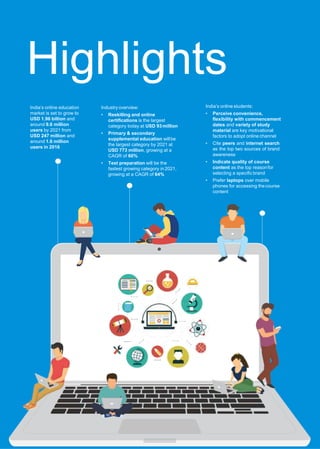
India’s online education
market is set to grow to
USD 1.96 billion and
around 9.6 million
users by 2021 from
USD 247 million and
around 1.6 million
users in 2016
Industry overview:
• Reskilling and online
certifications is the largest
category today at USD 93million
• Primary & secondary
supplemental education willbe
the largest category by 2021 at
USD 773 million, growing at a
CAGR of 60%
• Test preparation will be the
fastest growing category in 2021,
growing at a CAGR of 64%
India’s online students:
• Perceive convenience,
flexibility with commencement
dates and variety of study
material are key motivational
factors to adopt online channel
• Cite peers and internet search
as the top two sources of brand
awareness
• Indicate quality of course
content as the top reasonfor
selecting a specific brand
• Prefer laptops over mobile
phones for accessing thecourse
content
4 Online education in India:2021
Executive Summary – The future of Online
Education
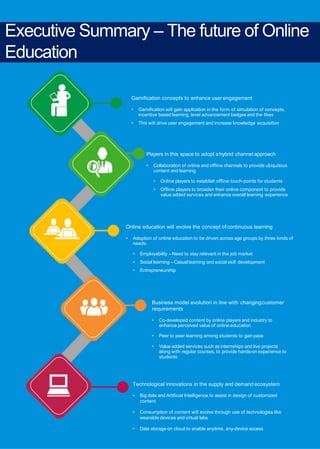
Gamification concepts to enhance user engagement
• Gamification will gain application in the form of simulation of concepts,
incentive based learning, level advancement badges and the likes
• This will drive user engagement and increase knowledge acquisition
Players in this space to adopt a hybrid channel approach
• Collaboration of online and offline channels to provide ubiquitous
content and learning
• Online players to establish offline touch-points for students
• Offline players to broaden their online component to provide
value added services and enhance overall learning experience
Online education will evolve the concept ofcontinuous learning
• Adoption of online education to be driven across age groups by three kinds of
needs:
• Employability – Need to stay relevant in the job market
• Social learning – Casual learning and social skill development
• Entrepreneurship
Business model evolution in line with changingcustomer
requirements
• Co-developed content by online players and industry to
enhance perceived value of online education
• Peer to peer learning among students to gain pace
• Value added services such as internships and live projects
along with regular courses, to provide hands-on experience to
students
Technological innovations in the supply and demand ecosystem
• Big data and Artificial Intelligence to assist in design of customized
content
• Consumption of content will evolve through use of technologies like
wearable devices and virtual labs
• Data storage on cloud to enable anytime, any-device access
Overview of the online education
ecosystem in India
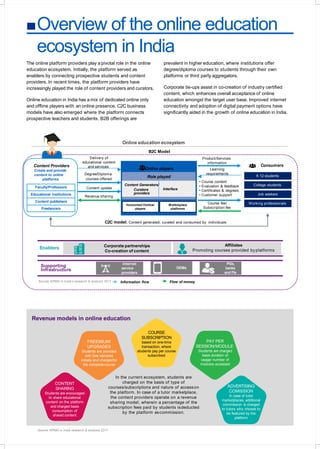
The online platform providers play a pivotal role in the online
education ecosystem. Initially, the platform served as
enablers by connecting prospective students and content
providers. In recent times, the platform providers have
increasingly played the role of content providers and curators.
Online education in India has a mix of dedicated online only
and offline players with an online presence. C2C business
models have also emerged where the platform connects
prospective teachers and students. B2B offerings are
prevalent in higher education, where institutions offer
degree/diploma courses to students through their own
platforms or third party aggregators.
Corporate tie-ups assist in co-creation of industry certified
content, which enhances overall acceptance of online
education amongst the target user base. Improved internet
connectivity and adoption of digital payment options have
significantly aided in the growth of online education in India.
Revenue models in online education
In the current ecosystem, students are
charged on the basis of type of
courses/subscriptions and nature of accesson
the platform. In case of a tutor marketplace,
the content providers operate on a revenue
sharing model, wherein a percentage of the
subscription fees paid by students isdeducted
by the platform ascommission.
COURSE
SUBSCRIPTION
based on one-time
transaction, where
students pay per course
subscribed
PAY PER
SESSION/MODULE
Students are charged
basis duration of
usage/ number of
modules accessed
FREEMIUM/
UPGRADES
Students are provided
with free samples
initially and chargedfor
the completecourse
CONTENT
SHARING
Students are encouraged
to share educational
content on the platform
and charged basis
consumption of
shared content
ADVERTISING
COMISSION
In case of tutor
marketplaces, additional
commission is charged
to tutors who choose to
be featured by the
platform
Source: KPMG in India research & analysis 2017
• Course content
• Evaluation & feedback
• Certificates & degrees
• Customer supportRevenue sharing
Delivery of
educational content
and services
Degree/Diploma
courses offered
Content update
Information flow Flow of money
Corporate partnerships
Co-creation of content
Enablers
Internet
service
providers
OEMsSupporting
Infrastructure
ConsumersContent Providers
Create and provide
content to online
platforms
Source: KPMG in India's research & analysis 2017
Faculty/Professors
Educational institutions
Content publishers
Freelancers
C2C model: Content generated, curated and consumed by individuals
PGs,
banks
and FIs
Online education ecosystem
B2C Model
Course fee/
Subscription fee
Product/Services
information
Learning
requirements
Job seekers
K 12 students
Working professionals
College students
Affiliates
Promoting courses provided byplatforms
Marketplace
platforms
Horizontal/ Vertical
players
Online players
Role played
Content Generators/
Curators Interface
providers
10
Online education in India - 2016
The education market in India, currently standing at USD 100
billion[5] presents a lucrative opportunity for monetization.
Introduction of technology has led to enhanced acceptance of
alternative modes of learning in India. India has witnessed a
significant increase in the total internet user population from
2011 to 2016 with overall internet penetration of 31 per cent
in 2016[6]. Approximately 409 million internet users are
expected to grow to approximately 735 million by2021[7],
presenting a positive future outlook for online business in
India. This growth has also been supported by the exponential
rise in number of smartphone users that reached around 290
million in 2016[8].
The online education market in India is USD 247 million in
2016 with approximately 1.57 million paid users.
Category-wise split of online education market in India (2016)
Online EducationMarket 1570247
USD (in millions)
No. of paidusers
(in thousands)
`
`
`
Primary and secondary
supplemental education
Higher education
Test preparation
Reskilling and online
certifications
Language and casual
learning
A, b
46773
5533
19643
49993
3535
• Reskilling and online certification courses is the largest
category in the Indian online education industry, driven by
IT professionals with a preference towards online trainings
for skill development/enhancement
• Primary and secondary supplemental education is driven by
the demand for quality education. The online channel
provides a conducive educational avenue for these
students who require focussed, individual learning
• Higher education is currently restricted by lack of clarity on
regulations. A strong regulatory framework would make it a
suitable substitute to distance learning programs and boost
adoption
• Online test preparation witnesses reasonable adoption
from target students largely from tier 2 and tier 3cities
• Language and casual learning has a significantly high user-
base, but with a low paying subscriber base, the B2C
revenue is limited.
Source:
[5]- Education sector in India, India Brand Equity Foundation, April 2017
[6], [7], [8]- Indian Languages – Defining India’s Internet, A KPMG in India-Google report, April 2017
Online education in India: 2021 11
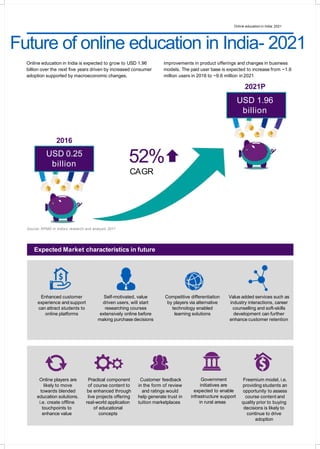
Future of online education in India- 2021
Online education in India is expected to grow to USD 1.96
billion over the next five years driven by increased consumer
adoption supported by macroeconomic changes,
improvements in product offerings and changes in business
models. The paid user base is expected to increase from ~1.6
million users in 2016 to ~9.6 million in 2021
2021P
USD 1.96
billion
52%
CAGR
2016
USD 0.25
billion
`
`
Source: KPMG in India's research and analysis 2017
Enhanced customer
experience and support
can attract students to
online platforms
Self-motivated, value
driven users, will start
researching courses
extensively online before
making purchase decisions
Competitive differentiation
by players via alternative
technology enabled
learning solutions
Value added services such as
industry interactions, career
counselling and soft-skills
development can further
enhance customer retention
Online players are Practical component Customer feedback Government Freemium model, i.e.
likely to move of course content to in the form of review initiatives are providing students an
towards blended be enhanced through and ratings would expected to enable opportunity to assess
education solutions. live projects offering help generate trust in infrastructure support course content and
i.e. create offline real-world application tuition marketplaces in rural areas quality prior to buying
touchpoints to of educational decisions is likely to
enhance value concepts continue to drive
adoption
Expected Market characteristics in future
Online education in India: 202112
Growthdriversofonlineeducation
Cost of online
education
INR 15,000– 20,000average transaction value range for online graduation courses inIndia[12]
Online education provides a low-cost alternative
• Lower infrastructure cost and a larger student base helps leverage on the economies of scale
and hence reduced prices via the online channel
• ~175 per cent increase in cost of education from 2008 to 2014[9]
• Online skill enhancement courses are around 53 per cent cheaper than offline alternatives[10]
INR2.5-5L
Graduation
Commerce & ArtsINR2K-15K
MedicalINR5-10L INR18-20L
Engineering
Government
colleges
INR5-6L
Private colleges
[11]
INR8-10L
• Open courses and distance learning enrolments in India to rise to around 10 million in 2021 growing at a
CAGR of around ten per cent[13]
• Areas where availability of quality offline education is low witness higher adoption of non-traditional
education methods. For example, states like Kerala, Bihar and Jammu and Kashmir account for ~ 4 Lakh
distance learning enrolments[14]
Online channel provides quality education to potential students
Availability of
quality education • Stark difference in educational qualification between urban and rural Indianpopulation
Graduate male
population
17%
13%
% Graduate
male population
% Graduate
female population
Rural
India
4.5%
2.2%
Graduate male
population
Employability
quotient
INR2.5K Average annual spend
INR10Kon primary education
Growing job seeking population drives the demand for industry relevant training
300 million
140 million
Increase in eligible working
population
Population employed
Government initiatives to drive adoption of online education
Government initiatives such as SWAYAM, E-Basta, Rashtriya Madhyamik Shiksha Abhiyan(RMSA),
Skill India and Digital India will enable the infrastructure needed by students to study online
Government’s
digital initiatives
Urban India
[15]
• ~ 280 million job seekers expected to enter the job market by2050[16]
• Unemployment rate in India at a five year high of around five per cent in 2016 [17]
• Annual growth rate in availability of jobs at around two per cent per annum
1991 2013 [18]
Source:
[9]- National Sample Survey Office (NSSO) Report, July 2015
[10], [12]- KPMG in India's research and analysis 2017
[11]- What does it cost to educate your child in India: Tomorrowmakers, 25 November 2015
[13]- Three Reasons Why Distance Learning is Taking Off in India, Technavio, 17 April 2015
[14]- MHRD Higher Education at a Glance, 2015-16
[15]- Literacy rate at 71% in rural India, 86% in urban: Survey, DNA, 30 June 2015
[16],[18]- India to see severe shortage of jobs in the next 35 years, Live Mint, 28 April 2016
[17]- Highest unemployment rate in India in 5 years: Govt. Survey, Financial Express, 1 October 2016
Online education in India: 2021
Internet penetration witnessing exponential growth across India
• Around 31 per cent internet penetration with about 409 million internet
users today [19]
• Increasing penetration in semi-urban and rural areas provide high potential
for growth
• Nearly 735 million projected users by 2021[20]
• Internet penetration will enable reach and increased traffic for the online
education players
Internet
penetration
Growing smartphone penetration across India to drive
technological adoption amongst masses
• Nearly 290 million smartphone users in India today[21]
• Smartphone user base expected to grow with the addition of approximately 180
million new users by 2021[22]
Smartphone
userbase
Significant increase in disposable personal income
• Disposable income of the country is expected to grow by 55 per cent by
2020[23]
• India will keep its current rank as the world’s second largest middle class till
2030[24]
Disposable
income
Large faction of Indian population is young, thus enlarging the target
population for online education
• Nearly 46 per cent of population between 15-40 age group[25]
• Young population with high aspirations but lower income is a good target
market for online education
• Further, the acceptability of online channel is also higher in the younger
demographic
Young
population
Source:
[19],[20],[21],[22],[23]- Indian Languages – Defining India’s Internet, A KPMG in India-Google report, April 2017
[24]- Top 5 Emerging Markets with the Best Middle Class Potential, Euromonitor International, 20 September 2015
[25]- Census of India, 2011
Online education in India: 2021
Brand selection and payment
preferences
Peer review and feedback play a key role in discovery
and selection of a platform. Online players need to
focus on efficient feedback mechanism to have higher
preference amongst target users.
The purchase decision is driven by quality of study
material available on the platforms. The perceived
value of the course by students is also important in the
selection of a specific platform.
A student’s engagement level with a brand is on
account of access to online content anytime,
anywhere. The time saved on commute as against the
offline channel is also a key aspect driving
engagement levels.
Customer
Lifecycle
Peerrecommendationsandqualityof
availablecontent arekeydriversfor
choosingabrand
64%
56%
44%
Peers
Family
Advertisements
40%
36%
33%
Quality of study material
Value for money
Faculty recommendation
37%
37%
34%
Convenience
Accessibility
Reduced travel time
Source:
[32], [33], [34], [35], [36] -Nielsen Primary Survey, Online education users N=3608: respondents included students and parents of students consuming online primary and secondary
education
Engagement: Reasons for being engaged with a brand[34]
Subscription: Key reasons for selecting a brand [33]
Discovery: Finding out about the brand [32]
Optiontopaycoursefeethrough
instalmentscouldfurther enhanceadoption
ofonlinechannel
26%
74%
Cash
Digital
Payment Period[35]
Mode of payment[36]
Why do students choose a specific brand?
How are students paying for the courses?
52% One time payment
A significant proportion of users have indicated that they
prefer to pay for the course fees in instalments. Flexible
48% Instalments payment options could further enhance customer experience
and adoption levels.
Considerable proportion of cash payments indicate a need for
offline touchpoint to enable payments. This could be
implemented via tie-ups with educational institutions and
other offline channels.
Online education in India: 2021
Acquiring and retaining customers
Acquisition and retention of online customers
34% Query resolution
33% Individual attention
32% Flexibility
Key challenges faced by students in offline channels[38]
Key barriers to adoption of online courses[39]
31% Familiarity with offlineeducation
31% Accessibility
30% Dependence on internet
Why have people who intend to use online channel, not usedit?[40]
46% Lack of requirement
33%
34% Poor Pastexperience
Lack of understanding of online channel
Studentsusinganofflinechannel
43% Home environment
41%
40% Reduced travel time
Convenience
Motivation factors for adoption of an online channel[41]
Enhancing customer experience for online students[42]
49% Video content
47% Need in-depth explanations
46% Summarized content
Studentsintendingtoadopt
anonlinechannel
Onlinestudents
Customer experience in
this category is driven by
quality and variety of
content offered by the
platforms. In some
cases, students require
video based content and
detailed explanations,
while others demand
concise format for ease
in revision.
Familiarity with the
offline channel and lack
of requirement are key
barriers to adoption of
online channel. Focused
group discussions[37] also
suggested lack of
awareness as a
challenge. Awareness
needs to be increased,
focusing on the
convenience aspect and
value add of the online
channel to grow
adoption.
Future outlook
Increased demand in domestic market and export opportunities in select Asian markets is expected to drive the
future for online primary and secondary supplemental education
• New age learning techniques can have a significant impact •
on the adoption of online channel for this category
• Value added services such as career counselling and
enhanced progress tracking could further increase adoption
levels
Players in this segment have witnessed demand from
overseas; West Asian countries (e.g.- UAE, Kuwait) are
emerging as an attractive export opportunity for this
category.
Source:
[37]- Nielsen Primary Research, Online education users and non-users N=40
[38], [39], [40], [41], [42]-Nielsen Primary Survey, Online education users N=3608: respondents included students and parents of students consuming online primary and
secondary education
Online education in India: 2021
Acquiring & retaining customers
Acquisition and retention of online customers
Lack of flexibility
Individual attention
Key challenges faced by students in offline channels[57]
Key barriers to adoption of online courses[58]
30%
31% Real time solution to queries
Teaching methodology
30% Dependence on internet
Why have people who intend to use online channel, not usedit?[59]
41% Lack of requirement
33%
40% Low awareness
Lack of interesting courses
Studentsusinganofflinechannel
58%
Flexibility with commencement
dates
52%
54% Immediate scoring
Convenience
Motivation factors for adoption of an online channel[60]
Enhancing customer experience for online students[61]
47% Detailed solutions
45% Video content
45% Pricing
Studentsintendingtoadopt
anonlinechannel
Onlinestudents
Offline test preparation
students indicate lack of
flexibility in courses as a
key challenge . At the
same time, large batch
sizes of offline classes
reduces individual
attention for students.
However, elements such
as classroom experience
and real time solution to
queries still differentiate
offline from the online
channel.
Online test preparation
offers students certain
unique offerings.
Students have the
flexibility to schedule
classes as per their
choice. At the same
time, students also gain
frequent performance
updates which enables
them to continuously
monitor their competitive
readiness.
Going forward, online
test preparation players
should focus on
enhancing product
offerings through more
in-depth solutions for
assessment modules,
higher video based
content while focusing
on communicating the
unique value
propositions of online
channel over offline in
this category.
Future outlook
Online test preparation is poised to witness rapid growth, based on increased acceptance in tier 2/tier 3 cities
35%
31% Need to keep notes
26%
Growth of online test preparation in the next 5 years is likely
to emerge from tier 2/tier 3 towns. This is on account of
limited options available for test preparation at these places.
Rapid rise in internet infrastructure and wide acceptance of
digital payments options, can contribute to the growth of
online test preparations in tier 2/tier 3 cities. An emerging
trend is the hybrid model, where online players have opened
centres to provide an offline touch point to students and also
a classroom experience at regular intervals. Hybrid model is
expected to gain traction in the future.
Players in this segment are also looking at online options to
address the overseas market looking to take competitive
exams in India.
Source:
[57], [58], [59], [60], [61]-Nielsen Primary Survey, Online education users N=3608
Online education in India: 2021 31
Source:
[71], [72], [73], [74], [75]-Nielsen Primary Survey, Online education users N=3608
Acquisition and retention of online customers
58% Pricing
55% Free courses
55% Video content
49% Travel time
44%
46% Flexibility
Individual attention
Key challenges faced by students in offline channels[71]
Key barriers to adoption of online courses[72]
37% Authenticity
38% Real time query resolution
38% Teaching methodology
Why have people who intend to use online channel, not used it?[73]
40% Lack of requirement
19%
25% Awareness
Lack of interesting courses
Studentsusinganofflinechannel
57% Convenience
51% Reduced travel time
51% Self paced learning
Motivation factors for adoption of an online channel[74]
Enhancing customer experience for online students[75]
Studentsintendingtoadopt
anonlinechannel
Onlinestudents
Offline certification
courses requiring
working professionals to
travel to classrooms to
attend sessions as per a
rigid schedule is cited as
the biggest challenge
with offline channel.
The online channel
provides these users
with the option oftaking
courses from their
home/workplace as per
their own schedules.
However, doubts still
persist over the
authenticity and user
support of such courses.
Lack of awareness and
lack of interesting
courses re cited as
reasons for low
adoption.
Future outlook
Employee-motivated user traction and B2B offerings to gain pace in the near future
• Rise in disposable income and need for employees to
distinguish themselves in the work environment could
continue to fuel adoption in this category
• Highly customised product offerings for specific industries
are expected to witness traction over the next few years
• Players in the online higher education segment are looking
to diversify in this category
• This category is expected to witness growth backed by
diversification of product and service offerings by current
players looking to cater to the B2B segment.
Acquiring & retaining customers
Online education in India: 202134
User profile for online higher education
Who is the current user?
Only four out of the top 50 Business schools and 60
Management schools out of ~ 690 colleges[78] in India are
present in the eastern part of India. Low presence of offline
alternatives has resulted in a higher uptake by the
prospective online users.
Demandforonlinechannelis
higherfromregions withlimited
presenceofreputedinstitutes
33%
39%
36%
26%
34%
24% 24%
19%
13%
4%
13%
9%
7%
2%
17%
0%
10%
20%
30%
40%
50%
60%
70%
West East SouthNorth
MBA/PGDM MCA MTech/ MS B.Ed/M.Ed/NTT
Percentageofuserstakingupaparticularcourse
Course wise preference of online higher education
across geographies[79]
64%
3%
1%
4% 4% 3%
1% 1% 0%
0%
60%
50% 48%
40% 36
%
38%
30%
20% 19% 18%
14%
10% 6% 6%
Tier 2
MTech/MS
MA/M.Com/M.Sc
Metro/ Tier1
MBA/PGDM MCA
B.Ed/M.Ed/NTT LLB/LLM
MD/MDS Others
Percentageofusersadoptingonlinecourses
Online higher education- Adoption of courses across tiers[80]
Adoptionintier2citiesisdrivenby
coursesoffering lucrative
employmentopportunities
Metros and tier 1 cities has higher adoption of different
types of courses. Higher adoption of courses perceived to
enhance employability such as MBA and MCA in tier 2
cities.
Source:
[78]- Business Today B-school rankings, Business Today, 2016
[79], [80]-Nielsen Primary Survey, Online education users N=3608
Online education in India: 2021
Channel and device preferences
and key challenges
Convenienceandaccessibilitydrive
adoptionofonline channelforhigher
education
Channel preference in the category is driven by
accessibility, convenience and flexibility. Online channel
allows the users to multi-task along with other
commitments, such as a full-time employment, family
responsibilities, etc.
Key motivational factors to adopt online education[81]
Why are students opting for online education?
Accessibility
Convenient content access
Flexible start dates
Smoothuserexperienceacrossdevices
isnecessaryinthis category
Strong trend of consumption on laptops indicates a higher
level of seriousness by the students towards the course
due to the value of the degree and higher ticket size in
comparison to other categories. Mobile consumption
indicates that the user is consuming different kinds of
content on different devices, leading to a need for higher
education players to customize their offerings to provide a
seamless user experience across devices.
Device preference[82]
How is the online content consumed?
80%
Mobile
93%
Laptop
What are the key challenges faced by students adopting online education?
Key challenges[83]
Lackofrecruitmentassistanceand
concernsover authenticityofcourses
anddegreesarekeyroadblocksto the
onlinechannel
Majority of courses are driven by the job opportunities
associated with them. Lack of recruitment assistance,
therefore, is a key challenges for an online user. In
addition, absence of a robust framework governing online
education leads to authenticity related challenges. Evolving
policy framework will play a key role in growth for this
category.
Source:
[81], [82], [83]-Nielsen Primary Survey, Online education users N=3608
32%
Availability of
employment opportunities
32%
Concern on
authenticity of courses
31%
Concern on
authenticity of the exam
Reduced travel time
Online education in India: 2021
Brand selection
peers, family and schools, others depend on their own
research on the internet to look for the available options.
Why do students choose a specific brand?
MBA/PGDM MCA
Peerinfluenceandonlineresearchimpact
brandselection
Peers, friends and internet are the major source of
awareness of different brands in the higher education
category. While some students hear about a brand from their
59% Family 49% School recommendation 47% Internet 61%
70% Peers 88% Peers 69% Family 78% Peers
63% Internet 57% Family 59% Peers 61% Internet
School
recommendation
MTech/MS B.Ed./M.Ed./NTT
Discovery: Finding out about the brand[84]
Subscription: Key reasons for subscribing to a brand[85]
47% Value for money
41% Quality study
material
40% Brand recognition
49% Value for money
49% Free content
47% Specialization in
the field
47% Quality study material
44% Faculty
41% Course content
48% Affordability
39% Offline touchpoints
39% Bridge course
The online channel acts as a cheaper alternate to the offline
medium. For MBA and MCA courses, students cite value for
money and quality content as reasons for brand
selection. Value of the degree for these courses is
dependent on the quality of the brand, hence making it a
critical factor for students. In contrast, MS/MTech. students
focus on the quality of the course, based on the study
material, the faculty and the course structure. B.Ed., M.Ed.
and NTT courses are driven by affordable online offerings.
Offline presence is also necessary for these users before
purchase.
Purchasedecisionsdrivenbydifferentfactorsfor
eachkindofcourse
Engagement: Reasons for being engaged with a brand[86]
38% Studying at home
38% Reduced travel
time
37% Value for money
43% Learning methodology
43% Performance tracking
43% Value for money
44% Multiple courses
38% Accessibility
38% Value for money
52% Self paced learning
48% Reduced travel time
48% No peer pressure
Students continue to use the selected brand only if there is a
high value for money aspect derived from the subscribed
course. Learning methodology and lack of peer pressure are
also cited as other reasons for staying with the brand.
Valueforinvestmentisakeyengagementdrivertowardsa
particularbrandacrosscoursetypes
Source:
[84], [85], [86]-Nielsen Primary Survey, Online education users N=3608
Online education in India: 2021
Payment preferences
How are students paying for the courses?
MBA/PGDM MCA MTech/MS
67% One time
payment
33% Instalments
48% One time payment
52% Instalments
71% One time
payment
29% Instalments
65%
One time
payment
35% Instalments
B.Ed./M.Ed./
NTT
Mode of payment[87]
lower transaction value in online channel.
Onetimepaymentsdominateall
categories
In contrast to the offline channel, one time payments is more
prevalent online, which might be driven by the significantly
12% Cash
88% Digital
38% Cash
62% Digital
13% Cash
87% Digital
25% Cash
75% Digital
exist and players may need to consider offline touch points for
payment collections.
Highdigitalpayments
The usage of digital payments ,despite higher ticket size, is
significantly high. However some usage of cash payments
`
`
`
Payment Period[88]
Source:
[87], [88]-Nielsen Primary Survey, Online education users N=3608
Online education in India: 202138
Acquiring & retaining customers
Acquisition and retention of online customers
Key challenges faced by students in offline channels[89]
Key barriers to adoption of online courses[90]
Why have people who intend to use online channel, not usedit?[91]
32% Lack of requirement
27% Online provides lowervalue
28% No courses ofinterest
Studentsusinganofflinechannel
45%
50% Flexible start date
50% Convenience
Study material access
Motivation factors for adoption of an online channel[92]
Enhancing customer experience for online students[93]
53% Free Courses
53% Flexible payments
53% Lower pricing
Studentsintendingtoadopt
anonlinechannel
Onlinestudents
Future outlook
Enhanced classroom experience and evolving regulatory framework will increase perceived value among the target
users
38% Peer pressure
38% Flexibility
38% Reduced travel time
These courses are limited to theoretical content currently;
adoption of virtual classroom concepts could bring courses
with a high practical component onto the online medium. At
the same time, the online experience needs to be engaging in
order to ensure a classroom experience for the students.
Category expected to benefit based on probable changes in
the regulatory framework.
Source:
[89], [90], [91], [92], [93]-Nielsen Primary Survey, Online education users N=3608
37%
37%
36% Familiarity with offlineeducation
Classroom learning methodology
Dependence on internet
Post-graduation courses
witness higher popularity
as compared to
graduation courses in
online higher education.
Majority of these
students are either
working professionals
who are looking to
progress in their careers
basis a second degree or
students who have
completed their
graduation courses and
are looking to enter the
job market through a
higher degree. Thus, for
these students an online
higher degree course
that can be completed
from their
homes/workplaces as
per their individual
schedules, is a
convenient option.
However, in higher
education courses, the
classroom experience is
an essential aspect of
learning. Students
collaborate on
projects/assignments
with expert guidance
from professors in a
practical learning
environment. At the
same time, there is a
higher familiarity with
traditional higher
education courses has
restricted adoption of
online. Thus, the need of
the hour for online
players in this category is
to provide a wholesome
learning experience for
students at affordable
prices.
Online education in India: 2021
44%
20% 19%
29%
24%
14
%
16
%
18
%
46
%
0%
10%
20%
30%
40%
50%
30.1-40 years18.1-22 years 22.1-25 years 25.1-30 years
Metro/Tier 1 Tier2
Percentageofusersusing
language/hobbycourses
Usage of language and casual learning platforms
across age brackets [94]
User profile, device preferences,
key challenges & Brand selection
Who is the current user?
However, in tier 2 cities, adoption is high amongst
users of older age groups.
Highadoptionamongstolderage
groupintier2cities
In metros/tier 1 cities, adoption for this category of
courses is evenly distributed across age groups.
How is the online content consumed?
Laptopisthepreferreddeviceofusage
English language learners form a majority of the user base
for this category, especially in tier 2 cities. These are
users looking to enhance their profiles with added
proficiency in English. Hence, there is a tendency to
successfully complete courses amongst these users,
which is demonstrated by higher usage of laptops.
What are the key challenges faced by students adopting online education?
Persistentconnectivityissuesarean
areaofconcern forusers
Users in this category have indicated connectivity and
asynchronous support from platform providers as top two
challenges. Thus, players in this category need to focus on
technological improvements to their products to enhance
customer experience.
Why do students choose a specific brand?
explore multiple options available online
before finally selecting a brand.
Availability of free content and
recommendations from peers are key
reasons for engagement across tiers.
While users in metros/tier 1 cities value
convenience, a large section of users in
tier 2 cities also focus on the value for
money aspect of courses.
Awarenessdrivenbyinternetsearch;
trialsessentialfor purchase
Internet searches dominate the discovery
of brands in this category. Users typically
Metro/Tier1
Device preference[95]
Tier2
67%
84%
Mobile 74%
Laptop 75%
Mobile
Laptop
41%
39%
Key challenges[96]
Pricing of advanced courses
Connectivity
Asynchronous responses
Customer
lifecycle
56%
51%
48%
Internet search
Advertisements
Peers
60%Internet search
Peers
Advertisements
52%
39%
Engagement:Reasons for being engaged witha brand [98]
Discovery: Finding out about the brand[97]
46% Peer recommendations
45% Free content
42%
Brand provides value
for money
Convenience
Free content
Peer recommendation %
47%
40%
35
Metro/Tier1 Tier2
Source:
[94], [95], [96], [97], [98]-Nielsen Primary Survey, Online education users N=3608
Online education in India: 2021
Payments, acquiring & retaining customers
How are students paying for the courses
The offline space is dominated by users paying
course fees in instalments viacash.
In contrast, users in the online channel are
making upfront digital payment of course fees.
Paymentoverviewcontradictory
toofflinespace
Online Offline
Payment Period[99]
38%
One time
payment
One time
payment 55%
Instalments 45% 62% Instalments
Mode of payment[100]
63% Cash
37% Digital
25%Cash
Digital 75%
Acquisition and retention of customers online
37%
35%
Easy access to offline players
Doubt clearance
34% Dependence on internet
Key challenges faced by students in offline channels [101]
Key barriers to adoption of online courses[102]
37%
35%
37% Need to maintainnotes
Flexibility
Individual attention
Why have people who intend to use online channel, not usedit?[103]
35% Awareness
27%
31% Lack of interesting courses
Lack of need
Studentsusinganofflinechannel
68% Flexible start date
56%
51% Travel time
Anytime, anywhere
Motivation factors for adoption of an online channel[104]
Studentsintendingtoadopt
anonlinechannel
Hobbies and
language learning
courses typically
have a high practical
component in their
teaching pedagogy.
At the same time,
there is an
abundance of offline
options for this
category, Hence, the
adoption of online
courses is low.
The online channel
provides users with
the option of learning
on the go as per
schedules of their
convenience. This
value proposition is
to be communicated
to prospective users
in order to drive
adoption for this
category.
Future outlook
propensity to pay may remain low
Source:
[99], [100], [101], [102], [103], [104]-Nielsen Primary Survey, Online education users N=3608
Language learning could continue to dominate adoption in this sector in the nearfuture
• Sector may continue to see growth in user base, however • Advertising could continue to be a key revenue driver for
these platforms.
Future
trends
in online
education
4
Online education in India: 202144
Hybrid channel adoption by existing traditional
and online players
In the future, online education will continue to gain popularity
among prospective learners including students and
professionals driven by aspects such as easy and on-demand
access to content, self-paced learning opportunities and
interactive & modular means of learning. However, nearly
one third of online learners also believe that online education
does not substitute traditional learning due to lack of
interaction with peers and instructors.[105] Low completion
rates of online certification courses due to lack of feedback
and interactions further underlines the need to have multiple
touch-points with the learners for improved engagement
levels. Virtual class rooms could also emerge as an asset-
light model for offline players to expand their network across
geographies.
The learner will therefore demand ubiquitous presence of
learning and content, where each channel may serve a
differentneed.
Sources:
[105]- KPMG in India's research and analysis 2017
Online VAS by offline players Offlinetouch-points byonline
players
OnlinetoOfflinemodel
Marketexpansionbyoffline
players
Traditional offline pedagogy
Online VAS
In order to meet the on-demand content needs of
their students, offline institutions may offer Value
Added Services (VAS) online.
Online courses
Online learning platforms may start engaging with
the students through offline touch points – labs,
group discussions, etc. to bridge the gap with
traditional modes of learning.
Analytics based Online
feedback to instructors
Customized offline
pedagogy
Online content creation
Physical sessions/interactions
Online platforms to aid offline faculty in
evaluating the students through in-depthfeedback
online. Also, online platforms could assist offline
students in aspects such as class scheduling and
instructor selection.
Online content access
and instructor selection
Virtual
classrooms
Traditional offline pedagogy
Expansion of market reach by way of virtual
classrooms may become increasingly common
amongst offline players. This will aid in offering a mix
of theoretical and practical experience for course
requiring practical knowledge and softskills.
Offline VAS
Potential hybrid channel business models that may emerge in the future are:
Online education in India: 2021
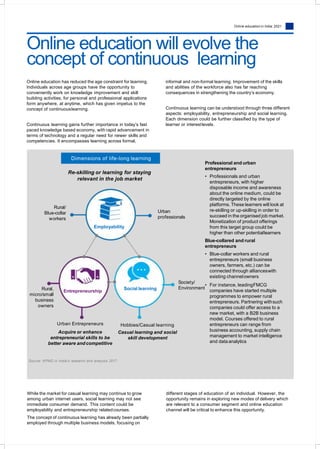
Online education has reduced the age constraint for learning.
Individuals across age groups have the opportunity to
conveniently work on knowledge improvement and skill
building activities, for personal and professional applications
form anywhere, at anytime, which has given impetus to the
concept of continuouslearning.
Continuous learning gains further importance in today’s fast
paced knowledge based economy, with rapid advancement in
terms of technology and a regular need for newer skills and
competencies. It encompasses learning across formal,
informal and non-formal learning. Improvement of the skills
and abilities of the workforce also has far reaching
consequences in strengthening the country’s economy.
Continuous learning can be understood through three different
aspects: employability, entrepreneurship and social learning.
Each dimension could be further classified by the type of
learner or interestlevels.
Professional and urban
entrepreneurs
• Professionals and urban
entrepreneurs, with higher
disposable income and awareness
about the online medium, could be
directly targeted by the online
platforms. These learners will look at
re-skilling or up-skilling in order to
succeed in the organised job market.
Monetization of product offerings
from this target group could be
higher than other potentiallearners
Blue-collared and rural
entrepreneurs
• Blue-collar workers and rural
entrepreneurs (small business
owners, farmers, etc.) can be
connected through allianceswith
existing channelowners
• For instance, leadingFMCG
companies have started multiple
programmes to empower rural
entrepreneurs. Partnering withsuch
companies could offer access to a
new market, with a B2B business
model. Courses offered to rural
entrepreneurs can range from
business accounting, supply chain
management to market intelligence
and dataanalytics
Employability
Entrepreneurship
Social learning
Urban
professionals
Rural/
Blue-collar
workers
Rural,
micro/small
business
owners
Society/
Environment
Re-skilling or learning for staying
relevant in the job market
Urban Entrepreneurs
Acquire or enhance
entrepreneurial skills to be
better aware and competitive
Hobbies/Casual learning
Casual learning and social
skill development
While the market for casual learning may continue to grow
among urban internet users, social learning may not see
immediate consumer demand. This content could be
employability and entrepreneurship relatedcourses.
The concept of continuous learning has already been partially
employed through multiple business models, focusing on
different stages of education of an individual. However, the
opportunity remains in exploring new modes of delivery which
are relevant to a consumer segment and online education
channel will be critical to enhance this opportunity.
Online education will evolve the
concept of continuous learning
Dimensions of life-long learning
Source: KPMG in India's research and analysis 2017
Online education in India: 202146
Primary &
secondary
supplemental
education
Simulation: Application of concepts
Quizzes and peer comparison
Interactive lab experiments
Higher
education
Endorsements
Minimum pass percentage in
a module to unlock the next
module
Badges, leadership board
Reskilling&
online
certification
Micro-credentials, discount for
subsequent courses on
completion of current course
Level advancement, badges
Potential use-cases of Gamification
Sources:
[106], [107]- KPMG in India's research and analysis 2017
Test Preparation
Discounts and prizes based on
overall performance
Incentive based learning:
leader board, badges
Language &
casuallearning
Increase in difficulty per level
Unlocking new features for
every level
Forming elite groupsbased
on performance
Knowledgeacquired
Application of gamification concepts across various
categories of online education will drive higher
engagement levels
Engagement-learning matrix of different
education methods
Source: KPMG in India's research and analysis 2017
Gamification is the practice of applying game
mechanics of fun, collaboration, competition and
rewards in non-gamesituations.
It is currently employed worldwide for enhancing
the engagement of learners across different stages
of education, including formal education and
training. The global market for gamification in
education is estimated to reach USD 10 billion by
2020.[106]
Gamification has started to gain popularity among
education service providers in India. One of the
players in the primary & secondary supplemental
education space has recently launched an
application which combines games, simulations
and videos to train children. Several other
technology leaders are entering the space to create
a solution for enhancing engagement and learning
experience for thestudents.
Gamification has gained success through usage of
key gaming principles and application oriented
learning, hence enhancing the learner’s
engagement levels. Nearly 95 per cent students
drop-out from MOOCs.[107] Gamification has the
potential to make the process of learning
interesting and hence address the issue of high
dropouts in onlinelearning.
Gamified
Online
Education
Outbound
activity
Classroom learning
Learnings from online
platform
Level of engagement
Source: KPMG in India's research and analysis 2017
Online education in India: 2021 47
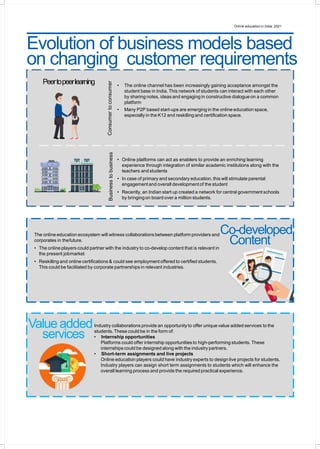
The online education ecosystem will witness collaborations between platform providers and
corporates in thefuture.
• The online players could partner with the industry to co-develop content that is relevant in
the present jobmarket
• Reskilling and online certifications & could see employment offered to certified students.
This could be facilitated by corporate partnerships in relevant industries.
• Online platforms can act as enablers to provide an enriching learning
experience through integration of similar academic institutions along with the
teachers andstudents
• In case of primary and secondary education, this will stimulate parental
engagement and overall developmentof the student
• Recently, an Indian start up created a network for central government schools
by bringingon board over a million students.
Co-developed
Content
Peertopeerlearning • The online channel has been increasingly gaining acceptance amongst the
student base in India. This network of students can interact with each other
by sharing notes, ideas and engaging in constructive dialogue on a common
platform
• Many P2P based start-ups are emerging in the online education space,
especially in the K12 and reskilling and certification space.
Industry collaborations provide an opportunity to offer unique value added services to the
students. These could be in the form of:
• Internship opportunities
Platforms could offer internship opportunities to high-performing students. These
internshipscould be designed along with the industry partners.
• Short-term assignments and live projects
Online education players could have industry experts to design live projects for students.
Industry players can assign short term assignments to students which will enhance the
overall learning process and provide the required practical experience.
Valueadded
services
ConsumertoconsumerBusinesstobusiness
Evolution of business models based
on changing customer requirements
Online education in India: 202148
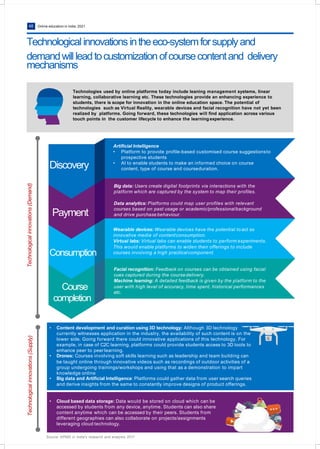
Technologies used by online platforms today include leaning management systems, linear
learning, collaborative learning etc. These technologies provide an enhancing experience to
students, there is scope for innovation in the online education space. The potential of
technologies such as Virtual Reality, wearable devices and facial recognition have not yet been
realized by platforms. Going forward, these technologies will find application across various
touch points in the customer lifecycle to enhance the learning experience.
Technologicalinnovations(Demand)Technologicalinnovations(Supply)
Technologicalinnovations intheeco-systemforsupplyand
demandwillleadtocustomizationofcoursecontentand delivery
mechanisms
Discovery
Payment
Consumption
Course
completion
Artificial Intelligence
• Platform to provide profile-based customised course suggestionsto
prospective students
• AI to enable students to make an informed choice on course
content, type of course and courseduration.
Big data: Users create digital footprints via interactions with the
platform which are captured by the system to map their profiles.
Data analytics: Platforms could map user profiles with relevant
courses based on past usage or academic/professionalbackground
and drive purchase behaviour.
Wearable devices: Wearable devices have the potential to act as
innovative media of contentconsumption.
Virtual labs: Virtual labs can enable students to perform experiments.
This would enable platforms to widen their offerings to include
courses involving a high practicalcomponent.
Facial recognition: Feedback on courses can be obtained using facial
cues captured during the coursedelivery.
Machine learning: A detailed feedback is given by the platform to the
user with high level of accuracy, time spent, historical performances
etc.
• Content development and curation using 3D technology: Although 3D technology
currently witnesses application in the industry, the availability of such content is on the
lower side. Going forward there could innovative applications of this technology. For
example, in case of C2C learning, platforms could provide students access to 3D tools to
enhance peer to peerlearning.
• Drones: Courses involving soft skills learning such as leadership and team building can
be taught online through innovative videos such as recordings of outdoor activities of a
group undergoing trainings/workshops and using that as a demonstration to impart
knowledge online
• Big data and Artificial Intelligence: Platforms could gather data from user search queries
and derive insights from the same to constantly improve designs of product offerings.
• Cloud based data storage: Data would be stored on cloud which can be
accessed by students from any device, anytime. Students can also share
content anytime which can be accessed by their peers. Students from
different geographies can also collaborate on projects/assignments
leveraging cloud technology.
Source: KPMG in India's research and analysis 2017
4
Key
takeaways
Online education in India: 2021
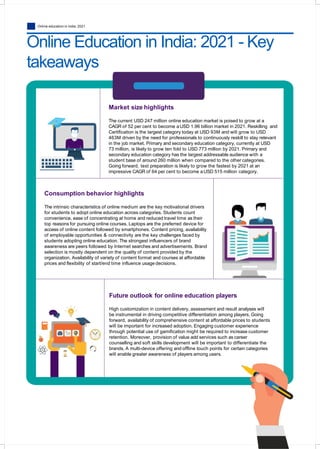
Online Education in India: 2021 - Key
takeaways
Market size highlights
The current USD 247 million online education market is poised to grow at a
CAGR of 52 per cent to become a USD 1.96 billion market in 2021. Reskilling and
Certification is the largest category today at USD 93M and will grow to USD
463M driven by the need for professionals to continuously reskill to stay relevant
in the job market. Primary and secondary education category, currently at USD
73 million, is likely to grow ten fold to USD 773 million by 2021. Primary and
secondary education category has the largest addressable audience with a
student base of around 260 million when compared to the other categories.
Going forward, test preparation is likely to grow the fastest by 2021 at an
impressive CAGR of 64 per cent to become a USD 515 million category.
Consumption behavior highlights
The intrinsic characteristics of online medium are the key motivational drivers
for students to adopt online education across categories. Students count
convenience, ease of concentrating at home and reduced travel time as their
top reasons for pursuing online courses. Laptops are the preferred device for
access of online content followed by smartphones. Content pricing, availability
of employable opportunities & connectivity are the key challenges faced by
students adopting online education. The strongest influencers of brand
awareness are peers followed by Internet searches and advertisements. Brand
selection is mostly dependent on the quality of content provided by the
organization. Availability of variety of content format and courses at affordable
prices and flexibility of start/end time influence usage decisions.
Future outlook for online education players
High customization in content delivery, assessment and result analyses will
be instrumental in driving competitive differentiation among players. Going
forward, availability of comprehensive content at affordable prices to students
will be important for increased adoption. Engaging customer experience
through potential use of gamification might be required to increase customer
retention. Moreover, provision of value add services such as career
counselling and soft skills development will be important to differentiate the
brands. A multi-device offering and offline touch points for certain categories
will enable greater awareness of players among users.

Online Education In India, Projection 2021

  • 1.
    A study byKPMG in India and Google May 2017
  • 2.
    Highlights India’s online education marketis set to grow to USD 1.96 billion and around 9.6 million users by 2021 from USD 247 million and around 1.6 million users in 2016 Industry overview: • Reskilling and online certifications is the largest category today at USD 93million • Primary & secondary supplemental education willbe the largest category by 2021 at USD 773 million, growing at a CAGR of 60% • Test preparation will be the fastest growing category in 2021, growing at a CAGR of 64% India’s online students: • Perceive convenience, flexibility with commencement dates and variety of study material are key motivational factors to adopt online channel • Cite peers and internet search as the top two sources of brand awareness • Indicate quality of course content as the top reasonfor selecting a specific brand • Prefer laptops over mobile phones for accessing thecourse content
  • 3.
    4 Online educationin India:2021 Executive Summary – The future of Online Education Gamification concepts to enhance user engagement • Gamification will gain application in the form of simulation of concepts, incentive based learning, level advancement badges and the likes • This will drive user engagement and increase knowledge acquisition Players in this space to adopt a hybrid channel approach • Collaboration of online and offline channels to provide ubiquitous content and learning • Online players to establish offline touch-points for students • Offline players to broaden their online component to provide value added services and enhance overall learning experience Online education will evolve the concept ofcontinuous learning • Adoption of online education to be driven across age groups by three kinds of needs: • Employability – Need to stay relevant in the job market • Social learning – Casual learning and social skill development • Entrepreneurship Business model evolution in line with changingcustomer requirements • Co-developed content by online players and industry to enhance perceived value of online education • Peer to peer learning among students to gain pace • Value added services such as internships and live projects along with regular courses, to provide hands-on experience to students Technological innovations in the supply and demand ecosystem • Big data and Artificial Intelligence to assist in design of customized content • Consumption of content will evolve through use of technologies like wearable devices and virtual labs • Data storage on cloud to enable anytime, any-device access
  • 4.
    Overview of theonline education ecosystem in India The online platform providers play a pivotal role in the online education ecosystem. Initially, the platform served as enablers by connecting prospective students and content providers. In recent times, the platform providers have increasingly played the role of content providers and curators. Online education in India has a mix of dedicated online only and offline players with an online presence. C2C business models have also emerged where the platform connects prospective teachers and students. B2B offerings are prevalent in higher education, where institutions offer degree/diploma courses to students through their own platforms or third party aggregators. Corporate tie-ups assist in co-creation of industry certified content, which enhances overall acceptance of online education amongst the target user base. Improved internet connectivity and adoption of digital payment options have significantly aided in the growth of online education in India. Revenue models in online education In the current ecosystem, students are charged on the basis of type of courses/subscriptions and nature of accesson the platform. In case of a tutor marketplace, the content providers operate on a revenue sharing model, wherein a percentage of the subscription fees paid by students isdeducted by the platform ascommission. COURSE SUBSCRIPTION based on one-time transaction, where students pay per course subscribed PAY PER SESSION/MODULE Students are charged basis duration of usage/ number of modules accessed FREEMIUM/ UPGRADES Students are provided with free samples initially and chargedfor the completecourse CONTENT SHARING Students are encouraged to share educational content on the platform and charged basis consumption of shared content ADVERTISING COMISSION In case of tutor marketplaces, additional commission is charged to tutors who choose to be featured by the platform Source: KPMG in India research & analysis 2017 • Course content • Evaluation & feedback • Certificates & degrees • Customer supportRevenue sharing Delivery of educational content and services Degree/Diploma courses offered Content update Information flow Flow of money Corporate partnerships Co-creation of content Enablers Internet service providers OEMsSupporting Infrastructure ConsumersContent Providers Create and provide content to online platforms Source: KPMG in India's research & analysis 2017 Faculty/Professors Educational institutions Content publishers Freelancers C2C model: Content generated, curated and consumed by individuals PGs, banks and FIs Online education ecosystem B2C Model Course fee/ Subscription fee Product/Services information Learning requirements Job seekers K 12 students Working professionals College students Affiliates Promoting courses provided byplatforms Marketplace platforms Horizontal/ Vertical players Online players Role played Content Generators/ Curators Interface providers
  • 5.
    10 Online education inIndia - 2016 The education market in India, currently standing at USD 100 billion[5] presents a lucrative opportunity for monetization. Introduction of technology has led to enhanced acceptance of alternative modes of learning in India. India has witnessed a significant increase in the total internet user population from 2011 to 2016 with overall internet penetration of 31 per cent in 2016[6]. Approximately 409 million internet users are expected to grow to approximately 735 million by2021[7], presenting a positive future outlook for online business in India. This growth has also been supported by the exponential rise in number of smartphone users that reached around 290 million in 2016[8]. The online education market in India is USD 247 million in 2016 with approximately 1.57 million paid users. Category-wise split of online education market in India (2016) Online EducationMarket 1570247 USD (in millions) No. of paidusers (in thousands) ` ` ` Primary and secondary supplemental education Higher education Test preparation Reskilling and online certifications Language and casual learning A, b 46773 5533 19643 49993 3535 • Reskilling and online certification courses is the largest category in the Indian online education industry, driven by IT professionals with a preference towards online trainings for skill development/enhancement • Primary and secondary supplemental education is driven by the demand for quality education. The online channel provides a conducive educational avenue for these students who require focussed, individual learning • Higher education is currently restricted by lack of clarity on regulations. A strong regulatory framework would make it a suitable substitute to distance learning programs and boost adoption • Online test preparation witnesses reasonable adoption from target students largely from tier 2 and tier 3cities • Language and casual learning has a significantly high user- base, but with a low paying subscriber base, the B2C revenue is limited. Source: [5]- Education sector in India, India Brand Equity Foundation, April 2017 [6], [7], [8]- Indian Languages – Defining India’s Internet, A KPMG in India-Google report, April 2017
  • 6.
    Online education inIndia: 2021 11 Future of online education in India- 2021 Online education in India is expected to grow to USD 1.96 billion over the next five years driven by increased consumer adoption supported by macroeconomic changes, improvements in product offerings and changes in business models. The paid user base is expected to increase from ~1.6 million users in 2016 to ~9.6 million in 2021 2021P USD 1.96 billion 52% CAGR 2016 USD 0.25 billion ` ` Source: KPMG in India's research and analysis 2017 Enhanced customer experience and support can attract students to online platforms Self-motivated, value driven users, will start researching courses extensively online before making purchase decisions Competitive differentiation by players via alternative technology enabled learning solutions Value added services such as industry interactions, career counselling and soft-skills development can further enhance customer retention Online players are Practical component Customer feedback Government Freemium model, i.e. likely to move of course content to in the form of review initiatives are providing students an towards blended be enhanced through and ratings would expected to enable opportunity to assess education solutions. live projects offering help generate trust in infrastructure support course content and i.e. create offline real-world application tuition marketplaces in rural areas quality prior to buying touchpoints to of educational decisions is likely to enhance value concepts continue to drive adoption Expected Market characteristics in future
  • 7.
    Online education inIndia: 202112 Growthdriversofonlineeducation Cost of online education INR 15,000– 20,000average transaction value range for online graduation courses inIndia[12] Online education provides a low-cost alternative • Lower infrastructure cost and a larger student base helps leverage on the economies of scale and hence reduced prices via the online channel • ~175 per cent increase in cost of education from 2008 to 2014[9] • Online skill enhancement courses are around 53 per cent cheaper than offline alternatives[10] INR2.5-5L Graduation Commerce & ArtsINR2K-15K MedicalINR5-10L INR18-20L Engineering Government colleges INR5-6L Private colleges [11] INR8-10L • Open courses and distance learning enrolments in India to rise to around 10 million in 2021 growing at a CAGR of around ten per cent[13] • Areas where availability of quality offline education is low witness higher adoption of non-traditional education methods. For example, states like Kerala, Bihar and Jammu and Kashmir account for ~ 4 Lakh distance learning enrolments[14] Online channel provides quality education to potential students Availability of quality education • Stark difference in educational qualification between urban and rural Indianpopulation Graduate male population 17% 13% % Graduate male population % Graduate female population Rural India 4.5% 2.2% Graduate male population Employability quotient INR2.5K Average annual spend INR10Kon primary education Growing job seeking population drives the demand for industry relevant training 300 million 140 million Increase in eligible working population Population employed Government initiatives to drive adoption of online education Government initiatives such as SWAYAM, E-Basta, Rashtriya Madhyamik Shiksha Abhiyan(RMSA), Skill India and Digital India will enable the infrastructure needed by students to study online Government’s digital initiatives Urban India [15] • ~ 280 million job seekers expected to enter the job market by2050[16] • Unemployment rate in India at a five year high of around five per cent in 2016 [17] • Annual growth rate in availability of jobs at around two per cent per annum 1991 2013 [18] Source: [9]- National Sample Survey Office (NSSO) Report, July 2015 [10], [12]- KPMG in India's research and analysis 2017 [11]- What does it cost to educate your child in India: Tomorrowmakers, 25 November 2015 [13]- Three Reasons Why Distance Learning is Taking Off in India, Technavio, 17 April 2015 [14]- MHRD Higher Education at a Glance, 2015-16 [15]- Literacy rate at 71% in rural India, 86% in urban: Survey, DNA, 30 June 2015 [16],[18]- India to see severe shortage of jobs in the next 35 years, Live Mint, 28 April 2016 [17]- Highest unemployment rate in India in 5 years: Govt. Survey, Financial Express, 1 October 2016
  • 8.
    Online education inIndia: 2021 Internet penetration witnessing exponential growth across India • Around 31 per cent internet penetration with about 409 million internet users today [19] • Increasing penetration in semi-urban and rural areas provide high potential for growth • Nearly 735 million projected users by 2021[20] • Internet penetration will enable reach and increased traffic for the online education players Internet penetration Growing smartphone penetration across India to drive technological adoption amongst masses • Nearly 290 million smartphone users in India today[21] • Smartphone user base expected to grow with the addition of approximately 180 million new users by 2021[22] Smartphone userbase Significant increase in disposable personal income • Disposable income of the country is expected to grow by 55 per cent by 2020[23] • India will keep its current rank as the world’s second largest middle class till 2030[24] Disposable income Large faction of Indian population is young, thus enlarging the target population for online education • Nearly 46 per cent of population between 15-40 age group[25] • Young population with high aspirations but lower income is a good target market for online education • Further, the acceptability of online channel is also higher in the younger demographic Young population Source: [19],[20],[21],[22],[23]- Indian Languages – Defining India’s Internet, A KPMG in India-Google report, April 2017 [24]- Top 5 Emerging Markets with the Best Middle Class Potential, Euromonitor International, 20 September 2015 [25]- Census of India, 2011
  • 9.
    Online education inIndia: 2021 Brand selection and payment preferences Peer review and feedback play a key role in discovery and selection of a platform. Online players need to focus on efficient feedback mechanism to have higher preference amongst target users. The purchase decision is driven by quality of study material available on the platforms. The perceived value of the course by students is also important in the selection of a specific platform. A student’s engagement level with a brand is on account of access to online content anytime, anywhere. The time saved on commute as against the offline channel is also a key aspect driving engagement levels. Customer Lifecycle Peerrecommendationsandqualityof availablecontent arekeydriversfor choosingabrand 64% 56% 44% Peers Family Advertisements 40% 36% 33% Quality of study material Value for money Faculty recommendation 37% 37% 34% Convenience Accessibility Reduced travel time Source: [32], [33], [34], [35], [36] -Nielsen Primary Survey, Online education users N=3608: respondents included students and parents of students consuming online primary and secondary education Engagement: Reasons for being engaged with a brand[34] Subscription: Key reasons for selecting a brand [33] Discovery: Finding out about the brand [32] Optiontopaycoursefeethrough instalmentscouldfurther enhanceadoption ofonlinechannel 26% 74% Cash Digital Payment Period[35] Mode of payment[36] Why do students choose a specific brand? How are students paying for the courses? 52% One time payment A significant proportion of users have indicated that they prefer to pay for the course fees in instalments. Flexible 48% Instalments payment options could further enhance customer experience and adoption levels. Considerable proportion of cash payments indicate a need for offline touchpoint to enable payments. This could be implemented via tie-ups with educational institutions and other offline channels.
  • 10.
    Online education inIndia: 2021 Acquiring and retaining customers Acquisition and retention of online customers 34% Query resolution 33% Individual attention 32% Flexibility Key challenges faced by students in offline channels[38] Key barriers to adoption of online courses[39] 31% Familiarity with offlineeducation 31% Accessibility 30% Dependence on internet Why have people who intend to use online channel, not usedit?[40] 46% Lack of requirement 33% 34% Poor Pastexperience Lack of understanding of online channel Studentsusinganofflinechannel 43% Home environment 41% 40% Reduced travel time Convenience Motivation factors for adoption of an online channel[41] Enhancing customer experience for online students[42] 49% Video content 47% Need in-depth explanations 46% Summarized content Studentsintendingtoadopt anonlinechannel Onlinestudents Customer experience in this category is driven by quality and variety of content offered by the platforms. In some cases, students require video based content and detailed explanations, while others demand concise format for ease in revision. Familiarity with the offline channel and lack of requirement are key barriers to adoption of online channel. Focused group discussions[37] also suggested lack of awareness as a challenge. Awareness needs to be increased, focusing on the convenience aspect and value add of the online channel to grow adoption. Future outlook Increased demand in domestic market and export opportunities in select Asian markets is expected to drive the future for online primary and secondary supplemental education • New age learning techniques can have a significant impact • on the adoption of online channel for this category • Value added services such as career counselling and enhanced progress tracking could further increase adoption levels Players in this segment have witnessed demand from overseas; West Asian countries (e.g.- UAE, Kuwait) are emerging as an attractive export opportunity for this category. Source: [37]- Nielsen Primary Research, Online education users and non-users N=40 [38], [39], [40], [41], [42]-Nielsen Primary Survey, Online education users N=3608: respondents included students and parents of students consuming online primary and secondary education
  • 11.
    Online education inIndia: 2021 Acquiring & retaining customers Acquisition and retention of online customers Lack of flexibility Individual attention Key challenges faced by students in offline channels[57] Key barriers to adoption of online courses[58] 30% 31% Real time solution to queries Teaching methodology 30% Dependence on internet Why have people who intend to use online channel, not usedit?[59] 41% Lack of requirement 33% 40% Low awareness Lack of interesting courses Studentsusinganofflinechannel 58% Flexibility with commencement dates 52% 54% Immediate scoring Convenience Motivation factors for adoption of an online channel[60] Enhancing customer experience for online students[61] 47% Detailed solutions 45% Video content 45% Pricing Studentsintendingtoadopt anonlinechannel Onlinestudents Offline test preparation students indicate lack of flexibility in courses as a key challenge . At the same time, large batch sizes of offline classes reduces individual attention for students. However, elements such as classroom experience and real time solution to queries still differentiate offline from the online channel. Online test preparation offers students certain unique offerings. Students have the flexibility to schedule classes as per their choice. At the same time, students also gain frequent performance updates which enables them to continuously monitor their competitive readiness. Going forward, online test preparation players should focus on enhancing product offerings through more in-depth solutions for assessment modules, higher video based content while focusing on communicating the unique value propositions of online channel over offline in this category. Future outlook Online test preparation is poised to witness rapid growth, based on increased acceptance in tier 2/tier 3 cities 35% 31% Need to keep notes 26% Growth of online test preparation in the next 5 years is likely to emerge from tier 2/tier 3 towns. This is on account of limited options available for test preparation at these places. Rapid rise in internet infrastructure and wide acceptance of digital payments options, can contribute to the growth of online test preparations in tier 2/tier 3 cities. An emerging trend is the hybrid model, where online players have opened centres to provide an offline touch point to students and also a classroom experience at regular intervals. Hybrid model is expected to gain traction in the future. Players in this segment are also looking at online options to address the overseas market looking to take competitive exams in India. Source: [57], [58], [59], [60], [61]-Nielsen Primary Survey, Online education users N=3608
  • 12.
    Online education inIndia: 2021 31 Source: [71], [72], [73], [74], [75]-Nielsen Primary Survey, Online education users N=3608 Acquisition and retention of online customers 58% Pricing 55% Free courses 55% Video content 49% Travel time 44% 46% Flexibility Individual attention Key challenges faced by students in offline channels[71] Key barriers to adoption of online courses[72] 37% Authenticity 38% Real time query resolution 38% Teaching methodology Why have people who intend to use online channel, not used it?[73] 40% Lack of requirement 19% 25% Awareness Lack of interesting courses Studentsusinganofflinechannel 57% Convenience 51% Reduced travel time 51% Self paced learning Motivation factors for adoption of an online channel[74] Enhancing customer experience for online students[75] Studentsintendingtoadopt anonlinechannel Onlinestudents Offline certification courses requiring working professionals to travel to classrooms to attend sessions as per a rigid schedule is cited as the biggest challenge with offline channel. The online channel provides these users with the option oftaking courses from their home/workplace as per their own schedules. However, doubts still persist over the authenticity and user support of such courses. Lack of awareness and lack of interesting courses re cited as reasons for low adoption. Future outlook Employee-motivated user traction and B2B offerings to gain pace in the near future • Rise in disposable income and need for employees to distinguish themselves in the work environment could continue to fuel adoption in this category • Highly customised product offerings for specific industries are expected to witness traction over the next few years • Players in the online higher education segment are looking to diversify in this category • This category is expected to witness growth backed by diversification of product and service offerings by current players looking to cater to the B2B segment. Acquiring & retaining customers
  • 13.
    Online education inIndia: 202134 User profile for online higher education Who is the current user? Only four out of the top 50 Business schools and 60 Management schools out of ~ 690 colleges[78] in India are present in the eastern part of India. Low presence of offline alternatives has resulted in a higher uptake by the prospective online users. Demandforonlinechannelis higherfromregions withlimited presenceofreputedinstitutes 33% 39% 36% 26% 34% 24% 24% 19% 13% 4% 13% 9% 7% 2% 17% 0% 10% 20% 30% 40% 50% 60% 70% West East SouthNorth MBA/PGDM MCA MTech/ MS B.Ed/M.Ed/NTT Percentageofuserstakingupaparticularcourse Course wise preference of online higher education across geographies[79] 64% 3% 1% 4% 4% 3% 1% 1% 0% 0% 60% 50% 48% 40% 36 % 38% 30% 20% 19% 18% 14% 10% 6% 6% Tier 2 MTech/MS MA/M.Com/M.Sc Metro/ Tier1 MBA/PGDM MCA B.Ed/M.Ed/NTT LLB/LLM MD/MDS Others Percentageofusersadoptingonlinecourses Online higher education- Adoption of courses across tiers[80] Adoptionintier2citiesisdrivenby coursesoffering lucrative employmentopportunities Metros and tier 1 cities has higher adoption of different types of courses. Higher adoption of courses perceived to enhance employability such as MBA and MCA in tier 2 cities. Source: [78]- Business Today B-school rankings, Business Today, 2016 [79], [80]-Nielsen Primary Survey, Online education users N=3608
  • 14.
    Online education inIndia: 2021 Channel and device preferences and key challenges Convenienceandaccessibilitydrive adoptionofonline channelforhigher education Channel preference in the category is driven by accessibility, convenience and flexibility. Online channel allows the users to multi-task along with other commitments, such as a full-time employment, family responsibilities, etc. Key motivational factors to adopt online education[81] Why are students opting for online education? Accessibility Convenient content access Flexible start dates Smoothuserexperienceacrossdevices isnecessaryinthis category Strong trend of consumption on laptops indicates a higher level of seriousness by the students towards the course due to the value of the degree and higher ticket size in comparison to other categories. Mobile consumption indicates that the user is consuming different kinds of content on different devices, leading to a need for higher education players to customize their offerings to provide a seamless user experience across devices. Device preference[82] How is the online content consumed? 80% Mobile 93% Laptop What are the key challenges faced by students adopting online education? Key challenges[83] Lackofrecruitmentassistanceand concernsover authenticityofcourses anddegreesarekeyroadblocksto the onlinechannel Majority of courses are driven by the job opportunities associated with them. Lack of recruitment assistance, therefore, is a key challenges for an online user. In addition, absence of a robust framework governing online education leads to authenticity related challenges. Evolving policy framework will play a key role in growth for this category. Source: [81], [82], [83]-Nielsen Primary Survey, Online education users N=3608 32% Availability of employment opportunities 32% Concern on authenticity of courses 31% Concern on authenticity of the exam Reduced travel time
  • 15.
    Online education inIndia: 2021 Brand selection peers, family and schools, others depend on their own research on the internet to look for the available options. Why do students choose a specific brand? MBA/PGDM MCA Peerinfluenceandonlineresearchimpact brandselection Peers, friends and internet are the major source of awareness of different brands in the higher education category. While some students hear about a brand from their 59% Family 49% School recommendation 47% Internet 61% 70% Peers 88% Peers 69% Family 78% Peers 63% Internet 57% Family 59% Peers 61% Internet School recommendation MTech/MS B.Ed./M.Ed./NTT Discovery: Finding out about the brand[84] Subscription: Key reasons for subscribing to a brand[85] 47% Value for money 41% Quality study material 40% Brand recognition 49% Value for money 49% Free content 47% Specialization in the field 47% Quality study material 44% Faculty 41% Course content 48% Affordability 39% Offline touchpoints 39% Bridge course The online channel acts as a cheaper alternate to the offline medium. For MBA and MCA courses, students cite value for money and quality content as reasons for brand selection. Value of the degree for these courses is dependent on the quality of the brand, hence making it a critical factor for students. In contrast, MS/MTech. students focus on the quality of the course, based on the study material, the faculty and the course structure. B.Ed., M.Ed. and NTT courses are driven by affordable online offerings. Offline presence is also necessary for these users before purchase. Purchasedecisionsdrivenbydifferentfactorsfor eachkindofcourse Engagement: Reasons for being engaged with a brand[86] 38% Studying at home 38% Reduced travel time 37% Value for money 43% Learning methodology 43% Performance tracking 43% Value for money 44% Multiple courses 38% Accessibility 38% Value for money 52% Self paced learning 48% Reduced travel time 48% No peer pressure Students continue to use the selected brand only if there is a high value for money aspect derived from the subscribed course. Learning methodology and lack of peer pressure are also cited as other reasons for staying with the brand. Valueforinvestmentisakeyengagementdrivertowardsa particularbrandacrosscoursetypes Source: [84], [85], [86]-Nielsen Primary Survey, Online education users N=3608
  • 16.
    Online education inIndia: 2021 Payment preferences How are students paying for the courses? MBA/PGDM MCA MTech/MS 67% One time payment 33% Instalments 48% One time payment 52% Instalments 71% One time payment 29% Instalments 65% One time payment 35% Instalments B.Ed./M.Ed./ NTT Mode of payment[87] lower transaction value in online channel. Onetimepaymentsdominateall categories In contrast to the offline channel, one time payments is more prevalent online, which might be driven by the significantly 12% Cash 88% Digital 38% Cash 62% Digital 13% Cash 87% Digital 25% Cash 75% Digital exist and players may need to consider offline touch points for payment collections. Highdigitalpayments The usage of digital payments ,despite higher ticket size, is significantly high. However some usage of cash payments ` ` ` Payment Period[88] Source: [87], [88]-Nielsen Primary Survey, Online education users N=3608
  • 17.
    Online education inIndia: 202138 Acquiring & retaining customers Acquisition and retention of online customers Key challenges faced by students in offline channels[89] Key barriers to adoption of online courses[90] Why have people who intend to use online channel, not usedit?[91] 32% Lack of requirement 27% Online provides lowervalue 28% No courses ofinterest Studentsusinganofflinechannel 45% 50% Flexible start date 50% Convenience Study material access Motivation factors for adoption of an online channel[92] Enhancing customer experience for online students[93] 53% Free Courses 53% Flexible payments 53% Lower pricing Studentsintendingtoadopt anonlinechannel Onlinestudents Future outlook Enhanced classroom experience and evolving regulatory framework will increase perceived value among the target users 38% Peer pressure 38% Flexibility 38% Reduced travel time These courses are limited to theoretical content currently; adoption of virtual classroom concepts could bring courses with a high practical component onto the online medium. At the same time, the online experience needs to be engaging in order to ensure a classroom experience for the students. Category expected to benefit based on probable changes in the regulatory framework. Source: [89], [90], [91], [92], [93]-Nielsen Primary Survey, Online education users N=3608 37% 37% 36% Familiarity with offlineeducation Classroom learning methodology Dependence on internet Post-graduation courses witness higher popularity as compared to graduation courses in online higher education. Majority of these students are either working professionals who are looking to progress in their careers basis a second degree or students who have completed their graduation courses and are looking to enter the job market through a higher degree. Thus, for these students an online higher degree course that can be completed from their homes/workplaces as per their individual schedules, is a convenient option. However, in higher education courses, the classroom experience is an essential aspect of learning. Students collaborate on projects/assignments with expert guidance from professors in a practical learning environment. At the same time, there is a higher familiarity with traditional higher education courses has restricted adoption of online. Thus, the need of the hour for online players in this category is to provide a wholesome learning experience for students at affordable prices.
  • 18.
    Online education inIndia: 2021 44% 20% 19% 29% 24% 14 % 16 % 18 % 46 % 0% 10% 20% 30% 40% 50% 30.1-40 years18.1-22 years 22.1-25 years 25.1-30 years Metro/Tier 1 Tier2 Percentageofusersusing language/hobbycourses Usage of language and casual learning platforms across age brackets [94] User profile, device preferences, key challenges & Brand selection Who is the current user? However, in tier 2 cities, adoption is high amongst users of older age groups. Highadoptionamongstolderage groupintier2cities In metros/tier 1 cities, adoption for this category of courses is evenly distributed across age groups. How is the online content consumed? Laptopisthepreferreddeviceofusage English language learners form a majority of the user base for this category, especially in tier 2 cities. These are users looking to enhance their profiles with added proficiency in English. Hence, there is a tendency to successfully complete courses amongst these users, which is demonstrated by higher usage of laptops. What are the key challenges faced by students adopting online education? Persistentconnectivityissuesarean areaofconcern forusers Users in this category have indicated connectivity and asynchronous support from platform providers as top two challenges. Thus, players in this category need to focus on technological improvements to their products to enhance customer experience. Why do students choose a specific brand? explore multiple options available online before finally selecting a brand. Availability of free content and recommendations from peers are key reasons for engagement across tiers. While users in metros/tier 1 cities value convenience, a large section of users in tier 2 cities also focus on the value for money aspect of courses. Awarenessdrivenbyinternetsearch; trialsessentialfor purchase Internet searches dominate the discovery of brands in this category. Users typically Metro/Tier1 Device preference[95] Tier2 67% 84% Mobile 74% Laptop 75% Mobile Laptop 41% 39% Key challenges[96] Pricing of advanced courses Connectivity Asynchronous responses Customer lifecycle 56% 51% 48% Internet search Advertisements Peers 60%Internet search Peers Advertisements 52% 39% Engagement:Reasons for being engaged witha brand [98] Discovery: Finding out about the brand[97] 46% Peer recommendations 45% Free content 42% Brand provides value for money Convenience Free content Peer recommendation % 47% 40% 35 Metro/Tier1 Tier2 Source: [94], [95], [96], [97], [98]-Nielsen Primary Survey, Online education users N=3608
  • 19.
    Online education inIndia: 2021 Payments, acquiring & retaining customers How are students paying for the courses The offline space is dominated by users paying course fees in instalments viacash. In contrast, users in the online channel are making upfront digital payment of course fees. Paymentoverviewcontradictory toofflinespace Online Offline Payment Period[99] 38% One time payment One time payment 55% Instalments 45% 62% Instalments Mode of payment[100] 63% Cash 37% Digital 25%Cash Digital 75% Acquisition and retention of customers online 37% 35% Easy access to offline players Doubt clearance 34% Dependence on internet Key challenges faced by students in offline channels [101] Key barriers to adoption of online courses[102] 37% 35% 37% Need to maintainnotes Flexibility Individual attention Why have people who intend to use online channel, not usedit?[103] 35% Awareness 27% 31% Lack of interesting courses Lack of need Studentsusinganofflinechannel 68% Flexible start date 56% 51% Travel time Anytime, anywhere Motivation factors for adoption of an online channel[104] Studentsintendingtoadopt anonlinechannel Hobbies and language learning courses typically have a high practical component in their teaching pedagogy. At the same time, there is an abundance of offline options for this category, Hence, the adoption of online courses is low. The online channel provides users with the option of learning on the go as per schedules of their convenience. This value proposition is to be communicated to prospective users in order to drive adoption for this category. Future outlook propensity to pay may remain low Source: [99], [100], [101], [102], [103], [104]-Nielsen Primary Survey, Online education users N=3608 Language learning could continue to dominate adoption in this sector in the nearfuture • Sector may continue to see growth in user base, however • Advertising could continue to be a key revenue driver for these platforms.
  • 20.
  • 21.
    Online education inIndia: 202144 Hybrid channel adoption by existing traditional and online players In the future, online education will continue to gain popularity among prospective learners including students and professionals driven by aspects such as easy and on-demand access to content, self-paced learning opportunities and interactive & modular means of learning. However, nearly one third of online learners also believe that online education does not substitute traditional learning due to lack of interaction with peers and instructors.[105] Low completion rates of online certification courses due to lack of feedback and interactions further underlines the need to have multiple touch-points with the learners for improved engagement levels. Virtual class rooms could also emerge as an asset- light model for offline players to expand their network across geographies. The learner will therefore demand ubiquitous presence of learning and content, where each channel may serve a differentneed. Sources: [105]- KPMG in India's research and analysis 2017 Online VAS by offline players Offlinetouch-points byonline players OnlinetoOfflinemodel Marketexpansionbyoffline players Traditional offline pedagogy Online VAS In order to meet the on-demand content needs of their students, offline institutions may offer Value Added Services (VAS) online. Online courses Online learning platforms may start engaging with the students through offline touch points – labs, group discussions, etc. to bridge the gap with traditional modes of learning. Analytics based Online feedback to instructors Customized offline pedagogy Online content creation Physical sessions/interactions Online platforms to aid offline faculty in evaluating the students through in-depthfeedback online. Also, online platforms could assist offline students in aspects such as class scheduling and instructor selection. Online content access and instructor selection Virtual classrooms Traditional offline pedagogy Expansion of market reach by way of virtual classrooms may become increasingly common amongst offline players. This will aid in offering a mix of theoretical and practical experience for course requiring practical knowledge and softskills. Offline VAS Potential hybrid channel business models that may emerge in the future are:
  • 22.
    Online education inIndia: 2021 Online education has reduced the age constraint for learning. Individuals across age groups have the opportunity to conveniently work on knowledge improvement and skill building activities, for personal and professional applications form anywhere, at anytime, which has given impetus to the concept of continuouslearning. Continuous learning gains further importance in today’s fast paced knowledge based economy, with rapid advancement in terms of technology and a regular need for newer skills and competencies. It encompasses learning across formal, informal and non-formal learning. Improvement of the skills and abilities of the workforce also has far reaching consequences in strengthening the country’s economy. Continuous learning can be understood through three different aspects: employability, entrepreneurship and social learning. Each dimension could be further classified by the type of learner or interestlevels. Professional and urban entrepreneurs • Professionals and urban entrepreneurs, with higher disposable income and awareness about the online medium, could be directly targeted by the online platforms. These learners will look at re-skilling or up-skilling in order to succeed in the organised job market. Monetization of product offerings from this target group could be higher than other potentiallearners Blue-collared and rural entrepreneurs • Blue-collar workers and rural entrepreneurs (small business owners, farmers, etc.) can be connected through allianceswith existing channelowners • For instance, leadingFMCG companies have started multiple programmes to empower rural entrepreneurs. Partnering withsuch companies could offer access to a new market, with a B2B business model. Courses offered to rural entrepreneurs can range from business accounting, supply chain management to market intelligence and dataanalytics Employability Entrepreneurship Social learning Urban professionals Rural/ Blue-collar workers Rural, micro/small business owners Society/ Environment Re-skilling or learning for staying relevant in the job market Urban Entrepreneurs Acquire or enhance entrepreneurial skills to be better aware and competitive Hobbies/Casual learning Casual learning and social skill development While the market for casual learning may continue to grow among urban internet users, social learning may not see immediate consumer demand. This content could be employability and entrepreneurship relatedcourses. The concept of continuous learning has already been partially employed through multiple business models, focusing on different stages of education of an individual. However, the opportunity remains in exploring new modes of delivery which are relevant to a consumer segment and online education channel will be critical to enhance this opportunity. Online education will evolve the concept of continuous learning Dimensions of life-long learning Source: KPMG in India's research and analysis 2017
  • 23.
    Online education inIndia: 202146 Primary & secondary supplemental education Simulation: Application of concepts Quizzes and peer comparison Interactive lab experiments Higher education Endorsements Minimum pass percentage in a module to unlock the next module Badges, leadership board Reskilling& online certification Micro-credentials, discount for subsequent courses on completion of current course Level advancement, badges Potential use-cases of Gamification Sources: [106], [107]- KPMG in India's research and analysis 2017 Test Preparation Discounts and prizes based on overall performance Incentive based learning: leader board, badges Language & casuallearning Increase in difficulty per level Unlocking new features for every level Forming elite groupsbased on performance Knowledgeacquired Application of gamification concepts across various categories of online education will drive higher engagement levels Engagement-learning matrix of different education methods Source: KPMG in India's research and analysis 2017 Gamification is the practice of applying game mechanics of fun, collaboration, competition and rewards in non-gamesituations. It is currently employed worldwide for enhancing the engagement of learners across different stages of education, including formal education and training. The global market for gamification in education is estimated to reach USD 10 billion by 2020.[106] Gamification has started to gain popularity among education service providers in India. One of the players in the primary & secondary supplemental education space has recently launched an application which combines games, simulations and videos to train children. Several other technology leaders are entering the space to create a solution for enhancing engagement and learning experience for thestudents. Gamification has gained success through usage of key gaming principles and application oriented learning, hence enhancing the learner’s engagement levels. Nearly 95 per cent students drop-out from MOOCs.[107] Gamification has the potential to make the process of learning interesting and hence address the issue of high dropouts in onlinelearning. Gamified Online Education Outbound activity Classroom learning Learnings from online platform Level of engagement Source: KPMG in India's research and analysis 2017
  • 24.
    Online education inIndia: 2021 47 The online education ecosystem will witness collaborations between platform providers and corporates in thefuture. • The online players could partner with the industry to co-develop content that is relevant in the present jobmarket • Reskilling and online certifications & could see employment offered to certified students. This could be facilitated by corporate partnerships in relevant industries. • Online platforms can act as enablers to provide an enriching learning experience through integration of similar academic institutions along with the teachers andstudents • In case of primary and secondary education, this will stimulate parental engagement and overall developmentof the student • Recently, an Indian start up created a network for central government schools by bringingon board over a million students. Co-developed Content Peertopeerlearning • The online channel has been increasingly gaining acceptance amongst the student base in India. This network of students can interact with each other by sharing notes, ideas and engaging in constructive dialogue on a common platform • Many P2P based start-ups are emerging in the online education space, especially in the K12 and reskilling and certification space. Industry collaborations provide an opportunity to offer unique value added services to the students. These could be in the form of: • Internship opportunities Platforms could offer internship opportunities to high-performing students. These internshipscould be designed along with the industry partners. • Short-term assignments and live projects Online education players could have industry experts to design live projects for students. Industry players can assign short term assignments to students which will enhance the overall learning process and provide the required practical experience. Valueadded services ConsumertoconsumerBusinesstobusiness Evolution of business models based on changing customer requirements
  • 25.
    Online education inIndia: 202148 Technologies used by online platforms today include leaning management systems, linear learning, collaborative learning etc. These technologies provide an enhancing experience to students, there is scope for innovation in the online education space. The potential of technologies such as Virtual Reality, wearable devices and facial recognition have not yet been realized by platforms. Going forward, these technologies will find application across various touch points in the customer lifecycle to enhance the learning experience. Technologicalinnovations(Demand)Technologicalinnovations(Supply) Technologicalinnovations intheeco-systemforsupplyand demandwillleadtocustomizationofcoursecontentand delivery mechanisms Discovery Payment Consumption Course completion Artificial Intelligence • Platform to provide profile-based customised course suggestionsto prospective students • AI to enable students to make an informed choice on course content, type of course and courseduration. Big data: Users create digital footprints via interactions with the platform which are captured by the system to map their profiles. Data analytics: Platforms could map user profiles with relevant courses based on past usage or academic/professionalbackground and drive purchase behaviour. Wearable devices: Wearable devices have the potential to act as innovative media of contentconsumption. Virtual labs: Virtual labs can enable students to perform experiments. This would enable platforms to widen their offerings to include courses involving a high practicalcomponent. Facial recognition: Feedback on courses can be obtained using facial cues captured during the coursedelivery. Machine learning: A detailed feedback is given by the platform to the user with high level of accuracy, time spent, historical performances etc. • Content development and curation using 3D technology: Although 3D technology currently witnesses application in the industry, the availability of such content is on the lower side. Going forward there could innovative applications of this technology. For example, in case of C2C learning, platforms could provide students access to 3D tools to enhance peer to peerlearning. • Drones: Courses involving soft skills learning such as leadership and team building can be taught online through innovative videos such as recordings of outdoor activities of a group undergoing trainings/workshops and using that as a demonstration to impart knowledge online • Big data and Artificial Intelligence: Platforms could gather data from user search queries and derive insights from the same to constantly improve designs of product offerings. • Cloud based data storage: Data would be stored on cloud which can be accessed by students from any device, anytime. Students can also share content anytime which can be accessed by their peers. Students from different geographies can also collaborate on projects/assignments leveraging cloud technology. Source: KPMG in India's research and analysis 2017
  • 26.
  • 27.
    Online education inIndia: 2021 Online Education in India: 2021 - Key takeaways Market size highlights The current USD 247 million online education market is poised to grow at a CAGR of 52 per cent to become a USD 1.96 billion market in 2021. Reskilling and Certification is the largest category today at USD 93M and will grow to USD 463M driven by the need for professionals to continuously reskill to stay relevant in the job market. Primary and secondary education category, currently at USD 73 million, is likely to grow ten fold to USD 773 million by 2021. Primary and secondary education category has the largest addressable audience with a student base of around 260 million when compared to the other categories. Going forward, test preparation is likely to grow the fastest by 2021 at an impressive CAGR of 64 per cent to become a USD 515 million category. Consumption behavior highlights The intrinsic characteristics of online medium are the key motivational drivers for students to adopt online education across categories. Students count convenience, ease of concentrating at home and reduced travel time as their top reasons for pursuing online courses. Laptops are the preferred device for access of online content followed by smartphones. Content pricing, availability of employable opportunities & connectivity are the key challenges faced by students adopting online education. The strongest influencers of brand awareness are peers followed by Internet searches and advertisements. Brand selection is mostly dependent on the quality of content provided by the organization. Availability of variety of content format and courses at affordable prices and flexibility of start/end time influence usage decisions. Future outlook for online education players High customization in content delivery, assessment and result analyses will be instrumental in driving competitive differentiation among players. Going forward, availability of comprehensive content at affordable prices to students will be important for increased adoption. Engaging customer experience through potential use of gamification might be required to increase customer retention. Moreover, provision of value add services such as career counselling and soft skills development will be important to differentiate the brands. A multi-device offering and offline touch points for certain categories will enable greater awareness of players among users.