
1
Lab Task : 01
Submitted By :
Syed Abuzar Hussain Shah
Reg #
SP15-BEE-096
Submitted To:
Sir Ateeq-ul-Inam
Class:
BEE-5A
Dated: 20/03/2017
2
Statement of Problem:
Take the Fourier series of regular alternating pulses having pulse width ‘ ’ and
time period ‘T’. Find out that bandwidth depends on pulse width or time period.
Also find that the number of spectral lines depends on pulse width or time
period.
Literature Background:
Alternating pulses consist up of zeros and ones which shows transitions
between 0 and 1 with specific frequency and Time period. If we change the
frequency of pulse, Time period also changes proportionally.
In this lab I’ll take Fourier series of regular alternating pulses whose width is ‘ ’
and time period ‘T’.
Basically, Fourier series is used to represent a periodic signal in terms of cosine
and sine waves. A periodic signal is just a signal that repeats its pattern at some
period.
After taking Fourier Series, I am left with Sinc function. Then I’ll plot the input
data of Sinc function in Matlab using stem command.
Result contains the information about the bandwidth of the impulse and also the
spectral lines.
Procedure:
I am Using Exponential Fourier Series for regular interval alternating pulses.
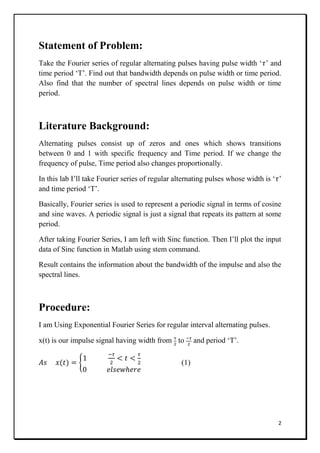
x(t) is our impulse signal having width from to and period ‘T’.
{ (1)
3
Figure 1
Regular alternating pulse signal
Applying Fourier Series we get:
∫
⇒ ∫
[
( ) ( )
]
[
( ) ( )
]
[
( ) ( )
] (3)
Putting in eq (3)
⇒ [
( ) ( )
]
(4)
As sin(x) =
4
⇒
.
(5)
Now applying Eq (5) in Matlab using different values of T and
Matlab Coding:
clc
clear all
close all
n= -20:1:20;
T=0.8; %Time period
Ta=0.4; %pulse width
x=(Ta/T)*sinc(n*(Ta/T));
stem(n,x)
title('T=0.8 Ta=0.4')
ylabel('x[n]')
grid;
5
Figure 2
Graph of sinc function
clc
clear all
close all
n= -20:1:20;
T=0.8;
Ta=0.2;
x=(Ta/T)*sinc(n*(Ta/T));
stem(n,x)
title('T=0.8 Ta=0.2')
ylabel('x[n]')
grid;
6
Figure 3
Graph of sinc function
clc
clear all
close all
n= -20:1:20;
T=0.9;
Ta=0.3;
x=(Ta/T)*sinc(n*(Ta/T));
stem(n,x)
title('T=0.9 Ta=0.3')
ylabel('x[n]')
grid;
7
Figure 4
Graph of sinc function
clc
clear all
close all
n= -20:1:20;
T=0.6;
Ta=0.3;
x=(Ta/T)*sinc(n*(Ta/T));
stem(n,x)
title('T=0.6 Ta=0.3')
ylabel('x[n]')
grid;
8
Figure 5
Graph of sinc function
Analysis:
From Figure 2,3,4 and 5 I analysed the bandwidth and spectral lines of the
signal. I relate the Bandwidth with the variation of pulse width and also the
relation of spectral lines with changing time period.
B is inversely proportional to the pulse width and spectral lines are directly
proportional to time period as shown in table no 1.
Table no 1:
S.
No.
Time Period
“T’’ in sec
Pulse Width
in sec
Bandwidth
Hertz
Number of Spectral lines
In first central lobe
1 0.8 0.4 5 3
2 0.8 0.2 10 7
3 0.9 0.3 6.667 5
4 0.6 0.3 6.667 3
9
Question And Answers:
Q1: It is required to keep the pulse in the center of time domain graph,
when we take the Fourier Series of regular interval alternating pulses why?
Ans:
It is required to keep the pulse in the centre of time domain graph, because
when we take the Fourier Series of regular interval alternating pulses we get
sinc function which gives us maximum value at 0.
Q2: What happened to the number of spectral lines in first central lobe of
sinc function, when pulse width is constant and time period is increasing?
Ans:
When pulse width is constant and time period is increasing, the spectral lines in
first central lobe of sinc function also increases as shown in Figure no 4, Figure
no 5 and Table no 1.
Q3: What happens to the bandwidth of first central lobe of sinc function
when time period is constant and pulse width is increasing?
Ans:
When time period is constant and pulse width is increasing the bandwidth of
first central lobe of sinc function decreases as shown in Figure no 1, Figure no
2 and Table no 1.
Conclusion:
In this lab I had learnt to find the Fourier series of alternating pulses and making
sinc function. By plotting sinc function in Matlab for different value of time
period and pulse width, I conclude that the Bandwidth is inversely proportional
to pulse width and spectral lines are directly proportional to time period.

Fourier series

  • 1.
    1 Lab Task :01 Submitted By : Syed Abuzar Hussain Shah Reg # SP15-BEE-096 Submitted To: Sir Ateeq-ul-Inam Class: BEE-5A Dated: 20/03/2017
  • 2.
    2 Statement of Problem: Takethe Fourier series of regular alternating pulses having pulse width ‘ ’ and time period ‘T’. Find out that bandwidth depends on pulse width or time period. Also find that the number of spectral lines depends on pulse width or time period. Literature Background: Alternating pulses consist up of zeros and ones which shows transitions between 0 and 1 with specific frequency and Time period. If we change the frequency of pulse, Time period also changes proportionally. In this lab I’ll take Fourier series of regular alternating pulses whose width is ‘ ’ and time period ‘T’. Basically, Fourier series is used to represent a periodic signal in terms of cosine and sine waves. A periodic signal is just a signal that repeats its pattern at some period. After taking Fourier Series, I am left with Sinc function. Then I’ll plot the input data of Sinc function in Matlab using stem command. Result contains the information about the bandwidth of the impulse and also the spectral lines. Procedure: I am Using Exponential Fourier Series for regular interval alternating pulses. x(t) is our impulse signal having width from to and period ‘T’. { (1)
  • 3.
    3 Figure 1 Regular alternatingpulse signal Applying Fourier Series we get: ∫ ⇒ ∫ [ ( ) ( ) ] [ ( ) ( ) ] [ ( ) ( ) ] (3) Putting in eq (3) ⇒ [ ( ) ( ) ] (4) As sin(x) =
  • 4.
    4 ⇒ . (5) Now applying Eq(5) in Matlab using different values of T and Matlab Coding: clc clear all close all n= -20:1:20; T=0.8; %Time period Ta=0.4; %pulse width x=(Ta/T)*sinc(n*(Ta/T)); stem(n,x) title('T=0.8 Ta=0.4') ylabel('x[n]') grid;
  • 5.
    5 Figure 2 Graph ofsinc function clc clear all close all n= -20:1:20; T=0.8; Ta=0.2; x=(Ta/T)*sinc(n*(Ta/T)); stem(n,x) title('T=0.8 Ta=0.2') ylabel('x[n]') grid;
  • 6.
    6 Figure 3 Graph ofsinc function clc clear all close all n= -20:1:20; T=0.9; Ta=0.3; x=(Ta/T)*sinc(n*(Ta/T)); stem(n,x) title('T=0.9 Ta=0.3') ylabel('x[n]') grid;
  • 7.
    7 Figure 4 Graph ofsinc function clc clear all close all n= -20:1:20; T=0.6; Ta=0.3; x=(Ta/T)*sinc(n*(Ta/T)); stem(n,x) title('T=0.6 Ta=0.3') ylabel('x[n]') grid;
  • 8.
    8 Figure 5 Graph ofsinc function Analysis: From Figure 2,3,4 and 5 I analysed the bandwidth and spectral lines of the signal. I relate the Bandwidth with the variation of pulse width and also the relation of spectral lines with changing time period. B is inversely proportional to the pulse width and spectral lines are directly proportional to time period as shown in table no 1. Table no 1: S. No. Time Period “T’’ in sec Pulse Width in sec Bandwidth Hertz Number of Spectral lines In first central lobe 1 0.8 0.4 5 3 2 0.8 0.2 10 7 3 0.9 0.3 6.667 5 4 0.6 0.3 6.667 3
  • 9.
    9 Question And Answers: Q1:It is required to keep the pulse in the center of time domain graph, when we take the Fourier Series of regular interval alternating pulses why? Ans: It is required to keep the pulse in the centre of time domain graph, because when we take the Fourier Series of regular interval alternating pulses we get sinc function which gives us maximum value at 0. Q2: What happened to the number of spectral lines in first central lobe of sinc function, when pulse width is constant and time period is increasing? Ans: When pulse width is constant and time period is increasing, the spectral lines in first central lobe of sinc function also increases as shown in Figure no 4, Figure no 5 and Table no 1. Q3: What happens to the bandwidth of first central lobe of sinc function when time period is constant and pulse width is increasing? Ans: When time period is constant and pulse width is increasing the bandwidth of first central lobe of sinc function decreases as shown in Figure no 1, Figure no 2 and Table no 1. Conclusion: In this lab I had learnt to find the Fourier series of alternating pulses and making sinc function. By plotting sinc function in Matlab for different value of time period and pulse width, I conclude that the Bandwidth is inversely proportional to pulse width and spectral lines are directly proportional to time period.