BASE Workshop 4:
Four keys to exam success
National Centre for Teaching & Learning
one
Think positively about the challenge
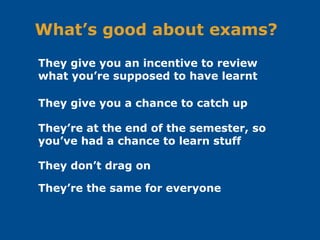
What’s good about exams?
They’re at the end of the semester, so
you’ve had a chance to learn stuff
They don’t drag on
They give you an incentive to review
what you’re supposed to have learnt
They give you a chance to catch up
They’re the same for everyone
They make the good
things in life seem
even sweeter than
before
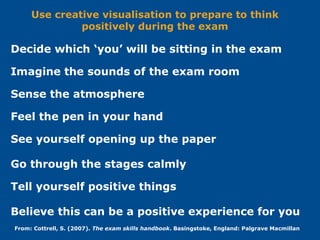
Imagine the sounds of the exam room
Sense the atmosphere
Feel the pen in your hand
See yourself opening up the paper
Go through the stages calmly
Believe this can be a positive experience for you
From: Cottrell, S. (2007). The exam skills handbook. Basingstoke, England: Palgrave Macmillan
Tell yourself positive things
Decide which ‘you’ will be sitting in the exam
Use creative visualisation to prepare to think
positively during the exam
two
Plan early on, so that you get a sense of control
and progress
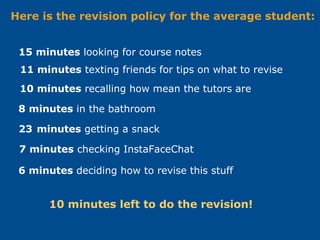
Here is the revision policy for the average student:
15 minutes looking for course notes
11 minutes texting friends for tips on what to revise
10 minutes recalling how mean the tutors are
8 minutes in the bathroom
23 minutes getting a snack
7 minutes checking InstaFaceChat
6 minutes deciding how to revise this stuff
10 minutes left to do the revision!
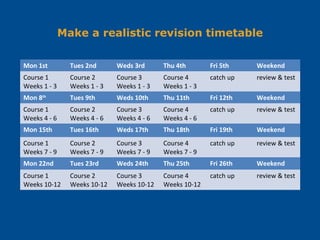
Mon 1st Tues 2nd Weds 3rd Thu 4th Fri 5th Weekend
Course 1
Weeks 1 - 3
Course 2
Weeks 1 - 3
Course 3
Weeks 1 - 3
Course 4
Weeks 1 - 3
catch up review & test
Mon 8th
Tues 9th Weds 10th Thu 11th Fri 12th Weekend
Course 1
Weeks 4 - 6
Course 2
Weeks 4 - 6
Course 3
Weeks 4 - 6
Course 4
Weeks 4 - 6
catch up review & test
Mon 15th Tues 16th Weds 17th Thu 18th Fri 19th Weekend
Course 1
Weeks 7 - 9
Course 2
Weeks 7 - 9
Course 3
Weeks 7 - 9
Course 4
Weeks 7 - 9
catch up review & test
Mon 22nd Tues 23rd Weds 24th Thu 25th Fri 26th Weekend
Course 1
Weeks 10-12
Course 2
Weeks 10-12
Course 3
Weeks 10-12
Course 4
Weeks 10-12
catch up review & test
Make a realistic revision timetable
three
Be active and creative in your revision
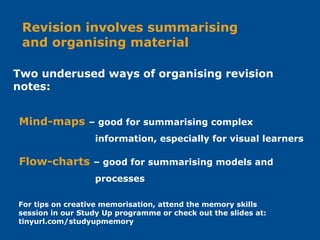
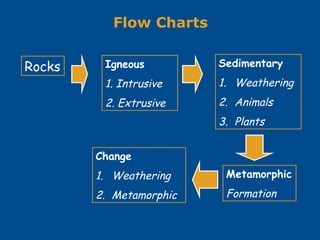
Flow-charts – good for summarising models and
processes
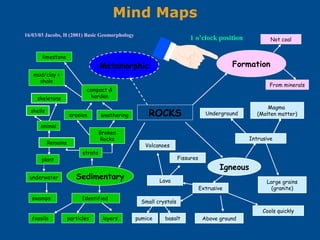
Mind-maps – good for summarising complex
information, especially for visual learners
Revision involves summarising
and organising material
Two underused ways of organising revision
notes:
For tips on creative memorisation, attend the memory skills
session in our Study Up programme or check out the slides at:
tinyurl.com/studyupmemory
Mind Maps
ROCKS
Formation
From minerals
Not coal
Extrusive
Cools quickly
Above ground
Small crystals
Lava
Fissures
Volcanoes
pumice basalt
mud/clay >
shale
limestone
Metamorphic
1 o’clock position16/03/03 Jacobs, H (2001) Basic Geomorphology
Igneous
Intrusive
Underground
Magma
(Molten matter)
Large grains
(granite)
Broken
Rocks
erosion weathering
strata
compact &
harden
plant
animal
shells
skeletons
swamps
Remains
underwater Sedimentary
Identified
layersparticlesfossils
Flow Charts
Rocks Igneous
1. Intrusive
2. Extrusive
Sedimentary
1. Weathering
2. Animals
3. Plants
Metamorphic
Formation
Change
1. Weathering
2. Metamorphic
four
Make good use of past papers and examples from
your tutors
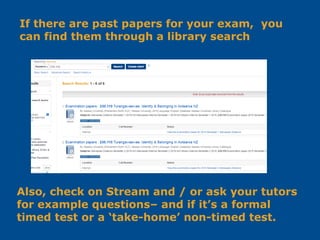
If there are past papers for your exam, you
can find them through a library search
Also, check on Stream and / or ask your tutors
for example questions– and if it’s a formal
timed test or a ‘take-home’ non-timed test.
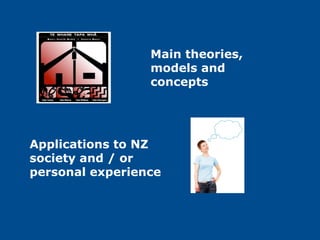
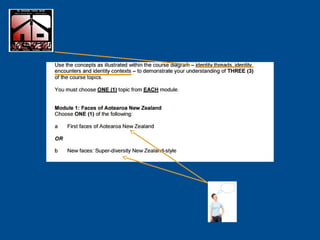
Typical FOCUS of exam questions
Main theories,
models and
concepts
Applications to NZ
society and / or
personal experience
Typical TIMING of exam questions
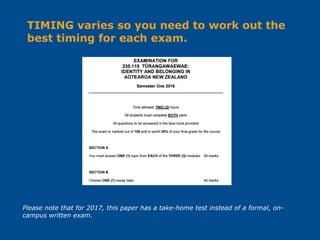
TIMING varies so you need to work out the
best timing for each exam.
Please note that for 2017, this paper has a take-home test instead of a formal, on-
campus written exam.
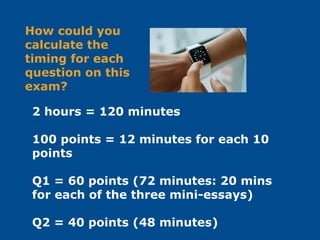
2 hours = 120 minutes
100 points = 12 minutes for each 10
points
Q1 = 60 points (72 minutes: 20 mins
for each of the three mini-essays)
Q2 = 40 points (48 minutes)
How could you
calculate the
timing for each
question on this
exam?
Practise planning (and, if possible,
writing some) exam essays.
Consider writing a ‘skeleton plan’ for all of your
essays at the beginning of the exam, while your
mind is fresh. Then you have something to build on
when you do the writing later.
Identify the parts of the question and give one or two
paragraphs to each part.
Write on every second line – plenty of space for any
later revisions, additions or corrections!
Tips for writing exam essays
TOPIC: New faces – superdiversity NZ style.
TASK: Use identity threads, encounters and contexts
to show your understanding of the topic.
This suggests a three-paragraph essay (giving you five
minutes or so per paragraph of five or six sentences)
with no introduction or conclusion.
Suggestion for a 15-20 minute short essay
For each paragraph, you could: Explain the concept
(e.g. identity threads), give two or three examples
related to the topic and explain what they tell us
about the topic.
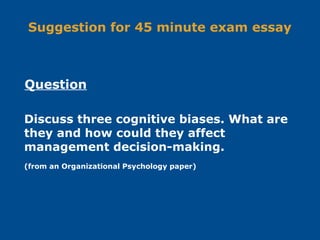
Suggestion for 45 minute exam essay
Discuss three cognitive biases. What are
they and how could they affect
management decision-making.
(from an Organizational Psychology paper)
Question
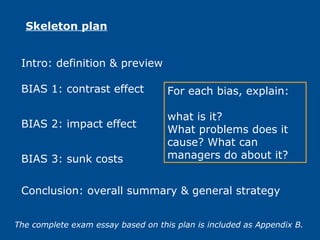
Intro: definition & preview
Skeleton plan
BIAS 1: contrast effect
Conclusion: overall summary & general strategy
BIAS 2: impact effect
BIAS 3: sunk costs
For each bias, explain:
what is it?
What problems does it
cause? What can
managers do about it?
The complete exam essay based on this plan is included as Appendix B.
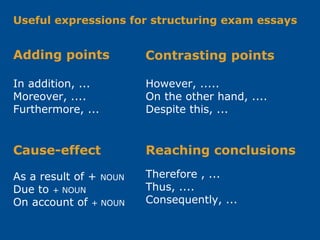
Useful expressions for structuring exam essays
Adding points
However, .....
On the other hand, ....
Despite this, ...
In addition, ...
Moreover, ....
Furthermore, ...
Contrasting points
Reaching conclusions
Therefore , ...
Thus, ....
Consequently, ...
Cause-effect
As a result of + NOUN
Due to + NOUN
On account of + NOUN
CONCLUSION
Do your best to get yourself in a positive frame of
mind about your exams.
Make yourself a practical revision plan – and start
early!
Get a good idea of what’s expected and use that to
practise planning and writing some example exam
essays.
Choose ways of organising material that work for
you.
Appendix A: Extra resources
6 hour Course on revision and examinations from Open Learning, UK
tinyurl.com/exams1
Exam Skills tips from Massey University [OWLL]
tinyurl.com/exams3
Exam Skills tips from Reading University, UK
tinyurl.com/exams5
Resources, workshops and consultations on positive thinking and
wellness from Massey’s health and counselling centre
tinyurl.com/masseyhealth
Guides and recordings about relaxation and positive thinking from the
Mental Health Foundation, UK
http://tinyurl.com/stressandrelaxationadvice
Video on motivation for study from Trinity College, Dublin, Ireland
http://tinyurl.com/exams8
Spiritual support from Massey’s chaplaincy
tinyurl.com/masseychaplaincy
Discuss three cognitive biases.
What are they and how could they
affect management decision-
making.
Question
Appendix B: Example essay
Approximately 45 minutes
Timing
See the plan for this essay on slide 25.
A cognitive bias is any tendency to think irrationally.
These biases are often based on rules of thumb or
heuristics, which might appear to be common sense, but
in fact are no more true that the commonsense view that
the sun goes round the earth. This essay will analyse
three cognitive biases and highlight their potentially
damaging impact on management decision-making.
Introduction
The contrast effect is the tendency to measure things in
relative, rather than absolute terms. For instance, goods which
are offered at a clearly discounted rate are likely to appear
attractive, because consumers focus on how much less they
now cost, rather than how much they are really worth in terms
of cost-benefit to the user. It is important for managers to
know about the contrast effect in order to avoid being
influenced by it in purchase or investment decisions, but also
so that they can manage how their own decisions are perceived
by their employees. So, managers awarding two or three
percent pay rises in these hard economic times, need to try to
avoid workers comparing these to better times and focus
instead on the absolute value of the increase in financial and
job security terms.
Paragraph 2
Impact bias is another failure of objectivity, where people
tend to overestimate the strength of feeling they’re going
to have as a result of a change. In management, this
may be a barrier to change, as overestimating the pain
caused by such a change may make managers more risk-
averse than they need to be. In a democratic
organisation, employees’ initial reactions to proposed
changes – for example, a move to a different premises,
or a change of software – are likely to be very negative
because of this bias, even if the change turns out to be
beneficial to them. Managers need, therefore, to be well-
prepared to sympathise, to allow time for adjustment and
to communicative realistic positive messages.
Paragraph 3
Finally, basing future financial decisions on sunk costs is
a widespread fallacy in management. Although sunk costs
cannot be recovered and therefore should not be
considered when calculating future investments,
behavioural economists point out that managers are still
strongly influenced by them. Managers who have
invested millions in developing particular markets will find
it difficult to forget that – at least emotionally – when
making a decision about whether to withdraw. As with
the previous fallacies, it is important to ask questions and
use decision-making tools to calculate the true future
costs and benefits of our decisions, while also
understanding how sunk costs may be holding back
clients or competitors.
Paragraph 4
In conclusion, cognitive biases can affect every aspect of
management decision-making. This is not because
individuals are entirely irrational, but because rationality
is ‘bounded’ by emotions and rules of thumb which are
essential for everyday life, but potentially disastrous for
bigger decisions in the business world. Managers
therefore need to be aware of their own biases, use
appropriate tools to correct them and understand how
how these same fallacies affect all of their employees,
colleagues and clients.
Conclusion

Four keys to exam success

  • 1.
    BASE Workshop 4: Fourkeys to exam success National Centre for Teaching & Learning
  • 2.
  • 3.
    What’s good aboutexams? They’re at the end of the semester, so you’ve had a chance to learn stuff They don’t drag on They give you an incentive to review what you’re supposed to have learnt They give you a chance to catch up They’re the same for everyone
  • 4.
    They make thegood things in life seem even sweeter than before
  • 5.
    Imagine the soundsof the exam room Sense the atmosphere Feel the pen in your hand See yourself opening up the paper Go through the stages calmly Believe this can be a positive experience for you From: Cottrell, S. (2007). The exam skills handbook. Basingstoke, England: Palgrave Macmillan Tell yourself positive things Decide which ‘you’ will be sitting in the exam Use creative visualisation to prepare to think positively during the exam
  • 6.
    two Plan early on,so that you get a sense of control and progress
  • 7.
    Here is therevision policy for the average student: 15 minutes looking for course notes 11 minutes texting friends for tips on what to revise 10 minutes recalling how mean the tutors are 8 minutes in the bathroom 23 minutes getting a snack 7 minutes checking InstaFaceChat 6 minutes deciding how to revise this stuff 10 minutes left to do the revision!
  • 8.
    Mon 1st Tues2nd Weds 3rd Thu 4th Fri 5th Weekend Course 1 Weeks 1 - 3 Course 2 Weeks 1 - 3 Course 3 Weeks 1 - 3 Course 4 Weeks 1 - 3 catch up review & test Mon 8th Tues 9th Weds 10th Thu 11th Fri 12th Weekend Course 1 Weeks 4 - 6 Course 2 Weeks 4 - 6 Course 3 Weeks 4 - 6 Course 4 Weeks 4 - 6 catch up review & test Mon 15th Tues 16th Weds 17th Thu 18th Fri 19th Weekend Course 1 Weeks 7 - 9 Course 2 Weeks 7 - 9 Course 3 Weeks 7 - 9 Course 4 Weeks 7 - 9 catch up review & test Mon 22nd Tues 23rd Weds 24th Thu 25th Fri 26th Weekend Course 1 Weeks 10-12 Course 2 Weeks 10-12 Course 3 Weeks 10-12 Course 4 Weeks 10-12 catch up review & test Make a realistic revision timetable
  • 9.
    three Be active andcreative in your revision
  • 10.
    Flow-charts – goodfor summarising models and processes Mind-maps – good for summarising complex information, especially for visual learners Revision involves summarising and organising material Two underused ways of organising revision notes: For tips on creative memorisation, attend the memory skills session in our Study Up programme or check out the slides at: tinyurl.com/studyupmemory
  • 11.
    Mind Maps ROCKS Formation From minerals Notcoal Extrusive Cools quickly Above ground Small crystals Lava Fissures Volcanoes pumice basalt mud/clay > shale limestone Metamorphic 1 o’clock position16/03/03 Jacobs, H (2001) Basic Geomorphology Igneous Intrusive Underground Magma (Molten matter) Large grains (granite) Broken Rocks erosion weathering strata compact & harden plant animal shells skeletons swamps Remains underwater Sedimentary Identified layersparticlesfossils
  • 12.
    Flow Charts Rocks Igneous 1.Intrusive 2. Extrusive Sedimentary 1. Weathering 2. Animals 3. Plants Metamorphic Formation Change 1. Weathering 2. Metamorphic
  • 13.
    four Make good useof past papers and examples from your tutors
  • 14.
    If there arepast papers for your exam, you can find them through a library search Also, check on Stream and / or ask your tutors for example questions– and if it’s a formal timed test or a ‘take-home’ non-timed test.
  • 15.
    Typical FOCUS ofexam questions
  • 16.
    Main theories, models and concepts Applicationsto NZ society and / or personal experience
  • 18.
    Typical TIMING ofexam questions
  • 19.
    TIMING varies soyou need to work out the best timing for each exam. Please note that for 2017, this paper has a take-home test instead of a formal, on- campus written exam.
  • 20.
    2 hours =120 minutes 100 points = 12 minutes for each 10 points Q1 = 60 points (72 minutes: 20 mins for each of the three mini-essays) Q2 = 40 points (48 minutes) How could you calculate the timing for each question on this exam?
  • 21.
    Practise planning (and,if possible, writing some) exam essays.
  • 22.
    Consider writing a‘skeleton plan’ for all of your essays at the beginning of the exam, while your mind is fresh. Then you have something to build on when you do the writing later. Identify the parts of the question and give one or two paragraphs to each part. Write on every second line – plenty of space for any later revisions, additions or corrections! Tips for writing exam essays
  • 23.
    TOPIC: New faces– superdiversity NZ style. TASK: Use identity threads, encounters and contexts to show your understanding of the topic. This suggests a three-paragraph essay (giving you five minutes or so per paragraph of five or six sentences) with no introduction or conclusion. Suggestion for a 15-20 minute short essay For each paragraph, you could: Explain the concept (e.g. identity threads), give two or three examples related to the topic and explain what they tell us about the topic.
  • 24.
    Suggestion for 45minute exam essay Discuss three cognitive biases. What are they and how could they affect management decision-making. (from an Organizational Psychology paper) Question
  • 25.
    Intro: definition &preview Skeleton plan BIAS 1: contrast effect Conclusion: overall summary & general strategy BIAS 2: impact effect BIAS 3: sunk costs For each bias, explain: what is it? What problems does it cause? What can managers do about it? The complete exam essay based on this plan is included as Appendix B.
  • 26.
    Useful expressions forstructuring exam essays Adding points However, ..... On the other hand, .... Despite this, ... In addition, ... Moreover, .... Furthermore, ... Contrasting points Reaching conclusions Therefore , ... Thus, .... Consequently, ... Cause-effect As a result of + NOUN Due to + NOUN On account of + NOUN
  • 27.
  • 28.
    Do your bestto get yourself in a positive frame of mind about your exams. Make yourself a practical revision plan – and start early! Get a good idea of what’s expected and use that to practise planning and writing some example exam essays. Choose ways of organising material that work for you.
  • 29.
    Appendix A: Extraresources 6 hour Course on revision and examinations from Open Learning, UK tinyurl.com/exams1 Exam Skills tips from Massey University [OWLL] tinyurl.com/exams3 Exam Skills tips from Reading University, UK tinyurl.com/exams5 Resources, workshops and consultations on positive thinking and wellness from Massey’s health and counselling centre tinyurl.com/masseyhealth Guides and recordings about relaxation and positive thinking from the Mental Health Foundation, UK http://tinyurl.com/stressandrelaxationadvice Video on motivation for study from Trinity College, Dublin, Ireland http://tinyurl.com/exams8 Spiritual support from Massey’s chaplaincy tinyurl.com/masseychaplaincy
  • 30.
    Discuss three cognitivebiases. What are they and how could they affect management decision- making. Question Appendix B: Example essay Approximately 45 minutes Timing See the plan for this essay on slide 25.
  • 31.
    A cognitive biasis any tendency to think irrationally. These biases are often based on rules of thumb or heuristics, which might appear to be common sense, but in fact are no more true that the commonsense view that the sun goes round the earth. This essay will analyse three cognitive biases and highlight their potentially damaging impact on management decision-making. Introduction
  • 32.
    The contrast effectis the tendency to measure things in relative, rather than absolute terms. For instance, goods which are offered at a clearly discounted rate are likely to appear attractive, because consumers focus on how much less they now cost, rather than how much they are really worth in terms of cost-benefit to the user. It is important for managers to know about the contrast effect in order to avoid being influenced by it in purchase or investment decisions, but also so that they can manage how their own decisions are perceived by their employees. So, managers awarding two or three percent pay rises in these hard economic times, need to try to avoid workers comparing these to better times and focus instead on the absolute value of the increase in financial and job security terms. Paragraph 2
  • 33.
    Impact bias isanother failure of objectivity, where people tend to overestimate the strength of feeling they’re going to have as a result of a change. In management, this may be a barrier to change, as overestimating the pain caused by such a change may make managers more risk- averse than they need to be. In a democratic organisation, employees’ initial reactions to proposed changes – for example, a move to a different premises, or a change of software – are likely to be very negative because of this bias, even if the change turns out to be beneficial to them. Managers need, therefore, to be well- prepared to sympathise, to allow time for adjustment and to communicative realistic positive messages. Paragraph 3
  • 34.
    Finally, basing futurefinancial decisions on sunk costs is a widespread fallacy in management. Although sunk costs cannot be recovered and therefore should not be considered when calculating future investments, behavioural economists point out that managers are still strongly influenced by them. Managers who have invested millions in developing particular markets will find it difficult to forget that – at least emotionally – when making a decision about whether to withdraw. As with the previous fallacies, it is important to ask questions and use decision-making tools to calculate the true future costs and benefits of our decisions, while also understanding how sunk costs may be holding back clients or competitors. Paragraph 4
  • 35.
    In conclusion, cognitivebiases can affect every aspect of management decision-making. This is not because individuals are entirely irrational, but because rationality is ‘bounded’ by emotions and rules of thumb which are essential for everyday life, but potentially disastrous for bigger decisions in the business world. Managers therefore need to be aware of their own biases, use appropriate tools to correct them and understand how how these same fallacies affect all of their employees, colleagues and clients. Conclusion

Editor's Notes

  • #2 Focus of this session is on the first step of research proposal that is defining the scope of your research. What does that mean? What you will and will not cover-from the general to the specific So look at Getting started-don’t know what to study Refining process