Dr. Prasad Modak
Ekonnect Knowledge Foundation
Foundation Course
on Environmental
Management &
Sustainability
Key Pre-requisites
• Ecology – Understanding why
environment matters!
– Passion
– Perseverance
– Patience
• Thinking about not just the Problem but
also Opportunity
2
Building the
Thought Process
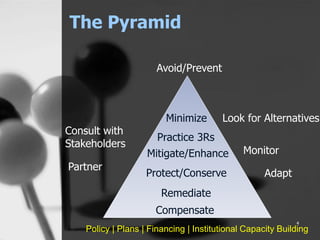
The Pyramid
4
Avoid/Prevent
Look for Alternatives
Mitigate/Enhance
Minimize
Compensate
Consult with
Stakeholders
Monitor
Remediate
Protect/Conserve Adapt
Partner
Practice 3Rs
Policy | Plans | Financing | Institutional Capacity Building
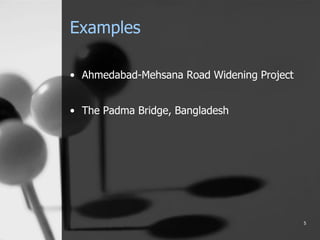
Examples
• Ahmedabad-Mehsana Road Widening Project
• The Padma Bridge, Bangladesh
5
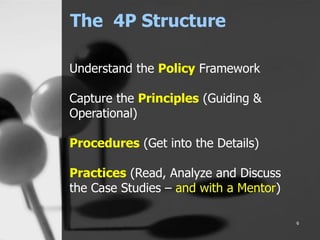
The 4P Structure
6
Understand the Policy Framework
Capture the Principles (Guiding &
Operational)
Procedures (Get into the Details)
Practices (Read, Analyze and Discuss
the Case Studies – and with a Mentor)
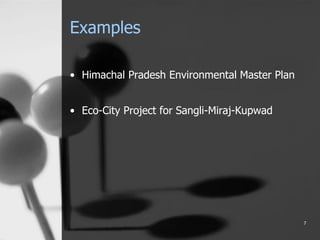
Examples
• Himachal Pradesh Environmental Master Plan
• Eco-City Project for Sangli-Miraj-Kupwad
7
It will have to be a Team
Work
8
Environmental Management is multi-
disciplinary
You need attitude to appreciate other
disciplines – their role and relevance
Learning in Environmental
Management is often
Experiential
9
Field Surveys
Stakeholder consultations
Case studies and Narratives
Group Discussions and Debates
You can no more learn
environmental management in silos,
You need to learn in a systems
perspective and in cross-sectoral
formats
10
Air Quality Modelling
Water Quality Modelling
Groundwater contamination Modelling
Fate of Environmental Pollutants
Pollution Control
Pollution Prevention
Integrated Pollution Prevention &
Control
11
12
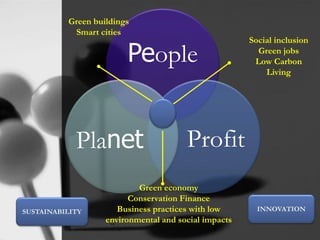
People
ProfitPlanet
Social inclusion
Green jobs
Low Carbon
Living
Green buildings
Smart cities
Green economy
Conservation Finance
Business practices with low
environmental and social impacts
INNOVATIONSUSTAINABILITY
Learning will need to be blended,
collaborative and cross-sectoral -
driven through carefully chosen
case studies
13
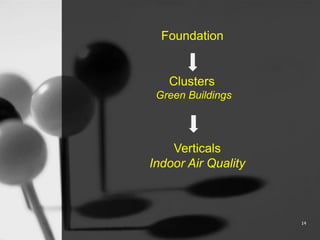
14
Foundation
Verticals
Indoor Air Quality
Clusters
Green Buildings
15
Plan your education, research,
training, jobs and
entrepreneurships accordingly
16
Features of the E-learning
Course on Environmental
Management & Sustainability
Highlights
• Case study driven – emphasizing
pyramid thinking and the 4P process
• Case studies will be dynamic – updated
every month
• Collaborative with Discussion Groups
and Mentors
• Blended – triggering field work, surveys,
stakeholder consultations - Localization
17
Highlights
• Competitive and rewarding
• Provides resources and networking
• Four weeks of learning through 4 case
studies
• Can join anytime
• Course assessment done on
understanding of case studies
• Certificate issued on successful
completion 18
Samples of First 4 Case Studies
• Urban Air Quality Management (Substitution of
Compressed Natural Gas in Delhi)
• Genetically Modified Food & Environmental Risk
Assessment (Case of Monsanto in India)
• Business & Sustainability (Cases from India
Inc) Does Sustainability Pay?
• Managing Water Conflicts (Case of Dewas
Water Supply in Madhya Pradesh)
19
Let us now view the
E-learning Portal

Foundation course on environmental management & sustainability_ Presentation made at NITK

  • 1.
    Dr. Prasad Modak EkonnectKnowledge Foundation Foundation Course on Environmental Management & Sustainability
  • 2.
    Key Pre-requisites • Ecology– Understanding why environment matters! – Passion – Perseverance – Patience • Thinking about not just the Problem but also Opportunity 2
  • 3.
  • 4.
    The Pyramid 4 Avoid/Prevent Look forAlternatives Mitigate/Enhance Minimize Compensate Consult with Stakeholders Monitor Remediate Protect/Conserve Adapt Partner Practice 3Rs Policy | Plans | Financing | Institutional Capacity Building
  • 5.
    Examples • Ahmedabad-Mehsana RoadWidening Project • The Padma Bridge, Bangladesh 5
  • 6.
    The 4P Structure 6 Understandthe Policy Framework Capture the Principles (Guiding & Operational) Procedures (Get into the Details) Practices (Read, Analyze and Discuss the Case Studies – and with a Mentor)
  • 7.
    Examples • Himachal PradeshEnvironmental Master Plan • Eco-City Project for Sangli-Miraj-Kupwad 7
  • 8.
    It will haveto be a Team Work 8 Environmental Management is multi- disciplinary You need attitude to appreciate other disciplines – their role and relevance
  • 9.
    Learning in Environmental Managementis often Experiential 9 Field Surveys Stakeholder consultations Case studies and Narratives Group Discussions and Debates
  • 10.
    You can nomore learn environmental management in silos, You need to learn in a systems perspective and in cross-sectoral formats 10 Air Quality Modelling Water Quality Modelling Groundwater contamination Modelling Fate of Environmental Pollutants
  • 11.
    Pollution Control Pollution Prevention IntegratedPollution Prevention & Control 11
  • 12.
    12 People ProfitPlanet Social inclusion Green jobs LowCarbon Living Green buildings Smart cities Green economy Conservation Finance Business practices with low environmental and social impacts INNOVATIONSUSTAINABILITY
  • 13.
    Learning will needto be blended, collaborative and cross-sectoral - driven through carefully chosen case studies 13
  • 14.
  • 15.
    15 Plan your education,research, training, jobs and entrepreneurships accordingly
  • 16.
    16 Features of theE-learning Course on Environmental Management & Sustainability
  • 17.
    Highlights • Case studydriven – emphasizing pyramid thinking and the 4P process • Case studies will be dynamic – updated every month • Collaborative with Discussion Groups and Mentors • Blended – triggering field work, surveys, stakeholder consultations - Localization 17
  • 18.
    Highlights • Competitive andrewarding • Provides resources and networking • Four weeks of learning through 4 case studies • Can join anytime • Course assessment done on understanding of case studies • Certificate issued on successful completion 18
  • 19.
    Samples of First4 Case Studies • Urban Air Quality Management (Substitution of Compressed Natural Gas in Delhi) • Genetically Modified Food & Environmental Risk Assessment (Case of Monsanto in India) • Business & Sustainability (Cases from India Inc) Does Sustainability Pay? • Managing Water Conflicts (Case of Dewas Water Supply in Madhya Pradesh) 19
  • 20.
    Let us nowview the E-learning Portal