Greg Lemke, CSP, CHMM
   Introductions
   Old vs New (Compliance vs. EMS)
   Ideas for the future


30,000 foot i
30 000 f t view
   Command and Control
    ◦ Regulatory compliance emphasis
    ◦ Enforcement
    ◦ Not always cost effective

    ◦ Reliance on:
      Environmental Policy
      Environmental Audits
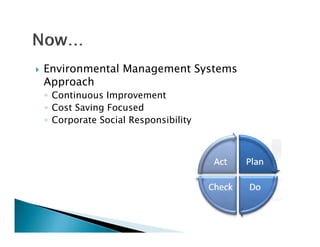
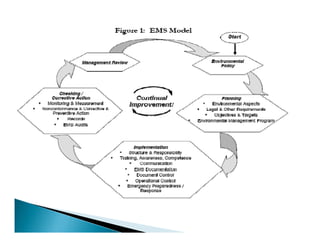
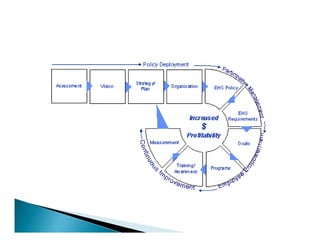
   Environmental Management Systems
    Approach
    ◦ Continuous Improvement
    ◦ Cost Saving Focused
    ◦ Corporate Social Responsibility
1. The pace of the global economy
 ◦   Competitiveness
 ◦   instantaneous knowledge
2.
2 The sharp increase in energy costs

3. The more recent and ramped-up attention
   of global climate change.
Are your operations, organizational structure,
core products and/or services, and stakeholder
engagements sustainable?
 ◦ Third-party verifiable sustainability
 ◦ Corporate social responsibility reporting
 ◦ I t
   International standards f environment and h lth
          ti   l t d d for         i       t d health
   and safety
   In business, ROI is most often thought of as
    dollars made or saved in relation to dollars
    invested
    ◦ baseline operations
    ◦ implement programs with specific metrics
    ◦ work to achieve those goals
   The return on investments need to well-
    documented, and sustainable operations
    need to be beneficial to the traditional
    bottom line
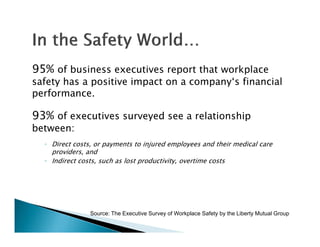
95% of business executives report that workplace
safety has a positive impact on a company‘s financial
performance.

93% of executives surveyed see a relationship
between:
  ◦ Direct costs, or payments to injured employees and their medical care
    providers, and
  ◦ Indirect costs, such as lost productivity, overtime costs


                Source: The Executive Survey of Workplace Safety by the Liberty Mutual Group
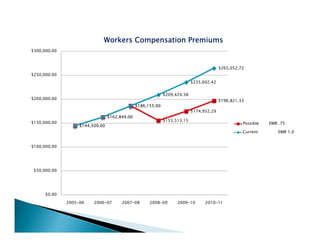
Workers Compensation Premiums
$300,000.00


                                                                                         $265,052.72
$250,000.00
                                                                           $235,602.42


                                                             $209,424.38
$200,000.00
                                                                                         $196,821.33
                                               $186,155.00
                                                                           $174,952.29
                                 $162,849.00
                                                             $155,513.15
$150,000.00                                                                                        Possible   EMR .75
                   $144,509.00
                                                                                                   Current        EMR 1.0


$100,000.00


 $50 000 00
 $50,000.00


      $0.00

              2005-06
              2005 06    2006-07
                         2006 07       2007-08
                                       2007 08       2008-09
                                                     2008 09       2009-10
                                                                   2009 10       2010-11
                                                                                 2010 11
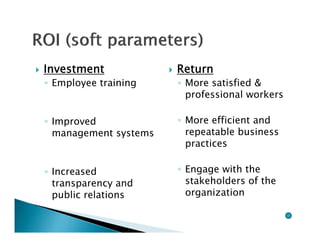
   Investment                Return
    ◦ Employee training        ◦ More satisfied &
                                 professional workers

    ◦ Improved                 ◦ More efficient and
      management systems         repeatable business
                                 practices

    ◦ Increased                ◦ Engage with the
      transparency and           stakeholders of the
      public relations           organization
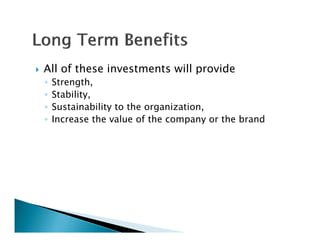
   All of these investments will provide
    ◦   Strength,
    ◦   Stability,
    ◦   Sustainability to the organization
                              organization,
    ◦   Increase the value of the company or the brand
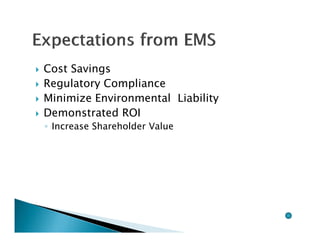
   Cost Savings
   Regulatory Compliance
   Minimize Environmental Liability
   Demonstrated ROI
    ◦ Increase Shareholder Value
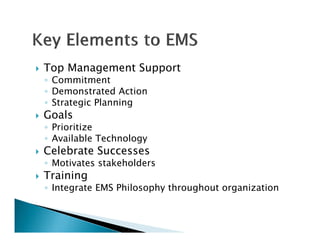
   Top Management Support
    ◦ Commitment
      C      i
    ◦ Demonstrated Action
    ◦ Strategic Planning
   Goals
    ◦ Prioritize
    ◦ Available Technology
   Celebrate Successes
    ◦ Motivates stakeholders
   Training
    ◦ Integrate EMS Philosophy throughout organization
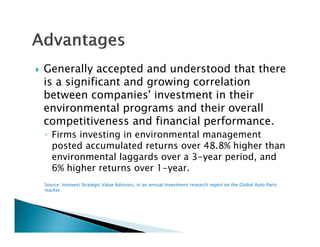
   Generally accepted and understood that there
    is a significant and growing correlation
    between companies' investment in their
    environmental programs and their overall
    competitiveness and financial performance.
    ◦ Firms investing in environmental management
                    g                      g
      posted accumulated returns over 48.8% higher than
      environmental laggards over a 3-year period, and
      6% higher returns over 1-year.
                              1 year.
    Source: Innovest Strategic Value Advisors, in an annual investment research report on the Global Auto Parts
    market
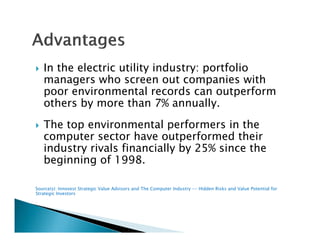
   In the electric utility industry: portfolio
    managers who screen out companies with
                 h              t         i     ith
    poor environmental records can outperform
    others by more than 7% annually.
             y                         y
   The top environmental performers in the
    computer sector have outperformed their
    industry rivals financially by 25% since the
    beginning of 1998.

Source(s): Innovest Strategic Value Advisors and The Computer Industry -- Hidden Risks and Value Potential for
Strategic Investors
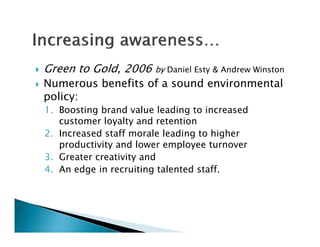
   Green to Gold, 2006     by Daniel Esty & Andrew Winston
   Numerous benefits of a sound environmental
    policy:
    1. Boosting brand value l di
    1 B     ti  b    d l leading t i to increased
                                                d
       customer loyalty and retention
    2. Increased staff morale leading to higher
       productivity and lower employee turnover
    3. Greater creativity and
    4 An edge in recruiting talented staff
    4.                                staff.
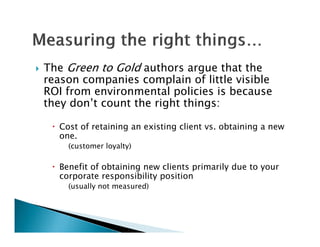
   The Green to Gold authors argue that the
    reason companies complain of little visible
                   i         l i   f littl i ibl
    ROI from environmental policies is because
    they don’t count the right things:
       y                   g        g

      Cost of retaining an existing client vs. obtaining a new
       one.
         (customer loyalty)

      Benefit of obtaining new clients primarily due to your
                          g             p       y        y
       corporate responsibility position
         (usually not measured)
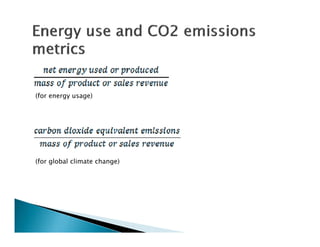
(for energy usage)


(for global climate change)
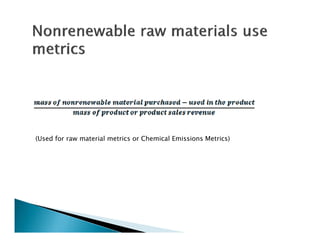
(Used for raw material metrics or Chemical Emissions Metrics)
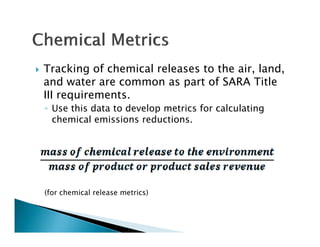
   Tracking of chemical releases to the air, land,
    and water are common as part of SARA Title
    III requirements.
    ◦ Use this data to develop metrics for calculating
      chemical emissions reductions.


    (for chemical release metrics)
   Electricity Conservation
    ◦ Electricity conversation or reduced use of energy
   Green Energy
    ◦ Switching to greener or renewable energy sources
   Fuel Substitution
    ◦ Reduced fuel use, substitution to greener fuels
   Greening Chemistry
    ◦ Reduced use of or substitutions of high global-warming-
                                              global warming
      potential (GWP) chemicals
   Water Conservation
    ◦ Reduced water use
   Materials Management
    ◦ Reductions from life-cycle analysis and extending the life of
      secondary materials
              y
   Work to increase awareness of sustainability among staff
    and management.
    ◦ This will provide a common language and keep everyone thinking
      about the impact y have during the course of our daily tasks.
                   p you             g                     y

   Take an inventory of current efforts that make progress
    toward sustainability and be frank about areas that need
    improvement.
    ◦ Enhance your current efforts and identify additional improvements.

   Formulate vision of what sustainability means to you
    ◦ Identify long-term goals necessary to achieve that vision.
   Incorporate the awareness and terminology of sustainability
    into your budget decisions, program administration and
    project development.
   Does this help move us toward sustainability
       Even if incrementally?

   Will elements of this project serve as a potential stepping
    stone toward other changes or initiatives?

   Will increased implementation costs yield savings in the
    long-run or provide a social or environmental return on
       g        p
    investment?
   In a corporate climate that embraces the
    adage that "what matters gets measured"

   The ability to measure and evaluate
    environmental performance allows
    environmental staff to demonstrate the value
    of its programs and gain equal footing with
     f                             f
    other business objectives
   Goals stated:

           "Execute this process well"
                        vs.
        "Don't perform this process badly."
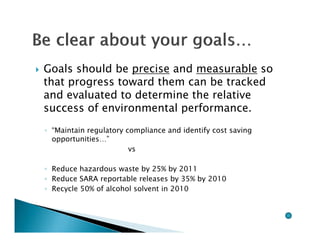
   Goals should be precise and measurable so
    that progress toward them can be tracked
    and evaluated to determine the relative
    success of environmental performance
                             performance.
    ◦ “Maintain regulatory compliance and identify cost saving
      opportunities…
      opportunities ”
                            vs

    ◦ Reduce hazardous waste by 25% by 2011
    ◦ Reduce SARA reportable releases by 35% by 2010
    ◦ Recycle 50% of alcohol solvent in 2010
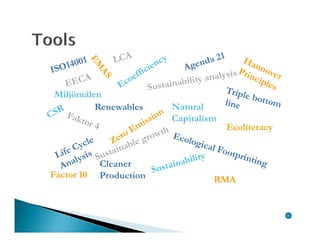
Miljömålen
          Renewables     Natural
                         Capitalism
                                      Ecoliteracy


            Cleaner
Factor 10   Production            RMA
   Comparing environmental performance
    against its return on investment (ROI) is a
    bottom line-oriented approach.

   Illustrate that environmental, healthy, and
    safety (EH&S) programs have a positive effect
    on company financials.
1. Recognition and commitment from senior leadership;
2. Build a business case based on benchmarking against sector
   standards and trends, and baseline your existing programs,
   activities, and services;
3. Defining sustainability, based on sector-type, culture, brand,
   existence of programs, and longer-term goals;
4. Implement sustainability initiatives including specific actions,
   roles/responsibilities, and implementation schedule; and
5. Measure and report processes to measure progress against specific
   metrics and use this data to report to management, shareholders,
   customers, employees, and/or other stakeholders.
Thank You

      QUESTIONS?

Greg Lemke, CSP, CHMM
  Director, L
  Di t      Loss P
                 Prevention
                       ti
     glemke@occutec.com


     OCCU TEC I
     OCCU-TEC, Inc.
   Kansas City, Missouri

Environmental Management Systems: Demonstrating ROI AHMP 2009 Presentation

  • 1.
  • 2.
    Introductions  Old vs New (Compliance vs. EMS)  Ideas for the future 30,000 foot i 30 000 f t view
  • 3.
    Command and Control ◦ Regulatory compliance emphasis ◦ Enforcement ◦ Not always cost effective ◦ Reliance on:  Environmental Policy  Environmental Audits
  • 4.
    Environmental Management Systems Approach ◦ Continuous Improvement ◦ Cost Saving Focused ◦ Corporate Social Responsibility
  • 5.
    1. The paceof the global economy ◦ Competitiveness ◦ instantaneous knowledge 2. 2 The sharp increase in energy costs 3. The more recent and ramped-up attention of global climate change.
  • 6.
    Are your operations,organizational structure, core products and/or services, and stakeholder engagements sustainable? ◦ Third-party verifiable sustainability ◦ Corporate social responsibility reporting ◦ I t International standards f environment and h lth ti l t d d for i t d health and safety
  • 7.
    In business, ROI is most often thought of as dollars made or saved in relation to dollars invested ◦ baseline operations ◦ implement programs with specific metrics ◦ work to achieve those goals  The return on investments need to well- documented, and sustainable operations need to be beneficial to the traditional bottom line
  • 8.
    95% of businessexecutives report that workplace safety has a positive impact on a company‘s financial performance. 93% of executives surveyed see a relationship between: ◦ Direct costs, or payments to injured employees and their medical care providers, and ◦ Indirect costs, such as lost productivity, overtime costs Source: The Executive Survey of Workplace Safety by the Liberty Mutual Group
  • 9.
    Workers Compensation Premiums $300,000.00 $265,052.72 $250,000.00 $235,602.42 $209,424.38 $200,000.00 $196,821.33 $186,155.00 $174,952.29 $162,849.00 $155,513.15 $150,000.00 Possible EMR .75 $144,509.00 Current EMR 1.0 $100,000.00 $50 000 00 $50,000.00 $0.00 2005-06 2005 06 2006-07 2006 07 2007-08 2007 08 2008-09 2008 09 2009-10 2009 10 2010-11 2010 11
  • 10.
    Investment  Return ◦ Employee training ◦ More satisfied & professional workers ◦ Improved ◦ More efficient and management systems repeatable business practices ◦ Increased ◦ Engage with the transparency and stakeholders of the public relations organization
  • 11.
    All of these investments will provide ◦ Strength, ◦ Stability, ◦ Sustainability to the organization organization, ◦ Increase the value of the company or the brand
  • 12.
    Cost Savings  Regulatory Compliance  Minimize Environmental Liability  Demonstrated ROI ◦ Increase Shareholder Value
  • 15.
    Top Management Support ◦ Commitment C i ◦ Demonstrated Action ◦ Strategic Planning  Goals ◦ Prioritize ◦ Available Technology  Celebrate Successes ◦ Motivates stakeholders  Training ◦ Integrate EMS Philosophy throughout organization
  • 16.
    Generally accepted and understood that there is a significant and growing correlation between companies' investment in their environmental programs and their overall competitiveness and financial performance. ◦ Firms investing in environmental management g g posted accumulated returns over 48.8% higher than environmental laggards over a 3-year period, and 6% higher returns over 1-year. 1 year. Source: Innovest Strategic Value Advisors, in an annual investment research report on the Global Auto Parts market
  • 17.
    In the electric utility industry: portfolio managers who screen out companies with h t i ith poor environmental records can outperform others by more than 7% annually. y y  The top environmental performers in the computer sector have outperformed their industry rivals financially by 25% since the beginning of 1998. Source(s): Innovest Strategic Value Advisors and The Computer Industry -- Hidden Risks and Value Potential for Strategic Investors
  • 18.
    Green to Gold, 2006 by Daniel Esty & Andrew Winston  Numerous benefits of a sound environmental policy: 1. Boosting brand value l di 1 B ti b d l leading t i to increased d customer loyalty and retention 2. Increased staff morale leading to higher productivity and lower employee turnover 3. Greater creativity and 4 An edge in recruiting talented staff 4. staff.
  • 19.
    The Green to Gold authors argue that the reason companies complain of little visible i l i f littl i ibl ROI from environmental policies is because they don’t count the right things: y g g  Cost of retaining an existing client vs. obtaining a new one. (customer loyalty)  Benefit of obtaining new clients primarily due to your g p y y corporate responsibility position (usually not measured)
  • 20.
    (for energy usage) (forglobal climate change)
  • 21.
    (Used for rawmaterial metrics or Chemical Emissions Metrics)
  • 22.
    Tracking of chemical releases to the air, land, and water are common as part of SARA Title III requirements. ◦ Use this data to develop metrics for calculating chemical emissions reductions. (for chemical release metrics)
  • 24.
    Electricity Conservation ◦ Electricity conversation or reduced use of energy  Green Energy ◦ Switching to greener or renewable energy sources  Fuel Substitution ◦ Reduced fuel use, substitution to greener fuels  Greening Chemistry ◦ Reduced use of or substitutions of high global-warming- global warming potential (GWP) chemicals  Water Conservation ◦ Reduced water use  Materials Management ◦ Reductions from life-cycle analysis and extending the life of secondary materials y
  • 25.
    Work to increase awareness of sustainability among staff and management. ◦ This will provide a common language and keep everyone thinking about the impact y have during the course of our daily tasks. p you g y  Take an inventory of current efforts that make progress toward sustainability and be frank about areas that need improvement. ◦ Enhance your current efforts and identify additional improvements.  Formulate vision of what sustainability means to you ◦ Identify long-term goals necessary to achieve that vision.
  • 26.
    Incorporate the awareness and terminology of sustainability into your budget decisions, program administration and project development.
  • 27.
    Does this help move us toward sustainability  Even if incrementally?  Will elements of this project serve as a potential stepping stone toward other changes or initiatives?  Will increased implementation costs yield savings in the long-run or provide a social or environmental return on g p investment?
  • 28.
    In a corporate climate that embraces the adage that "what matters gets measured"  The ability to measure and evaluate environmental performance allows environmental staff to demonstrate the value of its programs and gain equal footing with f f other business objectives
  • 29.
    Goals stated: "Execute this process well" vs. "Don't perform this process badly."
  • 30.
    Goals should be precise and measurable so that progress toward them can be tracked and evaluated to determine the relative success of environmental performance performance. ◦ “Maintain regulatory compliance and identify cost saving opportunities… opportunities ” vs ◦ Reduce hazardous waste by 25% by 2011 ◦ Reduce SARA reportable releases by 35% by 2010 ◦ Recycle 50% of alcohol solvent in 2010
  • 31.
    Miljömålen Renewables Natural Capitalism Ecoliteracy Cleaner Factor 10 Production RMA
  • 32.
    Comparing environmental performance against its return on investment (ROI) is a bottom line-oriented approach.  Illustrate that environmental, healthy, and safety (EH&S) programs have a positive effect on company financials.
  • 33.
    1. Recognition andcommitment from senior leadership; 2. Build a business case based on benchmarking against sector standards and trends, and baseline your existing programs, activities, and services; 3. Defining sustainability, based on sector-type, culture, brand, existence of programs, and longer-term goals; 4. Implement sustainability initiatives including specific actions, roles/responsibilities, and implementation schedule; and 5. Measure and report processes to measure progress against specific metrics and use this data to report to management, shareholders, customers, employees, and/or other stakeholders.
  • 34.
    Thank You QUESTIONS? Greg Lemke, CSP, CHMM Director, L Di t Loss P Prevention ti glemke@occutec.com OCCU TEC I OCCU-TEC, Inc. Kansas City, Missouri