









How you
can benefit
from using

Redis

javier ramirez
@supercoco9
I was
Lois Lane

javier ramirez

@supercoco9

https://teowaki.com

FOSDEM 2014
In the beginner's
mind there are many
possibilities, in the
expert's mind there
are few.
Shunryu Suzuki
javier ramirez

@supercoco9

https://teowaki.com

FOSDEM 2014
myth: the bottleneck

javier ramirez

@supercoco9

https://teowaki.com

FOSDEM 2014
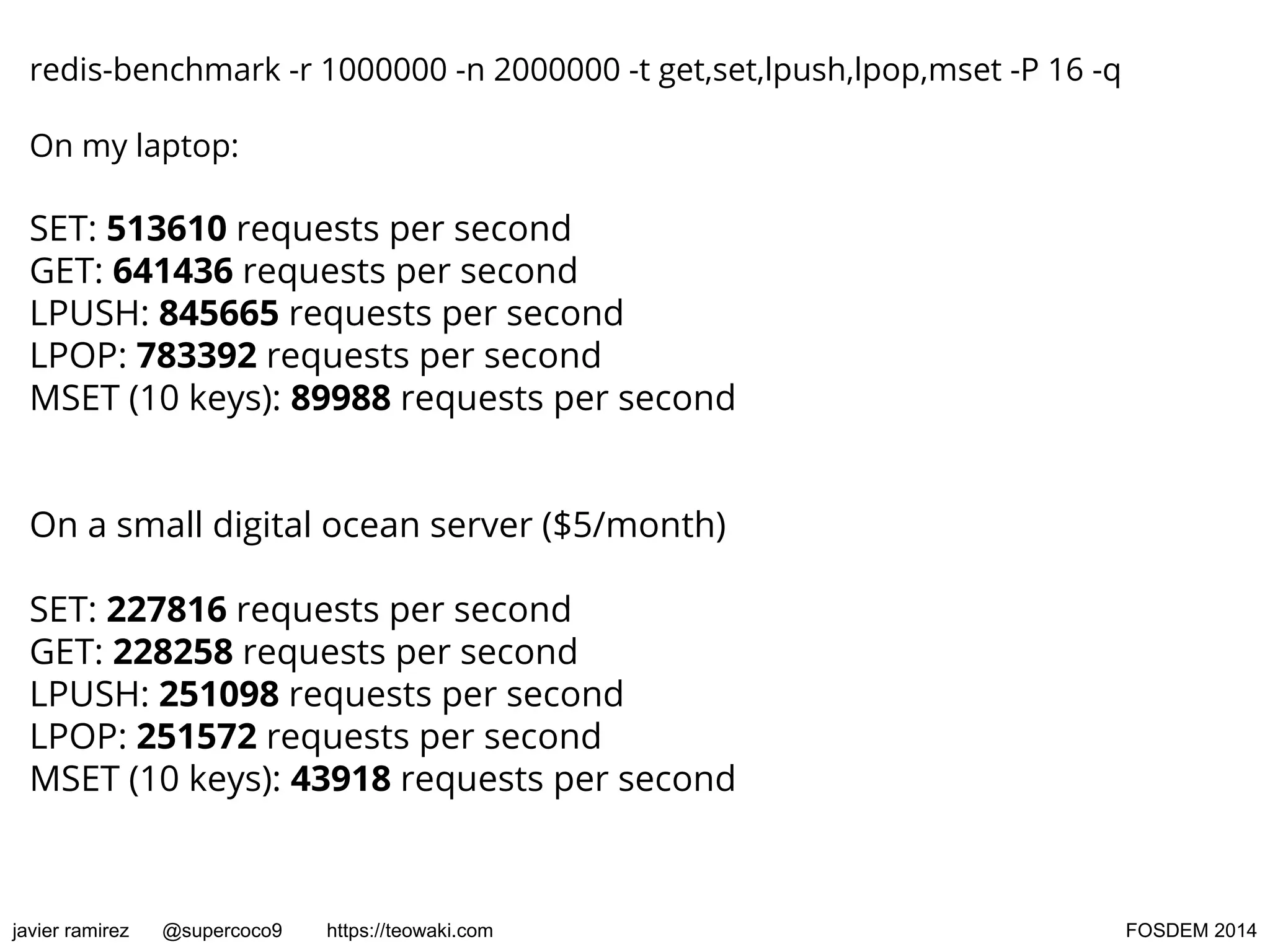
redis-benchmark -r 1000000 -n 2000000 -t get,set,lpush,lpop,mset -P 16 -q
On my laptop:

SET: 513610 requests per second
GET: 641436 requests per second
LPUSH: 845665 requests per second
LPOP: 783392 requests per second
MSET (10 keys): 89988 requests per second
On a small digital ocean server ($5/month)
SET: 227816 requests per second
GET: 228258 requests per second
LPUSH: 251098 requests per second
LPOP: 251572 requests per second
MSET (10 keys): 43918 requests per second

javier ramirez

@supercoco9

https://teowaki.com

FOSDEM 2014
myth: Redis is just like
memcached

javier ramirez

@supercoco9

https://teowaki.com

FOSDEM 2014
myth: Redis is for queues

javier ramirez

@supercoco9

https://teowaki.com

FOSDEM 2014
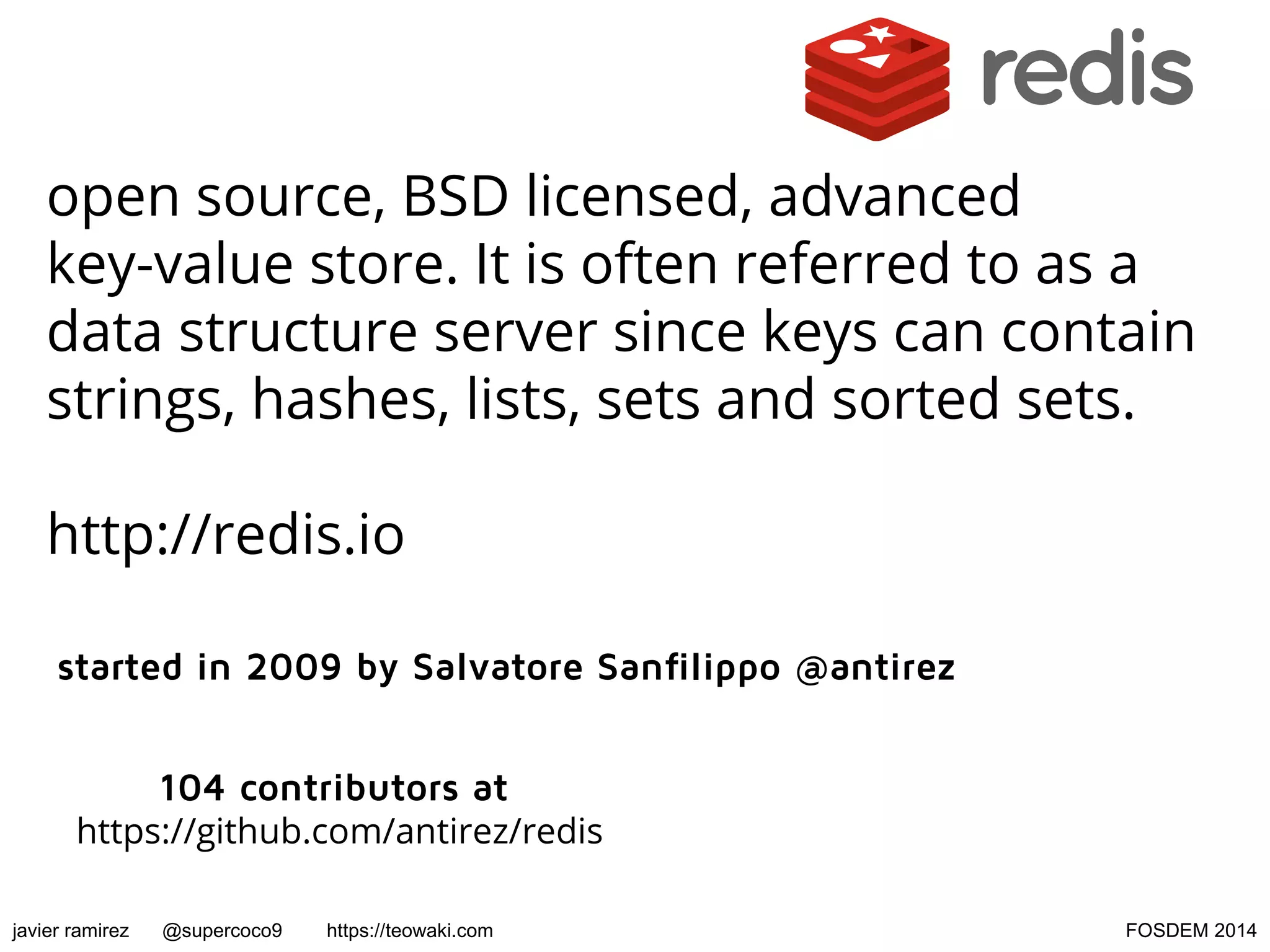
open source, BSD licensed, advanced
key-value store. It is often referred to as a
data structure server since keys can contain
strings, hashes, lists, sets and sorted sets.
http://redis.io
started in 2009 by Salvatore Sanfilippo @antirez
104 contributors at

https://github.com/antirez/redis
javier ramirez

@supercoco9

https://teowaki.com

FOSDEM 2014
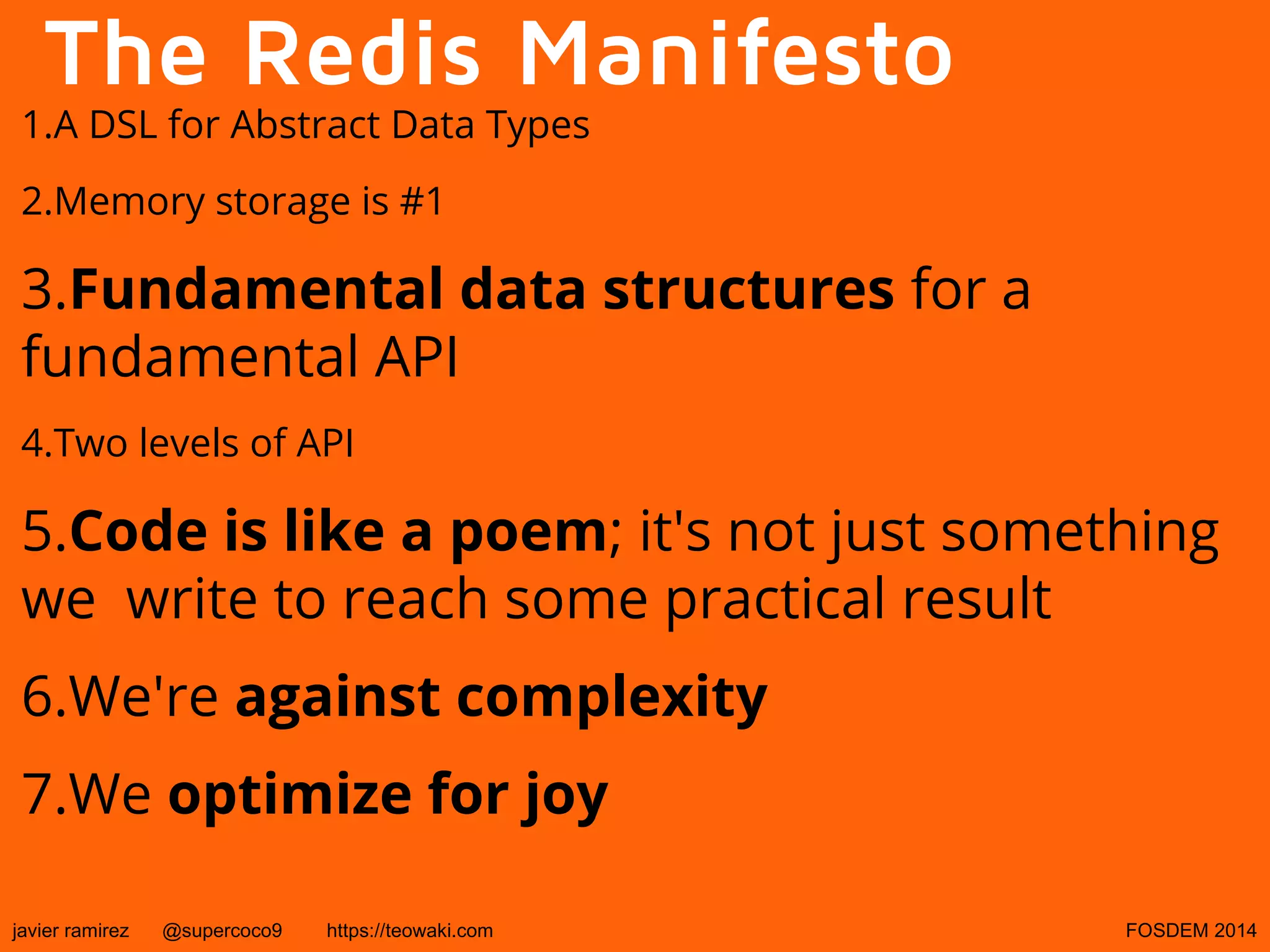
The Redis Manifesto

1.A DSL for Abstract Data Types
2.Memory storage is #1

3.Fundamental data structures for a
fundamental API
4.Two levels of API

5.Code is like a poem; it's not just something
we write to reach some practical result
6.We're against complexity
7.We optimize for joy
javier ramirez

@supercoco9

https://teowaki.com

FOSDEM 2014
Redis makes
you think
javier ramirez

@supercoco9

https://teowaki.com

FOSDEM 2014
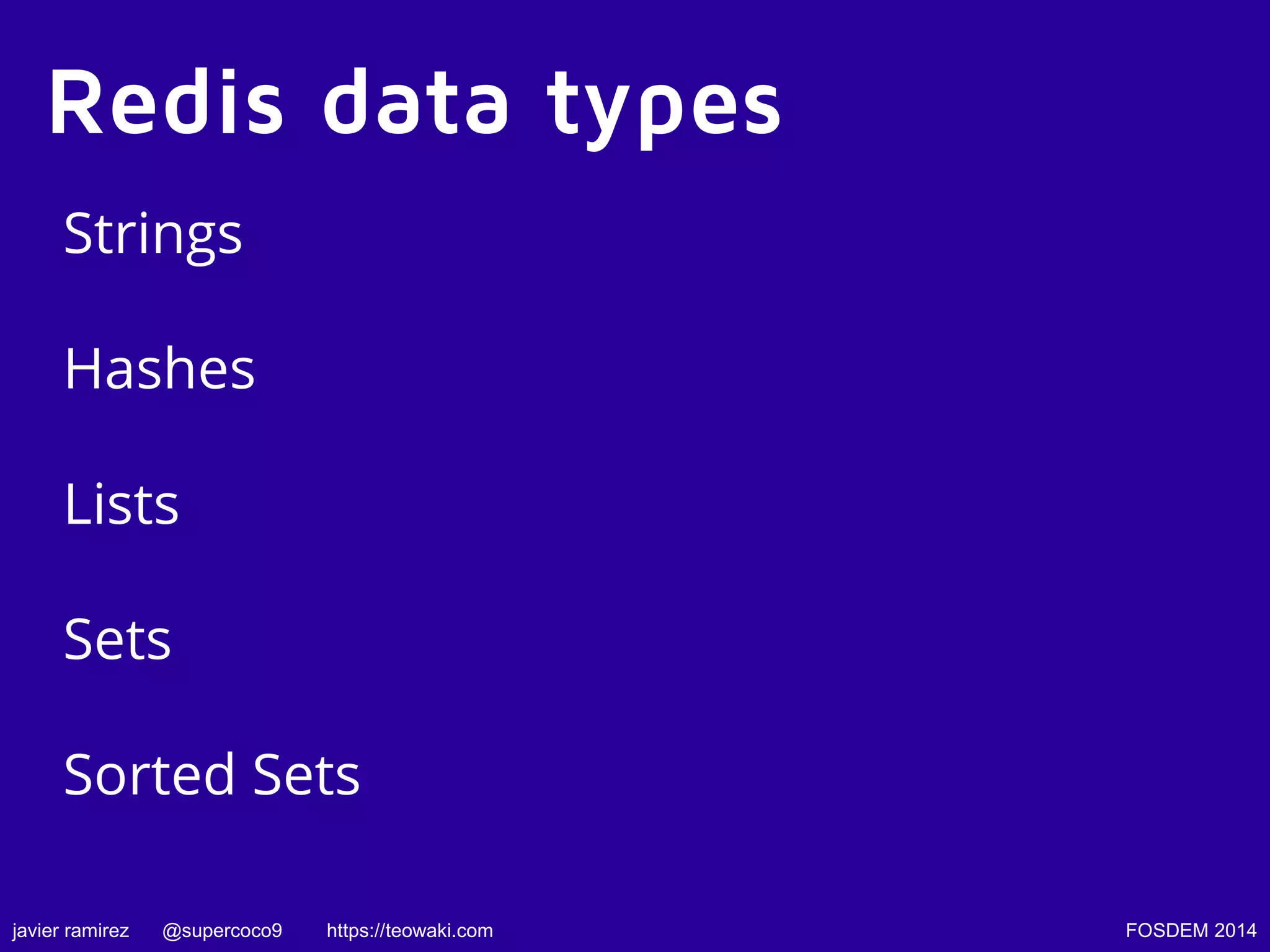
Redis data types
Strings
Hashes
Lists
Sets
Sorted Sets
javier ramirez

@supercoco9

https://teowaki.com

FOSDEM 2014
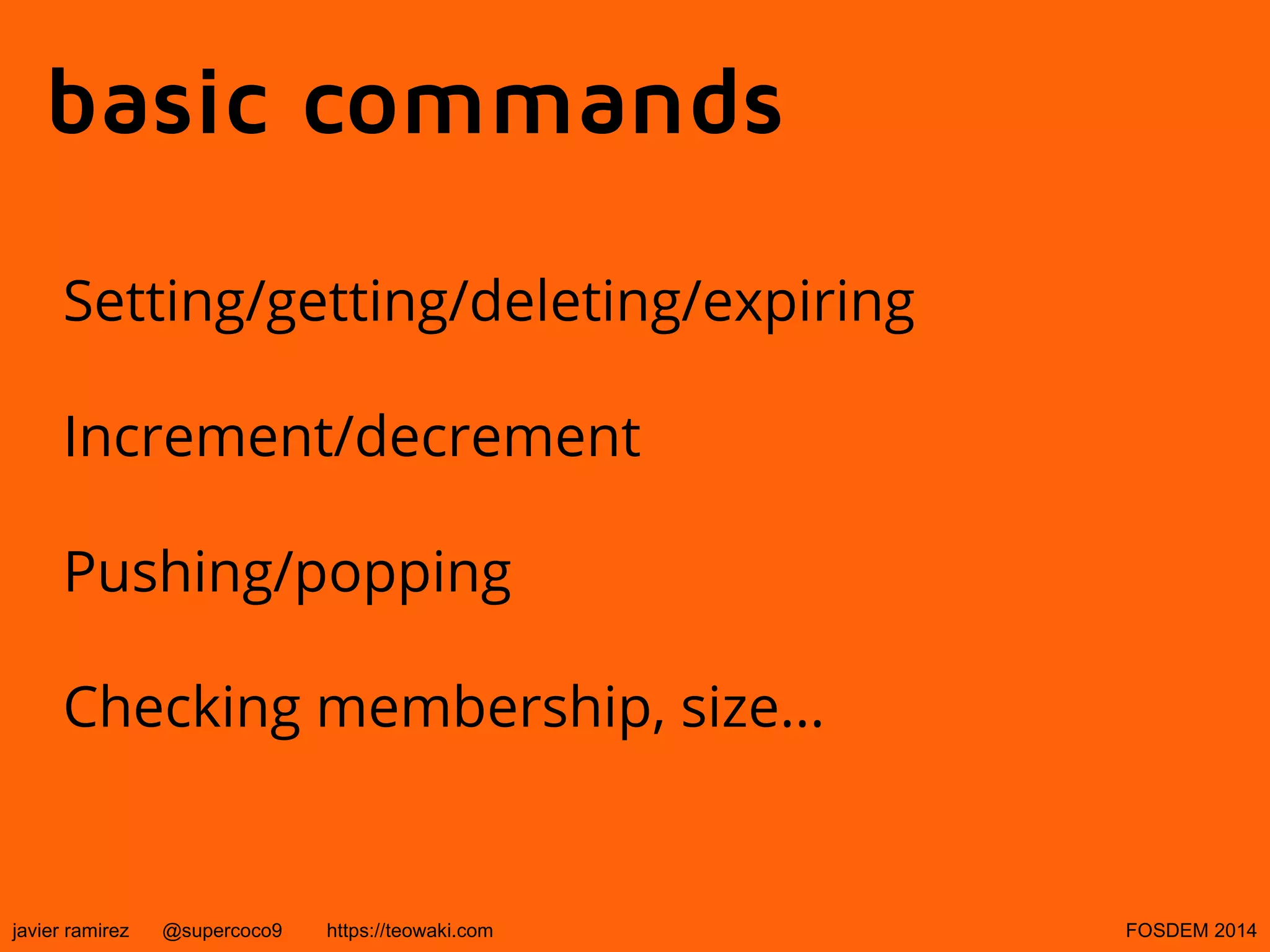
basic commands
Setting/getting/deleting/expiring
Increment/decrement
Pushing/popping
Checking membership, size...

javier ramirez

@supercoco9

https://teowaki.com

FOSDEM 2014
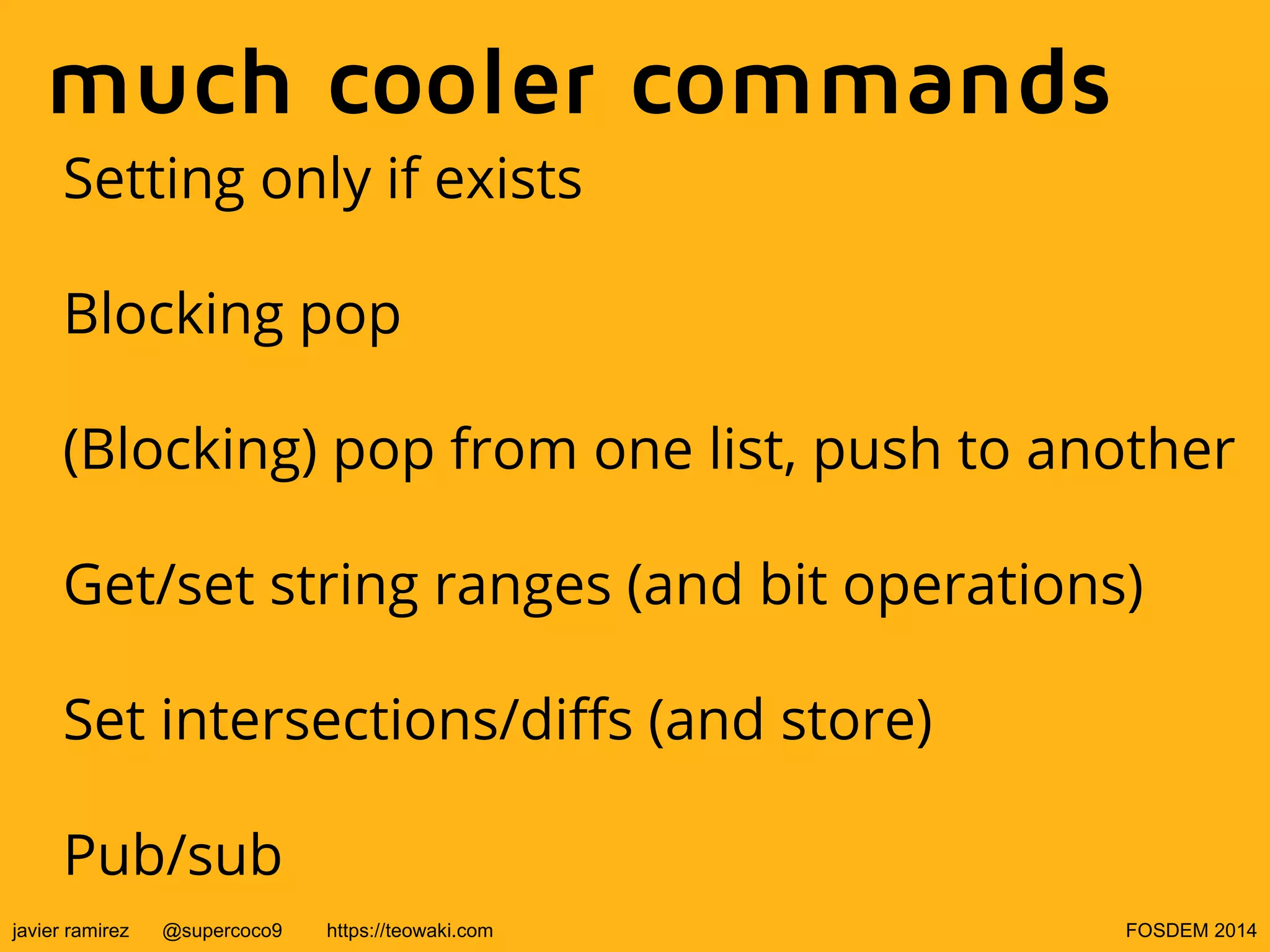
much cooler commands
Setting only if exists
Blocking pop
(Blocking) pop from one list, push to another
Get/set string ranges (and bit operations)
Set intersections/diffs (and store)
Pub/sub
javier ramirez

@supercoco9

https://teowaki.com

FOSDEM 2014
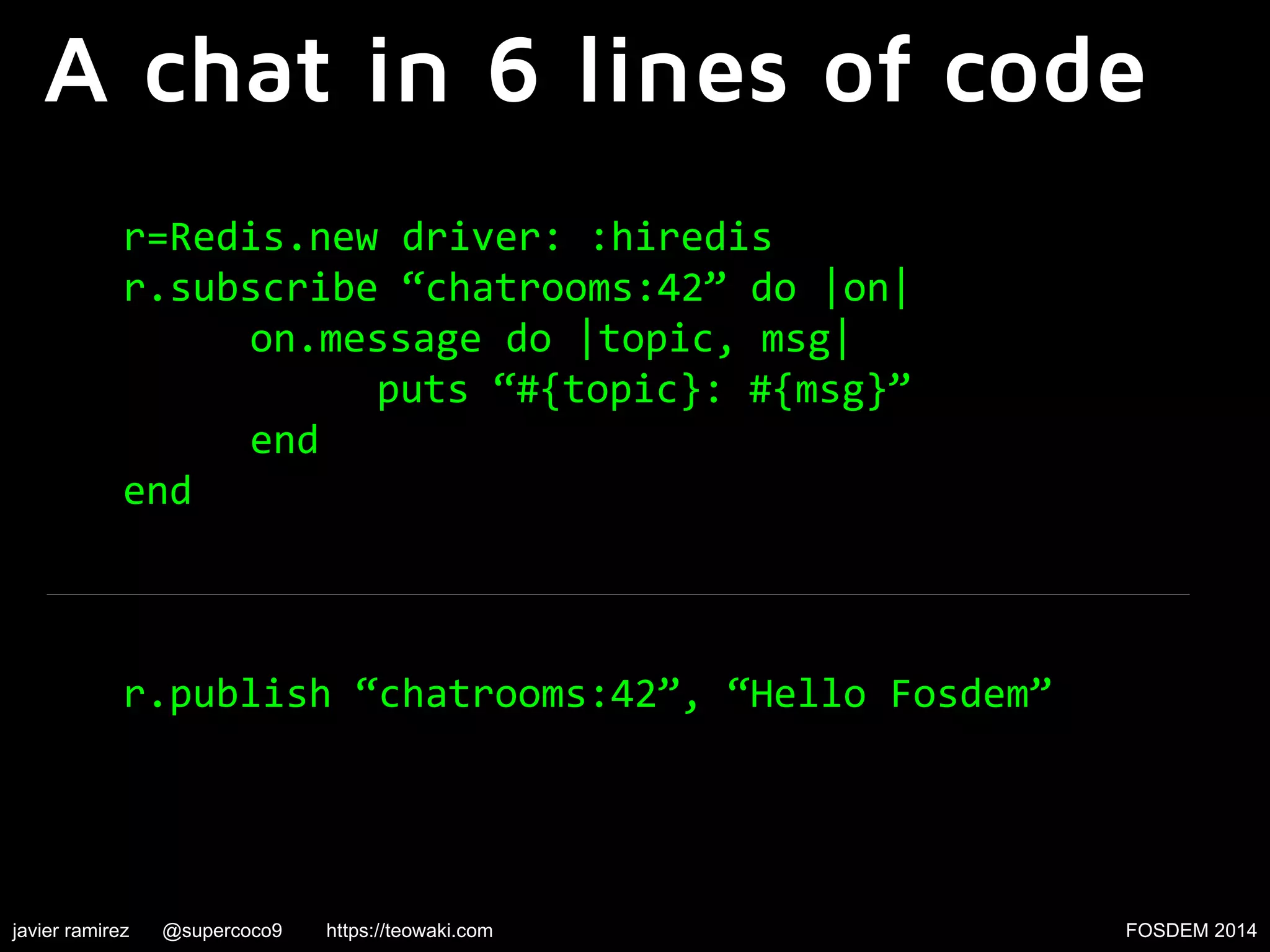
A chat in 6 lines of code
r=Redis.new driver: :hiredis
r.subscribe “chatrooms:42” do |on|
on.message do |topic, msg|
puts “#{topic}: #{msg}”
end
end

r.publish “chatrooms:42”, “Hello Fosdem”

javier ramirez

@supercoco9

https://teowaki.com

FOSDEM 2014
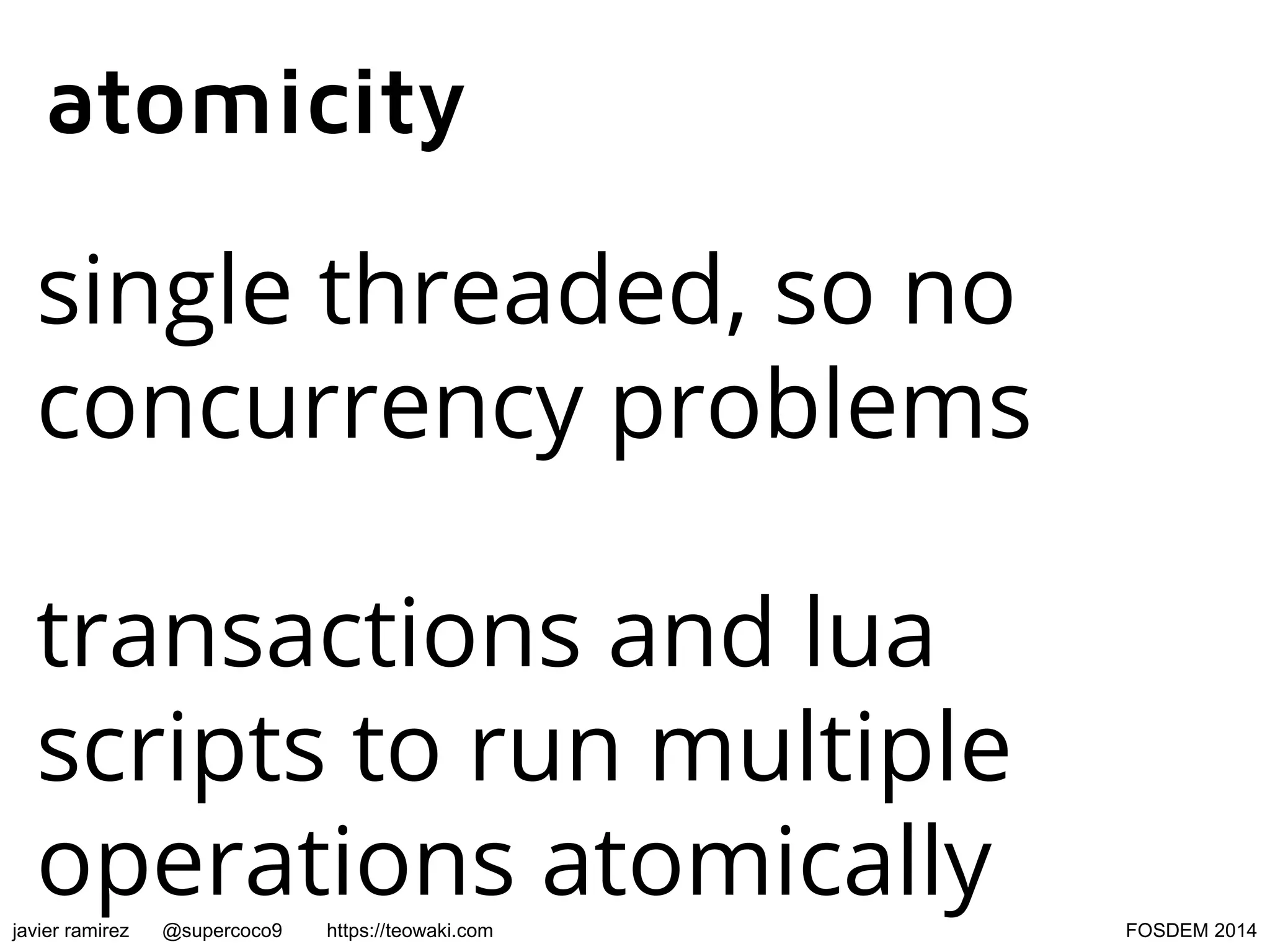
atomicity
single threaded, so no
concurrency problems
transactions and lua
scripts to run multiple
operations atomically

javier ramirez

@supercoco9

https://teowaki.com

FOSDEM 2014
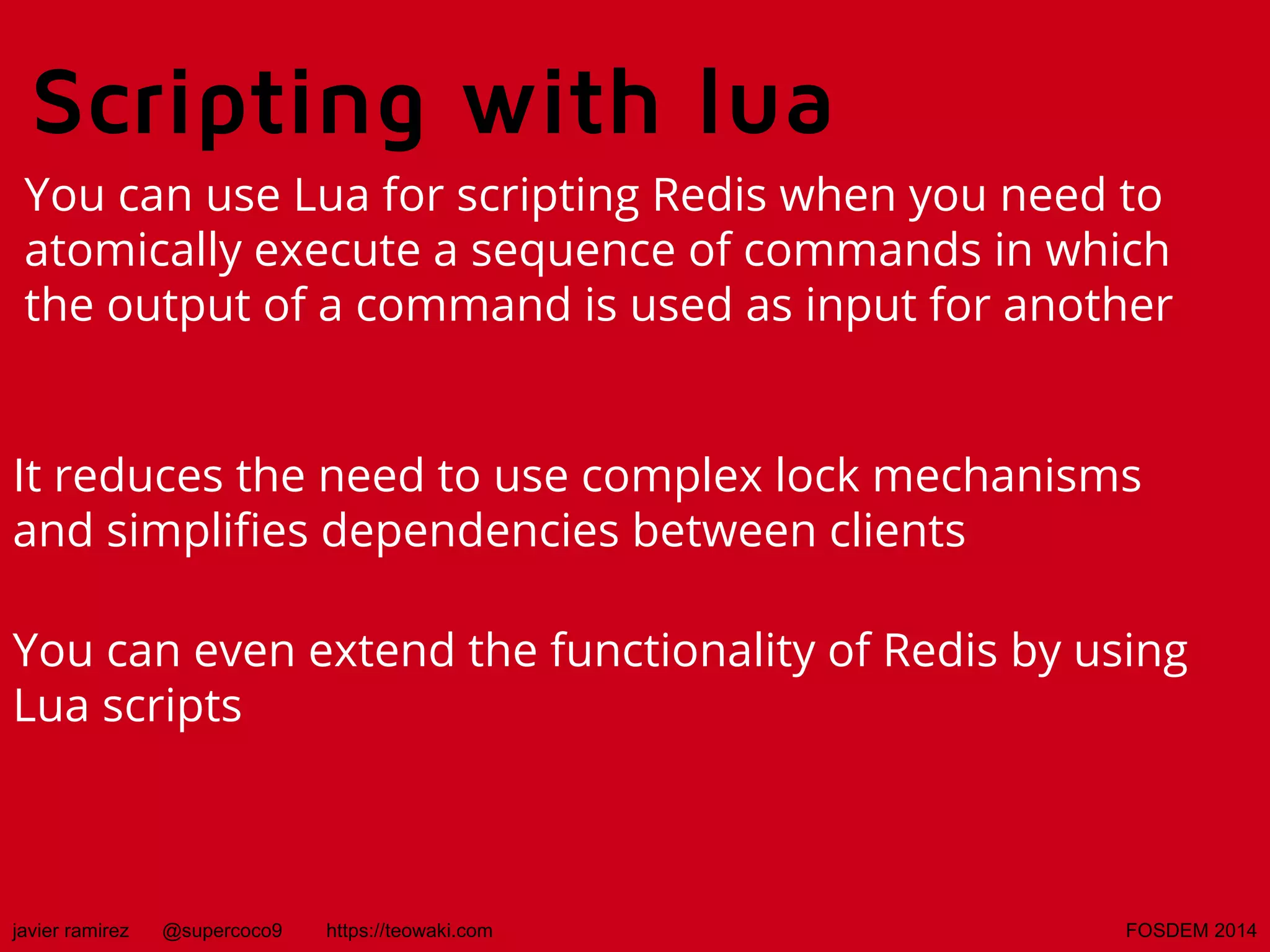
Scripting with lua
You can use Lua for scripting Redis when you need to
atomically execute a sequence of commands in which
the output of a command is used as input for another
It reduces the need to use complex lock mechanisms
and simplifies dependencies between clients
You can even extend the functionality of Redis by using
Lua scripts

javier ramirez

@supercoco9

https://teowaki.com

FOSDEM 2014
Redis keeps
everything
in memory
all the time
javier ramirez

@supercoco9

https://teowaki.com

FOSDEM 2014
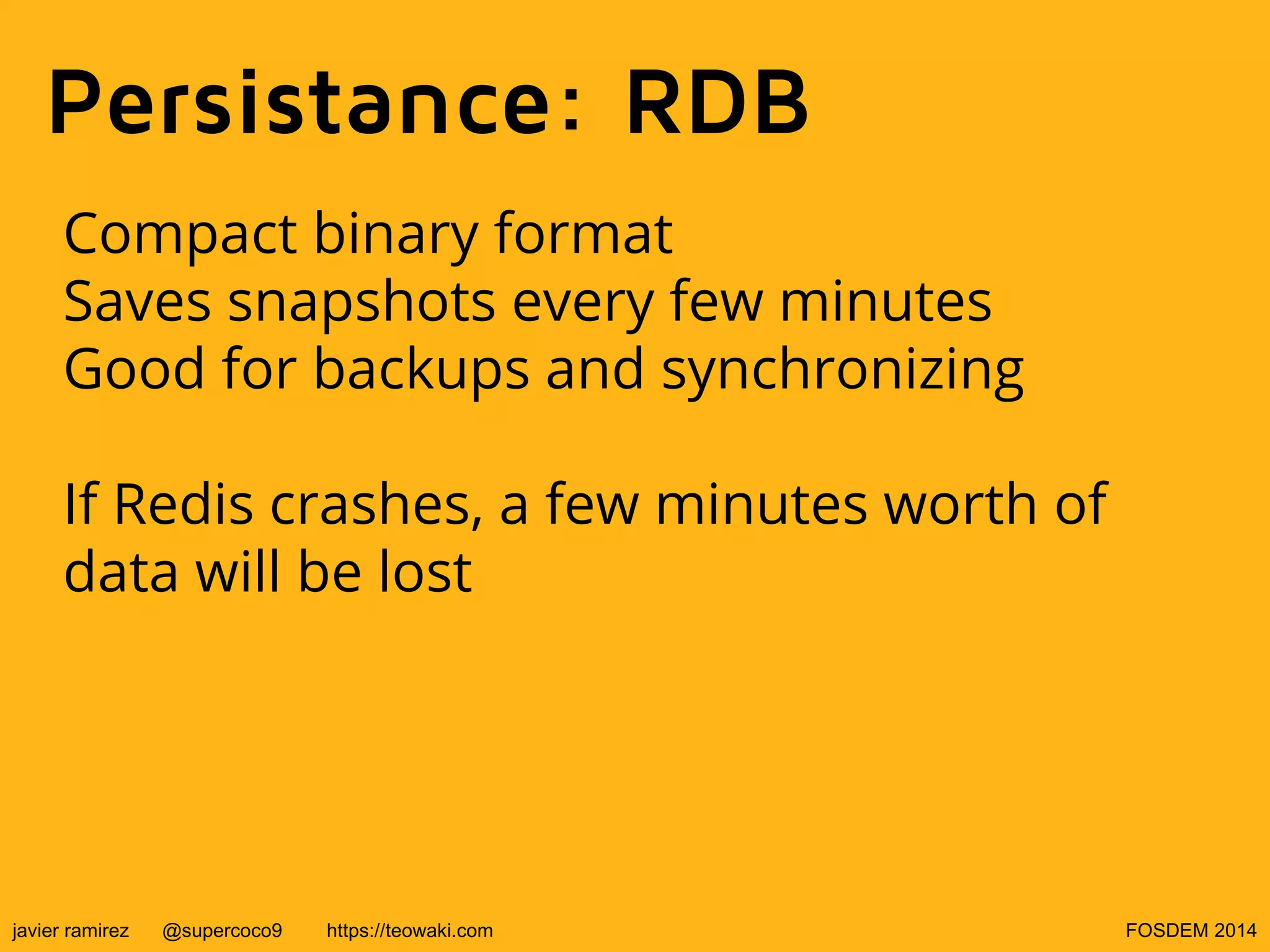
Persistance: RDB
Compact binary format
Saves snapshots every few minutes
Good for backups and synchronizing
If Redis crashes, a few minutes worth of
data will be lost

javier ramirez

@supercoco9

https://teowaki.com

FOSDEM 2014
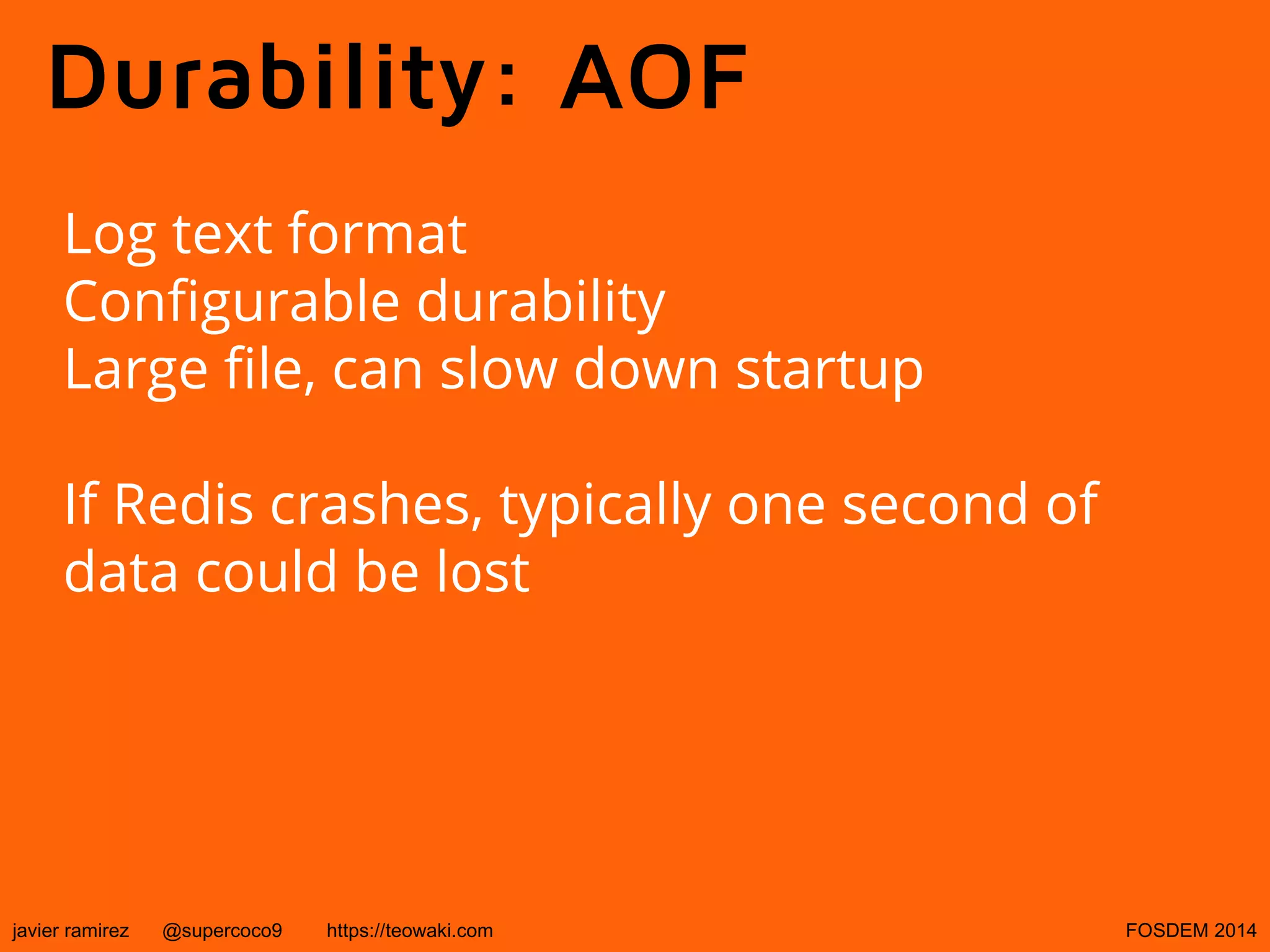
Durability: AOF
Log text format
Configurable durability
Large file, can slow down startup
If Redis crashes, typically one second of
data could be lost

javier ramirez

@supercoco9

https://teowaki.com

FOSDEM 2014
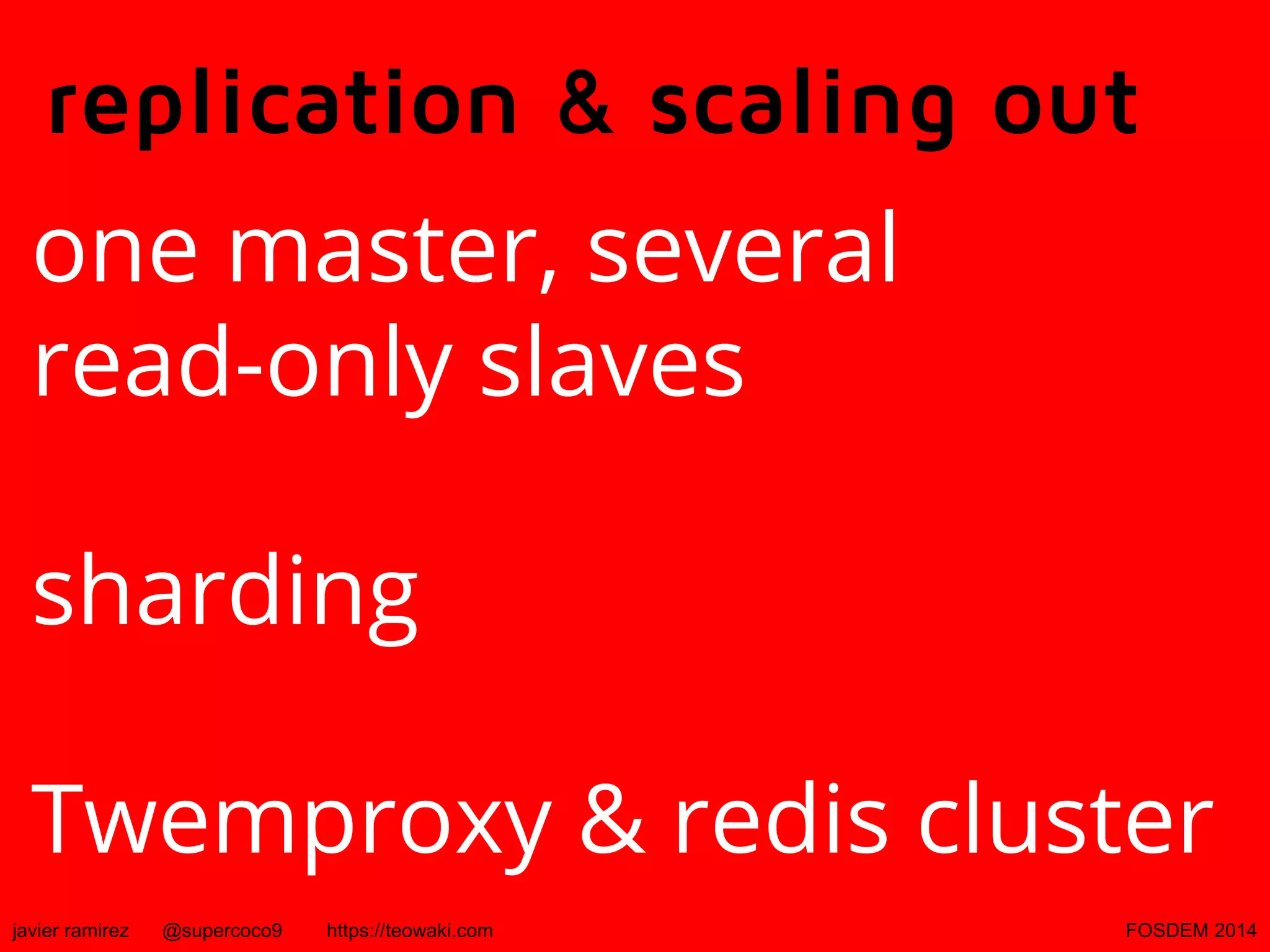
replication & scaling out
one master, several
read-only slaves
sharding
Twemproxy & redis cluster
javier ramirez

@supercoco9

https://teowaki.com

FOSDEM 2014
what's being used for

javier ramirez

@supercoco9

https://teowaki.com

FOSDEM 2014
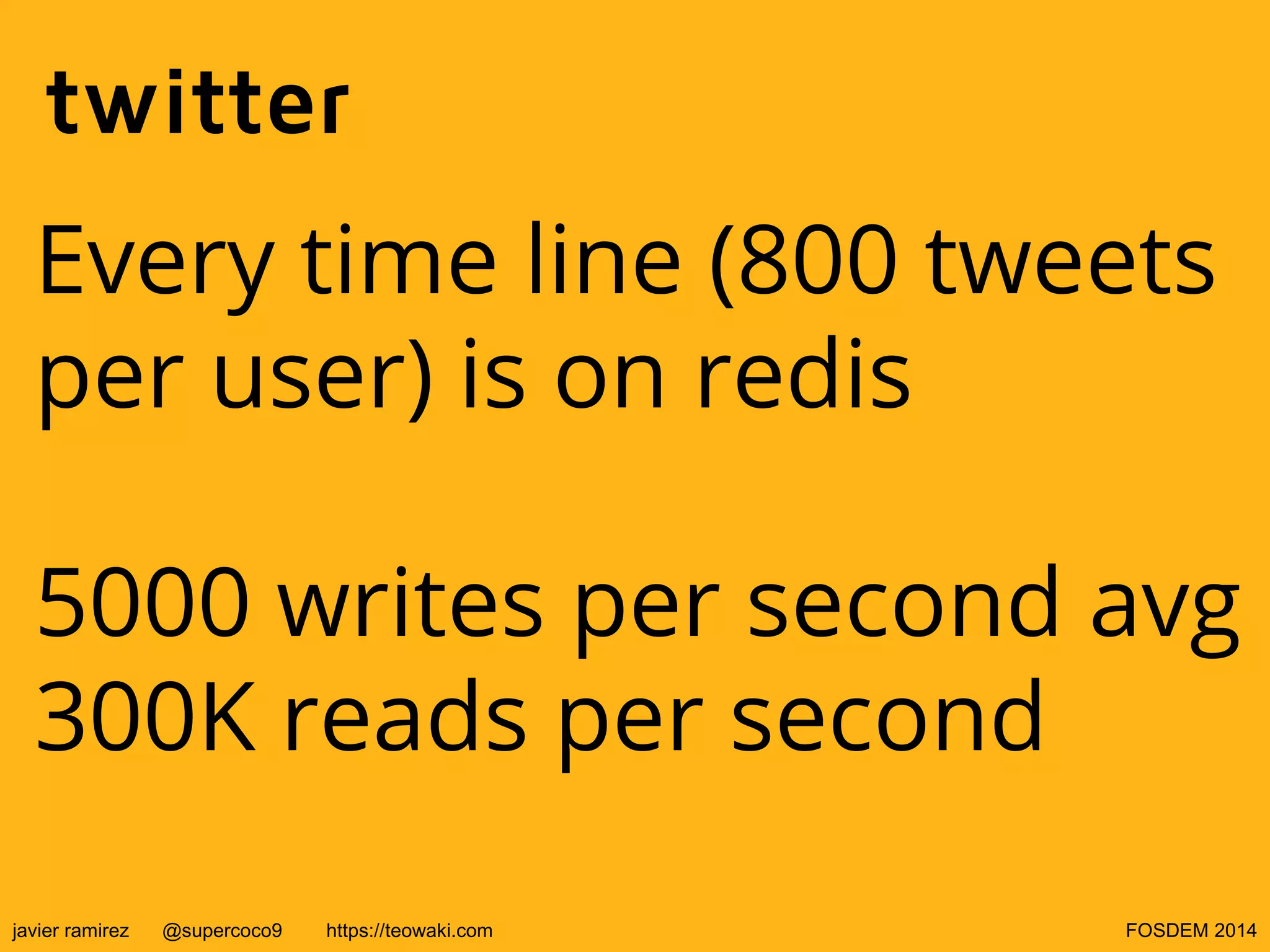
twitter
Every time line (800 tweets
per user) is on redis
5000 writes per second avg
300K reads per second
javier ramirez

@supercoco9

https://teowaki.com

FOSDEM 2014
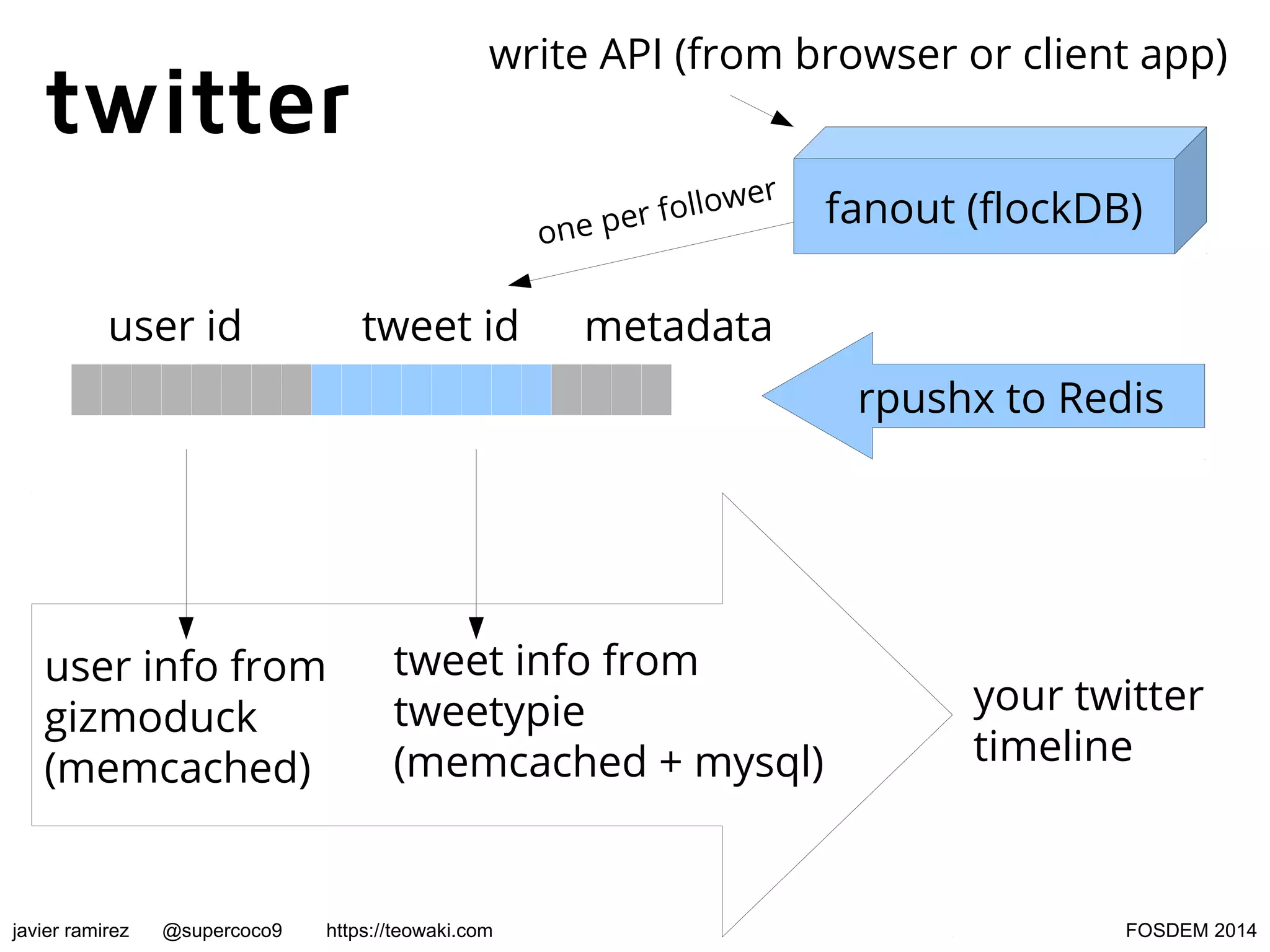
twitter

write API (from browser or client app)
follo
e per
on

user id

tweet id

wer

fanout (flockDB)

metadata
rpushx to Redis

user info from
gizmoduck
(memcached)

javier ramirez

@supercoco9

tweet info from
tweetypie
(memcached + mysql)

https://teowaki.com

your twitter
timeline

FOSDEM 2014
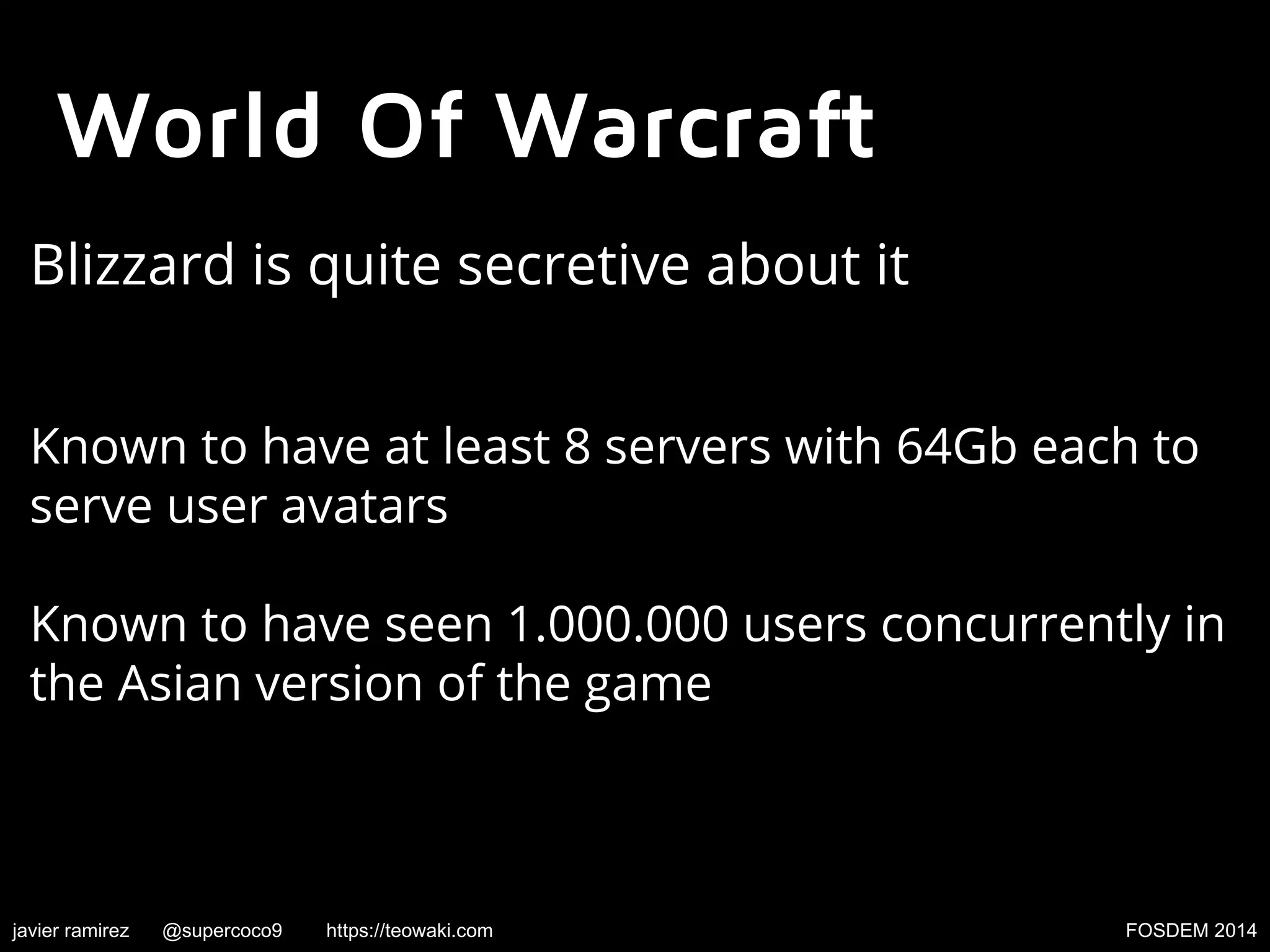
World Of Warcraft
Blizzard is quite secretive about it
Known to have at least 8 servers with 64Gb each to
serve user avatars
Known to have seen 1.000.000 users concurrently in
the Asian version of the game

javier ramirez

@supercoco9

https://teowaki.com

FOSDEM 2014
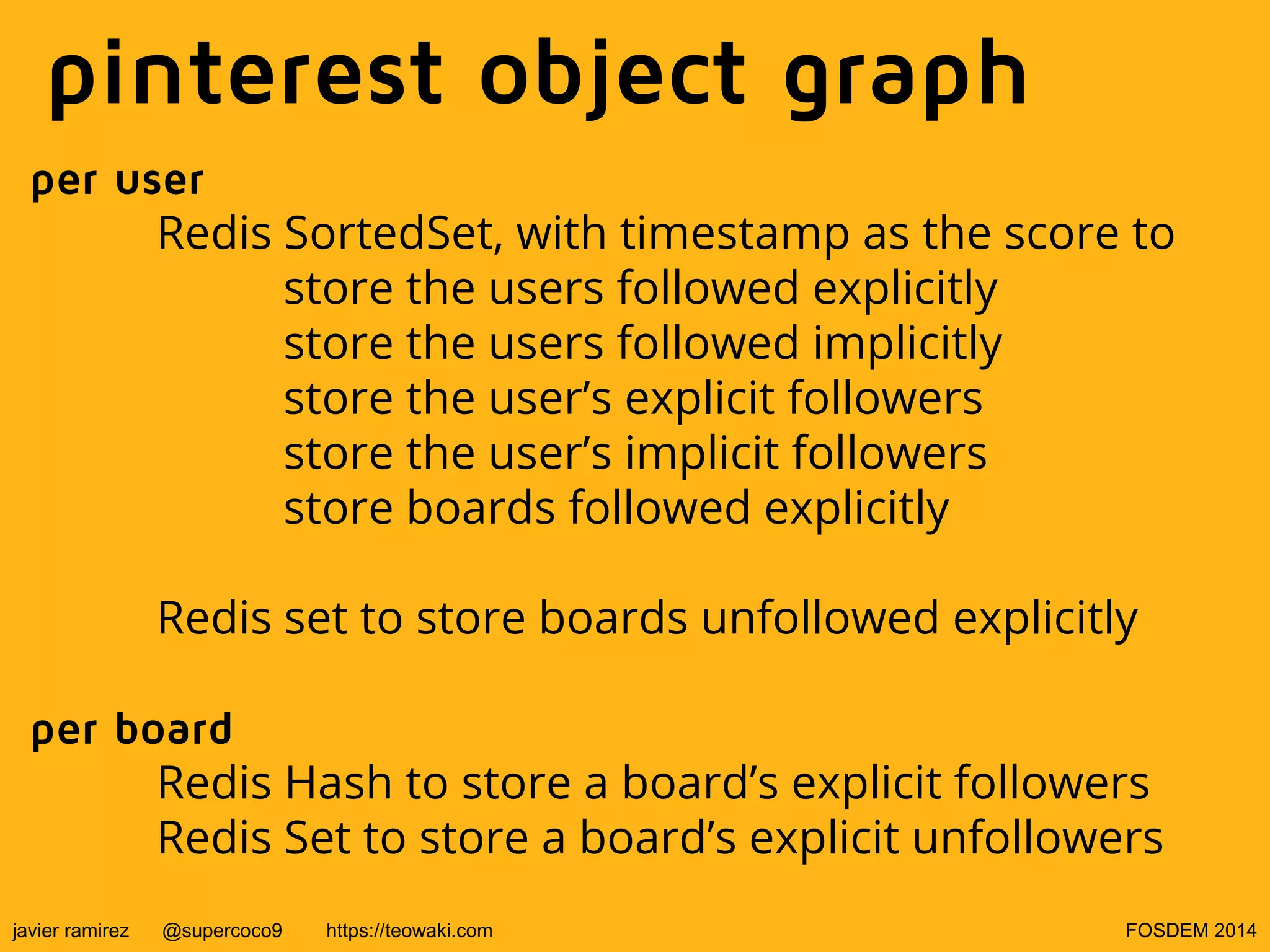
pinterest object graph
per user
Redis SortedSet, with timestamp as the score to
store the users followed explicitly
store the users followed implicitly
store the user’s explicit followers
store the user’s implicit followers
store boards followed explicitly
Redis set to store boards unfollowed explicitly
per board
Redis Hash to store a board’s explicit followers
Redis Set to store a board’s explicit unfollowers
javier ramirez

@supercoco9

https://teowaki.com

FOSDEM 2014
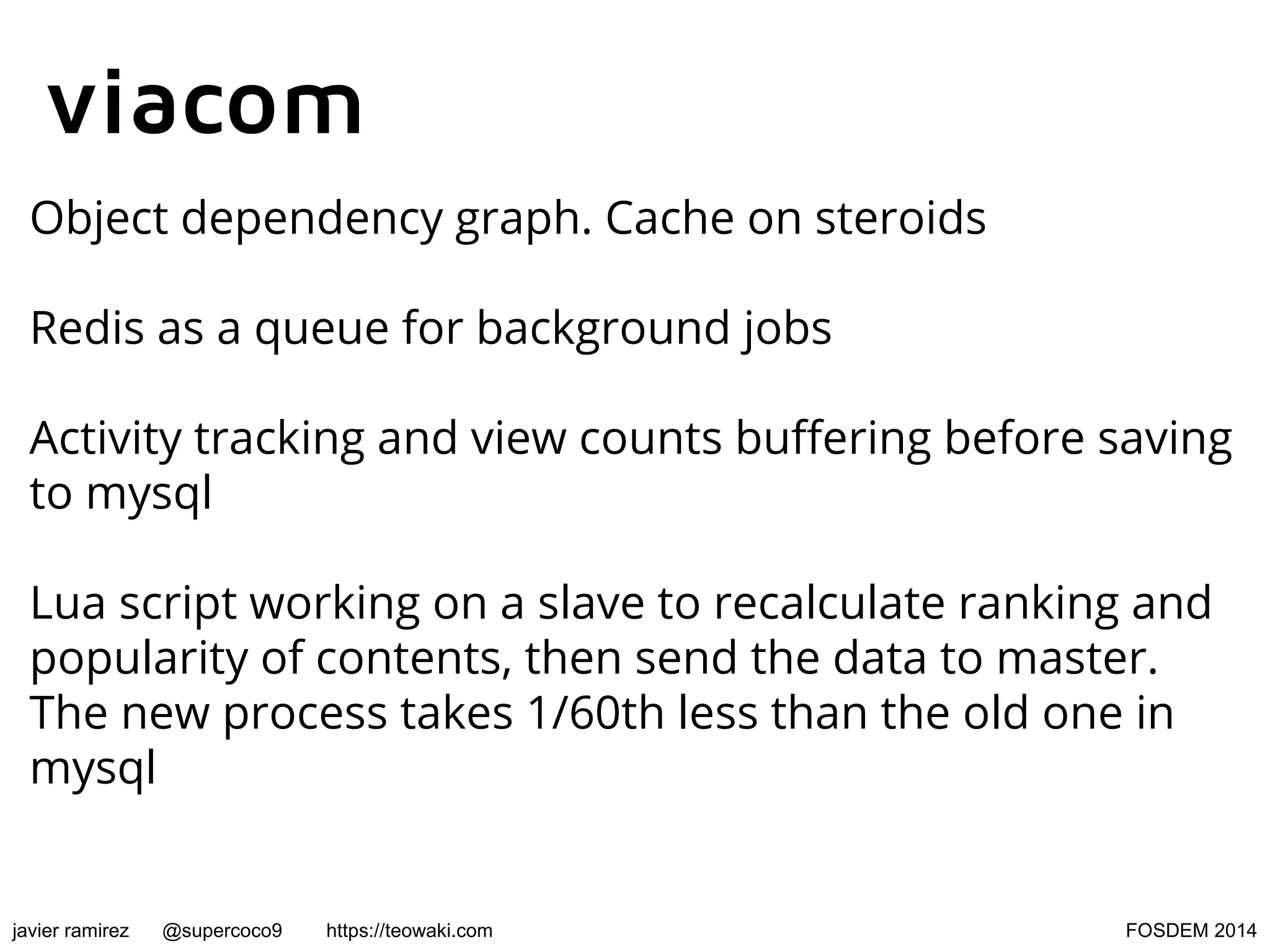
viacom
Object dependency graph. Cache on steroids
Redis as a queue for background jobs
Activity tracking and view counts buffering before saving
to mysql
Lua script working on a slave to recalculate ranking and
popularity of contents, then send the data to master.
The new process takes 1/60th less than the old one in
mysql

javier ramirez

@supercoco9

https://teowaki.com

FOSDEM 2014
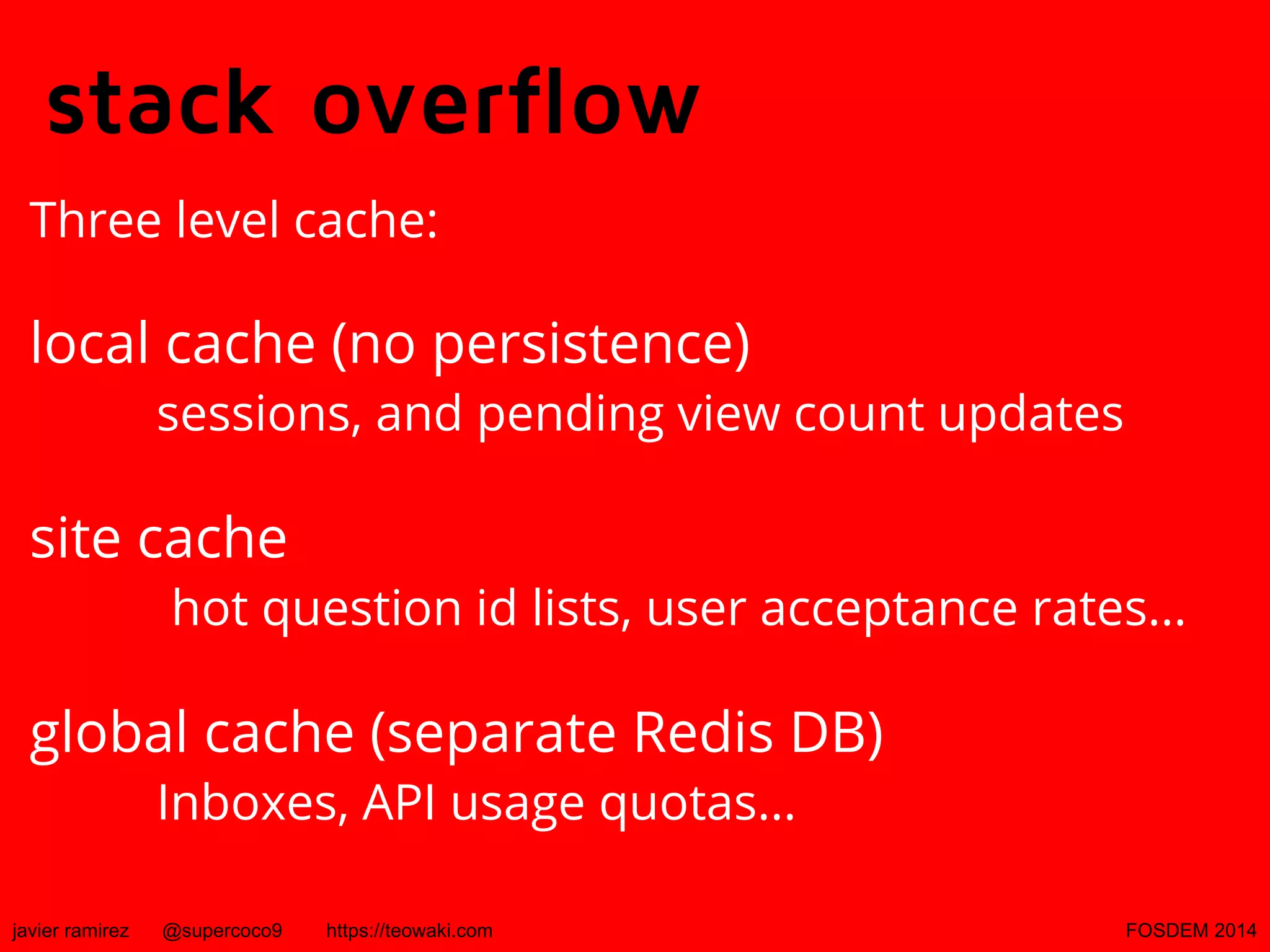
stack overflow
Three level cache:

local cache (no persistence)

sessions, and pending view count updates

site cache

hot question id lists, user acceptance rates...

global cache (separate Redis DB)
Inboxes, API usage quotas...

javier ramirez

@supercoco9

https://teowaki.com

FOSDEM 2014
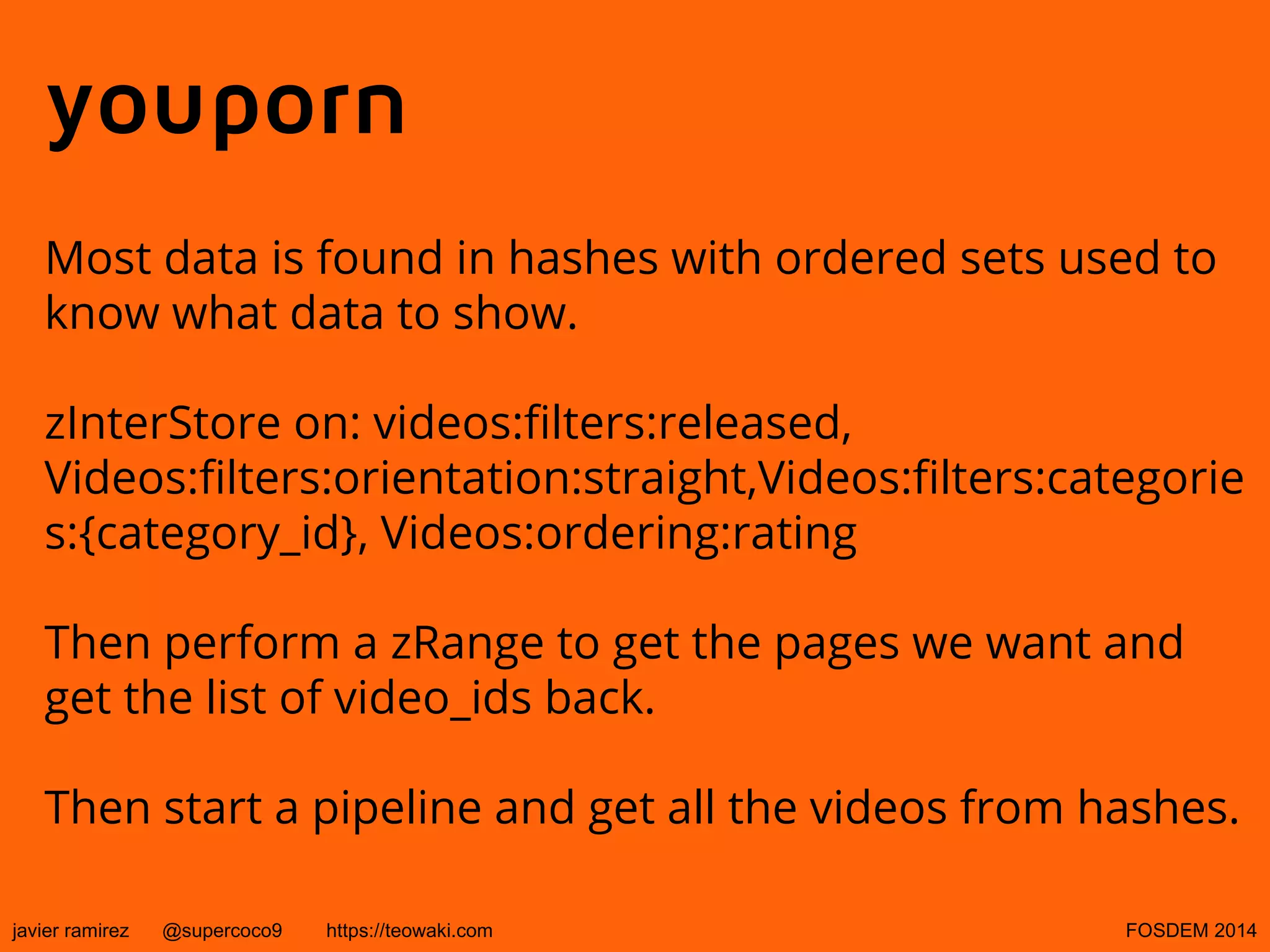
youporn
Most data is found in hashes with ordered sets used to
know what data to show.
zInterStore on: videos:filters:released,
Videos:filters:orientation:straight,Videos:filters:categorie
s:{category_id}, Videos:ordering:rating
Then perform a zRange to get the pages we want and
get the list of video_ids back.
Then start a pipeline and get all the videos from hashes.
javier ramirez

@supercoco9

https://teowaki.com

FOSDEM 2014
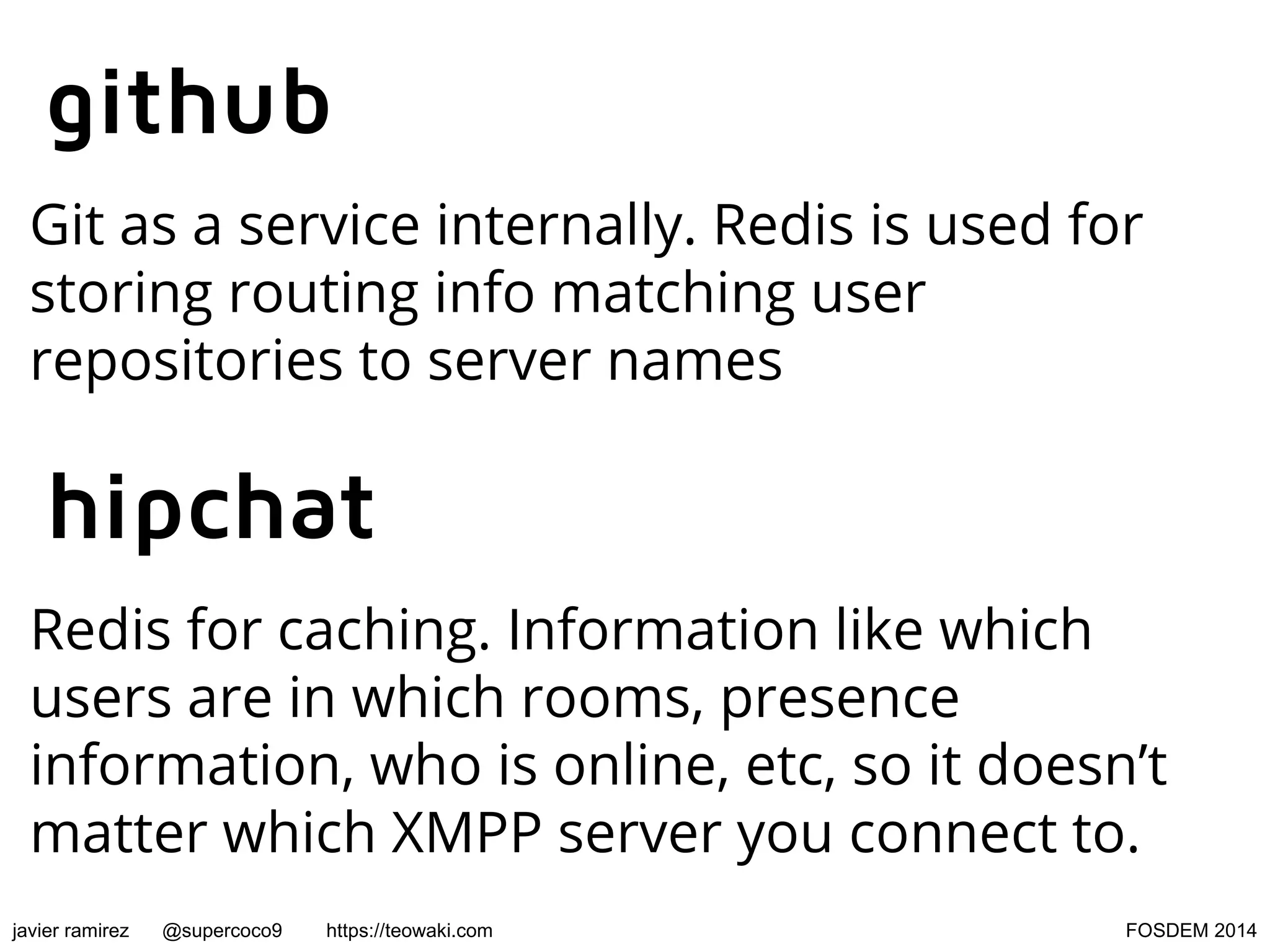
github
Git as a service internally. Redis is used for
storing routing info matching user
repositories to server names

hipchat
Redis for caching. Information like which
users are in which rooms, presence
information, who is online, etc, so it doesn’t
matter which XMPP server you connect to.
javier ramirez

@supercoco9

https://teowaki.com

FOSDEM 2014
when things go wrong

javier ramirez

@supercoco9

https://teowaki.com

FOSDEM 2014
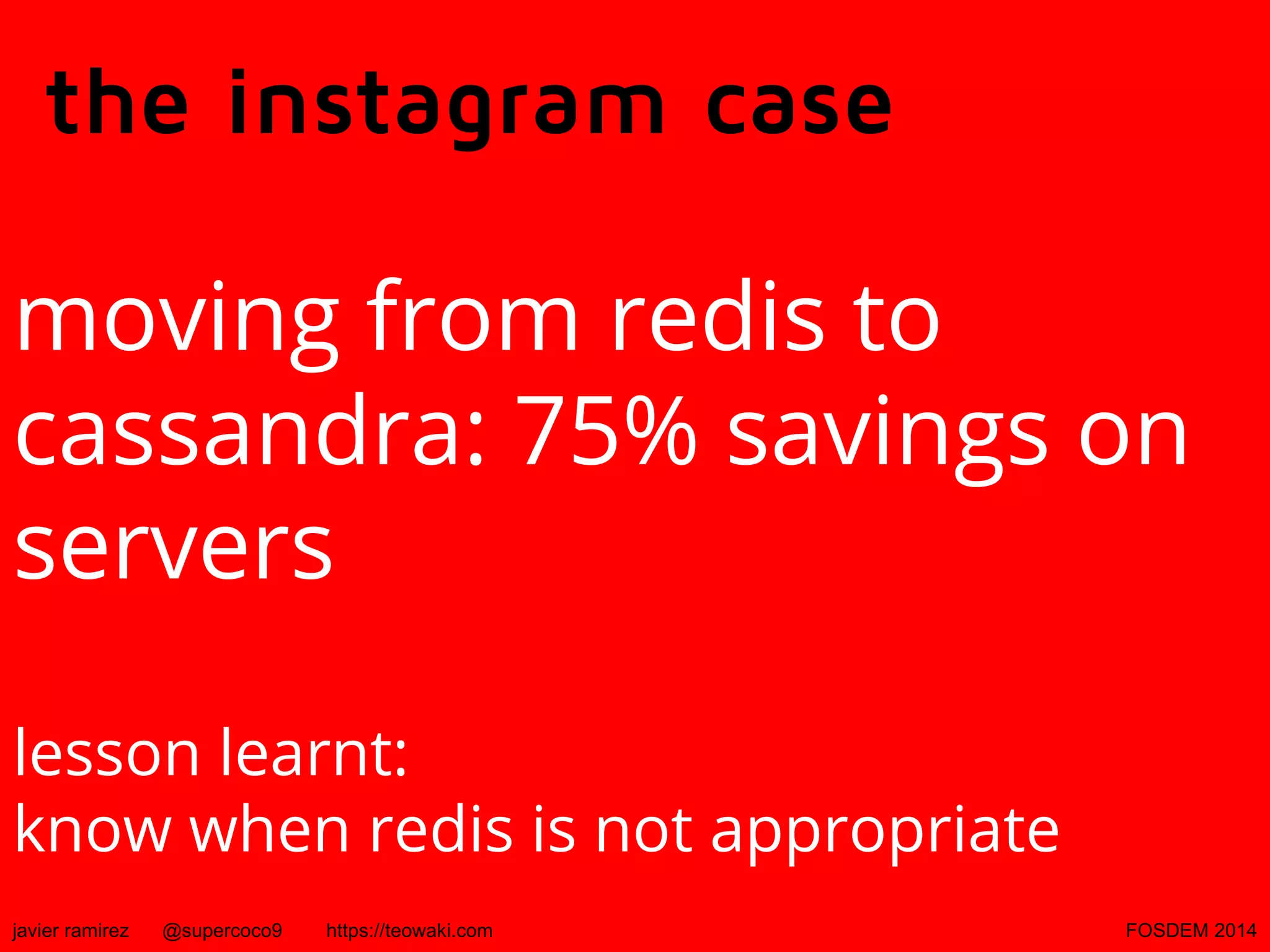
the instagram case
moving from redis to
cassandra: 75% savings on
servers
lesson learnt:
know when redis is not appropriate
javier ramirez

@supercoco9

https://teowaki.com

FOSDEM 2014
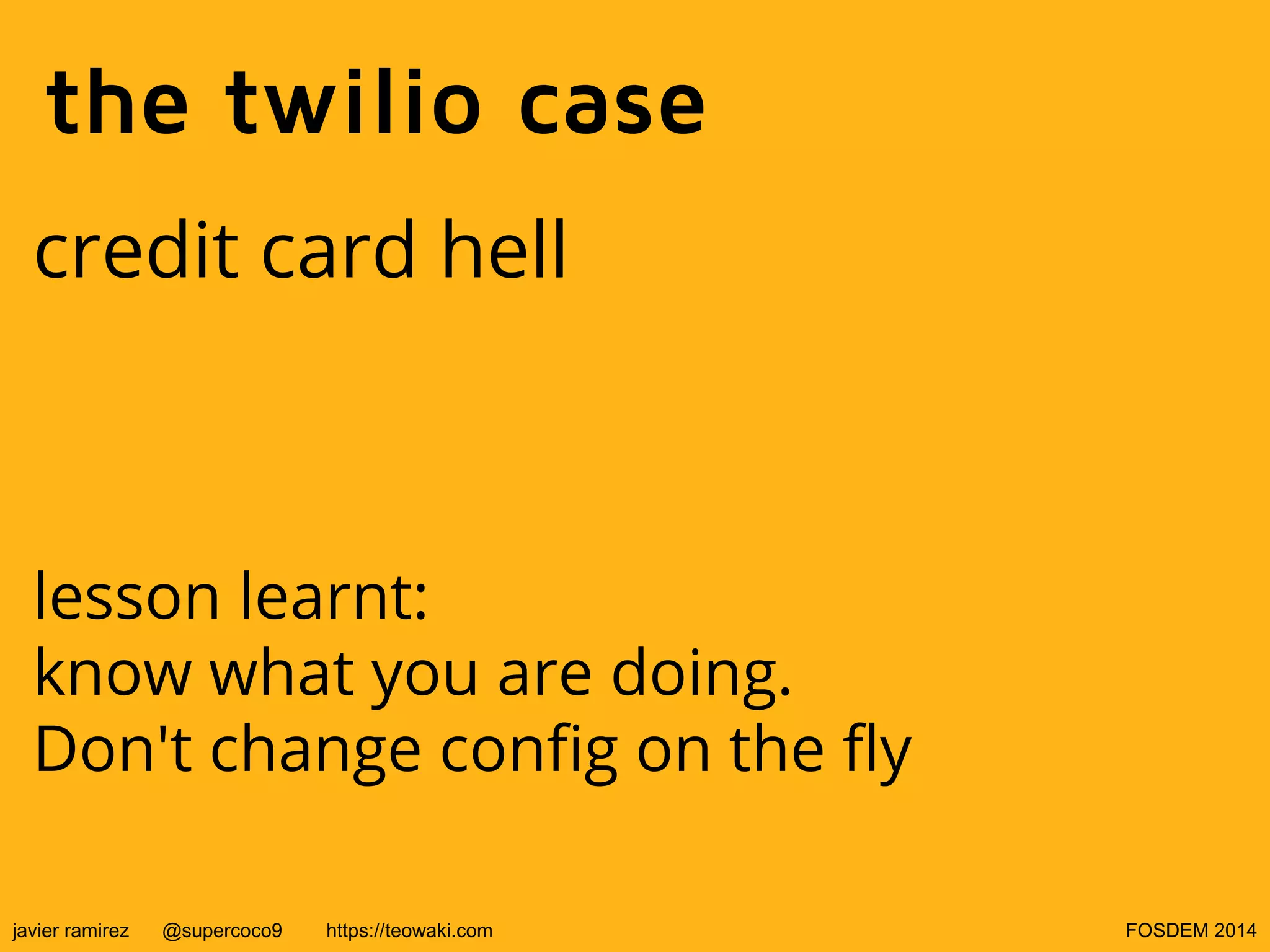
the twilio case
credit card hell

lesson learnt:
know what you are doing.
Don't change config on the fly
javier ramirez

@supercoco9

https://teowaki.com

FOSDEM 2014
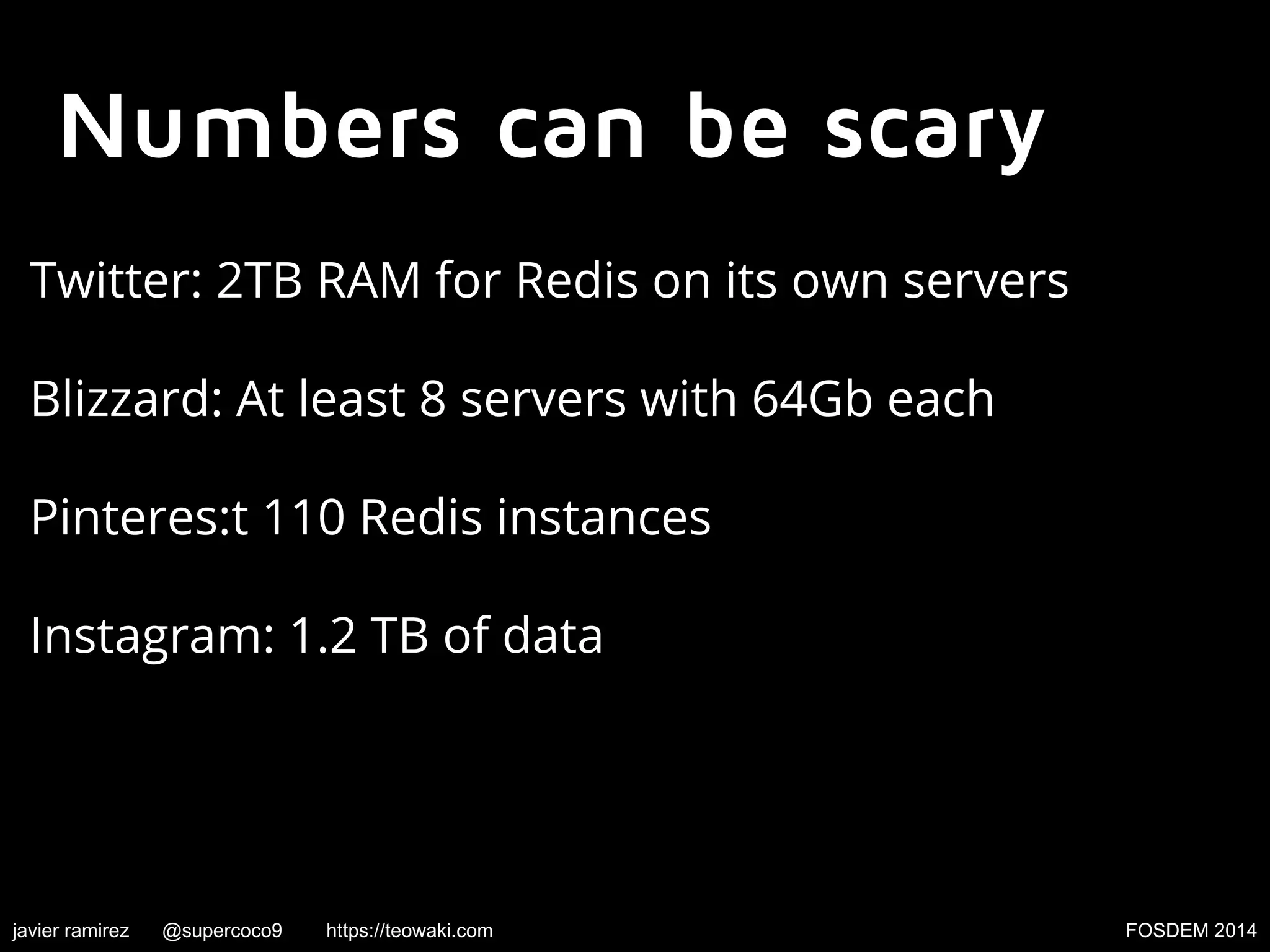
Numbers can be scary
Twitter: 2TB RAM for Redis on its own servers
Blizzard: At least 8 servers with 64Gb each
Pinteres:t 110 Redis instances
Instagram: 1.2 TB of data

javier ramirez

@supercoco9

https://teowaki.com

FOSDEM 2014
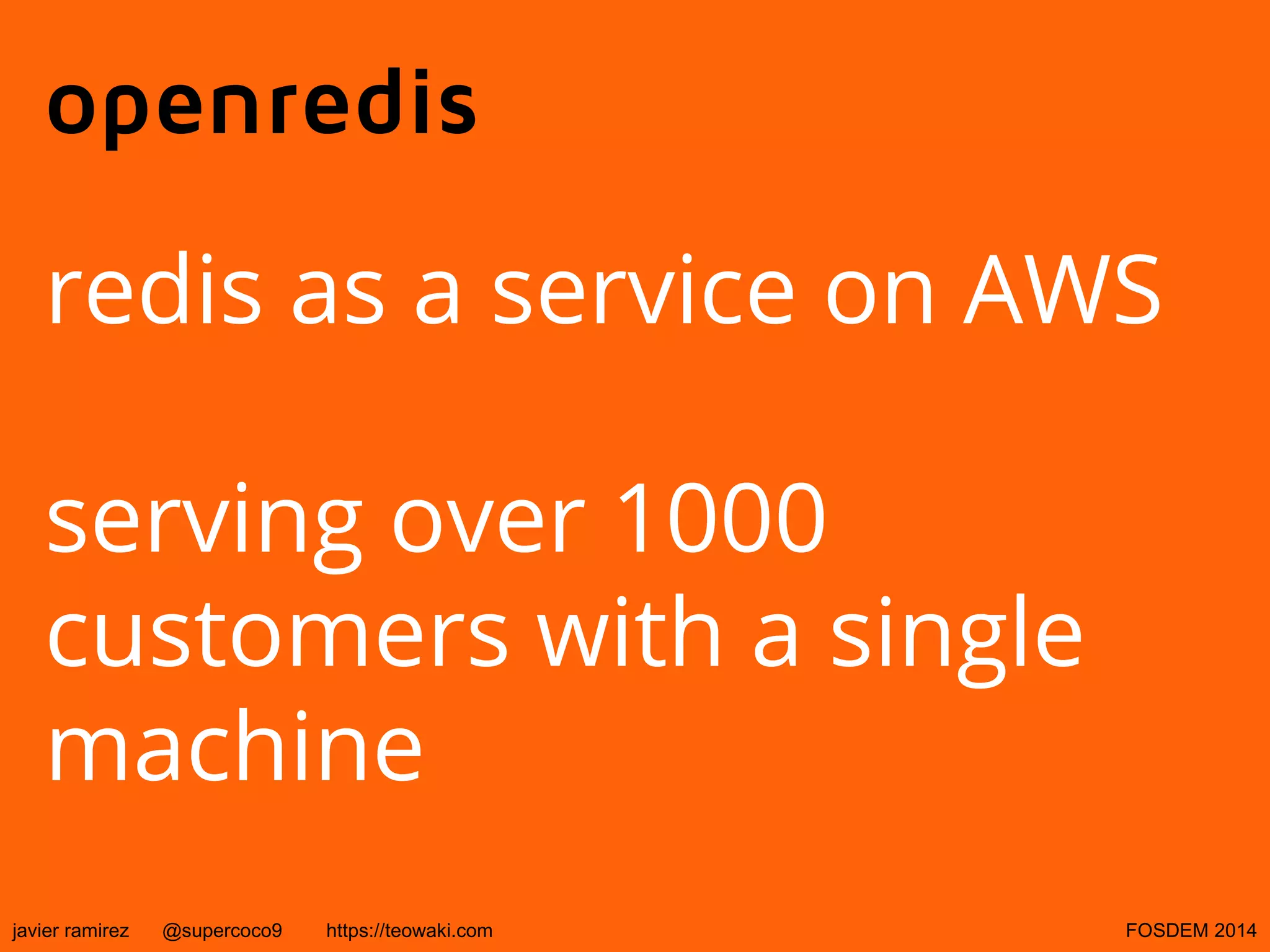
openredis
redis as a service on AWS
serving over 1000
customers with a single
machine
javier ramirez

@supercoco9

https://teowaki.com

FOSDEM 2014
how teowaki is using redis

javier ramirez

@supercoco9

https://teowaki.com

FOSDEM 2014
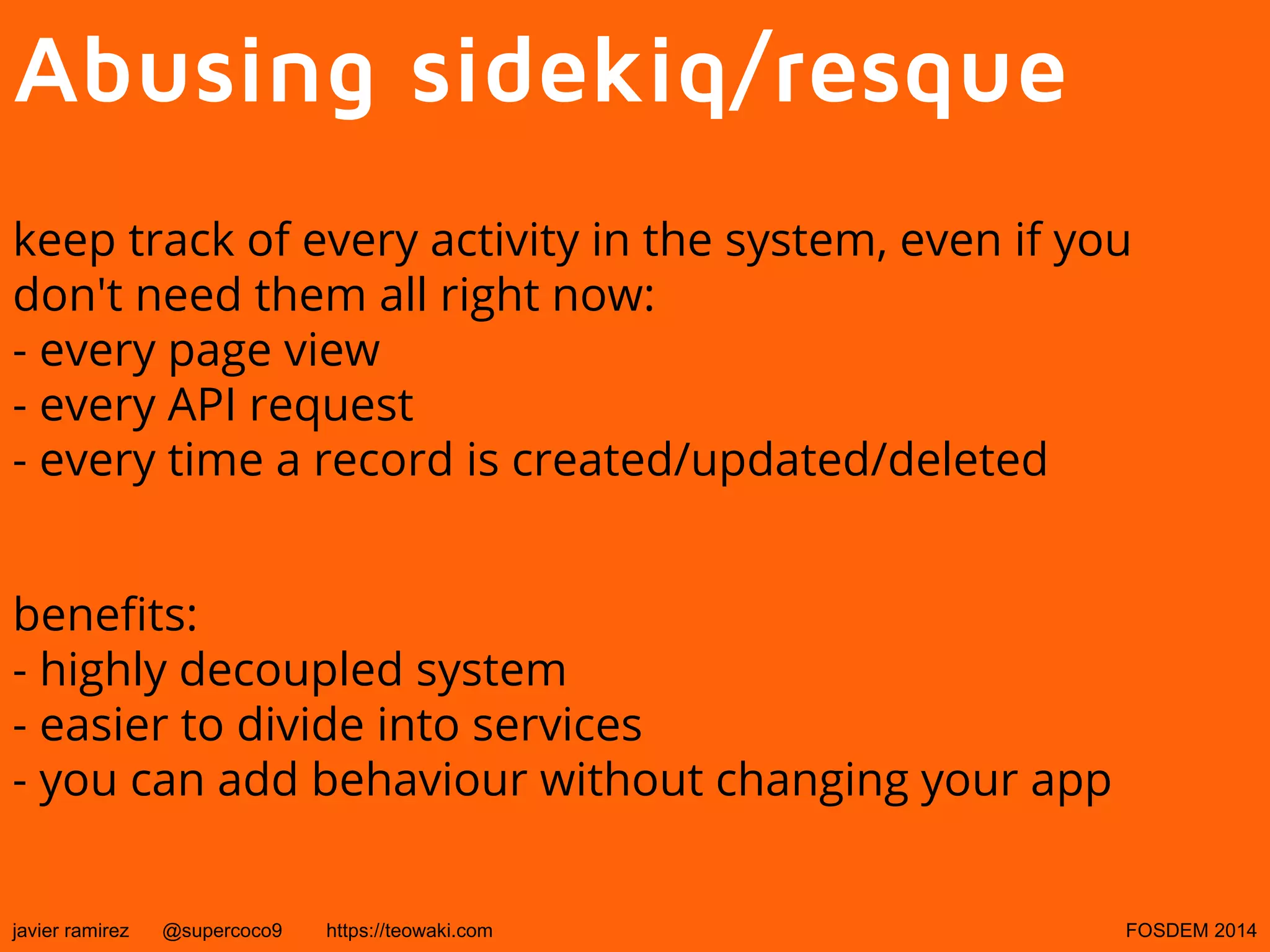
Abusing sidekiq/resque
keep track of every activity in the system, even if you
don't need them all right now:
- every page view
- every API request
- every time a record is created/updated/deleted
benefits:
- highly decoupled system
- easier to divide into services
- you can add behaviour without changing your app
javier ramirez

@supercoco9

https://teowaki.com

FOSDEM 2014
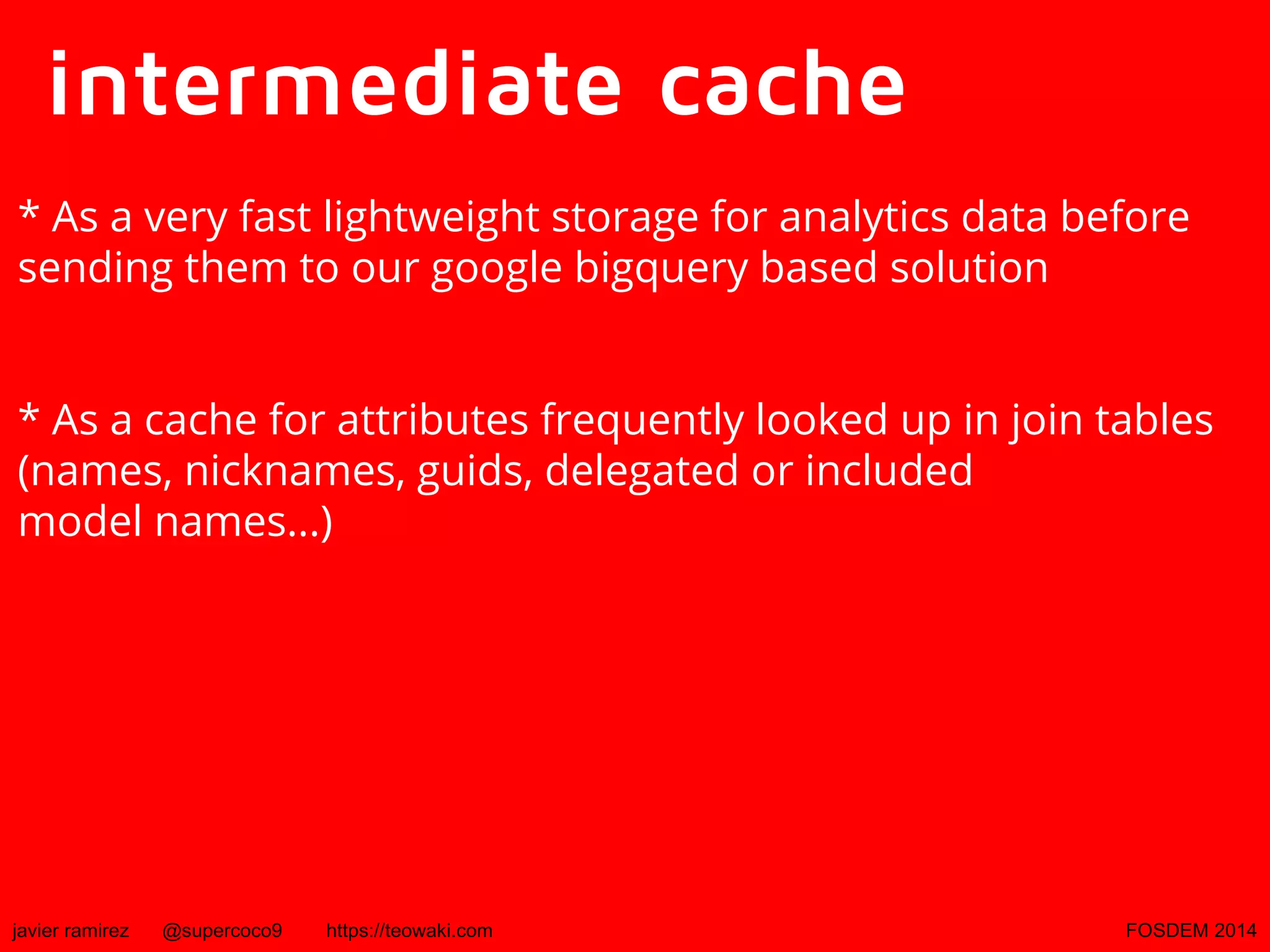
intermediate cache
* As a very fast lightweight storage for analytics data before
sending them to our google bigquery based solution
* As a cache for attributes frequently looked up in join tables
(names, nicknames, guids, delegated or included
model names...)

javier ramirez

@supercoco9

https://teowaki.com

FOSDEM 2014
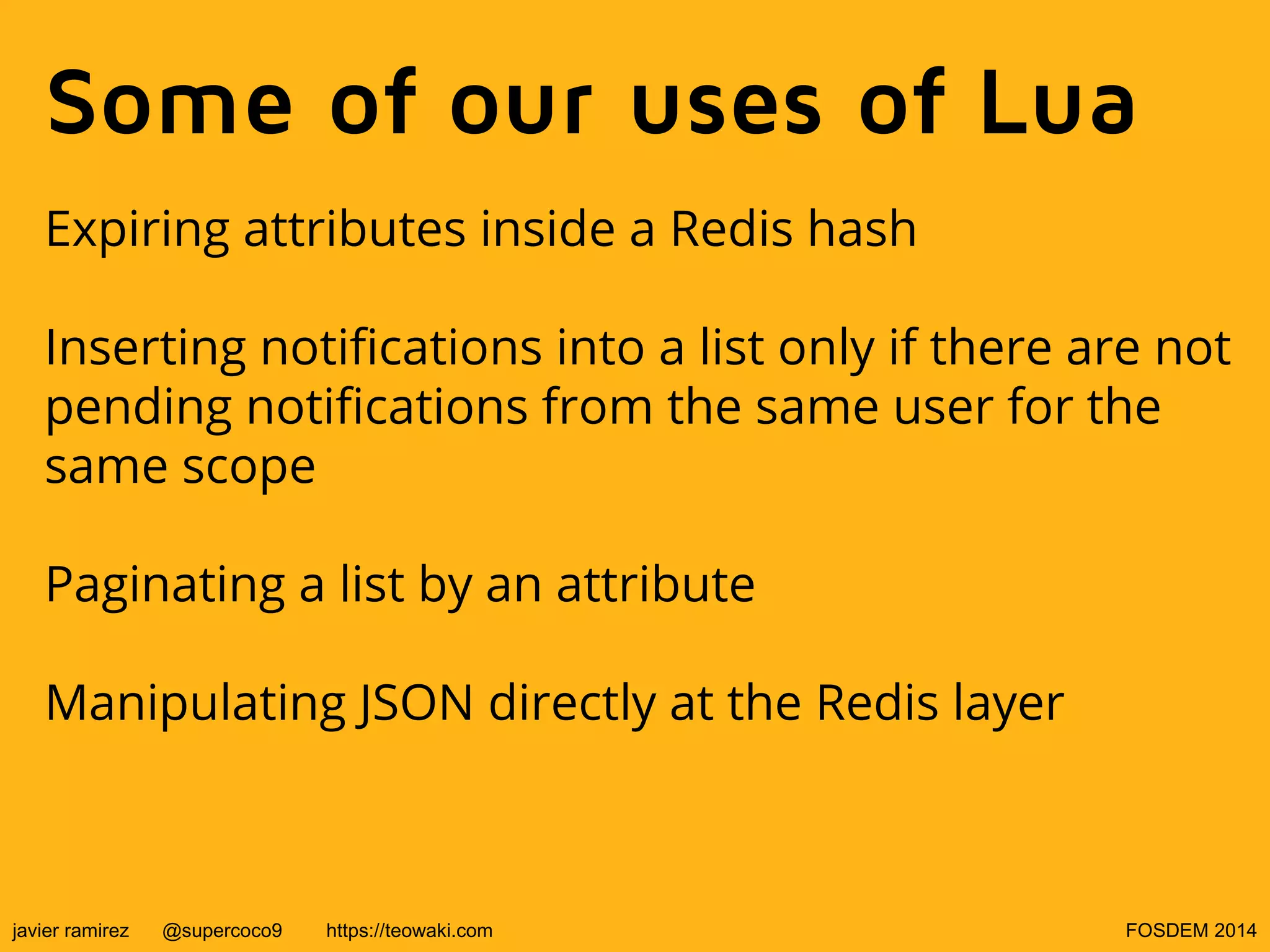
Some of our uses of Lua
Expiring attributes inside a Redis hash
Inserting notifications into a list only if there are not
pending notifications from the same user for the
same scope
Paginating a list by an attribute
Manipulating JSON directly at the Redis layer

javier ramirez

@supercoco9

https://teowaki.com

FOSDEM 2014
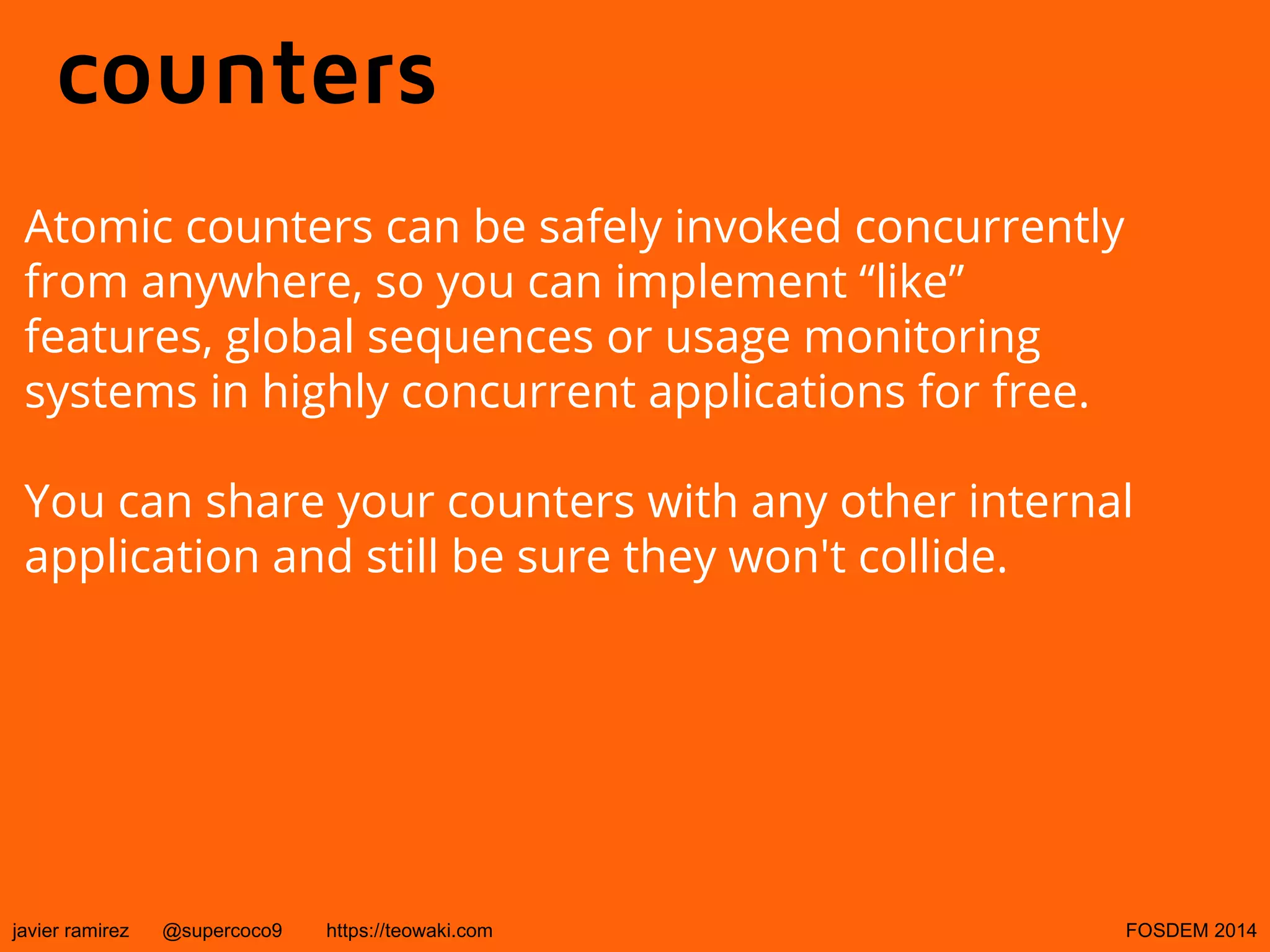
counters
Atomic counters can be safely invoked concurrently
from anywhere, so you can implement “like”
features, global sequences or usage monitoring
systems in highly concurrent applications for free.
You can share your counters with any other internal
application and still be sure they won't collide.

javier ramirez

@supercoco9

https://teowaki.com

FOSDEM 2014
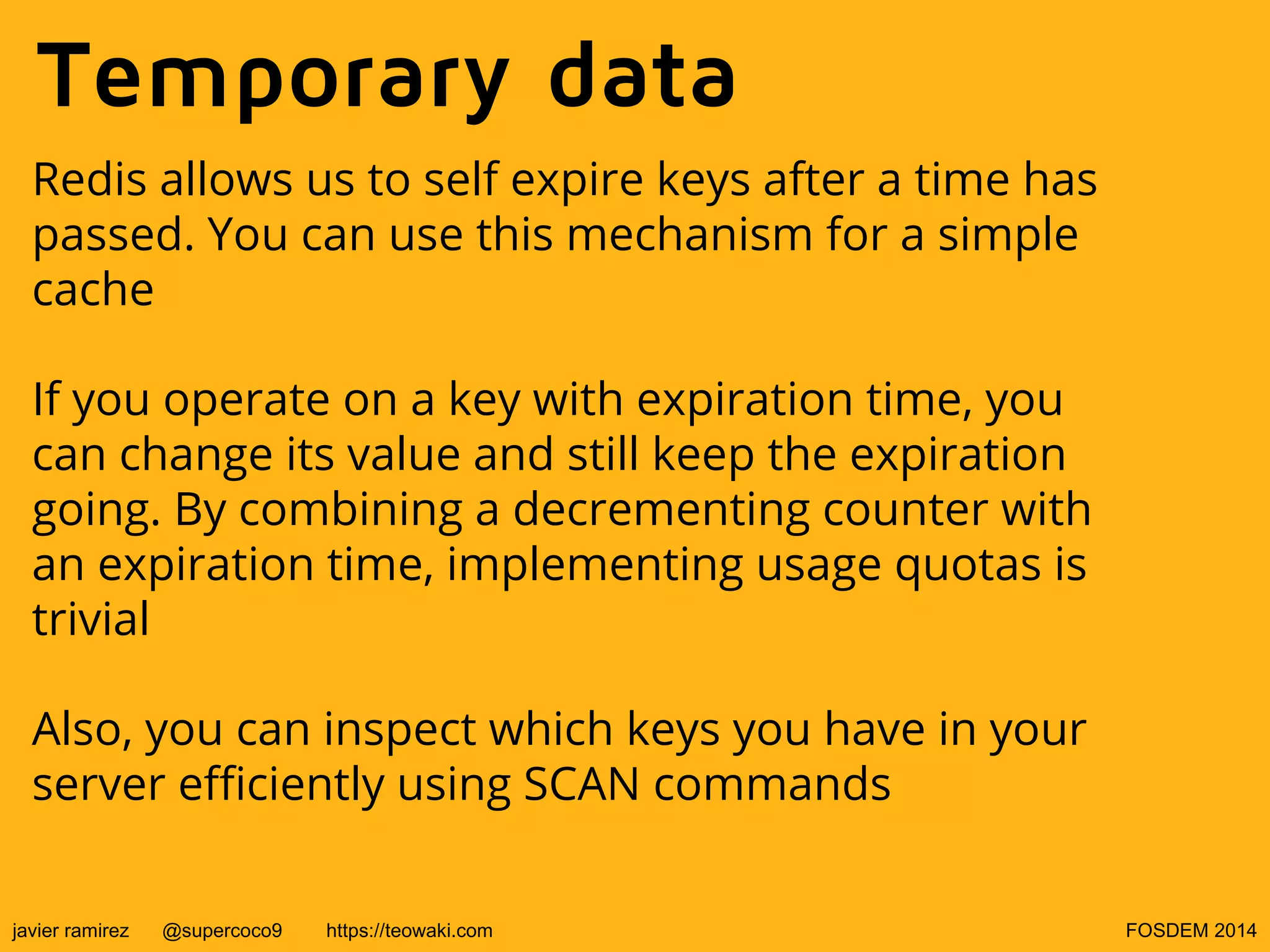
Temporary data
Redis allows us to self expire keys after a time has
passed. You can use this mechanism for a simple
cache
If you operate on a key with expiration time, you
can change its value and still keep the expiration
going. By combining a decrementing counter with
an expiration time, implementing usage quotas is
trivial
Also, you can inspect which keys you have in your
server efficiently using SCAN commands
javier ramirez

@supercoco9

https://teowaki.com

FOSDEM 2014
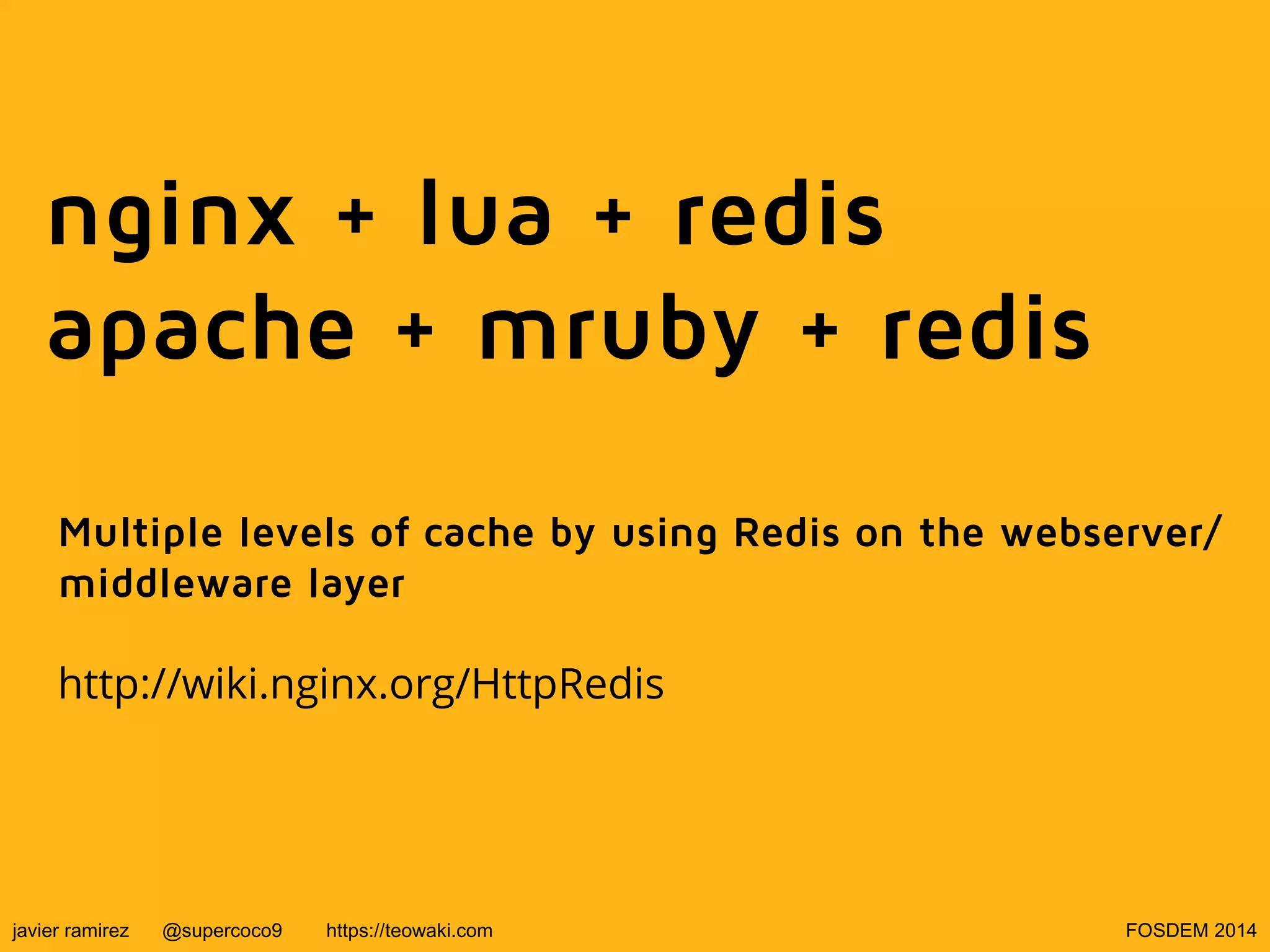
nginx + lua + redis
apache + mruby + redis
Multiple levels of cache by using Redis on the webserver/
middleware layer
http://wiki.nginx.org/HttpRedis

javier ramirez

@supercoco9

https://teowaki.com

FOSDEM 2014
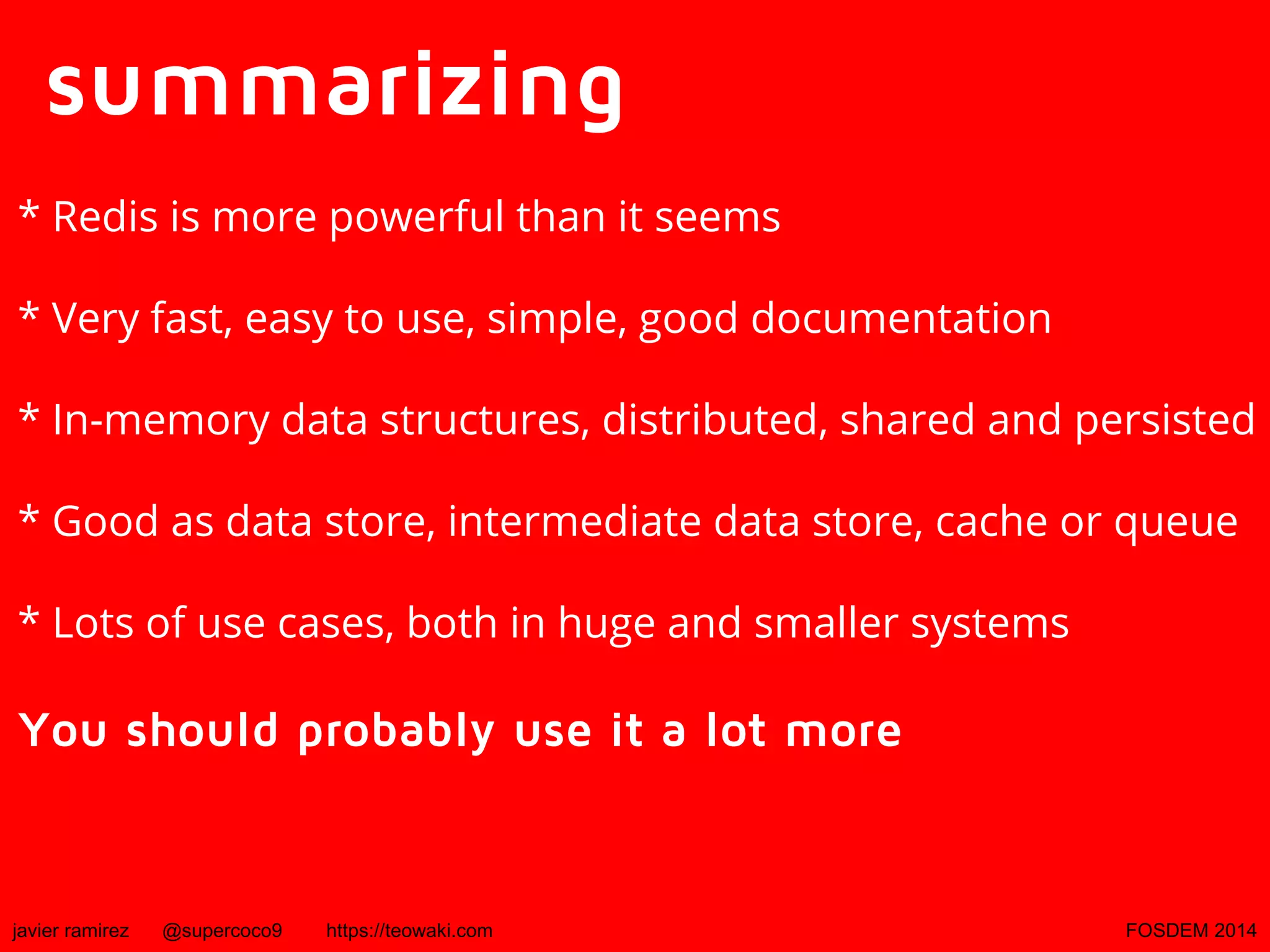
summarizing
* Redis is more powerful than it seems
* Very fast, easy to use, simple, good documentation
* In-memory data structures, distributed, shared and persisted
* Good as data store, intermediate data store, cache or queue
* Lots of use cases, both in huge and smaller systems

You should probably use it a lot more

javier ramirez

@supercoco9

https://teowaki.com

FOSDEM 2014
Find related links at
https://teowaki.com/teams/javier-community/link-categories/redis

Dank u.
Merci.
If you enjoyed this talk, please sign up for
https://teowaki.com

Javier Ramírez
@supercoco9
FOSDEM 2014

Fosdem how you can benefit from redis, javier ramirez @ teowaki

  • 1.
    How you can benefit fromusing Redis javier ramirez @supercoco9
  • 7.
    I was Lois Lane javierramirez @supercoco9 https://teowaki.com FOSDEM 2014
  • 8.
    In the beginner's mindthere are many possibilities, in the expert's mind there are few. Shunryu Suzuki javier ramirez @supercoco9 https://teowaki.com FOSDEM 2014
  • 9.
    myth: the bottleneck javierramirez @supercoco9 https://teowaki.com FOSDEM 2014
  • 10.
    redis-benchmark -r 1000000-n 2000000 -t get,set,lpush,lpop,mset -P 16 -q On my laptop: SET: 513610 requests per second GET: 641436 requests per second LPUSH: 845665 requests per second LPOP: 783392 requests per second MSET (10 keys): 89988 requests per second On a small digital ocean server ($5/month) SET: 227816 requests per second GET: 228258 requests per second LPUSH: 251098 requests per second LPOP: 251572 requests per second MSET (10 keys): 43918 requests per second javier ramirez @supercoco9 https://teowaki.com FOSDEM 2014
  • 11.
    myth: Redis isjust like memcached javier ramirez @supercoco9 https://teowaki.com FOSDEM 2014
  • 12.
    myth: Redis isfor queues javier ramirez @supercoco9 https://teowaki.com FOSDEM 2014
  • 13.
    open source, BSDlicensed, advanced key-value store. It is often referred to as a data structure server since keys can contain strings, hashes, lists, sets and sorted sets. http://redis.io started in 2009 by Salvatore Sanfilippo @antirez 104 contributors at https://github.com/antirez/redis javier ramirez @supercoco9 https://teowaki.com FOSDEM 2014
  • 14.
    The Redis Manifesto 1.ADSL for Abstract Data Types 2.Memory storage is #1 3.Fundamental data structures for a fundamental API 4.Two levels of API 5.Code is like a poem; it's not just something we write to reach some practical result 6.We're against complexity 7.We optimize for joy javier ramirez @supercoco9 https://teowaki.com FOSDEM 2014
  • 15.
    Redis makes you think javierramirez @supercoco9 https://teowaki.com FOSDEM 2014
  • 16.
    Redis data types Strings Hashes Lists Sets SortedSets javier ramirez @supercoco9 https://teowaki.com FOSDEM 2014
  • 17.
  • 18.
    much cooler commands Settingonly if exists Blocking pop (Blocking) pop from one list, push to another Get/set string ranges (and bit operations) Set intersections/diffs (and store) Pub/sub javier ramirez @supercoco9 https://teowaki.com FOSDEM 2014
  • 19.
    A chat in6 lines of code r=Redis.new driver: :hiredis r.subscribe “chatrooms:42” do |on| on.message do |topic, msg| puts “#{topic}: #{msg}” end end r.publish “chatrooms:42”, “Hello Fosdem” javier ramirez @supercoco9 https://teowaki.com FOSDEM 2014
  • 20.
    atomicity single threaded, sono concurrency problems transactions and lua scripts to run multiple operations atomically javier ramirez @supercoco9 https://teowaki.com FOSDEM 2014
  • 21.
    Scripting with lua Youcan use Lua for scripting Redis when you need to atomically execute a sequence of commands in which the output of a command is used as input for another It reduces the need to use complex lock mechanisms and simplifies dependencies between clients You can even extend the functionality of Redis by using Lua scripts javier ramirez @supercoco9 https://teowaki.com FOSDEM 2014
  • 22.
    Redis keeps everything in memory allthe time javier ramirez @supercoco9 https://teowaki.com FOSDEM 2014
  • 23.
    Persistance: RDB Compact binaryformat Saves snapshots every few minutes Good for backups and synchronizing If Redis crashes, a few minutes worth of data will be lost javier ramirez @supercoco9 https://teowaki.com FOSDEM 2014
  • 24.
    Durability: AOF Log textformat Configurable durability Large file, can slow down startup If Redis crashes, typically one second of data could be lost javier ramirez @supercoco9 https://teowaki.com FOSDEM 2014
  • 25.
    replication & scalingout one master, several read-only slaves sharding Twemproxy & redis cluster javier ramirez @supercoco9 https://teowaki.com FOSDEM 2014
  • 26.
    what's being usedfor javier ramirez @supercoco9 https://teowaki.com FOSDEM 2014
  • 27.
    twitter Every time line(800 tweets per user) is on redis 5000 writes per second avg 300K reads per second javier ramirez @supercoco9 https://teowaki.com FOSDEM 2014
  • 28.
    twitter write API (frombrowser or client app) follo e per on user id tweet id wer fanout (flockDB) metadata rpushx to Redis user info from gizmoduck (memcached) javier ramirez @supercoco9 tweet info from tweetypie (memcached + mysql) https://teowaki.com your twitter timeline FOSDEM 2014
  • 29.
    World Of Warcraft Blizzardis quite secretive about it Known to have at least 8 servers with 64Gb each to serve user avatars Known to have seen 1.000.000 users concurrently in the Asian version of the game javier ramirez @supercoco9 https://teowaki.com FOSDEM 2014
  • 30.
    pinterest object graph peruser Redis SortedSet, with timestamp as the score to store the users followed explicitly store the users followed implicitly store the user’s explicit followers store the user’s implicit followers store boards followed explicitly Redis set to store boards unfollowed explicitly per board Redis Hash to store a board’s explicit followers Redis Set to store a board’s explicit unfollowers javier ramirez @supercoco9 https://teowaki.com FOSDEM 2014
  • 31.
    viacom Object dependency graph.Cache on steroids Redis as a queue for background jobs Activity tracking and view counts buffering before saving to mysql Lua script working on a slave to recalculate ranking and popularity of contents, then send the data to master. The new process takes 1/60th less than the old one in mysql javier ramirez @supercoco9 https://teowaki.com FOSDEM 2014
  • 32.
    stack overflow Three levelcache: local cache (no persistence) sessions, and pending view count updates site cache hot question id lists, user acceptance rates... global cache (separate Redis DB) Inboxes, API usage quotas... javier ramirez @supercoco9 https://teowaki.com FOSDEM 2014
  • 33.
    youporn Most data isfound in hashes with ordered sets used to know what data to show. zInterStore on: videos:filters:released, Videos:filters:orientation:straight,Videos:filters:categorie s:{category_id}, Videos:ordering:rating Then perform a zRange to get the pages we want and get the list of video_ids back. Then start a pipeline and get all the videos from hashes. javier ramirez @supercoco9 https://teowaki.com FOSDEM 2014
  • 34.
    github Git as aservice internally. Redis is used for storing routing info matching user repositories to server names hipchat Redis for caching. Information like which users are in which rooms, presence information, who is online, etc, so it doesn’t matter which XMPP server you connect to. javier ramirez @supercoco9 https://teowaki.com FOSDEM 2014
  • 35.
    when things gowrong javier ramirez @supercoco9 https://teowaki.com FOSDEM 2014
  • 36.
    the instagram case movingfrom redis to cassandra: 75% savings on servers lesson learnt: know when redis is not appropriate javier ramirez @supercoco9 https://teowaki.com FOSDEM 2014
  • 37.
    the twilio case creditcard hell lesson learnt: know what you are doing. Don't change config on the fly javier ramirez @supercoco9 https://teowaki.com FOSDEM 2014
  • 38.
    Numbers can bescary Twitter: 2TB RAM for Redis on its own servers Blizzard: At least 8 servers with 64Gb each Pinteres:t 110 Redis instances Instagram: 1.2 TB of data javier ramirez @supercoco9 https://teowaki.com FOSDEM 2014
  • 39.
    openredis redis as aservice on AWS serving over 1000 customers with a single machine javier ramirez @supercoco9 https://teowaki.com FOSDEM 2014
  • 40.
    how teowaki isusing redis javier ramirez @supercoco9 https://teowaki.com FOSDEM 2014
  • 41.
    Abusing sidekiq/resque keep trackof every activity in the system, even if you don't need them all right now: - every page view - every API request - every time a record is created/updated/deleted benefits: - highly decoupled system - easier to divide into services - you can add behaviour without changing your app javier ramirez @supercoco9 https://teowaki.com FOSDEM 2014
  • 42.
    intermediate cache * Asa very fast lightweight storage for analytics data before sending them to our google bigquery based solution * As a cache for attributes frequently looked up in join tables (names, nicknames, guids, delegated or included model names...) javier ramirez @supercoco9 https://teowaki.com FOSDEM 2014
  • 43.
    Some of ouruses of Lua Expiring attributes inside a Redis hash Inserting notifications into a list only if there are not pending notifications from the same user for the same scope Paginating a list by an attribute Manipulating JSON directly at the Redis layer javier ramirez @supercoco9 https://teowaki.com FOSDEM 2014
  • 44.
    counters Atomic counters canbe safely invoked concurrently from anywhere, so you can implement “like” features, global sequences or usage monitoring systems in highly concurrent applications for free. You can share your counters with any other internal application and still be sure they won't collide. javier ramirez @supercoco9 https://teowaki.com FOSDEM 2014
  • 45.
    Temporary data Redis allowsus to self expire keys after a time has passed. You can use this mechanism for a simple cache If you operate on a key with expiration time, you can change its value and still keep the expiration going. By combining a decrementing counter with an expiration time, implementing usage quotas is trivial Also, you can inspect which keys you have in your server efficiently using SCAN commands javier ramirez @supercoco9 https://teowaki.com FOSDEM 2014
  • 46.
    nginx + lua+ redis apache + mruby + redis Multiple levels of cache by using Redis on the webserver/ middleware layer http://wiki.nginx.org/HttpRedis javier ramirez @supercoco9 https://teowaki.com FOSDEM 2014
  • 47.
    summarizing * Redis ismore powerful than it seems * Very fast, easy to use, simple, good documentation * In-memory data structures, distributed, shared and persisted * Good as data store, intermediate data store, cache or queue * Lots of use cases, both in huge and smaller systems You should probably use it a lot more javier ramirez @supercoco9 https://teowaki.com FOSDEM 2014
  • 48.
    Find related linksat https://teowaki.com/teams/javier-community/link-categories/redis Dank u. Merci. If you enjoyed this talk, please sign up for https://teowaki.com Javier Ramírez @supercoco9 FOSDEM 2014