QuestDB
Community Meetup #7
1
2022-07-28
QuestDB Team
Today’s agenda
2
Update about replication
1
2 AMA
3 Other news
Roadmap updates
3
Javier Ramirez, Developer Relations at QuestDB
@supercoco9 - @QuestDB
QuestDB
4
Recent developments
● Replication (WIP) <- today’s
focus!
● Partitions detach/attach
workflow (soon)
● CSV imports for unordered
data without size limitation
(soon)
What do we mean by replication
● Higher availability for reads, and higher throughput
○ Write to one QuestDB instance, propagate changes, and read
from many
● Higher availability and higher throughput for both reads and writes
(available only on QuestDB Cloud)
○ Write to many QuestDB instances, propagate changes, and
read from many
5
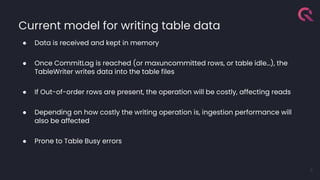
Current model for writing table data
● Data is received and kept in memory
● Once CommitLag is reached (or maxuncommitted rows, or table idle…), the
TableWriter writes data into the table files
● If Out-of-order rows are present, the operation will be costly, affecting reads
● Depending on how costly the writing operation is, ingestion performance will
also be affected
● Prone to Table Busy errors
6
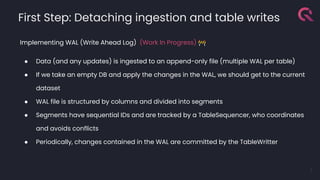
First Step: Detaching ingestion and table writes
Implementing WAL (Write Ahead Log) (Work In Progress) 🚧
● Data (and any updates) is ingested to an append-only file (multiple WAL per table)
● If we take an empty DB and apply the changes in the WAL, we should get to the current
dataset
● WAL file is structured by columns and divided into segments
● Segments have sequential IDs and are tracked by a TableSequencer, who coordinates
and avoids conflicts
● Periodically, changes contained in the WAL are committed by the TableWritter
7
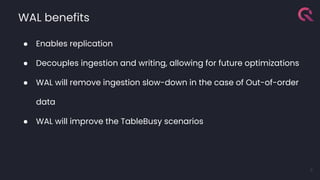
WAL benefits
● Enables replication
● Decouples ingestion and writing, allowing for future optimizations
● WAL will remove ingestion slow-down in the case of Out-of-order
data
● WAL will improve the TableBusy scenarios
8
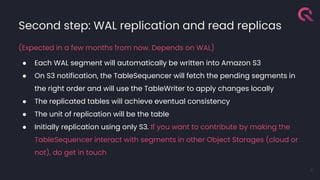
Second step: WAL replication and read replicas
(Expected in a few months from now. Depends on WAL)
● Each WAL segment will automatically be written into Amazon S3
● On S3 notification, the TableSequencer will fetch the pending segments in
the right order and will use the TableWriter to apply changes locally
● The replicated tables will achieve eventual consistency
● The unit of replication will be the table
● Initially replication using only S3. If you want to contribute by making the
TableSequencer interact with segments in other Object Storages (cloud or
not), do get in touch
9
AMA
10
Javier, Developer Advocate
& QuestDB Team
Questions from the community
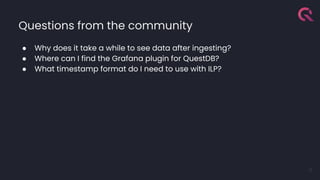
● Why does it take a while to see data after ingesting?
● Where can I find the Grafana plugin for QuestDB?
● What timestamp format do I need to use with ILP?
11
We’re hiring!
● Senior Backend Engineer (Python), QuestDB Cloud
● Cloud Engineer, QuestDB Cloud
Apply at: questdb.io/careers
12
Thank you!
13
@QuestDb QuestDB
Join Slack: slack.questdb.io
Star us: github.com/questdb/questdb
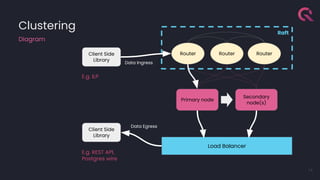
Clustering
14
Client Side
Library
Router Router Router
Raft
Primary node
Secondary
node(s)
Data Ingress
Load Balancer
Data Egress
Client Side
Library
E.g. ILP
E.g. REST API,
Postgres wire
Diagram

QuestDB-Community-Call-20220728

  • 1.
  • 2.
    Today’s agenda 2 Update aboutreplication 1 2 AMA 3 Other news
  • 3.
    Roadmap updates 3 Javier Ramirez,Developer Relations at QuestDB @supercoco9 - @QuestDB
  • 4.
    QuestDB 4 Recent developments ● Replication(WIP) <- today’s focus! ● Partitions detach/attach workflow (soon) ● CSV imports for unordered data without size limitation (soon)
  • 5.
    What do wemean by replication ● Higher availability for reads, and higher throughput ○ Write to one QuestDB instance, propagate changes, and read from many ● Higher availability and higher throughput for both reads and writes (available only on QuestDB Cloud) ○ Write to many QuestDB instances, propagate changes, and read from many 5
  • 6.
    Current model forwriting table data ● Data is received and kept in memory ● Once CommitLag is reached (or maxuncommitted rows, or table idle…), the TableWriter writes data into the table files ● If Out-of-order rows are present, the operation will be costly, affecting reads ● Depending on how costly the writing operation is, ingestion performance will also be affected ● Prone to Table Busy errors 6
  • 7.
    First Step: Detachingingestion and table writes Implementing WAL (Write Ahead Log) (Work In Progress) 🚧 ● Data (and any updates) is ingested to an append-only file (multiple WAL per table) ● If we take an empty DB and apply the changes in the WAL, we should get to the current dataset ● WAL file is structured by columns and divided into segments ● Segments have sequential IDs and are tracked by a TableSequencer, who coordinates and avoids conflicts ● Periodically, changes contained in the WAL are committed by the TableWritter 7
  • 8.
    WAL benefits ● Enablesreplication ● Decouples ingestion and writing, allowing for future optimizations ● WAL will remove ingestion slow-down in the case of Out-of-order data ● WAL will improve the TableBusy scenarios 8
  • 9.
    Second step: WALreplication and read replicas (Expected in a few months from now. Depends on WAL) ● Each WAL segment will automatically be written into Amazon S3 ● On S3 notification, the TableSequencer will fetch the pending segments in the right order and will use the TableWriter to apply changes locally ● The replicated tables will achieve eventual consistency ● The unit of replication will be the table ● Initially replication using only S3. If you want to contribute by making the TableSequencer interact with segments in other Object Storages (cloud or not), do get in touch 9
  • 10.
  • 11.
    Questions from thecommunity ● Why does it take a while to see data after ingesting? ● Where can I find the Grafana plugin for QuestDB? ● What timestamp format do I need to use with ILP? 11
  • 12.
    We’re hiring! ● SeniorBackend Engineer (Python), QuestDB Cloud ● Cloud Engineer, QuestDB Cloud Apply at: questdb.io/careers 12
  • 13.
    Thank you! 13 @QuestDb QuestDB JoinSlack: slack.questdb.io Star us: github.com/questdb/questdb
  • 14.
    Clustering 14 Client Side Library Router RouterRouter Raft Primary node Secondary node(s) Data Ingress Load Balancer Data Egress Client Side Library E.g. ILP E.g. REST API, Postgres wire Diagram