The Future of Fast Databases:
Lessons from a Decade of QuestDB
Javier Ramírez
@supercoco9
Fast Data Advocate
When was the last time you wished your
database was slower to ingest and query
data?
How excited would you get about a new
database with non-standard data storage,
so you need to write some ETL if you
want to join it with the rest of your
existing data?
My fast database definition*:
Designed for performant frequent multi
million record ingestion and performant
frequent queries over multi billion record
datasets.
* My own biased definition. But this is my talk, so just setting the context
The farther backward you can look,
the farther forward you can see.
— Winston Churchill
The database is the bottleneck
- Every developer in the 90s
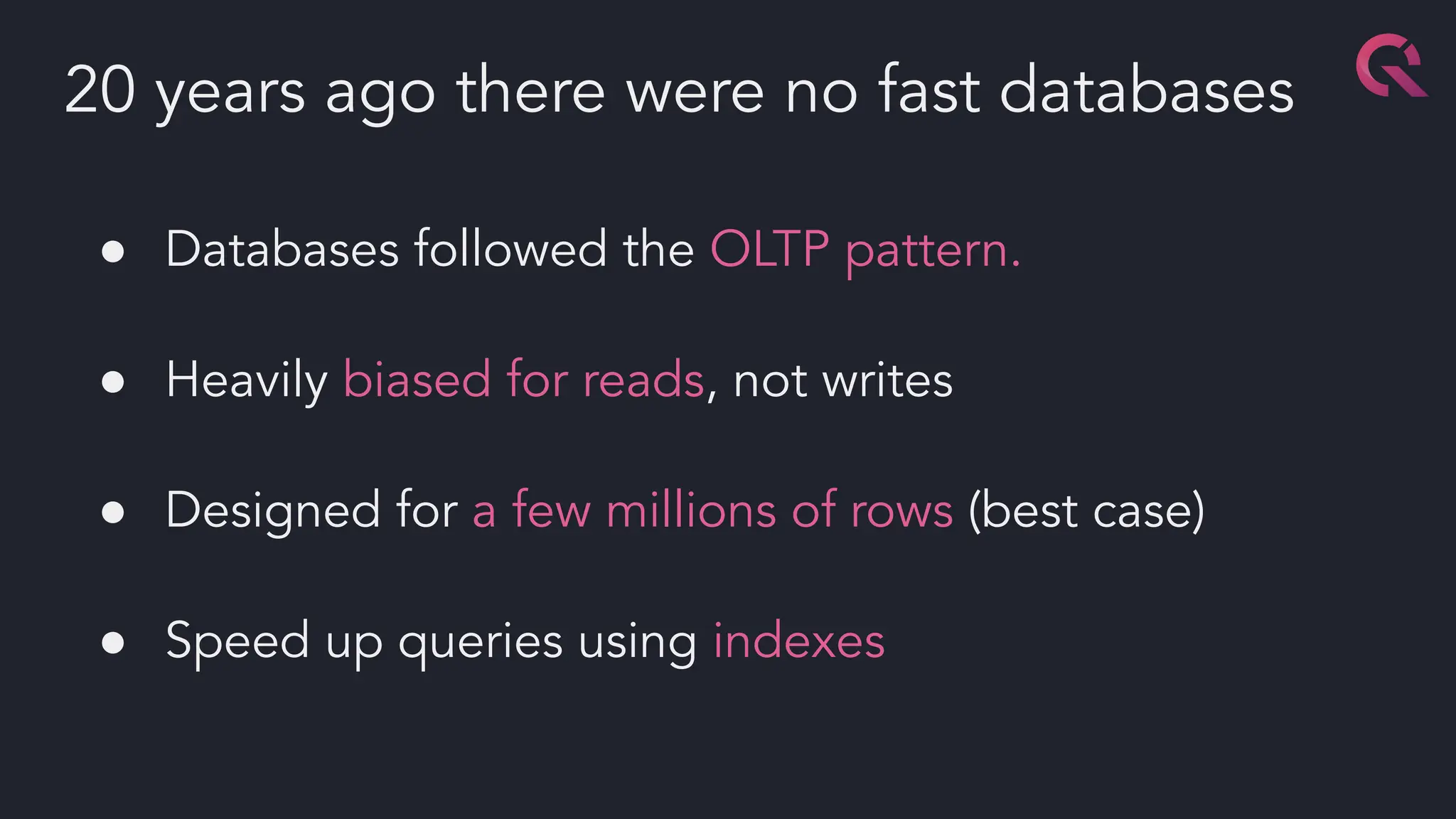
● Databases followed the OLTP pattern.
● Heavily biased for reads, not writes
● Designed for a few millions of rows (best case)
● Speed up queries using indexes
20 years ago there were no fast databases
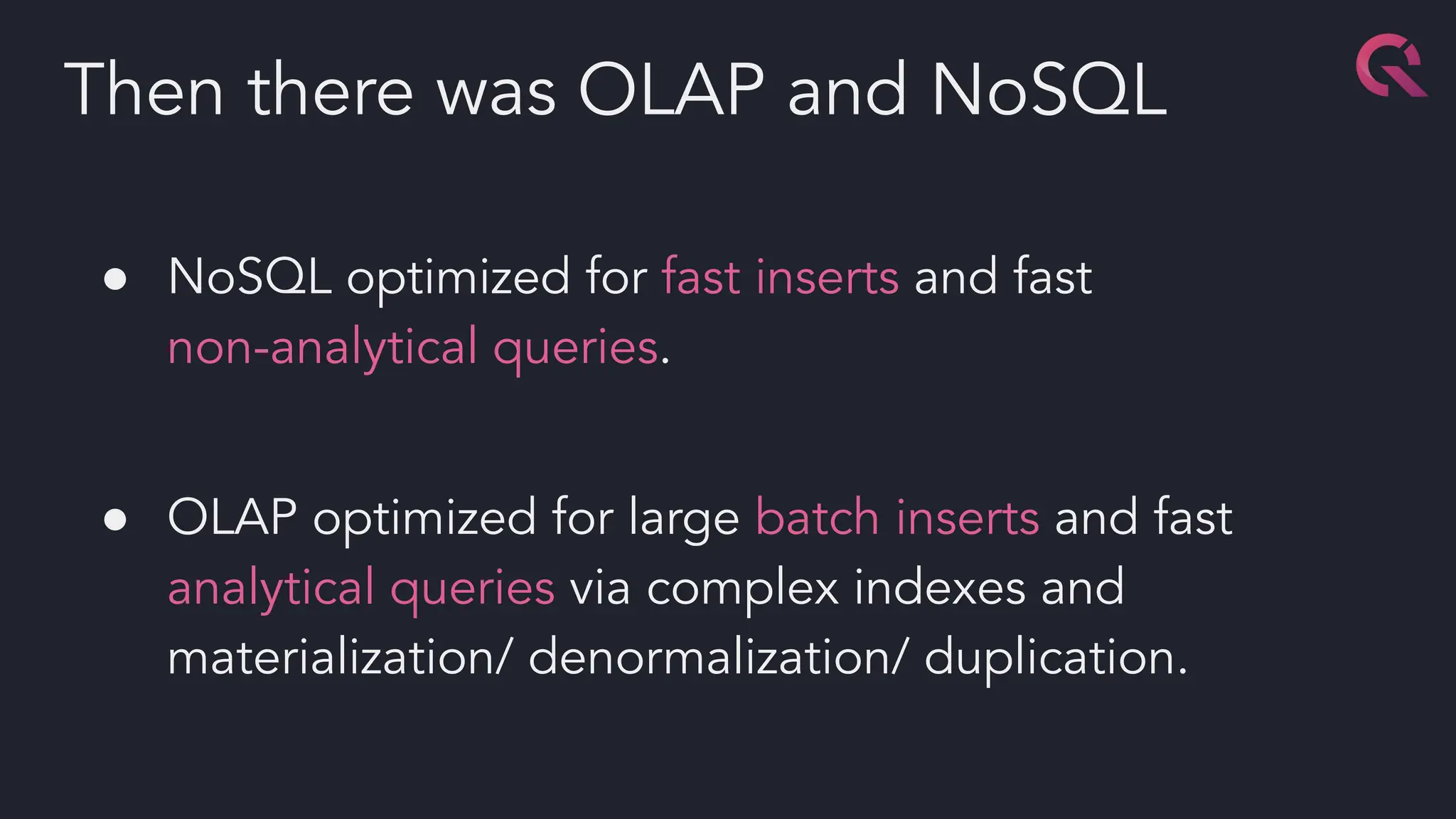
● NoSQL optimized for fast inserts and fast
non-analytical queries.
● OLAP optimized for large batch inserts and fast
analytical queries via complex indexes and
materialization/ denormalization/ duplication.
Then there was OLAP and NoSQL
● Following success of Map/Reduce and HDFS for data
processing, many OLAP databases separated storage
from computation, allowing for distributed queries.
● The data lake concept was created.
● Writes were still mostly batched.
Then there was OLAP separation of storage
● File formats typically used in OLAP made it very costly
to update individual records.
● Cloud-based object stores typically work with
immutable files with no random-access updates.
OLAP = Immutable*
* Until recently
● It can get very big. It never stops. Always incomplete.
● It will burst, lag, and arrive out of order. It will get
updated after you’ve already emitted results.
● Individual data points lose value over time, but long-term
aggregations are priceless.
● Analysts prefer low latency and data freshness.
Some ugly truths about streaming data
● Time Series Databases specialise in very fast ingestion,
very fast queries over nascent data, and powerful
time-based analytical queries.
● They focus on nascent data, deleting, downsampling,
or slowing-down older data.
Time Series Databases Enter the Scene
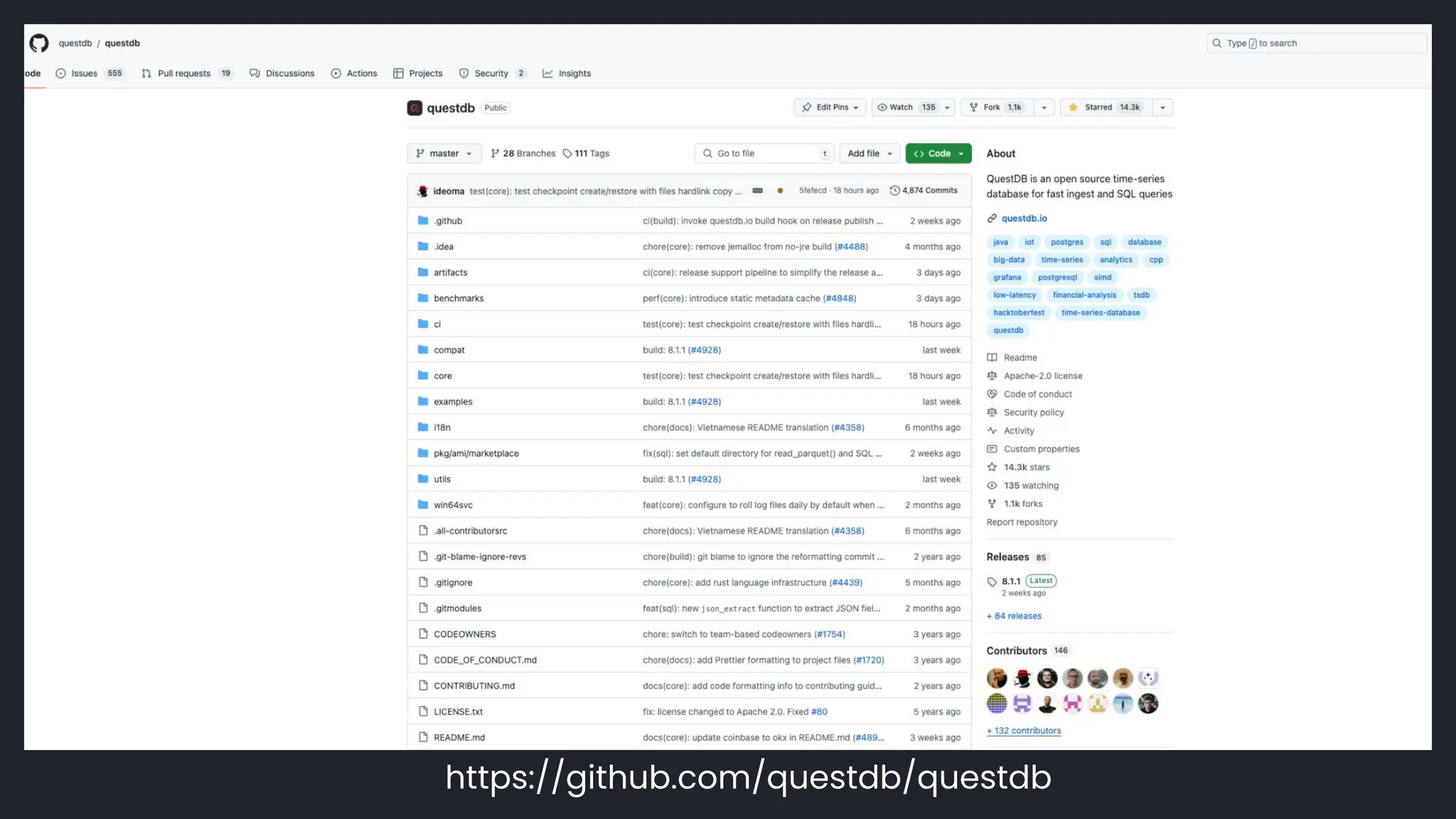
https://github.com/questdb/questdb
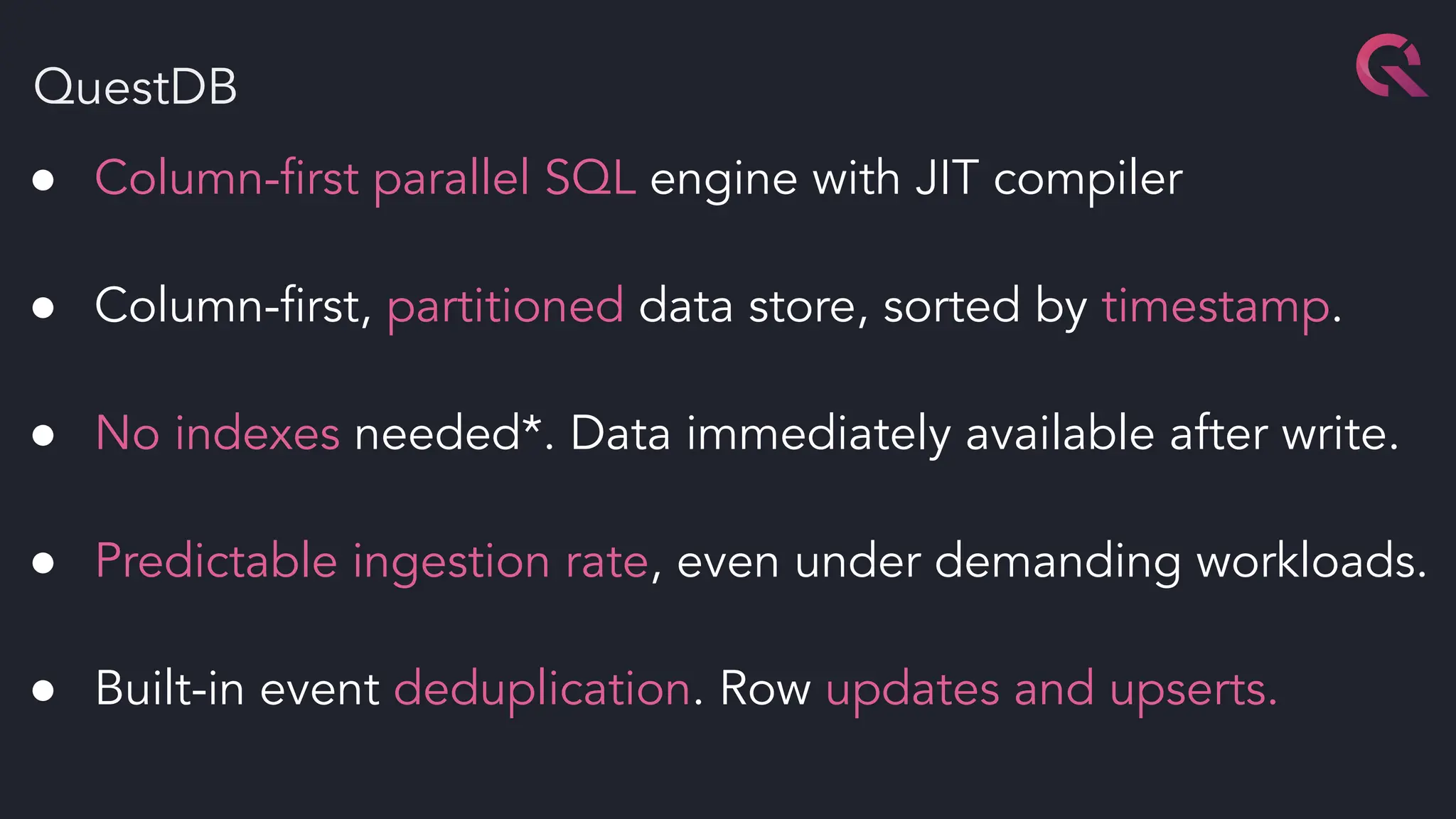
QuestDB
● Column-first parallel SQL engine with JIT compiler
● Column-first, partitioned data store, sorted by timestamp.
● No indexes needed*. Data immediately available after write.
● Predictable ingestion rate, even under demanding workloads.
● Built-in event deduplication. Row updates and upserts.
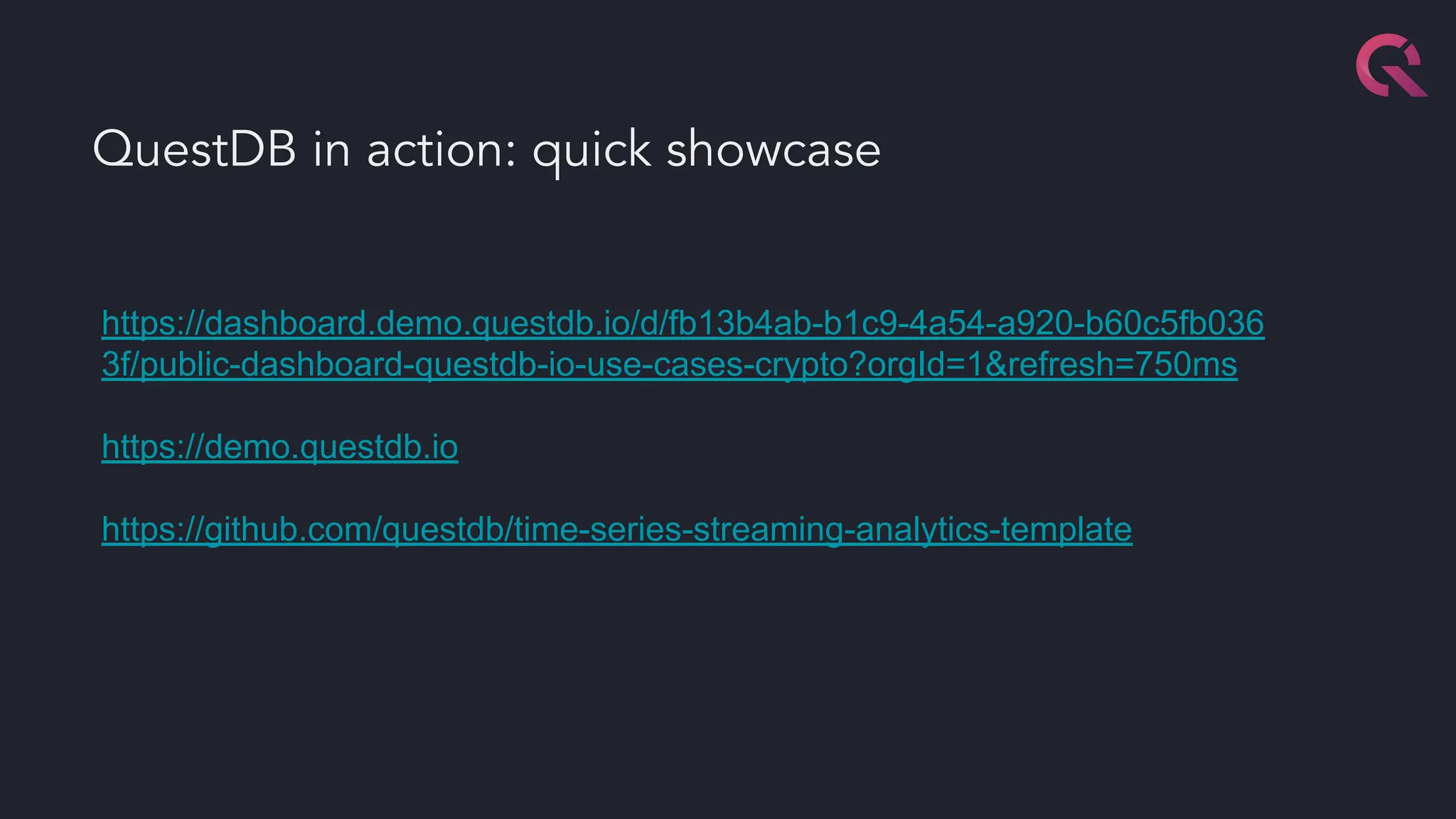
QuestDB in action: quick showcase
https://dashboard.demo.questdb.io/d/fb13b4ab-b1c9-4a54-a920-b60c5fb036
3f/public-dashboard-questdb-io-use-cases-crypto?orgId=1&refresh=750ms
https://demo.questdb.io
https://github.com/questdb/time-series-streaming-analytics-template
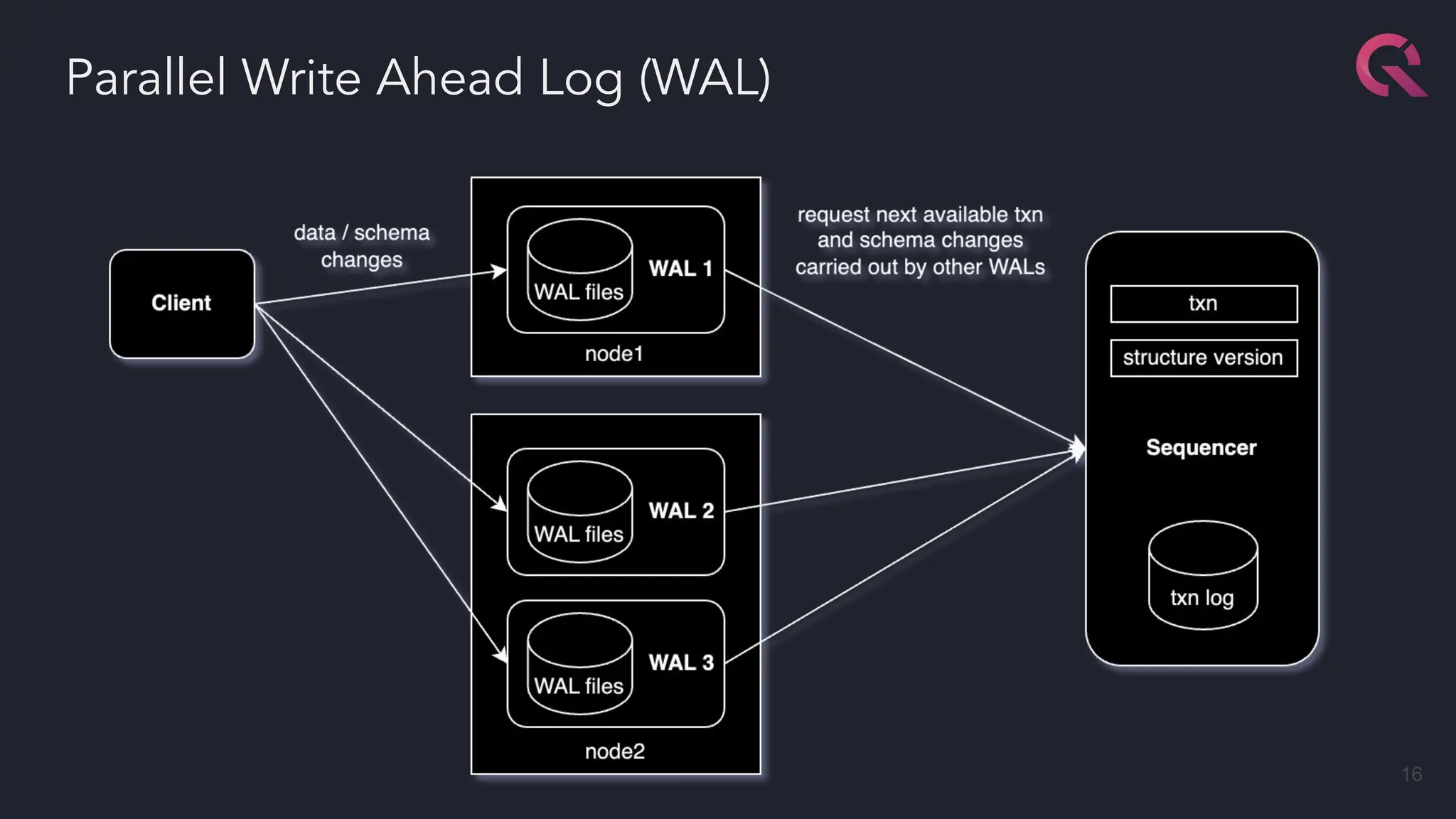
Parallel Write Ahead Log (WAL)
16
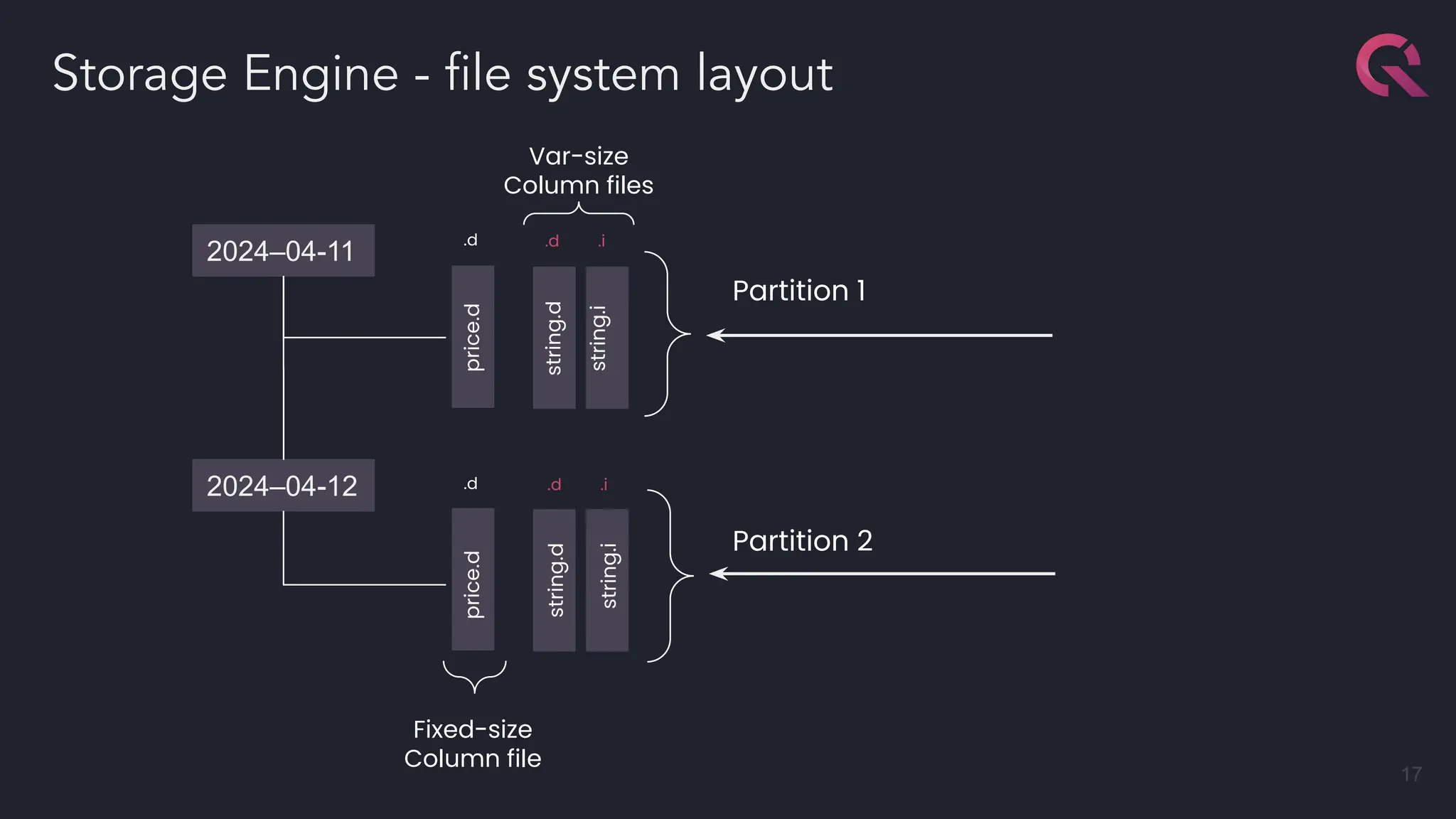
Storage Engine - file system layout
17
2024–04-11
2024–04-12
.d .d
.d
.i
.d .i
string.d
price.d
string.i
Partition 2
Partition 1
Fixed-size
Column file
Var-size
Column files
price.d
string.d
string.i
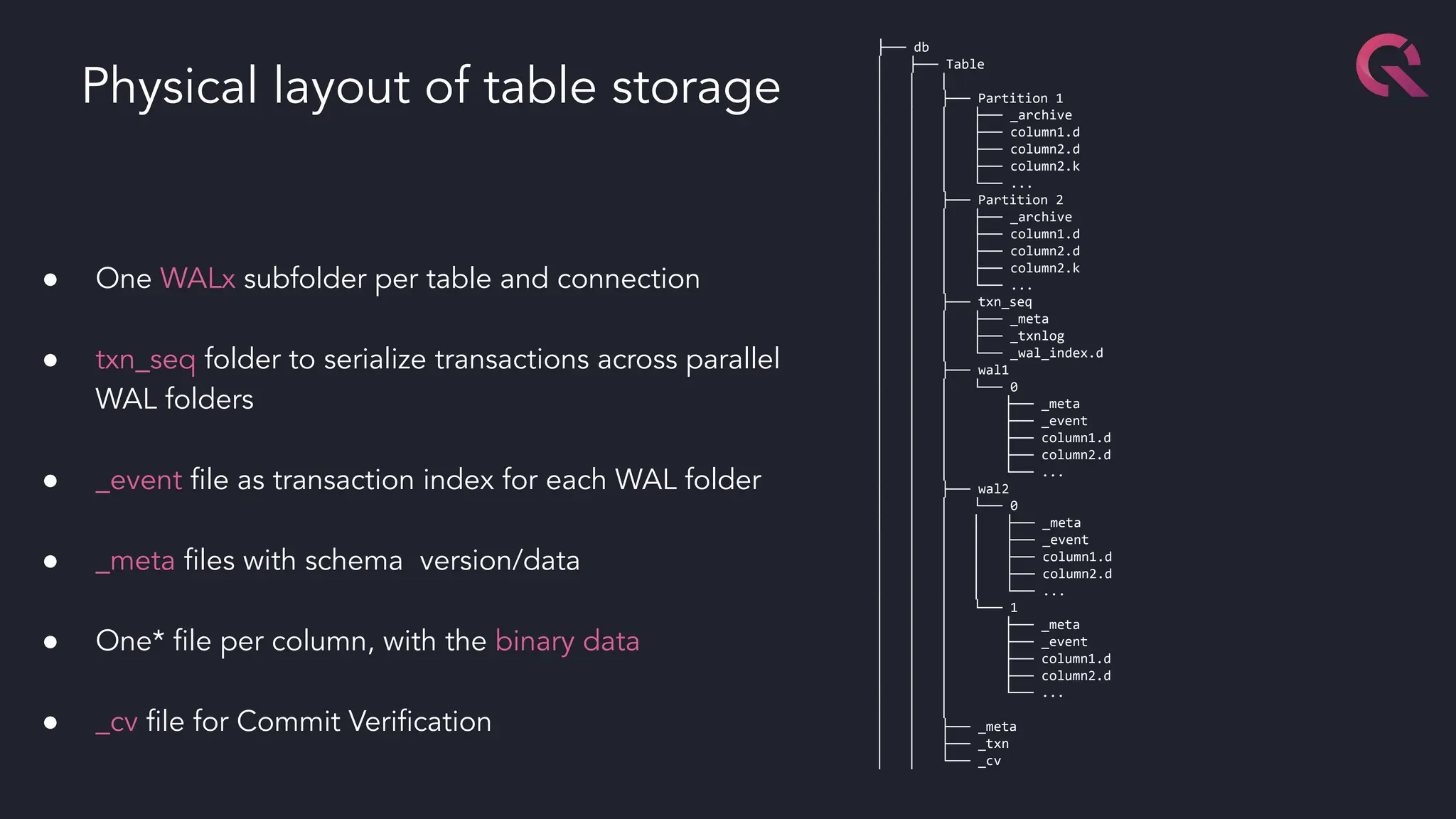
Physical layout of table storage
├── db
│ ├── Table
│ │ │
│ │ ├── Partition 1
│ │ │ ├── _archive
│ │ │ ├── column1.d
│ │ │ ├── column2.d
│ │ │ ├── column2.k
│ │ │ └── ...
│ │ ├── Partition 2
│ │ │ ├── _archive
│ │ │ ├── column1.d
│ │ │ ├── column2.d
│ │ │ ├── column2.k
│ │ │ └── ...
│ │ ├── txn_seq
│ │ │ ├── _meta
│ │ │ ├── _txnlog
│ │ │ └── _wal_index.d
│ │ ├── wal1
│ │ │ └── 0
│ │ │ ├── _meta
│ │ │ ├── _event
│ │ │ ├── column1.d
│ │ │ ├── column2.d
│ │ │ └── ...
│ │ ├── wal2
│ │ │ └── 0
│ │ │ │ ├── _meta
│ │ │ │ ├── _event
│ │ │ │ ├── column1.d
│ │ │ │ ├── column2.d
│ │ │ │ └── ...
│ │ │ └── 1
│ │ │ ├── _meta
│ │ │ ├── _event
│ │ │ ├── column1.d
│ │ │ ├── column2.d
│ │ │ └── ...
│ │ │
│ │ ├── _meta
│ │ ├── _txn
│ │ └── _cv
● One WALx subfolder per table and connection
● txn_seq folder to serialize transactions across parallel
WAL folders
● _event file as transaction index for each WAL folder
● _meta files with schema version/data
● One* file per column, with the binary data
● _cv file for Commit Verification
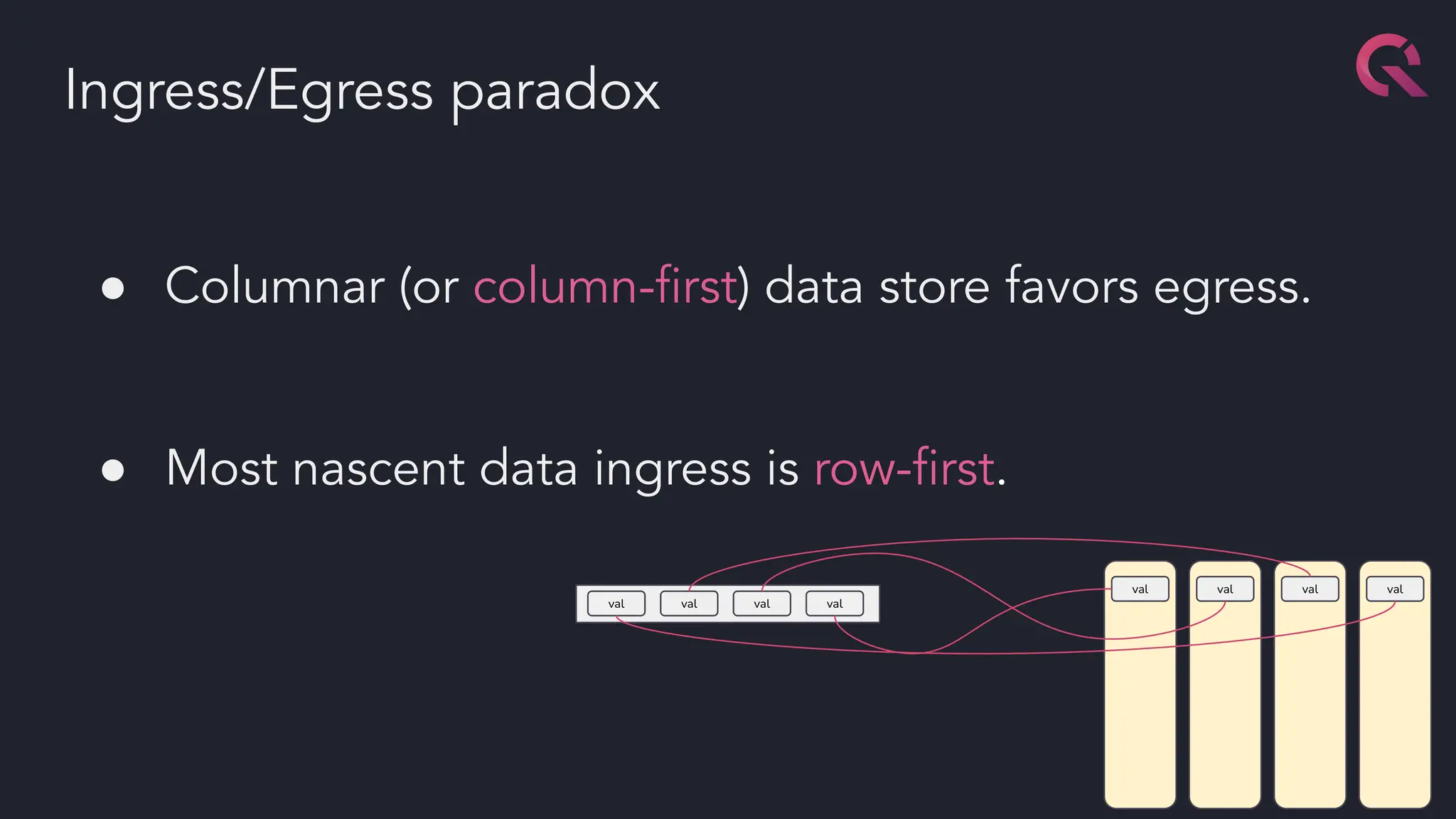
● Columnar (or column-first) data store favors egress.
● Most nascent data ingress is row-first.
Ingress/Egress paradox
val val val val
val val val val
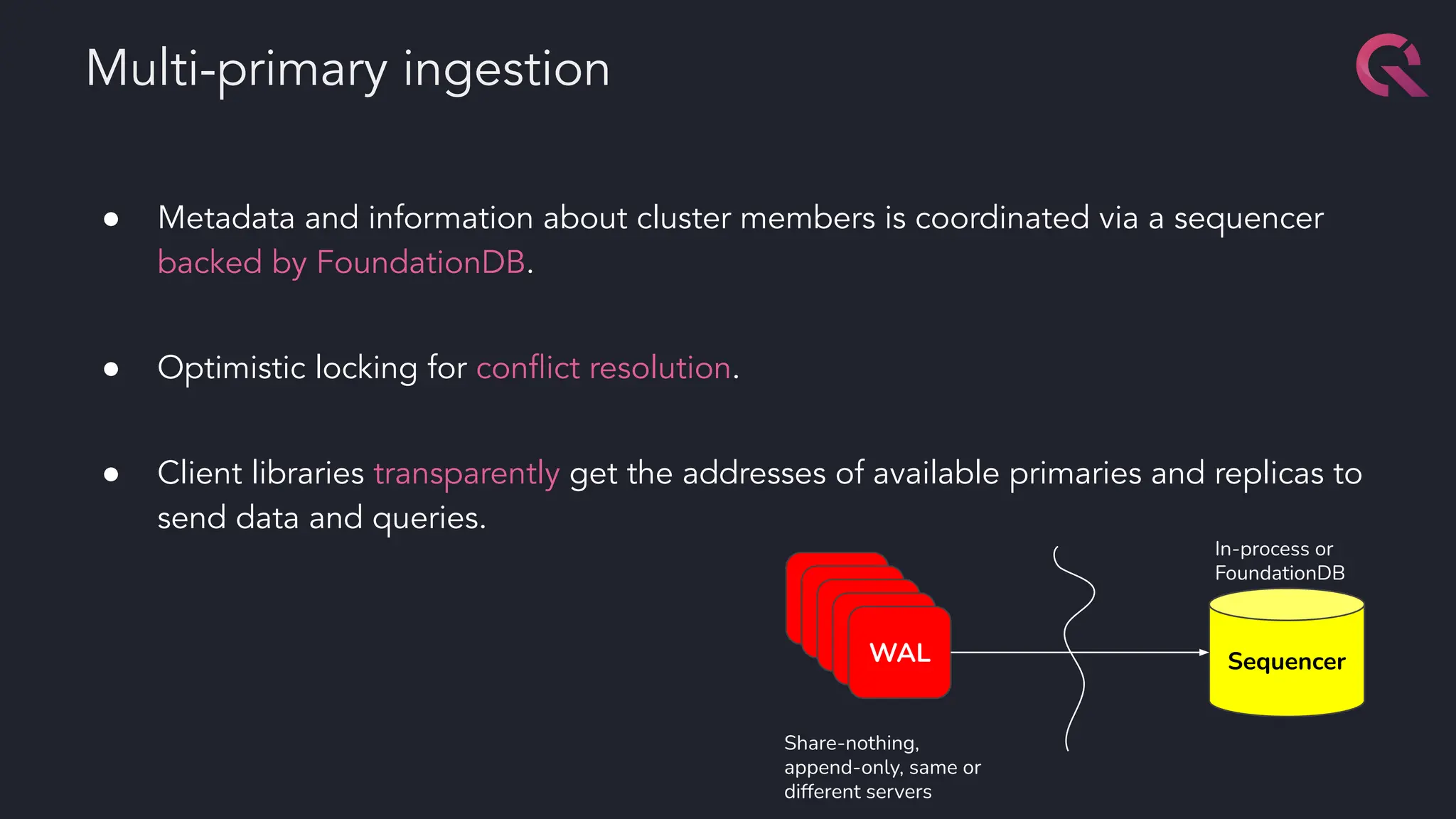
Multi-primary ingestion
● Metadata and information about cluster members is coordinated via a sequencer
backed by FoundationDB.
● Optimistic locking for conflict resolution.
● Client libraries transparently get the addresses of available primaries and replicas to
send data and queries.
WA
L
WA
L
WA
L
WA
L
WAL Sequencer
In-process or
FoundationDB
Share-nothing,
append-only, same or
different servers
Our ability to look at data and see
trends helps us to make better
predictions about what comes next.
— Tim Berners-Lee, Inventor of the World Wide
Web
● The hadoop ecosystem developed the Apache Hudi format,
Netflix developed Apache Iceberg, and Databricks developed
Delta Lake. The three of them are open formats and allow for
mutable data, transactions, schema evolution, and streaming.
● They are open, so multiple data engines and applications can
share the same datasets with no duplication.
New open file formats
● Dashboards and reports query over billions of records to produce a
result with just a few filtered/aggregated rows.
● Might want to use the whole unaggregated dataset directly, or most of
the dataset minus some outliers, or a subset of columns. On most
databases that means a slow export, and expensive data duplication.
● Might want to use an aggregated downsampled version of the dataset,
converting from multi billions of records to multi millions. Serializing and
deserializing is slow and resource consuming.
Data Science and ML
● Lakehouse Engine architecture offers the most flexibility, TSDBs generally
not there yet.
● TSDBs double-down on the ingress performance, OLAP are on the backfoot.
● OLAP double down on storage cost and analytical workloads (queries).
● OLAP query engines are sophisticated, TSDBs are on the back foot.
● TSDB engines are simpler to operate. OLAP is more complex and sometimes
cloud-only.
What the present looks like
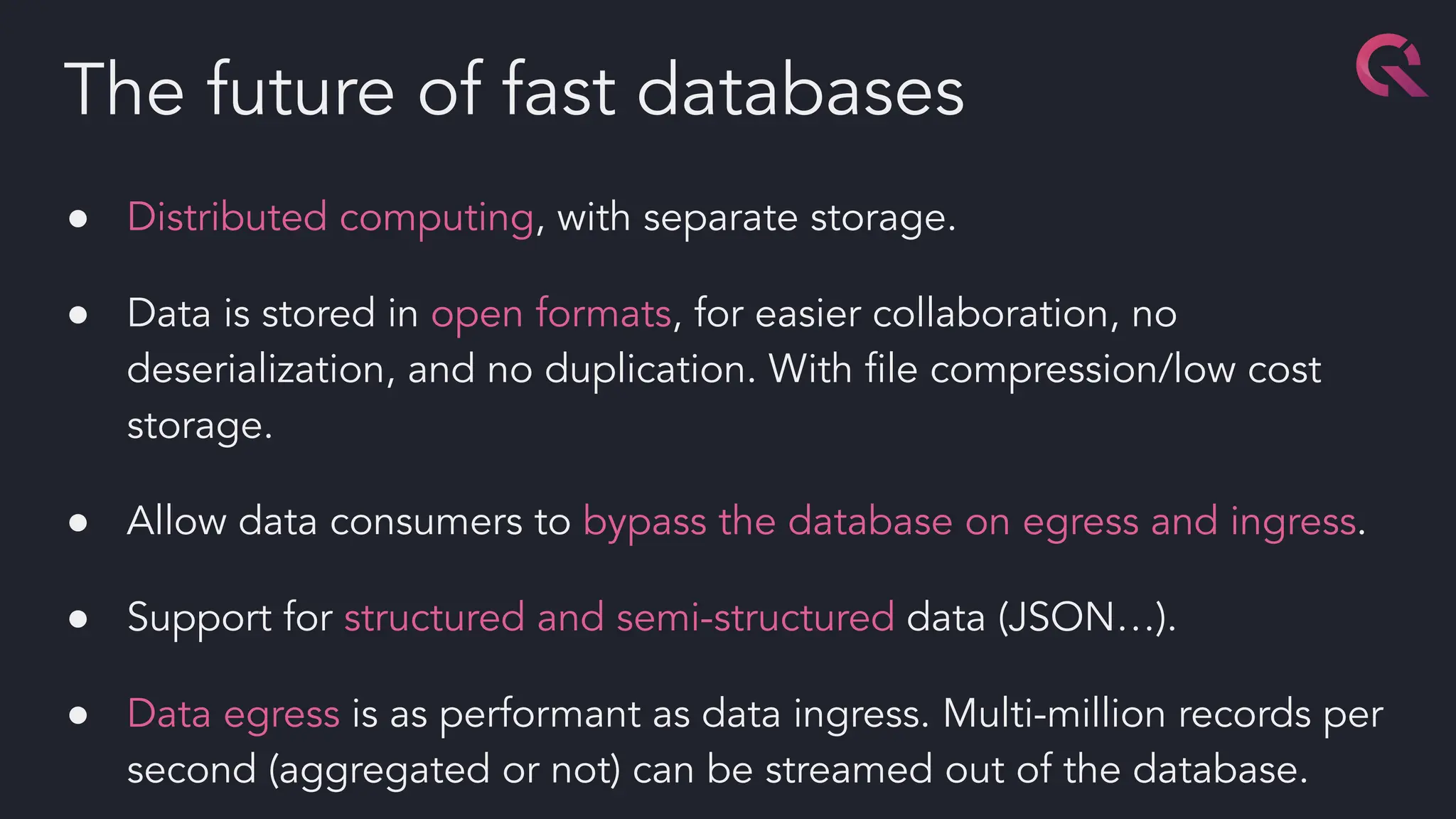
● Distributed computing, with separate storage.
● Data is stored in open formats, for easier collaboration, no
deserialization, and no duplication. With file compression/low cost
storage.
● Allow data consumers to bypass the database on egress and ingress.
● Support for structured and semi-structured data (JSON…).
● Data egress is as performant as data ingress. Multi-million records per
second (aggregated or not) can be streamed out of the database.
The future of fast databases
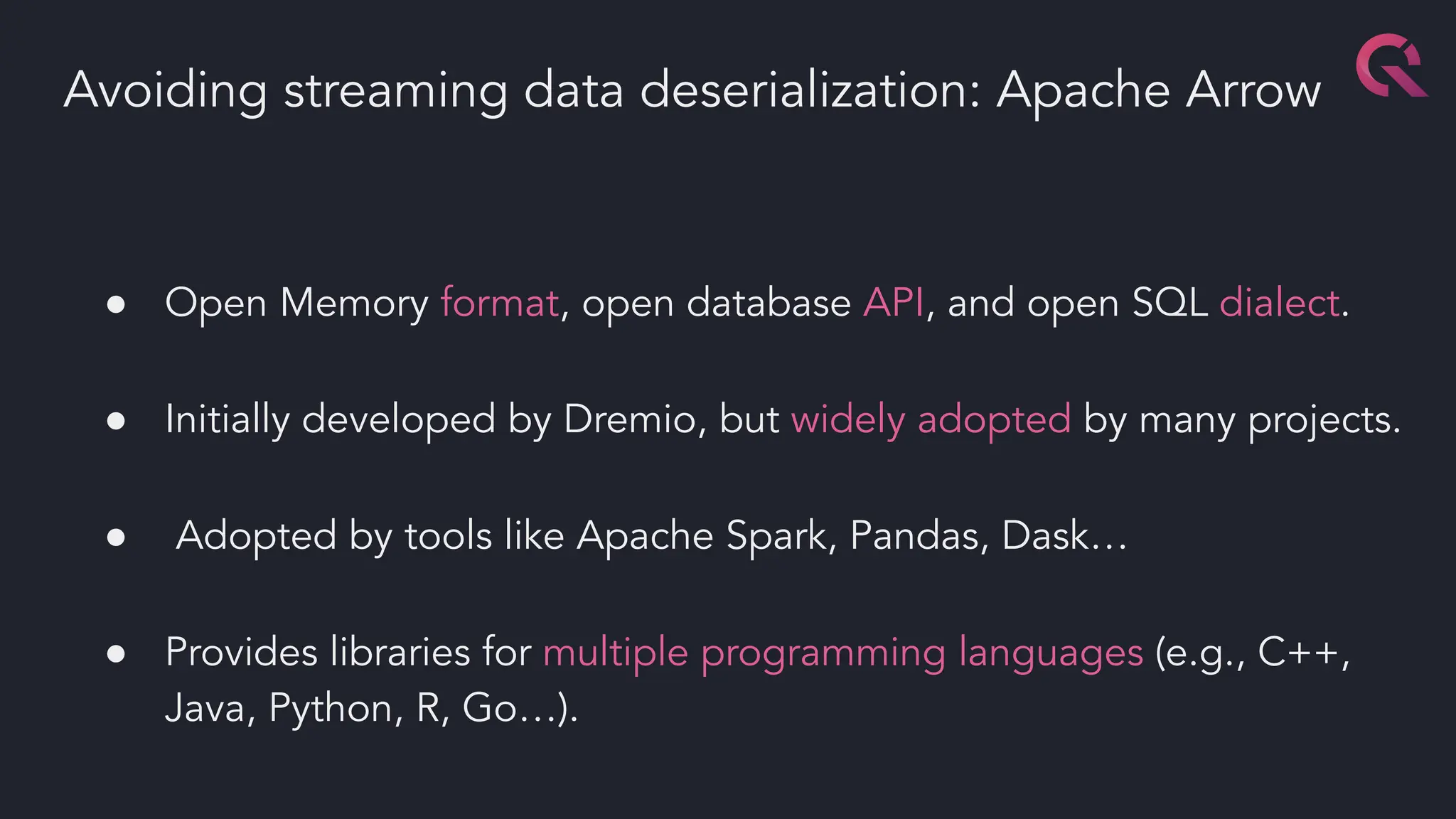
● Open Memory format, open database API, and open SQL dialect.
● Initially developed by Dremio, but widely adopted by many projects.
● Adopted by tools like Apache Spark, Pandas, Dask…
● Provides libraries for multiple programming languages (e.g., C++,
Java, Python, R, Go…).
Avoiding streaming data deserialization: Apache Arrow
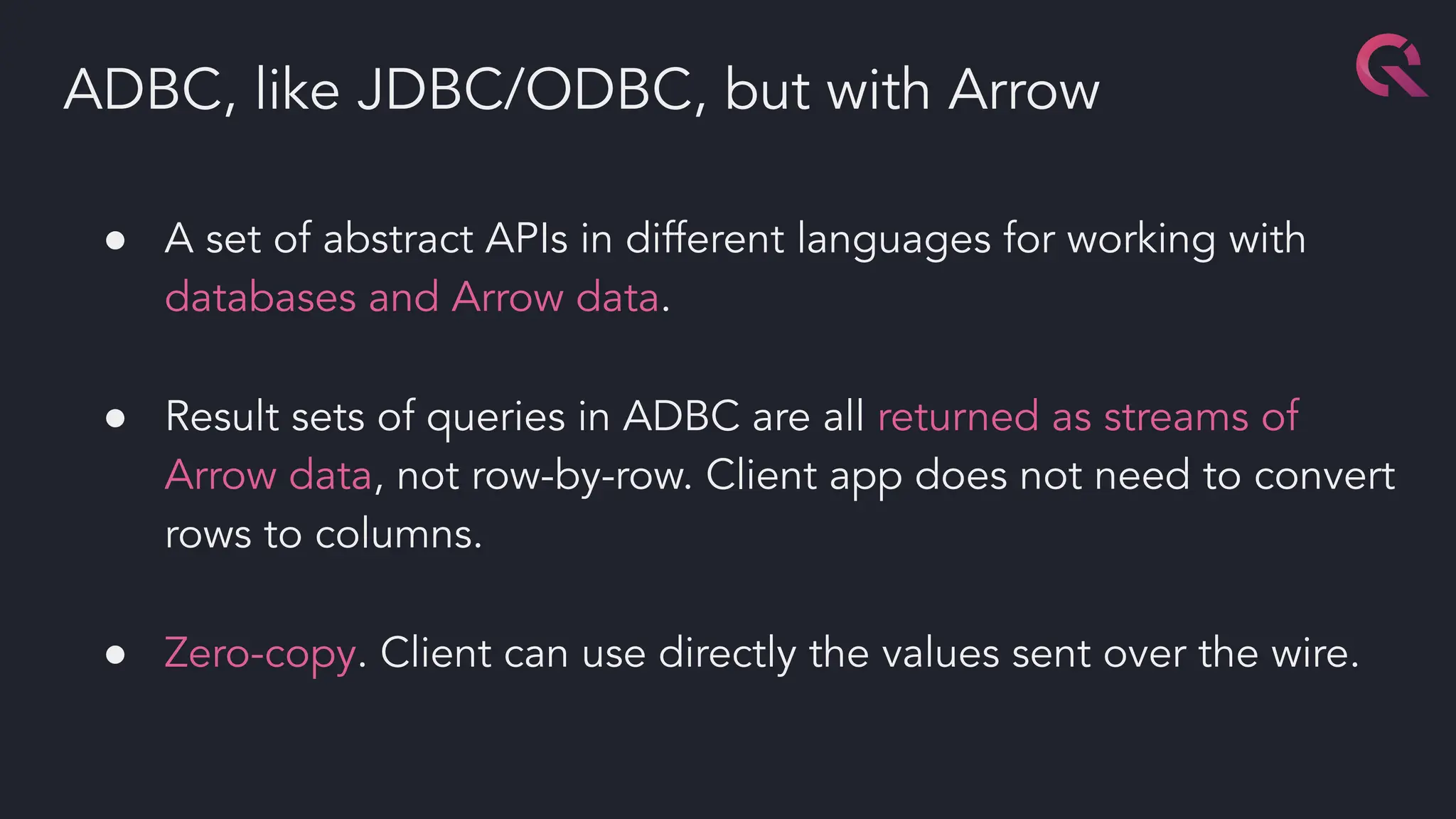
● A set of abstract APIs in different languages for working with
databases and Arrow data.
● Result sets of queries in ADBC are all returned as streams of
Arrow data, not row-by-row. Client app does not need to convert
rows to columns.
● Zero-copy. Client can use directly the values sent over the wire.
ADBC, like JDBC/ODBC, but with Arrow
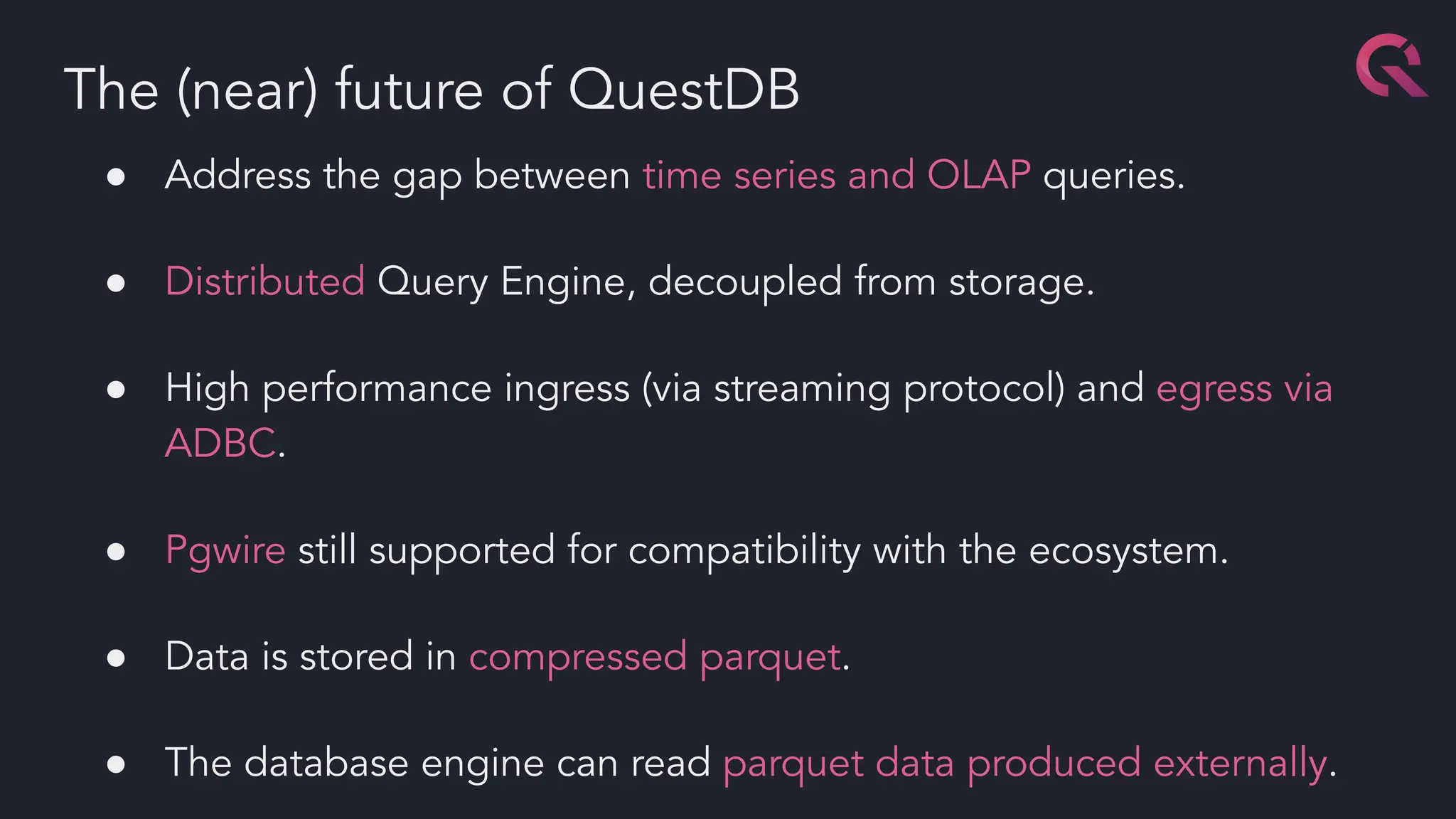
● Address the gap between time series and OLAP queries.
● Distributed Query Engine, decoupled from storage.
● High performance ingress (via streaming protocol) and egress via
ADBC.
● Pgwire still supported for compatibility with the ecosystem.
● Data is stored in compressed parquet.
● The database engine can read parquet data produced externally.
The (near) future of QuestDB
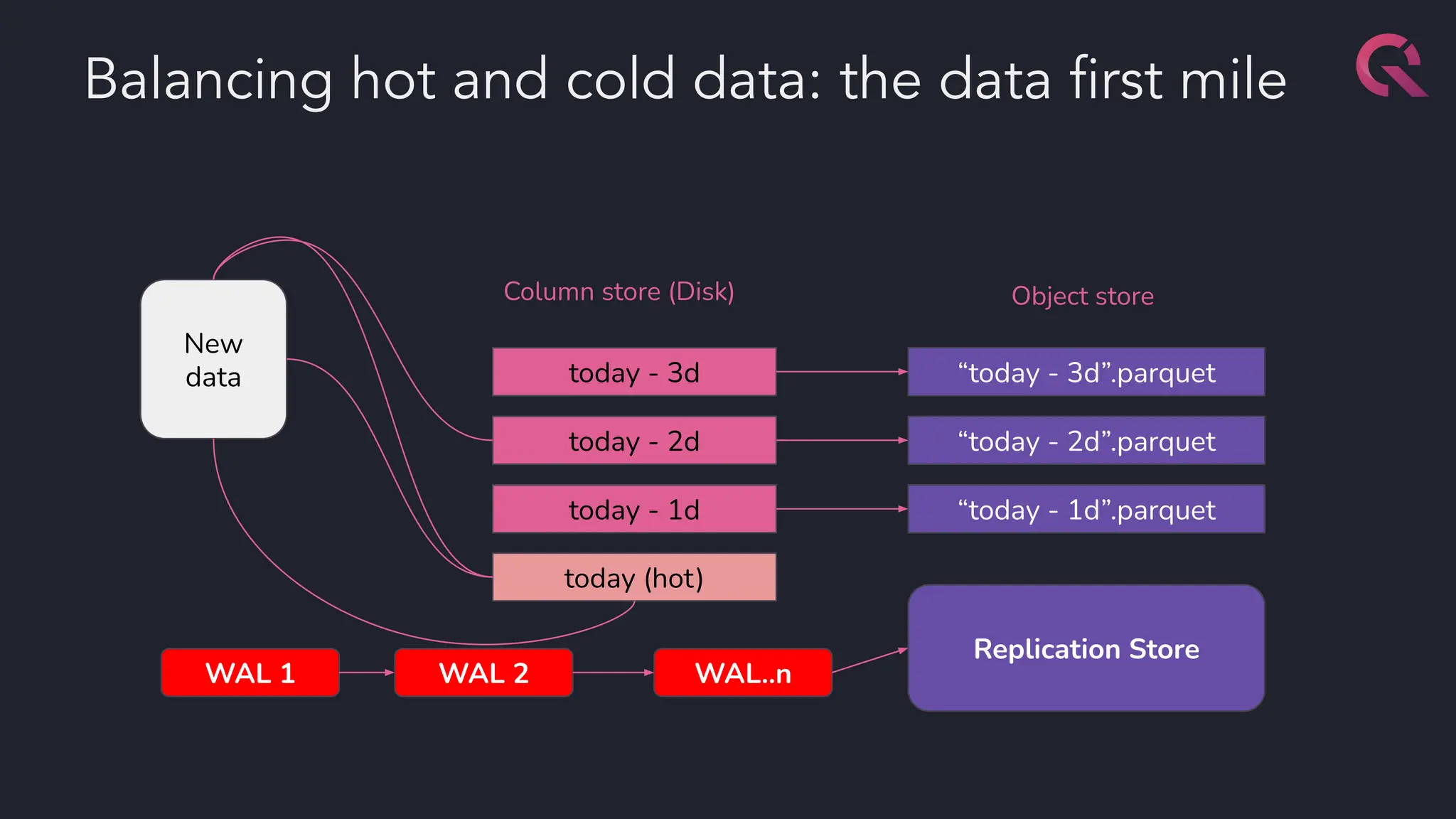
Balancing hot and cold data: the data first mile
today - 3d
today - 2d
today - 1d
today (hot)
New
data
Column store (Disk)
“today - 3d”.parquet
“today - 2d”.parquet
“today - 1d”.parquet
Object store
Replication Store
WAL..n
WAL 2
WAL 1
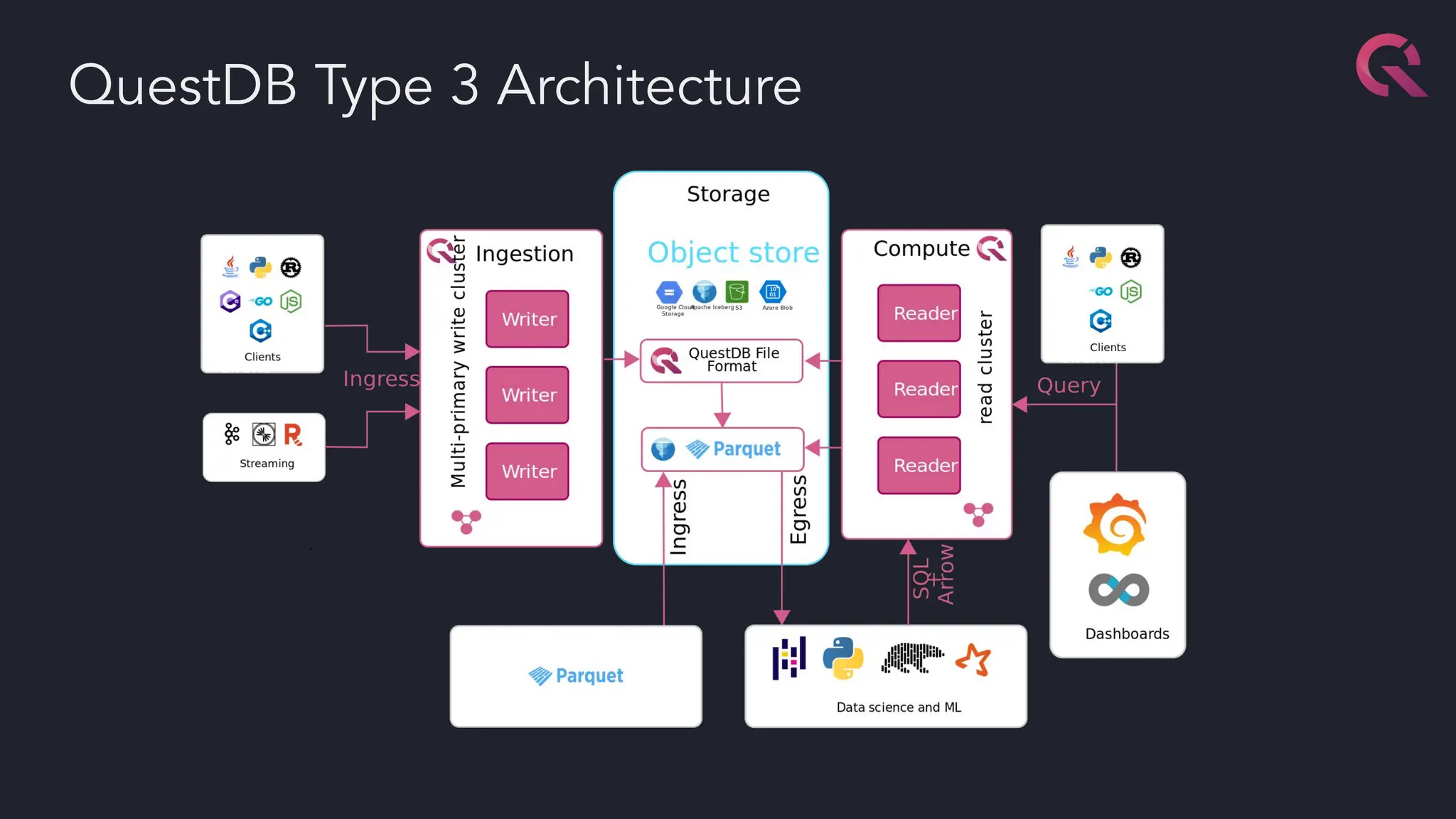
QuestDB Type 3 Architecture
QuestDB and Parquet Quick Demo
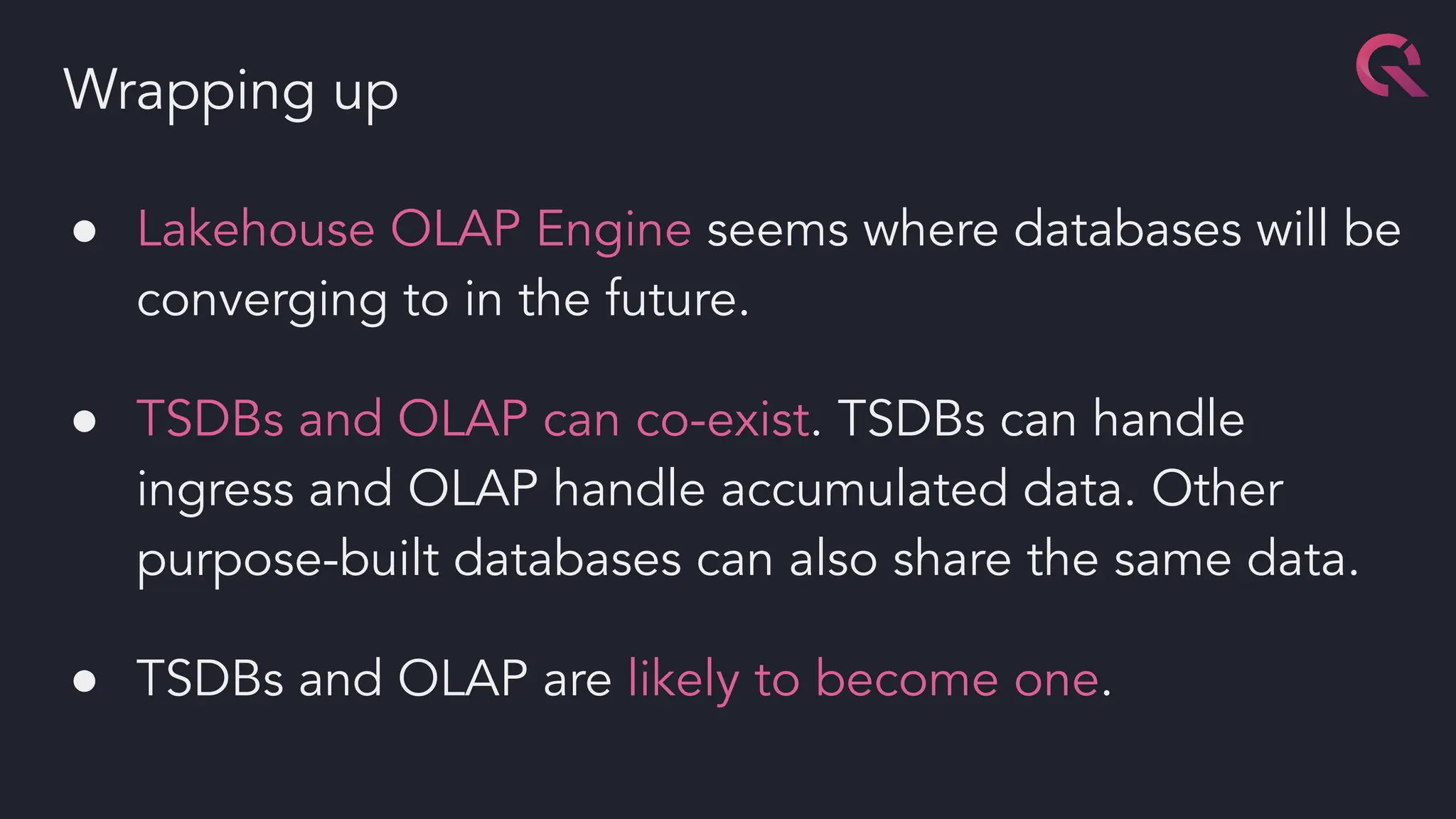
● Lakehouse OLAP Engine seems where databases will be
converging to in the future.
● TSDBs and OLAP can co-exist. TSDBs can handle
ingress and OLAP handle accumulated data. Other
purpose-built databases can also share the same data.
● TSDBs and OLAP are likely to become one.
Wrapping up
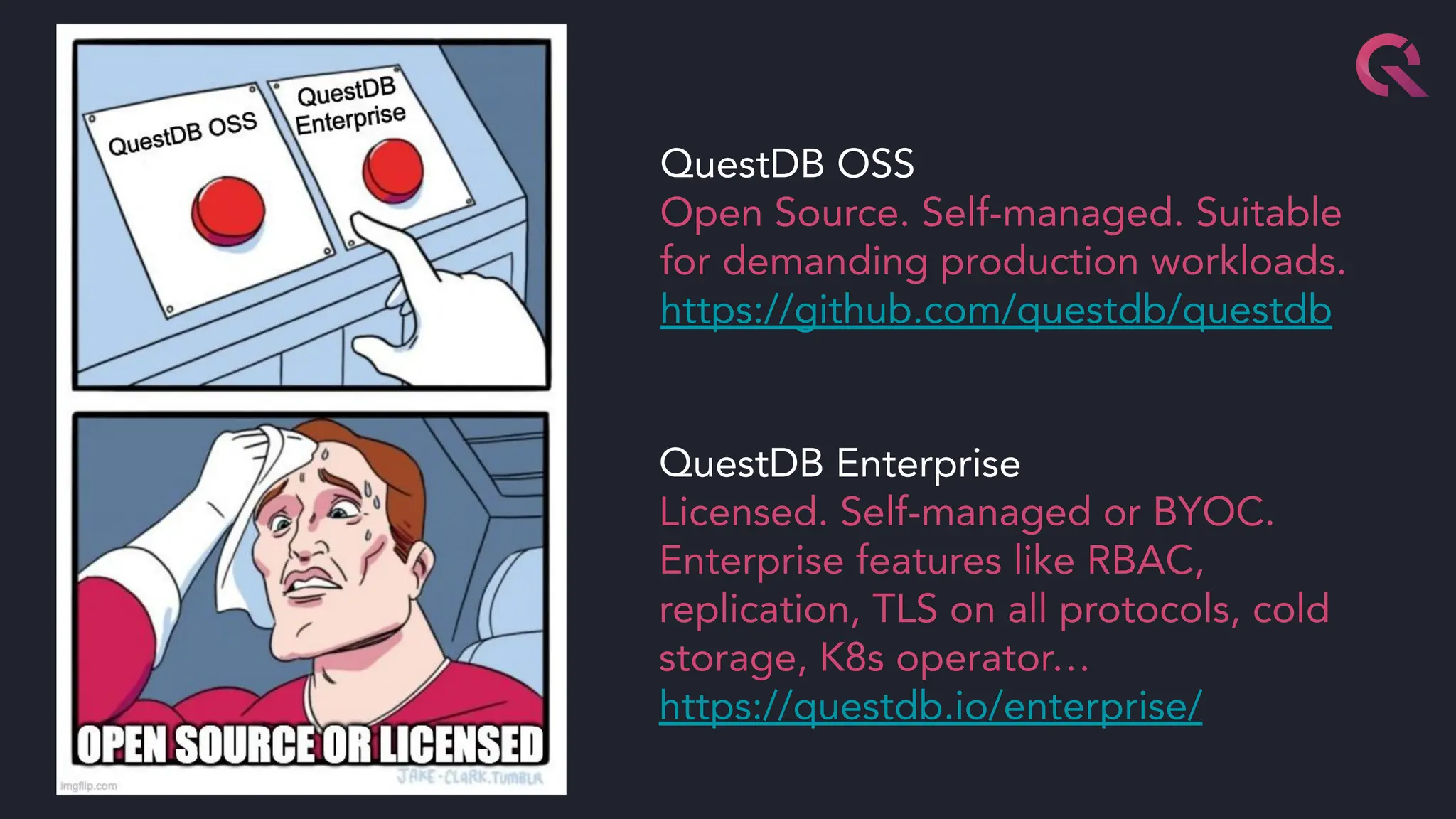
QuestDB OSS
Open Source. Self-managed. Suitable
for demanding production workloads.
https://github.com/questdb/questdb
QuestDB Enterprise
Licensed. Self-managed or BYOC.
Enterprise features like RBAC,
replication, TLS on all protocols, cold
storage, K8s operator…
https://questdb.io/enterprise/
34
● https://github.com/questdb/questdb
● https://questdb.io
● https://demo.questdb.io
● https://slack.questdb.io/
● https://github.com/questdb/time-series-streaming-analytics-template
We 💕 contributions
and GitHub ⭐ stars
Javier Ramírez
@supercoco9
Fast Data Advocate
THANK YOU!

The Future of Fast Databases: Lessons from a Decade of QuestDB

  • 1.
    The Future ofFast Databases: Lessons from a Decade of QuestDB Javier Ramírez @supercoco9 Fast Data Advocate
  • 2.
    When was thelast time you wished your database was slower to ingest and query data?
  • 3.
    How excited wouldyou get about a new database with non-standard data storage, so you need to write some ETL if you want to join it with the rest of your existing data?
  • 4.
    My fast databasedefinition*: Designed for performant frequent multi million record ingestion and performant frequent queries over multi billion record datasets. * My own biased definition. But this is my talk, so just setting the context
  • 5.
    The farther backwardyou can look, the farther forward you can see. — Winston Churchill
  • 6.
    The database isthe bottleneck - Every developer in the 90s
  • 7.
    ● Databases followedthe OLTP pattern. ● Heavily biased for reads, not writes ● Designed for a few millions of rows (best case) ● Speed up queries using indexes 20 years ago there were no fast databases
  • 8.
    ● NoSQL optimizedfor fast inserts and fast non-analytical queries. ● OLAP optimized for large batch inserts and fast analytical queries via complex indexes and materialization/ denormalization/ duplication. Then there was OLAP and NoSQL
  • 9.
    ● Following successof Map/Reduce and HDFS for data processing, many OLAP databases separated storage from computation, allowing for distributed queries. ● The data lake concept was created. ● Writes were still mostly batched. Then there was OLAP separation of storage
  • 10.
    ● File formatstypically used in OLAP made it very costly to update individual records. ● Cloud-based object stores typically work with immutable files with no random-access updates. OLAP = Immutable* * Until recently
  • 11.
    ● It canget very big. It never stops. Always incomplete. ● It will burst, lag, and arrive out of order. It will get updated after you’ve already emitted results. ● Individual data points lose value over time, but long-term aggregations are priceless. ● Analysts prefer low latency and data freshness. Some ugly truths about streaming data
  • 12.
    ● Time SeriesDatabases specialise in very fast ingestion, very fast queries over nascent data, and powerful time-based analytical queries. ● They focus on nascent data, deleting, downsampling, or slowing-down older data. Time Series Databases Enter the Scene
  • 13.
  • 14.
    QuestDB ● Column-first parallelSQL engine with JIT compiler ● Column-first, partitioned data store, sorted by timestamp. ● No indexes needed*. Data immediately available after write. ● Predictable ingestion rate, even under demanding workloads. ● Built-in event deduplication. Row updates and upserts.
  • 15.
    QuestDB in action:quick showcase https://dashboard.demo.questdb.io/d/fb13b4ab-b1c9-4a54-a920-b60c5fb036 3f/public-dashboard-questdb-io-use-cases-crypto?orgId=1&refresh=750ms https://demo.questdb.io https://github.com/questdb/time-series-streaming-analytics-template
  • 16.
  • 17.
    Storage Engine -file system layout 17 2024–04-11 2024–04-12 .d .d .d .i .d .i string.d price.d string.i Partition 2 Partition 1 Fixed-size Column file Var-size Column files price.d string.d string.i
  • 18.
    Physical layout oftable storage ├── db │ ├── Table │ │ │ │ │ ├── Partition 1 │ │ │ ├── _archive │ │ │ ├── column1.d │ │ │ ├── column2.d │ │ │ ├── column2.k │ │ │ └── ... │ │ ├── Partition 2 │ │ │ ├── _archive │ │ │ ├── column1.d │ │ │ ├── column2.d │ │ │ ├── column2.k │ │ │ └── ... │ │ ├── txn_seq │ │ │ ├── _meta │ │ │ ├── _txnlog │ │ │ └── _wal_index.d │ │ ├── wal1 │ │ │ └── 0 │ │ │ ├── _meta │ │ │ ├── _event │ │ │ ├── column1.d │ │ │ ├── column2.d │ │ │ └── ... │ │ ├── wal2 │ │ │ └── 0 │ │ │ │ ├── _meta │ │ │ │ ├── _event │ │ │ │ ├── column1.d │ │ │ │ ├── column2.d │ │ │ │ └── ... │ │ │ └── 1 │ │ │ ├── _meta │ │ │ ├── _event │ │ │ ├── column1.d │ │ │ ├── column2.d │ │ │ └── ... │ │ │ │ │ ├── _meta │ │ ├── _txn │ │ └── _cv ● One WALx subfolder per table and connection ● txn_seq folder to serialize transactions across parallel WAL folders ● _event file as transaction index for each WAL folder ● _meta files with schema version/data ● One* file per column, with the binary data ● _cv file for Commit Verification
  • 19.
    ● Columnar (orcolumn-first) data store favors egress. ● Most nascent data ingress is row-first. Ingress/Egress paradox val val val val val val val val
  • 20.
    Multi-primary ingestion ● Metadataand information about cluster members is coordinated via a sequencer backed by FoundationDB. ● Optimistic locking for conflict resolution. ● Client libraries transparently get the addresses of available primaries and replicas to send data and queries. WA L WA L WA L WA L WAL Sequencer In-process or FoundationDB Share-nothing, append-only, same or different servers
  • 21.
    Our ability tolook at data and see trends helps us to make better predictions about what comes next. — Tim Berners-Lee, Inventor of the World Wide Web
  • 22.
    ● The hadoopecosystem developed the Apache Hudi format, Netflix developed Apache Iceberg, and Databricks developed Delta Lake. The three of them are open formats and allow for mutable data, transactions, schema evolution, and streaming. ● They are open, so multiple data engines and applications can share the same datasets with no duplication. New open file formats
  • 23.
    ● Dashboards andreports query over billions of records to produce a result with just a few filtered/aggregated rows. ● Might want to use the whole unaggregated dataset directly, or most of the dataset minus some outliers, or a subset of columns. On most databases that means a slow export, and expensive data duplication. ● Might want to use an aggregated downsampled version of the dataset, converting from multi billions of records to multi millions. Serializing and deserializing is slow and resource consuming. Data Science and ML
  • 24.
    ● Lakehouse Enginearchitecture offers the most flexibility, TSDBs generally not there yet. ● TSDBs double-down on the ingress performance, OLAP are on the backfoot. ● OLAP double down on storage cost and analytical workloads (queries). ● OLAP query engines are sophisticated, TSDBs are on the back foot. ● TSDB engines are simpler to operate. OLAP is more complex and sometimes cloud-only. What the present looks like
  • 25.
    ● Distributed computing,with separate storage. ● Data is stored in open formats, for easier collaboration, no deserialization, and no duplication. With file compression/low cost storage. ● Allow data consumers to bypass the database on egress and ingress. ● Support for structured and semi-structured data (JSON…). ● Data egress is as performant as data ingress. Multi-million records per second (aggregated or not) can be streamed out of the database. The future of fast databases
  • 26.
    ● Open Memoryformat, open database API, and open SQL dialect. ● Initially developed by Dremio, but widely adopted by many projects. ● Adopted by tools like Apache Spark, Pandas, Dask… ● Provides libraries for multiple programming languages (e.g., C++, Java, Python, R, Go…). Avoiding streaming data deserialization: Apache Arrow
  • 27.
    ● A setof abstract APIs in different languages for working with databases and Arrow data. ● Result sets of queries in ADBC are all returned as streams of Arrow data, not row-by-row. Client app does not need to convert rows to columns. ● Zero-copy. Client can use directly the values sent over the wire. ADBC, like JDBC/ODBC, but with Arrow
  • 28.
    ● Address thegap between time series and OLAP queries. ● Distributed Query Engine, decoupled from storage. ● High performance ingress (via streaming protocol) and egress via ADBC. ● Pgwire still supported for compatibility with the ecosystem. ● Data is stored in compressed parquet. ● The database engine can read parquet data produced externally. The (near) future of QuestDB
  • 29.
    Balancing hot andcold data: the data first mile today - 3d today - 2d today - 1d today (hot) New data Column store (Disk) “today - 3d”.parquet “today - 2d”.parquet “today - 1d”.parquet Object store Replication Store WAL..n WAL 2 WAL 1
  • 30.
    QuestDB Type 3Architecture
  • 31.
  • 32.
    ● Lakehouse OLAPEngine seems where databases will be converging to in the future. ● TSDBs and OLAP can co-exist. TSDBs can handle ingress and OLAP handle accumulated data. Other purpose-built databases can also share the same data. ● TSDBs and OLAP are likely to become one. Wrapping up
  • 33.
    QuestDB OSS Open Source.Self-managed. Suitable for demanding production workloads. https://github.com/questdb/questdb QuestDB Enterprise Licensed. Self-managed or BYOC. Enterprise features like RBAC, replication, TLS on all protocols, cold storage, K8s operator… https://questdb.io/enterprise/
  • 34.
    34 ● https://github.com/questdb/questdb ● https://questdb.io ●https://demo.questdb.io ● https://slack.questdb.io/ ● https://github.com/questdb/time-series-streaming-analytics-template We 💕 contributions and GitHub ⭐ stars Javier Ramírez @supercoco9 Fast Data Advocate THANK YOU!