CONFIDENTIAL AND PROPRIETARY
Any use of this material without specific permission of McKinsey & Company
is strictly prohibited
Your Name: __________________________
My Learning Workbook
Take a Step.
Forward.
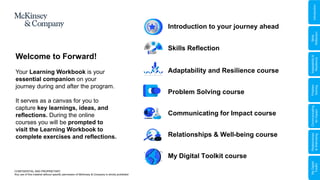
Welcome to Forward!
Your Learning Workbook is your
essential companion on your
journey during and after the program.
It serves as a canvas for you to
capture key learnings, ideas, and
reflections. During the online
courses you will be prompted to
visit the Learning Workbook to
complete exercises and reflections.
CONFIDENTIAL AND PROPRIETARY
Any use of this material without specific permission of McKinsey & Company is strictly prohibited
Adaptability and Resilience course
Problem Solving course
Communicating for Impact course
Relationships & Well-being course
Introduction to your journey ahead
My Digital Toolkit course
Skills Reflection
Introduction
Solving
&
Well-being
My
Digital
Toolkit
Skills
Reflection
Problem
Relationships
Communicating
for
Impact
Adaptability
&
Resilience
CONFIDENTIAL AND PROPRIETARY
Any use of this material without specific permission of McKinsey & Company is strictly prohibited
Introduction to your
journey ahead
Problem
Solving
Relationships
&
Well-being
My
Digital
Toolkit
Communicating
for
Impact
Adaptability
&
Resilience
Introduction
Skills
Reflection
4
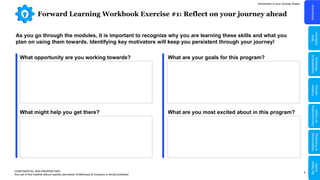
Forward Learning Workbook Exercise #1: Reflect on your journey ahead
Introduction to your Journey Ahead
CONFIDENTIAL AND PROPRIETARY
Any use of this material without specific permission of McKinsey & Company is strictly prohibited
As you go through the modules, it is important to recognize why you are learning these skills and what you
plan on using them towards. Identifying key motivators will keep you persistent through your journey!
What opportunity are you working towards?
What might help you get there?
What are your goals for this program?
What are you most excited about in this program?
Problem
Solving
Relationships
&
Well-being
My
Digital
Toolkit
Communicating
for
Impact
Adaptability
&
Resilience
Introduction
Skills
Reflection
5
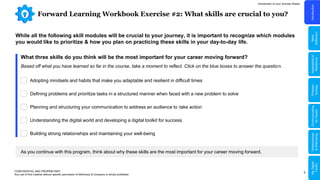
Forward Learning Workbook Exercise #2: What skills are crucial to you?
Introduction to your Journey Ahead
While all the following skill modules will be crucial to your journey, it is important to recognize which modules
you would like to prioritize & how you plan on practicing these skills in your day-to-day life.
CONFIDENTIAL AND PROPRIETARY
Any use of this material without specific permission of McKinsey & Company is strictly prohibited
What three skills do you think will be the most important for your career moving forward?
Adopting mindsets and habits that make you adaptable and resilient in difficult times
Defining problems and prioritize tasks in a structured manner when faced with a new problem to solve
Planning and structuring your communication to address an audience to take action
Understanding the digital world and developing a digital toolkit for success
Building strong relationships and maintaining your well-being
Based off what you have learned so far in the course, take a moment to reflect. Click on the blue boxes to answer the question.
As you continue with this program, think about why these skills are the most important for your career moving forward.
Problem
Solving
Relationships
&
Well-being
My
Digital
Toolkit
Communicating
for
Impact
Adaptability
&
Resilience
Introduction
Skills
Reflection
CONFIDENTIAL AND PROPRIETARY
Any use of this material without specific permission of McKinsey & Company is strictly prohibited
Skills Reflection
Skills
Reflection
Problem
Solving
Relationships
&
Well-being
My
Digital
Toolkit
Communicating
for
Impact
Adaptability
&
Resilience
Introduction
7
CONFIDENTIAL AND PROPRIETARY
Any use of this material without specific permission of McKinsey & Company is strictly prohibited
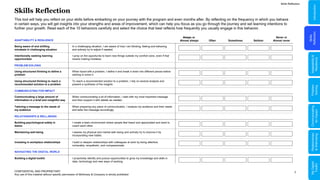
Skills Reflection
​This tool will help you reflect on your skills before embarking on your journey with the program and even months after. By reflecting on the frequency in which you behave
in certain ways, you will get insights into your strengths and areas of improvement, which can help you focus as you go through the journey and set learning intentions to
further your growth. Read each of the 10 behaviors carefully and select the choice that best reflects how frequently you usually engage in this behavior.
ADAPTABILITY & RESILIENCE
Being aware of and shifting
mindsets in challenging situation
Skills Reflection
Intentionally seeking learning
opportunities
PROBLEM SOLVING
Using structured thinking to define a
problem
Using structured thinking to reach a
recommended solution to a problem
COMMUNICATING FOR IMPACT
Communicating a large amount of
information in a brief and insightful way
Tailoring a message to the needs of
my audience
Never or
Almost never
Seldom
Sometimes
Often
Always or
Almost always
NAVIGATING THE DIGITAL WORLD
Building a digital toolkit
RELATIONSHIPS & WELL-BEING
Building psychological safety in
teams
Maintaining well-being
Investing in workplace relationships
In a challenging situation, I am aware of how I am thinking, feeling and behaving
and actively try to adjust if needed.
I jump on the opportunity to learn new things outside my comfort zone, even if that
means making mistakes.
When faced with a problem, I define it and break it down into different pieces before
starting to solve it.
To reach a recommended solution to a problem, I rely on several analysis and
present a synthesis of the insights.
When communicating a lot of information, I start with my most important message
and then support it with details as needed.
When preparing any piece of communication, I analyze my audience and their needs
and tailor the message accordingly.
I proactively identify and pursue opportunities to grow my knowledge and skills in
data, technology and new ways of working.
I create a team environment where people feel heard and appreciated and want to
coach each other.
I assess my physical and mental well-being and actively try to improve it by
incorporating new habits.
I build or deepen relationships with colleagues at work by being attentive,
vulnerable, empathetic, and compassionate.
Problem
Solving
Relationships
&
Well-being
My
Digital
Toolkit
Communicating
for
Impact
Adaptability
&
Resilience
Introduction
Skills
Reflection
CONFIDENTIAL AND PROPRIETARY
Any use of this material without specific permission of McKinsey & Company is strictly prohibited
Adaptability and
Resilience Course
Adaptability
&
Resilience
Problem
Solving
Relationships
&
Well-being
My
Digital
Toolkit
Communicating
for
Impact
Skills
Reflection
Introduction
9
Setting meaningful learning intentions
Adaptability & Resilience
CONFIDENTIAL AND PROPRIETARY
Any use of this material without specific permission of McKinsey & Company is strictly prohibited
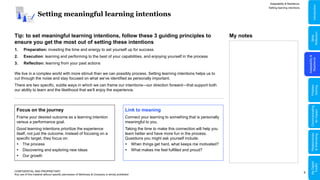
Setting learning intentions
Tip: to set meaningful learning intentions, follow these 3 guiding principles to
ensure you get the most out of setting these intentions
1. Preparation: investing the time and energy to set yourself up for success
2. Execution: learning and performing to the best of your capabilities, and enjoying yourself in the process
3. Reflection: learning from your past actions
We live in a complex world with more stimuli than we can possibly process. Setting learning intentions helps us to
cut through the noise and stay focused on what we’ve identified as personally important.
There are two specific, subtle ways in which we can frame our intentions—our direction forward—that support both
our ability to learn and the likelihood that we’ll enjoy the experience.
Focus on the journey
Frame your desired outcome as a learning intention
versus a performance goal.
Good learning intentions prioritize the experience
itself, not just the outcome. Instead of focusing on a
specific target, they focus on:
 The process
 Discovering and exploring new ideas
 Our growth
Link to meaning
Connect your learning to something that is personally
meaningful to you.
Taking the time to make this connection will help you
learn better and have more fun in the process.
Questions you might ask yourself include:
 When things get hard, what keeps me motivated?
 What makes me feel fulfilled and proud?
My notes
Adaptability
&
Resilience
Problem
Solving
Relationships
&
Well-being
Communicating
for
Impact
Skills
Reflection
Introduction
My
Digital
Toolkit
10
Forward Learning Workbook Exercise #1: What's your learning
intention for this program?
Adaptability & Resilience
CONFIDENTIAL AND PROPRIETARY
Any use of this material without specific permission of McKinsey & Company is strictly prohibited
Take a moment to reflect here. Build your learning intention for this program and reference the suggested
structure in the module to guide your thinking.
Setting learning intentions
Adaptability
&
Resilience
Problem
Solving
Relationships
&
Well-being
Communicating
for
Impact
Skills
Reflection
Introduction
My
Digital
Toolkit
11
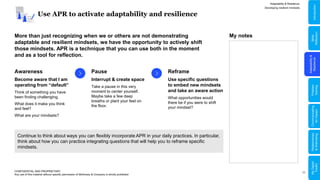
Use APR to activate adaptability and resilience
Adaptability & Resilience
CONFIDENTIAL AND PROPRIETARY
Any use of this material without specific permission of McKinsey & Company is strictly prohibited
Developing resilient mindsets
More than just recognizing when we or others are not demonstrating
adaptable and resilient mindsets, we have the opportunity to actively shift
those mindsets. APR is a technique that you can use both in the moment
and as a tool for reflection.
Pause
Interrupt & create space
Take a pause in this very
moment to center yourself.
Maybe take a few deep
breaths or plant your feet on
the floor.
Awareness
Become aware that I am
operating from “default”
Think of something you have
been finding challenging.
What does it make you think
and feel?
What are your mindsets?
Reframe
Use specific questions
to embed new mindsets
and take an aware action
What opportunities would
there be if you were to shift
your mindset?
Continue to think about ways you can flexibly incorporate APR in your daily practices. In particular,
think about how you can practice integrating questions that will help you to reframe specific
mindsets.
My notes
Adaptability
&
Resilience
Problem
Solving
Relationships
&
Well-being
Communicating
for
Impact
Skills
Reflection
Introduction
My
Digital
Toolkit
12
Forward Learning Workbook Exercise #2: Holding adaptable and resilient
mindsets
Adaptability & Resilience
CONFIDENTIAL AND PROPRIETARY
Any use of this material without specific permission of McKinsey & Company is strictly prohibited
Developing resilient mindsets
Take a moment to think and reflect here. Within the past week, how frequently have you held an adaptable
and resilient mindset? For times when you didn't hold these mindsets, what could you do differently to shift
your mindset?
Adaptability
&
Resilience
Problem
Solving
Relationships
&
Well-being
Communicating
for
Impact
Skills
Reflection
Introduction
My
Digital
Toolkit
13
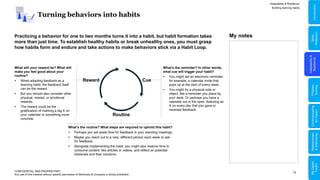
Turning behaviors into habits
Adaptability & Resilience
CONFIDENTIAL AND PROPRIETARY
Any use of this material without specific permission of McKinsey & Company is strictly prohibited
Practicing a behavior for one to two months turns it into a habit, but habit formation takes
more than just time. To establish healthy habits or break unhealthy ones, you must grasp
how habits form and endure and take actions to make behaviors stick via a Habit Loop.
What’s the reminder? In other words,
what cue will trigger your habit?
 You might set an electronic reminder:
for example, a calendar invite that
pops up at the start of every week.
 You might try a physical note or
object, like a reminder you place by
your desk. Or perhaps you have a
calendar out in the open, featuring an
X on every day that you gave or
received feedback.
What will your reward be? What will
make you feel good about your
routine?
 When adopting feedback as a
learning habit, the feedback itself
can be the reward.
 But you should also consider other
physical, mental, or emotional
rewards.
 The reward could be the
gratification of marking a big X on
your calendar or something more
concrete.
What’s the routine? What steps are required to uphold this habit?
 Perhaps you set aside time for feedback in your standing meetings.
 Maybe you reach out to a new, different person each week to ask
for feedback.
 Alongside implementing the habit, you might also reserve time to
consume content, like articles or videos, and reflect on potential
obstacles and their solutions.
Building learning habits
My notes
Reward Cue
Routine
Adaptability
&
Resilience
Problem
Solving
Relationships
&
Well-being
Communicating
for
Impact
Skills
Reflection
Introduction
My
Digital
Toolkit
14
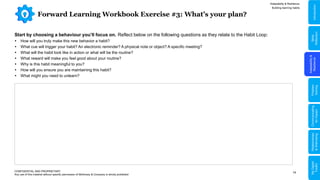
Forward Learning Workbook Exercise #3: What’s your plan?
Adaptability & Resilience
CONFIDENTIAL AND PROPRIETARY
Any use of this material without specific permission of McKinsey & Company is strictly prohibited
Start by choosing a behaviour you’ll focus on. Reflect below on the following questions as they relate to the Habit Loop:
 How will you truly make this new behavior a habit?
 What cue will trigger your habit? An electronic reminder? A physical note or object? A specific meeting?
 What will the habit look like in action or what will be the routine?
 What reward will make you feel good about your routine?
 Why is this habit meaningful to you?
 How will you ensure you are maintaining this habit?
 What might you need to unlearn?
Building learning habits
Adaptability
&
Resilience
Problem
Solving
Relationships
&
Well-being
Communicating
for
Impact
Skills
Reflection
Introduction
My
Digital
Toolkit
15
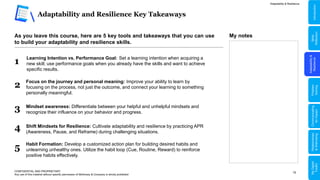
Adaptability and Resilience Key Takeaways
Adaptability & Resilience
CONFIDENTIAL AND PROPRIETARY
Any use of this material without specific permission of McKinsey & Company is strictly prohibited
As you leave this course, here are 5 key tools and takeaways that you can use
to build your adaptability and resilience skills.
1 Learning Intention vs. Performance Goal: Set a learning intention when acquiring a
new skill; use performance goals when you already have the skills and want to achieve
specific results.
Mindset awareness: Differentiate between your helpful and unhelpful mindsets and
recognize their influence on your behavior and progress.
3
2 Focus on the journey and personal meaning: Improve your ability to learn by
focusing on the process, not just the outcome, and connect your learning to something
personally meaningful.
4 Shift Mindsets for Resilience: Cultivate adaptability and resilience by practicing APR
(Awareness, Pause, and Reframe) during challenging situations.
5 Habit Formation: Develop a customized action plan for building desired habits and
unlearning unhealthy ones. Utilize the habit loop (Cue, Routine, Reward) to reinforce
positive habits effectively.
My notes
Adaptability
&
Resilience
Problem
Solving
Relationships
&
Well-being
Communicating
for
Impact
Skills
Reflection
Introduction
My
Digital
Toolkit
16
End of Course Reflection: Adaptability & Resilience
Adaptability & Resilience
CONFIDENTIAL AND PROPRIETARY
Any use of this material without specific permission of McKinsey & Company is strictly prohibited
Take a moment to reflect and jot down any key points that you would like to revisit in the future.
Adaptability
&
Resilience
Problem
Solving
Relationships
&
Well-being
Communicating
for
Impact
Skills
Reflection
Introduction
My
Digital
Toolkit
CONFIDENTIAL AND PROPRIETARY
Any use of this material without specific permission of McKinsey & Company is strictly prohibited
Problem Solving
Course
Problem
Solving
Adaptability
&
Resilience
Relationships
&
Well-being
My
Digital
Toolkit
Communicating
for
Impact
Skills
Reflection
Introduction
18
Forward Learning Workbook Exercise #1: Your approach to problem
solving
Problem Solving
McKinsey’s approach to problem solving
CONFIDENTIAL AND PROPRIETARY
Any use of this material without specific permission of McKinsey & Company is strictly prohibited
Take a moment to reflect. Consider a current problem that you’re having on the job or at home.
 How can you take a more structured approach to solving that problem?
 Describe your personal approach to problem solving at work or at home. Do you tend to be structured and evidence-based?
Or do you take a more intuitive approach? What are the benefits and shortcomings of your current approach?
Problem
Solving
Adaptability
&
Resilience
Relationships
&
Well-being
Communicating
for
Impact
Skills
Reflection
Introduction
My
Digital
Toolkit
19
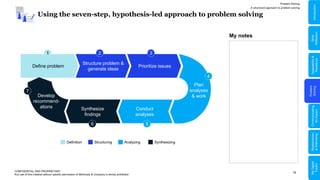
Using the seven-step, hypothesis-led approach to problem solving
Problem Solving
A structured approach to problem solving
Define problem
Structure problem &
generate ideas
Prioritize issues
Conduct
analyses
Synthesize
findings
Develop
recommend-
ations
Plan
analyses
& work
1 2 3
4
5
6
7
Definition Structuring Analyzing Synthesizing
CONFIDENTIAL AND PROPRIETARY
Any use of this material without specific permission of McKinsey & Company is strictly prohibited
My notes
Problem
Solving
Adaptability
&
Resilience
Relationships
&
Well-being
My
Digital
Toolkit
Communicating
for
Impact
Skills
Reflection
Introduction
20
Forward Learning Workbook Exercise #2: How do you define problems?
Problem Solving
Defining the problem
CONFIDENTIAL AND PROPRIETARY
Any use of this material without specific permission of McKinsey & Company is strictly prohibited
Take a moment to reflect. Do you usually take time to define a problem before attempting to solve it?
If so, how? What is your process?
Problem
Solving
Adaptability
&
Resilience
Relationships
&
Well-being
My
Digital
Toolkit
Communicating
for
Impact
Skills
Reflection
Introduction
21
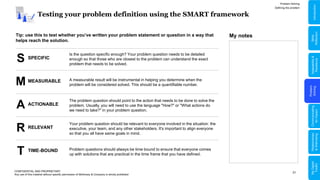
Testing your problem definition using the SMART framework
Tip: use this to test whether you’ve written your problem statement or question in a way that
helps reach the solution.
CONFIDENTIAL AND PROPRIETARY
Any use of this material without specific permission of McKinsey & Company is strictly prohibited
SPECIFIC
Is the question specific enough? Your problem question needs to be detailed
enough so that those who are closest to the problem can understand the exact
problem that needs to be solved.
S
MEASURABLE A measurable result will be instrumental in helping you determine when the
problem will be considered solved. This should be a quantifiable number.
M
ACTIONABLE
The problem question should point to the action that needs to be done to solve the
problem. Usually, you will need to use the language "How?" or "What actions do
we need to take?" in your problem question.
A
RELEVANT
Your problem question should be relevant to everyone involved in the situation: the
executive, your team, and any other stakeholders. It's important to align everyone
so that you all have same goals in mind.
R
TIME-BOUND Problem questions should always be time bound to ensure that everyone comes
up with solutions that are practical in the time frame that you have defined.
T
Problem Solving
Defining the problem
My notes
Problem
Solving
Adaptability
&
Resilience
Relationships
&
Well-being
My
Digital
Toolkit
Communicating
for
Impact
Skills
Reflection
Introduction
22
Using a Problem Statement Worksheet to define a problem
CONFIDENTIAL AND PROPRIETARY
Any use of this material without specific permission of McKinsey & Company is strictly prohibited
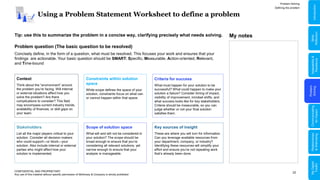
Tip: use this to summarize the problem in a concise way, clarifying precisely what needs solving.
Problem question (The basic question to be resolved)
Concisely define, in the form of a question, what must be resolved. This focuses your work and ensures that your
findings are actionable. Your basic question should be SMART: Specific, Measurable, Action-oriented, Relevant,
and Time-bound
Scope of solution space
What will and will not be considered in
your solution? The scope should be
broad enough to ensure that you’re
considering all relevant solutions, yet
narrow enough to ensure that your
analysis is manageable.
Stakeholders
List all the major players critical to your
solution. Consider all decision makers
who could support—or block—your
solution. Also include internal or external
parties who might affect how your
solution is implemented.
Key sources of insight
These are where you will turn for information.
Can you leverage available resources from
your department, company, or industry?
Identifying these resources will simplify your
effort and ensure you’re not repeating work
that’s already been done.
Constraints within solution
space
While scope defines the space of your
solution, constraints focus on what can
or cannot happen within that space.
Context
Think about the “environment” around
the problem you’re facing. Will internal
or external situations affect how you
solve the problem? Are there
complications to consider? This field
may encompass current industry trends,
availability of finances, or skill gaps on
your team.
Criteria for success
What must happen for your solution to be
successful? What could happen to make your
solution a failure? Consider timing of impact,
visibility of improvement, mindset shifts, and
what success looks like for key stakeholders.
Criteria should be measurable, so you can
judge whether or not your final solution
satisfies them.
Problem Solving
Defining the problem
My notes
Problem
Solving
Adaptability
&
Resilience
Relationships
&
Well-being
My
Digital
Toolkit
Communicating
for
Impact
Skills
Reflection
Introduction
23
Forward Learning Workbook Exercise #3: Integrating what you’ve learned
CONFIDENTIAL AND PROPRIETARY
Any use of this material without specific permission of McKinsey & Company is strictly prohibited
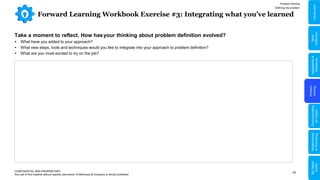
Take a moment to reflect. How hasyour thinking about problem definition evolved?
 What have you added to your approach?
 What new steps, tools and techniques would you like to integrate into your approach to problem definition?
 What are you most excited to try on the job?
Problem Solving
Defining the problem
Problem
Solving
Adaptability
&
Resilience
Relationships
&
Well-being
My
Digital
Toolkit
Communicating
for
Impact
Skills
Reflection
Introduction
24
Work planning tools
CONFIDENTIAL AND PROPRIETARY
Any use of this material without specific permission of McKinsey & Company is strictly prohibited
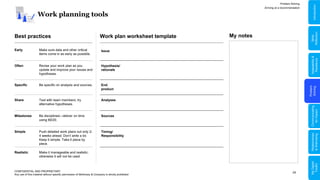
Best practices Work plan worksheet template
Make sure data and other critical
items come in as early as possible.
Early
Revise your work plan as you
update and improve your issues and
hypotheses.
Often
Be specific on analysis and sources.
Specific
Test with team members; try
alternative hypotheses.
Share
Be disciplined—deliver on time
using 80/20.
Milestones
Push detailed work plans out only 2-
4 weeks ahead. Don’t write a lot.
Keep it simple. Take it piece by
piece.
Simple
Make it manageable and realistic;
otherwise it will not be used.
Realistic
Issue
Hypothesis/
rationale
End
product
Analyses
Sources
Timing/
Responsibility
Problem Solving
Arriving at a recommendation
My notes
Problem
Solving
Adaptability
&
Resilience
Relationships
&
Well-being
My
Digital
Toolkit
Communicating
for
Impact
Skills
Reflection
Introduction
25
Problem Solving Key Takeaways
CONFIDENTIAL AND PROPRIETARY
Any use of this material without specific permission of McKinsey & Company is strictly prohibited
Problem Solving
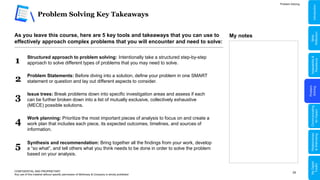
As you leave this course, here are 5 key tools and takeaways that you can use to
effectively approach complex problems that you will encounter and need to solve:
1 Structured approach to problem solving: Intentionally take a structured step-by-step
approach to solve different types of problems that you may need to solve.
Issue trees: Break problems down into specific investigation areas and assess if each
can be further broken down into a list of mutually exclusive, collectively exhaustive
(MECE) possible solutions.
3
2 Problem Statements: Before diving into a solution, define your problem in one SMART
statement or question and lay out different aspects to consider.
4 Work planning: Prioritize the most important pieces of analysis to focus on and create a
work plan that includes each piece, its expected outcomes, timelines, and sources of
information.
5 Synthesis and recommendation: Bring together all the findings from your work, develop
a “so what”, and tell others what you think needs to be done in order to solve the problem
based on your analysis.
My notes
Problem
Solving
Adaptability
&
Resilience
Relationships
&
Well-being
My
Digital
Toolkit
Communicating
for
Impact
Skills
Reflection
Introduction
26
End of Course Reflection: Problem Solving
CONFIDENTIAL AND PROPRIETARY
Any use of this material without specific permission of McKinsey & Company is strictly prohibited
Problem Solving
Take a moment to reflect and jot down any key points that you would like to revisit in the future.
Problem
Solving
Adaptability
&
Resilience
Relationships
&
Well-being
My
Digital
Toolkit
Communicating
for
Impact
Skills
Reflection
Introduction
Problem
Solving
Adaptability
&
Resilience
Relationships
&
Well-being
My
Digital
Toolkit
Communicating
for
Impact
Skills
Reflection
Introduction
Problem Solving
Case Assignment
Worksheets
Use the next 3 worksheets to practice completing the Hustleton Traffic Problem assignment
which you will find in your digital platform under the ‘Case Assignment: Solve a traffic problem’.
When you are done practicing using the worksheets, submit your answers on the digital
platform under the ‘Case Assignment: Solve a traffic problem’.
To keep a copy of your answers, make sure to write them in your Forward Learning
Workbook.
CONFIDENTIAL AND PROPRIETARY
Any use of this material without specific permission of McKinsey & Company is strictly prohibited
McKinsey & Company 28
1. Problem Definition Worksheet
How to use this worksheet
Use this worksheet to practice
completing the first step of your
assignment: defining the problem
clearly for all stakeholders involved.
Using the information provided in the
email from the Mayor, concisely
define what must be resolved.
How can we…
What is the Key Problem Statement?
(Write it down, starting with ‘How can the city of Hustleton…’)
Specific
Action-oriented
Time-bound
Measurable
Relevant
Is it sufficiently narrow, not too broad and general?
Can you quantify and measure it using some metric?
Is it clear what needs to be taken action on?
Is your problem statement relevant to the problem at hand and
for the stakeholders involved?
Is there a time horizon that indicates when the problem needs
to be solved?
Before you continue, put your statement to the test. Is it SMART?
Problem
Solving
Adaptability
&
Resilience
Relationships
&
Well-being
My
Digital
Toolkit
Communicating
for
Impact
Skills
Reflection
Introduction
Problem Solving
Case Assignment
CONFIDENTIAL AND PROPRIETARY
Any use of this material without specific permission of McKinsey & Company is strictly prohibited
McKinsey & Company 29
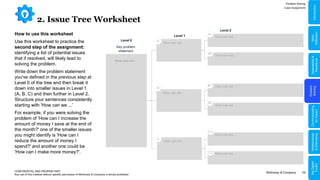
2. Issue Tree Worksheet
How to use this worksheet
Use this worksheet to practice the
second step of the assignment:
identifying a list of potential issues
that if resolved, will likely lead to
solving the problem.
Write down the problem statement
you've defined in the previous step at
Level 0 of the tree and then break it
down into smaller issues in Level 1
(A, B, C) and then further in Level 2.
Structure your sentences consistently
starting with 'How can we ...’
For example, if you were solving the
problem of 'How can I increase the
amount of money I save at the end of
the month?' one of the smaller issues
you might identify is 'How can I
reduce the amount of money I
spend?' and another one could be
'How can I make more money?'.
How can we…
How can we…
How can we…
How can we…
How can we…
How can we…
How can we…
How can we…
How can we…
A
B
C
A1
B1
C1
A2
B2
C2
How can we…
Level 1
Level 2
Key problem
statement
Level 0
Problem
Solving
Adaptability
&
Resilience
Relationships
&
Well-being
My
Digital
Toolkit
Communicating
for
Impact
Skills
Reflection
Introduction
Problem Solving
Case Assignment
CONFIDENTIAL AND PROPRIETARY
Any use of this material without specific permission of McKinsey & Company is strictly prohibited
McKinsey & Company 30
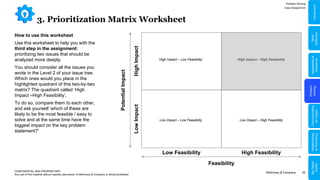
3. Prioritization Matrix Worksheet
How to use this worksheet
Use this worksheet to help you with the
third step in the assignment:
prioritizing two issues that should be
analyzed more deeply.
You should consider all the issues you
wrote in the Level 2 of your issue tree.
Which ones would you place in the
highlighted quadrant of this two-by-two
matrix? The quadrant called ‘High
Impact –High Feasibility’.
To do so, compare them to each other,
and ask yourself ‘which of these are
likely to be the most feasible / easy to
solve and at the same time have the
biggest impact on the key problem
statement?'
Potential
Impact
Low Feasibility High Feasibility
Feasibility
Low
Impact
High
Impact
High Impact – High Feasibility
High Impact – Low Feasibility
Low Impact – High Feasibility
Low Impact – Low Feasibility
Problem
Solving
Adaptability
&
Resilience
Relationships
&
Well-being
My
Digital
Toolkit
Communicating
for
Impact
Skills
Reflection
Introduction
Problem Solving
Case Assignment
CONFIDENTIAL AND PROPRIETARY
Any use of this material without specific permission of McKinsey & Company is strictly prohibited
CONFIDENTIAL AND PROPRIETARY
Any use of this material without specific permission of McKinsey & Company is strictly prohibited
Communicating for
Impact Course
Problem
Solving
Communicating
for
Impact
Adaptability
&
Resilience
Relationships
&
Well-being
My
Digital
Toolkit
Skills
Reflection
Introduction
32
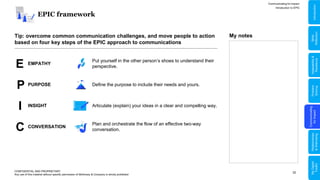
EPIC framework
CONFIDENTIAL AND PROPRIETARY
Any use of this material without specific permission of McKinsey & Company is strictly prohibited
Communicating for Impact
Introduction to EPIC
Tip: overcome common communication challenges, and move people to action
based on four key steps of the EPIC approach to communications
CONVERSATION
C Plan and orchestrate the flow of an effective two-way
conversation.
EMPATHY
E Put yourself in the other person’s shoes to understand their
perspective.
INSIGHT
I Articulate (explain) your ideas in a clear and compelling way.
PURPOSE
P Define the purpose to include their needs and yours.
My notes
Problem
Solving
Communicating
for
Impact
Adaptability
&
Resilience
Relationships
&
Well-being
My
Digital
Toolkit
Skills
Reflection
Introduction
33
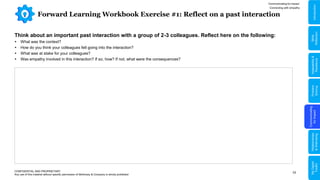
Forward Learning Workbook Exercise #1: Reflect on a past interaction
CONFIDENTIAL AND PROPRIETARY
Any use of this material without specific permission of McKinsey & Company is strictly prohibited
Communicating for Impact
Connecting with empathy
Think about an important past interaction with a group of 2-3 colleagues. Reflect here on the following:
 What was the context?
 How do you think your colleagues felt going into the interaction?
 What was at stake for your colleagues?
 Was empathy involved in this interaction? If so, how? If not, what were the consequences?
Problem
Solving
Communicating
for
Impact
Adaptability
&
Resilience
Relationships
&
Well-being
My
Digital
Toolkit
Skills
Reflection
Introduction
34
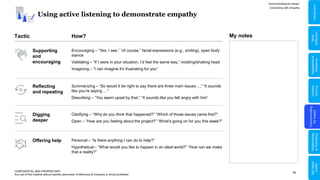
Using active listening to demonstrate empathy
Communicating for Impact
Connecting with empathy
CONFIDENTIAL AND PROPRIETARY
Any use of this material without specific permission of McKinsey & Company is strictly prohibited
How?
Tactic
Supporting
and
encouraging
Encouraging – “Yes, I see,” “of course,” facial expressions (e.g., smiling), open body
stance
Validating – “If I were in your situation, I’d feel the same way,” nodding/shaking head
Imagining – “I can imagine it’s frustrating for you”
Reflecting
and repeating
Summarizing – “So would it be right to say there are three main issues…,” “It sounds
like you’re saying …”
Describing – “You seem upset by that,” “It sounds like you felt angry with him”
Digging
deeper
Clarifying – “Why do you think that happened?” “Which of those issues came first?”
Open – “How are you feeling about the project?” “What’s going on for you this week?”
Offering help Personal – “Is there anything I can do to help?”
Hypothetical – “What would you like to happen in an ideal world?” “How can we make
that a reality?”
My notes
Problem
Solving
Communicating
for
Impact
Adaptability
&
Resilience
Relationships
&
Well-being
My
Digital
Toolkit
Skills
Reflection
Introduction
35
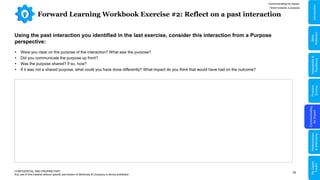
Forward Learning Workbook Exercise #2: Reflect on a past interaction
CONFIDENTIAL AND PROPRIETARY
Any use of this material without specific permission of McKinsey & Company is strictly prohibited
Using the past interaction you identified in the last exercise, consider this interaction from a Purpose
perspective:
 Were you clear on the purpose of the interaction? What was the purpose?
 Did you communicate the purpose up front?
 Was the purpose shared? If so, how?
 If it was not a shared purpose, what could you have done differently? What impact do you think that would have had on the outcome?
Communicating for Impact
Orient towards a purpose
Problem
Solving
Communicating
for
Impact
Adaptability
&
Resilience
Relationships
&
Well-being
My
Digital
Toolkit
Skills
Reflection
Introduction
36
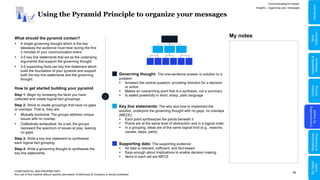
Using the Pyramid Principle to organize your messages
CONFIDENTIAL AND PROPRIETARY
Any use of this material without specific permission of McKinsey & Company is strictly prohibited
What should the pyramid contain?
 A single governing thought which is the key
takeaway the audience must hear during the first
2 minutes of your communication event.
 3-5 key line statements that act as the underlying
arguments that support the governing thought.
 3-5 supporting facts per key line statement which
build the foundation of your pyramid and support
both the key line statements and the governing
thought.
How to get started building your pyramid
Step 1: Begin by reviewing the facts you have
collected and create logical fact groupings.
Step 2: Strive to create groupings that have no gaps
or overlaps. That is, they are:
 Mutually exclusive: The groups address unique
issues with no overlap.
 Collectively exhaustive: As a set, the groups
represent the spectrum of issues at play, leaving
no gaps.
Step 3: Write a key line statement to synthesize
each logical fact grouping.
Step 4: Write a governing thought to synthesize the
key line statements.
Governing thought: The one-sentence answer or solution to a
problem:
 Answers the central question, providing direction for a decision
or action
 Makes an overarching point that is a synthesis, not a summary
 Is stated powerfully in short, sharp, plain language
Key line statements: The why and how to implement the
solution, underpins the governing thought with no gaps, no overlaps
(MECE):
 Each point synthesizes the points beneath it
 Points are at the same level of abstraction and in a logical order
 In a grouping, ideas are of the same logical kind (e.g., reasons,
causes, steps, parts)
Supporting data: The supporting evidence:
 All data is relevant, sufficient, and fact-based
 Says enough about implications to enable decision making
 Items in each set are MECE
Communicating for Impact
Insights – organizing your messages
My notes
Problem
Solving
Communicating
for
Impact
Adaptability
&
Resilience
Relationships
&
Well-being
My
Digital
Toolkit
Skills
Reflection
Introduction
37
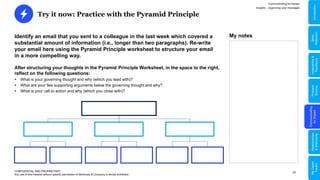
Try it now: Practice with the Pyramid Principle
CONFIDENTIAL AND PROPRIETARY
Any use of this material without specific permission of McKinsey & Company is strictly prohibited
Identify an email that you sent to a colleague in the last week which covered a
substantial amount of information (i.e., longer than two paragraphs). Re-write
your email here using the Pyramid Principle worksheet to structure your email
in a more compelling way.
Communicating for Impact
Insights – organizing your messages
After structuring your thoughts in the Pyramid Principle Worksheet, in the space to the right,
reflect on the following questions:
 What is your governing thought and why (which you lead with)?
 What are your few supporting arguments below the governing thought and why?
 What is your call to action and why (which you close with)?
My notes
Problem
Solving
Communicating
for
Impact
Adaptability
&
Resilience
Relationships
&
Well-being
My
Digital
Toolkit
Skills
Reflection
Introduction
38
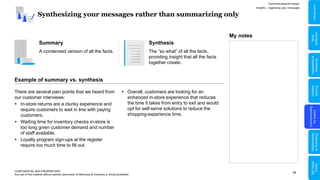
Synthesizing your messages rather than summarizing only
CONFIDENTIAL AND PROPRIETARY
Any use of this material without specific permission of McKinsey & Company is strictly prohibited
A condensed version of all the facts.
Summary Synthesis
The “so what” of all the facts,
providing insight that all the facts
together create.
Communicating for Impact
Insights – organizing your messages
Example of summary vs. synthesis
There are several pain points that we heard from
our customer interviews:
 In-store returns are a clunky experience and
require customers to wait in line with paying
customers.
 Waiting time for inventory checks in-store is
too long given customer demand and number
of staff available.
 Loyalty program sign-ups at the register
require too much time to fill out.
 Overall, customers are looking for an
enhanced in-store experience that reduces
the time it takes from entry to exit and would
opt for self-serve solutions to reduce the
shopping-experience time.
My notes
Problem
Solving
Communicating
for
Impact
Adaptability
&
Resilience
Relationships
&
Well-being
My
Digital
Toolkit
Skills
Reflection
Introduction
39
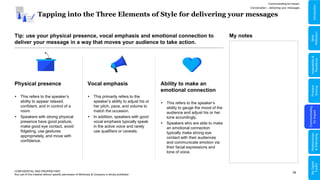
Tapping into the Three Elements of Style for delivering your messages
CONFIDENTIAL AND PROPRIETARY
Any use of this material without specific permission of McKinsey & Company is strictly prohibited
Tip: use your physical presence, vocal emphasis and emotional connection to
deliver your message in a way that moves your audience to take action.
Physical presence
 This refers to the speaker’s
ability to appear relaxed,
confident, and in control of a
room.
 Speakers with strong physical
presence have good posture,
make good eye contact, avoid
fidgeting, use gestures
appropriately, and move with
confidence.
Ability to make an
emotional connection
 This refers to the speaker’s
ability to gauge the mood of the
audience and adjust his or her
tone accordingly.
 Speakers who are able to make
an emotional connection
typically make strong eye
contact with their audiences
and communicate emotion via
their facial expressions and
tone of voice.
Vocal emphasis
 This primarily refers to the
speaker’s ability to adjust his or
her pitch, pace, and volume to
match the occasion.
 In addition, speakers with good
vocal emphasis typically speak
in the active voice and rarely
use qualifiers or caveats.
Communicating for Impact
Conversation – delivering your messages
My notes
Problem
Solving
Communicating
for
Impact
Adaptability
&
Resilience
Relationships
&
Well-being
My
Digital
Toolkit
Skills
Reflection
Introduction
40
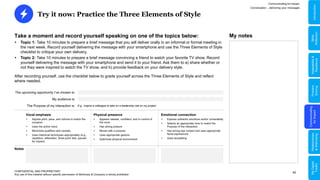
Try it now: Practice the Three Elements of Style
CONFIDENTIAL AND PROPRIETARY
Any use of this material without specific permission of McKinsey & Company is strictly prohibited
Take a moment and record yourself speaking on one of the topics below:
 Topic 1: Take 10 minutes to prepare a brief message that you will deliver orally in an informal or formal meeting in
the next week. Record yourself delivering the message with your smartphone and use the Three Elements of Style
checklist to critique your own delivery.
 Topic 2: Take 10 minutes to prepare a brief message convincing a friend to watch your favorite TV show. Record
yourself delivering the message with your smartphone and send it to your friend. Ask them to a) share whether or
not they were inspired to watch the TV show, and b) provide feedback on your delivery style.
After recording yourself, use the checklist below to grade yourself across the Three Elements of Style and reflect
where needed.
The upcoming opportunity I’ve chosen is:
My audience is:
The Purpose of my interaction is: E.g., Inspire a colleague to take on a leadership role on my project
Notes
 Express authentic emotions and/or vulnerability
 Selects an appropriate tone to match the
Purpose of the interaction
 Has strong eye contact and uses appropriate
facial expressions
 Uses storytelling
 Appears relaxed, confident, and in control of
the room
 Has strong posture
 Moves with a purpose
 Uses appropriate gesture
 Optimizes physical environment
 Adjusts pitch, pace, and volume to match the
occasion
 Uses the active voice
 Minimizes qualifiers and caveats
 Uses rhetorical techniques appropriately (e.g.,
repetition, alliteration, three-point lists, pauses
for impact)
Emotional connection
Physical presence
Vocal emphasis
Communicating for Impact
Conversation – delivering your messages
My notes
Problem
Solving
Communicating
for
Impact
Adaptability
&
Resilience
Relationships
&
Well-being
My
Digital
Toolkit
Skills
Reflection
Introduction
41
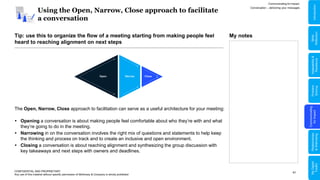
Using the Open, Narrow, Close approach to facilitate
a conversation
CONFIDENTIAL AND PROPRIETARY
Any use of this material without specific permission of McKinsey & Company is strictly prohibited
Tip: use this to organize the flow of a meeting starting from making people feel
heard to reaching alignment on next steps
The Open, Narrow, Close approach to facilitation can serve as a useful architecture for your meeting:
 Opening a conversation is about making people feel comfortable about who they’re with and what
they’re going to do in the meeting.
 Narrowing in on the conversation involves the right mix of questions and statements to help keep
the thinking and process on track and to create an inclusive and open environment.
 Closing a conversation is about reaching alignment and synthesizing the group discussion with
key takeaways and next steps with owners and deadlines.
Communicating for Impact
Conversation – delivering your messages
My notes
Problem
Solving
Communicating
for
Impact
Adaptability
&
Resilience
Relationships
&
Well-being
My
Digital
Toolkit
Skills
Reflection
Introduction
42
Forward Learning Workbook Exercise #3: Reflect on a past interaction
CONFIDENTIAL AND PROPRIETARY
Any use of this material without specific permission of McKinsey & Company is strictly prohibited
Think about the past interaction with a group of 2-3 colleagues you identified in the prior modules. Take a
moment to reflect in the space below about the following questions:
 Did the meeting have a clear and compelling opening? What did the facilitator do to make the participants feel comfortable about who they’re with and
what they’re going to do?
 Did the facilitator ask provocative and insightful questions to narrow in on the conversation? How did they use questions and statements to help keep the
thinking and process on track and also create an inclusive and open environment?
 Did the facilitator close the meeting with a clearly articulated outcome assigned to an owner with a set deadline? Were next steps defined?
 Did the facilitator help move the group to alignment, commitment, or action? If so, how?
Communicating for Impact
Conversation – delivering your messages
Problem
Solving
Communicating
for
Impact
Adaptability
&
Resilience
Relationships
&
Well-being
My
Digital
Toolkit
Skills
Reflection
Introduction
43
CONFIDENTIAL AND PROPRIETARY
Any use of this material without specific permission of McKinsey & Company is strictly prohibited
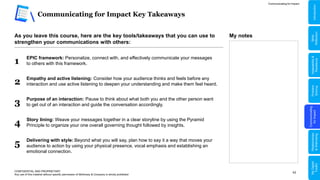
As you leave this course, here are the key tools/takeaways that you can use to
strengthen your communications with others:
1 EPIC framework: Personalize, connect with, and effectively communicate your messages
to others with this framework.
Empathy and active listening: Consider how your audience thinks and feels before any
interaction and use active listening to deepen your understanding and make them feel heard.
2
3 Purpose of an interaction: Pause to think about what both you and the other person want
to get out of an interaction and guide the conversation accordingly.
4 Story lining: Weave your messages together in a clear storyline by using the Pyramid
Principle to organize your one overall governing thought followed by insights.
5 Delivering with style: Beyond what you will say, plan how to say it a way that moves your
audience to action by using your physical presence, vocal emphasis and establishing an
emotional connection.
Communicating for Impact
My notes
Communicating for Impact Key Takeaways
Problem
Solving
Communicating
for
Impact
Adaptability
&
Resilience
Relationships
&
Well-being
My
Digital
Toolkit
Skills
Reflection
Introduction
44
End of Course Reflection: Communicating for Impact
CONFIDENTIAL AND PROPRIETARY
Any use of this material without specific permission of McKinsey & Company is strictly prohibited
Take a moment to reflect and jot down any key points that you would like to revisit in the future.
Communicating for Impact
Problem
Solving
Communicating
for
Impact
Adaptability
&
Resilience
Relationships
&
Well-being
My
Digital
Toolkit
Skills
Reflection
Introduction
CONFIDENTIAL AND PROPRIETARY
Any use of this material without specific permission of McKinsey & Company is strictly prohibited
Relationships &
Well-Being Course
Relationships
&
Well-being
Communicating
for
Impact
Problem
Solving
Adaptability
&
Resilience
My
Digital
Toolkit
Skills
Reflection
Introduction
46
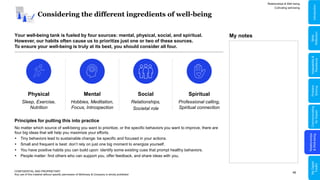
Considering the different ingredients of well-being
Your well-being tank is fueled by four sources: mental, physical, social, and spiritual.
However, our habits often cause us to prioritize just one or two of these sources.
To ensure your well-being is truly at its best, you should consider all four.
CONFIDENTIAL AND PROPRIETARY
Any use of this material without specific permission of McKinsey & Company is strictly prohibited
Principles for putting this into practice
No matter which source of well-being you want to prioritize, or the specific behaviors you want to improve, there are
four big ideas that will help you maximize your efforts.
 Tiny behaviors lead to sustainable change: be specific and focused in your actions.
 Small and frequent is best: don’t rely on just one big moment to energize yourself.
 You have positive habits you can build upon: identify some existing cues that prompt healthy behaviors.
 People matter: find others who can support you, offer feedback, and share ideas with you.
Mental
Hobbies, Meditation,
Focus, Introspection
Spiritual
Professional calling,
Spiritual connection
Relationships,
Societal role
Social
Physical
Sleep, Exercise,
Nutrition
Relationships & Well-being
Cultivating well-being
My notes
Relationships
&
Well-being
Communicating
for
Impact
Problem
Solving
Adaptability
&
Resilience
My
Digital
Toolkit
Skills
Reflection
Introduction
47
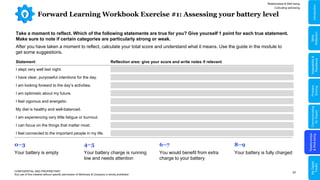
Forward Learning Workbook Exercise #1: Assessing your battery level
CONFIDENTIAL AND PROPRIETARY
Any use of this material without specific permission of McKinsey & Company is strictly prohibited
Take a moment to reflect. Which of the following statements are true for you? Give yourself 1 point for each true statement.
Make sure to note if certain categories are particularly strong or weak.
After you have taken a moment to reflect, calculate your total score and understand what it means. Use the guide in the module to
get some suggestions.
Statement Reflection area: give your score and write notes if relevant
I slept very well last night.
I have clear, purposeful intentions for the day.
I am looking forward to the day’s activities.
I am optimistic about my future.
I feel vigorous and energetic.
My diet is healthy and well-balanced.
I am experiencing very little fatigue or burnout.
I can focus on the things that matter most.
I feel connected to the important people in my life.
Relationships & Well-being
Cultivating well-being
0–3
Your battery is empty
4–5
Your battery charge is running
low and needs attention
6–7
You would benefit from extra
charge to your battery
8–9
Your battery is fully charged
Relationships
&
Well-being
Communicating
for
Impact
Problem
Solving
Adaptability
&
Resilience
My
Digital
Toolkit
Skills
Reflection
Introduction
48
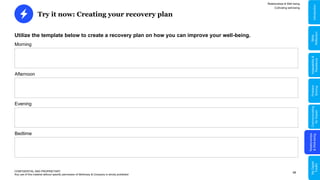
Try it now: Creating your recovery plan
CONFIDENTIAL AND PROPRIETARY
Any use of this material without specific permission of McKinsey & Company is strictly prohibited
Utilize the template below to create a recovery plan on how you can improve your well-being.
Morning
Afternoon
Evening
Bedtime
Relationships & Well-being
Cultivating well-being
Relationships
&
Well-being
Communicating
for
Impact
Problem
Solving
Adaptability
&
Resilience
My
Digital
Toolkit
Skills
Reflection
Introduction
49
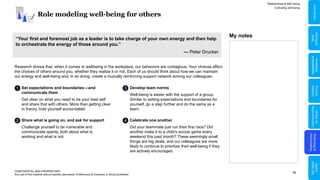
Role modeling well-being for others
CONFIDENTIAL AND PROPRIETARY
Any use of this material without specific permission of McKinsey & Company is strictly prohibited
Research shows that, when it comes to well-being in the workplace, our behaviors are contagious. Your choices affect
the choices of others around you, whether they realize it or not. Each of us should think about how we can maintain
our energy and well-being and, in so doing, create a mutually reinforcing support network among our colleagues.
Set expectations and boundaries—and
communicate them
Get clear on what you need to be your best self
and share that with others. More than getting clear
in theory, hold yourself accountable!
1 Develop team norms
Well-being is easier with the support of a group.
Similar to setting expectations and boundaries for
yourself, go a step further and do the same as a
team.
3
Share what is going on, and ask for support
Challenge yourself to be vulnerable and
communicate openly, both about what is
working and what is not.
2 Celebrate one another
Did your teammate just run their first race? Did
another make it to a child’s soccer game every
weekend this past month? These seemingly small
things are big deals, and our colleagues are more
likely to continue to prioritize their well-being if they
are actively encouraged.
4
Relationships & Well-being
Cultivating well-being
My notes
“Your first and foremost job as a leader is to take charge of your own energy and then help
to orchestrate the energy of those around you.”
— Peter Drucker
Relationships
&
Well-being
Communicating
for
Impact
Problem
Solving
Adaptability
&
Resilience
My
Digital
Toolkit
Skills
Reflection
Introduction
50
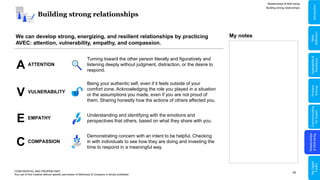
Building strong relationships
We can develop strong, energizing, and resilient relationships by practicing
AVEC: attention, vulnerability, empathy, and compassion.
CONFIDENTIAL AND PROPRIETARY
Any use of this material without specific permission of McKinsey & Company is strictly prohibited
Relationships & Well-being
Building strong relationships
ATTENTION
A
Turning toward the other person literally and figuratively and
listening deeply without judgment, distraction, or the desire to
respond.
VULNERABILITY
V
Being your authentic self, even if it feels outside of your
comfort zone. Acknowledging the role you played in a situation
or the assumptions you made, even if you are not proud of
them. Sharing honestly how the actions of others affected you.
EMPATHY
E Understanding and identifying with the emotions and
perspectives that others, based on what they share with you.
COMPASSION
C
Demonstrating concern with an intent to be helpful. Checking
in with individuals to see how they are doing and investing the
time to respond in a meaningful way.
My notes
Relationships
&
Well-being
Communicating
for
Impact
Problem
Solving
Adaptability
&
Resilience
My
Digital
Toolkit
Skills
Reflection
Introduction
51
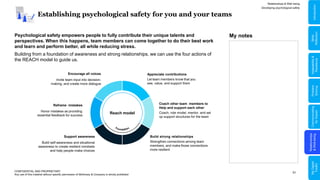
Establishing psychological safety for you and your teams
CONFIDENTIAL AND PROPRIETARY
Any use of this material without specific permission of McKinsey & Company is strictly prohibited
Psychological safety empowers people to fully contribute their unique talents and
perspectives. When this happens, team members can come together to do their best work
and learn and perform better, all while reducing stress.
Building from a foundation of awareness and strong relationships, we can use the four actions of
the REACH model to guide us.
Appreciate contributions
Let team members know that you
see, value, and support them
Coach other team members to
Help and support each other
Coach, role model, mentor, and set
up support structures for the team
Build strong relationships
Strengthen connections among team
members, and make those connections
more resilient
Reframe mistakes
Honor mistakes as providing
essential feedback for success
Support awareness
Build self-awareness and situational
awareness to create resilient mindsets
and help people make choices
Encourage all voices
Invite team input into decision-
making, and create more dialogue
Reach model
Relationships & Well-being
Developing psychological safety
My notes
Relationships
&
Well-being
Communicating
for
Impact
Problem
Solving
Adaptability
&
Resilience
My
Digital
Toolkit
Skills
Reflection
Introduction
52
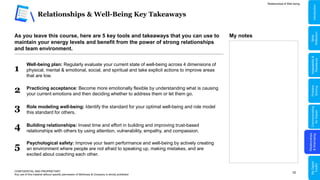
Relationships & Well-Being Key Takeaways
CONFIDENTIAL AND PROPRIETARY
Any use of this material without specific permission of McKinsey & Company is strictly prohibited
As you leave this course, here are 5 key tools and takeaways that you can use to
maintain your energy levels and benefit from the power of strong relationships
and team environment.
1
Well-being plan: Regularly evaluate your current state of well-being across 4 dimensions of
physical, mental & emotional, social, and spiritual and take explicit actions to improve areas
that are low.
Practicing acceptance: Become more emotionally flexible by understanding what is causing
your current emotions and then deciding whether to address them or let them go.
2
3 Role modeling well-being: Identify the standard for your optimal well-being and role model
this standard for others.
4 Building relationships: Invest time and effort in building and improving trust-based
relationships with others by using attention, vulnerability, empathy, and compassion.
5
Psychological safety: Improve your team performance and well-being by actively creating
an environment where people are not afraid to speaking up, making mistakes, and are
excited about coaching each other.
Relationships & Well-being
Relationships
&
Well-being
My notes
Communicating
for
Impact
Problem
Solving
Adaptability
&
Resilience
My
Digital
Toolkit
Skills
Reflection
Introduction
53
End of Course Reflection: Relationship & Well-being
CONFIDENTIAL AND PROPRIETARY
Any use of this material without specific permission of McKinsey & Company is strictly prohibited
Take a moment to reflect and jot down any key points that you would like to revisit in the future.
Relationships & Well-being
Relationships
&
Well-being
Communicating
for
Impact
Problem
Solving
Adaptability
&
Resilience
My
Digital
Toolkit
Skills
Reflection
Introduction
CONFIDENTIAL AND PROPRIETARY
Any use of this material without specific permission of McKinsey & Company is strictly prohibited
Replace with DGE
icon
My Digital Toolkit
Course
My
Digital
Toolkit
Relationships
&
Well-being
Communicating
for
Impact
Problem
Solving
Adaptability
&
Resilience
Skills
Reflection
Introduction
55
Forward Learning Workbook Exercise #1: How has digital impacted your
life?
CONFIDENTIAL AND PROPRIETARY
Any use of this material without specific permission of McKinsey & Company is strictly prohibited
Take a moment to reflect here. What new app, device, or digital service have you started using?
How has this product impacted your life? What made you start using this in the first place?
My Digital Toolkit
My
Digital
Toolkit
Relationships
&
Well-being
Communicating
for
Impact
Problem
Solving
Adaptability
&
Resilience
Skills
Reflection
Introduction
56
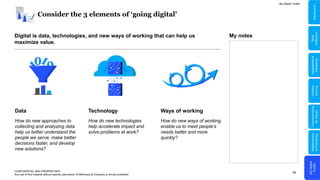
Consider the 3 elements of ‘going digital’
Digital is data, technologies, and new ways of working that can help us
maximize value.
CONFIDENTIAL AND PROPRIETARY
Any use of this material without specific permission of McKinsey & Company is strictly prohibited
Data Technology Ways of working
How do new approaches to
collecting and analyzing data
help us better understand the
people we serve, make better
decisions faster, and develop
new solutions?
How do new technologies
help accelerate impact and
solve problems at work?
How do new ways of working
enable us to meet people’s
needs better and more
quickly?
My Digital Toolkit
My notes
My
Digital
Toolkit
Relationships
&
Well-being
Communicating
for
Impact
Problem
Solving
Adaptability
&
Resilience
Skills
Reflection
Introduction
57
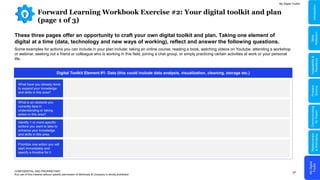
Forward Learning Workbook Exercise #2: Your digital toolkit and plan
(page 1 of 3)
CONFIDENTIAL AND PROPRIETARY
Any use of this material without specific permission of McKinsey & Company is strictly prohibited
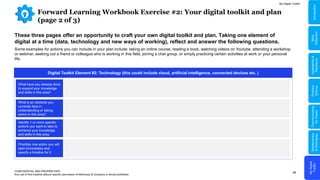
These three pages offer an opportunity to craft your own digital toolkit and plan. Taking one element of
digital at a time (data, technology and new ways of working), reflect and answer the following questions.
Some examples for actions you can include in your plan include: taking an online course, reading a book, watching videos on Youtube, attending a workshop
or webinar, seeking out a friend or colleague who is working in this field, joining a chat group, or simply practicing certain activities at work or your personal
life.
My Digital Toolkit
Skills
Reflection
Digital Toolkit Element #1: Data (this could include data analysis, visualization, cleaning, storage etc.)
What have you already done
to expand your knowledge
and skills in this area?
What is an obstacle you
currently face in
understanding or taking
action in this area?
Identify 1 or more specific
actions you want to take to
enhance your knowledge
and skills in this area.
Prioritize one action you will
start immediately and
specify a timeline for it
My
Digital
Toolkit
Relationships
&
Well-being
Communicating
for
Impact
Problem
Solving
Adaptability
&
Resilience
Skills
Reflection
Introduction
58
Forward Learning Workbook Exercise #2: Your digital toolkit and plan
(page 2 of 3)
CONFIDENTIAL AND PROPRIETARY
Any use of this material without specific permission of McKinsey & Company is strictly prohibited
These three pages offer an opportunity to craft your own digital toolkit and plan. Taking one element of
digital at a time (data, technology and new ways of working), reflect and answer the following questions.
Some examples for actions you can include in your plan include: taking an online course, reading a book, watching videos on Youtube, attending a workshop
or webinar, seeking out a friend or colleague who is working in this field, joining a chat group, or simply practicing certain activities at work or your personal
life.
My Digital Toolkit
What have you already done
to expand your knowledge
and skills in this area?
What is an obstacle you
currently face in
understanding or taking
action in this area?
Identify 1 or more specific
actions you want to take to
enhance your knowledge
and skills in this area.
Prioritize one action you will
start immediately and
specify a timeline for it
My
Digital
Toolkit
Relationships
&
Well-being
Communicating
for
Impact
Problem
Solving
Adaptability
&
Resilience
Skills
Reflection
Introduction
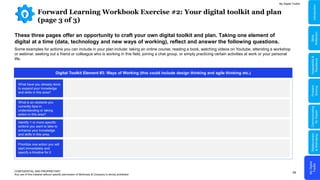
Digital Toolkit Element #2: Technology (this could include cloud, artificial intelligence, connected devices etc. )
59
Forward Learning Workbook Exercise #2: Your digital toolkit and plan
(page 3 of 3)
CONFIDENTIAL AND PROPRIETARY
Any use of this material without specific permission of McKinsey & Company is strictly prohibited
These three pages offer an opportunity to craft your own digital toolkit and plan. Taking one element of
digital at a time (data, technology and new ways of working), reflect and answer the following questions.
Some examples for actions you can include in your plan include: taking an online course, reading a book, watching videos on Youtube, attending a workshop
or webinar, seeking out a friend or colleague who is working in this field, joining a chat group, or simply practicing certain activities at work or your personal
life.
My Digital Toolkit
What have you already done
to expand your knowledge
and skills in this area?
What is an obstacle you
currently face in
understanding or taking
action in this area?
Identify 1 or more specific
actions you want to take to
enhance your knowledge
and skills in this area.
Prioritize one action you will
start immediately and
specify a timeline for it
My
Digital
Toolkit
Relationships
&
Well-being
Communicating
for
Impact
Problem
Solving
Adaptability
&
Resilience
Skills
Reflection
Introduction
Digital Toolkit Element #3: Ways of Working (this could include design thinking and agile thinking etc.)
60
My Digital Toolkit Key Takeaways
CONFIDENTIAL AND PROPRIETARY
Any use of this material without specific permission of McKinsey & Company is strictly prohibited
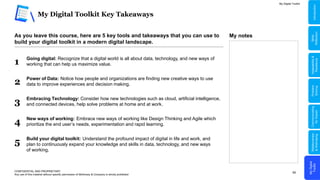
As you leave this course, here are 5 key tools and takeaways that you can use to
build your digital toolkit in a modern digital landscape.
1 Going digital: Recognize that a digital world is all about data, technology, and new ways of
working that can help us maximize value.
Power of Data: Notice how people and organizations are finding new creative ways to use
data to improve experiences and decision making.
2
3 Embracing Technology: Consider how new technologies such as cloud, artificial intelligence,
and connected devices, help solve problems at home and at work.
4 New ways of working: Embrace new ways of working like Design Thinking and Agile which
prioritize the end user’s needs, experimentation and rapid learning.
5 Build your digital toolkit: Understand the profound impact of digital in life and work, and
plan to continuously expand your knowledge and skills in data, technology, and new ways
of working.
My Digital Toolkit
My notes
My
Digital
Toolkit
Relationships
&
Well-being
Communicating
for
Impact
Problem
Solving
Adaptability
&
Resilience
Skills
Reflection
Introduction
61
End of Course Reflection: My Digital Toolkit
CONFIDENTIAL AND PROPRIETARY
Any use of this material without specific permission of McKinsey & Company is strictly prohibited
Take a moment to reflect and jot down any key points that you would like to revisit in the future.
My Digital Toolkit
My
Digital
Toolkit
Relationships
&
Well-being
Communicating
for
Impact
Problem
Solving
Adaptability
&
Resilience
Skills
Reflection
Introduction

Forward Learning Workbook.pdffhfxfvhxx n

  • 1.
    CONFIDENTIAL AND PROPRIETARY Anyuse of this material without specific permission of McKinsey & Company is strictly prohibited Your Name: __________________________ My Learning Workbook Take a Step. Forward.
  • 2.
    Welcome to Forward! YourLearning Workbook is your essential companion on your journey during and after the program. It serves as a canvas for you to capture key learnings, ideas, and reflections. During the online courses you will be prompted to visit the Learning Workbook to complete exercises and reflections. CONFIDENTIAL AND PROPRIETARY Any use of this material without specific permission of McKinsey & Company is strictly prohibited Adaptability and Resilience course Problem Solving course Communicating for Impact course Relationships & Well-being course Introduction to your journey ahead My Digital Toolkit course Skills Reflection Introduction Solving & Well-being My Digital Toolkit Skills Reflection Problem Relationships Communicating for Impact Adaptability & Resilience
  • 3.
    CONFIDENTIAL AND PROPRIETARY Anyuse of this material without specific permission of McKinsey & Company is strictly prohibited Introduction to your journey ahead Problem Solving Relationships & Well-being My Digital Toolkit Communicating for Impact Adaptability & Resilience Introduction Skills Reflection
  • 4.
    4 Forward Learning WorkbookExercise #1: Reflect on your journey ahead Introduction to your Journey Ahead CONFIDENTIAL AND PROPRIETARY Any use of this material without specific permission of McKinsey & Company is strictly prohibited As you go through the modules, it is important to recognize why you are learning these skills and what you plan on using them towards. Identifying key motivators will keep you persistent through your journey! What opportunity are you working towards? What might help you get there? What are your goals for this program? What are you most excited about in this program? Problem Solving Relationships & Well-being My Digital Toolkit Communicating for Impact Adaptability & Resilience Introduction Skills Reflection
  • 5.
    5 Forward Learning WorkbookExercise #2: What skills are crucial to you? Introduction to your Journey Ahead While all the following skill modules will be crucial to your journey, it is important to recognize which modules you would like to prioritize & how you plan on practicing these skills in your day-to-day life. CONFIDENTIAL AND PROPRIETARY Any use of this material without specific permission of McKinsey & Company is strictly prohibited What three skills do you think will be the most important for your career moving forward? Adopting mindsets and habits that make you adaptable and resilient in difficult times Defining problems and prioritize tasks in a structured manner when faced with a new problem to solve Planning and structuring your communication to address an audience to take action Understanding the digital world and developing a digital toolkit for success Building strong relationships and maintaining your well-being Based off what you have learned so far in the course, take a moment to reflect. Click on the blue boxes to answer the question. As you continue with this program, think about why these skills are the most important for your career moving forward. Problem Solving Relationships & Well-being My Digital Toolkit Communicating for Impact Adaptability & Resilience Introduction Skills Reflection
  • 6.
    CONFIDENTIAL AND PROPRIETARY Anyuse of this material without specific permission of McKinsey & Company is strictly prohibited Skills Reflection Skills Reflection Problem Solving Relationships & Well-being My Digital Toolkit Communicating for Impact Adaptability & Resilience Introduction
  • 7.
    7 CONFIDENTIAL AND PROPRIETARY Anyuse of this material without specific permission of McKinsey & Company is strictly prohibited Skills Reflection ​This tool will help you reflect on your skills before embarking on your journey with the program and even months after. By reflecting on the frequency in which you behave in certain ways, you will get insights into your strengths and areas of improvement, which can help you focus as you go through the journey and set learning intentions to further your growth. Read each of the 10 behaviors carefully and select the choice that best reflects how frequently you usually engage in this behavior. ADAPTABILITY & RESILIENCE Being aware of and shifting mindsets in challenging situation Skills Reflection Intentionally seeking learning opportunities PROBLEM SOLVING Using structured thinking to define a problem Using structured thinking to reach a recommended solution to a problem COMMUNICATING FOR IMPACT Communicating a large amount of information in a brief and insightful way Tailoring a message to the needs of my audience Never or Almost never Seldom Sometimes Often Always or Almost always NAVIGATING THE DIGITAL WORLD Building a digital toolkit RELATIONSHIPS & WELL-BEING Building psychological safety in teams Maintaining well-being Investing in workplace relationships In a challenging situation, I am aware of how I am thinking, feeling and behaving and actively try to adjust if needed. I jump on the opportunity to learn new things outside my comfort zone, even if that means making mistakes. When faced with a problem, I define it and break it down into different pieces before starting to solve it. To reach a recommended solution to a problem, I rely on several analysis and present a synthesis of the insights. When communicating a lot of information, I start with my most important message and then support it with details as needed. When preparing any piece of communication, I analyze my audience and their needs and tailor the message accordingly. I proactively identify and pursue opportunities to grow my knowledge and skills in data, technology and new ways of working. I create a team environment where people feel heard and appreciated and want to coach each other. I assess my physical and mental well-being and actively try to improve it by incorporating new habits. I build or deepen relationships with colleagues at work by being attentive, vulnerable, empathetic, and compassionate. Problem Solving Relationships & Well-being My Digital Toolkit Communicating for Impact Adaptability & Resilience Introduction Skills Reflection
  • 8.
    CONFIDENTIAL AND PROPRIETARY Anyuse of this material without specific permission of McKinsey & Company is strictly prohibited Adaptability and Resilience Course Adaptability & Resilience Problem Solving Relationships & Well-being My Digital Toolkit Communicating for Impact Skills Reflection Introduction
  • 9.
    9 Setting meaningful learningintentions Adaptability & Resilience CONFIDENTIAL AND PROPRIETARY Any use of this material without specific permission of McKinsey & Company is strictly prohibited Setting learning intentions Tip: to set meaningful learning intentions, follow these 3 guiding principles to ensure you get the most out of setting these intentions 1. Preparation: investing the time and energy to set yourself up for success 2. Execution: learning and performing to the best of your capabilities, and enjoying yourself in the process 3. Reflection: learning from your past actions We live in a complex world with more stimuli than we can possibly process. Setting learning intentions helps us to cut through the noise and stay focused on what we’ve identified as personally important. There are two specific, subtle ways in which we can frame our intentions—our direction forward—that support both our ability to learn and the likelihood that we’ll enjoy the experience. Focus on the journey Frame your desired outcome as a learning intention versus a performance goal. Good learning intentions prioritize the experience itself, not just the outcome. Instead of focusing on a specific target, they focus on:  The process  Discovering and exploring new ideas  Our growth Link to meaning Connect your learning to something that is personally meaningful to you. Taking the time to make this connection will help you learn better and have more fun in the process. Questions you might ask yourself include:  When things get hard, what keeps me motivated?  What makes me feel fulfilled and proud? My notes Adaptability & Resilience Problem Solving Relationships & Well-being Communicating for Impact Skills Reflection Introduction My Digital Toolkit
  • 10.
    10 Forward Learning WorkbookExercise #1: What's your learning intention for this program? Adaptability & Resilience CONFIDENTIAL AND PROPRIETARY Any use of this material without specific permission of McKinsey & Company is strictly prohibited Take a moment to reflect here. Build your learning intention for this program and reference the suggested structure in the module to guide your thinking. Setting learning intentions Adaptability & Resilience Problem Solving Relationships & Well-being Communicating for Impact Skills Reflection Introduction My Digital Toolkit
  • 11.
    11 Use APR toactivate adaptability and resilience Adaptability & Resilience CONFIDENTIAL AND PROPRIETARY Any use of this material without specific permission of McKinsey & Company is strictly prohibited Developing resilient mindsets More than just recognizing when we or others are not demonstrating adaptable and resilient mindsets, we have the opportunity to actively shift those mindsets. APR is a technique that you can use both in the moment and as a tool for reflection. Pause Interrupt & create space Take a pause in this very moment to center yourself. Maybe take a few deep breaths or plant your feet on the floor. Awareness Become aware that I am operating from “default” Think of something you have been finding challenging. What does it make you think and feel? What are your mindsets? Reframe Use specific questions to embed new mindsets and take an aware action What opportunities would there be if you were to shift your mindset? Continue to think about ways you can flexibly incorporate APR in your daily practices. In particular, think about how you can practice integrating questions that will help you to reframe specific mindsets. My notes Adaptability & Resilience Problem Solving Relationships & Well-being Communicating for Impact Skills Reflection Introduction My Digital Toolkit
  • 12.
    12 Forward Learning WorkbookExercise #2: Holding adaptable and resilient mindsets Adaptability & Resilience CONFIDENTIAL AND PROPRIETARY Any use of this material without specific permission of McKinsey & Company is strictly prohibited Developing resilient mindsets Take a moment to think and reflect here. Within the past week, how frequently have you held an adaptable and resilient mindset? For times when you didn't hold these mindsets, what could you do differently to shift your mindset? Adaptability & Resilience Problem Solving Relationships & Well-being Communicating for Impact Skills Reflection Introduction My Digital Toolkit
  • 13.
    13 Turning behaviors intohabits Adaptability & Resilience CONFIDENTIAL AND PROPRIETARY Any use of this material without specific permission of McKinsey & Company is strictly prohibited Practicing a behavior for one to two months turns it into a habit, but habit formation takes more than just time. To establish healthy habits or break unhealthy ones, you must grasp how habits form and endure and take actions to make behaviors stick via a Habit Loop. What’s the reminder? In other words, what cue will trigger your habit?  You might set an electronic reminder: for example, a calendar invite that pops up at the start of every week.  You might try a physical note or object, like a reminder you place by your desk. Or perhaps you have a calendar out in the open, featuring an X on every day that you gave or received feedback. What will your reward be? What will make you feel good about your routine?  When adopting feedback as a learning habit, the feedback itself can be the reward.  But you should also consider other physical, mental, or emotional rewards.  The reward could be the gratification of marking a big X on your calendar or something more concrete. What’s the routine? What steps are required to uphold this habit?  Perhaps you set aside time for feedback in your standing meetings.  Maybe you reach out to a new, different person each week to ask for feedback.  Alongside implementing the habit, you might also reserve time to consume content, like articles or videos, and reflect on potential obstacles and their solutions. Building learning habits My notes Reward Cue Routine Adaptability & Resilience Problem Solving Relationships & Well-being Communicating for Impact Skills Reflection Introduction My Digital Toolkit
  • 14.
    14 Forward Learning WorkbookExercise #3: What’s your plan? Adaptability & Resilience CONFIDENTIAL AND PROPRIETARY Any use of this material without specific permission of McKinsey & Company is strictly prohibited Start by choosing a behaviour you’ll focus on. Reflect below on the following questions as they relate to the Habit Loop:  How will you truly make this new behavior a habit?  What cue will trigger your habit? An electronic reminder? A physical note or object? A specific meeting?  What will the habit look like in action or what will be the routine?  What reward will make you feel good about your routine?  Why is this habit meaningful to you?  How will you ensure you are maintaining this habit?  What might you need to unlearn? Building learning habits Adaptability & Resilience Problem Solving Relationships & Well-being Communicating for Impact Skills Reflection Introduction My Digital Toolkit
  • 15.
    15 Adaptability and ResilienceKey Takeaways Adaptability & Resilience CONFIDENTIAL AND PROPRIETARY Any use of this material without specific permission of McKinsey & Company is strictly prohibited As you leave this course, here are 5 key tools and takeaways that you can use to build your adaptability and resilience skills. 1 Learning Intention vs. Performance Goal: Set a learning intention when acquiring a new skill; use performance goals when you already have the skills and want to achieve specific results. Mindset awareness: Differentiate between your helpful and unhelpful mindsets and recognize their influence on your behavior and progress. 3 2 Focus on the journey and personal meaning: Improve your ability to learn by focusing on the process, not just the outcome, and connect your learning to something personally meaningful. 4 Shift Mindsets for Resilience: Cultivate adaptability and resilience by practicing APR (Awareness, Pause, and Reframe) during challenging situations. 5 Habit Formation: Develop a customized action plan for building desired habits and unlearning unhealthy ones. Utilize the habit loop (Cue, Routine, Reward) to reinforce positive habits effectively. My notes Adaptability & Resilience Problem Solving Relationships & Well-being Communicating for Impact Skills Reflection Introduction My Digital Toolkit
  • 16.
    16 End of CourseReflection: Adaptability & Resilience Adaptability & Resilience CONFIDENTIAL AND PROPRIETARY Any use of this material without specific permission of McKinsey & Company is strictly prohibited Take a moment to reflect and jot down any key points that you would like to revisit in the future. Adaptability & Resilience Problem Solving Relationships & Well-being Communicating for Impact Skills Reflection Introduction My Digital Toolkit
  • 17.
    CONFIDENTIAL AND PROPRIETARY Anyuse of this material without specific permission of McKinsey & Company is strictly prohibited Problem Solving Course Problem Solving Adaptability & Resilience Relationships & Well-being My Digital Toolkit Communicating for Impact Skills Reflection Introduction
  • 18.
    18 Forward Learning WorkbookExercise #1: Your approach to problem solving Problem Solving McKinsey’s approach to problem solving CONFIDENTIAL AND PROPRIETARY Any use of this material without specific permission of McKinsey & Company is strictly prohibited Take a moment to reflect. Consider a current problem that you’re having on the job or at home.  How can you take a more structured approach to solving that problem?  Describe your personal approach to problem solving at work or at home. Do you tend to be structured and evidence-based? Or do you take a more intuitive approach? What are the benefits and shortcomings of your current approach? Problem Solving Adaptability & Resilience Relationships & Well-being Communicating for Impact Skills Reflection Introduction My Digital Toolkit
  • 19.
    19 Using the seven-step,hypothesis-led approach to problem solving Problem Solving A structured approach to problem solving Define problem Structure problem & generate ideas Prioritize issues Conduct analyses Synthesize findings Develop recommend- ations Plan analyses & work 1 2 3 4 5 6 7 Definition Structuring Analyzing Synthesizing CONFIDENTIAL AND PROPRIETARY Any use of this material without specific permission of McKinsey & Company is strictly prohibited My notes Problem Solving Adaptability & Resilience Relationships & Well-being My Digital Toolkit Communicating for Impact Skills Reflection Introduction
  • 20.
    20 Forward Learning WorkbookExercise #2: How do you define problems? Problem Solving Defining the problem CONFIDENTIAL AND PROPRIETARY Any use of this material without specific permission of McKinsey & Company is strictly prohibited Take a moment to reflect. Do you usually take time to define a problem before attempting to solve it? If so, how? What is your process? Problem Solving Adaptability & Resilience Relationships & Well-being My Digital Toolkit Communicating for Impact Skills Reflection Introduction
  • 21.
    21 Testing your problemdefinition using the SMART framework Tip: use this to test whether you’ve written your problem statement or question in a way that helps reach the solution. CONFIDENTIAL AND PROPRIETARY Any use of this material without specific permission of McKinsey & Company is strictly prohibited SPECIFIC Is the question specific enough? Your problem question needs to be detailed enough so that those who are closest to the problem can understand the exact problem that needs to be solved. S MEASURABLE A measurable result will be instrumental in helping you determine when the problem will be considered solved. This should be a quantifiable number. M ACTIONABLE The problem question should point to the action that needs to be done to solve the problem. Usually, you will need to use the language "How?" or "What actions do we need to take?" in your problem question. A RELEVANT Your problem question should be relevant to everyone involved in the situation: the executive, your team, and any other stakeholders. It's important to align everyone so that you all have same goals in mind. R TIME-BOUND Problem questions should always be time bound to ensure that everyone comes up with solutions that are practical in the time frame that you have defined. T Problem Solving Defining the problem My notes Problem Solving Adaptability & Resilience Relationships & Well-being My Digital Toolkit Communicating for Impact Skills Reflection Introduction
  • 22.
    22 Using a ProblemStatement Worksheet to define a problem CONFIDENTIAL AND PROPRIETARY Any use of this material without specific permission of McKinsey & Company is strictly prohibited Tip: use this to summarize the problem in a concise way, clarifying precisely what needs solving. Problem question (The basic question to be resolved) Concisely define, in the form of a question, what must be resolved. This focuses your work and ensures that your findings are actionable. Your basic question should be SMART: Specific, Measurable, Action-oriented, Relevant, and Time-bound Scope of solution space What will and will not be considered in your solution? The scope should be broad enough to ensure that you’re considering all relevant solutions, yet narrow enough to ensure that your analysis is manageable. Stakeholders List all the major players critical to your solution. Consider all decision makers who could support—or block—your solution. Also include internal or external parties who might affect how your solution is implemented. Key sources of insight These are where you will turn for information. Can you leverage available resources from your department, company, or industry? Identifying these resources will simplify your effort and ensure you’re not repeating work that’s already been done. Constraints within solution space While scope defines the space of your solution, constraints focus on what can or cannot happen within that space. Context Think about the “environment” around the problem you’re facing. Will internal or external situations affect how you solve the problem? Are there complications to consider? This field may encompass current industry trends, availability of finances, or skill gaps on your team. Criteria for success What must happen for your solution to be successful? What could happen to make your solution a failure? Consider timing of impact, visibility of improvement, mindset shifts, and what success looks like for key stakeholders. Criteria should be measurable, so you can judge whether or not your final solution satisfies them. Problem Solving Defining the problem My notes Problem Solving Adaptability & Resilience Relationships & Well-being My Digital Toolkit Communicating for Impact Skills Reflection Introduction
  • 23.
    23 Forward Learning WorkbookExercise #3: Integrating what you’ve learned CONFIDENTIAL AND PROPRIETARY Any use of this material without specific permission of McKinsey & Company is strictly prohibited Take a moment to reflect. How hasyour thinking about problem definition evolved?  What have you added to your approach?  What new steps, tools and techniques would you like to integrate into your approach to problem definition?  What are you most excited to try on the job? Problem Solving Defining the problem Problem Solving Adaptability & Resilience Relationships & Well-being My Digital Toolkit Communicating for Impact Skills Reflection Introduction
  • 24.
    24 Work planning tools CONFIDENTIALAND PROPRIETARY Any use of this material without specific permission of McKinsey & Company is strictly prohibited Best practices Work plan worksheet template Make sure data and other critical items come in as early as possible. Early Revise your work plan as you update and improve your issues and hypotheses. Often Be specific on analysis and sources. Specific Test with team members; try alternative hypotheses. Share Be disciplined—deliver on time using 80/20. Milestones Push detailed work plans out only 2- 4 weeks ahead. Don’t write a lot. Keep it simple. Take it piece by piece. Simple Make it manageable and realistic; otherwise it will not be used. Realistic Issue Hypothesis/ rationale End product Analyses Sources Timing/ Responsibility Problem Solving Arriving at a recommendation My notes Problem Solving Adaptability & Resilience Relationships & Well-being My Digital Toolkit Communicating for Impact Skills Reflection Introduction
  • 25.
    25 Problem Solving KeyTakeaways CONFIDENTIAL AND PROPRIETARY Any use of this material without specific permission of McKinsey & Company is strictly prohibited Problem Solving As you leave this course, here are 5 key tools and takeaways that you can use to effectively approach complex problems that you will encounter and need to solve: 1 Structured approach to problem solving: Intentionally take a structured step-by-step approach to solve different types of problems that you may need to solve. Issue trees: Break problems down into specific investigation areas and assess if each can be further broken down into a list of mutually exclusive, collectively exhaustive (MECE) possible solutions. 3 2 Problem Statements: Before diving into a solution, define your problem in one SMART statement or question and lay out different aspects to consider. 4 Work planning: Prioritize the most important pieces of analysis to focus on and create a work plan that includes each piece, its expected outcomes, timelines, and sources of information. 5 Synthesis and recommendation: Bring together all the findings from your work, develop a “so what”, and tell others what you think needs to be done in order to solve the problem based on your analysis. My notes Problem Solving Adaptability & Resilience Relationships & Well-being My Digital Toolkit Communicating for Impact Skills Reflection Introduction
  • 26.
    26 End of CourseReflection: Problem Solving CONFIDENTIAL AND PROPRIETARY Any use of this material without specific permission of McKinsey & Company is strictly prohibited Problem Solving Take a moment to reflect and jot down any key points that you would like to revisit in the future. Problem Solving Adaptability & Resilience Relationships & Well-being My Digital Toolkit Communicating for Impact Skills Reflection Introduction
  • 27.
    Problem Solving Adaptability & Resilience Relationships & Well-being My Digital Toolkit Communicating for Impact Skills Reflection Introduction Problem Solving Case Assignment Worksheets Usethe next 3 worksheets to practice completing the Hustleton Traffic Problem assignment which you will find in your digital platform under the ‘Case Assignment: Solve a traffic problem’. When you are done practicing using the worksheets, submit your answers on the digital platform under the ‘Case Assignment: Solve a traffic problem’. To keep a copy of your answers, make sure to write them in your Forward Learning Workbook. CONFIDENTIAL AND PROPRIETARY Any use of this material without specific permission of McKinsey & Company is strictly prohibited
  • 28.
    McKinsey & Company28 1. Problem Definition Worksheet How to use this worksheet Use this worksheet to practice completing the first step of your assignment: defining the problem clearly for all stakeholders involved. Using the information provided in the email from the Mayor, concisely define what must be resolved. How can we… What is the Key Problem Statement? (Write it down, starting with ‘How can the city of Hustleton…’) Specific Action-oriented Time-bound Measurable Relevant Is it sufficiently narrow, not too broad and general? Can you quantify and measure it using some metric? Is it clear what needs to be taken action on? Is your problem statement relevant to the problem at hand and for the stakeholders involved? Is there a time horizon that indicates when the problem needs to be solved? Before you continue, put your statement to the test. Is it SMART? Problem Solving Adaptability & Resilience Relationships & Well-being My Digital Toolkit Communicating for Impact Skills Reflection Introduction Problem Solving Case Assignment CONFIDENTIAL AND PROPRIETARY Any use of this material without specific permission of McKinsey & Company is strictly prohibited
  • 29.
    McKinsey & Company29 2. Issue Tree Worksheet How to use this worksheet Use this worksheet to practice the second step of the assignment: identifying a list of potential issues that if resolved, will likely lead to solving the problem. Write down the problem statement you've defined in the previous step at Level 0 of the tree and then break it down into smaller issues in Level 1 (A, B, C) and then further in Level 2. Structure your sentences consistently starting with 'How can we ...’ For example, if you were solving the problem of 'How can I increase the amount of money I save at the end of the month?' one of the smaller issues you might identify is 'How can I reduce the amount of money I spend?' and another one could be 'How can I make more money?'. How can we… How can we… How can we… How can we… How can we… How can we… How can we… How can we… How can we… A B C A1 B1 C1 A2 B2 C2 How can we… Level 1 Level 2 Key problem statement Level 0 Problem Solving Adaptability & Resilience Relationships & Well-being My Digital Toolkit Communicating for Impact Skills Reflection Introduction Problem Solving Case Assignment CONFIDENTIAL AND PROPRIETARY Any use of this material without specific permission of McKinsey & Company is strictly prohibited
  • 30.
    McKinsey & Company30 3. Prioritization Matrix Worksheet How to use this worksheet Use this worksheet to help you with the third step in the assignment: prioritizing two issues that should be analyzed more deeply. You should consider all the issues you wrote in the Level 2 of your issue tree. Which ones would you place in the highlighted quadrant of this two-by-two matrix? The quadrant called ‘High Impact –High Feasibility’. To do so, compare them to each other, and ask yourself ‘which of these are likely to be the most feasible / easy to solve and at the same time have the biggest impact on the key problem statement?' Potential Impact Low Feasibility High Feasibility Feasibility Low Impact High Impact High Impact – High Feasibility High Impact – Low Feasibility Low Impact – High Feasibility Low Impact – Low Feasibility Problem Solving Adaptability & Resilience Relationships & Well-being My Digital Toolkit Communicating for Impact Skills Reflection Introduction Problem Solving Case Assignment CONFIDENTIAL AND PROPRIETARY Any use of this material without specific permission of McKinsey & Company is strictly prohibited
  • 31.
    CONFIDENTIAL AND PROPRIETARY Anyuse of this material without specific permission of McKinsey & Company is strictly prohibited Communicating for Impact Course Problem Solving Communicating for Impact Adaptability & Resilience Relationships & Well-being My Digital Toolkit Skills Reflection Introduction
  • 32.
    32 EPIC framework CONFIDENTIAL ANDPROPRIETARY Any use of this material without specific permission of McKinsey & Company is strictly prohibited Communicating for Impact Introduction to EPIC Tip: overcome common communication challenges, and move people to action based on four key steps of the EPIC approach to communications CONVERSATION C Plan and orchestrate the flow of an effective two-way conversation. EMPATHY E Put yourself in the other person’s shoes to understand their perspective. INSIGHT I Articulate (explain) your ideas in a clear and compelling way. PURPOSE P Define the purpose to include their needs and yours. My notes Problem Solving Communicating for Impact Adaptability & Resilience Relationships & Well-being My Digital Toolkit Skills Reflection Introduction
  • 33.
    33 Forward Learning WorkbookExercise #1: Reflect on a past interaction CONFIDENTIAL AND PROPRIETARY Any use of this material without specific permission of McKinsey & Company is strictly prohibited Communicating for Impact Connecting with empathy Think about an important past interaction with a group of 2-3 colleagues. Reflect here on the following:  What was the context?  How do you think your colleagues felt going into the interaction?  What was at stake for your colleagues?  Was empathy involved in this interaction? If so, how? If not, what were the consequences? Problem Solving Communicating for Impact Adaptability & Resilience Relationships & Well-being My Digital Toolkit Skills Reflection Introduction
  • 34.
    34 Using active listeningto demonstrate empathy Communicating for Impact Connecting with empathy CONFIDENTIAL AND PROPRIETARY Any use of this material without specific permission of McKinsey & Company is strictly prohibited How? Tactic Supporting and encouraging Encouraging – “Yes, I see,” “of course,” facial expressions (e.g., smiling), open body stance Validating – “If I were in your situation, I’d feel the same way,” nodding/shaking head Imagining – “I can imagine it’s frustrating for you” Reflecting and repeating Summarizing – “So would it be right to say there are three main issues…,” “It sounds like you’re saying …” Describing – “You seem upset by that,” “It sounds like you felt angry with him” Digging deeper Clarifying – “Why do you think that happened?” “Which of those issues came first?” Open – “How are you feeling about the project?” “What’s going on for you this week?” Offering help Personal – “Is there anything I can do to help?” Hypothetical – “What would you like to happen in an ideal world?” “How can we make that a reality?” My notes Problem Solving Communicating for Impact Adaptability & Resilience Relationships & Well-being My Digital Toolkit Skills Reflection Introduction
  • 35.
    35 Forward Learning WorkbookExercise #2: Reflect on a past interaction CONFIDENTIAL AND PROPRIETARY Any use of this material without specific permission of McKinsey & Company is strictly prohibited Using the past interaction you identified in the last exercise, consider this interaction from a Purpose perspective:  Were you clear on the purpose of the interaction? What was the purpose?  Did you communicate the purpose up front?  Was the purpose shared? If so, how?  If it was not a shared purpose, what could you have done differently? What impact do you think that would have had on the outcome? Communicating for Impact Orient towards a purpose Problem Solving Communicating for Impact Adaptability & Resilience Relationships & Well-being My Digital Toolkit Skills Reflection Introduction
  • 36.
    36 Using the PyramidPrinciple to organize your messages CONFIDENTIAL AND PROPRIETARY Any use of this material without specific permission of McKinsey & Company is strictly prohibited What should the pyramid contain?  A single governing thought which is the key takeaway the audience must hear during the first 2 minutes of your communication event.  3-5 key line statements that act as the underlying arguments that support the governing thought.  3-5 supporting facts per key line statement which build the foundation of your pyramid and support both the key line statements and the governing thought. How to get started building your pyramid Step 1: Begin by reviewing the facts you have collected and create logical fact groupings. Step 2: Strive to create groupings that have no gaps or overlaps. That is, they are:  Mutually exclusive: The groups address unique issues with no overlap.  Collectively exhaustive: As a set, the groups represent the spectrum of issues at play, leaving no gaps. Step 3: Write a key line statement to synthesize each logical fact grouping. Step 4: Write a governing thought to synthesize the key line statements. Governing thought: The one-sentence answer or solution to a problem:  Answers the central question, providing direction for a decision or action  Makes an overarching point that is a synthesis, not a summary  Is stated powerfully in short, sharp, plain language Key line statements: The why and how to implement the solution, underpins the governing thought with no gaps, no overlaps (MECE):  Each point synthesizes the points beneath it  Points are at the same level of abstraction and in a logical order  In a grouping, ideas are of the same logical kind (e.g., reasons, causes, steps, parts) Supporting data: The supporting evidence:  All data is relevant, sufficient, and fact-based  Says enough about implications to enable decision making  Items in each set are MECE Communicating for Impact Insights – organizing your messages My notes Problem Solving Communicating for Impact Adaptability & Resilience Relationships & Well-being My Digital Toolkit Skills Reflection Introduction
  • 37.
    37 Try it now:Practice with the Pyramid Principle CONFIDENTIAL AND PROPRIETARY Any use of this material without specific permission of McKinsey & Company is strictly prohibited Identify an email that you sent to a colleague in the last week which covered a substantial amount of information (i.e., longer than two paragraphs). Re-write your email here using the Pyramid Principle worksheet to structure your email in a more compelling way. Communicating for Impact Insights – organizing your messages After structuring your thoughts in the Pyramid Principle Worksheet, in the space to the right, reflect on the following questions:  What is your governing thought and why (which you lead with)?  What are your few supporting arguments below the governing thought and why?  What is your call to action and why (which you close with)? My notes Problem Solving Communicating for Impact Adaptability & Resilience Relationships & Well-being My Digital Toolkit Skills Reflection Introduction
  • 38.
    38 Synthesizing your messagesrather than summarizing only CONFIDENTIAL AND PROPRIETARY Any use of this material without specific permission of McKinsey & Company is strictly prohibited A condensed version of all the facts. Summary Synthesis The “so what” of all the facts, providing insight that all the facts together create. Communicating for Impact Insights – organizing your messages Example of summary vs. synthesis There are several pain points that we heard from our customer interviews:  In-store returns are a clunky experience and require customers to wait in line with paying customers.  Waiting time for inventory checks in-store is too long given customer demand and number of staff available.  Loyalty program sign-ups at the register require too much time to fill out.  Overall, customers are looking for an enhanced in-store experience that reduces the time it takes from entry to exit and would opt for self-serve solutions to reduce the shopping-experience time. My notes Problem Solving Communicating for Impact Adaptability & Resilience Relationships & Well-being My Digital Toolkit Skills Reflection Introduction
  • 39.
    39 Tapping into theThree Elements of Style for delivering your messages CONFIDENTIAL AND PROPRIETARY Any use of this material without specific permission of McKinsey & Company is strictly prohibited Tip: use your physical presence, vocal emphasis and emotional connection to deliver your message in a way that moves your audience to take action. Physical presence  This refers to the speaker’s ability to appear relaxed, confident, and in control of a room.  Speakers with strong physical presence have good posture, make good eye contact, avoid fidgeting, use gestures appropriately, and move with confidence. Ability to make an emotional connection  This refers to the speaker’s ability to gauge the mood of the audience and adjust his or her tone accordingly.  Speakers who are able to make an emotional connection typically make strong eye contact with their audiences and communicate emotion via their facial expressions and tone of voice. Vocal emphasis  This primarily refers to the speaker’s ability to adjust his or her pitch, pace, and volume to match the occasion.  In addition, speakers with good vocal emphasis typically speak in the active voice and rarely use qualifiers or caveats. Communicating for Impact Conversation – delivering your messages My notes Problem Solving Communicating for Impact Adaptability & Resilience Relationships & Well-being My Digital Toolkit Skills Reflection Introduction
  • 40.
    40 Try it now:Practice the Three Elements of Style CONFIDENTIAL AND PROPRIETARY Any use of this material without specific permission of McKinsey & Company is strictly prohibited Take a moment and record yourself speaking on one of the topics below:  Topic 1: Take 10 minutes to prepare a brief message that you will deliver orally in an informal or formal meeting in the next week. Record yourself delivering the message with your smartphone and use the Three Elements of Style checklist to critique your own delivery.  Topic 2: Take 10 minutes to prepare a brief message convincing a friend to watch your favorite TV show. Record yourself delivering the message with your smartphone and send it to your friend. Ask them to a) share whether or not they were inspired to watch the TV show, and b) provide feedback on your delivery style. After recording yourself, use the checklist below to grade yourself across the Three Elements of Style and reflect where needed. The upcoming opportunity I’ve chosen is: My audience is: The Purpose of my interaction is: E.g., Inspire a colleague to take on a leadership role on my project Notes  Express authentic emotions and/or vulnerability  Selects an appropriate tone to match the Purpose of the interaction  Has strong eye contact and uses appropriate facial expressions  Uses storytelling  Appears relaxed, confident, and in control of the room  Has strong posture  Moves with a purpose  Uses appropriate gesture  Optimizes physical environment  Adjusts pitch, pace, and volume to match the occasion  Uses the active voice  Minimizes qualifiers and caveats  Uses rhetorical techniques appropriately (e.g., repetition, alliteration, three-point lists, pauses for impact) Emotional connection Physical presence Vocal emphasis Communicating for Impact Conversation – delivering your messages My notes Problem Solving Communicating for Impact Adaptability & Resilience Relationships & Well-being My Digital Toolkit Skills Reflection Introduction
  • 41.
    41 Using the Open,Narrow, Close approach to facilitate a conversation CONFIDENTIAL AND PROPRIETARY Any use of this material without specific permission of McKinsey & Company is strictly prohibited Tip: use this to organize the flow of a meeting starting from making people feel heard to reaching alignment on next steps The Open, Narrow, Close approach to facilitation can serve as a useful architecture for your meeting:  Opening a conversation is about making people feel comfortable about who they’re with and what they’re going to do in the meeting.  Narrowing in on the conversation involves the right mix of questions and statements to help keep the thinking and process on track and to create an inclusive and open environment.  Closing a conversation is about reaching alignment and synthesizing the group discussion with key takeaways and next steps with owners and deadlines. Communicating for Impact Conversation – delivering your messages My notes Problem Solving Communicating for Impact Adaptability & Resilience Relationships & Well-being My Digital Toolkit Skills Reflection Introduction
  • 42.
    42 Forward Learning WorkbookExercise #3: Reflect on a past interaction CONFIDENTIAL AND PROPRIETARY Any use of this material without specific permission of McKinsey & Company is strictly prohibited Think about the past interaction with a group of 2-3 colleagues you identified in the prior modules. Take a moment to reflect in the space below about the following questions:  Did the meeting have a clear and compelling opening? What did the facilitator do to make the participants feel comfortable about who they’re with and what they’re going to do?  Did the facilitator ask provocative and insightful questions to narrow in on the conversation? How did they use questions and statements to help keep the thinking and process on track and also create an inclusive and open environment?  Did the facilitator close the meeting with a clearly articulated outcome assigned to an owner with a set deadline? Were next steps defined?  Did the facilitator help move the group to alignment, commitment, or action? If so, how? Communicating for Impact Conversation – delivering your messages Problem Solving Communicating for Impact Adaptability & Resilience Relationships & Well-being My Digital Toolkit Skills Reflection Introduction
  • 43.
    43 CONFIDENTIAL AND PROPRIETARY Anyuse of this material without specific permission of McKinsey & Company is strictly prohibited As you leave this course, here are the key tools/takeaways that you can use to strengthen your communications with others: 1 EPIC framework: Personalize, connect with, and effectively communicate your messages to others with this framework. Empathy and active listening: Consider how your audience thinks and feels before any interaction and use active listening to deepen your understanding and make them feel heard. 2 3 Purpose of an interaction: Pause to think about what both you and the other person want to get out of an interaction and guide the conversation accordingly. 4 Story lining: Weave your messages together in a clear storyline by using the Pyramid Principle to organize your one overall governing thought followed by insights. 5 Delivering with style: Beyond what you will say, plan how to say it a way that moves your audience to action by using your physical presence, vocal emphasis and establishing an emotional connection. Communicating for Impact My notes Communicating for Impact Key Takeaways Problem Solving Communicating for Impact Adaptability & Resilience Relationships & Well-being My Digital Toolkit Skills Reflection Introduction
  • 44.
    44 End of CourseReflection: Communicating for Impact CONFIDENTIAL AND PROPRIETARY Any use of this material without specific permission of McKinsey & Company is strictly prohibited Take a moment to reflect and jot down any key points that you would like to revisit in the future. Communicating for Impact Problem Solving Communicating for Impact Adaptability & Resilience Relationships & Well-being My Digital Toolkit Skills Reflection Introduction
  • 45.
    CONFIDENTIAL AND PROPRIETARY Anyuse of this material without specific permission of McKinsey & Company is strictly prohibited Relationships & Well-Being Course Relationships & Well-being Communicating for Impact Problem Solving Adaptability & Resilience My Digital Toolkit Skills Reflection Introduction
  • 46.
    46 Considering the differentingredients of well-being Your well-being tank is fueled by four sources: mental, physical, social, and spiritual. However, our habits often cause us to prioritize just one or two of these sources. To ensure your well-being is truly at its best, you should consider all four. CONFIDENTIAL AND PROPRIETARY Any use of this material without specific permission of McKinsey & Company is strictly prohibited Principles for putting this into practice No matter which source of well-being you want to prioritize, or the specific behaviors you want to improve, there are four big ideas that will help you maximize your efforts.  Tiny behaviors lead to sustainable change: be specific and focused in your actions.  Small and frequent is best: don’t rely on just one big moment to energize yourself.  You have positive habits you can build upon: identify some existing cues that prompt healthy behaviors.  People matter: find others who can support you, offer feedback, and share ideas with you. Mental Hobbies, Meditation, Focus, Introspection Spiritual Professional calling, Spiritual connection Relationships, Societal role Social Physical Sleep, Exercise, Nutrition Relationships & Well-being Cultivating well-being My notes Relationships & Well-being Communicating for Impact Problem Solving Adaptability & Resilience My Digital Toolkit Skills Reflection Introduction
  • 47.
    47 Forward Learning WorkbookExercise #1: Assessing your battery level CONFIDENTIAL AND PROPRIETARY Any use of this material without specific permission of McKinsey & Company is strictly prohibited Take a moment to reflect. Which of the following statements are true for you? Give yourself 1 point for each true statement. Make sure to note if certain categories are particularly strong or weak. After you have taken a moment to reflect, calculate your total score and understand what it means. Use the guide in the module to get some suggestions. Statement Reflection area: give your score and write notes if relevant I slept very well last night. I have clear, purposeful intentions for the day. I am looking forward to the day’s activities. I am optimistic about my future. I feel vigorous and energetic. My diet is healthy and well-balanced. I am experiencing very little fatigue or burnout. I can focus on the things that matter most. I feel connected to the important people in my life. Relationships & Well-being Cultivating well-being 0–3 Your battery is empty 4–5 Your battery charge is running low and needs attention 6–7 You would benefit from extra charge to your battery 8–9 Your battery is fully charged Relationships & Well-being Communicating for Impact Problem Solving Adaptability & Resilience My Digital Toolkit Skills Reflection Introduction
  • 48.
    48 Try it now:Creating your recovery plan CONFIDENTIAL AND PROPRIETARY Any use of this material without specific permission of McKinsey & Company is strictly prohibited Utilize the template below to create a recovery plan on how you can improve your well-being. Morning Afternoon Evening Bedtime Relationships & Well-being Cultivating well-being Relationships & Well-being Communicating for Impact Problem Solving Adaptability & Resilience My Digital Toolkit Skills Reflection Introduction
  • 49.
    49 Role modeling well-beingfor others CONFIDENTIAL AND PROPRIETARY Any use of this material without specific permission of McKinsey & Company is strictly prohibited Research shows that, when it comes to well-being in the workplace, our behaviors are contagious. Your choices affect the choices of others around you, whether they realize it or not. Each of us should think about how we can maintain our energy and well-being and, in so doing, create a mutually reinforcing support network among our colleagues. Set expectations and boundaries—and communicate them Get clear on what you need to be your best self and share that with others. More than getting clear in theory, hold yourself accountable! 1 Develop team norms Well-being is easier with the support of a group. Similar to setting expectations and boundaries for yourself, go a step further and do the same as a team. 3 Share what is going on, and ask for support Challenge yourself to be vulnerable and communicate openly, both about what is working and what is not. 2 Celebrate one another Did your teammate just run their first race? Did another make it to a child’s soccer game every weekend this past month? These seemingly small things are big deals, and our colleagues are more likely to continue to prioritize their well-being if they are actively encouraged. 4 Relationships & Well-being Cultivating well-being My notes “Your first and foremost job as a leader is to take charge of your own energy and then help to orchestrate the energy of those around you.” — Peter Drucker Relationships & Well-being Communicating for Impact Problem Solving Adaptability & Resilience My Digital Toolkit Skills Reflection Introduction
  • 50.
    50 Building strong relationships Wecan develop strong, energizing, and resilient relationships by practicing AVEC: attention, vulnerability, empathy, and compassion. CONFIDENTIAL AND PROPRIETARY Any use of this material without specific permission of McKinsey & Company is strictly prohibited Relationships & Well-being Building strong relationships ATTENTION A Turning toward the other person literally and figuratively and listening deeply without judgment, distraction, or the desire to respond. VULNERABILITY V Being your authentic self, even if it feels outside of your comfort zone. Acknowledging the role you played in a situation or the assumptions you made, even if you are not proud of them. Sharing honestly how the actions of others affected you. EMPATHY E Understanding and identifying with the emotions and perspectives that others, based on what they share with you. COMPASSION C Demonstrating concern with an intent to be helpful. Checking in with individuals to see how they are doing and investing the time to respond in a meaningful way. My notes Relationships & Well-being Communicating for Impact Problem Solving Adaptability & Resilience My Digital Toolkit Skills Reflection Introduction
  • 51.
    51 Establishing psychological safetyfor you and your teams CONFIDENTIAL AND PROPRIETARY Any use of this material without specific permission of McKinsey & Company is strictly prohibited Psychological safety empowers people to fully contribute their unique talents and perspectives. When this happens, team members can come together to do their best work and learn and perform better, all while reducing stress. Building from a foundation of awareness and strong relationships, we can use the four actions of the REACH model to guide us. Appreciate contributions Let team members know that you see, value, and support them Coach other team members to Help and support each other Coach, role model, mentor, and set up support structures for the team Build strong relationships Strengthen connections among team members, and make those connections more resilient Reframe mistakes Honor mistakes as providing essential feedback for success Support awareness Build self-awareness and situational awareness to create resilient mindsets and help people make choices Encourage all voices Invite team input into decision- making, and create more dialogue Reach model Relationships & Well-being Developing psychological safety My notes Relationships & Well-being Communicating for Impact Problem Solving Adaptability & Resilience My Digital Toolkit Skills Reflection Introduction
  • 52.
    52 Relationships & Well-BeingKey Takeaways CONFIDENTIAL AND PROPRIETARY Any use of this material without specific permission of McKinsey & Company is strictly prohibited As you leave this course, here are 5 key tools and takeaways that you can use to maintain your energy levels and benefit from the power of strong relationships and team environment. 1 Well-being plan: Regularly evaluate your current state of well-being across 4 dimensions of physical, mental & emotional, social, and spiritual and take explicit actions to improve areas that are low. Practicing acceptance: Become more emotionally flexible by understanding what is causing your current emotions and then deciding whether to address them or let them go. 2 3 Role modeling well-being: Identify the standard for your optimal well-being and role model this standard for others. 4 Building relationships: Invest time and effort in building and improving trust-based relationships with others by using attention, vulnerability, empathy, and compassion. 5 Psychological safety: Improve your team performance and well-being by actively creating an environment where people are not afraid to speaking up, making mistakes, and are excited about coaching each other. Relationships & Well-being Relationships & Well-being My notes Communicating for Impact Problem Solving Adaptability & Resilience My Digital Toolkit Skills Reflection Introduction
  • 53.
    53 End of CourseReflection: Relationship & Well-being CONFIDENTIAL AND PROPRIETARY Any use of this material without specific permission of McKinsey & Company is strictly prohibited Take a moment to reflect and jot down any key points that you would like to revisit in the future. Relationships & Well-being Relationships & Well-being Communicating for Impact Problem Solving Adaptability & Resilience My Digital Toolkit Skills Reflection Introduction
  • 54.
    CONFIDENTIAL AND PROPRIETARY Anyuse of this material without specific permission of McKinsey & Company is strictly prohibited Replace with DGE icon My Digital Toolkit Course My Digital Toolkit Relationships & Well-being Communicating for Impact Problem Solving Adaptability & Resilience Skills Reflection Introduction
  • 55.
    55 Forward Learning WorkbookExercise #1: How has digital impacted your life? CONFIDENTIAL AND PROPRIETARY Any use of this material without specific permission of McKinsey & Company is strictly prohibited Take a moment to reflect here. What new app, device, or digital service have you started using? How has this product impacted your life? What made you start using this in the first place? My Digital Toolkit My Digital Toolkit Relationships & Well-being Communicating for Impact Problem Solving Adaptability & Resilience Skills Reflection Introduction
  • 56.
    56 Consider the 3elements of ‘going digital’ Digital is data, technologies, and new ways of working that can help us maximize value. CONFIDENTIAL AND PROPRIETARY Any use of this material without specific permission of McKinsey & Company is strictly prohibited Data Technology Ways of working How do new approaches to collecting and analyzing data help us better understand the people we serve, make better decisions faster, and develop new solutions? How do new technologies help accelerate impact and solve problems at work? How do new ways of working enable us to meet people’s needs better and more quickly? My Digital Toolkit My notes My Digital Toolkit Relationships & Well-being Communicating for Impact Problem Solving Adaptability & Resilience Skills Reflection Introduction
  • 57.
    57 Forward Learning WorkbookExercise #2: Your digital toolkit and plan (page 1 of 3) CONFIDENTIAL AND PROPRIETARY Any use of this material without specific permission of McKinsey & Company is strictly prohibited These three pages offer an opportunity to craft your own digital toolkit and plan. Taking one element of digital at a time (data, technology and new ways of working), reflect and answer the following questions. Some examples for actions you can include in your plan include: taking an online course, reading a book, watching videos on Youtube, attending a workshop or webinar, seeking out a friend or colleague who is working in this field, joining a chat group, or simply practicing certain activities at work or your personal life. My Digital Toolkit Skills Reflection Digital Toolkit Element #1: Data (this could include data analysis, visualization, cleaning, storage etc.) What have you already done to expand your knowledge and skills in this area? What is an obstacle you currently face in understanding or taking action in this area? Identify 1 or more specific actions you want to take to enhance your knowledge and skills in this area. Prioritize one action you will start immediately and specify a timeline for it My Digital Toolkit Relationships & Well-being Communicating for Impact Problem Solving Adaptability & Resilience Skills Reflection Introduction
  • 58.
    58 Forward Learning WorkbookExercise #2: Your digital toolkit and plan (page 2 of 3) CONFIDENTIAL AND PROPRIETARY Any use of this material without specific permission of McKinsey & Company is strictly prohibited These three pages offer an opportunity to craft your own digital toolkit and plan. Taking one element of digital at a time (data, technology and new ways of working), reflect and answer the following questions. Some examples for actions you can include in your plan include: taking an online course, reading a book, watching videos on Youtube, attending a workshop or webinar, seeking out a friend or colleague who is working in this field, joining a chat group, or simply practicing certain activities at work or your personal life. My Digital Toolkit What have you already done to expand your knowledge and skills in this area? What is an obstacle you currently face in understanding or taking action in this area? Identify 1 or more specific actions you want to take to enhance your knowledge and skills in this area. Prioritize one action you will start immediately and specify a timeline for it My Digital Toolkit Relationships & Well-being Communicating for Impact Problem Solving Adaptability & Resilience Skills Reflection Introduction Digital Toolkit Element #2: Technology (this could include cloud, artificial intelligence, connected devices etc. )
  • 59.
    59 Forward Learning WorkbookExercise #2: Your digital toolkit and plan (page 3 of 3) CONFIDENTIAL AND PROPRIETARY Any use of this material without specific permission of McKinsey & Company is strictly prohibited These three pages offer an opportunity to craft your own digital toolkit and plan. Taking one element of digital at a time (data, technology and new ways of working), reflect and answer the following questions. Some examples for actions you can include in your plan include: taking an online course, reading a book, watching videos on Youtube, attending a workshop or webinar, seeking out a friend or colleague who is working in this field, joining a chat group, or simply practicing certain activities at work or your personal life. My Digital Toolkit What have you already done to expand your knowledge and skills in this area? What is an obstacle you currently face in understanding or taking action in this area? Identify 1 or more specific actions you want to take to enhance your knowledge and skills in this area. Prioritize one action you will start immediately and specify a timeline for it My Digital Toolkit Relationships & Well-being Communicating for Impact Problem Solving Adaptability & Resilience Skills Reflection Introduction Digital Toolkit Element #3: Ways of Working (this could include design thinking and agile thinking etc.)
  • 60.
    60 My Digital ToolkitKey Takeaways CONFIDENTIAL AND PROPRIETARY Any use of this material without specific permission of McKinsey & Company is strictly prohibited As you leave this course, here are 5 key tools and takeaways that you can use to build your digital toolkit in a modern digital landscape. 1 Going digital: Recognize that a digital world is all about data, technology, and new ways of working that can help us maximize value. Power of Data: Notice how people and organizations are finding new creative ways to use data to improve experiences and decision making. 2 3 Embracing Technology: Consider how new technologies such as cloud, artificial intelligence, and connected devices, help solve problems at home and at work. 4 New ways of working: Embrace new ways of working like Design Thinking and Agile which prioritize the end user’s needs, experimentation and rapid learning. 5 Build your digital toolkit: Understand the profound impact of digital in life and work, and plan to continuously expand your knowledge and skills in data, technology, and new ways of working. My Digital Toolkit My notes My Digital Toolkit Relationships & Well-being Communicating for Impact Problem Solving Adaptability & Resilience Skills Reflection Introduction
  • 61.
    61 End of CourseReflection: My Digital Toolkit CONFIDENTIAL AND PROPRIETARY Any use of this material without specific permission of McKinsey & Company is strictly prohibited Take a moment to reflect and jot down any key points that you would like to revisit in the future. My Digital Toolkit My Digital Toolkit Relationships & Well-being Communicating for Impact Problem Solving Adaptability & Resilience Skills Reflection Introduction