CHAPTER 11: THE PASSIVE VOICE
Writing 5
FIRST: ACTIVE VOICE
 The child washes the dishes.
subject verb object
 We are learning English.
subject verb object
 The boy has kicked the ball.
subject verb object
PARTS OF THE SENTENCE
 The child washes the dishes.
S V O
What’s the
action?
wash
Who does
the action? What
“gets” the
action?
The child the dishes
We’ll call
this the
receive
r.
We’ll call
this the
agent.
FORMING THE PASSIVE
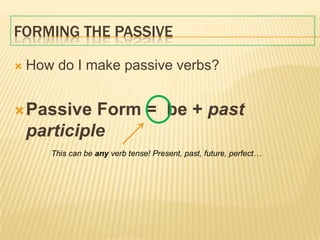
 How do I make passive verbs?
Passive Form = be + past
participle
This can be any verb tense! Present, past, future, perfect…
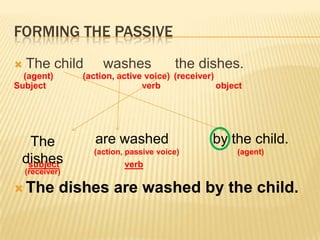
 The child washes the dishes.
(agent) (action, active voice) (receiver)
Subject verb object
subject verb
 The dishes are washed by the child.
FORMING THE PASSIVE
The
dishes
(receiver)
are washed
(action, passive voice)
by the child.
(agent)
TRANSITIVE VERBS
 The passive voice can only be used with
transitive verbs.
 These are verbs that have an object.
We can’t find the answers.
(subject) (verb) (object)
James didn’t enjoy the party.
(subject) (verb) (object)
The Marlins have built a house.
(subject) (verb) (object)
INTRANSITIVE VERBS
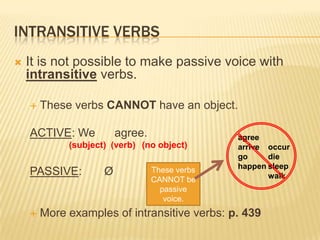
 It is not possible to make passive voice with
intransitive verbs.
 These verbs CANNOT have an object.
ACTIVE: We agree.
(subject) (verb) (no object)
PASSIVE: Ø
 More examples of intransitive verbs: p. 439
agree
arrive
go
happen
occur
die
sleep
walk
These verbs
CANNOT be
passive
voice.

Forming the passive

  • 1.
    CHAPTER 11: THEPASSIVE VOICE Writing 5
  • 2.
    FIRST: ACTIVE VOICE The child washes the dishes. subject verb object  We are learning English. subject verb object  The boy has kicked the ball. subject verb object
  • 3.
    PARTS OF THESENTENCE  The child washes the dishes. S V O What’s the action? wash Who does the action? What “gets” the action? The child the dishes We’ll call this the receive r. We’ll call this the agent.
  • 4.
    FORMING THE PASSIVE How do I make passive verbs? Passive Form = be + past participle This can be any verb tense! Present, past, future, perfect…
  • 5.
     The childwashes the dishes. (agent) (action, active voice) (receiver) Subject verb object subject verb  The dishes are washed by the child. FORMING THE PASSIVE The dishes (receiver) are washed (action, passive voice) by the child. (agent)
  • 6.
    TRANSITIVE VERBS  Thepassive voice can only be used with transitive verbs.  These are verbs that have an object. We can’t find the answers. (subject) (verb) (object) James didn’t enjoy the party. (subject) (verb) (object) The Marlins have built a house. (subject) (verb) (object)
  • 7.
    INTRANSITIVE VERBS  Itis not possible to make passive voice with intransitive verbs.  These verbs CANNOT have an object. ACTIVE: We agree. (subject) (verb) (no object) PASSIVE: Ø  More examples of intransitive verbs: p. 439 agree arrive go happen occur die sleep walk These verbs CANNOT be passive voice.