Exploiting
Academic Vocabulary
Katie Mansfield & Richard Paterson
Lexical Approach Conference – Saturday 11th May, 13:45
Overview
1. AWL
2. Shortfall between IELTS vocab and Academic vocab
3. Specialist Language and AWL
4. Practical suggestions
1. Academic Word List (AWL) (i)
 Compiled from corpus of 3.5 million words of written
academic texts
 570 word families (10% of total words in academic texts)
 Arranged into 10 sublists
 Reflect word frequency & range
(Coxhead 2000)
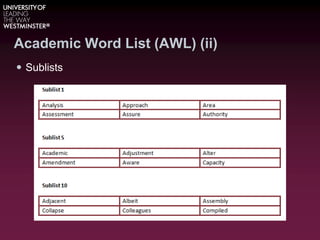
Academic Word List (AWL) (ii)
 Sublists
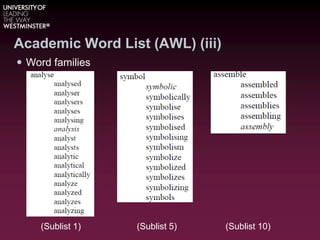
Academic Word List (AWL) (iii)
 Word families
(Sublist 1) (Sublist 5) (Sublist 10)
Academic Word List (AWL) (iv)
Advantages
1. Words students need in wide range of academic texts
2. Exercises incorporated into Academic English lessons
3. Free online sources available (PC & Smartphone):
Flashcard maker
http://orangeorapple.com/Flashcards/Default.aspx
Exercises
http://www.englishvocabularyexercises.com/
Test maker
http://www.phonetain.com/Phonetain_Software/Products.htm
AWL highlighter
http://www.nottingham.ac.uk/alzsh3/acvocab/awlhighlighter.htm
Academic Word List (AWL) (v)
Disadvantages
1. Created in year 2000. Need updating?
2. No focus on collocations (Durrant 2009)
3. Does not address discipline-specific vocabulary (Martinez
et al 2009)
2. Shortfall between IELTS & Academic vocab
 ‘Important’ vocabulary not necessarily of high academic
value
 Descriptive rather than analytical
 Judgements of validity not taken into account
3. Specialist Language & AWL
Typical Academic Vocab Areas
 Differences between formal academic language and
everyday language
 Phrases to refer to sources and to paraphrase or quote
 Vocabulary to organise texts
 Word building with Latin affixes
 Words with Greek and Latin roots
 TECHNICAL academic vocabulary normally has a field
specific meaning
 Abstract academic vocabulary can be described as
referring to terms to do with meaning and thinking such as
idea, concept, theory; or to non-specific concepts e.g.
problem
 “Parts of British HIGHER EDUCATION are
PEDAGOGICALLY constrained by the marketisation that
has accompanied its expansion”
 Acquisition of abstract academic vocabulary is a strong
indicator of how well students learn subject specific content
(Stahl & Nagy 2006; Marzano & Pickering 2005)
Practical suggestions (i)
 Problem: Does not address discipline-specific vocabulary
 Solution: Create a discipline – specific wordlist.
 What needed?
Discipline-specific texts.
Concordance software programme e.g. Antconc (free),
Sketch engine, Wordsmith Tools.
Time
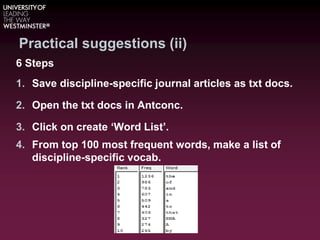
Practical suggestions (ii)
6 Steps
1. Save discipline-specific journal articles as txt docs.
2. Open the txt docs in Antconc.
3. Click on create ‘Word List’.
4. From top 100 most frequent words, make a list of
discipline-specific vocab.
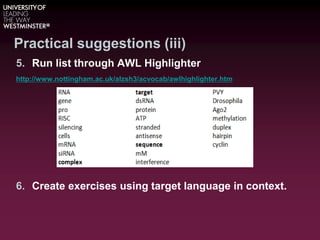
Practical suggestions (iii)
5. Run list through AWL Highlighter
http://www.nottingham.ac.uk/alzsh3/acvocab/awlhighlighter.htm
6. Create exercises using target language in context.
Practical suggestions (iv)
Once at home, students can:
1. Carry out discipline-specific exercises.
2. Write definition of key words to include in Module
dictionary.
3. See how words work by accessing online tools e.g.
Word tree http://wordtree.coventry.ac.uk/?BAWE
BNC http://corpus.byu.edu/bnc/
List of references
• Coxhead, A. (2000). A New Academic Word List. TESOL Quarterly , 213-238.
• Durrant, P. (2009). Investigating the viability of a collocation list for students of English
for academic purposes. English for Specific Purposes , 157-169.
• Martinez, I. A., Beck, S. C., & Panza, C. B. (2009). Academic vocabulary in agriculture
research articles: A corpus-based study. English for Specific Purposes , 183-198.
• Marzano, R., & Pickering, D. (2005). Building academic vocabulary: Teacher’s Manual.
Arlington, VA: Association for Supervision and Curriculum Development.
• Stahl, S., & Nagy, W. (2006). Teaching word meanings. Mahwah, NJ: Lawrence
Erlbaum Associates.
Contact details:
Katie Mansfield – k.mansfield@westminster.ac.uk
Richard Paterson – r.paterson@westminster.ac.uk

Exploiting academic vocabulary 11th may 2013

  • 1.
    Exploiting Academic Vocabulary Katie Mansfield& Richard Paterson Lexical Approach Conference – Saturday 11th May, 13:45
  • 2.
    Overview 1. AWL 2. Shortfallbetween IELTS vocab and Academic vocab 3. Specialist Language and AWL 4. Practical suggestions
  • 3.
    1. Academic WordList (AWL) (i)  Compiled from corpus of 3.5 million words of written academic texts  570 word families (10% of total words in academic texts)  Arranged into 10 sublists  Reflect word frequency & range (Coxhead 2000)
  • 4.
    Academic Word List(AWL) (ii)  Sublists
  • 5.
    Academic Word List(AWL) (iii)  Word families (Sublist 1) (Sublist 5) (Sublist 10)
  • 6.
    Academic Word List(AWL) (iv) Advantages 1. Words students need in wide range of academic texts 2. Exercises incorporated into Academic English lessons 3. Free online sources available (PC & Smartphone): Flashcard maker http://orangeorapple.com/Flashcards/Default.aspx Exercises http://www.englishvocabularyexercises.com/ Test maker http://www.phonetain.com/Phonetain_Software/Products.htm AWL highlighter http://www.nottingham.ac.uk/alzsh3/acvocab/awlhighlighter.htm
  • 7.
    Academic Word List(AWL) (v) Disadvantages 1. Created in year 2000. Need updating? 2. No focus on collocations (Durrant 2009) 3. Does not address discipline-specific vocabulary (Martinez et al 2009)
  • 8.
    2. Shortfall betweenIELTS & Academic vocab  ‘Important’ vocabulary not necessarily of high academic value  Descriptive rather than analytical  Judgements of validity not taken into account
  • 9.
    3. Specialist Language& AWL Typical Academic Vocab Areas  Differences between formal academic language and everyday language  Phrases to refer to sources and to paraphrase or quote  Vocabulary to organise texts  Word building with Latin affixes  Words with Greek and Latin roots
  • 10.
     TECHNICAL academicvocabulary normally has a field specific meaning  Abstract academic vocabulary can be described as referring to terms to do with meaning and thinking such as idea, concept, theory; or to non-specific concepts e.g. problem  “Parts of British HIGHER EDUCATION are PEDAGOGICALLY constrained by the marketisation that has accompanied its expansion”  Acquisition of abstract academic vocabulary is a strong indicator of how well students learn subject specific content (Stahl & Nagy 2006; Marzano & Pickering 2005)
  • 11.
    Practical suggestions (i) Problem: Does not address discipline-specific vocabulary  Solution: Create a discipline – specific wordlist.  What needed? Discipline-specific texts. Concordance software programme e.g. Antconc (free), Sketch engine, Wordsmith Tools. Time
  • 12.
    Practical suggestions (ii) 6Steps 1. Save discipline-specific journal articles as txt docs. 2. Open the txt docs in Antconc. 3. Click on create ‘Word List’. 4. From top 100 most frequent words, make a list of discipline-specific vocab.
  • 13.
    Practical suggestions (iii) 5.Run list through AWL Highlighter http://www.nottingham.ac.uk/alzsh3/acvocab/awlhighlighter.htm 6. Create exercises using target language in context.
  • 14.
    Practical suggestions (iv) Onceat home, students can: 1. Carry out discipline-specific exercises. 2. Write definition of key words to include in Module dictionary. 3. See how words work by accessing online tools e.g. Word tree http://wordtree.coventry.ac.uk/?BAWE BNC http://corpus.byu.edu/bnc/
  • 15.
    List of references •Coxhead, A. (2000). A New Academic Word List. TESOL Quarterly , 213-238. • Durrant, P. (2009). Investigating the viability of a collocation list for students of English for academic purposes. English for Specific Purposes , 157-169. • Martinez, I. A., Beck, S. C., & Panza, C. B. (2009). Academic vocabulary in agriculture research articles: A corpus-based study. English for Specific Purposes , 183-198. • Marzano, R., & Pickering, D. (2005). Building academic vocabulary: Teacher’s Manual. Arlington, VA: Association for Supervision and Curriculum Development. • Stahl, S., & Nagy, W. (2006). Teaching word meanings. Mahwah, NJ: Lawrence Erlbaum Associates.
  • 16.
    Contact details: Katie Mansfield– k.mansfield@westminster.ac.uk Richard Paterson – r.paterson@westminster.ac.uk