Corporación Educativa
                                                 Colegio Internacional Cartagena
                                                                CLASE

                        Versión         01-11          Código      FO-DC-01   Página
                                                                                         1 de 5


  Área:              Idiomas               Asignatura:          Inglés               Curso:       4,5
  Fecha:             9/04/12          Periodo:     I            Nº Horas:     9hr    Semana:      9
  Docente:           Evelin Trinidad Peña Jerez
  Tema:              Simple present-Habitual Actions
  Indicador          Identify the simple present tense in habitual situations.
  de Logro


          Exploración             Use the simple present tense in habitual situations.
          Contextualización
                                                   Simple Present

           The Simple Present is used to make statements about the present time. It is used in the
           following ways.

           - Permanent facts: These sentences give facts which are always true.
           It is cold in winter. - The sun shines. - Fish live in water.

           - Present facts: These sentences are true now.
           I work at home. - She plays the piano.
           "I work at home" doesn't mean I am working right now, but it does mean that in my
           present condition I work at home.

           - Habitual actions: I get up at 8.00. - They come here every day.
           These actions are repeated regularly, so they are considered a present reality and are
EMOCIÓN


           expressed in the Simple Present.

           Simple Present Negatives

           Simple Present negatives and questions are used in the same situations as Simple
           Present statements: for permanent facts, present fact, and habitual actions.

           - Permanent facts: I do not speak Japanese. - Fish do not live in water.

           - Present facts: I do not work at home. - She does not play the piano.

           - Habitual actions: I do not get up at 8.00. - They do not come here every day.

           Simple Present Questions

           To make a Simple Present Questions you put do or does before the subject. For example:
           - Statement: I speak Japanese.
           - Questions: Do I speak Japanese?
           - Statement: She likes pizza.
           - Questions: Does she like pizza?
           As with negatives, the verb after do or does (and the subject) is always in the bare
Corporación Educativa
                                     Colegio Internacional Cartagena
                                                  CLASE

            Versión          01-11       Código        FO-DC-01     Página
                                                                                2 de 5


infinitive form. It is the auxiliary verb "to do", do or does, which changes.

Adverbs of Frequency

Adverbs of frequency show how often something happens. For example: "I always brush
my teeth" means I brush my teeth every day

Adverbs

Always - He always eats breakfast.
Usually - He usually eats breakfast.
Often - He often eats breakfast.
Sometimes - He sometimes eats breakfast.
Never - He never eats breakfast.

For infrequent events we can use:

Don't usually - He doesn't usually eat breakfast.

Adverb Position

Adverb position varies greatly in English. However as a general rule, adverbs of
frequency come before the main verb. For example:

These are correct: "sometimes" comes before the main verb "play"
- We sometimes play sports.
- We don't often play sports.

Spelling Rules for the Present Simple

If you look above you'll see the spelling doesn't change, except for the third person
singular (He, She, It) which adds an "s" to the verb. For example "I eat - He eats".

Sometimes other spelling rules also apply to He, She and It. All the following verbs add
"es" instead of "s":

. Verb Endings

Verbs ending in -o add -es

Verbs ending in -s add -es

Verbs ending in -x add -es

Verbs ending in -ch add -es

Verbs ending in -sh add -es
Corporación Educativa
                                       Colegio Internacional Cartagena
                                                     CLASE

              Versión         01-11        Código        FO-DC-01      Página
                                                                                3 de 5


 Verbs ending in a consonant and -y often change the -y to -ies:

 Verbs such as "buy" have no consonant before the "y", so you simply add -s
 as usual.

 Spelling Examples

 do - does, go - goes

 pass - passes, kiss - kisses

 fix - fixes, mix - mixes

 match - matches, catch - catches

 push - pushes, rush - rushes

 try - tries, cry – cries

 buy - buys, pay - pays.
Conceptualización


 Dialogues - Everyday Conversations

 Conversation 1:

 Hi, how are you today?

 Fine, thanks.

 Do you have English class?

 Yes, I have English class. It's very interesting.

 Your English is good. Do you understand the teacher?

 Well, yes, I understand. English is difficult, but I learn quickly.

 Well done!

 Conversation 2:

 Tyler, do you have a hobby?

 Sure, I read books.
Corporación Educativa
                                               Colegio Internacional Cartagena
                                                           CLASE

                      Versión          01-11      Código       FO-DC-01    Página
                                                                                        4 de 5


          Oh, I like books as well. Do you watch TV?

          Yes, I watch TV every day. I like drama and comedy programs.

          I like the news. And I go to the gym as well.

          Me too! Let's go together.

          That sounds great!


         Producción

         Present Simple Tense
         Write the correct form of the verb in each sentence.
         1. John ______________ (play/plays) soccer.
         2. They ______________ (don’t/doesn’t) study after school.
         3. We _______________ (take/takes) the metro to the office every day.
         4. What ___________ (do/does) you want to study?
         5. On Tuesdays, I _________ (go/goes) to the mall.
         6. Terry ___________ (play/plays) soccer; he _________________ (practice/practices)
         every day.
         7. ____________ (Do/Does) Lucy ride her bike to school, or ___________ (do/does) she
         take the bus?
         8. On Sunday, he ____________ (don’t/doesn’t) read the newspaper.
         9. Where _____________ (do/does) they work?
         10. How ____________ (do/does) you spell your name?
         Modelación
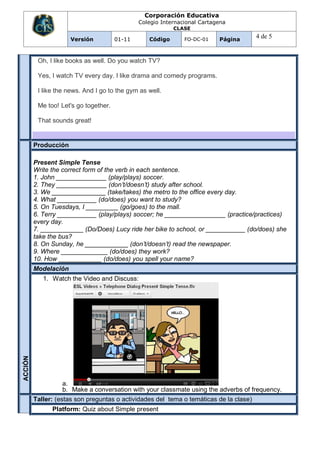
            1. Watch the Video and Discuss:
ACCIÓN


                   a.
                   b. Make a conversation with your classmate using the adverbs of frequency.
         Taller: (estas son preguntas o actividades del tema o temáticas de la clase)
         ON
         UA
         EV
         AL

         CI


               Platform: Quiz about Simple present
Corporación Educativa
                                    Colegio Internacional Cartagena
                                                  CLASE

             Versión       01-11        Código       FO-DC-01   Página
                                                                         5 de 5


Lectura Complementaria :

      -Platform presentations about the topics.
Bibliografía :
English page Free online English lessons & ESL / EFL resources

Formato de clase 4y 5 simple present

  • 1.
    Corporación Educativa Colegio Internacional Cartagena CLASE Versión 01-11 Código FO-DC-01 Página 1 de 5 Área: Idiomas Asignatura: Inglés Curso: 4,5 Fecha: 9/04/12 Periodo: I Nº Horas: 9hr Semana: 9 Docente: Evelin Trinidad Peña Jerez Tema: Simple present-Habitual Actions Indicador Identify the simple present tense in habitual situations. de Logro Exploración Use the simple present tense in habitual situations. Contextualización Simple Present The Simple Present is used to make statements about the present time. It is used in the following ways. - Permanent facts: These sentences give facts which are always true. It is cold in winter. - The sun shines. - Fish live in water. - Present facts: These sentences are true now. I work at home. - She plays the piano. "I work at home" doesn't mean I am working right now, but it does mean that in my present condition I work at home. - Habitual actions: I get up at 8.00. - They come here every day. These actions are repeated regularly, so they are considered a present reality and are EMOCIÓN expressed in the Simple Present. Simple Present Negatives Simple Present negatives and questions are used in the same situations as Simple Present statements: for permanent facts, present fact, and habitual actions. - Permanent facts: I do not speak Japanese. - Fish do not live in water. - Present facts: I do not work at home. - She does not play the piano. - Habitual actions: I do not get up at 8.00. - They do not come here every day. Simple Present Questions To make a Simple Present Questions you put do or does before the subject. For example: - Statement: I speak Japanese. - Questions: Do I speak Japanese? - Statement: She likes pizza. - Questions: Does she like pizza? As with negatives, the verb after do or does (and the subject) is always in the bare
  • 2.
    Corporación Educativa Colegio Internacional Cartagena CLASE Versión 01-11 Código FO-DC-01 Página 2 de 5 infinitive form. It is the auxiliary verb "to do", do or does, which changes. Adverbs of Frequency Adverbs of frequency show how often something happens. For example: "I always brush my teeth" means I brush my teeth every day Adverbs Always - He always eats breakfast. Usually - He usually eats breakfast. Often - He often eats breakfast. Sometimes - He sometimes eats breakfast. Never - He never eats breakfast. For infrequent events we can use: Don't usually - He doesn't usually eat breakfast. Adverb Position Adverb position varies greatly in English. However as a general rule, adverbs of frequency come before the main verb. For example: These are correct: "sometimes" comes before the main verb "play" - We sometimes play sports. - We don't often play sports. Spelling Rules for the Present Simple If you look above you'll see the spelling doesn't change, except for the third person singular (He, She, It) which adds an "s" to the verb. For example "I eat - He eats". Sometimes other spelling rules also apply to He, She and It. All the following verbs add "es" instead of "s": . Verb Endings Verbs ending in -o add -es Verbs ending in -s add -es Verbs ending in -x add -es Verbs ending in -ch add -es Verbs ending in -sh add -es
  • 3.
    Corporación Educativa Colegio Internacional Cartagena CLASE Versión 01-11 Código FO-DC-01 Página 3 de 5 Verbs ending in a consonant and -y often change the -y to -ies: Verbs such as "buy" have no consonant before the "y", so you simply add -s as usual. Spelling Examples do - does, go - goes pass - passes, kiss - kisses fix - fixes, mix - mixes match - matches, catch - catches push - pushes, rush - rushes try - tries, cry – cries buy - buys, pay - pays. Conceptualización Dialogues - Everyday Conversations Conversation 1: Hi, how are you today? Fine, thanks. Do you have English class? Yes, I have English class. It's very interesting. Your English is good. Do you understand the teacher? Well, yes, I understand. English is difficult, but I learn quickly. Well done! Conversation 2: Tyler, do you have a hobby? Sure, I read books.
  • 4.
    Corporación Educativa Colegio Internacional Cartagena CLASE Versión 01-11 Código FO-DC-01 Página 4 de 5 Oh, I like books as well. Do you watch TV? Yes, I watch TV every day. I like drama and comedy programs. I like the news. And I go to the gym as well. Me too! Let's go together. That sounds great! Producción Present Simple Tense Write the correct form of the verb in each sentence. 1. John ______________ (play/plays) soccer. 2. They ______________ (don’t/doesn’t) study after school. 3. We _______________ (take/takes) the metro to the office every day. 4. What ___________ (do/does) you want to study? 5. On Tuesdays, I _________ (go/goes) to the mall. 6. Terry ___________ (play/plays) soccer; he _________________ (practice/practices) every day. 7. ____________ (Do/Does) Lucy ride her bike to school, or ___________ (do/does) she take the bus? 8. On Sunday, he ____________ (don’t/doesn’t) read the newspaper. 9. Where _____________ (do/does) they work? 10. How ____________ (do/does) you spell your name? Modelación 1. Watch the Video and Discuss: ACCIÓN a. b. Make a conversation with your classmate using the adverbs of frequency. Taller: (estas son preguntas o actividades del tema o temáticas de la clase) ON UA EV AL CI Platform: Quiz about Simple present
  • 5.
    Corporación Educativa Colegio Internacional Cartagena CLASE Versión 01-11 Código FO-DC-01 Página 5 de 5 Lectura Complementaria : -Platform presentations about the topics. Bibliografía : English page Free online English lessons & ESL / EFL resources