
International School
                                                                  Cartagena
                                                                      CLASE

                           Versión        00-12           Código         FO-DC-01    Página        1 de 5

Área:                 English               Asignatura:           English                Curso:          10th
Fecha:                04 al 10 -03          Periodo:        I     Nº Hor:       12hr     Semana:         7
Tema:                 Phrasalverbs
Indicador             Students will be able to use the phrasal verbs
de Logro


          Exploración
          Contextualización


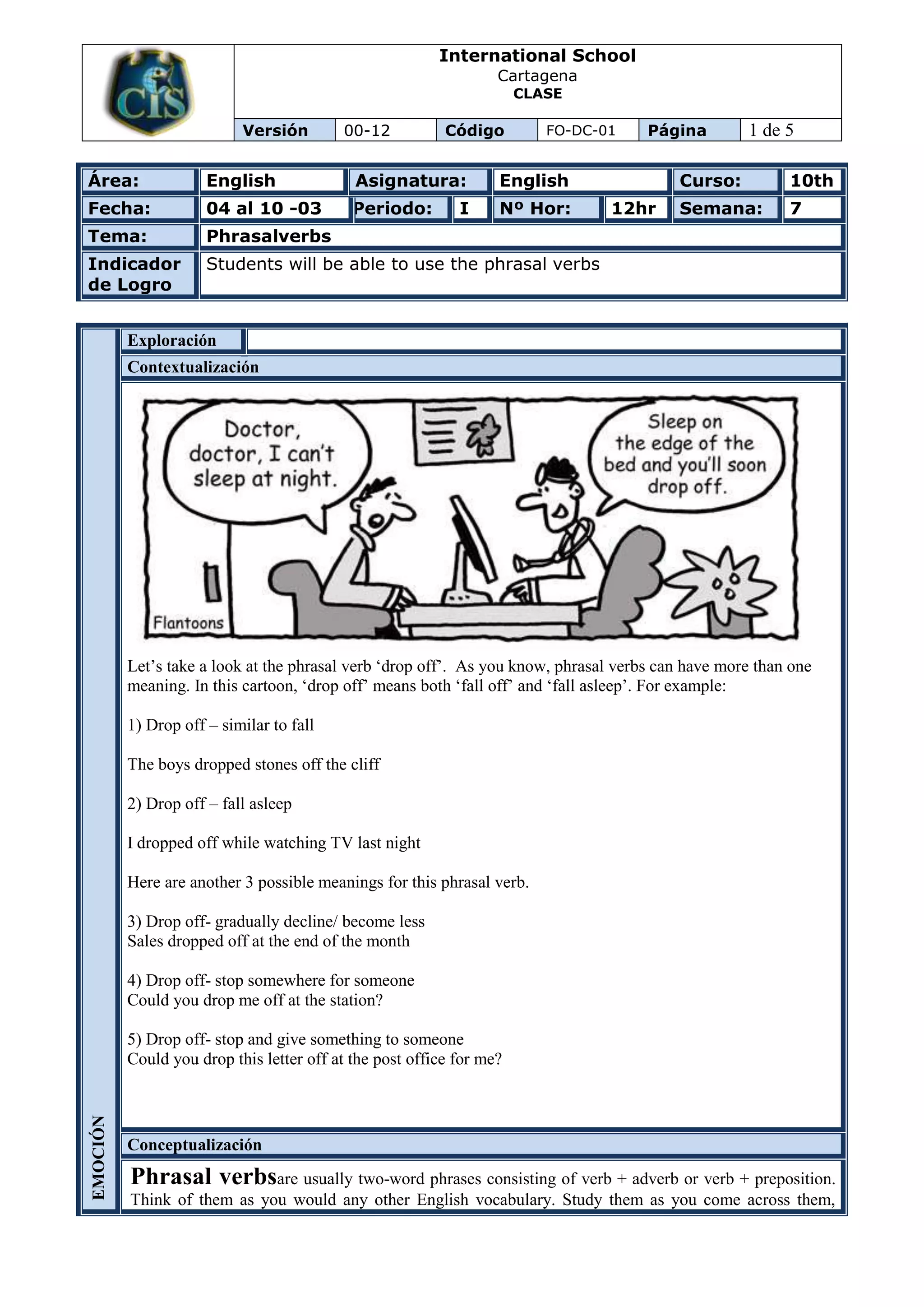
          Let‟s take a look at the phrasal verb „drop off‟. As you know, phrasal verbs can have more than one
          meaning. In this cartoon, „drop off‟ means both „fall off‟ and „fall asleep‟. For example:

          1) Drop off – similar to fall

          The boys dropped stones off the cliff

          2) Drop off – fall asleep

          I dropped off while watching TV last night

          Here are another 3 possible meanings for this phrasal verb.

          3) Drop off- gradually decline/ become less
          Sales dropped off at the end of the month

          4) Drop off- stop somewhere for someone
          Could you drop me off at the station?

          5) Drop off- stop and give something to someone
          Could you drop this letter off at the post office for me?
EMOCIÓN


          Conceptualización
          Phrasal verbsare usually two-word phrases consisting of verb + adverb or verb + preposition.
          Think of them as you would any other English vocabulary. Study them as you come across them,
International School
                                                                    Cartagena
                                                                     CLASE

                           Versión         00-12          Código             FO-DC-01     Página           2 de 5

         rather than trying to memorize many at once. Use the list below as a reference guide when you find an
         expression that you don't recognize. The examples will help you understand the meanings. If you think
         of each phrasal verb as a separate verb with a specific meaning, you will be able to remember it more
         easily. Like many other verbs, phrasal verbs often have more than one meaning.
         Producción
         Phrasal verbsare mainly used in spoken English and informal texts. (The more formal a
         conversation or text, the less phrasal verbs are found.)

         Phrasal verbs consist of a verb plus a particle (preposition, adverb). The particle can change the
         meaning of the verb completely, e.g.:

         look up – consult a reference book (look a word up in a dictionary)
         look for – seek (look for her ring)
         look forward – anticipate with pleasure (look forward to meeting someone)

         There are no rules that might explain how phrasal verbs are formed correctly - all you can do is look
         them up in a good dictionary and study their meanings. In our lists, you will find some frequently used
         phrasal verbs and their meanings.

         Frequently Used Phrasal Verbs with:

         break, bring, call, carry, come, do, fall, get, go, keep, look, make, put, run, set, take, turn

         Position of the Particle

         The particle is placed either after the verb or after the object.

         Example:
         Write down the word. / Write the word down.
         If the object is a pronoun, however, the particle has to be placed after the pronoun (object).

         Example:
         Writeitdown.
         Modelación
         Idiomatic usage

         It is, however, the figurative or idiomatic application in everyday speech which makes phrasal verbs so
         important:

         "I hope you will get over your operation quickly."
         The literal meaning of “to get over”, in the sense of “to climb over something to get to the other side”,
         is not relevant here. Here "get over" means "recover from" or "feel better".

         PHRASAL VERBS

         Transitive and intransitive phrasal verbs
ACCIÓN


         Phrasal verbs also differ in their transitivity or intransitivity in the same way as normal verbs do. A
         transitive verb always has an object.

         For example:-
International School
                                                                      Cartagena
                                                                       CLASE

                               Versión       00-12           Código          FO-DC-01      Página         3 de 5


             “Many people walked across the bridge.”
             "Across" in this sentence is the preposition to "the bridge".

             An intransitive verb does not have an object.

             For example:-

             “When I entered the room he looked up.”
             "Up" here is an adverb, and does not have an object.


             Separable or inseparable phrasal verbs

             A further way of considering phrasal verbs is whether they are separable or inseparable. In inseparable
             verbs, the object comes after the particle.

             For example:-

             "She got on the bus ."
             "On weekdays, we look after our grandchildren."
             Separable verbs have several ways of separating verb, particle and object. Usually, the object comes
             between verb and particle.

             For example:-

             "She looked up the word in her dictionary."
             "She looked it up in her dictionary."
             However, with some separable verbs, the object can come before or after the particle.

             For example:-

             "Switch the light off."
             "Switch off the light."
             "Switch it off."
             !Note - There is usually no way of telling whether they are separable, inseparable, transitive or
             intransitive. In most cases you have to get a feel for them.


             Taller
             Choose the correct definition for each phrasal verb...

             'Get along' means...

                 a. Leave
                 b. Make great progress
EVALUACION


                 c. Make a quick visit

             'Eat into' means...

                 a. Laugh, cry or clap loudly
                 b. Deal with something
International School
                                                    Cartagena
                                                          CLASE

                  Versión     00-12          Código          FO-DC-01     Página      4 de 5

    c. Use something valuable when you don't want to
'
Freeze over' means...

    a. Pass for or serve as
    b. Become covered with ice (lake, river, pond, etc)
    c. Remove small problems or irregularities

'Lash out against' means...

    a. Return somewhere
    b. Criticise something strongly
    c. Be elected

'Stick out' means...

    a. Extend part of your body
    b. Be friendly and spend time with someone
    c. Smarten up, improve
'

Plant out' means...

    a. Criticise someone strongly
    b. Reduce the price of something
    c. Put a young plant that has been grown in a pot or greenhouse into the ground
'
Throw out' means...

    a. Appear in court charged with a crime or offence
    b. Get money off someone
    c. Dislocate
'
Fly into' means...

    a. Accelerate rapidly from stationary
    b. Do something that should have been done earlier
    c. Change emotion quickly
'
Keep to' means...

    a. Live with someone when you are in a relationship.
    b. Make a mistake, do badly, spoil
    c. Stay within limits

'Zoom out' means...

    a. Focus less closely
    b. Make someone appear in court
    c. Enter computer data or text
Bibliografía
International School
                                                   Cartagena
                                                     CLASE

               Versión       00-12          Código        FO-DC-01      Página        5 de 5

I.     Understanding and using grammar (1999). Third edition. Betty SchrampferAzar.

II.    The big picture (2011). Santillana Education. S.L Richmond Publishing.

III.   Top Notch (2011). Second Edition, Student book. Pearson Education, Inc.

Formato plano 10th week7_phra_verbs

  • 1.
    International School Cartagena CLASE Versión 00-12 Código FO-DC-01 Página 1 de 5 Área: English Asignatura: English Curso: 10th Fecha: 04 al 10 -03 Periodo: I Nº Hor: 12hr Semana: 7 Tema: Phrasalverbs Indicador Students will be able to use the phrasal verbs de Logro Exploración Contextualización Let‟s take a look at the phrasal verb „drop off‟. As you know, phrasal verbs can have more than one meaning. In this cartoon, „drop off‟ means both „fall off‟ and „fall asleep‟. For example: 1) Drop off – similar to fall The boys dropped stones off the cliff 2) Drop off – fall asleep I dropped off while watching TV last night Here are another 3 possible meanings for this phrasal verb. 3) Drop off- gradually decline/ become less Sales dropped off at the end of the month 4) Drop off- stop somewhere for someone Could you drop me off at the station? 5) Drop off- stop and give something to someone Could you drop this letter off at the post office for me? EMOCIÓN Conceptualización Phrasal verbsare usually two-word phrases consisting of verb + adverb or verb + preposition. Think of them as you would any other English vocabulary. Study them as you come across them,
  • 2.
    International School Cartagena CLASE Versión 00-12 Código FO-DC-01 Página 2 de 5 rather than trying to memorize many at once. Use the list below as a reference guide when you find an expression that you don't recognize. The examples will help you understand the meanings. If you think of each phrasal verb as a separate verb with a specific meaning, you will be able to remember it more easily. Like many other verbs, phrasal verbs often have more than one meaning. Producción Phrasal verbsare mainly used in spoken English and informal texts. (The more formal a conversation or text, the less phrasal verbs are found.) Phrasal verbs consist of a verb plus a particle (preposition, adverb). The particle can change the meaning of the verb completely, e.g.: look up – consult a reference book (look a word up in a dictionary) look for – seek (look for her ring) look forward – anticipate with pleasure (look forward to meeting someone) There are no rules that might explain how phrasal verbs are formed correctly - all you can do is look them up in a good dictionary and study their meanings. In our lists, you will find some frequently used phrasal verbs and their meanings. Frequently Used Phrasal Verbs with: break, bring, call, carry, come, do, fall, get, go, keep, look, make, put, run, set, take, turn Position of the Particle The particle is placed either after the verb or after the object. Example: Write down the word. / Write the word down. If the object is a pronoun, however, the particle has to be placed after the pronoun (object). Example: Writeitdown. Modelación Idiomatic usage It is, however, the figurative or idiomatic application in everyday speech which makes phrasal verbs so important: "I hope you will get over your operation quickly." The literal meaning of “to get over”, in the sense of “to climb over something to get to the other side”, is not relevant here. Here "get over" means "recover from" or "feel better". PHRASAL VERBS Transitive and intransitive phrasal verbs ACCIÓN Phrasal verbs also differ in their transitivity or intransitivity in the same way as normal verbs do. A transitive verb always has an object. For example:-
  • 3.
    International School Cartagena CLASE Versión 00-12 Código FO-DC-01 Página 3 de 5 “Many people walked across the bridge.” "Across" in this sentence is the preposition to "the bridge". An intransitive verb does not have an object. For example:- “When I entered the room he looked up.” "Up" here is an adverb, and does not have an object. Separable or inseparable phrasal verbs A further way of considering phrasal verbs is whether they are separable or inseparable. In inseparable verbs, the object comes after the particle. For example:- "She got on the bus ." "On weekdays, we look after our grandchildren." Separable verbs have several ways of separating verb, particle and object. Usually, the object comes between verb and particle. For example:- "She looked up the word in her dictionary." "She looked it up in her dictionary." However, with some separable verbs, the object can come before or after the particle. For example:- "Switch the light off." "Switch off the light." "Switch it off." !Note - There is usually no way of telling whether they are separable, inseparable, transitive or intransitive. In most cases you have to get a feel for them. Taller Choose the correct definition for each phrasal verb... 'Get along' means... a. Leave b. Make great progress EVALUACION c. Make a quick visit 'Eat into' means... a. Laugh, cry or clap loudly b. Deal with something
  • 4.
    International School Cartagena CLASE Versión 00-12 Código FO-DC-01 Página 4 de 5 c. Use something valuable when you don't want to ' Freeze over' means... a. Pass for or serve as b. Become covered with ice (lake, river, pond, etc) c. Remove small problems or irregularities 'Lash out against' means... a. Return somewhere b. Criticise something strongly c. Be elected 'Stick out' means... a. Extend part of your body b. Be friendly and spend time with someone c. Smarten up, improve ' Plant out' means... a. Criticise someone strongly b. Reduce the price of something c. Put a young plant that has been grown in a pot or greenhouse into the ground ' Throw out' means... a. Appear in court charged with a crime or offence b. Get money off someone c. Dislocate ' Fly into' means... a. Accelerate rapidly from stationary b. Do something that should have been done earlier c. Change emotion quickly ' Keep to' means... a. Live with someone when you are in a relationship. b. Make a mistake, do badly, spoil c. Stay within limits 'Zoom out' means... a. Focus less closely b. Make someone appear in court c. Enter computer data or text Bibliografía
  • 5.
    International School Cartagena CLASE Versión 00-12 Código FO-DC-01 Página 5 de 5 I. Understanding and using grammar (1999). Third edition. Betty SchrampferAzar. II. The big picture (2011). Santillana Education. S.L Richmond Publishing. III. Top Notch (2011). Second Edition, Student book. Pearson Education, Inc.