International School
                                                       Cartagena
                                                         CLASE

                         Versión    00-12       Código      FO-DC-01      Página       1 de 9

Área:               English           Asignatura:      English                Curso:        9th
Fecha:              28 al 03-02      Periodo:     I    Nº Hor:         12hr   Semana:       2
Tema:               Verb tenses review
Indicador           Students will be able to identify and use the different verb tenses.
de Logro


          Exploración     identify and use the different verb tenses
          Contextualización
EMOCIÓN


          Conceptualización
International School
                                    Cartagena
                                        CLASE

             Versión   00-12   Código      FO-DC-01   Página   2 de 9


Ó
A
C
C


N


Producción
I
International School
                       Cartagena
                           CLASE

Versión   00-12   Código      FO-DC-01   Página   3 de 9
International School
                       Cartagena
                           CLASE

Versión   00-12   Código      FO-DC-01   Página   4 de 9
International School
                                       Cartagena
                                          CLASE

             Versión   00-12     Código      FO-DC-01   Página    5 de 9


Modelación
                       Verb Forms and Verb Tenses
                                 Overview
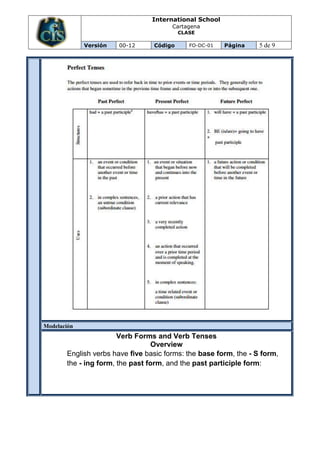
       English verbs have five basic forms: the base form, the - S form,
       the - ing form, the past form, and the past participle form:
International School
                                        Cartagena
                                          CLASE

     Versión      00-12         Código         FO-DC-01    Página   6 de 9

1.    the base (or simple) form

      For all verbs except BE, the base form is the
      verb with "no special ending" (no - s, - ing,
      - ed, etc.).

2.    the - S (or third-person singular,
      present tense) form

      For BE, this form is is and for have, it's has.
      For other verbs, the - S form is the verb + - s or
      - es.

      Note: For some verbs enging in y, y --> - i + es.

3.    the - ing (or present participle) form

      For many verbs, this form is the verb + - ing.
      For some verbs, the last consonant must be
      doubled in order to form the -ing form correctly.
      For verbs which end in a consonant + -e,
      the -e is dropped.

4.    the past form

      For many verbs (regular verbs), this form
      is the verb + - d or - ed; for some verbs ending
      in y, y --> i + ed.

      For many other verbs (irregular verbs), the past
      form may resemble the base form with "internal
      changes" (for example, do / did; took / take;
      see / saw) or be the same as the base form
      (for example, cut / cut; cost / cost; put / put).
      In a few cases, the past form may look quite
      different from the base form (for example,
      go / went and buy / bought).
International School
                                                 Cartagena
                                                   CLASE

              Versión      00-12          Código        FO-DC-01      Página   7 de 9

         5.    the past participle form

               For regular verbs, this form is the same as the
               past form. For irregular verbs, this form often
               has "internal changes" (for example, do / did / done;
               go / went / gone; see / saw / seen), but the past
               participle may be the same as the base form and / or
               the past form (for example, cost / cost / cost;
               set / set / set; pay / paid / paid; sell / sold / sold).
V
A

U
A


O
N
C
E


L


Taller
I
International School
                                                   Cartagena
                                                      CLASE

               Versión        00-12         Código        FO-DC-01       Página       8 de 9


Bibliografía
I.     Understanding and using grammar (1999). Third edition. Betty SchrampferAzar.

II.    The big picture (2011). Santillana Education. S.L Richmond Publishing.

III.   Top Notch (2011). Second Edition, Student book. Pearson Education, Inc.
International School
                       Cartagena
                           CLASE

Versión   00-12   Código      FO-DC-01   Página   9 de 9

Formato plano 9th week2_verb_tens

  • 1.
    International School Cartagena CLASE Versión 00-12 Código FO-DC-01 Página 1 de 9 Área: English Asignatura: English Curso: 9th Fecha: 28 al 03-02 Periodo: I Nº Hor: 12hr Semana: 2 Tema: Verb tenses review Indicador Students will be able to identify and use the different verb tenses. de Logro Exploración identify and use the different verb tenses Contextualización EMOCIÓN Conceptualización
  • 2.
    International School Cartagena CLASE Versión 00-12 Código FO-DC-01 Página 2 de 9 Ó A C C N Producción I
  • 3.
    International School Cartagena CLASE Versión 00-12 Código FO-DC-01 Página 3 de 9
  • 4.
    International School Cartagena CLASE Versión 00-12 Código FO-DC-01 Página 4 de 9
  • 5.
    International School Cartagena CLASE Versión 00-12 Código FO-DC-01 Página 5 de 9 Modelación Verb Forms and Verb Tenses Overview English verbs have five basic forms: the base form, the - S form, the - ing form, the past form, and the past participle form:
  • 6.
    International School Cartagena CLASE Versión 00-12 Código FO-DC-01 Página 6 de 9 1. the base (or simple) form For all verbs except BE, the base form is the verb with "no special ending" (no - s, - ing, - ed, etc.). 2. the - S (or third-person singular, present tense) form For BE, this form is is and for have, it's has. For other verbs, the - S form is the verb + - s or - es. Note: For some verbs enging in y, y --> - i + es. 3. the - ing (or present participle) form For many verbs, this form is the verb + - ing. For some verbs, the last consonant must be doubled in order to form the -ing form correctly. For verbs which end in a consonant + -e, the -e is dropped. 4. the past form For many verbs (regular verbs), this form is the verb + - d or - ed; for some verbs ending in y, y --> i + ed. For many other verbs (irregular verbs), the past form may resemble the base form with "internal changes" (for example, do / did; took / take; see / saw) or be the same as the base form (for example, cut / cut; cost / cost; put / put). In a few cases, the past form may look quite different from the base form (for example, go / went and buy / bought).
  • 7.
    International School Cartagena CLASE Versión 00-12 Código FO-DC-01 Página 7 de 9 5. the past participle form For regular verbs, this form is the same as the past form. For irregular verbs, this form often has "internal changes" (for example, do / did / done; go / went / gone; see / saw / seen), but the past participle may be the same as the base form and / or the past form (for example, cost / cost / cost; set / set / set; pay / paid / paid; sell / sold / sold). V A U A O N C E L Taller I
  • 8.
    International School Cartagena CLASE Versión 00-12 Código FO-DC-01 Página 8 de 9 Bibliografía I. Understanding and using grammar (1999). Third edition. Betty SchrampferAzar. II. The big picture (2011). Santillana Education. S.L Richmond Publishing. III. Top Notch (2011). Second Edition, Student book. Pearson Education, Inc.
  • 9.
    International School Cartagena CLASE Versión 00-12 Código FO-DC-01 Página 9 de 9