International School
                                                              Cartagena
                                                                CLASE

                         Versión       00-12          Código         FO-DC-01       Página        1 de 6

Área:               English              Asignatura:          English                    Curso:        6th
Fecha:              18 al 24-02         Periodo:        I     Nº Hor:          12hr      Semana:       5
Tema:               Simple past and Past continuous.
Indicador           Students will be able to use the simple past and past continuous to talk
de Logro            about past actions.


          Exploración     Use the simple past and past continuous to talk about past actions.
          Contextualización
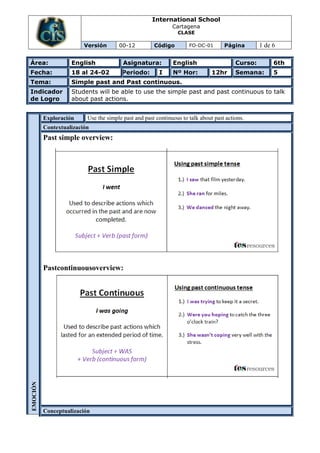
          Past simple overview:


          Pastcontinuousoverview:
EMOCIÓN


          Conceptualización
International School
                                                       Cartagena
                                                         CLASE

                 Versión        00-12          Código         FO-DC-01      Página         2 de 6

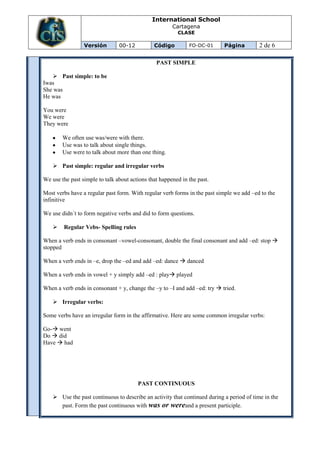
                                                PAST SIMPLE

     Past simple: to be
Iwas
She was
He was

You were
We were
They were

        We often use was/were with there.
        Use was to talk about single things.
        Use were to talk about more than one thing.

     Past simple: regular and irregular verbs

We use the past simple to talk about actions that happened in the past.

Most verbs have a regular past form. With regular verb forms in the past simple we add –ed to the
infinitive

We use didn´t to form negative verbs and did to form questions.

       Regular Vebs- Spelling rules

When a verb ends in consonant –vowel-consonant, double the final consonant and add –ed: stop 
stopped

When a verb ends in –e, drop the –ed and add –ed: dance  danced

When a verb ends in vowel + y simply add –ed : play played

When a verb ends in consonant + y, change the –y to –I and add –ed: try  tried.

     Irregular verbs:

Some verbs have an irregular form in the affirmative. Here are some common irregular verbs:

Go- went
Do  did
Have  had


                                        PAST CONTINUOUS

     Use the past continuous to describe an activity that continued during a period of time in the
      past. Form the past continuous with was or wereand a present participle.
International School
                                                             Cartagena
                                                              CLASE

                         Versión       00-12         Código          FO-DC-01   Página        3 de 6

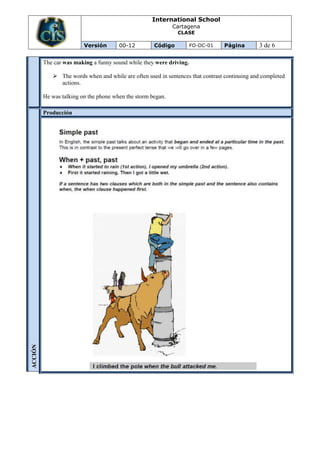
         The car was making a funny sound while they were driving.

             The words when and while are often used in sentences that contrast continuing and completed
              actions.

         He was talking on the phone when the storm began.

         Producción
ACCIÓN
International School
                                                    Cartagena
                                                      CLASE

               Versión        00-12          Código        FO-DC-01         Página   4 de 6


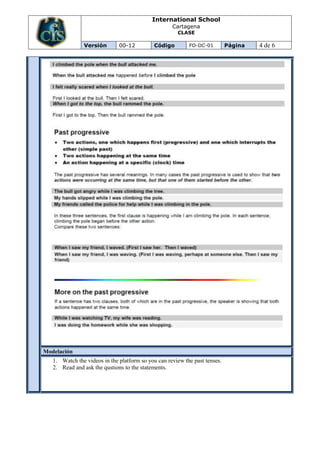
Modelación
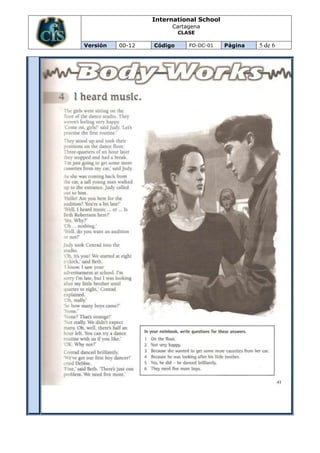
   1. Watch the videos in the platform so you can review the past tenses.
   2. Read and ask the qustions to the statements.
International School
                       Cartagena
                           CLASE

Versión   00-12   Código      FO-DC-01   Página   5 de 6
International School
                                                                      Cartagena
                                                                        CLASE

                                 Versión        00-12         Código          FO-DC-01     Página        6 de 6

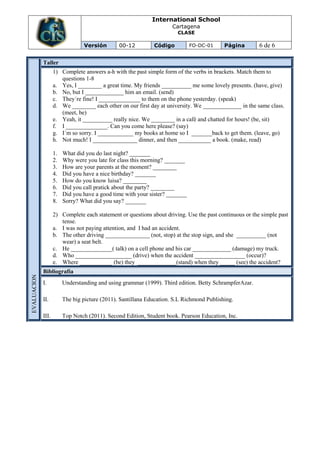
             Taller
                    1) Complete answers a-h with the past simple form of the verbs in brackets. Match them to
                       questions 1-8
                    a. Yes, I ________ a great time. My friends __________ me some lovely presents. (have, give)
                    b. No, but I _____________ him an email. (send)
                    c. They´re fine! I ______________ to them on the phone yesterday. (speak)
                    d. We ________ each other on our first day at university. We _____________ in the same class.
                       (meet, be)
                    e. Yeah, it __________ really nice. We ________ in a café and chatted for hours! (be, sit)
                    f. I ______________. Can you come here please? (say)
                    g. I´m so sorry. I ____________ my books at home so I _______back to get them. (leave, go)
                    h. Not much! I _______________ dinner, and then ___________ a book. (make, read)

                    1.   What did you do last night? _______
                    2.   Why were you late for class this morning? _______
                    3.   How are your parents at the moment? ________
                    4.   Did you have a nice birthday? _______
                    5.   How do you know luisa? ________
                    6.   Did you call pratick about the party? ________
                    7.   Did you have a good time with your sister? _______
                    8.   Sorry? What did you say? _______

                    2) Complete each statement or questions about driving. Use the past continuous or the simple past
                       tense.
                    a. I was not paying attention, and I had an accident.
                    b. The other driving _______________ (not, stop) at the stop sign, and she __________ (not
                       wear) a seat belt.
                    c. He ______________( talk) on a cell phone and his car _____________ (damage) my truck.
                    d. Who ___________________ (drive) when the accident _________________ (occur)?
                    e. Where ___________ (be) they _____________(stand) when they _____ (see) the accident?
             Bibliografía
EVALUACION


             I.          Understanding and using grammar (1999). Third edition. Betty SchrampferAzar.

             II.         The big picture (2011). Santillana Education. S.L Richmond Publishing.

             III.        Top Notch (2011). Second Edition, Student book. Pearson Education, Inc.

Formato plano 6th week5_simp_pastvspastcont

  • 1.
    International School Cartagena CLASE Versión 00-12 Código FO-DC-01 Página 1 de 6 Área: English Asignatura: English Curso: 6th Fecha: 18 al 24-02 Periodo: I Nº Hor: 12hr Semana: 5 Tema: Simple past and Past continuous. Indicador Students will be able to use the simple past and past continuous to talk de Logro about past actions. Exploración Use the simple past and past continuous to talk about past actions. Contextualización Past simple overview: Pastcontinuousoverview: EMOCIÓN Conceptualización
  • 2.
    International School Cartagena CLASE Versión 00-12 Código FO-DC-01 Página 2 de 6 PAST SIMPLE  Past simple: to be Iwas She was He was You were We were They were We often use was/were with there. Use was to talk about single things. Use were to talk about more than one thing.  Past simple: regular and irregular verbs We use the past simple to talk about actions that happened in the past. Most verbs have a regular past form. With regular verb forms in the past simple we add –ed to the infinitive We use didn´t to form negative verbs and did to form questions.  Regular Vebs- Spelling rules When a verb ends in consonant –vowel-consonant, double the final consonant and add –ed: stop  stopped When a verb ends in –e, drop the –ed and add –ed: dance  danced When a verb ends in vowel + y simply add –ed : play played When a verb ends in consonant + y, change the –y to –I and add –ed: try  tried.  Irregular verbs: Some verbs have an irregular form in the affirmative. Here are some common irregular verbs: Go- went Do  did Have  had PAST CONTINUOUS  Use the past continuous to describe an activity that continued during a period of time in the past. Form the past continuous with was or wereand a present participle.
  • 3.
    International School Cartagena CLASE Versión 00-12 Código FO-DC-01 Página 3 de 6 The car was making a funny sound while they were driving.  The words when and while are often used in sentences that contrast continuing and completed actions. He was talking on the phone when the storm began. Producción ACCIÓN
  • 4.
    International School Cartagena CLASE Versión 00-12 Código FO-DC-01 Página 4 de 6 Modelación 1. Watch the videos in the platform so you can review the past tenses. 2. Read and ask the qustions to the statements.
  • 5.
    International School Cartagena CLASE Versión 00-12 Código FO-DC-01 Página 5 de 6
  • 6.
    International School Cartagena CLASE Versión 00-12 Código FO-DC-01 Página 6 de 6 Taller 1) Complete answers a-h with the past simple form of the verbs in brackets. Match them to questions 1-8 a. Yes, I ________ a great time. My friends __________ me some lovely presents. (have, give) b. No, but I _____________ him an email. (send) c. They´re fine! I ______________ to them on the phone yesterday. (speak) d. We ________ each other on our first day at university. We _____________ in the same class. (meet, be) e. Yeah, it __________ really nice. We ________ in a café and chatted for hours! (be, sit) f. I ______________. Can you come here please? (say) g. I´m so sorry. I ____________ my books at home so I _______back to get them. (leave, go) h. Not much! I _______________ dinner, and then ___________ a book. (make, read) 1. What did you do last night? _______ 2. Why were you late for class this morning? _______ 3. How are your parents at the moment? ________ 4. Did you have a nice birthday? _______ 5. How do you know luisa? ________ 6. Did you call pratick about the party? ________ 7. Did you have a good time with your sister? _______ 8. Sorry? What did you say? _______ 2) Complete each statement or questions about driving. Use the past continuous or the simple past tense. a. I was not paying attention, and I had an accident. b. The other driving _______________ (not, stop) at the stop sign, and she __________ (not wear) a seat belt. c. He ______________( talk) on a cell phone and his car _____________ (damage) my truck. d. Who ___________________ (drive) when the accident _________________ (occur)? e. Where ___________ (be) they _____________(stand) when they _____ (see) the accident? Bibliografía EVALUACION I. Understanding and using grammar (1999). Third edition. Betty SchrampferAzar. II. The big picture (2011). Santillana Education. S.L Richmond Publishing. III. Top Notch (2011). Second Edition, Student book. Pearson Education, Inc.