FORMALDEHYDE
What are Aldehydes ??
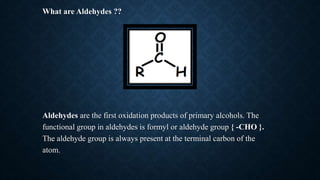
Aldehydes are the first oxidation products of primary alcohols. The
functional group in aldehydes is formyl or aldehyde group { -CHO }.
The aldehyde group is always present at the terminal carbon of the
atom.
What is Formaldehyde ?
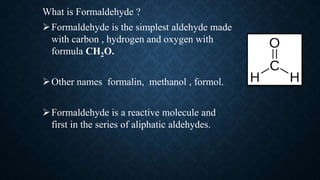
Formaldehyde is the simplest aldehyde made
with carbon , hydrogen and oxygen with
formula CH2O.
Other names formalin, methanol , formol.
Formaldehyde is a reactive molecule and
first in the series of aliphatic aldehydes.
History and Occurrence of Formaldehyde
 Formaldehyde was reported in 1859 by the Russian chemist
Alexandra Mikhailovich Butlerov and conclusively identified in 1869
by German chemist Hofmann .
 Formaldehyde has become a major industrial product. Hoffmann
passed a mixture of Methanol and air over a heated platinum spiral
and then identified formaldehyde as the product .
 Formaldehyde can be in nature , as one of the component of the
atmosphere and in the instellar space. The formaldehyde in the
atmosphere is formed by the reaction of oxgen and methane.
 Human produce about 1.5 ounces (42.52 grams) of formaldehyde a
day as a normal part of our metabolism. Inhaled Formaldehyde is
rapidly metabolized and ultimatedly converted to carbon dioxide and
exhaled.It doesn’t accumulate in our body.
PREPARATION OF FORMALDEHYDE
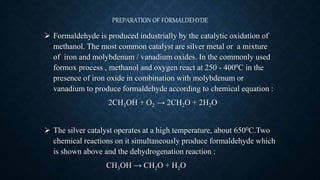
 Formaldehyde is produced industrially by the catalytic oxidation of
methanol. The most common catalyst are silver metal or a mixture
of iron and molybdenum / vanadium oxides. In the commonly used
formox process , methanol and oxygen react at 250 - 4000C in the
presence of iron oxide in combination with molybdenum or
vanadium to produce formaldehyde according to chemical equation :
2CH3OH + O2 → 2CH2O + 2H2O
 The silver catalyst operates at a high temperature, about 6500C.Two
chemical reactions on it simultaneously produce formaldehyde which
is shown above and the dehydrogenation reaction :
CH3OH → CH2O + H2O
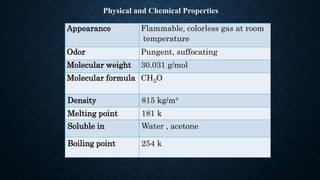
Physical and Chemical Properties
Appearance Flammable, colorless gas at room
temperature
Odor Pungent, suffocating
Molecular weight 30.031 g/mol
Molecular formula CH2O
Density 815 kg/m³
Melting point 181 k
Soluble in Water , acetone
Boiling point 254 k
Geometric Properties
Hybridization Sp2
Shape Trigonal planar
Bond angle H – C – H = 1160
H – C = O = 1220
Bond lengths C – H => 111 pm
C = O =>111.1 pm
Uses of Formaldehyde
1] Preservative in medical laboratories.
2] Embalming agent in mortuaries
3] Manufacture of urea , phenol, and melamine resins and for a variety of
special industrial chemicals.
4] Adhesives in the manufacture of particle board , fiberboard, and
plywood , and for molding, paper treating and coating , textile treating ,
surface coating and foams for insulation .
5] Formaldehyde is also used as a treatment for athlete's foot, in cough
drops , skin disinfectants, mouthwashes , spermatic creams, as a
disinfectants for vasectomies and root canals.
HEALTH HAZARDS OF fORMALDEHYDE
formaldehyde

formaldehyde

  • 1.
  • 2.
    What are Aldehydes?? Aldehydes are the first oxidation products of primary alcohols. The functional group in aldehydes is formyl or aldehyde group { -CHO }. The aldehyde group is always present at the terminal carbon of the atom.
  • 3.
    What is Formaldehyde? Formaldehyde is the simplest aldehyde made with carbon , hydrogen and oxygen with formula CH2O. Other names formalin, methanol , formol. Formaldehyde is a reactive molecule and first in the series of aliphatic aldehydes.
  • 4.
    History and Occurrenceof Formaldehyde  Formaldehyde was reported in 1859 by the Russian chemist Alexandra Mikhailovich Butlerov and conclusively identified in 1869 by German chemist Hofmann .  Formaldehyde has become a major industrial product. Hoffmann passed a mixture of Methanol and air over a heated platinum spiral and then identified formaldehyde as the product .  Formaldehyde can be in nature , as one of the component of the atmosphere and in the instellar space. The formaldehyde in the atmosphere is formed by the reaction of oxgen and methane.  Human produce about 1.5 ounces (42.52 grams) of formaldehyde a day as a normal part of our metabolism. Inhaled Formaldehyde is rapidly metabolized and ultimatedly converted to carbon dioxide and exhaled.It doesn’t accumulate in our body.
  • 5.
    PREPARATION OF FORMALDEHYDE Formaldehyde is produced industrially by the catalytic oxidation of methanol. The most common catalyst are silver metal or a mixture of iron and molybdenum / vanadium oxides. In the commonly used formox process , methanol and oxygen react at 250 - 4000C in the presence of iron oxide in combination with molybdenum or vanadium to produce formaldehyde according to chemical equation : 2CH3OH + O2 → 2CH2O + 2H2O  The silver catalyst operates at a high temperature, about 6500C.Two chemical reactions on it simultaneously produce formaldehyde which is shown above and the dehydrogenation reaction : CH3OH → CH2O + H2O
  • 6.
    Physical and ChemicalProperties Appearance Flammable, colorless gas at room temperature Odor Pungent, suffocating Molecular weight 30.031 g/mol Molecular formula CH2O Density 815 kg/m³ Melting point 181 k Soluble in Water , acetone Boiling point 254 k
  • 7.
    Geometric Properties Hybridization Sp2 ShapeTrigonal planar Bond angle H – C – H = 1160 H – C = O = 1220 Bond lengths C – H => 111 pm C = O =>111.1 pm
  • 8.
    Uses of Formaldehyde 1]Preservative in medical laboratories. 2] Embalming agent in mortuaries 3] Manufacture of urea , phenol, and melamine resins and for a variety of special industrial chemicals. 4] Adhesives in the manufacture of particle board , fiberboard, and plywood , and for molding, paper treating and coating , textile treating , surface coating and foams for insulation . 5] Formaldehyde is also used as a treatment for athlete's foot, in cough drops , skin disinfectants, mouthwashes , spermatic creams, as a disinfectants for vasectomies and root canals.
  • 9.
    HEALTH HAZARDS OFfORMALDEHYDE