This document discusses the fundamental role that logic has played in the development of computer science over the past 50 years. It provides examples of how logic has provided a unifying foundational framework and modeling tool for areas like machine architecture, programming languages, databases, and more. The document then traces the historical developments in logic that enabled these contributions, including Boolean logic, first-order logic, automata theory, and analyses of computational complexity. Overall, it outlines how logic has become central to computer science in a way analogous to the role of calculus in traditional engineering fields.
![First-Order Logic
A formalism for specifying properties of mathematical structures, such as
graphs, partial orders, groups, rings, fields, . . .
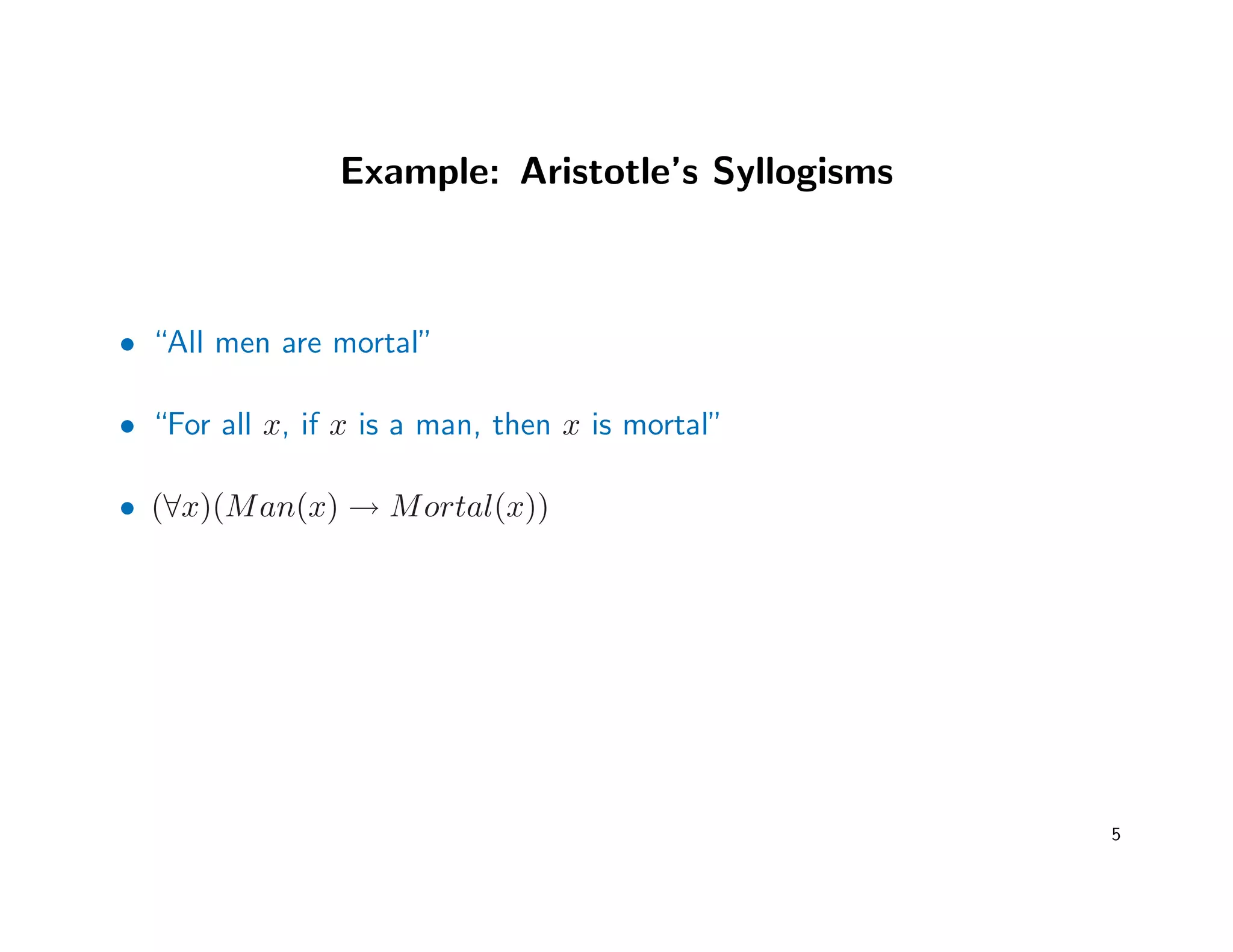
Mathematical Structure: [Tarski, 1933]
A = (D, R1, . . . , Rk, f1, . . . , fl),
• D is a non-empty set – universe
• Ri is an m-ary relation on A, for some m (that is, Ri ⊆ Am
)
• fj is an n-ary function on A, for some n (that is, fi : An
→ D)
6](https://image.slidesharecdn.com/logicrevo15-170731170815/75/Logicrevo15-7-2048.jpg)
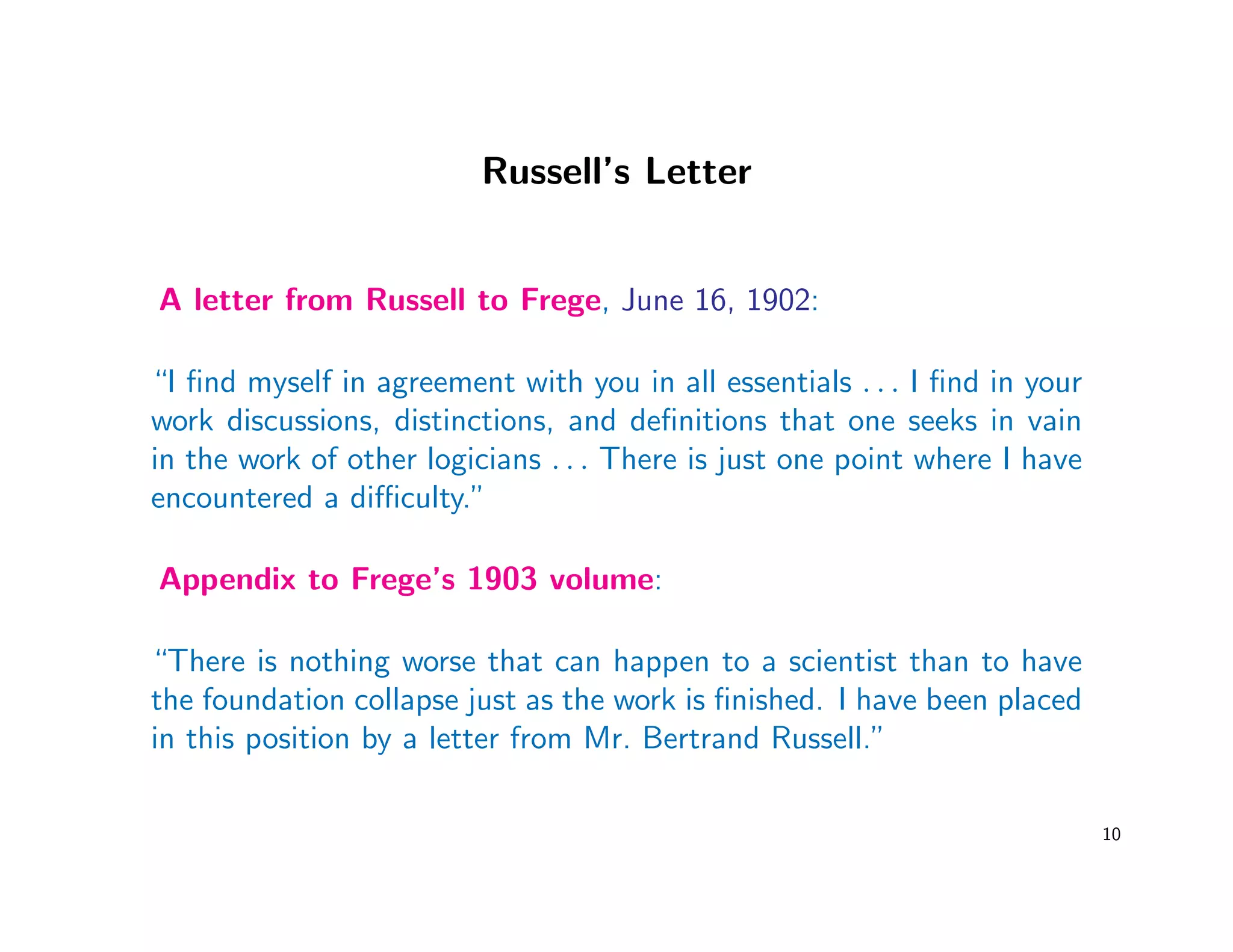
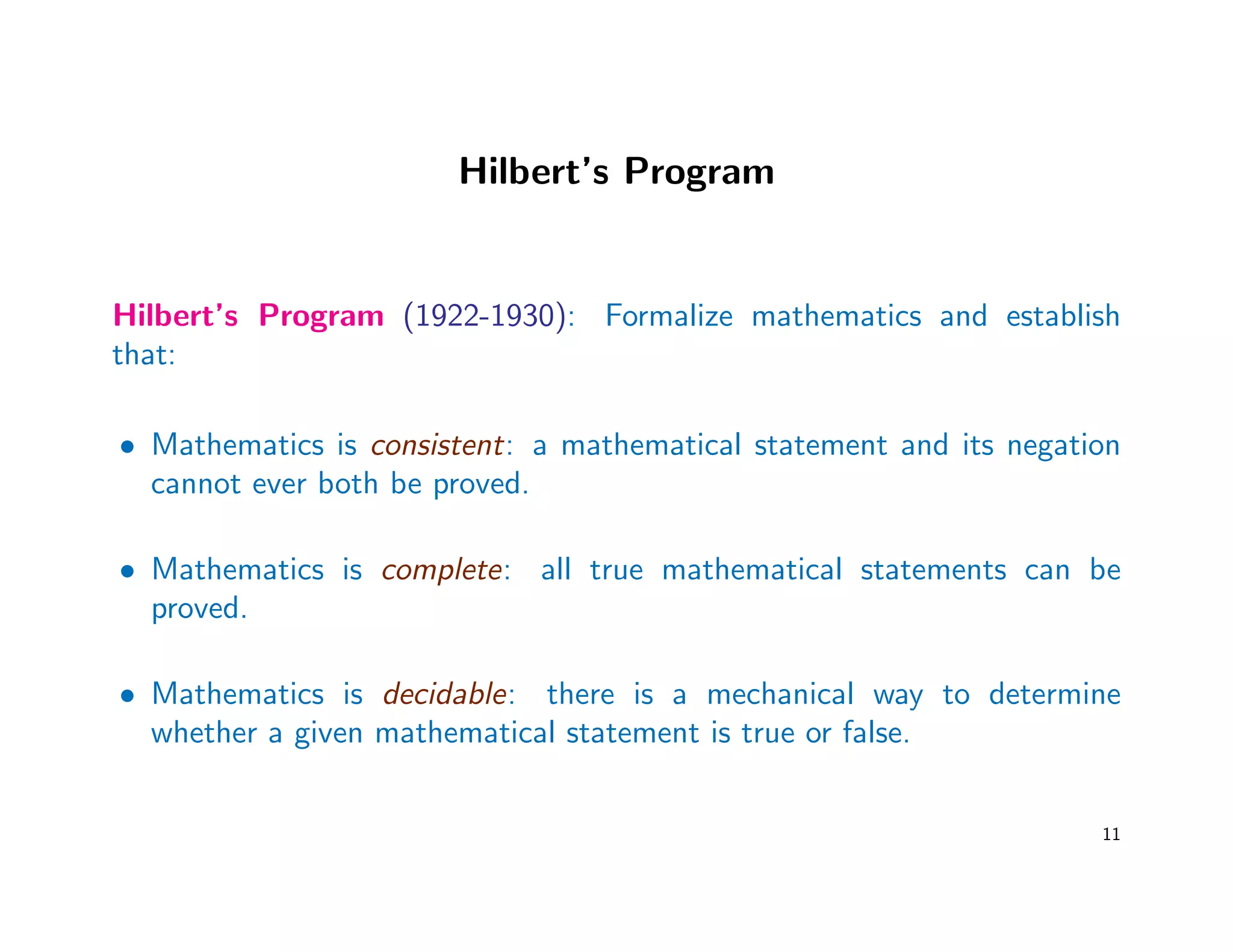
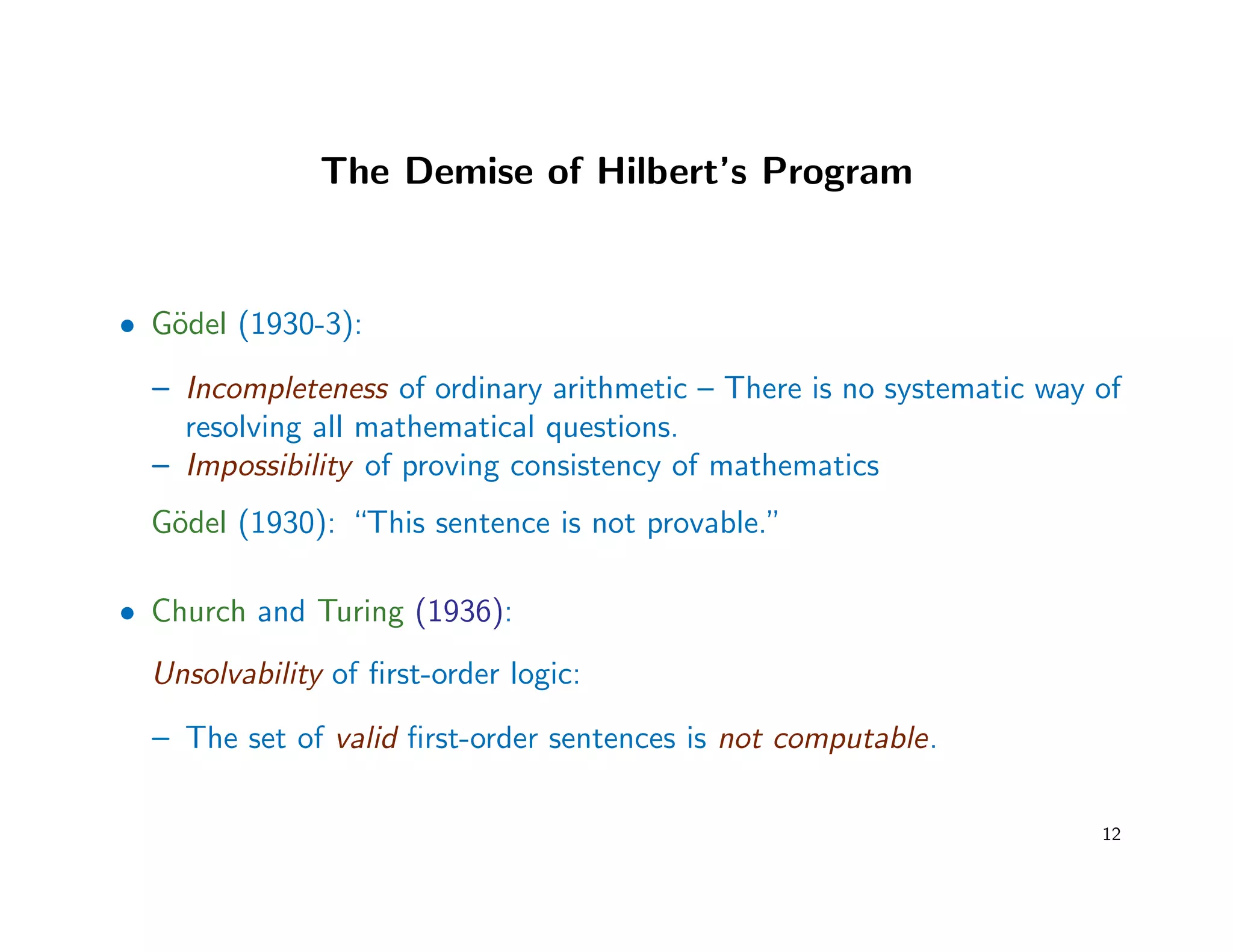
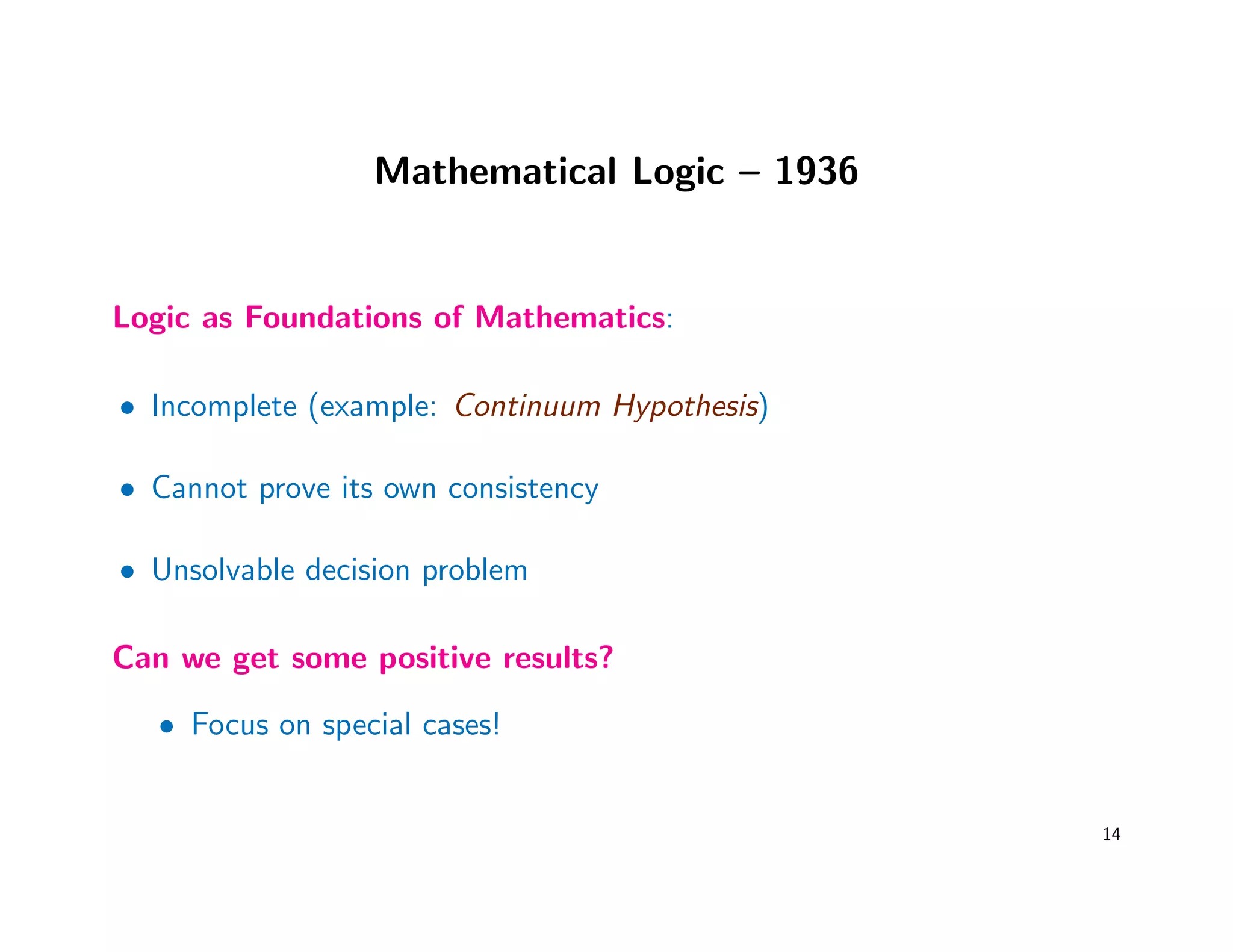
![Entscheidungsproblem
Entscheidungsproblem (The Decision Problem) [Hilbert-Ackermann,
1928]: Decide if a given first-order sentence is valid (dually, satisfiable).
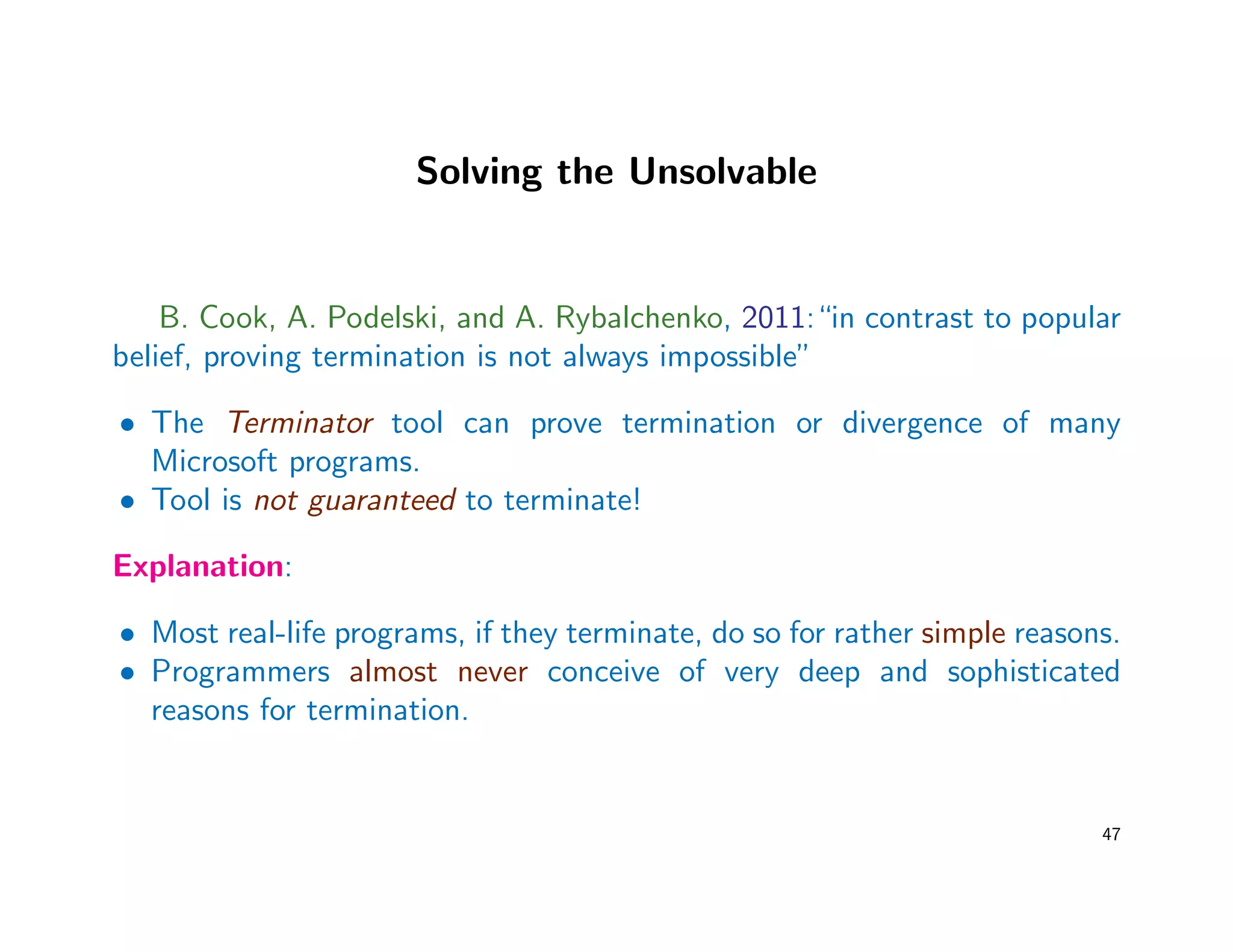
Church-Turing Theorem, 1936: The Decision Problem is unsolvable.
Turing, 1936:
• Defined computability in terms of Turing machines (TMs)
• Proved that the termination problem for TMs is unsolvable (“this
machine terminates iff it does not terminate”)
• Reduced termination to Entscheidungsproblem.
13](https://image.slidesharecdn.com/logicrevo15-170731170815/75/Logicrevo15-14-2048.jpg)
![Monadic Logic
Monadic Class: First-order logic with monadic predicates – captures
syllogisms.
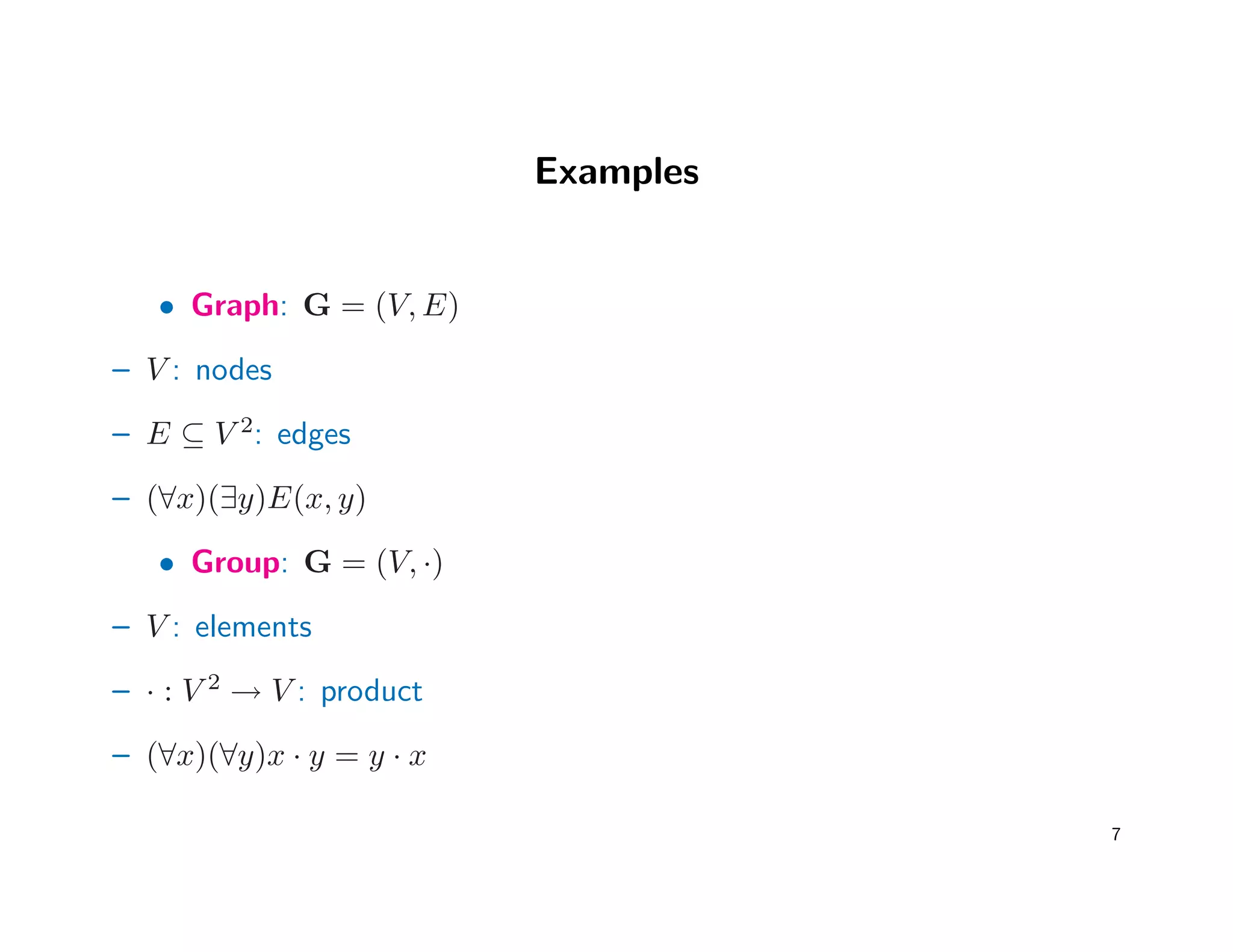
• (∀x)P(x), (∀x)(P(x) → Q(x)) |= (∀x)Q(x)
[L¨owenheim, 1915]: The Monadic Class is
decidable.
• Proof: Bounded-model property – if a sentence
is satisfiable, it is satisfiable in a structure of
bounded size.
• Proof technique: quantifier elimination.
19](https://image.slidesharecdn.com/logicrevo15-170731170815/75/Logicrevo15-20-2048.jpg)
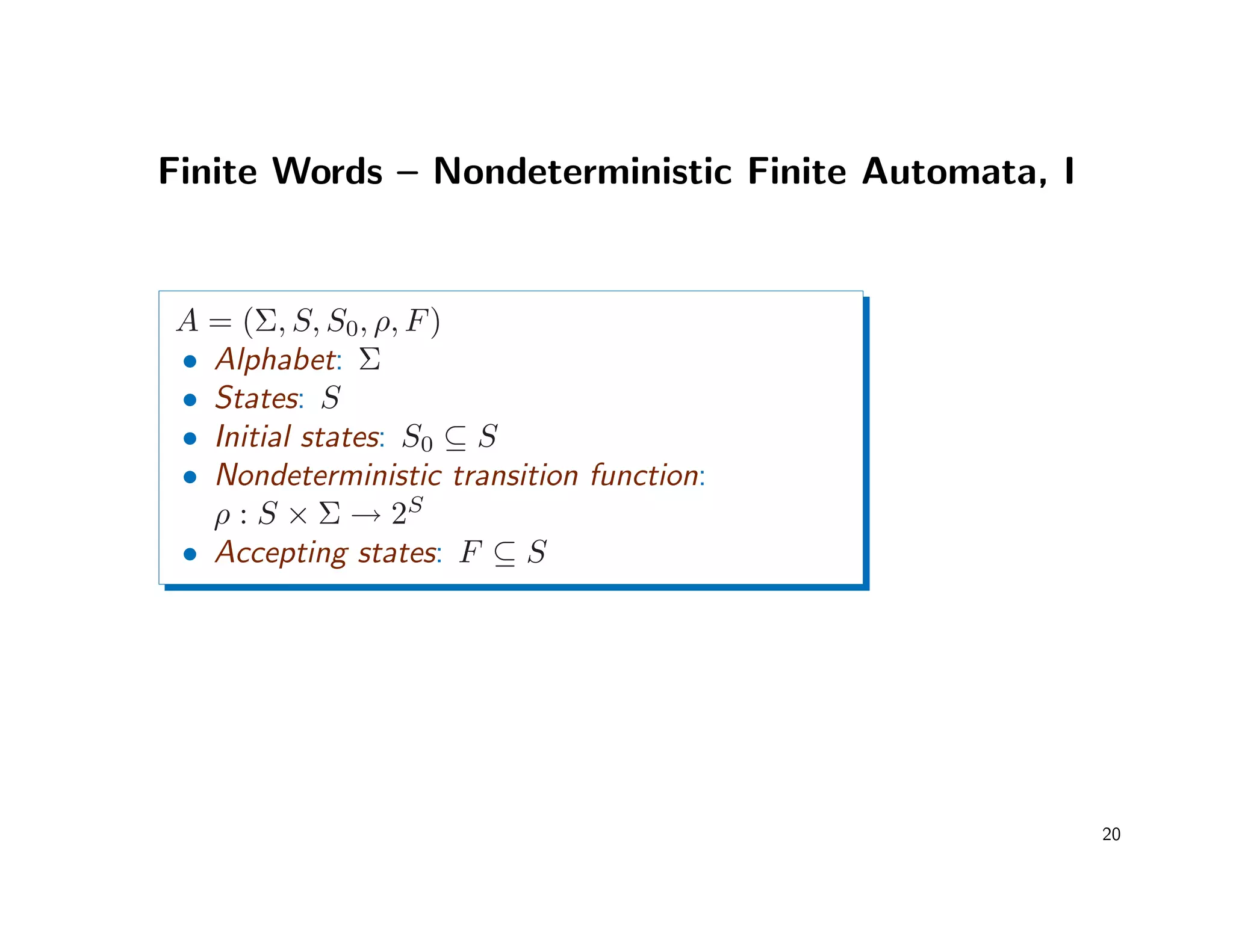
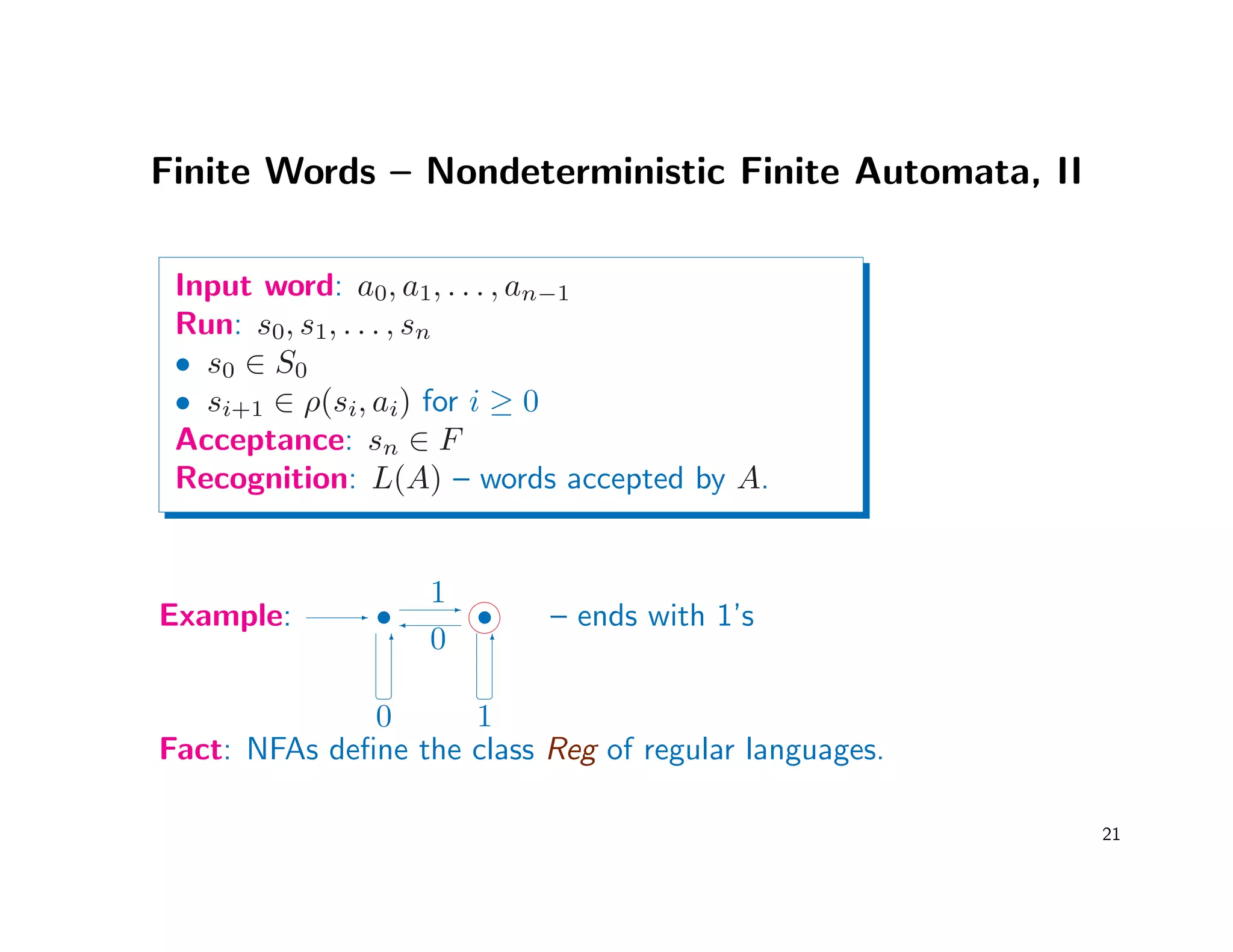
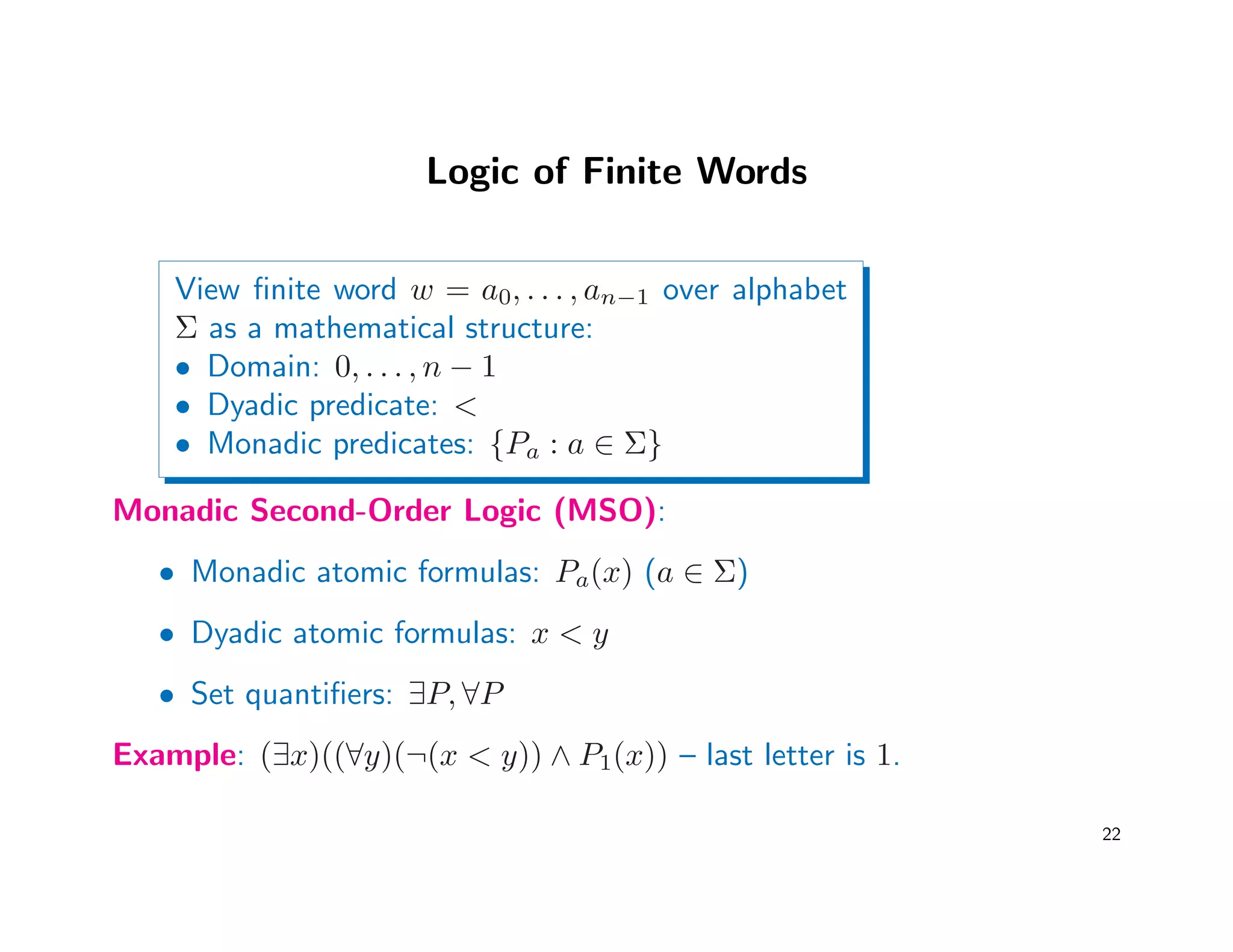
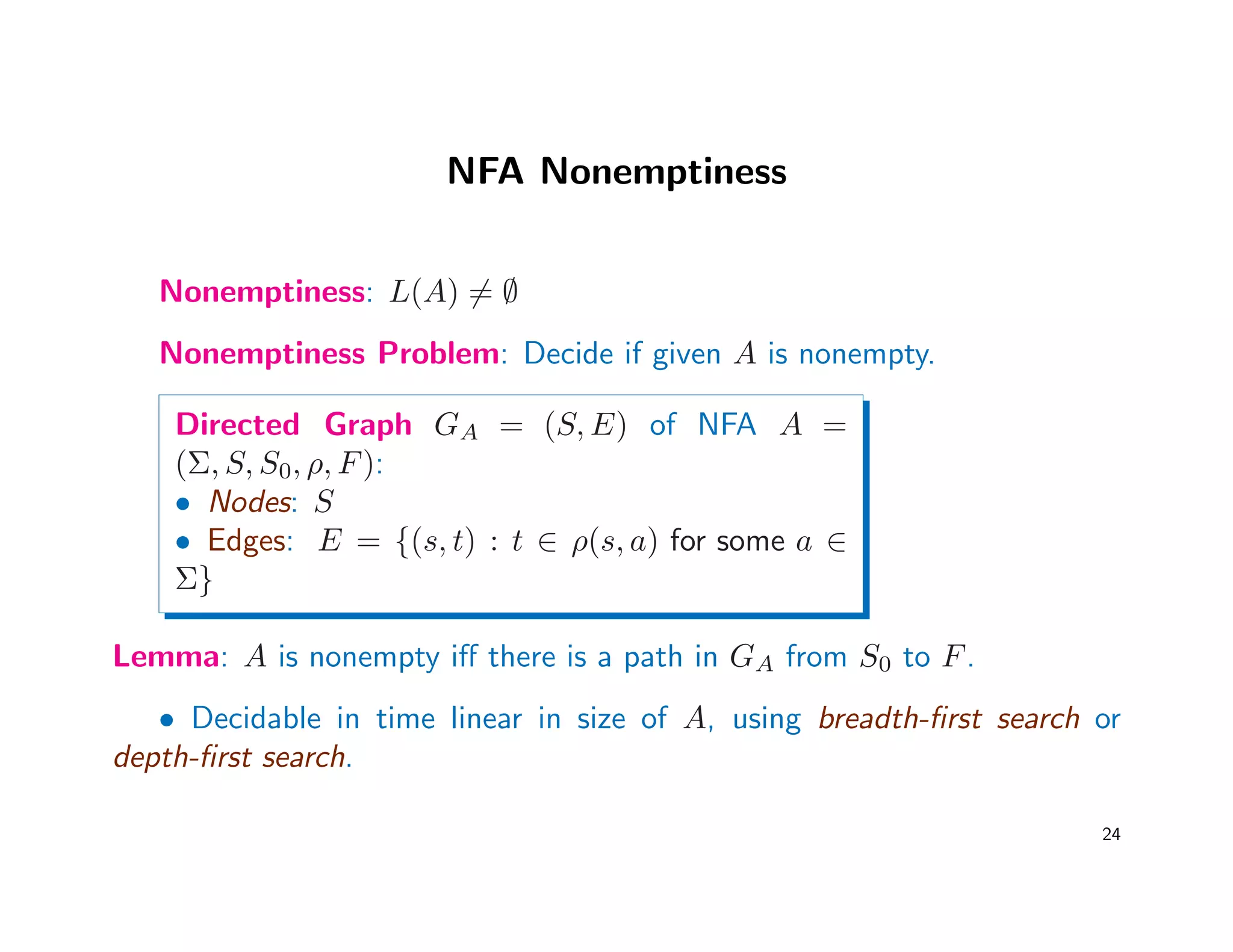
![Automata and Logic
Theorem [B¨uchi, Elgot, Trakhtenbrot, 1957-8
(independently)]: MSO ≡ NFA
• Both MSO and NFA define the class Reg.
Proof: Effective
• From NFA to MSO (A → ϕA)
• From MSO to NFA (ϕ → Aϕ)
23](https://image.slidesharecdn.com/logicrevo15-170731170815/75/Logicrevo15-24-2048.jpg)
![Complexity Barrier
Computational Complexity:
• Naive Upper Bound: Nonelementary Growth
2···2n
(tower of height O(n))
• Lower Bound [Stockmeyer, 1974]: Satisfiability of FO over finite words
is nonelementary (no bounded-height tower).
26](https://image.slidesharecdn.com/logicrevo15-170731170815/75/Logicrevo15-27-2048.jpg)
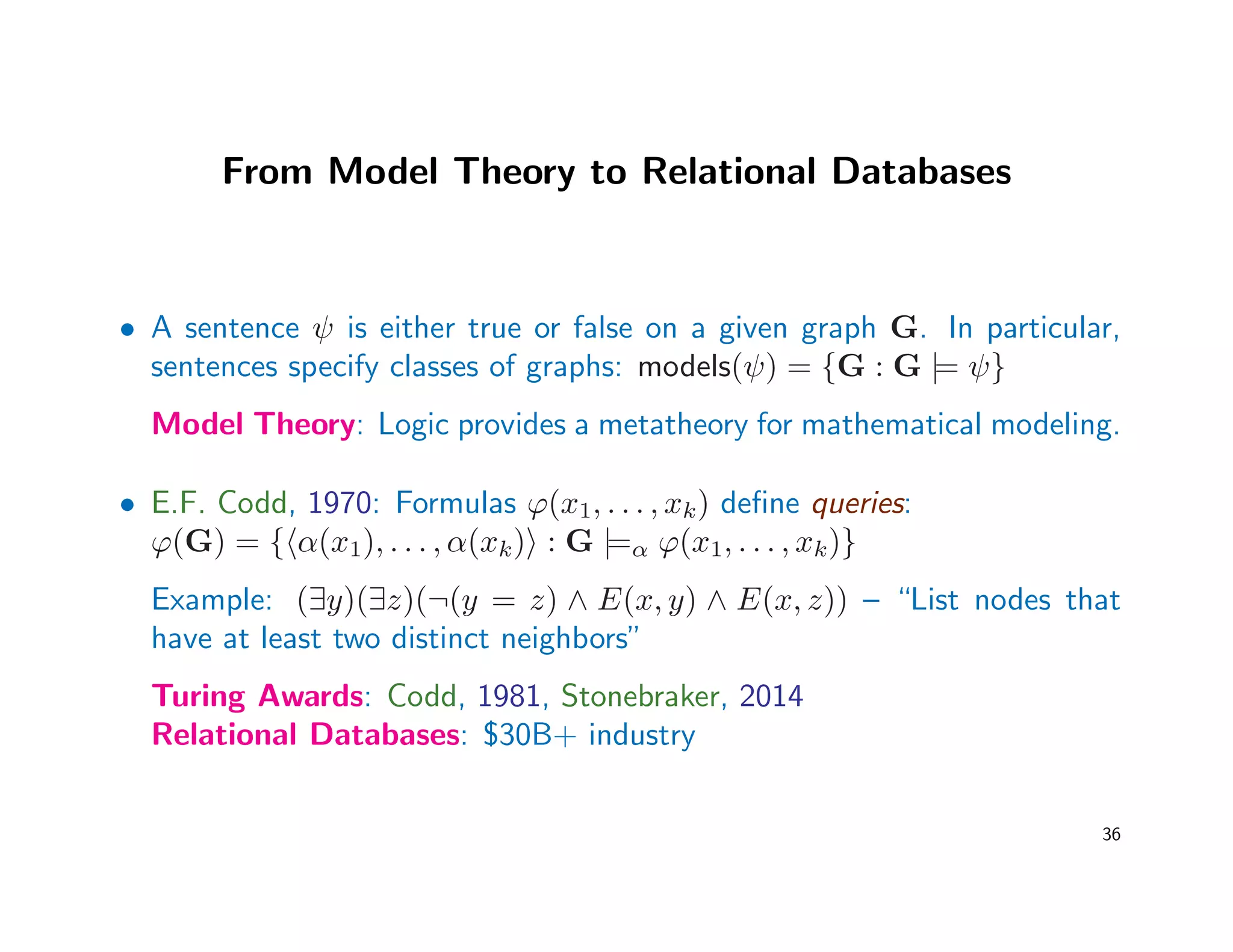
![Algorithmic Problems in First-Order Logic
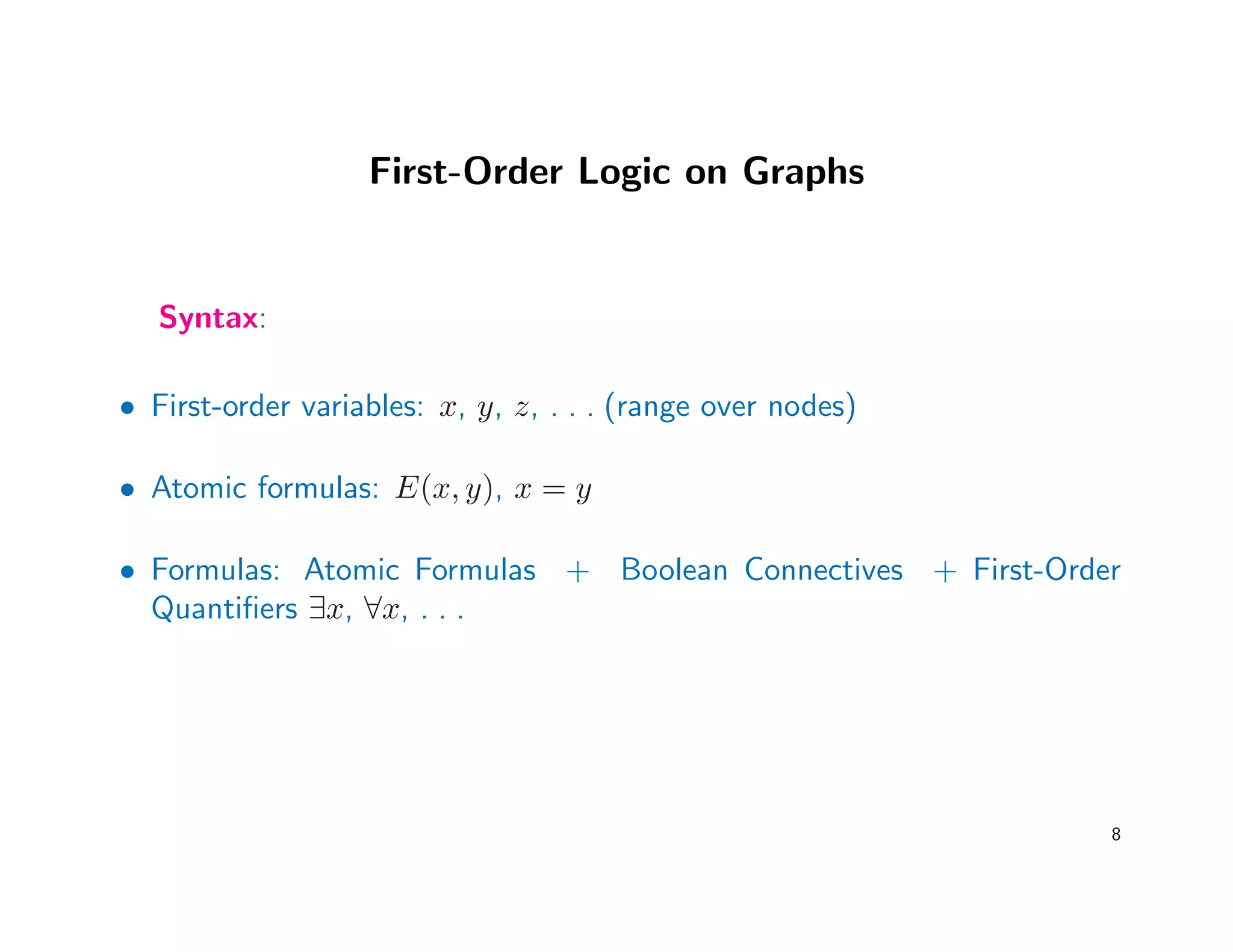
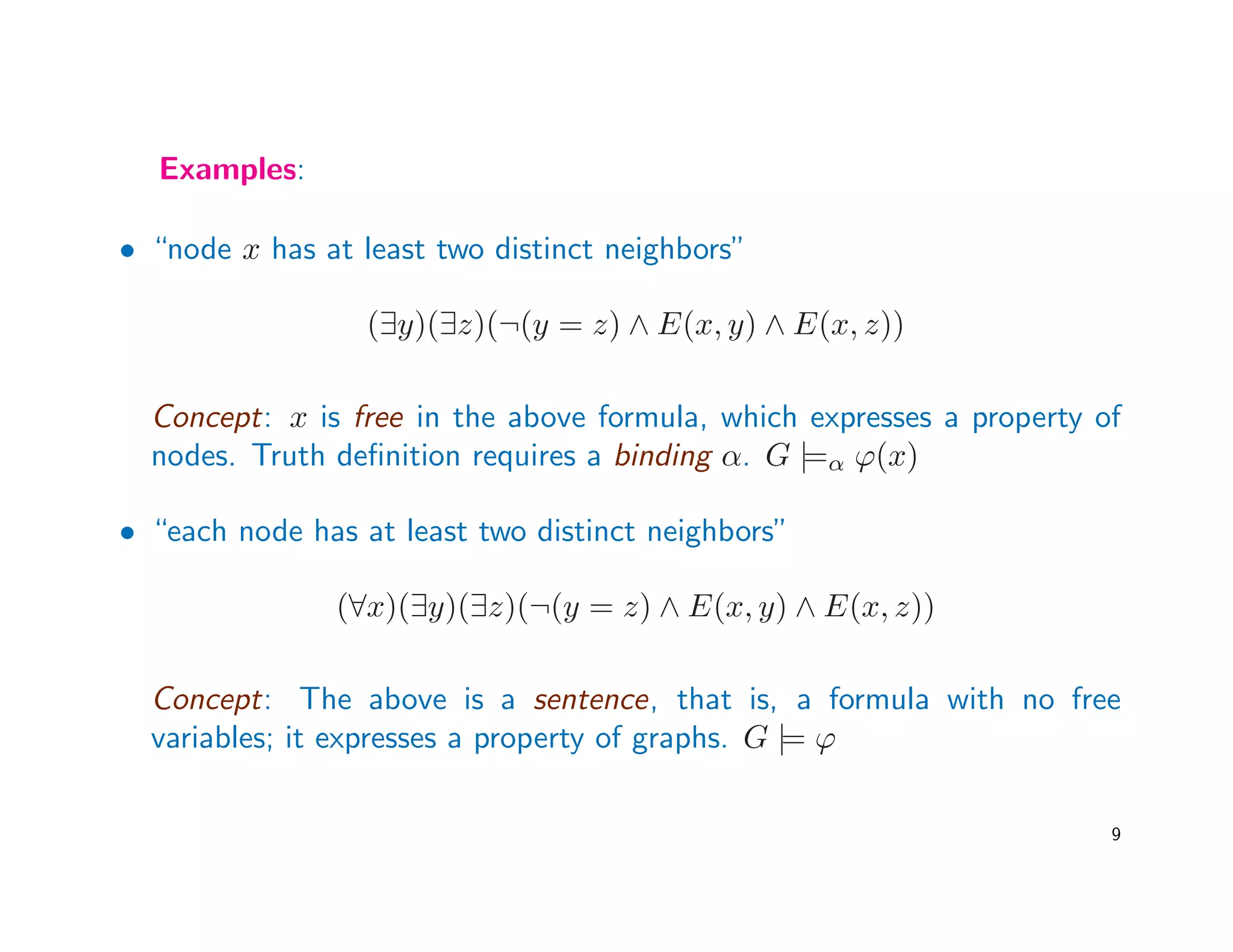
Satisfiability Problem: Given a first-order formula ψ, is there a graph G
and binding α, such that G |=α ψ?
Truth-Evaluation Problem: Given a first-order formula ϕ(x1, . . . , xk), a
finite graph G, and a binding α, does G |=α ϕ(x1, . . . , xk)?
Contrast:
• Satisfiability is undecidable [Church, Turing 1936]
• Truth evaluation, which is query evaluation, is decidable.
38](https://image.slidesharecdn.com/logicrevo15-170731170815/75/Logicrevo15-39-2048.jpg)
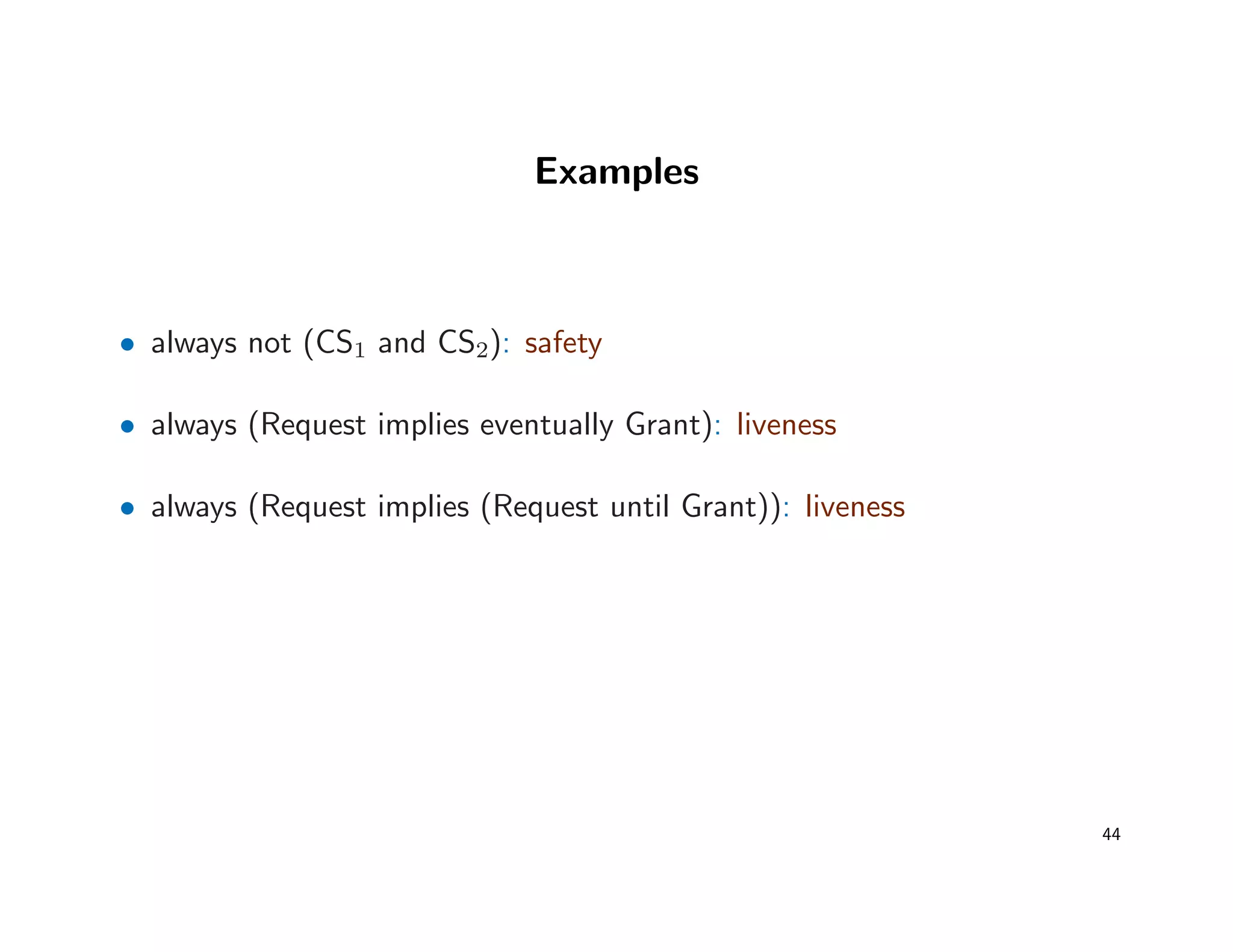
![The Temporal Logic of Programs
Crux: Need to specify ongoing behavior rather than input/output relation!
“Temporal logic to the rescue” [Pnueli, 1977]:
• Linear temporal logic (LTL) as a logic for the
specification of non-terminating programs
• Model checking via reduction to MSO
But: nonelementary complexity!
43](https://image.slidesharecdn.com/logicrevo15-170731170815/75/Logicrevo15-44-2048.jpg)
![Model Checking
“Algorithmic verification” [Clarke Emerson,
1981, Queille Sifakis, 1982]: Model checking
programs of size m wrt CTL formulas of size n
can be done in time mn.
Linear-Time Response [Lichtenstein Pnueli, 1985]: Model checking
programs of size m wrt LTL formulas of size n can be done in time m2O(n)
(tableau heuristics).
Seemingly:
• Automata: Nonelementary
• Tableaux: exponential
45](https://image.slidesharecdn.com/logicrevo15-170731170815/75/Logicrevo15-46-2048.jpg)
![Back to Automata
Exponential-Compilation Theorem [V. Wolper, 1983–1986]: Given an
LTL formula ϕ of size n, one can construct an automaton Aϕ of size 2O(n)
such that a trace σ satisfies ϕ if and only if σ is accepted by Aϕ.
Automata-Theoretic Algorithms:
1. LTL Satisfiability:
ϕ is satisfiable iff L(Aϕ) = ∅ (PSPACE)
2. LTL Model Checking:
M |= ϕ iff L(M × A¬ϕ) = ∅ (m2O(n)
)
Today: Widespread industrial usage
• Industrial Languages: PSL, SVA (IEEE standards)
46](https://image.slidesharecdn.com/logicrevo15-170731170815/75/Logicrevo15-47-2048.jpg)