Forklift Certification
  Training Course
Overview
• Operating a forklift is serious business Each
  Operating a forklift is serious business. Each 
  year over 100 deaths involving forklifts occur 
  and OSHA estimates that there are nearly 70 
  and OSHA estimates that there are nearly 70
  thousand accidents.
• While the principles of operating a forklift may
  While the principles of operating a forklift may 
  seem as simple as driving a car, proper safety 
  and driver training are necessary to 
  and driver training are necessary to
  accomplish safe forklift operation.
What this Course Is
            What this Course Is
• This course will review safe forklift operation 
                                         p
  requirements. Upon completion on this course 
  you will have been provided the information 
  needed to pass a forklift safety test.
  needed to pass a forklift safety test
• This course complies with OSHA regulations 
  1910.178 (l), 1915.120 (a), 1917.1 (a)(2)(xiv), 
  1918.1 (b)(10), 1926.602 (d) and meets 
  requirements for a Forklift Certification Training 
  Course.
  Course
• This training must be taken each 3 years or when 
  an accident or near‐miss occurs.
What this Course Is Not
        What this Course Is Not
• This course will not teach you how to operate a 
                              y             p
  forklift. 
• Certification is not complete without a driving 
  evaluation administered by a person who has the 
  evaluation administered by a person who has the
  required knowledge, training and experience to 
  train powered industrial operators and judge 
  their competency
• This course is not designed to substitute for 
  operator training in the operation of specific 
  operator training in the operation of specific
  forklifts in a specific workplace as required by 
  OSHA regulations.
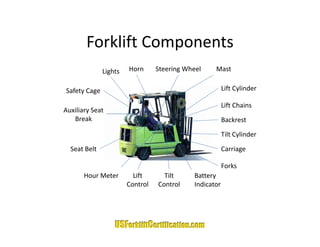
Forklift Components
        Forklift Components
              Lights   Horn      Steering Wheel    Mast


Safety Cage                                             Lift Cylinder

                                                        Lift Chains
Auxiliary Seat
A ili     S
   Break                                                Backrest

                                                        Tilt Cylinder

  Seat Belt                                             Carriage

                                                        Forks
       Hour Meter        Lift      Tilt     Battery
                       Control   Control    Indicator
Operation Rules
               Operation Rules
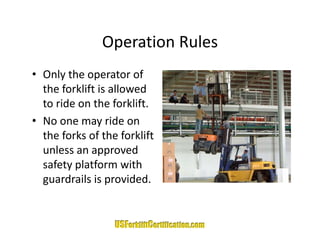
• Only the operator of
  Only the operator of 
  the forklift is allowed 
  to ride on the forklift.
• No one may ride on 
  the forks of the forklift
  the forks of the forklift
  unless an approved 
  safety platform with 
        yp
  guardrails is provided.
Loading Dock Areas
              Loading Dock Areas
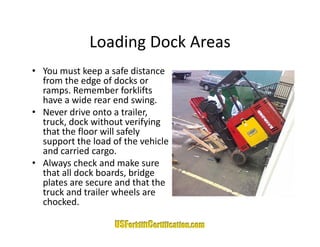
• You must keep a safe distance 
  from the edge of docks or 
  ramps. Remember forklifts 
  have a wide rear end swing.
• Never drive onto a trailer, 
  truck, dock without verifying 
  that the floor will safely 
  support the load of the vehicle 
          t th l d f th       hi l
  and carried cargo.
• Always check and make sure 
  that all dock boards, bridge 
  th t ll d k b d b id
  plates are secure and that the 
  truck and trailer wheels are 
  chocked.
  chocked
Traveling
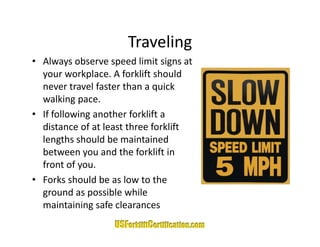
• Always observe speed limit signs at 
  your workplace. A forklift should 
  your workplace. A forklift should
  never travel faster than a quick 
  walking pace.
• If following another forklift a 
  distance of at least three forklift 
  lengths should be maintained 
  lengths should be maintained
  between you and the forklift in 
  front of you.
• Forks should be as low to the 
  ground as possible while 
  maintaining safe clearances
                  f l
Traveling (continued)
          Traveling (continued)
• The operator must slow down and sound the
  The operator must slow down and sound the 
  horn at cross aisles and other locations where 
  vision is obstructed.
  vision is obstructed
• The operator must always drive slowly enough 
  to make a turn without tipping the forklift and 
  to make a turn without tipping the forklift and
  to stop safely for pedestrians.
• S
  Seat belts are required to be worn while 
       b l            i d b             hil
  operating the forklift.
Lifting Loads
                   Lifting Loads
• Overloading will increase the risk that a forklift will tip
  Overloading will increase the risk that a forklift will tip 
  over and reduce the ability to control it. Forklifts 
  must not be overloaded.
• Loaders and/or operators must check the maximum 
  load capacity on the forklift nameplate.
• Lifted loads must be neatly piled and cross‐tied, if 
  possible.
• To reduce the risk of tipping, the load must be 
  centered on the lift forks.
Lifting Loads (continued)
        Lifting Loads (continued)
• No one can be allowed to stand or pass under the
  No one can be allowed to stand or pass under the 
  lift portion of any forklift, whether loaded or 
  empty, because injury may result from mechanical 
  failure or falling objects.
• Before moving or stacking materials, the operator 
  must survey the path of travel to avoid machinery, 
  overhead obstructions, sprinkler systems, 
  manufactured goods and other obstructions.
  manufactured goods and other obstructions
Unattended Forklift
            Unattended Forklift
• A forklift is considered unattended if the operator 
      o    t s co s de ed u atte ded t e ope ato
  is more than 25 feet from the forklift or if not 
  visible by the operator. 
• Unattended forklifts must lower the forks to the 
  ground. Controls must be set to neutral, power 
  turned off and the brakes set. Wheels must be 
  t     d ff d th b k            t Wh l         tb
  chocked if the forklift is unattended on an incline.
• If you are not seated in the forklift but stay within
  If you are not seated in the forklift but stay within 
  25 feet, you must, set the brakes, lower the forks 
  to the ground and set all controls to neutral.
         g
Forklift Stability
                  Forklift Stability
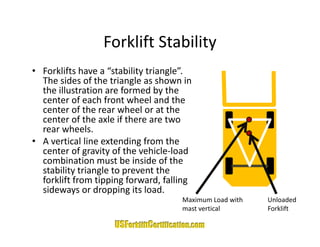
• Forklifts have a “stability triangle”. 
  The sides of the triangle as shown in 
  the illustration are formed by the 
  center of each front wheel and the 
  center of the rear wheel or at the 
      t     f th        h l       t th
  center of the axle if there are two 
  rear wheels. 
• A
  A vertical line extending from the 
        ti l li     t di f          th
  center of gravity of the vehicle‐load 
  combination must be inside of the 
  stability triangle to prevent the 
  stability triangle to prevent the
  forklift from tipping forward, falling 
  sideways or dropping its load.
                                      Maximum Load with
                                      Maximum Load with   Unloaded 
                                                          Unloaded
                                      mast vertical       Forklift
Forklift Stability (continued)
      Forklift Stability (continued)
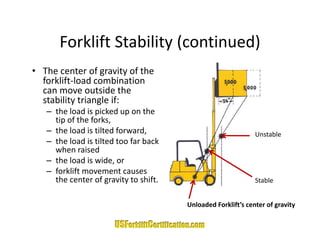
• The center of gravity of the 
  forklift‐load combination 
  can move outside the 
  stability triangle if:
   – the load is picked up on the 
     tip of the forks,
   – the load is tilted forward,                               Unstable
   – th l d i tilt d t f b k
     the load is tilted too far back 
     when raised
   – the load is wide, or
   – forklift movement causes
     forklift movement causes 
     the center of gravity to shift.                           Stable


                                        Unloaded Forklift’s center of gravity
Steps to Take in a Tipover of a 
   Sit‐Down Counterbalanced Forklift:
   Sit Down Counterbalanced Forklift:


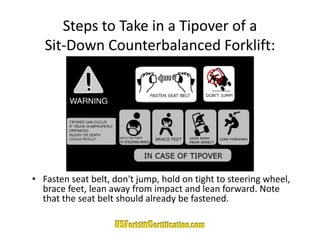
• Fasten seat belt, don't jump, hold on tight to steering wheel, 
  brace feet, lean away from impact and lean forward. Note 
  that the seat belt should already be fastened. 
  that the seat belt should already be fastened.
Fueling and Charging
                  Fueling and Charging
Batteries
• Battery charging areas should be provided with systems for flushing and 
   neutralizing spilled electrolyte, fire protection, protecting charging apparatus 
       t li i     ill d l t l t fi           t ti        t ti     h i           t
   from damage by forklifts, and adequate ventilation of fumes from off gassing 
   (hydrogen gas) from the batteries.
• S ki i
   Smoking is prohibited in the battery charging area.
                  hibit d i th b tt         h i
• Open flames shall not be used for checking the electrolyte levels of the 
   storage batteries.

Refueling
• Fuel tanks should not be filled while the engine is running.
• Spillage of oil or fuel should be carefully cleaned up or allowed to completely 
   evaporate and the fuel cap replaced before restarting the engine.
• Open flames shall not be used for checking gasoline levels in the fuel tanks.
   Open flames shall not be used for checking gasoline levels in the fuel tanks.
• There shall be no smoking when refueling or changing LP tanks on the forklift.
Inclines
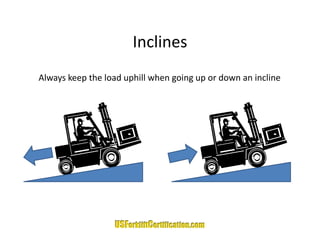
Always keep the load uphill when going up or down an incline
Always keep the load uphill when going up or down an incline
Electric Motor Powered Industrial Trucks
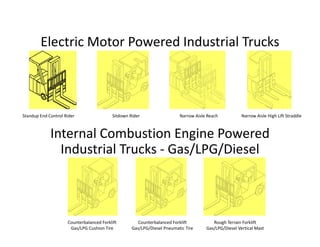
        Electric Motor Powered Industrial Trucks


Standup End Control Rider                   Sitdown Rider                  Narrow Aisle Reach           Narrow Aisle High Lift Straddle


             Internal Combustion Engine Powered 
                                      g
               Industrial Trucks ‐ Gas/LPG/Diesel 


                      Counterbalanced Forklift         Counterbalanced Forklift           Rough Terrain Forklift 
                       Gas/LPG Cushion Tire          Gas/LPG/Diesel Pneumatic Tire     Gas/LPG/Diesel Vertical Mast
• Employees shall not place any part of their
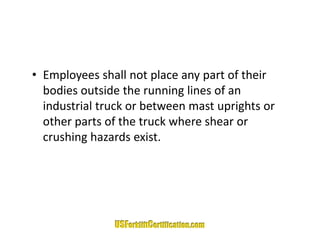
  Employees shall not place any part of their 
  bodies outside the running lines of an 
  industrial truck or between mast uprights or 
  industrial truck or between mast uprights or
  other parts of the truck where shear or 
  crushing hazards exist.
  crushing hazards exist

Forklift certification

  • 1.
    Forklift Certification Training Course
  • 2.
    Overview • Operating aforklift is serious business Each Operating a forklift is serious business. Each  year over 100 deaths involving forklifts occur  and OSHA estimates that there are nearly 70  and OSHA estimates that there are nearly 70 thousand accidents. • While the principles of operating a forklift may While the principles of operating a forklift may  seem as simple as driving a car, proper safety  and driver training are necessary to  and driver training are necessary to accomplish safe forklift operation.
  • 3.
    What this Course Is What this Course Is • This course will review safe forklift operation  p requirements. Upon completion on this course  you will have been provided the information  needed to pass a forklift safety test. needed to pass a forklift safety test • This course complies with OSHA regulations  1910.178 (l), 1915.120 (a), 1917.1 (a)(2)(xiv),  1918.1 (b)(10), 1926.602 (d) and meets  requirements for a Forklift Certification Training  Course. Course • This training must be taken each 3 years or when  an accident or near‐miss occurs.
  • 4.
    What this Course Is Not What this Course Is Not • This course will not teach you how to operate a  y p forklift.  • Certification is not complete without a driving  evaluation administered by a person who has the  evaluation administered by a person who has the required knowledge, training and experience to  train powered industrial operators and judge  their competency • This course is not designed to substitute for  operator training in the operation of specific  operator training in the operation of specific forklifts in a specific workplace as required by  OSHA regulations.
  • 5.
    Forklift Components Forklift Components Lights Horn Steering Wheel Mast Safety Cage Lift Cylinder Lift Chains Auxiliary Seat A ili S Break Backrest Tilt Cylinder Seat Belt Carriage Forks Hour Meter Lift Tilt Battery Control Control Indicator
  • 6.
    Operation Rules Operation Rules • Only the operator of Only the operator of  the forklift is allowed  to ride on the forklift. • No one may ride on  the forks of the forklift the forks of the forklift unless an approved  safety platform with  yp guardrails is provided.
  • 7.
    Loading Dock Areas Loading Dock Areas • You must keep a safe distance  from the edge of docks or  ramps. Remember forklifts  have a wide rear end swing. • Never drive onto a trailer,  truck, dock without verifying  that the floor will safely  support the load of the vehicle  t th l d f th hi l and carried cargo. • Always check and make sure  that all dock boards, bridge  th t ll d k b d b id plates are secure and that the  truck and trailer wheels are  chocked. chocked
  • 8.
    Traveling • Always observe speed limit signs at  your workplace. A forklift should  your workplace. A forklift should never travel faster than a quick  walking pace. • If following another forklift a  distance of at least three forklift  lengths should be maintained  lengths should be maintained between you and the forklift in  front of you. • Forks should be as low to the  ground as possible while  maintaining safe clearances f l
  • 9.
    Traveling (continued) Traveling (continued) • The operator must slow down and sound the The operator must slow down and sound the  horn at cross aisles and other locations where  vision is obstructed. vision is obstructed • The operator must always drive slowly enough  to make a turn without tipping the forklift and  to make a turn without tipping the forklift and to stop safely for pedestrians. • S Seat belts are required to be worn while  b l i d b hil operating the forklift.
  • 10.
    Lifting Loads Lifting Loads • Overloading will increase the risk that a forklift will tip Overloading will increase the risk that a forklift will tip  over and reduce the ability to control it. Forklifts  must not be overloaded. • Loaders and/or operators must check the maximum  load capacity on the forklift nameplate. • Lifted loads must be neatly piled and cross‐tied, if  possible. • To reduce the risk of tipping, the load must be  centered on the lift forks.
  • 11.
    Lifting Loads (continued) Lifting Loads (continued) • No one can be allowed to stand or pass under the No one can be allowed to stand or pass under the  lift portion of any forklift, whether loaded or  empty, because injury may result from mechanical  failure or falling objects. • Before moving or stacking materials, the operator  must survey the path of travel to avoid machinery,  overhead obstructions, sprinkler systems,  manufactured goods and other obstructions. manufactured goods and other obstructions
  • 12.
    Unattended Forklift Unattended Forklift • A forklift is considered unattended if the operator  o t s co s de ed u atte ded t e ope ato is more than 25 feet from the forklift or if not  visible by the operator.  • Unattended forklifts must lower the forks to the  ground. Controls must be set to neutral, power  turned off and the brakes set. Wheels must be  t d ff d th b k t Wh l tb chocked if the forklift is unattended on an incline. • If you are not seated in the forklift but stay within If you are not seated in the forklift but stay within  25 feet, you must, set the brakes, lower the forks  to the ground and set all controls to neutral. g
  • 13.
    Forklift Stability Forklift Stability • Forklifts have a “stability triangle”.  The sides of the triangle as shown in  the illustration are formed by the  center of each front wheel and the  center of the rear wheel or at the  t f th h l t th center of the axle if there are two  rear wheels.  • A A vertical line extending from the  ti l li t di f th center of gravity of the vehicle‐load  combination must be inside of the  stability triangle to prevent the  stability triangle to prevent the forklift from tipping forward, falling  sideways or dropping its load. Maximum Load with Maximum Load with Unloaded  Unloaded mast vertical Forklift
  • 14.
    Forklift Stability (continued) Forklift Stability (continued) • The center of gravity of the  forklift‐load combination  can move outside the  stability triangle if: – the load is picked up on the  tip of the forks, – the load is tilted forward, Unstable – th l d i tilt d t f b k the load is tilted too far back  when raised – the load is wide, or – forklift movement causes forklift movement causes  the center of gravity to shift. Stable Unloaded Forklift’s center of gravity
  • 15.
    Steps to Take in a Tipover of a  Sit‐Down Counterbalanced Forklift: Sit Down Counterbalanced Forklift: • Fasten seat belt, don't jump, hold on tight to steering wheel,  brace feet, lean away from impact and lean forward. Note  that the seat belt should already be fastened.  that the seat belt should already be fastened.
  • 16.
    Fueling and Charging Fueling and Charging Batteries • Battery charging areas should be provided with systems for flushing and  neutralizing spilled electrolyte, fire protection, protecting charging apparatus  t li i ill d l t l t fi t ti t ti h i t from damage by forklifts, and adequate ventilation of fumes from off gassing  (hydrogen gas) from the batteries. • S ki i Smoking is prohibited in the battery charging area. hibit d i th b tt h i • Open flames shall not be used for checking the electrolyte levels of the  storage batteries. Refueling • Fuel tanks should not be filled while the engine is running. • Spillage of oil or fuel should be carefully cleaned up or allowed to completely  evaporate and the fuel cap replaced before restarting the engine. • Open flames shall not be used for checking gasoline levels in the fuel tanks. Open flames shall not be used for checking gasoline levels in the fuel tanks. • There shall be no smoking when refueling or changing LP tanks on the forklift.
  • 17.
  • 18.
    Electric Motor Powered Industrial Trucks Electric Motor Powered Industrial Trucks Standup End Control Rider  Sitdown Rider Narrow Aisle Reach Narrow Aisle High Lift Straddle Internal Combustion Engine Powered  g Industrial Trucks ‐ Gas/LPG/Diesel  Counterbalanced Forklift  Counterbalanced Forklift  Rough Terrain Forklift  Gas/LPG Cushion Tire Gas/LPG/Diesel Pneumatic Tire Gas/LPG/Diesel Vertical Mast
  • 19.
    • Employees shallnot place any part of their Employees shall not place any part of their  bodies outside the running lines of an  industrial truck or between mast uprights or  industrial truck or between mast uprights or other parts of the truck where shear or  crushing hazards exist. crushing hazards exist