1
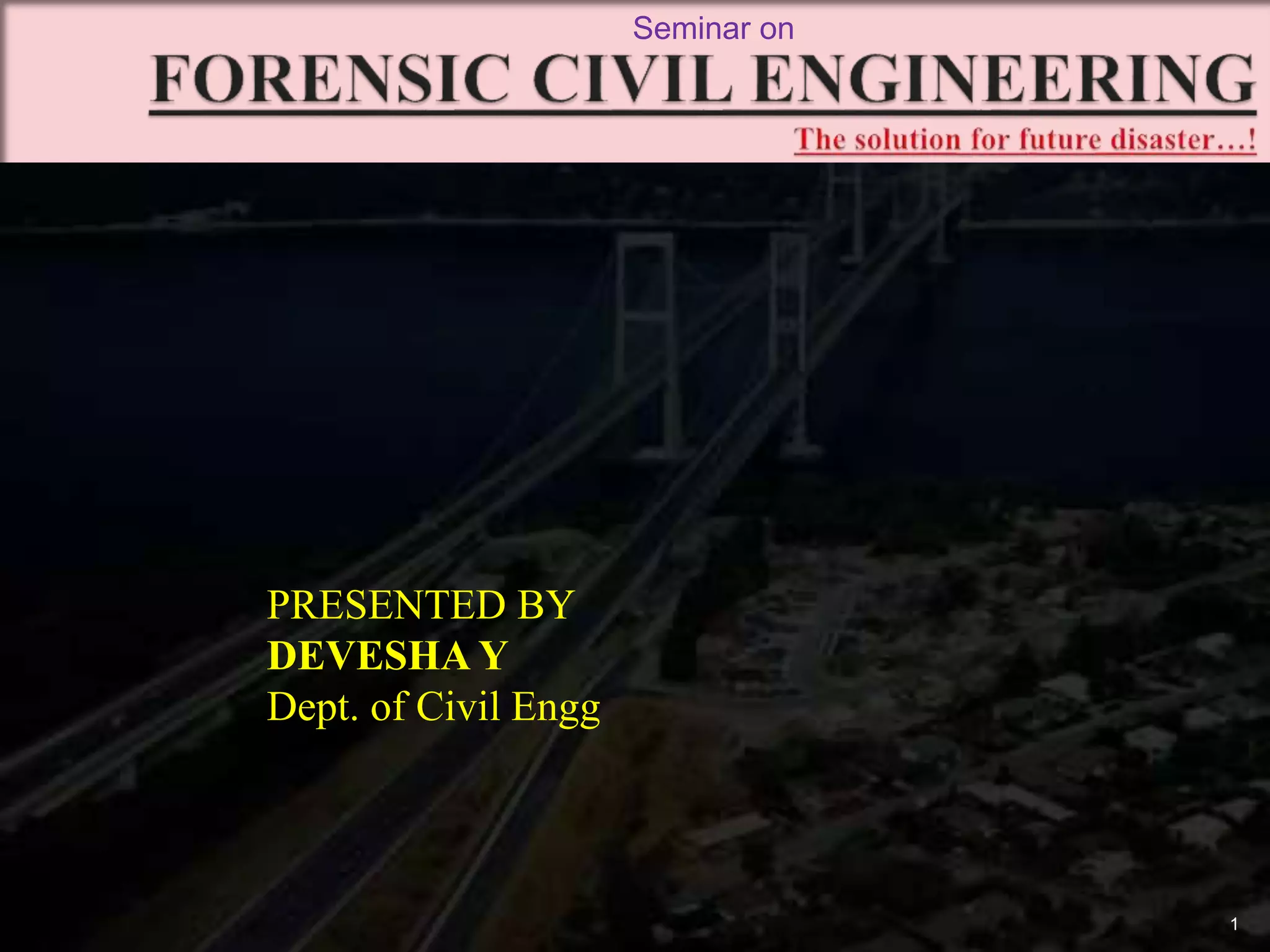
PRESENTED BY
DEVESHA Y
Dept. of Civil Engg
Seminar on
OUT LINE
 Introduction
 History
 Investigation
 Procedure
 Qualification of forensic civil engineer
 Photo Gallery
 Case study
 References
FORENSIC CIVIL ENGINEERING
2
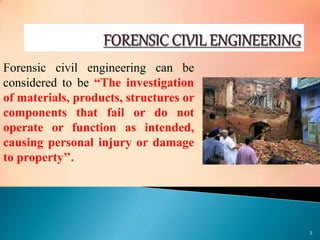
Forensic civil engineering can be
considered to be “The investigation
of materials, products, structures or
components that fail or do not
operate or function as intended,
causing personal injury or damage
to property’’.
3
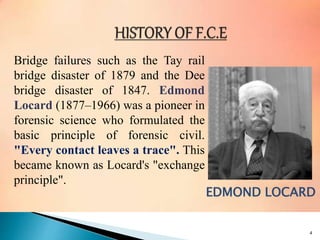
Bridge failures such as the Tay rail
bridge disaster of 1879 and the Dee
bridge disaster of 1847. Edmond
Locard (1877–1966) was a pioneer in
forensic science who formulated the
basic principle of forensic civil.
"Every contact leaves a trace". This
became known as Locard's "exchange
principle".
EDMOND LOCARD
4
INVESTIGATION PROCEDURE
 ”Define” the failure.
 Collect evidence.
 Analyze the evidence.
 The possible events that root causes for the failure.
 Validate the hypothesis through structural analysis.
 Arrive at a conclusion regarding the cause(s)
 Prepare the final report.
5
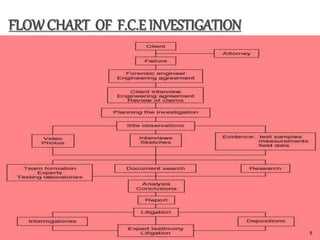
FLOW CHART OF F.C.E INVESTIGATION
6
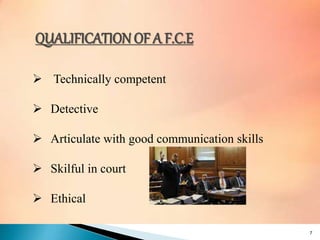
QUALIFICATION OF A F.C.E
 Technically competent
 Detective
 Articulate with good communication skills
 Skilful in court
 Ethical
7
METHODS OF F.C.E
 EMPIRICAL METHODS
 It contains testing of materials in laboratory
 THEORITICAL METHODS
 RCA----- Root Case Analysis
 ECFC---- Event & Casual Factors Charting
 MORT--- Management Oversight & Risk Tree
 SSAI----- System Safety Accident Investigation
8
NDT METHODS
1. Rebound Hammer test
2. Ultrasonic Pulse Velocity test
3. Cover meter test
4. Half-cell Potential Measurement test
5. Impact echo / pulse echo test
6. Ground Penetrating Radar test
SDT METHODS
1. Concrete core test
2. Capo test
3. Windsor probe test
4. Load test
9
TOOLS (PHOTO GALLERY)
REBOUND HAMMER TEST U P V MACHINE
SCANNING OF REBARS MEASUREMENT OF CORROSION
10
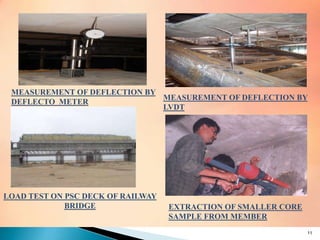
MEASUREMENT OF DEFLECTION BY
DEFLECTO METER
MEASUREMENT OF DEFLECTION BY
LVDT
LOAD TEST ON PSC DECK OF RAILWAY
BRIDGE EXTRACTION OF SMALLER CORE
SAMPLE FROM MEMBER
11
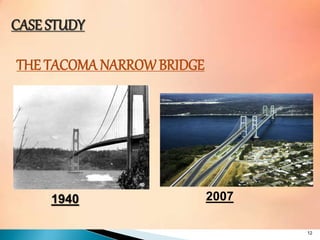
CASE STUDY
THE TACOMA NARROW BRIDGE
1940 2007
12
13
THE TACOMA NARROWBRIDGE
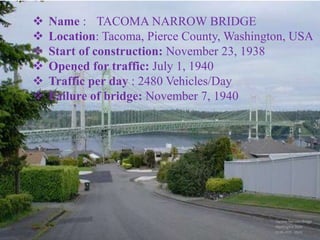
 Name : TACOMA NARROW BRIDGE
 Location: Tacoma, Pierce County, Washington, USA
 Start of construction: November 23, 1938
 Opened for traffic: July 1, 1940
 Traffic per day : 2480 Vehicles/Day
 Failure of bridge: November 7, 1940
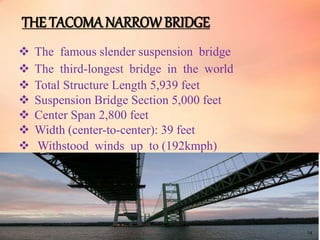
THE TACOMA NARROW BRIDGE
 The famous slender suspension bridge
 The third-longest bridge in the world
 Total Structure Length 5,939 feet
 Suspension Bridge Section 5,000 feet
 Center Span 2,800 feet
 Width (center-to-center): 39 feet
 Withstood winds up to (192kmph)
14
FAILUREOF TACOMA BRIDGE
15
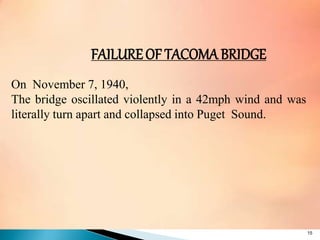
On November 7, 1940,
The bridge oscillated violently in a 42mph wind and was
literally turn apart and collapsed into Puget Sound.
INVESTIGATION REPORT ON TACOMA BRIDGE
It may best explained by Diane Vaughn,
while commenting on the Challenger Space Shuttle
explosion, described as “normalisation of deviance”
“The gradual acceptance of sequential minor
errors and failures accumulating and
culminating in a major catastrophe”
.
16
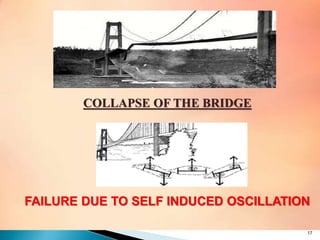
FAILURE DUE TO SELF INDUCED OSCILLATION
COLLAPSE OF THE BRIDGE
17
 Slender suspension bridge in the world.
 The designers also “forgot” the slender suspension bridge.
The solid plate girders supporting the bridge deck acted
barriers to wind flow below the deck, while the wind flowed
smoothly above, causing an aero dynamic uplift.
 Soon the bridge started oscillating and grew in until finally the
deck structure ruptured and the bridge collapsed.
18
RESULTS ON TACOMA BRIDGE
19
SUMMARY
 Forensic Civil Engineering is the application of engineering sciences
to the investigation of failures or other performance problems.
 A wide and multi-disciplinary field, requiring civil engineering
expertise and knowledge of legal procedures.
 Forensic civil engineering deals with the investigation and
reconstruction of failures in infrastructures.
 Engineers & managers need to have a aerial view of the process,
techniques, outcome reporting and legal aspects of forensic civil
engineering investigation
20
1. Task Committee on Guidelines for Failure Investigation, "Guidelines for
Failure Investigation", ASCE, 1989.
2. Christoph Kohl, Doreen Streicher, (2006) “Results of reconstructed and
fused NDT-data measured in the laboratory and on-site at bridges”, Cement
& Concrete Composites, 2006, pp.402-413. .
3. Krause M, Barmann R, Friedlinghaus R, Kretzschamar F, Kroggel O,
Langenberg K, Maierhofer Ch, Muller W, Neisecke J, Schickert M, Schmitz
V, Wiggenhauser H., and Wollbold F. (1997), Comparison of pulse echo
methods for testing concrete’ NDT& E International 4 (special issue), 1997,
pp. 195–204.
4. Maierhofer C. (2003) “Nondestructive Evaluation of Concrete Infrastructure
with Ground Penetrating Radar”, Journal of Materials in Civil Engineering,
ASCE, May-June 2003, PP. 287-297.
5. Sansalone, M., and Carino, N. J. (1986) “Impact-Echo: A method for flaw
detection in concrete using transient stress waves”, NBSIR 86-3452,
National Bureau of Standards, Sept., 1986, 222 p.
21
22
23

FORENSIC CIVIL ENGINEERING

  • 1.
    1 PRESENTED BY DEVESHA Y Dept.of Civil Engg Seminar on
  • 2.
    OUT LINE  Introduction History  Investigation  Procedure  Qualification of forensic civil engineer  Photo Gallery  Case study  References FORENSIC CIVIL ENGINEERING 2
  • 3.
    Forensic civil engineeringcan be considered to be “The investigation of materials, products, structures or components that fail or do not operate or function as intended, causing personal injury or damage to property’’. 3
  • 4.
    Bridge failures suchas the Tay rail bridge disaster of 1879 and the Dee bridge disaster of 1847. Edmond Locard (1877–1966) was a pioneer in forensic science who formulated the basic principle of forensic civil. "Every contact leaves a trace". This became known as Locard's "exchange principle". EDMOND LOCARD 4
  • 5.
    INVESTIGATION PROCEDURE  ”Define”the failure.  Collect evidence.  Analyze the evidence.  The possible events that root causes for the failure.  Validate the hypothesis through structural analysis.  Arrive at a conclusion regarding the cause(s)  Prepare the final report. 5
  • 6.
    FLOW CHART OFF.C.E INVESTIGATION 6
  • 7.
    QUALIFICATION OF AF.C.E  Technically competent  Detective  Articulate with good communication skills  Skilful in court  Ethical 7
  • 8.
    METHODS OF F.C.E EMPIRICAL METHODS  It contains testing of materials in laboratory  THEORITICAL METHODS  RCA----- Root Case Analysis  ECFC---- Event & Casual Factors Charting  MORT--- Management Oversight & Risk Tree  SSAI----- System Safety Accident Investigation 8
  • 9.
    NDT METHODS 1. ReboundHammer test 2. Ultrasonic Pulse Velocity test 3. Cover meter test 4. Half-cell Potential Measurement test 5. Impact echo / pulse echo test 6. Ground Penetrating Radar test SDT METHODS 1. Concrete core test 2. Capo test 3. Windsor probe test 4. Load test 9
  • 10.
    TOOLS (PHOTO GALLERY) REBOUNDHAMMER TEST U P V MACHINE SCANNING OF REBARS MEASUREMENT OF CORROSION 10
  • 11.
    MEASUREMENT OF DEFLECTIONBY DEFLECTO METER MEASUREMENT OF DEFLECTION BY LVDT LOAD TEST ON PSC DECK OF RAILWAY BRIDGE EXTRACTION OF SMALLER CORE SAMPLE FROM MEMBER 11
  • 12.
    CASE STUDY THE TACOMANARROW BRIDGE 1940 2007 12
  • 13.
    13 THE TACOMA NARROWBRIDGE Name : TACOMA NARROW BRIDGE  Location: Tacoma, Pierce County, Washington, USA  Start of construction: November 23, 1938  Opened for traffic: July 1, 1940  Traffic per day : 2480 Vehicles/Day  Failure of bridge: November 7, 1940
  • 14.
    THE TACOMA NARROWBRIDGE  The famous slender suspension bridge  The third-longest bridge in the world  Total Structure Length 5,939 feet  Suspension Bridge Section 5,000 feet  Center Span 2,800 feet  Width (center-to-center): 39 feet  Withstood winds up to (192kmph) 14
  • 15.
    FAILUREOF TACOMA BRIDGE 15 OnNovember 7, 1940, The bridge oscillated violently in a 42mph wind and was literally turn apart and collapsed into Puget Sound.
  • 16.
    INVESTIGATION REPORT ONTACOMA BRIDGE It may best explained by Diane Vaughn, while commenting on the Challenger Space Shuttle explosion, described as “normalisation of deviance” “The gradual acceptance of sequential minor errors and failures accumulating and culminating in a major catastrophe” . 16
  • 17.
    FAILURE DUE TOSELF INDUCED OSCILLATION COLLAPSE OF THE BRIDGE 17
  • 18.
     Slender suspensionbridge in the world.  The designers also “forgot” the slender suspension bridge. The solid plate girders supporting the bridge deck acted barriers to wind flow below the deck, while the wind flowed smoothly above, causing an aero dynamic uplift.  Soon the bridge started oscillating and grew in until finally the deck structure ruptured and the bridge collapsed. 18 RESULTS ON TACOMA BRIDGE
  • 19.
    19 SUMMARY  Forensic CivilEngineering is the application of engineering sciences to the investigation of failures or other performance problems.  A wide and multi-disciplinary field, requiring civil engineering expertise and knowledge of legal procedures.  Forensic civil engineering deals with the investigation and reconstruction of failures in infrastructures.  Engineers & managers need to have a aerial view of the process, techniques, outcome reporting and legal aspects of forensic civil engineering investigation
  • 20.
    20 1. Task Committeeon Guidelines for Failure Investigation, "Guidelines for Failure Investigation", ASCE, 1989. 2. Christoph Kohl, Doreen Streicher, (2006) “Results of reconstructed and fused NDT-data measured in the laboratory and on-site at bridges”, Cement & Concrete Composites, 2006, pp.402-413. . 3. Krause M, Barmann R, Friedlinghaus R, Kretzschamar F, Kroggel O, Langenberg K, Maierhofer Ch, Muller W, Neisecke J, Schickert M, Schmitz V, Wiggenhauser H., and Wollbold F. (1997), Comparison of pulse echo methods for testing concrete’ NDT& E International 4 (special issue), 1997, pp. 195–204. 4. Maierhofer C. (2003) “Nondestructive Evaluation of Concrete Infrastructure with Ground Penetrating Radar”, Journal of Materials in Civil Engineering, ASCE, May-June 2003, PP. 287-297. 5. Sansalone, M., and Carino, N. J. (1986) “Impact-Echo: A method for flaw detection in concrete using transient stress waves”, NBSIR 86-3452, National Bureau of Standards, Sept., 1986, 222 p.
  • 21.
  • 22.
  • 23.