CHAPTER 1
EDGAR MENOR, RPh
LESSON 2.
STS in the ANCIENT, MIDDLE and MODERN AGES
OBJECTIVES
After studying this module, you should be able to:
1. Describe the development of Science and Technology during Ancient,
Middle, Modern Ages;
2. Identify inventions and discoveries that changed the world over the
course of history.
THE ASIAN CIVILIZATIONS
• Asia is the biggest continent in the world and the home of many ancient
civilizations.
• It is host to many cultural, economic, scientific and political activities of all
ages. In the field of science, technology and mathematics, great civilizations
have stood out: India, China and the Middle East civilizations (Mesopotamian
Civilizations.)
• These civilizations were incomparable in terms of their contributions to the
development of knowledge during their time.
Sumerian Civilization
• Sumeria, found on the southernmost tip of the ancient Mesopotamia, 3500 BCE, is a great city
with a civilization known as Sumer. The concept of inventing the wheel came during 3500 B.C.
the Sumerian people are perplexed about the limitations on just how much weight humans can
carry over land. The idea came about to connect a non-moving platform to a rolling cylinder—
the sail and plow, which improved trade and farming.
• The Sumerians introduced the 360-day calendar, and they devised the Sexagesimal number
system, it is a number system through which counting is in units and intervals of sixty (60).
This has become the basis for graduating the circumference of a circle to 360 degrees and the
sixty-minute equal graduations to an hour duration in time.
• Sumerians are known for their high degree of cooperation with one another and their desire for
great things.
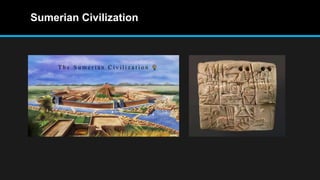
• Sumerians developed the first writing system known as cuneiform. It utilizes word pictures and
triangular symbols that are carved on clay using wedge instruments and then left to dry. This
was used to keep records of things with great historical value or their everyday life.
Sumerian Civilization
Babylonian civilization
• Babylonian civilization emerged from about 3,500 until 500 BC. They were
located on the border of the Euphrates and Tigris rivers in Iraq.
• The Babylonians dig canals and developed earthen dikes to irrigate their
crops and provide water to their livestock. They innovate upon the Sumerian
sexagesimal system.
• Astronomers of Babylon compiled lists of planets and stars which somewhat
accurately pictured the positions of the celestial bodies of our solar system in
terms of 12 equally-spaced signs, each one associated with a zodiacal
constellation.
• One of the major contributions is the Hanging Gardens of Babylon, one of the seven
wonders of the ancient world.
Babylonian civilization
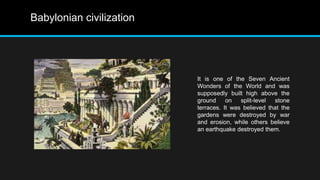
It is one of the Seven Ancient
Wonders of the World and was
supposedly built high above the
ground on split-level stone
terraces. It was believed that the
gardens were destroyed by war
and erosion, while others believe
an earthquake destroyed them.
Egyptian Civilization
• Ancient Egypt began between 5,000-3,100BC and is found in the northeast area of continental
Africa.
• The River Nile has sustained the Egyptians with the necessary water requirements to support
agricultural activities. Egyptians produced a variety of earthenware and pottery items.
• They also worked on metals to produce tools, weapons, and agricultural implements. They
constructed dwellings made of reeds and air-dried mud bricks.
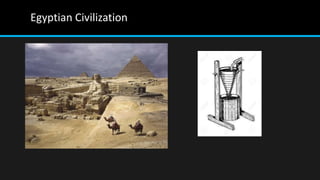
• They built the famous pyramids, and they devised a 365-day calendar. This solar calendar has 365-
day per cycle.
• The year is made up of three seasons that have a hundred and twenty days each; this includes an
intercalary month consisting of epagomenal days of five; this is treated separately from the year
proper. Another contribution is the papyrus.
• They were able to process the Papyrus plant in order to produce thin sheets on which one could
write down things. Egyptians developed a system of writing using symbols, known as hieroglyphs.
Egyptian Civilization
Greek Civilization
• This civilization shaped the modern intellectual world we know today.
• It emerged at around 1,100 BC; the Greek civilization focused on
scientific works of great Greek philosophers in the likes of Socrates,
Thales, Hippocrates, Archimedes, Aristotle, Archimedes, and Ptolemy.
Their contributions became the foundation and pillars of western ideals
and civilization.
• The alarm clock was invented by the ancient Greeks.
• They made use of water that dropped into drums, which sounded the
alarm.
• Another contribution of Greek civilization is windmills, which were used
in agricultural processing like milling of grains.
Greek Civilization
Roman Civilization
• Roman's great contribution is the Gazette, the first newspaper which contains announcements of
the Roman Empire to the people. These were engraved in metal or stone tablets and then publicly
displayed.
• Record-keeping was easier when the paper was invented; the Roman Empire was able to produce
the first book or codex, which was composed of papyrus pages bound together with an animal skin
as its cover.
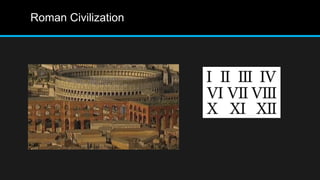
• The Romans devised their own number system specifically to address the need for a standard
counting method that would meet their increasing communication and trade concerns.
• ROMAN ARCHITECTURE one of the most visual contributions of the Roman Empire to the world
• considered a continuation of Greek architecture
• able to implement major projects such as large churches (basilicas and cathedrals, coliseums
amphitheaters etc.)
Roman Civilization
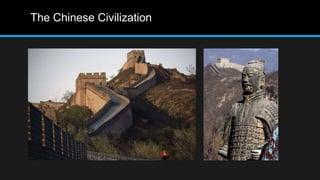
The Chinese Civilization
• The oldest civilization in Asia is Chinese civilization. Silk is one of the things
that connect Far East China to the world. Another was the use of
acupuncture, which uses needles in which Chinese doctors used this to treat
diseases. Tea, which is made of crushed dried tea leaves, was developed,
and the first tea was drunk by a Chinese emperor.
• Gun powder was developed by Chinese alchemists. It is made up of
charcoal, sulfur, and potassium nitrate, which can generate large amounts of
heat and gas in an instant.
• China is also famous for its largest and most extensive infrastructure, the
great wall of china. It is made of stone, brick, wood, earth, and other
materials.
The Chinese Civilization
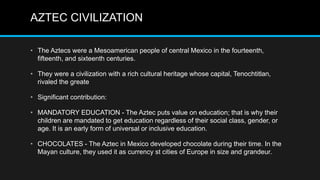
AZTEC CIVILIZATION
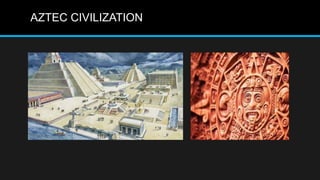
• The Aztecs were a Mesoamerican people of central Mexico in the fourteenth,
fifteenth, and sixteenth centuries.
• They were a civilization with a rich cultural heritage whose capital, Tenochtitlan,
rivaled the greate
• Significant contribution:
• MANDATORY EDUCATION - The Aztec puts value on education; that is why their
children are mandated to get education regardless of their social class, gender, or
age. It is an early form of universal or inclusive education.
• CHOCOLATES - The Aztec in Mexico developed chocolate during their time. In the
Mayan culture, they used it as currency st cities of Europe in size and grandeur.
AZTEC CIVILIZATION
SUMMARY
• It has been established that most, if not all, of the discoveries and inventions during each
period were due to human needs and wants.
• Science therefore provided different civilizations the means to survive and understand the
natural and physical world.
• All in all, it enabled human beings to develop various technologies that helped them in their
everyday tasks.
• Each civilization has its unique characteristic and way of living.
• The social economic structures and the way their rulers rule their land including the internal
and external that took place during those times shaped the striking features of the civilization.
• It is therefore important to note that the kind of society we have speaks of our achievement
and on how we move towards progress.
REFERENCES
• McNamara, J et al. 2018. Science Technology and Society. C&E Publishing Inc.
• Serafica, J. et al.2018. Science Technology and Society, Rex Book Store Inc.

Forensic Chemistry Chapter !

  • 1.
  • 2.
    LESSON 2. STS inthe ANCIENT, MIDDLE and MODERN AGES
  • 3.
    OBJECTIVES After studying thismodule, you should be able to: 1. Describe the development of Science and Technology during Ancient, Middle, Modern Ages; 2. Identify inventions and discoveries that changed the world over the course of history.
  • 4.
    THE ASIAN CIVILIZATIONS •Asia is the biggest continent in the world and the home of many ancient civilizations. • It is host to many cultural, economic, scientific and political activities of all ages. In the field of science, technology and mathematics, great civilizations have stood out: India, China and the Middle East civilizations (Mesopotamian Civilizations.) • These civilizations were incomparable in terms of their contributions to the development of knowledge during their time.
  • 5.
    Sumerian Civilization • Sumeria,found on the southernmost tip of the ancient Mesopotamia, 3500 BCE, is a great city with a civilization known as Sumer. The concept of inventing the wheel came during 3500 B.C. the Sumerian people are perplexed about the limitations on just how much weight humans can carry over land. The idea came about to connect a non-moving platform to a rolling cylinder— the sail and plow, which improved trade and farming. • The Sumerians introduced the 360-day calendar, and they devised the Sexagesimal number system, it is a number system through which counting is in units and intervals of sixty (60). This has become the basis for graduating the circumference of a circle to 360 degrees and the sixty-minute equal graduations to an hour duration in time. • Sumerians are known for their high degree of cooperation with one another and their desire for great things. • Sumerians developed the first writing system known as cuneiform. It utilizes word pictures and triangular symbols that are carved on clay using wedge instruments and then left to dry. This was used to keep records of things with great historical value or their everyday life.
  • 6.
  • 7.
    Babylonian civilization • Babyloniancivilization emerged from about 3,500 until 500 BC. They were located on the border of the Euphrates and Tigris rivers in Iraq. • The Babylonians dig canals and developed earthen dikes to irrigate their crops and provide water to their livestock. They innovate upon the Sumerian sexagesimal system. • Astronomers of Babylon compiled lists of planets and stars which somewhat accurately pictured the positions of the celestial bodies of our solar system in terms of 12 equally-spaced signs, each one associated with a zodiacal constellation. • One of the major contributions is the Hanging Gardens of Babylon, one of the seven wonders of the ancient world.
  • 8.
    Babylonian civilization It isone of the Seven Ancient Wonders of the World and was supposedly built high above the ground on split-level stone terraces. It was believed that the gardens were destroyed by war and erosion, while others believe an earthquake destroyed them.
  • 9.
    Egyptian Civilization • AncientEgypt began between 5,000-3,100BC and is found in the northeast area of continental Africa. • The River Nile has sustained the Egyptians with the necessary water requirements to support agricultural activities. Egyptians produced a variety of earthenware and pottery items. • They also worked on metals to produce tools, weapons, and agricultural implements. They constructed dwellings made of reeds and air-dried mud bricks. • They built the famous pyramids, and they devised a 365-day calendar. This solar calendar has 365- day per cycle. • The year is made up of three seasons that have a hundred and twenty days each; this includes an intercalary month consisting of epagomenal days of five; this is treated separately from the year proper. Another contribution is the papyrus. • They were able to process the Papyrus plant in order to produce thin sheets on which one could write down things. Egyptians developed a system of writing using symbols, known as hieroglyphs.
  • 10.
  • 11.
    Greek Civilization • Thiscivilization shaped the modern intellectual world we know today. • It emerged at around 1,100 BC; the Greek civilization focused on scientific works of great Greek philosophers in the likes of Socrates, Thales, Hippocrates, Archimedes, Aristotle, Archimedes, and Ptolemy. Their contributions became the foundation and pillars of western ideals and civilization. • The alarm clock was invented by the ancient Greeks. • They made use of water that dropped into drums, which sounded the alarm. • Another contribution of Greek civilization is windmills, which were used in agricultural processing like milling of grains.
  • 12.
  • 13.
    Roman Civilization • Roman'sgreat contribution is the Gazette, the first newspaper which contains announcements of the Roman Empire to the people. These were engraved in metal or stone tablets and then publicly displayed. • Record-keeping was easier when the paper was invented; the Roman Empire was able to produce the first book or codex, which was composed of papyrus pages bound together with an animal skin as its cover. • The Romans devised their own number system specifically to address the need for a standard counting method that would meet their increasing communication and trade concerns. • ROMAN ARCHITECTURE one of the most visual contributions of the Roman Empire to the world • considered a continuation of Greek architecture • able to implement major projects such as large churches (basilicas and cathedrals, coliseums amphitheaters etc.)
  • 14.
  • 15.
    The Chinese Civilization •The oldest civilization in Asia is Chinese civilization. Silk is one of the things that connect Far East China to the world. Another was the use of acupuncture, which uses needles in which Chinese doctors used this to treat diseases. Tea, which is made of crushed dried tea leaves, was developed, and the first tea was drunk by a Chinese emperor. • Gun powder was developed by Chinese alchemists. It is made up of charcoal, sulfur, and potassium nitrate, which can generate large amounts of heat and gas in an instant. • China is also famous for its largest and most extensive infrastructure, the great wall of china. It is made of stone, brick, wood, earth, and other materials.
  • 16.
  • 17.
    AZTEC CIVILIZATION • TheAztecs were a Mesoamerican people of central Mexico in the fourteenth, fifteenth, and sixteenth centuries. • They were a civilization with a rich cultural heritage whose capital, Tenochtitlan, rivaled the greate • Significant contribution: • MANDATORY EDUCATION - The Aztec puts value on education; that is why their children are mandated to get education regardless of their social class, gender, or age. It is an early form of universal or inclusive education. • CHOCOLATES - The Aztec in Mexico developed chocolate during their time. In the Mayan culture, they used it as currency st cities of Europe in size and grandeur.
  • 18.
  • 19.
    SUMMARY • It hasbeen established that most, if not all, of the discoveries and inventions during each period were due to human needs and wants. • Science therefore provided different civilizations the means to survive and understand the natural and physical world. • All in all, it enabled human beings to develop various technologies that helped them in their everyday tasks. • Each civilization has its unique characteristic and way of living. • The social economic structures and the way their rulers rule their land including the internal and external that took place during those times shaped the striking features of the civilization. • It is therefore important to note that the kind of society we have speaks of our achievement and on how we move towards progress.
  • 20.
    REFERENCES • McNamara, Jet al. 2018. Science Technology and Society. C&E Publishing Inc. • Serafica, J. et al.2018. Science Technology and Society, Rex Book Store Inc.

Editor's Notes

  • #3 Summarize your research in three to five points.