http://facstaff.gpc.edu/~shale/humanities/literature/world_literature/classprojects/mexico/mayat4.jpg
What were the most significant characteristics of Olmec and other pre-Aztec Central American societies? http://lh5.ggpht.com/_VfMUo-Vczeo/RuQmEau3haI/AAAAAAAADpY/yTUIgmoS7Ns/DSC_0571.JPG
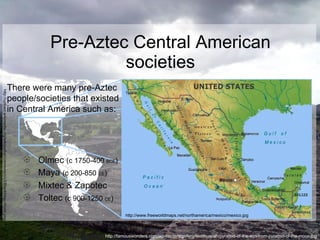
Pre-Aztec Central American societies There were many pre-Aztec people/societies that existed in Central America such as: Olmec  (c 1750-400  BCE ) Maya  (c 200-850  CE ) Mixtec & Zapotec Toltec  (c 900-1250  CE ) http://www.freeworldmaps.net/northamerica/mexico/mexico.jpg http://famouswonders.com/wp-content/gallery/teotihuacan/pyramid-of-the-sun-from-pyramid-of-the-moon.jpg http://upload.wikimedia.org/wikipedia/commons/c/c3/BlankMap-World.png
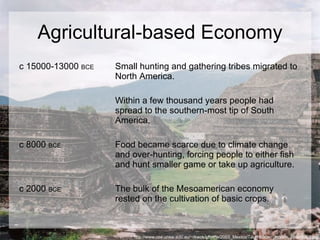
Agricultural-based Economy c 15000-13000  BCE   Small hunting and gathering tribes migrated to  North America. Within a few thousand years people had  spread to the southern-most tip of South  America. c 8000  BCE  Food became scarce due to climate change  and over-hunting, forcing people to either fish  and hunt smaller game or take up agriculture. c 2000  BCE The bulk of the Mesoamerican economy  rested on the cultivation of basic crops. http://www.cse.unsw.edu.au/~rkwok/photos/2003_Mexico/Teotihuacan_mooon_pyramid01.jpg
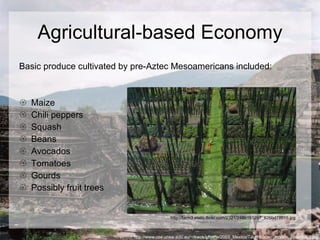
Agricultural-based Economy Basic produce cultivated by pre-Aztec Mesoamericans included: Maize Chili peppers Squash Beans Avocados Tomatoes Gourds Possibly fruit trees  http://www.cse.unsw.edu.au/~rkwok/photos/2003_Mexico/Teotihuacan_mooon_pyramid01.jpg http://farm3.static.flickr.com/2321/2489191297_826bd78015.jpg
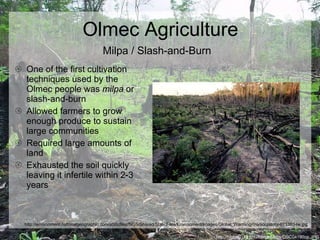
Olmec Agriculture One of the first cultivation techniques used by the Olmec people was  milpa  or slash-and-burn Allowed farmers to grow enough produce to sustain large communities Required large amounts of land Exhausted the soil quickly leaving it infertile within 2-3 years http://biology.uta.edu/herpetology/DSC04190op.JPG http://environment.nationalgeographic.com/staticfiles/NGS/Shared/StaticFiles/Environment/Images/Global_Warming/maniocplants-671395-lw.jpg Milpa / Slash-and-Burn
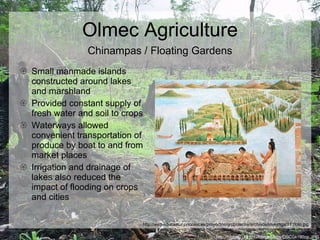
Olmec Agriculture Small manmade islands constructed around lakes and marshland Provided constant supply of fresh water and soil to crops Waterways allowed convenient transportation of produce by boat to and from market places Irrigation and drainage of lakes also reduced the impact of flooding on crops and cities http://biology.uta.edu/herpetology/DSC04190op.JPG Chinampas / Floating Gardens http://web.educastur.princast.es/proyectos/grupotecne/archivos/investiga/111foto.jpg
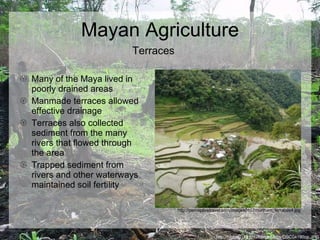
Mayan Agriculture Many of the Maya lived in poorly drained areas Manmade terraces allowed effective drainage Terraces also collected sediment from the many rivers that flowed through the area Trapped sediment from rivers and other waterways maintained soil fertility http://biology.uta.edu/herpetology/DSC04190op.JPG Terraces http://perceptivetravel.com/images0107/northam_terraces4.jpg
Mayan Agriculture In addition to the basic crops grown by most Mesoamericans, the Maya and some others also cultivated cacao and cotton Cacao was considered a precious commodity and was sometimes even used as currency Cotton was woven into valuable items of clothing Both of these enhanced the strength of agricultural-based trade in Mesoamerica  http://biology.uta.edu/herpetology/DSC04190op.JPG Additional Produce http://www.fiery-foods.com/images/ed/chocolate/maya.jpg
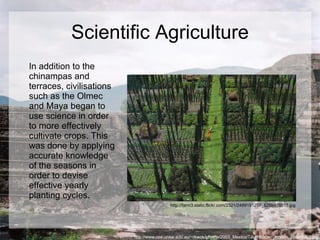
Scientific Agriculture In addition to the chinampas and terraces, civilisations such as the Olmec and Maya began to use science in order to more effectively cultivate crops. This was done by applying accurate knowledge of the seasons in order to devise effective yearly planting cycles. http://www.cse.unsw.edu.au/~rkwok/photos/2003_Mexico/Teotihuacan_mooon_pyramid01.jpg http://farm3.static.flickr.com/2321/2489191297_826bd78015.jpg
City-States and the Centrality of Religion Sustainable agriculture lead to further population growth triggering the development of large cities and city-states centralised by religion http://www.travelblog.org/Gallery/47467/l/29787.jpg http://2012istheend.com/images/mayan_city.jpg
Olmec Cities The three main Olmec cities San Lorenzo (c 1200-800  BCE ) La Venta (c 800-400  BCE ) Tres Zapotes (c 400-100  BCE ) Were not true city-states but they were run religiously and centred around main religious pyramids and temples just as later city-states were http://www.travelblog.org/Gallery/47467/l/29787.jpg http://www.bibliotecapleyades.net/egipto/fingerprintgods/images/finger21.gif
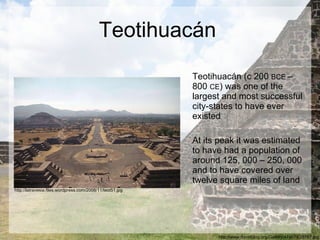
Teotihuacán   Teotihuacán (c 200  BCE  – 800  CE ) was one of the largest and most successful city-states to have ever existed At its peak it was estimated to have had a population of around 125, 000 – 250, 000 and to have covered over twelve square miles of land http://www.travelblog.org/Gallery/47467/l/29787.jpg http://latravesia.files.wordpress.com/2008/11/teot51.jpg
As it was a city-state its citizens were not only elites but those of the middle and sometimes lower classes Its main focal points were two massive religious structures: the Pyramid of the Sun & the Pyramid of the Moon The construction of the city was largely directed by priests and overseen by professional architects and sculptors Teotihuacán contained a main thoroughfare – the Avenue of the Dead – many alleyways, a large marketplace, numerous temples and residential buildings  Teotihuacán  http://www.travelblog.org/Gallery/47467/l/29787.jpg http://www.geocities.com/linksatlantis/teotihuacanmoon.jpg http://z.about.com/d/gomexico/1/0/I/3/-/-/sun_pyramid.jpg
Teotihuacán  http://www.travelblog.org/Gallery/47467/l/29787.jpg http://www.world-mysteries.com/teot_map.gif Pyramid of the Sun Pyramid of the Moon Marketplace Temples and residential blocks Main thoroughfare
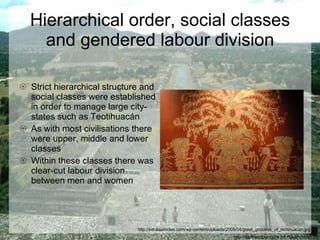
Hierarchical order, social classes and gendered labour division Strict hierarchical structure and social classes were established in order to manage large city-states such as Teotihuacán  As with most civilisations there were upper, middle and lower classes Within these classes there was clear-cut labour division between men and women http://earthacupuncture.info/teotihuacan.jpg http://keralaarticles.com/wp-content/uploads/2008/04/great_goddess_of_teotihuacan.jpg
Upper Classes / Elites The upper classes in Mesoamerican city-states were known as elites They consisted mainly of kings, ruling families and hereditary nobles, as well as ‘political’ merchants who originated largely from the nobles and ruling families Elites generally held the most power, owned the most land and were wealthier and healthier than most people of other classes http://earthacupuncture.info/teotihuacan.jpg http://www.arthistory-archaeology.umd.edu/ARTHwebsitedecommissionedNov32008/webresources/courses/ARTH250/FA04/zapotec%20xipe%20totec.jpg
Middle Class The middle class consisted of priests, warriors, architects, sculptors and specialised artisans Priests were highly educated and ruled the middle classes Professional architects and sculptors oversaw the construction of buildings and monuments Specialised artisans created valuable items of clothing, pottery and jewellery for the upper classes http://earthacupuncture.info/teotihuacan.jpg http://lh6.ggpht.com/_WuZRIPMAef0/SIE7nNY8E1I/AAAAAAAACz0/tapfmruKbvY/37ptg_yrbundl.JPG
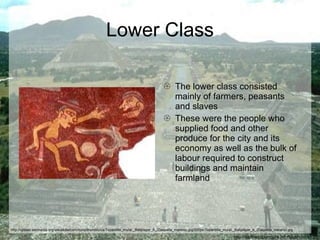
Lower Class The lower class consisted mainly of farmers, peasants and slaves These were the people who supplied food and other produce for the city and its economy as well as the bulk of labour required to construct buildings and maintain farmland http://earthacupuncture.info/teotihuacan.jpg http://upload.wikimedia.org/wikipedia/commons/thumb/c/ca/Tepantitla_mural,_Ballplayer_A_(Daquella_manera).jpg/220px-Tepantitla_mural,_Ballplayer_A_(Daquella_manera).jpg
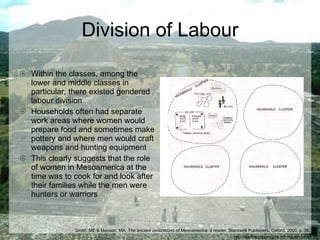
Division of Labour Within the classes, among the lower and middle classes in particular, there existed gendered labour division Households often had separate work areas where women would prepare food and sometimes make pottery and where men would craft weapons and hunting equipment This clearly suggests that the role of women in Mesoamerica at the time was to cook for and look after their families while the men were hunters or warriors http://earthacupuncture.info/teotihuacan.jpg Smith, ME & Masson, MA,  The ancient civilizations of Mesoamerica: a reader , Blackwell Publishers, Oxford, 2000, p. 36.
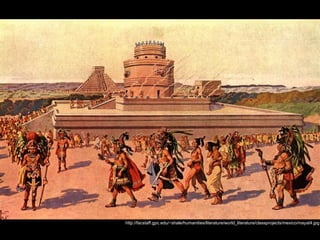
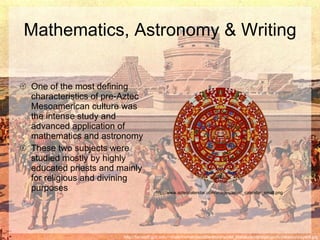
Mathematics, Astronomy & Writing One of the most defining characteristics of pre-Aztec Mesoamerican culture was the intense study and advanced application of mathematics and astronomy These two subjects were studied mostly by highly educated priests and mainly for religious and divining purposes  http://facstaff.gpc.edu/~shale/humanities/literature/world_literature/classprojects/mexico/mayat4.jpg http://www.azteccalendar.com/images/aztec_calendar_small.png
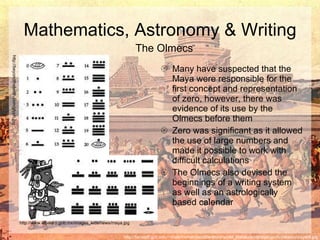
Many have suspected that the Maya were responsible for the first concept and representation of zero, however, there was evidence of its use by the Olmecs before them Zero was significant as it allowed the use of large numbers and made it possible to work with difficult calculations The Olmecs also devised the beginnings of a writing system as well as an astrologically based calendar  Mathematics, Astronomy & Writing http://facstaff.gpc.edu/~shale/humanities/literature/world_literature/classprojects/mexico/mayat4.jpg The Olmecs http://beyondthetenth.com/glyph.jpg http://www.elbalero.gob.mx/images_kids/news/maya.jpg
While the Maya were not the first to study Maths and Astronomy, they certainly did improve upon it  The Maya created a system of writing that was more advanced that that used by the Aztecs They also created an extremely accurate calendar that was even more precise than any calendar system used by Europeans at the time  Mathematics, Astronomy & Writing http://facstaff.gpc.edu/~shale/humanities/literature/world_literature/classprojects/mexico/mayat4.jpg The Maya http://www.talariaenterprises.com/images3/6067a.jpg
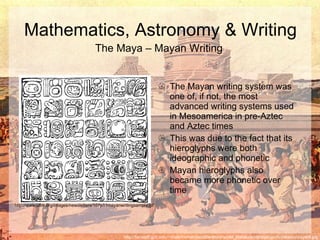
The Mayan writing system was one of, if not, the most advanced writing systems used in Mesoamerica in pre-Aztec and Aztec times This was due to the fact that its hieroglyphs were both ideographic and phonetic Mayan hieroglyphs also became more phonetic over time Mathematics, Astronomy & Writing http://facstaff.gpc.edu/~shale/humanities/literature/world_literature/classprojects/mexico/mayat4.jpg The Maya – Mayan Writing http://www.utlm.org/images/newsletters/107p11mayanwritingsample.gif
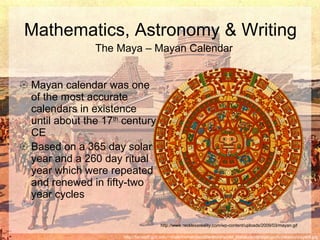
Mayan calendar was one of the most accurate calendars in existence until about the 17 th  century CE Based on a 365 day solar year and a 260 day ritual year which were repeated and renewed in fifty-two year cycles   Mathematics, Astronomy & Writing http://facstaff.gpc.edu/~shale/humanities/literature/world_literature/classprojects/mexico/mayat4.jpg The Maya – Mayan Calendar http://www.recklessreality.com/wp-content/uploads/2009/03/mayan.gif
Neolithic Technology Despite advanced knowledge of math, astronomy and written language, pre-Aztec technology was relatively neolithic The wheel was used in things like pottery but not used in any methods of transport or agriculture  Some metals were utilised but only decoratively and not in any practical way e.g. to make weapons or tools Most tools and weapons at the time were either made of obsidian and other types of stone and sometimes animal bone  http://www.cse.unsw.edu.au/~rkwok/photos/2003_Mexico/Teotihuacan_mooon_pyramid01.jpg http://www.the-book-of-mormon.com/mayan-pottery-chama-valley.jpg http://images.encarta.msn.com/xrefmedia/sharemed/targets/images/pho/t025/T025099A.jpg
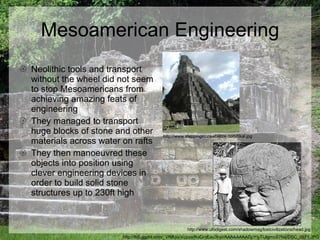
Mesoamerican Engineering Neolithic tools and transport without the wheel did not seem to stop Mesoamericans from achieving amazing feats of engineering They managed to transport huge blocks of stone and other materials across water on rafts They then manoeuvred these objects into position using clever engineering devices in order to build solid stone structures up to 230ft high  http://lh5.ggpht.com/_VfMUo-Vczeo/RuQmEau3haI/AAAAAAAADpY/yTUIgmoS7Ns/DSC_0571.JPG http://www.steppingstonesbelize.com/tikal.jpg http://www.ufodigest.com/shadowmag/lostcivilizations/head.jpg
What were the most significant characteristics of Olmec and other pre-Aztec Central American societies? Scientific agriculture and an agriculturally-based economy Large religiously centralised cities and city-states Strict social stratification and gendered labour division Advanced use of mathematics, astronomy and written language The use of neolithic technology and the creation of engineering marvels  http://famouswonders.com/wp-content/gallery/teotihuacan/pyramid-of-the-sun-from-pyramid-of-the-moon.jpg

History Presentation

  • 1.
  • 2.
    What were themost significant characteristics of Olmec and other pre-Aztec Central American societies? http://lh5.ggpht.com/_VfMUo-Vczeo/RuQmEau3haI/AAAAAAAADpY/yTUIgmoS7Ns/DSC_0571.JPG
  • 3.
    Pre-Aztec Central Americansocieties There were many pre-Aztec people/societies that existed in Central America such as: Olmec (c 1750-400 BCE ) Maya (c 200-850 CE ) Mixtec & Zapotec Toltec (c 900-1250 CE ) http://www.freeworldmaps.net/northamerica/mexico/mexico.jpg http://famouswonders.com/wp-content/gallery/teotihuacan/pyramid-of-the-sun-from-pyramid-of-the-moon.jpg http://upload.wikimedia.org/wikipedia/commons/c/c3/BlankMap-World.png
  • 4.
    Agricultural-based Economy c15000-13000 BCE Small hunting and gathering tribes migrated to North America. Within a few thousand years people had spread to the southern-most tip of South America. c 8000 BCE Food became scarce due to climate change and over-hunting, forcing people to either fish and hunt smaller game or take up agriculture. c 2000 BCE The bulk of the Mesoamerican economy rested on the cultivation of basic crops. http://www.cse.unsw.edu.au/~rkwok/photos/2003_Mexico/Teotihuacan_mooon_pyramid01.jpg
  • 5.
    Agricultural-based Economy Basicproduce cultivated by pre-Aztec Mesoamericans included: Maize Chili peppers Squash Beans Avocados Tomatoes Gourds Possibly fruit trees http://www.cse.unsw.edu.au/~rkwok/photos/2003_Mexico/Teotihuacan_mooon_pyramid01.jpg http://farm3.static.flickr.com/2321/2489191297_826bd78015.jpg
  • 6.
    Olmec Agriculture Oneof the first cultivation techniques used by the Olmec people was milpa or slash-and-burn Allowed farmers to grow enough produce to sustain large communities Required large amounts of land Exhausted the soil quickly leaving it infertile within 2-3 years http://biology.uta.edu/herpetology/DSC04190op.JPG http://environment.nationalgeographic.com/staticfiles/NGS/Shared/StaticFiles/Environment/Images/Global_Warming/maniocplants-671395-lw.jpg Milpa / Slash-and-Burn
  • 7.
    Olmec Agriculture Smallmanmade islands constructed around lakes and marshland Provided constant supply of fresh water and soil to crops Waterways allowed convenient transportation of produce by boat to and from market places Irrigation and drainage of lakes also reduced the impact of flooding on crops and cities http://biology.uta.edu/herpetology/DSC04190op.JPG Chinampas / Floating Gardens http://web.educastur.princast.es/proyectos/grupotecne/archivos/investiga/111foto.jpg
  • 8.
    Mayan Agriculture Manyof the Maya lived in poorly drained areas Manmade terraces allowed effective drainage Terraces also collected sediment from the many rivers that flowed through the area Trapped sediment from rivers and other waterways maintained soil fertility http://biology.uta.edu/herpetology/DSC04190op.JPG Terraces http://perceptivetravel.com/images0107/northam_terraces4.jpg
  • 9.
    Mayan Agriculture Inaddition to the basic crops grown by most Mesoamericans, the Maya and some others also cultivated cacao and cotton Cacao was considered a precious commodity and was sometimes even used as currency Cotton was woven into valuable items of clothing Both of these enhanced the strength of agricultural-based trade in Mesoamerica http://biology.uta.edu/herpetology/DSC04190op.JPG Additional Produce http://www.fiery-foods.com/images/ed/chocolate/maya.jpg
  • 10.
    Scientific Agriculture Inaddition to the chinampas and terraces, civilisations such as the Olmec and Maya began to use science in order to more effectively cultivate crops. This was done by applying accurate knowledge of the seasons in order to devise effective yearly planting cycles. http://www.cse.unsw.edu.au/~rkwok/photos/2003_Mexico/Teotihuacan_mooon_pyramid01.jpg http://farm3.static.flickr.com/2321/2489191297_826bd78015.jpg
  • 11.
    City-States and theCentrality of Religion Sustainable agriculture lead to further population growth triggering the development of large cities and city-states centralised by religion http://www.travelblog.org/Gallery/47467/l/29787.jpg http://2012istheend.com/images/mayan_city.jpg
  • 12.
    Olmec Cities Thethree main Olmec cities San Lorenzo (c 1200-800 BCE ) La Venta (c 800-400 BCE ) Tres Zapotes (c 400-100 BCE ) Were not true city-states but they were run religiously and centred around main religious pyramids and temples just as later city-states were http://www.travelblog.org/Gallery/47467/l/29787.jpg http://www.bibliotecapleyades.net/egipto/fingerprintgods/images/finger21.gif
  • 13.
    Teotihuacán Teotihuacán (c 200 BCE – 800 CE ) was one of the largest and most successful city-states to have ever existed At its peak it was estimated to have had a population of around 125, 000 – 250, 000 and to have covered over twelve square miles of land http://www.travelblog.org/Gallery/47467/l/29787.jpg http://latravesia.files.wordpress.com/2008/11/teot51.jpg
  • 14.
    As it wasa city-state its citizens were not only elites but those of the middle and sometimes lower classes Its main focal points were two massive religious structures: the Pyramid of the Sun & the Pyramid of the Moon The construction of the city was largely directed by priests and overseen by professional architects and sculptors Teotihuacán contained a main thoroughfare – the Avenue of the Dead – many alleyways, a large marketplace, numerous temples and residential buildings Teotihuacán http://www.travelblog.org/Gallery/47467/l/29787.jpg http://www.geocities.com/linksatlantis/teotihuacanmoon.jpg http://z.about.com/d/gomexico/1/0/I/3/-/-/sun_pyramid.jpg
  • 15.
    Teotihuacán http://www.travelblog.org/Gallery/47467/l/29787.jpghttp://www.world-mysteries.com/teot_map.gif Pyramid of the Sun Pyramid of the Moon Marketplace Temples and residential blocks Main thoroughfare
  • 16.
    Hierarchical order, socialclasses and gendered labour division Strict hierarchical structure and social classes were established in order to manage large city-states such as Teotihuacán As with most civilisations there were upper, middle and lower classes Within these classes there was clear-cut labour division between men and women http://earthacupuncture.info/teotihuacan.jpg http://keralaarticles.com/wp-content/uploads/2008/04/great_goddess_of_teotihuacan.jpg
  • 17.
    Upper Classes /Elites The upper classes in Mesoamerican city-states were known as elites They consisted mainly of kings, ruling families and hereditary nobles, as well as ‘political’ merchants who originated largely from the nobles and ruling families Elites generally held the most power, owned the most land and were wealthier and healthier than most people of other classes http://earthacupuncture.info/teotihuacan.jpg http://www.arthistory-archaeology.umd.edu/ARTHwebsitedecommissionedNov32008/webresources/courses/ARTH250/FA04/zapotec%20xipe%20totec.jpg
  • 18.
    Middle Class Themiddle class consisted of priests, warriors, architects, sculptors and specialised artisans Priests were highly educated and ruled the middle classes Professional architects and sculptors oversaw the construction of buildings and monuments Specialised artisans created valuable items of clothing, pottery and jewellery for the upper classes http://earthacupuncture.info/teotihuacan.jpg http://lh6.ggpht.com/_WuZRIPMAef0/SIE7nNY8E1I/AAAAAAAACz0/tapfmruKbvY/37ptg_yrbundl.JPG
  • 19.
    Lower Class Thelower class consisted mainly of farmers, peasants and slaves These were the people who supplied food and other produce for the city and its economy as well as the bulk of labour required to construct buildings and maintain farmland http://earthacupuncture.info/teotihuacan.jpg http://upload.wikimedia.org/wikipedia/commons/thumb/c/ca/Tepantitla_mural,_Ballplayer_A_(Daquella_manera).jpg/220px-Tepantitla_mural,_Ballplayer_A_(Daquella_manera).jpg
  • 20.
    Division of LabourWithin the classes, among the lower and middle classes in particular, there existed gendered labour division Households often had separate work areas where women would prepare food and sometimes make pottery and where men would craft weapons and hunting equipment This clearly suggests that the role of women in Mesoamerica at the time was to cook for and look after their families while the men were hunters or warriors http://earthacupuncture.info/teotihuacan.jpg Smith, ME & Masson, MA, The ancient civilizations of Mesoamerica: a reader , Blackwell Publishers, Oxford, 2000, p. 36.
  • 21.
    Mathematics, Astronomy &Writing One of the most defining characteristics of pre-Aztec Mesoamerican culture was the intense study and advanced application of mathematics and astronomy These two subjects were studied mostly by highly educated priests and mainly for religious and divining purposes http://facstaff.gpc.edu/~shale/humanities/literature/world_literature/classprojects/mexico/mayat4.jpg http://www.azteccalendar.com/images/aztec_calendar_small.png
  • 22.
    Many have suspectedthat the Maya were responsible for the first concept and representation of zero, however, there was evidence of its use by the Olmecs before them Zero was significant as it allowed the use of large numbers and made it possible to work with difficult calculations The Olmecs also devised the beginnings of a writing system as well as an astrologically based calendar Mathematics, Astronomy & Writing http://facstaff.gpc.edu/~shale/humanities/literature/world_literature/classprojects/mexico/mayat4.jpg The Olmecs http://beyondthetenth.com/glyph.jpg http://www.elbalero.gob.mx/images_kids/news/maya.jpg
  • 23.
    While the Mayawere not the first to study Maths and Astronomy, they certainly did improve upon it The Maya created a system of writing that was more advanced that that used by the Aztecs They also created an extremely accurate calendar that was even more precise than any calendar system used by Europeans at the time Mathematics, Astronomy & Writing http://facstaff.gpc.edu/~shale/humanities/literature/world_literature/classprojects/mexico/mayat4.jpg The Maya http://www.talariaenterprises.com/images3/6067a.jpg
  • 24.
    The Mayan writingsystem was one of, if not, the most advanced writing systems used in Mesoamerica in pre-Aztec and Aztec times This was due to the fact that its hieroglyphs were both ideographic and phonetic Mayan hieroglyphs also became more phonetic over time Mathematics, Astronomy & Writing http://facstaff.gpc.edu/~shale/humanities/literature/world_literature/classprojects/mexico/mayat4.jpg The Maya – Mayan Writing http://www.utlm.org/images/newsletters/107p11mayanwritingsample.gif
  • 25.
    Mayan calendar wasone of the most accurate calendars in existence until about the 17 th century CE Based on a 365 day solar year and a 260 day ritual year which were repeated and renewed in fifty-two year cycles Mathematics, Astronomy & Writing http://facstaff.gpc.edu/~shale/humanities/literature/world_literature/classprojects/mexico/mayat4.jpg The Maya – Mayan Calendar http://www.recklessreality.com/wp-content/uploads/2009/03/mayan.gif
  • 26.
    Neolithic Technology Despiteadvanced knowledge of math, astronomy and written language, pre-Aztec technology was relatively neolithic The wheel was used in things like pottery but not used in any methods of transport or agriculture Some metals were utilised but only decoratively and not in any practical way e.g. to make weapons or tools Most tools and weapons at the time were either made of obsidian and other types of stone and sometimes animal bone http://www.cse.unsw.edu.au/~rkwok/photos/2003_Mexico/Teotihuacan_mooon_pyramid01.jpg http://www.the-book-of-mormon.com/mayan-pottery-chama-valley.jpg http://images.encarta.msn.com/xrefmedia/sharemed/targets/images/pho/t025/T025099A.jpg
  • 27.
    Mesoamerican Engineering Neolithictools and transport without the wheel did not seem to stop Mesoamericans from achieving amazing feats of engineering They managed to transport huge blocks of stone and other materials across water on rafts They then manoeuvred these objects into position using clever engineering devices in order to build solid stone structures up to 230ft high http://lh5.ggpht.com/_VfMUo-Vczeo/RuQmEau3haI/AAAAAAAADpY/yTUIgmoS7Ns/DSC_0571.JPG http://www.steppingstonesbelize.com/tikal.jpg http://www.ufodigest.com/shadowmag/lostcivilizations/head.jpg
  • 28.
    What were themost significant characteristics of Olmec and other pre-Aztec Central American societies? Scientific agriculture and an agriculturally-based economy Large religiously centralised cities and city-states Strict social stratification and gendered labour division Advanced use of mathematics, astronomy and written language The use of neolithic technology and the creation of engineering marvels http://famouswonders.com/wp-content/gallery/teotihuacan/pyramid-of-the-sun-from-pyramid-of-the-moon.jpg