Limitations
IV
Applications
II
I
Algorithm
&
Time
Complexity
I
I
I
Introduction
Contents
Limitations
IV
Applications
II
I
Algorithm
&
Time
Complexity
I
I
I
Introduction
Contents
Limitations
IV
Applications
II
I
Algorithm
&
Time
Complexity
I
I
I
Introduction
Introduction
01
PART
Ford
Fulkerson
Ford-Fulkerson algorithm is a
greedy approach for Calculating
the maximum flow in a network.
Net Work Flow
Network flow refers to the movement of data, traffic, or
other forms of communication through a network, such as
a computer network, transportation network, or social
network. It involves the transfer of information or
resources from one node or vertex to another, often
following specific paths or routes.
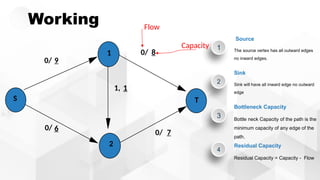
1 The source vertex has all outward edges
no inward edges.
Source
2 Sink will have all inward edge no outward
edge
Sink
3 Bottle neck Capacity of the path is the
minimum capacity of any edge of the
path.
Bottleneck Capacity
4
Residual Capacity = Capacity - Flow
Residual Capacity
Working
S
1
2
T
0/ 9
0/ 8
1, 1
0/ 7
0/ 6
Flow
Capacity
Working
0/ 9
0/ 1
0/ 7
0/ 6
S
1
2
T
0/ 8
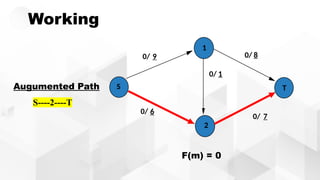
Augumented Path
S----2----T
F(m) = 0
Working
0/ 9
0/ 1
6/ 7
6/ 6
S
1
2
T
0/ 8
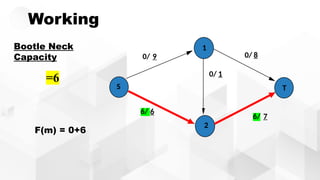
Bootle Neck
Capacity
=6
F(m) = 0+6
Working
0/ 9
0/ 1
6/ 7
6/ 6
S
1
2
T
0/ 8
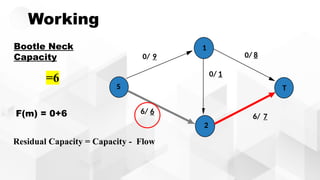
Bootle Neck
Capacity
=6
F(m) = 0+6
Residual Capacity = Capacity - Flow
Working
0/ 9
0/ 1
6/ 7
6/ 6
S
1
2
T
0/ 8
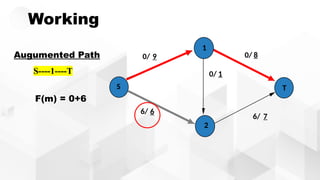
Augumented Path
S----1----T
F(m) = 0+6
Working
0/ 9
0/ 1
6/ 7
6/ 6
S
1
2
T
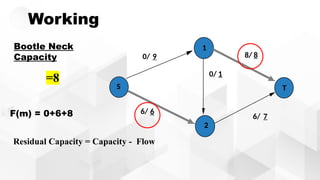
8/ 8
Bootle Neck
Capacity
=8
F(m) = 0+6+8
Residual Capacity = Capacity - Flow
Working
0/ 9
0/ 1
6/ 7
6/ 6
S
1
2
T
8/ 8
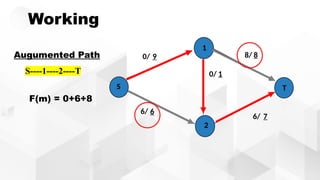
Augumented Path
S----1----2----T
F(m) = 0+6+8
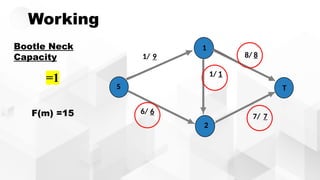
Working
1/ 9
1/ 1
7/ 7
6/ 6
S
1
2
T
8/ 8
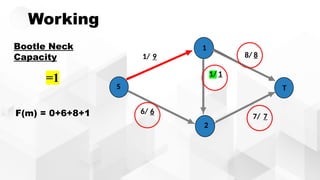
Bootle Neck
Capacity
=1
F(m) = 0+6+8+1
Working
1/ 9
1/ 1
7/ 7
6/ 6
S
1
2
T
8/ 8
Bootle Neck
Capacity
=1
F(m) =15
Pseudocode
&
Time Complexity
02
PART
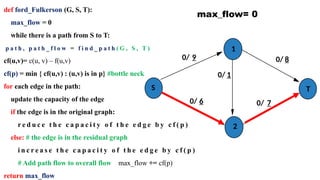
def ford_Fulkerson (G, S, T):
max_flow = 0
while there is a path from S to T:
p a t h , p a t h _ f l o w = f i n d _ p a t h ( G , S , T )
cf(u,v)= c(u, v) – f(u,v)
cf(p) = min { cf(u,v) : (u,v) is in p} #bottle neck
for each edge in the path:
update the capacity of the edge
if the edge is in the original graph:
r e d u c e t h e c a p a c i t y o f t h e e d g e b y c f ( p )
else: # the edge is in the residual graph
i n c r e a s e t h e c a p a c i t y o f t h e e d g e b y c f ( p )
# Add path flow to overall flow max_flow += cf(p)
return max_flow
S
1
2
T
max_flow= 0
0/ 9
0/ 1
0/ 7
0/ 6
0/ 8
def ford_Fulkerson (G, S, T):
max_flow = 0
while there is a path from S to T:
p a t h , p a t h _ f l o w = f i n d _ p a t h ( G , S , T )
cf(u,v)= c(u, v) – f(u,v)
cf(p) = min { cf(u,v) : (u,v) is in p} #bottle neck
for each edge in the path:
update the capacity of the edge
if the edge is in the original graph:
r e d u c e t h e c a p a c i t y o f t h e e d g e b y c f ( p )
else: # the edge is in the residual graph
i n c r e a s e t h e c a p a c i t y o f t h e e d g e b y c f ( p )
# Add path flow to overall flow max_flow += cf(p)
return max_flow
S
1
2
T
0/ 9
0/ 1
6/ 7
6/ 6
0/ 8
max_flow = 0+6
def ford_Fulkerson (G, S, T):
max_flow = 0
while there is a path from S to T:
p a t h , p a t h _ f l o w = D F S ( G , S , T )
cf(u,v)= c(u, v) – f(u,v)
cf(p) = min { cf(u,v) : (u,v) is in p} #bottle neck
for each edge in the path:
update the capacity of the edge
if the edge is in the original graph:
r e d u c e t h e c a p a c i t y o f t h e e d g e b y c f ( p )
else: # the edge is in the residual graph
i n c r e a s e t h e c a p a c i t y o f t h e e d g e b y c f ( p )
# Add path flow to overall flow max_flow += cf(p)
return max_flow
S
1
2
T
0/ 9
0/ 1
6/ 7
6/ 6
0/ 8
max_flow = 0+6
def ford_Fulkerson (G, S, T):
max_flow = 0
while there is a path from S to T:
p a t h , p a t h _ f l o w = D F S ( G , S , T )
cf(u,v)= c(u, v) – f(u,v)
cf(p) = min { cf(u,v) : (u,v) is in p} #bottle neck
for each edge in the path:
update the capacity of the edge
if the edge is in the original graph:
r e d u c e t h e c a p a c i t y o f t h e e d g e b y c f ( p )
else: # the edge is in the residual graph
i n c r e a s e t h e c a p a c i t y o f t h e e d g e b y c f ( p )
# Add path flow to overall flow max_flow += cf(p)
return max_flow
max_flow = 0+6
0/ 9
0/ 1
6/ 7
6/ 6
S
1
2
T
0/ 8
def ford_Fulkerson (G, S, T):
max_flow = 0
while there is a path from S to T:
p a t h , p a t h _ f l o w = D F S ( G , S , T )
cf(u,v)= c(u, v) – f(u,v)
cf(p) = min { cf(u,v) : (u,v) is in p} #bottle neck
for each edge in the path:
update the capacity of the edge
if the edge is in the original graph:
r e d u c e t h e c a p a c i t y o f t h e e d g e b y c f ( p )
else: # the edge is in the residual graph
i n c r e a s e t h e c a p a c i t y o f t h e e d g e b y c f ( p )
# Add path flow to overall flow max_flow += cf(p)
return max_flow
max_flow = 0+6+8
0/ 9
0/ 1
6/ 7
6/ 6
S
1
2
T
8/ 8
def ford_Fulkerson (G, S, T):
max_flow = 0
while there is a path from S to T:
p a t h , p a t h _ f l o w = D F S ( G , S , T )
cf(u,v)= c(u, v) – f(u,v)
cf(p) = min { cf(u,v) : (u,v) is in p} #bottle neck
for each edge in the path:
update the capacity of the edge
if the edge is in the original graph:
r e d u c e t h e c a p a c i t y o f t h e e d g e b y c f ( p )
else: # the edge is in the residual graph
i n c r e a s e t h e c a p a c i t y o f t h e e d g e b y c f ( p )
# Add path flow to overall flow max_flow += cf(p)
return max_flow
max_flow = 0+6+8
0/ 9
0/ 1
6/ 7
6/ 6
S
1
2
T
8/ 8
def ford_Fulkerson (G, S, T):
max_flow = 0
while there is a path from S to T:
p a t h , p a t h _ f l o w = D F S ( G , S , T )
cf(u,v)= c(u, v) – f(u,v)
cf(p) = min { cf(u,v) : (u,v) is in p} #bottle neck
for each edge in the path:
update the capacity of the edge
if the edge is in the original graph:
r e d u c e t h e c a p a c i t y o f t h e e d g e b y c f ( p )
else: # the edge is in the residual graph
i n c r e a s e t h e c a p a c i t y o f t h e e d g e b y c f ( p )
# Add path flow to overall flow max_flow += cf(p)
return max_flow
max_flow = 0+6+8+1
1/ 9
1/ 1
7/ 7
6/ 6
S
1
2
T
8/ 8
def ford_Fulkerson (G, S, T):
max_flow = 0
while there is a path from S to T:
p a t h , p a t h _ f l o w = D F S ( G , S , T )
cf(u,v)= c(u, v) – f(u,v)
cf(p) = min { cf(u,v) : (u,v) is in p} #bottle neck
for each edge in the path:
update the capacity of the edge
if the edge is in the original graph:
r e d u c e t h e c a p a c i t y o f t h e e d g e b y c f ( p )
else: # the edge is in the residual graph
i n c r e a s e t h e c a p a c i t y o f t h e e d g e b y c f ( p )
# Add path flow to overall flow max_flow += cf(p)
return max_flow
max_flow = 15
1/ 9
1/ 1
7/ 7
6/ 6
S
1
2
T
8/ 8
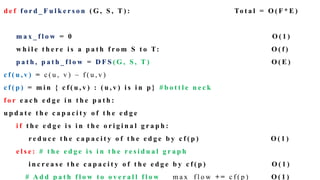
Time Complexity
d e f f o r d _ F u l k e r s o n ( G , S , T ) : To t a l = O ( F * E )
m a x _ f l o w = 0 O ( 1 )
w h i l e t h e r e i s a p a t h f r o m S t o T: O ( f )
p a t h , p a t h _ f l o w = D F S ( G , S , T ) O ( E )
c f ( u , v ) = c ( u , v ) – f ( u , v )
c f ( p ) = m i n { c f ( u , v ) : ( u , v ) i s i n p } # b o t t l e n e c k
f o r e a c h e d g e i n t h e p a t h :
u p d a t e t h e c a p a c i t y o f t h e e d g e
i f t h e e d g e i s i n t h e o r i g i n a l g r a p h :
r e d u c e t h e c a p a c i t y o f t h e e d g e b y c f ( p ) O ( 1 )
e l s e : # t h e e d g e i s i n t h e r e s i d u a l g r a p h
i n c r e a s e t h e c a p a c i t y o f t h e e d g e b y c f ( p ) O ( 1 )
# A d d p a t h f l o w t o o v e r a l l f l o w m a x _ f l o w + = c f ( p ) O ( 1 )
Application
03
PART
Water Distribution Pipeline:
In the context of a water distribution pipeline, it could be used to determine the
maximum amount of water that can flow from a source (like a reservoir) to various
destinations (like homes or businesses) through a network of pipes while respecting
capacity constraints.
For example, imagine a water distribution system with a source reservoir, several
intermediate junctions, and multiple endpoints (e.g., homes, factories). Each pipe
connecting these points has a maximum capacity of water it can carry.
Bipartite matching problem:
The Bipartite Matching Problem is a graph theory problem where the goal is to find
the maximum matching in a bipartite graph. This means finding the largest possible
set of edges with no common vertices.
For example, consider a scenario where you have a set of students and a set of
projects, and you want to match each student with exactly one project based on their
preferences. This can be represented as a bipartite graph, with students on one side
and projects on the other, and edges indicating preferences.
Advantages
04
PART
1. Easy to Understand: The algorithm is simple to understand and apply due to its
clear idea.
2. Flexible: It may be used to solve a wide range of flow network problems,
including network flow optimization and transportation.
3. Efficient in Some Cases: It can be fairly efficient in some situations if capacities
are integers and there are a finite number of augmenting paths.
Disadvantages
05
PART
1. Not Always Efficient: If the limits are real, the procedure could take a while to
find the maximum flow in the worst-case.
2. Dependent on Initial Flow: Selecting the right initial flow can have an impact on
how well the algorithm performs, but doing so can be difficult.
3. May Not Handle Loops Well: The algorithm could fail or could return inaccurate
results if it finds loops in the flow network.
Thanks

Ford_Fulkerson_Algorithm_uptade.ppt[1].pptx

  • 1.
  • 2.
  • 3.
  • 4.
  • 5.
    Ford Fulkerson Ford-Fulkerson algorithm isa greedy approach for Calculating the maximum flow in a network.
  • 6.
    Net Work Flow Networkflow refers to the movement of data, traffic, or other forms of communication through a network, such as a computer network, transportation network, or social network. It involves the transfer of information or resources from one node or vertex to another, often following specific paths or routes.
  • 7.
    1 The sourcevertex has all outward edges no inward edges. Source 2 Sink will have all inward edge no outward edge Sink 3 Bottle neck Capacity of the path is the minimum capacity of any edge of the path. Bottleneck Capacity 4 Residual Capacity = Capacity - Flow Residual Capacity Working S 1 2 T 0/ 9 0/ 8 1, 1 0/ 7 0/ 6 Flow Capacity
  • 8.
    Working 0/ 9 0/ 1 0/7 0/ 6 S 1 2 T 0/ 8 Augumented Path S----2----T F(m) = 0
  • 9.
    Working 0/ 9 0/ 1 6/7 6/ 6 S 1 2 T 0/ 8 Bootle Neck Capacity =6 F(m) = 0+6
  • 10.
    Working 0/ 9 0/ 1 6/7 6/ 6 S 1 2 T 0/ 8 Bootle Neck Capacity =6 F(m) = 0+6 Residual Capacity = Capacity - Flow
  • 11.
    Working 0/ 9 0/ 1 6/7 6/ 6 S 1 2 T 0/ 8 Augumented Path S----1----T F(m) = 0+6
  • 12.
    Working 0/ 9 0/ 1 6/7 6/ 6 S 1 2 T 8/ 8 Bootle Neck Capacity =8 F(m) = 0+6+8 Residual Capacity = Capacity - Flow
  • 13.
    Working 0/ 9 0/ 1 6/7 6/ 6 S 1 2 T 8/ 8 Augumented Path S----1----2----T F(m) = 0+6+8
  • 14.
    Working 1/ 9 1/ 1 7/7 6/ 6 S 1 2 T 8/ 8 Bootle Neck Capacity =1 F(m) = 0+6+8+1
  • 15.
    Working 1/ 9 1/ 1 7/7 6/ 6 S 1 2 T 8/ 8 Bootle Neck Capacity =1 F(m) =15
  • 16.
  • 17.
    def ford_Fulkerson (G,S, T): max_flow = 0 while there is a path from S to T: p a t h , p a t h _ f l o w = f i n d _ p a t h ( G , S , T ) cf(u,v)= c(u, v) – f(u,v) cf(p) = min { cf(u,v) : (u,v) is in p} #bottle neck for each edge in the path: update the capacity of the edge if the edge is in the original graph: r e d u c e t h e c a p a c i t y o f t h e e d g e b y c f ( p ) else: # the edge is in the residual graph i n c r e a s e t h e c a p a c i t y o f t h e e d g e b y c f ( p ) # Add path flow to overall flow max_flow += cf(p) return max_flow S 1 2 T max_flow= 0 0/ 9 0/ 1 0/ 7 0/ 6 0/ 8
  • 18.
    def ford_Fulkerson (G,S, T): max_flow = 0 while there is a path from S to T: p a t h , p a t h _ f l o w = f i n d _ p a t h ( G , S , T ) cf(u,v)= c(u, v) – f(u,v) cf(p) = min { cf(u,v) : (u,v) is in p} #bottle neck for each edge in the path: update the capacity of the edge if the edge is in the original graph: r e d u c e t h e c a p a c i t y o f t h e e d g e b y c f ( p ) else: # the edge is in the residual graph i n c r e a s e t h e c a p a c i t y o f t h e e d g e b y c f ( p ) # Add path flow to overall flow max_flow += cf(p) return max_flow S 1 2 T 0/ 9 0/ 1 6/ 7 6/ 6 0/ 8 max_flow = 0+6
  • 19.
    def ford_Fulkerson (G,S, T): max_flow = 0 while there is a path from S to T: p a t h , p a t h _ f l o w = D F S ( G , S , T ) cf(u,v)= c(u, v) – f(u,v) cf(p) = min { cf(u,v) : (u,v) is in p} #bottle neck for each edge in the path: update the capacity of the edge if the edge is in the original graph: r e d u c e t h e c a p a c i t y o f t h e e d g e b y c f ( p ) else: # the edge is in the residual graph i n c r e a s e t h e c a p a c i t y o f t h e e d g e b y c f ( p ) # Add path flow to overall flow max_flow += cf(p) return max_flow S 1 2 T 0/ 9 0/ 1 6/ 7 6/ 6 0/ 8 max_flow = 0+6
  • 20.
    def ford_Fulkerson (G,S, T): max_flow = 0 while there is a path from S to T: p a t h , p a t h _ f l o w = D F S ( G , S , T ) cf(u,v)= c(u, v) – f(u,v) cf(p) = min { cf(u,v) : (u,v) is in p} #bottle neck for each edge in the path: update the capacity of the edge if the edge is in the original graph: r e d u c e t h e c a p a c i t y o f t h e e d g e b y c f ( p ) else: # the edge is in the residual graph i n c r e a s e t h e c a p a c i t y o f t h e e d g e b y c f ( p ) # Add path flow to overall flow max_flow += cf(p) return max_flow max_flow = 0+6 0/ 9 0/ 1 6/ 7 6/ 6 S 1 2 T 0/ 8
  • 21.
    def ford_Fulkerson (G,S, T): max_flow = 0 while there is a path from S to T: p a t h , p a t h _ f l o w = D F S ( G , S , T ) cf(u,v)= c(u, v) – f(u,v) cf(p) = min { cf(u,v) : (u,v) is in p} #bottle neck for each edge in the path: update the capacity of the edge if the edge is in the original graph: r e d u c e t h e c a p a c i t y o f t h e e d g e b y c f ( p ) else: # the edge is in the residual graph i n c r e a s e t h e c a p a c i t y o f t h e e d g e b y c f ( p ) # Add path flow to overall flow max_flow += cf(p) return max_flow max_flow = 0+6+8 0/ 9 0/ 1 6/ 7 6/ 6 S 1 2 T 8/ 8
  • 22.
    def ford_Fulkerson (G,S, T): max_flow = 0 while there is a path from S to T: p a t h , p a t h _ f l o w = D F S ( G , S , T ) cf(u,v)= c(u, v) – f(u,v) cf(p) = min { cf(u,v) : (u,v) is in p} #bottle neck for each edge in the path: update the capacity of the edge if the edge is in the original graph: r e d u c e t h e c a p a c i t y o f t h e e d g e b y c f ( p ) else: # the edge is in the residual graph i n c r e a s e t h e c a p a c i t y o f t h e e d g e b y c f ( p ) # Add path flow to overall flow max_flow += cf(p) return max_flow max_flow = 0+6+8 0/ 9 0/ 1 6/ 7 6/ 6 S 1 2 T 8/ 8
  • 23.
    def ford_Fulkerson (G,S, T): max_flow = 0 while there is a path from S to T: p a t h , p a t h _ f l o w = D F S ( G , S , T ) cf(u,v)= c(u, v) – f(u,v) cf(p) = min { cf(u,v) : (u,v) is in p} #bottle neck for each edge in the path: update the capacity of the edge if the edge is in the original graph: r e d u c e t h e c a p a c i t y o f t h e e d g e b y c f ( p ) else: # the edge is in the residual graph i n c r e a s e t h e c a p a c i t y o f t h e e d g e b y c f ( p ) # Add path flow to overall flow max_flow += cf(p) return max_flow max_flow = 0+6+8+1 1/ 9 1/ 1 7/ 7 6/ 6 S 1 2 T 8/ 8
  • 24.
    def ford_Fulkerson (G,S, T): max_flow = 0 while there is a path from S to T: p a t h , p a t h _ f l o w = D F S ( G , S , T ) cf(u,v)= c(u, v) – f(u,v) cf(p) = min { cf(u,v) : (u,v) is in p} #bottle neck for each edge in the path: update the capacity of the edge if the edge is in the original graph: r e d u c e t h e c a p a c i t y o f t h e e d g e b y c f ( p ) else: # the edge is in the residual graph i n c r e a s e t h e c a p a c i t y o f t h e e d g e b y c f ( p ) # Add path flow to overall flow max_flow += cf(p) return max_flow max_flow = 15 1/ 9 1/ 1 7/ 7 6/ 6 S 1 2 T 8/ 8
  • 25.
  • 26.
    d e ff o r d _ F u l k e r s o n ( G , S , T ) : To t a l = O ( F * E ) m a x _ f l o w = 0 O ( 1 ) w h i l e t h e r e i s a p a t h f r o m S t o T: O ( f ) p a t h , p a t h _ f l o w = D F S ( G , S , T ) O ( E ) c f ( u , v ) = c ( u , v ) – f ( u , v ) c f ( p ) = m i n { c f ( u , v ) : ( u , v ) i s i n p } # b o t t l e n e c k f o r e a c h e d g e i n t h e p a t h : u p d a t e t h e c a p a c i t y o f t h e e d g e i f t h e e d g e i s i n t h e o r i g i n a l g r a p h : r e d u c e t h e c a p a c i t y o f t h e e d g e b y c f ( p ) O ( 1 ) e l s e : # t h e e d g e i s i n t h e r e s i d u a l g r a p h i n c r e a s e t h e c a p a c i t y o f t h e e d g e b y c f ( p ) O ( 1 ) # A d d p a t h f l o w t o o v e r a l l f l o w m a x _ f l o w + = c f ( p ) O ( 1 )
  • 27.
  • 28.
    Water Distribution Pipeline: Inthe context of a water distribution pipeline, it could be used to determine the maximum amount of water that can flow from a source (like a reservoir) to various destinations (like homes or businesses) through a network of pipes while respecting capacity constraints. For example, imagine a water distribution system with a source reservoir, several intermediate junctions, and multiple endpoints (e.g., homes, factories). Each pipe connecting these points has a maximum capacity of water it can carry.
  • 29.
    Bipartite matching problem: TheBipartite Matching Problem is a graph theory problem where the goal is to find the maximum matching in a bipartite graph. This means finding the largest possible set of edges with no common vertices. For example, consider a scenario where you have a set of students and a set of projects, and you want to match each student with exactly one project based on their preferences. This can be represented as a bipartite graph, with students on one side and projects on the other, and edges indicating preferences.
  • 30.
  • 31.
    1. Easy toUnderstand: The algorithm is simple to understand and apply due to its clear idea. 2. Flexible: It may be used to solve a wide range of flow network problems, including network flow optimization and transportation. 3. Efficient in Some Cases: It can be fairly efficient in some situations if capacities are integers and there are a finite number of augmenting paths.
  • 32.
  • 33.
    1. Not AlwaysEfficient: If the limits are real, the procedure could take a while to find the maximum flow in the worst-case. 2. Dependent on Initial Flow: Selecting the right initial flow can have an impact on how well the algorithm performs, but doing so can be difficult. 3. May Not Handle Loops Well: The algorithm could fail or could return inaccurate results if it finds loops in the flow network.
  • 34.