Forces
What is a Force?
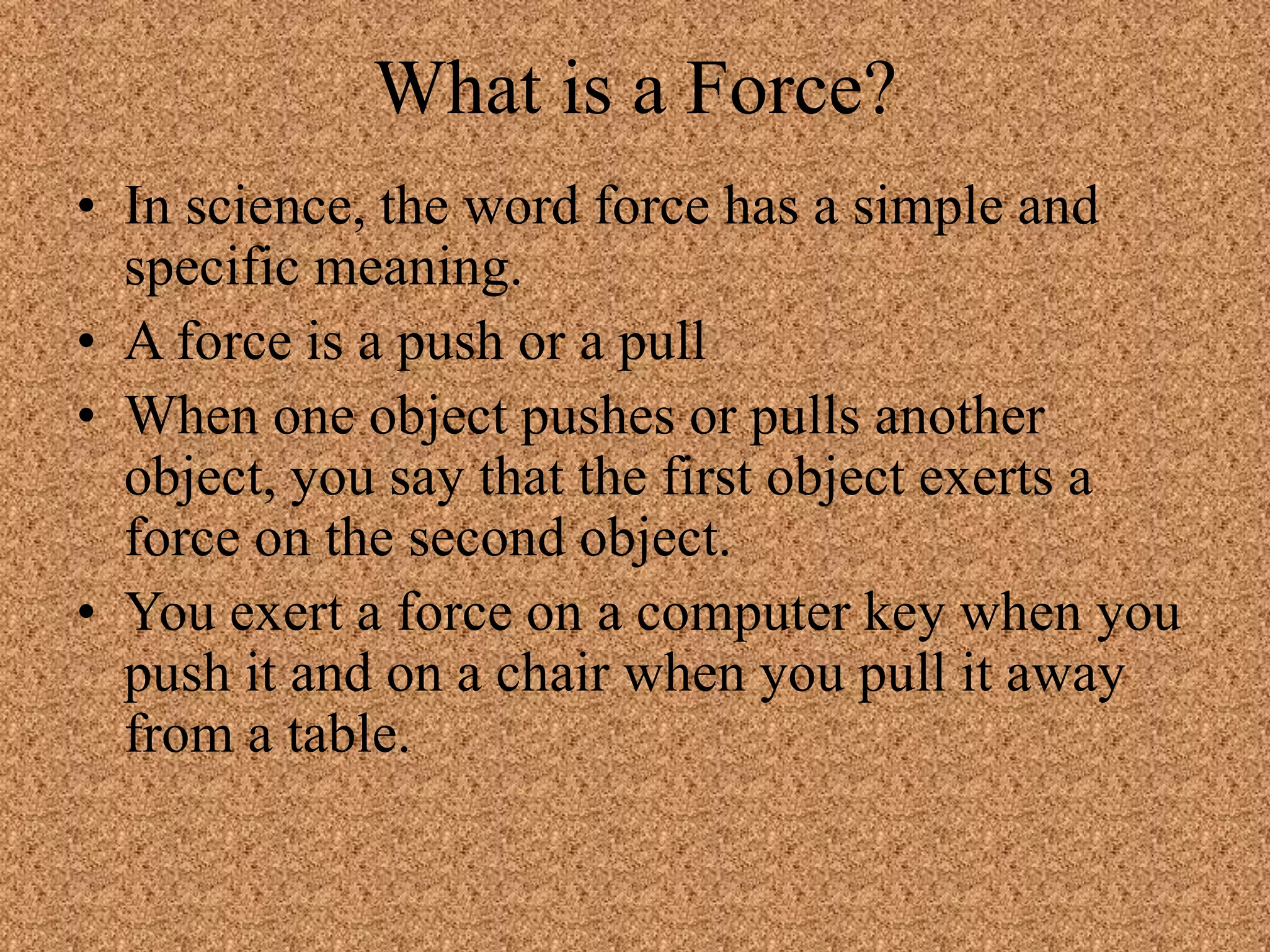
• In science, the word force has a simple and
specific meaning.
• A force is a push or a pull
• When one object pushes or pulls another
object, you say that the first object exerts a
force on the second object.
• You exert a force on a computer key when you
push it and on a chair when you pull it away
from a table.
• Like velocity and acceleration, a force is
described by its strength and by the direction
in which it acts.
• If you push a door, you exert a force in a
different direction than if you pull on the door.
• The strength of a force is measured in the SI
unit called the newton (N).
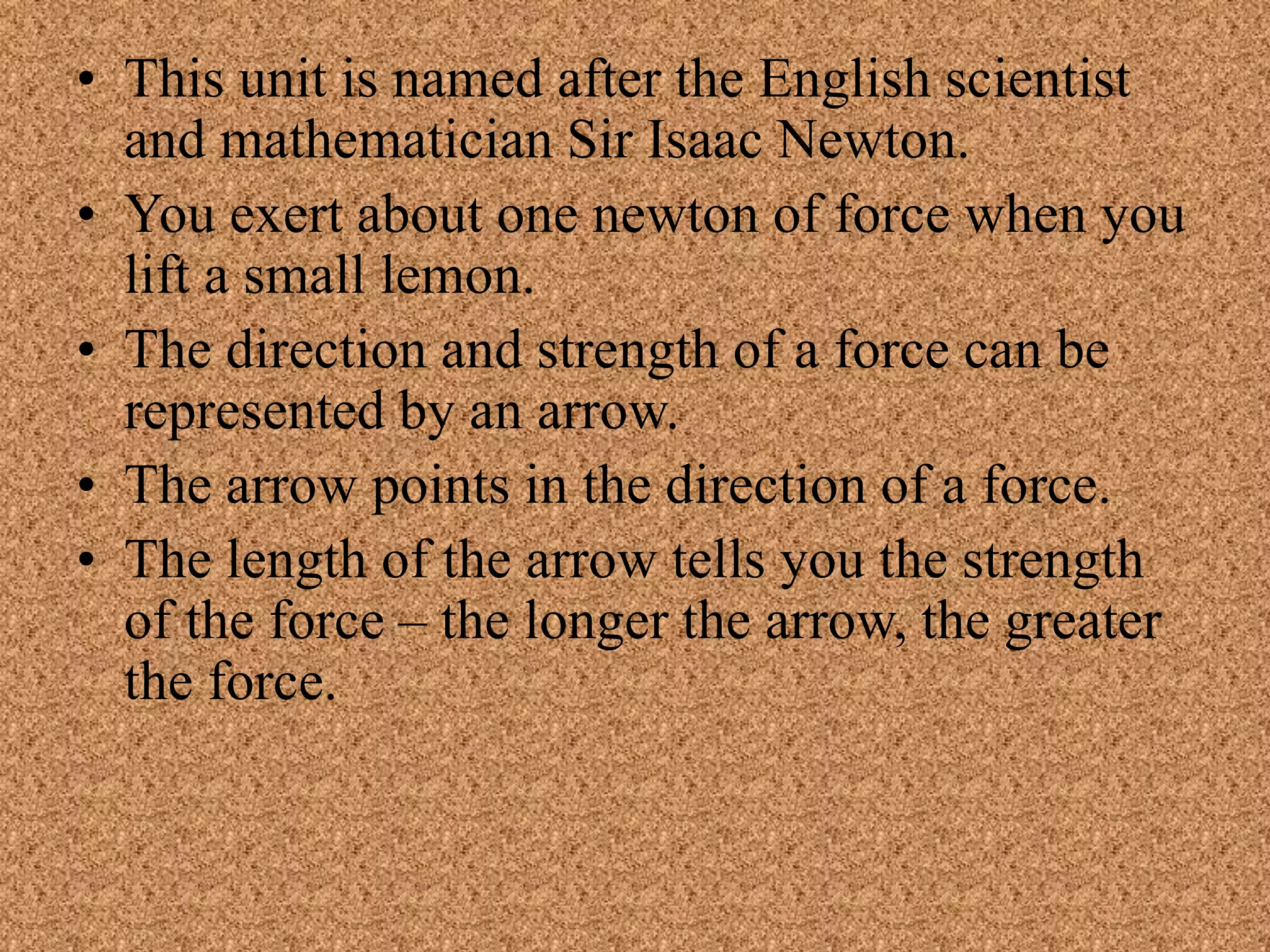
• This unit is named after the English scientist
and mathematician Sir Isaac Newton.
• You exert about one newton of force when you
lift a small lemon.
• The direction and strength of a force can be
represented by an arrow.
• The arrow points in the direction of a force.
• The length of the arrow tells you the strength
of the force – the longer the arrow, the greater
the force.
Combining Forces
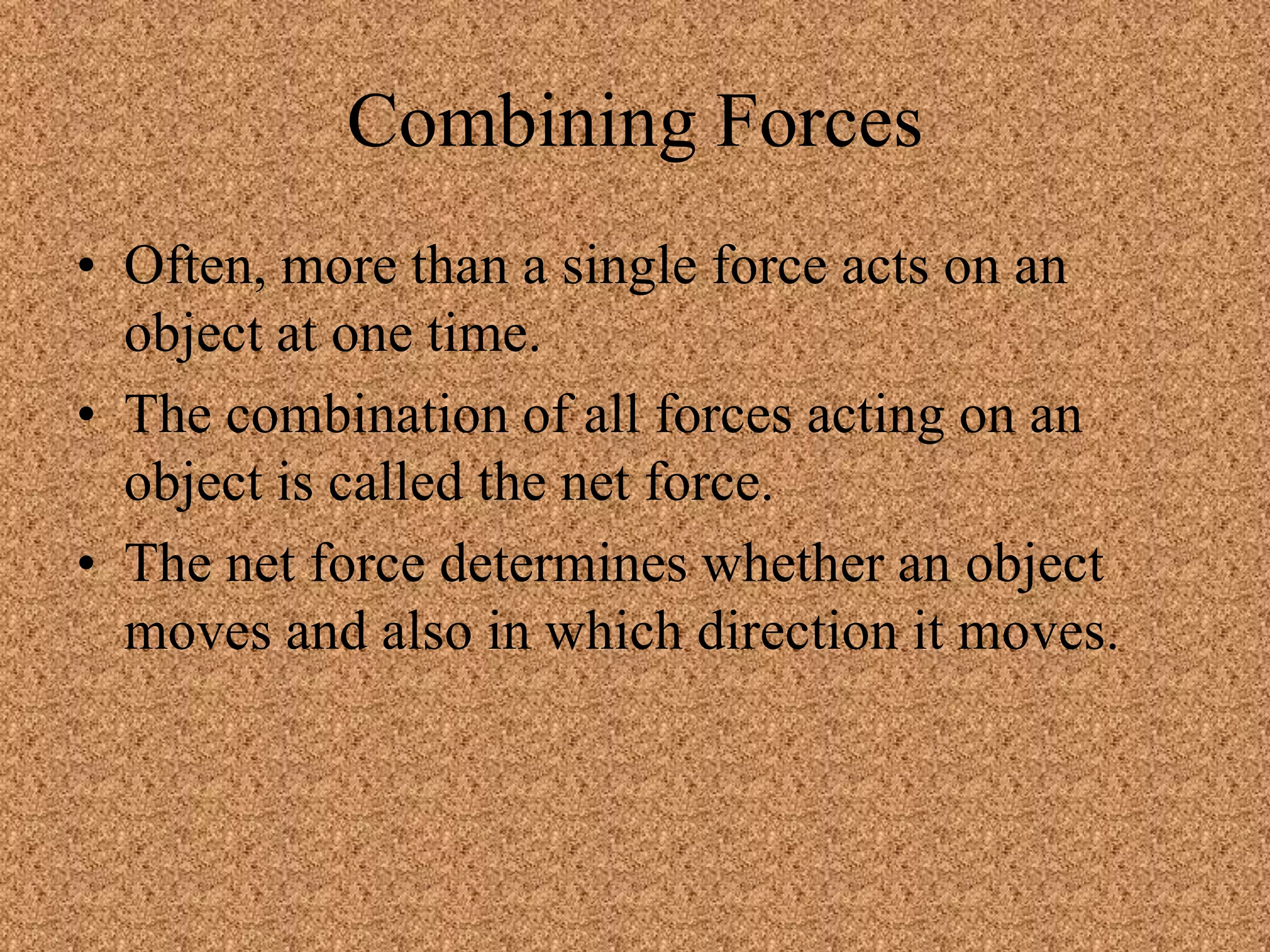
• Often, more than a single force acts on an
object at one time.
• The combination of all forces acting on an
object is called the net force.
• The net force determines whether an object
moves and also in which direction it moves.
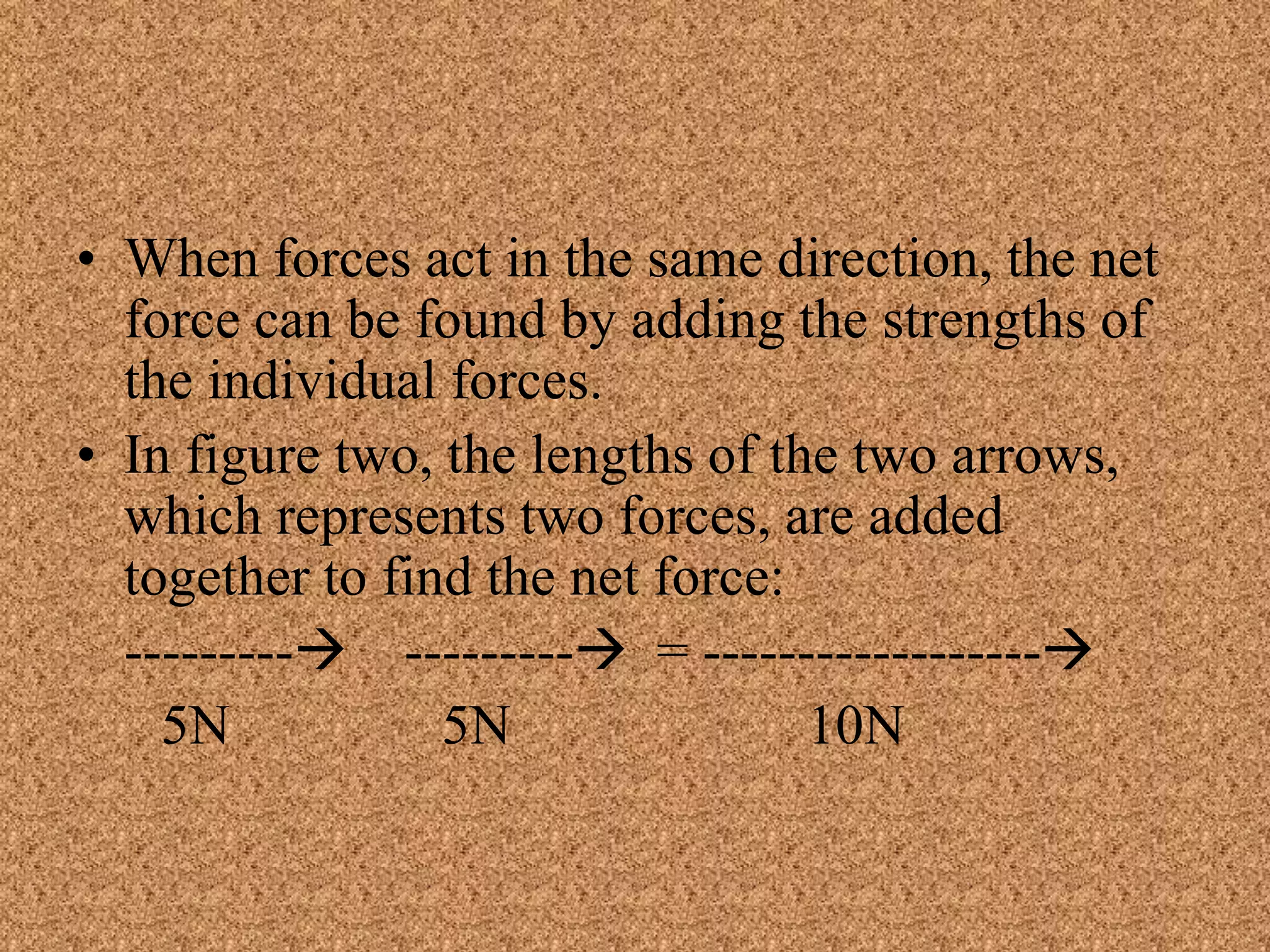
• When forces act in the same direction, the net
force can be found by adding the strengths of
the individual forces.
• In figure two, the lengths of the two arrows,
which represents two forces, are added
together to find the net force:
--------- --------- = ------------------
5N 5N 10N
• When forces act in opposite directions, they
also combine to produce a net force.
• However, you must pay attention to the
direction of each force.
• Adding a force acting in one direction to a
force acting in the opposite direction is the
same as adding a positive number to a negative
number.
• So when two forces act in opposite directions,
they combine by subtraction.
• The net force always acts in the direction of
the greater force.
----- ---------- = -----
5N 10N 5N
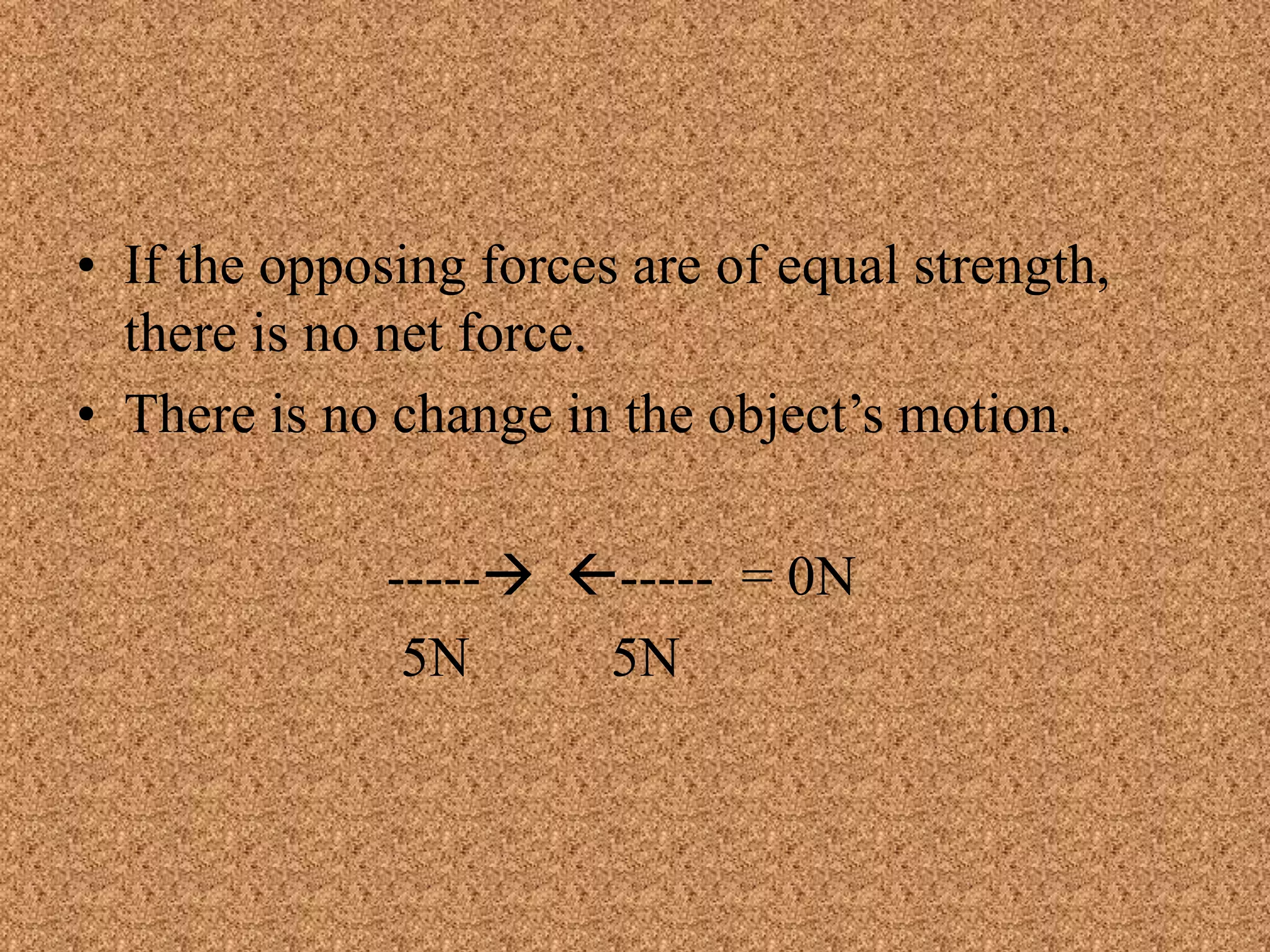
• If the opposing forces are of equal strength,
there is no net force.
• There is no change in the object’s motion.
----- ----- = 0N
5N 5N
Unbalanced Forces
• Whenever there is a net force acting on an
object, the forces are unbalanced.
• Unbalanced forces can cause an object to start
moving, stop moving, or change direction.
• Unbalanced forces acting on an object result in
a net force and cause a change in the object’s
motion.
• Figure 3 shows two people exerting forces on a
box.
• When they both push a box to the right, their
individual forces add together to produce a net
force in that direction.
• Since a net, or unbalanced, force acts on the
box, the box moves to the right.
• When the two people push the box in opposite
directions, the net force on the box is the
difference between their individual forces.
• Because the boy pushes with a greater force
than the girl, their forces are unbalanced and a
net force acts on the box to the right.
• As a result, the box moves to the right.
Balanced Forces
• When forces are exerted on an object, the
object’s motion does not always change.
• In an arm wrestling contest, each person exerts
a force on the other’s arm, but the two forces
are exerted in opposite directions.
• Even though both people push hard, their arm
position may not change.
• Equal forces acting on one object in opposite
directions are called balanced forces.
• Each force is balanced by the other.
• Balanced forces acting on an object do not change the
object’s motion.
• When equal forces are exerted in opposite directions,
there is no net force.
• In Figure 3, when two people push on the box with
equal force in opposite directions, the forces cancel
out.
• The box does not move.

Forces.ppt

  • 1.
  • 2.
    What is aForce? • In science, the word force has a simple and specific meaning. • A force is a push or a pull • When one object pushes or pulls another object, you say that the first object exerts a force on the second object. • You exert a force on a computer key when you push it and on a chair when you pull it away from a table.
  • 3.
    • Like velocityand acceleration, a force is described by its strength and by the direction in which it acts. • If you push a door, you exert a force in a different direction than if you pull on the door. • The strength of a force is measured in the SI unit called the newton (N).
  • 4.
    • This unitis named after the English scientist and mathematician Sir Isaac Newton. • You exert about one newton of force when you lift a small lemon. • The direction and strength of a force can be represented by an arrow. • The arrow points in the direction of a force. • The length of the arrow tells you the strength of the force – the longer the arrow, the greater the force.
  • 5.
    Combining Forces • Often,more than a single force acts on an object at one time. • The combination of all forces acting on an object is called the net force. • The net force determines whether an object moves and also in which direction it moves.
  • 6.
    • When forcesact in the same direction, the net force can be found by adding the strengths of the individual forces. • In figure two, the lengths of the two arrows, which represents two forces, are added together to find the net force: --------- --------- = ------------------ 5N 5N 10N
  • 7.
    • When forcesact in opposite directions, they also combine to produce a net force. • However, you must pay attention to the direction of each force. • Adding a force acting in one direction to a force acting in the opposite direction is the same as adding a positive number to a negative number.
  • 8.
    • So whentwo forces act in opposite directions, they combine by subtraction. • The net force always acts in the direction of the greater force. ----- ---------- = ----- 5N 10N 5N
  • 9.
    • If theopposing forces are of equal strength, there is no net force. • There is no change in the object’s motion. ----- ----- = 0N 5N 5N
  • 10.
    Unbalanced Forces • Wheneverthere is a net force acting on an object, the forces are unbalanced. • Unbalanced forces can cause an object to start moving, stop moving, or change direction. • Unbalanced forces acting on an object result in a net force and cause a change in the object’s motion.
  • 11.
    • Figure 3shows two people exerting forces on a box. • When they both push a box to the right, their individual forces add together to produce a net force in that direction. • Since a net, or unbalanced, force acts on the box, the box moves to the right.
  • 12.
    • When thetwo people push the box in opposite directions, the net force on the box is the difference between their individual forces. • Because the boy pushes with a greater force than the girl, their forces are unbalanced and a net force acts on the box to the right. • As a result, the box moves to the right.
  • 14.
    Balanced Forces • Whenforces are exerted on an object, the object’s motion does not always change. • In an arm wrestling contest, each person exerts a force on the other’s arm, but the two forces are exerted in opposite directions. • Even though both people push hard, their arm position may not change.
  • 15.
    • Equal forcesacting on one object in opposite directions are called balanced forces. • Each force is balanced by the other. • Balanced forces acting on an object do not change the object’s motion. • When equal forces are exerted in opposite directions, there is no net force. • In Figure 3, when two people push on the box with equal force in opposite directions, the forces cancel out. • The box does not move.