Poverty In Victorian Britain
Poverty had a huge problem in Dickens’s time. Originally, he wanted
to write a pamphlet to raise awareness about poverty, but he
decided that a short Christmas story would spread the message
more effectively.
Question:
How is the theme of social injustice shown in the
novella?
Question:
How is the theme of social injustice shown in the novella?
Answer:
In A Christmas Carol Dickens shows the theme of social
injustice through:
● Scrooge refusing to give money to the poor
● the characters of Ignorance and Want
● thieves dividing up Scrooge's belongings
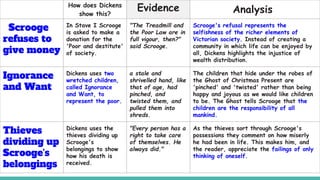
How does Dickens
show this?
Evidence Analysis
Scrooge
refuses to
give money
In Stave I Scrooge
is asked to make a
donation for the
'Poor and destitute'
of society.
"The Treadmill and
the Poor Law are in
full vigour, then?"
said Scrooge.
Scrooge's refusal represents the
selfishness of the richer elements of
Victorian society. Instead of creating a
community in which life can be enjoyed by
all, Dickens highlights the injustice of
wealth distribution.
Ignorance
and Want
Dickens uses two
wretched children,
called Ignorance
and Want, to
represent the poor.
a stale and
shrivelled hand, like
that of age, had
pinched, and
twisted them, and
pulled them into
shreds.
The children that hide under the robes of
the Ghost of Christmas Present are
'pinched' and 'twisted' rather than being
happy and joyous as we would like children
to be. The Ghost tells Scrooge that the
children are the responsibility of all
mankind.
Thieves
dividing up
Scrooge's
belongings
Dickens uses the
thieves dividing up
Scrooge's
belongings to show
how his death is
received.
"Every person has a
right to take care
of themselves. He
always did."
As the thieves sort through Scrooge's
possessions they comment on how miserly
he had been in life. This makes him, and
the reader, appreciate the failings of only
thinking of oneself.
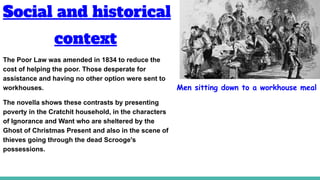
Social and historical
context
The Poor Law was amended in 1834 to reduce the
cost of helping the poor. Those desperate for
assistance and having no other option were sent to
workhouses.
The novella shows these contrasts by presenting
poverty in the Cratchit household, in the characters
of Ignorance and Want who are sheltered by the
Ghost of Christmas Present and also in the scene of
thieves going through the dead Scrooge's
possessions.
Men sitting down to a workhouse meal
Question:
What elements of social injustice does Dickens
highlight in this novella?
Question:
What elements of social injustice does Dickens highlight in this
novella?
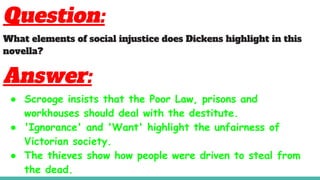
Answer:
● Scrooge insists that the Poor Law, prisons and
workhouses should deal with the destitute.
● 'Ignorance' and 'Want' highlight the unfairness of
Victorian society.
● The thieves show how people were driven to steal from
the dead.
Question:
How is the theme of Christmas shown in the novella?
Question:
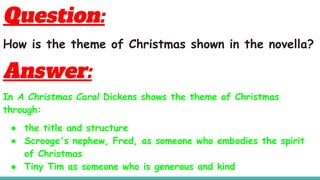
How is the theme of Christmas shown in the novella?
Answer:
In A Christmas Carol Dickens shows the theme of Christmas
through:
● the title and structure
● Scrooge's nephew, Fred, as someone who embodies the spirit
of Christmas
● Tiny Tim as someone who is generous and kind
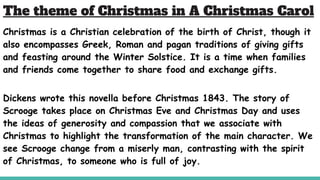
The theme of Christmas in A Christmas Carol
Christmas is a Christian celebration of the birth of Christ, though it
also encompasses Greek, Roman and pagan traditions of giving gifts
and feasting around the Winter Solstice. It is a time when families
and friends come together to share food and exchange gifts.
Dickens wrote this novella before Christmas 1843. The story of
Scrooge takes place on Christmas Eve and Christmas Day and uses
the ideas of generosity and compassion that we associate with
Christmas to highlight the transformation of the main character. We
see Scrooge change from a miserly man, contrasting with the spirit
of Christmas, to someone who is full of joy.
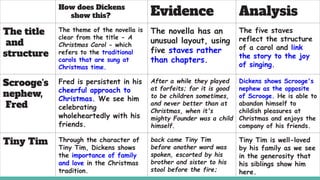
How does Dickens
show this? Evidence Analysis
The title
and
structure
The theme of the novella is
clear from the title - A
Christmas Carol - which
refers to the traditional
carols that are sung at
Christmas time.
The novella has an
unusual layout, using
five staves rather
than chapters.
The five staves
reflect the structure
of a carol and link
the story to the joy
of singing.
Scrooge's
nephew,
Fred
Fred is persistent in his
cheerful approach to
Christmas. We see him
celebrating
wholeheartedly with his
friends.
After a while they played
at forfeits; for it is good
to be children sometimes,
and never better than at
Christmas, when it's
mighty Founder was a child
himself.
Dickens shows Scrooge's
nephew as the opposite
of Scrooge. He is able to
abandon himself to
childish pleasures at
Christmas and enjoys the
company of his friends.
Tiny Tim Through the character of
Tiny Tim, Dickens shows
the importance of family
and love in the Christmas
tradition.
back came Tiny Tim
before another word was
spoken, escorted by his
brother and sister to his
stool before the fire;
Tiny Tim is well-loved
by his family as we see
in the generosity that
his siblings show him
here.
Question:
How does Dickens use the theme of Christmas in this novella?
Question:
How does Dickens use the theme of Christmas in this novella?
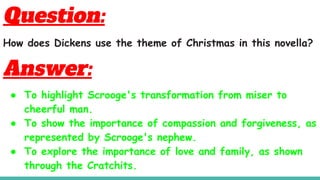
Answer:
● To highlight Scrooge's transformation from miser to
cheerful man.
● To show the importance of compassion and forgiveness, as
represented by Scrooge's nephew.
● To explore the importance of love and family, as shown
through the Cratchits.
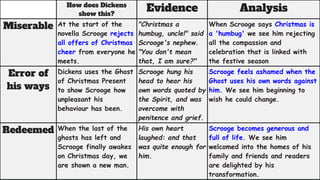
How does Dickens
show this?
Evidence Analysis
Miserable At the start of the
novella Scrooge rejects
all offers of Christmas
cheer from everyone he
meets.
"Christmas a
humbug, uncle!" said
Scrooge's nephew.
"You don't mean
that, I am sure?"
When Scrooge says Christmas is
a 'humbug' we see him rejecting
all the compassion and
celebration that is linked with
the festive season
Error of
his ways
Dickens uses the Ghost
of Christmas Present
to show Scrooge how
unpleasant his
behaviour has been.
Scrooge hung his
head to hear his
own words quoted by
the Spirit, and was
overcome with
penitence and grief.
Scrooge feels ashamed when the
Ghost uses his own words against
him. We see him beginning to
wish he could change.
Redeemed When the last of the
ghosts has left and
Scrooge finally awakes
on Christmas day, we
are shown a new man.
His own heart
laughed: and that
was quite enough for
him.
Scrooge becomes generous and
full of life. We see him
welcomed into the homes of his
family and friends and readers
are delighted by his
transformation.
Question:
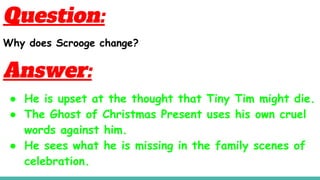
Why does Scrooge change?
Question:
Why does Scrooge change?
Answer:
● He is upset at the thought that Tiny Tim might die.
● The Ghost of Christmas Present uses his own cruel
words against him.
● He sees what he is missing in the family scenes of
celebration.

A Christmas Carol- Background and Context

  • 4.
    Poverty In VictorianBritain Poverty had a huge problem in Dickens’s time. Originally, he wanted to write a pamphlet to raise awareness about poverty, but he decided that a short Christmas story would spread the message more effectively.
  • 5.
    Question: How is thetheme of social injustice shown in the novella?
  • 6.
    Question: How is thetheme of social injustice shown in the novella? Answer: In A Christmas Carol Dickens shows the theme of social injustice through: ● Scrooge refusing to give money to the poor ● the characters of Ignorance and Want ● thieves dividing up Scrooge's belongings
  • 7.
    How does Dickens showthis? Evidence Analysis Scrooge refuses to give money In Stave I Scrooge is asked to make a donation for the 'Poor and destitute' of society. "The Treadmill and the Poor Law are in full vigour, then?" said Scrooge. Scrooge's refusal represents the selfishness of the richer elements of Victorian society. Instead of creating a community in which life can be enjoyed by all, Dickens highlights the injustice of wealth distribution. Ignorance and Want Dickens uses two wretched children, called Ignorance and Want, to represent the poor. a stale and shrivelled hand, like that of age, had pinched, and twisted them, and pulled them into shreds. The children that hide under the robes of the Ghost of Christmas Present are 'pinched' and 'twisted' rather than being happy and joyous as we would like children to be. The Ghost tells Scrooge that the children are the responsibility of all mankind. Thieves dividing up Scrooge's belongings Dickens uses the thieves dividing up Scrooge's belongings to show how his death is received. "Every person has a right to take care of themselves. He always did." As the thieves sort through Scrooge's possessions they comment on how miserly he had been in life. This makes him, and the reader, appreciate the failings of only thinking of oneself.
  • 8.
    Social and historical context ThePoor Law was amended in 1834 to reduce the cost of helping the poor. Those desperate for assistance and having no other option were sent to workhouses. The novella shows these contrasts by presenting poverty in the Cratchit household, in the characters of Ignorance and Want who are sheltered by the Ghost of Christmas Present and also in the scene of thieves going through the dead Scrooge's possessions. Men sitting down to a workhouse meal
  • 9.
    Question: What elements ofsocial injustice does Dickens highlight in this novella?
  • 10.
    Question: What elements ofsocial injustice does Dickens highlight in this novella? Answer: ● Scrooge insists that the Poor Law, prisons and workhouses should deal with the destitute. ● 'Ignorance' and 'Want' highlight the unfairness of Victorian society. ● The thieves show how people were driven to steal from the dead.
  • 11.
    Question: How is thetheme of Christmas shown in the novella?
  • 12.
    Question: How is thetheme of Christmas shown in the novella? Answer: In A Christmas Carol Dickens shows the theme of Christmas through: ● the title and structure ● Scrooge's nephew, Fred, as someone who embodies the spirit of Christmas ● Tiny Tim as someone who is generous and kind
  • 13.
    The theme ofChristmas in A Christmas Carol Christmas is a Christian celebration of the birth of Christ, though it also encompasses Greek, Roman and pagan traditions of giving gifts and feasting around the Winter Solstice. It is a time when families and friends come together to share food and exchange gifts. Dickens wrote this novella before Christmas 1843. The story of Scrooge takes place on Christmas Eve and Christmas Day and uses the ideas of generosity and compassion that we associate with Christmas to highlight the transformation of the main character. We see Scrooge change from a miserly man, contrasting with the spirit of Christmas, to someone who is full of joy.
  • 14.
    How does Dickens showthis? Evidence Analysis The title and structure The theme of the novella is clear from the title - A Christmas Carol - which refers to the traditional carols that are sung at Christmas time. The novella has an unusual layout, using five staves rather than chapters. The five staves reflect the structure of a carol and link the story to the joy of singing. Scrooge's nephew, Fred Fred is persistent in his cheerful approach to Christmas. We see him celebrating wholeheartedly with his friends. After a while they played at forfeits; for it is good to be children sometimes, and never better than at Christmas, when it's mighty Founder was a child himself. Dickens shows Scrooge's nephew as the opposite of Scrooge. He is able to abandon himself to childish pleasures at Christmas and enjoys the company of his friends. Tiny Tim Through the character of Tiny Tim, Dickens shows the importance of family and love in the Christmas tradition. back came Tiny Tim before another word was spoken, escorted by his brother and sister to his stool before the fire; Tiny Tim is well-loved by his family as we see in the generosity that his siblings show him here.
  • 15.
    Question: How does Dickensuse the theme of Christmas in this novella?
  • 16.
    Question: How does Dickensuse the theme of Christmas in this novella? Answer: ● To highlight Scrooge's transformation from miser to cheerful man. ● To show the importance of compassion and forgiveness, as represented by Scrooge's nephew. ● To explore the importance of love and family, as shown through the Cratchits.
  • 17.
    How does Dickens showthis? Evidence Analysis Miserable At the start of the novella Scrooge rejects all offers of Christmas cheer from everyone he meets. "Christmas a humbug, uncle!" said Scrooge's nephew. "You don't mean that, I am sure?" When Scrooge says Christmas is a 'humbug' we see him rejecting all the compassion and celebration that is linked with the festive season Error of his ways Dickens uses the Ghost of Christmas Present to show Scrooge how unpleasant his behaviour has been. Scrooge hung his head to hear his own words quoted by the Spirit, and was overcome with penitence and grief. Scrooge feels ashamed when the Ghost uses his own words against him. We see him beginning to wish he could change. Redeemed When the last of the ghosts has left and Scrooge finally awakes on Christmas day, we are shown a new man. His own heart laughed: and that was quite enough for him. Scrooge becomes generous and full of life. We see him welcomed into the homes of his family and friends and readers are delighted by his transformation.
  • 18.
  • 19.
    Question: Why does Scroogechange? Answer: ● He is upset at the thought that Tiny Tim might die. ● The Ghost of Christmas Present uses his own cruel words against him. ● He sees what he is missing in the family scenes of celebration.