closanVoe
Unjumble the word:
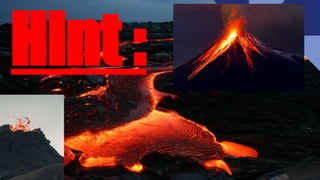
Hint :
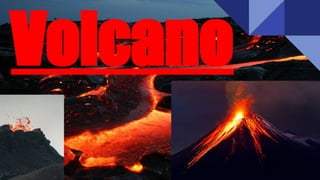
Volcano
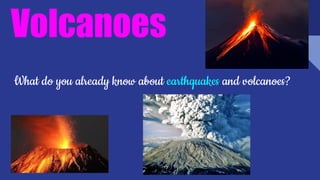
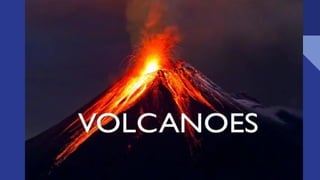
Volcanoes
What do you already know about earthquakes and volcanoes?
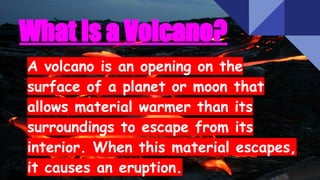
What Is a Volcano?
A volcano is an opening on the
surface of a planet or moon that
allows material warmer than its
surroundings to escape from its
interior. When this material escapes,
it causes an eruption.
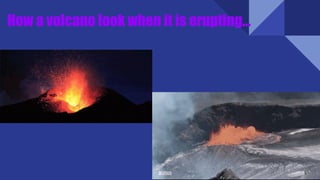
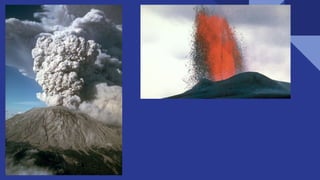
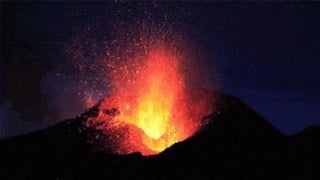
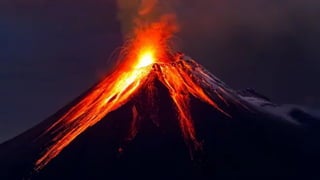
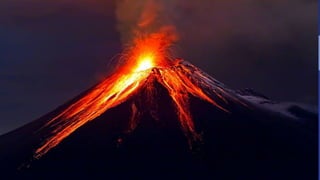
How a volcano look when it is erupting…
https://www.youtube.com/
watch?v=3Jxeh-yAXek
https://www.youtube.com/
watch?v=yWXd21yaci8
Volcanoes can be active,
dormant or extinct.
An active volcano is one that has erupted within the last 10,000 years or it

has some type of activity going on.
This activity could be anything from gases being released or even
earthquakes around it.
A dormant volcano is one that hasn’t erupted in the last 10,000 years,
however there is a chance it will erupt at some point.
An extinct volcano is one that hasn’t erupted in the last 10,000 years and is
unlikely to erupt in the future.
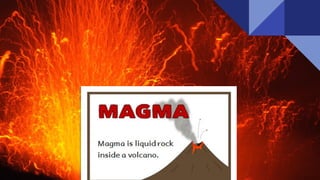
The liquid inside the volcano is
called magma.
Volcanoes hold very hot liquid called magma.
Magma is rock that is so hot, it has turned into a liquid.
It glows bright orange and is held in a chamber within the
volcano.
Lava is very, very hot!
That’s right, lava is very hot!
It can get up to 1,250° Celsius.
This makes volcanoes very dangerous and it is why they
should be avoided.
Each volcano has a different level of risk which should always
be researched before visiting.
There are around 1,500 active
volcanoes in the world.
There are lots of volcanoes, in fact, there are around 1,500 which are
active.
Most volcanoes are found in countries that have coastlines on the
Pacific Ocean.
Luckily in the UK we have no active volcanoes.
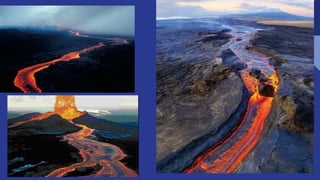
The largest volcano on Earth is
Mauna Loa in Hawaii.
The largest volcano on Earth is in Hawaii. It’s called the Mauna Loa.
From sea level it is 4,169 metres high. However, under the sea it also
goes down another 5,000 metres.
This would make it higher than Mount Everest!
Since 1843, it has erupted 33 times.
HOW IT ERUPTS…
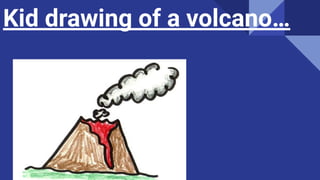
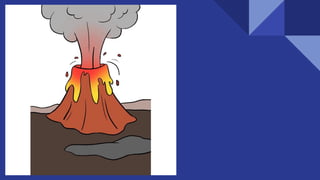
Kid drawing of a volcano…
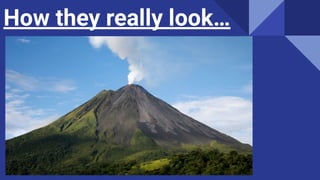
How they really look…
Deadliest Eruption
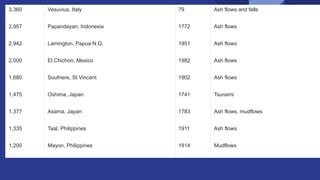
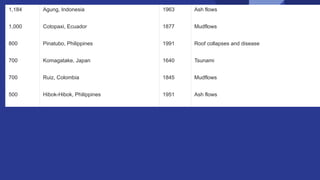
The list below contains eruptions with more than 500 known human fatalities.
( an occurrence of death by accident, in war, or from disease)
…….These are the most deadly eruptions known. Other eruptions have been as big
or bigger than these, but no one lived nearby to be threatened (for example the
Valley of 10,000 Smokes eruption in Alaska in 1912). The Mt. St. Helens eruption in
1980 in Washington state was a far less dangerous eruption than these, only 61
humans died, although thousands of deer and other animals perished. The ancient
eruption at Santorini Island in the Mediterranean Sea in about 1650 BC certainly
killed thousands of people (and was the source of the Atlantis legend), but there are
no real estimates of the number of deaths. Remember that all of the numbers of
deaths listed here are best guesses; various books give different numbers. This list
is based on data in Volcanic Hazards: A Sourcebook on the Effects of Eruptions by
Russell J. Blong (Academic Press, 1984).
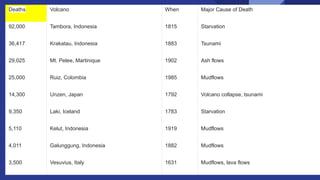
Deaths Volcano When Major Cause of Death
92,000 Tambora, Indonesia 1815 Starvation
36,417 Krakatau, Indonesia 1883 Tsunami
29,025 Mt. Pelee, Martinique 1902 Ash flows
25,000 Ruiz, Colombia 1985 Mudflows
14,300 Unzen, Japan 1792 Volcano collapse, tsunami
9,350 Laki, Iceland 1783 Starvation
5,110 Kelut, Indonesia 1919 Mudflows
4,011 Galunggung, Indonesia 1882 Mudflows
3,500 Vesuvius, Italy 1631 Mudflows, lava flows
3,360 Vesuvius, Italy 79 Ash flows and falls
2,957 Papandayan, Indonesia 1772 Ash flows
2,942 Lamington, Papua N.G. 1951 Ash flows
2,000 El Chichon, Mexico 1982 Ash flows
1,680 Soufriere, St Vincent 1902 Ash flows
1,475 Oshima, Japan 1741 Tsunami
1,377 Asama, Japan 1783 Ash flows, mudflows
1,335 Taal, Philippines 1911 Ash flows
1,200 Mayon, Philippines 1814 Mudflows
1,184 Agung, Indonesia 1963 Ash flows
1,000 Cotopaxi, Ecuador 1877 Mudflows
800 Pinatubo, Philippines 1991 Roof collapses and disease
700 Komagatake, Japan 1640 Tsunami
700 Ruiz, Colombia 1845 Mudflows
500 Hibok-Hibok, Philippines 1951 Ash flows
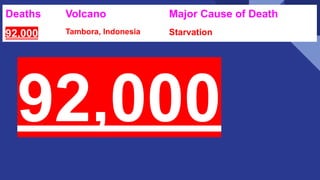
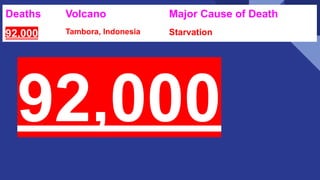
Deaths Volcano Major Cause of Death
92,000 Tambora, Indonesia Starvation
92,000
Make sure you understood everything and
if you want me to repeat anything please
say it now before i start the activity…
Count your points…
What were the highest amongst
of deaths caused by the volcano
and how were they cause…
1 point
Deaths Volcano Major Cause of Death
92,000 Tambora, Indonesia Starvation
92,000
Well done if you got that right
and if you didn’t it is ok…
It is ok
What is the liquid rock inside
a volcano called?
Magma
1 point
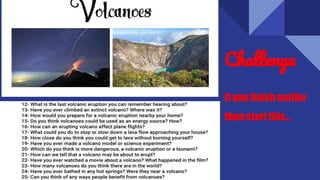
Challenge
If you finish earlier
than start this…
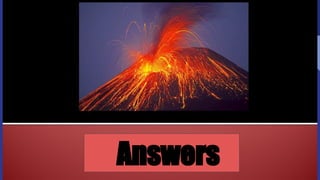
Answers
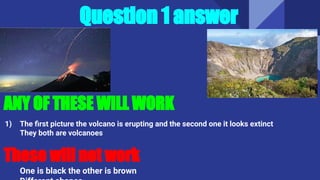
ANY OF THESE WILL WORK
1) The first picture the volcano is erupting and the second one it looks extinct
They both are volcanoes
These will not work
One is black the other is brown
Question 1 answer
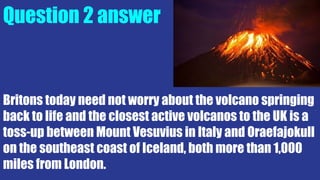
Question 2 answer
Britons today need not worry about the volcano springing
back to life and the closest active volcanos to the UK is a
toss-up between Mount Vesuvius in Italy and Oraefajokull
on the southeast coast of Iceland, both more than 1,000
miles from London.
Question 3 answer
Volcanoes spew hot, dangerous gases, ash, lava, and
rock that are powerfully destructive. ... Volcanic
eruptions can result in additional threats to health,
such as floods, mudslides, power outages, drinking
water contamination, and wildfires.
Question 4 answer
Volcanoes that have produced exceedingly voluminous pyroclastic
eruptions and formed large calderas in the past 2 million years
include Yellowstone, Long Valley in eastern California, Toba in
Indonesia, and Taupo in New Zealand.
Question 5 answer
With more than 13,000 islands, Indonesia leads the
world with the largest number of active volcanoes.
The areas volcanoes have also produced the most
fatalities.
Fatalities def
an occurrence of death by accident, in war, or
from disease
Question 6 answer
How volcanoes are formed and erupt?
A volcano is formed when hot molten rock, ash and gases escape from an opening in the Earth's
surface. The molten rock and ash solidify as they cool, forming the distinctive volcano shape
shown here. As a volcano erupts, it spills lava that flows downslope. Hot ash and gases are thrown
into the air.
https://www.youtube.com/watch?v=K7Oq9_DU1Mc
Question 7 answer
Active volcanoes have a recent history of eruptions; they are likely to
erupt again. Dormant volcanoes have not erupted for a very long time
but may erupt at a future time. Extinct volcanoes are not expected to
erupt in the future.
Question 8 answer
https://www.theguardian.com/environment/clima
te-consensus-97-per-cent/2014/feb/25/global-wa
rming-slowdown-volcanoes-contribute
Question 9 answer
https://www.psu.edu/news/research/
story/living-volcano/
Question 10 answer
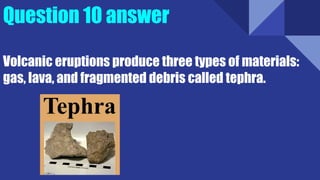
Volcanic eruptions produce three types of materials:
gas, lava, and fragmented debris called tephra.
https://www.youtube.com/watch?v=3Jxeh-yAXek
https://www.youtube.com/watch?v=LQwZwKS9RPs
https://www.youtube.com/watch?v=DfFPJE1EYPo
Get your whiteboards out and start writing
at least 5 bullet points or more
the one that writes the most will get 1
point.
Question 9 answer
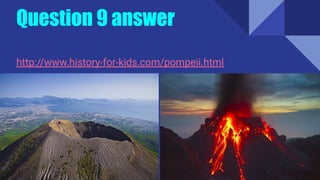
http://www.history-for-kids.com/pompeii.html
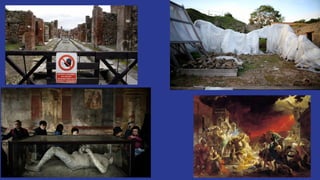
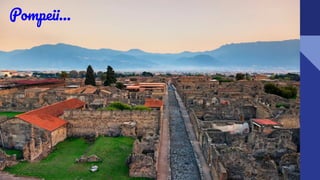
Pompeii…
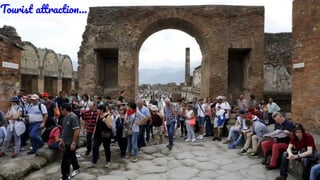
Tourist attraction…
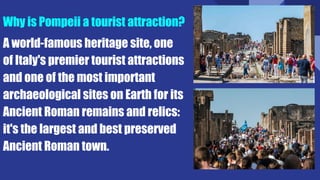
Why is Pompeii a tourist attraction?
A world-famous heritage site, one
of Italy's premier tourist attractions
and one of the most important
archaeological sites on Earth for its
Ancient Roman remains and relics:
it's the largest and best preserved
Ancient Roman town.
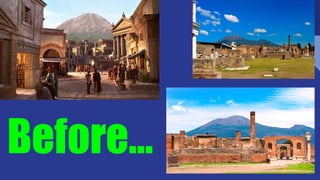
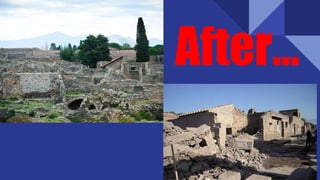
Before…
After…
Recap
1. Volcanoes are openings of the Earth’s
surface.
Volcanoes are openings of the Earth’s surface.
When a volcano erupts lava, ash and gas is expelled from it.
The hole at the top is known as the volcanic crater.
2. The word volcano comes from the word
‘vulcan’.
Have you ever wondered where the word volcano comes from?
3. Volcanoes can be active, dormant or extinct.
An active volcano is one that has erupted within the last 10,000 years or it has some
type of activity going on.
This activity could be anything from gases being released or even earthquakes
around it.
A dormant volcano is one that hasn’t erupted in the last 10,000 years, however there
is a chance it will erupt at some point.
An extinct volcano is one that hasn’t erupted in the last 10,000 years and is unlikely
to erupt in the future.
4. The liquid inside the volcano is called
magma.
Volcanoes hold very hot liquid called magma.
Magma is rock that is so hot, it has turned into a liquid.
It glows bright orange and is held in a chamber within the
volcano.
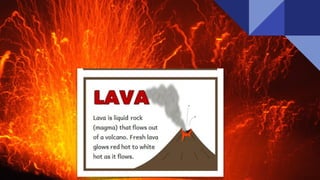
5. Lava is the liquid that is expelled
from the volcano.
Once a volcano erupts, the magma will come out of the
top of the volcano.
After it has left the volcano, it is called lava.
Once the lava has cooled down it will turn into solid
rock.
Now for the second last task tell me what you have learnt throughout the whole
lesson
Wright at least 5 bullet points
●
●
●
●
●
●
●
●
●
●
●
●
●
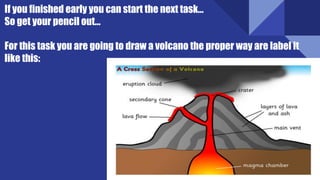
If you finished early you can start the next task…
So get your pencil out…
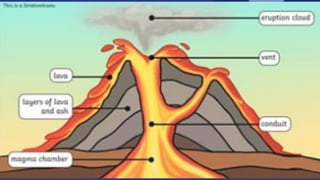
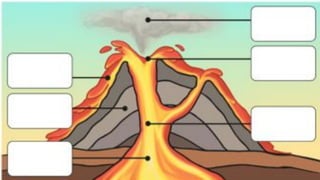
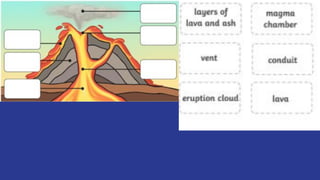
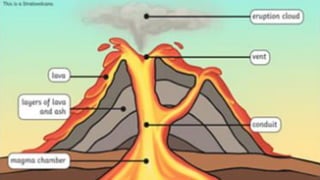
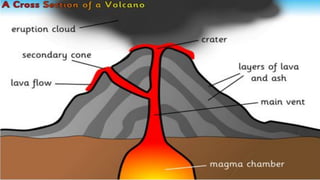
For this task you are going to draw a volcano the proper way are label it
like this:
This is the end of our topic
volcanoes I hope you
understood everything.

Volcanoes

  • 1.
  • 2.
  • 3.
  • 4.
    Volcanoes What do youalready know about earthquakes and volcanoes?
  • 5.
    What Is aVolcano? A volcano is an opening on the surface of a planet or moon that allows material warmer than its surroundings to escape from its interior. When this material escapes, it causes an eruption.
  • 12.
    How a volcanolook when it is erupting…
  • 17.
  • 18.
    Volcanoes can beactive, dormant or extinct. An active volcano is one that has erupted within the last 10,000 years or it has some type of activity going on. This activity could be anything from gases being released or even earthquakes around it. A dormant volcano is one that hasn’t erupted in the last 10,000 years, however there is a chance it will erupt at some point. An extinct volcano is one that hasn’t erupted in the last 10,000 years and is unlikely to erupt in the future.
  • 19.
    The liquid insidethe volcano is called magma. Volcanoes hold very hot liquid called magma. Magma is rock that is so hot, it has turned into a liquid. It glows bright orange and is held in a chamber within the volcano.
  • 20.
    Lava is very,very hot! That’s right, lava is very hot! It can get up to 1,250° Celsius. This makes volcanoes very dangerous and it is why they should be avoided. Each volcano has a different level of risk which should always be researched before visiting.
  • 21.
    There are around1,500 active volcanoes in the world. There are lots of volcanoes, in fact, there are around 1,500 which are active. Most volcanoes are found in countries that have coastlines on the Pacific Ocean. Luckily in the UK we have no active volcanoes.
  • 22.
    The largest volcanoon Earth is Mauna Loa in Hawaii. The largest volcano on Earth is in Hawaii. It’s called the Mauna Loa. From sea level it is 4,169 metres high. However, under the sea it also goes down another 5,000 metres. This would make it higher than Mount Everest! Since 1843, it has erupted 33 times.
  • 24.
  • 26.
    Kid drawing ofa volcano…
  • 27.
  • 28.
    Deadliest Eruption The listbelow contains eruptions with more than 500 known human fatalities. ( an occurrence of death by accident, in war, or from disease) …….These are the most deadly eruptions known. Other eruptions have been as big or bigger than these, but no one lived nearby to be threatened (for example the Valley of 10,000 Smokes eruption in Alaska in 1912). The Mt. St. Helens eruption in 1980 in Washington state was a far less dangerous eruption than these, only 61 humans died, although thousands of deer and other animals perished. The ancient eruption at Santorini Island in the Mediterranean Sea in about 1650 BC certainly killed thousands of people (and was the source of the Atlantis legend), but there are no real estimates of the number of deaths. Remember that all of the numbers of deaths listed here are best guesses; various books give different numbers. This list is based on data in Volcanic Hazards: A Sourcebook on the Effects of Eruptions by Russell J. Blong (Academic Press, 1984).
  • 29.
    Deaths Volcano WhenMajor Cause of Death 92,000 Tambora, Indonesia 1815 Starvation 36,417 Krakatau, Indonesia 1883 Tsunami 29,025 Mt. Pelee, Martinique 1902 Ash flows 25,000 Ruiz, Colombia 1985 Mudflows 14,300 Unzen, Japan 1792 Volcano collapse, tsunami 9,350 Laki, Iceland 1783 Starvation 5,110 Kelut, Indonesia 1919 Mudflows 4,011 Galunggung, Indonesia 1882 Mudflows 3,500 Vesuvius, Italy 1631 Mudflows, lava flows
  • 30.
    3,360 Vesuvius, Italy79 Ash flows and falls 2,957 Papandayan, Indonesia 1772 Ash flows 2,942 Lamington, Papua N.G. 1951 Ash flows 2,000 El Chichon, Mexico 1982 Ash flows 1,680 Soufriere, St Vincent 1902 Ash flows 1,475 Oshima, Japan 1741 Tsunami 1,377 Asama, Japan 1783 Ash flows, mudflows 1,335 Taal, Philippines 1911 Ash flows 1,200 Mayon, Philippines 1814 Mudflows
  • 31.
    1,184 Agung, Indonesia1963 Ash flows 1,000 Cotopaxi, Ecuador 1877 Mudflows 800 Pinatubo, Philippines 1991 Roof collapses and disease 700 Komagatake, Japan 1640 Tsunami 700 Ruiz, Colombia 1845 Mudflows 500 Hibok-Hibok, Philippines 1951 Ash flows
  • 32.
    Deaths Volcano MajorCause of Death 92,000 Tambora, Indonesia Starvation 92,000
  • 34.
    Make sure youunderstood everything and if you want me to repeat anything please say it now before i start the activity… Count your points…
  • 35.
    What were thehighest amongst of deaths caused by the volcano and how were they cause… 1 point
  • 36.
    Deaths Volcano MajorCause of Death 92,000 Tambora, Indonesia Starvation 92,000
  • 37.
    Well done ifyou got that right and if you didn’t it is ok… It is ok
  • 38.
    What is theliquid rock inside a volcano called?
  • 39.
  • 44.
    Challenge If you finishearlier than start this…
  • 45.
  • 46.
    ANY OF THESEWILL WORK 1) The first picture the volcano is erupting and the second one it looks extinct They both are volcanoes These will not work One is black the other is brown Question 1 answer
  • 47.
    Question 2 answer Britonstoday need not worry about the volcano springing back to life and the closest active volcanos to the UK is a toss-up between Mount Vesuvius in Italy and Oraefajokull on the southeast coast of Iceland, both more than 1,000 miles from London.
  • 48.
    Question 3 answer Volcanoesspew hot, dangerous gases, ash, lava, and rock that are powerfully destructive. ... Volcanic eruptions can result in additional threats to health, such as floods, mudslides, power outages, drinking water contamination, and wildfires.
  • 49.
    Question 4 answer Volcanoesthat have produced exceedingly voluminous pyroclastic eruptions and formed large calderas in the past 2 million years include Yellowstone, Long Valley in eastern California, Toba in Indonesia, and Taupo in New Zealand.
  • 50.
    Question 5 answer Withmore than 13,000 islands, Indonesia leads the world with the largest number of active volcanoes. The areas volcanoes have also produced the most fatalities. Fatalities def an occurrence of death by accident, in war, or from disease
  • 51.
    Question 6 answer Howvolcanoes are formed and erupt? A volcano is formed when hot molten rock, ash and gases escape from an opening in the Earth's surface. The molten rock and ash solidify as they cool, forming the distinctive volcano shape shown here. As a volcano erupts, it spills lava that flows downslope. Hot ash and gases are thrown into the air. https://www.youtube.com/watch?v=K7Oq9_DU1Mc
  • 52.
    Question 7 answer Activevolcanoes have a recent history of eruptions; they are likely to erupt again. Dormant volcanoes have not erupted for a very long time but may erupt at a future time. Extinct volcanoes are not expected to erupt in the future.
  • 53.
  • 54.
  • 55.
    Question 10 answer Volcaniceruptions produce three types of materials: gas, lava, and fragmented debris called tephra.
  • 56.
    https://www.youtube.com/watch?v=3Jxeh-yAXek https://www.youtube.com/watch?v=LQwZwKS9RPs https://www.youtube.com/watch?v=DfFPJE1EYPo Get your whiteboardsout and start writing at least 5 bullet points or more the one that writes the most will get 1 point.
  • 57.
  • 59.
  • 60.
  • 61.
    Why is Pompeiia tourist attraction? A world-famous heritage site, one of Italy's premier tourist attractions and one of the most important archaeological sites on Earth for its Ancient Roman remains and relics: it's the largest and best preserved Ancient Roman town.
  • 62.
  • 63.
  • 64.
  • 65.
    1. Volcanoes areopenings of the Earth’s surface. Volcanoes are openings of the Earth’s surface. When a volcano erupts lava, ash and gas is expelled from it. The hole at the top is known as the volcanic crater.
  • 66.
    2. The wordvolcano comes from the word ‘vulcan’. Have you ever wondered where the word volcano comes from?
  • 67.
    3. Volcanoes canbe active, dormant or extinct. An active volcano is one that has erupted within the last 10,000 years or it has some type of activity going on. This activity could be anything from gases being released or even earthquakes around it. A dormant volcano is one that hasn’t erupted in the last 10,000 years, however there is a chance it will erupt at some point. An extinct volcano is one that hasn’t erupted in the last 10,000 years and is unlikely to erupt in the future.
  • 68.
    4. The liquidinside the volcano is called magma. Volcanoes hold very hot liquid called magma. Magma is rock that is so hot, it has turned into a liquid. It glows bright orange and is held in a chamber within the volcano.
  • 69.
    5. Lava isthe liquid that is expelled from the volcano. Once a volcano erupts, the magma will come out of the top of the volcano. After it has left the volcano, it is called lava. Once the lava has cooled down it will turn into solid rock.
  • 71.
    Now for thesecond last task tell me what you have learnt throughout the whole lesson Wright at least 5 bullet points ● ● ● ● ● ● ● ● ● ● ● ● ●
  • 72.
    If you finishedearly you can start the next task… So get your pencil out… For this task you are going to draw a volcano the proper way are label it like this:
  • 74.
    This is theend of our topic volcanoes I hope you understood everything.