Copyright  ©  The McGraw-Hill Companies, Inc. Permission required for reproduction or display. Chapter 3 Lecture Outline
Learning Outcomes After studying this chapter, you should be able to answer the following questions: •  How does species diversity arise? •  Why do species live in different locations? •  How do interactions among species affect their fates and that of communities? •  If a species has unlimited growth potential, why doesn’t it fi ll the earth? •  What special properties does a community of species have, and why are they important? •  What is the relationship between species diversity and community stability? •  What is disturbance, and how does it affect communities? 3-
3.1 Evolution Leads to Diversity Natural selection and adaptation modify species Adaptation,  the acquisition of traits that allow a species to survive in its environment, is one of the most important concepts in biology. The process of better-selected individuals passing their traits to the next generation is called  natural selection. 3-
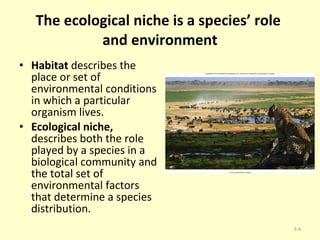
The ecological niche is a species’ role  and environment Habitat  describes the place or set of environmental conditions in which a particular organism lives.  Ecological niche,  describes both the role played by a species in a biological community and the total set of environmental factors that determine a species distribution. 3-
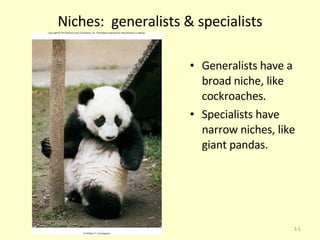
Niches:  generalists & specialists Generalists have a broad niche, like cockroaches. Specialists have narrow niches, like giant pandas. 3-
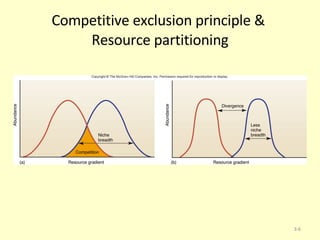
Competitive exclusion principle &  Resource partitioning 3-
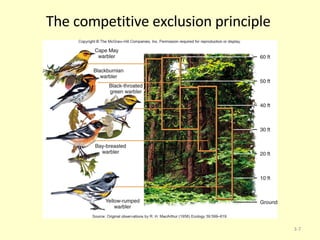
The competitive exclusion principle  3-
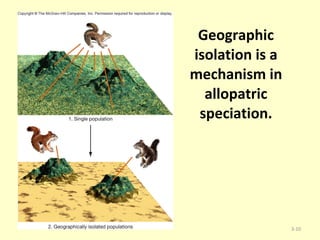
Speciation The development of a new species is called  speciation. Geographic isolation  results in  allopatric speciation —species arise in non-overlapping geographic locations . Behavioral isolation  results in  sympatric speciation —species arise in the same location as the ancestor species. 3-
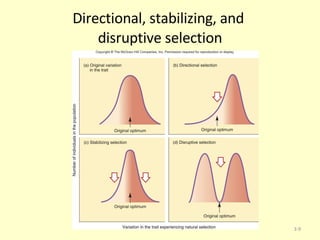
Directional, stabilizing, and  disruptive selection 3-
Geographic isolation is a mechanism in allopatric speciation. 3-
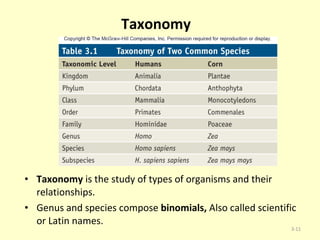
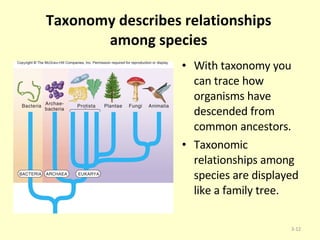
Taxonomy Taxonomy  is the study of types of organisms and their relationships. Genus and species compose  binomials,  Also called scientific or Latin names. 3-
Taxonomy describes relationships among species With taxonomy you can trace how organisms have descended from common ancestors. Taxonomic relationships among species are displayed like a family tree.  3-
3.2 Species Interactions Shape Communities of Species Competition is a type of antagonistic relationship within a biological community. Organisms compete for resources that are in limited supply. Competition among members of the same species is called  intraspecific competition. Competition between members of different species is called  interspecific competition. 3-
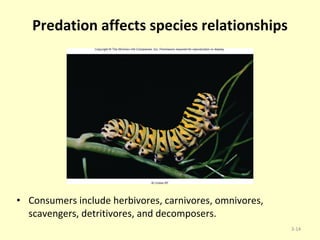
Predation affects species relationships Consumers include herbivores, carnivores, omnivores, scavengers, detritivores, and decomposers.  3-
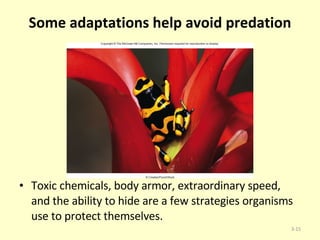
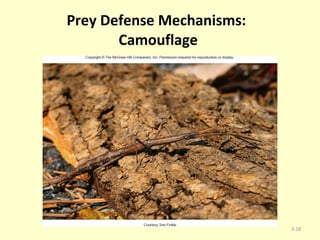
Some adaptations help avoid predation Toxic chemicals, body armor, extraordinary speed, and the ability to hide are a few strategies organisms use to protect themselves. 3-
Coevolution The response of predator to prey and vice versa, over tens of thousands of years, produces physical and behavioral changes in a process known as  coevolution.  Coevolution can be mutually beneficial: many plants and pollinators have forms and behaviors that benefit each other.  A classic case is that of fruit bats, which pollinate and disperse seeds of fruit-bearing tropical plants. 3-
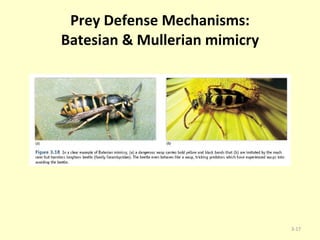
Prey Defense Mechanisms: Batesian & Mullerian mimicry 3-
Prey Defense Mechanisms:  Camouflage  3-
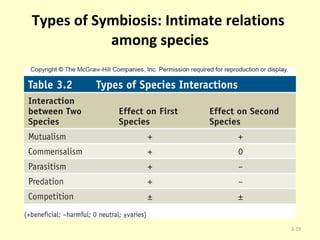
Types of Symbiosis: Intimate relations  among species 3-
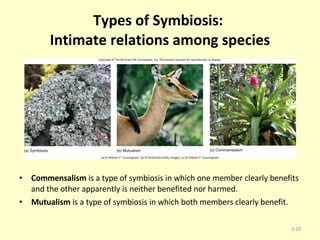
Types of Symbiosis:  Intimate relations among species Commensalism  is a type of symbiosis in which one member clearly benefits and the other apparently is neither benefited nor harmed.  Mutualism  is a type of symbiosis in which both members clearly benefit. 3-
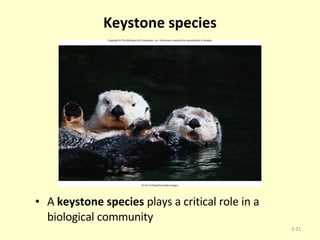
Keystone species A  keystone species  plays a critical role in a biological community  3-
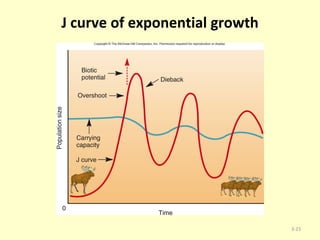
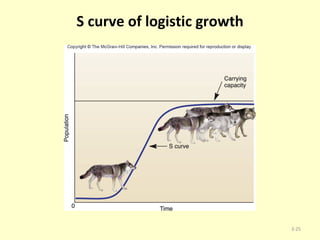
3.3 The Growth of Species Populations Biotic potential—  the amount of potential growth of a population with unrestrained biological reproduction. Exponential (r) growth  is population growth with no limits;  it results in a “J” growth curve when graphed. Logistic growth  curves result from carrying capacity  (K)  limiting population growth;  it results in a “S” shaped growth curve when graphed. 3-
J curve of exponential growth 3-
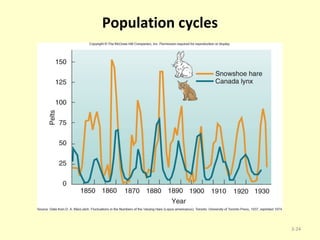
Population cycles 3-
S curve of logistic growth 3-
Limits to population size Density-dependent,  meaning as population size increases, the effect intensifies. With a larger population, there is an increased risk that disease or parasites will spread, or that predators will be attracted to the area.  Density-independent  limits to population are often nonbiological, capricious acts of nature. A population is affected no matter what its size. 3-
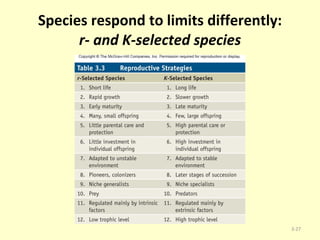
Species respond to limits differently: r- and K-selected species 3-
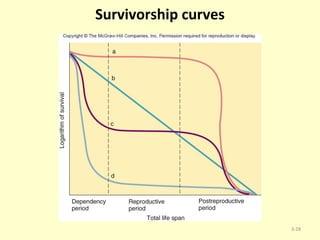
Survivorship curves 3-
3.4 Properties of Communities Depend on Species Diversity Diversity and abundance Diversity  is the number of different species per unit area. Abundance  refers to the number of individuals of a species in an area. 3-
Species patterns create community structure Boundaries of species populations and communities form patterns that fit together: (1) individuals and species are spaced throughout communities in different ways; (2) the communities themselves are arranged over a large geographic area or landscape (3) communities have relatively uniform interiors (“cores”) and also “edges” that meet.  Community  (or ecological) structure refers to these patterns of spatial distribution of individuals, species, and communities. 3-
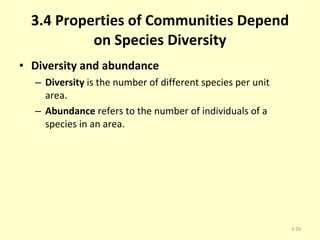
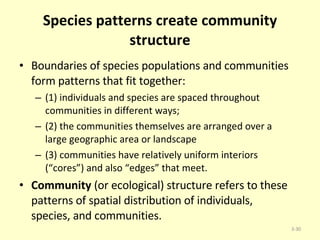
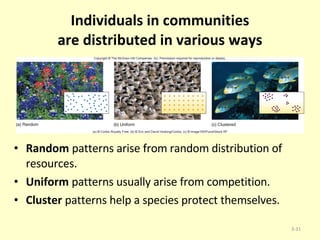
Individuals in communities are distributed in various ways Random  patterns arise from random distribution of resources. Uniform  patterns usually arise from competition. Cluster  patterns help a species protect themselves. 3-
Communities are distributed in patterns across a landscape Core habitat- a mostly uniform environment big enough to support nearly all the plants and animals that are typically found in that community. Ecotone- or border between two communities, rich in species. Edge effects- where communities meet, the environmental conditions blend and the species and microclimate of one community can penetrate the other. .  3-
3.5 Communities Are Dynamic and Change Over Time Climax community- The community that developed last and lasted the longest. Primary succession-  land that is bare of soil—a sandbar, mudslide, rock face, volcanic flow—is colonized by living organisms where none lived before. Secondary succession -after a disturbance, if left undisturbed, a community will mature to a characteristic set of organisms. Pioneer species -the first species to colonize a community in primary succession on land. 3-
Practice Quiz 1. Explain how tolerance limits to environmental factors determine distribution of a highly specialized species such as the saguaro cactus. 2. Productivity, diversity, complexity, resilience, and structure are exhibited to some extent by all communities and ecosystems. Describe how these characteristics apply to the  ecosystem in which you live. 3. Define  selective pressure  and describe one example that has affected species where you live. 4. Define  keystone species  and explain their importance in community structure and function. 5. The most intense interactions often occur between individuals of the same species. What concept discussed in this chapter can be used to explain this phenomenon? 3-
Practice Quiz continued 6. Explain how predators affect the adaptations of their prey. 7. Competition for a limited quantity of resources occurs in all ecosystems. This competition can be interspecific or intraspecific. Explain some of the ways an organism might deal with these different types of competition. 8. Describe the process of succession that occurs after a forest fire destroys an existing biological community. Why may periodic fire be beneficial to a community? 9. Which world ecosystems are most productive in terms of biomass ( fig. 3.31 )? Which are least productive? What units are used in this figure to quantify biomass accumulation? 10. Discuss the dangers posed to existing community members when new species are introduced into ecosystems. 3-

Chapt03 Lecture

  • 1.
    Copyright © The McGraw-Hill Companies, Inc. Permission required for reproduction or display. Chapter 3 Lecture Outline
  • 2.
    Learning Outcomes Afterstudying this chapter, you should be able to answer the following questions: • How does species diversity arise? • Why do species live in different locations? • How do interactions among species affect their fates and that of communities? • If a species has unlimited growth potential, why doesn’t it fi ll the earth? • What special properties does a community of species have, and why are they important? • What is the relationship between species diversity and community stability? • What is disturbance, and how does it affect communities? 3-
  • 3.
    3.1 Evolution Leadsto Diversity Natural selection and adaptation modify species Adaptation, the acquisition of traits that allow a species to survive in its environment, is one of the most important concepts in biology. The process of better-selected individuals passing their traits to the next generation is called natural selection. 3-
  • 4.
    The ecological nicheis a species’ role and environment Habitat describes the place or set of environmental conditions in which a particular organism lives. Ecological niche, describes both the role played by a species in a biological community and the total set of environmental factors that determine a species distribution. 3-
  • 5.
    Niches: generalists& specialists Generalists have a broad niche, like cockroaches. Specialists have narrow niches, like giant pandas. 3-
  • 6.
    Competitive exclusion principle& Resource partitioning 3-
  • 7.
  • 8.
    Speciation The developmentof a new species is called speciation. Geographic isolation results in allopatric speciation —species arise in non-overlapping geographic locations . Behavioral isolation results in sympatric speciation —species arise in the same location as the ancestor species. 3-
  • 9.
    Directional, stabilizing, and disruptive selection 3-
  • 10.
    Geographic isolation isa mechanism in allopatric speciation. 3-
  • 11.
    Taxonomy Taxonomy is the study of types of organisms and their relationships. Genus and species compose binomials, Also called scientific or Latin names. 3-
  • 12.
    Taxonomy describes relationshipsamong species With taxonomy you can trace how organisms have descended from common ancestors. Taxonomic relationships among species are displayed like a family tree. 3-
  • 13.
    3.2 Species InteractionsShape Communities of Species Competition is a type of antagonistic relationship within a biological community. Organisms compete for resources that are in limited supply. Competition among members of the same species is called intraspecific competition. Competition between members of different species is called interspecific competition. 3-
  • 14.
    Predation affects speciesrelationships Consumers include herbivores, carnivores, omnivores, scavengers, detritivores, and decomposers. 3-
  • 15.
    Some adaptations helpavoid predation Toxic chemicals, body armor, extraordinary speed, and the ability to hide are a few strategies organisms use to protect themselves. 3-
  • 16.
    Coevolution The responseof predator to prey and vice versa, over tens of thousands of years, produces physical and behavioral changes in a process known as coevolution. Coevolution can be mutually beneficial: many plants and pollinators have forms and behaviors that benefit each other. A classic case is that of fruit bats, which pollinate and disperse seeds of fruit-bearing tropical plants. 3-
  • 17.
    Prey Defense Mechanisms:Batesian & Mullerian mimicry 3-
  • 18.
  • 19.
    Types of Symbiosis:Intimate relations among species 3-
  • 20.
    Types of Symbiosis: Intimate relations among species Commensalism is a type of symbiosis in which one member clearly benefits and the other apparently is neither benefited nor harmed. Mutualism is a type of symbiosis in which both members clearly benefit. 3-
  • 21.
    Keystone species A keystone species plays a critical role in a biological community 3-
  • 22.
    3.3 The Growthof Species Populations Biotic potential— the amount of potential growth of a population with unrestrained biological reproduction. Exponential (r) growth is population growth with no limits; it results in a “J” growth curve when graphed. Logistic growth curves result from carrying capacity (K) limiting population growth; it results in a “S” shaped growth curve when graphed. 3-
  • 23.
    J curve ofexponential growth 3-
  • 24.
  • 25.
    S curve oflogistic growth 3-
  • 26.
    Limits to populationsize Density-dependent, meaning as population size increases, the effect intensifies. With a larger population, there is an increased risk that disease or parasites will spread, or that predators will be attracted to the area. Density-independent limits to population are often nonbiological, capricious acts of nature. A population is affected no matter what its size. 3-
  • 27.
    Species respond tolimits differently: r- and K-selected species 3-
  • 28.
  • 29.
    3.4 Properties ofCommunities Depend on Species Diversity Diversity and abundance Diversity is the number of different species per unit area. Abundance refers to the number of individuals of a species in an area. 3-
  • 30.
    Species patterns createcommunity structure Boundaries of species populations and communities form patterns that fit together: (1) individuals and species are spaced throughout communities in different ways; (2) the communities themselves are arranged over a large geographic area or landscape (3) communities have relatively uniform interiors (“cores”) and also “edges” that meet. Community (or ecological) structure refers to these patterns of spatial distribution of individuals, species, and communities. 3-
  • 31.
    Individuals in communitiesare distributed in various ways Random patterns arise from random distribution of resources. Uniform patterns usually arise from competition. Cluster patterns help a species protect themselves. 3-
  • 32.
    Communities are distributedin patterns across a landscape Core habitat- a mostly uniform environment big enough to support nearly all the plants and animals that are typically found in that community. Ecotone- or border between two communities, rich in species. Edge effects- where communities meet, the environmental conditions blend and the species and microclimate of one community can penetrate the other. . 3-
  • 33.
    3.5 Communities AreDynamic and Change Over Time Climax community- The community that developed last and lasted the longest. Primary succession- land that is bare of soil—a sandbar, mudslide, rock face, volcanic flow—is colonized by living organisms where none lived before. Secondary succession -after a disturbance, if left undisturbed, a community will mature to a characteristic set of organisms. Pioneer species -the first species to colonize a community in primary succession on land. 3-
  • 34.
    Practice Quiz 1.Explain how tolerance limits to environmental factors determine distribution of a highly specialized species such as the saguaro cactus. 2. Productivity, diversity, complexity, resilience, and structure are exhibited to some extent by all communities and ecosystems. Describe how these characteristics apply to the ecosystem in which you live. 3. Define selective pressure and describe one example that has affected species where you live. 4. Define keystone species and explain their importance in community structure and function. 5. The most intense interactions often occur between individuals of the same species. What concept discussed in this chapter can be used to explain this phenomenon? 3-
  • 35.
    Practice Quiz continued6. Explain how predators affect the adaptations of their prey. 7. Competition for a limited quantity of resources occurs in all ecosystems. This competition can be interspecific or intraspecific. Explain some of the ways an organism might deal with these different types of competition. 8. Describe the process of succession that occurs after a forest fire destroys an existing biological community. Why may periodic fire be beneficial to a community? 9. Which world ecosystems are most productive in terms of biomass ( fig. 3.31 )? Which are least productive? What units are used in this figure to quantify biomass accumulation? 10. Discuss the dangers posed to existing community members when new species are introduced into ecosystems. 3-

Editor's Notes

  • #2 EVOLUTION: What are the mechanisms that promote the great variety of species on earth and that determine which species will survive in one environment but not another? SPECIES INTERACTIONS: We will look at the interactions within and between species that affect their success and shape biological communities. BIOLOGICAL COMMUNITIES: No species is an island. It always lives with other species in a biological community in a particular environment.