



Financial Planning
 Needs for Women
        Fahzy Abdul-Rahman, Ph.D., M.P.H.
               New Mexico State University


   For New Mexico Conference on Aging 2011
Outline
   New Normal
   Retirement Need for Women
   Financial and Retirement Planning
   What to Do?
New Normal


Economic conditions
New
Economic
 Reality?
Characteristics of the “New Normal”

An extended period of:-
•   Slow U.S. economic growth: GDP growth < 2%
•   Low single-digit average annual stock returns
•   Stubbornly high unemployment levels: 9.1%
    •   Precarious job security (public and private sector)
    •   Youth, <25: 24%
        •   College debt --- Next financial crisis wave

•   Tightened credit standards
•   Declining asset values (e.g., housing)
•   Increased precautionary household savings and debt
    repayment
•   Decreased household spending
Retirement Need for Women

        Personal Finance Foundation
Women: Demographics
•   Life expectancies (2005): Men (75.2 years) and women
    (80.4)
         For couples of the same age, this means that women are
          expected to spend their last five years being a widow.
             husbands are still almost ½ year more educated and
             about 2 ½ years older than their wives.
         Impact of the health care costs
•       Widower among men (4%) vs. widows among women
        (12%)
         Homeownership: 81% of widows vs. 67.8% nationally
•       Average marriage span of 8 years
         single working mother issues: custody, childcare, and debt
          issues
Women
   Earn less: 77.8 cents for every dollar men earn
   Less likely to have retirement plan:
       Tend to work in part-time jobs or for employers that don’t
        offer retirement benefits
       Fewer have defined-benefit pension plans.
       And those with plans have smaller pensions because of
        less time in the workforce.
       Women are also less likely to participate in 401(k) plans
        because of lower compensation.
Women
   More likely to take career breaks / provide for others
    before themselves
       Children
       Elderly parents (in laws)
   Lower potential earnings over lifetime
       Due to above:
           Lower wage, more familial responsibilities,
       11 years out of the workforce due to childbirth and care
        giving to children and frail elderly (Brennan, & O’Neill,
        2004).
Women
   Women have lower Social Security benefits
       Lower income and less time in the workforce also means
        lower Social Security income
       In 2007
           unmarried elderly (age 65+) woman, SS comprises 48% of their
            total income
           unmarried elderly men : 37% and
           elderly couples: only 30%
   Fared worse in financial planning knowledge
       Performed worse than men in financial literacy questions
        on compound interest, inflation, and especially stock risk
        diversification (Lusardi and Mitchell, 2008).
Women: Eventually, …


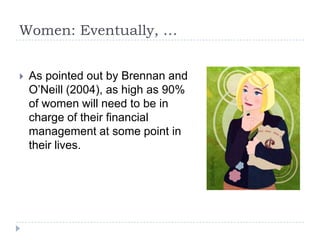
   As pointed out by Brennan and
    O’Neill (2004), as high as 90%
    of women will need to be in
    charge of their financial
    management at some point in
    their lives.
Financial and Retirement Planning


                         The Basics
Personal Finance Basics
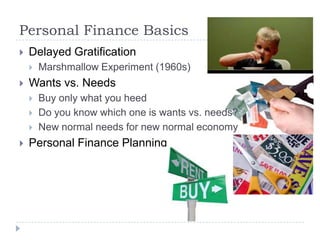
   Delayed Gratification
       Marshmallow Experiment (1960s)
   Wants vs. Needs
       Buy only what you heed
       Do you know which one is wants vs. needs?
       New normal needs for new normal economy
   Personal Finance Planning
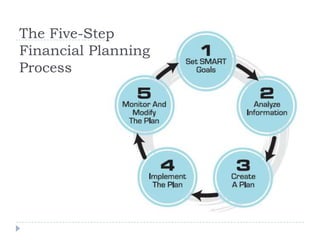
The Five-Step
Financial Planning
Process
Smart Goals

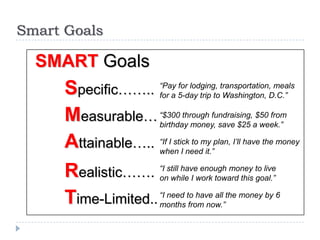
  SMART Goals
      Specific……..           “Pay for lodging, transportation, meals
                             for a 5-day trip to Washington, D.C.”

      Measurable… “$300 through fundraising,a$50 from
                     birthday money, save $25 week.”

      Attainable….. “If I stick to my plan, I’ll have the money
                     when I need it.”

      Realistic……. “I still havework toward this to live
                     on while I
                                   enough money
                                                    goal.”

      Time-Limited.. “I need to have all the money by 6
                     months from now.”
What to Do?

       React
What To Do?
1.   Make retirement plans a priority when you consider
     a job
2.   Work as long as you can at the highest salary you
     can
3.   Understand the effect on Social Security benefits of
     divorce and remarriage
4.   Put money away for retirement on a regular basis
5.   Learn about your finances
All Bad for Women?

   More likely to seek the advice of financial planners
Resources & Financial Advice

   Own research
   Hire professionals
       Certified Financial Planner® (CFP®)
       Chartered Financial Analyst (CFA®)
       Certified Fund Specialist (CFS)
       Chartered Financial Consultant (ChFC)
       Certified Investment Management Analyst (CIMA)
       Certified Public Accountant and Personal Financial
        Specialist (CPA and PFS)
   Selecting Investment Professionals (FINRA)
Financial Planning
 Needs for Women
        Fahzy Abdul-Rahman, Ph.D., M.P.H.
               New Mexico State University


   For New Mexico Conference on Aging 2011

Financial Planning Needs for Women

  • 1.
    Financial Planning Needsfor Women Fahzy Abdul-Rahman, Ph.D., M.P.H. New Mexico State University For New Mexico Conference on Aging 2011
  • 2.
    Outline  New Normal  Retirement Need for Women  Financial and Retirement Planning  What to Do?
  • 3.
  • 4.
  • 5.
    Characteristics of the“New Normal” An extended period of:- • Slow U.S. economic growth: GDP growth < 2% • Low single-digit average annual stock returns • Stubbornly high unemployment levels: 9.1% • Precarious job security (public and private sector) • Youth, <25: 24% • College debt --- Next financial crisis wave • Tightened credit standards • Declining asset values (e.g., housing) • Increased precautionary household savings and debt repayment • Decreased household spending
  • 6.
    Retirement Need forWomen Personal Finance Foundation
  • 7.
    Women: Demographics • Life expectancies (2005): Men (75.2 years) and women (80.4)  For couples of the same age, this means that women are expected to spend their last five years being a widow.  husbands are still almost ½ year more educated and  about 2 ½ years older than their wives.  Impact of the health care costs • Widower among men (4%) vs. widows among women (12%)  Homeownership: 81% of widows vs. 67.8% nationally • Average marriage span of 8 years  single working mother issues: custody, childcare, and debt issues
  • 8.
    Women  Earn less: 77.8 cents for every dollar men earn  Less likely to have retirement plan:  Tend to work in part-time jobs or for employers that don’t offer retirement benefits  Fewer have defined-benefit pension plans.  And those with plans have smaller pensions because of less time in the workforce.  Women are also less likely to participate in 401(k) plans because of lower compensation.
  • 9.
    Women  More likely to take career breaks / provide for others before themselves  Children  Elderly parents (in laws)  Lower potential earnings over lifetime  Due to above:  Lower wage, more familial responsibilities,  11 years out of the workforce due to childbirth and care giving to children and frail elderly (Brennan, & O’Neill, 2004).
  • 10.
    Women  Women have lower Social Security benefits  Lower income and less time in the workforce also means lower Social Security income  In 2007  unmarried elderly (age 65+) woman, SS comprises 48% of their total income  unmarried elderly men : 37% and  elderly couples: only 30%  Fared worse in financial planning knowledge  Performed worse than men in financial literacy questions on compound interest, inflation, and especially stock risk diversification (Lusardi and Mitchell, 2008).
  • 11.
    Women: Eventually, …  As pointed out by Brennan and O’Neill (2004), as high as 90% of women will need to be in charge of their financial management at some point in their lives.
  • 12.
    Financial and RetirementPlanning The Basics
  • 13.
    Personal Finance Basics  Delayed Gratification  Marshmallow Experiment (1960s)  Wants vs. Needs  Buy only what you heed  Do you know which one is wants vs. needs?  New normal needs for new normal economy  Personal Finance Planning
  • 14.
  • 15.
    Smart Goals SMART Goals Specific…….. “Pay for lodging, transportation, meals for a 5-day trip to Washington, D.C.” Measurable… “$300 through fundraising,a$50 from birthday money, save $25 week.” Attainable….. “If I stick to my plan, I’ll have the money when I need it.” Realistic……. “I still havework toward this to live on while I enough money goal.” Time-Limited.. “I need to have all the money by 6 months from now.”
  • 16.
  • 17.
    What To Do? 1. Make retirement plans a priority when you consider a job 2. Work as long as you can at the highest salary you can 3. Understand the effect on Social Security benefits of divorce and remarriage 4. Put money away for retirement on a regular basis 5. Learn about your finances
  • 18.
    All Bad forWomen?  More likely to seek the advice of financial planners
  • 19.
    Resources & FinancialAdvice  Own research  Hire professionals  Certified Financial Planner® (CFP®)  Chartered Financial Analyst (CFA®)  Certified Fund Specialist (CFS)  Chartered Financial Consultant (ChFC)  Certified Investment Management Analyst (CIMA)  Certified Public Accountant and Personal Financial Specialist (CPA and PFS)  Selecting Investment Professionals (FINRA)
  • 20.
    Financial Planning Needsfor Women Fahzy Abdul-Rahman, Ph.D., M.P.H. New Mexico State University For New Mexico Conference on Aging 2011

Editor's Notes

  • #7 Psychology
  • #8 Husband-wife age gap: http://client.norc.org/jole/soleweb/853.pdf
  • #9 Life expectancies: U.S. Census Bureau, 2008U.S. Women&apos;s Bureau and the National Committee on Pay Equity, 2007.www.socialsecurity.gov &quot;Social Security is Important to Women&quot; October 2008.
  • #10 Life expectancies: U.S. Census Bureau, 2008U.S. Women&apos;s Bureau and the National Committee on Pay Equity, 2007.www.socialsecurity.gov &quot;Social Security is Important to Women&quot; October 2008.
  • #11 Lusardi and Mitchell, 2008
  • #13 Psychology
  • #14 The marshmallow experiment is a famous test of this concept conducted by Walter Mischel at Stanford University and discussed by Daniel Goleman in his popular work. In the 1960s, a group of four-year olds were given a marshmallow and promised another, only if they could wait 20 minutes before eating the first one. Some children could wait and others could not. The researchers then followed the progress of each child into adolescence, and demonstrated that those with the ability to wait were better adjusted and more dependable (determined via surveys of their parents and teachers), and scored an average of 210 points higher on the Scholastic Aptitude Test.
  • #18 Make retirement plans a priority when you consider a jobConsider sacrificing some current salary in return for a good retirement plan, and seek out employers who will match part or all of your savings in a contributory plan. Work as long as you can at the highest salary you canThe longer you work, the more you can sock away for retirement. And the older you are when you retire, the fewer years of retirement you will have to fund. Higher Social Security benefits are an extra bonus for those years of hard work. If you pay into Social Security for at least ten years (or if you qualify for Social Security under your husband&apos;s work record), you won&apos;t have to pay monthly premiums for Medicare hospital insurance when you retire. Understand the effect on Social Security benefits of divorce and remarriageIf you divorce, you are entitled to Social Security payments equal to 50% of your ex-husband&apos;s benefits, if you were married for at least ten years. You&apos;ll lose that right if you remarry, though you&apos;ll be entitled to collect payments based on your new husband&apos;s benefits. A widow is entitled to her late husband&apos;s benefits as long as she doesn&apos;t remarry before age 60. Put money away for retirement on a regular basisJust $10 to $20 a week can add up, especially if you start young. For example, $20 a week invested in growth mutual funds from age 40 to age 65 will build to a nest egg of $92,000. Start at age 25, and it will grow to nearly $370,000. Learn about your financesDon&apos;t just sign tax returns, be sure you understand them. Get assistance from your tax preparer if you need explanations. Identify your financial assets and debts, and begin to save for your future by paying down debt and budgeting. If you are married, be sure that you and your husband each understand what you own and what you owe, and use insurance to plan for the possibility of death or disability.
  • #19 According to BMO Financial Group.