Choose Your Destination:  A Financial Wellness Seminar for Women
Important Notes Please be advised that this presentation is for educational purposes only. It is not intended as legal or tax advice. Accordingly, any tax information provided in this presentation is not intended or written to be used, and cannot be used, by any taxpayer for the purpose of avoiding penalties that may be imposed on the taxpayer. The tax information was written to support the promotion or marketing of the transaction(s) or matter(s) addressed, and you should seek advice based on your particular circumstances from an independent tax advisor. Securities offered through AXA Advisors, LLC (NY,NY 212-314-4600), member FINRA, SIPC.  Annuity and insurance products offered through AXA Network, LLC and its subsidiaries.  AXA Advisors and AXA Network do not provide tax or legal advice.  You should consult with your attorney and/or tax advisor before making final investment or planning decisions.
Today’s Discussion Issues Impacting Women The Map to Your Destination Strategies for Each Stage of Life Financial Strategies in Everyday Life
Working Women In the United States: Women own 28% of all non-farm businesses and employ 7.1 million people 1a 38% of females 16 years or older work in management, professional and related occupations, compared with 32% of males 1b Women held 13.5% of Executive Officer positions and 15.2% of the board seats in the Fortune 500 companies in 2009 2 There were 94,000 female police officers across the country, 14,000 women firefighters, 330,000 lawyers, 266,000 physicians and surgeons, and 36,000 pilots 3 Sources:  1) U.S. Department of Commerce,  “U.S. Census Bureau News Facts for Features:   Women’s History Month: March 2009,”  Jan 5, 2009. Data pertains to a) 2002 and b) 2007.   2) Catalyst ,  “ 2009 Catalyst Census: Fortune 500 Women Executive Officers and Top Earners”. 3) U.S. Census Bureau,  “Statistical Abstract of the United States: 2009”.  Note that number of pilots pertains to 2006.
Issues Impacting  Women’s Finances During the Working Years Of the estimated 65.7 million Americans who are informal caregivers, 66% are women – and many of them are simultaneously caring for an older relative and raising children or grandchildren To accommodate caregiving, more than half of employed caregivers have made changes at work, such as going in late or leaving early, or working fewer hours 20% of all caregivers ever employed while involved in caregiving gave up work either temporarily or permanently, or took a leave of absence Source:   Caregiving in the U.S., Executive Summary Nov.2009
Issues Impacting  Women’s Finances After the Working Years Worldwide, women have longer life expectancies than men in nearly every society today 1 67% of Americans age 85 or older are women 2 Women make up 71% of the nursing-home population 3 Women are more likely than men to be single, widowed, or divorced in retirement 4 Sources:   1) National Vital Statistics Report, vol57 num14, April 17, 2009. 2) Population Division, U.S. Census Bureau, May 2009.  3) The National Nursing Home Survey, US. Dept. of Human Services, June 2009.  4) US. Census Bureau Current Population Survey, 2009.
Today’s Discussion Issues Impacting Women The Map to Your Destination Strategies for Each Stage of Life Financial Strategies in Everyday Life
Choosing Your Destination Shaping your financial wellbeing means more than choosing financial products - it’s about choosing where you want to be tomorrow. Choosing Your Destination - Four Steps 1. Set your goals 2. Examine where you are vs. where you want to be 3. Develop a plan to meet your goals 4. Activate your plan and stick to it
Goal Setting What Are Your Financial Goals?   Short-, Medium- and Long-Term Objectives For Example:  Short - Out of debt in 3 yrs Medium -  Child starting college in 10 yrs Long - Retirement nest egg Of Note: Women who usually work full time have median earnings of $638 per week, or 79.9% of the $798 median for men.  (Source: US Department of Labor Bureau of Statistics, “Highlights of Women’s Earnings in 2008, July 2009)
Goal Setting What Are Your Lifestyle Goals?  Examples:  Free Time Financial Independence Helping Others Consider Lifestyle Goals for Today  and  Tomorrow Connect Financial and Lifestyle Together A Tip for Smart Planning Prepare for both the best- and worst-case scenarios
Financial Review Things to Consider Do you have a written plan?  What is your risk tolerance?  What are the tax implications?  Do the products you own match your goals?  Are your investments coordinated?
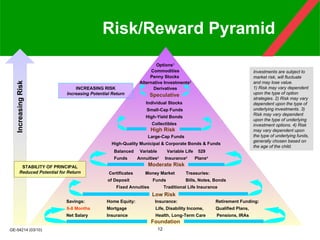
Risk/Reward Pyramid Investments are subject to market risk, will fluctuate and may lose value.  1) Risk may vary dependent upon the type of option strategies. 2) Risk may vary dependent upon the type of underlying investments. 3) Risk may vary dependent upon the type of underlying investment options. 4) Risk may vary dependent upon the type of underlying funds, generally chosen based on the age of the child. Balanced   Variable  Variable Life Funds   Annuities*  Insurance*  529 Plans**  Fixed Annuities   Traditional Life Insurance INCREASING RISK Increasing Potential Return Options 1 Commodities Penny Stocks  Alternative Investments 2 Derivatives Individual Stocks Small-Cap Funds High-Yield Bonds Collectibles Large-Cap Funds High-Quality Municipal & Corporate Bonds & Funds Certificates  Money Market   Treasuries: of Deposit  Funds   Bills, Notes, Bonds Fixed Annuities   Traditional Life Insurance Savings:   Home Equity:  Insurance:    Retirement Funding: 6-8 Months   Mortgage   Life, Disability Income,  Qualified Plans, Net Salary   Insurance   Health, Long-Term Care  Pensions, IRAs Increasing Risk   Moderate Risk Balanced   Variable  Variable Life  529 Funds   Annuities 3   Insurance 3   Plans 4   High Risk Low Risk Foundation STABILITY OF PRINCIPAL Reduced Potential for Return Speculative
Today’s Discussion Issues Impacting Women The Map to Your Destination Strategies for Each Stage of Life Financial Strategies in Everyday Life
Taking Care of Yourself Retirement Savings & Investments Annuities Qualified Plans Retirement Accounts
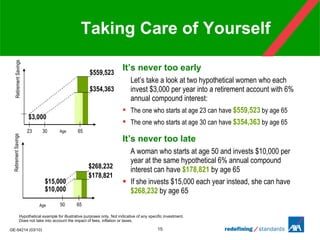
Taking Care of Yourself  It’s never too early Let’s take a look at two hypothetical women who each invest $3,000 per year into a retirement account with 6% annual compound interest:  The one who starts at age 23 can have  $559,523   by age 65  The one who starts at age 30 can have  $354,363   by age 65   It’s never too late A woman who starts at age 50 and invests $10,000 per year at the same hypothetical 6% annual compound interest can have  $178,821  by age 65 If she invests $15,000 each year instead, she can have  $268,232   by age 65   Hypothetical example for illustrative purposes only. Not indicative of any specific investment.  Does not take into account the impact of fees, inflation or taxes. $3,000 Retirement Savings 23 30 65 Age $354,363 $559,523 $15,000 Retirement Savings 50 65 Age $10,000 $178,821 $268,232
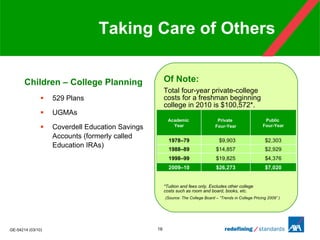
Taking Care of Others Children – College Planning 529 Plans UGMAs Coverdell Education Savings Accounts (formerly called Education IRAs) Of Note: Total four-year private-college  costs for a freshman beginning  college in 2010 is $100,572*. *Tuition and fees only. Excludes other college  costs such as room and board, books, etc. (Source: The College Board – “Trends in College Pricing 2009” ) Academic  Year Private  Four-Year Public  Four-Year 1978–79 $9,903 $2,303 1988–89 $14,857 $2,929 1998–99 $19,825 $4,376 2009–10 $26,273 $7,020
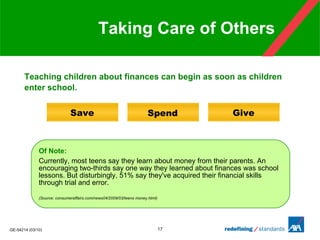
Teaching children about finances can begin as soon as children enter school. Taking Care of Others Of Note: Currently, most teens say they learn about money from their parents. An encouraging two-thirds say one way they learned about finances was school lessons. But disturbingly, 51% say they've acquired their financial skills through trial and error. (Source: consumeraffairs.com/news04/2009/03/teens money.html) Save Spend Give
Taking Care of Others Seniors Long-Term Care Estate Planning Of Note: In 2009, 41.2 million people aged 18 or older had some type of activity limitation. 1  11 million needed assistance from others to perform everyday activities. 1 By 2020, 12 million people will need long term care. 2 Sources: 1. www.census.gov/press release, Facts for Features May 2009    2. www.longtermcare.gov/LTC, National Clearinghouse for LTC Info Oct. 2008
Taking Care of Others Leaving a Legacy Life Insurance Estate Planning Gifting Strategies A Tip for Smart Planning: Leaving everything to your spouse could cost your heirs large amounts in estate taxes.
Business Planning Future Business Owners Number of women-owned firms rapidly increasing Answer to the work/life question Semi-retirement
Business Planning Current Business Owners Balancing personal and business finances Business protection Employee needs
Today’s Discussion Issues Impacting Women The Map to Your Destination Strategies for Each Stage of Life Financial Strategies in Everyday Life
What’s Standing in the Way Common Roadblocks Busy Lifestyle Preconceived notions Attitudes about money
What’s Standing in the Way What You Can Do Examine what might be keeping you from your goals Work with a financial professional Stay focused on the big picture  Reward yourself
Choosing  A Financial Professional Possible Questions to Ask: What type of clients do you usually work with?  What is your area of specialty? What licenses and degrees do you hold?  How do you communicate with clients? How often?  Do you offer annual reviews?  How are you compensated?  How long have you been in the business?  What do you think is the most important part of a financial strategy and/or investing?
Q & A
Thank You

Choose Your Destination

  • 1.
    Choose Your Destination: A Financial Wellness Seminar for Women
  • 2.
    Important Notes Pleasebe advised that this presentation is for educational purposes only. It is not intended as legal or tax advice. Accordingly, any tax information provided in this presentation is not intended or written to be used, and cannot be used, by any taxpayer for the purpose of avoiding penalties that may be imposed on the taxpayer. The tax information was written to support the promotion or marketing of the transaction(s) or matter(s) addressed, and you should seek advice based on your particular circumstances from an independent tax advisor. Securities offered through AXA Advisors, LLC (NY,NY 212-314-4600), member FINRA, SIPC. Annuity and insurance products offered through AXA Network, LLC and its subsidiaries. AXA Advisors and AXA Network do not provide tax or legal advice. You should consult with your attorney and/or tax advisor before making final investment or planning decisions.
  • 3.
    Today’s Discussion IssuesImpacting Women The Map to Your Destination Strategies for Each Stage of Life Financial Strategies in Everyday Life
  • 4.
    Working Women Inthe United States: Women own 28% of all non-farm businesses and employ 7.1 million people 1a 38% of females 16 years or older work in management, professional and related occupations, compared with 32% of males 1b Women held 13.5% of Executive Officer positions and 15.2% of the board seats in the Fortune 500 companies in 2009 2 There were 94,000 female police officers across the country, 14,000 women firefighters, 330,000 lawyers, 266,000 physicians and surgeons, and 36,000 pilots 3 Sources: 1) U.S. Department of Commerce, “U.S. Census Bureau News Facts for Features: Women’s History Month: March 2009,” Jan 5, 2009. Data pertains to a) 2002 and b) 2007. 2) Catalyst , “ 2009 Catalyst Census: Fortune 500 Women Executive Officers and Top Earners”. 3) U.S. Census Bureau, “Statistical Abstract of the United States: 2009”. Note that number of pilots pertains to 2006.
  • 5.
    Issues Impacting Women’s Finances During the Working Years Of the estimated 65.7 million Americans who are informal caregivers, 66% are women – and many of them are simultaneously caring for an older relative and raising children or grandchildren To accommodate caregiving, more than half of employed caregivers have made changes at work, such as going in late or leaving early, or working fewer hours 20% of all caregivers ever employed while involved in caregiving gave up work either temporarily or permanently, or took a leave of absence Source: Caregiving in the U.S., Executive Summary Nov.2009
  • 6.
    Issues Impacting Women’s Finances After the Working Years Worldwide, women have longer life expectancies than men in nearly every society today 1 67% of Americans age 85 or older are women 2 Women make up 71% of the nursing-home population 3 Women are more likely than men to be single, widowed, or divorced in retirement 4 Sources: 1) National Vital Statistics Report, vol57 num14, April 17, 2009. 2) Population Division, U.S. Census Bureau, May 2009. 3) The National Nursing Home Survey, US. Dept. of Human Services, June 2009. 4) US. Census Bureau Current Population Survey, 2009.
  • 7.
    Today’s Discussion IssuesImpacting Women The Map to Your Destination Strategies for Each Stage of Life Financial Strategies in Everyday Life
  • 8.
    Choosing Your DestinationShaping your financial wellbeing means more than choosing financial products - it’s about choosing where you want to be tomorrow. Choosing Your Destination - Four Steps 1. Set your goals 2. Examine where you are vs. where you want to be 3. Develop a plan to meet your goals 4. Activate your plan and stick to it
  • 9.
    Goal Setting WhatAre Your Financial Goals? Short-, Medium- and Long-Term Objectives For Example: Short - Out of debt in 3 yrs Medium - Child starting college in 10 yrs Long - Retirement nest egg Of Note: Women who usually work full time have median earnings of $638 per week, or 79.9% of the $798 median for men. (Source: US Department of Labor Bureau of Statistics, “Highlights of Women’s Earnings in 2008, July 2009)
  • 10.
    Goal Setting WhatAre Your Lifestyle Goals? Examples: Free Time Financial Independence Helping Others Consider Lifestyle Goals for Today and Tomorrow Connect Financial and Lifestyle Together A Tip for Smart Planning Prepare for both the best- and worst-case scenarios
  • 11.
    Financial Review Thingsto Consider Do you have a written plan? What is your risk tolerance? What are the tax implications? Do the products you own match your goals? Are your investments coordinated?
  • 12.
    Risk/Reward Pyramid Investmentsare subject to market risk, will fluctuate and may lose value. 1) Risk may vary dependent upon the type of option strategies. 2) Risk may vary dependent upon the type of underlying investments. 3) Risk may vary dependent upon the type of underlying investment options. 4) Risk may vary dependent upon the type of underlying funds, generally chosen based on the age of the child. Balanced Variable Variable Life Funds Annuities* Insurance* 529 Plans** Fixed Annuities Traditional Life Insurance INCREASING RISK Increasing Potential Return Options 1 Commodities Penny Stocks Alternative Investments 2 Derivatives Individual Stocks Small-Cap Funds High-Yield Bonds Collectibles Large-Cap Funds High-Quality Municipal & Corporate Bonds & Funds Certificates Money Market Treasuries: of Deposit Funds Bills, Notes, Bonds Fixed Annuities Traditional Life Insurance Savings: Home Equity: Insurance: Retirement Funding: 6-8 Months Mortgage Life, Disability Income, Qualified Plans, Net Salary Insurance Health, Long-Term Care Pensions, IRAs Increasing Risk Moderate Risk Balanced Variable Variable Life 529 Funds Annuities 3 Insurance 3 Plans 4 High Risk Low Risk Foundation STABILITY OF PRINCIPAL Reduced Potential for Return Speculative
  • 13.
    Today’s Discussion IssuesImpacting Women The Map to Your Destination Strategies for Each Stage of Life Financial Strategies in Everyday Life
  • 14.
    Taking Care ofYourself Retirement Savings & Investments Annuities Qualified Plans Retirement Accounts
  • 15.
    Taking Care ofYourself It’s never too early Let’s take a look at two hypothetical women who each invest $3,000 per year into a retirement account with 6% annual compound interest: The one who starts at age 23 can have $559,523 by age 65 The one who starts at age 30 can have $354,363 by age 65 It’s never too late A woman who starts at age 50 and invests $10,000 per year at the same hypothetical 6% annual compound interest can have $178,821 by age 65 If she invests $15,000 each year instead, she can have $268,232 by age 65 Hypothetical example for illustrative purposes only. Not indicative of any specific investment. Does not take into account the impact of fees, inflation or taxes. $3,000 Retirement Savings 23 30 65 Age $354,363 $559,523 $15,000 Retirement Savings 50 65 Age $10,000 $178,821 $268,232
  • 16.
    Taking Care ofOthers Children – College Planning 529 Plans UGMAs Coverdell Education Savings Accounts (formerly called Education IRAs) Of Note: Total four-year private-college costs for a freshman beginning college in 2010 is $100,572*. *Tuition and fees only. Excludes other college costs such as room and board, books, etc. (Source: The College Board – “Trends in College Pricing 2009” ) Academic Year Private Four-Year Public Four-Year 1978–79 $9,903 $2,303 1988–89 $14,857 $2,929 1998–99 $19,825 $4,376 2009–10 $26,273 $7,020
  • 17.
    Teaching children aboutfinances can begin as soon as children enter school. Taking Care of Others Of Note: Currently, most teens say they learn about money from their parents. An encouraging two-thirds say one way they learned about finances was school lessons. But disturbingly, 51% say they've acquired their financial skills through trial and error. (Source: consumeraffairs.com/news04/2009/03/teens money.html) Save Spend Give
  • 18.
    Taking Care ofOthers Seniors Long-Term Care Estate Planning Of Note: In 2009, 41.2 million people aged 18 or older had some type of activity limitation. 1 11 million needed assistance from others to perform everyday activities. 1 By 2020, 12 million people will need long term care. 2 Sources: 1. www.census.gov/press release, Facts for Features May 2009 2. www.longtermcare.gov/LTC, National Clearinghouse for LTC Info Oct. 2008
  • 19.
    Taking Care ofOthers Leaving a Legacy Life Insurance Estate Planning Gifting Strategies A Tip for Smart Planning: Leaving everything to your spouse could cost your heirs large amounts in estate taxes.
  • 20.
    Business Planning FutureBusiness Owners Number of women-owned firms rapidly increasing Answer to the work/life question Semi-retirement
  • 21.
    Business Planning CurrentBusiness Owners Balancing personal and business finances Business protection Employee needs
  • 22.
    Today’s Discussion IssuesImpacting Women The Map to Your Destination Strategies for Each Stage of Life Financial Strategies in Everyday Life
  • 23.
    What’s Standing inthe Way Common Roadblocks Busy Lifestyle Preconceived notions Attitudes about money
  • 24.
    What’s Standing inthe Way What You Can Do Examine what might be keeping you from your goals Work with a financial professional Stay focused on the big picture Reward yourself
  • 25.
    Choosing AFinancial Professional Possible Questions to Ask: What type of clients do you usually work with? What is your area of specialty? What licenses and degrees do you hold? How do you communicate with clients? How often? Do you offer annual reviews? How are you compensated? How long have you been in the business? What do you think is the most important part of a financial strategy and/or investing?
  • 26.
  • 27.

Editor's Notes

  • #2 Welcome to our presentation “Choose Your Destination: A financial wellness seminar for women.” I am [Name] , a [Title] with AXA Advisors, LLC. Please feel free to ask questions as we go along — we’ll do our best to answer them for you. Recognize, though, that specific answers often depend on individual facts and circumstances, so complete answers may have to be deferred until one-on-one meetings with your financial professional takes place. The only “homework” we’re going to ask of you is to complete the evaluation form. This is our “report card” on how helpful the information was to you, and it enables us to fine-tune future informational programs. You’ll note also that there are boxes you can check to indicate specific information you want us to be prepared to discuss with you, if you choose to schedule a follow-up meeting. You’ll also notice that you can request that we not call you, if that is your preference. [Discuss break, rest room, refreshment info; cell phone etiquette; how you’ll handle questions from attendees.]
  • #4 [Read slide]
  • #5 Clearly, women have made great strides in entering the business world and moving up the ranks, whether it’s into a new business venture or as a corporate leader. [Read Slide] As you can see from these statistics, the impact of women in business has in no way reached a plateau. With the numbers of women business owners and female executives growing rapidly, their influence will continue to grow.
  • #6 Do we need a separate seminar that addresses women’s financial needs? The answer is yes. As you can see, women have unique lifestyle issues that directly impact their financial needs. Women are still likely to shoulder more of the care giving duties for children and older relatives, or perform “double duty” by caring for both children and older relatives at the same time. This often means they leave the workforce or reduce their hours, resulting in lost personal income and reduced benefits. Care giving can also include financial care as well, meaning that many women must plan for their own financial future as well as the financial futures of others.
  • #7 Next, women statistically live longer than men – therefore spending more years in retirement. The majority of women are also unmarried during at least part of their retirement. This means that women, generally speaking, may need to build a larger retirement nest egg than men, and are likely to be solely responsible for managing it at some point. All of these issues together affect women’s needs for disability and health insurance, college funding, long-term care insurance, retirement benefits, and so on.
  • #8 [Read slide]
  • #9 So what does choosing your destination mean? Planning begins by FIRST choosing where you want to go, THEN deciding the best way to get there. Even the most well-informed investors often take the opposite approach – by purchasing products and making investments before they’ve developed a clearly defined set of goals. This can result in a disjointed portfolio of financial products that do not necessarily work together to meet their individual needs. By following these four steps, you are much more likely to make financial decisions that are well suited to your chosen destination.
  • #10 An important first step in planning is placing your goals in short-, medium- and long-term categories. A complete financial strategy should include tactics to help reach all of these goals. One should avoid too many assets in long-term investment vehicles, and not enough directed towards short-term needs, and vice versa.
  • #11 It’s important to consider your lifestyle goals in tandem with your financial goals. For example, if two of your financial goals are 1) owning a vacation home and 2) living debt-free, and your primary lifestyle goal is “financial security,” living debt-free may rise in priority above owning a second home. It’s also important to plan for both the best- and worst-case scenarios. This means you want to aim for your ideal, while also planning for unexpected events even if they seem unlikely. Let’s look at an example. Say, Rebecca’s primary lifestyle goal is making sure she is not a burden to her relatives during old age. Therefore, her financial goal is accumulating retirement savings, but she also needs to plan for the worst case. She’ll need to prepare for possible disability, nursing-home costs, extensive medical care, and make sure she has a current estate plan. Based on the statistics we saw a few minutes ago about women in retirement, you can see how important planning for the unexpected can be.
  • #12 Working towards your financial goals with a formal, written strategy is like traveling somewhere new with a detailed map - you are much more likely to choose the appropriate path to your destination. There are a number of things to consider when choosing financial products. For example, when choosing investments, you’ll first want to consider your risk tolerance, which we’ll review in more detail on the next slide. Another thing to consider is tax implications. For example, even if you’ve done a stellar job of accumulating, without an estate plan in place, a good portion of your hard-earned estate could go to taxes rather than to your heirs. Many people have a strong investment portfolio but too little protection, or vice versa. That’s another reason it’s important to look at each product in terms of the goals you’ve set. Your goals usually fall into several different life-stage categories.
  • #13 [Review the slide] All investing involves a certain amount of risk. How well you tolerate price fluctuations in your investment portfolio will need to be balanced against your desired rate of return in determining the types of investments you will choose. An offsetting factor to risk is time. If you have a long investment-time horizon, you will probably be able to tolerate more risk because you have time to make up any losses you may experience early on. For a shorter-term investment, such as saving to buy a house, you probably want to take on less risk and have more liquidity in your investments. In general, younger people can usually afford to take on more risk than older investors, although they may not wish to.
  • #14 [Read slide]
  • #15 Women have unique considerations when planning for retirement, as mentioned before. Each of the financial vehicles listed here can be important for retirement funding, and it is rare that one method alone will be sufficient. For example, since no one is able to predict how many years they will spend in retirement, a retirement account such as an IRA or a qualified plan such as 401(k) may not be enough to ensure you have all of the funds you need. In this case, different types of annuities can enhance your retirement plan by offering a fixed amount of income each year upon annuitization. We are all aware that Social Security only covers a portion of what most people need to retire comfortably. And last, since savings and investments are reduced by inflation, you’ll need to consider the value of your assets now vs. the future.
  • #16 Let’s take a look at the importance of time. Delaying saving for retirement can be costly. As you can see in this first hypothetical example, the woman who starts planning for retirement seven years earlier garners a nest egg that’s over $200,000 larger. The main point here is that even one year can make a big difference in how much you may be able to accumulate. Best of all, the earlier you start, the more likely it is your nest egg may be made up of earned interest. The woman who began at age 23 invested $126,000, but accumulated over $430,000 in interest in the hypothetical example. Still, don’t be discouraged if you didn’t start saving in your 20s. You can still work towards a comfortable retirement even if your time horizon is short. As you can see by the second example, a woman who saves $15,000 for 15 years in an interest-bearing retirement account can have more than a quarter million dollars to add to her nest egg with this hypothetical 6% annual return. This example is meant to illustrate a point and not to show how a particular investment will perform. It does not take into account the impact of fees, inflation or taxes.
  • #17 As we discussed earlier, women are still generally the primary caregivers for both children and the elderly. Part of caregiving can include funding all or part of the costs of college and/or eldercare. College education already carries a hefty price tag, and the costs are continuing to rise. One of the best ways to cover college costs is to start as early as possible, when children are infants. However, even if a child has just a few years before reaching college age, you may still be able to benefit from setting up college savings accounts. 529 plans are state-managed savings plans that are growing in popularity because of their tax-free withdrawals (for higher education purposes only) and the high amount of allowable contributions. Uniform Gifts to Minors and Coverdell Education Savings Accounts can also be tax-efficient ways to help save for college. If you are investing in a 529 plan outside your state of residence, you may lose available state tax benefits. Make sure you understand your state tax laws to get the most from your plan. 529 plans are subject to enrollment, maintenance, administration/management fees and expenses. 529 plans are subject to fluctuation in value and market rise, including loss of principal. Investors should consider the investment objectives, risks, charges, and expenses of 529 plans carefully before purchasing. More information about 529 plans can be found in the issuer’s official statement. Please read the official statement carefully before investing.
  • #18 If you have children, teaching them about finances can be fun for both of you, not to mention beneficial. Have you ever said to yourself “If only I’d known that earlier….”? For younger children, consider setting up three separate savings jars or purchasing a toy bank that has different slots such as "save,” "spend" and "give,” then encourage your child to distribute his/her allowance equally between the three categories. The sooner kids learn about financial concepts the more likely they will be to make well-educated decisions in the future.
  • #19 It comes as a surprise to many women that they might expect to spend as many years caring for a parent as they do for a child living at home – an average of 20 years. This number does not even take into account caregiving that may be required for a spouse or other elderly relative. One way to ease the potential financial burden of caregiving is to examine the possibility of long-term-care insurance for parents, your spouse or anyone else you may be responsible for. Like any product, long-term-care insurance is not always right for everyone, but if it’s appropriate to your situation it can provide significant protection against future expenses. It’s equally important to examine your own needs for long-term care and disability income insurance. If you were to become disabled or required extensive care in your later years, these products would help you maintain your financial independence. Lastly, estate planning can play many roles in planning a financial strategy, but one aspect of estate planning important to caregiving is making your wishes for possible future caregiving known in the present. Again, this works both ways – you AND others may eventually depend on you should have updated estate plans in place.
  • #20 Taking care of others and taking care of yourself are really not separate issues. In fact, there are many financial options that can provide current or future benefits to both you and the people you care about. Consider life insurance. The most apparent benefit of life insurance is the lump sum that beneficiaries can receive upon the death of the insured. Through certain types of life insurance products, you also have an opportunity to accumulate cash value. In addition, it can be a valuable estate planning tool for providing a liquid source of funds to help beneficiaries pay for any estate taxes that may be due. Estate planning is an in-depth topic that we’ve only briefly touched upon. The most important thing to know about estate planning is, even if you think you don’t need a plan, you probably do. Frequently, people assume that estate plans are only necessary for people who are required to pay estate taxes. However, an estate plan can also be important for helping to preserve the assets you do have, and for making sure your wishes are carried out in the future. If you already have an estate plan, it’s worth reviewing – especially with the tax-law changes that have taken place. Gifting is another method for benefiting others while helping to preserve your own assets. Charitable giving can reduce your taxes while providing valuable assets to the organization of your choice.
  • #21 Let’s take a moment to go over business planning. Even if you are not a business owner now, you may find yourself considering the option in the future, given the pace at which women-owned firms are cropping up (double the rate of other small businesses, as mentioned before). With the caregiving roles that women have, they often choose to start their own business in part to adopt a more flexible work schedule. Also, trends indicate that retirement is often “semi-retirement,” with people leaving one career but starting a new one, such as their own business.
  • #22 Women who own businesses or are self-employed have a wide range of financial issues to handle. They must plan for their businesses as well as their own personal needs. While these factors may often overlap, it’s a good rule of thumb to have distinct planning strategies for both areas. For example, one common assumption business owners may make is that the sale of their share of the business will serve as their retirement fund. It’s much less risky to set up a separate retirement plan, regardless of the success of your business. Business owners usually have increased protection needs as well. If something were to happen to you or a key person, would your business be able to operate effectively? Disability income insurance and key-person protection can help guard your business against possible loss in this situation. Properly funded buy-sell agreements can also help ensure that your business continues to run and that your heirs receive their allotted value of the business in the case of death. Last, you want to take care of the employees that help your business run. Employee benefits are important in helping to attract and retain quality employees.
  • #23 [Read slide]
  • #24 Think back to your goals for a minute. If at any time in this seminar you’ve thought to yourself “that sounds great…. but I don’t see how that’s possible for me”, it’s a good time to think about any roadblocks that are standing in the way of reaching your destination. Few of us feel like we have enough free time, and we’ve all probably said at one time or another “I’ll get to that later.” We may also have preconceived ideas such as “it’s a lot of work to plan” or “money doesn’t grow on trees.” Some people may even feel embarrassed about the state of their financial life or their level of knowledge. Consider though: How many of us spend one or two weeks planning in meticulous detail for an upcoming vacation, yet don’t allow an hour or more each month to review our finances?
  • #25 One of the most important steps to overcoming limitations is recognizing that they exist. Then, by keeping your focus on your destination rather than every twist and turn in the road, you’re much more likely to take a proactive approach to planning. It’s also important to work a regular treat item into your financial strategy. Allow yourself a nice dinner, spa treatment, sporting-event ticket, or the like each month as part of your monthly budget. By nature we all respond to rewards. Rewarding yourself each time you take care of a financial matter can be another way to keep it fun. After meeting with a financial professional, for instance, you could plan a leisure activity or time with family as a reward.
  • #26 We’ve covered quite a bit of ground so far, yet each of these topics could compose a seminar in itself if we were to explore them in-depth. This is one reason working with a professional can be invaluable. They can help you filter the vast amount of financial information available, and tailor it to your specific situation. This doesn’t mean that you give up decision-making control, but you can benefit from the experience and guidance of a trained professional. If you have a financial professional you are happy with, maintain the relationship and consider periodic reviews to make sure your strategies are updated to meet your changing needs. If you don’t have a financial professional, we would be more than happy to help you to find one. Since women generally consider trust and personal rapport to be very important when working with an financial professional, there are steps you can take to determine how comfortable you feel with a potential candidate.
  • #27 Thanks for your time today – I wish all of you the best in reaching your destination. Please complete the evaluation form provided both honestly and candidly so that we might improve our workshop for others. Now I’ll take any questions you may have. [After Q&A…] This concludes this afternoon’s/evening’s formal presentation. [If applies: We invite you to stay a few moments and enjoy the refreshments.] My associates and I will be happy to talk to you one-on-one if you have further questions. Thank you.