Retirement BasicsAn Overview of the Retirement Planning Process
When You Imagine Your Retirement, What Do You See?
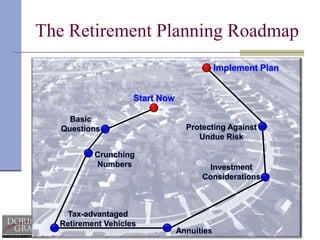
The Retirement Planning RoadmapImplement PlanStart NowBasic QuestionsProtecting Against Undue RiskCrunching NumbersInvestment ConsiderationsTax-advantaged Retirement VehiclesAnnuities
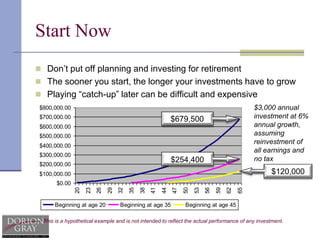
Start Now$679,500$254,400$120,000Don’t put off planning and investing for retirementThe sooner you start, the longer your investments have to growPlaying “catch-up” later can be difficult and expensive$3,000 annual investment at 6% annual growth, assuming reinvestment of all earnings and no taxThis is a hypothetical example and is not intended to reflect the actual performance of any investment.
Basic ConsiderationsWhat kind of retirement do you want?When do you want to retire?How long will retirement last?
Basic Considerations--What Kind of Retirement Do You Want?Financial independence Freedom to travel, pursue hobbiesAbility to live where you want (e.g., in current home, vacation home)Opportunity to provide financially for children or grandchildren
Basic Considerations--When Do You Want to Retire?The earlier you retire, the shorter the period of time you have to accumulate funds and the longer those dollars will need to lastSocial Security isn’t available until age 62Medicare eligibility begins at age 65
Basic Considerations--How Long Will Retirement Last?Average 65-year-old American can expect to live another 18.6 years*Average life expectancy is likely to continue to increaseRetirement may last 25 years or more* National Vital Statistics Report, Vol. 58, No. 1, August, 2009
Crunching the NumbersEstimate retirement expensesEstimate retirement incomeIdentify the “gap”Calculate your retirement investment goalAccount for inflation
Crunching the Numbers--Estimating Retirement Expenses“Rules of thumb” (e.g., you’ll need 60 to 90% of pre-retirement income) are easy but too generalThink about how your actual expenses will change     (e.g., mortgage may decrease, healthcare costs may increase)Include estimates for special retirement pursuits         (e.g., travel, hobbies)
Crunching the Numbers--Estimating Retirement IncomeThe three-legged retirement income stool:Social Security
Traditional employer pension
Individual savings & investmentsAn individual born in 1957 who currently earns $70,000 can expect to receive roughly $24,000 each year (today’s dollars) in Social Security retirement benefits at full retirement age.**www.ssa.gov Quick Calculator
Crunching the Numbers--Identifying the “Gap”Additional annual income needed in retirementEstimated annual expenses in retirementEstimated annual income in retirementCompare projected annual retirement income and expenses“Gap” represents additional annual retirement income needed$30,000$20,000$50,000
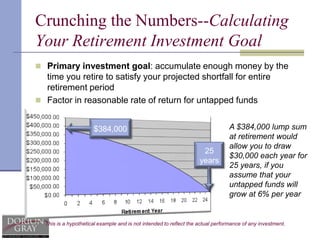
Crunching the Numbers--Calculating Your Retirement Investment GoalPrimary investment goal: accumulate enough money by the time you retire to satisfy your projected shortfall for entire retirement periodFactor in reasonable rate of return for untapped funds$384,000A $384,000 lump sum at retirement would allow you to draw $30,000 each year for 25 years, if you assume that your untapped funds will grow at 6% per year25 yearsThis is a hypothetical example and is not intended to reflect the actual performance of any investment.
Crunching the Numbers--Account for Inflation$395,000$169,000Inflation reduces the purchasing power of today’s dollarsAverage annual rate of inflation is 3% over last 20 years (Source: U.S. Department of Labor consumer price index data)$5,000 invested annually
6% rate of return
3% annual inflation Tax-Advantaged Savings VehiclesTax deferral can help your money growTake full advantage of 401(k)s and other employer-sponsored retirement plansContribute to a traditional or Roth IRA if you qualify
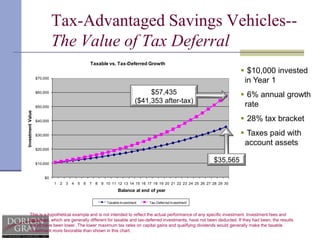
Tax-Advantaged Savings Vehicles-- The Value of Tax Deferral $10,000 invested in Year 1
 6% annual growth rate
 28% tax bracket
 Taxes paid with account assets$57,435($41,353 after-tax)$35,565This is a hypothetical example and is not intended to reflect the actual performance of any specific investment. Investment fees and expenses, which are generally different for taxable and tax-deferred investments, have not been deducted. If they had been, the results would have been lower. The lower maximum tax rates on capital gains and qualifying dividends would generally make the taxable investment more favorable than shown in this chart.
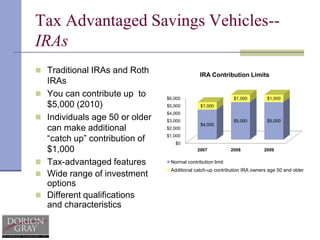
Tax Advantaged Savings Vehicles--IRAsTraditional IRAs and Roth IRAsYou can contribute up  to $5,000 (2010) Individuals age 50 or older can make additional “catch up” contribution of $1,000Tax-advantaged featuresWide range of investment optionsDifferent qualifications and characteristicsIRA Contribution Limits
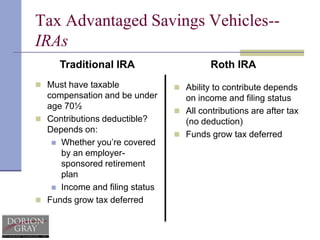
Tax Advantaged Savings Vehicles--IRAsTraditional IRARoth IRAMust have taxable compensation and be under age 70½Contributions deductible? Depends on:Whether you’re covered by an employer-sponsored retirement planIncome and filing statusFunds grow tax deferredAbility to contribute depends on income and filing status All contributions are after tax (no deduction)Funds grow tax deferred
Tax Advantaged Savings Vehicles--IRAsRoth IRAsTraditional IRAsQualified distributions are federal income tax free5 year holding requirement, andAge 59½ DisabilityFirst-time homebuyer expensesNonqualified distributions-- federal income tax and 10% premature distribution tax may apply to earnings portionDistributions subject to federal income tax Generally, distributions made prior to age 59½ are subject to additional 10% premature distribution tax
Tax Advantaged Savings Vehicles--IRAsIf you can do both, should you make deductible contributions to a traditional IRA or contribute to a Roth IRA?Traditional IRA may make more sense if you want to lower your tax bill while you’re still working and you expect to be in a lower tax bracket when you retireRoth IRA may make     more sense if you want to minimize taxes during retirement and preserve assets for your           beneficiaries
Tax-Advantaged Savings Vehicles-- 401(k) Plans--Pretax contributionsDefer up to $16,500 of compensation (2010)Individuals age 50 or older can make additional “catch-up” contributions of $5,500 (2010)Funds grow tax deferred until withdrawnEmployer “match” is free moneyLimited to investment options offered by planDistributions made prior to age 59½ (age 55 in some circumstances) are subject to additional 10% premature distribution taxEmployee Contribution Limits: 401(k) Plans
Tax-Advantaged Savings Vehicles-- 401(k) Plan--Roth ContributionsContributions are after taxFunds grow tax deferred until withdrawn Total contributions (Roth and pretax) up to $16,500 of compensation, $22,000 if age 50 or older (2010)Qualified distributions are federal income tax free5 year holding requirement AND Either age 59½ or disabledNonqualified distribution--federal income tax and 10% premature distribution tax may apply to earnings portionTreated same as pretax contributions for all plan purposes (withdrawal rules, etc.)

Retirement Basics

  • 1.
    Retirement BasicsAn Overviewof the Retirement Planning Process
  • 2.
    When You ImagineYour Retirement, What Do You See?
  • 3.
    The Retirement PlanningRoadmapImplement PlanStart NowBasic QuestionsProtecting Against Undue RiskCrunching NumbersInvestment ConsiderationsTax-advantaged Retirement VehiclesAnnuities
  • 4.
    Start Now$679,500$254,400$120,000Don’t putoff planning and investing for retirementThe sooner you start, the longer your investments have to growPlaying “catch-up” later can be difficult and expensive$3,000 annual investment at 6% annual growth, assuming reinvestment of all earnings and no taxThis is a hypothetical example and is not intended to reflect the actual performance of any investment.
  • 5.
    Basic ConsiderationsWhat kindof retirement do you want?When do you want to retire?How long will retirement last?
  • 6.
    Basic Considerations--What Kindof Retirement Do You Want?Financial independence Freedom to travel, pursue hobbiesAbility to live where you want (e.g., in current home, vacation home)Opportunity to provide financially for children or grandchildren
  • 7.
    Basic Considerations--When DoYou Want to Retire?The earlier you retire, the shorter the period of time you have to accumulate funds and the longer those dollars will need to lastSocial Security isn’t available until age 62Medicare eligibility begins at age 65
  • 8.
    Basic Considerations--How LongWill Retirement Last?Average 65-year-old American can expect to live another 18.6 years*Average life expectancy is likely to continue to increaseRetirement may last 25 years or more* National Vital Statistics Report, Vol. 58, No. 1, August, 2009
  • 9.
    Crunching the NumbersEstimateretirement expensesEstimate retirement incomeIdentify the “gap”Calculate your retirement investment goalAccount for inflation
  • 10.
    Crunching the Numbers--EstimatingRetirement Expenses“Rules of thumb” (e.g., you’ll need 60 to 90% of pre-retirement income) are easy but too generalThink about how your actual expenses will change (e.g., mortgage may decrease, healthcare costs may increase)Include estimates for special retirement pursuits (e.g., travel, hobbies)
  • 11.
    Crunching the Numbers--EstimatingRetirement IncomeThe three-legged retirement income stool:Social Security
  • 12.
  • 13.
    Individual savings &investmentsAn individual born in 1957 who currently earns $70,000 can expect to receive roughly $24,000 each year (today’s dollars) in Social Security retirement benefits at full retirement age.**www.ssa.gov Quick Calculator
  • 14.
    Crunching the Numbers--Identifyingthe “Gap”Additional annual income needed in retirementEstimated annual expenses in retirementEstimated annual income in retirementCompare projected annual retirement income and expenses“Gap” represents additional annual retirement income needed$30,000$20,000$50,000
  • 15.
    Crunching the Numbers--CalculatingYour Retirement Investment GoalPrimary investment goal: accumulate enough money by the time you retire to satisfy your projected shortfall for entire retirement periodFactor in reasonable rate of return for untapped funds$384,000A $384,000 lump sum at retirement would allow you to draw $30,000 each year for 25 years, if you assume that your untapped funds will grow at 6% per year25 yearsThis is a hypothetical example and is not intended to reflect the actual performance of any investment.
  • 16.
    Crunching the Numbers--Accountfor Inflation$395,000$169,000Inflation reduces the purchasing power of today’s dollarsAverage annual rate of inflation is 3% over last 20 years (Source: U.S. Department of Labor consumer price index data)$5,000 invested annually
  • 17.
  • 18.
    3% annual inflationTax-Advantaged Savings VehiclesTax deferral can help your money growTake full advantage of 401(k)s and other employer-sponsored retirement plansContribute to a traditional or Roth IRA if you qualify
  • 19.
    Tax-Advantaged Savings Vehicles--The Value of Tax Deferral $10,000 invested in Year 1
  • 20.
    6% annualgrowth rate
  • 21.
    28% taxbracket
  • 22.
    Taxes paidwith account assets$57,435($41,353 after-tax)$35,565This is a hypothetical example and is not intended to reflect the actual performance of any specific investment. Investment fees and expenses, which are generally different for taxable and tax-deferred investments, have not been deducted. If they had been, the results would have been lower. The lower maximum tax rates on capital gains and qualifying dividends would generally make the taxable investment more favorable than shown in this chart.
  • 23.
    Tax Advantaged SavingsVehicles--IRAsTraditional IRAs and Roth IRAsYou can contribute up to $5,000 (2010) Individuals age 50 or older can make additional “catch up” contribution of $1,000Tax-advantaged featuresWide range of investment optionsDifferent qualifications and characteristicsIRA Contribution Limits
  • 24.
    Tax Advantaged SavingsVehicles--IRAsTraditional IRARoth IRAMust have taxable compensation and be under age 70½Contributions deductible? Depends on:Whether you’re covered by an employer-sponsored retirement planIncome and filing statusFunds grow tax deferredAbility to contribute depends on income and filing status All contributions are after tax (no deduction)Funds grow tax deferred
  • 25.
    Tax Advantaged SavingsVehicles--IRAsRoth IRAsTraditional IRAsQualified distributions are federal income tax free5 year holding requirement, andAge 59½ DisabilityFirst-time homebuyer expensesNonqualified distributions-- federal income tax and 10% premature distribution tax may apply to earnings portionDistributions subject to federal income tax Generally, distributions made prior to age 59½ are subject to additional 10% premature distribution tax
  • 26.
    Tax Advantaged SavingsVehicles--IRAsIf you can do both, should you make deductible contributions to a traditional IRA or contribute to a Roth IRA?Traditional IRA may make more sense if you want to lower your tax bill while you’re still working and you expect to be in a lower tax bracket when you retireRoth IRA may make more sense if you want to minimize taxes during retirement and preserve assets for your beneficiaries
  • 27.
    Tax-Advantaged Savings Vehicles--401(k) Plans--Pretax contributionsDefer up to $16,500 of compensation (2010)Individuals age 50 or older can make additional “catch-up” contributions of $5,500 (2010)Funds grow tax deferred until withdrawnEmployer “match” is free moneyLimited to investment options offered by planDistributions made prior to age 59½ (age 55 in some circumstances) are subject to additional 10% premature distribution taxEmployee Contribution Limits: 401(k) Plans
  • 28.
    Tax-Advantaged Savings Vehicles--401(k) Plan--Roth ContributionsContributions are after taxFunds grow tax deferred until withdrawn Total contributions (Roth and pretax) up to $16,500 of compensation, $22,000 if age 50 or older (2010)Qualified distributions are federal income tax free5 year holding requirement AND Either age 59½ or disabledNonqualified distribution--federal income tax and 10% premature distribution tax may apply to earnings portionTreated same as pretax contributions for all plan purposes (withdrawal rules, etc.)