The Nature of
Reading
Presented by:
Rosalina J. Villaneza
Chief
Teaching and Learning Division
Bureau of Learning Delivery
National Training on Literacy Instruction
School-Based INSET on Literacy Instruction
Delivered by:
Kerwin M. Regis
SDO-Quezon City
Re-echoed by:
Nickole G. Ordiales
L & D Coordinator, Mamlad High School
Mamlad, Jovellar, Albay
National Training on Literacy Instruction
School-Based INSET on Literacy Instruction
OUR LEARNING OBJECTIVES
At the end of the training, you should be able to:
1. Examine teaching practices that will help uncover
belief in the reading process;
2. Explain the nature of reading;
3. Realize that the reader has a significant role in
the reading process and that his/her attitude and
motivation affect his/her reading performance;
and
4. Apply research-based practices in teaching
children learn to read and read to learn
National Training on Literacy Instruction
School-Based INSET on Literacy Instruction
National Training on Literacy Instruction
School-Based INSET on Literacy Instruction
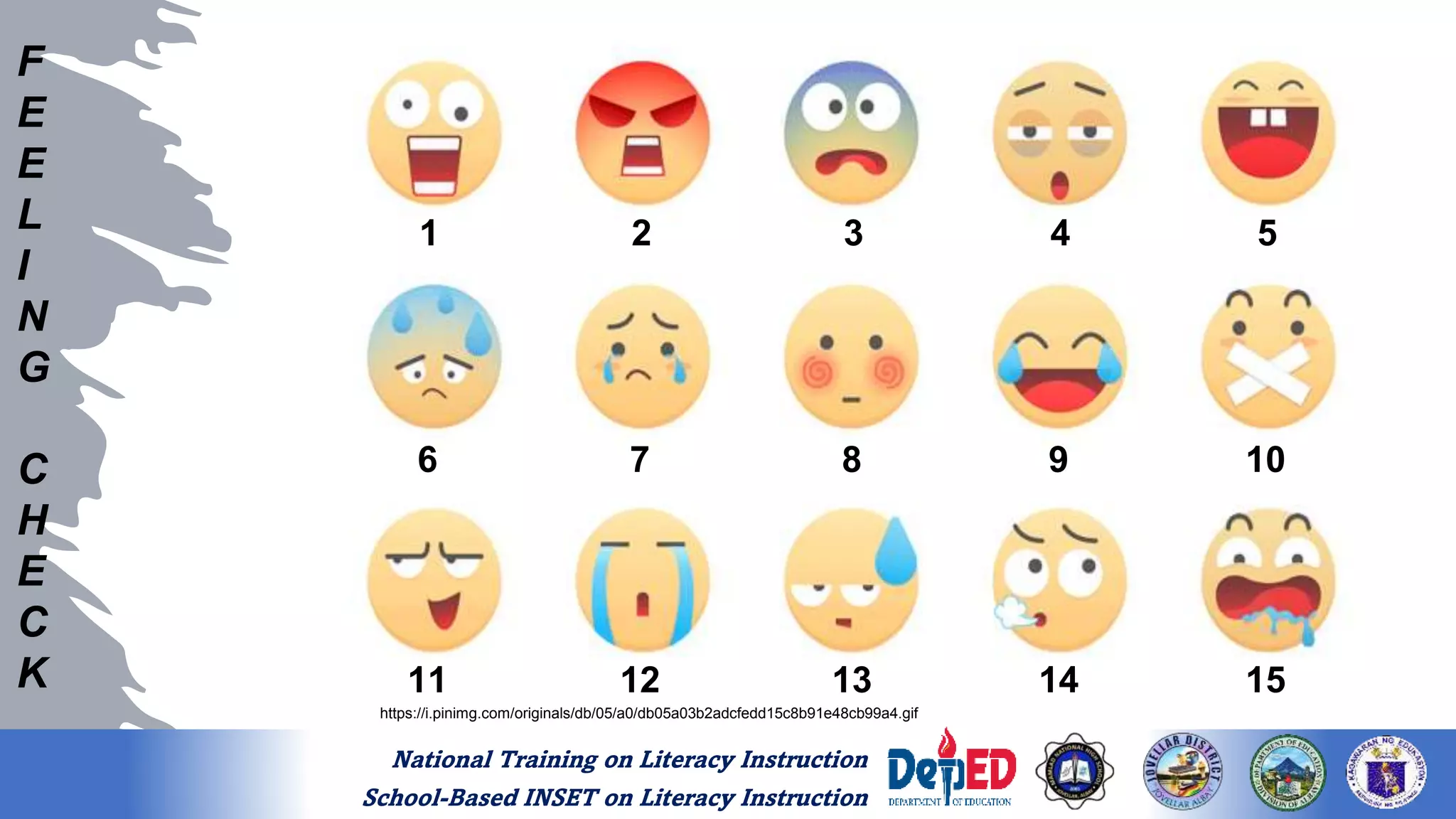
1 2 3 4 5
6 7 8 9 10
11 12 13 14 15
F
E
E
L
I
N
G
C
H
E
C
K
https://i.pinimg.com/originals/db/05/a0/db05a03b2adcfedd15c8b91e48cb99a4.gif
National Training on Literacy Instruction
School-Based INSET on Literacy Instruction
Why Reading?
National Training on Literacy Instruction
School-Based INSET on Literacy Instruction
Activity 1 - Anticipation Guide
Directions:
1. The participants will be divided into two small groups.
2. Each group will Accomplish Activity 1 - Anticipation Guide for ten
(10) minutes.
3. Each group should choose a Facilitator (to facilitate the discussion), a
Recorder (to record the discussion) and a Reporter (to report to the
big group the output(s).
4. The reporter will be given 2 minutes to share the group’s output.
National Training on Literacy Instruction
School-Based INSET on Literacy Instruction
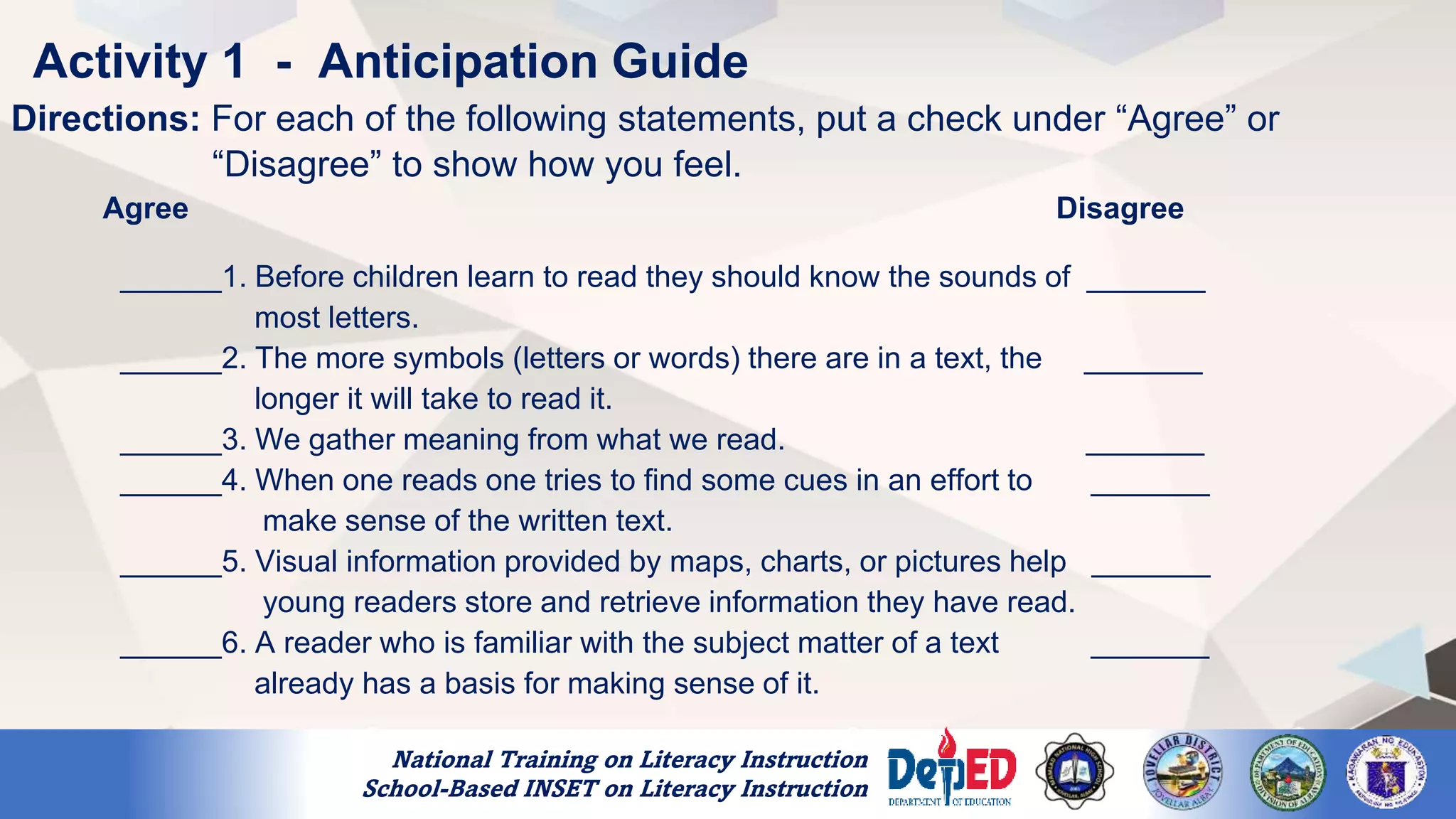
Activity 1 - Anticipation Guide
Directions: For each of the following statements, put a check under “Agree” or
“Disagree” to show how you feel.
Agree Disagree
______1. Before children learn to read they should know the sounds of _______
most letters.
______2. The more symbols (letters or words) there are in a text, the _______
longer it will take to read it.
______3. We gather meaning from what we read. _______
______4. When one reads one tries to find some cues in an effort to _______
make sense of the written text.
______5. Visual information provided by maps, charts, or pictures help _______
young readers store and retrieve information they have read.
______6. A reader who is familiar with the subject matter of a text _______
already has a basis for making sense of it.
National Training on Literacy Instruction
School-Based INSET on Literacy Instruction
Activity 1 - Anticipation Guide
National Training on Literacy Instruction
School-Based INSET on Literacy Instruction
Activity 1 - Anticipation Guide-PRESENTATION
National Training on Literacy Instruction
School-Based INSET on Literacy Instruction
National Training on Literacy Instruction
School-Based INSET on Literacy Instruction
Activity 1 - Anticipation Guide-LET’S PROCESS
1. Before children learn to read they should know the sounds of
most letters.
Agree – Awareness of the sounds of the language
is a fundamental skill in learning to read. This leads
to associating the sounds (phonemes) with the
corresponding letter symbols (graphemes).
National Training on Literacy Instruction
School-Based INSET on Literacy Instruction
Activity 1 - Anticipation Guide-LET’S PROCESS
2. The more symbols (letters or words) there are in a text, the
longer it will take to read it.
Agree – This is true. But if smaller sense units (words,
phrases) are combined into bigger, coherent ones
(sentences, paragraphs), the whole is much faster to read
than if they are separate or incoherent. Therefore, learners
will read more successfully, if given whole meaningful
units of text to read rather than disconnected bits.
National Training on Literacy Instruction
School-Based INSET on Literacy Instruction
Activity 1 - Anticipation Guide-LET’S PROCESS
3. We gather meaning from what we read.
Disagree – The word “gather” implies that somehow the meaning of
a text is there in the words and all we need to do is pick it up.
The construction of meaning that occurs in reading is usually a
combination of decoding and understanding words, phrases, and
sentences – the text (bottom –up processes) and one’s previous
knowledge or schema of the text content and genre (top – down
processes).
The more background knowledge a reader has that connects with
the text being read, the more likely the reader will be able to make
sense of what is being read.
National Training on Literacy Instruction
School-Based INSET on Literacy Instruction
Activity 1 - Anticipation Guide-LET’S PROCESS
4. When one reads one tries to find some cues in an effort to
make sense of the written text.
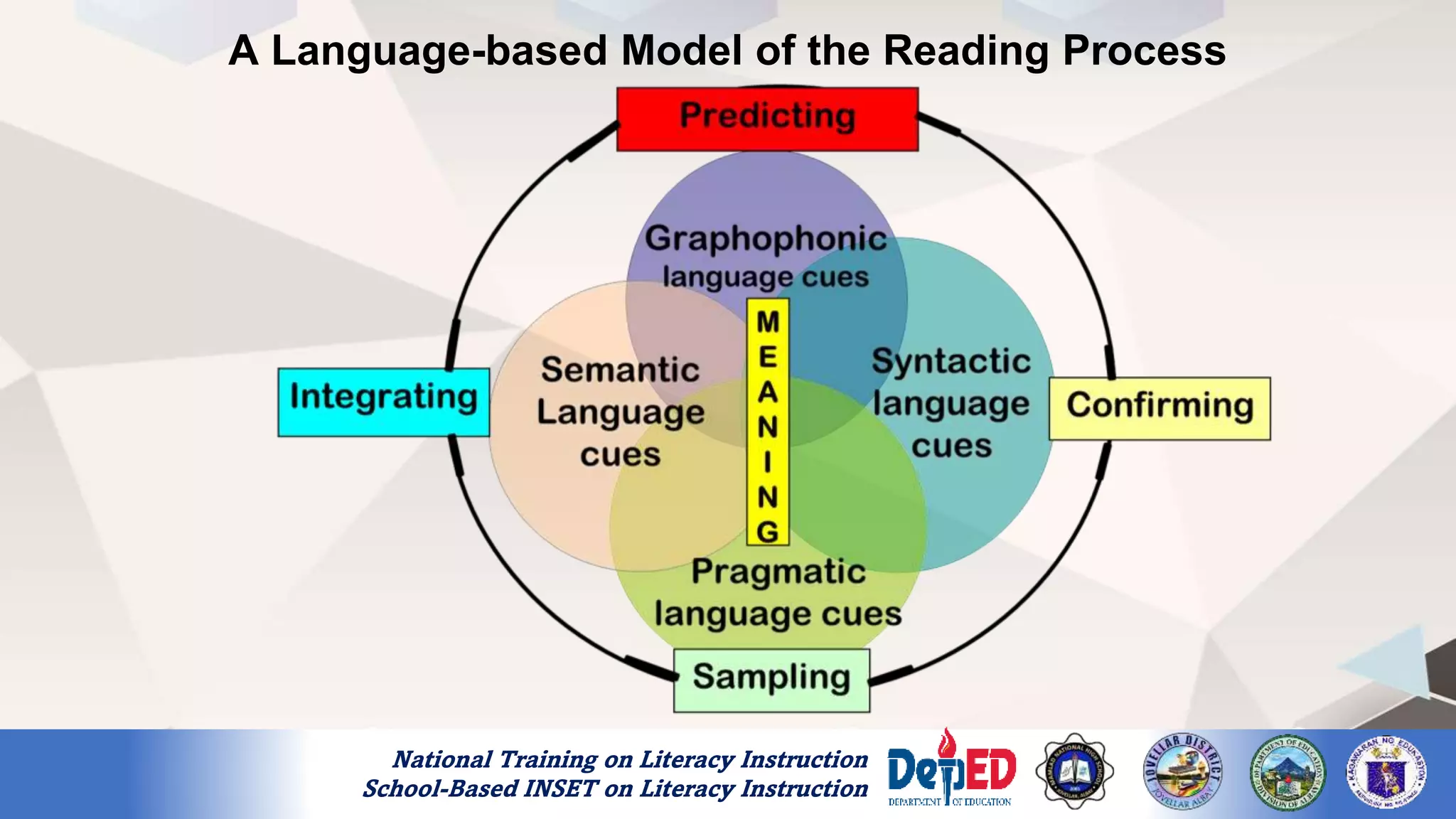
Agree – When one reads, he tries to find some cues in an effort to
make sense of the written text. The available language information
consists of sounds and symbols (graphophonic cues), language
structure or grammar (syntactic cues), and knowledge which is part
of the reader’s background (semantic cues).
These cues answer the following questions:
 Does it look right?
 Does it fit the sense of the story?
National Training on Literacy Instruction
School-Based INSET on Literacy Instruction
Activity 1 - Anticipation Guide-LET’S PROCESS
5. Visual information provided by maps, charts, or pictures help
young readers store and retrieve information they have read.
Agree – Sometimes, a reader does not have sufficient
background information about a text. A diagram, a chart,
or any picture cues can help young readers to better
understand what they read.
National Training on Literacy Instruction
School-Based INSET on Literacy Instruction
Activity 1 - Anticipation Guide-LET’S PROCESS
6. A reader who is familiar with the subject matter of a text
already has a basis for making sense of it..
Agree –The more background knowledge a reader
has to connect with the text being read, the more
likely the reader will be able to make sense of what
is being read.
National Training on Literacy Instruction
School-Based INSET on Literacy Instruction
Let us watch the recorded lecture on the topic
“The Nature of Reading” from Dr. Rose J.
Villaneza.
Do some note taking of important concepts.
After watching the video, we will have a Q & A
activity about salient points discussed.
National Training on Literacy Instruction
School-Based INSET on Literacy Instruction
If you see this icon ,
there is a question that you need to answer.
Kindly raise your right hand if you want to
answer.
National Training on Literacy Instruction
School-Based INSET on Literacy Instruction
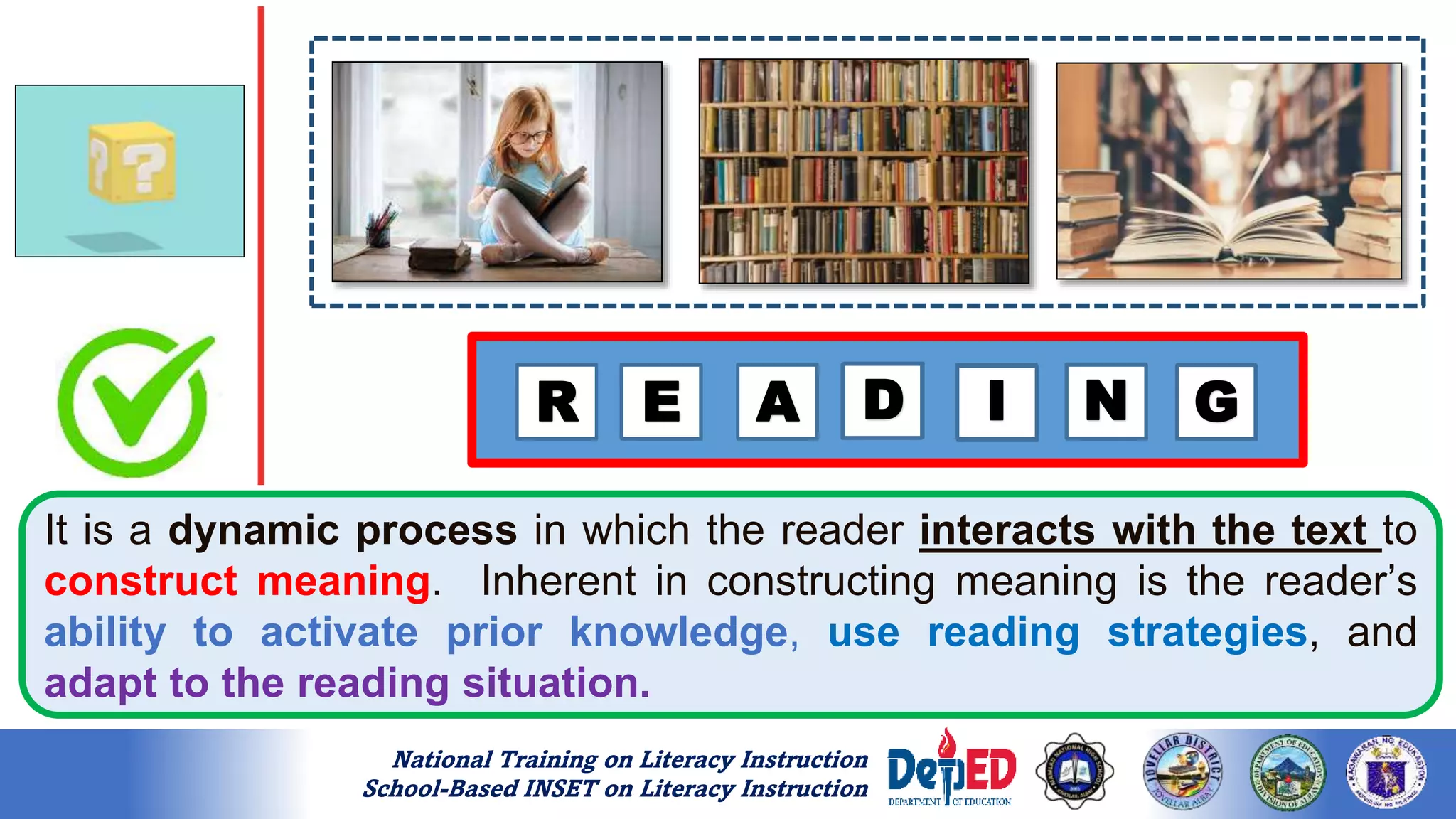
It is a dynamic process in which the reader interacts with the text to
construct meaning. Inherent in constructing meaning is the reader’s
ability to activate prior knowledge, use reading strategies, and
adapt to the reading situation.
R E A D I N G
National Training on Literacy Instruction
School-Based INSET on Literacy Instruction
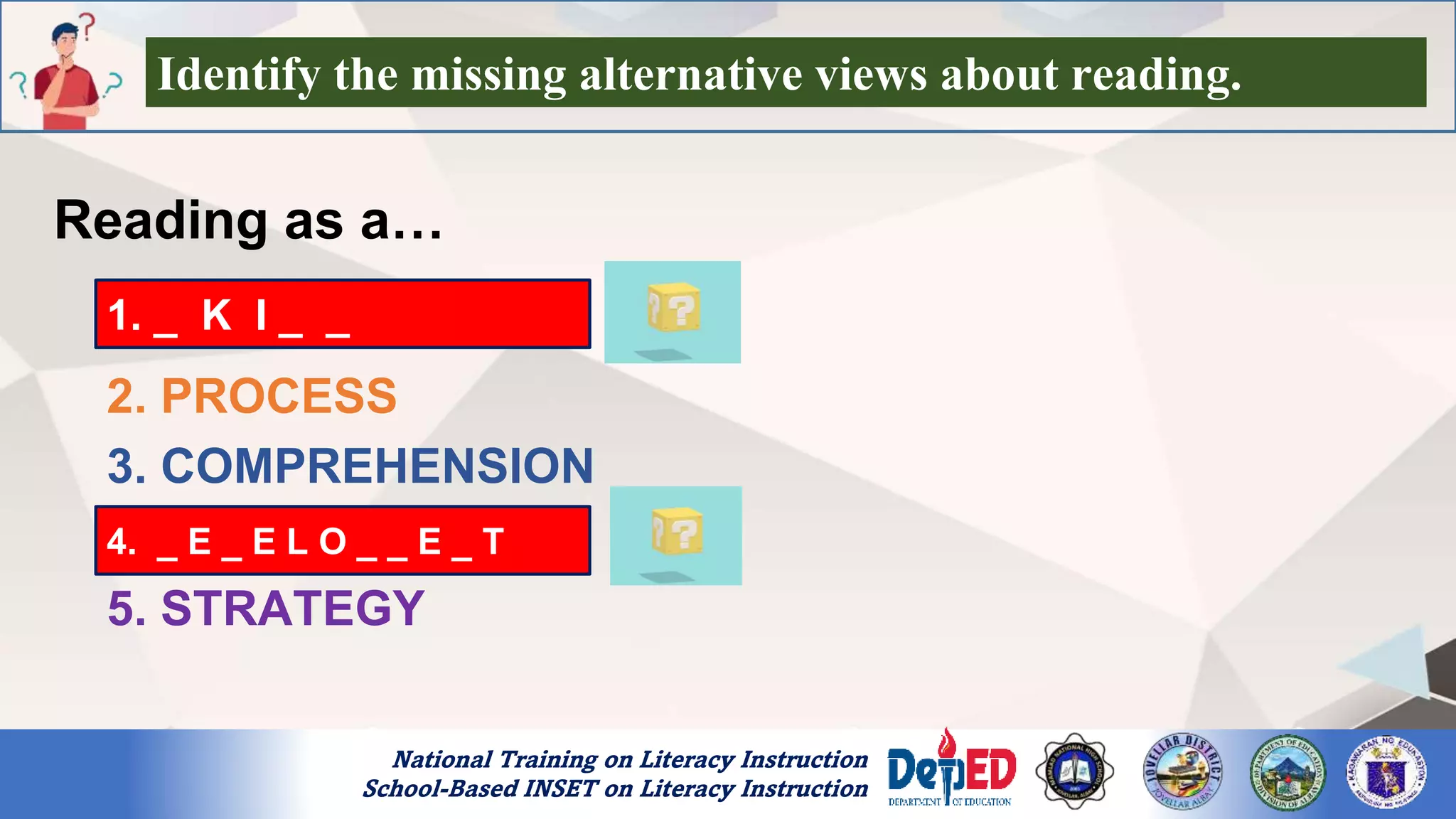
Identify the missing alternative views about reading.
1. SKILL
2. PROCESS
3. COMPREHENSION
4. DEVELOPMENT
5. STRATEGY
National Training on Literacy Instruction
School-Based INSET on Literacy Instruction
Reading as a…
1. _ K I _ _
4. _ E _ E L O _ _ E _ T
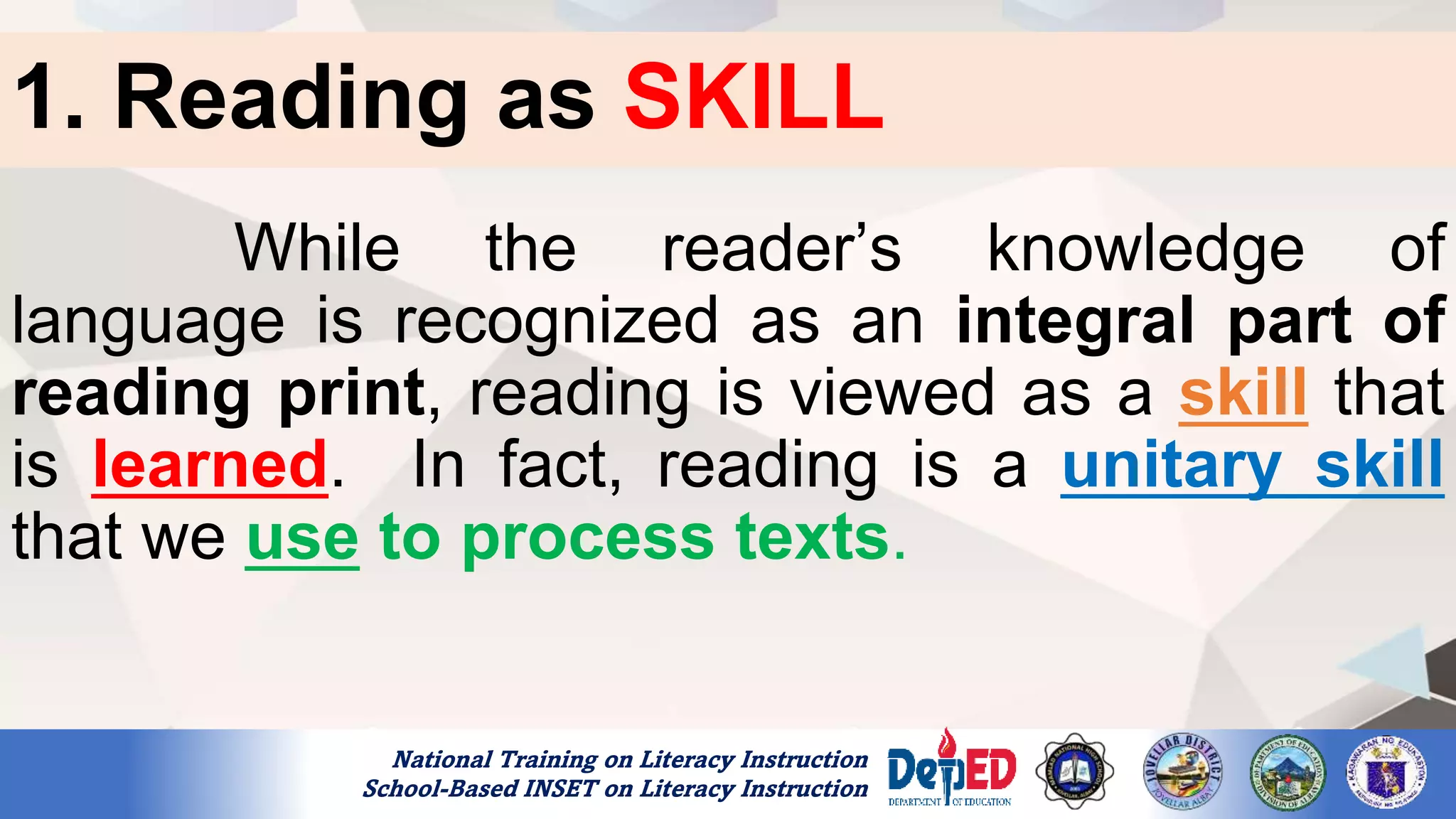
1. Reading as SKILL
While the reader’s knowledge of
language is recognized as an integral part of
reading print, reading is viewed as a skill that
is learned. In fact, reading is a unitary skill
that we use to process texts.
National Training on Literacy Instruction
School-Based INSET on Literacy Instruction
Reading as a Skill
National Training on Literacy Instruction
School-Based INSET on Literacy Instruction
1. W_ _ D _ D E _ T _ _ I _ A T I _ N 2. _ O _ P _ _ H E _ S _ _ N
The Word Identification Subskills
National Training on Literacy Instruction
School-Based INSET on Literacy Instruction
Comprehension Subskills
National Training on Literacy Instruction
School-Based INSET on Literacy Instruction
Skills and Strategies Go Together
National Training on Literacy Instruction
School-Based INSET on Literacy Instruction
S _ R _ T_E _ I _S
Providing Scaffolding through Strategies
National Training on Literacy Instruction
School-Based INSET on Literacy Instruction
P _ _ R A _ _ I S T _ D
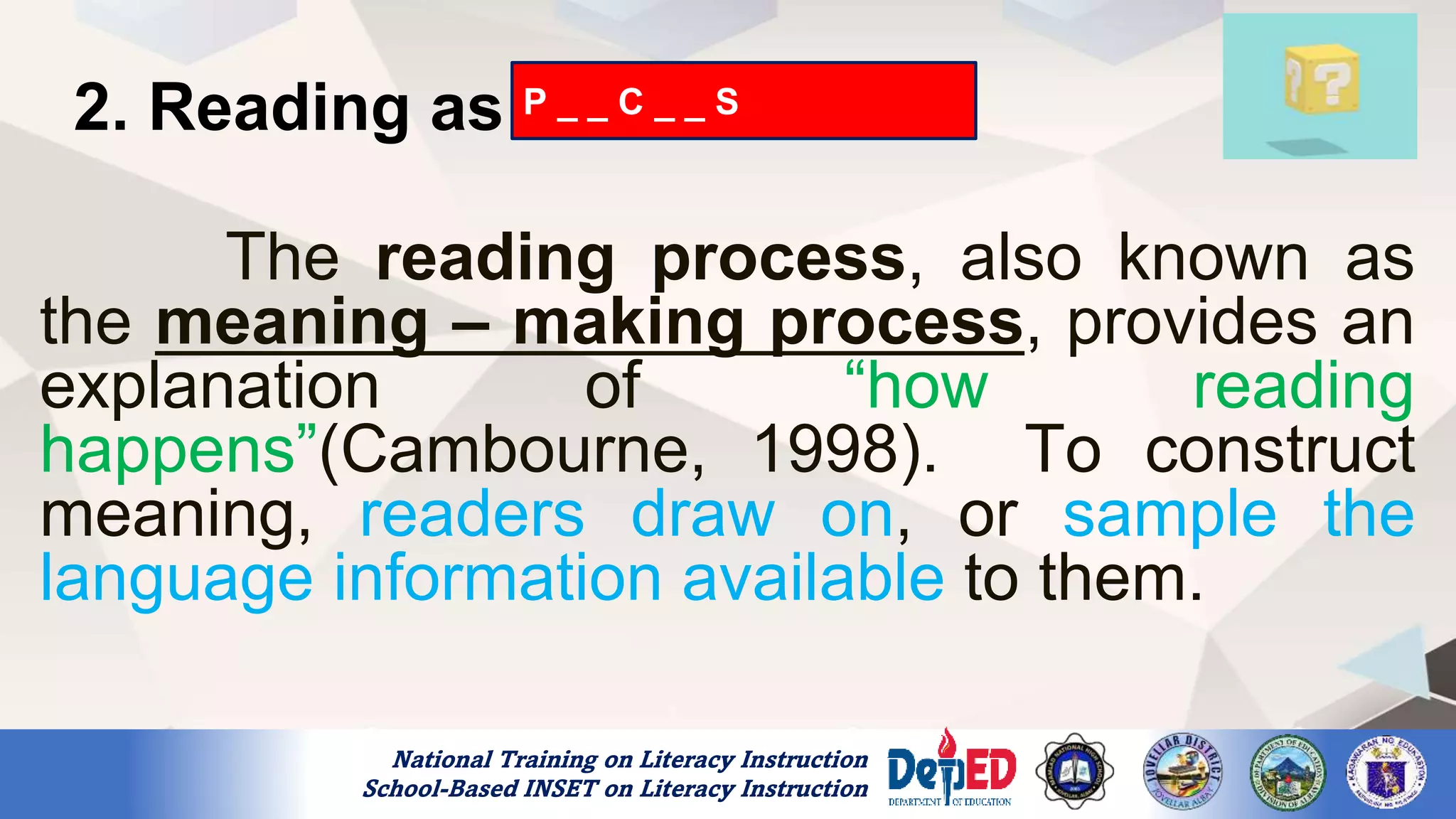
2. Reading as PROCESS
The reading process, also known as
the meaning – making process, provides an
explanation of “how reading
happens”(Cambourne, 1998). To construct
meaning, readers draw on, or sample the
language information available to them.
National Training on Literacy Instruction
School-Based INSET on Literacy Instruction
P _ _ C _ _ S
A Language-based Model of the Reading Process
National Training on Literacy Instruction
School-Based INSET on Literacy Instruction
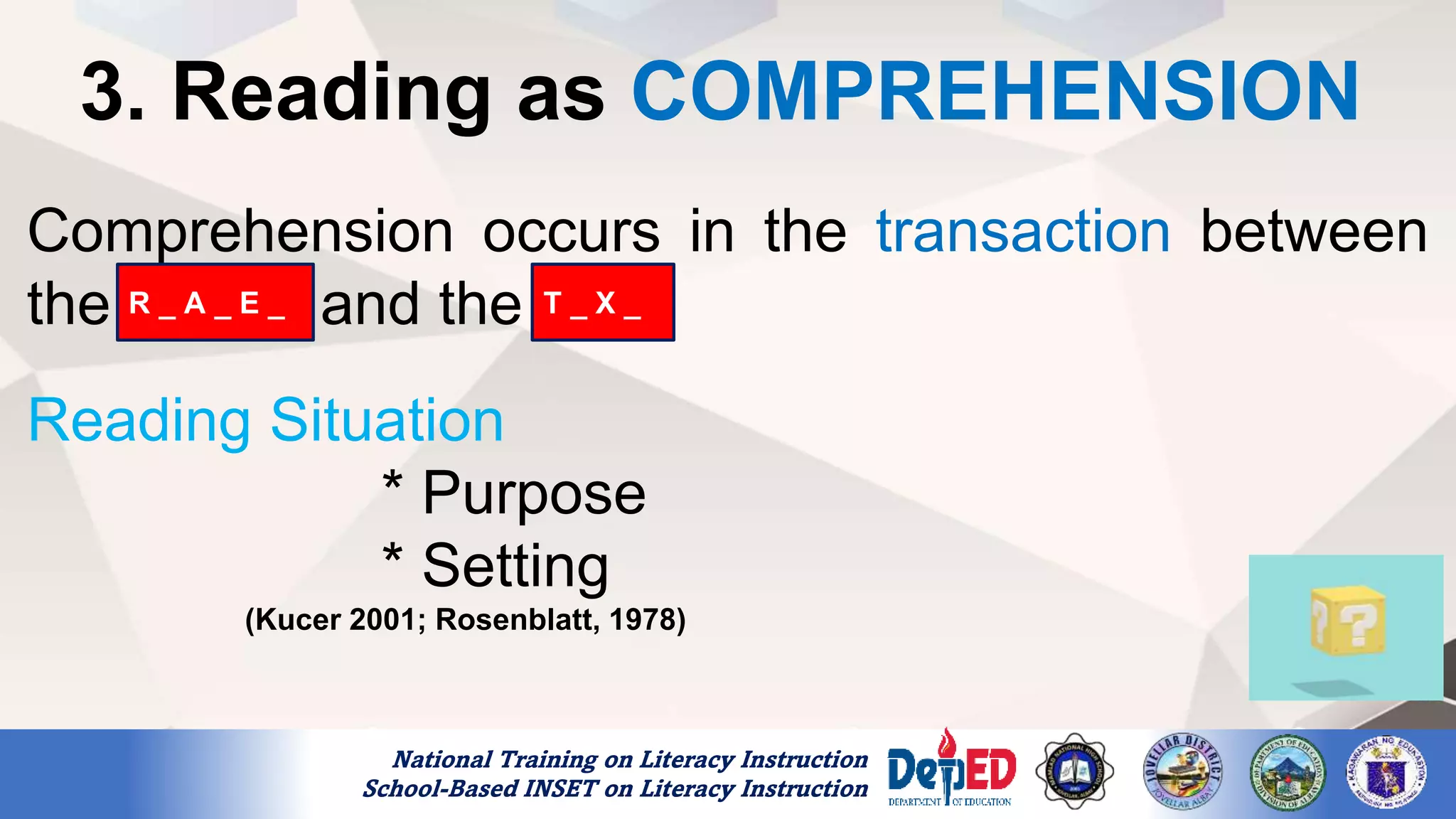
3. Reading as COMPREHENSION
Comprehension occurs in the transaction between
the reader and the text.
Reading Situation
* Purpose
* Setting
(Kucer 2001; Rosenblatt, 1978)
National Training on Literacy Instruction
School-Based INSET on Literacy Instruction
R _ A _ E _ T _ X _
National Training on Literacy Instruction
School-Based INSET on Literacy Instruction
Schema Theory
● According to the schema theory,
individuals have organized world
knowledge which are stored through a
series of networkable solutions known as
schema. These can be activated or
retrieved when needed.
● Reading comprehension involves
thinking.
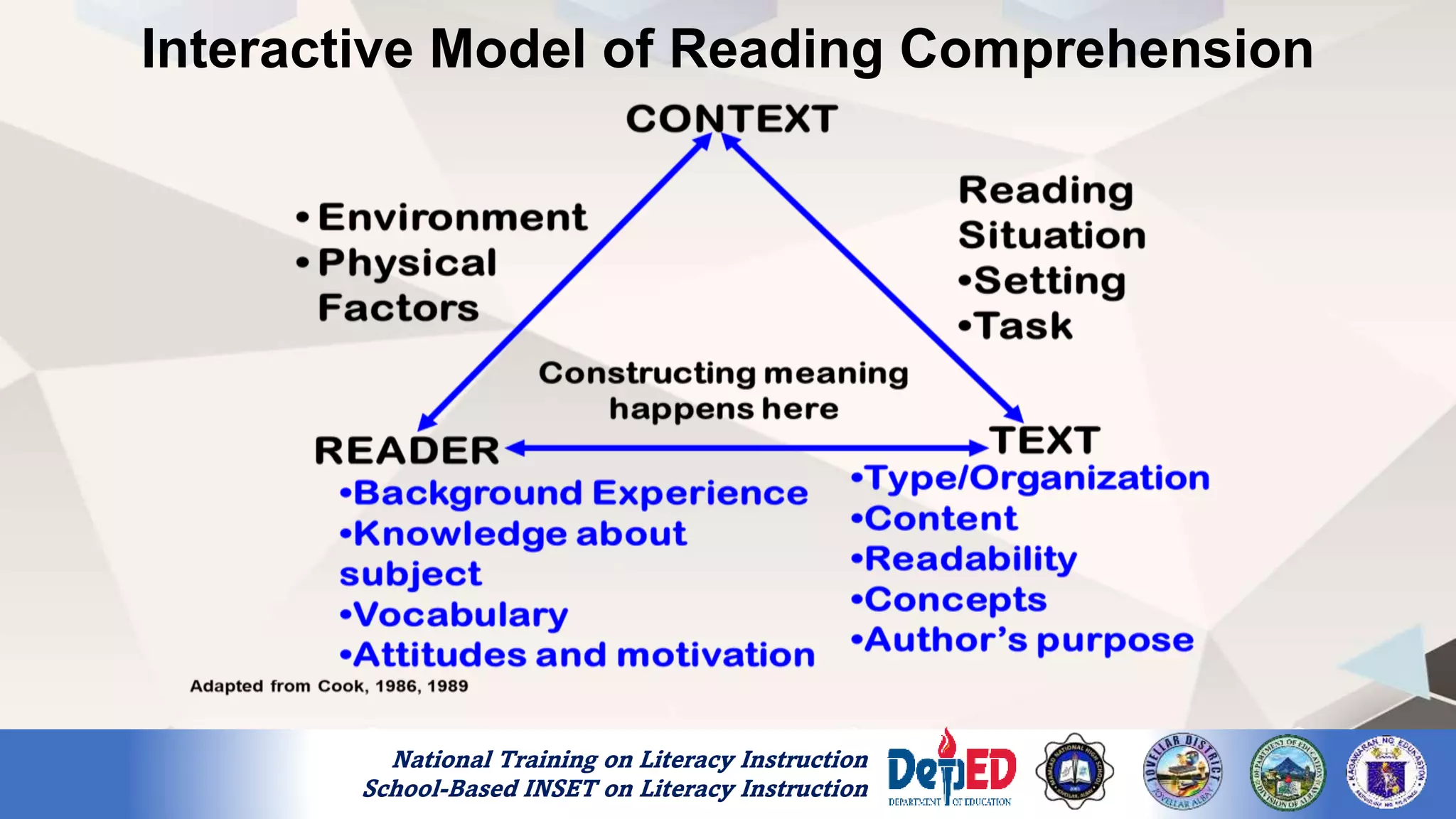
3. Reading as COMPREHENSION
Interactive Model of Reading Comprehension
National Training on Literacy Instruction
School-Based INSET on Literacy Instruction
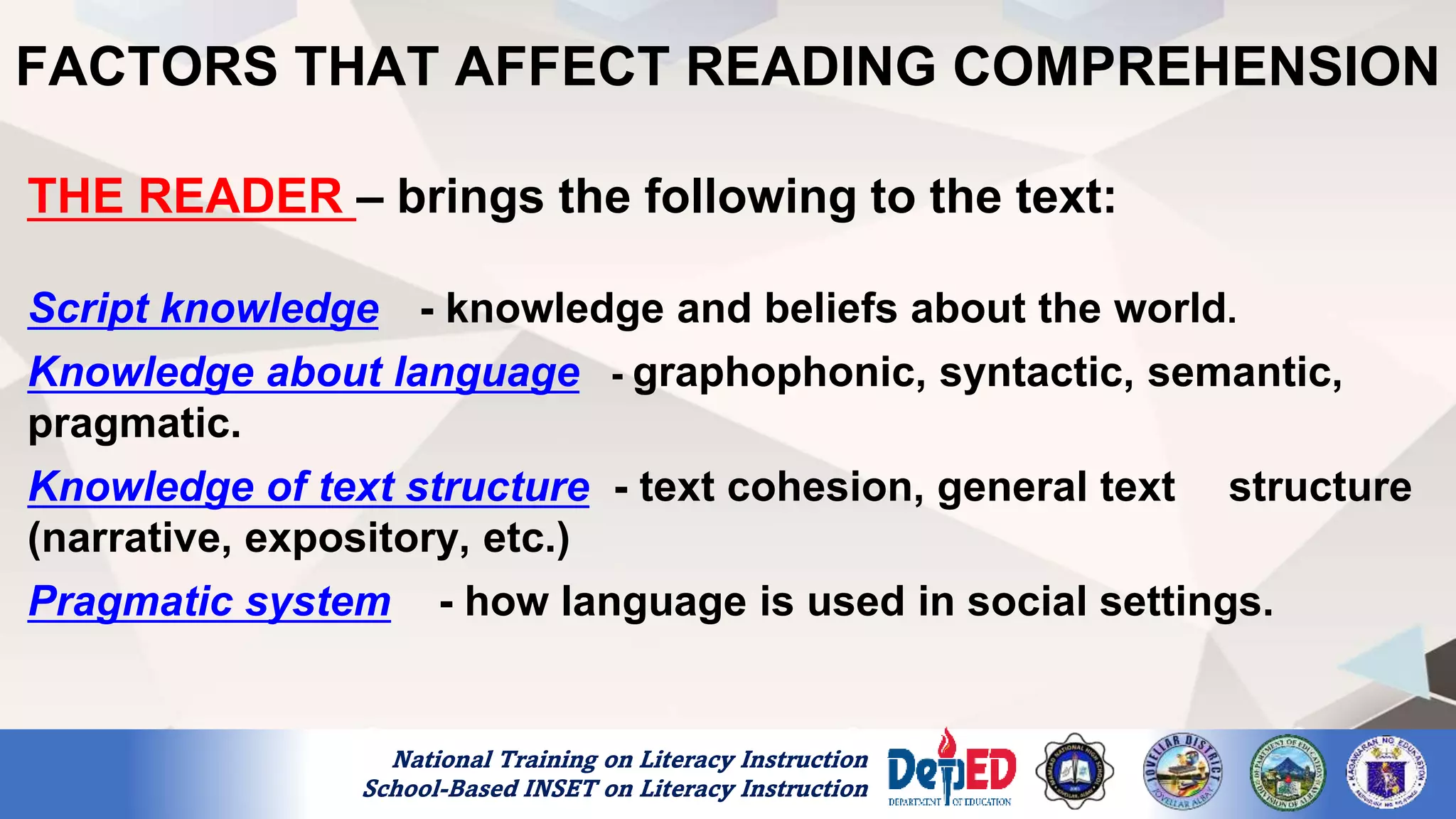
FACTORS THAT AFFECT READING COMPREHENSION
THE READER – brings the following to the text:
Script knowledge - knowledge and beliefs about the world.
Knowledge about language - graphophonic, syntactic, semantic,
pragmatic.
Knowledge of text structure - text cohesion, general text structure
(narrative, expository, etc.)
Pragmatic system - how language is used in social settings.
National Training on Literacy Instruction
School-Based INSET on Literacy Instruction
FACTORS THAT AFFECT READING COMPREHENSION
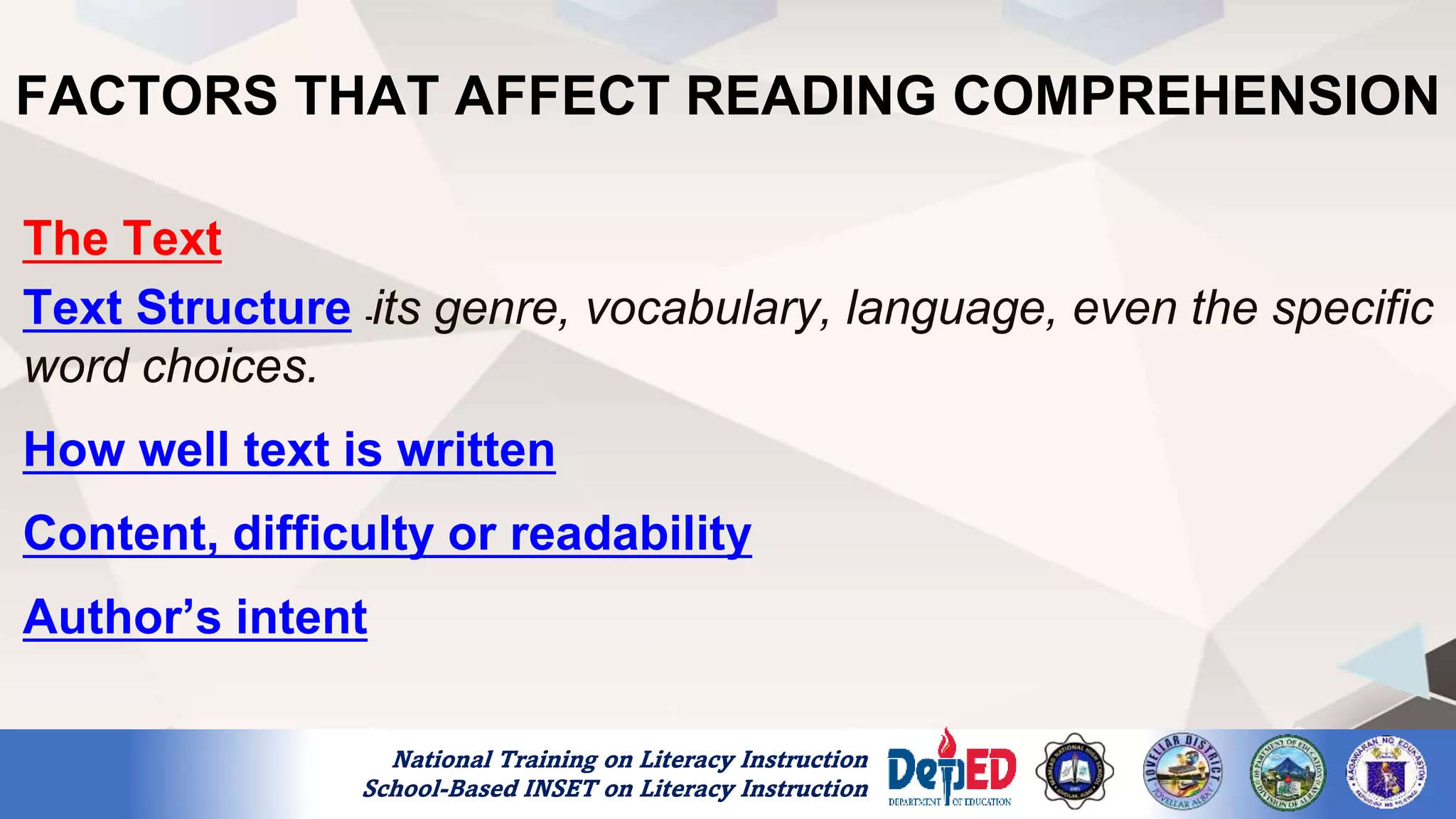
The Text
Text Structure -its genre, vocabulary, language, even the specific
word choices.
How well text is written
Content, difficulty or readability
Author’s intent
National Training on Literacy Instruction
School-Based INSET on Literacy Instruction
FACTORS THAT AFFECT READING COMPREHENSION
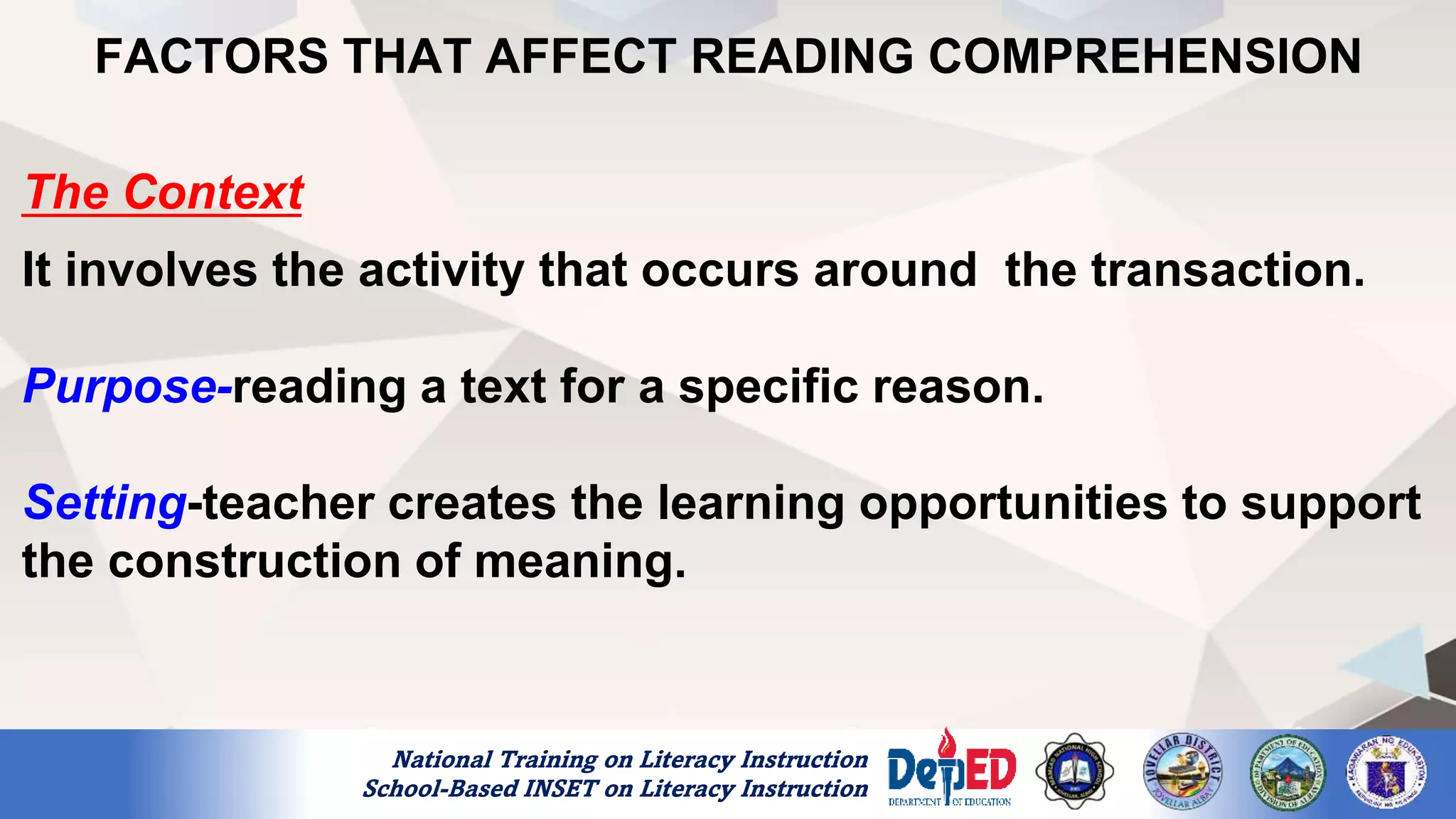
The Context
It involves the activity that occurs around the transaction.
Purpose-reading a text for a specific reason.
Setting-teacher creates the learning opportunities to support
the construction of meaning.
National Training on Literacy Instruction
School-Based INSET on Literacy Instruction
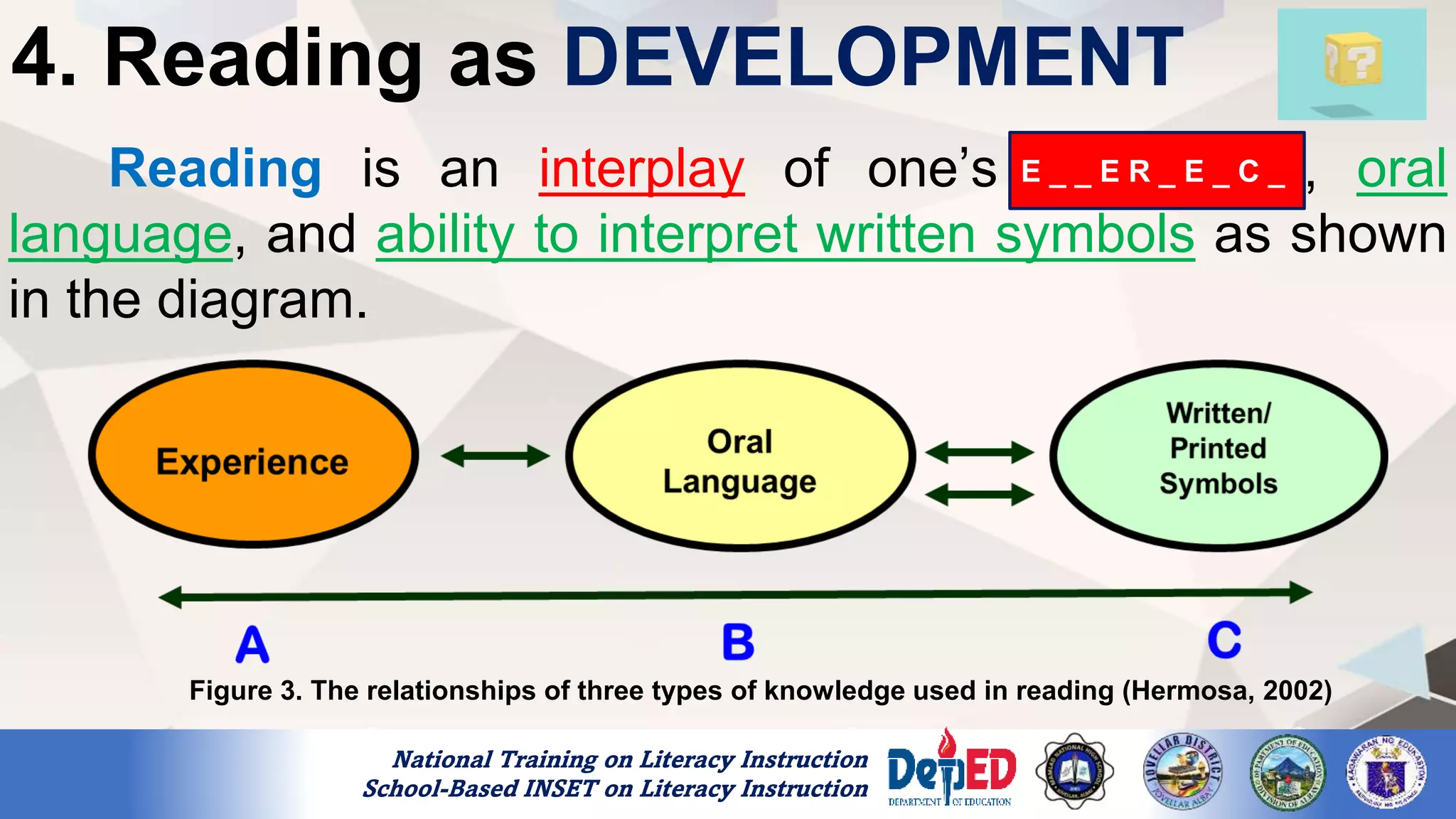
4. Reading as DEVELOPMENT
Reading is an interplay of one’s experience, oral
language, and ability to interpret written symbols as shown
in the diagram.
Figure 3. The relationships of three types of knowledge used in reading (Hermosa, 2002)
National Training on Literacy Instruction
School-Based INSET on Literacy Instruction
E _ _ E R _ E _ C _
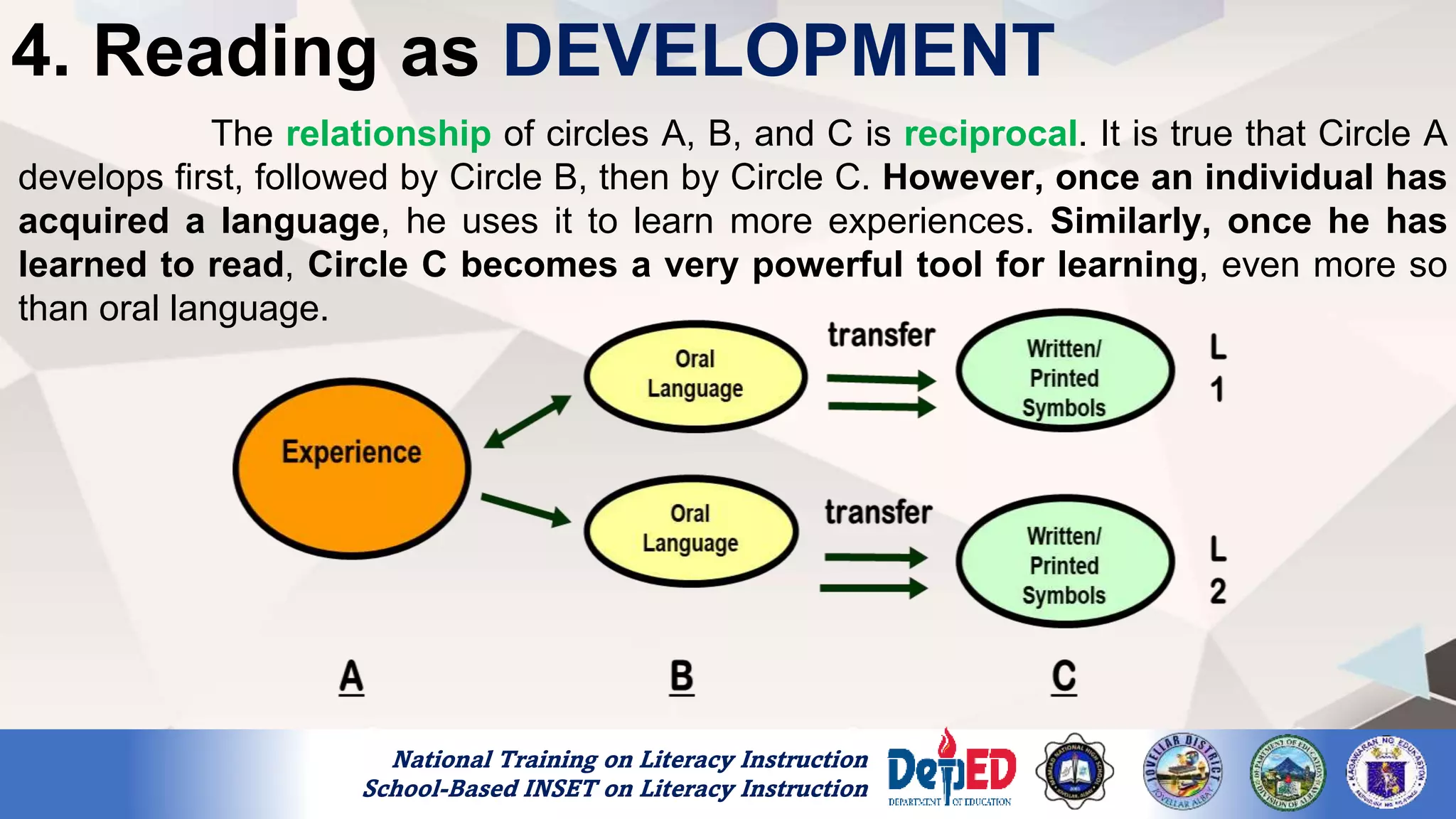
4. Reading as DEVELOPMENT
The relationship of circles A, B, and C is reciprocal. It is true that Circle A
develops first, followed by Circle B, then by Circle C. However, once an individual has
acquired a language, he uses it to learn more experiences. Similarly, once he has
learned to read, Circle C becomes a very powerful tool for learning, even more so
than oral language.
National Training on Literacy Instruction
School-Based INSET on Literacy Instruction
4. Reading as
DEVELOPMENT
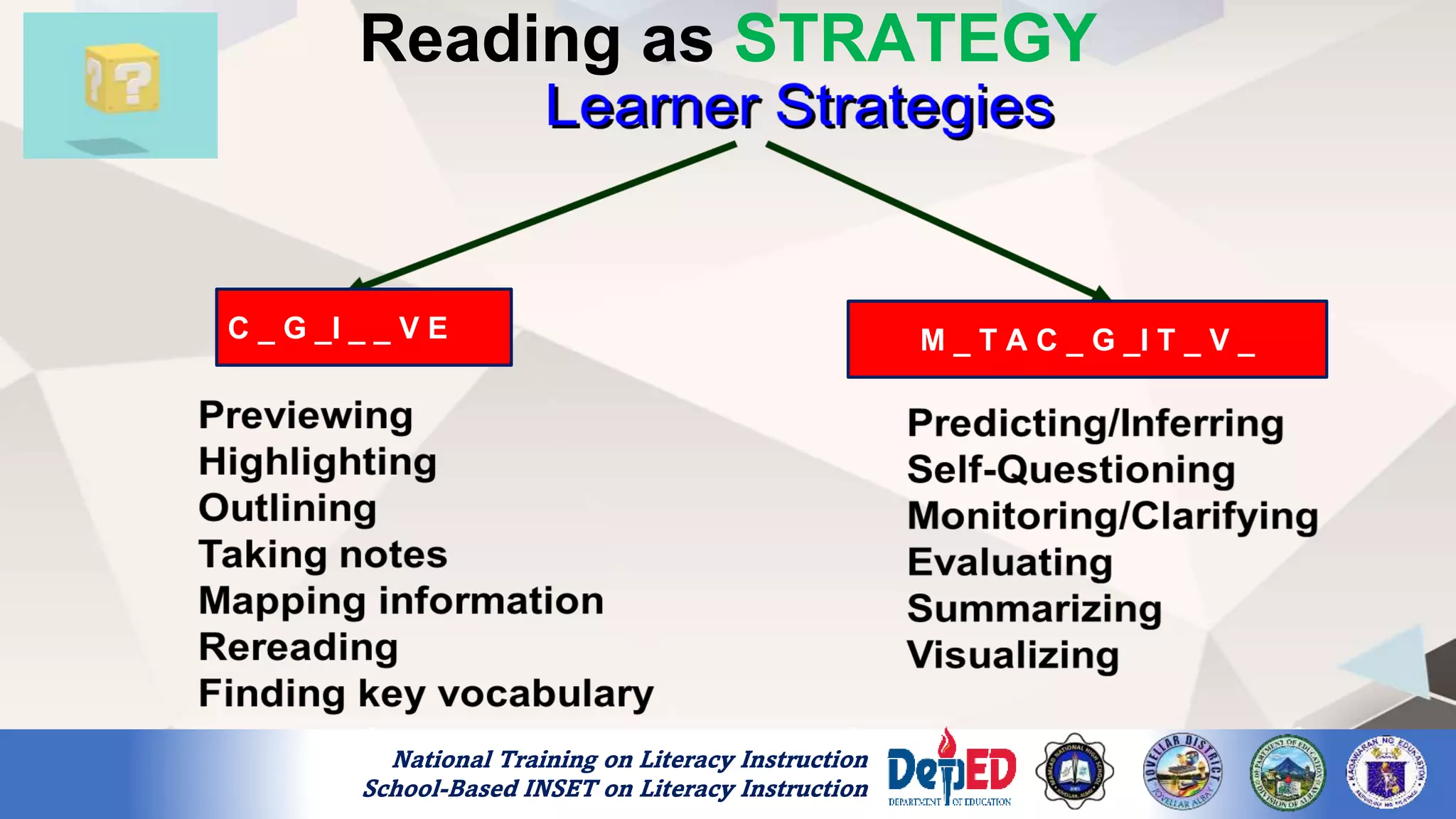
• Reading and writing have their roots in a
child’s earliest attempts to communicate
and make meaning.
• Reading development is correlated with
other aspects of child development –
physical, cognitive, linguistic, and socio –
emotional.
• Oral language development is an integral
part of beginning reading instruction.
National Training on Literacy Instruction
School-Based INSET on Literacy Instruction
5. Reading as STRATEGY
Strategies are conscious, flexible plans a reader
applies to a variety of texts.
The use of strategies implies awareness, reflection, and
interaction between the reader and the author.
Strategies do not operate individually or sequentially, but
are interrelated and recursive.
The goal is the active construction of meaning and the
ability to adapt strategies to varying reading demands.
National Training on Literacy Instruction
School-Based INSET on Literacy Instruction
Reading as STRATEGY
National Training on Literacy Instruction
School-Based INSET on Literacy Instruction
C _ G _I _ _ V E M _ T A C _ G _I T _ V _
National Training on Literacy Instruction
School-Based INSET on Literacy Instruction
National Training on Literacy Instruction
School-Based INSET on Literacy Instruction
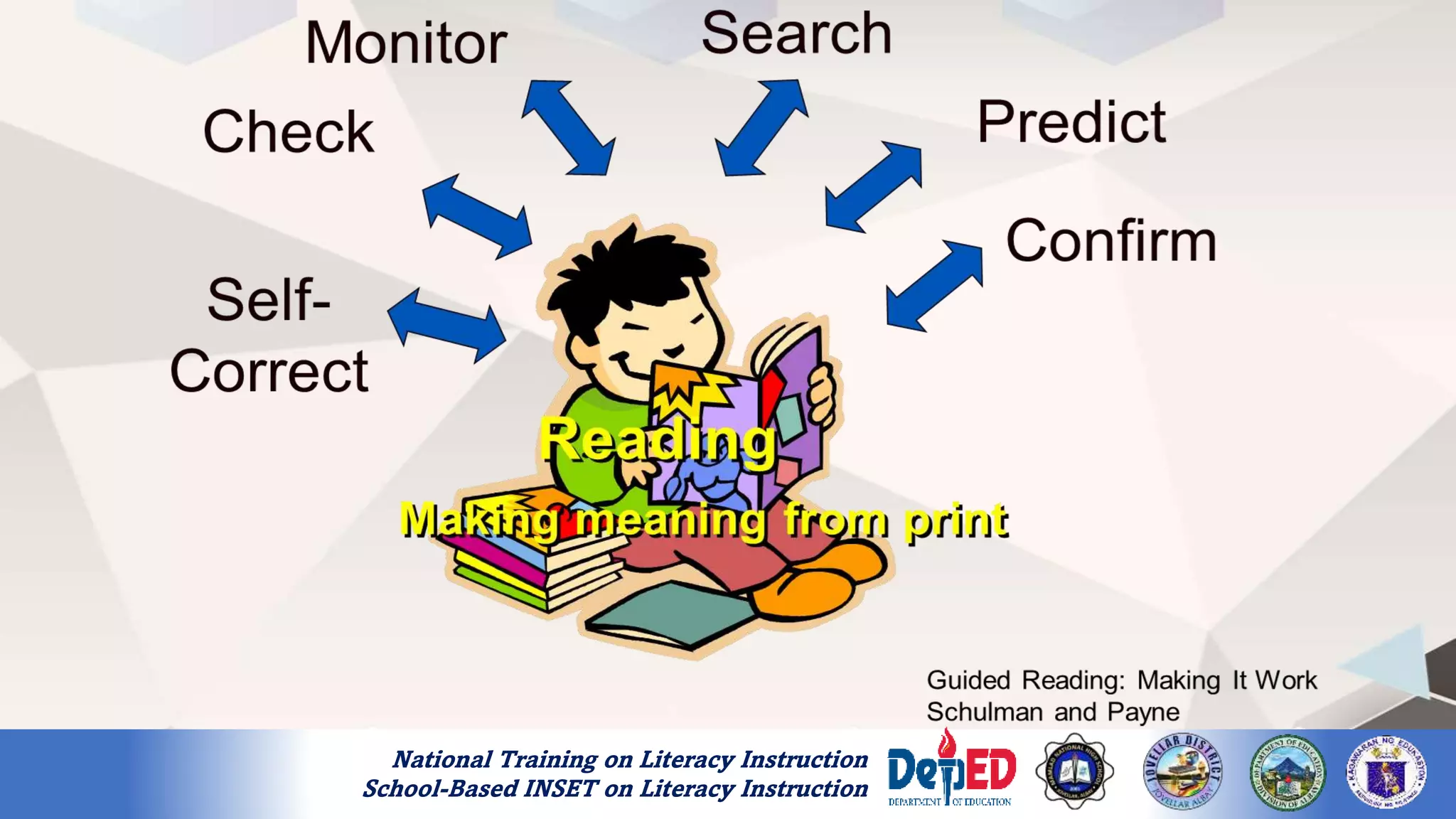
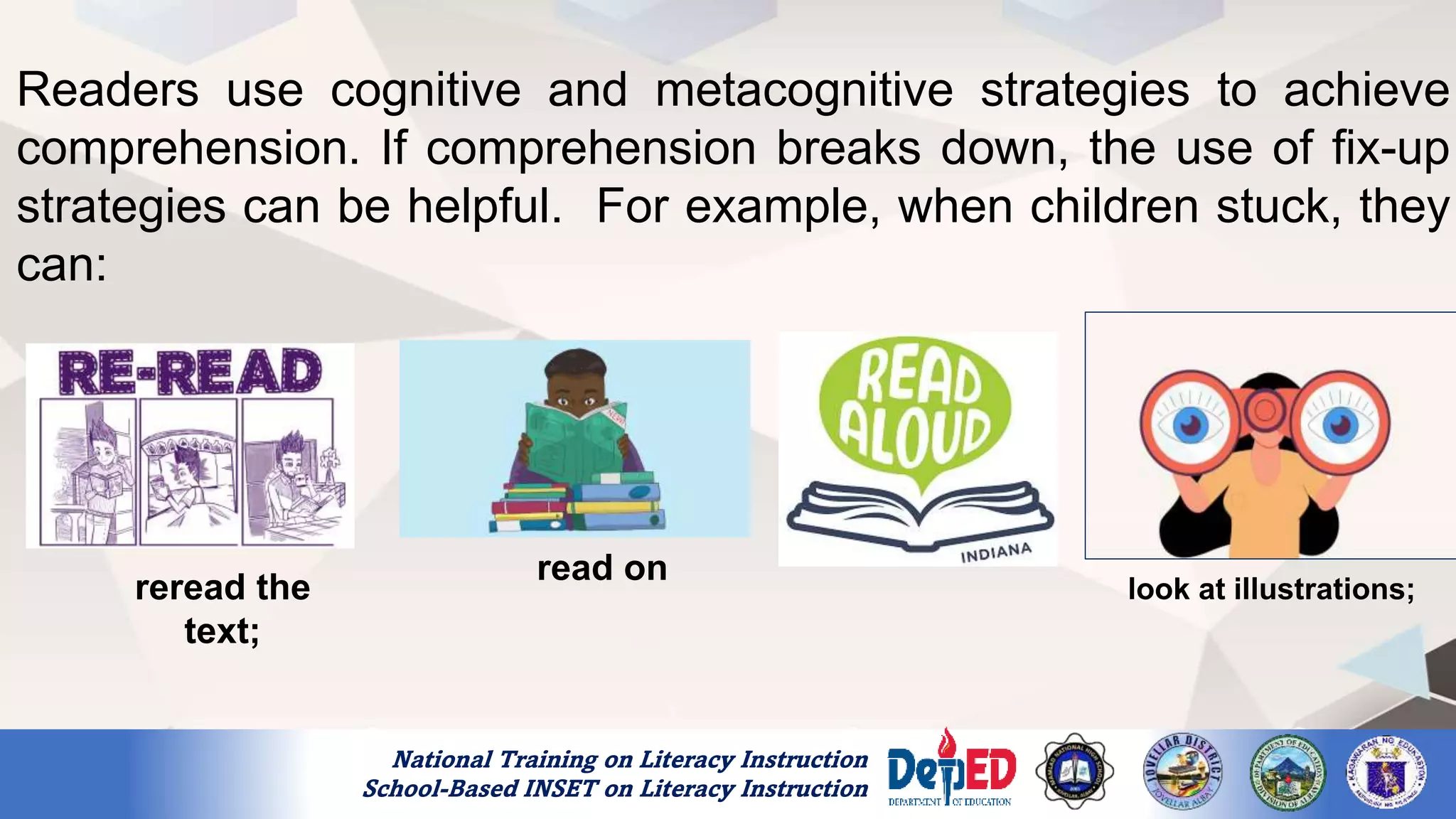
Readers use cognitive and metacognitive strategies to achieve
comprehension. If comprehension breaks down, the use of fix-up
strategies can be helpful. For example, when children stuck, they
can:
reread the
text;
read on
look at illustrations;
National Training on Literacy Instruction
School-Based INSET on Literacy Instruction
check surrounding sentences ask for help.
Reflection
Questions:
•1. Learning all these, how
should learners be taught to
read?
•2. Why do you think we still
have frustrated readers even in
the higher grades?
National Training on Literacy Instruction
School-Based INSET on Literacy Instruction
My Professional Development Plan as a Reading Teacher
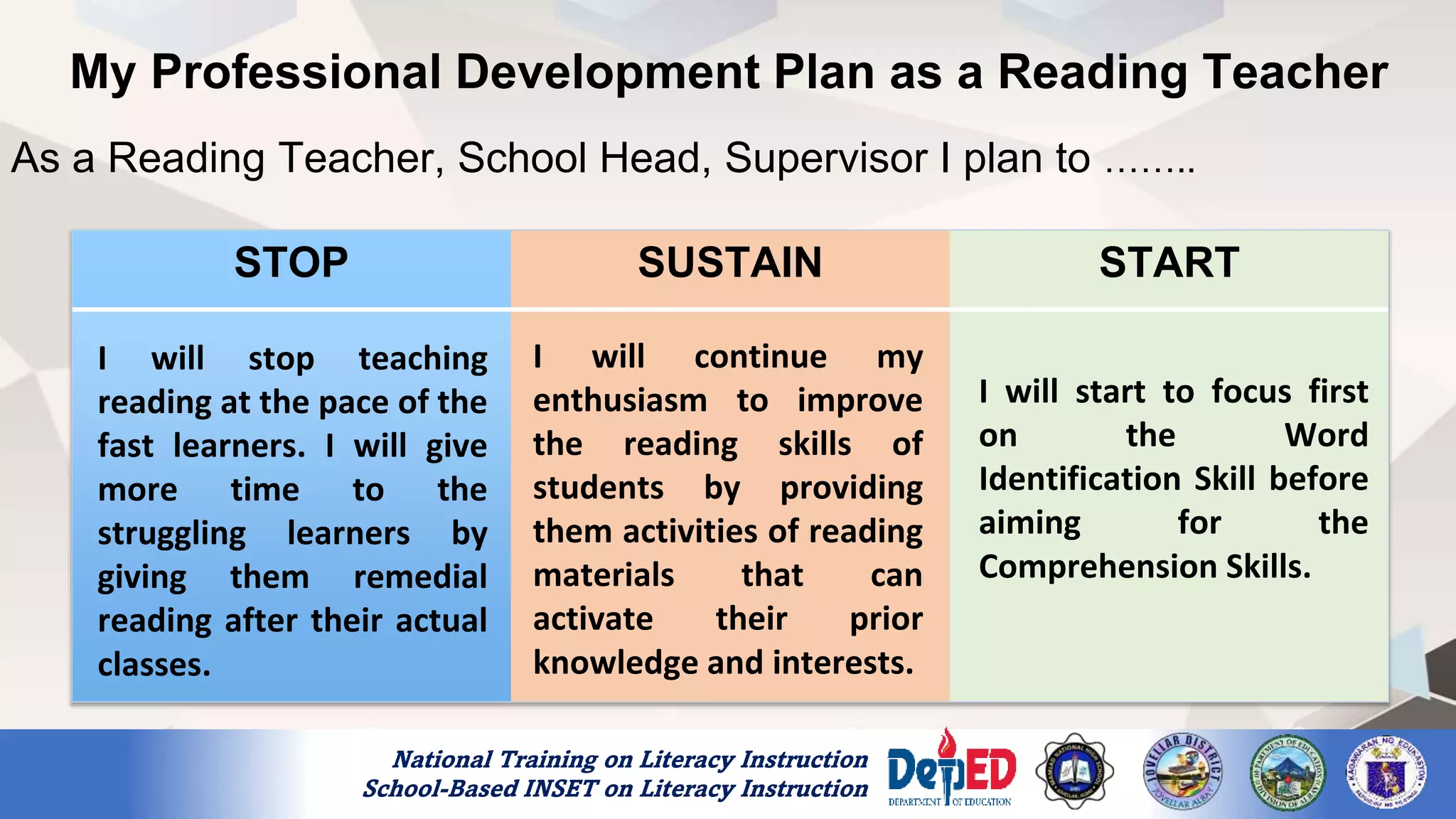
As a Reading Teacher, School Head, Supervisor I plan to ……..
STOP SUSTAIN START
National Training on Literacy Instruction
School-Based INSET on Literacy Instruction
I will stop teaching
reading at the pace of the
fast learners. I will give
more time to the
struggling learners by
giving them remedial
reading after their actual
classes.
I will continue my
enthusiasm to improve
the reading skills of
students by providing
them activities of reading
materials that can
activate their prior
knowledge and interests.
I will start to focus first
on the Word
Identification Skill before
aiming for the
Comprehension Skills.
National Training on Literacy Instruction
School-Based INSET on Literacy Instruction
My Professional Development Plan as a Reading Teacher
National Training on Literacy Instruction
School-Based INSET on Literacy Instruction
2
1 3
4
PICK YOUR REWARD!
National Training on Literacy Instruction
School-Based INSET on Literacy Instruction
National Training on Literacy Instruction
School-Based INSET on Literacy Instruction
Children Learn to Read and Write
Good readers aren’t born.
They’re created.
Created as the evening clock stands still and
the minutes of a bedtime story reign supreme.
Lovingly read each night.
National Training on Literacy Instruction
School-Based INSET on Literacy Instruction
Adapted from “A daughter learns to read”
By Mardi C. Dilks, The Reading Teacher,
Vol. 56, No. 3 November 2002
Good writers aren’t born.
They’re taught.
Taught to revere writing, as an important tool,
the nuts and bolts linking them to the world
beyond.
Guaranteed to strengthen the mind of an
impressionable child.
Children Learn to Read and Write
National Training on Literacy Instruction
School-Based INSET on Literacy Instruction
Adapted from “A daughter learns to read”
By Mardi C. Dilks, The Reading Teacher,
Vol. 56, No. 3 November 2002
Good readers and writers aren’t born.
They’re inspired.
Inspired by teachers who value reading and writing,
as the keys to knowledge and success.
Who read and write like they breathe…
Continuously, steadily, automatically.
Adapted from “A daughter learns to read”
By Mardi C. Dilks, The Reading Teacher,
Vol. 56, No. 3 November 2002
Children Learn to Read and Write
National Training on Literacy Instruction
School-Based INSET on Literacy Instruction
Thank You!
National Training on Literacy Instruction
School-Based INSET on Literacy Instruction

Session Presentation - The Nature of Reading.pptx

  • 1.
    The Nature of Reading Presentedby: Rosalina J. Villaneza Chief Teaching and Learning Division Bureau of Learning Delivery National Training on Literacy Instruction School-Based INSET on Literacy Instruction Delivered by: Kerwin M. Regis SDO-Quezon City Re-echoed by: Nickole G. Ordiales L & D Coordinator, Mamlad High School Mamlad, Jovellar, Albay National Training on Literacy Instruction School-Based INSET on Literacy Instruction
  • 2.
    OUR LEARNING OBJECTIVES Atthe end of the training, you should be able to: 1. Examine teaching practices that will help uncover belief in the reading process; 2. Explain the nature of reading; 3. Realize that the reader has a significant role in the reading process and that his/her attitude and motivation affect his/her reading performance; and 4. Apply research-based practices in teaching children learn to read and read to learn National Training on Literacy Instruction School-Based INSET on Literacy Instruction
  • 3.
    National Training onLiteracy Instruction School-Based INSET on Literacy Instruction 1 2 3 4 5 6 7 8 9 10 11 12 13 14 15 F E E L I N G C H E C K https://i.pinimg.com/originals/db/05/a0/db05a03b2adcfedd15c8b91e48cb99a4.gif
  • 4.
    National Training onLiteracy Instruction School-Based INSET on Literacy Instruction
  • 5.
    Why Reading? National Trainingon Literacy Instruction School-Based INSET on Literacy Instruction
  • 6.
    Activity 1 -Anticipation Guide Directions: 1. The participants will be divided into two small groups. 2. Each group will Accomplish Activity 1 - Anticipation Guide for ten (10) minutes. 3. Each group should choose a Facilitator (to facilitate the discussion), a Recorder (to record the discussion) and a Reporter (to report to the big group the output(s). 4. The reporter will be given 2 minutes to share the group’s output. National Training on Literacy Instruction School-Based INSET on Literacy Instruction
  • 7.
    Activity 1 -Anticipation Guide Directions: For each of the following statements, put a check under “Agree” or “Disagree” to show how you feel. Agree Disagree ______1. Before children learn to read they should know the sounds of _______ most letters. ______2. The more symbols (letters or words) there are in a text, the _______ longer it will take to read it. ______3. We gather meaning from what we read. _______ ______4. When one reads one tries to find some cues in an effort to _______ make sense of the written text. ______5. Visual information provided by maps, charts, or pictures help _______ young readers store and retrieve information they have read. ______6. A reader who is familiar with the subject matter of a text _______ already has a basis for making sense of it. National Training on Literacy Instruction School-Based INSET on Literacy Instruction
  • 8.
    Activity 1 -Anticipation Guide National Training on Literacy Instruction School-Based INSET on Literacy Instruction
  • 9.
    Activity 1 -Anticipation Guide-PRESENTATION National Training on Literacy Instruction School-Based INSET on Literacy Instruction
  • 10.
    National Training onLiteracy Instruction School-Based INSET on Literacy Instruction Activity 1 - Anticipation Guide-LET’S PROCESS 1. Before children learn to read they should know the sounds of most letters. Agree – Awareness of the sounds of the language is a fundamental skill in learning to read. This leads to associating the sounds (phonemes) with the corresponding letter symbols (graphemes).
  • 11.
    National Training onLiteracy Instruction School-Based INSET on Literacy Instruction Activity 1 - Anticipation Guide-LET’S PROCESS 2. The more symbols (letters or words) there are in a text, the longer it will take to read it. Agree – This is true. But if smaller sense units (words, phrases) are combined into bigger, coherent ones (sentences, paragraphs), the whole is much faster to read than if they are separate or incoherent. Therefore, learners will read more successfully, if given whole meaningful units of text to read rather than disconnected bits.
  • 12.
    National Training onLiteracy Instruction School-Based INSET on Literacy Instruction Activity 1 - Anticipation Guide-LET’S PROCESS 3. We gather meaning from what we read. Disagree – The word “gather” implies that somehow the meaning of a text is there in the words and all we need to do is pick it up. The construction of meaning that occurs in reading is usually a combination of decoding and understanding words, phrases, and sentences – the text (bottom –up processes) and one’s previous knowledge or schema of the text content and genre (top – down processes). The more background knowledge a reader has that connects with the text being read, the more likely the reader will be able to make sense of what is being read.
  • 13.
    National Training onLiteracy Instruction School-Based INSET on Literacy Instruction Activity 1 - Anticipation Guide-LET’S PROCESS 4. When one reads one tries to find some cues in an effort to make sense of the written text. Agree – When one reads, he tries to find some cues in an effort to make sense of the written text. The available language information consists of sounds and symbols (graphophonic cues), language structure or grammar (syntactic cues), and knowledge which is part of the reader’s background (semantic cues). These cues answer the following questions:  Does it look right?  Does it fit the sense of the story?
  • 14.
    National Training onLiteracy Instruction School-Based INSET on Literacy Instruction Activity 1 - Anticipation Guide-LET’S PROCESS 5. Visual information provided by maps, charts, or pictures help young readers store and retrieve information they have read. Agree – Sometimes, a reader does not have sufficient background information about a text. A diagram, a chart, or any picture cues can help young readers to better understand what they read.
  • 15.
    National Training onLiteracy Instruction School-Based INSET on Literacy Instruction Activity 1 - Anticipation Guide-LET’S PROCESS 6. A reader who is familiar with the subject matter of a text already has a basis for making sense of it.. Agree –The more background knowledge a reader has to connect with the text being read, the more likely the reader will be able to make sense of what is being read.
  • 16.
    National Training onLiteracy Instruction School-Based INSET on Literacy Instruction Let us watch the recorded lecture on the topic “The Nature of Reading” from Dr. Rose J. Villaneza. Do some note taking of important concepts. After watching the video, we will have a Q & A activity about salient points discussed.
  • 17.
    National Training onLiteracy Instruction School-Based INSET on Literacy Instruction
  • 18.
    If you seethis icon , there is a question that you need to answer. Kindly raise your right hand if you want to answer. National Training on Literacy Instruction School-Based INSET on Literacy Instruction
  • 19.
    It is adynamic process in which the reader interacts with the text to construct meaning. Inherent in constructing meaning is the reader’s ability to activate prior knowledge, use reading strategies, and adapt to the reading situation. R E A D I N G National Training on Literacy Instruction School-Based INSET on Literacy Instruction
  • 20.
    Identify the missingalternative views about reading. 1. SKILL 2. PROCESS 3. COMPREHENSION 4. DEVELOPMENT 5. STRATEGY National Training on Literacy Instruction School-Based INSET on Literacy Instruction Reading as a… 1. _ K I _ _ 4. _ E _ E L O _ _ E _ T
  • 21.
    1. Reading asSKILL While the reader’s knowledge of language is recognized as an integral part of reading print, reading is viewed as a skill that is learned. In fact, reading is a unitary skill that we use to process texts. National Training on Literacy Instruction School-Based INSET on Literacy Instruction
  • 22.
    Reading as aSkill National Training on Literacy Instruction School-Based INSET on Literacy Instruction 1. W_ _ D _ D E _ T _ _ I _ A T I _ N 2. _ O _ P _ _ H E _ S _ _ N
  • 23.
    The Word IdentificationSubskills National Training on Literacy Instruction School-Based INSET on Literacy Instruction
  • 24.
    Comprehension Subskills National Trainingon Literacy Instruction School-Based INSET on Literacy Instruction
  • 25.
    Skills and StrategiesGo Together National Training on Literacy Instruction School-Based INSET on Literacy Instruction S _ R _ T_E _ I _S
  • 26.
    Providing Scaffolding throughStrategies National Training on Literacy Instruction School-Based INSET on Literacy Instruction P _ _ R A _ _ I S T _ D
  • 27.
    2. Reading asPROCESS The reading process, also known as the meaning – making process, provides an explanation of “how reading happens”(Cambourne, 1998). To construct meaning, readers draw on, or sample the language information available to them. National Training on Literacy Instruction School-Based INSET on Literacy Instruction P _ _ C _ _ S
  • 28.
    A Language-based Modelof the Reading Process National Training on Literacy Instruction School-Based INSET on Literacy Instruction
  • 29.
    3. Reading asCOMPREHENSION Comprehension occurs in the transaction between the reader and the text. Reading Situation * Purpose * Setting (Kucer 2001; Rosenblatt, 1978) National Training on Literacy Instruction School-Based INSET on Literacy Instruction R _ A _ E _ T _ X _
  • 30.
    National Training onLiteracy Instruction School-Based INSET on Literacy Instruction Schema Theory ● According to the schema theory, individuals have organized world knowledge which are stored through a series of networkable solutions known as schema. These can be activated or retrieved when needed. ● Reading comprehension involves thinking. 3. Reading as COMPREHENSION
  • 31.
    Interactive Model ofReading Comprehension National Training on Literacy Instruction School-Based INSET on Literacy Instruction
  • 32.
    FACTORS THAT AFFECTREADING COMPREHENSION THE READER – brings the following to the text: Script knowledge - knowledge and beliefs about the world. Knowledge about language - graphophonic, syntactic, semantic, pragmatic. Knowledge of text structure - text cohesion, general text structure (narrative, expository, etc.) Pragmatic system - how language is used in social settings. National Training on Literacy Instruction School-Based INSET on Literacy Instruction
  • 33.
    FACTORS THAT AFFECTREADING COMPREHENSION The Text Text Structure -its genre, vocabulary, language, even the specific word choices. How well text is written Content, difficulty or readability Author’s intent National Training on Literacy Instruction School-Based INSET on Literacy Instruction
  • 34.
    FACTORS THAT AFFECTREADING COMPREHENSION The Context It involves the activity that occurs around the transaction. Purpose-reading a text for a specific reason. Setting-teacher creates the learning opportunities to support the construction of meaning. National Training on Literacy Instruction School-Based INSET on Literacy Instruction
  • 35.
    4. Reading asDEVELOPMENT Reading is an interplay of one’s experience, oral language, and ability to interpret written symbols as shown in the diagram. Figure 3. The relationships of three types of knowledge used in reading (Hermosa, 2002) National Training on Literacy Instruction School-Based INSET on Literacy Instruction E _ _ E R _ E _ C _
  • 36.
    4. Reading asDEVELOPMENT The relationship of circles A, B, and C is reciprocal. It is true that Circle A develops first, followed by Circle B, then by Circle C. However, once an individual has acquired a language, he uses it to learn more experiences. Similarly, once he has learned to read, Circle C becomes a very powerful tool for learning, even more so than oral language. National Training on Literacy Instruction School-Based INSET on Literacy Instruction
  • 37.
    4. Reading as DEVELOPMENT •Reading and writing have their roots in a child’s earliest attempts to communicate and make meaning. • Reading development is correlated with other aspects of child development – physical, cognitive, linguistic, and socio – emotional. • Oral language development is an integral part of beginning reading instruction. National Training on Literacy Instruction School-Based INSET on Literacy Instruction
  • 38.
    5. Reading asSTRATEGY Strategies are conscious, flexible plans a reader applies to a variety of texts. The use of strategies implies awareness, reflection, and interaction between the reader and the author. Strategies do not operate individually or sequentially, but are interrelated and recursive. The goal is the active construction of meaning and the ability to adapt strategies to varying reading demands. National Training on Literacy Instruction School-Based INSET on Literacy Instruction
  • 39.
    Reading as STRATEGY NationalTraining on Literacy Instruction School-Based INSET on Literacy Instruction C _ G _I _ _ V E M _ T A C _ G _I T _ V _
  • 40.
    National Training onLiteracy Instruction School-Based INSET on Literacy Instruction
  • 41.
    National Training onLiteracy Instruction School-Based INSET on Literacy Instruction Readers use cognitive and metacognitive strategies to achieve comprehension. If comprehension breaks down, the use of fix-up strategies can be helpful. For example, when children stuck, they can: reread the text; read on look at illustrations;
  • 42.
    National Training onLiteracy Instruction School-Based INSET on Literacy Instruction check surrounding sentences ask for help.
  • 43.
    Reflection Questions: •1. Learning allthese, how should learners be taught to read? •2. Why do you think we still have frustrated readers even in the higher grades? National Training on Literacy Instruction School-Based INSET on Literacy Instruction
  • 44.
    My Professional DevelopmentPlan as a Reading Teacher As a Reading Teacher, School Head, Supervisor I plan to …….. STOP SUSTAIN START National Training on Literacy Instruction School-Based INSET on Literacy Instruction I will stop teaching reading at the pace of the fast learners. I will give more time to the struggling learners by giving them remedial reading after their actual classes. I will continue my enthusiasm to improve the reading skills of students by providing them activities of reading materials that can activate their prior knowledge and interests. I will start to focus first on the Word Identification Skill before aiming for the Comprehension Skills.
  • 45.
    National Training onLiteracy Instruction School-Based INSET on Literacy Instruction My Professional Development Plan as a Reading Teacher
  • 46.
    My Professional DevelopmentPlan as a Reading Teacher National Training on Literacy Instruction School-Based INSET on Literacy Instruction
  • 47.
    2 1 3 4 PICK YOURREWARD! National Training on Literacy Instruction School-Based INSET on Literacy Instruction
  • 48.
    National Training onLiteracy Instruction School-Based INSET on Literacy Instruction
  • 49.
    Children Learn toRead and Write Good readers aren’t born. They’re created. Created as the evening clock stands still and the minutes of a bedtime story reign supreme. Lovingly read each night. National Training on Literacy Instruction School-Based INSET on Literacy Instruction Adapted from “A daughter learns to read” By Mardi C. Dilks, The Reading Teacher, Vol. 56, No. 3 November 2002
  • 50.
    Good writers aren’tborn. They’re taught. Taught to revere writing, as an important tool, the nuts and bolts linking them to the world beyond. Guaranteed to strengthen the mind of an impressionable child. Children Learn to Read and Write National Training on Literacy Instruction School-Based INSET on Literacy Instruction Adapted from “A daughter learns to read” By Mardi C. Dilks, The Reading Teacher, Vol. 56, No. 3 November 2002
  • 51.
    Good readers andwriters aren’t born. They’re inspired. Inspired by teachers who value reading and writing, as the keys to knowledge and success. Who read and write like they breathe… Continuously, steadily, automatically. Adapted from “A daughter learns to read” By Mardi C. Dilks, The Reading Teacher, Vol. 56, No. 3 November 2002 Children Learn to Read and Write National Training on Literacy Instruction School-Based INSET on Literacy Instruction
  • 52.
    Thank You! National Trainingon Literacy Instruction School-Based INSET on Literacy Instruction