Positive Student Discipline:
Turning Classroom into Home
-------------------
TEACHER 3
Positive Student Discipline:
Turning Classroom into Home
Presented by:
LORNA DIG DINO
2023
Session Objectives
The participants are expected to:
• explain positive student discipline
• suggest strategies in turning classroom into home
• list down the KSAs or insights gained from the session
and concrete plans on these will be applied in the
classroom/school
Activity (10 minutes)
1. Think of an object that symbolizes a home. Why ? How
does this relate to positive student discipline? How can a
“home” be created in the classroom through positive
student discipline?
2. Share your thoughts about this with your seatmate.
Positive Discipline: an approach to teaching
helps children succeed
 gives them the information they need to learn, and
supports their development
respects children’s rights to healthy development, protection
from violence, and active participation in their learning.
-Positive Discipline In Everyday Teaching A Primer for Filipino Teachers, Department of Education E-Net
Philippines Save the Children, November 2015
Legal Basis for Prohibiting Corporal Punishment
and the Practice of Positive Discipline
• The UN Convention on the Rights of the Child requires that States Parties
“shall take all appropriate measures to protect the child from all forms of
violence (Article 19).” States Parties are also required to “take all appropriate
measures to ensure that school discipline is administered in a manner consistent
with the child’s human dignity and in conformity with the present Convention.
(Article 28(2)).”
Legal Basis for Prohibiting Corporal Punishment
and the Practice of Positive Discipline
• DepEd Order No. 40 s. 2012, known as “Policy and Guidelines on Protecting
Children In School From Abuse, Violence, Exploitation, Discrimination, Bullying
And Other Forms Of Abuse”.
• DepEd Order No. 55, s. 2013 which supports the implementation of Republic Act
No. 10627, known as the Anti-Bullying Act of 2013; and
• DepEd Order No. 18, s. 2015 or the Guidelines and Procedures on the
Management of Children-At-Risk and Children in Conflict with the Law.
Corporal Punishment
o any punishment in which physical force is used and intended to cause some degree
of pain or discomfort, however light, for instance:
 smacking, slapping, spanking children, with the hand or with an implement -- a
whip, stick, belt, shoe, wooden spoon, etc.
 kicking, shaking or throwing children, scratching, pinching, biting, pulling hair or
boxing ears, forcing children to stay in uncomfortable positions, burning, scolding
or forced ingestion (for example, washing children’s mouths out with soap or
forcing them to swallow hot spices).
-United Nations Committee on the Rights of the Child General Comment No. 81
Non-physical forms of punishment
ocruel and degrading and are thus incompatible with the Convention.
Examples are punishment that:
o belittles, humiliates, denigrates, scapegoats, threatens, scares or
ridicules the child.
Magnitude and Effects of Corporal
Punishment
• 80% to 98% of children experience corporal punishment in their homes.
• In the Philippines, a study conducted by Save the Children in 2005
revealed:
o 85% of children have experienced corporal punishment in their
homes and that the most common form is spanking (65%).
o (82%) reported that they had been hit on different parts of their
body.
Magnitude and Effects of Corporal
Punishment
• In 2011, about two in three parents of children under 17 said they
used corporal punishment. Spanking the bottom (52%) was the
most prevalent form of corporal punishment used.
- Pulse Asia Survey (2011). ULAT NG BAYAN SURVEY, November 10 - 23,
2011 /Philippines.
Magnitude and Effects of Corporal
Punishment
Effects of physical punishment of children based on numerous studies conducted
globally over the past 30 years:
 consistently demonstrated that physical punishment predicts negative
outcomes throughout childhood and into adulthood.
 increases children’s risks for increased aggression, increased delinquency and
anti-social behavior, physical injury and reports to child welfare, poorer parent-
child relationships, and poorer mental health; also associated with lower self-
esteem and poorer academic success.
- Gershoff, Elizabeth (2002). Corporal punishment by parents and associated child behaviors and experiences: A
Meta-Analytic and Theoretical Review” http://www.apa.org/pubs/journals/releases/bul1284539.pdf
Comparative Outlooks
of High & Low Performers
High Performers Low Performers
 Have a positive attitude towards work  Have a negative attitude towards work
 Are happy in their jobs  Are unhappy in their jobs
 See work as a source of self-satisfaction  See work as a source of income
 Like to be involved in all kinds of tasks  Avoid being involved in all kinds of tasks
 See problems as challenges  See problems as challenges
 Regard work as a stepping stone to higher
goals
 Regard work as disagreeable; complain about
it
-F. Landa Jocano, Work Values of Successful Filipinos
Positive Discipline is:
• Effective discipline is positive and constructive.
• It involves setting goals for learning, and finding constructive
solutions to challenging situations
-Durrant, Joan E. (2010). Positive Discipline in Everyday Teaching. Bangkok: Save the Children.
Positive Discipline is:
• About finding long term solutions that develop students’ own
self-discipline;
• Clear and consistent communication;
-Durrant, Joan E. (2010). Positive Discipline in Everyday Teaching. Bangkok: Save the Children.
Positive Discipline is:
• Consistent reinforcement of your expectations, rules and limits;
• Based on knowing your students and being fair;
-Durrant, Joan E. (2010). Positive Discipline in Everyday Teaching. Bangkok: Save the Children.
Positive Discipline is:
• Aimed at building a mutually respectful relationship with your
students;
• Teaching students life-long skills and fostering their love of
learning;
-Durrant, Joan E. (2010). Positive Discipline in Everyday Teaching. Bangkok: Save the Children.
Positive Discipline is:
• Teaching courtesy, non-violence, empathy, self-respect, and
respect for others and their rights; and
• Increasing students’ competence and confidence to handle
academic challenges and difficult situations.
-Durrant, Joan E. (2010). Positive Discipline in Everyday Teaching. Bangkok: Save the Children.
Positive Discipline is not:
oPermissiveness;
oLetting students do whatever they want;
oHaving no rules, limits or expectations;
oShort-term reactions; or
oAlternative punishment to slapping, hitting and shaming.
Positive Discipline in Everyday Teaching
(PDET) Approach
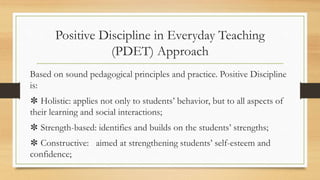
Based on sound pedagogical principles and practice. Positive Discipline
is:
✽ Holistic: applies not only to students’ behavior, but to all aspects of
their learning and social interactions;
✽ Strength-based: identifies and builds on the students’ strengths;
✽ Constructive: aimed at strengthening students’ self-esteem and
confidence;
Positive Discipline in Everyday Teaching
(PDET) Approach
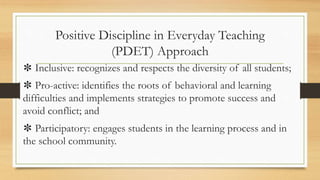
✽ Inclusive: recognizes and respects the diversity of all students;
✽ Pro-active: identifies the roots of behavioral and learning
difficulties and implements strategies to promote success and
avoid conflict; and
✽ Participatory: engages students in the learning process and in
the school community.
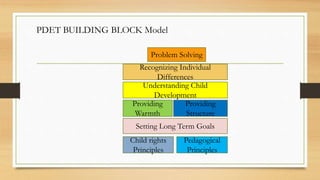
Problem Solving
Recognizing Individual
Differences
Understanding Child
Development
Providing
Structure
Providing
Warmth
Setting Long Term Goals
Pedagogical
Principles
Child rights
Principles
PDET BUILDING BLOCK Model
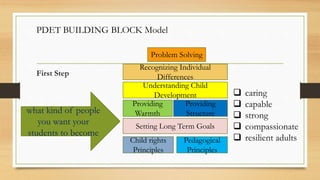
First Step
Problem Solving
Recognizing Individual
Differences
Understanding Child
Development
Providing
Structure
Providing
Warmth
Setting Long Term Goals
Pedagogical
Principles
Child rights
Principles
PDET BUILDING BLOCK Model
what kind of people
you want your
students to become
 caring
 capable
 strong
 compassionate
 resilient adults
Problem Solving
Recognizing Individual
Differences
Understanding Child
Development
Providing
Structure
Providing
Warmth
Setting Long Term Goals
Pedagogical
Principles
Child rights
Principles
PDET BUILDING BLOCK Model
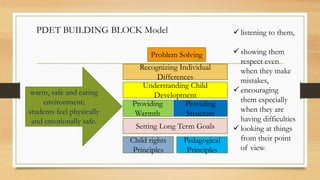
warm, safe and caring
environment;
students feel physically
and emotionally safe.
 listening to them,
 showing them
respect even
when they make
mistakes,
 encouraging
them especially
when they are
having difficulties
 looking at things
from their point
of view.
Problem Solving
Recognizing Individual
Differences
Understanding Child
Development
Providing
Structure
Providing
Warmth
Setting Long Term Goals
Pedagogical
Principles
Child rights
Principles
PDET BUILDING BLOCK Model
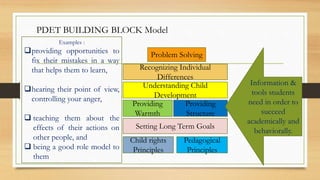
Information &
tools students
need in order to
succeed
academically and
behaviorally.
Examples :
providing opportunities to
fix their mistakes in a way
that helps them to learn,
hearing their point of view,
controlling your anger,
 teaching them about the
effects of their actions on
other people, and
 being a good role model to
them
Problem Solving
Recognizing Individual
Differences
Understanding Child
Development
Providing
Structure
Providing
Warmth
Setting Long Term Goals
Pedagogical
Principles
Child rights
Principles
PDET BUILDING BLOCK Model
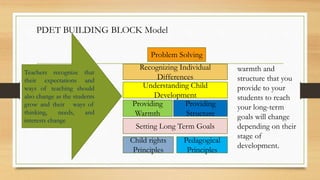
Teachers recognize that
their expectations and
ways of teaching should
also change as the students
grow and their ways of
thinking, needs, and
interests change
warmth and
structure that you
provide to your
students to reach
your long-term
goals will change
depending on their
stage of
development.
Problem Solving
Recognizing Individual
Differences
Understanding Child
Development
Providing
Structure
Providing
Warmth
Setting Long Term Goals
Pedagogical
Principles
Child rights
Principles
PDET BUILDING BLOCK Model
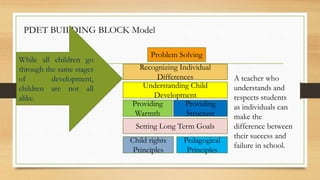
While all children go
through the same stages
of development,
children are not all
alike.
A teacher who
understands and
respects students
as individuals can
make the
difference between
their success and
failure in school.
Problem Solving
Recognizing Individual
Differences
Understanding Child
Development
Providing
Structure
Providing
Warmth
Setting Long Term Goals
Pedagogical
Principles
Child rights
Principles
PDET BUILDING BLOCK Model
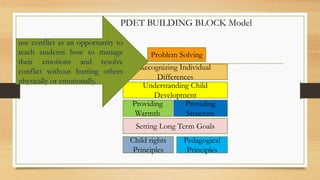
use conflict as an opportunity to
teach students how to manage
their emotions and resolve
conflict without hurting others
physically or emotionally.
Problem Solving
Recognizing Individual
Differences
Understanding Child
Development
Providing
Structure
Providing
Warmth
Setting Long Term Goals
Pedagogical
Principles
Child rights
Principles
PDET BUILDING BLOCK Model
use conflict as an opportunity to
teach students how to manage
their emotions and resolve
conflict without hurting others
physically or emotionally.
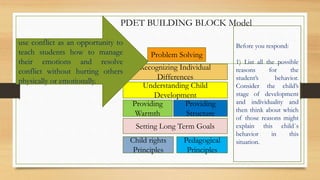
Before you respond:
1) List all the possible
reasons for the
student’s behavior.
Consider the child’s
stage of development
and individuality and
then think about which
of those reasons might
explain this child`s
behavior in this
situation.
Problem Solving
Recognizing Individual
Differences
Understanding Child
Development
Providing
Structure
Providing
Warmth
Setting Long Term Goals
Pedagogical
Principles
Child rights
Principles
PDET BUILDING BLOCK Model
use conflict as an opportunity to
teach students how to manage
their emotions and resolve
conflict without hurting others
physically or emotionally.
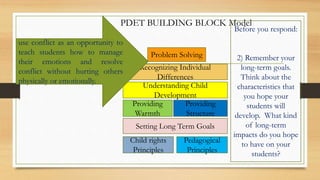
Before you respond:
2) Remember your
long-term goals.
Think about the
characteristics that
you hope your
students will
develop. What kind
of long-term
impacts do you hope
to have on your
students?
Problem Solving
Recognizing Individual
Differences
Understanding Child
Development
Providing
Structure
Providing
Warmth
Setting Long Term Goals
Pedagogical
Principles
Child rights
Principles
PDET BUILDING BLOCK Model
use conflict as an opportunity to
teach students how to manage
their emotions and resolve
conflict without hurting others
physically or emotionally.
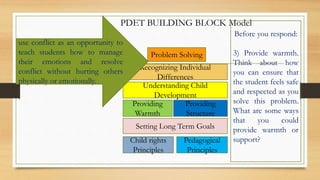
Before you respond:
3) Provide warmth.
Think about how
you can ensure that
the student feels safe
and respected as you
solve this problem.
What are some ways
that you could
provide warmth or
support?
Problem Solving
Recognizing Individual
Differences
Understanding Child
Development
Providing
Structure
Providing
Warmth
Setting Long Term Goals
Pedagogical
Principles
Child rights
Principles
PDET BUILDING BLOCK Model
use conflict as an opportunity to
teach students how to manage
their emotions and resolve
conflict without hurting others
physically or emotionally.
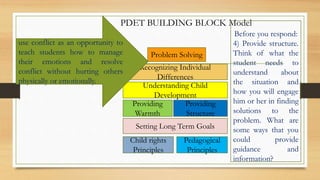
Before you respond:
4) Provide structure.
Think of what the
student needs to
understand about
the situation and
how you will engage
him or her in finding
solutions to the
problem. What are
some ways that you
could provide
guidance and
information?
Problem Solving
Recognizing Individual
Differences
Understanding Child
Development
Providing
Structure
Providing
Warmth
Setting Long Term Goals
Pedagogical
Principles
Child rights
Principles
PDET BUILDING BLOCK Model
use conflict as an opportunity to
teach students how to manage
their emotions and resolve
conflict without hurting others
physically or emotionally.
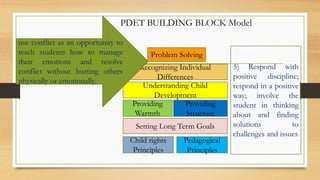
5) Respond with
positive discipline;
respond in a positive
way; involve the
student in thinking
about and finding
solutions to
challenges and issues
Practicing Positive Discipline
involves a thoughtful and holistic approach to your
relationships with young people.
may seem more difficult to you right now, but it will help make
your interactions with students more respectful and caring, and
in the longer term that investment will provide a happier and
calmer classroom and school environment.
Practicing Positive Discipline
 a continuous learning process for both teachers and
students.
requires commitment and adherence to the rights of the
child to be taught and treated with respect while in school.
• “ ... There is no ambiguity: ‘All forms of physical or mental violence’ does not
leave room for any level of legalized violence against children. Corporal
punishment and other cruel or degrading forms of punishment are forms of
violence and the State must take all appropriate legislative, administrative,
social and educational measures to eliminate them.”
-United nations Committee on the Rights of the Child, General Comment no. 8 on the
Convention on the Rights of the Child
A Note on Teachers’ Well-Being
and Stress Management
Our temperaments also affect our behavior in the classroom.
Teacher-student relationships are strongly affected by the match
between the student’s and the teacher’s temperaments.
It is very important for us to think of our own temperament to be able
to consider how we can adjust our expectations, meet our students’
needs, and find ways of resolving conflict without punishment.
• “ ... There is no ambiguity: ‘All forms of physical or mental violence’ does
not leave room for any level of legalized violence against children. Corporal
punishment and other cruel or degrading forms of punishment are forms of
violence and the State must take all appropriate legislative, administrative,
social and educational measures to eliminate them.”
-United nations Committee on the Rights of the Child, General Comment no.
8 on the Convention on the Rights of the Child
Dear Teachers: Please
explore other ways to teach students how to manage their emotions
and resolve conflict without hurting them physically and emotionally.
cultivate an environment where the children thrive and grow healthily,
and so, find ways to help rear them in the most positive way we can.
• Reference:
Positive Discipline in Everyday Teaching, A Primer for Filipino Teachers,
Department of Education, E-Net Philippines, Save the Children, November
2015
Usap
Unawa
Kalinga
(UUK)
Thank you very much!
Stay safe. God bless!
MOL!
-Lorna Dig Dino

Mam-Lorna-Positive-Student-Discipline_2023-_edited-Final.pptx

  • 1.
    Positive Student Discipline: TurningClassroom into Home ------------------- TEACHER 3
  • 2.
    Positive Student Discipline: TurningClassroom into Home Presented by: LORNA DIG DINO 2023
  • 3.
    Session Objectives The participantsare expected to: • explain positive student discipline • suggest strategies in turning classroom into home • list down the KSAs or insights gained from the session and concrete plans on these will be applied in the classroom/school
  • 4.
    Activity (10 minutes) 1.Think of an object that symbolizes a home. Why ? How does this relate to positive student discipline? How can a “home” be created in the classroom through positive student discipline? 2. Share your thoughts about this with your seatmate.
  • 5.
    Positive Discipline: anapproach to teaching helps children succeed  gives them the information they need to learn, and supports their development respects children’s rights to healthy development, protection from violence, and active participation in their learning. -Positive Discipline In Everyday Teaching A Primer for Filipino Teachers, Department of Education E-Net Philippines Save the Children, November 2015
  • 6.
    Legal Basis forProhibiting Corporal Punishment and the Practice of Positive Discipline • The UN Convention on the Rights of the Child requires that States Parties “shall take all appropriate measures to protect the child from all forms of violence (Article 19).” States Parties are also required to “take all appropriate measures to ensure that school discipline is administered in a manner consistent with the child’s human dignity and in conformity with the present Convention. (Article 28(2)).”
  • 7.
    Legal Basis forProhibiting Corporal Punishment and the Practice of Positive Discipline • DepEd Order No. 40 s. 2012, known as “Policy and Guidelines on Protecting Children In School From Abuse, Violence, Exploitation, Discrimination, Bullying And Other Forms Of Abuse”. • DepEd Order No. 55, s. 2013 which supports the implementation of Republic Act No. 10627, known as the Anti-Bullying Act of 2013; and • DepEd Order No. 18, s. 2015 or the Guidelines and Procedures on the Management of Children-At-Risk and Children in Conflict with the Law.
  • 8.
    Corporal Punishment o anypunishment in which physical force is used and intended to cause some degree of pain or discomfort, however light, for instance:  smacking, slapping, spanking children, with the hand or with an implement -- a whip, stick, belt, shoe, wooden spoon, etc.  kicking, shaking or throwing children, scratching, pinching, biting, pulling hair or boxing ears, forcing children to stay in uncomfortable positions, burning, scolding or forced ingestion (for example, washing children’s mouths out with soap or forcing them to swallow hot spices). -United Nations Committee on the Rights of the Child General Comment No. 81
  • 9.
    Non-physical forms ofpunishment ocruel and degrading and are thus incompatible with the Convention. Examples are punishment that: o belittles, humiliates, denigrates, scapegoats, threatens, scares or ridicules the child.
  • 10.
    Magnitude and Effectsof Corporal Punishment • 80% to 98% of children experience corporal punishment in their homes. • In the Philippines, a study conducted by Save the Children in 2005 revealed: o 85% of children have experienced corporal punishment in their homes and that the most common form is spanking (65%). o (82%) reported that they had been hit on different parts of their body.
  • 11.
    Magnitude and Effectsof Corporal Punishment • In 2011, about two in three parents of children under 17 said they used corporal punishment. Spanking the bottom (52%) was the most prevalent form of corporal punishment used. - Pulse Asia Survey (2011). ULAT NG BAYAN SURVEY, November 10 - 23, 2011 /Philippines.
  • 12.
    Magnitude and Effectsof Corporal Punishment Effects of physical punishment of children based on numerous studies conducted globally over the past 30 years:  consistently demonstrated that physical punishment predicts negative outcomes throughout childhood and into adulthood.  increases children’s risks for increased aggression, increased delinquency and anti-social behavior, physical injury and reports to child welfare, poorer parent- child relationships, and poorer mental health; also associated with lower self- esteem and poorer academic success. - Gershoff, Elizabeth (2002). Corporal punishment by parents and associated child behaviors and experiences: A Meta-Analytic and Theoretical Review” http://www.apa.org/pubs/journals/releases/bul1284539.pdf
  • 13.
    Comparative Outlooks of High& Low Performers High Performers Low Performers  Have a positive attitude towards work  Have a negative attitude towards work  Are happy in their jobs  Are unhappy in their jobs  See work as a source of self-satisfaction  See work as a source of income  Like to be involved in all kinds of tasks  Avoid being involved in all kinds of tasks  See problems as challenges  See problems as challenges  Regard work as a stepping stone to higher goals  Regard work as disagreeable; complain about it -F. Landa Jocano, Work Values of Successful Filipinos
  • 14.
    Positive Discipline is: •Effective discipline is positive and constructive. • It involves setting goals for learning, and finding constructive solutions to challenging situations -Durrant, Joan E. (2010). Positive Discipline in Everyday Teaching. Bangkok: Save the Children.
  • 15.
    Positive Discipline is: •About finding long term solutions that develop students’ own self-discipline; • Clear and consistent communication; -Durrant, Joan E. (2010). Positive Discipline in Everyday Teaching. Bangkok: Save the Children.
  • 16.
    Positive Discipline is: •Consistent reinforcement of your expectations, rules and limits; • Based on knowing your students and being fair; -Durrant, Joan E. (2010). Positive Discipline in Everyday Teaching. Bangkok: Save the Children.
  • 17.
    Positive Discipline is: •Aimed at building a mutually respectful relationship with your students; • Teaching students life-long skills and fostering their love of learning; -Durrant, Joan E. (2010). Positive Discipline in Everyday Teaching. Bangkok: Save the Children.
  • 18.
    Positive Discipline is: •Teaching courtesy, non-violence, empathy, self-respect, and respect for others and their rights; and • Increasing students’ competence and confidence to handle academic challenges and difficult situations. -Durrant, Joan E. (2010). Positive Discipline in Everyday Teaching. Bangkok: Save the Children.
  • 19.
    Positive Discipline isnot: oPermissiveness; oLetting students do whatever they want; oHaving no rules, limits or expectations; oShort-term reactions; or oAlternative punishment to slapping, hitting and shaming.
  • 20.
    Positive Discipline inEveryday Teaching (PDET) Approach Based on sound pedagogical principles and practice. Positive Discipline is: ✽ Holistic: applies not only to students’ behavior, but to all aspects of their learning and social interactions; ✽ Strength-based: identifies and builds on the students’ strengths; ✽ Constructive: aimed at strengthening students’ self-esteem and confidence;
  • 21.
    Positive Discipline inEveryday Teaching (PDET) Approach ✽ Inclusive: recognizes and respects the diversity of all students; ✽ Pro-active: identifies the roots of behavioral and learning difficulties and implements strategies to promote success and avoid conflict; and ✽ Participatory: engages students in the learning process and in the school community.
  • 22.
    Problem Solving Recognizing Individual Differences UnderstandingChild Development Providing Structure Providing Warmth Setting Long Term Goals Pedagogical Principles Child rights Principles PDET BUILDING BLOCK Model
  • 23.
    First Step Problem Solving RecognizingIndividual Differences Understanding Child Development Providing Structure Providing Warmth Setting Long Term Goals Pedagogical Principles Child rights Principles PDET BUILDING BLOCK Model what kind of people you want your students to become  caring  capable  strong  compassionate  resilient adults
  • 24.
    Problem Solving Recognizing Individual Differences UnderstandingChild Development Providing Structure Providing Warmth Setting Long Term Goals Pedagogical Principles Child rights Principles PDET BUILDING BLOCK Model warm, safe and caring environment; students feel physically and emotionally safe.  listening to them,  showing them respect even when they make mistakes,  encouraging them especially when they are having difficulties  looking at things from their point of view.
  • 25.
    Problem Solving Recognizing Individual Differences UnderstandingChild Development Providing Structure Providing Warmth Setting Long Term Goals Pedagogical Principles Child rights Principles PDET BUILDING BLOCK Model Information & tools students need in order to succeed academically and behaviorally. Examples : providing opportunities to fix their mistakes in a way that helps them to learn, hearing their point of view, controlling your anger,  teaching them about the effects of their actions on other people, and  being a good role model to them
  • 26.
    Problem Solving Recognizing Individual Differences UnderstandingChild Development Providing Structure Providing Warmth Setting Long Term Goals Pedagogical Principles Child rights Principles PDET BUILDING BLOCK Model Teachers recognize that their expectations and ways of teaching should also change as the students grow and their ways of thinking, needs, and interests change warmth and structure that you provide to your students to reach your long-term goals will change depending on their stage of development.
  • 27.
    Problem Solving Recognizing Individual Differences UnderstandingChild Development Providing Structure Providing Warmth Setting Long Term Goals Pedagogical Principles Child rights Principles PDET BUILDING BLOCK Model While all children go through the same stages of development, children are not all alike. A teacher who understands and respects students as individuals can make the difference between their success and failure in school.
  • 28.
    Problem Solving Recognizing Individual Differences UnderstandingChild Development Providing Structure Providing Warmth Setting Long Term Goals Pedagogical Principles Child rights Principles PDET BUILDING BLOCK Model use conflict as an opportunity to teach students how to manage their emotions and resolve conflict without hurting others physically or emotionally.
  • 29.
    Problem Solving Recognizing Individual Differences UnderstandingChild Development Providing Structure Providing Warmth Setting Long Term Goals Pedagogical Principles Child rights Principles PDET BUILDING BLOCK Model use conflict as an opportunity to teach students how to manage their emotions and resolve conflict without hurting others physically or emotionally. Before you respond: 1) List all the possible reasons for the student’s behavior. Consider the child’s stage of development and individuality and then think about which of those reasons might explain this child`s behavior in this situation.
  • 30.
    Problem Solving Recognizing Individual Differences UnderstandingChild Development Providing Structure Providing Warmth Setting Long Term Goals Pedagogical Principles Child rights Principles PDET BUILDING BLOCK Model use conflict as an opportunity to teach students how to manage their emotions and resolve conflict without hurting others physically or emotionally. Before you respond: 2) Remember your long-term goals. Think about the characteristics that you hope your students will develop. What kind of long-term impacts do you hope to have on your students?
  • 31.
    Problem Solving Recognizing Individual Differences UnderstandingChild Development Providing Structure Providing Warmth Setting Long Term Goals Pedagogical Principles Child rights Principles PDET BUILDING BLOCK Model use conflict as an opportunity to teach students how to manage their emotions and resolve conflict without hurting others physically or emotionally. Before you respond: 3) Provide warmth. Think about how you can ensure that the student feels safe and respected as you solve this problem. What are some ways that you could provide warmth or support?
  • 32.
    Problem Solving Recognizing Individual Differences UnderstandingChild Development Providing Structure Providing Warmth Setting Long Term Goals Pedagogical Principles Child rights Principles PDET BUILDING BLOCK Model use conflict as an opportunity to teach students how to manage their emotions and resolve conflict without hurting others physically or emotionally. Before you respond: 4) Provide structure. Think of what the student needs to understand about the situation and how you will engage him or her in finding solutions to the problem. What are some ways that you could provide guidance and information?
  • 33.
    Problem Solving Recognizing Individual Differences UnderstandingChild Development Providing Structure Providing Warmth Setting Long Term Goals Pedagogical Principles Child rights Principles PDET BUILDING BLOCK Model use conflict as an opportunity to teach students how to manage their emotions and resolve conflict without hurting others physically or emotionally. 5) Respond with positive discipline; respond in a positive way; involve the student in thinking about and finding solutions to challenges and issues
  • 34.
    Practicing Positive Discipline involvesa thoughtful and holistic approach to your relationships with young people. may seem more difficult to you right now, but it will help make your interactions with students more respectful and caring, and in the longer term that investment will provide a happier and calmer classroom and school environment.
  • 35.
    Practicing Positive Discipline a continuous learning process for both teachers and students. requires commitment and adherence to the rights of the child to be taught and treated with respect while in school.
  • 36.
    • “ ...There is no ambiguity: ‘All forms of physical or mental violence’ does not leave room for any level of legalized violence against children. Corporal punishment and other cruel or degrading forms of punishment are forms of violence and the State must take all appropriate legislative, administrative, social and educational measures to eliminate them.” -United nations Committee on the Rights of the Child, General Comment no. 8 on the Convention on the Rights of the Child
  • 37.
    A Note onTeachers’ Well-Being and Stress Management Our temperaments also affect our behavior in the classroom. Teacher-student relationships are strongly affected by the match between the student’s and the teacher’s temperaments. It is very important for us to think of our own temperament to be able to consider how we can adjust our expectations, meet our students’ needs, and find ways of resolving conflict without punishment.
  • 38.
    • “ ...There is no ambiguity: ‘All forms of physical or mental violence’ does not leave room for any level of legalized violence against children. Corporal punishment and other cruel or degrading forms of punishment are forms of violence and the State must take all appropriate legislative, administrative, social and educational measures to eliminate them.” -United nations Committee on the Rights of the Child, General Comment no. 8 on the Convention on the Rights of the Child
  • 39.
    Dear Teachers: Please exploreother ways to teach students how to manage their emotions and resolve conflict without hurting them physically and emotionally. cultivate an environment where the children thrive and grow healthily, and so, find ways to help rear them in the most positive way we can.
  • 40.
    • Reference: Positive Disciplinein Everyday Teaching, A Primer for Filipino Teachers, Department of Education, E-Net Philippines, Save the Children, November 2015
  • 41.
  • 42.
    Thank you verymuch! Stay safe. God bless! MOL! -Lorna Dig Dino