

Submitted to :
Dr. Thomas Abraham
Submitted by :
Group no.V (6th Sem.)
Shilpi Amita topno : 10BSCAG032
Ankita Tirkey : 10BSCAG039
Shraddha Suman : 10BSCAGO60
Aparna Priya : 10BSCAGO80
Harshita Khare : 10BSCAG087
Anand Singh : 10BSCAG104
Amit Kamlakar : 10BSCAG115
Vishnu Karun : 10BSCAG128
Mohd. Shabi : 10BSCAG132
Ankita Mandal : 10BSCAG139
Nanda KR. Maharjan : 10BSCAG151
INTRODUCTION
•Forest gardening - it is a low
maintenance sustainable plant-based food
production and agroforestry system based
on woodland ecosystems.
•Incorporate fruit and nut trees, shrubs, herbs,
vines and perennial vegetables which
have yields directly useful to humans.
•A forest garden is a garden modelled on a natural
woodland.
It has 3 layers of vegetation:
Trees, shrubs, herbaceous plants.
The plants in a forest garden are mainly
perennial, which gives the system its long-term
nature.
Many of the plants which are used are
multipurpose; they may have a main function or
have a number of other uses.
Plants are also mixed to a large degree, so there
are few large blocks or areas of a single species,
and each species is grown close to many others
in ways that are mutually beneficial.
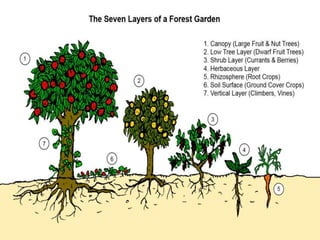
1
2
3
4
5
6
7
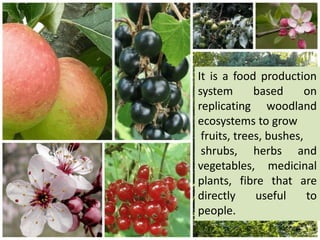
It is a food production
system based on
replicating woodland
ecosystems to grow
fruits, trees, bushes,
shrubs, herbs and
vegetables, medicinal
plants, fibre that are
directly useful to
people.
8
Food security - growing a wide variety of food
plants in your backgarden means that you have a
steady supply of fresh food that is independent of
price fluctuations, fuel availability, failed harvests
etc.
Because the food is produced close to the point
of use there are no transport costs and there are
no energy costs associated with industrialised
farming.
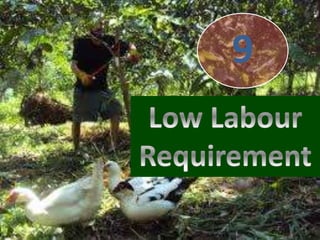
9
Low labour requirements - once established the
plants need little maintenance because they
are perennial.
Because it is close at hand, you can observe it
carefully and make small interventions when
needed.
It is something that can be managed in a few
hours a week. This means anyone can maintain
a forest garden in their spare time.
10
Water - deep rooted trees can access water from
far below ground so there is little need for
watering once established.
The network of roots at different levels absorb
water quickly and prevent rapid runoff, reducing
the chance of flooding.
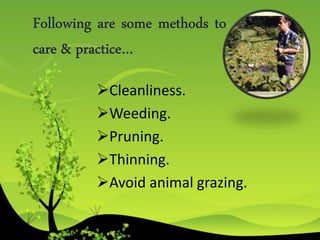
Cleanliness.
Weeding.
Pruning.
Thinning.
Avoid animal grazing.
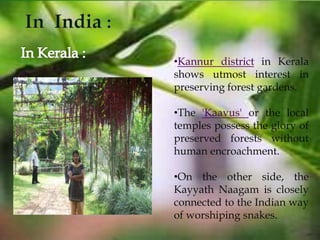
•Kannur district in Kerala
shows utmost interest in
preserving forest gardens.
•The 'Kaavus' or the local
temples possess the glory of
preserved forests without
human encroachment.
•On the other side, the
Kayyath Naagam is closely
connected to the Indian way
of worshiping snakes.
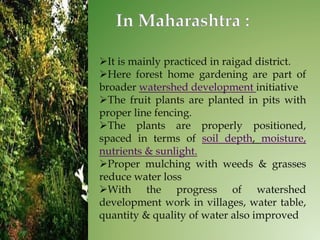
It is mainly practiced in raigad district.
Here forest home gardening are part of
broader watershed development initiative
The fruit plants are planted in pits with
proper line fencing.
The plants are properly positioned,
spaced in terms of soil depth, moisture,
nutrients & sunlight.
Proper mulching with weeds & grasses
reduce water loss
With the progress of watershed
development work in villages, water table,
quantity & quality of water also improved
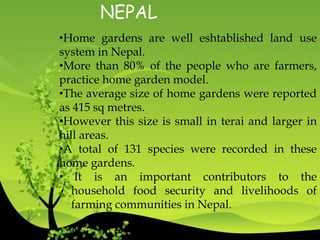
NEPAL
•Home gardens are well eshtablished land use
system in Nepal.
•More than 80% of the people who are farmers,
practice home garden model.
•The average size of home gardens were reported
as 415 sq metres.
•However this size is small in terai and larger in
hill areas.
•A total of 131 species were recorded in these
home gardens.
• It is an important contributors to the
household food security and livelihoods of
farming communities in Nepal.
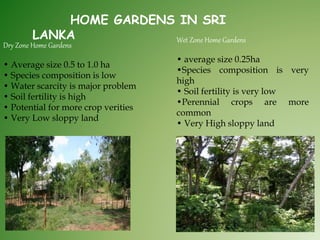
Wet Zone Home Gardens
• average size 0.25ha
•Species composition is very
high
• Soil fertility is very low
•Perennial crops are more
common
• Very High sloppy land
Dry Zone Home Gardens
• Average size 0.5 to 1.0 ha
• Species composition is low
• Water scarcity is major problem
• Soil fertility is high
• Potential for more crop verities
• Very Low sloppy land
HOME GARDENS IN SRI
LANKA
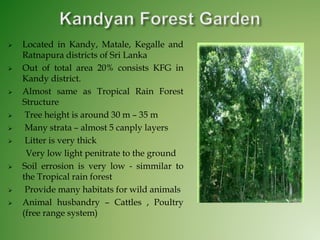
 Located in Kandy, Matale, Kegalle and
Ratnapura districts of Sri Lanka
 Out of total area 20% consists KFG in
Kandy district.
 Almost same as Tropical Rain Forest
Structure
 Tree height is around 30 m – 35 m
 Many strata – almost 5 canply layers
 Litter is very thick
Very low light penitrate to the ground
 Soil errosion is very low ‐ simmilar to
the Tropical rain forest
 Provide many habitats for wild animals
 Animal husbandry – Cattles , Poultry
(free range system)
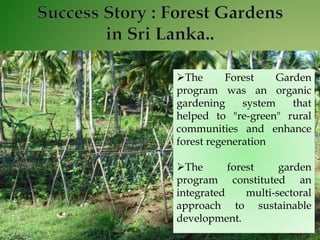
The Forest Garden
program was an organic
gardening system that
helped to "re-green" rural
communities and enhance
forest regeneration
The forest garden
program constituted an
integrated multi-sectoral
approach to sustainable
development.
Through the Forest Gardens program, tree and seedling nurseries were
established in 12 communities, propagating a total of 73,308 plants for
reforestation—a value estimated at US$52,363.00.
The program benefited hundreds of farm families, enabling them to
improve their livelihoods while practicing sustainable management of their
natural resources.
 Forest Gardens farmers were able to sell their produce through Forest
Gardens Shops to several organic products exporters, like Lanka Organics,
Guyapi Tropicales, and Quickshaws Ltd., for premium prices for export-
quality certified products.
The average monthly income, Rs. 3000 per month before the project
started, increased on average by Rs. 824 with the introduction of income
generation activities such as vegetable cultivation, seed collecting
programs, ginger and tumeric cultivation, and plant nursery development.
In Nepal :
locals formed Bhawanipur Forest User's
Group.
Over 65 hectors of open land is planted
with herb Asparagus aka American
jersyking as cash crop.
Earned over Rs. 72 lakh last year alone.
forest has also become a source of
employment to locals.
forest has inspired locals to participate in
plantation, protection and scientific
management of the forest in their own way
Rubber plantation is done in 7 ha land
Why everyone isn't planting
forest gardens ???
The idea is still new
Skill
Proven yields.
Timescales.
Work required.
Economics.
Scale.
Food taste.
The “all or nothing” effect.
.
There are over 20,000 species of edible plants in
world yet fewer than 20 species now provide 90%
of our food.
Large areas of land devoted to single crop
increases the dependence upon intervention of
chemicals & intensive control methods with added
threat of chemicals resistant insect and new
disease.
The changing world climate greatly affecting
cultivation indicates a greater diversity is needed.
We need to use a minimal input of resources &
energy, creat a harmonious ecosystem & cause
least possible damage to the environment while
achieving high productivity.
HOW TO MAKE FOREST
GARDEN:
By : Robert Hart.
Forest Gardening
By: John Arden Ferguson.
Forest gardening

Forest gardening

  • 2.
    Submitted to : Dr.Thomas Abraham Submitted by : Group no.V (6th Sem.) Shilpi Amita topno : 10BSCAG032 Ankita Tirkey : 10BSCAG039 Shraddha Suman : 10BSCAGO60 Aparna Priya : 10BSCAGO80 Harshita Khare : 10BSCAG087 Anand Singh : 10BSCAG104 Amit Kamlakar : 10BSCAG115 Vishnu Karun : 10BSCAG128 Mohd. Shabi : 10BSCAG132 Ankita Mandal : 10BSCAG139 Nanda KR. Maharjan : 10BSCAG151
  • 3.
    INTRODUCTION •Forest gardening -it is a low maintenance sustainable plant-based food production and agroforestry system based on woodland ecosystems. •Incorporate fruit and nut trees, shrubs, herbs, vines and perennial vegetables which have yields directly useful to humans. •A forest garden is a garden modelled on a natural woodland.
  • 4.
    It has 3layers of vegetation: Trees, shrubs, herbaceous plants. The plants in a forest garden are mainly perennial, which gives the system its long-term nature. Many of the plants which are used are multipurpose; they may have a main function or have a number of other uses. Plants are also mixed to a large degree, so there are few large blocks or areas of a single species, and each species is grown close to many others in ways that are mutually beneficial.
  • 6.
  • 8.
  • 9.
  • 10.
  • 11.
  • 12.
  • 13.
  • 14.
    It is afood production system based on replicating woodland ecosystems to grow fruits, trees, bushes, shrubs, herbs and vegetables, medicinal plants, fibre that are directly useful to people.
  • 15.
  • 16.
    Food security -growing a wide variety of food plants in your backgarden means that you have a steady supply of fresh food that is independent of price fluctuations, fuel availability, failed harvests etc. Because the food is produced close to the point of use there are no transport costs and there are no energy costs associated with industrialised farming.
  • 17.
  • 18.
    Low labour requirements- once established the plants need little maintenance because they are perennial. Because it is close at hand, you can observe it carefully and make small interventions when needed. It is something that can be managed in a few hours a week. This means anyone can maintain a forest garden in their spare time.
  • 19.
  • 20.
    Water - deeprooted trees can access water from far below ground so there is little need for watering once established. The network of roots at different levels absorb water quickly and prevent rapid runoff, reducing the chance of flooding.
  • 22.
  • 24.
    •Kannur district inKerala shows utmost interest in preserving forest gardens. •The 'Kaavus' or the local temples possess the glory of preserved forests without human encroachment. •On the other side, the Kayyath Naagam is closely connected to the Indian way of worshiping snakes.
  • 25.
    It is mainlypracticed in raigad district. Here forest home gardening are part of broader watershed development initiative The fruit plants are planted in pits with proper line fencing. The plants are properly positioned, spaced in terms of soil depth, moisture, nutrients & sunlight. Proper mulching with weeds & grasses reduce water loss With the progress of watershed development work in villages, water table, quantity & quality of water also improved
  • 26.
    NEPAL •Home gardens arewell eshtablished land use system in Nepal. •More than 80% of the people who are farmers, practice home garden model. •The average size of home gardens were reported as 415 sq metres. •However this size is small in terai and larger in hill areas. •A total of 131 species were recorded in these home gardens. • It is an important contributors to the household food security and livelihoods of farming communities in Nepal.
  • 27.
    Wet Zone HomeGardens • average size 0.25ha •Species composition is very high • Soil fertility is very low •Perennial crops are more common • Very High sloppy land Dry Zone Home Gardens • Average size 0.5 to 1.0 ha • Species composition is low • Water scarcity is major problem • Soil fertility is high • Potential for more crop verities • Very Low sloppy land HOME GARDENS IN SRI LANKA
  • 28.
     Located inKandy, Matale, Kegalle and Ratnapura districts of Sri Lanka  Out of total area 20% consists KFG in Kandy district.  Almost same as Tropical Rain Forest Structure  Tree height is around 30 m – 35 m  Many strata – almost 5 canply layers  Litter is very thick Very low light penitrate to the ground  Soil errosion is very low ‐ simmilar to the Tropical rain forest  Provide many habitats for wild animals  Animal husbandry – Cattles , Poultry (free range system)
  • 29.
    The Forest Garden programwas an organic gardening system that helped to "re-green" rural communities and enhance forest regeneration The forest garden program constituted an integrated multi-sectoral approach to sustainable development.
  • 30.
    Through the ForestGardens program, tree and seedling nurseries were established in 12 communities, propagating a total of 73,308 plants for reforestation—a value estimated at US$52,363.00. The program benefited hundreds of farm families, enabling them to improve their livelihoods while practicing sustainable management of their natural resources.  Forest Gardens farmers were able to sell their produce through Forest Gardens Shops to several organic products exporters, like Lanka Organics, Guyapi Tropicales, and Quickshaws Ltd., for premium prices for export- quality certified products. The average monthly income, Rs. 3000 per month before the project started, increased on average by Rs. 824 with the introduction of income generation activities such as vegetable cultivation, seed collecting programs, ginger and tumeric cultivation, and plant nursery development.
  • 31.
    In Nepal : localsformed Bhawanipur Forest User's Group. Over 65 hectors of open land is planted with herb Asparagus aka American jersyking as cash crop. Earned over Rs. 72 lakh last year alone. forest has also become a source of employment to locals. forest has inspired locals to participate in plantation, protection and scientific management of the forest in their own way Rubber plantation is done in 7 ha land
  • 32.
    Why everyone isn'tplanting forest gardens ??? The idea is still new Skill Proven yields. Timescales. Work required. Economics. Scale. Food taste. The “all or nothing” effect. .
  • 34.
    There are over20,000 species of edible plants in world yet fewer than 20 species now provide 90% of our food. Large areas of land devoted to single crop increases the dependence upon intervention of chemicals & intensive control methods with added threat of chemicals resistant insect and new disease. The changing world climate greatly affecting cultivation indicates a greater diversity is needed. We need to use a minimal input of resources & energy, creat a harmonious ecosystem & cause least possible damage to the environment while achieving high productivity.
  • 35.
    HOW TO MAKEFOREST GARDEN: By : Robert Hart. Forest Gardening By: John Arden Ferguson.

Editor's Notes

  • #6 Picture background with textured caption (Intermediate) To reproduce the textured shape effects on this slide, do the following: On the Home tab, in the Slides group, click Layout, and then click Blank. Also on the Home tab, in the Drawing group, click Shapes, and then under Rectangles click Rectangle. On the slide, drag to draw a rectangle. Select the rectangle. Under Drawing Tools, on the Format tab, in the Size group, enter 5” into the Height box and 4” into the Width box. Also on the Format tab, in the Shape Styles group, click the Format Shape dialog box launcher. In the Format Shape dialog box, click Fill in the left pane, in the Fill pane, click Picture or texture fill, and then do the following: Click the button next to Textures and then click and then click Pink Tissue Paper (fourth row). In the Transparency box, enter 20%. Also in the Format Picture dialog box, click Line Color in the left pane, and in the Line Color pane select No line. Also in the Format Picture dialog box, click Picture Color in the left pane, and in the Picture Color pane, under Recolor, click the button next to Presets, and then click Orange, Accent color 6 Dark (second row). Also in the Format Picture dialog box, click Glow and Soft Edges in the left pane, and then in the Glow and Soft Edges pane, do the following: Under Glow, click the button next to Presets, and then click No Glow. Under Soft Edges, in the Size box enter 5 pt. On the Home tab, in the Drawing group, click Shapes, and then under Rectangles click Rectangle. On the slide, drag to draw a rectangle. Select the second rectangle. Under Drawing Tools, on the Format tab, in the Shape Styles group, click Shape Fill, point to Gradient, and click More Gradients. In the Format Shape dialog box, click Fill in the left pane, in the Fill pane, select Gradient fill, and then do the following: In the Type list, select Linear. In the Angle box, enter 90°. Under Gradient stops, click Add gradient stops or Remove gradient stops until two stops appear in the slider. Also under Gradient stops, customize the gradient stops as follows: Select the first stop in the slider, and then do the following: In the Position box, enter 0%. Click the button next to Color, and then under Theme Colors click Black, Text 1 (first row). In the Transparency box, enter 100%. Select the last stop in the slider, and then do the following: In the Position box, enter 100%. Click the button next to Color, and then under Theme Colors click Black, Text 1 (first row). In the Transparency box, enter 50%. Also in the Format Picture dialog box, click Glow and Soft Edges in the left pane, and then in the Glow and Soft Edges pane, under Soft Edges, in the Size box enter 5 pt. Also in the Format Picture dialog box, click Size in the left pane, in the Size pane, under Size and rotate, enter 5” into the Height box and 4” into the Width box. Press and hold CTRL, and then select both rectangles. On the Home tab, in the Drawing group, click Arrange, point to Align, and then do the following: Click Align Selected Objects. Click Align Center. Click Align Middle. To reproduce the clip art effects on this slide, do the following: On the Insert tab, in the Images group, click Clip Art. In the Clip Art pane, do the following: In the Search for box, enter 00322861.wmf. In the Results should be list, select All media file types. Select Include Office.com content. Click Go. Double-click the thumbnail of the clip art to insert it onto the slide. Select the clip art. Under Picture Tools, on the Format tab, in the Size group, enter 0.56” into the Height box and 2” into the Width box. Also on the Format tab, in the Arrange group, click Group, and then click Ungroup to convert the clip art to a Microsoft Office drawing object. On the Home tab, in the Edit group, click Select, and then click Selection Pane. In the Selection and Visibility pane, select Autoshape and press DELETE. Select the ungrouped clip art. Under Drawing Tools, on the Format tab, in the Shape Styles group, click the Format Object dialog box launcher. In the Format Shape dialog box, click Fill in the left pane, in the Fill pane click Solid fill, and then under Fill Color, do the following: in the Color box, enter Black, Text 1. In the Transparency box, enter 80%. Position the ungrouped clip art over the bottom half of the transparent rectangle. Select the ungrouped clip art. On the Home tab, in the Clipboard group, click the arrow to the right of Copy, and then click Duplicate. Select the second ungrouped clip art. On the Home tab, in the Drawing group, click Arrange, point to Rotate, and then click More Rotation Options. In the Format Shape dialog box, click Size in the left pane, in the Size pane, under Size and rotate, in the Rotation box enter 180°. Position the second ungrouped clip art over the top half of the transparent rectangle. To reproduce the text effects on this slide, do the following: On the Insert tab, in the Text group, click Text Box. On the slide, drag to draw a text box. Enter text in the text box, and then select the text. On the Home tab, in the Font group, select Constantia from the Font list, select 36 pt. from the Font Size list, and then select White, Background 1 from the Font Color list. Also on the Home tab, in the Paragraph group, click Center. Press and hold CTRL, and then select the textured rectangle, the transparent rectangle, both ungrouped clip art, and the text box. On the Home tab, in the Drawing group, click Arrange, point to Align, and then do the following: Click Align Selected Objects. Click Align Center. Press and hold CTRL, and then select both rectangles and the text box. On the Home tab, in the Drawing group, click Arrange, point to Align, and then click Align Middle. To reproduce the picture background on this slide, do the following: On the Design tab, in the Background group, click Background Styles, and then click Format Background. In the Format Background dialog box, click Fill in the left pane, in the Fill pane, click Picture or texture fill, and then under Insert from click File. In the Insert Picture dialog box, select a picture and then click Insert.