Celebrating Women: Healthy Heroes in
Agriculture
Women Managing the Farm
February 5, 2015 Manhattan, KS
Judi Adams, MS, RDN
President
Who Are We?
 Organized in 1972 at the all-time low of wheat flour
consumption at 110 lbs/person
 82% of income is from 26 wheat producer organizations;
the remainder from industry members
Voting Members
 ADM Milling
 AIB International
 Ardent Mills
 Bimbo Bakeries USA, Inc.
 Cereal Food Processors
/Milner Milling
 KS Wheat Commission
 MD Grain Producers
Utilization Board
 MI Wheat Program
 MT Wheat & Barley
Committee
 NE Wheat Board
 NAMA
 ND Mill
 ND Wheat Commission
 OH Small Grains Marketing
Program
 SD Wheat Commission
 TX Wheat Producers Board
 WA Grain Commission
Our Mission
To increase the public’s understanding of the importance of
wheat foods in a healthful diet
But… Today we are talking about women in
agriculture
My agriculture background:
Raised on a dairy farm and then a black angus ranch
near Sheridan, WY
Have worked for the ND State Extension Service (Foods and
Nutrition Specialist)
ND Wheat Commission
National Sunflower Association
Consulted for ND Barley Council, ND “Cowbells,” and others
Marketing Director, WY Dept. of Agriculture
Let’s Talk Getting and Keeping Healthy
 Conflicting nutrition info in the media
 Doctors as a source of nutrition guidance
 Common Sense
 Moderation
 Variety
 AND physical activity
 No Magic Bullets
The Most Validated Eating Plans
 MyPlate
 Mediterranean “Diet”
 DASH “Diet”
 They all recommend LOTS of physical activity – at least 150
minutes/week for adults (30 min. 5 days a week)
 An hour per day is recommended for children
MyPlate
 2010 Dietary Guidelines for Americans are illustrated by
MyPlate (2015 Guidelines coming soon)
 Been accused of causing the obesity epidemic for promoting
low fat and increasing carbs
Unfortunately, it is estimated that less than 8% of
Americans follow the Guidelines
Fat consumption has remained steady at about 80-85 g per
day since 1971. We have NEVER gone “low-fat”
 A diet of moderation:
Fruits and vegetables
Grains (1/2 whole)
Lean protein
Low-fat or no-fat dairy products
The Mediterranean Diet*
 Numerous research studies have shown its
effectiveness
 Recommends moderation in all of the food groups:
High in omega 3 oils (primarily fish and flax)
High in fruits and vegetables
High in grains; some versions emphasize whole
grains
Moderate in lean meat and low-fat dairy
*No one single definition of a “Mediterranean Diet”
The DASH* Diet
 For the 5th year in a row, the expert panel from US
News & World Report chose the DASH diet as the
Best Diet, Healthiest Diet, and the Best Diet for
Diabetes
 Lowers blood pressure without reducing sodium
intake
 Results in weight loss
 Encourages grains (at least 3 whole), fruits,
vegetables, lean meats, fish or poultry, nuts, seeds
and legumes
*Dietary Approaches to Stop Hypertension
What Does the Consumer Know
about Gluten?
Gluten-Free Mania
Miley Cyrus
Gwyneth Paltrow
Elizabeth Hasselbeck
The Web is Driving the Gluten-Free Message
Of all the messages on the internet about gluten, only
.5% comes from scientists (celiac researchers and
dietitians)
 It is a protein found in wheat, barley and rye
 Gluten is typically 80% of the total protein
 It is needed for volume and texture for breads;
strength/elasticity for tortillas – less needed in cakes,
pastries and cookies
 It acts as a prebiotic improving gut health
What Is Gluten?
On-going Research
 Reducing gluten in grains
Tulane in New Orleans and WA State University
with Arcadia
 Changing the way the body processes gluten
ImmunsanT Inc. (vaccine)
Alba Theraputics (targets Zonulin which causes leaky
gut)
Abbvie (enzyme to decompose gluten)
Who NEEDS to Cut out Gluten?
 Those with diagnosed celiac disease (<1% in the U.S.)
 Those with “non-celiac gluten sensitivity” (NCGS)
 Those who are allergic to wheat (can still eat rye and
barley)
Celiac Disease
 Genetic, autoimmune disorder triggered by the
consumption of gluten found in wheat, rye and
barley
 Autoimmune disease occurs when the body attacks
normal tissue such as the gastrointestinal tract
Slide by Shelley Case, RD
Celiac Incidence
 US Average: 1 in 141
Higher if Scandinavian, Irish, parts of Middle East:
1 in 50-60
1st-degree relatives : 1 in 22
2nd-degree relatives (aunt, cousin) : 1 in 39
 Incidence is increasing:
4 times higher than 60 years ago
 All autoimmune diseases are increasing
What Causes Celiac Disease?
1. Genetics – you must have a gene
2. Exposure to gluten
3. A “leaky” gut
4. Trigger - stress, trauma
– Surgeries, pregnancy, etc., death in the family or
divorce
– Viral infections
1. Increased awareness, better diagnostics
2. Bacterial overgrowth: Antibiotics and
medications, antacids, age
3. High salt intake
4. Clean theory or hygiene hypothesis
Theories about Celiac Disease Increase
Theories about Celiac Disease Increase,
continued
5. Short fermentations for bread vs. a long fermenting
sourdough: breaks down the gluten more
6. Poor diets overall: low fiber, folate, vitamins, too many
calories
7. Increase in cesarean births (1/3 in U.S.)
8. Increased vital wheat gluten in the food/cosmetic supply
9. Change in the gut microbiome: may be increasing all
autoimmune diseases
21
 Abdominal pain 68%
 Eczema, rash 40%
 Headache 35%
 “Foggy mind” 34%
 Fatigue 33%
 Diarrhea 33%
 Depression 22%
 Numbness in
extremities 20%
 Joint pains 11%
22
Non-Celiac Gluten Sensitivity
New and Controversial
Where’s The Research?
 In 2011, Monash University in Australia announced
there were a high percentage of people who were
“sensitive” to gluten but did not have celiac disease
 In August 2013, the same researchers said they were
wrong
 They determined that people were rarely sensitive
to gluten
 The problem is FODMAPS – Fermentable Oligo, Di,
Mono saccharides and Polyols.
Problems May be Due to FODMAPs
 Oligosaccharides: fructan, Inulin, wheat, rye, onion, garlic,
Jerusalem and globe artichoke, asparagus, chocolate
 Polyols: apples, apricots, blackberries, cherries, lychees,
nectarines, peaches, pears, plums, prunes, watermelon and
some vegetables, including avocados, cauliflower, mushrooms
and snow peas; isomalt, maltitol, mannitol, sorbitol and
xylitol.
 Mono and disaccharides: fructose, lactose (dairy)
Source: Barrett JS, Gibson PR. Therap Adv Gastroenterol. 2012 Jul;5(4):261-8.
Stephano Guandalini, MD
Founder and Director of the Chicago Celiac
Research Center
estimates .5% of the U.S. population have non-celiac
gluten sensitivity
Wheat Allergy
 Less than .5% of Americans have a diagnosed wheat
allergy
 Highest in children who usually outgrow it by their
teenage years
26
“Today’s Wheat Is Different”
 CLAIMS:
 18” wheat is a product of 1960s -70s genetic research
and is due to GMO wheat
 Gluten content is higher in wheat than 50 years ago-
studies in both the US and Canada show no changes
back as far as 1860.
 FACTS:
Ancient and modern wheats’ stalks range from 12”
to 60”
Height genes do not code for protein or gluten
content
NO GMO Wheat commercially available in the world
27Source: USDA Nat’l Small Grains Collection
Cost of Gluten-Free Foods
 Gluten-free foods cost on average 162% more than
non-GF foods (Down from 242% in 2008)
 Source: T Kulai and M Rashid. Assessment of Nutritional Adequacy and Cost of
Gluten-Free Food Products. Department of Paediatrics, Dalhousie University, IWK
Health Centre, Halifax, Nova Scotia, Canada
Ingredients that Must be Avoided
• Wheat and its relatives
– Wheat germ, bran,
starch, bulgur,
durum, semolina,
pastas, farro, farina,
couscous, triticale,
spelt, dinkel, einkorn,
emmer, Kamut®
• Rye, Barley
• Oats – non-certified
Gluten-free
• Malt/ beer
• Malt Extract/ vinegar
• Malt Flavoring
• Soy sauce
• Hydrolyzed vegetable
protein
• Many flavors
• Many other foods
Nutritional Impact of a
Gluten-Free Diet
 Often high in fat, sugar and calories
 Usually lower in fiber, B vitamins, iron and folic acid
(not enriched)
 Many gain weight on this diet
Some increase body mass index (BMI) 56%
 Fewer grains and whole grains, nearly all refined
Often use lower protein/lower fiber grains
Fiber & Gluten-Free Diets
 Low in total and cereal fiber
 Cereal fiber provides benefits different than that of
fruits and vegetables and vice-versa
 Average of 6 g per day vs average of 16 g per
day normally consumed
 VS 25-38 g per day recommended
 Low fiber may result in:
 Constipation
 Gut & health issues
 Risk of adenocarcinoma
Fiber and Flatus
 Flatus emissions: men, fiber 28g
mean 12.7 times
range 2-53
 Flatus emissions: women, fiber 24g
mean 7.1
range 1-32
 Correlated with fiber intake
 Gas is a “good thing”
Source: Bolin and Stanton, Eur J Surg Suppl 1998 582:115
There is no published evidence to support a
weight loss claim for a gluten-free diet
22
23
24
25
26
27
28
25 35 45 55 65
BodyMassIndex.
Carbohydrate(% of total)
NHANES (men)
NHANES (women)
CSFII (men)
CSFII (women)
BLSA
WHS
NHS I
NHS II
HPFS
Canadian NBSS
Adapted from Gaesser. JADA 2007; 107:1768-1780
Relationship Between Carbohydrate Intake and
Body Mass Index (BMI)
Wheat consumption is not associated with high
levels of belly fat OR obesity
In fact:
 The French eat 1.5 times as much wheat as the US and have
1/3 the obesity rate
 The Italians eat twice as much wheat as the US and have ¼
the obesity rate
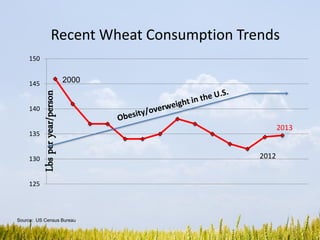
Wheat Consumption Trends Do Not Follow
Obesity Trends
1830-2010
Source: Kasarda DD J Agric Food Chem. 2013 Feb 13;61(6):1155-9.
125
130
135
140
145
150
2012
2013
Lbsperyear/person
Recent Wheat Consumption Trends
Source: US Census Bureau
2000
We Are Making Progress
 Recent positive newspaper, magazines and television
stories:
Is Avoiding Gluten a Risky Fad or a Healthy Diet? NY Times
Before Going Gluten-Free, Make Sure It’s Necessary – NY
Times
“Jimmy Kimmel Live”
“Farewell to gluten free:….” – National Post
“Backlash Has Begun Against Gluten-Free Dieters”-
Washington Post
“Gluten-Free Boom Overshadows Celiac Disease” –
Chicago (PRWEB)
Charlize Theron on “Chelsea Lately” –TV show (R-rated)
Consumer Reports – The Truth About Gluten
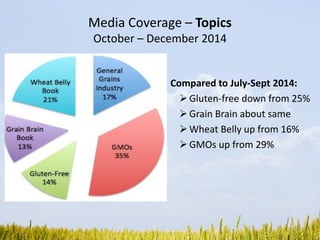
Media Coverage – Topics
October – December 2014
Compared to July-Sept 2014:
Gluten-free down from 25%
Grain Brain about same
Wheat Belly up from 16%
GMOs up from 29%
Media Coverage – Tone
October – December 2014
Compared to July-Sept 2014:
Neutral about the same
Positive up from 15%
Negative down from 29%
Glyphosate
 Originally started with a faulty “research” article from a
faculty member at MIT – based on associations
 Spread through the internet – primarily through the “Healthy
Home Economist” blog
 No truth to the allegations:
Very little glyphosate is used on wheat
What is used, is not drenched (1 quart over a football field)
No residue reaches the bran, germ or endosperm
4.5% of all herbicides are used on wheat
 WFC and others (KWC) worked to disparage these rumors
Upcoming Challenges
 “The Grain Divide” video, focuses on how “big” agriculture
has bred the taste out of wheat and champions growing
“local”
 “Bread Head” video project - a young man on a quest for
answers spurred by his mother’s Alzheimer’s. Emotional, web-
based campaign for funding
However, AARP’s most recent newsletter discussed
dementia and Alzheimer’s
At this time, no known correlation to diet
So What’s the Bottom Line?
 You know the answer – boring that it is:
 All foods in moderation
 Lots of physical activity
 Just because it’s on the best seller list doesn’t make
it factual
 Gluten-free doesn’t mean healthier
 Feed your gut with fiber
 No magic bullets
Thanks for Inviting Me
Questions?
www.Wheatfoods.org

Celebrating Women: Healthy Heroes in Agriculture

  • 1.
    Celebrating Women: HealthyHeroes in Agriculture Women Managing the Farm February 5, 2015 Manhattan, KS Judi Adams, MS, RDN President
  • 2.
    Who Are We? Organized in 1972 at the all-time low of wheat flour consumption at 110 lbs/person  82% of income is from 26 wheat producer organizations; the remainder from industry members
  • 3.
    Voting Members  ADMMilling  AIB International  Ardent Mills  Bimbo Bakeries USA, Inc.  Cereal Food Processors /Milner Milling  KS Wheat Commission  MD Grain Producers Utilization Board  MI Wheat Program  MT Wheat & Barley Committee  NE Wheat Board  NAMA  ND Mill  ND Wheat Commission  OH Small Grains Marketing Program  SD Wheat Commission  TX Wheat Producers Board  WA Grain Commission
  • 4.
    Our Mission To increasethe public’s understanding of the importance of wheat foods in a healthful diet
  • 5.
    But… Today weare talking about women in agriculture My agriculture background: Raised on a dairy farm and then a black angus ranch near Sheridan, WY Have worked for the ND State Extension Service (Foods and Nutrition Specialist) ND Wheat Commission National Sunflower Association Consulted for ND Barley Council, ND “Cowbells,” and others Marketing Director, WY Dept. of Agriculture
  • 6.
    Let’s Talk Gettingand Keeping Healthy  Conflicting nutrition info in the media  Doctors as a source of nutrition guidance  Common Sense  Moderation  Variety  AND physical activity  No Magic Bullets
  • 7.
    The Most ValidatedEating Plans  MyPlate  Mediterranean “Diet”  DASH “Diet”  They all recommend LOTS of physical activity – at least 150 minutes/week for adults (30 min. 5 days a week)  An hour per day is recommended for children
  • 8.
    MyPlate  2010 DietaryGuidelines for Americans are illustrated by MyPlate (2015 Guidelines coming soon)  Been accused of causing the obesity epidemic for promoting low fat and increasing carbs Unfortunately, it is estimated that less than 8% of Americans follow the Guidelines Fat consumption has remained steady at about 80-85 g per day since 1971. We have NEVER gone “low-fat”  A diet of moderation: Fruits and vegetables Grains (1/2 whole) Lean protein Low-fat or no-fat dairy products
  • 9.
    The Mediterranean Diet* Numerous research studies have shown its effectiveness  Recommends moderation in all of the food groups: High in omega 3 oils (primarily fish and flax) High in fruits and vegetables High in grains; some versions emphasize whole grains Moderate in lean meat and low-fat dairy *No one single definition of a “Mediterranean Diet”
  • 10.
    The DASH* Diet For the 5th year in a row, the expert panel from US News & World Report chose the DASH diet as the Best Diet, Healthiest Diet, and the Best Diet for Diabetes  Lowers blood pressure without reducing sodium intake  Results in weight loss  Encourages grains (at least 3 whole), fruits, vegetables, lean meats, fish or poultry, nuts, seeds and legumes *Dietary Approaches to Stop Hypertension
  • 11.
    What Does theConsumer Know about Gluten?
  • 12.
    Gluten-Free Mania Miley Cyrus GwynethPaltrow Elizabeth Hasselbeck
  • 13.
    The Web isDriving the Gluten-Free Message Of all the messages on the internet about gluten, only .5% comes from scientists (celiac researchers and dietitians)
  • 14.
     It isa protein found in wheat, barley and rye  Gluten is typically 80% of the total protein  It is needed for volume and texture for breads; strength/elasticity for tortillas – less needed in cakes, pastries and cookies  It acts as a prebiotic improving gut health What Is Gluten?
  • 15.
    On-going Research  Reducinggluten in grains Tulane in New Orleans and WA State University with Arcadia  Changing the way the body processes gluten ImmunsanT Inc. (vaccine) Alba Theraputics (targets Zonulin which causes leaky gut) Abbvie (enzyme to decompose gluten)
  • 16.
    Who NEEDS toCut out Gluten?  Those with diagnosed celiac disease (<1% in the U.S.)  Those with “non-celiac gluten sensitivity” (NCGS)  Those who are allergic to wheat (can still eat rye and barley)
  • 17.
    Celiac Disease  Genetic,autoimmune disorder triggered by the consumption of gluten found in wheat, rye and barley  Autoimmune disease occurs when the body attacks normal tissue such as the gastrointestinal tract Slide by Shelley Case, RD
  • 18.
    Celiac Incidence  USAverage: 1 in 141 Higher if Scandinavian, Irish, parts of Middle East: 1 in 50-60 1st-degree relatives : 1 in 22 2nd-degree relatives (aunt, cousin) : 1 in 39  Incidence is increasing: 4 times higher than 60 years ago  All autoimmune diseases are increasing
  • 19.
    What Causes CeliacDisease? 1. Genetics – you must have a gene 2. Exposure to gluten 3. A “leaky” gut 4. Trigger - stress, trauma – Surgeries, pregnancy, etc., death in the family or divorce – Viral infections
  • 20.
    1. Increased awareness,better diagnostics 2. Bacterial overgrowth: Antibiotics and medications, antacids, age 3. High salt intake 4. Clean theory or hygiene hypothesis Theories about Celiac Disease Increase
  • 21.
    Theories about CeliacDisease Increase, continued 5. Short fermentations for bread vs. a long fermenting sourdough: breaks down the gluten more 6. Poor diets overall: low fiber, folate, vitamins, too many calories 7. Increase in cesarean births (1/3 in U.S.) 8. Increased vital wheat gluten in the food/cosmetic supply 9. Change in the gut microbiome: may be increasing all autoimmune diseases 21
  • 22.
     Abdominal pain68%  Eczema, rash 40%  Headache 35%  “Foggy mind” 34%  Fatigue 33%  Diarrhea 33%  Depression 22%  Numbness in extremities 20%  Joint pains 11% 22 Non-Celiac Gluten Sensitivity New and Controversial
  • 23.
    Where’s The Research? In 2011, Monash University in Australia announced there were a high percentage of people who were “sensitive” to gluten but did not have celiac disease  In August 2013, the same researchers said they were wrong  They determined that people were rarely sensitive to gluten  The problem is FODMAPS – Fermentable Oligo, Di, Mono saccharides and Polyols.
  • 24.
    Problems May beDue to FODMAPs  Oligosaccharides: fructan, Inulin, wheat, rye, onion, garlic, Jerusalem and globe artichoke, asparagus, chocolate  Polyols: apples, apricots, blackberries, cherries, lychees, nectarines, peaches, pears, plums, prunes, watermelon and some vegetables, including avocados, cauliflower, mushrooms and snow peas; isomalt, maltitol, mannitol, sorbitol and xylitol.  Mono and disaccharides: fructose, lactose (dairy) Source: Barrett JS, Gibson PR. Therap Adv Gastroenterol. 2012 Jul;5(4):261-8.
  • 25.
    Stephano Guandalini, MD Founderand Director of the Chicago Celiac Research Center estimates .5% of the U.S. population have non-celiac gluten sensitivity
  • 26.
    Wheat Allergy  Lessthan .5% of Americans have a diagnosed wheat allergy  Highest in children who usually outgrow it by their teenage years 26
  • 27.
    “Today’s Wheat IsDifferent”  CLAIMS:  18” wheat is a product of 1960s -70s genetic research and is due to GMO wheat  Gluten content is higher in wheat than 50 years ago- studies in both the US and Canada show no changes back as far as 1860.  FACTS: Ancient and modern wheats’ stalks range from 12” to 60” Height genes do not code for protein or gluten content NO GMO Wheat commercially available in the world 27Source: USDA Nat’l Small Grains Collection
  • 28.
    Cost of Gluten-FreeFoods  Gluten-free foods cost on average 162% more than non-GF foods (Down from 242% in 2008)  Source: T Kulai and M Rashid. Assessment of Nutritional Adequacy and Cost of Gluten-Free Food Products. Department of Paediatrics, Dalhousie University, IWK Health Centre, Halifax, Nova Scotia, Canada
  • 29.
    Ingredients that Mustbe Avoided • Wheat and its relatives – Wheat germ, bran, starch, bulgur, durum, semolina, pastas, farro, farina, couscous, triticale, spelt, dinkel, einkorn, emmer, Kamut® • Rye, Barley • Oats – non-certified Gluten-free • Malt/ beer • Malt Extract/ vinegar • Malt Flavoring • Soy sauce • Hydrolyzed vegetable protein • Many flavors • Many other foods
  • 30.
    Nutritional Impact ofa Gluten-Free Diet  Often high in fat, sugar and calories  Usually lower in fiber, B vitamins, iron and folic acid (not enriched)  Many gain weight on this diet Some increase body mass index (BMI) 56%  Fewer grains and whole grains, nearly all refined Often use lower protein/lower fiber grains
  • 31.
    Fiber & Gluten-FreeDiets  Low in total and cereal fiber  Cereal fiber provides benefits different than that of fruits and vegetables and vice-versa  Average of 6 g per day vs average of 16 g per day normally consumed  VS 25-38 g per day recommended  Low fiber may result in:  Constipation  Gut & health issues  Risk of adenocarcinoma
  • 32.
    Fiber and Flatus Flatus emissions: men, fiber 28g mean 12.7 times range 2-53  Flatus emissions: women, fiber 24g mean 7.1 range 1-32  Correlated with fiber intake  Gas is a “good thing” Source: Bolin and Stanton, Eur J Surg Suppl 1998 582:115
  • 34.
    There is nopublished evidence to support a weight loss claim for a gluten-free diet
  • 35.
    22 23 24 25 26 27 28 25 35 4555 65 BodyMassIndex. Carbohydrate(% of total) NHANES (men) NHANES (women) CSFII (men) CSFII (women) BLSA WHS NHS I NHS II HPFS Canadian NBSS Adapted from Gaesser. JADA 2007; 107:1768-1780 Relationship Between Carbohydrate Intake and Body Mass Index (BMI)
  • 36.
    Wheat consumption isnot associated with high levels of belly fat OR obesity In fact:  The French eat 1.5 times as much wheat as the US and have 1/3 the obesity rate  The Italians eat twice as much wheat as the US and have ¼ the obesity rate
  • 37.
    Wheat Consumption TrendsDo Not Follow Obesity Trends 1830-2010 Source: Kasarda DD J Agric Food Chem. 2013 Feb 13;61(6):1155-9.
  • 38.
  • 39.
    We Are MakingProgress  Recent positive newspaper, magazines and television stories: Is Avoiding Gluten a Risky Fad or a Healthy Diet? NY Times Before Going Gluten-Free, Make Sure It’s Necessary – NY Times “Jimmy Kimmel Live” “Farewell to gluten free:….” – National Post “Backlash Has Begun Against Gluten-Free Dieters”- Washington Post “Gluten-Free Boom Overshadows Celiac Disease” – Chicago (PRWEB) Charlize Theron on “Chelsea Lately” –TV show (R-rated) Consumer Reports – The Truth About Gluten
  • 40.
    Media Coverage –Topics October – December 2014 Compared to July-Sept 2014: Gluten-free down from 25% Grain Brain about same Wheat Belly up from 16% GMOs up from 29%
  • 41.
    Media Coverage –Tone October – December 2014 Compared to July-Sept 2014: Neutral about the same Positive up from 15% Negative down from 29%
  • 42.
    Glyphosate  Originally startedwith a faulty “research” article from a faculty member at MIT – based on associations  Spread through the internet – primarily through the “Healthy Home Economist” blog  No truth to the allegations: Very little glyphosate is used on wheat What is used, is not drenched (1 quart over a football field) No residue reaches the bran, germ or endosperm 4.5% of all herbicides are used on wheat  WFC and others (KWC) worked to disparage these rumors
  • 43.
    Upcoming Challenges  “TheGrain Divide” video, focuses on how “big” agriculture has bred the taste out of wheat and champions growing “local”  “Bread Head” video project - a young man on a quest for answers spurred by his mother’s Alzheimer’s. Emotional, web- based campaign for funding However, AARP’s most recent newsletter discussed dementia and Alzheimer’s At this time, no known correlation to diet
  • 44.
    So What’s theBottom Line?  You know the answer – boring that it is:  All foods in moderation  Lots of physical activity  Just because it’s on the best seller list doesn’t make it factual  Gluten-free doesn’t mean healthier  Feed your gut with fiber  No magic bullets
  • 45.
    Thanks for InvitingMe Questions? www.Wheatfoods.org