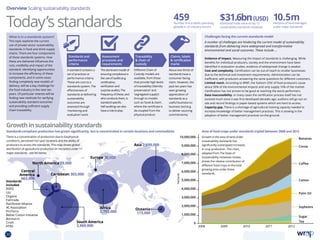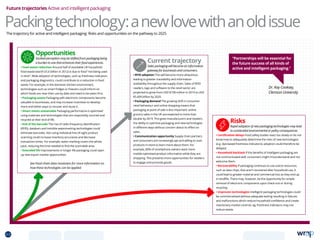


FoodFutures
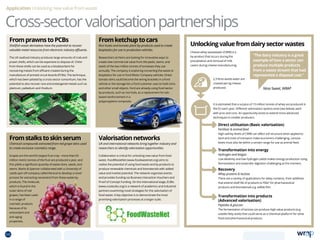
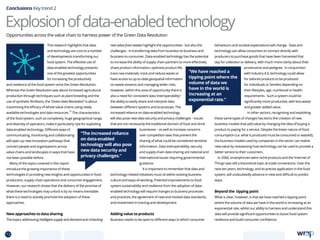
frombusinessasusual
tobusinessunusual
Foreword
The future of food is uncertain. Not since the Second World War has
there been a more pressing need to look again at how we produce,
distribute, value and consume our food. My mother’s generation
were used to being thrifty, understanding the reasons behind post-
war challenges in food supply and the need to ration and respect
what food they had.
If we fast forward to today, we live in a world where challenges to
future food security are becoming more obvious after decades of
relative plenty; and where a third of all food grown is thrown away –
that’s one-in-four calories lost and a major impact not just on our
future food security but on our future
nutritional security.
The reality is that we are at a crossroads, a
tipping point - as the decisions that
governments, businesses and we, as
consumers, make today will determine how and
if we can meet the demands of future
generations. As this report shows, the world’s
population is set to rise to 8.1 billion in the next
decade; and a growing and increasingly urbanised middle class has
aspirations for a more varied protein rich diet. This is happening at a
time when the natural resources we depend upon for our food (land,
soil, freshwater, biodiversity) are under growing stress; and there is
an increasing risk of a major food production shock as the early
squalls of John Beddington’s ‘Perfect Storm’ of food, water and
energy shortages begin to make themselves felt. Closer to home, in
the UK alone, population increases mean that it will take another 5
million tonnes of food to feed the UK population in 10 years’ time.
These are clearly challenging times.
But where there are challenges there are also opportunities. The
raft of data-enabled technologies identified in this report are
becoming more accessible and affordable, driving a revolution in
how the food system operates, connecting supply chain partners
and consumers in new and innovative ways, improving yields and
communication, reducing resource use and waste; and opening the
door to new food chain collaborations and partnerships.
Not all solutions or opportunities are technology-based. The
potential to create more concrete links between food system
sustainability and public health and nutrition are of increasing
interest to policymakers, businesses and civil society. If obesity rates
and diet-related ill-health rise as predicted, with the resultant costs
to society and the health system, a wider coalition of interests need
to come together to ensure a joined-up policy and business
response. There are some obvious synergies and win-win situations
in the debate around healthy, sustainable diets (e.g. more plant-
based foods; new and more sustainable sources of protein; better
range of portions reflecting different dietary
needs, resulting in less food waste and
overconsumption) that deserve further
exploration. The future food system will need to
play an active role in helping consumers make
healthier and more sustainable food choices.
If the past decade has been one of discovering
the nature and scale of the issues we face and
beginning to respond to them, then the success of
the next 10 years will be judged on the choices we make in finding
solutions that transform the food chain and our relationship with
food.
We have to ensure that we have a food chain that is ‘FIT’ for the
future (flexible, intelligent, transparent) - one that is ready to
respond to future challenges and trends; and is able to reconcile the
needs of consumers, whilst protecting and enhancing our natural
environment.
Dr Liz Goodwin, OBE
CEO, WRAP
“The future food system will
need to play an active role
in helping consumers make
healthier and more
sustainable food choices.”
i
Executivesummary 1
Introduction3
Identifyingfoodsystempriorities 4
Foodsystemtrends 5
FoodFutures:keytrendsforthenextdecade 6
FoodFuturestopics 7
OverviewoftheFoodFuturetopics 8
Topics
Climateriskstofoodchainresilience 9
Farmingforthefuture 13
Landscape-scaleopportunities 17
Alternativefeedsandproteins 21
Aquacultureexpansion 25
Scalingsustainabilitystandards 29
Skillsforfuturefoodchallenges 33
Consciousfoodchoices 37
Redefininggroceryretailmodels 41
Newpartnershipscollaborations 45
Foodchaindatarevolution 49
Industry4.0inthefoodsystem 53
Intelligentsupplyanddemand 57
Activeintelligentpackaging 61
Unlockingnewvaluefromwaste 65
Conclusions,keytrendsandrecommendations69
This report is best viewed in Adobe Reader -
this will enable the navigation functionality.
All of the sources of information used to
develop this report are available in a separate
document. This can be downloaded from
www.wrap.org.uk/foodfuturesreferences
How to use
this report
You can navigate between topics by clicking
hyperlinks embedded in the topic icons.
Additional navigation buttons can also be
found at the bottom left hand side of each
page. These enable you to move forward and
back within the document or jump to the
contents page using the contents button.
Contents
ii
CONTENTS
AdrianJones(WelshGovernment)
AliceEllison(BritishRetailConsortium)*
AmyCrooks(NationalSkillsAcademyforFoodandDrink)
AndreaGraham(NationalFarmersUnion)*
AndrewEdlin(2SistersFoodGroup)*
AngelaBooth(ABAgri)
AvtaMathar(GreenChemistryCentreofExcellence,UniversityofYork)
BobGordon(Nando’s)*
CerisJones(NationalFarmersUnion)*
CharlesGodfray(UniversityofOxford)*
DanCrossley(FoodEthicsCouncil)*
DavidMorris(WelshAssemblyGovernment)*
EdwinaHughes(Sodexo)*
GordonFriend(DepartmentforEnvironment,FoodandRuralAffairs)*
HenryKing(Unilever)*
JeffreyHyman(FoodDrinkInnovationNetwork)*
JimBracken(GS1)
KirstenVanEssen(CentreforIndustrialSustainability)
KylieRussell(EnvironmentAgency)*
LizParkes(EnvironmentAgency)*
MariannePemberton(EthicalBeanCoffee)
MartinForsyth(BidvestFoodservice)
MikeJames(ATSGlobal)
PatrickMallet(ISEAL)
PiersHart(WWF-UK)
RajKhosla(ColoradoStateUniversity)
RowlandHill(MarksSpencer)*
SaraEppel(DepartmentforEnvironment,FoodandRuralAffairs)*
ScottJohnston(Young’sSeafood)
ShaunMcLennan(DepartmentforEnvironment,FoodandRuralAffairs)
StephenBoyle(ZeroWasteScotland)*
SteveEvans(EPSRCCentreforSustainableManufacturing)*
SteveReeson(FoodDrinkFederation)*
TaraGarnett(OxfordMartinSchool)*
TimBenton(GlobalFoodSecurity)*
TomPowell(DepartmentforEnvironment,FoodandRuralAffairs)
*ThoughtLeadershipGroup
Written by:This report has been made possible with the
help of the following people:
Acknowledgements
DragonRouge
ETANTE
Report design
Richard Scott Design
Although the contributors
have helped to provide
valuable input for this report,
the final content is the
responsibility of the authors.
© WRAP
iii
Executivesummary
Achieving food and nutrition security in an increasingly
complex and uncertain world means that “business as usual”
approaches may no longer be a credible option. The UK food
system was built for an era that has passed; businesses and
policymakers are having to adapt and react to new and
rapidly evolving economic, environmental and social realities.
The challenges are well rehearsed and cover a dizzying range
of issues, from shifting global trade patterns, to water stress
and increasing consumer expectations. Understandably
therefore, the leaders of tomorrow will need to look further
ahead to find ways to tackle the emerging challenges of today
- something we term ‘doing business unusual’.
Through this research we have
identified a range of areas where
businesses and policymakers can foster
innovation, develop more resilient value
chains and improve the offer to
consumers. This report presents an
in-depth analysis of where these
opportunities for doing business unusual
will come from. It has been created to
inspire, provoke debate and ultimately influence the choices
made today. In all, 15 ‘priority topics’ have been identified that
range from the expansion of global aquaculture to the
opportunities presented by automation and data exchange in
food manufacturing (so-called ‘Industry 4.0’).
Each topic establishes its critical relevance to the future of
the food system and presents key risks, opportunities and
existing examples of innovation. Three cross-cutting trends
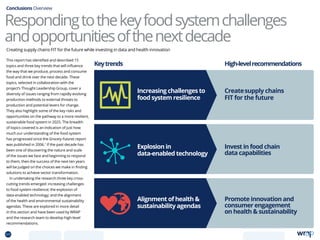
also emerge as priorities for attention: the increasing
challenges to food system resilience; the explosion in data-
enabled technology and the alignment of health and
sustainability agendas.
These trends, explored in more detail below,
are used as a framework for prioritising the steps
we need to take toward a healthier, more
sustainable society.
Resilient supply chains that
are FIT for the future
In the ten years since the WRAP Grocery Futures
report was published, the food system and wider
society have witnessed significant changes: social
media was born and has continued to expand its
influence; global food security has come to
mainstream attention – as has the food system’s exposure to
climate change. These changes have meant
that many ‘sustainability’ issues have
become strategic issues for businesses
across the food value chain. Key risks and
impacts and the business case for action
are now understood far more clearly than
they were in 2006. However, the complexity
of addressing the many issues that stand in
the way of achieving a sustainable and
resilient food future have also become more clear.
Events such as the 2007/8 World Food Price Crisis and
‘Horsegate’ have highlighted the fragility of the food system.
Investors and financial institutions, perhaps sensitised by the
recent global financial crisis, are also increasingly conscious of
systemic risks to the economy and the food system. While
concerns about external pressures, such as water scarcity
and the degradation of our soils, have become the focus of
debate on supply chain risk, there is now a growing
appreciation of the risks that stem from the form that
modern food systems and economies take: they are large,
complex, interconnected and specialised.
To respond to these challenges, future supply chains will
need to be remodelled to be flexible, intelligent, and
transparent (FIT).
• Flexibility will come from a range of attributes that
encourage resilience, such as diversity and redundancy.
• Intelligence will come from businesses and policymakers
investing more in understanding, communicating and
managing risks – and identifying and realising new
opportunities. This will require interdisciplinary
partnerships, the smarter use of data and a reassessment
of the skills and training needs of the UK food workforce.
• Greater transparency will be needed to help highlight
hidden risks that come from complexity and create
incentives that drive better decision-making and
collaborations in supply chains.
A number of opportunities exist for business and
policymakers to engage in this area, such as the development
of new products from diversified protein sources;
opportunities to realise efficiencies and reduce food waste; or
creating new high value by-products from undervalued waste
streams. The location-specific nature of many critical food
system challenges will also call for a new breed of local and
‘landscape-scale’ partnerships that deliver more sustainable
“The leaders of tomorrow
will need to look further
ahead to find ways to
tackle the emerging
challenges of today.”
1 TOPICSMENU CONCLUSIONSCONTENTS
resource use. Policymakers can support these initiatives
through the development of an open spatial data
infrastructure for the UK – a national-level framework of
geographically relevant data, policies and tools that are easy
to access and use.
New opportunities from data-enabled
technology in the food chain
Data and data-enabled technology are at the core of a
number of the opportunities identified in this research. The
effective use of data-enabled technology presents one of the
greatest opportunities for the food system since the Green
Revolution. Whereas the Green Revolution saw increased
agricultural productivity through techniques, such as plant
breeding and the use of synthetic fertilisers, the ‘Green Data
Revolution’ will create a smarter, more flexible and resilient
food system, as more data is created and shared between
supply chain partners and consumers.
The characteristics of the food system, such as complexity,
huge geographical range, and diversity of
operators make it particularly suitable for
exploiting data-enabled technologies.
This report explores a number of exciting
opportunities open to business and
policymakers including precision
agriculture, smarter certification, factory
automation, ‘intelligent’ packaging, risk
analytics, supply chain forecasting,
product personalisation and new means
of engaging with consumers.
Our research shows that the delivery of the potential
benefits from these technologies is by no means inevitable:
there is a need to actively promote the adoption of these
approaches and invest in skills and capacity. Also, care will be
needed to avoid the downsides of increased digital
connectivity – such as new data security and privacy risks.
To unlock the potential of this area food businesses and
policymakers should develop ambitious data strategies that
identify and leverage the data-enabled technologies that are
most appropriate to their organisations.
Product innovation and consumer engagement
on health and sustainability
In the last ten years, the link between food sustainability and
public health has become of increasing interest to business
leaders, policymakers and civil society. The concept of
‘healthy sustainable diets’ has come to dominate research
and policy discussions - in particular the synergies and trade-
offs between dietary preferences and the environmental
impacts of global supply chains. National governments are
starting to add weight to this debate by providing dietary
recommendations that aim to deliver improved
environmental and nutritional outcomes.
This report underlines the wider set of
interdependencies between public health,
the food system and the integrity of the
natural environment. For example, how
environmental change has the potential to
impact public health by increasing food
safety risks or reducing the nutritional
quality of crops. In addition to this,
ensuring the UK has a diversified,
sustainable and healthy supply of protein
will be one of the defining challenges of the coming decades.
The solutions, such as new models of land-based aquaculture
and the use of alternate sources of protein in animal feed
(likely to be the main focus in the next decade) and as novel
ingredients in food products, have many potential
advantages as long as any new risks to human and
environmental health are properly managed. A systems
approach to dealing with health and sustainability outcomes
is therefore critical when it comes to considering our future
food and protein options, but also calls for more engagement
and support from the public. Consumer interest in health and
nutrition is increasing but it is important that this trend is
capitalised on to also deliver broader sustainability outcomes,
as well as new products and services.
The future of food
Making the most from these opportunities over the next ten
years will be judged by the degree to which we find scalable
solutions that transform the sector and our relationship
with food.
In order to adapt and respond to future shocks,
opportunities and trends, UK policymakers and businesses
will need to take a leadership role: exploring and supporting
the uptake of new technologies, production systems and raw
materials; realising the benefits of investing in data and skills;
and establishing new and innovative collaborations and
regulatory frameworks. By embracing ‘business unusual’ we
can ensure that our food system is truly fit for the future.
Executivesummary
“The effective use of data-
enabled technology
presents one of the
greatest opportunities for
the food system since the
Green Revolution.”
2 TOPICSMENU CONCLUSIONSCONTENTS
Introduction
Introduction Welcome
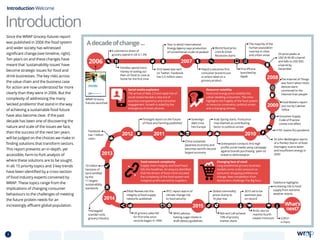
Since the WRAP Grocery Futures report
was published in 2006 the food system
and wider society has witnessed
significant change (see timeline, right).
Ten years on and these changes have
meant that ‘sustainability issues’ have
become strategic issues for food and
drink businesses. The key risks across
the value chain and the business case
for action are now understood far more
clearly than they were in 2006. But the
complexity of addressing the many
‘wicked problems’ that stand in the way
of achieving a sustainable food future
have also become clear. If the past
decade has been one of discovering the
nature and scale of the issues we face,
then the success of the next ten years
will be judged on the choices we make in
finding solutions that transform sectors.
This report presents an in-depth, yet
accessible, farm-to-fork analysis of
where these solutions are to be sought.
In all, 15 priority topics and 3 key trends
have been identified by a cross-section
of food industry experts convened by
WRAP. These topics range from the
implications of changing consumer
behaviours to the challenges of meeting
the future protein needs for an
increasingly affluent global population.
Adecadeofchange...
2006
What’s
next?
WRAP Grocery
Futures launched
E-commerce share of
grocery spend in UK is 1.5%
Families spend more
money on eating out
than on food to cook at
home for the first time
First tweet was sent
on Twitter. Facebook
has 5.5 million users
PepsiCo becomes first
consumer brand to put
a carbon label on a
grocery product
First iPhone
launched by
Apple
Oil price peaks at
USD $145.85 a barrel
and falls to USD $32
a barrel by
December
The majority of the
human population
now live in cities
and urban areas
The Internet of Things
was ‘born’ when more
devices were
connected to the
Internet than people
Food Matters report
put out by Cabinet
Office
Groceries Supply
Code of Practice
comes into effect
Sir John Beddington warns
of a ‘Perfect Storm’ of food
shortages, scarce water
and insufficient energy in
2030
World food price
crisis  Great
Recession starts
Year in which International
Energy Agency says production
of conventional crude oil peaked
Social media explosion
The arrival of Web 2.0 and rapid rise of
social media heralds a new era of
business transparency and consumer
engagement. Growth is aided by the
emergence of smart phones.
Food network complexity
Supply chain integrity and food fraud
hits the headlines. An enquiry identified
that the drivers of food crime included
the complexity of the food system and
marginal profits earned by suppliers.
Resource volatility
Food and energy price volatility hits
urban-dwelling consumers. The crisis
highlights the fragility of the food system
to resource constraints, political unrest
and a changing climate.
2007
2008
2009
201020112012
2013
2014
2015
H1N1 (swine flu) pandemic
Arab Spring starts. Food price
rises blamed as contributing
factor to political unrest
Sovereign
debt crisis
hits Europe
China surpasses
Japanese economy and
becomes world’s second
largest economy
Foresight report on the Future
of Food and Farming published
Facebook
has 1 billion
users
10 million
hectares of
land certified
by the
11 largest
sustainability
standards
“Horsegate”
scandal rocks
grocery industry
Elliott Review into the
integrity of food supply
networks published
UK grocery sales fell
for first time since
records began in 1994
WHO advises
halving sugar intake in
draft dietary guidelines
IPCC report warns of
climate change risk
to food security
Global commodity
prices slump to
16 year low
2015 set to be
warmest year
on record
Taskforce highlights
increasing risk to food
supply from extreme
weather events
Arctic sea ice
reaches fourth
lowest minimum COP21
in Paris
Aldi and Lidl achieve
10% of grocery
market share
Changing face of retail
Long established grocery business
models come under pressure as
consumer shopping preferences
change. New competition from
discounters challenge The Big Four.
Greenpeace conducts first high
profile social-media savvy campaign
against brands purchasing palm oil
linked to deforestation
3 TOPICSMENU CONCLUSIONSCONTENTS
Identifyingfoodsystempriorities
Introduction Research methodology
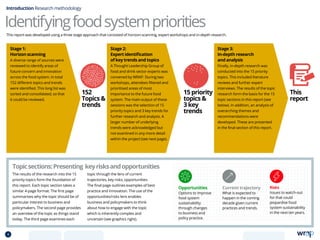
Stage 2:
Expert identification
of key trends and topics
A Thought Leadership Group of
food and drink sector experts was
convened by WRAP. During two
workshops, attendees filtered and
prioritised areas of most
importance to the future food
system. The main output of these
sessions was the selection of 15
priority topics and 3 key trends for
further research and analysis. A
larger number of underlying
trends were acknowledged but
not examined in any more detail
within the project (see next page).
The results of the research into the 15
priority topics form the foundation of
this report. Each topic section takes a
similar 4-page format: The first page
summarises why the topic should be of
particular interest to business and
policymakers. The second page provides
an overview of the topic as things stand
today. The third page examines each
topic through the lens of current
trajectories, key risks, opportunities.
The final page outlines examples of best
practice and innovation. The use of the
opportunities/risks lens enables
business and policymakers to think
about how to engage with the topic
which is inherently complex and
uncertain (see graphics right).
Topicsections:Presenting keyrisksandopportunities
Opportunities
Options to improve
food system
sustainability
through changes
to business and
policy practice.
Current trajectory
What is expected to
happen in the coming
decade given current
practices and trends.
Risks
Issues to watch-out
for that could
jeopardise food
system sustainability
in the next ten years.
This report was developed using a three stage approach that consisted of horizon-scanning, expert workshops and in-depth research.
Stage 1:
Horizon scanning
A diverse range of sources were
reviewed to identify areas of
future concern and innovation
across the food system. In total
152 different topics and trends
were identified. This long list was
sorted and consolidated, so that
it could be reviewed.
Stage 3:
In-depth research
and analysis
Finally, in-depth research was
conducted into the 15 priority
topics. This included literature
reviews and further expert
interviews. The results of the topic
research form the basis for the 15
topic sections in this report (see
below). In addition, an analysis of
overarching themes and
recommendations were
developed. These are presented
in the final section of this report.
152
Topics 
trends
15 priority
topics 
3 key
trends
This
report
4 TOPICSMENU CONCLUSIONSCONTENTS
Economic challenges
Weak economic growth in the
EU and depressed commodity
prices have a significant
influence on decision-making
from farm to store.
Increasing challenges
to food system
resilience
Food system actors
are having to adapt
to an uncertain
operating
environment.
Climate 
environmental change
The risks of climate-related shocks
to the food system are increasing.
Globalisation  trade
Global trade flows are
changing, with more
competition from purchasers
in emerging markets.
Demographics  inequality
The widening wealth gap and aging
population are altering household food
shopping and eating behaviours.
Alignment of health
sustainabilityagendas
There is a growing
appreciation of the many
synergies - but also some
important tensions - when
tackling major public health
and environmental challenges
of this century.
Ideology
Food supply chains are
having to cater to an
increasingly diverse
range of religious
beliefs.
Convenience
Changing social norms and working
practices continue to influence the
frequency and format of food consumption.
Social media
More than two thirds of the British
population have social media
profiles. The way households
make purchasing and dining
decisions is increasingly online.
The food, energy,
water nexus
Despite low commodity
prices, long term concerns
remain over availability and
quality of resources
underpinning the food system
e.g. soil, water and energy.
Urbanisation
The world’s urban population will
grow by more than a billion
people between 2010 and 2025.
Environment
Society
Economy
Explosion of data-
enabled technology
The amount of data is growing
at an exponential rate. This
offers potential for a smarter,
more responsive food system.
Introduction Trends
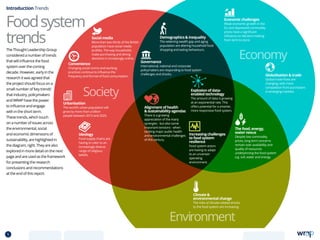
Foodsystem
trends
The Thought Leadership Group
considered a number of trends
that will influence the food
system over the coming
decade. However, early in the
research it was agreed that
the project should focus on a
small number of ‘key trends’
that industry, policymakers
and WRAP have the power
to influence and engage
with in the short term.
These trends, which touch
on a number of issues across
the environmental, social
and economic dimensions of
sustainability, are highlighted in
the diagram, right. They are also
explored in more detail on the next
page and are used as the framework
for presenting the research
conclusions and recommendations
at the end of this report.
Governance
International, national and corporate
policymakers are responding to food system
challenges and shocks.
5 TOPICSMENU CONCLUSIONSCONTENTS
The growth in ‘smart’ technology
is driving a revolution in how the
entire food system operates, from
a better understanding of land
resources to automated factories
and kitchens. Data-enabled
technology is becoming cheaper
and more accessible all the time,
but the food system has yet to
fully capitalise on the benefits
these technologies can unlock.
Over the next ten years these
benefits will be explored as
companies, households and
policymakers seek to make better
use of data. Those organisations
that have the capabilities to
realise this potential will be
better placed to respond to the
challenges of tomorrow.
By 2025 the “Perfect Storm” of
energy, water and food shortages
are expected to be impacting
society. The food systems
developed in the last century
will not be fit for dealing with
the increasing complexity and
volatility of environmental, social
and economic systems. Failure to
respond proactively to these new
challenges will leave businesses
exposed to disruptions or left
with business models that are
unresponsive to changing societal
and consumer demands. There is
a need to understand and create
a food system that has greater
resilience to shocks and pressures
that will be placed on it.
The links between food system
sustainability and public health
are of increasing interest to
business leaders, policymakers
and civil society. The concept
of ‘healthy sustainable diets’
has become an important area
of this debate - in particular
the synergies and trade-offs
between dietary preferences
and the environmental impacts
of food supply chains. Beyond
diet, there is growing agreement
that the serious environmental
and public health challenges we
face need to be addressed in an
integrated manner so that new
opportunities can be promoted
- and unintended consequences
can be avoided.
Explosion in data-enabled technology
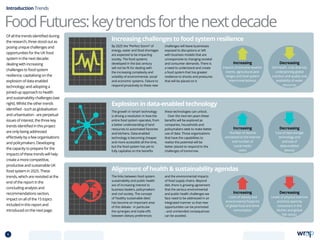
Increasing challenges to food system resilience
Alignment of health  sustainability agendas
Introduction Trends
Of all the trends identified during
the research, three stood out as
posing unique challenges and
opportunities for the UK food
system in the next decade:
dealing with increasing
challenges to food system
resilience; capitalising on the
explosion of data enabled
technology; and adopting a
joined-up approach to health
and sustainability challenges (see
right). Whilst the other trends
identified - such as globalisation
and urbanisation - are perpetual
issues of interest, the three key
trends identified in this project
are only being addressed
effectively by a few organisations
and policymakers. Developing
the capacity to prepare for the
impacts of these trends will help
create a more competitive,
productive and sustainable UK
food system in 2025. These
trends, which are revisited at the
end of the report in the
concluding analysis and
recommendations section,
impact on all of the 15 topics
included in this report and
introduced on the next page.
FoodFutures:keytrendsforthenextdecade
Increasing
Impacts of extreme weather
events, agricultural pest
ranges and food system
interconnectedness
Increasing
Number of devices
connected to the internet
and number of
social media
users
Increasing
Costs of obesity and
environmental footprint
of global food and drink
consumption
Decreasing
Soil health, crop diversity
underpinning global
nutrition and quality and
availability of water
resources
Decreasing
Cost of data storage
technology and
and size of
data-enabled
devices
Decreasing
Levels of physical exercise
and time spent by
consumers in the
kitchen and global
fish stocks
6 TOPICSMENU CONCLUSIONSCONTENTS
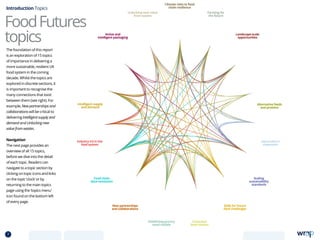
FoodFutures
topics
The foundation of this report
is an exploration of 15 topics
of importance in delivering a
more sustainable, resilient UK
food system in the coming
decade. Whilst the topics are
explored in discrete sections, it
is important to recognise the
many connections that exist
between them (see right). For
example, New partnerships and
collaborations will be critical to
delivering Intelligent supply and
demand and Unlocking new
value from wastes.
Navigation
The next page provides an
overview of all 15 topics,
before we dive into the detail
of each topic. Readers can
navigate to a topic section by
clicking on topic icons and links
on the topic ‘clock’ or by
returning to the main topics
page using the ‘topics menu’
icon found on the bottom left
of every page.
Introduction Topics
Climate risks to food
chain resilience
Farming for
the future
Unlocking new value
from wastes
Landscape-scale
opportunities
Active and
intelligent packaging
Alternative feeds
and proteins
Intelligent supply
and demand
Aquaculture
expansion
Scaling
sustainability
standards
Food chain
data revolution
New partnerships
and collaborations
Skills for future
food challenges
Industry 4.0 in the
food system
Conscious
food choices
Redefining grocery
retail models
7 TOPICSMENU CONCLUSIONSCONTENTS
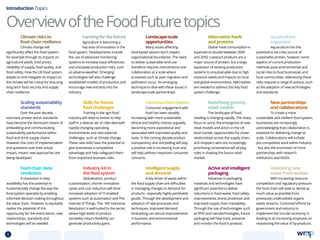
OverviewoftheFoodFuturetopics
Introduction Topics
Farmingforthefuture
Agriculture is becoming a
key area of innovation in the
food system. Developments include
the use of advanced monitoring
systems to increase input efficiencies
and anticipate production risks, such
as adverse weather. Emerging
technologies will also challenge
established models of production and
encourage new entrants into the
industry.
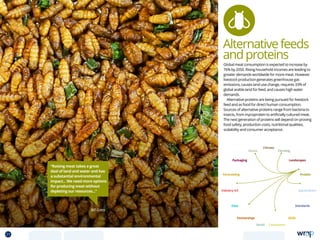
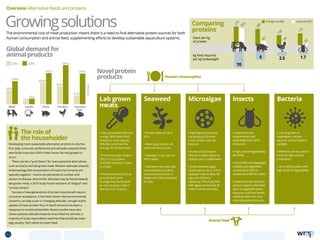
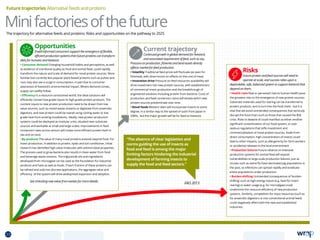
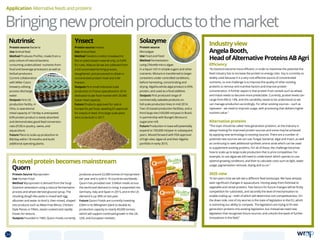
Alternative feeds
and proteins
Global meat consumption is
expected to double between 2000
and 2050. Livestock products are a
major source of protein, but a large
expansion of existing production
systems is unsustainable due to high
resource needs and impacts on local
and global environments. Alternatives
are needed to address this key food
system challenge.
Food chain data
revolution
A revolution in data
availability has the potential to
fundamentally change the way the
food system operates by enabling
informed decision making throughout
the value chain. However to equitably
realise the potential of this
opportunity for the entire sector, new
relationships, standards and
technologies will be needed.
Climate risks to
food chain resilience
Climate change will
significantly affect the food system -
for example through its impacts on
agricultural yields, food prices,
reliability of supply, food quality, and
food safety. How the UK food system
adapts to and mitigates its impact on
the climate will be critical for ensuring
long term food security and supply
chain resilience.
New partnerships
and collaborations
To create a more
sustainable and resilient food system,
businesses are increasingly
acknowledging that collaboration is
essential for delivering change at
scale. Collaborations will include
pre-competitive work within industry
- but also the promotion of more
partnerships with research
institutions and NGOs.
Active and intelligent
packaging
Advances in packaging
materials and technologies have
significant potential to deliver
reductions in food waste, food safety
improvements, brand protection and
improved supply chain traceability.
Through the use of technologies such
as RFID and nanotechnologies, future
packaging will help track, preserve
and monitor the food it protects.
Redefining grocery
retail models
The landscape of food
retailing is changing rapidly. The sharp
focus on price, the emergence of new
retail models and actors in the UK
food market, opportunities for closer
relationships across the supply chain,
and shoppers who are increasingly
prioritising convenience will all play
roles in shaping the future retail
market.
Intelligent supply
and demand
A key driver of waste within
the food supply chain are difficulties
in managing changes in demand for
products - especially highly perishable
goods. Through the development and
adoption of new processes and
techniques, improved demand
forecasting can secure improvements
in business and environmental
performance.
Landscape-scale
opportunities
Many issues affecting
land-based sectors don’t respect
organisational boundaries. The need
to deliver sustainable land use
therefore requires interventions and
collaboration at a scale where
processes such as pest migration and
pollination occur. An emerging
technique to deal with these issues is
landscape-scale partnerships.
Skills for future
food challenges
Training in the agri-food
industry will need to evolve to help
staff in a diverse set of roles deal with
rapidly changing operating
environments and new external
challenges, such as climate change.
These new skills have the potential to
give businesses a competitive
advantage and help safeguard them
from important business risks.
Consciousfoodchoices
Consumer engagement with
food has been steadily
increasing with more sustainable,
ethical and healthy choices arguably
becoming more aspirational and
associated with improved quality and
taste. In the coming decade product
transparency and storytelling will play
a positive role in increasing trust and
will help address important consumer
concerns.
Scaling sustainability
standards
Over the past decade,
voluntary private sector standards
have become the dominant means of
embedding and communicating
sustainability performance within
food and drink supply chains.
However the costs of implementation
and questions over their actual
impact, means new approaches are
being developed.
Industry 4.0 in
the food system
Globalisation, product
customisation, shorter innovation
cycles and cost reduction will drive
increased adoption of IT-enabled
systems such as automation and The
Internet of Things. This ‘4th Industrial
Revolution’ is well-suited to the sector,
where high levels of product
variability means flexibility can
generate productivity gains.
Unlocking new
value from wastes
With increasing resource
competition and regulatory pressure
the food chain will seek to derive as
much value as possible from
previously underutilised organic
waste streams. Concerted efforts by
government and industry to
implement the ‘circular economy’ is
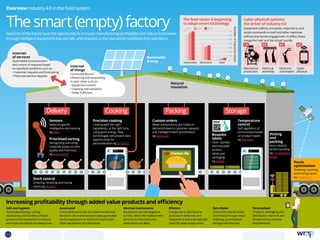
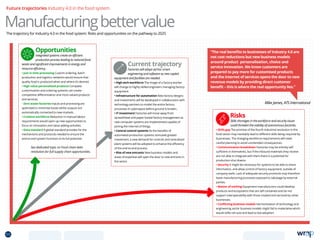
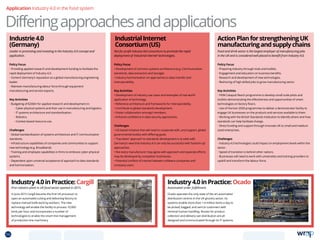
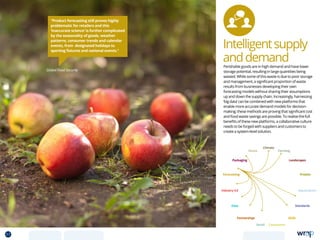
leading to an increasing emphasis on
reassessing the value of by-products.
Aquaculture
expansion
Aquaculture has the
potential to be a key source of
sustainable protein, however some
aspects of current production
methods pose environmental and
social risks to food businesses and
local communities. Addressing these
risks requires a range of actions, such
as the adoption of new technologies
and standards.
8 TOPICSMENU CONCLUSIONSCONTENTS
UK-US Taskforce on Extreme Weather
and Global Food System Resilience
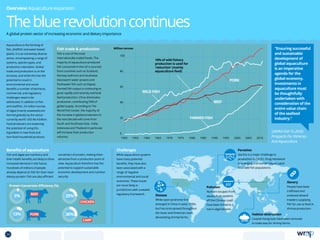
Climaterisks
tofoodchain
resilience
“Evidence suggests that the risk of a
1-in-100 year production shock
event from extreme weather could
increase to a 1-in-30 year or more in
the next few decades.”
By 2025 the food system is expected to be experiencing
the ‘Perfect Storm’ of food, energy and water shortages.
Climate change will affect food supply chain resilience
through its impact on food safety, raw material
availability, and food quality. Gradual changes to
regional climate combined with unexpected and
increasingly extreme weather shocks have the potential
to change the way supply chains operate and impact
upon the price we pay for food. Anticipating and
responding to these changes will require responses
across the food system using a range of new tools,
technologies, business models and practices.
Data
Aquaculture
Protein
Farming
Climate
Partnerships
Consumers
Packaging
Retail
Forecasting
Landscapes
Skills
Industry 4.0
Waste
Standards
9 TOPICSMENU CONCLUSIONSCONTENTS
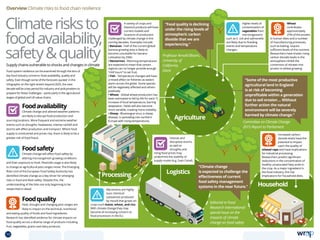
Food system resilience can be examined through the lens of
key food industry concerns: food availability, quality and
safety. Even though some of the forecasts quoted in the
infographic on the right stretch beyond 2025, the next
decade will be a key period for industry and policymakers to
prepare for these challenges – particularly in the agricultural
stages of global and UK value chains.
Climaterisksto
foodavailability,
safetyquality
Overview Climate risks to food chain resilience
Wheat
contributes
approximately
25% of the protein
in human diets and a number
of manufacturing processes,
such as baking, require
sufficient levels of this nutrient.
Researchers have shown rising
carbon dioxide levels in the
atmosphere inhibit the
conversion of nitrates into
protein in wheat growing.
Increased carbon-
dioxide levels have the
potential to impact
upon the quality of
oilseed rape and have implications
for industrial processing.
Researchers predict significant
reductions in the concentration of
healthy unsaturated fatty acids in
the crop. As a major ingredient in
the food industry, this has
implications for household diets.
A variety of crops and
livestock products will have
current models and
locations of production
challenged by climate change in the
coming decades. Examples include:
• Bananas - Half of the current global
banana growing area is likely to
become unsuitable for banana
cultivation by 2060.
• Nectarines - Warming temperatures
are expected to mean that certain
regions can no longer provide enough
“chill hours” to set fruit.
• Fish - Temperature changes will have
a mixed effect on fisheries as waters
warm across the globe. Some species
will be negatively affected and others
positively.
• Wheat - Global wheat production has
been estimated to fall by 6% for each °C
increase of local temperature, barring
adaptation. Yields will also become
more variable, creating more volatility.
• Sheep - Bluetongue virus, a sheep
disease, is spreading into northern
Europe with rising temperatures.
Intense and
disruptive storms
as well as
droughts and
rising food prices may
undermine the stability of
supply routes (e.g. Suez Canal).
Mycotoxins are highly
toxic chemical
substances produced
by mould that grows on
crops such maize, wheat, and rice.
With climate change they may
become of increasing concern to
food processors in the EU.
Committee on Climate Change
2015 Report to Parliament
Editorial in Food
Research International
special issue on the
impacts of climate
change on food safety
“Some of the most productive
agricultural land in England
is at risk of becoming
unprofitable within a generation
due to soil erosion ... Without
further action the natural
environment will be severely
harmed by climate change.”
“Food quality is declining
under the rising levels of
atmospheric carbon
dioxide that we are
experiencing.”
Foodavailability
Climate change and altered weather patterns
are likely to disrupt food production and
sourcing locations. More frequent and extreme weather
events such as droughts, heatwaves, intense rainfall and
storms will affect production and transport. Where food
supply is constrained and prices rise, there is likely to be a
greater risk of food fraud.
Foodsafety
Climate change will affect food safety by
altering microorganism growing conditions
and their exposure to food. Pesticide usage is also likely
to change as agricultural pest ranges move. The Emerging
Risks Unit of the European Food Safety Authority has
identified climate change as a key driver for emerging
risks in food and feed safety. Despite this, the
understanding of the links are only beginning to be
researched in detail.
Foodquality
Heat, drought and changing pest ranges are
likely to impact on the technical, nutritional
and eating quality of foods and food ingredients.
Research has identified evidence for climate impacts on
food quality across a diverse range of products including
fruit, vegetables, grains and dairy products.
Logistics
Household
“Climate change
is expected to challenge the
effectiveness of current
food safety management
systems in the near future.”
Processing
Agriculture
Higher levels of
contamination of
vegetables from
microorganisms
such as E. coli and salmonella
are likely due to flooding
events and temperature
changes.
Supply chains vulnerable to shocks and changes in climate
Professor Arnold Bloom,
University of
California,
Davis
10 TOPICSMENU CONCLUSIONSCONTENTS
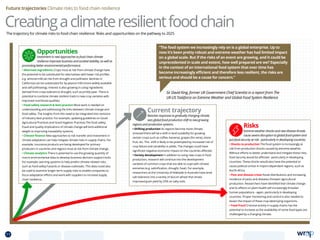
Current trajectory
Reactive responses to gradually changing climate
sees global food production shift to new growing
regions and production systems.
• Shifting production As regions become more climate
stressed there will be a shift in land suitability for growing
certain crops such as coffee, bananas, grapes (for wine), stone
fruit, etc. This shift is likely to be preempted by increased risk of
crop failure and variability in yields. The changes could have
significant negative economic impact on the countries affected.
• Variety development In addition to using new crops in food
production, research will continue into the development
varieties of common crops that are able to cope with climate
extremes (e.g. salinification, drought, heat). For example,
researchers at the University of Adelaide in Australia have bred
salt tolerance into a variety of durum wheat that shows
improved grain yield by 25% on salty soils.
Opportunities
Investment in new approaches to food chain climate
resilience improves business and societal stability, as well as
promoting better environmental performance.
• Alternate ingredients Crops most at risk from climate change have
the potential to be substituted for alternatives with lower risk profiles
e.g. almond milk (at risk from drought and pollinator declines in
California) can be substituted for by peanut milk (more widely available
and self-pollinating). Interest is also growing in using ingredients
derived from crops tolerant to drought, such as prickly pear. There is
potential to combine climate resilient traits in new crop varieties with
improved nutritional qualities.
• Food safety research  best practice More work is needed on
understanding and addressing the links between climate change and
food safety. The insights from this need to be integrated into revisions
of industry best practice. For example, updating guidelines on Good
Agricultural Practices and Good Hygienic Practices.The food safety,
fraud and quality implications of climate change will lend additional
weight to improving traceability systems.
• Climate finance New approaches to risk transfer and investment in
climate adaptation can help mitigate climate risks in supply chains. For
example, insurance products are being developed for primary
producers in countries and regions most at risk from climate change.
• Climate analytics There is potential to use the growing quantity of
macro environmental data to develop business decision-support tools.
For example, warning systems to help predict climate-related risks,
such as food safety hazards or disease outbreaks. This data could also
be used to examine longer-term supply risks to enable companies to
focus adaptation efforts and work with suppliers to increase supply
chain resilience.
Creatingaclimateresilientfoodchain
Future trajectories Climate risks to food chain resilience
Risks
Extreme weather shocks and new disease threats
cause severe disruption to global food system and
put food security at risk - particularly in developing countries.
• Shocks to production The food system is increasingly at
risk from production shocks caused by extreme weather.
Without efforts to better understand and mitigate these risks,
food security would be affected - particularly in developing
countries. These shocks would also have the potential to
cause political unrest in import-dependant regions, such as
North Africa.
• Pest and disease crises Novel distributions and increasing
incidence of pests and diseases threaten agricultural
production. Researchers have identified that climate change
and its effects on plant health will increasingly threaten
human populations - again, particularly in developing
countries. Proper monitoring and control is also needed to
lessen the impact of these crop-destroying organisms.
• Food fraud Criminal activity in supply chains has the
potential to increase as the availability of some food types are
challenged by a changing climate.
The trajectory for climate risks to food chain resilience: Risks and opportunities on the pathway to 2025
Sir David King, former UK Government Chief Scientist in a report from The
UK-US Taskforce on Extreme Weather and Global Food System Resilience
“The food system we increasingly rely on is a global enterprise. Up to
now it’s been pretty robust and extreme weather has had limited impact
on a global scale. But if the risks of an event are growing, and it could be
unprecedented in scale and extent, how well prepared are we? Especially
in the context of an international food system that over time has
become increasingly efficient and therefore less resilient, the risks are
serious and should be a cause for concern.”
11 TOPICSMENU CONCLUSIONSCONTENTS
Increasingfoodchainclimateresilience
Newfinancialproductswillbeusedtoincreasetheresilience
ofproducersandpromoteinvestmentinagriculture.
The Global Innovation Lab for Climate Finance is
piloting the Agricultural Supply Chain Adaptation
Facility. It is a credit enhancement and technical
assistance facility that aims to strengthen small- to
medium-sized farmers’ and processors’ ability to
make climate-resilient investments. In another
example, Columbia University and large re-
insurance companies are designing index insurance
products that will allow banana farmers in the
Dominican Republic to recover more quickly if
severe winds or droughts damage crops. Swiss Re
and Oxfam America have also developed a risk
management framework to enable farmers in
Ethiopia to improve their food and income security
through climate resilience projects, insurance and
microcredit.
Environmental data will increasingly help support
strategic decision-making in grocery supply chains.
Businesses are exploring how long-range climate
forecasting and risk analysis can help them identify
low resilience and adapt to future primary
production conditions. For example, Sainsbury’s, in
collaboration with fresh produce suppliers and
academic partners, has been exploring the feasibility
of using macro environmental datasets to support
long term climate change adaptation. The feasibility
study, funded by Innovate UK, focused on risks that
impact upon stonefruit product quality, availability
and cost. In another project, WRAP are working with
industry partners to develop a Raw Materials Risk
and Opportunity Assessment Tool to help inform
business sourcing strategies and decisions. This tool
includes a range of risk parameters, including the
impacts of climate change on production.
Agricultural production is particularly vulnerable to
climate change and so warrants special attention.
Climate Smart Agriculture (CSA) could increase
resilience of agriculture to climate change. CSA is
defined by the UNFAO as “agriculture that
sustainably increases productivity, enhances
resilience (adaptation), reduces/removes GHGs
(mitigation), and enhances achievement of national
food security and development goals”. According to
the research programme on Climate Change,
Agriculture  Food Security, CSA “includes both
traditional techniques, such as mulching,
intercropping, conservation agriculture, and pasture
and manure management, and innovative practices,
programmes, and policies, such as improved crop
varieties, better weather forecasting, and risk
insurance”. However there may be a trade-off
between resilience and agricultural yield.
New forecasting techniques and systems will help
mitigate the food safety impacts of climate change.
New collaborative and data-enabled platforms will
help industry respond to challenges. For example:
• Horizon scanning will look at diseases emerging in
animals or other parts of the world to identify and
predict threats.
• Early warning systems will use computer models
and weather conditions to predict risk levels for
mycotoxins in crops.
• Veg-i-Trade is a European Commission funded
project on the impact of climate change and
globalisation on the safety of fresh produce. It has
developed a diagnostic tool for performance
measurement and identification of bottle necks in
horticultural safety management systems as well as
guidance on risk-based sampling plans.
Foodsafetywarnings
Supplyriskanalysis
Climatesmartfarming
Climateinsurance
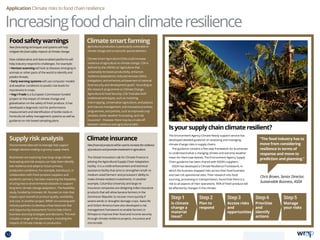
Isyoursupplychainclimateresilient?
The Environment Agency Climate Ready support service has
developed detailed guidance on assessing and managing
climate change risks in supply chains.
The guidance contains a five-step framework for businesses
to understand what a changing climate and extreme weather
mean for them (see below). The Environment Agency Supply
Chain guidance has been shared with ASDA’s suppliers.
ASDA has developed a Climate Resilience Framework, in
which the business mapped risks across their food business
and own UK operational sites. Their research into food
sourcing, processing or transportation, found that there is a
risk to all aspects of their operations. 95% of fresh produce will
be affected by changes in the climate.
Step1
Is climate
change a
material
issue?
Step2
Plan to
respond
Step3
Access risks
and
opportunities
Step4
Prioritise
and
identify
actions
Step5
Manage
your risks
Application Climate risks to food chain resilience
“The food industry has to
move from considering
resilience in terms of
response and move to
prediction and planning.”
Chris Brown, Senior Director,
Sustainable Business, ASDA
12 TOPICSMENU CONCLUSIONSCONTENTS
Farming for
the future
A UK Strategy for
Agricultural Technologies
“The challenges facing the food industry are well
documented. From adapting to the effects of climate
change, to feeding a growing global population with
dwindling resources, it is very clear that the degree of
change that is required within food and agriculture systems,
and the pace with which that change needs to be delivered,
requires us to adopt new ways of doing things.”
Agriculture will become a key area of technological
innovation in the coming decade. Impacting all areas of
the production system, this innovation will be driven by
a desire from both industry and policymakers to reduce
production costs, boost agricultural output, and adapt
to a changing climate.
Likely areas of innovation include precision agriculture
and the use of advanced monitoring and data systems
as well as biological innovations in genomics and plant
breeding. Some emerging approaches will also
challenge established models of food production
through the use of alternative systems such as soil-less
growing and indoor farming. This topic explores these
opportunities for advanced, commercial farming
systems.
Data
Aquaculture
Protein
Farming
Climate
Partnerships
Consumers
Packaging
Retail
Forecasting
Landscapes
Skills
Industry 4.0
Waste
Standards
13 TOPICSMENU CONCLUSIONSCONTENTS
Remote Sensing
(RS) techniques
Aerial and/or satellite
imagery used to determine
yield potential, nutrient
deficiencies, and stresses.
Notjusttechnology:
theroleforintegrated
productionmethods
The benefits of sustainable intensification divide
opinion, with some critics arguing it is a trojan horse
for furthering the interests of ‘big agriculture’.
However, while future farming usually brings to
mind technological advances, innovation needn’t be
technocentric. There is growing interest in integrated
production methods, and we can expect them to rise
in tandem with technological innovations:
Agroforestry: A system that combines trees with
either arable crops or livestock pasture. Benefits
include maximising space in three dimensions,
reduced erosion, increasing soil fertility and better
nutrient capture (reducing leaching) – increasing
total farm productivity.
Integrated pest management: IPM widens pest
control strategies to reduce the use of pesticides. For
example, biodiversity-rich field margins provide
habitats for insects to control aphids or attract birds
that manage slug populations. In glasshouses,
biological controls can be introduced to manage
pest populations as soon as they are observed.
No-till farming: Also known as zero tillage, it is
being explored in smallholder and large-scale
production (for example, it is very widespread in
drought-prone Australia). No-till means minimal soil
disturbance, permanent soil cover, direct sowing
and sound crop rotation. Although short term yields
can decline, these are seen to recover and UK
reports include improved soil quality, water
infiltration and lower operational costs.
Organic agriculture: This system has an established
certified standard for integrated production.
Artificial fertilisers are banned and farmers develop
fertile soil by rotating crops and using compost,
manure and clover. Pesticide applications are
severely restricted, and GM crops and ingredients
are banned.
Overview Farming for the future
Thefarmofthefuture
Controlled Traffic Farming (CTF)
An application of machine guidance,
it allows the exact use of the same
tracks each time, minimising soil
compaction and enabling no-till
operations.
Variable rate application/
technology (VRT)
The variable application of seeding
and spraying according to accurate,
specific maps of soil and plant
information.
Robotics
Potential applications
ranging from: weed and pest
management; to milking; to
artificial hands capable of
picking strawberries.
Individual
livestock tracking
Satellite receivers allow tracking and
storing of information on animal
health status, grazing behaviour;
data can be further used to
understand grazing pressure and
create virtual fencing.
Harvest monitoring
Instant data on crops (wet and
dry readings, crop density,
information about yield) allows
harvests that maximise yield.
Biomass monitoring
Mapping of plant growth and amount
of nitrogen needed through location-
specific crop phenology observations
(study of cyclical/seasonal events
and their external influences) and
optical sensors for canopy status and
nitrogen content.
The opportunity
The world population is projected to grow by over a
billion to 8.1 billion by 2025. Net expansion of cropland is
estimated to overshoot UNEP’s “safe operating space” of
1,640 Mha by 2020. To feed the world’s future population,
the FAO predicts that overall food production will need to
be raised by 60% when compared to 2005.
To meet these demands without exceeding planetary
boundaries, there is the need to get ‘more from less’.
However, increases in UK agricultural productivity have
trailed other countries over the last four decades, and it is
now at the lower end of agricultural productivity in
developed countries.
Uptake of precision agriculture
Precision agriculture is an emerging methodology linking
management practices to site specific soil and crop
conditions. Precision agriculture is used to monitor
performance, react to changes in the weather, predict
harvest times, and to apply precise chemical inputs.
These approaches enable highly targeted, efficient
management as well as providing evidence to drive
further innovation. Precision techniques such as greater
fuel efficiency and lower chemical inputs result in
lowering greenhouse gas emissions and higher water
quality. The are also economic benefits: Controlled Traffic
Farming (CTF) has been able to reduce machinery and
input costs up to 75%.
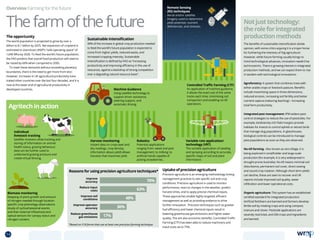
Reasons for using precision agriculture techniques*
Improve
accuracy
Reduce input
costs
Improve soil
conditions
Improve operator
accuracy
Reduce greenhouse
gas emissions
76%
63%
48%
36%
17%
*Based on 518 farms that use at least one precision farming technique
Sustainable intensification
90% of the increase in global crop production needed
to feed the world’s future population is expected to
come from higher yields, reduced waste, and
increased cropping intensity. Sustainable
intensification is defined by FAO as “increasing
productivity and improving efficiency in the use of
resources, against a backdrop of strong competition
over a degrading natural resource base”.
Machine Guidance
Using satellite technology to
support driver assistance,
steering support, and
automatic driving.
Agritechinaction
14 TOPICSMENU CONCLUSIONSCONTENTS
Current trajectory
Establishment of agri-technology will drive fastest
rate of change for any part of the food system.
• Technology High value, large arable production systems will
be further mechanised, with ground-based activities directed
by data from remote-sensing. Supporting technologies such as
GPS and drones will increase in precision and decrease in price,
making them more accessible to a larger population of
farmers. Output data will drive up efficiency, meaning lower
inputs for the same, or higher, output yields.
• Consolidation There is greater consolidation in UK farming,
particularly for livestock where economies of scale are driving
cost-competitiveness. Within industry it is generally expected
that this trend is likely to continue.
• Combined monitoring services Advanced weather
monitoring, modelling and agronomic data , such as from The
Climate Corporation (bought by Monsanto for USD ~$1bn), will
become increasingly important in informing farmer behaviour.
• Novel production systems These will expand in scale, with
urban or peri-urban production systems becoming
commonplace, although only providing modest contributors to
calorific demands. They are likely to provide fresh produce, but
unlikely to substitute for major food groups such as
carbohydrates or proteins.
Opportunities
Diversified production systems that combine
the best of agri-technology with integrated
production systems to produce quality, affordable food.
• Quality food Higher quality, nutritious produce may be
supplied in larger volumes that lower the cost to
households, with particular opportunities from emerging
markets. Potential for savings from optimisation to be
passed on to householders.
• Efficient Step change reductions in inputs for crop
production, reducing fuel, water, and chemical inputs.
Knock-on benefits would reduce run-off and enhance
biodiversity from reduced agrichemical applications.
Focus on waste reduction will also drive efficiency
improvements.
• Diversified production Agri-tech and integrated
production systems may be co-existing, with the latest
technology used to enhance novel production systems.
There may be proliferation in methods and locations of
food production, with increased production around cities
including for high value proteins such as fish from
aquaponics. Benefits from these changes would apply to
small farms as well as large scale farms.
• Connected Farmers in all growing regions could gain
access to high-speed internet and mobile data.
Standardised data protocols could provide free or
low-cost access to farmers from all sectors, while apps
running on existing low cost technologies (such as
smartphones and tablets) could reduce upfront
investment costs.
Risks
Greatest risks may stem from unintended
consequences from adoption of future
farming methods.
• (Not) addressing food security If sustainable
intensification succeeds in increasing food production,
it won’t necessarily improve food security for the most
vulnerable in society. Affordability of, and access to,
food must remain priority policies.
• Unequal uptake Whether linked to regional
connectivity of producers, or capital investments
segregating the market, risks of disparities of uptake of
technical advances which makes smaller farmers less
competitive and unable to survive.
• Technology reliance Ownership and access to data
could reside with a small number of (large) businesses,
on which food production increasingly depends. There
may be risk of farmers depending on technology,
reducing autonomy and self-sufficiency.
• Soils For future farming, managing and enhancing
soil structure and fertility will be critical. Sustainable
intensification must avoid soil degradation in pursuit of
higher yields.
Details of climate change risks to agriculture
in Climate risks to food chain resilience.
Future trajectories Farming for the future
Fertilegroundforinnovation
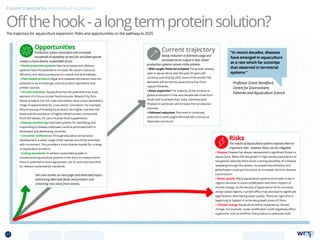
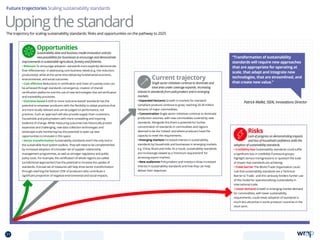
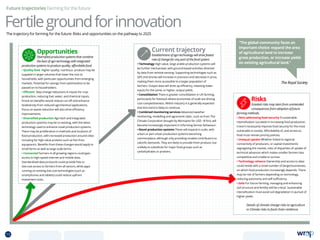
The trajectory for farming for the future: Risks and opportunities on the pathway to 2025
The Royal Society
“The global community faces an
important choice: expand the area
of agricultural land to increase
gross production, or increase yields
on existing agricultural land.”
15 TOPICSMENU CONCLUSIONSCONTENTS
Innovations in genetic sequencing speed and cost
Historically, time and cost have been limiting factors for crop and livestock
breeding innovations. New developments in the speed and cost at which
genetic sequencing can occur are opening the technology up for use in
traditional breeding methods, as well as the potential for genetic
modification.
• Next Generation Sequencing (NGS) technologies can be used to
generate whole genome sequences for crop species; this technology is
becoming cheaper and more accessible, enabling faster development
of new varieties.
• Phenotyping methodologies are a current barrier to greater use of
NGS; the relationship between genetic variation and phenotypic
differences (i.e. the physical expression of the gene) is complex, and
NGS only offers one side of the picture. Imaging sensors and software
for 2D and 3D imaging analyses are promising fields for developments
in plant phenotyping.
• New low-density array systems allow swifter and cheaper
genotyping of animals. Access to detailed genetic information is giving
farmers the ability to make more informed decisions on breeding
selection and increasing yield and efficiency, particularly in dairy cows.
C4 pathway in rice Rice is one of the critical food staples around the
world, but yields are plateauing as demand continues to rise. In Southeast
Asia, every hectare of agricultural land currently has to support 27 people;
this is projected to rise to 43 by 2050. A global group of researchers is
currently working to introduce a more efficient type of photosynthesis
(“C4”) in rice . This so-called carbon concentrating mechanism enables C4
species to exhibit 50% higher yields, as well as significantly enhanced
water and nitrogen use efficiencies.
Coffee breeding for a changing climate
Nestlé is working with major coffee RD organisations in Brazil and
Ethiopia. Their screening programme looks for the following water-related
characteristics in coffee plants: lower overall water demand, fewer and
shorter irrigation cycles, less drought sensitivity, and fast recovery after
droughts.
Growing indoors…
Indoor growing allows the producer to control the environment. This
enables more efficient light exposure, temperature control, and irrigation.
Pest pressure is greatly reduced and dependency and risk from weather
becomes a thing of the past. Produce grown in indoor farms use up to
98% less water and 70% less fertiliser than traditional farms. New
innovations in lighting allow lettuce to grow 2.5x faster.
LED lights have brought multiple benefits because they don’t generate
heat, allowing insulated buildings, closer proximity to plants and lower
energy demand.
Vertical farming, a specific system for growing indoors, makes efficient
use of land restraints: crops are grown in “high-rises” in multiple levels
that vastly reduce land footprint requirements. The city of Newark, NJ in
the US has just provided USD $9 million in grants and tax credits to build
what will be the world’s largest producing vertical farm.
…without soil
Soil-less growing takes controlling the environment to the next level.
Controlling the medium in which crops are grown reduces soil-borne
disease and allows for much more efficient manipulation and monitoring
of nutrient availability. Soil-less growing can mean higher yields with
higher water and fertiliser efficiency than traditional agricultural but
energy demands can be high due to heating, cooling, lighting, and
circulation requirements.
Hydroponics uses a water-based medium with bare root. Hydroponics
can use up to 70% less water than conventional irrigation-fed systems.
Aquaponics is an integration of aquaculture and hydroponics into one
production system. A symbiotic relationship whereby waste from fish is a
fertiliser for growing plants, thus providing protein and high quality herbs
from a single system. However, it currently has high start-up costs, and
commercial aquaponic systems are relatively few in number. Fish species
suited to aquaponics are also limited; tilapia is the most commonly used.
Aeroponics is an offshoot of hydroponics in which water is sprayed onto
bare roots, rather than immersing them. It uses up to 70% less water than
hydroponics.
Biologicalinnovations HarnessingtechnologyNewproductionsystems
“It makes good business sense, if not now then certainly in
the future. For example, we’re doing research and
development on new varieties of coffee and cocoa that are
more drought-resistant and higher yielding. This is about
creating shared value, not just value for shareholders.”
Anne Roulin, vice-president of nutrition,
health, wellness and sustainability at Nestlé
Application Farming for the future
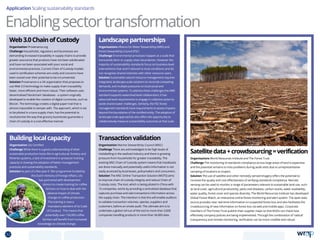
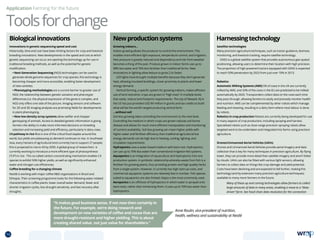
Toolsforchange
Satellite technologies
Many precision agriculture techniques, such as tractor guidance, biomass
monitoring, and livestock tracking, require satellite technology.
GNSS is a global satellite system that provides autonomous geo-spatial
positioning, allowing users to determine their location with high precision.
The proportion of high-powered tractors equipped with GNSS is expected
to reach 50% penetration by 2023 from just over 10% in 2013.
Robotics
Automatic Milking Systems (AMS) 5% of cows in the UK are currently
milked by AMS, and 20% of the cows in the EU are predicted to be milked
automatically by 2020. Transponders collect data on the cows each time
they pass through, allowing farmers to easily and precisely monitor health
and nutrition. AMS can be complemented by other robots which manage
feeding and cleaning, resulting in a dairy farm where most labour is done
by robots.
Robotics in crop production Robots are currently being developed for use
in many aspects of crop production, including spraying and harvest.
Specialised robots such as close-range precision spraying robots allow
targeted work to be undertaken and integrated into farms using precision
agriculture.
Drones/Unmanned Aerial Vehicles (UAVs)
Drones and Unmanned Aerial Vehicles provide aerial imagery and data
collection that is key for many techniques in precision agriculture. By flying
lower, they can provide more detail than satellite imagery and aren’t foiled
by clouds. UAVs can also be fitted with various light sensors, allowing
farmers to collect data on things like crop damage and yield potential.
Costs have been declining and are expected to fall further, making this
technology (and by extension many precision agriculture techniques)
available to many more farmers in the future.
Many of these up and coming technologies allow farmers to collect
large amounts of data in many areas, enabling a move to a “data-
driven” farm. See Food chain data revolution for the connection
16 TOPICSMENU CONCLUSIONSCONTENTS
Landscape-scale
opportunities
“However, our land is a finite resource, and it is set to
come under increasing pressure... as we seek to maximise
economic returns, and as we recognise its potential to
yield benefits in diverse areas such as ecosystem services,
mitigating climate change, and wellbeing.”
Foresight Report, 2014
A demand-supply analysis of UK land requirements in
2030 indicates the potential for an additional 7 million
hectares to meet the needs of a population of 70 million,
equivalent to an increase of 35% of the UK’s current
agricultural land. While some of this demand can be
met by more efficient production, and less food waste,
the future will place higher demands on our finite land
resources.
With increasing pressure on land, the optimisation of
multiple functions becomes essential; whether for food
cultivation, flood risk alleviation, natural habitats or
energy production. One technique for optimisation is
‘landscape scale’ management approaches, which
operate across multiple farms to pursue shared
objectives.
Data
Aquaculture
Protein
Farming
Climate
Partnerships
Consumers
Packaging
Retail
Forecasting
Landscapes
Skills
Industry 4.0
Waste
Standards
17 TOPICSMENU CONCLUSIONSCONTENTS
Town
Overview Landscape-scale opportunities
Foodproductionfromalandscapesystem
Landscape approaches have developed from a need to
identify integrated solutions to competing demands on
land uses, pressures on environmental systems and
requirements from the local community. Within any
landscape, there are usually a variety of land uses such as
for forestry, agriculture, and grazing, as well as for
recreational uses and ecosystem services such as water
catchments and biodiversity habitats. Payment for
ecosystem services would create a market for natural
capital that could reconfigure land management priorities.
The landscape shown illustrates interdependencies
between farms, other businesses and the
community. A single retailer could be sourcing from
this landscape for all products (apples, bread, milk,
and oil), or alternatively four different manufacturers
may have a shared interest. By focusing on the
region, stakeholders may uncover opportunities
such as joint investments, utilisation of by-products
or rotation planning to bring added value for farmer,
locals and procuring businesses. Global Landscapes Forum
“The main tenet of integrated landscapes
management is recognizing and
negotiating for trade-offs. There are likely
to be winners and losers – but the overall
goal is to ‘win more’ and ‘lose less’.”
Recognising the characteristics of the producing region,
not just focusing on individual product outputs.
Watertreatmentsite
Works with dairy and
arable farms to reduce
phosphorus and nitrogen
run-off into watercourses.
Sharedwater
catchment
Applegrower
Benefits from
pollinator habitats on
arable and dairy farms.
Arablefarm
Receives
compensation for
managing grassland
to receive floodwater.
Dairyfarm
Uses crop
waste from
arable farm as feedstock
for anaerobic digestor. Arablefarm
Oilseed rape
benefits from
pollinators.
Anaerobic
Digestor
Town
Relies on arable
farm for flood
mitigation.
Satellite
Satellites and other tools used to
provide live monitoring data and
evidence to support satisfaction
of land use requirements (e.g.
ploughing regimes).
Sourcingproducts
fromthelandscape
18 TOPICSMENU CONCLUSIONSCONTENTS
Risks
The practical challenges of coordinated planning
of land use will always pose a barrier, and
behaviours revert to short term supply and demand.
• Complexity Attempting to understand, define and reward
competing interests of land users may not reach a
satisfactory conclusion. Establishing a market can create
incentives, but it is difficult to design effectively to ensure
the correct signals that will generate net gains in natural
capital.
• Funding gap Designing and implementing landscape
programmes requires resources. When the beneficiaries
may be dispersed (or a public good), the case for private
sector investment is weak.
• Skilled coordinators Expertise on the ground from
coordinators who understand their key stakeholders is
essential but may not be readily available.
• Regulatory environment Regulations and tax regimes
may not align with coordinated approaches, and can
present barriers to development off new behaviours.
Current trajectory
Progression from ambition to action, with
implementation of landscape methods spreading
beyond water catchments to other land functions.
• Established methods In ten years, a range of methods will be
tested and implemented for different types of landscapes.
• Immature markets Emergence of markets for trading of
value between landscape stakeholders – but limited to simple
transactions.
• Measurable benefits Outcomes from early implementations,
providing data demonstrating impacts on landscape
stakeholders.
• Growing momentum A small number of food businesses roll
out these methods across their sourcing landscapes, raising
awareness across their producers and wider industry.
Opportunities
Successful implementation could remodel the
composition of land use patterns, with individual
actors rewarded for contributing to the common vision.
• Landscape leaders Major sourcing businesses step up as
‘land shapers’, helping to positively shape landscapes by their
procurement strategies.
• Functioning market Farmers and other land managers have
clear market signals in order to benefit from management
decisions that deliver greatest net gain from the landscape.
• Greater productivity The landscape is more productive for
food and other outputs, while enhancing the natural capital.
• Climate adaptation An integrated approach presents
opportunities to adapt to climate change co-operatively, with
greater potency than any single farmer acting alone.
• Improved relationships Partnerships between producers
and between sourcing businesses strengthen relationships
that lead to further collaboration and new innovations.
Aneedformethodsandnewmarkets
Future trajectories Landscape-scale opportunities
The trajectory for landscape-scale opportunities: Risks and opportunities on the pathway to 2025
Prof. Tim Benton,
Global Food Security Programme
“With rising demands to produce more
food from the land, and the growing
crises of climate change and biodiversity
loss, it is more important than ever to
manage landscapes sustainably.”
19 TOPICSMENU CONCLUSIONSCONTENTS
Landscapepartnershipsinaction
Application Landscape-scale opportunities
Scope4:Howtogrow
sustainablesourcinginto
measurableimpactsinregions
andcommoditysystems
The US-based Sustainable Food Lab - with members including
Unilever, Mars, and Starbucks - has introduced ‘Scope 4’ guidance for
international sustainable sourcing programmes that face region-wide
challenges such as water shortage or chronic poverty.
Scope 4 is described as “the space around the supply chain:
geographically, in the surrounding landscape; agronomically,
including livestock and other crops in rotation; socially, to account for
healthcare and education; economically, to capture synergies with
other enterprises on a farm as well as off-farm income; and
strategically in order to take advantage of other stakeholders.”
This new guidance addresses the challenges for individual
businesses striving to source sustainably from a region, and the
challenges from attempting to go it alone. The Sustainable Food Lab
provides examples from regions as diverse as Iowa for soybeans,
Ghana for cocoa, and South Africa for sugar, highlighting the need for
one company to lead strategy development in a given landscape,
around which others can then collaborate.
The Scope 4 guidance identified three bottlenecks to
implementation:
• Lack of financial resources to fund the organising function.
• Insufficient technical and leadership capabilities within coordinating
organisation.
• Unclear business case for less innovative players in the system.
The articulation of Scope 4 supported by a series of major food
businesses is a significant development in the evolution of landscape
approaches. Rightly it
acknowledges challenges to
implementation, but a series of
case studies and outline of the
opportunity at large present
valuable evidence for
programmes of regionally-focused
sustainable sourcing.
DefraSustainable
Intensification
Platform(SIP)
Opportunities and risks for farming and
the environment at a landscape level.
The SIP Research Platform is operating at farm and landscape scale. SIP2,
at the ‘landscape’ scale, is investigating the spatial variation in land
capability and environmental risks, to see where coordinated action
opportunities exist within England and Wales. The project covers seven
study areas, and seeks to identify the mechanisms by which more
collaborative working among farmers can be enabled.
GeneralMills
Purchasing as part of crop rotation.
When General Mills began to look into sustainable wheat, they realised
that engaging solely with wheat growing would not be sufficient to
address the issue and claim the title “sustainable”. Rather they would
need to involve not only the farmers’ whole rotation (which includes
sugar beets, potatoes, and barley alongside the wheat) but also the
companies that purchase those other products in the rotation. General
Mills further engaged the Nature Conservancy and state and federal
agencies in a multi-player initiative whose ultimate goal is improving and
maintaining the water and soil quality of their landscape to achieve
sustainable production for all stakeholders.
WessexWater
Groundwater in agricultural regions can be affected by high levels of
nitrates and pesticides. The common response to this is to build
treatment plants and carbon filters to remove the impurities. Wessex
Water has begun to take a different approach that is lower cost and
more sustainable. The Wessex Water supply region is predominantly
rural and agricultural, so the company depends on local farmers and
land owners to manage the land. Wessex Water works with farmers
across the catchment to achieve the common objectives of food
production and high quality ground and surface waters. The
successes of the scheme have enabled Wessex Water to cease the
requirement for additional treatments at three sites, leading to cost
savings for the business and benefits for farmers including optimised
use of nutrients and pesticides.
SABMiller
Watersheds by nature are larger than individual farms, and any
avenue for improving water quality must necessarily include all
players with a stake in it. SABMiller, one of the world’s largest brewers,
recognised that water quality in their South Africa and Colombia
breweries was a serious problem that needed to be addressed
beyond their breweries. They turned to WWF and GIZ, developing a
landscape approach that involved all the key players in the catchment
to more successfully mitigate risks. SABMiller knows that the capital
costs incurred by this project are an investment, one that is vastly
outweighed by the reputational costs and supply chain risk that
would be associated with water scarcity and pollution.
Co-operatingin
watercatchments
20 TOPICSMENU CONCLUSIONSCONTENTS
Global meat consumption is expected to increase by
76% by 2050. Rising household incomes are leading to
greater demands worldwide for more meat. However
livestock production generates greenhouse gas
emissions, causes land use change, requires 33% of
global arable land for feed, and causes high water
demands.
Alternative proteins are being pursued for livestock
feed and as food for direct human consumption.
Sources of alternative proteins range from bacteria to
insects, from mycoprotein to artificially cultured meat.
The next generation of proteins will depend on proving
food safety, production costs, nutritional qualities,
scalability and consumer acceptance.
Bill Gates
“Raising meat takes a great
deal of land and water and has
a substantial environmental
impact... We need more options
for producing meat without
depleting our resources...”
Alternativefeeds
andproteins
Data
Aquaculture
Protein
Farming
Climate
Partnerships
Consumers
Packaging
Retail
Forecasting
Landscapes
Skills
Industry 4.0
Waste
Standards
21 TOPICSMENU CONCLUSIONSCONTENTS
Overview Alternative feeds and proteins
The environmental cost of meat production means there is a need to find alternative protein sources for both
human consumption and animal feed, supplementing efforts to develop sustainable aquaculture systems.
64m
13m
100m
82m
106m
2005 2050
Beef Lamb Pork Poultry Farmed
fish
25m
143m
181m
140m
intonnes
41m
Developing more sustainable alternative proteins is only the
first step; consumer preferences and attitudes towards these
new foods must also shift in their favour for real growth to
occur.
There can be a “yuck factor” for many potential alternatives,
such as insects and lab-grown meat. Western attitudes towards
entomophagy (the consumption of insects by humans) are
typically negative – insects are perceived as unclean and
vectors of disease. And similar attitudes may be found towards
lab-grown meat; a 2014 study found reactions of “disgust” and
“unnaturalness”.
Success of new generations of protein sources will require
consumer acceptance. It has been shown that environmental
concerns can play a part in changing attitudes, though recent
uptake of insect protein flour in North America has been a
response to nutritional benefits. Recent studies have also
shown positive attitudes towards insect feed for animals; a
majority of study respondents said that they would eat meat
(pig, poultry, fish) raised on insect feed.
The role of
the householder
Growingsolutions
10
5 1.72.5
275
250
240
60
150
50
20
175
Energy use (MJ)
kg feed required
per kg bodyweight
Land use (M2
)
Global demand for
animal products
Novel protein
products Human consumption
Animal feed
Comparing
proteins
Input per kg
of protein
Lab grown
meats
Seaweed Microalgae Insects Bacteria
• Uses potentially 45% less
energy, 96% fewer GHG
emissions, and requires
99% less land than the
average for farmed beef.
• First hamburger made in
2013. It cost approx
£200,000 and took 2 years
to create.
• Processed meat such as
ground beef, pork,
sausage may be feasible
on a production scale in
the next 5 to 10 years.
• Protein levels of up to
47%.
• Most types contain all
essential amino acids.
• Saltwater crop; uses no
fresh water.
• Seaweed meal may help
increase body condition
and wool production in
sheep and milk production
in cows
• High lipid (oil) content;
can produce 50 times
more oil than corn per
hectare.
• A new study shows it
may be a viable option to
replace corn in cattle feed.
• Dried defatted algae
could replace up to 1/3 of
soybean meal in diets for
pigs and chickens,
replacing 10% of pig feed
with algae would save 30
million tonnes annually.
• Lower land use
requirements and
potentially lower GHG
emissions.
• High protein digestability
(86-89%).
• Up to 80% of bodyweight
is edible and digestible,
compared to 55% for
chicken and 40% for cattle.
• Insects can be reared on
various organic substrates
such as vegetable waste,
manures, and food waste,
creating value from and
reducing waste products.
• Can be grown on
wastewater nutrient
sources, without feed or
sunlight.
• Methane can be used as
input for high volume
production.
• Up to 60% protein, with
high levels of digestability.
22 TOPICSMENU CONCLUSIONSCONTENTS
Current trajectory
Continued growth in global demand for livestock,
and associated requirement of feed, such as soy.
Pressure on production, fisheries and land assets directly
affects market for feed production.
• Volatility Traditional feed prices will fluctuate (as seen for
fishmeal), with direct knock-on effects on the cost of meat.
• Innovation drive Pressure on feed resources availability will
drive investment into new protein sources, with establishment
of commercial insect production and the breakthrough of
engineered solutions including protein from bacteria. Costs of
production and feed conversion ratios will dictate which new
protein sources predominate over time.
• Novel foods Western diets will incorporate insects to some
degree, in a similar way to the spread of sushi from Japan in
2000s , but the major growth will be for feed to livestock.
Risks
Future protein and feed sources will need to
operate at scale, and success relies upon a
dependable, safe, balanced system to support livestock that
depend on them.
• Health risks Real or perceived risks to human health pose
the greatest risks to the emergence of new protein sources.
Substrate materials used for rearing can be transferred to
protein products, and in turn into the food chain - but it is
vital that we avoid unintended consequences that seriously
disrupt the food chain such as those that caused the BSE
crisis. Risks to beware of could manifest as either another
significant contamination of our food system, or over-
zealous regulations that stifle investment and
commercialisation of novel protein sources. Aside from
direct consumption, high concentration of insects could
lead to other impacts, such as allergenicity for farm workers
or accidental releases to the local environment.
• Production failures Future reliance on intensive
production systems for animal feed will expose
vulnerabilities to large-scale production failures. Just as
viruses such as swine flu have decimated pig populations in
the past, so infections can spread rapidly and eradicate
entire populations under production.
• Burden-shifting Unintended consequences of ‘burden-
shifting’ such as high energy inputs (e.g. heat for insect
rearing) or water usage (e.g. for microalgae) could
undermine the resource efficiency of new production
systems. Similarly, competition for input resources (such as
for anaerobic digestors or into conventional animal feed)
could negatively affect both the new and established
industries.
Opportunities
If well-informed consumers support the emergence of flexible,
efficient production systems then future proteins can transform
diets for humans and livestock.
• Consumer demand Changing household habits and perceptions, as well
as evidence of nutritional quality as food and animal feed, could rapidly
transform the nature and scale of demand for novel protein sources. More
familiar but currently less popular plant-based proteins such as pulses and
nuts may also see a surge in consumption, in part due to consumer
awareness of livestock’s environmental impact. Where demand comes,
supply can swiftly follow.
• Efficiency In a resource-constrained world, the ideal solutions will
efficiently convert low-grade inputs to high-grade protein products. The
nutrient inputs to new protein production need to be drawn from low
value sources, such as mixed waste streams or digestate from anaerobic
digestors, and new protein could be reared using cooling water or low
grade heat from existing installations. Ideally, new protein production
systems could be deployed as modular units, situated near substrate
sources and workable at small and large scales. Improvements in feed
conversion rates across sectors will create more efficient protein both in
sea and on land.
• By-products The value of many novel proteins extends beyond food. For
insect production, in addition to protein, lipids and soil conditioner, initial
research has identified high value molecules with antimicrobial properties.
The process used to grow bacteria also results in clean water from food
and beverage waste streams. The triglyceride oils and ingredients
developed from microaglae can be used as the foundation for industrial
products and fuels as well as foods. If each fraction of these proteins can
be refined and sold into discrete applications, the aggregate value and
efficiency of the system will drive widespread expansion and adoption.
Minifactoriesofthefuture
Future trajectories Alternative feeds and proteins
FAO 2013
“The absence of clear legislation and
norms guiding the use of insects as
food and feed is among the major
limiting factors hindering the industrial
development of farming insects to
supply the food and feed sectors.”
The trajectory for alternative feeds and proteins: Risks and opportunities on the pathway to 2025
23
See Unlocking new value from wastes for more details.
TOPICSMENU CONCLUSIONSCONTENTS
Ynsect
Protein source
Microalgae
Use Food and Feed
Method Fermentation
using Chlorella micro algae
in a liquor rich in simple sugars and other
nutrients. Mixture is transferred to larger
containers under controlled conditions,
before harvesting, concentrating and
drying. AlgaVia whole algal product is 65%
protein, and used as a food additive.
Outputs First produced range of
commercially saleable products on
full-scale production lines in mid 2014.
Two US-based production facilities, and a
third large site (100,000 mt/year) in Brazil,
in partnership with Bunge’s Bonsucro
sugarcane mill.
Future Production in Iowa will potentially
expand to 100,000 mt/year in subsequent
years. Moved forward with FDA approval
of high-oleic algae oil and their AlgaVia
portfolio in early 2015.
Industryview
AngelaBooth,
HeadofAlternativeProteinsABAgri
Efficiency
“As livestock become more efficient, in order to maximise the potential the
feed industry has to increase the protein to energy ratio. Soy is currently so
widely used because it is a very cost-effective source of concentrated
nutrients, so one challenge is to improve the quality of other existing
proteins to remove anti-nutritive factors and improve protein
concentration. A further aspect is that protein from cereals such as wheat
and maize needs to become more predictable. Currently, protein levels can
range from 8% to 14%, and this variability needs to be understood so we
can manage production accordingly. For other existing sources – such as
rapeseed – we need to improve usage, with processing that delivers higher
nutrient value.”
Alternative proteins
“This topic should be called ‘new generation proteins’, as the industry is
always looking for improved protein sources and some may be achieved
by applying new technology to existing sources. There are a number of
potential new sources we can use: fungal, bacterial, algal and insect, as well
as continuing to seek additional synthetic amino acids which can be used
to supplement existing proteins. For all of these, the challenge becomes
how to scale up to large-scale production that is price competitive. For
example, to use algae we still need to understand: which species to use;
optimal growing conditions; and then to calculate costs such as light, water
usage, pigmentation removal, drying and so on.”
2025 view
“In ten years time we will see a different feed landscape. We have already
seen significant changes in aquaculture, moving away from fishmeal to
vegetable and cereal proteins. Two factors for future changes will be firstly
competition for substrates, and secondly the level of mechanisation to
enable scaling up – both of which will determine cost competitiveness. On
the down side, one of my worries is the state of legislation in the EU, which
is restricting our ability to compete. The legislators are trying to fit new
generation proteins into existing legislation, but instead we need new
legislation that recognises future sources, and unlocks the wave of further
innovations in the field.”
Application Alternative feeds and proteins
Bringingnewproteinproductstothemarket
Nutrinsic
Anovelproteinbecomesmainstream
Quorn
Protein source Bacteria
Use Animal feed
Method Produces ProFloc, made from a
poly-culture of natural bacteria
consuming underutilised nutrients from
food and beverage processors as well as
biofuel producers.
Current collaboration
with Miller Coors
brewery utilising
process discharge
water.
Outputs First US
production facility, in
Ohio, is operational.
Initial capacity of 13t/day is anticipated.
63% protein product is easily absorbed
and demonstrates good feed conversion
ratio (FCR) in poultry, swine, and
aquaculture.
Future Plans to scale up production to
80t/day within 18 months and build
additional operating plants.
Protein Source Mycoprotein
Use Human Food
Method Mycoprotein is derived from the fungi
Fusarium venenatum using a natural fermentation
process and wheat-derived glucose syrup. The
resulting dough-like paste is mixed with egg
albumen and water to bind it, then mixed, shaped
into products such as Meat-Free Mince, Chicken-
Style Pieces or Fillets, steam-cooked and rapidly
frozen for texture.
Outputs Founded in 1985, Quorn Foods currently
produces around 22,000 tonnes of mycoprotein
per year and is sold in 16 countries worldwide.
Quorn has provided over 3 billion meals across
the world and demand is rising; it expanded into
Germany, Italy and Spain in 2015, and in the US
demand is up 30% on last year.
Future Quorn Foods are currently investing
£30m in its Billingham plant to double its
production capacity to nearly 40,000 tonnes,
which will support continued growth in the UK,
USA, and European markets.
Protein source Insects
Use Animal feed
Method Tenebrio molitor (mealworm)
fed on plant based material only, to fulfill
EU rules. Mature larvae are collected from
a full automated farming process,
slaughtered, and processed to obtain a
concentrated protein meal and a fat
fraction.	
Outputs First small industrial scale
production in France operational in 2016
dedicated to pet food market with 20,000
t/year meal capacity.
Future Products approved for sale in
Europe for pet food, awaiting EU approval
for insects in feed. First large scale plant
aims to be built in 2017.
Solazyme
24 TOPICSMENU CONCLUSIONSCONTENTS
Aquaculture
expansion
“It is highly unlikely that wild capture fisheries will be able to produce
higher yields in the future. For aquaculture the opposite is the case. No
other food production sector has grown as fast over the past 20 years...
It [the industry] must now prove that large-scale fish farming is
possible without placing unacceptable demands on the environment.”
World Ocean Review
Aquaculture has become the fastest growing animal
protein sector and in 2014 global output overtook beef.
By 2030, almost two thirds of fish for human
consumption could be produced by the sector.
Aquaculture has the potential to contribute to healthy
sustainable diets and economic development due to the
nutritional qualities of its products and the potential for
efficient, low impact production. The development and
adoption of innovative systems could also relieve
pressure on sensitive natural habitats on land. However
significant technical, commercial and policy challenges
will need to be addressed in the coming decade to fully
realise the potential of this increasingly important global
protein sector.
Data
Aquaculture
Protein
Farming
Climate
Partnerships
Consumers
Packaging
Retail
Forecasting
Landscapes
Skills
Industry 4.0
Waste
Standards
25 TOPICSMENU CONCLUSIONSCONTENTS
1950
0
20
40
60
80
100
1955 1960 1965 1970 1975 1980 1985 1990 1995 2000 2005 2010
Pollution
Nutrient escapes from
aquaculture systems
off the Chinese coast
have been linked to a
rise in algal blooms.
Habitat destruction
Coastal mangroves have been removed
to make way for shrimp farms.
Disease
White-spot syndrome first
emerged in China in early 1990s
but has since spread throughout
the Asian and American coast,
devastating shrimp farms.
Parasites
Sea lice is a major challenge to
production in the EU. Drug resistance
is emerging and lice can impact upon
local wild fish populations.
Slavery
People have been
trafficked and
enslaved aboard
trawlers supplying
fish for use as feed in
shrimp production.
Overview Aquaculture expansion
Thebluerevolutioncontinues
A global protein sector of increasing economic and dietary importance
Benefits of aquaculture
Fish and algae are nutritious and
their health benefits are likely to drive
increased demand in the future.
Hundreds of millions of people
already depend on fish for their main
dietary protein. Fish are also efficient
converters of protein, making them
attractive from a production point of
view. Aquaculture therefore has the
potential to support sustainable
economic development and nutrition
security.
BEEF
WILD FISH
FARMED FISH
PORK
“Ensuring successful
and sustainable
development of
global aquaculture
is an imperative
agenda for the
global economy.
Investments in
aquaculture must
be thoughtfully
undertaken with
consideration of the
entire value chain
of the seafood
industry.”
UNFAO Fish To 2030:
Prospects For Fisheries
And Aquaculture
Protein Conversion Efficiency (%)
BEEF
5%
PORK13%
CHICKEN
25%
CARP
30%
Fish trade  production
Fish is one of the most
internationally traded foods. The
majority of aquaculture-produced
fish consumed in the UK is sourced
from countries such as Scotland,
Norway (salmon) and Southeast
Asia (warm water prawns and
freshwater fish such as tilapia).
Farmed fish output is continuing to
grow rapidly and recently overtook
beef production. China dominates
production, contributing 59% of
global supply. According to The
World Fish Center, the majority of
the increase in global production in
the next decade will come from
South and Southeast Asia. India,
Indonesia and Thailand in particular
will increase their production
volumes.
Challenges
While aquaculture systems
have many potential
benefits, they have also
been associated with a
range of negative
environmental and social
outcomes. These issues
are more likely in
jurisdictions with a weaker
regulatory framework.
10% of wild fishery
production is used for
‘reduction’ (mainly
aquaculture feed)
Aquaculture is the farming of
fish, shellfish and water-based
plants. It is an extremely diverse
sector, encompassing a range of
systems, species types, and
production intensities. Global
trade and production is on the
increase, and while this has the
potential to result in
environmental and social
benefits a number of technical,
commercial, and regulatory
challenges need to be
addressed. In addition to fish
and shellfish, 24 million tonnes
of algae (mainly seaweeds) are
farmed globally by the sector -
currently worth USD $6.4 billion.
Food producers are exploring
the potential of using this
ingredient in new food and
non-food household products.
Million tonnes
26 TOPICSMENU CONCLUSIONSCONTENTS
Current trajectory
Steady reduction in fishmeal usage and
increased sector output in Asia. Novel
production systems remain niche solution.
• Wild caught fisheries eclipsed The growth already
seen in aquaculture over the past 20 years will
continue such that by 2025 more of the world’s fish
demands will be met by aquaculture than from
capture fisheries.
• Asian expansion The majority of the increase in
global production in the next decade will come from
South and Southeast Asia. India, Indonesia and
Thailand in particular will increase their production
volumes.
• Fishmeal reduction The trend in continued
reduction in wild-caught fishmeal will continue as
alternates are found.
Opportunities
Production system innovation and increased
household acceptability of new fish and plant species
creates a more diverse, sustainable sector.
• Novel producton systems New land-based and offshore
systems have the potential to increase the sector’s resource
efficiency and reduce pressures on coastal and land habitats.
• Plant-based products Algae and seaweed derivatives have the
potential to be increasingly used as product ingredients and
protein sources.
• Circular economy Aquaculture has the potential to be a key
element of a future circular food economy. Research by Zero
Waste Scotland into fish, beer and whisky value chains identified a
range of opportunities for cross-sector innovation. For example,
the processing of brewing by-products into higher nutrition fish
feeds and the extraction of highly refined protein compounds
from fish wastes, for use in human food supplements.
• Disease monitoring Improved systems for identifying and
responding to disease outbreaks could be promoted both in
developed and developing countries.
• Consumer preferences Through education and product
development, a wider range of fish species should be promoted
with consumers. This provides a more diverse market for a range
of aquaculture products.
• Scaling standards To achieve sustainable growth in
conventional aquaculture systems in the short to medium-term
there is potential to enourage greater use of, and improvements
to, relevant sustainability standards.
See case studies on next page and dedicated topics
addressing Alternate feeds and proteins and
Unlocking new value from wastes.
Risks
The nature of aquaculture systems exposes them to
important risks - however these can be mitigated.
• Disease Disease has always represented a significant threat to
aquaculture. When fish are grown in high density populations of
low genetic diversity there exists a strong possibility of a disease
sweeping through the system. Increased intensification and
globalisation could put the sector at increased risk from disease
transmission.
• Water quality Many aquaculture systems are known to be in
regions sensitive to ocean acidification and other impacts of
climate change. As the density of aquaculture farms increases
along coastal regions, nutrient efflux may also lead to significant
algal blooms, diminishing water quality. There are signs this is
beginning to happen in some key growth areas of China.
• Climate change Aquaculture will be impacted by climate
change. For example, ocean acidification could negatively affect
organisms, such as shellfish, that produce a carbonate shell.
Offthehook-alongtermproteinsolution?
Future trajectories Aquaculture expansion
Professor Grant Stentiford,
Centre for Environment,
Fisheries and Aquaculture Science
“In recent decades, diseases
have emerged in aquaculture
at a rate which far outstrips
that observed in terrestrial
systems.”
The trajectory for aquaculture expansion: Risks and opportunities on the pathway to 2025
27 TOPICSMENU CONCLUSIONSCONTENTS
Aquaculturesystemandproductdevelopment
ApplicationAquaculture
Mara is a Scottish company capitalising on the
growing global demand for seaweed as a health
food ingredient. The company is working with
researchers to trial the commercial application of a
land-based aquaculture production system. The
Scottish Government has identified potential for the
growth of seaweed cultivation and its use in
Integrated Multi­Trophic Aquaculture (IMTA). See
example below from Loch Fyne.
Loch Fyne are trialling the first large scale Integrated
Multi Trophic Aquaculture site (IMTA) in Scotland. In
an IMTA system various species are farmed
alongside each other to create a balanced
ecosystem. Even though some crops will yield less
than if grown alone, IMTA systems are designed to
create greater overall output. Species grown at Loch
Fyne include salmon, mussels, oysters, queen
scallops, sea urchins and various edible seaweeds.
The Scottish Aquaculture Innovation Centre is
overseeing research into new techniques to reduce
the incidence of sea lice in farmed salmon – a major
constraint on production that costs the industry
£30m per annum. One project is developing a
vaccine that will enable the commercial farming of
wrasse - a fish that cleans the salmon of lice.
Calysta is a US biotech firm with offices in the UK
developing FeedKind protein, a high protein feed
ingredient that is an alternative to fishmeal and soya
protein concentrate in livestock diets.  Calysta’s
naturally occurring microorganisms utilize methane
as their sole source of carbon and energy.  They are
grown in a patented bioreactor, then dried and
pelletised.  The first large-scale FeedKind production
facility is targeted to open in 2017. 
RecirculatingAquacultureSystems
According to a detailed review of recirculation
aquaculture systems (RAS) technologies by the
University of Stirling, they have the potential to:
minimise water consumption; control culture
conditions; allow waste streams to be fully
managed; and increase biosecurity. Economic
sustainability remains the greatest challenge for
long-term adoption for table fish production. An
analysis of different Atlantic Salmon production
systems estimated land-based RAS are almost 30%
more costly than inshore cages, per kg of fish.
To make the economics more favourable, some
start-up enterprises are exploring the potential to
produce multiple high value products nearer to
customers and consumers. GrowUp Urban Farms is
building the UK’s first commercial-scale aquaponic
urban farm in London. They are converting a 6,000
square foot warehouse into a controlled
environment aquaponic farm capable of
hydroponically producing 20 tonnes of salad on a
footprint of less than 200m2, as well as 4 tonnes of
Tilapia fish.
Maraseaweeds
LochFyneIMTA
ScottishAquaculture
InnovationCentre
CalystaFeedKind
GROWUP URBAN FARMS
------
------
dRMM
de Rijke Marsh Morgan Architects
------
VISITOR
CENTRE 
VIEWING
GALLERY
STAFF
FACILITIES
SCISSOR LIFT
FOR HARVESTING
PRODUCE DELIVERED
IN LONDON BY
ELECTRIC VEHICLE
PROCESSING
AREA
HYDROPONICS
(PLANTS)
WATER
TANKS
FILTRATION
SYSTEM 
PUMPS
AQUACULTURE
(FISH)
KEY
WATER CIRCULATION
PLANTS
DISTRIBUTION
Scott Johnston, Technical Controller
Grimsby, Young’s Seafood
“I see particular significance for
land based fish farms utilising
water filtration and re-circulation
technologies which have several
genuinely positive environmental
aspects.”
Urbanaquaponicfarm
28 TOPICSMENU CONCLUSIONSCONTENTS
Scaling
sustainability
standards
Over the past decade private sector sustainability
standards and certification have become the dominant
method of defining, delivering, demonstrating and
creating demand for more sustainable products -
particularly addressing issues in agriculture, fisheries
and forestry. However the proliferation of different
schemes, combined with the costs of implementation
and questions over their impact, means new
approaches are beginning to be developed. These will
use innovations in data collection as well as completely
new models of measuring sustainability outcomes.
Mike Barry, Director of Sustainable Business,
Marks  Spencer
“Most sustainability standards are not set up
to drive scale change in a way that would
allow all the world’s output of a commodity or
all of a supermarket’s products to be certified.
To achieve this level of scale change we need
a new way of working. One that links markets
(developed and developing); producers (big
and small); policy makers, civil society and
campaigners to deliver a whole landscape
approach to managing commodity.”
Data
Aquaculture
Protein
Farming
Climate
Partnerships
Consumers
Packaging
Retail
Forecasting
Landscapes
Skills
Industry 4.0
Waste
Standards
29 TOPICSMENU CONCLUSIONSCONTENTS
Overview Scaling sustainability standards
Today’sstandards
Growthinsustainabilitystandards
What is in a standards system?
This topic explores the current
use of private sector sustainability
standards in food and drink supply
chains. There are four components
of these standards systems. How
these are delivered influences the
cost, credibility and impact of the
standard. Identifying opportunities
to increase the efficiency of these
components, and in some cases
finding completely new models of
delivery, will be a key challenge for
the food industry in the next ten
years. Of particular interest will be
finding new methods for verifying
sustainability standard outcomes
and providing sufficient supply
chain traceability.
Standards-compliant production has grown significantly, but is concentrated in certain locations and commodities Area of food crops under standards tripled between 2008 and 2012
A number of challenges are hindering the current model of sustainability
standards from delivering more widespread and transformative
environmental and social outcomes. These include ...
Evidence of impact. Measuring the impact of standards is challenging. While
benefits for individual producers, society and the environment have been
identified in evaluation studies, evidence of widespread change is weaker.
Cost and complexity. Certification can be out-of-reach to smaller businesses
due to the technical and investment requirements. Administration can be
inefficient, with producers answering the same questions for different customers.
Limited reach. According to WWF, the ‘bottom 25%’ of food producers cause
about 50% of the environmental impacts and only supply 10% of the market.
Certification has not proven to be good at reaching the worst performers.
Data inaccessibility. In many cases the certification process itself has not
evolved much since it was first developed decades ago; auditors still go out on
site and record findings in paper-based systems which are hard to access.
Capacity gap. There is a shortage of agricultural training capacity needed to
increase knowledge of better management practices. This is slowing in the
adoption of better management practices on-the-ground.
2008 2009 2010 2011 2012
A standard contains a
set of practices or
performance criteria.
These are core to a
standards system. The
effectiveness of
standards at delivering
sustainability
outcomes are
assessed through
‘monitoring and
evaluation’ work.
About two thirds of
standards have a
consumer facing
claim. However, the
past ten years has
seen growing
appreciation of
standards as a
useful business-to-
business tool (e.g.
to deliver sourcing
commitments).
The dominant model of
ensuring compliance is
the use of audits (e.g.
certification,
verification and
surprise audits). The
frequency of these, and
who conducts them, is
standard specific.
Self-auditing can also
have a role to play.
Different Chain of
Custody models are
available, from those
that provide high levels
of traceability (‘identity
preservation’ and
‘segregated supply’)
through to models
such as ‘book  claim’,
where the certificate is
de-coupled from the
physical product.
Bananas
Cocoa
Coffee
Cotton
Palm Oil
Soybeans
Sugar
Tea
Standards and
performance
criteria
Assessment
processes and
requirements
Traceability
 chain of
custody
Claims, labels
 certification
marks
Challenges facing the current standards model
Growth in the area of land under
sustainability standards has
significantly outstripped increases
in crop production. This chart,
adapted from The State of
Sustainability Initiatives review,
shows the relative contribution of
different food crops to the total
growing area under these
standards.
There is a concentration of production due to biophysical
conditions, perceived ‘hot spot’ locations and the ability of
producers to access the standards. This map shows global
distribution of agricultural production (in hectares) under 11
major standards - see list below.
Africa
2,793,000
Asia 2,699,000
Europe 30,000
North America 59,000
Caribbean 303,000
Oceania
173,000
South America
3,969,000
459Number of eco labels operating
globally in 25 industry sectors
$31.6bn(USD)
Estimated trade value of top 12
sustainability standards initiatives
10.5mHectares of land managed
under major standards
10,000,000
9,000,000
8,000,000
7,000,000
6,000,000
5,000,000
4,000,000
3,000,000
2,000,000
1,000,000
0
hectares
Standards
included
RSPO
Utz
Organic
Fairtrade
Rainforest Alliance
4C Association
ProTerra
Better Cotton Initiative
Bonsucro
CmiA
RTRS
Central
America
663,000
30 TOPICSMENU CONCLUSIONSCONTENTS
Current trajectory
Single sector initiatives continue to dominate and
total area under coverage expands. Increasing
interest in standards from policymakers and in emerging
markets.
• Expanded hectares Growth in markets for standard-
compliant products continue to grow, reaching 20-30 million
hectares of major commodities.
• Concentration Single sector initiatives continue to dominate
production volumes, with new commodities covered by new
standards. Alongside this there is potential for further
concentration of standards in commodities and regions
deemed to be the ‘riskiest’ and where producers have the
capacity to meet the requirements.
• Emerging markets Increased interest in sustainability
standards by households and businesses in emerging markets
e.g. China, Brazil and India. As a result, sustainability standards
are increasingly viewed as a ‘minimum requirement’ for
accessing export markets.
• New audiences Policymakers and investors show increased
interest in sustainability standards and how they can help
deliver their objectives.
Future trajectories Scaling sustainability standards
Opportunities
Sustainability data and business model innovation unlocks
new possibilities for businesses to encourage and demonstrate
improvements in sustainable agriculture, forestry and fisheries.
• Relevant To encourage adoption, standards more explicitly demonstrate
their effectiveness in addressing core business needs (e.g. risk reduction,
productivity), while at the same time delivering fundamental economic,
environmental, and social outcomes.
• Cost effective Reductions in certification and chain of custody costs can
be achieved through standards convergence, creation of shared
certification platforms and the use of new technologies that aid verification
and traceability processes.
• Outcome based A shift to more ‘outcome-based’ standards has the
potential to empower producers with the flexibility to adopt practices that
are more locally relevant and can be judged on performance, not
practices. Such an approach will also provide supply chain customers,
households and policymakers with more compelling and inspiring
evidence of change. While measuring outcomes has historically proved
expensive and challenging, new data collection technologies and
landscape-scale monitoring has the potential to open up new
opportunities to innovate in this space.
• Sector transformation Sustainability standards aren’t the only tool in
the sustainable food system toolbox. They will need to be complemented
by increased adoption of a broader set of supplier relationship
management programmes, as well as stronger regulatory and public
policy tools. For example, the certification of whole regions (so-called
‘jurisdictional approaches’) has the potential to increase the uptake of
standards. A broad set of measures will help drive sector transformation
through reaching the ‘bottom 25%’ of producers who contribute a
significant proportion of negative environmental and social impacts.
Uppingthestandard
Risks
Lack of progress on demonstrating impacts
and loss of household confidence stalls the
adoption of sustainability standards.
• Credibility loss Sustainability standards could suffer
a significant loss in credibility if pressure groups
highlight serious transgressions or question the scale
of impact that standards are achieving.
• Trade barrier The World Trade Organisation could
rule that sustainability standards are a Technical
Barrier to Trade - and this seriously hinders further use
of this model for operationalising sustainability in
international trade.
• Lower demand Growth in emerging market demand
for commodities, with lower sustainability
requirements, could mean adoption of standards is
much less attractive in some producer countries in the
short term.
Patrick Mallet, ISEAL Innovations Director
“Transformation of sustainability
standards will require new approaches
that are appropriate for operating at
scale, that adapt and integrate new
technologies, that are streamlined, and
that create new value.”
The trajectory for scaling sustainability standards: Risks and opportunities on the pathway to 2025
31 TOPICSMENU CONCLUSIONSCONTENTS
Application Scaling sustainability standards
Enablingsectortransformation
Web3.0ChainofCustody
Organisation Provenance.org
Challenge Households, regulators and businesses are
demanding increased traceability in supply chains to provide
greater assurance that products have not been adulterated
and have not been associated with poor social and
environmental practices. Current Chain of Custody models
used in certification schemes are costly and concerns have
been voiced over their potential to be circumvented.
Solution Provenance is a UK organisation that proposes to
use Web 3.0 technology to make supply chain traceability
faster, more efficient and more robust. Their software uses
decentralised ‘blockchain’ databases - a system originally
developed to enable the creation of digital currencies, such as
Bitcoin. The technology creates a digital paper trail that is
almost impossible to tamper with. The approach, which is set
to be piloted in a tuna supply chain, has the potential to
revolutionise the way that grocery businesses guarantee a
chain of custody in a cost-effective manner.
Transactionvalidation
Organisation Marine Stewardship Council (MSC)
Challenge There are acknowledged to be high levels of
mislabelling in the seafood industry and there is growing
pressure from households for greater traceability. The
existing MSC Chain of Custody system means that tracebacks
are done manually and potentially useful information is not
easily accessed by businesses, policymakers and consumers.
Solution The MSC Online Transaction Solution (MOTS) aims
to improve chain of custody integrity and reduce Chain of
Custody costs. The tool, which is being piloted in China with
15 companies, works by providing a centralised database that
captures purchase and sale transactions information across
the supply chain. The intention is that this will enable auditors
to validate transaction volumes, species, suppliers and
customers, before an onsite audit. The ultimate aim is to
undertake a global roll-out of the tool to more than 3,000
companies handling products in more than 34,000 sites.
Landscapepartnerships
Organisations Alliance for Water Stewardship (AWS) and
Forest Stewardship Council (FSC)
Challenge Environmental processes happen at a scale that
transcends farm or supply chain boundaries. However the
majority of sustainability standards focus on business-level
interventions that aren’t tailored to local conditions and do
not recognise shared interests with other resource users.
Solution Sustainable natural resource management requires
integrated, landscape-scale solutions to reconcile competing
demands, and multiple pressures on local social and
environmental systems. To address these challenges the AWS
standard supports watershed level collaboration: it has
advanced-level requirements to engage in collective action to
tackle shared water challenges. Similarly, the FSC forest
management standards have requirements to assess impacts
beyond the boundaries of the certified entity. The adoption of
landscape-scale approaches also offers the opportunity to
collaboratively measure sustainability outcomes at that scale.
Buildinglocalcapacity
Organisation Utz Certified
Challenge While there is a good understanding of what
sustainable production looks like in agricultural, forestry and
fisheries systems, a lack of investment in producer training
capacity is slowing the adoption of better management
practices and sustainability standards.
Solution As part of a five year € 18m programme funded by
the Dutch ministry of Foreign Affairs, Utz
has partnered with development
donors to create training for coffee
farmers on how to deal with the
adverse impact of climate
change on coffee production.
The training is now a
mandatory element of its Code
of Conduct. This means that
potentially over 150,000 coffee
farmers will benefit from increased
knowledge on climate change.
Satellitedata+crowdsourcing=verification
Organisations World Resources Institute and The Forest Trust
Challenge The monitoring of standards compliance across large areas of land is expensive
and the potential remains to miss problems during audit visits due to unrepresentative
sampling of locations to inspect.
Solution The use of satellite and other remotely sensed imagery offers the potential to
increase the quality and cost effectiveness of verifying standards compliance. Remote
sensing can be used to monitor a range of parameters relevant to sustainable land use, such
as land cover, agricultural productivity, pests and diseases, carbon stocks, water availability,
water quality, forest cover and species diversity. The World Resources Institute has developed
Global Forest Watch, an interactive online forest monitoring and alert system. The open data
source provides near real-time information on suspected forest loss and also facilitates the
crowdsourcing of new information on forest loss via web and mobile apps. Corporate
members of The Forest Trust publish their supplier maps so that NGOs can check how
effectively company policies are being implemented. Through the combination of ‘radical’
transparency and remote monitoring, verification can be more credible and robust.
32 TOPICSMENU CONCLUSIONSCONTENTS
“The industry predicts 109,000 new staff will be required
over the next ten years to replace retiring staff - even
though the total number of people employed in the
sector will continue to dip as a result of increasing
automation, new technology and efficiency gains.”
National Skills Academy
for Food  Drink, on food
manufacturing
Skillsforfuture
foodchallenges
The food industry is the UK’s largest private sector
employer with 3.7m jobs in 200,000 firms. Concerns are
high in the agricultural and manufacturing sectors over
a shortage of workers, particularly the unavailability of
the advanced skills needed for rapidly evolving
workplaces. However, this fear sits alongside
expectations of greater automation leading to less
employment - perhaps indicating a move toward fewer,
more skilled employees.
There is agreement that more needs to be done to
attract new younger talent to the industry. Concerted
efforts are needed to enhance the public image of food
production and to establish clearer entry points,
particularly through schools and colleges.
Data
Aquaculture
Protein
Farming
Climate
Partnerships
Consumers
Packaging
Retail
Forecasting
Landscapes
Skills
Industry 4.0
Waste
Standards
33 TOPICSMENU CONCLUSIONSCONTENTS
WORKFORCE
430,000
WORKFORCE
390,000
WORKFORCE
2,700,000
Entry
tothe
sector
The
demand
Overview Skills for future food challenges
Anew
robotic
workforce
35% of existing UK jobs
are at risk of automation
in the next 20 years,
including replacing human
labour on farms, in
catering and in assembly
activities such as food
processing in factories.
While this is likely to lead
to a smaller workforce, the
sector will need
employees with the skills
to maintain and work
alongside automated
sytems, creating new
positions that require a
different, or expanded,
skill set.
Attracting
talent
Agriculture and food
manufacturing sectors
have both identified
the need to appeal
to future
workforce.
94% work in microbusinesses (10 employees). The
average age is 55, with only 12% aged 25-34. Surveys
show 40% of training is informal on the job, with lack
of time cited as the main barrier to skills
development. Farmers themselves forecast greater
professionalism required by 2030, and over a
quarter expect labour shortages in the next 15
years. The National Federation of Young Farmer’s
Club have a mission to develop skills for their 25,000
members and so equip the next generation of
farmers with the technical skills needed.
Employees across the sector in over 8,000
businesses. Forecasts are for 109,000 new jobs
required by 2022 (compared to 2012), although
the total size of sector is expected to contract due
to automation  efficiency gains.
Employers need abilities in STEM (science,
technology, engineering  maths) subjects, with
64% struggling to recruit people with the
appropriate skills. Budget contraints have reduced
graduate scheme places, leading to concerns over
future managers developing internally.
Established mechanisms are needed to bring more
varied talent to manufacturing. Through its ‘Feeding
Britain’s Future’ programme the IGD is focused on
inspiring 5,000 school children to follow careers in
the sector. A new National Skills Academy for Food
and Drink scheme will provide career advice to 5,000
young people, deliver ten new Trailblazer
Apprenticeship standards, and develop industry
Kitemarks for training provision.
According to the UK Commission for Employment
and Skills, the number of students having a part time
job has dropped from 42% nine years ago to 18%
today. At the same time lack of apprenticeships and
desirable restaurant jobs has led to a lack of a
pipeline of talent wanting to be chefs. In 2015 job
postings rose by a massive 61% but those looking for
catering roles only increased by 8.5%.
Agriculture Manufacturing Retailcatering
With 1.1m in retail and 1.6m in catering, the demand
profile varies across the sector. Employers are
generally looking for workforce flexibility, as well as
stronger ‘soft skills’ such as communication and
teamwork. Ten-year net employment growth of 4%
is estimated in the retail sector by 2022, and for
hospitality high recruitment needs to reflect rapid
staff turnover. There is evidence of significant
competition for positions - 200 applicants per
vacancy at a new Costa Coffee branch, and over
1,500 applicants for 40 roles at a new Lidl store.
Attractingnewtalenttothefoodsector
“There remains a serious skills
shortage in our sector, and we
need to ensure that industry has
the talent it needs to remain
competitive. “
“Manufacturers will need to
replace 28% of their current
workforce by 2022, and we’re
facing a skills gap, particularly in
engineering and food science.”
“The skills gap in the hospitality
sector is the largest... and the most
common reason is workers being
new to their role.”
Meurig Raymond, NFU President
Angela Coleshill, Director of Employment,
Skills, and Corporate Services, FDF People 1st, State of the Nation
Agriculture suffers from poor perception among
young people, more than 80% of whom think
farming is outdated. Other barriers include
ownership or access to land; a third of young people
surveyed believed they needed a family connection
to break into the sector. The Future of Farming
Review proposed the need to create land
partnerships and to assist older farmers in better
planning for exiting their farms.
The demand profile for
talent varies between
farming,
manufacturing,
hospitality, and retail.
Increasing penetration
of technologies is
reducing demand for
low-skill roles, but the
sector as a whole seeks
to improve its image to
attract the best recruits
for the future.
34 TOPICSMENU CONCLUSIONSCONTENTS
Opportunities
Food sector successfully establishes an identity
that attracts the best new talent - and provides
clear entry points and opportunities to progress.
• Robotic help An increasing use of robots on farms for the
back-breaking, time-consuming, mundane tasks could free
farmers up to focus on innovative solutions and activities
for their business.
• Joined up thinking The creation of a universal ‘one-stop-
shop’ for UK businesses may help identify skills
programmes from farm to fork. A network of practical sites
develops for interested parties - e.g. demonstrator farms/
centres of excellence; open factories; proven e-learning
courses.
• Diversified recruitment Employers could look beyond
young talent, recruiting diverse entrants which leads to
greater retention, lower recruitment pressures and
associated development of skills for the job.
• Enabling farm entrepreneurs Assistance could include
desirable exits for retiring farmers, land partnership for
new farmers, innovative financing, and mentoring for new
entrants joining larger, consolidated agricultural
businesses.
Risks
The loud messages from industry aren’t heeded,
and the skills gap directly affects food quality,
cost and ability to innovate, resulting in missed
opportunities for Gross Value Added to UK Plc.
• Understanding engagement at home Future skills in the
food industry will benefit from sound knowledge and
engagement with food in the home. The recent trend for
less time cooking and fewer home skills may pose a risk for
future talent entering into the industry.
• Agricultural productivity Mismatch between the
advanced agriculture techniques available with the know-
how in the workforce may lead to a productivity gap from
UK farming. This is exacerbated by continued lack of access
to land, curtailing opportunities and ambition of new
entrants.
• Food quality Acute shortage of skills could impact on food
quality and business growth leading to higher costs.
• Avoiding investment Budgetary pressures in food
businesses could lead to reduced investment in training to
protect short term performance. Declining development
opportunities for staff may reduce productivity, staff
retention and attraction of new quality candidates.
Current trajectory
Significant new entrants to agricultural sector
replacing older farmers, and emergence of higher
portion of skilled workers in manufacturing. New minimum
wage places pressure on cost base in retail and catering.
• Clearer sector image Active efforts to reposition the UK’s
largest employment sector succeed in shedding out-dated and
unclear image of food production.
• Flexible workers There will be some acute shortages, leading
to a scramble to fill them from contractors and universities
stepping in to provide technical services.
• Smaller workforce Gradual reduction in aggregate number
of employees in the sector, as automation and efficiencies
reduce labour demands in agriculture, manufacturing, retail
and catering; 35% of all existing UK jobs are at risk of
automation by 2035.
• Varied training opportunities Whether in-house, online,
apprenticeships or centres of excellence, the next ten years of
training will be far more varied and rich than in the past.
• Minimum wage increases Legislation on minimum wage
significantly affects cost base of labour intensive sectors,
particularly catering and retail.
The trajectory for skills for future food challenges: Risks and opportunities on the pathway to 2025
Ensuringathrivingfoodeconomy
Future trajectories Skills for future food challenges
Leading Food 4.0 Report by National Centre
for Universities and Business
“Food lacks the unified voice with which to
address government, research funders,
universities and the education system that
other sectors - such as automotive or
pharma - have developed.”
35 TOPICSMENU CONCLUSIONSCONTENTS
ProgrammesfordevelopingUKskills
Expertisefrom
universities
As technical demand increases,
universities can provide expertise to fill
skills gaps, but this is in early stages. Food 4.0 reported that
“only a few universities have a clear sense of the research,
innovation and educational needs of the food economy.
Conversely many, if not most, food businesses do not have a
strategic and long-term relationship with universities”.
Nestlé has partnered with the University of Lincoln as a
follow on from its ‘Fast Start’ school leaver programme to
provide paid positions to work part time whilst studying for a
school degree. Another good example of collaboration
starting to happen comes from the University of Nottingham,
which has produced a capability statement that is structured
to help the food and drink industry navigate and better
access the university’s expertise so that its knowledge can be
applied in helping to address challenges faced by industry.
Goingonline
Online resources create options for
more flexible training and skills
development. High levels of online
services by parts of the farming community
present e-learning opportunities, and The Farmers Weekly
Academy and ARTIS e-learning platform both provide courses
that earn CPD credits for farmers.
Within manufacturing there are fewer options, although
The National Skills Academy in Food and Drink has its Online
Academy for manufacturing, and food hygiene and safety
courses are available from a number of providers.
Gamification of training is a growing trend adopted to make
content more engaging, such as Waitrose’s approach to food
safety and hygiene legal compliance training. More broadly,
Massive Open Online Courses (MOOCs) provide widespread
availability, and Open University’s FutureLearn is recognised
as a leading provider with courses available on nutrition and
food security.
Centresof
Excellence
Spanning the whole food supply chain,
new centres are springing up to inject
needed skills. “To deliver a world class agricultural industry
requires a pipeline of basic and strategic research that feeds
through to inform both the training of our students and our
advisory services.”
Examples include the Centre of Excellence in UK Farming
(CEUKF), seed-funded by Waitrose in 2011; £12m funding for
the new Centre for Agricultural Informatics and Sustainability
Metrics (AIMS) at Rothamsted Research; and the National
Centre of Excellence for Food Engineering (NCEFE) at
Sheffield Hallam University (operational in 2017) which
includes a 4-year MEng degree and 3-year BEng. A new
Centre for Innovation Excellence in Livestock (CIEL) has the
support of over 80 companies and 30 industry bodies for its
bid to attract government funding, led by the ADHB.
FoodEnterprise
Zones
Technology and consumer interests are
seeding the opportunities for new levels
of food entrepreneurship. One government scheme seeking
to nurture this trend is the creation of “Food Enterprise
Zones” (FEZs) in England. The government expects new FEZs
will create 10,000 new jobs and significant investment by
promoting place-based enterprises and creating much
needed links between producers and processors. Local
Development Orders will make business start-ups and
expansion easier and faster. Eleven FEZs are planned in
England, with three of these in Lincolnshire.
FEZs demonstrate the importance of place-based
enterprise, a theme explored in more detail in the Landscape
scale opportunities topic.
Business-ledprogrammes
While smaller businesses in the sector can struggle to provide training, the largest
companies have extensive staff development programmes.
The Industry Skills Partnership brings together 50 food and drink manufacturing
companies as well as a range of trade associations to collaborate on designing
effective employee training. It is supported by £2m of BIS funding and £1m of
industry funding.
In-house training is also filling gaps identified in the market. The major retailers have
established in-house training academies - from 2004 to 2012, Tesco delivered 7,000
apprenticeships, before increasing this to a further 10,000 over the subsequent two
years. Within food service, Whitbread (owner of Costa Coffee) is aiming for 6,000
apprenticeships by 2020, with apprenticeship levels that are externally recognised.
Many food businesses are extending this pro-active support for skills to their supply
chains. For young people under 25, programmes such as MS’s Farming for the Future
and McDonald’s Progressive Young Farmers extend training
and support opportunities into agriculture. Sainsbury’s is
changing perceptions of agriculture through a new specialist
apprenticeship scheme with Staffline. The aims are to
secure quality supply from UK producers in the long term.
At the other end of the value chain, support is also
being extended to help householders gain skills in
food preparation and nutrition. Tesco is
investing almost £5m into the Children’s
Food Trust network of school cooking
clubs, giving children the skills to cook
meals at home and make healthy food
choices. WRAP’s ‘10 Cities’ programme
similarly offers free cookery classes to
the public across the UK.
Application Skills for future food challenges
Skills of the workforce are critical across many of the other
topics covered, and in particular for Consious food choices
and Food chain data revolution.
36 TOPICSMENU CONCLUSIONSCONTENTS
Conscious
foodchoices
“Three things remain constant:
Britons’ culinary curiosity, their
love of good food and their
desire to eat healthily.”
The Waitrose Food and Drink Report 2014
In the UK, household engagement with food has been
steadily increasing with more sustainable, ethical and
healthy choices arguably becoming more aspirational
and associated with improved quality and taste. This is
where product transparency and storytelling can play a
positive role against other issues and any scandals that
might reach household consciousness. There are real
challenges beyond sustainability and transparency to
face between now and 2025, including access to food
and the relationship between health, food and nutrition.
Solutions to these challenges may need to be found at a
societal level, not just a personal level.
Data
Aquaculture
Protein
Farming
Climate
Partnerships
Consumers
Packaging
Retail
Forecasting
Landscapes
Skills
Industry 4.0
Waste
Standards
37 TOPICSMENU CONCLUSIONSCONTENTS
Quality
Consumers are increasingly looking for
quality in terms not just of taste, but also of
provenance and safety. However, food
scandals and lack of transparency mean
they do not always trust food. Food
manufacturers and restaurants can use new
technologies in areas like supply chain
monitoring and active and intelligent
packaging to reassure and inform.
Concerns about food quality and hygiene
are greater for out of home occasions,
which are likely to increase versus in home
consumption to 2025.
The landscape of what motivates and drives consumer choice is complex and
personal. Some of the key influencers are price, quality, trust and transparency,
socio-cultural influences, and more recently health and sustainability.
Thechanginglandscape
ofconsumerchoice
Overview Conscious food choices
Health
We are heading towards a health crisis in
the UK, with both an aging population and
rising obesity rates putting additional
pressure on resources. Food and nutrition
can play a valuable role but cannot on their
own solve these challenges. Concentrating
on the individual alone is not enough to
make changes in food consumption and
behaviour. Businesses and government
will need to take a greater role in helping
people eat more healthily - including
reformulating products and changing
public procurement standards.
With an increasing proportion of eating
occasions taking place out of home, it will
be important that healthy, sustainable
choices are available and affordable in all
channels, from restaurants to workplace
catering.
Sustainability
Sustainability and broader ethical
considerations motivate a minority, with
Millennials far more likely than older
people to consider these in their
purchasing. Ethical concerns have proven
resilient to recession, and are likely to
continue to grow in importance even
during a time of expected increases in
food prices. Reducing food waste at home
has been motivated more by financial
benefits than by sustainability concerns,
but as a generation schooled in recycling
become householders, sustainability could
become a greater driver.
Prices
For UK consumers as a whole, price is the
most important factor influencing product
choice, ahead of quality, taste and health.
The continuing growth of retail
discounters will ensure that price will
continue to play a key role. Significant
price increases in a core category like
meat, as a result of increased demand
from a growing middle class in China, will
affect consumption, particularly in lower
income households. Increasing price
volatility in staple foods will cause some
reappraisal of food choices. By 2025
people could be spending an increased
proportion of their income on food, which
is likely to constrain their ability to buy
high quality food. However, relative price
stability or price reductions in foods such
as fruit and vegetables could challenge
historic perceptions that healthier foods
are more expensive.
Food trends
Flexitarian eating (cutting down on meat
eating) is likely to continue to increase,
motivated by health, price and the
personal taste of younger consumers. A
growing minority are seeking diets that
reflect very specific food concerns, from
‘gluten-free’ to ‘longevity enhancement’;
these interests will spread and new
themes emerge, requiring highly tailored
food solutions. “I want this, and I want it
here and now” will shape behaviour, as
people will expect technology to enable
mobile ordering and the delivery of all
forms of food to home or other locations
at precise times.
In an increasingly connected, interactive
world, consumers will expect food
companies to seek out and address their
opinions and wishes continuously, as well
as assist them with food preparation,
recipes and advice.
Meal time
preparation
The average time it takes
to prepare the main meal
has reduced from 60
minutes (1993) to 32
minutes (2013). This
downward trend looks set
to continue as time
continues to be pressured.
unavoidable
e.g. banana peel
Total household food waste:
4.2
1.6
1.2
avoidable
possibly avoidable
e.g. potato skins,
bread crusts
Million tonnes
Obesity issues
Obesity affected 24% of women in
2013, a figure which is projected to
rise to 33% by 2030. Similarly, the
percentage among men is expected
to rise from 26% to 36%. The
correlating NHS spend on obesity
will grow from £6bn to £10bn.
24% 33%
26% 47%
2013
NHS
spend
Men
Women
% of
obese...
2030
food hygiene
additives in products
food poisoning
pesticides and chemicals
label misrepresention
£6bn
£10bn
Consumer concern about food
safety issues out of home
37%
29%
28%
28%
28%
38 TOPICSMENU CONCLUSIONSCONTENTS
Current trajectory
Convenience and price continue to drive consumer
preferences. Food waste levels continue to fall
• Flexible choices Eating out will continue to increase as choice
and availability rises whilst still being a convenient and easy
option. Choices based on specialist diets continue to remain
niche in terms of market size but increase in terms of
consumer awareness. Food prices will continue to be a major
influencer and driver of the diets consumers choose.
• Aging healthily The aging population continues to put
pressure on health systems but could be an opportunity for
food companies to meet their individual health needs through
nutrition.
• Ethics ‘built in’ Brands will still need to entice and delight
consumers, rather than seeking to educate them, even as
consumers are more aware of the complex and varied
sustainable and ethical concerns within food and food
production. Sustainability and ethics will be an expectation,
rather than a nice to have and this will be reflected in more
healthier choices and responsible advertising.
• Managing out waste Food waste will likely continue to
become less socially acceptable. It is also likely to decrease as
food becomes both more valued and more easily managed
and planned through interconnected platforms, devices and
appliances preventing waste.
Onthemenu:positivesustainablediets
Opportunities
Consumers become increasingly engaged in
food, led by strong public procurement policies
• Product innovation There is an opportunity for food and
drink companies to make it easier for consumers to make
more sustainable and healthy choices. There is potential to
create new products and services with sustainability and
health values that an increasing proportion of the UK
population are calling for.
• Consumer engagement There is an opportunity and
need to increase consumer engagement in food
sustainability and health. For example: the promotion of
better portion control to reduce food waste and
overconsumption; increased accessibility of product
information; and increased consumer acceptability of new
crop and livestock breeds that are more climate resilient.
This could build in the successes of consumer campaigns,
such as ‘Love Food Hate Waste’.
• Choice editing The big challenge of societal health has to
be tackled at a societal level. Public procurement policies
that require healthy and sustainable meals can have a
knock on effect throughout the supply chain as suppliers
change to meet procurement requirements. This also helps
to normalise sustainable diets and choices. Government
should promote dietary guidelines that position healthy
choices as sustainable choices.
Future trajectories Conscious food choices
Risks
Food system under pressure from growing
inequality and worsening dietary health.
• Food inequality The low food prices of 2015 are unlikely
to last to 2025 with high levels of volatility in prices being
more common, and some food categories becoming more
expensive. When volatile prices are at their peak, it may
make it more difficult for consumers to access high quality,
healthy and sustainable food, especially low income
households. This could have a serious knock on effect to
consumer health and wellbeing.
• Nutrition deficit The compound impacts of food
inequality, rising obesity and an aging population will put a
new focus on nutrition. The resulting burden on the health
service means that the government may have to make an
intervention.
“As shoppers begin to recognise the links
between health and sustainability, new
opportunities will open up for food
businesses. For example, innovations that
meet the specific health needs of the
individual, while enhancing the natural
environment and reducing food waste.”
The trajectory for conscious food choices: Risks and opportunities on the pathway to 2025
Dr Richard Swannell, Director, WRAP
39 TOPICSMENU CONCLUSIONSCONTENTS
Makingsustainabledietseasyandappealing
Application Conscious food choices
Making good use of food that would otherwise be
wasted is creating opportunities for entrepreneurs
and larger companies. In the UK, OLIO is a platform
that enables neighbours and local businesses to
connect easily to share surplus food. The hyper-local
focus is designed to deliver social benefits around
increased interaction, as well as financial benefits to
those who can share the cost of food.
Rubies in the Rubble make award-winning
chutneys and jams from left over fruit and
vegetables, emphasising great taste first and
sustainability second. In
France, Intermarché
celebrates and
promotes
‘Inglorious Fruit
and Vegetables’,
misshapen produce
that would normally be
rejected by the retailer.
Technology can help solve the contradictions arising
from our growing interest in food and cooking, our
desire for real and healthy food and the diminishing
amount of time we spend on food preparation at
home. Gousto is a UK home delivery service
designed to save time while helping to improve
cooking skills. A weekly menu based around healthy,
organic, high welfare standard foods is delivered in
exact ingredient portions to make cooking easy and
eliminate waste. This saves shopping and food
preparation time, while ensuring a healthy,
sustainable meal.
EatWith is a platform enabling people to connect
with chefs who will cook a meal or offer a supper
club in their own home. Launched in 2010 it is
available in 150 cities, involving over 500 chefs.
Reframing
waste
Timesaving
technology
The intersection of health and sustainability and the
importance of a holistic view of health beyond pure
nutrition have begun to be communicated. In the UK,
for example, the WWF Livewell plate demonstrated
that by making small changes, you can eat a healthy,
balanced and sustainable diet for a “positive
difference for ourselves and for nature”. These
people and planet positive approaches are starting to
be implemented in government recommendations.
The Swedish government’s advice can be summed
up with their introductory statement “Eat greener,
not too much and be active”, three simple ideas that
together would not only be better for health but also
for the planet. The holistic links are explicitly
addressed: “When it comes to food, it’s easy to
concentrate on individual nutrients or foods to the
exclusion of everything else. But all aspects are
interlinked, so it’s important to maintain a holistic
approach.”
In the USA, the federal Dietary Guidelines Advisory
Committee is responsible for recommending the
content of dietary guidelines to the US government.
In 2015, their recommendations included defining a
healthy dietary pattern as “lower in red and
processed meat”. They define a “sustainable diet”as
one “lower in calories and animal based foods [that]
is more health promoting and is associated with
lower environmental impact than... the current U.S.
diet”. After consideration, the US government
decided against including the goal of sustainability as
“a factor in developing dietary guidelines”. While
sustainability will not officially enter US dietary
guidelines in 2015, its promotion by the Advisory
Committee and inclusion in the conversation
demonstrates a movement towards linking health
and sustainability that is likely to continue to grow.
USAandSwedish
governmenthealthrecommendations
Mixed fortunes in bringing health and sustainability together in government recommendations.
40 TOPICSMENU CONCLUSIONSCONTENTS
Redefininggrocery
retailmodelsSince the 2008 recession householders have been
spending more at the value-end of the market, leading
to an erosion of profitability at the ‘Big 4’ supermarkets.
As the dominance of the Big 4 weakens, price sensitivity
is increasingly driving retailer strategies and behaviours.
This trend is unlikely to slow and alongside an
increasing prevalence for smaller, more regular shops
carried out locally will re-shape traditional retail. On-line
sales and delivery platforms will accelerate this by
allowing smaller disruptive innovators to compete.
Retailers’ relationships with suppliers is changing and
becoming more balanced. This will lead to the need for
closer relationships, longer contract terms and greater
collaboration.
“It’s our job to be competitive in
all aspects and at all ends of the
market. That includes the
opening price point in any
category in the market.”
Dave Lewis, CEO Tesco Plc
Data
Aquaculture
Protein
Farming
Climate
Partnerships
Consumers
Packaging
Retail
Forecasting
Landscapes
Skills
Industry 4.0
Waste
Standards
41 TOPICSMENU CONCLUSIONSCONTENTS
Tesco Asda Sainsbury’s Morrisons Lidl Aldi
Overview Redefining grocery retail models
‘Big4’
72.3%ofmarket
‘Discounters’
+9.6%ofmarket
Thechangingfaceofretail
The change in market share of discounters
has gone through the roof in three years, with
a rapid growth in new stores and changes in
shopper buying behaviours. For many new
entrants, online and mobile technologies
have provided the means to reach the
market. ‘Challenger brands’ are emerging
around convenience or around specific
issues, like locally sourced food. One
emerging player is FarmDrop which started
as a fresh produce click  collect offer but last
year raised nearly £750,000 to fund
expansion; they now deliver the same day
direct to customers.  
Established retail players are also entering
the mainstream food market, such as
Amazon. Their model allows consumers to
order groceries and products from local
restaurants and stores for same day delivery
all under AmazonPrime membership.
Whilst it is highly unlikely that the ‘Big 4’ will have
lost combined dominance by this date, their
market share is forecast to continue to be eroded
by the continuing, though slowing, rise in
‘discounters’ and ‘pound shops’. To drive scale,
consolidation is highly likely, particularly across
European retailers, such as seen with Ahold and
Delhaize, and by 2025 this trend could affect UK
retailers. Further expansion from disruptive
innovators is expected, taking advantage of
growing consumer desire for differentiation in the
areas of local sourcing, sustainability and
transparency, and powered by omnichannel and
new methods of delivery or collection.
Vertically integrated supply chains allow for more
direct control of costs and quality, as well as
improved traceability, as seen in Morrison’s
operating model. ASDA’s subsidiary IPL simplify the
supply chain and reduce cost. These approaches
will be increasingly adopted as they allow the
grower and retailer to have a closer relationship.
Collaborative groups such as Tesco’s Supplier
Network or Sainsbury’s farming groups accelerate
pure commercial activity and drive
sustainability benefits. These will be increasingly
essential in a future of climate change, resource
competition and increased scrutiny.
Over the next few years the trend will move
towards fixed and longer contract terms to
encourage greater collaboration and investment in
quality and efficiency. Cross border buying
alliances will be more typical in the UK, following
the commonly seen continental model.
Powerto
theproducer
The supply chain has undergone
significant change. Coupled with more
legislative oversight and the need to
secure volume in the light of increasing
overseas competition for food, this is
re-shaping the balance of power
between retailers and suppliers. The
Grocery Code Adjudicator has also
grown in strength leading to a greater
focus on compliance.
 Consolidation amongst producers
has increased and will continue leading
to fewer but far larger players, who
have a bigger voice both in negotiating
with their retail customers and in
influencing action and activities across
the supply chain. In the future, it is
conceivable that brands will bypass
retailers, and sell directly to consumers
through their own online platforms or
via other third parties.
Never before has traditional retail changed so quickly
Changeinmarket
sharefrom2012-2015
Disruptionofretail
Newwaysofbuying
Lookingaheadto2025
Win-win for
consumers
Households are hugely
benefiting from lower
prices as well as a never
before seen choice of
delivery options and
convenience of shop.
Short term-ism
danger
Unless checked, the
current razor sharp
focus on price from
some major retailers
could lead to dilution of
sustainability
programmes which in
turn would increase
supply chain risk, future
costs and possibly
alienate consumers.
More detail on the household’s
influence on retail in
Conscious food choices.
42 TOPICSMENU CONCLUSIONSCONTENTS
Current trajectory
Different market dynamics emerge:
shoppers seeking ever greater convenience,
and traditional retailer models under pressure.
• Less ‘Big 4’ power The ‘Big 4’ will continue to lose
market share and value as they seek to compete with
the discounters contrary to their standard business
models. Smaller, more regular, shops carried out
locally or picked up through click and collect points
will increase in popularity further adding to retailers’
cost base.
• Obsession with price The narrow focus on price
may compete with the pursuit of greater
sustainability, and so less opportunity to mitigate
future costs, whilst the discounters continue to
innovate. The food production sector will become
increasingly consolidated into fewer companies with
more power and smaller players will decrease in
numbers.
• Convenience Consumers might be able to order
and collect their shopping same day at a location of
their choosing and have greater transparency on its
origins and values.
Opportunities
Closer relationships across the food system will
improve the consumer offer whilst at the same
time driving efficiency and innovation.
• Integration Food producers could develop closer, longer
term, more collaborative relationships with retailers. These
closer relationships, possibly partly vertically integrated,
may stabilise price fluctuations and lead to greater
transparency for consumers as well as create an
environment for innovation and joint investments.
Efficiency may increase and the need to manage natural
resources over the long term will be recognised.
• Consumers drive innovation The growing desire for
healthier, more sustainable food, especially amongst
Millenials, growing consumer demands for greater
transparency, and pressure from new, disruptive entrants
to the market mean that product ranges will become more
healthy and sustainable over time.
• Increased efficiency If a more joined up marketplace is
established and there are closer relationships between
growers, processors, and retailers, this could lead to the
wider use of innovations such as ‘whole crop purchase’
arrangements, allowing crops to be used across multiple
product categories and supply chain partners (e.g. loose
produce, ready meals, soups and sauces), increasing crop
utilisation, and reducing waste.
• Start-ups Competitive pressure in the market place
drives food entrepreneurship, alongside new production
methods and connectivity might lead to new food start-ups
thriving outside the ‘traditional’ grocery sector.
Significantchangeonthehorizon?
Risks
Significant re-shaping of the retail environment
occurs, with the danger that a singular focus on
price leaves some retailers open to losing further market share
to the discounters and disrupters.
• Sector realignment Traditional supermarkets could lose the
loyalty of a significant number of shoppers, resulting in the loss
of market share by the ‘Big 4’ and the potential for further
consolidation in the UK market or the acquisition of UK retailers
by European or international retailers. Increasing volumes of
available product and supply chain information and new
consumer-facing technologies could leave unprepared retailers
exposed to reputational and brand risk in an era of ultra-
transparency.
• Loss of supply volumes Sole focus on price and margins,
characterised by transactional relationships with suppliers,
could lead to a loss of suppliers or to supply volumes taken up
by overseas retailers. There could be potential for suppliers and
disruptors to seek direct sales relationships with consumers,
by-passing established retailer channels.
• Greater producer power Increasing demand for good quality
food in overseas markets provides producers with the
opportunity to have a greater ability to set buying terms, and to
be selective over the customers they choose to supply.
• Race to the bottom On-going price-driven retail competition
may lead to short-termism and a lack of available capital to
invest in forward thinking innovation and to build longer-term,
more strategic partnerships to improve the resilience of the
supply base. Knock-on effects include the progressive loss of
suppliers to competitors prepared to co-invest and collaborate
with them.
The trajectory for grocery retail models: Risks and opportunities on the pathway to 2025
Future trajectories Redefining grocery retail models
Adam Leyland, Editor at the Grocer
“Amazon is feared precisely
because profit is not the
measure of its success. It is
only growth.”
43 TOPICSMENU CONCLUSIONSCONTENTS
Application Redefining grocery retail models
Traditionalshopsareout InstantgratificationdemandedTechnologyisin
4%
10%
2000
Today
2020
‘Biggerbaskets’
£3.79
£6.52
£3.79 average
basket shop, with
4% fresh fruit 
vegetables
£6.52 average
basket shop, with
10% fresh fruit 
vegetables
22%
increase in value
of top-up shops
to £20.6bn
60%
rise in
‘food to go’
Evolvingconsumerdemandsdrivenewchannels
Omnichannel shoppers
spend 30-67% more than
traditional shoppers
Consumers want to buy what they want (whether food or non-food) when
they want, with multiple delivery or collection options. Diversification into
selling food-to-go is a key growth area for traditional retailers. This is
beginning to transcend the allegiance previously given to loyalty schemes
or brands in favour of convenience and immediate gratification.
Big trolley shops are less popular and are being replaced by more
regular, smaller basket shops. In fact 2015 marked the year when each of
the ‘Big 4’ publically announced the closure of stores and innovations to
keep the bigger formats alive.
The purchasing of fresh fruit and vegetables from smaller stores has
risen from 4% of all shops in 2000 to 10% in 2014. Alongside a further
increase in sales of fresh food, this rise indicates a lesser need to then
carry out a shop at a larger store.
These trends towards top-up-shops are expected to continue, further
negating the need to travel to a large out-of-town superstore.
The internet of things is having a
profound effect on shopping
behaviours with 19% more
consumer spending year on year
across technology channels and
shop formats including laptop,
mobile, tablet, small store, large
store, or destination shops.
Across all products, an
omnichannel shopper spends
30-67% more cash per visit than an average shopper pushing a trolley
around a store, though this trend is heavily skewed towards non-food
items.
Only 20% of shoppers carry out the majority of their food shopping
online, versus 80% for music and film purchases. For traditional retailers,
picking and delivering food on-line through grocery home shopping is
often less profitable than from a store, and when online rises to over 10%
of a store’s sales this
often leads to
duplication of facilities
through a ‘dark store’.
Waitrose is one year
into a five year vision to
adopt a true
omnishoping
experience. They are
now using an application
platform to coordinate
technology across channels sugh as mobiles, in-store kiosks, and
e-commerce. Phil Curnow, practice lead of system design and
development, said that “If we’re going to compete, and we’re going to win,
we have to make that investment” into the technology.
Retailers are also investing more attractive shops with a natural feel,
such as Marks  Spencer’s ‘living wall’ concept and Albert Heijn’s concept
stores, which use technology such as iBeacon to allow customers to ask
for help, find products, or even self-check out. These are designed to
attract and gain greater shopper loyalty.
More detail on the influences of technology can be found
in Food chain data revolution.
Food also benefits from greater innovation on delivery and collection with
the number of click and collect points rapidly rising, whether in store,
from transport hubs, or from a special parked vehicle location. The time
slots for home delivery are shrinking, leading to more shopper
convenience and greater immediacy and accuracy of delivery times.
 Click and collect has emerged as a key on-line opportunity for
supermarkets for general merchandise as well as food as it utilises
existing store space and staff. The ability for consumers to pick up
according to their own schedule and location is driving innovation such as
ASDA’s acquisition in 2015 of technology to allow their customers to
collect shopping from stand-alone, temperature controlled Intelligent
Pods in under 60 seconds. ASDA now has over 600 click and collect
locations and plans to increase this to over 1,000, including through petrol
filling station forecourts, by 2018. This trend will continue, though likely
with a charging model for lower value purchases as seen with John Lewis
in mid-2015.
 Delivery technology is supporting the move towards instant
gratification with the emergence and growth of drone deliveries.
Amazon‘s so-called ‘Prime Air’ is currently trialing this method in the US
with aircraft up to 25kg. While currently it is mired in technological and
regulatory concerns, it is expected to be viable within the ten year
timescale.
44 TOPICSMENU CONCLUSIONSCONTENTS
“As sustainability issues become
increasingly complex, global in
nature and pivotal to success,
companies are realizing that they
can’t make the necessary impact
acting alone.”
Joining Forces: Collaboration and Leadership for
Sustainability. MIT Sloan Management Review
Collaboration has become one of the most prominent
concepts in sustainable business over the past decade,
however there remains significant potential to create
business value and a more sustainable food system
from working together: fewer than 30% of managers
say their companies are engaged in successful
sustainability partnerships. The scale and complexity of
delivering a step change in sustainability outcomes
required in the food system necessitates
interdisciplinary approaches. If properly scoped and
nurtured, future food partnerships have the potential to
increase productivity, mitigate risk and create
opportunities for the development of new products and
services.
Newpartnerships
collaborations
Data
Aquaculture
Protein
Farming
Climate
Partnerships
Consumers
Packaging
Retail
Forecasting
Landscapes
Skills
Industry 4.0
Waste
Standards
45 TOPICSMENU CONCLUSIONSCONTENTS
Creating tangible sustainability and business value by working together
Thebusiness
caseforcollaboration
Overview New partnerships  collaborations
Since the WRAP Grocery Futures report was published in
2006, ‘collaboration’ has become one of the most promoted
concepts in sustainable business. In particular, much
attention has been paid to high profile collaborations such
as the increasing number of multi-stakeholder roundtables.
However, collaboration takes many forms and needs a lot of
work to do well, so practice lags behind intentions despite
success stories such as the supply chain management
movement ‘Efficient Consumer Response’.
According to a recent business survey by MIT Sloan, fewer
than 30% of managers say their companies are engaged in
successful sustainability partnerships. Much potential
therefore still exists to exploit the benefits of collaborating
with internal or external stakeholders such as NGOs,
researchers, customers, suppliers or competitors.
Collaborations between sectors are becoming of greater
interest as the circular economy agenda intensifies. The
diversity of opportunities and business benefits are explored
in the graphic, right. This shows how collaboration can
deliver clear business benefits in terms of improved
productivity, reduced business risk and greater market
share.
Thebuildingblocks
ofcollaboration
The Consumer Goods Forum identified some guiding
principles for successful collaborations in their report
on Future Value Chain 2022. These were as follows:
Put the consumer at the center Consumer
education and communication is key for success.
Keep it simple Don’t over-engineer solutions and
demonstrate tangible benefits quickly.
Plan upfront for success Engage with multiple
stakeholders and develop a compelling business
case.
Create a sound model Ensure strong governance,
leverage new technologies and reward participants.
Returnon
equityorcapital
Joining Forces: Collaboration and
Leadership for Sustainability. MIT
Sloan Management Review
Increase
productivity
“Corporate sustainability is moving
steadily from the old model — comprised
primarily of ad hoc or opportunistic
efforts that often produced tense
relationships with the public sector —
towards strategic and transformational
initiatives that engage multiple entities.”
Managerisks
Grow
market
Improve asset performance
Organisations can work together to
improve asset use, increase
profitability and also deliver
environmental and social benefits.
Lower cost of technology
development
By pooling resources it is more
cost effective to develop
mutually beneficial technologies
or intellectual property.
Monitoring  verification
For example, NGO monitoring
of sustainability commitments
on-the-ground.
Secure raw material supply
Enter into longer term contracts
with producers that also have
sustainability requirements. Materiality assessment
Using 3rd party expertise
and credibility to identify
and communicate the most
important sustainability
issues to address.
Support product and
business model
innovation
Partnerships enable full
exploitation of the
growing spectrum of
technologies and ideas.
Improved market
orientation
Partnerships help
businesses respond
to increasing product
complexity and
rapidly changing
consumer demands.
Access new markets
For example, unlocking value in
waste by-products through
partnering with researchers and
potential customers – often in
different non-food sectors.
See Unlocking new value
through wastes.
Transform markets
Through multi-stakeholder
collaboration, best practice and
definitions of sustainable
production can be established
across whole industries.
Manage critical natural resource risks
e.g. water stewardship through improved
governance and co-operation between
multiple resource users.
Avoid first mover
disadvantage
Properly managed
collaboration can enable
coordinated, sector-wide
improvements in product
sustainability. However care
is needed to avoid anti-
competitve behaviours.
Staff retention and personal
development
Improve employee engagement and
retention through working with
trusted partners to create a more
enriching environment, such as social
or environmental NGOs.
Increase efficiency of supply
chain management
A range of opportunities exist
to identify mutual benefits
across the value chain e.g.
waste mapping and reduction.
Improve supply chain
innovation through
knowledge sharing
Peer-to-peer learning facilitated
by online platforms and ‘real-
world’ supplier groups.
Linkingcollaboration
tocorebusiness
objectives
46 TOPICSMENU CONCLUSIONSCONTENTS
The trajectory for new partnerships  collaboration: Risks and opportunities on the pathway to 2025
Makingbetterconnections
Future trajectories New partnerships  collaborations
Current trajectory
Challenge of creating more resilient primary
production systems is focus of efforts.
• Engagement on sustainable agriculture The
challenges of helping millions of farmers adopt better
management practices and more climate smart
approaches will be the focus of increasing collaboration
between a wide range of businesses, NGOs, donors, and
policymakers. There is likely to be consolidation and/or
alignment of initiatives in this area.
• Supple chain partnerships With increasing global
competition and a desire to secure supplies of quality raw
materials, food and drink supply chains will continue to
become increasingly about partners working and long
term planning. With this there will be an increase need to
select partners carefully and use best practice in
managing these relationships.
• Courtauld 2025 The new agreement builds on successes
of the past decade to help consumers further reduce
avoidable food waste and businesses realise efficiency
savings along supply chains. The new agreement will help
businesses report collectively and credibly on progress in
reducing whole-life impacts outside their operational
boundaries.
• Structured funding There is continued growth in
research funders encouraging interdisciplinary
collaborations to tackle complex problems; for example,
Innovate UK and the Agri-tech Strategy.
Opportunities
Secure sector-wide understanding of the benefits
and opportunities for creating food partnerships
of the future.
• Collaboration best practice Businesses, policymakers
and other key stakeholders (e.g. social enterprises, NGOs)
will work together to overcome the remaining barriers to
collaboration (e.g. intellectual property, sustainable
commodity production, competition law, geographical
diversity); develop and share proven practices; and develop
and promote new and novel enterprise models that
support their mutual interests and deliver collective benefit
and impact.
• Brokering local collaborations An increase in location-
specific collaborations could be driven by a focus on
realising the benefits of landscape-scale approaches to
ecosystem service management and a desire to create a
circular food economy . To catalyse these relationships, a
location-centric digital platform could be created that maps
assets, waste streams and resource needs. Examples of
potential benefits include management of water quality
within a catchment; increasing the value of by-products;
and join investment in infrastructure, such as renewables.
• Farm-to-fork collaborations Whole supply chain
collaborations may be able to identify multiple resource
efficiency, sustainability and commercial opportunities. For
example, through collaborative demand and supply
planning and climate risk management. This can improve
resilience, drive open innovation across the supply chain,
and enhance the relationships between suppliers and their
customers.
Risks
Poorly scoped and delivered collaborations put
the credibility of participants at risk and
exposures business to regulatory fines.
• Credibility With the growth in collaborations, participants
might become far more selective about those they engage
in. Demonstrating that genuine outcomes are delivered and
that there is a clear business case would become more
important. Increased scrutiny by NGOs and consumers
would mean collaborations will need to demonstrate this to
external stakeholders.
• Collusion As collaborations begin to tackle fundamental
societal problems and have much stronger links to strategic
issues, the risk of straying into anti-competitive areas would
need to be mitigated more than ever.
“Six steps to successful supply chain
collaboration,” McKinsey  Company
“In our experience, successful Consumer
Packaged Goods collaborations that
involve two or three separate initiatives
in a category deliver a return that’s
equivalent to a profit uplift of 5 percent
to 11 percent in the affected category,
through a combination of increased
sales and reduced costs.”
47 TOPICSMENU CONCLUSIONSCONTENTS
Creatingbusinessvaluefrompartnerships
Application New partnerships  collaborations
Encourage better land
and building asset use
Partners Various including Blake Morgan, National Trust, and the Soil
Association.
Context Land prices are a major barrier to entry into land-based
enterprises. At the same time many agricultural assets are underutilised.
Aim of collaboration Help landowners identify and parcel out land and
buildings on which ‘land entrepreneurs’ can establish new, independent
businesses. This will also deliver a diversified landscape and community
benefits.
How it worked Purposefully brought together both sides
(representatives of land owners and tenants) to find the common
ground, and develop a straightforward process.
Value chain
waste reduction
Partners Greencore (own-brand food manufacturer),
Sainsbury’s (their customer), as well as packaging, fresh produce, and
meat ingredient suppliers. Convened by WRAP.
Context Food waste is high on industry and stakeholder agendas and
offers opportunities to reduce costs.
Aim of collaboration To reduce food and packaging waste during the
production and distribution of sandwiches.
How it worked 1,700 tonnes of waste reduction now being targeted
through 17 projects; improving supply
chain relationships; and increasing
knowledge and environmental
awareness of staff.
Raw material security
Partners Muntons, a malt and malted ingredient
company, partnered with Dewing Grain, a grain merchant.
Context Winter malting barley sowings have been in sharp decline in
recent years and this represents a worrying trend to the malting
industry.
Aim of collaboration Secure long term supply of quality winter barley
and farm sustainability data which can be shared with downstream
customers.
How it works Three year added value contract developed for barley
growers in return for undertaking and sharing analysis of crop
production carbon footprint.
Cool Farm Tool
Partners 22 members spanning food business,
researchers, standards setters, and NGOs. UK-based
members include Tesco, Marks  Spencer, and University of Aberdeen.
Context Agricultural sustainability has been identified as a priority issue
for food and drink companies. Understanding and addressing issues
such as greenhouse gas emissions, biodiversity impacts, and water
stewardship is technically challenging.
Aim of collaboration By working together the group can share the costs
of developing a standardised, scientifically robust, credible, and farmer-
friendly approach to measuring changes in key farm sustainability
indicators. The group can also share experiences of addressing these
issues in a pre-competitive space and use their combined influence to
access new sources of funding.
How it works Companies contribute a membership fee and in return
can use the tool to support their sustainability work with farmers and
growers. For example, PepsiCo have used the tool to quantify a 34%
reduction in potato crop related greenhouse gas emissions.
Achieve cross-sector
packaging reductions
Partners Brands, retailers, and manufacturers formed the
Seasonal Confectionery Working Group (SCWG), facilitated by WRAP.
Context The Easter egg topped a consumer poll on too much packaging.
However packaging was seen as important
element of brand value or ‘gift-worthiness’.
Aim of collaboration Identify and act on
opportunities to optimise packaging.
How it worked Through the work of the
SCWG Easter egg packaging was cut by 25%
and, in some cases, by as much as 50%. The
SCWG members have continued to make
changes around chocolate eggs, as well as
other areas, such as Christmas selection
packs. Members successfully overcame
concerns over Competition Law.
Improving beef
production efficiency
through better data sharing
Partners Researchers, government, farmers and processing industry in
Northern Ireland.
Context Carcase grading data is useful for a wide range of industry
actors but was not collected digitally or in a shareable format.
Aim of collaboration Create and promote the use of an online tool for
sharing and benchmarking carcase quality data. The ultimate aim to
improve beef production efficiency and long
term breeding.
How it worked BovIS system developed and
successfully rolled out. All farmers surveyed
say that the system is useful or very useful
for informing management and breeding
decisions. Sector using data to identify
breeding strategies and identify trends.
48 TOPICSMENU CONCLUSIONSCONTENTS
Foodchain
datarevolutionThe ‘data revolution’ is affecting every aspect of the food
system, from the farmer that can access real time
weather and market information to households being
able to find, research and share their opinions and
preferences on the origin of their food and the places
they dine.
Data has the potential to fundamentally change the
way the food system operates by enabling informed
decision making throughout the value chain. However to
equitably realise the potential of this opportunity for the
entire sector, new relationships, standards and
technologies will be needed. Without engagement in
these areas the promise of the revolution may be stifled
by a lack of interoperability between systems supporting
communication up and down the supply chain.
“Thanks to new technologies, the volume, level of detail, and speed of
data available on societies, the economy and the environment is without
precedent. Governments, companies, researchers and citizens groups
are in a ferment of experimentation, innovation and adaptation to the
new world of data. People, economies and societies are adjusting to a
world of faster, more networked and more comprehensive data – and all
the fears and dangers, as well as opportunities, that brings.”
The UN Secretary
General’s Independent
Expert Advisory Group
on Data Revolution for
Sustainable Development
Data
Aquaculture
Protein
Farming
Climate
Partnerships
Consumers
Packaging
Retail
Forecasting
Landscapes
Skills
Industry 4.0
Waste
Standards
49 TOPICSMENU CONCLUSIONSCONTENTS
Production
The same amount of inputs
are given to all parts of a
system and the yield is
reported to customers.
Processing
Raw material purchasing and
product development based
on anticipated retail and
household demand.
Retail  Hospitality
Selection is made available based
on a price point and anticipated
demand based on last year’s
sales.
Households
Purchasing decisions based on
cost, quality and convenience
informed by product placement
and branding.
Unlocking information to support the food system revolution has been promoted as
being the biggest opportunity to face agriculture since the Green Revolution. However,
it’s not just on farm that data can create a more efficient and productive system.
Thevisionofdata-based
decisionmaking
What is ‘big data’?
There remains no universally accepted
definition for what big data refers to, but it is
typically characterised by information that is of
such a high volume, velocity and variety to
require specific technologies or analytical
methods in order to gain value from its storage.
Exponential growth in the
number of data-enabled
technologies used by
society will enable the
collection, sharing and
use of data throughout
the food system.
Data-enabled
technologies
come of age
2015 2020
Overview Food chain data revolution
Old way
New way
Yield
Expected yield Customer demand Tastes and Preferences
Volume Availability
New relationships influence production and consumption
Consumer
Connected
devices
Business
13bn
2.9bn
1.6bn
8.3bn
Production
Better forecasting: Weather, yield,
demand, value.
Resource management: Smarter
application of fertilisers and pesticides,
automated farm equipment, inventory
management.
Production community: Building and
harnessing collective knowledge through
social networks and the sharing of ‘live’
unbiased information.
Crop monitoring: Real time soil and
environment information supporting
growth stage analysis from tertiary,
drone, and satellite technologies.
Processing
Order fulfillment: Receiving and responding
to real-time requests.
Resource management: Equipment,
production lines and their inputs are monitored
in real time from anywhere.
Quality control: Real time monitoring and
reporting of materials, products and equipment
failures.
Autonomous control: Using the data,
capabilities and mandate to operate efficiently,
manufacturing lines can operate themselves.
Retail 
Hospitality
Promotions: Sales and specials linked to
weather patterns, best before dates, local
household preferences, etc.
Sector monitoring: Market analysis, product
innovation.
Product transparency: Full supply chain
traceability, ingredients, positioning, and
claims.
Product marketing: Household expectations
of more and more data being available.
Households
Personal diets: Culinary preferences,
ingredient knowledge and personal
nutritional information combined to
choice edit meals, dining and shopping.
Beyond the label: Product scanning and
ingredient name decoding to go beyond
controlled marketing language.
Prioritised ingredients: Seasonality and
best before features of purchased foods.
Responsible purchasing: Transparency
and social media communities make
choices easier to understand.
50 TOPICSMENU CONCLUSIONSCONTENTS
Opportunities
Global data commons that is provided
in a universal format for widespread use.
• Supply chain transparency Disclosing data
throughout the supply chain would improve brand
trust and loyalty whilst significantly reducing the risk of
food fraud.
• Global standard There is no single system in place
that has support from all parts of the food system
from farm to fork. A new standard developed
concerning the legal, technical, privacy, and statistical
standards would promote the sharing of data as a
global resource.
• Healthy and sustainable diets Information could
influence consumption patterns, as households
rapidly adopt tools enabling them to understand their
food choices in terms of both nutritional value and
sustainable production.
• Equal access to data Open access to technologies
(e.g. satellite imagery) supports all supply chain actors
to collect, store, access, and share their data in a
meaningful way.
• Waste reduction Improved forecasting and
monitoring can allow better use of resources and
reduce waste.
Current trajectory
Product and supply chain transparency
is becoming the new normal for businesses.
• Clear labels Product labels describing the origins and
contents of food stuffs will be written clearly on product
labels, apps, and websites to help households
understand the relevant attributes of the food they are
buying.
• Increased focus on food fraud The increased risk of
food fraud in increasingly complex supply chains will
contribute to higher expectations and controls on
traceability.
• Training A major focus for businesses will be ensuring
staff and their customers are able to access, utilise, and
understand the tools and data they have access to and
appreciate how data can support their roles.
• Intuitive household apps Mobile applications aiming
to simplify open data for households are likely to be
mainly from a health perspective but could also link to
sustainability, depending on demand.
• Agriculture apps lead the way Producers are likely
to make the greatest use of mobile technology and
open data enabling them to have access to necessary
information.
• Asia-Pacific agricultural growth Applied data
technologies in agriculture will grow most quickly in this
market as farming systems rapidly modernise.
Betterforeveryoneorbetterforbusiness?
Future trajectories Food chain data revolution
Risks
A surge in data protectionist activity amongst
government and private bodies could widen the
gap between the haves and the have nots.
• Privacy Concerns throughout the system, from
confidential business information to households, could
result in regulatory changes restricting the use of certain
technologies.
• Cyber attacks Cloud-based data storage or datasets may
be unavailable, corrupted, or destroyed if not adequately
protected.
• Private datasets Closed systems may produce unfair
advantages for certain companies, sectors, countries, or
regions that restrict the use of data and profit from the
generation of that data from third parties.
• Small farmers could be disadvantaged Technologies,
such as sensors, and software may present new capital and
skill requirements that are beyond the reach of small
enterprises.
SINTEF
“A full 90% of all the data in
the world has been generated
over the last two years.”
The trajectory for the food chain data revolution: Risks and opportunities on the pathway to 2025
51 TOPICSMENU CONCLUSIONSCONTENTS
Realisingthepotentialoffreeandopendata
Application Food chain data revolution
Key Issue:
Data Availability
Making existing statistics and data
available to the public or third parties to
create new value.
Why Public and private organisations have
traditionally collected and analysed information for
their own purposes. By opening up data to the
public new applications and knowledge can be
gained to further food system efficiencies and
innovation.
Trends It is increasingly common to support Open
Data frameworks and many governmental bodies
are seeking to capitalise or stimulate new
innovations through these initiatives.
Barriers Privacy concerns (e.g. personal health
records) and who pays for digitisation are the
principal issues.
Innovation: Blue Number Initiative
A collaboration between the International Trade Center,
GS1, and the UN Global Compact to produce a global
register of farms and growers.
Aim Improve product traceability from farm to fork
using a single communication and technology
standard.
How it works A unique ID is provided for all farms.
Producers can voluntarily report on their compliance
with Good Agricultural Practices (GAP) and any
associated sustainability certifications they had.
Funders Private and public sectors
Outlook Platform development and pilot across
organisations and countries to reach one million
farmers by 2019.
Issues Addressed
Key Issue:
Data Accessibility
Providing data in a format that can be
used by everyone in a way that does not
require access to proprietary systems.
Why Datasets are typically stored in ‘in house’
systems where unique software is needed to access
or interpret the information.
Trends New global standards are starting to be
developed, such as GS1, however governments have
taken the position that any change must be
stimulated, and resolved, by industry.
Barriers Global data standards take a long time to
develop and often are marred by red herring issues
that delay their adoption leading to many companies
moving ahead with their own supply chain
standards.
Innovation: Centre for Agricultural
Informatics and Metrics for
Sustainability (AIMS)
Consolidated internet portal to all publicly available
and pre-competitive industry data relevant to the whole
food system.
Aim Maximise the availability and sharing of data
among stakeholders in the food system.
How it works Global data repository with basic
analytical and data visualisation capabilities to
support high level sophisticated analyses.
Funders UK Government.
Outlook £12 million has been allocated to the
development of the AIMS Centre and the promised
platform.
Issues Addressed
Key Issue:
Understanding of Data
Novel analytical tools that simplify large
volumes of data to make it accessible to
relevant decision makers.
Why Data is varied and increasingly unstructured
making analysis and interpretation of information
difficult. New ways of engaging and illustrating cross
cutting relationships are needed as demand for
data-based decisions increases.
Trends Business tools are moving away from being
both data collection and analysis tools. Instead a
new breed of tools are developing that allow for
multiple datasets to be combined to visualise data
across a range of metrics. Household applications
are becoming more user friendly, reducing the
technical knowledge needed for use.
Barriers Requires good quality data in the right
format in order to be meaningful.
Innovation: Global Open Data for
Agriculture and Nutrition (GODAN)
Network and support organisation to aid the liberation
of data.
Aim Agricultural and nutritional data should be
available, accessible and usable for unrestricted use.
How it works Provides policy and institutional
support to policymakers and organisations.
Funders UK (DFID), US, the Netherlands
Government, the Open Data Institute, FAO, CTA,
Centre for Agriculture and Biosciences International,
CGIAR and Global Forum on Agricultural Research.
Outlook Focus on building partnerships, projects
and infrastructure to illustrate how open data can
support agriculture and nutrition.
Issues Addressed
Innovation: Good Guide
Household friendly mobile application consolidating
scientific and publicly available information about
products.
Aim An intuitive mobile and web application for
households to make informed choices about the
products they purchase.
How it works Provides product reviews and
scientific ratings for over 250,000 products in food,
personal care, household and child-rearing areas.
Funders UL Information  Insights (private).
Outlook Public engagement and promotion of
resource to drive further industry disclosure.
Issues Addressed
Harnessing the information and knowledge
we have of the world and how seemingly
distinct variables influence our food system is
leading to significant funding for
organisations that can unlock this potential.
Three particular areas are the focus of the
innovative organisations and businesses
seeking to capitalise on big data: making data
available, improving accessibility to support
new research, and being understandable for
those making decisions from the citizen to
the CEO. Initiatives to find or provide
solutions to these issues are working across
the value chain, from producers to
households.
52
New skills will be needed to work with newly
available data. See Skills for future food challenges
for more details.
TOPICSMENU CONCLUSIONSCONTENTS
Jeremy Shinton, Mitsubishi Electric
“The constant pressure on costs in the food industry
means it has a long history of innovating, so is likely to
embrace Industry 4.0 quickly and enthusiastically... the
need for traceability right through the production chain
has already ensured that machines are interconnected
and archiving data. Industry 4.0 should enhance this.”
The rise of digital industrial technology is heralding in
the fourth industrial revolution. Since the term was
coined in Germany in 2011 to describe the revolution
taking place to enable autonomous factories there has
been rapid progress to develop and deploy these new
technologies across the industry.
Despite a slow start for the food sector adopting the
technologies that drive Industry 4.0, there are signs that
a rapid expansion is underway as food businesses
recognise the revenue opportunities for new products
and services that can be delivered. However to deliver
this potential the sector will need to ensure the labour
force transitions its skill set to match the requirements
of these new facilities.
Industry4.0in
thefoodsystem
Data
Aquaculture
Protein
Farming
Climate
Partnerships
Consumers
Packaging
Retail
Forecasting
Landscapes
Skills
Industry 4.0
Waste
Standards
53 TOPICSMENU CONCLUSIONSCONTENTS
Overview Industry 4.0 in the food system
Thesmart(empty)factoryFactories of the future have the opportunity to increase manufacturing profitability and reduce food waste
through intelligent equipment that can talk, and respond, to the real world conditions they operate in.
Safe and hygienic
Automated testing, sorting,
monitoring and handling of food
products and equipment to ensure
minimum standards are always met.
Automated
End-to-end processes are implemented and
decisions are made based on data generated
by the equipment on itself and shared with
other equipment and processes.
Minimal maintenance
Equipment can self diagnose,
correct, and order replacement
parts from manufacturers
when faults are likely.
Efficient
Energy use is optimised to
production demands and
responds to and automatically
plans for peak supply times.
Zero Waste
Food and material waste
minimised through smart
ordering, prioritisation,
storage and disposal.
Personalised
Products, packaging and
distribution channels are
all tailored to customer
requirements.
Stock control
Ordering, receiving and tracing
inputs eg Mydibel
Prioritised sorting
Recognising and using
materials based on their
quality and freshness
eg Dairymaster
Precision cooking
Cooking with the right
ingredients, at the right time,
using good energy. New
technologies will present new
opportunities for
personalisation eg Hershey’s
Natural
insulation
Renewable
Energy
Custom orders
Meals and products are made on
demand linked to customer requests
and intelligent batch prioritisation
eg Starbucks Bespoke
labels
Clear, stylised
and traceable
product
labels and
packaging
eg Diageo
Temperature
control
Self regulation of
environment based
on product needs
eg Winmate
Route
optimisation
Ordering, receiving
and tracing inputs
eg Papa Johns
Sensors
Material-specific
intelligence and tracking
eg KiMs
The food sector is beginning
to adopt smart technology
70k
60k
50k
40k
30k
20k
10k
0
Automotive Electronics Food
Numberofindustrialrobots
2011 2012 2013 Equipment collects, processes, responds to and
sends commands to itself and other machines
without any human engagement. In effect, these
merge the ‘real’ and the ‘virtual’ worlds.
Cyber-physical systems:
the driver of Industry 4.0
Internet
of services
Automated communication
and control of requests based
on specified conditions such as:
• Customer requests and forecasting
• Parts and service requests
Delivery Cooking Packing Storage
Internet
of things
Connected devices
influencing and responding
to each other such as:
• Equipment control
• Cleaning and sanitation
• Order fulfilment
ChickenPie
Picking
and
packing
Auto-robotics
driven handling
eg Constellation
Brews
Increasing profitability through added value products and efficiency
label
Mechanical
production
Electrical
assembly
Electronic
automation
Cyber-
physical
1.0 2.0 3.0 4.0
54 TOPICSMENU CONCLUSIONSCONTENTS
Future trajectories Industry 4.0 in the food system
ManufacturingbettervalueThe trajectory for Industry 4.0 in the food system: Risks and opportunities on the pathway to 2025
Current trajectory
Factories will adopt ad-hoc smart
engineering and software as new capital
equipment and facilities are needed.
• High tech workforce The image of a factory worker
will change to highly skilled engineers managing factory
equipment.
• Infrastructure for automation New factory designs
and investments will be developed in collaboration with
technology partners to model the entire factory
processes in cyberspace before ground is broken.
• IT investment Factories will move away from
spreadsheet and paper-based factory management as
new computer systems are implemented capable of
joining the internet of things.
• Central control systems As the benefits of
automated production systems stimulate greater
investment, a new demand for controls and centralised
plant systems will be adopted to enhance the efficiency
of the end-to-end process.
• Rise of new entrants New business models and
areas of expertise will open the door to new entrants in
the sector.
Risks
Skills shortages in the workforce and security issues
could threaten the viability of autonomous factories.
• Skills gap The promise of the fourth industrial revolution in the
food sector may inevitably lead to different skills being required by
businesses. The changing workforce requirements will need
careful planning to avoid unintended consequences.
• Communication breakdown Factories may be entirely self
sufficient in themselves, but if the inbound materials they receive
are not able to integrate with them there is a potential for
production shut downs.
• Security It might be necessary for systems to be able to share
information, and allow control of factory equipment, outside of
company walls. Lack of adequate security protocols may therefore
leave manufacturing processes exposed to sabotage by external
parties.
• Master of nothing Equipment manufacturers could develop
products and ecosystems that are self contained and do not
support interoperability with those created and serviced by other
businesses.
• Conflicting business models Harmonisation of technology and
engineering sector business models might fail to materialise which
would stifle roll outs and lead to low adoption.
Mike James, ATS International
“The real benefits to businesses of Industry 4.0 are
not cost reductions but new business models
around product personalisation, choice and
service innovation. We know customers are
prepared to pay more for customised products
and the internet of services opens the door to new
revenue models by providing direct customer
benefit – this is where the real opportunity lies.”
Opportunities
Integrated systems create an efficient
production process leading to reduced food
waste and significant improvements in energy and
resource efficiency.
• Just in time processing Custom ordering, batch
production and logistics networks would ensure that
quality food is produced when and where it’s desired.
• High value personalised products Complete
customisation and ordering systems can create
competitive differentiation and more valued products
and services.
• Zero waste factories Inputs and processing are
optimised to minimise losses whilst outputs are
automatically connected to new markets.
• Creative workforce Reduction in manual labour
requirements would open up new opportunities to
focus on innovation and value adding activities.
• Data standard A global standard provides for the
mechanisms and protocols needed to ensure the
end-to-end system functions to its full potential.
See dedicated topic on Food chain data 		
revolution for full supply chain opportunities.
55 TOPICSMENU CONCLUSIONSCONTENTS
Leader in promoting and investing in the Industry 4.0 concept and
application.
Policy Focus
• Providing applied research and development funding to facilitate the
rapid deployment of Industry 4.0.
• Cement Germany’s reputation as a global manufacturing engineering
leader.
• Maintain manufacturing labour force through equipment
manufacturing and service exports.
Key Activities
• Budgeting of €200m for applied research and development in:
• Cyber-physical systems and their use in manufacturing and logistics.
• IT systems architecture and standardisation.
• Robotics.
• Context-based resource use.
Challenges
• Global standardisation of systems architecture and IT communication
standards.
• Infrastructure capabilities of companies and communities to support
new technology (e.g. Broadband).
• Training and employee capabilities in firms to embrace cyber-physical
systems.
• Dependent upon universal acceptance of approach to data standards
and harmonisation.
Not for profit industry-led consortium to promote the rapid
deployment of ‘industrial internet’ technologies.
Policy Focus
• Development of common systems architecture (e.g. Communication
standards, data extraction and storage).
• Industry harmonisation on approaches to data transfer and
interoperability.
Key Activities
• Development of industry use cases and examples of real world
application of technology.
• Reference architecture and frameworks for interoperability.
• Contribute to global standards development.
• Foster collaboration amongst members.
• Enhance confidence in data security approaches.
Challenges
• US-based initiative that will need to cooperate with, and support, global
governmental bodies with differing goals.
• ‘Top-down’ approach to standards development is at odds with
Germany’s view that Industry 4.0 can only be successful with ‘bottom-up’
approaches.
• Not every manufacturer may agree with approach and separate efforts
may be developed by competitor businesses.
• Potential conflicts of interest between software companies and
company users.
Food and drink sector is the largest employer of manufacturing jobs
in the UK and is considered well placed to benefit from Industry 4.0.
Policy Focus
• Preparing industry through trials and toolkits.
• Engagement and education on business benefits.
• Research and development of new technologies.
• Reshoring of high skilled jobs to grow manufacturing sector.
Key Activities
• HVM Catapult Reach programme to develop small scale pilots and
toolkits demonstrating the effectiveness and opportunities of smart
technologies on factory floors.
• Use of Horizon 2020 programmes to deliver a demonstrator facility to
engage UK businesses on the products and services available to them.
• Working with the British Standards Institution to identify where and how
standards can help facilitate change.
• Direct funding and support through Innovate UK to small and medium
sized enterprises.
Challenges
• Industry 4.0 technologies could impact on employment levels within the
sector.
• Speed of transition is behind other nations.
• Businesses will need to work with universities and training providers to
upskill and transform the labour-force.
Industrie4.0
(Germany)
IndustrialInternet
Consortium(US)
ActionPlanforstrengtheningUK
manufacturingandsupplychains
Industry4.0inPractice:Cargill
First robotics plant in UK food sector opened in 2015.
Industry4.0inPractice:Ocado
Automated order fulfillment.
In June 2015 Cargill became the first UK processor to
open an automated cutting and deboning factory to
replace manual knife work by workers. The new
technology will enable the facility to process 10,000
birds per hour and incorporates a number of
technologies to enable the smart line management
of production line machinery.
Ocado operates the only state of the art automated
distribution centres in the UK grocery sector. Its
systems enable more than 1.4 million items a day to
be picked, bagged, and sent to customers with
minimal human handling. Routes for product
collection and delivery van distribution are all
designed and communicated through its IT systems.
Application Industry 4.0 in the food system
Differingapproachesandapplications
56 TOPICSMENU CONCLUSIONSCONTENTS
Intelligentsupply
anddemand
“Product forecasting still proves highly
problematic for retailers and this
‘inaccurate science’ is further complicated
by the seasonality of goods, weather
patterns, consumer trends and calendar
events, from designated holidays to
sporting fixtures and national events.”
Global Food Security
Perishable goods are in high demand and have lower
storage potential, resulting in large quantities being
wasted. While some of this waste is due to poor storage
and management, a significant proportion of waste
results from businesses developing their own
forecasting models without sharing their assumptions
up and down the supply chain. Increasingly, harnessing
‘big data’ can be combined with new platforms that
enable more accurate demand models for decision-
making; these methods are proving that significant cost
and food waste savings are possible. To realise the full
benefits of these new platforms, a collaborative culture
needs to be forged with suppliers and customers to
create a system-level solution.
Data
Aquaculture
Protein
Farming
Climate
Partnerships
Consumers
Packaging
Retail
Forecasting
Landscapes
Skills
Industry 4.0
Waste
Standards
57 TOPICSMENU CONCLUSIONSCONTENTS
Cost of waste to UK food
manufacturers and grocery
and hospitality retailers
Overview Intelligent supply  demand
Collaboratingforefficiency
There are a myriad of reasons why businesses struggle to work together to supply
the right amount of food at the right time. Finding a solution therefore requires
greater collaboration and data sharing throughout the supply chain.
Challenges aligning demand forecasting from farm to store
Collaborating up, down and across the supply chain
Avoiding
anti-competitive
behaviour
Working up, down and across
the supply chain can potentially
result in anti-competitive
practices if not done carefully.
Better collaboration and clear
legal advice will be needed to
overcome these potential
barriers.
Balancinglean
practiceswithrisk
It is impossible to predict each and every factor
that will contribute to consumer demand in the
same timescales throughout a supply chain.
Production systems will always have a significant
delay between when they make growing
decisions and the sale of the grown output.
Implementing a more intelligent system
through the sharing of assumptions and
forecasts can play a crucial role in minimising
significant volumes of unnecessary waste,
however if companies become too focused on
the models they could find themselves exposed
to high prices or additional waste when
unexpected events occur, such as changing
market conditions, weather events, strategy
reviews.
When purchasing
decisions are made
Anticipating
Demand
Sharing
information
Ordering
Software
Tools
Key forecast
considerations
Emphasis in
forecasting
Producer
Worstcase
Bestcase
Production or orders based on
internal growth targets.
• Months to years in
advance of crop maturity
• Months in advance
of production
• Weeks in advance
of sales
• Security of sale
(e.g. contract requirements)
• Weather and climate impacts
• Input prices
• New product development
• Retail/consumer demand
• Consumer behaviour
• Weather events
• Competitor practices
• Land and resource availability
• Weather
• Global market conditions • Household demand
Sophisticated market analysis
incorporating customer spending
power, tastes, and external events.
Forecasts are developed in isolation by buying/trading
teams, information and assumptions are not shared
with suppliers, internal technical or marketing teams.
Coordinated plans are developed in
collaboration with suppliers, customers
and relevant business units.
Orders are ‘best guess’ and placed
without consideration of promotions,
discounting or sales performance.
Orders are based on real world information
to maximise sales at the desired price point.
No, or limited, use resulting in inventory management
challenges and/or frequent expedited ordering and
significant changes in orders.
Automated ordering and stock
management incorporating smart
forecasting and store delivery.
Manufacturer Retailer
8m£6.5bn
tonnes
food waste
Around 50% of
supply chain food
waste resides with
manufacturers.
Upto1/3
of UK retailers and suppliers
do not use weather data in
supply planning
58 TOPICSMENU CONCLUSIONSCONTENTS
RISKS
Focus remains on retail and manufacturer
models reducing benefits to producers.
• Technical solution dependence If supplier relationships
or internal information silos are not addressed the risk
could remain that information is not acted upon or
understood by all affected parties.
• Inaccurate forecasts A single significant event that
results in stock not being available due to a data processing
or communication error could undermine faith and trust in
automated systems.
• Shifting burdens Enhancing inventory management and
forecasting capabilities in manufacturing and retail
partnerships could lead to greater short term waste
burdens at the producer level. Alternatively, unaligned
forecasting systems used by manufacturers and retailers
could result in excess risk and waste for manufacturers.
• Long term contracts If flexibility is not built into multi-
season supply contracts, the forecasting models that are
used to predict demand may be out-dated by the time
production actually takes place leading to further
overproduction or promotion activities to move stock.
Current trajectory
The gap between those businesses that
have advanced forecasting systems and
those that do not will close.
• Sophisticated models New algorithms
incorporating ever widening datasets will enable
buyers to make informed decisions using real time
sales statistics combined with wider market data.
• Cost savings Reduced excess inventory and
stocking of products at the points in time they are
desired by customers maximises profits and reduces
product discounting and food waste.
• Risk mitigation Incorporation of external factors
into ordering systems to allow for real time
adjustments based on expected or unexpected
events (e.g. regulations, food safety recall chilling
effects).
• Internal forecast sharing Businesses will continue
to build relationships and data harmonisation
between procurement and sales teams to improve
overall company forecast accuracy.
Opportunities
Farm to retail collaboration leads to overall
waste reduction and cost savings for all.
• Efficient production Short production runs could
become a thing of the past if manufacturers can plan in
advance for orders and find optimal distribution loads
and routes.
• Perpetual stock Product shortfalls may no longer be
an issue if stock is ordered and supplied in line with
expected demand based on real world conditions (e.g.
weather spells, sporting events).
• Customer loyalty This could result from company
reputation, linked to product availability and
dependency, leading to a better performance rating for
supply contracts or household purchases.
• Producer engagement Better visibility of supply
requirements from retailers and hospitality at the farm
level could provide advance warning of crop and varietal
requirements.
The trajectory for intelligent supply  demand: Risks and opportunities on the pathway to 2025
Theevolutionofsupplychaincollaboration
Future trajectories Intelligent supply  demand
Foodlogistics.com
“The easy availability of high-powered
software...makes it possible for companies
of all sizes to predict, model and shape
demand in a more accurate, detailed and
timely fashion than was feasible for even
the largest, wealthiest corporations a few
years ago.”
59 TOPICSMENU CONCLUSIONSCONTENTS
Why it is important Functionality
Application Intelligent supply  demand
Deliveringsmartersupplychains
Tesco
Tesco is the one of the world’s largest retailers, managing tens of thousands of
products throughout its supply chain. From 2007 – 2013 Tesco’s analytics team
grew from five to fifty. Tasked with applying advanced modeling to supply chain
problems they continually review data internally to predict demand. To create a
more efficient supply chain, this could be extended to the provision of this
information back to suppliers and ultimately producers.
Some examples of the team’s work includes:
• Consumer demand predictions based on weather forecast and store location,
credited with reducing excess stock, and reducing out of stock for ‘good
weather items’ by a factor of four. So far the team has saved Tesco £6m/year.
• Simulated performance of distribution depots and fed in demand forecasts to
show where stock could be optimised. Saved £50m through reduced stock
levels.
• Built algorithms to calculate discounts for produce near the end of shelf life
(previously done by store managers). Saved £30m of previously wasted stock.
JJFoodService
JJ Food Service is an independent food wholesaler and distributor for the UK
catering industry with a turnover of nearly £200 million. Its 60,000 customers
are spread across quick service restaurants, traditional retailers and education
establishments, and servicing the needs of its customers requires over 1 million
sales orders and 55,000 purchase orders to be processed each year.
Underpinning its growth has been a promise to respond to customers in real
time if they are able to deliver a product at the specified date and location
desired. In the past, the company found that its ability to deliver this promise
was being challenged by a lack of centralised information on orders and
purchases. After reviewing the systems and processes used by the business,
they sought to implement a forecasting system that would increase data
automation, improve forecasting and replenishment systems and enable them
to manually intervene in special situations (e.g. holidays, events).
Key benefits:
• 15% reduction in on-hand inventory.
• 50% reduction in order processing time.
• Orders are automatically filled to optimise distribution (e.g. full pallets, lorries).
• Shelf life and category characteristics are considered for fresh items.
Thefunctionalitythatdrivesintelligentsystems
Improving forecast capability involves a number of business changes, from attitudes related to data sharing
internally and externally to putting the processes in place to drive permanent change. Besides these company-
specific challenges, it is essential that companies move away from isolated data management and towards
software solutions that are able to address the multitude of variables that can deliver more accurate forecasting.
Below are some of the key functionalities present in the systems used by companies of all sizes that have
successfully improved their performance.
Weather
information
Holidays
and events
Promotion
management
Top-down
material
price shocks
Sales and
supply team
data exchange
Demographic
trends
Menu cycles
Fresh product
shelf life
• Weather events directly
affect production and
consumption patterns.
• Integration with weather
services.
• Forecast algorithms.
• Major events increase or
decrease purchase of
certain products.
• Custom calendar
functionality to modify day
and hour supply.
• Increase or decrease in
supply requirements.
• Real-time ordering system
interface.
• Assess company-level
profitability risks.
• Cross category
aggregation and
dashboards.
• Mutual understanding
needed to maximise
profitability.
• Intuitive user interface.
• Interface with sales
systems.
• Directly affect household
purchasing choices.
• Market population/store
catchment-level data
integration.
• Reduce food waste
from over purchasing.
• Calendar functionality.
• Fresh food date codes.
• Minimising transport and
processing time for perishable
goods to increase shelf-life.
• Product life data.
Applied
functionality
Applied
functionality
Holidays and events
Weather information
Promotion management
Sales and supply team
data exchange
Menu cycles
Fresh product shelf life
60 TOPICSMENU CONCLUSIONSCONTENTS
“Food brand [and own brand] owners and
packaging companies need to understand
consumer acceptance of new technologies
and if necessary develop communication
strategies to support the product launch.”
RMIT University
Packaging has historically been viewed as a necessary
cost for moving products through supply chains and
engaging with households at the point of purchase. For
more than twenty years it has been a subject of concern
for governments and waste authorities as they have
battled to reduce waste, but new forms of packaging
have the potential to change this and address the
15 million tonnes of food and drink wasted in the UK
each year.
For years we have been on the edge of a packaging
revolution and we’re now at the point where new
innovations are becoming cost effective and value-
adding.
Activeintelligent
packaging
Data
Aquaculture
Protein
Farming
Climate
Partnerships
Consumers
Packaging
Retail
Forecasting
Landscapes
Skills
Industry 4.0
Waste
Standards
61 TOPICSMENU CONCLUSIONSCONTENTS
The global market for active and intelligent packaging, currently at USD $13.75
billion, is expected to grow to reach USD $21.41 billion by the end of 2019.
Unpackinginnovation
Overview Active and intelligent packaging
Recyclability
isstillking
Packaging
diagnostics
What is it Packaging that is
able to detect leaks or
breaches.
Technology Smart sensor
tags and labels that extend
to the cap are able to
transmit data on damage
caused by seal-breakage;
plastics that change colour
on detecting the presence of
oxygen within; use of
nanotechnology materials.
Barrier Currently technology
is primarily applied in bottles
and packaging with caps,
seals or lids.
Future Diagnostic
technology could extend to
include more types of
packaging, extending its
practical application to more
products and its usefulness
to households.
Freshness
indicators
What is it Packaging that
reacts to certain chemicals
and atmospheric changes
within the package, signaling
the freshness of the food
inside.
Technology Dye-based
technologies that repond to
bacterial decomposition;
high viscosity media
reserves; radio-frequency
identification (RFID) sensors
that detect ethanol.
Barrier Cost, trust, and
concerns around liability are
the primary obstacles.
However, stock
management practices will
also need to evolve.
Future Effective technology
could revolutionise “use-by”
dates, reducing food waste
in stores and the household.
Temperature
monitoring
What is it Alerts or
indicators if a temperature
threshold has been
exceeded on either end of a
supply chain.
Technology Temperature
sensing RFID tags, scanning
thermometers, databars.
Barrier Price and
accessibility; current
technology for temperature
monitoring along supply
chain requires a data logger
that is only read at
destination. New printed
electronics (with RFID tags)
can be slow to produce.
Future Real-time data and
remote monitoring across
the supply chain requires a
supportive system.
See the Food chain
data revolution.
Product
information
What is it Technology is
used in the packaging, or on
the food itself, to relay
product information.
Technology A range,
including integrated
computer software, printed
electronics, augmented
reality, databars and RFID
tags.
Barrier Minimal public
understanding on how to
use technology; recyclability
of electronic components.
Future Consumer demand
and food safety issues will
continue to push the interest
in greater understanding of
where products have come
from. Marketing teams will
increasingly use technology
to boost brand engagement
in stores and at home.
Product
traceability
What is it Used to identify,
track and trace goods
throughout the supply chain
journey.
Technology RFID is used to
automatically and wirelessly
capture and transmit data;
databars providing source of
good tracking (e.g. Global
Trade Item Numbers, or
GTIN).
Barrier Standardisation of
technology across the supply
chain; data protection
concerns.
Future RFID tags could
become more widely
adopted; MS rolled these
out to 100% of its chilled
food ten years ago. New
technology means that RFID
can be electronically printed
into tags, eliminating the
need for separate RFID tags.
Active Ability to monitor,
report on and respond to
the environment it protects
Intelligent Adding value to
supply chains through the
storage of, transmission of
or linking to information
In the UK in 2013, 162kg
of packaging waste was
created for every person,
around 35% of which
was not recycled.
Manufacturers and
retailers can help
increase recycling rates
further through design
changes and
communication
combined with improved
collection systems by
waste management
bodies.
162kg
packaging
waste
65%
Recycled
35%
Not
Recycled
62 TOPICSMENU CONCLUSIONSCONTENTS
Current trajectory
Sales packaging will become an information
gateway for businesses and consumers.
• RFID adoption This will become more ubiquitous,
leading to greater traceability and information
availability throughout the supply chain. Sales of RFID
readers, tags and software to the retail sector are
projected to grow from USD $738 million in 2014 to USD
$5.409 billion by 2020.
• Packaging demand The growing shift in consumer
retail behaviour and online shopping means that
packaging at point of sale is less important: online
grocery sales in the UK are expected to more than
double by 2019. This gives manufacturers and retailers
the ability to optimise packaging and new technologies
in different ways without concern about its effect on
sales.
• Communication opportunity Supply chain partners
and consumers are increasingly apt and willing to scan
products in-store to learn more about them. For
example, 80% of smartphone owners want more
mobile-optimised product information while they are
shopping. This presents more opportunities for retailers
to engage and promote goods.
Future trajectories Active and intelligent packaging
Risks
Rapid adoption of new packaging technologies may lead
to unintended environmental or policy consequences.
• Certification delays Food safety bodies react too slowly or do not
know how to adequately determine the risks of new technologies
(e.g. dye-based freshness indicators); adoption could therefore be
delayed.
• Household backlash If the benefits of intelligent packaging are
not communicated well; consumers might misunderstand and not
welcome them.
• Recoverability If packaging continues to use scarce resources,
such as data chips, that aren’t recovered after household use, it
could lead to greater material and commercial loss as they end up
in landfills. There may, however, be the opportunity for simple
removal of electronic components upon check-out or during
recycling.
• Unproven technologies Intelligent packaging technologies could
be commercialised without adequate testing resulting in failures
and malfunctions which reduce household confidence and create
reactionary market controls, eg. freshness indicators may not
reduce waste.
Dr. Kay Cooksey,
Clemson University
“Partnerships will be essential for
the future success of all kinds of
active and intelligent packaging.”
Packingtechnology:anewlovewithanoldissueThe trajectory for active and intelligent packaging: Risks and opportunities on the pathway to 2025
Opportunities
Societal perception may be shifted from packaging being
a burden to one that enhances their food experiences.
• Food waste reduction Around half of avoidable UK household
food waste (worth £5.6 billion in 2012) is due to food “not being used
in time”. Wide adoption of technologies, such as freshness indicators
and packaging diagnostics, could contribute to a reduction in food
waste. For example, in the domestic kitchen environment,
technologies such as smart fridges or freezers could inform on
which foods are near their use-by date and need to be eaten first.
• Packaging assets Packaging with electronic components become
valuable to businesses, and may increase incentives to develop
more and better ways to recover and reuse it.
• Smart meets sustainable Packaging performance is optimised
using materials and technologies that are responsibly sourced and
recycled at their end of life.
• End of the barcode The rise of radio-frequency identification
(RFID), databars and invisible watermarking technologies could
eliminate barcodes. Not using individual line-of-sight product
scanning could increase inventory accuracies and decrease
transaction times. For example, water marking covers the whole
pack, reducing the time needed to find the scannable area.
• Extended life Improvements in longer life packaging could open
up new export market opporunities.
See Food chain data revolution for more information on
how these technologies can be applied.
63 TOPICSMENU CONCLUSIONSCONTENTS
TheProducer
Managing input inventory and communicating with
customers could become more resource, time and cost
efficient.
Opportunities
• Less time spent responding to customer requests for
information and data.
• Input inventory sourcing and quality management.
• Higher degrees of traceability showing where their crops
and products are going.
Challenges
• Inconsistent technologies used by customers resulting in
multiple systems.
• Greater visibility and prominence of second and third tier
customers resulting in greater standards or demands.
TheManufacturer
Developing technology will lead to a reduction in energy use
and waste while promoting more efficient transport and
traceability along the supply chain.
Opportunities
• New and reusable packaging systems for transportation can
reduce solid waste, material consumption, energy use, and
greenhouse gas emissions.
• Transit packaging can be fitted with radio-frequency
identification (RFID), or other scannable technology, to allow
data capture throughout the supply chain journey.
Challenges
• Inconsistent infrastructure may limit use of new and reusable
packaging at various stages of supply chain.
• Capital costs and differing regulations between countries and
regions may be a barrier to introducing new technologies.
• Regulations may not be advanced enough to permit the use
of new technologies in food packaging.
TheRetailer
Greater understanding and control over food freshness
and safety promises to minimise waste and cost.
Opportunities
• Ability to respond more quickly to food safety concerns.
• Better inventory management could lead to reduction in
food waste.
• Replace use-by dates with potentially more accurate quality
indicators.
• Ability to keep certain foods fresher longer.
Challenges
• Staff and customer training may be needed to take full
advantage of new packaging technology.
• As new technology begins to appear on shelves, customers
may demand faster rollouts.
• Food safety legislation changes may be needed to support
alternative safety and quality indicators.
TheHousehold
Increased information availability may aid decision
making and help reduce food waste, thus saving money.
Opportunities
• Greater understanding of the product and its origin.
• Reduction in food waste may save money.
• Better brand and product engagement.
• Greater recyclability likely to be popular.
Challenges
• Without public engagement or education, consumers may
not understand or trust new packaging technologies, thereby
reducing their effect.
• New materials may confuse consumers, deterring them
from recycling their end products.
• Household recycling schemes may lag behind developments
in packaging innovations.
CaseStudy:
EthicalBeanCoffee
What is it A Canada-based coffee supplier that sources fairtrade,
organic coffee from countries around the world. They currently sell
in North America, the Caribbean, and Japan.
Technology Quick Response (QR) codes can be read by
smartphones or online through the Lot number, allowing consumers
to track their coffee from the exact field it was grown in, see
documentation for their organic and fairtrade certifications, and
read farmer profiles. Additionally when a code is scanned, Ethical
Bean Coffee receives location information, helping them target
retailers and distribution.
Future Ethical Bean Coffee plans extensions of its traceability
technology, allowing consumers to connect directly to the producers.
The company is also working on a companion app for the producers,
enabling them to link to those consuming their product.
The packaging is currently not recyclable and so is lacking a core
aspect of sustainability, despite the technology not having a direct
relationship to the materials. The company is working to address this
issue; in the meantime, their coffee bag return programme accepts
consumers’ used foil-lined coffee bags and stores them until they
have come up with a solution for recycling. The company offers an
incentive for participation in the programme.
“[Our technology] comes with increased sales, we’re
still growing at 30% a year. You can buy through the app,
and that has gone up. It’s also what we think is the right
thing to do, as … a fair trade organic coffee company.”
- Lloyd Bernhard, co-founder and
chief executive
Application Active and intelligent packaging
Whatactiveintelligentpackagingmeansfor…
64 TOPICSMENU CONCLUSIONSCONTENTS
Unlockingnew
valuefromwaste
In recent years many UK companies have made
significant reductions in the volumes of waste that has
been sent to landfill. Unavoidable waste is now
commonly sent to anaerobic digestion, energy-from-
waste solutions, or is used as animal feed. However
there is significant potential to make better use of under
utilised resources and create new products and value
using biological and chemical biorefining techniques.
So-called advanced ‘valorisation’ of waste will be critical
to delivering a circular food and drink system in the next
decade and will require the restructuring of current
models of food and drink manufacturing processes.
Rafael Luque and James H Clark,
leading green chemistry researchers
“Food waste sources comprise a remarkable
complexity as a consequence of their
inherent diversity and variability but can
provide an infinite number of possibilities
and resources through designed and well
thought out green technological valorisation
strategies.”
Data
Aquaculture
Protein
Farming
Climate
Partnerships
Consumers
Packaging
Retail
Forecasting
Landscapes
Skills
Industry 4.0
Waste
Standards
65 TOPICSMENU CONCLUSIONSCONTENTS
Overview Unlocking new value from waste
Unlockingthe
circularfood
economyWaste valorisation opportunities
exist across multiple sectors
Bake
ry
SECTOR
C
heese
Olive
Orange
M
eat
Wine
 PROCESS
‘WASTE’ STREAM
WASTE QUANTITIES
VALORISATION PROCESSES
VALORISATION OUTPUT
from
proce
ssing
Wastebakerypr
oducts
175,000tonnes
of
bakerywaste
in
EU
Enzymaticbreakdownofsugars
and
ferm
entation
Succinicacid–precursorto
bioplastic
chees
e
production
W
he
y
w
aterfrom
Asurplusof
13m
illiontonnesofwhey,
containingab
out619,250tonnesoflactose,
are
producedintheEU
Protein
h
ydrolysisusingenzymes
Functiona
lfood
ingredients(peptides)
Peel,segmentfrom
juiceprocessing
wasteinSpain
0.6milliontonnesofcitrus
Cascadeapproachconsistingofpressing,
Limonene,ethanolfeedpellets
Olive pulp
in Southern Europe peryear
8 million tonnes of olive pulp generated
Enzymatic hydrolysis and glucoseferm
entat
ion
Fuel (ethanol)
Blood from
a
battoir processing
lam
b,pigand poultry processing
1
70
,000tonnesof blood from UK beef,
Fi
ltering,centrifugation, reverse osmosis
Cellculture forvaccine production
Deadyeastcells
otherparticles(lees)
peryearproducedinEU14milliontonnesofwinelees
Microwave-assistedextraction
Antioxidants–foruseaspreservative
Waste valorisation is the process of
converting waste materials into more useful
products including chemicals, materials, and
fuels. Advanced techniques enable the
recovery of existing high-added value
compounds within waste or the
transformation of waste components to new
products, such as proteins, sugars, vitamins,
alcohols, fatty acids, etc. These can be used in
food products, such as ‘functional foods,’ (see
box below), or as the basis for
pharmaceutical and biomaterial products,
including packaging. The diagram, right,
shows potential routes to new products from
of six key food groups (‘food sectors’) and
represents a snapshot of what innovation in
valorisation could achieve.
Benefits of valorisation
Beyond the creation of new products, waste
valorisation has the potential to provide
additional benefits to business and society
including: reduced environmental impacts;
reduced waste disposal costs; reduced
dependence on non-renewable raw
materials; and increased food security.
Functional foods
and nutraceuticals
Functional foods contain biologically active components
which offer the potential of enhanced health or reduced
risk of disease. They are part of a larger market called
‘nutraceuticals’, that also includes dietary supplements.
In 2013, the global market for functional foods was
worth an estimated USD $43bn.
Example valorisation
opportunities in six
food sectors
oilextraction,fermentation
66 TOPICSMENU CONCLUSIONSCONTENTS
Risks
UK food and drink sector does not
fully exploit the potential of waste
valorisation to create circular food economy.
• Resource competition If competition for
renewable materials intensifies, it would raise
challenging questions over the prioritisation of
destinations (e.g. between energy generation,
animal feed, industries, growth medium, or
fertiliser).
• Contamination Health scares associated with
by-product contamination would reduce
consumer acceptability of techniques and
further slow adoption.
Current trajectory
There remains limited commercialisation
of advanced waste valorisation
approaches due to unresolved challenges.
• Limited market application Without unlocking the
‘Technology Readiness Level’ pathway from basic
academic research to market application, waste
valorisation has the potential to remain a relatively
niche activity.
• Variability  traceability Variable consistency,
composition, and poor traceability of waste hinders
valorisation opportunities.
• Legal definitions Legal definitions of waste,
by-products and residues impact the potential for
different waste management options.
• Compliance costs Regulatory compliance costs are
too large for small businesses to innovate.
Opportunities
New approaches to the commercialisation
of waste valorisation underpin the delivery
of a circular food economy in the UK.
• Decision support tools A suite of powerful and
user-friendly analytical tools and processes could help
businesses to identify opportunities for waste
valorisation.
• Data sharing Increased uptake of valorisation would
also be supported by real-time, spatially explicit, waste
data sharing across new networks and between
partners across multiple sectors and sites.
• Industrial symbiosis The use of more integrated
approaches to whole supply chain resource
management supports advanced valorisation
strategies. These might see collaborations between
two or more industrial facilities or companies in which
the wastes or by-products of one would become the
raw materials for another.
• Transdisciplinary approaches Maximum
exploitation of the potential of food waste could be
achieved through transdisciplinary approaches
drawing upon disciplines as diverse as engineering
and socio-economics.
Future trajectories Unlocking new value from waste
RealisingthewastedpotentialThe trajectory for unlocking new value from waste: Risks and opportunities on the pathway to 2025
Carol Lin, The City
University of Hong Kong
“The conversion of biomass waste to
bulk chemicals was found to be nearly
7.5 and 3.5 times more profitable than
the conversion to animal feed and
transportation fuel, respectively.”
67 TOPICSMENU CONCLUSIONSCONTENTS
FromprawnstoPCBs
Shellfish waste derivatives have the potential to recover
valuable metal resources from electronic industry effluents.
The UK seafood industry produces large amounts of crab and
prawn shells, which can be expensive to dispose of. Chitin
from these shells can be used as a bioabsorbent for
recovering metals from effluent created during the
manufacture of printed circuit boards (PCBs). The technique,
which has been piloted by a cross-sector consortium, has the
potential to also recover rare and endangered metals such as
platinum, palladium and rhodium.
Fromstalkstoskinserum
Chemical compounds extracted from red grape skins used
to create exclusive cosmetics range.
Grapes are the world’s largest fruit crop - more than 65
million metric tonnes of the fruit are produced a year, and
this yields a significant quantity of waste skins, seeds, and
stems. Marks  Spencer collaborated with a University of
Leeds spin-off company called Keracol to develop a novel
process for extracting resveratrol from these waste by-
products. The molecule,
which is found in the
outer skins of red
grapes, has been used
in a range of
cosmetic products
because of its
antioxidant and
anti-aging
properties.
Fromketchuptocars
Rice husks and tomato plant by-products used to create
bioplastics for use in production vehicles.
Researchers at Heinz are looking for innovative ways to
create new commercial value from the peels, stems, and
seeds of the two million tonnes of tomatoes they use
annually. The company is exploring converting the waste to
bioplastics for use in Ford Motor Company vehicles. Dried
tomato skins could become the wiring brackets in a Ford
vehicle or the storage bin a Ford customer uses to hold coins
and other small objects. Ford are already using food sector
by-products, such as rice hulls, as a replacement for talc-
based reinforcement in a
polypropylene composite.
Valorisationnetworks
UK and international networks bring together industry and
researchers to identify valorisation opportunities.
Collaboration is critical for unlocking new value from food
waste. FoodWasteNet (www.foodwastenet.org) aims to
realise the potential of using food waste and by-products to
produce renewable chemicals and biomaterials with added
value and market potential. The network organises events
and provides funding via Business Interaction Vouchers and
Proof of Concept Funding. On the international stage, EUBis
(www.costeubis.org) is a network of academics and industrial
partners examining novel strategies for the valorisation of
food waste. A key objective is to demonstrate the most
promising valorisation processes at a larger scale.
Unlockingvaluefromdairysectorwastes
Application Unlocking new value from waste
Cross-sectorvalorisationpartnerships
Cheese whey wastewater (CWW) is a
by-product that occurs during the
precipitation and removal of milk
casein during cheese manufacturing.
Nina Sweet, WRAP
“The dairy industry is a great
example of how a sector can
produce multiple products
from a waste stream that had
represented a disposal cost.”
2.3 litres waste water are
created per kg cheese
produced.
It is estimated that a surplus of 13 million tonnes of whey are produced in
the EU each year. Different valorisation options exist (see below), each
with pros and cons. An opportunity exists to extend more advanced
techniques to smaller producers.
Direct utilisation (Basic valorisation)
Fertiliser  animal feed
High salinity levels of CWW can affect soil structure when applied to
land and costs of transport make economics challenging. Lactose
levels must also be within a certain range for use as animal feed.
Transformation into products
(Advanced valorisation)
Peptides  glucose
The fermentation of lactose can produce high value products (e.g.
volatile fatty acids) that could serve as a ‘chemical platform’ for other
food and pharmaceutical products.
Recovery
Whey proteins  lactose
There are a variety of applications for whey contents, from additives
that extend shelf life of products to ‘filler’ for pharmaceutical
products and biomaterials e.g. edible film.
Transformation into energy
Hydrogen and biogas
Low alkalinity and low hydrogen yields makes energy production using
fermentation and anaerobic digestion challenging at the moment.
68 TOPICSMENU CONCLUSIONSCONTENTS
This report has identified and described 15
topics and three key trends that will influence
the way that we produce, process and consume
food and drink over the next decade. These
topics, selected in collaboration with the
project’s Thought Leadership Group, cover a
diversity of issues ranging from rapidly evolving
production methods to external threats to
production and potential levers for change.
They also highlight some of the key risks and
opportunities on the pathway to a more resilient,
sustainable food system in 2025. The breadth
of topics covered is an indication of just how
much our understanding of the food system
has progressed since the Grocery Futures report
was published in 2006.1
If the past decade has
been one of discovering the nature and scale
of the issues we face and beginning to respond
to them, then the success of the next ten years
will be judged on the choices we make in finding
solutions to achieve sector transformation.
In undertaking the research three key cross-
cutting trends emerged: increasing challenges
to food system resilience; the explosion of
data-enabled technology; and the alignment
of the health and environmental sustainability
agendas. These are explored in more detail
in this section and have been used by WRAP
and the research team to develop high-level
recommendations.
Conclusions Overview
Conclusions,keytrendsandrecommendations
Creating supply chains FIT for the future while investing in data and health innovation
Explosion in
data-enabled technology
Increasing challenges to
food system resilience
Createsupply chains
FIT for the future
Keytrends High-levelrecommendations
Invest in food chain
data capabilities
Promote innovation and
consumer engagement
on health  sustainability
Alignment of health 
sustainability agendas
Respondingtothekeyfoodsystemchallenges
andopportunitiesofthenextdecade
69 TOPICSMENU CONCLUSIONSCONTENTS
The food system continues to
become an increasingly volatile,
uncertain, complex, ambiguous
(‘VUCA’) domain
i
. Recent events,
such as the 2007/8 World Food
Price Crisis and ‘Horsegate’, have
highlighted the
fragility of the food system to stressors,
such as climate change, environmental
degradation, criminal activity, civil unrest
and political decision-making in exporting
countries.
2
While the OECD/FAO’s forecast
to 2024 is for the prices of agricultural
commodities to decrease in real terms, it
warns that “there is a high probability of
at least one severe shock to international markets within the
next ten years”.
3
Looking further ahead, a preliminary analysis
undertaken by a joint UK-US Taskforce has suggested that the
risk of a 1-in-100 year production shock is likely to increase in
frequency to 1-in-30 or more, by 2040.
Financial risks
Investors and financial institutions, perhaps sensitised by
the recent global financial crisis, are becoming increasingly
conscious of wider systemic risks to the economy and food
system. For example, Mark Carney, the Governor of the Bank
of England, identified that “the challenges currently posed by
climate change pale in significance compared with what might
come”.
4
Work by the University of Oxford has also highlighted
the significant value of agricultural assets (such as land) that
have the potential to be stranded
ii
due to environmentally-
related risk factors.
5
Production shocks
As concerns about external pressures, such as water
scarcity, have been the focus of debate on supply chain risk,
there is now a growing appreciation
of the risks that stem from the form
that modern supply chains and
economies take: large systems that are
increasingly interconnected, specialised
and consolidated.
2,6,7
For example,
researchers and businesses have come
to better understand the risk inherent in
monocultures of nutritionally important
crops: Bananas and oranges provide significant sources of
nutrition in both developed and developing
world diets but are progressively threatened
by Panama Disease and ‘citrus greening’.
8,9,10
Today only 30 plant species are cultivated
to provide 95% of food and feed.
11
These
issues – and others – point to an urgent
need to re-examine the potential dangers
of ‘efficiency’ driving the wrong policy and
business responses to the complex food system challenges
we face.
12
As Ian Goldin, a former Vice President of the
World Bank, warns: “Through the transformation of supply
chains, globalisation has made production more efficient but
simultaneously left the world trade network susceptible to
systemic failures”.
7
Moving beyond business as usual
These new challenges will also mean that the past business
models, policy incentives and value chain relationships will
need to be reframed and redesigned to improve resilience
and reduce waste. Failure to respond to these challenges
will leave businesses exposed to volatility and supply chain
disruption; or left with business models that are unable to
respond to changing consumer and regulatory demands.
This report highlights that supply chain relationships and
business governance will need to evolve to deal with new
external pressures and power dynamics: food and drink
sector employees will need to develop new skills to deal with
complexity and wisely realise the potential gains to be had
from adopting new technologies on our farms and in our
factories, restaurants, and stores. Accessing the full potential of
different forms of partnership and collaboration will help deal
with systemic challenges that span multiple
disciplines. The diversity and location-specific
nature of the challenges we face means that
much innovation will have to emerge from the
fields and factories – and these will need to be
nurtured.
13
Finally, it is worth noting that changes in
response to food system complexity are not just
relevant to business stakeholders: they will have implications
for consumers as well. Creating a more resilient food system
is likely to require a greater diversity of raw material inputs
and products. The need to engage consumers on these new
foods and ingredients, and related issues, such as health and
sustainability, will only increase as we head towards 2025.
Conclusions Key trend
Increasingchallengestofoodsystemresilience
i. The acronym VUCA (Volatile, Uncertain, Complex and Ambiguous) was coined by the US military but has since been adopted by business strategists.
ii. Stranded assets: “environmentally unsustainable assets suffer from unanticipated or premature writeoffs, downward revaluations or are converted to liabilities, can be caused by a range of environment-related risks”. Caldecott et al (2013)
“Failure to respond to
these challenges will
leave businesses
exposed to supply
chain disruption.”
“There is now a growing
appreciation of the risks
that stem from the form
that modern supply chains
and economies take.”
External pressures and the nature of globalised supply chains means food system models and practices need to change
70 TOPICSMENU CONCLUSIONSCONTENTS
To respond to the challenges
outlined above, future supply
chains will need to be FIT for the
future: flexible (F), intelligent (I)
and transparent (T).
• Flexibility will come from
a range of attributes that
encourage resilience such as diversity and redundancy.
iii
• Intelligence will come from businesses and
policymakers investing more in understanding and
managing risks. This will also require interdisciplinary
approaches, partnerships, better use of data and a
reassessment of the skills and training needs of the UK
food workforce.
• Transparency is needed to help uncover hidden risks
that come from complexity and create incentives that
drive the right changes in supply chains.
Conclusions Recommendation 1
...forpolicymakers
• Support the creation of business tools for food system
resilience. Policymakers, through the funding of innovative
research, can help to provide evidence to industry on the business
principles, practices and supply chain structures that are best
equipped to deal with an increasingly volatile, uncertain, complex
and ambiguous operating environment. It is critical to provide the
right tools and frameworks to help business create FIT supply
chains.
• Create a regulatory environment that fosters partnerships
and diversity. Greater resilience could be enabled by updates to
guidance and, where necessary, the legal framework. For
example, by supporting more beneficial collaborations within the
framework of competition law; and accelerating the processes for
the safe adoption of new innovations (such as alternative protein
sources).
• Develop an open spatial data infrastructure. Given the
location-dependent nature of food system challenges and
solutions the UK government could develop a UK food system
spatial data infrastructure (SDI). An SDI is a framework of
geographically-relevant data, policies, users and tools that are
linked in such a way that the data can be used widely and
effectively. The UK has a rich mapping history, and could now
follow the lead of other countries, such as South Africa, by
launching open resources to help plot supply, demand; and
improve the management of natural resources. Governments
could work with food businesses and others to create a common
platform for the collection and sharing of this information, as a
foundation for businesses to use, analyse and apply or tailor to
their own supply chains.
...forbusinesses
• Show leadership on climate change. Climate change is a threat
multiplier that challenges the food system’s ability to deliver safe
and nutritious foods. One of the most effective ways to increase
the long term resilience of the food system is for business to take a
leadership position on climate change and act to limit temperature
increases to 2o
C.
• Drive product innovation through harnessing diversity. An
effective method of increasing resilience is to diversify the
ingredient-base of your portfolio. With this comes opportunities
for innovation, new business models, collaborations and product
lines. For example, there is the potential to develop novel offshore
and land-based aquaculture; explore alternative protein sources
for food and feed; provide consumers with new product
experiences by harnessing crop variety diversity – and at the same
time mitigate water or disease risks; or help to unlock new
commercial value by creating nutritionally beneficial products from
food supply chain by-products.
• Drive down farm-to-fork food waste. One third of all food
grown globally goes to waste. Apply FIT principles by tackling food
waste along the value chain to improve productivity, food security,
and help shoppers to act; whilst simultaneously reducing costs,
sourcing risks and additional damage to the natural environment.
• Unlock the value of landscape partnerships. Sustainable food
production is closely connected to a system of soil, landscape and
resource management (such as within a water catchment) that
improves fertility and natural capital, reduces waste, and builds
resilience to climate shocks. By creating partnerships in specific
landscapes business can unlock new potential for delivering
tangible sustainability improvements and business opportunities.
iii. Resilient systems have five characteristics: robustness, redundancy,
resourcefulness, response and recovery. Redundancy involves “having
excess capacity and back-up systems, which enable the maintenance of
core functionality in the event of disturbances”.
14
Opportunities  recommendations...
CreatesupplychainsFITforthefuture
71 TOPICSMENU CONCLUSIONSCONTENTS
This research highlights that data
and technology are core to a number
of developments transforming our
food system. The effective use of
data-enabled technology presents
one of the greatest opportunities
for increasing the productivity
and resilience of the food system since the Green Revolution.
Whereas the Green Revolution was about increased agricultural
production through techniques such as plant breeding and the
use of synthetic fertilisers, the “Green Data Revolution” is about
maximising the efficacy of whole value chains using newly
available technologies and data resources.
15
The characteristics
of the food system, such as complexity, huge geographical range,
and diversity of operators, make it particularly ripe for exploiting
data-enabled technology. Different ways of
communicating, monitoring and collaborating
will open up new innovation pathways that
connect people and organisations across
value chains and landscapes in ways that have
not been possible before.
Many of the topics covered in this report
introduce the growing importance of these
technologies in providing new insights and opportunities in food
production, supply chain operations and consumer engagement.
However, our research shows that the delivery of the promise of
what these technologies may unlock is by no means inevitable:
there is a need to actively promote the adoption of these
approaches.
New approaches to data sharing
The topics addressing Intelligent supply and demand and Unlocking
new value from wastes highlight the opportunities - but also the
challenges - in transferring data from business-to-business and
business-to-consumer. Data-enabled technology has the potential
to increase the ability of supply chain partners to more effectively
share product information, optimise product life,
trace raw materials, track and reduce waste or
have access to up-to-date geospatial information
on waste streams and managing wider risks.
However, within this area of opportunity there is
also a need for consistent data ‘interoperability’:
the ability to easily share and interpret data
between different systems and businesses. The
increased reliance on data-enabled technology
will also pose new data security and privacy challenges – issues
that are not necessarily the traditional domain of food and drink
businesses – as well as increase concerns
over competition laws that prevent the
sharing of what could be considered sensitive
information. Data interoperability, security
and supply chain data sharing are national and
international issues requiring governmental
guidance.
It is important to remember that data and
technology-related initiatives must sit within existing business
culture and ways-of-working. Potential improvements to food
system sustainability and resilience from the adoption of data-
enabled technology will require changes to business processes
and practices; the agreement of new and revised data standards;
and investment in training and development.
Adding value to products
Business needs to be open to different ways in which consumer
behaviours and societal expectations will change. Data and
technology can allow consumers to connect directly with
producers to purchase goods that have been harvested that
day for collection or delivery, with much more clarity about their
provenance and pedigree. In conjunction
with Industry 4.0, technology could allow
for tailored products to be produced
for individuals or families depending on
their lifestyles, age, nutritional or health
requirements. Such a system could be
significantly more productive, with less waste
and greater added value.
In other sectors, recognising and exploiting
these same types of changes has led to the creation of new
business models that add value by changing the idea of buying a
product to paying for a service. Despite the linear nature of food
consumption (i.e. what is produced must be consumed or wasted),
the business models used by companies in the sector can realise
new value by reassessing how technology can be used to provide a
better service to their customers.
In 2006, smartphones were niche products and the ‘Internet of
Things’ was still a theoretical topic at trade conventions. Over the
next ten years, technology, and its precise application in the food
system, will undoubtedly advance in new and difficult to predict
ways.
Beyond the tipping point
What is clear, however, is that we have reached a tipping point
where the volume of data we have in the world is increasing at an
exponential rate, whilst our ability to harness and understand this
data will provide significant opportunities to boost food system
resilience and build consumer confidence.
Conclusions Key trend 2
Explosionofdata-enabledtechnology
“The increased reliance
on data-enabled
technology will also pose
new data security and
privacy challenges.”
“We have reached a
tipping point where the
volume of data we
have in the world is
increasing at an
exponential rate.”
Opportunities across the value chain to harness power of the Green Data Revolution
72 TOPICSMENU CONCLUSIONSCONTENTS
In order to develop a more
resilient food and drink
system, businesses will need
to invest in and exploit the
use of data and technology to
better connect their value
chains, including their
customers. But the explosion in data-enabled
technology offers far more potential than this. The
Green Data Revolution can support the delivery of a
smarter, more flexible, food system which can
optimise the way land is used and food is grown,
harvested, processed and eaten. It also offers
consumers new ways to access food, and engage with
food in a way that will challenge the established
systems and promote the adoption of Industry 4.0
technologies and new business models.
Conclusions Recommendation 2
...forpolicymakers
• Create a food and drink sector data strategy. Pursue the
development of a sector-wide strategy to promote food system
innovation through the use of data-enabled technology. This
should include continuing to open up government data resources
to the public and businesses and promoting the ready exchange
of data, for example through extension of the Centre of
Agriculture Informatics and Metrics of Sustainability to look
beyond the farm gate to extend to the rest of the supply chain.
• Fund training and skills development in food chain data.
Actively fund and support new skills and training in the food
chain, particularly in technology and informatics. A focus on skills
to support the application of agricultural technology and food
chain data science to develop the workforce will help enhance the
competitiveness of businesses whilst putting the UK at the
forefront of the Green Data Revolution.
• Provide guidance on the competition implications of greater
data sharing. Provide guidance to businesses on how data
exchange can take place without infringing competition laws. This
will help businesses take advantage of the opportunity within the
existing legal and regulatory framework. This will also require
working with international partners to harmonise this framework,
so that companies can operate within a single set of rules
whereby legal systems around the world have a shared
understanding of what is considered shareable data.
...forbusinesses
• Drive product innovation and supply chain resilience
through clear data strategy. By developing a food chain data
strategy business can leverage the most promising data-enabled
technologies and drive innovation to deliver new consumer and
business value. This will need to build on existing systems and
stretch down the supply chain to primary producers to maximise
the benefits. This will also involve reviewing data privacy policies
with suppliers and customers to promote a greater
understanding of what information can be shared and the
mechanisms that should be put in place to do so to protect
privacy, comply with data protection requirements, competition
laws and principles.
• Create business culture and capacity that can harness
potential of food chain data. Invest in training and expertise, in
particular for data analysts and computer scientists, who will be
critical to building new business value from ever-increasing
volumes of available data. This will also include training those who
communicate data and information with those outside of the
business (e.g. suppliers, customers and households). Part of this
should include developing a responsive culture that is able to act
on new information as soon as it becomes available. There will be
uncertainty in the data and organisations must be capable and
comfortable with making decisions on both precise and imprecise
information quickly and effectively.
• Support data interoperability initiatives. Adopt interoperable
data management standards and requirements to support the
use of supply chain knowledge within the business and enable
data sharing between different supply chain partners, who may
be using different information systems. This will involve
collaboration across industry and with technology providers.
Investinfoodchaindatacapabilities
Opportunities  recommendations...
73 TOPICSMENU CONCLUSIONSCONTENTS
Since the publication of the
WRAP Grocery Futures report in
2006, the links between food
sustainability and public health
have become of increasing
interest to business leaders,
policymakers and civil society. The
concept of ‘healthy sustainable diets’
has come to dominate discussions - in
particular the synergies and trade-
offs between dietary preferences
and the environmental impacts of
food supply chains.
16,17
As noted in
the topic on Conscious food choices,
national governments and civil society
organisations are starting to add
weight to this debate by exploring
dietary recommendations that address both environment
and nutrition challenges.
18,19,20,21
Understanding the direct relationship
Food Futures has also underlined the wider set of
interdependencies between public health, the food
system and the integrity of the natural environment.
For example, in the topic on Climate risks to food chain
resilience it can be seen how environmental change has
the potential to impact public health by increasing food
safety risks and reducing the nutritional quality of crops.
In the Aquaculture expansion and Alternate feeds and
proteins topics the point is made that personal choices on
the future sources of dietary protein will influence public
health and environmental outcomes.
Promoting balance
Bridging the gaps between health and sustainability
policies does not necessarily mean that any single
product or ingredient need to be avoided at all costs
and the food chain will need to recognise that careful
thought is required in the use of ingredients and foods
that have acknowledged health and sustainability issues
associated with them. The challenges
for businesses in the next ten years
will be innovating to find new ways
of delivering the nutritional content
needed by society while reducing the
impact on the planet. The challenge
for policymakers will be to ensure that
any new guidance considers this.
Embracing joined up approaches
Ensuring the UK has a diversified,
sustainable supply of protein is one
of the defining challenges of the
21st century. One potential solution
presented in the report - new
commercial models of sustainable
aquaculture - has many potential
advantages: the public health benefits
associated with increased fish consumption; reduced
dependence on more resource intensive forms of
protein production; reduced pressure on wild fish stocks;
and a more circular food economy through the use
of recirculating, multi-trophic aquaculture systems.
22
However, to achieve this goal a careful route needs to be
plotted to avoid increased antibiotic resistance, livestock
disease transmission and water pollution – all of which
have human and environmental health implications. A
systems approach to dealing with health and sustainability
outcomes in the food system is therefore critical when it
comes to considering our future protein sources.
Conclusions Key trend 3
Alignmentofhealthsustainabilityagendas
“A systems approach to
dealing with health and
sustainability outcomes in
the food system is critical
when it comes to
considering our future
“Food Futures has also
underlined the wider set of
interdependencies between
public health, the food
system and the integrity of
the natural environment.”
A systems approach to health and sustainability is critical for meeting future food security goals
74 TOPICSMENU CONCLUSIONSCONTENTS
Conclusions Recommendation 3
...forpolicymakers
• Pursue joined up policies on health and sustainability.
Create a joint taskforce to undertake a review of policy areas to
identify where there are opportunities for better, more cost-
effective outcomes, reduce regulation where appropriate and
drive more efficiency and consistency in policy delivery and
outcomes. Consider the role of sustainability within the remit of
government agencies concerned with health and dietary advice
(e.g. the Scientific Advisory Committee on Nutrition, the Food
Standards Agency, Public Health England).
• Extend Food Enterprize Zones to support health outcomes.
Explore the potential to create a network of UK landscapes that
deliver health, economic, environmental and food production
objectives. This could use the ‘Food Enterprise Zones’ model as a
basis for action and bring a broad range of business and civil
society partners.
• Champion international agreement on dietary advice.
Pursue international agreement on the integration of
sustainability considerations into dietary advice, drawing upon
experiences of work in the UK, US and other countries – e.g.
through the World Health Organisation (WHO).
• Use public procurement to drive health and sustainability
agenda. Review the criteria used in the procurement of food and
drink by the public sector to ensure that health and sustainability
criteria are effectively delivered.
...forbusinesses
• Review governance of health and sustainability. Undertake a
strategic review of overlaps between sustainability and health-
related policies to ensure alignment and trade-offs can be
managed. For example, explore potential benefits of bringing
nutrition and sustainability requirements together in agricultural
production standards to promote an integrated approach to food
product nutrition and sustainability.
• Use health and sustainability agenda to fuel product
innovation and novel partnerships. Opportunities here include
developing nutraceuticals and other health-related products from
food supply chain by-products, or creating new plant and
livestock-derived sources of dietary protein. The interconnected
nature of the health and sustainability challenge will call for novel
partnerships - for example between product development,
marketing, crop breeding and nutrition specialists.
• Increase consumer engagement on health and
sustainability. The need to engage consumers on health and
sustainability will only increase as we head towards 2025.
Opportunities here include product personalisation (e.g.
developing portions and nutritional profile that reflect a person’s
age and activity levels).
• Support enterprises and initiatives that deliver health 
environment outcomes. For example, through linking
agricultural production to outdoor access and physical activity in
areas near to growing urban populations.
Promoteinnovationandconsumerengagement
onhealthsustainability
Opportunities  recommendationsBy bringing together the
health and sustainability
agendas society can make the
most of recognised synergies
between the two and ensure
that any trade-offs or tensions
can be addressed holistically.
The looming ‘protein challenge’ should be the initial
focus of this work: animal protein places significant
resource pressures on the world and over-
consumption is associated with negative health
outcomes . The need to increase public engagement
will also be crucial to determining the future health of
the nation and sustainability of the food system.
Consumer interest in health and nutrition is increasing
and this trend should be capitalised on to also deliver
broader sustainability outcomes, where there is a link
between dietary choices and the integrity of the
natural environment.
75 TOPICSMENU CONCLUSIONSCONTENTS
References
Below are the references used in the Conclusions section. The sources used to develop the whole report are available to download from www.wrap.org.uk/foodfuturesreferences
1. WRAP. (2006). Grocery Futures: The Future of UK Grocery
Retail.
2. Lloyd’s. (2015). Food system shock: The insurance impacts of
acute disruption to global food supply. Lloyd’s Emerging Risk
Report.
3. OECD. (2015). OECD-FAO Agricultural Outlook 2015. Paris:
OECD Publishing.
4. Carney, M. (2015). Breaking the tragedy of the horizon –
climate change and financial stability.
5. Caldecott et al. (2013). Stranded Assets in Agriculture:
Protecting Value from Environment-Related Risks. Smith School,
University of Oxford.
6. Global Food Security. (2015). Extreme weather and resilience
of the global food system. Final Project Report from the UK-
US Taskforce on Extreme Weather and Global Food System
Resilience. UK.
7. Goldin, I and Mariathasan, M. (2014). The Butterfly Defect –
How globalization creates systemic risks, and what to do about it.
8. Joven, B.P. (2014). An inconvenient truth about the banana
industry in Asia. Bioversity International.
9. UNCTAD. (2012). Banana commodity profile.
10. UNFAO. (2013). Issue Brief: Managing Huanglongbing/Citrus
Greening Disease in the Caribbean.
11. Mouillé, B. U. Charrondière, R. and Burlingame, B. (2010).
The Contribution of Plant Genetic Resources to Health and Dietary
Diversity. UNFAO.
12. Garnett, T., Röös, E., Little, D. (2015). Lean, green, mean,
obscene…? What is efficiency? And is it sustainable? FCRN.
13. MacMillan T, Benton TG. (2014) Agriculture: Engage
farmers in research. Nature, 509(7498), 25-7. doi:
10.1038/509025a
14. World Economic Forum. (2008). Global Risks 2013 Eighth
Edition.
15. Gaud, W. S. (1968). The Green Revolution: Accomplishments
and Apprehensions.
16. UNFAO. (2010). Sustainable Diets and Biodiversity: Directions
and solutions for policy, research and action.
17. Garnett, T. (2014). What is a sustainable healthy diet? FCRN.
18. La Fondation Goodplanet. (n.d.) La solution est dans
l’assiette: alimentation  climat.
19. Livsmedelsverket. (2015). Find your way to eat greener, not
too much and be active.
20. German Council for Sustainable Development. (2013). The
Sustainable Shopping Basket.
21. Health Council of the Netherlands. (2011). Guidelines for a
healthy diet: the ecological perspective.
22. Weichselbaum, E., Coe, S., Buttriss, J. and Stanner, S.
(2013). Fish in the diet: A review. Nutrition Bulletin, 38, 128–
177. doi: 10.1111/nbu.12021
76 TOPICSMENU CONCLUSIONSCONTENTS
#DoBusinessUnusual
www.wrap.org.uk/foodfutures
@WRAP_UK
While we have tried to make sure this report is accurate, WRAP does not accept liability for any loss, damage, cost or expense incurred or arising from reliance on this report. Readers are responsible
for assessing the accuracy and conclusions of the content of this report. Quotations and case studies have been drawn from the public domain, with permissions sought where practicable. This report
does not represent endorsement of the examples used and has not been endorsed by the organisations and individuals featured within it. This material is copyrighted. You can copy it free of charge
and may use excerpts from it provided they are not used in a misleading context and you must identify the source of the material and acknowledge WRAP’s copyright. You must not use this report or
material from it to endorse or suggest WRAP has endorsed a commercial product or service. For more details please see our terms and conditions on our website at www.wrap.org.uk

Food in future

  • 1.
  • 2.
    Foreword The future offood is uncertain. Not since the Second World War has there been a more pressing need to look again at how we produce, distribute, value and consume our food. My mother’s generation were used to being thrifty, understanding the reasons behind post- war challenges in food supply and the need to ration and respect what food they had. If we fast forward to today, we live in a world where challenges to future food security are becoming more obvious after decades of relative plenty; and where a third of all food grown is thrown away – that’s one-in-four calories lost and a major impact not just on our future food security but on our future nutritional security. The reality is that we are at a crossroads, a tipping point - as the decisions that governments, businesses and we, as consumers, make today will determine how and if we can meet the demands of future generations. As this report shows, the world’s population is set to rise to 8.1 billion in the next decade; and a growing and increasingly urbanised middle class has aspirations for a more varied protein rich diet. This is happening at a time when the natural resources we depend upon for our food (land, soil, freshwater, biodiversity) are under growing stress; and there is an increasing risk of a major food production shock as the early squalls of John Beddington’s ‘Perfect Storm’ of food, water and energy shortages begin to make themselves felt. Closer to home, in the UK alone, population increases mean that it will take another 5 million tonnes of food to feed the UK population in 10 years’ time. These are clearly challenging times. But where there are challenges there are also opportunities. The raft of data-enabled technologies identified in this report are becoming more accessible and affordable, driving a revolution in how the food system operates, connecting supply chain partners and consumers in new and innovative ways, improving yields and communication, reducing resource use and waste; and opening the door to new food chain collaborations and partnerships. Not all solutions or opportunities are technology-based. The potential to create more concrete links between food system sustainability and public health and nutrition are of increasing interest to policymakers, businesses and civil society. If obesity rates and diet-related ill-health rise as predicted, with the resultant costs to society and the health system, a wider coalition of interests need to come together to ensure a joined-up policy and business response. There are some obvious synergies and win-win situations in the debate around healthy, sustainable diets (e.g. more plant- based foods; new and more sustainable sources of protein; better range of portions reflecting different dietary needs, resulting in less food waste and overconsumption) that deserve further exploration. The future food system will need to play an active role in helping consumers make healthier and more sustainable food choices. If the past decade has been one of discovering the nature and scale of the issues we face and beginning to respond to them, then the success of the next 10 years will be judged on the choices we make in finding solutions that transform the food chain and our relationship with food. We have to ensure that we have a food chain that is ‘FIT’ for the future (flexible, intelligent, transparent) - one that is ready to respond to future challenges and trends; and is able to reconcile the needs of consumers, whilst protecting and enhancing our natural environment. Dr Liz Goodwin, OBE CEO, WRAP “The future food system will need to play an active role in helping consumers make healthier and more sustainable food choices.” i
  • 3.
    Executivesummary 1 Introduction3 Identifyingfoodsystempriorities 4 Foodsystemtrends5 FoodFutures:keytrendsforthenextdecade 6 FoodFuturestopics 7 OverviewoftheFoodFuturetopics 8 Topics Climateriskstofoodchainresilience 9 Farmingforthefuture 13 Landscape-scaleopportunities 17 Alternativefeedsandproteins 21 Aquacultureexpansion 25 Scalingsustainabilitystandards 29 Skillsforfuturefoodchallenges 33 Consciousfoodchoices 37 Redefininggroceryretailmodels 41 Newpartnershipscollaborations 45 Foodchaindatarevolution 49 Industry4.0inthefoodsystem 53 Intelligentsupplyanddemand 57 Activeintelligentpackaging 61 Unlockingnewvaluefromwaste 65 Conclusions,keytrendsandrecommendations69 This report is best viewed in Adobe Reader - this will enable the navigation functionality. All of the sources of information used to develop this report are available in a separate document. This can be downloaded from www.wrap.org.uk/foodfuturesreferences How to use this report You can navigate between topics by clicking hyperlinks embedded in the topic icons. Additional navigation buttons can also be found at the bottom left hand side of each page. These enable you to move forward and back within the document or jump to the contents page using the contents button. Contents ii CONTENTS
  • 4.
    AdrianJones(WelshGovernment) AliceEllison(BritishRetailConsortium)* AmyCrooks(NationalSkillsAcademyforFoodandDrink) AndreaGraham(NationalFarmersUnion)* AndrewEdlin(2SistersFoodGroup)* AngelaBooth(ABAgri) AvtaMathar(GreenChemistryCentreofExcellence,UniversityofYork) BobGordon(Nando’s)* CerisJones(NationalFarmersUnion)* CharlesGodfray(UniversityofOxford)* DanCrossley(FoodEthicsCouncil)* DavidMorris(WelshAssemblyGovernment)* EdwinaHughes(Sodexo)* GordonFriend(DepartmentforEnvironment,FoodandRuralAffairs)* HenryKing(Unilever)* JeffreyHyman(FoodDrinkInnovationNetwork)* JimBracken(GS1) KirstenVanEssen(CentreforIndustrialSustainability) KylieRussell(EnvironmentAgency)* LizParkes(EnvironmentAgency)* MariannePemberton(EthicalBeanCoffee) MartinForsyth(BidvestFoodservice) MikeJames(ATSGlobal) PatrickMallet(ISEAL) PiersHart(WWF-UK) RajKhosla(ColoradoStateUniversity) RowlandHill(MarksSpencer)* SaraEppel(DepartmentforEnvironment,FoodandRuralAffairs)* ScottJohnston(Young’sSeafood) ShaunMcLennan(DepartmentforEnvironment,FoodandRuralAffairs) StephenBoyle(ZeroWasteScotland)* SteveEvans(EPSRCCentreforSustainableManufacturing)* SteveReeson(FoodDrinkFederation)* TaraGarnett(OxfordMartinSchool)* TimBenton(GlobalFoodSecurity)* TomPowell(DepartmentforEnvironment,FoodandRuralAffairs) *ThoughtLeadershipGroup Written by:This reporthas been made possible with the help of the following people: Acknowledgements DragonRouge ETANTE Report design Richard Scott Design Although the contributors have helped to provide valuable input for this report, the final content is the responsibility of the authors. © WRAP iii
  • 5.
    Executivesummary Achieving food andnutrition security in an increasingly complex and uncertain world means that “business as usual” approaches may no longer be a credible option. The UK food system was built for an era that has passed; businesses and policymakers are having to adapt and react to new and rapidly evolving economic, environmental and social realities. The challenges are well rehearsed and cover a dizzying range of issues, from shifting global trade patterns, to water stress and increasing consumer expectations. Understandably therefore, the leaders of tomorrow will need to look further ahead to find ways to tackle the emerging challenges of today - something we term ‘doing business unusual’. Through this research we have identified a range of areas where businesses and policymakers can foster innovation, develop more resilient value chains and improve the offer to consumers. This report presents an in-depth analysis of where these opportunities for doing business unusual will come from. It has been created to inspire, provoke debate and ultimately influence the choices made today. In all, 15 ‘priority topics’ have been identified that range from the expansion of global aquaculture to the opportunities presented by automation and data exchange in food manufacturing (so-called ‘Industry 4.0’). Each topic establishes its critical relevance to the future of the food system and presents key risks, opportunities and existing examples of innovation. Three cross-cutting trends also emerge as priorities for attention: the increasing challenges to food system resilience; the explosion in data- enabled technology and the alignment of health and sustainability agendas. These trends, explored in more detail below, are used as a framework for prioritising the steps we need to take toward a healthier, more sustainable society. Resilient supply chains that are FIT for the future In the ten years since the WRAP Grocery Futures report was published, the food system and wider society have witnessed significant changes: social media was born and has continued to expand its influence; global food security has come to mainstream attention – as has the food system’s exposure to climate change. These changes have meant that many ‘sustainability’ issues have become strategic issues for businesses across the food value chain. Key risks and impacts and the business case for action are now understood far more clearly than they were in 2006. However, the complexity of addressing the many issues that stand in the way of achieving a sustainable and resilient food future have also become more clear. Events such as the 2007/8 World Food Price Crisis and ‘Horsegate’ have highlighted the fragility of the food system. Investors and financial institutions, perhaps sensitised by the recent global financial crisis, are also increasingly conscious of systemic risks to the economy and the food system. While concerns about external pressures, such as water scarcity and the degradation of our soils, have become the focus of debate on supply chain risk, there is now a growing appreciation of the risks that stem from the form that modern food systems and economies take: they are large, complex, interconnected and specialised. To respond to these challenges, future supply chains will need to be remodelled to be flexible, intelligent, and transparent (FIT). • Flexibility will come from a range of attributes that encourage resilience, such as diversity and redundancy. • Intelligence will come from businesses and policymakers investing more in understanding, communicating and managing risks – and identifying and realising new opportunities. This will require interdisciplinary partnerships, the smarter use of data and a reassessment of the skills and training needs of the UK food workforce. • Greater transparency will be needed to help highlight hidden risks that come from complexity and create incentives that drive better decision-making and collaborations in supply chains. A number of opportunities exist for business and policymakers to engage in this area, such as the development of new products from diversified protein sources; opportunities to realise efficiencies and reduce food waste; or creating new high value by-products from undervalued waste streams. The location-specific nature of many critical food system challenges will also call for a new breed of local and ‘landscape-scale’ partnerships that deliver more sustainable “The leaders of tomorrow will need to look further ahead to find ways to tackle the emerging challenges of today.” 1 TOPICSMENU CONCLUSIONSCONTENTS
  • 6.
    resource use. Policymakerscan support these initiatives through the development of an open spatial data infrastructure for the UK – a national-level framework of geographically relevant data, policies and tools that are easy to access and use. New opportunities from data-enabled technology in the food chain Data and data-enabled technology are at the core of a number of the opportunities identified in this research. The effective use of data-enabled technology presents one of the greatest opportunities for the food system since the Green Revolution. Whereas the Green Revolution saw increased agricultural productivity through techniques, such as plant breeding and the use of synthetic fertilisers, the ‘Green Data Revolution’ will create a smarter, more flexible and resilient food system, as more data is created and shared between supply chain partners and consumers. The characteristics of the food system, such as complexity, huge geographical range, and diversity of operators make it particularly suitable for exploiting data-enabled technologies. This report explores a number of exciting opportunities open to business and policymakers including precision agriculture, smarter certification, factory automation, ‘intelligent’ packaging, risk analytics, supply chain forecasting, product personalisation and new means of engaging with consumers. Our research shows that the delivery of the potential benefits from these technologies is by no means inevitable: there is a need to actively promote the adoption of these approaches and invest in skills and capacity. Also, care will be needed to avoid the downsides of increased digital connectivity – such as new data security and privacy risks. To unlock the potential of this area food businesses and policymakers should develop ambitious data strategies that identify and leverage the data-enabled technologies that are most appropriate to their organisations. Product innovation and consumer engagement on health and sustainability In the last ten years, the link between food sustainability and public health has become of increasing interest to business leaders, policymakers and civil society. The concept of ‘healthy sustainable diets’ has come to dominate research and policy discussions - in particular the synergies and trade- offs between dietary preferences and the environmental impacts of global supply chains. National governments are starting to add weight to this debate by providing dietary recommendations that aim to deliver improved environmental and nutritional outcomes. This report underlines the wider set of interdependencies between public health, the food system and the integrity of the natural environment. For example, how environmental change has the potential to impact public health by increasing food safety risks or reducing the nutritional quality of crops. In addition to this, ensuring the UK has a diversified, sustainable and healthy supply of protein will be one of the defining challenges of the coming decades. The solutions, such as new models of land-based aquaculture and the use of alternate sources of protein in animal feed (likely to be the main focus in the next decade) and as novel ingredients in food products, have many potential advantages as long as any new risks to human and environmental health are properly managed. A systems approach to dealing with health and sustainability outcomes is therefore critical when it comes to considering our future food and protein options, but also calls for more engagement and support from the public. Consumer interest in health and nutrition is increasing but it is important that this trend is capitalised on to also deliver broader sustainability outcomes, as well as new products and services. The future of food Making the most from these opportunities over the next ten years will be judged by the degree to which we find scalable solutions that transform the sector and our relationship with food. In order to adapt and respond to future shocks, opportunities and trends, UK policymakers and businesses will need to take a leadership role: exploring and supporting the uptake of new technologies, production systems and raw materials; realising the benefits of investing in data and skills; and establishing new and innovative collaborations and regulatory frameworks. By embracing ‘business unusual’ we can ensure that our food system is truly fit for the future. Executivesummary “The effective use of data- enabled technology presents one of the greatest opportunities for the food system since the Green Revolution.” 2 TOPICSMENU CONCLUSIONSCONTENTS
  • 7.
    Introduction Introduction Welcome Since theWRAP Grocery Futures report was published in 2006 the food system and wider society has witnessed significant change (see timeline, right). Ten years on and these changes have meant that ‘sustainability issues’ have become strategic issues for food and drink businesses. The key risks across the value chain and the business case for action are now understood far more clearly than they were in 2006. But the complexity of addressing the many ‘wicked problems’ that stand in the way of achieving a sustainable food future have also become clear. If the past decade has been one of discovering the nature and scale of the issues we face, then the success of the next ten years will be judged on the choices we make in finding solutions that transform sectors. This report presents an in-depth, yet accessible, farm-to-fork analysis of where these solutions are to be sought. In all, 15 priority topics and 3 key trends have been identified by a cross-section of food industry experts convened by WRAP. These topics range from the implications of changing consumer behaviours to the challenges of meeting the future protein needs for an increasingly affluent global population. Adecadeofchange... 2006 What’s next? WRAP Grocery Futures launched E-commerce share of grocery spend in UK is 1.5% Families spend more money on eating out than on food to cook at home for the first time First tweet was sent on Twitter. Facebook has 5.5 million users PepsiCo becomes first consumer brand to put a carbon label on a grocery product First iPhone launched by Apple Oil price peaks at USD $145.85 a barrel and falls to USD $32 a barrel by December The majority of the human population now live in cities and urban areas The Internet of Things was ‘born’ when more devices were connected to the Internet than people Food Matters report put out by Cabinet Office Groceries Supply Code of Practice comes into effect Sir John Beddington warns of a ‘Perfect Storm’ of food shortages, scarce water and insufficient energy in 2030 World food price crisis Great Recession starts Year in which International Energy Agency says production of conventional crude oil peaked Social media explosion The arrival of Web 2.0 and rapid rise of social media heralds a new era of business transparency and consumer engagement. Growth is aided by the emergence of smart phones. Food network complexity Supply chain integrity and food fraud hits the headlines. An enquiry identified that the drivers of food crime included the complexity of the food system and marginal profits earned by suppliers. Resource volatility Food and energy price volatility hits urban-dwelling consumers. The crisis highlights the fragility of the food system to resource constraints, political unrest and a changing climate. 2007 2008 2009 201020112012 2013 2014 2015 H1N1 (swine flu) pandemic Arab Spring starts. Food price rises blamed as contributing factor to political unrest Sovereign debt crisis hits Europe China surpasses Japanese economy and becomes world’s second largest economy Foresight report on the Future of Food and Farming published Facebook has 1 billion users 10 million hectares of land certified by the 11 largest sustainability standards “Horsegate” scandal rocks grocery industry Elliott Review into the integrity of food supply networks published UK grocery sales fell for first time since records began in 1994 WHO advises halving sugar intake in draft dietary guidelines IPCC report warns of climate change risk to food security Global commodity prices slump to 16 year low 2015 set to be warmest year on record Taskforce highlights increasing risk to food supply from extreme weather events Arctic sea ice reaches fourth lowest minimum COP21 in Paris Aldi and Lidl achieve 10% of grocery market share Changing face of retail Long established grocery business models come under pressure as consumer shopping preferences change. New competition from discounters challenge The Big Four. Greenpeace conducts first high profile social-media savvy campaign against brands purchasing palm oil linked to deforestation 3 TOPICSMENU CONCLUSIONSCONTENTS
  • 8.
    Identifyingfoodsystempriorities Introduction Research methodology Stage2: Expert identification of key trends and topics A Thought Leadership Group of food and drink sector experts was convened by WRAP. During two workshops, attendees filtered and prioritised areas of most importance to the future food system. The main output of these sessions was the selection of 15 priority topics and 3 key trends for further research and analysis. A larger number of underlying trends were acknowledged but not examined in any more detail within the project (see next page). The results of the research into the 15 priority topics form the foundation of this report. Each topic section takes a similar 4-page format: The first page summarises why the topic should be of particular interest to business and policymakers. The second page provides an overview of the topic as things stand today. The third page examines each topic through the lens of current trajectories, key risks, opportunities. The final page outlines examples of best practice and innovation. The use of the opportunities/risks lens enables business and policymakers to think about how to engage with the topic which is inherently complex and uncertain (see graphics right). Topicsections:Presenting keyrisksandopportunities Opportunities Options to improve food system sustainability through changes to business and policy practice. Current trajectory What is expected to happen in the coming decade given current practices and trends. Risks Issues to watch-out for that could jeopardise food system sustainability in the next ten years. This report was developed using a three stage approach that consisted of horizon-scanning, expert workshops and in-depth research. Stage 1: Horizon scanning A diverse range of sources were reviewed to identify areas of future concern and innovation across the food system. In total 152 different topics and trends were identified. This long list was sorted and consolidated, so that it could be reviewed. Stage 3: In-depth research and analysis Finally, in-depth research was conducted into the 15 priority topics. This included literature reviews and further expert interviews. The results of the topic research form the basis for the 15 topic sections in this report (see below). In addition, an analysis of overarching themes and recommendations were developed. These are presented in the final section of this report. 152 Topics trends 15 priority topics 3 key trends This report 4 TOPICSMENU CONCLUSIONSCONTENTS
  • 9.
    Economic challenges Weak economicgrowth in the EU and depressed commodity prices have a significant influence on decision-making from farm to store. Increasing challenges to food system resilience Food system actors are having to adapt to an uncertain operating environment. Climate environmental change The risks of climate-related shocks to the food system are increasing. Globalisation trade Global trade flows are changing, with more competition from purchasers in emerging markets. Demographics inequality The widening wealth gap and aging population are altering household food shopping and eating behaviours. Alignment of health sustainabilityagendas There is a growing appreciation of the many synergies - but also some important tensions - when tackling major public health and environmental challenges of this century. Ideology Food supply chains are having to cater to an increasingly diverse range of religious beliefs. Convenience Changing social norms and working practices continue to influence the frequency and format of food consumption. Social media More than two thirds of the British population have social media profiles. The way households make purchasing and dining decisions is increasingly online. The food, energy, water nexus Despite low commodity prices, long term concerns remain over availability and quality of resources underpinning the food system e.g. soil, water and energy. Urbanisation The world’s urban population will grow by more than a billion people between 2010 and 2025. Environment Society Economy Explosion of data- enabled technology The amount of data is growing at an exponential rate. This offers potential for a smarter, more responsive food system. Introduction Trends Foodsystem trends The Thought Leadership Group considered a number of trends that will influence the food system over the coming decade. However, early in the research it was agreed that the project should focus on a small number of ‘key trends’ that industry, policymakers and WRAP have the power to influence and engage with in the short term. These trends, which touch on a number of issues across the environmental, social and economic dimensions of sustainability, are highlighted in the diagram, right. They are also explored in more detail on the next page and are used as the framework for presenting the research conclusions and recommendations at the end of this report. Governance International, national and corporate policymakers are responding to food system challenges and shocks. 5 TOPICSMENU CONCLUSIONSCONTENTS
  • 10.
    The growth in‘smart’ technology is driving a revolution in how the entire food system operates, from a better understanding of land resources to automated factories and kitchens. Data-enabled technology is becoming cheaper and more accessible all the time, but the food system has yet to fully capitalise on the benefits these technologies can unlock. Over the next ten years these benefits will be explored as companies, households and policymakers seek to make better use of data. Those organisations that have the capabilities to realise this potential will be better placed to respond to the challenges of tomorrow. By 2025 the “Perfect Storm” of energy, water and food shortages are expected to be impacting society. The food systems developed in the last century will not be fit for dealing with the increasing complexity and volatility of environmental, social and economic systems. Failure to respond proactively to these new challenges will leave businesses exposed to disruptions or left with business models that are unresponsive to changing societal and consumer demands. There is a need to understand and create a food system that has greater resilience to shocks and pressures that will be placed on it. The links between food system sustainability and public health are of increasing interest to business leaders, policymakers and civil society. The concept of ‘healthy sustainable diets’ has become an important area of this debate - in particular the synergies and trade-offs between dietary preferences and the environmental impacts of food supply chains. Beyond diet, there is growing agreement that the serious environmental and public health challenges we face need to be addressed in an integrated manner so that new opportunities can be promoted - and unintended consequences can be avoided. Explosion in data-enabled technology Increasing challenges to food system resilience Alignment of health sustainability agendas Introduction Trends Of all the trends identified during the research, three stood out as posing unique challenges and opportunities for the UK food system in the next decade: dealing with increasing challenges to food system resilience; capitalising on the explosion of data enabled technology; and adopting a joined-up approach to health and sustainability challenges (see right). Whilst the other trends identified - such as globalisation and urbanisation - are perpetual issues of interest, the three key trends identified in this project are only being addressed effectively by a few organisations and policymakers. Developing the capacity to prepare for the impacts of these trends will help create a more competitive, productive and sustainable UK food system in 2025. These trends, which are revisited at the end of the report in the concluding analysis and recommendations section, impact on all of the 15 topics included in this report and introduced on the next page. FoodFutures:keytrendsforthenextdecade Increasing Impacts of extreme weather events, agricultural pest ranges and food system interconnectedness Increasing Number of devices connected to the internet and number of social media users Increasing Costs of obesity and environmental footprint of global food and drink consumption Decreasing Soil health, crop diversity underpinning global nutrition and quality and availability of water resources Decreasing Cost of data storage technology and and size of data-enabled devices Decreasing Levels of physical exercise and time spent by consumers in the kitchen and global fish stocks 6 TOPICSMENU CONCLUSIONSCONTENTS
  • 11.
    FoodFutures topics The foundation ofthis report is an exploration of 15 topics of importance in delivering a more sustainable, resilient UK food system in the coming decade. Whilst the topics are explored in discrete sections, it is important to recognise the many connections that exist between them (see right). For example, New partnerships and collaborations will be critical to delivering Intelligent supply and demand and Unlocking new value from wastes. Navigation The next page provides an overview of all 15 topics, before we dive into the detail of each topic. Readers can navigate to a topic section by clicking on topic icons and links on the topic ‘clock’ or by returning to the main topics page using the ‘topics menu’ icon found on the bottom left of every page. Introduction Topics Climate risks to food chain resilience Farming for the future Unlocking new value from wastes Landscape-scale opportunities Active and intelligent packaging Alternative feeds and proteins Intelligent supply and demand Aquaculture expansion Scaling sustainability standards Food chain data revolution New partnerships and collaborations Skills for future food challenges Industry 4.0 in the food system Conscious food choices Redefining grocery retail models 7 TOPICSMENU CONCLUSIONSCONTENTS
  • 12.
    OverviewoftheFoodFuturetopics Introduction Topics Farmingforthefuture Agriculture isbecoming a key area of innovation in the food system. Developments include the use of advanced monitoring systems to increase input efficiencies and anticipate production risks, such as adverse weather. Emerging technologies will also challenge established models of production and encourage new entrants into the industry. Alternative feeds and proteins Global meat consumption is expected to double between 2000 and 2050. Livestock products are a major source of protein, but a large expansion of existing production systems is unsustainable due to high resource needs and impacts on local and global environments. Alternatives are needed to address this key food system challenge. Food chain data revolution A revolution in data availability has the potential to fundamentally change the way the food system operates by enabling informed decision making throughout the value chain. However to equitably realise the potential of this opportunity for the entire sector, new relationships, standards and technologies will be needed. Climate risks to food chain resilience Climate change will significantly affect the food system - for example through its impacts on agricultural yields, food prices, reliability of supply, food quality, and food safety. How the UK food system adapts to and mitigates its impact on the climate will be critical for ensuring long term food security and supply chain resilience. New partnerships and collaborations To create a more sustainable and resilient food system, businesses are increasingly acknowledging that collaboration is essential for delivering change at scale. Collaborations will include pre-competitive work within industry - but also the promotion of more partnerships with research institutions and NGOs. Active and intelligent packaging Advances in packaging materials and technologies have significant potential to deliver reductions in food waste, food safety improvements, brand protection and improved supply chain traceability. Through the use of technologies such as RFID and nanotechnologies, future packaging will help track, preserve and monitor the food it protects. Redefining grocery retail models The landscape of food retailing is changing rapidly. The sharp focus on price, the emergence of new retail models and actors in the UK food market, opportunities for closer relationships across the supply chain, and shoppers who are increasingly prioritising convenience will all play roles in shaping the future retail market. Intelligent supply and demand A key driver of waste within the food supply chain are difficulties in managing changes in demand for products - especially highly perishable goods. Through the development and adoption of new processes and techniques, improved demand forecasting can secure improvements in business and environmental performance. Landscape-scale opportunities Many issues affecting land-based sectors don’t respect organisational boundaries. The need to deliver sustainable land use therefore requires interventions and collaboration at a scale where processes such as pest migration and pollination occur. An emerging technique to deal with these issues is landscape-scale partnerships. Skills for future food challenges Training in the agri-food industry will need to evolve to help staff in a diverse set of roles deal with rapidly changing operating environments and new external challenges, such as climate change. These new skills have the potential to give businesses a competitive advantage and help safeguard them from important business risks. Consciousfoodchoices Consumer engagement with food has been steadily increasing with more sustainable, ethical and healthy choices arguably becoming more aspirational and associated with improved quality and taste. In the coming decade product transparency and storytelling will play a positive role in increasing trust and will help address important consumer concerns. Scaling sustainability standards Over the past decade, voluntary private sector standards have become the dominant means of embedding and communicating sustainability performance within food and drink supply chains. However the costs of implementation and questions over their actual impact, means new approaches are being developed. Industry 4.0 in the food system Globalisation, product customisation, shorter innovation cycles and cost reduction will drive increased adoption of IT-enabled systems such as automation and The Internet of Things. This ‘4th Industrial Revolution’ is well-suited to the sector, where high levels of product variability means flexibility can generate productivity gains. Unlocking new value from wastes With increasing resource competition and regulatory pressure the food chain will seek to derive as much value as possible from previously underutilised organic waste streams. Concerted efforts by government and industry to implement the ‘circular economy’ is leading to an increasing emphasis on reassessing the value of by-products. Aquaculture expansion Aquaculture has the potential to be a key source of sustainable protein, however some aspects of current production methods pose environmental and social risks to food businesses and local communities. Addressing these risks requires a range of actions, such as the adoption of new technologies and standards. 8 TOPICSMENU CONCLUSIONSCONTENTS
  • 13.
    UK-US Taskforce onExtreme Weather and Global Food System Resilience Climaterisks tofoodchain resilience “Evidence suggests that the risk of a 1-in-100 year production shock event from extreme weather could increase to a 1-in-30 year or more in the next few decades.” By 2025 the food system is expected to be experiencing the ‘Perfect Storm’ of food, energy and water shortages. Climate change will affect food supply chain resilience through its impact on food safety, raw material availability, and food quality. Gradual changes to regional climate combined with unexpected and increasingly extreme weather shocks have the potential to change the way supply chains operate and impact upon the price we pay for food. Anticipating and responding to these changes will require responses across the food system using a range of new tools, technologies, business models and practices. Data Aquaculture Protein Farming Climate Partnerships Consumers Packaging Retail Forecasting Landscapes Skills Industry 4.0 Waste Standards 9 TOPICSMENU CONCLUSIONSCONTENTS
  • 14.
    Food system resiliencecan be examined through the lens of key food industry concerns: food availability, quality and safety. Even though some of the forecasts quoted in the infographic on the right stretch beyond 2025, the next decade will be a key period for industry and policymakers to prepare for these challenges – particularly in the agricultural stages of global and UK value chains. Climaterisksto foodavailability, safetyquality Overview Climate risks to food chain resilience Wheat contributes approximately 25% of the protein in human diets and a number of manufacturing processes, such as baking, require sufficient levels of this nutrient. Researchers have shown rising carbon dioxide levels in the atmosphere inhibit the conversion of nitrates into protein in wheat growing. Increased carbon- dioxide levels have the potential to impact upon the quality of oilseed rape and have implications for industrial processing. Researchers predict significant reductions in the concentration of healthy unsaturated fatty acids in the crop. As a major ingredient in the food industry, this has implications for household diets. A variety of crops and livestock products will have current models and locations of production challenged by climate change in the coming decades. Examples include: • Bananas - Half of the current global banana growing area is likely to become unsuitable for banana cultivation by 2060. • Nectarines - Warming temperatures are expected to mean that certain regions can no longer provide enough “chill hours” to set fruit. • Fish - Temperature changes will have a mixed effect on fisheries as waters warm across the globe. Some species will be negatively affected and others positively. • Wheat - Global wheat production has been estimated to fall by 6% for each °C increase of local temperature, barring adaptation. Yields will also become more variable, creating more volatility. • Sheep - Bluetongue virus, a sheep disease, is spreading into northern Europe with rising temperatures. Intense and disruptive storms as well as droughts and rising food prices may undermine the stability of supply routes (e.g. Suez Canal). Mycotoxins are highly toxic chemical substances produced by mould that grows on crops such maize, wheat, and rice. With climate change they may become of increasing concern to food processors in the EU. Committee on Climate Change 2015 Report to Parliament Editorial in Food Research International special issue on the impacts of climate change on food safety “Some of the most productive agricultural land in England is at risk of becoming unprofitable within a generation due to soil erosion ... Without further action the natural environment will be severely harmed by climate change.” “Food quality is declining under the rising levels of atmospheric carbon dioxide that we are experiencing.” Foodavailability Climate change and altered weather patterns are likely to disrupt food production and sourcing locations. More frequent and extreme weather events such as droughts, heatwaves, intense rainfall and storms will affect production and transport. Where food supply is constrained and prices rise, there is likely to be a greater risk of food fraud. Foodsafety Climate change will affect food safety by altering microorganism growing conditions and their exposure to food. Pesticide usage is also likely to change as agricultural pest ranges move. The Emerging Risks Unit of the European Food Safety Authority has identified climate change as a key driver for emerging risks in food and feed safety. Despite this, the understanding of the links are only beginning to be researched in detail. Foodquality Heat, drought and changing pest ranges are likely to impact on the technical, nutritional and eating quality of foods and food ingredients. Research has identified evidence for climate impacts on food quality across a diverse range of products including fruit, vegetables, grains and dairy products. Logistics Household “Climate change is expected to challenge the effectiveness of current food safety management systems in the near future.” Processing Agriculture Higher levels of contamination of vegetables from microorganisms such as E. coli and salmonella are likely due to flooding events and temperature changes. Supply chains vulnerable to shocks and changes in climate Professor Arnold Bloom, University of California, Davis 10 TOPICSMENU CONCLUSIONSCONTENTS
  • 15.
    Current trajectory Reactive responsesto gradually changing climate sees global food production shift to new growing regions and production systems. • Shifting production As regions become more climate stressed there will be a shift in land suitability for growing certain crops such as coffee, bananas, grapes (for wine), stone fruit, etc. This shift is likely to be preempted by increased risk of crop failure and variability in yields. The changes could have significant negative economic impact on the countries affected. • Variety development In addition to using new crops in food production, research will continue into the development varieties of common crops that are able to cope with climate extremes (e.g. salinification, drought, heat). For example, researchers at the University of Adelaide in Australia have bred salt tolerance into a variety of durum wheat that shows improved grain yield by 25% on salty soils. Opportunities Investment in new approaches to food chain climate resilience improves business and societal stability, as well as promoting better environmental performance. • Alternate ingredients Crops most at risk from climate change have the potential to be substituted for alternatives with lower risk profiles e.g. almond milk (at risk from drought and pollinator declines in California) can be substituted for by peanut milk (more widely available and self-pollinating). Interest is also growing in using ingredients derived from crops tolerant to drought, such as prickly pear. There is potential to combine climate resilient traits in new crop varieties with improved nutritional qualities. • Food safety research best practice More work is needed on understanding and addressing the links between climate change and food safety. The insights from this need to be integrated into revisions of industry best practice. For example, updating guidelines on Good Agricultural Practices and Good Hygienic Practices.The food safety, fraud and quality implications of climate change will lend additional weight to improving traceability systems. • Climate finance New approaches to risk transfer and investment in climate adaptation can help mitigate climate risks in supply chains. For example, insurance products are being developed for primary producers in countries and regions most at risk from climate change. • Climate analytics There is potential to use the growing quantity of macro environmental data to develop business decision-support tools. For example, warning systems to help predict climate-related risks, such as food safety hazards or disease outbreaks. This data could also be used to examine longer-term supply risks to enable companies to focus adaptation efforts and work with suppliers to increase supply chain resilience. Creatingaclimateresilientfoodchain Future trajectories Climate risks to food chain resilience Risks Extreme weather shocks and new disease threats cause severe disruption to global food system and put food security at risk - particularly in developing countries. • Shocks to production The food system is increasingly at risk from production shocks caused by extreme weather. Without efforts to better understand and mitigate these risks, food security would be affected - particularly in developing countries. These shocks would also have the potential to cause political unrest in import-dependant regions, such as North Africa. • Pest and disease crises Novel distributions and increasing incidence of pests and diseases threaten agricultural production. Researchers have identified that climate change and its effects on plant health will increasingly threaten human populations - again, particularly in developing countries. Proper monitoring and control is also needed to lessen the impact of these crop-destroying organisms. • Food fraud Criminal activity in supply chains has the potential to increase as the availability of some food types are challenged by a changing climate. The trajectory for climate risks to food chain resilience: Risks and opportunities on the pathway to 2025 Sir David King, former UK Government Chief Scientist in a report from The UK-US Taskforce on Extreme Weather and Global Food System Resilience “The food system we increasingly rely on is a global enterprise. Up to now it’s been pretty robust and extreme weather has had limited impact on a global scale. But if the risks of an event are growing, and it could be unprecedented in scale and extent, how well prepared are we? Especially in the context of an international food system that over time has become increasingly efficient and therefore less resilient, the risks are serious and should be a cause for concern.” 11 TOPICSMENU CONCLUSIONSCONTENTS
  • 16.
    Increasingfoodchainclimateresilience Newfinancialproductswillbeusedtoincreasetheresilience ofproducersandpromoteinvestmentinagriculture. The Global InnovationLab for Climate Finance is piloting the Agricultural Supply Chain Adaptation Facility. It is a credit enhancement and technical assistance facility that aims to strengthen small- to medium-sized farmers’ and processors’ ability to make climate-resilient investments. In another example, Columbia University and large re- insurance companies are designing index insurance products that will allow banana farmers in the Dominican Republic to recover more quickly if severe winds or droughts damage crops. Swiss Re and Oxfam America have also developed a risk management framework to enable farmers in Ethiopia to improve their food and income security through climate resilience projects, insurance and microcredit. Environmental data will increasingly help support strategic decision-making in grocery supply chains. Businesses are exploring how long-range climate forecasting and risk analysis can help them identify low resilience and adapt to future primary production conditions. For example, Sainsbury’s, in collaboration with fresh produce suppliers and academic partners, has been exploring the feasibility of using macro environmental datasets to support long term climate change adaptation. The feasibility study, funded by Innovate UK, focused on risks that impact upon stonefruit product quality, availability and cost. In another project, WRAP are working with industry partners to develop a Raw Materials Risk and Opportunity Assessment Tool to help inform business sourcing strategies and decisions. This tool includes a range of risk parameters, including the impacts of climate change on production. Agricultural production is particularly vulnerable to climate change and so warrants special attention. Climate Smart Agriculture (CSA) could increase resilience of agriculture to climate change. CSA is defined by the UNFAO as “agriculture that sustainably increases productivity, enhances resilience (adaptation), reduces/removes GHGs (mitigation), and enhances achievement of national food security and development goals”. According to the research programme on Climate Change, Agriculture Food Security, CSA “includes both traditional techniques, such as mulching, intercropping, conservation agriculture, and pasture and manure management, and innovative practices, programmes, and policies, such as improved crop varieties, better weather forecasting, and risk insurance”. However there may be a trade-off between resilience and agricultural yield. New forecasting techniques and systems will help mitigate the food safety impacts of climate change. New collaborative and data-enabled platforms will help industry respond to challenges. For example: • Horizon scanning will look at diseases emerging in animals or other parts of the world to identify and predict threats. • Early warning systems will use computer models and weather conditions to predict risk levels for mycotoxins in crops. • Veg-i-Trade is a European Commission funded project on the impact of climate change and globalisation on the safety of fresh produce. It has developed a diagnostic tool for performance measurement and identification of bottle necks in horticultural safety management systems as well as guidance on risk-based sampling plans. Foodsafetywarnings Supplyriskanalysis Climatesmartfarming Climateinsurance Isyoursupplychainclimateresilient? The Environment Agency Climate Ready support service has developed detailed guidance on assessing and managing climate change risks in supply chains. The guidance contains a five-step framework for businesses to understand what a changing climate and extreme weather mean for them (see below). The Environment Agency Supply Chain guidance has been shared with ASDA’s suppliers. ASDA has developed a Climate Resilience Framework, in which the business mapped risks across their food business and own UK operational sites. Their research into food sourcing, processing or transportation, found that there is a risk to all aspects of their operations. 95% of fresh produce will be affected by changes in the climate. Step1 Is climate change a material issue? Step2 Plan to respond Step3 Access risks and opportunities Step4 Prioritise and identify actions Step5 Manage your risks Application Climate risks to food chain resilience “The food industry has to move from considering resilience in terms of response and move to prediction and planning.” Chris Brown, Senior Director, Sustainable Business, ASDA 12 TOPICSMENU CONCLUSIONSCONTENTS
  • 17.
    Farming for the future AUK Strategy for Agricultural Technologies “The challenges facing the food industry are well documented. From adapting to the effects of climate change, to feeding a growing global population with dwindling resources, it is very clear that the degree of change that is required within food and agriculture systems, and the pace with which that change needs to be delivered, requires us to adopt new ways of doing things.” Agriculture will become a key area of technological innovation in the coming decade. Impacting all areas of the production system, this innovation will be driven by a desire from both industry and policymakers to reduce production costs, boost agricultural output, and adapt to a changing climate. Likely areas of innovation include precision agriculture and the use of advanced monitoring and data systems as well as biological innovations in genomics and plant breeding. Some emerging approaches will also challenge established models of food production through the use of alternative systems such as soil-less growing and indoor farming. This topic explores these opportunities for advanced, commercial farming systems. Data Aquaculture Protein Farming Climate Partnerships Consumers Packaging Retail Forecasting Landscapes Skills Industry 4.0 Waste Standards 13 TOPICSMENU CONCLUSIONSCONTENTS
  • 18.
    Remote Sensing (RS) techniques Aerialand/or satellite imagery used to determine yield potential, nutrient deficiencies, and stresses. Notjusttechnology: theroleforintegrated productionmethods The benefits of sustainable intensification divide opinion, with some critics arguing it is a trojan horse for furthering the interests of ‘big agriculture’. However, while future farming usually brings to mind technological advances, innovation needn’t be technocentric. There is growing interest in integrated production methods, and we can expect them to rise in tandem with technological innovations: Agroforestry: A system that combines trees with either arable crops or livestock pasture. Benefits include maximising space in three dimensions, reduced erosion, increasing soil fertility and better nutrient capture (reducing leaching) – increasing total farm productivity. Integrated pest management: IPM widens pest control strategies to reduce the use of pesticides. For example, biodiversity-rich field margins provide habitats for insects to control aphids or attract birds that manage slug populations. In glasshouses, biological controls can be introduced to manage pest populations as soon as they are observed. No-till farming: Also known as zero tillage, it is being explored in smallholder and large-scale production (for example, it is very widespread in drought-prone Australia). No-till means minimal soil disturbance, permanent soil cover, direct sowing and sound crop rotation. Although short term yields can decline, these are seen to recover and UK reports include improved soil quality, water infiltration and lower operational costs. Organic agriculture: This system has an established certified standard for integrated production. Artificial fertilisers are banned and farmers develop fertile soil by rotating crops and using compost, manure and clover. Pesticide applications are severely restricted, and GM crops and ingredients are banned. Overview Farming for the future Thefarmofthefuture Controlled Traffic Farming (CTF) An application of machine guidance, it allows the exact use of the same tracks each time, minimising soil compaction and enabling no-till operations. Variable rate application/ technology (VRT) The variable application of seeding and spraying according to accurate, specific maps of soil and plant information. Robotics Potential applications ranging from: weed and pest management; to milking; to artificial hands capable of picking strawberries. Individual livestock tracking Satellite receivers allow tracking and storing of information on animal health status, grazing behaviour; data can be further used to understand grazing pressure and create virtual fencing. Harvest monitoring Instant data on crops (wet and dry readings, crop density, information about yield) allows harvests that maximise yield. Biomass monitoring Mapping of plant growth and amount of nitrogen needed through location- specific crop phenology observations (study of cyclical/seasonal events and their external influences) and optical sensors for canopy status and nitrogen content. The opportunity The world population is projected to grow by over a billion to 8.1 billion by 2025. Net expansion of cropland is estimated to overshoot UNEP’s “safe operating space” of 1,640 Mha by 2020. To feed the world’s future population, the FAO predicts that overall food production will need to be raised by 60% when compared to 2005. To meet these demands without exceeding planetary boundaries, there is the need to get ‘more from less’. However, increases in UK agricultural productivity have trailed other countries over the last four decades, and it is now at the lower end of agricultural productivity in developed countries. Uptake of precision agriculture Precision agriculture is an emerging methodology linking management practices to site specific soil and crop conditions. Precision agriculture is used to monitor performance, react to changes in the weather, predict harvest times, and to apply precise chemical inputs. These approaches enable highly targeted, efficient management as well as providing evidence to drive further innovation. Precision techniques such as greater fuel efficiency and lower chemical inputs result in lowering greenhouse gas emissions and higher water quality. The are also economic benefits: Controlled Traffic Farming (CTF) has been able to reduce machinery and input costs up to 75%. Reasons for using precision agriculture techniques* Improve accuracy Reduce input costs Improve soil conditions Improve operator accuracy Reduce greenhouse gas emissions 76% 63% 48% 36% 17% *Based on 518 farms that use at least one precision farming technique Sustainable intensification 90% of the increase in global crop production needed to feed the world’s future population is expected to come from higher yields, reduced waste, and increased cropping intensity. Sustainable intensification is defined by FAO as “increasing productivity and improving efficiency in the use of resources, against a backdrop of strong competition over a degrading natural resource base”. Machine Guidance Using satellite technology to support driver assistance, steering support, and automatic driving. Agritechinaction 14 TOPICSMENU CONCLUSIONSCONTENTS
  • 19.
    Current trajectory Establishment ofagri-technology will drive fastest rate of change for any part of the food system. • Technology High value, large arable production systems will be further mechanised, with ground-based activities directed by data from remote-sensing. Supporting technologies such as GPS and drones will increase in precision and decrease in price, making them more accessible to a larger population of farmers. Output data will drive up efficiency, meaning lower inputs for the same, or higher, output yields. • Consolidation There is greater consolidation in UK farming, particularly for livestock where economies of scale are driving cost-competitiveness. Within industry it is generally expected that this trend is likely to continue. • Combined monitoring services Advanced weather monitoring, modelling and agronomic data , such as from The Climate Corporation (bought by Monsanto for USD ~$1bn), will become increasingly important in informing farmer behaviour. • Novel production systems These will expand in scale, with urban or peri-urban production systems becoming commonplace, although only providing modest contributors to calorific demands. They are likely to provide fresh produce, but unlikely to substitute for major food groups such as carbohydrates or proteins. Opportunities Diversified production systems that combine the best of agri-technology with integrated production systems to produce quality, affordable food. • Quality food Higher quality, nutritious produce may be supplied in larger volumes that lower the cost to households, with particular opportunities from emerging markets. Potential for savings from optimisation to be passed on to householders. • Efficient Step change reductions in inputs for crop production, reducing fuel, water, and chemical inputs. Knock-on benefits would reduce run-off and enhance biodiversity from reduced agrichemical applications. Focus on waste reduction will also drive efficiency improvements. • Diversified production Agri-tech and integrated production systems may be co-existing, with the latest technology used to enhance novel production systems. There may be proliferation in methods and locations of food production, with increased production around cities including for high value proteins such as fish from aquaponics. Benefits from these changes would apply to small farms as well as large scale farms. • Connected Farmers in all growing regions could gain access to high-speed internet and mobile data. Standardised data protocols could provide free or low-cost access to farmers from all sectors, while apps running on existing low cost technologies (such as smartphones and tablets) could reduce upfront investment costs. Risks Greatest risks may stem from unintended consequences from adoption of future farming methods. • (Not) addressing food security If sustainable intensification succeeds in increasing food production, it won’t necessarily improve food security for the most vulnerable in society. Affordability of, and access to, food must remain priority policies. • Unequal uptake Whether linked to regional connectivity of producers, or capital investments segregating the market, risks of disparities of uptake of technical advances which makes smaller farmers less competitive and unable to survive. • Technology reliance Ownership and access to data could reside with a small number of (large) businesses, on which food production increasingly depends. There may be risk of farmers depending on technology, reducing autonomy and self-sufficiency. • Soils For future farming, managing and enhancing soil structure and fertility will be critical. Sustainable intensification must avoid soil degradation in pursuit of higher yields. Details of climate change risks to agriculture in Climate risks to food chain resilience. Future trajectories Farming for the future Fertilegroundforinnovation The trajectory for farming for the future: Risks and opportunities on the pathway to 2025 The Royal Society “The global community faces an important choice: expand the area of agricultural land to increase gross production, or increase yields on existing agricultural land.” 15 TOPICSMENU CONCLUSIONSCONTENTS
  • 20.
    Innovations in geneticsequencing speed and cost Historically, time and cost have been limiting factors for crop and livestock breeding innovations. New developments in the speed and cost at which genetic sequencing can occur are opening the technology up for use in traditional breeding methods, as well as the potential for genetic modification. • Next Generation Sequencing (NGS) technologies can be used to generate whole genome sequences for crop species; this technology is becoming cheaper and more accessible, enabling faster development of new varieties. • Phenotyping methodologies are a current barrier to greater use of NGS; the relationship between genetic variation and phenotypic differences (i.e. the physical expression of the gene) is complex, and NGS only offers one side of the picture. Imaging sensors and software for 2D and 3D imaging analyses are promising fields for developments in plant phenotyping. • New low-density array systems allow swifter and cheaper genotyping of animals. Access to detailed genetic information is giving farmers the ability to make more informed decisions on breeding selection and increasing yield and efficiency, particularly in dairy cows. C4 pathway in rice Rice is one of the critical food staples around the world, but yields are plateauing as demand continues to rise. In Southeast Asia, every hectare of agricultural land currently has to support 27 people; this is projected to rise to 43 by 2050. A global group of researchers is currently working to introduce a more efficient type of photosynthesis (“C4”) in rice . This so-called carbon concentrating mechanism enables C4 species to exhibit 50% higher yields, as well as significantly enhanced water and nitrogen use efficiencies. Coffee breeding for a changing climate Nestlé is working with major coffee RD organisations in Brazil and Ethiopia. Their screening programme looks for the following water-related characteristics in coffee plants: lower overall water demand, fewer and shorter irrigation cycles, less drought sensitivity, and fast recovery after droughts. Growing indoors… Indoor growing allows the producer to control the environment. This enables more efficient light exposure, temperature control, and irrigation. Pest pressure is greatly reduced and dependency and risk from weather becomes a thing of the past. Produce grown in indoor farms use up to 98% less water and 70% less fertiliser than traditional farms. New innovations in lighting allow lettuce to grow 2.5x faster. LED lights have brought multiple benefits because they don’t generate heat, allowing insulated buildings, closer proximity to plants and lower energy demand. Vertical farming, a specific system for growing indoors, makes efficient use of land restraints: crops are grown in “high-rises” in multiple levels that vastly reduce land footprint requirements. The city of Newark, NJ in the US has just provided USD $9 million in grants and tax credits to build what will be the world’s largest producing vertical farm. …without soil Soil-less growing takes controlling the environment to the next level. Controlling the medium in which crops are grown reduces soil-borne disease and allows for much more efficient manipulation and monitoring of nutrient availability. Soil-less growing can mean higher yields with higher water and fertiliser efficiency than traditional agricultural but energy demands can be high due to heating, cooling, lighting, and circulation requirements. Hydroponics uses a water-based medium with bare root. Hydroponics can use up to 70% less water than conventional irrigation-fed systems. Aquaponics is an integration of aquaculture and hydroponics into one production system. A symbiotic relationship whereby waste from fish is a fertiliser for growing plants, thus providing protein and high quality herbs from a single system. However, it currently has high start-up costs, and commercial aquaponic systems are relatively few in number. Fish species suited to aquaponics are also limited; tilapia is the most commonly used. Aeroponics is an offshoot of hydroponics in which water is sprayed onto bare roots, rather than immersing them. It uses up to 70% less water than hydroponics. Biologicalinnovations HarnessingtechnologyNewproductionsystems “It makes good business sense, if not now then certainly in the future. For example, we’re doing research and development on new varieties of coffee and cocoa that are more drought-resistant and higher yielding. This is about creating shared value, not just value for shareholders.” Anne Roulin, vice-president of nutrition, health, wellness and sustainability at Nestlé Application Farming for the future Toolsforchange Satellite technologies Many precision agriculture techniques, such as tractor guidance, biomass monitoring, and livestock tracking, require satellite technology. GNSS is a global satellite system that provides autonomous geo-spatial positioning, allowing users to determine their location with high precision. The proportion of high-powered tractors equipped with GNSS is expected to reach 50% penetration by 2023 from just over 10% in 2013. Robotics Automatic Milking Systems (AMS) 5% of cows in the UK are currently milked by AMS, and 20% of the cows in the EU are predicted to be milked automatically by 2020. Transponders collect data on the cows each time they pass through, allowing farmers to easily and precisely monitor health and nutrition. AMS can be complemented by other robots which manage feeding and cleaning, resulting in a dairy farm where most labour is done by robots. Robotics in crop production Robots are currently being developed for use in many aspects of crop production, including spraying and harvest. Specialised robots such as close-range precision spraying robots allow targeted work to be undertaken and integrated into farms using precision agriculture. Drones/Unmanned Aerial Vehicles (UAVs) Drones and Unmanned Aerial Vehicles provide aerial imagery and data collection that is key for many techniques in precision agriculture. By flying lower, they can provide more detail than satellite imagery and aren’t foiled by clouds. UAVs can also be fitted with various light sensors, allowing farmers to collect data on things like crop damage and yield potential. Costs have been declining and are expected to fall further, making this technology (and by extension many precision agriculture techniques) available to many more farmers in the future. Many of these up and coming technologies allow farmers to collect large amounts of data in many areas, enabling a move to a “data- driven” farm. See Food chain data revolution for the connection 16 TOPICSMENU CONCLUSIONSCONTENTS
  • 21.
    Landscape-scale opportunities “However, our landis a finite resource, and it is set to come under increasing pressure... as we seek to maximise economic returns, and as we recognise its potential to yield benefits in diverse areas such as ecosystem services, mitigating climate change, and wellbeing.” Foresight Report, 2014 A demand-supply analysis of UK land requirements in 2030 indicates the potential for an additional 7 million hectares to meet the needs of a population of 70 million, equivalent to an increase of 35% of the UK’s current agricultural land. While some of this demand can be met by more efficient production, and less food waste, the future will place higher demands on our finite land resources. With increasing pressure on land, the optimisation of multiple functions becomes essential; whether for food cultivation, flood risk alleviation, natural habitats or energy production. One technique for optimisation is ‘landscape scale’ management approaches, which operate across multiple farms to pursue shared objectives. Data Aquaculture Protein Farming Climate Partnerships Consumers Packaging Retail Forecasting Landscapes Skills Industry 4.0 Waste Standards 17 TOPICSMENU CONCLUSIONSCONTENTS
  • 22.
    Town Overview Landscape-scale opportunities Foodproductionfromalandscapesystem Landscapeapproaches have developed from a need to identify integrated solutions to competing demands on land uses, pressures on environmental systems and requirements from the local community. Within any landscape, there are usually a variety of land uses such as for forestry, agriculture, and grazing, as well as for recreational uses and ecosystem services such as water catchments and biodiversity habitats. Payment for ecosystem services would create a market for natural capital that could reconfigure land management priorities. The landscape shown illustrates interdependencies between farms, other businesses and the community. A single retailer could be sourcing from this landscape for all products (apples, bread, milk, and oil), or alternatively four different manufacturers may have a shared interest. By focusing on the region, stakeholders may uncover opportunities such as joint investments, utilisation of by-products or rotation planning to bring added value for farmer, locals and procuring businesses. Global Landscapes Forum “The main tenet of integrated landscapes management is recognizing and negotiating for trade-offs. There are likely to be winners and losers – but the overall goal is to ‘win more’ and ‘lose less’.” Recognising the characteristics of the producing region, not just focusing on individual product outputs. Watertreatmentsite Works with dairy and arable farms to reduce phosphorus and nitrogen run-off into watercourses. Sharedwater catchment Applegrower Benefits from pollinator habitats on arable and dairy farms. Arablefarm Receives compensation for managing grassland to receive floodwater. Dairyfarm Uses crop waste from arable farm as feedstock for anaerobic digestor. Arablefarm Oilseed rape benefits from pollinators. Anaerobic Digestor Town Relies on arable farm for flood mitigation. Satellite Satellites and other tools used to provide live monitoring data and evidence to support satisfaction of land use requirements (e.g. ploughing regimes). Sourcingproducts fromthelandscape 18 TOPICSMENU CONCLUSIONSCONTENTS
  • 23.
    Risks The practical challengesof coordinated planning of land use will always pose a barrier, and behaviours revert to short term supply and demand. • Complexity Attempting to understand, define and reward competing interests of land users may not reach a satisfactory conclusion. Establishing a market can create incentives, but it is difficult to design effectively to ensure the correct signals that will generate net gains in natural capital. • Funding gap Designing and implementing landscape programmes requires resources. When the beneficiaries may be dispersed (or a public good), the case for private sector investment is weak. • Skilled coordinators Expertise on the ground from coordinators who understand their key stakeholders is essential but may not be readily available. • Regulatory environment Regulations and tax regimes may not align with coordinated approaches, and can present barriers to development off new behaviours. Current trajectory Progression from ambition to action, with implementation of landscape methods spreading beyond water catchments to other land functions. • Established methods In ten years, a range of methods will be tested and implemented for different types of landscapes. • Immature markets Emergence of markets for trading of value between landscape stakeholders – but limited to simple transactions. • Measurable benefits Outcomes from early implementations, providing data demonstrating impacts on landscape stakeholders. • Growing momentum A small number of food businesses roll out these methods across their sourcing landscapes, raising awareness across their producers and wider industry. Opportunities Successful implementation could remodel the composition of land use patterns, with individual actors rewarded for contributing to the common vision. • Landscape leaders Major sourcing businesses step up as ‘land shapers’, helping to positively shape landscapes by their procurement strategies. • Functioning market Farmers and other land managers have clear market signals in order to benefit from management decisions that deliver greatest net gain from the landscape. • Greater productivity The landscape is more productive for food and other outputs, while enhancing the natural capital. • Climate adaptation An integrated approach presents opportunities to adapt to climate change co-operatively, with greater potency than any single farmer acting alone. • Improved relationships Partnerships between producers and between sourcing businesses strengthen relationships that lead to further collaboration and new innovations. Aneedformethodsandnewmarkets Future trajectories Landscape-scale opportunities The trajectory for landscape-scale opportunities: Risks and opportunities on the pathway to 2025 Prof. Tim Benton, Global Food Security Programme “With rising demands to produce more food from the land, and the growing crises of climate change and biodiversity loss, it is more important than ever to manage landscapes sustainably.” 19 TOPICSMENU CONCLUSIONSCONTENTS
  • 24.
    Landscapepartnershipsinaction Application Landscape-scale opportunities Scope4:Howtogrow sustainablesourcinginto measurableimpactsinregions andcommoditysystems TheUS-based Sustainable Food Lab - with members including Unilever, Mars, and Starbucks - has introduced ‘Scope 4’ guidance for international sustainable sourcing programmes that face region-wide challenges such as water shortage or chronic poverty. Scope 4 is described as “the space around the supply chain: geographically, in the surrounding landscape; agronomically, including livestock and other crops in rotation; socially, to account for healthcare and education; economically, to capture synergies with other enterprises on a farm as well as off-farm income; and strategically in order to take advantage of other stakeholders.” This new guidance addresses the challenges for individual businesses striving to source sustainably from a region, and the challenges from attempting to go it alone. The Sustainable Food Lab provides examples from regions as diverse as Iowa for soybeans, Ghana for cocoa, and South Africa for sugar, highlighting the need for one company to lead strategy development in a given landscape, around which others can then collaborate. The Scope 4 guidance identified three bottlenecks to implementation: • Lack of financial resources to fund the organising function. • Insufficient technical and leadership capabilities within coordinating organisation. • Unclear business case for less innovative players in the system. The articulation of Scope 4 supported by a series of major food businesses is a significant development in the evolution of landscape approaches. Rightly it acknowledges challenges to implementation, but a series of case studies and outline of the opportunity at large present valuable evidence for programmes of regionally-focused sustainable sourcing. DefraSustainable Intensification Platform(SIP) Opportunities and risks for farming and the environment at a landscape level. The SIP Research Platform is operating at farm and landscape scale. SIP2, at the ‘landscape’ scale, is investigating the spatial variation in land capability and environmental risks, to see where coordinated action opportunities exist within England and Wales. The project covers seven study areas, and seeks to identify the mechanisms by which more collaborative working among farmers can be enabled. GeneralMills Purchasing as part of crop rotation. When General Mills began to look into sustainable wheat, they realised that engaging solely with wheat growing would not be sufficient to address the issue and claim the title “sustainable”. Rather they would need to involve not only the farmers’ whole rotation (which includes sugar beets, potatoes, and barley alongside the wheat) but also the companies that purchase those other products in the rotation. General Mills further engaged the Nature Conservancy and state and federal agencies in a multi-player initiative whose ultimate goal is improving and maintaining the water and soil quality of their landscape to achieve sustainable production for all stakeholders. WessexWater Groundwater in agricultural regions can be affected by high levels of nitrates and pesticides. The common response to this is to build treatment plants and carbon filters to remove the impurities. Wessex Water has begun to take a different approach that is lower cost and more sustainable. The Wessex Water supply region is predominantly rural and agricultural, so the company depends on local farmers and land owners to manage the land. Wessex Water works with farmers across the catchment to achieve the common objectives of food production and high quality ground and surface waters. The successes of the scheme have enabled Wessex Water to cease the requirement for additional treatments at three sites, leading to cost savings for the business and benefits for farmers including optimised use of nutrients and pesticides. SABMiller Watersheds by nature are larger than individual farms, and any avenue for improving water quality must necessarily include all players with a stake in it. SABMiller, one of the world’s largest brewers, recognised that water quality in their South Africa and Colombia breweries was a serious problem that needed to be addressed beyond their breweries. They turned to WWF and GIZ, developing a landscape approach that involved all the key players in the catchment to more successfully mitigate risks. SABMiller knows that the capital costs incurred by this project are an investment, one that is vastly outweighed by the reputational costs and supply chain risk that would be associated with water scarcity and pollution. Co-operatingin watercatchments 20 TOPICSMENU CONCLUSIONSCONTENTS
  • 25.
    Global meat consumptionis expected to increase by 76% by 2050. Rising household incomes are leading to greater demands worldwide for more meat. However livestock production generates greenhouse gas emissions, causes land use change, requires 33% of global arable land for feed, and causes high water demands. Alternative proteins are being pursued for livestock feed and as food for direct human consumption. Sources of alternative proteins range from bacteria to insects, from mycoprotein to artificially cultured meat. The next generation of proteins will depend on proving food safety, production costs, nutritional qualities, scalability and consumer acceptance. Bill Gates “Raising meat takes a great deal of land and water and has a substantial environmental impact... We need more options for producing meat without depleting our resources...” Alternativefeeds andproteins Data Aquaculture Protein Farming Climate Partnerships Consumers Packaging Retail Forecasting Landscapes Skills Industry 4.0 Waste Standards 21 TOPICSMENU CONCLUSIONSCONTENTS
  • 26.
    Overview Alternative feedsand proteins The environmental cost of meat production means there is a need to find alternative protein sources for both human consumption and animal feed, supplementing efforts to develop sustainable aquaculture systems. 64m 13m 100m 82m 106m 2005 2050 Beef Lamb Pork Poultry Farmed fish 25m 143m 181m 140m intonnes 41m Developing more sustainable alternative proteins is only the first step; consumer preferences and attitudes towards these new foods must also shift in their favour for real growth to occur. There can be a “yuck factor” for many potential alternatives, such as insects and lab-grown meat. Western attitudes towards entomophagy (the consumption of insects by humans) are typically negative – insects are perceived as unclean and vectors of disease. And similar attitudes may be found towards lab-grown meat; a 2014 study found reactions of “disgust” and “unnaturalness”. Success of new generations of protein sources will require consumer acceptance. It has been shown that environmental concerns can play a part in changing attitudes, though recent uptake of insect protein flour in North America has been a response to nutritional benefits. Recent studies have also shown positive attitudes towards insect feed for animals; a majority of study respondents said that they would eat meat (pig, poultry, fish) raised on insect feed. The role of the householder Growingsolutions 10 5 1.72.5 275 250 240 60 150 50 20 175 Energy use (MJ) kg feed required per kg bodyweight Land use (M2 ) Global demand for animal products Novel protein products Human consumption Animal feed Comparing proteins Input per kg of protein Lab grown meats Seaweed Microalgae Insects Bacteria • Uses potentially 45% less energy, 96% fewer GHG emissions, and requires 99% less land than the average for farmed beef. • First hamburger made in 2013. It cost approx £200,000 and took 2 years to create. • Processed meat such as ground beef, pork, sausage may be feasible on a production scale in the next 5 to 10 years. • Protein levels of up to 47%. • Most types contain all essential amino acids. • Saltwater crop; uses no fresh water. • Seaweed meal may help increase body condition and wool production in sheep and milk production in cows • High lipid (oil) content; can produce 50 times more oil than corn per hectare. • A new study shows it may be a viable option to replace corn in cattle feed. • Dried defatted algae could replace up to 1/3 of soybean meal in diets for pigs and chickens, replacing 10% of pig feed with algae would save 30 million tonnes annually. • Lower land use requirements and potentially lower GHG emissions. • High protein digestability (86-89%). • Up to 80% of bodyweight is edible and digestible, compared to 55% for chicken and 40% for cattle. • Insects can be reared on various organic substrates such as vegetable waste, manures, and food waste, creating value from and reducing waste products. • Can be grown on wastewater nutrient sources, without feed or sunlight. • Methane can be used as input for high volume production. • Up to 60% protein, with high levels of digestability. 22 TOPICSMENU CONCLUSIONSCONTENTS
  • 27.
    Current trajectory Continued growthin global demand for livestock, and associated requirement of feed, such as soy. Pressure on production, fisheries and land assets directly affects market for feed production. • Volatility Traditional feed prices will fluctuate (as seen for fishmeal), with direct knock-on effects on the cost of meat. • Innovation drive Pressure on feed resources availability will drive investment into new protein sources, with establishment of commercial insect production and the breakthrough of engineered solutions including protein from bacteria. Costs of production and feed conversion ratios will dictate which new protein sources predominate over time. • Novel foods Western diets will incorporate insects to some degree, in a similar way to the spread of sushi from Japan in 2000s , but the major growth will be for feed to livestock. Risks Future protein and feed sources will need to operate at scale, and success relies upon a dependable, safe, balanced system to support livestock that depend on them. • Health risks Real or perceived risks to human health pose the greatest risks to the emergence of new protein sources. Substrate materials used for rearing can be transferred to protein products, and in turn into the food chain - but it is vital that we avoid unintended consequences that seriously disrupt the food chain such as those that caused the BSE crisis. Risks to beware of could manifest as either another significant contamination of our food system, or over- zealous regulations that stifle investment and commercialisation of novel protein sources. Aside from direct consumption, high concentration of insects could lead to other impacts, such as allergenicity for farm workers or accidental releases to the local environment. • Production failures Future reliance on intensive production systems for animal feed will expose vulnerabilities to large-scale production failures. Just as viruses such as swine flu have decimated pig populations in the past, so infections can spread rapidly and eradicate entire populations under production. • Burden-shifting Unintended consequences of ‘burden- shifting’ such as high energy inputs (e.g. heat for insect rearing) or water usage (e.g. for microalgae) could undermine the resource efficiency of new production systems. Similarly, competition for input resources (such as for anaerobic digestors or into conventional animal feed) could negatively affect both the new and established industries. Opportunities If well-informed consumers support the emergence of flexible, efficient production systems then future proteins can transform diets for humans and livestock. • Consumer demand Changing household habits and perceptions, as well as evidence of nutritional quality as food and animal feed, could rapidly transform the nature and scale of demand for novel protein sources. More familiar but currently less popular plant-based proteins such as pulses and nuts may also see a surge in consumption, in part due to consumer awareness of livestock’s environmental impact. Where demand comes, supply can swiftly follow. • Efficiency In a resource-constrained world, the ideal solutions will efficiently convert low-grade inputs to high-grade protein products. The nutrient inputs to new protein production need to be drawn from low value sources, such as mixed waste streams or digestate from anaerobic digestors, and new protein could be reared using cooling water or low grade heat from existing installations. Ideally, new protein production systems could be deployed as modular units, situated near substrate sources and workable at small and large scales. Improvements in feed conversion rates across sectors will create more efficient protein both in sea and on land. • By-products The value of many novel proteins extends beyond food. For insect production, in addition to protein, lipids and soil conditioner, initial research has identified high value molecules with antimicrobial properties. The process used to grow bacteria also results in clean water from food and beverage waste streams. The triglyceride oils and ingredients developed from microaglae can be used as the foundation for industrial products and fuels as well as foods. If each fraction of these proteins can be refined and sold into discrete applications, the aggregate value and efficiency of the system will drive widespread expansion and adoption. Minifactoriesofthefuture Future trajectories Alternative feeds and proteins FAO 2013 “The absence of clear legislation and norms guiding the use of insects as food and feed is among the major limiting factors hindering the industrial development of farming insects to supply the food and feed sectors.” The trajectory for alternative feeds and proteins: Risks and opportunities on the pathway to 2025 23 See Unlocking new value from wastes for more details. TOPICSMENU CONCLUSIONSCONTENTS
  • 28.
    Ynsect Protein source Microalgae Use Foodand Feed Method Fermentation using Chlorella micro algae in a liquor rich in simple sugars and other nutrients. Mixture is transferred to larger containers under controlled conditions, before harvesting, concentrating and drying. AlgaVia whole algal product is 65% protein, and used as a food additive. Outputs First produced range of commercially saleable products on full-scale production lines in mid 2014. Two US-based production facilities, and a third large site (100,000 mt/year) in Brazil, in partnership with Bunge’s Bonsucro sugarcane mill. Future Production in Iowa will potentially expand to 100,000 mt/year in subsequent years. Moved forward with FDA approval of high-oleic algae oil and their AlgaVia portfolio in early 2015. Industryview AngelaBooth, HeadofAlternativeProteinsABAgri Efficiency “As livestock become more efficient, in order to maximise the potential the feed industry has to increase the protein to energy ratio. Soy is currently so widely used because it is a very cost-effective source of concentrated nutrients, so one challenge is to improve the quality of other existing proteins to remove anti-nutritive factors and improve protein concentration. A further aspect is that protein from cereals such as wheat and maize needs to become more predictable. Currently, protein levels can range from 8% to 14%, and this variability needs to be understood so we can manage production accordingly. For other existing sources – such as rapeseed – we need to improve usage, with processing that delivers higher nutrient value.” Alternative proteins “This topic should be called ‘new generation proteins’, as the industry is always looking for improved protein sources and some may be achieved by applying new technology to existing sources. There are a number of potential new sources we can use: fungal, bacterial, algal and insect, as well as continuing to seek additional synthetic amino acids which can be used to supplement existing proteins. For all of these, the challenge becomes how to scale up to large-scale production that is price competitive. For example, to use algae we still need to understand: which species to use; optimal growing conditions; and then to calculate costs such as light, water usage, pigmentation removal, drying and so on.” 2025 view “In ten years time we will see a different feed landscape. We have already seen significant changes in aquaculture, moving away from fishmeal to vegetable and cereal proteins. Two factors for future changes will be firstly competition for substrates, and secondly the level of mechanisation to enable scaling up – both of which will determine cost competitiveness. On the down side, one of my worries is the state of legislation in the EU, which is restricting our ability to compete. The legislators are trying to fit new generation proteins into existing legislation, but instead we need new legislation that recognises future sources, and unlocks the wave of further innovations in the field.” Application Alternative feeds and proteins Bringingnewproteinproductstothemarket Nutrinsic Anovelproteinbecomesmainstream Quorn Protein source Bacteria Use Animal feed Method Produces ProFloc, made from a poly-culture of natural bacteria consuming underutilised nutrients from food and beverage processors as well as biofuel producers. Current collaboration with Miller Coors brewery utilising process discharge water. Outputs First US production facility, in Ohio, is operational. Initial capacity of 13t/day is anticipated. 63% protein product is easily absorbed and demonstrates good feed conversion ratio (FCR) in poultry, swine, and aquaculture. Future Plans to scale up production to 80t/day within 18 months and build additional operating plants. Protein Source Mycoprotein Use Human Food Method Mycoprotein is derived from the fungi Fusarium venenatum using a natural fermentation process and wheat-derived glucose syrup. The resulting dough-like paste is mixed with egg albumen and water to bind it, then mixed, shaped into products such as Meat-Free Mince, Chicken- Style Pieces or Fillets, steam-cooked and rapidly frozen for texture. Outputs Founded in 1985, Quorn Foods currently produces around 22,000 tonnes of mycoprotein per year and is sold in 16 countries worldwide. Quorn has provided over 3 billion meals across the world and demand is rising; it expanded into Germany, Italy and Spain in 2015, and in the US demand is up 30% on last year. Future Quorn Foods are currently investing £30m in its Billingham plant to double its production capacity to nearly 40,000 tonnes, which will support continued growth in the UK, USA, and European markets. Protein source Insects Use Animal feed Method Tenebrio molitor (mealworm) fed on plant based material only, to fulfill EU rules. Mature larvae are collected from a full automated farming process, slaughtered, and processed to obtain a concentrated protein meal and a fat fraction. Outputs First small industrial scale production in France operational in 2016 dedicated to pet food market with 20,000 t/year meal capacity. Future Products approved for sale in Europe for pet food, awaiting EU approval for insects in feed. First large scale plant aims to be built in 2017. Solazyme 24 TOPICSMENU CONCLUSIONSCONTENTS
  • 29.
    Aquaculture expansion “It is highlyunlikely that wild capture fisheries will be able to produce higher yields in the future. For aquaculture the opposite is the case. No other food production sector has grown as fast over the past 20 years... It [the industry] must now prove that large-scale fish farming is possible without placing unacceptable demands on the environment.” World Ocean Review Aquaculture has become the fastest growing animal protein sector and in 2014 global output overtook beef. By 2030, almost two thirds of fish for human consumption could be produced by the sector. Aquaculture has the potential to contribute to healthy sustainable diets and economic development due to the nutritional qualities of its products and the potential for efficient, low impact production. The development and adoption of innovative systems could also relieve pressure on sensitive natural habitats on land. However significant technical, commercial and policy challenges will need to be addressed in the coming decade to fully realise the potential of this increasingly important global protein sector. Data Aquaculture Protein Farming Climate Partnerships Consumers Packaging Retail Forecasting Landscapes Skills Industry 4.0 Waste Standards 25 TOPICSMENU CONCLUSIONSCONTENTS
  • 30.
    1950 0 20 40 60 80 100 1955 1960 19651970 1975 1980 1985 1990 1995 2000 2005 2010 Pollution Nutrient escapes from aquaculture systems off the Chinese coast have been linked to a rise in algal blooms. Habitat destruction Coastal mangroves have been removed to make way for shrimp farms. Disease White-spot syndrome first emerged in China in early 1990s but has since spread throughout the Asian and American coast, devastating shrimp farms. Parasites Sea lice is a major challenge to production in the EU. Drug resistance is emerging and lice can impact upon local wild fish populations. Slavery People have been trafficked and enslaved aboard trawlers supplying fish for use as feed in shrimp production. Overview Aquaculture expansion Thebluerevolutioncontinues A global protein sector of increasing economic and dietary importance Benefits of aquaculture Fish and algae are nutritious and their health benefits are likely to drive increased demand in the future. Hundreds of millions of people already depend on fish for their main dietary protein. Fish are also efficient converters of protein, making them attractive from a production point of view. Aquaculture therefore has the potential to support sustainable economic development and nutrition security. BEEF WILD FISH FARMED FISH PORK “Ensuring successful and sustainable development of global aquaculture is an imperative agenda for the global economy. Investments in aquaculture must be thoughtfully undertaken with consideration of the entire value chain of the seafood industry.” UNFAO Fish To 2030: Prospects For Fisheries And Aquaculture Protein Conversion Efficiency (%) BEEF 5% PORK13% CHICKEN 25% CARP 30% Fish trade production Fish is one of the most internationally traded foods. The majority of aquaculture-produced fish consumed in the UK is sourced from countries such as Scotland, Norway (salmon) and Southeast Asia (warm water prawns and freshwater fish such as tilapia). Farmed fish output is continuing to grow rapidly and recently overtook beef production. China dominates production, contributing 59% of global supply. According to The World Fish Center, the majority of the increase in global production in the next decade will come from South and Southeast Asia. India, Indonesia and Thailand in particular will increase their production volumes. Challenges While aquaculture systems have many potential benefits, they have also been associated with a range of negative environmental and social outcomes. These issues are more likely in jurisdictions with a weaker regulatory framework. 10% of wild fishery production is used for ‘reduction’ (mainly aquaculture feed) Aquaculture is the farming of fish, shellfish and water-based plants. It is an extremely diverse sector, encompassing a range of systems, species types, and production intensities. Global trade and production is on the increase, and while this has the potential to result in environmental and social benefits a number of technical, commercial, and regulatory challenges need to be addressed. In addition to fish and shellfish, 24 million tonnes of algae (mainly seaweeds) are farmed globally by the sector - currently worth USD $6.4 billion. Food producers are exploring the potential of using this ingredient in new food and non-food household products. Million tonnes 26 TOPICSMENU CONCLUSIONSCONTENTS
  • 31.
    Current trajectory Steady reductionin fishmeal usage and increased sector output in Asia. Novel production systems remain niche solution. • Wild caught fisheries eclipsed The growth already seen in aquaculture over the past 20 years will continue such that by 2025 more of the world’s fish demands will be met by aquaculture than from capture fisheries. • Asian expansion The majority of the increase in global production in the next decade will come from South and Southeast Asia. India, Indonesia and Thailand in particular will increase their production volumes. • Fishmeal reduction The trend in continued reduction in wild-caught fishmeal will continue as alternates are found. Opportunities Production system innovation and increased household acceptability of new fish and plant species creates a more diverse, sustainable sector. • Novel producton systems New land-based and offshore systems have the potential to increase the sector’s resource efficiency and reduce pressures on coastal and land habitats. • Plant-based products Algae and seaweed derivatives have the potential to be increasingly used as product ingredients and protein sources. • Circular economy Aquaculture has the potential to be a key element of a future circular food economy. Research by Zero Waste Scotland into fish, beer and whisky value chains identified a range of opportunities for cross-sector innovation. For example, the processing of brewing by-products into higher nutrition fish feeds and the extraction of highly refined protein compounds from fish wastes, for use in human food supplements. • Disease monitoring Improved systems for identifying and responding to disease outbreaks could be promoted both in developed and developing countries. • Consumer preferences Through education and product development, a wider range of fish species should be promoted with consumers. This provides a more diverse market for a range of aquaculture products. • Scaling standards To achieve sustainable growth in conventional aquaculture systems in the short to medium-term there is potential to enourage greater use of, and improvements to, relevant sustainability standards. See case studies on next page and dedicated topics addressing Alternate feeds and proteins and Unlocking new value from wastes. Risks The nature of aquaculture systems exposes them to important risks - however these can be mitigated. • Disease Disease has always represented a significant threat to aquaculture. When fish are grown in high density populations of low genetic diversity there exists a strong possibility of a disease sweeping through the system. Increased intensification and globalisation could put the sector at increased risk from disease transmission. • Water quality Many aquaculture systems are known to be in regions sensitive to ocean acidification and other impacts of climate change. As the density of aquaculture farms increases along coastal regions, nutrient efflux may also lead to significant algal blooms, diminishing water quality. There are signs this is beginning to happen in some key growth areas of China. • Climate change Aquaculture will be impacted by climate change. For example, ocean acidification could negatively affect organisms, such as shellfish, that produce a carbonate shell. Offthehook-alongtermproteinsolution? Future trajectories Aquaculture expansion Professor Grant Stentiford, Centre for Environment, Fisheries and Aquaculture Science “In recent decades, diseases have emerged in aquaculture at a rate which far outstrips that observed in terrestrial systems.” The trajectory for aquaculture expansion: Risks and opportunities on the pathway to 2025 27 TOPICSMENU CONCLUSIONSCONTENTS
  • 32.
    Aquaculturesystemandproductdevelopment ApplicationAquaculture Mara is aScottish company capitalising on the growing global demand for seaweed as a health food ingredient. The company is working with researchers to trial the commercial application of a land-based aquaculture production system. The Scottish Government has identified potential for the growth of seaweed cultivation and its use in Integrated Multi­Trophic Aquaculture (IMTA). See example below from Loch Fyne. Loch Fyne are trialling the first large scale Integrated Multi Trophic Aquaculture site (IMTA) in Scotland. In an IMTA system various species are farmed alongside each other to create a balanced ecosystem. Even though some crops will yield less than if grown alone, IMTA systems are designed to create greater overall output. Species grown at Loch Fyne include salmon, mussels, oysters, queen scallops, sea urchins and various edible seaweeds. The Scottish Aquaculture Innovation Centre is overseeing research into new techniques to reduce the incidence of sea lice in farmed salmon – a major constraint on production that costs the industry £30m per annum. One project is developing a vaccine that will enable the commercial farming of wrasse - a fish that cleans the salmon of lice. Calysta is a US biotech firm with offices in the UK developing FeedKind protein, a high protein feed ingredient that is an alternative to fishmeal and soya protein concentrate in livestock diets.  Calysta’s naturally occurring microorganisms utilize methane as their sole source of carbon and energy.  They are grown in a patented bioreactor, then dried and pelletised.  The first large-scale FeedKind production facility is targeted to open in 2017.  RecirculatingAquacultureSystems According to a detailed review of recirculation aquaculture systems (RAS) technologies by the University of Stirling, they have the potential to: minimise water consumption; control culture conditions; allow waste streams to be fully managed; and increase biosecurity. Economic sustainability remains the greatest challenge for long-term adoption for table fish production. An analysis of different Atlantic Salmon production systems estimated land-based RAS are almost 30% more costly than inshore cages, per kg of fish. To make the economics more favourable, some start-up enterprises are exploring the potential to produce multiple high value products nearer to customers and consumers. GrowUp Urban Farms is building the UK’s first commercial-scale aquaponic urban farm in London. They are converting a 6,000 square foot warehouse into a controlled environment aquaponic farm capable of hydroponically producing 20 tonnes of salad on a footprint of less than 200m2, as well as 4 tonnes of Tilapia fish. Maraseaweeds LochFyneIMTA ScottishAquaculture InnovationCentre CalystaFeedKind GROWUP URBAN FARMS ------ ------ dRMM de Rijke Marsh Morgan Architects ------ VISITOR CENTRE VIEWING GALLERY STAFF FACILITIES SCISSOR LIFT FOR HARVESTING PRODUCE DELIVERED IN LONDON BY ELECTRIC VEHICLE PROCESSING AREA HYDROPONICS (PLANTS) WATER TANKS FILTRATION SYSTEM PUMPS AQUACULTURE (FISH) KEY WATER CIRCULATION PLANTS DISTRIBUTION Scott Johnston, Technical Controller Grimsby, Young’s Seafood “I see particular significance for land based fish farms utilising water filtration and re-circulation technologies which have several genuinely positive environmental aspects.” Urbanaquaponicfarm 28 TOPICSMENU CONCLUSIONSCONTENTS
  • 33.
    Scaling sustainability standards Over the pastdecade private sector sustainability standards and certification have become the dominant method of defining, delivering, demonstrating and creating demand for more sustainable products - particularly addressing issues in agriculture, fisheries and forestry. However the proliferation of different schemes, combined with the costs of implementation and questions over their impact, means new approaches are beginning to be developed. These will use innovations in data collection as well as completely new models of measuring sustainability outcomes. Mike Barry, Director of Sustainable Business, Marks Spencer “Most sustainability standards are not set up to drive scale change in a way that would allow all the world’s output of a commodity or all of a supermarket’s products to be certified. To achieve this level of scale change we need a new way of working. One that links markets (developed and developing); producers (big and small); policy makers, civil society and campaigners to deliver a whole landscape approach to managing commodity.” Data Aquaculture Protein Farming Climate Partnerships Consumers Packaging Retail Forecasting Landscapes Skills Industry 4.0 Waste Standards 29 TOPICSMENU CONCLUSIONSCONTENTS
  • 34.
    Overview Scaling sustainabilitystandards Today’sstandards Growthinsustainabilitystandards What is in a standards system? This topic explores the current use of private sector sustainability standards in food and drink supply chains. There are four components of these standards systems. How these are delivered influences the cost, credibility and impact of the standard. Identifying opportunities to increase the efficiency of these components, and in some cases finding completely new models of delivery, will be a key challenge for the food industry in the next ten years. Of particular interest will be finding new methods for verifying sustainability standard outcomes and providing sufficient supply chain traceability. Standards-compliant production has grown significantly, but is concentrated in certain locations and commodities Area of food crops under standards tripled between 2008 and 2012 A number of challenges are hindering the current model of sustainability standards from delivering more widespread and transformative environmental and social outcomes. These include ... Evidence of impact. Measuring the impact of standards is challenging. While benefits for individual producers, society and the environment have been identified in evaluation studies, evidence of widespread change is weaker. Cost and complexity. Certification can be out-of-reach to smaller businesses due to the technical and investment requirements. Administration can be inefficient, with producers answering the same questions for different customers. Limited reach. According to WWF, the ‘bottom 25%’ of food producers cause about 50% of the environmental impacts and only supply 10% of the market. Certification has not proven to be good at reaching the worst performers. Data inaccessibility. In many cases the certification process itself has not evolved much since it was first developed decades ago; auditors still go out on site and record findings in paper-based systems which are hard to access. Capacity gap. There is a shortage of agricultural training capacity needed to increase knowledge of better management practices. This is slowing in the adoption of better management practices on-the-ground. 2008 2009 2010 2011 2012 A standard contains a set of practices or performance criteria. These are core to a standards system. The effectiveness of standards at delivering sustainability outcomes are assessed through ‘monitoring and evaluation’ work. About two thirds of standards have a consumer facing claim. However, the past ten years has seen growing appreciation of standards as a useful business-to- business tool (e.g. to deliver sourcing commitments). The dominant model of ensuring compliance is the use of audits (e.g. certification, verification and surprise audits). The frequency of these, and who conducts them, is standard specific. Self-auditing can also have a role to play. Different Chain of Custody models are available, from those that provide high levels of traceability (‘identity preservation’ and ‘segregated supply’) through to models such as ‘book claim’, where the certificate is de-coupled from the physical product. Bananas Cocoa Coffee Cotton Palm Oil Soybeans Sugar Tea Standards and performance criteria Assessment processes and requirements Traceability chain of custody Claims, labels certification marks Challenges facing the current standards model Growth in the area of land under sustainability standards has significantly outstripped increases in crop production. This chart, adapted from The State of Sustainability Initiatives review, shows the relative contribution of different food crops to the total growing area under these standards. There is a concentration of production due to biophysical conditions, perceived ‘hot spot’ locations and the ability of producers to access the standards. This map shows global distribution of agricultural production (in hectares) under 11 major standards - see list below. Africa 2,793,000 Asia 2,699,000 Europe 30,000 North America 59,000 Caribbean 303,000 Oceania 173,000 South America 3,969,000 459Number of eco labels operating globally in 25 industry sectors $31.6bn(USD) Estimated trade value of top 12 sustainability standards initiatives 10.5mHectares of land managed under major standards 10,000,000 9,000,000 8,000,000 7,000,000 6,000,000 5,000,000 4,000,000 3,000,000 2,000,000 1,000,000 0 hectares Standards included RSPO Utz Organic Fairtrade Rainforest Alliance 4C Association ProTerra Better Cotton Initiative Bonsucro CmiA RTRS Central America 663,000 30 TOPICSMENU CONCLUSIONSCONTENTS
  • 35.
    Current trajectory Single sectorinitiatives continue to dominate and total area under coverage expands. Increasing interest in standards from policymakers and in emerging markets. • Expanded hectares Growth in markets for standard- compliant products continue to grow, reaching 20-30 million hectares of major commodities. • Concentration Single sector initiatives continue to dominate production volumes, with new commodities covered by new standards. Alongside this there is potential for further concentration of standards in commodities and regions deemed to be the ‘riskiest’ and where producers have the capacity to meet the requirements. • Emerging markets Increased interest in sustainability standards by households and businesses in emerging markets e.g. China, Brazil and India. As a result, sustainability standards are increasingly viewed as a ‘minimum requirement’ for accessing export markets. • New audiences Policymakers and investors show increased interest in sustainability standards and how they can help deliver their objectives. Future trajectories Scaling sustainability standards Opportunities Sustainability data and business model innovation unlocks new possibilities for businesses to encourage and demonstrate improvements in sustainable agriculture, forestry and fisheries. • Relevant To encourage adoption, standards more explicitly demonstrate their effectiveness in addressing core business needs (e.g. risk reduction, productivity), while at the same time delivering fundamental economic, environmental, and social outcomes. • Cost effective Reductions in certification and chain of custody costs can be achieved through standards convergence, creation of shared certification platforms and the use of new technologies that aid verification and traceability processes. • Outcome based A shift to more ‘outcome-based’ standards has the potential to empower producers with the flexibility to adopt practices that are more locally relevant and can be judged on performance, not practices. Such an approach will also provide supply chain customers, households and policymakers with more compelling and inspiring evidence of change. While measuring outcomes has historically proved expensive and challenging, new data collection technologies and landscape-scale monitoring has the potential to open up new opportunities to innovate in this space. • Sector transformation Sustainability standards aren’t the only tool in the sustainable food system toolbox. They will need to be complemented by increased adoption of a broader set of supplier relationship management programmes, as well as stronger regulatory and public policy tools. For example, the certification of whole regions (so-called ‘jurisdictional approaches’) has the potential to increase the uptake of standards. A broad set of measures will help drive sector transformation through reaching the ‘bottom 25%’ of producers who contribute a significant proportion of negative environmental and social impacts. Uppingthestandard Risks Lack of progress on demonstrating impacts and loss of household confidence stalls the adoption of sustainability standards. • Credibility loss Sustainability standards could suffer a significant loss in credibility if pressure groups highlight serious transgressions or question the scale of impact that standards are achieving. • Trade barrier The World Trade Organisation could rule that sustainability standards are a Technical Barrier to Trade - and this seriously hinders further use of this model for operationalising sustainability in international trade. • Lower demand Growth in emerging market demand for commodities, with lower sustainability requirements, could mean adoption of standards is much less attractive in some producer countries in the short term. Patrick Mallet, ISEAL Innovations Director “Transformation of sustainability standards will require new approaches that are appropriate for operating at scale, that adapt and integrate new technologies, that are streamlined, and that create new value.” The trajectory for scaling sustainability standards: Risks and opportunities on the pathway to 2025 31 TOPICSMENU CONCLUSIONSCONTENTS
  • 36.
    Application Scaling sustainabilitystandards Enablingsectortransformation Web3.0ChainofCustody Organisation Provenance.org Challenge Households, regulators and businesses are demanding increased traceability in supply chains to provide greater assurance that products have not been adulterated and have not been associated with poor social and environmental practices. Current Chain of Custody models used in certification schemes are costly and concerns have been voiced over their potential to be circumvented. Solution Provenance is a UK organisation that proposes to use Web 3.0 technology to make supply chain traceability faster, more efficient and more robust. Their software uses decentralised ‘blockchain’ databases - a system originally developed to enable the creation of digital currencies, such as Bitcoin. The technology creates a digital paper trail that is almost impossible to tamper with. The approach, which is set to be piloted in a tuna supply chain, has the potential to revolutionise the way that grocery businesses guarantee a chain of custody in a cost-effective manner. Transactionvalidation Organisation Marine Stewardship Council (MSC) Challenge There are acknowledged to be high levels of mislabelling in the seafood industry and there is growing pressure from households for greater traceability. The existing MSC Chain of Custody system means that tracebacks are done manually and potentially useful information is not easily accessed by businesses, policymakers and consumers. Solution The MSC Online Transaction Solution (MOTS) aims to improve chain of custody integrity and reduce Chain of Custody costs. The tool, which is being piloted in China with 15 companies, works by providing a centralised database that captures purchase and sale transactions information across the supply chain. The intention is that this will enable auditors to validate transaction volumes, species, suppliers and customers, before an onsite audit. The ultimate aim is to undertake a global roll-out of the tool to more than 3,000 companies handling products in more than 34,000 sites. Landscapepartnerships Organisations Alliance for Water Stewardship (AWS) and Forest Stewardship Council (FSC) Challenge Environmental processes happen at a scale that transcends farm or supply chain boundaries. However the majority of sustainability standards focus on business-level interventions that aren’t tailored to local conditions and do not recognise shared interests with other resource users. Solution Sustainable natural resource management requires integrated, landscape-scale solutions to reconcile competing demands, and multiple pressures on local social and environmental systems. To address these challenges the AWS standard supports watershed level collaboration: it has advanced-level requirements to engage in collective action to tackle shared water challenges. Similarly, the FSC forest management standards have requirements to assess impacts beyond the boundaries of the certified entity. The adoption of landscape-scale approaches also offers the opportunity to collaboratively measure sustainability outcomes at that scale. Buildinglocalcapacity Organisation Utz Certified Challenge While there is a good understanding of what sustainable production looks like in agricultural, forestry and fisheries systems, a lack of investment in producer training capacity is slowing the adoption of better management practices and sustainability standards. Solution As part of a five year € 18m programme funded by the Dutch ministry of Foreign Affairs, Utz has partnered with development donors to create training for coffee farmers on how to deal with the adverse impact of climate change on coffee production. The training is now a mandatory element of its Code of Conduct. This means that potentially over 150,000 coffee farmers will benefit from increased knowledge on climate change. Satellitedata+crowdsourcing=verification Organisations World Resources Institute and The Forest Trust Challenge The monitoring of standards compliance across large areas of land is expensive and the potential remains to miss problems during audit visits due to unrepresentative sampling of locations to inspect. Solution The use of satellite and other remotely sensed imagery offers the potential to increase the quality and cost effectiveness of verifying standards compliance. Remote sensing can be used to monitor a range of parameters relevant to sustainable land use, such as land cover, agricultural productivity, pests and diseases, carbon stocks, water availability, water quality, forest cover and species diversity. The World Resources Institute has developed Global Forest Watch, an interactive online forest monitoring and alert system. The open data source provides near real-time information on suspected forest loss and also facilitates the crowdsourcing of new information on forest loss via web and mobile apps. Corporate members of The Forest Trust publish their supplier maps so that NGOs can check how effectively company policies are being implemented. Through the combination of ‘radical’ transparency and remote monitoring, verification can be more credible and robust. 32 TOPICSMENU CONCLUSIONSCONTENTS
  • 37.
    “The industry predicts109,000 new staff will be required over the next ten years to replace retiring staff - even though the total number of people employed in the sector will continue to dip as a result of increasing automation, new technology and efficiency gains.” National Skills Academy for Food Drink, on food manufacturing Skillsforfuture foodchallenges The food industry is the UK’s largest private sector employer with 3.7m jobs in 200,000 firms. Concerns are high in the agricultural and manufacturing sectors over a shortage of workers, particularly the unavailability of the advanced skills needed for rapidly evolving workplaces. However, this fear sits alongside expectations of greater automation leading to less employment - perhaps indicating a move toward fewer, more skilled employees. There is agreement that more needs to be done to attract new younger talent to the industry. Concerted efforts are needed to enhance the public image of food production and to establish clearer entry points, particularly through schools and colleges. Data Aquaculture Protein Farming Climate Partnerships Consumers Packaging Retail Forecasting Landscapes Skills Industry 4.0 Waste Standards 33 TOPICSMENU CONCLUSIONSCONTENTS
  • 38.
    WORKFORCE 430,000 WORKFORCE 390,000 WORKFORCE 2,700,000 Entry tothe sector The demand Overview Skills forfuture food challenges Anew robotic workforce 35% of existing UK jobs are at risk of automation in the next 20 years, including replacing human labour on farms, in catering and in assembly activities such as food processing in factories. While this is likely to lead to a smaller workforce, the sector will need employees with the skills to maintain and work alongside automated sytems, creating new positions that require a different, or expanded, skill set. Attracting talent Agriculture and food manufacturing sectors have both identified the need to appeal to future workforce. 94% work in microbusinesses (10 employees). The average age is 55, with only 12% aged 25-34. Surveys show 40% of training is informal on the job, with lack of time cited as the main barrier to skills development. Farmers themselves forecast greater professionalism required by 2030, and over a quarter expect labour shortages in the next 15 years. The National Federation of Young Farmer’s Club have a mission to develop skills for their 25,000 members and so equip the next generation of farmers with the technical skills needed. Employees across the sector in over 8,000 businesses. Forecasts are for 109,000 new jobs required by 2022 (compared to 2012), although the total size of sector is expected to contract due to automation efficiency gains. Employers need abilities in STEM (science, technology, engineering maths) subjects, with 64% struggling to recruit people with the appropriate skills. Budget contraints have reduced graduate scheme places, leading to concerns over future managers developing internally. Established mechanisms are needed to bring more varied talent to manufacturing. Through its ‘Feeding Britain’s Future’ programme the IGD is focused on inspiring 5,000 school children to follow careers in the sector. A new National Skills Academy for Food and Drink scheme will provide career advice to 5,000 young people, deliver ten new Trailblazer Apprenticeship standards, and develop industry Kitemarks for training provision. According to the UK Commission for Employment and Skills, the number of students having a part time job has dropped from 42% nine years ago to 18% today. At the same time lack of apprenticeships and desirable restaurant jobs has led to a lack of a pipeline of talent wanting to be chefs. In 2015 job postings rose by a massive 61% but those looking for catering roles only increased by 8.5%. Agriculture Manufacturing Retailcatering With 1.1m in retail and 1.6m in catering, the demand profile varies across the sector. Employers are generally looking for workforce flexibility, as well as stronger ‘soft skills’ such as communication and teamwork. Ten-year net employment growth of 4% is estimated in the retail sector by 2022, and for hospitality high recruitment needs to reflect rapid staff turnover. There is evidence of significant competition for positions - 200 applicants per vacancy at a new Costa Coffee branch, and over 1,500 applicants for 40 roles at a new Lidl store. Attractingnewtalenttothefoodsector “There remains a serious skills shortage in our sector, and we need to ensure that industry has the talent it needs to remain competitive. “ “Manufacturers will need to replace 28% of their current workforce by 2022, and we’re facing a skills gap, particularly in engineering and food science.” “The skills gap in the hospitality sector is the largest... and the most common reason is workers being new to their role.” Meurig Raymond, NFU President Angela Coleshill, Director of Employment, Skills, and Corporate Services, FDF People 1st, State of the Nation Agriculture suffers from poor perception among young people, more than 80% of whom think farming is outdated. Other barriers include ownership or access to land; a third of young people surveyed believed they needed a family connection to break into the sector. The Future of Farming Review proposed the need to create land partnerships and to assist older farmers in better planning for exiting their farms. The demand profile for talent varies between farming, manufacturing, hospitality, and retail. Increasing penetration of technologies is reducing demand for low-skill roles, but the sector as a whole seeks to improve its image to attract the best recruits for the future. 34 TOPICSMENU CONCLUSIONSCONTENTS
  • 39.
    Opportunities Food sector successfullyestablishes an identity that attracts the best new talent - and provides clear entry points and opportunities to progress. • Robotic help An increasing use of robots on farms for the back-breaking, time-consuming, mundane tasks could free farmers up to focus on innovative solutions and activities for their business. • Joined up thinking The creation of a universal ‘one-stop- shop’ for UK businesses may help identify skills programmes from farm to fork. A network of practical sites develops for interested parties - e.g. demonstrator farms/ centres of excellence; open factories; proven e-learning courses. • Diversified recruitment Employers could look beyond young talent, recruiting diverse entrants which leads to greater retention, lower recruitment pressures and associated development of skills for the job. • Enabling farm entrepreneurs Assistance could include desirable exits for retiring farmers, land partnership for new farmers, innovative financing, and mentoring for new entrants joining larger, consolidated agricultural businesses. Risks The loud messages from industry aren’t heeded, and the skills gap directly affects food quality, cost and ability to innovate, resulting in missed opportunities for Gross Value Added to UK Plc. • Understanding engagement at home Future skills in the food industry will benefit from sound knowledge and engagement with food in the home. The recent trend for less time cooking and fewer home skills may pose a risk for future talent entering into the industry. • Agricultural productivity Mismatch between the advanced agriculture techniques available with the know- how in the workforce may lead to a productivity gap from UK farming. This is exacerbated by continued lack of access to land, curtailing opportunities and ambition of new entrants. • Food quality Acute shortage of skills could impact on food quality and business growth leading to higher costs. • Avoiding investment Budgetary pressures in food businesses could lead to reduced investment in training to protect short term performance. Declining development opportunities for staff may reduce productivity, staff retention and attraction of new quality candidates. Current trajectory Significant new entrants to agricultural sector replacing older farmers, and emergence of higher portion of skilled workers in manufacturing. New minimum wage places pressure on cost base in retail and catering. • Clearer sector image Active efforts to reposition the UK’s largest employment sector succeed in shedding out-dated and unclear image of food production. • Flexible workers There will be some acute shortages, leading to a scramble to fill them from contractors and universities stepping in to provide technical services. • Smaller workforce Gradual reduction in aggregate number of employees in the sector, as automation and efficiencies reduce labour demands in agriculture, manufacturing, retail and catering; 35% of all existing UK jobs are at risk of automation by 2035. • Varied training opportunities Whether in-house, online, apprenticeships or centres of excellence, the next ten years of training will be far more varied and rich than in the past. • Minimum wage increases Legislation on minimum wage significantly affects cost base of labour intensive sectors, particularly catering and retail. The trajectory for skills for future food challenges: Risks and opportunities on the pathway to 2025 Ensuringathrivingfoodeconomy Future trajectories Skills for future food challenges Leading Food 4.0 Report by National Centre for Universities and Business “Food lacks the unified voice with which to address government, research funders, universities and the education system that other sectors - such as automotive or pharma - have developed.” 35 TOPICSMENU CONCLUSIONSCONTENTS
  • 40.
    ProgrammesfordevelopingUKskills Expertisefrom universities As technical demandincreases, universities can provide expertise to fill skills gaps, but this is in early stages. Food 4.0 reported that “only a few universities have a clear sense of the research, innovation and educational needs of the food economy. Conversely many, if not most, food businesses do not have a strategic and long-term relationship with universities”. Nestlé has partnered with the University of Lincoln as a follow on from its ‘Fast Start’ school leaver programme to provide paid positions to work part time whilst studying for a school degree. Another good example of collaboration starting to happen comes from the University of Nottingham, which has produced a capability statement that is structured to help the food and drink industry navigate and better access the university’s expertise so that its knowledge can be applied in helping to address challenges faced by industry. Goingonline Online resources create options for more flexible training and skills development. High levels of online services by parts of the farming community present e-learning opportunities, and The Farmers Weekly Academy and ARTIS e-learning platform both provide courses that earn CPD credits for farmers. Within manufacturing there are fewer options, although The National Skills Academy in Food and Drink has its Online Academy for manufacturing, and food hygiene and safety courses are available from a number of providers. Gamification of training is a growing trend adopted to make content more engaging, such as Waitrose’s approach to food safety and hygiene legal compliance training. More broadly, Massive Open Online Courses (MOOCs) provide widespread availability, and Open University’s FutureLearn is recognised as a leading provider with courses available on nutrition and food security. Centresof Excellence Spanning the whole food supply chain, new centres are springing up to inject needed skills. “To deliver a world class agricultural industry requires a pipeline of basic and strategic research that feeds through to inform both the training of our students and our advisory services.” Examples include the Centre of Excellence in UK Farming (CEUKF), seed-funded by Waitrose in 2011; £12m funding for the new Centre for Agricultural Informatics and Sustainability Metrics (AIMS) at Rothamsted Research; and the National Centre of Excellence for Food Engineering (NCEFE) at Sheffield Hallam University (operational in 2017) which includes a 4-year MEng degree and 3-year BEng. A new Centre for Innovation Excellence in Livestock (CIEL) has the support of over 80 companies and 30 industry bodies for its bid to attract government funding, led by the ADHB. FoodEnterprise Zones Technology and consumer interests are seeding the opportunities for new levels of food entrepreneurship. One government scheme seeking to nurture this trend is the creation of “Food Enterprise Zones” (FEZs) in England. The government expects new FEZs will create 10,000 new jobs and significant investment by promoting place-based enterprises and creating much needed links between producers and processors. Local Development Orders will make business start-ups and expansion easier and faster. Eleven FEZs are planned in England, with three of these in Lincolnshire. FEZs demonstrate the importance of place-based enterprise, a theme explored in more detail in the Landscape scale opportunities topic. Business-ledprogrammes While smaller businesses in the sector can struggle to provide training, the largest companies have extensive staff development programmes. The Industry Skills Partnership brings together 50 food and drink manufacturing companies as well as a range of trade associations to collaborate on designing effective employee training. It is supported by £2m of BIS funding and £1m of industry funding. In-house training is also filling gaps identified in the market. The major retailers have established in-house training academies - from 2004 to 2012, Tesco delivered 7,000 apprenticeships, before increasing this to a further 10,000 over the subsequent two years. Within food service, Whitbread (owner of Costa Coffee) is aiming for 6,000 apprenticeships by 2020, with apprenticeship levels that are externally recognised. Many food businesses are extending this pro-active support for skills to their supply chains. For young people under 25, programmes such as MS’s Farming for the Future and McDonald’s Progressive Young Farmers extend training and support opportunities into agriculture. Sainsbury’s is changing perceptions of agriculture through a new specialist apprenticeship scheme with Staffline. The aims are to secure quality supply from UK producers in the long term. At the other end of the value chain, support is also being extended to help householders gain skills in food preparation and nutrition. Tesco is investing almost £5m into the Children’s Food Trust network of school cooking clubs, giving children the skills to cook meals at home and make healthy food choices. WRAP’s ‘10 Cities’ programme similarly offers free cookery classes to the public across the UK. Application Skills for future food challenges Skills of the workforce are critical across many of the other topics covered, and in particular for Consious food choices and Food chain data revolution. 36 TOPICSMENU CONCLUSIONSCONTENTS
  • 41.
    Conscious foodchoices “Three things remainconstant: Britons’ culinary curiosity, their love of good food and their desire to eat healthily.” The Waitrose Food and Drink Report 2014 In the UK, household engagement with food has been steadily increasing with more sustainable, ethical and healthy choices arguably becoming more aspirational and associated with improved quality and taste. This is where product transparency and storytelling can play a positive role against other issues and any scandals that might reach household consciousness. There are real challenges beyond sustainability and transparency to face between now and 2025, including access to food and the relationship between health, food and nutrition. Solutions to these challenges may need to be found at a societal level, not just a personal level. Data Aquaculture Protein Farming Climate Partnerships Consumers Packaging Retail Forecasting Landscapes Skills Industry 4.0 Waste Standards 37 TOPICSMENU CONCLUSIONSCONTENTS
  • 42.
    Quality Consumers are increasinglylooking for quality in terms not just of taste, but also of provenance and safety. However, food scandals and lack of transparency mean they do not always trust food. Food manufacturers and restaurants can use new technologies in areas like supply chain monitoring and active and intelligent packaging to reassure and inform. Concerns about food quality and hygiene are greater for out of home occasions, which are likely to increase versus in home consumption to 2025. The landscape of what motivates and drives consumer choice is complex and personal. Some of the key influencers are price, quality, trust and transparency, socio-cultural influences, and more recently health and sustainability. Thechanginglandscape ofconsumerchoice Overview Conscious food choices Health We are heading towards a health crisis in the UK, with both an aging population and rising obesity rates putting additional pressure on resources. Food and nutrition can play a valuable role but cannot on their own solve these challenges. Concentrating on the individual alone is not enough to make changes in food consumption and behaviour. Businesses and government will need to take a greater role in helping people eat more healthily - including reformulating products and changing public procurement standards. With an increasing proportion of eating occasions taking place out of home, it will be important that healthy, sustainable choices are available and affordable in all channels, from restaurants to workplace catering. Sustainability Sustainability and broader ethical considerations motivate a minority, with Millennials far more likely than older people to consider these in their purchasing. Ethical concerns have proven resilient to recession, and are likely to continue to grow in importance even during a time of expected increases in food prices. Reducing food waste at home has been motivated more by financial benefits than by sustainability concerns, but as a generation schooled in recycling become householders, sustainability could become a greater driver. Prices For UK consumers as a whole, price is the most important factor influencing product choice, ahead of quality, taste and health. The continuing growth of retail discounters will ensure that price will continue to play a key role. Significant price increases in a core category like meat, as a result of increased demand from a growing middle class in China, will affect consumption, particularly in lower income households. Increasing price volatility in staple foods will cause some reappraisal of food choices. By 2025 people could be spending an increased proportion of their income on food, which is likely to constrain their ability to buy high quality food. However, relative price stability or price reductions in foods such as fruit and vegetables could challenge historic perceptions that healthier foods are more expensive. Food trends Flexitarian eating (cutting down on meat eating) is likely to continue to increase, motivated by health, price and the personal taste of younger consumers. A growing minority are seeking diets that reflect very specific food concerns, from ‘gluten-free’ to ‘longevity enhancement’; these interests will spread and new themes emerge, requiring highly tailored food solutions. “I want this, and I want it here and now” will shape behaviour, as people will expect technology to enable mobile ordering and the delivery of all forms of food to home or other locations at precise times. In an increasingly connected, interactive world, consumers will expect food companies to seek out and address their opinions and wishes continuously, as well as assist them with food preparation, recipes and advice. Meal time preparation The average time it takes to prepare the main meal has reduced from 60 minutes (1993) to 32 minutes (2013). This downward trend looks set to continue as time continues to be pressured. unavoidable e.g. banana peel Total household food waste: 4.2 1.6 1.2 avoidable possibly avoidable e.g. potato skins, bread crusts Million tonnes Obesity issues Obesity affected 24% of women in 2013, a figure which is projected to rise to 33% by 2030. Similarly, the percentage among men is expected to rise from 26% to 36%. The correlating NHS spend on obesity will grow from £6bn to £10bn. 24% 33% 26% 47% 2013 NHS spend Men Women % of obese... 2030 food hygiene additives in products food poisoning pesticides and chemicals label misrepresention £6bn £10bn Consumer concern about food safety issues out of home 37% 29% 28% 28% 28% 38 TOPICSMENU CONCLUSIONSCONTENTS
  • 43.
    Current trajectory Convenience andprice continue to drive consumer preferences. Food waste levels continue to fall • Flexible choices Eating out will continue to increase as choice and availability rises whilst still being a convenient and easy option. Choices based on specialist diets continue to remain niche in terms of market size but increase in terms of consumer awareness. Food prices will continue to be a major influencer and driver of the diets consumers choose. • Aging healthily The aging population continues to put pressure on health systems but could be an opportunity for food companies to meet their individual health needs through nutrition. • Ethics ‘built in’ Brands will still need to entice and delight consumers, rather than seeking to educate them, even as consumers are more aware of the complex and varied sustainable and ethical concerns within food and food production. Sustainability and ethics will be an expectation, rather than a nice to have and this will be reflected in more healthier choices and responsible advertising. • Managing out waste Food waste will likely continue to become less socially acceptable. It is also likely to decrease as food becomes both more valued and more easily managed and planned through interconnected platforms, devices and appliances preventing waste. Onthemenu:positivesustainablediets Opportunities Consumers become increasingly engaged in food, led by strong public procurement policies • Product innovation There is an opportunity for food and drink companies to make it easier for consumers to make more sustainable and healthy choices. There is potential to create new products and services with sustainability and health values that an increasing proportion of the UK population are calling for. • Consumer engagement There is an opportunity and need to increase consumer engagement in food sustainability and health. For example: the promotion of better portion control to reduce food waste and overconsumption; increased accessibility of product information; and increased consumer acceptability of new crop and livestock breeds that are more climate resilient. This could build in the successes of consumer campaigns, such as ‘Love Food Hate Waste’. • Choice editing The big challenge of societal health has to be tackled at a societal level. Public procurement policies that require healthy and sustainable meals can have a knock on effect throughout the supply chain as suppliers change to meet procurement requirements. This also helps to normalise sustainable diets and choices. Government should promote dietary guidelines that position healthy choices as sustainable choices. Future trajectories Conscious food choices Risks Food system under pressure from growing inequality and worsening dietary health. • Food inequality The low food prices of 2015 are unlikely to last to 2025 with high levels of volatility in prices being more common, and some food categories becoming more expensive. When volatile prices are at their peak, it may make it more difficult for consumers to access high quality, healthy and sustainable food, especially low income households. This could have a serious knock on effect to consumer health and wellbeing. • Nutrition deficit The compound impacts of food inequality, rising obesity and an aging population will put a new focus on nutrition. The resulting burden on the health service means that the government may have to make an intervention. “As shoppers begin to recognise the links between health and sustainability, new opportunities will open up for food businesses. For example, innovations that meet the specific health needs of the individual, while enhancing the natural environment and reducing food waste.” The trajectory for conscious food choices: Risks and opportunities on the pathway to 2025 Dr Richard Swannell, Director, WRAP 39 TOPICSMENU CONCLUSIONSCONTENTS
  • 44.
    Makingsustainabledietseasyandappealing Application Conscious foodchoices Making good use of food that would otherwise be wasted is creating opportunities for entrepreneurs and larger companies. In the UK, OLIO is a platform that enables neighbours and local businesses to connect easily to share surplus food. The hyper-local focus is designed to deliver social benefits around increased interaction, as well as financial benefits to those who can share the cost of food. Rubies in the Rubble make award-winning chutneys and jams from left over fruit and vegetables, emphasising great taste first and sustainability second. In France, Intermarché celebrates and promotes ‘Inglorious Fruit and Vegetables’, misshapen produce that would normally be rejected by the retailer. Technology can help solve the contradictions arising from our growing interest in food and cooking, our desire for real and healthy food and the diminishing amount of time we spend on food preparation at home. Gousto is a UK home delivery service designed to save time while helping to improve cooking skills. A weekly menu based around healthy, organic, high welfare standard foods is delivered in exact ingredient portions to make cooking easy and eliminate waste. This saves shopping and food preparation time, while ensuring a healthy, sustainable meal. EatWith is a platform enabling people to connect with chefs who will cook a meal or offer a supper club in their own home. Launched in 2010 it is available in 150 cities, involving over 500 chefs. Reframing waste Timesaving technology The intersection of health and sustainability and the importance of a holistic view of health beyond pure nutrition have begun to be communicated. In the UK, for example, the WWF Livewell plate demonstrated that by making small changes, you can eat a healthy, balanced and sustainable diet for a “positive difference for ourselves and for nature”. These people and planet positive approaches are starting to be implemented in government recommendations. The Swedish government’s advice can be summed up with their introductory statement “Eat greener, not too much and be active”, three simple ideas that together would not only be better for health but also for the planet. The holistic links are explicitly addressed: “When it comes to food, it’s easy to concentrate on individual nutrients or foods to the exclusion of everything else. But all aspects are interlinked, so it’s important to maintain a holistic approach.” In the USA, the federal Dietary Guidelines Advisory Committee is responsible for recommending the content of dietary guidelines to the US government. In 2015, their recommendations included defining a healthy dietary pattern as “lower in red and processed meat”. They define a “sustainable diet”as one “lower in calories and animal based foods [that] is more health promoting and is associated with lower environmental impact than... the current U.S. diet”. After consideration, the US government decided against including the goal of sustainability as “a factor in developing dietary guidelines”. While sustainability will not officially enter US dietary guidelines in 2015, its promotion by the Advisory Committee and inclusion in the conversation demonstrates a movement towards linking health and sustainability that is likely to continue to grow. USAandSwedish governmenthealthrecommendations Mixed fortunes in bringing health and sustainability together in government recommendations. 40 TOPICSMENU CONCLUSIONSCONTENTS
  • 45.
    Redefininggrocery retailmodelsSince the 2008recession householders have been spending more at the value-end of the market, leading to an erosion of profitability at the ‘Big 4’ supermarkets. As the dominance of the Big 4 weakens, price sensitivity is increasingly driving retailer strategies and behaviours. This trend is unlikely to slow and alongside an increasing prevalence for smaller, more regular shops carried out locally will re-shape traditional retail. On-line sales and delivery platforms will accelerate this by allowing smaller disruptive innovators to compete. Retailers’ relationships with suppliers is changing and becoming more balanced. This will lead to the need for closer relationships, longer contract terms and greater collaboration. “It’s our job to be competitive in all aspects and at all ends of the market. That includes the opening price point in any category in the market.” Dave Lewis, CEO Tesco Plc Data Aquaculture Protein Farming Climate Partnerships Consumers Packaging Retail Forecasting Landscapes Skills Industry 4.0 Waste Standards 41 TOPICSMENU CONCLUSIONSCONTENTS
  • 46.
    Tesco Asda Sainsbury’sMorrisons Lidl Aldi Overview Redefining grocery retail models ‘Big4’ 72.3%ofmarket ‘Discounters’ +9.6%ofmarket Thechangingfaceofretail The change in market share of discounters has gone through the roof in three years, with a rapid growth in new stores and changes in shopper buying behaviours. For many new entrants, online and mobile technologies have provided the means to reach the market. ‘Challenger brands’ are emerging around convenience or around specific issues, like locally sourced food. One emerging player is FarmDrop which started as a fresh produce click collect offer but last year raised nearly £750,000 to fund expansion; they now deliver the same day direct to customers.   Established retail players are also entering the mainstream food market, such as Amazon. Their model allows consumers to order groceries and products from local restaurants and stores for same day delivery all under AmazonPrime membership. Whilst it is highly unlikely that the ‘Big 4’ will have lost combined dominance by this date, their market share is forecast to continue to be eroded by the continuing, though slowing, rise in ‘discounters’ and ‘pound shops’. To drive scale, consolidation is highly likely, particularly across European retailers, such as seen with Ahold and Delhaize, and by 2025 this trend could affect UK retailers. Further expansion from disruptive innovators is expected, taking advantage of growing consumer desire for differentiation in the areas of local sourcing, sustainability and transparency, and powered by omnichannel and new methods of delivery or collection. Vertically integrated supply chains allow for more direct control of costs and quality, as well as improved traceability, as seen in Morrison’s operating model. ASDA’s subsidiary IPL simplify the supply chain and reduce cost. These approaches will be increasingly adopted as they allow the grower and retailer to have a closer relationship. Collaborative groups such as Tesco’s Supplier Network or Sainsbury’s farming groups accelerate pure commercial activity and drive sustainability benefits. These will be increasingly essential in a future of climate change, resource competition and increased scrutiny. Over the next few years the trend will move towards fixed and longer contract terms to encourage greater collaboration and investment in quality and efficiency. Cross border buying alliances will be more typical in the UK, following the commonly seen continental model. Powerto theproducer The supply chain has undergone significant change. Coupled with more legislative oversight and the need to secure volume in the light of increasing overseas competition for food, this is re-shaping the balance of power between retailers and suppliers. The Grocery Code Adjudicator has also grown in strength leading to a greater focus on compliance.  Consolidation amongst producers has increased and will continue leading to fewer but far larger players, who have a bigger voice both in negotiating with their retail customers and in influencing action and activities across the supply chain. In the future, it is conceivable that brands will bypass retailers, and sell directly to consumers through their own online platforms or via other third parties. Never before has traditional retail changed so quickly Changeinmarket sharefrom2012-2015 Disruptionofretail Newwaysofbuying Lookingaheadto2025 Win-win for consumers Households are hugely benefiting from lower prices as well as a never before seen choice of delivery options and convenience of shop. Short term-ism danger Unless checked, the current razor sharp focus on price from some major retailers could lead to dilution of sustainability programmes which in turn would increase supply chain risk, future costs and possibly alienate consumers. More detail on the household’s influence on retail in Conscious food choices. 42 TOPICSMENU CONCLUSIONSCONTENTS
  • 47.
    Current trajectory Different marketdynamics emerge: shoppers seeking ever greater convenience, and traditional retailer models under pressure. • Less ‘Big 4’ power The ‘Big 4’ will continue to lose market share and value as they seek to compete with the discounters contrary to their standard business models. Smaller, more regular, shops carried out locally or picked up through click and collect points will increase in popularity further adding to retailers’ cost base. • Obsession with price The narrow focus on price may compete with the pursuit of greater sustainability, and so less opportunity to mitigate future costs, whilst the discounters continue to innovate. The food production sector will become increasingly consolidated into fewer companies with more power and smaller players will decrease in numbers. • Convenience Consumers might be able to order and collect their shopping same day at a location of their choosing and have greater transparency on its origins and values. Opportunities Closer relationships across the food system will improve the consumer offer whilst at the same time driving efficiency and innovation. • Integration Food producers could develop closer, longer term, more collaborative relationships with retailers. These closer relationships, possibly partly vertically integrated, may stabilise price fluctuations and lead to greater transparency for consumers as well as create an environment for innovation and joint investments. Efficiency may increase and the need to manage natural resources over the long term will be recognised. • Consumers drive innovation The growing desire for healthier, more sustainable food, especially amongst Millenials, growing consumer demands for greater transparency, and pressure from new, disruptive entrants to the market mean that product ranges will become more healthy and sustainable over time. • Increased efficiency If a more joined up marketplace is established and there are closer relationships between growers, processors, and retailers, this could lead to the wider use of innovations such as ‘whole crop purchase’ arrangements, allowing crops to be used across multiple product categories and supply chain partners (e.g. loose produce, ready meals, soups and sauces), increasing crop utilisation, and reducing waste. • Start-ups Competitive pressure in the market place drives food entrepreneurship, alongside new production methods and connectivity might lead to new food start-ups thriving outside the ‘traditional’ grocery sector. Significantchangeonthehorizon? Risks Significant re-shaping of the retail environment occurs, with the danger that a singular focus on price leaves some retailers open to losing further market share to the discounters and disrupters. • Sector realignment Traditional supermarkets could lose the loyalty of a significant number of shoppers, resulting in the loss of market share by the ‘Big 4’ and the potential for further consolidation in the UK market or the acquisition of UK retailers by European or international retailers. Increasing volumes of available product and supply chain information and new consumer-facing technologies could leave unprepared retailers exposed to reputational and brand risk in an era of ultra- transparency. • Loss of supply volumes Sole focus on price and margins, characterised by transactional relationships with suppliers, could lead to a loss of suppliers or to supply volumes taken up by overseas retailers. There could be potential for suppliers and disruptors to seek direct sales relationships with consumers, by-passing established retailer channels. • Greater producer power Increasing demand for good quality food in overseas markets provides producers with the opportunity to have a greater ability to set buying terms, and to be selective over the customers they choose to supply. • Race to the bottom On-going price-driven retail competition may lead to short-termism and a lack of available capital to invest in forward thinking innovation and to build longer-term, more strategic partnerships to improve the resilience of the supply base. Knock-on effects include the progressive loss of suppliers to competitors prepared to co-invest and collaborate with them. The trajectory for grocery retail models: Risks and opportunities on the pathway to 2025 Future trajectories Redefining grocery retail models Adam Leyland, Editor at the Grocer “Amazon is feared precisely because profit is not the measure of its success. It is only growth.” 43 TOPICSMENU CONCLUSIONSCONTENTS
  • 48.
    Application Redefining groceryretail models Traditionalshopsareout InstantgratificationdemandedTechnologyisin 4% 10% 2000 Today 2020 ‘Biggerbaskets’ £3.79 £6.52 £3.79 average basket shop, with 4% fresh fruit vegetables £6.52 average basket shop, with 10% fresh fruit vegetables 22% increase in value of top-up shops to £20.6bn 60% rise in ‘food to go’ Evolvingconsumerdemandsdrivenewchannels Omnichannel shoppers spend 30-67% more than traditional shoppers Consumers want to buy what they want (whether food or non-food) when they want, with multiple delivery or collection options. Diversification into selling food-to-go is a key growth area for traditional retailers. This is beginning to transcend the allegiance previously given to loyalty schemes or brands in favour of convenience and immediate gratification. Big trolley shops are less popular and are being replaced by more regular, smaller basket shops. In fact 2015 marked the year when each of the ‘Big 4’ publically announced the closure of stores and innovations to keep the bigger formats alive. The purchasing of fresh fruit and vegetables from smaller stores has risen from 4% of all shops in 2000 to 10% in 2014. Alongside a further increase in sales of fresh food, this rise indicates a lesser need to then carry out a shop at a larger store. These trends towards top-up-shops are expected to continue, further negating the need to travel to a large out-of-town superstore. The internet of things is having a profound effect on shopping behaviours with 19% more consumer spending year on year across technology channels and shop formats including laptop, mobile, tablet, small store, large store, or destination shops. Across all products, an omnichannel shopper spends 30-67% more cash per visit than an average shopper pushing a trolley around a store, though this trend is heavily skewed towards non-food items. Only 20% of shoppers carry out the majority of their food shopping online, versus 80% for music and film purchases. For traditional retailers, picking and delivering food on-line through grocery home shopping is often less profitable than from a store, and when online rises to over 10% of a store’s sales this often leads to duplication of facilities through a ‘dark store’. Waitrose is one year into a five year vision to adopt a true omnishoping experience. They are now using an application platform to coordinate technology across channels sugh as mobiles, in-store kiosks, and e-commerce. Phil Curnow, practice lead of system design and development, said that “If we’re going to compete, and we’re going to win, we have to make that investment” into the technology. Retailers are also investing more attractive shops with a natural feel, such as Marks Spencer’s ‘living wall’ concept and Albert Heijn’s concept stores, which use technology such as iBeacon to allow customers to ask for help, find products, or even self-check out. These are designed to attract and gain greater shopper loyalty. More detail on the influences of technology can be found in Food chain data revolution. Food also benefits from greater innovation on delivery and collection with the number of click and collect points rapidly rising, whether in store, from transport hubs, or from a special parked vehicle location. The time slots for home delivery are shrinking, leading to more shopper convenience and greater immediacy and accuracy of delivery times.  Click and collect has emerged as a key on-line opportunity for supermarkets for general merchandise as well as food as it utilises existing store space and staff. The ability for consumers to pick up according to their own schedule and location is driving innovation such as ASDA’s acquisition in 2015 of technology to allow their customers to collect shopping from stand-alone, temperature controlled Intelligent Pods in under 60 seconds. ASDA now has over 600 click and collect locations and plans to increase this to over 1,000, including through petrol filling station forecourts, by 2018. This trend will continue, though likely with a charging model for lower value purchases as seen with John Lewis in mid-2015.  Delivery technology is supporting the move towards instant gratification with the emergence and growth of drone deliveries. Amazon‘s so-called ‘Prime Air’ is currently trialing this method in the US with aircraft up to 25kg. While currently it is mired in technological and regulatory concerns, it is expected to be viable within the ten year timescale. 44 TOPICSMENU CONCLUSIONSCONTENTS
  • 49.
    “As sustainability issuesbecome increasingly complex, global in nature and pivotal to success, companies are realizing that they can’t make the necessary impact acting alone.” Joining Forces: Collaboration and Leadership for Sustainability. MIT Sloan Management Review Collaboration has become one of the most prominent concepts in sustainable business over the past decade, however there remains significant potential to create business value and a more sustainable food system from working together: fewer than 30% of managers say their companies are engaged in successful sustainability partnerships. The scale and complexity of delivering a step change in sustainability outcomes required in the food system necessitates interdisciplinary approaches. If properly scoped and nurtured, future food partnerships have the potential to increase productivity, mitigate risk and create opportunities for the development of new products and services. Newpartnerships collaborations Data Aquaculture Protein Farming Climate Partnerships Consumers Packaging Retail Forecasting Landscapes Skills Industry 4.0 Waste Standards 45 TOPICSMENU CONCLUSIONSCONTENTS
  • 50.
    Creating tangible sustainabilityand business value by working together Thebusiness caseforcollaboration Overview New partnerships collaborations Since the WRAP Grocery Futures report was published in 2006, ‘collaboration’ has become one of the most promoted concepts in sustainable business. In particular, much attention has been paid to high profile collaborations such as the increasing number of multi-stakeholder roundtables. However, collaboration takes many forms and needs a lot of work to do well, so practice lags behind intentions despite success stories such as the supply chain management movement ‘Efficient Consumer Response’. According to a recent business survey by MIT Sloan, fewer than 30% of managers say their companies are engaged in successful sustainability partnerships. Much potential therefore still exists to exploit the benefits of collaborating with internal or external stakeholders such as NGOs, researchers, customers, suppliers or competitors. Collaborations between sectors are becoming of greater interest as the circular economy agenda intensifies. The diversity of opportunities and business benefits are explored in the graphic, right. This shows how collaboration can deliver clear business benefits in terms of improved productivity, reduced business risk and greater market share. Thebuildingblocks ofcollaboration The Consumer Goods Forum identified some guiding principles for successful collaborations in their report on Future Value Chain 2022. These were as follows: Put the consumer at the center Consumer education and communication is key for success. Keep it simple Don’t over-engineer solutions and demonstrate tangible benefits quickly. Plan upfront for success Engage with multiple stakeholders and develop a compelling business case. Create a sound model Ensure strong governance, leverage new technologies and reward participants. Returnon equityorcapital Joining Forces: Collaboration and Leadership for Sustainability. MIT Sloan Management Review Increase productivity “Corporate sustainability is moving steadily from the old model — comprised primarily of ad hoc or opportunistic efforts that often produced tense relationships with the public sector — towards strategic and transformational initiatives that engage multiple entities.” Managerisks Grow market Improve asset performance Organisations can work together to improve asset use, increase profitability and also deliver environmental and social benefits. Lower cost of technology development By pooling resources it is more cost effective to develop mutually beneficial technologies or intellectual property. Monitoring verification For example, NGO monitoring of sustainability commitments on-the-ground. Secure raw material supply Enter into longer term contracts with producers that also have sustainability requirements. Materiality assessment Using 3rd party expertise and credibility to identify and communicate the most important sustainability issues to address. Support product and business model innovation Partnerships enable full exploitation of the growing spectrum of technologies and ideas. Improved market orientation Partnerships help businesses respond to increasing product complexity and rapidly changing consumer demands. Access new markets For example, unlocking value in waste by-products through partnering with researchers and potential customers – often in different non-food sectors. See Unlocking new value through wastes. Transform markets Through multi-stakeholder collaboration, best practice and definitions of sustainable production can be established across whole industries. Manage critical natural resource risks e.g. water stewardship through improved governance and co-operation between multiple resource users. Avoid first mover disadvantage Properly managed collaboration can enable coordinated, sector-wide improvements in product sustainability. However care is needed to avoid anti- competitve behaviours. Staff retention and personal development Improve employee engagement and retention through working with trusted partners to create a more enriching environment, such as social or environmental NGOs. Increase efficiency of supply chain management A range of opportunities exist to identify mutual benefits across the value chain e.g. waste mapping and reduction. Improve supply chain innovation through knowledge sharing Peer-to-peer learning facilitated by online platforms and ‘real- world’ supplier groups. Linkingcollaboration tocorebusiness objectives 46 TOPICSMENU CONCLUSIONSCONTENTS
  • 51.
    The trajectory fornew partnerships collaboration: Risks and opportunities on the pathway to 2025 Makingbetterconnections Future trajectories New partnerships collaborations Current trajectory Challenge of creating more resilient primary production systems is focus of efforts. • Engagement on sustainable agriculture The challenges of helping millions of farmers adopt better management practices and more climate smart approaches will be the focus of increasing collaboration between a wide range of businesses, NGOs, donors, and policymakers. There is likely to be consolidation and/or alignment of initiatives in this area. • Supple chain partnerships With increasing global competition and a desire to secure supplies of quality raw materials, food and drink supply chains will continue to become increasingly about partners working and long term planning. With this there will be an increase need to select partners carefully and use best practice in managing these relationships. • Courtauld 2025 The new agreement builds on successes of the past decade to help consumers further reduce avoidable food waste and businesses realise efficiency savings along supply chains. The new agreement will help businesses report collectively and credibly on progress in reducing whole-life impacts outside their operational boundaries. • Structured funding There is continued growth in research funders encouraging interdisciplinary collaborations to tackle complex problems; for example, Innovate UK and the Agri-tech Strategy. Opportunities Secure sector-wide understanding of the benefits and opportunities for creating food partnerships of the future. • Collaboration best practice Businesses, policymakers and other key stakeholders (e.g. social enterprises, NGOs) will work together to overcome the remaining barriers to collaboration (e.g. intellectual property, sustainable commodity production, competition law, geographical diversity); develop and share proven practices; and develop and promote new and novel enterprise models that support their mutual interests and deliver collective benefit and impact. • Brokering local collaborations An increase in location- specific collaborations could be driven by a focus on realising the benefits of landscape-scale approaches to ecosystem service management and a desire to create a circular food economy . To catalyse these relationships, a location-centric digital platform could be created that maps assets, waste streams and resource needs. Examples of potential benefits include management of water quality within a catchment; increasing the value of by-products; and join investment in infrastructure, such as renewables. • Farm-to-fork collaborations Whole supply chain collaborations may be able to identify multiple resource efficiency, sustainability and commercial opportunities. For example, through collaborative demand and supply planning and climate risk management. This can improve resilience, drive open innovation across the supply chain, and enhance the relationships between suppliers and their customers. Risks Poorly scoped and delivered collaborations put the credibility of participants at risk and exposures business to regulatory fines. • Credibility With the growth in collaborations, participants might become far more selective about those they engage in. Demonstrating that genuine outcomes are delivered and that there is a clear business case would become more important. Increased scrutiny by NGOs and consumers would mean collaborations will need to demonstrate this to external stakeholders. • Collusion As collaborations begin to tackle fundamental societal problems and have much stronger links to strategic issues, the risk of straying into anti-competitive areas would need to be mitigated more than ever. “Six steps to successful supply chain collaboration,” McKinsey Company “In our experience, successful Consumer Packaged Goods collaborations that involve two or three separate initiatives in a category deliver a return that’s equivalent to a profit uplift of 5 percent to 11 percent in the affected category, through a combination of increased sales and reduced costs.” 47 TOPICSMENU CONCLUSIONSCONTENTS
  • 52.
    Creatingbusinessvaluefrompartnerships Application New partnerships collaborations Encourage better land and building asset use Partners Various including Blake Morgan, National Trust, and the Soil Association. Context Land prices are a major barrier to entry into land-based enterprises. At the same time many agricultural assets are underutilised. Aim of collaboration Help landowners identify and parcel out land and buildings on which ‘land entrepreneurs’ can establish new, independent businesses. This will also deliver a diversified landscape and community benefits. How it worked Purposefully brought together both sides (representatives of land owners and tenants) to find the common ground, and develop a straightforward process. Value chain waste reduction Partners Greencore (own-brand food manufacturer), Sainsbury’s (their customer), as well as packaging, fresh produce, and meat ingredient suppliers. Convened by WRAP. Context Food waste is high on industry and stakeholder agendas and offers opportunities to reduce costs. Aim of collaboration To reduce food and packaging waste during the production and distribution of sandwiches. How it worked 1,700 tonnes of waste reduction now being targeted through 17 projects; improving supply chain relationships; and increasing knowledge and environmental awareness of staff. Raw material security Partners Muntons, a malt and malted ingredient company, partnered with Dewing Grain, a grain merchant. Context Winter malting barley sowings have been in sharp decline in recent years and this represents a worrying trend to the malting industry. Aim of collaboration Secure long term supply of quality winter barley and farm sustainability data which can be shared with downstream customers. How it works Three year added value contract developed for barley growers in return for undertaking and sharing analysis of crop production carbon footprint. Cool Farm Tool Partners 22 members spanning food business, researchers, standards setters, and NGOs. UK-based members include Tesco, Marks Spencer, and University of Aberdeen. Context Agricultural sustainability has been identified as a priority issue for food and drink companies. Understanding and addressing issues such as greenhouse gas emissions, biodiversity impacts, and water stewardship is technically challenging. Aim of collaboration By working together the group can share the costs of developing a standardised, scientifically robust, credible, and farmer- friendly approach to measuring changes in key farm sustainability indicators. The group can also share experiences of addressing these issues in a pre-competitive space and use their combined influence to access new sources of funding. How it works Companies contribute a membership fee and in return can use the tool to support their sustainability work with farmers and growers. For example, PepsiCo have used the tool to quantify a 34% reduction in potato crop related greenhouse gas emissions. Achieve cross-sector packaging reductions Partners Brands, retailers, and manufacturers formed the Seasonal Confectionery Working Group (SCWG), facilitated by WRAP. Context The Easter egg topped a consumer poll on too much packaging. However packaging was seen as important element of brand value or ‘gift-worthiness’. Aim of collaboration Identify and act on opportunities to optimise packaging. How it worked Through the work of the SCWG Easter egg packaging was cut by 25% and, in some cases, by as much as 50%. The SCWG members have continued to make changes around chocolate eggs, as well as other areas, such as Christmas selection packs. Members successfully overcame concerns over Competition Law. Improving beef production efficiency through better data sharing Partners Researchers, government, farmers and processing industry in Northern Ireland. Context Carcase grading data is useful for a wide range of industry actors but was not collected digitally or in a shareable format. Aim of collaboration Create and promote the use of an online tool for sharing and benchmarking carcase quality data. The ultimate aim to improve beef production efficiency and long term breeding. How it worked BovIS system developed and successfully rolled out. All farmers surveyed say that the system is useful or very useful for informing management and breeding decisions. Sector using data to identify breeding strategies and identify trends. 48 TOPICSMENU CONCLUSIONSCONTENTS
  • 53.
    Foodchain datarevolutionThe ‘data revolution’is affecting every aspect of the food system, from the farmer that can access real time weather and market information to households being able to find, research and share their opinions and preferences on the origin of their food and the places they dine. Data has the potential to fundamentally change the way the food system operates by enabling informed decision making throughout the value chain. However to equitably realise the potential of this opportunity for the entire sector, new relationships, standards and technologies will be needed. Without engagement in these areas the promise of the revolution may be stifled by a lack of interoperability between systems supporting communication up and down the supply chain. “Thanks to new technologies, the volume, level of detail, and speed of data available on societies, the economy and the environment is without precedent. Governments, companies, researchers and citizens groups are in a ferment of experimentation, innovation and adaptation to the new world of data. People, economies and societies are adjusting to a world of faster, more networked and more comprehensive data – and all the fears and dangers, as well as opportunities, that brings.” The UN Secretary General’s Independent Expert Advisory Group on Data Revolution for Sustainable Development Data Aquaculture Protein Farming Climate Partnerships Consumers Packaging Retail Forecasting Landscapes Skills Industry 4.0 Waste Standards 49 TOPICSMENU CONCLUSIONSCONTENTS
  • 54.
    Production The same amountof inputs are given to all parts of a system and the yield is reported to customers. Processing Raw material purchasing and product development based on anticipated retail and household demand. Retail Hospitality Selection is made available based on a price point and anticipated demand based on last year’s sales. Households Purchasing decisions based on cost, quality and convenience informed by product placement and branding. Unlocking information to support the food system revolution has been promoted as being the biggest opportunity to face agriculture since the Green Revolution. However, it’s not just on farm that data can create a more efficient and productive system. Thevisionofdata-based decisionmaking What is ‘big data’? There remains no universally accepted definition for what big data refers to, but it is typically characterised by information that is of such a high volume, velocity and variety to require specific technologies or analytical methods in order to gain value from its storage. Exponential growth in the number of data-enabled technologies used by society will enable the collection, sharing and use of data throughout the food system. Data-enabled technologies come of age 2015 2020 Overview Food chain data revolution Old way New way Yield Expected yield Customer demand Tastes and Preferences Volume Availability New relationships influence production and consumption Consumer Connected devices Business 13bn 2.9bn 1.6bn 8.3bn Production Better forecasting: Weather, yield, demand, value. Resource management: Smarter application of fertilisers and pesticides, automated farm equipment, inventory management. Production community: Building and harnessing collective knowledge through social networks and the sharing of ‘live’ unbiased information. Crop monitoring: Real time soil and environment information supporting growth stage analysis from tertiary, drone, and satellite technologies. Processing Order fulfillment: Receiving and responding to real-time requests. Resource management: Equipment, production lines and their inputs are monitored in real time from anywhere. Quality control: Real time monitoring and reporting of materials, products and equipment failures. Autonomous control: Using the data, capabilities and mandate to operate efficiently, manufacturing lines can operate themselves. Retail Hospitality Promotions: Sales and specials linked to weather patterns, best before dates, local household preferences, etc. Sector monitoring: Market analysis, product innovation. Product transparency: Full supply chain traceability, ingredients, positioning, and claims. Product marketing: Household expectations of more and more data being available. Households Personal diets: Culinary preferences, ingredient knowledge and personal nutritional information combined to choice edit meals, dining and shopping. Beyond the label: Product scanning and ingredient name decoding to go beyond controlled marketing language. Prioritised ingredients: Seasonality and best before features of purchased foods. Responsible purchasing: Transparency and social media communities make choices easier to understand. 50 TOPICSMENU CONCLUSIONSCONTENTS
  • 55.
    Opportunities Global data commonsthat is provided in a universal format for widespread use. • Supply chain transparency Disclosing data throughout the supply chain would improve brand trust and loyalty whilst significantly reducing the risk of food fraud. • Global standard There is no single system in place that has support from all parts of the food system from farm to fork. A new standard developed concerning the legal, technical, privacy, and statistical standards would promote the sharing of data as a global resource. • Healthy and sustainable diets Information could influence consumption patterns, as households rapidly adopt tools enabling them to understand their food choices in terms of both nutritional value and sustainable production. • Equal access to data Open access to technologies (e.g. satellite imagery) supports all supply chain actors to collect, store, access, and share their data in a meaningful way. • Waste reduction Improved forecasting and monitoring can allow better use of resources and reduce waste. Current trajectory Product and supply chain transparency is becoming the new normal for businesses. • Clear labels Product labels describing the origins and contents of food stuffs will be written clearly on product labels, apps, and websites to help households understand the relevant attributes of the food they are buying. • Increased focus on food fraud The increased risk of food fraud in increasingly complex supply chains will contribute to higher expectations and controls on traceability. • Training A major focus for businesses will be ensuring staff and their customers are able to access, utilise, and understand the tools and data they have access to and appreciate how data can support their roles. • Intuitive household apps Mobile applications aiming to simplify open data for households are likely to be mainly from a health perspective but could also link to sustainability, depending on demand. • Agriculture apps lead the way Producers are likely to make the greatest use of mobile technology and open data enabling them to have access to necessary information. • Asia-Pacific agricultural growth Applied data technologies in agriculture will grow most quickly in this market as farming systems rapidly modernise. Betterforeveryoneorbetterforbusiness? Future trajectories Food chain data revolution Risks A surge in data protectionist activity amongst government and private bodies could widen the gap between the haves and the have nots. • Privacy Concerns throughout the system, from confidential business information to households, could result in regulatory changes restricting the use of certain technologies. • Cyber attacks Cloud-based data storage or datasets may be unavailable, corrupted, or destroyed if not adequately protected. • Private datasets Closed systems may produce unfair advantages for certain companies, sectors, countries, or regions that restrict the use of data and profit from the generation of that data from third parties. • Small farmers could be disadvantaged Technologies, such as sensors, and software may present new capital and skill requirements that are beyond the reach of small enterprises. SINTEF “A full 90% of all the data in the world has been generated over the last two years.” The trajectory for the food chain data revolution: Risks and opportunities on the pathway to 2025 51 TOPICSMENU CONCLUSIONSCONTENTS
  • 56.
    Realisingthepotentialoffreeandopendata Application Food chaindata revolution Key Issue: Data Availability Making existing statistics and data available to the public or third parties to create new value. Why Public and private organisations have traditionally collected and analysed information for their own purposes. By opening up data to the public new applications and knowledge can be gained to further food system efficiencies and innovation. Trends It is increasingly common to support Open Data frameworks and many governmental bodies are seeking to capitalise or stimulate new innovations through these initiatives. Barriers Privacy concerns (e.g. personal health records) and who pays for digitisation are the principal issues. Innovation: Blue Number Initiative A collaboration between the International Trade Center, GS1, and the UN Global Compact to produce a global register of farms and growers. Aim Improve product traceability from farm to fork using a single communication and technology standard. How it works A unique ID is provided for all farms. Producers can voluntarily report on their compliance with Good Agricultural Practices (GAP) and any associated sustainability certifications they had. Funders Private and public sectors Outlook Platform development and pilot across organisations and countries to reach one million farmers by 2019. Issues Addressed Key Issue: Data Accessibility Providing data in a format that can be used by everyone in a way that does not require access to proprietary systems. Why Datasets are typically stored in ‘in house’ systems where unique software is needed to access or interpret the information. Trends New global standards are starting to be developed, such as GS1, however governments have taken the position that any change must be stimulated, and resolved, by industry. Barriers Global data standards take a long time to develop and often are marred by red herring issues that delay their adoption leading to many companies moving ahead with their own supply chain standards. Innovation: Centre for Agricultural Informatics and Metrics for Sustainability (AIMS) Consolidated internet portal to all publicly available and pre-competitive industry data relevant to the whole food system. Aim Maximise the availability and sharing of data among stakeholders in the food system. How it works Global data repository with basic analytical and data visualisation capabilities to support high level sophisticated analyses. Funders UK Government. Outlook £12 million has been allocated to the development of the AIMS Centre and the promised platform. Issues Addressed Key Issue: Understanding of Data Novel analytical tools that simplify large volumes of data to make it accessible to relevant decision makers. Why Data is varied and increasingly unstructured making analysis and interpretation of information difficult. New ways of engaging and illustrating cross cutting relationships are needed as demand for data-based decisions increases. Trends Business tools are moving away from being both data collection and analysis tools. Instead a new breed of tools are developing that allow for multiple datasets to be combined to visualise data across a range of metrics. Household applications are becoming more user friendly, reducing the technical knowledge needed for use. Barriers Requires good quality data in the right format in order to be meaningful. Innovation: Global Open Data for Agriculture and Nutrition (GODAN) Network and support organisation to aid the liberation of data. Aim Agricultural and nutritional data should be available, accessible and usable for unrestricted use. How it works Provides policy and institutional support to policymakers and organisations. Funders UK (DFID), US, the Netherlands Government, the Open Data Institute, FAO, CTA, Centre for Agriculture and Biosciences International, CGIAR and Global Forum on Agricultural Research. Outlook Focus on building partnerships, projects and infrastructure to illustrate how open data can support agriculture and nutrition. Issues Addressed Innovation: Good Guide Household friendly mobile application consolidating scientific and publicly available information about products. Aim An intuitive mobile and web application for households to make informed choices about the products they purchase. How it works Provides product reviews and scientific ratings for over 250,000 products in food, personal care, household and child-rearing areas. Funders UL Information Insights (private). Outlook Public engagement and promotion of resource to drive further industry disclosure. Issues Addressed Harnessing the information and knowledge we have of the world and how seemingly distinct variables influence our food system is leading to significant funding for organisations that can unlock this potential. Three particular areas are the focus of the innovative organisations and businesses seeking to capitalise on big data: making data available, improving accessibility to support new research, and being understandable for those making decisions from the citizen to the CEO. Initiatives to find or provide solutions to these issues are working across the value chain, from producers to households. 52 New skills will be needed to work with newly available data. See Skills for future food challenges for more details. TOPICSMENU CONCLUSIONSCONTENTS
  • 57.
    Jeremy Shinton, MitsubishiElectric “The constant pressure on costs in the food industry means it has a long history of innovating, so is likely to embrace Industry 4.0 quickly and enthusiastically... the need for traceability right through the production chain has already ensured that machines are interconnected and archiving data. Industry 4.0 should enhance this.” The rise of digital industrial technology is heralding in the fourth industrial revolution. Since the term was coined in Germany in 2011 to describe the revolution taking place to enable autonomous factories there has been rapid progress to develop and deploy these new technologies across the industry. Despite a slow start for the food sector adopting the technologies that drive Industry 4.0, there are signs that a rapid expansion is underway as food businesses recognise the revenue opportunities for new products and services that can be delivered. However to deliver this potential the sector will need to ensure the labour force transitions its skill set to match the requirements of these new facilities. Industry4.0in thefoodsystem Data Aquaculture Protein Farming Climate Partnerships Consumers Packaging Retail Forecasting Landscapes Skills Industry 4.0 Waste Standards 53 TOPICSMENU CONCLUSIONSCONTENTS
  • 58.
    Overview Industry 4.0in the food system Thesmart(empty)factoryFactories of the future have the opportunity to increase manufacturing profitability and reduce food waste through intelligent equipment that can talk, and respond, to the real world conditions they operate in. Safe and hygienic Automated testing, sorting, monitoring and handling of food products and equipment to ensure minimum standards are always met. Automated End-to-end processes are implemented and decisions are made based on data generated by the equipment on itself and shared with other equipment and processes. Minimal maintenance Equipment can self diagnose, correct, and order replacement parts from manufacturers when faults are likely. Efficient Energy use is optimised to production demands and responds to and automatically plans for peak supply times. Zero Waste Food and material waste minimised through smart ordering, prioritisation, storage and disposal. Personalised Products, packaging and distribution channels are all tailored to customer requirements. Stock control Ordering, receiving and tracing inputs eg Mydibel Prioritised sorting Recognising and using materials based on their quality and freshness eg Dairymaster Precision cooking Cooking with the right ingredients, at the right time, using good energy. New technologies will present new opportunities for personalisation eg Hershey’s Natural insulation Renewable Energy Custom orders Meals and products are made on demand linked to customer requests and intelligent batch prioritisation eg Starbucks Bespoke labels Clear, stylised and traceable product labels and packaging eg Diageo Temperature control Self regulation of environment based on product needs eg Winmate Route optimisation Ordering, receiving and tracing inputs eg Papa Johns Sensors Material-specific intelligence and tracking eg KiMs The food sector is beginning to adopt smart technology 70k 60k 50k 40k 30k 20k 10k 0 Automotive Electronics Food Numberofindustrialrobots 2011 2012 2013 Equipment collects, processes, responds to and sends commands to itself and other machines without any human engagement. In effect, these merge the ‘real’ and the ‘virtual’ worlds. Cyber-physical systems: the driver of Industry 4.0 Internet of services Automated communication and control of requests based on specified conditions such as: • Customer requests and forecasting • Parts and service requests Delivery Cooking Packing Storage Internet of things Connected devices influencing and responding to each other such as: • Equipment control • Cleaning and sanitation • Order fulfilment ChickenPie Picking and packing Auto-robotics driven handling eg Constellation Brews Increasing profitability through added value products and efficiency label Mechanical production Electrical assembly Electronic automation Cyber- physical 1.0 2.0 3.0 4.0 54 TOPICSMENU CONCLUSIONSCONTENTS
  • 59.
    Future trajectories Industry4.0 in the food system ManufacturingbettervalueThe trajectory for Industry 4.0 in the food system: Risks and opportunities on the pathway to 2025 Current trajectory Factories will adopt ad-hoc smart engineering and software as new capital equipment and facilities are needed. • High tech workforce The image of a factory worker will change to highly skilled engineers managing factory equipment. • Infrastructure for automation New factory designs and investments will be developed in collaboration with technology partners to model the entire factory processes in cyberspace before ground is broken. • IT investment Factories will move away from spreadsheet and paper-based factory management as new computer systems are implemented capable of joining the internet of things. • Central control systems As the benefits of automated production systems stimulate greater investment, a new demand for controls and centralised plant systems will be adopted to enhance the efficiency of the end-to-end process. • Rise of new entrants New business models and areas of expertise will open the door to new entrants in the sector. Risks Skills shortages in the workforce and security issues could threaten the viability of autonomous factories. • Skills gap The promise of the fourth industrial revolution in the food sector may inevitably lead to different skills being required by businesses. The changing workforce requirements will need careful planning to avoid unintended consequences. • Communication breakdown Factories may be entirely self sufficient in themselves, but if the inbound materials they receive are not able to integrate with them there is a potential for production shut downs. • Security It might be necessary for systems to be able to share information, and allow control of factory equipment, outside of company walls. Lack of adequate security protocols may therefore leave manufacturing processes exposed to sabotage by external parties. • Master of nothing Equipment manufacturers could develop products and ecosystems that are self contained and do not support interoperability with those created and serviced by other businesses. • Conflicting business models Harmonisation of technology and engineering sector business models might fail to materialise which would stifle roll outs and lead to low adoption. Mike James, ATS International “The real benefits to businesses of Industry 4.0 are not cost reductions but new business models around product personalisation, choice and service innovation. We know customers are prepared to pay more for customised products and the internet of services opens the door to new revenue models by providing direct customer benefit – this is where the real opportunity lies.” Opportunities Integrated systems create an efficient production process leading to reduced food waste and significant improvements in energy and resource efficiency. • Just in time processing Custom ordering, batch production and logistics networks would ensure that quality food is produced when and where it’s desired. • High value personalised products Complete customisation and ordering systems can create competitive differentiation and more valued products and services. • Zero waste factories Inputs and processing are optimised to minimise losses whilst outputs are automatically connected to new markets. • Creative workforce Reduction in manual labour requirements would open up new opportunities to focus on innovation and value adding activities. • Data standard A global standard provides for the mechanisms and protocols needed to ensure the end-to-end system functions to its full potential. See dedicated topic on Food chain data revolution for full supply chain opportunities. 55 TOPICSMENU CONCLUSIONSCONTENTS
  • 60.
    Leader in promotingand investing in the Industry 4.0 concept and application. Policy Focus • Providing applied research and development funding to facilitate the rapid deployment of Industry 4.0. • Cement Germany’s reputation as a global manufacturing engineering leader. • Maintain manufacturing labour force through equipment manufacturing and service exports. Key Activities • Budgeting of €200m for applied research and development in: • Cyber-physical systems and their use in manufacturing and logistics. • IT systems architecture and standardisation. • Robotics. • Context-based resource use. Challenges • Global standardisation of systems architecture and IT communication standards. • Infrastructure capabilities of companies and communities to support new technology (e.g. Broadband). • Training and employee capabilities in firms to embrace cyber-physical systems. • Dependent upon universal acceptance of approach to data standards and harmonisation. Not for profit industry-led consortium to promote the rapid deployment of ‘industrial internet’ technologies. Policy Focus • Development of common systems architecture (e.g. Communication standards, data extraction and storage). • Industry harmonisation on approaches to data transfer and interoperability. Key Activities • Development of industry use cases and examples of real world application of technology. • Reference architecture and frameworks for interoperability. • Contribute to global standards development. • Foster collaboration amongst members. • Enhance confidence in data security approaches. Challenges • US-based initiative that will need to cooperate with, and support, global governmental bodies with differing goals. • ‘Top-down’ approach to standards development is at odds with Germany’s view that Industry 4.0 can only be successful with ‘bottom-up’ approaches. • Not every manufacturer may agree with approach and separate efforts may be developed by competitor businesses. • Potential conflicts of interest between software companies and company users. Food and drink sector is the largest employer of manufacturing jobs in the UK and is considered well placed to benefit from Industry 4.0. Policy Focus • Preparing industry through trials and toolkits. • Engagement and education on business benefits. • Research and development of new technologies. • Reshoring of high skilled jobs to grow manufacturing sector. Key Activities • HVM Catapult Reach programme to develop small scale pilots and toolkits demonstrating the effectiveness and opportunities of smart technologies on factory floors. • Use of Horizon 2020 programmes to deliver a demonstrator facility to engage UK businesses on the products and services available to them. • Working with the British Standards Institution to identify where and how standards can help facilitate change. • Direct funding and support through Innovate UK to small and medium sized enterprises. Challenges • Industry 4.0 technologies could impact on employment levels within the sector. • Speed of transition is behind other nations. • Businesses will need to work with universities and training providers to upskill and transform the labour-force. Industrie4.0 (Germany) IndustrialInternet Consortium(US) ActionPlanforstrengtheningUK manufacturingandsupplychains Industry4.0inPractice:Cargill First robotics plant in UK food sector opened in 2015. Industry4.0inPractice:Ocado Automated order fulfillment. In June 2015 Cargill became the first UK processor to open an automated cutting and deboning factory to replace manual knife work by workers. The new technology will enable the facility to process 10,000 birds per hour and incorporates a number of technologies to enable the smart line management of production line machinery. Ocado operates the only state of the art automated distribution centres in the UK grocery sector. Its systems enable more than 1.4 million items a day to be picked, bagged, and sent to customers with minimal human handling. Routes for product collection and delivery van distribution are all designed and communicated through its IT systems. Application Industry 4.0 in the food system Differingapproachesandapplications 56 TOPICSMENU CONCLUSIONSCONTENTS
  • 61.
    Intelligentsupply anddemand “Product forecasting stillproves highly problematic for retailers and this ‘inaccurate science’ is further complicated by the seasonality of goods, weather patterns, consumer trends and calendar events, from designated holidays to sporting fixtures and national events.” Global Food Security Perishable goods are in high demand and have lower storage potential, resulting in large quantities being wasted. While some of this waste is due to poor storage and management, a significant proportion of waste results from businesses developing their own forecasting models without sharing their assumptions up and down the supply chain. Increasingly, harnessing ‘big data’ can be combined with new platforms that enable more accurate demand models for decision- making; these methods are proving that significant cost and food waste savings are possible. To realise the full benefits of these new platforms, a collaborative culture needs to be forged with suppliers and customers to create a system-level solution. Data Aquaculture Protein Farming Climate Partnerships Consumers Packaging Retail Forecasting Landscapes Skills Industry 4.0 Waste Standards 57 TOPICSMENU CONCLUSIONSCONTENTS
  • 62.
    Cost of wasteto UK food manufacturers and grocery and hospitality retailers Overview Intelligent supply demand Collaboratingforefficiency There are a myriad of reasons why businesses struggle to work together to supply the right amount of food at the right time. Finding a solution therefore requires greater collaboration and data sharing throughout the supply chain. Challenges aligning demand forecasting from farm to store Collaborating up, down and across the supply chain Avoiding anti-competitive behaviour Working up, down and across the supply chain can potentially result in anti-competitive practices if not done carefully. Better collaboration and clear legal advice will be needed to overcome these potential barriers. Balancinglean practiceswithrisk It is impossible to predict each and every factor that will contribute to consumer demand in the same timescales throughout a supply chain. Production systems will always have a significant delay between when they make growing decisions and the sale of the grown output. Implementing a more intelligent system through the sharing of assumptions and forecasts can play a crucial role in minimising significant volumes of unnecessary waste, however if companies become too focused on the models they could find themselves exposed to high prices or additional waste when unexpected events occur, such as changing market conditions, weather events, strategy reviews. When purchasing decisions are made Anticipating Demand Sharing information Ordering Software Tools Key forecast considerations Emphasis in forecasting Producer Worstcase Bestcase Production or orders based on internal growth targets. • Months to years in advance of crop maturity • Months in advance of production • Weeks in advance of sales • Security of sale (e.g. contract requirements) • Weather and climate impacts • Input prices • New product development • Retail/consumer demand • Consumer behaviour • Weather events • Competitor practices • Land and resource availability • Weather • Global market conditions • Household demand Sophisticated market analysis incorporating customer spending power, tastes, and external events. Forecasts are developed in isolation by buying/trading teams, information and assumptions are not shared with suppliers, internal technical or marketing teams. Coordinated plans are developed in collaboration with suppliers, customers and relevant business units. Orders are ‘best guess’ and placed without consideration of promotions, discounting or sales performance. Orders are based on real world information to maximise sales at the desired price point. No, or limited, use resulting in inventory management challenges and/or frequent expedited ordering and significant changes in orders. Automated ordering and stock management incorporating smart forecasting and store delivery. Manufacturer Retailer 8m£6.5bn tonnes food waste Around 50% of supply chain food waste resides with manufacturers. Upto1/3 of UK retailers and suppliers do not use weather data in supply planning 58 TOPICSMENU CONCLUSIONSCONTENTS
  • 63.
    RISKS Focus remains onretail and manufacturer models reducing benefits to producers. • Technical solution dependence If supplier relationships or internal information silos are not addressed the risk could remain that information is not acted upon or understood by all affected parties. • Inaccurate forecasts A single significant event that results in stock not being available due to a data processing or communication error could undermine faith and trust in automated systems. • Shifting burdens Enhancing inventory management and forecasting capabilities in manufacturing and retail partnerships could lead to greater short term waste burdens at the producer level. Alternatively, unaligned forecasting systems used by manufacturers and retailers could result in excess risk and waste for manufacturers. • Long term contracts If flexibility is not built into multi- season supply contracts, the forecasting models that are used to predict demand may be out-dated by the time production actually takes place leading to further overproduction or promotion activities to move stock. Current trajectory The gap between those businesses that have advanced forecasting systems and those that do not will close. • Sophisticated models New algorithms incorporating ever widening datasets will enable buyers to make informed decisions using real time sales statistics combined with wider market data. • Cost savings Reduced excess inventory and stocking of products at the points in time they are desired by customers maximises profits and reduces product discounting and food waste. • Risk mitigation Incorporation of external factors into ordering systems to allow for real time adjustments based on expected or unexpected events (e.g. regulations, food safety recall chilling effects). • Internal forecast sharing Businesses will continue to build relationships and data harmonisation between procurement and sales teams to improve overall company forecast accuracy. Opportunities Farm to retail collaboration leads to overall waste reduction and cost savings for all. • Efficient production Short production runs could become a thing of the past if manufacturers can plan in advance for orders and find optimal distribution loads and routes. • Perpetual stock Product shortfalls may no longer be an issue if stock is ordered and supplied in line with expected demand based on real world conditions (e.g. weather spells, sporting events). • Customer loyalty This could result from company reputation, linked to product availability and dependency, leading to a better performance rating for supply contracts or household purchases. • Producer engagement Better visibility of supply requirements from retailers and hospitality at the farm level could provide advance warning of crop and varietal requirements. The trajectory for intelligent supply demand: Risks and opportunities on the pathway to 2025 Theevolutionofsupplychaincollaboration Future trajectories Intelligent supply demand Foodlogistics.com “The easy availability of high-powered software...makes it possible for companies of all sizes to predict, model and shape demand in a more accurate, detailed and timely fashion than was feasible for even the largest, wealthiest corporations a few years ago.” 59 TOPICSMENU CONCLUSIONSCONTENTS
  • 64.
    Why it isimportant Functionality Application Intelligent supply demand Deliveringsmartersupplychains Tesco Tesco is the one of the world’s largest retailers, managing tens of thousands of products throughout its supply chain. From 2007 – 2013 Tesco’s analytics team grew from five to fifty. Tasked with applying advanced modeling to supply chain problems they continually review data internally to predict demand. To create a more efficient supply chain, this could be extended to the provision of this information back to suppliers and ultimately producers. Some examples of the team’s work includes: • Consumer demand predictions based on weather forecast and store location, credited with reducing excess stock, and reducing out of stock for ‘good weather items’ by a factor of four. So far the team has saved Tesco £6m/year. • Simulated performance of distribution depots and fed in demand forecasts to show where stock could be optimised. Saved £50m through reduced stock levels. • Built algorithms to calculate discounts for produce near the end of shelf life (previously done by store managers). Saved £30m of previously wasted stock. JJFoodService JJ Food Service is an independent food wholesaler and distributor for the UK catering industry with a turnover of nearly £200 million. Its 60,000 customers are spread across quick service restaurants, traditional retailers and education establishments, and servicing the needs of its customers requires over 1 million sales orders and 55,000 purchase orders to be processed each year. Underpinning its growth has been a promise to respond to customers in real time if they are able to deliver a product at the specified date and location desired. In the past, the company found that its ability to deliver this promise was being challenged by a lack of centralised information on orders and purchases. After reviewing the systems and processes used by the business, they sought to implement a forecasting system that would increase data automation, improve forecasting and replenishment systems and enable them to manually intervene in special situations (e.g. holidays, events). Key benefits: • 15% reduction in on-hand inventory. • 50% reduction in order processing time. • Orders are automatically filled to optimise distribution (e.g. full pallets, lorries). • Shelf life and category characteristics are considered for fresh items. Thefunctionalitythatdrivesintelligentsystems Improving forecast capability involves a number of business changes, from attitudes related to data sharing internally and externally to putting the processes in place to drive permanent change. Besides these company- specific challenges, it is essential that companies move away from isolated data management and towards software solutions that are able to address the multitude of variables that can deliver more accurate forecasting. Below are some of the key functionalities present in the systems used by companies of all sizes that have successfully improved their performance. Weather information Holidays and events Promotion management Top-down material price shocks Sales and supply team data exchange Demographic trends Menu cycles Fresh product shelf life • Weather events directly affect production and consumption patterns. • Integration with weather services. • Forecast algorithms. • Major events increase or decrease purchase of certain products. • Custom calendar functionality to modify day and hour supply. • Increase or decrease in supply requirements. • Real-time ordering system interface. • Assess company-level profitability risks. • Cross category aggregation and dashboards. • Mutual understanding needed to maximise profitability. • Intuitive user interface. • Interface with sales systems. • Directly affect household purchasing choices. • Market population/store catchment-level data integration. • Reduce food waste from over purchasing. • Calendar functionality. • Fresh food date codes. • Minimising transport and processing time for perishable goods to increase shelf-life. • Product life data. Applied functionality Applied functionality Holidays and events Weather information Promotion management Sales and supply team data exchange Menu cycles Fresh product shelf life Fresh product shelf life 60 TOPICSMENU CONCLUSIONSCONTENTS
  • 65.
    “Food brand [andown brand] owners and packaging companies need to understand consumer acceptance of new technologies and if necessary develop communication strategies to support the product launch.” RMIT University Packaging has historically been viewed as a necessary cost for moving products through supply chains and engaging with households at the point of purchase. For more than twenty years it has been a subject of concern for governments and waste authorities as they have battled to reduce waste, but new forms of packaging have the potential to change this and address the 15 million tonnes of food and drink wasted in the UK each year. For years we have been on the edge of a packaging revolution and we’re now at the point where new innovations are becoming cost effective and value- adding. Activeintelligent packaging Data Aquaculture Protein Farming Climate Partnerships Consumers Packaging Retail Forecasting Landscapes Skills Industry 4.0 Waste Standards 61 TOPICSMENU CONCLUSIONSCONTENTS
  • 66.
    The global marketfor active and intelligent packaging, currently at USD $13.75 billion, is expected to grow to reach USD $21.41 billion by the end of 2019. Unpackinginnovation Overview Active and intelligent packaging Recyclability isstillking Packaging diagnostics What is it Packaging that is able to detect leaks or breaches. Technology Smart sensor tags and labels that extend to the cap are able to transmit data on damage caused by seal-breakage; plastics that change colour on detecting the presence of oxygen within; use of nanotechnology materials. Barrier Currently technology is primarily applied in bottles and packaging with caps, seals or lids. Future Diagnostic technology could extend to include more types of packaging, extending its practical application to more products and its usefulness to households. Freshness indicators What is it Packaging that reacts to certain chemicals and atmospheric changes within the package, signaling the freshness of the food inside. Technology Dye-based technologies that repond to bacterial decomposition; high viscosity media reserves; radio-frequency identification (RFID) sensors that detect ethanol. Barrier Cost, trust, and concerns around liability are the primary obstacles. However, stock management practices will also need to evolve. Future Effective technology could revolutionise “use-by” dates, reducing food waste in stores and the household. Temperature monitoring What is it Alerts or indicators if a temperature threshold has been exceeded on either end of a supply chain. Technology Temperature sensing RFID tags, scanning thermometers, databars. Barrier Price and accessibility; current technology for temperature monitoring along supply chain requires a data logger that is only read at destination. New printed electronics (with RFID tags) can be slow to produce. Future Real-time data and remote monitoring across the supply chain requires a supportive system. See the Food chain data revolution. Product information What is it Technology is used in the packaging, or on the food itself, to relay product information. Technology A range, including integrated computer software, printed electronics, augmented reality, databars and RFID tags. Barrier Minimal public understanding on how to use technology; recyclability of electronic components. Future Consumer demand and food safety issues will continue to push the interest in greater understanding of where products have come from. Marketing teams will increasingly use technology to boost brand engagement in stores and at home. Product traceability What is it Used to identify, track and trace goods throughout the supply chain journey. Technology RFID is used to automatically and wirelessly capture and transmit data; databars providing source of good tracking (e.g. Global Trade Item Numbers, or GTIN). Barrier Standardisation of technology across the supply chain; data protection concerns. Future RFID tags could become more widely adopted; MS rolled these out to 100% of its chilled food ten years ago. New technology means that RFID can be electronically printed into tags, eliminating the need for separate RFID tags. Active Ability to monitor, report on and respond to the environment it protects Intelligent Adding value to supply chains through the storage of, transmission of or linking to information In the UK in 2013, 162kg of packaging waste was created for every person, around 35% of which was not recycled. Manufacturers and retailers can help increase recycling rates further through design changes and communication combined with improved collection systems by waste management bodies. 162kg packaging waste 65% Recycled 35% Not Recycled 62 TOPICSMENU CONCLUSIONSCONTENTS
  • 67.
    Current trajectory Sales packagingwill become an information gateway for businesses and consumers. • RFID adoption This will become more ubiquitous, leading to greater traceability and information availability throughout the supply chain. Sales of RFID readers, tags and software to the retail sector are projected to grow from USD $738 million in 2014 to USD $5.409 billion by 2020. • Packaging demand The growing shift in consumer retail behaviour and online shopping means that packaging at point of sale is less important: online grocery sales in the UK are expected to more than double by 2019. This gives manufacturers and retailers the ability to optimise packaging and new technologies in different ways without concern about its effect on sales. • Communication opportunity Supply chain partners and consumers are increasingly apt and willing to scan products in-store to learn more about them. For example, 80% of smartphone owners want more mobile-optimised product information while they are shopping. This presents more opportunities for retailers to engage and promote goods. Future trajectories Active and intelligent packaging Risks Rapid adoption of new packaging technologies may lead to unintended environmental or policy consequences. • Certification delays Food safety bodies react too slowly or do not know how to adequately determine the risks of new technologies (e.g. dye-based freshness indicators); adoption could therefore be delayed. • Household backlash If the benefits of intelligent packaging are not communicated well; consumers might misunderstand and not welcome them. • Recoverability If packaging continues to use scarce resources, such as data chips, that aren’t recovered after household use, it could lead to greater material and commercial loss as they end up in landfills. There may, however, be the opportunity for simple removal of electronic components upon check-out or during recycling. • Unproven technologies Intelligent packaging technologies could be commercialised without adequate testing resulting in failures and malfunctions which reduce household confidence and create reactionary market controls, eg. freshness indicators may not reduce waste. Dr. Kay Cooksey, Clemson University “Partnerships will be essential for the future success of all kinds of active and intelligent packaging.” Packingtechnology:anewlovewithanoldissueThe trajectory for active and intelligent packaging: Risks and opportunities on the pathway to 2025 Opportunities Societal perception may be shifted from packaging being a burden to one that enhances their food experiences. • Food waste reduction Around half of avoidable UK household food waste (worth £5.6 billion in 2012) is due to food “not being used in time”. Wide adoption of technologies, such as freshness indicators and packaging diagnostics, could contribute to a reduction in food waste. For example, in the domestic kitchen environment, technologies such as smart fridges or freezers could inform on which foods are near their use-by date and need to be eaten first. • Packaging assets Packaging with electronic components become valuable to businesses, and may increase incentives to develop more and better ways to recover and reuse it. • Smart meets sustainable Packaging performance is optimised using materials and technologies that are responsibly sourced and recycled at their end of life. • End of the barcode The rise of radio-frequency identification (RFID), databars and invisible watermarking technologies could eliminate barcodes. Not using individual line-of-sight product scanning could increase inventory accuracies and decrease transaction times. For example, water marking covers the whole pack, reducing the time needed to find the scannable area. • Extended life Improvements in longer life packaging could open up new export market opporunities. See Food chain data revolution for more information on how these technologies can be applied. 63 TOPICSMENU CONCLUSIONSCONTENTS
  • 68.
    TheProducer Managing input inventoryand communicating with customers could become more resource, time and cost efficient. Opportunities • Less time spent responding to customer requests for information and data. • Input inventory sourcing and quality management. • Higher degrees of traceability showing where their crops and products are going. Challenges • Inconsistent technologies used by customers resulting in multiple systems. • Greater visibility and prominence of second and third tier customers resulting in greater standards or demands. TheManufacturer Developing technology will lead to a reduction in energy use and waste while promoting more efficient transport and traceability along the supply chain. Opportunities • New and reusable packaging systems for transportation can reduce solid waste, material consumption, energy use, and greenhouse gas emissions. • Transit packaging can be fitted with radio-frequency identification (RFID), or other scannable technology, to allow data capture throughout the supply chain journey. Challenges • Inconsistent infrastructure may limit use of new and reusable packaging at various stages of supply chain. • Capital costs and differing regulations between countries and regions may be a barrier to introducing new technologies. • Regulations may not be advanced enough to permit the use of new technologies in food packaging. TheRetailer Greater understanding and control over food freshness and safety promises to minimise waste and cost. Opportunities • Ability to respond more quickly to food safety concerns. • Better inventory management could lead to reduction in food waste. • Replace use-by dates with potentially more accurate quality indicators. • Ability to keep certain foods fresher longer. Challenges • Staff and customer training may be needed to take full advantage of new packaging technology. • As new technology begins to appear on shelves, customers may demand faster rollouts. • Food safety legislation changes may be needed to support alternative safety and quality indicators. TheHousehold Increased information availability may aid decision making and help reduce food waste, thus saving money. Opportunities • Greater understanding of the product and its origin. • Reduction in food waste may save money. • Better brand and product engagement. • Greater recyclability likely to be popular. Challenges • Without public engagement or education, consumers may not understand or trust new packaging technologies, thereby reducing their effect. • New materials may confuse consumers, deterring them from recycling their end products. • Household recycling schemes may lag behind developments in packaging innovations. CaseStudy: EthicalBeanCoffee What is it A Canada-based coffee supplier that sources fairtrade, organic coffee from countries around the world. They currently sell in North America, the Caribbean, and Japan. Technology Quick Response (QR) codes can be read by smartphones or online through the Lot number, allowing consumers to track their coffee from the exact field it was grown in, see documentation for their organic and fairtrade certifications, and read farmer profiles. Additionally when a code is scanned, Ethical Bean Coffee receives location information, helping them target retailers and distribution. Future Ethical Bean Coffee plans extensions of its traceability technology, allowing consumers to connect directly to the producers. The company is also working on a companion app for the producers, enabling them to link to those consuming their product. The packaging is currently not recyclable and so is lacking a core aspect of sustainability, despite the technology not having a direct relationship to the materials. The company is working to address this issue; in the meantime, their coffee bag return programme accepts consumers’ used foil-lined coffee bags and stores them until they have come up with a solution for recycling. The company offers an incentive for participation in the programme. “[Our technology] comes with increased sales, we’re still growing at 30% a year. You can buy through the app, and that has gone up. It’s also what we think is the right thing to do, as … a fair trade organic coffee company.” - Lloyd Bernhard, co-founder and chief executive Application Active and intelligent packaging Whatactiveintelligentpackagingmeansfor… 64 TOPICSMENU CONCLUSIONSCONTENTS
  • 69.
    Unlockingnew valuefromwaste In recent yearsmany UK companies have made significant reductions in the volumes of waste that has been sent to landfill. Unavoidable waste is now commonly sent to anaerobic digestion, energy-from- waste solutions, or is used as animal feed. However there is significant potential to make better use of under utilised resources and create new products and value using biological and chemical biorefining techniques. So-called advanced ‘valorisation’ of waste will be critical to delivering a circular food and drink system in the next decade and will require the restructuring of current models of food and drink manufacturing processes. Rafael Luque and James H Clark, leading green chemistry researchers “Food waste sources comprise a remarkable complexity as a consequence of their inherent diversity and variability but can provide an infinite number of possibilities and resources through designed and well thought out green technological valorisation strategies.” Data Aquaculture Protein Farming Climate Partnerships Consumers Packaging Retail Forecasting Landscapes Skills Industry 4.0 Waste Standards 65 TOPICSMENU CONCLUSIONSCONTENTS
  • 70.
    Overview Unlocking newvalue from waste Unlockingthe circularfood economyWaste valorisation opportunities exist across multiple sectors Bake ry SECTOR C heese Olive Orange M eat Wine PROCESS ‘WASTE’ STREAM WASTE QUANTITIES VALORISATION PROCESSES VALORISATION OUTPUT from proce ssing Wastebakerypr oducts 175,000tonnes of bakerywaste in EU Enzymaticbreakdownofsugars and ferm entation Succinicacid–precursorto bioplastic chees e production W he y w aterfrom Asurplusof 13m illiontonnesofwhey, containingab out619,250tonnesoflactose, are producedintheEU Protein h ydrolysisusingenzymes Functiona lfood ingredients(peptides) Peel,segmentfrom juiceprocessing wasteinSpain 0.6milliontonnesofcitrus Cascadeapproachconsistingofpressing, Limonene,ethanolfeedpellets Olive pulp in Southern Europe peryear 8 million tonnes of olive pulp generated Enzymatic hydrolysis and glucoseferm entat ion Fuel (ethanol) Blood from a battoir processing lam b,pigand poultry processing 1 70 ,000tonnesof blood from UK beef, Fi ltering,centrifugation, reverse osmosis Cellculture forvaccine production Deadyeastcells otherparticles(lees) peryearproducedinEU14milliontonnesofwinelees Microwave-assistedextraction Antioxidants–foruseaspreservative Waste valorisation is the process of converting waste materials into more useful products including chemicals, materials, and fuels. Advanced techniques enable the recovery of existing high-added value compounds within waste or the transformation of waste components to new products, such as proteins, sugars, vitamins, alcohols, fatty acids, etc. These can be used in food products, such as ‘functional foods,’ (see box below), or as the basis for pharmaceutical and biomaterial products, including packaging. The diagram, right, shows potential routes to new products from of six key food groups (‘food sectors’) and represents a snapshot of what innovation in valorisation could achieve. Benefits of valorisation Beyond the creation of new products, waste valorisation has the potential to provide additional benefits to business and society including: reduced environmental impacts; reduced waste disposal costs; reduced dependence on non-renewable raw materials; and increased food security. Functional foods and nutraceuticals Functional foods contain biologically active components which offer the potential of enhanced health or reduced risk of disease. They are part of a larger market called ‘nutraceuticals’, that also includes dietary supplements. In 2013, the global market for functional foods was worth an estimated USD $43bn. Example valorisation opportunities in six food sectors oilextraction,fermentation 66 TOPICSMENU CONCLUSIONSCONTENTS
  • 71.
    Risks UK food anddrink sector does not fully exploit the potential of waste valorisation to create circular food economy. • Resource competition If competition for renewable materials intensifies, it would raise challenging questions over the prioritisation of destinations (e.g. between energy generation, animal feed, industries, growth medium, or fertiliser). • Contamination Health scares associated with by-product contamination would reduce consumer acceptability of techniques and further slow adoption. Current trajectory There remains limited commercialisation of advanced waste valorisation approaches due to unresolved challenges. • Limited market application Without unlocking the ‘Technology Readiness Level’ pathway from basic academic research to market application, waste valorisation has the potential to remain a relatively niche activity. • Variability traceability Variable consistency, composition, and poor traceability of waste hinders valorisation opportunities. • Legal definitions Legal definitions of waste, by-products and residues impact the potential for different waste management options. • Compliance costs Regulatory compliance costs are too large for small businesses to innovate. Opportunities New approaches to the commercialisation of waste valorisation underpin the delivery of a circular food economy in the UK. • Decision support tools A suite of powerful and user-friendly analytical tools and processes could help businesses to identify opportunities for waste valorisation. • Data sharing Increased uptake of valorisation would also be supported by real-time, spatially explicit, waste data sharing across new networks and between partners across multiple sectors and sites. • Industrial symbiosis The use of more integrated approaches to whole supply chain resource management supports advanced valorisation strategies. These might see collaborations between two or more industrial facilities or companies in which the wastes or by-products of one would become the raw materials for another. • Transdisciplinary approaches Maximum exploitation of the potential of food waste could be achieved through transdisciplinary approaches drawing upon disciplines as diverse as engineering and socio-economics. Future trajectories Unlocking new value from waste RealisingthewastedpotentialThe trajectory for unlocking new value from waste: Risks and opportunities on the pathway to 2025 Carol Lin, The City University of Hong Kong “The conversion of biomass waste to bulk chemicals was found to be nearly 7.5 and 3.5 times more profitable than the conversion to animal feed and transportation fuel, respectively.” 67 TOPICSMENU CONCLUSIONSCONTENTS
  • 72.
    FromprawnstoPCBs Shellfish waste derivativeshave the potential to recover valuable metal resources from electronic industry effluents. The UK seafood industry produces large amounts of crab and prawn shells, which can be expensive to dispose of. Chitin from these shells can be used as a bioabsorbent for recovering metals from effluent created during the manufacture of printed circuit boards (PCBs). The technique, which has been piloted by a cross-sector consortium, has the potential to also recover rare and endangered metals such as platinum, palladium and rhodium. Fromstalkstoskinserum Chemical compounds extracted from red grape skins used to create exclusive cosmetics range. Grapes are the world’s largest fruit crop - more than 65 million metric tonnes of the fruit are produced a year, and this yields a significant quantity of waste skins, seeds, and stems. Marks Spencer collaborated with a University of Leeds spin-off company called Keracol to develop a novel process for extracting resveratrol from these waste by- products. The molecule, which is found in the outer skins of red grapes, has been used in a range of cosmetic products because of its antioxidant and anti-aging properties. Fromketchuptocars Rice husks and tomato plant by-products used to create bioplastics for use in production vehicles. Researchers at Heinz are looking for innovative ways to create new commercial value from the peels, stems, and seeds of the two million tonnes of tomatoes they use annually. The company is exploring converting the waste to bioplastics for use in Ford Motor Company vehicles. Dried tomato skins could become the wiring brackets in a Ford vehicle or the storage bin a Ford customer uses to hold coins and other small objects. Ford are already using food sector by-products, such as rice hulls, as a replacement for talc- based reinforcement in a polypropylene composite. Valorisationnetworks UK and international networks bring together industry and researchers to identify valorisation opportunities. Collaboration is critical for unlocking new value from food waste. FoodWasteNet (www.foodwastenet.org) aims to realise the potential of using food waste and by-products to produce renewable chemicals and biomaterials with added value and market potential. The network organises events and provides funding via Business Interaction Vouchers and Proof of Concept Funding. On the international stage, EUBis (www.costeubis.org) is a network of academics and industrial partners examining novel strategies for the valorisation of food waste. A key objective is to demonstrate the most promising valorisation processes at a larger scale. Unlockingvaluefromdairysectorwastes Application Unlocking new value from waste Cross-sectorvalorisationpartnerships Cheese whey wastewater (CWW) is a by-product that occurs during the precipitation and removal of milk casein during cheese manufacturing. Nina Sweet, WRAP “The dairy industry is a great example of how a sector can produce multiple products from a waste stream that had represented a disposal cost.” 2.3 litres waste water are created per kg cheese produced. It is estimated that a surplus of 13 million tonnes of whey are produced in the EU each year. Different valorisation options exist (see below), each with pros and cons. An opportunity exists to extend more advanced techniques to smaller producers. Direct utilisation (Basic valorisation) Fertiliser animal feed High salinity levels of CWW can affect soil structure when applied to land and costs of transport make economics challenging. Lactose levels must also be within a certain range for use as animal feed. Transformation into products (Advanced valorisation) Peptides glucose The fermentation of lactose can produce high value products (e.g. volatile fatty acids) that could serve as a ‘chemical platform’ for other food and pharmaceutical products. Recovery Whey proteins lactose There are a variety of applications for whey contents, from additives that extend shelf life of products to ‘filler’ for pharmaceutical products and biomaterials e.g. edible film. Transformation into energy Hydrogen and biogas Low alkalinity and low hydrogen yields makes energy production using fermentation and anaerobic digestion challenging at the moment. 68 TOPICSMENU CONCLUSIONSCONTENTS
  • 73.
    This report hasidentified and described 15 topics and three key trends that will influence the way that we produce, process and consume food and drink over the next decade. These topics, selected in collaboration with the project’s Thought Leadership Group, cover a diversity of issues ranging from rapidly evolving production methods to external threats to production and potential levers for change. They also highlight some of the key risks and opportunities on the pathway to a more resilient, sustainable food system in 2025. The breadth of topics covered is an indication of just how much our understanding of the food system has progressed since the Grocery Futures report was published in 2006.1 If the past decade has been one of discovering the nature and scale of the issues we face and beginning to respond to them, then the success of the next ten years will be judged on the choices we make in finding solutions to achieve sector transformation. In undertaking the research three key cross- cutting trends emerged: increasing challenges to food system resilience; the explosion of data-enabled technology; and the alignment of the health and environmental sustainability agendas. These are explored in more detail in this section and have been used by WRAP and the research team to develop high-level recommendations. Conclusions Overview Conclusions,keytrendsandrecommendations Creating supply chains FIT for the future while investing in data and health innovation Explosion in data-enabled technology Increasing challenges to food system resilience Createsupply chains FIT for the future Keytrends High-levelrecommendations Invest in food chain data capabilities Promote innovation and consumer engagement on health sustainability Alignment of health sustainability agendas Respondingtothekeyfoodsystemchallenges andopportunitiesofthenextdecade 69 TOPICSMENU CONCLUSIONSCONTENTS
  • 74.
    The food systemcontinues to become an increasingly volatile, uncertain, complex, ambiguous (‘VUCA’) domain i . Recent events, such as the 2007/8 World Food Price Crisis and ‘Horsegate’, have highlighted the fragility of the food system to stressors, such as climate change, environmental degradation, criminal activity, civil unrest and political decision-making in exporting countries. 2 While the OECD/FAO’s forecast to 2024 is for the prices of agricultural commodities to decrease in real terms, it warns that “there is a high probability of at least one severe shock to international markets within the next ten years”. 3 Looking further ahead, a preliminary analysis undertaken by a joint UK-US Taskforce has suggested that the risk of a 1-in-100 year production shock is likely to increase in frequency to 1-in-30 or more, by 2040. Financial risks Investors and financial institutions, perhaps sensitised by the recent global financial crisis, are becoming increasingly conscious of wider systemic risks to the economy and food system. For example, Mark Carney, the Governor of the Bank of England, identified that “the challenges currently posed by climate change pale in significance compared with what might come”. 4 Work by the University of Oxford has also highlighted the significant value of agricultural assets (such as land) that have the potential to be stranded ii due to environmentally- related risk factors. 5 Production shocks As concerns about external pressures, such as water scarcity, have been the focus of debate on supply chain risk, there is now a growing appreciation of the risks that stem from the form that modern supply chains and economies take: large systems that are increasingly interconnected, specialised and consolidated. 2,6,7 For example, researchers and businesses have come to better understand the risk inherent in monocultures of nutritionally important crops: Bananas and oranges provide significant sources of nutrition in both developed and developing world diets but are progressively threatened by Panama Disease and ‘citrus greening’. 8,9,10 Today only 30 plant species are cultivated to provide 95% of food and feed. 11 These issues – and others – point to an urgent need to re-examine the potential dangers of ‘efficiency’ driving the wrong policy and business responses to the complex food system challenges we face. 12 As Ian Goldin, a former Vice President of the World Bank, warns: “Through the transformation of supply chains, globalisation has made production more efficient but simultaneously left the world trade network susceptible to systemic failures”. 7 Moving beyond business as usual These new challenges will also mean that the past business models, policy incentives and value chain relationships will need to be reframed and redesigned to improve resilience and reduce waste. Failure to respond to these challenges will leave businesses exposed to volatility and supply chain disruption; or left with business models that are unable to respond to changing consumer and regulatory demands. This report highlights that supply chain relationships and business governance will need to evolve to deal with new external pressures and power dynamics: food and drink sector employees will need to develop new skills to deal with complexity and wisely realise the potential gains to be had from adopting new technologies on our farms and in our factories, restaurants, and stores. Accessing the full potential of different forms of partnership and collaboration will help deal with systemic challenges that span multiple disciplines. The diversity and location-specific nature of the challenges we face means that much innovation will have to emerge from the fields and factories – and these will need to be nurtured. 13 Finally, it is worth noting that changes in response to food system complexity are not just relevant to business stakeholders: they will have implications for consumers as well. Creating a more resilient food system is likely to require a greater diversity of raw material inputs and products. The need to engage consumers on these new foods and ingredients, and related issues, such as health and sustainability, will only increase as we head towards 2025. Conclusions Key trend Increasingchallengestofoodsystemresilience i. The acronym VUCA (Volatile, Uncertain, Complex and Ambiguous) was coined by the US military but has since been adopted by business strategists. ii. Stranded assets: “environmentally unsustainable assets suffer from unanticipated or premature writeoffs, downward revaluations or are converted to liabilities, can be caused by a range of environment-related risks”. Caldecott et al (2013) “Failure to respond to these challenges will leave businesses exposed to supply chain disruption.” “There is now a growing appreciation of the risks that stem from the form that modern supply chains and economies take.” External pressures and the nature of globalised supply chains means food system models and practices need to change 70 TOPICSMENU CONCLUSIONSCONTENTS
  • 75.
    To respond tothe challenges outlined above, future supply chains will need to be FIT for the future: flexible (F), intelligent (I) and transparent (T). • Flexibility will come from a range of attributes that encourage resilience such as diversity and redundancy. iii • Intelligence will come from businesses and policymakers investing more in understanding and managing risks. This will also require interdisciplinary approaches, partnerships, better use of data and a reassessment of the skills and training needs of the UK food workforce. • Transparency is needed to help uncover hidden risks that come from complexity and create incentives that drive the right changes in supply chains. Conclusions Recommendation 1 ...forpolicymakers • Support the creation of business tools for food system resilience. Policymakers, through the funding of innovative research, can help to provide evidence to industry on the business principles, practices and supply chain structures that are best equipped to deal with an increasingly volatile, uncertain, complex and ambiguous operating environment. It is critical to provide the right tools and frameworks to help business create FIT supply chains. • Create a regulatory environment that fosters partnerships and diversity. Greater resilience could be enabled by updates to guidance and, where necessary, the legal framework. For example, by supporting more beneficial collaborations within the framework of competition law; and accelerating the processes for the safe adoption of new innovations (such as alternative protein sources). • Develop an open spatial data infrastructure. Given the location-dependent nature of food system challenges and solutions the UK government could develop a UK food system spatial data infrastructure (SDI). An SDI is a framework of geographically-relevant data, policies, users and tools that are linked in such a way that the data can be used widely and effectively. The UK has a rich mapping history, and could now follow the lead of other countries, such as South Africa, by launching open resources to help plot supply, demand; and improve the management of natural resources. Governments could work with food businesses and others to create a common platform for the collection and sharing of this information, as a foundation for businesses to use, analyse and apply or tailor to their own supply chains. ...forbusinesses • Show leadership on climate change. Climate change is a threat multiplier that challenges the food system’s ability to deliver safe and nutritious foods. One of the most effective ways to increase the long term resilience of the food system is for business to take a leadership position on climate change and act to limit temperature increases to 2o C. • Drive product innovation through harnessing diversity. An effective method of increasing resilience is to diversify the ingredient-base of your portfolio. With this comes opportunities for innovation, new business models, collaborations and product lines. For example, there is the potential to develop novel offshore and land-based aquaculture; explore alternative protein sources for food and feed; provide consumers with new product experiences by harnessing crop variety diversity – and at the same time mitigate water or disease risks; or help to unlock new commercial value by creating nutritionally beneficial products from food supply chain by-products. • Drive down farm-to-fork food waste. One third of all food grown globally goes to waste. Apply FIT principles by tackling food waste along the value chain to improve productivity, food security, and help shoppers to act; whilst simultaneously reducing costs, sourcing risks and additional damage to the natural environment. • Unlock the value of landscape partnerships. Sustainable food production is closely connected to a system of soil, landscape and resource management (such as within a water catchment) that improves fertility and natural capital, reduces waste, and builds resilience to climate shocks. By creating partnerships in specific landscapes business can unlock new potential for delivering tangible sustainability improvements and business opportunities. iii. Resilient systems have five characteristics: robustness, redundancy, resourcefulness, response and recovery. Redundancy involves “having excess capacity and back-up systems, which enable the maintenance of core functionality in the event of disturbances”. 14 Opportunities recommendations... CreatesupplychainsFITforthefuture 71 TOPICSMENU CONCLUSIONSCONTENTS
  • 76.
    This research highlightsthat data and technology are core to a number of developments transforming our food system. The effective use of data-enabled technology presents one of the greatest opportunities for increasing the productivity and resilience of the food system since the Green Revolution. Whereas the Green Revolution was about increased agricultural production through techniques such as plant breeding and the use of synthetic fertilisers, the “Green Data Revolution” is about maximising the efficacy of whole value chains using newly available technologies and data resources. 15 The characteristics of the food system, such as complexity, huge geographical range, and diversity of operators, make it particularly ripe for exploiting data-enabled technology. Different ways of communicating, monitoring and collaborating will open up new innovation pathways that connect people and organisations across value chains and landscapes in ways that have not been possible before. Many of the topics covered in this report introduce the growing importance of these technologies in providing new insights and opportunities in food production, supply chain operations and consumer engagement. However, our research shows that the delivery of the promise of what these technologies may unlock is by no means inevitable: there is a need to actively promote the adoption of these approaches. New approaches to data sharing The topics addressing Intelligent supply and demand and Unlocking new value from wastes highlight the opportunities - but also the challenges - in transferring data from business-to-business and business-to-consumer. Data-enabled technology has the potential to increase the ability of supply chain partners to more effectively share product information, optimise product life, trace raw materials, track and reduce waste or have access to up-to-date geospatial information on waste streams and managing wider risks. However, within this area of opportunity there is also a need for consistent data ‘interoperability’: the ability to easily share and interpret data between different systems and businesses. The increased reliance on data-enabled technology will also pose new data security and privacy challenges – issues that are not necessarily the traditional domain of food and drink businesses – as well as increase concerns over competition laws that prevent the sharing of what could be considered sensitive information. Data interoperability, security and supply chain data sharing are national and international issues requiring governmental guidance. It is important to remember that data and technology-related initiatives must sit within existing business culture and ways-of-working. Potential improvements to food system sustainability and resilience from the adoption of data- enabled technology will require changes to business processes and practices; the agreement of new and revised data standards; and investment in training and development. Adding value to products Business needs to be open to different ways in which consumer behaviours and societal expectations will change. Data and technology can allow consumers to connect directly with producers to purchase goods that have been harvested that day for collection or delivery, with much more clarity about their provenance and pedigree. In conjunction with Industry 4.0, technology could allow for tailored products to be produced for individuals or families depending on their lifestyles, age, nutritional or health requirements. Such a system could be significantly more productive, with less waste and greater added value. In other sectors, recognising and exploiting these same types of changes has led to the creation of new business models that add value by changing the idea of buying a product to paying for a service. Despite the linear nature of food consumption (i.e. what is produced must be consumed or wasted), the business models used by companies in the sector can realise new value by reassessing how technology can be used to provide a better service to their customers. In 2006, smartphones were niche products and the ‘Internet of Things’ was still a theoretical topic at trade conventions. Over the next ten years, technology, and its precise application in the food system, will undoubtedly advance in new and difficult to predict ways. Beyond the tipping point What is clear, however, is that we have reached a tipping point where the volume of data we have in the world is increasing at an exponential rate, whilst our ability to harness and understand this data will provide significant opportunities to boost food system resilience and build consumer confidence. Conclusions Key trend 2 Explosionofdata-enabledtechnology “The increased reliance on data-enabled technology will also pose new data security and privacy challenges.” “We have reached a tipping point where the volume of data we have in the world is increasing at an exponential rate.” Opportunities across the value chain to harness power of the Green Data Revolution 72 TOPICSMENU CONCLUSIONSCONTENTS
  • 77.
    In order todevelop a more resilient food and drink system, businesses will need to invest in and exploit the use of data and technology to better connect their value chains, including their customers. But the explosion in data-enabled technology offers far more potential than this. The Green Data Revolution can support the delivery of a smarter, more flexible, food system which can optimise the way land is used and food is grown, harvested, processed and eaten. It also offers consumers new ways to access food, and engage with food in a way that will challenge the established systems and promote the adoption of Industry 4.0 technologies and new business models. Conclusions Recommendation 2 ...forpolicymakers • Create a food and drink sector data strategy. Pursue the development of a sector-wide strategy to promote food system innovation through the use of data-enabled technology. This should include continuing to open up government data resources to the public and businesses and promoting the ready exchange of data, for example through extension of the Centre of Agriculture Informatics and Metrics of Sustainability to look beyond the farm gate to extend to the rest of the supply chain. • Fund training and skills development in food chain data. Actively fund and support new skills and training in the food chain, particularly in technology and informatics. A focus on skills to support the application of agricultural technology and food chain data science to develop the workforce will help enhance the competitiveness of businesses whilst putting the UK at the forefront of the Green Data Revolution. • Provide guidance on the competition implications of greater data sharing. Provide guidance to businesses on how data exchange can take place without infringing competition laws. This will help businesses take advantage of the opportunity within the existing legal and regulatory framework. This will also require working with international partners to harmonise this framework, so that companies can operate within a single set of rules whereby legal systems around the world have a shared understanding of what is considered shareable data. ...forbusinesses • Drive product innovation and supply chain resilience through clear data strategy. By developing a food chain data strategy business can leverage the most promising data-enabled technologies and drive innovation to deliver new consumer and business value. This will need to build on existing systems and stretch down the supply chain to primary producers to maximise the benefits. This will also involve reviewing data privacy policies with suppliers and customers to promote a greater understanding of what information can be shared and the mechanisms that should be put in place to do so to protect privacy, comply with data protection requirements, competition laws and principles. • Create business culture and capacity that can harness potential of food chain data. Invest in training and expertise, in particular for data analysts and computer scientists, who will be critical to building new business value from ever-increasing volumes of available data. This will also include training those who communicate data and information with those outside of the business (e.g. suppliers, customers and households). Part of this should include developing a responsive culture that is able to act on new information as soon as it becomes available. There will be uncertainty in the data and organisations must be capable and comfortable with making decisions on both precise and imprecise information quickly and effectively. • Support data interoperability initiatives. Adopt interoperable data management standards and requirements to support the use of supply chain knowledge within the business and enable data sharing between different supply chain partners, who may be using different information systems. This will involve collaboration across industry and with technology providers. Investinfoodchaindatacapabilities Opportunities recommendations... 73 TOPICSMENU CONCLUSIONSCONTENTS
  • 78.
    Since the publicationof the WRAP Grocery Futures report in 2006, the links between food sustainability and public health have become of increasing interest to business leaders, policymakers and civil society. The concept of ‘healthy sustainable diets’ has come to dominate discussions - in particular the synergies and trade- offs between dietary preferences and the environmental impacts of food supply chains. 16,17 As noted in the topic on Conscious food choices, national governments and civil society organisations are starting to add weight to this debate by exploring dietary recommendations that address both environment and nutrition challenges. 18,19,20,21 Understanding the direct relationship Food Futures has also underlined the wider set of interdependencies between public health, the food system and the integrity of the natural environment. For example, in the topic on Climate risks to food chain resilience it can be seen how environmental change has the potential to impact public health by increasing food safety risks and reducing the nutritional quality of crops. In the Aquaculture expansion and Alternate feeds and proteins topics the point is made that personal choices on the future sources of dietary protein will influence public health and environmental outcomes. Promoting balance Bridging the gaps between health and sustainability policies does not necessarily mean that any single product or ingredient need to be avoided at all costs and the food chain will need to recognise that careful thought is required in the use of ingredients and foods that have acknowledged health and sustainability issues associated with them. The challenges for businesses in the next ten years will be innovating to find new ways of delivering the nutritional content needed by society while reducing the impact on the planet. The challenge for policymakers will be to ensure that any new guidance considers this. Embracing joined up approaches Ensuring the UK has a diversified, sustainable supply of protein is one of the defining challenges of the 21st century. One potential solution presented in the report - new commercial models of sustainable aquaculture - has many potential advantages: the public health benefits associated with increased fish consumption; reduced dependence on more resource intensive forms of protein production; reduced pressure on wild fish stocks; and a more circular food economy through the use of recirculating, multi-trophic aquaculture systems. 22 However, to achieve this goal a careful route needs to be plotted to avoid increased antibiotic resistance, livestock disease transmission and water pollution – all of which have human and environmental health implications. A systems approach to dealing with health and sustainability outcomes in the food system is therefore critical when it comes to considering our future protein sources. Conclusions Key trend 3 Alignmentofhealthsustainabilityagendas “A systems approach to dealing with health and sustainability outcomes in the food system is critical when it comes to considering our future “Food Futures has also underlined the wider set of interdependencies between public health, the food system and the integrity of the natural environment.” A systems approach to health and sustainability is critical for meeting future food security goals 74 TOPICSMENU CONCLUSIONSCONTENTS
  • 79.
    Conclusions Recommendation 3 ...forpolicymakers •Pursue joined up policies on health and sustainability. Create a joint taskforce to undertake a review of policy areas to identify where there are opportunities for better, more cost- effective outcomes, reduce regulation where appropriate and drive more efficiency and consistency in policy delivery and outcomes. Consider the role of sustainability within the remit of government agencies concerned with health and dietary advice (e.g. the Scientific Advisory Committee on Nutrition, the Food Standards Agency, Public Health England). • Extend Food Enterprize Zones to support health outcomes. Explore the potential to create a network of UK landscapes that deliver health, economic, environmental and food production objectives. This could use the ‘Food Enterprise Zones’ model as a basis for action and bring a broad range of business and civil society partners. • Champion international agreement on dietary advice. Pursue international agreement on the integration of sustainability considerations into dietary advice, drawing upon experiences of work in the UK, US and other countries – e.g. through the World Health Organisation (WHO). • Use public procurement to drive health and sustainability agenda. Review the criteria used in the procurement of food and drink by the public sector to ensure that health and sustainability criteria are effectively delivered. ...forbusinesses • Review governance of health and sustainability. Undertake a strategic review of overlaps between sustainability and health- related policies to ensure alignment and trade-offs can be managed. For example, explore potential benefits of bringing nutrition and sustainability requirements together in agricultural production standards to promote an integrated approach to food product nutrition and sustainability. • Use health and sustainability agenda to fuel product innovation and novel partnerships. Opportunities here include developing nutraceuticals and other health-related products from food supply chain by-products, or creating new plant and livestock-derived sources of dietary protein. The interconnected nature of the health and sustainability challenge will call for novel partnerships - for example between product development, marketing, crop breeding and nutrition specialists. • Increase consumer engagement on health and sustainability. The need to engage consumers on health and sustainability will only increase as we head towards 2025. Opportunities here include product personalisation (e.g. developing portions and nutritional profile that reflect a person’s age and activity levels). • Support enterprises and initiatives that deliver health environment outcomes. For example, through linking agricultural production to outdoor access and physical activity in areas near to growing urban populations. Promoteinnovationandconsumerengagement onhealthsustainability Opportunities recommendationsBy bringing together the health and sustainability agendas society can make the most of recognised synergies between the two and ensure that any trade-offs or tensions can be addressed holistically. The looming ‘protein challenge’ should be the initial focus of this work: animal protein places significant resource pressures on the world and over- consumption is associated with negative health outcomes . The need to increase public engagement will also be crucial to determining the future health of the nation and sustainability of the food system. Consumer interest in health and nutrition is increasing and this trend should be capitalised on to also deliver broader sustainability outcomes, where there is a link between dietary choices and the integrity of the natural environment. 75 TOPICSMENU CONCLUSIONSCONTENTS
  • 80.
    References Below are thereferences used in the Conclusions section. The sources used to develop the whole report are available to download from www.wrap.org.uk/foodfuturesreferences 1. WRAP. (2006). Grocery Futures: The Future of UK Grocery Retail. 2. Lloyd’s. (2015). Food system shock: The insurance impacts of acute disruption to global food supply. Lloyd’s Emerging Risk Report. 3. OECD. (2015). OECD-FAO Agricultural Outlook 2015. Paris: OECD Publishing. 4. Carney, M. (2015). Breaking the tragedy of the horizon – climate change and financial stability. 5. Caldecott et al. (2013). Stranded Assets in Agriculture: Protecting Value from Environment-Related Risks. Smith School, University of Oxford. 6. Global Food Security. (2015). Extreme weather and resilience of the global food system. Final Project Report from the UK- US Taskforce on Extreme Weather and Global Food System Resilience. UK. 7. Goldin, I and Mariathasan, M. (2014). The Butterfly Defect – How globalization creates systemic risks, and what to do about it. 8. Joven, B.P. (2014). An inconvenient truth about the banana industry in Asia. Bioversity International. 9. UNCTAD. (2012). Banana commodity profile. 10. UNFAO. (2013). Issue Brief: Managing Huanglongbing/Citrus Greening Disease in the Caribbean. 11. Mouillé, B. U. Charrondière, R. and Burlingame, B. (2010). The Contribution of Plant Genetic Resources to Health and Dietary Diversity. UNFAO. 12. Garnett, T., Röös, E., Little, D. (2015). Lean, green, mean, obscene…? What is efficiency? And is it sustainable? FCRN. 13. MacMillan T, Benton TG. (2014) Agriculture: Engage farmers in research. Nature, 509(7498), 25-7. doi: 10.1038/509025a 14. World Economic Forum. (2008). Global Risks 2013 Eighth Edition. 15. Gaud, W. S. (1968). The Green Revolution: Accomplishments and Apprehensions. 16. UNFAO. (2010). Sustainable Diets and Biodiversity: Directions and solutions for policy, research and action. 17. Garnett, T. (2014). What is a sustainable healthy diet? FCRN. 18. La Fondation Goodplanet. (n.d.) La solution est dans l’assiette: alimentation climat. 19. Livsmedelsverket. (2015). Find your way to eat greener, not too much and be active. 20. German Council for Sustainable Development. (2013). The Sustainable Shopping Basket. 21. Health Council of the Netherlands. (2011). Guidelines for a healthy diet: the ecological perspective. 22. Weichselbaum, E., Coe, S., Buttriss, J. and Stanner, S. (2013). Fish in the diet: A review. Nutrition Bulletin, 38, 128– 177. doi: 10.1111/nbu.12021 76 TOPICSMENU CONCLUSIONSCONTENTS
  • 81.
    #DoBusinessUnusual www.wrap.org.uk/foodfutures @WRAP_UK While we havetried to make sure this report is accurate, WRAP does not accept liability for any loss, damage, cost or expense incurred or arising from reliance on this report. Readers are responsible for assessing the accuracy and conclusions of the content of this report. Quotations and case studies have been drawn from the public domain, with permissions sought where practicable. This report does not represent endorsement of the examples used and has not been endorsed by the organisations and individuals featured within it. This material is copyrighted. You can copy it free of charge and may use excerpts from it provided they are not used in a misleading context and you must identify the source of the material and acknowledge WRAP’s copyright. You must not use this report or material from it to endorse or suggest WRAP has endorsed a commercial product or service. For more details please see our terms and conditions on our website at www.wrap.org.uk