Dairy 2020
What is it, and what does it mean for the industry?
What is Dairy 2020?

The key question:
What does a sustainable dairy industry look like in 2020?


The purpose:
• Provide a shared understanding of what ‘sustainability’ means
  for the dairy industry
• Identify areas for action and where there are conflicts/gaps
  still to be resolved


                                                            www.dairy2020.com
Who’s involved?


                  www.dairy2020.com
Project objectives

• Position industry for economic success through sustainability
leadership
• Create and communicate a vision for a sustainable UK dairy
industry which can be used as best practice for the dairy industry
globally
• Understand the sustainability challenges and opportunities
• Cooperate actively and transparently across the supply chain to
build trust and add value.


                                                          www.dairy2020.com
The process


              www.dairy2020.com
What is ‘futures’ and why did we use it?

• When talking about the long-term future, people are often
  willing to discuss important or sensitive issues more
  positively, focusing more on solutions than they otherwise
  might.
• People’s different underlying assumptions can be brought to
  light and talked over: the futures process is a tool to stimulate
  debate.
• Looking to the future can make the imperative for action
  much clearer, and galvanise a proactive response.


                                                           www.dairy2020.com
What are ‘scenarios’ and why did we create them?


• Allow us to deal with certainties and uncertainties
• Good at generating debate
• Don’t presuppose agreement about everything
• Show the connections between different issues
• Provide imperative for action


                                                        www.dairy2020.com
What did we produce?

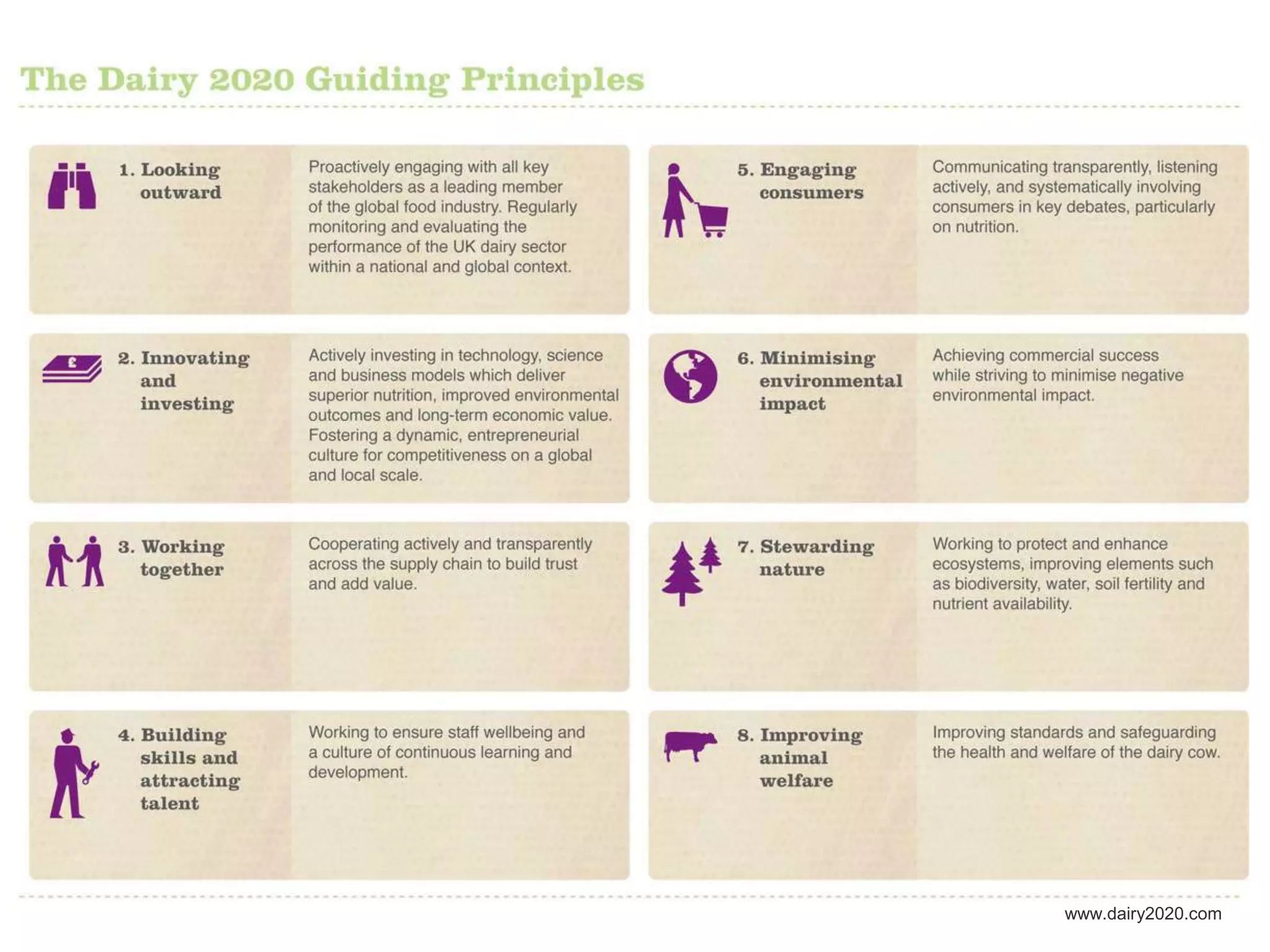
• A vision statement that sets a statement of ambition
• A framework of guiding principles that helps the industry
  negotiate the complexity of sustainability
• Areas of focus within each guiding principle that will enable a
  sustainable dairy industry to thrive in 2020
• A set of scenarios describing possible futures for the industry
  in 2020, and key risks and opportunities that the industry
  may have to operate within
• A toolkit that enables anyone in the industry to use these
  outputs for their own sustainability strategies
                                                          www.dairy2020.com
How did we get there?

Certainties
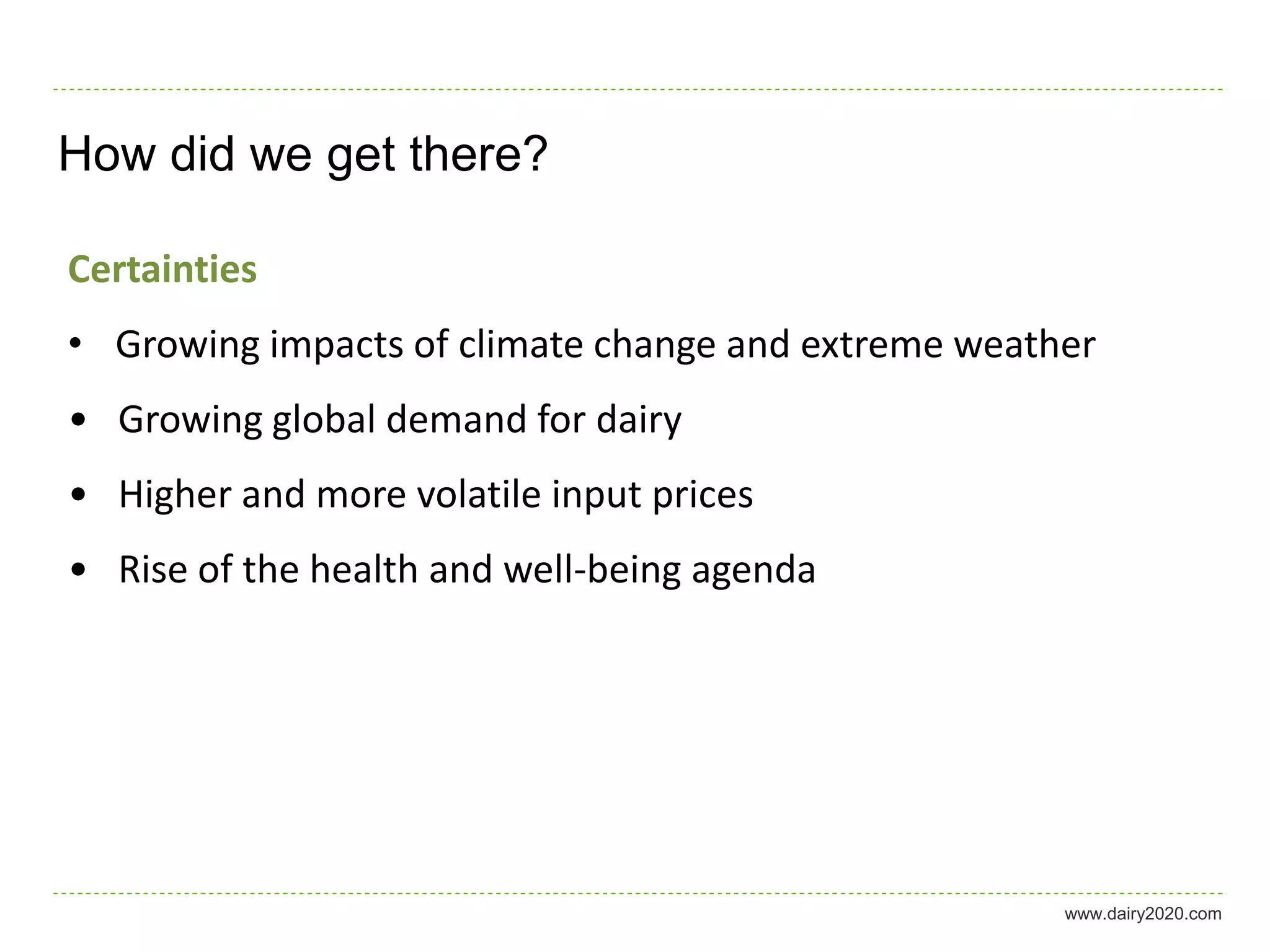
• Growing impacts of climate change and extreme weather
• Growing global demand for dairy
• Higher and more volatile input prices
• Rise of the health and well-being agenda


                                                     www.dairy2020.com
The things we were less sure about


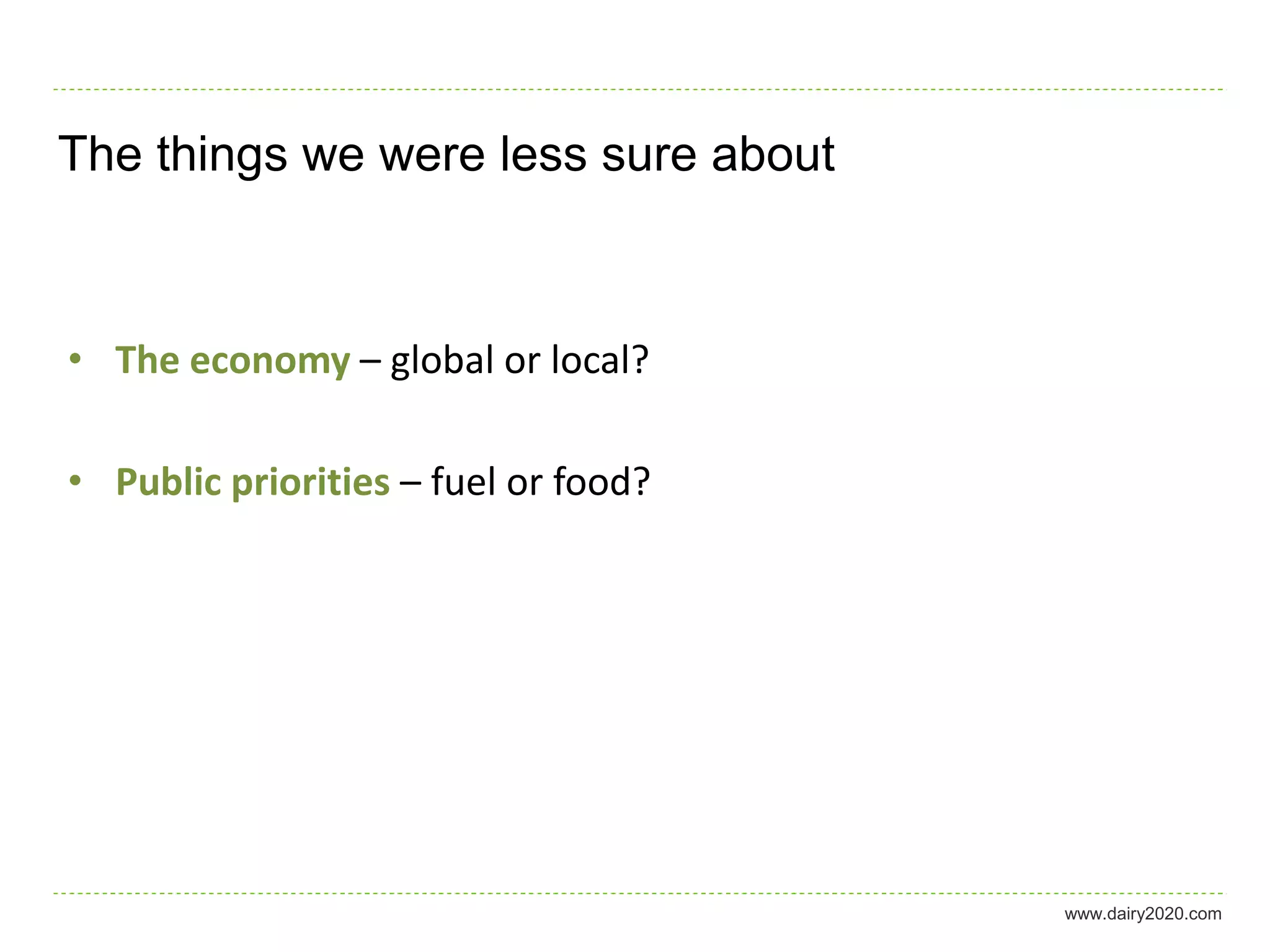
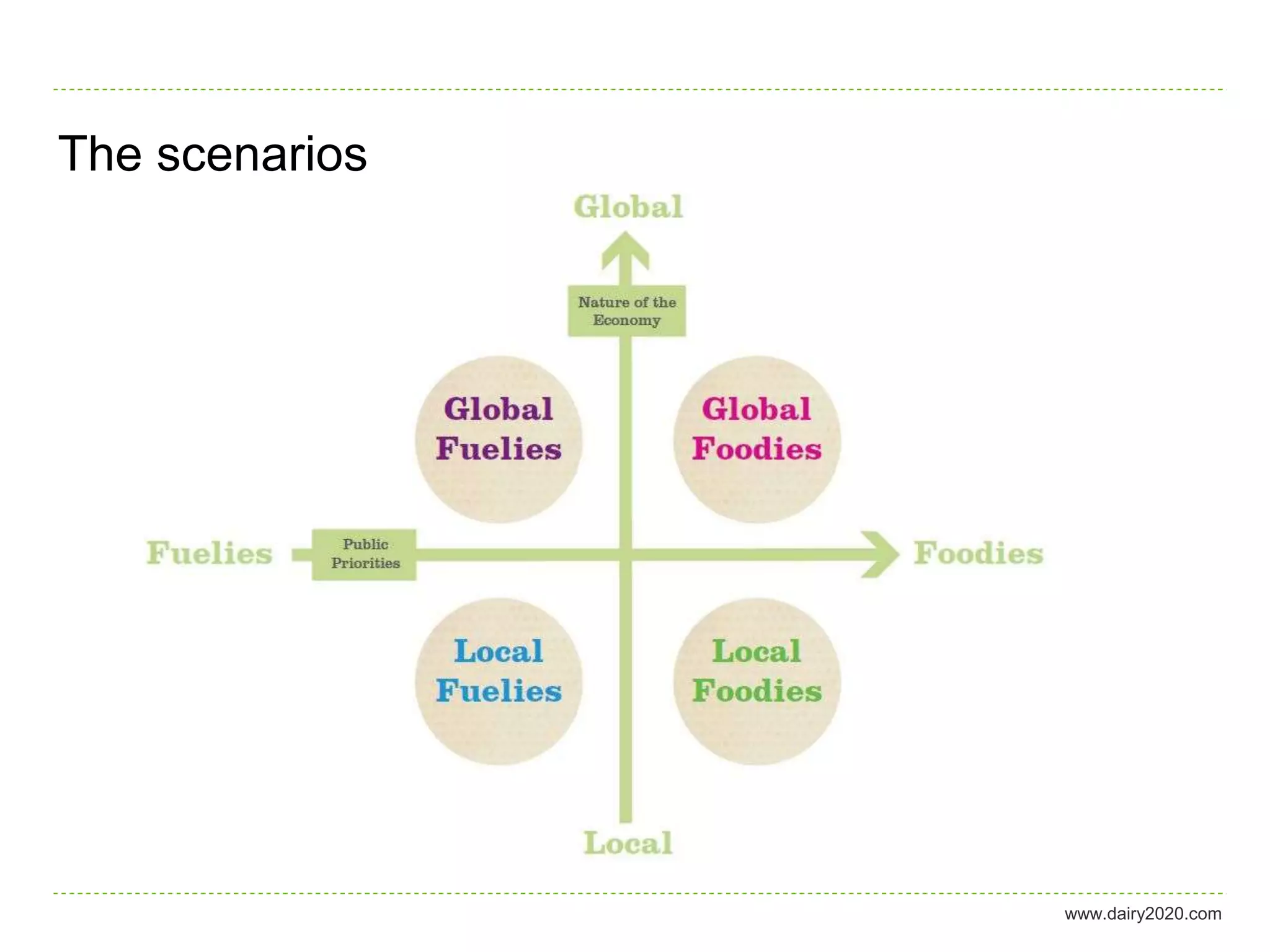
• The economy – global or local?

• Public priorities – fuel or food?


                                      www.dairy2020.com
The scenarios


                www.dairy2020.com
www.dairy2020.com
www.dairy2020.com
www.dairy2020.com
www.dairy2020.com
The vision


       “A vibrant UK dairy industry that
       enables people, environment and
              business to thrive”


                                           www.dairy2020.com
www.dairy2020.com
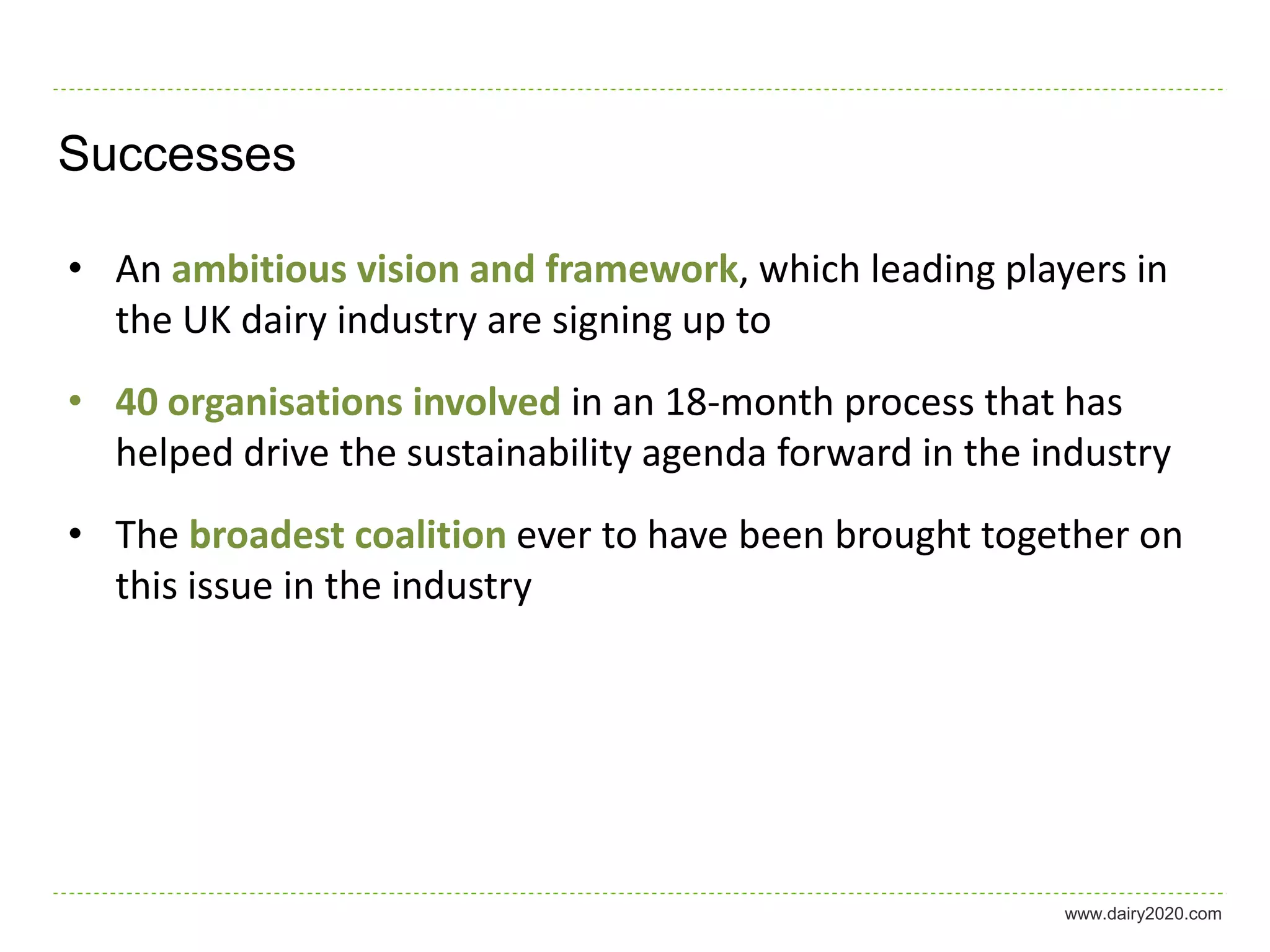
Successes

• An ambitious vision and framework, which leading players in
  the UK dairy industry are signing up to
• 40 organisations involved in an 18-month process that has
  helped drive the sustainability agenda forward in the industry
• The broadest coalition ever to have been brought together on
  this issue in the industry


                                                         www.dairy2020.com
Endorsements

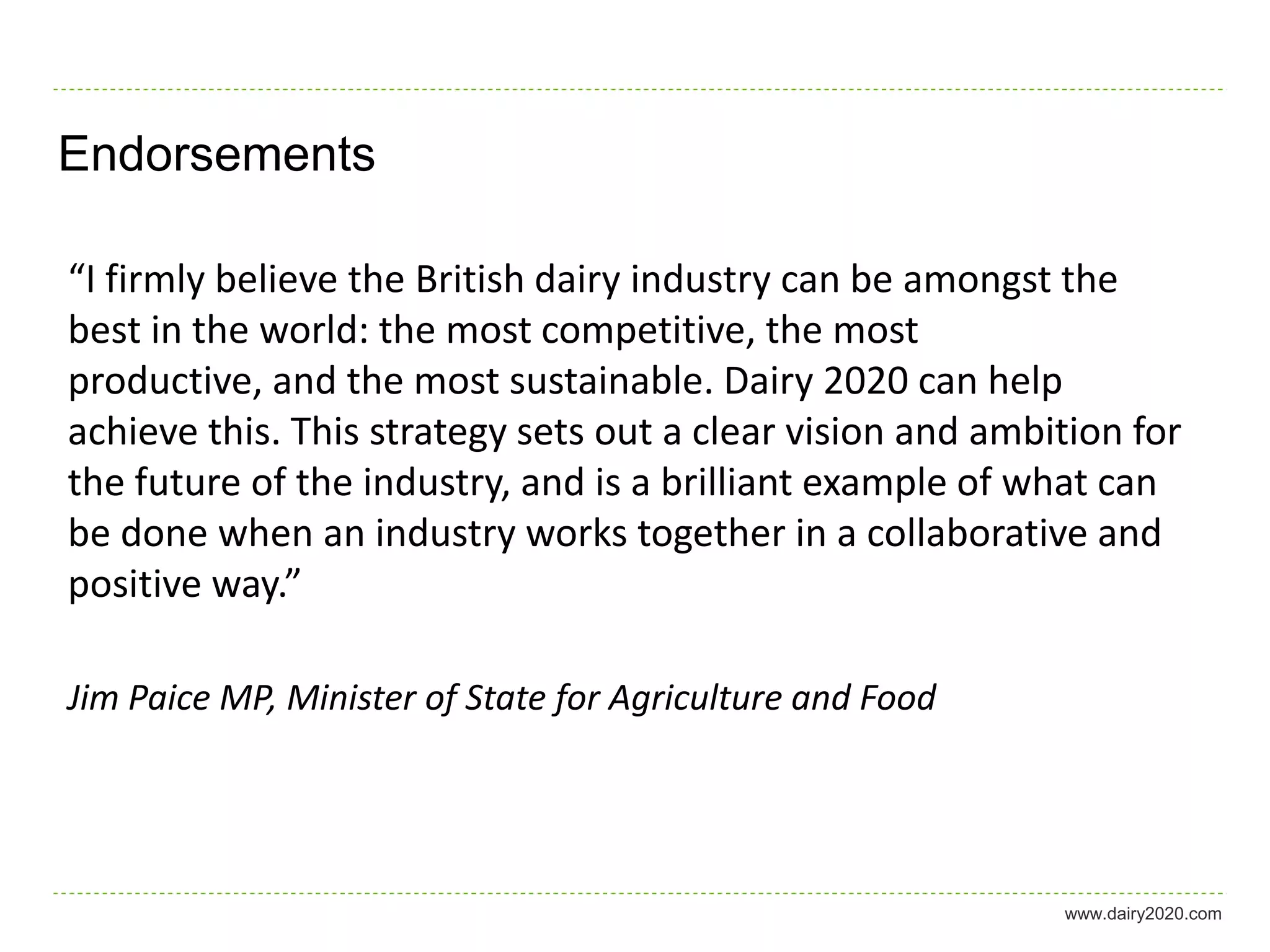
“I firmly believe the British dairy industry can be amongst the
best in the world: the most competitive, the most
productive, and the most sustainable. Dairy 2020 can help
achieve this. This strategy sets out a clear vision and ambition for
the future of the industry, and is a brilliant example of what can
be done when an industry works together in a collaborative and
positive way.”

Jim Paice MP, Minister of State for Agriculture and Food


                                                            www.dairy2020.com
Endorsements

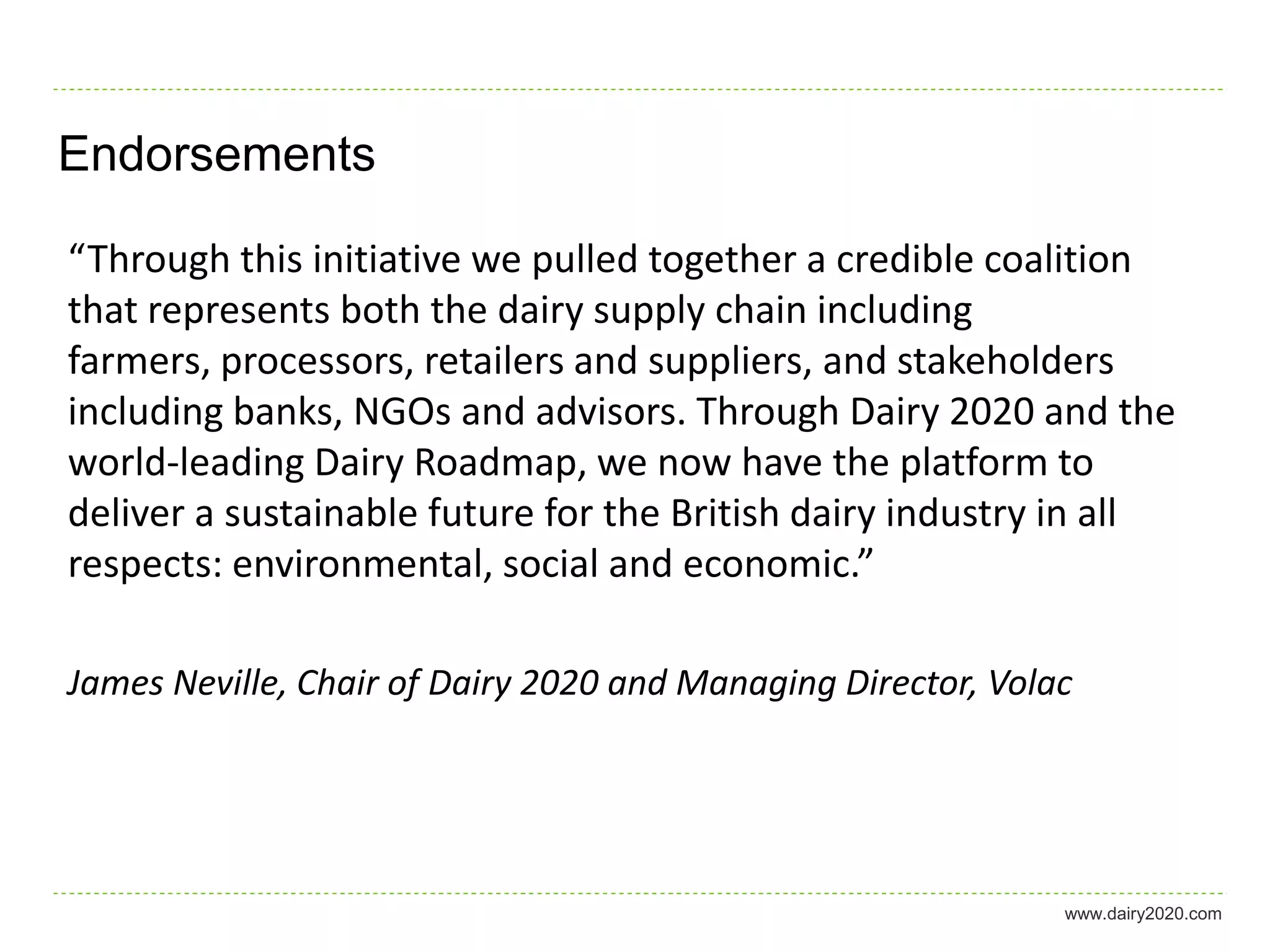
“Through this initiative we pulled together a credible coalition
that represents both the dairy supply chain including
farmers, processors, retailers and suppliers, and stakeholders
including banks, NGOs and advisors. Through Dairy 2020 and the
world-leading Dairy Roadmap, we now have the platform to
deliver a sustainable future for the British dairy industry in all
respects: environmental, social and economic.”

James Neville, Chair of Dairy 2020 and Managing Director, Volac


                                                              www.dairy2020.com
Endorsements

“Recent years have seen 'sustainability' often used and
sometimes abused in the world of food and farming. Dairy 2020
is an initiative that has not only helped define what the term
means, but also how the vision can be achieved. AIC and its
members who represent the livestock feed sector recognise they
have a vital role to play in supplying the right products, backed by
sound advice to underpin a truly sustainable dairy sector.”

David Caffal, Chief Executive, Agricultural Industries Confederation


                                                                 www.dairy2020.com
What’s next?

• Seek endorsement for the vision and framework from the
  wider supply chain
• Industry to refine the ‘areas of focus’ within each guiding
  principle to create a detailed action plan
• Implementation!
• Share learning with dairy sectors in other countries


                                                           www.dairy2020.com
Thank you!
www.dairy2020.com


                    www.dairy2020.com

Dairy 2020 slide deck intro to the project

  • 1.
    Dairy 2020 What isit, and what does it mean for the industry?
  • 2.
    What is Dairy2020? The key question: What does a sustainable dairy industry look like in 2020? The purpose: • Provide a shared understanding of what ‘sustainability’ means for the dairy industry • Identify areas for action and where there are conflicts/gaps still to be resolved www.dairy2020.com
  • 3.
    Who’s involved? www.dairy2020.com
  • 4.
    Project objectives • Positionindustry for economic success through sustainability leadership • Create and communicate a vision for a sustainable UK dairy industry which can be used as best practice for the dairy industry globally • Understand the sustainability challenges and opportunities • Cooperate actively and transparently across the supply chain to build trust and add value. www.dairy2020.com
  • 5.
    The process www.dairy2020.com
  • 6.
    What is ‘futures’and why did we use it? • When talking about the long-term future, people are often willing to discuss important or sensitive issues more positively, focusing more on solutions than they otherwise might. • People’s different underlying assumptions can be brought to light and talked over: the futures process is a tool to stimulate debate. • Looking to the future can make the imperative for action much clearer, and galvanise a proactive response. www.dairy2020.com
  • 7.
    What are ‘scenarios’and why did we create them? • Allow us to deal with certainties and uncertainties • Good at generating debate • Don’t presuppose agreement about everything • Show the connections between different issues • Provide imperative for action www.dairy2020.com
  • 8.
    What did weproduce? • A vision statement that sets a statement of ambition • A framework of guiding principles that helps the industry negotiate the complexity of sustainability • Areas of focus within each guiding principle that will enable a sustainable dairy industry to thrive in 2020 • A set of scenarios describing possible futures for the industry in 2020, and key risks and opportunities that the industry may have to operate within • A toolkit that enables anyone in the industry to use these outputs for their own sustainability strategies www.dairy2020.com
  • 9.
    How did weget there? Certainties • Growing impacts of climate change and extreme weather • Growing global demand for dairy • Higher and more volatile input prices • Rise of the health and well-being agenda www.dairy2020.com
  • 10.
    The things wewere less sure about • The economy – global or local? • Public priorities – fuel or food? www.dairy2020.com
  • 11.
    The scenarios www.dairy2020.com
  • 12.
  • 13.
  • 14.
  • 15.
  • 16.
    The vision “A vibrant UK dairy industry that enables people, environment and business to thrive” www.dairy2020.com
  • 17.
  • 18.
    Successes • An ambitiousvision and framework, which leading players in the UK dairy industry are signing up to • 40 organisations involved in an 18-month process that has helped drive the sustainability agenda forward in the industry • The broadest coalition ever to have been brought together on this issue in the industry www.dairy2020.com
  • 19.
    Endorsements “I firmly believethe British dairy industry can be amongst the best in the world: the most competitive, the most productive, and the most sustainable. Dairy 2020 can help achieve this. This strategy sets out a clear vision and ambition for the future of the industry, and is a brilliant example of what can be done when an industry works together in a collaborative and positive way.” Jim Paice MP, Minister of State for Agriculture and Food www.dairy2020.com
  • 20.
    Endorsements “Through this initiativewe pulled together a credible coalition that represents both the dairy supply chain including farmers, processors, retailers and suppliers, and stakeholders including banks, NGOs and advisors. Through Dairy 2020 and the world-leading Dairy Roadmap, we now have the platform to deliver a sustainable future for the British dairy industry in all respects: environmental, social and economic.” James Neville, Chair of Dairy 2020 and Managing Director, Volac www.dairy2020.com
  • 21.
    Endorsements “Recent years haveseen 'sustainability' often used and sometimes abused in the world of food and farming. Dairy 2020 is an initiative that has not only helped define what the term means, but also how the vision can be achieved. AIC and its members who represent the livestock feed sector recognise they have a vital role to play in supplying the right products, backed by sound advice to underpin a truly sustainable dairy sector.” David Caffal, Chief Executive, Agricultural Industries Confederation www.dairy2020.com
  • 22.
    What’s next? • Seekendorsement for the vision and framework from the wider supply chain • Industry to refine the ‘areas of focus’ within each guiding principle to create a detailed action plan • Implementation! • Share learning with dairy sectors in other countries www.dairy2020.com
  • 23.

Editor's Notes

  • #4 This was a collaborative process, and we wanted the whole supply chain represented. Here are some of our partners involved in the process.The project was managed and facilitated by Forum for the Future, the leading global sustainability non-profit. They provided food, futures and sustainability expertise, and acted as ‘critical friends’.Since the project has been launched, more organisations have endorsed the project and plan to use it in their organisations.
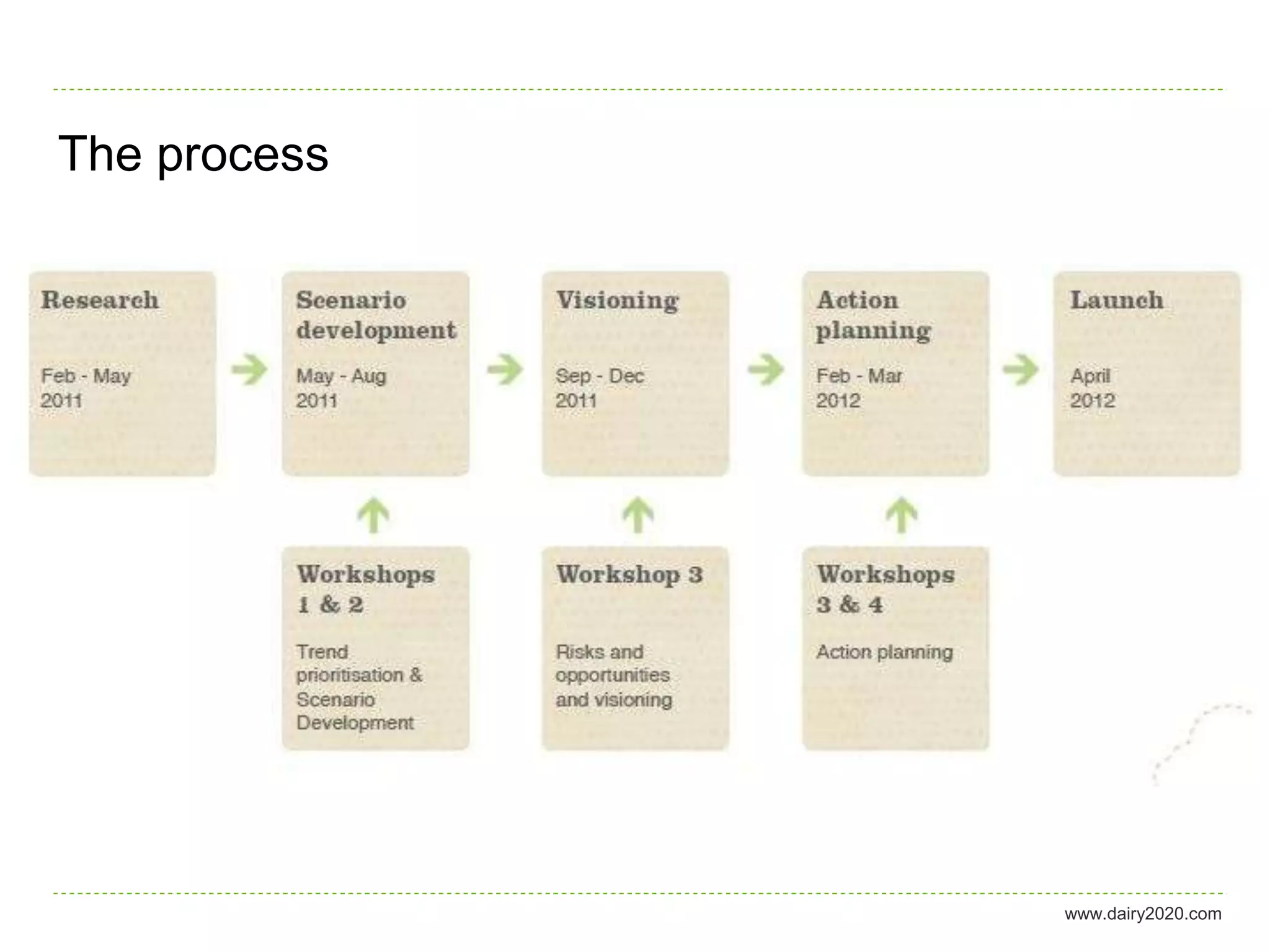
  • #6 The Dairy 2020 project was an 18-month collaboration between over 40 organisations from across the UK dairy supply chain. The process started with a scoping study back in September 2010, and the resulting project was designed byForum for the Future using the insight and feedback gained during that study. Forum are experts in using ‘futures’ processes to help whole sectors move onto a sustainable path. You can find more detail on the process we used on the Dairy 2020 website: http://www.dairy2020.com/about
  • #7 You can find out more about ‘futures’ and how it’s used on Forum for the Future’s website: http://www.forumforthefuture.org/our-work/how-we-do-it/futures-diagnosis/more-about-our-futures-work
  • #10 Our research and workshop dialogue suggested that some factors will be both important and relatively certain in the future – meaning that we can be fairly sure that they will need to be considered in any scenario. For this reason, some features are common to all four scenarios we have developed, although the emphasis may differ between them.For more information on the certainties, see page 3 of the ‘Scenarios for a sustainable UK dairy industry’ at www.dairy2020.com
  • #11 Other factors are more uncertain. It is easy to imagine things going a number of different ways when it comes to topics such as policy responses to climate change, the ability of farmers and the food industry to meet growing consumer demand, and public perceptions of dairy farming.The differences between our scenarios focus on two main uncertainties that the Working Group told us are most uncertain for the industry: the nature of the global economy and public priorities. These came to form the framework of the scenarios.
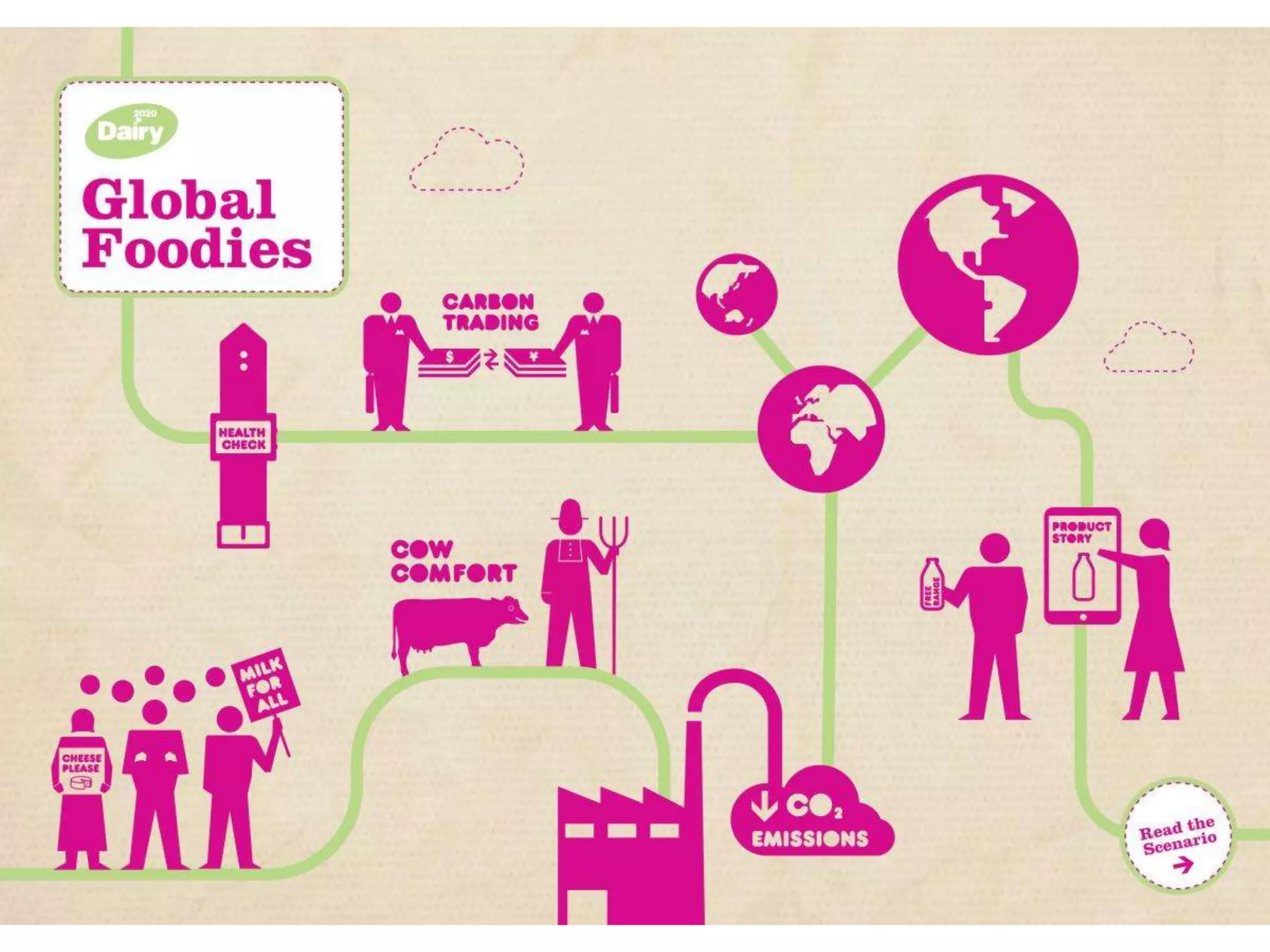
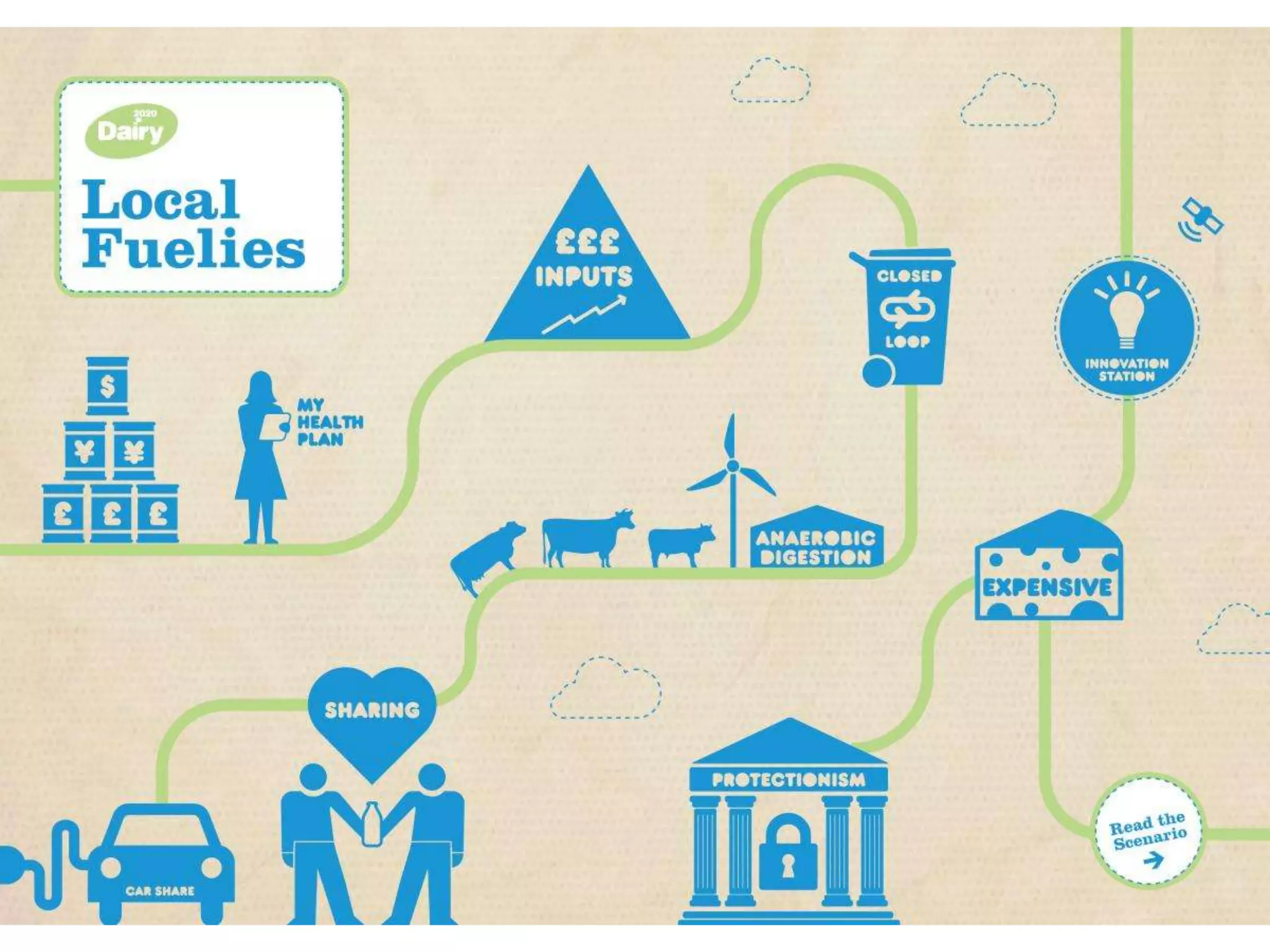
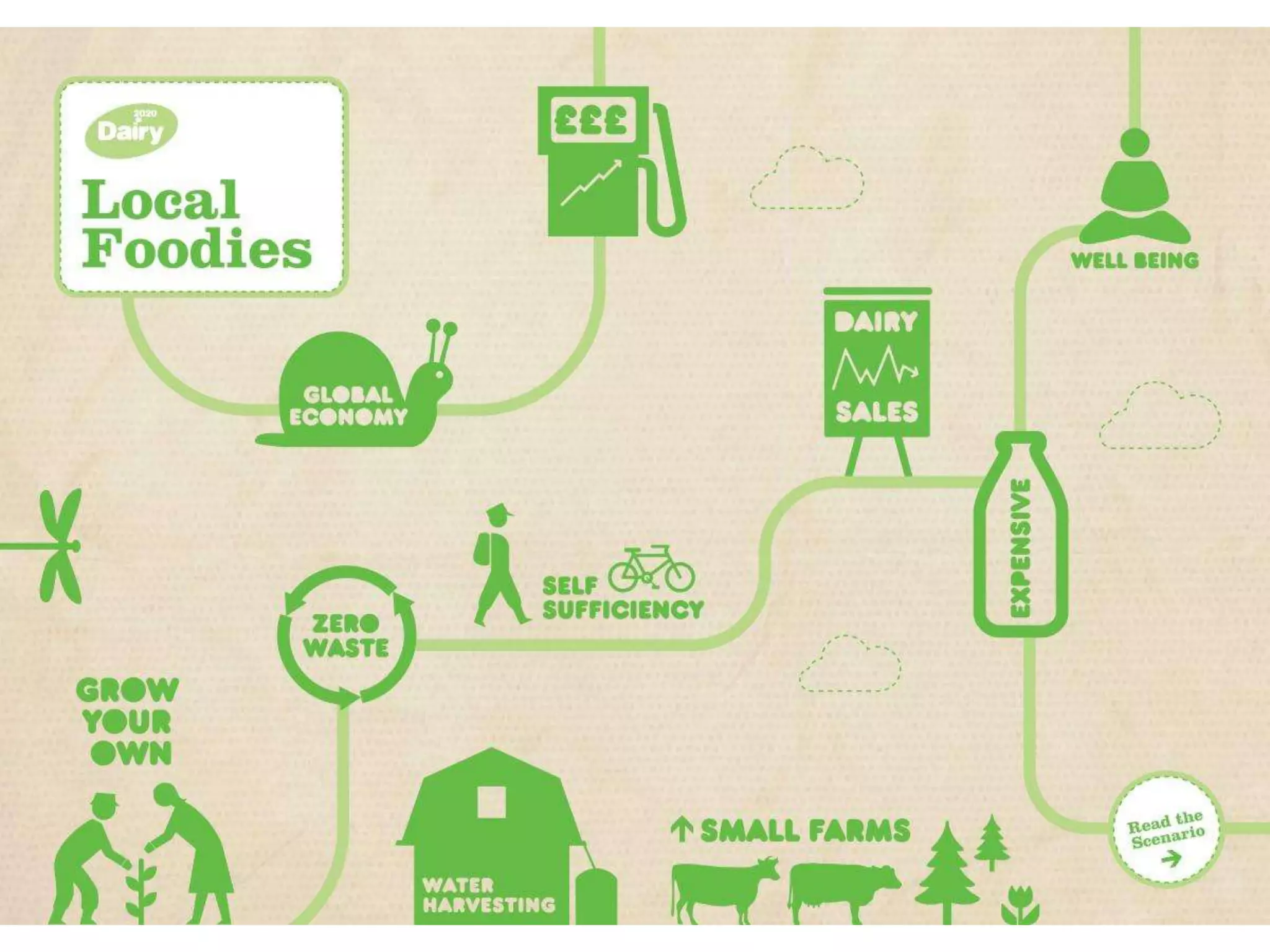
  • #12 The differences between our scenarios focus on two main uncertainties where we could be much less confident about their future direction.Global: Global supply chainsA globalised, highly competitive marketplaceAligned regulatory frameworks Multilateral trade agreementsHigh degree of competitiveness across the globeThe most efficient, innovative players win regardless of geographic origin Local: Trade flows globally, but there are more regional blocs More protectionism and trade barriersDifferentiated regulatory frameworks Bilateral trade agreements proliferate Former ‘emerging’ economies dominate, with ‘developed’ economies in a phase of low growthNational policies prioritize local production, food and energy security, and a higher degree of self-sufficiency‘Fuelies’: Practical and basic is desirablePeople are streamlining their lifestyles and attracted to products and services that are easily understood, and deliver multiple benefits.Maximizing efficiency is important: in lifestyles, in industry, etc.Consumer look for engagement with brands, but on a need-to-know basis: e.g. whether products are safe, production processes legal, etc.Price, performance, value and convenience is what the consumers want to know about, and brands and retailers are tasked with the responsibility to deliver it. ‘Foodies’:Politics are passionate and irrational on key issuesPeople want more than cheap products, and are interested in the ‘experience’ of production and consumptionProduct footprinting and labelling is important. Consumers want to know the 'back story' of products, and how that relates to their own lifestyles Lots of engagement between brands and consumersPeople seek as much information as possible in order to make choices meaningful to their lifestyles
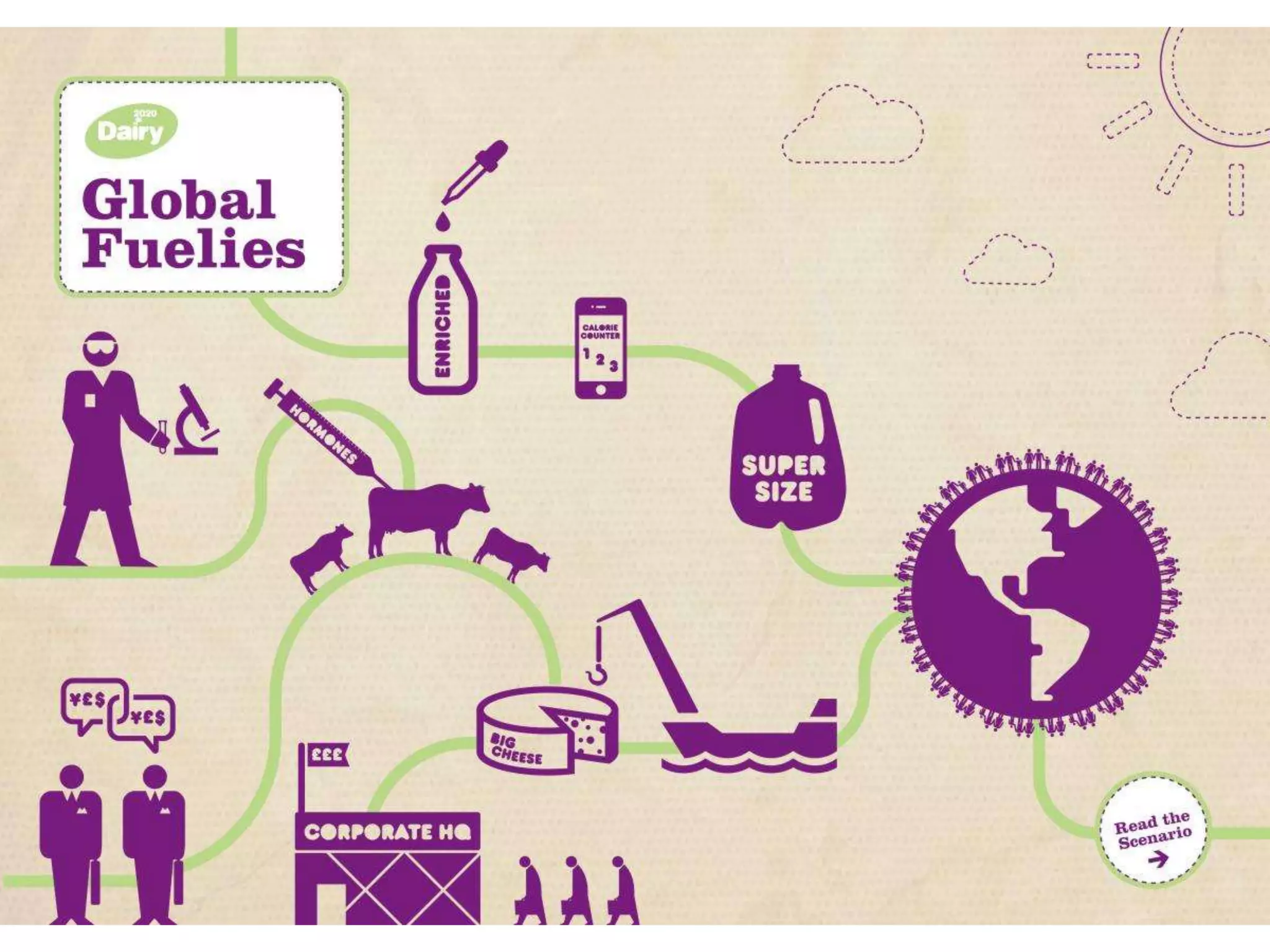
  • #13 Free markets and big business dictate global economic activity. Sustainability challenges tend to be dealt with through efficiency measures and technological innovation, but only when they threaten the bottom line in the shorter term.The UK dairy industry is globally competitive, and focuses on large-scale, professionally run farming operations. Consumers are interested in functional products that deliver what they want in a convenient form, but largely indifferent to how they’re produced.
  • #14 The economy is highly globalised, with strong interconnections between countries and regions. Business is dominated by multinationals, and ‘climate-preparedness’ determines the winners and losers. The UK dairy industry is a global leader, specialising in high-value, differentiated products and focused on the growing exportmarket. People care about the ‘experience’ of production and consumption, rather than just price and convenience – if you can afford it, that is.
  • #15 In a politically discordant world, protectionism is rife and import prices are high; energy and food security top the agenda. Climate change policy has taken a back seat. The UK dairy industry has shrunk because production is economically unviable except where farmers can diversify. UK consumers look for where they can get maximumnutrition for the lowest price.
  • #16 In an expensive and resource-constrained world, the imperative to reduce expensive imports has made local production and distribution attractive. Tackling sustainability challenges is an accepted priority for business, consumers and government. The recent decline in the UK dairy industry seems finally to have stabilised, with farmers enjoying high prices coupled with ecosystem service payments. The emphasis is on high-quality, high value-added production from smaller herds as consumers buy as locally as possible and look for quality and a great story to give meaning to their purchases.
  • #23 Implementation: the dairy2020.com website gives guidance for how you can use the Dairy 2020 outputs to test and create strategy, and stimulate innovation.