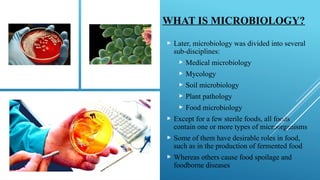
WHAT IS MICROBIOLOGY?
Later, microbiology was divided into several
sub-disciplines:
Medical microbiology
Mycology
Soil microbiology
Plant pathology
Food microbiology
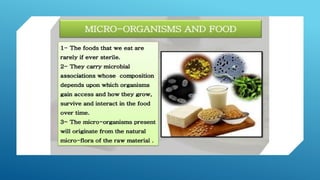
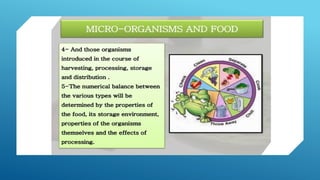
Except for a few sterile foods, all foods
contain one or more types of microorganisms
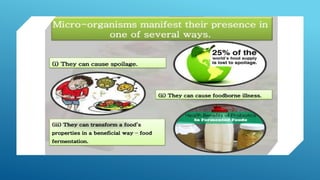
Some of them have desirable roles in food,
such as in the production of fermented food
Whereas others cause food spoilage and
foodborne diseases
EARLY HAPPENINGS
7000BC – Evidence that the
Babylonians manufactured beer
(fermentation)
3500 BC – Wine appeared
6000 BC – The first apparent reference
to food spoilage in recorded history
3000 BC – Egyptians manufactured
cheese (fermentation) and butter
(fermentation, low aw) Fermented foods
such as cheese and sour milk (yogurt)
were safer to eat and resisted spoilage
better than their raw agricultural
counterparts Several cultures also
learned to use salt (low aw) to preserve
meat and other foods around this time
8.
EARLY HAPPENINGS
1000BC – Romans used snow to
preserve shrimp (low temp)
Records of smoked and fermented
meats also appeared
Even though early human cultures
discovered effective ways to preserve
food (fermentation, salt, ice, drying
and smoking), they did not understood
how these practices inhibited food
spoilage or food borne disease
Their ignorance was compounded by a
belief that living things formed
spontaneously from nonliving matter
(Theory of Spontaneous Generation)
FOOD PROCESSING
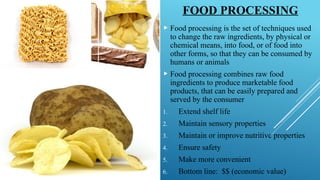
Foodprocessing is the set of techniques used
to change the raw ingredients, by physical or
chemical means, into food, or of food into
other forms, so that they can be consumed by
humans or animals
Food processing combines raw food
ingredients to produce marketable food
products, that can be easily prepared and
served by the consumer
1. Extend shelf life
2. Maintain sensory properties
3. Maintain or improve nutritive properties
4. Ensure safety
5. Make more convenient
6. Bottom line: $$ (economic value)
15.
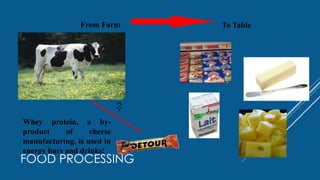
FOOD PROCESSING
From FarmTo Table
?
Whey protein, a by-
product of cheese
manufacturing, is used in
energy bars and drinks!
16.
FOOD PROCESSING METHODS
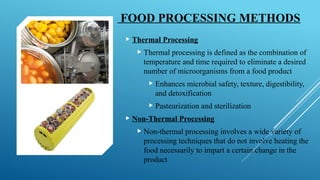
Thermal Processing
Thermal processing is defined as the combination of
temperature and time required to eliminate a desired
number of microorganisms from a food product
Enhances microbial safety, texture, digestibility,
and detoxification
Pasteurization and sterilization
Non-Thermal Processing
Non-thermal processing involves a wide variety of
processing techniques that do not involve heating the
food necessarily to impart a certain change in the
product
TRADITIONAL FOOD PROCESSINGMETHODS
Dehydration
Dehydration, or drying, of foods has long been practiced commercially in the production of
various food products:
Fruits, vegetables, skim milk, potatoes, soup mixes, and meats
Foodstuffs may be dried in air, superheated steam, vacuum, or inert gas or by direct
application of heat
Air is the most generally used drying medium, because:
It is plentiful and convenient
Permits gradual drying
Allowing sufficient control to avoid overheating
Loss of moisture content produced by drying results in increased concentration of nutrients
Dehydration techniques are aimed at lowering the water activity (aw) of foods
Lower the water activity, safer will be the food
19.
TRADITIONAL FOOD PROCESSINGMETHODS
Addition of Sugar
Fruit jelly and preserve manufacture, an important fruit by-product industry, is based on
the high-solids–high-acid principle, with its moderate heat-treatment requirements
Fruits that possess excellent qualities but are visually unattractive may be preserved and
utilized in the form of concentrates, which have a pleasing taste and substantial nutritive
value
Jellies and other fruit preserves are prepared from fruit by adding sugar and concentrating
by evaporation to a point where microbial spoilage cannot occur
The prepared product can be stored without hermetic sealing, although such protection is
useful to control mold growth, moisture loss, and oxidation
Candied and glacéed fruits are made by slow impregnation of the fruit with syrup until
the concentration of sugar in the tissue is sufficiently high to prevent growth of spoilage
microorganisms
20.
TRADITIONAL FOOD PROCESSINGMETHODS
Fermentation
Controlled fermentations are used to produce a range of fermented foods
Sauerkraut, pickles, olives, vinegar, dairy and other products
Controlled fermentation is a form of food preservation since it generally results in a
increase of acidity of the food, thus preventing the growth of spoilage micro-organisms
The two most common acids produced are lactic acid and acetic acid
Other acids such as propionic, fumaric and malic acid are also formed during
fermentation
It is highly probable that the first controlled food fermentations came into existence
through trial and error and a need to preserve foods for consumption later in the season
It is possible that the initial attempts at preservation involved the addition of salt or
seawater
MODERN FOOD PROCESSINGMETHODS
Refrigeration
The life of many foods may be increased by storage at temperatures below
4°C (40°F)
Commonly refrigerated foods include fresh fruits and vegetables, eggs,
dairy products, and meats
Also, refrigeration cannot improve the quality of decayed food; it can only
retard deterioration
One problem of modern mechanical refrigeration—that of dehydration of
foods due to moisture condensation—has been overcome through humidity
control mechanisms within the storage chamber and by appropriate
packaging techniques
23.
MODERN FOOD PROCESSINGMETHODS
Canning
Tin-coated steel containers, made from 98.5 percent sheet steel with a thin coating of tin, soon
became common, after 1820’s
These cans had a double seamed top and bottom to provided an airtight seal and could be
manufactured at high speeds
A typical canning operation involves:
Cleaning, filling, exhausting, can sealing, heat processing, cooking, labeling, casing, and
storage
Most of these operations are performed using high-speed, automatic machines
The thermal processes of canning are generally designed to destroy the spores of
the bacterium C. botulinum
This microorganism can easily grow under anaerobic conditions, producing the
deadly toxin that causes botulism
Sterilization requires heating to temperatures greater than 100°C (212°F)
24.
MODERN FOOD PROCESSINGMETHODS
Pasteurization
Pasteurization is the application of heat to a food product in order to:
Destroy pathogenic (disease-producing) microorganisms
Inactivate spoilage-causing enzymes
Reduce or destroy spoilage microorganisms
The relatively mild heat treatment used in the pasteurization process causes
minimal changes in the sensory and nutritional characteristics of foods
compared to the severe heat treatments used in the sterilization process
The typical processing conditions for the pasteurization of fruit juices
include heating to 77°C (171°F) and holding for 1 minute, followed by rapid
cooling to 7°C (45°F)
25.
MODERN FOOD PROCESSINGMETHODS
Pasteurization
In the pasteurization of milk, the time and temperature conditions target the
pathogenic bacteria Mycobacterium tuberculosis, Coxiella burnetti, and Brucella
abortus
The typical heat treatment used for pasteurizing milk is 72°C (162°F) for 15
seconds, followed by rapid cooling to 7°C
The high-temperature–short-time (HTST) treatments cause less damage to the
nutrient composition and sensory characteristics of foods and therefore are
preferred over the low-temperature–long-time (LTLT) treatments
Liquid foods such as milk, fruit juices, beers, wines, and liquid eggs are
pasteurized using plate-type heat exchangers
Plate-type heat exchangers are effective in rapid heating and cooling applications
26.
MODERN FOOD PROCESSINGMETHODS
Chemical Preservation
Sugar (jams, jellies, marmalades), vinegar and salt (pickling), and some
chemicals foreign to foods are added to prevent the growth of
microorganisms
The latter group includes some natural food constituents such as ascorbic
acid (vitamin C), which is added to frozen peaches to prevent browning
Sodium benzoate (benzoic acid) and other benzoates are among the
principal organic chemical preservatives
Sulfur dioxide and sulfites are perhaps the most important inorganic
chemical preservatives
Oxidizing agents such as nitrates and nitrites are commonly used in the
curing of meats
27.
MODERN FOOD PROCESSINGMETHODS
Irradiation
Food irradiation involves the use of either high-speed electron beams or high-energy
radiation with wavelengths smaller than 200 nanometers, or 2000 angstroms (e.g., X-rays
and gamma rays)
The two most common sources of high-energy radiation used in the food industry are
cobalt-60 (60
Co) and cesium-137 (137
Cs)
The unit of absorbed dose of radiation by a material is denoted as the gray (Gy), one gray
being equal to the absorption of one joule of energy by one kilogram of food
The bactericidal (bacteria-killing) effect of ionizing radiation is due to damage of the
biomolecules of bacterial cells
The free radicals produced during irradiation may destroy or change the structure of
cellular membranes
In addition, radiation causes irreversible changes to the nucleic acid molecules (i.e.,
DNA and RNA) of bacterial cells, inhibiting their ability to grow
28.
MODERN FOOD PROCESSINGMETHODS
Irradiation
Pathogenic bacteria that are unable to produce resistant endospores in foods such as
poultry, meats and seafood can be eliminated by radiation doses of 3 to 10 kilograys
If the dose of radiation is too low, then the damaged DNA can be repaired by
specialized enzymes
The dose of radiation used on food products is divided into three levels:
Radappertization is a dose in the range of 20 to 30 kilograys, necessary to sterilize a
food product
Radurization is a dose of 1 to 10 kilograys, that, like pasteurization, is useful for
targeting specific pathogens
Radicidation involves doses of less than 1 kilogray for extending shelf life and
inhibiting sprouting
29.
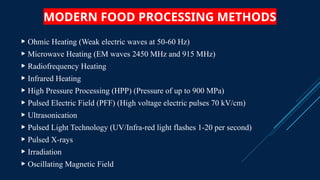
MODERN FOOD PROCESSINGMETHODS
Ohmic Heating (Weak electric waves at 50-60 Hz)
Microwave Heating (EM waves 2450 MHz and 915 MHz)
Radiofrequency Heating
Infrared Heating
High Pressure Processing (HPP) (Pressure of up to 900 MPa)
Pulsed Electric Field (PFF) (High voltage electric pulses 70 kV/cm)
Ultrasonication
Pulsed Light Technology (UV/Infra-red light flashes 1-20 per second)
Pulsed X-rays
Irradiation
Oscillating Magnetic Field