Folksonomies and Social
Tagging
What Are Tags?
• Keywords or terms associated with or
assigned to a piece of information
• They enable keyword-based classification
and search of information
Basic Model for Tagging Systems
USER
RESOURCES
TAGS
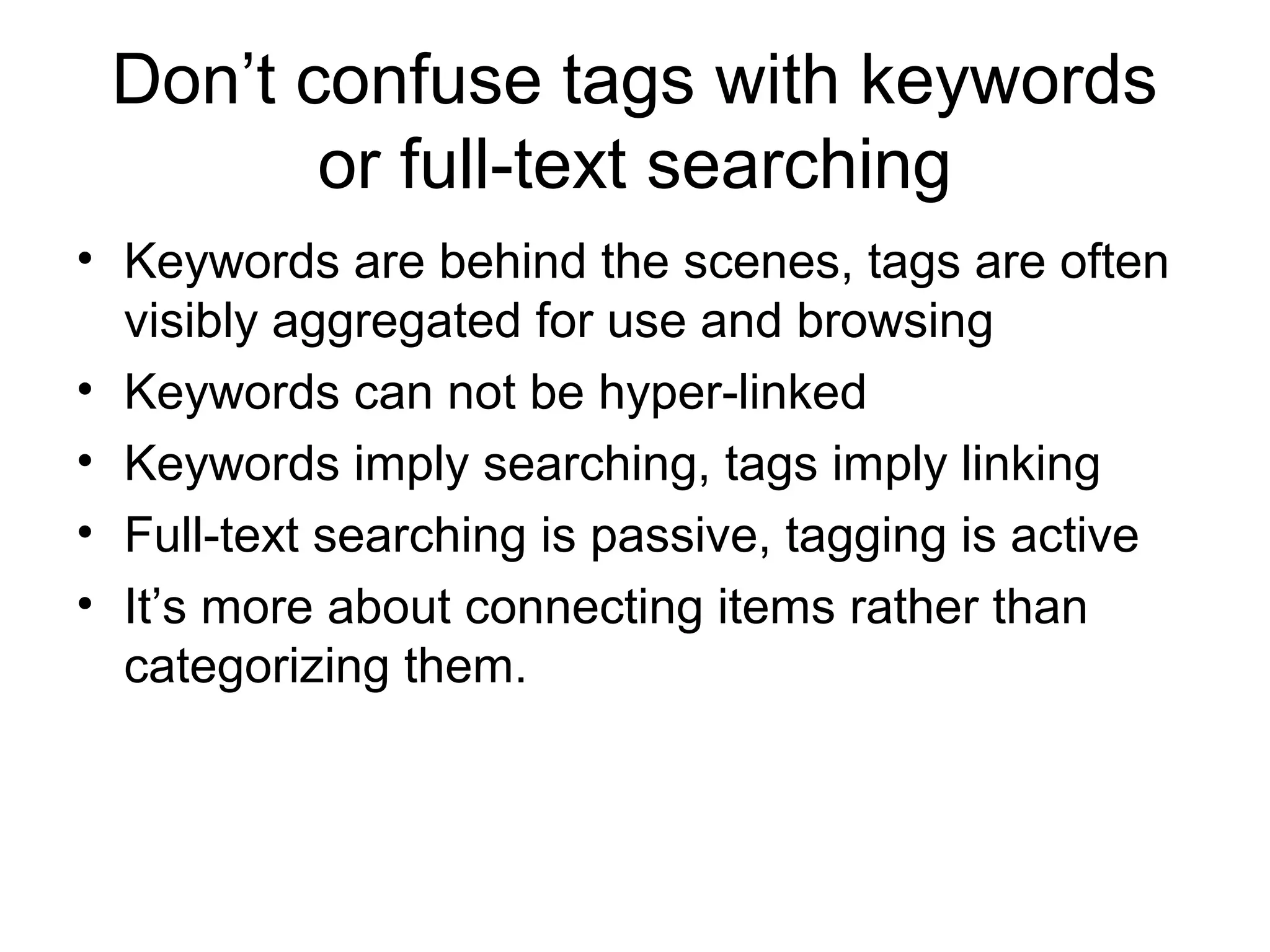
Don’t confuse tags with keywords
or full-text searching
• Keywords are behind the scenes, tags are often
visibly aggregated for use and browsing
• Keywords can not be hyper-linked
• Keywords imply searching, tags imply linking
• Full-text searching is passive, tagging is active
• It’s more about connecting items rather than
categorizing them.
Tags can be …
• Descriptions of the subject matter
• Where the item is located
• The intended use of the item
• Individual (gift from mom)
• Different people have different tagging
patterns
• Tagging systems encourage differences
Tags are
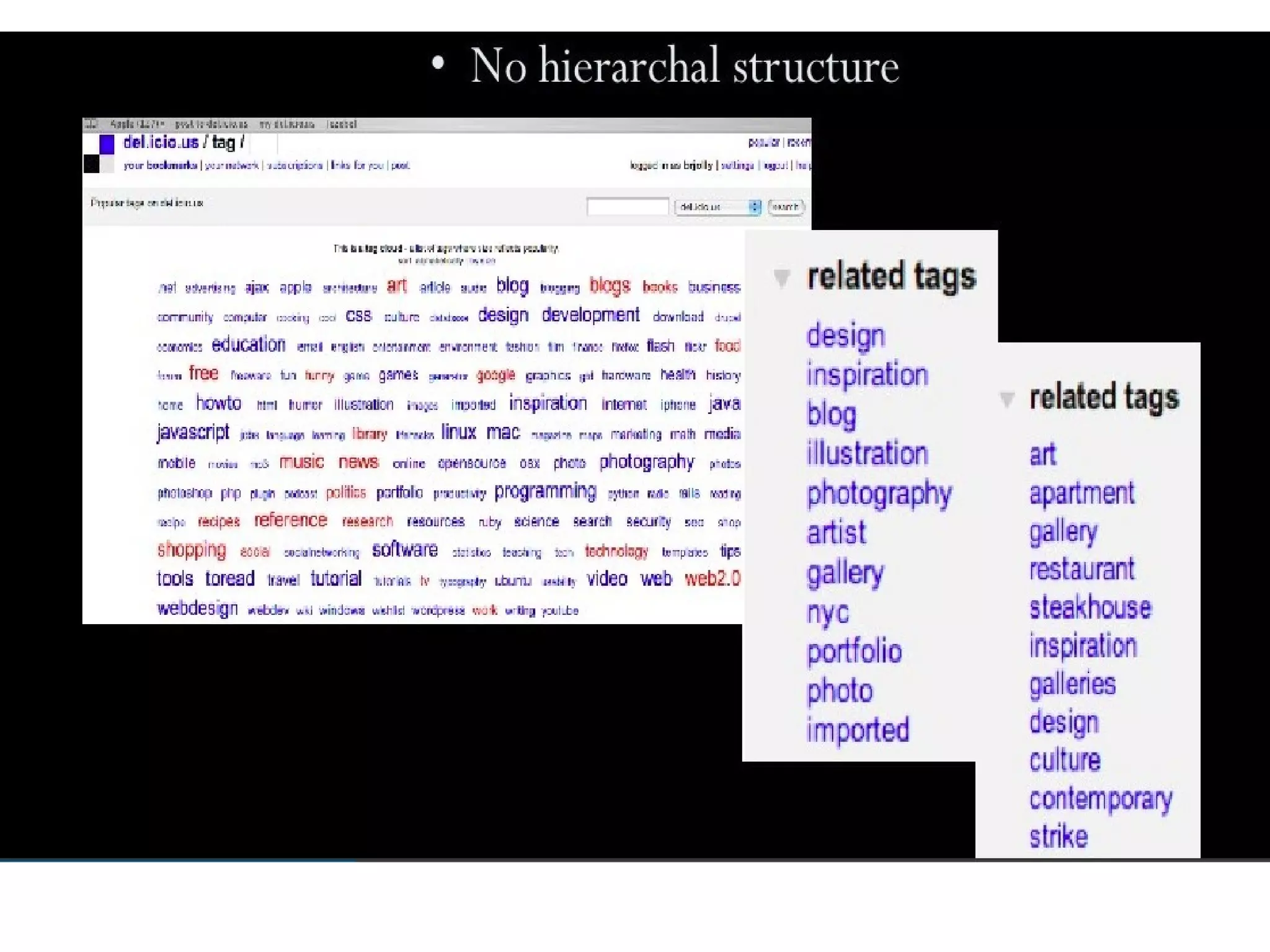
• Non-hierarchical
• A way to create links between items by the
creation of sets of objects
• A means of connecting with others
interested in the same things
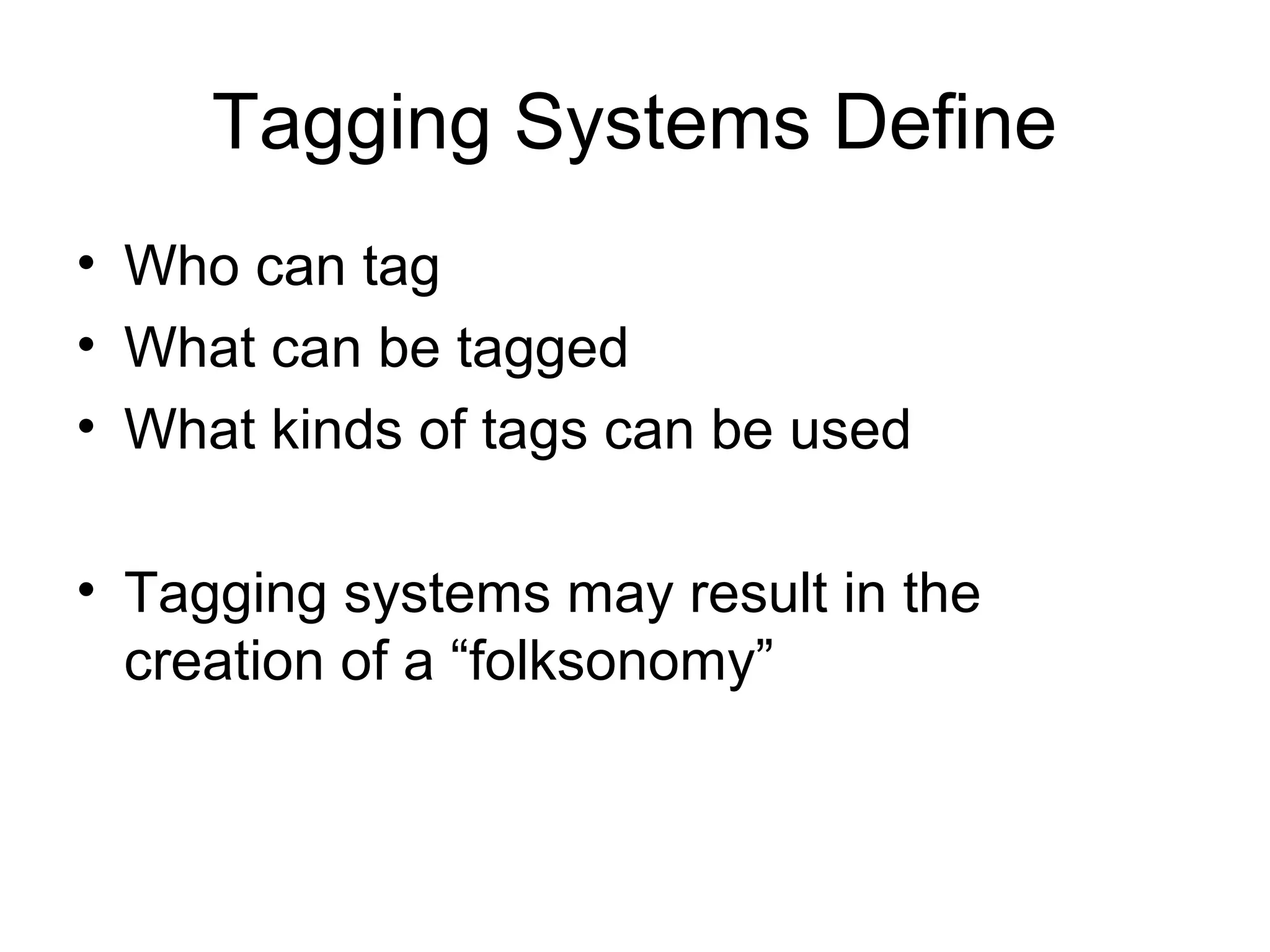
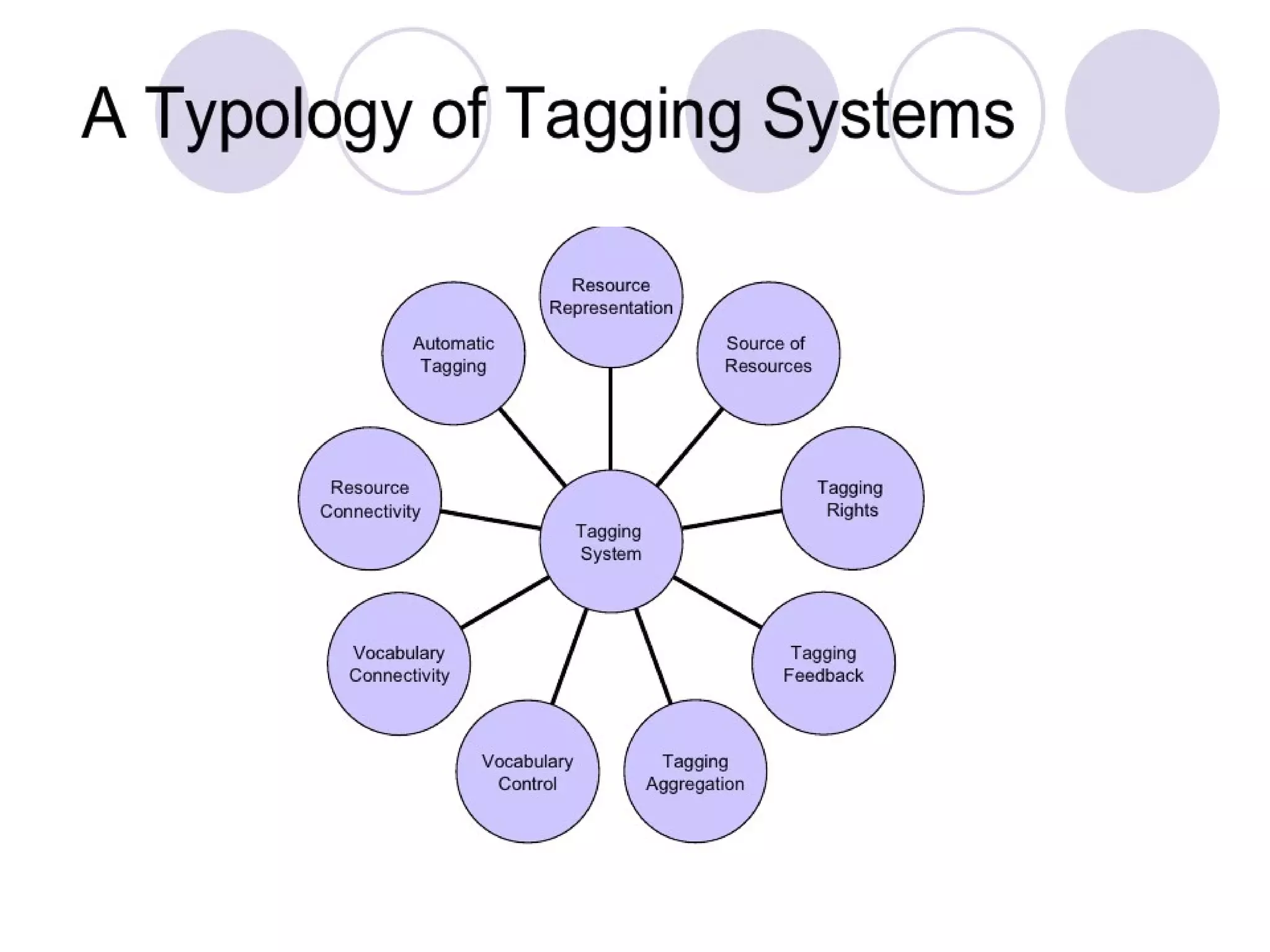
Tagging Systems Define
• Who can tag
• What can be tagged
• What kinds of tags can be used
• Tagging systems may result in the
creation of a “folksonomy”
Types of Tagging Systems
• Managing personal information
• Social bookmarking
• Collecting and sharing digital objects
• Improving the e-commerce experience
Why is tagging so popular?
• It is easy and enjoyable
• It has a low cognitive cost
• It is quick to do
• It provides self and social feedback
immediately
Putting the social in tagging
• Tags allow for social interaction because
when we navigate by tags we are directly
connecting with others
• People tag for their own benefit
Tags, and therefore social tags are
• Dynamic categorization systems
• Often created on-the-fly
• Chosen as relevant to the user – not to the
creator, cataloger or researcher
• A social activity (more on this later)
• Hopefully one small step toward a more
interactive and responsive library system
Social Bookmarking
Common elemental characteristics of social
bookmarking (folksonomic) systems.
• Tag – a single word label that is applied to an
object (URL)
• Tagging – the process of organizing an object
by assigning a label or “tag”
• Tag bundle –a group of tags linked by another
tag or “super tag”
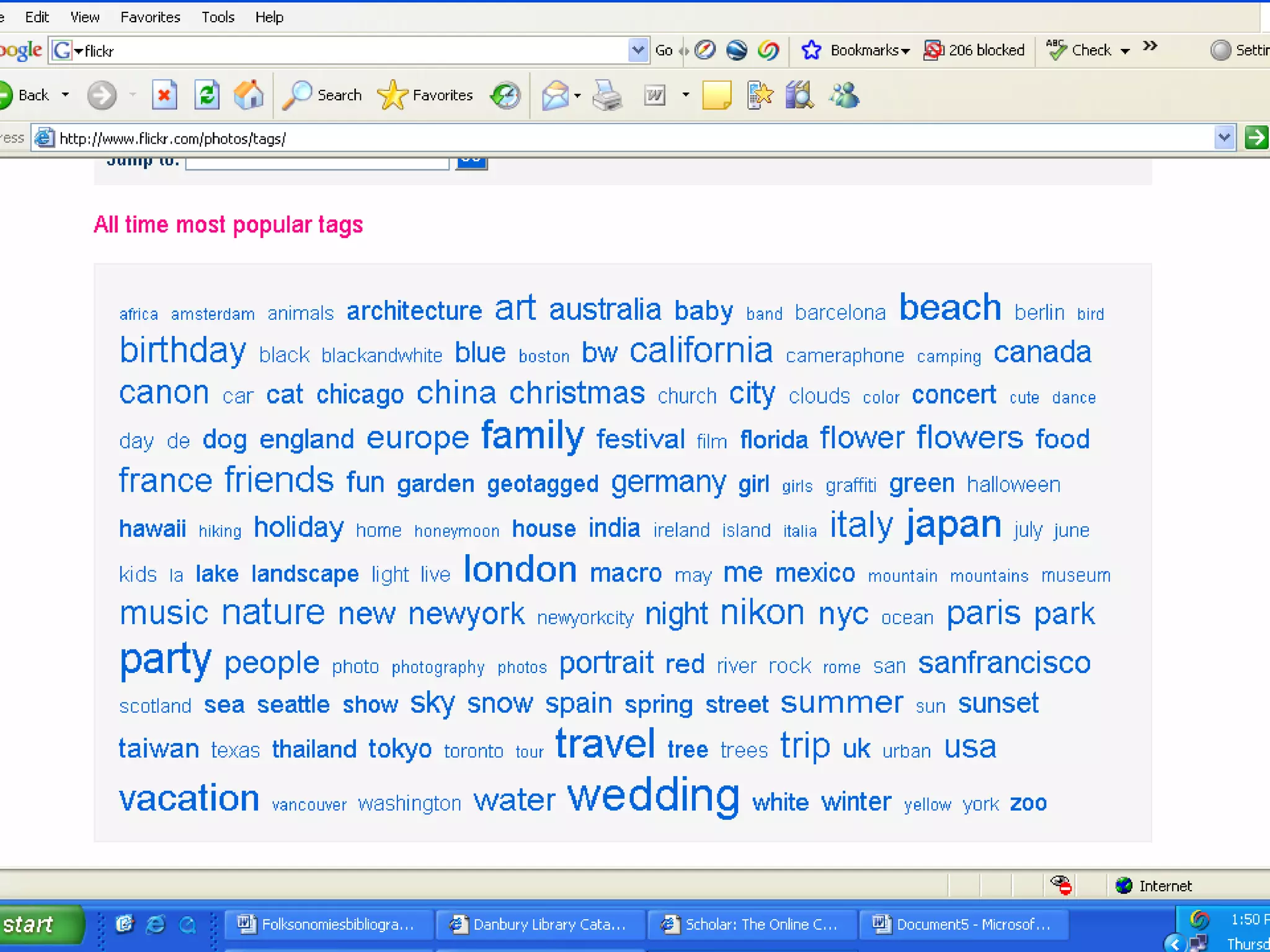
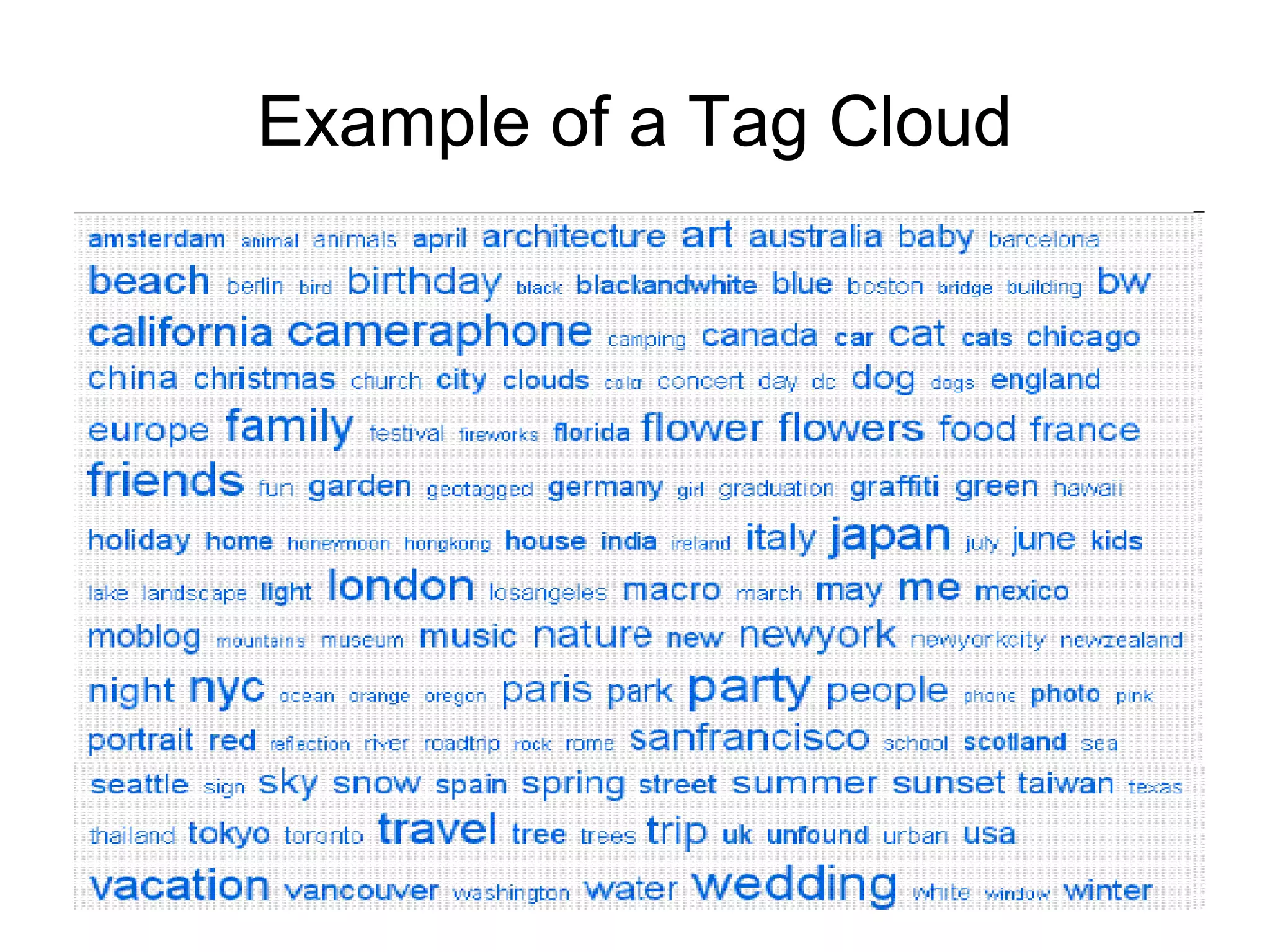
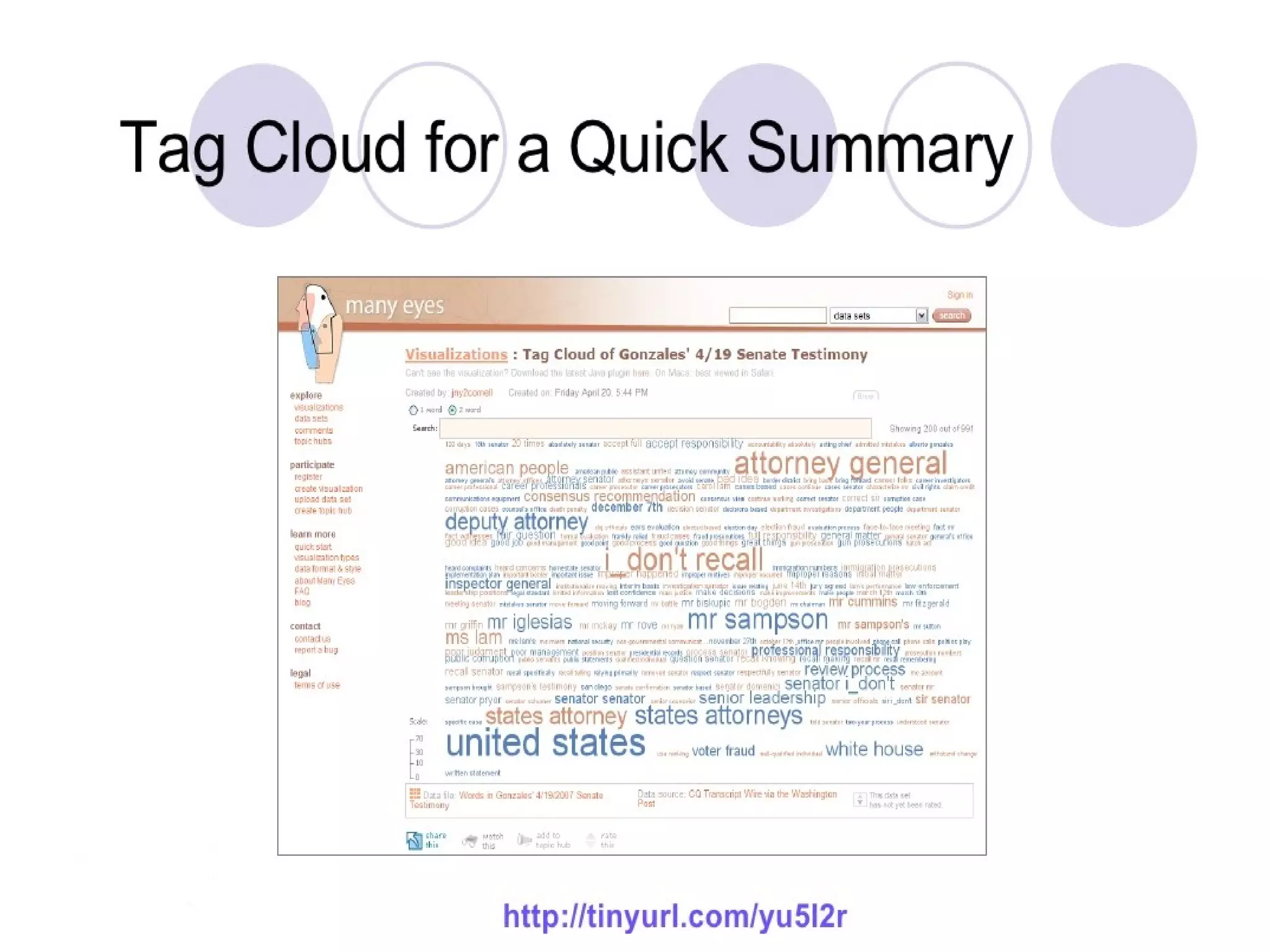
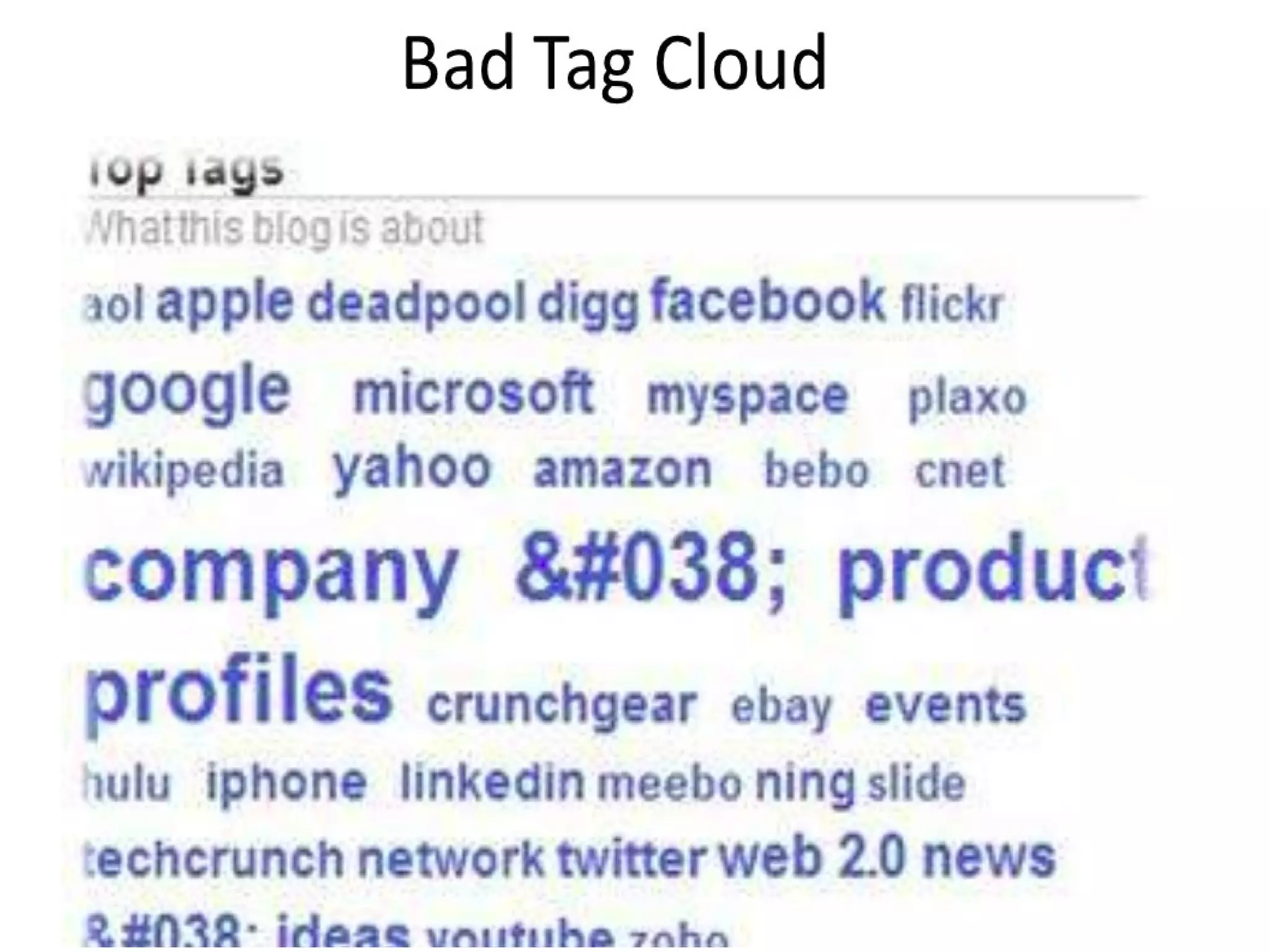
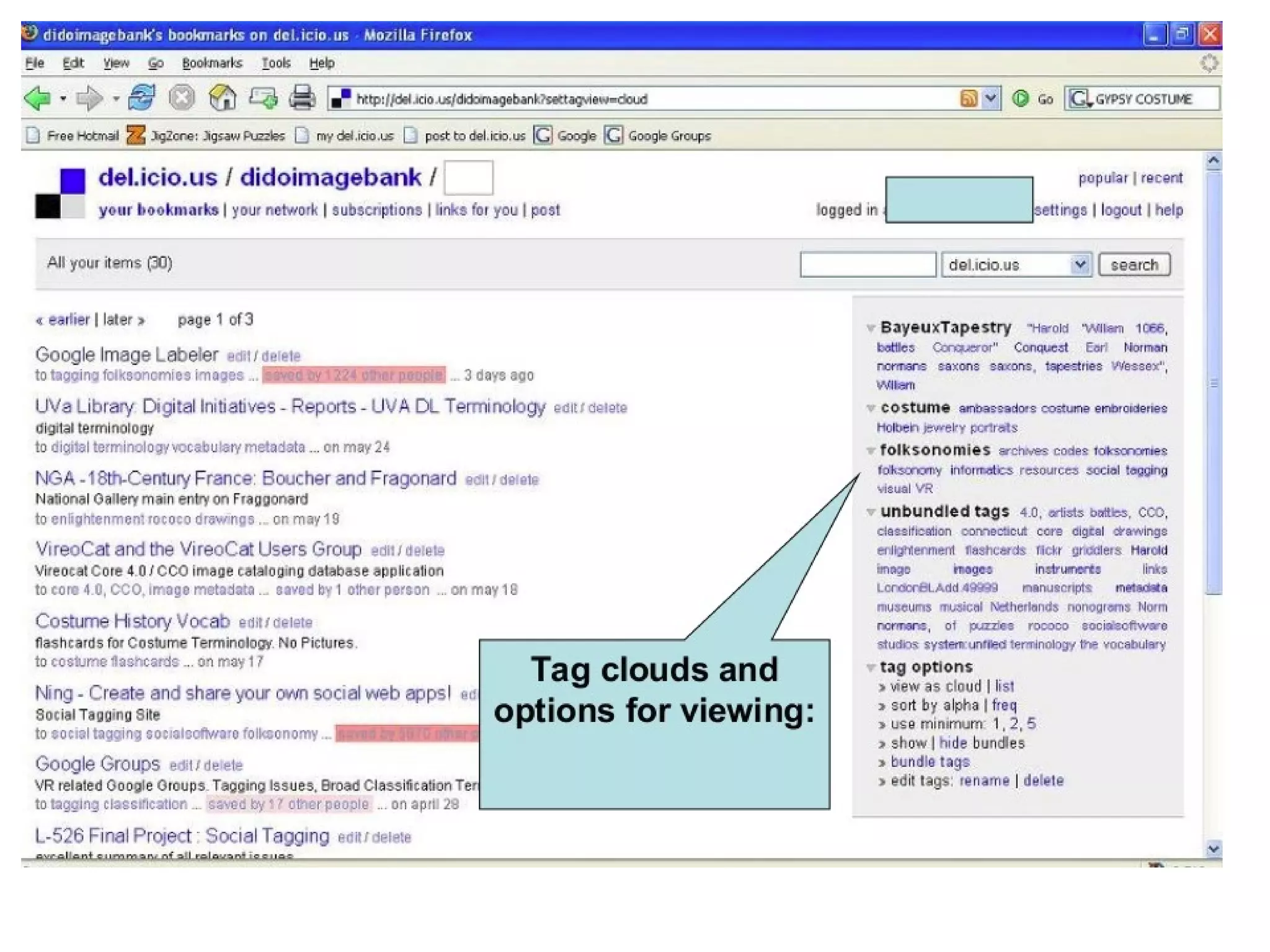
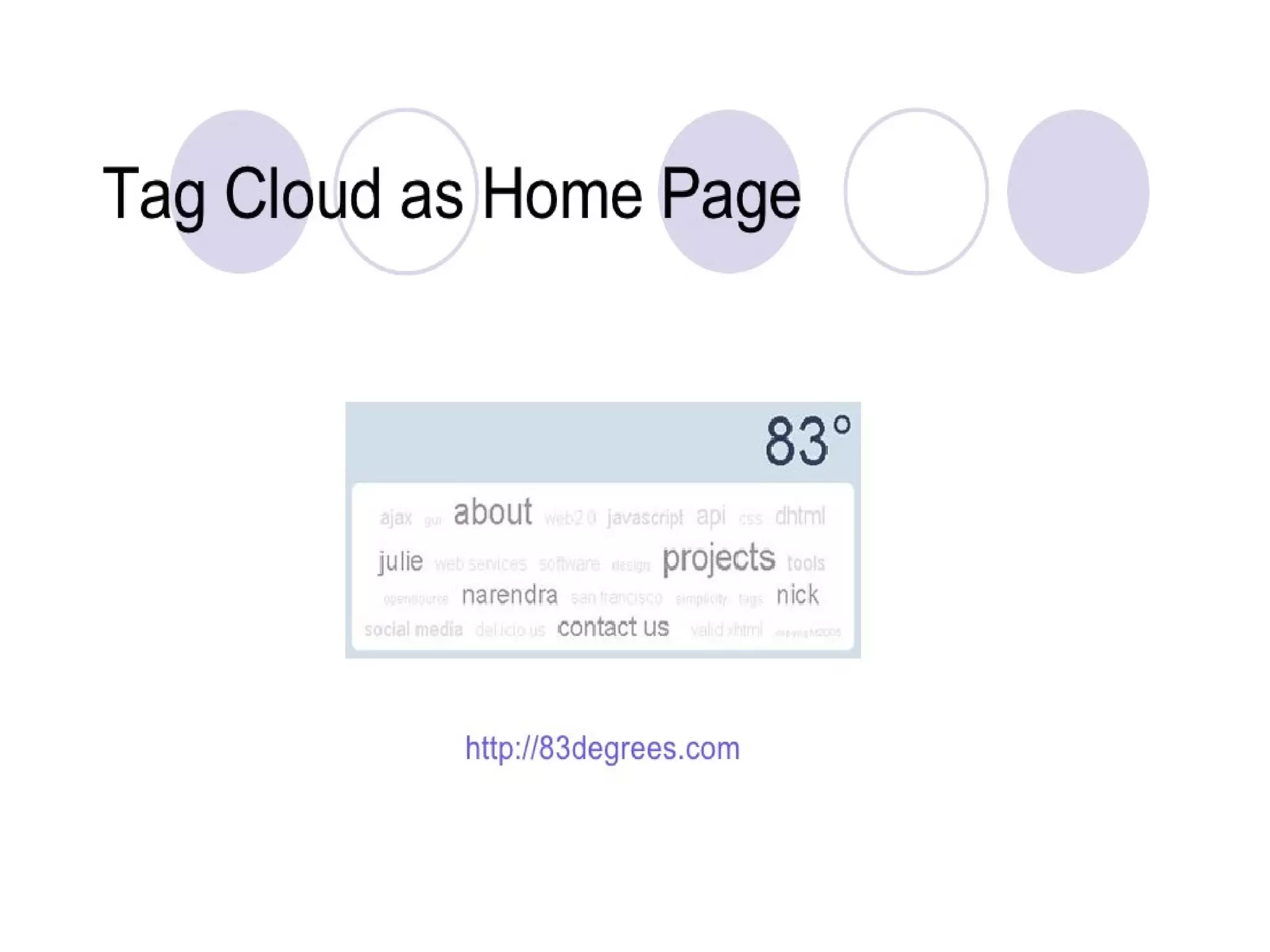
• Tag cloud - a visual weighted list of a set or
subset of tags
Tag Cloud
A visual weighted list of a set or subset of tags
Example of a Tag Cloud
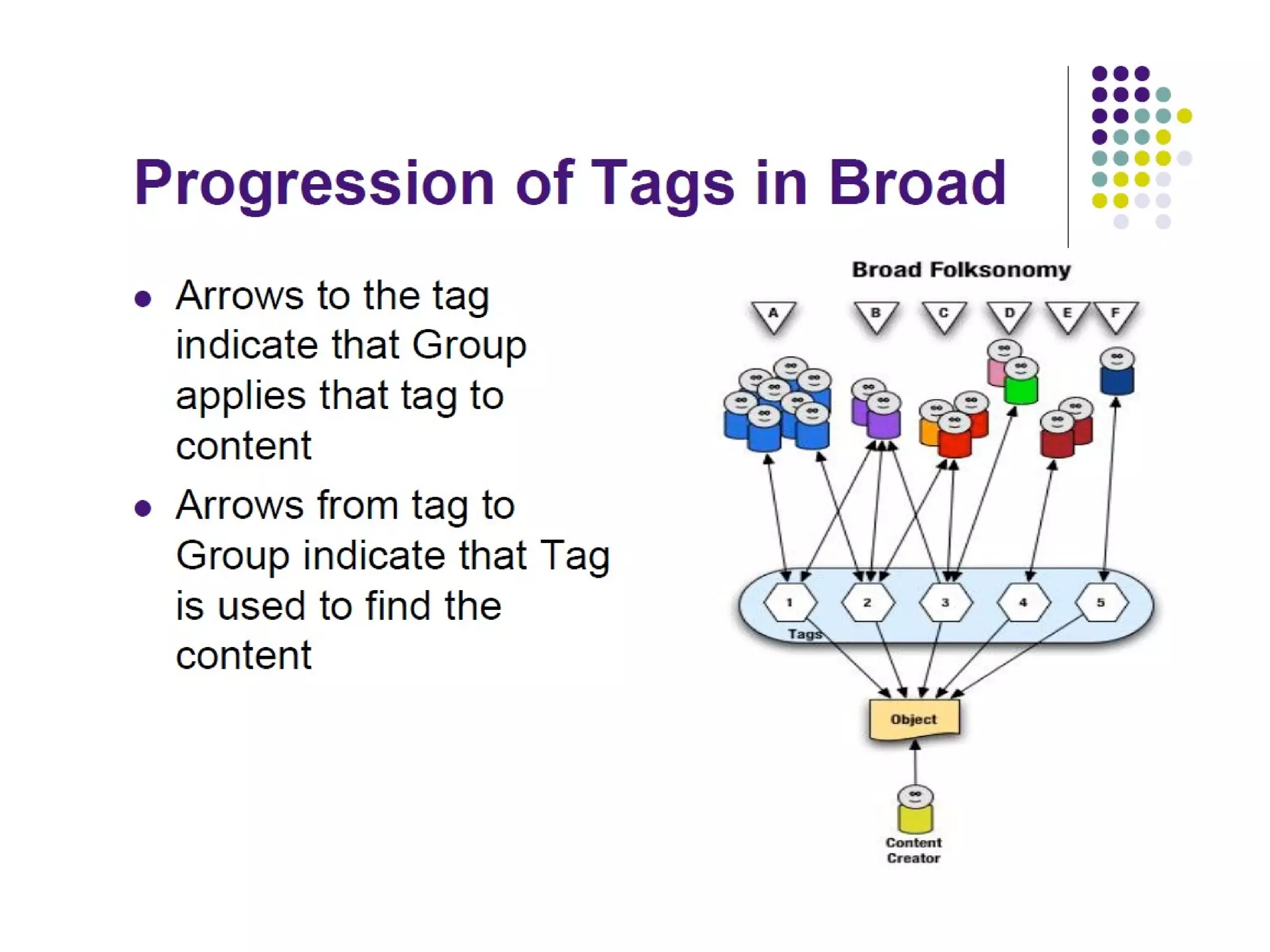
What is a folksonomy?
• Folksonomy is a collaboratively generated,
open-ended labeling system that enables users
to categorize content by freely chosen labels.
• Thomas Vander Wal coined the phrase by
combining “folk” + “taxonomy”. 􀂄􀂄
• Folksonomy refers to an “emergent, grassroots
taxonomy”
– An aggregate collections of tags
– A bottom-up categorical structure development
– An emergent thesaurus
Why do folksonomies work?
• The searcher defines the access, but
• The aggregation of the terms has public
value
• It’s a typically messy democratic approach
What makes folksonomies
popular?
• Their dynamic nature works well with
dynamic resources
• They’re personal
• They lower barriers to cooperation
Tagging and the consequent
folksonomies work best when
• It’s easy to do
• It’s not commercial in nature
• Taggers have ownership
• Taggers are more likely to tag their own
stuff than they are your stuff
• It has been shown to work well on the
Web
The unexpected development:
terminological consensus
• Collective action yields common terms
• Stabilization may be caused by imitation
and shared knowledge
• The wisdom of the crowd
Is your tagging influenced
by my tagging?
• Of course it is!
• People are beginning tag in ways that
make it easier for others to find like stuff
• Shared meaning consequently evolves for
tags
• Most used tags become most visible
Strengths of folksonomies
• Cost-effective way to organize Internet
• Social benefits
• It’s inclusive
• For many environments, they work well
Collocation issues
• They do not yield the level of clarity that
controlled vocabularies do
• Term ambiguity – words with multiple
meanings
• No synonym control
Issues with specificity
• Variable specificity for related terms
• Broadness of terms impacts precision –
terms are often imprecise
• Mixed perspectives
Issues with structure
• Singular and plural forms create
redundant headings
• No guidelines for the use of compound
headings, punctuation, word order
• No scope notes
• No cross references
Issues with accuracy
• Collective ‘wisdom’ of the tagging
community
• How does wrong information impact
retrieval
• Conflicting cultural norms
• Sometimes authority counts
“Spagging” and other problems
• Opening doors to opinion tags
• Tagging wars
• “Spagging”  Spam tagging
Tidying up the tags…?
• Lists of tagging norms have been
developed
• Are there programmatic solutions?
• Users know they are looking at tags
• By tidying, do we destroy the essence of
why this works?
• Do we realistically have the resources?
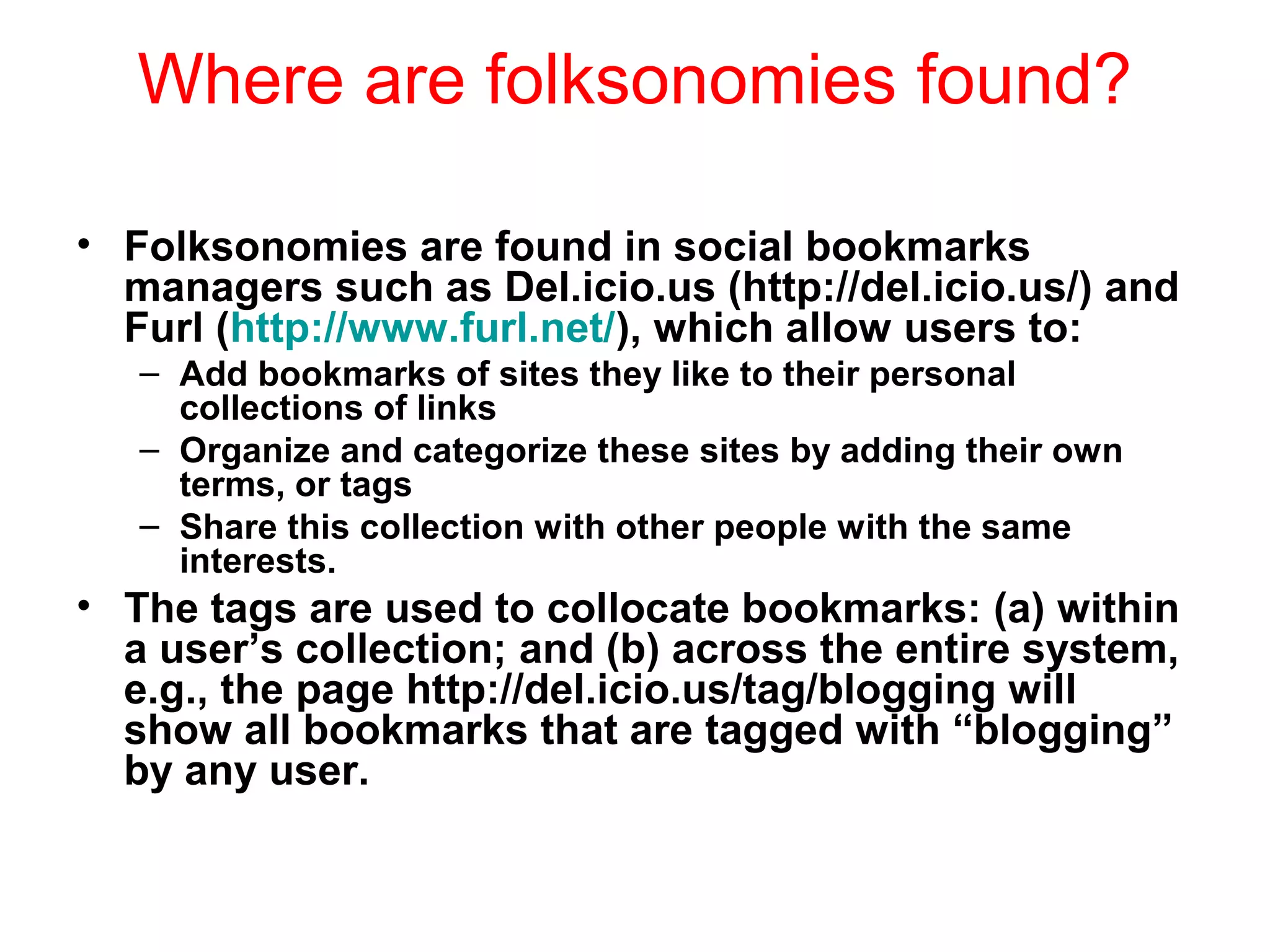
Where are folksonomies found?
• Folksonomies are found in social bookmarks
managers such as Del.icio.us (http://del.icio.us/) and
Furl (http://www.furl.net/), which allow users to:
– Add bookmarks of sites they like to their personal
collections of links
– Organize and categorize these sites by adding their own
terms, or tags
– Share this collection with other people with the same
interests.
• The tags are used to collocate bookmarks: (a) within
a user’s collection; and (b) across the entire system,
e.g., the page http://del.icio.us/tag/blogging will
show all bookmarks that are tagged with “blogging”
by any user.
Social Bookmarking
and Social Tagging
• what is social bookmarking?
– public sharing of links
• association of tags (keywords) with links
– network of related links created by users
• network of related tags created by users
• what is tagging?
– act of associating a term with a link or article
– labelling or classifying for personal use
• Tagging creates an association between user,
item and set of tags
Inter-term relationships
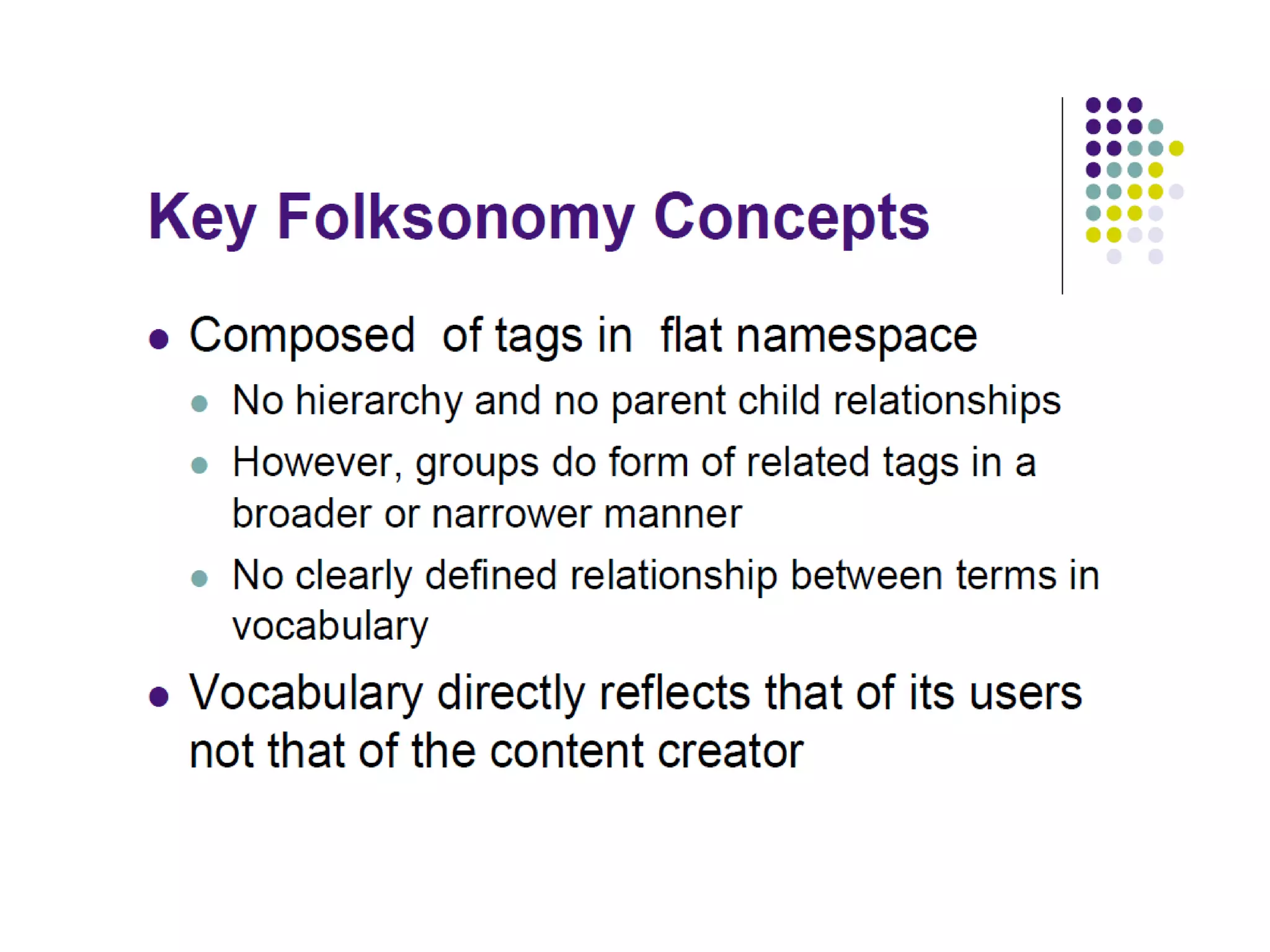
• There are no clearly defined relations
between and among the terms in the
vocabulary, unlike formal taxonomies and
classification schemes, where there are
multiple kinds of explicit relationships (e.g.,
broader, narrower, and related terms)
between and among terms.
• Folksonomies are simply the set of terms
that a group of users tagged content with;
they are not a predetermined set of
classification terms or labels.
Popular folksonomy sites
• Del.icio.us (http://del.icio.us)
• Flickr (http://www.flickr.com)
• Frassle (http://www.frassle.org)
• Furl (http://www.furl.net)
• Simpy (http://www.simpy.com)
• Spurl (http://www.spurl.com)
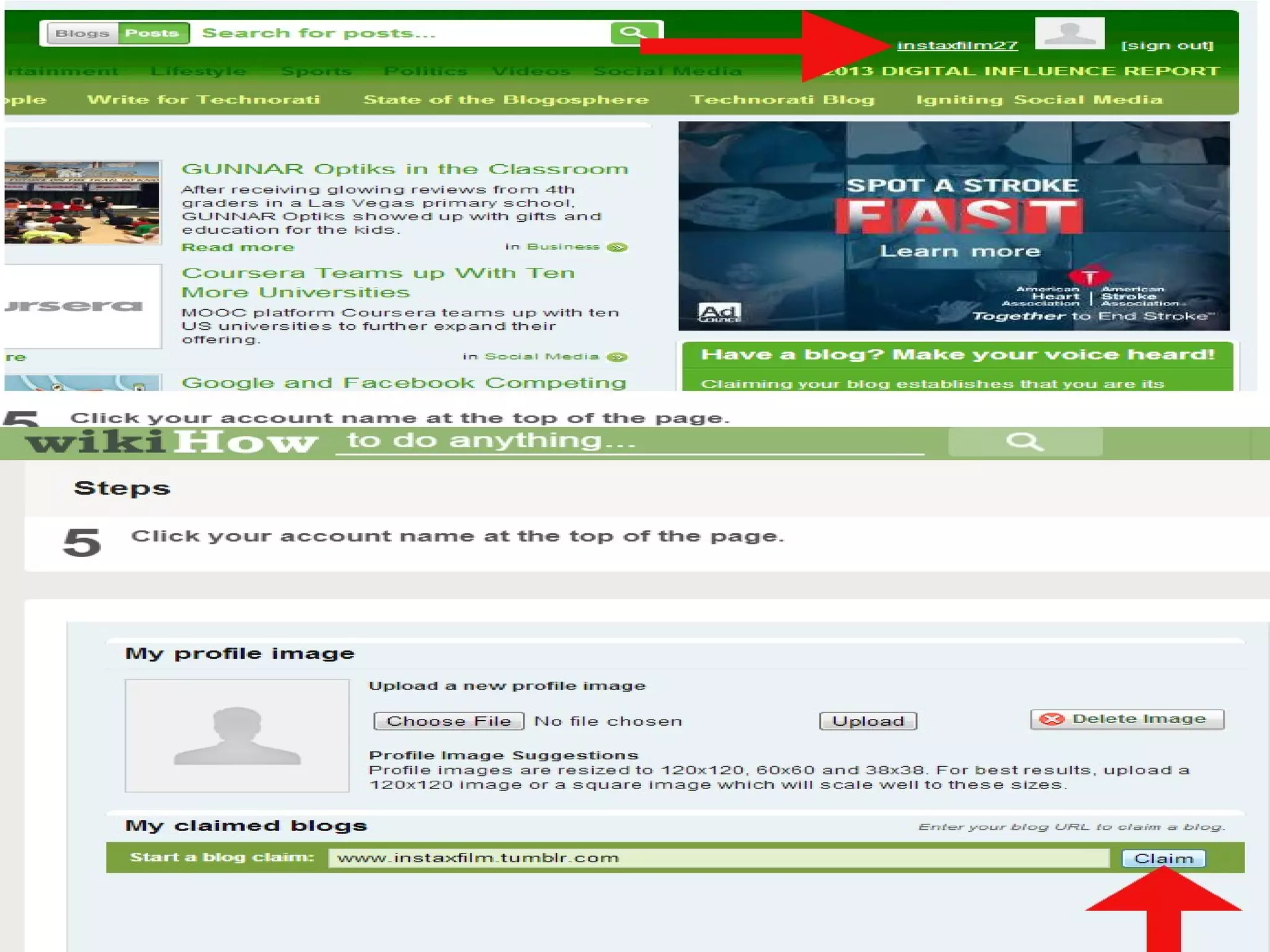
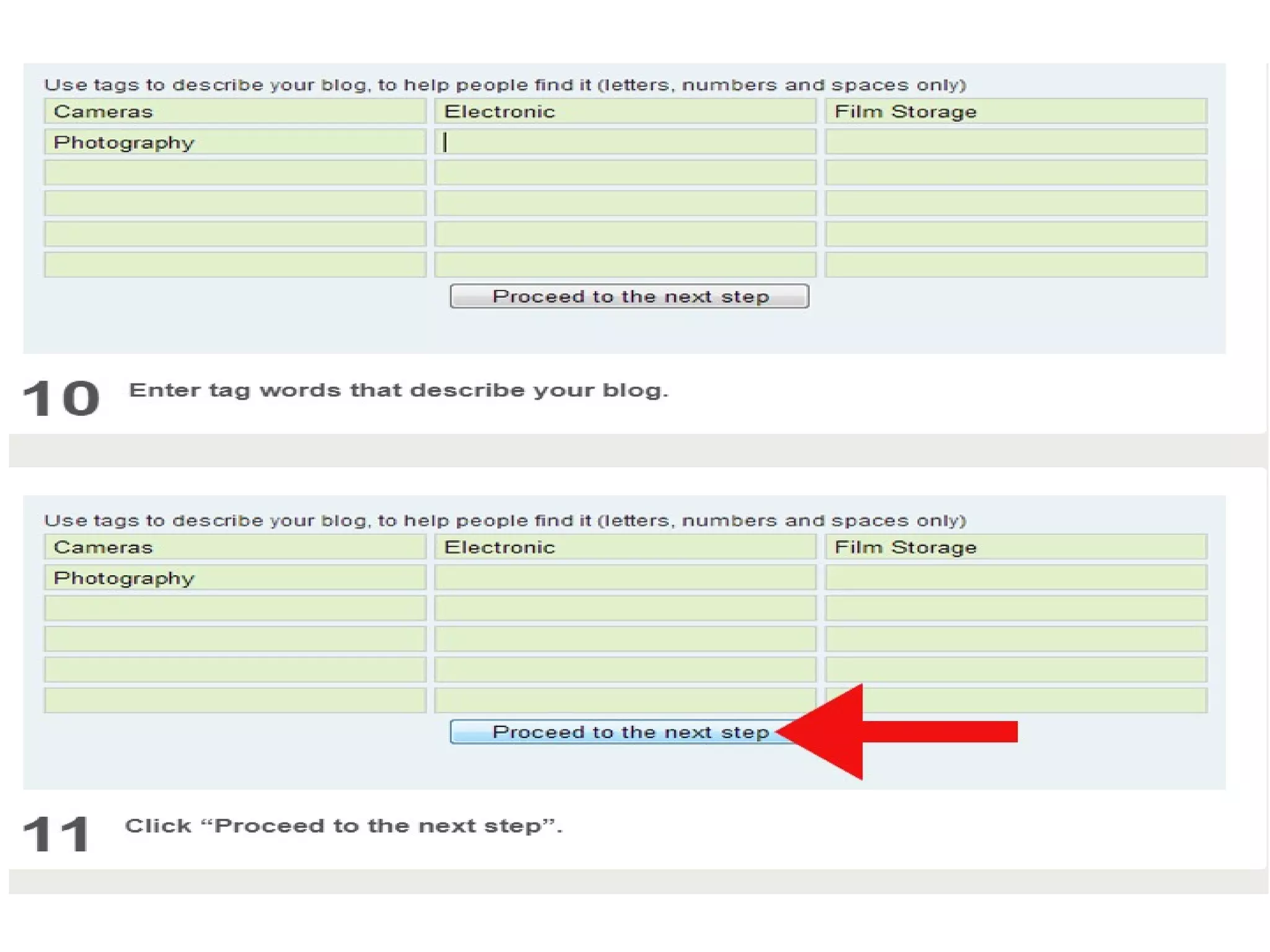
• Technorati (http://www.technorati.com)
Blogs (Technorati: http://technorati.com/ )
Bookmarks (Delicious: http://del.icio.us/ )
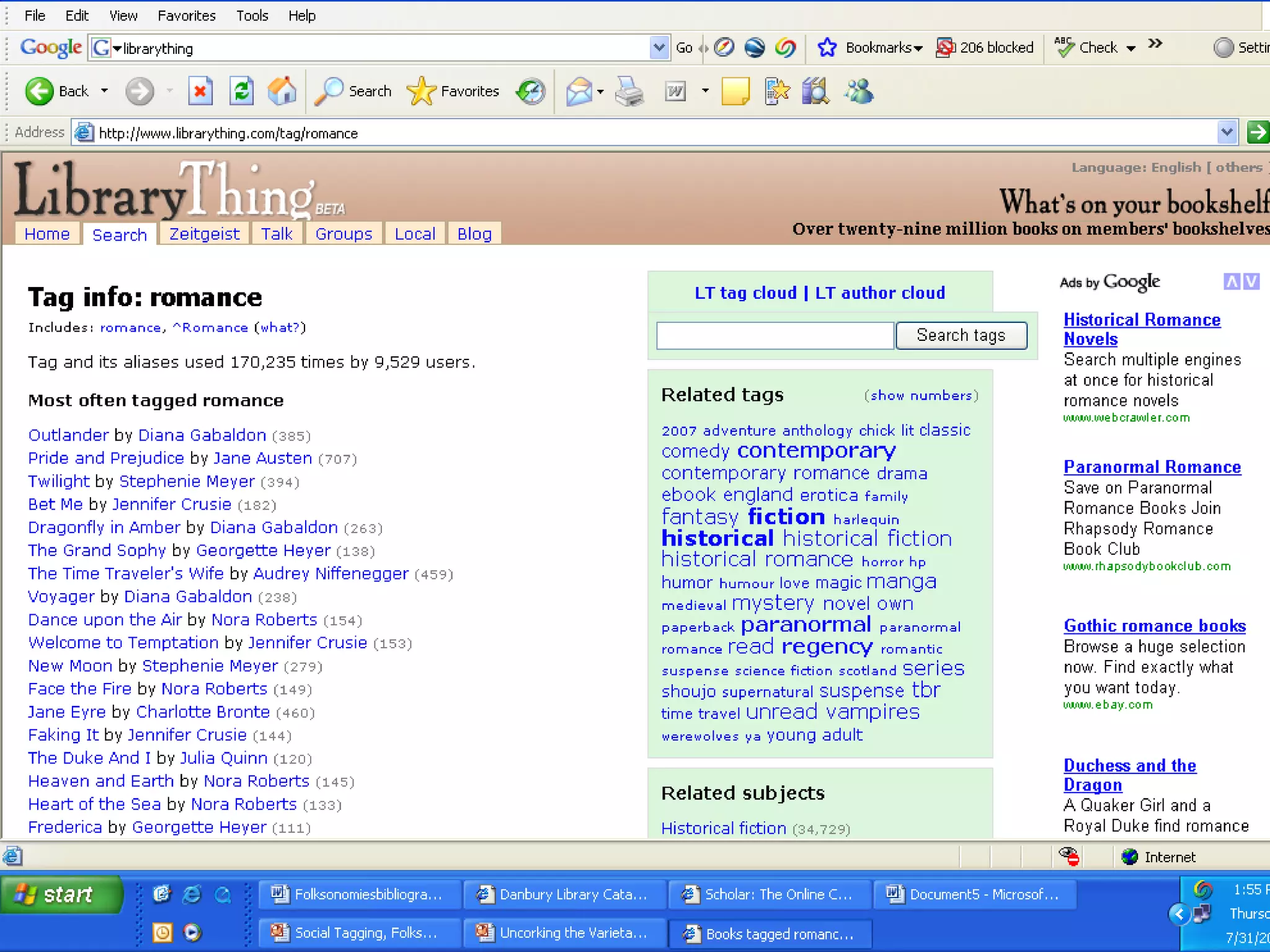
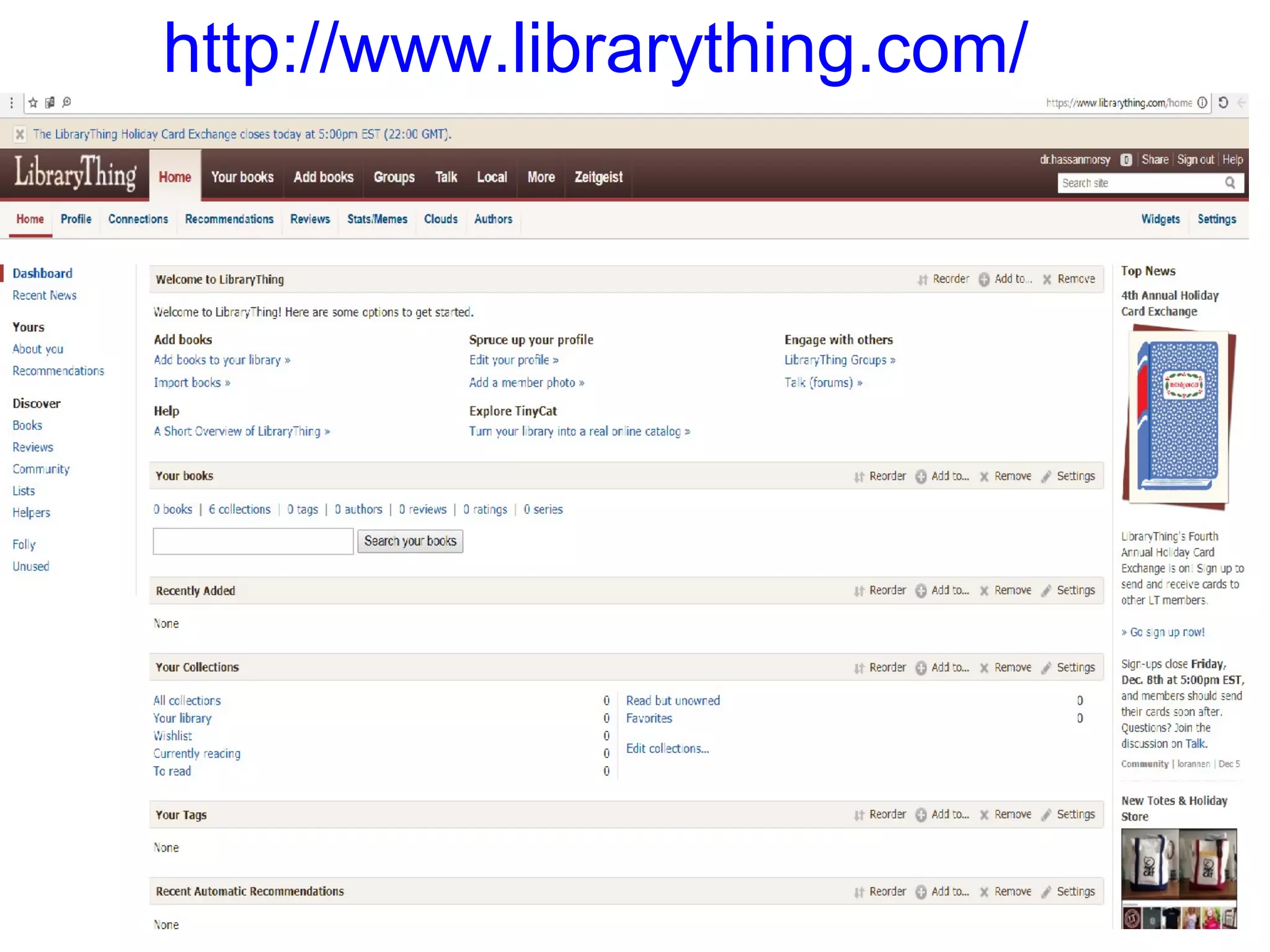
Books (Librarything: http://www.librarything.com/,
Amazon: http://www.amazon.com/)
Emails (Gmail: http://mail.google.com/ )
Events (http://www.goingtomeet.com/ )
People (Tagalag: http://www.tagalag.com/ )
Pictures (Flickr: http://www.flickr.com/ )
Podcasts (Odeo: http://odeo.com/ ))
Delicious site
http://technorati.com/
http://www.librarything.com/
The popularity of folksonomies
• The growing popularity of folksonomies can
be attributed to two principal factors:
– An increasing need to exert control over the mass
of digital information that we accumulate on a
daily basis.
– A desire to “democratize” the way in which digital
information is described and organized by using
categories and terminology that reflect the views
and needs of the actual end-users, rather than
those of an external organization or body.
What is Social Bookmarking?
• Social bookmarking is a server side web
based service which allows users to
create, manage and share their personal
bookmarks in a social community.
• Social bookmarking systems have three
major axes: users, tags, and URLs.
• Social bookmarking systems are a type of
folksonomy.
…then what is folksonomy?
• Folksonomy is a collaboratively generated,
open-ended labeling system that enables users
to categorize content by freely chosen labels.
• Thomas Vander Wal coined the phrase by
combining “folk” + “taxonomy”. 􀂄􀂄
• While folksonomy appears to be the most
popular, other names for the same phenomena
have been proposed which included: folk
classification, folk taxonomy, ethnoclassification,
distributed classification, social classification,
open tagging, free tagging, faceted hierarchy,
etc
Social Bookmarking as a
Classification System
• A classification system is a structured scheme
for categorizing knowledge, entities or objects to
improve access or study, created according to
alphabetical, associative, hierarchical,
numerical, ideological, spatial, chronological, or
other criteria.
• Traditional methods for organizing information
include controlled vocabularies, taxonomies,
thesauri, and ontologies.
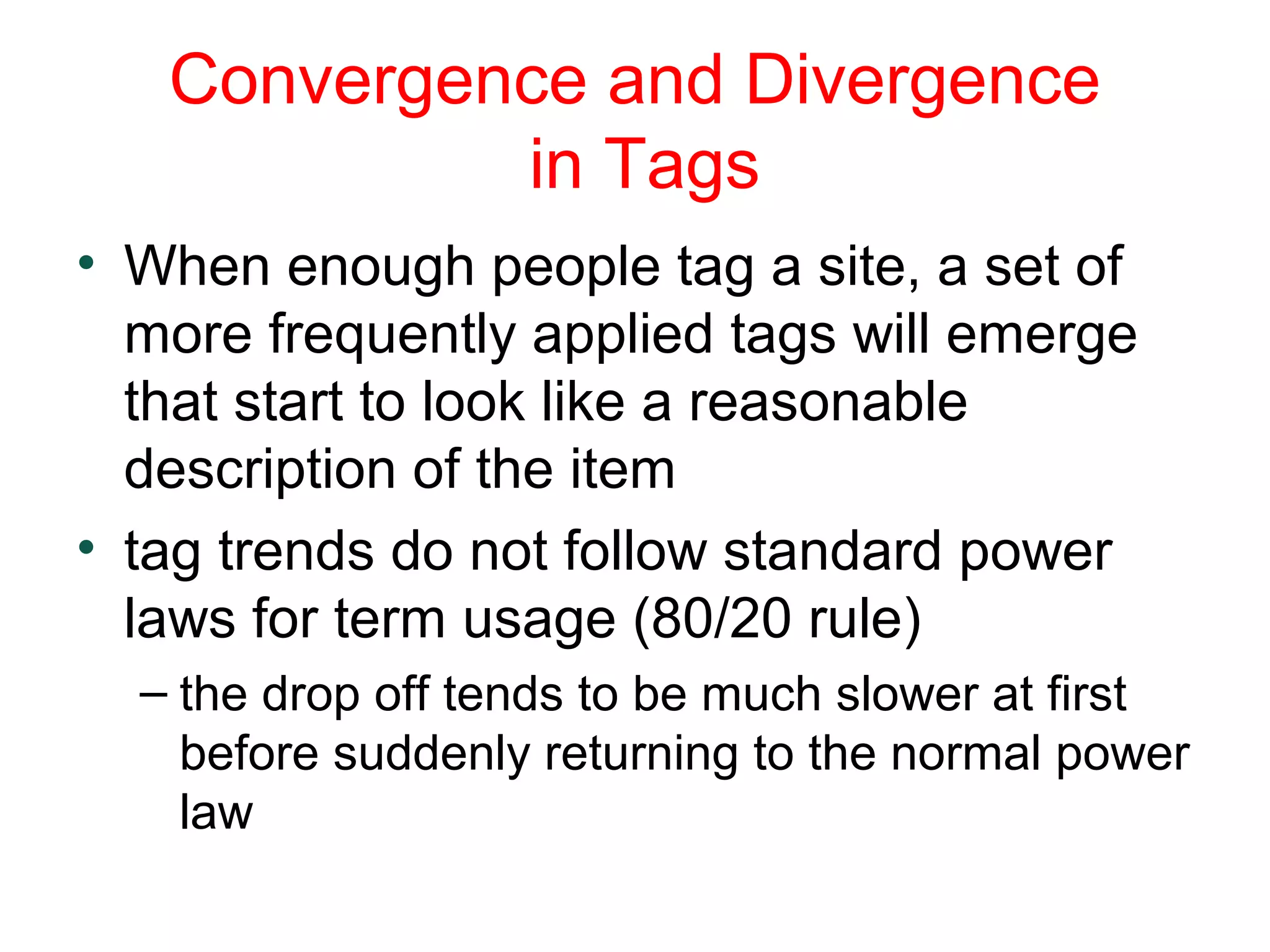
Convergence and Divergence
in Tags
• When enough people tag a site, a set of
more frequently applied tags will emerge
that start to look like a reasonable
description of the item
• tag trends do not follow standard power
laws for term usage (80/20 rule)
– the drop off tends to be much slower at first
before suddenly returning to the normal power
law
Tagging Patterns
• Consensus forms after a certain number of
users have tagged an item
– first item by 2250 people, second only tagged by 49
• frequency graphs suggest a relative consensus
on terms, but tag lists and co-word graphs do
not
– high frequency tags used frequently but not
necessarily with other high frequency terms
– tagging patterns may show group consensus and
trends in user communities.
Social Bookmarking Characteristics
• Common elemental characteristics of social
bookmarking (folksonomic) systems.
– Tag – a single word label that is applied to an object
(URL)
– Tagging – the process of organizing an object by
assigning a label or “tag”
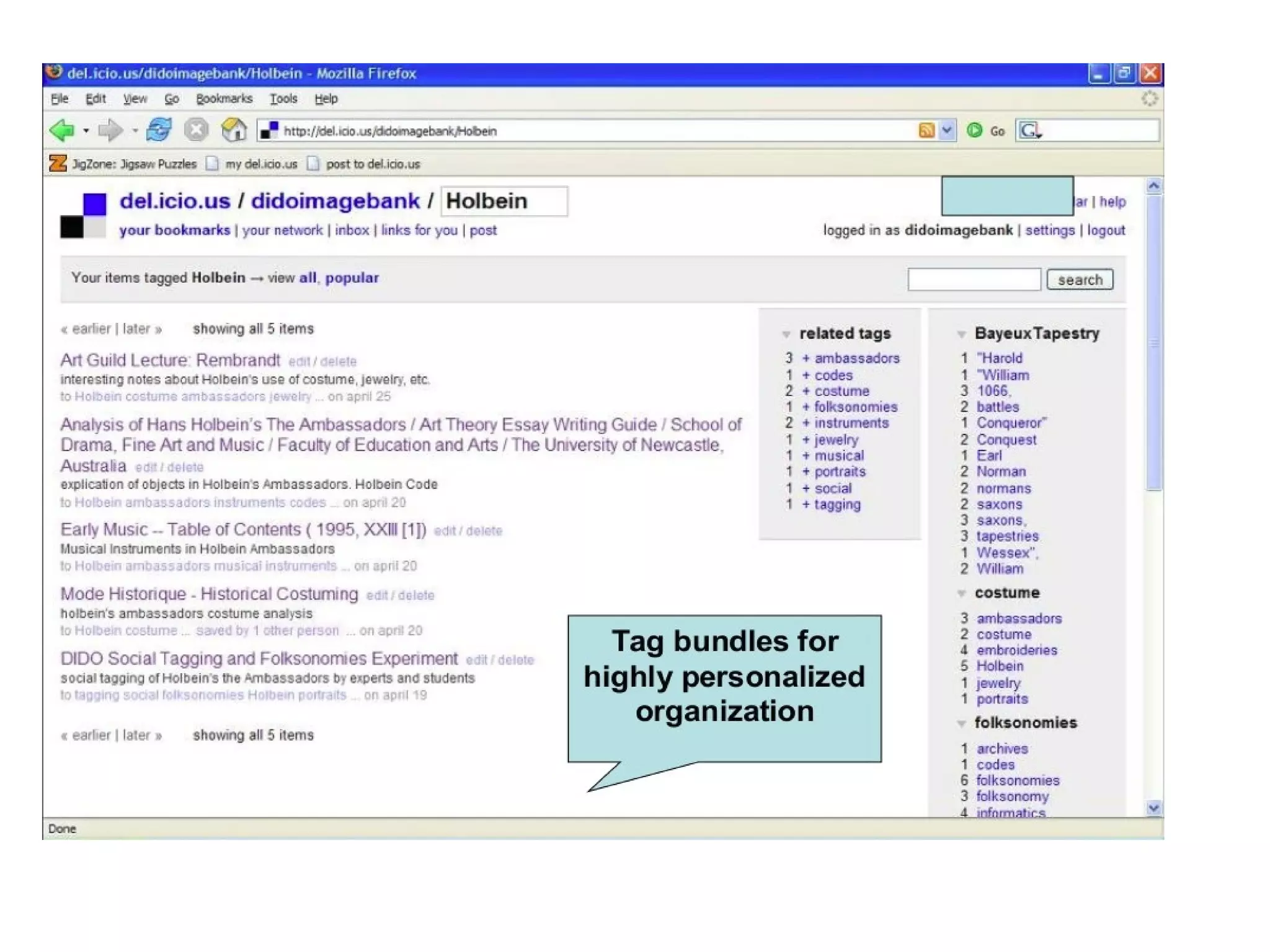
– Tag bundle –a group of tags linked by another tag or
“super tag”. Bundles are a way to group together
common tags. For instance, if you have the tags
"design", "painting", and "moma", you may want to
group these together into a bundle called "art".
– Tag cloud - a visual weighted list of a set or subset of
tags
Folksonomies & social tagging

Folksonomies & social tagging

  • 1.
  • 2.
    What Are Tags? •Keywords or terms associated with or assigned to a piece of information • They enable keyword-based classification and search of information
  • 3.
    Basic Model forTagging Systems USER RESOURCES TAGS
  • 8.
    Don’t confuse tagswith keywords or full-text searching • Keywords are behind the scenes, tags are often visibly aggregated for use and browsing • Keywords can not be hyper-linked • Keywords imply searching, tags imply linking • Full-text searching is passive, tagging is active • It’s more about connecting items rather than categorizing them.
  • 9.
    Tags can be… • Descriptions of the subject matter • Where the item is located • The intended use of the item • Individual (gift from mom) • Different people have different tagging patterns • Tagging systems encourage differences
  • 10.
    Tags are • Non-hierarchical •A way to create links between items by the creation of sets of objects • A means of connecting with others interested in the same things
  • 11.
    Tagging Systems Define •Who can tag • What can be tagged • What kinds of tags can be used • Tagging systems may result in the creation of a “folksonomy”
  • 12.
    Types of TaggingSystems • Managing personal information • Social bookmarking • Collecting and sharing digital objects • Improving the e-commerce experience
  • 13.
    Why is taggingso popular? • It is easy and enjoyable • It has a low cognitive cost • It is quick to do • It provides self and social feedback immediately
  • 14.
    Putting the socialin tagging • Tags allow for social interaction because when we navigate by tags we are directly connecting with others • People tag for their own benefit
  • 15.
    Tags, and thereforesocial tags are • Dynamic categorization systems • Often created on-the-fly • Chosen as relevant to the user – not to the creator, cataloger or researcher • A social activity (more on this later) • Hopefully one small step toward a more interactive and responsive library system
  • 20.
    Social Bookmarking Common elementalcharacteristics of social bookmarking (folksonomic) systems. • Tag – a single word label that is applied to an object (URL) • Tagging – the process of organizing an object by assigning a label or “tag” • Tag bundle –a group of tags linked by another tag or “super tag” • Tag cloud - a visual weighted list of a set or subset of tags
  • 21.
    Tag Cloud A visualweighted list of a set or subset of tags
  • 22.
    Example of aTag Cloud
  • 28.
    What is afolksonomy? • Folksonomy is a collaboratively generated, open-ended labeling system that enables users to categorize content by freely chosen labels. • Thomas Vander Wal coined the phrase by combining “folk” + “taxonomy”. 􀂄􀂄 • Folksonomy refers to an “emergent, grassroots taxonomy” – An aggregate collections of tags – A bottom-up categorical structure development – An emergent thesaurus
  • 34.
    Why do folksonomieswork? • The searcher defines the access, but • The aggregation of the terms has public value • It’s a typically messy democratic approach
  • 41.
    What makes folksonomies popular? •Their dynamic nature works well with dynamic resources • They’re personal • They lower barriers to cooperation
  • 50.
    Tagging and theconsequent folksonomies work best when • It’s easy to do • It’s not commercial in nature • Taggers have ownership • Taggers are more likely to tag their own stuff than they are your stuff • It has been shown to work well on the Web
  • 51.
    The unexpected development: terminologicalconsensus • Collective action yields common terms • Stabilization may be caused by imitation and shared knowledge • The wisdom of the crowd
  • 52.
    Is your tagginginfluenced by my tagging? • Of course it is! • People are beginning tag in ways that make it easier for others to find like stuff • Shared meaning consequently evolves for tags • Most used tags become most visible
  • 53.
    Strengths of folksonomies •Cost-effective way to organize Internet • Social benefits • It’s inclusive • For many environments, they work well
  • 54.
    Collocation issues • Theydo not yield the level of clarity that controlled vocabularies do • Term ambiguity – words with multiple meanings • No synonym control
  • 55.
    Issues with specificity •Variable specificity for related terms • Broadness of terms impacts precision – terms are often imprecise • Mixed perspectives
  • 56.
    Issues with structure •Singular and plural forms create redundant headings • No guidelines for the use of compound headings, punctuation, word order • No scope notes • No cross references
  • 57.
    Issues with accuracy •Collective ‘wisdom’ of the tagging community • How does wrong information impact retrieval • Conflicting cultural norms • Sometimes authority counts
  • 58.
    “Spagging” and otherproblems • Opening doors to opinion tags • Tagging wars • “Spagging”  Spam tagging
  • 59.
    Tidying up thetags…? • Lists of tagging norms have been developed • Are there programmatic solutions? • Users know they are looking at tags • By tidying, do we destroy the essence of why this works? • Do we realistically have the resources?
  • 60.
    Where are folksonomiesfound? • Folksonomies are found in social bookmarks managers such as Del.icio.us (http://del.icio.us/) and Furl (http://www.furl.net/), which allow users to: – Add bookmarks of sites they like to their personal collections of links – Organize and categorize these sites by adding their own terms, or tags – Share this collection with other people with the same interests. • The tags are used to collocate bookmarks: (a) within a user’s collection; and (b) across the entire system, e.g., the page http://del.icio.us/tag/blogging will show all bookmarks that are tagged with “blogging” by any user.
  • 61.
    Social Bookmarking and SocialTagging • what is social bookmarking? – public sharing of links • association of tags (keywords) with links – network of related links created by users • network of related tags created by users • what is tagging? – act of associating a term with a link or article – labelling or classifying for personal use • Tagging creates an association between user, item and set of tags
  • 62.
    Inter-term relationships • Thereare no clearly defined relations between and among the terms in the vocabulary, unlike formal taxonomies and classification schemes, where there are multiple kinds of explicit relationships (e.g., broader, narrower, and related terms) between and among terms. • Folksonomies are simply the set of terms that a group of users tagged content with; they are not a predetermined set of classification terms or labels.
  • 63.
    Popular folksonomy sites •Del.icio.us (http://del.icio.us) • Flickr (http://www.flickr.com) • Frassle (http://www.frassle.org) • Furl (http://www.furl.net) • Simpy (http://www.simpy.com) • Spurl (http://www.spurl.com) • Technorati (http://www.technorati.com)
  • 68.
    Blogs (Technorati: http://technorati.com/) Bookmarks (Delicious: http://del.icio.us/ ) Books (Librarything: http://www.librarything.com/, Amazon: http://www.amazon.com/) Emails (Gmail: http://mail.google.com/ ) Events (http://www.goingtomeet.com/ ) People (Tagalag: http://www.tagalag.com/ ) Pictures (Flickr: http://www.flickr.com/ ) Podcasts (Odeo: http://odeo.com/ ))
  • 71.
  • 77.
  • 84.
  • 95.
    The popularity offolksonomies • The growing popularity of folksonomies can be attributed to two principal factors: – An increasing need to exert control over the mass of digital information that we accumulate on a daily basis. – A desire to “democratize” the way in which digital information is described and organized by using categories and terminology that reflect the views and needs of the actual end-users, rather than those of an external organization or body.
  • 96.
    What is SocialBookmarking? • Social bookmarking is a server side web based service which allows users to create, manage and share their personal bookmarks in a social community. • Social bookmarking systems have three major axes: users, tags, and URLs. • Social bookmarking systems are a type of folksonomy.
  • 97.
    …then what isfolksonomy? • Folksonomy is a collaboratively generated, open-ended labeling system that enables users to categorize content by freely chosen labels. • Thomas Vander Wal coined the phrase by combining “folk” + “taxonomy”. 􀂄􀂄 • While folksonomy appears to be the most popular, other names for the same phenomena have been proposed which included: folk classification, folk taxonomy, ethnoclassification, distributed classification, social classification, open tagging, free tagging, faceted hierarchy, etc
  • 98.
    Social Bookmarking asa Classification System • A classification system is a structured scheme for categorizing knowledge, entities or objects to improve access or study, created according to alphabetical, associative, hierarchical, numerical, ideological, spatial, chronological, or other criteria. • Traditional methods for organizing information include controlled vocabularies, taxonomies, thesauri, and ontologies.
  • 99.
    Convergence and Divergence inTags • When enough people tag a site, a set of more frequently applied tags will emerge that start to look like a reasonable description of the item • tag trends do not follow standard power laws for term usage (80/20 rule) – the drop off tends to be much slower at first before suddenly returning to the normal power law
  • 100.
    Tagging Patterns • Consensusforms after a certain number of users have tagged an item – first item by 2250 people, second only tagged by 49 • frequency graphs suggest a relative consensus on terms, but tag lists and co-word graphs do not – high frequency tags used frequently but not necessarily with other high frequency terms – tagging patterns may show group consensus and trends in user communities.
  • 101.
    Social Bookmarking Characteristics •Common elemental characteristics of social bookmarking (folksonomic) systems. – Tag – a single word label that is applied to an object (URL) – Tagging – the process of organizing an object by assigning a label or “tag” – Tag bundle –a group of tags linked by another tag or “super tag”. Bundles are a way to group together common tags. For instance, if you have the tags "design", "painting", and "moma", you may want to group these together into a bundle called "art". – Tag cloud - a visual weighted list of a set or subset of tags