Collaborative Tagging
Agenda Introduction Taxonomy Folksonomy  Tagging in Folksonomy Visualizing Folksonomy Folksonomy and Semantic Web Metadata and Semantic Web Folksonomy Advantages Folksonomy Disadvantages Conclusion
Taxonomy One of the most common strategies for organizing content  Only admin / authorized person can add / edit categorize the content Use of taxonomy is not possible in websites with user generated content Content is constantly changing and its not possible to have a standalone taxonomy No single party can enforce taxonomy in whole user community Example, Wordpress blog categories. To overcome the disadvantages in Taxonomy, Folksonomy introduced.
Folksonomy Folksonomy became popular in 2004 Folksonomy is a characteristic of web 2.0 Folksonomy = Collective Tagging = Tagging = Social Tagging =  Social Indexing = Collaborative Tagging Folksonomy Online => Delicious  Offline => Library Records Folksonomy => Folk + Taxonomy Folks => Done by people Taxonomy => Classification of item into groups
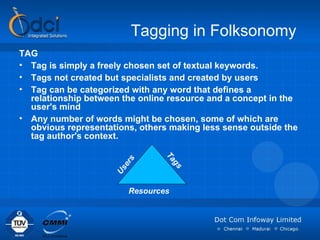
Tagging in Folksonomy  TAG Tag is simply a freely chosen set of textual keywords. Tags not created but specialists and created by users Tag can be categorized with any word that defines a relationship between the online resource and a concept in the user's mind Any number of words might be chosen, some of which are obvious representations, others making less sense outside the tag author's context. Resources Users Tags
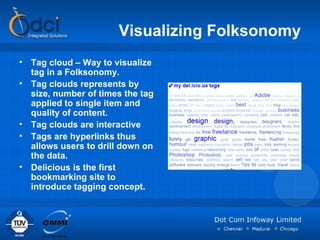
Visualizing Folksonomy Tag cloud – Way to visualize tag in a Folksonomy. Tag clouds represents by size, number of times the tag applied to single item and quality of content. Tag clouds are interactive Tags are hyperlinks thus allows users to drill down on the data.  Delicious is the first bookmarking site to introduce tagging concept.
Folksonomy and Semantic Web Folksonomy intended to make a body of information increasingly easy to search, discover, and navigate over time Folksonomy hold a key in developing semantic web and information retrieval system. Web content searchable through machine readable meta datas. Not sure every web authors have added metadata in their pages. Time consuming to learn and use How SE Categorize content in WEB <meta name=&quot;keywords&quot; content=&quot;computing, computer software, computer&quot;> <meta name=&quot;description&quot; content=&quot;Cheap widgets for sale&quot;> <meta name=&quot;author&quot; content=“Mercy Livingstone&quot;>
Metadata and Semantic Web Examples of  Metadata for Book Title Author Date of Publication Subject Unique Indentifier (International Standard Book Number) Number of pages Language of text
Metadata and Semantic Web Example of  Metadata for Audio Album Name Song title Year Composer Contributing Author Track Number Album Artist People also use “Dublin Core” metadata which consists of standard 15   metadata.
Folksonomy Advantages To provide additional keywords to help search engines and tag services add up your keyword counts and classify your post content. To provide additional navigation on your site, like an index reference, helping the user find related post content. Cheap, easy way to classify web content Capable to adapt to user style Scalability – easy for everyone use Reflects user's vocabulary Help machine to retrieve best information in the web.(If done with accuracy)
Folksonomy Disadvantages  Polisemy - Same tag with different meaning Ex, Chicken, Windows Synonyms – Different tags with same meaning Ex, Mate,Friend; Ocean, Sea Plural Vs Singular Acronym and Abbreviations  No spaces allowed (only single word)  Language Barrier Organized by amateur Anti-spam measure is tough
Conclusion Web is infinite, can’t rely on experts to classify things Its upto end users to contribute Single tag is not going to speak the language. The number of increase in tag that matters. Ex. Flickr Some extend taxonomy also can’t be ruled out. Ex. Library Catalogue.  We have to capitalize on the benefits of both the systems.  University of Pennsylvania adopted  Penn  Tagg Beyond the partnership with Taxonomy, Folksonomy moves forward in future classifying web towards creating semantic web.
Thank you

Collaborative Tagging - Folksonomy

  • 1.
  • 2.
    Agenda Introduction TaxonomyFolksonomy Tagging in Folksonomy Visualizing Folksonomy Folksonomy and Semantic Web Metadata and Semantic Web Folksonomy Advantages Folksonomy Disadvantages Conclusion
  • 3.
    Taxonomy One ofthe most common strategies for organizing content Only admin / authorized person can add / edit categorize the content Use of taxonomy is not possible in websites with user generated content Content is constantly changing and its not possible to have a standalone taxonomy No single party can enforce taxonomy in whole user community Example, Wordpress blog categories. To overcome the disadvantages in Taxonomy, Folksonomy introduced.
  • 4.
    Folksonomy Folksonomy becamepopular in 2004 Folksonomy is a characteristic of web 2.0 Folksonomy = Collective Tagging = Tagging = Social Tagging = Social Indexing = Collaborative Tagging Folksonomy Online => Delicious Offline => Library Records Folksonomy => Folk + Taxonomy Folks => Done by people Taxonomy => Classification of item into groups
  • 5.
    Tagging in Folksonomy TAG Tag is simply a freely chosen set of textual keywords. Tags not created but specialists and created by users Tag can be categorized with any word that defines a relationship between the online resource and a concept in the user's mind Any number of words might be chosen, some of which are obvious representations, others making less sense outside the tag author's context. Resources Users Tags
  • 6.
    Visualizing Folksonomy Tagcloud – Way to visualize tag in a Folksonomy. Tag clouds represents by size, number of times the tag applied to single item and quality of content. Tag clouds are interactive Tags are hyperlinks thus allows users to drill down on the data. Delicious is the first bookmarking site to introduce tagging concept.
  • 7.
    Folksonomy and SemanticWeb Folksonomy intended to make a body of information increasingly easy to search, discover, and navigate over time Folksonomy hold a key in developing semantic web and information retrieval system. Web content searchable through machine readable meta datas. Not sure every web authors have added metadata in their pages. Time consuming to learn and use How SE Categorize content in WEB <meta name=&quot;keywords&quot; content=&quot;computing, computer software, computer&quot;> <meta name=&quot;description&quot; content=&quot;Cheap widgets for sale&quot;> <meta name=&quot;author&quot; content=“Mercy Livingstone&quot;>
  • 8.
    Metadata and SemanticWeb Examples of Metadata for Book Title Author Date of Publication Subject Unique Indentifier (International Standard Book Number) Number of pages Language of text
  • 9.
    Metadata and SemanticWeb Example of Metadata for Audio Album Name Song title Year Composer Contributing Author Track Number Album Artist People also use “Dublin Core” metadata which consists of standard 15 metadata.
  • 10.
    Folksonomy Advantages Toprovide additional keywords to help search engines and tag services add up your keyword counts and classify your post content. To provide additional navigation on your site, like an index reference, helping the user find related post content. Cheap, easy way to classify web content Capable to adapt to user style Scalability – easy for everyone use Reflects user's vocabulary Help machine to retrieve best information in the web.(If done with accuracy)
  • 11.
    Folksonomy Disadvantages Polisemy - Same tag with different meaning Ex, Chicken, Windows Synonyms – Different tags with same meaning Ex, Mate,Friend; Ocean, Sea Plural Vs Singular Acronym and Abbreviations No spaces allowed (only single word) Language Barrier Organized by amateur Anti-spam measure is tough
  • 12.
    Conclusion Web isinfinite, can’t rely on experts to classify things Its upto end users to contribute Single tag is not going to speak the language. The number of increase in tag that matters. Ex. Flickr Some extend taxonomy also can’t be ruled out. Ex. Library Catalogue. We have to capitalize on the benefits of both the systems. University of Pennsylvania adopted Penn Tagg Beyond the partnership with Taxonomy, Folksonomy moves forward in future classifying web towards creating semantic web.
  • 13.