Folksonomy and Tagging in the Social Web Dr. Harry Chen CMSC 491S/691S February 18, 2008
Agenda How did folksonomy and tagging emerge in the Social Web? You tag – why and how? Can we define an information model for it? How do we characterize tagging systems? How do we visualize tags?
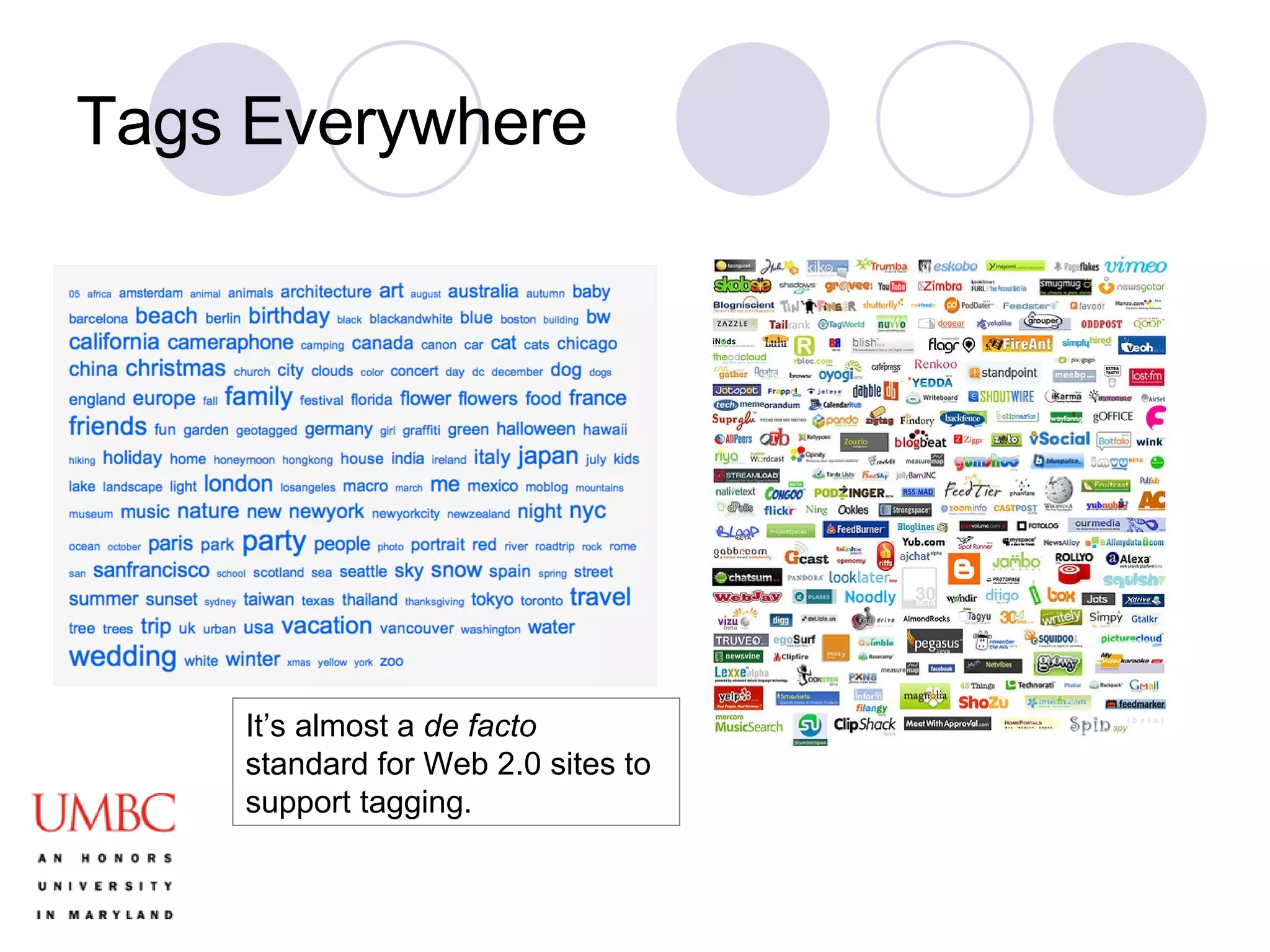
Tags Everywhere It’s almost a  de facto  standard for Web 2.0 sites to support tagging.
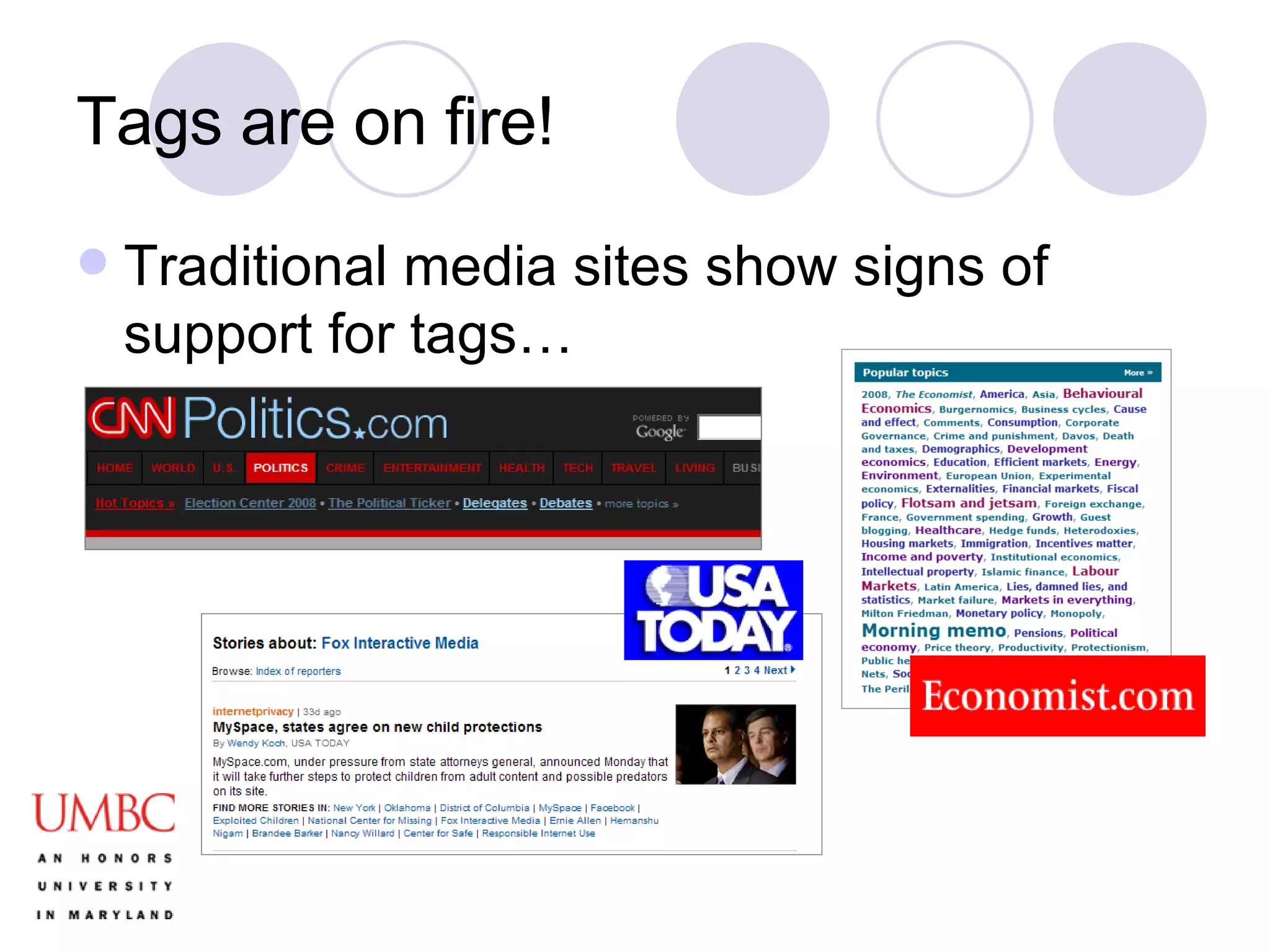
Tags are on fire! Traditional media sites show signs of support for tags…
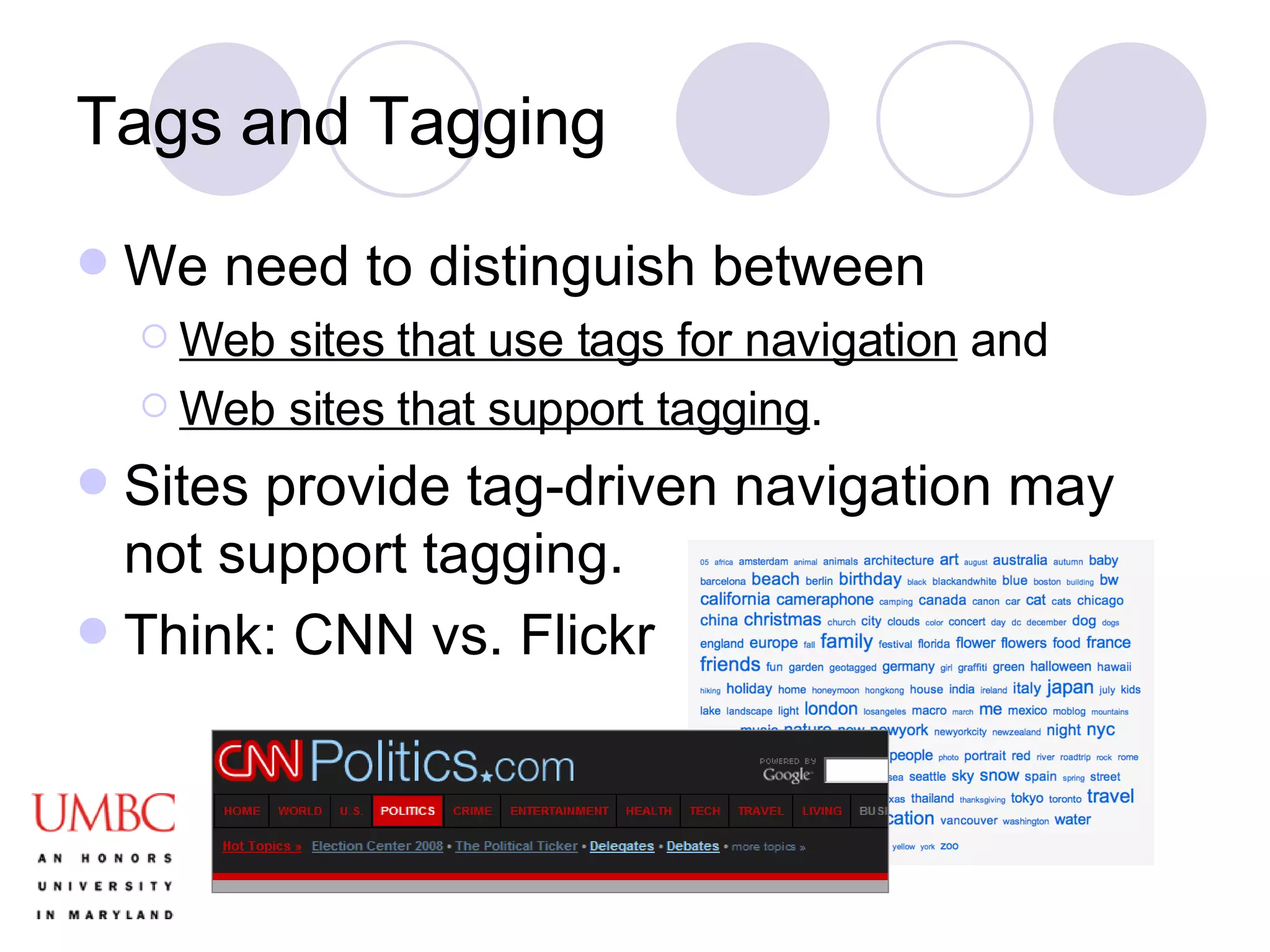
Tags and Tagging We need to distinguish between  Web sites that use tags for navigation  and  Web sites that support tagging . Sites provide tag-driven navigation may not support tagging. Think: CNN vs. Flickr
Why Use Tags Tags (keywords) seem to be effective in helping people to find and discover information. The Web is a collection of unstructured links and resources. Using tags can give people a sense of organization in a chaotic information environment. Can better search algorithms replace the need for tags?
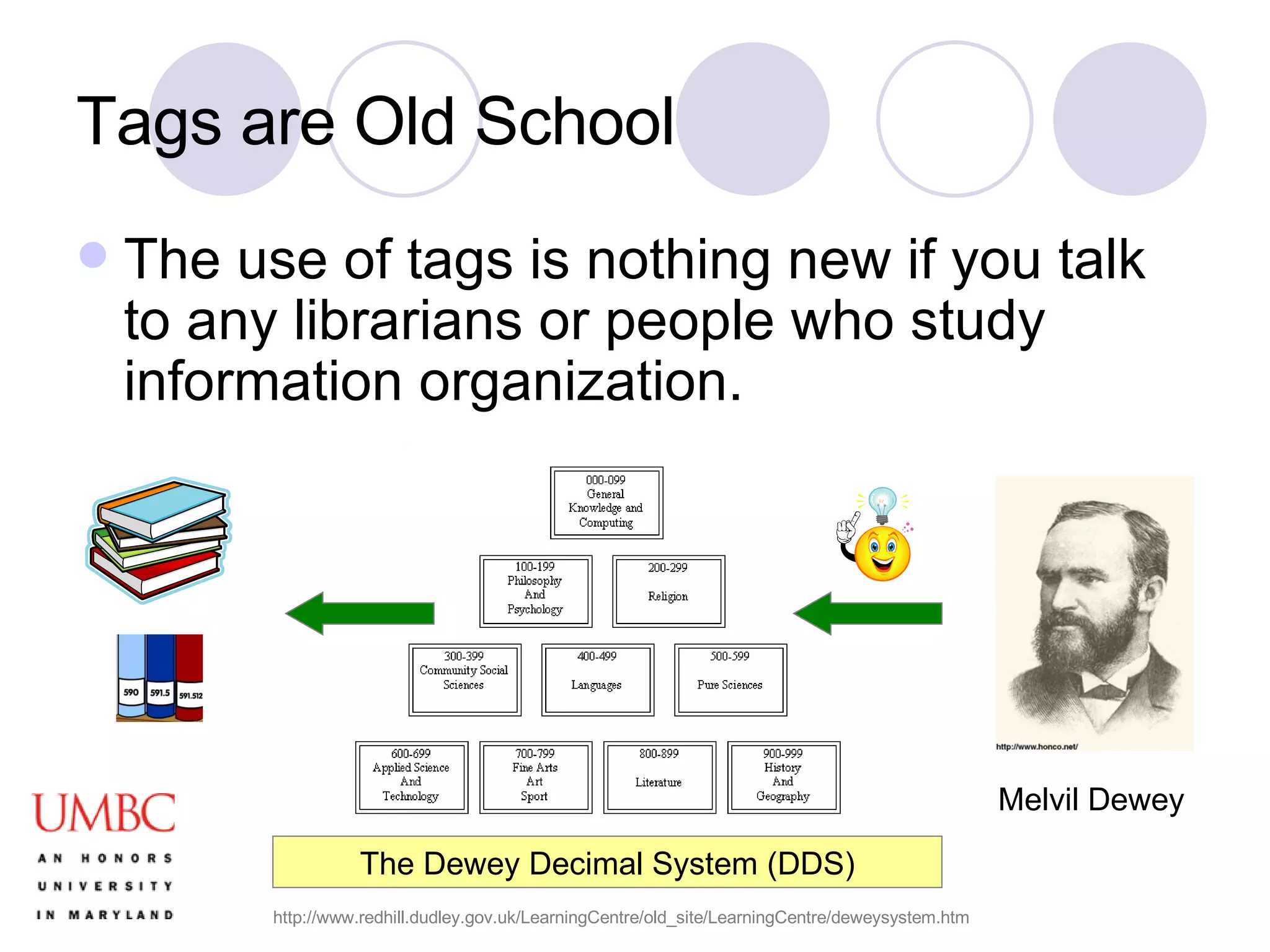
Tags are Old School The use of tags is nothing new if you talk to any librarians or people who study information organization. Melvil Dewey  http://www.redhill.dudley.gov.uk/LearningCentre/old_site/LearningCentre/deweysystem.htm The Dewey Decimal System (DDS)
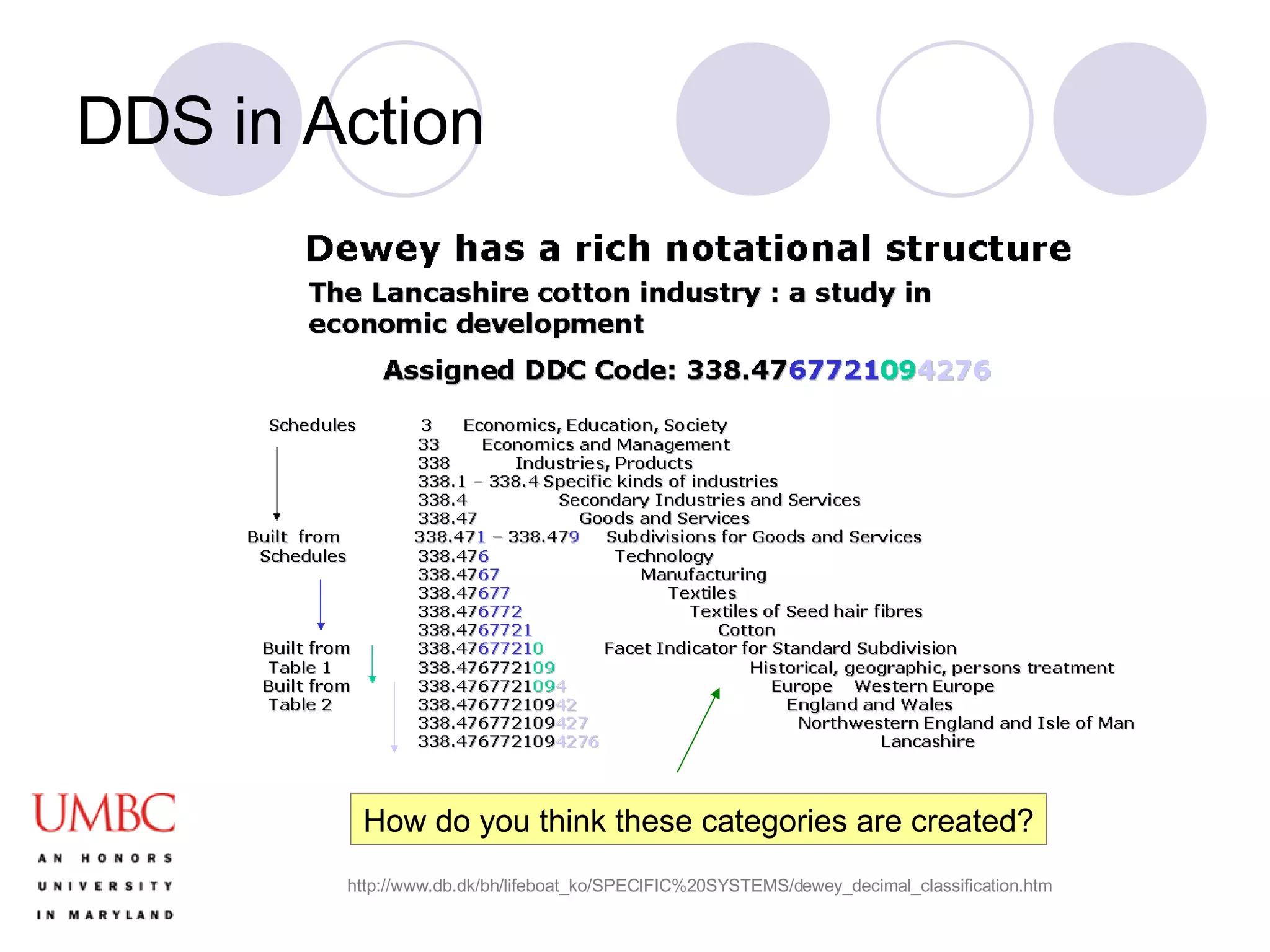
DDS in Action http://www.db.dk/bh/lifeboat_ko/SPECIFIC%20SYSTEMS/dewey_decimal_classification.htm How do you think these categories are created?
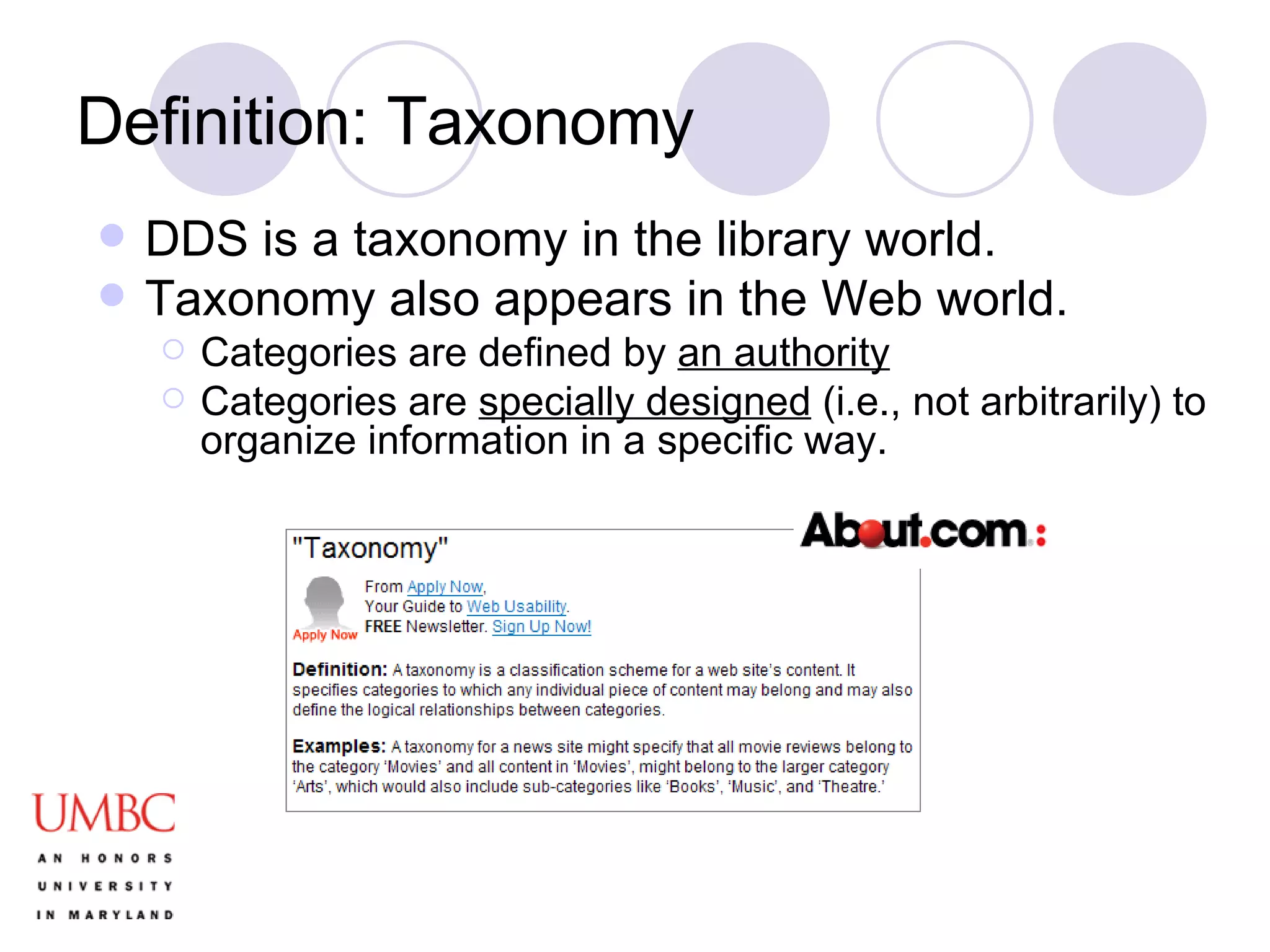
Definition: Taxonomy DDS is a taxonomy in the library world. Taxonomy also appears in the Web world. Categories are defined by  an authority Categories are  specially designed  (i.e., not arbitrarily) to organize information in a specific way.
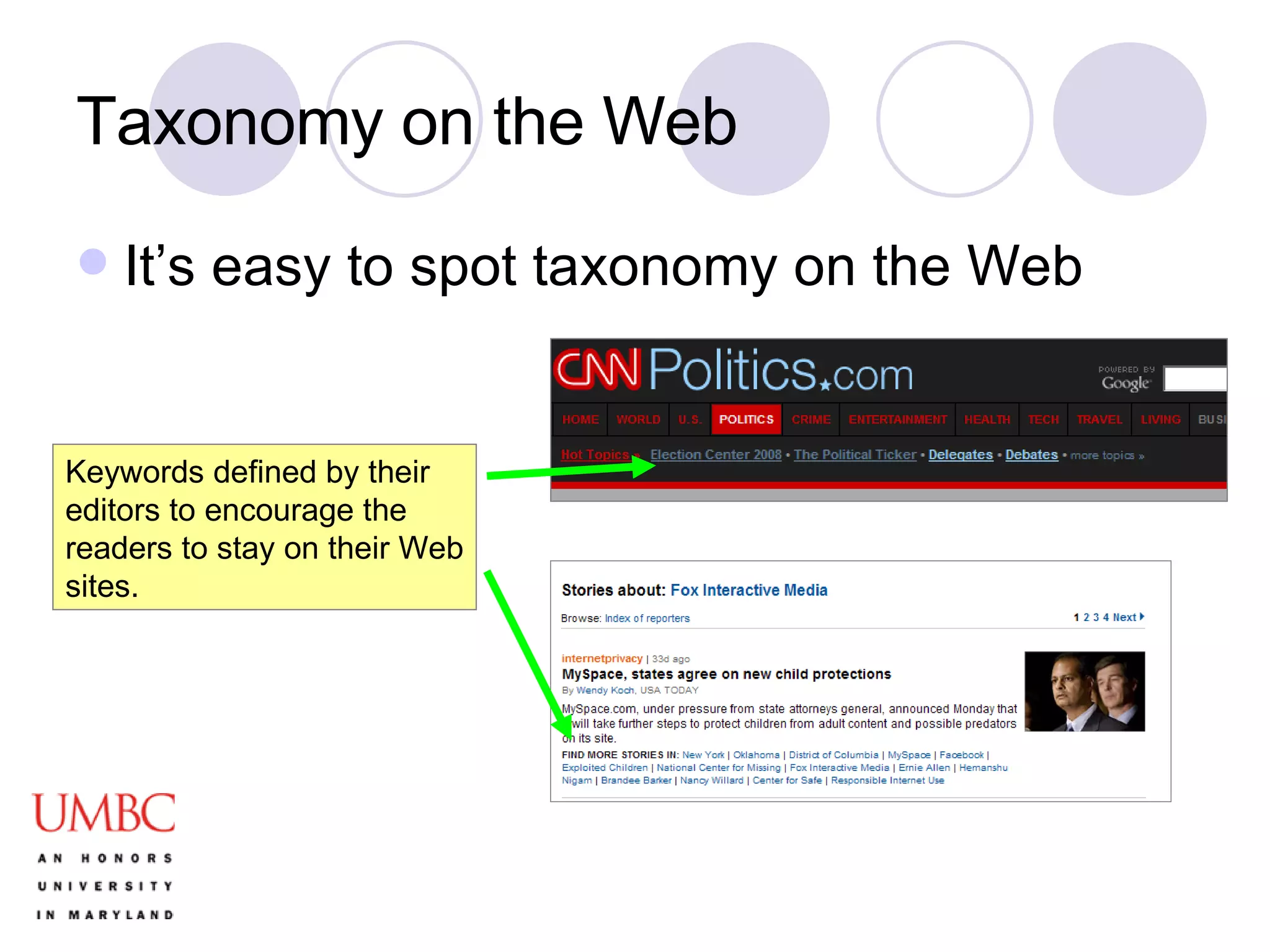
Taxonomy on the Web It’s easy to spot taxonomy on the Web Keywords defined by their editors to encourage the readers to stay on their Web sites.
Criticisms Against Taxonomy The use of taxonomy is not always practical for Web sites that provide user-generated content. “ Content is constantly changing. It’s impractical to have one static taxonomy.” “ No single party should have the authority to enforce any taxonomy on the whole user community.” “ A taxonomy that is good for categorizing information is not necessarily effective for finding and discovering information on the Web” Do you think it’s a good idea to organize your Web site using DDS?
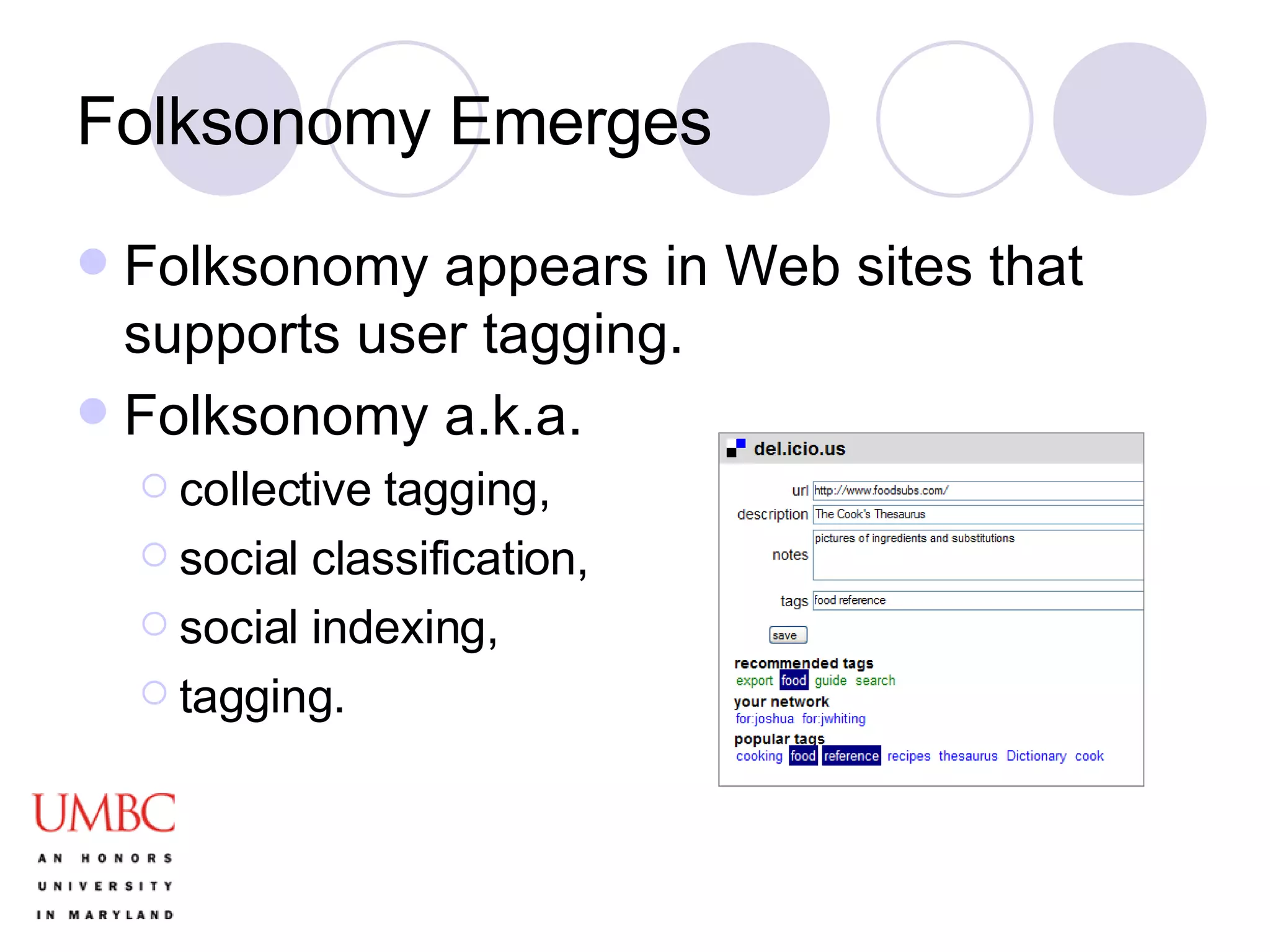
Folksonomy Emerges Folksonomy appears in Web sites that supports user tagging. Folksonomy a.k.a.  collective tagging,  social classification,  social indexing,  tagging.
Definition: Folksonomy Folksonomy is a practice and method of collaboratively creating and managing tags to annotate and categorize content. Users are usually free to choose the keywords that they use in tagging Systems usually provide “tag clouds” for finding and discovering information http://en.wikipedia.org/wiki/Folksonomy
IMHO The emergence of folksonomy also has something to do with Web search.  Search engines employ automatic techniques to organize information. Folksonomy relies on manual labor to category information. The folksonomy approach compliments what’s provided by the search and index algorithms.
How do we tag? Traditional subject indexing Subject indexing with feedback Tagging from a cognitive perspective
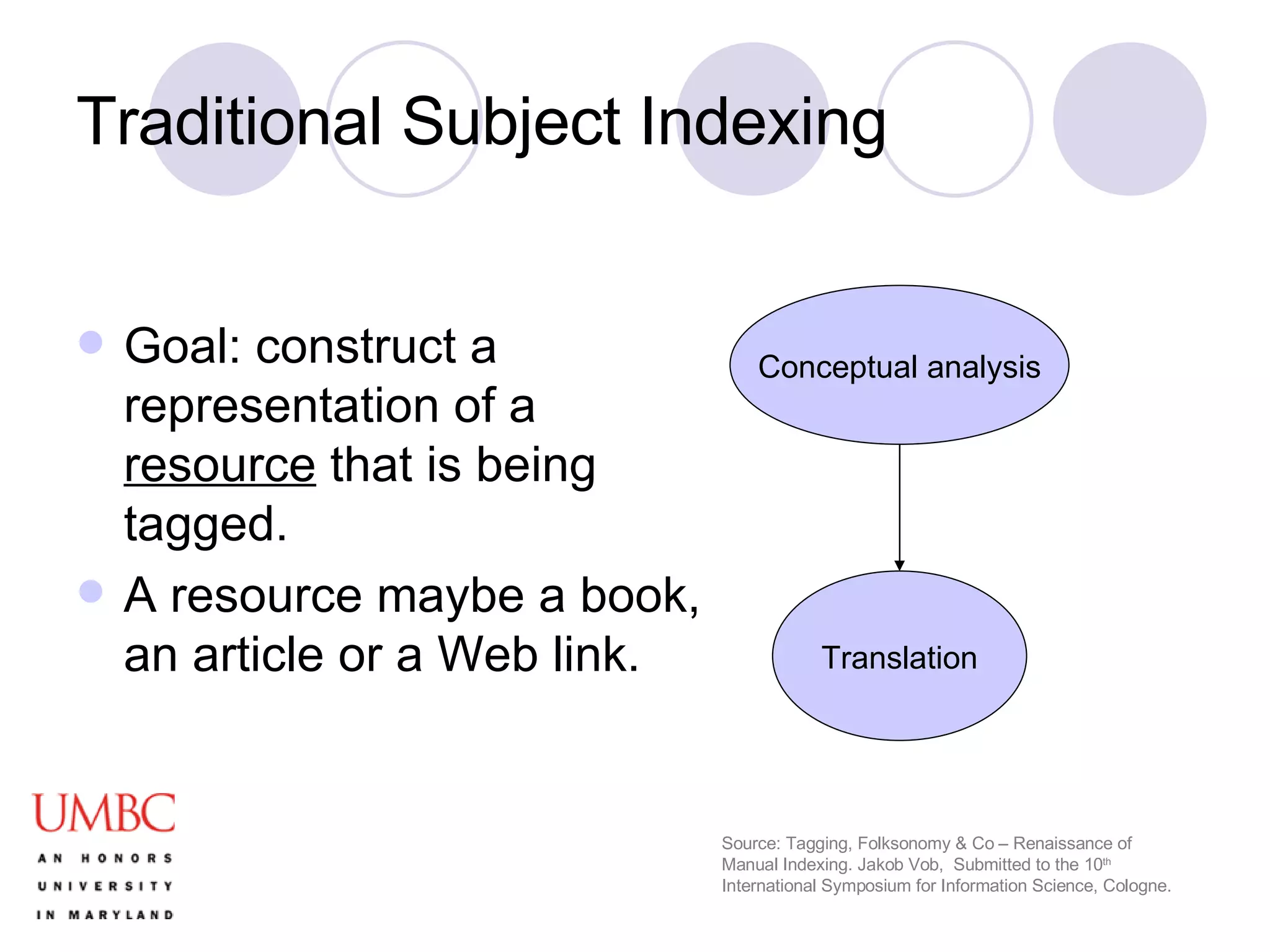
Traditional Subject Indexing Goal: construct a representation of a  resource  that is being tagged. A resource maybe a book, an article or a Web link. Conceptual analysis Translation Source: Tagging, Folksonomy & Co – Renaissance of Manual Indexing. Jakob Vob,  Submitted to the 10 th  International Symposium for Information Science, Cologne.
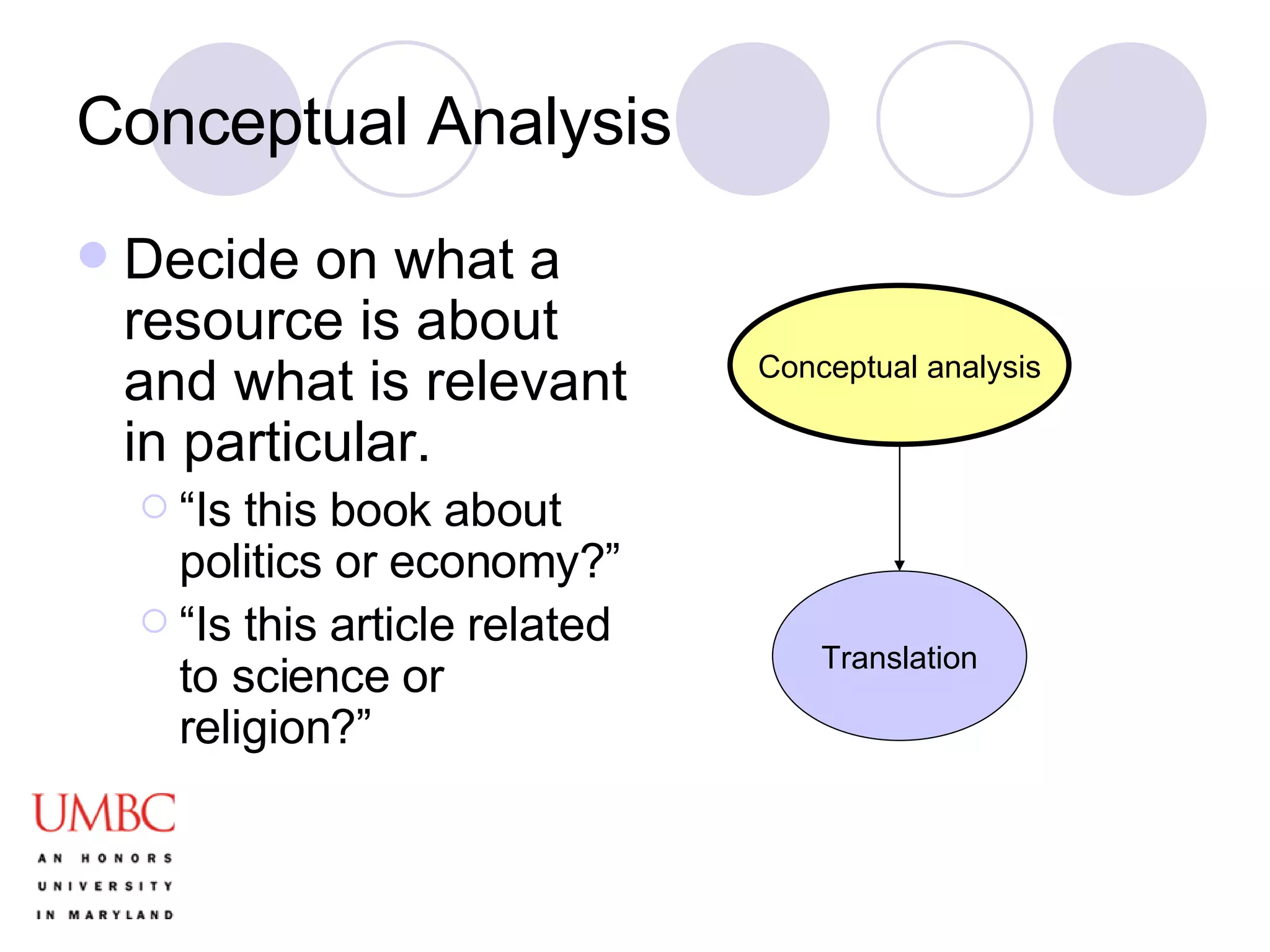
Conceptual Analysis Decide on what a resource is about and what is relevant in particular. “Is this book about politics or economy?” “Is this article related to science or religion?” Conceptual analysis Translation
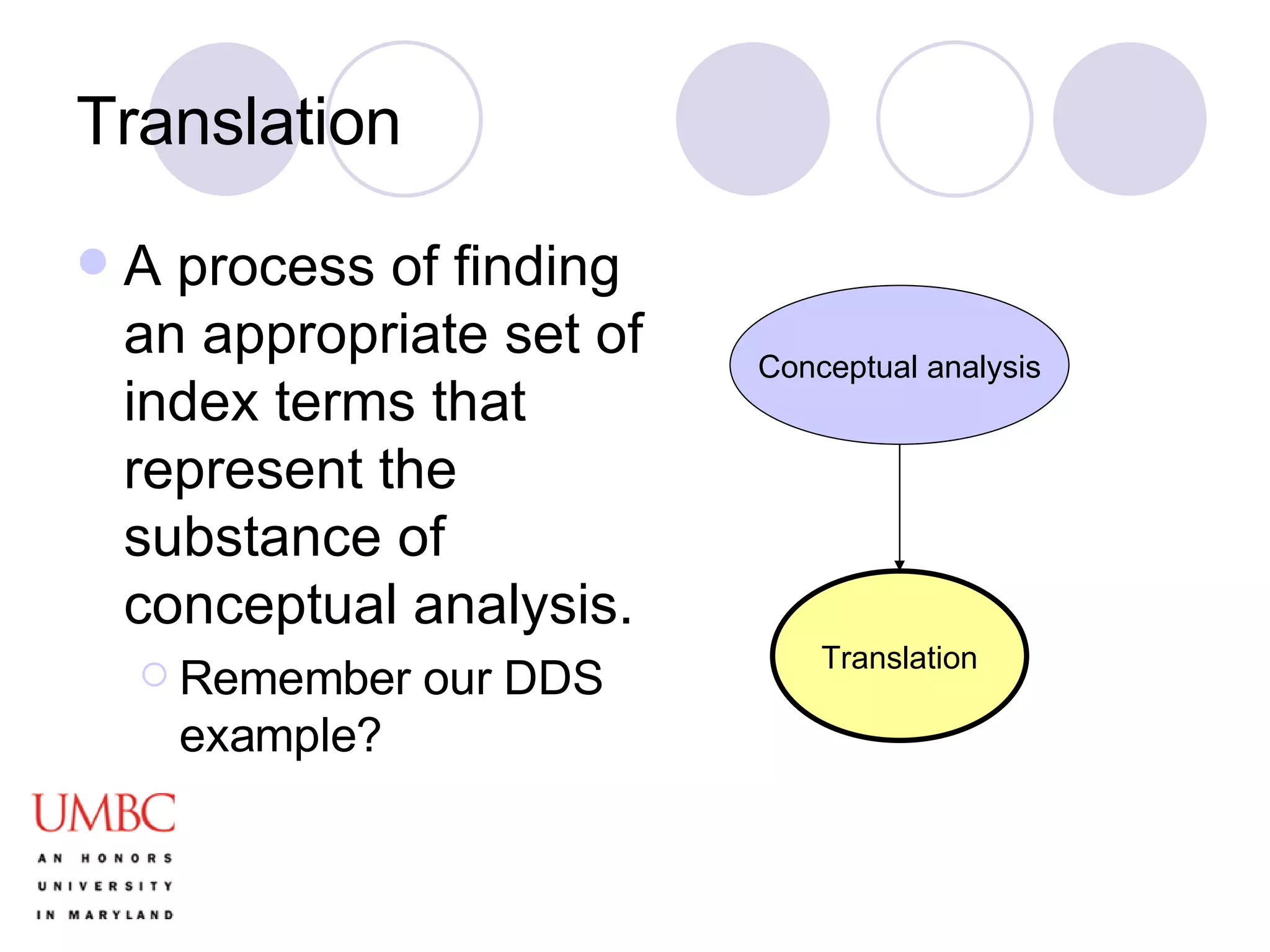
Translation A process of finding an appropriate set of index terms that represent the substance of conceptual analysis. Remember our DDS example? Conceptual analysis Translation
About Traditional Subject Indexing The indexer (person who does the tagging) is usually a subject expert with special training. Tags used usually come from a set of controlled vocabulary (i.e., pre-defined, fixed, rigid and authoritarian). No mention of how the pool of control vocabulary will evolve when the content of resources change
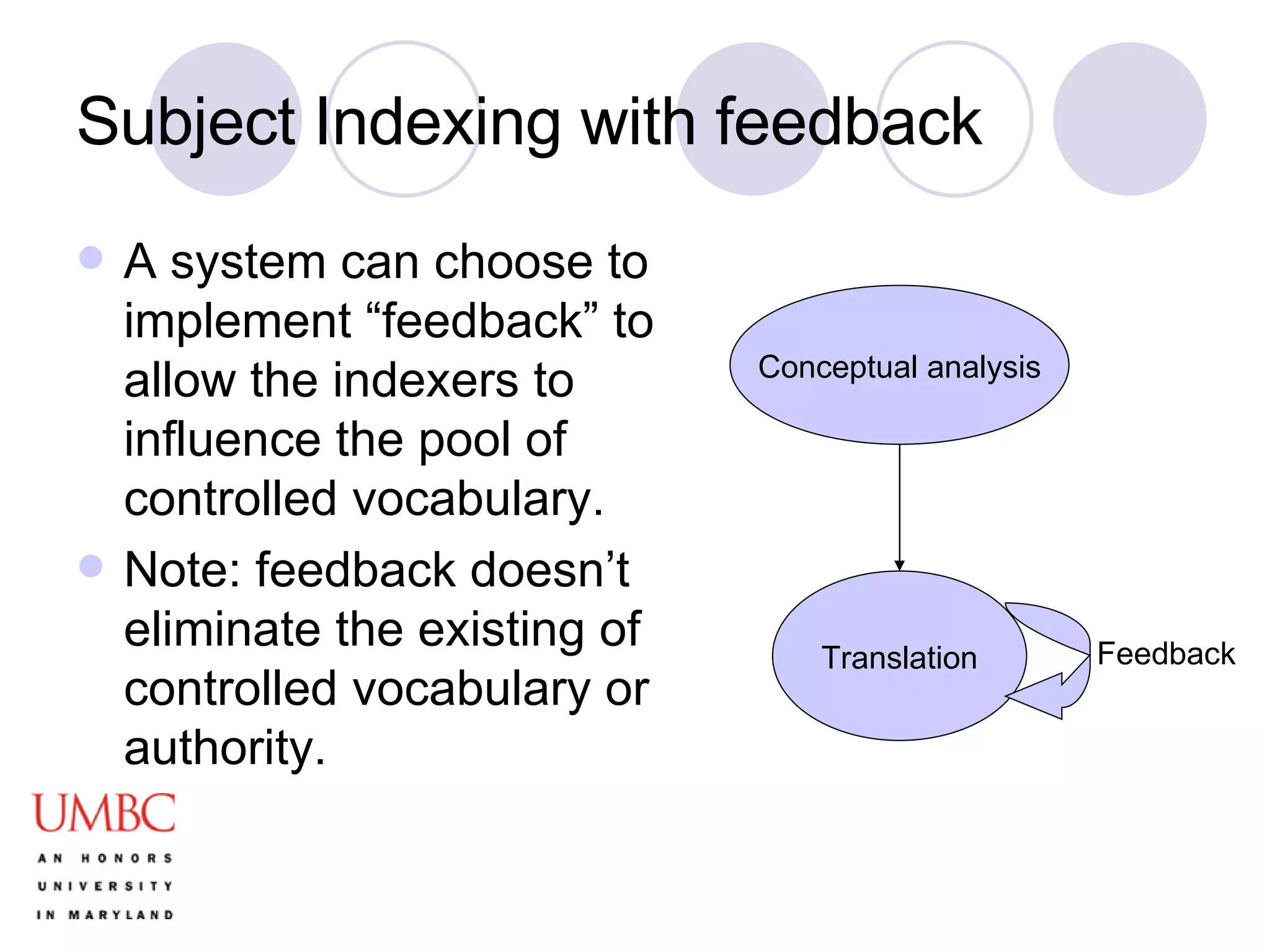
Subject Indexing with feedback A system can choose to implement “feedback” to allow the indexers to influence the pool of controlled vocabulary. Note: feedback doesn’t eliminate the existing of controlled vocabulary or authority. Conceptual analysis Translation Feedback
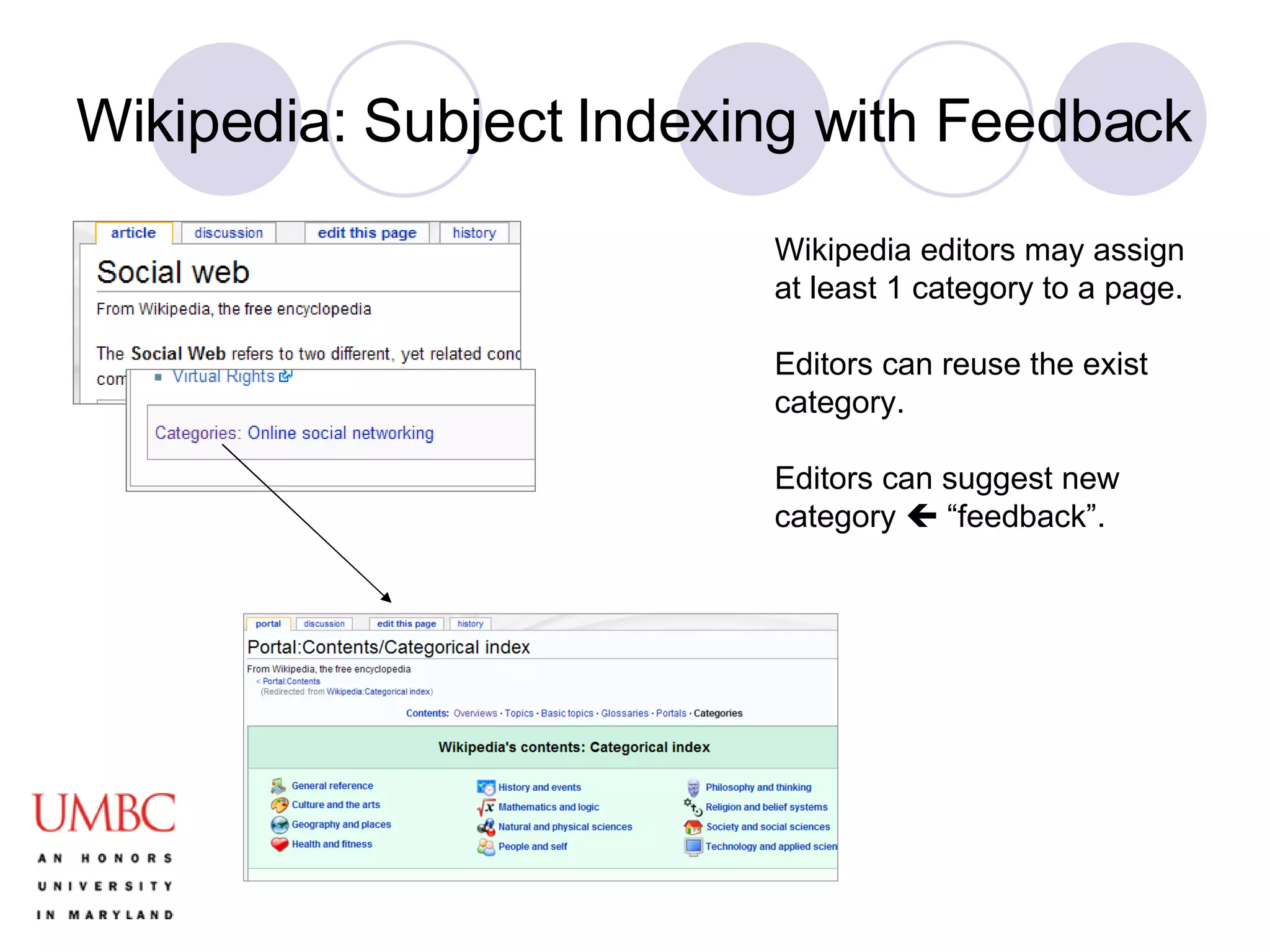
Wikipedia: Subject Indexing with Feedback Wikipedia editors may assign at least 1 category to a page. Editors can reuse the exist category. Editors can suggest new category    “feedback”.
Interesting human behavior in Wikipedia’s Feedback system Everyone is allowed to change and add categories Most editors only edit article text Most editors don’t add tags (i.e. categories). If they do, most editors choose to reuse the existing categories. Not many editors change or add categories. Source: Tagging, Folksonomy & Co – Renaissance of Manual Indexing. Jakob Vob,  Submitted to the 10 th  International Symposium for Information Science, Cologne. Any thoughts on why people may have behaved this way?
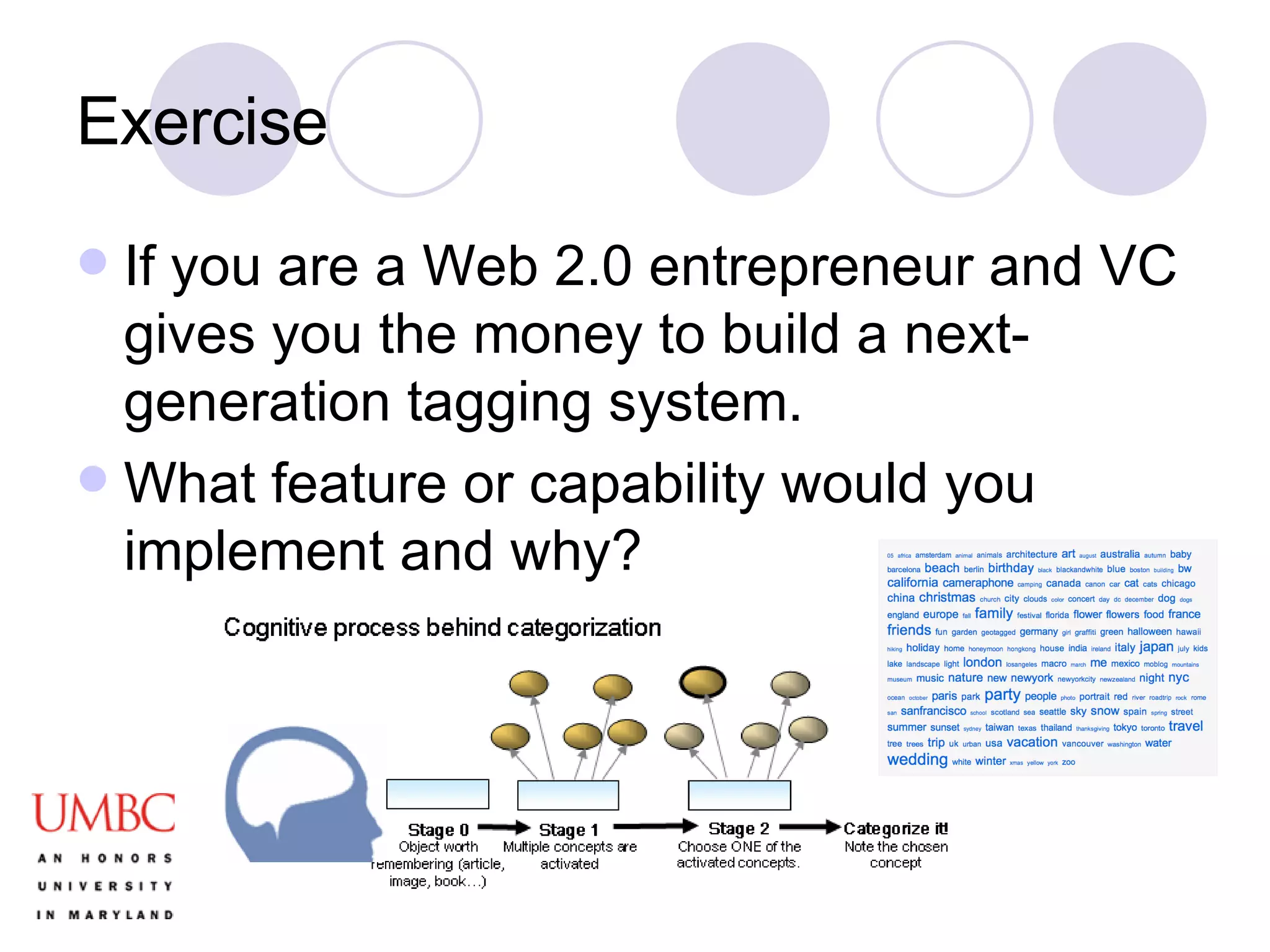
A Cognitive Analysis of Tagging How cognitive psychology and anthropology play a role in tagging. Why is interesting? By understanding how we tag can help developers to create more effective computer systems to assist users in tagging and finding tagged information. Adopted from “A cognitive analysis of tagging” by Rashmi Sinha. http://www.rashmisinha.com/archives/05_09/tagging-cognitive.html
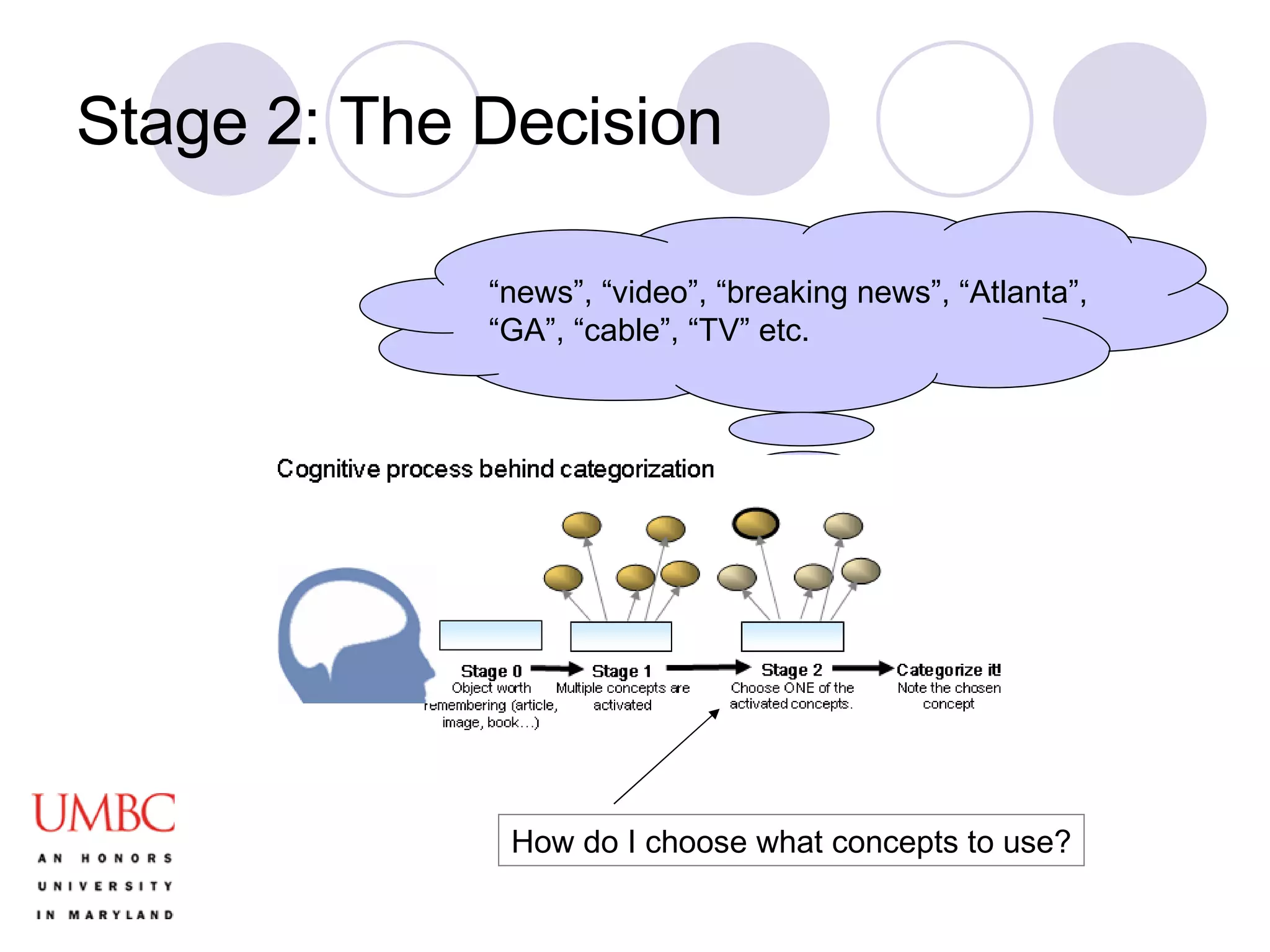
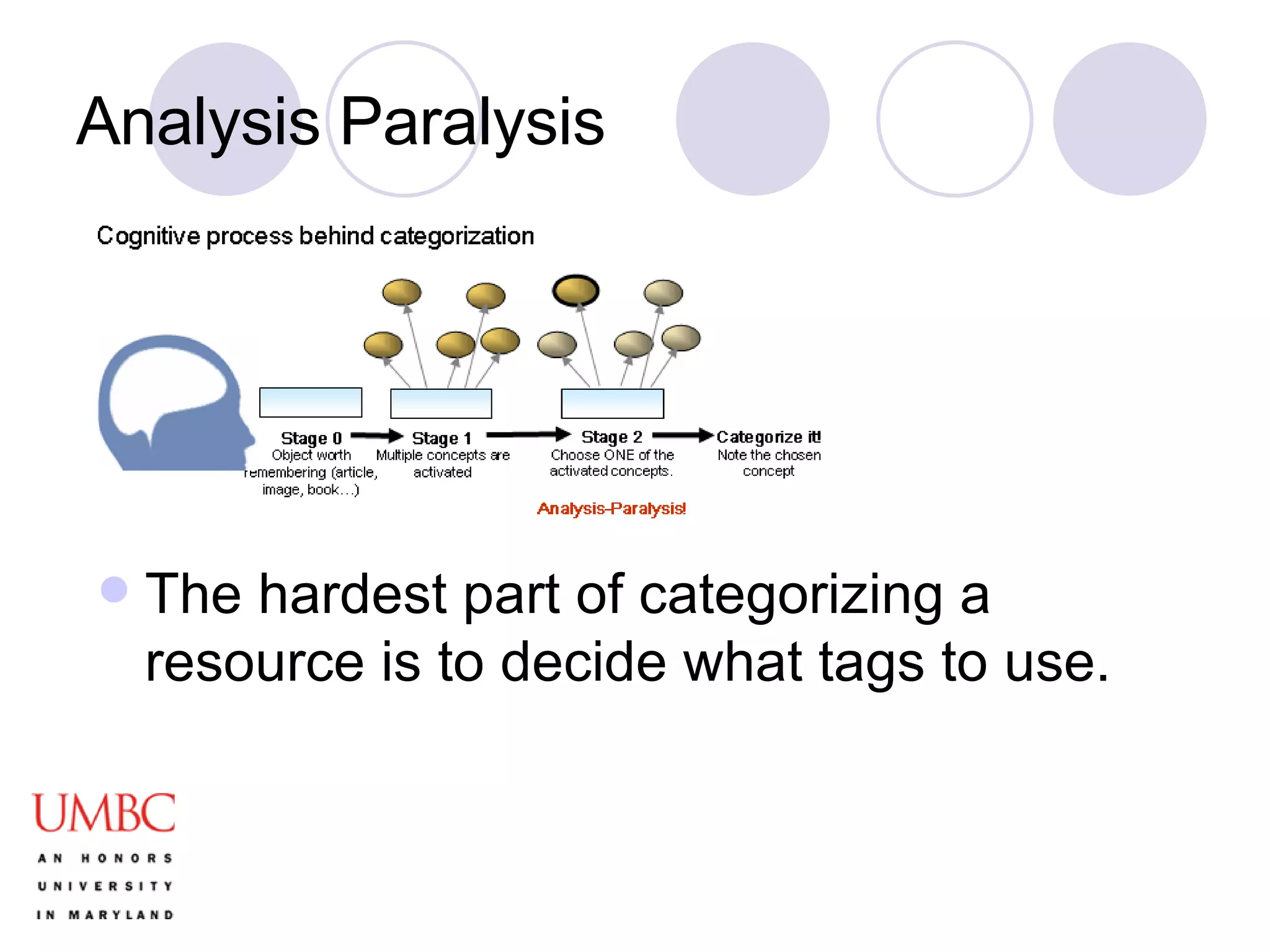
A Two-Stage Process Asking you to tag is asking you to categorize. Categorization is a 2-stage process Stage 1: Related Category Activation Stage 2: The Decision
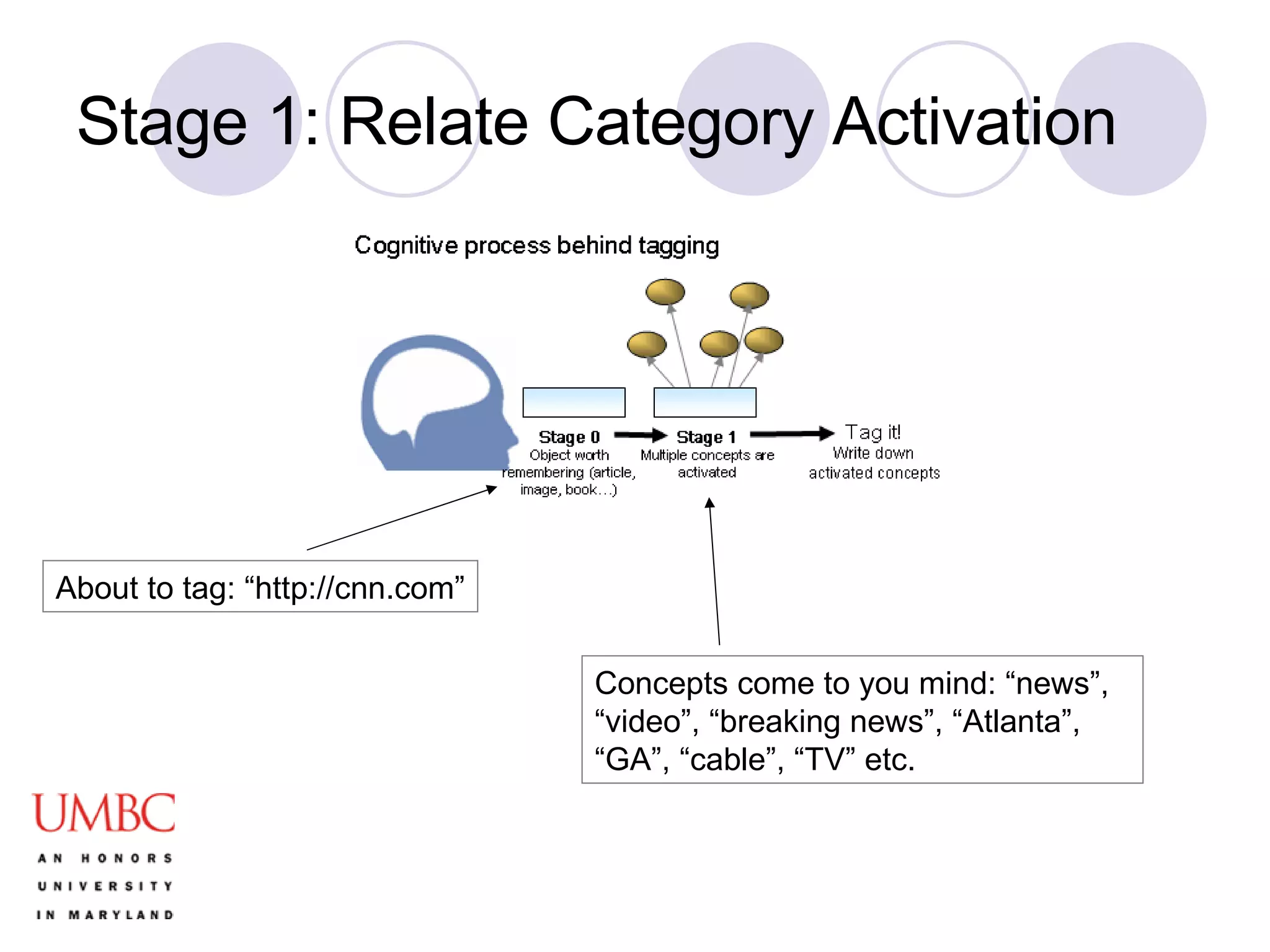
Stage 1: Relate Category Activation Concepts come to you mind: “news”, “video”, “breaking news”, “Atlanta”,  “GA”, “cable”, “TV” etc.  About to tag: “http://cnn.com”
Stage 2: The Decision How do I choose what concepts to use? “news”, “video”, “breaking news”, “Atlanta”,  “GA”, “cable”, “TV” etc.
Decision making is hard! You have to choose what tags to use. How do you decide? What criteria do you use to measure the quality of a tag? “ breaking news” vs. “news” “ TV” vs. “Cable” Part of your task:  optimize its future findability .  Will you find  http://cnn.com  via “news” or “tv” Do you have too many bookmarks tagged “tv”? Should you create a separate category for “cable” for a special group of “tv” bookmarks? Is your tag schema balanced?
Analysis Paralysis The hardest part of categorizing a resource is to decide what tags to use.
Other questions will slow you down If it’s costly to rename a tag, you will likely to think twice about picking “news” over “breaking news” or vice versa. If you are tagging for sharing information with others, you will consider if your tag “TV” is findable by others via “tv” or “cable” – maybe no one uses “tv”.
Web 2.0 Tagging Comes to Help  Tagging in Web 2.0 in fact is far easy than we think. We don’t need to worry much about the “Analysis Paralysis” problem.  Just write down all possible tags that come to our mind. If we got it wrong, we can count on Web 2.0 UI to rename and re-tag.
Exercise  If you are a Web 2.0 entrepreneur and VC gives you the money to build a next-generation tagging system.  What feature or capability would you implement and why?
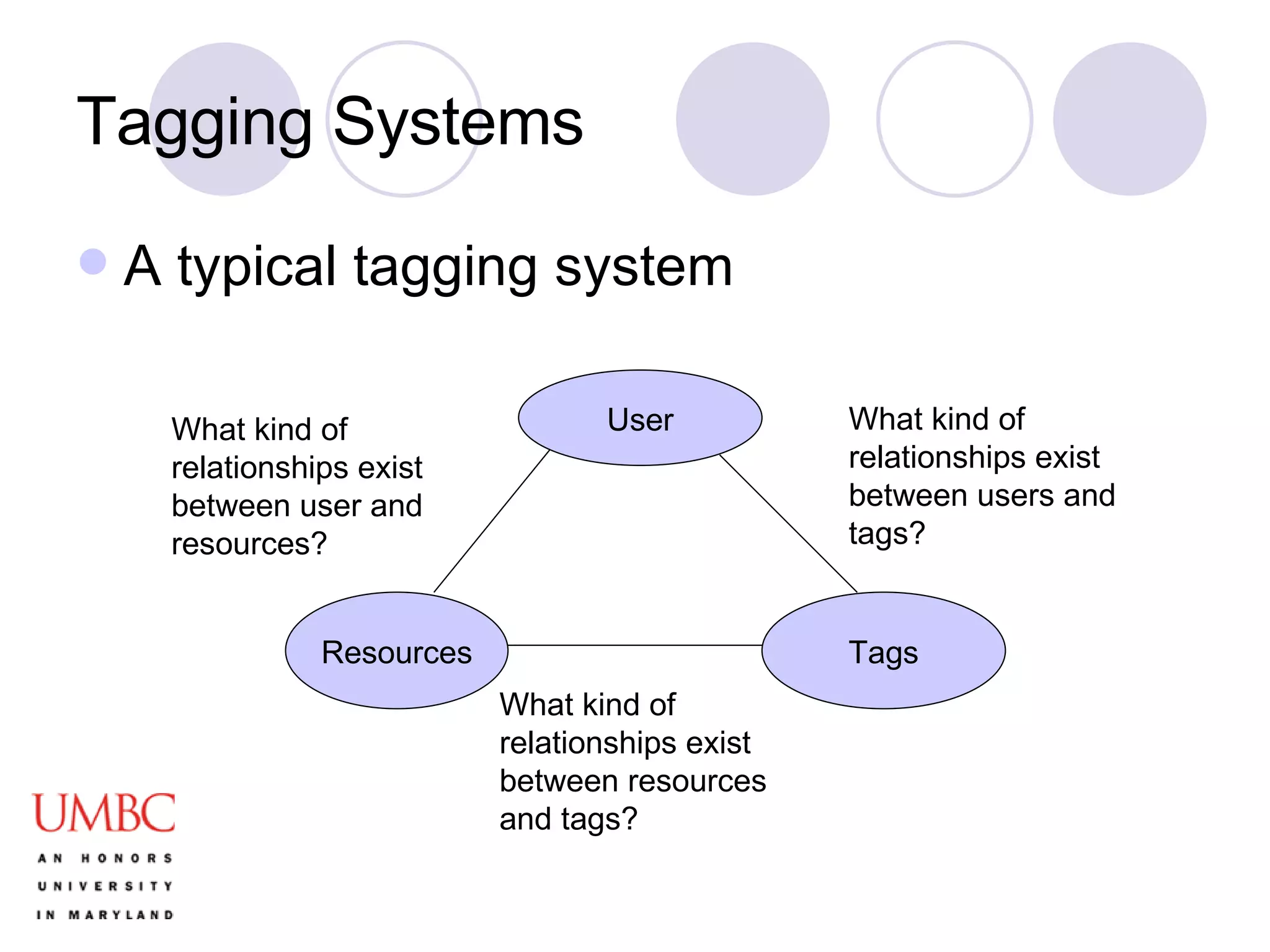
Tagging Systems A typical tagging system User Resources Tags What kind of relationships exist between users and tags? What kind of relationships exist between resources and tags? What kind of relationships exist between user and resources?
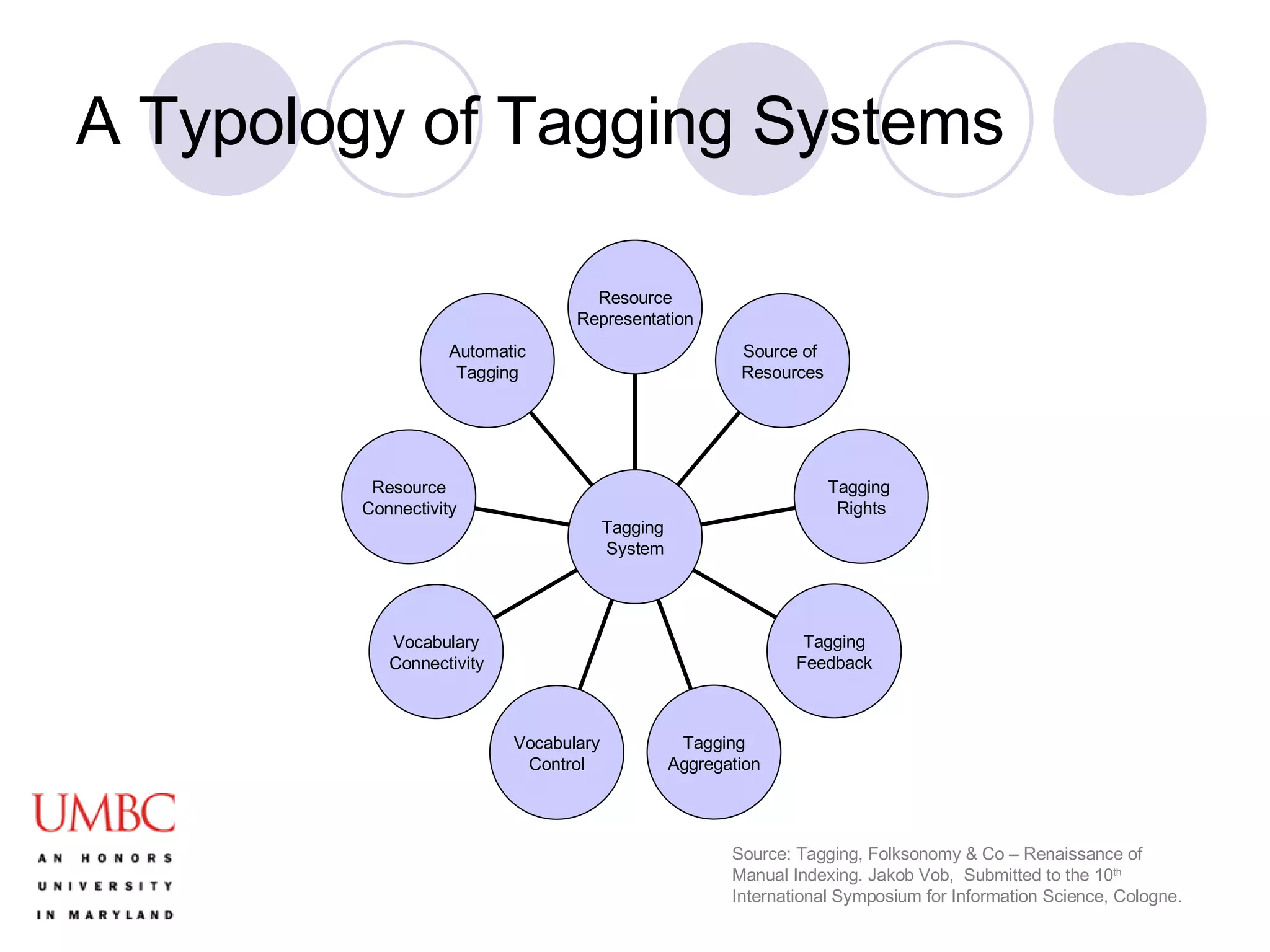
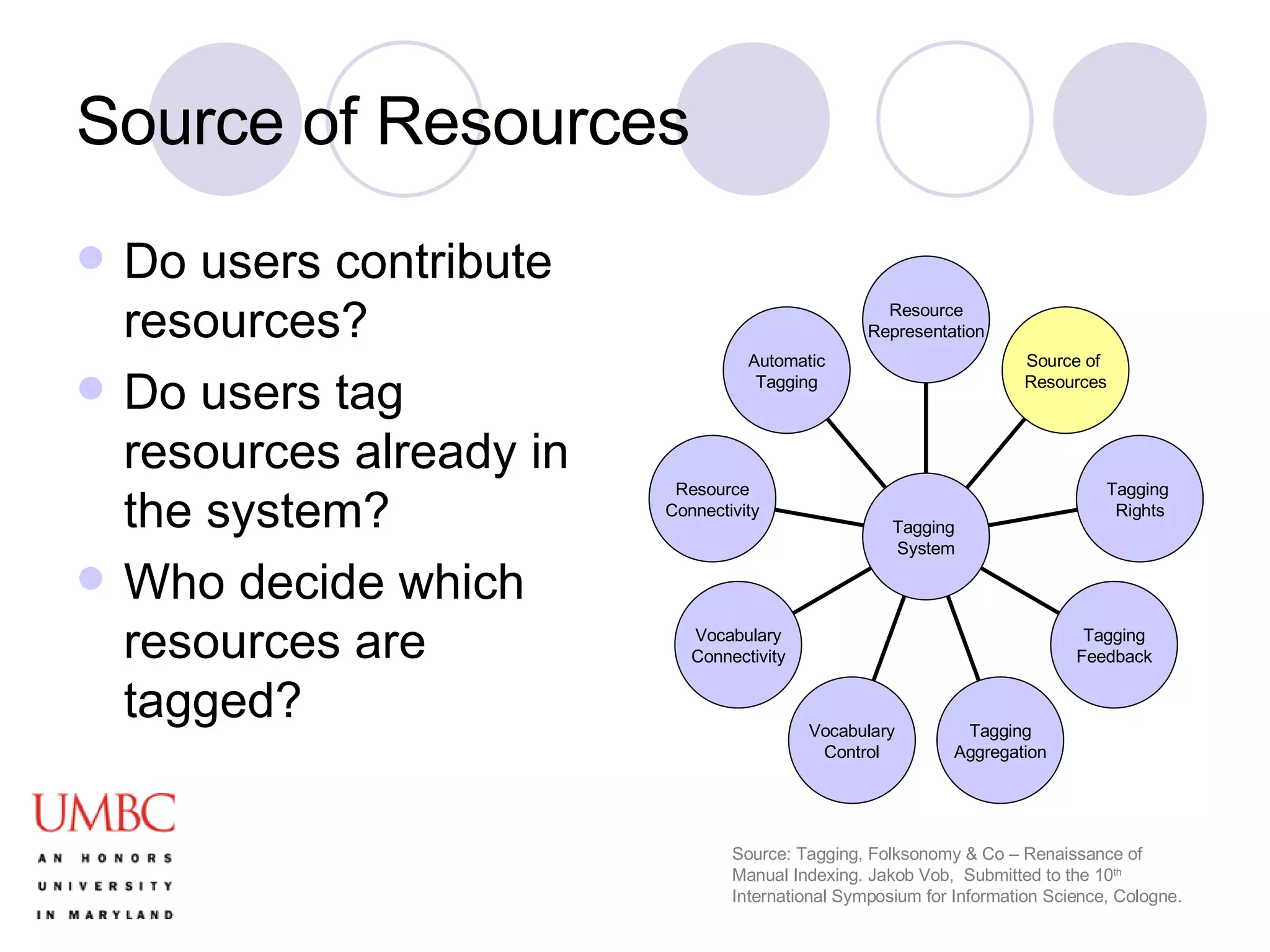
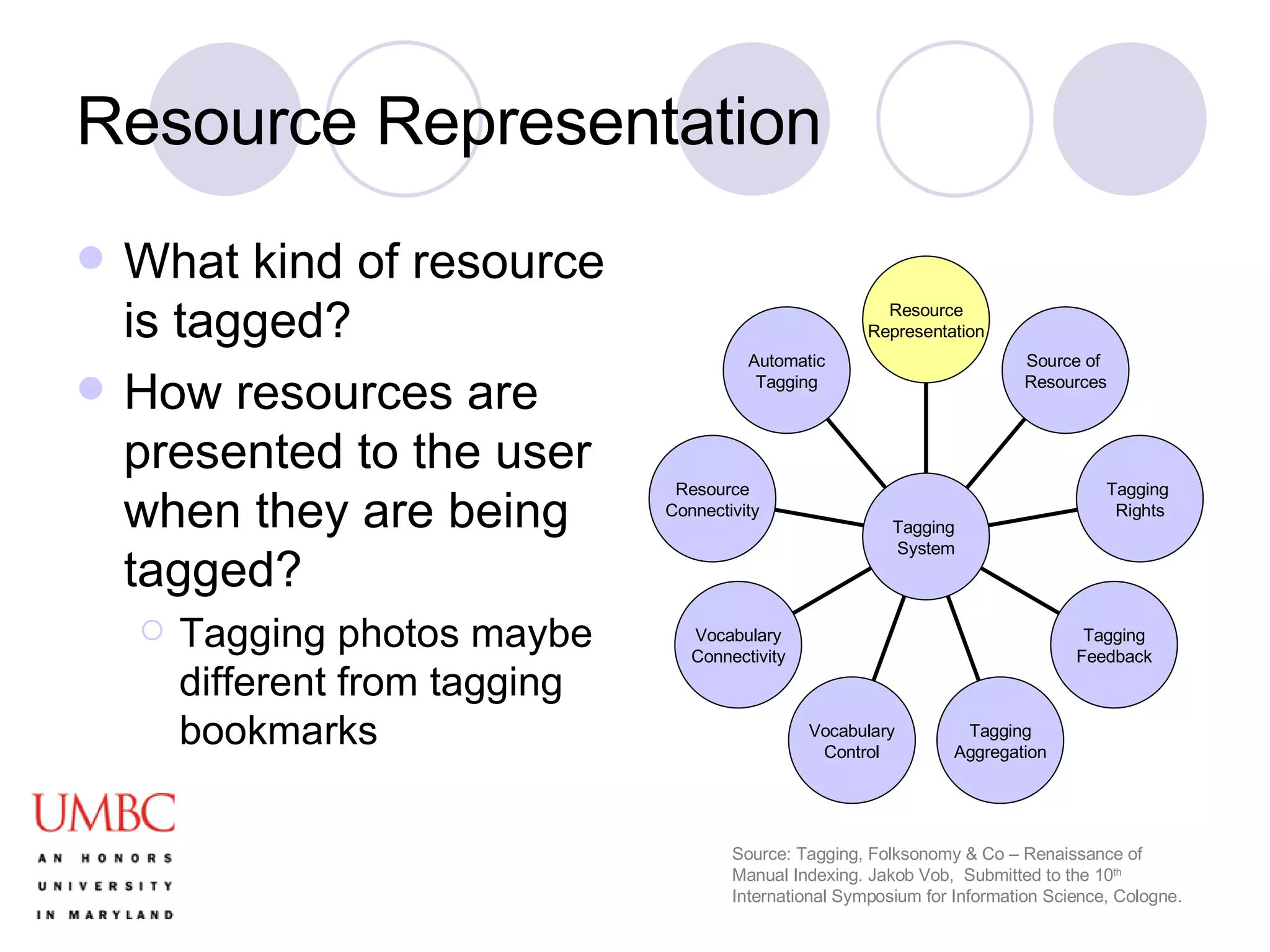
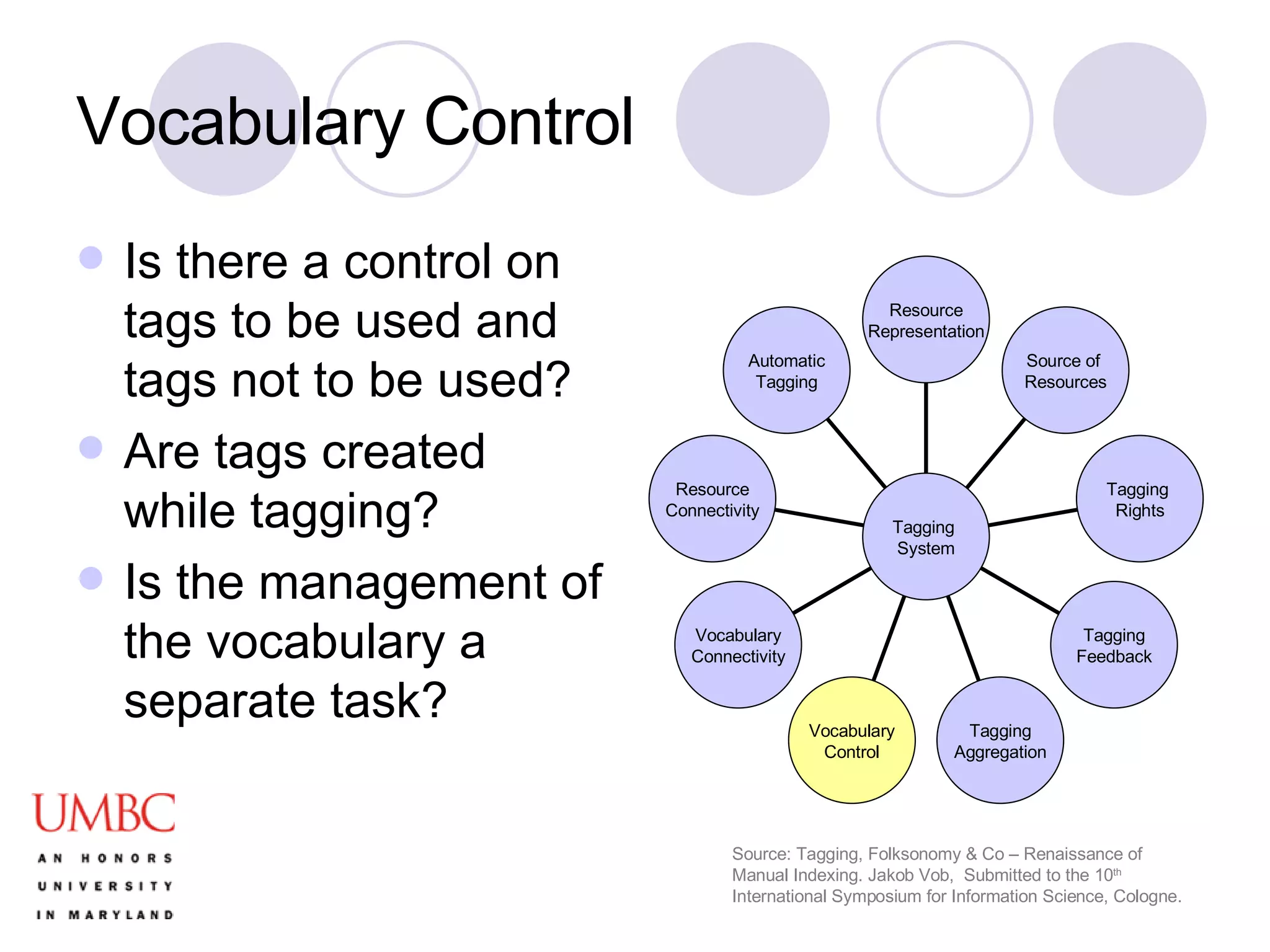
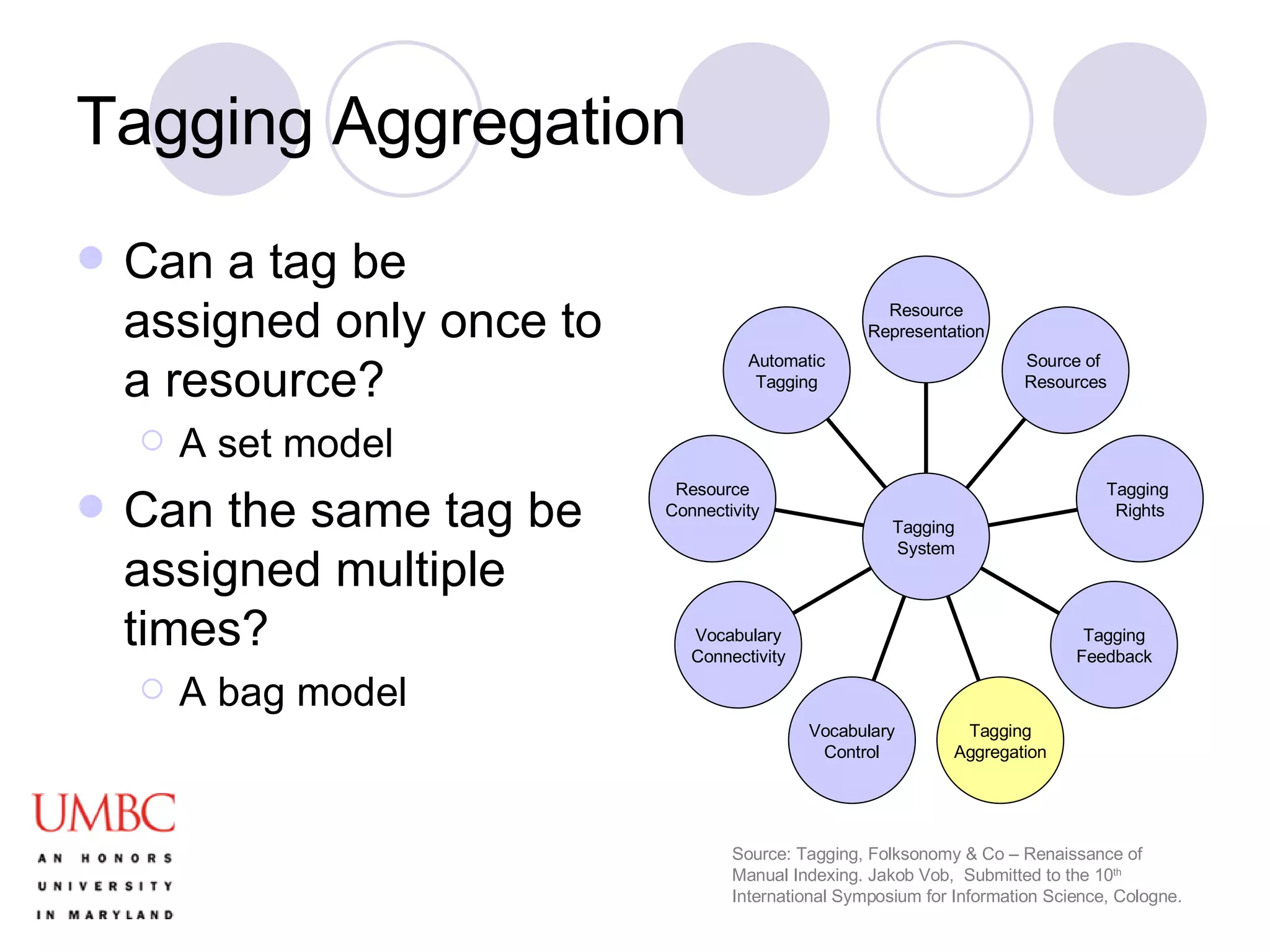
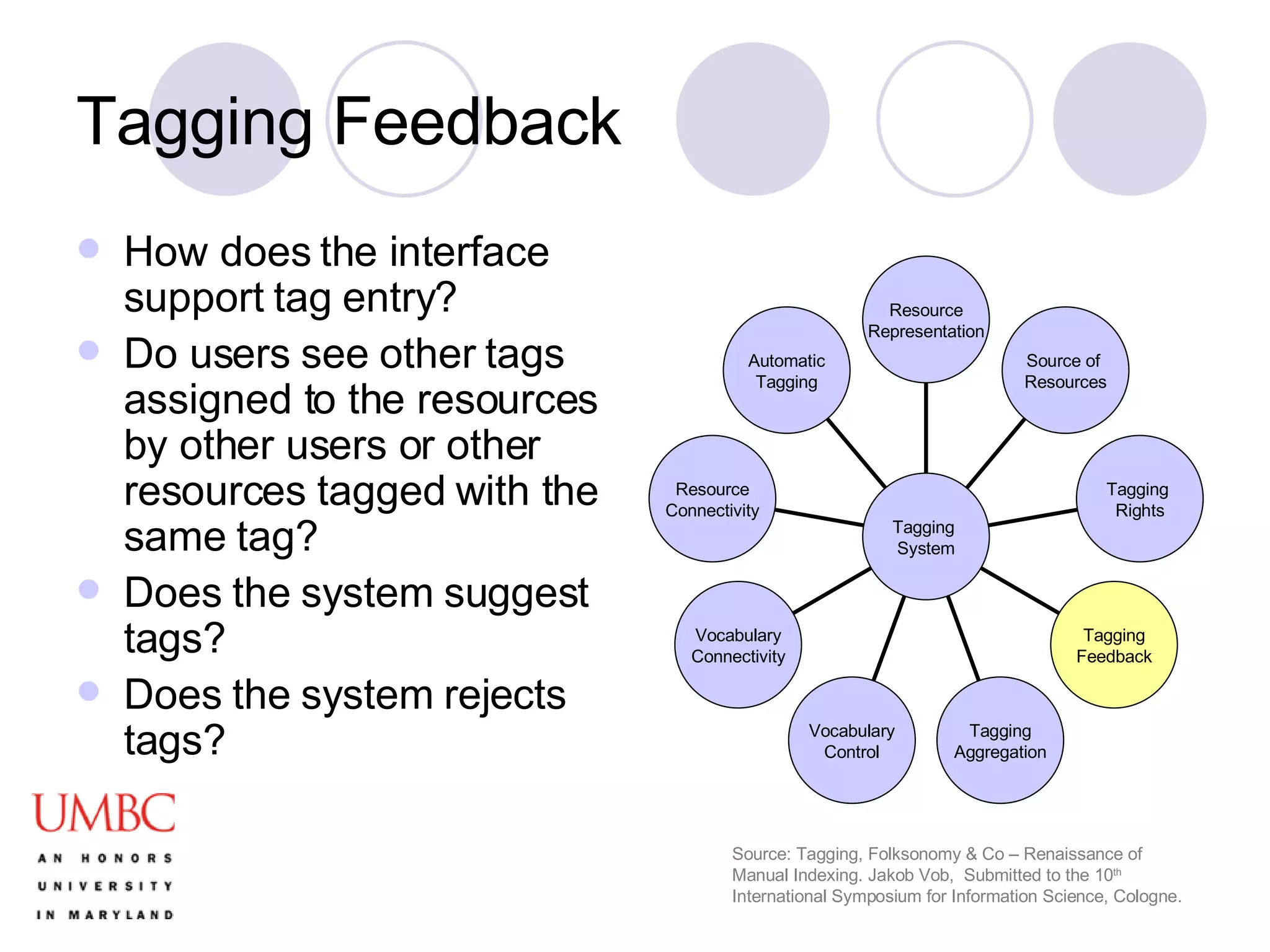
A Typology of Tagging Systems Source: Tagging, Folksonomy & Co – Renaissance of Manual Indexing. Jakob Vob,  Submitted to the 10 th  International Symposium for Information Science, Cologne. Automatic Tagging Resource Connectivity Vocabulary Connectivity Vocabulary Control Tagging Aggregation Tagging Feedback Tagging  Rights Source of  Resources Resource Representation Tagging  System
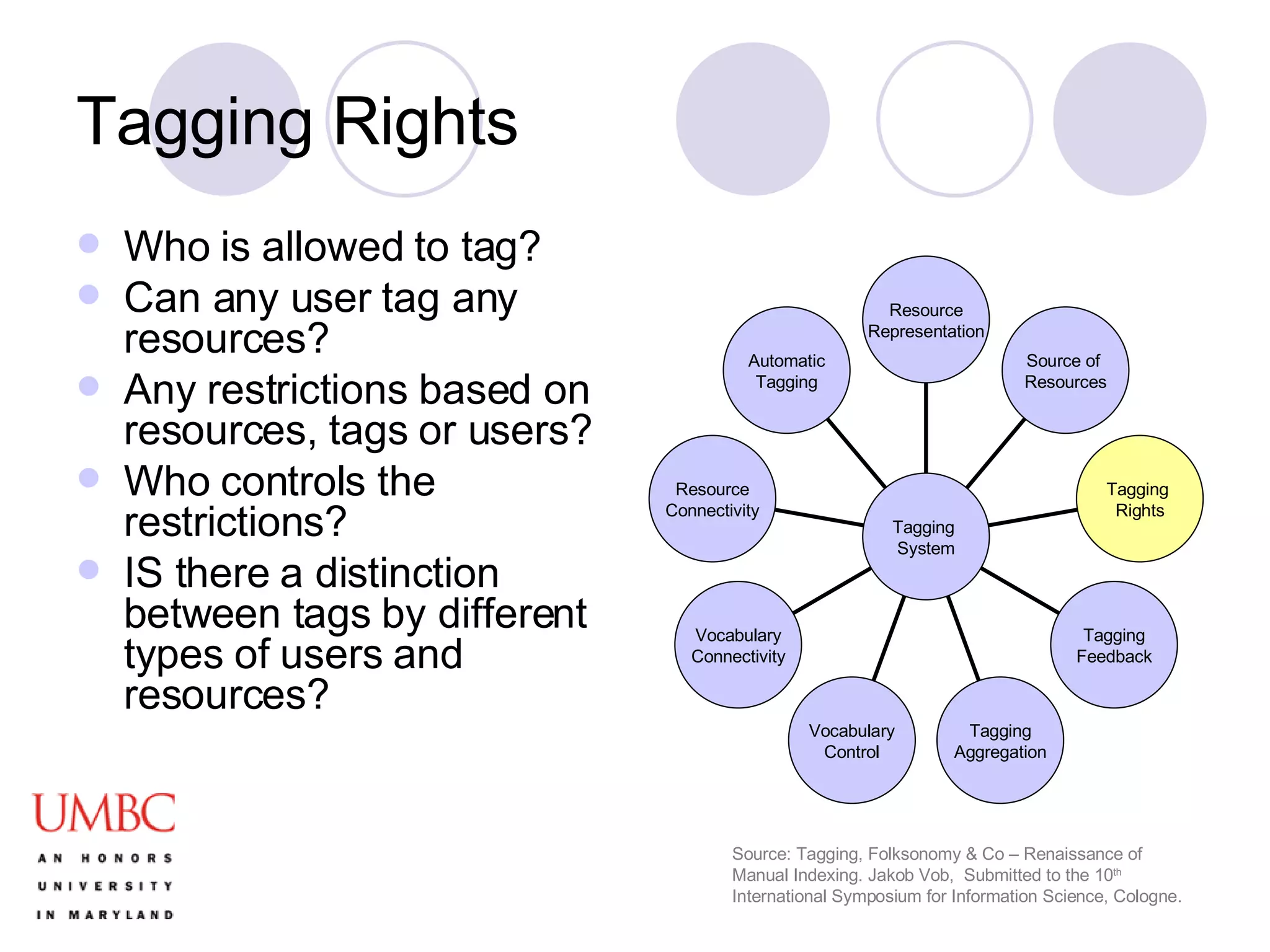
Tagging Rights Who is allowed to tag? Can any user tag any resources? Any restrictions based on resources, tags or users? Who controls the restrictions? IS there a distinction between tags by different types of users and resources? Source: Tagging, Folksonomy & Co – Renaissance of Manual Indexing. Jakob Vob,  Submitted to the 10 th  International Symposium for Information Science, Cologne. Automatic Tagging Resource Connectivity Vocabulary Connectivity Vocabulary Control Tagging Aggregation Tagging Feedback Tagging  Rights Source of  Resources Resource Representation Tagging  System
Source of Resources Do users contribute resources? Do users tag resources already in the system? Who decide which resources are tagged? Source: Tagging, Folksonomy & Co – Renaissance of Manual Indexing. Jakob Vob,  Submitted to the 10 th  International Symposium for Information Science, Cologne. Automatic Tagging Resource Connectivity Vocabulary Connectivity Vocabulary Control Tagging Aggregation Tagging Feedback Tagging  Rights Source of  Resources Resource Representation Tagging  System
Resource Representation What kind of resource is tagged? How resources are presented to the user when they are being tagged? Tagging photos maybe different from tagging bookmarks Source: Tagging, Folksonomy & Co – Renaissance of Manual Indexing. Jakob Vob,  Submitted to the 10 th  International Symposium for Information Science, Cologne. Automatic Tagging Resource Connectivity Vocabulary Connectivity Vocabulary Control Tagging Aggregation Tagging Feedback Tagging  Rights Source of  Resources Resource Representation Tagging  System
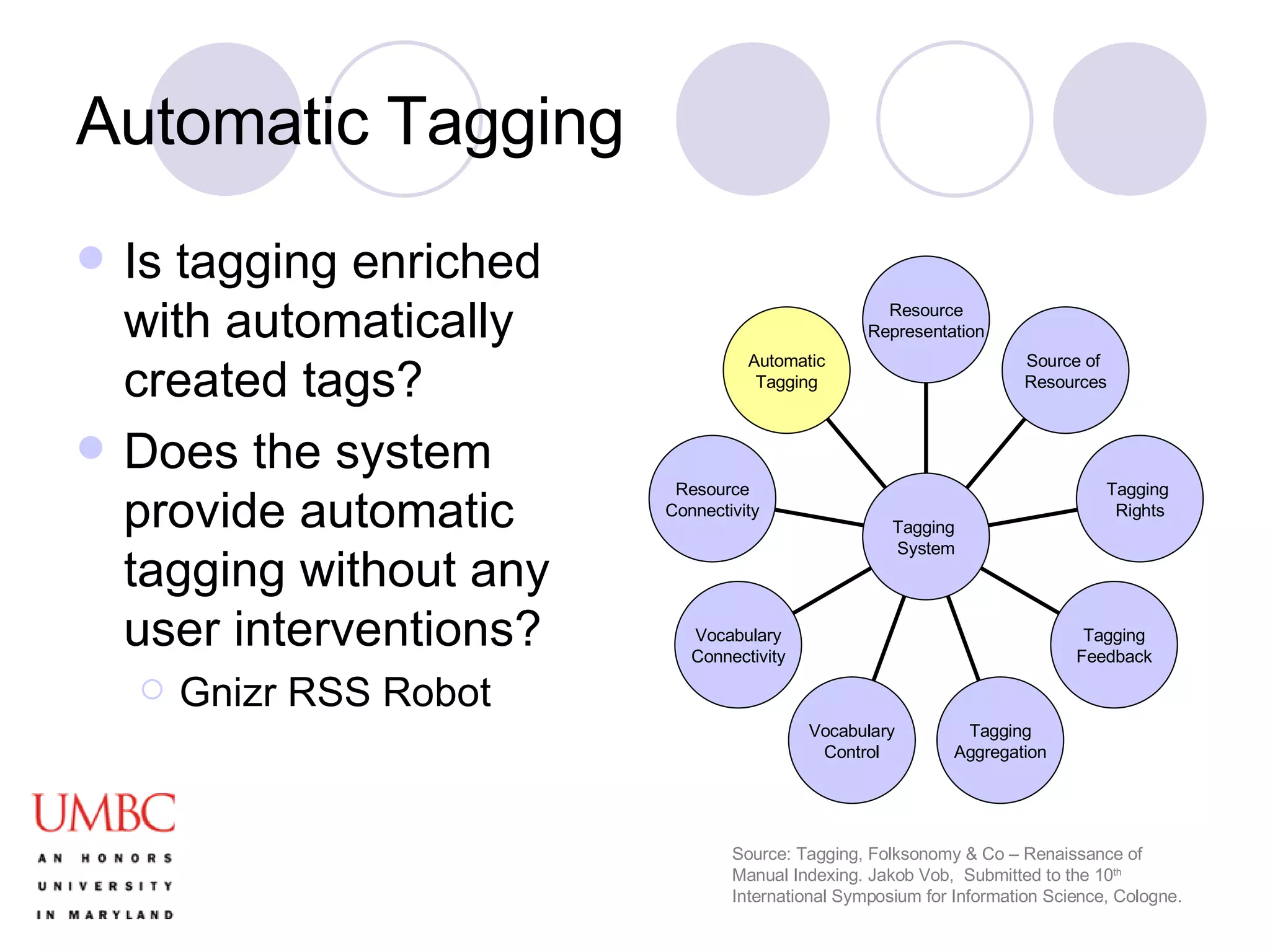
Automatic Tagging Is tagging enriched with automatically created tags? Does the system provide automatic tagging without any user interventions?  Gnizr RSS Robot Source: Tagging, Folksonomy & Co – Renaissance of Manual Indexing. Jakob Vob,  Submitted to the 10 th  International Symposium for Information Science, Cologne. Automatic Tagging Resource Connectivity Vocabulary Connectivity Vocabulary Control Tagging Aggregation Tagging Feedback Tagging  Rights Source of  Resources Resource Representation Tagging  System
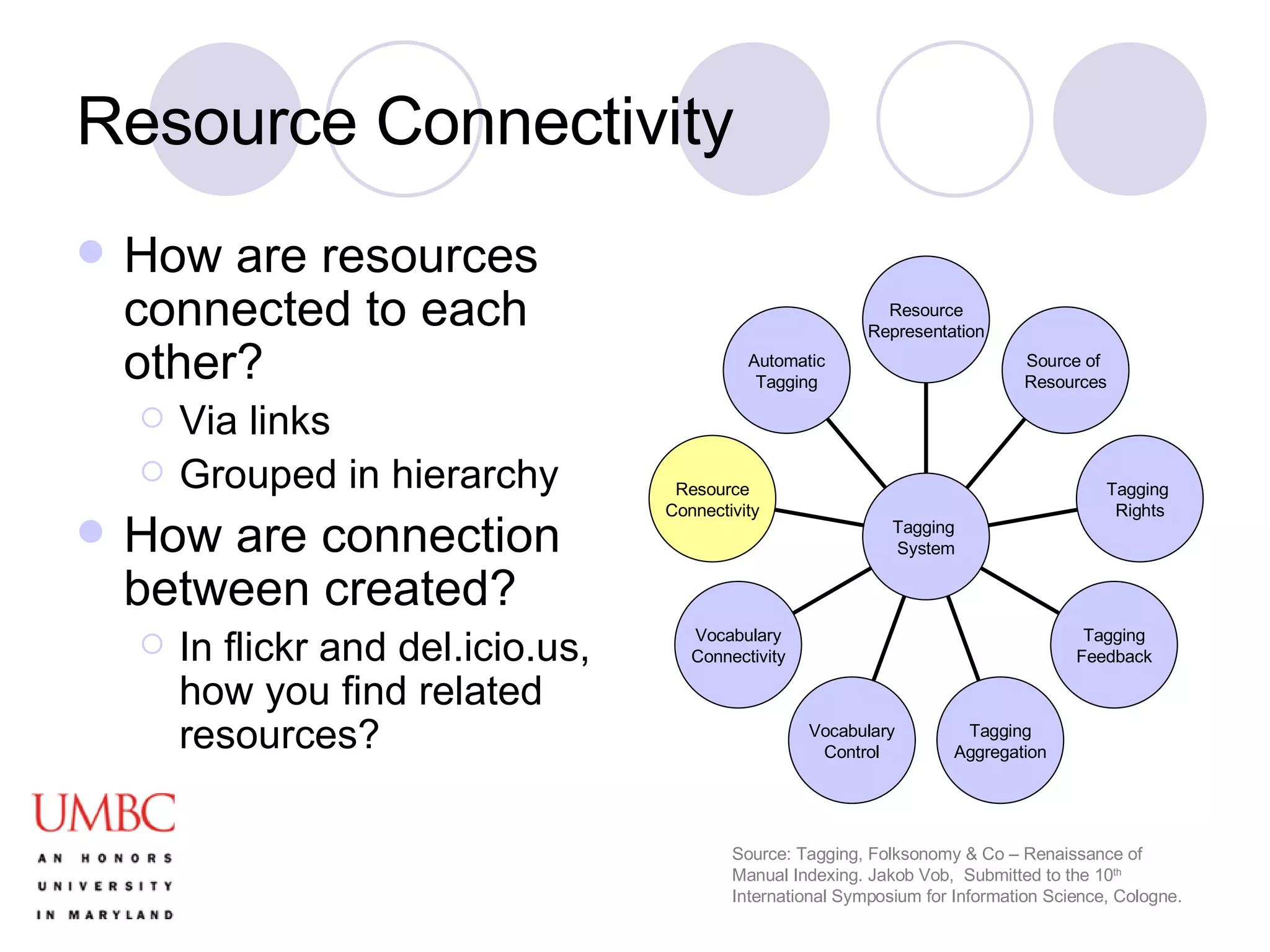
Resource Connectivity How are resources connected to each other?  Via links  Grouped in hierarchy How are connection between created? In flickr and del.icio.us, how you find related resources? Source: Tagging, Folksonomy & Co – Renaissance of Manual Indexing. Jakob Vob,  Submitted to the 10 th  International Symposium for Information Science, Cologne. Automatic Tagging Resource Connectivity Vocabulary Connectivity Vocabulary Control Tagging Aggregation Tagging Feedback Tagging  Rights Source of  Resources Resource Representation Tagging  System
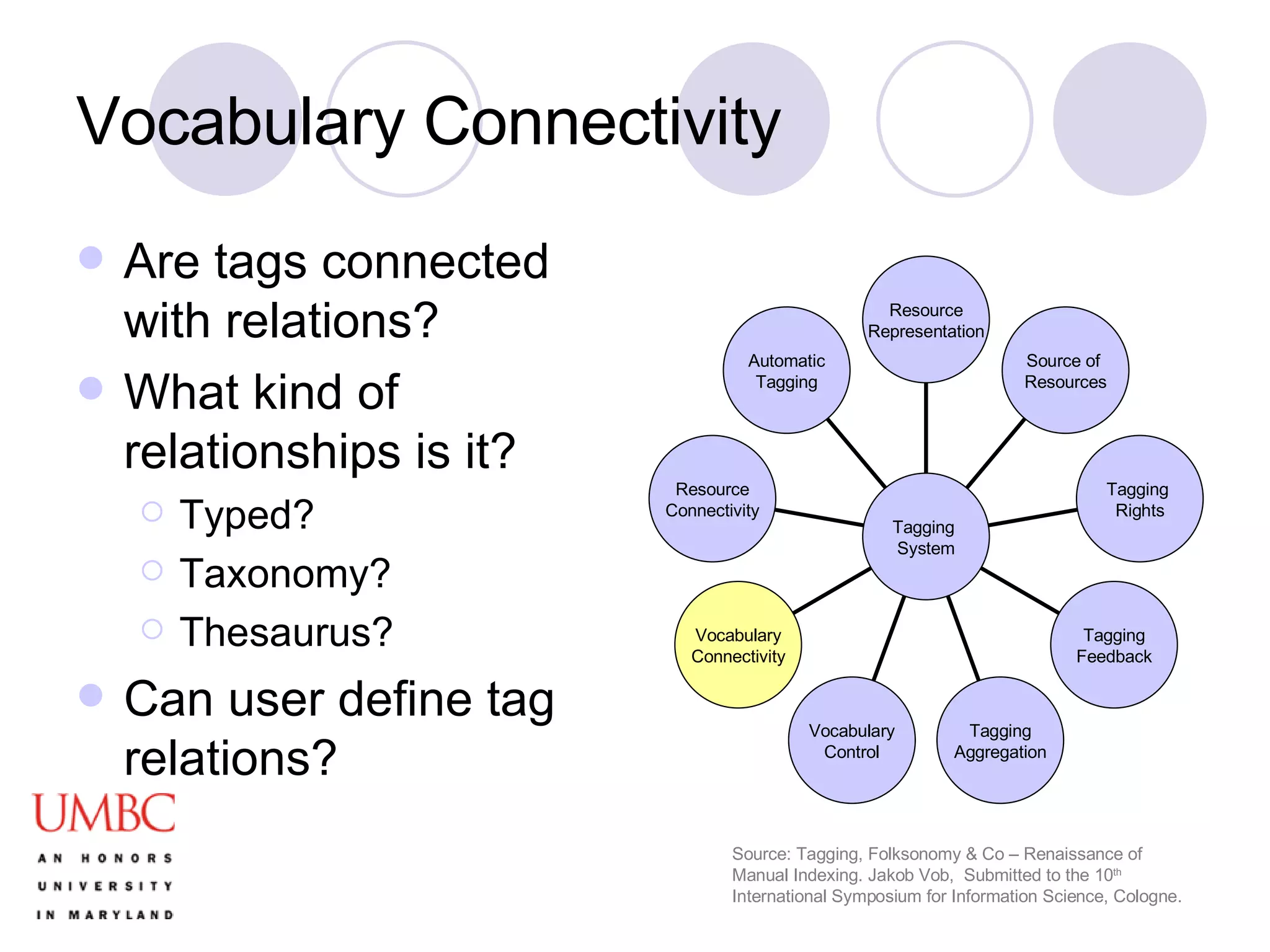
Vocabulary Connectivity Are tags connected with relations? What kind of relationships is it? Typed? Taxonomy? Thesaurus? Can user define tag relations? Source: Tagging, Folksonomy & Co – Renaissance of Manual Indexing. Jakob Vob,  Submitted to the 10 th  International Symposium for Information Science, Cologne. Automatic Tagging Resource Connectivity Vocabulary Connectivity Vocabulary Control Tagging Aggregation Tagging Feedback Tagging  Rights Source of  Resources Resource Representation Tagging  System
Vocabulary Control Is there a control on tags to be used and tags not to be used? Are tags created while tagging? Is the management of the vocabulary a separate task? Source: Tagging, Folksonomy & Co – Renaissance of Manual Indexing. Jakob Vob,  Submitted to the 10 th  International Symposium for Information Science, Cologne. Automatic Tagging Resource Connectivity Vocabulary Connectivity Vocabulary Control Tagging Aggregation Tagging Feedback Tagging  Rights Source of  Resources Resource Representation Tagging  System
Tagging Aggregation Can a tag be assigned only once to a resource? A set model Can the same tag be assigned multiple times? A bag model Source: Tagging, Folksonomy & Co – Renaissance of Manual Indexing. Jakob Vob,  Submitted to the 10 th  International Symposium for Information Science, Cologne. Automatic Tagging Resource Connectivity Vocabulary Connectivity Vocabulary Control Tagging Aggregation Tagging Feedback Tagging  Rights Source of  Resources Resource Representation Tagging  System
Tagging Feedback How does the interface support tag entry? Do users see other tags assigned to the resources by other users or other resources tagged with the same tag? Does the system suggest tags? Does the system rejects tags? Source: Tagging, Folksonomy & Co – Renaissance of Manual Indexing. Jakob Vob,  Submitted to the 10 th  International Symposium for Information Science, Cologne. Automatic Tagging Resource Connectivity Vocabulary Connectivity Vocabulary Control Tagging Aggregation Tagging Feedback Tagging  Rights Source of  Resources Resource Representation Tagging  System
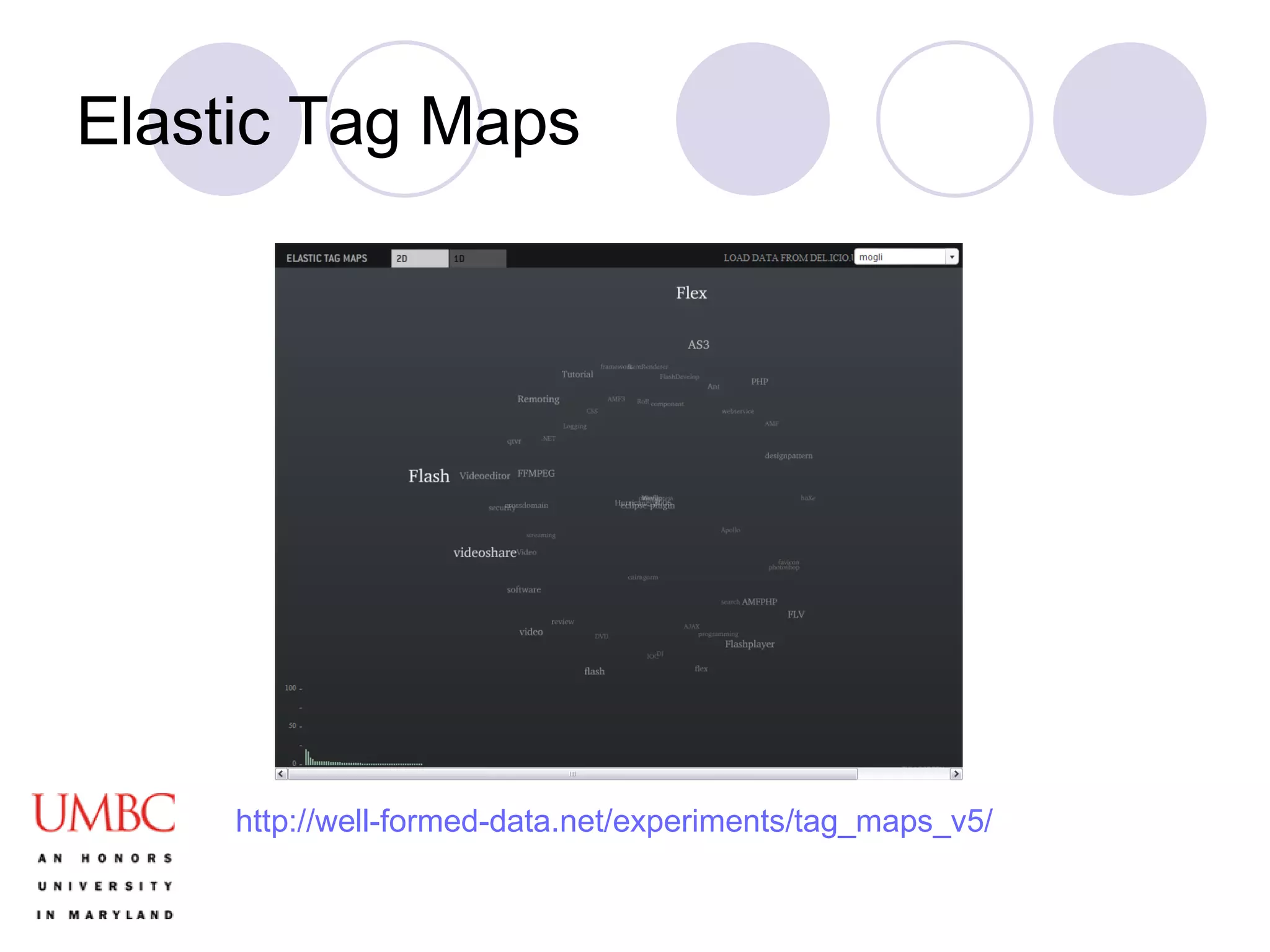
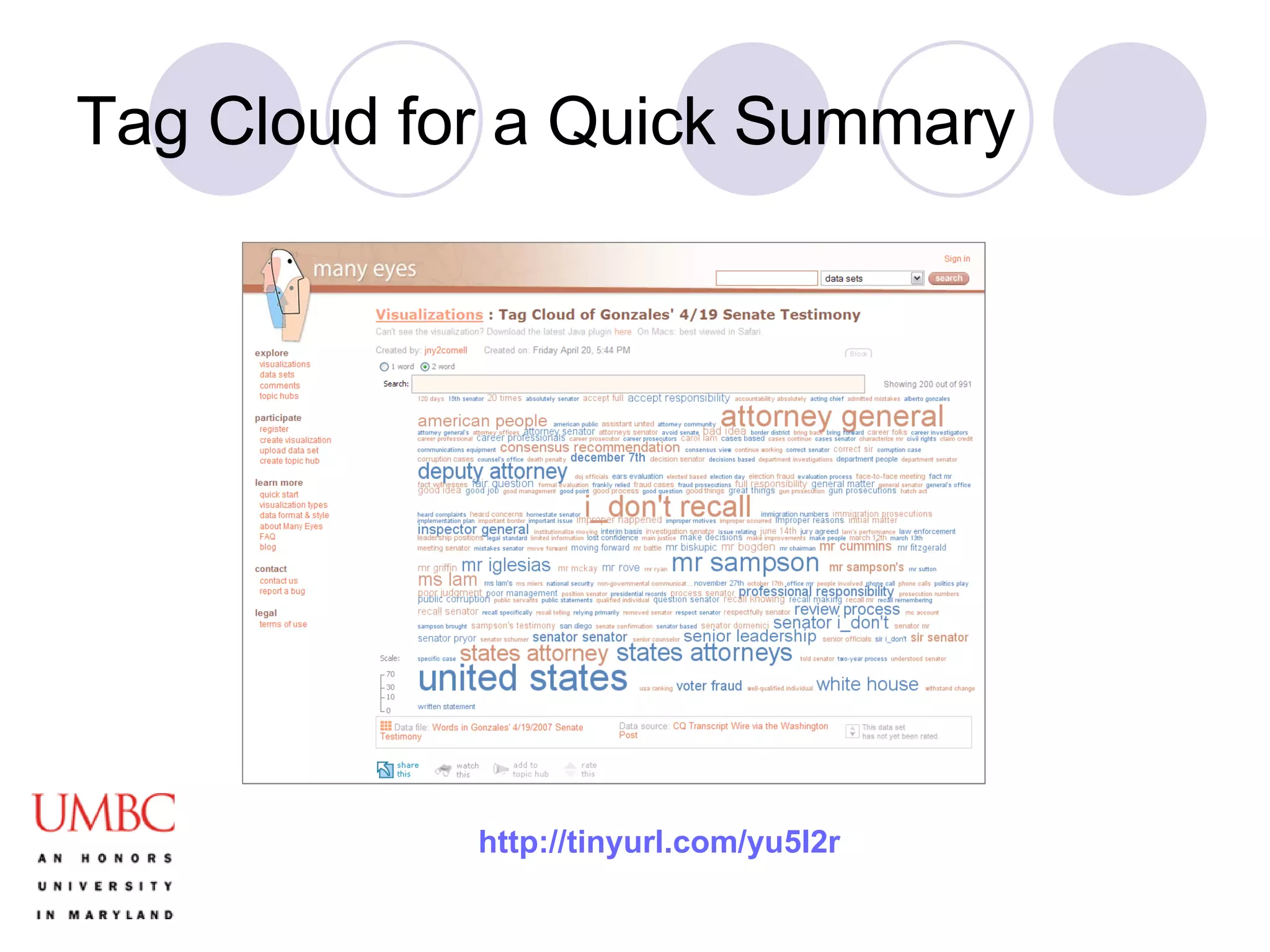
Tag Visualization Here are some examples.  What’s your opinion?  Are they effective? What purpose do they serve? Does it change the way we design Web pages?
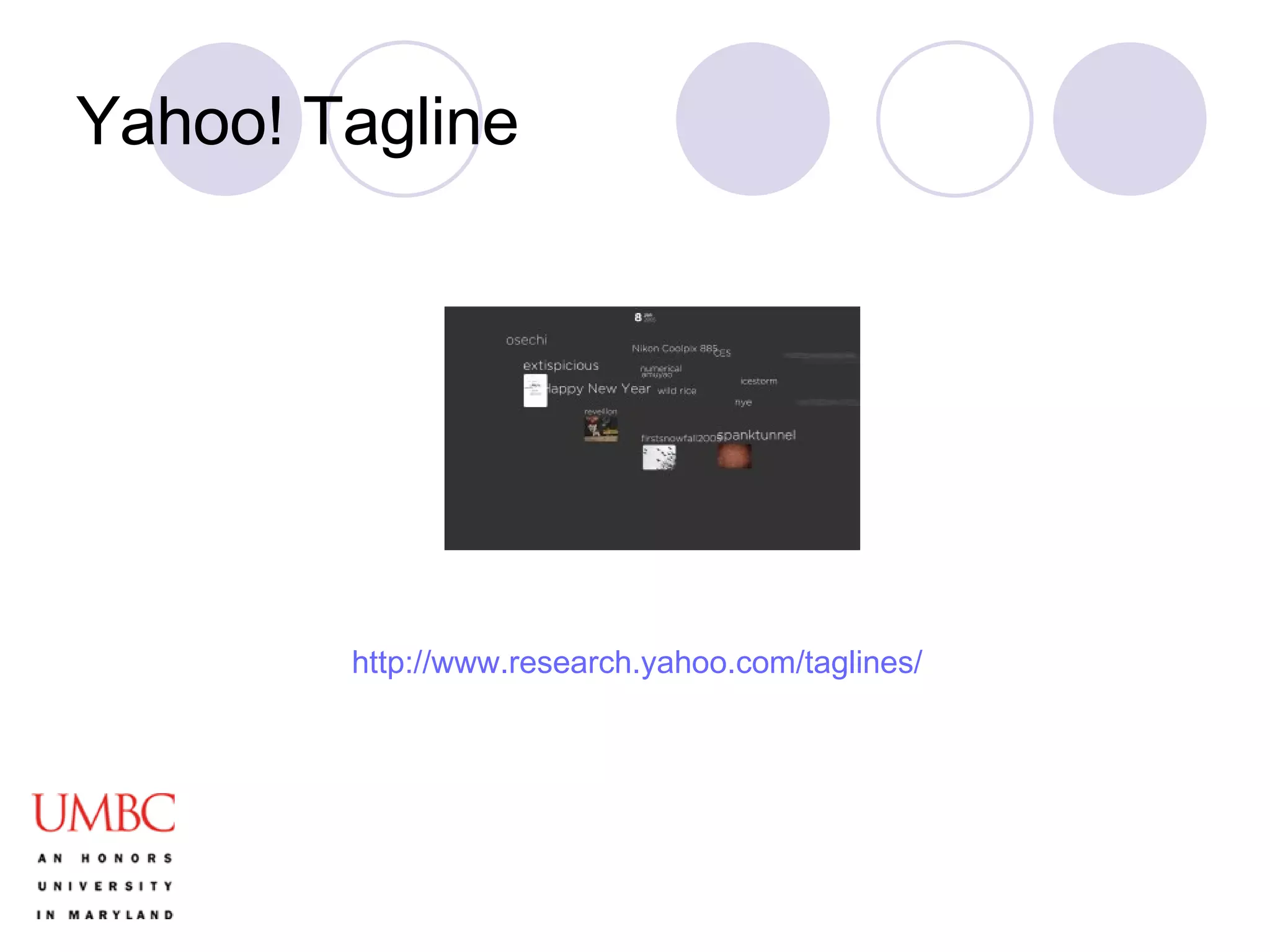
Yahoo! Tagline http://www.research.yahoo.com/taglines/
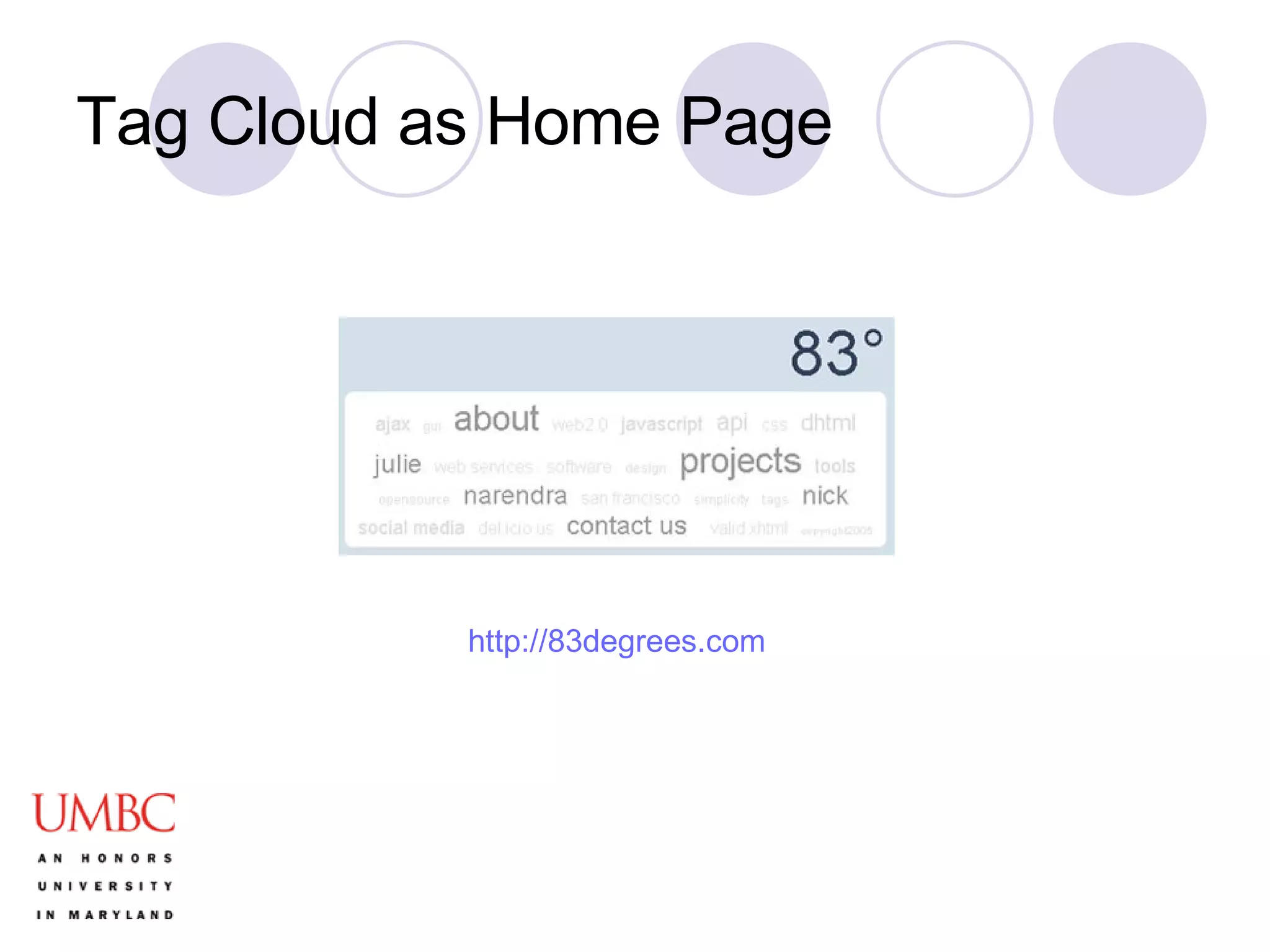
Tag Cloud as Home Page http://83degrees.com
Elastic Tag Maps http://well-formed-data.net/experiments/tag_maps_v5/
Tag Cloud for a Quick Summary http://tinyurl.com/yu5l2r
Summary Folksonomy and tagging emerged because we need to organize unstructured information on the Web – especially those user-generated content. Tagging is a natural extension of the traditional subject indexing.  By understanding the cognitive process of tagging we as developers can develop better tagging systems to help users to organize and find information.
Homework for this week! Post 1 blog on any of the following subject: Folksonomy and tagging Tag visualization Psychology and cognitive process behind tagging Tagging and the Semantic Web Tagging in the enterprises  Your encouraged to post 1+
 
Next Class: Oxford 2.0 style debate Goal : Help us to better understand the controversial issues that surround the Social Web technologies. Learn to be a better thinker. We will adopt a simplified version of the debate. Read about the  Oxford Style Debate
Prior to the day of the debate A resolution will be defined – you suggest or I pick. Class will be divided into two groups: Proposition : supports the resolution Opposition : oppose the resolution Decide days before the debate who will be in which group. You do research and find arguments and evidences to support your group.
On the day of the debate Take polls on the number of students who support or oppose the resolution Follow by a 20-minutes group discussion I will moderate the debate Each group will take turns to present their arguments. During each turn, the group has max. 10 minutes to present their arguments. The debate ends 10 minutes before the class ends.  Take polls again and see if anyone has switched sides. There is a catch!
After the debate If the second poll reveals a change in the number of students either support or oppose the resolution,  the team represented the side with the largest poll number increase will be immune from the following week’s blogging assignment.
Now. Decide the next debate groups
Resolution for Feb. 20, 2008 The social networking technology (blog-friendly phones, Facebook, Twitter, etc.) has made us  worse off  as a society. Research ideas: Is MySpace Good for Society?  (NYTimes) The Impact of Social Networking on Society  (Slashdot) Think from different perspectives: e.g., an economic, psychological, sociological, technological or political perspective

Folksonomy and Tagging in the Social Web

  • 1.
    Folksonomy and Taggingin the Social Web Dr. Harry Chen CMSC 491S/691S February 18, 2008
  • 2.
    Agenda How didfolksonomy and tagging emerge in the Social Web? You tag – why and how? Can we define an information model for it? How do we characterize tagging systems? How do we visualize tags?
  • 3.
    Tags Everywhere It’salmost a de facto standard for Web 2.0 sites to support tagging.
  • 4.
    Tags are onfire! Traditional media sites show signs of support for tags…
  • 5.
    Tags and TaggingWe need to distinguish between Web sites that use tags for navigation and Web sites that support tagging . Sites provide tag-driven navigation may not support tagging. Think: CNN vs. Flickr
  • 6.
    Why Use TagsTags (keywords) seem to be effective in helping people to find and discover information. The Web is a collection of unstructured links and resources. Using tags can give people a sense of organization in a chaotic information environment. Can better search algorithms replace the need for tags?
  • 7.
    Tags are OldSchool The use of tags is nothing new if you talk to any librarians or people who study information organization. Melvil Dewey http://www.redhill.dudley.gov.uk/LearningCentre/old_site/LearningCentre/deweysystem.htm The Dewey Decimal System (DDS)
  • 8.
    DDS in Actionhttp://www.db.dk/bh/lifeboat_ko/SPECIFIC%20SYSTEMS/dewey_decimal_classification.htm How do you think these categories are created?
  • 9.
    Definition: Taxonomy DDSis a taxonomy in the library world. Taxonomy also appears in the Web world. Categories are defined by an authority Categories are specially designed (i.e., not arbitrarily) to organize information in a specific way.
  • 10.
    Taxonomy on theWeb It’s easy to spot taxonomy on the Web Keywords defined by their editors to encourage the readers to stay on their Web sites.
  • 11.
    Criticisms Against TaxonomyThe use of taxonomy is not always practical for Web sites that provide user-generated content. “ Content is constantly changing. It’s impractical to have one static taxonomy.” “ No single party should have the authority to enforce any taxonomy on the whole user community.” “ A taxonomy that is good for categorizing information is not necessarily effective for finding and discovering information on the Web” Do you think it’s a good idea to organize your Web site using DDS?
  • 12.
    Folksonomy Emerges Folksonomyappears in Web sites that supports user tagging. Folksonomy a.k.a. collective tagging, social classification, social indexing, tagging.
  • 13.
    Definition: Folksonomy Folksonomyis a practice and method of collaboratively creating and managing tags to annotate and categorize content. Users are usually free to choose the keywords that they use in tagging Systems usually provide “tag clouds” for finding and discovering information http://en.wikipedia.org/wiki/Folksonomy
  • 14.
    IMHO The emergenceof folksonomy also has something to do with Web search. Search engines employ automatic techniques to organize information. Folksonomy relies on manual labor to category information. The folksonomy approach compliments what’s provided by the search and index algorithms.
  • 15.
    How do wetag? Traditional subject indexing Subject indexing with feedback Tagging from a cognitive perspective
  • 16.
    Traditional Subject IndexingGoal: construct a representation of a resource that is being tagged. A resource maybe a book, an article or a Web link. Conceptual analysis Translation Source: Tagging, Folksonomy & Co – Renaissance of Manual Indexing. Jakob Vob, Submitted to the 10 th International Symposium for Information Science, Cologne.
  • 17.
    Conceptual Analysis Decideon what a resource is about and what is relevant in particular. “Is this book about politics or economy?” “Is this article related to science or religion?” Conceptual analysis Translation
  • 18.
    Translation A processof finding an appropriate set of index terms that represent the substance of conceptual analysis. Remember our DDS example? Conceptual analysis Translation
  • 19.
    About Traditional SubjectIndexing The indexer (person who does the tagging) is usually a subject expert with special training. Tags used usually come from a set of controlled vocabulary (i.e., pre-defined, fixed, rigid and authoritarian). No mention of how the pool of control vocabulary will evolve when the content of resources change
  • 20.
    Subject Indexing withfeedback A system can choose to implement “feedback” to allow the indexers to influence the pool of controlled vocabulary. Note: feedback doesn’t eliminate the existing of controlled vocabulary or authority. Conceptual analysis Translation Feedback
  • 21.
    Wikipedia: Subject Indexingwith Feedback Wikipedia editors may assign at least 1 category to a page. Editors can reuse the exist category. Editors can suggest new category  “feedback”.
  • 22.
    Interesting human behaviorin Wikipedia’s Feedback system Everyone is allowed to change and add categories Most editors only edit article text Most editors don’t add tags (i.e. categories). If they do, most editors choose to reuse the existing categories. Not many editors change or add categories. Source: Tagging, Folksonomy & Co – Renaissance of Manual Indexing. Jakob Vob, Submitted to the 10 th International Symposium for Information Science, Cologne. Any thoughts on why people may have behaved this way?
  • 23.
    A Cognitive Analysisof Tagging How cognitive psychology and anthropology play a role in tagging. Why is interesting? By understanding how we tag can help developers to create more effective computer systems to assist users in tagging and finding tagged information. Adopted from “A cognitive analysis of tagging” by Rashmi Sinha. http://www.rashmisinha.com/archives/05_09/tagging-cognitive.html
  • 24.
    A Two-Stage ProcessAsking you to tag is asking you to categorize. Categorization is a 2-stage process Stage 1: Related Category Activation Stage 2: The Decision
  • 25.
    Stage 1: RelateCategory Activation Concepts come to you mind: “news”, “video”, “breaking news”, “Atlanta”, “GA”, “cable”, “TV” etc. About to tag: “http://cnn.com”
  • 26.
    Stage 2: TheDecision How do I choose what concepts to use? “news”, “video”, “breaking news”, “Atlanta”, “GA”, “cable”, “TV” etc.
  • 27.
    Decision making ishard! You have to choose what tags to use. How do you decide? What criteria do you use to measure the quality of a tag? “ breaking news” vs. “news” “ TV” vs. “Cable” Part of your task: optimize its future findability . Will you find http://cnn.com via “news” or “tv” Do you have too many bookmarks tagged “tv”? Should you create a separate category for “cable” for a special group of “tv” bookmarks? Is your tag schema balanced?
  • 28.
    Analysis Paralysis Thehardest part of categorizing a resource is to decide what tags to use.
  • 29.
    Other questions willslow you down If it’s costly to rename a tag, you will likely to think twice about picking “news” over “breaking news” or vice versa. If you are tagging for sharing information with others, you will consider if your tag “TV” is findable by others via “tv” or “cable” – maybe no one uses “tv”.
  • 30.
    Web 2.0 TaggingComes to Help Tagging in Web 2.0 in fact is far easy than we think. We don’t need to worry much about the “Analysis Paralysis” problem. Just write down all possible tags that come to our mind. If we got it wrong, we can count on Web 2.0 UI to rename and re-tag.
  • 31.
    Exercise Ifyou are a Web 2.0 entrepreneur and VC gives you the money to build a next-generation tagging system. What feature or capability would you implement and why?
  • 32.
    Tagging Systems Atypical tagging system User Resources Tags What kind of relationships exist between users and tags? What kind of relationships exist between resources and tags? What kind of relationships exist between user and resources?
  • 33.
    A Typology ofTagging Systems Source: Tagging, Folksonomy & Co – Renaissance of Manual Indexing. Jakob Vob, Submitted to the 10 th International Symposium for Information Science, Cologne. Automatic Tagging Resource Connectivity Vocabulary Connectivity Vocabulary Control Tagging Aggregation Tagging Feedback Tagging Rights Source of Resources Resource Representation Tagging System
  • 34.
    Tagging Rights Whois allowed to tag? Can any user tag any resources? Any restrictions based on resources, tags or users? Who controls the restrictions? IS there a distinction between tags by different types of users and resources? Source: Tagging, Folksonomy & Co – Renaissance of Manual Indexing. Jakob Vob, Submitted to the 10 th International Symposium for Information Science, Cologne. Automatic Tagging Resource Connectivity Vocabulary Connectivity Vocabulary Control Tagging Aggregation Tagging Feedback Tagging Rights Source of Resources Resource Representation Tagging System
  • 35.
    Source of ResourcesDo users contribute resources? Do users tag resources already in the system? Who decide which resources are tagged? Source: Tagging, Folksonomy & Co – Renaissance of Manual Indexing. Jakob Vob, Submitted to the 10 th International Symposium for Information Science, Cologne. Automatic Tagging Resource Connectivity Vocabulary Connectivity Vocabulary Control Tagging Aggregation Tagging Feedback Tagging Rights Source of Resources Resource Representation Tagging System
  • 36.
    Resource Representation Whatkind of resource is tagged? How resources are presented to the user when they are being tagged? Tagging photos maybe different from tagging bookmarks Source: Tagging, Folksonomy & Co – Renaissance of Manual Indexing. Jakob Vob, Submitted to the 10 th International Symposium for Information Science, Cologne. Automatic Tagging Resource Connectivity Vocabulary Connectivity Vocabulary Control Tagging Aggregation Tagging Feedback Tagging Rights Source of Resources Resource Representation Tagging System
  • 37.
    Automatic Tagging Istagging enriched with automatically created tags? Does the system provide automatic tagging without any user interventions? Gnizr RSS Robot Source: Tagging, Folksonomy & Co – Renaissance of Manual Indexing. Jakob Vob, Submitted to the 10 th International Symposium for Information Science, Cologne. Automatic Tagging Resource Connectivity Vocabulary Connectivity Vocabulary Control Tagging Aggregation Tagging Feedback Tagging Rights Source of Resources Resource Representation Tagging System
  • 38.
    Resource Connectivity Howare resources connected to each other? Via links Grouped in hierarchy How are connection between created? In flickr and del.icio.us, how you find related resources? Source: Tagging, Folksonomy & Co – Renaissance of Manual Indexing. Jakob Vob, Submitted to the 10 th International Symposium for Information Science, Cologne. Automatic Tagging Resource Connectivity Vocabulary Connectivity Vocabulary Control Tagging Aggregation Tagging Feedback Tagging Rights Source of Resources Resource Representation Tagging System
  • 39.
    Vocabulary Connectivity Aretags connected with relations? What kind of relationships is it? Typed? Taxonomy? Thesaurus? Can user define tag relations? Source: Tagging, Folksonomy & Co – Renaissance of Manual Indexing. Jakob Vob, Submitted to the 10 th International Symposium for Information Science, Cologne. Automatic Tagging Resource Connectivity Vocabulary Connectivity Vocabulary Control Tagging Aggregation Tagging Feedback Tagging Rights Source of Resources Resource Representation Tagging System
  • 40.
    Vocabulary Control Isthere a control on tags to be used and tags not to be used? Are tags created while tagging? Is the management of the vocabulary a separate task? Source: Tagging, Folksonomy & Co – Renaissance of Manual Indexing. Jakob Vob, Submitted to the 10 th International Symposium for Information Science, Cologne. Automatic Tagging Resource Connectivity Vocabulary Connectivity Vocabulary Control Tagging Aggregation Tagging Feedback Tagging Rights Source of Resources Resource Representation Tagging System
  • 41.
    Tagging Aggregation Cana tag be assigned only once to a resource? A set model Can the same tag be assigned multiple times? A bag model Source: Tagging, Folksonomy & Co – Renaissance of Manual Indexing. Jakob Vob, Submitted to the 10 th International Symposium for Information Science, Cologne. Automatic Tagging Resource Connectivity Vocabulary Connectivity Vocabulary Control Tagging Aggregation Tagging Feedback Tagging Rights Source of Resources Resource Representation Tagging System
  • 42.
    Tagging Feedback Howdoes the interface support tag entry? Do users see other tags assigned to the resources by other users or other resources tagged with the same tag? Does the system suggest tags? Does the system rejects tags? Source: Tagging, Folksonomy & Co – Renaissance of Manual Indexing. Jakob Vob, Submitted to the 10 th International Symposium for Information Science, Cologne. Automatic Tagging Resource Connectivity Vocabulary Connectivity Vocabulary Control Tagging Aggregation Tagging Feedback Tagging Rights Source of Resources Resource Representation Tagging System
  • 43.
    Tag Visualization Hereare some examples. What’s your opinion? Are they effective? What purpose do they serve? Does it change the way we design Web pages?
  • 44.
  • 45.
    Tag Cloud asHome Page http://83degrees.com
  • 46.
    Elastic Tag Mapshttp://well-formed-data.net/experiments/tag_maps_v5/
  • 47.
    Tag Cloud fora Quick Summary http://tinyurl.com/yu5l2r
  • 48.
    Summary Folksonomy andtagging emerged because we need to organize unstructured information on the Web – especially those user-generated content. Tagging is a natural extension of the traditional subject indexing. By understanding the cognitive process of tagging we as developers can develop better tagging systems to help users to organize and find information.
  • 49.
    Homework for thisweek! Post 1 blog on any of the following subject: Folksonomy and tagging Tag visualization Psychology and cognitive process behind tagging Tagging and the Semantic Web Tagging in the enterprises Your encouraged to post 1+
  • 50.
  • 51.
    Next Class: Oxford2.0 style debate Goal : Help us to better understand the controversial issues that surround the Social Web technologies. Learn to be a better thinker. We will adopt a simplified version of the debate. Read about the Oxford Style Debate
  • 52.
    Prior to theday of the debate A resolution will be defined – you suggest or I pick. Class will be divided into two groups: Proposition : supports the resolution Opposition : oppose the resolution Decide days before the debate who will be in which group. You do research and find arguments and evidences to support your group.
  • 53.
    On the dayof the debate Take polls on the number of students who support or oppose the resolution Follow by a 20-minutes group discussion I will moderate the debate Each group will take turns to present their arguments. During each turn, the group has max. 10 minutes to present their arguments. The debate ends 10 minutes before the class ends. Take polls again and see if anyone has switched sides. There is a catch!
  • 54.
    After the debateIf the second poll reveals a change in the number of students either support or oppose the resolution, the team represented the side with the largest poll number increase will be immune from the following week’s blogging assignment.
  • 55.
    Now. Decide thenext debate groups
  • 56.
    Resolution for Feb.20, 2008 The social networking technology (blog-friendly phones, Facebook, Twitter, etc.) has made us worse off as a society. Research ideas: Is MySpace Good for Society? (NYTimes) The Impact of Social Networking on Society (Slashdot) Think from different perspectives: e.g., an economic, psychological, sociological, technological or political perspective