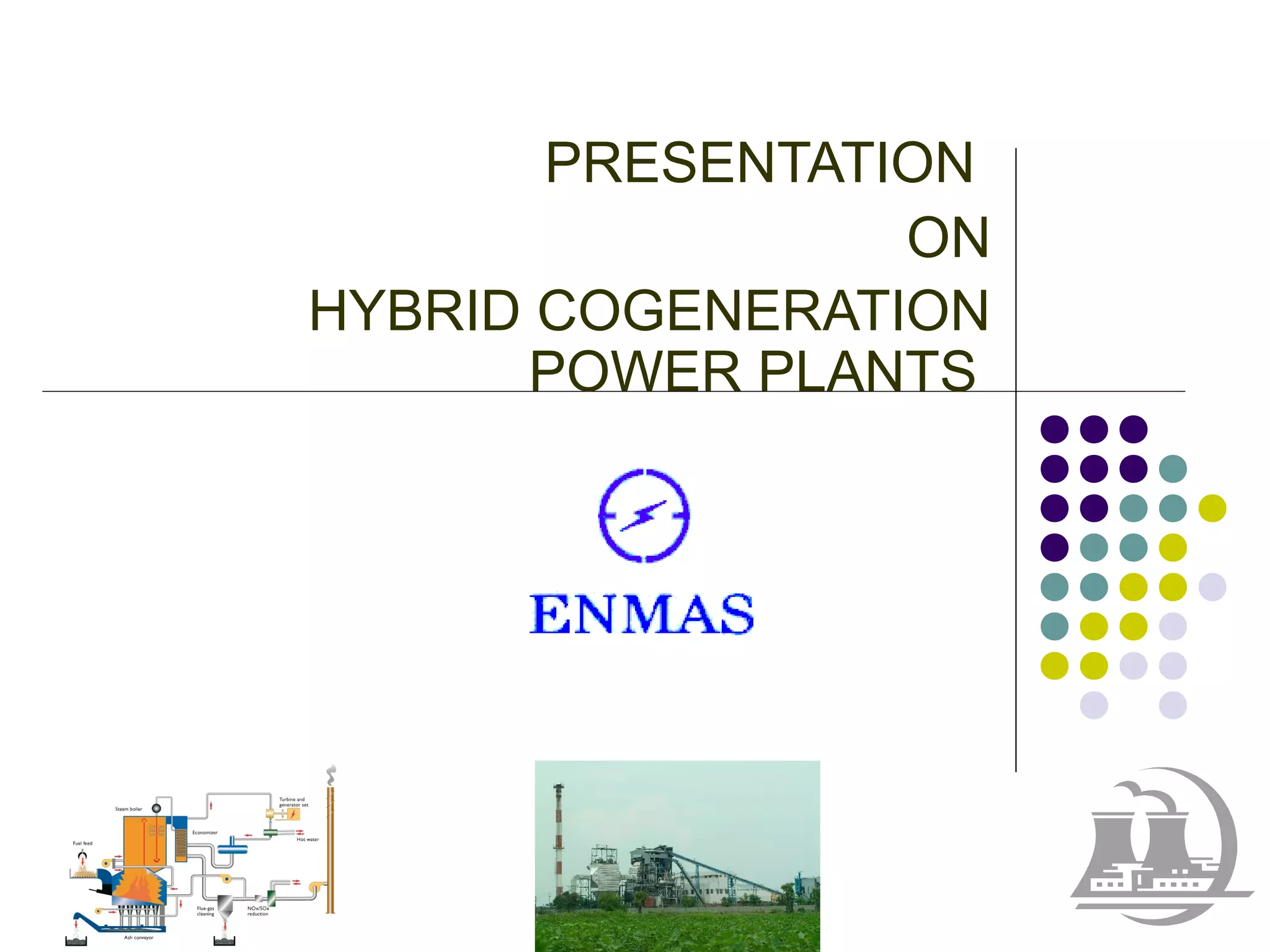
PRESENTATION
ON
HYBRID COGENERATION
POWER PLANTS
WHAT IS COGENERATION POWER
 GENERATION

OF CONSISTENT
POWER AND STEAM FOR THE
DOWN THE LINE PROCESS STEAM
REQUIREMENT IS CALLED
COGENERATION POWER.
WHO ARE THE END USERS
 ANY

PROCESS INDUSTRY
CONSUMING PROCESS STEAM AND
WHO ARE IN NEED OF CONSISTENT
POWER OTHER THAN DG SETS.
WHY COGEN POWER?
 IN

TODAY’S SCENARIO DUE TO
FREQUENT POWER CUTS AND
INFLATED FURNACE OIL PRICE THE
PROCESS INDUSTRIES ARE
FORCED TO INCREASE THEIR INPUT
COSTS. DUE TO THIS THEY FACE
EITHER REDUCTION IN PROFIT OR
LOSING OUT IN COMPETITION.
TARGET CLIENTS
• PADDY PROCESSING (24X7) &
• SOLVENT EXTRACTION INDUSTRIES.
• SMALL PAPER AND BOARD MILLS
• CHEMICAL INDUSTRIES
• TEXTILE MILLS INCLUDING SPINNING MILLS,
TEXTILE PROCESSING MILLS.
• CLUSTER OF SMALL AND MEDIUM SCALE
INDUSTRIES WHO ARE IN NEED OF
CONSISTENT POWER.
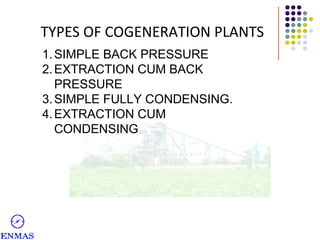
TYPES OF COGENERATION PLANTS
1. SIMPLE BACK PRESSURE
2. EXTRACTION CUM BACK
PRESSURE
3. SIMPLE FULLY CONDENSING.
4. EXTRACTION CUM
CONDENSING
MAIN EQUIPMENTS FOR
COGENERATION PLANTS
1.
2.
3.
4.
5.
6.
7.
8.
9.

BOILER WITH AUXILIARIES
STEAM TURBINE
AIR COOLED CONDENSER
FUEL AND ASH HANDLING SYSTEM
WATER TREATMENT PLANT
POWER CYCLE PIPING.
AUX COOLING TOWER
CIVIL FOUNDATIONS, TG HALL ETC..,
ELECTRICALS LIKE PCC, MCC, CABLES
ETC..,
10.INSTRUMENTATION AND CONTROL
SYSTEM
11.FIRE FIGHTING SYSTEM, HOT CRANES
12.AIR CONDITIONING AND VENTILATION
SYSTEM
RESOURCES FOR COGENERATION
 BIOMASS

INCLUDING WOOD CHIPS,
RICE HUSK, GROUND NUT SHELL,
COCONUT SHELL ETC.., ARE
AVAILABLE @ Rs 2500 PER TON
 NAPIER GRASS – WITH OWN
ENERGY PLANTATION – AVAILABLE
@ Rs 1500 PER TON.
BOTTLENECKS OF TODAY!!!

FEED STOCK
Availability of biomass fuel on continuous basis - Erratic seasons & frequent changes in
harvest plans
Often the biomass is diverted to produce manure or left in the field for decay/decompose
Growing demand from other industry for biomass, non-existence of medium/long term
fuel procurement plans, no scientific pricing
Fuel preparation related issues – handling, storage, preparation..etc
DESIGN & ENGG
Adaptability of fuel to Boiler combustion technology – Non-compatibility of wide range of
input fuel costing the efficiency/heat rate and increased cost of generation
Frequent troubles of plant equipment – Frequent failures, Open ends of engineering
interface and commissioning
Equipment and systems lack proper warranty coverage arrangement
O&M
Non-availability of qualified and skilled man-power
Teething problems of downstream equipment – improper logging /recording of system
operation and equipment behaviour.
Non-existence of right O&M procedures
After sales service arrangement (ASS) with equipment supplier is not-existing.
OTHER FACTORS
Lower tariff offered from utilities absorbing biomass power
High interest rates for debts, not able to sustain with the existing revenues
INDIA –POTENTIAL & ACHIEVEMENTS
•Indian climatic conditions offer an ideal environment for biomass production. Bio-energy has
remained critical to India’s energy mix.
A total of 288 biomass power and cogeneration projects aggregating to 2665 MW capacity have
been installed in the country; consisting of 130 biomass power projects of 999 MW and 158
bagasse cogeneration projects of 1666 MW.
•The availability of biomass in India is estimated at about 540 million tons per year covering
residues from agriculture, forestry and plantations.
The current potential of surplus agro and forest residues to energy is estimated at 16,881 MW
•Waste-to-energy potential of 2,700 MW
•Bagasse cogeneration is estimated at 5,000 MW.
•The present cumulative installed capacity, of grid-interactive biomass and Bagasse
cogeneration power is around 3000 MW as of Jujy’2011.
India has approximately 50 million hectares of degraded wasteland that lie outside the areas
demarcated as national forests and cultivable lands.
In addition, around 30 biomass power projects of 350 MW and 70 Cogeneration projects of 800
MW are under various stages of implementation.
GENERATION POTENTIAL…..contd
•States which have taken leadership position in
implementation of biomass power projects are
Andhra Pradesh, Chhattisgarh, Tamil Nadu,
Karnataka, Maharashtra Madhya Pradesh, Gujarat
and Uttar Pradesh.
•The combined potential of the techno-economically
viable biomass power generation capacity is 3800
MW covering the states of Tamilnadu, Karnataka,
Maharashtra, AP, Gujarat, Punjab, UP, MP and
Orissa.
POLICY INITIATIVES
•Subsidy Schemes of Government of India
•Priority lending for renewable energy projects
•RPO – Renewable Purchase Obligation by utilities
and bulk consumers
•REC Trading – Renewable Energy Certificate to sell
in the energy exchange as a part of RE benefit
•CDM – Carbon benefit available in International
market
•GBI- Generation Based Incentives available from
MNRE
•Power Trading allowed – Renewable power could be
traded in energy exchange across India
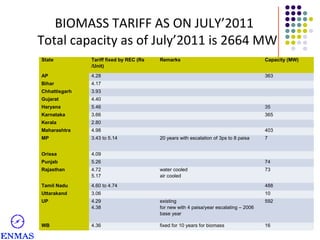
BIOMASS TARIFF AS ON JULY’2011
Total capacity as of July’2011 is 2664 MW
State

Tariff fixed by REC (Rs
/Unit)

Remarks

Capacity (MW)

AP

4.28

Bihar

4.17

Chhattisgarh

3.93

Gujarat

4.40

Haryana

5.46

35

Karnataka

3.66

365

Kerala

2.80

Maharashtra

4.98

MP

3.43 to 5.14

Orissa

4.09

Punjab

5.26

Rajasthan

4.72
5.17

Tamil Nadu

4.60 to 4.74

488

Uttarakand

3.06

10

UP

4.29
4.38

existing
for new with 4 paisa/year escalating – 2006
base year

592

WB

4.36

fixed for 10 years for biomass

16

363

403
20 years with escalation of 3ps to 8 paisa

7

74
water cooled
air cooled

73
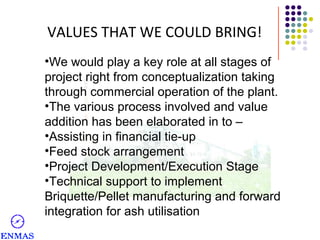
VALUES THAT WE COULD BRING!
•We would play a key role at all stages of
project right from conceptualization taking
through commercial operation of the plant.
•The various process involved and value
addition has been elaborated in to –
•Assisting in financial tie-up
•Feed stock arrangement
•Project Development/Execution Stage
•Technical support to implement
Briquette/Pellet manufacturing and forward
integration for ash utilisation
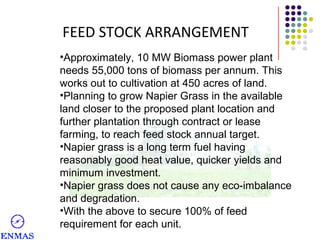
FEED STOCK ARRANGEMENT
•Approximately, 10 MW Biomass power plant
needs 55,000 tons of biomass per annum. This
works out to cultivation at 450 acres of land.
•Planning to grow Napier Grass in the available
land closer to the proposed plant location and
further plantation through contract or lease
farming, to reach feed stock annual target.
•Napier grass is a long term fuel having
reasonably good heat value, quicker yields and
minimum investment.
•Napier grass does not cause any eco-imbalance
and degradation.
•With the above to secure 100% of feed
requirement for each unit.
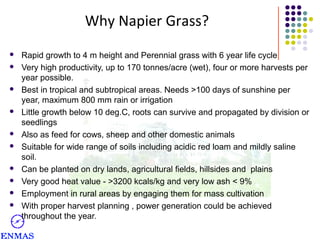
Why Napier Grass?















Rapid growth to 4 m height and Perennial grass with 6 year life cycle
Very high productivity, up to 170 tonnes/acre (wet), four or more harvests per
year possible.
Best in tropical and subtropical areas. Needs >100 days of sunshine per
year, maximum 800 mm rain or irrigation
Little growth below 10 deg.C, roots can survive and propagated by division or
seedlings
Also as feed for cows, sheep and other domestic animals
Suitable for wide range of soils including acidic red loam and mildly saline
soil.
Can be planted on dry lands, agricultural fields, hillsides and plains
Very good heat value - >3200 kcals/kg and very low ash < 9%
Employment in rural areas by engaging them for mass cultivation
With proper harvest planning , power generation could be achieved
throughout the year.
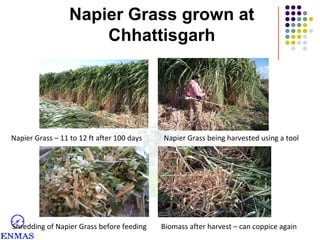
Napier Grass grown at
Chhattisgarh

Napier Grass – 11 to 12 ft after 100 days

Shredding of Napier Grass before feeding

Napier Grass being harvested using a tool

Biomass after harvest – can coppice again
PROJECT DEVELOPMENT & EXECUTION STAGE






Technology sourcing from ENMAS O &M with grate firing concept -which has
flexibility and adoptability over a wide range of fuel inputs
Commercial support- in economizing the generation cost, cash flow and
exposures
Engineering optimisation – To achieve better operational availability.
Optimizing the cycle parameters, schemes, layout and specifications
Seamless interface engineering - to achieve better performance of auxiliary
systems thereby reduced aux power consumption.
Procurement support – In sourcing of reputed/reliable equipment, proper
warranty and long term After Sales Support arrangement.



Project Management - Project monitoring and controlling as per technical
deliverables, project planning and budget



Erection and Commissioning support - Using the competent supervision team
for erection, commissioning and start up
Plant documentation – To maintain the archives, and Erection and
Commissioning data to use in the lifetime of the plant operation. Drawing up of
detailed O&M procedures.
Plant O&M – In sourcing of qualified man-power offering long term career
prospects and involving right from the days of pre-commissioning of plants,
establishing programmes with critical equipment suppliers for O&M
interventions/support
Technical support towards ash utilisation






What is the proposal ?
Provide

a comprehensive solution addressing –
Feed stock integration
Selection of efficient and right technology
Identifying right supplier to secure technical deliverables, within
the defined time frame and at competitive cost
Putting in place - Qualified O&M team and best operational
practices
Forward value addition for effective ash utilization
Revenue modeling and optimization
Feed stock security through Briquetting and Pelletising
Refinancing/scaling-up financing through low cost funds from
abroad once the plant is stabilised in operation
TYPICAL HYBRID COGENERATION
PLANT PARAMETERS














Size of the plant
3 MW
Cost of the project 20Cr
Debt: Equity
70% :30%
Implementation time
12 months from readiness
funds
Land required for plant
5 acres
Biomass fuel required at
2700 Kcals/Kwh heat rate 17000 tons/annum
Land required for biomass growing 150 acres
Cost of growing biomass Rs 30,000/acre/year
Fund required to grow biomass
Rs 1.80 Cr per year
Landed cost of fuel
Around Rs 1300 / ton
Market price of fuel today Rs 2500 to Rs 2600/ton
Payback period for investor
6 to 7 years

of
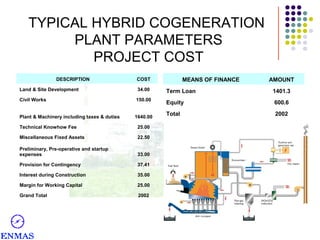
TYPICAL HYBRID COGENERATION
PLANT PARAMETERS
PROJECT COST
DESCRIPTION

MEANS OF FINANCE

COST

AMOUNT

Land & Site Development

34.00

Term Loan

1401.3

Civil Works

150.00

Equity

600.6

Plant & Machinery including taxes & duties

1640.00

Total

2002

Technical Knowhow Fee

25.00

Miscellaneous Fixed Assets

22.50

Preliminary, Pre-operative and startup
expenses

33.00

Provision for Contingency

37.41

Interest during Construction

35.00

Margin for Working Capital

25.00

Grand Total

2002
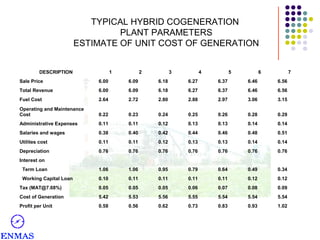
TYPICAL HYBRID COGENERATION
PLANT PARAMETERS
ESTIMATE OF UNIT COST OF GENERATION
DESCRIPTION

1

2

3

4

5

6

7

Sale Price

6.00

6.09

6.18

6.27

6.37

6.46

6.56

Total Revenue

6.00

6.09

6.18

6.27

6.37

6.46

6.56

Fuel Cost

2.64

2.72

2.80

2.88

2.97

3.06

3.15

Operating and Maintenance
Cost

0.22

0.23

0.24

0.25

0.26

0.28

0.29

Administrative Expenses

0.11

0.11

0.12

0.13

0.13

0.14

0.14

Salaries and wages

0.38

0.40

0.42

0.44

0.46

0.48

0.51

Utilites cost

0.11

0.11

0.12

0.13

0.13

0.14

0.14

Depreciation

0.76

0.76

0.76

0.76

0.76

0.76

0.76

Term Loan

1.06

1.06

0.95

0.79

0.64

0.49

0.34

Working Capital Loan

0.10

0.11

0.11

0.11

0.11

0.12

0.12

Tax (MAT@7.68%)

0.05

0.05

0.05

0.06

0.07

0.08

0.09

Cost of Generation

5.42

5.53

5.56

5.55

5.54

5.54

5.54

Profit per Unit

0.58

0.56

0.62

0.73

0.83

0.93

1.02

Interest on
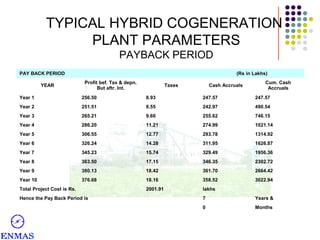
TYPICAL HYBRID COGENERATION
PLANT PARAMETERS
PAYBACK PERIOD
PAY BACK PERIOD
YEAR

(Rs in Lakhs)
Profit bef. Tax & depn.
But aftr. Int.

Taxes

Cash Accruals

Cum. Cash
Accruals

Year 1

256.50

8.93

247.57

247.57

Year 2

251.51

8.55

242.97

490.54

Year 3

265.21

9.60

255.62

746.15

Year 4

286.20

11.21

274.99

1021.14

Year 5

306.55

12.77

293.78

1314.92

Year 6

326.24

14.28

311.95

1626.87

Year 7

345.23

15.74

329.49

1956.36

Year 8

363.50

17.15

346.35

2302.72

Year 9

380.13

18.42

361.70

2664.42

Year 10

376.68

18.16

358.52

3022.94

2001.91

lakhs

Total Project Cost is Rs.
Hence the Pay Back Period is

7

Years &

0

Months
ENMAS O & M Introduction




Enmas O&M Services Private Limited is a
constituent of Resurgent group.
The Group has been operating for more than
two decades, ENMAS and GB are well known
brands of the group, for high quality products
and services to Thermal Power Plants –
Captive, Cogen and Biomass IPPs.
Collaborators - PMEG
 For

Higher sized Power plants above
100 MW, Enmas has collaboration with
PMEG (PIC - Marubeni Energy Group),
Atlanta, USA, Operating 13500 MW in 9
countries. Visit “www.pmeg.com”
Enmas O&M Services Private Limited
IIIFloor, Guna Building ,443, Anna Salai, Teynampet, Chennai
– 600 018
INDIA
Phone: +91 44 4901 7050
Fax
: +91 44 4901 7060
E-mail: marketing@enmasindia.com,
ks@enmasindia.com,lvs@enmasindia.com
Web: http://www.enmasindia.com

Presentation

  • 1.
  • 2.
    WHAT IS COGENERATIONPOWER  GENERATION OF CONSISTENT POWER AND STEAM FOR THE DOWN THE LINE PROCESS STEAM REQUIREMENT IS CALLED COGENERATION POWER.
  • 3.
    WHO ARE THEEND USERS  ANY PROCESS INDUSTRY CONSUMING PROCESS STEAM AND WHO ARE IN NEED OF CONSISTENT POWER OTHER THAN DG SETS.
  • 4.
    WHY COGEN POWER? IN TODAY’S SCENARIO DUE TO FREQUENT POWER CUTS AND INFLATED FURNACE OIL PRICE THE PROCESS INDUSTRIES ARE FORCED TO INCREASE THEIR INPUT COSTS. DUE TO THIS THEY FACE EITHER REDUCTION IN PROFIT OR LOSING OUT IN COMPETITION.
  • 5.
    TARGET CLIENTS • PADDYPROCESSING (24X7) & • SOLVENT EXTRACTION INDUSTRIES. • SMALL PAPER AND BOARD MILLS • CHEMICAL INDUSTRIES • TEXTILE MILLS INCLUDING SPINNING MILLS, TEXTILE PROCESSING MILLS. • CLUSTER OF SMALL AND MEDIUM SCALE INDUSTRIES WHO ARE IN NEED OF CONSISTENT POWER.
  • 6.
    TYPES OF COGENERATIONPLANTS 1. SIMPLE BACK PRESSURE 2. EXTRACTION CUM BACK PRESSURE 3. SIMPLE FULLY CONDENSING. 4. EXTRACTION CUM CONDENSING
  • 7.
    MAIN EQUIPMENTS FOR COGENERATIONPLANTS 1. 2. 3. 4. 5. 6. 7. 8. 9. BOILER WITH AUXILIARIES STEAM TURBINE AIR COOLED CONDENSER FUEL AND ASH HANDLING SYSTEM WATER TREATMENT PLANT POWER CYCLE PIPING. AUX COOLING TOWER CIVIL FOUNDATIONS, TG HALL ETC.., ELECTRICALS LIKE PCC, MCC, CABLES ETC.., 10.INSTRUMENTATION AND CONTROL SYSTEM 11.FIRE FIGHTING SYSTEM, HOT CRANES 12.AIR CONDITIONING AND VENTILATION SYSTEM
  • 8.
    RESOURCES FOR COGENERATION BIOMASS INCLUDING WOOD CHIPS, RICE HUSK, GROUND NUT SHELL, COCONUT SHELL ETC.., ARE AVAILABLE @ Rs 2500 PER TON  NAPIER GRASS – WITH OWN ENERGY PLANTATION – AVAILABLE @ Rs 1500 PER TON.
  • 9.
    BOTTLENECKS OF TODAY!!! FEEDSTOCK Availability of biomass fuel on continuous basis - Erratic seasons & frequent changes in harvest plans Often the biomass is diverted to produce manure or left in the field for decay/decompose Growing demand from other industry for biomass, non-existence of medium/long term fuel procurement plans, no scientific pricing Fuel preparation related issues – handling, storage, preparation..etc DESIGN & ENGG Adaptability of fuel to Boiler combustion technology – Non-compatibility of wide range of input fuel costing the efficiency/heat rate and increased cost of generation Frequent troubles of plant equipment – Frequent failures, Open ends of engineering interface and commissioning Equipment and systems lack proper warranty coverage arrangement O&M Non-availability of qualified and skilled man-power Teething problems of downstream equipment – improper logging /recording of system operation and equipment behaviour. Non-existence of right O&M procedures After sales service arrangement (ASS) with equipment supplier is not-existing. OTHER FACTORS Lower tariff offered from utilities absorbing biomass power High interest rates for debts, not able to sustain with the existing revenues
  • 10.
    INDIA –POTENTIAL &ACHIEVEMENTS •Indian climatic conditions offer an ideal environment for biomass production. Bio-energy has remained critical to India’s energy mix. A total of 288 biomass power and cogeneration projects aggregating to 2665 MW capacity have been installed in the country; consisting of 130 biomass power projects of 999 MW and 158 bagasse cogeneration projects of 1666 MW. •The availability of biomass in India is estimated at about 540 million tons per year covering residues from agriculture, forestry and plantations. The current potential of surplus agro and forest residues to energy is estimated at 16,881 MW •Waste-to-energy potential of 2,700 MW •Bagasse cogeneration is estimated at 5,000 MW. •The present cumulative installed capacity, of grid-interactive biomass and Bagasse cogeneration power is around 3000 MW as of Jujy’2011. India has approximately 50 million hectares of degraded wasteland that lie outside the areas demarcated as national forests and cultivable lands. In addition, around 30 biomass power projects of 350 MW and 70 Cogeneration projects of 800 MW are under various stages of implementation.
  • 11.
    GENERATION POTENTIAL…..contd •States whichhave taken leadership position in implementation of biomass power projects are Andhra Pradesh, Chhattisgarh, Tamil Nadu, Karnataka, Maharashtra Madhya Pradesh, Gujarat and Uttar Pradesh. •The combined potential of the techno-economically viable biomass power generation capacity is 3800 MW covering the states of Tamilnadu, Karnataka, Maharashtra, AP, Gujarat, Punjab, UP, MP and Orissa.
  • 12.
    POLICY INITIATIVES •Subsidy Schemesof Government of India •Priority lending for renewable energy projects •RPO – Renewable Purchase Obligation by utilities and bulk consumers •REC Trading – Renewable Energy Certificate to sell in the energy exchange as a part of RE benefit •CDM – Carbon benefit available in International market •GBI- Generation Based Incentives available from MNRE •Power Trading allowed – Renewable power could be traded in energy exchange across India
  • 13.
    BIOMASS TARIFF ASON JULY’2011 Total capacity as of July’2011 is 2664 MW State Tariff fixed by REC (Rs /Unit) Remarks Capacity (MW) AP 4.28 Bihar 4.17 Chhattisgarh 3.93 Gujarat 4.40 Haryana 5.46 35 Karnataka 3.66 365 Kerala 2.80 Maharashtra 4.98 MP 3.43 to 5.14 Orissa 4.09 Punjab 5.26 Rajasthan 4.72 5.17 Tamil Nadu 4.60 to 4.74 488 Uttarakand 3.06 10 UP 4.29 4.38 existing for new with 4 paisa/year escalating – 2006 base year 592 WB 4.36 fixed for 10 years for biomass 16 363 403 20 years with escalation of 3ps to 8 paisa 7 74 water cooled air cooled 73
  • 14.
    VALUES THAT WECOULD BRING! •We would play a key role at all stages of project right from conceptualization taking through commercial operation of the plant. •The various process involved and value addition has been elaborated in to – •Assisting in financial tie-up •Feed stock arrangement •Project Development/Execution Stage •Technical support to implement Briquette/Pellet manufacturing and forward integration for ash utilisation
  • 15.
    FEED STOCK ARRANGEMENT •Approximately,10 MW Biomass power plant needs 55,000 tons of biomass per annum. This works out to cultivation at 450 acres of land. •Planning to grow Napier Grass in the available land closer to the proposed plant location and further plantation through contract or lease farming, to reach feed stock annual target. •Napier grass is a long term fuel having reasonably good heat value, quicker yields and minimum investment. •Napier grass does not cause any eco-imbalance and degradation. •With the above to secure 100% of feed requirement for each unit.
  • 16.
    Why Napier Grass?           Rapidgrowth to 4 m height and Perennial grass with 6 year life cycle Very high productivity, up to 170 tonnes/acre (wet), four or more harvests per year possible. Best in tropical and subtropical areas. Needs >100 days of sunshine per year, maximum 800 mm rain or irrigation Little growth below 10 deg.C, roots can survive and propagated by division or seedlings Also as feed for cows, sheep and other domestic animals Suitable for wide range of soils including acidic red loam and mildly saline soil. Can be planted on dry lands, agricultural fields, hillsides and plains Very good heat value - >3200 kcals/kg and very low ash < 9% Employment in rural areas by engaging them for mass cultivation With proper harvest planning , power generation could be achieved throughout the year.
  • 17.
    Napier Grass grownat Chhattisgarh Napier Grass – 11 to 12 ft after 100 days Shredding of Napier Grass before feeding Napier Grass being harvested using a tool Biomass after harvest – can coppice again
  • 18.
    PROJECT DEVELOPMENT &EXECUTION STAGE      Technology sourcing from ENMAS O &M with grate firing concept -which has flexibility and adoptability over a wide range of fuel inputs Commercial support- in economizing the generation cost, cash flow and exposures Engineering optimisation – To achieve better operational availability. Optimizing the cycle parameters, schemes, layout and specifications Seamless interface engineering - to achieve better performance of auxiliary systems thereby reduced aux power consumption. Procurement support – In sourcing of reputed/reliable equipment, proper warranty and long term After Sales Support arrangement.  Project Management - Project monitoring and controlling as per technical deliverables, project planning and budget  Erection and Commissioning support - Using the competent supervision team for erection, commissioning and start up Plant documentation – To maintain the archives, and Erection and Commissioning data to use in the lifetime of the plant operation. Drawing up of detailed O&M procedures. Plant O&M – In sourcing of qualified man-power offering long term career prospects and involving right from the days of pre-commissioning of plants, establishing programmes with critical equipment suppliers for O&M interventions/support Technical support towards ash utilisation   
  • 19.
    What is theproposal ? Provide a comprehensive solution addressing – Feed stock integration Selection of efficient and right technology Identifying right supplier to secure technical deliverables, within the defined time frame and at competitive cost Putting in place - Qualified O&M team and best operational practices Forward value addition for effective ash utilization Revenue modeling and optimization Feed stock security through Briquetting and Pelletising Refinancing/scaling-up financing through low cost funds from abroad once the plant is stabilised in operation
  • 20.
    TYPICAL HYBRID COGENERATION PLANTPARAMETERS              Size of the plant 3 MW Cost of the project 20Cr Debt: Equity 70% :30% Implementation time 12 months from readiness funds Land required for plant 5 acres Biomass fuel required at 2700 Kcals/Kwh heat rate 17000 tons/annum Land required for biomass growing 150 acres Cost of growing biomass Rs 30,000/acre/year Fund required to grow biomass Rs 1.80 Cr per year Landed cost of fuel Around Rs 1300 / ton Market price of fuel today Rs 2500 to Rs 2600/ton Payback period for investor 6 to 7 years of
  • 21.
    TYPICAL HYBRID COGENERATION PLANTPARAMETERS PROJECT COST DESCRIPTION MEANS OF FINANCE COST AMOUNT Land & Site Development 34.00 Term Loan 1401.3 Civil Works 150.00 Equity 600.6 Plant & Machinery including taxes & duties 1640.00 Total 2002 Technical Knowhow Fee 25.00 Miscellaneous Fixed Assets 22.50 Preliminary, Pre-operative and startup expenses 33.00 Provision for Contingency 37.41 Interest during Construction 35.00 Margin for Working Capital 25.00 Grand Total 2002
  • 22.
    TYPICAL HYBRID COGENERATION PLANTPARAMETERS ESTIMATE OF UNIT COST OF GENERATION DESCRIPTION 1 2 3 4 5 6 7 Sale Price 6.00 6.09 6.18 6.27 6.37 6.46 6.56 Total Revenue 6.00 6.09 6.18 6.27 6.37 6.46 6.56 Fuel Cost 2.64 2.72 2.80 2.88 2.97 3.06 3.15 Operating and Maintenance Cost 0.22 0.23 0.24 0.25 0.26 0.28 0.29 Administrative Expenses 0.11 0.11 0.12 0.13 0.13 0.14 0.14 Salaries and wages 0.38 0.40 0.42 0.44 0.46 0.48 0.51 Utilites cost 0.11 0.11 0.12 0.13 0.13 0.14 0.14 Depreciation 0.76 0.76 0.76 0.76 0.76 0.76 0.76 Term Loan 1.06 1.06 0.95 0.79 0.64 0.49 0.34 Working Capital Loan 0.10 0.11 0.11 0.11 0.11 0.12 0.12 Tax (MAT@7.68%) 0.05 0.05 0.05 0.06 0.07 0.08 0.09 Cost of Generation 5.42 5.53 5.56 5.55 5.54 5.54 5.54 Profit per Unit 0.58 0.56 0.62 0.73 0.83 0.93 1.02 Interest on
  • 23.
    TYPICAL HYBRID COGENERATION PLANTPARAMETERS PAYBACK PERIOD PAY BACK PERIOD YEAR (Rs in Lakhs) Profit bef. Tax & depn. But aftr. Int. Taxes Cash Accruals Cum. Cash Accruals Year 1 256.50 8.93 247.57 247.57 Year 2 251.51 8.55 242.97 490.54 Year 3 265.21 9.60 255.62 746.15 Year 4 286.20 11.21 274.99 1021.14 Year 5 306.55 12.77 293.78 1314.92 Year 6 326.24 14.28 311.95 1626.87 Year 7 345.23 15.74 329.49 1956.36 Year 8 363.50 17.15 346.35 2302.72 Year 9 380.13 18.42 361.70 2664.42 Year 10 376.68 18.16 358.52 3022.94 2001.91 lakhs Total Project Cost is Rs. Hence the Pay Back Period is 7 Years & 0 Months
  • 24.
    ENMAS O &M Introduction   Enmas O&M Services Private Limited is a constituent of Resurgent group. The Group has been operating for more than two decades, ENMAS and GB are well known brands of the group, for high quality products and services to Thermal Power Plants – Captive, Cogen and Biomass IPPs.
  • 25.
    Collaborators - PMEG For Higher sized Power plants above 100 MW, Enmas has collaboration with PMEG (PIC - Marubeni Energy Group), Atlanta, USA, Operating 13500 MW in 9 countries. Visit “www.pmeg.com”
  • 26.
    Enmas O&M ServicesPrivate Limited IIIFloor, Guna Building ,443, Anna Salai, Teynampet, Chennai – 600 018 INDIA Phone: +91 44 4901 7050 Fax : +91 44 4901 7060 E-mail: marketing@enmasindia.com, ks@enmasindia.com,lvs@enmasindia.com Web: http://www.enmasindia.com