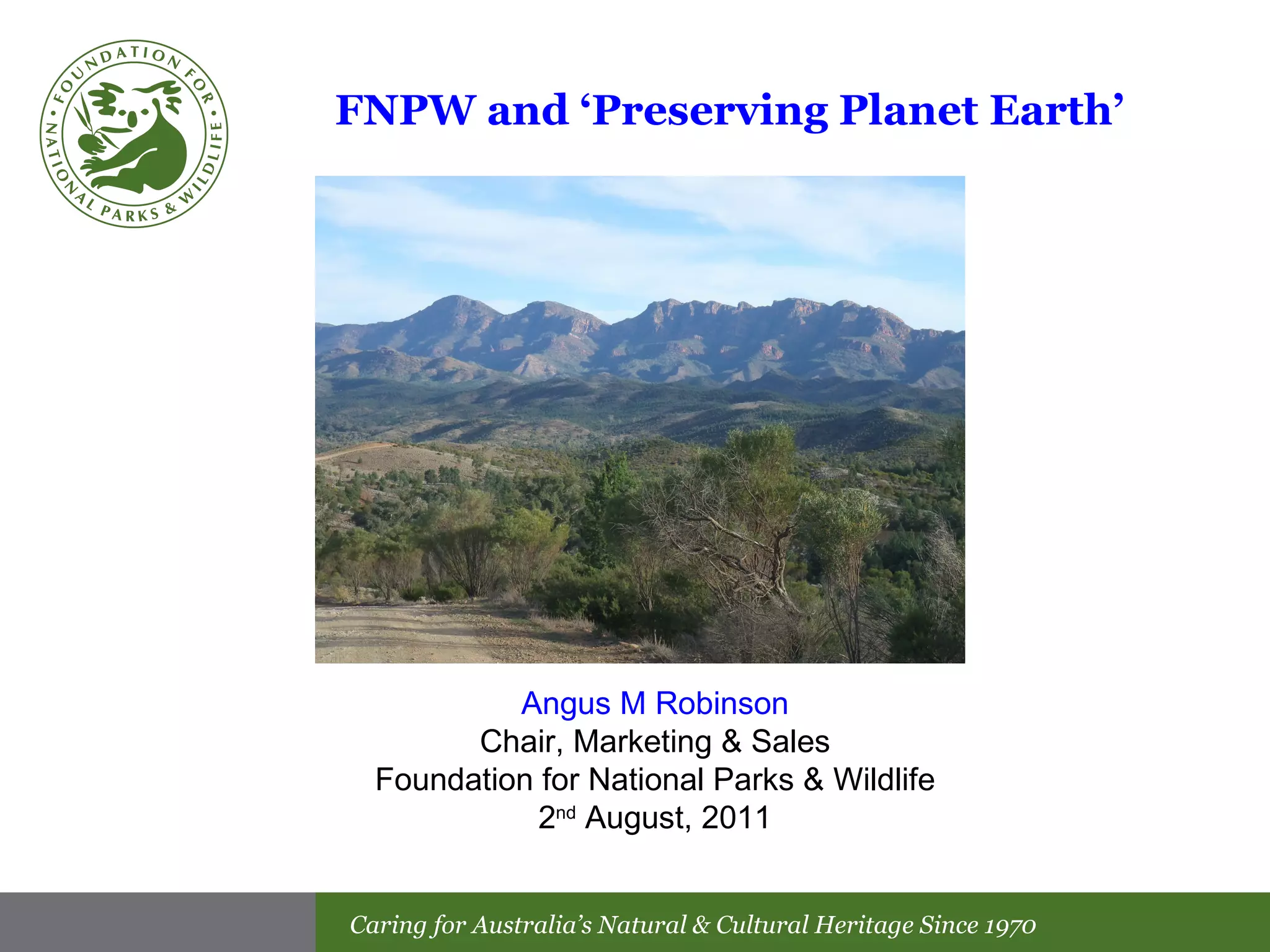
FNPW and ‘Preserving Planet Earth’ Angus M Robinson Chair, Marketing & Sales Foundation for National Parks & Wildlife 2 nd  August, 2011
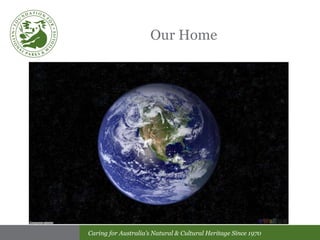
Our Home
Preserving Planet Earth! Urgent need for us all to start preserving  our only known liveable home  in the universe Preservation  not just conservation is becoming an imperative; our  entire natural environment is now under threat,  driven by over population and over development Much of Rotary’s international work relates to  natural disasters , increasingly related to  climate change  Rotary efforts are being directed to a wide range of  water projects  in developing countries The Rotary army  of over 1 million people organised in over 50,000 club units  can make the difference !
Today’s Agenda National Estate and  Natural Heritage About the mission of  the Foundation Land Acquisition  – a case study Habitat conservation  – Koala Tree Choice  Project Environmental Awareness  – the Backyard Buddies Program ‘ Preserve Planet Earth’ and  how Rotarians can participate
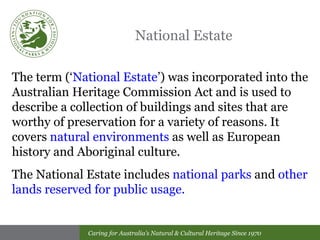
National Estate The term (‘ National Estate ’) was incorporated into the Australian Heritage Commission Act and is used to describe a collection of buildings and sites that are worthy of preservation for a variety of reasons. It covers  natural environments  as well as European history and Aboriginal culture. The National Estate includes  national parks  and  other lands reserved for public usage.
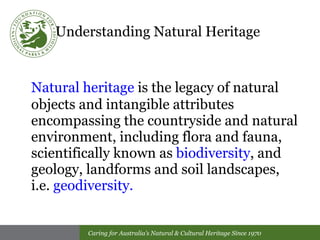
Understanding Natural Heritage   Natural heritage  is the legacy of natural objects and intangible attributes encompassing the countryside and natural environment, including flora and fauna, scientifically known as  biodiversity , and geology, landforms and soil landscapes,  i.e.  geodiversity.
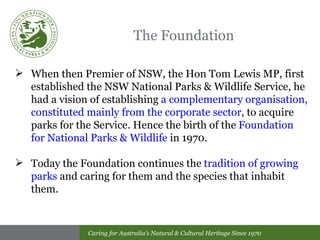
The Foundation When then Premier of NSW, the Hon Tom Lewis MP, first established the NSW National Parks & Wildlife Service, he had a vision of establishing  a complementary organisation, constituted mainly from the corporate sector , to acquire parks for the Service. Hence the birth of the  Foundation for National Parks & Wildlife  in 1970. Today the Foundation continues the  tradition of growing parks  and caring for them and the species that inhabit them.
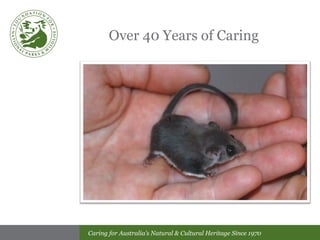
Over 40 Years of Caring
Vision The Foundation for National Parks & Wildlife aims to be Australia’s  foremost philanthropic partner for national parks .  We care for Australia’s natural and cultural heritage through  environmental education  and  conservation projects .
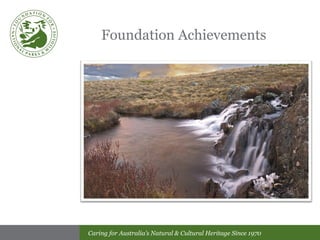
Foundation Achievements
1. Foundation Achievements In our history we have  added over 500,000 hectares  to Australia’s national reserve system, for the enjoyment of all. We  fund threatened species recovery programs . We have saved animals such as the  Lord Howe Island woodhen , Gould’s petrel and the yellow-footed rock-wallaby from extinction.
2. Foundation Achievements The Foundation  protects our heritage icons as sources of inspiration for future generations  of Australians and visitors from across the world.  Some examples of  cultural heritage  we have helped protect include the World Heritage Old Great North Road, Kosciuszko Historic Huts, Fort Denison, and  Mungo. Finally, we involve  the community in the conservation of Australia's native plants and animals through  environmental education.
Growing our National Parks
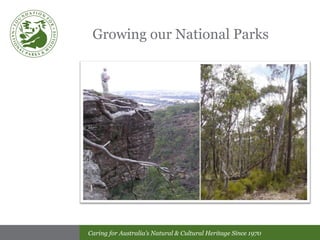
Growing Our National Parks Growing our parks is essential to  safeguard our natural heritage  for future Australians.  National Parks remain the core of our protected land  system.  The Foundation  continues to purchase suitable land to add to extend our national reserves  for future generations.
Growing Bongil Bongil National Park
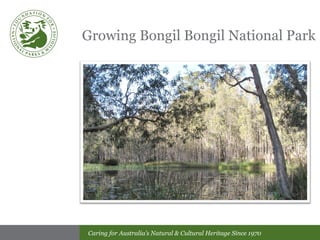
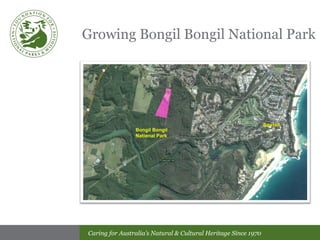
Growing Bongil Bongil NP 2010 saw the Foundation add  $550,000 worth of high  conservation land  to the Bongil Bongil National Park on the upper north coast of New South Wales. Five (5) threatened species  live on the 12.3 hectare  addition to Bongil Bongil including koalas, grey- headed flying-foxes, glossy black cockatoos, ospreys  and wallum froglets. This habitat will now be protected in perpetuity.
Growing Bongil Bongil National Park Bongil Bongil  National Park Sawtell
Growing Bongil Bongil NP The property also embraces  two endangered  ecological communities  – swamp sclerophyll  forest and freshwater wetlands on coastal floodplains. This land donation protects these valuable  ecological communities along with Bongil  Bongil’s existing estuaries, amazing beaches  and coastal rainforests.
Plants & Wildlife
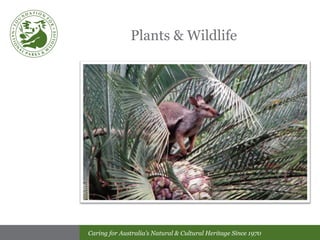
Plants & Wildlife Many of Australia’s species are in decline.  The Foundation also cares for the well-being of our unique Australian wildlife through feral pest control, captive breeding programs, and  monitoring surveys  e.g. the  Koala Tree  Choice project
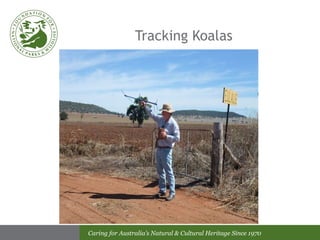
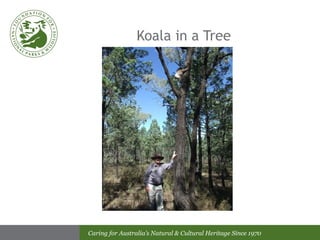
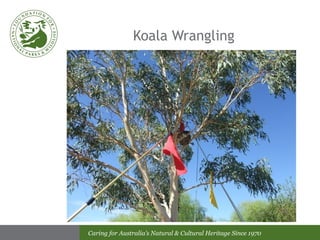
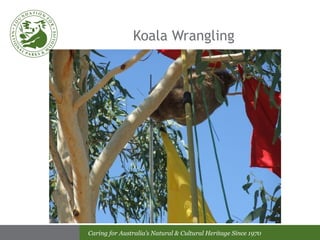
Koala Tree Choice Gunnedah Koalas are dependent on selecting the  right tree  in the  right place  at the  right time . The project seeks to explore the  direct effect of climate change on koalas  by examining which parts of the landscape and which tree species koalas use, and what condition they are in during a heatwave.
Koala Tree Choice Participants National Parks & Wildlife Service Gunnedah Research Centre Landcare NSW Inc University of Sydney School of Biological  Sciences & Veterinary School Foundation for National Parks & Wildlife
Gunnedah Natural Heritage Gunnedah Basin Permian Coal Measures and covered by Triassic sediments and rich volcanic derived soils – broad flood plains with class 1 to 5 soils Mixed dry land eucalypts and Pilliga Scrub varieties e.g. Cypress Pine, Casuarinas etc Macropods, koalas, profilic birdlife common – Koala Capital of Australia! European farming settlements, Dorothy Makellar, and indigenous culture (Kamilaroi peoples etc)
Tracking Koalas
Koala in a Tree
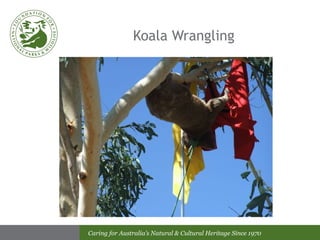
Koala Wrangling
Koala Wrangling
Koala Wrangling
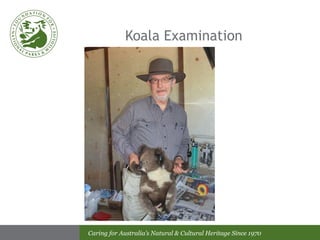
Koala Examination
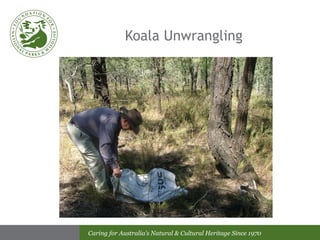
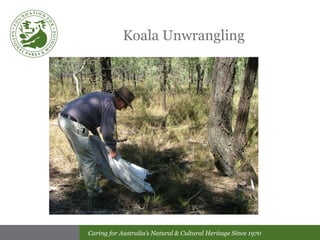
Koala Unwrangling
Koala Unwrangling
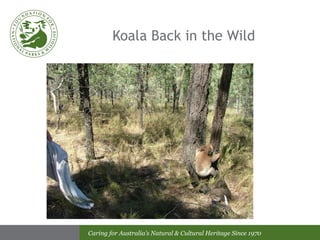
Koala Back in the Wild
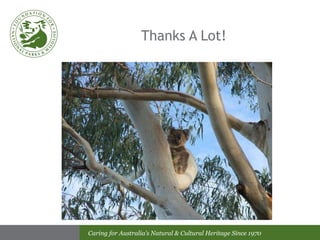
Thanks A Lot!
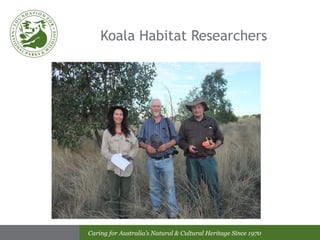
Koala Habitat Researchers
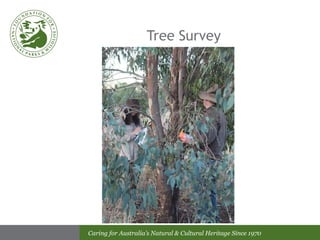
Tree Survey
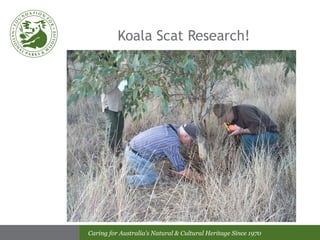
Koala Scat Research!
Koala Tree Choice Project  Outcomes Koala survival enhancement Improvement to native ecosystems through  intelligent  tree planting and clearing Enhanced knowledge for landholders – response to  climate change Improved coal mine site rehabilitation
Environmental Education – ‘Backyard Buddies’
Backyard Buddies  Our Backyard Buddies biodiversity education program  encourages the community to look after wildlife in their own backyards . It is making a real contribution by protecting local wildlife and biodiversity, and achieving environmental sustainability. There are over  15,000 Backyard Buddy members  who receive our monthly e-newsletter  full of interesting facts about backyard plants and animals and tips and ideas on how to attract them.
Backyard Buddies  Backyard Buddies has recently launched its own facebook page for members to talk about their buddies and  share their stories , ideas and photos. Last year our Backyard Buddies program raised more than $100,000.  This money was directed back into funding  some of our many ‘on the ground’  projects.
FNPW and Rotary One of RI’s programs is  ‘Preserve Planet Earth’.   In 2009,  Rotary E-Club One  won a district award for a 3 year sponsorship of a US/Australian collaboration program involving  conservation activities  by young people. Over the period 2008 -2010,  Rotary E-Club One  contributed funding towards the  Little Penguin wardens  program in Manly. RI Fellowship of  Birdwatching Rotarians  is considering sponsorship of an  FNPW program  to underpin their visit to the 2014 RI Conference in Sydney.
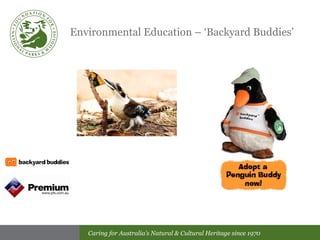
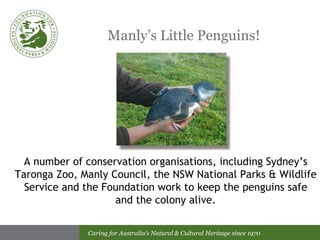
Manly’s Little Penguins! A number of conservation organisations, including Sydney’s Taronga Zoo, Manly Council, the NSW National Parks & Wildlife Service and the Foundation work to keep the penguins safe and the colony alive.
Other Sydneyside Projects Sydney Harbour Corporate Volunteering Identification of Endangered Flora, Botany Bay Coastal Saltmarsh & Mangrove Rehabilitation along Lane Cove River Botany Bay North Walking Track
Support the Foundation There are many ways Rotarians or a Rotary Club can support the Foundation: Make a  ‘One Off’ Donation Become a  Club Sponsor  of a local wildlife conservation project Stay informed  – encourage family members to sign up  to receive our  quarterly newsletter
Support the Foundation Our environment depends on people who care to fight for it. As a registered charity,  tax deductible donations primarily fund the Foundation’s activities . Our achievements result from the support we receive from committed individuals.  The Foundation  directs funds towards projects with tangible conservation outcomes  such as growing our national reserve system for the public, pest eradication programs and threatened species recovery and research projects.
For more Information about the Foundation Visit our website www.fnpw.org.au  and  sign up for our newsletter! Become our friend on Facebook www.facebook.com/fnpw.1970 www.facebook.com/backyardbuddies Follow us on twitter http://twitter.com/fnpw Call us (02) 9221 1949 Email [email_address]

FNPW and Preserving Planet Earth

  • 1.
    FNPW and ‘PreservingPlanet Earth’ Angus M Robinson Chair, Marketing & Sales Foundation for National Parks & Wildlife 2 nd August, 2011
  • 2.
  • 3.
    Preserving Planet Earth!Urgent need for us all to start preserving our only known liveable home in the universe Preservation not just conservation is becoming an imperative; our entire natural environment is now under threat, driven by over population and over development Much of Rotary’s international work relates to natural disasters , increasingly related to climate change Rotary efforts are being directed to a wide range of water projects in developing countries The Rotary army of over 1 million people organised in over 50,000 club units can make the difference !
  • 4.
    Today’s Agenda NationalEstate and Natural Heritage About the mission of the Foundation Land Acquisition – a case study Habitat conservation – Koala Tree Choice Project Environmental Awareness – the Backyard Buddies Program ‘ Preserve Planet Earth’ and how Rotarians can participate
  • 5.
    National Estate Theterm (‘ National Estate ’) was incorporated into the Australian Heritage Commission Act and is used to describe a collection of buildings and sites that are worthy of preservation for a variety of reasons. It covers natural environments as well as European history and Aboriginal culture. The National Estate includes national parks and other lands reserved for public usage.
  • 6.
    Understanding Natural Heritage Natural heritage is the legacy of natural objects and intangible attributes encompassing the countryside and natural environment, including flora and fauna, scientifically known as biodiversity , and geology, landforms and soil landscapes, i.e. geodiversity.
  • 7.
    The Foundation Whenthen Premier of NSW, the Hon Tom Lewis MP, first established the NSW National Parks & Wildlife Service, he had a vision of establishing a complementary organisation, constituted mainly from the corporate sector , to acquire parks for the Service. Hence the birth of the Foundation for National Parks & Wildlife in 1970. Today the Foundation continues the tradition of growing parks and caring for them and the species that inhabit them.
  • 8.
    Over 40 Yearsof Caring
  • 9.
    Vision The Foundationfor National Parks & Wildlife aims to be Australia’s foremost philanthropic partner for national parks . We care for Australia’s natural and cultural heritage through environmental education and conservation projects .
  • 10.
  • 11.
    1. Foundation AchievementsIn our history we have added over 500,000 hectares to Australia’s national reserve system, for the enjoyment of all. We fund threatened species recovery programs . We have saved animals such as the Lord Howe Island woodhen , Gould’s petrel and the yellow-footed rock-wallaby from extinction.
  • 12.
    2. Foundation AchievementsThe Foundation protects our heritage icons as sources of inspiration for future generations of Australians and visitors from across the world. Some examples of cultural heritage we have helped protect include the World Heritage Old Great North Road, Kosciuszko Historic Huts, Fort Denison, and Mungo. Finally, we involve the community in the conservation of Australia's native plants and animals through environmental education.
  • 13.
  • 14.
    Growing Our NationalParks Growing our parks is essential to safeguard our natural heritage for future Australians. National Parks remain the core of our protected land system. The Foundation continues to purchase suitable land to add to extend our national reserves for future generations.
  • 15.
    Growing Bongil BongilNational Park
  • 16.
    Growing Bongil BongilNP 2010 saw the Foundation add $550,000 worth of high conservation land to the Bongil Bongil National Park on the upper north coast of New South Wales. Five (5) threatened species live on the 12.3 hectare addition to Bongil Bongil including koalas, grey- headed flying-foxes, glossy black cockatoos, ospreys and wallum froglets. This habitat will now be protected in perpetuity.
  • 17.
    Growing Bongil BongilNational Park Bongil Bongil National Park Sawtell
  • 18.
    Growing Bongil BongilNP The property also embraces two endangered ecological communities – swamp sclerophyll forest and freshwater wetlands on coastal floodplains. This land donation protects these valuable ecological communities along with Bongil Bongil’s existing estuaries, amazing beaches and coastal rainforests.
  • 19.
  • 20.
    Plants & WildlifeMany of Australia’s species are in decline. The Foundation also cares for the well-being of our unique Australian wildlife through feral pest control, captive breeding programs, and monitoring surveys e.g. the Koala Tree Choice project
  • 21.
    Koala Tree ChoiceGunnedah Koalas are dependent on selecting the right tree in the right place at the right time . The project seeks to explore the direct effect of climate change on koalas by examining which parts of the landscape and which tree species koalas use, and what condition they are in during a heatwave.
  • 22.
    Koala Tree ChoiceParticipants National Parks & Wildlife Service Gunnedah Research Centre Landcare NSW Inc University of Sydney School of Biological Sciences & Veterinary School Foundation for National Parks & Wildlife
  • 23.
    Gunnedah Natural HeritageGunnedah Basin Permian Coal Measures and covered by Triassic sediments and rich volcanic derived soils – broad flood plains with class 1 to 5 soils Mixed dry land eucalypts and Pilliga Scrub varieties e.g. Cypress Pine, Casuarinas etc Macropods, koalas, profilic birdlife common – Koala Capital of Australia! European farming settlements, Dorothy Makellar, and indigenous culture (Kamilaroi peoples etc)
  • 24.
  • 25.
  • 26.
  • 27.
  • 28.
  • 29.
  • 30.
  • 31.
  • 32.
    Koala Back inthe Wild
  • 33.
  • 34.
  • 35.
  • 36.
  • 37.
    Koala Tree ChoiceProject Outcomes Koala survival enhancement Improvement to native ecosystems through intelligent tree planting and clearing Enhanced knowledge for landholders – response to climate change Improved coal mine site rehabilitation
  • 38.
    Environmental Education –‘Backyard Buddies’
  • 39.
    Backyard Buddies Our Backyard Buddies biodiversity education program encourages the community to look after wildlife in their own backyards . It is making a real contribution by protecting local wildlife and biodiversity, and achieving environmental sustainability. There are over 15,000 Backyard Buddy members who receive our monthly e-newsletter full of interesting facts about backyard plants and animals and tips and ideas on how to attract them.
  • 40.
    Backyard Buddies Backyard Buddies has recently launched its own facebook page for members to talk about their buddies and share their stories , ideas and photos. Last year our Backyard Buddies program raised more than $100,000. This money was directed back into funding some of our many ‘on the ground’ projects.
  • 41.
    FNPW and RotaryOne of RI’s programs is ‘Preserve Planet Earth’. In 2009, Rotary E-Club One won a district award for a 3 year sponsorship of a US/Australian collaboration program involving conservation activities by young people. Over the period 2008 -2010, Rotary E-Club One contributed funding towards the Little Penguin wardens program in Manly. RI Fellowship of Birdwatching Rotarians is considering sponsorship of an FNPW program to underpin their visit to the 2014 RI Conference in Sydney.
  • 42.
    Manly’s Little Penguins!A number of conservation organisations, including Sydney’s Taronga Zoo, Manly Council, the NSW National Parks & Wildlife Service and the Foundation work to keep the penguins safe and the colony alive.
  • 43.
    Other Sydneyside ProjectsSydney Harbour Corporate Volunteering Identification of Endangered Flora, Botany Bay Coastal Saltmarsh & Mangrove Rehabilitation along Lane Cove River Botany Bay North Walking Track
  • 44.
    Support the FoundationThere are many ways Rotarians or a Rotary Club can support the Foundation: Make a ‘One Off’ Donation Become a Club Sponsor of a local wildlife conservation project Stay informed – encourage family members to sign up to receive our quarterly newsletter
  • 45.
    Support the FoundationOur environment depends on people who care to fight for it. As a registered charity, tax deductible donations primarily fund the Foundation’s activities . Our achievements result from the support we receive from committed individuals. The Foundation directs funds towards projects with tangible conservation outcomes such as growing our national reserve system for the public, pest eradication programs and threatened species recovery and research projects.
  • 46.
    For more Informationabout the Foundation Visit our website www.fnpw.org.au and sign up for our newsletter! Become our friend on Facebook www.facebook.com/fnpw.1970 www.facebook.com/backyardbuddies Follow us on twitter http://twitter.com/fnpw Call us (02) 9221 1949 Email [email_address]

Editor's Notes

  • #26 Angus to add his personal experience about Koala wrangling.
  • #27 Angus to add his personal experience about Koala wrangling.
  • #28 Angus to add his personal experience about Koala wrangling.
  • #29 Angus to add his personal experience about Koala wrangling.
  • #30 Angus to add his personal experience about Koala wrangling.
  • #31 Angus to add his personal experience about Koala wrangling.
  • #32 Angus to add his personal experience about Koala wrangling.
  • #33 Angus to add his personal experience about Koala wrangling.
  • #34 Angus to add his personal experience about Koala wrangling.
  • #35 Angus to add his personal experience about Koala wrangling.
  • #36 Angus to add his personal experience about Koala wrangling.
  • #37 Angus to add his personal experience about Koala wrangling.
  • #38 When the then Premier of NSW, Tom Lewis, first established the NSW National Parks & Wildlife Service, he had a vision of establishing a complementary organisation, constituted mainly from the corporate sector, to acquire parks for the Service. This turned out to be the Foundation for National Parks & Wildlife.
  • #43 Angus to add his personal experience about Koala wrangling.
  • #44 Angus to add his personal experience about Koala wrangling.