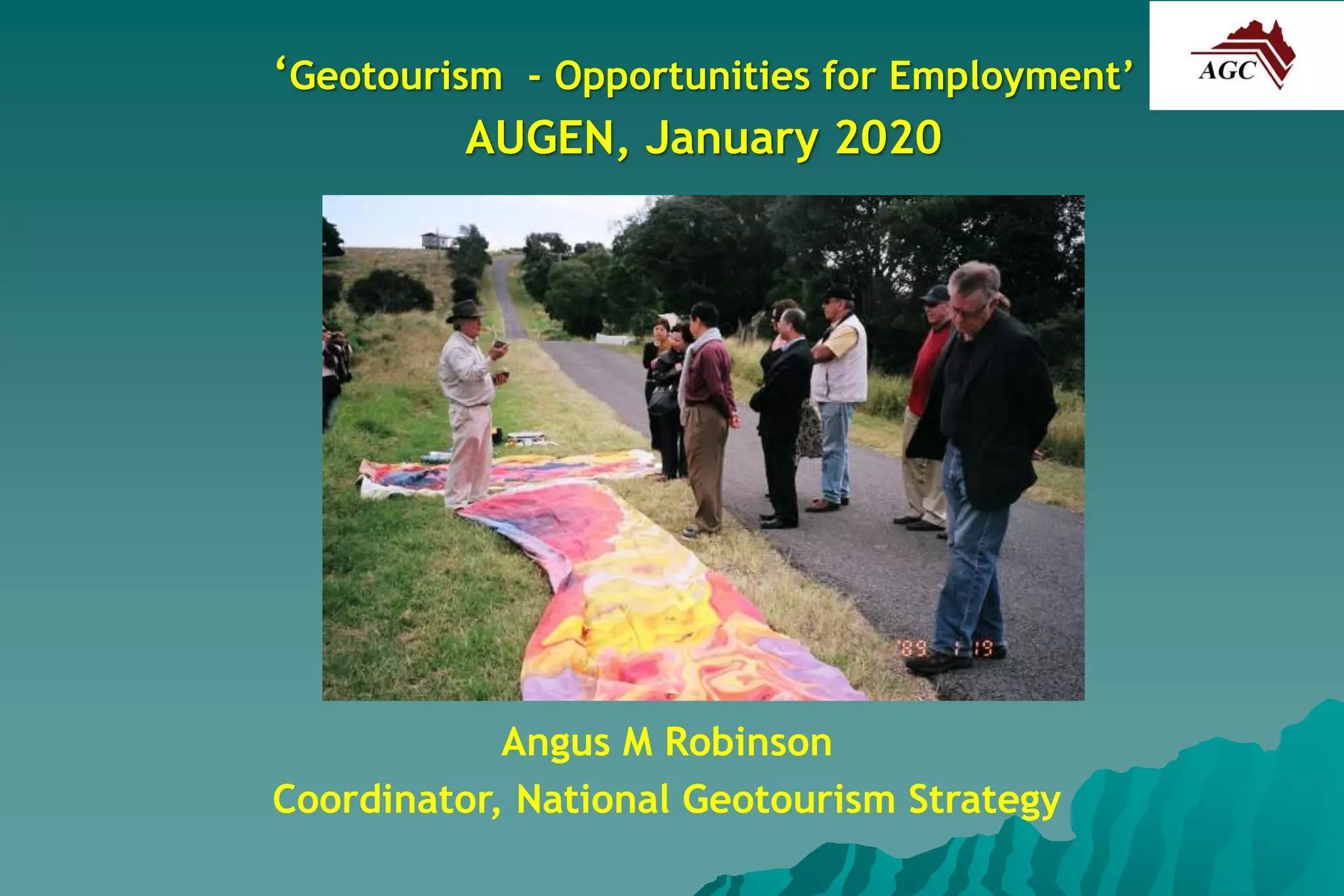
‘Geotourism - Opportunities for Employment’
AUGEN, January 2020
Angus M Robinson
Coordinator, National Geotourism Strategy
Australian Geoscience Council
 The Australian Geoscience Council (AGC) is the
peak Council of geoscientists in Australia
representing eight major Australian geoscientific
societies with a total membership of over 8,000
individuals.
 Under the current 2015-2020 Strategic Plan of
the AGC, and as a Geoscience advocacy
opportunity, the AGC has decided to formulate a
draft National Geotourism Strategy to
accommodate the orderly development of major
geotourism projects and activities in line with
overseas trends and domestic regional
development imperatives.
Today’s Agenda
 Understanding National Heritage
 Ecotourism and Geotourism
 National Geotourism Strategy Discussion Topics
 Geotrails
 Tourism Earth Sciences
 Geotourism and Employment Opportunities
 Take-Aways: Major Geotourism Development in
Australia
Understanding
Natural
Heritage
Natural heritage is the
legacy of natural objects
and intangible attributes
encompassing the
countryside and natural
environment, including flora
and fauna, scientifically
known as BIODIVERSITY, and
geology, landforms and soil
landscapes, i.e.
GEODIVERSITY (Geoheritage)
Ecotourism
&
Geotourism
Concepts
 Ecotourism is ecologically sustainable
tourism with a primary focus on
experiencing protected natural areas
that fosters environmental and
cultural understanding, appreciation
and conservation.
 But ecotourism per se is too narrowly
defined and is increasingly seen as a
niche market.
 However 'geotourism is holistic,
nature-based and cultural tourism
that focuses on an area's geology &
landscape as the platform for
providing visitor engagement,
learning and enjoyment'.
Ecotourism
&
Geotourism
Concepts
 Ecotourism is practised
predominantly in protected
areas such as national parks
whereas geotourism is
undertaken also in all areas
where primary industry
activities are being carried out.
 Unlike ecotourism, geotourism is
increasingly seen globally as an
instrument of regional economic
development.
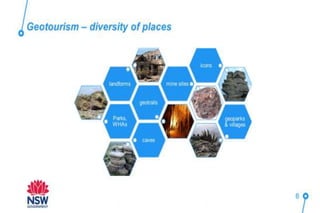
Geotourism
comprises the following features of both
natural and cultural heritage:
 Abiotic – non-living aspects such as the
climate & geology e.g. landscape and
landforms: GEODIVERSITY.
 Biotic – the living parts eg. fauna (animals)
and flora (plants): BIODIVERSITY.
 Cultural – past & present, indigenous and
post European settlement, non-living and
built.
Holistic in scope, geotourism is booming
globally and a key driver for tourism,
particularly in Europe and Asia.
Source: Professor Ross Dowling
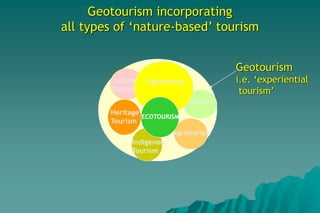
Geotourism incorporating
all types of ‘nature-based’ tourism
Sightseeing
Cuisine
Agritourism
Indigenous
Tourism
Heritage
Tourism
Cultural
Tourism
ECOTOURISM
Geotourism
i.e. ‘experiential
tourism’
9
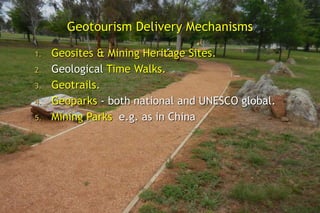
Geotourism Delivery Mechanisms
1. Geosites & Mining Heritage Sites.
2. Geological Time Walks.
3. Geotrails.
4. Geoparks - both national and UNESCO global.
5. Mining Parks e.g. as in China
National
Geotourism
Strategy –
Discussion
Topics
1. Geotourism as a means of celebrating
geoheritage.
2. Enhanced coordination nationally of
geoheritage listings.
3. Establishment of a national set of
administrative procedures for
‘georegional’ assessment.
4. New geotrail development.
5. Geotourism to strengthen Australia’s
international geoscience standing.
6. Training of geologists to improve
communication skills for geosite
interpretation.
7. Collaboration with providers of other
areas of natural (bioregion) and cultural
(particularly MINING) heritage content.
National
Geotourism
Strategy –
Topic #1
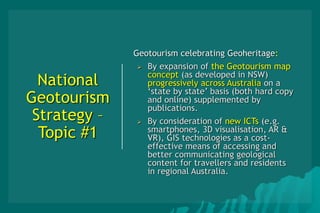
Geotourism celebrating Geoheritage:
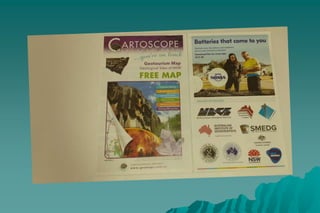
 By expansion of the Geotourism map
concept (as developed in NSW)
progressively across Australia on a
‘state by state’ basis (both hard copy
and online) supplemented by
publications.
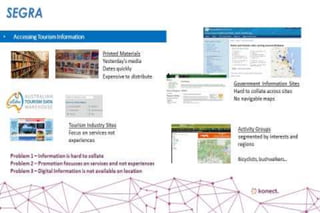
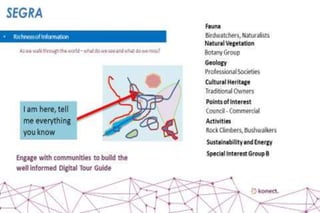
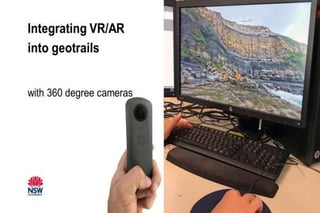
 By consideration of new ICTs (e.g.
smartphones, 3D visualisation, AR &
VR), GIS technologies as a cost-
effective means of accessing and
better communicating geological
content for travellers and residents
in regional Australia.
National
Geotourism
Strategy –
Topic #2
Enhanced coordination nationally of
geoheritage listings with the objective of
highlighting areas of both geotourism value
and geosites that need to be protected,
given that
 the right balance needs to be
determined between the needs of
exposing geosites for public visitation
and geoconservation needs, and
 there are no national standards or
guidelines with each state/territory
having different strategies and systems
for recording geoheritage.
•
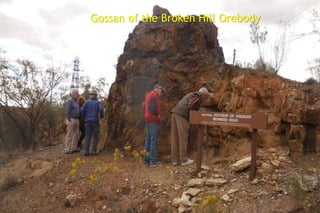
Gossan of the Broken Hill Orebody
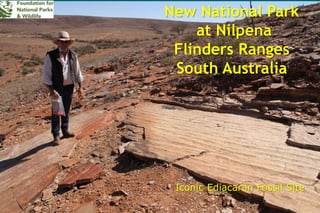
New National Park
at Nilpena
Flinders Ranges
South Australia
Iconic Ediacaran Fossil Site
National
Geotourism
Strategy –
Topic #3
Establishment of a national set
of administrative procedures for
‘georegional’ assessment to
provide for potential geopark
nominations at state and
national levels and, as approved
by governments, at a UNESCO
Global Geopark level.
Georegions,
Geotrails
and
Geoparks
 In large regional areas such as the
Murchison in Western Australia, the
Mid West Development Commission
and local councils are undertaking a
‘georegional’ assessment.
 Including the determination of the
most viable geotourism delivery
mechanism available.
 In the first instance this is focused
on geotrail development.
 This may lead to the identification
of an area suitable for geopark
development, subject to State
Government approval.
Major
Geotourism
Development
in Australia
 More focus needs to be applied to
communicating the ‘georegional’
nature of geotourism.
 Preferred focus first on geotrail
development.
 Any emerging geopark proposals must
be supported by Geological Surveys.
 More time must be allowed to gain
community engagement/support to
ensure geopark sustainability.
 Need to compile and promote
quantifiable data and analysis to
establish socio-economic benefit.
National
Geotourism
Strategy –
Topic #4
New Geotrail Development:
individual geological surveys from
the States and Territories be invited
to engage, on an ‘as needs’ basis,
and in collaboration with
university/museum interest groups
as well as with state/territory
divisions and branches of the
interested professional societies, to
review the suitability of existing
roads, bushwalks, biking and rail
trails as potential geotrails.
Geotourism
and
Regional
Development
 Regional development imperatives
(growth and jobs) are now driving
geotourism initiatives in Australia.
 Creating geotrails is arguably the
easiest way of providing early
pathways and support from
governments for geotourism
activities in Australia.
 Successful roll-out of geotrails will
instill confidence in geotourism,
providing a future pathway to
geopark establishment and
development in Australia.
Why
Geotrails?
 Relates directly to the tourism
experience of a journey linking
destinations.
 In Australia, unlike geoparks,
geotrails have widespread appeal,
and do not compete with or impact
on land management/access issues.
 Geotrails are relatively easy to
establish and represent a very cost-
effective means of enhancing
regional development.
 Can form the basis of a 'defacto
geopark'.
Best
Practice
Geotrails
 Should be constructed around
routes currently used by
tourists; geotrails should form
logical journeys linking
accommodation destinations.
 Should meld the geological
heritage features of a region
with a cohesive STORY.
 Should incorporate and package
in the biodiversity and cultural
components (including mining
heritage) of the region through
which the geotrail traverses.
Current & Potential Major Geotrail Projects in Australia
1. Tasmania - West Coast Geotrail, Furneaux Geotrail.
2. Queensland - Savannah Way, Dig the Tropics, Boulder Opal
(Western Queensland).
3. Victoria/SA - Kanawinka, Great Ocean Road.
4. South Australia - Brachina Gorge, Great Central Geotrail
Proposal.
5. Western Australia - Murchison Proposal.
6. New South Wales - Volcano geotrail proposal (Warrumbungle)
7. Northern Territory – Range of new proposals (Mark Asendorf).
Plus a wide range of smaller, dedicated geotrails along
walking tracks, old rail easements etc. being developed in
NSW (e.g. various Riverina Rail Trail projects), Tasmania, Qld,
WA and SA; and river trails (e.g. Darling River Run).
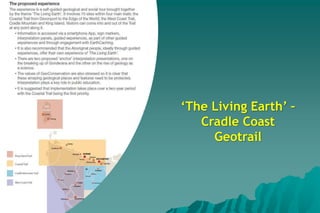
‘The Living Earth’ –
Cradle Coast
Geotrail
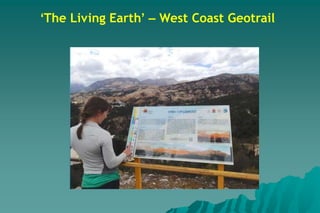
‘The Living Earth’ – West Coast Geotrail
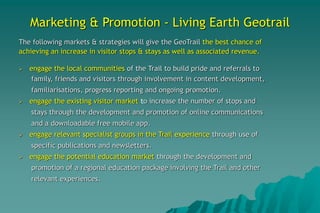
Marketing & Promotion - Living Earth Geotrail
The following markets & strategies will give the GeoTrail the best chance of
achieving an increase in visitor stops & stays as well as associated revenue.
 engage the local communities of the Trail to build pride and referrals to
family, friends and visitors through involvement in content development,
familiarisations, progress reporting and ongoing promotion.
 engage the existing visitor market to increase the number of stops and
stays through the development and promotion of online communications
and a downloadable free mobile app.
 engage relevant specialist groups in the Trail experience through use of
specific publications and newsletters.
 engage the potential education market through the development and
promotion of a regional education package involving the Trail and other
relevant experiences.
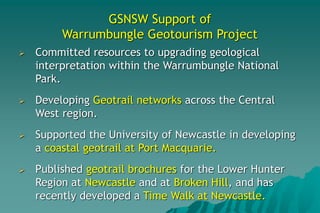
GSNSW Support of
Warrumbungle Geotourism Project
 Committed resources to upgrading geological
interpretation within the Warrumbungle National
Park.
 Developing Geotrail networks across the Central
West region.
 Supported the University of Newcastle in developing
a coastal geotrail at Port Macquarie.
 Published geotrail brochures for the Lower Hunter
Region at Newcastle and at Broken Hill, and has
recently developed a Time Walk at Newcastle.
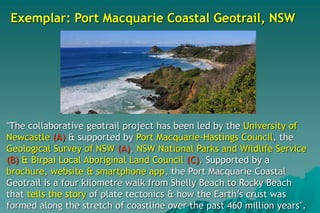
Exemplar: Port Macquarie Coastal Geotrail, NSW
"The collaborative geotrail project has been led by the University of
Newcastle (A) & supported by Port Macquarie-Hastings Council, the
Geological Survey of NSW (A), NSW National Parks and Wildlife Service
(B) & Birpai Local Aboriginal Land Council (C). Supported by a
brochure, website & smartphone app, the Port Macquarie Coastal
Geotrail is a four kilometre walk from Shelly Beach to Rocky Beach
that tells the story of plate tectonics & how the Earth’s crust was
formed along the stretch of coastline over the past 460 million years".
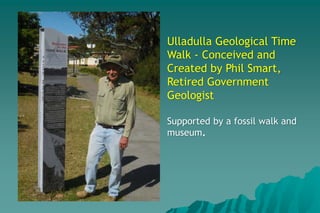
Ulladulla Geological Time
Walk - Conceived and
Created by Phil Smart,
Retired Government
Geologist
Supported by a fossil walk and
museum.
National
Geotourism
Strategy –
Topic #5
Using geotourism to strengthen
Australia’s international geoscience
standing
 and enhance its influence for the
long- term benefits of Australian
geoscientists through the
establishment of sister park, sister
museum/rock garden, sister
geological and mining heritage sites
relationships, particularly with China
and countries in the Asia-Pacific
region.
 Also relevant for countries that enjoy
‘Gondwana age’ geological
relationships with Australia.
Australia-China Memorandum of Cooperation
The GSA and the Geological Society of China
Executed June 2016
 The Australia-China relationship is becoming more
important with the increasing level of economic,
social and cultural activities in the coming decades.
 The Memorandum of Cooperation will be focused
on growing and enhancing best practice nature-
based tourism (i.e. geotourism) in both countries.
 Tourism park managers could play a significant role
in establishing ‘sister’ relationships between parks,
as a key driver of future geotourism.
National
Geotourism
Strategy –
Topic #6
Professional development
opportunities for geoscientists
wishing to develop content
interpretation and tour guiding skills
for enhanced interaction with the
public by
 engagement with the Savannah
Guides organisation, the
professional group - Interpretation
Australia, and
 using best practice audio and
multimedia technologies.
Tourism Earth Sciences - Definition
 Originating in China in the 1980s, a multi-disciplinary
academic subject adopting knowledge and
methodology of Earth Sciences to understand, study,
plan, protect and utilise tourism resources.
 A new branch of Earth Sciences to study tourism,
leisure, and their relationship with the composition,
structures, energy movement and changes of Earth’s
surface. It includes tourism environments involving
geology and geography and therefore is a fusion of
tourism geology and tourism geography.
Tourism Earth Sciences - Opportunities
 Education & research
 Geoparks and geoconservation
 Tourism – national parks, tour guides
 Economic development – UNESCO Global Geoparks,
World Bank, AuSAID, regional development agencies
National
Geotourism
Strategy –
Topic #7
Mechanisms for collaboration
with providers of other areas of
natural (bioregion) and cultural
heritage content,
 inclusive of mining and
resource industry heritage
(e.g. mining companies,
geological and mining
museums, historical
societies,
 as well as specialist groups
with interests in flora and
fauna etc.)
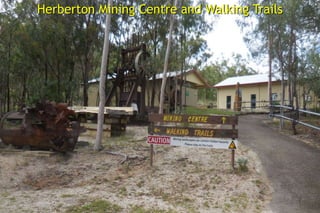
Jinguashi Gold Ecological Park, Taiwan
Herberton Mining Centre and Walking Trails
The Mineral Exploration/Geotourism Interface
 Exploring the opportunity for discovery.
 Love of landscapes/great outdoors/travel.
 Satisfying project work with challenges.
 Learning new skills and knowledge.
 Educating/enthusing others in an outdoor
environment - quite different from the
museum experience.
Where is the Gold in Geotourism?
 New domestic employment and consulting opportunities
for geoscientists - interpretation signage/boards, design
of geotrails etc; particularly important during mining
exploration downturns.
 Consulting opportunities in developing countries where
geoparks are now being nominated and developed.
 Management roles in geoparks, regional development and
local government agencies.
 Increased revenues for regions and local communities.
 Opportunity for geology related interests during early
retirement.
Take-Aways:
Major
Geotourism
Development
in Australia
 The State and Territory Chief
Government Geologists are
considering a proposed ‘way
forward’ based on these
discussion topics as identified by
the Australian Geoscience
Council (AGC).
 It is hoped that priority may be
able to be given to making a
start on implementing these
recommended measures in
collaboration with the
constituent member societies of
the AGC.
 The AGC remains confident that
a national geotourism strategy
can start to emerge during 2020.
Take-Aways
 Significant geotourism initiatives are emerging
globally and in Australia.
 Geotourism development will in time necessitate the
employment of geoscientists.
 Careers in geotourism can complement employment
in mining and exploration.
 University Earth Science Faculties should consider
introducing Tourism Earth Science as a curricular
option, but include geomorphology as a core subject.
Contact Details
angus@leisuresolutions.com.au
Tel: 0418 488 340
https://www.slideshare.net/leisuresolutions
http://www.leisuresolutions.com.au/index.php/geotourism-industry-groups/
Information about Australian Geotourism and Geopark Development Activities
http://www.agc.org.au/geoscience-in-australia/geotourism/
Australian Geoscience Council

Augen2020

  • 1.
    ‘Geotourism - Opportunitiesfor Employment’ AUGEN, January 2020 Angus M Robinson Coordinator, National Geotourism Strategy
  • 2.
    Australian Geoscience Council The Australian Geoscience Council (AGC) is the peak Council of geoscientists in Australia representing eight major Australian geoscientific societies with a total membership of over 8,000 individuals.  Under the current 2015-2020 Strategic Plan of the AGC, and as a Geoscience advocacy opportunity, the AGC has decided to formulate a draft National Geotourism Strategy to accommodate the orderly development of major geotourism projects and activities in line with overseas trends and domestic regional development imperatives.
  • 3.
    Today’s Agenda  UnderstandingNational Heritage  Ecotourism and Geotourism  National Geotourism Strategy Discussion Topics  Geotrails  Tourism Earth Sciences  Geotourism and Employment Opportunities  Take-Aways: Major Geotourism Development in Australia
  • 4.
    Understanding Natural Heritage Natural heritage isthe legacy of natural objects and intangible attributes encompassing the countryside and natural environment, including flora and fauna, scientifically known as BIODIVERSITY, and geology, landforms and soil landscapes, i.e. GEODIVERSITY (Geoheritage)
  • 5.
    Ecotourism & Geotourism Concepts  Ecotourism isecologically sustainable tourism with a primary focus on experiencing protected natural areas that fosters environmental and cultural understanding, appreciation and conservation.  But ecotourism per se is too narrowly defined and is increasingly seen as a niche market.  However 'geotourism is holistic, nature-based and cultural tourism that focuses on an area's geology & landscape as the platform for providing visitor engagement, learning and enjoyment'.
  • 6.
    Ecotourism & Geotourism Concepts  Ecotourism ispractised predominantly in protected areas such as national parks whereas geotourism is undertaken also in all areas where primary industry activities are being carried out.  Unlike ecotourism, geotourism is increasingly seen globally as an instrument of regional economic development.
  • 7.
    Geotourism comprises the followingfeatures of both natural and cultural heritage:  Abiotic – non-living aspects such as the climate & geology e.g. landscape and landforms: GEODIVERSITY.  Biotic – the living parts eg. fauna (animals) and flora (plants): BIODIVERSITY.  Cultural – past & present, indigenous and post European settlement, non-living and built. Holistic in scope, geotourism is booming globally and a key driver for tourism, particularly in Europe and Asia. Source: Professor Ross Dowling
  • 8.
    Geotourism incorporating all typesof ‘nature-based’ tourism Sightseeing Cuisine Agritourism Indigenous Tourism Heritage Tourism Cultural Tourism ECOTOURISM Geotourism i.e. ‘experiential tourism’
  • 9.
  • 10.
    Geotourism Delivery Mechanisms 1.Geosites & Mining Heritage Sites. 2. Geological Time Walks. 3. Geotrails. 4. Geoparks - both national and UNESCO global. 5. Mining Parks e.g. as in China
  • 11.
    National Geotourism Strategy – Discussion Topics 1. Geotourismas a means of celebrating geoheritage. 2. Enhanced coordination nationally of geoheritage listings. 3. Establishment of a national set of administrative procedures for ‘georegional’ assessment. 4. New geotrail development. 5. Geotourism to strengthen Australia’s international geoscience standing. 6. Training of geologists to improve communication skills for geosite interpretation. 7. Collaboration with providers of other areas of natural (bioregion) and cultural (particularly MINING) heritage content.
  • 12.
    National Geotourism Strategy – Topic #1 Geotourismcelebrating Geoheritage:  By expansion of the Geotourism map concept (as developed in NSW) progressively across Australia on a ‘state by state’ basis (both hard copy and online) supplemented by publications.  By consideration of new ICTs (e.g. smartphones, 3D visualisation, AR & VR), GIS technologies as a cost- effective means of accessing and better communicating geological content for travellers and residents in regional Australia.
  • 17.
    National Geotourism Strategy – Topic #2 Enhancedcoordination nationally of geoheritage listings with the objective of highlighting areas of both geotourism value and geosites that need to be protected, given that  the right balance needs to be determined between the needs of exposing geosites for public visitation and geoconservation needs, and  there are no national standards or guidelines with each state/territory having different strategies and systems for recording geoheritage. •
  • 18.
    Gossan of theBroken Hill Orebody
  • 19.
    New National Park atNilpena Flinders Ranges South Australia Iconic Ediacaran Fossil Site
  • 20.
    National Geotourism Strategy – Topic #3 Establishmentof a national set of administrative procedures for ‘georegional’ assessment to provide for potential geopark nominations at state and national levels and, as approved by governments, at a UNESCO Global Geopark level.
  • 21.
    Georegions, Geotrails and Geoparks  In largeregional areas such as the Murchison in Western Australia, the Mid West Development Commission and local councils are undertaking a ‘georegional’ assessment.  Including the determination of the most viable geotourism delivery mechanism available.  In the first instance this is focused on geotrail development.  This may lead to the identification of an area suitable for geopark development, subject to State Government approval.
  • 22.
    Major Geotourism Development in Australia  Morefocus needs to be applied to communicating the ‘georegional’ nature of geotourism.  Preferred focus first on geotrail development.  Any emerging geopark proposals must be supported by Geological Surveys.  More time must be allowed to gain community engagement/support to ensure geopark sustainability.  Need to compile and promote quantifiable data and analysis to establish socio-economic benefit.
  • 23.
    National Geotourism Strategy – Topic #4 NewGeotrail Development: individual geological surveys from the States and Territories be invited to engage, on an ‘as needs’ basis, and in collaboration with university/museum interest groups as well as with state/territory divisions and branches of the interested professional societies, to review the suitability of existing roads, bushwalks, biking and rail trails as potential geotrails.
  • 24.
    Geotourism and Regional Development  Regional developmentimperatives (growth and jobs) are now driving geotourism initiatives in Australia.  Creating geotrails is arguably the easiest way of providing early pathways and support from governments for geotourism activities in Australia.  Successful roll-out of geotrails will instill confidence in geotourism, providing a future pathway to geopark establishment and development in Australia.
  • 25.
    Why Geotrails?  Relates directlyto the tourism experience of a journey linking destinations.  In Australia, unlike geoparks, geotrails have widespread appeal, and do not compete with or impact on land management/access issues.  Geotrails are relatively easy to establish and represent a very cost- effective means of enhancing regional development.  Can form the basis of a 'defacto geopark'.
  • 26.
    Best Practice Geotrails  Should beconstructed around routes currently used by tourists; geotrails should form logical journeys linking accommodation destinations.  Should meld the geological heritage features of a region with a cohesive STORY.  Should incorporate and package in the biodiversity and cultural components (including mining heritage) of the region through which the geotrail traverses.
  • 27.
    Current & PotentialMajor Geotrail Projects in Australia 1. Tasmania - West Coast Geotrail, Furneaux Geotrail. 2. Queensland - Savannah Way, Dig the Tropics, Boulder Opal (Western Queensland). 3. Victoria/SA - Kanawinka, Great Ocean Road. 4. South Australia - Brachina Gorge, Great Central Geotrail Proposal. 5. Western Australia - Murchison Proposal. 6. New South Wales - Volcano geotrail proposal (Warrumbungle) 7. Northern Territory – Range of new proposals (Mark Asendorf). Plus a wide range of smaller, dedicated geotrails along walking tracks, old rail easements etc. being developed in NSW (e.g. various Riverina Rail Trail projects), Tasmania, Qld, WA and SA; and river trails (e.g. Darling River Run).
  • 28.
    ‘The Living Earth’– Cradle Coast Geotrail
  • 29.
    ‘The Living Earth’– West Coast Geotrail
  • 30.
    Marketing & Promotion- Living Earth Geotrail The following markets & strategies will give the GeoTrail the best chance of achieving an increase in visitor stops & stays as well as associated revenue.  engage the local communities of the Trail to build pride and referrals to family, friends and visitors through involvement in content development, familiarisations, progress reporting and ongoing promotion.  engage the existing visitor market to increase the number of stops and stays through the development and promotion of online communications and a downloadable free mobile app.  engage relevant specialist groups in the Trail experience through use of specific publications and newsletters.  engage the potential education market through the development and promotion of a regional education package involving the Trail and other relevant experiences.
  • 31.
    GSNSW Support of WarrumbungleGeotourism Project  Committed resources to upgrading geological interpretation within the Warrumbungle National Park.  Developing Geotrail networks across the Central West region.  Supported the University of Newcastle in developing a coastal geotrail at Port Macquarie.  Published geotrail brochures for the Lower Hunter Region at Newcastle and at Broken Hill, and has recently developed a Time Walk at Newcastle.
  • 32.
    Exemplar: Port MacquarieCoastal Geotrail, NSW "The collaborative geotrail project has been led by the University of Newcastle (A) & supported by Port Macquarie-Hastings Council, the Geological Survey of NSW (A), NSW National Parks and Wildlife Service (B) & Birpai Local Aboriginal Land Council (C). Supported by a brochure, website & smartphone app, the Port Macquarie Coastal Geotrail is a four kilometre walk from Shelly Beach to Rocky Beach that tells the story of plate tectonics & how the Earth’s crust was formed along the stretch of coastline over the past 460 million years".
  • 33.
    Ulladulla Geological Time Walk- Conceived and Created by Phil Smart, Retired Government Geologist Supported by a fossil walk and museum.
  • 34.
    National Geotourism Strategy – Topic #5 Usinggeotourism to strengthen Australia’s international geoscience standing  and enhance its influence for the long- term benefits of Australian geoscientists through the establishment of sister park, sister museum/rock garden, sister geological and mining heritage sites relationships, particularly with China and countries in the Asia-Pacific region.  Also relevant for countries that enjoy ‘Gondwana age’ geological relationships with Australia.
  • 35.
    Australia-China Memorandum ofCooperation The GSA and the Geological Society of China Executed June 2016  The Australia-China relationship is becoming more important with the increasing level of economic, social and cultural activities in the coming decades.  The Memorandum of Cooperation will be focused on growing and enhancing best practice nature- based tourism (i.e. geotourism) in both countries.  Tourism park managers could play a significant role in establishing ‘sister’ relationships between parks, as a key driver of future geotourism.
  • 36.
    National Geotourism Strategy – Topic #6 Professionaldevelopment opportunities for geoscientists wishing to develop content interpretation and tour guiding skills for enhanced interaction with the public by  engagement with the Savannah Guides organisation, the professional group - Interpretation Australia, and  using best practice audio and multimedia technologies.
  • 37.
    Tourism Earth Sciences- Definition  Originating in China in the 1980s, a multi-disciplinary academic subject adopting knowledge and methodology of Earth Sciences to understand, study, plan, protect and utilise tourism resources.  A new branch of Earth Sciences to study tourism, leisure, and their relationship with the composition, structures, energy movement and changes of Earth’s surface. It includes tourism environments involving geology and geography and therefore is a fusion of tourism geology and tourism geography.
  • 38.
    Tourism Earth Sciences- Opportunities  Education & research  Geoparks and geoconservation  Tourism – national parks, tour guides  Economic development – UNESCO Global Geoparks, World Bank, AuSAID, regional development agencies
  • 39.
    National Geotourism Strategy – Topic #7 Mechanismsfor collaboration with providers of other areas of natural (bioregion) and cultural heritage content,  inclusive of mining and resource industry heritage (e.g. mining companies, geological and mining museums, historical societies,  as well as specialist groups with interests in flora and fauna etc.)
  • 40.
    Jinguashi Gold EcologicalPark, Taiwan Herberton Mining Centre and Walking Trails
  • 42.
    The Mineral Exploration/GeotourismInterface  Exploring the opportunity for discovery.  Love of landscapes/great outdoors/travel.  Satisfying project work with challenges.  Learning new skills and knowledge.  Educating/enthusing others in an outdoor environment - quite different from the museum experience.
  • 43.
    Where is theGold in Geotourism?  New domestic employment and consulting opportunities for geoscientists - interpretation signage/boards, design of geotrails etc; particularly important during mining exploration downturns.  Consulting opportunities in developing countries where geoparks are now being nominated and developed.  Management roles in geoparks, regional development and local government agencies.  Increased revenues for regions and local communities.  Opportunity for geology related interests during early retirement.
  • 44.
    Take-Aways: Major Geotourism Development in Australia  TheState and Territory Chief Government Geologists are considering a proposed ‘way forward’ based on these discussion topics as identified by the Australian Geoscience Council (AGC).  It is hoped that priority may be able to be given to making a start on implementing these recommended measures in collaboration with the constituent member societies of the AGC.  The AGC remains confident that a national geotourism strategy can start to emerge during 2020.
  • 45.
    Take-Aways  Significant geotourisminitiatives are emerging globally and in Australia.  Geotourism development will in time necessitate the employment of geoscientists.  Careers in geotourism can complement employment in mining and exploration.  University Earth Science Faculties should consider introducing Tourism Earth Science as a curricular option, but include geomorphology as a core subject.
  • 46.
    Contact Details angus@leisuresolutions.com.au Tel: 0418488 340 https://www.slideshare.net/leisuresolutions http://www.leisuresolutions.com.au/index.php/geotourism-industry-groups/ Information about Australian Geotourism and Geopark Development Activities http://www.agc.org.au/geoscience-in-australia/geotourism/ Australian Geoscience Council